
Submitted:
13 August 2026
Posted:
14 August 2026
You are already at the latest version
Abstract
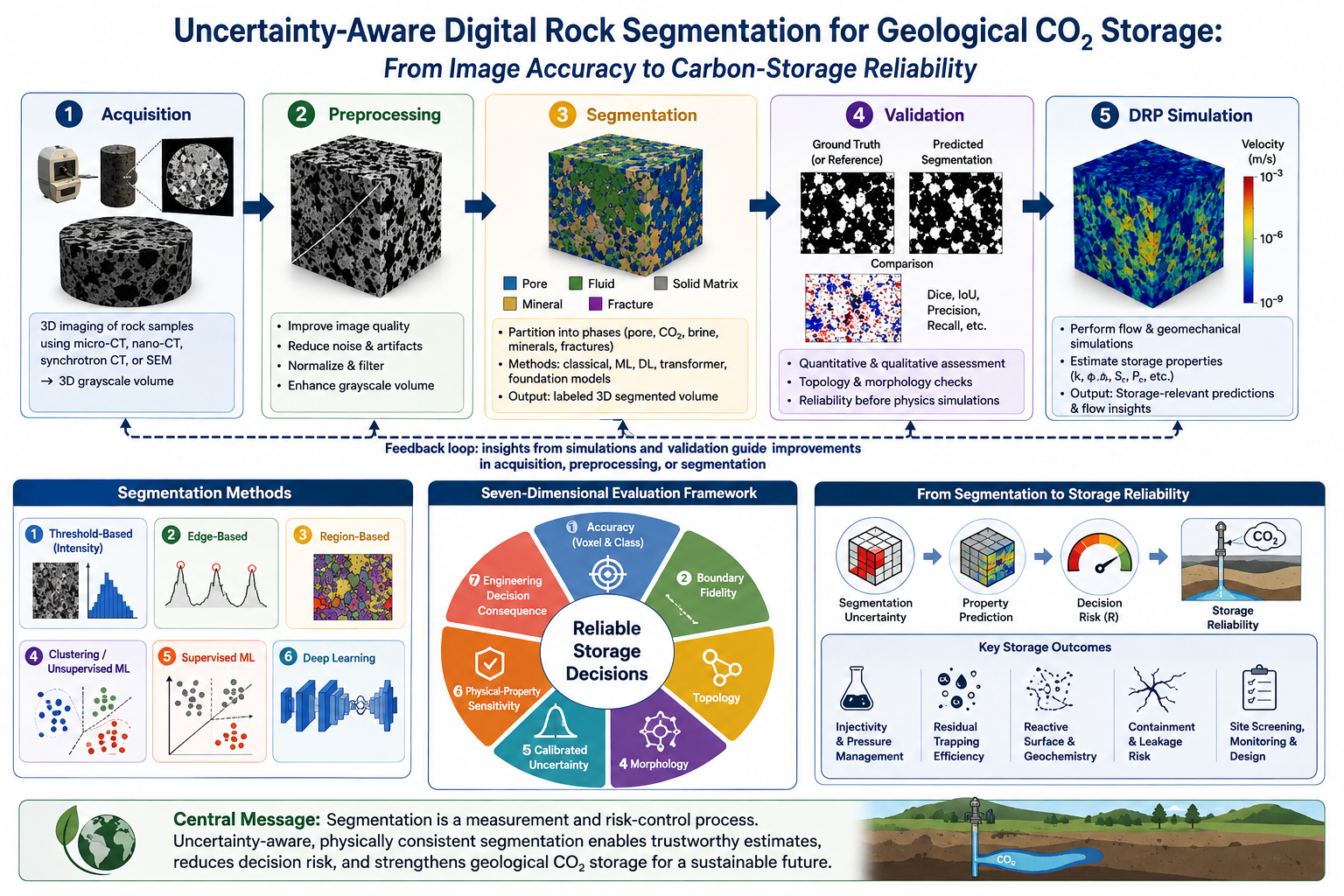
Geological CO₂ storage is essential to pathways to carbon neutrality, but its deployment depends on trustworthy estimates of storage capacity, injectivity, trapping, reactive evolution, and containment. Digital rock physics can provide these estimates from X-ray and electron microscopy images, yet every result depends on image segmentation, which converts grayscale data into pore, mineral, fracture, and fluid phases. This review evaluates classical methods, machine learning, deep learning, transformers, and foundation models according to whether they support reliable storage decisions rather than image overlap scores alone. Evidence is synthesized from imaging of dry rocks, CO₂–brine experiments, multiscale studies of carbonates and shales, and analyses of fractured rocks. We introduce a framework with seven dimensions: class accuracy, boundary fidelity, topology, morphology, calibrated uncertainty, sensitivity of physical properties, and consequences for engineering decisions. The evidence shows that visually similar segmentations can yield substantially different predictions of permeability, connected porosity, residual trapping, reactive surface area, and leakage paths when errors occur at critical pore throats, fluid interfaces, or fractures. We therefore recommend selecting methods according to storage task and lithology, validating them on independent samples, propagating ensembles of plausible segmentations, using metrics that account for topology, and comparing predictions with laboratory measurements. The central message is simple: segmentation should be treated as both a measurement process and a form of risk control. Segmentation with auditable and quantified uncertainty can reduce false site acceptance or rejection, improve injection and monitoring design, and strengthen geological CO₂ storage as a technology for carbon neutrality.
Keywords:
geological CO₂ storage
; carbon neutrality
; digital rock physics
; image segmentation
; micro-computed tomography
; uncertainty quantification
; injectivity
; residual trapping
; physical validation
; decision support
Copyright: This open access article is published under a Creative Commons CC BY 4.0 license, which permit the free download, distribution, and reuse, provided that the author and preprint are cited in any reuse.


