

Submitted:
14 August 2026
Posted:
14 August 2026
You are already at the latest version
Abstract
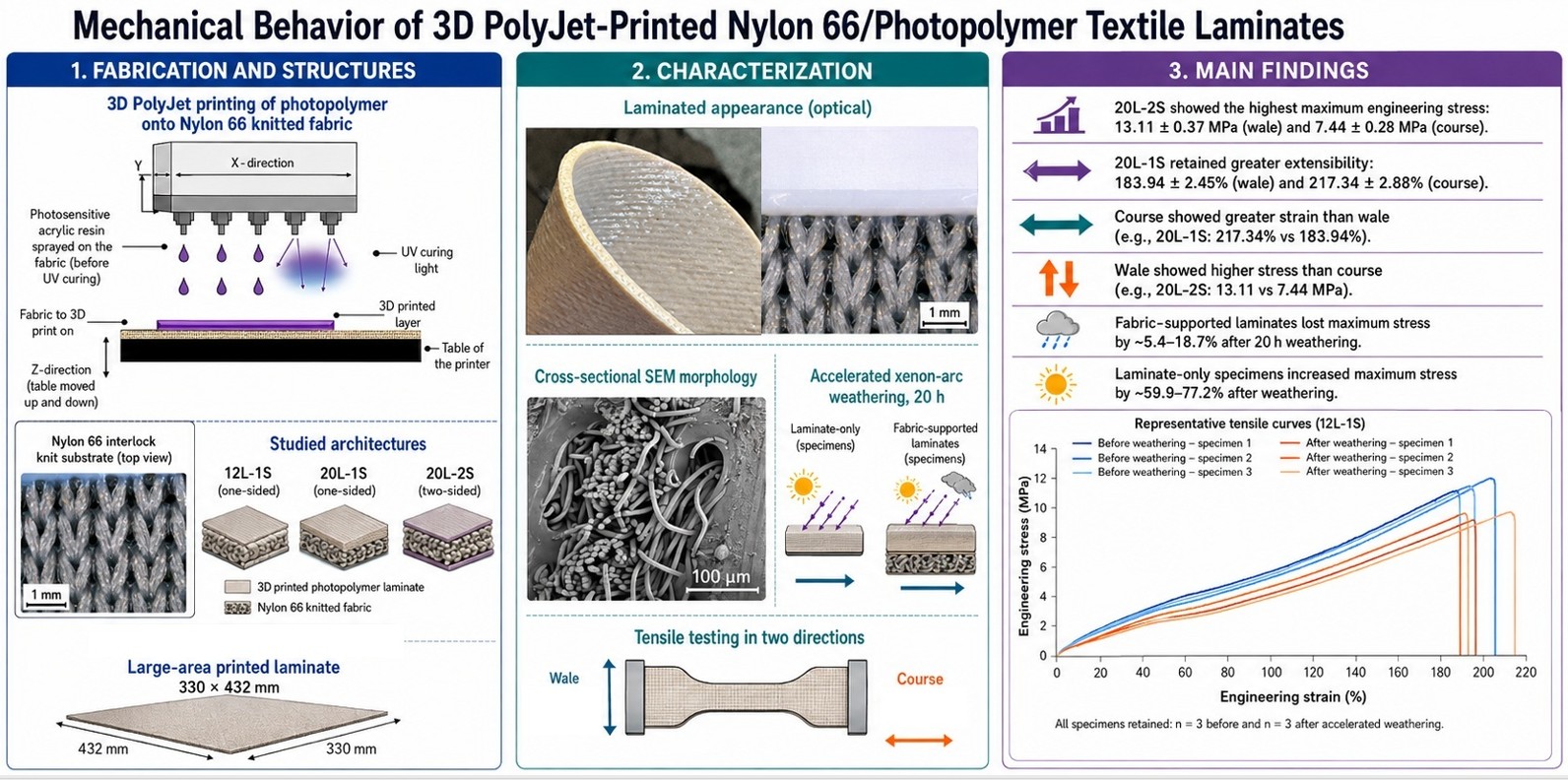
Large-area three-dimensional polyjet printing (3DPP) of continuous photopolymer laminates directly onto knitted fabrics provides a potential route toward technical textile applications beyond localized decorative features. This study investigated acrylic photosensitive resin (APR) laminates measuring 330 × 432 mm deposited onto a Nylon 66 interlock knitted fabric. 12- and 20-layer laminates were produced in one-sided and two-sided configurations, and their morphology and tensile behavior were evaluated in the wale and course directions before and after 20 h of accelerated xenon-arc weathering. Scanning electron microscopy showed that the APR formed a continuous external laminate while locally penetrating inter-yarn and inter-filament spaces within the knitted substrate. Before weathering, the 20-layer two-sided (20L-2S) architecture exhibited the highest maximum engineering stress, reaching 13.11 ± 0.37 MPa in the wale direction and 7.44 ± 0.28 MPa in the course direction. In contrast, the 20-layer one-sided (20L-1S) architecture retained substantially greater extensibility, reaching maximum engineering strains of 183.94 ± 2.45% and 217.34 ± 2.88% in the wale and course directions, respectively. Thus, two-sided printing maximized load-bearing capacity, whereas one-sided 20-layer printing provided a better balance between reinforcement and preservation of the large-strain response of the knitted substrate. Accelerated weathering reduced the maximum engineering stress of fabric-supported laminates by approximately 5.4–18.7% and maximum engineering strain by 2.1–21.1%, depending on architecture and loading direction. Unsupported APR laminates exhibited increases of approximately 59.9–77.2% in maximum engineering stress after exposure, without a corresponding increase in strain capacity. This response suggests exposure-induced stiffening or additional curing of the photopolymer. The results demonstrate that continuous 3DPP can produce mechanically integrated textile–photopolymer laminates with tunable strength–extensibility relationships relevant to flexible technical textile structures.
Keywords:
3D printing
; polyjet printing
; 3D printed on textiles
; direct-to-textile additive manufacturing
; Nylon 66
; interlock knitted fabric
; photopolymer
; laminate
; tensile behavior
; accelerated weathering
; nonlinear stress–strain behavior
; strain stiffening
1. Introduction
Three-dimensional printing (3DP) (or additive manufacturing) has traditionally been explored and used to produce components for automotive [1], aerospace [2,3], wearables [4], and many types of consumer products, including parts of shoes [5], headsets, but also educational models, especially for medical studies [6], including dental models and braces [7], but also figurines, gadgets, toys [8,9], to name some. Over the past years, however, textile-integrated 3DP has garnered increasing interest among fashion designers [10,11,12]. Fashion designer Iris Van Herpen not only creates completely 3D-printed clothing, but she also 3DPP-ed directly on textiles, exploring opportunities and fabric functionalities [13,14]. This allows combining the functionality of fabric substrates and expressing artistic ideas that were very difficult or impossible to add or express before the introduction of 3DP, as stated by another fashion designer, Karim Rashid [15]. Three-dimensional polyjet printing (3DPP) technology allows printing on both conventional fabrics and meshes to form clothing on demand, haute couture, and fashion accessories, as proven by Van Herpen and Karim Rashid in the last decade. The 3DPP allows the use of up to 600,000 colors and combines opaque or translucent photopolymers with different Shore hardness. It has been proven that it is possible to add functionalities to textiles, such as printing small surface designs that serve as a braille for the visually impaired [16], being smaller shapes - domes - spaced on a fabric. The concept of 3DPP on a fabric is presented in Figure 1. A fabric is placed on the printer’s table, and droplets of ultraviolet (UV)-curable acrylic photosensitive resin (APR) jet onto the fabric surface according to the previously created digital design. Each deposited layer is cured (permanently hardened) by UV light during layer deposition, initiating photopolymerization and converting the liquid resin into a solid body. This process is possible because the resin contains reactive monomers and/or oligomers together with photo initiators that respond to light of a suitable wavelength. After one layer is cured, the next layer can be deposited either on top of the cured layer or adjacent to it, depending on the design and geometry of the printed structure [17].
1.1. Printing on Textiles for Functional and Technical Applications
Although direct 3DPP on textiles has attracted some interest, its wider, non-artistic applications remain limited. Published studies have primarily examined printing feasibility, polymer–textile adhesion, surface morphology, and durability after washing, abrasion, or light exposure. Comparatively little attention has been given to continuous, large-area 3DPP laminates that function as mechanically active components of textile–polymer structures. Most published studies have focused on small-sized 3DPP on woven fabrics, leaving a relative dearth of information on knitted fabrics, which exhibit different stretch, drape, and porosity characteristics [19,20]. Knitted fabrics differ fundamentally from woven substrates because their deformation is initially governed by loop rotation, loop opening, yarn bending, and interloop sliding, followed by increasing yarn alignment at higher strain. Consequently, the response of a printed knitted laminate cannot be inferred directly from results obtained for relatively dimensionally stable woven fabrics. These studies have shown that adhesion between the printed polymer and the textile depends on fiber type, surface morphology, textile architecture, and printing parameters, including temperature, printing speed, and layer thickness [19,20,21]. Using a Stratasys Connex 350 printer and FullCure photopolymer materials, the researchers printed polymer structures directly onto several textile substrates and reported adhesion forces of approximately 30–35 N. Their study established that 3DPP can be used to produce polymer–textile composite structures, while also identifying several practical challenges, including resin flow through highly porous fabrics and fixation of textile substrates on the build platform. In a different study, Braille domes were printed onto cotton and polyester woven fabrics, and the resulting materials were evaluated for washing resistance, colorfastness to light, tensile behavior, and abrasion resistance. The results showed that the resin remained attached to the textile substrates after washing; however, the printed structures were sensitive to light exposure and abrasion. Tensile testing also indicated that the presence of printed resin features reduced the strength and elongation of the fabrics. This work demonstrated that the 3DPP can modify textile performance, although the periodically printed small-size design was evaluated primarily as a surface feature rather than as a continuous mechanical laminate [16]. More recently, studies using medical polyjet resins such as MED610 have investigated the influence of textile substrates on adhesion and surface morphology [22]. This direction is particularly relevant because MED610 is a biocompatible resin, suggesting potential future applications in medical and biomedical textile composites. However, the studies have focused mainly on material compatibility, adhesion, surface roughness, hydrophobicity, porosity, and morphology rather than on the development and validation of complete technical textile prototypes [22]. Overall, the current 3DPP on textiles demonstrates that UV-curable photopolymer resins can be successfully deposited onto selected textile substrates and that adhesion, substrate morphology, resin penetration, and environmental durability are among the key challenges [16,19,20,22]. Other research investigated composites made by laminating 3D-printed re-entrant thermoplastic polyurethane patterns onto aramid knitted fabric. The laminated structures showed improved mechanical performance and energy absorption compared with the unmodified knit, indicating their potential for protective textile applications. However, the polymer patterns were printed separately and then bonded to the fabric rather than printed directly onto the textile substrate [23]. In general, most published relevant studies remain focused on printability, adhesion testing, surface morphology, or localized surface features [19,20,22].
1.2. Purpose of the Study
Research remains scarce on continuous, large area 3DPP laminates deposited directly onto textiles. Therefore, the purpose of this study was to investigate continuous 3DPP laminates using APR, measuring approximately 330 × 432 mm, produced on knitted Nylon 66 fabric, and to determine how laminate architecture influences the mechanical behavior of the resulting textile–polymer system. Laminates comprising different numbers of printed layers were applied either to one side or to both sides of the knitted substrate. The effects of printed-layer configuration, one- versus two-sided application, fabric direction (wale and course), and accelerated UV exposure (aging) on tensile behavior were evaluated. The broader motivation for this work was to explore the potential of 3DPP textile–polymer laminates for technical textile applications. It is hypothesized that a continuous large-area APR layer may reduce the openness of the knitted structure and potentially provide enhanced surface protection or barrier functionality, while the knitted Nylon 66 substrate may contribute flexibility and extensibility. Such material combinations could be relevant to flexible barriers, protective covers, inflatable structures, and other technical textile applications requiring a balance of strength, flexibility, stretchability, durability, and surface protection.
2. Materials and Methods
2.1. Initial Three-Dimensional Polyjet Priting (3DP) – Exploratory Study
An initial exploratory study was conducted to determine suitable printed-layer configurations for producing larger-area textile–APR laminates. Square specimens measuring 8 × 8 cm were prepared by Stratasys, Ltd., Eden Prairie, MN, USA, using progressively increasing layer numbers ranging from 2 to 20 layers (Figure 2). The specimens, printed on a grey double-knit interlock Nylon 66 fabric, were visually examined from both the printed and reverse sides to assess surface coverage and resin penetration through the fabric. The specimens were printed on a grey double-knit interlock Nylon 66 fabric used only for the exploratory study and distinct from the white Nylon 66 fabric used in the main experiment. This preliminary study was conducted to identify suitable layer configurations for producing larger-area laminates. Specimens with fewer than 12 layers showed incomplete surface coverage, whereas the 12-layer configuration was the first to form a continuous surface without visible pores in the laminate. Increasing the number of layers to 20 produced a thicker laminate with more complete coverage. Accordingly, the 12- and 20-layer configurations were selected for the main study. Based on the difference between the thicknesses of the printed and unprinted fabrics, the estimated thickness of a single deposited layer was 0.022 mm ± 2%. The APR did not penetrate completely through the fabric, as no resin was visible on the technical back (reverse) of the specimens.
2.2. Fabric Used in Three-Dimensional Polyjet Printing (3DPP)
A double stitch, interlock, weft knit, white, 100% Nylon 66 fabric was selected as a substrate for 3DPP. This fabric was purchased at Testfabrics, Inc., West Pittston, PA, USA. It was selected because Nylon 66 is one of the strongest conventional (non-high performance), manufactured raw materials and is traditionally used for conventional and some technical applications, e.g., parachutes, braided, twisted, and circular knitted ropes, and materials in inflatables. The structure of the fabric is presented in Figure 4, where wales (vertical direction) and courses (horizontal direction) are shown. The interlock knitted fabric was selected as the textile substrate because its double-knit architecture provides a relatively stable and uniform surface for direct 3D deposition while retaining the loop-mediated deformability characteristic of knitted structures. Compared with conventional non-stretch woven fabrics, the knitted construction can accommodate greater deformation through changes in loop geometry, even without incorporating elastomeric yarns.
2.3. Acrylic Photosensitive Resin (APR) Used for 3DPP Lamination
The APR used to 3DPP laminates on the surface of the knitted Nylon 66 fabrics was VeroEco™Flex developed by Stratasys, Ltd., Eden Prairie, MN, USA. The grey laminate color used in this study was generated from a combination of VeroEco™Flex Cyan [24], VeroEco™Flex Magenta [25], and VeroEco™Flex Yellow [26]. The three resin components had similar basic physical characteristics. The reported density was 1.079 g/cm³ for VeroEco™Flex Cyan, 1.077 g/cm³ for VeroEco™Flex Magenta, and 1.075 g/cm³ for VeroEco™Flex Yellow. According to the corresponding Safety Data Sheets (SDSs), all three materials are liquids and are insoluble in water. The chemical composition of the resin systems was only partially disclosed by the manufacturer in the available Safety Data Sheets [24,25,26]. A substantial proportion of each formulation was represented by constituents identified only as proprietary. The SDSs listed six proprietary constituent entries for both VeroEco™Flex Cyan and VeroEco™Flex Magenta, while VeroEco™Flex Yellow contained seven proprietary constituent entries. The disclosed ingredients common to all three formulations were camphene (CAS 79-92-5), 2,6-bis(1,1-dimethylethyl)-4-methylphenol (CAS 128-37-0), glycerol, propoxylated, esters with acrylic acid (CAS 52408-84-1), and 1,7,7-trimethyltricyclo [2.2.1.0²,⁶]heptane (CAS 508-32-7), each reported at 0.1–0.3 wt.%. The exact percentage or concentration of the composition was withheld as a trade secret.
2.4. Main Experiment - 3DPP on Textiles
Based on the initial exploratory study, 12-layer and 20-layer configurations were selected for the main experiment. The 12-layer configuration represented the lowest number of printed layers that produced a visually continuous laminate without apparent open pores on the surface, see Figure 3 (f). The 20-layer configuration was selected because it represented the maximum layer number evaluated during the preliminary screening and produced the greatest degree of surface coverage and pore closure, see Figure 3 (j). The comparison between 12 and 20 layers therefore enabled assessment of how increasing the amount and thickness of the deposited APR influenced laminate mechanical performance. Table 1 lists samples that were prepared, analyzed, and tested.
2.5. Basic Characteristics of Fabrics and Laminates
The fabric substrate characteristics and laminates were measured according to American Society for Testing and Materials (ASTM) standards for fabric weight [27], fabric count [28], and thickness [29], and are presented in Table 2. They were measured after 24 h of conditioning at 21 °C and 65% rh. The 3DPP panels were received from Stratasys, Ltd. and were conditioned for at least 24 h at 21 °C and 65% rH before any tests were performed. Each printed area on the fabric measured 13 × 17 in. (330.2 × 431.8 mm).
The unsupported laminate-only specimens were produced as independent reference structures and did not represent APR physically separated from the corresponding fabric-supported laminates. Due to the fact that the APR penetrated inter-yarn and inter-filament spaces within the knitted substrate, the measured combined thickness reflected both external laminate formation and internal resin penetration. Accordingly, the separately measured properties of the fabric and unsupported laminate were used as reference values and were not assumed to reproduce exactly the measured properties of the complete fabric-supported architecture.
2.5.1. Scanning Electron Microscope (SEM) Imaging
Scanning electron microscopy (SEM) was used to examine both the surface morphology and cross-sectional structure of the 3DPP laminates and their interaction with the Nylon 66 knitted substrate. Surface images were obtained to evaluate the continuity and uniformity of the printed layer and the extent of coverage of the knitted fabric. Cross-sectional images were used to examine the APR–textile interface, including penetration of the APR into the inter-yarn and inter-filament spaces and the physical configuration of the laminate within the textile structure. The images were acquired using a secondary-electron detector at an accelerating voltage of 5.0 kV, a working distance of approximately 7.9 mm, and a 30 µm aperture. Images were recorded at magnifications of 100×, 150×, and 500×.
2.5.2. Accelerated Weathering
Accelerated xenon-arc weathering was conducted to evaluate the effect of 20 h of accelerated xenon-arc exposure on the appearance and mechanical behavior of the unprinted Nylon 66 knitted fabric and the Nylon 66 fabrics with 3DPP laminates, as well as the laminates only. The exposure procedure was based on AATCC TM169-2020, Weather Resistance of Textiles: Xenon Lamp Exposure. Testing was performed using a Q-SUN Xe-3-HS xenon-arc weathering chamber (Q-Lab Corporation, Westlake, OH, USA) [30]. The specimens were exposed continuously for 20 h at a spectral irradiance of 1.10 W·m⁻²·nm⁻¹ controlled at 420 nm. The specimens were mounted flat in the exposure chamber. Regardless of whether the samples were one-sided or two-sided laminate structures, only one surface was oriented toward the xenon-arc light source and therefore exposed to the accelerated weathering. For the one-sided structures, the 3DPP-laminated surface was oriented toward the xenon-arc light source. Following exposure, the samples were visually examined for changes in appearance, including discoloration, yellowing, surface cracking, embrittlement, laminate damage, and local separation of the printed layer from the knitted substrate. The unexposed and weathered specimens were subsequently subjected to tensile testing to determine the effect of 20 h of accelerated weathering on their stress–strain behavior.
2.5.3. Tensile Properties
Tensile testing was conducted using a strip method based on ASTM D5035 [31] on an ADMET eXpert 7601 universal testing system controlled by MTestQuattro software. Specimens were tested at a crosshead speed of 254 mm/min (10 in/min). Specimen dimensions were 50 mm wide and 150 mm long, and specimens were prepared in the wale and course directions and tested using an initial gauge length of 100 mm. Engineering strain was calculated from crosshead displacement relative to the initial gauge length. Engineering stress was calculated from the recorded tensile force using the measured specimen width and the total measured thickness of the tested structure, including both the knitted Nylon 66 substrate and the printed APR laminate where applicable. Three specimens were tested for each material architecture, direction, and exposure condition. Individual curves were inspected before calculation of group statistics. Mean stress–strain curves were generated by interpolation onto a common strain grid, and the shaded regions represent ±1 sample standard deviation (SD) over the strain range for which at least two specimens remained.
3. Results
Figure 5 presents a large area 3DPP laminate measuring 330.2 × 431.8 mm. The APR formed a continuous laminate across the printed area. Parallel surface striations were visible on all the panels. These striations were not intentional design features but resulted from the printing path used during APR deposition. The striations were oriented parallel to the longer dimension of the panel, corresponding to successive jetting and curing passes along the 431.8 mm edge. They are responsible for an SD in weight and thickness measurements (see Table 2). Although such process-related surface patterning is undesirable from the standpoint of surface uniformity, it can occur during large-area printing and provides a visible indication of the printing direction. Further observation through the scanning electron microscope (SEM) confirmed the presence of the striations.
3.1. Scanning Electron Microscope (SEM) Imaging
The representative surface image in Figure 6 shows that the APR formed a largely continuous layer over the textile substrate. Approximately parallel surface undulations were visible and corresponded to the striations observed in the macroscopic panel photograph (see Figure 5). The printed surface was therefore continuous but not completely smooth or uniform. Small, irregular surface features were also distributed across the laminate. Because their chemical composition was not determined, they are described here only as morphological surface features and cannot be conclusively identified as contamination, residual material, or fragments produced during specimen preparation. The cross-sectional image of the 12-layer one-sided laminate in Figure 7 shows a compact APR region aligned with the knitted substrate. The APR extended into spaces between yarns and locally surrounded individual Nylon 66 filaments. However, the penetration was not uniform throughout the textile structure, and some filament bundles remained only partially surrounded by resin. These observations indicate that the laminate was connected to the textile through a combination of surface coverage and localized penetration into the porous knitted structure. The morphology is consistent with mechanical interlocking between the cured photopolymer and the textile substrate. The two-sided laminate shown in Figure 8 exhibited a different cross-sectional architecture, with the Nylon 66 knitted structure positioned between the APR regions applied to both surfaces. A higher-magnification image in Figure 9 further showed close contact between the APR and individual filaments, as well as partially filled inter-filament spaces and irregular fracture surfaces. The irregular edges and loose fragments visible in the cross-sectional images resulted from cutting or fracturing the specimens during SEM preparation. Additional cross-sectional images of the 20-layer laminate are presented in Figure 10 and Figure 11, further illustrating localized APR penetration around filament bundles and individual filaments.
Following 20 h of accelerated xenon-arc exposure, visible fading of the grey APR surface was observed. Because color change was not quantified instrumentally, this observation is reported qualitatively.
3.2. Engineering Stress-Strain Behavior
The tensile behavior of the unprinted Nylon 66 knit, the fabric-supported 3DPP laminates, and the unsupported laminate-only specimens were evaluated before and after accelerated xenon-arc exposure.
Table 3 summarizes the mean maximum engineering stress values, and Table 4 summarizes the mean maximum engineering strain values. Figure 12, Figure 13, Figure 14 and Figure 15 present the corresponding mean engineering stress–strain curves, Figure 16, Figure 17, Figure 18, Figure 19, Figure 20 and Figure 21 show the individual specimen curves for the fabric-supported laminates, and Figure 22 documents progressive deformation and failure of a representative 20L-2S specimen. The effects of loading direction, printed-layer number, laminate placement, and accelerated exposure are discussed in the following sections.
Samples tested in the course direction reached greater strains before failure than specimens tested in the wale direction. This directional difference is consistent with the deformation of the knitted structure, which accommodated extension through loop opening, rotation, yarn bending, and interloop rearrangement before the yarn segments became fully aligned and directly loaded. Table 4 summarizes the mean maximum engineering strain values.
3.2.1. Directional Response of Reference Nylon 66 Knit
The unprinted Nylon 66 interlock knit exhibited a strongly direction-dependent tensile response. Before accelerated weathering, the reference fabric reached a mean maximum engineering stress of 10.13 ± 0.92 MPa in the wale direction and 5.22 ± 0.63 MPa in the course direction. The corresponding maximum engineering strains were 184.40 ± 8.44% and 221.23 ± 13.33%, respectively. Thus, the wale direction exhibited greater load-bearing capacity, whereas the course direction accommodated greater deformation before final failure. After accelerated weathering, the maximum engineering stress decreased to 9.91 ± 0.97 MPa in the wale direction and 4.89 ± 0.17 MPa in the course direction, while the maximum engineering strain decreased to 163.30 ± 13.44% and 190.73 ± 11.86%, respectively. The directional difference therefore remained after exposure. This combination of higher wale-direction stress and greater course-direction strain reflects the anisotropic deformation of the knitted structure, in which loop geometry and yarn orientation govern the progression from loop rearrangement and opening to direct yarn loading.
3.2.2. Effect of Laminate Architecture Before Accelerated Weathering
Before accelerated exposure, the 20-layer two-sided (20L-2S) architecture produced the highest maximum engineering stress in both loading directions, reaching 13.11 ± 0.37 MPa in the wale direction. In the course direction, the two 20-layer architectures exhibited similar maximum engineering stress values, but the 20L-2S structure showed the slightly higher mean value, reaching 7.44 ± 0.28 MPa, compared with 7.26 ± 0.15 MPa for the 20L-1S structure. The difference between the two course-direction values was small, only 0.18 MPa, and should not be interpreted as evidence of a substantial mechanical advantage of the two-sided architecture. Nevertheless, both 20-layer configurations produced a clear increase in maximum engineering stress relative to the unprinted Nylon 66 knit.
In Figure 12, Figure 13, Figure 14 and Figure 15, dashed lines represent the unsupported 3DPP laminate-only specimens; the accompanying enlarged views show these lower-stress curves separately; 12L-1S – Nylon 66 fabric reinforced with a 12-layer 3DPP laminate on one side; 20L-1S – Nylon 66 fabric reinforced with a 20-layer 3DPP laminate on one side; 20L-2S – Nylon 66 fabric reinforced with 20-layer 3DPP laminates on both sides.
Before accelerated weathering, the unprinted Nylon 66 knit exhibited the highest mean extensibility, reaching 184.40 ± 8.44% engineering strain in the wale direction and 221.23 ± 13.33% in the course direction. The 20L-1S architecture retained nearly the full extensibility of the reference fabric, reaching 183.94 ± 2.45% in the wale direction and 217.34 ± 2.88% in the course direction. In comparison, the 20L-2S architecture reached 164.42 ± 3.73% and 159.23 ± 3.93%, respectively, while the 12L-1S structure reached 126.29 ± 4.15% and 158.15 ± 19.98%. These results demonstrate a trade-off between reinforcement and extensibility: two-sided printing increased the maximum engineering stress but more strongly constrained deformation of the knitted substrate, whereas the 20-layer one-sided architecture preserved substantially greater extensibility.
Figure 13 further illustrates the strength–extensibility trade-off in the course direction: the 20L-1S architecture retained substantially greater strain capacity, whereas the 20L-2S architecture exhibited the highest maximum engineering stress.
3.2.3. Response of Fabric-Supported Laminates After Accelerated Weathering
Accelerated xenon-arc weathering reduced the maximum engineering stress of all fabric-supported laminate architectures. The 12-layer one-sided structure decreased from 10.05 to 9.00 MPa in the wale direction and from 6.01 to 4.92 MPa in the course direction, corresponding to reductions of approximately 10.4% and 18.1%, respectively. The 20-layer one-sided structure decreased from 11.97 to 11.32 MPa in the wale direction and from 7.26 to 5.90 MPa in the course direction, corresponding to reductions of approximately 5.4% and 18.7%, respectively. The 20-layer two-sided structure decreased from 13.11 to 11.60 MPa in the wale direction and from 7.44 to 6.88 MPa in the course direction, corresponding to reductions of approximately 11.5% and 7.5%, respectively. The results indicate that the effect of accelerated weathering depended on both loading direction and laminate architecture. The greatest reduction was observed for the 20-layer one-sided structure tested in the course direction, whereas the 20-layer two-sided structure showed the smallest reduction in the course direction. After weathering, both 20-layer architectures continued to exhibit greater maximum engineering stress than the weathered unprinted Nylon 66 fabric in both directions. In contrast, the weathered 12-layer one-sided structure remained below the reference fabric in the wale direction and was nearly equal to it in the course direction. Thus, the thicker 20-layer configurations retained a clearer reinforcement effect after the 20-h exposure.
Accelerated xenon-arc exposure also reduced the maximum engineering strain of all fabric-supported laminates. For the 12L-1S structure, strain decreased from 126.29 to 123.58% in the wale direction and from 158.15 to 146.41% in the course direction, corresponding to reductions of 2.1% and 7.4%, respectively. For the 20L-1S architecture, strain decreased from 183.94 to 159.80% in the wale direction and from 217.34 to 171.52% in the course direction, corresponding to reductions of 13.1% and 21.1%. The 20L-2S architecture decreased from 164.42 to 140.30% in the wale direction and from 159.23 to 134.75% in the course direction, corresponding to reductions of 14.7% and 15.4%, respectively. Thus, the greatest loss of extensibility occurred for the 20L-1S structure in the course direction, whereas the 12L-1S structure showed the smallest strain reduction in the wale direction.
After weathering, the same strength–extensibility trade-off remained: the 20L-2S architecture retained the highest maximum engineering stress, whereas the 20L-1S architecture retained greater maximum strain in both loading directions. The corresponding mean stress–strain curves are presented in Figure 14 and Figure 15.
The 12L-1S structure generally failed at lower strains than the 20L-1S structure. This does not necessarily indicate that the thinner laminate was intrinsically more brittle. Instead, differences in laminate continuity, penetration, cracking, and load transfer may have influenced the point at which the combined textile–photopolymer structure failed. The individual course-direction curves also showed greater specimen-to-specimen variability for the 12L-1S architecture, including one unexposed specimen that extended substantially farther than the other specimens.
Accelerated xenon-arc exposure generally reduced the strain sustained by the fabric-supported structures before final rupture. This reduction was particularly evident for the 20L-1S laminate in both directions and for the 20L-2S laminate in the wale direction. The change was smaller for the 12L-1S laminate in the wale direction, whereas the course-direction results showed greater variability. When considered together with the reductions in maximum engineering stress, the lower failure strains indicate that accelerated exposure reduced the ability of the fabric-supported laminates to sustain large deformation.
The unsupported laminate-only specimens remained substantially less extensible than the fabric-supported structures and generally failed at approximately 50–60% engineering strain. Although their maximum engineering stress increased after accelerated exposure, the curves did not show a corresponding increase in extensibility. This combination is consistent with exposure-induced stiffening or additional curing; however, whether the exposure also caused embrittlement cannot be established from maximum stress and strain alone. The strain response also clarifies the staged failure mechanism of the fabric-supported laminates. The initial shoulder or local reduction in stress, generally occurring between approximately 35% and 60% strain, was associated with cracking, fragmentation, or local separation of the APR layer. However, this event did not represent complete specimen failure. The Nylon 66 knitted substrate remained continuous and accommodated substantial additional deformation before the yarns became aligned and taut, producing renewed strain stiffening and eventual rupture. Consequently, the high strain at final failure primarily reflects the continued load-bearing capacity of the knitted substrate after damage to the 3DPP laminate.
3.2.4. Laminates Without Nylon 66 Fabric
The unsupported laminate-only specimens exhibited substantially lower maximum stresses than the fabric-supported structures but showed the opposite exposure-related trend. The 12-layer laminate-only specimens increased from 1.52 ± 0.17 to 2.43 ± 0.13 MPa in the wale-related orientation and from 1.48 ± 0.05 to 2.47 ± 0.02 MPa in the course-related orientation. The 20-layer laminate-only specimens increased from 2.13 ± 0.67 to 3.41 ± 0.89 MPa and from 2.02 ± 0.20 to 3.58 ± 0.01 MPa, respectively. These changes corresponded to increases of approximately 59.9–77.2%.
The increased maximum stress of the unsupported photopolymer after exposure was consistent with additional curing or exposure-induced stiffening. However, maximum stress alone cannot distinguish beneficial post-curing from embrittlement. The result should therefore be considered together with changes in strain at failure, curve shape, visible cracking, and surface condition.
Despite the substantial increase in maximum stress after exposure, the unsupported laminates did not exhibit a corresponding increase in extensibility. The maximum strain of the 12-layer laminate changed only from 54.80 ± 5.32% to 54.61 ± 2.41% in the wale-related orientation and from 53.73 ± 2.11% to 52.20 ± 1.15% in the course-related orientation. For the 20-layer laminate, strain decreased from 53.60 ± 8.41% to 48.39 ± 11.62% and from 54.94 ± 3.19% to 52.82 ± 2.13%, respectively. Thus, accelerated exposure increased the maximum stress of the unsupported APR without increasing its strain capacity, supporting an interpretation of exposure-induced stiffening or additional curing.
3.2.5. Nonlinear Behavior
The stress–strain curves demonstrated that maximum stress represented only one aspect of the mechanical response. The fabric-supported laminates exhibited strongly nonlinear behavior characterized by an initial increase in stress, a shoulder or local stress reduction, and subsequent strain stiffening. This response was particularly evident in the 20-layer one-sided and two-sided structures. The first local maximum was consistent with the onset of cracking, fragmentation, or local separation of the printed laminate. Following this event, the knitted Nylon 66 substrate remained intact and continued to deform through loop rotation, loop opening, yarn bending, and interloop rearrangement. At higher strain, the yarn segments became progressively aligned and taut, producing renewed strain stiffening before final rupture. The resulting high-strain response was hyperelastic-like in shape; however, the complete textile–photopolymer structure should not be described as purely hyperelastic because the laminate underwent irreversible damage and elastic recovery was not evaluated through unloading–reloading testing. Individual stress–strain curves for the 20L-1S, 20L-2S, and 12L-1S architectures in both loading directions are presented in Figure 16, Figure 17, Figure 18, Figure 19, Figure 20 and Figure 21. The progressive cracking and continued deformation of a representative 20L-2S specimen are illustrated in Figure 22.
4. Discussion
The results demonstrate that the tensile behavior of the 3DPP textile–APR structures was governed by the interaction between the APR laminate and the deformable Nylon 66 knitted substrate rather than by either constituent independently. SEM observations showed that the APR formed a largely continuous external layer while also penetrating locally into inter-yarn and inter-filament spaces. This morphology indicates that the printed polymer was mechanically integrated with the knitted structure through surface coverage and localized interlocking rather than acting simply as a separate film attached to the fabric.
Laminate architecture produced a clear trade-off between reinforcement and extensibility. The 20-layer two-sided (20L-2S) architecture exhibited the highest maximum engineering stress in both loading directions before accelerated weathering, reaching 13.11 ± 0.37 MPa in the wale direction and 7.44 ± 0.28 MPa in the course direction. In contrast, the 20-layer one-sided (20L-1S) architecture retained substantially greater extensibility, reaching 183.94 ± 2.45% strain in the wale direction and 217.34 ± 2.88% in the course direction, compared with 164.42 ± 3.73% and 159.23 ± 3.93%, respectively, for the two-sided structure. Thus, increasing the amount of APR and constraining both surfaces of the knit increased load-bearing capacity but restricted the loop-mediated deformation that normally allows knitted fabrics to sustain very large strains. The 20L-2S configuration can therefore be considered the strongest architecture based on maximum engineering stress, whereas the 20L-1S configuration provided a more favorable balance between reinforcement and extensibility.
The nonlinear stress–strain response further illustrates the different roles of the laminate and textile substrate. In the fabric-supported structures, an initial shoulder or local stress reduction generally occurred at approximately 35–60% strain and was associated with cracking, fragmentation, or local separation of the APR (see Figure 22 (b), (c)). This did not represent complete failure of the specimen. The knitted Nylon 66 remained continuous and accommodated substantial additional deformation before progressive yarn alignment and strain stiffening ultimately led to rupture. The high-strain response was therefore hyperelastic-like in shape, but the complete laminate should not be described as purely hyperelastic because irreversible cracking of the APR occurred and elastic recovery was not evaluated. This staged failure behavior is important for potential technical applications because damage to the printed surface did not immediately eliminate the load-bearing capability of the textile substrate.
One of the most unexpected findings was the response of the unsupported APR laminates to accelerated xenon-arc exposure (laminates only, no fabric). Whereas the fabric-supported laminates generally showed reductions in maximum engineering stress after exposure, the unsupported APR specimens became considerably stronger. Maximum engineering stress increased by approximately 59.9–77.2%, depending on laminate thickness and test/sample orientation. At the same time, their maximum strain remained similar or decreased slightly rather than increasing. This response is consistent with additional curing, increased crosslink density, or exposure-induced stiffening of the photopolymer. This phenomenon cannot be fully explained without further analysis.
The behavior of the complete textile–APR laminates was different because xenon exposure affected not only the APR but also the Nylon 66 substrate and potentially the interface between them. The unprinted Nylon 66 reference retained most of its maximum engineering stress after exposure but showed a noticeable decrease in extensibility: maximum strain decreased by 11.4% in the wale direction and 13.8% in the course direction. Consequently, additional curing or stiffening of the APR could occur simultaneously with a reduction in the deformability of the knitted substrate. In the combined structure, these two responses may act competitively: a stiffer APR can carry greater stress when tested independently, while a less extensible Nylon 66 substrate can reduce the ability of the complete laminate to redistribute stress through loop opening and yarn rearrangement. Changes in stiffness mismatch between the APR and Nylon 66 may also increase local stress concentrations and alter crack initiation or load transfer at the interface. The reduction in mechanical performance of the complete laminate should therefore not be interpreted simply as degradation of the APR. Rather, it likely reflects the combined response of the textile, photopolymer, and their mechanically integrated interface.
Visual observations provide additional evidence that xenon exposure altered the APR. Although quantitative color measurements were not performed, fading of the grey laminate was visually observed following accelerated exposure. The specimens were also examined for discoloration, yellowing, surface cracking, laminate damage, and local separation of the printed layer from the textile, as specified in the experimental procedure. Because color change was not measured instrumentally, the observed fading should be described qualitatively rather than interpreted as a quantified photodegradation response. Nevertheless, the visible fading demonstrates that the xenon exposure produced an observable change in the printed material and supports the need for future colorimetric and chemical characterization of the APR following environmental exposure.
The surface morphology of the large-area laminates also highlights the importance of the manufacturing process. Parallel striations were visible across the printed panels and were attributed to the jetting and curing path used during APR deposition. SEM examination confirmed corresponding surface undulations. These features indicate that large-area polyjet deposition did not produce a perfectly uniform surface, even though the laminate was macroscopically continuous. Variations in deposition path, layer overlap, curing conditions, and processing speed could potentially influence surface uniformity and local laminate thickness. In particular, faster production may reduce the time available for uniform droplet deposition, leveling, or curing and could therefore increase process-related surface irregularities. However, printing speed was not varied systematically in the present study, so a direct relationship between production speed and striation formation cannot be established from these results. This should therefore be considered a hypothesis for future process-optimization studies rather than a conclusion of the present work.
The presence of striations may also have mechanical implications. Local differences in surface profile and laminate thickness could influence stiffness, crack initiation, and stress distribution during tensile loading.
Overall, the results show that continuous large-area 3DPP on knitted textiles produces a mechanically complex laminate in which the advantages of the two constituents are not simply additive. The APR provides reinforcement and surface continuity, whereas the knitted Nylon 66 provides the large-strain deformation capacity characteristic of loop-based textile structures. Two-sided 20-layer printing maximized maximum engineering stress but constrained extensibility, while one-sided 20-layer printing preserved substantially more of the deformability of the original knit. Accelerated xenon exposure further demonstrated that the constituents can respond in opposite ways: the unsupported APR became stronger and apparently stiffer, whereas the Nylon 66 lost extensibility and the complete textile-supported structures showed reduced tensile performance. These findings emphasize that optimization of 3DPP technical textiles requires consideration not only of polymer properties and printed-layer number but also of textile architecture, interfacial load transfer, environmental exposure, and large-area printing conditions.
5. Conclusions
Continuous large-area 3D polyjet-printed APR laminates were successfully produced directly on Nylon 66 interlock knitted fabric, forming textile–photopolymer structures measuring approximately 330 × 432 mm. SEM observations showed that the APR formed a continuous external laminate and penetrated locally between yarns and individual filaments, creating a mechanically integrated structure rather than a simple surface coating.
The tensile response was strongly dependent on knitted-fabric direction and laminate architecture. The unprinted Nylon 66 exhibited higher maximum engineering stress in the wale direction but greater extensibility in the course direction. Incorporation of the APR increased the load-bearing capacity of the knitted structure, particularly for the 20-layer configurations. The 20-layer two-sided architecture produced the highest maximum engineering stress before accelerated weathering, reaching 13.11 ± 0.37 MPa in the wale direction and 7.44 ± 0.28 MPa in the course direction. In contrast, the 20-layer one-sided architecture retained substantially greater extensibility, reaching 183.94 ± 2.45% and 217.34 ± 2.88% engineering strain in the wale and course directions, respectively. Consequently, two-sided printing maximized strength, whereas one-sided 20-layer printing provided a more favorable balance between reinforcement and preservation of knitted-fabric extensibility.
Accelerated xenon-arc weathering produced a contrasting response in the constituent materials. The maximum engineering stress of the unsupported APR laminates increased by approximately 59.9–77.2%, while their strain capacity remained similar or decreased, indicating exposure-induced stiffening and potentially additional curing of the photopolymer. In contrast, the unprinted Nylon 66 exhibited reduced strain after exposure, and all fabric-supported laminates showed reductions in maximum engineering stress and strain. These findings suggest that the post-weathering behavior of the complete laminates resulted from the combined response of the APR, the Nylon 66 substrate, and their interface. Further work is required to determine whether the increased stress of the unsupported APR results from additional photopolymer curing, increased crosslinking, or another exposure-induced structural change.
The fabric-supported laminates exhibited strongly nonlinear, staged tensile failure. Cracking or fragmentation of the APR occurred before final specimen rupture, while the underlying knitted substrate remained continuous and continued to deform to much greater strains. This behavior demonstrates that the textile substrate retained a load-bearing role after initial laminate damage.
Overall, the study demonstrates that continuous 3DPP can be used to engineer large-area textile–photopolymer laminates with tunable mechanical behavior. Increasing laminate coverage enhances load-bearing capacity but can reduce the large-strain deformability characteristic of knitted textiles. The observed strength–extensibility trade-off and the different weathering responses of the polymer and textile components should therefore be considered when designing 3DPP laminates for flexible barriers, protective structures, covers, and future inflatable textile systems.
6. Future Work
Future studies should evaluate a broader range of printed-layer counts to determine more precisely the minimum number of deposited layers required for complete pore closure and to establish how increasing laminate thickness affects flexibility, tensile performance, abrasion resistance, durability, and barrier properties. The experimental matrix should also include knitted, woven, and nonwoven substrates with different fiber types, surface roughness, porosity, extensibility, and structural stability. Such comparisons would clarify how textile architecture controls resin penetration, mechanical interlocking, interfacial bonding, and subsequent deformation.
Also, different types of APR resin formulations with different stiffness, elasticity, toughness, and environmental resistance should be investigated. Long-term durability studies should address abrasion, repeated flexing, fatigue, weathering, hydrolysis, laundering, and cyclic mechanical loading. Chemical and morphological characterization after exposure would help distinguish additional photopolymer curing from embrittlement or degradation.
A particularly important direction is the development of continuous 3DPP textile laminates for inflatable and pressure-bearing textile structures. Although the 12-layer configuration produced a visually continuous surface without apparent open pores, visual pore closure alone does not demonstrate airtightness, waterproofness, or pressure retention. Future work should therefore include air-permeability, hydrostatic-pressure, leakage, pressure-retention, and seam-integrity testing. Burst-strength and cyclic inflation–deflation experiments should be performed to determine whether the printed laminate can withstand repeated internal pressurization without cracking, delamination, or progressive loss of pressure. The effects of folding, bending, and local crease formation should also be examined because inflatable products are commonly stored in a collapsed state and repeatedly deployed.
For inflatable applications, the performance of one-sided and two-sided printing should be compared directly. A one-sided laminate may reduce mass and preserve flexibility, whereas a two-sided architecture may provide greater reinforcement, improved surface enclosure, and increased resistance to local damage. Future studies should also evaluate printed repair patches, locally reinforced high-stress regions, and graded laminate thicknesses around valves, seams, folds, and attachment points. These investigations would support the development of lightweight inflatable shelters, pressure-supported structures, flotation devices, protective cushions, flexible bladders, and other textile-based inflatable systems.
Together, these studies would provide a more complete understanding of continuous textile–photopolymer laminates and establish whether the technology can be developed for inflatables, flexible barriers, protective covers, waterproof structures, and other technical textile applications. The current draft already identifies pressure retention, leakage, burst strength, and cyclic inflation–deflation as important future tests, so this expanded version strengthens rather than changes that direction.
Supplementary Materials
The following supporting information can be downloaded at https://doi.org/10.6084/m9.figshare.33201465.
Author Contributions
Conceptualization, methodology, software, validation, formal analysis, investigation, data curation, writing—original draft preparation, writing—review and editing, visualization, I.C.W. The author has read and agreed to the published version of the manuscript.
Funding
No funding was received to conduct this research work.
Data Availability Statement
Data available upon request in Excel sheet format.
Conflicts of Interest
The author declares no conflicts of interest.
References
- Wiese, M.; Thiede, S.; Herrmann, C. Rapid manufacturing of automotive polymer series parts: A systematic review of processes, materials and challenges. Addit. Manuf. 36 2020, 1–13. [Google Scholar] [CrossRef]
- Ngo, T. D.; Kashani, A.; Imbalzano, G.; Nguyen, K. T. Q.; Hui, D. Additive manufacturing (3D printing): A review of materials, methods, applications and challenges. Compos. Part B Eng. 143 2018, 172–196. [Google Scholar] [CrossRef]
- Uriondo, A.; Esperon-Miguez, M.; Perinpanayagam, S. The present and future of additive manufacturing in the aerospace sector: A review of important aspects. Proc. Inst. Mech. Eng. Part G. J. Aerosp. Eng. 2015, 229(11), 2132–2147. [Google Scholar] [CrossRef]
- Rachim, V. P.; Park, S.-M. Review of 3D-printing technologies for wearable and implantable bio-integrated sensors. Essays Biochem. 2021, 65(3), 491–502. [Google Scholar] [CrossRef] [PubMed]
- Chansoda, K.; Chookaew, W.; Suvanjumrat, C. Optimizing laser 3D printing parameters for customized rubber latex health shoe insoles. Prog. Addit. Manuf. 2025, 10(8), 4875–4886. [Google Scholar] [CrossRef]
- Rengier, F.; Mehndiratta, A.; von Tengg-Kobligk, H.; Zechmann, C. M.; Unterhinninghofen, R.; Kauczor, H.-U.; Giesel, F. L. 3D printing based on imaging data: Review of medical applications. Int. J. Comput. Assist. Radiol. Surg. 2010, 5(4), 335–341. [Google Scholar] [CrossRef] [PubMed]
- Dawood, A.; Marti Marti, B.; Sauret-Jackson, V.; Darwood, A. 3D printing in dentistry. Br. Dent. J. 2015, 219(11), 521–529. [Google Scholar] [CrossRef] [PubMed]
- Petersen, E. E.; Kidd, R. W.; Pearce, J. M. Impact of DIY Home Manufacturing with 3D Printing on the Toy and Game Market. Technologies 2017, 5(3), 45. [Google Scholar] [CrossRef]
- Chen, Z. The service-oriented manufacturing mode based on 3D printing: A case of personalized toy. Procedia Eng. 174 2017, 1315–1322. Available online: https://www.sciencedirect.com/science/article/pii/S1877705817302783?via%3Dihub. [CrossRef]
- Perry, A. 3D-printed apparel and 3D-printer: exploring advantages, concerns, and purchases. Int. J. Fash. Des. Technol. Educ. 2018, 11(1), 95–103. [Google Scholar] [CrossRef]
- Xiao, Y.-Q.; Kan, C.-W. Review on Development and Application of 3D-Printing Technology in Textile and Fashion Design. Coatings 2022, 12(2), 267. [Google Scholar] [CrossRef]
- Smelik, A. Fractal folds: The posthuman fashion of Iris van Herpen. Fash. Theory 2022, 26(1), 5–26. [Google Scholar] [CrossRef]
- Stratasys. Foliage dress. 3DFashion Stratasys. n.d.-a. Available online: https://3dprintedart.stratasys.com/fashion/project-one-tg5ld-c24df-gzm69-wam56-r8zsy (accessed on 29 July 2026).
- Stratasys. J850 TechStyle 3D printer: Direct-to-textile 3D printing. n.d.-b. Available online: https://www.stratasys.com/en/3d-printers/printer-catalog/polyjet/3d-printer-tech-style/ (accessed on 29 July 2026).
- Stratasys. Digi dress. 2022. Available online: https://3dprintedart.stratasys.com/fashion/digi-dress (accessed on 29 July 2026).
- Becker, P.; Ciesielska-Wrόbel, I. Performance of Fabrics with 3D-Printed Photosensitive Acrylic Resin on the Surface. Polymers 2024, 16(4), 486. [Google Scholar] [CrossRef] [PubMed]
- McKerricher, G.; Vaseem, M.; Shamim, A. Fully inkjet-printed microwave passive electronics. Microsyst. Nanoeng. 2017, 3, 16075. [Google Scholar] [CrossRef] [PubMed]
- Stratasys. J850™ TechStyle™ 3D printer. Stratasys Support Center. n.d. Available online: https://support.stratasys.com/en/Printers/PolyJet/J850-TechStyle.
- Kozior, T.; Ehrmann, A. First Proof-of-Principle of PolyJet 3D Printing on Textile Fabrics. Polymers 2023, 15(17), 3536. [Google Scholar] [CrossRef] [PubMed]
- Popescu, D.; Amza, C. G. 3D printing onto textiles: A systematic analysis of the adhesion studies. 3D Print. Addit. Manuf. 2024, 11(2), 586–606. Available online: https://journals.sagepub.com/doi/10.1089/3dp.2022.0100. [CrossRef] [PubMed]
- Sabantina, L.; Kinzel, F.; Ehrmann, A.; Finsterbusch, K. Combining 3D printed forms with textile structures—Mechanical and geometrical properties of multi-material systems. IOP Conf. Ser. Mater. Sci. Eng. 87 2015, 012005. Available online: https://iopscience.iop.org/article/10.1088/1757-899X/87/1/012005.
- Kozior, T.; Mpofu, N. S.; Fiedler, J.; Ehrmann, A. Influence of textile substrates on the adhesion of PJM-printed MED610 and surface morphology. Tekstilec 2024, 67(3), 252–265. Available online: https://journals.uni-lj.si/tekstilec/article/view/19154. [CrossRef]
- Jung, I.; Kim, H.; Lee, S. Characterizations of 3D printed re-entrant pattern/aramid knit composite prepared by various tilting angles. Fash. Text. 2021, 8, 44. [Google Scholar] [CrossRef]
- Stratasys. VeroEco™Flex Cyan, FLX201 . (SDS-06472 EN A, Revision 2) [Safety data sheet]. 19 June 2023a. Available online: https://support.stratasys.com/en/materials/sds?phrase=SDS-06472.
- Stratasys. VeroEco™Flex Magenta, FLX200. (SDS-06473 EN A, Revision 2) [Safety data sheet]. 19 June 2023b. Available online: https://support.stratasys.com/en/materials/sds?phrase=SDS-06473.
- Stratasys. VeroEco™Flex Yellow, FLX202 (SDS-06476 EN A, Revision 2) [Safety data sheet]. 19 June 2023c. Available online: https://support.stratasys.com/en/materials/sds?phrase=SDS-06476.
- ASTM D3776/D3776M-20; Standard; Test Methods for Mass Per Unit Area (Weight) of Fabric. American Society for Testing and Materials (ASTM) International: West Conshohocken, PA, USA, 2021.
- ASTM D8007-24; Standard Test Method for Wale and Course Count of Weft Knitted Fabrics. ASTM International: West Conshohocken, PA, USA, 2024. [CrossRef]
- ASTM D1777-96; Standard Test Method for Thickness of Textile Materials. American Society for Testing and Materials (ASTM) International: West Conshohocken, PA, USA, 2019.
- American Association of Textile Chemists and Colorists (AATCC). AATCC TM169-2020, Weather Resistance of Textiles: Xenon Lamp Exposure; Research Triangle Park, NC, USA: AATCC, 2020. [Google Scholar]
- Standard Test Method for Breaking Force and Elongation of Textile Fabrics (Strip Method). ASTM D5035-11; Annual Book of ASTM Standards. American Society for Testing and Materials (ASTM) International: West Conshohocken, PA, USA; ASTM International, 2019.
Figure 1.
Three-dimensional polyjet printing (3DPP) directly onto a textile substrate. The textile is positioned on the table (build platform), after which droplets of UV-curable photopolymer are deposited according to the digital model and cured sequentially to produce a polymer structure integrated with the fabric surface; (a) a printer, and (b) a polyjet printing system on fabric [18]; (c) schematic illustration of resin deposition onto a fabric.
Figure 1.
Three-dimensional polyjet printing (3DPP) directly onto a textile substrate. The textile is positioned on the table (build platform), after which droplets of UV-curable photopolymer are deposited according to the digital model and cured sequentially to produce a polymer structure integrated with the fabric surface; (a) a printer, and (b) a polyjet printing system on fabric [18]; (c) schematic illustration of resin deposition onto a fabric.
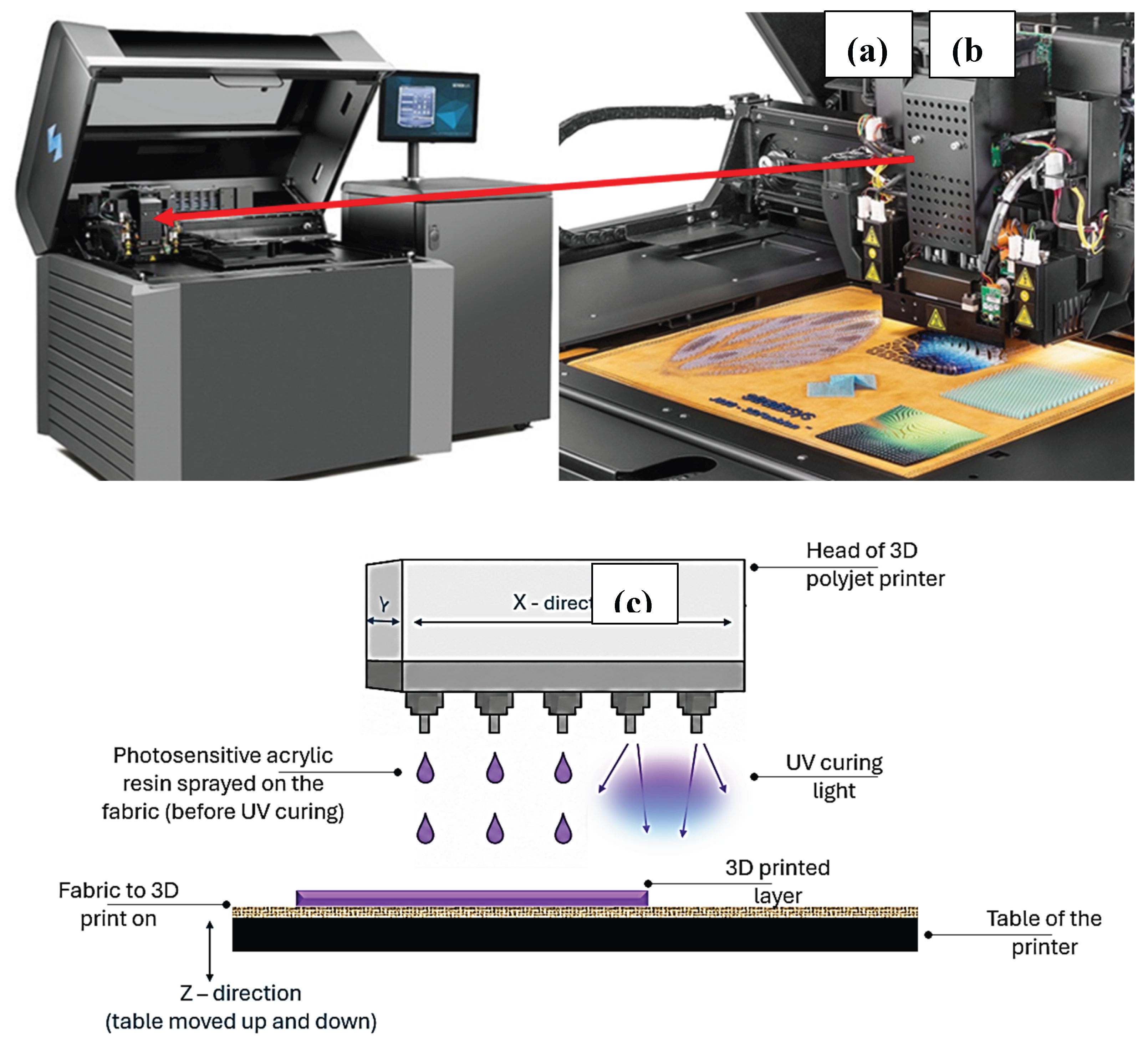
Figure 2.
Preliminary three-dimensional polyjet printing (3DPP) of acrylic photosensitive resin (APR) layers on Nylon 66 interlock fabric. The samples show increasing print coverage and surface opacity with layer numbers ranging from 2 to 20.
Figure 2.
Preliminary three-dimensional polyjet printing (3DPP) of acrylic photosensitive resin (APR) layers on Nylon 66 interlock fabric. The samples show increasing print coverage and surface opacity with layer numbers ranging from 2 to 20.
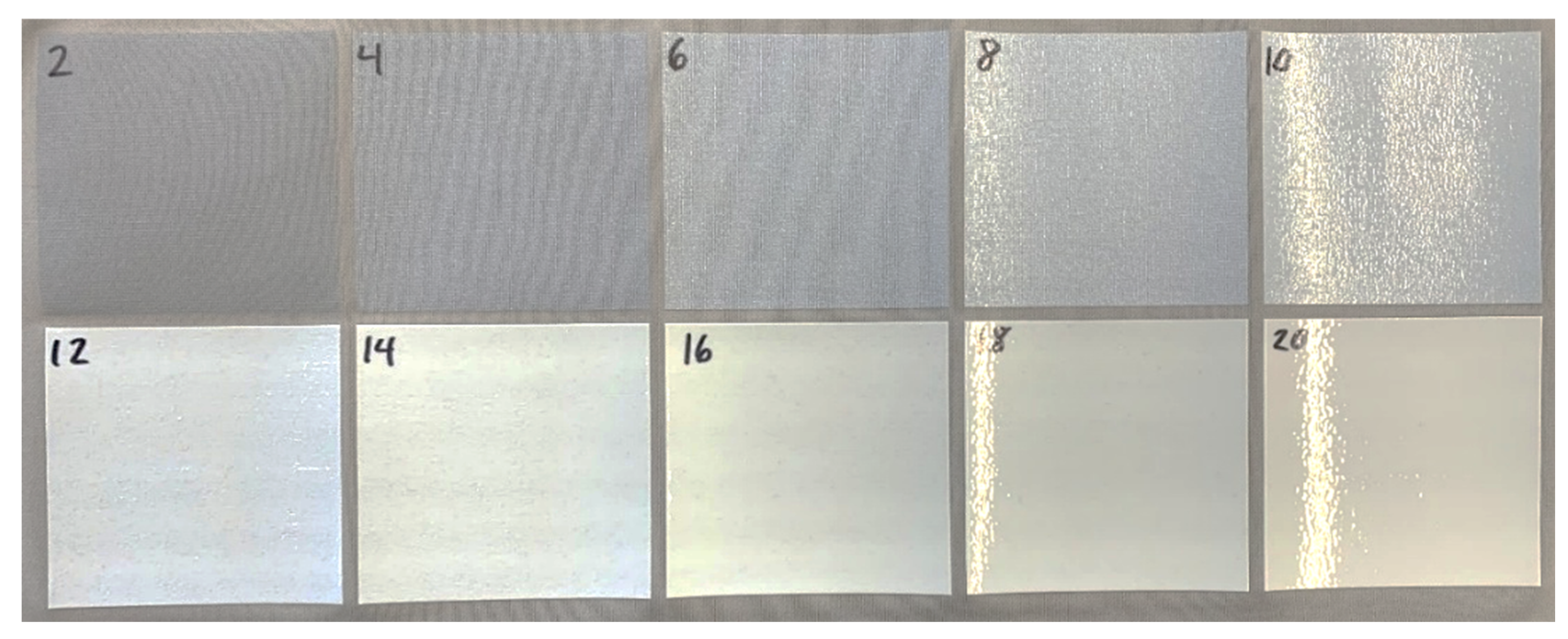
Figure 3.
The three-dimensional polyjet printing (3DPP) in the initial exploratory study; progressively increasing layer numbers ranging from 2 to 20 layers; (a) 2 layers; (b) 4 layers; (c) 6 layers; (d) 8 layers; (e) 10 layers; (f) 12 layers; (g) 14 layers; (h) 16 layers; (i) 18 layers; (j) 20 layers.
Figure 3.
The three-dimensional polyjet printing (3DPP) in the initial exploratory study; progressively increasing layer numbers ranging from 2 to 20 layers; (a) 2 layers; (b) 4 layers; (c) 6 layers; (d) 8 layers; (e) 10 layers; (f) 12 layers; (g) 14 layers; (h) 16 layers; (i) 18 layers; (j) 20 layers.
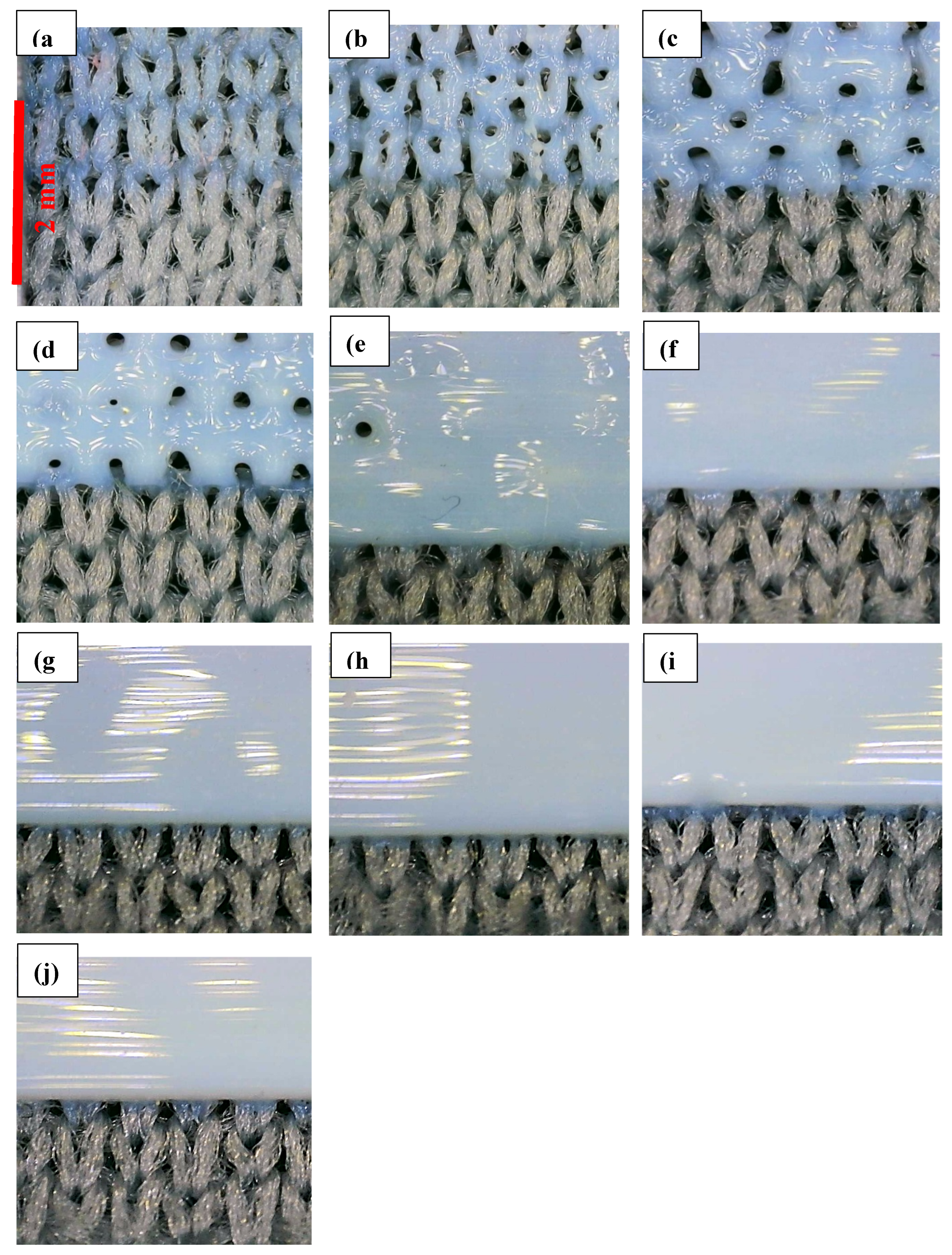
Figure 4.
Structure of the weft-knitted fabric used for 3D polyjet printing (3DPP): (a) idealized representation of the technical face of the fabric; the technical face and technical back of an interlock structure are identical; and (b) photograph of the fabric used in the main experiment. The black lines indicate the yarn paths forming the knitted loops. Wales are columns of intermeshed loops oriented in the lengthwise, or vertical direction, whereas courses are rows of loops oriented in the widthwise, or horizontal direction.
Figure 4.
Structure of the weft-knitted fabric used for 3D polyjet printing (3DPP): (a) idealized representation of the technical face of the fabric; the technical face and technical back of an interlock structure are identical; and (b) photograph of the fabric used in the main experiment. The black lines indicate the yarn paths forming the knitted loops. Wales are columns of intermeshed loops oriented in the lengthwise, or vertical direction, whereas courses are rows of loops oriented in the widthwise, or horizontal direction.
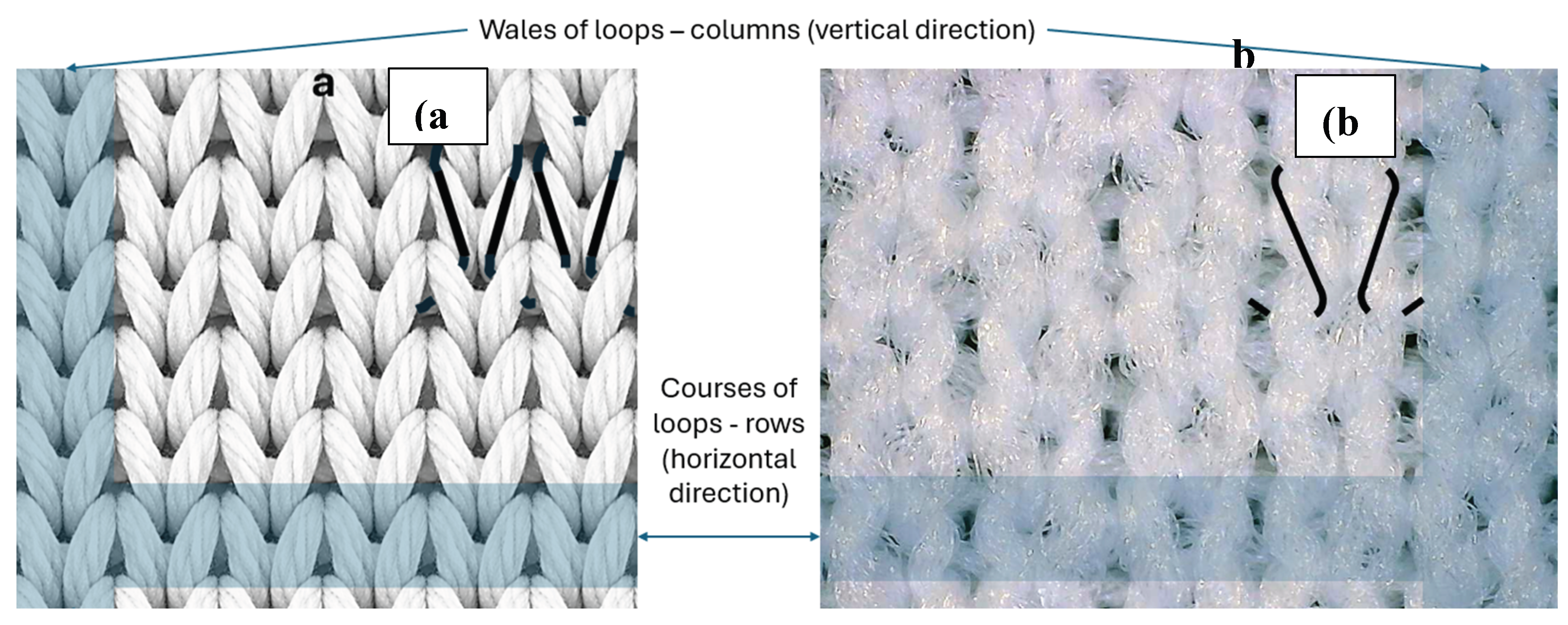
Figure 5.
An example of a large-area 3D polyjet-printed (3DPP) laminate, measuring 13 × 17 in. (330.2 × 431.8 mm), deposited directly onto a knitted fabric substrate.
Figure 5.
An example of a large-area 3D polyjet-printed (3DPP) laminate, measuring 13 × 17 in. (330.2 × 431.8 mm), deposited directly onto a knitted fabric substrate.
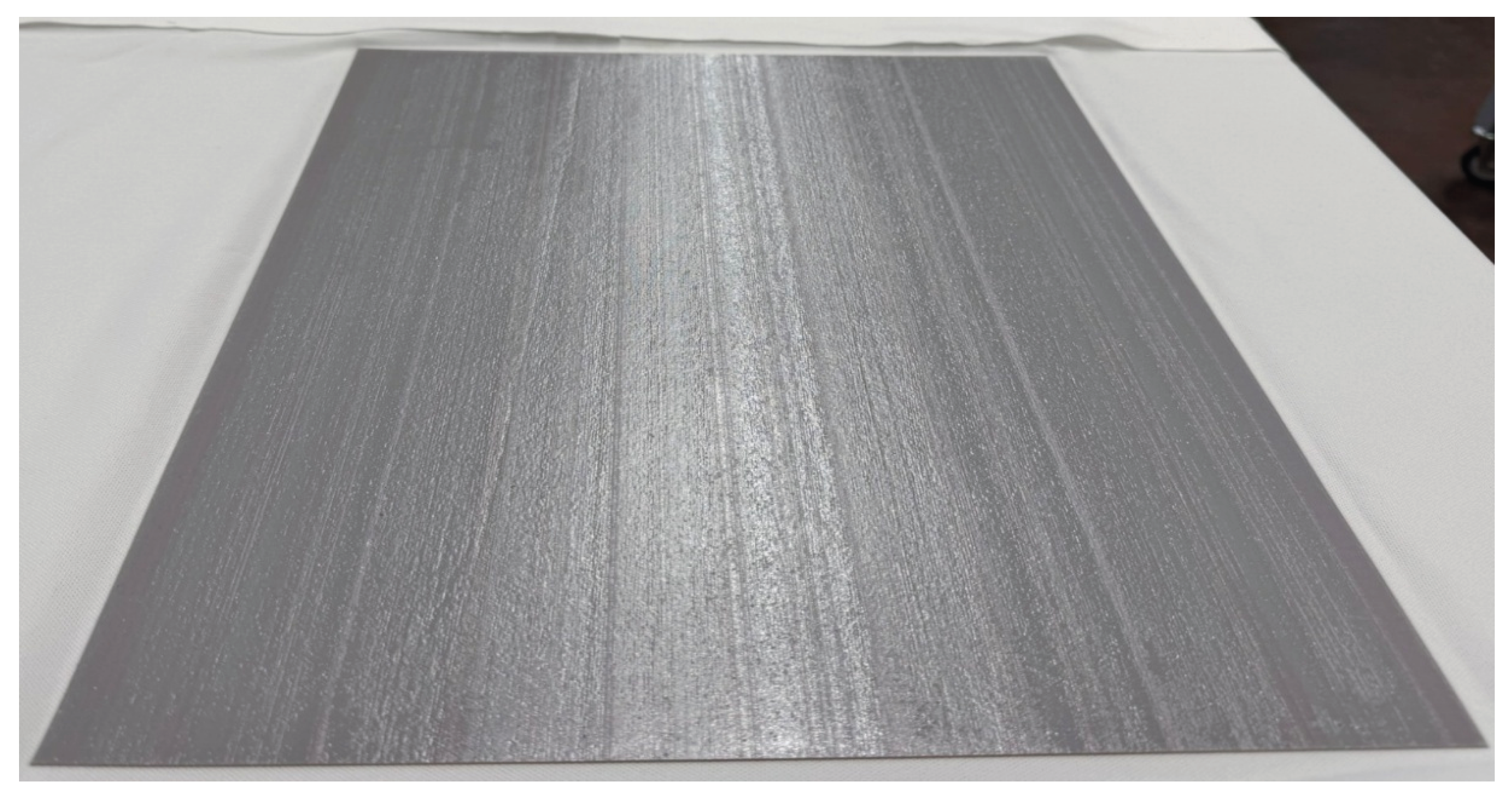
Figure 6.
Surface SEM image of a representative 3DPP laminate showing a continuous APR surface with parallel printing-related striations and scattered irregular surface features. Magnification: 150×; scale bar: 100 µm.
Figure 6.
Surface SEM image of a representative 3DPP laminate showing a continuous APR surface with parallel printing-related striations and scattered irregular surface features. Magnification: 150×; scale bar: 100 µm.
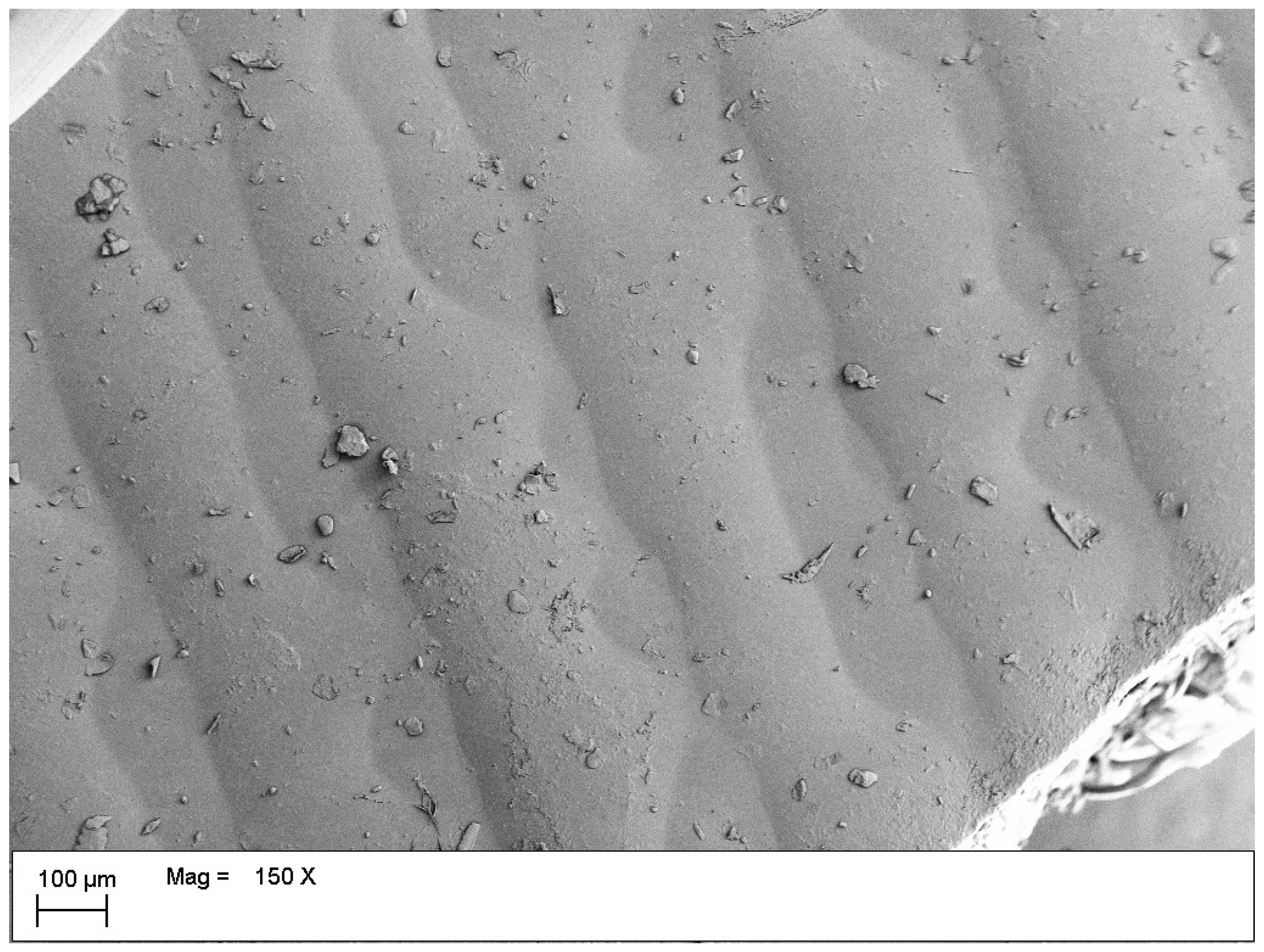
Figure 7.
Cross-sectional SEM image of the 12-layer one-sided 3DPP laminate, showing the compact external APR layer and localized penetration of the APR into spaces between yarns and individual filaments of the Nylon 66 knitted substrate. Magnification: 150×; scale bar: 100 µm.
Figure 7.
Cross-sectional SEM image of the 12-layer one-sided 3DPP laminate, showing the compact external APR layer and localized penetration of the APR into spaces between yarns and individual filaments of the Nylon 66 knitted substrate. Magnification: 150×; scale bar: 100 µm.
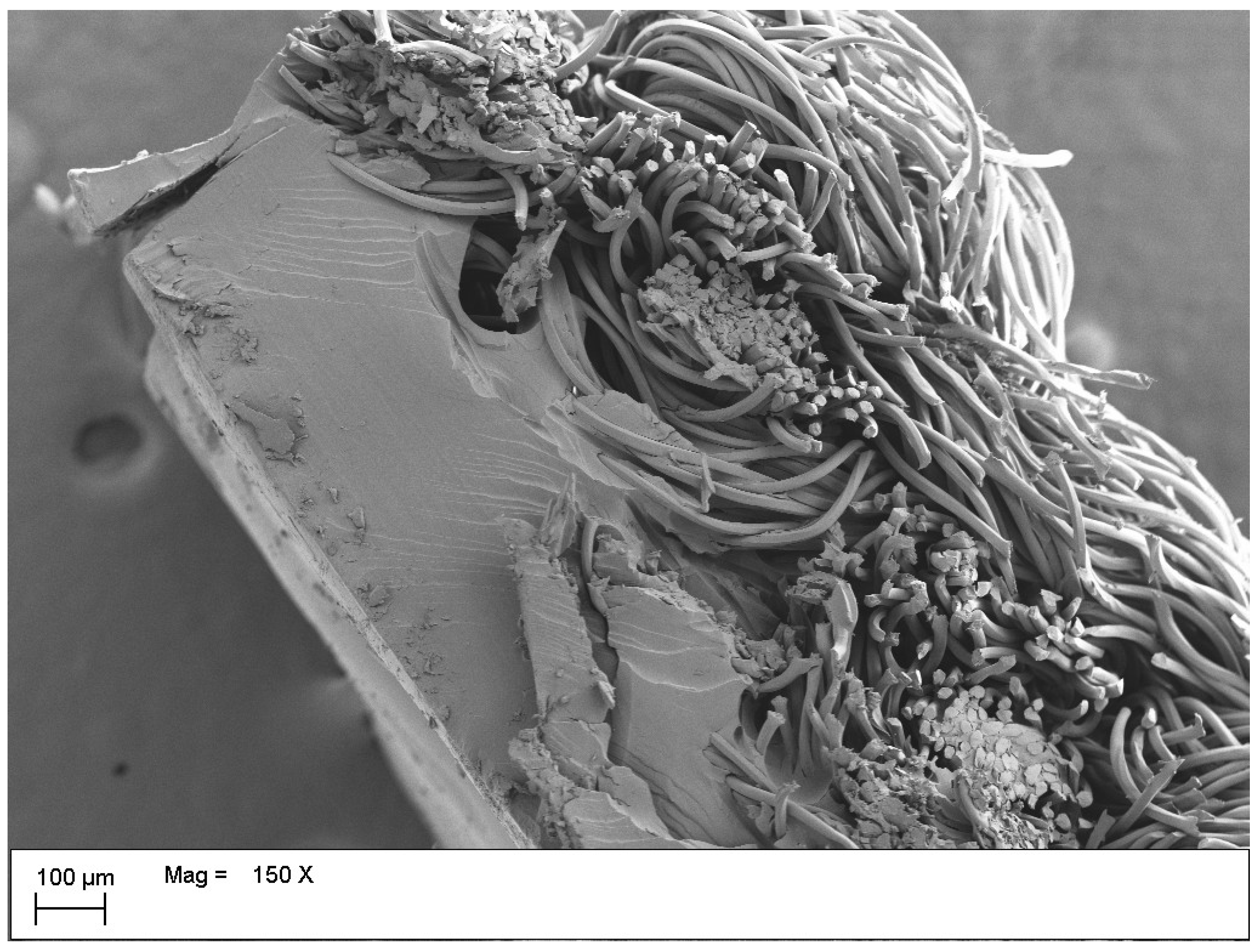
Figure 8.
Cross-sectional SEM image of a two-sided 3DPP laminate showing the Nylon 66 knitted structure positioned between the APR regions. Open inter-yarn and inter-filament spaces remain visible within the textile structure. Magnification: 150×; scale bar: 100 µm.
Figure 8.
Cross-sectional SEM image of a two-sided 3DPP laminate showing the Nylon 66 knitted structure positioned between the APR regions. Open inter-yarn and inter-filament spaces remain visible within the textile structure. Magnification: 150×; scale bar: 100 µm.
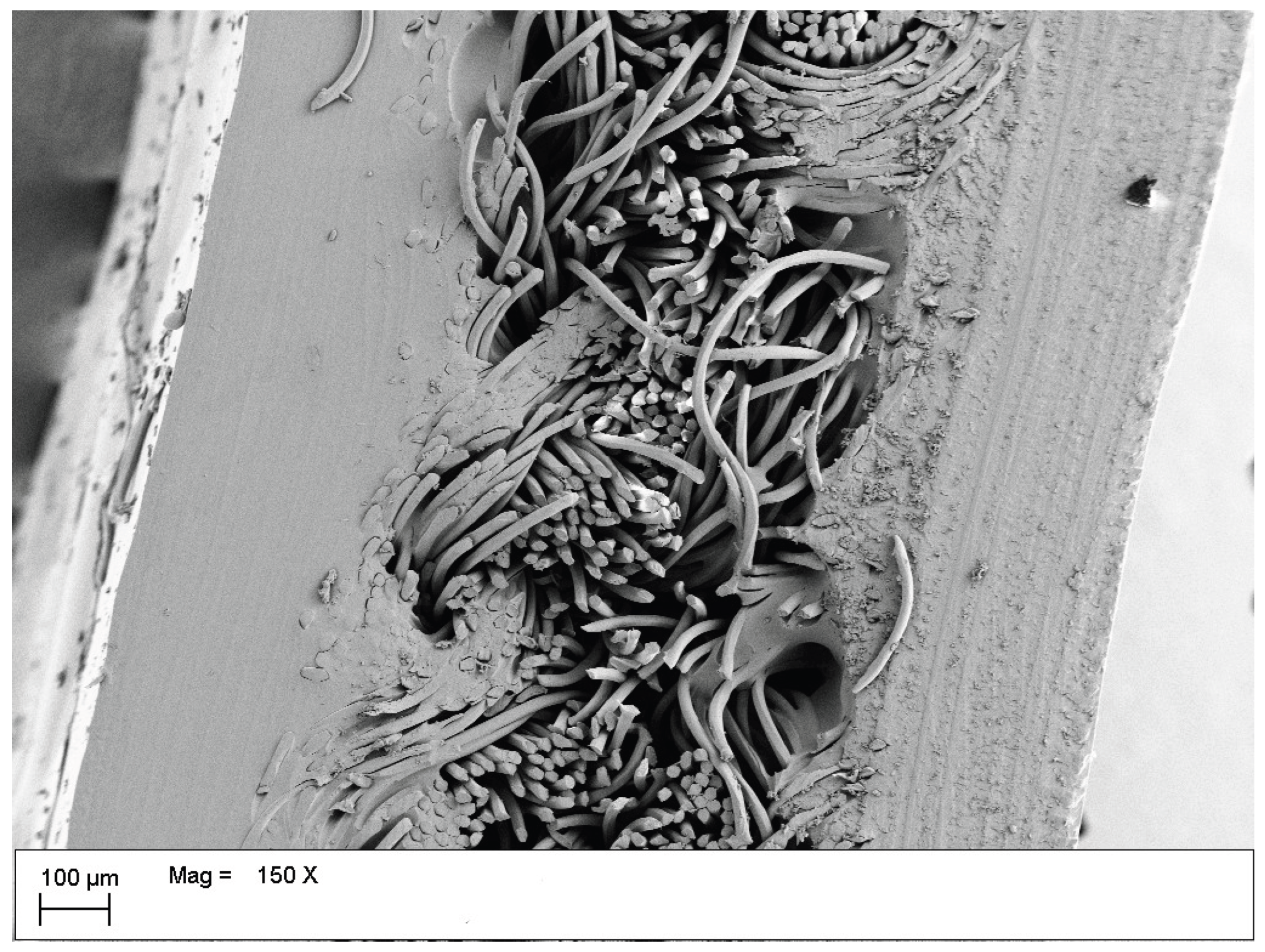
Figure 9.
Higher-magnification SEM image of the APR interface from Figure 8, showing resin surrounding individual filaments and irregular fracture along the prepared cross-sectional edge. Magnification: 500×; scale bar: 20 µm.
Figure 9.
Higher-magnification SEM image of the APR interface from Figure 8, showing resin surrounding individual filaments and irregular fracture along the prepared cross-sectional edge. Magnification: 500×; scale bar: 20 µm.
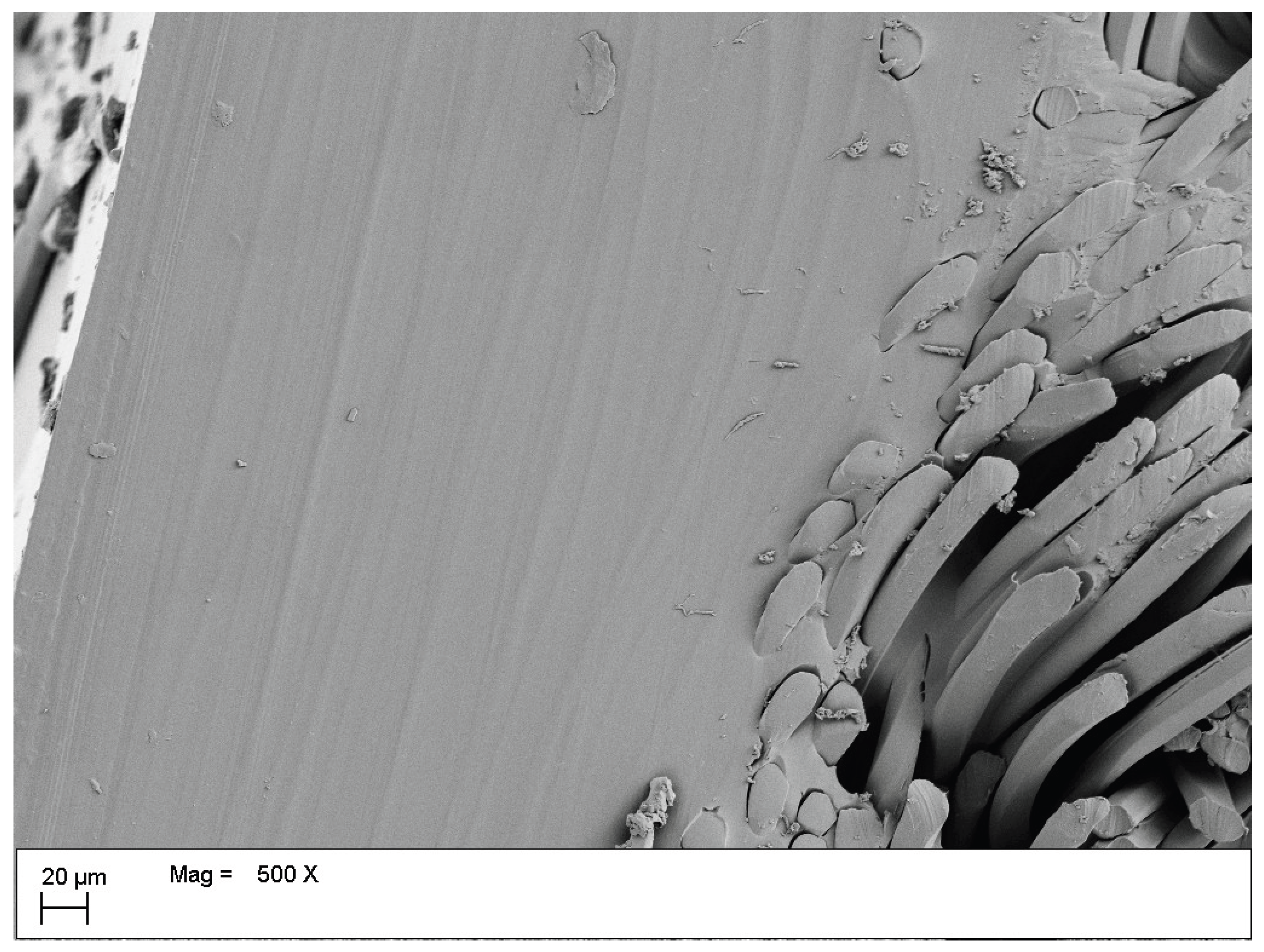
Figure 10.
Cross-sectional SEM image of a 20-layer 3DPP laminate showing the arrangement of the external APR region and the Nylon 66 knitted substrate. Some filament bundles were locally surrounded or partially immersed in the APR (red arrows), while other regions remained unfilled. Magnification: 100×; scale bar: 100 µm.
Figure 10.
Cross-sectional SEM image of a 20-layer 3DPP laminate showing the arrangement of the external APR region and the Nylon 66 knitted substrate. Some filament bundles were locally surrounded or partially immersed in the APR (red arrows), while other regions remained unfilled. Magnification: 100×; scale bar: 100 µm.
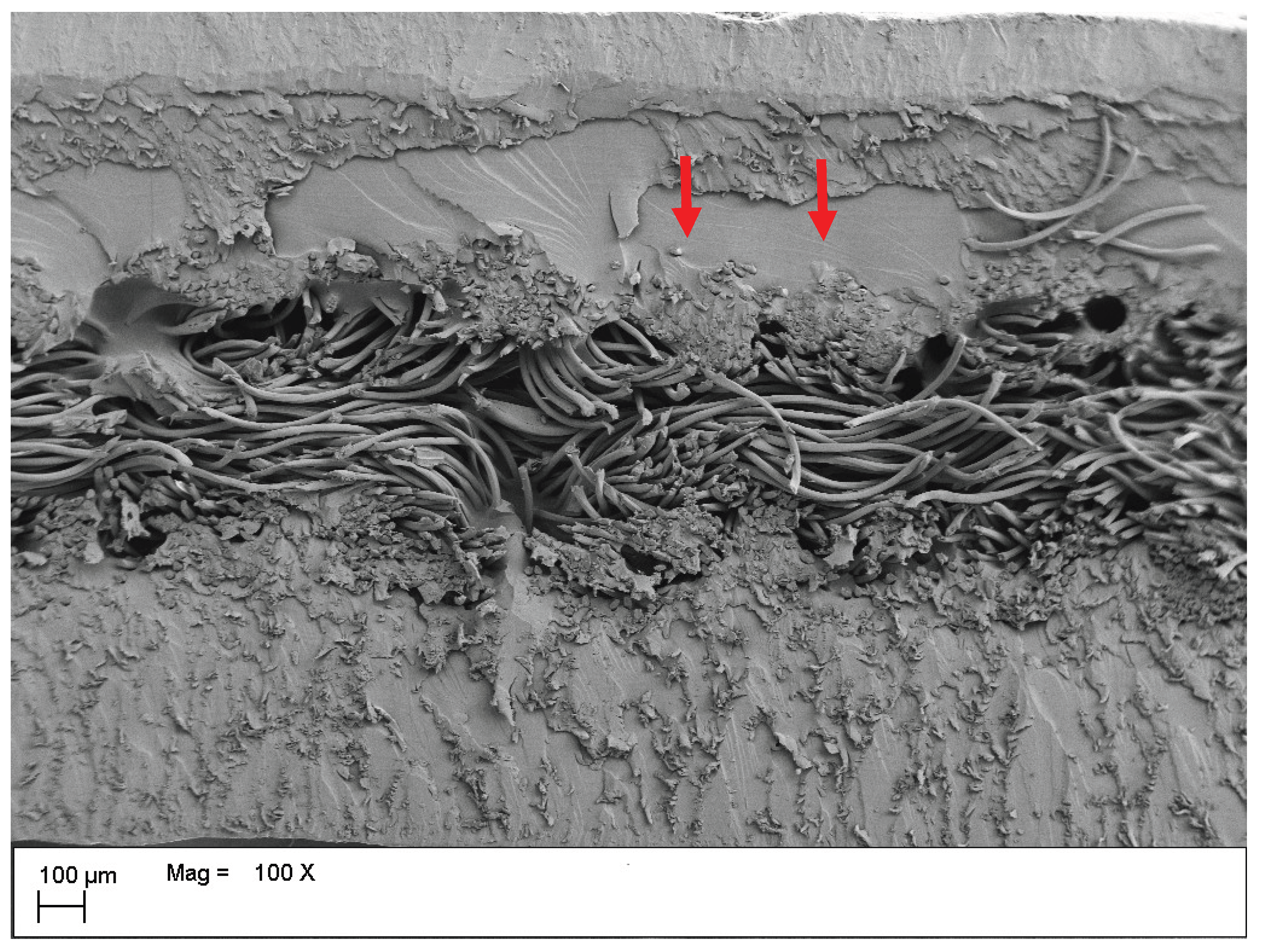
Figure 11.
Higher-magnification SEM image of the 20-layer laminate presented in Figure 10, showing single filaments immersed in the APR. Magnification: 500×; scale bar: 20 µm.
Figure 11.
Higher-magnification SEM image of the 20-layer laminate presented in Figure 10, showing single filaments immersed in the APR. Magnification: 500×; scale bar: 20 µm.
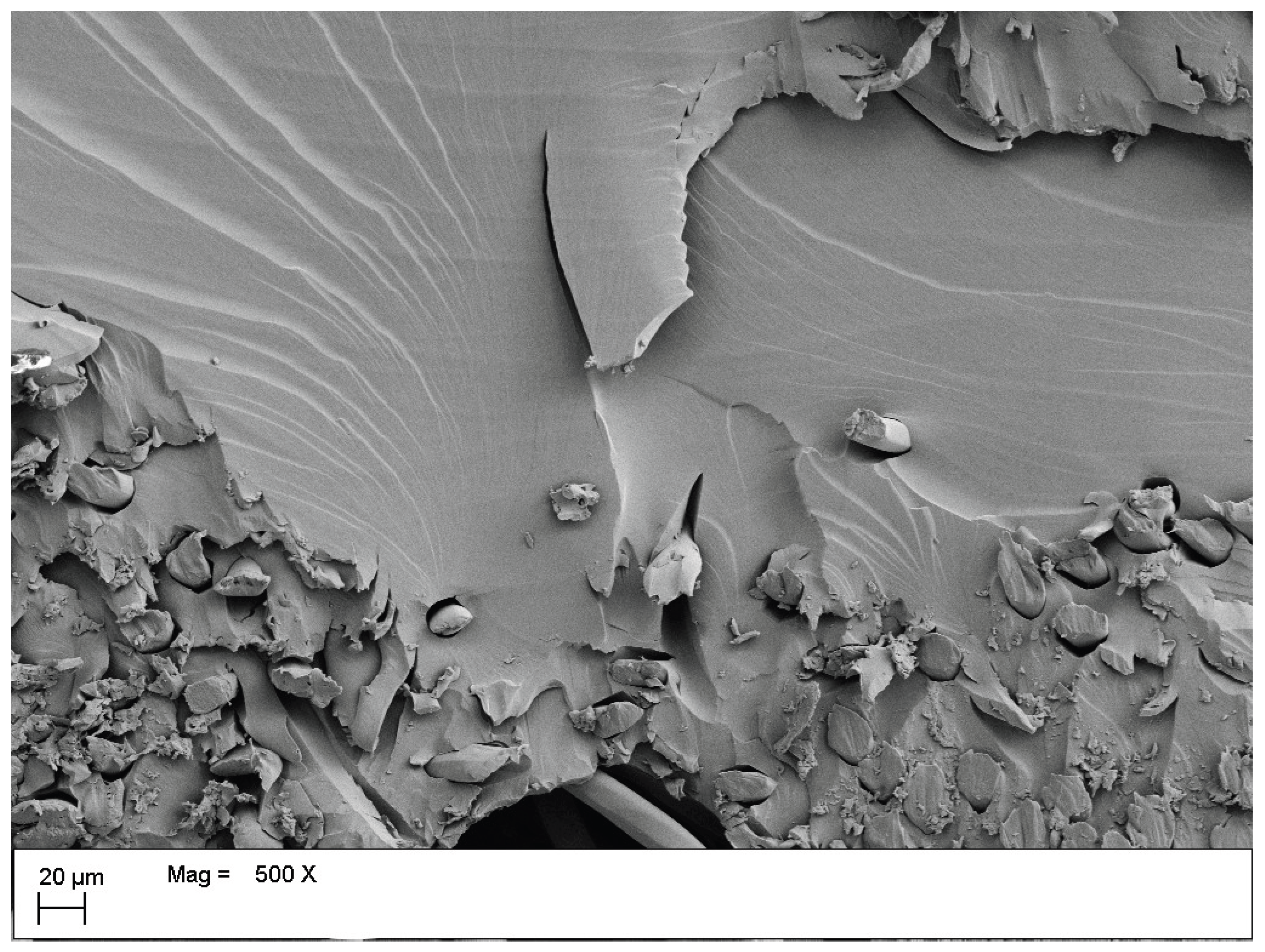
Figure 12.
Mean engineering stress–strain curves of the Nylon 66 interlock knitted reference fabric, fabric-supported 3DPP laminates (12 layers (12L), 20 layers (20L), one-sided (1S), two-sided (2S)), and unsupported laminate-only specimens (laminates only) tested in the wale direction before accelerated xenon-arc exposure. Solid lines represent the mean response of three specimens (n = 3), while the shaded regions around the curves indicate ±1 standard deviation (SD). Dashed lines correspond to unsupported 3DPP laminate-only specimens.
Figure 12.
Mean engineering stress–strain curves of the Nylon 66 interlock knitted reference fabric, fabric-supported 3DPP laminates (12 layers (12L), 20 layers (20L), one-sided (1S), two-sided (2S)), and unsupported laminate-only specimens (laminates only) tested in the wale direction before accelerated xenon-arc exposure. Solid lines represent the mean response of three specimens (n = 3), while the shaded regions around the curves indicate ±1 standard deviation (SD). Dashed lines correspond to unsupported 3DPP laminate-only specimens.
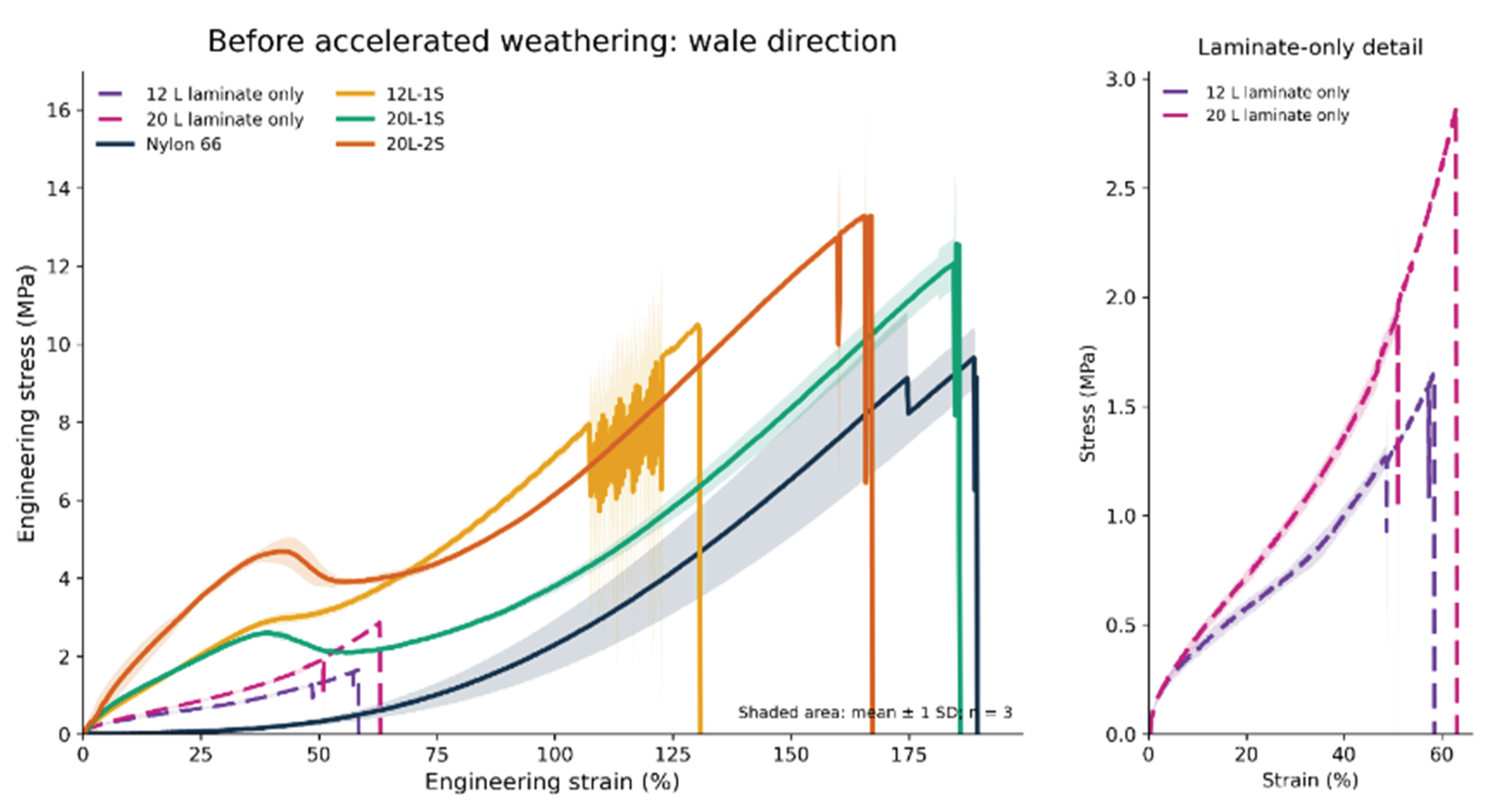
Figure 13.
Mean engineering stress–strain curves of the Nylon 66 interlock knitted reference fabric, fabric-supported 3D polyjet-printed laminates, and unsupported laminate-only specimens tested in the course direction before accelerated xenon-arc exposure. Solid lines represent the mean response of three specimens, shaded regions indicate ±1 standard deviation, and dashed lines represent the unsupported laminate-only specimens. The inset provides an enlarged view of the laminate-only curves.
Figure 13.
Mean engineering stress–strain curves of the Nylon 66 interlock knitted reference fabric, fabric-supported 3D polyjet-printed laminates, and unsupported laminate-only specimens tested in the course direction before accelerated xenon-arc exposure. Solid lines represent the mean response of three specimens, shaded regions indicate ±1 standard deviation, and dashed lines represent the unsupported laminate-only specimens. The inset provides an enlarged view of the laminate-only curves.
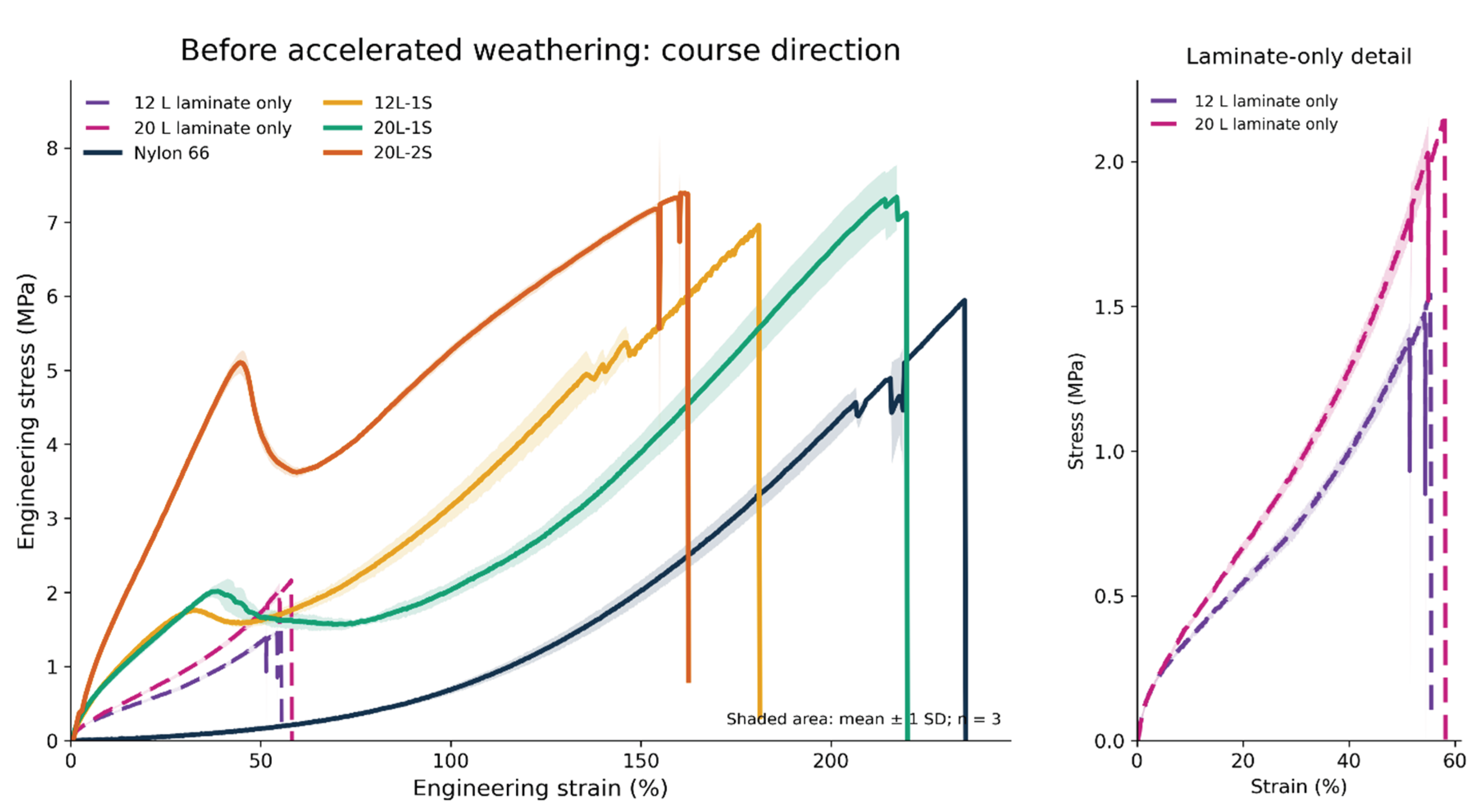
Figure 14.
Mean engineering stress–strain curves of the Nylon 66 interlock knitted reference fabric, fabric-supported 3D polyjet-printed laminates, and unsupported laminate-only specimens tested in the wale direction after 20 h of accelerated xenon-arc exposure. Solid lines represent the mean response of three specimens, shaded regions indicate ±1 standard deviation, and dashed lines represent the unsupported laminate-only specimens. The inset provides an enlarged view of the laminate-only curves.
Figure 14.
Mean engineering stress–strain curves of the Nylon 66 interlock knitted reference fabric, fabric-supported 3D polyjet-printed laminates, and unsupported laminate-only specimens tested in the wale direction after 20 h of accelerated xenon-arc exposure. Solid lines represent the mean response of three specimens, shaded regions indicate ±1 standard deviation, and dashed lines represent the unsupported laminate-only specimens. The inset provides an enlarged view of the laminate-only curves.
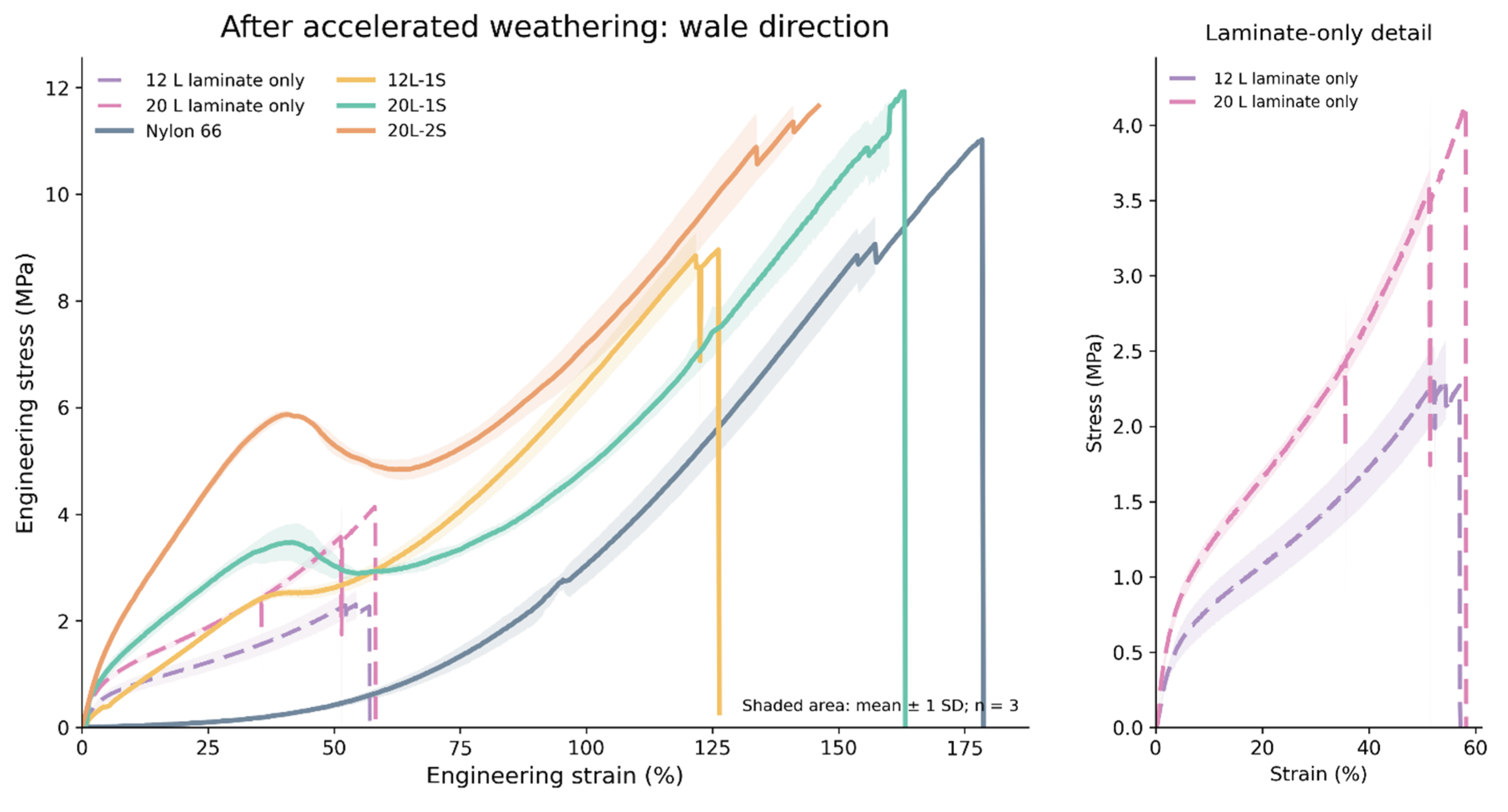
Figure 15.
Mean engineering stress–strain curves of the Nylon 66 interlock knitted reference fabric, fabric-supported 3D polyjet-printed laminates, and unsupported laminate-only specimens tested in the course direction after 20 h of accelerated xenon-arc exposure. Solid lines represent the mean response of three specimens, shaded regions indicate ±1 standard deviation, and dashed lines represent the unsupported laminate-only specimens. The inset provides an enlarged view of the laminate-only curves.
Figure 15.
Mean engineering stress–strain curves of the Nylon 66 interlock knitted reference fabric, fabric-supported 3D polyjet-printed laminates, and unsupported laminate-only specimens tested in the course direction after 20 h of accelerated xenon-arc exposure. Solid lines represent the mean response of three specimens, shaded regions indicate ±1 standard deviation, and dashed lines represent the unsupported laminate-only specimens. The inset provides an enlarged view of the laminate-only curves.
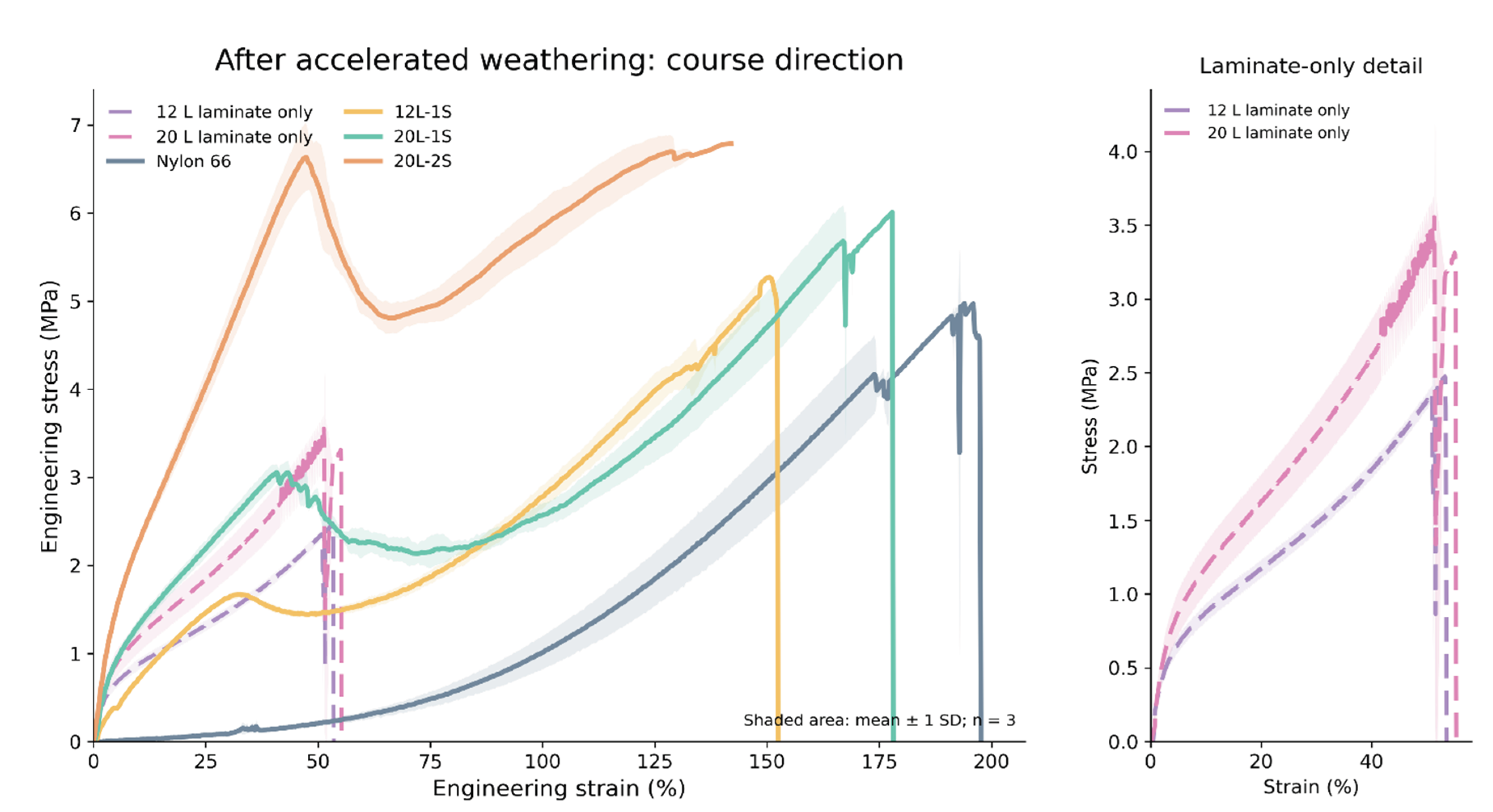
Figure 16.
Individual engineering stress–strain curves of the 20-layer one-sided laminate tested in the wale direction before and after 20 h of accelerated xenon-arc exposure. Three specimens are shown for each condition (n = 3).
Figure 16.
Individual engineering stress–strain curves of the 20-layer one-sided laminate tested in the wale direction before and after 20 h of accelerated xenon-arc exposure. Three specimens are shown for each condition (n = 3).
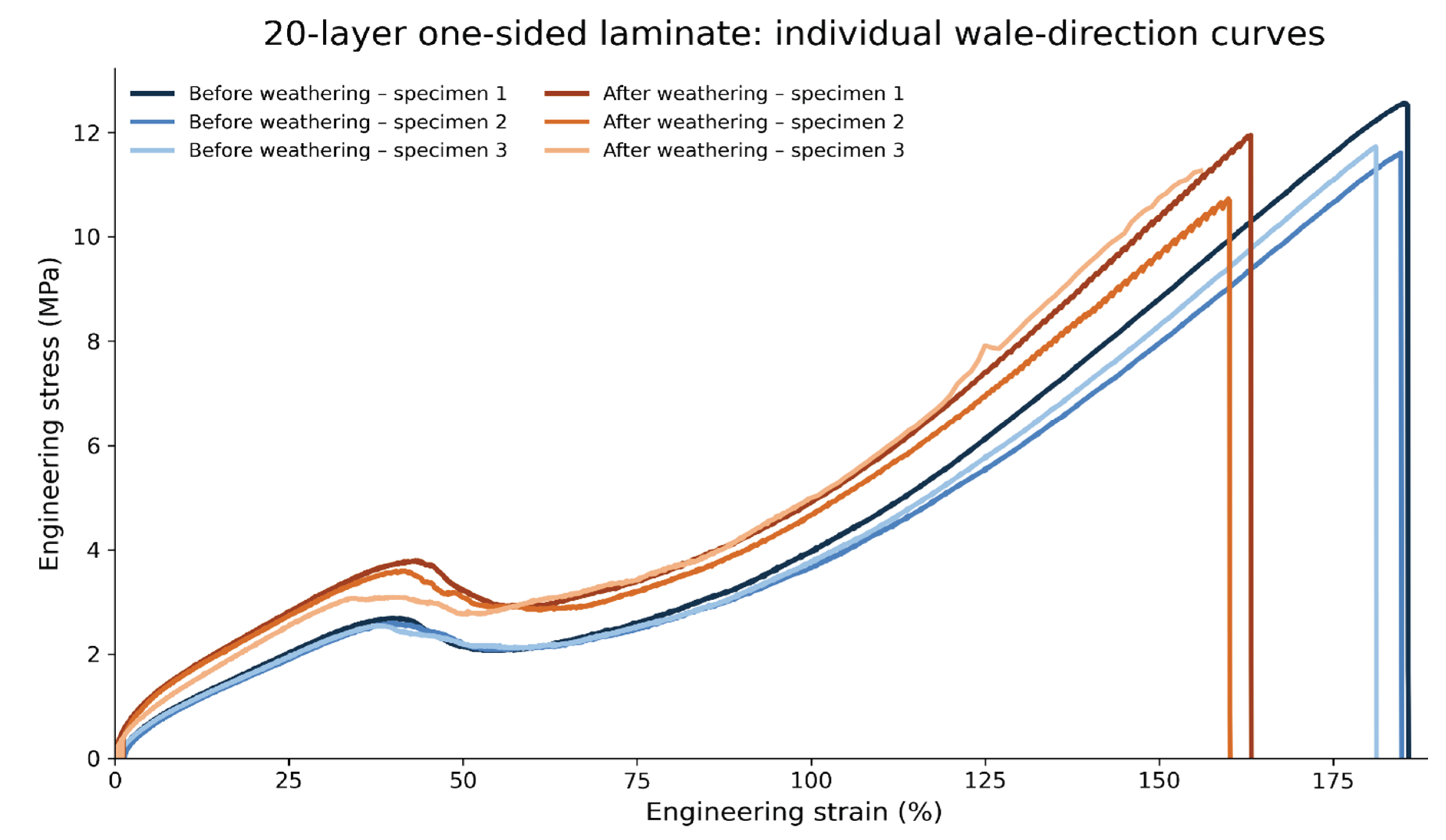
Figure 17.
Individual engineering stress–strain curves of the 20-layer one-sided laminate tested in the course direction before and after 20 h of accelerated xenon-arc exposure. Three specimens are shown for each condition (n = 3).
Figure 17.
Individual engineering stress–strain curves of the 20-layer one-sided laminate tested in the course direction before and after 20 h of accelerated xenon-arc exposure. Three specimens are shown for each condition (n = 3).
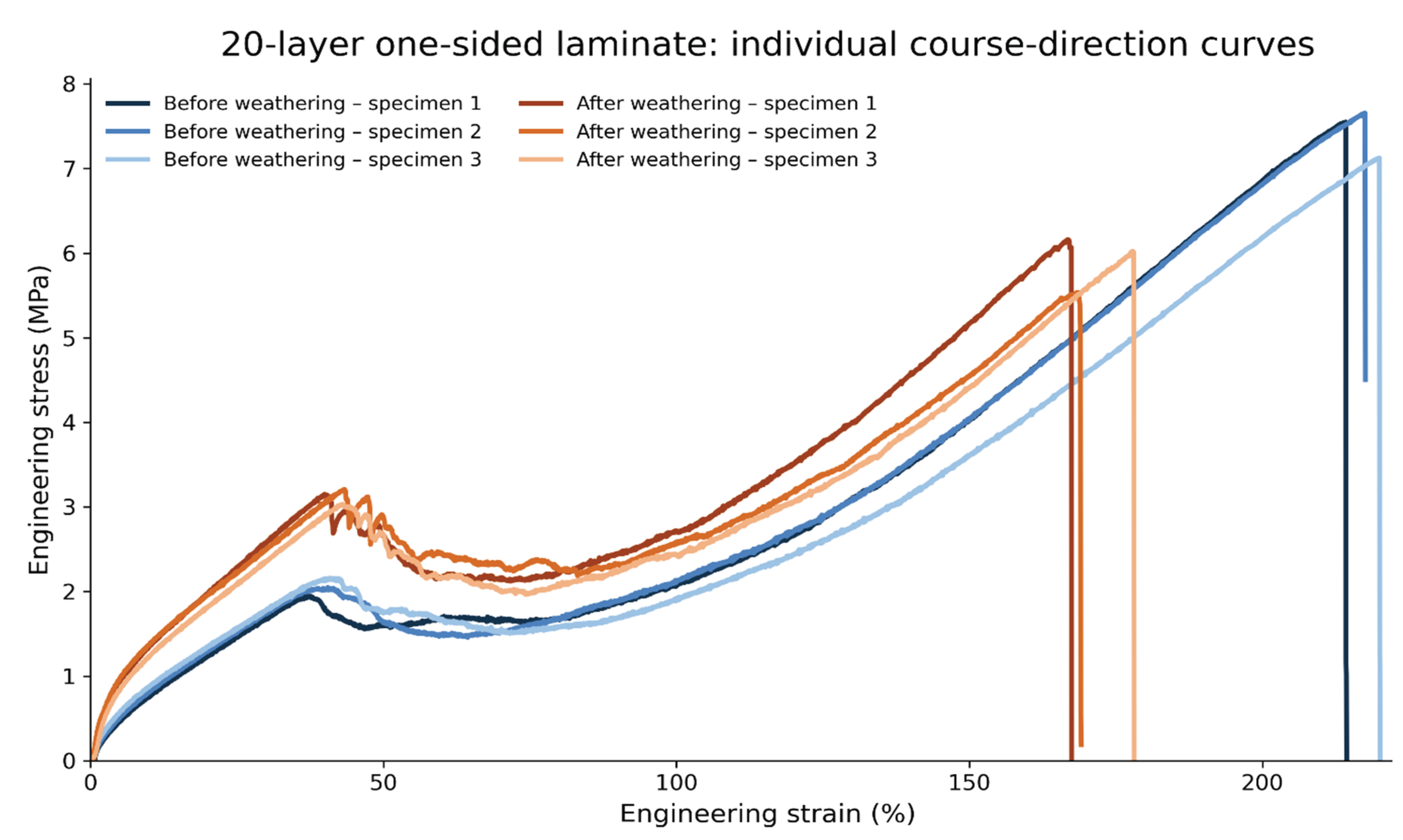
Figure 18.
Individual engineering stress–strain curves of the 20-layer two-sided laminate tested in the wale direction before and after 20 h of accelerated xenon-arc exposure. Three specimens are shown for each condition (n = 3).
Figure 18.
Individual engineering stress–strain curves of the 20-layer two-sided laminate tested in the wale direction before and after 20 h of accelerated xenon-arc exposure. Three specimens are shown for each condition (n = 3).
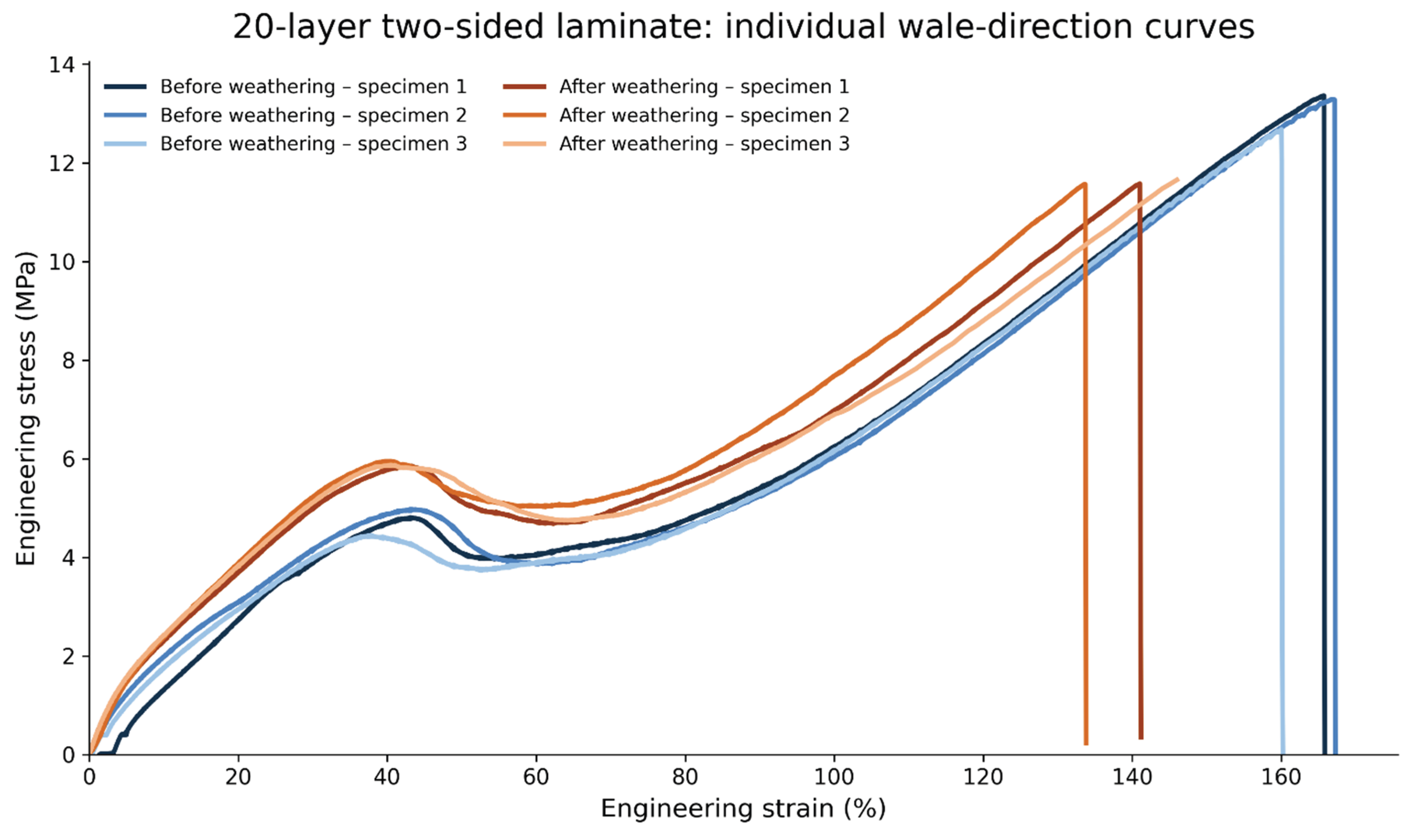
Figure 19.
Individual engineering stress–strain curves of the 20-layer two-sided laminate tested in the course direction before and after 20 h of accelerated xenon-arc exposure. Three specimens are shown for each condition (n = 3).
Figure 19.
Individual engineering stress–strain curves of the 20-layer two-sided laminate tested in the course direction before and after 20 h of accelerated xenon-arc exposure. Three specimens are shown for each condition (n = 3).
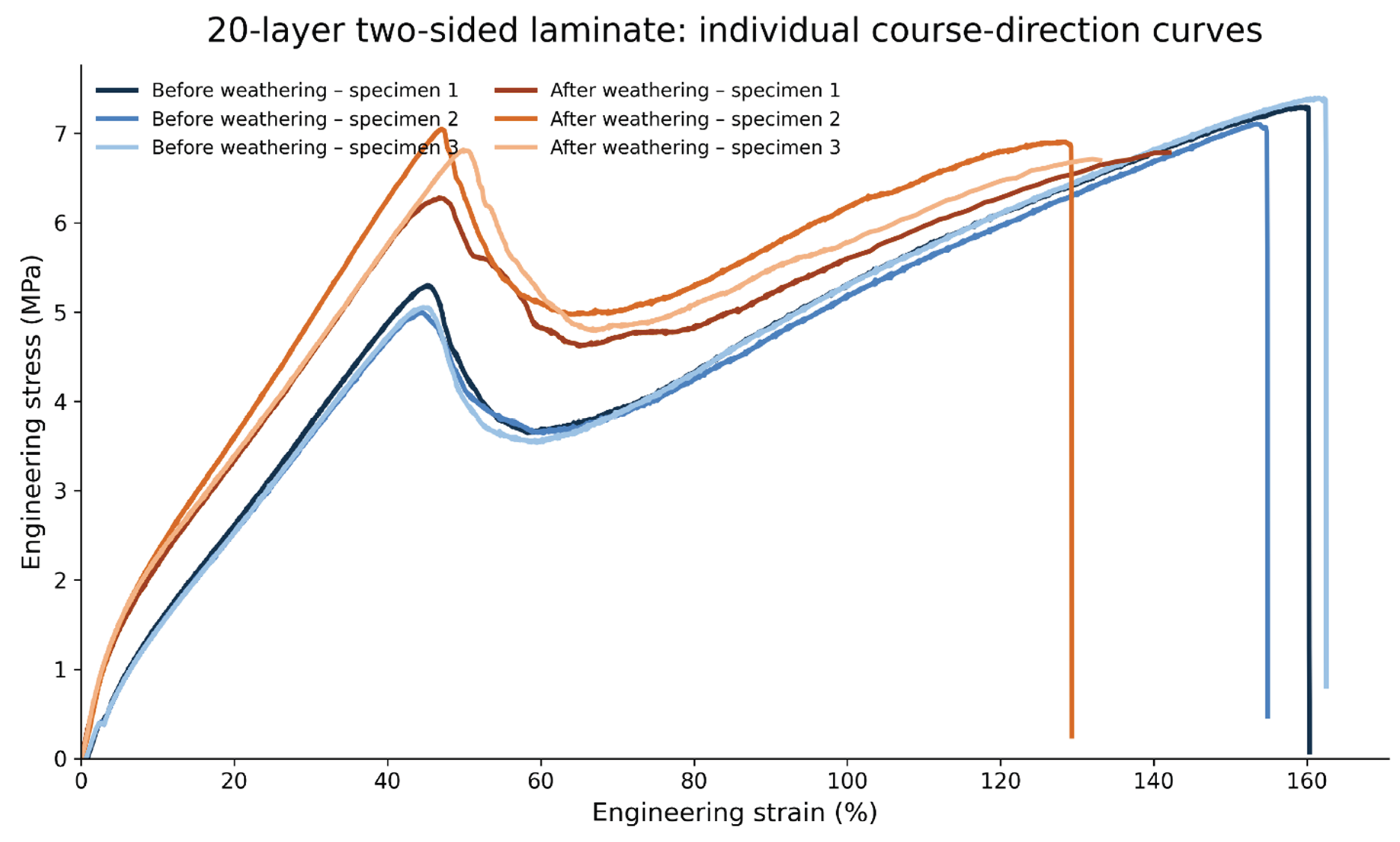
Figure 20.
Individual engineering stress–strain curves of the 12-layer one-sided laminate tested in the wale direction before and after 20 h of accelerated xenon-arc exposure. Three specimens are shown for each condition (n = 3).
Figure 20.
Individual engineering stress–strain curves of the 12-layer one-sided laminate tested in the wale direction before and after 20 h of accelerated xenon-arc exposure. Three specimens are shown for each condition (n = 3).
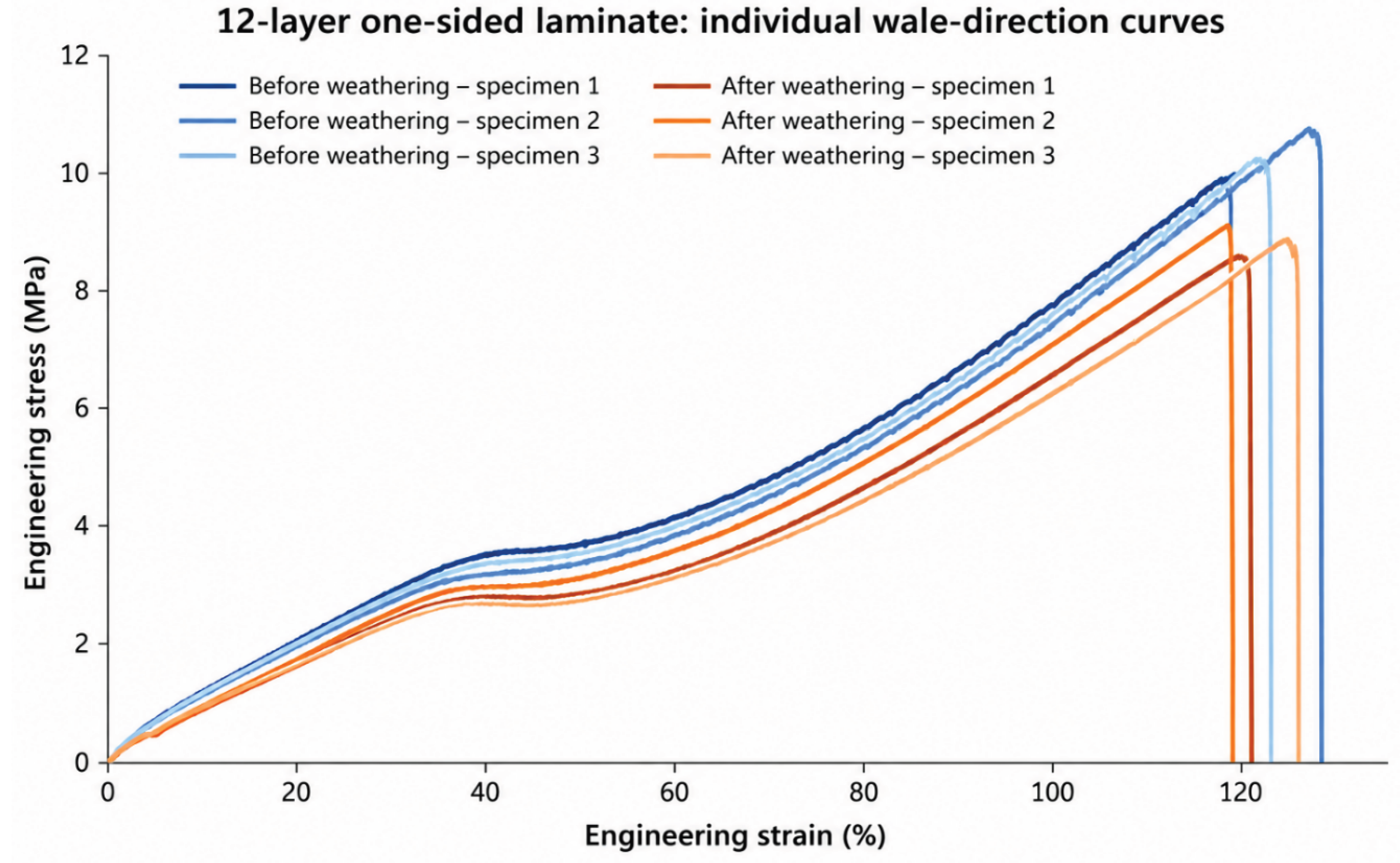
Figure 21.
Individual engineering stress–strain curves of the 12-layer one-sided laminate tested in the course direction before and after 20 h of accelerated xenon-arc exposure. Three specimens are shown for each condition (n = 3).
Figure 21.
Individual engineering stress–strain curves of the 12-layer one-sided laminate tested in the course direction before and after 20 h of accelerated xenon-arc exposure. Three specimens are shown for each condition (n = 3).
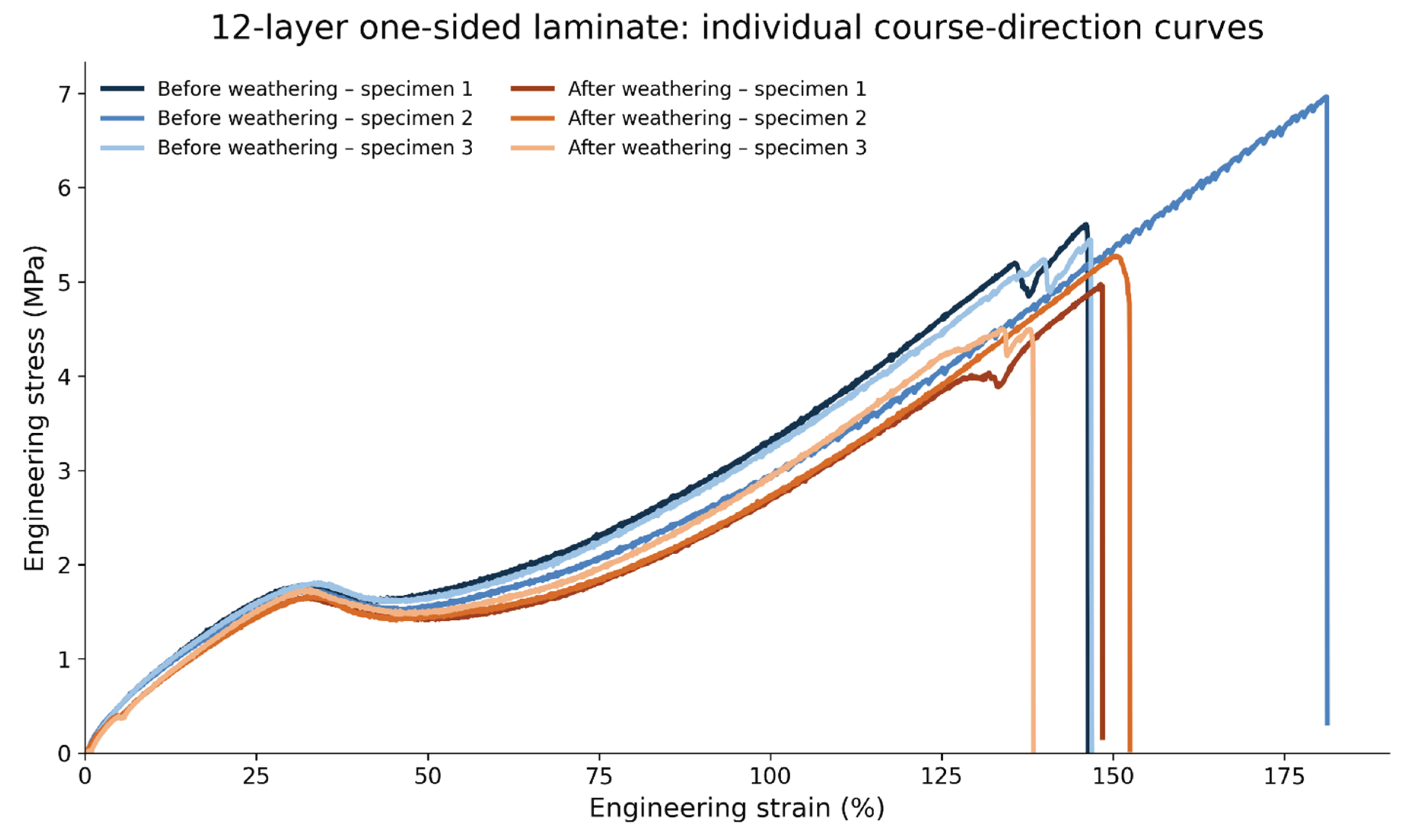
Figure 22.
Selected video frames showing the progressive deformation and failure of a 20-layer two-sided 3DPP laminate tested in the course direction: (a) initially intact specimen at the beginning of loading; (b) onset of transverse cracking in the APR layer; (c) propagation and multiplication of transverse cracks while the Nylon 66 knitted substrate remained continuous; (d) fully developed cracking across the specimen, with the underlying Nylon 66 fabric visible between the cracked APR segments; (e) advanced extension of the knitted substrate, with approximately evenly spaced APR segments and localized hourglass-shaped narrowing of the specimen; and (f) final rupture of the specimen.
Figure 22.
Selected video frames showing the progressive deformation and failure of a 20-layer two-sided 3DPP laminate tested in the course direction: (a) initially intact specimen at the beginning of loading; (b) onset of transverse cracking in the APR layer; (c) propagation and multiplication of transverse cracks while the Nylon 66 knitted substrate remained continuous; (d) fully developed cracking across the specimen, with the underlying Nylon 66 fabric visible between the cracked APR segments; (e) advanced extension of the knitted substrate, with approximately evenly spaced APR segments and localized hourglass-shaped narrowing of the specimen; and (f) final rupture of the specimen.
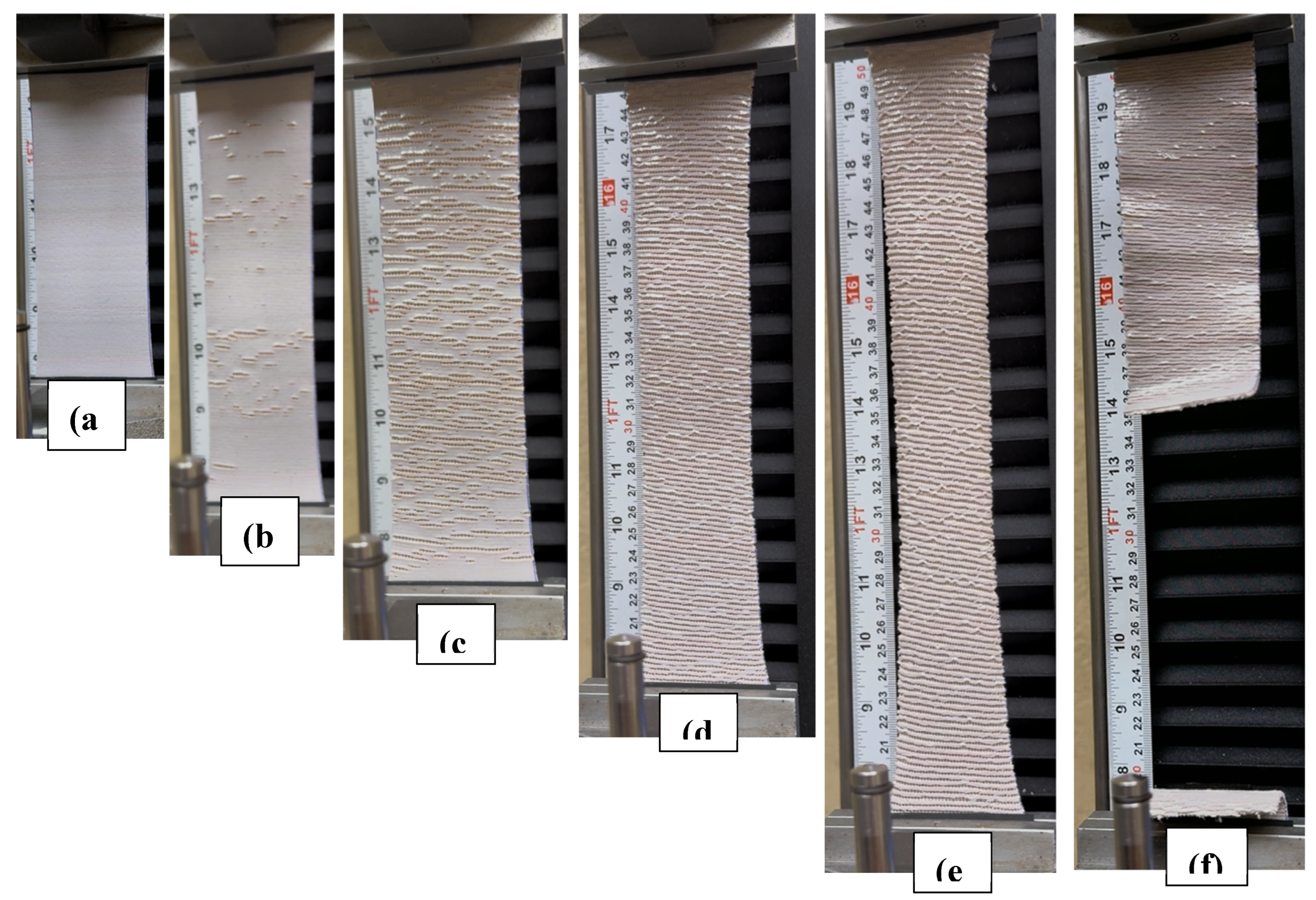

Table 1.
Experimental sample configurations: Nylon 66 knitted substrate (reference), laminate-only (reference), and the number and placement of 3DPP-ed layers on the technical face and technical back of the fabric.
Table 1.
Experimental sample configurations: Nylon 66 knitted substrate (reference), laminate-only (reference), and the number and placement of 3DPP-ed layers on the technical face and technical back of the fabric.
| Sample | 100% Nylon 66 interlock stitch, weft knitted fabric | 3DPP lamination on | Note | |
|---|---|---|---|---|
| the face of the fabrics |
the back of the fabric | |||
| 1 | Yes | - | Reference fabric/no 3DPP | |
| 2 | - | 12 layers | Reference 3DPP/no fabric | |
| 3 | - | 20 layers | Reference 3DPP/no fabric | |
| 4 | Yes | 12 layers | - | - |
| 5 | Yes | 12 layers | 12 layers | Produced samples were damaged during tensile testing; thus, some of the results were not reported |
| 6 | Yes | 20 layers | - | - |
| 7 | Yes | 20 layers | 20 layers | - |
Table 2.
Characteristics of Nylon 66 knitted fabric (reference), laminates without textile support (reference), and the 12-layer and 20-layer 3DPP laminates on Nylon 66 fabric; values are mean ± standard deviation (SD); n = 10 for every material.
Table 2.
Characteristics of Nylon 66 knitted fabric (reference), laminates without textile support (reference), and the 12-layer and 20-layer 3DPP laminates on Nylon 66 fabric; values are mean ± standard deviation (SD); n = 10 for every material.
| Material | Weight [g/m2] ±SD |
Thickness [mm] ±SD |
Number of wales/10 cm | Number of courses/10 cm |
|---|---|---|---|---|
| Nylon 66 | 223±4.5 | 0.940 ±0.020 | 124 | 150 |
| 12 layers- laminate only | 386.5±6.2 | 0.2540±0.050 | n/a | n/a |
| 20 layers- laminate only | 569.6±6.5 | 0.5160±0.010 | n/a | n/a |
| 12 layers-one side print on Nylon 66 | 797±7.5 | 1.1940±0.020 | n/a | n/a |
| 12 layers – two-side print on Nylon 66 | 1168±5.5 | 1.470±0.030 | n/a | n/a |
| 20 layer – one-side print on Nylon 66 | 1010±6.4 | 1.460±0.030 | n/a | n/a |
| 20 layers – two-side print on Nylon 66 | 1790±6.8 | 1.9570±0.050 | n/a | n/a |
Table 3.
Mean maximum engineering stress of the Nylon 66 knit, fabric-supported 3DPP laminates, and laminate-only specimens before and after accelerated xenon-arc weathering; values are mean ± standard deviation (SD), n = 3. Laminate-only orientations correspond to the surface striation orientations and were treated as wale- and course-direction fabric specimens; thus, wale direction was along striations.
Table 3.
Mean maximum engineering stress of the Nylon 66 knit, fabric-supported 3DPP laminates, and laminate-only specimens before and after accelerated xenon-arc weathering; values are mean ± standard deviation (SD), n = 3. Laminate-only orientations correspond to the surface striation orientations and were treated as wale- and course-direction fabric specimens; thus, wale direction was along striations.
| Material type | Direction of specimens | Before accelerated weathering; maximum engineering stress [MPa] | After accelerated weathering; maximum engineering stress [MPa] | Change in engineering stress: before vs. after [%] |
|---|---|---|---|---|
| Nylon 66; only fabric | Wale | 10.13 ± 0.92 | 9.91 ± 0.97 | -2.2 |
| Nylon 66; only fabric | Course | 5.22 ± 0.63 | 4.89 ± 0.17 | -6.3 |
| 12L-1S | Wale | 10.05 ± 0.39 | 9.00 ± 0.29 | -10.4 |
| 12L-1S | Course | 6.01 ± 0.83 | 4.92 ± 0.39 | -18.1 |
| 20L-1S | Wale | 11.97 ± 0.52 | 11.32 ± 0.61 | -5.4 |
| 20L-1S | Course | 7.26 ± 0.15 | 5.90 ± 0.33 | -18.7 |
| 20L-2S | Wale | 13.11 ± 0.37 | 11.60 ± 0.05 | -11.5 |
| 20L-2S | Course | 7.44 ± 0.28 | 6.88 ± 0.14 | -7.5 |
| 12 L; only laminate | Wale orientation | 1.52 ± 0.17 | 2.43 ± 0.13 | +59.9 |
| 12 L; only laminate | Course orientation | 1.48 ± 0.05 | 2.47 ± 0.02 | +66.9 |
| 20 L; only laminate | Wale orientation | 2.13 ± 0.67 | 3.41 ± 0.89 | +60.1 |
| 20 L; only laminate | Course orientation | 2.02 ± 0.20 | 3.58 ± 0.01 | +77.2 |
Table 4.
Mean maximum engineering strain of the Nylon 66 knit, fabric-supported 3DPP laminates, and laminate-only specimens before and after accelerated xenon-arc weathering; values are mean ± standard deviation (SD), n = 3. Laminate-only orientations correspond to the surface striation orientations and were treated as wale- and course-direction fabric specimens; thus, wale direction was along striations.
Table 4.
Mean maximum engineering strain of the Nylon 66 knit, fabric-supported 3DPP laminates, and laminate-only specimens before and after accelerated xenon-arc weathering; values are mean ± standard deviation (SD), n = 3. Laminate-only orientations correspond to the surface striation orientations and were treated as wale- and course-direction fabric specimens; thus, wale direction was along striations.
| Material type |
Direction of specimens |
Before accelerated weathering; maximum engineering strain [%] | After accelerated weathering; maximum engineering strain [%] |
Change in engineering strain: before vs. after [%] |
| Nylon 66 | Wale | 184.40 ± 8.44 | 163.30 ± 13.44 | −11.4 |
| Nylon 66 | Course | 221.23 ± 13.33 | 190.73 ± 11.86 | −13.8 |
| 12L-1S | Wale | 126.29 ± 4.15 | 123.58 ± 2.40 | −2.1 |
| 12L-1S | Course | 158.15 ± 19.98 | 146.41 ± 7.26 | −7.4 |
| 20L-1S | Wale | 183.94 ± 2.45 | 159.80 ± 3.63 | −13.1 |
| 20L-1S | Course | 217.34 ± 2.88 | 171.52 ± 5.74 | −21.1 |
| 20L-2S | Wale | 164.42 ± 3.73 | 140.30 ± 6.16 | −14.7 |
| 20L-2S | Course | 159.23 ± 3.93 | 134.75 ± 6.55 | −15.4 |
| 12L laminate only | Wale orientation | 54.80 ± 5.32 | 54.61 ± 2.41 | −0.4 |
| 12L laminate only | Course orientation | 53.73 ± 2.11 | 52.20 ± 1.15 | −2.9 |
| 20L laminate only | Wale orientation | 53.60 ± 8.41 | 48.39 ± 11.62 | −9.7 |
| 20L laminate only | Course orientation | 54.94 ± 3.19 | 52.82 ± 2.13 | −3.8 |
Disclaimer/Publisher’s Note: The statements, opinions and data contained in all publications are solely those of the individual author(s) and contributor(s) and not of MDPI and/or the editor(s). MDPI and/or the editor(s) disclaim responsibility for any injury to people or property resulting from any ideas, methods, instructions or products referred to in the content. |
© 2026 by the authors. Licensee MDPI, Basel, Switzerland. This article is an open access article distributed under the terms and conditions of the Creative Commons Attribution (CC BY) license (http://creativecommons.org/licenses/by/4.0/).
Copyright: This open access article is published under a Creative Commons CC BY 4.0 license, which permit the free download, distribution, and reuse, provided that the author and preprint are cited in any reuse.