
Submitted:
14 August 2026
Posted:
14 August 2026
You are already at the latest version
Abstract
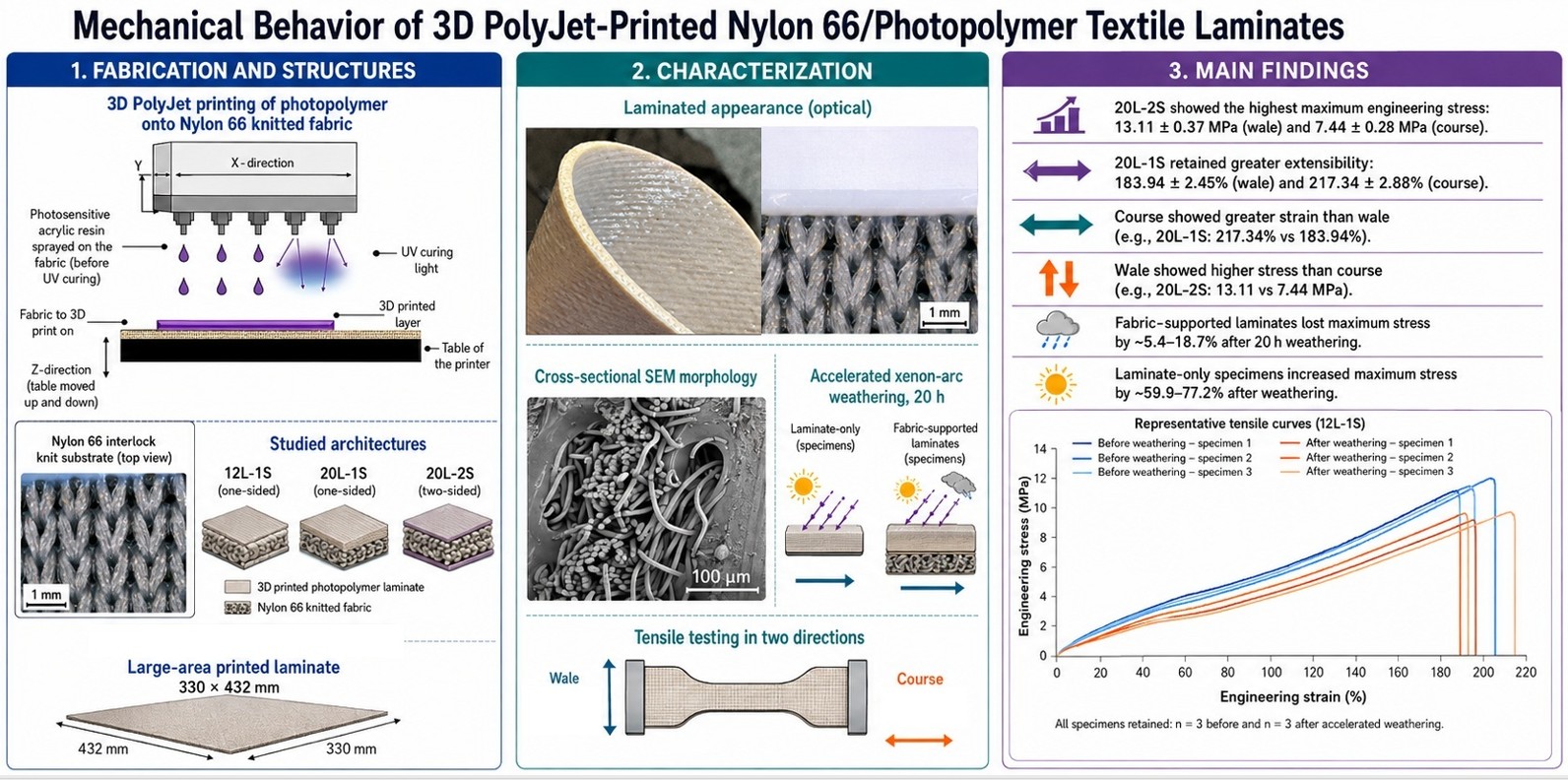
Large-area three-dimensional polyjet printing (3DPP) of continuous photopolymer laminates directly onto knitted fabrics provides a potential route toward technical textile applications beyond localized decorative features. This study investigated acrylic photosensitive resin (APR) laminates measuring 330 × 432 mm deposited onto a Nylon 66 interlock knitted fabric. 12- and 20-layer laminates were produced in one-sided and two-sided configurations, and their morphology and tensile behavior were evaluated in the wale and course directions before and after 20 h of accelerated xenon-arc weathering. Scanning electron microscopy showed that the APR formed a continuous external laminate while locally penetrating inter-yarn and inter-filament spaces within the knitted substrate. Before weathering, the 20-layer two-sided (20L-2S) architecture exhibited the highest maximum engineering stress, reaching 13.11 ± 0.37 MPa in the wale direction and 7.44 ± 0.28 MPa in the course direction. In contrast, the 20-layer one-sided (20L-1S) architecture retained substantially greater extensibility, reaching maximum engineering strains of 183.94 ± 2.45% and 217.34 ± 2.88% in the wale and course directions, respectively. Thus, two-sided printing maximized load-bearing capacity, whereas one-sided 20-layer printing provided a better balance between reinforcement and preservation of the large-strain response of the knitted substrate. Accelerated weathering reduced the maximum engineering stress of fabric-supported laminates by approximately 5.4–18.7% and maximum engineering strain by 2.1–21.1%, depending on architecture and loading direction. Unsupported APR laminates exhibited increases of approximately 59.9–77.2% in maximum engineering stress after exposure, without a corresponding increase in strain capacity. This response suggests exposure-induced stiffening or additional curing of the photopolymer. The results demonstrate that continuous 3DPP can produce mechanically integrated textile–photopolymer laminates with tunable strength–extensibility relationships relevant to flexible technical textile structures.
Keywords:
3D printing
; polyjet printing
; 3D printed on textiles
; direct-to-textile additive manufacturing
; Nylon 66
; interlock knitted fabric
; photopolymer
; laminate
; tensile behavior
; accelerated weathering
; nonlinear stress–strain behavior
; strain stiffening
Copyright: This open access article is published under a Creative Commons CC BY 4.0 license, which permit the free download, distribution, and reuse, provided that the author and preprint are cited in any reuse.


