

Submitted:
12 August 2026
Posted:
14 August 2026
You are already at the latest version
Abstract
This study investigates the fabricability, microstructures, mechanical and corrosion behavior of multi-material structure (MMS) composed of niobium alloy (NbZr1) and titanium alloy (Ti64) using a wire-arc directed energy deposition process. The microstructure of NbZr1 alloy primarily consisted of equiaxed grains oriented in the rolling direction, while the deposited Ti64 microstructure exhibited ‘banding’ morphology and a basket weave structure composed of α phase lamellae in a β matrix. The MMS interface revealed good metallurgical bonding and was free from defects such as cracks, pores and intermetallic phases. Niobium diffusion from the NbZr1 into the Ti64 alloy resulted in formation (β-Ti + Nb) solid solution which imparted strength to the MMS. The hardness testing showed that microhardness values follow the trend: NbZr1 substrate > MMS interface > Ti64 deposit. The NbZr1–Ti64 multi-material structure developed in this study exhibited a balanced combination of ductility (22.73% elongation) and moderate tensile strength (254.18 MPa), outperforming most reported NbZr1-Ti64 MMS studies. All tensile specimens failed in ductile manner on NbZr1 side. The MMS demonstrated superior corrosion resistance, exhibiting the lowest corrosion current density and corrosion rate compared to its individual counterparts.
Keywords:
multi-material structure
; NbZr1
; Ti64
; wire arc directed deposition
; corrosion
; bimetallic structure
; functionally graded materials
Keywords:Multi-material structure; NbZr1; Ti64; Wire arc directed deposition; corrosion; bimetallic structure; functionally graded materials
1. Introduction
Multi-material structures (MMS) refer to components or assemblies composed of two or more distinct materials, integrated to leverage their individual and combined properties [1]. Multi-material structures offer potentially better performance and numerous advantages over the structures fabricated using conventional single materials. Multi-materials structures also encompass terminologies such as bimetals, bimetallic structures (BS) and functionally graded materials (FGM) [2]. Functionally graded materials are designed with smooth transition between two dissimilar materials, whereas bimetallic structures have a sharp transition. Both are engineering approaches to combine the properties of two different materials to achieve a combination of mechanical, thermal, or chemical properties that a single material cannot provide [3]. Applications of multi-material structures are widespread in sectors such as aerospace, automotive, medical, nuclear, chemical, and energy systems, where multifunctional performance is critical [3,4,5,6].
One of the most widely used alloys in aerospace, biomedical, and energy is Ti-6Al-4V (commonly referred to as Ti64) [7]. Ti64 is a dual-phase (α+β) titanium alloy known for its high strength-to-weight ratio, excellent corrosion resistance, and good biocompatibility [8]. The alloy is extensively used in aerospace structural components, turbine blades, and orthopedic implants due to its capability to withstand high mechanical loads while remaining lightweight. However, Ti64 exhibits limited performance at elevated temperatures (>400 °C) due to a significant reduction in mechanical properties, limiting its applicability in high-temperature environments [9]. On the other hand, niobium-based alloy NbZr1 (niobium with 1 wt.% zirconium) are recognized for their superior high-temperature performance, excellent corrosion resistance in aggressive environments, and outstanding biocompatibility [10]. NbZr1 maintains structural stability and mechanical integrity at temperatures exceeding 1000 °C, making it an ideal candidate for applications in nuclear fuel cladding, chemical reactors, structural components, and aerospace thermal shielding systems [11]. Additionally, zirconium enhances the alloy’s oxidation resistance and solid-solution strengthening to the Nb matrix, increasing high-temperature strength while maintaining ductility [10,12].
Integrating NbZr1 with Ti64 in a bimetallic configuration offers a promising pathway to developing advanced structures that leverage the lightweight and high-strength characteristics of Ti64 with the high-temperature and corrosion resistance capabilities of NbZr1. Such hybrid structures can address the critical demands of next-generation aerospace engines, advanced nuclear reactors where structural integrity across a broad temperature range is essential . However, due to the considerable difference in physical and chemical properties between these two alloys—including melting points, thermal expansion coefficients, and elemental diffusivity—the fabrication of NbZr1/Ti64 MMS presents significant metallurgical challenges [13]. Achieving a strong, defect-free interface between these materials is critical for the performance and reliability of the resulting multi-material structures.
MMS can be processed by conventional as well as additive manufacturing methods. MMS could be processed using conventional manufacturing methods, such as casting, forging, powder metallurgy, thermal spray deposition, electro-deposition, welding, brazing, diffusion bonding, and the transient-liquid-phase (TLP) technique [3,14]. Various attempts were made to join Nb-alloys and Ti-alloys using conventional methods. Torkamany et al. [13,15] investigated pulsed Nd:YAG laser welding of pure niobium to Ti–6Al–4V. Optimal parameters yielded full-penetration joints without intermetallic formation. Welds exhibited Ti/Nb-rich zones, matching niobium’s tensile strength. Fractures occurred in the niobium, indicating sound weld integrity. Gao et al. [16] examined effect of heat input on pulsed laser-welded Ti6Al4V/Nb joints. Increased heat input improves fusion, reduces defects, and increases the width of the heat heat-affected zone. Ti- and Nb-rich zones formed without intermetallic. Welds exhibited tensile strength of 250MPa, with fractures occurring in the Nb base. Zhou et al. [17] successfully laser welded NiTiNb and Ti6Al4V alloys using Nb filler. With the increase in laser power, the amount of melted Nb increased, which reduced brittle intermetallics (NiTi, Ti2Ni), narrowed IMC regions, and improved joint strength. Franchini et al. [18] also successfully welded a Nb-base alloy (C-103) to Ti6Al4V without cracks using electron beam welding, achieving tensile strength of 511 MPa. Siqueira [19] et al. studied the microstructure and hardness of fiber laser beam welded Ti-Nb sheets. The samples were defect-free, and the hardness profile decreased from the top (Ti) to the bottom (Nb). Yulong et al. [20] performed orthogonal parameter optimization for high-quality welding of two dissimilar Nb/TC4 and Nb/SLMed TC4 alloys is via electron beam welding. The optimal conditions for attaining the highest tensile strength of 314.1 MPa were 62 kV of acceleration voltage, 10 mA of welding beam current, and 4.5 mm/s of scanning rate.
Compared with conventional manufacturing methods, additive manufacturing (AM) offers significant advantages in fabricating complex geometries while providing unprecedented flexibility in material composition, structural design, and functional integration, making it particularly attractive to produce multi-material structures [6,21,22,23]. The feasibility of Ti-alloy/Nb-alloy MMS additive manufacturing has been demonstrated in only a limited number of studies. Jiang et al. [24] fabricated a TC4/Nb multi-material structure using multi-wire Wire arc additive manufacturing (WAAM), where the deposited material consisted primarily of α-Ti, β-Ti, and (Nb,Ti) solid solution phases without the formation of brittle intermetallic compounds. Similarly, Jadhav et al. [25] fabricated Ti6Al4V–NbZr1 bimetallic structures using gas tungsten arc welding (GTAW)-based WAAM and reported sound metallurgical bonding with no pores, cracks, or intermetallic compounds at the interface. WAAM offers an attractive route for fabricating multi-material structures with discrete or functionally graded transitions because of its high deposition rate, excellent material utilization, compositional flexibility, and cost-effectiveness for large-scale components [12,13]. By appropriate control of process parameters and deposition strategy, WAAM enables the successful integration of dissimilar materials such as NbZr1 and Ti64 while minimizing interfacial defects and tailoring the resulting microstructure.
Despite these advances, studies on Nb-alloy/Ti-alloy multi-material structures remain scarce, and a comprehensive understanding of the relationships among microstructure, mechanical behavior, and corrosion performance is still lacking. In particular, the corrosion behavior of NbZr1–Ti64 MMS produced by wire arc directed deposition has received little attention, despite its critical importance for aerospace, biomedical, and chemical processing applications. Therefore, the present study aims to fabricate a NbZr1–Ti64 MMS using wire arc directed deposition and systematically investigate its interfacial microstructure, phase constitution, mechanical properties, fracture behavior, and corrosion performance. The findings provide new insights into the process–structure–property relationships governing Nb-alloy/Ti-alloy multi-material systems and demonstrate the feasibility of producing high-integrity dissimilar structures for advanced engineering applications.
2. Materials and Methods
2.1. Fabrication of Multi-Material Structure and Sample Preparation
The GTAW-based WAAM system depicted in Figure 1(a) was used to fabricate thin-walled, multi-material structure of NbZr1-Ti64. The configuration consists of a 6-axis Fanuc ArcMate 120iC robot with a Fanuc R-J3iB controller, a Miller Dynasty 400 GTA welding power source, and a generic wire feeder. The welding torch mounted on the face plate of the robot. The robot was programmed by using a teach pendant so that the welding torch follows the programmed path to produce the desired structure. Ti64 consumable wire, with a diameter of 1.2 mm and specification ERTi-5 (Washington Alloy Company, USA), was used for deposition. Ti64 was deposited on NbZr1 substrate (ASTM B393), measuring 100 mm × 20 mm × 7 mm, provided by ALB Materials Inc. U.S.A. The chemical composition of the Ti64 consumable wire and NbZr1 substrate are detailed in Table 1. To deposit thin walls, process parameters such as welding current (I), travel speed (TS), and wire feed rate (WFR) were considered. Near-optimal process parameters for depositing multi-layer thin-wall were determined based on previous studies [7,26,27] and preliminary experiments were performed to achieve stable arc behavior, uniform bead geometry, and defect-free deposition with adequate fusion while minimizing excessive heat input. High-purity argon (99.999%) served as shielding gas. The same gas served as trailing gas to protect the deposition from oxidation and contamination. The process parameters used in this study are shown in Table 2. The rationale for using 200A current to deposit the first layer of Ti64 was to achieve strong bonding between NbZr1 and Ti64, leveraging the high heat input resulting from the high current. However, starting from the second layer, a current of 140 A was used to achieve lower heat input during the deposition of the subsequent Ti64 layers. This approach helps reduce the residual stress generated in the NbZr1 substrate due to the repetitive thermal cycles experienced during the WAAM process. After the deposition of each layer, the top surface was allowed to cool down to 60 °C before further deposition. A total of 22 layers of Ti64 were deposited. Figure 1(b) shows the deposited thin-wall structure of NbZr1-Ti64 with a height of 44mm.
After the deposition process, the thin-wall was sectioned along the build direction at specific locations, as shown in Figure 1(b) using a metallurgical saw (METCUT-10) to get samples for microstructure characterization and microhardness testing. Samples were hot mounted and polished. The sample surfaces were then grounded with SiC abrasives (grit sizes of 240–1200) and polished using diamond paste solutions of 3μm and 1μm size. The Ti64 side of the polished samples was etched with 3 mL HF + 5 mL HNO3 + 100 mL H2O, and the NbZr1 side was etched with 10 mL HF + 20 mL HNO3 + 10 mL H2O. EBSD Sample preparation was accomplished by grinding with SiC, followed by polishing down to 1um utilizing diamond media, followed by electropolishing as a final step to prepare an EBSD-ready surface. Three tensile specimens, following ASTM E8 standard, were prepared from thin wall using wire electrical discharge machining (EDM), with dimensions illustrated in Figure 1(c). For corrosion testing, square coupons measuring 20 mm × 20 mm × 1.2 mm were sectioned from the NbZr1 substrate, Ti64 deposit, and NbZr1–Ti64 interface regions using wire EDM, as indicated in Figure 1(b). The coupons were subsequently grounded and polished prior to electrochemical testing.
2.2. Microstructure, Corrosion Characterization and Mechanical Property Testing
The microstructures were analyzed using an optical (OM) and scanning electron (SEM) microscopy. For optical microscopy, a Nikon SMZ 1500 microscope was used for low-magnification images (up to 10X magnification). A Hitachi SU 7000 field emission scanning electron microscope (SEM) coupled with energy dispersive spectrometry (EDS) was employed for microstructure and compositional analysis. For EDS analysis, the EDAX Octane Elect Super EDS system with EDAX APEX software was used. X-ray diffraction (XRD) was carried out to determine the phases present at the interface using a Rigaku Ultima IV XRD machine. Diffraction patterns were recorded using a D/teX Ultra-High-Speed Detector. The raw data was imported into the PDXL software package for phase analysis and comparison with the standard patterns in the ICDD database. Electron beam backscatter diffraction imaging was performed using a JEOL JSM 7900F field emission SEM equipped with an EDAX Hitachi Octane Elect Super EBSD system. Data was captured using EDAX TEAM v4.6 and processed using TSL OIM Analysis v8.0 software. Microhardness tests were performed along the build direction of thin walls using a Buehler Wilson VH1202 microhardness tester with 500g applied load (Vickers diamond indenter) and dwell time of 10s. The Microhardness tester was equipped with an integrated high-resolution camera and DiametTM software. Mechanical strength was investigated using the computer-controlled, uniaxial tensile testing system (TestResources 810 E4 Electrodynamic Test Machine). Tensile tests were conducted with an elongation rate of 0.001s-1. The fractured surfaces of tensile specimens were examined using the FEI Quanta 200 SEM. Corrosion characterization was performed using a traditional three-electrode electrochemical cell with the test specimen as the working electrode, a platinum mesh as the counter electrode, and a saturated calomel electrode (SCE) as the reference electrode. Potentiodynamic polarization tests were performed using a potentiostat. The corrosion test specimens were cut from locations as shown in Figure 1(b). The ground, polished specimens were washed with ethanol, rinsed with deionized water, and dried before testing. After stabilizing the open-circuit potential (OCP) for half an hour, the measurements were carried out in a 3.5% wt. NaCl solution at room temperature. At a scan rate of 1 mV/s. Tafel extrapolation was used to calculate the corrosion potential and corrosion current density.
3. Results and Discussion
3.1. Microstructural Analysis
Figure 2(a) shows a cross-sectional optical micrograph of a fabricated NbZr1–Ti64 MMS wall. The deposited structure exhibited a sound build morphology with well-defined layer bands corresponding to successive deposition passes. Two distinct deposited layers were observed above the NbZr1 substrate, indicating stable material deposition and consistent layer formation. As shown in Figure 2(a), for the first two layers of Ti64, the layer interfaces can be seen clearly. At the center, the height of the first layer is larger in comparison to the second and subsequent layers. During deposition of 1st layer of Ti64, the NbZr1 substrate also melted partially, this adds to molten Ti64, thus increasing the total volume of molten metal and results in increased height of layer at the center. For subsequent layers (second and third layers) only Ti64 wire was likely melted, resulting in lower subsequent layer heights. After the third layer, parallel bands are observed. Similar ‘banding’ morphology has been observed in many studies on WAAM of Ti64 because of thermal cycling that causes recrystallization in α+β region promoting nucleation and growth of secondary α phase and forms coarsened lamellar structure when cycling conditions are adequate [7,26,27,30,31,32]. Within the top layers of Ti64 deposited no parallel bands are observed. SEM image of deposited Ti64 region is shown in Figure 2(b). A typical basketweave (Widmanstätten) microstructure consisting of α and β phases was observed throughout the deposited Ti64 layer. The formation of the α+β basket-weave structure is commonly associated with improved strength and toughness in Ti64 alloys due to the interlocking arrangement of α laths within the retained β matrix [7,26,30].
A higher magnification SEM image of the NbZr1–Ti64 interface is presented in Figure 2(c). A continuous and defect-free metallurgical bond was observed between the deposited Ti64 and the NbZr1 substrate. The interface appeared free from cracks, pores, or interfacial separation, suggesting successful joining between the dissimilar materials. The microstructure of the NbZr1 substrate is shown in Figure 2(d). The substrate exhibits equiaxed grains of varying sizes, similar to that observed in the NbZr1 alloy fabricated via powder metallurgy [33]. Furthermore, because the NbZr1 substrate was cold rolled, the grains are oriented in the rolling direction.
Figure 2(e) shows the X-ray diffraction pattern from the interface region carried out for a scan range of 2θ = 30–100°. Major peaks are observed at 2θ ∼ 35°, 38°, 55°, 69°, 83°, and 95°. Based on the crystal phase analysis of peaks, interface primarily consists of Nb, α-Ti, β-Ti, and (β-Ti + Nb) phases no other intermetallic compounds observed. The peaks of only one type of solid solution, i.e., (β-Ti + Nb) solid solution were observed. This is consistent with the Ti-Nb phase diagram, which exhibits strong Ti and Nb solubility. Since the temperature during the deposition of 1st layer of Ti64 is higher than the β transition temperature of Ti64, the β-Ti phase predominates in the molten pool, allowing transformation of α-Ti alloy into β-Ti. β-Ti and Nb form a (β -Ti + Nb) solid solution in the welding process [20]. According to binary phase diagrams of Ti-Nb and Nb-V [34], no intermetallic compounds are likely to form in a Ti/Nb and Nb/V couple. Additionally, in the ternary phase diagram of Ti-Nb-Al, [35] below 7.5 wt% Al, formation of intermetallic compounds between niobium and aluminum is not likely. The peaks for (β-Ti + Nb) solid solution phase are observed at 2θ ∼ 38°, 55°, 69° which consistent with XRD results reported for electron beam welded Nb-TC4 joint [20], laser welded NiTiNb and Ti6Al4V alloys [17], and multi-wire WAAM of TC4/Nb heterogeneous alloy [24].
Figure 3(a) presents the EDS elemental area mapping data from the NbZr1–Ti64 multi-material structure, while Figure 3(b) shows the corresponding line-scan results across the interface. A clear compositional transition is observed across the interface, indicating successful bonding between the two dissimilar materials. The elemental area maps show that Ti, Al, and V are predominantly concentrated within the deposited Ti64, whereas Nb and Zr are primarily distributed on NbZr1 side. The elemental area mapping clearly indicates the diffusion of Nb into the Ti64 deposit, which is corroborated by the EDS point-scan analysis. The line-scan results further confirm the compositional variation. As the scan traverses from the Ti64 side to the NbZr1 side, the concentrations of Ti, Al, and V decrease sharply, while the Nb concentration increases significantly. The Zr concentration remains relatively low but becomes more pronounced within the NbZr1 region, consistent with the nominal composition of the NbZr1 alloy. The EDS point-scan results summarized in Table 3 support the line-scan observations. Points 1 and 2, located in the 1st layer of Ti64 just above the interface, contained approximately 58 wt.% Ti, 30 wt.% Nb, 4.3 wt.% Al, and 5.5 wt.% V, indicating diffusion of Nb from the substrate into molten Ti64 during deposition of 1st layer of Ti64. This composition corresponds to a Ti + Nb solid solution phase [34]. In contrast, points 3 and 4, located within the NbZr1 region, exhibited approximately 96 wt.% Nb with only trace amounts of Ti, Al, and V. The presence of small quantities of Ti within the NbZr1 side and Nb within the Ti64 side suggests localized elemental interdiffusion during deposition. The gradual compositional transition across the interface indicates effective metallurgical bonding and strong chemical compatibility between the two alloys. No abrupt compositional discontinuity or enrichment of individual elements was observed, suggesting that significant segregation or formation of brittle intermetallic phases did not occur during processing. The observed elemental interdiffusion is expected to promote interfacial integrity.
A representative cross-section image and data analysis are shown in Figure 4. Figure 4(a) shows the inverse pole figure of the interfacial area, indexed for FCC and BCC crystal structures. The large-grained nature of the NbZr1 substrate is evident in this image, although the crystals of the substrate are sufficiently large so that the texturing is not evident. Thile the WAAM-deposited Ti64 material exhibits a significantly smaller grain structure, consistent with the rapid cooling that occurs during the deposition process. The submicron basket-weave structure is not evident in this image due to the length scale effects. The Kernel Average Misorientation (KAM) map in Figure 4(b) suggests that the substrate has a relatively low degree of residual stress compared to the WAAM-deposited Ti64, which shows evidence of residual stresses at the micron length-scale. While KAM data is highly sensitive to surface preparation artifacts, it appears that there may be a concentration of residual stress at the first few microns of the interface, although this stress does not extend into either the NBZr1 substrate or the bulk of the Ti64 material. The phase map in Figure 4(c) indicates a majority of BCC crystal structure with traces of FCC structure present which indicates that the BCC Nb has diffused into Ti64 deposit. While pole figures depicted in Figure 4(d) show superficial evidence of texturing, the over-represented orientations are likely due to the low population of large NbZr1 grains in this image, and the preferred orientations of the two Ti64 regions in this data set. The grain boundary misorientation data in Figure 4(e) is typical of metallic structures that show evidence of some residual stresses, since OIM analysis software frequently identifies regions of inhomogeneous crystal strain as a large population of very low-angle grain boundaries. The misorientation map also exhibits a weak peak in the 40°-50° range, which is typical of additively manufacture microstructures. Figure 4(f) shows the grain size analysis with an average of 23.31um. However, separate grain size analysis of the NbZr1 and Ti64, at significantly different length scales, would be required to further quantify these values. The combined OM, SEM, and XRD analyses demonstrate that the NbZr1–Ti64 multi-material structure possesses a defect-free metallurgical interface, a characteristic α+β basket-weave microstructure in the deposited Ti64 region, and a stable equiaxed grain structure in the NbZr1 substrate. The absence of interfacial defects and brittle intermetallic compounds is expected to contribute positively to the mechanical integrity and corrosion resistance of the fabricated MMS.
3.2. Mechanical Properties
3.2.1. Microhardness
In order to study the microhardness distribution of NbZr1-Ti64 MMS prepared by WAAM, microhardness measurements along the building direction were carried out, as shown in Figure 5. The microhardness values follow the trend: NbZr1 substrate > MMS interface > Ti64 deposit. The microhardness of NbZr1 substrate varied between 105-122 HV, with average value of 117 HV, which is comparable to conventionally fabricated NbZr1 (121.5± 2.4 HV) [12,29]. On NbZr1 side just below the bimetallic interface (heat affected zone of NbZr1), a reduction in hardness (87 HV) was observed. Reduction in hardness is due to coarsening of grains in heat affected zone of NbZr1. Similar phenomena are reported in electron beam welding of Nb sheets [36,37]. At the interface microhardness slightly increased to 217 HV. Within the first layer of deposit hardness further increased to 249 HV. The increase in hardness at the interface and first layer can be attributed to the solid solution strengthening by Ti and Nb. From 2nd layer onwards (Ti64 deposit) the hardness ranges from 329-361 HV, with average value of 346 HV. Similar hardness values have been observed in WAAM of Ti64 [7,26,27,31,32].
3.2.2. Tensile Properties
Engineering stress–strain curves of the NbZr1–Ti64 MMS tensile specimens are shown in Figure 6. All three specimens exhibited similar deformation behavior, indicating good repeatability of the fabrication process. The specimens showed an initial linear elastic region followed by substantial plastic deformation prior to fracture, suggesting a predominantly ductile failure mode. The average ultimate tensile strength (UTS) and elongation were measured as 254.18 ± 3.37 MPa and 22.73 ± 1.15%, respectively. The small standard deviation in both strength and elongation demonstrates the consistency of the deposited structure and the reliability of the metallurgical bond formed between NbZr1 and Ti64. The tensile specimens sustained significant plastic deformation after yielding, as evidenced by the extended strain-hardening region and high elongation values observed in the stress–strain curves. The fractured specimens shown in inset of Figure 6 further confirm substantial necking before failure, which is characteristic of ductile deformation.
A comparison of the tensile properties of previously reported Nb/Nb-alloy–Ti64 multi-material structures fabricated using various manufacturing techniques is presented in Table 4. Although NbZr1 - Ti64 MMS fabricated in this study has lower UTS than reported in previous studies, it significantly outperforms in terms of elongation. The present NbZr1–Ti64 structure exhibited a lower UTS than those reported in previous studies [13,24,25], which reported strengths ranging from approximately 269 to 610 MPa. The reduced strength can be attributed to the relatively lower strength of the NbZr1 substrate and the microstructural heterogeneity associated with the dissimilar material interface. Nevertheless, the UTS obtained in the present study is comparable to that reported for pulsed laser welded Ti6Al4V–Nb joints (250 MPa) [16]. Despite the moderate tensile strength, the fabricated NbZr1–Ti64 MMS demonstrated superior ductility compared with most reported Nb/Ti64 dissimilar joints. The measured elongation of 22.73% exceeded the values reported for Ti64–NbZr1 WAAM structures (3.9%) [25], Ti64–Nb WAAM structures (14.59–17.77%) [24], and electron-beam welded Nb–Ti64 joints (5.2–6.6%) [20]. The elongation was also slightly higher than that reported for Nd:YAG laser welded Ti6Al4V–Nb joints (~20%) [13]. The enhanced ductility indicates that the interface could accommodate strain without premature crack initiation or catastrophic failure, thereby promoting stable plastic deformation during tensile loading. Overall, the tensile results demonstrate that the NbZr1–Ti64 multi-material structure fabricated in this study provides an attractive combination of moderate tensile strength and excellent ductility, making it suitable for applications where deformation tolerance and structural integrity are more critical than maximum load-bearing capacity. The high elongation achieved further suggests effective metallurgical bonding and the absence of brittle intermetallic compounds at the NbZr1–Ti64 interface.
In order to systematically reveal the fracture mechanism of tensile specimens, the fracture morphology was analyzed by scanning electron microscopy. The fracture surfaces of the NbZr1–Ti64 multi-material tensile specimens after tensile testing are shown in Figure 7(a–c). Fractographic analysis revealed a predominantly ductile fracture mode, consistent with the high elongation of 22.73 ± 1.15% obtained during tensile testing. All specimens exhibited extensive plastic deformation accompanied by microvoid nucleation, growth, and coalescence, indicating significant energy absorption prior to failure. Figure 7(a) shows plastically deformed regions (A) and clusters of fine microvoids (B), which likely nucleated around microstructural heterogeneities and subsequently coalesced during crack propagation. The elongated cavities (D) represent stretched dimples formed under tensile loading. In Figure 7(b), a higher density of equiaxed and elongated dimples is observed. The circled region (B) highlights micro void coalescence, while feature (C) corresponds to tear ridges and fibrous ligaments formed between neighboring voids during final fracture. The elongated depressions (D) indicate void growth and linkage along the crack path. Figure 7(c) further confirms the ductile nature of failure, displaying numerous interconnected large and small dimples across the fracture surface. The absence of cleavage facets, river patterns, and intergranular cracking indicates that fracture occurred primarily through a microvoid coalescence mechanism. The extensive dimpled morphology and plastic flow features suggest strong metallurgical bonding at the NbZr1–Ti64 interface, enabling substantial plastic deformation without premature interfacial failure.
3.3. Corrosion Performance
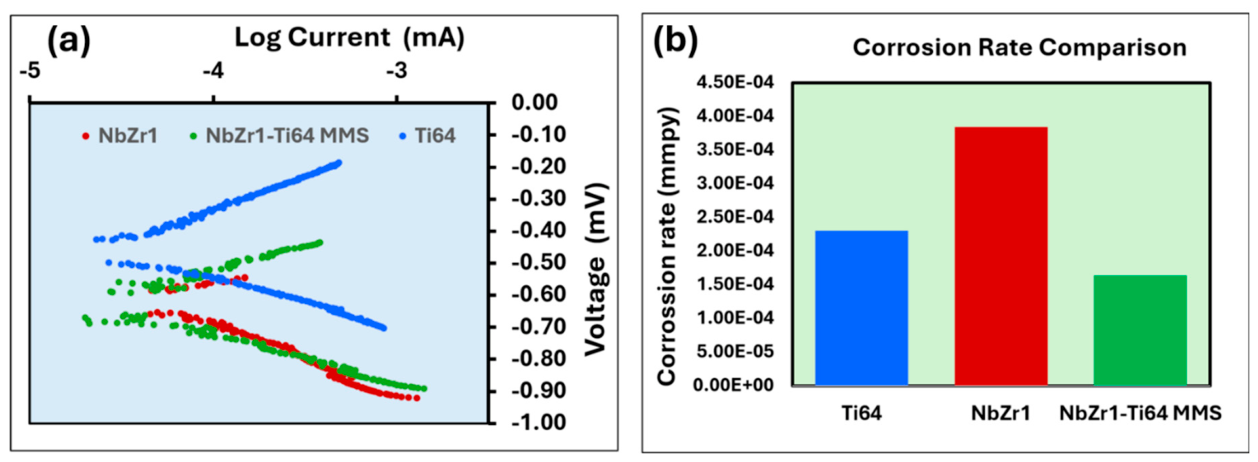
The corrosion behavior of the NbZr1–Ti64 multi-material structure was evaluated using potentio-dynamic polarization tests in a 3.5 wt.% NaCl solution, and the resulting Tafel curves are presented in Figure 8(a). The corrosion potential (Ecorr), corrosion current density (Icorr), and corrosion rate values derived from the polarization measurements are summarized in Table 5 and Figure 8(b).
The polarization curves indicate that all materials exhibited passive behavior in the chloride-containing environment due to the formation of stable oxide films on their surfaces. However, noticeable differences were observed in their electrochemical responses. The NbZr1–Ti64 MMS exhibited the lowest corrosion current density (0.019 μA cm−2) among the investigated materials, compared with 0.026 μA cm−2 for Ti64 and 0.045 μA cm−2 for NbZr1. Since corrosion current density is directly proportional to the corrosion rate, the lower Icorr value of the multi-material structure indicates superior corrosion resistance [38,39]. The measured corrosion potential of the NbZr1–Ti64 MMS was −626.63 mV, which was more negative than those of Ti64 (−455.22 mV) and NbZr1 (−608.66 mV). Although a more positive Ecorr is generally associated with a lower thermodynamic tendency for corrosion initiation, corrosion performance is more strongly governed by the corrosion current density and passive film stability [40]. The significantly reduced Icorr value observed for the NbZr1–Ti64 MMS suggests that once passivation occurred, the corrosion kinetics were effectively suppressed.
The corrosion rate comparison shown in Figure 8(b) further confirms the enhanced corrosion resistance of the NbZr1–Ti64 MMS. The multi-material structure exhibited the lowest corrosion rate among the tested materials, whereas NbZr1 showed the highest corrosion rate and Ti64 displayed intermediate behavior. The improved corrosion resistance of the NbZr1–Ti64 MMS can be attributed to the formation of a protective mixed oxide layer consisting primarily of TiO2, Nb2O5, and ZrO2 [41,42]. These oxides are highly stable and act as effective barriers against chloride ion penetration, thereby reducing anodic dissolution and enhancing passivation. Furthermore, the metallurgical bonding achieved between NbZr1 and Ti64 likely contributed to the development of a compact and continuous passive film across the interface region. The absence of brittle intermetallic compounds and significant interfacial defects, as observed in the microstructural analysis, may have minimized localized galvanic effects and prevented preferential corrosion attack at the dissimilar material interface. Overall, the potentio-dynamic polarization results demonstrate that the fabricated NbZr1–Ti64 multi-material structure possesses superior corrosion resistance compared with the individual Ti64 and NbZr1 materials. The combination of a low corrosion current density, reduced corrosion rate, and stable passive behavior highlights the potential of the NbZr1–Ti64 MMS for applications requiring both mechanical reliability and enhanced corrosion resistance in chloride-containing environments.
4. Conclusions
The NbZr1–Ti6Al4V multi-material structure was successfully fabricated using the wire arc directed deposition process, and the relationships between microstructure, mechanical properties, and corrosion behavior were systematically investigated. The major conclusions are summarized as follows:
- A defect-free metallurgical bond was successfully achieved between the NbZr1 substrate, and the wire arc deposited Ti64 without the formation of cracks, pores, or interfacial delamination at the interface. The interfacial microstructure exhibited a continuous diffusion zone characterized by Nb diffusion into the Ti64 deposit, promoting the formation of a Nb-stabilized (β-Ti+Nb) solid solution while suppressing the formation of brittle intermetallic compounds. EBSD characterization revealed a predominantly BCC microstructure near the interface with an average grain size of approximately 23.3 μm and an average grain misorientation angle of 17.6°. The interface exhibited relatively weak crystallographic texture and a high fraction of low-angle grain boundaries, indicating effective recovery during repeated thermal cycling and contributing to strong interfacial bonding.
- The hardness profile showed a gradual transition across the interface without abrupt changes, reflecting the diffusion-controlled compositional gradient and absence of brittle intermetallic compounds. The NbZr1–Ti64 multi-material structure exhibited a combination of moderate tensile strength (254.18 ± 3.37 MPa) and excellent ductility (22.73 ± 1.15%), demonstrating superior ductility compared with most previously reported studies. Fractographic analysis confirmed a ductile microvoid coalescence fracture mechanism with extensive plastic deformation and no evidence of brittle interfacial failure.
- Electrochemical testing in 3.5 wt.% NaCl solution showed that the NbZr1–Ti64 multi-material structure exhibited superior corrosion resistance compared with the individual constituent materials, as evidenced by the lowest corrosion current density and the highest polarization resistance. The enhanced corrosion performance is attributed to the formation of a stable passive oxide layer and the chemically graded diffusion region at the interface.
- The combined microstructural stability, good mechanical performance, and improved corrosion resistance demonstrate that wire arc directed deposition is an effective manufacturing route for producing NbZr1–Ti64 multi-material structures, offering significant potential for aerospace, biomedical, nuclear, and other high-performance engineering applications requiring corrosion-resistant and high-temperature structural components.
Author Contributions
Conceptualization, S.J., D.K.; methodology, S.J., D.K., A.A., S.K., T.B., A.S. and D.Y.; validation, S.J., D.K., A.A., S.K., T.B., A.S. and D.Y.; formal analysis, S.J., D.K., A.A., S.K., T.B., A.S. and D.Y.; investigation, S.J., D.K., S.K., T.B., A.S. and D.Y.; resources, S.J., D.K., A.A., S.K., T.B., A.S. and D.Y.; data curation, S.J., D.K., S.K., T.B., A.S. and D.Y.; writing—original draft preparation, S.J., D.K., S.K., T.B., A.S. and D.Y.; writing—review and editing, S.J., D.K., A.A., S.K., T.B., A.S. and D.Y. All authors have read and agreed to the published version of the manuscript.
Funding
This research was supported by Office of Research at Kennesaw State University, Marietta, GA, USA.
Data Availability Statement
The data presented in this study are available on request from the corresponding author.
Conflicts of Interest
The authors declare no conflicts of interest.
References
- Wei, C.; Zhang, Z.; Cheng, D.; Sun, Z.; Zhu, M.; Li, L. An overview of laser-based multiple metallic material additive manufacturing: from macro- to micro-scales. Int. J. Extrem. Manuf. 2020, 3, 012003. [Google Scholar] [CrossRef]
- Dhanola, D.S. Prasad, A comprehensive review of wire arc additive manufacturing for metallic functionally graded materials. Eng. Res. Express 2024, 6. [Google Scholar] [CrossRef]
- Bandyopadhyay; Y. Zhang, B. Onuike, Additive manufacturing of bimetallic structures. Virtual Phys. Prototyp. 2022, 17, 256–294. [Google Scholar] [CrossRef]
- Feenstra, D.R.; Banerjee, R.; Fraser, H.L.; Huang, A.; Molotnikov, A.; Birbilis, N. Critical review of the state of the art in multi-material fabrication via directed energy deposition. Curr. Opin. Solid State Mater. Sci. 2021, 25. [Google Scholar] [CrossRef]
- Bandyopadhyay, B. Heer, Additive manufacturing of multi-material structures. Mater. Sci. Eng. R Rep. 2018, 129, 1–16. [Google Scholar] [CrossRef]
- Wang, D.; Liu, L.; Deng, G.; Deng, C.; Bai, Y.; Yang, Y.; Wu, W.; Chen, J.; Liu, Y.; Wang, Y.; Lin, X.; Han, C. Recent progress on additive manufacturing of multi-material structures with laser powder bed fusion. Virtual Phys. Prototyp. 2022, 17, 329–365. [Google Scholar] [CrossRef]
- Wang, F.; Williams, S.; Colegrove, P.; Antonysamy, A.A. Microstructure and mechanical properties of wire and arc additive manufactured Ti-6Al-4V. Metall. Mater. Trans. A Phys. Metall. Mater. Sci. 2013, 44, 968–977. [Google Scholar] [CrossRef]
- Maurya, A.K.; Yeom, J.T.; Kim, J.H.; Park, C.H.; Hong, J.K.; Yang, J.; Kang, N.H.; Cheon, S.; Reddy, N.S.; Cheepu, M.; Cho, S.M. Wire arc additive manufacturing method for Ti–6Al–4V alloy to improve the grain refinement efficiency and mechanical properties. J. Mater. Res. Technol. 2024, 31, 3003–3013. [Google Scholar] [CrossRef]
- Artaza, T.; Suárez, A.; Veiga, F.; Braceras, I.; Tabernero, I.; Larrañaga, O.; Lamikiz, A. Wire arc additive manufacturing Ti6Al4V aeronautical parts using plasma arc welding: Analysis of heat-treatment processes in different atmospheres. J. Mater. Res. Technol. 2020, 9, 15454–15466. [Google Scholar] [CrossRef]
- Sarkar; Kapoor, R.; Verma, A.; Chakravartty, J.K.; Suri, A.K. Hot deformation behavior of Nb–1Zr–0.1C alloy in the temperature range 700–1700 °C. J. Nucl. Mater. 2012, 422, 1–7. [Google Scholar] [CrossRef]
- Gupta, S.K.; Jaypuria, S.; Pratihar, D.K.; Saha, P. Experimental Investigation on Microstructure and Mechanical Properties of Laser-Welded Nb-1% Zr-0.1% C Alloy. J. Mater. Eng. Perform. 2021, 30, 8412–8425. [Google Scholar] [CrossRef]
- Islam, S.; Ahsan, M.R.U.; Seo, G.J.; Lee, H.J.; Park, T.; Pourboghrat, F.; Kim, D.B. Investigations of Microstructure and Mechanical Properties in Wire + Arc Additively Manufactured Niobium–Zirconium Alloy. Adv. Eng. Mater. 2023, 25, 2201633. [Google Scholar] [CrossRef]
- Torkamany, M.J.; Malek Ghaini, F.; Poursalehi, R. Dissimilar pulsed Nd: YAG laser welding of pure niobium to Ti-6Al-4V. Mater. Des. 2014, 53, 915–920. [Google Scholar] [CrossRef]
- Saleh; Jiang, J.; Fathi, R.; Al-hababi, T.; Xu, Q.; Wang, L.; D. Song, A. Ma, 30 Years of functionally graded materials: An overview of manufacturing methods, Applications and Future Challenges. Compos. B Eng. 2020, 201. [Google Scholar] [CrossRef]
- Torkamany, M.J.; Malek Ghaini, F.; Poursalehi, R. An insight to the mechanism of weld penetration in dissimilar pulsed laser welding of niobium and Ti–6Al–4V. Opt. Laser Technol. 2016, 79, 100–107. [Google Scholar] [CrossRef]
- Gao, X.L.; Liu, J.; Zhang, L.J. Effect of heat input on microstructure and mechanical properties of pulsed laser welded joints in Ti6Al4V/Nb dissimilar alloys. Int. J. Adv. Manuf. Technol. 2018, 94, 3937–3947. [Google Scholar] [CrossRef]
- Zhou, X.; Chen, Y.; Huang, Y.; Mao, Y.; Yu, Y. Effects of niobium addition on the microstructure and mechanical properties of laser-welded joints of NiTiNb and Ti6Al4V alloys. J. Alloys Compd. 2018, 735, 2616–2624. [Google Scholar] [CrossRef]
- Franchini, F.; Pierantozzi, P. Electron beam welding of dissimilar materials: Niobium-base alloy C-103 with titanium-base alloy Ti-6AI-4V ELI. Weld. Int. 1992, 6, 792–797. [Google Scholar] [CrossRef]
- de Mota Siqueira, R.H.; Atilio, I.; de Andrade Ferreira, C.C.; de Carvalho, S.M.; de Lima, M.S.F. Fiber Laser Beam Welding Between Niobium and Titanium. J. Aircr. Spacecr. Technol. 2020, 4, 21–25. [Google Scholar] [CrossRef]
- Li, Y.; Meng, Y.; Lei, M.; Wang, W.; Li, X. A Study on Microstructure and Mechanical Properties of Electron Beam Welded Joint of Nb/Selective Laser-Melted TC4 Dissimilar Alloys. J. Mater. Eng. Perform. 2024. [Google Scholar] [CrossRef]
- Gibson; Rosen, D.; Stucker, B.; Khorasani, M. Additive manufacturing technologies; Springer International Publishing, 2020. [Google Scholar] [CrossRef]
- DebRoy, T.; Wei, H.L.; Zuback, J.S.; Mukherjee, T.; Elmer, J.W.; Milewski, J.O.; Beese, A.M.; Wilson-Heid, A.; De, A.; Zhang, W. Additive manufacturing of metallic components – Process, structure and properties. Prog. Mater. Sci. 2018, 92, 112–224. [Google Scholar] [CrossRef]
- Jadhav, S.; Kusekar, S.; Belure, A.; Digole, S.; Mali, A.; Cheepu, M.; Mugale, M.; Alkunte, S.; Kim, D. Recent Progress and Scientific Challenges in Wire-Arc Additive Manufacturing of Metallic Multi-Material Structures. J. Manuf. Mater. Process. 2025, 9. [Google Scholar] [CrossRef]
- Jiang, P.F.; Nie, M.H.; Teng, J.Z.; Wang, X.B.; Liu, C.Z.; Zhang, Z.H. Multi-wire arc additive manufacturing of TC4/Nb bionic layered heterogeneous alloy: Microstructure evolution and mechanical properties. Mater. Sci. Eng. A 2023, 874. [Google Scholar] [CrossRef]
- Jadhav, S.; Bajestani, M.S.; Islam, S.; Karim, M.A.; Kim, C.J.; Lee, H.J.; Cho, Y.T.; Kim, D.B. Materials characterization of Ti6Al4V to NbZr1 bimetallic structure fabricated by wire arc additive manufacturing. Mater. Today Commun. 2023, 36. [Google Scholar] [CrossRef]
- Manoj; Rao, M.A.; Basha, M.M.; Basha, S.M.; Sankar, M.R. State of art on wire feed additive manufacturing of Ti-6Al-4V alloy. In Mater. Today Proc.; Elsevier Ltd., 2019; pp. 2608–2615. [Google Scholar] [CrossRef]
- Wainwright, J.; Williams, S.; Ding, J. Refinement of Ti-6Al-4V prior-β grain structure in the as-deposited condition via process control during wire-direct energy deposition. Addit. Manuf. 2023, 74. [Google Scholar] [CrossRef]
- ERTi-5 (6Al-4V) TIG – Washington Alloy. n.d. Available online: https://www.washingtonalloy.com/erti-5-6al-4v_tig/ (accessed on 18 July 2026).
- Niobium Sheet (Nb Sheet) | ALB-N001. n.d. Available online: https://www.albmaterials.com/metals-and-alloys/713-niobium-nb-sheets.html.
- Chakraborty; Tirumala, T.; Chitral, S.; Sahoo, B.N.; Kiran, D. V.; Kumar, P.A. The State of the Art for Wire Arc Additive Manufacturing Process of Titanium Alloys for Aerospace Applications. J. Mater. Eng. Perform. 2022, 31, 6149–6182. [Google Scholar] [CrossRef]
- Lin, J.J.; Lv, Y.H.; Liu, Y.X.; Xu, B.S.; Sun, Z.; Li, Z.G.; Wu, Y.X. Microstructural evolution and mechanical properties of Ti-6Al-4V wall deposited by pulsed plasma arc additive manufacturing. Mater. Des. 2016, 102, 30–40. [Google Scholar] [CrossRef]
- Wu, B.; Pan, Z.; Ding, D.; Cuiuri, D.; Li, H.; Fei, Z. The effects of forced interpass cooling on the material properties of wire arc additively manufactured Ti6Al4V alloy. J. Mater. Process. Technol. 2018, 258, 97–105. [Google Scholar] [CrossRef]
- Tanvir, G.; Karim, M.A.; Kim, N.; Jeon, Y.; Kim, D.B. High-cycle tensile-tensile fatigue performance of niobium alloy: Conventional vs wire-arc additive manufacturing. J. Mater. Res. Technol. 2025, 35, 98–109. [Google Scholar] [CrossRef]
- Okamoto, H.; Schlesinger, M.E.; Mueller, E.M. (Eds.) Alloy Phase Diagrams; ASM International, 2016. [Google Scholar] [CrossRef]
- Chen, G.L.; Wang, X. T.; Ni, K.Q.; Hao, S.M.; Cao, J.X.; Dingb, J.J.; Zhangb, X. Investigation on the 1000, 1150 and 1400 °C isothermal section of the Ti-Al-Nb system. 1996. [Google Scholar] [CrossRef]
- Tao, J.; Wu, J.; Liu, Z.; Ma, J.; Liu, Z.; Peng, W. Influence of Different Beam Oscillation Patterns in Electron Beam Welding of Niobium Sheets with Different Thickness. Materials 2022, 15. [Google Scholar] [CrossRef] [PubMed]
- Das, K.; Ghosh, A.; Bhattacharya, A.; Lanjewar, H.; Majumdar, J.D.; Ghosh, M. Effect of beam current on the microstructure, crystallographic texture and mechanical properties of electron beam welded high purity niobium. Mater. Charact. 2021, 179. [Google Scholar] [CrossRef]
- Yang, J.; Yang, H.; Yu, H.; Wang, Z.; Zeng, X. Corrosion Behavior of Additive Manufactured Ti-6Al-4V Alloy in NaCl Solution. Metall. Mater. Trans. A 2017, 48, 3583–3593. [Google Scholar] [CrossRef]
- Dai, N.; Zhang, L.-C.; Zhang, J.; Zhang, X.; Ni, Q.; Chen, Y.; Wu, M.; Yang, C. Distinction in corrosion resistance of selective laser melted Ti-6Al-4V alloy on different planes. Corros. Sci. 2016, 111, 703–710. [Google Scholar] [CrossRef]
- Eichler, T. Corrosion Books: Electrochemical Techniques in Corrosion Science and Engineering. In Materials and Corrosion; Kelly, R. G., Scully, J.R., Shoesmith, D.W., Buchheit, R.G., Eds.; 2006; Volume 57, pp. 284–285. [Google Scholar] [CrossRef]
- Sharma; Oh, M.C.; Kim, J.T.; Srivastava, A.K.; Ahn, B. Investigation of electrochemical corrosion behavior of additive manufactured Ti–6Al–4V alloy for medical implants in different electrolytes. J. Alloys Compd. 2020, 830. [Google Scholar] [CrossRef]
- Chukwuike, V.I.; Rajalakshmi, K.; Barik, R.C. Surface and electrochemical corrosion analysis of niobium oxide film formed in various wet media. Appl. Surf. Sci. Adv. 2021, 4. [Google Scholar] [CrossRef]
Figure 1.
(a) GTAW-WAAM setup, (b) fabricated NbZr1-Ti64 multi-material wall showing the sampling locations for microstructural characterization, microhardness measurements, corrosion# and tensile specimen extraction, (c) geometry and dimensions of tensile specimen.
Figure 1.
(a) GTAW-WAAM setup, (b) fabricated NbZr1-Ti64 multi-material wall showing the sampling locations for microstructural characterization, microhardness measurements, corrosion# and tensile specimen extraction, (c) geometry and dimensions of tensile specimen.
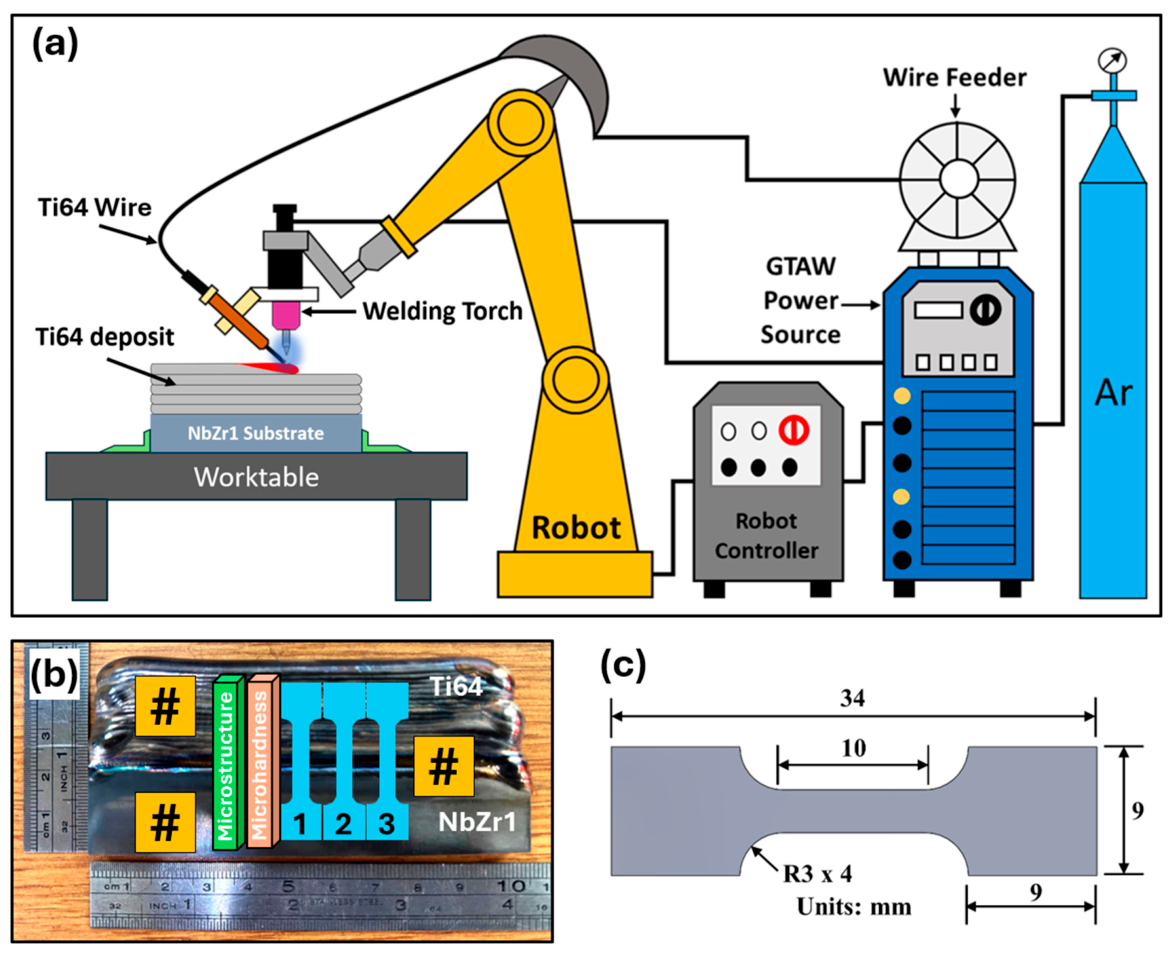
Figure 2.
(a) Optical microscope image of MMS, SEM images: (b) Ti64 deposit, (c) MMS interface, (d) NbZr1 substrate; (e) XRD spectra of MMS interface.
Figure 2.
(a) Optical microscope image of MMS, SEM images: (b) Ti64 deposit, (c) MMS interface, (d) NbZr1 substrate; (e) XRD spectra of MMS interface.
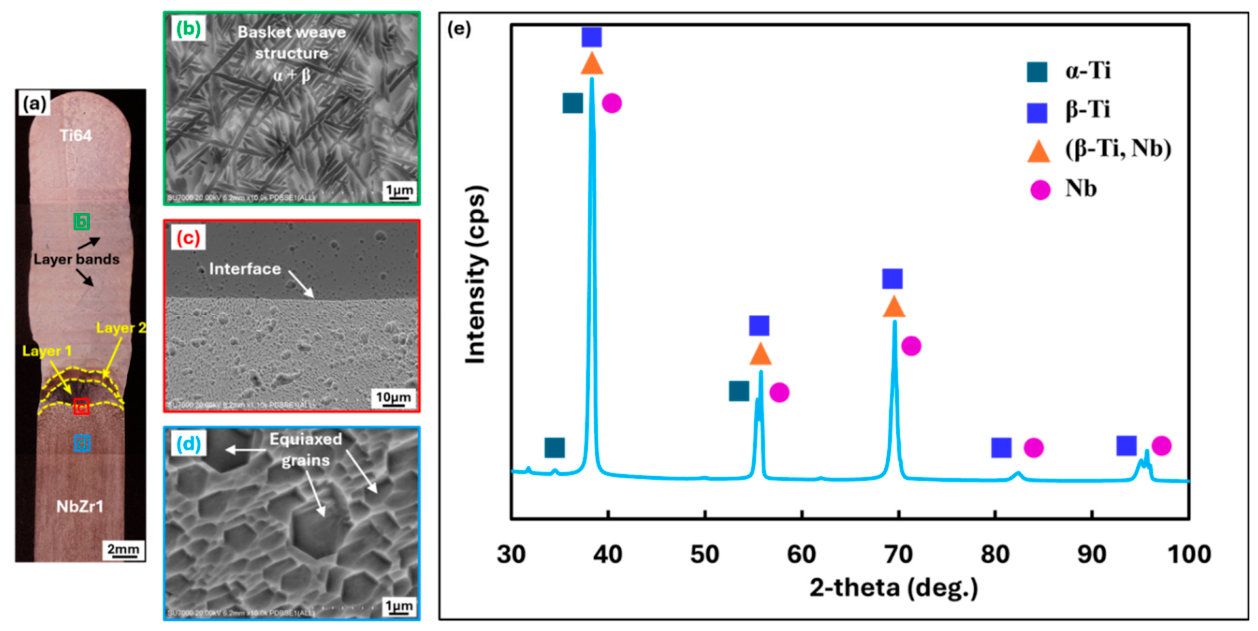
Figure 3.
(a) EDS area map (b) Line scan results.
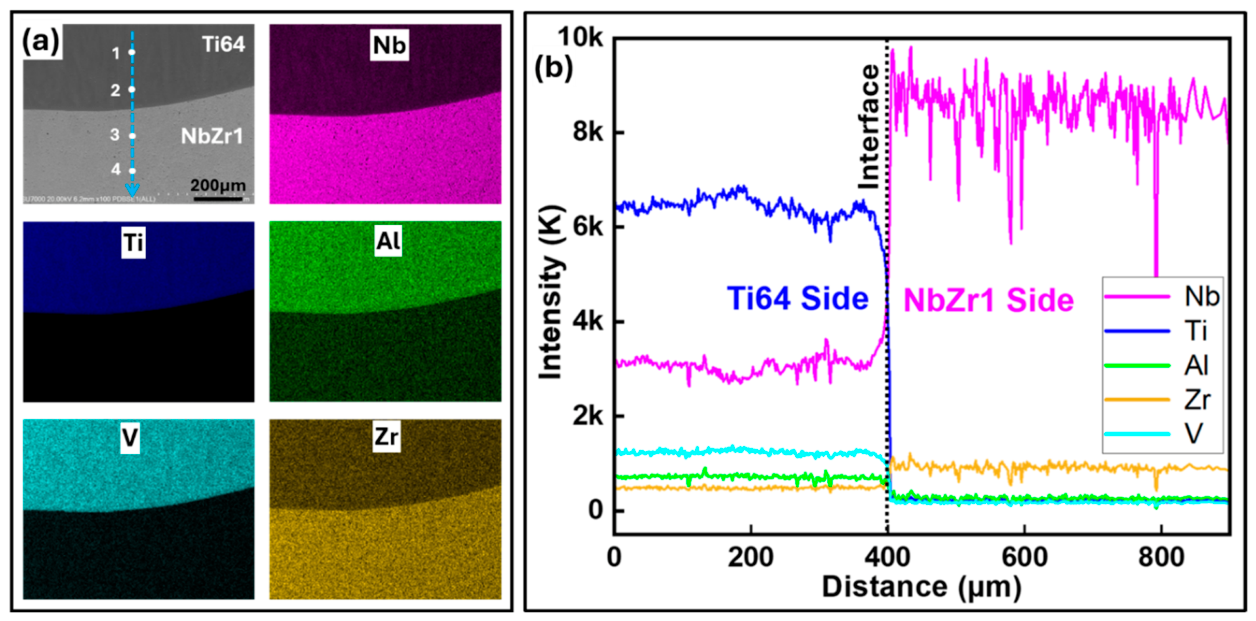
Figure 4.
(a) EBSD map, (b) KAM map, (c) Phase fraction, (d) Pole figure, (e) Misorientation angle (f) Grain size distribution at interface of NbZr1-Ti64 multi-material structure.
Figure 4.
(a) EBSD map, (b) KAM map, (c) Phase fraction, (d) Pole figure, (e) Misorientation angle (f) Grain size distribution at interface of NbZr1-Ti64 multi-material structure.
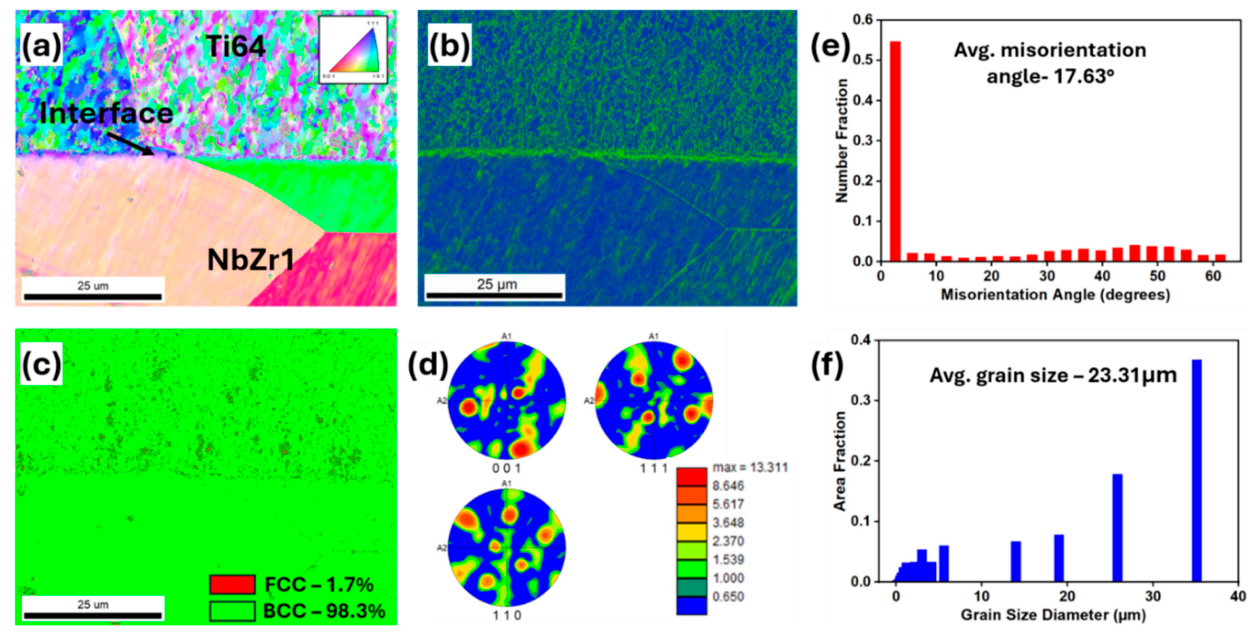
Figure 5.
Hardness profile of NbZr1-Ti64 MMS.
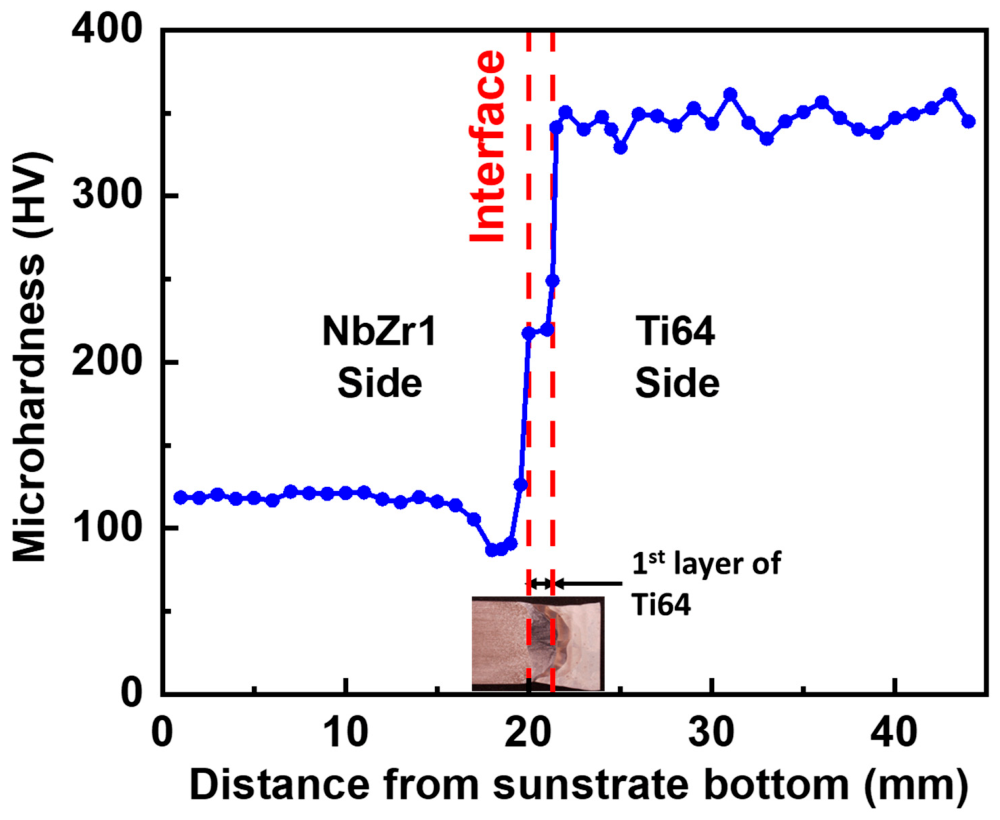
Figure 6.
Stress-strain curves of NbZr1-Ti64 MMS.
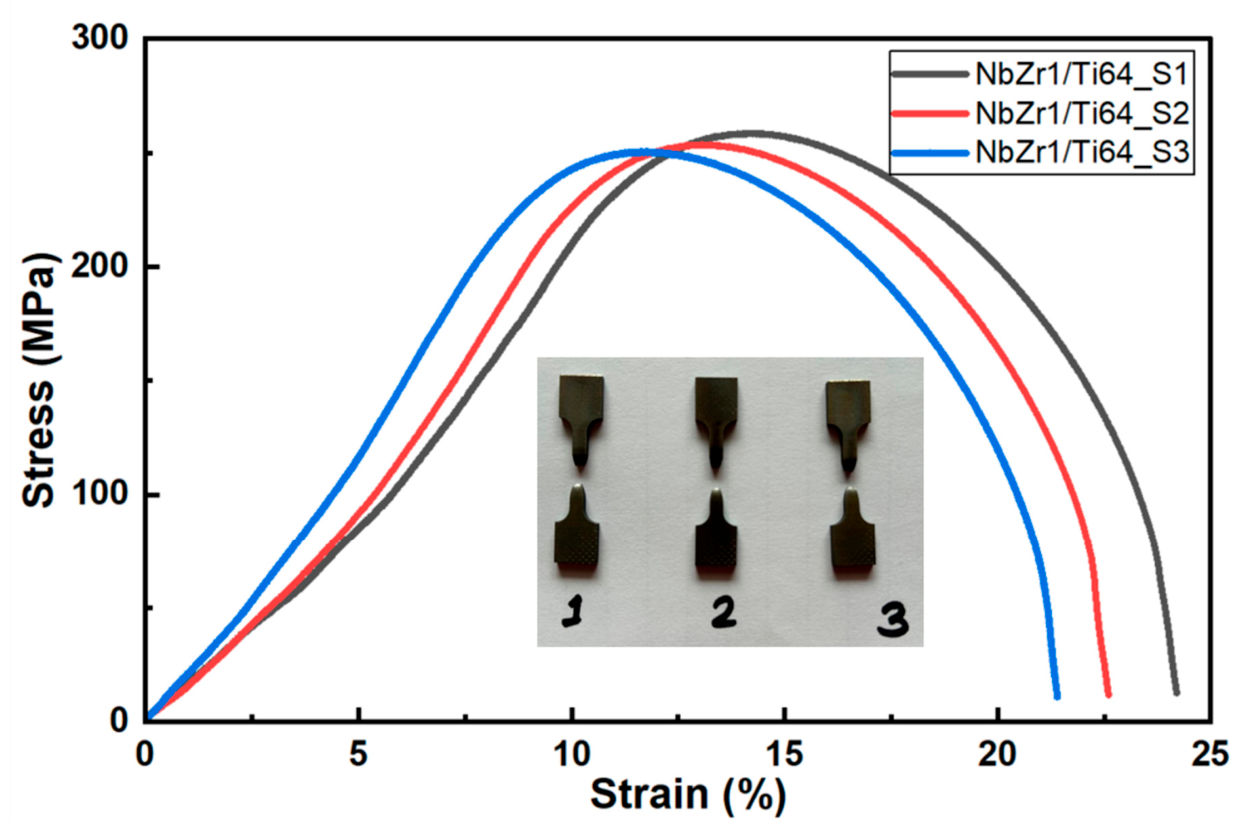
Figure 7.
(a-c): SEM images of fractured tensile specimens [A: Plastic flow region / deformation bands, B: Micro void coalescence region (fine dimples), C: Tear ridges and fibrous ligaments, D: Elongated dimples].
Figure 7.
(a-c): SEM images of fractured tensile specimens [A: Plastic flow region / deformation bands, B: Micro void coalescence region (fine dimples), C: Tear ridges and fibrous ligaments, D: Elongated dimples].
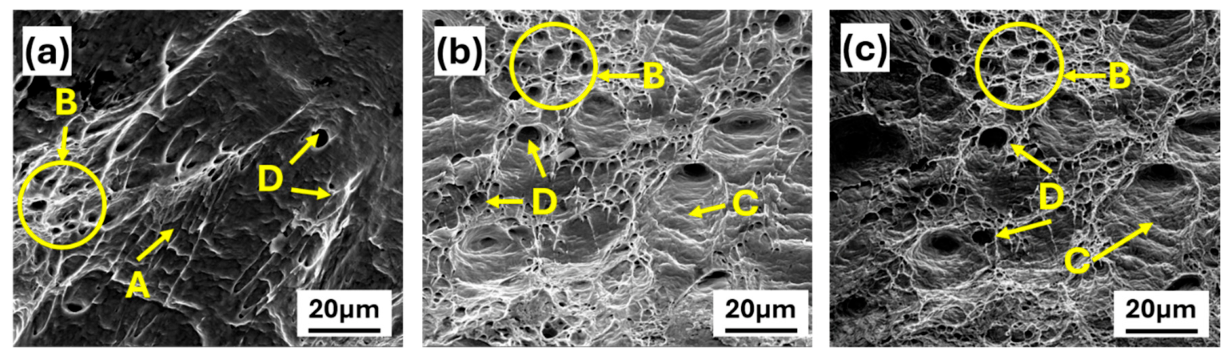
Figure 8.
(a) Potentio-dynamic polarization (Tafel) curves for NbZr1-Ti64 MMS in a 3.5wt.%NaCl solution (b) Corrosion rate comparison.
Figure 8.
(a) Potentio-dynamic polarization (Tafel) curves for NbZr1-Ti64 MMS in a 3.5wt.%NaCl solution (b) Corrosion rate comparison.

| C | O | N | H | Fe | Al | V | Ti | Nb | Zr | |
| Ti64 | 0.05 | 0.12-0.20 | 0.03 | 0.015 | 0.22 | 5.5-6.75 | 3.4-4.5 | Bal. | - | - |
| NbZr1 | - | - | - | - | - | - | - | - | 99 | 1 |
Table 2.
Process parameters.
| Process parameters | Value |
| Welding Current | 200A-1st layer, 140A-2nd layer onwards |
| Wire feed rate (WFR) | 1800 mm/min |
| Travel speed (TS) | 200 mm/min |
| Wire diameter | 1.2 mm |
| Electrode-to-workpiece distance | 5 mm |
| Torch angle | 90° |
| Shielding gas composition | 99.999% Argon |
| Shielding gas flow rate | 15 L/min |
| Trailing gas composition | 99.999% Argon |
Table 3.
EDS point-scan results of selected points inFigure 3(a) (wt.%).
Table 3.
EDS point-scan results of selected points inFigure 3(a) (wt.%).
| Point | Ti | Nb | Al | V | Zr |
| 1 | 58.33 | 29.69 | 4.30 | 5.61 | 2.07 |
| 2 | 57.85 | 30.26 | 4.30 | 5.41 | 2.18 |
| 3 | 0.19 | 95.92 | 0.64 | 0.13 | 3.13 |
| 4 | 0.21 | 96.08 | 0.67 | 0.19 | 2.85 |
Table 4.
Comparison of tensile properties of Nb/Nb alloy – Ti64 multi-material structures.
| Nb/Nb alloy -Ti64 multi-material fabrication method | UTS (MPa) | EL (%) |
| NbZr1-Ti64 (This study) | 254.18 ± 3.37 | 22.73 ± 1.15 |
| Ti64 – NbZr1 (WAAM) [25] | 543.5 | 3.9 |
| Ti64 - Nb (WAAM) [24] | Long. Dir. 452.96 Trans. Dir. 610.33 |
14.59 17.77 |
| Ti6Al4V – Nb (Nd:YAG Laser Welding) [13] |
269 | ~20 |
| Ti6Al4V – Nb (Pulsed Laser Welding) [16] |
250 | - |
| Nb (Conventional) – Ti64 Nb (SLMed) – Ti64 (Electron beam welding) [20] |
314.1 ± 7.8 293.2 ± 0.9 |
6.6 ± 1.0 5.2 ± 0.7 |
Table 5.
Electrochemical corrosion parameters derived from potentio-dynamic polarization tests.
| Material | Ecorr (mV) | Icorr (µAcm−2) | Corrosion rate (mmpy) |
| Ti64 | -455.22 | 0.026 | 0.000231 |
| NbZr1 | -608.66 | 0.045 | 0.000384 |
| NbZr1-Ti64 MMS | -626.63 | 0.019 | 0.000164 |
Disclaimer/Publisher’s Note: The statements, opinions and data contained in all publications are solely those of the individual author(s) and contributor(s) and not of MDPI and/or the editor(s). MDPI and/or the editor(s) disclaim responsibility for any injury to people or property resulting from any ideas, methods, instructions or products referred to in the content. |
© 2026 by the authors. Licensee MDPI, Basel, Switzerland. This article is an open access article distributed under the terms and conditions of the Creative Commons Attribution (CC BY) license (http://creativecommons.org/licenses/by/4.0/).
Copyright: This open access article is published under a Creative Commons CC BY 4.0 license, which permit the free download, distribution, and reuse, provided that the author and preprint are cited in any reuse.