
Submitted:
13 August 2026
Posted:
13 August 2026
You are already at the latest version
Abstract
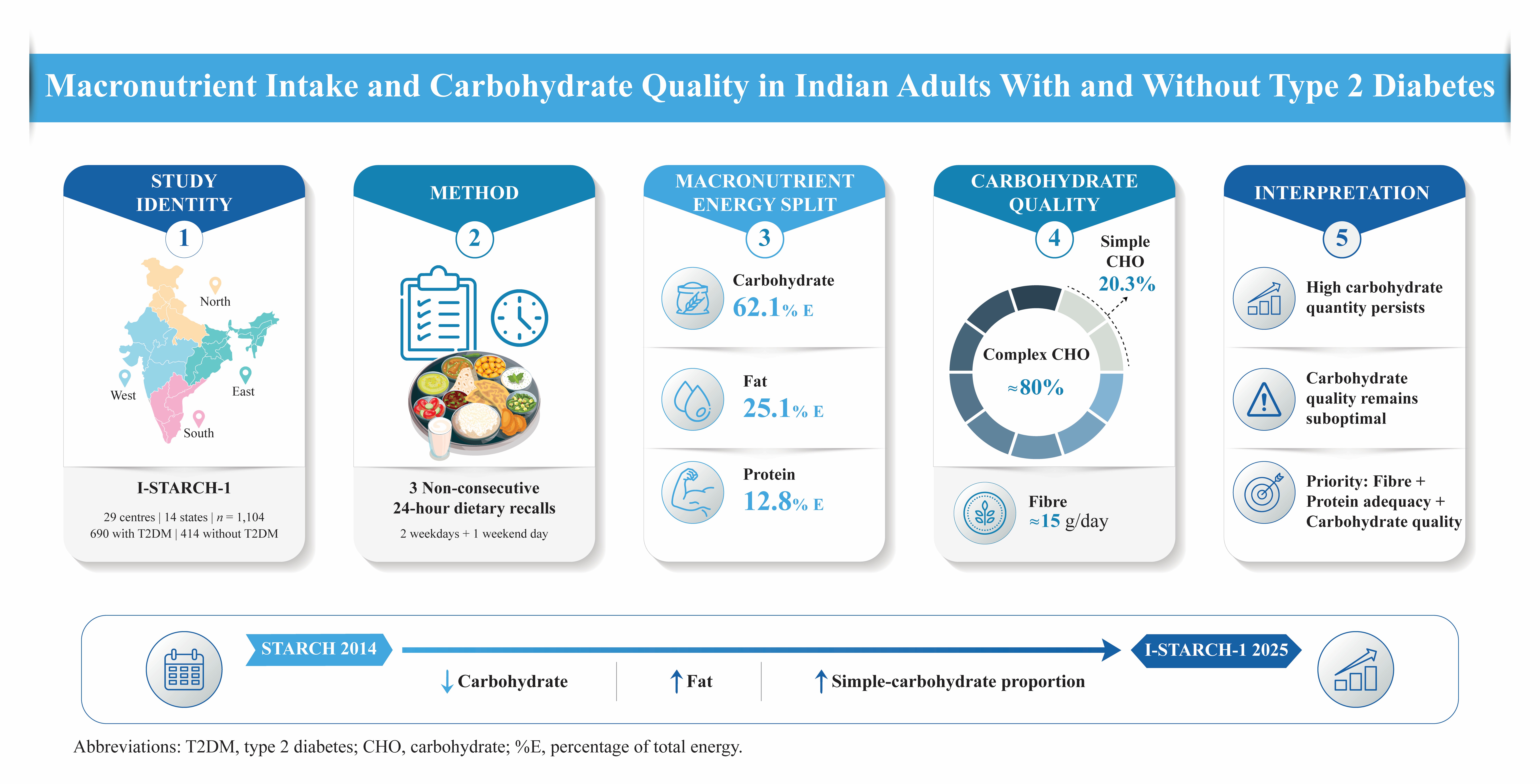
Background/Objectives: India's diet remains dominated by carbohydrates; the recent ICMR–INDIAB survey-21 found that carbohydrates contribute approximately 62% of total energy intake nationally, alongside relatively low protein intake, but did not assess carbohydrate quality by diabetes status. I-STARCH-1 characterised macronutrient intake and carbohydrate quality among Indian adults with and without type 2 diabetes mellitus (T2DM), with descriptive comparison to the original STARCH (Study to Assess dietaRy CarboHydrate content) 2014 cohort. Methods: This multicentre cross-sectional study enrolled 1104 adults (690 with T2DM and 414 without T2DM) from 29 healthcare centres across 14 Indian states. Dietary intake was assessed using three non-consecutive 24-hour recalls and harmonised using the Indian Council of Medical Research–National Institute of Nutrition (ICMR–NIN) Food Composition Tables. Macronutrient intake was compared by T2DM status and geographic zone, with STARCH 2014 used as a historical reference. Exploratory Diet-Quality Index (DQI) and Protein–Fat Quality Index (PFQI) scores were also evaluated. Results: Carbohydrates contributed 62.1% of total energy intake, fat 25.1%, and protein 12.8%. Simple carbohydrates accounted for 20.3% of total carbohydrate intake, while fibre intake remained low (~15 g/day). Adults with T2DM derived a lower proportion of energy from carbohydrates than those without T2DM (61.0% vs. 64.1%). Dietary patterns were broadly consistent across geographic zones. Compared descriptively with STARCH 2014, I-STARCH-1 showed lower carbohydrate intake, higher fat intake, a higher simple-carbohydrate proportion, and less favourable exploratory DQI and PFQI values. Convenience clinic-based sampling and the cross-sectional design limit generalisability and causal inference. Conclusions: Carbohydrate intake among Indian adults remains high, while carbohydrate quality is suboptimal, characterised by low fibre and elevated simple-carbohydrate intake. Findings support prioritising carbohydrate quality, fibre, and protein adequacy rather than reducing carbohydrate quantity alone.
Keywords:
carbohydrate quality
; macronutrient intake
; dietary fibre
; simple carbohydrates
; type 2 diabetes mellitus
; dietary patterns
; nutrition transition
; India
; diet-quality index
; protein–fat quality index
Copyright: This open access article is published under a Creative Commons CC BY 4.0 license, which permit the free download, distribution, and reuse, provided that the author and preprint are cited in any reuse.


