

Submitted:
12 August 2026
Posted:
13 August 2026
You are already at the latest version
Abstract
Phosphorus is an essential macronutrient for plant growth and development, yet its availability in many soils is limited by strong chemical fixation and low mobility. Arbuscular mycorrhizal symbiosis provides an important biological strategy for improving plant phosphate acquisition by establishing specialized arbuscules within root cortical cells, where reciprocal nutrient exchange occurs across the periarbuscular membrane. Among the phosphate transporter families involved in this process, the mycorrhiza-specific PHT1 transporters PT4 in Medicago truncatula and PT11 in Oryza sativa have emerged as central components of the mycorrhizal phosphate uptake pathway and are essential for the establishment and maintenance of functional arbuscules. Increasing evidence suggests that PT4/PT11 function extends beyond phosphate transport itself, linking phosphate acquisition with arbuscule development, nutrient exchange, and symbiotic stability. In this review, we summarize current knowledge of the molecular mechanisms underlying PT4/PT11 function and regulation during AM symbiosis. We first compare mycorrhiza-specific and mycorrhiza-inducible phosphate transporters across plant species and discuss their localization, transport properties, and contributions to the mycorrhizal Pi uptake pathway. We then integrate the multilayered regulatory network controlling PT4/PT11 expression, including the common symbiosis signaling pathway, calcium-dependent signaling, CYCLOPS–RAM1-centered transcriptional regulation, AP2/ERF-family regulators, hormone signaling, and systemic phosphate-sensing pathways. Particular attention is given to the functional coordination between phosphate uptake and other components of reciprocal nutrient exchange, including carbon and lipid transfer, proton extrusion, and arbuscule development. We further discuss how disruption of PT4/PT11-mediated phosphate transport affects arbuscule integrity and may alter the physiological and signaling status of the plant–fungus interface. Based on available genetic, physiological, and molecular evidence, we propose a working model in which PT4/PT11-mediated phosphate uptake contributes to maintaining a favorable phosphate environment at the periarbuscular interface, thereby supporting continued nutrient exchange and arbuscule longevity. Importantly, this model remains to be experimentally validated, particularly with respect to the mechanisms linking interfacial phosphate status to fungal nutrient release and host–fungus signaling. Finally, we highlight emerging approaches, including single-cell and spatial transcriptomics, proteomics, proximity labeling, and genome editing, that may resolve the cell-type-specific functions and molecular interactomes of PT4/PT11. Understanding these mechanisms may provide a conceptual and practical foundation for exploiting AM symbiosis to improve phosphorus-use efficiency, reduce dependence on mineral phosphate fertilizers, and develop more sustainable crop production systems.
Keywords:
phosphate transporter PT4/PT11
; nutrient exchange
; common symbiosis signaling pathway
; transcriptional regulation
; arbuscule development
1. Introduction
1.1. Global Phosphorus Limitation
Phosphorus is one of the three major macronutrients essential for plant growth and development and plays central roles in energy metabolism, nucleic acid biosynthesis, membrane structure, and signal transduction. It also contributes to sugar and starch metabolism, grain formation and maturation, biological nitrogen fixation, and root system development (Zeng et al., 2026). The primary sources of phosphorus that plants obtain from the soil can be categorized into inorganic and organic phosphorus. Inorganic phosphorus is further subdivided into water-soluble, adsorbed, and mineral forms, while organic phosphorus consists mainly of inositol phosphates, phosphate esters, nucleic acids, and microbial biomass phosphorus (Huang et al., 2017).
However, the primary form of phosphorus absorbed by the vast majority of plants from the soil is inorganic phosphate; because phosphate readily forms insoluble complexes with soil metal cations, the concentration of plant-available phosphorus is often low. Low-phosphorus stress not only alters plant morphology and physiological and biochemical processes but can also affect plant growth and development, thereby limiting vegetation productivity (López-Arredondo et al., 2014). As a vital plant nutrient, phosphorus has limited reserves and is prone to soil fixation; furthermore, its runoff leads to eutrophication in water bodies. The low-use efficiency and substantial losses of phosphorus fertilizers have become major constraints on sustainable agricultural production (Li et al., 2024).
1.2. Arbuscular Mycorrhizal Fungi Improve Phosphate Acquisition
Soil microorganisms—including bacteria, fungi, and actinomycetes—are vital components of the soil ecosystem. They decompose organic matter, transform nutrients, improve soil structure, promote plant growth, enhance plant resilience to abiotic stress, and purify the soil environment, serving as a fundamental force in maintaining natural material cycling and soil health (Chen et al., 2024a; Wang et al., 2024; Zhong et al., 2025). Over the course of long-term evolution, plants have evolved various strategies for acquiring nutrients from soil. These include direct uptake through roots and indirect acquisition through symbiotic associations with soil microorganisms (Zhao et al., 2024). Mycorrhizae are mutualistic associations between fungi and plant roots, and more than 80% of terrestrial plant species are capable of forming mycorrhizal associations. Mycorrhizal associations are broadly classified into ectomycorrhizal and endomycorrhizal types, with arbuscular mycorrhiza (AM) representing the most widespread endomycorrhizal association. The mycelium penetrating the root serves as an interface for solute exchange between the host plant and the fungus, facilitating the transport of mineral nutrients and water to the plant while simultaneously acquiring carbohydrates from the plant's root system (Bücking et al., 2001; Kyslynska et al., 2023; Harrison et al., 2005). Among endomycorrhizae, the most widely distributed type is known as AM symbiosis. AM symbiosis is an aseptate endomycorrhizal association characterized by the formation of specialized fungal structures, particularly arbuscules and, in some species, vesicles, within host roots (Brundrett et al., 2004; Smith et al., 1997). Eighty percent of vascular plants are capable of forming arbuscular mycorrhizae, which are highly branched fungal structures that develop within root cortical cells. While the arbuscular hyphae essentially fill the entire space of the cortical cell, the fungal plasma membrane does not fuse with the plant plasma membrane; instead, the plant plasma membrane forms a specialized structure, the periarbuscular membrane (PAM), that envelops the arbuscular hyphae. The interface between the arbuscular plasma membrane of the mycorrhizal fungus and the periarbuscular membrane of the plant is hypothesized to be the primary interface for the exchange of soluble nutrients between the two symbionts (Ivanov et al., 2014; Cox et al., 1976) (Figure 1).
AM fungi form symbiotic relationships with more than two-thirds of plant species in terrestrial ecosystems. The extraradical hyphae of AM fungi extend beyond the rhizosphere, expanding the plant's nutrient-acquisition zone well past the root surface; their most critical function is facilitating the uptake of water and mineral nutrients, particularly inorganic phosphate, which is essential for plant growth and development. Although AM fungi possess some phosphatase genes, their ability to mineralize organic phosphorus is limited compared to ectomycorrhizal fungi, their extraradical hyphae release carbon-containing compounds into the soil, significantly altering the properties of the soil microenvironment and specifically recruiting phosphate-solubilizing microorganisms to assist in acquiring phosphorus from organic sources (Li et al., 1991; Zhang et al., 2022; Jiang et al., 2021). AM fungi utilize high-affinity phosphate transporters—encoded by the fungi themselves—to take up soluble phosphorus from the soil, transport it into the fungal cytoplasm, and store it in vacuoles. These fungal phosphate transporters belong to the major facilitator superfamily (MFS). Three phosphate transporters, GvPT, GiPT, and GmosPT, have been cloned from Glomus versiforme, G. intraradices, and G. mosseae, respectively; among them, GmosPT is highly expressed in intraradical hyphae (Harrison et al., 1995; Maldonado-Mendoza et al., 2001; Benedetto et al., 2005; Ansari et al., 2026). Phosphate is released into the apoplast from intraradical hyphae; plant-driven mycorrhizal phosphate transporters specifically take up the inorganic phosphate transported by the fungal hyphae and subsequently distribute it to various parts of the plant (Karandashov et al., 2005).
Consequently, plants can take up phosphorus from the soil directly through the root epidermis and root hairs, as well as via the mycorrhizal pathway (Qi et al., 2022; Shi et al., 2021; Smith et al., 2011a). Under low-phosphorus stress, plants expand their root absorptive surface area to acquire more phosphorus by increasing the number and length of root hairs and developing finer, longer roots (Lynch et al., 2011). Experimental data on the arbuscular mycorrhizal symbiosis indicate that mycorrhizae significantly promote phosphorus uptake by the plant (Qi et al., 2022; Shi et al., 2021; Smith et al., 2011a). This is because hyphae can reach soil areas inaccessible to plant roots, helping the plant expand its phosphorus absorption area. Therefore, under phosphorus-deficient conditions, plants are more inclined to establish mycorrhizal symbioses with mycorrhizal fungi to enhance their ability to acquire phosphorus from the soil; conversely, high phosphorus levels inhibit the development of arbuscular mycorrhizae (Balzergue et al., 2010; Paries et al., 2023). Furthermore, the mechanisms by which ectomycorrhizal and AM fungi promote plant phosphorus uptake differ. AM fungi possess genes encoding multiple phosphatases that can promote the activation of organophosphates, but their contribution to organophosphate mineralization is generally considered more limited than that of many ectomycorrhizal fungi. (Joner et al., 2000; Rosling et al., 2016). Therefore, ectomycorrhizal fungi primarily hydrolyze organic phosphorus by secreting phosphatases, whereas AM fungi generally exhibit lower phosphatase activity and rely more on associated phosphate-solubilizing microorganisms.
1.3. PT4/PT11 Phosphate Transporter in an Arbuscular Mycorrhizal Symbiosis System
During AM fungal-mediated phosphate transport, gene regulation plays a pivotal role in both the AM fungi and the plant host, thereby facilitating the efficient transfer of soil phosphate into the plant. Similar to the cases of endomycorrhizae and ectomycorrhizae, high-affinity phosphate transporters encoded by genes such as MtPT4 in Medicago truncatula, OsPT11 in Oryza sativa, LjPT4 in Lotus japonicus, ZmPT6 in Zea mays, and SlPT4 in Solanum lycopersicum mediate phosphate transport across the symbiotic interface. These transporters belong to the phosphate transporter 1 (PHT1) family (Chen et al., 2024b; Rui et al., 2022; Javot et al., 2007a; Javot et al., 2007b; Walder et al., 2015; Volpe et al., 2016). The expression of these phosphate transporter genes is strongly induced during AM symbiosis, the transporters localize to the PAM of plant root cortical cells containing arbuscules and and actively take up phosphate released by AM fungi through proton-coupled phosphate transport (Xie et al., 2013; Willmann et al., 2013). Functionally, they are the key agents enabling the mycorrhizal phosphate uptake pathway. After AM fungi transport phosphate in the form of polyphosphate through their hyphae to the arbuscules and hydrolyze it into phosphate for release into the periarbuscular space, these phosphate transporters located on the PAM efficiently take up the phosphate from that apoplastic space into the symbiotic cortical cells of the plant, thereby completing the transmembrane transport of phosphate from the fungus to the plant (Xie et al., 2016; Kobae, 2019). This process is crucial for maintaining the stability of the plant-arbuscular mycorrhizal symbiosis; studies have shown that knocking out or suppressing the genes encoding MtPT4 or OsPT11 not only blocks the uptake of fungus-derived phosphate but also leads to the premature degradation of arbuscular structures and a sharp decline in symbiotic efficiency, indicating that the function of these phosphate transporters is indispensable for maintaining the symbiotic relationship (Choi et al., 2018; Jia et al., 2025). The expression of these transporters is coordinately regulated by plant phosphate-starvation signaling pathways and symbiotic signaling networks. Their gene promoter regions typically contain PHR transcription factor binding sites (P1BS) characterized by the core sequence GNATATNC as well as mycorrhiza-specific transcription factor binding sequences (MYCS) and AW-box binding sequences (AAAGATAT...) and so on. This ensures their precise, induced expression under conditions of low phosphate availability and fungal colonization (Ansari et al., 2026; Chen et al., 2011). It is noteworthy that although this type of mycorrhiza-inducible PHT1 transporter has been identified in both monocots and dicots, the phylogenetic relationships of their homologous proteins are not entirely conserved across different species (such as rice and potato), suggesting that different plants may have evolved distinct molecular strategies to adapt to symbiotic phosphate uptake (Paszkowski et al., 2002; Karandashov et al., 2004). Numerous studies indicate that mycorrhizal phosphate transporter genes are specifically activated during the establishment of plant-mycorrhizal fungal symbiosis; these genes exhibit either constitutive mycorrhiza-specific expression or inducible expression within mycorrhizae (Karandashov et al., 2005). The expression of mycorrhizal phosphate transporter genes is linked to phosphate levels, with high phosphate concentrations inhibiting their expression (Nagy et al., 2009). Xu et al. used Slpt4 mutants in tomato to further demonstrate that SlPT4 is specifically induced by mycorrhizal colonization, the loss of SlPT4 function cannot be compensated for by other phosphate transporter genes (Xu et al., 2007). Pumplin et al. and Kobae et al. utilized existing organelle-specific fluorescent marker proteins to further analyze cellular states during arbuscule development and degeneration. They observed that MtPT4-GFP and OsPT11-GFP localized to the fine branches of mature arbuscules but were undetectable in young or degenerating arbuscules; this established that these mycorrhiza-specific phosphate transporters (MtPT4 and OsPT11) undergo degradation alongside the arbuscules, suggesting a potential link between mycorrhizal phosphate transporters and the processes of arbuscule development and degeneration (Pumplin et al., 2009; Kobae et al., 2010).
The expression of these phosphate transporter genes is regulated by the SPX-PHR signaling pathway within the plant; this pathway modulates the expression of phosphate starvation response genes by sensing intracellular phosphate status. SPX proteins sense intracellular soluble inositol polyphosphates (InsPs) and regulate the activity of PHR transcription factors to induce the expression of phosphate starvation-induced (PSI) genes, thereby enhancing the plant's adaptability to low phosphate conditions (Jung et al., 2018; Yang et al., 2024; Zhou et al., 2021). Under low phosphate conditions, the binding affinity of SPX for PHR2 is significantly reduced, leading to a rapid increase in PHR2 protein levels; this facilitates the binding of PHR2 to P1BS elements within the promoters of phosphate transporter genes and activates the expression of genes related to phosphate transport, thereby enhancing the plant's capacity for phosphate uptake and utilization (Wang et al., 2014). However, under high-phosphate conditions, SPX proteins bind to PHRs, sequestering them or inhibiting their DNA-binding activity, thereby suppressing the expression of PSI genes (Puga et al., 2014; Wang et al., 2014; Ge et al., 2026; Mangalakkadan et al., 2026).
In summary, PT4/PT11 transporters act as molecular switches for phosphate exchange at the plant-fungus interface; they not only determine the efficiency of symbiotic phosphate nutrition but also serve as core elements in maintaining the structural and functional stability of the entire arbuscular mycorrhizal symbiosis. A deeper understanding of their regulatory mechanisms will provide a crucial theoretical foundation for leveraging and optimizing mycorrhizal symbioses to achieve sustainable agriculture.
1.4. Symbiotic Signal Transduction Pathway of Arbuscular Mycorrhizal Fungi
AM fungal symbiosis is a form of endosymbiosis. The initiation of AM symbiotic signaling begins with the secretion of molecules such as strigolactones (SLs) and flavonoids from plant roots into the rhizosphere under conditions of nutrient deficiency (Akiyama et al., 2005). SLs not only act as chemical attractants to stimulate the germination and hyphal branching of AM fungal spores but also create conditions for the establishment of symbiosis by altering the rhizosphere microenvironment (Rodriguez-Garcia et al., 2026; Samanta et al., 2025). In response, AM fungi release signaling molecules known as Myc factors, the primary components of which are short-chain chitin oligomers (COs) and lipochitin-oligosaccharides (LCOs) (Paszkowski et al., 2006). Plant root epidermal cells detect these fungal signals through members of the LysM-RLK (lysine motif-containing receptor-like kinase) family. Once a Myc factor is recognized by its specific receptor, it triggers intracellular calcium oscillations. The ion channels DMI1/CASTOR/POLLUX and the receptor-like kinase DMI2/SYMRK are required for the generation of these calcium oscillations, whereas the calcium/calmodulin-dependent protein kinase DMI3/CCaMK decodes the resulting calcium signatures. In this pathway, the symbiotic receptor kinase SYMRK acts as a key node; it possesses an extracellular domain rich in leucine repeat sequences (LRR) and an intracellular kinase domain, and activates downstream pathways upon signal detection. Activated CCaMK triggers the expression of symbiosis-related transcription factors. Specifically, CCaMK phosphorylates the downstream regulator CYCLOPS, which activates a transcriptional regulatory network involving the GRAS-family transcription factor RAM1, thereby initiating the expression of a series of Myc-induced and symbiosis-related genes within the nucleus, which in turn drives fungal infection and the formation of arbuscular structures. This pathway is commonly referred to as the arbuscular mycorrhizal symbiosis signaling pathway (Stracke et al., 2002; Díaz et al., 2025; Genre et al., 2016).
Recent research suggests that signal transduction is not limited to the initial stages of symbiosis establishment; continuous signal exchange is also required during the development and functional maintenance of arbuscules within cortical cells. The peri-arbuscular space (PAS) is the interface between plants and fungi; it serves not only as a site for nutrient exchange but also as a hub for continuous signal communication mediated by signal peptides, cell wall components, and extracellular vesicles. Furthermore, the concept of a common symbiotic signaling pathway is being re-evaluated: while core components are shared between AM and root nodule symbioses, growing evidence suggests that pathway outputs are symbiont-specific and that bypass or parallel signaling pathways may exist. Concurrently, plants have evolved sophisticated negative regulatory mechanisms to restrict excessive symbiotic development, thereby ensuring a balance between nutrient investment and the benefits gained (Rodriguez-Garcia et al., 2026; Genre et al., 2016; Gutjahr et al., 2008).
While previous reviews have largely focused on phosphate transporters or AM nutrition, this article highlights the pivotal roles of PT4 and PT11 as core regulators in coordinating nutrient exchange, arbuscule development, feedback signaling, and the maintenance of symbiosis. In summary, signal transduction in AM symbiosis constitutes a complex, multi-stage, and multi-component network; it begins with chemical dialogue in the rhizosphere and proceeds through perception by LysM receptors and nuclear signal transduction via the Common Symbiosis Signaling Pathway, ultimately leading to cellular reprogramming and the establishment of symbiotic structures. A deeper understanding of this pathway not only unveils the evolutionary mysteries of plant-fungal interactions but also provides molecular targets and a theoretical basis for leveraging AM fungi to enhance crop nutrient efficiency and stress tolerance (Figure 2).
2. Evolution and Conservation of AM-Specific Phosphate Transporters
2.1. Phosphate Transporter 1 Family
Through fungal hyphal networks, AM symbiosis facilitates the uptake of soil phosphorus and its transport to the arbuscular interface within root cortical cells; at this interface, members of the PHT1 phosphate transporter family mediate phosphate uptake across the periarbuscular membrane into the host cortical cell (Javot et al., 2007a; Javot et al., 2007b; Ahmed et al., 2025).
The plant PHT1 family belongs to the MFS and functions as proton-coupled phosphate transporters. PHT1 proteins mediate high-affinity phosphate (Pi) uptake in plant cells. These proteins exhibit a characteristic structure of 12 transmembrane helices; their function relies on the proton motive force, utilizing the proton gradient across the plasma membrane to cotransport Pi ions into the cytoplasm (Bayle et al., 2011; Zhou et al., 2025; Li et al., 2019). Nine PHT1 family members have been identified in the model plant Arabidopsis thaliana, and thirteen in Oryza sativa. Based on sequence similarity, expression patterns, and functional differences, PHT1 members can be further categorized into several subgroups. Notably, members closely associated with AM symbiosis primarily belong to specific subclades; their transcription is specifically induced by AM fungal colonization, and their spatiotemporal expression dynamics are highly synchronized with the progression of arbuscule development. Their transcription is strongly induced during arbuscule development and typically reaches its highest levels during arbuscule maturation, followed by a decline as arbuscules enter senescence. This dynamic expression pattern is closely associated with their role in phosphate exchange at the symbiotic interface (Sun et al., 2017; Nagarajan et al., 2011; McGaley et al., 2026).
2.2. AM Symbiosis-Induced PHT1 Members and Functional Validation
In Medicago truncatula, MtPT4 was the first gene definitively identified as an AM symbiosis-specific phosphate transporter. It is expressed exclusively in cortical cells containing arbuscules, and the encoded protein localizes to the PAM, the plant plasma membrane surrounding the arbuscular branches, thereby positioning the transporter at the central site of nutrient exchange. In loss-of-function MtPT4 mutants, although AM fungi can still successfully colonize roots and form intact arbuscules, these arbuscules undergo premature degeneration, and the fungi fail to effectively release phosphate at the interface, resulting in a complete loss of the symbiotic benefit regarding phosphorus nutrition. This pivotal experimental evidence established the irreplaceable role of this PHT1 family member as an interfacial phosphate unloader (Harrison et al., 2002; Javot et al., 2011). In Lotus japonicus, LjPT4 encodes a phosphate transporter involved in AM symbiosis; its primary functions involve phosphate nutrient uptake during AM symbiosis and the regulation of root system development. During arbuscular mycorrhizal symbiosis, it localizes to the membrane of cells containing arbuscules and is responsible for acquiring inorganic phosphate released by arbuscular mycorrhizal fungi, thereby providing nutrients to the host plant. This gene plays a key role in maintaining the normal morphology and developmental structure of fungal arbuscules within the root (Volpe et al., 2016; Rui et al., 2022)
OsPT11 is a phosphate transporter gene in Oryza sativa that primarily mediates phosphate uptake and transport and plays a crucial role in AM symbiosis. Its expression is specifically induced during symbiosis between rice and AM fungi, and the protein localizes to the plasma membrane of cortical cells enveloping the arbuscules; furthermore, OsPT11 activation is regulated specifically by mycorrhizal symbiotic signals. OsPT11 is a major contributor to the mycorrhizal phosphate uptake pathway in rice, facilitating nutrient acquisition in low-phosphorus soils (Paszkowski et al., 2002; Mitra et al., 2026). Similar AM-inducible PHT1 members, including SlPT4 and SlPT5 in tomato, have subsequently been identified in several plant species. In tomato, these transporters are strongly induced following AM fungal colonization and contribute to phosphate acquisition during symbiosis. Furthermore, as key molecular markers of tomato arbuscular mycorrhizal symbiosis, the expression levels of these two genes reflect the activation and regulatory status of symbiotic signaling between the plant and the beneficial fungi (Rui et al., 2023; Chen et al., 2024b). Similar AM-inducible PHT1 members, including StPT3 and StPT4 in potato, have also been identified. These genes encode high-affinity phosphate transporters that are induced following AM fungal colonization and arbuscule formation, thereby facilitating phosphate acquisition at the symbiotic interface (Loth-Pereda et al., 2011; Nagy et al., 2005). In summary, the functional module comprising AM-inducible PHT1 members is highly conserved in angiosperms (Table 1).
2.3. Coupling of PHT1-Mediated Phosphate Transport and Carbon-Phosphate Exchange
Phosphate transfer during AM symbiosis is not a unidirectional supply of nutrients; rather, it is a tightly coordinated and mutually beneficial process. The plant relies on the fungus to acquire additional nutrients, while in return, it provides the fungus with carbon sources to sustain its vital activities (Chiu et al., 2019; Javot et al., 2007a; Javot et al., 2007b). Phosphorus absorbed from the soil by the fungus is primarily transported to the arbuscules in the form of polyphosphate via cytoplasmic streaming within the hyphae; there, it is depolymerized into releasable inorganic phosphate. On the plant side, PHT1 proteins are responsible for the efficient uptake of phosphate from this interface space into cortical cells. Notably, this phosphate uptake process is coupled via signaling mechanisms to the transfer of photosynthetic products to the fungus: when the plant's phosphate status is sufficient, the host actively downregulates the expression of AM-inducible PHT1 and reduces carbon allocation, thereby establishing a negative feedback loop that ensures the economic sustainability of the symbiosis (Solaiman et al., 1999; Karandashov et al., 2005). In recent years, the transcription factor PHR2 and GRAS family proteins RAD1 have been shown to directly regulate PHT1 gene transcription, integrating the plant's overall phosphorus nutritional status with symbiotic phosphate transport activity within a unified regulatory network (Rey et al., 2017; Shi et al., 2021).
2.4. Synergistic Action of Multiple PHT1 Members in Mycorrhizal Symbiosis
In most plant genomes, multiple PHT1 members are induced by AM symbiosis, exhibiting a combination of functional redundancy and specialized division of labor. For instance, while both OsPT11 and OsPT13 in Oryza sativa are expressed in arbuscule-containing cells, their knockout phenotypes differ: Ospt11 mutants display significant defects in both phosphate uptake and arbuscule development, whereas Ospt13 mutants show a relatively mild phenotype, suggesting that OsPT11 performs the primary phosphate transport function, whereas OsPT13 may provide partial functional redundancy or complementary activity (Paszkowski et al., 2002; Mitra et al., 2026). In tomato, the double knockout of Slpt4 and Slpt5 more completely abolishes the benefits of AM-mediated phosphate uptake, revealing an additive functional effect among family members. This mechanism of functional redundancy ensures the continuity of symbiotic phosphate transport under stress or mutation, and implies that achieving desired crop improvements may require simultaneously targeting multiple PHT1 members in breeding programs (Rui et al., 2023; Chen et al., 2024b).
In summary, as key executors of phosphate transport at the plant-fungus symbiotic interface, the PHT1 family constitutes a central node in the nutrient exchange chain of AM symbiosis. Research on PHT1 has evolved from the functional characterization of single genes—starting with the discovery of MtPT4 in Medicago truncatula to in-depth investigations into phosphate transport regulatory networks, carbon-phosphate coupling mechanisms, and patterns of functional redundancy. Future research will focus on the mechanisms regulating PHT1 protein activity and the targeted utilization of these proteins in breeding crops with high phosphate-use efficiency, thereby providing molecular solutions to reduce chemical phosphate fertilizer inputs and achieve sustainable agriculture.
2.5. AM-Specific Promoter Regulation: Cis-Elements and Trans-Acting Factors
During the establishment of AM symbiosis, plant root cortical cells undergo profound transcriptional reprogramming, involving the specific activation or upregulation of hundreds of symbiosis-related genes. The spatiotemporal expression of these genes relies on the precise recognition and synergistic interaction between cis-acting elements within their promoter regions and corresponding transcription factors. Deciphering the regulatory codes of AM-specific promoters is central to understanding how plants precisely control symbiotic developmental programs and provides the molecular foundation for optimizing symbiotic benefits through genetic engineering.
Studies using Medicago truncatula as a model system indicate that AM-induced genes can be categorized into two subclasses based on their spatial expression patterns: one subclass is expressed specifically in cortical cells containing arbuscules (the phosphate transporter gene MtPT4 and the serine carboxypeptidase gene MtScp1), while the other exhibits expression in arbuscule-containing cells as well as weaker expression in adjacent cell layers (glutathione S-transferase MtGst1 and β-1,4-endoglucanase MtCel1). These differences in expression patterns suggest the existence of at least two signal activation mechanisms: one that activates arbuscule-specific genes in a cell-autonomous manner, and another that regulates the expression of the second subclass of genes in a local, non-cell-autonomous manner. Promoter-reporter gene fusion experiments reveal that relatively small upstream regions (typically 150–300 bp) are sufficient to drive AM-specific transcription, implying that cis-regulatory elements are highly concentrated within the proximal promoter region (Harrison et al., 2002; Küster et al., 2007).
Transcription factors from numerous families regulate target gene expression by recognizing specific DNA sequence motifs within promoters (Huang et al., 2021; Ma et al., 2022; Ma et al., 2024a; Ma et al., 2024b; Ma et al., 2025). Research on AM promoters has identified multiple functional cis-elements. The P1BS is one of the most extensively studied elements. It serves as the recognition target for the PHR transcription factor family of phosphate-responsive transcription factors. At least one copy of the P1BS element has been identified in the promoters of AM-inducible phosphate transporter genes across rice, tomato, and various legumes. Functional analyses have demonstrated that P1BS is essential for the expression of AM-related genes; mutation of this element completely abolishes the expression of reporter genes in mycorrhiza-colonized roots (Sega et al., 2019; Ruan et al., 2015). PHRs activate the expression of key AM genes by binding to P1BS under low phosphate conditions, such as PT11, CCD7, and CERK1. Conversely, SPX proteins inhibit the nuclear localization and DNA-binding activity of PHRs, thereby suppressing the symbiotic program at the transcriptional level (Das et al., 2022a). MYCS represents another class of conserved elements found in the promoters of AM-related genes. Comparative analysis demonstrates that MYCS elements are widely present in the promoters of AM-inducible transporter genes in Solanaceae and Fabaceae species, yet they have not been identified in rice. The deletion of either the P1BS or the MYCS element abolishes the AM-inducible activity of the promoter, suggesting that these two classes of elements act synergistically to achieve full symbiosis-specific transcriptional activation. This dual-element dependency implies that AM-specific expression requires the cooperative assembly of multiple transcriptional regulators (Xu et al., 2023; Ansari et al., 2026; Chen et al., 2011). The AW-box and CTTC motifs serve as binding sites for AP2/ERF-family transcription factors (such as WRI5a and CBX1). In Medicago truncatula, WRI5a directly binds to the AW-box within target gene promoters to regulate the expression of genes involved in fatty acid biosynthesis and phosphate transport; meanwhile, in Lotus japonicus, CBX1 recognizes the CTTC motif to perform a similar function. These elements are primarily involved in gene regulation during the functional maturation stage of arbuscules. Recent studies have also revealed that WRI5a binds to the AW-box (located at -396 to -420 bp) in the promoter of an auxin efflux transporter ABCB1 and activates its expression to promote arbuscule development, thereby broadening our understanding of the functional scope of AM promoter regulatory networks (Ho-Plágaro et al., 2022; Wang et al., 2026). A novel motif has also been identified in the promoters of MtLec5 and MtLec7. By comparing these two co-regulated AM-specific lectin genes, researchers identified a conserved 10-bp motif (AACATTTTGT). Located on the sense and antisense strands of the respective promoters and showing no homology to any known regulatory elements, this motif may represent a novel class of binding sites for AM-specific transcription factors. Interestingly, this motif was not found in the promoters of other known AM-specific genes, suggesting that AM genes belonging to different functional categories may be driven by distinct regulatory modules (Chen et al., 2011; Frenzel et al., 2005; Frenzel et al., 2006). GRAS-family transcription factors occupy a central position in the transcriptional regulatory network of AM symbiosis. The complex formed by CYCLOPS and DELLA proteins directly regulates the expression of RAM1; acting as a key upstream regulator, RAM1 not only activates genes associated with arbuscule development but also participates in a positive regulatory loop with WRI5a, in which the two factors reinforce the transcriptional program required for arbuscule maturation. Furthermore, NSP1 and NSP2 regulate the expression of genes involved in SL biosynthesis, while the DELLA-MYB1 module participates in regulating genes associated with arbuscule degeneration. This multi-layered transcriptional cascade suggests that the activation of AM-specific promoters results from the sequential or cooperative action of multiple transcription factors (Ho-Plágaro et al., 2022; Pimprikar et al., 2016; Yu et al., 2016; Floss et al., 2017).
Although several AM-specific cis-elements have been identified, the field still faces several core challenges. First, reliably predicting conserved regulatory motifs from a limited number of known promoter sequences remains a bioinformatics challenge. Second, compared to the relatively well-defined organ-specific elements (OSEs) found in root nodule symbiosis, the regulation of AM-specific genes appears more complex, involving the combinatorial action of multiple promoter modules. In the future, integrating single-cell transcriptomics, high-throughput promoter activity screening, and gene-editing technologies holds the promise of systematically mapping the regulatory landscape of AM-specific promoters, thereby providing molecular tools for the precise manipulation of symbiotic benefits (Table 2).
3. Regulation of PT4 and PT11 Expression During AM Symbiosis
The establishment of the AM symbiosis begins with a series of intracellular signal transduction events triggered by the host root system's perception of fungal signaling molecules, the conserved signaling module known as CSSP. Given that this module plays a critical role in both AM symbiosis and the legume-rhizobium symbiosis, it suggests that the signaling mechanism of the latter evolved from the more ancient AM symbiotic pathway (Paszkowski et al., 2006; Stracke et al., 2002; Díaz et al., 2025; Genre et al., 2016).
3.1. Transcriptional Regulation
Upon CSSP activation, the signal is progressively transmitted and amplified through a cascade of downstream transcription factors, ultimately converging on the promoters of symbiosis-related genes such as PT4 and PT11 to drive their specific, high-level expression in cortical cells containing arbuscules. This transcriptional regulatory network exhibits a multi-tiered structural organization, involving the cooperative action of multiple GRAS-family transcription factors and the combinatorial encoding of cis-regulatory elements (Gutjahr et al., 2008; Yang et al., 2022; Das et al., 2022a). Downstream of the CSSP, the RAM1 transcription factor was the first to be definitively identified as a key regulator directly controlling the expression of PT4 and PT11. RAM1 belongs to the GRAS family of transcription factors, and its expression is co-activated by the CCaMK-CYCLOPS complex and DELLA proteins. In ram1 mutants, although AM fungi can colonize the root system, arbuscule development is aberrant and PT4 expression is drastically reduced; this suggests that RAM1 serves as a central link connecting early calcium signaling with the expression of genes involved in nutrient exchange. Two additional transcription factors, WRI5a in M. truncatula and CBX1 in L. japonicus, are members of the AP2/ERF family and regulate overlapping aspects of arbuscule development and nutrient exchange. Both have been implicated in the regulation of mycorrhiza-associated phosphate transporter genes (PT4). WRI5a is specifically expressed during the arbuscule formation stage; The wri5a mutant exhibits impaired arbuscule maturation and significantly reduced PT4 expression. Notably, RAM1 and WRI5a form a regulatory module that reinforces the transcriptional program associated with arbuscule maturation and nutrient exchange. This is a signal amplification circuit that ensures the sustained high expression of symbiotic functional genes during arbuscule maturation. Furthermore, WRI5a regulates the expression of genes involved in fatty acid biosynthesis, thereby coordinating phosphate transport with carbon source supply at the transcriptional level (Pimprikar et al., 2016; Paries et al., 2025; Zhang et al., 2023).
The regulation of PT4/PT11 by transcription factors relies on the recognition of specific cis-elements within their promoters. Several functional elements have been identified in the promoters of AM-inducible phosphate transporter genes by MtPT4 and OsPT11: the P1BS element serves as the binding target for PHR transcription factors, which respond to phosphate status. PHRs are activated under low phosphate conditions and upregulate the expression of a suite of phosphate-starvation-induced genes by binding to P1BS. While the presence of P1BS confers a basal response to phosphate status, it alone is insufficient to drive arbuscule-specific expression. The AW-box acts as the binding site for WRI5a, an AP2/ERF-family transcription factor; WRI5a directly activates PT4 transcription by binding to the AW-box within its promoter. Functional studies suggest that P1BS and AW-box-containing regulatory modules contribute substantially to AM-inducible promoter activity, as the mutation or deletion of either element severely impairs the AM-inducible activity of the promoter. These findings reveal a dual-switch regulatory model: PHRs provide basal phosphate-responsive transcriptional activity via P1BS, whereas WRI5a confers enhanced, arbuscule-specific expression via the AW-box. These two regulatory signals act synergistically both spatially (restricted to arbuscule-containing cells) and temporally (during arbuscule development) to ensure that PT4/PT11 expression is precisely localized to the nutrient exchange interface (Pimprikar et al., 2016; Chakravarthy et al., 2003; Paries et al., 2025).
In summary, the transcriptional regulation of PT4/PT11 constitutes a complex network involving the synergistic action of multiple factors across interconnected regulatory layers. From the activation of transcription by upstream CSSP via the RAM1-WRI5a positive feedback loop, through the combinatorial coding of P1BS and AW-box elements at the promoter level, to SPX-mediated negative feedback regulation by phosphate status, this network ensures the precise spatiotemporal expression of phosphate transporter genes, serving as the molecular basis for efficient nutrient exchange in AM symbiosis. Future elucidation of this regulatory pathway in non-model crops will provide potential molecular targets for optimizing symbiotic benefits through transcriptional regulation.
3.2. Hormonal Regulation of AM Symbiosis and Implications for PT4/PT11
Plant hormones are endogenous trace organic molecules that serve as critical intercellular signals. At extremely low concentrations, they govern virtually all phases of the plant life cycle, encompassing germination, vegetative growth, reproductive development, and senescence, and concurrently enable plants to cope with abiotic stresses including drought and chilling stress (Ma et al., 2026; Murtaza et al., 2026).
Beyond the fine-tuned control exerted by the CSSP and downstream transcriptional regulatory networks on PT4/PT11, the multifaceted roles played by phytohormones represent a regulatory dimension that cannot be overlooked. Plants employ virtually all major classes of phytohormones to modulate their relationships with AM fungi. These hormonal signals interact with nutritional status, developmental programs, and transcriptional networks to form a complex regulatory system. Consequently, this section focuses on how various phytohormones directly or indirectly influence PT4/PT11 expression and symbiotic phosphate transport function.
3.2.1. Regulatory Roles of Auxin and Cytokinin
Auxin (IAA) plays a central regulatory role in the symbiotic relationship between plants and AM fungi; numerous studies have confirmed that IAA acts as a positive signal that promotes and finely regulates this symbiosis. AM fungal colonization significantly increases IAA levels in plant roots, which can promote root architectural changes, including increased lateral root and root hair formation. Auxin signaling may also directly contribute to arbuscule formation (Chen et al., 2022; Liu et al., 2024; Etemadi et al., 2014). Fitze et al. determined the levels of free, esterified, and amide-conjugated IAA in maize roots inoculated with Glomus intraradices during the early stages of arbuscular mycorrhiza formation. They found that the levels of amide conjugates of IAA and indole-3-butyric acid (IBA) increased significantly at some days post-inoculation. The production of free and conjugated IBA was systemically induced during arbuscular mycorrhizal colonization of maize leaves. This suggests that the synthesis and hydrolysis of auxin conjugates play a crucial role in the formation of arbuscular mycorrhizae. Consequently, their results suggest the existence of complex regulatory mechanisms operating at both local and systemic levels that modulate the levels of free and conjugated auxins during the early stages of arbuscular mycorrhizal symbiosis (Fitze et al., 2005).
Cytokinin (CK) regulation of PT4/PT11 transporters exhibits intriguing organ-specific differentiation. Studies using transgenic tobacco have revealed a sophisticated dual-regulatory model: shoot-derived CK positively influences intraradical AM fungal development and the transcriptional levels of the AM-responsive phosphate transporter gene NtPT4; conversely, root-derived CK appears to act as a brake, limiting the supply of carbon sources from the root to the fungus to prevent the symbiotic relationship from shifting into parasitism. Although CK levels generally increase in AM-colonized plants, their function is not merely one of unidirectional promotion; rather, they perform distinct regulatory tasks across different tissue levels, suggesting that plants may precisely balance nutrient investment and returns within the symbiosis through the compartmentalized distribution of CK (Großkinsky et al., 2025; Liao et al., 2018).
3.2.2. Regulatory Networks Involving Gibberellins, Abscisic Acid, and Jasmonic Acid
Similar to the multifaceted roles of cytokinins (CK), gibberellins (GA) and abscisic acid (ABA) exhibit antagonistic regulatory patterns regarding AM symbiosis. GA negatively regulates arbuscule formation by promoting the degradation of DELLA proteins, which are themselves essential positive regulators of arbuscule development. This mechanism constitutes a hierarchical regulatory cascade: upstream GA signaling indirectly influences the activity of downstream transcription factors RAM1 by altering DELLA protein stability, thereby indirectly affecting the transcriptional program that includes PT4/PT11. In contrast, ABA positively promotes arbuscule formation through an ethylene-independent pathway. Previous studies have shown that ABA and jasmonic acid (JA) can influence AM symbiosis and may indirectly affect PT4/PT11 expression through their effects on symbiotic development. These observations suggest that hormonal regulation of PT4/PT11 may occur through multiple partially independent signaling branches. JA exerts context-dependent effects on AM symbiosis, with its effects depending on hormone concentration, developmental stage, host genotype, and environmental conditions. JA may influence symbiosis by modulating carbon allocation to colonized roots and/or by altering host defense responses (Floss et al., 2013; Xue et al., 2015).
Crucially, plant hormone signaling pathways do not operate in isolation but are deeply integrated with the transcription factor networks discussed in earlier chapters. A prime example is the bridging function of DELLA proteins: as key regulatory targets of GA signaling, DELLA proteins also serve as pivotal nodes in the transcription factor cascade downstream of the CSSP, acting in concert with CYCLOPS to activate RAM1 expression. Consequently, by triggering DELLA protein degradation, GA indirectly inhibits the entire activation pathway extending from the CSSP through RAM1 to PT4/PT11. Conversely, the positive regulation exerted by ABA and JA likely involves maintaining DELLA protein stability or activating other symbiotic transcription factors. Furthermore, auxin signaling exhibits crosstalk with the SL biosynthesis pathway; as signaling molecules crucial for the early stages of symbiosis establishment, SL are synthesized under the control of PHR transcription factors (Thilakarathne et al., 2025; Park et al., 2013; Lei et al., 2020).
In summary, the hormonal regulation of PT4/PT11 and their upstream transcriptional networks presents a complex landscape characterized by synergistic hormonal interactions and intertwined positive and negative feedback loops. Through mechanisms such as the GA-DELLA module, the differential functions of shoot- and root-derived cytokinins, and the multifaceted effects of ABA and JA, plants integrate external environmental signals (such as phosphate nutritional status) and internal developmental cues into the regulation of symbiotic programs. This ensures that the expression of phosphate transporter genes consistently aligns with the optimization of the plant's overall growth strategy.
3.3. Nutrient Feedback with AM Symbiosis
In the preceding sections, we explored how CSSP initiates symbiotic signaling, how transcription factor networks drive the expression of PT4/PT11, and how phytohormones regulate this process across multiple dimensions. However, these regulatory mechanisms do not operate in a vacuum; they are subject to continuous monitoring and dynamic adjustment based on the plant's internal nutritional status. This section focuses on how nutritional feedback acts as an economic valve, determining based on the host's phosphorus demand whether to maintain, enhance, or suppress the investment in phosphate transport within the AM symbiosis (Shi et al., 2021; Aizaz et al., 2024; Das et al., 2022a).
3.3.1. Systemic Feedback on Phosphate Nutritional Status
The expression of PT4/PT11 is highly sensitive to internal phosphate levels, a feedback response mediated primarily by the PHR-SPX regulatory module. SPX proteins negatively regulate PHR activity in response to cellular phosphate and inositol pyrophosphate status. Under phosphate starvation, PHR proteins bind to P1BS elements in the promoters of target genes, thereby activating phosphate-starvation-induced genes, including PT4/PT11. Conversely, when internal phosphate levels are sufficient, SPX proteins (SYG1/PHO81/XPR1) interact directly with PHRs, inhibiting their DNA-binding activity and/or nuclear localization, which blocks P1BS-mediated transcriptional activation. Given that P1BS is a critical component of the AM-responsive promoter architecture, along with AW-box and MYCS elements, this feedback mechanism effectively suppresses the expression of symbiotic phosphate transporter genes under high-phosphate conditions. When a plant can already obtain sufficient phosphate from the soil via its own root system, the investment of continuing to supply carbon sources to AM fungi in exchange for additional phosphate is economically disadvantageous (Ge et al., 2026; Sega et al., 2019; Lin et al., 2025). Thus, the suppression of PT4/PT11 under high-phosphate conditions represents an active divestment strategy, preventing the symbiotic relationship from shifting from mutualism to parasitism.
3.3.2. Feedback Regulation of Carbon Source Supply
The balance between phosphate acquisition and carbon expenditure lies at the heart of the economics of AM symbiosis. As discussed previously, under high-phosphate conditions, plants do not require AM fungi for nutrient uptake; consequently, they restrict the flow of carbon to the fungi to minimize carbon loss. There is an intrinsic coupling between the transfer of photosynthetic carbon, including sugars and fatty acids, from the plant to the fungus and the phosphate returned by the fungus. Experimental evidence shows that when photosynthesis is inhibited through shading treatments, the expression levels of PT4 and PT11 decline, leading to reduced efficiency in symbiotic phosphate uptake. This phenomenon demonstrates a strategy wherein plants actively downregulate phosphate transport capacity when carbon sources are scarce: if they cannot sustain the carbon payment, the plant may reduce phosphate acquisition through the mycorrhizal pathway when the carbon cost of maintaining the symbiosis exceeds its nutritional benefits (Ryan et al., 2012; Balzergue et al., 2013). Plants integrate carbon status with the expression of phosphate transport genes via the RAM1-WRI5a positive feedback loop. WRI5a regulates not only PT4/PT11 but also directly controls the expression of genes involved in fatty acid biosynthesis, thereby coupling phosphate acquisition capacity (PT4/PT11) with carbon payment capacity (fatty acid synthesis) at the transcriptional level. When the supply of photosynthetic products is insufficient, this loop may be interrupted by an energy signal—not yet fully elucidated—leading to the coordinated downregulation of both the maintenance costs of arbuscules and the benefits of phosphate uptake (Paries et al., 2025; Shi et al., 2021; Zhang et al., 2023).
3.3.3. On the Regulation of AM Symbiosis by Nitrogen and Zinc
Although phosphate is the primary nutrient exchanged in AM symbiosis, the status of other nutrients—such as nitrogen (N) and zinc (Zn) also influences the expression of PT4/PT11. While nitrogen sufficiency can promote AM symbiosis, studies have also shown that it can inhibit the process; thus, the impact of nitrogen on AM symbiosis is multifaceted and remains to be fully elucidated. This N feedback may act on upstream regulators of PT4/PT11 via independent signaling pathways or indirectly influence carbon allocation by altering the plant's overall carbon-to-nitrogen balance, thereby modulating investment in the symbiosis. Similarly, soil zinc availability affects the efficiency of AM symbiosis establishment, though it remains unclear whether this feedback directly regulates PT4/PT11 transcription (Rui et al., 2022; Xie et al., 2019; Nouri et al., 2014).
3.3.4. Dynamic Feedback of Phosphate Transport and the Arbuscule Life Cycle
The expression of PT4/PT11 undergoes dynamic changes corresponding to the developmental stages of arbuscules. Phosphate transporter expression peaks during the arbuscule maturation phase, facilitating the efficient uptake of phosphate released by the fungus. However, as arbuscules enter the senescence phase, PT4/PT11 expression drops precipitously, coinciding with the onset of arbuscule collapse and host cell degeneration. This dynamic response stems in part from the intracellular accumulation of the phosphate transport product itself; as phosphate continuously enters cortical cells via PT4/PT11, elevated intracellular phosphate levels inhibit further PT4/PT11 transcription through the aforementioned PHR-SPX module, thereby establishing a product-driven negative feedback loop. Concurrently, arbuscule senescence may involve the induced expression of specific transcriptional repressors that shut down the transcription of phosphate transporter genes (Yang et al., 2012; Luginbuehl et al., 2017; Kobae, 2019).
In summary, situating nutrient feedback within the multi-level regulatory framework established in the preceding sections clearly demonstrates its structural role. The upstream CSSP module acts as a switch, determining whether to initiate the symbiotic program; the intermediate transcription factor network (RAM1-WRI5a) functions as an amplifier, driving high-level expression of PT4/PT11; and nutrient feedback serves as a throttle, fine-tuning output intensity based on the plant's cost-benefit calculations. Together, these components form a three-tiered initiation-amplification-tuning regulatory architecture that ensures the reliable activation of the symbiosis program while providing the flexibility needed to adapt to fluctuations in environmental nutrient availability. Current and future research aims to elucidate how nutrient signals precisely regulate this transcriptional network at the molecular level, thereby identifying targets for sustainable agricultural strategies that optimize symbiotic benefits and reduce reliance on chemical fertilizers through genetic improvement.
4. PT4/PT11 as Regulators of Arbuscule Development and Lifespan
In the preceding three sections, we systematically outlined the complete molecular pathway of PT4/PT11, spanning from CSSP and transcriptional activation to dynamic regulation by hormonal and nutritional status. However, the function of PT4/PT11 extends far beyond merely executing phosphate transport; they play an active regulatory role during the maturation phase of arbuscule development. This section focuses on how PT4/PT11, through their transport activity, actively shapes the developmental progression and functional maturation of arbuscules.
4.1. Arbuscule Maturation
4.1.1. Spatiotemporal Coupling Between PT4/PT11 Expression and the Maturation Process of Arbuscules
Arbuscule development is a dynamic, continuous process that can be broadly divided into four stages: invasion, branching/expansion, maturation, and senescence. During the invasion and early branching stages, the expression of PT4/PT11 remains at a low level or has not yet been initiated. As the arbuscular branching network progressively expands within the cortical cells, PT4/PT11 transcription is rapidly induced, peaking during the maturation stage; the resulting proteins are precisely localized to the PAM—the critical interface where substantial nutrient exchange between the plant and fungus occurs (Floss et al., 2013; Alexander et al., 1989; Zhang et al., 2023). Initiating high-level phosphate transport before arbuscular branches have fully expanded is energetically inefficient, as the fungus has not yet established a sufficiently large interface area for phosphate release; conversely, once the arbuscules mature and the fungal partner begins releasing phosphate in large quantities, the plant must immediately possess efficient phosphate uptake capabilities to prevent the loss of phosphate from the interfacial space. Therefore, the upregulation of PT4/PT11 is not merely a consequence of arbuscular maturation but serves as a marker of its completion (Balzergue et al., 2013; Kobae., 2019; Harrison et al., 2002).
4.1.2. Effect of PT4/PT11 Deletion on Arbuscule Maturation: A Phenotype of Premature Senescence
The most significant impact of PT4/PT11 transport dysfunction on arbuscule development is the loss of the ability to maintain the mature state. In Medicago truncatula, the Mtpt4 mutant can still be successfully colonized by AM fungi and can form morphologically intact arbuscules; however, these arbuscules undergo premature degeneration shortly after formation. Unlike wild-type arbuscules, which maintain a mature phase lasting several days, those in mtpt4 mutants typically begin to collapse within 1–2 days of formation, manifesting as branch shrinkage, membrane disintegration, and condensation of the fungal cytoplasm before rapidly entering senescence. The mature phase of an arbuscule is not merely a passive window of time preceding senescence, but an active state that requires continuous functional input for its maintenance. PT4/PT11-mediated phosphate transport represents one such essential functional input. In the absence of this transport activity, arbuscules may be born, but they fail to survive long enough to fulfill their role in nutrient delivery (Javot et al., 2011; Harrison et al., 2002).
4.1.3. Signaling Linkage Between Interfacial Phosphate Accumulation and Arbuscule Longevity
How does PT4/PT11-mediated phosphate transport influence arbuscule lifespan? Current research suggests an interface signal clearance model. During normal symbiosis, the fungus releases phosphate into the PAS the apoplastic region between the periarbuscular membrane and the fungal plasma membrane. Phosphate in this space is rapidly taken up by the plant via PT4/PT11, maintaining a low phosphate concentration at the interface. This phosphate-depleted interfacial environment may facilitate continued phosphate release by the fungus, thereby establishing a positive feedback loop for nutrient exchange. However, when PT4/PT11 function is lost, phosphate in the interface cannot be effectively cleared, leading to an abnormal rise in local phosphate concentration. This accumulation may be perceived by the fungus and/or the host cell as a signal of impaired nutrient exchange, potentially contributing to premature arbuscule senescence. Furthermore, the stalling of phosphate transport may disrupt the coupling of carbon-phosphorus exchange; the plant might downregulate carbon supply due to the lack of sufficient phosphate returns, while the fungus undergoes active degradation in response to the reduced carbon availability. This model is supported by experimental evidence: in pt4 mutants, although arbuscule morphology appears normal during early stages, the interfacial region often exhibits abnormal accumulation of membrane structures and deposition of cell wall materials, indicating a disruption of the apoplastic environment (Volpe et al., 2016; Gu et al., 2011; Javot et al., 2007b).
In summary, PT4 and PT11 serve not only as executors of phosphate acquisition during AM symbiosis but also as active regulators that maintain arbuscule maturity. By scavenging interfacial phosphorus to sustain a favorable microenvironment for exchange and by influencing the plant's continued investment in symbiosis through phosphate signaling feedback, they establish a dynamic boundary, determined by transport activity, between the maintenance of maturity and the onset of senescence. Understanding this regulatory logic lays a crucial foundation for the subsequent discussion of the mechanisms triggering arbuscule senescence (Section 4.2).
4.2. Arbuscule Degeneration
Arbuscule degeneration represents the final stage of the AM symbiosis lifecycle, marking the termination of the symbiotic relationship between the fungus and the individual cortical cell. This process is not merely a passive decline but rather a programmed cellular event actively regulated by the plant. Complementing the discussion in the previous section regarding the positive roles of PT4 and PT11 in maintaining arbuscule maturity, this section focuses on the triggering mechanisms and molecular markers of arbuscule degeneration, as well as the underlying mechanisms by which the loss of PT4/PT11 function accelerates this process.
4.2.1. Morphological and Cytological Characteristics of Arbuscule Senescence
Arbuscule senescence is a clearly identifiable degenerative process. At the cellular level, senescing arbuscules exhibit the contraction and collapse of their tree-like branching structures, a reduction in branch lumen diameter, and fungal cytoplasmic condensation and vacuolization, ultimately leading to organelle degradation and cellular collapse. Concurrently, the plant-derived PAM gradually loses the structural integrity of its close apposition to the fungal branches; the membrane surface area decreases, and the interfacial gap widens. This degenerative process is accompanied by heightened lysosomal/vacuolar activity within the plant cell, indicating that the plant cell actively participates in the clearance of arbuscules. Within the same root segment or even among adjacent cortical cells, one often observes the coexistence of arbuscules at various developmental stages, ranging from newly formed and functionally mature arbuscules to those undergoing senescence (Park et al., 2015; Toth et al., 1984; Carrión et al., 2014). Thus, this spatial distribution strongly suggests that the triggering of arbuscule senescence is not driven by systemic signals but is instead governed by cell-autonomous or local regulatory mechanisms.
4.2.2. Molecular Mechanisms Underlying PT4/PT11 Loss of Function and Accelerated Arbuscule Senescence
In Mtpt4 and Ospt11 mutants, arbuscules rapidly enter a degradation program after formation, resulting in a significantly shortened functional lifespan. This phenomenon raises a critical question: through what molecular mechanisms does the loss of PT4/PT11 accelerate arbuscule senescence? Current research points to several interconnected pathways; the most direct explanation is the disruption of the microenvironment caused by phosphate accumulation at the symbiotic interface. In wild-type symbiosis, PT4/PT11 efficiently clears phosphate from the PAS, maintaining a local phosphate sink that facilitates continuous phosphate release by the fungus and sustains its metabolic activity. In contrast, when PT4/PT11 function is lost, phosphate cannot be effectively removed from the interfacial space, leading to abnormally high local phosphate concentrations. This may alter the physicochemical environment of the interface and potentially interfere with fungal phosphate release or membrane-associated processes. At the same time, plant cells may interpret the high phosphate levels at the interface as a signal to terminate the exchange via a phosphate-sensing mechanism that remains to be fully elucidated, thereby triggering the arbuscule-clearing program (Javot et al., 2007a; Javot et al., 2007b; Javot et al., 2011; Choi et al., 2018; Jia et al., 2025).
The uncoupling of carbon-phosphate exchange is another key factor. AM symbiosis is fundamentally a bidirectional exchange of carbon and phosphate. When the loss of PT4/PT11 impedes phosphate uptake, the plant reduces carbon supply to the fungus because it fails to receive an adequate phosphate return. Studies show that in pt4 mutants, lipid accumulation within arbuscules is reduced; since lipids are the primary form in which the fungus acquires carbon from the plant, this insufficient carbon supply prevents the fungus from meeting the energy demands of maintaining arbuscular structures, thereby accelerating their degradation. Recent research further demonstrates that the activity of the WRI5a-RAM1 positive feedback loop relies on continuous phosphate signaling; when phosphate transport is blocked, the loop's activity declines, downregulating not only PT4/PT11 itself but also genes involved in fatty acid synthesis. This forms a vicious cycle: insufficient phosphate uptake leads to reduced carbon export, causing arbuscular energy depletion, which in turn further downregulates phosphate transport (Zhang et al., 2016; Konečný et al., 2019; Chiu et al., 2019; Dreyer et al., 2019).
Furthermore, the localized activation of defense responses cannot be overlooked. PT4/PT11-mediated phosphate transport does more than provide nutrients; the interfacial microenvironment maintained by this process may also serve to suppress plant defense responses. When phosphate transport is impaired, fungal PAMPs may become more readily perceived by the host, potentially increasing the likelihood of localized immune activation. However, the molecular connection between PT4/PT11-mediated phosphate transport and immune signaling remains unresolved. This hypothesis aligns with observations in pt4 mutants, where callose deposition and elevated reactive oxygen species levels are detected in the vicinity of arbuscules (Dindas et al., 2022; Li et al., 2025; Agisha et al., 2024).
4.2.3. Transcription Factor Network Regulating Arbuscule Senescence
In addition to the transport activity of PT4 and PT11, specific transcription factors are directly involved in the regulatory program of arbuscule senescence. In contrast to positive regulators such as RAM1 and WRI5a, which promote arbuscule maturation, certain transcription factors appear to function as “switches” for senescence. In Medicago truncatula, the R2R3-MYB transcription factor MtMYB1 has been identified as a potential promoter of arbuscule senescence. MtMYB1 is specifically upregulated in cortical cells containing senescing arbuscules; its overexpression leads to premature arbuscule degeneration, whereas its knockout delays the senescence process, suggesting it acts as an executor within the degeneration program. MtMYB1 is associated with the transcriptional program of arbuscule degeneration, whereas the upstream signals connecting phosphate status, PT4 activity, and MtMYB1 remain incompletely understood. This counterintuitive regulatory pattern characterized by maintenance under low phosphate and initiation under high phosphate (contrary to the typical paradigm where phosphate starvation promotes uptake and phosphate sufficiency promotes senescence), further highlights the complexity of signal interpretation within the interfacial microenvironment (Floss et al., 2017; Paries et al., 2025; Jiang et al., 2018).
After arbuscules fully degenerate, the cortical cells do not die but instead revert to a non-symbiotic state; they may even be re-colonized by new fungal hyphae forming new arbuscules within the same cell a process known as recolonization of previously colonized cortical cells. This phenomenon suggests that the termination of arbuscule senescence is an active, reversible cellular cleanup process rather than irreversible cell death. Plants degrade the degenerated fungal remnants via the lysosomal pathway and recycle membrane components, thereby preparing for potential re-infection. Following senescence, the expression levels of PT4 and PT11 drop to basal levels, and their reactivation depends on renewed fungal contact and the re-perception of signals (Kokkoris., 2026; Russo et al., 2021).
In summary, the precise regulation of arbuscule aging holds significant adaptive importance. By actively limiting the lifespan of individual arbuscules, plants can flexibly adjust their investment in symbiotic relationships based on environmental changes (when phosphate supply is sufficient), thereby avoiding excessive allocation to symbiotic units with diminishing marginal benefits. Additionally, the periodic replacement of arbuscules provides plants with opportunities to reassess the value of current symbiotic partners and engage in renegotiation. This cyclical strategy of evaluating, maintaining, or terminating individual arbuscules may allow plants to dynamically optimize AM symbiosis throughout development.
4.3. Bidirectional Signaling
In the preceding two sections, we examined how PT4 and PT11 maintain arbuscule maturity and how their loss of function accelerates arbuscule degeneration. These discussions raise a fundamental question: what determines the fate of an arbuscule, its maintenance or its decline? Growing evidence suggests that the answer lies in the continuous bidirectional signaling dialogue occurring at the peri-arbuscular interface. The essence of the AM symbiosis is the bidirectional exchange of carbon and phosphorus; the continuity and fairness of this exchange rely on precise signaling and reciprocal monitoring between the plant and the fungus at the interface (Kiers et al., 2011; Zhang et al., 2023). Therefore, this chapter details how the bidirectional exchange of carbon and phosphorus regulates arbuscule development.
4.3.1. The Arbuscular Interface: A Hub for Continuous Signal Exchange
The arbuscular interface—specifically the PAS, situated between the PAM and the fungal plasma membrane, serves not merely as a physical site for nutrient exchange but also as a critical hub for bidirectional signaling. A continuous molecular dialogue persists between the plant and the fungus even during the mature stage of symbiosis. Fungal-derived signaling molecules known as Myc factors continue to function during the arbuscule maturation phase. For instance, the LCO receptor LjLYS11 in Lotus japonicus is specifically expressed in cortical cells containing arbuscules, suggesting that fungal LCO signals are still perceived by the plant during this stage. On the plant side, LysM-RLK receptor complexes (such as the MtLYK8-MtCERK1-MtDMI2 complex) located on the PAM continuously monitor these fungal signals to assess the status of the symbiotic partner (Zhang et al., 2024; Rodriguez-Garcia et al., 2026; Rasmussen et al., 2016).
4.3.2. PT4/PT11 Transport Activity Acting as a Signaling Hub
PT4 and PT11 occupy a central position in this bidirectional signaling network. However, they function as more than mere executors of phosphate transport. Their transport activity may generate or modulate local physiological signals that inform the status of nutrient exchange. When PT4 and PT11 operate efficiently, the PAM continuously clears phosphate from the interfacial space, maintaining a phosphate-depleted interfacial environment that favors phosphate release by the fungus. This local phosphate gradient may favor continued phosphate release and metabolic activity by the fungal partner. Upon receiving this signal, the fungus sustains its interfacial metabolism and carbon source utilization, thereby ensuring the longevity and maturation of the arbuscules (Javot et al., 2007a; Yang et al., 2012; Ikeh et al., 2016; Bhalla et al., 2022). When PT4/PT11 function is impaired, phosphate within the interfacial space cannot be effectively cleared, leading to an abnormal rise in local phosphate concentration. This interfacial phosphate accumulation may be perceived by fungal or plant cells as a signal to terminate exchange. The plant may interpret this as a failure of the fungus to effectively supply phosphate, thereby initiating processes to reduce carbon export or even trigger arbuscule degradation (Harrison et al., 2002; Zhang et al., 2023). Thus, PT4/PT11-mediated phosphate transport is not merely a mechanism for nutrient acquisition but a crucial safeguard for maintaining the mutualistic dialogue.
4.3.3. The Arbuscular Interface Signal Sensing and Response Mechanism
Plants possess complex sensing networks at the interface. Cell wall components, receptor kinases, signaling peptides, and extracellular vesicles collectively constitute this sensing system. Notably, the cell wall integrity sensing pathway has been shown to regulate arbuscule development (Rodriguez-Garcia et al., 2026).
Furthermore, the feedback regulation of nutritional signaling is tightly coupled with bidirectional signaling at the interface. Phosphate-starvation-responsive PHR transcription factors not only directly activate PT4/PT11 transcription via P1BS elements but also regulate SL biosynthesis genes, thereby influencing signal output during the early stages of symbiosis establishment. Meanwhile, SPX proteins act as sensors of phosphate status; under high-phosphate conditions, they downregulate the entire symbiotic program including PT4/PT11 expression and carbon supply by inhibiting PHRs. This circuit establishes a global regulatory network that integrates the plant's overall nutritional status with local signaling at the interface (Das et al., 2022a; Das et al., 2022b; Shi et al., 2021; Liao et al., 2022). An imbalance in bidirectional signaling is also a key driver of arbuscule degeneration. When PT4/PT11 function is lost or the exchange of carbon and phosphate at the interface becomes unbalanced, the plant may initiate an arbuscule-clearing program by inducing senescence-promoting factors such as the transcription factor MtMYB1. This process is not merely a case of the plant punishing the fungus; rather, it likely represents a signal to terminate the mutualistic relationship, triggered by a mismatch between carbon supply and phosphate return (Floss et al., 2017; Paries et al., 2025; Jiang et al., 2018). Some studies suggest that arbuscular degeneration may stem from the active senescence of the fungus under carbon-limited conditions or from active elimination by the plant upon perceiving insufficient returns. Regardless of the underlying mechanism, the interpretation of interfacial signals is a critical step (Bashyal et al., 2025).
5. Future Perspectives
This review systematically outlines the multifaceted roles of PT4 and PT11 in AM symbiosis: ranging from downstream target genes regulated by CSSP and transcription factor networks to effectors dynamically modulated by hormonal and nutritional status, and ultimately to key regulators that actively shape arbuscule maturation, participate in bidirectional signaling at the interface, and influence arbuscule lifespan. Establishing this conceptual framework lays a solid foundation for a deeper understanding of the molecular regulatory logic underlying AM symbiosis. Nevertheless, numerous critical questions remain unresolved. Future research is expected to achieve breakthroughs in the following areas, driving a paradigm shift in the field from descriptive understanding to actionable design.
5.1. Beyond Transport: Signaling, Regulation, and Interactome of PT4/PT11
Current research primarily attributes the role of PT4/PT11 in maintaining arbuscule maturity to their phosphate transport activity. As integral membrane proteins located on the PAM, do the intracellular domains of PT4/PT11 interact directly with signaling proteins? How is their transport activity precisely regulated to adapt to real-time fluctuations in phosphate concentration at the interface? What mechanisms govern their polar localization on the PAM? Future studies employing proximity labeling techniques (such as TurboID technology) combined with mass spectrometry hold promise for systematically identifying the PT4/PT11 interactome and revealing potential signal transduction partners.
5.2. Molecular Switches and Cellular Decision-Making Mechanisms in Arbuscule Senescence
While it is known that the loss of PT4/PT11 accelerates senescence, a process involving transcription factors such as MtMYB1, several questions remain unresolved: (1) Is arbuscule senescence a program actively initiated by the plant, or is it the result of the fungus actively degenerating due to a lack of carbon sources? (2) What is the cell-autonomous molecular basis for the phenomenon where adjacent arbuscules within the same root segment exist at different developmental stages? (3) To what extent do the molecular components of arbuscule senescence overlap with those of plant autophagy and programmed cell death? Single-cell and spatial transcriptomics offer the potential to distinguish arbuscules and their host cells at various developmental stages simultaneously, enabling the construction of a molecular dynamic map of the arbuscule life cycle and the identification of the "gatekeeper" genes and regulatory networks that trigger senescence.
5.3. Systematic Identification and Functional Validation of Inter-Kingdom Signaling Molecules
Beyond LCOs and COs, do fungi release other signaling molecules such as effector proteins, small RNAs, or metabolites that influence PT4/PT11 expression or arbuscule lifespan? Do plants transmit regulatory signals to fungi via extracellular vesicles? Given the recent discovery in root nodule symbiosis that plant-derived miRNAs can enter rhizobial cells via extracellular vesicles to regulate gene expression, investigating whether a similar mechanism exists in AM symbiosis is highly valuable. Integrating multi-omics analyses such as secretomics, metabolomics, and extracellular vesicle profiling with fluorescence-based cross-kingdom tracking technologies promises to systematically reveal this largely unexplored inter-kingdom signaling network.
5.4. From Module Analysis to System Modeling: Integrating Multi-Level Regulatory Frameworks
Future research should establish multi-scale dynamic models that incorporate signal perception, transcriptional regulation, metabolic flux (carbon/phosphate exchange), and developmental dynamics into a unified computational framework. Such models would simulate trends in arbuscule lifespan and phosphorus uptake efficiency under varying environmental conditions (e.g., phosphate levels, light intensity, and hormonal treatments). This systems biology approach will propel the field from a descriptive phase focused on identifying individual genes toward an engineering-oriented phase focused on predicting and designing symbiotic performance.
5.5. Translational Applications for Sustainable Agriculture
The ultimate goal of AM symbiosis application is to achieve green, sustainable agriculture by utilizing agricultural microorganisms to reduce reliance on chemical phosphorus fertilizers. Current translational efforts face two major bottlenecks. First, there is a significant gap between the strictly controlled conditions of the laboratory and the complex, fluctuating environments of the field; extensive field validation and supporting agronomic research are required to ensure that the regulatory benefits of PT4/PT11 are consistently realized under field conditions. Second, it remains to be determined whether enhancing symbiotic benefits entails trade-offs regarding other crop traits such as yield, disease resistance, and stress tolerance, necessitating systematic, multi-trait assessments. Future strategies might include engineering smart promoters that drive PT4/PT11 expression in response to phosphate status, or transferring AM regulatory modules into crop species that currently exhibit poor symbiotic performance, thereby enabling the widespread, multi-species utilization of AM symbiosis (Figure 3).
6. Conclusion
In summary, research on PT4/PT11 has evolved from the identification of individual functional genes to a systematic understanding of regulatory networks, developmental effects, and ecological adaptations. Current evidence supports PT4/PT11 as central regulatory nodes that couple phosphate acquisition with arbuscule development, nutrient exchange, and symbiotic maintenance. Over the next decade, the integration of single-cell technologies, genome editing, and synthetic biology may enable us not only to decipher how plants regulate AM symbiosis but also to rationally engineer these regulatory programs, thereby translating mechanistic insights into practical strategies for improving phosphorus-use efficiency, crop productivity, and sustainable agriculture.
Author Contributions
All the authors contributed to the present form of the manuscript. XY: Writing–original draft, writing–review and editing. ZM: Supervision, writing–original draft, writing–review and editing. All authors have read and agreed to the published version of the manuscript.
Funding
The authors declare that they have no conflicts of interest associated with this work.
Data Availability
Data will be made available on request.
Conflicts of Interest
The authors declare that they have no conflicts of interest associated with this work.
Generative AI Statement
During the preparation of this manuscript, the authors used AI (Chatgpt-5)-assisted language-polishing tools to improve readability. The authors reviewed and edited all generated text and take full responsibility for the content of this publication. No generative-AI tool was used to generate scientific claims, data, or analytical conclusions.
References
- Agisha, V.N.; Suraby, E.J.; Dhandapani, S.; Sng, Y.H.; Lim, S.H.; Park, B.S. Molecular Mechanisms of Phosphate Use Efficiency in Arabidopsis via Penicillium olsonii TLL1. Int J Mol Sci. 2024, 25, 12865. [CrossRef]
- Ahmed, N.; Li, J.; Li, Y.; Deng, L.; Deng, L.; Chachar, M.; Chachar, Z.; Chachar, S.; Hayat, F.; Raza, A.; Umrani, J.H.; Gong, L.; Tu, P. Symbiotic synergy: How Arbuscular Mycorrhizal Fungi enhance nutrient uptake, stress tolerance, and soil health through molecular mechanisms and hormonal regulation. IMA Fungus. 2025, 16, e144989. [CrossRef]
- Antolín-Llovera, M.; Petutschnig, E.; Oldroyd, G.E.D. Knowing your friends and foes—Plant receptor-like kinases as initiators of symbiosis or defence. New Phytol. 2014, 204, 791–802. [CrossRef]
- Aizaz, M.; Lubna.; Jan, R.; Asaf, S.; Bilal, S.; Kim, K.M.; Al-Harrasi, A. Regulatory Dynamics of Plant Hormones and Transcription Factors under Salt Stress. Biology (Basel). 2024, 13, 673. [CrossRef]
- Akiyama, K.; Matsuzaki, K.; Hayashi, H. Plant sesquiterpenes induce hyphal branching in arbuscular mycorrhizal fungi. Nature. 2005, 435, 824-7. [CrossRef]
- Alexander, T.; Toth, R.; Meier, R.; Weber, H.C. Dynamics of arbuscule development and degeneration in onion, bean, and tomato with reference to vesicular–arbuscular mycorrhizae in grasses. Canadian Journal of Botany. 1989, 67, 2505-2513. [CrossRef]
- Ansari, R.A.; Egamberdievich, K.E.; Fayziyevich, B.X.; Kurbonovich, T.M.; Enverovna, B.L.; Raximovna, M.T.; Babakulovna, R.R. Soil to Cytoplasm: The Mycorrhizal Phosphorus Express and Its Regulatory Steps. J. Fungi. 2026, 12, 473.
- Balzergue, C.; Chabaud, M.; Barker, D.G.; Bécard, G.; Rochange, S.F High phosphate reduces host ability to develop arbuscular mycorrhizal symbiosis without affecting root calcium spiking responses to the fungus. Front. Plant Sci. 2013, 4, 426. [CrossRef]
- Balzergue, C.; Puech-Pagès, V.; Bécard, G.; Rochange, S.F. The regulation of arbuscular mycorrhizal symbiosis by phosphate in pea involves early and systemic signalling events. Journal of experimental botany. 2010, 62, 1049-1060.
- Bari, R.; Datt Pant, B.; Stitt, M.; Scheible, W.R. PHO2, microRNA399, and PHR1 define a phosphate-signaling pathway in plants. Plant Physiol. 2006, 141, 988-99.
- Bashyal, S.; Everett, H.; Matsuura, S.; Müller, L.M. A plant CLE peptide and its fungal mimic promote arbuscular mycorrhizal symbiosis via CRN-mediated ROS suppression. Proc Natl Acad Sci U S A. 2025, 122, e2422215122. [CrossRef]
- Bayle, V.; Arrighi, J.F.; Creff, A.; Nespoulous, C.; Vialaret, J.; Rossignol, M.; Gonzalez, E.; Paz-Ares, J.; Nussaume, L. Arabidopsis thaliana high-affinity phosphate transporters exhibit multiple levels of posttranslational regulation. Plant Cell. 2011, 23, 1523-35. [CrossRef]
- Benedetto, A.; Magurno, F.; Bonfante, P.; Lanfranco, L. Expression profiles of a phosphate transporter gene (GmosPT) from the endomycorrhizal fungus Glomus mosseae. Mycorrhiza. 2005, 15, 620-627. [CrossRef]
- Bhalla, K.; Qu, X.; Kretschmer, M.; Kronstad, J.W. The phosphate language of fungi. Trends Microbiol. 2022, 30, 338-349.
- Brundrett, M. Diversity and classification of mycorrhizal associations. Biol Rev Camb Philos Soc. 2004, 79, 473-95.
- Bücking, H.; Heyser, W. Microautoradiographic localization of phosphate and carbohydrates in mycorrhizal roots of Populus tremula× Populus alba and the implications for transfer processes in ectomycorrhizal associations. Tree Physiology. 2001, 21, 101-107.
- Carrión, C.A.; Martínez, D.E, Costa, M.L.; Guiamet, J.J. Senescence-Associated Vacuoles, a Specific Lytic Compartment for Degradation of Chloroplast Proteins? Plants (Basel). 2014, 3, 498-512. [CrossRef]
- Charpentier, M.; Sun, J.; Martins, T.V.; Radhakrishnan, G.V.; Findlay, K.; Soumpourou, E.; Thouin, J.; Véry, A.A.; Sanders, D.; Morris, R.J.; et al. Nuclear-localized cyclic nucleotide-gated channels mediate symbiotic calcium oscillations. Science. 2016, 352, 1102-1105. [CrossRef]
- Chakravarthy, S.; Tuori, R.P.; D'Ascenzo, M.D.; Fobert, P.R.; Despres, C.; Martin, G.B. The tomato transcription factor Pti4 regulates defense-related gene expression via GCC box and non-GCC box cis elements. Plant Cell. 2003, 15, 3033-50. [CrossRef]
- Chen, A.; Gu, M.; Sun, S.; Zhu, L.; Hong, S.; Xu, G. Identification of two conserved cis-acting elements, MYCS and P1BS, involved in the regulation of mycorrhiza-activated phosphate transporters in eudicot species. New Phytol. 2011, 189, 1157-1169.
- Chen, A.; Hu, J.; Sun, S.; Xu, G. Conservation and divergence of both phosphate- and mycorrhiza-regulated physiological responses and expression patterns of phosphate transporters in solanaceous species. New Phytol. 2007, 173, 817-831.
- Chen, Q.; Song, Y.; An, Y.; Lu, Y.; Zhong, G. Soil Microorganisms: Their Role in Enhancing Crop Nutrition and Health. Diversity. 2024a, 16, 734.
- Chen, X.; Bai, Y.; Lin, Y.; Liu, H.; Han, F.; Chang, H.; Li, M.; Liu, Q. Genome-Wide Identification and Characterization of the PHT1 Gene Family and Its Response to Mycorrhizal Symbiosis in Salvia miltiorrhiza under Phosphate Stress. Genes (Basel). 2024b, 15, 589.
- Chen, X.; Chen, J.; Liao, D.; Ye, H.; Li, C.; Luo, Z.; Yan, A.; Zhao, Q.; Xie, K.; Li, Y.; Wang, D.; Chen, J.; Chen, A.; Xu, G. Auxin-mediated regulation of arbuscular mycorrhizal symbiosis: A role of SlGH3.4 in tomato. Plant Cell Environ. 2022, 45, 955-968.
- Chiu, C.H.; Paszkowski, U. Mechanisms and Impact of Symbiotic Phosphate Acquisition. Cold Spring Harb Perspect Biol. 2019, 11, a034603.
- Choi, J.; Summers, W.; Paszkowski, U. Mechanisms Underlying Establishment of Arbuscular Mycorrhizal Symbioses. Annu Rev Phytopathol. 2018, 56, 135-160.
- Cox, G.; Tinker, P.B. Translocation and transfer of nutrients in vesicular–arbuscular mycorrhizas: I. The arbuscule and phosphorus transfer: a quantitative ultrastructural study. New Phytologist. 1976, 77, 371-378.
- Das, D.; Paries, M.; Hobecker, K.; Gigl, M.; Dawid, C.; Lam, H.M.; Zhang, J.; Chen, M.; Gutjahr, C. PHOSPHATE STARVATION RESPONSE transcription factors enable arbuscular mycorrhiza symbiosis. Nat Commun. 2022a, 13, 477. [CrossRef]
- Das, D.; Gutjahr C. Old dog, new trick: The PHR-SPX system regulates arbuscular mycorrhizal symbiosis. Mol Plant. 2022b, 15, 225-227. [CrossRef]
- Delaux, P.M.; Gutjahr, C. Evolution of small molecule-mediated regulation of arbuscular mycorrhiza symbiosis. Philos Trans R Soc Lond B Biol Sci. 2024, 379, 20230369. [CrossRef]
- Díaz, V.; Villalobos, M.; Arriaza, K.; Flores, K.; Hernández-Saravia, L.P.; Velásquez, A. Decoding the Dialog Between Plants and Arbuscular Mycorrhizal Fungi: A Molecular Genetic Perspective. Genes (Basel). 2025, 16, 143.
- Dindas, J.; DeFalco, T.A.; Yu, G.; Zhang, L.; David, P.; Bjornson, M.; Thibaud, M.C.; Custódio, V.; Castrillo, G.; Nussaume, L.; Macho, A.P.; Zipfel C. Direct inhibition of phosphate transport by immune signaling in Arabidopsis. Curr Biol. 2022, 32, 488-495.
- Dreyer, I.; Spitz, O.; Kanonenberg, K.; Montag, K.; Handrich, M.R.; Ahmad, S.; Schott-Verdugo, S.; Navarro-Retamal, C.; Rubio-Meléndez, M.E.; Gomez-Porras, J.L.; Riedelsberger, J.; Molina-Montenegro, M.A.; Succurro, A.; Zuccaro, A.; Gould, S.B.; Bauer, P.; Schmitt, L.; Gohlke, H. Nutrient exchange in arbuscular mycorrhizal symbiosis from a thermodynamic point of view. New Phytol. 2019, 222, 1043-1053.
- Etemadi, M.; Gutjahr, C.; Couzigou, J.M.; Zouine, M.; Lauressergues, D.; Timmers, A.; Audran, C.; Bouzayen, M.; Bécard, G.; Combier, J.P. Auxin perception is required for arbuscule development in arbuscular mycorrhizal symbiosis. Plant Physiol. 2014, 166, 281-92.
- Fitze, D.; Wiepning, A.; Kaldorf, M.; Ludwig-Müller, J. Auxins in the development of an arbuscular mycorrhizal symbiosis in maize. J Plant Physiol. 2005, 162, 1210-9.
- Floss, D.S.; Gomez, S.K.; Park, H.J.; MacLean, A.M.; Müller, L.M.; Bhattarai, K.K.; Lévesque-Tremblay, V.; Maldonado-Mendoza, I.E.; Harrison, M.J. A Transcriptional Program for Arbuscule Degeneration during AM Symbiosis Is Regulated by MYB1. Curr Biol. 2017, 27, 1206-1212.
- Floss, D.S.; Levy, J.G.; Lévesque-Tremblay, V.; Pumplin, N.; Harrison, M.J. DELLA proteins regulate arbuscule formation in arbuscular mycorrhizal symbiosis. Proc Natl Acad Sci U S A. 2013, 110, E5025-34.
- Frenzel, A.; Manthey, K.; Perlick, A.M.; Meyer, F.; Pühler, A.; Küster, H.; Krajinski, F. Combined transcriptome profiling reveals a novel family of arbuscular mycorrhizal-specific Medicago truncatula lectin genes. Mol Plant Microbe Interact. 2005, 18, 771-82.
- Frenzel, A.; Tiller, N.; Hause, B.; Krajinski, F. The conserved arbuscular mycorrhiza-specific transcription of the secretory lectin MtLec5 is mediated by a short upstream sequence containing specific protein binding sites. Planta. 2006, 224, 792-800.
- Foo, E.; Ross, J.J.; Jones, W.T.; Reid, J.B. Plant hormones in arbuscular mycorrhizal symbioses: an emerging role for gibberellins. Ann Bot. 2013, 111, 769-79.
- Ge, S.; Yuan, K.; Lei, M. The SPX protein family in plants: from phosphate sensors to multifunctional signaling hubs. Stress Biol. 2026, 6, 36.
- Genre, A.; Russo, G. Does a Common Pathway Transduce Symbiotic Signals in Plant-Microbe Interactions? Front Plant Sci. 2016, 7, 96.
- Großkinsky, D.K.; Molin, E.M.; Bosetto, F.; Edelsbrunner, K.; Oravec, M.; Večeřová, K.; Tříska, J.; Roitsch, T. Structure-function relation of cytokinins determines their differential efficiency in mediating tobacco resistance against Pseudomonas syringae. Physiol Plant. 2025, 177, e70028.
- Gobbato, E.; Marsh, J.F.; Vernié, T.; Wang, E.; Maillet, F.; Kim, J.; Miller, J.B.; Sun, J.; Bano, S.A.; Ratet, P.; et al. A GRAS-type transcription factor with a specific function in mycorrhizal signaling. Curr. Biol. 2012, 22, 2236–2241.
- Guether, M.; Balestrini, R.; Hannah, M.; He, J.; Udvardi, M.K.; Bonfante, P. Genome-wide reprogramming of regulatory networks, transport, cell wall and membrane biogenesis during arbuscular mycorrhizal symbiosis in Lotus japonicus. New Phytol. 2009, 182, 200-212.
- Gu, M.; Chen, A.; Dai, X.; Liu, W.; Xu, G. How does phosphate status influence the development of the arbuscular mycorrhizal symbiosis? Plant Signal Behav. 2011, 6, 1300-4.
- Guo, R.; Wu, Y.N.; Liu, C.C.; Liu, Y.N.; Tian, L.; Cheng, J.F.; Pan, Z.; Wang, D.; Wang, B. OsADK1, a novel kinase regulating arbuscular mycorrhizal symbiosis in rice. New Phytol. 2022, 234, 256-268.
- Gutjahr, C.; Banba, M.; Croset, V.; An, K.; Miyao, A.; An, G.; Hirochika, H.; Imaizumi-Anraku, H.; Paszkowski, U. Arbuscular mycorrhiza-specific signaling in rice transcends the common symbiosis signaling pathway. Plant Cell. 2008, 20, 2989-3005.
- Glassop, D.; Smith, S.E.; Smith, F.W. Cereal phosphate transporters associated with the mycorrhizal pathway of phosphate uptake into roots. Planta. 2005, 222, 688-98.
- Güimil, S.; Chang, H.S.; Zhu, T.; Sesma, A.; Osbourn, A.; Roux, C.; Ioannidis, V.; Oakeley, E.J.; Docquier, M.; Descombes, P.; Briggs, S.P.; Paszkowski, U. Comparative transcriptomics of rice reveals an ancient pattern of response to microbial colonization. Proc Natl Acad Sci U S A. 2005, 102, 8066-70.
- Harrison, M.J.; Dewbre, G.R.; Liu, J. A phosphate transporter from Medicago truncatula involved in the acquisition of phosphate released by arbuscular mycorrhizal fungi. Plant Cell. 2002, 14, 2413-29.
- Harrison, M.J.; Van Buuren, M.L. A phosphate transporter from the mycorrhizal fungus Glomus versiforme. Nature. 1995, 378, 626-9.
- Harrison, M.J. Signaling in the arbuscular mycorrhizal symbiosis. Annu. Rev. Microbiol. 2005, 59, 19-42.
- Herrera-Medina, M.J.; Steinkellner, S.; Vierheilig, H.; Ocampo Bote, J.A.; García Garrido J.M. Abscisic acid determines arbuscule development and functionality in the tomato arbuscular mycorrhiza. New Phytol. 2007, 175, 554-564.
- Ho-Plágaro, T.; García-Garrido, J.M. Multifarious and Interactive Roles of GRAS Transcription Factors During Arbuscular Mycorrhiza Development. Front Plant Sci. 2022, 13, 836213.
- Huang, L.M.; Jia, X.X.; Zhang, G.L.; Shao, M.A. Soil organic phosphorus transformation during ecosystem development: A review. Plant and Soil. 2017, 417, 17-42.
- Huang, S.; Ma, Z.; Hu, L.; Huang, K.; Zhang, M.; Zhang, S.; Jiang, W.; Wu, T.; Du, X. Involvement of rice transcription factor OsERF19 in response to ABA and salt stress responses. Plant Physiol Biochem. 2021, 167, 22-30.
- Ikeh, M.A.; Kastora, S.L.; Day, A.M.; Herrero-de-Dios, C.M.; Tarrant, E.; Waldron, K.J.; Banks, A.P.; Bain, J.M.; Lydall, D.; Veal, E.A.; MacCallum, D.M.; Erwig, L.P.; Brown, A.J.; Quinn, J. Pho4 mediates phosphate acquisition in Candida albicans and is vital for stress resistance and metal homeostasis. Mol Biol Cell. 2016, 27, 2784-801.
- Ivanov, S.; Harrison, M.J. A set of fluorescent protein-based markers expressed from constitutive and arbuscular mycorrhiza-inducible promoters to label organelles, membranes and cytoskeletal elements in Medicago truncatula. Plant J. 2014, 80, 1151-63.
- Javot, H.; Penmetsa, R.V.; Breuillin, F.; Bhattarai, K.K.; Noar, R.D.; Gomez, S.K.; Zhang, Q.; Cook, D.R.; Harrison, M.J. Medicago truncatula mtpt4 mutants reveal a role for nitrogen in the regulation of arbuscule degeneration in arbuscular mycorrhizal symbiosis. Plant J. 2011, 68, 954-65.
- Javot, H.; Penmetsa, R.V.; Terzaghi, N.; Cook, D.R.; Harrison, M.J. A Medicago truncatula phosphate transporter indispensable for the arbuscular mycorrhizal symbiosis. Proc Natl Acad Sci U S A. 2007a, 104, 1720-5.
- Javot, H.; Pumplin, N.; Harrison, M.J. Phosphate in the arbuscular mycorrhizal symbiosis: transport properties and regulatory roles. Plant Cell Environ. 2007b, 30, 310-322.
- Jia, J.; Lu, Y.; Li, Y.; Li, Y.; Li, L.; Zhang, H. Functional Characterization of Acer Truncatum PHT1 Family Phosphate Transporter Genes and Their Involvement in Arbuscular Mycorrhizal Symbiosis. Physiol Plant. 2025, 177, e70346.
- Jiang, F.; Zhang, L.; Zhou, J.; George, T.S.; Feng, G. Arbuscular mycorrhizal fungi enhance mineralisation of organic phosphorus by carrying bacteria along their extraradical hyphae. New Phytol. 2021, 230, 304-315.
- Jiang, Y.; Xie, Q.; Wang, W.; Yang, J.; Zhang, X.; Yu, N.; Zhou, Y.; Wang, E. Medicago AP2-Domain Transcription Factor WRI5a Is a Master Regulator of Lipid Biosynthesis and Transfer during Mycorrhizal Symbiosis. Mol Plant. 2018, 11, 1344-1359.
- Jiang, Y.; Wang, W.; Xie, Q.; Liu, N.; Liu, L.; Wang, D.; Zhang, X.; Yang, C.; Chen, X.; Tang, D.; Wang, E. Plants transfer lipids to sustain colonization by mutualistic mycorrhizal and parasitic fungi. Science. 2017, 356, 1172-1175.
- Joner, E.J.; Van Aarle, I.M.; Vosatka, M. Phosphatase activity of extra-radical arbuscular mycorrhizal hyphae: a review. Plant and Soil. 2000, 226, 199-210.
- Jung, J.Y.; Ried, M.K.; Hothorn, M.; Poirier, Y. Control of plant phosphate homeostasis by inositol pyrophosphates and the SPX domain. Curr Opin Biotechnol. 2018, 49, 156-162.
- Karandashov, V.; Bucher, M. Symbiotic phosphate transport in arbuscular mycorrhizas. Trends Plant Sci. 2005, 10, 22-9.
- Karandashov, V.; Nagy, R.; Wegmüller, S.; Amrhein, N.; Bucher, M. Evolutionary conservation of a phosphate transporter in the arbuscular mycorrhizal symbiosis. Proc Natl Acad Sci U S A. 2004, 101, 6285-90.
- Kiers, E.T.; Duhamel, M.; Beesetty, Y.; Mensah, J.A.; Franken, O.; Verbruggen, E.; Fellbaum, C.R.; Kowalchuk, G.A.; Hart, M.M.; Bago, A.; Palmer, T.M.; West, S.A.; Vandenkoornhuyse, P.; Jansa, J.; Bücking, H. Reciprocal rewards stabilize cooperation in the mycorrhizal symbiosis. Science. 2011, 333, 880-2.
- Kobae, Y. Dynamic Phosphate Uptake in Arbuscular Mycorrhizal Roots Under Field Conditions. Front. Environ. Sci. 2019, 6:159.
- Kobae, Y.; Hata, S. Dynamics of periarbuscular membranes visualized with a fluorescent phosphate transporter in arbuscular mycorrhizal roots of rice. Plant Cell Physiol. 2010, 51, 341-53. [CrossRef]
- Kokkoris, V. Mycelial dynamics in arbuscular mycorrhizal fungi. New Phytol. 2026, 249, 691-713. [CrossRef]
- Konečný, J.; Hršelová, H.; Bukovská, P.; Hujslová, M.; Jansa, J. Correlative evidence for co-regulation of phosphorus and carbon exchanges with symbiotic fungus in the arbuscular mycorrhizal Medicago truncatula. PLoS One. 2019, 14, e0224938. [CrossRef]
- Küster, H.; Vieweg, M.F.; Manthey, K.; Baier, M.C.; Hohnjec, N.; Perlick, A.M. Identification and expression regulation of symbiotically activated legume genes. Phytochemistry. 2007, 68, 8-18. [CrossRef]
- Kyslynska, A. S.; Nadkernychna, O. V.; Kopylov, Y. P.; Tsekhmister, H. V. The relation between mutualistic mycorrhiza and endophytic plant-fungus associations and their effect on host plants. Agricultural Science and Practice. 2023, 10, 54-75. [CrossRef]
- Lei, W.; Li, Y.; Yao, X.; Qiao, K.; Wei, L.; Liu, B.; Zhang, D.; Lin, H. NAP is involved in GA-mediated chlorophyll degradation and leaf senescence by interacting with DELLAs in Arabidopsis. Plant Cell Rep. 2020, 39, 75-87.
- Leng, J.; Wei, X.; Jin, X.; Wang, L.; Fan, K.; Zou, K.; Zheng, Z.; Saridis, G.; Zhao, N.; Zhou, D.; Duanmu, D.; Wang, E.; Cui, H.; Bucher, M.; Xue, L. ARBUSCULAR MYCORRHIZA-INDUCED KINASES AMK8 and AMK24 associate with the receptor-like kinase KINASE3 to regulate arbuscular mycorrhizal symbiosis in Lotus japonicus. Plant Cell. 2023, 35, 2006-2026.
- Li, J.; Chen, S.; Yu, B.; Li, Q.; Liu, R.; Wang, Z.; Wan, L.; Zhao, Y. TIR immune signalling is blocked by phosphorylation to maintain plant growth. Nat Plants. 2025, 11, 1193-1204.
- Li, Y.; Wang, X.; Zhang, H.; Wang, S.; Ye, X.; Shi, L.; Xu, F.; Ding, G. Molecular identification of the phosphate transporter family 1 (PHT1) genes and their expression profiles in response to phosphorus deprivation and other abiotic stresses in Brassica napus. PLoS One. 2019, 14, e0220374.
- Li, X. L.; George, E.; Marschner, H. Phosphorus depletion and pH decrease at the root–soil and hyphae–soil interfaces of VA mycorrhizal white clover fertilized with ammonium. New phytologist. 1991, 119, 397-404.
- Li, Y.; Xu, Z.; Zhang, L.; Chen, W.; Feng, G. Dynamics between soil fixation of fertilizer phosphorus and biological phosphorus mobilization determine the phosphorus budgets in agroecosystems. Agriculture, Ecosystems & Environment. 2024, 375, 109174.
- Liao, D.; Sun, C.; Liang, H.; Wang, Y.; Bian, X.; Dong, C.; Niu, X.; Yang, M.; Xu, G.; Chen, A.; Wu, S. SlSPX1-SlPHR complexes mediate the suppression of arbuscular mycorrhizal symbiosis by phosphate repletion in tomato. Plant Cell. 2022, 34, 4045-4065.
- Liao, D.; Wang, S.; Cui, M.; Liu, J.; Chen, A.; Xu, G. Phytohormones Regulate the Development of Arbuscular Mycorrhizal Symbiosis. Int J Mol Sci. 2018, 19, 3146.
- Lin, D.; Tian, P.; Zhu, X.; Lin, Z.; Li, Z.; Zhang, Y.; Mo, B.; Chen, X.; Huang T. A PHR transcription factor-directed gene network reveals key regulators of phosphate metabolism and starvation responses in tomato. Plant Cell. 2025, 37, koaf171.
- Lin, S.I.; Chiang, S.F.; Lin, W.Y.; Chen, J.W.; Tseng, C.Y.; Wu, P.C.; Chiou T.J. Regulatory network of microRNA399 and PHO2 by systemic signaling. Plant Physiol. 2008, 147, 732-46.
- Liu, W.; Kohlen, W.; Lillo, A.; Op den Camp, R.; Ivanov, S.; Hartog, M.; Limpens, E.; Jamil, M.; Smaczniak, C.; Kaufmann, K.; Yang, W.C.; Hooiveld, G.J.; Charnikhova, T.; Bouwmeester, H.J.; Bisseling, T.; Geurts, R. Strigolactone biosynthesis in Medicago truncatula and rice requires the symbiotic GRAS-type transcription factors NSP1 and NSP2. Plant Cell. 2011, 23, 3853-65.
- Liu, C.Y.; Guo, X.N.; Dai, F.J.; Wu, Q.S. Mycorrhizal Symbiosis Enhances P Uptake and Indole-3-Acetic Acid Accumulation to Improve Root Morphology in Different Citrus Genotypes. Horticulturae. 2024, 10, 339.
- López-Arredondo, D.L.; Leyva-González, M.A.; González-Morales, S.I.; López-Bucio, J.; Herrera-Estrella, L. Phosphate nutrition: improving low-phosphate tolerance in crops. Annu Rev Plant Biol. 2014, 65, 95-123.
- Loth-Pereda, V.; Orsini, E.; Courty, P.E.; Lota, F.; Kohler, A.; Diss, L.; Blaudez, D.; Chalot, M.; Nehls, U.; Bucher, M.; Martin, F. Structure and expression profile of the phosphate Pht1 transporter gene family in mycorrhizal Populus trichocarpa. Plant Physiol. 2011, 156, 2141-54. [CrossRef]
- Luginbuehl, L.H.; Oldroyd, G.E.D. Understanding the Arbuscule at the Heart of Endomycorrhizal Symbioses in Plants. Curr Biol. 2017, 27, R952-R963. [CrossRef]
- Lynch, J.P. Root phenes for enhanced soil exploration and phosphorus acquisition: tools for future crops. Plant Physiol. 2011, 156, 1041-9. [CrossRef]
- Ma, Z.; Jin, Y.M.; Wu, T.; Hu, L.; Zhang, Y.; Jiang, W.; Du, X. OsDREB2B, an AP2/ERF transcription factor, negatively regulates plant height by conferring GA metabolism in rice. Front Plant Sci. 2022, 13, 1007811. [CrossRef]
- Ma, Z.; Hu, L. WRKY Transcription Factor Responses and Tolerance to Abiotic Stresses in Plants. Int J Mol Sci. 2024a, 25, 6845. [CrossRef]
- Ma, Z.; Hu, L.; Jiang, W. Understanding AP2/ERF Transcription Factor Responses and Tolerance to Various Abiotic Stresses in Plants: A Comprehensive Review. Int J Mol Sci. 2024b, 25, 893. [CrossRef]
- Ma, Z.; Hu, L.; Zhong, Y. Structure, evolution, and roles of MYB transcription factors proteins in secondary metabolite biosynthetic pathways and abiotic stresses responses in plants: a comprehensive review. Front Plant Sci. 2025, 16, 1626844. [CrossRef]
- Maldonado-Mendoza, I.E.; Dewbre, G.R.; Harrison, M.J. A phosphate transporter gene from the extra-radical mycelium of an arbuscular mycorrhizal fungus Glomus intraradices is regulated in response to phosphate in the environment. Mol Plant Microbe Interact. 2001, 14, 1140-8. [CrossRef]
- Mangalakkadan, A.; Roychowdhury, A.; Chennakesavulu, K.; Kumar, R. Phosphate starvation response 1 (PHR1): a versatile master regulator shaping plant resilience beyond phosphate deprivation. J Exp Bot. 2026, 77, 2156-2176. [CrossRef]
- Maeda, D.; Ashida, K.; Iguchi, K.; Chechetka, S.A.; Hijikata, A.; Okusako, Y.; Deguchi, Y.; Izui, K.; Hata, S. Knockdown of an arbuscular mycorrhiza-inducible phosphate transporter gene of Lotus japonicus suppresses mutualistic symbiosis. Plant Cell Physiol. 2006, 47, 807-17. [CrossRef]
- McGaley, J.; Orvošová, M.; Schneider, B.; Chiu, C.H.; Roth, R.; Bowden, S.; Hope, M.S.; Davis, J.L.; Khalif, W.; Wallington, E.J.; Paszkowski, U. Symbiotic phosphate transporter dynamics in rice expose functional plasticity of the arbuscules. Nat Commun. 2026, 17, 5450.
- Mitra, D.; Panneerselvam, P.; Chidambaranathan, P.; Nayak, A.K.; Kumar, A.; Kumar, U.; Parida, P.; Sahu, A.K.; Anandan, A.; Mohapatra, P.K.D. Arbuscular Mycorrhizal Fungi Modulate Variety-Specific Phosphate Transporter Gene Expression in Aerobic Rice Under Phosphorus-Limited Soil Conditions. Plants. 2026, 15, 1675.
- Murtaza, G.; Ahmed, Z.; Ullah, S.; Alotaibi, M.S.; Ali, S.; Iqbal, R. Hormone-metabolism crosstalk in plants: an integrated signaling network coordinating growth and stress adaptation. Plant Signal Behav. 2026, 21, 2710517.
- Nagarajan, V.K.; Jain, A.; Poling, M.D.; Lewis, A.J.; Raghothama, K.G.; Smith, A.P. Arabidopsis Pht1;5 mobilizes phosphate between source and sink organs and influences the interaction between phosphate homeostasis and ethylene signaling. Plant Physiol. 2011, 156, 1149-63.
- Nagy, R.; Drissner, D.; Amrhein, N.; Jakobsen, I.; Bucher, M. Mycorrhizal phosphate uptake pathway in tomato is phosphorus-repressible and transcriptionally regulated. New Phytol. 2009, 181, 950-959.
- Nagy, R.; Karandashov, V.; Chague, V.; Kalinkevich, K.; Tamasloukht, M.; Xu, G.; Jakobsen, I.; Levy, A.A.; Amrhein, N.; Bucher, M. The characterization of novel mycorrhiza-specific phosphate transporters from Lycopersicon esculentum and Solanum tuberosum uncovers functional redundancy in symbiotic phosphate transport in solanaceous species. Plant J. 2005, 42, 236-50.
- Nagy, R.; Vasconcelos, M.J.; Zhao, S.; McElver, J.; Bruce, W.; Amrhein, N.; Raghothama, K.G.; Bucher, M. Differential regulation of five Pht1 phosphate transporters from maize (Zea mays L.). Plant Biol (Stuttg). 2006, 8, 186-97.
- Nouri, E.; Breuillin-Sessoms, F.; Feller, U.; Reinhardt, D. Phosphorus and nitrogen regulate arbuscular mycorrhizal symbiosis in Petunia hybrida. PLoS One. 2014, 9, e90841.
- Paries, M.; Hobecker, K.; Hernandez, Luelmo, S.; Binci, F.; Guercio, A.; Usländer, A.; Cardoso, C.; Si, Y.; Wankner, L.; Bashyal, S.; Troycke, P.; Brückner, F.; Pimprikar, P.; Shabek, N.; Gutjahr, C. The GRAS protein RAM1 interacts with WRI transcription factors to regulate plant genes required for arbuscule development and function. Proc Natl Acad Sci U S A. 2025, 122, e2427021122.
- Paries, M.; Gutjahr, C. The good, the bad, and the phosphate: regulation of beneficial and detrimental plant–microbe interactions by the plant phosphate status. New Phytologist. 2023, 239, 29-46.
- Park, H.J.; Floss, D.S.; Levesque-Tremblay V.; Bravo A.; Harrison M.J. Hyphal Branching during Arbuscule Development Requires Reduced Arbuscular Mycorrhiza1. Plant Physiol. 2015, 169, 2774-88.
- Park, J.; Nguyen, K.T.; Park, E.; Jeon, J.S.; Choi, G. DELLA proteins and their interacting RING Finger proteins repress gibberellin responses by binding to the promoters of a subset of gibberellin-responsive genes in Arabidopsis. Plant Cell. 2013, 25, 927-43.
- Paszkowski, U.; Jakovleva, L.; Boller, T. Maize mutants affected at distinct stages of the arbuscular mycorrhizal symbiosis. Plant J. 2006, 47, 165-73. [CrossRef]
- Paszkowski, U.; Kroken, S.; Roux, C.; Briggs, S.P. Rice phosphate transporters include an evolutionarily divergent gene specifically activated in arbuscular mycorrhizal symbiosis. Proc Natl Acad Sci U S A. 2002, 99, 13324-9. [CrossRef]
- Pimprikar, P.; Carbonnel, S.; Paries, M.; Katzer, K.; Klingl, V.; Bohmer, M.J, Karl, L.; Floss, D.S.; Harrison, M.J.; Parniske, M.; Gutjahr, C. A CCaMK-CYCLOPS-DELLA Complex Activates Transcription of RAM1 to Regulate Arbuscule Branching. Curr Biol. 2016, 26, 987-98.
- Pumplin, N.; Harrison, M.J. Live-cell imaging reveals periarbuscular membrane domains and organelle location in Medicago truncatula roots during arbuscular mycorrhizal symbiosis. Plant Physiol. 2009, 151, 809-19.
- Puga, M.I.; Mateos, I.; Charukesi, R.; Wang, Z.; Franco-Zorrilla, J.M.; de Lorenzo, L.; Irigoyen, M.L.; Masiero, S.; Bustos, R.; Rodríguez, J.; Leyva, A.; Rubio, V.; Sommer, H.; Paz-Ares, J. SPX1 is a phosphate-dependent inhibitor of Phosphate Starvation Response 1 in Arabidopsis. Proc Natl Acad Sci U S A. 2014, 111, 14947-52.
- Qi, S.; Wang, J.; Wan, L.; Dai, Z.; da Silva, Matos, D.M.; Du, D.; Egan, S.; Bonser, S.P.; Thomas, T.; Moles, A.T. Arbuscular Mycorrhizal Fungi Contribute to Phosphorous Uptake and Allocation Strategies of Solidago canadensis in a Phosphorous-Deficient Environment. Front. Plant Sci. 2022, 13, 831654.
- Rasmussen, S.R.; Füchtbauer, W.; Novero, M.; Volpe, V.; Malkov, N.; Genre, A.; Bonfante, P.; Stougaard, J.; Radutoiu, S. Intraradical colonization by arbuscular mycorrhizal fungi triggers induction of a lipochitooligosaccharide receptor. Sci Rep. 2016, 6, 29733.
- Rausch, C.; Daram, P.; Brunner, S.; Jansa, J.; Laloi, M.; Leggewie, G.; Amrhein, N.; Bucher, M. A phosphate transporter expressed in arbuscule-containing cells in potato. Nature. 2001, 414, 462-70.
- Rae, A.L.; Cybinski, D.H.; Jarmey, J.M.; Smith, F.W. Characterization of two phosphate transporters from barley; evidence for diverse function and kinetic properties among members of the Pht1 family. Plant Mol Biol. 2003, 53, 27-36.
- Rey, T.; Bonhomme, M.; Chatterjee, A.; Gavrin, A.; Toulotte, J.; Yang, W.; André, O.; Jacquet, C.; Schornack, S. The Medicago truncatula GRAS protein RAD1 supports arbuscular mycorrhiza symbiosis and Phytophthora palmivora susceptibility. J Exp Bot. 2017, 68, 5871-5881.
- Rodriguez-Garcia, D.R.; Müller, L.M. Signaling at the interface: The cell wall, peptides, and extracellular vesicles mediate partner communication during arbuscular mycorrhizal symbiosis. Curr Opin Plant Biol. 2026, 89, 102849.
- Rosling, A.; Midgley, M.G.; Cheeke, T.; Urbina, H.; Fransson, P.; Phillips, R.P. Phosphorus cycling in deciduous forest soil differs between stands dominated by ecto- and arbuscular mycorrhizal trees. New Phytol. 2016, 209, 1184-95.
- Ruan, W.; Guo, M.; Cai, L.; Hu, H.; Li, C.; Liu, Y.; Wu, Z.; Mao, C.; Yi, K.; Wu, P.; Mo, X. Genetic manipulation of a high-affinity PHR1 target cis-element to improve phosphorous uptake in Oryza sativa L. Plant Mol Biol. 2015, 87, 429-40.
- Rui, W.; Ma, J.; Wei, N.; Zhu, X.; Li, Z. Genome-Wide Analysis of the PHT Gene Family and Its Response to Mycorrhizal Symbiosis in Tomatoes under Phosphate Starvation Conditions. Int J Mol Sci. 2023, 24, 10246. [CrossRef]
- Rui, W.; Mao, Z.; Li, Z. The Roles of Phosphorus and Nitrogen Nutrient Transporters in the Arbuscular Mycorrhizal Symbiosis. Int J Mol Sci. 2022, 23, 11027. [CrossRef]
- Russo, G.; Genre, A. Divide and Be Conquered-Cell Cycle Reactivation in Arbuscular Mycorrhizal Symbiosis. Front Plant Sci. 2021, 12, 753265. [CrossRef]
- Ryan, M.H.; Tibbett, M.; Edmonds-Tibbett, T.; Suriyagoda, L.D.; Lambers, H.; Cawthray, G.R.; Pang, J. Carbon trading for phosphorus gain: the balance between rhizosphere carboxylates and arbuscular mycorrhizal symbiosis in plant phosphorus acquisition. Plant Cell Environ. 2012, 35, 2170-80. [CrossRef]
- Samanta, I.; Ghosh, K.; Saikia, R.; Savita.; Maity, P.J.; Chowdhary, G. Arbuscular mycorrhizal fungi - a natural tool to impart abiotic stress tolerance in plants. Plant Signal Behav. 2025, 20, 2525843. [CrossRef]
- Sega, P.; Pacak, A. Plant PHR Transcription Factors: Put on A Map. Genes (Basel). 2019, 10, 1018. [CrossRef]
- Shi J.; Zhao B.; Zheng S.; Zhang X.; Wang X.; Dong W.; Xie Q.; Wang G.; Xiao Y.; Chen F.; Yu N.; Wang E. A phosphate starvation response-centered network regulates mycorrhizal symbiosis. Cell. 2021, 184, 5527-5540.
- Smith, F.A.; Smith, S.E. Structural diversity in (vesicular)-arbuscular mycorrhizal symbioses. New Phytol. 1997, 137, 373-388.
- Singh, S.; Parniske, M. Activation of calcium- and calmodulin-dependent protein kinase (CCaMK), the central regulator of plant root endosymbiosis. Curr. Opin. Plant Biol. 2012, 15, 444–453.
- Smith, S.E.; Jakobsen, I.; Grønlund, M.; Smith F.A. Roles of arbuscular mycorrhizas in plant phosphorus nutrition: interactions between pathways of phosphorus uptake in arbuscular mycorrhizal roots have important implications for understanding and manipulating plant phosphorus acquisition. Plant Physiol. 2011a, 156, 1050-7.
- Smith, S.E, Smith, F.A. Roles of arbuscular mycorrhizas in plant nutrition and growth: new paradigms from cellular to ecosystem scales. Annu Rev Plant Biol. 2011b, 62, 227-50.
- Solaiman, M.Z.; Ezawa, T.; Kojima, T.; Saito, M. Polyphosphates in intraradical and extraradical hyphae of an arbuscular mycorrhizal fungus, Gigaspora margarita. Appl Environ Microbiol. 1999, 65, 5604-6.
- Stracke, S.; Kistner, C.; Yoshida, S.; Mulder, L.; Sato, S.; Kaneko, T.; Tabata, S.; Sandal, N.; Stougaard, J.; Szczyglowski, K.; Parniske, M. A plant receptor-like kinase required for both bacterial and fungal symbiosis. Nature. 2002, 417, 959-62.
- Sun, T.; Li, M.; Shao, Y.; Yu, L.; Ma, F. Comprehensive Genomic Identification and Expression Analysis of the Phosphate Transporter (PHT) Gene Family in Apple. Front Plant Sci. 2017, 8, 426.
- Thilakarathne, A.S.; Liu, F.; Zou, Z. Plant Signaling Hormones and Transcription Factors: Key Regulators of Plant Responses to Growth, Development, and Stress. Plants (Basel). 2025, 14, 1070.
- Toth, R.; Miller, R.M. Dynamics of arbuscule development and degeneration in a Zea mays mycorrhiza. American journal of botany. 1984, 71, 449-460.
- Volpe, V.; Giovannetti, M.; Sun, X.G.; Fiorilli, V.; Bonfante, P. The phosphate transporters LjPT4 and MtPT4 mediate early root responses to phosphate status in nonmycorrhizal roots. Plant Cell Environ. 2016, 39, 660-71.
- Walder, F.; Brulé, D.; Koegel, S.; Wiemken, A.; Boller, T.; Courty, P.E. Plant phosphorus acquisition in a common mycorrhizal network: regulation of phosphate transporter genes of the Pht1 family in sorghum and flax. New Phytol. 2015, 205, 1632-1645.
- Wang, W.; Wang, Y.; Xie, Q.; Shi, J.; Sun, L.; He, Z.; Murray, J.; Wang, E.; Yu, N.; Zhang, X. AP2-domain transcription factor WRI5a-regulated MtABCB1 promotes arbuscule development in mycorrhizal symbiosis. Sci Bull (Beijing). 2026, 71, 264-268.
- Wang, Z;, Ruan, W.; Shi, J.; Zhang, L.; Xiang, D.; Yang, C.; Li, C.; Wu, Z.; Liu, Y.; Yu, Y.; Shou, H.; Mo, X.; Mao, C.; Wu, P. Rice SPX1 and SPX2 inhibit phosphate starvation responses through interacting with PHR2 in a phosphate-dependent manner. Proc Natl Acad Sci U S A. 2014, 111, 14953-8.
- Wang, X.; Chi, Y.; Song, S. Important soil microbiota's effects on plants and soils: a comprehensive 30-year systematic literature review. Front Microbiol. 2024, 15, 1347745. [CrossRef]
- Willmann, M.; Gerlach, N.; Buer, B.; Polatajko, A.; Nagy, R.; Koebke, E.; Jansa, J.; Flisch, R.; Bucher, M. Mycorrhizal phosphate uptake pathway in maize: vital for growth and cob development on nutrient poor agricultural and greenhouse soils. Front Plant Sci. 2013, 4, 533. [CrossRef]
- Xie, X.; Hu, W.; Fan, X.; Chen, H.; Tang, M. Interactions Between Phosphorus, Zinc, and Iron Homeostasis in Nonmycorrhizal and Mycorrhizal Plants. Front Plant Sci. 2019, 10, 1172. [CrossRef]
- Xie, X.; Huang, W.; Liu, F.; Tang, N.; Liu, Y.; Lin, H.; Zhao, B. Functional analysis of the novel mycorrhiza-specific phosphate transporter AsPT1 and PHT1 family from Astragalus sinicus during the arbuscular mycorrhizal symbiosis. New Phytol. 2013, 198, 836-852. [CrossRef]
- Xie, X.; Lin, H.; Peng, X.; Xu, C.; Sun, Z.; Jiang, K.; Huang, A.; Wu, X.; Tang, N.; Salvioli, A.; Bonfante, P.; Zhao, B. Arbuscular Mycorrhizal Symbiosis Requires a Phosphate Transceptor in the Gigaspora margarita Fungal Symbiont. Mol Plant. 2016, 9, 1583-1608. [CrossRef]
- Xu, G.H.; Chague, V.; Melamed-Bessudo, C.; Kapulnik, Y.; Jain, A.; Raghothama, K.G.; Levy, A.A.; Silber, A. Functional characterization of LePT4: a phosphate transporter in tomato with mycorrhiza-enhanced expression. J Exp Bot. 2007, 58, 2491-501. [CrossRef]
- Xu, Y.; Liu, F.;Rehman, S.; Dong, H.; Hu, Q.; Tu, Z.; Li, X. Genome-wide analysis of AMT gene family and its response to mycorrhizal symbiosis in maize. Journal of Plant Growth Regulation. 2023, 42, 1134-1143. [CrossRef]
- Xue, L.; Cui, H.; Buer, B.; Vijayakumar, V.; Delaux, P.M.; Junkermann, S.; Bucher, M. Network of GRAS transcription factors involved in the control of arbuscule development in Lotus japonicus. Plant Physiol. 2015, 167, 854-71. [CrossRef]
- Xue, L.; Klinnawee, L.; Zhou, Y.; Saridis, G.; Vijayakumar, V.; Brands, M.; Dörmann, P.; Gigolashvili, T.; Turck, F.; Bucher M. AP2 transcription factor CBX1 with a specific function in symbiotic exchange of nutrients in mycorrhizal Lotus japonicus. Proc Natl Acad Sci U S A. 2018, 115, E9239-E9246.
- Yang, S.Y.; Grønlund, M.; Jakobsen, I.; Grotemeyer, M.S.; Rentsch, D.; Miyao, A.; Hirochika, H.; Kumar, C.S.; Sundaresan, V.; Salamin, N.; Catausan, S.; Mattes, N.; Heuer, S.; Paszkowski, U. Nonredundant regulation of rice arbuscular mycorrhizal symbiosis by two members of the phosphate transporter1 gene family. Plant Cell. 2012, 24, 4236-51.
- Yang, S.Y.; Lin, W.Y.; Hsiao, Y.M.; Chiou, T.J. Milestones in understanding transport, sensing, and signaling of the plant nutrient phosphorus. Plant Cell. 2024, 36, 1504-1523.
- Yang, J.; Lan, L.; Jin, Y.; Yu, N.; Wang, D.; Wang, E. Mechanisms underlying legume–rhizobium symbioses. J. Integr. Plant Biol. 2022, 64, 244–267.
- Yu, N.; Luo, D.; Zhang, X.; Liu, J.; Wang, W.; Jin, Y.; Dong, W.; Liu, J.; Liu, H.; Yang, W.; Zeng, L.; Li, Q.; He, Z.; Oldroyd, G.E.; Wang, E. A DELLA protein complex controls the arbuscular mycorrhizal symbiosis in plants. Cell Res. 2014, 24, 130-3.
- Zeng, H.; Wang, Y.; Xu, J.; Zhang, S.; Ali, S.; Qin, C.; Lei, M.; Xu, G. Mineral nutrients as regulators of plant flowering time: A molecular perspective. J Integr Plant Biol. 2026, 5.
- Zhang, J.; Sun, J.; Chiu, C.H.; Landry, D.; Li, K.; Wen, J.; Mysore, K.S.; Fort, S.; Lefebvre, B.; Oldroyd, G.E.D.; Feng, F. A receptor required for chitin perception facilitates arbuscular mycorrhizal associations and distinguishes root symbiosis from immunity. Curr Biol. 2024, 34, 1705-1717.
- Zhang, L.; Xu, M.; Liu, Y.; Zhang, F.; Hodge, A.; Feng, G. Carbon and phosphorus exchange may enable cooperation between an arbuscular mycorrhizal fungus and a phosphate-solubilizing bacterium. New Phytol. 2016, 210, 1022-32.
- Zhang, L.; Zhou, J.; George, T.S.; Limpens, E.; Feng, G. Arbuscular mycorrhizal fungi conducting the hyphosphere bacterial orchestra. Trends Plant Sci. 2022, 27, 402-411.
- Zhang, Q.; Wang, S.; Xie, Q.; Xia, Y.; Lu, L.; Wang, M.; Wang, G.; Long, S.; Cai, Y.; Xu, L.; Wang, E.; Jiang, Y. Control of arbuscule development by a transcriptional negative feedback loop in Medicago. Nat Commun. 2023, 14, 5743.
- Zhao B.; Jia X.; Yu N.; Murray J.D.; Yi K.; Wang E. Microbe-dependent and independent nitrogen and phosphate acquisition and regulation in plants. New Phytol. 2024, 242, 1507-1522.
- Zhong, Y.; Chi, H.; Wu, T.; Fan, W.; Su, H.; Li, R.; Jiang, W.; Du, X.; Ma, Z. Diversity of rhizosphere microbial communities in different rice varieties and their diverse adaptive responses to saline and alkaline stress. Front Microbiol. 2025, 16, 1537846. [CrossRef]
- Zhou, J.; Hu, Q.; Xiao, X.; Yao, D.; Ge, S.; Ye, J.; Li, H.; Cai, R.; Liu, R.; Meng, F.; Wang, C.; Zhu, J.K.; Lei, M.; Xing, W. Mechanism of phosphate sensing and signaling revealed by rice SPX1-PHR2 complex structure. Nat Commun. 2021, 12, 7040. [CrossRef]
- Zhou, Y.; Fan, J.; Wu, Q.; Wang, H.; Huang, X.; Liao, L.; Xie, H.; Peng, X. Systematic Identification of Phosphate Transporter Family 1 (PHT1) Genes and Their Expression Profiling in Response to Low Phosphorus and Related Hormones in Fagopyrum tataricum (L.) Gaertn. Agronomy. 2025, 15, 576. [CrossRef]
Figure 1.
Schematic representation of plant phosphorus acquisition pathways. Phosphorus uptake by plants occurs via two major routes: the root pathway (direct uptake by root epidermal cells and root hairs) and the mycorrhizal pathway (uptake mediated by AM fungi). In the root pathway, plants directly absorb available inorganic phosphorus from the soil solution through root epidermal cells. In the mycorrhizal pathway, extraradical hyphae of AM fungi extend beyond the rhizosphere and take up phosphorus from soil, which is then transported to intraradical hyphae and released into the periarbuscular space for subsequent plant uptake via mycorrhiza-inducible phosphate transporters. Additionally, soil microorganisms contribute to phosphorus mobilization through the secretion of phosphatases and organic acids, which facilitate the mineralization of organic phosphorus and the solubilization of non-bioavailable inorganic phosphorus, thereby increasing the pool of available phosphorus for both root and hyphal uptake. Root and hyphal exudates further modulate rhizosphere microbial activity and phosphorus cycling. Image materials are generated from https://www.biogdp.com.
Figure 1.
Schematic representation of plant phosphorus acquisition pathways. Phosphorus uptake by plants occurs via two major routes: the root pathway (direct uptake by root epidermal cells and root hairs) and the mycorrhizal pathway (uptake mediated by AM fungi). In the root pathway, plants directly absorb available inorganic phosphorus from the soil solution through root epidermal cells. In the mycorrhizal pathway, extraradical hyphae of AM fungi extend beyond the rhizosphere and take up phosphorus from soil, which is then transported to intraradical hyphae and released into the periarbuscular space for subsequent plant uptake via mycorrhiza-inducible phosphate transporters. Additionally, soil microorganisms contribute to phosphorus mobilization through the secretion of phosphatases and organic acids, which facilitate the mineralization of organic phosphorus and the solubilization of non-bioavailable inorganic phosphorus, thereby increasing the pool of available phosphorus for both root and hyphal uptake. Root and hyphal exudates further modulate rhizosphere microbial activity and phosphorus cycling. Image materials are generated from https://www.biogdp.com.
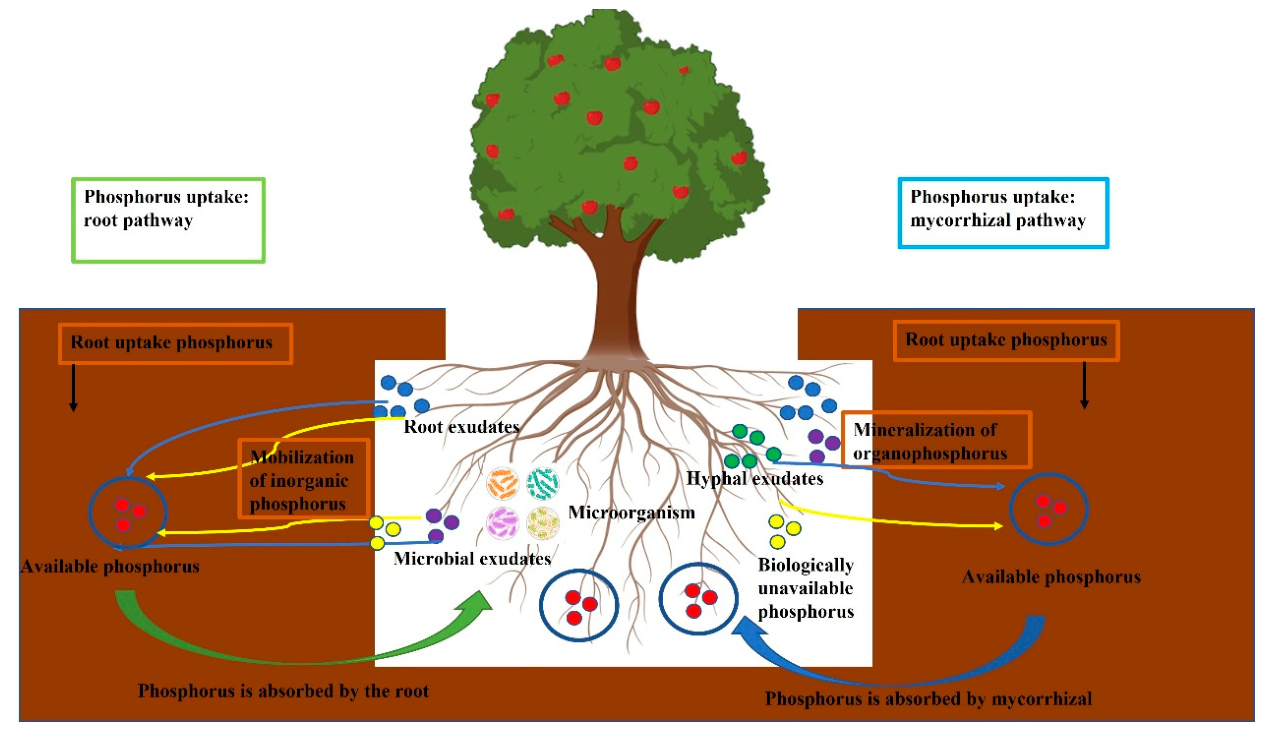
Figure 2.
Common symbiosis signaling pathway underlying arbuscular mycorrhizal (AM) symbiosis. AM fungal signals, including mycorrhizal lipochitooligosaccharides (Myc-LCOs) and short-chain chitin oligomers (Myc-COs), are perceived by host LysM receptor-like kinases (RLKs) at the plasma membrane, initiating the common symbiosis signaling pathway (CSSP). Signal perception activates downstream components, including SYMRK/DMI2, MAPKs, and nuclear-localized signaling proteins such as CASTOR and POLLUX, resulting in characteristic nuclear Ca²⁺ oscillations. The Ca²⁺ signal is decoded by the calcium/calmodulin-dependent protein kinase CCaMK/DMI3, which activates the transcriptional regulator CYCLOPS/IPD3 and downstream symbiotic transcriptional programs. These signaling events converge on key transcription factors, including RAM1, CBX1, WRI5, and other AM-associated regulators, to activate genes required for arbuscule formation, nutrient transport, and symbiotic nutrient exchange. The CSSP is further integrated with hormonal signals, nutrient status, ROS/MAPK signaling, phosphorylation, ubiquitin–proteasome pathways, and negative regulatory mechanisms involving DELLA proteins, SPX proteins, and transcriptional repressors. Coordinated transcriptional reprogramming ultimately promotes arbuscule development, phosphate and nitrogen acquisition, lipid transfer, and establishment of a functional and sustainable AM symbiosis. PT4/PT11 are important AM-inducible phosphate transporters within this downstream symbiotic transcriptional network and mediate phosphate uptake across the periarbuscular membrane. Abbreviations: AM, arbuscular mycorrhiza; CCaMK, calcium/calmodulin-dependent protein kinase; CSSP, common symbiosis signaling pathway; LCOs, lipochitooligosaccharides; RLK, receptor-like kinase; TFs, transcription factors; Pi, inorganic phosphate; N, nitrogen.
Figure 2.
Common symbiosis signaling pathway underlying arbuscular mycorrhizal (AM) symbiosis. AM fungal signals, including mycorrhizal lipochitooligosaccharides (Myc-LCOs) and short-chain chitin oligomers (Myc-COs), are perceived by host LysM receptor-like kinases (RLKs) at the plasma membrane, initiating the common symbiosis signaling pathway (CSSP). Signal perception activates downstream components, including SYMRK/DMI2, MAPKs, and nuclear-localized signaling proteins such as CASTOR and POLLUX, resulting in characteristic nuclear Ca²⁺ oscillations. The Ca²⁺ signal is decoded by the calcium/calmodulin-dependent protein kinase CCaMK/DMI3, which activates the transcriptional regulator CYCLOPS/IPD3 and downstream symbiotic transcriptional programs. These signaling events converge on key transcription factors, including RAM1, CBX1, WRI5, and other AM-associated regulators, to activate genes required for arbuscule formation, nutrient transport, and symbiotic nutrient exchange. The CSSP is further integrated with hormonal signals, nutrient status, ROS/MAPK signaling, phosphorylation, ubiquitin–proteasome pathways, and negative regulatory mechanisms involving DELLA proteins, SPX proteins, and transcriptional repressors. Coordinated transcriptional reprogramming ultimately promotes arbuscule development, phosphate and nitrogen acquisition, lipid transfer, and establishment of a functional and sustainable AM symbiosis. PT4/PT11 are important AM-inducible phosphate transporters within this downstream symbiotic transcriptional network and mediate phosphate uptake across the periarbuscular membrane. Abbreviations: AM, arbuscular mycorrhiza; CCaMK, calcium/calmodulin-dependent protein kinase; CSSP, common symbiosis signaling pathway; LCOs, lipochitooligosaccharides; RLK, receptor-like kinase; TFs, transcription factors; Pi, inorganic phosphate; N, nitrogen.
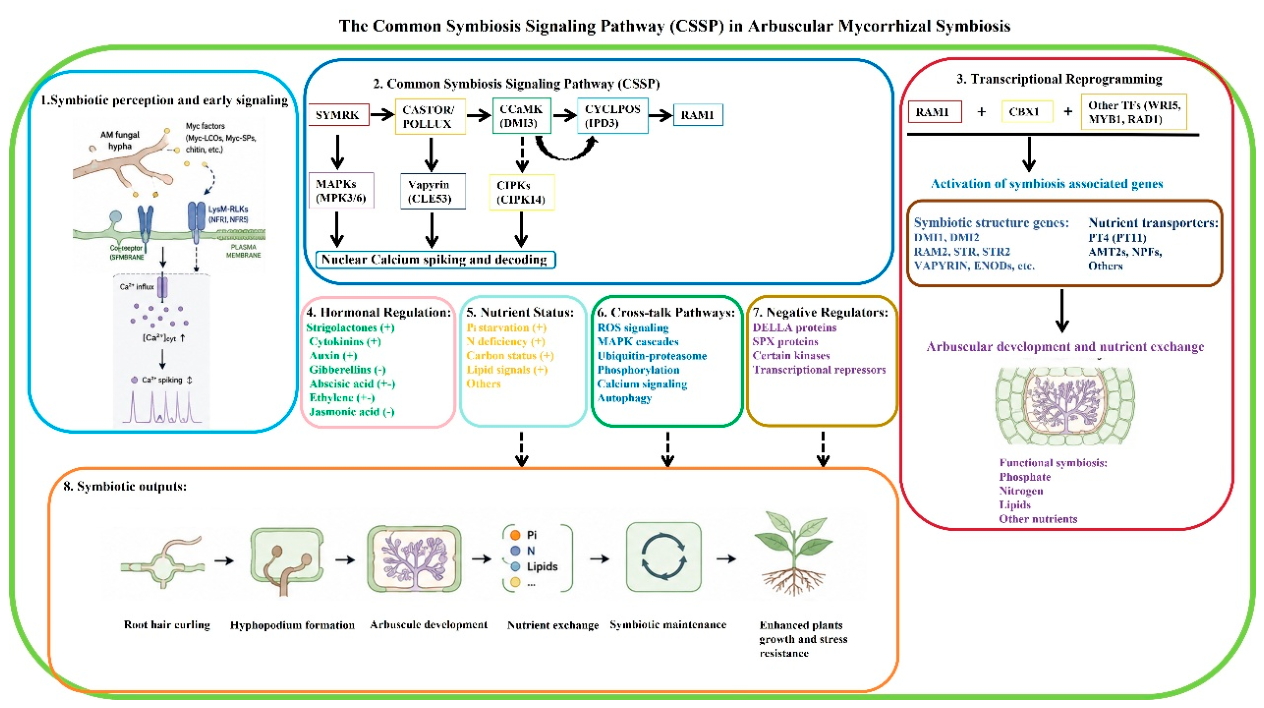
Figure 3.
Transformative applications of mycorrhiza-specific phosphate transporters PT4/PT11 in sustainable agriculture. PT4/PT11-mediated phosphate uptake at the arbuscular interface provides a potential molecular target for improving the efficiency and stability of arbuscular mycorrhizal (AM) symbiosis. Six complementary application strategies are highlighted. (1) Improving phosphorus-use efficiency: enhancing PT4/PT11 expression or promoter activity may increase mycorrhiza-mediated phosphate acquisition and potentially reduce dependence on mineral phosphate fertilizers. (2) Breeding AM-efficient crops: natural allelic variation in PT4/PT11 and associated regulatory components could be exploited through marker-assisted selection, genomic selection, or other breeding approaches to develop crops with improved AM responsiveness and phosphorus-use efficiency. (3) Precision genome editing: CRISPR/Cas-based editing of PT4/PT11 promoters or regulatory elements may enable tissue-specific, developmentally regulated, or stress-responsive expression while minimizing potential growth penalties. (4) Engineering synthetic symbiosis: synthetic promoters, gene stacking, or targeted manipulation of PT4/PT11 together with key symbiotic regulators, such as RAM1, WRI5, and MYB-family transcription factors, may provide opportunities to optimize the strength and stability of AM associations. (5) Enhancing abiotic-stress resilience: improved phosphate and carbon exchange mediated by functional PT4/PT11 pathways may contribute to plant tolerance to drought, salinity, and temperature stress and support yield stability under changing environmental conditions. (6) Sustainable agriculture: integration of PT4/PT11-centered strategies with AM inoculation, precision breeding, genome editing, and improved nutrient management could contribute to reduced phosphate fertilizer inputs, lower environmental impacts, improved soil health and biodiversity, and more resource-efficient crop production. Together, these strategies illustrate the potential of PT4/PT11 as molecular targets for translating mechanistic insights into AM symbiosis into practical strategies for sustainable and climate-resilient agriculture.
Figure 3.
Transformative applications of mycorrhiza-specific phosphate transporters PT4/PT11 in sustainable agriculture. PT4/PT11-mediated phosphate uptake at the arbuscular interface provides a potential molecular target for improving the efficiency and stability of arbuscular mycorrhizal (AM) symbiosis. Six complementary application strategies are highlighted. (1) Improving phosphorus-use efficiency: enhancing PT4/PT11 expression or promoter activity may increase mycorrhiza-mediated phosphate acquisition and potentially reduce dependence on mineral phosphate fertilizers. (2) Breeding AM-efficient crops: natural allelic variation in PT4/PT11 and associated regulatory components could be exploited through marker-assisted selection, genomic selection, or other breeding approaches to develop crops with improved AM responsiveness and phosphorus-use efficiency. (3) Precision genome editing: CRISPR/Cas-based editing of PT4/PT11 promoters or regulatory elements may enable tissue-specific, developmentally regulated, or stress-responsive expression while minimizing potential growth penalties. (4) Engineering synthetic symbiosis: synthetic promoters, gene stacking, or targeted manipulation of PT4/PT11 together with key symbiotic regulators, such as RAM1, WRI5, and MYB-family transcription factors, may provide opportunities to optimize the strength and stability of AM associations. (5) Enhancing abiotic-stress resilience: improved phosphate and carbon exchange mediated by functional PT4/PT11 pathways may contribute to plant tolerance to drought, salinity, and temperature stress and support yield stability under changing environmental conditions. (6) Sustainable agriculture: integration of PT4/PT11-centered strategies with AM inoculation, precision breeding, genome editing, and improved nutrient management could contribute to reduced phosphate fertilizer inputs, lower environmental impacts, improved soil health and biodiversity, and more resource-efficient crop production. Together, these strategies illustrate the potential of PT4/PT11 as molecular targets for translating mechanistic insights into AM symbiosis into practical strategies for sustainable and climate-resilient agriculture.
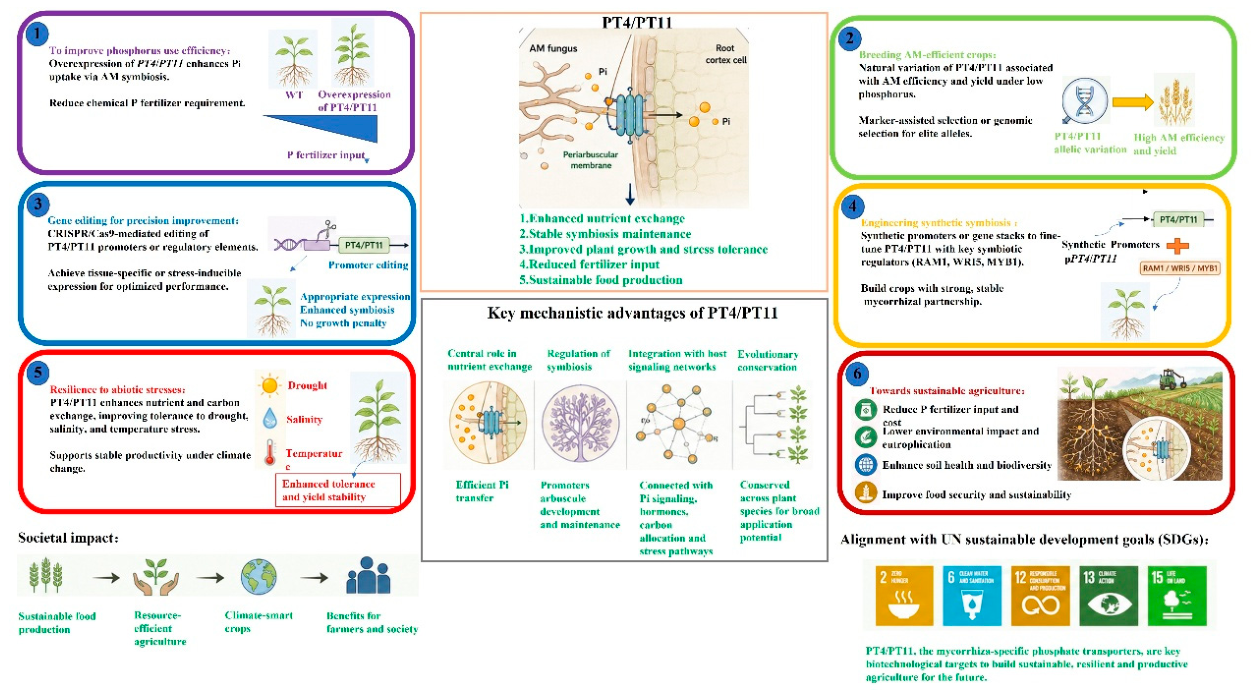

Table 1.
Mycorrhiza-specific and mycorrhiza-inducible phosphate transporters in plant endomycorrhizae.
Table 1.
Mycorrhiza-specific and mycorrhiza-inducible phosphate transporters in plant endomycorrhizae.
| Gene name | Species | PHT1 subgroup | Serial Number | Gene expression pattern | Reference | |
|---|---|---|---|---|---|---|
| MtPT4 | Medicago truncatula | PHT1 | AAM76744 | Mycorrhiza-specific | (Harrison et al., 2002; Javot et al., 2007a and Pumplin et al., 2009) | |
| LjPT4 | Lotus japonicus | PHT1 | BAE93353 | Mycorrhiza-inducible | (Maeda et al., 2006 and Guether et al., 2009 ) | |
| OsPT11 | Oryza sativa | PHT1 | AAN39052 | Mycorrhiza-specific | (Paszkowski et al., 2002, Kobae et al., 2010, Güimil et al., 2005) | |
| OsPT13 | Oryza sativa | PHT1 | AAN39054 | Mycorrhiza-inducible | (Paszkowski et al., 2002 and Güimil et al., 2005) | |
| NtPT3 | Nicotiana tabacum | PHT1 | EF091669 | Mycorrhiza-inducible | (Chen et al., 2007) | |
| NtPT4 | Nicotiana tabacum | PHT1 | EF091672 | Mycorrhiza-inducible | (Chen et al., 2007) | |
| NtPT5 | Nicotiana tabacum | PHT1 | EF091675 | Mycorrhiza-inducible | (Chen et al., 2007) | |
| Pht1; 6 | Zea mays | PHT1 | CAH25731 | Mycorrhiza-inducible | (Glassop et al., 2005 and Nagy et al., 2006) | |
| Pht1; 8 | Triticum aestivum | PHT1 | CAH25730 | Mycorrhiza-specific | (Glassop et al., 2005) | |
| Pht1; myc | Hordeum vulgare | PHT1 | AAO72440 | Mycorrhiza-inducible | (Rae et al., 2003 and Glassop et al., 2005) | |
| CfPT3 | Capsicum frutescens | PHT1 | EF091667 | Mycorrhiza-inducible | (Chen et al., 2007) | |
| CfPT4 | Capsicum frutescens | PHT1 | EF091670 | Mycorrhiza-inducible | (Chen et al., 2007) | |
| CfPT5 | Capsicum frutescens | PHT1 | EF091673 | Mycorrhiza-inducible | (Chen et al., 2007) | |
| SmPT3 | Solanum melongena | PHT1 | EF091668 | Mycorrhiza-inducible | (Chen et al., 2007) | |
| SmPT4 | Solanum melongena | PHT1 | EF091671 | Mycorrhiza-inducible | (Chen et al., 2007) | |
| SmPT5 | Solanum melongena | PHT1 | EF091674 | Mycorrhiza-inducible | (Chen et al., 2007) | |
| StPT3 | Solanum tuberosum | PHT1 | CAC87043 | Mycorrhiza-inducible | (Nagy et al., 2005 and Rauschet al., 2001) | |
| StPT4 | Solanum tuberosum | PHT1 | AAW51149 | Mycorrhiza-specific | (Nagy et al., 2005) | |
| StPT5 | Solanum tuberosum | PHT1 | AAX85195 | Mycorrhiza-specific | (Nagy et al., 2005) | |
| LePT3 | Lycopersicon esculentum | PHT1 | AY804011 | Mycorrhiza-inducible | (Nagy et al., 2005) | |
| LePT4 | Lycopersicon esculentum | PHT1 | AAX85192 | Mycorrhiza-specific | (Nagy et al., 2005) | |
| LePT5 | Lycopersicon esculentum | PHT1 | AAX85194 | Mycorrhiza-inducible | (Nagy et al., 2005) | |
| This table is adapted from Javot et al. 2007 |
Table 2.
Regulatory network controlling PT4/PT11 expression during arbuscular mycorrhizal symbiosis.
Table 2.
Regulatory network controlling PT4/PT11 expression during arbuscular mycorrhizal symbiosis.
| Regulatory level | Representative regulator(s) | Mode of regulation | Target/Mechanism | Effect on PT4/PT11 | Representative references |
|---|---|---|---|---|---|
| Plasma membrane receptors | SYMRK/DMI2, CERK1 homologs | Signal transduction | Initiate the common symbiosis signaling pathway (CSSP) through receptor-mediated perception of Myc factors | Positive | (Antolín-Llovera et al., 2014) |
| Nuclear calcium signaling | CASTOR, POLLUX, NUP85, NUP133 | Nuclear Ca²⁺ oscillation | Generate nuclear calcium spiking required for downstream signaling | Positive | (Charpentier et al., 2016) |
| Calcium decoder | CCaMK | Protein kinase | Decodes Ca²⁺ signatures and phosphorylates CYCLOPS | Strong positive | (Singh and Parniske., 2012) |
| Central transcriptional regulator | CYCLOPS | Transcriptional activation | Directly activates RAM1 transcription | Strong positive | (Pimprikar et al., 2016) |
| Master regulator | RAM1 (GRAS TF) | Direct transcriptional activation | Activates AM-associated transcriptional programs, including phosphate transport and arbuscule-development genes | Essential positive regulator | (Gobbato et al., 2012) |
| AP2/ERF transcription factor | WRI5a | Direct activation | Coordinates lipid metabolism and phosphate transporter expression | Positive | (Jiang et al., 2017 and Guo et al., 2022) |
| AP2/ERF transcription factor | CBX1 | Direct transcriptional activation | Activates PT11 together with lipid-transfer genes | Positive | (Xue et al., 2018) |
| GRAS proteins | DELLA proteins | Protein interaction | Form complexes with CYCLOPS/RAM1 to enhance transcription | Positive | (Floss et al., 2013) |
| Additional transcription factors | RAD1, MIG1, NSP1/NSP2 | Transcriptional regulation | Coordinate cortical cell differentiation and AM development | Positive | (Park et al., 2015 and Lin et al., 2011) |
| Hormonal regulation | Strigolactones | Hormone signaling | Promote fungal branching and PT4/PT11 induction | Positive | (Akiyama et al., 2005) |
| Abscisic acid | Hormone signaling | Facilitates AM establishment and transporter expression | Positive | (Herrera-Medina et al., 2007) | |
| Gibberellins | DELLA degradation | Destabilizes DELLA proteins and suppresses RAM1 pathway | Negative | (Floss et al., 2013) | |
| Ethylene | Hormone signaling | Restricts AM colonization under some conditions | Mostly negative | (Foo et al., 2013) | |
| Phosphate signaling | PHR1/PHR2 | Pi starvation response | Coordinates systemic phosphate starvation signaling | Positive under low Pi | (Bari et al., 2006) |
| SPX proteins | Pi sensor | Inhibit PHR activity under Pi sufficiency | Negative | (Puga et al., 2014) | |
| miR399–PHO2 module | Systemic Pi signaling | Modulates phosphate homeostasis and transporter abundance | Indirect | (Lin et al., 2008) | |
| Kinase signaling module | KINASE3 (KIN3), AMK8, AMK24, OsRLCK171 | Receptor-like kinase cascade | CBX1 directly activates KIN3; AMK8/24 interact with KIN3 to regulate arbuscule development and nutrient exchange | Indirect positive | (Leng et al., 2023) |
| Negative-feedback regulation | ERM1–ERF12–TPL module | Transcriptional repression | WRI5a activates ERF12, which recruits TPL to attenuate excessive arbuscule development and indirectly fine-tune PT4/PT11 activity | Fine-tuning / Negative feedback | (Zhang et al., 2023) |
| Emerging regulatory mechanisms | Small molecules, single-cell transcriptomics, spatial transcriptomics | Multi-omics regulation | Cell-type-specific regulatory networks reveal additional regulators controlling arbuscule-containing cortical cells and PT4/PT11 expression | Putative positive regulators | (Delaux and Gutjahr., 2024) |
| Environmental regulation | External Pi availability | Nutrient feedback | High Pi suppresses AM development and PT4/PT11 expression | Negative | (Smith and Smith., 2011) |
Disclaimer/Publisher’s Note: The statements, opinions and data contained in all publications are solely those of the individual author(s) and contributor(s) and not of MDPI and/or the editor(s). MDPI and/or the editor(s) disclaim responsibility for any injury to people or property resulting from any ideas, methods, instructions or products referred to in the content. |
© 2026 by the authors. Licensee MDPI, Basel, Switzerland. This article is an open access article distributed under the terms and conditions of the Creative Commons Attribution (CC BY) license.
Copyright: This open access article is published under a Creative Commons CC BY 4.0 license, which permit the free download, distribution, and reuse, provided that the author and preprint are cited in any reuse.