

Submitted:
11 August 2026
Posted:
12 August 2026
You are already at the latest version
Abstract
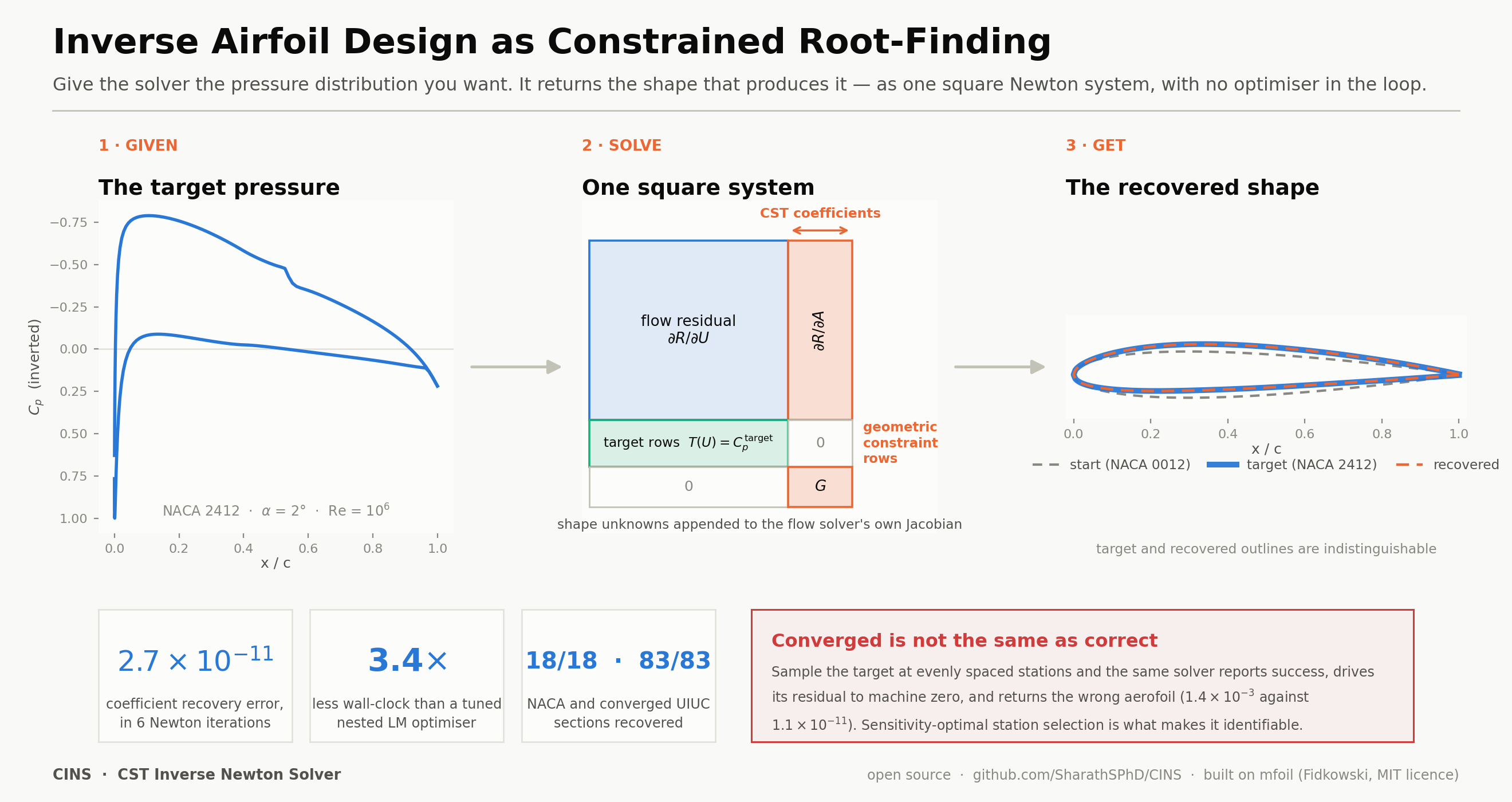
Inverse airfoil design, recovering a geometry that produces a prescribed surface pressureor edge-velocity distribution, is recast here as a single determined nonlinear root-find ratherthan an objective-function search. Parameterising the surface with Class-Shape-Transformation(CST) coefficients that enter the geometry linearly makes the geometric sensitivity of the surfaceexact, constant and design-independent. It also makes geometric design constraints, among themleading-edge radius, trailing-edge thickness and inscribed area, linear algebraic rows rather thannonlinear predicates. Appending the CST coefficients as unknowns to a coupled viscous/inviscidNewton solver (mfoil) therefore converts constrained shape optimisation into constrained root-finding: one square system, no outer loop, no surrogate. The architecture is validated with afalsifiable self-consistency test in which a known CST coefficient vector is recovered from itsown self-generated target to ∥A−A∗∥∞= 2.75 ×10⁻¹¹ in six Newton iterations. The recoveredgeometry reproduces the reference section’s fully released (natural-transition) aerodynamiccoefficients to ∆cl = 3.4 ×10⁻¹². An ablation matrix identifies the primary uniqueness guard forthe resulting square system: sensitivity-optimal (QR-pivoted) selection of target stations, notinitial-guess quality, separates recovery of the true design from clean convergence to a spuriousbut residual-zeroing root. Measured against a competently-tuned nested Levenberg–Marquardtbaseline under two independent fair-paired controls, the monolithic architecture requires 3.1–8.1×fewer counted flow solves and 3.4–3.5×less wall-clock time. This is a real but modest reduction,not the two-to-three-orders-of-magnitude headline hypothesised a priori, and it comes withdeterminism, an exact analytic Jacobian for the constraint rows, and per-iteration failure-modediagnostics for which the nested baseline has no analogue. Generalisation is then evaluatedon two pre-registered panels. A 20-section NACA panel recovers all 18 generable sections to∥A−A∗∥∞ ≤1.51 ×10⁻¹⁰; a 117-section panel drawn from the UIUC coordinate databaserecovers every one of its 83 converged sections to better than 10−4, while missing the pre-registered composite criterion on iteration count rather than on accuracy. Both panel outcomesare reported alongside the exclusions they rest on and the geometric bias those exclusions carry.The architecture is finally placed on a comparison table against MISES’s own modal inverse mode,the nearest prior CST-based inverse method, and the current generative and learned-surrogateinverse-design literature, on formulation class, cost, determinism and constraint-handling groundsrather than a single flow-solve number, since the methods are not commensurable on that axisalone.
Keywords:
inverse design
; airfoil
; class-shape transformation
; Newton method
; viscous–inviscid coupling
; identifiability
; constrained root-finding
Copyright: This open access article is published under a Creative Commons CC BY 4.0 license, which permit the free download, distribution, and reuse, provided that the author and preprint are cited in any reuse.


