Submitted:
11 August 2026
Posted:
12 August 2026
You are already at the latest version
Abstract
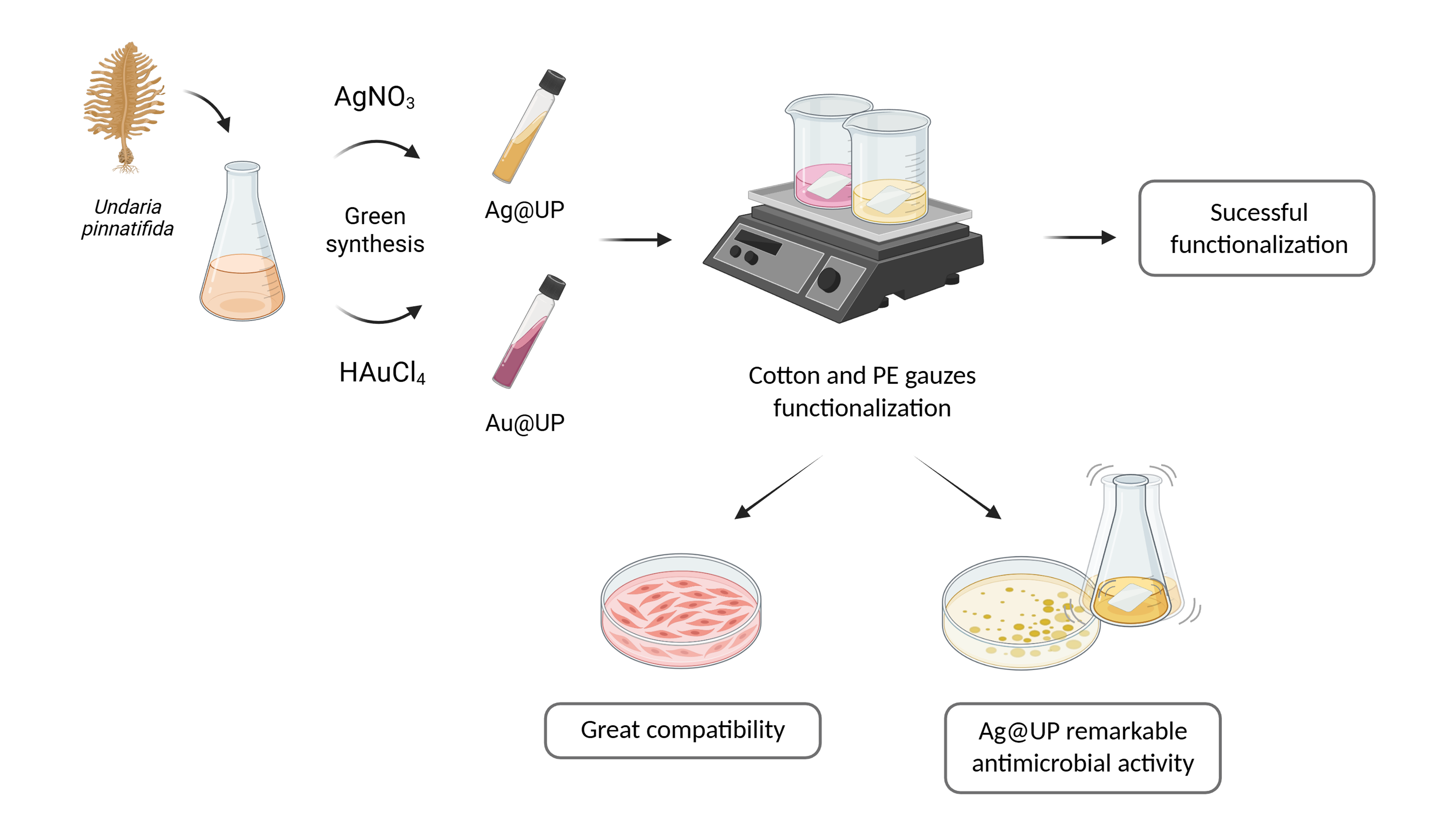
Functionalizing textiles with nanoparticles is a promising strategy for developing sustainable materials with antimicrobial activity and reduced potential for resistance. This study aimed to develop antimicrobial cotton and polyester (PE) textiles functionalized with gold and silver nanoparticles (Au@UP and Ag@UP) biosynthesized using Undaria pinnatifida (UP) aqueous extracts. Nanoparticle-functionalized textiles were characterized by UV–vis spectroscopy, SEM, and FTIR, and nanoparticle attachment–detachment and stability were evaluated on both substrates. Antioxidant activity was assessed by the DPPH assay, while antimicrobial activity against Staphylococcus aureus and Pseudomonas aeruginosa and cytocompatibility using the L-929 cell line were determined. UV–vis spectroscopy revealed a slow-release profile, while SEM, UV–vis, and FTIR confirmed nanoparticle binding. Cotton exhibited higher nanoparticle affinity and stability (KS=0.5007 for Au@UP and 0.4817 for Ag@UP), attributed to its abundance of reactive hydroxyl groups. Although antioxidant activity decreased after nanoparticle binding (<5%), functionalized cotton gauzes retained antimicrobial activity. Au@UP and Ag@UP textiles were non-cytotoxic (>80% cell viability) and inhibited the growth of S. aureus (~15% and 90%, respectively) and P. aeruginosa (~90% for both). These findings support the potential of UP-mediated nanoparticle-functionalized textiles, particularly Ag@UP-containing materials, as sustainable antimicrobial surfaces.