

Submitted:
11 August 2026
Posted:
12 August 2026
You are already at the latest version
Abstract
The efficient operation of lithium-ion battery management systems (BMSs) depends on accurate state-of-charge (SOC) estimation. However, the performance of conventional model-based SOC estimation methods may deteriorate owing to parameter uncertainty, and nonlinear battery dynamics. This study proposes a hybrid SOC estimation framework termed DO-EKFRes comprising two stages. In the first stage, the process and measurement noise covariance matrices are optimized offline using the Adam optimizer with finite-difference gradient approximation. In the second stage, a Bidirectional Long Short-Term Memory (BiLSTM) residual learning network is employed to compensate for the remaining SOC estimation errors. The proposed framework was evaluated using two complementary validation protocols: a synthetic Monte Carlo experiment and a Leave-One-Battery-Out (LOBO) cross-validation framework based on the NASA Prognostics Center of Excellence (PCoE) lithium-ion battery dataset. In the synthetic validation, DO-EKFRes achieved an RMSE of 0.93%, corresponding to reductions of 40.47% and 25.81% relative to the EKF and DO-EKF, respectively. In the NASA LOBO evaluation, the proposed framework achieved a mean RMSE of 4.04%, corresponding to reductions of 49.22% and 29.48% relative to the EKF and DO-EKF, respectively. These results demonstrate that integrating offline covariance optimization with BiLSTM-based residual learning improves estimation accuracy, robustness, and cross-battery generalization, providing a practical solution for lithium-ion battery SOC estimation in battery management systems.
Keywords:
lithium-ion battery
; state-of-charge estimation
; battery management system
; extended Kalman filter
; residual learning
; bidirectional long short-term memory
1. Introduction
Lithium-ion (Li-ion) batteries are widely employed in electric vehicles, portable electronic devices, and stationary energy storage systems because of their high energy density, extended cycle life, and favorable electrochemical characteristics [1,2,4]. Their increasing deployment across diverse applications has made BMSs indispensable for maintaining battery safety, operational reliability, and efficient energy utilization under varying operating conditions [3,5].
State-of-charge (SOC) estimation is a key function of BMSs, providing critical information for battery supervision, charge control, and energy management. Therefore, achieving accurate SOC estimation is essential for ensuring reliable battery operation, mitigating overcharge and over-discharge, and prolonging battery service life [6].
SOC represents the remaining charge stored inside a battery relative to its nominal capacity [2]. However, SOC cannot be measured directly using physical sensors and must instead be estimated from measurable quantities such as terminal voltage and current [8]. Accurate SOC estimation remains challenging because Li-ion batteries exhibit highly nonlinear dynamics and time-varying characteristics influenced by temperature variations, aging, and operating conditions [9,23]. To overcome these challenges, a wide range of SOC estimation frameworks has been developed, which can generally be classified into three categories: model-based, data-driven, and hybrid frameworks [39]. Figure 1 illustrates the taxonomy of these frameworks.
Conventional techniques, such as Coulomb counting and open-circuit-voltage methods, are computationally efficient but suffer from error accumulation and limited against sensor noise [2]. To overcome these limitations, model-based employing equivalent circuit models (ECMs) have attracted considerable attention in recent years [6,8,24].
Among the model-based approaches, Kalman-filter-based methods have been extensively investigated for battery SOC estimation owing to their recursive structure, physical interpretability, and relatively low computational cost [6,8]. Various filtering frameworks, including the Extended Kalman Filter (EKF), Unscented Kalman Filter (UKF), and particle filters have been proposed for battery-state estimation [23,26]. The EKF has demonstrated satisfactory estimation performance under moderate operating conditions by combining equivalent-circuit models with real-time battery measurements [6]. However, the estimation accuracy of EKF-based approaches remains strongly dependent on the appropriate selection of the process-noise covariance matrix Q and the measurement-noise covariance matrix R [24]. In practical applications, the covariance matrices are commonly selected manually to remain constant throughout the battery lifetime. Consequently, inaccurate covariance selection may lead to estimation bias, slow convergence, and performance degradation under varying operating conditions [25]. o overcome the limitations associated with the manual tuning of the process and measurement noise covariance matrices, several adaptive Kalman filtering techniques have been developed to improve the adaptability of conventional Kalman filters. Representative approaches include dual-estimation frameworks, multi-innovation filtering strategies, Sage–Husa adaptive filtering, and maximum-likelihood-based covariance adaptation [8,23,27,28]. Although these methods improve estimation performance and robustness under varying operating conditions, they remain limited by the structural modelling errors introduced by reduced-order equivalent-circuit models [9,27].
Data-driven approaches have also emerged as an effective alternative for battery SOC estimation [4,29]. Deep-learning architectures, including artificial neural networks (ANNs), recurrent neural networks (RNNs), and long short-term memory (LSTM) networks, have demonstrated strong capability in learning the nonlinear relationship between battery measurements and SOC [30].These methods estimate SOC directly from measured data without requiring explicit electrochemical models. However, their performance often degrades under unseen operating conditions, limiting their generalisation capability. In addition, they lack the physical interpretability and recursive state-estimation capability inherent to Kalman-filter-based methods.
Consequently, recent research has increasingly focused on hybrid SOC estimation frameworks that combine physical battery models with data-driven learning algorithms. Xing et al. [31] integrated a dual-EKF with a neural-network-based compensation model to reduce the residual estimation error. Hybrid frameworks combining data-driven models with Kalman-filter-based correction have also been reported in [32,33], while Yun et al. [34] developed a hybrid model-based and data-driven framework for electric-vehicle batteries. More recently, Sun et al. [35] proposed an LSTM-EKF framework enhanced by feature engineering and physics-based output constraints, achieving average RMSE values below under different operating temperatures. Similarly, Peng et al. [36] developed a hybrid PID-AEKF framework for LiFePO4 batteries with estimation errors below , while Jiang et al. [37] integrated an adaptive UKF with deep-learning models to improve estimation robustness under different operating conditions.
1.1. Critical Review
Previous studies demonstrate that EKF, UKF, adaptive filtering, and hybrid learning-based methods are among the most investigated approaches for SOC estimation. Most existing studies have been validated using standard driving cycles or laboratory experiments under controlled operating conditions [38]. Although these evaluation protocols provide useful benchmarks, they do not fully capture the variability introduced by different battery cells, operating conditions, and degradation levels encountered in practical applications [39]. Consequently, the generalisation capability of existing SOC estimation frameworks remains insufficiently investigated [39].
Overall, the literature demonstrates a clear evolution from conventional model-based estimation methods toward adaptive and hybrid learning-based frameworks [39]. Nevertheless, several challenges remain unresolved. Conventional filtering methods preserve physical interpretability but remain sensitive to parameter uncertainties, modelling errors, and nonlinear disturbances, whereas hybrid frameworks improve estimation accuracy at the expense of increased model complexity and limited generalisation capability. Furthermore, most adaptive and hybrid approaches continue to rely on manually tuned or heuristically determined measurement covariance matrices, while the residual modelling errors introduced by reduced-order equivalent-circuit models are rarely addressed within the same estimation framework. In addition, most validation studies are performed using data collected from the same battery cells under different operating cycles, providing limited evidence of cross-cell generalisation. These limitations motivate the development of more adaptive and generalisable SOC estimation frameworks.
Motivated by these challenges, this study proposes a hybrid DO-EKFRes framework for lithium-ion battery SOC estimation. The proposed method first identifies the process measurement covariance matrices offline through data-driven optimisation, resulting in a Data-Optimized Extended Kalman Filter (DO-EKF). A Bidirectional Long Short-Term Memory (BiLSTM) network is then employed to learn and compensate for the residual estimation error of the filter. The proposed framework is evaluated using both a controlled synthetic Monte Carlo experiment and the NASA PCoE dataset under a Leave-One-Battery-Out (LOBO) validation protocol to assess its estimation accuracy, and generalisation capability across different battery cells and degradation conditions.
2. Materials and Methods
Figure 2 presents the workflow of the proposed framework, consisting of four main stages: data preparation, model development, validation, and performance evaluation. Initially, the battery datasets are preprocessed through parameter identification and feature extraction. Subsequently, a Data-Optimized Extended Kalman Filter (DO-EKF) is employed to estimate the battery SOC using offline optimized process and measurement-noise covariance matrices. The remaining estimation error is then learned by BiLSTM network to compensate for the residual modelling error and improve the final SOC estimate. The proposed framework is evaluated using two validation protocols. A controlled Monte Carlo synthetic dataset and Leave-One-Battery-Out (LOBO) cross-validation protocol is employed on the NASA PCoE battery dataset [40]. The estimation performance is finally quantified using RMSE and compared with EKF and DO-EKF-based frameworks.
2.1. Battery Model
The electrical behaviour of the Li-ion battery is modelled using a first-order equivalent circuit model (ECM), which offers an effective balance between computational efficiency and real-time state estimation performance. As illustrated in Figure 3, the first-order ECM comprises an open-circuit voltage (OCV) source, an ohmic resistance , and an RC polarization branch consisting of the resistor and capacitor . To account for temperature variations, a linear compensation term is incorporated into the OCV–SOC relationship. The battery state vector is defined as:
where denotes the battery state of charge and represents the polarization voltage across the RC branch. The discrete-time state equations are expressed as
where
is the effective battery capacity, and denotes the process-noise vector.
The corresponding terminal voltage is modeled as
where denotes the temperature compensation coefficient, is the reference temperature, and represents the measurement noise.
2.2. Dataset and Experimental Setup
To comprehensively evaluate the proposed DO-EKFRes framework, two datasets are employed. A synthetic dataset is first generated under controlled operating conditions to assess the estimation performance in the presence of parameter variations and measurement uncertainties. Subsequently, the NASA Prognostics Center of Excellence (PCoE) battery dataset is used to evaluate the proposed framework under realistic battery aging conditions. The overall experimental protocol is summarized in Figure 2.
2.2.1. Synthetic Data Generation
A synthetic battery dataset is generated using the first-order equivalent circuit model described in Section 2.1. The simulated operating conditions include variations in the initial SOC, battery state-of-health (SOH), ambient temperature, and dynamic current profiles. Measurement noise and sensor bias are further incorporated to emulate practical operating conditions. The synthetic data generation procedure is summarized in Algorithm 1.
For each Monte Carlo scenario, the ECM is used to generate the battery states and terminal voltage, producing synchronized time-series measurements of current, voltage, temperature, SOC, and SOH. The resulting synthetic dataset is randomly divided into 80% and 20% subsets for model training and validation, respectively.
| Algorithm 1 Synthetic Dataset Generation |
|
2.2.2. NASA PCoE Dataset
To evaluate the proposed framework under realistic battery degradation conditions, experiments are conducted using the NASA Prognostics Center of Excellence (PCoE) lithium-ion battery dataset [40]. The dataset contains accelerated aging experiments performed on commercial 18650 lithium-ion cells under repeated charge-discharge cycles.
Four battery cells (B0005, B0006, B0007, and B0018) are selected in this study, comprising a total of 636 charge-discharge cycles and 185,721 preprocessed time-series samples. The battery measurements include terminal voltage, current, temperature, and reference SOC values, providing a comprehensive benchmark for validating battery state estimation algorithms.
2.2.3. LOBO Cross-Validation
The generalisation capability of the proposed framework is evaluated using a LOBO cross-validation protocol. During each validation fold, one battery cell is completely excluded from the model development process and used exclusively for testing, while the remaining three battery cells are used for training and validation.
To optimise the model parameters, the available training batteries are chronologically divided according to the charge-discharge cycles, where 80% of the cycles are used for model fitting and the remaining 20% are reserved for validation and hyperparameter selection. This evaluation protocol ensures that the testing battery remains entirely unseen during model training, providing a rigorous assessment of the estimation accuracy and cross-cell generalisation capability under different degradation conditions.
2.3. Data-Optimized Extended Kalman Filter (DO-EKF)
The proposed Data-Optimized Extended Kalman Filter (DO-EKF) extends the conventional EKF by employing offline data-driven optimization of the process-noise covariance matrix and the measurement-noise covariance R. Accordingly, the proposed framework identifies the optimal process and measurement noise covariance matrices using the training data and subsequently employs the optimized matrices during online inference.
2.3.1. Extended Kalman Filter
The EKF recursively estimates the battery state by combining the first-order equivalent circuit model with the measured battery voltage and current. The nonlinear state-space model is expressed as
where and denote the process and measurement noise, respectively.
The prediction step is given by
where
The correction step is performed according to
2.3.2. Process-Noise Covariance Optimization
The estimation accuracy of the EKF depends on the appropriate selection of the process-noise covariance matrix and the measurement-noise covariance matrix R. As illustrated in Figure 4, the optimization algorithm iteratively searches for the optimal covariance matrices by minimizing the SOC estimation error. The resulting optimal covariance matrices, , are subsequently fixed and employed during online inference.
2.3.3. Proposed DO-EKF Residual Learning Network
The proposed DO-EKFRes framework consists of two sequential stages. The first stage employs DO-EKF to provide a physics-based SOC estimate, whereas the second stage utilizes a Bidirectional Long Short-Term Memory (BiLSTM) network to compensate for the residual estimation error. Hybrid frameworks that combine recursive Kalman filtering with deep learning have recently demonstrated improved estimation accuracy by exploiting the strengths of model-based and data-driven approaches [16,17,18,19].
Following the optimization of the process-noise covariance matrix and the measurement-noise covariance matrix R, the EKF is executed using the optimized covariance matrices without further online adaptation. The resulting estimator is referred to as the DO-EKF. The overall workflow of the proposed DO-EKF is illustrated in Figure 5.
The residual-learning network receives a 14-dimensional feature vector composed of measured battery signals, health-related indicators, temporal information, and variables generated by the DO-EKF. These features are organized into multivariate temporal sequences and supplied to the BiLSTM network. The complete set of input features is summarized in Table 1. The overall residual-learning framework is illustrated in Figure 6.
The residual target is defined as the difference between the reference SOC and the corresponding DO-EKF estimate,
where denotes the reference SOC and is the SOC estimated by the DO-EKF. Consequently, the BiLSTM is trained to learn the remaining estimation error that cannot be captured by the model-based estimator.
To exploit the temporal dependency of battery dynamics, a sliding window of length L is constructed for each sampling instant,
where denotes the 14-dimensional feature vector at time step k. The resulting feature sequence is processed by a two-layer BiLSTM network followed by an attention mechanism, allowing the model to identify the most informative temporal features for residual estimation [19,20,22]. The predicted residual correction is subsequently added to the DO-EKF estimate to obtain the final SOC estimate,
where denotes the residual correction predicted by the BiLSTM network. This hybrid formulation preserves the physical consistency of the DO-EKF while compensating for the remaining nonlinear modelling errors through data-driven residual learning.
The residual-learning network was trained using the Smooth- loss function and the Adam optimizer. Early stopping based on the validation loss was employed to prevent overfitting, and the optimal network parameters were retained for the subsequent LOBO evaluation.
To quantitatively compare all evaluated frameworks, the estimation accuracy was assessed using the root mean square error (RMSE) and mean absolute error (MAE), defined as:
where N denotes the total number of samples, is the estimated SOC, and is the corresponding reference SOC. RMSE is more sensitive to large estimation errors, whereas MAE provides the average magnitude of the estimation error.
2.4. Comparative Performance Analysis
A statistical analysis was conducted to evaluate the significance of the performance differences among the proposed DO-EKFRes, DO-EKF, and standard EKF under the synthetic Monte Carlo benchmark. Following established best practices for statistical comparison of algorithms [10], the Friedman test was first performed to determine whether statistically significant differences existed among the three estimation methods [11]. Kendall’s coefficient of concordance (W) was subsequently computed to quantify the degree of agreement among the model rankings across validation scenarios [12].
To identify specific differences between methods, post-hoc pairwise comparisons were performed using the Wilcoxon signed-rank test [13]. To control the family-wise error rate arising from multiple comparisons, the Holm-Bonferroni correction was applied to the resulting p-values [14]. Furthermore, the matched-pairs rank-biserial correlation () was reported to quantify the effect size of each pairwise comparison, providing a robust and interpretable measure of the magnitude of the observed performance differences [15].
For the NASA LOBO evaluation, only four battery cells were available for validation, limiting the statistical power of the pairwise comparisons. Therefore, the NASA results are discussed primarily to demonstrate the generalization capability of the proposed framework on real-world battery data under the LOBO protocol, whereas the inferential statistical analysis is based on the synthetic Monte Carlo experiments.
3. Results and Discussion
3.1. Synthetic Monte Carlo Evaluation
The proposed DO-EKFRes framework was first evaluated using 30 independent Monte Carlo validation scenarios generated under controlled model mismatch and measurement uncertainty.
Figure 7 presents the RMSE obtained for each validation scenario using the EKF, DO-EKF, and the proposed DO-EKFRes. Across the 30 validation Monte Carlo scenarios, the EKF exhibited the largest estimation errors due to the intentionally introduced mismatch between the estimator model and the true battery dynamics. Offline optimization of the process and measurement noise covariance matrices consistently produced a more compact RMSE distribution, demonstrating that appropriate covariance selection enhances the EKF under modelling uncertainties. However, residual errors remained because the equivalent circuit model cannot fully represent the nonlinear battery behavior.
The proposed DO-EKFRes further reduced the estimation error across nearly all validation scenarios while exhibiting the narrowest RMSE distribution. By learning the residual estimation error from temporal battery measurements and filter states, the BiLSTM effectively compensated for the systematic nonlinear modelling errors that remained after offline covariance optimization. As shown in Figure 8, the proposed framework achieved not only the lowest mean and median RMSE but also the smallest performance variability, indicating more accurate and robust SOC estimation under diverse operating conditions.
Quantitatively, the proposed DO-EKFRes reduced the average RMSE to 0.93%, corresponding to a 40.47% improvement over the EKF and a further 25.81% improvement compared with the DO-EKF. Similar improvements were observed for the MAE and confirming that the proposed framework improves not only the average estimation accuracy but also the robustness of the estimation performance across different validation scenarios. Furthermore, the Friedman test confirmed a statistically significant difference among the three frameworks (, ). As reported in Table 2, the proposed DO-EKFRes achieved the lowest average rank 1.03, followed by DO-EKF 1.97, whereas the EKF obtained the highest average rank 3.00. These results demonstrate that the proposed framework consistently outperformed the benchmark frameworks across the LOBO validation scenarios.
As summarized in Table 3, the pairwise Wilcoxon signed-rank tests with Holm correction confirmed statistically significant differences between all compared frameworks (). In particular, DO-EKFRes significantly outperformed both the EKF and the optimized DO-EKF, confirming that residual learning provides a statistically significant improvement beyond offline covariance optimization.
The obtained results indicate that the residual-learning strategy effectively compensates for the nonlinear dynamics and modelling inaccuracies that cannot be fully represented by the equivalent circuit model or corrected by the Kalman filtering process, resulting in improved estimation accuracy and robustness [19,20,21,22].
3.2. NASA PCoE Dataset Evaluation
Unlike the synthetic benchmark, the NASA PCoE Li-ion battery dataset incorporates practical challenges encountered in real-world applications, including battery aging, capacity degradation, measurement uncertainty, and battery-to-battery variability accumulated during long-term cycling [40]. The composition of the dataset used for the LOBO evaluation is summarized in Table 4.
Table 5 summarizes the battery-wise performance of the conventional EKF, the proposed DO-EKF, and the proposed DO-EKFRes under the LOBO evaluation protocol. The proposed framework consistently achieves the lowest estimation errors across all battery cells. The largest improvement is observed for battery B0018, where the RMSE decreases from 4.26% for EKF and 2.91% for DO-EKF to 1.38% for DO-EKFRes. In contrast, battery B0006 exhibits the highest estimation errors across all methods, reflecting its more challenging degradation characteristics and larger cycle-to-cycle variability. Nevertheless, the proposed DO-EKFRes still provides the best performance, reducing the RMSE by approximately 47% compared with the conventional EKF.
Figure 9 further summarizes the average RMSE over the four LOBO folds. The proposed DO-EKFRes reduces the average RMSE from 7.97% for the conventional EKF to 4.05%, corresponding to an improvement of 49.2%. Compared with DO-EKF, the residual-learning stage provides a further RMSE reduction of 29.5%, demonstrating its effectiveness in compensating for the remaining estimation errors.
Compared with our previous LOBO study [7], the proposed DO-EKFRes consistently achieves lower RMSE across all test batteries. While the previous framework improved input signal quality through wavelet denoising prior to machine learning, the present work extends this line of research by enhancing the estimation process through data-driven covariance optimization followed by residual error learning. These enhancements contribute to improved cross-battery generalization under the same LOBO evaluation protocol.
3.3. Comparative Evaluation with Adaptive SOC Estimation Methods
To further assess the practical significance of the proposed framework, its performance was compared with representative adaptive SOC estimation methods recently reported in the literature under identical synthetic model-mismatch conditions, including the Sage-Husa adaptive extended Kalman filter (Sage-Husa AEKF) and the machine learning-assisted adaptive extended Kalman filter (ML-AEKF) [27,29]. As described in Section 2.2.1, the synthetic dataset was designed to reproduce realistic battery uncertainties under controlled model-mismatch conditions while preserving the ground-truth SOC, enabling a fair and consistent comparison of different estimation frameworks.
As summarized in Table 6, the proposed DO-EKFRes achieves the lowest RMSE, MAE, and average Friedman rank among all compared methods. Furthermore, Table 7 confirms its superiority over the representative adaptive estimation methods. Compared with the Sage-Husa AEKF and ML-AEKF, the proposed framework reduces the RMSE by 22.3% and 72.4%, respectively. The corresponding large effect sizes () indicate that these improvements are practically significant, while the Holm-adjusted p-values () confirm their statistical significance after multiple-comparison correction. These results demonstrate the effectiveness and robustness of the proposed framework under synthetic model-mismatch conditions.
Figure 10 further illustrates the average Friedman ranking of the compared adaptive SOC estimation methods. The proposed DO-EKFRes achieves the lowest average rank 1.10, indicating the most consistent estimation performance across all validation scenarios. In contrast, the Sage-Husa AEKF ranks second with an average rank of 2.27, whereas the ML-AEKF exhibits the weakest overall performance with an average rank of 4.63. These results are consistent with the RMSE and MAE comparisons presented in Table 6, further demonstrating the superiority and robustness of the proposed framework under synthetic model-mismatch conditions.
From a practical BMS perspective, the proposed framework offers several advantages. Since covariance optimization is performed offline, the online estimation process remains deterministic without requiring repeated covariance updates, thereby reducing the computational burden and facilitating deployment on resource-constrained embedded battery management hardware. Furthermore, retaining the physics-based EKF as the primary estimator preserves estimation stability, while the residual-learning stage compensates only for the remaining nonlinear modelling errors. These characteristics provide an effective balance between estimation accuracy, computational efficiency, and practical implementation.
4. Conclusions
This study proposed a hybrid SOC estimation framework, termed DO-EKFRes, which combines offline covariance optimization with BiLSTM-based residual learning. The proposed framework preserves the recursive structure of the EKF while compensating for the remaining nonlinear estimation errors through residual correction, thereby improving estimation accuracy without increasing the online computational complexity. Furthermore, DO-EKFRes consistently outperformed the EKF, the DO-EKF, and representative adaptive filtering methods. The experimental results demonstrated RMSE reductions of up to 16.68% and 49.2% on the synthetic and NASA datasets, respectively, while statistical analyses confirmed that these improvements were both statistically and practically significant.
From a practical BMS perspective, the proposed framework eliminates the need for online covariance adaptation by transferring the optimization process to an offline stage. Consequently, it maintains a lightweight recursive estimator suitable for resource-constrained embedded battery management systems while providing improved estimation robustness and cross-battery generalization. Future work will investigate the extension of the proposed framework to battery aging conditions, temperature variations, and state-of-health-aware SOC estimation, as well as its validation on additional battery chemistries and real-time embedded BMS platforms.
Author Contributions
Conceptualization, M.I.A.-H. and R.K.; methodology, M.I.A.-H. and R.K.; software, M.I.A.-H.; validation, M.I.A.-H. and R.K.; formal analysis, M.I.A.-H.; investigation, M.I.A.-H.; resources, A.O.B. and A.M.A.; data curation, M.I.A.-H.; writing—original draft preparation, M.I.A.-H.; writing—review and editing, Y.H.N., R.K., A.O.B., and A.M.A.; All authors have read and agreed to the published version of the manuscript.
Funding
This research received no external funding.
Institutional Review Board Statement
Not applicable. This study did not involve humans or animals; it uses the publicly available NASA PCoE lithium-ion battery dataset [40] and simulated synthetic data.
Informed Consent Statement
Not applicable.
Data Availability Statement
The NASA PCoE lithium-ion battery dataset analyzed in this study is publicly available from the NASA Ames Prognostics Data Repository [40]. The synthetic dataset and analysis code are available from the corresponding author upon reasonable request.
Acknowledgments
The authors would like to thank Al-Bayan University, Baghdad, Iraq, for its support of this research.
Conflicts of Interest
The author declares no conflicts of interest.
Abbreviations
The following abbreviations are used in this manuscript:
| SOC | State of Charge |
| BMS | Battery Management System |
| ECM | Equivalent Circuit Model |
| OCV | Open-Circuit Voltage |
| EKF | Extended Kalman Filter |
| DO-EKF | Data-Optimized Extended Kalman Filter |
| BiLSTM | Bidirectional Long Short-Term Memory |
| LOBO | Leave-One-Battery-Out |
| RMSE | Root Mean Square Error |
| MAE | Mean Absolute Error |
References
- Yun, X.; Zhang, X.; Fan, X. State of Charge Evaluation of Battery in Electric Vehicles Based on Data-Driven and Model Fusion Approach. Electrical Engineering 2023, 105, 3307–3318. [CrossRef]
- Qiao, X.; Wang, Z.; Hou, E.; Liu, G.; Cai, Y. Online Estimation of Open Circuit Voltage Based on Extended Kalman Filter with Self-Evaluation Criterion. Energies 2022, 15, 4373. [CrossRef]
- Al-Hiyali, M.I.; Kannan, R.; Alharthi, Y.Z.; Shutari, H. Exploiting the Electrochemical Impedance Spectroscopy Frequency Profiles for State-of-Health Prediction of Lithium-Ion Battery. J. Electrochem. Soc. 2024, 171, 090528. [CrossRef]
- Pushpavanam, B.; Kalyani, S.; Prasanna, M.A.; Sangaiah, A.K. IoT-Enabled Deep Learning Algorithm for Estimation of State-of-Charge of Lithium-Ion Batteries. Journal of Circuits, Systems and Computers 2024, 33. [CrossRef]
- Ge, D.; Jin, G.; Wang, J.; Zhang, Z. A Novel Suppressing Kalman Filter Divergence Method for the State of Charge Estimation of Lithium-Ion Batteries under Complex Conditions. Journal of Energy Storage 2024, 89, 111706. [CrossRef]
- Yang, F.; Shi, D.; Lam, K.-H. Modified Extended Kalman Filtering Algorithm for Precise Voltage and State-of-Charge Estimations of Rechargeable Batteries. Journal of Energy Storage 2022, 56, 105831. [CrossRef]
- Al-Hiyali, M.I.; Kannan, R.; Shutari, H. Optimizing State of Charge Estimation in Lithium-Ion Batteries via Wavelet Denoising and Regression-Based Machine Learning Approaches. World Electr. Veh. J. 2025, 16, 291. [CrossRef]
- Gu, T.; Sheng, J.; Fan, Q.; Wang, D. The Modified Multi-Innovation Adaptive EKF Algorithm for Identifying Battery SOC. Ionics 2022, 28, 3877–3891. [CrossRef]
- Miao, H.; Chen, J.; Mao, L.; Qu, K.; Zhao, J.; Zhu, Y. A Novel Online Model Parameters Identification Method with Anti-Interference Characteristics for Lithium-Ion Batteries. International Journal of Energy Research 2021, 45, 9502–9517. [CrossRef]
- Benavoli, A.; Corani, G.; Mangili, F. Should We Really Use Post-Hoc Tests Based on Mean-Ranks? J. Mach. Learn. Res. 2016, 17, 1–10. https://jmlr.org/papers/v17/benavoli16a.html.
- Pereira, D.R.; Pazoti, M.A.; Pereira, L.A.M.; Rodrigues, D.; Ramos, C.C.O.; Souza, A.N.; Papa, J.P. Social-Spider Optimization-Based Support Vector Machines Applied for Energy Theft Detection. Comput. Electr. Eng. 2015, 49, 25–38. [CrossRef]
- Chicco, D.; Jurman, G. The Advantages of the Matthews Correlation Coefficient (MCC) Over F1 Score and Accuracy in Binary Classification Evaluation. BMC Genomics 2020, 21, 6. [CrossRef]
- Nachar, N. The Mann-Whitney U: A Test for Assessing Whether Two Independent Samples Come from the Same Distribution. Tutor. Quant. Methods Psychol. 2008, 4, 13–20. [CrossRef]
- Carrasco, J.L.; King, T.S.; Chinchilli, V.M. The Concordance Correlation Coefficient for Repeated Measures Estimates. Stat. Methods Med. Res. 2018, 27, 2443–2460. [CrossRef]
- Lakens, D. Sample Size Justification. Collabra: Psychol. 2022, 8, 33267. [CrossRef]
- Tian, Y.; Lai, R.; Li, X.; Xiang, L.; Tian, J. A Combined Method for State-of-Charge Estimation for Lithium-Ion Batteries Using a Long Short-Term Memory Network and an Adaptive Cubature Kalman Filter. Applied Energy 2020, 265, 114789. [CrossRef]
- Zhao, H.; Liao, C.; Zhang, C.; Wang, L.; Wang, L. State-of-Charge Estimation of Lithium-Ion Battery: Joint Long Short-Term Memory Network and Adaptive Extended Kalman Filter Online Estimation Algorithm. Journal of Power Sources 2024, 604, 234451. [CrossRef]
- Xie, Y.; Wang, S.; Zhang, G.; Fan, Y.; Fernandez, C.; Blaabjerg, F. Optimized Multi-Hidden Layer Long Short-Term Memory Modeling and Suboptimal Fading Extended Kalman Filtering Strategies for the Synthetic State-of-Charge Estimation of Lithium-Ion Batteries. Applied Energy 2023, 336, 120866. [CrossRef]
- Li, Y.; Ye, M.; Wang, Q.; Lian, G.; Xia, B. An Improved Model Combining Machine Learning and Kalman Filtering Architecture for State-of-Charge Estimation of Lithium-Ion Batteries. Green Energy and Intelligent Transportation 2024, 3, 100163.
- Chemali, E.; Kollmeyer, P. J.; Preindl, M.; Ahmed, R.; Emadi, A. Long Short-Term Memory Networks for Accurate State-of-Charge Estimation of Li-Ion Batteries. IEEE Transactions on Industrial Electronics 2018, 65(8), 6730–6739. [CrossRef]
- Quan, R.; Liu, P.; Li, Z.; Li, Y.; Chang, Y.; Yan, H. A Multi-Dimensional Residual Shrinking Network Combined with a Long Short-Term Memory Network for State-of-Charge Estimation of Li-Ion Batteries. Journal of Energy Storage 2023, 57, 106263. [CrossRef]
- Wu, L.; Wei, X.; Lin, C.; Huang, Z.; Fan, Y.; Liu, C.; Fang, S. Battery SOC Estimation with Physics-Constrained BiLSTM Under Different External Pressures and Temperatures. Journal of Energy Storage 2025, 117, 116205.
- Xing, L.; Zhan, M.; Guo, M.; Ling, L. Parameter Identification and SOC Estimation for Power Battery Based on Multi-Timescale Double Kalman Filter Algorithm. International Journal of Computational Science and Engineering 2022, 25, 619–628. [CrossRef]
- Wu, M.; Qin, L.; Wu, G. State of Charge Estimation Based on an Affine Iterative Adaptive Extended Kalman Filter. Journal of Energy Storage 2022, 51, 104472. [CrossRef]
- Takyi-Aninakwa, P.; Wang, S.; Zhang, H.; et al. A Strong Tracking Adaptive Fading Extended Kalman Filter for the State of Charge Estimation of Lithium-Ion Batteries. International Journal of Energy Research 2022. [CrossRef]
- Li, C.; Kim, G.-W. Improved State-of-Charge Estimation Using Parameter Estimation and Multi-Innovation Adaptive Robust Unscented Kalman Filter. Energies 2024, 17. [CrossRef]
- Tang, X.; Wang, Y.; Chen, Z. On-Line Parameter Identification and SOC Estimation Based on Improved Sage–Husa Adaptive EKF. Energies 2024. [CrossRef]
- Barros, A.; et al. Adaptive Extended Kalman Filtering for Battery State of Charge Estimation on STM32. IEEE Embedded Systems Letters 2024. [CrossRef]
- Zhao, X.; Qian, X.; Xuan, D.; Jung, S. State of Charge Estimation Based on Multi-Input Extreme Learning Machine Using Online Model Parameter Identification. Journal of Energy Storage 2022, 56. [CrossRef]
- Cui, Z.; Kang, L.; Li, L.; Wang, L.; Wang, K. A Combined State-of-Charge Estimation Method Using an Improved BGRU Network and UKF. Energy 2022, 259. [CrossRef]
- Xing, L.; Ling, L.; Wu, X. Lithium-Ion Battery State-of-Charge Estimation Based on a Dual Extended Kalman Filter and BPNN Correction. Connection Science 2022, 34. [CrossRef]
- Cao, L.; Shao, C.; Zhang, Z.; Cao, S. A Novel Fusion Method Based on Improved Genetic Algorithm BP and Adaptive Extended Kalman Filter. Sensors 2023, 23. [CrossRef]
- Lin, J.; et al. Algorithm of BPNN-UKF Based on a Fusion Model for SOC Estimation. IET Power Electronics 2023. [CrossRef]
- Tang, A.; Huang, Y.; Liu, S.; Yu, Q.; Shen, W.; Xiong, R. A Novel Lithium-Ion Battery State of Charge Estimation Method Based on the Fusion of Neural Network and Equivalent Circuit Models. Applied Energy 2023, 348, 121578. [CrossRef]
- Sun, Y.; You, S.; Hu, F.; Du, J. A Data-Driven Method Based on Feature Engineering and Physics-Constrained LSTM-EKF for Lithium-Ion Battery SOC Estimation. Batteries 2026, 12, 64. [CrossRef]
- Peng, S.; et al. State of Charge Estimation for LiFePO4 Batteries Joint by PID Observer and Improved EKF in Various OCV Ranges. Applied Energy 2025, 377, 124435.
- Jiang, H.; et al. A Novel Hybrid Framework for SOC Estimation Using PatchMixer-LSTM and Adaptive UKF. Energy 2025, 335, 137891.
- Lee, W.H.; Kim, K.-K. Outlier-Robust Extended Kalman Filter for State-of-Charge Estimation of Lithium-Ion Batteries. IEEE Access 2023, 11, 132766–132779. [CrossRef]
- Luo, K.; Chen, X.; Zheng, H.; Shi, Z. A Review of Deep Learning Approach to Predicting the State of Health and State of Charge of Lithium-Ion Batteries. Journal of Energy Chemistry 2022, 74, 159–173.
- Saha, B.; Goebel, K. Battery Data Set. NASA Ames Research Center, Prognostics Center of Excellence (PCoE), 2007. Available online: https://www.nasa.gov/content/prognostics-center-of-excellence-data-set-repository (accessed on 18 July 2026).
Figure 1.
Taxonomy of SOC estimation including Model-Based, data-driven, and hybrid estimation frameworks.
Figure 1.
Taxonomy of SOC estimation including Model-Based, data-driven, and hybrid estimation frameworks.
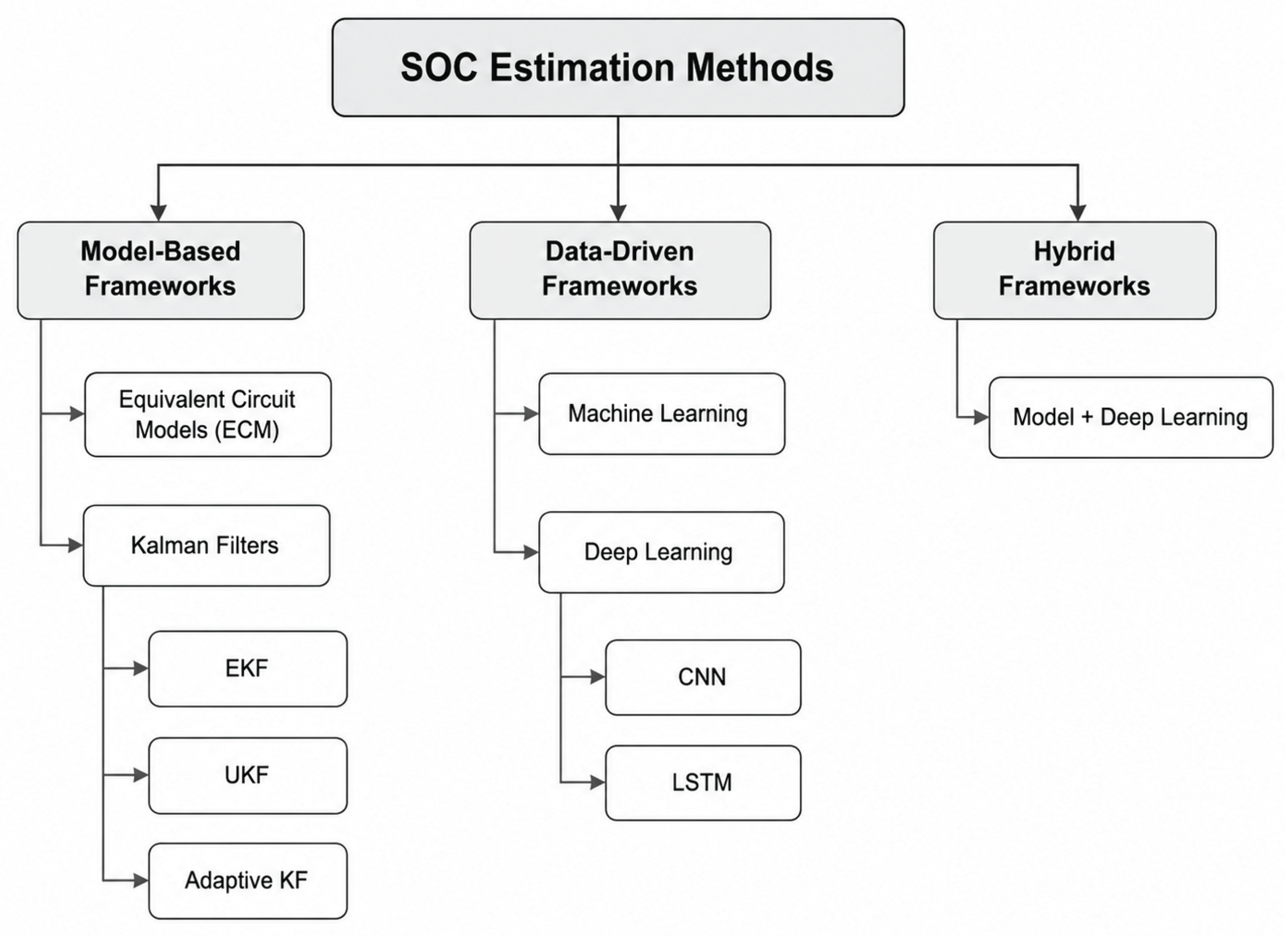
Figure 2.
Experimental pipeline adopted to train, validate, and evaluate the SOC estimation frameworks using both synthetic simulations and the NASA battery dataset.
Figure 2.
Experimental pipeline adopted to train, validate, and evaluate the SOC estimation frameworks using both synthetic simulations and the NASA battery dataset.
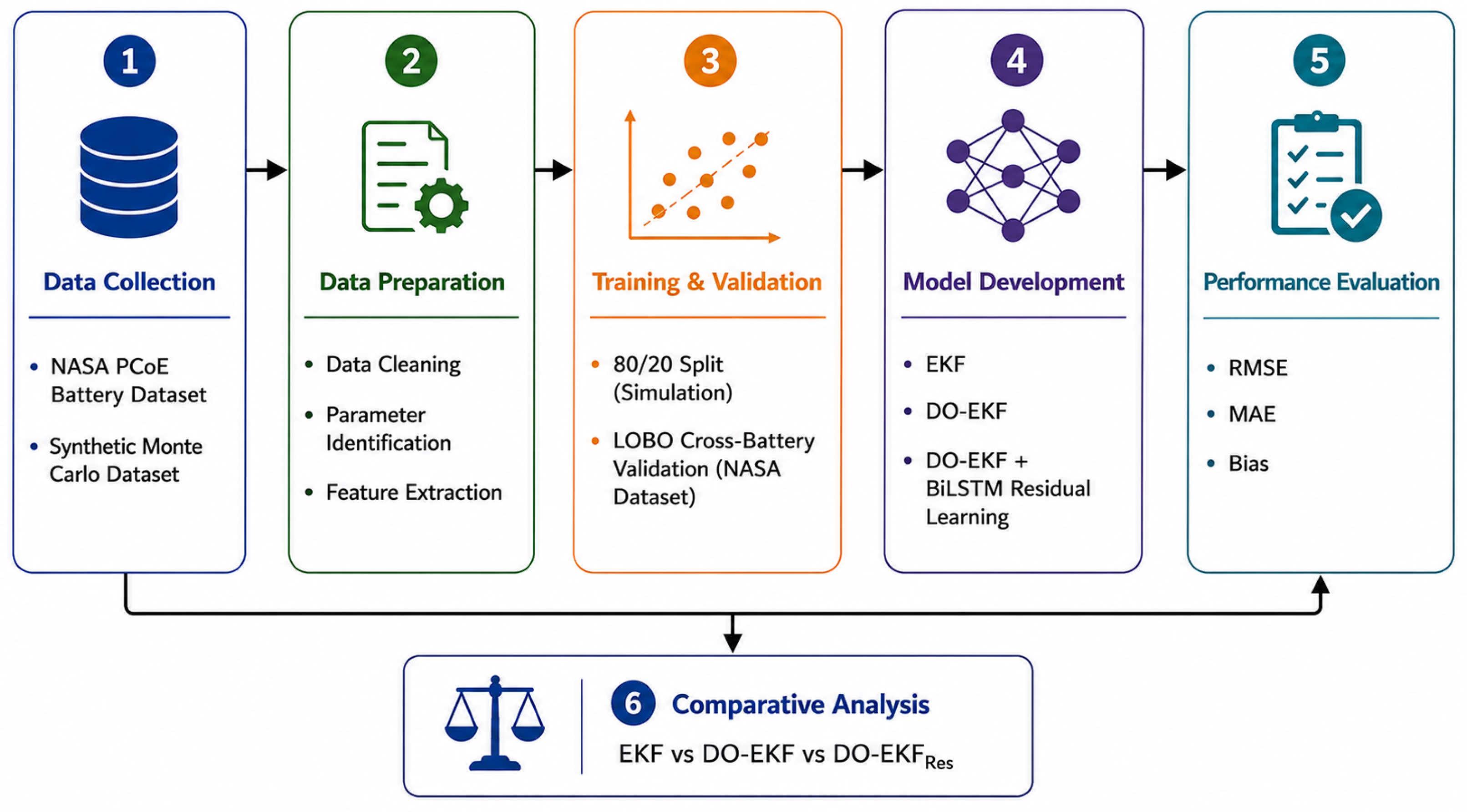
Figure 3.
First-order equivalent circuit model adopted for battery state estimation.
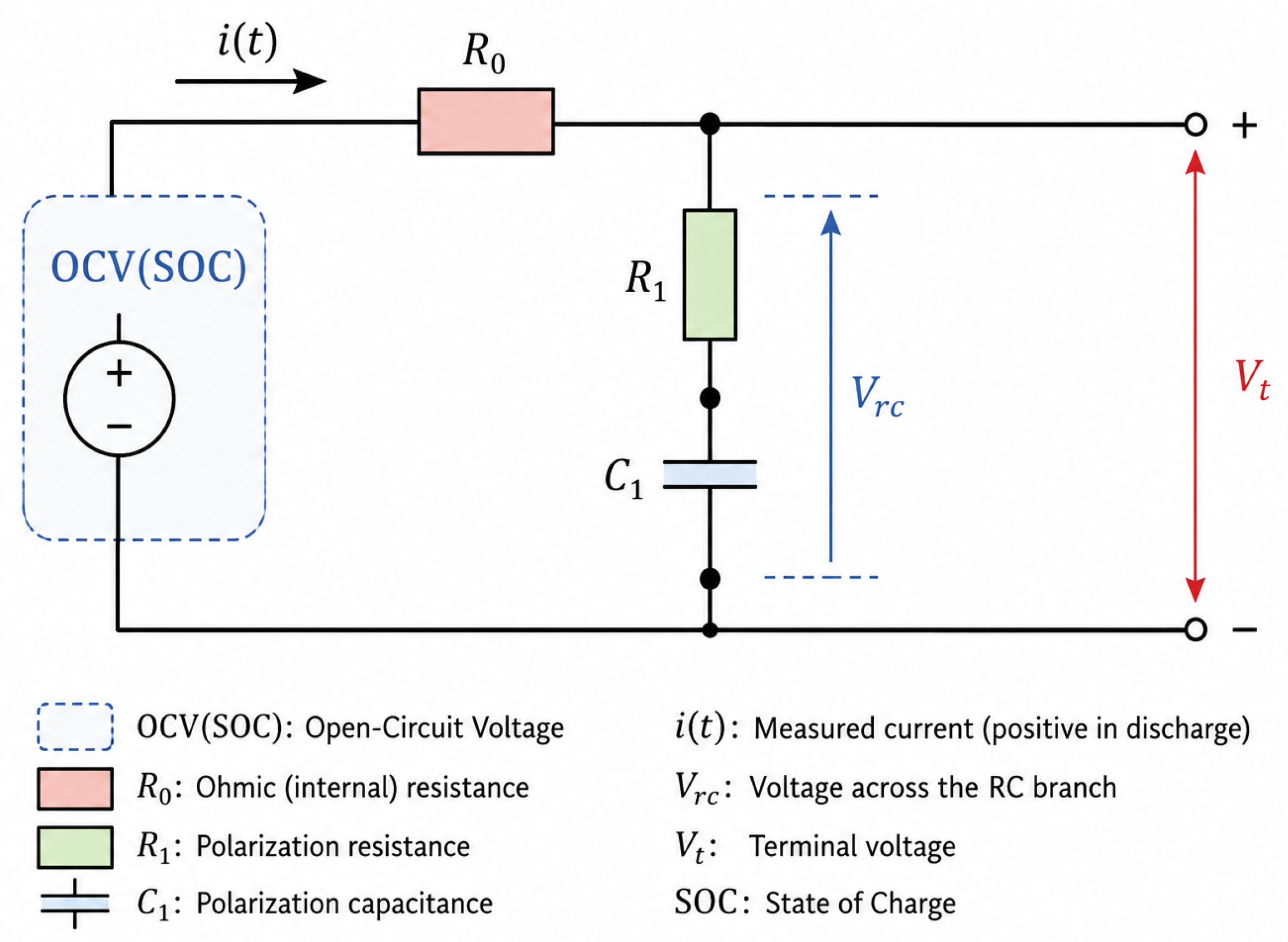
Figure 4.
Optimization workflow of the process-noise covariance matrix and the measurement-noise covariance R for the Data-Optimized Extended Kalman Filter (DO-EKF).
Figure 4.
Optimization workflow of the process-noise covariance matrix and the measurement-noise covariance R for the Data-Optimized Extended Kalman Filter (DO-EKF).
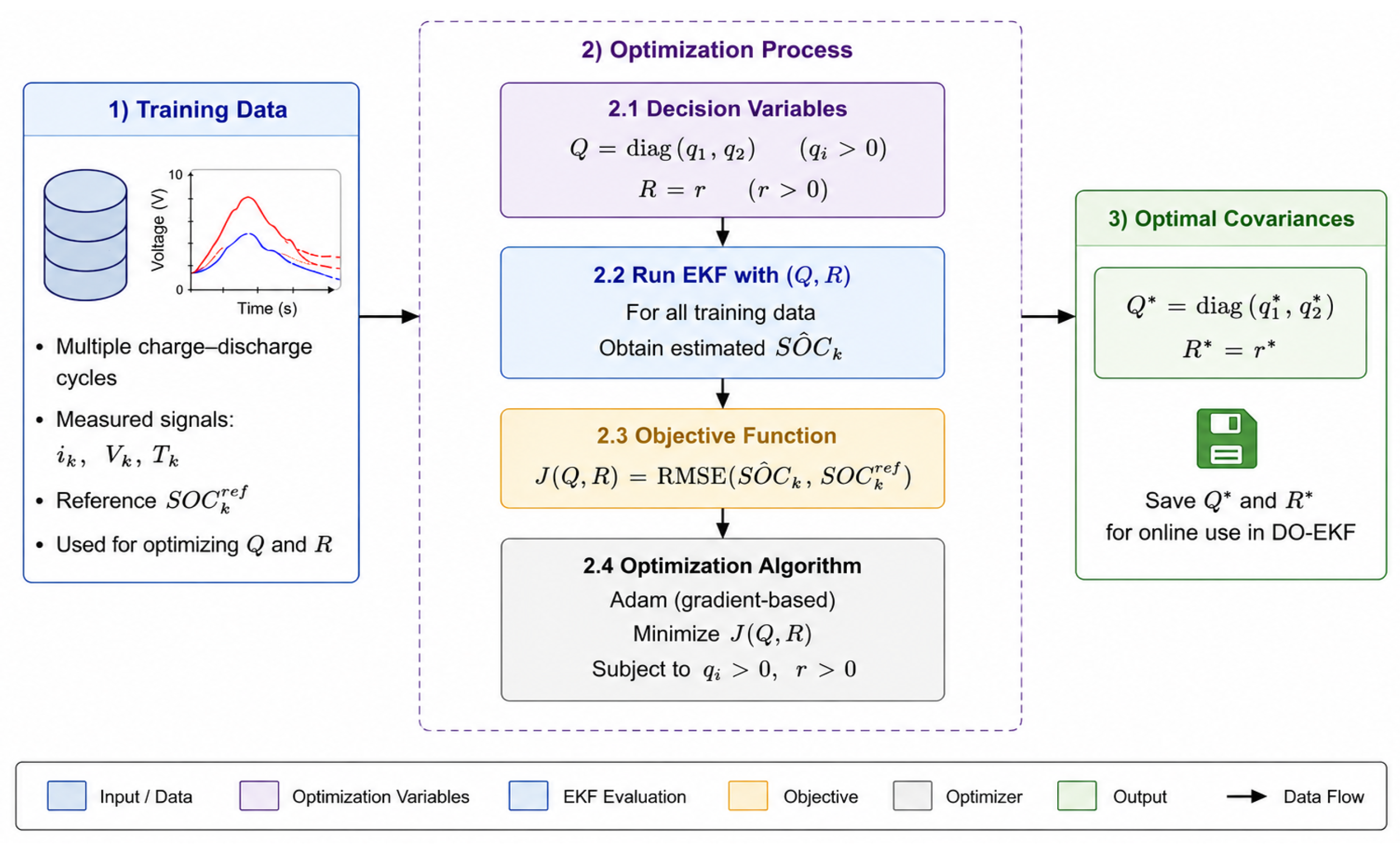
Figure 5.
Workflow of the proposed Data-Optimized Extended Kalman Filter (DO-EKF).
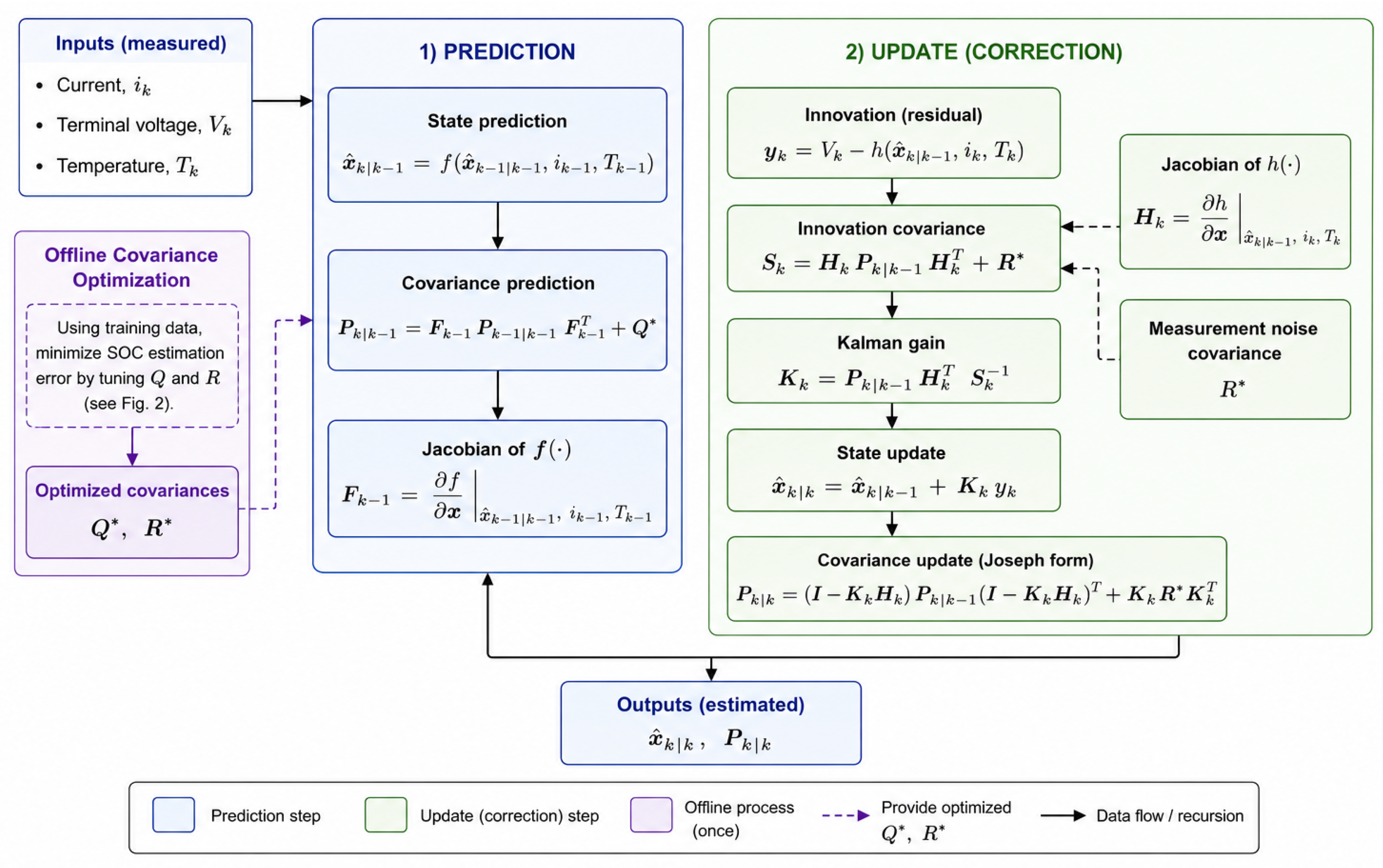
Figure 6.
Residual-learning framework of the proposed DO-EKFRes, showing the feature extraction, BiLSTM-based residual estimation, and final SOC correction.
Figure 6.
Residual-learning framework of the proposed DO-EKFRes, showing the feature extraction, BiLSTM-based residual estimation, and final SOC correction.
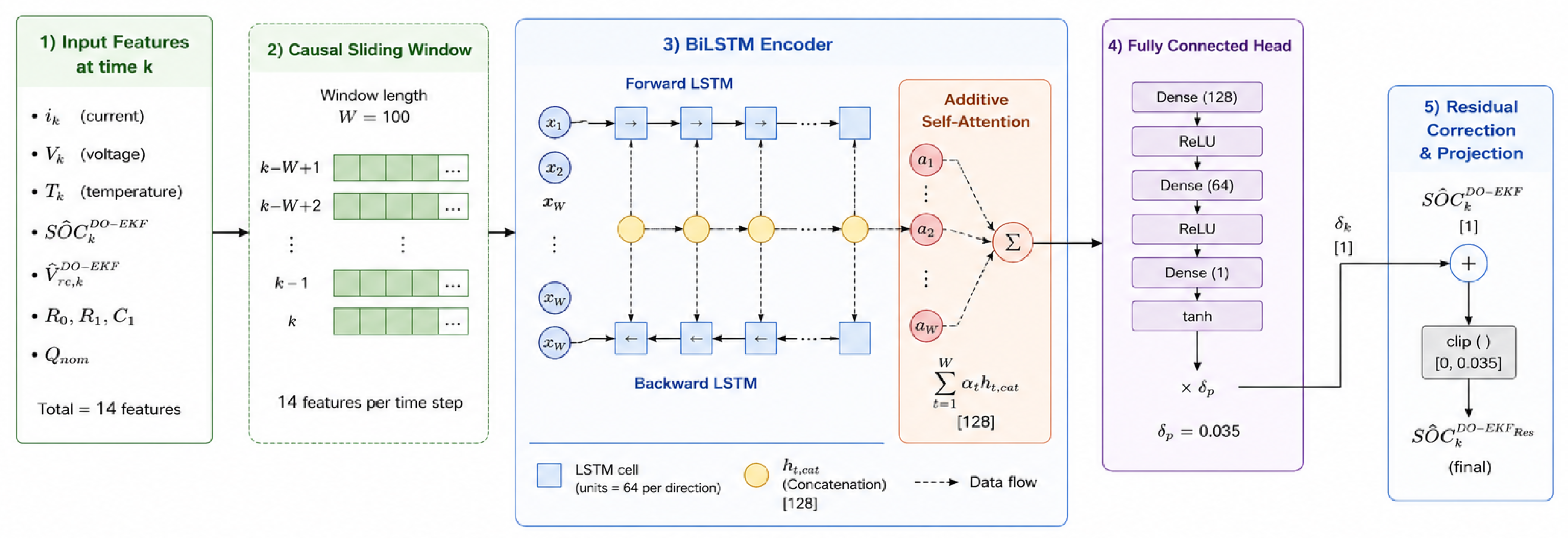
Figure 7.
Root mean square error (RMSE) across the 30 validation Monte Carlo scenarios for EKF, DO-EKF, and the proposed DO-EKFRes.
Figure 7.
Root mean square error (RMSE) across the 30 validation Monte Carlo scenarios for EKF, DO-EKF, and the proposed DO-EKFRes.
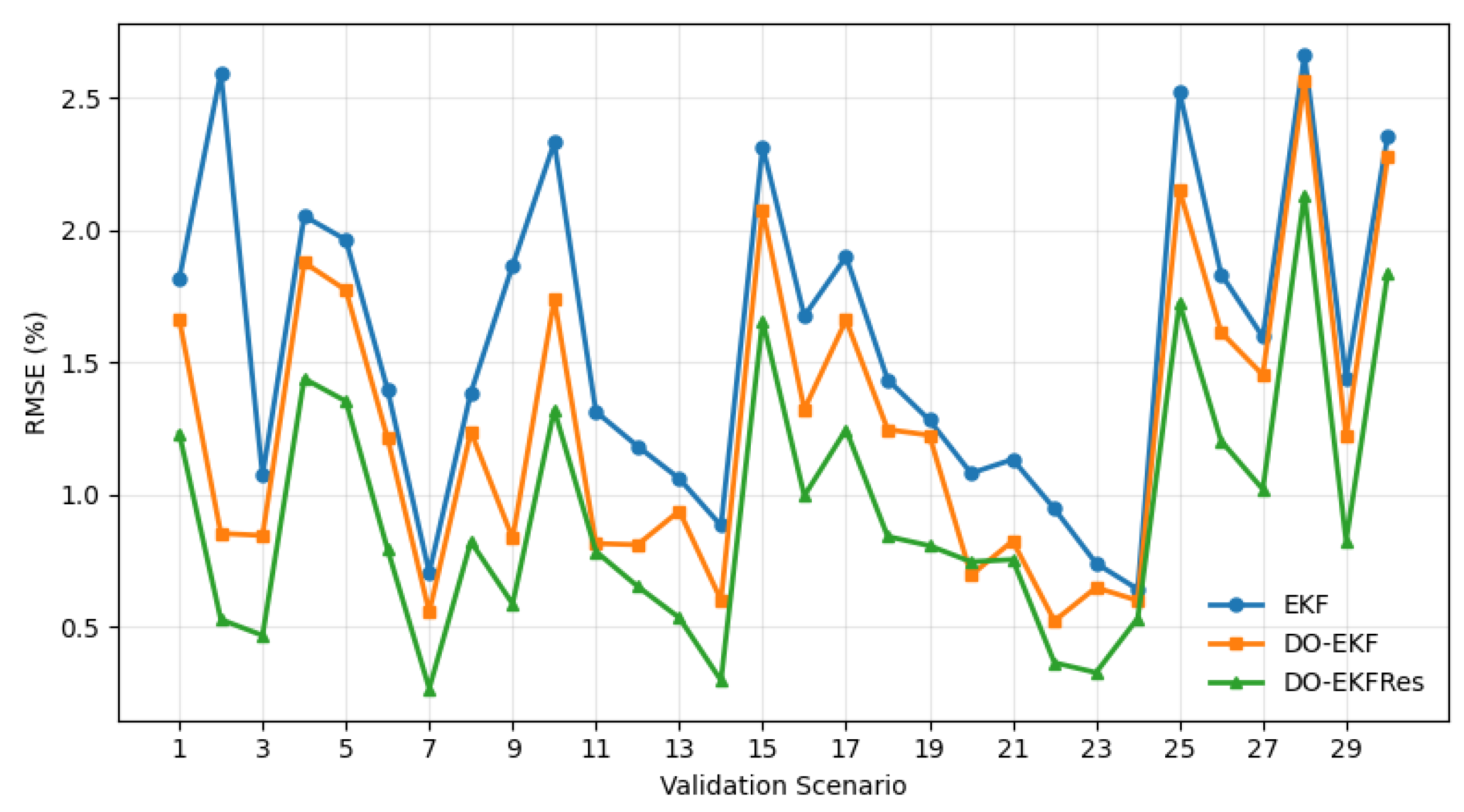
Figure 8.
Distribution of validation RMSE over the 30 Monte Carlo scenarios for EKF, DO-EKF, and the proposed DO-EKFRes.
Figure 8.
Distribution of validation RMSE over the 30 Monte Carlo scenarios for EKF, DO-EKF, and the proposed DO-EKFRes.
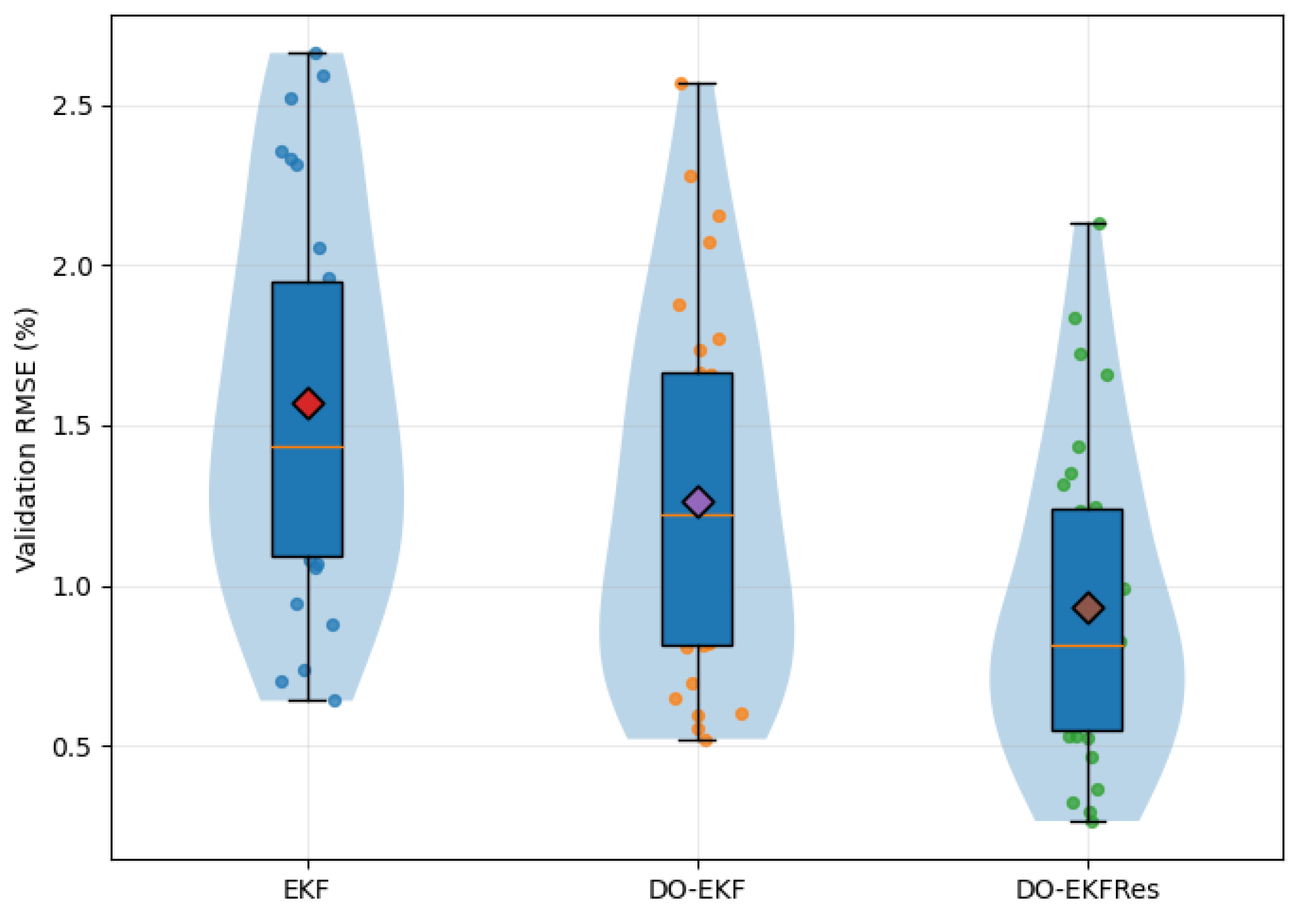
Figure 9.
Battery-wise RMSE comparison of EKF, DO-EKF, and the proposed DO-EKFRes under LOBO evaluation protocol.
Figure 9.
Battery-wise RMSE comparison of EKF, DO-EKF, and the proposed DO-EKFRes under LOBO evaluation protocol.
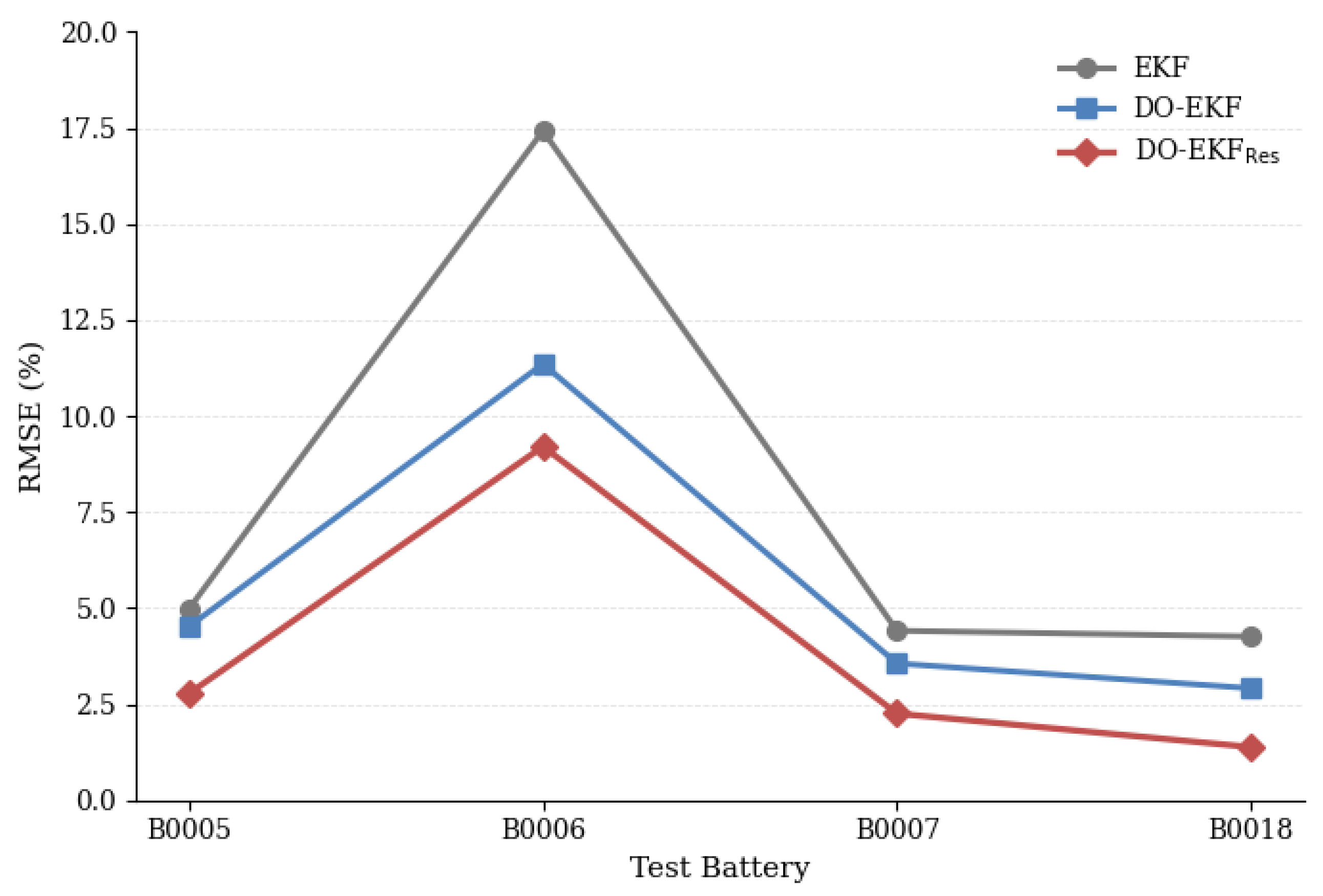
Figure 10.
Average Friedman ranks of the adaptive SOC estimation methods.
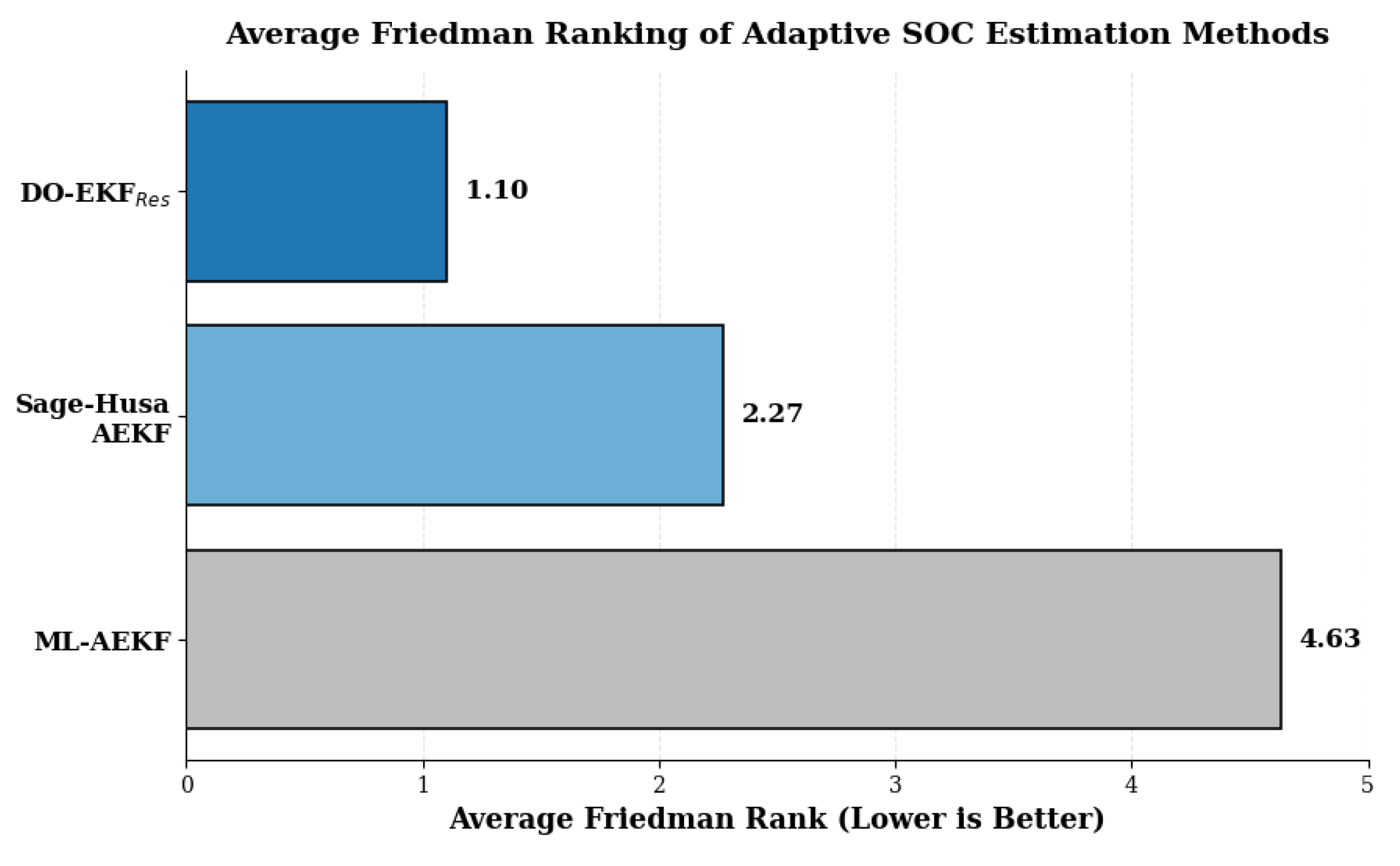

Table 1.
Input features used by the residual-learning network.
| No. | Feature | Description |
| 1 | Voltage_measured | Measured terminal voltage (V) |
| 2 | Current_discharge | Measured discharge current (A) |
| 3 | Temperature_measured | Battery temperature (°C) |
| 4 | SOH | State of Health |
| 5 | SOH_delta | Battery degradation () |
| 6 | time_norm | Normalized operating time |
| 7 | dV_dt | Voltage gradient |
| 8 | dI_dt | Current gradient |
| 9 | discharged_Ah | Cumulative discharged capacity (Ah) |
| 10 | cumulative_Wh | Cumulative discharged energy (Wh) |
| 11 | R_dyn_approx | Approximate dynamic internal resistance |
| 12 | SOC_DO | DO-EKF estimated SOC |
| 13 | V_EKF_pred | Predicted terminal voltage |
| 14 | V_EKF_error | Voltage innovation () |
Table 2.
Friedman statistical test results.
| Method | Average Rank | Rank Sum |
| DO-EKFRes | 1.0333 | 31 |
| DO-EKF | 1.9667 | 59 |
| EKF | 3.0000 | 90 |
Table 3.
Pairwise Wilcoxon signed-rank test results with Holm correction.
| Comparison | Mean Difference (%) | Adjusted p-value | Significant |
| EKF vs DO-EKF | 0.3106 | Yes | |
| EKF vs DO-EKFRes | 0.6363 | Yes | |
| DO-EKF vs DO-EKFRes | 0.3256 | Yes |
Table 4.
Composition of the NASA PCoE dataset used in the LOBO evaluation.
| Battery | Number of Cycles | Approximate Samples |
|---|---|---|
| B0005 | 168 | 49,000 |
| B0006 | 168 | 49,000 |
| B0007 | 168 | 49,000 |
| B0018 | 132 | 38,721 |
| Total | 636 | 185,721 |
Table 5.
Battery-wise performance comparison on the NASA dataset under LOBO evaluation.
| Battery | Method | RMSE ± Std (%) | MAE (%) |
|---|---|---|---|
| B0005 | EKF | 4.9758 ± 2.2992 | 4.2406 |
| DO-EKF | 4.5167 ± 1.7747 | 3.7410 | |
| DO-EKFRes | 2.7726 ± 0.9591 | 1.8100 | |
| B0006 | EKF | 17.4269 ± 13.2968 | 14.2271 |
| DO-EKF | 11.3573 ± 9.4838 | 9.8524 | |
| DO-EKFRes | 9.2058 ± 8.8068 | 7.9059 | |
| B0007 | EKF | 4.4109 ± 1.6495 | 3.3739 |
| DO-EKF | 3.5599 ± 1.1185 | 2.5559 | |
| DO-EKFRes | 2.2543 ± 0.4113 | 1.2400 | |
| B0018 | EKF | 4.2603 ± 2.0008 | 3.6252 |
| DO-EKF | 2.9119 ± 1.2010 | 2.6658 | |
| DO-EKFRes | 1.3805 ± 0.4208 | 0.9864 |
Table 6.
Performance comparison between the proposed DO-EKFRes and representative adaptive SOC estimation methods.
Table 6.
Performance comparison between the proposed DO-EKFRes and representative adaptive SOC estimation methods.
| Method | RMSE (%) | MAE (%) | Avg. Rank |
|---|---|---|---|
| Sage-Husa AEKF | 1.110 | 2.27 | |
| ML-AEKF | 2.322 | 4.63 | |
| DO-EKFRes | 0.821 | 1.10 |
Table 7.
Statistical comparison between the proposed DO-EKFRes and adaptive SOC estimation methods.
| Method | RMSE Reduction (%) | Effect Size () | Holm-adjusted p |
|---|---|---|---|
| Sage-Husa AEKF | 22.3 | 0.970 | |
| ML-AEKF | 72.4 | 1.000 |
Disclaimer/Publisher’s Note: The statements, opinions and data contained in all publications are solely those of the individual author(s) and contributor(s) and not of MDPI and/or the editor(s). MDPI and/or the editor(s) disclaim responsibility for any injury to people or property resulting from any ideas, methods, instructions or products referred to in the content. |
© 2026 by the authors. Licensee MDPI, Basel, Switzerland. This article is an open access article distributed under the terms and conditions of the Creative Commons Attribution (CC BY) license.
Copyright: This open access article is published under a Creative Commons CC BY 4.0 license, which permit the free download, distribution, and reuse, provided that the author and preprint are cited in any reuse.