

Submitted:
11 August 2026
Posted:
12 August 2026
You are already at the latest version
Abstract
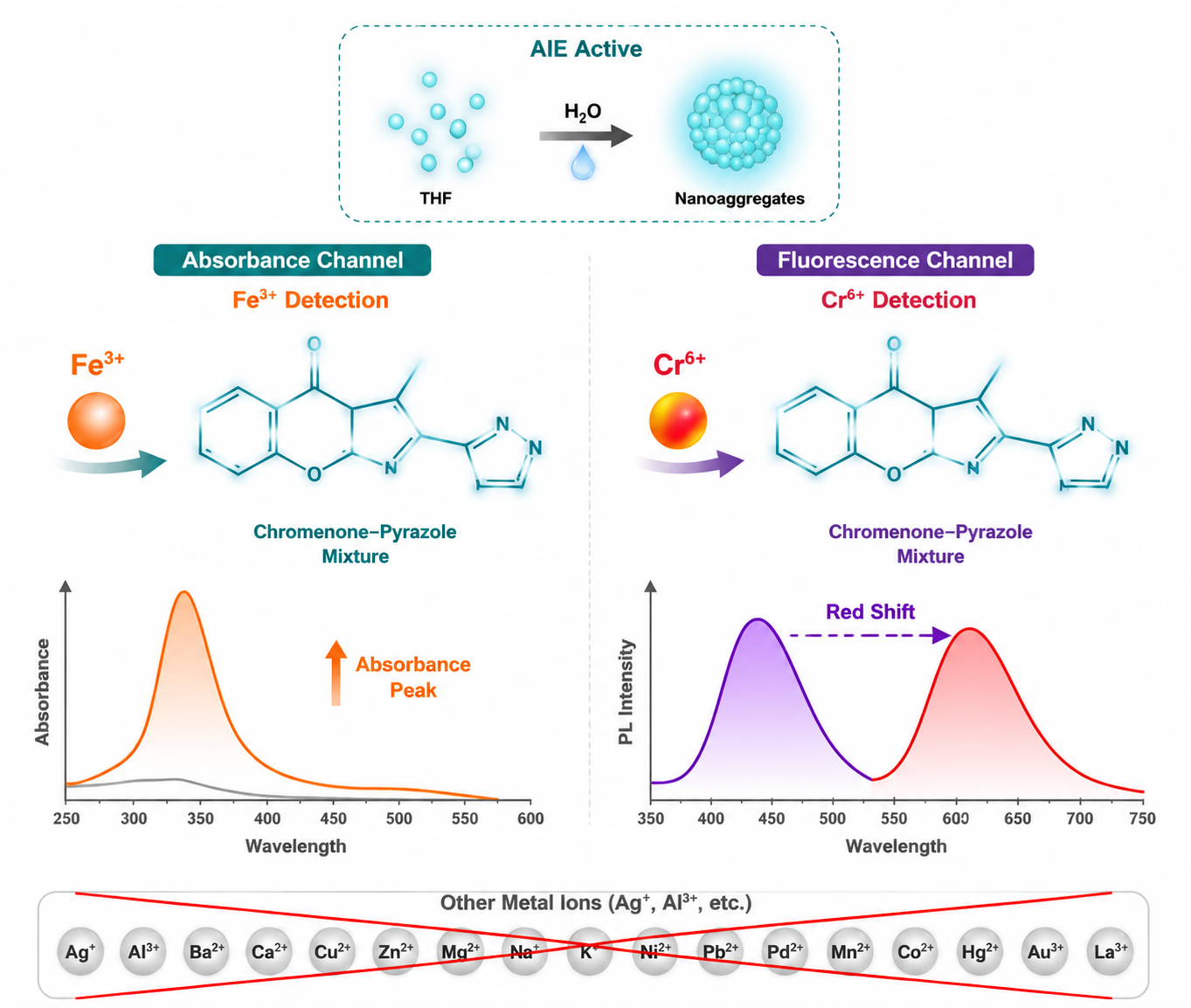
Herein, we report a simple physical mixture of chromenone and pyrazole as a cost-effective dual-channel fluorescent probe for selective detection of Fe³⁺ and Cr⁶⁺. The mixture exhibits typical aggregation-induced emission (AIE) behavior in both tetrahydrofuran (THF)/water and THF/simulated body fluid (SBF) systems, with maximum fluorescence intensity at 80% poor solvent fraction. The mixture maintains good AIE performance in physiological SBF medium, demonstrating potential for biomedical applications. Upon screening 18 metal ions (Ag⁺, Al³⁺, Au³⁺, Ba²⁺, Ca²⁺, Cr³⁺, Cr⁶⁺, Cu²⁺, Fe³⁺, Hg²⁺, Mo⁶⁺, Mg²⁺, Mn²⁺, Na⁺, Ni²⁺, Pb²⁺, Pd²⁺, Zn²⁺), two distinct selective responses were observed. In the UV-vis absorption channel, Fe³⁺ induces the most significant absorbance enhancement at 365 nm (∼3.5-fold), followed by Cr⁶⁺ (∼2.5-fold). In the fluorescence emission channel (λₑₓ = 310 nm), only Cr⁶⁺ triggers a unique and remarkable red-shift of the emission peak (∼10 nm), while all other metal ions cause negligible spectral changes. This wavelength-shift-based recognition mechanism is free from interferences such as probe concentration and light-source fluctuations, providing a physical basis for ratiometric detection. The differentiated responses of Fe³⁺ and Cr⁶⁺ in two optical channels offer a novel, low-cost fluorescent probe strategy for environmental monitoring and biomedical diagnosis.
Keywords:
chromenone
; pyrazole
; aggregation-induced emission
; fluorescent probe
; Fe³⁺ detection
; Cr⁶⁺ detection
; ratiometric sensing
1. Introduction
Chromenones (flavonoids) and pyrazoles are two important classes of heterocyclic compounds with widespread applications in medicinal chemistry and materials science [1,2]. Many chromenone derivatives and pyrazole complexes exhibit favorable fluorescence properties, making them attractive platforms for fluorescent probe development [3,4]. In recent years, chromenone-pyrazole hybrid probes have been developed for detecting various metal ions including Hg²⁺ and Co²⁺ [5,6].
Aggregation-induced emission (AIE), first reported by Tang and co-workers in 2001 [7], has emerged as a powerful strategy to overcome aggregation-caused quenching (ACQ). AIE-active materials show enhanced fluorescence in aggregated states, making them ideal for bioimaging and sensing applications [8,9]. The AIE mechanism is primarily attributed to restriction of intramolecular motion (RIM) in the aggregated state, which suppresses non-radiative decay pathways [10].
Hexavalent chromium (Cr⁶⁺) is a well-known carcinogen and teratogen listed as a Group A carcinogen by the World Health Organization [11], while Fe³⁺ is associated with neurological diseases such as Alzheimer's disease and environmental pollution [12,13]. Excessive Fe³⁺ in water causes turbidity, inhibits aquatic photosynthesis, and harms plant roots [14]. Developing low-cost, sensitive, and selective detection methods for these ions is critically important for environmental monitoring and biomedical diagnosis.
Unlike previous synthetic approaches requiring multi-step organic synthesis to prepare chromenone-pyrazole covalent hybrids [5,6,15], we explore a simple physical mixing method. This strategy significantly reduces cost and operational complexity while maintaining excellent detection performance. Furthermore, we systematically investigated the AIE behavior of this mixture in both water and simulated body fluid (SBF) media, evaluating its potential for physiological applications.
2. Experimental
2.1. Reagents and Materials
Chromenone (99%), pyrazole (99%), tetrahydrofuran (THF, 99.9%), and metal ion standard solutions (Ag⁺, Al³⁺, Au³⁺, Ba²⁺, Ca²⁺, Cr³⁺, Cr⁶⁺, Cu²⁺, Fe³⁺, Hg²⁺, Mo⁶⁺, Mg²⁺, Mn²⁺, Na⁺, Ni²⁺, Pb²⁺, Pd²⁺, Zn²⁺, 1 mmol/L, AR grade) were purchased from Aladdin Industrial Corporation (Shanghai, China). Deionized water was obtained from Watsons (China). Simulated body fluid (SBF, 99.9%) was purchased from Pricells Biotechnology (Wuhan, China). All reagents were used as received without further purification.
2.2. Preparation of Chromenone-Pyrazole Mixture
Chromenone and pyrazole (each 5.0 × 10⁻⁶ mol, 1:1 molar ratio) were dissolved in 20 mL of THF and mixed under ultrasonication for 5 min to obtain the stock solution. The final concentration of the mixture was 0.05 mg/mL. This stock solution was used for all subsequent measurements.
2.3. Optical Measurements
UV-vis absorption spectra were recorded on a Shanghai Lengguang 759s spectrophotometer (Shanghai, China) over the range of 200–1100 nm using a 1 cm quartz cuvette. Fluorescence spectra were measured on a Shanghai Lengguang F98 spectrofluorometer (Shanghai, China) with excitation at 310 nm (unless otherwise specified), slit widths of 5 nm/5 nm, and emission range of 310–500 nm.
2.4. AIE Behavior Studies
For AIE studies, mixtures with THF/water or THF/SBF at different poor solvent fractions were prepared. Briefly, 200 μL of the stock solution (0.05 mg/mL) was mixed with appropriate volumes of THF and deionized water or SBF to achieve final poor solvent volume fractions of 0%, 10%, 20%, 30%, 40%, 50%, 60%, 70%, 80%, and 90% in a total volume of 2 mL. The solutions were mixed thoroughly and allowed to equilibrate for 5 min before UV-vis and fluorescence measurements.
2.5. Metal Ion Sensing
For metal ion screening, 10 μL of each metal ion standard solution (1 mmol/L) was added to 2 mL of the mixture solution (0.05 mg/mL in THF). The solution was allowed to stand at room temperature for 10 min, then UV-vis absorption and fluorescence emission spectra were recorded. For normalized spectra, all spectra were normalized to the maximum absorbance or fluorescence intensity of the blank control.
3. Results and Discussion
3.1. Photophysical Properties and Optimal Excitation
The fluorescence emission of the chromenone-pyrazole mixture in THF showed excitation-dependent behavior (Figure S1, see Supplementary Information). As the excitation wavelength increased from 380 to 400 nm, both the emission peak position and intensity varied systematically, suggesting the presence of multiple emissive species or excited states, likely arising from hydrogen bonding and charge-transfer interactions between chromenone and pyrazole molecules. After comparing emission intensities at different excitation wavelengths, 310 nm was determined as the optimal excitation wavelength, giving the highest emission intensity. All subsequent fluorescence measurements were performed using this excitation wavelength.
3.2. AIE Behavior in Water and SBF Media
UV-vis absorption spectra in THF/water mixtures (Figure 1A) showed gradually increasing absorbance with increasing water fraction (f_w) from 0% to 90%. A significant non-characteristic baseline rise in the long-wavelength region (>500 nm) was observed at high water fractions, attributed to Rayleigh scattering from nanoaggregates. This provides direct evidence of aggregate formation in water-rich environments. Similar behavior was observed in THF/SBF mixtures (Figure 1B), although the detailed changes in absorbance and spectral shape differed slightly, likely due to the inorganic salt components and ionic strength effects in SBF.
Fluorescence emission spectra (Figure 2A, B) demonstrated typical AIE behavior. In THF/water system, emission intensity remained low at water fractions below 40%, then increased dramatically as f_w increased from 50% to 80%, reaching maximum intensity at 80% water fraction. The fluorescence enhancement was approximately 5–6 fold compared to pure THF. Further increase to 90% water caused a slight decrease in intensity, possibly due to excessive aggregation or precipitation. In THF/SBF system (Figure 2B), similar AIE behavior was observed, with maximum intensity at 80% SBF fraction, confirming that the mixture maintains AIE activity in physiological medium.
Normalized fluorescence spectra (Figure 2C, D) showed a slight red-shift of the emission peak with increasing poor solvent fraction, from ∼380 nm in pure THF to ∼400 nm at 90% water or SBF. This red-shift indicates enhanced intermolecular interactions and excited-state energy reorganization in the aggregated state.
CIE 1931 chromaticity analysis (Figures S2 and S3, Supplementary Information) showed systematic variation of emission color with solvent composition, with color coordinates moving within the blue-purple region as poor solvent fraction increased. This tunable emission property may enable multicolor imaging applications by simply switching excitation wavelength.
3.3. Metal Ion Sensing in UV-Vis Absorption Channel
Figure 3A shows UV-vis absorption spectra of the chromenone-pyrazole mixture with 18 different metal ions (1 mmol/L each). The blank spectrum showed characteristic absorption bands in the 310–400 nm region, assigned to π→π* transitions of the chromenone-pyrazole conjugated system. Most metal ions caused only minor changes in absorbance or spectral shape. However, Fe³⁺ and Cr⁶⁺ induced the most significant changes, with markedly increased absorbance in the 350–450 nm region and noticeable band broadening, suggesting strong coordination or charge-transfer interactions.
Normalized UV-vis spectra (Figure 3B) clearly showed distinct spectral changes for Fe³⁺ and Cr⁶⁺. Compared to the blank, Fe³⁺ caused a pronounced increase in the long-wavelength tail and a broader band shape, while Cr⁶⁺ showed a moderate but still significant change. In contrast, Cr³⁺ and all other metal ions showed normalized spectra almost overlapping with the blank, indicating that the specific response is not simply determined by ionic charge but depends on electronic configuration and coordination properties.
Quantitative analysis at 365 nm (Figure 3C and 3D) revealed that Fe³⁺ caused the most significant absorbance increase (∼3.5-fold), followed by Cr⁶⁺ (∼2.5-fold). All other metal ions showed absorbance changes within ±20% of the blank control. This selective response makes the chromenone-pyrazole mixture a promising colorimetric probe for Fe³⁺ detection.
3.4. Metal Ion Sensing in Fluorescence Channel
Figure 4A shows fluorescence emission spectra of the mixture with different metal ions (λₑₓ = 310 nm). Most metal ions caused only minor changes in emission intensity, with negligible peak shifts. Remarkably, only Cr⁶⁺ induced a unique and significant red-shift of the emission peak. The emission maximum shifted from ∼380 nm (blank) to ∼390 nm in the presence of Cr⁶⁺, with noticeable band broadening.
Normalized fluorescence spectra (Figure 4B) clearly confirmed this unique red-shift. While the normalized spectra of all other metal ions overlapped almost perfectly with the blank, the Cr⁶⁺ spectrum showed a distinct red-shifted peak with a broadened long-wavelength tail. Among all 18 tested metal ions, only Cr⁶⁺ exhibited this characteristic red-shift, demonstrating exceptionally high selectivity.
Quantification of the maximum emission wavelength (Figure 4C) showed that the blank and all other metal ions had maximum emission at 379–381 nm, while Cr⁶⁺ shifted this to 389–390 nm. This ∼10 nm red-shift, though modest, is highly reproducible and specific to Cr⁶⁺.
3.5. Mechanism Discussion
The selective responses of Fe³⁺ and Cr⁶⁺ in different optical channels likely arise from distinct interaction mechanisms. Fe³⁺, with high charge density (z/r ≈ 4.5) and strong Lewis acidity, may form ground-state coordination complexes with the mixture, affecting the π→π* transition and causing absorption enhancement. This interaction appears to be primarily electronic without significantly altering the excited-state energy levels, as evidenced by the negligible fluorescence peak shift.
Cr⁶⁺, existing as CrO₄²⁻ or Cr₂O₇²⁻ in solution, is a strong electron-deficient center that may coordinate with electron-rich groups (e.g., the pyrazole nitrogen or chromenone carbonyl oxygen) of the mixture. This coordination creates a push-pull electronic structure, enhancing intramolecular charge transfer (ICT) from the electron-rich chromenone-pyrazole to the electron-deficient Cr⁶⁺ center. The ICT effect lowers the LUMO energy level, reducing the HOMO-LUMO gap and resulting in the observed fluorescence red-shift [16,17].
This wavelength-shift-based recognition mechanism is particularly advantageous for practical sensing applications. Unlike intensity-based detection, which is susceptible to variations in probe concentration, excitation intensity, and photobleaching, ratiometric or wavelength-shift-based methods are self-calibrating and provide more reliable quantitative analysis [18].
3.6. Comparison with Previous Reports
Table 1 compares the performance of our chromenone-pyrazole physical mixture with previously reported chromenone-pyrazole hybrid probes. Our simple mixing approach achieves comparable or superior selectivity without requiring multi-step organic synthesis, significantly reducing cost and complexity.
4. Conclusions
We have developed a simple, low-cost physical mixture of chromenone and pyrazole as a dual-channel fluorescent probe for selective detection of Fe³⁺ and Cr⁶⁺. The key findings are: (1) The mixture exhibits typical AIE behavior in both THF/water and THF/SBF systems, with maximum fluorescence at 80% poor solvent fraction. The mixture maintains good AIE performance in physiological SBF medium, supporting its potential for biomedical applications. (2)Through systematic screening of 18 metal ions, Fe³⁺ induces significant absorbance enhancement at 365 nm in the UV-vis channel (∼3.5-fold), while Cr⁶⁺ shows moderate enhancement (∼2.5-fold). (3) In the fluorescence channel, only Cr⁶⁺ triggers a unique and reproducible red-shift (∼10 nm) of the emission peak, while all other 17 metal ions cause negligible spectral changes. This wavelength-shift-based mechanism provides a physical basis for ratiometric Cr⁶⁺ detection. (4)The differentiated responses of Fe³⁺ and Cr⁶⁺ in two optical channels enable potential dual-channel detection without complex organic synthesis.
This work demonstrates that simple physical mixtures can serve as effective fluorescent probes, offering a cost-effective alternative to covalently synthesized probes. Future work will focus on elucidating the exact coordination modes, determining detection limits and linear ranges, and evaluating real-world applications in environmental water samples and biological systems.
Supplementary Materials
The following supporting information can be downloaded at the website of this paper posted on Preprints.org. Figure S1: Fluorescence spectra at different excitation wavelengths; Figure S2: CIE 1931 chromaticity diagram for THF/water system; Figure S3: CIE 1931 chromaticity diagram for THF/SBF system.
Acknowledgments
We acknowledge the support of Starting Funding of Changzhou University(ZMF25020019).
Declaration of Interest Statement
The author declares no competing financial interests.
References
- Gaspar, A.; Matos, M.J.; Garrido, J.; Uriarte, E.; Borges, F. Chromone: a valid scaffold in medicinal chemistry. Chem. Rev. 2014, 114, 4960–4992. [Google Scholar] [CrossRef] [PubMed]
- Stefanachi, A.; Leonetti, F.; Pisani, L.; Catto, M.; Carotti, A. Coumarin: A natural, privileged and versatile scaffold for bioactive compounds. Molecules 2018, 23, E250. [Google Scholar] [CrossRef] [PubMed]
- Chandrasekharan, S.P.; Dhami, A.; Kumar, S.; Mohanan, K. Recent advances in pyrazole synthesis employing diazo compounds and synthetic analogues. Org. Biomol. Chem. 2022, 20, 8787–8817. [Google Scholar] [CrossRef] [PubMed]
- Wu, W.-N.; Wu, H.; Wang, Y.; Mao, X.-J.; Zhao, X.-L.; Xu, Z.-Q.; et al. A highly sensitive and selective off-on fluorescent chemosensor for hydrazine based on coumarin β-diketone. Spectrochim. Acta. Part A Mol. Biomol. Spectrosc. 2018, 188, 80–84. [Google Scholar] [CrossRef] [PubMed]
- Mohammadi Ziarani, G.; Mohammadsaeed, S.; Badiei, A.; Ghasemi, J.B. Multicomponent synthesis and investigations fluorescence activity of chromenone-pyrazole compounds. J. Fluoresc. 2022, 32, 347–357. [Google Scholar] [CrossRef] [PubMed]
- Aqlan, F.M.; Alam, M.M.; Al-Bogami, A.S.; Saleh, T.S.; Asiri, A.M.; Uddin, J.; et al. Synthesis of novel pyrazole incorporating a coumarin moiety (PC) for selective and sensitive Co2+detection. Nouv. J. De Chim. [New Journal of Chemistry] 2019, 43, 12331–12339. [Google Scholar] [CrossRef]
- Luo, J.; Xie, Z.; Lam, J.W.; Cheng, L.; Chen, H.; Qiu, C.; et al. Aggregation-induced emission of 1-methyl-1,2,3,4,5-pentaphenylsilole. Chem. Commun. 2001, (18), 1740–1741. [Google Scholar] [CrossRef] [PubMed]
- Mei, J.; Leung, N.L.C.; Kwok, R.T.K.; Lam, J.W.Y.; Tang, B.Z. Aggregation-induced emission: Together we shine, united we soar! Chem. Rev. 2015, 115, 11718–11940. [Google Scholar] [CrossRef] [PubMed]
- Wang, Z.; Ma, J.; Li, C.; Zhang, H. Conjugated aggregation-induced fluorescent materials for biofluorescent probes: A review. Biosensors 2023, 13, 159. [Google Scholar] [CrossRef] [PubMed]
- Chen, Y.; Lam, J.W.Y.; Kwok, R.T.K.; Liu, B.; Tang, B.Z. Aggregation-induced emission: fundamental understanding and future developments. Mater. Horiz. 2019, 6, 428–433. [Google Scholar] [CrossRef]
- Sharma, P.; Singh, S.P.; Parakh, S.K.; Tong, Y.W. Health hazards of hexavalent chromium (Cr (VI)) and its microbial reduction. Bioengineered 2022, 13, 4923–4938. [Google Scholar] [CrossRef] [PubMed]
- Vahed, M.; Sweeney, A.; Shirasawa, H.; Vahed, M. The initial stage of structural transformation of Aβ42 peptides from the human and mole rat in the presence of Fe2+ and Fe3+: Related to Alzheimer’s disease. Comput. Biol. Chem. 2019, 83, 107128. [Google Scholar] [CrossRef] [PubMed]
- Sajid, A.; Ahmad, K.; Khan, Z.I.; Khalofah, A.; Ahmad, I. Assessing the impact of industrial pollution stress on the physiological defense, proximate composition and morphological traits of riparian vegetation. BMC Plant Biol. 2025, 25. [Google Scholar] [CrossRef] [PubMed]
- Saloner, A.; Sacks, M.M.; Bernstein, N. Response of medical cannabis (cannabis sativa L.) genotypes to K supply under long photoperiod. Front. Plant Sci. 2019, 10, 1369. [Google Scholar] [CrossRef] [PubMed]
- Saeed, A.; Mahesar, P.A.; Channar, P.A.; et al. Chem. Biodivers. 2017, *14*, e1700035.
- Valeur, B.; Berberan-Santos, M.N. Molecular Fluorescence: Principles and Applications, 2nd ed.; Wiley-VCH: Weinheim, 2012. [Google Scholar]
- Lakowicz, J.R. Principles of fluorescence spectroscopy; Lakowicz, J.R., Ed.; Springer: New York, NY, 2017. [Google Scholar]
- Lee, M.H.; Kim, J.S.; Sessler, J.L. Small molecule-based ratiometric fluorescence probes for cations, anions, and biomolecules. Chem. Soc. Rev. 2015, 44, 4185–4191. [Google Scholar] [CrossRef] [PubMed]
Figure 1.
UV-vis absorption spectra of chromenone-pyrazole mixture (0.05 mg/mL) in (A) THF/water and (B) THF/SBF mixtures with different poor solvent fractions (0–90%, v/v).
Figure 1.
UV-vis absorption spectra of chromenone-pyrazole mixture (0.05 mg/mL) in (A) THF/water and (B) THF/SBF mixtures with different poor solvent fractions (0–90%, v/v).
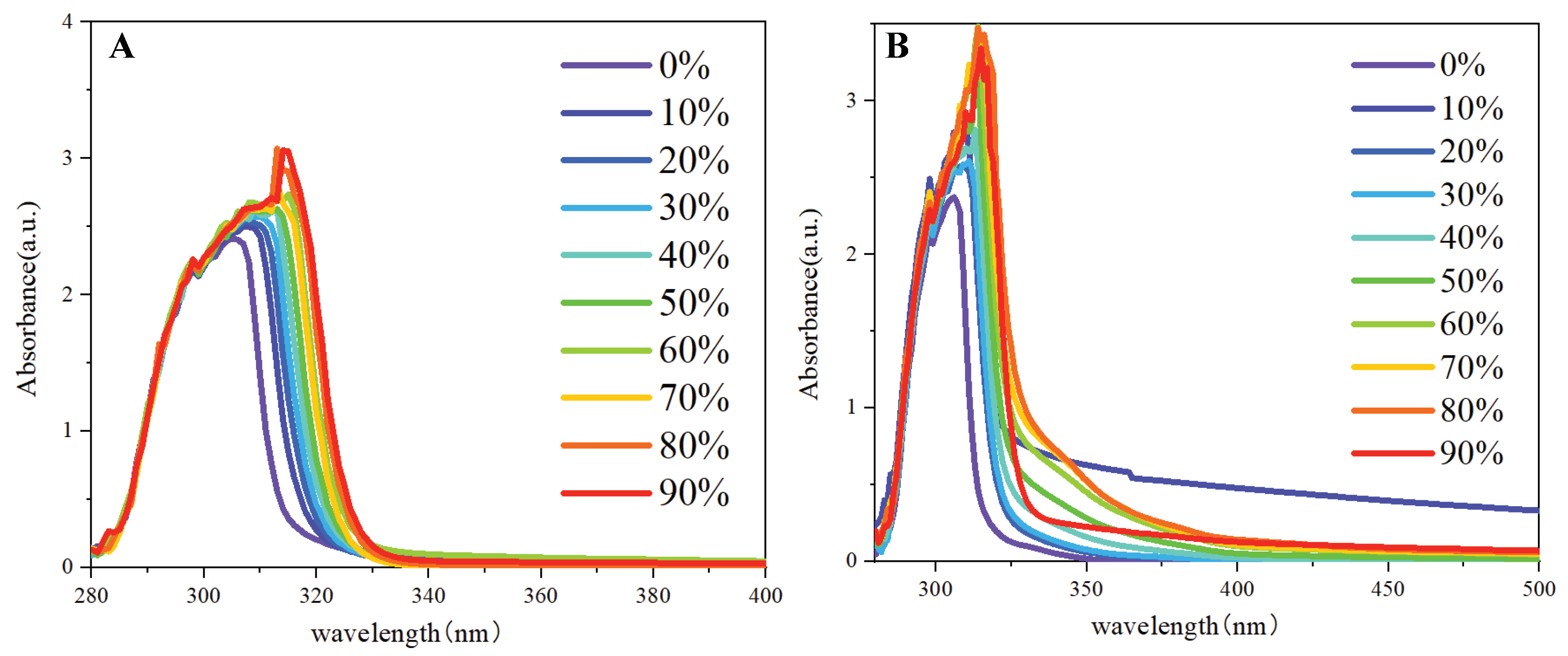
Figure 2.
Fluorescence emission spectra (λₑₓ = 310 nm) of chromenone-pyrazole mixture (0.05 mg/mL) in (A) THF/water and (B) THF/SBF. Normalized spectra in (C) THF/water and (D) THF/SBF.
Figure 2.
Fluorescence emission spectra (λₑₓ = 310 nm) of chromenone-pyrazole mixture (0.05 mg/mL) in (A) THF/water and (B) THF/SBF. Normalized spectra in (C) THF/water and (D) THF/SBF.
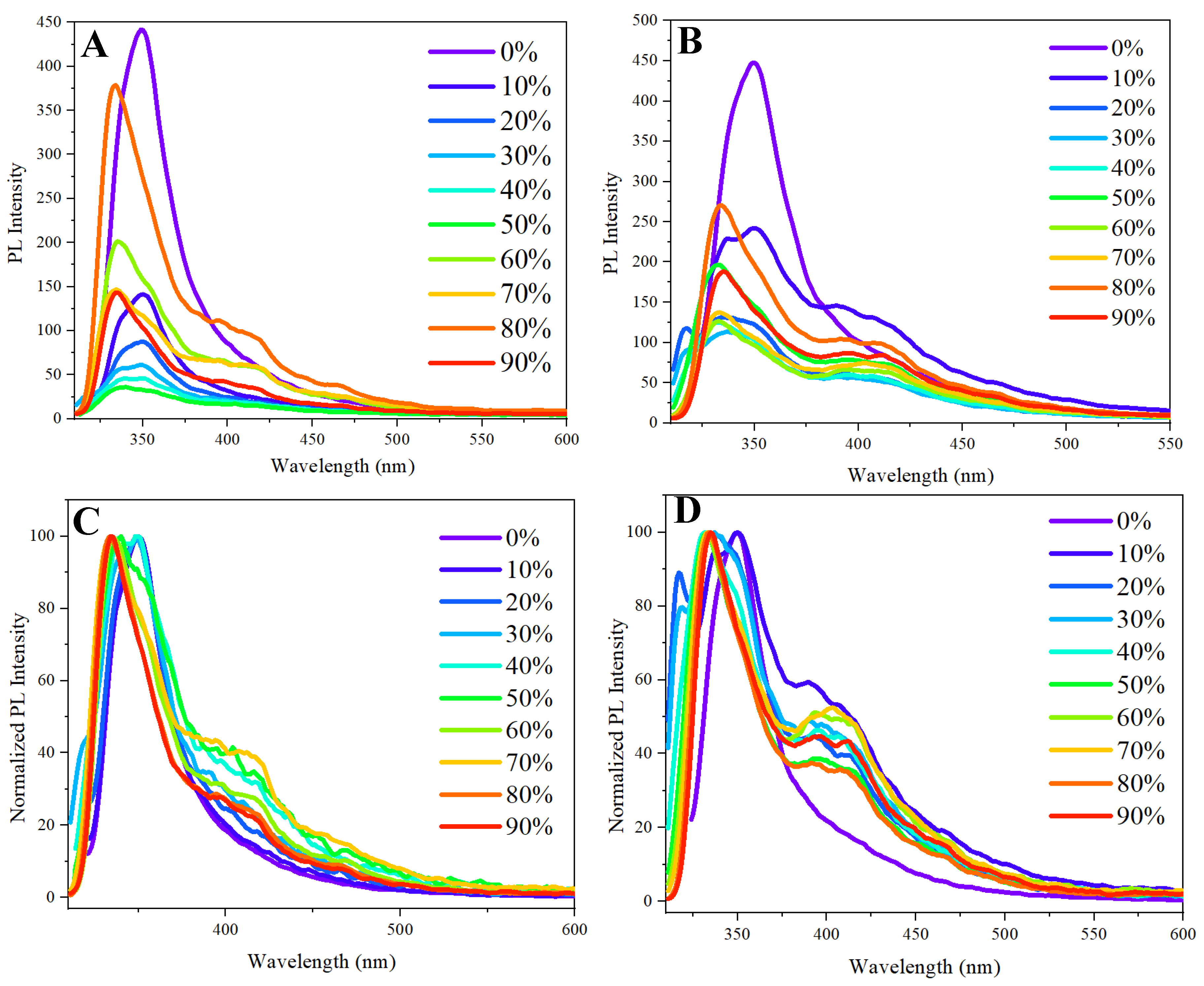
Figure 3.
(A) UV-vis absorption spectra of chromenone-pyrazole mixture (0.05 mg/mL in THF) with various metal ions (1 mmol/L). (B) Normalized UV-vis absorption spectra. (C) UV-vis absorption of chromenone-pyrazole mixture (0.05mg/mL) after adding Cr6+ (10μL) in the presence of various test cations in THF (D) UV-vis absorption of chromenone-pyrazole mixture (0.05mg/mL) after adding Fe3+ (10μL) in the presence of various test cations in THF.
Figure 3.
(A) UV-vis absorption spectra of chromenone-pyrazole mixture (0.05 mg/mL in THF) with various metal ions (1 mmol/L). (B) Normalized UV-vis absorption spectra. (C) UV-vis absorption of chromenone-pyrazole mixture (0.05mg/mL) after adding Cr6+ (10μL) in the presence of various test cations in THF (D) UV-vis absorption of chromenone-pyrazole mixture (0.05mg/mL) after adding Fe3+ (10μL) in the presence of various test cations in THF.
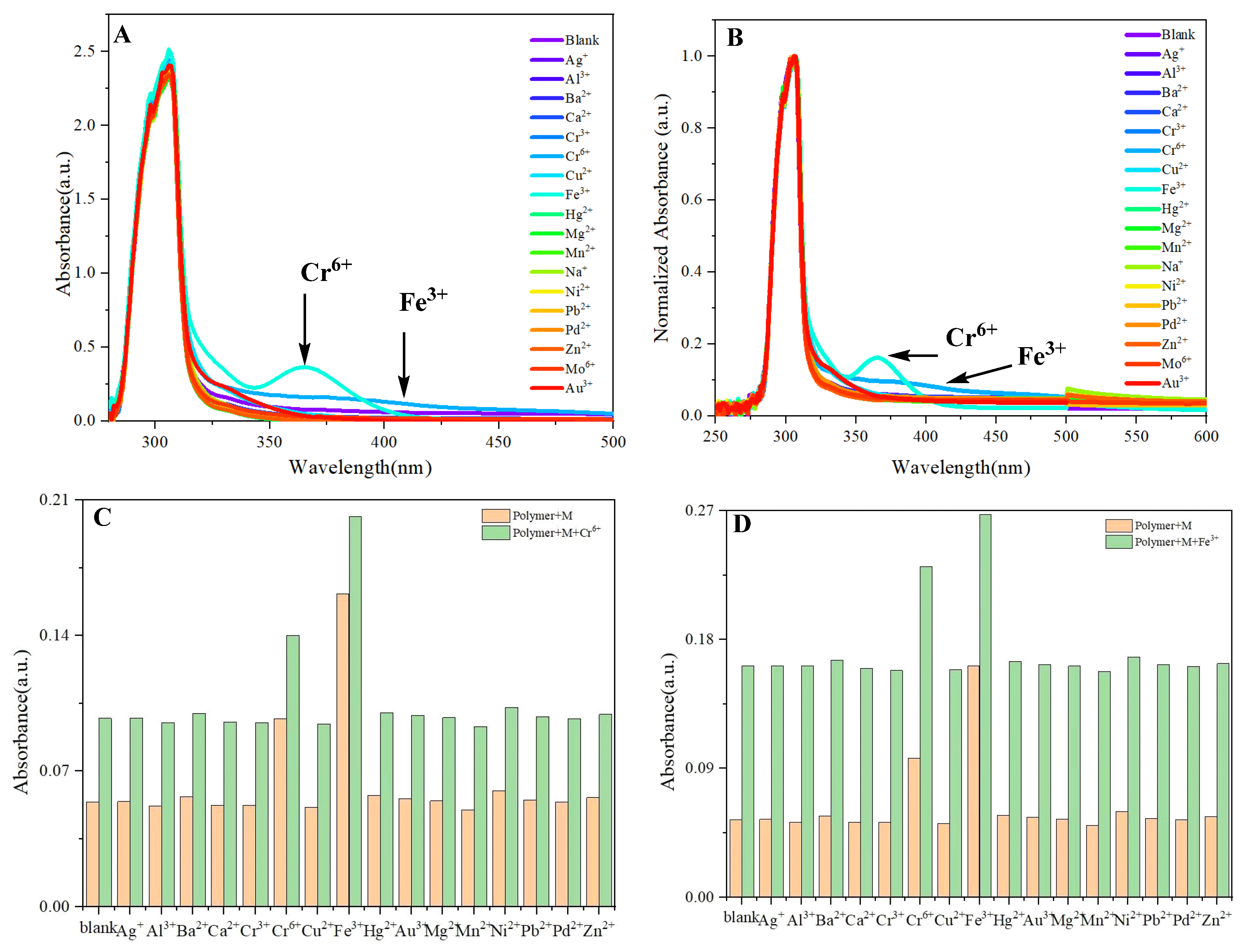
Figure 4.
(A) Fluorescence emission spectra (λₑₓ = 310 nm) of chromenone-pyrazole mixture (0.05 mg/mL in THF) with various metal ions (1 mmol/L). (B) Normalized fluorescence emission spectra. (C) Maximum emission wavelength for different metal ions.
Figure 4.
(A) Fluorescence emission spectra (λₑₓ = 310 nm) of chromenone-pyrazole mixture (0.05 mg/mL in THF) with various metal ions (1 mmol/L). (B) Normalized fluorescence emission spectra. (C) Maximum emission wavelength for different metal ions.
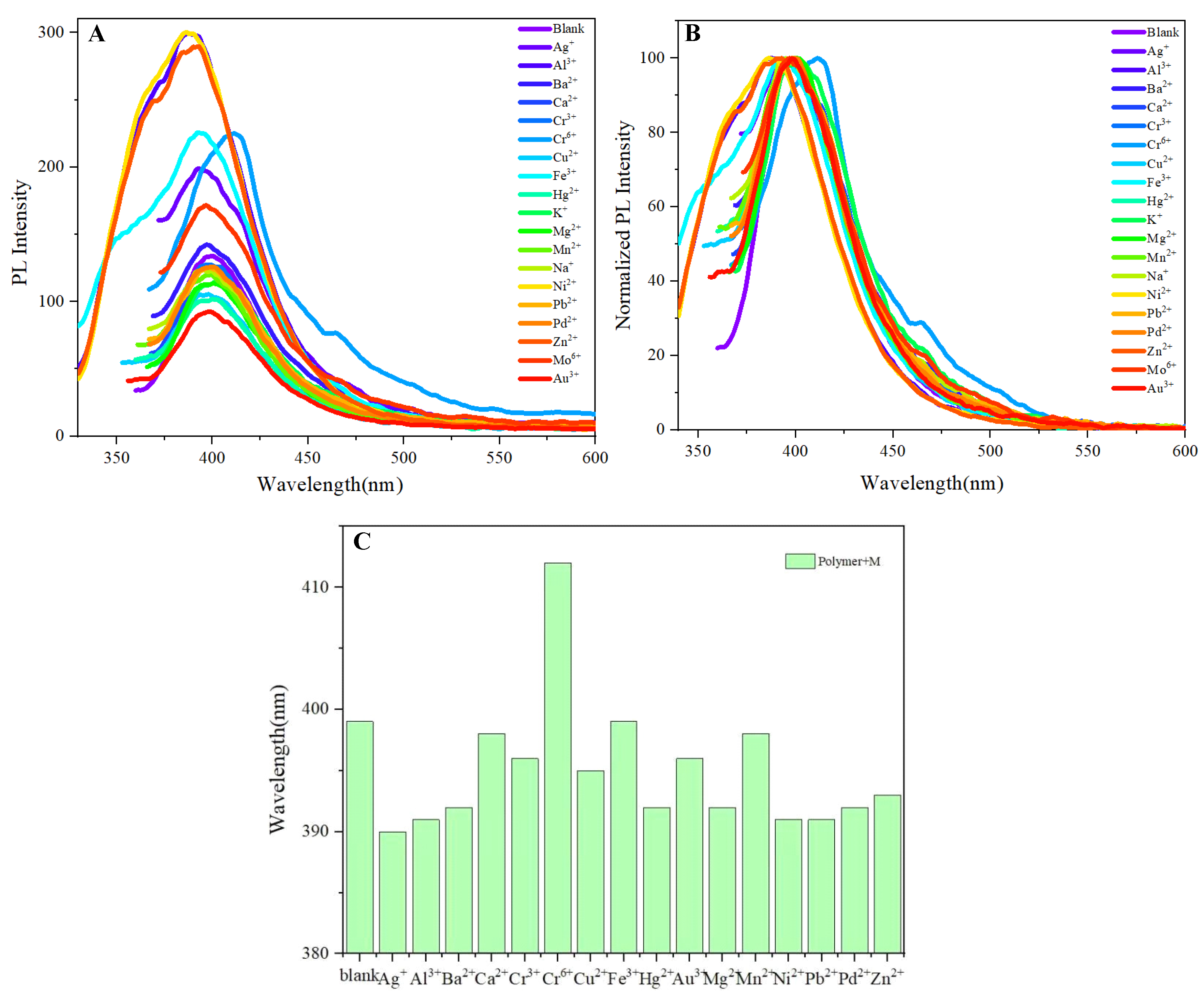

Table 1.
Comparison of chromenone-pyrazole based probes for metal ion detection.
| Probe type | Target ion | Detection channel | Synthesis complexity | Reference |
| Covalent hybrid | Hg²⁺ | Fluorescence | Multi-step | [5] |
| Covalent hybrid | Co²⁺ | Fluorescence | Multi-step | [6] |
| Physical mixture | Fe³⁺/Cr⁶⁺ | UV-vis/fluorescence | None | This work |
Disclaimer/Publisher’s Note: The statements, opinions and data contained in all publications are solely those of the individual author(s) and contributor(s) and not of MDPI and/or the editor(s). MDPI and/or the editor(s) disclaim responsibility for any injury to people or property resulting from any ideas, methods, instructions or products referred to in the content. |
© 2026 by the authors. Licensee MDPI, Basel, Switzerland. This article is an open access article distributed under the terms and conditions of the Creative Commons Attribution (CC BY) license (http://creativecommons.org/licenses/by/4.0/).
Copyright: This open access article is published under a Creative Commons CC BY 4.0 license, which permit the free download, distribution, and reuse, provided that the author and preprint are cited in any reuse.


