

Submitted:
11 August 2026
Posted:
12 August 2026
You are already at the latest version
Abstract
Catching birds is a common and well-established practice that is valuable for research, management, conservation and animal welfare. The most appropriate technique varies among species, and some species can be particularly challenging to capture. Many studies of owls instead rely on vocal or visual observations alone because of the difficulty of capturing birds. Between 2019 and 2026, we successfully developed capture methods for three small Ninox species, the Norfolk Island Morepork (Ninox novaeseelandiae undulata), the Tasmanian Boobook (N. leucopsis), and the Christmas Island Hawk-owl (N. natalis). Hand-nets or mist-nets were successfully used for each species, with thermal scopes, bright narrow-beam headtorches, call broadcast and model decoys proving valuable in different study systems. We show that the most appropriate technique for catching small hawk-owls is context dependent, with successful capture relying on matching the technique to the ecology, behaviour and habitat of the target species. Careful interpretation of behavioural cues and the strategic use of supporting technologies further improves capture success.
Keywords:
hawk-owl
; capture technique
; call broadcast
; model decoy
1. Introduction
The safe and effective capture of birds is a well-established practice that underpins ecological research, conservation management and animal welfare [1]. Captured individuals provide opportunities to collect a diverse range of ecological, behavioural and biological data that cannot readily be obtained through observation alone. Capture thus provides insights into movement ecology, habitat use, demography, genetic diversity, population connectivity, diet, physiology, disease and contaminant exposure [e.g., 2, 3, 4]. As technologies continue to evolve, the information that can be obtained from captured individuals is expanding, enabling new ecological questions to be addressed and strengthening the evidence base for conservation planning and management. With almost half of the world's bird species currently in decline [5], generating the knowledge needed to guide effective conservation action is an increasingly urgent global priority.
Despite their conservation significance, many owl species remain comparatively poorly studied because their nocturnal, cryptic and often forest-dwelling habits make them inherently difficult to detect, observe and capture. These challenges are especially acute for small forest owls, many of which are threatened island endemics [6]. Consequently, effective and ethically acceptable capture techniques are fundamental to advancing research and conservation for many owl species.
While a range of methods has been developed to capture owls, each has limitations that restrict its application under particular field conditions or for particular species. Historically, traps incorporating live prey or conspecifics were widely used [7]. Whilst often highly efficient, these approaches have largely been superseded by methods that better address contemporary animal welfare standards [8,9]. Mist-nets have subsequently been used successfully for a variety of owl species, typically in conjunction with call broadcast or decoys, although capture success remains strongly influenced by flight height, habitat structure and species behaviour [10,11,12,13]. Dho-gaza nets overcome some of these limitations by allowing birds to be intercepted within the canopy and have been applied successfully in a range of owl studies [14,15]. Hand-netting has also been used in specialised situations, most commonly at roosts and nest cavities, although locating suitable birds can be difficult and opportunities for capture are invariably limited [1,16]. Collectively, these methods demonstrate that successful owl capture is highly context dependent, highlighting the need to continue to develop and refine practical, effective and ethically acceptable approaches for forest owls under a range of field conditions.
Between 2019 and 2026, we developed and refined capture methods to investigate the ecology and conservation requirements of three small forest owl species. Here, we describe successful approaches for capturing the Norfolk Island Morepork (Ninox novaeseelandiae undulata), the Tasmanian Boobook (N. leucopsis), and the Christmas Island Hawk-owl (N. natalis). These case studies demonstrate how capture techniques can be adapted to contrasting species and field conditions and provide transferable lessons to guide future research and conservation programmes involving small forest owls and other difficult-to-capture owl species.
2. Case Studies
2.1. The Norfolk Island Morepork
The Critically Endangered Norfolk Island Morepork is a small hawk-owl with an average mass of 163 ± 4 g (F. Sperring unpublished data). The subspecies is endemic to Norfolk Island (Latitude: -29.0291, Longitude: 167.9565), in the western Pacific where just ~25 individuals remain [17]. The Norfolk Island Morepork underwent an extreme form of genetic rescue involving the deliberate hybridisation with the closely related New Zealand Morepork (the nominate subspecies of N. novaeseelandiae) in 1986, with the current population derived from the last remaining Norfolk Island Morepork, a female, and a single New Zealand Morepork male [18]. Norfolk Island Moreporks occupy small territories, averaging 69 ± 16 ha, with very little overlap between pairs [19]. Most of the population occurs within Norfolk Island National Park, which protects the last remaining tract of remnant vegetation, while the rest of the population occupies the human-modified landscape at lower densities [19]. Nestbox monitoring indicates that egg laying usually occurs between October and December [20]. Historically, the last remaining female was captured in a mist-net [21], but we are not aware of any other attempts to catch free flying individuals for research or conservation purposes. To inform further conservation actions for the Norfolk Island Morepork, an intensive research programme was commenced in 2019 that sought to investigate critical habitat requirements, diet, breeding success and genetic health [22]. This required the development of a reliable method for capturing free-ranging adults across territories that differed in vegetation structure and accessibility.
All capture efforts were undertaken during two field trips in the breeding season, from October to November 2019 and November 2020 to January 2021, and one field trip in the non-breeding season, from May to June 2020. Approximate roost locations were first identified through dusk and dawn surveys, during which fieldworkers listened for the first call of the night or the last call of the morning. Norfolk Island Moreporks exhibit roost-site fidelity, using between two and five roosts over a four-week period, which allowed repeated capture attempts within the same area [23]. Capture locations were selected based on proximity to known roosts, accessibility of perches on either side of the mist-nets, an open understorey providing suitable flight paths, low canopy height and the absence of nearby emergent trees. Where suitable locations occurred on slopes, mist-nets were most successfully erected perpendicular to the slope.
Two to four mist-nets were erected at each location, usually along vehicle tracks, public walking tracks or more-narrow walking tracks established for management access. Mist-nets with a mesh size of 32 mm and lengths of between 6 and 12 m were erected at heights of up to 3 m using bamboo poles. Nets were set before dusk, with one UE Wonderboom 4 portable Bluetooth speaker positioned on each side of the net array (Figure 1). A soft-toy owl was occasionally placed in a nearby tree as a decoy. During last light, approximately 20 minutes before sunset, the species-specific two-note ‘boobook’ or contact call was broadcast to lure nearby owls. Between two and five fieldworkers maintained a constant watch for owls entering the area silently, supplemented by spotlighting at approximately 10-minute intervals when birds were not otherwise detected.
Several refinements were important in directing owls into the nets. When an owl approached, alarm or courtship calls (‘por-por’), food-sharing calls (‘bray’) or juvenile begging calls (‘trills’) were broadcast at a lower volume to draw that bird closer, with all call types used successfully at different times. Once the owl’s position was known, calls were broadcast from the speaker on the opposite side of the net to encourage the owl to fly towards the speaker and intersect the net. Speaker positions were also adjusted during capture attempts to encourage birds to use alternative perches if the perches they first selected were not conducive to capture. For owls that were known to be using multiple roosts, dawn surveys were occasionally conducted to determine which roost area was being used before a capture attempt that evening. Where tall canopy or nearby emergent trees made capture difficult, observations across multiple nights were used to identify regular flight paths, allowing nets to be repositioned accordingly. Nets were also set around a regularly used roost before dawn on one occasion, intercepting an owl as it returned without the use of playback or a decoy. Capture attempts did not exceed one hour per owl. All owls were removed from the nets immediately upon capture.
Between November 2019 and June 2021, 12 Norfolk Island Moreporks, including four pairs, were captured on 22 occasions; six individuals were captured either twice or three times (Table 1). Captures occurred predominantly at dusk with 21 of 22 captures between 6:45 pm and 8:11 pm, ranging from 21 minutes before sunset to 40 minutes after sunset. Some individuals were captured on the first night of attempted capture, whereas others required up to 14 nights. One owl was recaptured at dawn, four minutes after sunrise, as it returned to a regularly used roost.
2.2. The Tasmanian Boobook
The Tasmanian Boobook is a small hawk-owl weighing between 118 and 275 g [24]. It is a widespread and locally common species that breeds only in Tasmania but exhibits partial migration to mainland Australia during winter [25]. Tasmanian Boobooks can be differentiated from the closely related southern Boobook (N. boobook) by eye colour and plumage characteristics [25,26]. Although owl records consistent with Tasmanian Boobooks had been reported from mainland Australia during winter for more than a century, the discovery in 2015 that these birds appeared to consistently stage at Victorian headlands provided the first opportunity to reliably locate and capture them. This apparent staging behaviour was subsequently documented annually during October and November. To confirm that these birds were indeed Tasmanian Boobooks, we sought to capture individuals on headlands, assess their plumage and bare-part features, obtain molecular samples, and fit GPS-equipped satellite tags to reveal their movements, including the potential to demonstrate active migration between mainland Australia and Tasmania via Bass Strait. To our knowledge, Tasmanian Boobooks had not been the focus of targeted capture for research purposes prior to this study.
Tasmanian Boobooks were targeted for capture at coastal staging areas during migration. Coastal headlands present a particular challenge for the effective capture of migrating owls, as sites are windswept and support dense low vegetation (typically <1.5 m in height), while birds are not expected to call, nor respond readily to playback (but see below). This means standard mist-nets were likely to be ineffective, as it is very difficult to position them such that there is a high probability a bird will fly into a net. The very low vegetation and typically windy conditions further reduce the efficacy of mist-nets, as the movement of the net and placement against the night sky meant it would be visible to the owls, both in ambient light and owing to the presence of working lighthouses.
All capture efforts were undertaken across three nights at Cape Liptrap Lighthouse (Latitude: -38.9072, Longitude: 145.9226) and two nights at Wilsons Promontory Lighthouse (Southeast Point)(Longitude: -39.1297, Latitude: 146.4244), Victoria, between 7 October and 4 November 2022. These prominent headlands were where the species was known or suspected to congregate, respectively. Capture attempts were undertaken in the first few hours after dark while birds were actively perched around lighthouse precincts. Thermal cameras or scopes were used to locate perched birds efficiently. Birds perched on low shrubs or fence posts, and thus considered catchable, were then approached by a fieldworker carrying a padded hand-net (1.2 m handle length; 180 cm hoop radius) while shining a bright, narrow-beamed headtorch directly at the bird. Capture attempts commenced only once the fieldworker was within approximately 10 m of the bird to minimise the period during which the owl was illuminated. All owls were immediately removed from the hand net after capture.
Several refinements were implemented to allow close approach without causing birds to flush. Dark clothing was worn to improve camouflage and fieldworkers moved quietly, avoiding noisy debris that could alert birds to their presence. Critically, while approaching and preparing for capture, fieldworkers ensured that both their arms and the hand-net remained behind the headtorch beam so that no shadows were cast towards the owl. Efforts to minimise sound, including the wearing soft fabric clothing (for example, abrasive Gore-Tex jackets) and careful footfall, were also important. Throughout the approach, careful attention was paid to the behaviour of the target bird, with signs of increasing alertness, such as looking around, adjusting posture or shaking the wings, used to modify the direction or speed of approach. Call broadcast was also trialled opportunistically following spontaneous vocalisations by one individual at Cape Liptrap Lighthouse. The owl continued calling but showed no apparent response to the broadcast, and no further use of playback or decoys was incorporated into the capture method.
At Cape Liptrap Lighthouse, five Tasmanian Boobooks were successfully captured using this method [25]. Five additional capture attempts were unsuccessful. Fieldworkers also learned that success depended on selecting birds perched clear of surrounding branches, as three failed attempts resulted from the hand-net catching dead branches during the swing. Similarly, birds perched high in dead stags were generally unsuitable targets because they could not be approached within range.
2.3. The Christmas Island Hawk-Owl
The nationally Vulnerable Christmas Island Boobook or Hawk-owl is a small hawk-owl with an average mass of 181 ± 2 g (A. Tipton, unpublished data), endemic to Christmas Island (Latitude: -10.4837, Longitude: 105.6472). Approximately 25% of Christmas Island has been strip-mined for phosphate, around 5% has been modified for human settlement, and the remainder comprises largely intact protected rainforest. The population is currently estimated at 510-1500 individuals and is distributed across the island [27,28]. Nesting is suspected to occur in April, although breeding phenology and synchrony remain poorly understood [29]. The ecology of the Christmas Island Hawk-owl was previously investigated in the period 1994-1996, in which owls were captured by locating birds at daytime roosts and using a variable-length (2-5 m) noosing pole [30]. New research into the ecology and conservation of the species commenced in 2024 to investigate habitat use, diet, breeding biology and genetics. This required the development of a reliable method for capturing free-ranging adults throughout the year in dense tropical rainforest.
All capture efforts were undertaken during five field trips between July 2024 and February 2026, each lasting between two and six weeks and collectively spanning much of the annual cycle. Capture locations were identified by broadcasting calls following a standardised protocol at approximately 500 m intervals along roadsides. Sites were selected where roadside vegetation was relatively low and suitable perches occurred on both sides of the road. Triple-note Christmas Island ‘boobook’ calls were broadcast because they were believed to provoke a stronger response than the basic two-note ‘boobook’ call (M. Kotian, unpublished data). Broadcast volume was adjusted so calls could be heard by human observers approximately 200 m away, thereby targeting only owls occupying the local territory. Calls were broadcast for one minute to lure nearby owls, followed by one minute of passive observation by fieldworkers for owl responses, before a further one-minute broadcast. Between two and five fieldworkers maintained a constant watch for approaching owls using a Pulsar Telos XL50 LRF thermal monocular. If no owl was detected visually or aurally following an additional two minutes of spotlighting, fieldworkers moved to the next survey location.
When an owl was detected, broadcast was immediately paused and the bird's responsiveness was then assessed with very limited call broadcast before capture was attempted. Responsiveness was evaluated by how rapidly the owl approached and whether its flight path might be manipulated further using playback. If an owl responded quickly and predictably, a single mist-net was rapidly erected parallel to the vegetation and perpendicular to the anticipated flight path (Figure 1). Mist-nets (32 mm mesh; 6–12 m long) were erected to heights of up to 5.6 m using three or four 1.4 m mist-net poles. To facilitate rapid repositioning of the net and minimise deployment time, each side of the net was held by one person rather than fixed in position. On bright nights, nets were erected within shadows cast by surrounding vegetation and against dark backgrounds to reduce their visibility. A 3D-printed decoy owl was positioned approximately 1.5 m above the ground and about 2 m from the net within the anticipated flight path to lure owls closer to the net. Chicken feathers and plasticine were used to improve the realism of the decoy (Image 1). One Sonos Roam 2 portable Bluetooth speaker was positioned beneath the decoy and a second speaker placed on the opposite side of the net.
Several refinements were implemented to consistently direct owls into the mist-net. Once the net was erected, aggressive calls were broadcast at reduced volume, with the most successful recording comprising a pair of territorial owls producing a combination of 'por-por' and triple-note ‘boobook’ calls. Where this recording proved ineffective, recordings from other individuals were trialled. Calls were alternated between speakers positioned on either side of the net, while the owl's movements were continuously monitored using the thermal monocular to determine which side of the net it occupied. Nets were initially erected using three poles (5.2 m total height), providing greater stability, and increased to four poles only when birds consistently flew above the net. On one occasion, an owl repeatedly swooped and/or made physical contact with the decoy before flying over the net, apparently detecting the mist-net. The net was subsequently ‘flicked’ during the attack, successfully capturing the bird (see Wilson et al. 1996 for details on net-flicking). Capture attempts did not exceed one hour per owl, including when multiple owls were present. All owls were removed from the mist-net immediately after capture.
Between July 2024 and February 2026, 36 individual Christmas Island Hawk-owls, including six pairs, were captured on 37 occasions, with one individual captured twice. Mist-nets were erected without a successful capture on only three occasions, representing an 89% success rate once nets had been deployed. Following refinement of the technique, between one and three owls were routinely captured per night. Three recapture attempts were undertaken. One owl was successfully recaptured on the first attempt, 11 weeks after its initial capture. Two subsequent attempts to recapture members of another pair, 12 and 13 days after their initial capture, were unsuccessful. All owls were captured between 30 minutes before sunset and five hours after sunset.
3. Discussion
We captured Norfolk Island Moreporks, Tasmanian Boobooks and Christmas Island Hawk-owls on 65 occasions between November 2019 and February 2026 using three complementary capture strategies tailored to each species and study system. Across these studies we demonstrate the value of combining mist-nets or hand-nets with call broadcast, decoys, thermal imagery, spotlights and an understanding of species-specific behaviour. Although the three capture techniques differed substantially, the choice of method was driven by the ecology and behaviour of each species rather than by any inherent superiority of one capture technique over another. Our experience demonstrates that understanding the target species' ecology and behaviour is fundamental to successful capture. We discuss important considerations and the value of lures, decoys and camouflage.
Successful owl capture depends on selecting methods that align with the ecology and behaviour of the target species. For the Norfolk and Christmas Island owls, call broadcast exploited their territorial behaviour and was critical for success. On Norfolk Island, understanding roost fidelity, the timing of evening departures and repeated flight paths allowed us to identify and exploit situations where birds were likely to fly low across predictable routes. This approach was not transferable to Christmas Island because the canopy was considerably taller. Instead, roads proved valuable by increasing the distance between perches, thus allowing birds to swoop lower. Improved decoy visibility along roads may have also contributed to capture success. Capture success improved throughout each project as our understanding of each species' ecology and behaviour increased. For example, we learnt that some Christmas Island Hawk-owls use roads to delineate territories. Although individuals could often be manipulated to move along roads, they would not cross them in response to lures. Subsequent GPS data retrieved from these birds confirmed this behaviour, revealing roads to be hard territorial boundaries (F. Sperring unpublished data). Once this was established, it became part of the protocol to ensure owls were willing to use the flight path intended for capture before setting up the mist-net. By taking species' ecology into account, careful use of behavioural patterns and cues can guide actions and facilitate capture.
Successful hand-net capture of Tasmanian Boobooks depends less on territorial responses and more on interpreting fine-scale behavioural cues from individual birds. For Tasmanian Boobooks, interpreting behavioural cues such as which direction the bird was looking, facing or angling its body, minute adjustments to wing placement, or shifting on its feet were used to indicate the risk of flushing the target individual. These cues informed both the fieldworkers approach speed and the timing of the net swing. For example, an owl that suddenly looks towards the ground may have heard footsteps. The appropriate response would be to stand still until the owl resumed its original posture.
Effective use of call broadcast required continual adjustment in response to the behaviour of individual owls. For the most effective use of call broadcast, it is important to manipulate the timing and volume of broadcast, speaker selection, and vocalisation type in response to the target individual’s behaviour. Important behaviours to observe include flight height and distance, perch location, and vocalisation type. The timing of each behaviour in relation to the broadcast is also valuable to note. Quick and aggressive responses indicate a strong reaction to the broadcast and are most likely to result in successful capture. Because hawk-owls have an excellent ability to localise sound [31], broadcast volume requires careful calibration. Call broadcast volume can be lowered to encourage closer investigation near the net but should not be so low that the owl perceives the call to be far away.
The selection of appropriate recordings was also important for capture success. On Norfolk and Christmas Island, particular recordings were favoured due to the aggressive responses they typically produced. However, sometimes these recordings were counterproductive as lures, with target individuals ceasing vocalisation, remaining perched, or even flying away. In these cases, other recordings were required for successful capture. This may be explained by the role vocalisations play for communicating an individual's identity, sex, fitness, or quality [32,33]. These factors are important to consider in the context of the target individual. For example, broadcasting an aggressive call from a high-quality male may be effective for catching an unpaired female or a territorial pair, but counterproductive for catching a low-quality or juvenile male. Habituation to particular recordings is also possible and should be considered to ensure the birds remain responsive. Access to a diverse library of recordings from individuals of varying quality, sex, and paired status, as well as close attention to behavioural responses, may improve capture success across a range of contexts.
Artificial decoys of conspecifics have been used with mixed results in both this study and others [e.g., 13, 34]. On Christmas Island, our 3D-printed decoy owl, paired with call broadcast, was central to the successful capture of two individuals. Decoys appeared most effective when incorporated into an aggressive territorial interaction rather than simply acting as a visual lure. Anecdotal observations also indicate that the presence of the decoy encourages lower flights (F. Sperring pers obs). On Norfolk Island, there was little evidence that the soft toy decoy affected behaviour and likelihood of capture. Similarly, other research has noted that New Zealand Moreporks ‘appeared to take no notice’ of a painted polystyrene decoy [13]. There are several potential reasons for these differences. First, the soft toy or painted decoy may have been unconvincing. Second, detectability may have been lower for the soft toy, as it was placed in a tree under canopy cover, as opposed to on a stand with little to no canopy cover. Additionally, the top of the 3D printed decoy’s head was white with no feathers, which may have made this decoy particularly conspicuous. Third, observed differences in decoy effectiveness may reflect interspecific variation in behavioural responses to perceived conspecific intruders. We recommend trialling the use of artificial conspecific decoys for capturing hawk-owls. We further highlight the importance of detectability and suggest that an imperfect replica may still have value.
Reducing the visual and acoustic detectability of both fieldworkers and capture equipment was an important component of successful owl capture, yet these considerations are rarely discussed in descriptions of capture methods. For the hand-netting technique, success relied on minimising detection by the target bird. Headtorches effectively masked the approach of a fieldworker behind a light beam, a technique rarely described in the literature. Wearing dark clothing was also valuable in reducing the visual conspicuousness of fieldworkers. While many hawk-owl species rely more heavily on sight than hearing, their hearing remains acute and highly sensitive [8,31,35]. It was therefore important to minimise acoustic cues by wearing appropriate clothing and footwear and carefully selecting an approach path that enabled quiet movement. By contrast, when mist-netting, wearing dark clothing did not appear to influence capture success. Similarly, while communication was minimised during each capture attempt, we did not find that speaking at a normal volume to communicate observations negatively influenced capture success. Reducing the detectability of mist-nets was critical for success, and we highlight four considerations. First, nets should abut vegetation to improve concealment. Second, on bright nights (e.g., minimal cloud cover and a visible moon), nets should be placed in shadows to reduce contrast against the night sky. Third, nets should be placed in areas with little to no wind to minimise movement that may attract attention. Fourth, care should be taken to minimise the amount of time that light is shone on the net when an owl is in the area.
4. Conclusions
Relative to other taxonomic groups, endemic island owls are disproportionately threatened and under-studied [6]. By capturing birds, invaluable data can be obtained to understand the ecology of these species. Much of these data remains difficult or impossible to obtain via passive methods and is essential for informing conservation management strategies. We demonstrate that no single capture method is universally appropriate for small hawk-owls. Instead, successful capture depends on matching the technique to the ecology, behaviour and habitat of the target species. Mist-nets and hand-nets can both be highly effective in the appropriate context, particularly when combined with call broadcast, artificial decoys, light as a means to mask an approach, and thermal technology.
Author Contributions
Conceptualization, VFS and RHC; methodology, VFS, NB, JW, JZ, AT, MK, NM, MH, and RHC; resources, VFS, RHC, JW, and NM; data curation, VFS, AT, and JZ; writing – original draft preparation, VFS and RHC; writing – review and editing, VFS, NB, JW, JZ, AT, MK, NM, MH, and RHC; visualisation, VFS, and MK; supervision, RHC, JW, and NM; project administration, VFS, RHC, JW, NM, JZ, AT; funding acquisition, RHC, JW, NM. All authors have read and agreed to the published version of the manuscript.
Funding
Research on Norfolk and Christmas Island was funded by the Australian Government through the National Environmental Science Program and Director of National Parks. During research on Norfolk Island, V. Florence S. was supported by an Australian Government Research Training Program Scholarship. Amy T and Mayuri K were supported by Western Sydney University Postgraduate Scholarships and Candidature Project Funding. Research on the Tasmanian Boobook was supported by a generous donation from Biosis Pty Ltd.
Institutional Review Board Statement
Research on Norfolk Island was approved by Parks Australia and conducted under Monash University Animal Ethics approval 2021-25691, date: 2026.02.08. Research on Tasmanian Boobooks was approved by the Monash University Animal Ethics Committee (2022-25691) and conducted under scientific permits from Parks Victoria (AA-0000497). Research on Christmas Island was approved by the Western Sydney University Animal Ethics Committee (A16029) and conducted under permits from Parks Australia (AU-COM2026-028).
Data Availability Statement
All data is contained within the article.
Conflicts of Interest
The authors declare no conflicts of interest.
Acknowledgments
We would like to thank all of the volunteers involved in each project for their field contributions, in particular, Tommy Landmann, Jolene Oliver, Mark Hallam, Nick Mooney, and Zach Arnold. Thanks to all Parks Australia staff at Norfolk Island National Park and Christmas Island National Park for their assistance throughout the projects. During the preparation of this manuscript, the authors used Claude Sonnet 4.6 for the purpose of searching for peer reviewed and grey literature that discuss the use of model decoys or headtorches and hand-nets for capturing owls. The authors have reviewed and edited the output, including the verification of references, and take full responsibility for the content of this publication.
References
- Gosler, A. Birds in the hand. In Bird ecology and conservation: a handbook of techniques; Sutherland, W. J., Newton, I., Green, R., Eds.; Oxford University Press, 2004; pp. 85–118. [Google Scholar]
- Baylis, S.M.; Drynan, D.; Clarke, N.; Van, M.; Sunnucks, P.; Clarke, R.H. Estimates of wear rates in metal bird bands, with applications for survival and movement models of marked individuals. J. Field Ornithol. 2018, 89, 393–406. [Google Scholar] [CrossRef]
- Halpin, L.R.; Mott, R.; Clay, T.A.; Humphries, G.R.; Chatwin, T.A.; Carlile, N.; Clarke, R.H. Predicting the foraging habitats of sympatrically breeding gadfly petrels in the South Pacific Ocean. Front. Mar. Sci. 2022, 9, 853104. [Google Scholar] [CrossRef]
- Austin, L.M.; Amos, J.N.; Robledo-Ruiz, D.A.; Zhou, J.W.; Clarke, R.H.; Pavlova, A.; Sunnucks, P. Random mating in a hybrid zone between two putative climate-adapted bird lineages with predicted mitonuclear incompatibilities. Mol. Ecol. 2025, 34, e17612. [Google Scholar] [CrossRef] [PubMed]
- Lees, A.C.; Haskell, L.; Allinson, T.; Bezeng, S.B.; Burfield, I.J.; Renjifo, L.M.; Rosenberg, K.V.; Viswanathan, A.; Butchart, S.H.M. State of the World's Birds. Annu. Rev. Environ. Resour. 2022, 47, 231–260. [Google Scholar] [CrossRef]
- Balza, U.; Johnson, J.A.; Concepcion, C.; Vargas, F.H.; McClure, C.J.W. Conservation Letter: Status and Conservation of Island Raptors. J. Raptor Res. 2025, 59. [Google Scholar] [CrossRef]
- Bub, H. Bird Trapping and Bird Banding: A Handbook for Trapping Methods All Over the World; Cornell University Press, 1991. [Google Scholar]
- Olsen, J. Australian High Country Owls; CSIRO Publishing, 2012. [Google Scholar] [CrossRef]
- Olsen, J.; Fuentes, E.E.; Trost, S.; Debus, S. Behaviour and family association during the post-fledging period in Southern Boobooks Ninox boobook. Corella 2020, 44, 61–70. [Google Scholar]
- Erdman, T.C.; Brinker, D.F. Increasing mist net captures of migrant Northern Saw-whet Owls (Aegolius acadicus) with an audiolure. Biology and conservation of owls of the Northern Hemisphere: 2nd International symposium, Minnesota, USA, 5–9 February 1997. [Google Scholar]
- Lewis, S.B.; Kissling, M.L. A technique for capturing Western Screech-Owls (Megascops kennicottii) in southeast Alaska. North Am. Bird. Bander 2009, 34, 5. [Google Scholar]
- Pollock, J.; Carlisle, J.D.; Runco, C.; Kaltenecker, G. Increasing Capture Frequency for Flammulated Owls and Northern Saw-whet Owls During Fall Migration. J. Raptor Res. 2015, 49, 88–92. [Google Scholar] [CrossRef]
- Stephenson, B.M.; Minot, E.O.; Olsen, P. Capturing, marking and radio-tracking a small owl, the Southern Boobook Ninox novaeseelandiae in Australasia. Corella 1998, 22, 104–107. [Google Scholar]
- Kavanagh, R. Ecology and management of large forest owls in south-eastern Australia. Ph.D. Thesis, University of Sydney, May 1997. [Google Scholar]
- Bradsworth, N.; White, J.G.; Rendall, A.R.; Carter, N.; Cooke, R. Where to sleep in the city? How urbanisation impacts roosting habitat availability for an apex predator. Glob. Ecol. Conserv. 2021, 26, e01494. [Google Scholar] [CrossRef]
- Colvin, B.A.; Hegdal, P.L. Techniques for capturing common Barn-Owls. J. Field Ornithol. 1986, 57, 200–207. [Google Scholar]
- Sperring, V.F.; Wilson, M.; Isaac, B.; Macgregor, N.A.; Clarke, R.H.; Dundas, S. Call broadcast surveys monitor owls with more precision than passive surveys by citizen scientists or acoustic recording units. Wildl. Res. 2025, 52. [Google Scholar] [CrossRef]
- Garnett, S.T.; Olsen, P.; Butchart, S.H.; Hoffmann, A.A. Did hybridization save the Norfolk Island Boobook Owl Ninox novaeseelandiae undulata? Oryx 2011, 45, 500–504. [Google Scholar] [CrossRef]
- Sperring, V.F.; Bradsworth, N.; Isaac, B.; Brown, S.; Wilson, M.; Macgregor, N.A.; Clarke, R.H. Habitat requirements of a critically endangered Ninox hawk-owl: implications for island-wide restoration. Restor. Ecol. 2024, 32. [Google Scholar] [CrossRef]
- Olsen, P.D. Re-establishment of an endangered subspecies: the Norfolk Island Boobook Owl Ninox novaeseelandiae undulata. Bird. Conserv. Int. 1996, 6, 63–80. [Google Scholar] [CrossRef]
- Olsen, P.D.; Mooney, N.J.; Olsen, J. Status and conservation of the Norfolk Island Boobook Ninox novaeseelandiae undulata. In Raptors in the Modern World. Proceedings of the III World Conference on Birds of Prey and Owls, Eliat, Israel, 1989. [Google Scholar]
- Sperring, V.F. Conservation management of small, isolated populations: The Norfolk Island Morepork as a case study. Ph.D Thesis, Monash University, Clayton, Victoria, Australia, October 2023. [Google Scholar]
- Sperring, V.F.; Weeks, A.R.; Webster, W.; Macgregor, N.A.; Wilson, M.; Isaac, B.; Clarke, R.H. Diet breadth of a critically endangered owl presents challenges for invasive rodent management: a conservation conundrum. Emu-Austral Ornithol. 2024, 124, 187–198. [Google Scholar] [CrossRef]
- Australian Bird Study Association. Bird in the hand (second edition) - Australia . 2023. Available online: https://absa.asn.au/pub/bird-in-the-hand-2nd-edn/owls/ (accessed on 31 July 2026).
- Zhou, J.W.; Sperring, V.F.; Allen, P.; Clarke, R.H. Satellite-tracking provides first description of migration in Tasmanian Boobooks Ninox leucopsis. Emu-Austral Ornithol. 2025, 1–13. [Google Scholar]
- Menkhorst, P.; Rogers, D.; Clarke, R.; Davies, J.; Marsack, P.; Franklin, K. The Australian Bird Guide; CSIRO Publishing, 2017. [Google Scholar]
- Macgregor, N.; Flakus, S.; Bell, E.; Grigg, A.; Legge, S.M.; Woinarski, J.; James, D.J.; McAllan, I.A.; Garnett, S. Christmas Island boobook Ninox natalis. In The Action Plan for Australian Birds 2020; Garnett, S., Baker, B. G., Eds.; CSIRO Publishing, 2021; pp. 363–365. [Google Scholar]
- Tiernan, B.; Woinarski, J.C.Z.; Legge, S.M.; Southwell, D.; Barry Baker, G.; Hill, F.R.; James, D.J.; Macgregor, N.A.; Flakus, S.; Garnett, S.T. Stable detection frequency of the threatened Christmas Island Boobook Ninox natalis, 2012–2022. Emu-Austral Ornithol. 2024, 1–11. [Google Scholar] [CrossRef]
- Hill, R. The Christmas Island Hawk Owl - It's Distribution, An Estimate of Density, Population Size, and It's Conservation Status; Australian Nature Conservation Agency, 1995. [Google Scholar]
- Hill, F.A.R.; Lill, A. Density and Total Population Estimates for the Threatened Christmas Island Hawk-Owl Ninox natalis. Emu-Austral Ornithol. 1998, 98, 209–220. [Google Scholar] [CrossRef]
- Swanson, M.; Sanderson, K. Preliminary observations on acoustic perception of alarm calls and natural sounds by Australian owls and frogmouths. South Aust. Ornithol. 1999, 33, 51–54. [Google Scholar]
- Tseng, S.; Hodder, D.P.; Otter, K.A. Using autonomous recording units for vocal individuality: insights from Barred Owl identification. Avian Conserv. Ecol. 2024, 19, 23. [Google Scholar] [CrossRef]
- Hardouin, L.A.; Reby, D.; Bavoux, C.; Burneleau, G.; Bretagnolle, V. Communication of male quality in owl hoots. Am. Nat. 2007, 169, 552–562. [Google Scholar] [CrossRef] [PubMed]
- Elody, B.I.; Sloan, N.F. A mist net technique useful for capturing Barred Owls. North Am. Bird. Bander 1984, 9, 3. [Google Scholar]
- Gutiérrez-Ibáñez, C.; Iwaniuk, A.N.; Lisney, T.J.; Wylie, D.R. Comparative study of visual pathways in owls (Aves: Strigiformes). Brain Behav. Evol. 2013, 81, 27–39. [Google Scholar] [CrossRef] [PubMed]
Figure 1.
Methods used to capture Ninox novaeseelandiae undulata on Norfolk Island, Ninox leucopsis at Cape Liptrap and Wilson’s Promontory, Victoria, Australia, and Ninox natalis on Christmas Island.
Figure 1.
Methods used to capture Ninox novaeseelandiae undulata on Norfolk Island, Ninox leucopsis at Cape Liptrap and Wilson’s Promontory, Victoria, Australia, and Ninox natalis on Christmas Island.
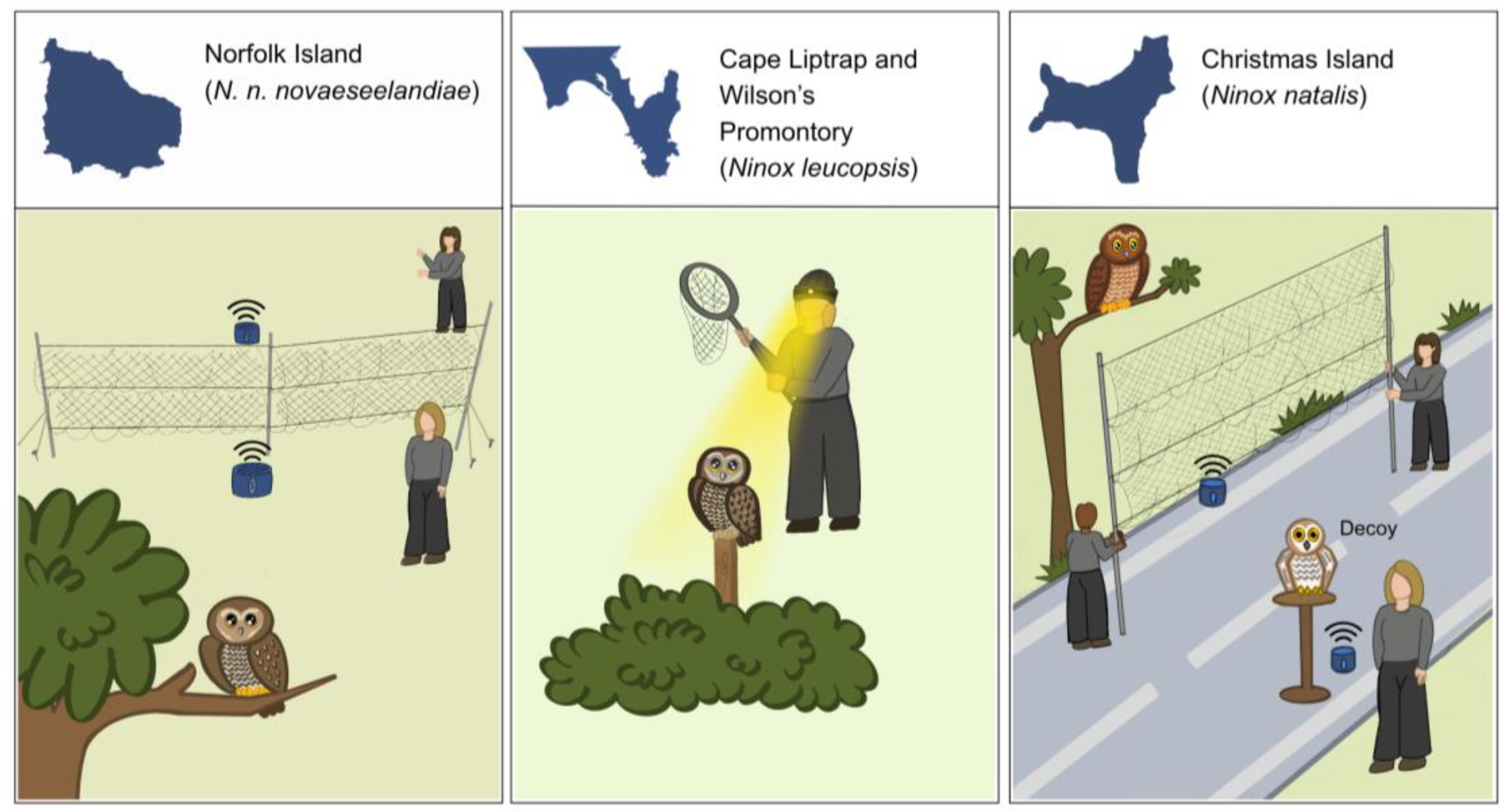

Table 1.
Tools, techniques, and methods used to successfully capture Norfolk Island Moreporks, Tasmanian Boobooks, and Christmas Island Hawk-owls.
Table 1.
Tools, techniques, and methods used to successfully capture Norfolk Island Moreporks, Tasmanian Boobooks, and Christmas Island Hawk-owls.
| Species | Method of capture | Number of captures | Tools and techniques |
| Norfolk Island Morepork (Ninox novaeseelandiae undulata) | Mist-net | 22 | Call broadcast, roost identification, behavioural observations |
| Tasmanian Boobook (Ninox leucopsis) | Hand-net | 5 | Bright narrow-beam headtorch, thermal camera/scope, visual and acoustic camouflage |
| Christmas Island Hawk-owl (Ninox natalis) | Mist-net | 37 | Call broadcast, decoy, thermal camera/scope, bright narrow-beam headtorch, visual and acoustic camouflage |
| Hand-net | 1 |
Disclaimer/Publisher’s Note: The statements, opinions and data contained in all publications are solely those of the individual author(s) and contributor(s) and not of MDPI and/or the editor(s). MDPI and/or the editor(s) disclaim responsibility for any injury to people or property resulting from any ideas, methods, instructions or products referred to in the content. |
© 2026 by the authors. Licensee MDPI, Basel, Switzerland. This article is an open access article distributed under the terms and conditions of the Creative Commons Attribution (CC BY) license (http://creativecommons.org/licenses/by/4.0/).
Copyright: This open access article is published under a Creative Commons CC BY 4.0 license, which permit the free download, distribution, and reuse, provided that the author and preprint are cited in any reuse.