

Submitted:
09 August 2026
Posted:
12 August 2026
You are already at the latest version
Abstract
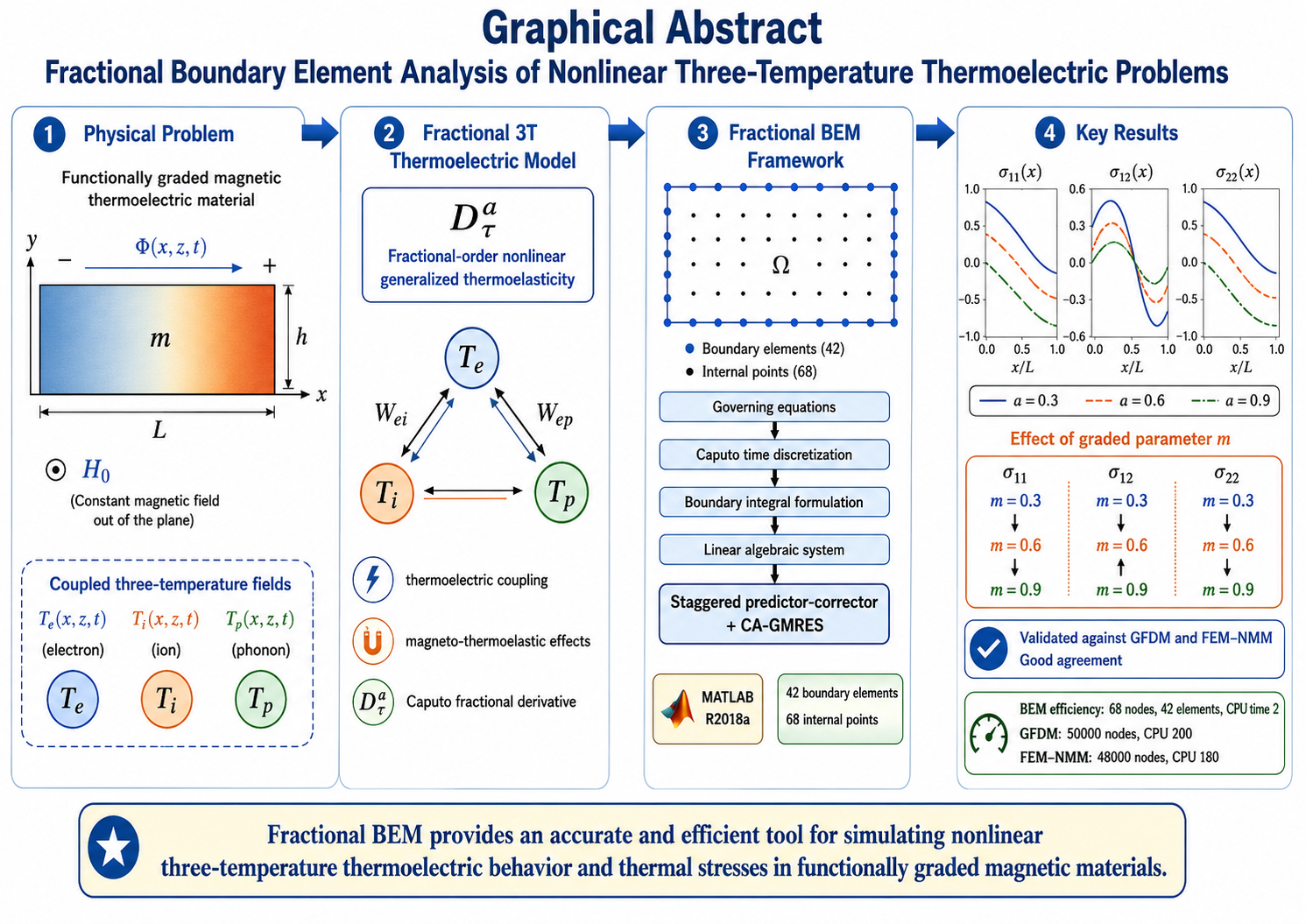
The primary goal of this article is to propose a new fractional boundary element technique for solving nonlinear three-temperature (3T) thermoelectric problems. Analytical solution of the current problem is extremely difficult to obtain. To overcome this difficulty, a new numerical technique must be developed to solve such problem. As a result, we propose a novel fractional boundary element method (BEM) to solve the governing equations of our considered problem. Because of the advantages of the BEM solution, such as the ability to treat problems with complicated geometries that were difficult to solve using previous numerical methods, and the fact that the internal domain does not need to be discretized. As a result, the BEM can be used in a wide variety of thermoelectric applications. The numerical results show the effects of the magnetic field and the graded parameter on thermal stresses. The numerical results also validate the validity and accuracy of the proposed technique.
Keywords:
boundary element method
; fractional-order
; three-temperature
; generalized thermoelasticity
; functionally graded magnetic thermoelectric structures
1. Introduction
Utilizing initial conditions and boundary conditions at m and Max Planck proposed the quantum theory of electromagnetic radiation in 1900, and Albert Einstein proposed the concept of photons and phonons in 1905 and 1907 to explain why temperature varies with the specific heat of solid crystals. A phonon is a quantum of vibrational mechanical energy produced by a lattice of oscillating atoms, where the thermal energy of the atoms causes the lattice to vibrate. This generates compression mechanical waves, which carry heat and sound through the anisotropic material. The careful study of phonons is an important part of solid-state physics because it is important for many thermal and acoustic properties of solids, as well as a variety of low- and high-temperature superconductive technologies.
Many bodies undergo significant changes in their properties as a result of the application of an electric or magnetic field, allowing for the profitable application of this fact in technological applications. The development of electrorheological and magnetic fluids has piqued the interest of many people due to their potential applications in clutches, actuators, shock absorbers, valves, and exercise equipment, to name a few. Field dependent solids, also known as electro-active elastomers, were recently developed by infusing elastomers with electrorheological fluids or embedding them with electrically conducting particles. Magneto-active elastomers, on the other hand, were created by encapsulating elastomers with magnetically responsive particles. Such field dependent solids have potential applications due to the change in structure and the resulting effect on the elasticity and compliance of the material, such field dependent solids have potential applications in a wide range of applications.
Adaptive algorithms based on fractional calculus (FC) have been proposed for parameter estimation of various problems [1,2], and they outperform standard adaptive methodologies in terms of convergence speed and estimation accuracy [3]. FC is concerned with the calculation of real-order derivatives and integrals [4]. The FC has been successfully used to solve problems in circuit design [5], artistic paintings [6], vibration analysis [7], hydro turbine systems [8], control engineering [9,10], nanotechnology [11], and biological processes [12,13]. Fractional adaptive algorithms are used to estimate the parameters of power signals. The fractional order least mean square (FOLMS) technique is used to estimate the amplitude and phase of power signals [14]. The momentum FOLMS (mFOLMS) was created to speed up the convergence speed of conventional FOLMS [15]. Experiments have shown that the mFOLMS algorithm outperforms the traditional LMS and standard FOLMS algorithms in terms of convergence speed. The FOLMS and mFOLMS performance are unaffected by the fractional order. The so-called innovative FOLMS (I-FOLMS) adaptive algorithm [16], on the other hand, was recently developed, indicating a strong reliance on fractional order. The I-FOLMS solves the opposing requirements of fast convergence speed and small steady-state error by using an appropriate fractional order selection. The fractional order parameter was discovered to be capable of influencing the initial convergence speed and estimation accuracy of I-FOLMS. These intriguing properties of the I-FOLMS necessitate further research into the I-FOLMS for parameter estimation of power signals, as well as comparisons with the regular FOLMS.
Knopoff [17] and Chadwick [18], followed by Kaliski and Petykiewicz [19], pioneered the magnetoelasticity foundations. Magnetic theory development and application were previously solely based on magnetic experiments. Because of the rapid development of high-performance computational methods and computer hardware, efficient and accurate computational methods for modeling and simulation of real magnetic experiments have been used, particularly when the magnetic experiment is difficult, dangerous, or expensive.
The interaction between magnetic and strain fields in a thermoelastic solid is receiving increased attention due to its numerous applications in geophysics, plasma physics, and other fields. All of the articles cited above assumed that interactions between the two fields occur via Lorentz forces appearing in equations of motion and a term entering Ohm’s law and representing the electric field created by the velocity of a material particle traveling in a magnetic field. In these investigations, the heat equation under consideration is typically the uncoupled or coupled theory, rather than the generalised one. Ezzat and Awad developed a model of micropolar generalised magneto-thermoelasticity based on modified Ohm’s and Fourier’s laws [20]. In the literature, several fractional-order models have been investigated for various applications. There is no general analytical solution due to the computational difficulty of solving complex fractional nonlinear thermoelasticity problems. Numerical methods, including the BEM, should be used to solve such problems. Different three-temperature theories have been investigated in the context of micropolar-thermoelasticity [21], carbon nanotube fiber reinforced composites [22], micropolar piezothermoelasticity [23], Micropolar Magneto-thermoviscoelasticity [24] and Magneto-thermooviscoelasticity [25].
In this paper, we presented a new fractional order theory of functionally graded magnetic thermoelectric materials. This theory’s application to three-temperature nonlinear generalized thermoelasticity is solved using boundary element analysis. Because of its advantages, such as dealing with more complex shapes of functionally graded magnetic thermoelectric materials and not requiring the discretization of the internal domain, BEM has low RAM and CPU usage. As a result, it is adaptable and effective for dealing with complex nonlinear 3T thermoelectric FGM problems. The numerical results demonstrate the effects of a magnetic field and a graded parameter on thermal stresses in FGMTM. The numerical results also confirm the validity and accuracy of the proposed technique.
2. Formulation of the Problem
A Cartesian coordinate system for a 2D functionally graded magnetic thermoelectric structure with thickness of h and length as shown in Figure 1. It is assumed to be subjected to an electric potential Φ(x, z, t) along the direction and placed in an external constant magnetic field within the region which bounded by boundary , where are subsets of such that .
The governing equations for fractional order three-temperature nonlinear generalized thermoelastic problems of functionally graded magnetic thermoelectric materials can be written as [26]
where
The fractional order three-temperature radiative heat conduction equations coupled with electron, ion and phonon temperatures can be expressed as
where
in which
And
The total energy of a unit mass can be described as follows:
Initial and boundary conditions can be written as
3. BEM Simulation for Temperature Field
The boundary element method is used in this section to solve the nonlinear time-dependent two dimensions three temperature (2D-3T) radiation diffusion equations that are coupled by electron, ion, and photon temperatures.
Caputo’s integral definition and Grunwald-Letnikov integral definition are consistent with the Riemann-Liouville integral definition. Also, Caputo’s derivative definition and Grunwald-Letnikov derivative definition are consistent with the Riemann-Liouville derivative definition. When the Riemann-Liouville or Grunwald-Letnikov definitions are compared to the Caputo definition, the functions that are derivable in the Caputo sense are significantly fewer. According to finite difference scheme of Caputo at times and , we obtain [27]
where
Based on equation (10), the fractional order heat equations (5) can be replaced by the following system
Based on the fundamental solution of (12), the direct formulation of boundary integral equation corresponding to (5) can be expressed as
which can be written in the absence of internal heat sources as follows
We assume that the time derivative of temperature can be approximated by a series of known functions in order to transform the domain integral in (14) to the boundary. and unknown coefficients as
Also, we assume that is a solution of
Thus, equation (14) results in the following boundary integral equation
where
and
In which the entries of are the coefficients of with matrix defined as [24]
Using the standard boundary element discretization scheme for equation (17) and using equation (19), we obtain the following set of ordinary differential equations
where matrices and are depending on the current time step, boundary geometry and material properties, and are, respectively, temperature and heat flux vectors at boundary nodes, and b is the internal heat generation vector
The diffusion matrix can be defined as
with
In order to solve equation (21) numerically the functions and are interpolated as
where the parameter determines the practical time in the present time step.
By differentiating equation (25) with respect to time we get
By substituting from Equations (25) - (27) into Equation (21), we obtain
By using initial and boundary conditions at and considering the previous time step solution as initial values for the next step, we obtain the following linear algebraic system
where is unknown matrix, and and are known matrices
4. BEM Simulation for Displacement and Microrotation Fields
Using the weighted residual method, the governing equations (1) and (2) can be transformed into the following integral equations
in which
The boundary conditions are
The integration of the first term of equations (33) and (34) leads to
According to Huang and Liang [28], the boundary integral equation can be written as
The integration of (35)’s left-hand side by parts results in
According to Eringen [29], the elastic stress can be written as
Hence, equation (36) may be expressed as
By applying the integration by parts again to the left-hand side of (38), we obtain
where
According to Dragos [30], the fundamental solution may be written as
The weighting functions for and may be expressed as follows:
On the basis of Dragos [30], the fundamental solution may be expressed as
Using the above two sets of weighting functions into (39) we have
Thus, we obtain
in which
Now, we introduce the following relations
By discretizing the boundary, we can write (46) as
Which can be expressed as
By employing the following formula
Hence, equation (50) may be expressed as
The global matrix system equation for all nodes can be written as follows
where denotes the displacements and denotes the tractions.
Now, we can write (53) into the following form
In Matlab (R2018a), an explicit staggered predictor-corrector scheme based on the communication-avoiding generalized minimal residual (CA-GMRES) method is efficiently implemented for solving the resulting simultaneous linear algebraic systems to obtain the temperature and displacement fields.
5. Numerical Results and Discussion
In the context of functionally graded magnetic thermoelectric materials, the proposed BEM technique can be applied to a wide range of fractional-order nonlinear generalised thermal stress problems. The BEM discretization was performed using 42 boundary elements and 68 internal points, as shown in Figure 2.
Figure 3. Shows the variation of the thermal stress along -axis for different values of fractional order parameter (). It is shown from this figure that the thermal stress decreases with the increase of until . Then it increases with the increase of . It is also shown from this figure that the thermal stress decreases with the increase of fractional order parameter.
Figure 4. Shows the variation of the thermal stress along -axis for different values of fractional order parameter (). It is shown from this figure that the thermal stress decreases with the increase of . It is also shown from this figure that the thermal stress increases with the increase of fractional order parameter.
Figure 5 shows the variation of the thermal stress along -axis for different values of fractional order parameter (). It is shown from this figure that the thermal stress increases with the increase of . It is also shown from this figure that the thermal stress decreases with the increase of fractional order parameter.
Figure 6. Shows the variation of the thermal stress along -axis for different values of functionally graded parameter (). It is shown from this figure that the thermal stress increases with the increase of until . Then it decreases with the increase of . It is also shown from this figure that the thermal stress increases with the increase of functionally graded parameter.
Figure 7. Shows the variation of the thermal stress along -axis for different values of functionally graded parameter (). It is shown from this figure that the thermal stress increases with the increase of . It is also shown from this figure that the thermal stress decreases with the increase of functionally graded parameter.
Figure 8 Shows the variation of the thermal stress along -axis for different values of functionally graded parameter (). It is shown from this figure that the thermal stress increases with the increase of . It is also shown from this figure that the thermal stress decreases with the increase of functionally graded parameter.
It is noted from figures 3-8 that the fractional order parameter and functionally graded parameter have a strong effect on the thermal stress , and in the functionally graded magnetic thermoelectric materials.
Table 1 shows a comparison of required computer resources for the current BEM results, GFDM results of Gu et al. [31] and FEM–NMM results of An et al. [32] of modeling of fractional nonlinear three-temperature (3T) thermoelectric problems.
There were no published results to demonstrate the validity of the proposed technique’s results. Some literatures, on the other hand, can be regarded as special cases of the considered general study. Figure 9 shows the variation of the special case thermal stress along -axis for BEM, generalized finite difference method (GFDM) and combined finite element method/normal mode method (FEM–NMM) in the case of fractional order homogeneous . Figure 10 shows the propagation of the thermal stress along -axis for BEM, GFDM and FEM–NMM in the case of zero fractional order, and non-homogeneous . These findings for thermal stress in functionally graded magnetic thermoelectric materials, show that the BEM findings are in a very good agreement with the GFDM findings of Gu et al. [31], and FEM–NMM findings of An et al. [32]. These results show that the BEM results are in a very good agreement to the FEM and NMM results. Thus, the validity of the proposed technique was confirmed.
6. Conclusions
Based on an explicit staggered predictor-corrector scheme The primary goal of this paper is to present a novel fractional-order theory that will aid in the advancement of functionally graded magnetic thermoelectric materials’ technological and industrial applications. Three-temperature nonlinear generalized thermoelasticity of functionally graded magnetic thermoelectric materials is the name given to this theory (FGMTMs). We must successfully adopt computerized numerical methods for solving and simulating complex nonlinear FGM problems in order to successfully guide the current research field toward the development of new functionally graded materials (FGMs). The governing equations are extremely difficult to solve experimentally or analytically due to the proposed theory’s severe nonlinearity. To address this issue, new numerical approaches for solving such equations must be developed. We propose a new formulation of the boundary element method for solving the theory’s governing equations (BEM). Because of the advantages of the BEM approach, such as the ability to deal with issues with complicated shapes that are difficult to deal with using standard methods, and the lack of the need for internal domain discretization. It also necessitates low CPU utilization and memory storage. As a result, the BEM is appropriate for a wide variety of sophisticated FGMTMs applications. The numerical results are discussed, with an emphasis on the effects of magnetic fields and graded parameters on thermal stresses in FGMTMs. Based on the findings, the suggested BEM technique is more effective, precise, and stable than GFDM or FEM–NMM. Current numerical results for our problem may be of interest to computer scientists, material science researchers, engineers, and designers and developers of functionally graded materials..
Author Contributions
Conceptualization, Fahmy; methodology, Fahmy; software, Fahmy; validation, Fahmy, Almehmadi, Al Subhi and Sohail; formal analysis, Fahmy; investigation, Fahmy; resources, Fahmy; data curation, Fahmy; writing—original draft preparation, Fahmy, Almehmadi, Al Subhi and Sohail; writing—review and editing, Fahmy, Almehmadi, Al Subhi and Sohail; visualization, Fahmy; supervision, Fahmy; project administration, Fahmy; funding acquisition, Fahmy and Almehmadi. All authors have read and agreed to the published version of the manuscript.
Funding
The authors declare that this independent, corrected version received no direct external funding or institutional grants.
Data Availability Statement
All data and computational resources underlying the results presented in this study have been deposited in Figshare. The repository contains the numerical datasets, source code, figure-reproduction scripts, validation data, and supporting documentation required to reproduce and further analyze the reported results. The repository is publicly accessible at https://doi.org/10.6084/m9.figshare.33190854.
Conflicts of Interest
The authors declare no conflict of interest.
Nomenclature
| Stress–temperature coefficients | Constant elastic moduli | ||
| Kronecker delta | Electric field vector | ||
| Strain tensor | Dilatation | ||
| permutation symbol | Mass force vector | ||
| Micro-strain tensor | Permittivity tensor | ||
| Tractions | Magnetic field intensity | ||
| Magnetic permeability | Constant magnetic field | ||
| Peltier coefficient | Electric density vector | ||
| Density | Conductive coefficients | ||
| Stress tensor | Seebeck coefficient | ||
| Reference stress | Functionally graded parameter | ||
| Electric conductivity | Total energy of unit mass | ||
| Time | Pore pressure | ||
| Relaxation times | Temperature functions | ||
| Unified parameter | Reference temperature | ||
| Fractional order parameter | Displacement vector | ||
| Magnetic strength components | electron-ion energy coefficient | ||
| Specific heat capacities | electron-phonon energy coefficient |
References
- Cheng, S.; Wei, Y.; Sheng, D.; Chen, Y.; Wang, Y. Identification for Hammerstein nonlinear ARMAX systems based on multi-innovation fractional order stochastic gradient. Signal Process. 2018, 142, 1–10. [Google Scholar] [CrossRef]
- Chaudhary, N.I.; Khan, Z.A.; Zubair, S.; Raja, M.A.Z.; Dedovic, N. Normalized fractional adaptive methods for nonlinear control autoregressive systems. Appl. Math. Model. 2019, 66, 457–471. [Google Scholar] [CrossRef]
- Khan, Z.A.; Zubair, S.; Alquhayz, H.; Azeem, M.; Ditta, A. Design of Momentum Fractional Stochastic Gradient Descent for Recommender Systems. IEEE Access 2019, 7, 179575–179590. [Google Scholar] [CrossRef]
- Sabatier, J.; Agrawal, O. P.; Machado, J. T. Advances in Fractional Calculus; Springer, 2007. [Google Scholar]
- Bertsias, P.; Psychalinos, C.; Maundy, B.J.; Elwakil, A.S.; Radwan, A.G. Partial fraction expansion–based realizations of fractional-order differentiators and integrators using active filters. Int. J. Circuit Theory Appl. 2019, 47, 513–531. [Google Scholar] [CrossRef]
- Machado, J.T.; Lopes, A.M. Artistic painting: A fractional calculus perspective. Appl. Math. Model. 2019, 65, 614–626. [Google Scholar] [CrossRef]
- Tang, Y.; Zhen, Y.; Fang, B. Nonlinear vibration analysis of a fractional dynamic model for the viscoelastic pipe conveying fluid. Appl. Math. Model. 2018, 56, 123–136. [Google Scholar] [CrossRef]
- Long, Y.; Xu; Chen, B.; D. Ye, W. Dynamic characteristics for a hydro-turbine governing system with viscoelastic materials described by fractional calculus. Appl. Math. Model. 2018, 58, 128–139. [Google Scholar] [CrossRef]
- Baleanu, D.; Machado, J.A.T. Fractional Dynamics and Control; Springer Science & Business Media, 2011. [Google Scholar]
- Sharma, R.; Bhasin, S.; Gaur, P.; Joshi, D. A switching-based collaborative fractional order fuzzy logic controllers for robotic manipulators. Appl. Math. Model. 2019, 73, 228–246. [Google Scholar] [CrossRef]
- Baleanu; Gven, D.; Machado, Z.B.J.T. (Eds.) New Trends in Nanotechnology and Fractional Calculus Applications; Springer: New York, 2010; p. C397. [Google Scholar]
- Pinto, C.M.; Carvalho, A.R. Diabetes mellitus and TB co-existence: clinical implications from a fractional order modelling. Appl. Math. Model. 2019, 68, 219–243. [Google Scholar] [CrossRef]
- Ionescu, C.M.; Lopes, A.; Copot, D.; Machado, J.A.T.; Bates, J.H.T. The role of fractional calculus in modeling biological phenomena: A review. Commun. Nonlin. Sci. Numer. Simul. 2017, 51, 141–159. [Google Scholar] [CrossRef]
- Chaudhary, N.I.; Zubair, S.; Raja, M.A.Z. A new computing approach for power signal modeling using fractional adaptive algorithms. ISA Trans. 2017, 68, 189–202. [Google Scholar] [CrossRef] [PubMed]
- Zubair, S.; Chaudhary, N.I.; Khan, Z.A.; Wang, W. Momentum fractional LMS for power signal parameter estimation. Signal Process. 2018, 142, 441–449. [Google Scholar] [CrossRef]
- Cheng, S.; Wei, Y.; Chen, Y.; Li, Y.; Wang, Y. An innovative fractional order LMS based on variable initial value and gradient order. Signal Process. 2017, 133, 260–269. [Google Scholar] [CrossRef]
- Knopoff, L. The interaction between elastic wave motions and a magnetic field in electrical conductors. J. Geophys. Res. 1955, 60, 441–456. [Google Scholar] [CrossRef]
- Chadwick, P. Thermoelasticity. In The dynamical theory, progress in solid mechanics; North-Holland Publishing Co: Amsterdam, 1960; Vol 1, pp. MR 0113406 p. 263–328. [Google Scholar]
- Kaliski, S.; Petykiewicz, J. Equation of motion coupled with the field of temperature in a magnetic field involving mechanical and electrical relaxation for anisotropic bodies. Proc. Vib. Probl. 1959, 1, 3–11. [Google Scholar]
- Ezzat, M. A.; Awad, E. S. Micropolar generalized magneto-thermoelasticity with modified Ohm’s and Fourier’s laws. J. Math. Anal. Appl. 2009, 353, 99–113. [Google Scholar] [CrossRef]
- Fahmy, M.A. A Novel BEM for Modeling and Simulation of 3T Nonlinear Generalized Anisotropic Micropolar-Thermoelasticity Theory withMemory Dependent Derivative. Comput. Model. Eng. Sci. 2021, 126, 175–199. [Google Scholar] [CrossRef]
- Fahmy, M.A. A new boundary element formulation for modeling and simulation of three-temperature distributions in carbon nanotube fiber reinforced composites with inclusions. Math. Methods Appl. Sci. 2021, 49, 7550–7565. [Google Scholar] [CrossRef]
- Fahmy, M.A. Boundary Element Algorithm for Nonlinear Modeling and Simulation of Three-Temperature Anisotropic Generalized Micropolar Piezothermoelasticity with Memory-Dependent Derivative. Int. J. Appl. Mech. 2020, 12. [Google Scholar] [CrossRef]
- Fahmy, M.A.; Shaw, S.; Mondal, S.; Abouelregal, A.E.; Lotfy, K.; Kudinov, I.A.; Soliman, A.H. Boundary Element Modeling for Simulation and Optimization of Three-Temperature Anisotropic Micropolar Magneto-thermoviscoelastic Problems in Porous Smart Structures Using NURBS and Genetic Algorithm. Int. J. Thermophys. 2021, 42, 1–28. [Google Scholar] [CrossRef]
- Fahmy, M.A. Boundary element modeling of 3 T nonlinear transient magneto-thermoviscoelastic wave propagation problems in anisotropic circular cylindrical shells. Compos. Struct. 2021, 277, 114655–114655. [Google Scholar] [CrossRef]
- Fahmy, M.A. Implicit–explicit time integration DRBEM for generalized magneto-thermoelasticity problems of rotating anisotropic viscoelastic functionally graded solids. Eng. Anal. Bound. Elem. 2013, 37, 107–115. [Google Scholar] [CrossRef]
- Cattaneo, C. Sur une forme de i’equation de la chaleur elinant le paradox d’une propagation instantanc. In Comptes rendus de l’Académie des Sciences; Gauthier-Villars: Paris, 1958; Volume 247, pp. 431–433. [Google Scholar]
- Huang, F.-Y.; Liang, K.-Z. Boundary element method for micropolar thermoelasticity. Eng. Anal. Bound. Elem. 1996, 17, 19–26. [Google Scholar] [CrossRef]
- Eringen, A. C. Theory of micropolar elasticity. Fracture, II.; Aca- demic Press: New York, 1968. [Google Scholar]
- Dragoş, L. Fundamental solutions in micropolar elasticity. Int. J. Eng. Sci. 1984, 22, 265–275. [Google Scholar] [CrossRef]
- Gu, Y.; Qu, W.; Chen, W.; Song, L.; Zhang, C. The generalized finite difference method for long-time dynamic modeling of three-dimensional coupled thermoelasticity problems. J. Comput. Phys. 2019, 384, 42–59. [Google Scholar] [CrossRef]
- An, B.; Zhang, C.; Shang, D.; Xiao, Y.; Khan, I.U. A Combined Finite Element Method with Normal Mode for the Elastic Structural Acoustic Radiation in Shallow Water. J. Theor. Comput. Acoust. 2020, 28. [Google Scholar] [CrossRef]
Figure 1.
Geometry of the considered thermoelectric structure.
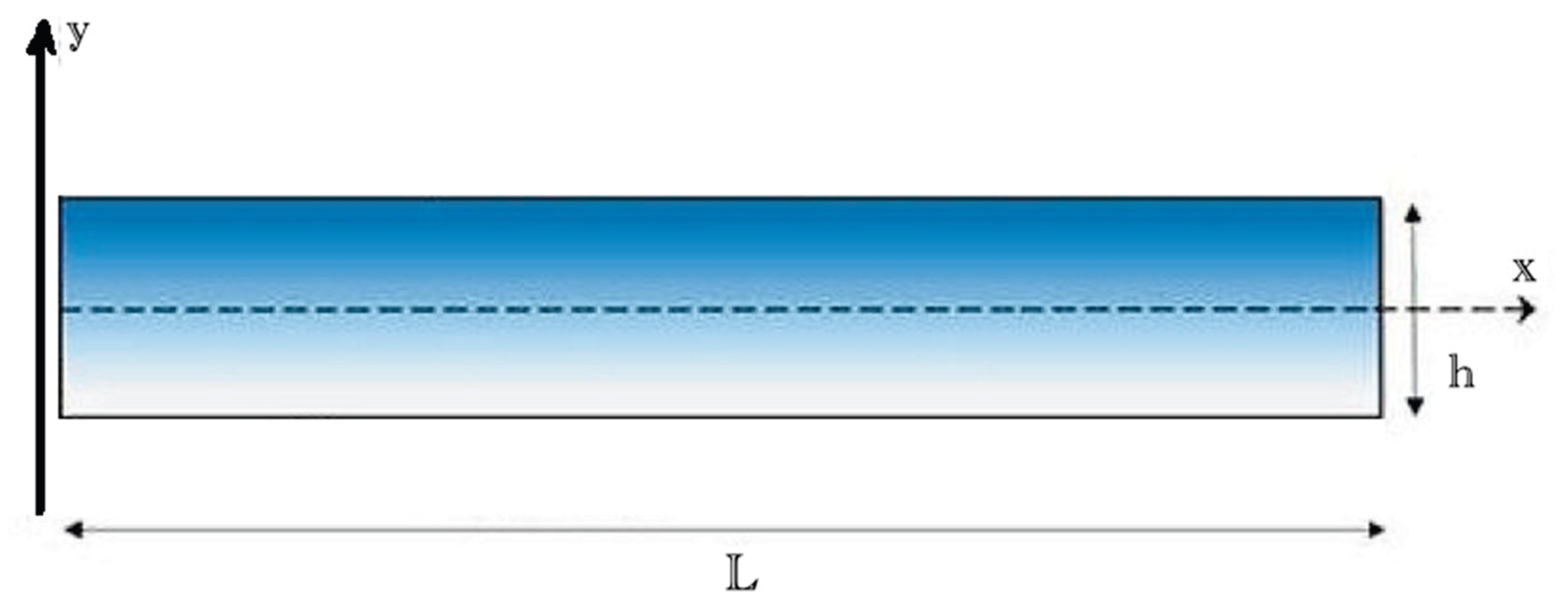
Figure 2.
Boundary element model of the considered structure.
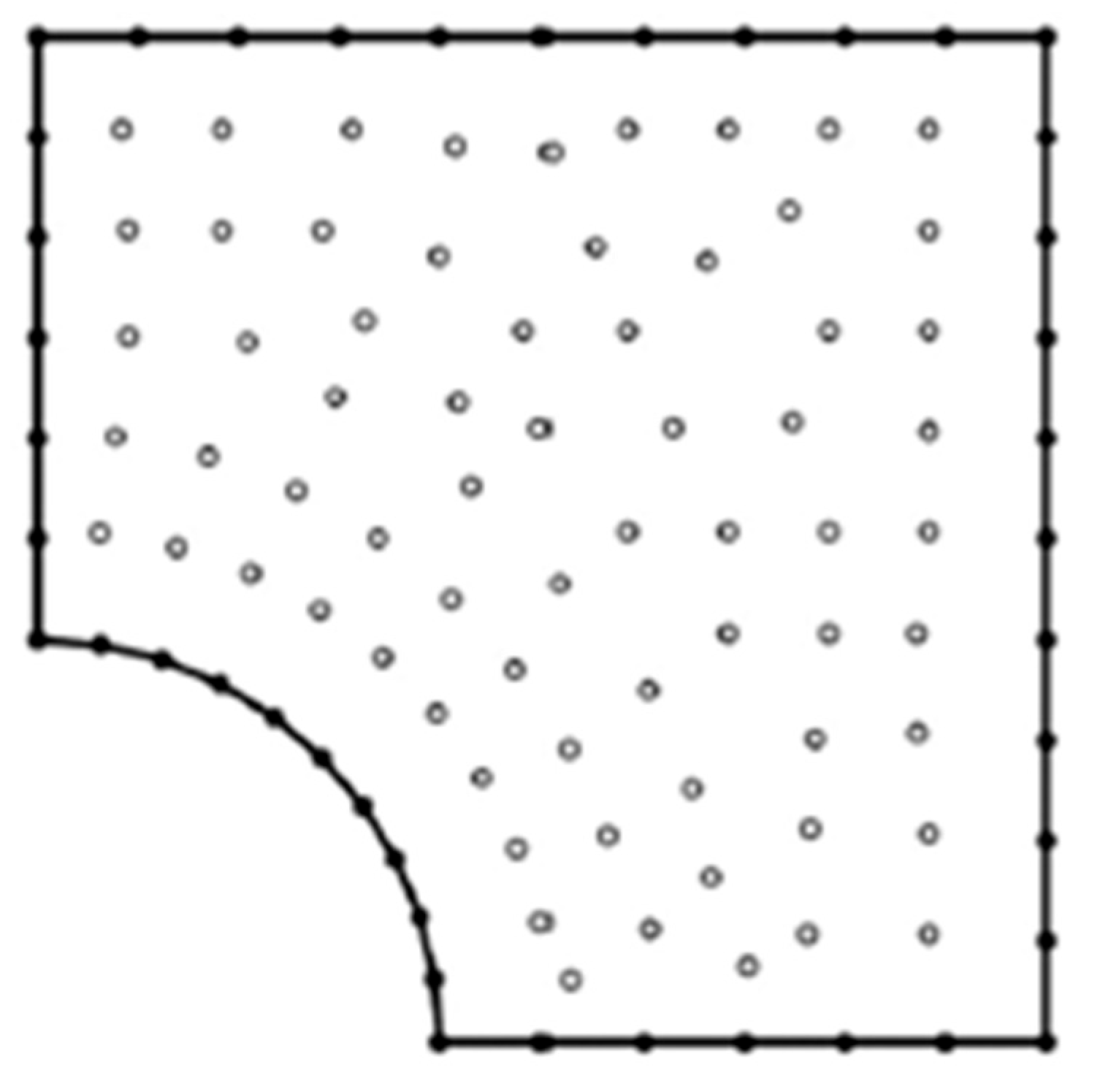
Figure 3.
Variation of the thermal stress along -axis for different values of functionally graded parameter.
Figure 3.
Variation of the thermal stress along -axis for different values of functionally graded parameter.
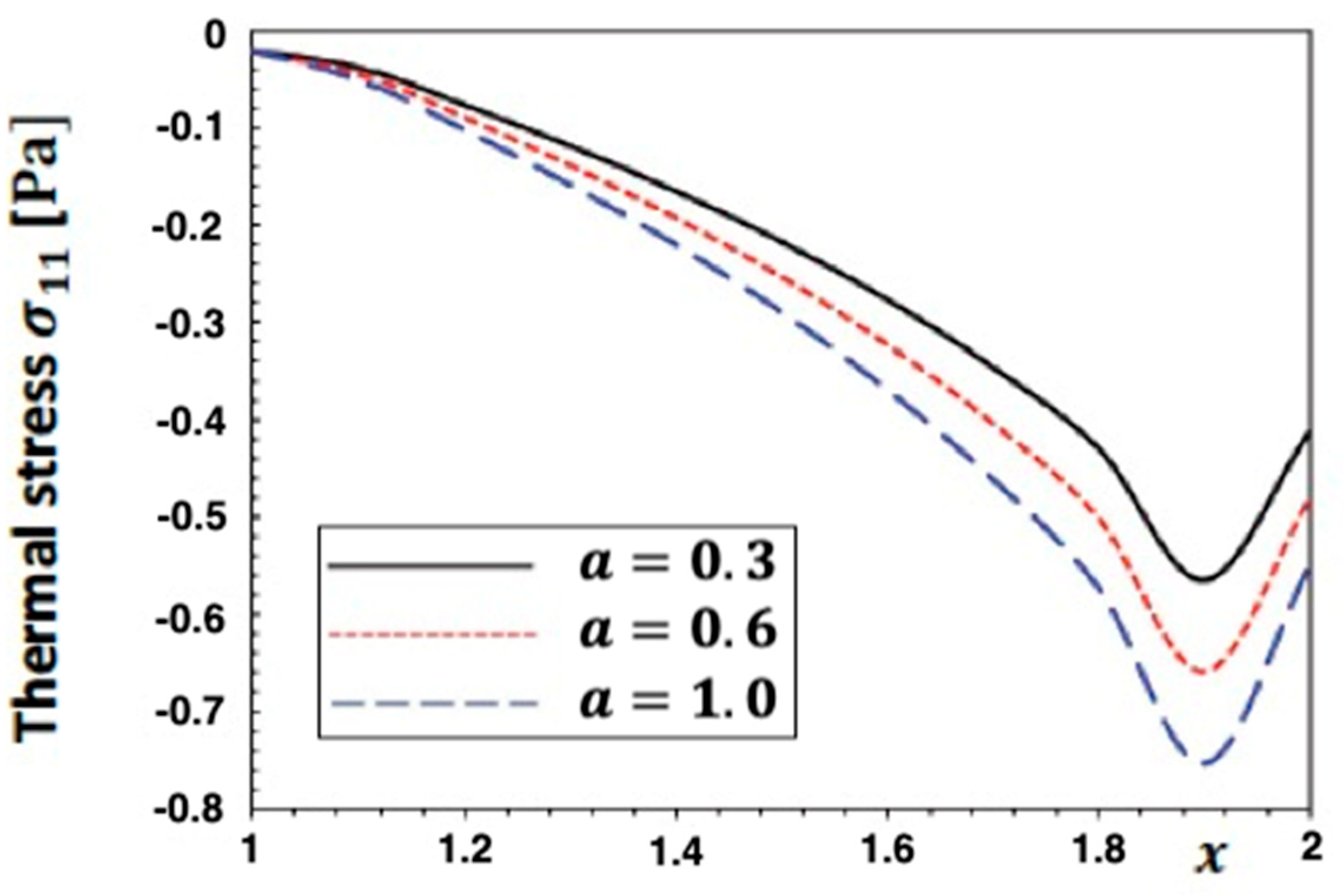
Figure 4.
Variation of the thermal stress along -axis for different values of functionally graded parameter.
Figure 4.
Variation of the thermal stress along -axis for different values of functionally graded parameter.
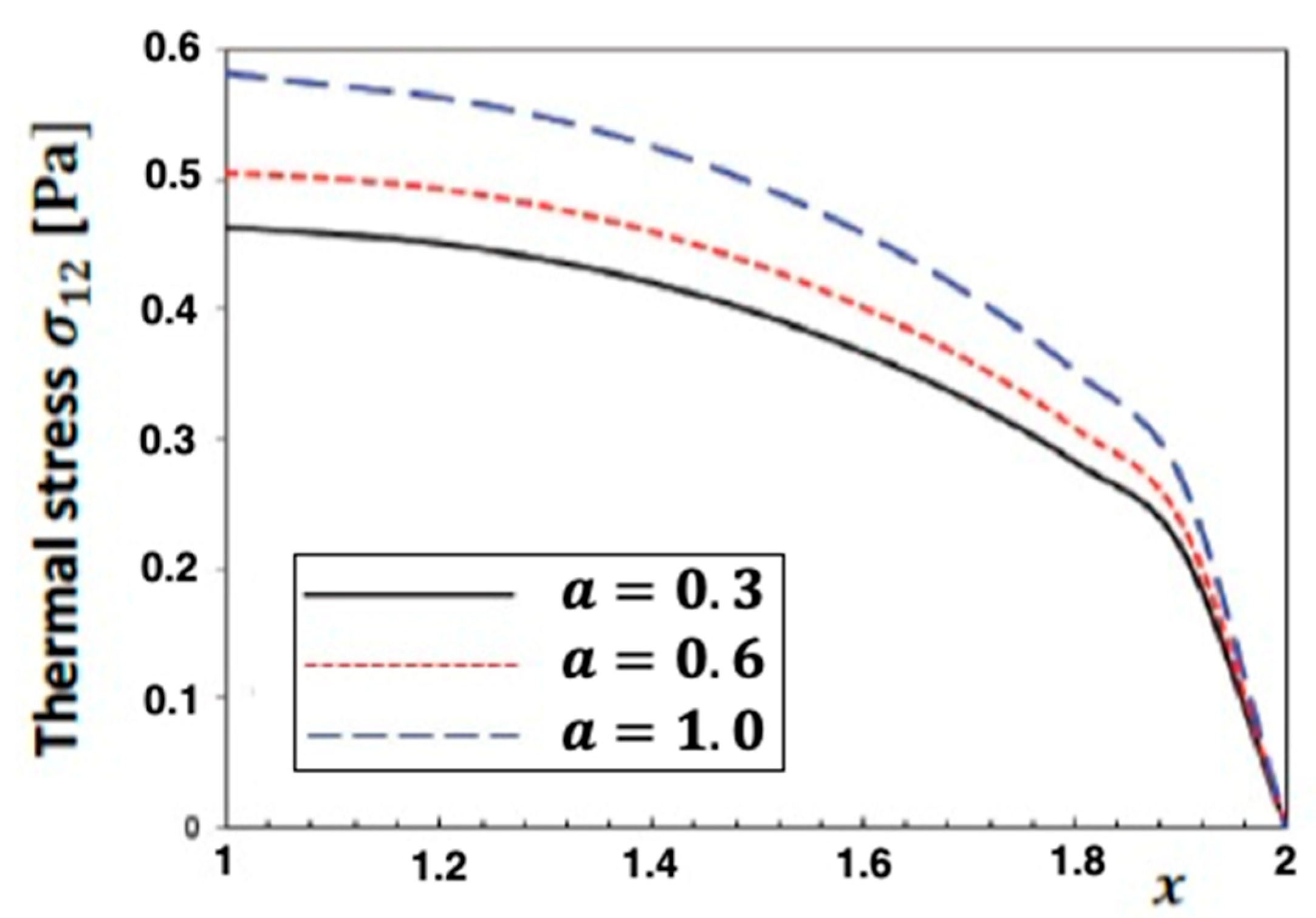
Figure 5.
Variation of the thermal stress along -axis for different values of functionally graded parameter.
Figure 5.
Variation of the thermal stress along -axis for different values of functionally graded parameter.
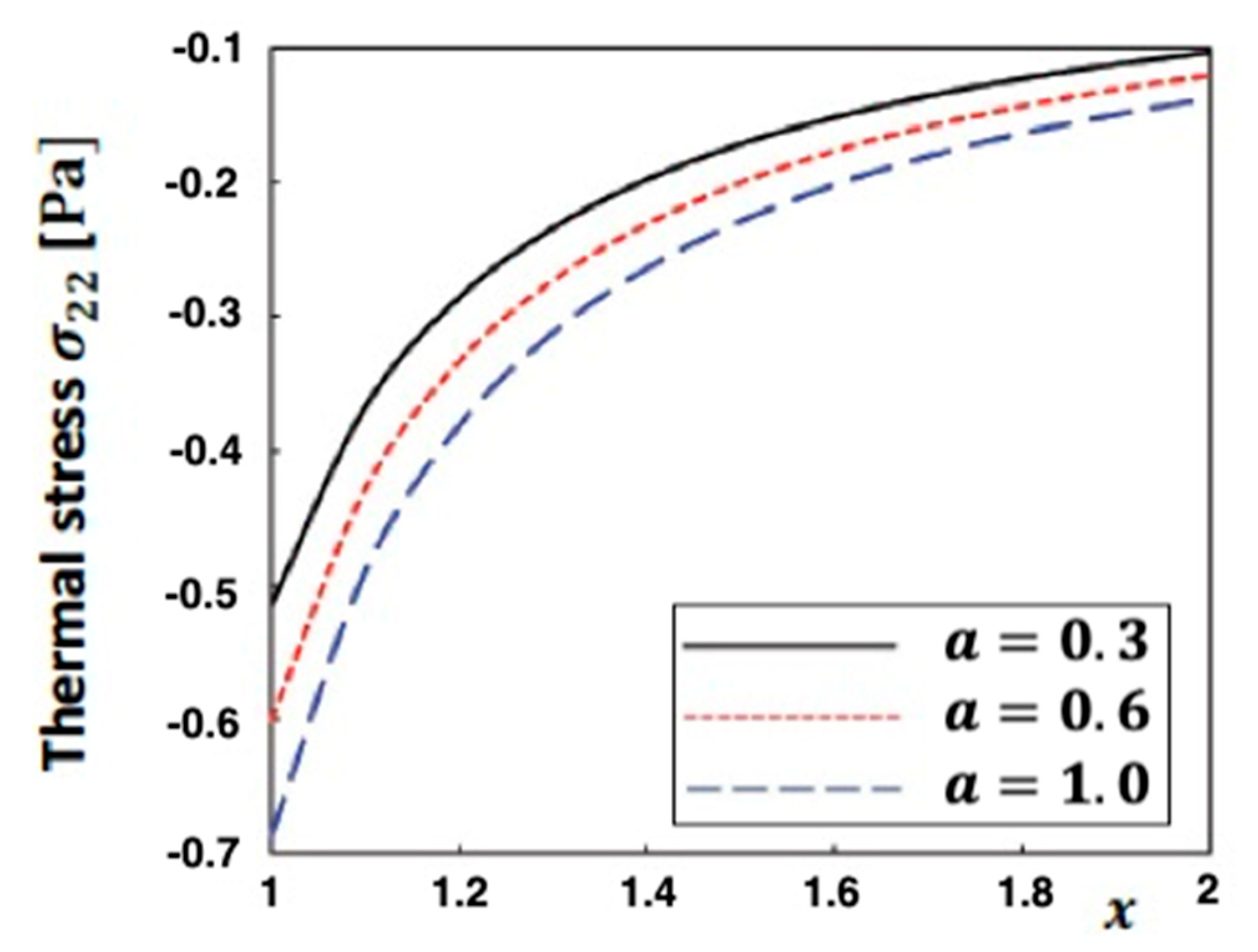
Figure 6.
Variation of the thermal stress along -axis for different values of functionally graded parameter.
Figure 6.
Variation of the thermal stress along -axis for different values of functionally graded parameter.
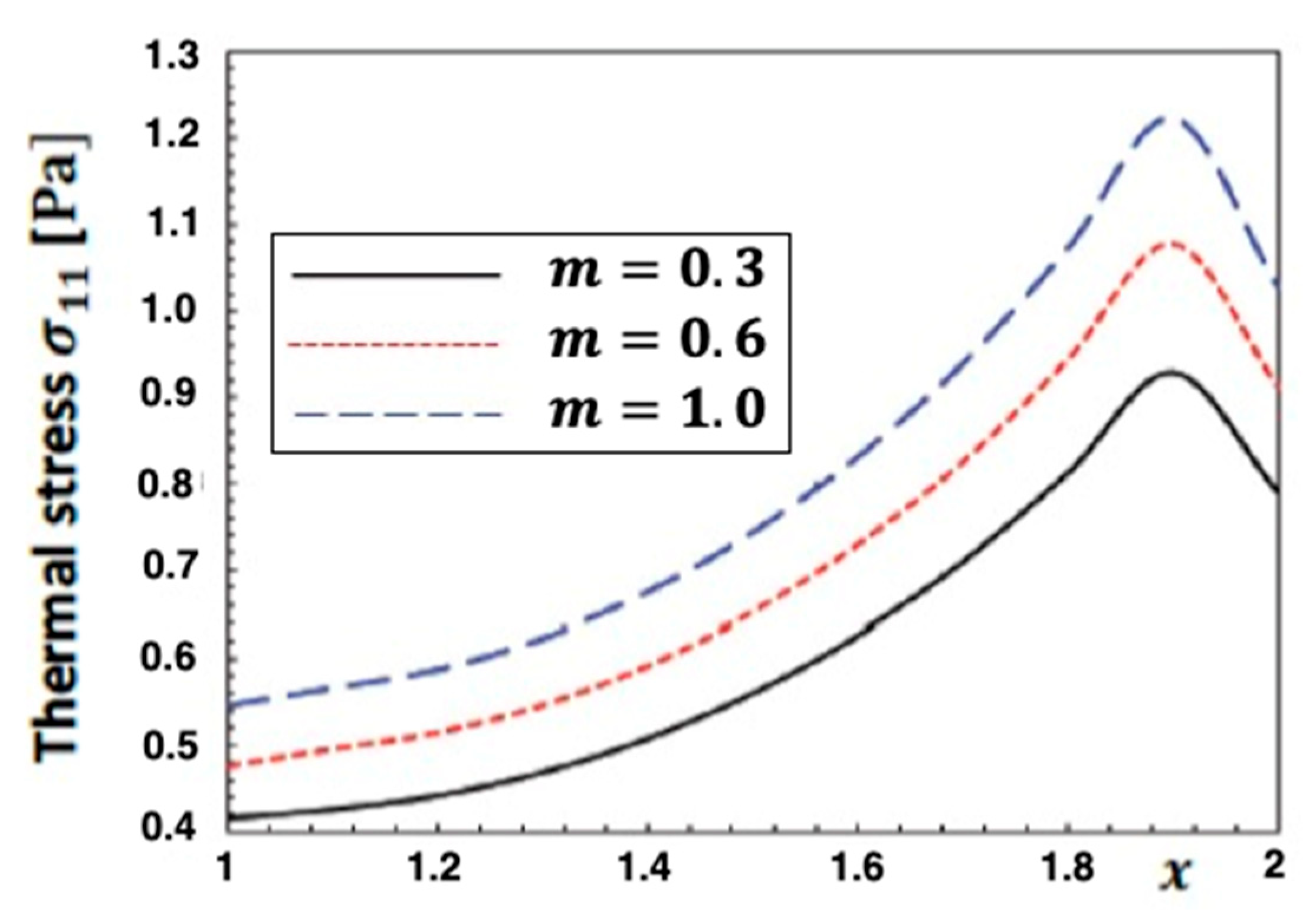
Figure 7.
Variation of the thermal stress along -axis for different values of functionally graded parameter.
Figure 7.
Variation of the thermal stress along -axis for different values of functionally graded parameter.
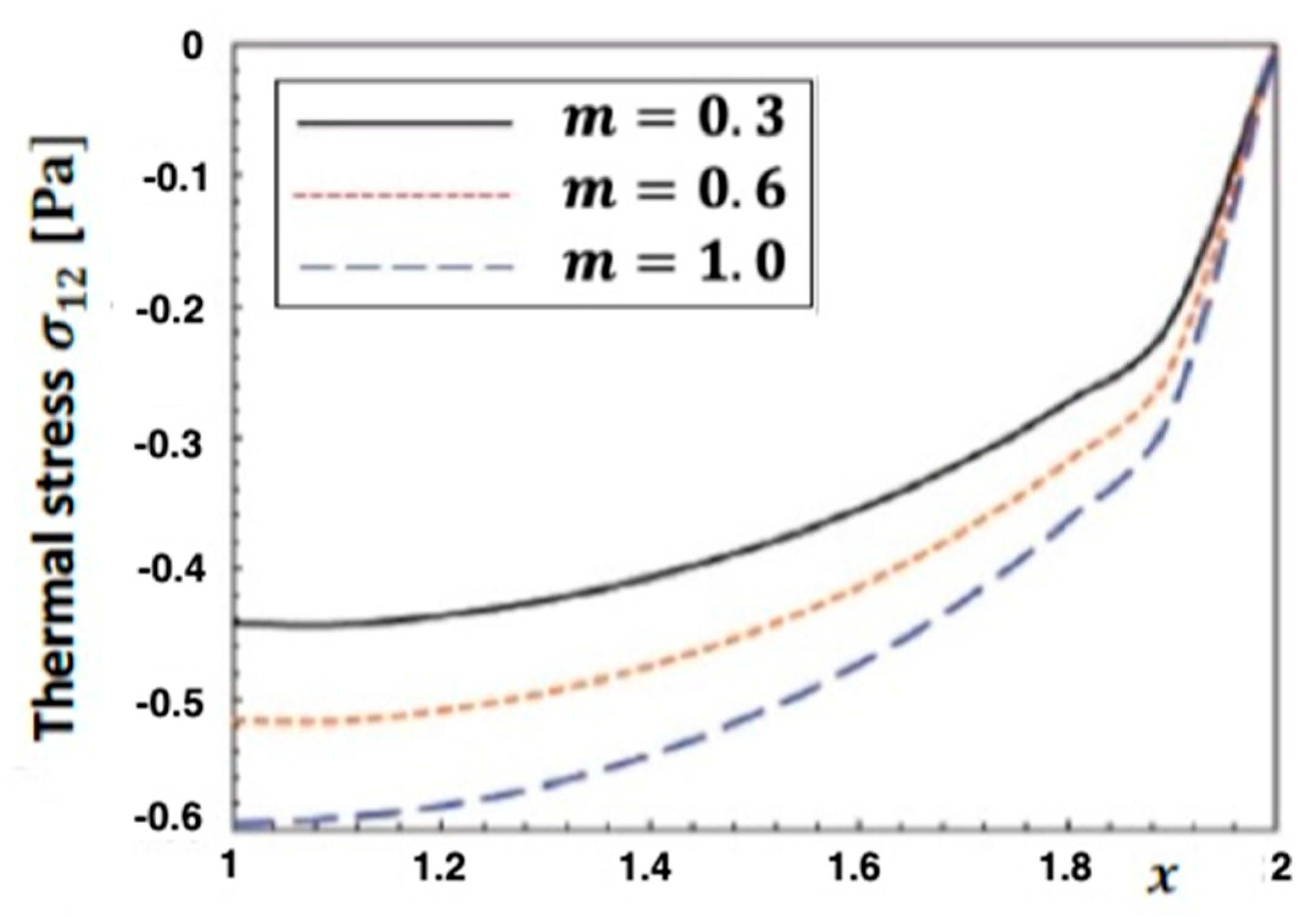
Figure 8.
Variation of the thermal stress along -axis for different values of functionally graded parameter.
Figure 8.
Variation of the thermal stress along -axis for different values of functionally graded parameter.
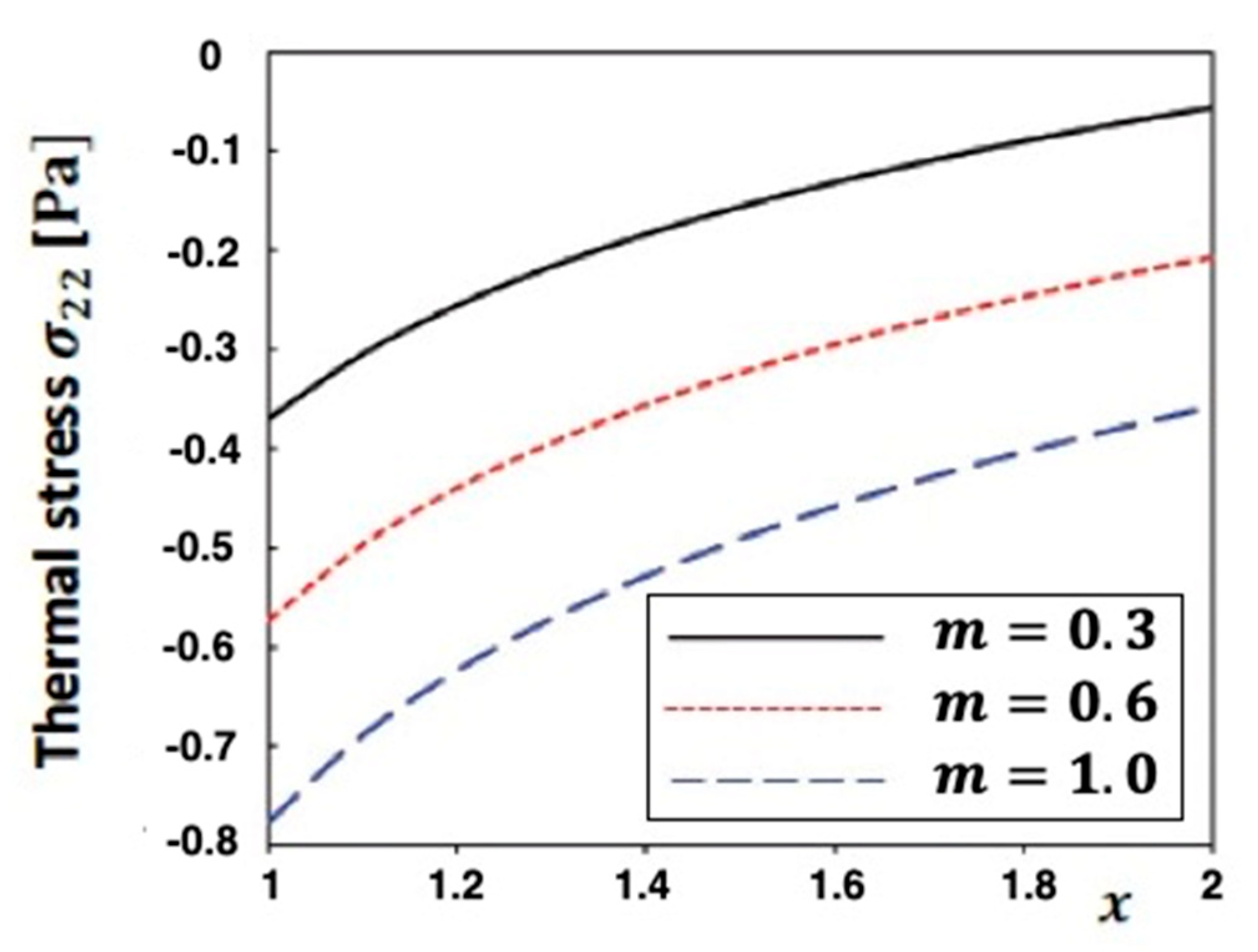
Figure 9.
Variation of the special case thermal stress along -axis for BEM, GFDM and FEM–NMM .
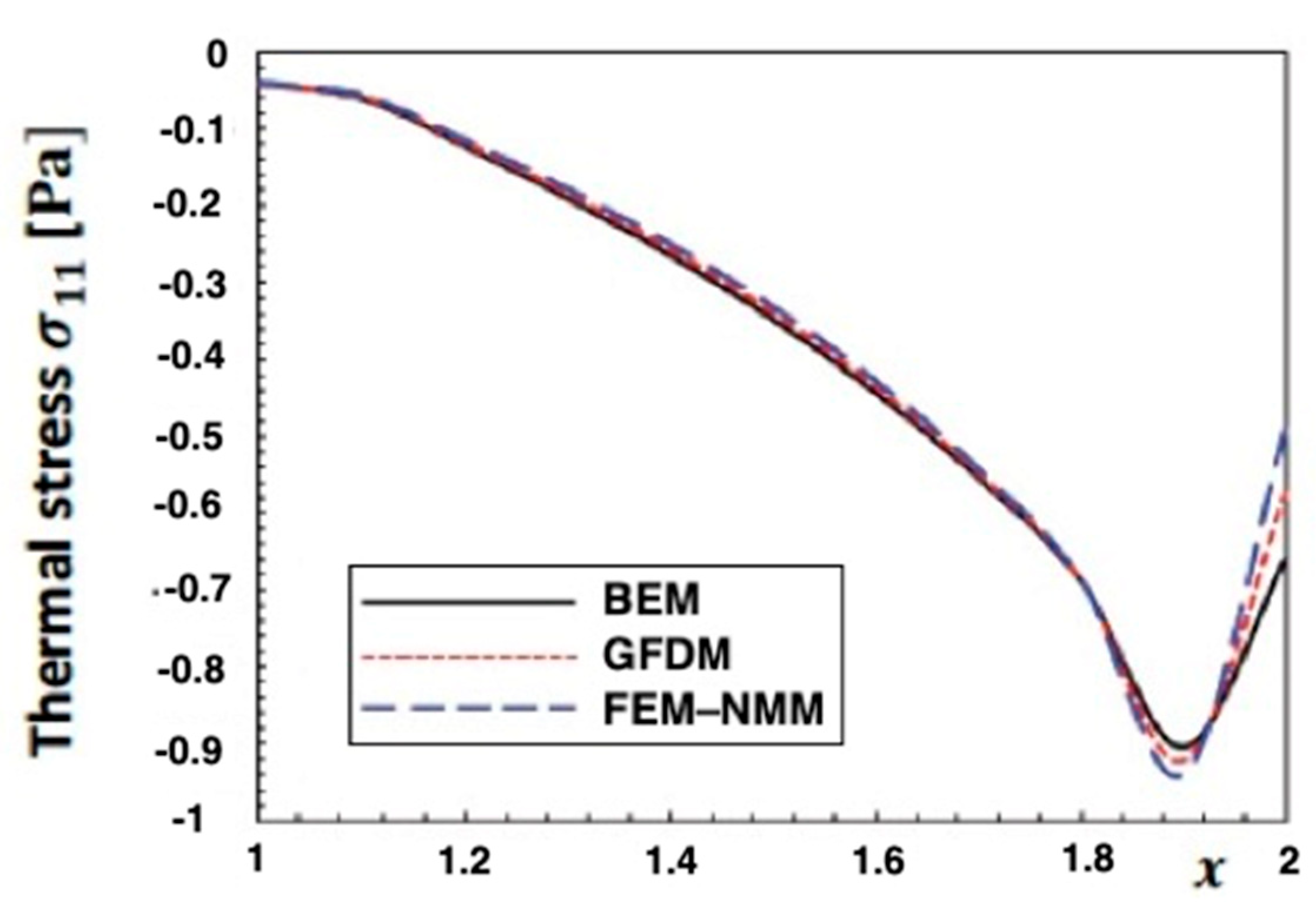
Figure 10.
Variation of the special case thermal stress along -axis for BEM, GFDM and FEM–NMM .
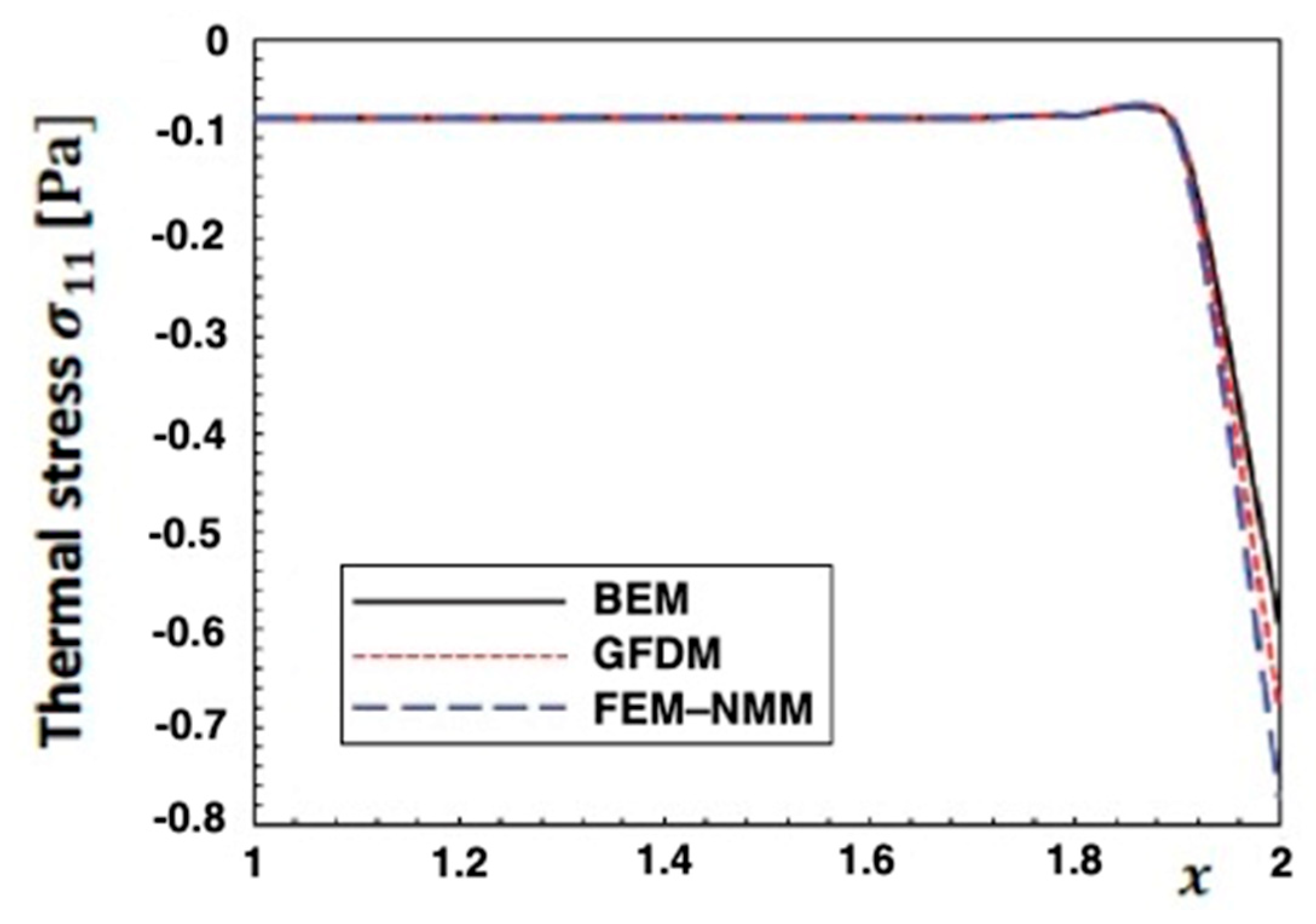

Table 1.
A comparison of the required computer resources for modeling of fractional nonlinear three-temperature (3T) thermoelectric problems.
Table 1.
A comparison of the required computer resources for modeling of fractional nonlinear three-temperature (3T) thermoelectric problems.
| BEM | GFDM | FEM–NMM | |
| Number of nodes | 68 | 50000 | 48000 |
| Number of elements | 42 | 20000 | 18000 |
| CPU time | 2 | 200 | 180 |
| Memory | 1 | 180 | 160 |
| Disc space | 0 | 240 | 220 |
| Accuracy of results | 1 | 2.2 | 2.0 |
Disclaimer/Publisher’s Note: The statements, opinions and data contained in all publications are solely those of the individual author(s) and contributor(s) and not of MDPI and/or the editor(s). MDPI and/or the editor(s) disclaim responsibility for any injury to people or property resulting from any ideas, methods, instructions or products referred to in the content. |
© 2026 by the authors. Licensee MDPI, Basel, Switzerland. This article is an open access article distributed under the terms and conditions of the Creative Commons Attribution (CC BY) license (http://creativecommons.org/licenses/by/4.0/).
Copyright: This open access article is published under a Creative Commons CC BY 4.0 license, which permit the free download, distribution, and reuse, provided that the author and preprint are cited in any reuse.