

Submitted:
10 August 2026
Posted:
11 August 2026
You are already at the latest version
Abstract
Poor aqueous solubility limits roughly 40% of marketed oral drugs and up to ~90% of development candidates. One established remedy is the prodrug strategy: the covalent attachment of a bioreversible promoiety that regenerates the parent drug in vivo. The same conjugation can move a molecule in either of two opposite directions along the hydrophilic–lipophilic axis: hydrophilization raises aqueous solubility, whereas lipophilization instead raises membrane and oil solubility for permeation-limited or topical uses. This review addresses the hydrophilizing route and asks a single question: can enzymatic (biocatalytic) synthesis replace conventional chemistry in building water-soluble prodrugs? We examine, class by class of hydrophilic promoiety (polyol and sugar esters, glycosides, amino-acid esters, poly(ethylene glycol) and ionizable phosphates), the biocatalytic toolbox (lipases, acyltransferases, glycosidases and glycosyltransferases), the molecular determinants of its selectivity, the pharmacokinetic consequences of hydrophilization, and the translation of these reactions to process, benchmarking each against the corresponding chemical route. A consistent three-part test emerges: enzymes suffice, and frequently surpass chemistry, wherever an accessible hydroxyl or carboxyl must be functionalized regioselectively on a promoiety bearing no competing group and a moderate solubility gain is required. This is the regime of polyols, sugars and glycosides, with reported aqueous-solubility increases spanning roughly 4-fold to 5500-fold; chemistry remains necessary for ionizable phosphates, amino-acid esters and PEG carriers. Enzymatic routes are sufficient and advantageous for polyol and sugar prodrugs, yet the field’s central ‘green’ claim is asserted far more often than it is measured (E-factor, PMI, life-cycle assessment), and in-vivo pharmacokinetic data for enzymatically synthesized hydrophilizing prodrugs remain almost absent, the two gaps that most limit translation and set the agenda for the field.
Keywords:
prodrugs
; water-soluble prodrugs
; drug solubility
; poorly soluble drugs
; bioavailability
; biocatalysis
; lipase
; glycosyltransferase
; enzymatic esterification
; green chemistry
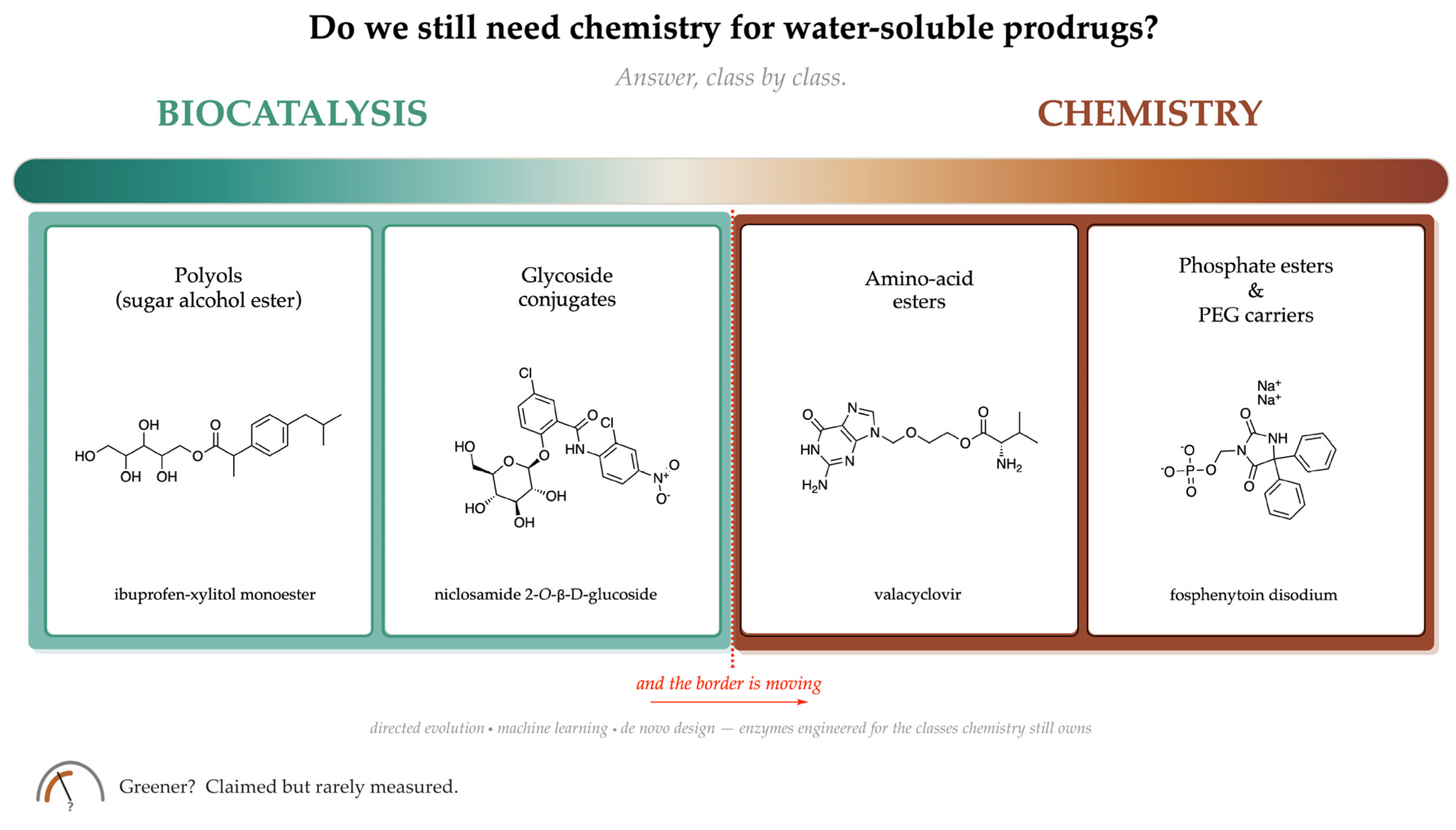
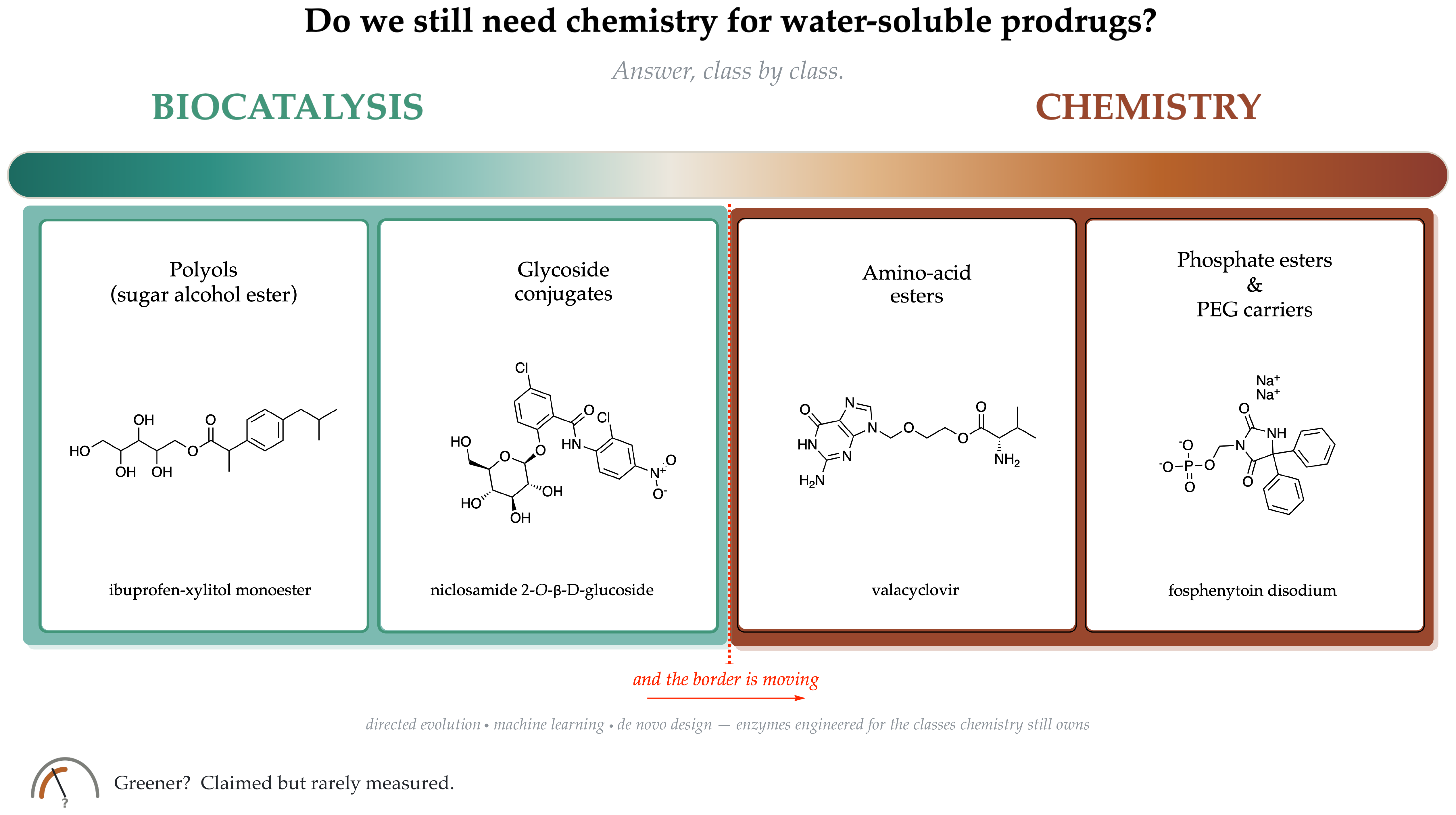
Graphical Abstract. Do we still need chemistry for water-soluble prodrugs? The answer is a border rather than a single verdict, and it is drawn class by class. Where the promoiety offers an accessible hydroxyl, carries no second reactive group and a moderate, neutral solubility gain suffices, the polyol, sugar and glycoside conjugates (left, biocatalysis), a lipase or a glycosyltransferase forms the bond in one regioselective, protecting-group-free step, and the enzyme is the better tool; representative conjugates are the ibuprofen–xylitol monoester and niclosamide 2-O-β-d-glucoside. Where the promoiety is ionizable, brings a competing nucleophile, or is a large non-natural carrier, the amino-acid esters, phosphates and PEG carriers (right, chemistry), the bond is still built by protection, activation and deprotection, as for valacyclovir and fosphenytoin; the largest gains on that side are realized as salts (fosphenytoin as its disodium salt, valacyclovir as its hydrochloride) and are therefore not measured on the same footing as the neutral enzymatic conjugates. That border is moving: directed evolution, machine learning and de novo design are being aimed at the classes chemistry still owns. The sustainability advantage that motivates the enzymatic route, however, remains claimed far more often than it is measured.
1. Introduction
1.1. The Aqueous-Solubility Bottleneck in Drug Discovery and Development
Poor aqueous solubility has become the dominant physicochemical liability of the modern small-molecule pipeline. Contemporary medicinal chemistry, driven by combinatorial approaches and target-led design, tends to deliver candidates of higher molecular weight and greater lipophilicity, and with them a persistent solubility deficit: an estimated ~40% of marketed oral drugs and up to ~90% of the compounds in discovery pipelines are classified as poorly water-soluble [1,2,3]. Because dissolution in the gastrointestinal fluids is a prerequisite for absorption, low solubility translates directly into slow or incomplete dissolution, erratic and sub-therapeutic oral bioavailability and, ultimately, developmental attrition, physicochemical properties, lipophilicity foremost among them, being a recognized contributor to candidate failure [4]. Solubility is therefore not a peripheral formulation detail but a gate-keeping property that decides whether an otherwise potent molecule can become a medicine.
The consequences of poor solubility are not uniform, however, and the Biopharmaceutics Classification System (BCS) makes the distinction precise. By ranking drugs along the two axes of aqueous solubility and intestinal permeability, the BCS separates compounds whose absorption is limited by dissolution (Class II: low solubility, high permeability) from those additionally limited by membrane transport (Class IV: low solubility, low permeability) [5]. The distinction is decisive for any solubilizing strategy: raising solubility rescues a Class II compound, whose only barrier is getting into solution, but leaves a Class IV compound still constrained by its poor permeability, a limit revisited in Section 5.2. A provisional BCS classification of the top-selling oral products indicates that about 40% of marketed drugs fall into the solubility-limited classes (BCS II and IV) [6]. The Developability Classification System (DCS) refines this picture for development by weighing solubility and permeability against dose and dissolution rate, and better predicts when solubility is genuinely the performance-limiting attribute [7]. The burden, moreover, is growing, and Lipinski’s analysis identifies the mechanism rather than the symptom. High-throughput screening reliably detects in-vitro activity even in compounds of very poor thermodynamic solubility, and the readiest way to raise that activity is to add well-placed lipophilic groups, so the assay itself shapes the physicochemical profile of the hits it returns: leads from the HTS era carry higher molecular weight and log P, and lower solubility, than those that preceded it, and these are precisely the properties the rule of five flags as predictors of poor absorption or permeation [8], and about three-quarters of current development candidates now fall into BCS classes II and IV, a markedly higher proportion than among marketed drugs, so poor solubility is an increasingly upstream problem carrying a higher risk of attrition [9].
It also matters which solubility problem is being solved, because the two that prodrugs address are not the same. For a parenteral drug the goal is a concentrated, stable injectable, and the promoiety is chosen to make the molecule dissolve at dose in a small volume; here an ionizable group, most often a phosphate that endogenous alkaline phosphatases cleave once the drug is in the circulation, is the classic answer [10]. For an orally administered drug the problem is dissolution-limited absorption, the defining case of BCS Class II, and raising solubility helps only so far as permeability allows, which is why a Class IV compound is not rescued by solubility alone [5]. The neutral enzymatic conjugates of Section 3 speak mostly to the oral problem; the ionizable prodrugs of Section 3.5 speak mostly to the parenteral one, a distinction the verdict map records for the phosphate class.
1.2. The Prodrug Strategy and the Solubility Axis: Lipophilization vs Hydrophilization
A prodrug is an inactive, bioreversible derivative of a drug that regenerates the active parent in vivo through an enzymatic or chemical transformation, and among the strategies for poorly soluble molecules it is one of the oldest and most clinically validated: roughly one in five small-molecule drugs approved between 2000 and 2008 was a prodrug, and more than 12% of the small-molecule new chemical entities approved in the following decade [11,12]. For solubility specifically, the approach works by covalently appending a promoiety, the solubilizing carrier group, that shifts the molecule along the hydrophilic–lipophilic axis [13]. Crucially, the same conjugation chemistry can move a drug in either direction: grafting a lipophilic group (lipophilization) raises membrane and oil solubility for topical or permeation-limited applications, whereas grafting a polar group (hydrophilization) raises aqueous solubility. Ketoprofen exemplifies the hydrophilizing route: its single carboxylic-acid handle has been conjugated enzymatically to saccharides to give markedly more water-soluble derivatives [14]. The lipophilizing direction has been reviewed extensively elsewhere [15] and lies outside our scope; this review addresses the hydrophilizing direction, the enzymatic construction of water-soluble prodrugs.
What a promoiety can buy depends first on whether it carries a charge. A neutral, polar carrier such as a glycol, a sugar or a short poly(ethylene glycol) chain typically increases solubility only two- to three-fold on its own, whereas an ionizable group such as a phosphate or an amine can raise it by several orders of magnitude [10]. The gains recorded for the neutral, enzymatically built conjugates of Section 3 (roughly 4-fold to 5500-fold, and, for the phytosterol esters, larger still) therefore seem at first to defy the rule. They are measured against parent drugs of vanishingly low baseline solubility, and the appended sugar or polyol does more than add polarity: it disrupts the crystal packing that held the parent insoluble in the first place [13]. The fold-change is large not because a neutral promoiety has become an ionizable one, but because two different barriers are being lowered. Dissolution requires both that a molecule leave its crystal and that the cavity it occupies in water be solvated, and Stella and Nti-Addae separate the drugs limited by the first from those limited by the second: the high-melting, highly crystalline ‘brick dust’ molecule, whose crystal packing energy dominates, from the low-melting ‘grease ball’, whose difficulty is poor interaction with the solvent [13]. Adding polar surface addresses the second barrier, which is the situation the two- to three-fold figure describes, whereas disrupting the packing addresses the first and is treated as a route to solubility distinct from attaching a polar or ionized promoiety [10]. The parents behind the largest gains of Table 3 are crystalline solids whose insolubility is most plausibly packing-limited, so the neutral-carrier results and the textbook expectation describe different mechanisms rather than contradicting one another. The reading remains inferential, however, since none of the syntheses surveyed reports the melting point, enthalpy of fusion or solid-state characterization that would establish it. A second caveat is one of accounting rather than mechanism: the largest gains quoted anywhere in this review are not neutral conjugations but ionizations. The marketed phosphate and amino-acid ester prodrugs are isolated and dosed as salts, fosphenytoin as its disodium salt (≈142 mg/mL, equivalent to ~88 mg/mL of phenytoin and a gain of roughly 3500-fold) and valacyclovir as its hydrochloride (≈174 mg/mL, about two orders over acyclovir), so much of their apparent solubility gain is contributed by the permanent charge and its counter-ion, not by the covalent promoiety itself. Such salt-form values are not strictly comparable to the neutral, un-ionized conjugates that the enzymatic routes deliver, and the two are kept distinct throughout (in the text, in Table 3 and in Figure 1), the largest fold-changes sitting on the chemistry side precisely because they are realized as salts. A third caveat mirrors the second and belongs beside it, because it runs the other way. Several of the drugs hydrophilized enzymatically in Section 3 are themselves carboxylic acids, and esterifying that acid to a polyol consumes the one group in the molecule that would have ionized. Ibuprofen and ketoprofen are weak acids, ketoprofen with a pKa of 3.89 [7], so both are largely dissociated, and correspondingly far more soluble, at intestinal pH. The parent values against which their conjugates are compared, 21 mg/L for ibuprofen, are those of the un-ionized free acid in unbuffered water. That is the appropriate comparison for the stomach, where the acid is neutral and its dissolution genuinely limits absorption, and it is the deficit these prodrugs were designed to correct [16]; it is a generous one for the intestine, where the parent already dissolves as its anion. Both sides of the ledger are therefore measured against favourable denominators, in opposite ways, and neither set of fold-changes should be read as a like-for-like ranking.
1.3. Chemistry vs Biocatalysis for Building the Bond, and the Question This Review Asks
Once a hydrophilizing promoiety is chosen, the bond that attaches it can be forged by classical synthetic chemistry or by an enzyme, and the two routes differ in ways that matter for this review. Chemical acylation, glycosylation or phosphorylation is general and robust, but on the polyhydroxylated promoieties central to hydrophilization it discriminates neither how many hydroxyls react nor which, so reaching a single monosubstituted product demands protecting-group manipulation, together with activated reagents and, often, forcing conditions. The two kinds of control are not equally important, and it is worth separating them at the outset, because for a promoiety chosen purely to raise solubility they answer different questions. The degree of substitution governs the effect itself: every additional acylation both consumes a free hydroxyl and appends a second lipophilic drug unit, so a diester is more lipophilic than the corresponding monoester and moves the conjugate back along the axis it was meant to travel. The position of the ester barely changes the polarity, but it fixes the product as one chemical entity rather than a mixture of constitutional isomers, and it sets the steric environment of the bond and therefore the rate at which the drug is released (Section 5.3). Selectivity is thus wanted for two distinct reasons, the first for solubility and the second for identity and for control of reversion. Biocatalysis offers the opposite profile: hydrolases, glycosyltransferases and related enzymes act with high regio- and stereoselectivity under mild, near-neutral conditions, frequently discriminating one hydroxyl among several without any protection and with a lower environmental burden [17,18]. These attributes align the enzymatic route with the principles of green chemistry (fewer steps, fewer auxiliaries, milder energy demand) that increasingly govern process choice in pharmaceutical synthesis [19,20,21]. Successive waves of protein engineering (enabled by DNA sequencing, gene synthesis and directed evolution) have moved biocatalysis from a niche curiosity to a mainstream, industrially proven synthetic strategy now competitive with chemocatalysis and increasingly able to access even new-to-Nature reactivity [22,23]. This contrast frames the question the title poses, and that the remainder of the review answers class by class: given that biocatalysis can build these bonds, do we still need chemistry for water-soluble prodrugs?
A single criterion runs beneath the class-by-class answers that follow, and it is worth stating at the outset. Biocatalysis is decisive wherever the synthetic difficulty is one of discrimination, both in how many hydroxyls react and in which of them does, and wherever the promoiety carries no second reactive group to compete for the catalyst; this is the regime of the polyols and the sugars, where a lipase or glycosyltransferase delivers a single monosubstituted product in one step that the chemical route can reach only by protection and deprotection. Chemistry reasserts itself the moment that condition breaks: when the promoiety brings a competing nucleophile that must be masked in any case, as with the α-amine of an amino acid; when the solubilizing group is ionizable and demands a dedicated bond-forming chemistry of its own, as with a phosphate; or when the carrier is a featureless polymer that presents nothing for regioselectivity to resolve, as with poly(ethylene glycol). The verdict map of Table 1 is, in essence, this criterion applied one class at a time [10]. To keep the comparison disciplined, we apply the same three-part test to every class that follows: an enzymatic route is expected to win when the drug or promoiety offers an accessible –OH or –COOH handle, when the promoiety carries no second reactive group that would compete for the catalyst, and when a neutral, moderate solubility gain suffices.
A hydrophilizing prodrug must satisfy two conditions, not one, and only the first is a question of synthesis. The bond that carries the solubilizing group must be buildable, the concern of this review’s title, but it must also be cleavable in vivo, reverting cleanly to the active parent at or before its site of action; a conjugate that is beautifully made but does not release its drug, or that masks the very feature on which the drug’s action depends, is a solubilizer and not a prodrug [10]. The two conditions are, revealingly, the province of different chemistries: the bond is most often formed by the routes debated here, enzymatic or classical, while it is almost always broken by an enzyme in the body, a hydrolase or phosphatase acting after administration. Section 5 takes up this second condition; the sections between it and here establish only that the bond can be made.
1.4. Scope, Boundaries and Roadmap of This Review
The scope of this review is deliberately narrow along two axes. First, in synthetic route, we consider only the enzymatic (biocatalytic) construction of the solubilizing bond, treating classical chemistry as the benchmark against which the enzymatic route is judged rather than as a subject in its own right. Second, in direction, we consider only hydrophilization, the attachment of polar promoieties to raise the aqueous solubility of poorly soluble small molecules and bioactives. Three adjacent fields are therefore explicitly excluded. Lipophilisation, the opposite movement along the same axis, is the subject of dedicated reviews and is not treated here [15]. Solubilization by formulation (cyclodextrin inclusion complexes [24], pharmaceutical cocrystals [25], nanocrystals [26] and amorphous solid dispersions [27]) raises apparent solubility without forming a bioreversible covalent bond and therefore does not yield a prodrug; comprehensively surveyed elsewhere [2], these approaches fall outside our definition. Finally, conjugation aimed at targeting rather than solubility, such as antibody–drug conjugates, addresses a different problem and is likewise out of scope [28].
Within these boundaries the review is organized as a single question answered per promoiety class. Existing reviews treat the enzymatic branches in isolation (the lipophilization of phenolics [15] or the glycosyltransferase-mediated glycodiversification of small molecules [29]), but, to our knowledge, none frames the comparison across every class of hydrophilizing promoiety, or centres the prodrug and its pharmacokinetic fate, as we do here: whether, for each class of hydrophilizing promoiety, enzymatic synthesis is sufficient to displace chemistry. A recent critical evaluation makes this comparison for glycosylation specifically [30], whereas the present review spans all hydrophilizing promoiety classes. Comprehensive reviews of prodrug design and of lipase-mediated sugar-ester synthesis exist alongside these [10,31,32], but they treat the promoiety, the pharmacology or the reaction in isolation rather than the choice between the two synthetic routes. Two contributions are therefore specific to the present review: the explicit three-part test of Section 1.3, stated in advance and applied to every promoiety class in the verdict of Section 7, so that the answer can be disagreed with on stated grounds; and the reporting audit of Section 6.4, which converts the field’s most repeated justification, and the endpoint that would vindicate it, into measured gaps. Section 2 surveys the biocatalytic toolbox; Section 3 assembles the per-class evidence; Section 4 and Section 5 examine the molecular determinants of selectivity and the pharmacokinetic consequences of hydrophilization; and Section 6 addresses process translation and the still-unquantified question of the route’s ‘greenness’; Section 7 delivers the verdict class by class, and Section 8 sets out what does not yet work and what is moving. The answer is previewed in the verdict map of Table 1 and shown against the measured gains in Figure 1: enzymes suffice, and often win, for polyol, sugar and glycoside conjugates, whereas chemistry remains necessary for phosphates, amino-acid esters and PEG, and the comparative sustainability that motivates much of the field remains asserted rather than measured.
2. The Biocatalytic Toolbox for Hydrophilizing Conjugation
Before turning to the cases it is worth laying out the instruments (Figure 2, Scheme 1), and doing so comparatively, because every bond-forming enzymatic tool in this section has a classical chemical counterpart against which it will be judged. Where the enzyme is a lipase (or other hydrolase) or an acyltransferase, the chemical alternative is carbodiimide (Steglich) coupling, an acyl chloride, or direct acid-catalysed (Fischer) esterification; where it is a glycosyltransferase or glycosidase, the alternative is chemical glycosylation (Koenigs–Knorr, Fischer glycosidation); where a phosphate must be introduced, the alternative is protecting-group phosphorylation. Those chemical routes are examined head-to-head in Section 6.3; here we set out the biocatalytic toolbox whose scope and limits determine, class by class, whether the enzyme can displace them.
2.1. Hydrolases, Acyltransferases and Whole-Cell Systems
The workhorses of hydrophilizing conjugation are the hydrolases, and above all the lipases. These serine hydrolases operate through the canonical Ser–His–Asp catalytic triad and, unusually, retain and even gain activity in low-water organic media, where the hydrolytic equilibrium is driven back toward synthesis and where substrate, stereo- and regioselectivity can be tuned, sometimes inverted, by the solvent [33]. The lipase B from Candida antarctica (CaLB), sold in immobilized form as Novozym 435, is the field’s default catalyst: it acts on a broad range of primary alcohols and carboxylic acids and is markedly thermostable, while its A-type counterpart (CaLA) extends the reach of these yeast lipases even to sterically hindered secondary and tertiary alcohols [34]. This blend of promiscuity toward polyols and alcohols, mild operation and commercial availability is precisely what makes lipases the natural tool for grafting a hydrophilic promoiety onto a drug bearing a –COOH or –OH handle, as the extensive record of lipase-made active pharmaceutical ingredients attests [20]; proteases and esterases extend the same logic to substrates and regiochemistries that lipases address poorly.
Two developments widen the toolbox beyond the classical lipase. First, the acyltransferase from Mycobacterium smegmatis (MsAcT) performs transesterification, amidation and perhydrolysis directly in water: its octameric assembly forms a hydrophobic active-site channel of restricted access that favours acyl transfer over hydrolysis even in aqueous medium (its perhydrolysis-to-hydrolysis ratio, measured with hydrogen peroxide as the acceptor, is some fifty-fold higher than that of the best lipase tested), so that esters can be built without the anhydrous conditions hydrolases normally demand [35,36]. Making esters in water rather than by displacing an equilibrium in organic solvent is a genuine frontier for hydrophilic conjugation, where drug and promoiety are frequently both water-soluble. Second, whole-cell biocatalysis uses the intact microbial cell as a self-contained package of enzymes and cofactors: it avoids enzyme purification, stabilizes the catalyst within its native envelope and regenerates costly cofactors in situ, an advantage that becomes decisive for the cofactor-dependent glycosyltransferases considered next, and one already exploited to make flavonoid glucosides in engineered Saccharomyces cerevisiae once its endogenous glucosidases are deleted to stop them hydrolysing the product [37,38].
2.2. Glycosidases and Glycosyltransferases: (Trans)Glycosylation and Cofactor Economics
Sugars can be attached by an entirely different enzymatic logic, and the choice of enzyme is really a choice of sugar donor. Glycoside hydrolases can be run in reverse: under transglycosylation conditions, enzymes such as lactase, β-galactosidase or β-xylosidase transfer a sugar to an acceptor rather than hydrolysing it, and have been used to assemble glycosyl blocks and glycosides of poorly soluble scaffolds [39]. Glycosyltransferases (GTs) achieve the same attachment with far higher regio- and stereocontrol: adopting one of two conserved folds (GT-A, metal-dependent; GT-B, metal-independent) and acting by an inverting or a retaining mechanism that fixes the α or β anomer, they deliver the sugar to a defined position and configuration [40]. Direct glucosylation of poorly soluble bioactives by GTs and by maltogenic amylases has produced large aqueous-solubility gains, from mangiferin to niclosamide [41,42]. Two further sucrose- or starch-based transglucosidases broaden this toolkit: amylosucrase transfers glucose from sucrose to acceptors such as resveratrol, whose α-glucoside is about 13-fold more water-soluble than the aglycone [43], while cyclodextrin glucanotransferase (CGTase) transglucosylates poorly soluble flavonoids directly in water, raising the aqueous solubility of baicalin roughly 190- to 320-fold as its mono- and diglucosides [44].
The practical divide within this branch is economic. Leloir GTs require an activated nucleotide sugar such as uridine diphosphate glucose (UDP-glucose), too costly to consume stoichiometrically unless regenerated in situ, typically by coupling the reaction to sucrose synthase, which recycles UDP back to UDP-glucose at the expense of cheap sucrose [45]. Non-Leloir enzymes avoid the problem altogether: family GH70 glucansucrases and transglucosidases transfer glucose directly from sucrose (and related amylases from starch), so that no nucleotide cofactor is needed at all [46]. It is largely this donor economy, rather than any difference in the glycosidic bond itself, that decides which glycosylation route is practical at scale, an argument revisited when process costs are weighed in Section 6.
2.3. Engineering the Catalyst: Directed Evolution, Glycorandomization, Promiscuity Expansion
Where a natural enzyme lacks the required scope, it can be engineered to acquire it. Directed evolution, iterative rounds of mutagenesis and screening, has become a routine and, since its recognition with the 2018 Nobel Prize in Chemistry, an emblematic means of tailoring biocatalysts to non-natural substrates and conditions [47]. For the glycosyltransferases central to Section 2.2, evolution has broadened acceptor promiscuity, the basis of glycorandomisation, and has converted carbohydrate-processing enzymes into synthetically useful transferases [48,49]. The reach of the approach is captured by multi-enzyme design at manufacturing scale: the synthesis of the antiviral islatravir was compressed into a three-step, nine-enzyme in vitro cascade in which five enzymes were evolved to act on non-natural substrates, showing how far engineered biocatalysis has moved from single transformations toward complete synthetic routes [50]. The same rational-design logic underpins the molecular determinants of selectivity treated in Section 4.
2.4. Reaction Media, Acyl-Donor Strategy and Thermodynamic Control
Because hydrophilization joins a polar promoiety to an often apolar drug and releases water, the reaction medium is a control variable rather than a passive backdrop. Working in low-water organic solvent shifts a hydrolase toward synthesis and can sharpen or even invert its selectivity [33]. Solvent choice is now also a sustainability decision: green-solvent selection guides such as the CHEM21 framework rank media on safety, health and environmental criteria and add a bio-derivability band that favours alcohols obtainable from biomass, while deep eutectic solvents have been added to the same palette for lipase catalysis [51,52]. The synthesis of xylitol monoferulate exploits exactly this, using tert-amyl alcohol to dissolve both a hydrophilic polyol and a sparingly soluble phenolic acid in a single green phase [53], building on the broader methodology of lipase-catalysed sugar-ester synthesis in non-aqueous media [32].
Equilibrium is the second lever. An esterification is inherently reversible, and two strategies drive it toward product. The first is thermodynamic: water is a co-product, so removing it, with molecular sieves or under vacuum, lowers the thermodynamic water activity aw and shifts the position of the equilibrium toward the ester. Water activity is not the same quantity as water content, since the same amount of water is held more tightly by a polar solvent or a hydrophilic support than by an apolar one, and it is the activity that the equilibrium and the enzyme both respond to. The second strategy is kinetic and does not move the equilibrium but removes it, by using an activated acyl donor. Vinyl and isopropenyl esters are the classic activated donors: the released enol tautomerises irreversibly (vinyl esters to acetaldehyde, isopropenyl esters to acetone), so the reaction cannot run backwards. This acyl-donor strategy was first demonstrated for the lipase synthesis of monoacylglycerols [54]. The convenience carries a cost: the liberated acetaldehyde is reactive and can deactivate the enzyme through covalent modification, so the gain in conversion must be balanced against biocatalyst stability [55]. Controlling water activity and the synthesis-versus-hydrolysis balance is thus central to any preparative hydrophilization.
2.5. Immobilization, Operational Stability and Reuse
Whatever the enzyme and medium, practical and commercial viability usually requires that the biocatalyst be immobilized. Fixing the enzyme to a support (by adsorption, encapsulation or carrier-free cross-linking) improves operational stability and, above all, enables recovery and reuse across many cycles while lowering the risk of protein residues in the product [56]. Immobilization is more than a packaging step: confinement on a support can itself modify activity, specificity and selectivity, sometimes detrimentally but sometimes favourably, as in the interfacial activation of lipases on hydrophobic carriers [57]. Novozym 435, CaLB adsorbed on a macroporous acrylic resin, is the archetype, and its performance, stability and limitations have been analysed in detail [58]. Direct spectroscopic evidence supports this: infrared microspectroscopy of an immobilized ω-transaminase showed that the carrier’s surface chemistry reshapes the enzyme’s secondary structure and that a reaction water activity above 0.90 markedly improves turnover, tying support choice and reaction medium directly to catalytic performance [59]. Read beside the equilibrium argument of Section 2.4 this is a limit rather than a contradiction: transamination releases no water, so there the activity acts only on the hydration of the protein, whereas for a hydrolase the same variable must be set low enough to drive synthesis and high enough to keep the enzyme mobile. Immobilization also provides the physical form required for the packed-bed, continuous-flow operation that Section 6 takes up as the bridge to process.
3. Hydrophilizing Promoieties and the Prodrugs Made from Them
3.1. Polyols and Sugar Alcohols (Xylitol, Sorbitol, Erythritol, Glycerol, Mannitol)
The clearest case for biocatalysis is also, superficially, the least demanding: grafting a polyol onto a poorly soluble drug through a single ester bond. What makes it compelling is not the bond but the selectivity with which the enzyme forms it. A polyol such as xylitol or sorbitol presents four or five hydroxyls of comparable reactivity; the classical chemical route to a monoester must therefore protect all but one, couple, and deprotect, spending steps and reagents to buy a regiochemistry that a lipase delivers in a single operation. It is this protecting-group-free selectivity for a primary hydroxyl, rather than any single spectacular result, that places polyol prodrugs squarely in the territory where enzymes are the preferable tool.
The argument is best made not by one example but by a series in which the same drug, ibuprofen, is carried toward the hydrophilic end of the axis while the biocatalyst and the reaction medium are progressively simplified. Ibuprofen is an apt test case: an aqueous solubility of only ~21 mg/L renders its oral absorption dissolution-limited [16], precisely the deficit a hydrophilic promoiety is meant to correct. In a first iteration, ibuprofen was esterified directly with sorbitol in a biphasic hexane/water system using free porcine pancreatic lipase (a deliberately inexpensive, non-immobilized catalyst), with the water content itself governing the esterification/hydrolysis balance and yields reaching ~64–73% at equilibrium [16]. A second iteration replaced both the biphasic system and the free enzyme with immobilized Candida antarctica lipase B (Novozym 435) in a single organic phase: simpler to operate, regioselective for the primary hydroxyl of xylitol, and reaching an 80% conversion yield that the recovered biocatalyst still delivered at 68 ± 3% after five reuse cycles, though the aqueous solubility of the ester itself was not determined [60]. A third iteration dispensed with added solvent altogether: (S)-ibuprofen was condensed with glycerol under solvent-free conditions catalysed by immobilized Rhizomucor miehei lipase, the glycerol serving at once as substrate and as enzyme stabiliser [62]. Two conjugates from this polyol series were measured rather than assumed. The ibuprofen–erythritol ester reaches 463 µg/mL by the turbidimetric method, twenty-two times the solubility of ibuprofen itself, and the glyceric ester of ursodeoxycholic acid reaches 123 mg/L against 20 mg/L for the parent bile acid, a six-fold gain, the ester formed at the C-24 carboxyl with NMR placing the glycerol attachment on a primary hydroxyl [63]. Read in sequence, these studies make one point: the enzymatic route is not a fixed protocol but a tunable one, in which catalyst cost, phase behaviour and solvent burden can each be traded down without surrendering selectivity. Beyond ibuprofen, the same protecting-group-free, CaLB-catalysed strategy has been applied across a range of poorly soluble bioactives and polyols: nine cinnamic-acid derivatives were esterified with the polyol erythritol, with molecular docking rationalising how aromatic-ring substituents govern conversion [64]; the poorly soluble bile acid ursodeoxycholic acid (aqueous solubility ~20 mg/L) was hydrophilized as its glyceric ester, with the site of acylation established by two-dimensional NMR (HMBC) [63]; and the lipophilic preservative sorbic acid was converted to a more hydrophilic glycerol ester by the same lipase [65].
That selectivity is not accidental, and the same body of work begins to explain it. Molecular docking of the two ibuprofen enantiomers reproduces the opposite enantiopreferences of the two lipases, CaLB favouring the (R)-acid, the Rhizomucor miehei enzyme the (S), through the near-attack geometries to which we return in Section 4, where the predictive logic of rational design is treated in full [62].
A further refinement turns the promoiety from a passive solubilizer into a second active principle. When the acyl partner is itself bioactive, the conjugate becomes bifunctional: esterification of ferulic acid, an antioxidant, with xylitol yields xylitol monoferulate, a molecule in which both halves carry activity [53]. Here the enzyme also resolves a polarity mismatch that would frustrate a one-pot chemical reaction, since a single green solvent (tert-amyl alcohol) dissolves both the sparingly soluble phenolic acid and the strongly hydrophilic polyol; with water withdrawn by molecular sieves to drive the equilibrium, conversions exceed 98% [53].
The approach is not limited to substrates that carry a carboxylic acid. Phytosterols, which offer only hydroxyl handles and so cannot be esterified to a polyol directly, were joined through a divinyl adipate linker in a fully enzymatic two-step sequence, a lipase-catalysed transesterification followed by a protease-catalysed coupling, raising the aqueous solubility of the β-sitosterol sorbitol adipate to 7.89 mM at 35 °C, against the value of 2.8 × 10⁻⁶ mM reported for the parent phytosterols, with a parallel rise in in vitro bioaccessibility [66]. The same logic carries to other scaffolds, other carriers and bioactives that are not drugs: immobilized Candida antarctica lipase B transesterifies the terminal methyl ester of the food colorant bixin with sorbitol, at a water activity near zero in 2-methyl-2-butanol with tetrahydrofuran added as co-solvent to dissolve the substrates, giving the sorbitol ester of norbixin in 50% yield; the improved hydrophilicity is anticipated by the authors rather than measured [67]. Two caveats keep the account honest and foreshadow Section 6: the activated vinyl donor that renders the first step irreversible liberates acetaldehyde, a reactive by-product, and the second step was run in pyridine, a solvent whose toxicity sits uneasily with any claim of greenness.
Taken together, the polyol studies define the green core of the verdict map. They show that a hydrophilic promoiety can be attached regioselectively, on a primary hydroxyl, without protection; that the biocatalyst and medium can be tuned from a cheap free lipase to a reusable immobilized one to no solvent at all; that the resulting solubility gains span from roughly one order of magnitude to about three; and that the promoiety can itself be chosen to be therapeutically active. For this class, the answer to the title’s question is not a grudging enzymes will do but an affirmative enzymes are the better tool: the first and firmest ‘no, chemistry is not required’ on the map.
3.2. Mono- and Disaccharides: Ester- and Glycoside-Linked Conjugates
If polyols make the cleanest case for enzymatic hydrophilization, mono- and disaccharides make the richest one, for a sugar can be attached to a drug by two mechanistically distinct routes: an ester bond, forged by the very hydrolases already met, or a glycosidic bond, forged by an entirely different class of enzyme. The two routes reach the same destination, a more soluble conjugate, by different roads, draw on different donors, and fail in different ways.
The ester route extends the logic of Section 3.1 from polyols to sugars, and it accommodates two further demands: a poorly soluble, high-value drug and, where that drug is chiral, a single enantiomer. Docetaxel is the emblematic case. Because the taxane offers no convenient handle for direct sugar esterification, the conjugate was assembled chemo-enzymatically: a glycosidase (lactase, β-galactosidase or β-xylosidase) first built a carboxyethyl β-d-glycoside by transglycosylation, and this pre-formed glycosyl block was then coupled chemically to the C-7 hydroxyl of docetaxel, through a sequence that benzylated the sugar hydroxyls, silylated the drug’s C-2′ hydroxyl, joined the two with EDCI and DMAP, and removed both protecting groups by hydrogenolysis [39]. The glucoside was 52-fold more water-soluble than docetaxel and, with the xyloside, was hydrolysed back to the drug by cancer-cell enzymes, whereas the galactoside resisted hydrolysis and largely lost cytotoxicity, an early signal, revisited in Section 5, that the sugar governs not only solubility but release. The lesson for the title question is precise, and it cuts both ways: the enzyme forms the glycosidic bond, but the bond to the drug is made chemically and carries the full protecting-group burden that the polyol esters of Section 3.1 avoid; and the enzymatic step is here the least productive of the sequence, the three glycosylations returning 22 to 35% against 85 to 95% for each of the chemical steps that followed.
The ketoprofen–saccharide conjugates make the stronger claim, because both steps are enzymatic. A lipase from Mucor miehei first resolves the racemic ketoprofen vinyl ester by hydrolysing the (R)-ester, leaving the pharmacologically active (S)-vinyl ester in 90% yield and 90% enantiomeric excess, and a protease from Bacillus licheniformis then transesterifies it onto a panel of mono- and disaccharides, regioselectively at the primary hydroxyl. The yields are uneven: 87% for the mannoside, but 23 to 50% for four of the seven conjugates, the disaccharides faring worst [14]. Every conjugate was more hydrophilic than the parent drug by partition coefficient, and hydrolysis at pH 7.4 returned 37% of the ketoprofen from the glucoside and 47% from the maltoside within 24 h, and close to 90% over seven days. Three features recur from Section 3.1 and matter for Section 6: the reaction is driven irreversibly by a vinyl ester, again at the cost of liberating acetaldehyde; it is run in a 1:1 pyridine/tert-butanol mixture, chosen because unprotected sugars dissolve in little else and screened against DMF and DMSO, so that the solvent burden of this route is set by the promoiety rather than by the enzyme; and the racemic vinyl ester on which both enzymatic steps depend is itself prepared with mercury(II) acetate and sulfuric acid in refluxing vinyl acetate, the same class of heavy-metal promoter for which the classical Koenigs–Knorr glycosylation is faulted in Section 6.3.
The glycosidic route dispenses with the ester entirely and attaches the sugar through its anomeric carbon, but it forces a choice of enzyme that is really a choice of donor economy. Leloir glycosyltransferases transfer sugars with exquisite regio- and stereocontrol, yet demand an activated nucleotide sugar such as UDP-glucose, a reagent too costly to consume stoichiometrically at scale unless it is regenerated. Glucansucrases and transglycosylating amylases sidestep this by transferring glucose from cheap, abundant donors, sucrose or starch, and it is largely this economic distinction, rather than any difference in the bond itself, that decides which glycoside route is practical.
The trade-off is visible across three representative systems. Engineering the glucansucrase GTF-D from Streptococcus mutans expanded its acceptor scope so that it glucosylates flavonoids (catechin, genistein, daidzein, silybin) from sucrose rather than a nucleotide sugar, raising the solubility of genistein roughly four-fold; notably, the products are α-glucosides, whereas the glycosides that occur in nature are β, so the enzyme yields compounds new to the natural-product reservoir [49]. A maltogenic amylase from Parageobacillus galactosidasius glycosylates the xanthone mangiferin from maltodextrin, and the maltosyl-α-(1→6) product is some 5500-fold more soluble than mangiferin while retaining its antioxidant activity, a solubility gain obtained with no nucleotide cofactor at all [41]. Where the nucleotide-sugar cost is accepted, the structural reward can be large: sequential action of two Bacillus glycosyltransferases on ganoderic acid A, one at the C-15 hydroxyl and the other at the C-26 carboxyl, furnished a diglucoside 1024-fold more soluble than the parent triterpenoid [68].
The same Bacillus enzymes extend the pattern to related triterpenoids, and show that the position matters as much as the sugar: BsGT110 rendered ganoderic acid F 89-fold and the 26-O-glucoside of ganoderic acid G 97-fold more soluble than their aglycones, while BsUGT489 glucosylating the same acid at C-3 gave only a 54-fold gain [69,70].
Yet the sharpest warning in this section comes not from its largest gain. Enzymatic O-glucosylation of niclosamide, achieved with engineered plant glycosyltransferases, made the drug 100-fold more soluble at physiological pH, and simultaneously abolished its antimicrobial and antiviral activity [42]. The glycoside is therefore useful only as a true prodrug, one that must shed its sugar at the target site to act; the solubility–permeability tension is taken up in full in Section 5. Read against the verdict map, the sugars split. Where the bond is glycosidic, formed by a glucansucrase, a maltogenic amylase or a glycosyltransferase, the enzyme does the whole job and the class behaves like the polyols before it. Where the bond is an ester, chemistry re-enters: it made the drug–block linkage for docetaxel and the racemic vinyl ester on which the ketoprofen route depends. Both classes are collated in Table 3, with their solubility gains where these were measured, and the open question is no longer whether the bond can be formed enzymatically, but whether the conjugate reverts to an active drug. With the next class, the amino acids, the answer to the title’s question changes outright.
3.3. Amino Acids and Small Peptides
The amino acids are the hinge of the verdict map, the class in which the answer to the title’s question first tilts toward chemistry, and tilts rather than settles, because the obstacle is one of selectivity, not of principle. An amino acid raises aqueous solubility by the same charge-driven logic that governs the phosphates of Section 3.5, though far more gently: its α-amino group, protonated at gastric and physiological pH, supplies the ionizable handle. Acyclovir makes the case. The antiherpetic is sparingly soluble, 1.2 to 1.6 mg/mL at room temperature [71], and erratically absorbed, with an oral bioavailability of only 15–21%; esterification of its hydroxyl with l-valine gives valacyclovir (Scheme 2), soluble as its hydrochloride at about 174 mg/mL, a rise of roughly two orders of magnitude, though carried largely by the ionizable α-amino group as its hydrochloride salt rather than by the valyl ester itself (whose primary role is PEPT1-mediated uptake), and far better absorbed by mouth [72].
Why the bond is chemistry’s rather than the enzyme’s follows from the promoiety itself. The amino acid carries, beside the carboxyl that must become the ester, a free α-amine that is an equally willing nucleophile; unprotected during a chemical coupling it condenses to peptides or consumes the activating reagent, and its stereocentre is fragile besides. The classical route therefore masks the amine as an N-Cbz or Boc carbamate, couples with a carbodiimide, and strips the mask by hydrogenolysis or acid (the protection a lipase avoids in the polyol series), while the strongly basic coupling catalyst still drives partial racemization: two to three per cent of the d-isomer was measured in most batches of the N-Cbz-valyl intermediate and attributed by the authors to DMAP [72]. Stereochemistry matters because absorption is itself stereoselective, the l-esters being taken up markedly better than their d-counterparts and the racemates falling in between [72], a preference later assigned to the intestinal peptide transporter PEPT1 [73]. The marketed amino-acid prodrugs bear out the pattern: valacyclovir and valganciclovir, the l-valyl esters of acyclovir and ganciclovir, lift the oral bioavailability of their parents to roughly 60% from the 15–21% and 6–8% of the free drugs, and both are made by chemical synthesis and reconverted in vivo by a dedicated hydrolase, the biphenyl hydrolase-like protein [10].
For this class the verdict is therefore a qualified yes: chemistry is largely required (Table 2). It is qualified because the enzymatic route is difficult but not precluded, and difficult in a way that invites the biocatalyst. The proteases and acyltransferases of Section 2 can, in principle, join an amino acid to a hydroxyl through an ester, and they offer exactly the asset chemistry lacks here: an absolute stereospecificity that would deliver the single l-ester untroubled by the racemization that attends a basic coupling. What still resists them is the free α-amine, a rival nucleophile in the aqueous or near-aqueous media these enzymes prefer, together with the protease’s own hydrolytic inclination toward the bond just formed. Unlike a phosphate, then, an amino-acid promoiety is a target the enzyme could plausibly reach were these two problems solved; the door is ajar, and it is pushed at again among the frontiers of Section 8. One point Section 5 will take up completes the picture: the free amine does double duty, driving not only solubility but recognition by PEPT1, so that the amino-acid ester is at once a solubilizing and a permeability-directed prodrug, a dual character that no neutral polyol or sugar confers.
3.4. PEG and Oligo(Ethylene Glycol) Carriers
Poly(ethylene glycol) is the most widely used solubilizing polymer in the clinic (Scheme 3), and the aqueous-solubility gains it affords rival or exceed those of any sugar promoiety: conjugation raises the solubility of camptothecin from ~0.0025 to at least 2 mg/mL as its 40 kDa PEG ester [75], and enhances that of the practically insoluble SN38 roughly 1000-fold [76]. Yet PEGylation sits firmly on the chemical side of the verdict map, for reasons that are structural rather than incidental.
In every reported solubility prodrug the bond is forged by chemical activation. The polymer terminus is converted to an active ester (N-hydroxysuccinimide), an active carbonate (p-nitrophenyl chloroformate), or a carboxylic acid coupled through a carbodiimide (DCC/EDC), and then condensed with an –OH, –NH2 or –SH handle on the drug, with competing groups masked where necessary [76]. Higher-molecular-weight PEGs (of at least 30–40 kDa) are needed to slow renal clearance and, for anticancer agents, to secure the passive tumor accumulation on which the strategy depends, while amino-acid spacers such as glycine or alanine are chemically interposed to tune the hydrolysis rate of the releasable ester [75].
Biocatalysis gains no foothold here, and for precisely the reason it excels with polyols: its decisive strength is protecting-group-free regioselectivity among competing hydroxyls, and a PEG terminus is mono-functional (two in the diol form), so there is nothing for that selectivity to resolve; a single, high-yield chemical coupling suffices and the enzyme confers no advantage. The point of attachment reinforces this: in the clinical camptothecin and SN38 conjugates the polymer is esterified at the drug’s C-20, a sterically hindered tertiary hydroxyl whose low nucleophilicity forces even the chemical acylation to rely on carbodiimide activation or on DMAP-assisted acyl transfer [78,79,80]; such hindered tertiary alcohols are poor substrates for lipase-catalysed acylation. The polymer adds a second obstacle, though not the one usually assumed. Sheer size is not disqualifying: lipases esterify low-molecular-weight PEG [58] and transglutaminase or sortase attach 20 to 40 kDa PEG to proteins [77]. In those reactions only the chain end reaches the catalytic residue while the coil stays outside in solvent, and its partner is a flexible protein side chain or a small linear acid, because active sites are built to hold one small substrate at a time: the glucansucrase pocket accommodates a single glucosyl unit per cycle and needs an accessory carbohydrate-binding domain to keep the growing chain nearby [46]. A camptothecin 20-O-ester instead asks one pocket to accept a 40 kDa coil and a hindered tertiary alcohol on a rigid pentacyclic core at the same time, so the steric cost compounds rather than replaces the primary objection that PEG offers nothing for regioselectivity to resolve. The enzymatic advantage therefore evaporates, and chemistry is universal for this class.
Enzymatic PEGylation is not unknown, but where it exists it addresses proteins and peptides (attached site-specifically by transglutaminase- or sortase-mediated conjugation to defined residues [77]) rather than the poorly soluble small molecules that are the subject of this review. For small-molecule hydrophilization by PEG no enzymatic route has been established; this is the gap, and the clearest point on the map at which the answer to the title’s question remains an unqualified yes: chemistry is required.
3.5. Ionizable Promoieties: Phosphate, Hemisuccinate, Choline
With the ionizable promoieties the answer to the title’s question inverts, and it inverts for structural rather than circumstantial reasons. A polyol or a sugar raises solubility by adding neutral, hydrogen-bonding surface; a phosphate, a hemisuccinate or a choline ester raises it by introducing a permanent charge, and charge delivers some of the largest solubility gains in the whole repertoire. Phenytoin, sparingly soluble at 20–25 µg/mL, becomes fosphenytoin (Figure 3), the disodium phosphate ester of its 3-hydroxymethyl derivative, since phenytoin itself carries no hydroxyl to phosphorylate, soluble at 142 mg/mL and equivalent to roughly 88 mg/mL of phenytoin: a gain of roughly 3500-fold, among the largest in the review and realized as the salt, through the permanent charge and its sodium counter-ions, and so not measured on the same footing as the neutral-conjugate gains of Section 3.1 and Section 3.2 [81]. It is precisely this magnitude that makes ionizable prodrugs the strategy of choice where solubility must be forced to its limit, above all in parenteral and intravenous formulations, in which the whole dose must dissolve in a small aqueous volume.
Yet the bond that produces the gain is, with rare exceptions, forged by chemistry, and here the contrast with Section 3.1 is sharpest. The phosphorylation of fosphenytoin could not be achieved by direct reaction on the hydroxymethyl handle. The alcohol was poorly reactive and the phosphorylated species prone to decomposition, so the synthesis proceeds instead through a chloromethyl intermediate displaced by a protected (dibenzyl) phosphate and later freed by hydrogenolysis, or through phosphoramidite coupling, oxidation and deprotection [81]. This is protecting-group chemistry that no biocatalyst removes the need for. The enzymes that introduce phosphate, the kinases, are the wrong tool for an arbitrary drug on two counts: they consume ATP as the phosphoryl donor, and their substrate recognition is narrow, evolved for particular metabolites rather than promiscuous across chemical space. There is no broad-substrate phosphotransferase analogous to Candida antarctica lipase B for the ester bond, and a molecule that is not a natural metabolite is, as a rule, simply not a kinase substrate; the biocatalytic phosphorylation that does exist relies on ATP-dependent kinases of narrow, metabolite-focused scope [83]. For the phosphate promoiety the answer to the title’s question is therefore an unqualified yes: chemistry is required, the first and firmest such answer on the verdict map.
One asymmetry qualifies this verdict without softening it: while making the phosphate bond is chemistry’s, cleaving it is enzymology’s, and here the enzyme is generous where synthesis was not. Alkaline phosphatase is broadly specific and abundant, at the intestinal brush border and throughout the body, so the prodrug that only chemistry can build is reconverted to drug with ease, a division of labour opposite to that of the neutral esters, where a single hydrolase both forms and cleaves the bond. But this very generosity carries a liability that belongs to Pharmaceutics and returns in Section 5. Because dephosphorylation is fast, an orally administered phosphate prodrug can dissolve, be stripped of its charge at the brush border, and generate a locally supersaturated solution of the poorly soluble parent drug that precipitates before it is absorbed (Figure 3). Heimbach and co-workers showed this directly for fosphenytoin, TAT-59 and estramustine phosphate: enzyme-mediated dephosphorylation drives supersaturation, and the induction times for precipitation can fall within gastrointestinal residence times under realistic conditions [82]. This is why the phosphate strategy has triumphed parenterally (fosphenytoin is an intravenous agent) yet so often disappointed by the oral route: the solubility is real but is spent at the wrong moment. The exception confirms the mechanism. Estramustine phosphate is one of the few phosphate prodrugs marketed for oral use, and it escapes precipitation not because it is cleaved slowly but because of what surrounds the parent at the moment of release. Dephosphorylation is progressive, so the estramustine appearing at the brush border does so in a lumen that still holds most of a 400 to 1000 mg dose of unconverted prodrug, and that prodrug binds and solubilizes it: estramustine’s solubility rises roughly forty-fold, from 0.001 to 0.04 mg/mL at pH 7.4, in its presence. Since the driving force for nucleation is the ratio of the released concentration to that solubility, raising the denominator forty-fold keeps supersaturation low and the induction time beyond gastrointestinal residence times, whereas no comparable effect was found for fosphenytoin or TAT-59. The solubilization is a physical, non-covalent interaction between prodrug and parent in solution, distinct from the covalent conjugation that is this review’s subject [82].
The hemisuccinate and choline esters extend the same logic with less drama. A hemisuccinate adds a terminal carboxylate by acylation with succinic anhydride, a choline ester a quaternary ammonium; both are ionizable, both are made chemically, and both share the phosphate’s defining character, a large, charge-driven solubility gain reached by a route for which no general biocatalytic equivalent exists. They confirm rather than complicate the reading of this class: where the promoiety is ionizable, the bond is chemistry’s to make, and the verdict map turns, for the first time, decisively red.
Concrete cases bear this out (Scheme 4). The hemisuccinate is the classic solution-stable, water-soluble design for poorly soluble drugs: the 21-hemisuccinates of corticosteroids, marketed as their sodium succinate salts (hydrocortisone and methylprednisolone sodium succinate), dissolve readily for intravenous use and are cleaved within minutes by esterases, at the recognized cost of limited solution stability [84]. A choline-based promoiety can lift solubility even more dramatically: cholinium salts of methotrexate are more than three orders of magnitude more soluble than the free drug, though here the gain comes from ion pairing rather than covalent conjugation, so this is strictly an ion-paired salt and not a covalent prodrug [85].
3.6. Beyond Esters: The Linkage Palette and Its Cleavage Chemistry
The esters that dominate the preceding sections are only the most common member of a broader palette of solubilizing linkages, and the choice of bond is not incidental: it sets both the chemical stability of the prodrug on the shelf and the mechanism and rate of its reversion in the body [86]. Esters, carbonates, carbamates, glycosidic bonds and phosphate esters differ systematically along these two axes. Esters are the most versatile and the most readily cleaved, hydrolysed chemically and, above all, enzymatically by the ubiquitous carboxylesterases (Section 5.3) [87,88]. Carbonates and, still more, carbamates trade lability for stability, the carbamate being markedly more resistant to hydrolysis, which is useful when premature cleavage must be avoided but which demands a more active enzyme, or a self-immolative spacer, to release the drug [10,89]. Glycosidic bonds are chemically robust and are cleaved selectively by glycosidases, a property exploited for site-directed release (Section 3.2). Phosphate esters are chemically stable yet rapidly cleaved by the broadly distributed alkaline phosphatases, which is why they afford some of the largest solubility gains but can also precipitate the parent drug on too-rapid activation (Section 3.5 and Section 5.2) [82].
The practical lesson is that the linkage is a design variable to be matched to the promoiety and to the intended site of action, not a default. For the enzymatic hydrophilization that is this review's subject the ester and the glycosidic bond are the natural targets: both are formed well by the hydrolases and transferases of Section 2 and cleaved cleanly by widely available enzymes, whereas the carbamate and the phosphate, attractive though they are for stability or for the magnitude of the solubility gain, still belong largely to chemistry both to build (Section 3.3, Section 3.4 and Section 3.5) and, for the carbamate, to release. Reading the palette this way closes the loop between how a bond is made (Section 2, Section 3 and Section 4) and how it is broken (Section 5). Representative structures for each promoiety class are collected in Scheme 5.
4. Molecular Determinants of Selectivity and Rational Design
4.1. Regio- and Stereoselectivity: Discriminating Hydroxyls and Controlling the Anomeric Centre
If Section 3 established that enzymes can build hydrophilizing bonds, this section explains why they build them so well, and the answer is selectivity, the property that the three-part test of Section 1.3 placed at the centre of the comparison. The defining difficulty of grafting a polar promoiety is control of both the degree and the site of substitution: a polyol or a sugar presents several hydroxyls of near-identical reactivity, and the enzyme's value lies in acylating one of them, once, without protecting the rest. That lipases can do this was established early and generally. Several unrelated lipases catalyse the transesterification of monosaccharides with activated esters in pyridine or dry organic media, acylating the primary 6-hydroxyl of glucose, mannose and other sugars selectively enough to give single 6-O-acyl products [90]; and, once that primary position is blocked, lipases discriminate among the four remaining secondary hydroxyls of C-6-protected glucose, galactose and mannose, with different lipases favouring different positions so that even C-2 or C-3 monoesters become accessible by the choice of enzyme alone [91]. This is exactly the protection-free regiocontrol that the chemical route can reach only through protection and deprotection (Section 6.3), and it carries over directly to the polyol prodrugs of Section 3.1, where the same primary-hydroxyl selectivity lets CaLB attach ibuprofen, or ferulic acid, to a single position of xylitol [53,60]. Control of the second axis, the degree of substitution, is documented in the same series and largely by absence: under optimized conditions the ibuprofen–xylitol, sorbic acid–glycerol and (S)-ibuprofen–glycerol esterifications gave no detectable diester, and the xylitol monoferulate synthesis only traces of the bis(ferulate) [53,60,62,65]. The lever is the acid-to-polyol molar ratio, raised in favour of the polyol expressly to minimize diacylation of erythritol; where that suppression is not applied the di-acylated ibuprofen–erythritol ester is a major product, isolated in 50% yield beside the monoester at 75% [62]. That the diester is the outcome to be avoided rather than a harmless companion follows from its properties, since it is more lipophilic than the monoester and, for erythritol, a solid where the monoesters are oils [60,62]. The same secondary-hydroxyl discrimination operates on drug scaffolds: CaLB selectively acylates the 3α- over the 7β-hydroxyl of the bile acid ursodeoxycholic acid, and can subsequently remove the 3α-ester selectively, distinguishing two secondary hydroxyls on one steroid nucleus [92].
Regiocontrol is only one axis; stereocontrol is a second, independent one, and it matters most for the glycosides of Section 3.2. Glycosyltransferases set the anomeric configuration of the new bond, and engineering that configuration expands chemical space rather than merely improving yield: an engineered glucansucrase (GTF-D from Streptococcus mutans, variant M4) glucosylates flavonoids such as catechin, genistein and daidzein from cheap sucrose and attaches the sugar as an α-glucoside, whereas the naturally occurring glycosides are typically β, so the enzyme delivers products new to the natural-product reservoir, with solubility and bioactivity that must be characterized afresh [49]. A third axis, enantioselectivity, operates on the drug rather than the promoiety: CaLB preferentially esterifies the (R)-enantiomer of ibuprofen, so the biocatalyst also filters the stereochemistry of the parent acid it conjugates [60]. Regio-, stereo- and enantioselectivity are therefore three distinct handles set in a single step by the choice of enzyme, and, as Section 5.3 notes, the anomer fixed here also decides which glycosidase can later cleave the bond in vivo, the reason a docetaxel glucoside is unmasked by cancer-cell enzymes while its galactoside is not.
4.2. Rational Design: Molecular Docking, Near-Attack Conformations, Enzyme Engineering
Selectivity of this precision is not accidental, and it can increasingly be predicted before a single reaction is run. Its conceptual basis is the near-attack conformation (NAC): the fraction of enzyme–substrate complexes populated in a geometry already poised to reach the transition state governs the observed rate, so a hydroxyl, or an enantiomer, that more readily adopts a productive near-attack geometry reacts faster and more selectively [93]. Molecular docking operationalises this idea by ranking, for a given substrate pose in the active site, which hydroxyl or which enantiomer sits in a near-attack geometry. Applied to the ibuprofen–polyol series, docking of the two ibuprofen enantiomers into the lipase active sites reproduced the opposite enantiopreferences observed experimentally, CaLB favouring the (R)-acid, and rationalised the regiochemistry through the near-attack geometries accessible to each pose (Section 3.1) [62]. Docking thus turns selectivity from an empirical observation into a design variable. The same computational–experimental workflow extends beyond ibuprofen: docking of nine cinnamic-acid derivatives predicted how ring substituents and the degree of unsaturation reshape the productive binding poses on CaLB, in agreement with the measured conversions [64].
Where the natural active site does not offer the required geometry, it can be reshaped, and the same engineering logic met in Section 2.3 becomes a rational-design tool here: site-saturation mutagenesis of GTF-D produced a variant with markedly improved transglucosylation of flavonoids, an active site redesigned to admit new acceptors and to set the anomeric outcome [49]. Read together, docking and NAC analysis (which explain and predict selectivity) and directed or semi-rational engineering (which introduce it where it is absent) form the design loop that will decide whether the enzymatic route can be extended to the substrate classes where chemistry still dominates (Section 3.3, Section 3.4 and Section 3.5 and Section 8.2).
4.3. Structural Verification: NMR-Led Assignment of Acylation Position, Purity and Degree of Substitution
A claim of regioselectivity is only as good as the evidence that locates the new bond, and here nuclear magnetic resonance is decisive. The position of acylation is established most directly by heteronuclear multiple-bond correlation (HMBC), which reveals the long-range 1H–13C coupling between the proton on the esterified carbon and the ester carbonyl, pinpointing which hydroxyl of the polyol or sugar carries the acyl group; a full one- and two-dimensional suite (1H, 13C, DEPT, COSY, HSQC/HMQC and HMBC) with mass spectrometry then confirms structure, purity and, for polyols, the degree of substitution. This is the approach by which the ester position was assigned historically for enzymatic sugar monoesters via 13C NMR [90], and by which the site of esterification was fixed and a single regioisomer confirmed for both the ibuprofen–xylitol prodrug and xylitol monoferulate [53,60]. HMBC is what separates a demonstrated regiochemistry from an asserted one.
The spectroscopy that verifies a product can, increasingly, also follow the reaction that makes it. In-line and on-line NMR (now feasible on benchtop instruments and in flow, and quantitative down to the microlitre scale) turns NMR from an end-point characterization tool into a real-time monitor of conversion, kinetics and reaction optimization [94]. For a hydrophilizing esterification this means the synthesis-versus-hydrolysis balance (Section 2.4) and the emergence of the target regioisomer could be tracked as they occur; it is the natural bridge from the molecular characterization of this section to the process-analytical control of Section 6.6, where the analytical method that proves the bond in the laboratory becomes the one that governs it on the plant.
5. From Molecule to Medicine: Pharmaceutical and Pharmacokinetic Consequences
5.1. Quantifying the Payoff: Solubility and Dissolution Gains
The most immediate measure of a hydrophilizing prodrug is the size of the solubility gain it delivers, and across the enzymatic conjugates of Section 3 these gains are large but far from uniform, spanning roughly 4-fold to 5500-fold, that is from well under one to nearly four orders of magnitude (Table 3). Their magnitude depends less on the enzyme than on how insoluble the parent is and on how thoroughly the appended sugar disrupts its crystal lattice.
Three cautions keep these numbers meaningful. First, they are not measured on a common footing: the determinations are made in water or in buffer, at temperatures that are not always stated, by methods ranging from filtration with chromatographic quantification to turbidimetry, and the phytosterol entry compares a conjugate measured here with a parent value taken from earlier literature rather than alongside it, so fold-changes drawn from different studies should be read as orders of magnitude rather than ranked against one another. Second, where a value is reported it refers to equilibrium (thermodynamic) aqueous solubility, not to the dissolution kinetics that actually govern oral absorption; dissolution-rate profiles are rarely reported for these conjugates, so a large equilibrium gain should not be read automatically as a proportional gain in dissolution or exposure. Third, a solubility gain is useful only if the parent is released and remains active, a point developed in Section 5.2 and Section 5.3, and the reason the docetaxel galactoside, which resisted hydrolysis, largely lost the cytotoxicity that its glucoside retained [39].
A fourth observation belongs here rather than in a footnote, because it concerns the endpoint on which this review turns. Of the seventeen primary syntheses of Table 3, six report no solubility measurement for any conjugate they made, one of them stating only that the product is more hydrophilic than the parent and one anticipating rather than measuring the gain. A further conjugate is likewise unmeasured, although the study reporting it measured a companion conjugate from the same series and is therefore scored as measured. Eleven of seventeen (65%) therefore quantify the property the conjugate was made to improve, the study-by-study scoring being given in Supplementary Table S1. The same audit shows one study in seventeen reporting an in-vitro permeability surrogate and none reporting in-vivo data, the asymmetry set out in Table 4 and counted in Table 6. Synthetic novelty has been easier to publish than the measurement that would justify it, and the pattern runs parallel to the green-metrics gap of Section 6.4.

Table 3.
Representative enzymatically and chemo-enzymatically synthesized hydrophilizing prodrugs across promoiety classes, polyol esters (Section 3.1) followed by the sugar and glycoside conjugates of Section 3.2. Columns give the promoiety and linkage, the biocatalyst and its source or form, the glycosyl/acyl donor and reaction medium, the aqueous-solubility gain quantified in the cited primary study (fold-increase or absolute value; n.r. = not reported, which applies to six of the seventeen studies), and notes on selectivity, activation or retained activity. Where given, conversion or yield is included with the reaction medium. All solubility gains in this table are for the neutral, un-ionized conjugate; salt-form values (e.g., fosphenytoin disodium, valacyclovir hydrochloride) are discussed separately in Section 3.3, Section 3.4 and Section 3.5 and are not directly comparable.
Table 3.
Representative enzymatically and chemo-enzymatically synthesized hydrophilizing prodrugs across promoiety classes, polyol esters (Section 3.1) followed by the sugar and glycoside conjugates of Section 3.2. Columns give the promoiety and linkage, the biocatalyst and its source or form, the glycosyl/acyl donor and reaction medium, the aqueous-solubility gain quantified in the cited primary study (fold-increase or absolute value; n.r. = not reported, which applies to six of the seventeen studies), and notes on selectivity, activation or retained activity. Where given, conversion or yield is included with the reaction medium. All solubility gains in this table are for the neutral, un-ionized conjugate; salt-form values (e.g., fosphenytoin disodium, valacyclovir hydrochloride) are discussed separately in Section 3.3, Section 3.4 and Section 3.5 and are not directly comparable.
| Drug / bioactive | Promoiety & linkage | Biocatalyst (source / form) | Donor / reaction medium | Solubility gain | Selectivity, activation & notes | Ref. |
| Ibuprofen | Xylitol ester (primary –OH) | CaLB (Novozym 435, immob.); ×5 reuse | 2-methyl-2-butanol; 80% conv. | ≈12× (method not stated) | regioselective for the primary –OH | [60] |
| Ibuprofen | Sorbitol ester | porcine pancreatic lipase (free) | biphasic hexane/water; 64–73% conv. | n.r. | – | [16] |
| (S)-Ibuprofen | Glycerol ester | Rhizomucor miehei lipase (immob.) | solvent-free (glycerol as substrate + stabiliser); 83 ± 5% conv. | n.r. | – | [62] |
| Ferulic acid | Xylitol ester | CaLB; >98% conv. | tert-amyl alcohol | n.r. | bifunctional antioxidant conjugate | [53] |
| Ibuprofen | Erythritol ester | CaLB (Novozym 435, immob.) | 2-methyl-2-butanol; 82 ± 4% conv. | 463 µg/mL (≈22×; turbidimetric) | pair of diastereomers; bio-based polyol | [62] |
| Cinnamic acids (nine derivatives) | Erythritol ester | CaLB (Novozym 435, immob.) | solvent-assisted or solventless; yields >95% | n.r. | docking rationalises substituent effects | [64] |
| Ursodeoxycholic acid | Glyceric ester (monoglyceride) | CaLB (Novozym 435, immob.) | solvent-free, glycerol as reagent and medium | 123 mg/L (≈6×; UDCA 20 mg/L) | C-24 ester; primary glycerol –OH assigned by NMR | [63] |
| Sorbic acid | Glycerol ester | CaLB (immob.) | solvent-free; 61% isolated | n.r. | antimicrobial activity improved vs S. cerevisiae | [65] |
| Bixin (food colorant) | Sorbitol ester of norbixin (methyl-ester transesterification) | CaLB (Novozym 435, immob.) | 2-methyl-2-butanol + 20% THF, a_w ≈ 0; 50% yield | n.r. | hydrophilicity anticipated by the authors, not measured | [67] |
| Phytosterols (β-sitosterol) | Sorbitol / mannitol / xylitol ester | C. rugosa lipase + B. subtilis protease | divinyl adipate linker; isooctane, then pyridine; >94% conv. | 4.6–7.9 mM (parent 2.8 × 10⁻⁶ mM, lit.) | two-enzyme sequence | [66] |
| Docetaxel | β-d-glucoside (carboxyethyl spacer, ester-linked) | glycosidase (lactase / β-gal / β-xyl, transglyc.) + chemical coupling | aqueous buffer, then chemical | ≈52× (27 µM) | sugar–drug bond formed chemically; galactoside inactive | [39] |
| (S)-Ketoprofen | Mono-/disaccharide esters (primary –OH) | M. miehei lipase (resolution) + B. licheniformis protease | vinyl ester; pyridine / tert-butanol; ≤87% | n.r. (all > parent) | released at physiological pH | [14] |
| Flavonoids (catechin, genistein, daidzein, silybin) | α-glucoside (O-glycoside) | engineered glucansucrase GTF-D M4 (S. mutans) | sucrose | genistein ≈4× | α-anomer; no nucleotide cofactor | [49] |
| Mangiferin | maltosyl-α-(1→6) O-glycoside | maltogenic amylase (P. galactosidasius) | maltodextrin | ≈5500× | antioxidant retained; no cofactor | [41] |
| Ganoderic acid A | 15,26-O-β-diglucoside | two Bacillus glycosyltransferases (Leloir), sequential | UDP-glucose | ≈1024× | two-site sequential glycosylation | [68] |
| Ganoderic acids F, G | glucoside (O-glycoside) | Bacillus GT BsGT110 (Leloir) | UDP-glucose | ≈89× (F); ≈97× (G) | single-site glucosylation | [69,70] |
| Niclosamide | O-glucoside | engineered plant glycosyltransferases (Leloir) | UDP-glucose | ≈100× (physiol. pH) | antimicrobial activity abrogated: true prodrug | [42] |
5.2. The Solubility–Permeability Interplay and the Hydrophilic–Lipophilic Balance
A solubility gain is not a free lunch. Because intestinal permeability scales with the drug's membrane/aqueous partitioning, raising apparent aqueous solubility tends to lower apparent permeability: solubilization by cyclodextrins or surfactants reduces the free, membrane-available fraction of drug, whereas cosolvents lower its membrane/aqueous partitioning at essentially constant free fraction; by either route the solubility–permeability interplay cannot be ignored when a solubilizing strategy is judged [95]. For a hydrophilizing prodrug the same tension operates through the promoiety's polarity (beyond a point, added hydrophilicity that aids dissolution begins to hinder permeation), so the target is a balance along the hydrophilic–lipophilic axis rather than maximal solubility.
The niclosamide case is the sharpest illustration: its O-glucoside is 100 times more soluble at physiological conditions yet shows no effect on the growth of Staphylococcus aureus or on the infectivity of SARS-CoV-2 and hepatitis C virus at concentrations at which niclosamide itself is active. The authors attribute the loss to the sugar preventing membrane penetration or sterically hindering the binding interactions, and conclude that such a glycoside would be useful only if it behaved as a true prodrug, shedding its sugar at the target site [42]. The framework that formalizes this limit is the BCS (Section 1.1): solubilization rescues a Class II compound but leaves a Class IV compound constrained by poor permeability [5]. A kinetic pitfall attends the largest jumps: a supersaturated solution generated on dissolution must be stabilized against precipitation, the 'spring and parachute' problem, or the dissolved drug crashes out before absorption [96], precisely what occurs when a phosphate prodrug is dephosphorylated too rapidly at the intestinal wall [82].
5.3. In Vivo Activation: Enzymatic Reconversion, Release Kinetics, Interspecies Differences
A prodrug must revert to its active parent, and whether that reversion needs a catalyst different from the one that built the bond depends on the linkage. For the neutral esters at the heart of this review it does not: the same hydrolase family forms the bond in vitro, driven toward synthesis by the low-water conditions of Section 2.4, and hydrolyses it in vivo, so what changes is the thermodynamic direction, not the enzyme (a point already made in Section 3.5). Glycosides can be built by the very glycosidases that later cleave them (transglycosylation) or by distinct glycosyltransferases, whereas the phosphates are the clear opposite case, forged by chemistry and cleaved by a genuinely different catalyst, a phosphatase. In vivo, esters are cleaved by ubiquitous esterases and carboxylesterases, glycosides by glycosidases and phosphates by phosphatases, each with its own tissue distribution and kinetics. The geraniol–ferulic acid ester (Fer-Ger) shows how tissue- and species-dependent this reconversion is: it is hydrolyzed in human whole blood with a half-life of ~194 min, roughly ten times faster in rat whole blood (~20 min) and faster still in rat liver homogenate (~4 min), yet it is not hydrolyzed in rat brain homogenate nor by neuron-differentiated N2a cells, in which no free geraniol is detectable inside or outside the cells, and the intact conjugate still prevents the loss of viability caused by hydrogen peroxide, although the authors find it pro-oxidant in those same cells and caution that the protection may reflect mitochondrial hyperactivation [97].
Such interspecies differences are the rule, not the exception, and they complicate the translation of animal data to humans. For an ester prodrug of curcumin, plasma hydrolysis proceeded in the order rat ≫ human > dog, with carboxylesterase dominating in the rat but multiple esterases contributing in dog and human [98]. The human carboxylesterases are themselves distributed unevenly (CES1 predominating in liver, CES2 in intestine and in several tumors), and between them they activate a long list of ester prodrugs (oseltamivir, clopidogrel, irinotecan, capecitabine), so the choice of linkage effectively selects both the activating enzyme and the site of activation [87,88]. The same logic explains why the docetaxel glucoside is unmasked by cancer-cell enzymes while its galactoside is not [39]: the sugar, not only the drug, dictates where and whether release occurs.
5.4. Reported Bioavailability and (Pre)Clinical Outcomes
When the question shifts from solubility in a cuvette to performance in vivo, the evidence base becomes markedly asymmetric, and the asymmetry is itself a finding. The solubilizing prodrugs with real pharmacokinetic and clinical data are, almost without exception, of chemical synthesis. Fosphenytoin is water-soluble and cleaved by endogenous phosphatases to release phenytoin on parenteral administration [81]. Valacyclovir, the l-valyl ester of acyclovir, raises the oral bioavailability of acyclovir from ~15–21% primarily through active uptake by the intestinal peptide transporter PEPT1 [10], with improved aqueous solubility a secondary contributor, and is made by protecting-group chemistry [72]. Even the glycoside example most cited clinically, dapagliflozin, is instructive precisely because it is not a releasing prodrug: the metabolically labile O-glucoside phlorizin was deliberately replaced by a hydrolysis-resistant C-glucoside to prevent β-glucosidase cleavage, a chemical solution to a stability problem [99].
Against this stands the near-absence of in vivo pharmacokinetics for the enzymatically synthesized hydrophilizing prodrugs that are this review's subject: their solubility gains are documented, but AUC, Cmax, Tmax, oral bioavailability and half-life are seldom measured, and the reconversion data that do exist are largely in vitro (plasma or tissue homogenates, as for Fer-Ger) rather than in vivo [97]. This is not a bibliographic gap to be closed by more searching but a real gap in the primary literature, and stating it plainly is more useful than obscuring it: for the enzymatic route to compete on the terms that matter to a pharmaceutics readership, the field must generate genuine pharmacokinetic data, not only solubility fold-changes. The contrast is laid out in Table 4.
Table 4.
(Pre)clinical and pharmacokinetic outcomes of water-soluble prodrugs: the evidence asymmetry between chemically marketed prodrugs (rows 1–4, real in-vivo PK) and enzymatically or chemo-enzymatically synthesized candidates (rows 5–10, in-vitro only).
Table 4.
(Pre)clinical and pharmacokinetic outcomes of water-soluble prodrugs: the evidence asymmetry between chemically marketed prodrugs (rows 1–4, real in-vivo PK) and enzymatically or chemo-enzymatically synthesized candidates (rows 5–10, in-vitro only).
| Drug | Prodrug | Promoiety / linkage | Route (chem/enz) | Key PK / bioavailability | Status | Ref. |
| Phenytoin | Fosphenytoin | Phosphate ester (ionizable) | Chemical | Cleaved by endogenous phosphatases; parenteral/IV | Marketed | [81] |
| Acyclovir | Valacyclovir | l-valyl ester (amino acid) | Chemical | Oral F ↑ from 15–21% to ~60% (PEPT1-mediated) | Marketed | [10,72] |
| Ganciclovir | Valganciclovir | l-valyl ester (amino acid) | Chemical | Oral F ↑ from 6–8% to ~60% | Marketed | [10] |
| Phlorizin (parent scaffold) | Dapagliflozin | C-glucoside (hydrolysis-resistant) | Chemical | Metabolically stable C-glucoside; oral SGLT2 inhibitor | Marketed | [99] |
| Docetaxel | 7-propionyl-docetaxel 3′′-O-β-d-glucoside | ester-linked glucoside | Chemo-enzymatic | In vitro only; hydrolysed by cancer-cell enzymes; no in-vivo PK | In vitro | [39] |
| Niclosamide | niclosamide O-glucoside | glucoside | Enzymatic | In vitro only; parent activity abrogated; no in-vivo PK | In vitro | [42] |
| Mangiferin | maltosyl-α-(1→6)-mangiferin | maltoside | Enzymatic | In vitro only; antioxidant retained; PK n.d. | In vitro | [41] |
| Ganoderic acid A | GAA 15,26-O-β-diglucoside | diglucoside | Enzymatic | In vitro only; PK n.d. | In vitro | [68] |
| Ferulic acid (Fer-Ger) | geraniol–ferulic acid ester | ester (bifunctional) | Enzymatic | In vitro hydrolysis only: human-blood t½ 194 min; no in-vivo PK | In vitro | [97] |
| Ibuprofen | ibuprofen–xylitol | polyol ester | Enzymatic | No in-vivo PK reported | In vitro | [60] |
5.5. Promoiety Safety, Released Metabolites and Activation Selectivity
The safety of a prodrug includes the fate of the promoiety it releases, and here the neutral carriers of Section 3 hold an advantage worth spending. Polyols and simple sugars are, as a class, generally recognized as safe: erythritol, xylitol, sorbitol and mannitol carry established acceptable daily intakes, their main documented liability being dose-dependent osmotic and laxative gastrointestinal effects at high intake rather than systemic toxicity [100,101]. A polyol or sugar promoiety therefore returns, on cleavage, a metabolite with a benign and well-characterized profile, an advantage the more novel glycosides do not automatically share, since an α-glucoside or diglucoside new to Nature has, by definition, no established safety record.
Activation selectivity is the second safety axis. Because the activating enzymes are distributed unevenly, CES2 and certain glycosidases being over-represented in tumor tissue, a linkage can in principle be chosen so that the drug is released preferentially at its target rather than prematurely in the systemic circulation, a selectivity already exploited by carboxylesterase-activated anticancer prodrugs [87,88]. Conversely, premature systemic hydrolysis wastes drug and can expose off-target tissues. Underlying all of this is a regulatory reality that enthusiasm for 'green' synthesis should not obscure: a prodrug is a new chemical entity with its own toxicology, pharmacokinetics and development burden, however elegantly or sustainably its bond was formed [31,102].
6. Process Translation and Green Chemistry
6.1. From Batch to Continuous Flow: Packed-Bed Reactors, Productivity and Stability
With the biocatalyst chosen and immobilized, the question of Section 6 is whether the chemistry of the preceding sections can be turned into a process, and the first lever is reactor format. Moving from stirred batch to continuous flow, typically a packed-bed reactor filled with immobilized enzyme, lets the substrate stream percolate through a fixed catalyst bed: the enzyme is retained and reused, product is separated from catalyst simply by leaving the column, and residence time and mass transfer can be tuned precisely [103,104]. The format is directly applicable to a hydrophilizing esterification: a continuous-flow packed-bed reactor of immobilized CaLB (Novozym 435) converts geraniol and propionic acid to geranyl propionate at ~87% conversion in a 15-min residence time, with Novozym 435 the most active and stable of the biocatalysts screened [105]. The same arrangement, immobilized CaLB in a packed bed, transfers to the polyol and sugar esters of Section 3, and the operational stability and reusability that make it economic are properties of the immobilized preparation discussed in Section 2.5 [58].
6.2. Scale-Up, Biocatalyst Economics and Productivity Metrics
Whether such a process is viable is ultimately an economic question, and the decisive figure is the biocatalyst yield, the mass of product obtained per mass of enzyme consumed. Techno-economic analysis puts this in perspective: for large-volume, low-value products a biocatalyst must typically deliver of the order of 2000–10000 kg of product per kg of immobilized enzyme to be economic, whereas for high-value pharmaceuticals a yield of only 50–100 kg product per kg enzyme can already suffice [106]. Hydrophilizing prodrugs are high-value, low-volume products and therefore sit in the forgiving end of this range, which is exactly why an immobilized, reusable lipase, even a comparatively costly one, can be amortized over many cycles [58]. High enzyme loading, the recognized brake on biocatalytic economics, consequently matters less here than it would for a commodity chemical [17,21].
Reporting such economics consistently, however, requires the metrics that industry actually uses, biocatalyst yield (kg product per kg enzyme), turnover number, space-time yield (volumetric productivity) and the enzyme's share of the cost of goods, rather than conversion alone [106]. These are the quantitative counterparts of the qualitative green claims examined next, and the enzymatic-prodrug literature rarely reports them, the measurement gap that Section 6.4 identifies.
6.3. The Green Case, Qualitatively, and the Chemical Benchmark It Is Measured Against
A claim that the enzymatic route is greener is credible only if the chemical route it replaces is described fairly. For an ester bond the classical options are activation of the acid as an acyl chloride or, for sensitive substrates, carbodiimide-mediated (Steglich) coupling with DCC or EDC and a nucleophilic catalyst such as DMAP [80]. A third classical option deserves naming precisely because it resembles the enzymatic reaction most closely. Direct thermal esterification, the Fischer reaction under Brønsted-acid catalysis or the base-catalysed transesterification used industrially for sugar esters, needs no coupling reagent and, like the enzymatic route, releases only water. It fails on the substrate rather than on the by-product. In the industrial sucrose-ester process a lithium-soap catalyst at 170 to 185 °C under reduced pressure gives roughly 38% yield and the product is the tri-ester, whereas the lipase route at 40 to 60 °C gives the 6-O-monoester [32]. The comparison that matters is therefore not water against dicyclohexylurea, but mild selectivity against forcing conditions. On a polyhydroxylated promoiety these methods are not regioselective, so the target hydroxyl must first be exposed by protecting the others and the product then freed by deprotection, the protect–couple–deprotect sequence that adds steps, reagents and waste. For a glycosidic bond the classical routes (Koenigs–Knorr with glycosyl halides and heavy-metal promoters, or Fischer glycosidation) likewise rely on extensive protecting-group manipulation to control regio- and stereochemistry [30,107]. For a phosphate, direct phosphorylation of a poorly reactive alcohol is difficult and the intermediates are prone to decomposition, so protected phosphoramidite or dibenzyl-phosphate chemistry is used and later removed [108].
Against this benchmark the enzymatic advantage is specific rather than universal. On a substrate bearing an accessible, non-competing hydroxyl, a lipase or glycosyltransferase creates the same bond in a single regioselective step under mild, near-neutral conditions, without protection or deprotection and often with the biocatalyst recoverable by immobilization; the contrast is made concrete for the ibuprofen–sorbitol ester in Scheme 6 and Table 5. That particular comparison should be read for what it is. Douša and co-workers prepared the ester as an in-house reference standard for an impurity assay of ibuprofen soft-gelatin capsules, not as a synthetic route; the isomer mixture was the analytical object, and no attempt was made to optimize selectivity, solvent or waste [109]. It therefore illustrates what unselective acylation of a polyol produces, rather than the best that a deliberate chemical synthesis could achieve, for which the fair benchmark remains the protect–couple–deprotect sequence described above. The saving is therefore largest exactly where the chemical protecting-group burden is largest (the polyols and sugars of Section 3.1 and Section 3.2) and smallest where that burden is unavoidable anyway (the ionizable and competing-nucleophile promoieties of Section 3.3, Section 3.4 and Section 3.5), for which chemistry retains the field.
Table 5.
The same molecule made two ways, read as a green-chemistry contrast: the ibuprofen–sorbitol ester made chemically as an impurity reference standard [109] versus enzymatically as a designed water-soluble prodrug [16]. The enzymatic route uses no coupling reagents (no DCC/DMAP), releases only water and is regioselective; the chemical coupling does not discriminate among sorbitol’s free hydroxyls and leaves a stoichiometric urea co-product to remove.
Table 5.
The same molecule made two ways, read as a green-chemistry contrast: the ibuprofen–sorbitol ester made chemically as an impurity reference standard [109] versus enzymatically as a designed water-soluble prodrug [16]. The enzymatic route uses no coupling reagents (no DCC/DMAP), releases only water and is regioselective; the chemical coupling does not discriminate among sorbitol’s free hydroxyls and leaves a stoichiometric urea co-product to remove.
| Green-relevant feature | Chemical route, [109] | Enzymatic route, [16] |
| Coupling / activating reagents | DCC (1 equiv) with catalytic DMAP (10 mol%) | none, direct esterification |
| Stoichiometric co-product | dicyclohexylurea (solid) to remove | water only |
| Reaction solvent | DMSO; dichloromethane in work-up | hexane / water biphasic |
| Selectivity | low, the free hydroxyls compete → a mixture of four isomers, mainly the sorbit-1-yl and sorbit-6-yl monoesters, obtained as racemates | regioselective, a single monoester (favouring a primary –OH) |
| Downstream burden | chromatographic separation of the isomer mixture | one predominant product (monoester isolated, 67% yield) |
| Catalyst | coupling reagent consumed stoichiometrically | cheap free porcine pancreatic lipase: catalytic, not immobilized |
| Reaction conditions | room temperature, 20 h | mild, ~35–40 °C, aqueous–organic |
| Role of the ester here | an unwanted degradation impurity (a contaminant) | an intended water-soluble prodrug |
6.4. The Reporting Gap: Green Metrics, and the Outcomes That Would Justify Them
Whether these qualitative advantages translate into a measured environmental benefit is a separate question, and answering it requires the standard toolkit of green metrics: atom economy, the E-factor (mass of waste per mass of product) and its relative process mass intensity (PMI = E-factor + 1), solvent-intensity measures and, at the most complete level, life-cycle assessment (LCA) [110,111]. These metrics were devised precisely to compare chemical and biocatalytic routes on a common basis, and unified toolkits such as CHEM21 make them straightforward to apply [112]. Yet across the enzymatic hydrophilizing-prodrug literature surveyed here they are almost never reported: conversion and yield are given, but E-factor, PMI, solvent intensity and LCA are largely absent (Table 6). The field asserts greenness far more often than it measures it.
Where quantitative comparisons do exist, they caution against assuming that enzymatic automatically means greener. A full LCA of a nucleotide (2′3′-cGAMP) synthesis found the biocatalytic route roughly eighteen-fold lower in global-warming potential than the chemical one [113]; a prospective LCA of a Baeyer–Villiger monomer synthesis found no significant climate-change advantage for the biocatalytic route [114]; and a critical evaluation of natural-product glycosylation found that chemical routes could show lower E-factors while biocatalytic routes scored better on end-point impact categories, showing that a single mass-based metric can mislead [30]. The honest conclusion is not that biocatalysis is proven greener, but that its sustainability advantage is real in some cases, context-dependent, and, for hydrophilizing prodrugs specifically, still essentially unmeasured. Closing that gap with consistent metrics, and the occasional LCA, is the field's clearest methodological priority and the bridge to the process and economic questions of the preceding subsections; a complete green account would also credit the renewable supply of the promoiety itself, as for xylitol obtained from lignocellulosic hemicellulose [115].
Because that conclusion carries weight, the basis for the count is set out explicitly rather than asserted. The N = 17 studies are the primary enzymatic and chemo-enzymatic syntheses assembled in Table 3, and each is listed individually, with the corresponding entry for every metric, in Supplementary Table S1. A study was included if it reported an original experimental synthesis, catalysed wholly or in part by an isolated enzyme or a whole cell, of a covalent conjugate between a small-molecule drug or bioactive and a hydrophilizing promoiety (a polyol or sugar alcohol, a mono- or disaccharide, or a glycosyl unit), with experimental detail sufficient to identify the reaction medium and the outcome. Reviews, purely computational or analytical papers, syntheses in the lipophilizing direction, conjugation to macromolecular carriers, and the marketed chemically made prodrugs of Table 4 were excluded, the last because they are not enzymatic and are not what the greenness claim is made about. Each paper was then read for five green-metric quantities (conversion or isolated yield; a stated green or sustainability rationale for the reaction medium; E-factor; process mass intensity or atom economy; life-cycle assessment) and for three outcome quantities (a measured aqueous solubility for the conjugate; an in-vitro permeability surrogate such as Caco-2 or PAMPA; and any in-vivo pharmacokinetic measurement). A metric was scored as reported only where a value, or an explicit rationale in the case of the solvent, appears in the paper itself, not where the concept is invoked in the introduction or the discussion; on that criterion the frequent appearance of the phrase ‘green chemistry’ in an opening paragraph does not count. This is an audit of a defined and disclosed set rather than a systematic review, and it is presented so that the reader can extend or contest it; the pattern it returns, however, is not marginal.
Table 6.
What the field measures, and what it does not. Across the N = 17 primary enzymatic and chemo-enzymatic prodrug syntheses of Table 3, listed individually in Supplementary Table S1, conversion or isolated yield is reported by nearly all, whereas quantitative sustainability metrics are absent: no study reports an E-factor, a process mass intensity or atom economy, or a life-cycle assessment. Six of the seventeen operate in aqueous buffer, a medium that would rank favourably on any solvent guide, but none of the six reports a solvent metric or presents the choice as a sustainability decision, and they are therefore not counted in that row. The lower block extends the same count to the outcome metrics: six of the seventeen do not measure the aqueous solubility of the conjugate they made, one reports a permeability surrogate, and none reports in-vivo pharmacokinetics. Scoring criteria are given in the preceding paragraph.
Table 6.
What the field measures, and what it does not. Across the N = 17 primary enzymatic and chemo-enzymatic prodrug syntheses of Table 3, listed individually in Supplementary Table S1, conversion or isolated yield is reported by nearly all, whereas quantitative sustainability metrics are absent: no study reports an E-factor, a process mass intensity or atom economy, or a life-cycle assessment. Six of the seventeen operate in aqueous buffer, a medium that would rank favourably on any solvent guide, but none of the six reports a solvent metric or presents the choice as a sustainability decision, and they are therefore not counted in that row. The lower block extends the same count to the outcome metrics: six of the seventeen do not measure the aqueous solubility of the conjugate they made, one reports a permeability surrogate, and none reports in-vivo pharmacokinetics. Scoring criteria are given in the preceding paragraph.
| Metric | Studies reporting it (n of 17) | Share (%) |
| Green metrics | ||
| Conversion or isolated yield | 16 | 94% |
| Green or sustainability rationale stated for the reaction medium | 4 | 24% |
| E-factor | 0 | 0% |
| Process mass intensity or atom economy | 0 | 0% |
| Life-cycle assessment (LCA) | 0 | 0% |
| Outcome metrics | ||
| Aqueous solubility of the conjugate quantified | 11 | 65% |
| In-vitro permeability surrogate (Caco-2 / PAMPA) | 1 | 6% |
| In-vivo pharmacokinetic data | 0 | 0% |
The gap is recognized inside the field as well as from outside it, which is worth recording because it makes the finding harder to dismiss as an outsider’s complaint. The xylitol monoferulate synthesis states that the work ‘does not include a life cycle assessment (LCA) to evaluate the CO2 footprint of this approach compared to classical esterifications’ and that such an analysis ‘would provide valuable insights into the overall sustainability of the process’ [53]; the niclosamide glucosylation concludes that a comparison of the enzymatic and chemical routes ‘would need to be performed, including using the life cycle assessment framework to quantify the environmental impacts’ [42]. Two of the seventeen studies, in other words, name the missing measurement themselves. What is absent is not the awareness but the measurement, and the lower block of Table 6 shows that the same is true of the endpoint: six of the seventeen never quantified the solubility they were designed to improve, and none followed the conjugate into an animal.
6.5. Downstream Processing and Product Isolation
A cost that laboratory reports routinely omit but manufacturing cannot is downstream processing. The very feature that makes a hydrophilizing prodrug useful, high polarity, makes it hard to isolate, because it must be separated from an excess of unreacted polyol or sugar that is equally polar, then freed of solvent and crystallized to the required purity. For polyol and sugar conjugates this separation, not the enzymatic step, frequently governs net yield, purity and cost, and it is the least-reported part of the whole sequence [116].
6.6. Process Robustness, PAT/QbD and Residual-Enzyme Control
Manufacturing also demands robustness and control that a proof-of-concept synthesis need not. Batch-to-batch consistency is the province of quality-by-design, and in-line process-analytical technology (PAT) provides the real-time monitoring that underpins it; here the in-line and benchtop NMR introduced in Section 4.3 is the natural instrument, turning the same spectroscopy that proves regiochemistry into a tool that could govern conversion and selectivity on the plant within a quality-by-design framework [94,117]. A control point specific to biocatalysis is the enzyme itself: immobilized preparations such as Novozym 435 are known to leach protein and to undergo support dissolution under operating conditions, so residual enzyme or its fragments in the isolated active pharmaceutical ingredient is a genuine quality attribute to be monitored and controlled as part of downstream processing [58,116].
7. Chemistry vs Biocatalysis: A Balanced Verdict
The title asks a question, and the evidence assembled here permits a direct answer, provided it is given class by class rather than as a slogan. Applying the three-part test of Section 1.3 to each promoiety class, and reading the outcome from the verdict map of Table 1, the review reaches three distinct conclusions rather than one.
For the neutral polyol, sugar and glycoside carriers, chemistry is not the bottleneck: for the bond-forming step the enzyme is often the better tool. These promoieties present the exact problem biocatalysis solves best (selecting one hydroxyl among several of near-identical reactivity, on a carrier with no competing reactive group), so a lipase or glycosyltransferase assembles the bond in a single regioselective, protecting-group-free step [49,60]. The solubility gains obtained this way span roughly 4-fold to 5500-fold (Table 3); for this class the answer to the title is a confident, if carefully bounded, no: chemistry is not needed to form the solubilizing bond, even where, as for docetaxel, a chemo-enzymatic hybrid still couples a pre-formed glycosyl block to the drug. The two halves of the class are not, however, equally settled, and the difference is one of cofactor economics. A lipase ester needs no cofactor and the acyl donor is the drug itself, so the mass balance of the enzymatic step is the reaction equation. A Leloir glycosyltransferase, by contrast, consumes a sugar nucleotide, and UDP-glucose is expensive enough that the verdict for glycosides rests on the sucrose-synthase and co-immobilized cascade systems of Section 2.2, which keep the nucleotide catalytic rather than stoichiometric at the cost of a second enzyme and have so far been demonstrated on the laboratory scale [45,61]. For the polyol and sugar esters the answer is therefore unqualified; for the glycosides it is the same answer with a proviso on cofactor supply that scale-up has yet to discharge. What the verdict does not yet claim is in-vivo performance, since the pharmacokinetic translation of Section 5.4 remains largely unmeasured.
For the ionizable phosphates, the amino-acid esters and the PEG carriers, the verdict inverts: chemistry remains necessary. A phosphate delivers among the largest solubility gains and is the strategy of choice for parenteral formulation, but its bond is made by protecting-group phosphorylation, not by an enzyme; the kinases that transfer phosphate are ATP-dependent and narrow in scope, with no broad-substrate equivalent of CaLB [81,108]. An amino-acid promoiety carries a free α-amine that competes during acylation and a stereocentre that basic coupling can racemize; the marketed amino-acid ester prodrugs are made chemically, and the enzymatic route, though conceivable, is not yet practical [118]. PEG offers a mono-functional, non-natural terminus with no regiochemistry for an enzyme to control, and the drug-side partner is typically a hindered tertiary alcohol, so its conjugates are built by chemical activation throughout [76]. For these three classes the present answer is yes, chemistry is still required, but the qualifier ‘present’ is deliberate: the amino-acid door in particular is ajar rather than shut (Section 8.2), and the barrier is one of present capability rather than principle.
The third conclusion concerns the claim most often used to justify the enzymatic route, that it is greener, and here the verdict is neither yes nor no but not proven. The metrics that would settle it exist and were designed for exactly this comparison, yet they are almost never applied to hydrophilizing-prodrug syntheses; where broader LCA comparisons have been made, the biocatalytic advantage proves real in some cases and absent in others [30,113,114]. All of these, moreover, are analogous systems rather than hydrophilizing prodrugs, which have essentially never been assessed this way. Until the field measures rather than asserts, the sustainability leg of the comparison must be reported as an open question, not a settled advantage.
None of this is an argument against chemistry, and the review is careful not to make one. Classical bond formation remains the more general tool: it is indifferent to aqueous incompatibility, it handles the ionizable and the sterically hostile with equal ease, it runs on established plant, and it carries decades of regulatory precedent for the very promoieties (phosphate, succinate, amino-acid esters) on which marketed solubilizing prodrugs still rest [10]. Biocatalysis earns its place not by displacing this chemistry everywhere but by being demonstrably better where its particular strength, protecting-group-free regioselection, is exactly what the problem requires. The result is therefore a map, not a case against one side, and a map, unlike a verdict, is provisional: it records where the border between chemistry and biocatalysis runs today, on the understanding that the border is moving (Section 8).
8. Challenges, Open Questions and the Future of Biocatalysis in Prodrug Chemistry
8.1. Current Limitations
Credibility in a review of this kind rests on naming what does not yet work, and the enzymatic route to water-soluble prodrugs has real limits. The first is substrate scope: the low-water organic solvents that drive esterification toward synthesis dissolve the polar promoiety poorly, so substrate solubility, not product solubility, can cap conversion. The second is control: the balance between synthesis and hydrolysis must be held by managing water activity (Section 2.4), and enzyme stability can suffer with polar substrates and reactive acyl donors. The third is biological: the kinetics of in-vivo activation are difficult to program and, as Section 5.4 made plain, genuine pharmacokinetic data for enzymatically made hydrophilizing prodrugs are almost absent. The fourth is industrial: scale-up and the downstream separation of a polar prodrug from a polar sugar excess (Section 6.5) both remain to be addressed. None of these is disqualifying, but each is a place where honesty serves the argument better than enthusiasm.
8.2. Emerging Frontiers
Against these limits stands a set of advances that are moving quickly, and the most consequential is the engineering of the catalyst itself. Directed evolution already extends the scope of the enzymes central to this review (the promiscuity of a natural-product glycosyltransferase, for instance, was broadened by iterative mutation and screening to glycosylate acceptors it had never encountered [48]), yet the bottleneck of evolution is the vastness of sequence space, which is formally intractable and in which functional variants are exponentially rare. Machine-learning-guided directed evolution attacks precisely this: by learning the map from sequence to function from characterized variants, statistical models steer the search toward productive regions of sequence space without a physical model of catalysis, compressing many rounds of trial and error into far fewer experiments [119]. Beyond redesigning natural enzymes lies the more radical prospect of building them from scratch: computational, increasingly deep-learning-driven de novo design is beginning to create entirely new active sites, and with them access to reactions, and even non-biological chemistries, that Nature never evolved, as in the deep-learning design of artificial luciferases built around wholly new active sites [120,121]. For the classes where chemistry still dominates, these tools point straight at the gap: an engineered phosphotransferase of broad scope, or an acyltransferase that esterifies an amino acid in water without its free amine competing, would move a red cell of the verdict map toward green. In parallel, multi-enzyme cascades that regenerate their own cofactors (Section 2.2 and Section 2.3) and integration with continuous-flow manufacturing and in-line process analytics (Section 6.1 and Section 6.6) are turning isolated transformations into whole processes [50,94,104].
8.3. Open Questions: Toward a Default Biocatalytic Route, and What It Means for the Future of Chemistry
What, then, would it take for the enzymatic route to become the default rather than the exception for water-soluble prodrugs? Three things, each drawn from the preceding sections. First, a shared quantitative language: until the field reports E-factor, PMI, solvent intensity and, where it matters, life-cycle assessment as routinely as it reports yield, the ‘green’ claim will remain an assertion rather than a demonstration (Section 6.4). Second, enzymes engineered for the classes chemistry still owns, phosphates and amino acids above all, so that the verdict map is redrawn by capability, not merely re-described. Third, pharmacokinetic evidence in vivo, without which solubility gains remain promises (Section 5.4).
The title of this review is posed as a rivalry, chemistry or biocatalysis, but the deeper answer may be that the rivalry is dissolving. For most of its history biocatalysis borrowed what Nature happened to have evolved; today, with directed evolution, machine learning and de novo design, we are increasingly able to write the catalyst to specification [119,121]. Seen this way, the question ‘do we still need chemistry?’ is not about replacing one discipline with another but about the widening of chemistry itself to include the design of the catalysts that build its bonds. Water-soluble prodrugs are a small and concrete corner of that shift, but a good place to watch it happen, because here the enzyme's signature strength, protecting-group-free selectivity, is exactly what the problem rewards. What this review offers is therefore not a verdict that closes the matter, but a map of a border that is still moving.
Supplementary Materials
The following supporting information can be downloaded at the website of this paper posted on Preprints.org, Table S1: What each study reports, and what it does not: reporting audit of the seventeen primary enzymatic and chemo-enzymatic syntheses of hydrophilizing prodrugs surveyed in this review, scored against five green metrics and three outcome metrics. For each study the table gives the biocatalyst and the reaction medium, and whether the paper reports a conversion or isolated yield, a green or sustainability rationale for the medium, an E-factor, a process mass intensity or atom economy, a life-cycle assessment, a measured aqueous solubility for the conjugate, an in-vitro permeability surrogate and any in-vivo pharmacokinetic measurement, together with the inclusion criteria and the scoring rule applied.
Author Contributions
Conceptualization, F.Z.; methodology, F.Z.; validation, F.Z.; formal analysis, F.Z.; investigation, F.Z., D.M., F.P. and L.A.L.; resources, P.P.G.; data curation, F.Z.; writing of the original draft, F.Z.; writing, review and editing, F.Z.; visualization, F.Z.; supervision, P.P.G.; project administration, P.P.G. All authors have read and agreed to the published version of the manuscript.
Funding
This research received no external funding.
Institutional Review Board Statement
Not applicable.
Informed Consent Statement
Not applicable.
Data Availability Statement
The dataset underlying the reporting audit of Section 6.4 is provided in full in Supplementary Table S1, which lists each of the seventeen primary studies against every criterion scored. No other new data were created or analyzed in this study.
Conflicts of Interest
F.Z. and P.P.G. are Guest Editors of the Special Issue “Prodrug Strategies for Enhancing Drug Stability and Pharmacokinetics” and were not involved in the peer-review or editorial decision-making for this manuscript, which was handled independently. The authors declare no other conflicts of interest.
Acknowledgments
During the preparation of this manuscript, the authors used a generative artificial intelligence assistant solely to improve the English language and readability of the text. The authors reviewed and edited the output and take full responsibility for the content of this publication.
Abbreviations
The following abbreviations are used in this manuscript:
| Abbreviation | Meaning |
| ALP | alkaline phosphatase |
| ATP | adenosine 5′-triphosphate |
| AUC | area under the plasma concentration–time curve |
| BCS | Biopharmaceutics Classification System |
| BPHL | biphenyl hydrolase-like protein (valacyclovir hydrolase) |
| BsGT110 | glycosyltransferase 110 from Bacillus subtilis |
| CaLA | Candida antarctica lipase A |
| CaLB | Candida antarctica lipase B |
| CES1, CES2 | human carboxylesterase 1 and 2 |
| CGTase | cyclodextrin glucanotransferase |
| CHEM21 | Chemical Manufacturing Methods for the 21st Century Pharmaceutical Industries (solvent selection guide) |
| Cmax | maximum plasma concentration |
| COSY | correlation spectroscopy |
| DCC | N,N′-dicyclohexylcarbodiimide |
| DCS | Developability Classification System |
| DCU | N,N′-dicyclohexylurea |
| DEPT | distortionless enhancement by polarization transfer |
| DMAP | 4-(dimethylamino)pyridine |
| DMSO | dimethyl sulfoxide |
| DNA | deoxyribonucleic acid |
| EDC | 1-ethyl-3-(3-dimethylaminopropyl)carbodiimide |
| EPR | enhanced permeability and retention |
| E-factor | environmental factor (mass of waste per mass of product) |
| F | oral bioavailability |
| Fer-Ger | geraniol ester of ferulic acid |
| GAA | ganoderic acid A |
| GH70 | glycoside hydrolase family 70 |
| GT | glycosyltransferase |
| GTF-D | glucosyltransferase-D (glucansucrase) from Streptococcus mutans |
| HMBC | heteronuclear multiple-bond correlation |
| HMQC | heteronuclear multiple-quantum correlation |
| HSQC | heteronuclear single-quantum correlation |
| LCA | life-cycle assessment |
| MsAcT | Mycobacterium smegmatis acyltransferase |
| NAC | near-attack conformation |
| NMR | nuclear magnetic resonance |
| PAT | process analytical technology |
| PDB | Protein Data Bank |
| PEG | poly(ethylene glycol) |
| PEPT1 | intestinal peptide transporter 1 (gene SLC15A1) |
| PK | pharmacokinetics |
| PMI | process mass intensity |
| QbD | quality by design |
| SARS-CoV-2 | severe acute respiratory syndrome coronavirus 2 |
| SGLT2 | sodium–glucose cotransporter 2 |
| SN38 | 7-ethyl-10-hydroxycamptothecin |
| Tmax | time to maximum plasma concentration |
| UDP | uridine 5′-diphosphate |
| aw | water activity |
References
- Kalepu, S.; Nekkanti, V. Insoluble drug delivery strategies: review of recent advances and business prospects. Acta Pharm. Sin. B 2015, 5, 442–453. [Google Scholar] [CrossRef] [PubMed]
- Xie, B.; Liu, Y.; Li, X.; Yang, P.; He, W. Solubilization techniques used for poorly water-soluble drugs. Acta Pharm. Sin. B 2024, 14, 4683–4716. [Google Scholar] [CrossRef] [PubMed]
- Kumari, L.; Choudhari, Y.; Patel, P.; Gupta, G.D.; Singh, D.; Rosenholm, J.M.; Bansal, K.K.; Kurmi, B.D. Advancement in Solubilization Approaches: A Step towards Bioavailability Enhancement of Poorly Soluble Drugs. Life 2023, 13, 1099. [Google Scholar] [CrossRef] [PubMed]
- Waring, M.J.; Arrowsmith, J.; Leach, A.R.; Leeson, P.D.; Mandrell, S.; Owen, R.M.; Pairaudeau, G.; Pennie, W.D.; Pickett, S.D.; Wang, J.; Wallace, O.; Weir, A. An analysis of the attrition of drug candidates from four major pharmaceutical companies. Nat. Rev. Drug Discov. 2015, 14, 475–486. [Google Scholar] [CrossRef] [PubMed]
- Amidon, G.L.; Lennernäs, H.; Shah, V.P.; Crison, J.R. A theoretical basis for a biopharmaceutic drug classification: the correlation of in vitro drug product dissolution and in vivo bioavailability. Pharm. Res. 1995, 12, 413–420. [Google Scholar] [CrossRef] [PubMed]
- Takagi, T.; Ramachandran, C.; Bermejo, M.; Yamashita, S.; Yu, L.X.; Amidon, G.L. A provisional biopharmaceutical classification of the top 200 oral drug products in the United States, Great Britain, Spain, and Japan. Mol. Pharm. 2006, 3, 631–643. [Google Scholar] [CrossRef] [PubMed]
- Butler, J.M.; Dressman, J.B. The Developability Classification System: application of biopharmaceutics concepts to formulation development. J. Pharm. Sci. 2010, 99, 4940–4954. [Google Scholar] [CrossRef] [PubMed]
- Lipinski, C.A.; Lombardo, F.; Dominy, B.W.; Feeney, P.J. Experimental and computational approaches to estimate solubility and permeability in drug discovery and development settings. Adv. Drug Deliv. Rev. 2001, 46, 3–26. [Google Scholar] [CrossRef] [PubMed]
- Di, L.; Fish, P.V.; Mano, T. Bridging solubility between drug discovery and development. Drug Discov. Today 2012, 17, 486–495. [Google Scholar] [CrossRef] [PubMed]
- Rautio, J.; Meanwell, N.A.; Di, L.; Hageman, M.J. The expanding role of prodrugs in contemporary drug design and development. Nat. Rev. Drug Discov. 2018, 17, 559–587. [Google Scholar] [CrossRef] [PubMed]
- Huttunen, K.M.; Raunio, H.; Rautio, J. Prodrugs–from serendipity to rational design. Pharmacol. Rev. 2011, 63, 750–771. [Google Scholar] [CrossRef] [PubMed]
- Rautio, J.; Kumpulainen, H.; Heimbach, T.; Oliyai, R.; Oh, D.; Järvinen, T.; Savolainen, J. Prodrugs: design and clinical applications. Nat. Rev. Drug Discov. 2008, 7, 255–270. [Google Scholar] [CrossRef] [PubMed]
- Stella, V.J.; Nti-Addae, K.W. Prodrug strategies to overcome poor water solubility. Adv. Drug Deliv. Rev. 2007, 59, 677–694. [Google Scholar] [CrossRef] [PubMed]
- Wang, H.-Y.; Li, C.; Wang, N.; Li, K.; Feng, X.-W.; He, T.; Yu, X.-Q. Two-step enzymatic selective synthesis of water-soluble ketoprofen–saccharide conjugates in organic media. Bioorg. Med. Chem. 2009, 17, 1905–1910. [Google Scholar] [CrossRef] [PubMed]
- Jasińska, K.; Fabiszewska, A.; Białecka-Florjańczyk, E.; Zieniuk, B. Mini-review on the enzymatic lipophilization of phenolics present in plant extracts with the special emphasis on anthocyanins. Antioxidants 2022, 11, 1528. [Google Scholar] [CrossRef] [PubMed]
- Zappaterra, F.; Maldonado Rodriguez, M.E.; Summa, D.; Semeraro, B.; Costa, S.; Tamburini, E. Biocatalytic Approach for Direct Esterification of Ibuprofen with Sorbitol in Biphasic Media. Int. J. Mol. Sci. 2021, 22, 3066. [Google Scholar] [CrossRef] [PubMed]
- Sheldon, R.A.; Woodley, J.M. Role of biocatalysis in sustainable chemistry. Chem. Rev. 2018, 118, 801–838. [Google Scholar] [CrossRef] [PubMed]
- Bell, E.L.; Finnigan, W.; France, S.P.; Green, A.P.; Hayes, M.A.; Hepworth, L.J.; Lovelock, S.L.; Niikura, H.; Osuna, S.; Romero, E.; Ryan, K.S.; Turner, N.J.; Flitsch, S.L. Biocatalysis. Nat. Rev. Methods Prim. 2021, 1, 46. [Google Scholar] [CrossRef]
- Anastas, P.; Eghbali, N. Green chemistry: principles and practice. Chem. Soc. Rev. 2010, 39, 301–312. [Google Scholar] [CrossRef] [PubMed]
- de Melo Carvalho, A.C.L.; de Sousa Fonseca, T.; de Mattos, M.C.; de Oliveira, M.d.C.F.; de Lemos, T.L.G.; Molinari, F.; Romano, D.; Serra, I. Recent advances in lipase-mediated preparation of pharmaceuticals and their intermediates. Int. J. Mol. Sci. 2015, 16, 29682–29716. [Google Scholar] [CrossRef] [PubMed]
- O’Connell, A.; Barry, A.; Burke, A.J.; Hutton, A.E.; Bell, E.L.; Green, A.P.; O’Reilly, E. Biocatalysis: landmark discoveries and applications in chemical synthesis. Chem. Soc. Rev. 2024, 53, 2828–2850. [Google Scholar] [CrossRef] [PubMed]
- Bornscheuer, U.T.; Huisman, G.W.; Kazlauskas, R.J.; Lutz, S.; Moore, J.C.; Robins, K. Engineering the third wave of biocatalysis. Nature 2012, 485, 185–194. [Google Scholar] [CrossRef] [PubMed]
- Sheldon, R.A.; Brady, D. Broadening the scope of biocatalysis in sustainable organic synthesis. ChemSusChem 2019, 12, 2859–2881. [Google Scholar] [CrossRef] [PubMed]
- Loftsson, T.; Brewster, M.E. Pharmaceutical applications of cyclodextrins. 1. Drug solubilization and stabilization. J. Pharm. Sci. 1996, 85, 1017–1025. [Google Scholar] [CrossRef] [PubMed]
- Duggirala, N.K.; Perry, M.L.; Almarsson, Ö.; Zaworotko, M.J. Pharmaceutical cocrystals: along the path to improved medicines. Chem. Commun. 2016, 52, 640–655. [Google Scholar] [CrossRef] [PubMed]
- Junghanns, J.-U.A.H.; Müller, R.H. Nanocrystal technology, drug delivery and clinical applications. Int. J. Nanomed. 2008, 3, 295–309. [Google Scholar] [CrossRef] [PubMed]
- Baghel, S.; Cathcart, H.; O’Reilly, N.J. Polymeric amorphous solid dispersions: a review of amorphization, crystallization, stabilization, solid-state characterization, and aqueous solubilization of biopharmaceutical classification system class II drugs. J. Pharm. Sci. 2016, 105, 2527–2544. [Google Scholar] [CrossRef] [PubMed]
- Beck, A.; Goetsch, L.; Dumontet, C.; Corvaïa, N. Strategies and challenges for the next generation of antibody–drug conjugates. Nat. Rev. Drug Discov. 2017, 16, 315–337. [Google Scholar] [CrossRef] [PubMed]
- Thuan, N.H.; Huong, Q.T.T.; Lam, B.D.; Tam, H.T.; Thu, P.T.; Canh, N.X.; Tatipamula, V.B. Advances in glycosyltransferase-mediated glycodiversification of small molecules. 3 Biotech. 2024, 14, 209. [Google Scholar] [CrossRef] [PubMed]
- Mejia-Otálvaro, F.; Lax, B.M.; Kırtel, O.; Welner, D.H. Sustainable natural product glycosylation: a critical evaluation of biocatalytic and chemical approaches. ChemSusChem 2025, 18, e202501094. [Google Scholar] [CrossRef] [PubMed]
- Subbaiah, M.A.M.; Rautio, J.; Meanwell, N.A. Prodrugs as empowering tools in drug discovery and development. Chem. Soc. Rev. 2024, 53, 2099–2210. [Google Scholar] [CrossRef] [PubMed]
- Gumel, A.M.; Annuar, M.S.M.; Heidelberg, T.; Chisti, Y. Lipase mediated synthesis of sugar fatty acid esters. Process Biochem. 2011, 46, 2079–2090. [Google Scholar] [CrossRef]
- Klibanov, A.M. Improving enzymes by using them in organic solvents. Nature 2001, 409, 241–246. [Google Scholar] [CrossRef] [PubMed]
- Kirk, O.; Christensen, M.W. Lipases from Candida antarctica: unique biocatalysts from a unique origin. Org. Process Res. Dev. 2002, 6, 446–451. [Google Scholar] [CrossRef]
- Mathews, I.; Soltis, M.; Saldajeno, M.; Ganshaw, G.; Sala, R.; Weyler, W.; Cervin, M.A.; Whited, G.; Bott, R. Structure of a novel enzyme that catalyzes acyl transfer to alcohols in aqueous conditions. Biochemistry 2007, 46, 8969–8979. [Google Scholar] [CrossRef] [PubMed]
- Cannazza, P.; Donzella, S.; Pellis, A.; Contente, M.L. Mycobacterium smegmatis acyltransferase: the big new player in biocatalysis. Biotechnol. Adv. 2022, 59, 107985. [Google Scholar] [CrossRef] [PubMed]
- Wang, H.; Yang, Y.; Lin, L.; Zhou, W.; Liu, M.; Cheng, K.; Wang, W. Engineering Saccharomyces cerevisiae with the deletion of endogenous glucosidases for the production of flavonoid glucosides. Microb. Cell Fact. 2016, 15, 134. [Google Scholar] [CrossRef] [PubMed]
- Lin, B.; Tao, Y. Whole-cell biocatalysts by design. Microb. Cell Fact. 2017, 16, 106. [Google Scholar] [CrossRef] [PubMed]
- Shimoda, K.; Kubota, N.; Uesugi, D.; Hamada, H. Chemo-enzymatic synthesis of ester-linked docetaxel–monosaccharide conjugates as water-soluble prodrugs. Molecules 2011, 16, 6769–6777. [Google Scholar] [CrossRef] [PubMed]
- Lairson, L.L.; Henrissat, B.; Davies, G.J.; Withers, S.G. Glycosyltransferases: structures, functions, and mechanisms. Annu. Rev. Biochem. 2008, 77, 521–555. [Google Scholar] [CrossRef] [PubMed]
- Wu, J.-Y.; Ding, H.-Y.; Wang, T.-Y.; Tsai, Y.-L.; Ting, H.-J.; Chang, T.-S. Improving Aqueous Solubility of Natural Antioxidant Mangiferin through Glycosylation by Maltogenic Amylase from Parageobacillus galactosidasius DSM 18751. Antioxidants 2021, 10, 1817. [Google Scholar] [CrossRef] [PubMed]
- Lax, B.M.; Escorial García, M.; Fernandez-Antunez, C.; Bukh, J.; Ramirez, S.; Welner, D.H. Enzymatic Glucosylation Enhances the Solubility of Niclosamide but Abrogates Its Therapeutic Efficacy. ACS Omega 2026, 11, 8667–8677. [Google Scholar] [CrossRef] [PubMed]
- Moon, K.; Lee, S.; Park, H.; Cha, J. Enzymatic Synthesis of Resveratrol α-Glucoside by Amylosucrase of Deinococcus geothermalis. J. Microbiol. Biotechnol. 2021, 31, 1692–1700. [Google Scholar] [CrossRef] [PubMed]
- Lambert, C.; Lemagnen, P.; Don Simoni, E.; Hubert, J.; Kotland, A.; Paulus, C.; De Bizemont, A.; Bernard, S.; Humeau, A.; Auriol, D.; Reynaud, R. Enzymatic Synthesis of α-Glucosyl-Baicalin through Transglucosylation via Cyclodextrin Glucanotransferase in Water. Molecules 2023, 28, 3891. [Google Scholar] [CrossRef] [PubMed]
- Gutmann, A.; Lepak, A.; Diricks, M.; Desmet, T.; Nidetzky, B. Glycosyltransferase cascades for natural product glycosylation: use of plant instead of bacterial sucrose synthases improves the UDP-glucose recycling from sucrose and UDP. Biotechnol. J. 2017, 12, 1600557. [Google Scholar] [CrossRef] [PubMed]
- Meng, X.; Gangoiti, J.; Bai, Y.; Pijning, T.; van Leeuwen, S.S.; Dijkhuizen, L. Structure–function relationships of family GH70 glucansucrase and 4,6-α-glucanotransferase enzymes, and their evolutionary relationships with family GH13 enzymes. Cell. Mol. Life Sci. 2016, 73, 2681–2706. [Google Scholar] [CrossRef] [PubMed]
- Arnold, F.H. Innovation by evolution: bringing new chemistry to life (Nobel Lecture). Angew. Chem. Int. Ed. 2019, 58, 14420–14426. [Google Scholar] [CrossRef] [PubMed]
- Williams, G.J.; Zhang, C.; Thorson, J.S. Expanding the promiscuity of a natural-product glycosyltransferase by directed evolution. Nat. Chem. Biol. 2007, 3, 657–662. [Google Scholar] [CrossRef]
- Liang, C.; Zhang, Y.; Jia, Y.; Wang, W.; Li, Y.; Lu, S.; Jin, J.-M.; Tang, S.-Y. Engineering a Carbohydrate-processing Transglycosidase into Glycosyltransferase for Natural Product Glycodiversification. Sci. Rep. 2016, 6, 21051. [Google Scholar] [CrossRef] [PubMed]
- Huffman, M.A.; Fryszkowska, A.; Alvizo, O.; Borra-Garske, M.; Campos, K.R.; Canada, K.A.; Devine, P.N.; Duan, D.; Forstater, J.H.; Grosser, S.T.; et al. Design of an in vitro biocatalytic cascade for the manufacture of islatravir. Science 2019, 366, 1255–1259. [Google Scholar] [CrossRef] [PubMed]
- Prat, D.; Wells, A.; Hayler, J.; Sneddon, H.; McElroy, C.R.; Abou-Shehada, S.; Dunn, P.J. CHEM21 selection guide of classical- and less classical-solvents. Green Chem. 2016, 18, 288–296. [Google Scholar] [CrossRef]
- Tan, J.-N.; Dou, Y. Deep eutectic solvents for biocatalytic transformations: focused lipase-catalyzed organic reactions. Appl. Microbiol. Biotechnol. 2020, 104, 1481–1496. [Google Scholar] [CrossRef] [PubMed]
- Zappaterra, F.; Presini, F.; Meola, D.; Chaibi, C.; Aprile, S.; Lerin, L.A.; Giovannini, P.P. Green biocatalysis of xylitol monoferulate: Candida antarctica lipase B-mediated synthesis and characterization of a novel bifunctional prodrug. BioTech 2025, 14, 25. [Google Scholar] [CrossRef]
- Bornscheuer, U.T.; Yamane, T. Fatty acid vinyl esters as acylating agents: a new method for the enzymatic synthesis of monoacylglycerols. J. Am. Oil Chem. Soc. 1995, 72, 193–197. [Google Scholar] [CrossRef]
- Franken, B.; Eggert, T.; Jaeger, K.-E.; Pohl, M. Mechanism of acetaldehyde-induced deactivation of microbial lipases. BMC Biochem. 2011, 12, 10. [Google Scholar] [CrossRef] [PubMed]
- Sheldon, R.A.; van Pelt, S. Enzyme immobilization in biocatalysis: why, what and how. Chem. Soc. Rev. 2013, 42, 6223–6235. [Google Scholar] [CrossRef] [PubMed]
- Rodrigues, R.C.; Ortiz, C.; Berenguer-Murcia, Á.; Torres, R.; Fernández-Lafuente, R. Modifying enzyme activity and selectivity by immobilization. Chem. Soc. Rev. 2013, 42, 6290–6307. [Google Scholar] [CrossRef] [PubMed]
- Ortiz, C.; Ferreira, M.L.; Barbosa, O.; dos Santos, J.C.S.; Rodrigues, R.C.; Berenguer-Murcia, Á.; Briand, L.E.; Fernandez-Lafuente, R. Novozym 435: the “perfect” lipase immobilized biocatalyst? Catal. Sci. Technol. 2019, 9, 2380–2420. [Google Scholar] [CrossRef]
- Rădoi, I.-I.; Bedolla, D.E.; Vaccari, L.; Todea, A.; Zappaterra, F.; Volkov, A.; Gardossi, L. FTIR microscopy for direct observation of conformational changes on immobilized ω-transaminase: effect of water activity and organic solvent on biocatalyst performance. Catal. Sci. Technol. 2023, 13, 4955–4967. [Google Scholar] [CrossRef]
- Zappaterra, F.; Tupini, C.; Summa, D.; Cristofori, V.; Costa, S.; Trapella, C.; Lampronti, I.; Tamburini, E. Xylitol as a Hydrophilization Moiety for a Biocatalytically Synthesized Ibuprofen Prodrug. Int. J. Mol. Sci. 2022, 23, 2026. [Google Scholar] [CrossRef] [PubMed]
- Liu, H.; Tegl, G.; Nidetzky, B. Glycosyltransferase Co-Immobilization for Natural Product Glycosylation: Cascade Biosynthesis of the C-Glucoside Nothofagin with Efficient Reuse of Enzymes. Adv. Synth. Catal. 2021, 363, 2157–2169. [Google Scholar] [CrossRef]
- Zappaterra, F.; Presini, F.; Venturi, V.; Lerin, L.A.; Giovannini, P.P.; Costa, S. Biocatalytic Insights for the Synthesis of New Potential Prodrugs: Design of Two Ibuprofen Derivatives. Appl. Sci. 2023, 13, 9852. [Google Scholar] [CrossRef]
- Zappaterra, F.; Costa, S.; Summa, D.; Semeraro, B.; Cristofori, V.; Trapella, C.; Tamburini, E. Glyceric Prodrug of Ursodeoxycholic Acid (UDCA): Novozym 435-Catalyzed Synthesis of UDCA-Monoglyceride. Molecules 2021, 26, 5966. [Google Scholar] [CrossRef]
- Zappaterra, F.; Meola, D.; Presini, F.; Aprile, S.; Venturi, V.; Nosengo, C.; De Luca, C.; Catani, M.; Lerin, L.A.; Giovannini, P.P. Differential effect of nine cinnamic acid derivatives on the biocatalytic activity of Candida antarctica lipase type B. Curr. Res. Biotechnol. 2024, 8, 100231. [Google Scholar] [CrossRef]
- Zappaterra, F.; Summa, D.; Semeraro, B.; Buzzi, R.; Trapella, C.; Ladero, M.; Costa, S.; Tamburini, E. Enzymatic Esterification as Potential Strategy to Enhance the Sorbic Acid Behavior as Food and Beverage Preservative. Fermentation 2020, 6, 96. [Google Scholar] [CrossRef]
- Hu, Y.-Y.; Ma, C.-G.; Zhou, T.-L.; Bai, G.; Guo, S.-J.; Chen, X.-W. Enzymatic synthesis of hydrophilic phytosterol polyol esters and assessment of their bioaccessibility and uptake using an in vitro digestion/Caco-2 cell model. Food Chem. 2022, 370, 131324. [Google Scholar] [CrossRef] [PubMed]
- Jahangiri, A.; Møller, A.H.; Danielsen, M.; Madsen, B.; Joernsgaard, B.; Vaerbak, S.; Adlercreutz, P.; Dalsgaard, T.K. Hydrophilization of bixin by lipase-catalyzed transesterification with sorbitol. Food Chem. 2018, 268, 203–209. [Google Scholar] [CrossRef] [PubMed]
- Chang, T.-S.; Chiang, C.-M.; Wu, J.-Y.; Tsai, Y.-L.; Ting, H.-J. Production of a new triterpenoid disaccharide saponin from sequential glycosylation of ganoderic acid A by 2 Bacillus glycosyltransferases. Biosci. Biotechnol. Biochem. 2021, 85, 687–690. [Google Scholar] [CrossRef] [PubMed]
- Chang, T.-S. Glycosylation of ganoderic acid F by Bacillus glycosyltransferase. Agrochemicals 2022, 1, 3. [Google Scholar] [CrossRef]
- Wu, J.-Y.; Ding, H.-Y.; Wang, T.-Y.; Zhang, Y.-R.; Chang, T.-S. Glycosylation of ganoderic acid G by Bacillus glycosyltransferases. Int. J. Mol. Sci. 2021, 22, 9744. [Google Scholar] [CrossRef] [PubMed]
- Arnal, J.; Gonzalez-Alvarez, I.; Bermejo, M.; Amidon, G.L.; Junginger, H.E.; Kopp, S.; Midha, K.K.; Shah, V.P.; Stavchansky, S.; Dressman, J.B.; Barends, D.M. Biowaiver monographs for immediate release solid oral dosage forms: aciclovir. J. Pharm. Sci. 2008, 97, 5061–5073. [Google Scholar] [CrossRef] [PubMed]
- Beauchamp, L.M.; Orr, G.F.; de Miranda, P.; Burnette, T.; Krenitsky, T.A. Amino acid ester prodrugs of acyclovir. Antivir. Chem. Chemother. 1992, 3, 157–164. [Google Scholar] [CrossRef]
- Balimane, P.V.; Tamai, I.; Guo, A.; Nakanishi, T.; Kitada, H.; Leibach, F.H.; Tsuji, A.; Sinko, P.J. Direct evidence for peptide transporter (PepT1)-mediated uptake of a nonpeptide prodrug, valacyclovir. Biochem. Biophys. Res. Commun. 1998, 250, 246–251. [Google Scholar] [CrossRef] [PubMed]
- Kim, I.; Chu, X.-Y.; Kim, S.; Provoda, C.J.; Lee, K.-D.; Amidon, G.L. Identification of a human valacyclovirase: biphenyl hydrolase-like protein as valacyclovir hydrolase. J. Biol. Chem. 2003, 278, 25348–25356. [Google Scholar] [CrossRef] [PubMed]
- Greenwald, R.B.; Choe, Y.H.; McGuire, J.; Conover, C.D. Effective drug delivery by PEGylated drug conjugates. Adv. Drug Deliv. Rev. 2003, 55, 217–250. [Google Scholar] [CrossRef] [PubMed]
- Banerjee, S.S.; Aher, N.; Patil, R.; Khandare, J. Poly(ethylene glycol)-Prodrug Conjugates: Concept, Design, and Applications. J. Drug Deliv. 2012, 2012, 103973. [Google Scholar] [CrossRef]
- Dozier, J.K.; Distefano, M.D. Site-specific PEGylation of therapeutic proteins. Int. J. Mol. Sci. 2015, 16, 25831–25864. [Google Scholar] [CrossRef] [PubMed]
- Zhao, H.; Lee, C.; Sai, P.; Choe, Y.H.; Boro, M.; Pendri, A.; Guan, S.; Greenwald, R.B. 20-O-acylcamptothecin derivatives: evidence for lactone stabilization. J. Org. Chem. 2000, 65, 4601–4606. [Google Scholar] [CrossRef] [PubMed]
- Greenwald, R.B.; Pendri, A.; Conover, C.; Gilbert, C.; Yang, R.; Xia, J. Drug delivery systems. 2. Camptothecin 20-O-poly(ethylene glycol) ester transport forms. J. Med. Chem. 1996, 39, 424–431. [Google Scholar] [CrossRef]
- Neises, B.; Steglich, W. Simple method for the esterification of carboxylic acids. Angew. Chem. Int. Ed. Engl. 1978, 17, 522–524. [Google Scholar] [CrossRef]
- Stella, V.J. A Case for Prodrugs: Fosphenytoin. Adv. Drug Deliv. Rev. 1996, 19, 311–330. [Google Scholar] [CrossRef]
- Heimbach, T.; Oh, D.-M.; Li, L.Y.; Rodríguez-Hornedo, N.; Garcia, G.; Fleisher, D. Enzyme-Mediated Precipitation of Parent Drugs from Their Phosphate Prodrugs. Int. J. Pharm. 2003, 261, 81–92. [Google Scholar] [CrossRef] [PubMed]
- Wohlgemuth, R.; Liese, A.; Streit, W. Biocatalytic phosphorylations of metabolites: past, present, and future. Trends Biotechnol. 2017, 35, 452–465. [Google Scholar] [CrossRef] [PubMed]
- Anderson, B.D.; Conradi, R.A.; Knuth, K.E. Strategies in the design of solution-stable, water-soluble prodrugs. I: a physical–organic approach to pro-moiety selection for 21-esters of corticosteroids. J. Pharm. Sci. 1985, 74, 365–374. [Google Scholar] [CrossRef]
- Moshikur, R.M.; Chowdhury, M.R.; Wakabayashi, R.; Tahara, Y.; Moniruzzaman, M.; Goto, M. Ionic liquids with methotrexate moieties as a potential anticancer prodrug: synthesis, characterization and solubility evaluation. J. Mol. Liq. 2019, 278, 226–233. [Google Scholar] [CrossRef]
- Testa, B.; Mayer, J.M. Hydrolysis in Drug and Prodrug Metabolism: Chemistry, Biochemistry, and Enzymology; Wiley-VCH: Zürich/Weinheim, 2003; ISBN 3-906390-25-X. [Google Scholar] [CrossRef]
- Wang, D.; Zou, L.; Jin, Q.; Hou, J.; Ge, G.; Yang, L. Human carboxylesterases: a comprehensive review. Acta Pharm. Sin. B 2018, 8, 699–712. [Google Scholar] [CrossRef] [PubMed]
- Laizure, S.C.; Herring, V.; Hu, Z.; Witbrodt, K.; Parker, R.B. The role of human carboxylesterases in drug metabolism: have we overlooked their importance? Pharmacotherapy 2013, 33, 210–222. [Google Scholar] [CrossRef] [PubMed]
- Gavriel, A.G.; Sambrook, M.R.; Russell, A.T.; Hayes, W. Recent advances in self-immolative linkers and their applications in polymeric reporting systems. Polym. Chem. 2022, 13, 3188–3269. [Google Scholar] [CrossRef]
- Therisod, M.; Klibanov, A.M. Facile enzymatic preparation of monoacylated sugars in pyridine. J. Am. Chem. Soc. 1986, 108, 5638–5640. [Google Scholar] [CrossRef]
- Therisod, M.; Klibanov, A.M. Regioselective acylation of secondary hydroxyl groups in sugars catalyzed by lipases in organic solvents. J. Am. Chem. Soc. 1987, 109, 3977–3981. [Google Scholar] [CrossRef]
- Venturi, V.; Marchesi, E.; Perrone, D.; Costa, V.; Catani, M.; Aprile, S.; Lerin, L.A.; Zappaterra, F.; Giovannini, P.P.; Preti, L. Enzymatic Synthesis of New Acetoacetate–Ursodeoxycholic Acid Hybrids as Potential Therapeutic Agents and Useful Synthetic Scaffolds as Well. Molecules 2024, 29, 1305. [Google Scholar] [CrossRef] [PubMed]
- Bruice, T.C.; Lightstone, F.C. Ground state and transition state contributions to the rates of intramolecular and enzymatic reactions. Acc. Chem. Res. 1999, 32, 127–136. [Google Scholar] [CrossRef]
- Gomez, M.V.; de la Hoz, A. NMR reaction monitoring in flow synthesis. Beilstein J. Org. Chem. 2017, 13, 285–300. [Google Scholar] [CrossRef] [PubMed]
- Dahan, A.; Miller, J.M. The solubility–permeability interplay and its implications in formulation design and development for poorly soluble drugs. AAPS J. 2012, 14, 244–251. [Google Scholar] [CrossRef] [PubMed]
- Brouwers, J.; Brewster, M.E.; Augustijns, P. Supersaturating drug delivery systems: the answer to solubility-limited oral bioavailability? J. Pharm. Sci. 2009, 98, 2549–2572. [Google Scholar] [CrossRef] [PubMed]
- Lerin, L.A.; Botti, G.; Dalpiaz, A.; Bianchi, A.; Ferraro, L.; Chaibi, C.; Zappaterra, F.; Meola, D.; Giovannini, P.P.; Pavan, B. Characterization and hydrolysis studies of a prodrug obtained as ester conjugate of geraniol and ferulic acid by enzymatic way. Int. J. Mol. Sci. 2024, 25, 6263. [Google Scholar] [CrossRef] [PubMed]
- Ratnatilaka Na Bhuket, P.; Jithavech, P.; Ongpipattanakul, B.; Rojsitthisak, P. Interspecies differences in stability kinetics and plasma esterases involved in hydrolytic activation of curcumin diethyl disuccinate, a prodrug of curcumin. RSC Adv. 2019, 9, 4626–4634. [Google Scholar] [CrossRef] [PubMed]
- Meng, W.; Ellsworth, B.A.; Nirschl, A.A.; McCann, P.J.; Patel, M.; Girotra, R.N.; Wu, G.; Sher, P.M.; Morrison, E.P.; Biller, S.A.; et al. Discovery of dapagliflozin: a potent, selective renal sodium-dependent glucose cotransporter 2 (SGLT2) inhibitor for the treatment of type 2 diabetes. J. Med. Chem. 2008, 51, 1145–1149. [Google Scholar] [CrossRef] [PubMed]
- Qadir, A.M.; Omer, R.A. Safety of sugar alcohols on human health: a review. Int. J. Food Sci. Technol. 2026, 61, vvag012. [Google Scholar] [CrossRef]
- Mäkinen, K.K. Gastrointestinal disturbances associated with the consumption of sugar alcohols with special consideration of xylitol: scientific review and instructions for dentists and other health-care professionals. Int. J. Dent. 2016, 2016, 5967907. [Google Scholar] [CrossRef]
- Markovic, M.; Ben-Shabat, S.; Dahan, A. Prodrugs for improved drug delivery: lessons learned from recently developed and marketed products. Pharmaceutics 2020, 12, 1031. [Google Scholar] [CrossRef] [PubMed]
- Britton, J.; Majumdar, S.; Weiss, G.A. Continuous flow biocatalysis. Chem. Soc. Rev. 2018, 47, 5891–5918. [Google Scholar] [CrossRef] [PubMed]
- Tamborini, L.; Fernandes, P.; Paradisi, F.; Molinari, F. Flow bioreactors as complementary tools for biocatalytic process intensification. Trends Biotechnol. 2018, 36, 73–88. [Google Scholar] [CrossRef] [PubMed]
- Salvi, H.M.; Kamble, M.P.; Yadav, G.D. Synthesis of geraniol esters in a continuous-flow packed-bed reactor of immobilized lipase: optimization of process parameters and kinetic modeling. Appl. Biochem. Biotechnol. 2018, 184, 630–643. [Google Scholar] [CrossRef] [PubMed]
- Tufvesson, P.; Lima-Ramos, J.; Nordblad, M.; Woodley, J.M. Guidelines and cost analysis for catalyst production in biocatalytic processes. Org. Process Res. Dev. 2011, 15, 266–274. [Google Scholar] [CrossRef]
- Crawford, C.J.; Seeberger, P.H. Advances in glycoside and oligosaccharide synthesis. Chem. Soc. Rev. 2023, 52, 7773–7801. [Google Scholar] [CrossRef] [PubMed]
- Hecker, S.J.; Erion, M.D. Prodrugs of phosphates and phosphonates. J. Med. Chem. 2008, 51, 2328–2345. [Google Scholar] [CrossRef] [PubMed]
- Douša, M.; Meca, L.; Gibala, P.; Jirman, J.; Tkadlecová, M.; Srbek, J.; Šalandová, J.; Kovalčíková, E.; Břicháč, J. Esterification of Ibuprofen in Soft Gelatin Capsules Formulations – Identification, Synthesis and Liquid Chromatography Separation of the Degradation Products. J. Chromatogr. Sci. 2017, 55, 790–797. [Google Scholar] [CrossRef] [PubMed]
- Sheldon, R.A. The E factor 25 years on: the rise of green chemistry and sustainability. Green Chem. 2017, 19, 18–43. [Google Scholar] [CrossRef]
- Jiménez-González, C.; Ponder, C.S.; Broxterman, Q.B.; Manley, J.B. Using the right green yardstick: why process mass intensity is used in the pharmaceutical industry to drive more sustainable processes. Org. Process Res. Dev. 2011, 15, 912–917. [Google Scholar] [CrossRef]
- McElroy, C.R.; Constantinou, A.; Jones, L.C.; Summerton, L.; Clark, J.H. Towards a holistic approach to metrics for the 21st century pharmaceutical industry. Green Chem. 2015, 17, 3111–3121. [Google Scholar] [CrossRef]
- Becker, M.; Ziemińska-Stolarska, A.; Markowska, D.; Lütz, S.; Rosenthal, K. Comparative life cycle assessment of chemical and biocatalytic 2′3′-cyclic GMP-AMP synthesis. ChemSusChem 2023, 16, e202201629. [Google Scholar] [CrossRef] [PubMed]
- Delgove, M.A.F.; Laurent, A.-B.; Woodley, J.M.; De Wildeman, S.M.A.; Bernaerts, K.V.; van der Meer, Y. A prospective life cycle assessment of monomer synthesis: comparison of biocatalytic and oxidative chemistry. ChemSusChem 2019, 12, 1349–1360. [Google Scholar] [CrossRef] [PubMed]
- Umai, D.; Kayalvizhi, R.; Kumar, V.; Jacob, S. Xylitol: bioproduction and applications–a review. Front. Sustain. 2022, 3, 826190. [Google Scholar] [CrossRef]
- Guajardo, N.; Schrebler, R.A. Upstream and downstream bioprocessing in enzyme technology. Pharmaceutics 2024, 16, 38. [Google Scholar] [CrossRef] [PubMed]
- Kim, E.J.; Kim, J.H.; Kim, M.-S.; Jeong, S.H.; Choi, D.H. Process analytical technology tools for monitoring pharmaceutical unit operations: a control strategy for continuous process verification. Pharmaceutics 2021, 13, 919. [Google Scholar] [CrossRef] [PubMed]
- Vig, B.S.; Huttunen, K.M.; Laine, K.; Rautio, J. Amino acids as promoieties in prodrug design and development. Adv. Drug Deliv. Rev. 2013, 65, 1370–1385. [Google Scholar] [CrossRef] [PubMed]
- Yang, K.K.; Wu, Z.; Arnold, F.H. Machine-learning-guided directed evolution for protein engineering. Nat. Methods 2019, 16, 687–694. [Google Scholar] [CrossRef] [PubMed]
- Yeh, A.H.-W.; Norn, C.; Kipnis, Y.; Tischer, D.; Pellock, S.J.; Evans, D.; Ma, P.; Lee, G.R.; Zhang, J.Z.; Anishchenko, I.; et al. De novo design of luciferases using deep learning. Nature 2023, 614, 774–780. [Google Scholar] [CrossRef] [PubMed]
- Lovelock, S.L.; Crawshaw, R.; Basler, S.; Levy, C.; Baker, D.; Hilvert, D.; Green, A.P. The road to fully programmable protein catalysis. Nature 2022, 606, 49–58. [Google Scholar] [CrossRef] [PubMed]
Figure 1.
The chemistry–biocatalysis boundary across hydrophilizing promoiety classes. Each point is a representative prodrug from this review, placed by promoiety class (horizontal, categorical) and measured aqueous-solubility gain (vertical, log scale); colour marks who forms the solubilizing bond: enzyme (green) or chemistry (amber). Biocatalysis suffices, and often wins, across the neutral polyol, sugar and glycoside classes (left of the dashed border), spanning roughly 4-fold to 5500-fold; chemistry remains necessary for the ionizable phosphate, amino-acid ester and PEG classes (right), where fosphenytoin, among the largest gains in the review, also lies. The comparative greenness that motivates the enzymatic route is, for these syntheses, still largely unmeasured (Section 6.4). Amber points are ionizable prodrugs whose quoted gains are for the marketed salt form (fosphenytoin disodium; valacyclovir hydrochloride), where the charge and its counter-ion do much of the solubilizing; the green, neutral conjugates are measured un-ionized, so the two sides are not strictly comparable.
Figure 1.
The chemistry–biocatalysis boundary across hydrophilizing promoiety classes. Each point is a representative prodrug from this review, placed by promoiety class (horizontal, categorical) and measured aqueous-solubility gain (vertical, log scale); colour marks who forms the solubilizing bond: enzyme (green) or chemistry (amber). Biocatalysis suffices, and often wins, across the neutral polyol, sugar and glycoside classes (left of the dashed border), spanning roughly 4-fold to 5500-fold; chemistry remains necessary for the ionizable phosphate, amino-acid ester and PEG classes (right), where fosphenytoin, among the largest gains in the review, also lies. The comparative greenness that motivates the enzymatic route is, for these syntheses, still largely unmeasured (Section 6.4). Amber points are ionizable prodrugs whose quoted gains are for the marketed salt form (fosphenytoin disodium; valacyclovir hydrochloride), where the charge and its counter-ion do much of the solubilizing; the green, neutral conjugates are measured un-ionized, so the two sides are not strictly comparable.
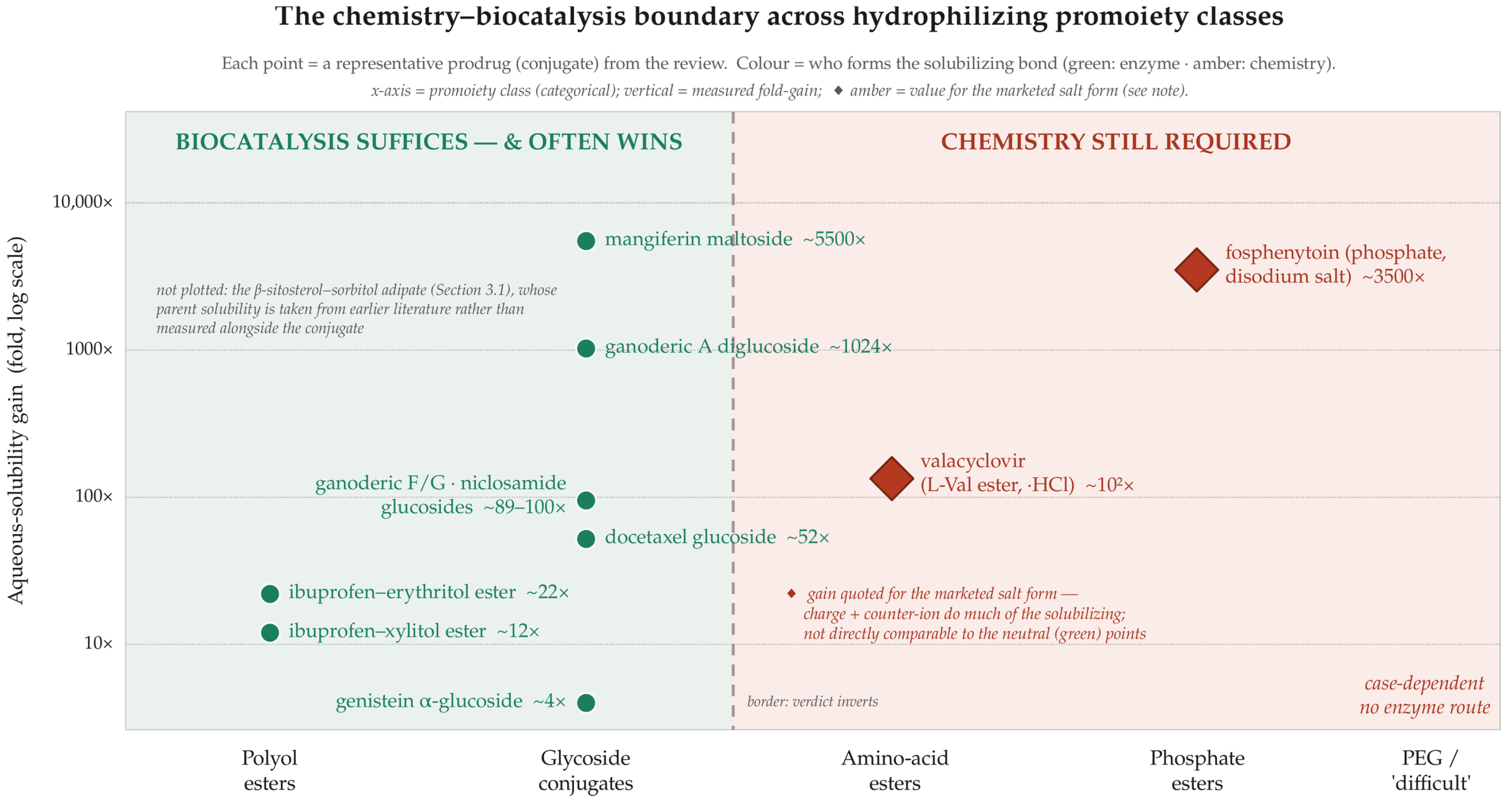
Figure 2.
The biocatalytic toolbox for hydrophilizing conjugation. Enzyme families are organized into two mechanistic lanes, the ester- and amide-forming hydrolases and acyltransferases (Section 2.1) and O-glycoside-forming glycosidases and glycosyltransferases (Section 2.2). The generic catalysed reaction is written out where it defines the lane, for the reversible esterification of the lipases and the glycosyl transfer of the glycosidases; the remaining families share those bond-forming modes and are annotated instead with the donor they require and the conditions they impose. Each family carries a ribbon structure from the Protein Data Bank (Candida antarctica lipase B, 1TCA; acyltransferase MsAcT, 2Q0Q; subtilisin, 1SCN; β-galactosidase, 1DP0; Leloir glycosyltransferase, 2C1Z; glucansucrase GTF180 from Lactobacillus reuteri, 3KLK). These entries illustrate the fold of enzymes in common use; except where a study happens to have used the same protein, they are not the specific catalysts of the syntheses reviewed in Section 3, which draw on homologues of the same families from other organizms. Every enzymatic tool is benchmarked against its classical chemical counterpart (Section 6.3).
Figure 2.
The biocatalytic toolbox for hydrophilizing conjugation. Enzyme families are organized into two mechanistic lanes, the ester- and amide-forming hydrolases and acyltransferases (Section 2.1) and O-glycoside-forming glycosidases and glycosyltransferases (Section 2.2). The generic catalysed reaction is written out where it defines the lane, for the reversible esterification of the lipases and the glycosyl transfer of the glycosidases; the remaining families share those bond-forming modes and are annotated instead with the donor they require and the conditions they impose. Each family carries a ribbon structure from the Protein Data Bank (Candida antarctica lipase B, 1TCA; acyltransferase MsAcT, 2Q0Q; subtilisin, 1SCN; β-galactosidase, 1DP0; Leloir glycosyltransferase, 2C1Z; glucansucrase GTF180 from Lactobacillus reuteri, 3KLK). These entries illustrate the fold of enzymes in common use; except where a study happens to have used the same protein, they are not the specific catalysts of the syntheses reviewed in Section 3, which draw on homologues of the same families from other organizms. Every enzymatic tool is benchmarked against its classical chemical counterpart (Section 6.3).
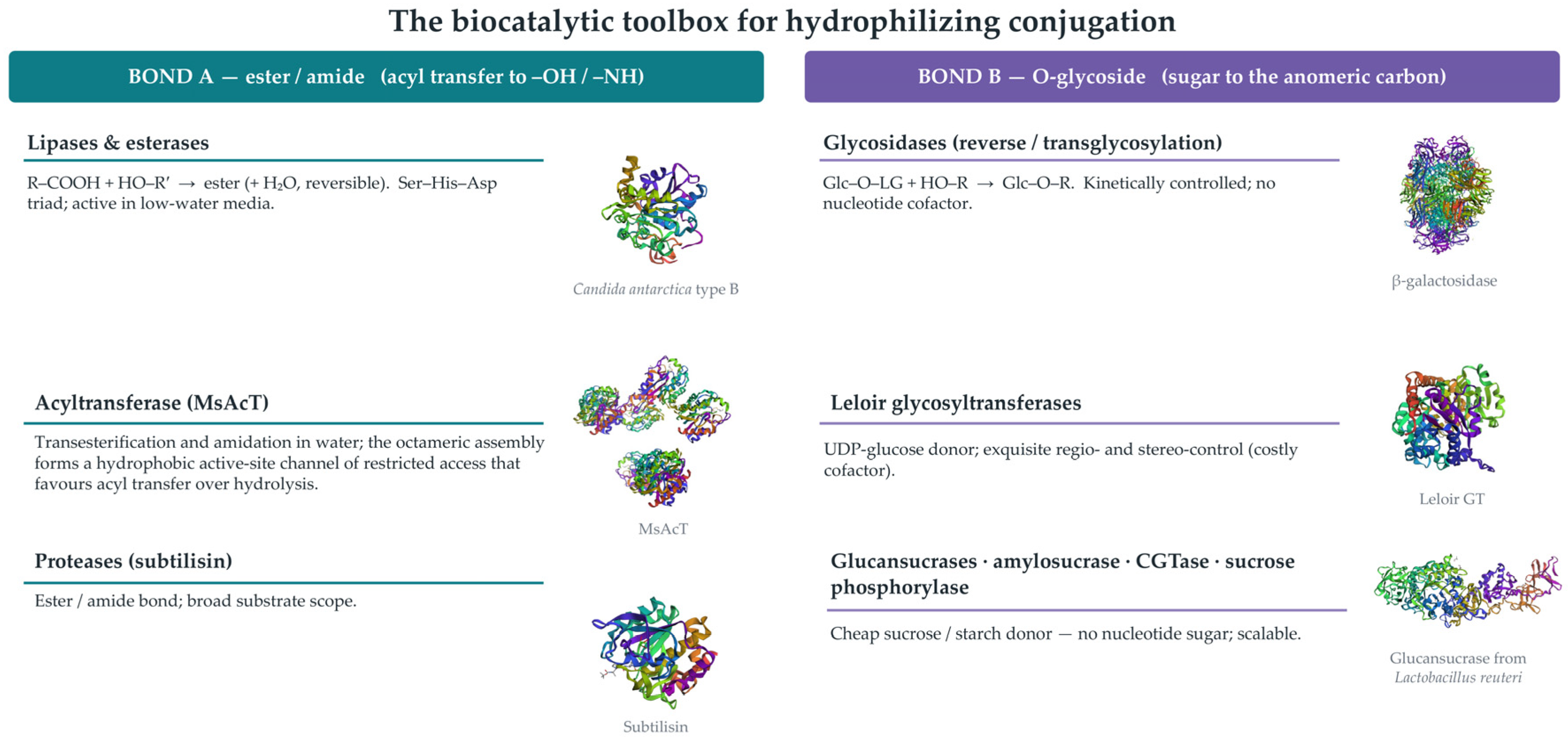
Scheme 1.
Biocatalytic hydrophilization of a poorly water-soluble drug, shown for the two bond types treated in this review. Top: an immobilized lipase (Candida antarctica lipase B, Novozym 435) esterifies the carboxylic acid of ibuprofen with the primary hydroxyl of xylitol in a green medium, releasing water, to give xylitol 2-(4-isobutylphenyl)propanoate. Bottom: a Leloir glycosyltransferase transfers glucose from UDP-glucose onto the phenolic hydroxyl of niclosamide, releasing UDP, to give niclosamide 2-O-β-d-glucoside. Immobilization allows the biocatalyst to be recovered and reused: for example, Novozym 435 still gave 68 ± 3% conversion after five cycles, against 80% in the first, for the ibuprofen–xylitol ester [60], and a co-immobilized glycosyltransferase–sucrose-synthase cascade retained ~40% of its activity over fifteen cycles [61]; the two figures are not directly comparable. In vivo, the ester and glycoside linkages are cleaved by esterases and glycosidases, regenerating the parent drug and the hydrophilic promoiety.
Scheme 1.
Biocatalytic hydrophilization of a poorly water-soluble drug, shown for the two bond types treated in this review. Top: an immobilized lipase (Candida antarctica lipase B, Novozym 435) esterifies the carboxylic acid of ibuprofen with the primary hydroxyl of xylitol in a green medium, releasing water, to give xylitol 2-(4-isobutylphenyl)propanoate. Bottom: a Leloir glycosyltransferase transfers glucose from UDP-glucose onto the phenolic hydroxyl of niclosamide, releasing UDP, to give niclosamide 2-O-β-d-glucoside. Immobilization allows the biocatalyst to be recovered and reused: for example, Novozym 435 still gave 68 ± 3% conversion after five cycles, against 80% in the first, for the ibuprofen–xylitol ester [60], and a co-immobilized glycosyltransferase–sucrose-synthase cascade retained ~40% of its activity over fifteen cycles [61]; the two figures are not directly comparable. In vivo, the ester and glycoside linkages are cleaved by esterases and glycosidases, regenerating the parent drug and the hydrophilic promoiety.
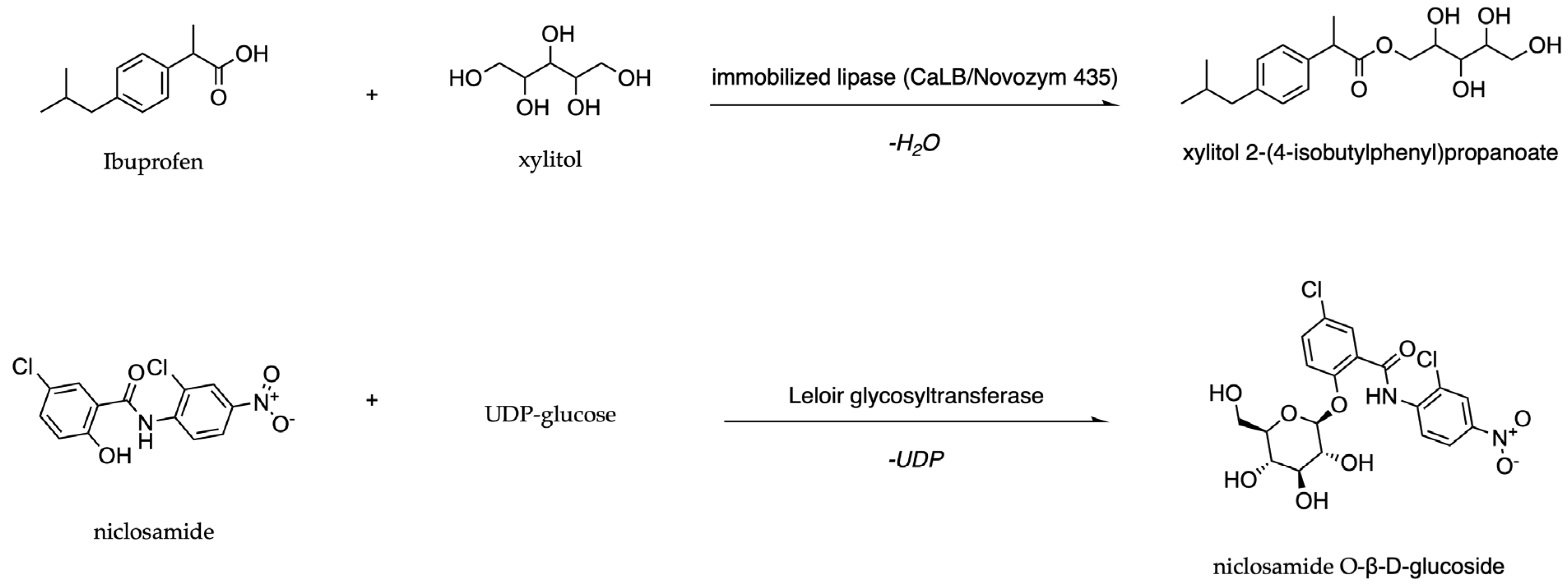
Scheme 2.
Amino-acid ester prodrugs are transporter-targeting, rather than merely solubilizing, shown here for valacyclovir, the l-valyl ester of acyclovir. (a) The ester is built by protecting-group chemistry: the α-amine of l-valine is masked (Cbz-Cl), its acid is coupled to the acyclovir hydroxyl (DCC, DMAP, with dicyclohexylurea as the stoichiometric co-product), and the protecting group is removed by hydrogenolysis in the presence of HCl, which delivers the drug as its hydrochloride (H2/Pd-C) [72]. This protect–couple–deprotect route is required because the free α-amino group is a competing nucleophile and because the intestinal transporter PEPT1 is l-selective, so the synthesis must preserve a configuration that a basic coupling tends to erode; an enzyme has not yet been shown to form this bond cleanly. (b) In vivo the sequence is ordered: PEPT1 (SLC15A1) drives stereoselective active uptake of the intact ester across the enterocyte apical membrane [73], the intact ester is carried in the portal blood to the liver, and hydrolysis to the parent drug by biphenyl hydrolase-like protein (BPHL, “valacyclovir hydrolase”; structure PDB 2OCG) occurs presystemically and predominantly in the liver (first-pass) [74], releasing acyclovir and l-valine into the systemic circulation. The net effect is a rise in acyclovir oral bioavailability from ~15–21% (dosed as acyclovir) to ~54–60% (dosed as valacyclovir); most of valacyclovir’s marketed aqueous-solubility gain, by contrast, comes from the hydrochloride salt of the ionizable α-amine rather than from the neutral ester. Valganciclovir, the l-valyl ester of ganciclovir, behaves analogously (oral bioavailability ~6–8% → ~60%).
Scheme 2.
Amino-acid ester prodrugs are transporter-targeting, rather than merely solubilizing, shown here for valacyclovir, the l-valyl ester of acyclovir. (a) The ester is built by protecting-group chemistry: the α-amine of l-valine is masked (Cbz-Cl), its acid is coupled to the acyclovir hydroxyl (DCC, DMAP, with dicyclohexylurea as the stoichiometric co-product), and the protecting group is removed by hydrogenolysis in the presence of HCl, which delivers the drug as its hydrochloride (H2/Pd-C) [72]. This protect–couple–deprotect route is required because the free α-amino group is a competing nucleophile and because the intestinal transporter PEPT1 is l-selective, so the synthesis must preserve a configuration that a basic coupling tends to erode; an enzyme has not yet been shown to form this bond cleanly. (b) In vivo the sequence is ordered: PEPT1 (SLC15A1) drives stereoselective active uptake of the intact ester across the enterocyte apical membrane [73], the intact ester is carried in the portal blood to the liver, and hydrolysis to the parent drug by biphenyl hydrolase-like protein (BPHL, “valacyclovir hydrolase”; structure PDB 2OCG) occurs presystemically and predominantly in the liver (first-pass) [74], releasing acyclovir and l-valine into the systemic circulation. The net effect is a rise in acyclovir oral bioavailability from ~15–21% (dosed as acyclovir) to ~54–60% (dosed as valacyclovir); most of valacyclovir’s marketed aqueous-solubility gain, by contrast, comes from the hydrochloride salt of the ionizable α-amine rather than from the neutral ester. Valganciclovir, the l-valyl ester of ganciclovir, behaves analogously (oral bioavailability ~6–8% → ~60%).
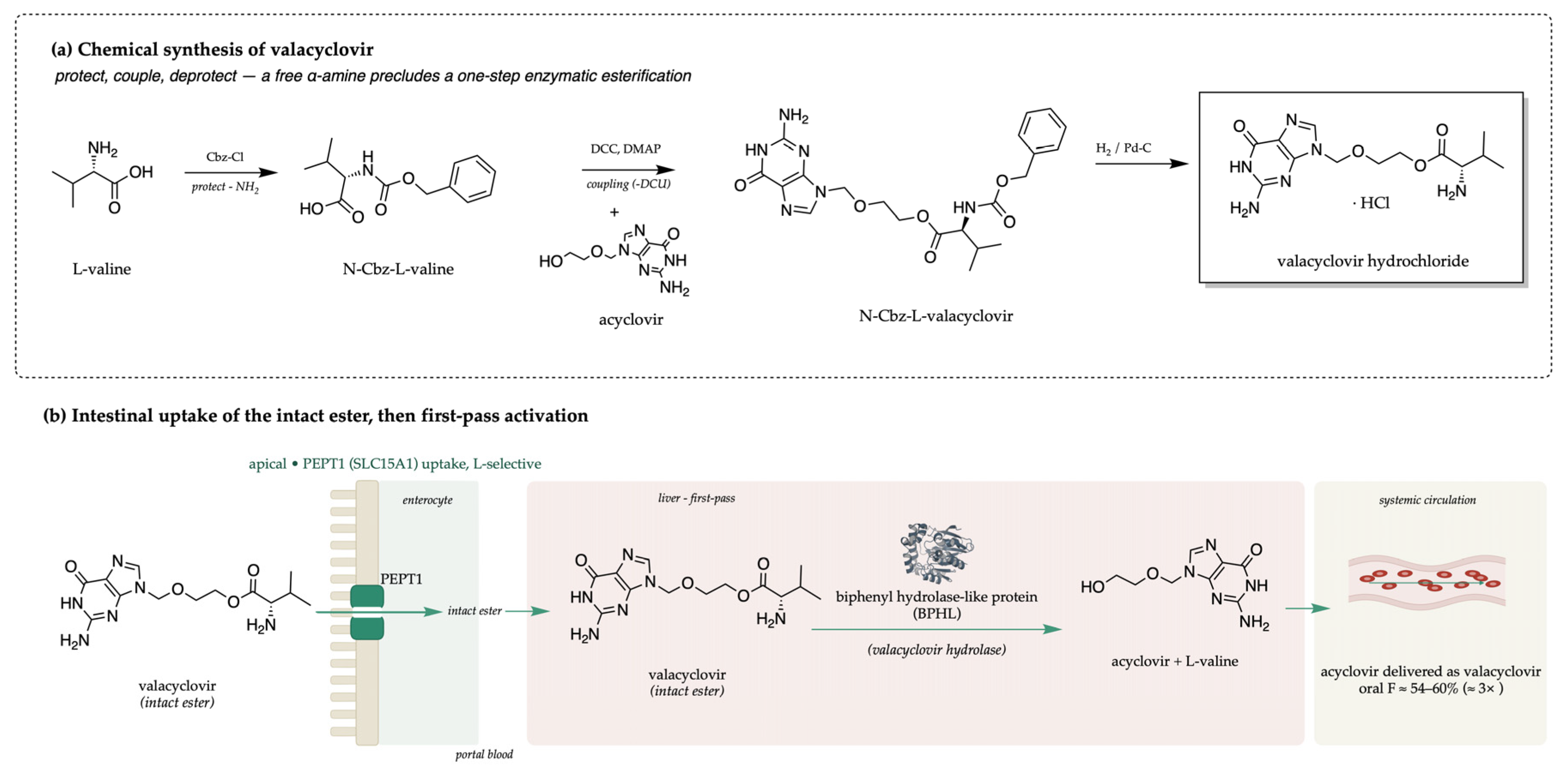
Scheme 3.
Chemical conjugation of a PEG solubilizing prodrug, shown for camptothecin (single-conjugate representation). A poly(ethylene glycol) chain, extended through a glycine spacer to a free carboxyl, is coupled to the camptothecin C-20 hydroxyl by carbodiimide (EDC) activation with 4-dimethylaminopyridine, giving the PEG–glycinate 20-O-ester [76]; the carbodiimide is consumed stoichiometrically to the corresponding urea, which for EDC is water-soluble and removed by aqueous washing rather than by filtration; acylating the tertiary C-20 hydroxyl also stabilizes the α-hydroxy-δ-lactone in its active form and raises aqueous solubility by orders of magnitude (camptothecin ~0.0025 → ≥2 mg/mL as its 40 kDa PEG ester) [75]. The bond is chemistry’s: the C-20 hydroxyl is a sterically hindered tertiary alcohol and PEG offers no regioselectivity for a biocatalyst to exploit, so no enzymatic route to small-molecule PEG conjugates is established; enzymatic PEGylation is a protein technology (transglutaminase or sortase) [77]. High molecular weight additionally slows renal clearance and drives EPR-based tumour accumulation. One drug is drawn for clarity; the marketed conjugates are multivalent: pegamotecan carries two camptothecins on a bifunctional 40 kDa PEG (glycine spacer [76]; alanine in [75]), and EZN-2208 carries ~four SN38 on a four-arm PEG.
Scheme 3.
Chemical conjugation of a PEG solubilizing prodrug, shown for camptothecin (single-conjugate representation). A poly(ethylene glycol) chain, extended through a glycine spacer to a free carboxyl, is coupled to the camptothecin C-20 hydroxyl by carbodiimide (EDC) activation with 4-dimethylaminopyridine, giving the PEG–glycinate 20-O-ester [76]; the carbodiimide is consumed stoichiometrically to the corresponding urea, which for EDC is water-soluble and removed by aqueous washing rather than by filtration; acylating the tertiary C-20 hydroxyl also stabilizes the α-hydroxy-δ-lactone in its active form and raises aqueous solubility by orders of magnitude (camptothecin ~0.0025 → ≥2 mg/mL as its 40 kDa PEG ester) [75]. The bond is chemistry’s: the C-20 hydroxyl is a sterically hindered tertiary alcohol and PEG offers no regioselectivity for a biocatalyst to exploit, so no enzymatic route to small-molecule PEG conjugates is established; enzymatic PEGylation is a protein technology (transglutaminase or sortase) [77]. High molecular weight additionally slows renal clearance and drives EPR-based tumour accumulation. One drug is drawn for clarity; the marketed conjugates are multivalent: pegamotecan carries two camptothecins on a bifunctional 40 kDa PEG (glycine spacer [76]; alanine in [75]), and EZN-2208 carries ~four SN38 on a four-arm PEG.
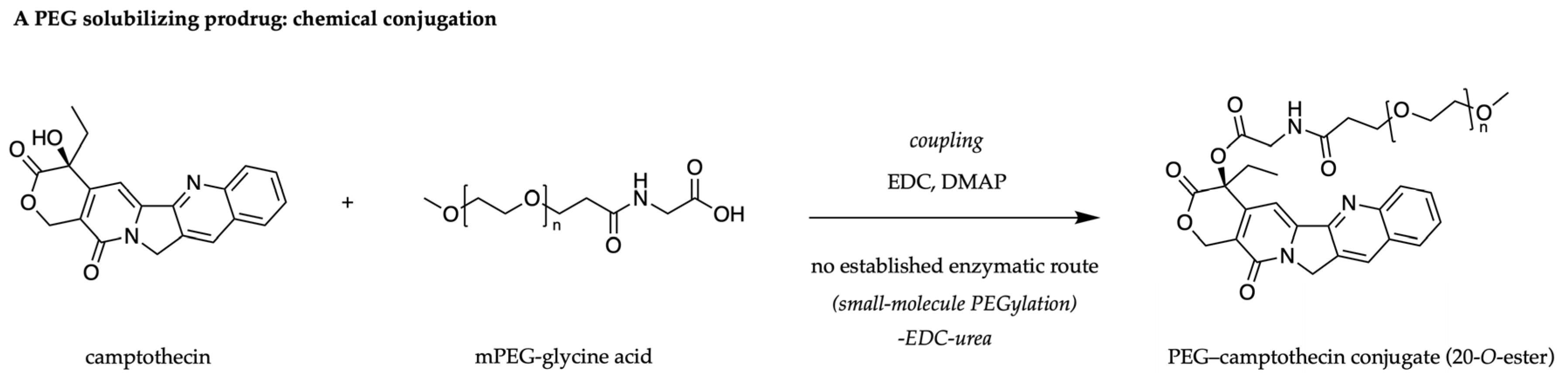
Figure 3.
The oral drawback of phosphate prodrugs: dephosphorylation-driven supersaturation, shown for fosphenytoin. (a) Parenterally the strategy works: fosphenytoin (the disodium phosphate ester of 3-hydroxymethylphenytoin, 142 mg/mL, intravenous/intramuscular only) is dephosphorylated by broadly specific alkaline phosphatase (human alkaline phosphatase, PDB 1EW2) once in the circulation, regenerating phenytoin, with formaldehyde released as the hydroxymethyl spacer collapses. (b) By the oral route the same reaction becomes a drawback: membrane-bound alkaline phosphatase at the intestinal brush border strips the phosphate before absorption, producing a locally supersaturated solution of the poorly soluble parent (phenytoin, 20–25 µg/mL) that nucleates and precipitates in the lumen; the solubility is real but spent at the wrong moment. Heimbach and co-workers demonstrated this in vitro for fosphenytoin (itself an intravenous agent, used here as the model) and TAT-59, with induction times within gastrointestinal residence times [81,82]. Estramustine phosphate, tested alongside them, did not precipitate within those times and is the exception discussed in the text: it solubilizes its own parent roughly forty-fold. The placental isozyme (PDB 1EW2) is drawn in both bands as a representative alkaline phosphatase; the brush-border enzyme of band b is a distinct gene product.
Figure 3.
The oral drawback of phosphate prodrugs: dephosphorylation-driven supersaturation, shown for fosphenytoin. (a) Parenterally the strategy works: fosphenytoin (the disodium phosphate ester of 3-hydroxymethylphenytoin, 142 mg/mL, intravenous/intramuscular only) is dephosphorylated by broadly specific alkaline phosphatase (human alkaline phosphatase, PDB 1EW2) once in the circulation, regenerating phenytoin, with formaldehyde released as the hydroxymethyl spacer collapses. (b) By the oral route the same reaction becomes a drawback: membrane-bound alkaline phosphatase at the intestinal brush border strips the phosphate before absorption, producing a locally supersaturated solution of the poorly soluble parent (phenytoin, 20–25 µg/mL) that nucleates and precipitates in the lumen; the solubility is real but spent at the wrong moment. Heimbach and co-workers demonstrated this in vitro for fosphenytoin (itself an intravenous agent, used here as the model) and TAT-59, with induction times within gastrointestinal residence times [81,82]. Estramustine phosphate, tested alongside them, did not precipitate within those times and is the exception discussed in the text: it solubilizes its own parent roughly forty-fold. The placental isozyme (PDB 1EW2) is drawn in both bands as a representative alkaline phosphatase; the brush-border enzyme of band b is a distinct gene product.
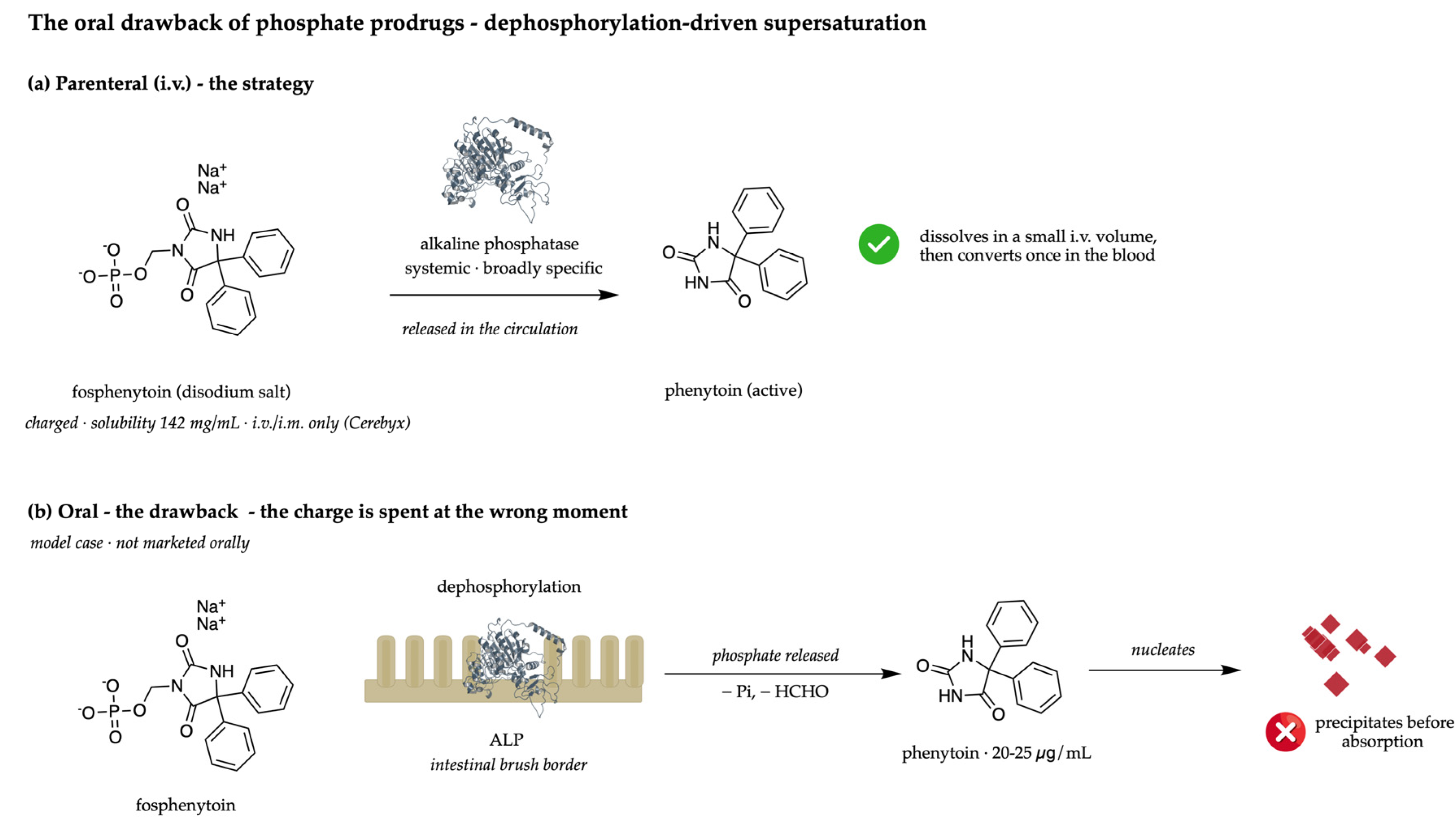
Scheme 4.
Chemical conjugation and enzymatic activation of ionizable prodrugs, for the two covalent classes of Section 3.5. Top, phosphate: phenytoin is N-hydroxymethylated (formaldehyde) and phosphorylated by the chloromethyl / dibenzyl-phosphate route (freed by H2/Pd hydrogenolysis) to fosphenytoin, its disodium phosphate ester; in vivo, alkaline phosphatase (human placental ALP, PDB 1EW2) cleaves the P–O ester, regenerating phenytoin with release of phosphate and formaldehyde [81]. Bottom, hemisuccinate: the primary 21-hydroxyl of hydrocortisone is acylated by succinic anhydride to the 21-hemisuccinate (sodium salt); in vivo, a carboxylesterase (human CES1, PDB 1MX1) hydrolyzes the ester, releasing hydrocortisone and succinate. The 21-hemisuccinate design and its solution-stability limits are documented for corticosteroid 21-esters generally, the experimental series being methylprednisolone [84]; the activating esterase is assigned by class, not by that study. In both classes the promoiety–drug bond is forged chemically and cleaved enzymatically. Choline esters are a third ionizable class (a permanent cation, esterase-cleaved); cholinium salts, being ion-paired, are not covalent prodrugs.
Scheme 4.
Chemical conjugation and enzymatic activation of ionizable prodrugs, for the two covalent classes of Section 3.5. Top, phosphate: phenytoin is N-hydroxymethylated (formaldehyde) and phosphorylated by the chloromethyl / dibenzyl-phosphate route (freed by H2/Pd hydrogenolysis) to fosphenytoin, its disodium phosphate ester; in vivo, alkaline phosphatase (human placental ALP, PDB 1EW2) cleaves the P–O ester, regenerating phenytoin with release of phosphate and formaldehyde [81]. Bottom, hemisuccinate: the primary 21-hydroxyl of hydrocortisone is acylated by succinic anhydride to the 21-hemisuccinate (sodium salt); in vivo, a carboxylesterase (human CES1, PDB 1MX1) hydrolyzes the ester, releasing hydrocortisone and succinate. The 21-hemisuccinate design and its solution-stability limits are documented for corticosteroid 21-esters generally, the experimental series being methylprednisolone [84]; the activating esterase is assigned by class, not by that study. In both classes the promoiety–drug bond is forged chemically and cleaved enzymatically. Choline esters are a third ionizable class (a permanent cation, esterase-cleaved); cholinium salts, being ion-paired, are not covalent prodrugs.
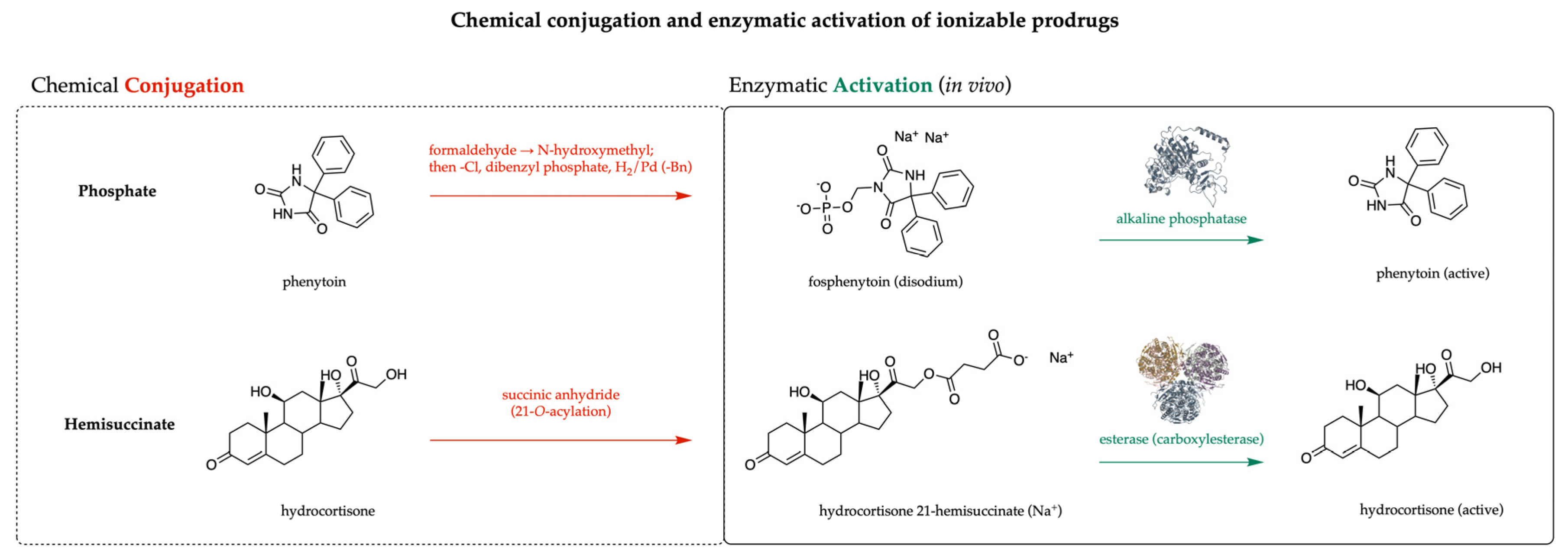
Scheme 5.
A toolbox of hydrophilizing promoieties, shown independently of the drug they modify. Each promoiety is drawn as the fragment it appends to the parent drug (R = the drug; the linkage and any charge are shown explicitly). Nonionic, polar promoieties (top: polyol and sugar-alcohol esters, sugar glycosides and esters, and PEG) raise aqueous solubility by adding hydrogen-bonding surface, and for the polyols and sugars are accessible to enzymatic conjugation. Ionizable, charged promoieties (bottom) raise solubility by introducing a charge and are installed chemically, their largest gains realized as salts: they comprise amino-acid esters (a cationic α-amine; PEPT1 substrates), phosphate and hemisuccinate esters (anionic) and choline esters (a permanent cation). Throughout, R marks the point of attachment to the drug.
Scheme 5.
A toolbox of hydrophilizing promoieties, shown independently of the drug they modify. Each promoiety is drawn as the fragment it appends to the parent drug (R = the drug; the linkage and any charge are shown explicitly). Nonionic, polar promoieties (top: polyol and sugar-alcohol esters, sugar glycosides and esters, and PEG) raise aqueous solubility by adding hydrogen-bonding surface, and for the polyols and sugars are accessible to enzymatic conjugation. Ionizable, charged promoieties (bottom) raise solubility by introducing a charge and are installed chemically, their largest gains realized as salts: they comprise amino-acid esters (a cationic α-amine; PEPT1 substrates), phosphate and hemisuccinate esters (anionic) and choline esters (a permanent cation). Throughout, R marks the point of attachment to the drug.
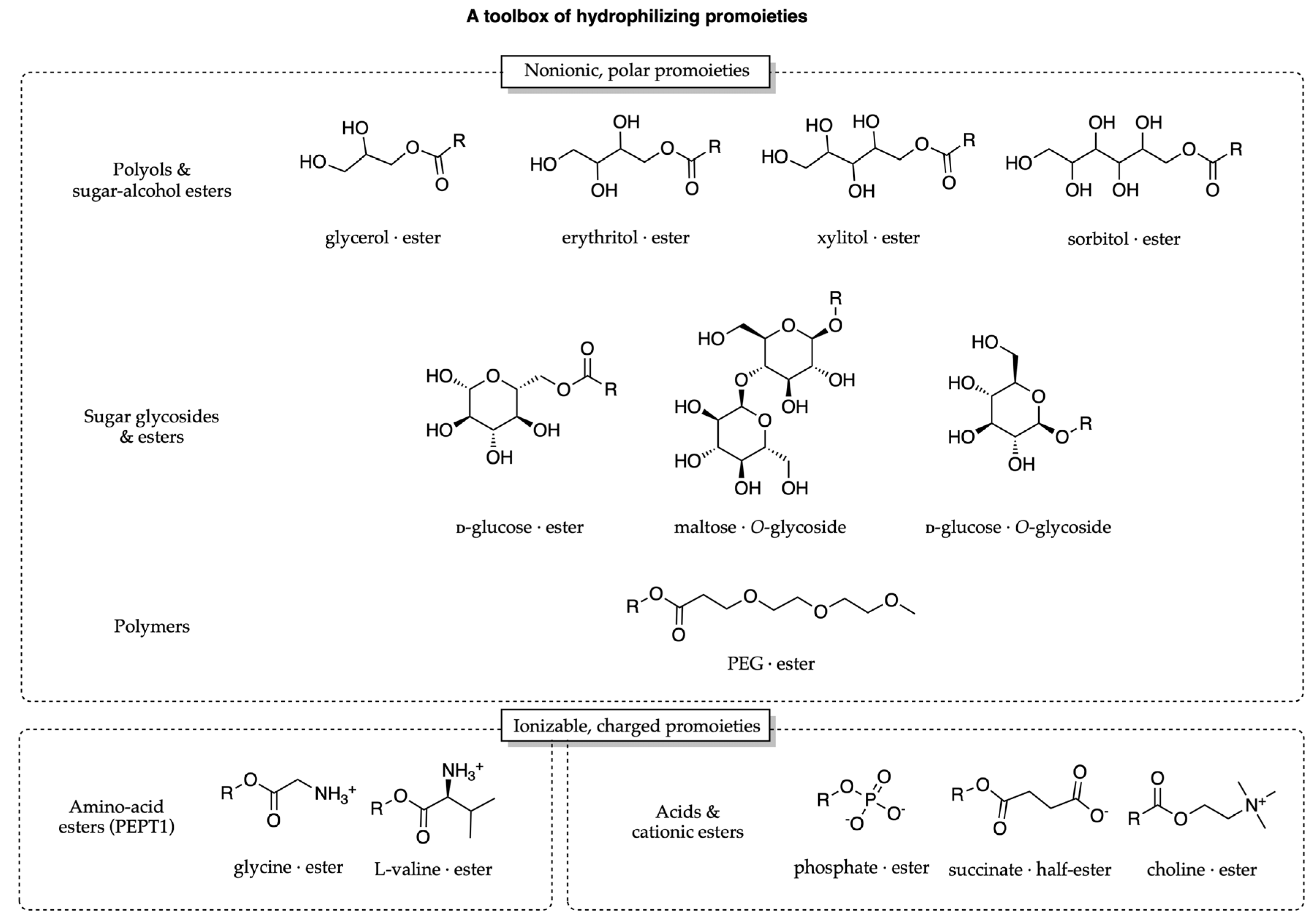
Scheme 6.
One molecule, two routes: the ibuprofen–sorbitol ester as an unwanted impurity versus a designed prodrug. The same ester is reached (a) enzymatically, by porcine pancreatic lipase in a hexane/water biphasic medium, as a single regioselective primary-hydroxyl monoester (the 1-O-monoester) and a deliberate water-soluble prodrug, formed without coupling reagents and releasing only water [16]; and (b) chemically, by DCC coupling with catalytic DMAP, where the absence of protecting groups leaves all six sorbitol hydroxyls free to react. The chemical route also gives monoesters, but not one of them: Douša and co-workers obtained a racemic mixture of four isomers, mainly the sorbit-1-yl and sorbit-6-yl 2-(4-isobutylphenyl)propionates, of which the drawn structures are representatives; the mixture must be separated chromatographically, and the coupling leaves a stoichiometric co-product, dicyclohexylurea (DCU), to be filtered off; there the ester is a degradation impurity of ibuprofen soft-gelatin capsules, synthesized only as a reference standard [109]. Stereocentres are left undrawn throughout: the configuration of d-sorbitol is set in the starting polyol and is retained, since esterification does not touch its stereocentres, whereas the ibuprofen α-carbon is racemic, so every conjugate is obtained as a mixture of diastereomers; the regioisomers of the chemical route are, by contrast, constitutional isomers arising from competing acylation of the different hydroxyls. The enzyme’s regioselectivity, and its clean mass balance, turn the same chemistry from a contaminant-identification problem into a single-step prodrug synthesis.
Scheme 6.
One molecule, two routes: the ibuprofen–sorbitol ester as an unwanted impurity versus a designed prodrug. The same ester is reached (a) enzymatically, by porcine pancreatic lipase in a hexane/water biphasic medium, as a single regioselective primary-hydroxyl monoester (the 1-O-monoester) and a deliberate water-soluble prodrug, formed without coupling reagents and releasing only water [16]; and (b) chemically, by DCC coupling with catalytic DMAP, where the absence of protecting groups leaves all six sorbitol hydroxyls free to react. The chemical route also gives monoesters, but not one of them: Douša and co-workers obtained a racemic mixture of four isomers, mainly the sorbit-1-yl and sorbit-6-yl 2-(4-isobutylphenyl)propionates, of which the drawn structures are representatives; the mixture must be separated chromatographically, and the coupling leaves a stoichiometric co-product, dicyclohexylurea (DCU), to be filtered off; there the ester is a degradation impurity of ibuprofen soft-gelatin capsules, synthesized only as a reference standard [109]. Stereocentres are left undrawn throughout: the configuration of d-sorbitol is set in the starting polyol and is retained, since esterification does not touch its stereocentres, whereas the ibuprofen α-carbon is racemic, so every conjugate is obtained as a mixture of diastereomers; the regioisomers of the chemical route are, by contrast, constitutional isomers arising from competing acylation of the different hydroxyls. The enzyme’s regioselectivity, and its clean mass balance, turn the same chemistry from a contaminant-identification problem into a single-step prodrug synthesis.
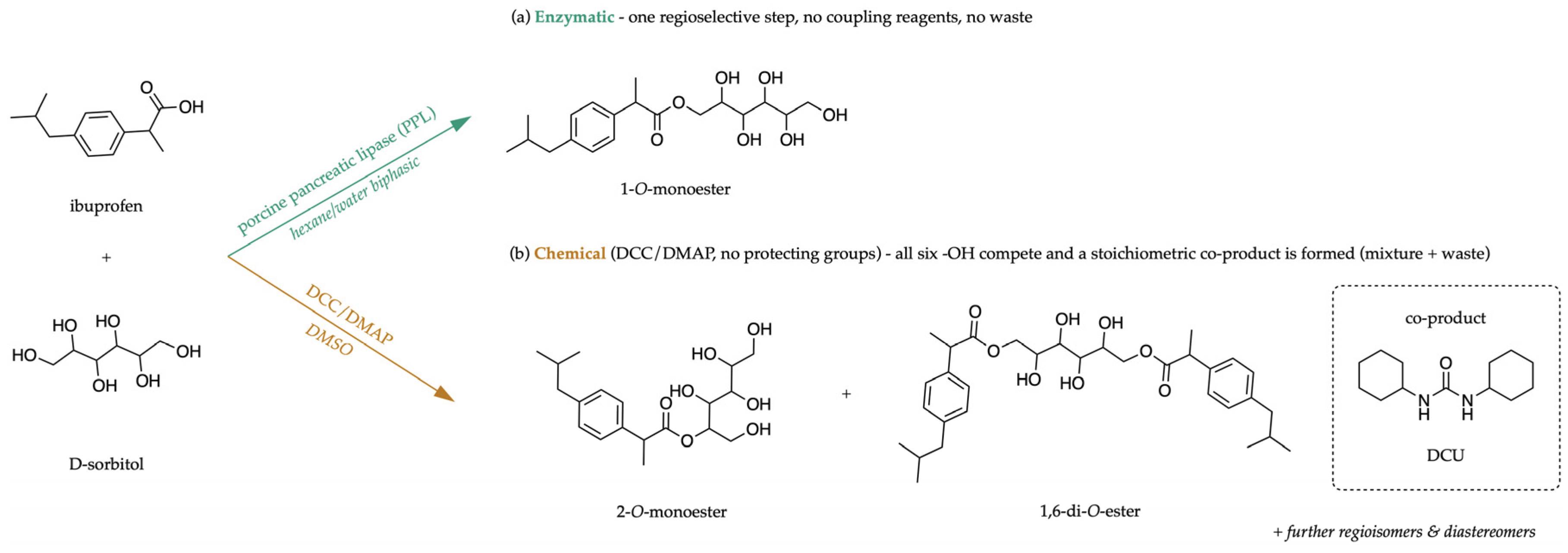
Table 1.
Verdict map: does chemistry stay necessary for water-soluble prodrugs? A per-class answer to the title question.
Table 1.
Verdict map: does chemistry stay necessary for water-soluble prodrugs? A per-class answer to the title question.
| Promoiety / linkage class | Chemistry still needed? | Rationale (claim to argue) → section |
| Polyol & sugar esters (accessible –OH / –COOH) | NO; enzymes suffice & win | regioselective, protecting-group-free, mild; core evidence → §3.1 |
| Glycoside conjugates (GT / transglycosidase) | NO/Mostly enzymatic | GTs glycosylate poorly soluble scaffolds directly (~4–5500×) → §3.2; bond formation only; reversion/retained activity is class-variable (→ §5.2) |
| Phosphate esters | YES, chemistry dominates | biggest solubility jumps, but realized as salts (parenteral/IV); kinases ATP-dependent & narrow → §3.5 |
| Amino-acid esters | YES, largely chemical | free amine competes; stereochemistry; enzymatic route hard → §3.3 |
| PEG / ‘difficult’ substrates | YES; chemistry is universal | mono-functional terminus, nothing for regioselectivity to resolve; hindered tertiary alcohol on the drug side → §3.4/§8.1 |
| Enzyme-vs-chemistry ‘greenness’ | UNPROVEN | claimed but rarely measured (E-factor/PMI/LCA): THE gap → §6.4 |
Table 2.
Two routes to amino-acid ester prodrugs: the established protect–couple–deprotect chemistry (used for the marketed l-valyl esters valacyclovir and valganciclovir) versus the direct but still-unrealized enzymatic route.
Table 2.
Two routes to amino-acid ester prodrugs: the established protect–couple–deprotect chemistry (used for the marketed l-valyl esters valacyclovir and valganciclovir) versus the direct but still-unrealized enzymatic route.
| Criterion | Chemical route (protect–couple–deprotect) | Enzymatic route (protease / acyltransferase) |
| α-Amino group | Amine masked as an N-Cbz or Boc carbamate, later cleaved (hydrogenolysis or acid) | Amine left unprotected, a competing nucleophile in the enzyme's aqueous medium |
| Bond formation | Carboxyl activated (carbodiimide), then esterified onto the drug hydroxyl | Carboxyl esterified onto the drug hydroxyl directly, without activation |
| Reaction medium | Anhydrous organic solvent, no water, amine masked | Aqueous or near-aqueous, where the free amine competes and the ester is hydrolysed |
| Stereochemistry | Partial racemization to the unwanted d-ester, poorly carried by PEPT1 | Single l-ester, free of racemization (absolute stereospecificity) |
| Step economy & greenness | Lower: protection, activation and deprotection add steps and waste | Higher in principle: protecting-group-free, fewer steps, once the amine is controlled |
| Maturity | Established: route to the marketed l-valyl esters valacyclovir and valganciclovir | Not yet realized for this bond; feasible in principle (Section 8) |
Disclaimer/Publisher’s Note: The statements, opinions and data contained in all publications are solely those of the individual author(s) and contributor(s) and not of MDPI and/or the editor(s). MDPI and/or the editor(s) disclaim responsibility for any injury to people or property resulting from any ideas, methods, instructions or products referred to in the content. |
© 2026 by the authors. Licensee MDPI, Basel, Switzerland. This article is an open access article distributed under the terms and conditions of the Creative Commons Attribution (CC BY) license (http://creativecommons.org/licenses/by/4.0/).
Copyright: This open access article is published under a Creative Commons CC BY 4.0 license, which permit the free download, distribution, and reuse, provided that the author and preprint are cited in any reuse.