

Submitted:
07 August 2026
Posted:
11 August 2026
You are already at the latest version
Abstract
Background/Objectives: Falls among community-dwelling older adults are a major public health challenge and a leading cause of functional decline. Although multifactorial fall prevention strategies are recommended, evidence on comprehensive nurse-led preventive care models in primary health care remains limited. This study evaluated the clinical effects of the PM ACTIVAS nurse-led preventive care model and its potential to operationalize evidence-based fall prevention in routine primary health care. Methods: This article reports the quantitative component of a broader mixed-methods research programme. A two-arm randomized controlled trial included 220 community-dwelling adults aged 65–80 years randomly assigned to the PM ACTIVAS intervention (n = 110) or usual care (n = 110). The 12-month intervention combined multidimensional fall-risk assessment, individualized care planning, home environmental assessment, health education, a home safety kit, family involvement, and monthly telephone follow-up. The primary outcome was fall occurrence; secondary outcomes were modifiable fall-risk factors, recognition of environmental fall hazards, and fear of falling. Results: Primary outcome data were available for 145 participants. Falls occurred in 17 participants (23.3%) in the intervention group and 19 (26.4%) in the control group, with no significant between-group differences in fall occurrence (p = 0.666) or number of falls (p = 0.164). After adjustment for baseline scores, the intervention group showed significantly fewer fall-risk factors (p = 0.001; partial η² = 0.07) and greater recognition of environmental fall hazards (p = 0.044; partial η² = 0.02). No between-group differences were observed in fear of falling. Conclusions: Although the PM ACTIVAS nurse-led preventive care model did not significantly reduce fall occurrence over 12 months, it reduced modifiable fall-risk factors and improved recognition of environmental hazards. These findings suggest that coordinated nurse-led care can operationalize evidence-based fall prevention within routine primary health care and support further evaluation of this model in community settings.
Keywords:
accidental falls
; primary health care
; home visits
; healthy aging
; nurse-led care
; community-dwelling older adults
1. Introduction
Maintaining functional ability has become one of the principal goals of health systems caring for rapidly ageing populations. The World Health Organization (WHO) defines healthy ageing as the process of developing and maintaining the functional ability that enables well-being in older age, shifting the focus of care from disease treatment toward preserving intrinsic capacity, autonomy, and quality of life [1,2]. This paradigm recognizes that enabling older adults to remain safely in their own homes and communities ("ageing in place") requires proactive, person-centred, and community-based models of care that identify modifiable risks before disability occurs. Consequently, preventive care has become a strategic priority for primary health care [3], positioning nurses to lead comprehensive interventions that promote healthy ageing and maintain independence [1,4].
Falls represents one of the greatest threats to healthy ageing because they compromise not only physical health but also functional independence, confidence, and social participation. Approximately one in four community-dwelling older adults experiences at least one fall annually, making falls one of the leading causes of injury, disability, hospitalization, institutionalization, and mortality worldwide [4,5]. Beyond their physical consequences, falls frequently trigger fear of falling, reduced mobility, social isolation, and progressive loss of functional capacity, often initiating a cycle of dependency that substantially affects quality of life and healthcare utilization [6]. Current evidence recognizes that falls rarely result from a single cause; instead, they emerge from complex interactions among intrinsic factors, medications, behaviors, environmental hazards, and social circumstances that evolve over time [4]. Preventing falls, therefore, should be understood as part of a broader strategy to preserve functional ability and support healthy ageing.
The growing recognition of this complexity has transformed fall prevention strategies over the past decade. International clinical guidelines now recommend comprehensive, multidimensional assessment followed by individualized interventions that address each older person's specific risk profile [4,7]. Although exercise remains the intervention supported by the strongest evidence, systematic reviews and recent clinical recommendations indicate that combining complementary strategies—including home hazard assessment and modification, medication review, education, behavioral counselling, and individualized care planning—can provide greater benefits for selected older adults [5,6,8,9,10]. However, important debate remains regarding the relative contribution of each intervention component and the populations most likely to benefit from multifactorial approaches. Increasingly, researchers argue that successful prevention depends not only on the intervention components themselves but also on the extent to which care is individualized, acceptable to older adults, and responsive to their living context and preferences [11,12]. These observations suggest that the challenge is no longer simply identifying effective intervention components, but delivering them in a coordinated and sustainable manner within routine primary health care.
Although multifactorial interventions are increasingly recommended, evidence regarding comprehensive nurse-led preventive care models capable of operationalizing evidence-based fall prevention within routine primary health care remains limited, particularly in Latin America [13,14,15]. Most randomized trials have evaluated isolated intervention components, whereas fewer studies have examined integrated nurse-led models of preventive care that combine multidimensional assessment, individualized education, environmental modification, family involvement, and longitudinal follow-up within primary health care [13,16].
The PM ACTIVAS Program was developed in Chile as part of a broader research programme aimed at designing, implementing, and evaluating a comprehensive nurse-led preventive care model for community-dwelling older adults. The intervention protocol has been previously published [17], followed by a qualitative evaluation demonstrating its feasibility and acceptability among older adults and healthcare professionals [18]. The present study reports the final phase of this programme by evaluating the model's clinical effects through a randomized controlled trial.
Generating evidence on effective and implementable nurse-led preventive care models is essential to strengthen primary health care responses to population ageing. Accordingly, advancing fall prevention requires not only identifying effective intervention components but also developing care models capable of operationalizing this evidence within routine primary health care. Therefore, the aim of this study was to evaluate the clinical effectiveness of the PM ACTIVAS nurse-led preventive care model and to examine its potential to operationalize evidence-based fall prevention within routine primary health care.
2. Materials and Methods
2.1. Study Design
This paper reports the quantitative component of a broader mixed-methods research programme designed to develop, implement, and evaluate the PM ACTIVAS Model. Specifically, this study reports the findings of a two-arm randomized controlled trial conducted to evaluate the clinical effects of the intervention. The qualitative evaluation of feasibility, acceptability, and implementation experiences has been reported separately [18]. The overall programme followed the Medical Research Council framework for the development and evaluation of complex interventions [19].
The trial was conducted between January 2021 and April 2022 in primary health care centres in the municipality of Renca, Santiago, Chile. The study protocol was prospectively registered at ClinicalTrials.gov (https://clinicaltrials.gov/study/NCT04313062; 2022-05-02) and has been published previously, including the theoretical rationale, intervention development, implementation strategy, and complete intervention description according to the Template for Intervention Description and Replication (TIDieR) checklist [17]. Therefore, only a brief description of the intervention is presented here. The study is reported in accordance with the Consolidated Standards of Reporting Trials (CONSORT) guidelines. [20]
2.2. Study Setting and Participants
Participants were recruited from the "Más Adultos Mayores Autovalentes" Program implemented in primary health care centres. Community-dwelling older adults aged 65–80 years who were functionally independent and had completed the national preventive health assessment within the previous 12 months were considered eligible.
Individuals presenting severe visual or hearing impairment preventing effective communication, moderate or severe cognitive or mood disorders, hospitalization during recruitment, or residence outside the participating health centres' catchment area were excluded.
A total sample of 220 participants was estimated based on an 80% statistical power, a significance level of 0.05, an expected small-to-moderate effect size for fall frequency, and an anticipated attrition rate of 10%. The sample size calculation was based on the primary outcome (fall occurrence). Participants were randomly allocated in a 1:1 ratio to either the intervention group (n = 110) or the control group (n = 110). The participant recruitment and allocation process is presented in Figure 1.
2.3. PM ACTIVAS Intervention
Participants allocated to the intervention group received the PM ACTIVAS Model, a comprehensive nurse-led home-based preventive care model developed to reduce fall risk and preserve functional independence among community-dwelling older adults. The intervention was delivered by trained registered nurses over a 12-month period in addition to usual primary care.
Because the PM ACTIVAS intervention has been fully described elsewhere according to the TIDieR checklist, only the intervention components necessary to interpret the trial results are summarized below [17].
Briefly, the PM ACTIVAS nurse-led preventive care model operationalizes evidence-based fall prevention by integrating:
- o multidimensional assessment of intrinsic and extrinsic fall risk factors;
- o individualized risk management and shared care planning;
- o home environmental assessment and modification;
- o individualized education and counselling;
- o provision of a home safety kit;
- o family involvement whenever appropriate; and
- o structured monthly telephone follow-up to reinforce agreed preventive actions.
The intervention is grounded in person-centred care and seeks to operationalize individualized evidence-based fall prevention by translating multidimensional risk assessment into personalized behavioural and environmental strategies that support healthy ageing and ageing in place.
Participants allocated to the control group received usual primary care according to national guidelines, including a baseline home visit and routine health services available within the primary care system. Both groups completed a falls calendar throughout the follow-up period [17].
2.4. Outcome Measures
Primary Outcome
The primary outcome comprised two complementary measures: fall occurrence (≥1 fall during follow-up) and the total number of falls recorded during the 12-month follow-up period. Participants in both the intervention and control groups prospectively recorded falls using a monthly Falls and Events Calendar, which constituted the principal outcome measure of the randomized trial. The calendar was provided at recruitment, and parti-cipants were instructed to record the days on which a fall, trip, or related event occurred. Family members or caregivers living in the same household and involved in the study activities could also assist with the recording process. Both participants and caregivers were instructed to use a standardized definition of a fall as any event resulting in the person coming into contact with the ground, regardless of its severity or consequences.
To enhance the completeness and reliability of prospective reporting, participants were contacted by telephone once a month throughout the 12-month follow-up period. During these contacts, the research team emphasized the importance of keeping the Falls and Events Calendar complete and up to date and addressed any questions regarding its completion. When appropriate, contact could also be established with a family member who lived with the participant and was familiar with the study activities. The completed calendars were collected by the research team during the final home visit.
Falls occurring during the 12 months preceding enrollment were also retrospectively reported at baseline. However, these data were used for baseline characterization rather than to assess change in fall occurrence. Unlike the prospective follow-up, baseline reports were not based on systematic monitoring using the study calendar or a standardized definition of a fall and were subject to recall bias, particularly given the 12-month recall period in an older population. Therefore, baseline and follow-up fall counts were not considered directly comparable, and change in the number of falls from baseline to fo-llow-up was not used as an outcome. Instead, the primary outcome was based exclusively on prospectively recorded falls during the 12-month follow-up period.
Secondary Outcomes
Secondary outcomes included intrinsic and extrinsic fall risk factors, assessed using a 37-item checklist developed for the project; ability to identify environmental fall hazards, assessed using an illustrated home-hazard recognition tool comprising four household scenarios; and fear of falling. Earlier versions of the fall-risk and home-hazard recognition instruments have been used in a randomized controlled trial conducted by the same research team among older adults [10], while detailed descriptions of the instruments and their scoring procedures have been reported elsewhere [17].
2.5. Data Collection
Baseline assessments were conducted during home visits after confirming eligibility criteria and obtaining written informed consent. Data collection included a structured questionnaire composed of six modules, administration of study instruments, and blood pressure measurement. During the COVID-19 pandemic, recruitment and data collection followed institutional infection prevention measures, including personal protective equipment, daily symptom screening, and SARS-CoV-2 testing when required.
Follow-up assessments were completed 12 months after baseline. Falls were prospectively monitored using the monthly falls calendar throughout the study period.
2.6. Data Analysis
Quantitative Análisis
Baseline comparability between the intervention and control groups was assessed using Mann–Whitney U tests for continuous variables and chi-square tests for categorical variables. Although 205 participants completed the 12-month follow-up, information on fall occurrence was available for 145 participants because some self-reported fall follow-up forms were incomplete. Therefore, analyses of the primary outcome were conducted using complete-case data.
The primary outcome was analyzed using two complementary approaches. First, fall occurrence during the 12-month follow-up was dichotomized as having experienced at least one fall versus no falls and compared between the intervention and control groups using the chi-square test. Second, the total number of falls recorded during follow-up was analyzed as a count outcome using negative binomial regression, with intervention group as the main predictor. Sensitivity analyses were conducted to account for falls reported during the 12 months preceding enrollment. For the dichotomous outcome, binary logistic regression was used, with fall occurrence during follow-up as the dependent variable and intervention group and baseline fall occurrence as predictors. For the count outcome, negative binomial regression was used, with the number of falls during follow-up as the dependent variable and intervention group and the number of falls reported at baseline as predictors.
For secondary outcomes with reliable baseline measurements (fall-risk factors and home hazard recognition), analysis of covariance (ANCOVA) was performed, with the follow-up score as the dependent variable, intervention group as the fixed factor, and the corresponding baseline score as a covariate. Adjusted effect sizes (partial η²) were calculated to facilitate interpretation of the magnitude of between-group differences. This approach allowed between-group dif-ferences at follow-up to be estimated while adjusting for baseline outcome levels. For the dichotomous outcome (fear of falling), an analogous approach was applied using binary logistic regression, with fear of falling at follow-up as the dependent variable and in-tervention group and baseline fear of falling as predictors. Statistical significance was set at p < 0.05 for all analyses.
2.7. Ethical Considerations
The study was conducted in accordance with the Declaration of Helsinki and approved by the Institutional Ethics Committee of (Approval No. 190318014), approved on December 20th 2019. The trial was prospectively registered at ClinicalTrials.gov (https://clinicaltrials.gov/study/NCT04313062; 2022-05-02). Written informed consent was obtained from all participants before enrolment.
Generative artificial intelligence was not used during the design of the study, participant recruitment, data collection, statistical analysis, or interpretation of findings. Any AI-assisted support used during manuscript preparation was limited to editorial writing assistance and will be reported in the Acknowledgments section in accordance with the journal's policy.
3. Results
3.1. Participant Flow and Baseline Characteristics
A total of 220 community-dwelling older adults were randomized to either the PM ACTIVAS intervention group (n = 110) or the control group receiving usual primary care (n = 110). Of the 205 participants who completed the 12-month follow-up, complete data on the primary outcome (fall occurrence) were available for 145 participants because some self-reported monthly falls calendars contained incomplete information (Figure 1).
Baseline demographic and clinical characteristics were comparable between study groups (Table 1). No statistically significant differences were observed in age, sex, educational level, cognitive status, functional assessment, previous falls, fear of falling, baseline fall-risk factors, or home hazard recognition, indicating successful randomization.
3.2. Primary Outcome
During the 12-month follow-up, falls were reported by 17 participants (23.3%) in the intervention group and 19 participants (26.4%) in the control group. No statistically sig-nificant difference was observed between groups in fall occurrence (p = 0.666). Likewise, no significant between-group difference was found in the number of falls experienced during follow-up (p = 0.164) (Table 2).
Sensitivity analyses adjusting for falls reported during the 12 months preceding enrollment yielded similar findings. In the logistic regression model, baseline fall occurrence was significantly associated with fall occurrence during follow-up (OR = 2.62, 95% CI [1.19, 5.80]); however, no significant intervention effect was observed after adjustment for baseline fall occurrence (OR = 1.05, 95% CI [0.48, 2.30]). Similarly, in the negative binomial regression model, no significant difference in the rate of falls during follow-up was observed between the intervention and control groups after adjustment for the number of falls reported at baseline (IRR = 0.65, 95% CI [0.34, 1.26]). Baseline number of falls was also not significantly associated with the rate of falls during follow-up (IRR = 1.04, 95% CI [0.88, 1.38]). These findings indicate that adjustment for baseline falls did not materially alter the primary results.
3.3. Secondary Outcomes
Significant between-group differences were observed for two secondary outcomes (Table 2).
3.3.1. Changes in Fall-Related Risk Factors
Participants receiving the PM ACTIVAS intervention demonstrated significantly fewer modifiable fall-risk factors than those receiving usual care at the end of follow-up. After adjusting for baseline scores, the intervention group presented significantly fewer fall-related risk factors than the control group (p = 0.001). The magnitude of this difference was moderate (partial η² = 0.07) (Table 2).
3.3.2. Recognition of Environmental Fall Hazards
Participants receiving the PM ACTIVAS intervention also demonstrated a greater ability to recognize home hazards than those receiving usual care. After adjusting for baseline scores, participants in the intervention group demonstrated significantly greater recognition of environmental fall hazards than those receiving usual care (p = 0.044), with a small effect size (partial η² = 0.02) (Table 2).
3.3.3. Fear of Falling
No statistically significant differences between groups were observed regarding fear of falling after the intervention (Table 2).
4. Discussion
This study evaluated the clinical effects of the PM ACTIVAS nurse-led preventive care model among community-dwelling older adults within routine primary health care. Although the PM ACTIVAS nurse-led preventive care model did not significantly reduce fall occurrence or the number of falls over 12 months, it was associated with meaningful improvements in modifiable fall-risk factors and environmental hazard recognition. These findings suggest that the principal contribution of PM ACTIVAS lies not only in its evidence-based intervention components but also in the way evidence-based fall prevention was operationalized through a coordinated nurse-led preventive care model. This interpretation aligns with recent evidence indicating that the effectiveness of multifactorial interventions depends not only on the combination of intervention components but also on their individualized application, coordination, and integration into routine care [11,21].
The observed reduction in fall-risk factors is likely explained by the synergistic integration of multiple evidence-based strategies rather than by the effect of any single intervention component [22]. PM ACTIVAS combines multidimensional risk assessment, individualized education, home hazard identification, tailored recommendations, and longitudinal follow-up within the PM ACTIVAS nurse-led preventive care model. This approach is consistent with recent evidence indicating that the effectiveness of fall prevention programs depends on combining complementary intervention components that address both intrinsic and extrinsic risk factors while adapting preventive strategies to individual needs and contexts [23,24,25]. Furthermore, implementation research has demonstrated that successful community-based fall prevention requires more than evidence-based interventions alone; it also depends on effective coordination, patient engagement, adaptation to local settings, and sustained professional support throughout the implementation process [26,27]. Together, these findings suggest that the effectiveness of PM ACTIVAS may be attributable not only to its evidence-based intervention components but also to the structured nurse-led preventive care model through which those components were coordinated and integrated into routine primary health care. This may help explain why multifactorial interventions with similar components often demonstrate heterogeneous effectiveness across studies.
Our findings complement the current international evidence on community-based fall prevention by addressing an important gap between intervention efficacy and real-world implementation. Recent systematic reviews and clinical recommendations consistently conclude that multifactorial interventions can reduce fall risk among community-dwelling older adults, although their overall effects are often modest and heterogeneous across populations and intervention designs [7,11]. Rather than contradicting these findings, the PM ACTIVAS nurse-led preventive care model offers a practical implementation framework for operationalizing evidence-based fall prevention within routine primary health care. This implementation-oriented perspective aligns with recent calls to move beyond evaluating individual intervention components toward understanding how evidence-based strategies can be effectively delivered, coordinated, and sustained in real-world community settings [19,23,26]. Consequently, the contribution of the present study lies not only in the observed reductions in modifiable fall-risk factors but also in illustrating how evidence-based fall prevention can be systematically integrated into routine primary health care through coordinated nursing practice. Accordingly, the innovation of PM ACTIVAS resides less in the individual intervention components than in the structured nurse-led model through which those components are coordinated, individualized, and embedded within routine primary health care [28].
The implications of these findings extend beyond fall prevention itself. Falls are recognized as one of the leading causes of functional decline, loss of independence, and increased health care utilization among older adults, making their prevention a priority for primary health care systems facing rapid population aging [3]. In this context, PM ACTIVAS demonstrates how nurses can lead an integrated preventive care delivery model by integrating comprehensive assessment, individualized care planning, health education, home-based interventions, and longitudinal follow-up into routine practice [29,30,31]. This approach is consistent with recent clinical recommendations emphasizing that fall prevention should be embedded within comprehensive, person-centered care rather than delivered as isolated clinical activities [5,7,32]. By strengthening continuity of care and proactively addressing modifiable risk factors, nurse-led preventive models such as PM ACTIVAS may contribute not only to reducing fall risk but also to preserving functional capacity, promoting healthy aging, and improving the sustainability of primary health care services [2].
This study has several strengths that enhance the relevance of its findings. First, it evaluated a comprehensive nurse-led preventive care model implemented under routine primary health care conditions, enhancing the transferability of the findings to real-world primary health care practice. Second, the multidimensional assessment of intrinsic and extrinsic fall-risk factors enabled the evaluation of clinically meaningful changes beyond the occurrence of falls alone, capturing improvements in modifiable risk profiles that constitute important intermediate outcomes in fall prevention [27]. Nevertheless, several limitations should be acknowledged. The study was conducted within a single primary health care setting, which may limit the generalizability of the findings to other populations and health systems. Although participant retention was high throughout the study, incomplete self-reported monthly falls calendars resulted in missing primary outcome data for a subset of participants, reducing the sample available for the main effectiveness analysis. This may have limited statistical power to detect between-group differences in fall occurrence despite significant improvements in modifiable fall-risk factors. Furthermore, while the study evaluated fall occurrence, it did not examine other clinically important outcomes, including fall-related injuries, hospitalizations, or health-related quality of life. Future multicenter studies using standardized prospective outcome collection with longer follow-up periods are needed to determine whether the observed reductions in modifiable fall-risk factors translate into sustained reductions in falls and other clinically important outcomes across diverse primary health care settings, and to assess the model's transferability and scalability.
5. Conclusions
This study demonstrates that the PM ACTIVAS nurse-led preventive care model can reduce modifiable fall-risk factors among community-dwelling older adults when integrated into routine primary health care. These findings reinforce the growing role of nurses as leaders in implementing evidence-based preventive care strategies. By integrating evidence-based interventions into a coordinated nurse-led preventive care model, PM ACTIVAS offers a transferable framework for strengthening healthy ageing policies and preventive primary health care for community-dwelling older adults. The principal contribution of this study lies not only in demonstrating improvements in modifiable fall-risk factors, but also in showing how evidence-based fall prevention can be systematically integrated into routine primary health care through a structured nurse-led preventive care model.
Supplementary Materials
The following supporting information can be downloaded at the website of this paper posted on Preprints.org, Table S1: CONSORT Checklist 2025.
Author Contributions
Conceptualization, C.B.T., F.M.D., C.L.R. and C.A.R.; methodology, C.B.T., F.M.D., C.L.R., C.A.R., V.P.C., P.M.G. and C.V.U.; formal analysis, C.B.T., F.M.D., C.L.R. and C.A.R.; investigation, C.A.R., I.I.T., S.C.R., M.G.A., M.R.A. and H.S.R.; data curation, V.P.C., C.A.R. and I.I.T.; writing—original draft preparation, C.B.T., F.M.D., C.L.R. and V.P.C.; writing—review and editing, C.B.T., F.M.D., C.L.R., C.A.R., S.C.R., M.G.A., M.R.A., V.P.C. P.M.G., I.I.T., C.V.U. and H.S.R.; supervision, C.B.T., F.M.D. and I.I.T.; project administration, C.B.T., F.M.D. and I.I.T. All authors have read and agreed to the published version of the manuscript.
Funding
This research was funded by ANID the Chilean National Agency for Research and Development (Agencia Nacional de Investigación y Desarrollo) and FONDEF (Fondo de Fomento al Desarrollo Científico y Tecnológico) Grant Fondef ID19I10349.
Institutional Review Board Statement
The study was conducted in accordance with the Declaration of Helsinki and approved by the Scientific Ethics Committee of Pontificia Universidad Católica de Chile (ID: 190318014).
Informed Consent Statement
Informed consent was obtained from all subjects involved in the study.
Data Availability Statement
The datasets generated and analyzed during the current study are not publicly available because they contain potentially identifiable participant information but are available from the corresponding author on reasonable request and subject to approval by the Institutional Ethics Committee.
Conflicts of Interest
The authors declare no conflicts of interest. The funders had no role in the design of the study; in the collection, analyses, or interpretation of data; in the writing of the manuscript; or in the decision to publish the results.:.
Acknowledgments
During the preparation of this manuscript, the authors used Chat GPT Plus version 5.5 for the purposes of translating into English and editing the manuscript. The authors have reviewed and edited the output and take full responsibility for the content of this publication.
References
- WHO. What is healthy ageing? Healthy Ageing Funct. Abil. 2020, 0–1. [Google Scholar] [CrossRef]
- Beard, J.R.; Officer, A.; De Carvalho, I.A.; Sadana, R.; Pot, A.M.; Michel, J.P.; et al. The World report on ageing and health: A policy framework for healthy ageing. In The Lancet;PubMed; Lancet Publishing Group, 2016; pp. 2145–54. [Google Scholar] [CrossRef] [PubMed]
- Henderson, D.A.G.; Donaghy, E.; Dozier, M.; Guthrie, B.; Huang, H.; Pickersgill, M.; et al. Understanding primary care transformation and implications for ageing populations and health inequalities: a systematic scoping review of new models of primary health care in OECD countries and China. BMC Med.;PubMed 2023, 21(1). [Google Scholar] [CrossRef] [PubMed]
- Montero-Odasso, M.; van der Velde, N.; Martin, F.C.; Petrovic, M.; Tan, M.P.; Ryg, J.; et al. World guidelines for falls prevention and management for older adults: a global initiative. In Age and Ageing; Oxford University Press, 2022. [Google Scholar] [CrossRef] [PubMed]
- Colón-Emeric, C.S.; McDermott, C.L.; Lee, D.S.; Berry, S.D. Risk Assessment and Prevention of Falls in Older Community-Dwelling Adults: A Review. In JAMA; American Medical Association, 2024; pp. 1397–406. [Google Scholar] [CrossRef] [PubMed]
- Guirguis-Blake, J.M.; Perdue, L.A.; Coppola, E.L.; Bean, S.I. Interventions to Prevent Falls in Older Adults: Updated Evidence Report and Systematic Review for the US Preventive Services Task Force. In JAMA; American Medical Association, 2024; pp. 58–69. [Google Scholar] [CrossRef] [PubMed]
- US Task Force Preventive Services. High-Priority Evidence Gaps Across the Lifespan, in All Communities Commemorating 40 Years of Making Evidence-Based Recommendations for Preventive Services ON BEHALF OF THE U.S. PREVENTIVE SERVICES TASK FORCE 14th Annual Report To Congress. 2024. [Google Scholar]
- Lektip, C.; Chaovalit, S.; Wattanapisit, A.; Lapmanee, S.; Nawarat, J.; Yaemrattanakul, W. Home hazard modification programs for reducing falls in older adults: a systematic review and meta-analysis. PeerJ;PubMed 2023, 11. [Google Scholar] [CrossRef] [PubMed]
- Clemson, L.; Stark, S.; Pighills, A.C.; Fairhall, N.J.; Lamb, S.E.; Ali, J.; et al. Environmental interventions for preventing falls in older people living in the community. In Cochrane Database of Systematic Reviews;PubMed; John Wiley and Sons Ltd, 2023. [Google Scholar] [CrossRef] [PubMed]
- Bustamante-Troncoso, C.; Herrera-López, L.M.; Sánchez, H.; Pérez, J.C.; Márquez-Doren, F.; Leiva, S. Effect of a multidimensional intervention for prevention of falls in the eldery. Aten. Primaria;PubMed 2020, 52(10), 722–30. [Google Scholar] [CrossRef] [PubMed]
- Pillay, J.; Gaudet, L.A.; Saba, S.; Vandermeer, B.; Ashiq, A.R.; Wingert, A.; et al. Falls prevention interventions for community-dwelling older adults: systematic review and meta-analysis of benefits, harms, and patient values and preferences. Syst. Rev.;PubMed 2024, 13(1). [Google Scholar] [CrossRef] [PubMed]
- Khatri, R.B.; Wolka, E.; Nigatu, F.; Zewdie, A.; Erku, D.; Endalamaw, A.; et al. People-centred primary health care: a scoping review. BMC Prim. Care;PubMed 2023, 24(1). [Google Scholar] [CrossRef] [PubMed]
- Orts-Cortés, M.I.; Cabañero-Martínez, M.J.; Meseguer-Liza, C.; Arredondo-González, C.P.; de la Cuesta-Benjumea, C.; Abad-Corpa, E. Effectiveness of nursing interventions in the prevention of falls in older adults in the community and in health care settings: A systematic review and meta-analysis of RCT. Enferm. Clin. 2024, 34(1), 4–13. [Google Scholar] [CrossRef]
- Bhasin, S.; Gill, T.M.; Reuben, D.B.; Latham, N.K.; Ganz, D.A.; Greene, E.J.; et al. A Randomized Trial of a Multifactorial Strategy to Prevent Serious Fall Injuries. N. Engl. J. Med.;PubMed 2020, 383(2), 129–40. [Google Scholar] [CrossRef] [PubMed]
- Ojo, E.O.; Thiamwong, L. Effects of Nurse-Led Fall Prevention Programs for Older Adults- A Systematic Review. Int. J. Nurse Res. Thail. 2022, 3(26), 1–17. [Google Scholar]
- Johansson, E.; Jonsson, H.; Dahlberg, R.; Patomella, A.H. The efficacy of a multifactorial falls-prevention programme, implemented in primary health care. Br. J. Occup. Ther. 2018, 81(8), 474–81. [Google Scholar] [CrossRef]
- Marquez-Doren, F.; Alcayaga-Rojas, C.; Bustamante-Troncoso, C.; Ibarra-Torres, I.; Lucchini-Raies, C. A Randomized Control Trial for a Comprehensive Fall Prevention Model for Self-Supporting Older Adults (PMACTIVAS): A Study Protocol. Int. J. Nurs. Health Care Res. 2023, 6(7). [Google Scholar] [CrossRef]
- Marquez-Doren, F.; Lucchini-Raies, C.; Alcayaga, C.; Bustamante, C.; González-Agüero, M. Acceptability and feasibility of a comprehensive fall prevention model for independent older adults: A qualitative evaluation. Int. J. Nurs. Stud. Adv. 2024, 7. [Google Scholar] [CrossRef] [PubMed]
- Skivington, K.; Matthews, L.; Simpson, S.A.; Craig, P.; Baird, J.; Blazeby, J.M.; et al. A new framework for developing and evaluating complex interventions: Update of Medical Research Council guidance. The BMJ;PubMed 2021, 374. [Google Scholar] [CrossRef] [PubMed]
- Hopewell, S.; Chan, A.W.; Collins, G.S.; Hróbjartsson, A.; Moher, D.; Schulz, K.F.; et al. CONSORT 2025 Statement: Updated Guideline for Reporting Randomized Trials. In JAMA; American Medical Association, 2025; pp. 1998–2005. [Google Scholar] [CrossRef] [PubMed]
- Wang, Y.; Wong, E.L.Y.; Nilsen, P.; Chung, VC ho; Tian, Y.; Yeoh, E.K. A scoping review of implementation science theories, models, and frameworks — an appraisal of purpose, characteristics, usability, applicability, and testability. In Implementation Science;PubMed; BioMed Central Ltd, 2023. [Google Scholar] [CrossRef] [PubMed]
- Marrocco, W.; Galli, A.; Scotti, S.; Calabrese, N.; Misericordia, P.; Dalle Vedove, A.; et al. A Multicomponent Primary-Care Intervention for Preventing Falls in Older Adults Living in the Community: The PREMIO Study. J. Clin. Med. 2023, 12(22). [Google Scholar] [CrossRef] [PubMed]
- Luo, Y.; Miao, Y.; Zhao, Y.; Li, J.; Guo, R.; Wu, Y. Effectiveness of Multifactorial and Exercise Programs in Preventing Falls Among Older Adults: A Systematic Review and Component Network Meta-Analysis. In Worldviews on Evidence-Based Nursing; John Wiley and Sons Inc, 2026. [Google Scholar] [CrossRef] [PubMed]
- Vandervelde, S.; Van Den Bosch, N.; Vlaeyen, E.; Dierckx De Casterlé, B.; Flamaing, J.; Belaen, G.; et al. Determinants influencing the implementation of multifactorial falls risk assessment and multidomain interventions in community- dwelling older people: A systematic review. In Age and Ageing;PubMed; Oxford University Press, 2024. [Google Scholar] [CrossRef] [PubMed]
- Linnerud, S.; Kvæl, L.A.H.; Graverholt, B.; Bjerk, M.; Taraldsen, K.; Brovold, T. Effectiveness of implementation strategies for uptake of fall prevention interventions in community care: A systematic review. In PLOS ONE;PubMed; Public Library of Science, 2025. [Google Scholar] [CrossRef] [PubMed]
- Vandervelde, S.; Vlaeyen, E.; de Casterlé, B.D.; Flamaing, J.; Valy, S.; Meurrens, J.; et al. Strategies to implement multifactorial falls prevention interventions in community-dwelling older persons: a systematic review. In Implementation Science;PubMed; BioMed Central Ltd, 2023. [Google Scholar] [CrossRef] [PubMed]
- Proctor, E.K.; Bunger, A.C.; Lengnick-Hall, R.; Gerke, D.R.; Martin, J.K.; Phillips, R.J.; et al. Ten years of implementation outcomes research: a scoping review. In Implementation Science;PubMed; BioMed Central Ltd, 2023. [Google Scholar] [CrossRef] [PubMed]
- Flynn, R.; Cassidy, C.; Dobson, L.; Al-Rassi, J.; Langley, J.; Swindle, J.; et al. Knowledge translation strategies to support the sustainability of evidence-based interventions in healthcare: a scoping review. In Implementation Science;PubMed; BioMed Central Ltd, 2023. [Google Scholar] [CrossRef] [PubMed]
- Yang, J.; Huang, J.; Han, M.; Qi, H.; Xu, M. Leadership Roles, Care Models, and Effectiveness of Advanced Practice Nurse–Led Multidisciplinary Teams: A Scoping Review. In International Nursing Review; John Wiley and Sons Inc, 2025. [Google Scholar] [CrossRef] [PubMed]
- Fajarini, M.; Setiawan, A.; Sung, C.M.; Chen, R.; Liu, D.; Lee, C.K.; et al. Effects of advanced practice nurses on health-care costs, quality of care, and patient well-being: A meta-analysis of randomized controlled trials. In International Journal of Nursing Studies;PubMed; Elsevier Ltd, 2025. [Google Scholar] [CrossRef] [PubMed]
- Alsaad, S.M.; Alabdulwahed, M.; Rabea, N.M.; Tharkar, S.; Alodhayani, A.A. Knowledge, Attitudes, and Practices of Nurses toward Risk Factors and Prevention of Falls in Older Adult Patients in a Large-Sized Tertiary Care Setting. Healthcare 2024, 12(4). [Google Scholar] [CrossRef] [PubMed]
- Bouton, C.; Journeaux, M.; Jourdain, M.; Angibaud, M.; Huon, J.F.; Rat, C. Interprofessional collaboration in primary care: what effect on patient health? A systematic literature review. BMC Prim. Care;PubMed 2023, 24(1). [Google Scholar] [CrossRef] [PubMed]
Figure 1.
Workflow.
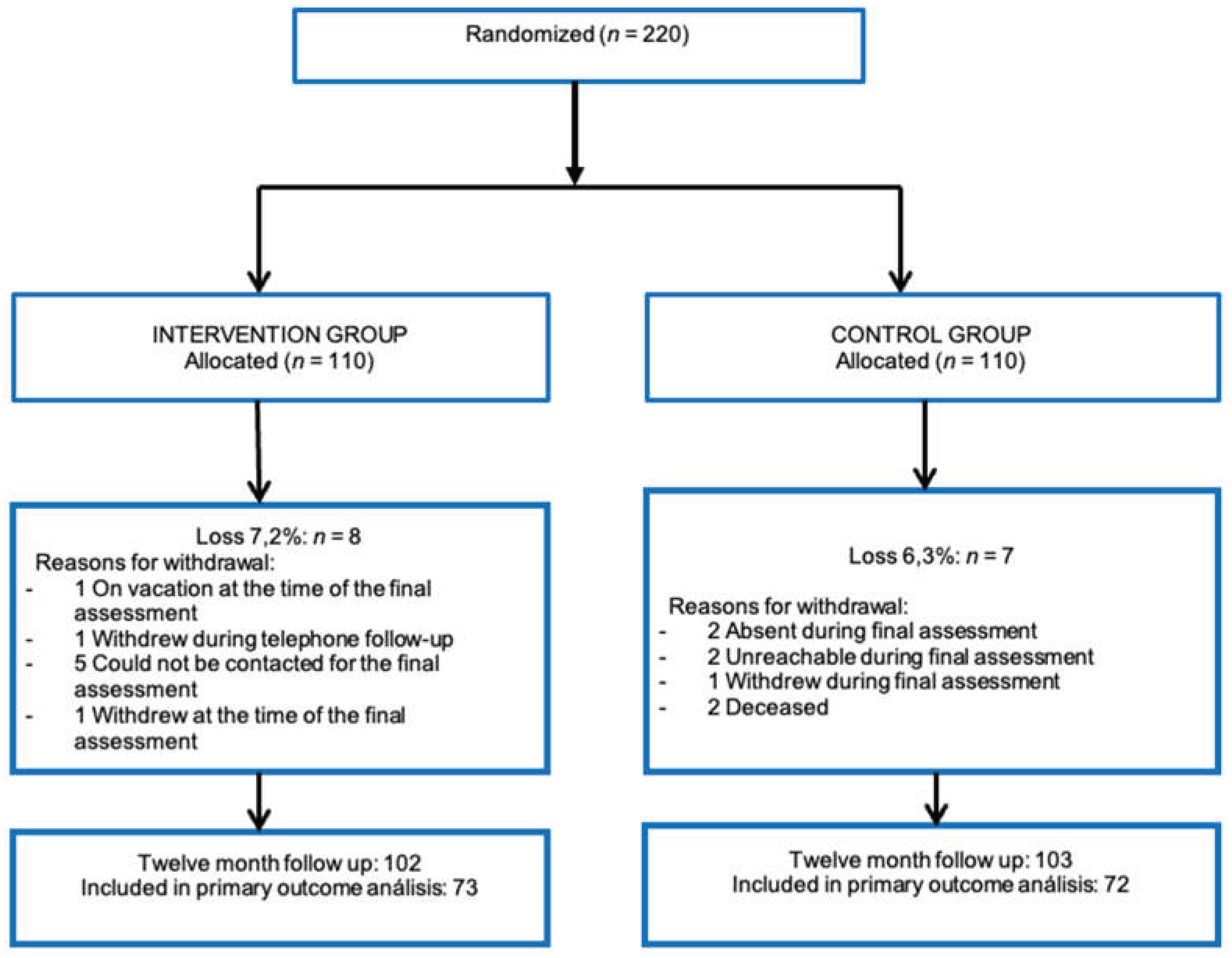

Table 1.
Baseline characteristics of study participants according to study group.
| Characteristic | Intervention (n=110) | Control (n=110) | P value |
|---|---|---|---|
| Age, years, median (IQR) | 72(15) | 72(13) | 0.957 |
| Female sex, n (%) | 94(85.5) | 100(90.9) | 0.210 |
| Education (years), median (IQR) | 8(16) | 8(17) | 0.147 |
| MMSE, median (IQR) | 18(6) | 18(6) | 0.471 |
| EFAM-A, median (IQR) | 49(11) | 50(11) | 0.078 |
| EFAM-B, median (IQR) | 43(43) | 44(41) | 0.445 |
| Previous falls, n (%) | 37(34.3) | 39(36.1) | 0.484 |
| Fear of falling, n (%) | 82(74.5) | 80(73.4) | 0.846 |
| Fall-risk checklist score, median (IQR) | 13(14) | 12(16) | 0.222 |
| Home hazard recognition score, median (IQR) | 11(15) | 11(16) | 0.294 |
Table 2.
Primary and secondary outcomes at baseline and 12-month follow-up.
| Outcome | Intervention Baseline | Intervention Follow-up | Control Baseline | Control Follow-up | Between-group p |
|---|---|---|---|---|---|
| Primary outcome | |||||
| Falls, n (%) | 37(34.3)a | 17 (23) | 39(36.1)a | 19 (26) | 0.666 |
| Number of falls median (IQR) | 0(4)a | 1 (5) | 0(8)a | 2 (5) | 0.164 |
| Secondary outcomes | |||||
| Fall-risk factors, median (IQR) | 13(14) | 10 (15) | 12(16) | 11(14) | 0.001 |
| Home hazard recognition, median (IQR) | 11(15) | 12(12) | 11(16) | 11.5(13) | 0.044 |
| Fear of falling, n (%) | 37 (34.3) | 29 (28.4) | 39 (36.1) | 29(28.2) | 0.558 |
a: Indicates a self-reported measure; these measures were included in the sensitivity analyses. P values correspond to the between-group comparisons described in the Statistical Analysis section (chi-square test, negative binomial regression, ANCOVA, or logistic regression, as appropriate).
Disclaimer/Publisher’s Note: The statements, opinions and data contained in all publications are solely those of the individual author(s) and contributor(s) and not of MDPI and/or the editor(s). MDPI and/or the editor(s) disclaim responsibility for any injury to people or property resulting from any ideas, methods, instructions or products referred to in the content. |
© 2026 by the authors. Licensee MDPI, Basel, Switzerland. This article is an open access article distributed under the terms and conditions of the Creative Commons Attribution (CC BY) license (http://creativecommons.org/licenses/by/4.0/).
Copyright: This open access article is published under a Creative Commons CC BY 4.0 license, which permit the free download, distribution, and reuse, provided that the author and preprint are cited in any reuse.