
Submitted:
10 August 2026
Posted:
11 August 2026
You are already at the latest version
Abstract
Lipid metabolic reprogramming is increasingly implicated in thyroid cancer progression and treatment resistance, but circulating lipid associations are often conflated with tumor lipid dependency. A clinically useful synthesis must distinguish systemic lipid markers from intratumoral lipid flux before integrating them into mechanistic or therapeutic models. This critical narrative review integrates evidence across three connected layers: circulating lipid markers; tumor-intrinsic uptake, oxidation, synthesis, desaturation, cholesterol and oxysterol pathways; and immune-spatial niches involving macrophage lipid handling, APOE-associated polarization and ferroptosis-related lipid peroxidation. In papillary thyroid carcinoma, multi-omics and mechanistic studies implicate LPL-FATP2-CPT1A, PC-AKT/mTOR-SREBP1c-FASN and METTL16/YTHDC2/SCD1 programs in membrane remodeling, invasion-related behavior and recurrence-risk stratification. In aggressive and anaplastic thyroid cancer, cholesterol-synthesis signaling, fatty-acid-oxidation adaptation and SREBF1/SCD1-linked ferroptosis defense may contribute to resistance to radioiodine, radiotherapy, chemotherapy and BRAF/MEK inhibition. Current evidence is strongest for mechanistic and biomarker hypotheses; thyroid-cancer-specific prospective trials of lipid-directed treatment are lacking. Lipid metabolism therefore provides a framework for molecular stratification and treatment sensitization, but it does not currently justify nonspecific lipid lowering or routine lipid-targeted therapy. Translation will require paired blood and tumor lipidomics, spatial profiling, functional perturbation and biomarker-defined prospective studies.
Keywords:
thyroid cancer
; lipid metabolism
; lipidomics
; fatty acid metabolism
; cholesterol
; SCD1
; ferroptosis
; immunometabolism
; therapeutic resistance
Introduction
Thyroid cancer comprises papillary thyroid carcinoma (PTC), follicular thyroid carcinoma (FTC), medullary thyroid carcinoma (MTC), poorly differentiated thyroid carcinoma (PDTC) and anaplastic thyroid carcinoma (ATC). PTC accounts for most cases and is usually associated with favorable survival, but this broad clinical impression can obscure the long-term burden of recurrence, lymph-node metastasis and local invasion. Integrated proteogenomic and metabolomic studies show that PTC remains molecularly heterogeneous even within clinically defined recurrence-risk groups [1]. ATC, although rare, is highly aggressive and frequently resistant to multimodal therapy. A clearer understanding of how thyroid cancer progresses from indolent disease to recurrence, metastatic spread, dedifferentiation and treatment resistance therefore remains clinically important.
Cancer metabolic reprogramming was initially framed largely around glycolysis, but lipid metabolism is now recognized as a central component of tumor adaptation. Lipids are structural membrane components, energy stores, signaling molecules and regulators of oxidative stress and regulated cell death. In thyroid cancer, lipid-related research has moved from early metabolomic and lipidomic biomarker discovery toward mechanistic studies of fatty acid metabolic enzymes, cholesterol metabolism, epitranscriptomic regulation, immune-cell lipid handling and ferroptosis sensitivity [2,3,4,5]. Lipid metabolism in thyroid cancer should therefore not be reduced to systemic dyslipidemia. A more useful translational model is that thyroid tumors and their microenvironment remodel lipid uptake, synthesis, storage, oxidation and peroxidation in ways that affect progression and therapeutic response.
Recent reviews have summarized metabolomic and lipidomic biomarker discovery, lipid-metabolism disorders, lipidomic profiling and fatty acid metabolic reprogramming in thyroid cancer [2,3,4,5]. These reviews establish the importance of the field, but they also illustrate that lipidomics, fatty acid metabolism, systemic dyslipidemia, ferroptosis and tumor immunometabolism are often discussed as partially separate literatures. The present Review builds on this foundation by integrating tumor-intrinsic lipid flux, systemic lipid markers, immune and spatial lipid biology, and therapy-resistance mechanisms into an evidence-graded disease-lipid framework.
Position Relative to Recent Reviews
Recent reviews have addressed thyroid cancer metabolomics and lipidomics, lipid-metabolism disorders, lipidomic profiling or fatty acid metabolic reprogramming [2,3,4,5]. The present Review extends this literature by making the systemic-marker versus intratumoral-flux distinction its organizing principle; integrating fatty acid, cholesterol, oxysterol, immune and ferroptosis pathways; and separating associative biomarkers from functionally supported vulnerabilities and clinically mature interventions. This cancer-centered framework links metabolic adaptation to recurrence, metastatic behavior, dedifferentiation and resistance to radioiodine, radiation and MAPK-pathway therapy.
This Review focuses on fatty acid hydrolysis, uptake, transport and oxidation; de novo fatty acid synthesis; cholesterol uptake and oxysterol metabolism; membrane lipid and sphingolipid remodeling; lipid droplet formation; immune lipid handling; and ferroptosis-related lipid peroxidation. The available literature is uneven across histologic subtypes. Evidence is strongest in PTC, where multi-omics studies have identified systematic changes in lipid composition, protein expression and metabolic pathways associated with lymph-node metastasis, recurrence risk and prognosis [1,6]. In ATC, lipid remodeling and ferroptosis escape are emerging as mechanisms of radioresistance and therapeutic vulnerability [7]. FTC, PDTC and MTC are discussed when relevant evidence is available, but they remain underrepresented.
The distinctive aim of this Review is to connect lipid-centered omics, spatial biology and mechanistic studies with questions central to thyroid cancer care: recurrence-risk stratification, dedifferentiation, radioiodine resistance, targeted-therapy adaptation and treatment sensitization. It distinguishes tumor-intrinsic lipid flux from systemic host lipid markers, identifies where patient-sample or functional evidence supports causal inference, and separates clinically testable hypotheses from interventions that remain preclinical.
Review Approach and Evidence Appraisal
We conducted a critical narrative review with structured evidence mapping rather than a PRISMA systematic review or meta-analysis. The search strategy was designed to identify mechanistic and disease-relevant evidence linking thyroid cancer with fatty acid uptake and oxidation, de novo lipogenesis, desaturation, cholesterol and oxysterol metabolism, lipidomics, immunometabolism, ferroptosis and therapeutic resistance. PubMed was searched on 25 May 2026, public trial and omics repositories were scanned on 26 May 2026, PubMed was refreshed on 5 June 2026, Wanfang Data and VIP/CQVIP were searched on 7 June 2026, and the clinical-trial scan was refreshed on 12 June 2026. Full search strings, screening categories, counts and audit files are provided in Supplementary File S1.
In the main synthesis, we prioritized patient tissue, blood-based and spatial omics studies; mechanistic studies with genetic or pharmacologic perturbation, rescue experiments, xenograft models or patient-derived organoids; and clinical cohorts or causal-inference studies relevant to peripheral lipid markers. Bioinformatic signatures, network pharmacology studies and prior reviews were used mainly for context or hypothesis generation. Evidence was not upgraded to clinical maturity unless thyroid-cancer-specific prospective intervention data were available.
Evidence strength was assigned with an operational narrative rubric adapted from GRADE-style domains of directness, replication, functional validation, clinical linkage and translational maturity. Formal GRADE ratings were not applied because most evidence came from omics, observational biomarker and preclinical mechanistic studies rather than comparative intervention trials. "Emerging" indicates single-study, abstract-level, bioinformatic-only, review-supported or early functional evidence without independent validation. "Emerging-moderate" indicates patient-sample or spatial/omics evidence with plausible mechanistic linkage but limited replication. "Moderate" indicates patient-sample, clinical or multi-omics evidence with clinical annotation or limited functional validation but without prospective validation. "Moderate preclinical" or "Moderate-high preclinical" indicates patient or omics evidence plus in vitro and in vivo, organoid or rescue evidence, still without thyroid-cancer-specific clinical-trial validation. No evidence chain was classified as clinically established.
The supplementary resource scan was used to identify trial signals and reusable omics resources, not for formal systematic inclusion. No thyroid-cancer-specific prospective anticancer trial of statins, ketogenic intervention, SCD1 inhibition, FAO inhibition, GPX4 inhibition or ferroptosis-directed lipid targeting was identified. One active first-in-human phase I study is evaluating the SCD1 inhibitor MTI-301 across refractory metastatic or unresectable solid tumors (NCT06911008), but no safety or efficacy results are yet available and the study is not thyroid-cancer-specific.
Because this was a critical narrative synthesis, the screening counts should not be interpreted as a PRISMA flow. Embase, Web of Science, Scopus, CNKI and SinoMed were not counted as searched because completed reproducible searches were not obtained.
During manuscript preparation, the authors used OpenAI Codex (GPT-5; OpenAI, accessed May-August 2026) to support literature organization, search-log structuring, evidence-table drafting, manuscript drafting and language polishing. The authors independently verified study eligibility, source data, citation placement, evidence interpretation and final wording, and take full responsibility for the manuscript.
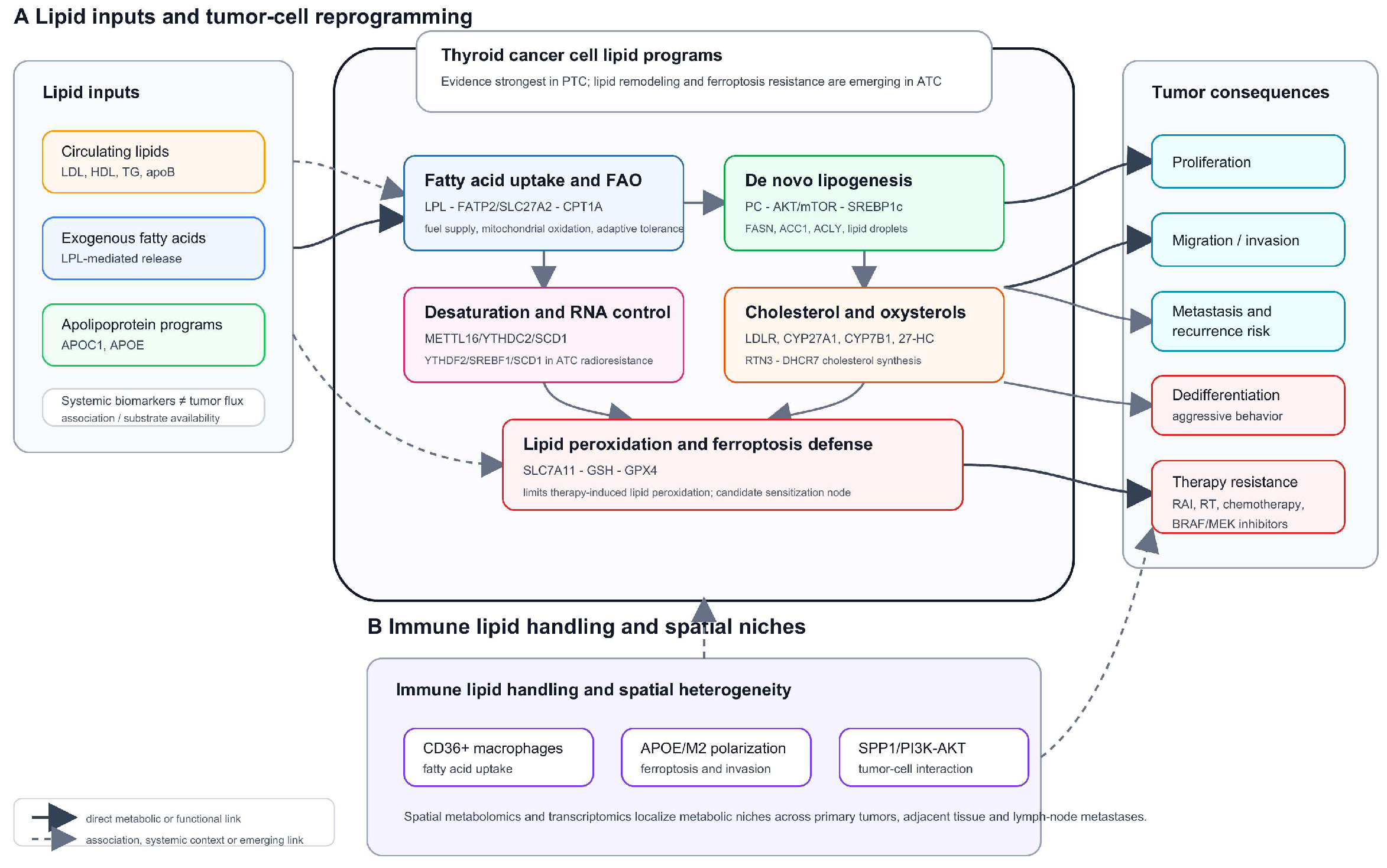
The synthesis is organized around two evidence tables and two figures. Table 1 summarizes evidence chains by lipid process, thyroid cancer context, evidence strength and translational interpretation. Table 2 separates candidate targets and combinations from clinical maturity and key limitations. Figure 1 summarizes tumor-cell, immune and systemic lipid networks. Figure 2 summarizes translational opportunities and barriers for sensitization-oriented strategies.
The figure separates systemic lipid inputs from tumor-cell lipid programs and immune-spatial niches. Circulating LDL, HDL, TG and apoB are presented as systemic biomarkers or sources of substrate availability, not as direct measurements of intratumoral lipid flux. The dashed connection from circulating markers denotes an associative or context-dependent relationship, whereas solid arrows denote more direct metabolic or functional evidence. In tumor cells, an LPL-FATP2-CPT1A candidate chain is linked to fatty acid uptake and FAO, while PC-AKT/mTOR-SREBP1c-FASN, METTL16/YTHDC2/SCD1 and YTHDF2/SREBF1/SCD1 represent candidate lipid synthesis, desaturation and RNA-regulated programs. Cholesterol and oxysterol nodes include LDLR, CYP27A1, CYP7B1, 27-HC and RTN3-DHCR7-dependent cholesterol synthesis. Ferroptosis defense is represented by SLC7A11-GSH-GPX4 and therapy-induced lipid peroxidation. Immune and spatial features include CD36-positive macrophages, APOE-associated M2 polarization, SPP1/PI3K-AKT tumor-cell interaction and spatial metabolomics/transcriptomics across primary tumors, adjacent tissue and lymph-node metastases. These processes converge on proliferation, migration/invasion, metastasis and recurrence risk, dedifferentiation, aggressive behavior and resistance to RAI, radiotherapy, chemotherapy and BRAF/MEK inhibitors.
Figure 2.
Translational opportunities.
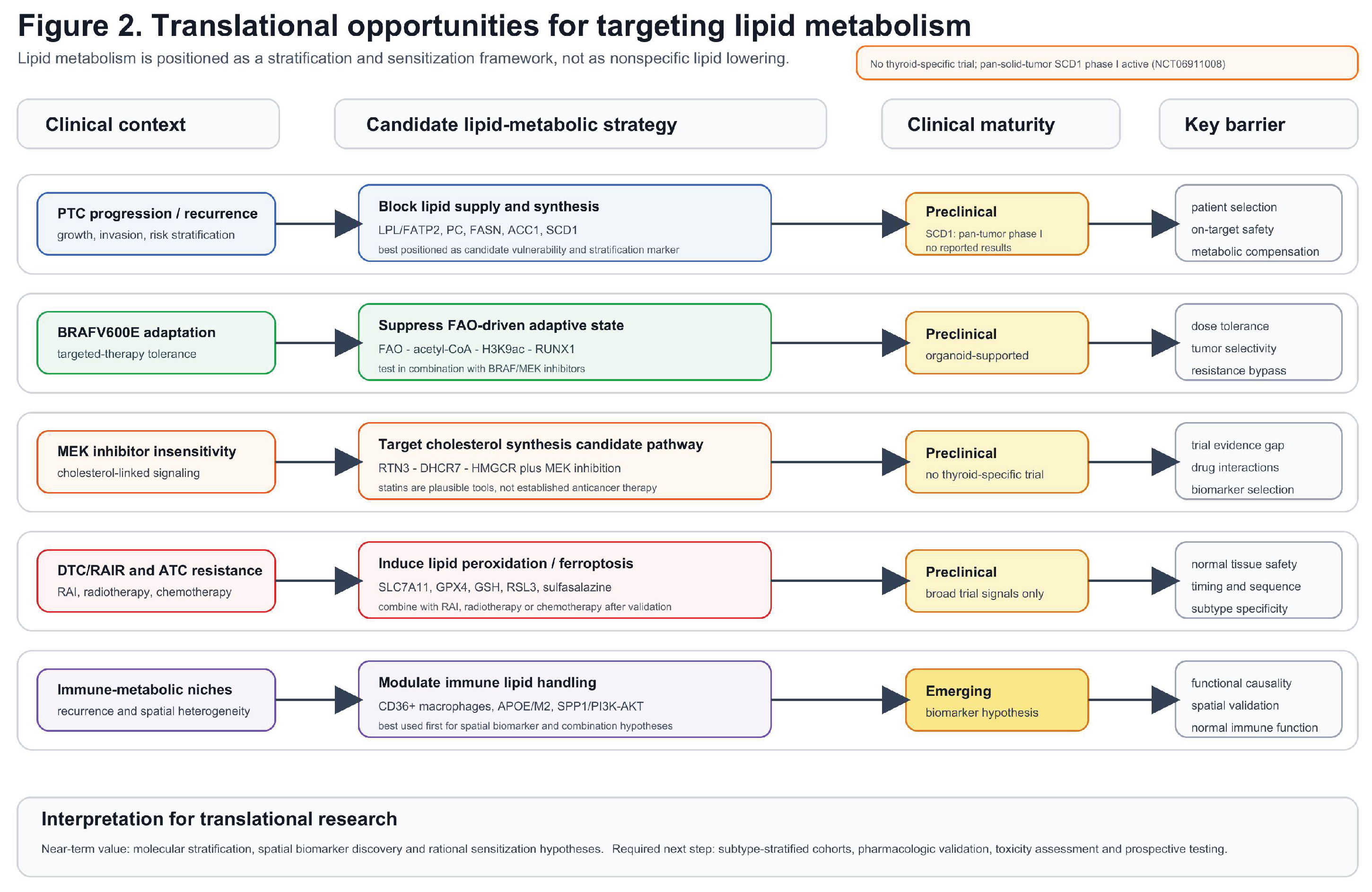
The figure presents lipid-metabolic intervention as a stratification and sensitization hypothesis rather than nonspecific lipid lowering or established therapy. The clinical-context column covers PTC progression/recurrence, BRAFV600E adaptation, MEK inhibitor insensitivity, DTC/RAIR and ATC resistance, and immune-metabolic niches. The strategy column maps these contexts to blockade of lipid supply and synthesis, suppression of an FAO-driven adaptive state, targeting of an RTN3-DHCR7-HMGCR cholesterol-synthesis candidate pathway, induction of lipid peroxidation/ferroptosis, and modulation of CD36/APOE/SPP1-related immune lipid handling. The clinical-maturity column distinguishes preclinical, organoid-supported and emerging biomarker hypotheses. The banner notes that no thyroid-cancer-specific prospective lipid-targeting trial was identified while acknowledging the active pan-solid-tumor phase I MTI-301 study. Key barriers include patient selection, toxicity window, dose tolerance, tumor selectivity, metabolic compensation, trial-evidence gaps, drug interactions, normal-tissue safety, timing and sequence, subtype specificity, spatial validation, functional causality and uncertain immunotherapy links.
Fatty Acid Rewiring in PTC: Lipolysis, Transport, Oxidation and Membrane Remodeling
One important feature of lipid metabolic change in PTC is reorganization of the fatty acid supply chain rather than isolated upregulation of a single enzyme. Multi-omics analysis comparing PTC with adjacent thyroid tissue demonstrated clear separation of tumor and non-tumor lipid profiles [6]. Tumors showed decreased triglycerides and diacylglycerols, together with increased membrane lipid classes such as phosphatidylcholine, phosphatidylinositol, phosphatidylglycerol, phosphatidylethanolamine, sphingomyelin and ceramides. This pattern suggests that fatty acids can be mobilized from storage lipids and redirected toward membrane remodeling, signaling or mitochondrial utilization.
At the molecular level, this work proposed an LPL-FATP2-CPT1A candidate chain. LPL hydrolyzes triglycerides to release fatty acids, FATP2/SLC27A2 supports fatty acid transport, and CPT1A is a rate-limiting enzyme for mitochondrial beta-oxidation of long-chain fatty acids. LPL, FATP2 and CPT1A were increased in PTC tissue and were associated with clinical progression or survival measures [6]. Functional experiments further showed that overexpression of these molecules enhanced thyroid cancer cell migration. Although migration assays do not by themselves establish an in vivo metastatic cascade, they move the LPL-FATP2-CPT1A candidate chain beyond biomarker association toward a functionally testable metabolic program.
An earlier Chinese patient-tissue study provides independent expression-level support for related fatty acid handling. After array-based discovery in three paired PTC and adjacent-tissue samples, RT-PCR validation in 46 paired samples showed higher tumor expression of SLC27A6/FATP6 and FABP3 [8]. This finding broadens the transporter and fatty acid-binding candidates implicated in PTC, but it remains supportive rather than causal because functional perturbation and outcome validation were not reported.
This fatty acid supply-chain model is consistent with recurrence-risk multi-omics. In 102 Chinese patients with PTC, high-risk disease showed altered triglycerides, free fatty acids and metabolic modules [1]. Integrated clustering identified a high-recurrence-risk metabolic subtype with poor outcome, suggesting that lipid metabolism contributes to risk stratification within PTC rather than merely separating tumor from adjacent tissue.
Additional studies link fatty acid metabolism to BRAF-driven adaptation. In BRAFV600E PTC, ACC2 was downregulated in clinical samples and cell lines, while BRAF inhibition altered de novo lipid synthesis, FAO and metabolic flux [9]. More recent work connected FAO to epigenetic therapy adaptation: BRAFV600E inhibition increased FAO and PGC1alpha, and FAO-derived acetyl-CoA was linked to H3K9ac remodeling and RUNX1-dependent survival programs. FAO inhibition with thioridazine enhanced the antitumor effect of BRAF inhibition in vitro, in vivo and in patient-derived organoids [10]. Other nodes include hypoxia-CPT1A signaling [11], circPCNXL2-ACC1-dependent fatty acid metabolism [12] and combined reliance on LPL-mediated exogenous uptake and FASN-mediated endogenous synthesis [13]. Collectively, these data suggest that PTC can mobilize exogenous uptake, endogenous synthesis and mitochondrial oxidation, and may rebalance these routes under therapeutic pressure.
Metabolomic and lipidomic studies also support diagnostic or metastatic biomarker development. A serum free fatty acid panel including C16:1, C18:2, C20:4 and C22:6 distinguished benign thyroid disease from thyroid cancer in 664 serum samples [14]. Plasma combined metabolomics and lipidomics identified 113 differential metabolites and 236 differential lipids between PTC and healthy controls [15]. These biomarker studies do not replace mechanistic tissue studies, but they provide a translational route toward noninvasive diagnosis, risk stratification and metabolic phenotyping.
De Novo Lipogenesis: A Proposed PC-AKT/mTOR-SREBP1c-FASN Pathway
In addition to uptake and utilization of exogenous or stored fatty acids, thyroid cancer cells may support aggressive phenotypes through de novo lipogenesis. Pyruvate carboxylase (PC) catalyzes an anaplerotic reaction that converts pyruvate to oxaloacetate, thereby supplying carbon for biosynthesis. A mechanistic study proposed that a PC-AKT/mTOR-SREBP1c-FASN pathway may support thyroid cancer aggressiveness [16].
PC was increased in invasive PTC compared with normal thyroid tissue in public transcriptomic data and was further associated with lymph-node metastasis in 38 PTC surgical samples [16]. PC knockdown reduced intracellular triglycerides, lipid droplets and free fatty acids, including oleic acid, stearic acid, palmitoleate and palmitic acid. It also downregulated FASN, ACC1 and ACLY, as well as SREBP1c. In clinical tissues, PC correlated with FASN and SREBP1c mRNA expression. Mechanistically, PC knockdown reduced AKT and mTOR phosphorylation, and PI3K inhibition decreased SREBP1c and lipid accumulation. Functionally, PC knockdown inhibited migration, invasion and xenograft growth, whereas SREBP1c overexpression partially rescued lipid accumulation, invasion and tumor weight.
This proposed pathway is important because it links tricarboxylic acid cycle anaplerosis, lipid synthesis and invasive behavior in a single experimentally testable model. In contrast to the LPL-FATP2-CPT1A candidate chain, which emphasizes fatty acid mobilization, transport and oxidation, the PC-centered pathway emphasizes endogenous lipogenesis to meet membrane, biosynthetic and motility demands. Current evidence supports PC-AKT/mTOR-SREBP1c-FASN as a strong mechanistic candidate, but larger independent cohorts, prospective prognostic validation and pharmacologic studies are required before it can be considered a mature clinical target.
SCD1 and m6A Regulation of Lipid Synthesis
Whereas the PC-centered pathway emphasizes metabolic activation of fatty acid synthesis, the METTL16/YTHDC2/SCD1 findings suggest that PTC lipid reprogramming can also be controlled at the epitranscriptomic level. SCD1 converts saturated fatty acids into monounsaturated fatty acids and thereby affects membrane composition, triglyceride synthesis, proliferation and migration. Because tumor cells require lipid synthesis and membrane remodeling, SCD1 is a plausible metabolic adaptation node.
A mechanistic study of 58 paired PTC and adjacent tissues integrated TCGA/cBioPortal analysis, RNA sequencing, m6A sequencing, fatty acid and triglyceride assays, cell-function experiments and mouse tumor models [17]. METTL16 was decreased in PTC, potentially through DNMT1-mediated promoter hypermethylation. METTL16 overexpression inhibited PTC proliferation, migration, invasion and in vivo metastasis, whereas METTL16 knockdown had the opposite effects. The key finding was that METTL16 increased m6A modification in the 3' untranslated region of SCD1 mRNA, while YTHDC2 recognized the modification and was reported to promote SCD1 mRNA degradation. Loss of METTL16 therefore stabilized SCD1 and enhanced lipid accumulation.
Metabolic assays supported this mechanism: METTL16 overexpression reduced palmitate, oleic acid, triglycerides and Oil Red O staining, whereas METTL16 knockdown increased lipid accumulation [17]. Pharmacologic inhibition of SCD1 with A939572 suppressed proliferation, colony formation, migration, triglyceride accumulation and tumor growth, and partially reversed the effects of METTL16 knockdown. This positions SCD1 as a potential vulnerability in METTL16-low PTC. Additional evidence links SCD to immune infiltration and PTC cell invasion [18], and early ATC work identified aberrant lipid metabolism and SCD1 as a therapeutic target [19]. In 50 paired PTC samples and two PTC cell lines, KMT5A was overexpressed, while its knockdown reduced SREBP1, SCD, FASN and ACC expression together with MDA, ROS and malignant cell phenotypes [20]. TCGA data from 455 PTCs further associated high KMT5A with extrathyroidal extension, lymph-node metastasis and advanced stage. These findings support chromatin-associated regulation of a lipogenic program, but they do not establish the proposed p53-SREBP intermediary mechanism, and lipid flux or in vivo therapeutic effects were not tested.
SCD1 targeting in thyroid cancer remains preclinical. Systemic SCD1 inhibition has raised mechanistic and preclinical concerns because the enzyme supports lipid homeostasis in normal tissues, including skin and ocular surface tissues. The active first-in-human MTI-301 phase I study in refractory solid tumors is designed to define dose and toxicity and excludes patients with clinically relevant corneal disease or grade 2 or greater neuropathy (NCT06911008); these criteria indicate safety domains under surveillance, not established treatment-emergent toxicities. No clinical results are available. Compensation through exogenous fatty acid uptake, CPT1A-mediated oxidation or alternative lipogenic pathways also remains a major concern and should be built into future combination studies.
Cholesterol Uptake, 27-Hydroxycholesterol and Aggressiveness
Cholesterol metabolism is another major component of thyroid cancer lipid reprogramming. Cholesterol supports membranes and lipid rafts, and oxysterol derivatives can modulate inflammation, proliferation and migration. However, cholesterol metabolism in thyroid cancer should not be interpreted simply as "higher serum cholesterol means higher cancer risk." A more plausible model is that aggressive tumors increase cholesterol uptake and intracellular cholesterol handling, thereby altering both circulating lipid profiles and intratumoral oxysterols.
An integrated clinical and mechanistic study included benign thyroid tumors, low/intermediate-risk PTC, high-risk PTC and PDTC/ATC, and measured 27-hydroxycholesterol (27-HC) in frozen tumor samples [21]. High-risk PTC and PDTC/ATC were associated with lower serum total cholesterol, LDL-C and apoB, whereas aggressive tumors showed increased LDLR and decreased HMGCR and CYP7B1. The detection rate and level of 27-HC increased with aggressiveness, reaching the highest frequency in PDTC/ATC [21]. CYP27A1 generates 27-HC and CYP7B1 clears it; thus, reduced CYP7B1 is consistent with 27-HC accumulation. LDL promoted proliferation and migration in thyroid cell models, CYP7B1 overexpression reduced CAL-62 proliferation and migration, and CYP27A1 knockdown blocked LDL-mediated proliferation [21].
These findings support a tumor-intrinsic uptake-conversion-oxysterol model rather than a peripheral lipid-only model. LDLR, CYP27A1, CYP7B1 and 27-HC are candidate metabolic nodes in aggressive thyroid cancer, but current evidence does not justify inferring that systemic cholesterol lowering will necessarily reduce thyroid cancer risk or improve outcome.
Cholesterol metabolism is also linked to targeted-therapy resistance. RTN3 was reported to be decreased in thyroid cancer and associated with disease progression, poor prognosis and MEK inhibitor insensitivity [22]. Mechanistically, RTN3 interacted with DHCR7 and promoted its ubiquitination; RTN3 loss stabilized DHCR7, increased cellular cholesterol and was linked to EGFR/ERK activation and tumor-progression phenotypes in experimental models. Simvastatin partially rescued this phenotype [22]. These data move cholesterol metabolism from an aggressiveness-associated observation toward a testable candidate mechanism of MEK inhibitor resistance. Clinical evidence for statin-based thyroid cancer intervention remains insufficient.
Peripheral blood lipid studies require separate interpretation. A nationwide Korean cohort linked thyroid cancer with subsequent dyslipidemia [23], repeated low HDL-C was associated with thyroid cancer risk [24], and the monocyte-to-HDL cholesterol ratio (MHR) has been proposed as an inflammatory-lipid marker in PTC [25]. These studies suggest that host metabolic state is associated with thyroid cancer, but they do not directly measure tumor-intrinsic LDLR-CYP27A1-CYP7B1 or RTN3-DHCR7 activity. Apolipoprotein studies provide additional candidates: APOC1 has been linked to PTC progression and treatment response [26,27], while APOE has been associated with PTC progression, ferroptosis resistance and macrophage polarization [28,29].
Lipid Metabolism, Immune Microenvironment and Recurrence-Risk Subtyping
Lipid reprogramming also intersects with the immune microenvironment. Traditional recurrence-risk stratification is based largely on clinicopathologic features, but multi-omics data indicate that PTCs within similar clinical risk categories can differ substantially in metabolic and immune states [1]. Four multi-omics subtypes were identified: low-risk/BRAF-like, high-risk/metabolic, high-risk/immune and high-risk/BRAF-like. The high-risk metabolic subtype had the poorest prognosis, supporting the concept of a metabolically defined recurrence-risk state [1].
Multi-omics network analysis also suggested crosstalk between lipid metabolism and immune state. Lipid classes such as phosphatidylcholine, phosphatidylethanolamine and sphingomyelin formed important modules, while free fatty acids, diacylglycerols, phosphatidylglycerols and FABP5 appeared in network layers linking metabolites, genes, proteins and phosphoproteins with antigen-processing and presentation proteins [1]. Thus, fatty acid metabolism may not only reflect tumor-cell energy and membrane requirements, but may also interact with or report the tumor immune microenvironment.
CD36-positive macrophage studies further strengthen this immunometabolic theme. CD36-positive proinflammatory macrophages have been identified in the PTC microenvironment and linked to adverse outcome and recurrence risk [30]. These macrophages may interact with metabolically active ZCCHC12-positive tumor cells and support proliferation-related signaling through SPP1/PI3K-AKT. Although this evidence should be interpreted with attention to study design and validation, CD36 is biologically plausible as a fatty acid uptake and lipid-handling molecule that connects macrophage metabolism, inflammatory state and tumor-cell behavior.
APOE provides a second, experimentally tractable link between tumor lipid biology and macrophage state. In PTC tissues and cell models, APOE expression accompanied higher xCT/SLC7A11, GPX4 and FTH1 and lower Fe2+ accumulation [29]. APOE knockdown increased Fe2+, MDA, ROS and ferroptosis-associated mitochondrial changes, whereas APOE overexpression produced the opposite pattern. DFO and PI3K inhibition partially reversed these effects, and THP-1-derived macrophage co-culture linked APOE-associated ferroptosis suppression to an Arg-1-high, IL-1beta-low M2-like state and increased PTC-cell migration and invasion. This is a coherent in vitro mechanism, but it remains limited by the absence of an in vivo tumor model, reliance on a simplified M1/M2 marker framework and incomplete definition of how APOE controls iron handling.
Spatial omics studies are beginning to localize these interactions. Integrated spatial metabolomics and transcriptomics of PTC primary tumors, adjacent tissues and lymph-node metastases mapped spatial metabolic-transcriptional landscapes and identified features associated with metastatic evolution [31]. These data suggest that PTC progression cannot be fully explained by bulk tissue averages. For lipid metabolism, future models should integrate lipid enzymes, lipid species and the spatial organization of immune cells and tumor cells.
Lipid Remodeling, Ferroptosis and Therapeutic Resistance in ATC
ATC is characterized by rapid progression, local invasion, distant metastasis and treatment resistance. Compared with PTC, the evidence base for lipid metabolism in ATC is smaller, but available studies suggest roles for lipogenesis, membrane remodeling and ferroptosis escape. Early work identified aberrant lipid metabolism in ATC and proposed SCD1 as a therapeutic target [19]. SCD1 may help ATC cells maintain membrane lipid homeostasis and avoid excessive lipid peroxidation during rapid growth and therapeutic stress.
More direct evidence connects lipid metabolism with radioresistance. YTHDF2-mediated stabilization of SREBF1 was reported to support lipid metabolic reprogramming and ferroptosis-associated radioresistance in ATC [7]. This mechanism is conceptually consistent with the METTL16/YTHDC2/SCD1 findings in PTC: m6A-associated regulators can control SREBP/SCD1-type lipid synthesis programs, thereby affecting lipid peroxidation and treatment response. However, different thyroid cancer subtypes, RNA targets and reader proteins may produce different biological consequences, so these pathways require subtype-specific validation.
Ferroptosis is a regulated cell-death process driven by iron-dependent lipid peroxidation. Because membrane lipid composition and lipid peroxidation determine ferroptosis sensitivity, lipid metabolic reprogramming and ferroptosis are intrinsically connected. Reviews of ferroptosis in thyroid cancer emphasize SLC7A11, GPX4, glutathione metabolism, lipid peroxidation and iron metabolism as candidate therapeutic nodes [32,33]. In differentiated thyroid cancer cells, iodine-131 induced ferroptosis-like lipid peroxidation through SLC7A11 suppression and synergized with sulfasalazine [34]. In radioiodine-refractory DTC, metabolomic profiling distinguished RAIR from non-RAIR disease and implicated acetoacetate and ketone metabolism in iodine uptake-related pathways [35].
ATC models further support metabolic and ferroptosis-directed sensitization strategies. Isoliquiritigenin was reported to suppress fatty acid synthesis and migration in ATC through AMPK/SREBF1 signaling [36]. Isobavachalcone plus doxorubicin suppressed ATC progression through ferroptosis activation [37], ultrasound-targeted microbubble destruction enhanced RSL3-induced ferroptosis [38], and GPX4 inhibition induced ferroptosis and mTOR pathway suppression in thyroid cancer [39]. These studies suggest that the lipid synthesis and lipid peroxidation defense systems, especially the SREBF1/SCD1 and SLC7A11-GSH-GPX4 axes, may represent metabolic vulnerabilities for treatment-resistant thyroid cancer.
Blood Lipids, Lipoproteins and Clinical Risk or Metastasis Biomarkers
Peripheral blood lipid studies are close to clinical practice but are easy to overinterpret. Dyslipidemia, apolipoproteins and inflammatory-lipid composite markers may support risk assessment or metastasis prediction, but they do not directly measure intratumoral lipid flux. In a Chinese single-center retrospective study of 1,650 patients with PTC and 882 controls with low-risk benign nodules, higher triglycerides and lower HDL-C were independently associated with prevalent PTC in both sexes [40]. The design cannot establish temporality, and selection of a nodule-based control group, single-time-point measurements and residual metabolic or hormonal confounding limit causal interpretation.
The prospective AMORIS cohort provides a different level of evidence. Among 561,388 Swedish participants followed for more than 30 years, each standard-deviation increase in total cholesterol and HDL-C was associated with modestly lower thyroid cancer risk, with hazard ratios of 0.91 and 0.86, respectively; LDL-C, triglycerides, ApoA-I and ApoB were not significantly associated [41]. Cases had lower total cholesterol and HDL-C decades before diagnosis, but several lipid and apolipoprotein markers declined further during the final 10 years before diagnosis. This pattern argues against treating measurements near diagnosis as simple etiologic exposures and suggests that both long-term host phenotype and reverse causation may contribute. The cohort nevertheless lacked histologic subtype, BMI and TSH data, and the effect sizes were small.
Mendelian randomization adds an exploratory causal-inference layer, but the available DTC analysis requires particular caution [42]. Univariate models reported associations for total cholesterol, HDL-C, ApoB and the ApoB/ApoA-I ratio, whereas none remained significant when the four correlated traits were entered together in multivariable MR. The DTC outcome GWAS was small, the article reported inconsistent case-control counts between sections, and some effect estimates were extreme with wide confidence intervals. These results are better treated as hypothesis-generating genetic signals than as proof that modifying a circulating lipid trait will alter DTC risk.
Composite inflammatory-lipid markers are also of interest. In a single-center study that retained 82 of 200 screened patients, MHR was associated with central lymph-node metastasis after propensity-score matching (OR 1.76, 95% CI 1.20-2.88) [43]. Integrated public scRNA-seq data from 17 tissues identified cholesterol-homeostasis-associated tumor states and a CD68-positive C3 macrophage cluster linked to metastatic features, while co-culture experiments supported a migration-promoting M2-like macrophage phenotype. This multimodal triangulation is biologically informative, but it does not show that blood MHR directly measures the intratumoral mechanism, and the clinical estimate lacks external validation. A final literature refresh identified a separate retrospective propensity score-matched cohort in which platelet-to-HDL-C ratio was independently associated with lymph-node metastasis and contributed to a moderate-discrimination nomogram [44]. Both indices remain candidate biomarkers whose value depends on external validation and incremental performance beyond ultrasound and clinicopathologic features.
Metabolomics and lipidomics provide an additional biomarker route. Studies have used metabolomics to predict lymph-node metastasis [45], plasma metabolomics/lipidomics to identify PTC diagnostic candidates [15], salivary metabolomics to detect metastatic PTC after surgery [46], fine-needle aspiration metabolomics to distinguish thyroid nodules [47], and NMR-based tissue or plasma profiling to identify papillary thyroid microcarcinoma [48]. These approaches are attractive because they can be aligned with clinical pathways, but multicenter, blinded and prospective validation, including incremental value over ultrasound, cytology, pathology and clinicopathologic risk features, is required before clinical recommendation.
Therapeutic Targets and Translational Opportunities
The evidence base identifies several candidate intervention nodes, but none should be considered ready for routine thyroid cancer care without prospective validation. Fatty acid uptake and oxidation are represented by LPL, FATP2 and CPT1A, which are increased in PTC and linked to progression or prognosis [6]. FATP2 and CPT1A represent fatty acid transport and mitochondrial oxidation, respectively, but both processes are important in heart, liver and immune cells; toxicity and metabolic compensation must therefore be considered before therapeutic translation.
De novo lipogenesis provides a second therapeutic direction. PC, FASN, ACC1, ACLY and SREBP1c connect anaplerosis with lipid synthesis and invasion [16]. These molecules may serve first as stratification or vulnerability biomarkers before therapeutic testing in selected populations. The pathways should not be viewed as independent drug targets: restricting LPL/FATP2-mediated exogenous lipid supply may select for greater SREBP1-FASN-ACC-dependent synthesis, whereas blocking synthesis may increase lipid scavenging, storage-lipid mobilization or CPT1A-dependent oxidation. Conversely, FAO inhibition can redirect fatty acids toward membrane synthesis or lipotoxic storage. Such bidirectional compensation offers a plausible explanation for weak single-agent activity and argues for flux-informed combinations, paired pharmacodynamic biomarkers and testing under physiologically relevant lipid conditions. SCD1 and its epitranscriptomic regulators provide a third candidate pathway. The METTL16/YTHDC2/SCD1 evidence is mechanistically strong in PTC but still preclinical, and SCD1 has also been implicated in ATC lipid metabolism and radioresistance [7,17,19].
Cholesterol and oxysterol metabolism provide a fourth route. LDLR, CYP27A1, CYP7B1 and 27-HC are associated with aggressive thyroid cancer [21], and RTN3-DHCR7 links cholesterol synthesis with MEK inhibitor insensitivity [22]. Although the availability of lipid-lowering drugs makes this direction attractive, thyroid cancer-specific clinical evidence is lacking.
Immunometabolism and ferroptosis provide additional translational opportunities. CD36-positive macrophages, SPP1/PI3K-AKT, YTHDF2/SREBF1, GPX4 and lipid peroxidation suggest that lipid metabolism may affect treatment response through the immune microenvironment and regulated cell death [7,30,32,33]. However, CD36 and related lipid-handling programs also support homeostatic functions in macrophages and other normal tissues. Systemic blockade could therefore alter tissue repair, host lipid handling or protective immune-cell states rather than selectively depleting tumor-promoting macrophages. Spatial context is likely decisive: lipid-loaded macrophage states at the invasive front, metastatic lymph node or hypoxic tumor niche may not be equivalent to phenotypically related cells in adjacent thyroid or peripheral organs. Spatially restricted delivery, state-specific biomarkers and paired tumor/normal-tissue profiling should precede immunotherapy combinations. The most plausible near-term strategy is not single-agent lipid lowering, but rational combination with radioiodine, radiotherapy, BRAF/MEK inhibition, chemotherapy or carefully designed immunotherapy-oriented studies. Compared with radioiodine, radiotherapy, chemotherapy and BRAF/MEK sensitization, lipid-metabolism-based immunotherapy combinations remain more speculative in thyroid cancer and require direct testing.
Limitations and Research Priorities
Several limitations should temper interpretation. The evidence is uneven across thyroid cancer subtypes. PTC has the strongest data, particularly for fatty acid metabolism, SCD1 regulation and multi-omics recurrence-risk studies. ATC evidence is increasing but remains focused on lipid remodeling, ferroptosis and therapy resistance. FTC, PDTC and MTC remain underrepresented, so findings should not be extrapolated across histologic subtypes without validation.
Study designs are also imbalanced. Multi-omics and bioinformatic studies identify candidate pathways and subtypes, but many findings remain associative. Functional experiments strengthen causal inference, yet sample sizes, model systems and in vivo validation are often limited. Clinical lipid studies are translatable but vulnerable to confounding, reverse causation and inconsistent phenotype definitions. The available MR analysis is exploratory rather than definitive, and inflammatory-lipid ratios such as MHR have not undergone independent external validation. Future work should connect tissue lipidomics, single-cell or spatial omics, functional perturbation and clinical outcomes in the same cohorts.
The relationship between tumor-intrinsic lipid metabolism and systemic host metabolism remains unresolved. Peripheral LDL-C, triglycerides, HDL-C and apoB do not necessarily reflect intratumoral lipid flux. Aggressive tumors may increase LDLR-mediated uptake, reduce circulating LDL-C/apoB and increase intratumoral 27-HC [21]. Prospective studies should therefore collect blood lipids, tumor lipidomics, metabolic-enzyme expression and outcomes in parallel.
This Review also has methodological limitations. Evidence identification remained PubMed-centered despite supplementary searches of Wanfang Data, VIP/CQVIP and public trial and omics repositories. Embase, Web of Science, Scopus, CNKI and SinoMed were not searched successfully. Screening and evidence appraisal were performed for a narrative synthesis rather than by two independent reviewers, and no design-specific risk-of-bias assessment was undertaken. The reported counts should therefore not be interpreted as a PRISMA study-selection flow.
Database, language and publication bias toward positive mechanistic findings remain possible. Some preclinical conclusions rely on limited thyroid cancer cell-line panels whose driver mutations, lineage state and culture conditions may influence lipid dependence and drug response. The synthesis may also favor candidate vulnerabilities with clearer translational narratives.
Priority directions include subtype- and driver-stratified prospective lipidomic cohorts; systematic functional validation of LPL, FATP2, CPT1A, PC, SREBP1c, FASN, SCD1, CD36 and YTHDF2/SREBF1; spatial transcriptomic, proteomic and lipidomic mapping of metabolic niches; and therapeutic studies that test lipid metabolic intervention as sensitization to radioiodine, radiotherapy, BRAF/MEK inhibitors, immunotherapy-oriented combinations or ferroptosis induction. A future prospectively registered systematic review should add Embase, Web of Science, Scopus, CNKI and SinoMed; conduct backward and forward citation chasing; use dual independent screening and extraction; appraise risk of bias by study design; and assess eligible non-English full texts.
Conclusions and Future Directions
Lipid metabolic reprogramming in thyroid cancer spans tumor-cell metabolism, systemic host signals, immune-spatial niches and treatment response. In PTC, convergent evidence supports altered fatty acid uptake, synthesis, desaturation, oxidation and membrane remodeling, with emerging links to recurrence and metastatic behavior. In aggressive and anaplastic disease, cholesterol synthesis, FAO-dependent adaptation and ferroptosis defense provide plausible mechanisms of resistance. The most defensible near-term use of this biology is biomarker-guided stratification and rational treatment sensitization, not empirical lipid lowering. Progress will depend on subtype-resolved validation, paired systemic and intratumoral measurements, spatial and functional studies, and prospective trials with pharmacodynamic endpoints.
Tables
Evidence-strength categories in Table 1 are author-assigned narrative categories based on the operational rubric described in the Review Approach rather than formal GRADE ratings. "Emerging" indicates single-study, mainly bioinformatic, abstract-level, review-supported or early functional evidence. "Moderate" indicates patient-sample, clinical or multi-omics evidence with limited functional validation but without prospective clinical validation. "Moderate-high preclinical" indicates patient/sample evidence plus in vitro and in vivo, organoid or rescue evidence, still without thyroid-cancer-specific clinical-trial validation. Hybrid labels such as "Emerging-moderate", "Emerging preclinical" or "Moderate preclinical" indicate evidence spanning adjacent categories but remaining below prospective clinical validation.

Table 1.
Evidence chains in thyroid cancer lipid metabolism.
| Evidence chain | Main context | Key nodes | Evidence type | Evidence strength | Clinical maturity | Representative evidence | Translational implication |
| Fatty acid hydrolysis, uptake and oxidation | PTC progression and prognosis | LPL, FATP2/SLC27A2, CPT1A | Lipidomics, metabolomics, proteomics, tissue validation and migration assays | Moderate | Biomarker and preclinical vulnerability hypothesis | TG/DG decrease, membrane lipids increase, and LPL/FATP2/CPT1A upregulation correlates with progression or survival [6] | Exogenous fatty acid use and FAO may represent PTC metabolic vulnerabilities |
| Metabolic recurrence-risk subtype | PTC recurrence-risk stratification | TG, FFA, FABP5 and lipid-related modules | Multi-omics in 102 patients with PTC | Moderate | Stratification hypothesis requiring external validation | A high-risk metabolic subtype is associated with worse prognosis [1] | Lipid metabolism may explain molecular heterogeneity within clinical risk groups |
| De novo lipogenesis | PTC invasion and tumor growth | PC, AKT/mTOR, SREBP1c, FASN, ACC1, ACLY | Clinical samples, cell models, mouse models and rescue experiments | Moderate-high preclinical | Preclinical target hypothesis | PC perturbation was linked to lipid accumulation, migration, invasion and tumor growth through an AKT/mTOR-SREBP1c-FASN candidate pathway [16] | PC/FASN/SREBP1c are mechanistically supported candidate targets, but the evidence chain requires independent replication and validation in larger cohorts |
| SCD1-dependent desaturation | PTC proliferation, migration and progression-associated phenotypes | METTL16, YTHDC2, SCD1, MUFA, TG | PTC tissues, RNA-seq/m6A-seq and in vitro/in vivo experiments | Moderate-high preclinical | Preclinical target hypothesis | METTL16/YTHDC2 was reported to promote SCD1 mRNA degradation and limit lipid accumulation and malignant phenotypes [17] | SCD1 may be a metabolic vulnerability in METTL16-low PTC |
| Cholesterol and oxysterol metabolism | High-risk PTC and PDTC/ATC aggressiveness | LDLR, CYP27A1, CYP7B1, 27-HC | Patient lipids, tumor 27-HC and cell-function studies | Moderate | Stratification and mechanistic hypothesis | Aggressive tumors increase LDL uptake and accumulate 27-HC [21] | Peripheral lipid associations should be separated from tumor-intrinsic cholesterol pathways |
| Cholesterol synthesis and targeted resistance | MEK inhibitor insensitivity | RTN3, DHCR7, cholesterol, EGFR/ERK | TCGA, protein interaction, cell and animal studies | Moderate preclinical | Preclinical sensitization hypothesis | RTN3 loss was linked to DHCR7 stabilization, increased cholesterol and MEK inhibitor insensitivity; simvastatin partially rescued this phenotype [22] | Cholesterol synthesis may be exploitable for targeted-therapy sensitization |
| Lipid-immune interface | PTC recurrence and spatial heterogeneity | CD36+ macrophages, APOE, SPP1/PI3K-AKT | Multi-omics, spatial omics and mechanistic studies | Emerging-moderate | Biomarker and immunometabolic hypothesis | CD36+ macrophages, APOE-associated macrophage polarization and spatial metabolic heterogeneity are linked to PTC progression [29,30,31] | Lipid-associated immune features may mark or contribute to tumor-immune states |
| Ferroptosis and radioiodine sensitization | DTC and RAIR-DTC | SLC7A11, GPX4, GSH, lipid peroxidation | DTC cell studies and metabolic profiling | Emerging preclinical | Preclinical sensitization hypothesis | I-131 induces ferroptosis-like lipid peroxidation and synergizes with sulfasalazine; RAIR-DTC metabolomics implicates iodine uptake-related metabolic pathways [34,35] | Ferroptosis induction is a candidate RAI-sensitization strategy |
| Ferroptosis and ATC treatment resistance | ATC radiotherapy, chemotherapy and ferroptosis defense | YTHDF2/SREBF1/SCD1, GPX4, SLC7A11, lipid peroxidation | ATC cell studies and preclinical models | Emerging preclinical | Preclinical sensitization hypothesis | YTHDF2/SREBF1-driven lipid remodeling is linked to radioresistance; ferroptosis-inducing combinations suppress ATC progression in preclinical models [7,37,38,39] | Lipid-peroxidation defense is a candidate vulnerability in treatment-resistant ATC |
Note: The moderate-high preclinical rating for the PC-AKT/mTOR-SREBP1c-FASN chain reflects the depth of patient-sample, rescue and in vivo evidence within one principal mechanistic study [16]. Independent replication and validation in larger, molecularly annotated cohorts remain necessary.
Table 2.
Candidate therapeutic targets and combination strategies in thyroid cancer lipid metabolism.
Table 2.
Candidate therapeutic targets and combination strategies in thyroid cancer lipid metabolism.
| Therapeutic direction | Candidate target or strategy | Potential context | Evidence base | Clinical maturity | Key limitation |
| Block fatty acid supply | LPL/FATP2 inhibition or combined exogenous uptake and FASN inhibition | PTC proliferation, migration and progression-associated phenotypes | Fatty acid uptake, transport and oxidation are associated with PTC progression [6,13] | Preclinical | Lipid transport is broadly required by normal tissues; therapeutic window requires validation |
| Inhibit fatty acid synthesis | PC, FASN, ACC1, ACLY, SREBP1c | Lipogenesis-dependent PTC | PC-AKT/mTOR-SREBP1c-FASN has functional support as a candidate pathway [16] | Preclinical | Thyroid cancer-specific clinical trials and patient selection criteria are lacking |
| Target SCD1 | SCD1 inhibitors and upstream m6A-SCD1 regulation | PTC/ATC lipid synthesis and desaturation dependence | METTL16/YTHDC2/SCD1 and ATC SCD1 studies support a preclinical vulnerability hypothesis [17,19] | Thyroid cancer: preclinical; solid-tumor phase I active (NCT06911008) | Selectivity, compensation, and ocular and neurologic safety remain undefined |
| Suppress FAO adaptive tolerance | FAO inhibition combined with BRAF inhibition | BRAFV600E thyroid cancer targeted-therapy adaptation | FAO-acetyl-CoA-H3K9ac-RUNX1 was linked to BRAFi adaptive resistance [10] | Preclinical/organoid-supported | Tumor selectivity and tolerable dosing of FAO inhibition need confirmation |
| Interfere with cholesterol synthesis | DHCR7/HMGCR candidate pathway, statins with MEK inhibitors | MEK inhibitor-insensitive tumors | RTN3-DHCR7 provides preclinical rationale [22] | Preclinical; no thyroid cancer-specific statin trial identified | Statin availability should not be interpreted as established anticancer efficacy |
| Induce ferroptosis | SLC7A11/GPX4 inhibition, RSL3 or sulfasalazine with RAI/radiotherapy/chemotherapy | DTC, RAIR-DTC and ATC therapeutic resistance | DTC iodine-131 ferroptosis-like effects, ATC ferroptosis therapy and GPX4 inhibition support this direction [34,35,37,38,39] | Preclinical; broad solid-tumor iron-related trial signals only | Tissue selectivity, safety and combination timing require validation |
| Modulate immune lipid handling | CD36+ macrophages, APOE/M2 polarization, SPP1/PI3K-AKT | PTC recurrence, lymph-node metastasis and immune microenvironment | CD36+ macrophage and APOE studies link lipid metabolism with immune state [29,30] | Biomarker/immunometabolic hypothesis | Spatial selectivity and normal-tissue immune effects require validation |
| Global clinical-trial caveat | Statins, ketogenic intervention, SCD1/FAO/GPX4 inhibition or ferroptosis-directed lipid targeting | Thyroid cancer lipid-metabolism targeting | No thyroid-specific trial; MTI-301 is in solid-tumor phase I (12 June 2026 refresh) | Not clinically established in thyroid cancer | Candidate strategies should be tested only in biomarker-defined prospective studies or trials |
Author Contributions
Conceptualization, L.Z. and Y.P.; methodology, L.Z. and Y.M.; investigation and data curation, L.Z. and Y.M.; writing-original draft preparation, L.Z.; writing-review and editing, L.M., J.S., Y.Z., G.P. and Y.P.; supervision, L.Z. and Y.P.; funding acquisition, Y.P. All authors have read and agreed to the published version of the manuscript.
Funding
This work was supported by the Basic Public Welfare Research Project of Zhejiang Province (LGF22H070008) and the Zhejiang Medical and Health Science and Technology Project (No. 2025KY1085). The funders had no role in the conceptualization of the review, literature screening, evidence interpretation, manuscript preparation or decision to submit the manuscript for publication.
Institutional Review Board Statement
Not applicable. This review did not involve new studies with human participants or animals.
Informed Consent Statement
Not applicable.
Data Availability Statement
No new data were created or analyzed in this study. Supporting search and screening information is provided in Supplementary File S1. Project search records, screening logs and extraction notes are available from the corresponding author on reasonable request.
Conflicts of Interest
The authors declare no conflicts of interest.
Acknowledgments
During the preparation of this manuscript, the authors used OpenAI Codex (GPT-5; OpenAI, accessed May-August 2026) for language polishing. The authors reviewed and edited all outputs, independently verified the underlying evidence and take full responsibility for the content.
Abbreviations
27-HC: 27-hydroxycholesterol; ACC: acetyl-CoA carboxylase; ACLY: ATP citrate lyase; APO: apolipoprotein; ATC: anaplastic thyroid carcinoma; BRAFi: BRAF inhibitor; CPT1A: carnitine palmitoyltransferase 1A; DTC: differentiated thyroid carcinoma; FAO: fatty acid oxidation; FASN: fatty acid synthase; FATP2: fatty acid transport protein 2; FTC: follicular thyroid carcinoma; GPX4: glutathione peroxidase 4; HDL-C: high-density lipoprotein cholesterol; HMGCR: 3-hydroxy-3-methylglutaryl-CoA reductase; LDL-C: low-density lipoprotein cholesterol; LDLR: low-density lipoprotein receptor; LNM: lymph-node metastasis; LPL: lipoprotein lipase; MHR: monocyte-to-HDL cholesterol ratio; MTC: medullary thyroid carcinoma; NIS: sodium-iodide symporter; PC: pyruvate carboxylase; PDTC: poorly differentiated thyroid carcinoma; PTC: papillary thyroid carcinoma; RAI: radioactive iodine; RAIR: radioiodine-refractory; SCD1: stearoyl-CoA desaturase 1; SLC7A11: solute carrier family 7 member 11; TG: triglyceride.
References
- Qu, N.; Chen, D.; Ma, B.; Zhang, L.; Wang, Q.; Wang, Y.; Wang, H.; Ni, Z.; Wang, W.; Liao, T.; et al. Integrated proteogenomic and metabolomic characterization of papillary thyroid cancer with different recurrence risks. Nat. Commun. 2024, 15, 1–18. [Google Scholar] [CrossRef] [PubMed]
- Yekta, R.F.; Tavirani, M.R.; Oskouie, A.A.; Mohajeri-Tehrani, M.R.; Soroush, A.R. The metabolomics and lipidomics window into thyroid cancer research. Biomarkers 2016, 22, 1–9. [Google Scholar] [CrossRef] [PubMed]
- Lukasiewicz, M.; Zwara, A.; Kowalski, J.; Mika, A.; Hellmann, A. The Role of Lipid Metabolism Disorders in the Development of Thyroid Cancer. Int. J. Mol. Sci. 2024, 25, 7129. [Google Scholar] [CrossRef] [PubMed]
- Daniealopol, V.; Daniealopol, R.; Sala, T.D.; Neagoe, R. Lipidomic Profiling: A Promising New Direction in the Diagnosis and Management of Thyroid Cancer? Cureus 2025, 17. [Google Scholar] [CrossRef] [PubMed]
- Ping, P.; Ma, Y.; Xu, X.; Li, J. Reprogramming of fatty acid metabolism in thyroid cancer: Potential targets and mechanisms. Chin. J. Cancer Res. 2025, 37, 227–249. [Google Scholar] [CrossRef] [PubMed]
- Lu, J.; Zhang, Y.; Sun, M.; Ding, C.; Zhang, L.; Kong, Y.; Cai, M.; Miccoli, P.; Ma, C.; Yue, X. Multi-Omics Analysis of Fatty Acid Metabolism in Thyroid Carcinoma. Front. Oncol. 2021, 11, 737127. [Google Scholar] [CrossRef] [PubMed]
- Dai, B.; Li, J.; Xu, L.; Chen, W.; Chen, J.; Song, M.; Liu, Y.; Wang, L.; Zhang, L.; Chen, J.; et al. YTHDF2-mediated stabilization of SREBF1 promotes lipid metabolic reprogramming and ferroptosis-associated radioresistance in anaplastic thyroid carcinoma. Cancer Lett. 2025, 639, 218232. [Google Scholar] [CrossRef] [PubMed]
- Liu, J.; Guan, H. [Screening and validation of lipid metabolism-related gene expression in papillary thyroid carcinoma] [in Chi-nese]. Mod. Oncol. 2018, 26(8), 1174–1178. [Google Scholar]
- Valvo, V.; Iesato, A.; Kavanagh, T.R.; Priolo, C.; Zsengeller, Z.; Pontecorvi, A.; Stillman, I.E.; Burke, S.D.; Liu, X.; Nucera, C. Fine-Tuning Lipid Metabolism by Targeting Mitochondria-Associated Acetyl-CoA-Carboxylase 2 in BRAF V600E Papillary Thyroid Carcinoma. Thyroid 2021, 31, 1335–1358. [Google Scholar] [CrossRef] [PubMed]
- Wang, X.; Zhang, J.; Yuan, J.; Wen, L.; Ying, T.; Xu, Z.; Zhou, Z.; Chen, S.; Zhou, Q.; Sheng, J.; et al. Fatty acid oxidation drives acetyl-CoA-dependent H3K9ac reprogramming to promote adaptive resistance to BRAFV600E inhibition in thyroid cancer. Cell Death Dis. 2026, 17. [Google Scholar] [CrossRef] [PubMed]
- Liang, Z.; He, H.; Zhang, B.; Kai, Z.; Zong, L. Hypoxia expedites the progression of papillary thyroid carcinoma by promoting the CPT1A-mediated fatty acid oxidative pathway. Drug Dev. Res. 2024, 85, e22168. [Google Scholar] [CrossRef] [PubMed]
- Chu, J.; Jiang, J.; Lu, X.; He, G.; Zhang, D. CircPCNXL2 promotes papillary thyroid carcinoma progression by regulating fatty acid metabolism induced by anabolic enzyme ACC1. Cancer Lett. 2024, 598, 217069. [Google Scholar] [CrossRef] [PubMed]
- Chen, S.; Li, C.; Chen, Y.; Bi, W.; Xu, G.; Cao, X.; Li, X. The roles of both the endogenous synthesis and exogenous uptake of fatty acids in thyroid cancer cell proliferation. Eur. J. Med. Res. 2025, 31. [Google Scholar] [CrossRef] [PubMed]
- Zhang, Y.; Qiu, L.; He, C.; Wang, Y.; Liu, Y.; Zhang, D.; Li, Z. Serum Unsaturated Free Fatty Acids: A Potential Biomarker Panel for Differentiating Benign Thyroid Diseases from Thyroid Cancer. J. Cancer 2015, 6, 1276–1281. [Google Scholar] [CrossRef] [PubMed]
- Wang, Z.; Yang, Y.; Xing, Y.; Si, D.; Wang, S.; Lin, J.; Li, C.; Zhang, J.; Yin, D. Combined metabolomic and lipidomic analysis uncovers metabolic profile and biomarkers for papillary thyroid carcinoma. Sci. Rep. 2023, 13, 1–11. [Google Scholar] [CrossRef] [PubMed]
- Liu, C.; Zhou, X.; Pan, Y.; Liu, Y.; Zhang, Y. Pyruvate carboxylase promotes thyroid cancer aggressiveness through fatty acid synthesis. BMC Cancer 2021, 21, 1–17. [Google Scholar] [CrossRef] [PubMed]
- Li, Q.; Wang, Y.; Meng, X.; Wang, W.; Duan, F.; Chen, S.; Zhang, Y.; Sheng, Z.; Gao, Y.; Zhou, L. METTL16 inhibits papillary thyroid cancer tumorigenicity through m6A/YTHDC2/SCD1-regulated lipid metabolism. Cell. Mol. Life Sci. 2024, 81, 1–17. [Google Scholar] [CrossRef] [PubMed]
- Shen, B.; Zhang, Y.; Tie, Y. Fatty acid metabolism influences the immune microenvironment in papillary thyroid cancer and identifies SCD as a novel biomarker. Front. Endocrinol. 2025, 16, 1534393. [Google Scholar] [CrossRef] [PubMed]
- von Roemeling, C.A.; Marlow, L.A.; Pinkerton, A.B.; Crist, A.; Miller, J.; Tun, H.W.; Smallridge, R.C.; Copland, J.A. Aberrant Lipid Metabolism in Anaplastic Thyroid Carcinoma Reveals Stearoyl CoA Desaturase 1 as a Novel Therapeutic Target. J. Clin. Endocrinol. Metab. 2015, 100, E697–E709. [Google Scholar] [CrossRef] [PubMed]
- Liao, T.; Wang, Y.-J.; Hu, J.-Q.; Wang, Y.; Han, L.-T.; Ma, B.; Shi, R.-L.; Qu, N.; Wei, W.-J.; Guan, Q.; et al. Histone methyltransferase KMT5A gene modulates oncogenesis and lipid metabolism of papillary thyroid cancer in�vitro. Oncol. Rep. 2018, 39, 2185–2192. [Google Scholar] [CrossRef] [PubMed]
- Revilla, G.; Pons, M.d.P.; Baila-Rueda, L.; García-León, A.; Santos, D.; Cenarro, A.; Magalhaes, M.; Blanco, R.M.; Moral, A.; Pérez, J.I.; et al. Cholesterol and 27-hydroxycholesterol promote thyroid carcinoma aggressiveness. Sci. Rep. 2019, 9, 1–13. [Google Scholar] [CrossRef] [PubMed]
- Ren, A.; Feng, N.; Yang, T.; Tang, Z.; Liu, H.; Li, Y.; Hu, Q.; Xi, Z.; Zhu, J.; Zhou, J.; et al. Declined RTN3 stabilizes DHCR7 to induce cholesterol-dependent tumor progression and MEK inhibitors insensitivity in thyroid cancer. Cell Death Dis. 2026, 17. [Google Scholar] [CrossRef] [PubMed]
- Song, Y.; Lee, H.S.; Park, G.; Kang, S.-W.; Lee, J.W. Dyslipidemia Risk in Thyroid Cancer Patients: A Nationwide Population-Based Cohort Study. Front. Endocrinol. 2022, 13, 893461. [Google Scholar] [CrossRef] [PubMed]
- Kim, J.; Kim, M.K.; Baek, K.-H.; Song, K.-H.; Han, K.; Kwon, H.-S. Repeated Low High-Density Lipoprotein Cholesterol and the Risk of Thyroid Cancer: A Nationwide Population- Based Study in Korea. Endocrinol. Metab. 2022, 37, 303–311. [Google Scholar] [CrossRef] [PubMed]
- Xu, H.; Pang, Y.; Li, X.; Zha, B.; He, T.; Ding, H. Monocyte to high-density lipoprotein cholesterol ratio as an independent risk factor for papillary thyroid carcinoma. J. Clin. Lab. Anal. 2021, 35, e24014. [Google Scholar] [CrossRef] [PubMed]
- Wang, R.; Wang, B.; Shi, J.; Zhu, Z.; Yao, Z. Apolipoprotein C1 functions as a target of thyroid carcinoma and synergistic effects with promising candidate-cyclopamine. Transl. Oncol. 2025, 63, 102617. [Google Scholar] [CrossRef] [PubMed]
- Bin, Y.; Li, Z.; Zuo, S.; Sun, S.; Li, M.; Song, J.; Lin, X.; Xue, G.; Wu, J. High expression of apolipoprotein C1 promotes proliferation and inhibits apoptosis of papillary thyroid carcinoma cells by activating the JAK2/STAT3 signaling pathway. 2025, 45, 359–370. [Google Scholar] [PubMed]
- Jiang, Q.; Feng, W.; Xiong, C.; Lv, Y. Integrated bioinformatics analysis of the association between apolipoprotein E expression and patient prognosis in papillary thyroid carcinoma. Oncol. Lett. 2020, 19, 2295–2305. [Google Scholar] [CrossRef] [PubMed]
- Li, Z.; Li, M.; Sun, S.; Bin, Y.; Zuo, S.; Huo, R.; Song, J.; Xue, G.; Lin, X.; Wu, J. APOE modulates ferroptosis to drive macrophage polarization toward the M2 type and enhance PTC migration and invasion. Immunobiology 2025, 230, 152900. [Google Scholar] [CrossRef] [PubMed]
- Zhang, X.; Guo, L.; Tian, W.; Yang, Y.; Yin, Y.; Qiu, Y.; Wang, W.; Li, Y.; Zhang, G.; Zhao, X.; et al. CD36+ Proinflammatory Macrophages Interact with ZCCHC12+ Tumor Cells in Papillary Thyroid Cancer Promoting Tumor Progression and Recurrence. Cancer Immunol. Res. 2024, 12, 1621–1639. [Google Scholar] [CrossRef] [PubMed]
- Li, K.; Pan, Z.; Chang, W.; Gong, Y.; Xu, T.; Lu, B.; He, J.; Ge, M.; Tan, Z.; Huang, P. Integrated spatial metabolomics and transcriptomics reveal the molecular landscape of papillary thyroid cancer and its lymph node metastasis. J. Transl. Med. 2025, 24. [Google Scholar] [CrossRef] [PubMed]
- Chen, Y.; Pan, G.; Wu, F.; Zhang, Y.; Li, Y.; Luo, D. Ferroptosis in thyroid cancer: Potential mechanisms, effective therapeutic targets and predictive biomarker. Biomed. Pharmacother. 2024, 177, 116971. [Google Scholar] [CrossRef] [PubMed]
- Lee, J.; Roh, J.-L. Ferroptosis in Anaplastic Thyroid Cancer: Molecular Mechanisms, Preclinical Evidence, and Therapeutic Prospects. Cells 2025, 14, 1800. [Google Scholar] [CrossRef] [PubMed]
- Ling, L.; Zhang, J.; Zhang, X.; Wang, P.; Ma, M.; Yin, B. Iodine-131 induces ferroptosis and synergizes with sulfasalazine in differentiated thyroid cancer cells via suppressing SLC7A11. Front. Oncol. 2025, 15, 1580828. [Google Scholar] [CrossRef] [PubMed]
- Wang, J.; Xu, Q.; Xuan, Z.; Mao, Y.; Tang, X.; Yang, K.; Song, F.; Zhu, X. Metabolomics reveals the implication of acetoacetate and ketogenic diet therapy in radioiodine-refractory differentiated thyroid carcinoma. Oncol. 2024, 29, e1120–e1131. [Google Scholar] [CrossRef] [PubMed]
- Chen, L.; Fu, Y.; Wang, J.; Lv, N.; Yu, S.; Fang, Q.; Xin, W. Isoliquiritigenin suppresses fatty acid synthesis and cancer cell migration in anaplastic thyroid carcinoma through AMPK/SREBF1 pathway. Arch. Biochem. Biophys. 2025, 766, 110352. [Google Scholar] [CrossRef] [PubMed]
- Lin, S.; Cai, H.; Song, X. Synergy between isobavachalcone and doxorubicin suppressed the progression of anaplastic thyroid cancer through ferroptosis activation. Braz. J. Med. Biol. Res. 2024, 57, e13679. [Google Scholar] [CrossRef] [PubMed]
- Liu, X.; Wang, L.; Liu, X.; Du, Y.; Zhang, B. Ultrasound-targeted microbubble destruction enhances RSL3-induced ferroptosis in anaplastic thyroid carcinoma. iScience 2026, 29, 114993. [Google Scholar] [CrossRef] [PubMed]
- Sekhar, K.R.; Hanna, D.N.; Cyr, S.; Baechle, J.J.; Kuravi, S.; Balusu, R.; Rathmell, K.; Baregamian, N. Glutathione peroxidase 4 inhibition induces ferroptosis and mTOR pathway suppression in thyroid cancer. Sci. Rep. 2022, 12, 1–10. [Google Scholar] [CrossRef] [PubMed]
- Zhang, Z.; Lan, X.; You, L.; Han, D.; Tang, H.; Zhao, Y.; Hu, X. Association between serum lipid and papillary thyroid cancer: a retrospective study in China. PeerJ 2025, 13, e19644. [Google Scholar] [CrossRef] [PubMed]
- Xiao, X.; Huang, Y.; Sadeghi, F.; Feychting, M.; Hammar, N.; Fang, F.; Zhang, Z.; Liu, Q. Carbohydrate, Lipid, and Apolipoprotein Biomarkers in Blood and Risk of Thyroid Cancer: Findings from the AMORIS Cohort. Cancers 2023, 15, 520. [Google Scholar] [CrossRef] [PubMed]
- Ma, Q.; Li, Y.; An, L.; Guo, L.; Liu, X. Assessment of causal association between differentiated thyroid cancer and disordered serum lipid profile: a Mendelian randomization study. Front. Endocrinol. 2023, 14, 1291445. [Google Scholar] [CrossRef] [PubMed]
- Ning, Z.-K.; Yi, H.; Yang, T.; Liu, J.; Su, S.; He, T.; Huang, H.; Xie, M.; Li, H.; Tang, Y.; et al. Single-cell perspective on the Monocyte-to-HDL cholesterol ratio as a metastasis biomarker in papillary thyroid cancer. BMC Cancer 2025, 25, 1203. [Google Scholar] [CrossRef] [PubMed]
- Zhang, T.; Zhang, Y.; Han, H.; Ma, M.; Yang, Z.; Zhang, T.; Ma, L.; Zhao, Y.-X. Prediction of lymph node metastasis in papillary thyroid cancer using a propensity score-matching-based platelet-to-HDL-C ratio plot model: A retrospective cohort study. J. Stomatol. Oral Maxillofac. Surg. 2026, 127, 102854. [Google Scholar] [CrossRef] [PubMed]
- Seo, J.W.; Han, K.; Lee, J.; Kim, E.-K.; Moon, H.J.; Yoon, J.H.; Park, V.Y.; Baek, H.-M.; Kwak, J.Y. Application of metabolomics in prediction of lymph node metastasis in papillary thyroid carcinoma. PLoS ONE 2018, 13, e0193883. [Google Scholar] [CrossRef] [PubMed]
- Yu, F.; Pan, J.; Zhang, L.; Li, S.; Zhang, C.; Fu, J.; Zhou, P.; Wang, J.; Yao, X.; Ni, Y.; et al. Non-invasive detection of metastatic papillary thyroid carcinoma after radical surgery using salivary metabolomic biomarkers. Arq. Bras. De Endocrinol. Metabol. 2026, 72, 1–6. [Google Scholar] [CrossRef] [PubMed]
- Ryoo, I.; Kwon, H.; Kim, S.C.; Jung, S.C.; A Yeom, J.; Shin, H.S.; Cho, H.R.; Yun, T.J.; Choi, S.H.; Sohn, C.-H.; et al. Metabolomic analysis of percutaneous fine-needle aspiration specimens of thyroid nodules: Potential application for the preoperative diagnosis of thyroid cancer. Sci. Rep. 2016, 6, 30075. [Google Scholar] [CrossRef] [PubMed]
- Lu, J.; Hu, S.; Miccoli, P.; Zeng, Q.; Liu, S.; Ran, L.; Hu, C. Non-invasive diagnosis of papillary thyroid microcarcinoma: a NMR-based metabolomics approach. Oncotarget 2016, 7, 81768–81777. [Google Scholar] [CrossRef] [PubMed]
Figure 1.
Integrated lipid metabolic reprogramming.
Disclaimer/Publisher’s Note: The statements, opinions and data contained in all publications are solely those of the individual author(s) and contributor(s) and not of MDPI and/or the editor(s). MDPI and/or the editor(s) disclaim responsibility for any injury to people or property resulting from any ideas, methods, instructions or products referred to in the content. |
© 2026 by the authors. Licensee MDPI, Basel, Switzerland. This article is an open access article distributed under the terms and conditions of the Creative Commons Attribution (CC BY) license (http://creativecommons.org/licenses/by/4.0/).
Copyright: This open access article is published under a Creative Commons CC BY 4.0 license, which permit the free download, distribution, and reuse, provided that the author and preprint are cited in any reuse.