
Submitted:
08 August 2026
Posted:
11 August 2026
You are already at the latest version
Abstract
The Alqueva Multifunctional Project was conceived as a development infrastructure for southern Portugal, promising agricultural modernisation, demographic stabilisation, job creation and territorial cohesion. This article examines the gap between these promises and the project’s outcomes through an analysis of documents, census data, sectoral indicators and a territorial case-study approach. The results reveal a clear paradox, as significant achievements were observed in the water, agriculture, energy and tourism sectors, including the expansion of irrigation, growth in exports, greater water security and innovation in the field of renewable energy. However, these sectoral gains have coexisted with ongoing depopulation, an ageing population, the precarious nature of the migrant workforce, land concentration, poor local value retention and growing environmental pressures. The article argues that this contradiction reflects a development model shaped by neo-extractivism, accumulation through dispossession and the limited capture of territorial rent. Alqueva thus demonstrates how technically successful infrastructure projects can fail to generate inclusive territorial development when redistribution, institutional coordination and local integration remain inadequate and when effective mechanisms for spatial justice are lacking.
Keywords:
Alqueva
; regional development
; spatial justice
; neoextractivism
; Alentejo
; accumulation by dispossession
1. Introduction
In the 20th century, few infrastructure projects in Portugal achieved a symbolic significance comparable to that of the Alqueva Dam. Planned during the Estado Novo regime as part of the 1957 Alentejo Irrigation Plan, suspended in 1978 due to post-revolutionary instability and resumed in 1995 with crucial structural funding from the European Union, the project was always presented as the decisive step towards transforming one of the most arid, depopulated and economically marginalised regions of Western Europe into a productive and prosperous area. When the dam gates finally closed in February 2002, the Alqueva reservoir, at 250 km², the largest artificial lake in Western Europe, materialised decades of accumulated expectation. The pledge was wide-ranging and ambitious, covering water security, agricultural modernisation, demographic stabilisation, job creation and the rebuilding of a new economic identity for the Alentejo hinterland.
After more than twenty years, the empirical evidence warrants a more detailed and critical examination. The project has unquestionably achieved certain engineering and sectoral objectives, namely, supplies drinking water to approximately 200,000 inhabitants across twenty municipalities, has enabled the expansion of irrigated agriculture to between 120,000 and 130,000 hectares, transformed Portugal into one of the world’s leading olive oil producers, and provided the foundation for renewable energy innovation, including the largest floating solar park in Europe. Yet when the lens shifts to territorial development the picture changes dramatically.
This paper proposes a critical analysis of this discrepancy between expectation and reality, drawing on a theoretical framework incorporating concepts of spatial justice, territorial governance, accumulation by dispossession, the appropriation of territorial rents, and socio-ecological sustainability. These conceptual tools, drawn from political geography, regional studies and political ecology, enable us to move beyond a purely technocratic assessment of the project and to raise fundamental questions about who benefits from major infrastructure investments, how territorial rents are distributed, and what types of development models are effectively reproduced when public investment is combined with private capital in the peripheral regions of Europe.
The article is structured as follows. Section 2 develops the theoretical framework. Section 3 describes the methodology. Section 4 reconstructs the founding promises of the Alqueva project. Section 5 analyses the real evolution of territorial indicators. Section 6 examines territorial governance and the role of Empresa de Desenvolvimento e Infra-estruturas do Alqueva (EDIA), the public entity responsible for managing the project. Section 7 analyses the emerging extractivist economic model. Section 8 addresses the contradictions between sectoral growth and persistent structural fragilities. Section 9 presents the discussion, and Section 10 offers conclusions and policy recommendations.
2. Theoretical Framework on Territorial Development, Spatial Justice, and Neoextractivism
The analytical framework used in this article draws on several interlinked theoretical bodies of work. The concept of territorial development as a process of enhancing endogenous capacities, strengthening institutions and improving the quality of life of communities forms the normative basis against which the outcomes of the Alqueva project are assessed (Moulaert, 2009). The contrast with purely sectoral or macroeconomic indicators of success (GDP growth, export volumes and investment inflows) is deliberate, since, whilst these indicators are relevant, they are insufficient to assess territorial development when they coexist with demographic decline, precarious employment and the deterioration of public services.
Spatial justice, as theorised by Harvey (2018) and Soja (2010), adds a normative and political dimension to this analysis. It questions whether the benefits and burdens of development are distributed equitably across social groups and spatial scales. In the case of Alqueva, issues of spatial justice arise at various levels, such as the displacement of the Aldeia da Luz community to make way for the dam; the exclusion of smallholders from the benefits of irrigation; the concentration of economic rents in the hands of external investors; and the unequal distribution of environmental costs, such as water pollution and biodiversity loss, across the territory.
The concept of neoextractivism (Svampa, 2019; Gudynas, 2015), originally developed in the context of Latin American resource extraction (and where concerns about post-extractivism are already beginning to emerge (Gonçalves & Aguilar Frias, 2026)), has been increasingly applied to European agricultural and energy systems (Batel & Kupers, 2022; Temper et al., 2020). In its European variant, neoextractivism refers to development models based on the intensive exploitation of natural resources (land, water, sunlight) for export-oriented production, with limited local value-added, weak backward and forward linkages to the local economy, and a structural tendency toward the externalisation of environmental costs. The Alentejo’s transformation into a landscape of superintensive olive monocultures, operated by transnational agribusiness groups and financed by international investment funds, fits this model with uncomfortable precision.
The Alqueva case operates within the regulatory framework of the European Union and is based primarily on irrigated agriculture, renewable energy production, and tourism. For this reason, the concept is not used here as a direct analogy with Latin American extractive frontiers, but as an analytical lens through which to examine specific territorial dynamics associated with resource-intensive development.
In this article, neoextractivism is operationalised through four characteristics: (i) the intensive mobilisation of natural resources, particularly water, land, and solar energy; (ii) the concentration of productive assets and land ownership; (iii) the limited territorial retention of economic value due to integration into global commodity chains; and (iv) the externalisation of environmental and social costs to local communities and ecosystems.
The concept is therefore useful for understanding how a large-scale public investment such as Alqueva can simultaneously generate sectoral success and produce more ambiguous outcomes in terms of spatial justice, and sustainability.
Closely related to this, Harvey’s (2003) concepts of accumulation by dispossession and the appropriation of land rent explain how public infrastructure can commodify resources not previously subject to the market and transfer publicly created value to private actors. In Alqueva, irrigation infrastructure accelerated the commodification of land, excluding many smallholders whilst simultaneously generating substantial gains for landowners and investors: approximately 70 per cent of agricultural land changed hands within a decade of the dam’s completion, and six investment groups came to control more than 65 per cent of the irrigated olive groves (Silveira et al., 2018; Rodríguez Sousa, 2023; Morgado, 2022). Agricultural land prices increased fivefold, largely benefiting non-resident landowners, whilst more than 2 billion euros in public investment generated an estimated increase in annual income of less than 1 per cent for the local population, illustrating the extent to which land rents were captured by external actors (Ribeiro et al., 2021).
Finally, the framework of socioecological sustainability (Boelens et al., 2016; Homobono et al., 2022) draws attention to the interdependence between social and ecological systems, and to the ways in which development models that degrade ecological integrity ultimately undermine the social conditions they purport to support. The intensive agricultural model enabled by Alqueva has produced documented impacts on soil quality, groundwater, aquatic biodiversity, and landscape integrity that raise serious questions about the long-term viability of the current production system. Figure 1 synthesizes the analytical framework adopted in this research.
This framework evaluates the Alqueva project through the lenses of territorial development, spatial justice, and socioecological sustainability, while interpreting neo-extractivism as the key mechanism mediating between hydraulic infrastructure investment and territorial outcomes. This perspective allows the research to move beyond a sectoral assessment of economic performance and to examine how benefits, costs, and opportunities are distributed across the territory and its communities.
3. Methodology
This article adopts a mixed qualitative methodology combining several steps, including documentary analysis, statistical data analysis, public policy analysis, and territorial case study. The approach is consistent with established practice in critical regional studies and political geography, where the complexity of territorial development processes resists reduction to single-method analysis and demands the triangulation of multiple evidence streams (Moulaert, 2009).
The documentary analysis draws on official planning documents, EDIA annual reports, national and regional statistics from the Instituto Nacional de Estatística (INE) and PORDATA, environmental impact assessments, and European Commission evaluations of structural fund programmes in the Alentejo region. Particular attention was paid to the planning documents produced in the lead-up to the dam’s completion, including the Plano de Rega do Alentejo and subsequent EU co-financed development programmes, as sources for reconstructing the founding promises of the project and the terms in which its success was to be evaluated. The comparison between these founding documents and subsequent statistical evidence constitutes the empirical core of the article’s argument.
The statistical analysis is based on census data from 2001, 2011, and 2021 which provide consistent demographic and socioeconomic data at the at the level of the sub-section of the Geographic Base for Information Representation (BGRI). This information is complemented by sectoral data on agricultural production, tourism employment, land ownership, behavior of demographic indicators (resident population; resident population under 25 years old), economic activities (companies by economic sector; labor costs), and tourism (local accommodation; tourism establishments) and environmental indicators from the National Institute of Statistics (INE), the Agricultural and Fisheries Financing Institute (IFAP), the Directorate-General for Agriculture and Rural Development (DGADR), and Turismo de Portugal.
The territorial scope of this study comprises the 21 municipalities directly integrated into the Alqueva Multipurpose Project (EFMA) irrigation perimeter and reservoir area (designated with the number 2 on the map in Figure 2). These municipalities constitute the primary intervention zone of the hydraulic infrastructure and represent the territory where direct impacts, both positive and negative, were expected to be most pronounced. To improve data accuracy, boundaries were adjusted to match the parishes within the municipalities that are encompassed by the irrigation perimeter (designated as 3 on the map legend in Figure 2). To evaluate the impacts on parishes in direct contact with the dam’s reservoir, an additional analytical scale was created, labeled as 2 on the map legend. Additionally, we highlighted the parish of Luz (designated as 1 on the map legend in Figure 2), which is particularly impacted by the dam’s construction, and collected statistical data for this parish using the same data sources and methods.
The temporal scope of the analysis spans 2001 to 2021, encompassing the period immediately preceding dam closure (2002) through two full decades of operational infrastructure. This 20-year window enables assessment of both short-term sectoral impacts and longer-term structural transformations in demography, activities, tourism, employment, and territorial cohesion. This information collection scale was aggregated for all remaining approximation scales represented in Figure 2, to ensure consistency in the data collected for the different variables.
Population dynamics are analysed at the Area of operation of the EFMA adjusted to the boundaries of fully included parishe for these 21 municipalities, allowing for spatial disaggregation that reveals patterns obscured by regional aggregates, as outlined in the previous paragraphs. Employment data are complemented by information from the Autoridade para as Condições do Trabalho (ACT) and from academic studies of labour conditions in the agricultural sector, given the well-documented underreporting of informal and migrant employment in official statistics.
Table 2015. to 2026. Search terms included combinations of “Alqueva,” “EDIA,” “Alentejo,” “territorial development,” “spatial justice,” “neoextractivism,” “land grabbing,” “olive farming,” “irrigation,” “demographic decline,” and related concepts in Portuguese, English, and Spanish. A total of 137 unique peer-reviewed studies were identified and assessed for relevance, of which 41 were analysed in depth and cited in this article. Priority was given to empirical studies of the Alqueva territory, theoretical work on neoextractivism and spatial justice applicable to the European context, and comparative analyses of large hydraulic infrastructure projects in peripheral regions.
4. The Founding Promises of the Alqueva Dam Project
To evaluate the Alqueva project’s outcomes fairly, it is necessary to understand what was promised and in what terms those promises were made. The political and institutional discourse surrounding the project, from its origins in the Estado Novo’s developmentalist nationalism to its revival under European integration, consistently mobilised a set of core narratives that shaped public expectations and legitimised the enormous public investment involved.
The central narrative was based on the idea that water was the missing ingredient and that its scarcity had condemned the Alentejo to poverty and depopulation. The region’s semidesert climate, characterised by hot, dry summers and erratic rainfall, had long been identified as the primary constraint on agricultural productivity and, by extension, on economic development and population retention. The 1957 Alentejo Irrigation Plan, developed under the Estado Novo’s corporatist planning apparatus, proposed the Alqueva dam as the solution to this environmental constraint, promising that the controlled supply of water would transform the region’s productive base and create the conditions for demographic stabilisation (Melo & Janeiro, 2005). The confident and idyllic rhetoric of the time claimed that the Alentejo would become, according to official planning documents, ‘the breadbasket of Portugal’, a ‘second California’ or a ‘southern paradise’.
When the project was revived in the 1990s and repositioned within the framework of EU structural policy, the founding narrative was updated but not fundamentally altered. The well-known keywords of European cohesion policy, such as territorial balance, regional convergence and sustainable development, have been superimposed on the original hydraulic determinism, giving rise to a narrative in which the Alqueva project was presented both as an instrument of European integration and as a national infrastructure project.
Official documents from the period speak of the project’s potential to “reverse the desertification of the internal Alentejo,” to “create thousands of qualified jobs,” to “fix the young population,” and to position the region as a competitive agricultural producer within the European single market (Dias-Sardinha et al., 2015; Serralheiro et al., 2022).
These promises were not merely rhetorical, as they shaped the design of the project, secured European structural funds, guided the planning of ancillary infrastructure and shaped the expectations of local communities. They also defined the accountability criteria against which the project’s success or failure would be assessed. The loss of 67,552 residents in the Alentejo between 2001 and 2021, the prevalence of precarious, seasonal and migrant labour in the new agricultural economy, and the persistence of the region’s structural development deficit relative to Portuguese and European averages suggest that the Alqueva project has failed.
It is also important to note what the founding promises did not include. There was no serious public discussion of the potential for land concentration and the exclusion of smallholders from the benefits of irrigation. The history of large-scale irrigation schemes in southern Europe, in the Spanish regadíos, in the Italian Mezzogiorno, in the Greek plains, offered abundant evidence that the introduction of irrigation into pre-existing agrarian structures characterised by inequality and land concentration tends to exacerbate rather than correct those inequalities (Swyngedouw, 2015). This evidence was not adequately incorporated into the planning of the Alqueva project. Environmental risks to the Alentejo’s fragile ecosystems were insufficiently assessed, no mechanism ensured that infrastructure-generated rents would benefit local communities, and the displacement of Aldeia da Luz was treated mainly as a technical issue rather than a major social and cultural disruption. These omissions significantly shaped the project’s outcomes.
5. The Evolution of Territorial Indicators
5.1. Longitudinal Comparison of Territorial Outcomes
Before examining individual dimensions of territorial change, Table 1 summarises demographic, economic and environmental indicators associated with the Alqueva project. A comparison between the initial implementation period and the consolidation phase reveals the central contradiction examined throughout this article, as productivity gains and export growth coexist with demographic decline, the concentration of land ownership and environmental degradation.
Table 1 presents a longitudinal analysis of key indicators related to the Alqueva project during its initial and consolidation phases. The data indicates significant disparities in territorial outcomes. Irrigated agriculture and agricultural output saw notable increases, establishing the region as a leading export-oriented agri-food area in Southern Europe. These developments affirm the project’s success in meeting its productive goals and reshaping Alentejo’s agricultural landscape.
However, the indicators suggest that economic modernisation has not led to a comprehensive territorial revitalisation. Population decline has persisted in most municipalities and demographic ageing has worsened. Employment growth has been largely confined to mechanised agricultural sectors and seasonal work, limiting the ability to address the persistent structural challenges in peripheral regions. The ongoing demographic decline, despite significant public investment, highlights a fundamental contradiction in the project.
The environmental indicators reinforce this pattern of uneven development. The expansion of intensive and super-intensive irrigation systems has been accompanied by increasing pressures on soils, water resources, biodiversity, and traditional agro-silvo-pastoral landscapes. Taken together, these trends provide the first empirical demonstration of what this article conceptualises as the Alqueva paradox: a development trajectory characterised by remarkable sectoral success but persistent territorial fragility.
5.2. Demography and Depopulation
The most fundamental measure of a territorial development project’s success is whether it improves the living conditions of the people who inhabit the territory, and, at the most basic level, whether it retains or attracts population. By this measure, the Alqueva project has failed. The Alentejo region, which had already experienced decades of population loss before the dam’s completion, continued to depopulate at an accelerating rate after 2002 (Table 2).
Population decline intensified with proximity to the project’s core area, reaching 26.2% in reservoir-bordering parishes and 32.3% in Luz between 2001 and 2021. Focusing on the younger demographic (under 25 years old), a pervasive decline is observed (Table 3). Nationally, a 13% reduction in this age cohort was recorded over the two decades. The region, however, experienced a more substantial decline of 15.7%. This reality is even more pronounced in the Riverside parishes adjacent to the reservoir, where a 19% decrease in the young population was observed between 2001 and 2021. The Parish of Luz presents a particularly stark case, with a 40% decline in its youthful population.
This demographic trajectory is not simply a continuation of pre-existing trends. It represents the persistence of structural conditions, the absence of qualified employment, the inadequacy of public services, the lack of housing, the weakness of urban infrastructure, that the Alqueva project was specifically designed to address and that it has demonstrably failed to transform. The case of Aldeia da Luz is particularly instructive. The village was relocated from its original site, which was flooded by the reservoir, to a purpose-built new settlement in 2002, one of the most symbolically charged acts of the entire project. At the time of the inauguration, the new village’s school had 28 pupils. By 2012, that number had fallen to 8; by 2015, to a single child (Walz, 2021.; Melo & Janeiro, 2005). This trajectory, from a community displaced in the name of development to a community abandoned by that same development, encapsulates the broader demographic paradox of the Alqueva project.
The causes of this continued depopulation are well-documented in the literature. Intensive and superintensive olive cultivation is highly mechanised and requires large amounts of unskilled, seasonal labour rather than the stable, qualified workforce that would attract and retain young families. The agricultural transformation enabled by Alqueva has, if anything, accelerated the displacement of traditional smallholder farmers, who had at least maintained a resident presence in the territory, and replaced them with a migrant workforce that does not settle permanently (Silveira et al., 2018).
5.3. Urban Structure, Mobility, and Public Services
The ongoing demographic decline adversely affects urban structure and public service delivery. The adequacy of public services, as health, education, social care, has deteriorated in many parts of the project area over the same period that agricultural output was growing. School closures, the consolidation of health centres, and the reduction of public transport services have made daily life increasingly difficult for the remaining population, particularly the elderly, who represent a growing proportion of residents. The ageing of the population, a direct consequence of the failure to retain or attract young families, creates a growing demand for health and social care services at precisely the moment when the fiscal base for providing those services is being eroded by population loss and economic marginalisation. This vicious cycle is one of the most intractable features of peripheral European territories and one that the Alqueva project has done nothing to interrupt (Chamusca, 2023; Chamusca, 2025).
The mobility infrastructure of the region, while improved by EU-funded road investments, remains inadequate for a dispersed settlement pattern. The absence of viable public transport alternatives effectively excludes non-drivers - the elderly, the young, the poor - from full participation in economic and social life, reinforcing the spatial injustices that the project was supposed to address (Nogués et al., 2021). The construction of the A26 motorway and improvements to the national road network have reduced travel times to Évora and Beja, but they have also facilitated the outmigration of the working-age population to larger urban centres, producing a paradox in which improved connectivity accelerates rather than reverses demographic decline, a phenomenon well-documented in the literature on transport infrastructure and regional development in peripheral European contexts (Chi, 2012; Anciães, 2016).
5.4. Employment, Qualification, and Labour Precariousness
The employment generated by the new agricultural economy is structurally different from what the founding promises envisaged. Rather than the qualified, stable jobs associated with a modernised, diversified agricultural sector, the dominant employment form in the Alqueva project area is unskilled, seasonal, and precarious. The expansion of superintensive olive cultivation has created demand for large numbers of harvest workers, but this demand is met almost entirely by migrant labour, primarily from Asia and Eastern Europe. In the municipality of Odemira, in the western Alentejo, migrants now represent approximately 39% of the total population, a proportion that reflects the scale of the labour transformation but also its social fragility (Cavaco & Isidoro, 2024; Évora, & Santinho, 2023). The concentration of migrant workers in certain municipalities has created significant social tensions and placed enormous pressure on local public services - schools, health centres, social services - that were already under strain from years of underfunding and population loss.
The living and working conditions of this migrant workforce have been widely documented as problematic. Investigations carried out by the Authority for Working Conditions and by academic researchers have revealed overcrowded housing, wages below the minimum wage, inadequate access to healthcare and systematic violations of labour rights. The agricultural model made possible by the Alqueva dam has thus produced a form of development that is both economically productive and socially regressive, generating export revenues whilst at the same time perpetuating conditions of labour exploitation that are incompatible with the European social model and with any meaningful conception of spatial justice (Évora & Santinho, 2023). The irony is obvious in a project justified, in part, as a means of combating the social marginalisation of the Alentejo.
For the local population, the employment outlook is equally bleak. The structural mismatch between the skills of the local workforce and the demand of the new economy has not been adequately addressed by public policies on training and education. The region’s vocational training infrastructure remains weak, and the absence of a coherent human capital development strategy, integrated into the agricultural development plan, means that residents are systematically at a disadvantage when competing for the limited number of skilled jobs that the new economy has created.
5.5. What Alqueva Actually Delivered
A balanced assessment of the Alqueva project requires recognition that, despite the contradictions mentioned above, the project has also generated significant regional benefits, demonstrating that its legacy is more complex than a simple narrative of failure. Perhaps the most significant achievement lies in the areas of water security and adaptation to climate change. In one of the European regions most exposed to drought and increasing climate variability, the Alqueva project has substantially strengthened the resilience of southern Portugal, ensuring the availability of water for multiple purposes and also improving urban water security.
The project has also stimulated new economic activities (irrigated agriculture, renewable energy and tourism). Technical services relating to irrigation management, agricultural consultancy, logistics and agri-food production have expanded in line with the growth of the agricultural sector. At the same time, the integration of hydroelectric power generation with floating photovoltaic technology has established Alqueva as an internationally recognised example of innovation in the field of renewable energy (Baptista et al., 2021).
Tourism represents another positive transformation. The reservoir has created new opportunities for water-based recreational activities, rural tourism and nature-related activities, whilst initiatives such as ‘Dark Sky Alqueva’ have increased the visibility and appeal of these areas. Although tourism remains spatially concentrated and is insufficient to reverse broader demographic trends, it has contributed to economic diversification and the promotion of the area (Rodrigues et al., 2015).
These achievements demonstrate that Alqueva has been highly successful as a hydraulic, agricultural, and technological infrastructure project. However, as the following sections will show, these positive transformations have not translated into the broader objectives of territorial cohesion, demographic revitalisation, and socially balanced development that originally justified the investment. The central paradox of Alqueva therefore lies not in the absence of success, but in the disconnect between infrastructure success and territorial development outcomes.
6. Territorial Governance and the Role of EDIA
EDIA was created in 1995 as the public entity responsible for the construction, management, and operation of the Alqueva project. Its institutional design reflects a particular model of territorial governance: a vertically integrated, technically specialised public enterprise with a mandate focused primarily on infrastructure delivery and water management, rather than on broader territorial development. This design choice has had significant consequences for the project’s developmental outcomes.
EDIA’s governance model has been characterised by a certain degree of institutional isolation, which has limited its ability to function as a genuine agent of development and territorial coordination. Its decision-making processes were largely internal, with limited mechanisms for meaningful participation by local councils, civil society organisations or the communities affected (Homobono et al., 2022; O Digital, 8 May 2026).
The relationship between EDIA and the Alentejo Regional Coordination and Development Commission (CCDRA) (the regional body responsible for spatial planning and the programming of European Structural Funds) has also been problematic.
Rather than functioning as complementary instruments within a coherent territorial strategy, EDIA and the CCDRA have often pursued parallel and, at times, contradictory agendas. The absence of an integrated territorial development plan linking infrastructure investment to broader spatial planning objectives, employment strategies, housing policies and the provision of public services has been identified as a fundamental governance failure (Chamusca et al., 2023; Pereira & Ramalhete, 2017).
Governance of the project’s environmental aspects proved to be particularly weak. The environmental impact assessment process, whilst compliant with EU requirements, failed to adequately anticipate or mitigate many of the project’s most significant ecological consequences (Beja & Alcazar, 2003; Rivaes et al., 2013).
Another aspect of the governance failure concerns the relationship between EDIA and the European institutions that co-financed the project. Indeed, the evaluation frameworks used by the European Commission did not require a systematic assessment of the project’s impacts on demographic trends, the quality of the labour market, land ownership structures or ecological integrity. This institutional gap between the EU’s stated commitment to territorial cohesion and the monitoring frameworks actually applied to major infrastructure projects represents a structural weakness in European cohesion policy, which the Alqueva case illustrates with particular clarity (Chamusca, 2023; Ribeiro et al., 2021).
7. Agriculture, Energy, and Tourism: The Extractivist Triangle
The neoextractivist dynamics identified in the Alqueva territory operate through three interrelated sectors: irrigated agriculture, renewable energy and tourism. (Svampa, 2019; Gudynas, 2015; Batel & Kupers, 2022).
The growth of companies in the energy sector (Electricity, gas, steam, and air conditioning supply) is substantial. Between 2011 and 2023, 266 new companies emerged in these sectors, representing an 831% increase since the start of this period. A similar trend is observed in the Real estate activities sector, with 1161 additional companies, marking a nearly 100% change from the beginning of the previous decade. The agriculture, animal production, hunting, forestry, and fishing sector also experienced significant growth, with the Alentejo region witnessing the establishment of 5482 new companies, a 37.7% increase compared to 2011. This expansion in the number of companies is accompanied by a rise in labor costs within these sectors, with Alentejo recording a 58.7% increase, slightly higher than the national average increase of 55.8% (Table 4).
7.1. Intensive and Superintensive Olive Cultivation
The transformation of the Alentejo’s agricultural landscape following the Alqueva project has been dramatic and rapid. Olive oil production in the region grew from 118,000 hectolitres in 1998 to 866,204 hectolitres in 2015, an increase of more than 600% in less than two decades (Silveira et al., 2018). By 2016, olive groves occupied 57% of the total irrigated area in the Alqueva project zone, with the superintensive model, characterised by very high tree densities, mechanised harvesting, and maximum water use, becoming increasingly dominant.
This agricultural revolution has generated significant macroeconomic benefits because Portugal has become one of the world’s leading olive oil exporters, and the Alentejo accounts for the majority of national production. However, the distribution of these benefits has been highly unequal. Approximately 70% of agricultural land in the project area changed hands within a decade of the dam’s completion. Six investment groups, predominantly foreign funds and multinational agribusiness corporations, came to control more than 65% of the irrigated olive groves (Silveira et al., 2018). The price of agricultural land quintupled, making it effectively inaccessible to local smallholder farmers. This process of land concentration represents a textbook case of accumulation by dispossession (Harvey, 2003): public investment in water infrastructure created a windfall that was appropriated primarily by external capital, while the original agricultural population was largely excluded from the resulting gains.
Water use for irrigation in the project area increased from approximately 50 hm³ per year before the dam’s completion to more than 500 hm³ per year by the mid-2010s, a tenfold increase that places enormous pressure on the reservoir’s capacity, particularly in the context of the accelerating Mediterranean drought cycle (Nascimento et al., 2024). The environmental consequences of this agricultural intensification are multiple and severe: soil salinisation in areas of intensive irrigation (Ramos et al., 2019), groundwater contamination by pesticides and fertilisers (Sousa et al., 2022), eutrophication and cyanobacterial blooms in the reservoir (Freire et al., 2024), and the wholesale replacement of diverse Mediterranean landscapes by monocultural olive groves with minimal ecological value (Beja & Alcazar, 2003).
7.2. Renewable Energy and the Floating Solar Park
The energy component of the Alqueva project has attracted significant international attention, in particular the installation of Europe’s largest floating solar farm on the surface of the reservoir. The combination of the 520 MW reversible hydroelectric power station – which can operate both as a generator and as a pumped-storage facility – with floating photovoltaic panels represents a genuinely innovative contribution to the energy transition and has positioned Alqueva as a benchmark for hybrid renewable energy systems (Almeida et al., 2022).
However, the value generated by renewable energy production (electricity revenues and carbon credits) flows mainly to the national grid and to the project’s institutional owners, with limited direct benefits for local communities. There is no community-based energy model, no local ownership structure, nor any territorial revenue-sharing mechanism that would allow the energy revenues generated by the reservoir to be reinvested in local public services or community infrastructure. The extractivist logic at play is clear: natural resources are mobilised for export-oriented production, with the local community functioning primarily as a passive host.
7.3. Tourism and the Dark Sky Economy
Between 2001 and 2026, tourism accommodation expanded substantially across the Alentejo and particularly in reservoir-bordering parishes. Nevertheless, the growth started from a very low base and remains spatially concentrated (Table 5).
The tourism sector has been the most visible success story of the Alqueva project’s diversification strategy. The creation of the reservoir opened new possibilities for water-based recreation and nature tourism, and the region’s exceptional atmospheric clarity, a consequence, in part, of its sparse population and limited light pollution, provided the basis for the Dark Sky Alqueva initiative, which in 2011 became the world’s first Starlight Tourism Destination certified by the Starlight Foundation (Rodrigues et al., 2015). The Amieira Marina, the houseboating offer, and a growing network of rural tourism units have created a distinctive tourism identity for the territory.
Although tourism remains spatially concentrated and insufficient to reverse broader demographic trends, it has contributed to increasing the visibility and attractiveness of territories that historically occupied a peripheral position within national tourism circuits.
Tourism has generated some local employment and has contributed to the economic diversification of a limited number of municipalities. However, the sector remains small in absolute terms relative to the scale of the project, and its spatial distribution is highly uneven, concentrated in a few locations with direct reservoir access, while leaving most of the project area’s hinterland unaffected. The tourism model also raises questions of sustainability. The concentration of leisure activities on the reservoir creates pressures on water quality and ecological integrity, while the commodification of the night sky as a tourism resource is inherently fragile in the face of the region’s ongoing population loss and the risk of light pollution from expanding agricultural and industrial facilities.
More fundamentally, the tourism economy of the Alqueva area reproduces, in a different register, the same extractivist logic that characterises the agricultural and energy sectors. Tourism revenues are generated primarily by visitors from outside the region, from Lisbon, from other European countries, who consume the landscape and the amenities without generating durable economic linkages to local communities. The accommodation and hospitality sector is dominated by a small number of larger operators. The Dark Sky brand, while internationally successful, has not been accompanied by the investment in cultural infrastructure, interpretation facilities, and community engagement that would be necessary to make it a genuine engine of territorial development rather than a marketing asset for a small number of private operators (Rodrigues et al., 2015).
8. Contradictions Between Sectoral Growth and Structural Fragilities
The Alqueva paradox is not primarily a product of technical failure, but of technical success disconnected from territorial redistribution and institutional embedding. Large-scale public investment generated substantial increases in irrigated production, agricultural exports, energy capacity, and tourism activity, yet a significant share of the resulting value was captured by external landowners, investment funds, and firms (Ribeiro et al., 2021; Lucas et al., 2024). At the same time, productive expansion did not translate into demographic revitalisation, as population decline and ageing continued across much of the project area.
The growth of labour demand also failed to produce broadly shared social gains: employment remained largely seasonal, precarious, and dependent on migrant workers, often under conditions of housing insecurity and limited access to essential services (Évora & Santinho, 2023; CNN, 04.06.2026). More broadly, economic modernisation was not accompanied by a comparable strengthening of local institutions, public transport, healthcare, education, or social infrastructure (Chamusca, 2023; Chamusca, 2025). These contradictions reveal a weak territorial embeddedness of the new economic model. Alqueva therefore succeeded as hydraulic and productive infrastructure, but remained limited as an instrument of territorial cohesion, because the mechanisms required to retain value locally, improve living conditions, and convert sectoral growth into long-term regional development were insufficient or absent (Ramos et al., 2019; Nascimento et al., 2024; Freire et al., 2024).
9. Alqueva as a Paradigm of Territorial Cohesion Policy Failure
The analysis presented in this article supports the argument that Alqueva is a prime example of the partial failure of territorial cohesion policies, given that sectoral success achieved through public infrastructure can coexist with territorial fragility and may even potentially exacerbate it when value capture, governance and redistribution are weak.
This failure is not, as we have seen, a failure of engineering or agricultural technology. It is a failure of governance, of institutional design and of the political economy of major infrastructure investments in Europe’s peripheral regions.
Firstly, the project was not designed or managed as a territorial development initiative. EDIA’s mandate consisted of the construction and operation of a dam and an irrigation system. It was not equipped to function as a territorial development agency capable of coordinating different policy areas, engaging with local communities and ensuring the redistribution of economic gains.
The absence of an integrated territorial development plan, linking investment in infrastructure with housing policy, employment strategy, the provision of public services and environmental management, reflects a fundamental design flaw that no amount of technical expertise could compensate for.
Secondly, the project’s governance framework lacked adequate mechanisms to capture and redistribute land value gains. The huge increase in land values was allowed to accrue entirely to private landowners and investors, without any fiscal or regulatory mechanism to channel a portion of that value back into the local area. A mechanism for capturing land value could have generated resources for investment in housing, public services and community infrastructure. The absence of such a mechanism reflects both a political choice and a governance shortfall that is not unique to Alqueva, but is characteristic of Portuguese territorial policy more broadly (Pereira & Ramalhete, 2017).
Thirdly, the project failed to give due consideration to the social and environmental conditions necessary for sustainable territorial development. The displacement of the Aldeia da Luz community was managed with a certain degree of technical competence, but without due recognition of the social and cultural costs of forced relocation or of the community’s right to participate in decisions regarding its own future. More broadly, the lack of meaningful community participation in the planning and governance of the project meant that the interests and priorities of local residents were systematically subordinated to the technical and economic objectives of the infrastructure investment. Another example is the fact that, according to reports from 2022, residents continue to pay taxes on land that was expropriated and is now submerged. This is a clear sign of the neglect to which these communities were subjected immediately after their rehousing (O Observador, 6 February 2022)
Fourthly, the neo-extractivist model that has emerged from the project is structurally incompatible with the territorial development objectives that justified the public investment. An economy based on the intensive extraction of natural resources for export-oriented production, with limited local added value and a structural tendency to shift environmental costs onto the local community, cannot generate the stable, skilled employment, social infrastructure and community vitality that territorial development requires and which were promised from the outset. The contradiction between the project’s initial promises and its actual outcomes is therefore not accidental. It is the predictable consequence of a development model designed to prioritise the interests of transnational capital at the expense of those of local communities.
These findings are consistent with a growing body of comparative studies on large-scale water infrastructure projects in peripheral regions of Europe. Studies on irrigation systems in Spain (Swyngedouw, 2015), in Greece (Kaika, 2017) and in Italy (Grifinn, 2006) have documented similar patterns, namely significant sectoral growth coexisting with demographic decline, precarious employment, land concentration and the appropriation of the benefits of public investment by external actors. The case of Alqueva enriches this comparative literature, whilst highlighting certain specific features of the Portuguese context, in particular the fragility of territorial governance institutions, the absence of redistributive fiscal instruments and the vulnerability of a small economy that is susceptible to the pressures of transnational agribusiness.
The question of why these governance failures occurred and why they persisted for more than two decades requires an analysis of the political economy of territorial policy in Portugal. The weakness of redistributive mechanisms in the Alqueva project partly reflects the dominance of a growth-oriented development paradigm, which prioritises attracting investment and export performance at the expense of distributive equity and territorial cohesion. It also reflects the relative weakness of local and regional bodies within the Portuguese institutional system, which concentrates significant decision-making power at national level. The municipalities in the Alqueva project area have, in practice, been mere spectators in a development process managed by national agencies and shaped by global market forces, lacking the appropriate tools or resources to influence its course or to secure a fair share of its benefits for their residents.
The European Union’s role in this story is ambivalent. On the one hand, EU structural funds provided the financial resources that made the Alqueva project possible, and EU cohesion policy provided the regulatory framework (territorial balance, regional convergence, sustainable development) within which the project was justified. On the other hand, the EU’s institutional frameworks for monitoring and evaluating major infrastructure investments have proved inadequate for ensuring that the objectives of cohesion policy are effectively achieved (Chamusca et al., 2023; Chamusca, 2025). Figure 3 provides a summary of this discussion, with the advantage of visually illustrating the relationships between the various dimensions highlighted and considered relevant.
The significance of the Alqueva case extends beyond the Portuguese context, illustrating the challenge posed by the assumption that investment in large-scale infrastructure will automatically generate social cohesion, demographic revitalisation and balanced regional development. The data presented in this article suggest that such outcomes depend not only on the physical infrastructure itself, but also on the governance mechanisms, redistributive mechanisms and social and environmental safeguards that accompany it. Alqueva demonstrates that infrastructure can successfully transform production systems, but at the same time fail to strengthen the territorial foundations of development. In this sense, the project should be understood not merely as a regional case study, but as a cautionary example of the limits of infrastructure-driven development, when economic efficiency is prioritised at the expense of territorial justice, social cohesion and long-term sustainability.
10. Conclusions and Recommendations
The Alqueva Multifunctional Project is a paradox. In many respects, it is a remarkable achievement in hydraulic engineering and agricultural policy: it is the largest artificial lake in Western Europe, has transformed Portugal’s agricultural landscape, contributes to renewable energy, and is a world-renowned tourist destination. However, these achievements have not been sufficient to bring about adequate regional development, and the gap between the project’s initial promises and its actual regional outcomes represents a significant political failure that calls for an honest analysis and a serious institutional response.
Several policy implications follow from this analysis. A genuine territorial development strategy for the Alqueva area would need to address, at minimum, four interconnected challenges. The governance architecture of the project needs to be redesigned to enable meaningful horizontal coordination across policy domains and vertical integration across scales of governance. EDIA’s mandate should be broadened, or complemented by a new institutional mechanism, to encompass territorial development objectives alongside infrastructure management. The municipalities of the project area need greater institutional capacity and financial resources to develop and implement integrated local development strategies. The absence of territorial rent capture mechanisms needs to be addressed as a matter of urgency. A land value levy, a territorial development fund, or a community benefit agreement framework would allow a portion of the economic rents generated by the project to be reinvested in local public services, housing, and community infrastructure. Without such mechanisms, the structural tendency of the current model to transfer publicly created value to private external actors will continue unchecked.
The agricultural model needs to be diversified and reoriented toward greater local value-added, shorter supply chains, and reduced environmental impact. This does not mean abandoning olive oil production, which has become a genuine comparative advantage for the region, but it does mean creating incentives for more sustainable production systems, for the development of local processing and marketing capacity, and for the integration of smallholder farmers into the new agricultural economy.
Finally, the environmental management of the project area needs to be strengthened significantly. The destruction of Mediterranean temporary ponds, the contamination of groundwater, the salinisation of soils, and the eutrophication of the reservoir represent failures of environmental governance that have long-term consequences for the viability of the entire system. A genuine commitment to socioecological sustainability would require not only stronger regulatory enforcement but a fundamental rethinking of the relationship between agricultural production and ecological integrity in the project area.
The Alqueva case has broader implications for European territorial policy. It illustrates, with unusual clarity, the limits of large infrastructure projects as instruments of regional development when they are not embedded in coherent territorial governance frameworks, when they lack mechanisms for redistributing the rents they generate, and when they are implemented in ways that facilitate the capture of public investment benefits by external capital. The lesson is that infrastructure investment, on its own, is insufficient. Territorial development requires not only water and roads, but institutions, redistribution, participation, and a genuine commitment to the wellbeing of the people who inhabit the territory.
References
- Almeida, R. M.; Schmitt, R.; Grodsky, S. M.; Flecker, A. S.; Gomes, C. P.; Zhao, L.; Liu, Haohui; Barros, Nathan; Kelman, Rafael; McIntyre, P. B. Floating solar power: evaluate trade-offs. Nature 2022, 606(7913), 246–249. [Google Scholar] [CrossRef] [PubMed]
- Anciães, P. R. Population decline and accessibility in the Portuguese interior. In Accessibility, Equity and Efficiency; Edward Elgar Publishing, 2016; pp. 33–54. [Google Scholar]
- Baptista, J.; Vargas, P.; Ferreira, J. R. A techno-economic analysis of floating photovoltaic systems, for southern european countries. Renew. Energy Power Qual. J. 2021, 19, 57–62. [Google Scholar]
- Batel, S.; Küpers, S. Politicizing hydroelectric power plants in Portugal: spatio-temporal injustices and psychosocial impacts of renewable energy colonialism in the Global North. Globalizations 2023, 20(6), 887–906. [Google Scholar] [CrossRef]
- Beja, P.; Alcazar, R. Conservation of Mediterranean temporary ponds under agricultural intensification: an evaluation using amphibians. Biol. Conserv. 2003, 114(3), 317–326. [Google Scholar] [CrossRef]
- Boelens, R.; Hoogesteger, J.; Swyngedouw, E.; Vos, J.; Wester, P. Hydrosocial territories: A political ecology perspective. Water Int. 2016, 41(1), 1–14. [Google Scholar] [CrossRef]
- Burnett, F. L. O cativeiro da terra e do trabalho: Política neoextrativista e planejamento em São Luís, Maranhão. Rev. Bras. De Estud. Urbanos E Reg. 2024, 26, e202415. [Google Scholar] [CrossRef]
- Cavaco, E.; Isidoro, R. Living conditions of immigrant workers in the agricultural sector in Southern Portugal. In 7th International Cukurova Agriculture and Veterinary Congress: Conference proceedings book; Akkoyun, H. T., Seydosoglu, S., Eds.; IKSAD Publishing House, 2024; pp. 1118–1121. [Google Scholar] [CrossRef]
- Chamusca, P. Measuring and addressing territorial cohesion: A framework for regional development in Portugal. Sustainability 2025, 17(7), 3061. [Google Scholar] [CrossRef]
- Chamusca, P. Public policies for territorial cohesion and sustainability in Europe: An overview. Sustainability 2023, 15(8), 6890. [Google Scholar] [CrossRef]
- Chi, G. The impacts of transport accessibility on population change across rural, suburban and urban areas: a case study of Wisconsin at sub-county levels. Urban Stud. 2012, 49(12), 2711–2731. [Google Scholar] [CrossRef]
- CNN. “La Pension”: o prédio em Beja que serviu de morada a quase mil imigrantes e está sob investigação. Retrieve form. 2026. Available online: https://cnnportugal.iol.pt/alentejo/imigracao/la-pension-o-predio-em-beja-que-serviu-de-morada-a-quase-mil-imigrantes-e-esta-sob-investigacao/20260604/6a203b22d34e28842c84cb81.
- Cotella, G.; Rivolin, U. J. The Europeanization of territorial governance. Towards a typology. Plan. Pract. Res. 2025, 40(2), 263–284. [Google Scholar] [CrossRef]
- Dias-Sardinha, I.; Reijnders, L.; Antunes, P. From environmental performance evaluation to eco-efficiency and sustainability balanced scorecards. Environ. Qual. Manag. 2015, 12(2), 51–64. [Google Scholar] [CrossRef]
- EDIA - Empresa de Desenvolvimento e Infraestruturas do Alqueva; S.A. Alqueva Agricultural Yearbook. 2025. [Google Scholar] [CrossRef]
- EDIA - Empresa de Desenvolvimento e Infraestruturas do Alqueva. Avaliação do Impacto Económico da Implementação do Empreendimento de Fins Múltiplos do Alqueva – Relatório Final. 2024. [Google Scholar]
- Évora, M. A.; Santinho, C. A “Europa” começa em Odemira? Reflexões sobre o trabalho agrícola imigrante no Alentejo Litoral. XII Congresso Português de Sociologia. Retrieve on. 2023. Available online: https://ciencia.iscte-iul.pt/publications/a-europa-comeca-em-odemira-reflexoes-sobre-o-trabalho-agricola-imigrante-no-alentejo-litoral/95578.
- Freire, M.; Ramos, I. J.; da Conceição Rego, M. Landscape Observatory in Alqueva, Alentejo Region (Portugal). Why It Matters? Thematic Session C. Observing Landscape Topic 2| Landscape Observatories: Post-2020 Agenda and Future Roles. In Cultivating Continuity of the European Landscape: New Challenges, Innovative Perspectives; Springer International Publishing: Cham, 2024; pp. 423–429. [Google Scholar] [CrossRef]
- Gonçalves, J.; Aguilar Frias, B. Restorative Justice and Post-Extractive Urban Transitions in Oil-Dependent Cities: The Case of Poza Rica, Mexico. Sustainability 2026, 18(12), 6318. [Google Scholar] [CrossRef]
- Griffin, R. C. Achieving water use efficiency in irrigation districts. J. Water Resour. Plan. Manag. 2006, 132(6), 434–442. [Google Scholar] [CrossRef]
- Gudynas, E. Extractivismos: Ecología, economía y política de un modo de entender el desarrollo y la naturaleza; CEDIB/CLAES, 2015; p. 453 p. [Google Scholar]
- Harvey, D. The new imperialism; Oxford University Press, 2003. [Google Scholar]
- Harvey, D. Justice, nature and the geography of difference, 2nd ed.; Wiley-Blackwell, 2018. [Google Scholar]
- Homobono, T.; Guimarães, M. H.; Esgalhado, C.; Madureira, L. Water governance in mediterranean farming systems through the social-ecological systems framework-an empirical case in Southern Portugal. Land 2022, 11(2), 178. [Google Scholar] [CrossRef]
- INE. Censos 2021: Resultados definitivos - Portugal; Instituto Nacional de Estatística, 2021. [Google Scholar]
- Kaika, M. Don’t call me resilient again!’: The New Urban Agenda as immunology … or … what happens when communities refuse to be vaccinated with ‘smart cities’ and indicators. Environ. Urban. 2017, 29(1), 89–102. [Google Scholar] [CrossRef]
- Leonardo, H. D. S. C.; Esteves, A. M.; Disterheft, A. Care as Resistance on Behalf of the Commons: Feminist Political Ecologies and Anti-Extractivism in Covas do Barroso, Portugal. Capital. Nat. Social. 2025, 36(4), 52–72. [Google Scholar] [CrossRef]
- Lucas, R.; Fragoso, R.; Costa Freitas, M. D. B. Market Challenges and Marketing Strategy of Olive Oil in Alentejo. In The Olive Landscapes of the Mediterranean: Key Challenges and Opportunities for their Sustainability in the Early XXIst Century; Springer Nature Switzerland: Cham, 2024; pp. 365–375. [Google Scholar]
- Melo, J.J.; Janeiro, C. Alqueva dam and irrigation project: hard lessons learned from good and bad assessment practice. Proc. IAIA’05., Cambridge, Massachusetts, 2005; Available online: https://rioslivresgeota.org/wp-content/uploads/2016/09/2005IAIA_AlquevaDam.pdf.
- Morgado, R.; Ribeiro, P. F.; Santos, J. L.; Rego, F.; Beja, P.; Moreira, F. Drivers of irrigated olive grove expansion in Mediterranean landscapes and associated biodiversity impacts. Landsc. Urban Plan. 2022, 225, 104429. [Google Scholar] [CrossRef]
- Moulaert, F. Social Innovation: Institutionally Embedded, Territorially(Re)Produced. In Social Innovation and Territorial Development; MacCallum, Diana, Moulaert, Frank, Hillier, Jean, Haddock, Serena Vicari, Eds.; Ashgate Publishing Limited, 2009; pp. 11–23. [Google Scholar]
- Nascimento, T. V. M.; de Oliveira, R. P.; de Melo, M. T. C. Impacts of large-scale irrigation and climate change on groundwater quality and the hydrological cycle: A case study of the Alqueva irrigation scheme and the Gabros de Beja aquifer system. Sci. Total Environ. 2024, 907, 168151. [Google Scholar] [CrossRef] [PubMed]
- Nogués, S.; González-González, E.; Cordera, R. Are current road investments exacerbating spatial inequalities inside European peripheral regions? Eur. Plan. Stud. 2021, 29(11), 2115–2135. [Google Scholar] [CrossRef]
- ∙ Observador. Alqueva. 20 anos depois, moradores ainda pagam IMI de casas em aldeia submersa. 2022. Available online: https://observador.pt/2022/02/06/alqueva-20-anos-depois-moradores-ainda-pagam-imi-de-casas-em-aldeia-submersa/.
- Digital, O. Câmara de Moura exige mais investimento associado ao Alqueva e aponta falhas à EDIA. 2026. Available online: https://sapo.pt/artigo/camara-de-moura-exige-mais-investimento-associado-ao-alqueva-e-aponta-falhas-a-edia-69fdb164f00315c8279f14b4.
- Pereira, M.; Ramalhete, F. Planeamento e conflitos territoriais: uma leitura na ótica da (in)justiça espacial. Finisterra 2017, 52(104). [Google Scholar] [CrossRef]
- Ramos, T. B.; Darouich, H.; Šimůnek, J.; Gonçalves, M. C.; Martins, J. C. Soil salinization in very high-density olive orchards grown in southern Portugal: Current risks and possible trends. Agric. Water Manag. 2019, 217, 265–281. [Google Scholar] [CrossRef]
- Ribeiro, D.; Jesus-Silva, N.; Ribeiro, J. The Multiplier Effect of European Union Funds in the Alentejo Region, Portugal, Between 2014-2020. Eur. J. Econ. Bus. Stud. 2021, 7(1), 12–22. [Google Scholar] [CrossRef]
- Rivaes, R.; Rodríguez-González, P. M.; Albuquerque, A.; Pinheiro, A. N.; Egger, G.; Ferreira, M. T. Riparian vegetation responses to altered flow regimes driven by climate change in Mediterranean rivers. Ecohydrology 2013, 6(3), 413–424. [Google Scholar] [CrossRef]
- Rivolin, U. J.; Cotella, G. Territorial governance in Europe: a comparative study. In Handbook of Territorial Governance; Edward Elgar Publishing, 2025; pp. 413–427. [Google Scholar]
- Rodrigues, A. L.; Rodrigues, A.; Peroff, D. M. The sky and sustainable tourism development: A case study of a dark sky reserve implementation in Alqueva. Int. J. Tour. Res. 2015, 17(3), 292–302. [Google Scholar] [CrossRef]
- Serralheiro, R.; Carvalho, M.; Pinto Correia, T.; Chambel, A. Opções de gestão pública dos recursos água e solo na Agricultura Portuguesa. Recur. Hídricos 2023, 43(2), 5–18. [Google Scholar] [CrossRef]
- Silveira, A.; Ferrão, J.; Munoz-Rojas Morenes, J.; Pinto-Correia, T.; Guimarães, M. H.; Schmidt, L. The sustainability of agricultural intensification in the early 21st century: Insights from the olive oil production in Alentejo (Southern Portugal). Chang. Soc. Leg. Chall. 2018, Vol. 3, 247–275. Available online: http://hdl.handle.net/10451/35927. [CrossRef]
- Soja, E. W. Seeking spatial justice; University of Minnesota Press, 2010. [Google Scholar]
- Sousa, A.; Muñoz-Rojas, J.; Brígido, C.; Prats, S. A. Impacts of agricultural intensification on soil erosion and sustainability of olive groves in Alentejo (Portugal). Landsc. Ecol. 2023, 38(12), 3479–3498. [Google Scholar] [CrossRef]
- Sousa, A.; Tribaldos-Anda, C.; Prats, S. A.; Brígido, C.; Muñoz-Rojas, J.; Rescia, A. J. Impacts of fertilization on environmental quality across a gradient of Olive Grove Management Systems in Alentejo (Portugal). Land 2022, 11(12), 2194. [Google Scholar] [CrossRef]
- Svampa, M. Neo-extractivism in Latin America: Socio-environmental conflicts, the territorial turn, and new political narratives; Cambridge University Press, 2019. [Google Scholar] [CrossRef]
- Swyngedouw, E. Liquid power: Contested hydro-modernities in twentieth-century Spain; MIT Press, 2015. [Google Scholar]
- Temper, L.; Avila, S.; Bene, D. D.; Gobby, J.; Kosoy, N.; Billon, P. L.; ...; Walter, M. Movements shaping climate futures: A systematic mapping of protests against fossil fuel and low-carbon energy projects. Environ. Res. Lett. 2020, 15(12), 123004. [Google Scholar] [CrossRef]
- Walz, C. Political Processes of Displacement in Infrastructure Development: the Case of Aldeia da Luz and the Alqueva Dam Project. Independent Study Project (ISP) Collection. 3387. 2021. Available online: https://digitalcollections.sit.edu/isp_collection/3387.
Figure 1.
Conceptual framework of the Alqueva paradox. Source: Author’s.
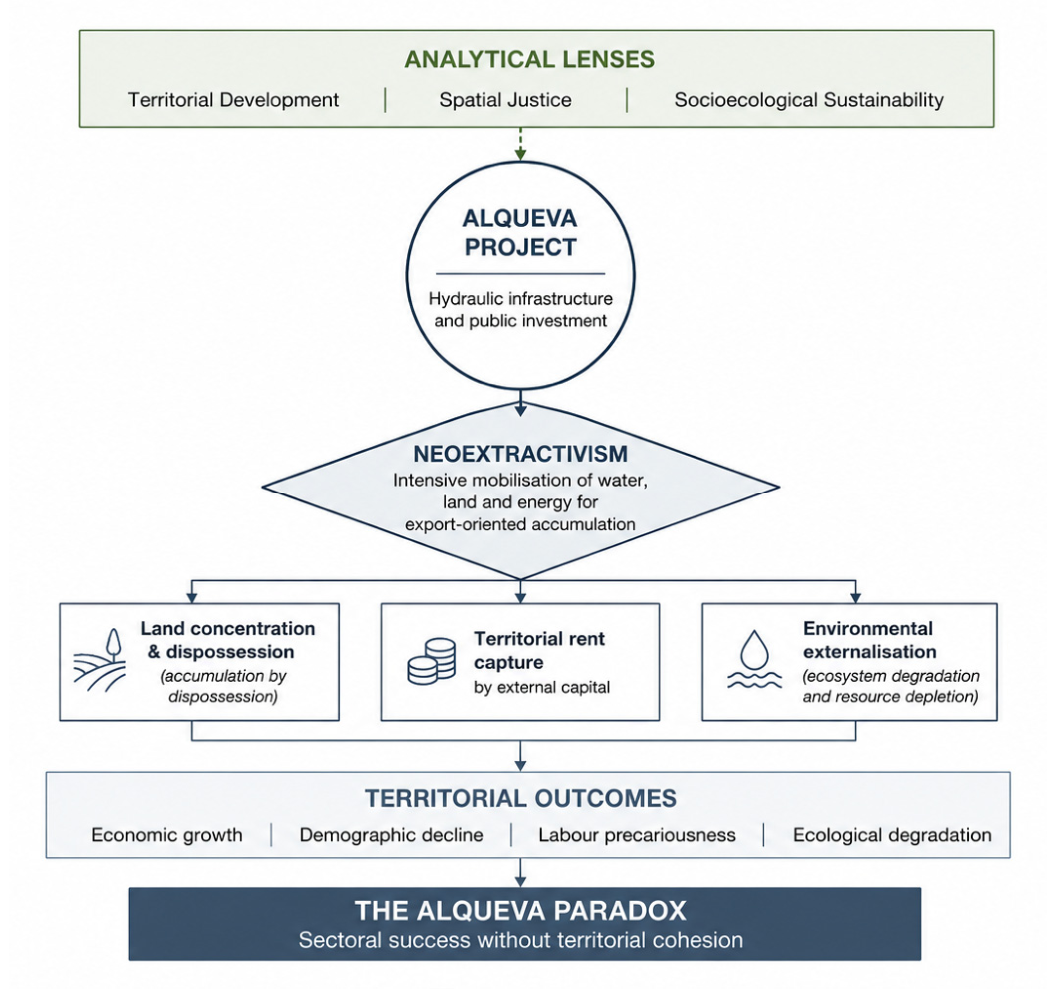
Figure 2.
Location and representation of analysis scales: 1. Luz parish; 2. Riverside parishes (bordering the reservoir); 3. Area of operation of the Alqueva Multi-Purpose Enterprise (EFMA) adjusted to the boundaries of fully included parishes; 4. Municipalities included in the area of operation of the Alqueva Multi-Purpose Enterprise (EFMA); 5. NUT II Alentejo. Source: Author’s elaboration using data imported from the National Institute of Statistics (INE).
Figure 2.
Location and representation of analysis scales: 1. Luz parish; 2. Riverside parishes (bordering the reservoir); 3. Area of operation of the Alqueva Multi-Purpose Enterprise (EFMA) adjusted to the boundaries of fully included parishes; 4. Municipalities included in the area of operation of the Alqueva Multi-Purpose Enterprise (EFMA); 5. NUT II Alentejo. Source: Author’s elaboration using data imported from the National Institute of Statistics (INE).
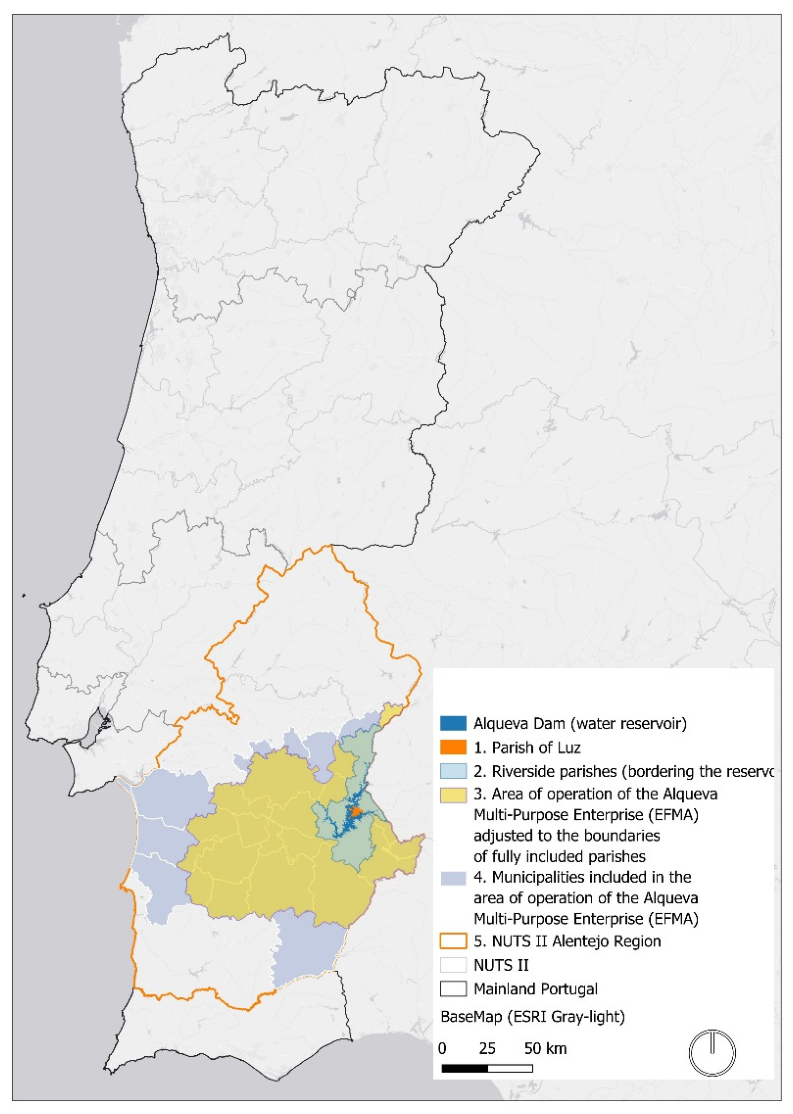
Figure 3.
Alqueva and the limits of infrastructure-led territorial development. Source: Author’s.
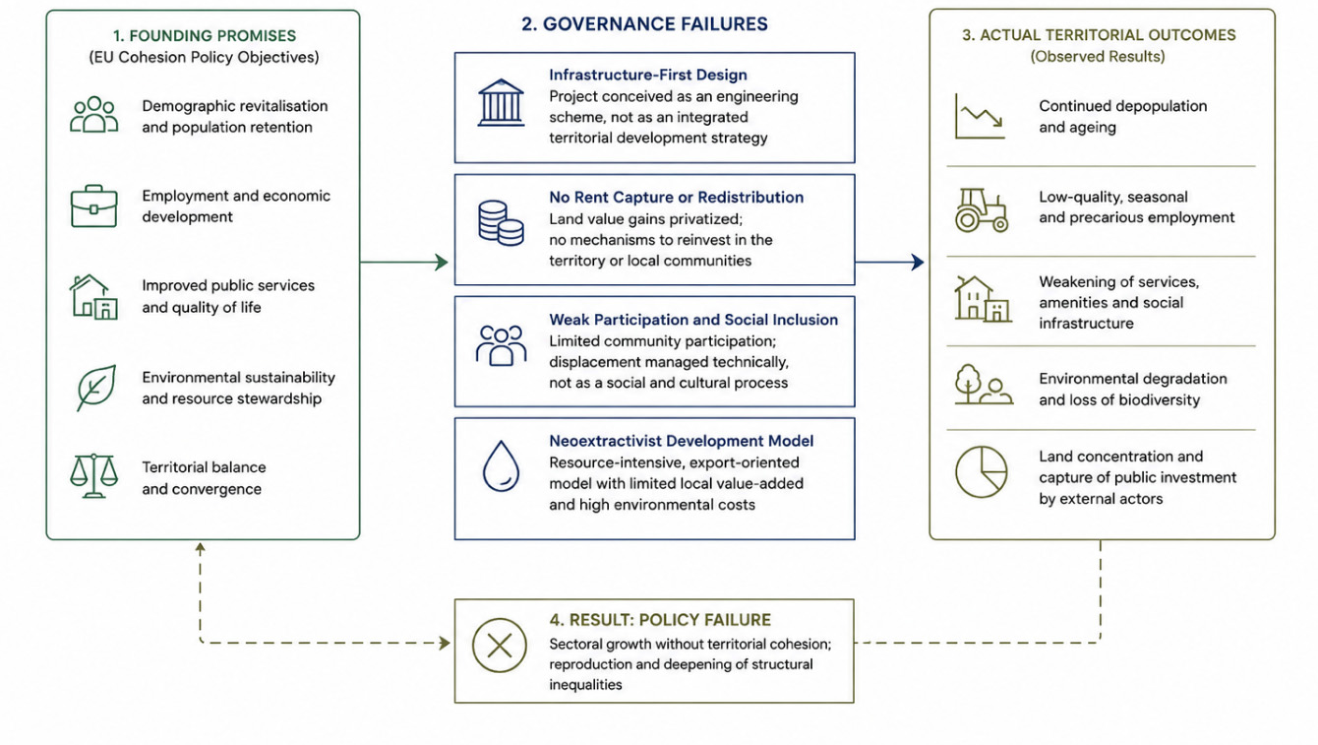

Table 1.
Sectoral growth and territorial fragility: comparative indicators before and after the consolidation of the Alqueva project.
Table 1.
Sectoral growth and territorial fragility: comparative indicators before and after the consolidation of the Alqueva project.
| Dimension | Early Project Phase (1990s-early 2000s) | Consolidation Phase (2010s-2020s) | Territorial Outcome |
| Irrigated Agriculture | Predominantly rainfed agriculture; limited irrigation | 120,000 ha under irrigation, relating to the first phase, which was completed in 2016; The ongoing second phase of the EFMA aims to increase the irrigated area by approximately 30 thousand hectares; dominance of olive and almond monocultures. | Major productive transformation |
| Olive Oil Production | 118,000 hl (1998) | Olive production expanded from 39,403 ha in 2017 to 76,728 ha in 2025, representing around 60% of the Alqueva irrigation area. The Alentejo now accounts for approximately 90% of Portuguese olive oil production, producing 1.1 million of the country’s 1.34 million tonnes of olives in 2024. Olive oil output reached 866,204 hl in 2015 and increased by 320% over two decades. In 2025, 31% of investment originated in Spain, while land rents ranged from €1,000 to €1,250 per hectare. | More 37325 hectares in 8 years More than 600% increase in output |
| Land Ownership | Traditional latifundia and locally owned farms | 70% of agricultural land changed ownership; six groups control over 65% of irrigated olive groves | Strong land concentration |
| Employment | Expectation of stable and qualified jobs | Seasonal, highly mechanised and migrant-dependent labour market | Limited territorial embeddedness |
| Water Use | Approx. 50 hm³/year | More than 500 hm³/year | Tenfold increase in resource consumption |
| Biodiversity | Montado landscapes, temporary ponds and steppe habitats widely present | Habitat loss, biodiversity decline, fragmentation of ecosystems | Ecological degradation |
| Water Quality | Limited agricultural pollution pressures | Eutrophication, nutrient runoff and pesticide contamination documented | Growing environmental stress |
| Regional Economy | Peripheral and low-productivity economy | Export-oriented agribusiness generated substantial economic returns. Between 1995 and 2028, Alqueva is estimated to contribute €34 billion to national production, €14 billion to GVA, €6 billion to remuneration, and €4 billion in tax revenue, while supporting an annual average of 32,800 full-time equivalent jobs. In 2022 alone, the project accounted for around 6% of Alentejo’s GVA and 4% of regional employment. With net public investment of approximately €2.5 billion, the estimated fiscal return is €1.20 for every euro invested (Final Economic Impact Assessment, 2024; Alqueva Agricultural Yearbook, 2025). | Strong sectoral growth |
Sources: Author’s.
Table 2.
Resident population counts for the years 2001, 2011, and 2023 at different geographical scales.
Table 2.
Resident population counts for the years 2001, 2011, and 2023 at different geographical scales.
| Approximation scales (fugure 1) | Resident population | ||||||||
| 2001 | 2011 | 2021 | Absolute population change from 2001 to 2011 | Percentage change between 2001 and 2011 | Absolute population change from 2011 to 2021 | Percentage change between 2011 and 2021 | Absolute population change from 2001 to 2021 | Percentage change between 2001 and 2021 | |
| Mainland Portugal | 9456452 | 10047621 | 9855909 | 591169 | 6,3 | -191712 | -1,9 | 399457 | 4,2 |
| NUTS II Alentejo Region | 536373 | 510160 | 468821 | -26213 | -4,9 | -41339 | -8,1 | -67552 | -12,6 |
| Area of operation of the Alqueva Multi-Purpose Enterprise (EFMA) adjusted to the boundaries of fully included parishes | 214185 | 202377 | 186114 | -11808 | -5,5 | -16263 | -8,0 | -28071 | -13,1 |
| Riverside parishes (bordering the reservoir) | 21242 | 17865 | 15674 | -3377 | -15,9 | -2191 | -12,3 | -5568 | -26,2 |
| Parish of Luz | 471 | 315 | 319 | -156 | -33,1 | 4 | 1,3 | -152 | -32,3 |
Source: INE with processing and calculations by the authors.
Table 3.
Resident population under 25 years old (2001, 2011, and 2021) for different geographical scales.
Table 3.
Resident population under 25 years old (2001, 2011, and 2021) for different geographical scales.
| Approximation scales (fugure 1) | Resident population <25 years old | |||||
| 2011 | Percentage of the total resident population in 2011 | 2021 | Percentage of the total resident population in 2021 | Absolute population change from 2011 to 2021 | Percentage change between 2011 and 2021 | |
| Mainland Portugal | 2638874 | 26,3 | 2296356 | 23,3 | -342518 | -13,0 |
| NUTS II Alentejo Region | 119968 | 23,5 | 101175 | 21,6 | -18793 | -15,7 |
| Area of operation of the Alqueva Multi-Purpose Enterprise (EFMA) adjusted to the boundaries of fully included parishes | 50434 | 24,9 | 43198 | 23,2 | -7236 | -14,3 |
| Riverside parishes (bordering the reservoir) | 4633 | 25,9 | 3768 | 24,0 | -865 | -18,7 |
| Parish of Luz | 87 | 27,6 | 52 | 16,3 | -35 | -40,2 |
Source: INE with processing and calculations by the authors.
Table 4.
Companies by Economic Activity (Subclass - CAE Rev. 3) and Labour Costs (€) of Businesses by Economic Activity (Subclass - CAE Rev. 3).
Table 4.
Companies by Economic Activity (Subclass - CAE Rev. 3) and Labour Costs (€) of Businesses by Economic Activity (Subclass - CAE Rev. 3).
| Companies by Economic Activity (Subclass - CAE Rev. 3) | Labour Costs (€) of Businesses by Economic Activity (Subclass - CAE Rev. 3) | |||||||
| Variation from 2011 to 2023 | Percentage Variation between 2011 and 2023 | Variation from 2011 to 2023 | Percentage Variation between 2011 and 2023 | Variation in Labour Costs (€) from 2011 to 2023 | Percentage Variation in Labour Costs between 2011 and 2023 | Variation in Labour Costs (€) from 2011 to 2023 | Percentage Variation in Labour Costs between 2011 and 2023 | |
| Portugal | Alentejo | Portugal | Alentejo | |||||
| Total | 396715 | 35,6 | 13872 | 17,4 | 26882803891 | 55,8 | 1178454468 | 58,7 |
| Agriculture, animal production, hunting, forestry and fishing | 64065 | 113,3 | 5482 | 37,7 | 714678128 | 96,4 | 256646527 | 113,4 |
| Electricity, gas, steam and air conditioning supply | 4442 | 554,6 | 266 | 831,3 | 107418656 | 23,1 | 1130224 | 89,1 |
| Real estate activities | 35813 | 123,6 | 1161 | 99,7 | 536426588 | 103,4 | 27221313 | 158,9 |
Source: INE with processing and calculations by the authors.
Table 5.
Growth in Supply of Local Accommodation and Tourism Establishments.
| Approximation scales (Figure 1) | ||||||
| NUTS II Alentejo Region | Area of operation of the Alqueva Multi-Purpose Enterprise (EFMA) adjusted to the boundaries of fully included parishes | Riverside parishes (bordering the reservoir) | Parish of Luz | |||
| Local Accommodation | Until 2001 | Number of records | 27 | 9 | 2 | 0 |
| Number of users | 364 | 133 | 42 | 0 | ||
| 2002-2011 | Number of records | 137 | 16 | 1 | 1 | |
| Number of users | 1680 | 242 | 18 | 18 | ||
| 2012 to July 7, 2026 | Number of records | 4876 | 1280 | 278 | 7 | |
| Number of users | 32142 | 8698 | 1689 | 42 | ||
| Total | Number of records | 5040 | 1305 | 281 | 8 | |
| Number of users | 34186 | 9073 | 1749 | 60 | ||
| Existing Tourism Establishments | until 2001 | Number of Accommodation Units | 1580 | 853 | 109 | |
| Number of Beds | 3090 | 1690 | 217 | |||
| 2002-2011 | Number of Accommodation Units | 3430 | 913 | 128 | ||
| Number of Beds | 7892 | 1946 | 256 | |||
| 2012 to July 7, 2026 | Number of Accommodation Units | 7085 | 2585 | 407 | ||
| Number of Beds | 16073 | 5270 | 849 | |||
| Total | Number of Accommodation Units | 12095 | 4351 | 644 | ||
| Number of Beds | 27055 | 8906 | 1322 | |||
| Local Accommodations per 100 inhabitants | 2001 | 0,1 | 0,1 | 0,2 | 0,0 | |
| 2011 | 0,3 | 0,1 | 0,1 | 5,7 | ||
| 2026 | 7,3 | 4,9 | 11,2 | 18,8 | ||
| Beds in Tourist Establishments per 100 inhabitants | 2001 | 0,6 | 0,8 | 1,0 | ||
| 2011 | 1,5 | 1,0 | 1,4 | |||
| 2026 | 5,8 | 4,8 | 8,4 | |||
Source: https://dadosabertos.turismodeportugal.pt/ with processing and calculations by the authors.
Disclaimer/Publisher’s Note: The statements, opinions and data contained in all publications are solely those of the individual author(s) and contributor(s) and not of MDPI and/or the editor(s). MDPI and/or the editor(s) disclaim responsibility for any injury to people or property resulting from any ideas, methods, instructions or products referred to in the content. |
© 2026 by the authors. Licensee MDPI, Basel, Switzerland. This article is an open access article distributed under the terms and conditions of the Creative Commons Attribution (CC BY) license.
Copyright: This open access article is published under a Creative Commons CC BY 4.0 license, which permit the free download, distribution, and reuse, provided that the author and preprint are cited in any reuse.


