
Submitted:
07 August 2026
Posted:
11 August 2026
You are already at the latest version
Abstract
This study investigates the spacecraft kinematics within the extreme gravitational environment of the Galactic Center, focusing on orbital dynamics near the supermassive black hole Sagittarius A* (Sgr A*). Because classical Newtonian mechanics fails in this strong-field regime, a high-fidelity numerical propagator based on the Schwarzschild metric was developed. By integrating with an explicit, adaptive-step Runge-Kutta method of order 8(5, 3) based on the Dormand-Prince coefficients (DOP853) the exact formulation of the forced geodesics, the relativistic dynamics are resolved using the proper time. The analysis explores transfer trajectories targeting both the highly eccentric stars S62 and S4714, and the wider orbits of S22 and S91. Results demonstrate that a classical open-loop Lambert guidance generates a macroscopic spatial divergence, quantified as a “Relativistic Miss Distance” exceeding 1.4 · 107 kilometers. The research mathematically isolates the kinematic phenomena caused by spacetime curvature: the attractive cubic term in the effective potential, the V-shaped excursion of osculating orbital elements at pericenter, the step-wise Schwarzschild precession, and severe chronometric delay due to gravitational time dilation. The study concludes that rigorous, purely relativistic modeling is an absolute requirement to accurately describe kinematic evolution in the Milky Way's core.
Keywords:
general relativity
; astrodynamics
; Sagittarius A*
; Schwarzschild metric
; orbital mechanics
; strong-field regime
; precession of pericenter
; gravitational time dilation
1. Introduction
For over three centuries, classical mechanics has accurately described celestial motions in weak-field regimes. However, this paradigm breaks down in the dense Galactic Center, dominated by the supermassive black hole Sagittarius A* (Sgr A*) [1,2]. Recent breakthroughs, particularly the imaging of Sgr A* [3] and the precise tracking of the dense stellar cluster (S-Cluster) in its surroundings by the GRAVITY collaboration [4,5,6,7], have opened a new window into the strong-field gravitational regime. In this extreme environment, the gravitational potential is so intense that Newtonian approximations fail: space becomes curved, time dilates, and closed Keplerian ellipses are replaced by complex precessing rosettes.
State-of-the-art studies primarily investigate phenomena such as strong-field gravitational lensing and black hole shadows [24], the Bayesian estimation of compact object parameters through near-infrared astrometry [25], the analytical modeling of post-Newtonian orbital effects and relativistic propagation delays for natural bodies like the S-stars or hypothetical binary pulsars [26,27]. While the observational community has successfully utilized stars like S2 as test candidates to verify General Relativity [14,31], the literature lacks a comprehensive framework dedicated to relativistic astrodynamics and active mission analysis in the strong-field regime. Indeed, the transition from passive observation to the kinematic evaluation of a spacecraft navigating near a supermassive black hole remains a largely unexplored gap. In this context, the classical Keplerian framework is no longer a valid approximation but a source of structural divergence: if an active probe were to operate in the vicinity of Sgr A*, relying on classical orbital mechanics, such as traditional Lambert solvers, would not merely result in minor kinematic errors, but lead to macroscopic trajectory divergences.
Therefore, the primary objective of this study is to investigate the orbital dynamics in the strong-field regime of Sgr A* and to quantify the physical limitations of classical models.
The study defines and measures the "Relativistic Miss Distance": the macroscopic discrepancy between the position predicted by classical mechanics and the actual location in curved spacetime. Ultimately, this work aims to mathematically isolate the kinematic phenomena caused by spacetime curvature, such as the attractive cubic term in the effective potential, the step-wise Schwarzschild precession, and the chronometric delay, demonstrating that rigorous, purely relativistic modeling is an absolute requirement for the accurate description of any body’s kinematic evolution in the core of the Milky Way.
2. Mathematical Model and Numerical Strategy
This section outlines the mathematical and computational framework developed to simulate spacecraft kinematics within the strong-field regime of Sgr A*.
2.1. the Schwarzschild Metric Assumption
In this study, the supermassive black hole Sgr A* has been modeled using the static, spherically symmetric Schwarzschild metric. While recent observational constraints suggest Sgr A* possesses a non-zero spin, the static approximation is rigorously justified for the spatial regime of the target S-Cluster stars (e.g., S62 and S4714; S22 and S91). At their pericenter distances (r ∼1), the gravitational potential is heavily dominated by the mass monopole moment [17]. Consequently, the primary relativistic deviation from Newtonian dynamics is the prograde Schwarzschild precession, scaling as in the effective potential [8]. In contrast, spin-induced frame-dragging effects (Lense-Thirring precession) scale as (J is the intrinsic angular momentum of the black hole). and remain sub-dominant, acting as negligible background noise rather than a primary dynamical driver at these orbital distances [17,32]. Therefore, the black hole’s mass is considered the sole relativistic driver for this kinematic analysis.
2.2. Equations of Motion and Proper Time
Diverging from classical mechanics, where coordinate time t serves as an absolute independent variable, General Relativity requires the formulation of kinematics using proper time , the time measured by a clock co-moving with the spacecraft. Consequently, the state vector is expanded into a nine-dimensional array comprising the spacetime coordinates (), the contravariant components of the 4-velocity , and the instantaneous vehicle mass m.
A fundamental geometric constraint of the Pseudo-Riemannian manifold is the 4-velocity normalization
This invariant condition enforces a strictly timelike trajectory and is algorithmically utilized to continuously determine the temporal component rigorously accounting for gravitational time dilation near Sgr A*.
For a propelled spacecraft, the free-fall geodesic path is altered by the engine thrust, leading to the forced geodesics equation:
where are the Christoffel symbols encoding the spacetime curvature, and is the propulsive 4-force [9]. To preserve the invariant rest mass of the vehicle, the thrust vector maintains strict orthogonality to the 4-velocity [10]
Because the resulting system of coupled Ordinary Differential Equations (ODEs) is highly non-linear, analytical solutions are unavailable; furthermore, the extreme eccentricities of the S-Cluster stars induce severe timescale variations. To prevent truncation errors and strictly preserve the 4-velocity norm, the relativistic propagation is executed utilizing an 8th-order explicit Runge-Kutta integration scheme (DOP853) [11]. This high-fidelity numerical strategy ensures that the macroscopic trajectory divergences observed are genuine physical manifestations of curved spacetime rather than numerical artifacts.
2.3. S-Cluster Experimental Scenarios
Prior to deployment in the Galactic Center, the numerical framework was rigorously validated within the Solar System via an Earth-Mars transfer simulation. This weak-field test confirmed that, in environments with negligible spacetime curvature, the relativistic propagator naturally converges to classical Newtonian dynamics, yielding a negligible integration drift ( km) when benchmarked against NASA Mars Design Reference Architecture 5.0 [12].
Following this validation, the kinematic analysis was applied to the S-Cluster, dividing the study into two distinct dynamical regimes to systematically probe the gravitational potential of Sgr A*.
2.3.1. Deep Gravity Regime (S62 → S4714)
The first experimental scenario targets the innermost region of the S-Cluster, focusing on the highly eccentric stars S62 and S4714 (, ; for the full list of orbital parameters, see Table A1 in Appendix A)2. Because their pericenters penetrate deeply into the relativistic potential well of Sgr A* (see Table A2 in Appendix A), these targets maximize strong-field signatures, such as the macroscopic Schwarzschild precession of the pericenter and severe gravitational time dilation. This regime serves as the primary stress-test to quantify the structural breakdown of classical Keplerian mechanics and the resulting spatial divergence [6,13].
2.3.2. Outer Cluster Regime (S22 → S91)
To validate the methodology across the wider galactic potential, the second scenario investigates a transfer between the stars S22 and S91. Situated at significantly larger radial distances ( AU, see Table A1 in Appendix A)3 and exhibiting moderate eccentricities, these stars reside in a weak-field relativistic regime. Here, General Relativity transitions into a perturbative force, and the orbital geometry remains quasi-Keplerian. This scenario acts as a critical control test, demonstrating the numerical stability of the relativistic solver over multi-century flight times and confirming that the accumulated trajectory drift is a secular physical effect rather than a numerical artifact [6,14].
3. Results
This section presents the numerical results of the trajectory analysis within the Galactic Center. By comparing classical Newtonian predictions with fully relativistic propagation, we quantify the structural divergence of the spacecraft’s path and isolate the specific physical mechanisms responsible for the breakdown of classical astrodynamics in the strong-field regime.
3.1. Optimal Transfer Strategies and Mission Profiles
Before detailing the microscopic dynamical effects of General Relativity, it is necessary to establish the macroscopic mission profiles. To identify the optimal transfer trajectories, a classical Newtonian Lambert solver was employed across extensive departure and time-of-flight search grids, later coupled with a relativistic propagator. Table 1 summarizes the absolute minimum-energy solutions identified for the selected S-cluster regimes.
In the Deep Gravity Regime (S62 → S4714 transfer), the extreme orbital velocities of the targets dictate prohibitive energy requirements. A direct transfer (0 revolutions) demands an extreme of 1436.9 km/s to intercept the target in 5.41 years. Relaxing the geometric constraints to permit a multi-revolution phasing (3 full revolutions around Sgr A*), allows the spacecraft to execute massive orbital plane changes at more favorable true anomalies, reducing the energetic cost to 1335.8 km/s, albeit extending the flight time to 56.39 years.
Conversely, the Outer Cluster transfer (S22 → S91) requires 912.6 km/s over a vast 537-year duration. This indicates that while the local spacetime curvature is significantly weaker in this region, the global kinematics of the S-cluster still demand propulsion systems fundamentally beyond contemporary chemical or nuclear-thermal limits (as detailed in Appendix B).
Crucially, the "Final Error" metric in Table 1 quantifies the spatial divergence at the arrival epoch when propagating these classical initial conditions through the full Schwarzschild metric. These macroscopic drifts (up to 14.22 AU) demonstrate that while the classical solver identifies the correct energetic basin of attraction, it fails to provide a precise interception. This discrepancy necessitates the detailed relativistic error analysis and dynamical characterization presented in the subsequent sections.
3.2. Relativistic Dynamics at Pericenter
To fully interpret the macroscopic navigation errors that accumulate over the transfer arc, it is necessary to investigate the kinematics at the point of maximum gravitational stress: the periapsis. The following analysis characterizes the effective potential landscape and the velocity profile to determine the dynamical root causes of the trajectory divergence.
3.2.1. The Effective Potential Landscape
The spacecraft’s energetic boundaries and orbital geometry are governed by the Effective Potential . The fundamental divergence from classical mechanics stems from the General Relativistic potential’s additional attractive cubic term [9,15,16]:
where h is the specific angular momentum. Unlike the classical Newtonian centrifugal barrier , which prevents collapse, the relativistic correction dominates at small radii, creating a purely attractive potential well.
In the Schwarzschild metric, the ISCO (Innermost Stable Circular Orbit) represents the absolute theoretical limit for stable circular motion around a black hole, located at . Beneath this critical radius, the stable minimum of the effective potential disappears, transforming into an inflection point. This boundary defines the so-called "plunge region": within this altitude, no stable circular orbits can exist, and any infinitesimal perturbation causes a particle to spiral inevitably into the central singularity, regardless of its angular momentum [15]. While the selected targets S62 and S4714 do not cross the ISCO, their deep penetration into the potential well and their extreme proximity to this boundary during periapsis passages further emphasize the structural instability and the highly non-linear nature of the dynamical environment the spacecraft must navigate.
In the Outer Cluster Regime (Figure 1b), the correction at pericenter ( AU) is seven orders of magnitude weaker ( J/kg) than the primary potential. This negligible disturbance cannot reshape the closed elliptical orbit and acts merely as a constant, weak drag, confirming a quasi-Newtonian local environment.
Conversely, in the Deep Gravity Regime (Figure 1a), the relativistic correction reaches a massive J/kg at the transfer pericenter ( AU). This profound energy mismatch implies that the spacecraft is subjected to an intense, unmodeled specific force that sharply bends the trajectory. Ultimately, this demonstrates that the classical Lambert solver fails because it computes the injection velocity based on a significantly "shallower" potential well, completely ignoring the structural morphing of the orbital geometry induced by spacetime curvature.
3.2.2. Velocity Profile near Pericenter Passage
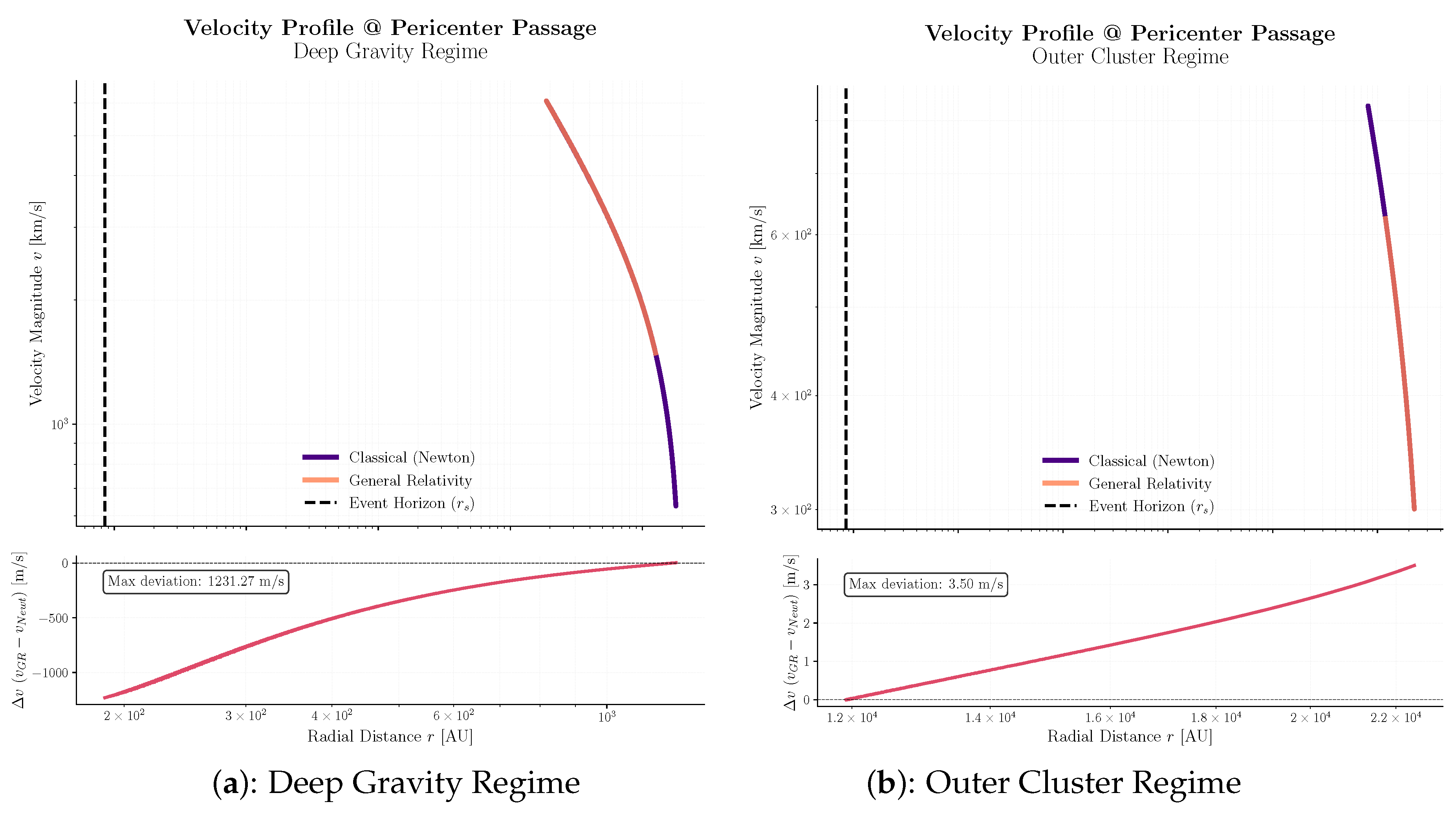
To isolate the instantaneous dynamical cause of the cumulative trajectory drift, a kinematic analysis is conducted at the periapsis. Because gravitational time dilation prevents a direct temporal comparison between the two models, the radial distance r is adopted as the common independent variable. Both Relativistic and Newtonian velocity profiles are computed and interpolated onto a dense logarithmic radial grid to extract the exact velocity deviation at every point along the trajectory.
In the Deep Gravity Regime (Figure 2a), the spacecraft reaches periapsis velocities exceeding km/s. At the closest approach ( AU), the deviation peaks at a massive m/s. This km/s discrepancy proves that General Relativity acts as a dominant force rather than a perturbative correction. If an onboard guidance system were to calculate an impulsive burn using Newtonian assumptions at this distance, the resulting would be fundamentally flawed, confirming the structural breakdown of classical mechanics in this environment.
Conversely, the analysis of the Outer Cluster (Figure 2b) offers a stark contrast. Despite the high orbital velocities of the target stars ( km/s), the local spacetime curvature is significantly flatter. At periapsis ( AU), the maximum deviation is merely m/s. This confirms that the local dynamics remain quasi-Newtonian and that the macroscopic spatial drift observed over the mission is strictly caused by the secular integration of this minute error over the 500-year flight time.
Figure 2.
Velocity Profile at Pericenter Passage. Top: the absolute orbital velocity magnitude v as a function of the radial distance. Bottom: the instantaneous velocity deviation .
Figure 2.
Velocity Profile at Pericenter Passage. Top: the absolute orbital velocity magnitude v as a function of the radial distance. Bottom: the instantaneous velocity deviation .
3.3. Secular Evolution and Orbital Reshaping
While the pericenter analysis isolates the instantaneous relativistic perturbation, its cumulative effect profoundly alters the global orbital geometry over time. To fully characterize the transition from quasi-Keplerian stability to the strong-field regime, it is necessary to investigate the secular evolution of the trajectories, demonstrating how spacetime curvature physically reshapes the orbital elements during the flight.
3.3.1. Schwarzschild Precession of Pericenter
The most prominent strong-field signature is the Schwarzschild Precession, causing a secular advance of the argument of pericenter () and generating characteristic unclosed "rosette" orbits. For an orbit with semi-major axis a and eccentricity e, the weak-field approximation predicts an angular shift per orbit equal to [14,17,18]:
To visualize the magnitude of this effect, the trajectories of the four reference stars were propagated over multiple periods.
In the Deep Gravity Regime (Figure 3a,b), the breakdown of the closed-orbit approximation is visually immediate. Due to the extreme eccentricities (), the evolution of is not continuous but step-wise: it remains nearly constant during the long apocenter coasting phase and undergoes a sharp, impulsive jump exactly at periapsis. The resulting precession rates are massive, peaking at numerically integrated values of /yr for S62 and /yr for S4714. This behavior constitutes a structural cause of the Newtonian guidance failure: while the classical Lambert solver assumes a fixed inertial target, the real target’s orbital plane physically rotates by nearly a degree during the transfer arc, causing a severe geometric mismatch at the predicted intercept point.
Conversely, the Outer Cluster anchors (Figure 4a,b) exhibit a distinct, quasi-Newtonian morphology. Because of their lower eccentricities (), the relativistic perturbation is less impulsive and more distributed, manifesting as a continuous sinusoidal oscillation superimposed on a negligible linear trend (/yr). The trajectories appear as perfectly closed elliptical traces, confirming that, for these distant targets, the geometric rotation is dynamically suppressed. This validates the use of fixed Keplerian ephemerids for mission planning in the weak-field limit, while highlighting that in the inner core, the target’s relativistic rotation is a dominant factor that cannot be ignored.
A more extensive compilation of results is present in Table A3 in Appendix A.
3.3.2. Oscillation of Osculating Orbital Elements
In classical Keplerian mechanics, the semi-major axis a and eccentricity e are constants of motion, fixed by the initial energy and angular momentum. However, in the General Relativistic framework, these quantities lose their status as strict invariants. The non-Newtonian term in the effective potential induces continuous variations in the orbital geometry, meaning that the physical trajectory continuously "morphs" mid-flight. To quantify this structural divergence from the Lambert solver’s static assumptions, the osculating Keplerian elements were computed at every integration step across the three reference scenarios; the result is shown in Figure 5.
In the Deep Gravity Regime, the spacecraft experiences a dramatic, localized violation of Keplerian mechanics. As the vehicle approaches the periapsis, the orbital elements undergo a sharp, impulsive V-shaped excursion: the semi-major axis contracts by approximately , and the eccentricity decreases by . This confirms that the interaction is impulsive, effectively injecting the spacecraft into a different orbit after the strong-field scattering event.
Conversely, the Outer Cluster transfer exhibits a qualitative shift in behavior. The evolution of a and e transitions from sharp spikes to smooth, long-period variations. The relative variance is minute (∼), bordering on numerical precision limits. Nevertheless, the distinct curvilinear profile confirms that these are genuine physical oscillations caused by the weak but non-zero gradient of the relativistic correction over vast radial distances rather than numerical artifacts.
Finally, the Earth-Mars control transfer yields a perfectly flat variance (, within machine precision). This result serves as a definitive validation of the numerical framework, rigorously confirming that the orbital variations observed in the Galactic Center are authentic manifestations of curved spacetime rather than numerical artifacts or energy leakage in the solver.
3.3.3. Gravitational Time Dilation
In General Relativity, time is not an absolute background parameter: its flow depends on the local gravitational potential and the velocity of the observer. This creates a physical discrepancy between the coordinate time (t), measured by a distant observer and used to define planetary ephemerides, and the proper time (), measured by the atomic clocks on board the spacecraft [15]:
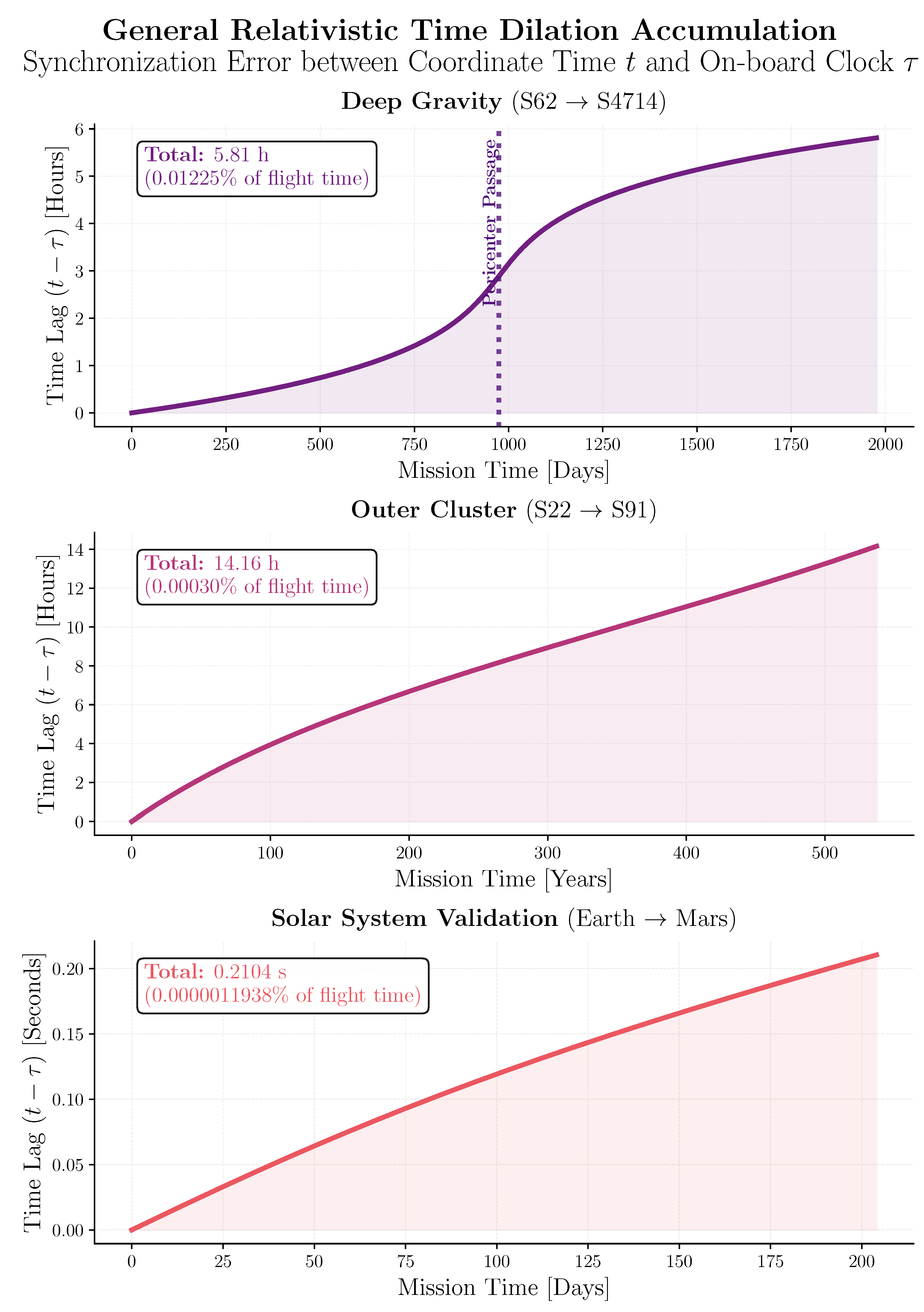
From an engineering perspective, this phenomenon manifests as a chronometric desynchronization drift, quantified as , as shown in Figure 6. This clock drift critically impacts navigation (ranging), communications (Doppler tracking), and on-board scheduling.
In the Deep Gravity Regime, the transfer exhibits a distinct non-linear behavior. As the spacecraft approaches the pericenter passage, the curve steepens significantly due to the extreme orbital velocities (∼) and the depth of the gravitational potential (). The total accumulated lag over the ∼2000-day mission reaches a critical 5.81 hours. An uncorrected desynchronization of nearly 6 hours implies that the spacecraft’s internal timeline is completely decoupled from the mission control’s coordinate timeline, causing any pre-scheduled maneuver to fail entirely.
In the Outer Cluster scenario, the time dilation accumulates almost linearly. The total lag reaches 14.16 hours, but this drift is accumulated over a vast flight time of more than 500 years. Here, the effect is not driven by a sudden plunge into the potential well, but by the relentless, secular integration of a minute potential difference over centuries.
Finally, the Earth-Mars control transfer serves as a baseline: the total accumulated lag over the 200-day transfer is merely 0.21 seconds. Considering the spacecraft’s orbital velocity (∼30 km/s), this temporal discrepancy translates to an along-track position error of approximately 6 km. While this validates the physical consistency of the model in weak fields, it highlights a fundamental scale difference: in the Solar System, neglecting time dilation results in a kilometers-level error correctable via trajectory tuning, whereas in the Galactic Center, it results in a macroscopic failure of the entire navigation timeline.
Figure 6.
General Relativistic Time Dilation Accumulation. Top: Deep Gravity regime, highlighting the sharp acceleration of the drift at pericenter; Middle: Outer Cluster regime, exhibiting a linear, secular accumulation over centuries; Bottom: Solar System validation (Earth-Mars transfer), showing a negligible lag of 0.21 seconds.
Figure 6.
General Relativistic Time Dilation Accumulation. Top: Deep Gravity regime, highlighting the sharp acceleration of the drift at pericenter; Middle: Outer Cluster regime, exhibiting a linear, secular accumulation over centuries; Bottom: Solar System validation (Earth-Mars transfer), showing a negligible lag of 0.21 seconds.
3.4. the Structural Failure of Classical Mechanics
Having characterized the fundamental dynamical roots of the trajectory divergence, this section quantifies the macroscopic operational consequences for mission design. To systematically assess the breakdown of the classical approximation, a global error analysis is performed across the entire temporal search domain.
3.4.1. Relativistic Miss Distance Maps
To evaluate the impact accuracy of the Newtonian Lambert solver, Relativistic Miss Distance Maps were generated. For every node in the departure-duration search grid, the algorithm computes the vector norm of the spatial discrepancy between the expected Newtonian arrival point and the actual relativistic position at the final time :
In the Deep Gravity Regime (Figure 7a), the error magnitude exhibits a structural and unavoidable failure of classical mechanics. Even in the absolute best-case geometric configuration, the spacecraft misses the target star by a minimum of km. The majority of the solution space presents errors in the order of km. This macroscopic divergence definitively proves that there are no optimal launch windows where Newtonian approximations accidentally cancel out relativistic effects; the classical solution functions strictly as a coarse initialization guess.
In the Outer Cluster Regime (Figure 7b), the miss distance reaches a maximum of ∼9 AU. While this represents a minute relative error (≈) compared to the colossal orbital scale, confirming that General Relativity acts locally as a perturbative force, the absolute drift still exceeds the target’s Sphere of Influence. The classical approximation successfully guides the spacecraft to the general vicinity, but an autonomous Relativistic Differential Corrector remains necessary for a precision intercept.
Finally, the Solar System validation (Figure 7c) confirms the physical consistency of the model. The maximum integration error drops to negligible values ( km), ensuring that 100% of classical trajectories successfully intersect the Martian Sphere of Influence. Furthermore, the error field’s strict 2.13-year periodicity perfectly matches the Earth-Mars synodic cycle, proving that the accumulated drift is highly deterministic, geometry-dependent, and an authentic product of spacetime curvature rather than a numerical artifact.
4. Discussion
The findings presented in this study demonstrate that navigating the extreme gravitational environment of Sagittarius A* requires a fundamental paradigm shift in astrodynamics. While classical Lambert solvers successfully identify the topologically optimal transfer strategies and estimate the general energetic requirements (effectively placing the spacecraft within the correct basin of attraction) their open-loop application leads to macroscopic targeting errors. The minimum Miss Distance of km observed in the Deep Gravity regime definitively proves that Newtonian mechanics is not merely an approximation, but a structurally inadequate framework for precision interception in the Galactic Center. In this domain, General Relativity acts as a dominant dynamical driver, and the chaotic accumulation of spacetime curvature effects renders ballistic propagation completely unfeasible.
Overcoming these limitations necessitates several theoretical and operational advancements. First, the field must transition from hybrid estimators to fully Relativistic Two-Point Boundary Value Problem solvers [28]. Unlike classical algorithms relying on Keplerian conics, the exact solution to the forced geodesic equations in curved spacetime would require the inversion of elliptic integrals (e.g., utilizing the Weierstrass ℘-function formalism) [29,30]. Developing such semi-analytical solvers would allow for the determination of transfer arcs without relying on weak-field assumptions or computationally expensive shooting methods.
Secondly, the assumption of static Keplerian ephemerides for the target stars introduces a systematic limit to precision. As demonstrated by the step-wise Schwarzschild precession of S62 and S4714, the target physically rotates away from the predicted intercept point. Future models must integrate the relativistic equations of motion for the destination stars simultaneously with the spacecraft. By evolving the target dynamically within the same spacetime structure, the guidance algorithm can aim for the physical position of the star rather than a flawed geometric prediction.
Furthermore, to achieve the highest astrophysical fidelity, the mathematical architecture must eventually be extended from the static Schwarzschild approximation to the rotating Kerr metric.
Ultimately, the macroscopic divergence of the classical trajectories dictates a shift from pure trajectory design to autonomous navigation. The engineering culmination of this feasibility study highlights that precision interception in the Galactic Center strictly mandates the implementation of autonomous, closed-loop Guidance, Navigation, and Control (GNC) systems, capable of measuring relativistic observables in real-time to continuously compensate for gravitational anomalies.
5. Conclusions
This work establishes a high-fidelity computational framework to quantify the breakdown of classical astrodynamics in the strong-field regime of Sagittarius A*. Through the analysis of optimal transfers within the S-Cluster, it was demonstrated that the specific forces induced by the relativistic potential, the unclosed precession of the orbits, and the severe chronometric decoupling caused by gravitational time dilation systematically destroy the accuracy of Newtonian guidance. While advanced propulsion technologies (such as nuclear fusion or antimatter, detailed in Appendix B) make these maneuvers energetically sustainable, the topological distortion of spacetime demands a definitive departure from classical orbital mechanics. Future deep-space exploration within galactic cores will inextricably rely on the direct integration of General Relativity into real-time flight software, transforming theoretical geodesics into executable mission profiles.
Author Contributions
Conceptualization: A.C.; Methodology: G.C. and L.M.; Formal analysis: A.C. and G.C.; Investigation: A.C: and L.M.; Data curation: A.C. and G.C.; Writing - Original Draft Preparation: A.C.; Writing - Review and Editing: G.C. and L.M.; Visualization: L.M.; Supervision and Project Administration: G.C. All authors have read and agreed to the published version fo the manuscript.
Funding
This research received no external funding.
Institutional Review Board Statement
Not applicable.
Informed Consent Statement
Not applicable.
Data Availability Statement
The data and underlying source code presented in this study are available on request from the corresponding author.
Conflicts of Interest
The authors declare no conflict of interest.
Appendix A. Tables
This appendix provides the complete datasets used for the setup of the mission scenarios and the numerical validation of the relativistic orbital dynamics. Table A1 reports the classical ephemerides for the selected targets. Table A2 highlights the relativistic potential strength of the Deep Gravity probes compared to the benchmark star S2. Finally, Table A3 summarizes the results of the numerical integration regarding the Schwarzschild precession of pericenter.

Table A1.
Classical orbital parameters of the selected S-cluster stars relative to Sagittarius A*. Data adapted from [13,14]. a is the semi-major axis; e is the eccentricity; i is the inclination, is the right ascension of the ascending node; is the argument of pericenter; P is the orbital period; is the time of closest approach to pericenter.
Table A1.
Classical orbital parameters of the selected S-cluster stars relative to Sagittarius A*. Data adapted from [13,14]. a is the semi-major axis; e is the eccentricity; i is the inclination, is the right ascension of the ascending node; is the argument of pericenter; P is the orbital period; is the time of closest approach to pericenter.
| Target | a [AU] | e [-] | i[°] | [°] | [°] | P [yrs] | [yrs] |
|---|---|---|---|---|---|---|---|
| Deep Gravity Regime | |||||||
| S62 | 740.08 | 0.976 | 72.76 | 122.61 | 42.62 | 9.9 | 2003.33 |
| S4714 | 841.35 | 0.985 | 127.70 | 129.28 | 357.25 | 12.0 | 2017.29 |
| Outer Cluster Regime | |||||||
| S22 | 10802.26 | 0.449 | 105.76 | 291.70 | 95.00 | 540.0 | 1996.90 |
| S91 | 15807.58 | 0.303 | 114.49 | 105.35 | 356.40 | 958.0 | 1108.00 |
Table A2.
Comparison of relativistic parameters between the benchmark star S2 and the selected Deep Gravity targets. represents the relativistic potential strength at periapsis (defined as , with being the pericenter radius). denotes the predicted Schwarzschild precession per orbit. Data adapted from [6,13].
Table A2.
Comparison of relativistic parameters between the benchmark star S2 and the selected Deep Gravity targets. represents the relativistic potential strength at periapsis (defined as , with being the pericenter radius). denotes the predicted Schwarzschild precession per orbit. Data adapted from [6,13].
| Target | Relativistic Parameter () | Precession () [arcmin] |
|---|---|---|
| S2 | 6.8 | |
| S62 | 46.0 | |
| S4714 | 64.0 |
Table A3.
Summary of Relativistic Precession Dynamics for the selected S-cluster targets. The numerical results obtained from the propagation are compared with the theoretical predictions derived from the weak-field approximation formula.
Table A3.
Summary of Relativistic Precession Dynamics for the selected S-cluster targets. The numerical results obtained from the propagation are compared with the theoretical predictions derived from the weak-field approximation formula.
| Target | Shift per Orbit | Precession Rate | ||
|---|---|---|---|---|
| Numerical | Theoretical | Numerical | Theoretical | |
| Deep Gravity Regime | ||||
| S62 | 1.347868 | 1.306094 | 0.136148 | 0.131929 |
| S4714 | 1.893002 | 1.829867 | 0.157750 | 0.152549 |
| Outer Cluster Regime | ||||
| S22 | 0.005171 | 0.005315 | ||
| S91 | 0.003111 | 0.003193 | ||
Appendix B. Advanced Propulsion Technologies and Relativistic Mass Variation
Navigating the strong-field gravitational regime of Sagittarius A* imposes extreme energetic requirements, with characteristic budgets often exceeding km/s. Such maneuvers are fundamentally beyond the capabilities of contemporary chemical or nuclear-thermal propulsion systems. To establish a physically consistent baseline for the mission analysis presented in this study, the spacecraft is assumed to be equipped with a high-performance continuous-thrust system based on Inertial Confinement Fusion (ICF) or Matter-Antimatter Annihilation [19,20].
In the fusion scenario, the primary engineering model assumes an ICF architecture, historically investigated in foundational interstellar studies such as Project Daedalus and Project Icarus [19,33]. This system utilizes the aneutronic Deuterium-Helium-3 (D-3He) reaction triggered by inertial confinement of fuel pellets. Such technology theoretically supports effective exhaust velocities on the order of km/s. Consequently, the specific impulse reaches the s range, which is the necessary prerequisite to prevent the required propellant mass fraction from diverging to physically impossible values ().
Due to the extreme nature of the propulsion system, the mass consumption must be rigorously modeled. In the relativistic numerical framework, the mass variation is integrated with respect to the spacecraft’s proper time , incorporating the time dilation factor to correctly relate the coordinate time (where power and flow rates are typically defined) to the local observer:
Furthermore, to satisfy the most demanding energy requirements, proton-antiproton () annihilation propulsion must be considered. In concepts such as the Beamed Core Antimatter Rocket, magnetic nozzles direct the charged pions resulting from the annihilation to generate thrust at relativistic exhaust velocities [20]. However, in this regime, the classical Tsiolkovsky rocket equation becomes structurally inadequate [21,22,23]. The annihilation process suffers from a specific efficiency constraint known as "mass loss": a significant fraction of the rest mass is radiated away as neutral pions (which decay into uncollimated gamma rays) rather than being converted into directed thrust via charged pions [20,23]. In such scenarios, a Relativistic Rocket Equation must be employed to account for both the relativistic velocity of the exhaust and the non-conservative conversion of rest mass into kinetic energy, underscoring the absolute necessity of ultra-high specific impulse to make Galactic Center exploration physically achievable.
References
- Karttunen, H.; Kröger, P.; Oja, H.; Poutanen, M.; Donner, K.J. Fundamental Astronomy, 6th ed.; Springer-Verlag: Berlin/Heidelberg, Germany, 2017. [Google Scholar]
- Parsons, J. Scientists find proof a supermassive black hole is lurking at the centre of the Milky Way. Available online: https://metro.co.uk/2018/10/31/scientists-find-proof-a-supermassive-black-hole-is-lurking-at-the-centre-of-the-milky-way-8092994/ (accessed on 3 June 2026).
- Event Horizon Telescope Collaboration. First image of our black hole. Available online: https://www.eso.org/public/images/eso2208-eht-mwa/ (accessed on 3 June 2026).
- GRAVITY Collaboration. Detection of orbital motions near the last stable circular orbit of the massive black hole Sgr A*. Astron. Astrophys. 2018, 618, L10. [Google Scholar] [CrossRef]
- GRAVITY Collaboration. A geometric distance measurement to the Galactic center black hole with 0.3% uncertainty. Astron. Astrophys. 2019, 625, L10. [Google Scholar] [CrossRef]
- GRAVITY Collaboration. Mass distribution in the Galactic Center based on interferometric astrometry of multiple stellar orbits. Astron. Astrophys. 2021, 657, L12. [Google Scholar]
- GRAVITY Collaboration. Polarimetry and astrometry of NIR flares as event horizon scale, dynamical probes for the mass of Sgr A*. Astron. Astrophys. 2023, 677, L10. [Google Scholar] [CrossRef]
- Marchini, M. Potenziale Efficace per le Geodetiche nella Metrica di Schwarzschild. Master’s thesis, Alma Mater Studiorum - Università di Bologna, Bologna, Italy, 2023. [Google Scholar]
- Schutz, B.F. A First Course in General Relativity; Cambridge University Press: Cambridge, UK, 1985. [Google Scholar]
- Rindler, W. Relativity. Special, General and Cosmological; Oxford University Press: Oxford, UK, 2006. [Google Scholar]
- Hairer, E.; Nørsett, S.P.; Wanner, G. Solving Ordinary Differential Equations I. Nonstiff Problems; Springer-Verlag: Berlin/Heidelberg, Germany, 2008. [Google Scholar]
- Drake, B.G. Human Exploration of Mars Design Reference Architecture 5.0; NASA Special Publication SP-2009-566; NASA Johnson Space Center: Houston, TX, USA, 2009. [Google Scholar]
- Peißker, F.; Eckart, A.; Zajaček, M.; Ali, B.; Parsa, M. S62 and S4711: Indications of a Population of Faint Fast-moving Stars inside the S2 Orbit—S4711 on a 7.6 yr Orbit around Sgr A*. Astrophys. J. 2020, 899, 50. [Google Scholar] [CrossRef]
- Gillessen, S.; Plewa, P.M.; Eisenhauer, F.; Sari, R.; Waisberg, I.; Habibi, M.; Pfuhl, O.; George, E.; Dexter, J.; von Fellenberg, S.; Ott, T.; Genzel, R. An Update on Monitoring Stellar Orbits in the Galactic Center. Astrophys. J. 2017, 837, 30. [Google Scholar] [CrossRef]
- Blau, M. Lecture Notes on General Relativity; Institut für Theoretische Physik, Universität Bern: Bern, Switzerland, 2012. [Google Scholar]
- Curtis, H.D. Orbital Mechanics for Engineering Students, 3rd ed.; Elsevier Ltd.: Amsterdam, Netherlands, 2014. [Google Scholar]
- Will, C.M. The Confrontation between General Relativity and Experiment. Living Rev. Relativ. 2006, 9, 3. [Google Scholar] [CrossRef] [PubMed]
- Kopeikin, S.M. The Orbital Pericenter Precession in the 2PN Approximation. Eur. Phys. J. Plus 2020, 135, 6. [Google Scholar] [CrossRef]
- Long, K.F.; Fogg, M.; Obousy, R.; et al. Project Icarus: Son of Daedalus - Flying Closer to Another Star. J. Br. Interplanet. Soc. 2009, 62, 403–414. [Google Scholar]
- Howe, S.D.; Hynes, M.V. Antimatter Propulsion: Status and Prospects; Technical Report LA-UR-85-2443; Los Alamos National Laboratory: Los Alamos, NM, USA, 1986. [Google Scholar]
- Bade, W.L. Relativistic Rocket Theory. Am. Ass. Phys. Teach. 1952, 21, 310–312. [Google Scholar] [CrossRef]
- Frisbee, R.H. How to Build an Antimatter Rocket for Interstellar Missions. In Proceedings of the 39th AIAA/ASME/SAE/ASEE Joint Propulsion Conference, Huntsville, AL, USA, 2003. [Google Scholar]
- Westmoreland, S. A note on Relativistic Rocketry. Acta Astronaut. 2010, 67, 1248–1251. [Google Scholar] [CrossRef]
- Shipley, J.O.; Dolan, S.R. Binary black hole shadows, chaotic scattering and the Cantor set. Class. Quantum Grav. 2016, 33, 175001. [Google Scholar] [CrossRef]
- Wang, X.; Ma, T.; Guo, M.; Zhang, H.-Q. Bayesian Analysis of Massive Boson Star Models for Sagittarius A* Using Near-Infrared Astrometry Data. arXiv 2025, preprint. [Google Scholar]
- Iorio, L. General Post-Newtonian Orbital Effects: From Earth’s Satellites to the Galactic Centre; Cambridge University Press: Cambridge, UK, 2025. [Google Scholar]
- Ben-Salem, B.; Hackmann, E. Relativistic propagation and frame dragging time delay in the timing of a pulsar orbiting the supermassive black hole SgrA*. arXiv 2021, preprint. [Google Scholar]
- Chandrasekhar, S. The Mathematical Theory of black holes; Oxford University Press: Oxford, UK, 1983. [Google Scholar]
- Hackmann, E.; Lämmerzahl, C. Complete Analytic Solution of the Geodesic Equation in Schwarzschild–(Anti-)de Sitter Spacetimes. Phys. Rev. Lett. 2008, 100, 171101. [Google Scholar] [CrossRef] [PubMed]
- Hagihara, Y. Theory of Relativistic Trajectories in a Gravitational Field of Schwarzschild. Jpn. J. Astron. Geophys. 1931, 8, 67–176. [Google Scholar]
- Ghez, A.M.; Salim, S.; Weinberg, N.N.; Lu, J.R.; Do, T.; Dunn, J.K.; Matthews, K.; Morris, M.R.; Yelda, S.; Becklin, E.E.; Kremenek, T.; Milosavljevic, M.; Naiman, J. Measuring Distance and Properties of the Milky Way’s Central Supermassive Black Hole with Stellar Orbits. Astrophys. J. 2008, 689, 1044–1062. [Google Scholar] [CrossRef] [PubMed]
- Fragione, G.; Loeb, A. An Upper Limit on the Spin of Sgr A* Based on Stellar Orbits in Its Vicinity. Astrophys. J. Lett. 2020, 901, L32. [Google Scholar] [CrossRef]
- Obousy, R.K. Project Icarus: Antimatter Catalyzed Fusion Propulsion For Interstellar Missions. Available online: https://web.archive.org/web/20181221055359/http://www.icarusinterstellar.org/uploads/2012/05/Antimatter-Catalyzed-Fusion-Propulsion-For-Interstellar-Missions.pdf (accessed on 11 June 2026).
| 1 |
is the Schwarzschild radius. It marks the location of the Event Horizon in a black hole. |
| 2 |
e is the eccentricity of the orbit. |
| 3 |
a is the semi-major axis of the orbit. |
Figure 1.
Effective Potential Analysis. Top: the Schwarzschild and Newtonian potentials curves. Bottom: the relativistic correction term.
Figure 1.
Effective Potential Analysis. Top: the Schwarzschild and Newtonian potentials curves. Bottom: the relativistic correction term.
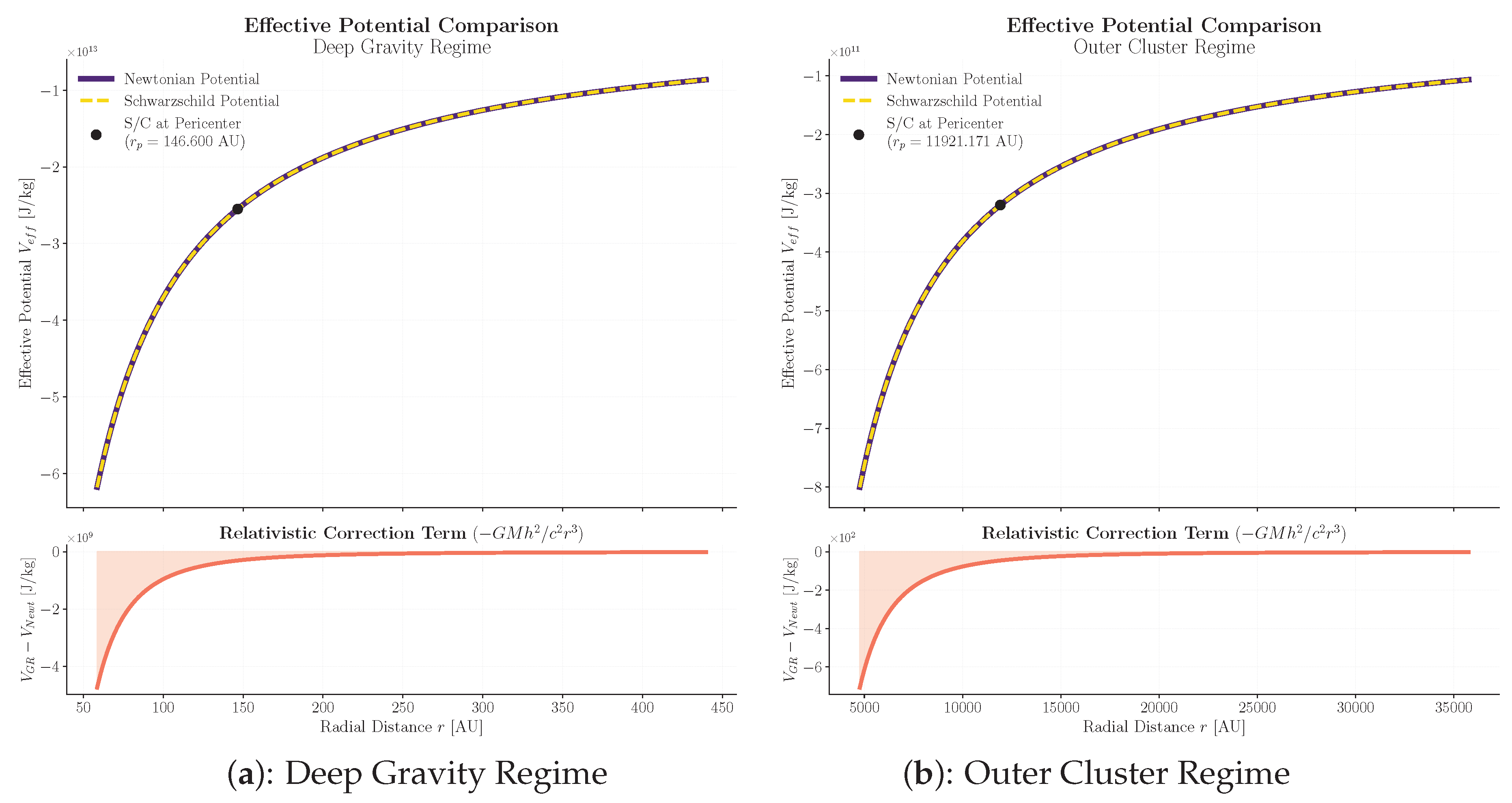
Figure 3.
Schwarzschild Precession of Pericenter for the selected targets for the Deep Gravity probes, exhibiting the highest precession rate and a pronounced rosette pattern.
Figure 3.
Schwarzschild Precession of Pericenter for the selected targets for the Deep Gravity probes, exhibiting the highest precession rate and a pronounced rosette pattern.
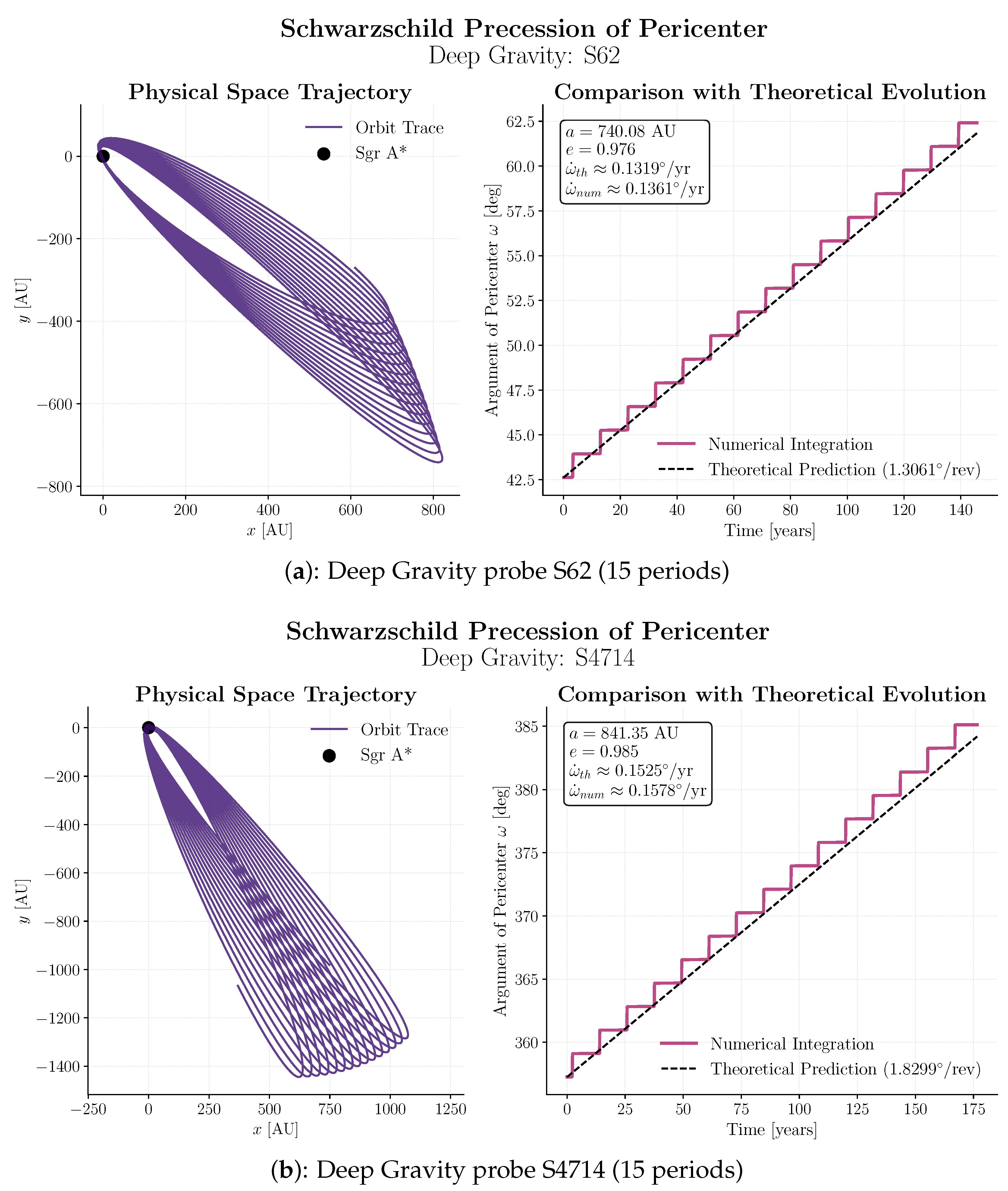
Figure 4.
Schwarzschild Precession of Pericenter for the selected targets for the Outer Cluster anchors, with continuous sinusoidal oscillations and negligible secular drift.
Figure 4.
Schwarzschild Precession of Pericenter for the selected targets for the Outer Cluster anchors, with continuous sinusoidal oscillations and negligible secular drift.
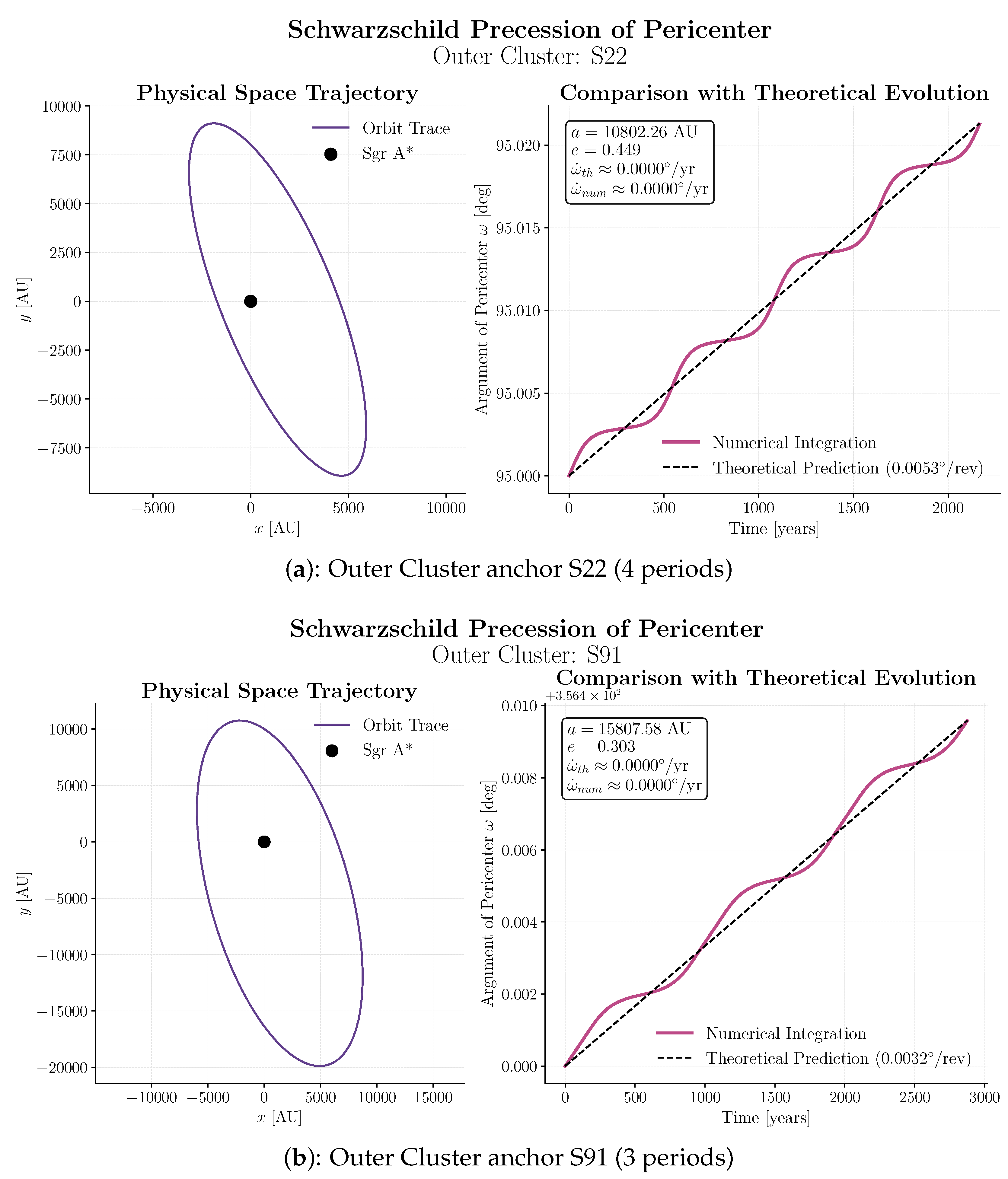
Figure 5.
Stability of Relativistic Orbital Elements during Transfer. Top: Deep Gravity Regime, highlighting the sharp V-shaped excursion at pericenter; Middle: Outer Cluster Regime, exhibiting smooth, long-period variations; Bottom: Solar System validation (Earth-Mars transfer), showing a perfectly flat variance that confirms numerical stability.
Figure 5.
Stability of Relativistic Orbital Elements during Transfer. Top: Deep Gravity Regime, highlighting the sharp V-shaped excursion at pericenter; Middle: Outer Cluster Regime, exhibiting smooth, long-period variations; Bottom: Solar System validation (Earth-Mars transfer), showing a perfectly flat variance that confirms numerical stability.
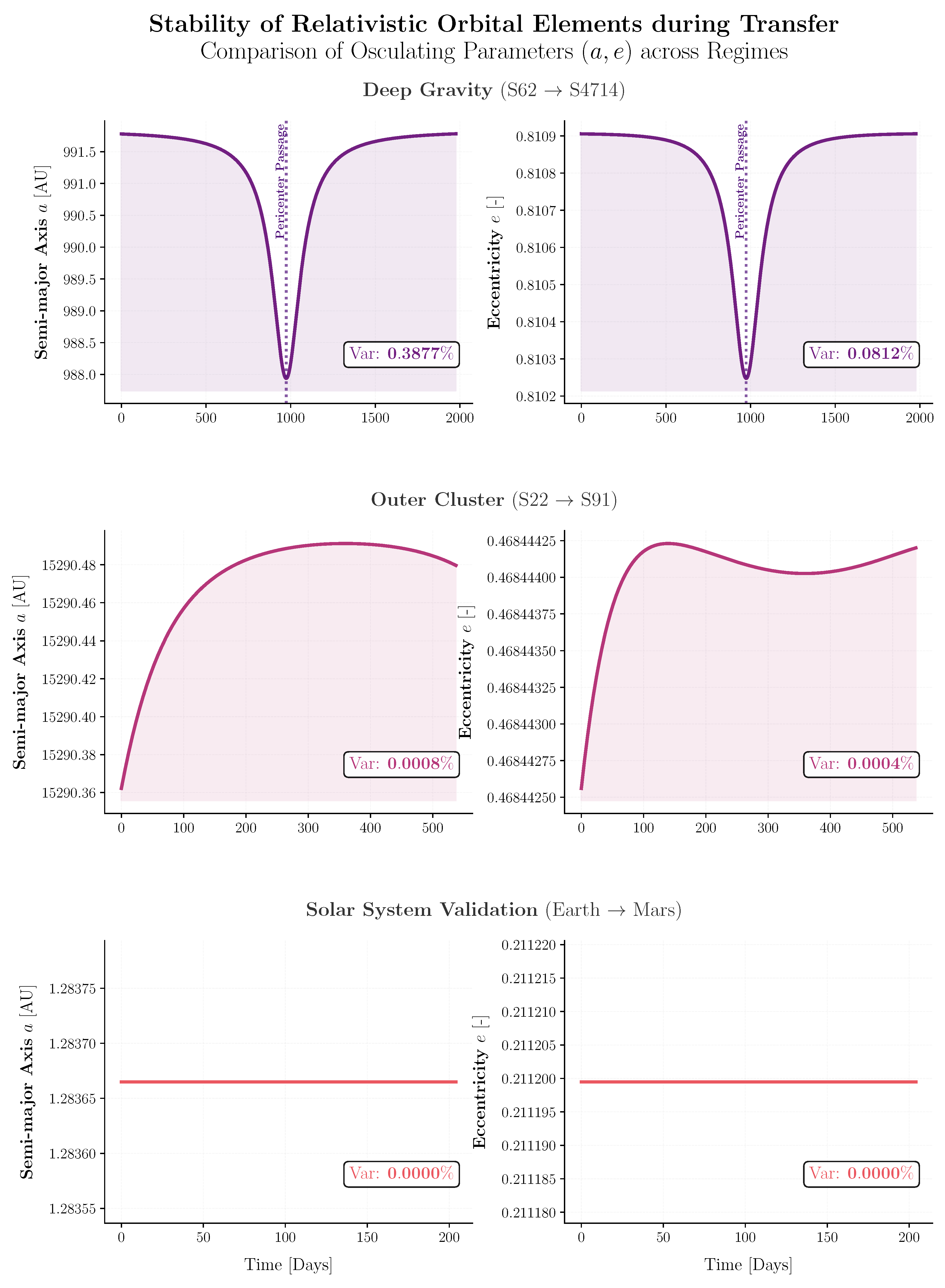
Figure 7.
Relativistic Miss Distance Maps characterizing the targeting error due to relativistic neglect in the Lambert solver.
Figure 7.
Relativistic Miss Distance Maps characterizing the targeting error due to relativistic neglect in the Lambert solver.
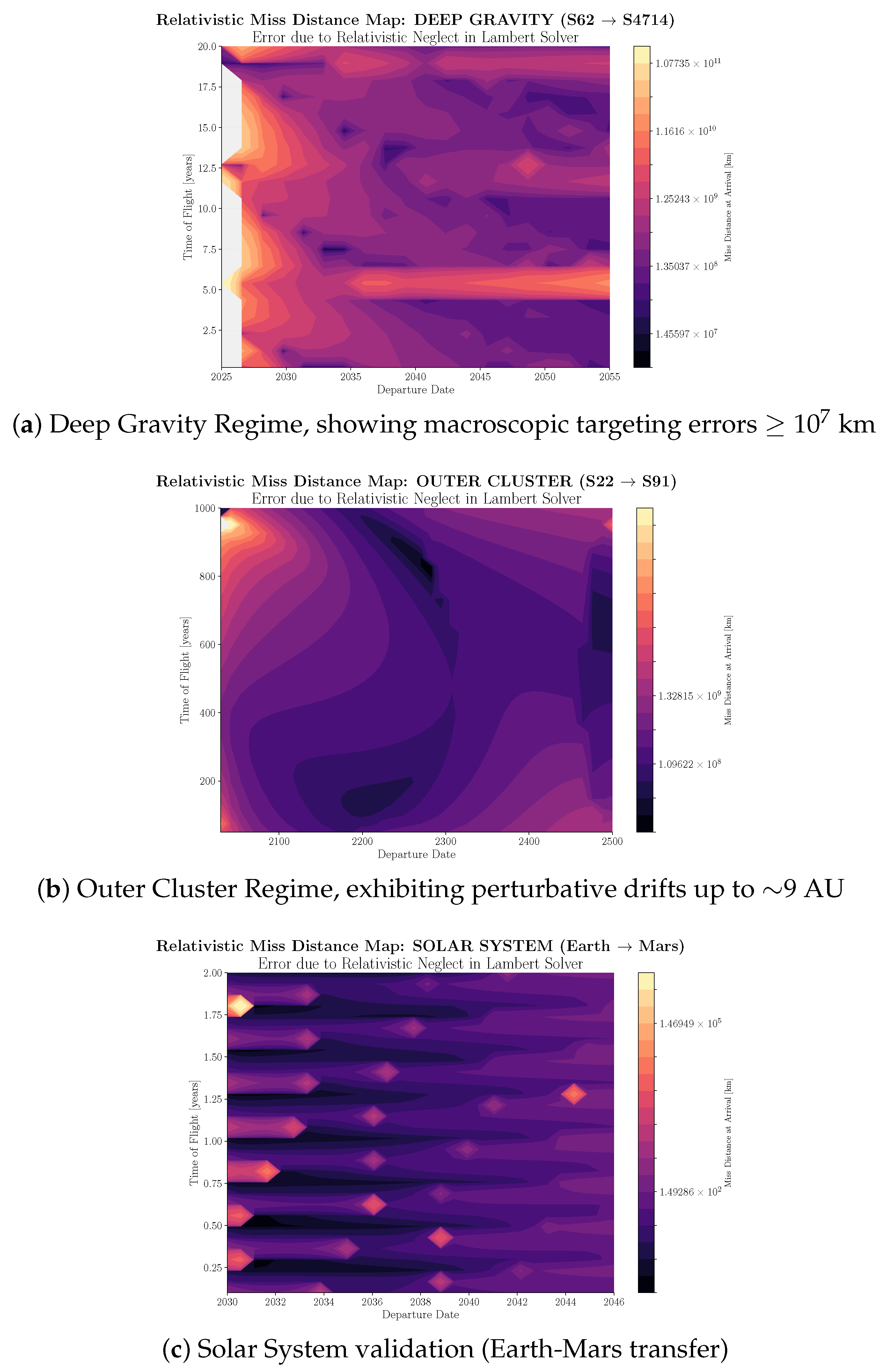
Table 1.
Summary of the optimal transfer solutions for the investigated regimes. The table compares the required propulsive effort (), flight duration, and the final integration error at arrival.
Table 1.
Summary of the optimal transfer solutions for the investigated regimes. The table compares the required propulsive effort (), flight duration, and the final integration error at arrival.
| Parameter | Deep Gravity (Direct) | Deep Gravity (Multirev.) | Outer Cluster |
|---|---|---|---|
| Departure [yr] | 2035.40 | 2070.85 | 2110.12 |
| Duration [yr] | 5.41 | 56.39 | 537.18 |
| Arrival [yr] | 2040.81 | 2127.24 | 2647.30 |
| Revolutions | 0 | 3 | 0 |
| 1436.9 | 1335.8 | 912.6 | |
| Final Error [AU] | 2.87 | 14.22 | 4.57 |
Disclaimer/Publisher’s Note: The statements, opinions and data contained in all publications are solely those of the individual author(s) and contributor(s) and not of MDPI and/or the editor(s). MDPI and/or the editor(s) disclaim responsibility for any injury to people or property resulting from any ideas, methods, instructions or products referred to in the content. |
© 2026 by the authors. Licensee MDPI, Basel, Switzerland. This article is an open access article distributed under the terms and conditions of the Creative Commons Attribution (CC BY) license (http://creativecommons.org/licenses/by/4.0/).
Copyright: This open access article is published under a Creative Commons CC BY 4.0 license, which permit the free download, distribution, and reuse, provided that the author and preprint are cited in any reuse.


