
Submitted:
07 August 2026
Posted:
11 August 2026
You are already at the latest version
Abstract
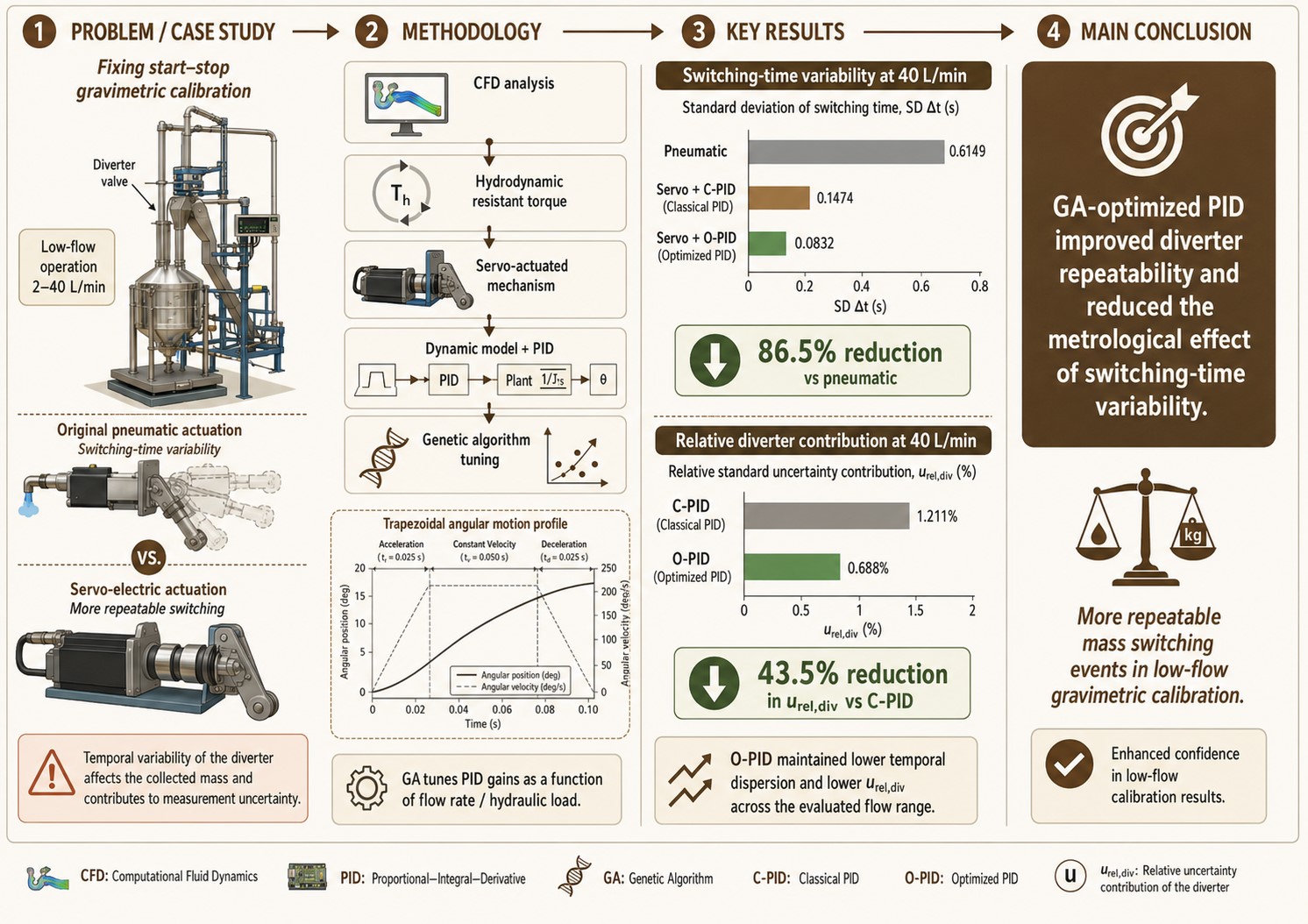
In gravimetric liquid-flow calibration systems, the diverter valve defines the effective start and end of mass collection. For this reason, its temporal repeatability affects the mass associated with the transition and can become a relevant contribution to the measurement uncertainty, especially in low-flow modules. Although the state of the art has addressed this problem through geometric improvements, time or mass correction models, CFD analysis, and higher-precision actuators, these approaches are usually treated in isolation, without systematically linking the variable hydrodynamic load, switching repeatability, and the affected-mass contribution within a single optimization framework. This work presents the genetic-algorithm-based tuning of a PID controller for the servo-electric actuation of a diverter valve in a 200 kg gravimetric module, operating in the interval from 2 L/min to 40 L/min. The main contribution consists of optimizing the PID gains as a function of the flow rate and the hydrodynamic load, with the purpose of reducing the temporal dispersion of the mechanism and its relative contribution to the gravimetric calculation. At 40 L/min, the original pneumatic system presented a switching-time standard deviation of 0.6149 s, while with the servo-electric system and the optimized PID this value decreased to 0.0832 s, equivalent to a reduction of 86.5%. Likewise, the relative contribution of the diverter decreased from 5.10% to 0.688%. The results show that the evolutionary optimization of the PID allows improving the repeatability of the diverter and reducing the variability of the affected mass, although it does not represent by itself the complete uncertainty budget of the gravimetric module.
Keywords:
gravimetric flow calibration
; diverter valve
; PID control
; genetic algorithm
; servo-electric actuator
; low liquid flow
; measurement uncertainty
; CFD
Copyright: This open access article is published under a Creative Commons CC BY 4.0 license, which permit the free download, distribution, and reuse, provided that the author and preprint are cited in any reuse.


