

Submitted:
10 August 2026
Posted:
10 August 2026
You are already at the latest version
Abstract
Climate change poses one of the greatest threats to the sustainability of rainfed agriculture in Latin America, where common bean (Phaseolus vulgaris L.) production is particularly vulnerable because of its high sensitivity to fluctuations in temperature and precipitation, as well as to extreme climatic events. This scoping review aimed to examine the evolution of scientific research on the impacts of climate change on the sustainability of rainfed common bean production in Latin America by identifying geographic and temporal research trends, methodological approaches, major scientific advances, knowledge gaps, and future research priorities. The review followed the Joanna Briggs Institute (JBI) methodological framework and the PRISMA-ScR reporting guidelines and included 154 peer-reviewed studies published in indexed journals. The evidence was synthesized by country, publication period, and methodological approach, encompassing field experiments, agroclimatic assessments, crop-simulation models, Geographic Information Systems (GIS), remote sensing, review articles, meta-analyses, and farmer surveys. The results revealed that scientific production was concentrated primarily in Mexico and Brazil, whereas research in the remaining Latin American countries remained limited and geographically fragmented. Over time, the field evolved from studies focused primarily on crop physiology and genetic improvement toward multidisciplinary approaches integrating climatic, agronomic, environmental, and socioeconomic perspectives. Despite these advances, important knowledge gaps remain, particularly the limited availability of long-term field experiments and the insufficient integration of environmental, economic, and social dimensions into climate adaptation research. This review provides a comprehensive regional synthesis of the available scientific evidence on climate change and rainfed common bean production in Latin America, offering a solid evidence base to guide future research, inform climate adaptation strategies, and strengthen the resilience and sustainability of rainfed common bean production systems.
Keywords:
climate change
; Phaseolus vulgaris
; rainfed common bean
; climate change adaptation
; agricultural resilience
; sustainable agriculture
; Latin America
; food security
1. Introduction
Climate change represents one of the foremost challenges to the sustainability of contemporary agricultural systems because it alters temperature [1], precipitation patterns [2], and the frequency and intensity of extreme climatic events, thereby compromising productivity, agroecosystem stability [3], and food security [4]. Rainfed agricultural systems are particularly vulnerable to these changes because they depend directly on precipitation and have a limited capacity to buffer the effects of climate variability. In this context, the adaptation of production systems is essential to reduce producers' vulnerability and strengthen agricultural resilience under future climate scenarios [1,2,3,4].
Within this context, common bean (Phaseolus vulgaris L.) is one of the most important food crops in Latin America, not only because of its contribution to the food and nutritional security of millions of people, but also because of its economic importance to family farming and rainfed production systems [5,6]. However, the crop's high sensitivity to water deficit, rising temperatures, and intraseasonal variability in precipitation has heightened concern regarding the potential effects of climate change on its productivity and stability [7,8]. Several studies have demonstrated that genetic improvement, the selection of drought- and heat-tolerant germplasm, and sustainable agronomic management are promising alternatives for enhancing the crop's adaptive capacity under increasingly restrictive environmental conditions [9,10,11].
Over recent decades, research on rainfed bean production has undergone substantial conceptual and methodological development [12,13]. Early studies focused primarily on crop physiological responses, varietal improvement, and agronomic management, whereas more recent research has incorporated interdisciplinary approaches integrating agroclimatic modeling, crop simulation, Geographic Information Systems (GIS), remote sensing, vulnerability analysis, socioeconomic assessments, and climate-smart adaptation strategies [14]. This evolution reflects a paradigm shift in which the analysis of bean production has moved beyond an exclusive focus on yield to encompass the sustainability of production systems from territorial, environmental, and social perspectives [15,16].
Despite these advances, the available scientific evidence continues to exhibit marked heterogeneity among Latin American countries. Mexico and Brazil account for most of the scientific output and have developed research ranging from genetic improvement to climate modeling and spatial risk assessment [15]. In other countries, however, information remains scattered, and bean production is often examined either as part of broader agricultural systems or through approaches focused on vulnerability and food security. Furthermore, independently conducted studies predominate, with limited integration of agronomic, climatic, environmental, and socioeconomic components. This fragmentation constrains the development of a regional perspective on the sustainability of rainfed bean production and the establishment of shared research and adaptation priorities [17,18].
In this context, scoping reviews are essential tools for synthesizing scientific evidence, identifying research trends, and recognizing knowledge gaps that can guide future research [8]. Although review studies on agricultural adaptation and climate change are available, information on rainfed common bean (Phaseolus vulgaris) remains fragmented across experimental research, modeling studies, simulations, geospatial analyses, meta-analyses, and socioeconomic assessments, without an integrative framework for understanding the development of scientific knowledge in Latin America. This situation limits the identification of regionally applicable adaptation strategies and the formulation of recommendations supported by the full body of available evidence [19].
Accordingly, this scoping review aimed to analyze the scientific evolution of research on the impacts of climate change on the sustainability of rainfed bean production (Phaseolus vulgaris L.) in Latin America by identifying geographic and temporal research trends, characterizing the principal methodological approaches employed, and synthesizing advances, limitations, and future directions in scientific knowledge. Integrating this evidence provides a regional overview of the state of the art and establishes a scientific basis for guiding new lines of research, strengthening the design of adaptation strategies, and contributing to the development of more resilient and sustainable rainfed bean production systems under climate change scenarios.
2. Materials and Methods
2.1. Study Design
This study was conducted as a scoping review aimed at identifying, organizing, and synthesizing the available scientific evidence on the impacts of climate change on the sustainability of rainfed common bean (Phaseolus vulgaris L.) production in Latin America. The review was conducted in accordance with the Joanna Briggs Institute (JBI) methodological guidance for scoping reviews and reported following the PRISMA-ScR (Preferred Reporting Items for Systematic Reviews and Meta-Analyses Extension for Scoping Reviews) guidelines to ensure a transparent, reproducible, and systematic review process.
2.2. Literature Search Strategy
The literature search was designed to identify scientific publications addressing climate change, sustainability, and rainfed common bean (Phaseolus vulgaris L.) production in Latin America. Searches were conducted in five electronic bibliographic databases: Scopus, Web of Science, ScienceDirect, SpringerLink, and Wiley Online Library.
The search strategy combined database-specific indexing terms, where available, with free-text keywords related to climate change, common bean (Phaseolus vulgaris L.), rainfed agriculture, sustainability, and Latin America using the Boolean operators "AND" and "OR". The following core search string was developed and subsequently adapted to the syntax and search fields of each database: ("climate change" OR "climate variability" OR drought OR "water stress" OR warming OR "extreme climatic events") AND ("common bean" OR "dry bean" OR "rainfed bean" OR "Phaseolus vulgaris") AND (rainfed OR "rain-fed" OR "rainfed agriculture") AND (sustainability OR resilience OR vulnerability OR adaptation OR productivity) AND ("Latin America" OR "Latin American" OR Mexico OR Brazil OR Argentina OR Bolivia OR Paraguay OR Uruguay OR Colombia OR Peru OR Chile OR Ecuador OR Venezuela OR Guatemala OR Honduras OR Nicaragua OR "Costa Rica" OR Panama OR "El Salvador" OR Cuba OR Haiti OR "Dominican Republic")
The search syntax was adapted to the requirements of each database, and filters were applied to retrieve peer-reviewed journal articles published in English or Spanish. Studies eligible for inclusion comprised field experiments, modeling studies, crop simulations, remote-sensing applications, Geographic Information Systems (GIS), meta-analyses, review articles, and farmer survey-based studies. The final literature search was completed in July 2026. Retrieved records were compiled into a bibliographic database containing information on the country of study, year of publication, methodological approach, research objectives, principal findings, and relevance to the review objectives. Duplicate records were removed before the screening process, and the remaining studies were assessed according to the predefined eligibility criteria. Although the search strategy encompassed all Latin American countries, no eligible studies meeting the predefined inclusion criteria were identified for Argentina, Bolivia, Paraguay, Uruguay, Panama, or the Dominican Republic.
2.3. Study Selection
The literature was selected through a multi-stage selection process. Titles and abstracts were initially screened to assess their relevance to the review objectives. Potentially eligible articles were subsequently evaluated through full-text review to determine their eligibility according to the predefined inclusion and exclusion criteria. Only peer-reviewed scientific articles that directly addressed the relationship between climate change and rainfed common bean (Phaseolus vulgaris L.) production, or that examined this crop within broader studies of climate change adaptation, vulnerability, resilience, sustainability, productivity, genetic improvement, or agronomic management under conditions of climate variability, were included.
Duplicate records, gray literature, conference abstracts, theses, book chapters, and studies whose primary focus was unrelated to rainfed common bean production or that did not provide evidence relevant to the review objectives were excluded. The selection process resulted in a final database comprising 154 peer-reviewed scientific articles, which constituted the body of evidence analyzed in this scoping review. The complete study selection workflow is presented in Figure 1.
2.4. Data Extraction and Organization
For each included study, predefined variables relevant to the review objectives were extracted using a standardized data extraction procedure. The extracted information included the author(s), year of publication, country of study, crop evaluated, production system (rainfed or irrigated), research topic, study type, study objectives, methodological approach, principal findings, and relevance to the review objectives. The extracted data were compiled into a bibliographic database and organized by Latin American country to examine the geographic distribution of scientific research. Subsequently, the studies were arranged chronologically to assess the temporal evolution of research and identify major scientific trends related to climate change and the sustainability of rainfed common bean (Phaseolus vulgaris L.) production across the region.
2.5. Methodological Classification of Studies
To identify methodological trends in research on rainfed common bean (Phaseolus vulgaris L.) production, the included studies were classified according to their primary research approach. Eight methodological categories were established: field experiments, modeling, crop simulation, remote sensing, Geographic Information Systems (GIS), meta-analyses, review articles, and farmer surveys. This classification enabled the analysis of methodological trends over time, the identification of the principal scientific contributions of each approach, and the recognition of existing knowledge gaps.
Consistent with the exploratory nature of this scoping review, no formal critical appraisal or risk-of-bias assessment of the included studies was performed. The primary objective was to systematically map, classify, and synthesize the available scientific evidence rather than to evaluate the methodological quality of individual studies.
2.6. Evidence Synthesis and Analysis
The extracted data were synthesized using descriptive and qualitative approaches. The retrieved literature was first analyzed according to country and publication period to characterize the geographic distribution and temporal evolution of research on rainfed common bean (Phaseolus vulgaris L.) production across Latin America. Subsequently, the eight predefined study categories were examined to identify their principal scientific contributions, current applications, limitations, and emerging research directions. Representative studies from each category were used to illustrate major advances in understanding the impacts of climate change and the development of adaptation strategies for sustainable rainfed common bean production. This evidence synthesis provided an integrated overview of the current state of scientific knowledge, identified existing research gaps, and highlighted priority areas for future research.
3. Results
3.1. Geographic Distribution and Regional Research Trends
Although the search strategy encompassed all Latin American countries, no eligible studies meeting the predefined inclusion criteria were identified for Argentina, Bolivia, Paraguay, Uruguay, Panama, or the Dominican Republic. Therefore, the geographic analyses presented in this review are based exclusively on the 14 countries for which eligible scientific evidence was available.
The analysis of scientific production on rainfed common bean (Phaseolus vulgaris L.) in Latin America reveals a markedly heterogeneous geographic distribution. Mexico and Brazil account for the largest body of scientific evidence and exhibit the greatest diversity of research approaches, encompassing agroclimatic modeling, genetic improvement, stress physiology, agronomic management, socioeconomic vulnerability, and climate adaptation strategies. In contrast, the available evidence remains limited in several Central American, Caribbean, and Andean countries, where rainfed common bean is frequently investigated within broader agricultural systems, food security, or climate vulnerability studies rather than as the primary focus of research.
Across the region, the reviewed studies consistently identify water deficit, increasing temperatures, irregular precipitation patterns, and declining water availability as the principal climatic factors threatening the productivity and sustainability of rainfed common bean production. However, the relative importance of these drivers varies according to the agroecological characteristics of each country. Drought, agroclimatic risk, and water management dominate research conducted in arid and semiarid environments, whereas altitude, soil degradation, production diversification, food security, and the vulnerability of smallholder farming systems receive greater attention in Andean and Central American regions.
Marked differences were also identified in the methodological approaches adopted across countries. Nations with more established research programs increasingly employ crop simulation models, climate scenario analyses, Geographic Information Systems (GIS), germplasm evaluation, and physiological assessments. In contrast, countries with fewer available studies rely primarily on socioeconomic analyses, case studies, farmer surveys, and evaluations of traditional agricultural systems. Although this methodological diversity provides complementary perspectives on the impacts of climate change, it also limits direct comparisons among studies because of differences in spatial scale, study period, analytical variables, and methodological frameworks.
Overall, the reviewed literature demonstrates substantial progress in identifying climate-related risks, developing stress-tolerant germplasm, implementing agroecological management practices, and evaluating farmers' adaptive capacity. Nevertheless, important knowledge gaps remain, including the limited availability of long-term field experiments, the scarcity of on-farm validation of adaptation strategies, and the insufficient integration of climatic, genetic, agronomic, environmental, and socioeconomic dimensions within unified analytical frameworks. Building on these regional trends, the following sections examine the principal scientific contributions, methodological advances, limitations, and research needs identified for each of the 14 Latin American countries included in this review.
3.1.1. Mexico
Research on rainfed bean production (Phaseolus vulgaris L.) in Mexico has undergone substantial development, progressing from studies characterizing crop responses to water deficit toward research that integrates climate variability, agroclimatic modeling, and production-system sustainability. Within this context, several studies have assessed the effects of future climate change scenarios on agricultural suitability, the spatial distribution of the crop, and potential yield reductions, providing tools to identify vulnerable areas and guide adaptation strategies [12,14,20]. In parallel, research on agronomic management has intensified, highlighting practices such as conservation agriculture, increased planting density, rainwater harvesting, and agroforestry systems, which have been shown to improve productivity and reduce the effects of water stress [21,22,23,24,25].
Complementarily, a substantial share of the scientific literature has focused on the genetic and physiological improvement of the crop by identifying traits associated with drought tolerance, water-use efficiency, and yield stability. These studies have included commercial varieties, landraces, and wild species, thereby broadening opportunities to develop germplasm with greater adaptive capacity under climate change [5,6,7,8,9,10,11,26,27,28,29,30]. Recent studies have also incorporated socioenvironmental approaches to analyze producer vulnerability, food security, and agroecosystem resilience, recognizing that climate change impacts depend on both biophysical factors and the social and economic conditions of production regions [3,4,15,31,32,33,34,35,36,37].
Nevertheless, the literature indicates that research remains concentrated mainly on experimental assessments, climate simulations, and studies conducted in specific regions of the Mexican Plateau, while other production areas remain underrepresented. Although abundant information is available on crop physiological responses and drought tolerance, few studies simultaneously integrate agronomic, environmental, economic, and social dimensions to assess the sustainability of the production system comprehensively. Likewise, most studies analyze the effects of a single climatic factor, particularly drought, whereas the impacts of compound climate events, such as interactions among high temperatures, extreme precipitation, and intraseasonal variability, remain underexplored [6,11,12,14,20]. These limitations hinder the development of adaptation strategies that adopt a systems perspective and can be applied across different agroecological contexts.
Overall, the scientific evidence suggests that future research should adopt interdisciplinary approaches that integrate genetic improvement, climate modeling, agronomic management, ecosystem-service assessment, and socioeconomic analysis within a single conceptual framework. Long-term studies under actual production conditions must also be strengthened, geographic coverage expanded to understudied regions, and the effectiveness of adaptation strategies assessed through sustainability and resilience indicators. It will likewise be essential to connect scientific advances with public policy design, technology adoption processes, and economic analyses capable of transferring the knowledge generated to rainfed bean producers [1,2,16,38,39,40,41,42,43,44,45]. These advances would support the development of rainfed bean production systems with greater adaptive capacity under projected climate scenarios.
3.1.2. Brazil
Research on rainfed bean production in Brazil has focused on understanding the effects of climate variability on crop productivity and spatial distribution. Using agroclimatic models, zoning, and simulations of future scenarios, several studies have identified shifts in suitable production areas, changes in optimal sowing dates, and increased crop exposure to water deficit and high temperatures [13,46,47,48,49,50,51]. In the Brazilian semiarid region, phenomena such as ENSO, the Atlantic Dipole, and precipitation variability have also been shown to substantially influence bean productivity, enabling the development of tools for monitoring and predicting agricultural risk [52,53,54,55,56,57].
In parallel, Brazil has strengthened research on genetic improvement and agronomic management as climate change adaptation strategies. Studies have identified genotypes with greater drought and heat tolerance, together with physiological traits associated with yield stability under stress conditions [58,59,60,61]. At the management level, conservation agriculture, no-tillage, and irrigation optimization have contributed to more efficient water use, while recent studies have also warned of potential changes in weed and disease dynamics under future climate scenarios [62,63,64,65]. Collectively, these findings are consistent with studies emphasizing the need to strengthen more resilient agricultural systems through sustainable practices and improved natural-resource management [19,66,67,68].
The literature has also incorporated socioeconomic analyses showing that the effects of climate change extend beyond agricultural productivity and affect regional development. Economic models and territorial studies indicate that yield losses can affect producer income, employment, land use, and agricultural expansion, particularly in regions with high climate vulnerability [69,70,71,72,73,74]. Several studies further emphasize that adaptive capacity depends not only on biophysical conditions but also on access to water, climate information, technical assistance, and public policies, which determine the resilience of family farming to extreme events [75,76,77,78,79,80,81].
Overall, the evidence shows that Brazil has made important advances in climate modeling, genetic improvement, and assessment of the vulnerability of rainfed bean production. However, gaps persist in integrating these approaches within a multidisciplinary perspective. Most studies independently analyze climatic, agronomic, or socioeconomic components, whereas long-term research validating these strategies under actual production conditions and simultaneously assessing their effects on agricultural-system sustainability remains scarce. In this context, priority should be given to studies that connect climate modeling, genetic improvement, agronomic management, and socioeconomic assessment, while also expanding geographic coverage and promoting public policies that facilitate the adoption of adaptation strategies [13,50,60,74].
3.1.3. Nicaragua
Research on rainfed bean production in Nicaragua has focused primarily on assessing the effects of climate variability and climate change on agricultural productivity, with particular emphasis on drought and changes in precipitation regimes. Climate analyses, modeling, and future projections indicate that rising temperatures, declining water availability, and deforestation increase the vulnerability of bean production and alter the agricultural suitability of the territory [18,82,83,84]. Climate risk has also been shown to vary among regions and production systems, providing information to guide adaptation strategies and agricultural planning [85,86].
Complementarily, research has prioritized analysis of the adaptation strategies implemented by smallholder farmers. Studies underscore the importance of participatory planning, community seed projects, agricultural diversification, and agroecological practices for strengthening resilience to extreme events [87,88,89,90]. In parallel, genetic improvement has identified germplasm with greater tolerance to drought and multiple stresses, highlighting the potential of common bean and tepary bean as strategic resources for confronting future climate scenarios [91,92].
The literature has also broadened its focus to encompass the social dimension of adaptation. Several studies show that the vulnerability of production systems depends not only on climatic conditions but also on access to resources, food security, water management, and gender inequalities. Adaptive capacities have accordingly been shown to differ among households and communities, while the participation of women and local producers is a key element in strengthening the resilience of agricultural systems [93,94,95].
Overall, the evidence shows that Nicaragua has made important advances in climate-risk assessment and in designing adaptation strategies for family farming. However, gaps persist in long-term experimental studies of Phaseolus vulgaris under actual rainfed conditions and in research that simultaneously integrates climatic, agronomic, genetic, and socioeconomic components. Studies assessing the effectiveness of adaptation strategies through long-term sustainability and productivity indicators are also limited. Future research should therefore strengthen field validation of adaptive technologies, integrate interdisciplinary approaches, and promote public policies that facilitate the adoption of resilient practices by smallholder farmers [19,89,90,91].
3.1.4. Honduras
Research on rainfed bean production in Honduras has focused on assessing crop vulnerability to climate change and developing strategies to strengthen the resilience of smallholder farmers. Simulation models, agroclimatic analyses, and future climate scenarios indicate that rising temperatures and precipitation variability may reduce bean yields in warmer areas of Honduras, whereas some higher-altitude regions may experience less severe effects [4,17]. These projections are consistent with international evidence showing that climate change can alter the geographic suitability of common bean production and shift suitable production areas toward cooler or higher-elevation environments [97]. These studies also emphasize the need to incorporate adaptation measures to reduce climate risk and strengthen the food security of rainfed agricultural systems.
Complementarily, one of the main strengths of Honduran research has been the development of participatory breeding programs and the assessment of sustainable management practices. Studies show that collaboration between farmers and researchers has produced bean varieties better adapted to drought and disease while also fostering high adoption rates among producers [98,99]. Agroecology, soil conservation, crop diversification, and sustainable intensification have likewise been identified as alternatives for increasing agroecosystem productivity and resilience under future climate scenarios [1,100,101,102].
The literature has also expanded its analysis to the social and institutional factors shaping climate change adaptation. Several studies show that adaptive capacity depends on access to knowledge, innovation, technical assistance, and producer participation in collaborative research processes. Partnerships among local organizations, research institutions, and farmers have been shown to strengthen the resilience of production systems and facilitate the adoption of adaptive technologies, particularly among smallholder hillside farmers [4,98,99].
Overall, the evidence shows that Honduras has made important advances in climate impact modeling, participatory bean breeding, and the promotion of agroecological adaptation strategies. Nevertheless, long-term studies that simultaneously integrate climatic, genetic, agronomic, and socioeconomic components to assess the sustainability of rainfed production systems remain scarce. The proposed strategies must also be validated under actual production conditions and assessed across different regions of the country. Future research should therefore strengthen interdisciplinary approaches, promote technology transfer, and consolidate public policies that facilitate the adoption of climate-resilient practices [1,4,17,98].
3.1.5. Guatemala
Research on rainfed bean production in Guatemala has focused on assessing the vulnerability of agricultural systems in the Dry Corridor and Western Highlands to climate change and on identifying strategies to enhance their resilience. Studies indicate that precipitation variability, rising temperatures, and limited water availability reduce bean productivity and compromise smallholder food security, underscoring the need to strengthen agricultural planning and local adaptation [82,83,103]. Access to climate information and the assessment of meteorological services have also proven valuable for improving decision-making and reducing agricultural risk [104,105].
A major complementary line of research has evaluated agroecological systems as a climate change adaptation strategy. Studies show that soil and water conservation practices, crop diversification, community seed banks, and stronger local organization increase the resilience, sustainability, and food security of milpa systems, in which bean is a fundamental crop [105,106]. This research indicates that long-term agroecological interventions generate greater benefits than isolated actions by strengthening farmers' capacity to cope with drought, intense rainfall, and other extreme climatic events.
The literature further emphasizes that adaptation of rainfed bean production depends on social and institutional factors in addition to biophysical conditions. Several studies indicate that climate information, technical assistance, community organization, and access to financial resources facilitate the adoption of adaptive practices, whereas socioeconomic constraints continue to limit the response capacity of many smallholders [103,104,105]. Overall, these findings show that agricultural resilience requires the integration of technological innovation, community participation, and institutional strengthening to reduce the vulnerability of rainfed production systems.
Overall, the scientific evidence shows that Guatemala has advanced primarily in the study of agroecological resilience and the development of tools to improve climate change adaptation. However, long-term experimental studies directly assessing the response of Phaseolus vulgaris under different climate scenarios and integrating agronomic, genetic, climatic, and socioeconomic components within a single approach remain scarce. Validation of adaptive technologies under actual production conditions must also be strengthened, and research expanded to other production regions of the country. Future studies should therefore consolidate interdisciplinary approaches and strengthen linkages among research, agricultural extension, and public policy to enhance the sustainability of rainfed bean production [104,105,106].
3.1.6. Colombia
Research on rainfed bean production in Colombia has focused primarily on assessing climate change impacts on agroclimatic suitability, productivity, and the spatial distribution of the crop. Climate models, spatial analyses, and future scenarios indicate that rising temperatures and changing precipitation patterns will reduce the suitability of production areas and shift optimal zones toward higher elevations, increasing the need for adaptation strategies [107,108]. Research also shows that climate variability is one of the principal constraints on the sustainability of rainfed bean production, especially in smallholder systems [109].
A well-established complementary line of research has analyzed bean producers' vulnerability and adaptive capacity. Studies demonstrate that exposure to drought, limited production diversification, restricted access to technical assistance, and scarce climate information substantially increase the vulnerability of agricultural households [109]. In parallel, perceptions of climate change have been shown to directly influence farmers' willingness to adopt drought-tolerant varieties and other adaptation strategies, highlighting the importance of strengthening agricultural extension and innovation services [110]. This evidence positions adaptation as a process integrating biophysical, social, and institutional components.
The literature has also incorporated approaches aimed at developing climate-smart technologies and assessing strategies to strengthen production-system resilience. Several studies emphasize genetic improvement, selection of adapted varieties, adjustment of sowing dates, crop diversification, and territorial planning as alternatives for reducing climate change impacts on bean production [107,108]. Coordination among research, innovation, and public policy is likewise considered essential for increasing smallholder adaptive capacity and improving the sustainability of rainfed agriculture.
Overall, the scientific evidence shows that Colombia has made important advances in climate modeling, vulnerability assessment, and the design of adaptation strategies for rainfed bean production. However, long-term experimental studies validating these strategies under actual production conditions and simultaneously integrating climatic, agronomic, genetic, and socioeconomic components remain limited. Gaps also persist in assessing the sustainability of the proposed technologies and their adoption across territorial scales. Future research should therefore strengthen interdisciplinary approaches, expand monitoring of production systems, and consolidate technology-transfer mechanisms to increase crop resilience to climate change [108,109,110].
3.1.7. Peru
Research on rainfed bean production in Peru has addressed the effects of climate variability and climate change primarily on Andean agricultural systems rather than specifically on Phaseolus vulgaris. Studies indicate that rising temperatures, irregular precipitation, and changes in water availability affect the productivity and stability of rainfed agriculture, shaping the adaptive capacity of smallholder farmers [111]. The response of agricultural systems also depends on the environmental and socioeconomic characteristics of each region.
The literature further emphasizes that agricultural vulnerability is determined by climatic factors as well as by water access, governance, and socioeconomic conditions. Within this context, public policies and integrated natural-resource management are considered essential for strengthening adaptive capacity [112]. In parallel, several studies recognize traditional knowledge, native-seed conservation, crop diversification, and agroecological practices as fundamental strategies for increasing the resilience of rainfed agricultural systems [113].
Overall, the evidence indicates that Peru has contributed primarily to understanding the adaptation of agricultural systems to climate change. However, research focusing specifically on Phaseolus vulgaris and experimentally assessing its response under future climate scenarios remains scarce. Gaps also persist in integrating climatic, agronomic, and socioeconomic components within a single research approach [111,112].
3.1.8. Chile
Research on rainfed bean production in Chile has been limited and conducted primarily within studies of multi-crop agricultural systems and water-resource management. The literature indicates that climate change will reduce water availability, alter the spatial distribution of crops, and affect rainfed systems more severely, causing substantial declines in bean production and income in some regions [114,115]. Producer adaptive capacity is also identified as crucial for reducing these impacts through changes in land use and agricultural planning.
The literature additionally shows that adopting adaptation strategies substantially increases the productivity and technical efficiency of agricultural systems. High-impact practices include efficient water management, soil conservation, adjustment of sowing dates, and the use of adapted varieties, all of which enhance the resilience of rainfed crops under future climate scenarios [116]. These findings demonstrate that adaptation is essential to the sustainability of Chilean agriculture.
Overall, the scientific evidence indicates that Chile has contributed primarily to analyzing the economic, productive, and territorial impacts of climate change on rainfed agriculture. However, studies specifically addressing Phaseolus vulgaris remain scarce. Most research includes bean as one of several crops analyzed; consequently, information on its agronomic and physiological responses under future climate scenarios remains limited [114,115].
Future research should therefore strengthen studies specifically addressing rainfed bean production, integrate climatic, agronomic, and socioeconomic components within a single approach, and validate the proposed adaptation strategies in the field. The performance of adapted varieties and their contribution to crop sustainability under actual production conditions must also be evaluated [114,115,116].
3.1.9. Costa Rica
Research on rainfed bean production in Costa Rica has focused primarily on the sustainability of traditional production systems and processes of agricultural intensification. Studies show that replacing the traditional frijol tapado system with more intensive systems increased productivity but also promoted soil erosion, agrochemical use, and agroecosystem degradation, thereby compromising the sustainability of hillside production [117]. Technological innovation and the availability of improved seed have also strengthened crop productivity and competitiveness [118].
The literature further indicates that bean sustainability depends on both agronomic management and institutional strengthening. Participatory research, certified-seed programs, and extension services have facilitated technology adoption by smallholders. Nevertheless, studies specifically addressing climate change effects on Phaseolus vulgaris remain scarce, and the crop is generally examined from a production rather than a climatic perspective [117,118].
Overall, the evidence indicates that Costa Rica has contributed primarily to understanding the sustainability and technological transformation of rainfed bean production systems. Nevertheless, research gaps persist in integrating climatic, agronomic, and socioeconomic components to assess crop adaptation to climate change. Future research should therefore strengthen the assessment of adaptation strategies and validate sustainable practices under future climate scenarios [117,118].
3.1.10. Cuba
The evidence available for Cuba is limited and focuses on agricultural drought and its implications for rainfed production systems rather than on studies specifically addressing Phaseolus vulgaris. The literature identifies rising temperatures, declining soil moisture, and more frequent droughts as the primary threats to Cuban agriculture, underscoring the need to strengthen climate monitoring and risk management [119].
Studies also emphasize the use of satellite imagery, drought indices, and early-warning systems to assess the progression of agricultural drought and support decision-making. These tools improve monitoring of rainfed crops and help guide adaptation measures, although the available evidence adopts a general agricultural perspective rather than focusing specifically on bean [119].
Overall, the literature shows that Cuba has contributed primarily to understanding agricultural drought and its relationship with climate change. However, substantial gaps persist regarding the agronomic, physiological, and productive responses of Phaseolus vulgaris under rainfed conditions. Future research should therefore develop bean-specific studies, integrate climatic and agronomic components, and validate adaptation strategies under actual production conditions [119].
3.1.11. Ecuador
Research on rainfed bean production in Ecuador is limited and has been conducted mainly within the context of Andean agricultural systems and climate variability. Studies indicate that changes in temperature, precipitation, and water availability affect agricultural productivity, food security, and smallholder resilience, underscoring the need to strengthen the adaptation of rainfed systems [120,121]. Although bean forms part of these production systems, it is not the primary research focus in most cases.
The literature also indicates that conservation agriculture is a major strategy for increasing the sustainability of bean production. Reduced tillage, crop rotations, and cover crops improve producer income, promote soil conservation, and strengthen the resilience of agricultural systems under adverse climatic conditions [122]. These findings highlight the importance of integrating sustainable management practices with climate change adaptation strategies.
Overall, the evidence indicates that Ecuador has contributed primarily to analyzing climate variability and sustainable management strategies in rainfed agricultural systems. However, studies specifically addressing Phaseolus vulgaris and its agronomic response to climate change remain scarce. Future research should therefore integrate climatic, agronomic, and socioeconomic components and validate adaptation strategies under actual production conditions [120,121,122].
3.1.12. El Salvador
Research on rainfed bean production in El Salvador is highly limited and has focused primarily on the effects of climate variability on agricultural productivity. The evidence shows that rising temperatures and precipitation variability reduce the performance of rainfed systems, in which bean is a staple crop, thereby increasing their vulnerability to climate change [123].
The literature also emphasizes that adaptive capacity depends on access to technology, technical assistance, credit, and agricultural innovation. These factors enhance smallholder productivity and resilience, demonstrating the importance of strengthening support policies and climate-information systems to reduce agricultural risk [123].
Overall, the evidence indicates that El Salvador has contributed primarily to analyzing agricultural productivity under climate change scenarios. However, substantial gaps persist in studies specifically addressing Phaseolus vulgaris and in assessments of adaptation strategies under actual rainfed conditions. Future research should therefore integrate climatic, agronomic, and socioeconomic components to strengthen crop sustainability [123].
3.1.13. Venezuela
The evidence available for Venezuela is highly limited and focuses primarily on assessing climate change effects on agriculture from a national perspective. The literature indicates that rising temperatures, more frequent droughts, and reduced water availability will increase the vulnerability of rainfed agricultural systems and affect the production of staple crops such as bean, although Phaseolus vulgaris is not the specific focus of study [124].
Studies additionally identify agroforestry systems as an alternative for strengthening the sustainability and resilience of rainfed agriculture. Integrating trees with staple crops, including bean, promotes soil conservation, improves water retention, and reduces drought effects, representing an adaptation strategy with potential for arid and semiarid regions of Latin America, including Venezuela [125].
Overall, the evidence indicates that Venezuela has contributed primarily to analyzing climate change scenarios and agroecological strategies for increasing agricultural resilience. However, substantial gaps persist in research specifically addressing rainfed Phaseolus vulgaris and its agronomic response to climate change. Future studies should therefore generate experimental evidence on the crop, integrate climatic, agronomic, and socioeconomic components, and assess adaptation strategies under actual production conditions [124,125].
3.1.14. Haiti
Research on rainfed bean production in Haiti has focused primarily on the sustainability of traditional production systems and the factors limiting their productivity. Studies show that soil degradation, nutrient depletion, crop intensification, and increasing disease pressure reduce bean yields, highlighting the importance of appropriate rotations, balanced nutrient management, and conservation practices for strengthening agricultural-system sustainability [126].
The literature further shows that the productive efficiency and resilience of smallholders depend on agronomic management as well as socioeconomic factors. Access to credit, technical assistance, education, and community organization improves bean productivity, while participatory research, crop rotation, organic fertilization, and soil conservation strengthen food security and the sustainability of rainfed systems [127,128].
Overall, the evidence indicates that Haiti has contributed primarily to understanding the sustainability and resilience of traditional bean production systems. However, studies directly assessing the response of Phaseolus vulgaris to climate change remain scarce. Future research should therefore integrate climatic, agronomic, and socioeconomic components to develop adaptation strategies that strengthen crop sustainability under rainfed conditions [126,127,128].

Table 1.
Research areas, methodological approaches, and main contributions of studies on rainfed Phaseolus vulgaris production in Latin America.
Table 1.
Research areas, methodological approaches, and main contributions of studies on rainfed Phaseolus vulgaris production in Latin America.
| Country | Research area | Technique employed | Methodology | Main contribution |
|---|---|---|---|---|
|
Mexico [58] |
Genetic improvement, climate change adaptation, and bean physiology. | Physiological assessment, genetic characterization, field trials, and germplasm evaluation. | Experimental studies, genetic improvement, and physiological assessment under water and heat stress. | Identification of drought- and high-temperature-tolerance mechanisms and development of germplasm adapted to adverse climatic conditions. |
|
Brazil [13,50] |
Agroclimatic modeling, drought characterization, and adaptation of rainfed bean to climate change. | Crop models, functional data analysis, drought profiles, climate scenarios, and evaluation of sowing dates. | Predictive modeling and agroclimatic analysis of historical series and future scenarios to assess water risk and crop productivity responses. | Characterized drought patterns affecting bean and assessed adjustments to sowing dates and crop cycles as strategies for reducing production losses under adverse climatic conditions. |
|
Nicaragua [93,94] |
Social vulnerability, food security, community adaptation, and smallholder resilience. | Household surveys, interviews, livelihood analysis, food-security indicators, and participatory assessment. | Socioeconomic and mixed-methods studies analyzing the adaptive capacity of rural households and communities. | Demonstrated that climate resilience depends on access to resources, community organization, gender equity, production diversification, and agricultural adaptation. |
|
Honduras [98,99] |
Genetic improvement, resistance to abiotic stress, and bean adaptation to climate change. | Genetic improvement, germplasm evaluation, multilocation trials, phenotypic characterization, and variety selection. | Experimental research and breeding programs evaluating germplasm across different rainfed environments. | Developed and evaluated bean varieties with greater drought tolerance and adaptation to rainfed conditions, thereby increasing yield under climate variability. |
|
Guatemala [106] |
Agroecology, sustainability, and adaptation of agricultural systems to climate change. | Agroecological assessment, production-system analysis, farm characterization, and evaluation of sustainable management practices. | Field studies using an agroecological approach and comparative assessment of production systems. | Demonstrated that crop diversification, agroecological management, and natural-resource conservation increase the resilience and sustainability of rainfed bean production systems under climate change. |
|
Colombia [107] |
Climate change, agroclimatic modeling, and adaptation of bean production systems. | Crop modeling, climate change scenarios, Geographic Information Systems (GIS), spatial analysis, and agroclimatic zoning. | Predictive modeling and climate-scenario simulation to assess crop vulnerability and adaptation potential. | Identified potential climate change impacts on bean production and developed scenarios to guide adaptation strategies and agricultural planning. |
|
Peru [111] |
Climate variability, production adaptation, and sustainability of rainfed Andean agricultural systems. | Analysis of climatic and production data, assessment of agricultural diversification, and socioeconomic analysis of rural households. | Quantitative observational study relating climate variability to farmers' production decisions and adaptation strategies. | Showed that intraseasonal temperature and precipitation variability alters crop decisions and production diversification, shaping the sustainability and adaptive capacity of rainfed agriculture. |
|
Chile [114] |
Climate change impacts, water availability, and adaptation of rainfed agricultural systems. | Agroclimatic modeling, climate scenarios, spatial analysis, and water-availability assessment. | Predictive modeling and simulation of future scenarios to assess climate change effects on agricultural production. | Demonstrated that declining water availability will alter agricultural suitability and affect rainfed bean production, proposing adaptation strategies based on territorial planning and efficient water management. |
|
Costa Rica [117] |
Sustainability of traditional bean production systems and natural-resource management. | Assessment of agricultural systems, comparative analysis of cropping systems, field studies, and evaluation of soil management. | Field research and comparative analysis of traditional and intensive production systems. | Demonstrated that crop intensification increases productivity but also promotes soil erosion, agrochemical use, and agroecosystem degradation, highlighting the importance of sustainable management practices for bean production. |
| Cuba [119] | Agricultural drought, climate monitoring, and vulnerability of rainfed agricultural systems. | Remote sensing, drought indices, satellite imagery, climate analysis, and early-warning systems. | Observational study based on spatial analysis and agroclimatic monitoring to assess the progression of agricultural drought. | Demonstrated the usefulness of remote-sensing drought monitoring for supporting agricultural-risk management and decision-making under climate variability in rainfed systems. |
|
Ecuador [122] |
Sustainable bean production, conservation of plant genetic resources, and strengthening of Andean agricultural systems. | Field trials, germplasm characterization, agronomic assessment, and in situ and ex situ conservation. | Experimental research and agronomic assessment for conserving and utilizing bean genetic diversity. | Contributed to the characterization and conservation of Phaseolus vulgaris genetic resources, promoting their use to strengthen the sustainability and adaptation of rainfed production systems in the Ecuadorian Andes. |
|
El Salvador [123] |
Agricultural productivity, climate variability, and resilience of rainfed systems. | Econometric models, productivity analysis, assessment of climatic variables, and characterization of technological and institutional factors. | Quantitative observational study based on climatic, production, and socioeconomic data to estimate the determinants of agricultural productivity. | Showed that temperature, precipitation, and extreme heat events shape rainfed agricultural productivity, while access to credit, mechanization, technical assistance, and climate-smart technologies strengthen farmers' adaptive capacity. |
|
Venezuela [125] |
Agroforestry, climate change adaptation, and resilience of agricultural systems. | Field trials, agroforestry-system assessment, comparative analysis, and characterization of sustainable management practices. | Experimental research and field studies assessing the performance of agroforestry systems as an adaptation strategy. | Demonstrated that integrating trees with rainfed crops improves soil conservation, water availability, and agricultural-system resilience under climate variability, providing a sustainable strategy for bean production. |
3.2. Temporal Evolution of Research
3.2.1. Before 2000
Research conducted before 2000 established the scientific foundations for understanding the sustainability of rainfed bean production systems in Latin America. During this period, studies focused primarily on improving productivity, assessing traditional cropping systems, examining bean responses to water deficit, and conserving natural resources, without yet explicitly addressing climate change effects. The studies conducted by [5,100,117,118,129,130] constitute the principal scientific antecedents of this period.
Early research showed that adopting improved varieties, strengthening extension programs, and incorporating new technologies increased crop productivity. However, it also indicated that agricultural intensification could accelerate soil degradation and increase dependence on external inputs [117,118]. In parallel, physiological studies demonstrated that bean yield was strongly constrained by water availability and that genetic variability existed for drought tolerance, providing criteria for selecting more stable genotypes under limiting environments [5].
Quantitative tools for analyzing climate-soil-crop interactions also began to be incorporated during this period. Integrating simulation models with Geographic Information Systems made it possible to identify spatial differences in productivity and optimize sowing dates and agronomic management under different environmental conditions [129]. Complementarily, studies conducted in Central America emphasized agroecological practices, cover crops, soil conservation, and integrated natural-resource management as strategies for improving production stability and reducing the vulnerability of small-scale agricultural systems [100,130].
Overall, the literature published before 2000 indicates that research was oriented primarily toward understanding the agronomic, physiological, and environmental factors determining the productivity and sustainability of rainfed bean production. Although climate change had not yet emerged as a research axis, this period generated the scientific knowledge that subsequently supported studies on the vulnerability, adaptation, and resilience of production systems under increasing climate variability.
3.2.2. Period 2000-2009
Between 2000 and 2009, research on rainfed bean production underwent a substantial shift from studies focused mainly on productivity and agronomic management toward research aimed at understanding crop adaptation to climate variability, genetic improvement for drought tolerance, water-use efficiency, and the incorporation of modeling tools to support decision-making. During this period, the relationship between climate and agricultural production became established as a central research axis, laying the groundwork for subsequent climate change studies.
Research demonstrated that climate variability directly influences production decisions and the stability of rainfed agricultural systems. Within this context, studies analyzed adaptation strategies implemented by smallholders, the potential of ENSO-based climate early-warning systems, and the utility of simulation models for reducing production risk through adjustments to sowing dates, crop selection, and agronomic management [31,32]. In parallel, studies on land degradation emphasized the close interaction among climate, soil, and hydrology, demonstrating that natural-resource conservation is essential for maintaining the productivity of rainfed systems [131].
A second research line focused on genetic improvement and the physiological response of bean to water deficit. Several studies assessed variability among cultivars and landraces, identifying germplasm with greater drought tolerance, improved water-use efficiency, and greater yield stability under water stress [26,27,133,134]. Complementarily, [6] synthesized advances in breeding for tolerance to abiotic stresses and identified the integration of genetic resources, physiology, and breeding as a priority strategy for increasing crop resilience under increasingly restrictive environmental conditions.
Overall, the evidence published between 2000 and 2009 marks the beginning of a new stage in bean research, characterized by the integration of agronomic, physiological, environmental, and socioeconomic approaches to understand crop vulnerability to climate variability. This period consolidated the scientific foundations for subsequent studies of climate change, adaptation, and resilience by incorporating modeling tools, genetic-improvement programs, and management strategies aimed at strengthening the sustainability of rainfed bean production.
3.2.3. Period 2010-2015
Between 2010 and 2015, research on rainfed bean production evolved toward an integrated approach centered on climate change effects on the sustainability of agricultural systems. Unlike the preceding period, studies incorporated vulnerability, adaptation, and resilience assessments together with agroclimatic modeling to analyze the effects of climate variability on crop productivity. Simulation models, spatial analyses, and economic assessments were developed to identify vulnerable regions and propose adaptation strategies for reducing climate risk [136,137].
In parallel, genetic improvement remained a priority research line and became oriented toward developing genotypes with greater tolerance to drought, high temperatures, and low soil fertility. Agroecological strategies based on soil conservation, crop diversification, and sustainable natural-resource management also began to be consolidated as alternatives for strengthening the resilience of bean production systems to climate change [1,7,8,138].
Overall, this period consolidated a paradigm shift from studies focused mainly on productivity toward research integrating agronomic, environmental, economic, and social components to understand crop sustainability under climate change scenarios.
A comparison of the 2010-2015 period with 2000-2009 indicates that the principal advance was the incorporation of climate change as a central research axis. Whereas studies of drought, climate variability, and genetic improvement predominated between 2000 and 2009, the 2010-2015 period introduced explicit vulnerability assessments, future climate scenarios, spatial analyses, and agroclimatic modeling to support decision-making [136,137]. Resilience also began to be addressed through a systems approach integrating genetic improvement, agroecology, natural-resource conservation, and strengthened producer adaptive capacity [1,7,138].
3.2.4. Period 2016-2020
Between 2016 and 2020, research on rainfed bean production consolidated climate change as its principal focus by integrating agronomic, climatic, genetic, environmental, and socioeconomic approaches to understand production-system sustainability. The use of crop-simulation models, climate scenarios (RCPs), Geographic Information Systems (GIS), and spatial analyses increased during this period to assess the effects of rising temperatures, precipitation variability, and extreme climatic events on bean productivity [12,14,48,57,104,125,139].
In parallel, genetic improvement evolved toward identifying germplasm with greater tolerance to drought, high temperatures, and low soil fertility by integrating physiological, genomic, and phenotyping tools, thereby strengthening the development of resilient varieties for rainfed environments. These advances are consistent with broader international efforts aimed at improving climate resilience in common bean breeding programs [135]. Complementarily, several studies demonstrated that conservation agriculture, crop diversification, sustainable soil management, and efficient water use increase agroecosystem adaptive capacity under climate change [104].
Another distinctive feature of this period was the incorporation of comprehensive vulnerability and resilience assessments that simultaneously considered biophysical, economic, and social variables. Studies began to analyze not only crop performance but also producers' adaptive capacity, food security, public policies, and climate-risk management, providing tools for designing territorial adaptation and climate-smart agriculture strategies [104,125,139].
Overall, the scientific evidence published between 2016 and 2020 consolidated a systems approach to the study of rainfed bean production, in which the integration of climate models, geospatial tools, genetic improvement, and sustainable management practices strengthened understanding of agricultural-system resilience to climate change.
The principal advance over the 2000-2009 and 2010-2015 periods was the development of research aimed at assessing and validating specific adaptation strategies under future climate change scenarios. Whereas earlier periods concentrated on characterizing vulnerability and projecting potential impacts, studies conducted between 2016 and 2020 began to integrate simulation models, RCP scenarios, GIS, and multicriteria analysis to quantify the effectiveness of adaptation options such as adjusting sowing dates and densities, spatially redistributing the crop, using resilient varieties, and implementing climate-smart agricultural practices [12,48,104,125,139]. This period also strengthened the integration of genomic tools, spatial analyses, and socioeconomic assessments, allowing the sustainability of rainfed bean production to be addressed from a multidisciplinary perspective that had not previously been developed to the same extent.
3.2.5. Period 2021-2026
Between 2021 and 2026, research on the sustainability of rainfed bean production evolved toward highly integrative approaches in which climate change was no longer analyzed solely from a biophysical perspective but also incorporated dimensions of sustainability, resilience, vulnerability, food security, agrobiodiversity conservation, and decision support [140,141,142]. Studies combined simulation models, geospatial intelligence, multicriteria analysis, sustainability-assessment frameworks (MESMIS), climate scenarios, and digital-agriculture tools to assess crop and agricultural-system performance under future climatic conditions [15,16,20,23,28,35,43,143,144,145].
Research expanded beyond the traditional focus on genetic improvement and agronomic adaptation to include the assessment of entire agricultural systems. Conservation agriculture, milpa sustainability, in situ conservation of bean genetic diversity, drought-risk assessment, ecosystem-based adaptation, and strengthening smallholder resilience through participatory and territorial-management approaches assumed greater importance during this period [23,28,43,143]. Studies also strengthened yield and agroclimatic-suitability modeling by incorporating essential climate variables, geospatial tools, and predictive models to support agricultural planning under climate change scenarios [15,20,144].
Complementarily, studies began to assess sustainability from a multidimensional perspective by integrating environmental, economic, and social indicators. Application of the MESMIS framework, analysis of agri-food systems, assessment of native-crop vulnerability, and research on adaptation policies reflect a transition toward systems approaches that simultaneously consider ecological resilience, food security, and the well-being of rural communities [16,35,43,145].
Overall, the scientific evidence published between 2021 and 2026 shows the consolidation of multidisciplinary research aimed at designing resilient agricultural systems, in which digital tools, predictive models, sustainability assessment, and genetic-resource conservation provide the basis for strengthening the adaptation of rainfed bean production to climate change.
Analysis of this evolutionary process indicates that the principal advance of this period was the transition from impact assessment toward the design and comprehensive evaluation of resilient agricultural systems. Whereas climate-scenario modeling and validation of adaptation strategies predominated between 2016 and 2020, the 2021-2026 period integrated sustainability frameworks such as MESMIS, digital-agriculture tools, essential climate variables, geospatial intelligence, agri-food-system analysis, and multicriteria assessments to support decision-making [15,16,20,144].
Research also broadened its analytical scale to incorporate agrobiodiversity conservation, milpa resilience, native-crop vulnerability, food security, and ecosystem-based adaptation, which had received limited attention in earlier periods [23,28,43,143,145]. This evolution reflects a shift toward a sustainability perspective in which bean is no longer studied in isolation but as part of complex socioecological systems supported by predictive tools and integrated climate-risk management criteria.
To synthesize the evolution of scientific knowledge identified across the five historical periods analyzed, Table 2 presents representative studies that made the most relevant contributions to the development of research on the sustainability of rainfed bean production under climate change in Latin America. For each period, the principal research lines, their scientific contributions, and the ways in which they shaped the conceptual and methodological evolution of the field are highlighted, demonstrating the transition from studies centered on crop productivity and physiological responses toward integrated approaches to sustainability, resilience, and climate change adaptation.
3.2.6. Analysis of the Thematic Evolution of Publications
Figure 2 shows the annual evolution of publications related to the sustainability of rainfed bean production in Latin America, categorized according to their primary thematic research line. Scientific output was limited before 2000 and remained relatively low during the first decade of the twenty-first century. However, since 2010, the number of publications has increased steadily, with the greatest growth occurring between 2016 and 2026. This trend reflects the growing scientific interest in understanding the effects of climate change on bean production systems.
Regarding the evolution of research lines, early studies focused primarily on genetic improvement, physiological responses to water stress, and agroclimatic modeling. Subsequently, research incorporated topics related to vulnerability, adaptation, and climate-risk assessment, revealing a transition toward approaches aimed at understanding the response of agricultural systems to climate variability. In recent years, greater thematic diversification has become evident, with an increase in studies on sustainability, agroecosystem resilience, conservation agriculture, and the use of predictive models and geospatial tools to support decision-making.
Overall, the figure reveals a clear evolution of scientific knowledge, from research aimed primarily at increasing crop productivity toward multidisciplinary approaches that integrate agronomic, environmental, climatic, and socioeconomic components to strengthen the sustainability and resilience of rainfed bean production under climate change. This trend confirms the consolidation of a systems approach in recent research and demonstrates that the adaptation of agricultural systems currently constitutes one of the principal research lines in this field.
3.3. Study Type and Methodology Used
3.3.1. Field Experiments
The available experimental evidence demonstrates that field studies have contributed significantly to understanding the response of rainfed bean to the principal stress factors associated with climate change, particularly drought and high temperatures. Experimental studies have focused on evaluating the agronomic and physiological performance of Phaseolus vulgaris and Phaseolus acutifolius genotypes by analyzing variables such as grain yield, biomass, harvest index, water-use efficiency, photosynthetic efficiency, leaf area index, biomass partitioning, and physiological traits related to water-stress tolerance [5,10,11,26,27,28].
In parallel, several experimental studies have demonstrated that conservation-agriculture practices represent a viable alternative for increasing the resilience of rainfed bean production systems. The incorporation of maize-bean or sorghum-bean rotations, live barriers, rainwater harvesting, vegetative cover, conservation tillage, and integrated soil management improved yields, reduced erosion, and increased production stability under climate variability [21,22,24]. Multisite studies also showed that the magnitude of yield gaps depends on local agroecological conditions and the agronomic management implemented, highlighting the importance of strategies tailored to each production environment [146].
Despite the advances observed, the experimental evidence presents important limitations. Most studies were conducted at specific experimental sites with few locations and growing seasons, thereby restricting extrapolation of the results to the broad diversity of environments in which rainfed bean is cultivated in Latin America. Short-term experiments also predominate, whereas long-term trials remain scarce, except for a few studies conducted under conservation-agriculture systems [21,24].
Experimental research also remains focused primarily on yield and conventional physiological variables. Indicators related to soil health, carbon dynamics, functional biodiversity, nutrient-use efficiency, greenhouse-gas emissions, and ecosystem-service provision are incorporated only to a limited extent, despite being fundamental components for assessing the overall sustainability of rainfed agroecosystems.
Another evident limitation is the weak integration between agronomic experiments and the socioeconomic dimensions of adaptation. Although some studies include validation in farmers' fields or perception assessments [24,147], most experimental research remains disconnected from processes of technology adoption, decision-making, and farmers' adaptive capacities.
The available evidence indicates that experimental research should advance toward integrated, long-term platforms established across multiple agroecological environments representative of rainfed bean production in Latin America. These experiments should combine the assessment of genotypes, management practices, soil and water conservation, regenerative agriculture, and climate-adaptation strategies under contrasting environmental conditions, thereby generating recommendations with greater regional validity.
It is also essential to incorporate a multidisciplinary approach that simultaneously integrates agronomic, physiological, edaphic, hydrological, environmental, and socioeconomic variables. Combining field experimentation with crop-simulation tools, remote sensing, high-resolution environmental monitoring, and spatial analyses would enable a more precise understanding of climate-soil-crop-management interactions and strengthen the development of evidence-based adaptation strategies.
3.3.2. Modeling
The evidence analyzed shows that modeling is one of the most highly developed approaches for examining the response of rainfed bean and associated agricultural systems to climate variability and change. The studies encompass considerable methodological diversity, including crop-simulation models, agroclimatic zoning, water balances, spatial analyses, hydrological models, climate econometrics, bioeconomic models, computable general equilibrium models, vulnerability assessments, and prospective scenario development. This breadth has enabled the problem to be studied at scales ranging from the plot and crop phenological cycle to national markets, regional land use, and macroeconomic effects.
One of the most consolidated research lines involves biophysical simulation of bean growth and yield. The ALMANACMEX, EPIC, DSSAT-CSM-CROPGRO-Dry Bean, DSSAT-BEANGRO, CropSyst, SARRA, and EcoCrop models have been used to evaluate the influence of temperature, precipitation, water deficit, atmospheric CO₂ concentration, sowing date, plant density, soil type, and agronomic management. These studies agree that rising temperatures can accelerate phenological development, shorten the crop cycle, and reduce yield, particularly in warm, semiarid, and low-elevation environments. However, they also show that effects are not spatially uniform and that some regions currently constrained by low temperatures could experience temporary benefits or shifts in suitability toward higher elevations [13,17,46,49,108].
Modeling has also enabled the identification of specific adaptation strategies. Adjusting sowing dates, increasing population density, selecting early-maturing or drought- and heat-tolerant varieties, supplemental irrigation, and water and soil conservation repeatedly emerge as measures capable of partially reducing projected losses. [14] showed that calibrating ALMANACMEX with experimental data makes it possible to evaluate density and management configurations under future scenarios, whereas [51] used DSSAT and functional data analysis to delimit sowing calendars with lower climate risk. Complementarily, [13] classified future drought profiles and linked the results to priority varietal traits such as early maturity, greater rooting depth, and simultaneous tolerance to water deficit and high temperatures.
Another extensively developed component is agroclimatic zoning and spatial analysis of production suitability. These studies integrate climatic, edaphic, and topographic information with scenarios generated by general or regional circulation models to determine suitable, marginal, or unsuitable areas and assess their shifts over time. In Mexico, major changes in bean production potential and water availability were projected, with greater exposure in arid and semiarid zones [12,148]. In Brazil, reductions and redistributions of suitable areas for common bean and cowpea were identified, together with changes in sowing windows and in the relative importance of thermal and water constraints [47,149]. Similar results were observed in Colombia, where climatically suitable areas for climbing bean are expected to shift toward higher elevations under high-emission scenarios [108]. At the global scale, [48] projected substantial changes in the climatic niche of common bean, showing that its future distribution will result from interactions among heat stress, drought, excess moisture, and cold.
Hydrological and water-balance models have broadened the analysis by considering green- and blue-water availability, soil moisture, evapotranspiration, and intersectoral competition for water resources. Results indicate that cumulative precipitation alone does not always adequately represent the water available to the crop because yield also depends on soil texture, storage capacity, the intraseasonal distribution of rainfall, and atmospheric demand [53,137]. Hydro-economic modeling also shows that rainfed producers are particularly sensitive to reductions in water availability and that improvements in conveyance efficiency or water infrastructure can mitigate, although not eliminate, production and economic losses [114].
Ricardian models, stochastic production frontiers, panel analyses, spatial equilibrium models, and computable general equilibrium models have quantified climate effects on land value, productivity, income, employment, prices, and household welfare. Studies show that aggregate effects can conceal important differences among producer types, regions, and management systems. Family-based and rainfed production units tend to be more sensitive because of their limited investment capacity and reduced access to irrigation, credit, mechanization, and technical assistance [71,74,150].
Integrating biophysical and economic components represents one of the most important advances. Some studies link climate, hydrological, crop, land-use, and economic models to analyze complete impact chains. [75] integrated climatic, hydrological, agricultural, demographic, and agroeconomic modules for semiarid northeastern Brazil; [18] combined biophysical and bioeconomic tools to assess adaptation options in Nicaragua; and [73] propagated uncertainty in climate-yield relationships through a general equilibrium model.
Despite the diversity of available models, the evidence reveals limited comparability among studies. Different reference periods, spatial scales, climate models, emission scenarios, bias-correction procedures, and agronomic assumptions are used. This heterogeneity makes it difficult to distinguish how much variation among results arises from the actual conditions of each region and how much is attributable to methodological decisions. Although some studies incorporate multiple climate models or probabilistic simulations, no standardized protocol yet exists for reporting and comparing uncertainty associated with climate data, crop parameters, socioeconomic scenarios, and model structure.
Independent validation remains insufficient in a substantial portion of the corpus. The best-supported crop models were calibrated using experimental trials or multiyear records, including those developed by [13,14,17]. However, several regional analyses depend on secondary yield databases, parameters transferred from other areas, or aggregated statistical relationships. This limitation is especially relevant in rainfed systems, where soil heterogeneity, actual sowing dates, local varieties, and management practices can substantially modify the observed response.
Explicit representation of varietal diversity and physiological mechanisms is also limited. In numerous studies, bean is modeled as a generic crop or through one or two representative cultivars, restricting the capacity to estimate adaptation associated with landraces, biofortified materials, contrasting growth habits, or related species such as tepary bean and cowpea. [7] analyzed the potential of breeding to expand suitable areas and [13] related drought profiles to desirable genetic attributes, models that directly incorporate physiological parameters associated with multiple-stress tolerance, phenological plasticity, or genotype × environment × management interactions remain scarce.
Most projections focus on the mean effects of gradual changes in temperature and precipitation. Compound events—for example, drought accompanied by heat waves, delayed onset of rainfall followed by intense precipitation, or water stress combined with low soil fertility—are insufficiently represented. Similarly, the effects of pests, diseases, and weeds under climate scenarios are modeled less frequently, although the study by [65] demonstrates the utility of simulating weed emergence and its implications for bean-maize systems.
Another knowledge gap concerns soil health and long-term ecological processes. The models analyzed prioritize yield, water availability, climatic suitability, and economic outcomes, whereas carbon dynamics, erosion, soil biodiversity, nutrient cycles, and greenhouse-gas emissions receive only marginal attention. EPIC and some integrated models can partially represent these processes, but their specific application to rainfed bean remains limited.
Explicit use of machine-learning techniques, near-real-time data assimilation, and hybrid models combining mechanistic processes with advanced statistical algorithms is also scarce. Functional data analysis and enviromic prediction represent recent innovations [50,51], but they do not yet constitute a consolidated research line. The absence of these approaches limits the dynamic updating of forecasts and the use of large volumes of climatic, phenotypic, and spatial information.
Future research should be directed toward multimodel, multiscale, and explicitly probabilistic modeling frameworks. Systematic comparison among crop models, combined with climate-model ensembles and multiple socioeconomic scenarios, would help separate sources of uncertainty and establish more robust confidence intervals. Rather than communicating only mean loss or gain values, studies should report the probability of exceeding critical thresholds for yield, income, water deficit, or food insecurity.
Calibration and validation should be strengthened through long-term regional experimental networks. These networks should cover gradients of elevation, temperature, precipitation, soil, and management and include commercial varieties, landraces, and improved lines. Integrating phenological, physiological, edaphic, and production observations would allow more precise parameterization of genotype × environment × management interactions. Citizen science and participatory trials, such as those used by [89], represent an alternative for expanding spatial coverage and evaluating materials under actual production conditions.
Models capable of representing multiple stresses and compound climatic events must also be developed. Simulations should integrate drought, heat, low fertility, soil degradation, pests, and diseases while considering the phenological stage at which each stress occurs. This advance would make it possible to determine whether a strategy that is effective against one constraint retains its performance when disturbances occur simultaneously or consecutively.
Finally, open repositories of data, parameters, code, and validation protocols should be established. Reproducibility would facilitate comparisons among countries, scenario updates, and model reuse in regions with lower technical capacity. It would also support quantitative syntheses to determine which adaptation strategies perform consistently across environments and which depend on specific local conditions.
3.3.3. Crop-Model Simulation
Simulation studies demonstrate that crop models are robust tools for assessing the response of rainfed bean to climate change and exploring adaptation strategies under different climate scenarios. Models such as DSSAT, ALMANACMEX, EPIC, CropSyst, AquaCrop, SARRA, and EcoCrop have enabled estimates of changes in yield, crop-cycle duration, water stress, and agroclimatic suitability, showing that rising temperatures and precipitation variability will reduce productivity primarily in warm and semiarid regions, although some higher-elevation areas could experience more favorable conditions [13,17,46].
Simulation has also enabled the assessment of adaptation measures such as adjusting sowing dates, selecting drought- and heat-tolerant cultivars, managing population density, and implementing conservation agriculture, demonstrating that these strategies can partially reduce the adverse effects of climate change [14,21,51]. Some studies likewise integrate simulation with economic, hydrological, and food-security models, broadening the analysis from crop productivity to implications for producer income and future food availability [18,49,84].
Despite these advances, important limitations remain. Most simulations are developed for specific regions and use few cultivars, limiting representation of the genetic and environmental diversity of rainfed bean. Furthermore, few studies compare different models using the same dataset or explicitly quantify uncertainty associated with climate projections [13,17].
Simulation also remains focused primarily on yield and water availability, whereas soil degradation, greenhouse-gas emissions, biodiversity, soil quality, and ecosystem services are poorly represented. The incorporation of socioeconomic factors that condition the adoption of proposed adaptation strategies is also limited [18,22].
Future research should develop integrated models that combine crop simulation, climate scenarios, edaphic processes, socioeconomic analyses, and environmental assessment within a sustainability framework. Strengthening model calibration and validation through long-term experimental networks that include greater genotypic and agroecological diversity is also a priority [13,14].
Finally, simulation should be oriented toward decision-support systems that integrate real-time climate information, remote sensing, and economic models, thereby generating specific recommendations for producers and decision-makers. This approach would support the design of more precise adaptation strategies and increase the practical utility of simulation as a tool for strengthening the resilience of rainfed bean to climate change [84,151].
3.3.4. Remote Sensing
The available evidence demonstrates that remote sensing has become an effective tool for the spatial and temporal monitoring of agricultural drought and for assessing the vulnerability of bean production systems. Studies primarily use MODIS, Landsat, Sentinel, and TRMM imagery combined with spectral and climatic indices such as NDVI, VSWI, ESI, and SPEI to characterize vegetation condition, water availability, and drought intensity at different spatial scales [15,77,79].
The integration of remote sensing with Geographic Information Systems (GIS) and socioeconomic databases has also enabled the development of risk maps, the identification of priority intervention areas, and the assessment of agricultural vulnerability under climate change scenarios [15]. More recently, some studies have begun combining satellite information with farmer interviews and classification algorithms, strengthening the interpretation of adaptation processes in vulnerable territories [152].
Despite these advances, the application of remote sensing to rainfed bean remains limited. Most studies use satellite imagery to monitor drought and vegetation conditions, whereas studies directly estimating agronomic variables such as bean yield, biomass, phenology, or productivity through remote sensing remain scarce [53,77].
Integration between remote sensing and mechanistic crop-simulation models is also limited, as is the validation of satellite products through field experimentation. Similarly, high-resolution imagery, unmanned aerial vehicles, dense time series, and real-time monitoring platforms remain infrequently used in the literature analyzed.
Future research should advance toward integrating remote sensing with crop-simulation models, climate information, and field observations to generate monitoring systems capable of estimating crop status, potential yield, and the risk of production loss in real time. Incorporating sensors with greater spatial and temporal resolution, UAV platforms, and new generations of satellites is also a priority for more precise characterization of within-field variability.
It will also be necessary to strengthen the development of early-warning systems that integrate satellite indices, climate forecasts, and socioeconomic variables to support decision-making by producers and institutions. Finally, combining remote sensing with artificial-intelligence and machine-learning techniques represents a still underexplored research line that could substantially improve the predictive capacity and monitoring of bean production systems under climate change scenarios.
3.3.5. Geographic Information Systems (GIS)
The available evidence demonstrates that Geographic Information Systems (GIS) have become a fundamental tool for analyzing the spatial distribution of agricultural suitability, vulnerability, and climate risk in rainfed bean production systems. Studies integrate climatic, edaphic, topographic, and land-use information to produce maps of agroclimatic suitability, agricultural zoning, water availability, and drought risk, facilitating the identification of priority regions for adaptation [12,15,38].
GIS has also enabled assessment of the spatial effects of climate change on shifts in potentially suitable cultivation areas, showing that rising temperatures and changes in precipitation patterns could reduce favorable areas in semiarid regions and shift production toward higher elevations or areas with better water conditions [12,153]. Complementarily, some studies integrate GIS with crop-simulation models and climate scenarios to support territorial planning and the design of adaptation strategies [108].
Despite these advances, GIS applications remain focused mainly on the spatial representation of climatic and biophysical variables. Few studies simultaneously integrate agronomic, socioeconomic, and environmental information to comprehensively assess the sustainability of rainfed bean. Moreover, most analyses use static cartography, whereas dynamic monitoring through real-time information remains limited [15].
Integration between GIS and emerging technologies such as high-resolution satellite imagery, unmanned aerial vehicles, machine learning, and decision-support systems is also limited. Likewise, few studies validate the resulting cartography using field observations or information provided directly by producers.
Future research should develop geospatial platforms that integrate GIS, remote sensing, crop simulation, climate forecasts, and socioeconomic databases, enabling simultaneous analysis of productivity, vulnerability, and the adaptive capacity of agricultural systems. Incorporating information with higher spatial and temporal resolution is also a priority for improving the accuracy of risk maps and strengthening early-warning systems.
Machine-learning tools, artificial intelligence, and advanced geospatial analysis should likewise be integrated to improve the prediction of vulnerable areas and optimize decision-making in agricultural planning. Finally, participatory validation of cartographic products with producers and local institutions will enable the development of more reliable and applicable tools for climate-risk management.
3.3.6. Meta-Analysis
The available evidence demonstrates that meta-analyses are robust synthesis tools for integrating results from numerous independent studies and obtaining quantitative estimates of climate change effects on agricultural systems. The studies analyzed synthesize experimental information from different regions, allowing the identification of general patterns related to productivity, drought, sustainable soil management, and crop resilience [19,154].
In particular, meta-analyses show that drought is one of the principal factors limiting legume production, with common bean being among the species most sensitive to water deficit, especially during reproductive stages. They also show that practices such as sustainable soil management, moisture conservation, and organic-matter incorporation contribute to increasing productivity and strengthening climate change adaptation [19,154].
Despite their importance, meta-analyses specifically addressing rainfed bean remain very scarce. Most available syntheses group multiple legume species or different agricultural systems; consequently, information specific to Phaseolus vulgaris generally represents only a fraction of the dataset analyzed [19].
Furthermore, no meta-analyses were identified that simultaneously integrate agronomic, physiological, climatic, socioeconomic, and environmental variables to comprehensively assess crop sustainability. Quantitative assessment of adaptation strategies, including conservation agriculture, genetic improvement, water management, and agroforestry systems, specifically under rainfed conditions is also limited [154].
Future research should develop meta-analyses specifically focused on rainfed bean, incorporating studies from Latin America and differentiating effects by environment, genotype, phenological stage, and level of water stress. This would generate more precise estimates of the magnitude of climate change impacts and the effectiveness of different adaptation strategies.
It is also a priority to integrate information from field experimentation, crop simulation, remote sensing, GIS, and socioeconomic studies through multivariate meta-analytical approaches to identify management practices with the strongest scientific evidence and establish research and agricultural-policy priorities. This type of synthesis would strengthen evidence-based decision-making and facilitate the development of regional recommendations for sustainable rainfed bean production.
3.3.7. Reviews
Review articles have consolidated knowledge generated by experimental, modeling, and simulation studies, providing an integrated view of climate change effects on rainfed bean and other agricultural systems. Reviews agree that drought, rising temperatures, and natural-resource degradation constitute the principal threats to agricultural productivity, whereas genetic improvement, agroecology, soil conservation, crop diversification, and efficient water use represent the adaptation alternatives with the strongest scientific support [1,2,8].
Reviews also synthesize evidence on the vulnerability of smallholders, showing that adaptive capacity depends not only on biophysical conditions but also on access to technology, financing, technical assistance, and public policies. In this regard, they emphasize the need for interdisciplinary approaches that integrate agronomic, environmental, and socioeconomic components to strengthen the resilience of rainfed agriculture [3].
Despite their contribution, the available reviews are predominantly narrative and encompass multiple crops or agricultural systems; therefore, little evidence is specifically oriented toward rainfed bean. In addition, most studies synthesize existing knowledge without quantitatively comparing adaptation strategies or assessing the level of evidence supporting different management practices [1,8].
Reviews that simultaneously integrate results from field experimentation, crop simulation, remote sensing, GIS, and socioeconomic analyses within a single conceptual framework are also scarce. Similarly, little information is available on the long-term effectiveness of adaptation strategies and their applicability across the different production regions of Latin America [3].
Future research should develop systematic reviews and scoping reviews focused exclusively on rainfed bean, using standardized methodologies that enable assessment of evidence quality and objective comparison of different adaptation strategies. Integrating results from complementary disciplines—physiology, genetic improvement, modeling, simulation, remote sensing, GIS, and social sciences—is also a priority for constructing a comprehensive crop-sustainability framework.
Existing knowledge gaps in Latin America must also be identified more precisely, particularly those related to resilience, technology adoption, environmental sustainability, and public-policy assessment. Such reviews would help establish research priorities and guide the design of adaptation strategies based on scientific evidence.
3.3.8. Farmer Surveys
Studies based on farmer surveys have provided insight into how farmers perceive climate change, the impacts they experience on rainfed bean production, and the adaptation strategies they implement locally. The evidence shows consensus among producers regarding rising temperatures, greater precipitation variability, more frequent droughts, and increased incidence of pests and diseases—phenomena that directly affect yield and the stability of agricultural systems [4,31].
Surveys have also documented that the principal adaptation measures include adjusting sowing dates, using improved or short-cycle varieties, conserving soil and water, diversifying production, adopting agroforestry, and strengthening institutional support networks. Several studies further demonstrate that adaptive capacity is closely related to socioeconomic factors such as access to technical assistance, credit, producer organizations, and resource availability [4,16].
Despite these contributions, most research is based on farmer perceptions, with limited integration of biophysical information that would enable these perceptions to be contrasted with climatic, experimental, or simulation data. Cross-sectional studies also predominate; therefore, little evidence is available on how adaptation strategies evolve over time or on their long-term effectiveness [4,34].
Likewise, few studies focus exclusively on rainfed bean because a large proportion of surveys analyze mixed agricultural systems, such as milpa or staple-grain systems. Assessment of public policies, technology adoption, and the socioeconomic barriers conditioning the implementation of adaptation measures is also limited [16,31].
Future research should integrate farmer surveys with field experimentation, crop simulation, remote sensing, and spatial analyses to compare local perceptions with biophysical and climatic evidence. Developing longitudinal studies to assess the persistence and effectiveness of adaptation strategies under changing climate scenarios is also a priority.
It will also be necessary to expand the geographic coverage of surveys and examine technology adoption, generational renewal, gender equity, access to financing, and the effects of public policies on the resilience of rainfed bean systems in greater depth. This approach will make it possible to understand not only how farmers adapt but also why particular strategies are adopted or rejected under different socioeconomic contexts.
To synthesize the principal methodological contributions identified in the literature, Table 3 presents the most representative studies for each research approach analyzed. The studies were selected based on methodological rigor, the relevance of their contributions, and their advancement of knowledge regarding climate change impacts and adaptation strategies in rainfed bean production systems. Collectively, these studies constitute scientific benchmarks that have guided research development in this field and demonstrate the evolution of the methodologies used to understand and strengthen crop sustainability.
4. Discussion
4.1. Latin American Countries
The geographic distribution of scientific production reveals a pronounced asymmetry in the development of research on Phaseolus vulgaris L. under rainfed conditions across Latin America. Mexico and Brazil account for most of the available scientific evidence and have progressively diversified their research agendas from traditional agronomic and physiological studies toward multidisciplinary approaches integrating agroclimatic modeling, crop simulation, genetic improvement, climate scenario analysis, and socioeconomic vulnerability assessments [6,12,13,14]. This scientific leadership is closely associated with the strategic importance of common bean for food security, the existence of long-term breeding programs, and stronger institutional capacities devoted to agricultural research. Consequently, these countries have generated a broader and more comprehensive body of knowledge that supports both the understanding of climate impacts and the development of adaptation strategies.
In contrast, scientific production in countries such as Peru, Cuba, Ecuador, El Salvador, Venezuela, and Haiti remains comparatively scarce and is frequently embedded within broader analyses of agricultural sustainability or climate vulnerability rather than focusing specifically on rainfed bean production. This disparity does not necessarily indicate that climate change poses a lower risk in these countries; instead, it likely reflects differences in research capacity, financial investment, access to technological infrastructure, and the continuity of national agricultural research programs. As a result, important geographic regions characterized by high climatic variability and strong dependence on rainfed agriculture remain underrepresented in the scientific literature, limiting the generation of locally adapted management strategies and reducing the regional representativeness of current knowledge.
Another important finding is the clear methodological differentiation observed among countries. Nations with a longer research trajectory have increasingly adopted predictive and interdisciplinary methodologies, including crop simulation, agroclimatic modeling, genetic improvement, and experimental field validation, whereas countries with lower scientific output have concentrated primarily on vulnerability assessments, farmers' perceptions of climate change, and socioeconomic analyses [4,15,17]. Although these latter studies provide valuable insights into the social dimensions of climate adaptation, their limited integration with experimental and biophysical research restricts the capacity to translate vulnerability assessments into practical adaptation measures. This methodological divergence highlights that scientific development has progressed unevenly not only in terms of publication volume but also regarding analytical complexity and technological sophistication.
The review further demonstrates that the conceptual framework of rainfed bean research has evolved considerably during the last decades. Initial investigations predominantly examined the direct physiological and agronomic effects of water deficit and temperature stress on crop productivity. More recent studies, however, increasingly recognize that the sustainability of rainfed bean production emerges from complex interactions among climatic variability, soil conditions, genetic resources, crop management, environmental constraints, institutional capacity, and socioeconomic factors. This transition reflects the broader evolution of agricultural research toward socioecological systems thinking, in which crop resilience is understood as the product of multiple interacting processes operating across different spatial and temporal scales rather than as the response to individual climatic variables alone.
Despite these advances, several important knowledge gaps remain evident. Long-term field experiments evaluating adaptation strategies under real farming conditions are still limited, particularly in highly vulnerable regions where climate projections indicate substantial changes in precipitation regimes and increasing temperatures. Likewise, relatively few studies integrate experimental observations, climate projections, geospatial analyses, and socioeconomic information within a common analytical framework capable of supporting evidence-based decision-making. The scarcity of standardized methodologies also hinders comparisons among countries and reduces opportunities for regional synthesis, making it difficult to identify adaptation strategies that may be transferable across different agroecological environments.
Future research should therefore move beyond isolated disciplinary approaches toward genuinely integrated and collaborative research frameworks. Strengthening regional scientific cooperation, harmonizing methodological protocols, expanding long-term monitoring networks, and promoting multidisciplinary studies that combine agronomy, climatology, genetics, geospatial sciences, environmental assessment, and socioeconomic analysis would substantially improve the scientific basis for climate adaptation. Such efforts would not only enhance understanding of the processes governing rainfed bean resilience but also facilitate the development of adaptation strategies that are scientifically robust, regionally transferable, and responsive to the diverse environmental and socioeconomic conditions of Latin America.
4.2. Temporal Evolution of Research
The temporal evolution of research clearly reflects the progressive maturation of scientific knowledge concerning the sustainability of rainfed bean production under climate change in Latin America. Rather than representing isolated advances, the different research periods illustrate a continuous expansion in the conceptual understanding of the factors controlling crop performance under increasingly variable climatic conditions. Early investigations primarily addressed immediate agronomic constraints affecting productivity, whereas more recent studies have progressively incorporated broader environmental, technological, and socioeconomic dimensions, demonstrating that climate adaptation cannot be understood solely through crop responses but requires a systems-based perspective [5,117,118].
Before 2000, research was largely devoted to identifying the physiological and agronomic mechanisms limiting bean productivity under rainfed conditions. Studies emphasized drought tolerance, soil management, cultivar selection, and improvements in traditional farming practices, reflecting the prevailing assumption that increasing crop productivity depended primarily on optimizing local agronomic conditions [5,117,118]. Although these investigations did not explicitly address climate change as a central research topic, they generated essential baseline knowledge regarding plant responses to water deficit and environmental stress. This foundational understanding subsequently became indispensable for interpreting the potential impacts of increasing temperatures and altered precipitation regimes associated with climate change.
During the period from 2000 to 2009, research underwent an important conceptual transition as climate variability began to be recognized as a determining factor influencing agricultural sustainability. The incorporation of crop modeling, genetic improvement programs, and climatic analyses enabled researchers to move beyond purely descriptive agronomic studies toward predictive approaches capable of evaluating future production scenarios [6,26,31]. This period marked the beginning of a stronger integration between crop physiology and climate sciences, providing the methodological basis for evaluating agricultural vulnerability under changing environmental conditions. Nevertheless, most investigations continued to analyze individual components of production systems rather than their interactions, limiting a comprehensive understanding of the complexity of rainfed agriculture.
A major scientific turning point occurred between 2010 and 2015, when climate change became the principal framework guiding research on rainfed bean production. Instead of considering climate as an external environmental driver, studies increasingly examined its interactions with agronomic management, crop genetics, ecosystem functioning, and rural livelihoods [1,8,10]. Consequently, multidisciplinary approaches incorporating agroclimatic modeling, spatial analysis, resilience assessment, and agroecological principles became progressively more common. This transition reflected the growing recognition that agricultural sustainability depends not only on crop productivity but also on the adaptive capacity of farming systems facing increasing climatic uncertainty.
Research published between 2016 and 2020 further strengthened this multidisciplinary perspective through the incorporation of Geographic Information Systems, crop simulation models, climate projections, and decision-support tools designed to evaluate alternative adaptation strategies [12,14,48]. These methodological advances substantially improved the predictive capacity of agricultural research by enabling the identification of vulnerable production areas, the evaluation of management scenarios, and the assessment of potential future impacts under different climate pathways. However, despite these technological developments, relatively few studies validated simulated adaptation strategies under long-term field conditions, highlighting an important gap between predictive research and practical implementation.
The most recent studies (2021–2026) demonstrate the consolidation of an integrated socioecological perspective in which sustainability is addressed through the simultaneous consideration of environmental, economic, technological, and social dimensions [15,16,20,23,144]. Digital agriculture, geospatial intelligence, multicriteria decision analysis, and sustainability assessment frameworks such as MESMIS increasingly complement traditional agronomic experimentation, reflecting the growing complexity of research questions and the availability of more sophisticated analytical tools. At the same time, this period illustrates an increasing interest in generating decision-support information capable of assisting producers and policymakers in designing more resilient agricultural systems under future climate scenarios.
Despite this remarkable scientific progress, several important challenges remain unresolved. Most available studies continue to focus on relatively short temporal scales, limiting the evaluation of adaptation strategies under long-term climatic variability and extreme weather events. Likewise, although predictive modeling has advanced considerably, greater efforts are still needed to integrate experimental validation, socioeconomic analyses, and spatial information within unified analytical frameworks capable of supporting agricultural decision-making across diverse agroecological conditions. Furthermore, limited harmonization of methodologies among countries continues to constrain regional comparisons and reduces opportunities to generate transferable adaptation strategies for Latin American rainfed agriculture.
Overall, the historical evolution of research demonstrates a clear transition from productivity-oriented investigations toward an integrated understanding of agricultural resilience within complex socioecological systems. Future advances will depend less on the development of additional analytical tools than on improving their integration across disciplines, scales, and production environments. Strengthening long-term monitoring programs, expanding multidisciplinary collaborations, and promoting coordinated regional research initiatives will be essential for generating robust scientific evidence capable of supporting sustainable adaptation of rainfed bean production under increasingly uncertain climate conditions.
4.3. Study Types and Methodologies
The methodological diversity identified in the reviewed literature reflects the progressive transformation of research on rainfed bean production from predominantly disciplinary investigations toward increasingly interdisciplinary approaches. Each methodological strategy has contributed unique perspectives for understanding the complex interactions between climate change and agricultural sustainability, while simultaneously revealing the limitations of relying on a single analytical framework. Collectively, the evidence demonstrates that no individual methodology is sufficient to characterize the multidimensional nature of rainfed production systems, emphasizing the need for complementary approaches capable of integrating biological, environmental, technological, and socioeconomic processes.
Experimental studies have played a fundamental role in establishing the physiological, agronomic, and genetic basis of crop responses to climatic stress. These investigations have generated robust evidence regarding drought tolerance, heat stress, crop management practices, and varietal performance under controlled and field conditions, providing essential information for breeding programs and agronomic adaptation strategies [5,13,14]. Their principal strength lies in the generation of direct empirical evidence that allows cause-and-effect relationships to be evaluated under specific environmental conditions. However, because most experiments are conducted at local or regional scales and over relatively short periods, their capacity to represent the wide climatic variability characteristic of Latin American rainfed agriculture remains limited. Consequently, extrapolation of experimental findings to broader geographic regions or future climatic conditions should be approached with caution unless supported by complementary analytical methods.
Crop modeling and simulation have substantially expanded the scope of agricultural research by enabling the evaluation of future climate scenarios that cannot be directly assessed through field experimentation. These approaches have improved understanding of the potential impacts of changing temperature and precipitation regimes on crop productivity while allowing the assessment of alternative adaptation strategies under different environmental and management conditions [13,14]. Their predictive capability constitutes one of their greatest advantages, particularly for long-term agricultural planning and climate adaptation. Nevertheless, model performance remains highly dependent on the quality of climatic, agronomic, and soil datasets used for calibration and validation. In many regions of Latin America, the limited availability of long-term environmental observations and high-quality field data continues to constrain the accuracy and transferability of simulation results.
The incorporation of remote sensing and Geographic Information Systems (GIS) has introduced an important spatial dimension to the analysis of climate change impacts on rainfed bean production. These technologies facilitate the identification of geographic patterns of agricultural suitability, climatic vulnerability, land-use dynamics, and environmental risk, thereby supporting territorial planning and evidence-based decision-making [12,15]. Their capacity to integrate large spatial datasets represents a major advance over conventional field-based approaches, particularly for regional assessments where extensive environmental heterogeneity exists. However, remote sensing products and spatial analyses generally require ground-based validation to ensure that observed spatial patterns accurately represent crop responses under actual production conditions. Strengthening the integration between geospatial technologies and field experimentation therefore remains an important priority for future research.
Socioeconomic approaches, including farmer surveys and vulnerability assessments, have contributed substantially to understanding the human dimensions of climate adaptation. These studies recognize that the resilience of rainfed bean production depends not only on environmental conditions but also on farmers' perceptions, management decisions, access to technology, institutional support, and economic constraints [3,4,18]. By incorporating social and economic variables, they provide a broader perspective on adaptation processes that cannot be captured through agronomic or biophysical analyses alone. Nevertheless, these approaches frequently remain disconnected from experimental and modeling studies, limiting their capacity to support integrated adaptation strategies that simultaneously address technical feasibility, environmental sustainability, and socioeconomic viability.
An additional finding emerging from this review is the relatively limited use of quantitative evidence synthesis. Although review articles have become increasingly common, relatively few meta-analyses have been conducted specifically for Phaseolus vulgaris under rainfed conditions. The scarcity of quantitative syntheses restricts the possibility of comparing adaptation strategies across different climatic regions, estimating overall effect sizes, and identifying the factors responsible for inconsistencies among individual studies. As the volume of available literature continues to increase, systematic reviews and meta-analyses will become increasingly important for consolidating scientific evidence and supporting evidence-based agricultural decision-making.
Overall, the methodological evolution observed demonstrates that scientific progress no longer depends exclusively on the development of increasingly sophisticated analytical tools but rather on their effective integration within multidisciplinary research frameworks. Future advances in the study of climate change and rainfed bean sustainability should therefore prioritize the convergence of field experimentation, crop simulation, agroclimatic modeling, remote sensing, Geographic Information Systems, and socioeconomic analyses through common methodological protocols and regional validation schemes. Such integration would facilitate multiscale assessments capable of linking physiological responses at the crop level with environmental processes operating across landscapes and the socioeconomic realities faced by farming communities. Ultimately, this integrated perspective will provide a more comprehensive scientific basis for designing adaptation strategies that are not only technically effective but also environmentally sustainable, economically feasible, and applicable across the diverse agroecological conditions of Latin America.
4.4. General Discussion
The present review demonstrates that scientific research on the impacts of climate change on the sustainability of rainfed bean production in Latin America has undergone a profound conceptual and methodological transformation over recent decades. Initially centered on understanding crop physiological responses and improving agronomic management, research has progressively evolved toward interdisciplinary frameworks integrating agroclimatic modeling, crop simulation, geospatial technologies, socioeconomic analyses, and vulnerability assessments. This transition reflects an important shift in scientific thinking: the sustainability of rainfed bean production is no longer viewed solely as a function of crop productivity but as the outcome of dynamic interactions among climatic variability, environmental conditions, genetic resources, agricultural management, socioeconomic factors, and institutional capacity [4,8,12,13]. Such a perspective recognizes that improving agricultural resilience requires a comprehensive understanding of production systems rather than isolated analyses of individual stress factors.
The review also highlights that scientific progress has not occurred uniformly across Latin America. Countries such as Mexico and Brazil have led the generation of scientific knowledge by adopting increasingly sophisticated methodologies and establishing long-term research programs that integrate experimental, predictive, and spatial approaches. In contrast, many other countries remain underrepresented in the scientific literature despite their high dependence on rainfed agriculture and their considerable exposure to climate variability. This imbalance has important implications because it limits the development of adaptation strategies that adequately represent the diversity of agroecological conditions, production systems, and socioeconomic realities present throughout the region. Consequently, the current body of evidence provides a solid scientific foundation for some environments while remaining insufficient for others, emphasizing the need to strengthen research capacity and regional scientific collaboration.
Another important contribution of this review is the recognition that methodological diversification alone is insufficient to address the complexity of climate change impacts on agricultural systems. Experimental studies, crop simulation models, agroclimatic analyses, remote sensing, Geographic Information Systems, and socioeconomic investigations each contribute valuable but partial perspectives on the problem. Although these approaches have advanced considerably during the last two decades, they continue to be applied predominantly as independent research strategies rather than as components of integrated analytical frameworks [3,15,18]. As a result, important interactions among crop physiology, environmental processes, farmer decision-making, and territorial dynamics remain only partially understood. Advancing beyond disciplinary boundaries therefore represents one of the principal scientific challenges for future research.
An additional aspect emerging from this review is the growing recognition that adaptation should not be understood as a single technological intervention but as a continuous and multidimensional process. Improving drought tolerance, developing climate-resilient cultivars, optimizing agronomic practices, incorporating geospatial technologies, and strengthening farmers' adaptive capacity should be viewed as complementary rather than independent strategies. Likewise, future adaptation measures should be evaluated not only according to their capacity to increase crop productivity but also in terms of their environmental sustainability, economic feasibility, and social acceptability. Such an integrated perspective is essential for ensuring that adaptation strategies remain effective under increasingly uncertain climatic conditions while simultaneously supporting food security and the long-term sustainability of rainfed agricultural systems.
Despite the considerable expansion of scientific knowledge documented in this review, several important research gaps remain. Long-term field experiments validating adaptation measures under contrasting climatic conditions are still limited, particularly in regions where climate projections indicate increasing drought frequency and greater precipitation variability. Furthermore, standardized methodological frameworks capable of facilitating comparisons among countries are still lacking, restricting opportunities for regional synthesis and the identification of transferable adaptation strategies. Greater integration between experimental research, predictive modeling, geospatial analysis, and socioeconomic assessment will therefore be necessary to generate evidence that is both scientifically robust and directly applicable to agricultural decision-making. Expanding regional monitoring networks, harmonizing data collection protocols, and strengthening collaborative research initiatives will also contribute to reducing current knowledge asymmetries across Latin America.
Overall, the evidence synthesized in this review indicates that the future of research on Phaseolus vulgaris L. under rainfed conditions will depend not only on continued methodological innovation but, more importantly, on the capacity to integrate knowledge across disciplines, spatial scales, and production environments. Building multidisciplinary research platforms that combine agronomy, climatology, genetics, geospatial sciences, environmental assessment, and socioeconomic analysis will be essential for improving the predictive capacity of adaptation strategies and supporting evidence-based agricultural policies. Ultimately, strengthening this integrative scientific framework will contribute not only to increasing the resilience of rainfed bean production but also to enhancing the sustainability and food security of one of the most important staple crops in Latin America under future climate change scenarios.
5. Conclusions
This scoping review demonstrates that research on climate change and the sustainability of rainfed bean (Phaseolus vulgaris L.) production in Latin America has evolved from discipline-specific studies toward increasingly integrated approaches combining agronomy, climate science, modeling, and geospatial analysis. Despite this progress, scientific knowledge remains unevenly distributed across the region, limiting the development of adaptation strategies applicable to the diversity of Latin American rainfed production systems.
The evidence synthesized indicates that strengthening the resilience of rainfed bean production will require moving beyond isolated technological solutions toward multidisciplinary frameworks integrating climatic, agronomic, genetic, environmental, and socioeconomic dimensions. Expanding long-term field studies, promoting regional scientific collaboration, and validating adaptation strategies under diverse agroecological conditions should therefore become priorities for future research.
Ultimately, improving the sustainability of rainfed bean production under climate change will depend not only on continued scientific advances but also on the effective translation of knowledge into agricultural management, technology transfer, and evidence-based public policies that enhance food security throughout Latin America.
Author Contributions
Conceptualization, A.N.L-D. and S.I.-D.; methodology, A.N.L-D.; validation, V.I.R.-A. and S.I.-D.; formal analysis, A.G.C.-M., A.N.L.-D and V.I.R.-A.; investigation, A.N.L.-D., R.S.-A., E.D. M-V., A.G.C.-M. and V.I.R-A; resources, R.S.-A. and E.D.M.-V; data curation, A.N.L.-D.; writing—original draft preparation, R.S.-A., and S.I.D.; writing—review and editing, A.G.C.-M.; visualization, V.I.R.-A. and E.D.M.-V.; supervision, S.I.-D. All authors have read and agreed to the published version of the manuscript.
Funding
This research received no external funding.
Institutional Review Board Statement
Not applicable.
Informed Consent Statement
Not applicable.
Data Availability Statement
No new data were created or analyzed in this study.
Conflicts of Interest
The authors declare no conflict of interest.
Acknowledgments
The authors acknowledge the support of the Mexican National Council for Humanities, Science, and Technology (CONAHCYT) for the scholarship awarded to MSc Alejandra Noemí López Díaz, which supported her doctoral studies and the development of this research. The authors also thank the anonymous reviewers for their constructive and insightful comments, which significantly improved the quality and clarity of this manuscript.
References
- Verma, K. K.; Song, X. P.; Kumari, A.; Jagadesh, M.; Singh, S. K.; Bhatt, R.; Li, Y. R. Climate change adaptation: challenges for agricultural sustainability. Plant Cell Environ. 2025, 48(4), 2522–2533. [Google Scholar] [PubMed]
- Dávila-Cisneros, Saúl; Castañeda-Miranda, Ana G.; Bautista-Capetillo, Carlos Francisco; Mattos-Villarroel, Erick Dante; Rodríguez-Abdala, Víktor Iván; Rovelo, Cruz Octavio Robles; Pinedo-Torres, Laura Alejandra; Flores-Chaires, Luis Alberto; Delgado, Salvador Ibarra. Monitoring the adverse effects of mining on water resources: A review using remote sensing, geographic information systems, and artificial intelligence. Phys. Chem. Earth Parts A/B/C 2026, Volume 143, 104380. [Google Scholar] [CrossRef]
- Donatti, C.I.; Harvey, C.A.; Martínez-Rodríguez, M.R.; Vignola, R.; Rodríguez, C.M. Vulnerability of smallholder farmers to climate change in Central America and Mexico: current knowledge and research gaps. Clim. Dev. 2019, 11(3), 264–286. [Google Scholar]
- Hernández-Montoya, D. A.; Castañeda-Miranda, A. G.; Martinez-Fierro, M. L.; Talavera-Lopez, A.; Sandoval-Aréchiga, R.; Gomez-Rodriguez, J. R.; Ibarra Delgado, S. Heavy metal contamination in foods: Advances in detection technologies, regulatory challenges, health risks, and implications for sustainable food safety. Sustainability 2026, 18(9), 4280. [Google Scholar] [CrossRef]
- Acosta-Gallegos, J.A.; Adams, M.W. Plant characteristics and yield stability of dry bean (Phaseolus vulgaris) cultivars under water stress. J. Agric. Sci. 1991, 117(2), 213–219. [Google Scholar] [CrossRef]
- Bernardo, R.; Charcosset, A. Usefulness of genetic information in marker-assisted recurrent selection: a simulation study. In Crop Sci; 2006; pp. 614–621. [Google Scholar] [CrossRef]
- Khatun, M.; Sarkar, S.; Era, F.M.; Islam, A.K.M.M.; Anwar, M.P.; Fahad, S.; Datta, R.; Islam, A.K.M.A. Drought stress in grain legumes: effects, tolerance mechanisms, and management. Agronomy 2021, 11(12), 2374. [Google Scholar] [CrossRef]
- Villalobos-López, M.A.; Arroyo-Becerra, A.; Quintero-Jiménez, A.; Iturriaga, G. Biotechnological advances to improve abiotic stress tolerance in crops. Int. J. Mol. Sci. 2022, 23(19), 12053. [Google Scholar] [CrossRef] [PubMed]
- Porch, T.G.; Beaver, J.S.; Debouck, D.G.; Jackson, S.A.; Kelly, J.D.; Dempewolf, H. Use of wild relatives and closely related species to adapt common bean to climate change. Agronomy 2013, 3(2), 433–461. [Google Scholar] [CrossRef]
- Vilakazi, B.; Mafongoya, P.L.; Odindo, A.O.; Phophi, M.M. The role of neglected grain legumes in food and nutrition security and human health. Sustainability 2025, 17(1), 350. [Google Scholar] [CrossRef]
- da Silva, A.V.R.; Cunha, I.D.C.M.; Pellegrinetti, T.A.; Boleta, E.H.M.; Zagatto, L.F.G.; Zagatto, S.D.S.S.; Mendes, L.W. Functional adaptations of the rhizosphere microbiome for promoting drought tolerance in common bean. Plant Stress 2025, 16. [Google Scholar] [CrossRef]
- Medina-García, Guillermo; Ruiz-Corral, José Ariel; Rodríguez-Moreno, Víctor Manuel; Soria-Ruiz, Jesús; Díaz-Padilla, Gabriel; Zarazúa Villaseñor, Patricia. Effect of climate change on the productive potential of beans in Mexico. Rev. Mex. De Cienc. Agrícolas 2016, 7(spe13), 2465–2474. Available online: http://www.scielo.org.mx/scielo.php?script=sci_arttext&pid=S2007-09342016000902465&lng=es&tlng=en.
- Heinemann, Alexandre Bryan; Ramirez-Villegas, Julian; Stone, Luís Fernando; Didonet, Agostinho Dirceu. Climate change determined drought stress profiles in rainfed common bean production systems in Brazil. In Agricultural and Forest Meteorology; ISSN 0168-1923, 2017; Volume 246, pp. Pages 64–77. [Google Scholar] [CrossRef]
- Baez-Gonzalez, A. D.; Fajardo-Díaz, R.; Garcia-Romero, G.; Osuna-Ceja, E.; Kiniry, J. R.; Meki, M. N. High sowing densities in rainfed common beans (Phaseolus vulgaris L.) in Mexican semi-arid highlands under future climate change. Agronomy 2020, 10(3), 442. [Google Scholar] [CrossRef]
- Ortega-Gaucin, D.; Ceballos-Tavares, J.A.; Ordoñez Sánchez, A.; Castellano-Bahena, H.V. Agricultural drought risk assessment: A spatial analysis of hazard, exposure, and vulnerability in Zacatecas, Mexico. Water 2021, 13(10), 1431. [Google Scholar] [CrossRef]
- Leyva, D.; De la Torre, M.; Coronado, Y. I. Sustainability of Indigenous peoples' agricultural systems in Hidalgo, Mexico. Sustainability 2021, 13(14), 8075. [Google Scholar] [CrossRef]
- Hernández Díaz-Ambrona, C. G.; Gigena, R.; Mendoza, C. O. Impacts of climate change on maize and dry bean yields of smallholder farmers in Honduras. Ibero-Am. J. Dev. Stud. 2013, 2(1), 4–22. [Google Scholar] [CrossRef]
- Radel, C.; Schmook, B.; Carte, L.; Mardero, S. Toward a political ecology of migration: Land, labor migration, and climate change in northwestern Nicaragua. World Dev. 2018, 108, 263–273. [Google Scholar] [CrossRef]
- Daryanto, S.; Wang, L.; Jacinthe, P.A. Global synthesis of drought effects on food legume production. PLoS ONE 2015, 10(6), e0127401. [Google Scholar] [CrossRef] [PubMed]
- Llanes Cárdenas, Omar; et al. Performance and prediction of reference evapotranspiration using seven alternative methods, in the state of Sinaloa, Mexico. RIDE. Rev. Iberoam. Para. La Investig. Y El Desarro. Educ. 2025, 16.31. [Google Scholar] [CrossRef]
- Osuna-Ceja, Esteban Salvador; Pimentel-López, José; Padilla-Ramírez, J. Saúl; Martínez-Gamiño, M. Ángel; Figueroa-Sandoval, Benjamín. Sustainability and resilience of a rainfed agroforestry system for the semi-arid highlands of Mexico. *Mex. J. Agric. Sci.* 2019, 10(spe22), 63–75. [Google Scholar] [CrossRef]
- Osuna-Ceja, E. S.; Figueroa-Sandoval, B.; Martínez-Gamiño, M. Á.; Pimentel-López, J. A rainfed agroforestry system for the semi-arid Highlands of Mexico. *Mex. J. Agric. Sci.* 2019, 10(SPE22), 89–103. [Google Scholar] [CrossRef]
- Monjardino, M.; López-Ridaura, S.; Van Loon, J.; Mottaleb, K.A.; Kruseman, G.; Zepeda, A.; Hernández, E.O.; Burgueño, J.; Singh, R.G.; Govaerts, B.; Erenstein, O. Disaggregating the value of conservation agriculture to inform the transition of smallholder farmers to sustainable agriculture: a Mexican case study. Agronomy 2021, 11(6), 1214. [Google Scholar] [CrossRef]
- Saldivia-Tejeda, A.; Uribe-Guerrero, M. Á.; Rojas-Cruz, J. M.; Guera, O. G. M.; Verhulst, N.; Fonteyne, S. Conservation agriculture improves maize yields and profitability in the semi-arid highlands of Mexico. Sci. Rep. 2024, 14(1), 29638. [Google Scholar] [CrossRef] [PubMed]
- Romero-Perezgrovas, Ricardo; Cheesman, Stephanie. Conservation Agriculture as an Alternative for Soil Erosion Control and Crop Production in Steep-slopes Regions Cultivated by Small-scale Farmers in Motozintla, Mexico. World J. Agric. Res. 2014, 2. 18–24. [Google Scholar] [CrossRef]
- Muñoz-Perea, C. G.; Terán, H.; Allen, R. G.; Wright, J. L.; Westermann, D. T.; Singh, S. P. Selection for drought resistance in dry bean landraces and cultivars. Crop Sci. 2006, 46(5), 2111–2120. [Google Scholar] [CrossRef]
- Munoz-Perea, C. G.; Allen, R. G.; Westermann, D. T.; Wright, J. L.; Singh, S. P. Water use efficiency among dry bean landraces and cultivars in drought-stressed and non-stressed environments. Euphytica 2007, 155(3), 393–402. [Google Scholar] [CrossRef]
- Suárez, J. C.; Contreras, A. T.; Anzola, J. A.; Vanegas, J. I.; Rao, I. M. Physiological characteristics of cultivated tepary bean (Phaseolus acutifolius A. Gray) and its wild relatives grown at high temperature and acid soil stress conditions in the Amazon region of Colombia. Plants 2021, 11(1), 116. [Google Scholar] [CrossRef] [PubMed]
- Cerda-Hurtado, I. M.; Mayek-Pérez, N.; Hernández-Delgado, S.; Muruaga-Martínez, J. S.; Reyes-Lara, M. A.; Reyes-Valdés, M. H.; González-Prieto, J. M. Climate adaptation and ecological descriptors of wild beans from Mexico. Ecol. Evol. 2018, 8(13), 6492–6504. [Google Scholar] [CrossRef] [PubMed]
- Cuervo-Robayo, Angela; Tobón, Wolke; Ureta, Carolina; Barrios, Juan; Gama-López, Susana; Martínez-Meyer, Enrique; Delgado-Salinas, Alfonso. The future of Mexican beans’ wild relatives: Identifying conservation areas. Atmósfera 2026, 40. [Google Scholar] [CrossRef]
- Eakin, H. Institutional change, climate risk, and rural vulnerability: Cases from Central Mexico. World Dev. 2005, 33(11), 1923–1938. [Google Scholar] [CrossRef]
- Adams, R. M.; Houston, L. L.; McCarl, B. A.; Tiscareño, M.; Matus, J.; Weiher, R. F. The benefits to Mexican agriculture of an El Niño-southern oscillation (ENSO) early warning system. Agric. For. Meteorol. 2003, 115(3-4), 183–194. [Google Scholar] [CrossRef]
- Monterroso-Rivas, A. I.; Conde-Álvarez, A. C.; Pérez-Damian, J. L.; López-Blanco, J.; Gaytan-Dimas, M.; Gómez-Díaz, J. D. Multi-temporal assessment of vulnerability to climate change: insights from the agricultural sector in Mexico. Clim. Change 2018, 147(3), 457–473. [Google Scholar] [CrossRef]
- Mardero, S.; Schmook, B.; Radel, C.; Christman, Z.; Lawrence, D.; Millones, M.; Schneider, L. Smallholder adaptations to drought and climate variability in southeastern Mexico. Environ. Hazards 2015, 14(4), 271–288. [Google Scholar] [CrossRef]
- Dobler-Morales, C.; Bocco, G. Social and Environmental Dimensions of Drought in Mexico: An Integrative Review. Int. J. Disaster Risk Reduct. 2021, 55, 102067. [Google Scholar] [CrossRef]
- Núñez, H. M.; Chakraborti, L.; Robles-Chávez, J. E. Effects of temperature and precipitation on Mexican food crop yields. Agribusiness 2026, 0, e70143. [Google Scholar] [CrossRef]
- Chávez, J. E. R. Allocation of drought relief resources and its biased impact on agricultural production in Mexico. Sobre México Temas De Econ. 2022, 1(6), 40–80. [Google Scholar] [CrossRef]
- Bautista-Capetillo, C.; Pacheco-Guerrero, A.; González-Trinidad, J.; Júnez-Ferreira, H. Agroclimatic zoning of the semi-arid region of Zacatecas, Mexico. Appl. Ecol. Environ. Res. 2018, 16(1), 251–266. [Google Scholar] [CrossRef]
- Pita-Díaz, O.; Ortega-Gaucin, D. Analysis of anomalies and trends in climate change indices in Zacatecas, Mexico. Climate 2020, 8(4), 55. [Google Scholar] [CrossRef]
- Toledo, V. M.; Barrera-Bassols, N. Political agroecology in Mexico: A path toward sustainability. Sustainability 2017, 9(2), 268. [Google Scholar] [CrossRef]
- Cid-Ríos, J. Á.; Reveles-Hernández, M.; Sánchez-Gutiérrez, R. A.; Ramírez-Cabra, N. Typification of PRODETER bean producers to address climate change in Zacatecas. Mex. J. Agric. Sci. 2022, 13(4), 741–748. [Google Scholar] [CrossRef]
- Fonteyne, S.; Castillo Caamal, J. B.; Lopez-Ridaura, S.; Van Loon, J.; Espidio Balbuena, J.; Osorio Alcalá, L.; Verhulst, N. Review of agronomic research on the milpa, the traditional polyculture system of Mesoamerica. Front. Agron. 2023, 5, 1115490. [Google Scholar] [CrossRef]
- González-Esquivel, C. E.; Briones-Guzmán, C.; Tovar-López, E.; López-Ridaura, S.; Arnés, E.; Camacho-Villa, T. C. Sustainability evaluation of contrasting milpa systems in the Yucatán Peninsula, Mexico. Environ. Dev. Sustain. 2025, 27(4), 9233–9255. [Google Scholar]
- Chikasha, T.E.; Rogério, C.M.; Nkhata, W.; Lázaro, M.B.; Santos, L. A systematic review of bruchid resistance in common bean: genetic mechanisms and implications for breeding in Africa. Agronomy 2026, 16(5), 491. [Google Scholar] [CrossRef]
- Turrent Fernández, A.; Cortés Flores, J. I.; Espinosa Calderón, A.; Hernández Romero, E.; Camas Gómez, R.; Torres Zambrano, J. P.; Zambada Martínez, A. MasAgro or MIAF, Which one is the best option to sustainably modernize traditional agriculture in Mexico? Rev. Mex. De Cienc. Agrícolas 2017, 8(5), 1169–1185. [Google Scholar] [CrossRef]
- Costa, L.C.; Justino, F.; Oliveira, L.J.C.; Sediyama, G.C.; Ferreira, W.P.M.; Lemos, C.F. Potential forcing of CO2, technology, and climate change on maize (Zea mays) and common bean (Phaseolus vulgaris) yields in southeastern Brazil. Environ. Res. Lett. 2009, 4(1), 014013. [Google Scholar] [CrossRef]
- Massignam, A. M.; Pandolfo, C.; Santi, A.; Caramori, P. H.; Vicari, M. B. Impact of climate change on climatic zoning of common bean in the South of Brazil. Agrometeoros 2018, 25(2). [Google Scholar] [CrossRef]
- Ramirez-Cabral, N.Y.Z.; Kumar, L.; Taylor, S. Crop niche models project significant changes in common bean growing areas. Agric. For. Meteorol. 2016, 218, 102–113. [Google Scholar] [CrossRef]
- Antolin, Luís A.S.; Heinemann, Alexandre B.; Marin, Fábio R. Impact assessment of common bean availability in Brazil under climate change scenarios. Agric. Syst. 2021, Volume 191, 103174. [Google Scholar] [CrossRef]
- Heinemann, Alexandre Bryan; Costa-Neto, Germano; Fritsche-Neto, Roberto; da Matta, David Henriques; Fernandes, Igor Kuivjogi. Enviromic prediction is useful to define the limits of climate adaptation: A case study of common bean in Brazil. Field Crops Res. 2022, Volume 286, 108628. [Google Scholar] [CrossRef]
- Justino, L.F.; Heinemann, A.B.; da Matta, D.H.; Stone, L.F.; Andrade, F.W.; da Silva, S.C. Optimizing sowing schedules for climate-resilient common bean production in south-central Brazil: a functional data analysis approach. Resources 2026, 15(3), 40. [Google Scholar] [CrossRef]
- Alves, J.M.B.; Servain, J.; Campos, J.N.B. Relationship between oceanic climate variability and rainfed agriculture in northeastern Brazil. Clim. Res. 2009, 38(3), 225–236. [Google Scholar] [CrossRef]
- Rossato, L.; Alvalá, R.C.D.S.; Marengo, J.A.; Zeri, M.; Cunha, A.P.D.A.; Pires, L.B.; Barbosa, H.A. Impact of soil moisture on crop yields in the Brazilian semiarid region. Front. Environ. Sci. 2017, 5, 73. [Google Scholar] [CrossRef]
- Batista, M. C.; de Oliveira Santos, J. P.; da Silva Filho, J. A.; de Sousa, J. Í.; da Silva Félix, R. J.; da Silva, J. L. C. Influence of rainfall variability on bean production (Phaseolus vulgaris L.) in a municipality of Brazilian semiarid. J. Environ. Anal. Prog. 2018, v. 03(n. 01), 001–007. [Google Scholar] [CrossRef]
- Moura Cardoso do Vale, T.; Helena Constantino Spyrides, M.; De Melo Barbosa Andrade, L.; Guedes Bezerra, B.; Evangelista da Silva, P. Subsistence agriculture productivity and climate extreme events. Atmosphere 2020, 11(12), 1287. [Google Scholar] [CrossRef]
- Lessa, L.C.R.; Lemos, J.D.J.S.; Tabosa, F.J.S.; Mendes, F.A.T.; Bezerra, F.N.R. Stability of food agriculture in Paraíba's dry land in the face of rainfall instabilities. J. Rural Econ. Sociol. 2024, 62(3), e274633. [Google Scholar] [CrossRef]
- Donagemma, G. K.; Freitas, P. L. D.; Balieiro, F. D. C.; Fontana, A.; Spera, S. T.; Lumbreras, J. F.; Bortolon, L. Characterization, agricultural potential, and perspectives for the management of light soils in Brazil. Pesqui. Agropecuária Bras. 2016, 51(9), 1003–1020. [Google Scholar] [CrossRef]
- Beebe, S.E.; Rao, I.M.; Cajiao, C.; Grajales, M. Selection for drought resistance in common bean also improves yield in phosphorus-limited and favorable environments. Crop Sci. 2008, 48, 582–592. [Google Scholar] [CrossRef]
- Ambachew, D.; Mekbib, F.; Asfaw, A.; Beebe, S. E.; Blair, M. W. Trait associations in common bean genotypes grown under drought stress and field infestation by BSM bean fly. Crop J. 2015, 3(4), 305–316. [Google Scholar] [CrossRef]
- Lanna, A.C.; Silva, R.A.; Ferraresi, T.M.; Mendonça, J.A.; Coelho, G.R.C.; Moreira, A.S.; Vianello, R.P. Physiological characterization of common bean (Phaseolus vulgaris L.) under abiotic stress for breeding purposes. Environ. Sci. Pollut. Res. 2018, 25(31), 31149–31164. [Google Scholar] [CrossRef] [PubMed]
- da Silva, D. A.; dos Reis, R. L. D. M.; Gonçalves, J. G. R.; Carbonell, S. A. M.; Chiorato, A. F. Effect of heat stress on common bean under natural growing conditions in three locations in different climate zones in the state of so paulo, brazil. J. Plant Breed. Crop Sci. 2018, 10(6), 134–145. [Google Scholar] [CrossRef]
- Reichert, José Miguel; Rodrigues, Miriam Fernanda; Awe, Gabriel Oladele; Riquelme, Ursino Federico Barreto; Kaiser, Douglas Rodrigo; Reinert, Dalvan José. Common bean in highly variable weather conditions, on sandy soils, and food security in a subtropical environment . Food Energy Secur. 2015, 4(3), 219–237. [Google Scholar] [CrossRef]
- Conceição, C. G. D.; Robaina, A. D.; Peiter, M. X.; Parizi, A. R.; Conceição, J. A. D.; Bruning, J. Economically optimal water depth and grain yield of common bean subjected to different irrigation depths. Rev. Bras. De Eng. Agrícola E Ambient. 2018, 22(7), 482–487. [Google Scholar] [CrossRef]
- Angelotti, F.; Hamada, E.; Bettiol, W. A comprehensive review of climate change and plant diseases in Brazil. Plants 2024, 13(17), 2447. [Google Scholar] [CrossRef] [PubMed]
- de Barros, E. C.; da Paixão, G. P.; do Sacramento, J. A. A. S.; Taube, P. S.; de Sousa, J. T. R. Predictive Modelling of Amaranthus hybridus Emergence Under Climate Change: Implications for the Efficiency of Bean and Maize Crop Systems. AgriEngineering 2026, 8(5), 192. [Google Scholar] [CrossRef]
- Considine, Michael J.; Siddique, Kadambot H.M.; Foyer, Christine H. Nature’s pulse power: legumes, food security, and climate change. J. Exp. Bot. 2017, Volume 68(Issue 8), Pages 1815–1818. [Google Scholar] [CrossRef] [PubMed]
- Roberts, D.P.; Mattoo, A.K. Sustainable agriculture: enhancing environmental benefits, nutritional quality of food, and crop resilience to abiotic and biotic stress. Agriculture 2018, 8(1), 8. [Google Scholar] [CrossRef]
- Kumar, S.; Gopinath, K.A.; Sheoran, S.; Meena, R.S.; Srinivasarao, C.; Bedwal, S.; Praharaj, C.S. Legume-based cropping systems for soil health restoration, resource conservation, and nutritional and environmental security in rainfed agroecosystems. Front. Microbiol. 2023, 13, 1041124. [Google Scholar] [CrossRef] [PubMed]
- Santos, C. V. D.; Oliveira, A. F. D.; Ferreira Filho, J. B. D. S. Potential impacts of climate change on agriculture and the economy in different regions of Brazil. Rev. De Econ. E Sociol. Rural 2021, 60(1), e220611. [Google Scholar]
- Assunção, Juliano; Chein, Flávia. Climate change and agricultural productivity in Brazil: future perspectives. Environ. Dev. Econ. 2016, 21(5), 581–602. [Google Scholar] [CrossRef]
- DePaula, Guilherme. The distributional effect of climate change on agriculture: Evidence from a Ricardian quantile analysis of Brazilian census data. J. Environ. Econ. Manag. 2020, 104(), 102378. [Google Scholar] [CrossRef]
- do Prado Tanure, Tarik Marques; Miyajima, Diego Nobuhiko; Magalhães, Aline Souza; Domingues, Edson Paulo; Carvalho, Terciane Sabadini. The Impacts of Climate Change on Agricultural Production, Land Use and Economy of the Legal Amazon Region Between 2030 and 2049. EconomiA 2020, Volume 21(Issue 1), 73–90. [Google Scholar] [CrossRef]
- Souza, B.; Haddad, E. Climate change in Brazil: addressing uncertainty in agricultural productivity models and its implications for economy-wide impacts. Spat. Econ. Anal. 2022, 17(1), 83–100. [Google Scholar] [CrossRef]
- Tanure, T.M.D.P.; Domingues, E.P.; Magalhães, A.S. Regional impacts of climate change on agricultural productivity: evidence from large-scale and family farming in Brazil. Rev. De Econ. E Sociol. Rural 2023, 62, e262515. [Google Scholar]
- Krol, M.S.; Bronstert, A. Integrated regional modelling of climate change impacts on natural resources and resource use in semi-arid Northeast Brazil. Environ. Model. Softw. 2007, 22(2), 259–268. [Google Scholar] [CrossRef]
- Lemos, M. C.; Finan, T. J.; Fox, R. W.; Nelson, D. R.; Tucker, J. The use of seasonal climate forecasts in policymaking: lessons from Northeast Brazil. Clim. Change 2002, 55(4), 479–507. [Google Scholar] [CrossRef]
- Anderson, Martha C.; Zolin, Cornelio A.; Sentelhas, Paulo C.; Hain, Christopher R.; Semmens, Kathryn; Tugrul Yilmaz, M.; Gao, Feng; Otkin, Jason A.; Tetrault, Robert. The Evaporative Stress Index as an indicator of agricultural drought in Brazil: an assessment based on crop yield impacts. Remote Sens. Environ. 2016, 174(), 82–99. [Google Scholar] [CrossRef]
- Marengo, J.A.; Galdos, M.V.; Challinor, A.; Cunha, A.P.; Marin, F.R.; Vianna, M.d.S.; Alvala, R.C.S.; Alves, L.M.; Moraes, O.L.; Bender, F. Drought in Northeast Brazil: A review of agricultural adaptation and policy options for food security. Clim. Resil. Sustain. 2022, 1, e17. [Google Scholar] [CrossRef]
- Alvalá, R. C.; Cunha, A. P. M.; Brito, S. S.; Seluchi, M. E.; Marengo, J. A.; Moraes, O. L.; Carvalho, M. A. Drought monitoring in the Brazilian Semiarid region. An. Da Acad. Bras. De Ciências 2017, 91. [Google Scholar] [CrossRef] [PubMed]
- de Lucas, Alanderson Firmino; da Silva, Marcos Vinícius; Jardim, Alexandre Maniçoba da Rosa Ferraz; de Souza, Luciana Sandra Bastos; Marinho, Gabriel Thales Barboza; Martins, Lady Daiane Costa de Sousa; Gomes, João Emanoel Ambrósio; et al. Satellite evidence for persistent degradation in Brazil's desertification nuclei. Remote Sens. Appl. Soc. Environ. 2026, 101932. [Google Scholar] [CrossRef]
- Burney, J.; Cesano, D.; Russell, J.; et al. Climate change adaptation strategies for smallholder farmers in the Brazilian Sertão. Clim. Change 2014, 126, 45–59. [Google Scholar] [CrossRef]
- Gourdji, S.; Läderach, P.; Valle, A. M.; Martinez, C. Z.; Lobell, D. B. Historical climate trends, deforestation, and maize and bean yields in Nicaragua. Agric. For. Meteorol. 2015, 200, 270–281. [Google Scholar] [CrossRef]
- Vergara, W.; Ríos, A. R.; Trapido, P.; Malarín, H. R. Agriculture and Future Climate in Latin America and the Caribbean: Systemic Impacts and Possible Responses; 2014. [Google Scholar]
- Rodriguez De Luque, J. J.; González-Rodríguez, C. E.; Gourdji, S.; Mason-D’Croz, D.; Obando-Bonilla, D.; Mesa-Diez, J.; Prager, S. D. Socio-economic impacts of climate change in Latin America and the Caribbean: 2020-2045. Cuad. De Desarro. Rural 2016, 13(78), 11–34. [Google Scholar]
- Leiva, A.; Shankar, B. Drought risk in Nicaragua: an empirical assessment specific to crop, region, and technology. J. Risk Res. 2001, 4(3), 275–290. [Google Scholar] [CrossRef]
- Kost, A.; Läderach, P.; Fisher, M.; Cook, S.; Gómez, L. Improving index-based drought insurance in varying topography: Evaluating basis risk based on perceptions of Nicaraguan hillside farmers. PLoS ONE 2012, 7(12), e51412. [Google Scholar] [CrossRef] [PubMed]
- Butler, J.R.A.; Bohensky, E.L.; Suadnya, W.; Yanuartati, Y.; Handayani, T.; Habibi, P.; Puspadi, K.; Skewes, T.D.; Wise, R.M.; Suharto, I.; Park, S.E.; Sutaryono, Y. Scenario planning to leap-frog the Sustainable Development Goals: An adaptation pathways approach. Clim. Risk Manag. 2016, Volume 12, Pages 83–99. [Google Scholar] [CrossRef]
- Baumann, M.D.; Zimmerer, K.S.; van Etten, J. Participatory seed projects and agroecological landscape knowledge in Central America. Int. J. Agric. Sustain. 2020, 18(4), 300–318. [Google Scholar] [CrossRef]
- Van Etten, J.; De Sousa, K.; Aguilar, A.; Barrios, M.; Coto, A.; Dell'Acqua, M.; Steinke, J. Crop variety management for climate adaptation supported by citizen science. Proc. Natl. Acad. Sci. 2019, 116(10), 4194–4199. [Google Scholar] [CrossRef] [PubMed]
- Vignola, R.; Esquivel, M.J.; Harvey, C.; Rapidel, B.; Bautista-Solis, P.; Alpizar, F.; Avelino, J. Ecosystem-based practices for smallholder adaptation to climate extremes: evidence of benefits and knowledge gaps in Latin America. Agronomy 2022, 12(10), 2535. [Google Scholar] [CrossRef]
- Beebe, S.E.; Rao, I.M.; Devi, M.J.; Polania, J. Common beans, biodiversity, and multiple stresses: challenges of drought resistance in tropical soils. Crop Pasture Sci. 2014, 65(7), 667–675. [Google Scholar] [CrossRef]
- Small, E. 45. Tepary bean: an ideal crop for arid zones. Biodiversity 2014, 15(2-3), 220–228. [Google Scholar] [CrossRef]
- Bacon, C.; Kelley, L.; Stewart, I. Hacia una ecología política feminista de la seguridad alimentaria e hídrica de los hogares durante la sequía en el norte de Nicaragua. Ecol. Soc. 2022, 27(1). [Google Scholar] [CrossRef]
- Bacon, Christopher M.; Sundstrom, William A.; Stewart, Iris T.; Maurer, Ed; Kelley, Lisa C. Towards smallholder food and water security: Climate variability in the context of multiple livelihood hazards in Nicaragua. World Dev. 2021, Volume 143, 105468. [Google Scholar] [CrossRef]
- Segnestam, L. Gender experiences in drought adaptation: Patterns of change in El Sauce, Nicaragua. Lat. Am. Res. Rev. 2017, 52(5), 807–823. [Google Scholar] [CrossRef]
- Saborío-Rodríguez, M.; Alpízar, F.; Aguilar-Solano, L.; Martínez-Rodríguez, M.R.; Vignola, R.; Viguera, B.; Harvey, C.A. Perceptions of Extreme Weather Events and Adaptation Decisions: A Case Study of Maize and Bean Farmers in Guatemala and Honduras. In Extreme Events and Climate Change; Castillo, F., Wehner, M., Stone, D.A., Eds.; Wiley: Hoboken, NJ, USA, 2021; pp. 89–106. [Google Scholar]
- Sharma, M.; Joshi, S.; Gupta, P.; Joshi, T. Climate, crops, and communities: Modeling the environmental stressors driving food supply chain insecurity. Earth 2025, 6(4), 121. [Google Scholar] [CrossRef]
- Humphries, S.; Rosas, J. C.; Gómez, M.; Jiménez, J.; Sierra, F.; Gallardo, O.; Barahona, M. Synergies at the interface of farmer–scientist partnerships: agricultural innovation through participatory research and plant breeding in Honduras. Agric. Food Secur. 2015, 4(1), 27. [Google Scholar] [CrossRef]
- Mather, D. L.; Bernsten, R.; Rosas, J. C.; Ruano, A. V.; Escoto, D. The economic impact of bean disease resistance research in Honduras. Agric. Econ. 2003, 29(3), 343–352. [Google Scholar] [CrossRef]
- Bunch, R. Higher productivity with fewer external inputs: Central American case studies on agroecological development and their broader implications. Environ. Dev. Sustain. 1999, 1, 219–233. [Google Scholar] [CrossRef]
- Degani, E.; Leigh, S. G.; Barber, H. M.; Jones, H. E.; Lukac, M.; Sutton, P.; Potts, S. G. Crop rotations in a climate change scenario: short-term effects of crop diversity on resilience and ecosystem service provision under drought. Agric. Ecosyst. Environ. 2019, 285, 106625. [Google Scholar] [CrossRef]
- Wollni, M.; Lee, D. R.; Thies, J. E. Conservation agriculture, organic marketing, and collective action in the Honduran hillsides. Agric. Econ. 2010, 41(3-4), 373–384. [Google Scholar] [CrossRef]
- Moore, M.; List, G.; Mauerman, M.; Ballesteros, D. S.; Baethgen, W. Assessing disparities in access, use, and potential benefits of weather and climate information services among farmers in Guatemala's Dry Corridor. Clim. Serv. 2025, 38, 100573. [Google Scholar] [CrossRef]
- Bouroncle, Claudia; Müller, Anna; Giraldo, Diana; Ríos, David; Imbach, Pablo; Girón, Estuardo; Portillo, Fernando; Boni, Alejandra; van Etten, Jacob; Ramírez-Villegas, Julián. A systematic approach to evaluating climate information products applied to agriculture and food security in Guatemala and Colombia. Clim. Serv. 2019, 16, 100137. [Google Scholar] [CrossRef]
- Calderón, C. I.; Jerónimo, C.; Praun, A.; Reyna, J.; Santos Castillo, I. D.; León, R.; Prado Córdova, J. P. Agroecology-based agriculture provides a foundation for more resilient livelihoods among smallholder farmers in western Guatemala. Agroecol. Sustain. Food Syst. 2018, 42(10), 1128–1169. [Google Scholar]
- González-Esquivel, C.E.; Camacho-Moreno, E.; Larrondo-Posadas, L.; Sum-Rojas, C.; de León-Cifuentes, W.E.; Vital-Peralta, E.; López-Ridaura, S. Sustainability of agroecological interventions in small-scale agricultural systems in the Western Highlands of Guatemala. Int. J. Agric. Sustain. 2020, 18(4), 285–299. [Google Scholar] [CrossRef]
- Ramirez-Villegas, Julian; Salazar, Mike; Jarvis, Andy; Navarro-Racines, Carlos E. A path forward for climate change adaptation in Colombian agriculture: perspectives towards 2050. Clim. Change 2012, 115(3-4), 611–628. [Google Scholar] [CrossRef]
- Rodríguez Roa, Andrea Onelia; Martínez-Maldonado, Fabio Ernesto; Gómez-Latorre, Douglas Andrés; Araujo-Carrillo, Gustavo Alfonso; Estupiñán Casallas, Jhon Mauricio; Deantonio Florido, Leidy Yibeth. Variations in climate suitability for climbing bean cultivation under climate change scenarios in Cundinamarca, Colombia. Atmósfera 2025, 39, 53455. [Google Scholar] [CrossRef]
- Pérez-Uribe, M. A.; Palacios, P. Effects of climate shocks on multidimensional rural poverty: evidence for Colombia. Clim. Dev. 2025, 17(1), 9–23. [Google Scholar] [CrossRef]
- Barnes, A.P.; Botero, H.; Pérez, L.; Ríos-Segura, D.; Ramirez-Villegas, J. Defining interpretive communities regarding climate change: An analysis of common bean producers in Latin America. Int. J. Agric. Sustain. 2022, 20(4), 408–422. [Google Scholar] [CrossRef]
- Ponce, C. Intraseasonal climate variability and crop diversification strategies in the Peruvian Andes: a warning regarding the sustainability of climate change adaptation. World Dev. 2020, 127, 104740. [Google Scholar] [CrossRef]
- Heikkinen, A.M. Climate change, power, and vulnerabilities in the Peruvian highlands. Reg. Environ. Change 2021, 21(3), 82. [Google Scholar] [CrossRef]
- Parraguez-Vergara, E.; Contreras, B.; Clavijo, N.; Villegas, V.; Paucar, N.; Ther, F. Does traditional indigenous and peasant agriculture have something to contribute to food sovereignty in Latin America? Evidence from Chile, Peru, Ecuador, Colombia, Guatemala, and Mexico. Int. J. Agric. Sustain. 2018, 16(4–5), 326–341. [Google Scholar] [CrossRef]
- Ponce, R.D.; Fernández, F.; Stehr, A.; et al. Distributional impacts of climate change on watershed communities: an integrated modeling approach. Reg. Env. Change 2017, 17, 1811–1821. [Google Scholar] [CrossRef]
- Melo, O.; Foster, W. Agricultural and forestry land use and labor under long-term climate change in Chile. Atmosphere 2021, 12(3), 305. [Google Scholar] [CrossRef]
- Roco, L.; Bravo-Ureta, B.; Engler, A.; Jara-Rojas, R. The impact of climate change adaptation on agricultural productivity in central Chile: A stochastic production frontier approach. Sustainability 2017, 9(9), 1648. [Google Scholar] [CrossRef]
- Bellows, B.C.; Hildebrand, P.E.; Hubbell, D.H. Sustainability of bean production systems on steep lands in Costa Rica. In Agricultural Systems; ISSN 0308-521X, 1996; Volume 50, Issue 4, pp. Pages 391–410. [Google Scholar] [CrossRef]
- Pachico, Douglas; Borbon, Eric. Technical change in traditional small farm agriculture: The case of beans in Costa Rica. In Agricultural Administration and Extension; ISSN 0269-7475, 1987; Volume 26, Issue 2, pp. Pages 65–74. [Google Scholar] [CrossRef]
- Batista, D.R.P.D. Some considerations regarding the behavior of agricultural drought in Cuban agriculture and the use of satellite imagery in its assessment. Cultiv. Trop. 2016, 37(3), 22–41. [Google Scholar]
- Leiva-Zuñiga, B.; Maza-Valladolid, J.; Vinocunga-Pillajo, R. Variabilidad meteorológica y su impacto en las actividades agropecuarias de la Amazonía ecuatoriana en Pastaza (2011–2021). La. Granja 2026, 43(1), 100–116. [Google Scholar] [CrossRef]
- Blackmore, I.; Rivera, C.; Waters, W. F.; Iannotti, L.; Lesorogol, C. The impact of seasonality and climate variability on livelihood security in the Ecuadorian Andes. Clim. Risk Manag. 2021, 32, 100279. [Google Scholar] [CrossRef]
- NGUEMA, A.B.I.G.A.I.L.; NORTON, G.E.O.R.G.E. W.; ALWANG, J.E.F.F.R.E.Y.; TAYLOR, D.A.N.I.E.L. B.; BARRERA, V.I.C.T.O.R.; BERTELSEN, M.I.C.H.A.E.L. Farm-level economic impacts of conservation agriculture in Ecuador. Exp. Agric. 2013, 49(1), 134–147. [Google Scholar] [CrossRef]
- Bravo-Uretaa, B. E.; Njukib, E.; Jara-Rojasc, R.; Salazar, L. Climatic effects and agricultural productivity: The case of El Salvador. Econ. Agrar. Y Recur. Nat. 2026, 26(1). [Google Scholar] [CrossRef]
- Lescher Soto, I.; Villamizar, A.; Olivares, B.O.; Gutiérrez, M.E.; Nagy, G.J. Navigating Uncertain Terrain: Venezuela’s Future Using the Shared Socioeconomic Pathways Framework—A Systematic Review. Climate 2024, 12(7), 98. [Google Scholar] [CrossRef]
- Krishnamurthy, L.; Krishnamurthy, P. K.; Rajagopal, I.; Peralta Solares, A. Can agroforestry systems thrive in the drylands? Characteristics of successful agroforestry systems in the arid and semi-arid regions of Latin America. Agrofor. Syst. 2019, 93(2), 503–513. [Google Scholar] [CrossRef]
- Clermont-Dauphin, C.; Cabidoche, Y. M.; Meynard, J. M. Diagnosis on the sustainability of an upland cropping system of southern Haiti. Agric. Ecosyst. Environ. 2005, 105(1-2), 221–234. [Google Scholar] [CrossRef]
- Dolisca, F.; Jolly, C. M. Technical efficiency of traditional and non-traditional crop production: a case study of Haiti. World J. Agric. Sci. 2008, 4(4), 416–426. [Google Scholar]
- Joseph, L.; Stephenson, M. O., Jr.; Zanotti, L.; Ricot, S. Sustainable agriculture and food sovereignty in Haiti: sharing knowledge and shaping the understanding of food systems at the University of Fondwa. Front. Sustain. Food Syst. 2023, 7, 1230763. [Google Scholar] [CrossRef]
- Lal, H.; Hoogenboom, G.; Calixte, J.P.; Jones, J.W.; Beinroth, F.H. Use of crop simulation models and GIS for regional productivity analysis. Trans. ASAE 1993, 36(1), 175–184. [Google Scholar] [CrossRef]
- Buckles, D.; Triomphe, B. Adoption of mucuna in the farming systems of northern Honduras. Agrofor. Syst. 1999, 47(1), 67–91. [Google Scholar] [CrossRef]
- Huber-Sannwald, E.; Maestre, F.T.; Herrick, J.E.; Reynolds, J.F. Ecohydrological feedbacks and linkages associated with land degradation: a case study from Mexico. Hydrol. Process. An. Int. J. 2006, 20(15), 3395–3411. [Google Scholar] [CrossRef]
- López-Vázquez, A.; Cadena-Zapata, M.; Campos-Magaña, S.; Zermeño-González, A.; Méndez-Dorado, M. Comparison of energy use and its effects on bulk density and yield under different tillage systems in a semi-arid region of Mexico. Agronomy 2019, 9(4), 189. [Google Scholar] [CrossRef]
- Singh, S.P. Drought resistance in landraces and cultivars of dry bean of the Durango race. Agron. J. 2007, 99, 1219–1225. [Google Scholar] [CrossRef]
- Acosta-Díaz, Efraín; Acosta-Gallegos, Jorge Alberto; Trejo-López, Carlos; Padilla-Ramírez, José Saúl; Amador-Ramírez, Mario Domingo. Adaptation traits in dry bean cultivars grown under drought stress. Agric. Técnica En. México 2009, 35(4), 419–428. Available online: http://www.scielo.org.mx/scielo.php?script=sci_arttext&pid=S0568-25172009000400007&lng=es&tlng=en.
- Chekanai, Vongai; Chikowo, Regis; Vanlauwe, Bernard. Response of common bean (Phaseolus vulgaris L.) to nitrogen, phosphorus and rhizobia inoculation across variable soils in Zimbabwe. Agric. Ecosyst. Environ. 2018, Volume 266, Pages 167–173. [Google Scholar] [CrossRef] [PubMed]
- Galindo, L. M.; Reyes, O.; Alatorre, J. E. E. Climate change, irrigation, and agricultural activities in Mexico: A Ricardian analysis using panel data. J. Dev. Agric. Econ. 2015, 7(7), 262–273. [Google Scholar] [CrossRef]
- Sánchez-Cohen, I.; Bueno-Hurtado, P.; Esquivel-Arriaga, G.; Velásquez-Valle, M. A. Impact of crop sensitivity to water stress in rain feed areas of Mexico. Rev. Chapingo Ser. Zonas Áridas 2015, 14(1), 61–74. [Google Scholar]
- Altieri, M. A.; Nicholls, C. I.; Henao, A.; Lana, M. A. Agroecology and the design of climate change-resilient farming systems: MA Altieri et al. Agron. Sustain. Dev. 2015, 35(3), 869–890. [Google Scholar]
- Viguera, Bárbara; Alpízar, Francisco; Harvey, Celia A.; Martínez-Rodríguez, M. Ruth; Saborío-Rodríguez, Milagro; Contreras, Lucía. Perceptions of climate change and adaptive responses of smallholder farmers in two Guatemalan landscapes. Agron. Mesoam. 2019, 30(2), 313–331. [Google Scholar] [CrossRef]
- Shelake, R.M.; Wagh, S.G.; Patil, A.M.; Červený, J.; Waghunde, R.R.; Kim, J.-Y. Thermal stress and plant-biotic interactions: progress and perspectives. Plants 2024, 13(15). [Google Scholar] [CrossRef] [PubMed]
- Tamru, S.; Hansen, J.; Zebiak, S.; Tesfaye, A.; Minten, B.; Demissie, T.; Solomon, D. Climate information services enhance farmers’ resilience to climate change: Impacts on agricultural productivity. Clim. Risk Manag. 2025, 49, 100724. [Google Scholar] [CrossRef]
- Hernández, M. A.; Alarcón, C.; Berrospi, M. L.; Lopera, D.; Quintero, D.; Reyes, B.; Olivet, F. Cultural and economic barriers and opportunities for women's participation in agricultural production systems: a case study in Guatemala. Front. Sustain. Food Syst. 2023, 7, 1185756. [Google Scholar] [CrossRef]
- Soleri, D.; Aragón Cuevas, F.; Castro García, H.; Cleveland, D. A.; Smith, S. E. The household context of in situ conservation in a crop diversity center: self-reported practices and perceptions of maize and *Phaseolus* bean farmers in Oaxaca, Mexico. Sustainability 2022, 14(12), 7148. [Google Scholar] [CrossRef]
- González-Abraham, C.; Flores-Santana, C.; Rodríguez-Ramírez, S.; Olguín-Álvarez, M.; Flores-Martínez, A.; Torres Rojo, J.M.; McCord, G.C. Long-term pathway analysis to assess the viability of sustainable food and land-use systems in Mexico. Sustain. Sci. 2023, 18(1), 469–484. [Google Scholar] [CrossRef]
- García-Galván, A.; Murray-Tortarolo, G.; Ibarrola-Rivas, M.J.; Estrada, F. Drought threats to Mexico's culinary heritage. J. Integr. Environ. Sci. 2026, 23(1), 2691085. [Google Scholar] [CrossRef]
- Eash, L.; Fonte, S. J.; Sonder, K.; Honsdorf, N.; Schmidt, A.; Govaerts, B.; Verhulst, N. Factors contributing to maize and bean yield gaps in Central America vary by site and agroecological conditions. J. Agric. Sci. 2019, 157(4), 300–317. [Google Scholar] [CrossRef]
- Michetti, M.; Ghinoi, S. Climate-driven vulnerability and risk perception: implications for climate change adaptation in rural Mexico. J. Env. Stud. Sci. 2020, 10, 290–302. [Google Scholar] [CrossRef]
- Flores Lopez, L. I.; Bautista-Capetillo, C. Green and blue water footprint accounting for dry beans (Phaseolus vulgaris) in primary region of Mexico. Sustainability 2015, 7(3), 3001–3016. [Google Scholar] [CrossRef]
- de PR Silva, V.; Campos, J. H.; Silva, M. T.; Azevedo, P. V. Impact of global warming on cowpea bean cultivation in northeastern Brazil. Agric. Water Manag. 2010, 97(11), 1760–1768. [Google Scholar] [CrossRef]
- Mendelsohn, R.; Arellano-González, J.; Christensen, P. A Ricardian analysis of Mexican farms. Environ. Dev. Econ. 2010, 15(2), 153–171. [Google Scholar] [CrossRef]
- Loboguerrero, A. M.; Boshell, F.; León, G.; Martínez-Barón, D.; Giraldo, D.; Mejía, L. R.; Cock, J. Bridging the gap between climate science and farmers in Colombia. Clim. Risk Manag. 2018, 22, 67–81. [Google Scholar] [CrossRef]
- Patrick, E. Socio-ecological drought and smallholder vulnerability in the Central American Dry Corridor. Ecol. Soc. 2026, 31(1), 23. [Google Scholar] [CrossRef]
- Lopez-Blanco, J.; Pérez-Damián, J. L.; Conde-Álvarez, A. C.; Gómez-Díaz, J. D.; Monterroso-Rivas, A. I. Land suitability levels for rainfed maize under current conditions and climate change projections in Mexico. Outlook Agric. 2018, 47(3), 181–191. [Google Scholar] [CrossRef]
- Branca, G.; Lipper, L.; McCarthy, N.; Jolejole, M.C. Food security, climate change, and sustainable land management. A review. Agron. Sustain. Dev. 2013, 33(4), 635–650. [Google Scholar] [CrossRef]
Figure 1.
PRISMA-ScR flow diagram of the study selection process. A total of 540 records were identified through searches of five electronic databases. After the removal of 66 duplicate records, 474 records were screened, 188 full-text articles were assessed for eligibility, and 154 studies were ultimately included in the scoping review on climate change and the sustainability of rainfed bean production in Latin America.
Figure 1.
PRISMA-ScR flow diagram of the study selection process. A total of 540 records were identified through searches of five electronic databases. After the removal of 66 duplicate records, 474 records were screened, 188 full-text articles were assessed for eligibility, and 154 studies were ultimately included in the scoping review on climate change and the sustainability of rainfed bean production in Latin America.
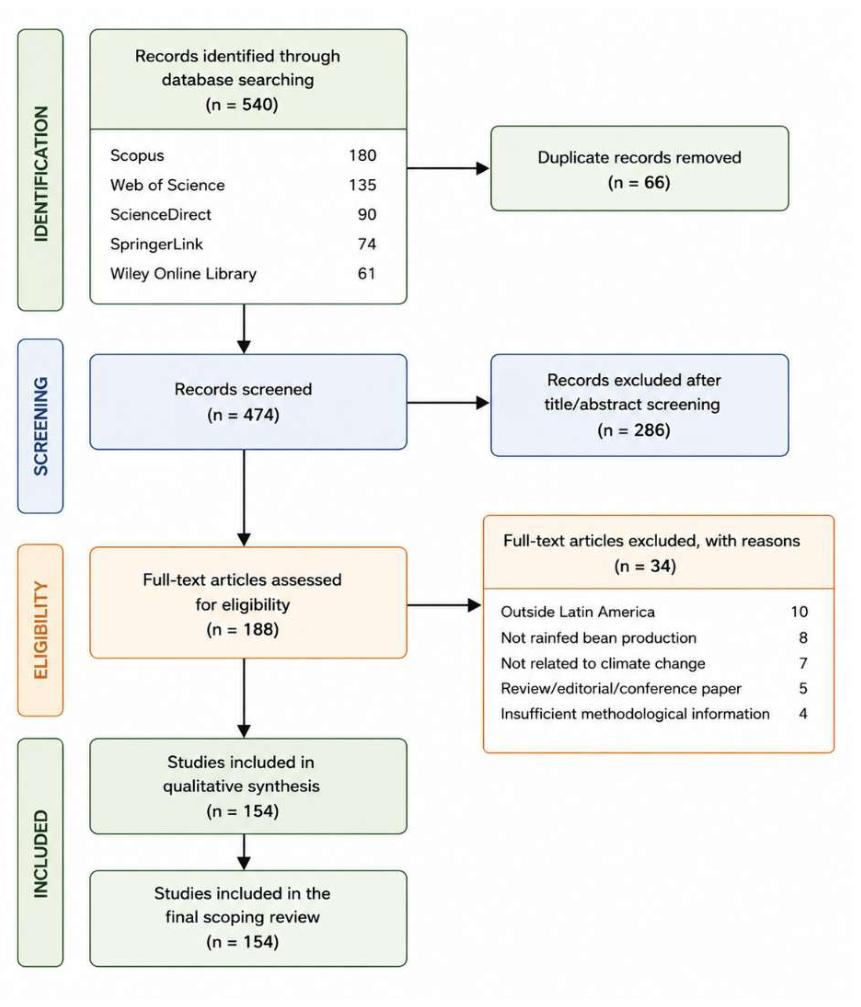
Figure 2.
Number of publications per year in Latin America.
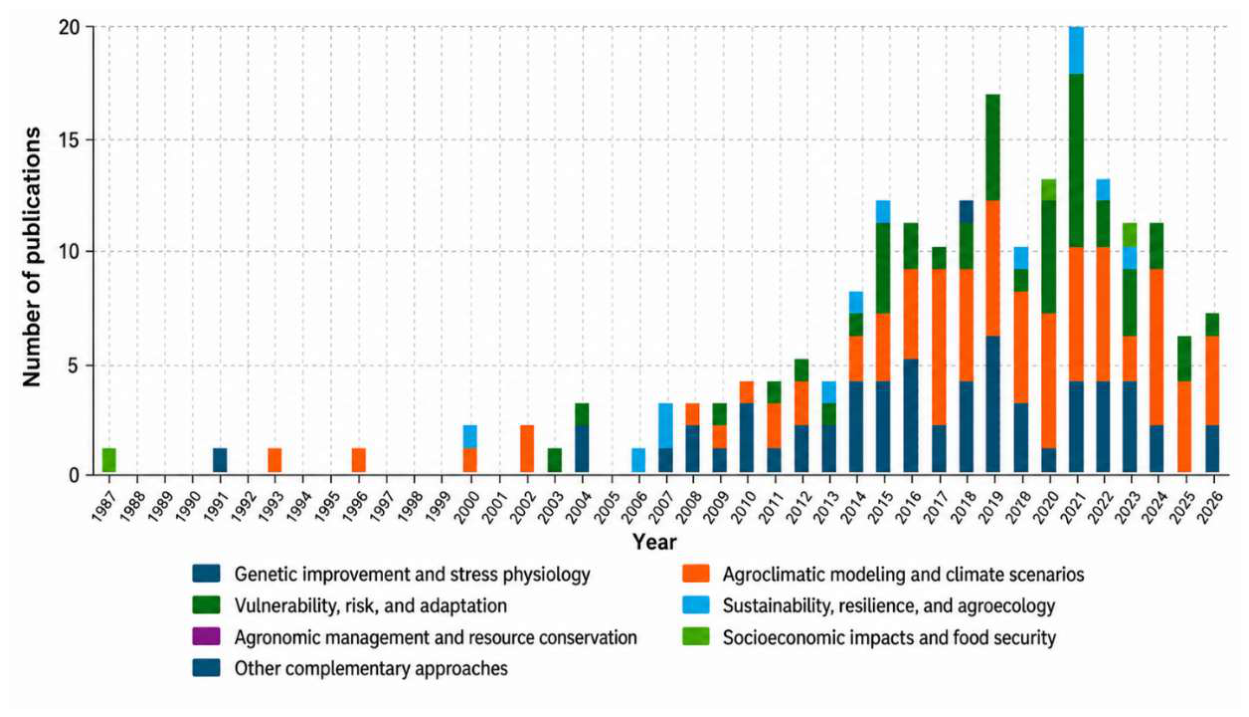
Table 2.
Representative studies that shaped the evolution of research on the sustainability of rainfed bean production under climate change in Latin America.
Table 2.
Representative studies that shaped the evolution of research on the sustainability of rainfed bean production under climate change in Latin America.
| Period | Lead author | Predominant focus | Scientific contribution | Evolution relative to the preceding period |
|---|---|---|---|---|
| Before 2000 | Acosta-Gallegos et al. (1991) [5] | Crop physiology | Foundations of drought tolerance. | Beginning of research on physiological adaptation. |
| 2000–2009 | Acosta-Díaz et al. (2009) [134] | Water-use efficiency | Selection of materials with efficient water use. | Strengthened the crop response to drought. |
| 2010–2015 | Beebe et al. (2014) [91] | Climate change | Integration of genetics and climate scenarios. | Climate change became the central research axis. |
| 2016–2020 | Donatti et al. (2019) [3] | Resilience | Adaptation through physiology and agronomic management. | Broadened the focus toward crop resilience. |
| 2021–2026 | Monjardino et al. (2021) [23] | Sustainability | Bioeconomic modeling and conservation agriculture. | The analysis evolved toward agri-food systems. |
Note: Representative studies were selected based on their contribution to the conceptual and methodological advancement of research during each historical period, according to the evidence compiled in the present review.
Table 3.
Representative studies of the principal methodologies used to investigate the impact of climate change on the sustainability of rainfed bean production.
Table 3.
Representative studies of the principal methodologies used to investigate the impact of climate change on the sustainability of rainfed bean production.
| Study type | Author (Year) | Country | Tool or methodology | Principal contribution | Relevance to the Review |
|---|---|---|---|---|---|
| Experimental | Suárez et al. (2021) [28]. | Colombia | Physiological and experimental evaluation of genotypes | Identified physiological mechanisms of drought tolerance in Phaseolus acutifolius with potential for common bean improvement. | Established the experimental foundations for developing climate-resilient cultivars. |
| Modeling | Heinemann et al. (2017) [13] | Brazil | DSSAT-CSM-CROPGRO-Dry Bean | Simulated drought profiles and assessed crop responses under multiple climate scenarios. | Provides a benchmark for climate-risk assessment and rainfed bean adaptation. |
| Simulation | Báez-González et al. (2020) [14] |
Mexico | ALMANACMEX | Assessed climate change scenarios and management alternatives through simulation calibrated with experimental data. | Demonstrated the utility of simulation for designing agronomic adaptation strategies. |
| Remote sensing | Ortega-Gaucin et al. (2021) [15] |
Mexico | Remote sensing + ASIS + GIS | Developed spatial maps of agricultural drought risk by integrating biophysical and socioeconomic information. | Strengthened territorial monitoring and climate-risk assessment. |
| GIS | Medina-García et al. (2016) [12] | Mexico | GIS + climatic and edaphic variables | Modeled bean production potential under climate change scenarios. | Provided a basis for territorial planning and regional adaptation. |
| Meta-analysis | Daryanto et al. (2015) [19] | Global | Meta-analysis (111 studies) | Quantified the effect of drought on food-legume production. | Generated quantitative evidence on bean sensitivity to water deficit. |
| Review | Beebe et al. (2013) [8] | International | Literature review | Synthesized knowledge on bean physiology, breeding, and management under climate change. | Provides the principal conceptual framework for crop adaptation. |
| Surveys | Harvey et al. (2018) [4] | Central America | Farmer surveys | Analyzed climate change perceptions and adaptation strategies implemented by smallholders. | Highlighted the importance of the social dimension in the resilience of agricultural systems. |
Disclaimer/Publisher’s Note: The statements, opinions and data contained in all publications are solely those of the individual author(s) and contributor(s) and not of MDPI and/or the editor(s). MDPI and/or the editor(s) disclaim responsibility for any injury to people or property resulting from any ideas, methods, instructions or products referred to in the content. |
© 2026 by the authors. Licensee MDPI, Basel, Switzerland. This article is an open access article distributed under the terms and conditions of the Creative Commons Attribution (CC BY) license (http://creativecommons.org/licenses/by/4.0/).
Copyright: This open access article is published under a Creative Commons CC BY 4.0 license, which permit the free download, distribution, and reuse, provided that the author and preprint are cited in any reuse.