
Submitted:
09 August 2026
Posted:
10 August 2026
You are already at the latest version
Abstract
Plutella xylostella is a destructive pest damaging the cruciferous plants worldwide. Transgenic plants expressing dsRNA can be widely deployed for pest control. However, highly effective lethal target genes are currently lacking. Here, we assessed the efficacy of RNA interference (RNAi) against P. xylostella through microinjection of in vitro synthesized dsRNA targeting PxvATPaseA. Injecting 800 ng of dsPxvATPaseA into the fourth-instar larvae greatly reduced the corresponding mRNA level by 1.88-fold on day 2, causing 45.8% larval mortality, and lastly 54.2% treated larvae sucessfully pupated. At a higher dose of 1200 ng of dsPxvATPaseA, RNAi efficacy was significantly enhanced. The expression level of PxvATPaseA was reduced by 2.22-fold and 1.92-fold on day 2 and 3, respectively, leading to 79.2% larval lethality, and only 20.8% of depleted larvae pupated. Our results indicate that PxvATPaseA is an effective target for managing P. xylostella. These findings will facilitate the development of genetically modified plants for the control of this pest.
Keywords:
Plutella xylostella
; RNA interference
; microinjection
; PxvATPaseA
1. Introduction
The diamondback moth, Plutella xylostella, represents one of the most economically devastating pests affecting cruciferous crops, causing an estimated annual loss of US $770 million in China and US $4–5 billion globally [1,2]. Its biological characteristics enable rapid evolution of resistance, with documented tolerance to over 100 chemical pesticides [1]. Therefore, developing novel control strategies for this pest is urgently needed.
Recent studies have shown transgenic plants expressing double-stranded RNA (dsRNA) via RNA interference (RNAi) can be effectively deployed for pest management, which was classified into two distinct categories: categories nuclear transformation (NT) lines and plastid transformation (PT) lines [3,4,5]. For example, applying transgenic plant Nicotiana tabacum expressing dsRNA of different genes to manage Helicoverpa armigera [6,7], Myzus persicae [8,9], Bemisia tabaci [10], Chilo partellus, P. xylostella and Maruca vitrata [11]. Furthermore, numerous transgenic plants, including Arabidopsis thaliana [12,13], Gossypium hirsutum [14], Oryza sativa [15], Glycine max [16,17], Zea mays [18], Solanum tuberosum [19,20], Lactuca sativa [21], Brassica napus [22] are generated to control pests. Notably, transgenic B. napus producing dsCHS1 significantly reduced larval weight and increased mortality in P. xylostella [22]. These findings demonstrate the feasibility of using dsRNA-expressing transgenic plants to manage P. xylostella populations. Nonetheless, the identification of effective molecular targets capable of inducing high lethality in pests stands as a fundamental requirement for the successful deployment of this transgenic technology.
Vacuolar-type H+-ATPase (V-ATPase) holoenzyme represents an evolutionarily conserved multisubunit complex ubiquitous across eukaryotic organisms. Its core function involves the hydrolysis of adenosine triphosphate (ATP), resulting in the formation of adenosine diphosphate (ADP) and inorganic phosphate, while concurrently translocating protons across cellular membranes [23,24,25]. In terms of architecture, the V-ATPase holoenzyme exhibits a bipartite structural organization consisting of the cytosolic V1 sector (encompassing eight subunits A to H) that drives ATP breakdown, and the membrane-embedded V0 sector that facilitates proton translocation across cellular membranes [26,27,28,29,30].
Previous research has identified vATPaseA as an attractive candidate target for RNAi-mediated pest control. Silencing vATPaseA in Hyphantria cunea impaired intestinal development and increased larval mortality [31]. In Plagiodera versicolora, knockdown of vATPase-A resulted in high mortality rates in both larvae and adults [32]. Similar lethal effects have been observed in Acalymma vittatum [33], Manduca sexta [34], Bemisia tabaci [35] and H. armigera [36]. Collectively, these studies suggest that vATPaseA may serve as an effective target for controlling P. xylostella via RNAi.
In this study, we investigated the biological function of vATPaseA by assessing the impacts of two doses of dsvATPaseA by microinjection in P. xylostella. Our findings identify PxvATPaseA as a potential target for developing dsRNA-expressing transgenic crops to control this pest.
2. Materials and Methods
2.1. Insect Rearing
The larvae of P. xylostella were fed on excised leaves of B. napus under precise experimental conditions (Temperature: 26 ± 1°C; Relative humidity: 60% ± 5%; Photoperiod: 16-hour light:8-hour dark). The adults were supplied with a 10% honey solution for nutrition.
2.2. Molecular Cloning
The putative PxvATPaseA sequence was required from publicly available transcriptome and genome datasets of P. xylostella [37,38]. To ensure sequence correctness, we performed PCR using gene-specific primers (Table S1). The accession number of full-length cDNA sequence was ON108624. Phylogenetic construction was carried out using MEGA-5 software, applying the neighbor-joining method with 1,000 bootstrap replications.
2.3. DsRNA Synthesis
Two cDNA fragments corresponding to PxvATPaseA and enhanced green fluorescent protein, GFP) were PCR-amplified via gene-specific primers (Table S1). To minimize off-target effects, we performed BLASTN analysis of target sequences against the P. xylostella transcriptome database, excluding regions with ≥20 bp contiguous homology to non-target genes. dsRNA was generated in vitro using the MEGAscript T7 High Yield Transcription Kit (Ambion, Austin, TX, USA) following the manufacturer’s protocol. Purified dsRNA concentrations were quantified by agarose gel electrophoresis and spectrophotometry (Nanodrop 1000). Aliquots were preserved at -80°C until experimental application.
2.4. DsRNA Microinjection
DsRNA microinjection was performed as described previously [39,40]. Briefly, newly ecdysed fourth-instar larvae were injected with either 800 ng or 1200 ng of dsPxvATPaseA. The individuals injected with dsGFP were used as negative controls. Each treatment group consisted of 8 larvae per replicate, with 6 biological replicates per dose. At 2 and 3 days post-injection, three replicates were processed for qRT-PCR analysis to measure the efficiency of RNA interference. The remaining three replicates were observed daily for three weeks to record survival rate, weight changes, pupation and adult emergence rate.
2.5. Real-Time Quantitative PCR (qRT-PCR)
Total RNA was isolated from all experimental samples to analyze temporal transcription patterns and tissue-specific expression profiles. For treatment group analysis, total RNA was extracted using TRIzol reagent (YiFeiXue Tech, Nanjing, China), with each of samples containing 8 pooled larvae and three biological replicates. qRT-PCR was performed to measure the relative abundance using previously described protocols [31]. The housekeeping gene ribosomal protein RPL32 (PxRPL32) was selected as the internal control. Each qRT-PCR assay included three biological replicates and three technical replicates to ensure reproducibility. Relative mRNA transcripts were computed via the 2-ΔΔCt method.
2.6. Data Analysis
Statistical analyses were carried out using SPSS version 26.0 for Windows (IBM Corp., Chicago, IL, USA). Data are presented as mean ± standard error (SE), and significant differences among treatment groups were determined using the Tukey-Kramer multiple comparison test. Survival curves were analyzed using GraphPad Prism version 8.0 with the log-rank (Mantel-Cox) test (95% confidence interval).
3. Results
3.1. Identification of PxvATPaseA
The full-length ORF of PxvATPaseA was 1848 bp, encoding 615 amino acids with a predicted molecular weight of 68.12 kDa and theoretical pI of 5.12. Domain analysis showed that PxvATPaseA contained a conserved V-ATPase_V1_A domain (Figure 1A). Phylogenetic analysis of vATPaseA from 19 insect species revealed that PxvATPaseA clustered within the Lepidoptera subclade (Figure 1B).
3.2. Expression Analysis of PxvATPaseA
PxvATPaseA was broadly expressed across all developmental stages. PxvATPaseA mRNA expression was significantly elevated in the early stage of each larval stage (second-, third- and fourth-instar larvae), and low at day 3 of the fourth-instar larvae (Figure 2A). PxvATPaseA was constitutively expressed in various tissues, with the highest expression observed in the foregut, hindgut, and Malpighian tubules, followed by moderate levels in the head, hemolymph, and midgut, and the lowest expression in the epidermis (Figure 2B).
3.3. Impacts of Injecting 800 ng dsPxvATPaseA into Fourth-instar Larvae
Microinjection of 800 ng dsPxvATPaseA into newly-molted fourth-instar larvae resulted in a significant 1.88-fold reduction in PxvATPaseA mRNA levels by day 2 post-injection, but no significant difference was observed on day 3 (Figure 3A). Knockdown of PxvATPaseA significantly inhibited larval development, with fresh weights lowered by 22.6% and 18.5% on day 3 and 4, respectively (Figure 3B). RNAi-mediated silencing of PxvATPaseA resulted in high larval mortality, with approximately 41.7% and 45.8% of treated larvae dying on days 3 and 4 post-injection, respectively (Figure 3C). Silencing PxvATPaseA disrupted larval-pupal development, resulting in successful pupation of only 54.2% of treated larvae (Figure 3D). In contrast, knockdown of PxvATPaseA had no significant effect on adult emergence rates (Figure 3E). Larvae treated with dsPxvATPaseA exhibited small and misshapen body size, gradually darkening and lastly dying (Figure 4A vs. 4B).
3.4. Effects of Injecting 1200 ng dsPxvATPaseA into Fourth-instar Larvae
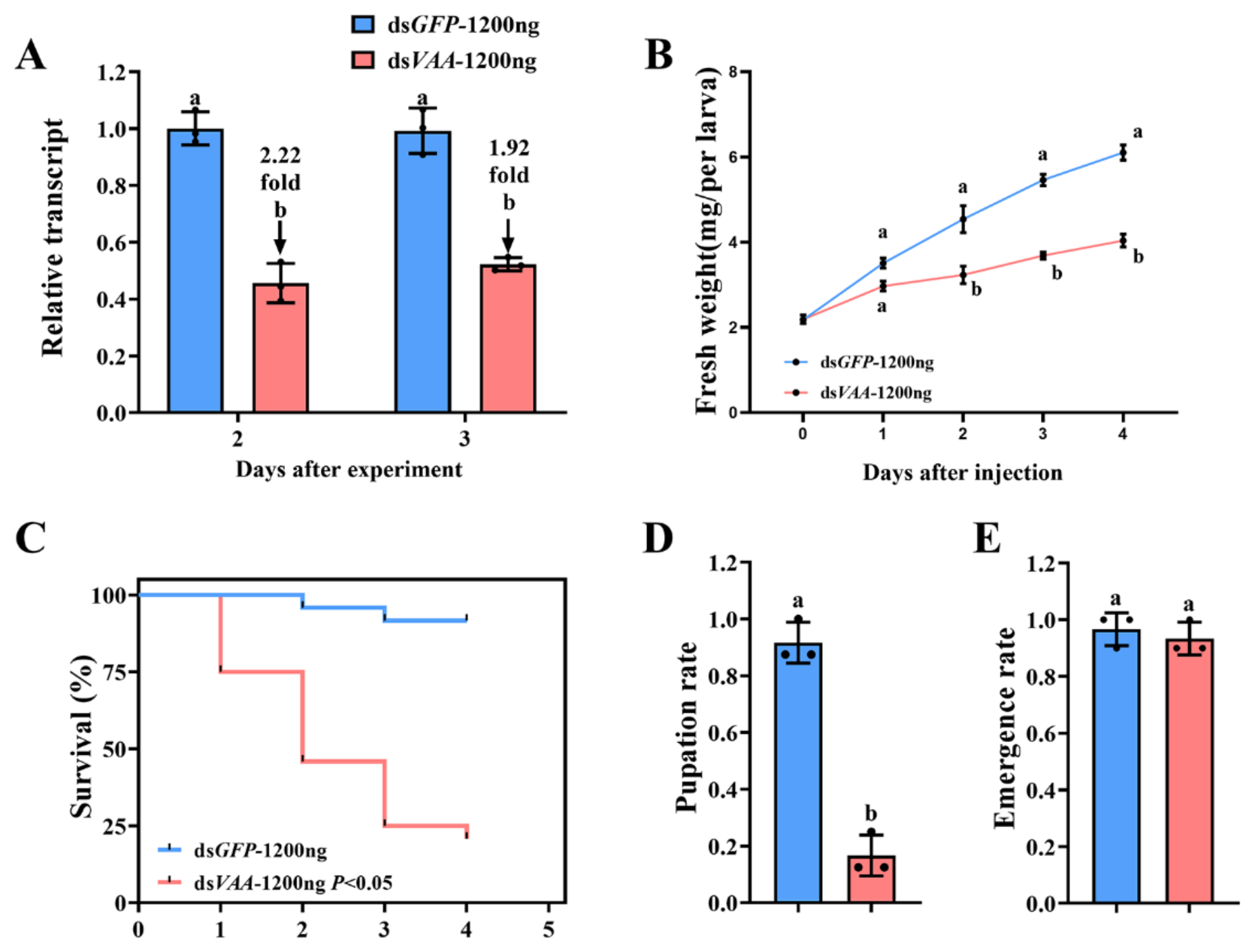
Injection of 1200 ng dsPxvATPaseA greatly lowered the PxvATPaseA transcript by 2.22-fold and 1.92-fold on days 2 and 3, respectively (Figure 5A). Knockdown of PxvATPaseA exerted a potent inhibitory effect on larval growth, resulting in significant reductions in fresh weight of 28.9%, 32.8%, and 33.8% on days 2, 3, and 4 post-injection, respectively (Figure 5B). RNAi of PxvATPaseA led to larval mortality, reaching 54.8%, 75.0% and 79.2% on day 2, 3 and 4, respectively (Figure 5C). Ultimately, only 20.8% of dsPxvATPaseA-treated larvae pupated (Figure 5D), though the adult emergence rate did not differ significantly between treatment and control groups (Figure 5E). PxvATPaseA-silenced larvae exhibited a complete failure to undergo pupal ecdysis, displaying stunted growth and abnormal body morphology, compared to dsGFP-injected controls. These PxvATPaseA-treated hypomorphs gradually became withered, dried and blackened, and eventually died (Figure 4C vs. 4D).
4. Discussion
vATPase is a multi-subunit complex involved in various biological functions across living organisms [41]. To date, the function of vATPaseA in P. xylostella has not been characterized. In this study, the sequence of vATPaseA in P. xylostella was identified from the transcriptome and genome data. RNAi-mediated silencing of PxvATPaseA via microinjection of two distinct dsRNA doses inhibited larval development, impaired pupae and ultimately caused high larval mortality. These results support that PxvATPaseA is an effectilve molecular target for sustainable management of P. xylostella larvae.
Domain analysis indicated the PxvATPaseA protein is highly conserved across species, containing a V-ATPase_V1_A domain (Figure 1). Additionally, a phylogenetic tree constructed from vATPaseA amino acid sequences of 19 insect species revealed that PxvATPaseA clusters within the Lepidoptera subclade (Figure 1). These results highlight the potential of targeting vATPaseA as an alternative RNAi-based strategy for managing P. xylostella.
PxvATPaseA was broadly expressed throughout all developmental stages, from embryo (egg) to adult. The mRNA level of PxvATPaseA was high in the early stage of each larval stage (second-, third- and fourth-instar larvae), and low at day 3 of fourth-instar larvae (Figure 2). Comparatively, peak vATPaseA expression in H. cunea occurs in third-instar larvae [31], whereas in P. versicolora, the highest expression is observed in first-instar larvae [32]. The elevated mRNA levels of PxvATPaseA during larval stages suggest a critical role larval growth and development in P. xylostella.
Tissue-speciffc expression patterns indicated that PxvATPaseA was highly expressed in the foregut, hindgut and Malpighian tubules (Figure 2). Consistent with our findings, in H. vigintioctopunctata, the mRNA level of vATPaseA was highest in the Malpighian tubules [42], while in P. versicolora, vATPaseA was highly transcribed in the hindgut and Malpighian tubules [32]. These similar expression profiles indicate that vATPaseA serves a vital function in toxin metabolism and waste excretion [36].
Although studies have shown that RNAi targeting PxTH [43], PxCHS1 [22], PxvATPasea [39], PxvATPaseE [40] induced high mortality in P. xylostella, lepidopteran pests can evolve resistance to RNAi through various mechanisms, including dsRNA instability, restricted systemic spread, endosomal entrapment, and dysfunction of core RNAi machinery [44]. Therefore, identifying highly effective lethal target genes is essential for sustainable control of lepidopteran pests such as P. xylostella.
Our results demonstrated that microinjection of dsPxvATPaseA at two doses significantly suppressed PxvATPaseA mRNA levels, reduced larval fresh weight, and caused high mortality (Figure 3 and Figure 4). Consistent with previous studies, knockdown of vATPaseA in H. cunea [31], H. vigintioctopunctata [42] and P. versicoloraa [32] resulted in significant lethal effects. Furthermore, transgenic B. napus expressing hpPxCHS1 increased larval mortality [22], suggesting that PxvATPaseA could similarly serve as an effective target for developing genetically modified crops to control P. xylostella.
Supplementary Materials
The following supporting information can be downloaded at the website of this paper posted on Preprints.org, Table S1: A list of primers used for RT-PCR of the genes.
Author Contributions
Conceptualization, X.Y. and Y.J.; methodology, X.Y. and Y.J.; investigation, X.Y. and Y.J.; writing—original draft preparation, X.Y. and Y.J.; writing—review and editing, X.Y. (Xiaohong Yan) and C.S.; supervision, X.Y. (Xiaohong Yan) and C.S.; project administration, X.Y. (Xiaohong Yan) and C.S.; funding acquisition, C.S. All authors have read and agreed to the published version of the manuscript.
Funding
Please add: This research was supported by the Innovation Project of the Chinese Academy of Agricultural Sciences (No. 2060302-049-091), the National Key Research and Development Program of China (2024YFD1400800), the National Natural Science Foundation of China (32502498), the Hubei Provincial Natural Science Foundation (2024AFB325), the Wuhan Natural Science Foundation Exploratory Program project (2024040801020312) and the Open Project Funding of Key Laboratory of Oil Crop Biology and Genetic Breeding, Ministry of Agriculture and Rural Affairs (KF202505).
Data Availability Statement
The original contributions presented in this study are included in this article/Supplementary Materials. Further inquiries can be directed to the corresponding authors.
Conflicts of Interest
The authors declare no confficts of interest.
References
- Shehzad, M.; Bodlah, I.; Siddiqui, J.A.; Bodlah, M.A.; Fareen, A.G.E.; Islam, W. Recent insights into pesticide resistance mechanisms in Plutella xylostella and possible management strategies. Environ. Sci. Pollut. Res. Int. 2023, 30, 95296–95311. [Google Scholar] [CrossRef] [PubMed]
- Yin, F.; Ge, T.; Zalucki, M.P.; Xiao, Y.; Peng, Z.; Li, Z. Gut symbionts affect Plutella xylostella (L.) susceptibility to chlorantraniliprole. Pestic. Biochem. Physiol. 2025, 209, 106327. [Google Scholar] [CrossRef] [PubMed]
- Zhang, J.; Khan, S.A.; Heckel, D.G.; Bock, R. Next-generation insect-resistant plants: RNAi-mediated crop protection. Trends Biotechnol. 2017, 35, 871–882. [Google Scholar] [CrossRef] [PubMed]
- Zhang, J.; Khan, S.A.; Hasse, C.; Ruf, S.; Heckel, D.G.; Bock, R. Full crop protection from an insect pest by expression of long double-stranded RNAs in plastids. Science 2015, 347, 991–994. [Google Scholar] [CrossRef] [PubMed]
- Li, X.; Liu, X.; Lu, W.; Yin, X.; An, S. Application progress of plant-mediated RNAi in pest control. Front. Bioeng. Biotechnol. 2022, 10, 963026. [Google Scholar] [CrossRef] [PubMed]
- Mamta; Reddy, K.R.; Rajam, M.V. Targeting chitinase gene of Helicoverpa armigera by host-induced RNA interference confers insect resistance in tobacco and tomato. Plant Mol. Biol. 2016, 90, 281–292. [Google Scholar] [PubMed]
- Xiong, Y.; Zeng, H.; Zhang, Y.; Xu, D.; Qiu, D. Silencing the HaHR3 gene by transgenic plant-mediated RNAi to disrupt Helicoverpa armigera development. Int. J. Biol. Sci. 2013, 9, 370–381. [Google Scholar] [CrossRef] [PubMed]
- Rauf, I.; Asif, M.; Amin, I.; Naqvi, R.Z.; Umer, N.; Mansoor, S.; Jander, G. Silencing cathepsin L expression reduces Myzus persicae protein content and the nutritional value as prey for Coccinella septempunctata. Insect Mol. Biol. 2019, 28, 785–797. [Google Scholar] [CrossRef] [PubMed]
- Zhao, D.; Qin, L.J.; Zhao, D.G. RNA interference of the nicotine demethylase gene CYP82E4v1 reduces nornicotine content and enhances Myzus persicae resistance in Nicotiana tabacum L. Plant Physiol. Biochem. 2016, 107, 214–221. [Google Scholar] [CrossRef] [PubMed]
- Dong, Y.; Yang, Y.; Wang, Z.; Wu, M.; Fu, J.; Guo, J.; Chang, L.; Zhang, J. Inaccessibility to double-stranded RNAs in plastids restricts RNA interference in Bemisia tabaci (whitefly). Pest Manag. Sci. 2020, 76, 3168–3176. [Google Scholar] [CrossRef] [PubMed]
- Rana, S.; Rajurkar, A.B.; Kumar, K.K.; Mohankumar, S. Comparative analysis of chitin SynthaseA dsRNA mediated RNA interference for management of crop pests of different families of Lepidoptera. Front. Plant. Sci. 2020, 11, 427. [Google Scholar] [CrossRef] [PubMed]
- Eakteiman, G.; Moses-Koch, R.; Moshitzky, P.; Mestre-Rincon, N.; Vassão, D.G.; Luck, K.; Sertchook, R.; Malka, O.; Morin, S. Targeting detoxification genes by phloem-mediated RNAi: A new approach for controlling phloem-feeding insect pests. Insect Biochem. Mol. Biol. 2018, 100, 10–21. [Google Scholar] [CrossRef] [PubMed]
- Bhatia, V.; Bhattacharya, R. Host-mediated RNA interference targeting a cuticular protein gene impaired fecundity in the green peach aphid Myzus persicae. Pest Manag. Sci. 2018, 74, 2059–2068. [Google Scholar] [CrossRef] [PubMed]
- Han, Q.; Wang, Z.; He, Y.; Xiong, Y.; Lv, S.; Li, S.; Zhang, Z.; Qiu, D.; Zeng, H. Transgenic cotton plants expressing the HaHR3 gene conferred enhanced resistance to Helicoverpa armigera and improved cotton yield. Int. J. Mol. Sci. 2017, 18, 1874. [Google Scholar] [CrossRef] [PubMed]
- Yang, J.; Sun, X.Q.; Zhu-Salzman, K.; Qin, Q.M.; Feng, H.Q.; Kong, X.D.; Zhou, X.G.; Cai, Q.N. Host-induced gene silencing of brown planthopper glutathione S-transferase gene enhances rice resistance to sap-sucking insect pests. J. Pest Sci. 2021, 94, 769–781. [Google Scholar]
- Dubey, V.K.; Lee, U.G.; Kwon, D.H.; Lee, S.H. Agroinfiltration-based expression of hairpin RNA in soybean plants for RNA interference against Tetranychus urticae. Pestic. Biochem. Physiol. 2017, 142, 53–58. [Google Scholar] [CrossRef] [PubMed]
- Meng, F.; Li, Y.; Zang, Z.; Li, N.; Ran, R.; Cao, Y.; Li, T.; Zhou, Q.; Li, W. Expression of the double-stranded RNA of the soybean pod borer Leguminivora glycinivorella (Lepidoptera: Tortricidae) ribosomal protein P0 gene enhances the resistance of transgenic soybean plants. Pest Manag. Sci. 2017, 73, 2447–2455. [Google Scholar] [CrossRef] [PubMed]
- Baum, J.A.; Bogaert, T.; Clinton, W.; Heck, G.R.; Feldmann, P.; Ilagan, O.; Johnson, S.; Plaetinck, G.; Munyikwa, T.; Pleau, M.; et al. Control of coleopteran insect pests through RNA interference. Nat. Biotechnol. 2007, 25, 1322–1326. [Google Scholar] [CrossRef] [PubMed]
- Hussain, T.; Aksoy, E.; Çalışkan, M.E.; Bakhsh, A. Transgenic potato lines expressing hairpin RNAi construct of molting-associated EcR gene exhibit enhanced resistance against Colorado potato beetle (Leptinotarsa decemlineata, Say). Transgenic Res. 2019, 28, 151–164. [Google Scholar] [CrossRef] [PubMed]
- Naqqash, M.N.; Gökçe, A.; Aksoy, E.; Bakhsh, A. Downregulation of imidacloprid resistant genes alters the biological parameters in Colorado potato beetle, Leptinotarsa decemlineata Say (chrysomelidae: Coleoptera). Chemosphere 2020, 240, 124857. [Google Scholar] [CrossRef] [PubMed]
- Ibrahim, A.B.; Monteiro, T.R.; Cabral, G.B.; Aragão, F.J.L. RNAi-mediated resistance to whitefly (Bemisia tabaci) in genetically engineered lettuce (Lactuca sativa). Transgenic Res. 2017, 26, 613–624. [Google Scholar] [CrossRef] [PubMed]
- Deng, P.; Peng, Y.; Sheng, Z.; Li, W.; Liu, Y. RNAi silencing CHS1 gene shortens the mortality time of Plutella xylostella feeding Bt-transgenic Brassica napus. Pest Manag. Sci. 2024, 80, 2610–2618. [Google Scholar] [CrossRef] [PubMed]
- Zeng, J.; Mu, L.L.; Jin, L.; Ali Anjum, A.; Li, G.Q. RNAi of vacuolar-type H(+)-ATPase genes causes growth delay and molting defect in Henosepilachna vigintioctopunctata. Bull. Entomol. Res. 2021, 111, 705–714. [Google Scholar] [CrossRef] [PubMed]
- Zeng, J.; Kang, W.N.; Jin, L.; Anjum, A.A.; Li, G.Q. Knockdown of Vacuolar ATPase Subunit G Gene affects larval survival and impaired pupation and adult emergence in Henosepilachna vigintioctopunctata. Insects 2021, 12, 935. [Google Scholar] [CrossRef] [PubMed]
- Zeng, J.; Kang, W.N.; Jin, L.; Anjum, A.A.; Li, G.Q. Vacuolar ATPase subunit F is critical for larval survival in Henosepilachna vigintioctopunctata. Insect Mol. Biol. 2022, 31, 177–189. [Google Scholar] [CrossRef] [PubMed]
- McGuire, C.; Stransky, L.; Cotter, K.; Forgac, M. Regulation of V-ATPase activity. Front. Biosci.-Landmark 2017, 22, 609–622. [Google Scholar] [CrossRef] [PubMed]
- Song, Q.; Meng, B.; Xu, H.; Mao, Z. The emerging roles of vacuolar-type ATPase-dependent Lysosomal acidification in neurodegenerative diseases. Transl. Neurodegener. 2020, 9, 17. [Google Scholar] [CrossRef] [PubMed]
- Abbas, Y.M.; Wu, D.; Bueler, S.A.; Robinson, C.V.; Rubinstein, J.L. Structure of V-ATPase from the mammalian brain. Science 2020, 367, 1240–1246. [Google Scholar] [CrossRef] [PubMed]
- Mazhab-Jafari, M.T.; Rohou, A.; Schmidt, C.; Bueler, S.A.; Benlekbir, S.; Robinson, C.V.; Rubinstein, J.L. Atomic model for the membrane-embedded V(O) motor of a eukaryotic V-ATPase. Nature 2016, 539, 118–122. [Google Scholar] [CrossRef] [PubMed]
- Roh, S.H.; Stam, N.J.; Hryc, C.F.; Couoh-Cardel, S.; Pintilie, G.; Chiu, W.; Wilkens, S. The 3.5-Å CryoEM structure of nanodisc-reconstituted yeast vacuolar ATPase V(o) proton channel. Mol. Cell 2018, 69, 993–1004.e1003. [Google Scholar] [CrossRef] [PubMed]
- Wang, X.; Zhao, D.; Wang, Q.; Liu, Y.; Lu, X.; Guo, W. Identification and functional analysis of V-ATPaseA and C Genes in Hyphantria cunea. Insects 2024, 15, 515. [Google Scholar] [CrossRef] [PubMed]
- Li, Y.; Ze, L.J.; Liu, F.J.; Liao, W.; Lu, M.; Liu, X.L. RNA interference of vATPase subunits A and E affects survival of larvae and adults in Plagiodera versicolora (Coleoptera: Chrysomelidae). Pestic. Biochem. Physiol. 2022, 188, 105275. [Google Scholar] [CrossRef] [PubMed]
- Kaplanoglu, E.; Longpré, F.; Donly, C. Evaluating the potential of RNA interference for control of striped cucumber beetle, Acalymma vittatum (Fabricius) (Coleoptera: Chrysomelidae). Pest Manag. Sci. 2026, 82, 3591–3602. [Google Scholar] [CrossRef] [PubMed]
- Burke, W.G.; Kaplanoglu, E.; Kolotilin, I.; Menassa, R.; Donly, C. RNA Interference in the tobacco hornworm, Manduca sexta, using plastid-encoded long double-stranded RNA. Front. Plant. Sci. 2019, 10, 313. [Google Scholar] [CrossRef] [PubMed]
- Thakur, N.; Upadhyay, S.K.; Verma, P.C.; Chandrashekar, K.; Tuli, R.; Singh, P.K. Enhanced whitefly resistance in transgenic tobacco plants expressing double stranded RNA of v-ATPase A gene. PLoS ONE 2014, 9, e87235. [Google Scholar] [CrossRef] [PubMed]
- Sharif, M.N.; Iqbal, M.S.; Alam, R.; Awan, M.F.; Tariq, M.; Ali, Q.; Nasir, I.A. Silencing of multiple target genes via ingestion of dsRNA and PMRi affects development and survival in Helicoverpa armigera. Sci. Rep. 2022, 12, 10405. [Google Scholar] [CrossRef] [PubMed]
- Xie, C.; Xiong, L.; Ye, M.; Shen, L.; Li, J.; Zhang, Z.; You, M.; You, S. Genome-wide analysis of V-ATPase genes in Plutella xylostella (L.) and the potential role of PxVHA-G1 in resistance to Bacillus thuringiensis Cry1Ac toxin. Int. J. Biol. Macromol. 2022, 194, 74–83. [Google Scholar] [CrossRef] [PubMed]
- Niu, R.C.; Meng, F.X.; Zeng, Q.H.; Wang, Y.J.; Liu, T.X.; Chu, D.; Zhang, S.Z. Comprehensive transcriptomic analyses of silk-associated genes and functional characterization of key silk fibroins in Plutella xylostella. Int. J. Mol. Sci. 2025, 26, 2842. [Google Scholar] [CrossRef] [PubMed]
- Yu, X.; Luo, J.; Lu, L.; Zhu, L.; Wang, S.; Yang, K.; Wan, X.; Wu, Y.; Akmal, B.; Wu, G.; et al. RNAi of vATPasea affects survival and larval-pupal development in Plutella xylostella. Insects 2025, 16, 1054. [Google Scholar] [CrossRef] [PubMed]
- Yu, X.; Luo, J.; Xue, J.; Lu, L.; Deng, P.; Zhu, L.; Yang, K.; Wan, X.; Wu, Y.; Boboev, A.; et al. RNAi-mediated silencing of vATPase subunit E impairs larval development in Plutella xylostella, and virtual screening identifies a potential inhibitor. Insects 2026, 17, 439. [Google Scholar] [CrossRef] [PubMed]
- Zeng, J.; Mu, L.L.; Jin, L.; Anjum, A.A.; Li, G.Q. Evaluation of three vacuolar ATPase genes as potential RNAi target in Henosepilachna vigintioctopunctata. J. Asia Pac. Entomol. 2021, 24, 55–63. [Google Scholar] [CrossRef]
- Guo, W.; Guo, M.; Yang, C.; Liu, Z.; Chen, S.; Lü, J.; Qiu, B.; Zhang, Y.; Zhou, X.; Pan, H. RNA interference-mediated silencing of vATPase subunits A and E affect survival and development of the 28-spotted ladybeetle, Henosepilachna vigintioctopunctata. Insect Sci. 2021, 28, 1664–1676. [Google Scholar] [CrossRef] [PubMed]
- Hou, Q.L.; Zhang, H.Q.; Zhu, J.N.; Chen, E.H. Tyrosine hydroxylase is required for the larval-pupal transformation and immunity of Plutella xylostella: potential for pest management. J. Agric. Food Chem. 2024, 72, 27818–27829. [Google Scholar] [CrossRef] [PubMed]
- Cooper, A.M.; Silver, K.; Zhang, J.; Park, Y.; Zhu, K.Y. Molecular mechanisms influencing efficiency of RNA interference in insects. Pest Manag. Sci. 2019, 75, 18–28. [Google Scholar] [CrossRef] [PubMed]
Figure 1.
Alignment (A) and phylogenetic analysis (B) of vATPase subunits A (PxvATPaseA) from Plutella xylostella. (A) The vATPaseA protein sequences were obtained from Ostrinia furnacalis, Bombyx mori, Aedes aegypti, Bactrocera dorsalis, Nilaparvata lugens, Bemisia tabaci, Acyrthosiphon pisum, Henosepilachna vigintioctopunctata, Diabrotica virgifera virgifera, Leptinotarsa decemlineata, and Plutella xylostella. The V-ATPase_V1_A domain is indicated by a black line. (B) The amino acid sequences of the PxvATPaseA subunit were derived from five lepidopteran species: Ostrinia furnacalis, Manduca sexta, Cnaphalocrocis medinalis, Bombyx mori, and Plutella xylostella; three dipteran species: Aedes aegypti, Ceratitis capitata, and Bactrocera dorsalis; three hemipteran species: Nilaparvata lugens, Bemisia tabaci, and Acyrthosiphon pisum; three hymenopteran species: Apis mellifera, Apis florea, and Bombus impatiens; and five coleopteran species: Propylea japonica, Henosepilachna vigintioctopunctata, Diabrotica virgifera virgifera, Plagiodera versicolora, and Leptinotarsa decemlineata. bootstrap analyses were performed with 1000 replications, and bootstrap values exceeding 50% are indicated on the tree.
Figure 1.
Alignment (A) and phylogenetic analysis (B) of vATPase subunits A (PxvATPaseA) from Plutella xylostella. (A) The vATPaseA protein sequences were obtained from Ostrinia furnacalis, Bombyx mori, Aedes aegypti, Bactrocera dorsalis, Nilaparvata lugens, Bemisia tabaci, Acyrthosiphon pisum, Henosepilachna vigintioctopunctata, Diabrotica virgifera virgifera, Leptinotarsa decemlineata, and Plutella xylostella. The V-ATPase_V1_A domain is indicated by a black line. (B) The amino acid sequences of the PxvATPaseA subunit were derived from five lepidopteran species: Ostrinia furnacalis, Manduca sexta, Cnaphalocrocis medinalis, Bombyx mori, and Plutella xylostella; three dipteran species: Aedes aegypti, Ceratitis capitata, and Bactrocera dorsalis; three hemipteran species: Nilaparvata lugens, Bemisia tabaci, and Acyrthosiphon pisum; three hymenopteran species: Apis mellifera, Apis florea, and Bombus impatiens; and five coleopteran species: Propylea japonica, Henosepilachna vigintioctopunctata, Diabrotica virgifera virgifera, Plagiodera versicolora, and Leptinotarsa decemlineata. bootstrap analyses were performed with 1000 replications, and bootstrap values exceeding 50% are indicated on the tree.
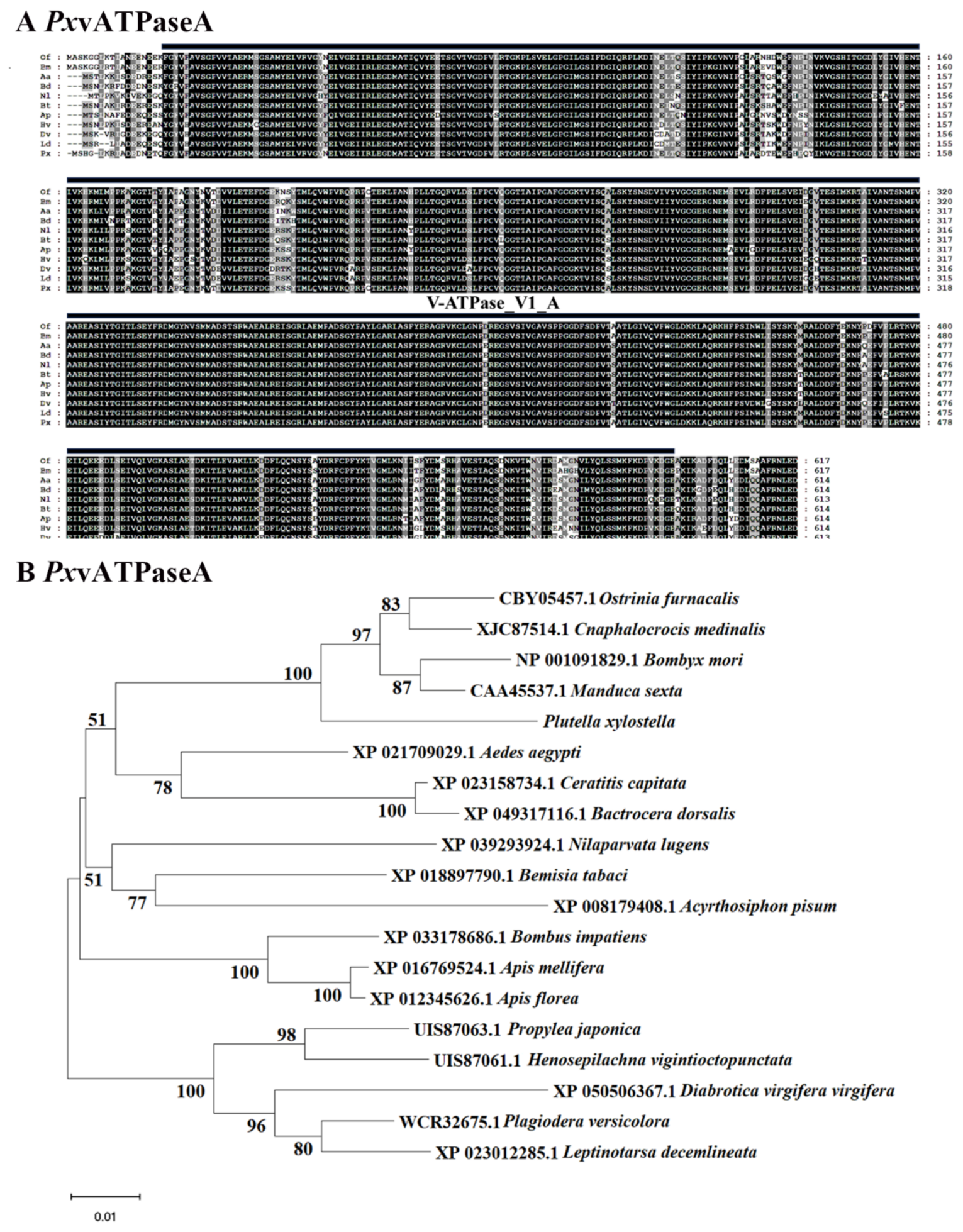
Figure 2.
Temporal (A) and Tissue (B) expression patterns of PxvATPaseA in Plutella xylostella. (A) For analyzing temporal transcription profiles, cDNA templates were prepared from eggs, larvae of the first to fourth instars collected at daily intervals (for first instar: 0–1 day after hatching; for other instars: day 0 refers to newly molted individuals), as well as newly ecdysed pupae and newly emerged adults. (B) For tissue-specific expression patterns, templates were derived from the head, foregut (FG), midgut (MG), hindgut (HG), hemolymph (HE), Malpighian tubules (MT), and epidermis (EP) of day-4 fourth-instar larvae. Each sample contained three independent biological replicates, with each including 5–10 individuals, and all qRT-PCR reactions were performed in technical triplicates. Expression levels were calculated using the 2−ΔΔCT method. Data are presented as column means with vertical bars indicating the standard error (SE).
Figure 2.
Temporal (A) and Tissue (B) expression patterns of PxvATPaseA in Plutella xylostella. (A) For analyzing temporal transcription profiles, cDNA templates were prepared from eggs, larvae of the first to fourth instars collected at daily intervals (for first instar: 0–1 day after hatching; for other instars: day 0 refers to newly molted individuals), as well as newly ecdysed pupae and newly emerged adults. (B) For tissue-specific expression patterns, templates were derived from the head, foregut (FG), midgut (MG), hindgut (HG), hemolymph (HE), Malpighian tubules (MT), and epidermis (EP) of day-4 fourth-instar larvae. Each sample contained three independent biological replicates, with each including 5–10 individuals, and all qRT-PCR reactions were performed in technical triplicates. Expression levels were calculated using the 2−ΔΔCT method. Data are presented as column means with vertical bars indicating the standard error (SE).
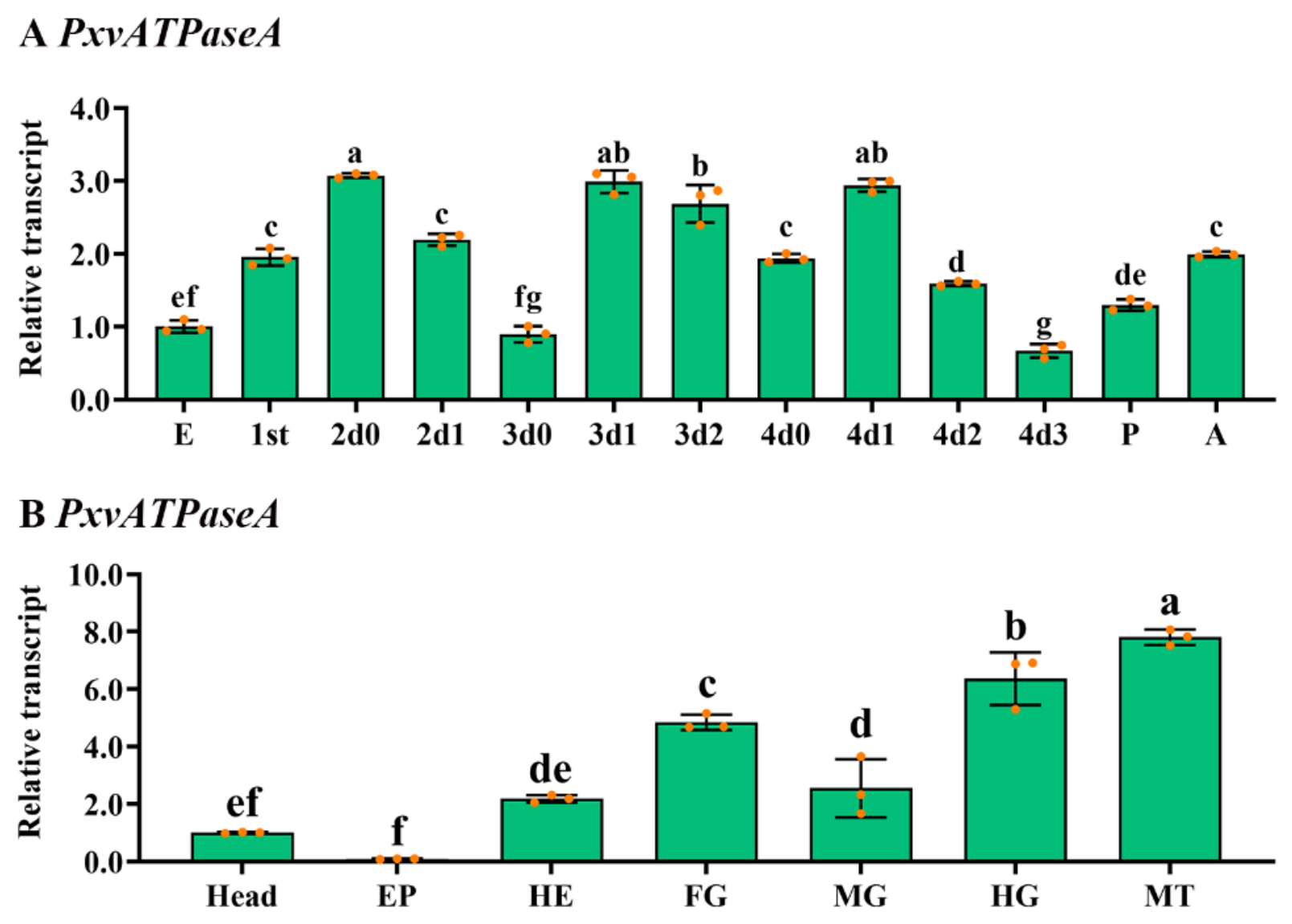
Figure 3.
Impacts on RNAi of PxvATPaseA in fourth-instar larvae in Plutella xylostella. Newly ecdysed fourth-instar larvae were microinjected with 0.2 µL of solution containing 800 ng of dsPxvATPaseA, with an equivalent amount of dsGFP as the control. PxvATPaseA transcript abundance were quantified at day 2 and 3 post-injection (A). Relative mRNA levels are presented as the ratio of relative copy numbers in treated larvae to those in the dsGFP control group (set as 1). Larval weight (B), survival rate (C), pupation rate (D), and emergence rate (E) were recorded over a 5-day trial period. Data are presented as mean ± SE. Different letters denote statistically significant differences at P < 0.05.
Figure 3.
Impacts on RNAi of PxvATPaseA in fourth-instar larvae in Plutella xylostella. Newly ecdysed fourth-instar larvae were microinjected with 0.2 µL of solution containing 800 ng of dsPxvATPaseA, with an equivalent amount of dsGFP as the control. PxvATPaseA transcript abundance were quantified at day 2 and 3 post-injection (A). Relative mRNA levels are presented as the ratio of relative copy numbers in treated larvae to those in the dsGFP control group (set as 1). Larval weight (B), survival rate (C), pupation rate (D), and emergence rate (E) were recorded over a 5-day trial period. Data are presented as mean ± SE. Different letters denote statistically significant differences at P < 0.05.
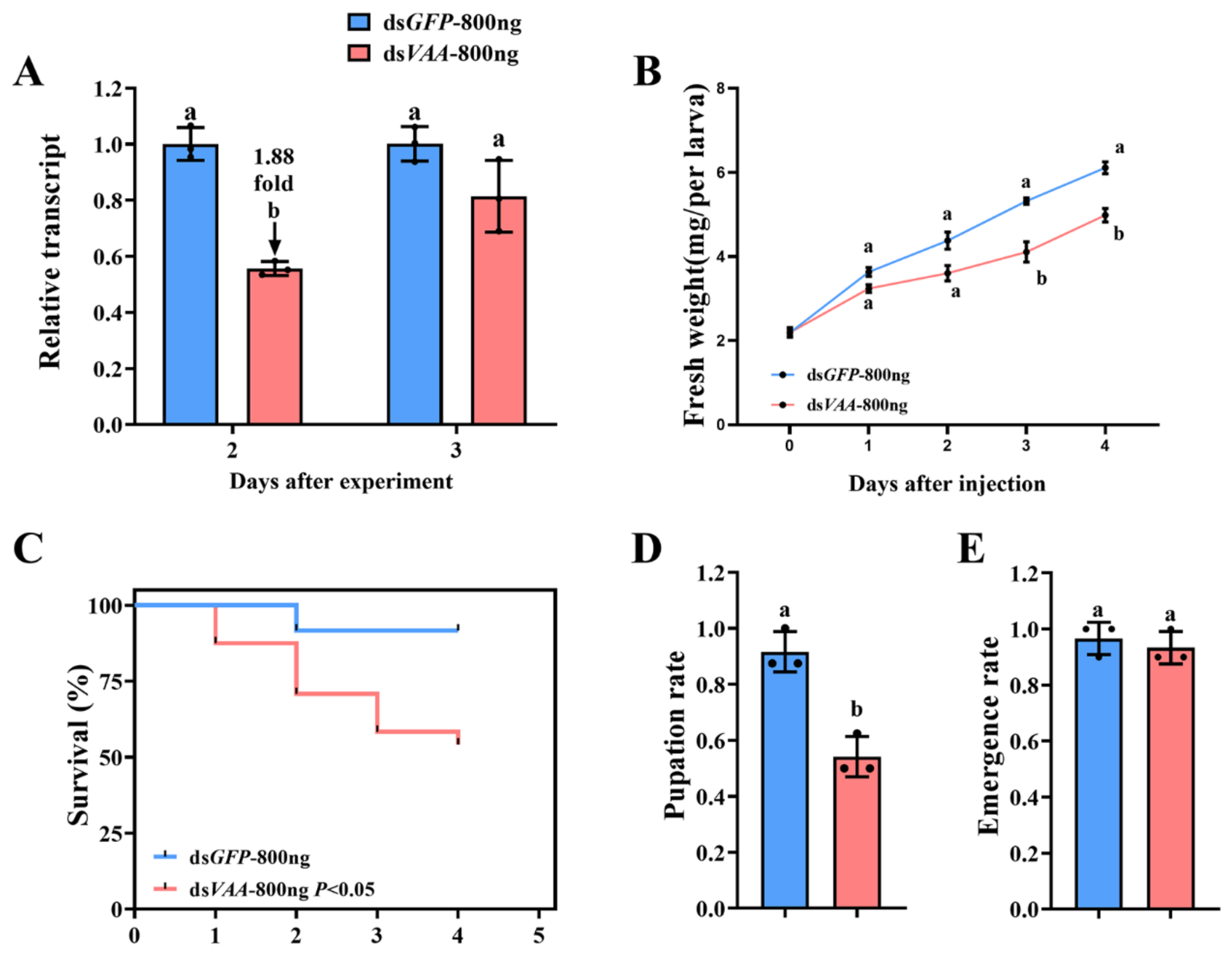
Figure 4.
Defect phenotype of RNAi of PxvATPaseA in fourth-instar larvae in Plutella xylostella by injecting two doses of dsRNA.
Figure 4.
Defect phenotype of RNAi of PxvATPaseA in fourth-instar larvae in Plutella xylostella by injecting two doses of dsRNA.
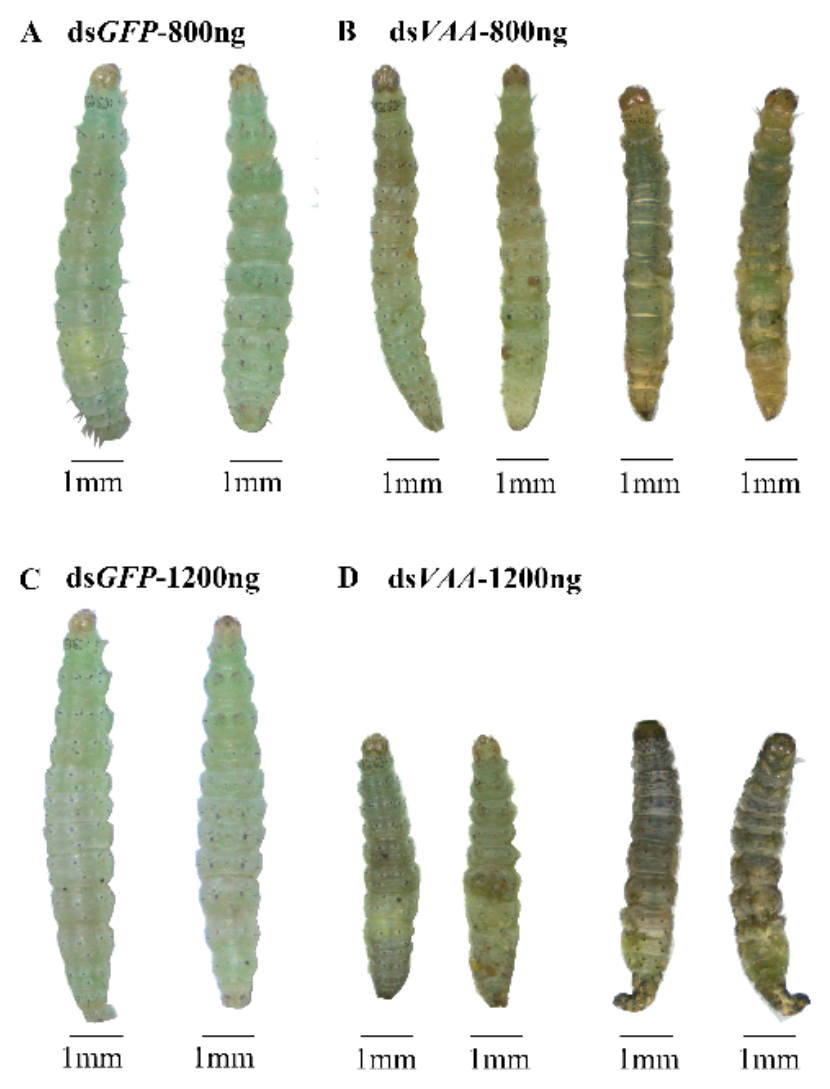
Figure 5.
Effects of silencing of PxvATPaseA on the fourth-instar larvae of Plutella xylostella. Newly ecdysed fourth-instar larvae were administered with 0.2 µL of solution containing 1200 ng of dsVAA, with dsGFP injection used as the negative control. Under identical experimental conditions, PxvATPaseA transcripts (A), larval weight (B), survival rate (C), pupation (D) and emergence rate (E) were analyzed. Data are shown as mean ± SE. Different lettersindicate statistically significant differences at P < 0.05.
Figure 5.
Effects of silencing of PxvATPaseA on the fourth-instar larvae of Plutella xylostella. Newly ecdysed fourth-instar larvae were administered with 0.2 µL of solution containing 1200 ng of dsVAA, with dsGFP injection used as the negative control. Under identical experimental conditions, PxvATPaseA transcripts (A), larval weight (B), survival rate (C), pupation (D) and emergence rate (E) were analyzed. Data are shown as mean ± SE. Different lettersindicate statistically significant differences at P < 0.05.
Disclaimer/Publisher’s Note: The statements, opinions and data contained in all publications are solely those of the individual author(s) and contributor(s) and not of MDPI and/or the editor(s). MDPI and/or the editor(s) disclaim responsibility for any injury to people or property resulting from any ideas, methods, instructions or products referred to in the content. |
© 2026 by the authors. Licensee MDPI, Basel, Switzerland. This article is an open access article distributed under the terms and conditions of the Creative Commons Attribution (CC BY) license (http://creativecommons.org/licenses/by/4.0/).
Copyright: This open access article is published under a Creative Commons CC BY 4.0 license, which permit the free download, distribution, and reuse, provided that the author and preprint are cited in any reuse.