

Submitted:
08 August 2026
Posted:
10 August 2026
You are already at the latest version
Abstract
Access to home ownership has become an axis of structural inequality between generations, in a context in which the real estate market increasingly operates as a mechanism for transferring wealth from younger cohorts to older ownership cohorts. To propose the theoretical-methodological design of a new composite indicator, the Intergenerational Housing Equity Index (IEIH), aimed at measuring and comparing internationally the disparity in access to housing between generational cohorts, with the possibility of integration into the monitoring systems of Sustainable Development Goal (SDG) 11. A qualitative documentary analysis of academic sources indexed in Scopus and Web of Science, as well as technical reports of multilateral organizations published between 2019 and 2026, was carried out, adapting the ten-step protocol of the Manual on the Construction of Composite Indicators of the OECD and the Joint Research Centre of the European Commission. Four constituent dimensions of the IEIH were identified (economic access, wealth and wealth transfer, regulatory framework and housing policy instruments, and generational housing adequacy), twelve candidate indicators, and a normalization, weighting, and aggregation procedure with sensitivity analysis. The IEIH complements the existing indicators of affordability and housing adequacy by explicitly incorporating the comparative-generational axis, and lays the methodological foundations for its empirical validation through a panel of experts (Delphi method) and a pilot study in Latin American countries.
Keywords:
intergenerational equity
; composite indicator
; housing
; SDG 11
; housing gap
; housing policy
1. Introduction
Contemporary patrimonial inequality has an increasingly decisive housing dimension. In most economies of the Organization for Economic Cooperation and Development (OECD), housing accounts for more than half of household assets, and its appreciation has been identified as the main driver of the sustained increase in the wealth-to-income ratio observed since the middle of the last century, above other forms of capital (Ioannides & Ngai, 2025). This dynamic acquires a specific generational reading: the cohorts that accessed property before the processes of urban land scarcity and regulatory restrictions on construction intensified captured most of this valorization, while younger generations currently face substantially more adverse access conditions (Glaeser & Gyourko, 2025).
Recent empirical evidence confirms the magnitude of the phenomenon. In the United States, the median price of a single-family home reached an all-time high of $412,000 in 2024, an increase of nearly 60% compared to 2019, while the sale of existing homes fell to its lowest level in three decades (Joint Center for Housing Studies of Harvard University [JCHS], 2025). In the same year, the median age of first-time buyers also reached an all-time high of 38 years, the ownership rate of households under 35 recorded its largest annual decline, and the number of rented households with housing spending overload reached a record 22.6 million (JCHS, 2025).
In the United Kingdom, the Resolution Foundation has documented that, from the cohort born between 1946 and 1950, each successive generation has reached, at the same age, lower ownership rates than the previous generation; households headed by thirty-year-olds are now half as likely to own as the baby boomer generation was at the same age (Resolution Foundation, 2019). This pattern coexists with a growing reliance on family transfers for access to first homes, the incidence of which among first-time buyers has more than doubled between the 1980s and 2020 (Hochstenbach et al., 2025).
Various econometric studies have quantified the weight of parental wealth on the probability that the next generation will access property, as well as the indirect channels through which this wealth is transmitted between generations, including the educational quality associated with the real estate valuation of the residence environment (Daysal et al., 2023; Gilraine et al., 2023). In the United States, the net worth of white millennial households increased by nearly $10,000 between 2013 and 2022, while that of Black and Hispanic millennial households was little changed over the same period, also showing an intersection between the generation gap and pre-existing racial inequalities (Urban Institute, 2024).
In Latin America and the Caribbean, a region that in 2023 concentrated about 82% of its population in urban areas, generational access to housing presents additional challenges derived from informality and limited mortgage credit coverage. By 2010, only 42% of people aged 15-39 owned their own home in the region, with values as low as 21% in some countries (Inter-American Development Bank [IDB], 2024). In the Peruvian case, urban expansion has been driven mainly by informal mechanisms of access to land and by progressive self-construction processes that can take decades to complete, which compromises both habitability and security of tenure (IDB, 2024; United Nations Human Settlements Organization [UN-Habitat], 2015).
Taken together, this evidence supports a structural interpretation of the phenomenon: the real estate market not only reflects, but actively reproduces and deepens inequality between generations, operating as a mechanism for transferring wealth from younger cohorts—who must pay historically high prices relative to their income—to older owning cohorts. that capitalize on the cumulative appreciation of their assets (Hochstenbach et al., 2025; Ioannides & Ngai, 2025). It is, therefore, a systemic transformation and not a merely cyclical situation, which requires measurement instruments capable of capturing it in a comparable way over time and between countries.
Despite the availability of widely used housing indicators, none of them explicitly incorporates the comparative-generational axis. Demographia's International Housing Affordability Survey uses the "median multiple"—the ratio of median house price to median household income—to rank the affordability of 95 metropolitan markets in eight countries, and in its 2025 edition failed to rate any of them as "affordable," an unprecedented situation in its twenty-one-year history (Cox, 2025). The World Bank's Adequate Housing Index (AHI) estimates, based on seven dimensions of adequacy, a deficit of 268 million housing units affecting 1260 million people in 64 emerging economies (Behr et al., 2021). For its part, SDG 11 indicator 11.1.1, which measures the proportion of the urban population living in precarious settlements or inadequate housing, is the official monitoring metric for this goal, with coverage in more than 320 cities (United Nations Human Settlements Organization [UN-Habitat], 2023). None of these instruments, however, disaggregates their results by generational cohort or allows for a systematic comparison of the relative position of different generations within the same country or between countries.
This absence constitutes a relevant methodological gap: without a composite indicator that comparably synthesizes the economic, patrimonial, regulatory and housing adequacy dimensions from a generational perspective, it is difficult to assess the progress – or setback – of intergenerational equity in housing, as well as to design and monitor public policies specifically aimed at correcting it. In response to this gap, this article aims to propose the theoretical-methodological design of the Intergenerational Housing Equity Index (IEIH), a composite indicator aimed at measuring and comparing internationally the disparity in access to housing between generational cohorts, with the potential for integration into SDG 11 monitoring systems.
The proposal is particularly relevant for the field of architecture and urban management, disciplines that have begun to incorporate innovative housing policy instruments – accessory dwelling units (ADUs), density rezoning, coliving and PropTech platforms – as responses aimed at expanding young generations' access to housing (Pothukuchi & Guinn, 2025). Having an indicator capable of measuring the effect of such instruments on intergenerational equity would allow policymakers and urban design practitioners to more rigorously assess their effectiveness. The article is organized as follows: section 2 describes the documentary methodological approach employed and the ten-step framework adapted for the design of the index; Section 3 presents the background check; section 4 develops the structural proposal of the IEIH; Section 5 discusses its theoretical and practical implications, as well as its limitations; and section 6 formulates conclusions and recommendations for future empirical validation.
2. Methods
2.1. Approach and Design
This study adopts a qualitative approach of documentary analysis, typical of design articles and methodological proposal in the field of composite indicators (Nardo et al., 2008). Unlike an empirical study that collects and processes primary data, the methodological objective pursued is to systematize the specialized literature and international technical frameworks in order to derive from them a conceptual architecture of the indicator —dimensions, candidate indicators, and aggregation procedure— susceptible to empirical validation at a later stage.
2.2. Search Strategy and Sources of Information
A documentary search was carried out in the Scopus and Web of Science databases, complemented by a review of institutional repositories of multilateral organizations and specialized research centers: the OECD, the World Bank, UN-Habitat, the Resolution Foundation, the National Bureau of Economic Research of the United States (NBER), the Joint Center for Housing Studies of Harvard University, the Inter-American Development Bank and the Economic Commission for Latin America and the Caribbean. The Boolean search string combined the terms ("intergenerational housing", OR, "generational housing gap", OR "housing wealth inequality"), AND ("composite indicator", OR "index", OR "indicator"), AND ("homeownership", OR "housing affordability", OR "housing equity"), restricted to publications disseminated between 2019 and 2026.
2.3. Inclusion and Exclusion Criteria, and Reliability of the Analysis
Articles published in journals indexed in Scopus or Web of Science, working papers from multilateral organizations and research centers with institutional technical review, and official monitoring reports of the Sustainable Development Goals were included. Press releases, informative publications without verifiable methodological support and sources without an identifiable publication date were excluded. The reliability of the analysis was sought by triangulating academic, multilateral and regional sources for each relevant empirical claim, as well as by systematically contrasting the design decisions of the proposed index with the principles set out in the OECD Handbook on the Construction of Composite Indicators and the European Commission's Joint Research Centre. standard methodological reference of the field (Nardo et al., 2008).
2.4. Methodological Framework for the Construction of the Index
The design of the IEIH adapts the ten-step protocol proposed by Nardo et al. (2008) for the construction of comparable composite indicators between countries: definition of the theoretical framework, selection of indicators, treatment of missing data, exploratory multivariate analysis, normalization, weighting, aggregation, robustness and sensitivity analysis, linkage with other related indicators, and visualization and communication of results. Table 3 summarizes the progress status of each step in this article. The steps corresponding to the theoretical framework, the selection of indicators and the normalization, weighting and aggregation procedure are developed in section 4 as a result of the documentary analysis; the steps that require harmonized primary data by country and cohort—currently fragmented or nonexistent in many Latin American contexts (IDB, 2024; UN-Habitat, 2015)—are set out as an empirical validation agenda in section 6.
| Step | Description | Status in this article |
| 1. Theoretical framework | Conceptual definition and delimitation of dimensions | Developed (sections 3 and 4) |
| 2. Selection of indicators | Identification of candidate indicators by dimension | Developed (Table 2) |
| 3. Processing of missing data | Multiple Assignment for Incomplete Series by Country | Pending (empirical validation) |
| 4. Multivariate analysis | Exploratory Principal Component Analysis | Pending (empirical validation) |
| 5. Standardization | Min-max method | Developed (section 4.3) |
| 6. Weighting | Equal weighting with contrast using ACP | Developed (section 4.3) |
| 7. Aggregation | Geometric Aggregation | Developed (section 4.3) |
| 8. Robustness and sensitivity | Monte Carlo Simulation | Pending (empirical validation) |
| 9. Linkage with other indicators | Contrast with SDG 11.1.1, AHI and Medium Multiple | Developed (section 4.5) |
| 10. Visualization and communication | Schematic representation of the index | Developed (Figure 1) |
| Note. Table 3. Adapted from Nardo et al. (2008). | ||
3. Theoretical Framework and Background Review
3.1. Existing Indicators Related to Housing and Equity
The international measurement of access to housing has a consolidated trajectory, although fragmented according to the aspect that each instrument prioritizes. Table 1 summarizes the main indicators identified in the documentary review and contrasts them with the IEIH proposal.
| Indicator | Institution / authors | Main focus | Explicit generational dimension | Coverage |
| Median multiple | Cox (2025); Demographia | Housing Price to Household Income Ratio | No | 95 metropolitan markets in 8 countries |
| Adequate Housing Index (AHI) | Behr et al. (2021); World Bank | Multidimensional housing adaptation (7 dimensions) | No | 64 emerging economies |
| Indicator 11.1.1 (SDG 11) | UN-Habitat (2023) | Proportion of urban population in slums | No | More than 320 cities |
| Price Gap Index (PGI) | Oh and Run (2026) | Dynamic redistribution of housing stock by occupational category | Partial (by occupational category, not by age cohort) | A region of France |
| IEIH (proposed) | This study | Intergenerational disparity in access, heritage, regulations and housing adequacy | Yes (central axis) | Designed for international comparison |
| Note. Table 1. Authors' elaboration based on Cox (2025), Behr et al. (2021), UN-Habitat (2023) and Ay and Le Corre (2026). | ||||
As can be seen in Table 1, the median multiple of Demographia offers a measure of affordability widely used and recommended by the World Bank and the United Nations (Cox, 2025), but it does not disaggregate its results by age cohort or weight the equity dimension. The World Bank's AHI incorporates seven dimensions of adequacy—overcrowding, materiality, and access to services, among others—calculated from harmonized household surveys, but it also does not distinguish between generations (Behr et al., 2021). SDG 11 indicator 11.1.1 measures the proportion of urban population in slums through the UN-Habitat Thriving Cities Initiative, although it has been noted that its definition fails to capture all the elements of the affordability target pursued by target 11.1 (UN-Habitat, 2023). Finally, the Price Gap Index (PGI), recently proposed for the French context, offers a dynamic and spatially disaggregated approach to the redistribution of housing wealth among occupational categories, although circumscribed to a single country and without an international comparative axis (Ay & Le Corre, 2026). None of the four instruments makes it possible, in a direct way, to compare the relative position of generational cohorts between countries, which is precisely the function that the IEIH is called upon to fulfill.
3.2. Empirical Evidence of the Intergenerational Housing Gap
Beyond the measurement instruments, the empirical literature on the housing intergenerational gap has been developed mainly along three lines. The first documents the divergent evolution of ownership rates by cohort in advanced economies, as described in the introduction for the cases of the United States and the United Kingdom (JCHS, 2025; Resolution Foundation, 2019). The second examines the mechanisms of transmission of housing wealth between generations, including both direct transfers – donations and inheritances – and indirect effects mediated by educational quality and access to credit (Daysal et al., 2023; Gilraine et al., 2023; Hochstenbach et al., 2025). The third line, of a more conceptual nature, has begun to propose specific analytical frameworks for intergenerational equity in housing, among which the recent proposal of «intergenerational housing solidarity» stands out as a lens for analyzing collaborative housing arrangements between generations (Schwittay, 2026). This conceptual line, however, has been developed predominantly in a qualitative and ethnographic key, without yet translating into quantitative instruments comparable between countries.
3.3. Evidence in Latin America and the Peruvian Context
In the Latin American context, the available evidence confirms the existence of a generational gap of considerable magnitude, although with less specific methodological development. The Inter-American Development Bank has documented that, on average, young people in the region leave the parental home around the age of 28, and that access to home ownership continues to be significantly more restricted for young cohorts than for previous generations, in a regional context in which about 45% of the population has some type of housing deficit (IDB, 2024). In the specific case of Peru, urban expansion has been marked by informal mechanisms of access to land and by progressive self-construction, which generates poor living conditions and distance from sources of employment and urban equipment (IDB, 2024). The regional diagnosis of housing deficit prepared by UN-Habitat together with the region's ministries of housing (MINURVI) is also one of the few sources that systematically documents the criteria and dimensions of adequate housing applicable to the Latin American context, a relevant input for adapting the IEIH to the region (UN-Habitat, 2015).
3.4. Policy and Innovation Instruments in Architecture and Real Estate Management
Faced with this gap, different cities have begun to experiment with regulatory instruments aimed at expanding the supply and making access to housing more flexible for young generations. The recent review of strategies for the promotion of accessory dwelling units (ADUs) in the United States documents how regulatory flexibility, combined with financing and technical assistance mechanisms, can increase the production of these types of units as a lower-cost housing alternative (Pothukuchi & Guinn, 2025). At the same time, density rezoning and coliving models – driven in part by PropTech platforms that facilitate tenant matching and the digital management of shared spaces – have positioned themselves as architectural and urban design responses to the rising cost of traditional housing. The incorporation of a normative and instrumental dimension within the IEIH, developed in the following section, responds precisely to the need to link the measurement of intergenerational equity with this type of innovation in the field of architecture and real estate management.
4. IEIH Proposal: Structure, Dimensions and Aggregation Procedure
4.1. Conceptual Definition
The Intergenerational Housing Equity Index (IEIH) is defined as a composite indicator, normalized on a scale of 0 to 100, which synthesizes the degree of disparity in access, wealth accumulation and housing adequacy between generational cohorts within the same country, also allowing comparison between countries and monitoring of their evolution over time. A value close to 100 would indicate a situation of high equity – comparable housing access conditions between generations – while a value close to 0 would indicate a severe generational disparity, with young cohorts at a clear relative disadvantage compared to older cohorts.
4.2. Proposed Dimensions and Indicators
Based on the background review, four constituent dimensions of the IEIH were identified, each composed of candidate indicators selected according to three criteria: (a) theoretical relevance for intergenerational housing equity; (b) availability and international comparability of the underlying data; and (c) actionability from public policy and urban-architectural design. Table 2 presents the proposed structure.
| Dimension | Candidate indicator | Unit/Measure | Suggested data source |
| D1. Affordable access | Median multiple by generational cohort | Price/Revenue Ratio | National household surveys; Demographia |
| Rate of access to mortgage credit by age group | % of approved applications | Central banks; Financial Superintendencies | |
| Housing expenditure burden by cohort | % of income allocated to housing | JCHS; Family Budget Surveys | |
| D2. Wealth and wealth transfer | Ownership rate by cohort vs. previous generation at the same age | Difference in percentage points | Resolution Foundation; censos nacionales |
| Reliance on Family Transfers for First Purchase | % of first-time buyers | Specialized housing surveys | |
| Gini index of housing assets by cohort | Coefficient 0-1 | Household Finance Surveys | |
| D3. Normative framework and policy instruments | Regulatory Scope of Accessory Dwelling Units and Rezoning | Ordinal Regulatory Easing Index | Municipal regulatory analysis |
| Public investment in housing for young households | % of GDP or public spending on housing | Ministries of Housing; IDB | |
| Penetration of PropTech platforms and coliving models | No. of active units/platforms | Sectoral registers | |
| D4. Generational housing adaptation | Qualitative housing deficit by cohort | % of households in deficit | UN-Habitat; Housing Censuses |
| Density of people per bedroom per cohort | People/Bedroom | Population and housing censuses | |
| Access to basic services by cohort | % of households with access | Censuses; Household Surveys | |
| Note. Table 2. Prepared by the author based on the documentary review systematized in section 3. ACP = principal component analysis. | |||
4.3. Standardisation, Weighting and Aggregation Procedure
Following the recommendations of the OECD/JRC Manual, it is proposed to standardise each indicator using the min-max method, which rescales the original values to a range of 0 to 100 based on the minimum and maximum values observed in the set of reference countries; it is a procedure widely used for its interpretative simplicity, although sensitive to outliers (Nardo et al., 2008). For weighting, the initial scheme is the egalitarian weighting between the four dimensions – an approach also adopted by benchmark indices such as the Human Development Index and, partially, by the World Bank's own AHI (Behr et al., 2021) – complemented by an analysis of alternative weights through principal component analysis that allows the robustness of the results to be contrasted against different weighting assumptions.
For the aggregation of the dimensions in the final index, a geometric aggregation is recommended instead of a simple arithmetic one, since this method reduces the degree of compensability between dimensions —preventing a very favorable performance in one dimension, such as the normative, from compensating a critical performance in another, such as the patrimonial—, which has been identified as a more methodologically conservative alternative for social welfare indices (Nardo et al., 2008). Finally, it is proposed to incorporate a sensitivity analysis based on Monte Carlo simulation, in line with recent applications to other international composite indices, in order to estimate the degree of uncertainty associated with methodological decisions of normalization and weighting.
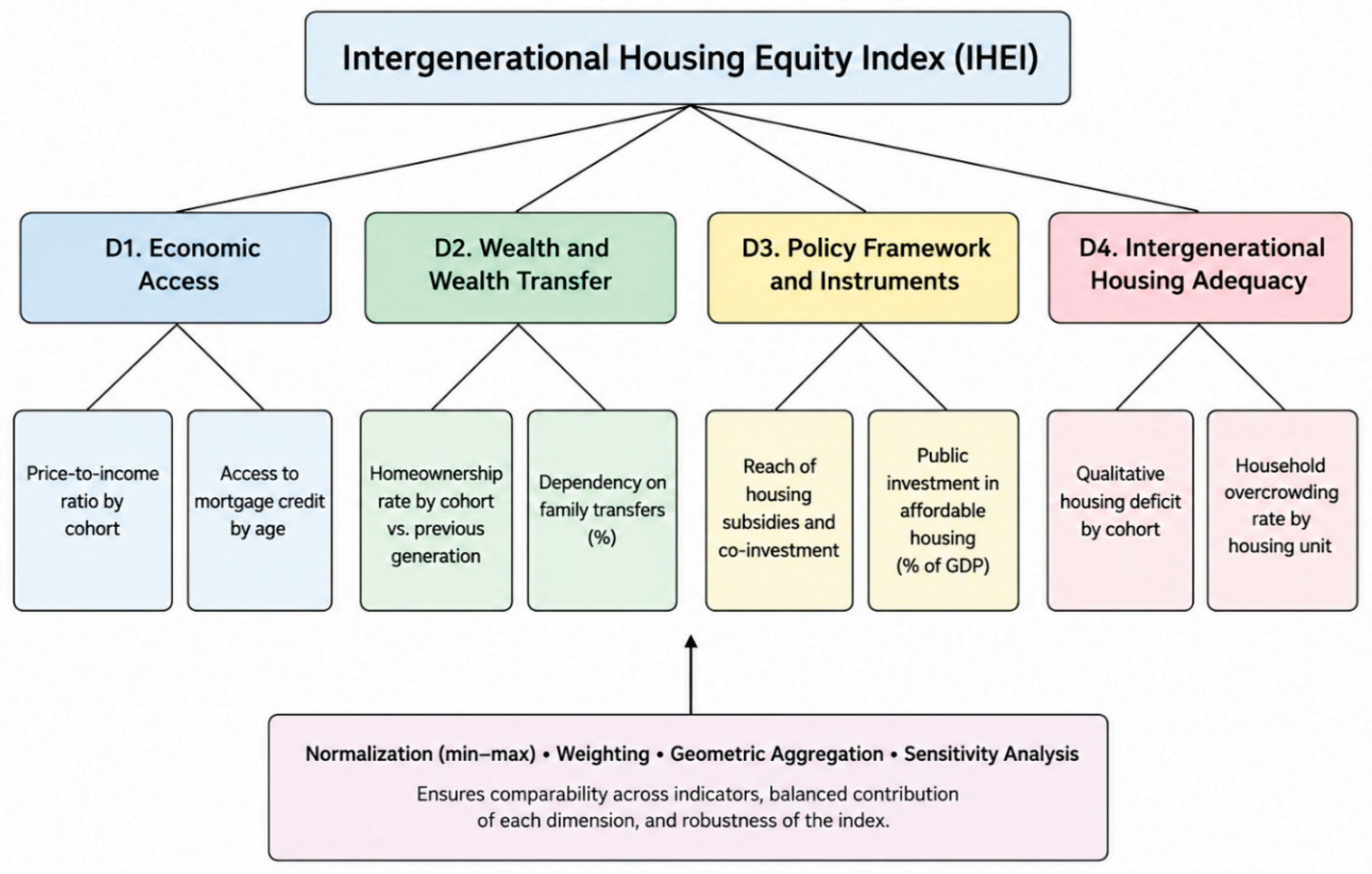
4.4. Schematic Representation of the IEIH
Figure 1 summarizes the proposed architecture of the index, from its four constitutive dimensions to the final aggregation procedure.
4.5. Comparison with Existing Indicators
Unlike Demographia's median multiple, which focuses exclusively on the price-to-income relationship (Cox, 2025), the IEIH explicitly incorporates the equity and normative dimensions, in addition to disaggregating its results by generational cohort. Unlike the World Bank's AHI, which focuses on the physical adequacy of housing in emerging economies (Behr et al., 2021), the IEIH prioritizes the comparative dimension between generations over adequacy at a single moment in time. And unlike SDG 11 indicator 11.1.1, which focuses on the identification of precarious settlements (UN-Habitat, 2023), the IEIH is designed to capture the dynamics of access and accumulation of heritage also in formal urban contexts, which positions it as a complementary – and not a substitute – instrument within the existing ecosystem of housing indicators.
5. Discussion
5.1. Theoretical Implications
From a theoretical point of view, the IEIH proposal contributes to two bodies of literature that have so far been developed relatively independently: on the one hand, the technical literature on the construction of composite indicators (Nardo et al., 2008; Behr et al., 2021); on the other, the substantive literature on intergenerational housing inequality, which has extensively documented the phenomenon through national case studies, but has not yet proposed an internationally comparable synthesis instrument (Hochstenbach et al., 2025; Resolution Foundation, 2023; Schwittay, 2026). By articulating both bodies of literature, the IEIH offers a way to empirically operationalize concepts such as «intergenerational housing solidarity» (Schwittay, 2026) or the «engine of inequality» attributed to the real estate market (Hochstenbach et al., 2025), which have so far been addressed mainly in a qualitative key or through case studies limited to a single country.
5.2. Practical Implications for Policymaking
From the perspective of public policy and urban-architectural design, a composite indicator such as the IEIH would allow, firstly, to identify more precisely in which dimension – economic, heritage, regulatory or adequacy – the generational disparity is concentrated in a given context, thus guiding the design of specific instruments. Second, it would make it possible to assess the effect of specific policy interventions, such as flexibilization for the development of accessory dwelling units or density rezoning, on the relative position of young cohorts in the normative and instrumental dimension of the index (Pothukuchi & Guinn, 2025). Third, its potential integration into SDG 11 monitoring systems would facilitate the incorporation of the generational perspective into national reports of progress towards the Sustainable Development Goals, currently absent from target 11.1 (UN-Habitat, 2023).
5.3. Originality of the Contribution
As far as has been determined through the documentary review carried out, the IEIH is the first proposal for a composite indicator explicitly designed to measure and compare intergenerational equity in access to housing internationally, differentiating itself from existing instruments both in terms of its unit of analysis – the generational cohort within each country – and in terms of its vocation for international comparability and integration with the SDG monitoring framework 11.
5.4. Limitations
This article is situated in the conceptual and methodological stage of the life cycle of a composite indicator, so its main limitations derive precisely from that nature. First, the proposal has not yet been subjected to empirical validation through the effective calculation of the index for a set of countries, a stage that requires the construction of a harmonized database by cohort and country, which currently does not exist for most of the candidate indicators identified in Table 2. Second, the availability of data disaggregated by generational cohort is considerably lower in Latin America than in the Anglo-Saxon contexts that concentrate most of the empirical evidence reviewed (IDB, 2024; UN-Habitat, 2015), which could introduce geographic coverage biases into early applications of the index. Third, as with any composite indicator, weighting and aggregation decisions entail an inevitable degree of normative judgment that must be made explicit and subjected to sensitivity analysis, as the reference methodological literature warns (Nardo et al., 2008). Finally, the documentary analysis carried out, although systematic, does not constitute a systematic or scoping review with a pre-registered protocol, so future iterations of this proposal could benefit from a more exhaustive review process.
6. Conclusions and Recommendations
Conclusions
First. The documentary evidence reviewed confirms that access to home ownership has become a structural axis of inequality between generations in both advanced and emerging economies, with the real estate market operating as a mechanism for transferring wealth from younger cohorts to older homeownership cohorts.
Second. The housing indicators currently available—the Demographia median multiple, the World Bank's Adequate Housing Index, and SDG 11 indicator 11.1.1—do not explicitly incorporate the comparative-generational axis, which constitutes a relevant methodological gap for the design and monitoring of intergenerational equity housing policies.
Third. The Intergenerational Housing Equity Index (IEIH) proposed in this article, structured in four dimensions – economic access, wealth and wealth transfer, regulatory framework and housing policy instruments, and generational housing adequacy – and twelve candidate indicators, offers a conceptual and methodological architecture capable of covering this gap, adapting the ten-step protocol of the OECD/JRC Manual for the construction of indicators compounds.
Fourth. The incorporation of a normative and instrumental dimension within the IEIH makes it possible to link the measurement of intergenerational equity with recent innovations in architecture and urban management, such as accessory housing units, density rezoning, and coliving models supported by PropTech platforms.
Recommendations
It is recommended, first, to set up an international panel of experts in housing, architecture and social statistics to validate and refine, using the Delphi method, the relevance and relative weighting of the twelve candidate indicators proposed in Table 2. Second, it is recommended that a pilot study of the calculation of the IEIH be carried out in a small group of Latin American countries with data availability – starting with Peru – to evaluate the practical feasibility of the index and adjust its standardization procedure to the particularities of the region. Third, it is recommended to promote the constitution of a regional observatory of housing data disaggregated by generational cohort, in coordination with organizations such as the Economic Commission for Latin America and the Caribbean and the Inter-American Development Bank, which provides the necessary information infrastructure for the sustained calculation of the index. Finally, it is recommended to explore, in future research, the comparison of alternative weighting schemes —egalitarian versus based on principal component analysis— and the performance of a Monte Carlo-type sensitivity analysis that allows reporting, together with the value of the index, a methodologically grounded range of uncertainty.
References
- Ay, J.-S.; Le Corre, T. The social stratification of homeowners' housing wealth: Bringing a dynamic approach through the price gap index. In Environment and Planning B: Urban Analytics and City Science; 2026. [Google Scholar] [CrossRef]
- Inter-American Development Bank. Housing value chain in Peru: Sectoral diagnosis and strategies to improve access to adequate housing; IDB, 2024. [Google Scholar]
- Behr, D. M.; Chen, L.; Goel, A.; Haider, K. T.; Singh, S.; Zaman, A. Introducing the Adequate Housing Index (AHI): A new approach to estimate the adequate housing deficit within and across emerging economies (Policy Research Working Paper No. 9830); Banco Mundial, 2021. [Google Scholar] [CrossRef]
- Cox, W. Demographia international housing affordability: 2025 edition; Chapman University Center for Demographics and Policy / Frontier Centre for Public Policy, 2025. [Google Scholar]
- Daysal, N. M.; Lovenheim, M. F.; Wasser, D. N. The intergenerational transmission of housing wealth (NBER Working Paper No. 31669); National Bureau of Economic Research, 2023. [Google Scholar] [CrossRef]
- Gilraine, M.; Graham, J.; Zheng, A. Public education and intergenerational housing wealth effects (NBER Working Paper No. 31345); National Bureau of Economic Research, 2023. [Google Scholar] [CrossRef]
- Glaeser, E.; Gyourko, J. America's housing affordability crisis and the decline of housing supply; Brookings Papers on Economic Activity, adelanto en línea; 2025. [Google Scholar]
- Hochstenbach, C.; Kadi, J.; Maalsen, S.; Nethercote, M. Housing as an engine of inequality and the role of policy. Int. J. Hous. Policy 2025, 25(1), 1–17. [Google Scholar] [CrossRef]
- Ioannides, Y. M.; Ngai, L. R. 2025. Housing and inequality (CEPR Discussion Paper No. 19907). Centre for Economic Policy Research.
- Joint Center for Housing Studies of Harvard University. The state of the nation's housing 2025; Harvard University, 2025. [Google Scholar]
- Nardo, M.; Saisana, M.; Saltelli, A.; Tarantola, S.; Hoffmann, A.; Giovannini, E. Handbook on constructing composite indicators: Methodology and user guide; OECD Publishing, 2008. [Google Scholar]
- United Nations Human Settlements Organization [UN-Habitat. Housing deficit in Latin America and the Caribbean: A tool for the diagnosis and development of effective policies in housing and habitat; UN-Habitat / MINURVI, 2015. [Google Scholar]
- United Nations Human Settlements Organization [UN-Habitat. SDG Indicator 11.1.1: Proportion of urban population living in slums, informal settlements or inadequate housing (Official metadata); UN-Habitat, 2023. [Google Scholar]
- Pothukuchi, K.; Guinn, A. Beyond zoning reform: A review of strategies for accessory dwelling unit affordability. Hous. Policy Debate 2025. [Google Scholar] [CrossRef]
- Resolution Foundation. Home affront: Housing across the generations; Resolution Foundation, 2019. [Google Scholar]
- Resolution Foundation; Broome, M.; Corlett, A.; Hale, S.; McCurdy, C.; Pacitti, C. An intergenerational audit for the UK: 2023; Resolution Foundation, 2023. [Google Scholar]
- Schwittay, A. Towards intergenerational housing solidarity. In Housing, Theory and Society; 2026. [Google Scholar] [CrossRef]
- Urban Institute. The great inequality transfer; Urban Institute, 2024. [Google Scholar]
Figure 1.
Note. Conceptual structure of the Intergenerational Housing Equity Index (IEIH), from its four constituent dimensions to the procedure of normalization, weighting and aggregation. Own elaboration.
Figure 1.
Note. Conceptual structure of the Intergenerational Housing Equity Index (IEIH), from its four constituent dimensions to the procedure of normalization, weighting and aggregation. Own elaboration.
Disclaimer/Publisher’s Note: The statements, opinions and data contained in all publications are solely those of the individual author(s) and contributor(s) and not of MDPI and/or the editor(s). MDPI and/or the editor(s) disclaim responsibility for any injury to people or property resulting from any ideas, methods, instructions or products referred to in the content. |
© 2026 by the authors. Licensee MDPI, Basel, Switzerland. This article is an open access article distributed under the terms and conditions of the Creative Commons Attribution (CC BY) license (http://creativecommons.org/licenses/by/4.0/).
Copyright: This open access article is published under a Creative Commons CC BY 4.0 license, which permit the free download, distribution, and reuse, provided that the author and preprint are cited in any reuse.