

Submitted:
08 August 2026
Posted:
10 August 2026
You are already at the latest version
Abstract
Beryllium-tungsten (Be-W) intermetallic compounds with low density, high elastic modulus, high melting point, and outstanding irradiation and corrosion resistance are promising candidates for extreme-environment applications, including fusion reactor plasma-facing components, aerospace high-temperature structures, and nuclear reactor functional materials. Herein, first-principles calculations based on the density functional theory (DFT) plane-wave pseudopotential method were performed to systematically explore the crystal structure, thermodynamic stability, electronic structure, bonding characteristics, and mechanical properties of three typical Be-W intermetallics (Be2W, Be12W, and Be22W). The consistency between optimized lattice parameters and experimental data validates the accuracy of the computational model. The calculated results reveal that Be12W has the lowest formation enthalpy and superior phase-forming capability, whereas Be2W presents the highest cohesive energy and Fermi level density of states, corresponding to inferior thermodynamic stability. All three intermetallics are mechanically stable and intrinsically metallic, with chemical bonding primarily governed by strong Be-p–W-d orbital hybridization and distinct covalent features. Mechanically, Be2W exhibits excellent volumetric deformation resistance, Be12W achieves the highest shear and Young’s moduli with optimal comprehensive mechanical performance, and Be22W possesses relatively poor mechanical properties. This work elucidates the inherent correlations between the structural, electronic, thermodynamic, and mechanical behaviors of the Be-W system, offering reliable theoretical guidance for the composition optimization, phase control, and fabrication design of advanced B-W based high-temperature irradiation-resistant structural materials.
Keywords:
Be-W intermetallic compounds
; a calculations
; density functional theory
; electronic structure
; elastic properties
; structural stability
1. Introduction
Beryllium (Be) is one of the lightest structural metals, featuring an ultra-low density of 1.85 g/cm3, an extremely high elastic modulus of approximately 300 GPa, outstanding thermal stability, low thermal neutron absorption cross-section and favorable machinability. It is widely applied as lightweight structural materials and nuclear functional materials in aerospace, nuclear industry and precision instrument industries [1,2,3].Tungsten (W) boasts the highest melting point among all metals at 3422 °C, together with ultrahigh high-temperature strength, superior creep resistance, prominent irradiation damage tolerance and excellent corrosion resistance. It serves as a preferred candidate material for core components operating under extreme high-temperature conditions such as fusion reactors, aero-engines and high-temperature furnaces [4,5,6].Alloying beryllium with tungsten to form Be–W intermetallic compounds can effectively integrate the respective merits of the two constituent metals and realize synergistic properties including low density, high elastic modulus, high-temperature resistance, irradiation tolerance and corrosion resistance. Consequently, such intermetallics are promising candidate systems for next-generation plasma-facing components of fusion reactors, high-temperature load-bearing aerospace structures and control materials for nuclear reactors [7,8].
The key performance indicators of Be–W alloys, such as macroscopic mechanical properties, thermal stability and irradiation resistance, strongly depend on the phase composition, crystal structure, atomic arrangement and phase stability of their intrinsic intermetallic phases [9]. Multiple stoichiometric intermetallic compounds including Be2W, Be12W and Be22W tend to generate during practical fabrication and service of Be–W alloys, and remarkable discrepancies in crystal structure, thermodynamic stability, mechanical performance and bonding characteristics among various phases dominantly determine the comprehensive service performance of the alloys [10]. Nevertheless, Be and W possess drastically different melting points (1287 °C for Be and 3422 °C for W). Problems including elemental segregation, phase decomposition and oxidative volatilization readily emerge during high-temperature alloying. It is experimentally difficult to synthesize high-purity single-phase Be–W intermetallics; furthermore, rigorous testing environments involving high temperature, high vacuum and irradiation exposure make it impossible to accurately acquire intrinsic thermodynamic parameters, electronic structures and inherent mechanical properties of these compounds. Conventional experimental investigations can only characterize the macroscopic properties of bulk alloys rather than uncover the underlying phase formation mechanisms and essential property origins at atomic and electronic scales, which greatly restricts the design and exploitation of Be–W-based materials.
Based on the fundamental principles of quantum mechanics, the first-principles calculation approach requires no empirical parameters and enables accurate prediction of intrinsic material properties including crystal structure, energetic parameters, electronic structure and elastic properties from the electronic scale. It has evolved into an indispensable core research tool for evaluating phase stability, bonding mechanism and property prediction of intermetallic compounds [11]. In recent years, first-principles calculations have been successfully implemented in numerous binary intermetallic systems, yielding abundant credible achievements concerning phase stability identification, bonding mechanism analysis and mechanical property forecasting. Existing first-principles investigations on intermetallics provide mature methodological references for analogous systems, covering the calculation of formation enthalpy and cohesive energy, density-of-states analysis, as well as the computation of elastic constants and the verification of mechanical stability criteria [12,13,14,15].
At present, systematic first-principles investigations on binary Be–W intermetallic compounds remain scarce. Most available studies focus on the physical property calculations of elemental beryllium and tungsten or preliminary exploration of simple alloy phases, while comprehensive comparative analyses of three typical intermetallics (Be2W, Be12W and Be22W) are still lacking. The microscopic mechanisms governing the differences in their phase-forming ability, thermodynamic stability, mechanical stability, electronic bonding features and elastic performances have not yet been clarified. Accordingly, within the framework of density functional theory, the first-principles plane-wave pseudopotential method is employed in this work to systematically compute the lattice parameters, formation enthalpy, cohesive energy, band structure, density of states, elastic constants and macroscopic elastic moduli of the three representative Be–W intermetallics. Multi-dimensional analyses from thermodynamic, mechanical and electronic structure perspectives are performed to reveal the stability evolution and intrinsic origins of property discrepancies among various Be–W compounds, laying a scientific theoretical foundation for the rational design and experimental fabrication of high-temperature irradiation-resistant Be–W-based structural materials.
2. Computational Methods and Crystal Models
All calculations in this work were performed based on density functional theory (DFT) using the CASTEP (Cambridge Serial Total Energy Package) quantum mechanics module embedded in Materials Studio. The Perdew–Burke–Ernzerhof (PBE) functional within the generalized gradient approximation (GGA) was adopted for the exchange-correlation potential. This functional exhibits high accuracy for intermetallic compounds composed of transition metals and light metals, and can reliably characterize orbital hybridization and energetic properties. The interaction between valence electrons and ionic cores was described by ultrasoft pseudopotentials, which can effectively reduce the plane-wave cutoff energy and improve computational efficiency [16,17,18].
The plane-wave cutoff energy was set to 450 eV to guarantee the convergence of total energy and the reliability of structural optimization. The Monkhorst-Pack grid scheme was used for Brillouin zone integration. Appropriate k-point meshes were selected according to the symmetry and unit cell size of each crystal structure to ensure convergence of self-consistent calculations. The convergence criteria for geometric optimization and energy calculations were defined as follows: the self-consistent field energy tolerance was 5×10⁻⁶ eV/atom, the interatomic force tolerance was 0.01 eV/nm, the unit cell stress tolerance was 0.02 GPa, and the atomic displacement tolerance was 5×10⁻⁴ Å. These settings ensure that all computational results meet the standard precision requirements of first-principles calculations.
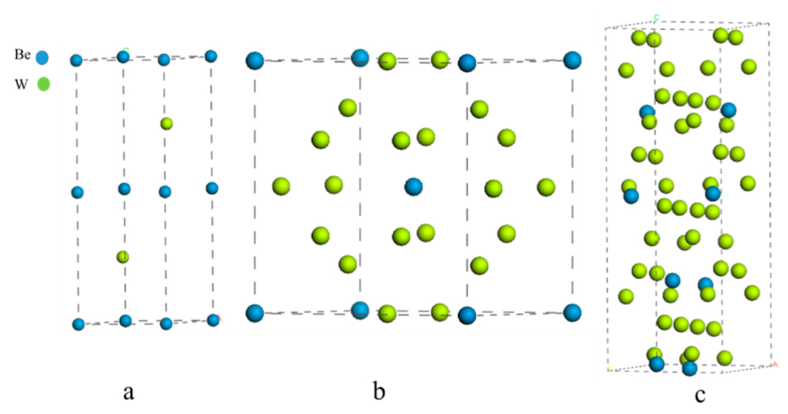
Multiple stable intermetallic compounds exist in the binary Be–W system. Three stoichiometric phases with high formation tendency in experiments and prominent engineering application values were selected in this study, namely Be2W, Be12W and Be22W. After establishing the initial crystal models, full geometric optimization was carried out on the lattice parameters, atomic coordinates and unit cell volume to release internal stress and obtain the ground-state equilibrium crystal structures. Subsequently, calculations of energy, electronic structure and elastic properties were implemented.
Figure 1.
Crystal structures of Be-W: (a) Be2W, (b) Be12W and (c) Be22W.
3. Calculation Results and Discussion
3.1. Crystal Structure and Thermodynamic Stability
The equilibrium crystal structure serves as the foundation for material property simulations and directly determines the accuracy and reliability of calculations. Therefore, geometric optimization was first performed on the crystal structures of Be2W, Be12W and Be22W to obtain their stable configurations. The crystallographic parameters after geometric optimization are listed in Table 1.Cohesive energy (Ecoh) refers to the energy released when isolated atoms assemble into a crystalline solid. It is commonly used to evaluate the structural stability of crystals and characterize the strength of atomic bonding. A negative cohesive energy value indicates a stable structure, and a smaller value corresponds to higher structural stability. Enthalpy of formation (ΔH) is defined as the energy absorbed or released during the formation of intermetallic compounds from solid elemental substances. It reflects the formation difficulty and alloying capacity of intermetallic compounds [19]. A negative enthalpy of formation means the compound tends to form readily, and a larger absolute value represents stronger alloying capability.
The cohesive energy and enthalpy of formation are calculated using Formula (1) and Formula (2), respectively [20]:
where is the total energy of the compound; x and y represent the atomic numbers of element A and element B in the compound, respectively. and denote the energy of a single isolated atom of element A and element B, while and stand for the average energy per atom in the stable elemental solids of A and B. In this work, the cohesive energy and enthalpy of formation of Be2W, Be12W and Be22W were calculated, and the results are summarized in Table 1.
The formation enthalpy can be used to judge the feasibility of a reaction. A negative formation enthalpy with a smaller absolute value indicates that the reaction occurs more readily. The cohesive energy is a key indicator for evaluating the stability of phase structures. According to the minimum energy principle, a lower cohesive energy corresponds to a more stable crystal structure. As shown in Table 1, Be12W has the lowest formation enthalpy, meaning it is the easiest to form. In contrast, Be2W exhibits the highest cohesive energy, which suggests that its crystal structure is the least stable among the three phases.
3.2. Electronic Structure
After geometric optimization, the band structures of Be2 W, Be12 W and Be22 W along the high-symmetry directions of the Brillouin zone are presented in Figure 2. The total density of states and partial density of states of the three alloys are shown in Figure 3, where the horizontal dashed line at 0 eV marks the Fermi level. It can be observed from Figure 2 that all three alloys possess electrical conductivity, as no obvious band gap is detected. Electrons can readily gain energy and jump into the conduction band to conduct electricity.
The band structure diagrams reveal that the valence band of Be2 W ranges from −9 eV to 0 eV and its conduction band from 0 eV to 23 eV (Figure 2(a)). For Be12 W, the valence band spans −11 eV to 0 eV and the conduction band 0 eV to 24 eV (Figure 2(b)). As for Be22 W, its valence band is located between −9 eV and 0 eV, and the conduction band between 0 eV and 22 eV (Figure 2(c)). The variation in band width and energy level crossing of each phase can also be clearly seen in Figure 2.Be12 W features a relatively broad band structure with drastic fluctuations, indicating that electrons within the bands have a small effective mass and high delocalization, and the atomic orbitals constructing these bands exhibit strong extensibility. In contrast, Be22 W has narrow bands, which means the eigenstates corresponding to these bands are mainly composed of atomic orbitals localized at specific lattice sites. Electrons in these bands are highly localized and have a relatively large effective mass. Be2 W shows considerable overlap between adjacent orbitals, suggesting strong bonding characteristics. Since the melting point and hardness of intermetallic compounds are positively correlated with the type and strength of chemical bonds, the elastic modulus decreases gradually while brittleness increases correspondingly. Consequently, Be2 W exhibits relatively high brittleness.
Density of states (DOS) describes the number of allowed electrons per unit energy interval, namely the electron distribution within a certain energy range [21]. Since atomic orbitals are primarily classified by energy levels, DOS can reflect the electron distribution in various orbitals, the interactions between atoms, and the characteristics of chemical bonds.The total density of states (DOS) and partial density of states (PDOS) of three Be-W intermetallic compounds, namely Be2 W, Be12 W and Be22 W, are presented in Figure 3(a) to 3(c). The vertical dashed line at 0 eV denotes the Fermi level (EF ) [22].
As illustrated in the figures, the density of states at the Fermi level is greater than zero for all three Be-W intermetallic compounds, demonstrating their metallic nature. Near the Fermi level, the electron orbitals of Be and W exhibit similar sharp peaks at identical energy positions. The total density of states is mainly contributed by the Be p-orbitals and W d-orbitals, indicating the formation of p-d hybridization between Be and W atoms.It can also be seen from the total and partial density of states that partial peak overlap occurs between the Be p-orbitals and W s-orbitals around 8 eV above the Fermi level, which verifies the formation of covalent bonding between Be and W in this system.
It can be seen from the density of states profile of Be2 W that the valence band region spanning 7 eV around 0 eV is mainly contributed by the d-orbitals of W, while the conduction band ranging from 5 eV to 12 eV is dominated by the p-orbitals of Be (Figure 3(a)). The density of states profiles of Be12 W and Be22 W (Figure 3(b) and 3(c)) show similar characteristics: their valence bands are primarily contributed by W d-orbitals and conduction bands by Be p-orbitals.
Further analysis of Figure 3 reveals that the density of states at the Fermi level EF mainly originates from the p-orbitals of Be and W. Specifically, the peak value of Be2 W is 3.2 eV, that of Be12 W is 4.3 eV, and that of Be22 W reaches 26.4 eV. In general, the position of the Fermi level and the density of states at the Fermi level N(EF ) determine the structural stability of materials. A lower N(EF ) value corresponds to a more stable structure. Since the intermetallic compound Be22 W has a relatively high N(EF ), it possesses inferior structural stability [23].
3.3. Mechanical Properties
Elastic constants are fundamental parameters characterizing the mechanical response of crystals and can be calculated from the stress-strain relationship. The number of independent elastic constants varies among different crystal systems. Specifically, hexagonal Be2 W has five independent elastic constants, tetragonal Be12 W has six, and cubic Be22 W has three. Material stability covers both energetic stability and mechanical stability. The Born-Huang stability criteria are adopted to evaluate the mechanical stability of crystals [24].
A hexagonal crystal system has five independent elastic constants, namely C11, C12, C13, C33 and C44 . The criteria for mechanical stability of hexagonal crystals are as follows: C11 >0; C11 −C12 >0; C44 >0; (C11 +C12 )C33 >2C132 [25].
A tetragonal crystal system possesses six independent elastic constants: C11, C12, C13, C33, C44 and C66 . Its mechanical stability conditions are: C11 >0, C33 >0, C44 >0, C66 >0, C11 −C12 >0, C11 +C33 −2C13 >0, 2(C11 +C12 )+C33 +4C13 >0 [26,27].
For a cubic crystal system, there are three independent elastic constants (C11, C12, C44 ). The corresponding stability criteria are: C11 >0, C44 >0, C11 −C12 >0 and C11 +2C12 >0 [19].
It can be seen from Table 2 that Be2 W satisfies all mechanical stability criteria: C11 >0, C11 −C12 >0, C44 >0 and (C11 +C12 )C33 >2C132 . Therefore, Be2 W is mechanically stable. Similarly, Be12 W and Be22 W are also verified to be mechanically stable according to the corresponding stability constraints.
Elastic modulus describes the tensile and compressive properties of materials within the elastic limit, which is generally characterized by bulk modulus (B), shear modulus (G), Young’s modulus (Y) and Poisson’s ratio (ν).The elastic moduli of polycrystalline materials can be derived from the elastic constants of single crystals via reasonable approximations. The Voigt method assumes uniform stress distribution throughout the sample, and the bulk modulus and shear modulus are further expressed in terms of elastic constants Cij .
The Reuss method adopts the assumption of uniform strain across the sample, and the bulk modulus and shear modulus are derived in terms of elastic compliance constants Sij .
Theoretically, Hill proved that the bulk modulus and shear modulus obtained by the Voigt method and the Reuss method correspond to the maximum and minimum values for polycrystals, respectively. He proposed that the actual elastic moduli of polycrystals can be expressed as the arithmetic mean of the values calculated by the Voigt and Reuss methods:
In addition, Young’s modulus E and Poisson’s ratio ν can be calculated by the following formulas:
The elastic properties including average bulk modulus B, Young’s modulus E, shear modulus G and Poisson’s ratio ν of Be2 W, Be12 W and Be22 W alloys calculated from elastic constants are listed in Table 3.
An analysis of the Voigt, Reuss and Hill average elastic parameters of the three Be-W intermetallic compounds (Be2 W, Be12 W and Be22 W) in Table 3 shows that the Voigt and Reuss models correspond to the theoretical upper and lower limits of the elastic modulus of polycrystalline materials, respectively. The bulk modulus, shear modulus, Young’s modulus and Poisson’s ratio derived from the Hill average, which is calculated as the arithmetic mean of the above two models, can more accurately characterize the macroscopic elastic mechanical behavior of polycrystalline compounds.
According to the Hill average results, the bulk modulus follows the order: Be2 W>Be12 W>Be22 W. This indicates that Be2 W has stronger resistance to hydrostatic pressure and volume deformation, while Be22 W exhibits the weakest resistance to volumetric compression. Both the shear modulus and Young’s modulus decrease in the sequence: Be12 W>Be2 W>Be22 W, demonstrating that Be12 W possesses higher elastic stiffness, better resistance to shear and plastic deformation, and the optimal comprehensive load-bearing performance. In terms of Poisson’s ratio, the values rank as: Be22 W>Be2 W>Be12 W. A lower Poisson’s ratio implies more remarkable brittleness. Be12 W has the minimum Poisson’s ratio and thus relatively higher brittleness. Be2 W and Be22 W show similar Poisson’s ratios, presenting better coordination of transverse deformation under loading and superior overall ductility. In addition, for all three compounds, the Voigt elastic modulus is higher than the Hill average, and the Hill average is larger than the Reuss elastic modulus. This distribution is highly consistent with the classic Voigt-Reuss-Hill theory, which further verifies the rationality and reliability of the calculated elastic constants and fitted moduli in this work.
4. Conclusions
Based on density functional theory (DFT), this work systematically investigates the crystal structures, thermodynamic stability, electronic structures and mechanical properties of three Be-W intermetallic compounds, namely Be2 W, Be12 W and Be22 W, by adopting the first-principles plane-wave pseudopotential method. The main conclusions are drawn as follows:
(1) Crystal structure and thermodynamic stability
The lattice constants obtained via geometric optimization are in good agreement with experimental values, which verifies the reliability of the established models. The calculated formation enthalpies indicate that Be12 W is the easiest to form and has the strongest alloying capacity. According to the cohesive energy and density of states at the Fermi level, Be2 W possesses the poorest structural stability, while Be12 W and Be22 W exhibit better stability.
(2) Electronic structure and bonding characteristics
No obvious band gaps are observed for the three compounds, which demonstrates their metallic conductivity. The total density of states is mainly contributed by Be p-orbitals and W d-orbitals, and prominent p-d orbital hybridization occurs, with covalent bonds acting as the dominant bonding form. Be12 W features highly extended orbitals and favorable bonding behavior, whereas Be2 W has relatively weak bonding strength.
(3) Mechanical stability and elastic properties
Be2 W (hexagonal), Be12 W (tetragonal) and Be22 W (cubic) all satisfy the Born criteria for mechanical stability of their corresponding crystal systems, proving that all three phases are mechanically stable. The bulk modulus follows the order: Be2 W>Be12 W>Be22 W, suggesting a gradual decline in the resistance to volume deformation. Both shear modulus and Young’s modulus rank as Be12 W>Be2 W>Be22 W, meaning Be12 W has the highest stiffness and deformation resistance. Poisson’s ratio results reveal that Be12 W shows relatively higher brittleness, while Be2 W and Be22 W have slightly better ductility.
In summary, Be12W stands out with superior formability, structural stability and comprehensive mechanical properties, and thus is a promising candidate phase for Be-W based high-temperature radiation-resistant structural materials. This study supplements the fundamental physical property data of binary Be-W intermetallic compounds and clarifies the correlation mechanism between microscopic bonding behavior and macroscopic performances. It provides theoretical basis and data support for the theoretical design, experimental preparation and engineering application of materials in this system.
This work was supported by the Science and Technology Department of Ningxia [grant numbers 2025AAC031060, 2025AAC031057].
Declaration of Interest
The authors declare that they have no conflict of interest.
References
- Xu, Q.; Zhang, P.; Yang, L.; et al. Microstructure and mechanical properties of Be–Al alloy fabricated by laser solid forming. Mater. Sci. Eng. A 2021, 799, 140335. [Google Scholar] [CrossRef]
- Yu, L.; Wang, W.; Li, B.; et al. Determination of homogenizing conditions and aging behaviors of cast 62Be-37.6Al-0.4Sc alloy. J. Alloys Compd. 2019, 808, 151742. [Google Scholar] [CrossRef]
- Gyoeroek, M.; Kaiser, A.; Sukuba, I.; et al. Surface binding energies of beryllium/tungsten alloys. J. Nucl. Mater. 2016, 472, 76–81. [Google Scholar] [CrossRef]
- Talignani, A.; Seede, R.; Whitt, A.; et al. A review on additive manufacturing of refractory tungsten and tungsten alloys. Addit. Manuf. 2022, 58, 103009. [Google Scholar] [CrossRef]
- Gietl, H.; Koyanagi, T.; Hu, X.; et al. Neutron irradiation-enhanced grain growth in tungsten and tungsten alloys. J. Alloys Compd. 2022, 901, 163419. [Google Scholar] [CrossRef]
- Philipps, V. Tungsten as material for plasma-facing components in fusion devices. J. Nucl. Mater. 2011, 415((1), S2–S9. [Google Scholar] [CrossRef]
- Nagel, N. Beryllium and Copper-Beryllium Alloys. ChemBioEng Rev. 2018, 5, 30–33. [Google Scholar]
- Yu, J.H.; Baldwin, M.J.; Doerner, R.P. Cracking and surface roughening of beryllium–tungsten alloy due to transient heating. Phys. Scr. 2017, 2017, 014009. [Google Scholar] [CrossRef]
- Wiltner, A.; Linsmeier, C. Surface alloying of thin beryllium films on tungsten. New J. Phys. 2006, 8, 181. [Google Scholar] [CrossRef]
- Chen, L.; Sukuba, I.; Probst, M.; et al. Beryllium, tungsten and their alloys Be2W and Be12W: Surface defect energetics from density functional theory calculations. Nucl. Mater. Energy 2018, 16, 149–157. [Google Scholar] [CrossRef]
- Zhao, D.-D.; Løvvik, O.M.; Marthinsen, K.; et al. Twinnability of Al–Mg alloys: A first-principles interpretation. Trans. Nonferrous Met. Soc. China 2017, 27, 1313–1318. [Google Scholar] [CrossRef]
- Hu, X.; Liu, Y.; Wu, Y.; et al. First-Principles Study of AlCrFeMoTi High-Entropy Alloys. Symmetry 2025, 17, 1965. [Google Scholar] [CrossRef]
- Tong, Y.; Peng, X.; Liang, X.; et al. First-principles and experiment perspectives of Hf alloying significantly strengthened TaW alloys. J. Alloys Compd. 2024, 997, 174955. [Google Scholar] [CrossRef]
- Wan, X.; Xie, W.; Chen, H.; et al. First-principles study of phase transformations in Cu–Cr alloys. J. Alloys Compd. 2021, 862, 158531. [Google Scholar] [CrossRef]
- Liu, S.; Esteban-manzanares, G.; Llorca, J. First-principles analysis of precipitation in Mg-Zn alloys. Phys. Rev. Mater. 2020, 4, 093609. [Google Scholar] [CrossRef]
- Clark, S.J.; Segall, M.D.; Pickard, C.J.; et al. First principles methods using CASTEP. Z. Für Krist.-Cryst. Mater. 2005, 220, 567–570. [Google Scholar] [CrossRef]
- Perdew, J.P.; Burke, K.; Ernzerhof, M. Generalized Gradient Approximation Made Simple. Phys. Rev. Lett. 1996, 77, 3865–3868. [Google Scholar] [CrossRef] [PubMed]
- Tse, G. CASTEP investigation of FeS and FeSe: Structural, electronic, optical, and mechanical properties using the HSE03 hybrid. AIP Adv. 2025, 15, 045318. [Google Scholar] [CrossRef]
- Sunmingqiang, H.; Detong, K.; Xiao, H.; et al. First-Principles Investigation of the Stability,Electronic Structure, and Mechanical Properties of M (Mn,Ti, Mo)-Doped α-Fe. Acta Phys. Sin. 2025, 74, 246202-1--9. [Google Scholar]
- Cheng, Z.; Long, W.; Zhang, G. First-principles Study on Ni3Snx (x=1, 2, 4) Intermetallic Compounds. Light Ind. Sci. Technol. 2020, 5. [Google Scholar]
- Shou, H.; Xie, R.; Peng, M.; et al. Stability and electronic structures of the TiZn intermetallic compounds: A DFT calculation. Phys. B Condens. Matter 2019, 560, 41–45. [Google Scholar] [CrossRef]
- Peng, M.; Shou, H.; Cao, Y. First-principles calculations of structural, elastic and thermodynamic properties of (h, r)-TiAl2. Phys. B Condens. Matter 2019, 561, 29–36. [Google Scholar]
- Jie-qiong, H.; Ming, X.; Ji-ming, Z.; et al. First principles study of Au-Sn intermetallic compounds. ActaPhysSin 2013, 62, 247102. [Google Scholar] [CrossRef]
- Hill, R. The Elastic Behaviour of a Crystalline Aggregate. Proc. Phys. Soc. Sect. A 1952, 65, 349. [Google Scholar] [CrossRef]
- Song, Y.-L.; Dou, Z.-H.; Zhang, T.-A.; et al. First-principles calculation on the structural, elastic and thermodynamic properties of Ti-Al intermetallics. Mater. Res. Express 2019, 6, 1065a4. [Google Scholar] [CrossRef]
- Kun, W.; Heyan, X.; Xiong, Z.; et al. First-principles study of electronic structure, elastic properties and hardness of Cr-doped CuZr2. Acta Phys. Sin. 2025, 74, 137101. [Google Scholar] [CrossRef]
- Mir, S.H.; Chakraborty, S. Pressure-Driven Band Gap Narrowing in Rb2AgPdCl5: Toward the Shockley–Queisser Limit of Lead-free Double Perovskites. J. Phys. Chem. C 2023, 127, 19728–19734. [Google Scholar] [CrossRef]
Figure 2.
Band structures of Be-W intermetallic compounds: (a) Be2W, (b) Be12W, (c) Be22W.
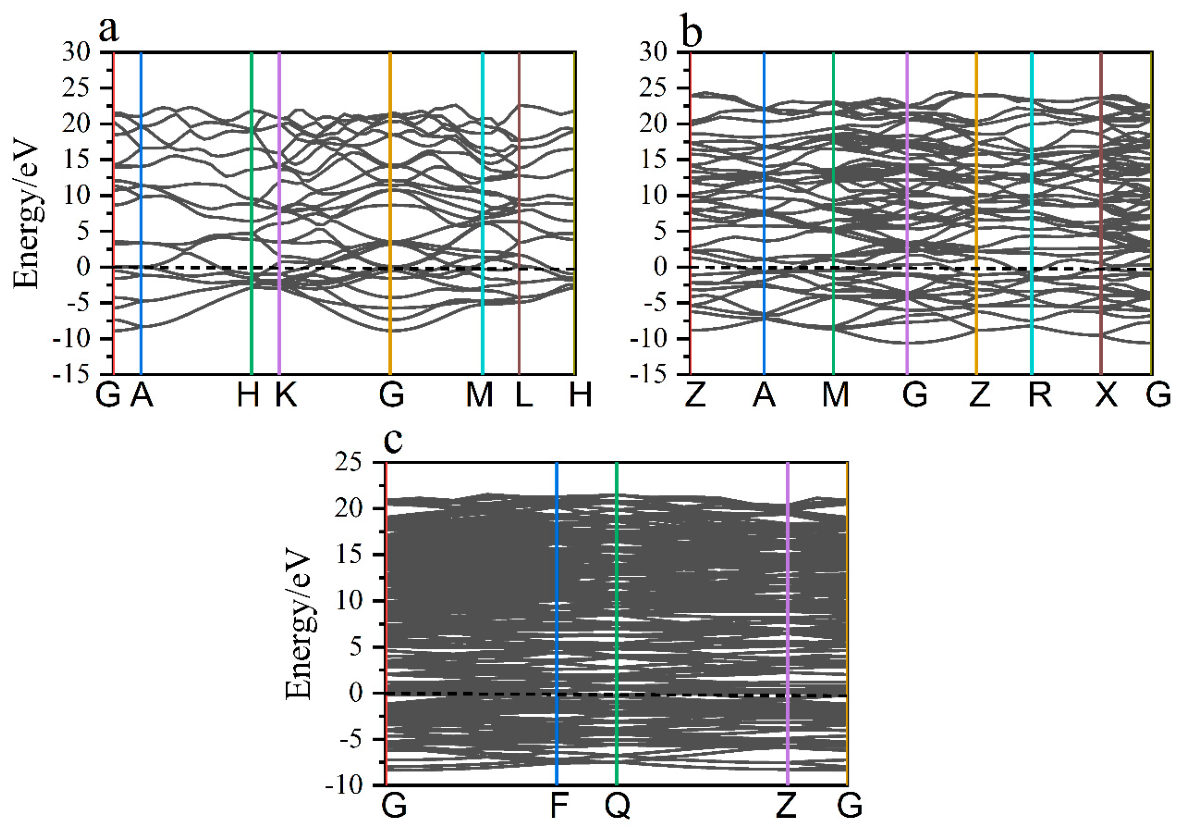
Figure 3.
Total and partial density of states of Be-W intermetallic compounds: (a) Be2W, (b) Be12W, (c) Be22W.
Figure 3.
Total and partial density of states of Be-W intermetallic compounds: (a) Be2W, (b) Be12W, (c) Be22W.
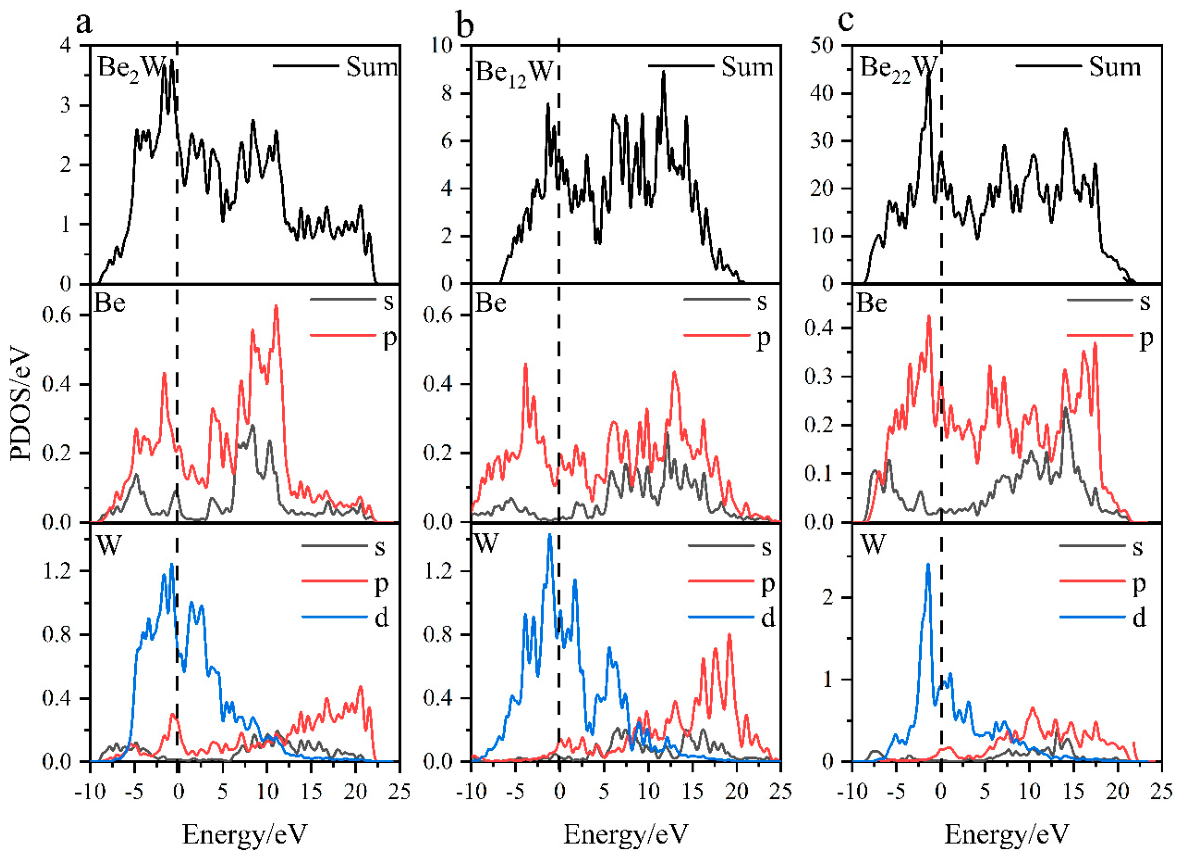

Table 1.
Lattice parameters, cohesive energies and formation enthalpies of Be2W, Be12W and Be22W.
| Phase | Space group | a/Å | b/Å | c/Å | E/eV | ΔH/eV |
| Be2W | P63/mmc | 2.72 | 2.72 | 6.83 | -19.6221 | -13.5378 |
| Be12W | I4/mmm | 5.44 | 5.44 | 4.21 | -25.8953 | -23.8928 |
| Be22W | Fd3m | 6.26 | 6.26 | 17.23 | -25.3951 | -23.3926 |
Table 2.
Elastic constants of Be2W, Be12W and Be22W alloys.
| Phase | Crystal Type | C11 | C12 | C13 | C33 | C44 | C66 |
| Be2W | hexagonal | 537.1 | 106.4 | 115.1 | 211.0 | 78.6 | / |
| Be12W | tetragonal | 271.3 | 143.1 | 52.9 | 370.4 | 124.3 | 64.8 |
| Be22W | cubic | 137.5 | 40.4 | / | / | 42.2 | / |
Table 3.
Bulk modulus B, shear modulus G, Young’s modulus E and Poisson’s ratio ν of Be2 W, Be12 W and Be22 W alloys.
Table 3.
Bulk modulus B, shear modulus G, Young’s modulus E and Poisson’s ratio ν of Be2 W, Be12 W and Be22 W alloys.
| Phase | Voigt | Reuss | Hill | |||||||||
| B | G | E | ν | B | G | E | ν | B | G | E | ν | |
| Be2W | 216.4 | 114.0 | 291.0 | 0.28 | 171.7 | 70.1 | 185.1 | 0.32 | 194.1 | 92.1 | 238.5 | 0.30 |
| Be12W | 156.734 | 106.9 | 261.4 | 0.22 | 156.716 | 93.5 | 233.9 | 0.25 | 156.725 | 100.2 | 247.8 | 0.24 |
| Be22W | 91.5 | 42.2 | 109.7 | 0.3002 | 87.8 | 39.7 | 103.5 | 0.3036 | 89.6 | 40.9 | 106.6 | 0.3019 |
Disclaimer/Publisher’s Note: The statements, opinions and data contained in all publications are solely those of the individual author(s) and contributor(s) and not of MDPI and/or the editor(s). MDPI and/or the editor(s) disclaim responsibility for any injury to people or property resulting from any ideas, methods, instructions or products referred to in the content. |
© 2026 by the authors. Licensee MDPI, Basel, Switzerland. This article is an open access article distributed under the terms and conditions of the Creative Commons Attribution (CC BY) license.
Copyright: This open access article is published under a Creative Commons CC BY 4.0 license, which permit the free download, distribution, and reuse, provided that the author and preprint are cited in any reuse.