

Submitted:
07 August 2026
Posted:
10 August 2026
You are already at the latest version
Abstract
Elevated salinity can significantly affect the rheological behavior, thickening time, and early strength development of API Class G cement slurries. This study experimentally investigated the effect of NaCl additions of 0, 4, and 8 wt.% BWOC on cement slurries with densities of 1.5 and 1.9 g/cm³ at temperatures of 25, 50, 75, and 90 °C. Rheological parameters, the time required to reach a consistency of 30 Bc under atmospheric pressure, the times required to attain selected compressive strength thresholds, and the ultrasonic cement analyzer (UCA)-estimated compressive strength after 12 and 24 h were evaluated.The results demonstrated that the effect of NaCl was not pro-portional to its concentration but depended on slurry density, temperature, and the property being evaluated. NaCl generally reduced plastic viscosity and yield stress, whereas gel strength exhibited a non-uniform response with a pronounced dependence on temperature. Its influence on thickening time and early strength development was likewise non-monotonic. Under certain test conditions, higher NaCl concentrations accelerated the attainment of the initial strength thresholds; however, they did not consistently increase the UCA-estimated compressive strength after 24 h or improve all evaluated operational properties. Among the investigated salinity levels, the slurry containing 4 wt.% NaCl exhibited the most balanced overall performance in terms of rheological behavior, thickening time, and early mechanical properties across both slurry densities and the investigated temperature range. Nevertheless, this concentration did not provide the best performance for every individual parameter or under all test conditions. The findings provide a basis for the further op-timization of cement slurry formulations intended for use in high-salinity environments. Since the experimental program did not include independent repetitions, the observed differences should be interpreted as descriptive trends that require statistical validation in future studies.
Keywords:
API Class G cement
; cement slurry
; NaCl
; rheology
; atmospheric consistency development
; compressive strength development
; salinity
; well cementing
1. Introduction
Well cementing is one of the key operations for ensuring the mechanical stability, zonal isolation, and long-term integrity of wellbore construction. Consequently, the design of cement systems cannot rely solely on optimizing the initial properties of the cement slurry but must also account for the performance requirements that the cement sheath must satisfy throughout the entire service life of the well [1]. Under high-salinity conditions, the behavior of cement systems becomes particularly complex because the presence of sodium chloride (NaCl) can significantly affect the rheological properties of cement slurries, thickening time, and the early development of compressive strength in the hardened cement sheath [2,3,4,5]. Recent studies have further emphasized the importance of optimizing the mechanical performance of hardened cement to ensure the long-term stability of wells operating under challenging conditions [6,7,8].
Owing to its widespread use and adaptability to a wide range of well conditions, API Class G cement serves as the basis for numerous cement systems used in deep well applications [9,10]. Its performance in saline environments depends on several factors, including salt concentration, temperature, the water-to-cement ratio, and the presence of other constituents in the liquid phase. In more complex formulations, dissolved ions may also influence the performance of polymeric additives, such as fluid-loss control agents. Consequently, the response of a cement system is governed not only by the NaCl concentration but also by the overall composition of the slurry [11,12].
Previous studies have shown that NaCl may accelerate the early stages of cement hydration and promote early strength development; however, its effect is not necessarily proportional to its concentration. At higher concentrations, NaCl may adversely affect rheological behavior, alter the development of hydration products, and reduce certain mechanical properties [5,14]. Chloride ions may also influence the porosity, phase composition, and long-term performance of the hardened cement matrix, with the magnitude of these effects depending on salinity and curing temperature [15,16]. In addition, NaCl affects the plastic viscosity, yield stress, and gel strength of cement slurries, thereby influencing flow resistance, rheological performance, and slurry stability during placement [14,17].
Previous investigations have primarily focused on individual aspects of the influence of salinity on cement systems. Teodoriu and Asamba [10] investigated the effect of NaCl content on the properties of API Class G cement and well integrity, Lago et al. [13] examined the influence of salinity on cement hydration, whereas Maroof et al. [14] studied the dynamic gelation and thickening behavior of NaCl-containing cement slurries. However, these studies did not simultaneously evaluate rheological properties, thickening behavior, and early compressive strength development within a unified experimental program covering different slurry densities, NaCl concentrations, and temperature conditions. In contrast, the present study integrates these performance indicators to provide a comprehensive assessment of the relationships among rheological behavior, thickening time, and early compressive strength development under different salinity levels.
The influence of NaCl on cement systems is associated with changes in the ionic environment of the liquid phase and the hydration kinetics of the principal cement clinker phases. The presence of Na+ and Cl− ions may affect the early hydration of aluminate and silicate phases as well as the formation of hydration products. Consequently, the overall response of the cement system depends on the interaction between salt concentration, temperature, and slurry composition [19,20].
This study is based on the hypothesis that the effect of NaCl on API Class G cement systems is not proportional to its concentration but is governed by the interaction among salt concentration, temperature, and cement slurry composition. It is further hypothesized that a moderate NaCl concentration can provide a more favorable balance between rheological performance, thickening behavior, and early compressive strength development, whereas further increases in NaCl concentration do not necessarily improve all performance characteristics.
Accordingly, the objective of this study was to experimentally evaluate the effects of 0, 4, and 8 wt.% BWOC NaCl on the rheological properties, the time required to reach a consistency of 30 Bc under atmospheric pressure, and the UCA-estimated early compressive strength development of API Class G cement slurries. The experiments were conducted using slurry densities of 1.5 and 1.9 g/cm3 at temperatures of 25, 50, 75, and 90 °C. Based on an integrated analysis of the obtained results, the formulation exhibiting the most balanced overall performance in terms of rheological behavior, thickening time, and early mechanical properties among the investigated systems was identified.
2. Methodology
The experimental program was conducted under laboratory conditions designed to ensure comparable results for all investigated cement slurry formulations. The selected temperature and slurry density ranges represent conditions relevant to cement systems exposed to elevated salinity.
All cement slurries were prepared using API Class G High Sulfate Resistant (HSR) oil well cement manufactured by Dyckerhoff. Selected data on the chemical composition, estimated clinker mineral composition, and composite cement parameter are presented in Table 1. These data were obtained from the manufacturer’s quality certificate for the cement batch used in this study. Prior to slurry preparation, the cement was sieved through an 850 μm sieve to remove any coarse agglomerates that may have formed during storage. This procedure did not alter the original particle size distribution of the cement.
Analytical-grade sodium chloride (NaCl, purity ≥99.5%) was used as the source of chloride ions. Prior to cement addition, NaCl was completely dissolved in the mixing water. The NaCl concentration was expressed as weight percent by weight of cement (BWOC). The investigated NaCl concentrations were 0, 4, and 8 wt.% BWOC.
Three NaCl concentrations were evaluated at two slurry densities, resulting in six base slurry formulations. Each formulation was tested at four temperatures, yielding a total of 24 combinations of NaCl concentration, slurry density, and temperature for each applicable test. Rheological parameters of the 1.9 g/cm3 slurry at 90 °C could not be determined because of premature slurry thickening during temperature conditioning. The selected NaCl concentrations were based on previous studies [10,13], which demonstrated that concentrations between 3 and 10 wt.% significantly affect hydration kinetics, rheological behavior, and early compressive strength development.
The experimental program included rheological measurements, thickening-time measurements, and monitoring of compressive strength development. Compressive strength development was continuously monitored using an Ultrasonic Cement Analyzer (UCA), whereas the UCA-estimated compressive strength values after 12 and 24 h were used for comparative evaluation of the investigated systems.
The target slurry densities of 1.5 and 1.9 g/cm3 were selected to represent two characteristic ranges of cement systems commonly used in deep-well cementing. The 1.5 g/cm3 slurry was characterized by a higher water-to-cement ratio and lower solids content, whereas the 1.9 g/cm3 slurry represented a more concentrated system with a lower water-to-cement ratio.
The density of each freshly prepared slurry was verified immediately after mixing using a mud balance with a resolution of ±0.01 g/cm3. Density values are reported as nominal values rounded according to the resolution of the measuring device. Accordingly, the designations 1.5 and 1.9 g/cm3 refer to the nominal slurry densities.
The final density of each formulation was confirmed by direct measurement immediately before testing. The compositions of the six base slurry formulations are presented in Table 2.
Cement slurries were prepared using a Chandler Engineering Model 3260 mixer in accordance with API RP 10B-2/ISO 10426-2. The required amount of NaCl was first added to the mixing water and allowed to dissolve completely before cement addition. Cement was then added uniformly over 15 s while mixing at 4,000 ± 200 rpm, followed by slurry homogenization for 35 s at 12,000 ± 500 rpm. The order of component addition and the mixing procedure were identical for all investigated formulations.
A separate fresh slurry batch was prepared for each rheological, thickening-time, and UCA test. Immediately after mixing, the slurry was transferred to the appropriate testing apparatus without unnecessary delay. The actual slurry density was verified immediately after mixing using a mud balance. The mixing water temperature was approximately 20 °C, and NaCl was stirred for approximately 5 min to ensure complete dissolution before cement addition.

Table 3.
Overview of the experimental program and investigated parameters.
| Parameter | Values |
|---|---|
| Cement slurry density | 1.5 i 1.9 g/cm3 |
| NaCl concentration | 0, 4 i 8 wt.% BWOC |
| Test temperature | 25, 50, 75 i 90 °C |
| Rheological testing | PV, YP, and gel strength |
| Consistency threshold | 30 Bc |
| Values used for comparison | UCA-estimated compressive strength at 12 and 24 h |
| Monitored strength thresholds | 0.5 MPa and 3.5 MPa |
| Device for monitoring consistency development | Chandler Atmospheric Consistometer Model 1200 |
| Rheological measurement speeds | 3, 6, 30, 60, 100, 200 i 300 rpm |
| Conditioning prior to measurement | Until the target temperature was reached, followed by an additional 20 min. |
| Gel strength | After 10 s and 10 min of static rest |
| Rheology testing device | Chandler Engineering Model 3530 |
| Compressive strength testing device | Chandler 4265 Twin-Cell UCA |
Rheological properties of the cement slurries were determined using a Chandler Engineering Model 3530 viscometer. Prior to testing, the samples were conditioned until the target temperature was reached, after which conditioning was continued for an additional 20 min. Rheological measurements were performed at rotational speeds of 3, 6, 30, 60, 100, 200, and 300 rpm, followed by measurements in the reverse sequence from 200 to 3 rpm. For each rotational speed, the average of the readings obtained during increasing and decreasing rotor speeds was used in the subsequent analysis.
Plastic viscosity (PV) and yield stress (YP) were determined using a simplified two-point Bingham calculation based on the average viscometer readings at 300 and 100 rpm, in accordance with the laboratory procedure adopted from API RP 10B-2/ISO 10426-2 [23]. The average reading at each rotational speed was calculated from the values recorded during both increasing and decreasing rotor speeds. The rheological parameters were calculated using the following equations:
Where θ300 and θ100 are the average viscometer readings at 300 and 100 rpm, respectively, PV is the plastic viscosity expressed in mPa·s, and YP is the yield stress expressed in Pa. The factor 1.5 arises from the simplified two-point calculation for the selected rotational speeds, whereas the factor 0.4788 converts yield stress from lb/100 ft2 to Pa.
Since PV and YP were calculated directly from two measurement points rather than by regression fitting of the complete flow curve, no goodness-of-fit criterion was applied. The resulting values represent comparative two-point Bingham parameters and do not imply that the cement slurries exhibited ideal Bingham behavior over the entire investigated shear-rate range.
Gel strength was determined after static periods of 10 s and 10 min. Before each static period, the slurry was conditioned by mixing at 300 rpm for approximately 1 min to establish a consistent initial state. After the prescribed static period, the viscometer was restarted at 3 rpm, and the maximum dial reading recorded during the initiation of slurry movement was taken as the gel strength. The procedure was performed separately for the 10 s and 10 min static periods.
The development of slurry consistency was monitored using a Chandler Engineering Model 1200 atmospheric consistometer at atmospheric pressure and temperatures of 25, 50, 75, and 90 °C. The time required for the slurry to reach a consistency of 30 Bc was selected as the comparative experimental parameter. This consistency level was used solely as a common reference point for comparing the rate of consistency development among the investigated formulations and was not intended to represent the actual operational pumping time under well conditions. Because the measurements were performed at atmospheric pressure, the obtained values should be regarded as laboratory indicators of the relative effects of NaCl concentration, temperature, and slurry density on consistency development. Consequently, they cannot be directly equated with thickening times determined under simulated downhole pressure and temperature conditions.
Early compressive strength development was continuously monitored using a Chandler Engineering Model 4265 Twin-Cell Ultrasonic Cement Analyzer (UCA). The instrument is calibrated annually by the manufacturer. During testing, ultrasonic pulses continuously propagated through the specimen, and changes in pulse transit time were automatically converted into estimated compressive strength values using the manufacturer’s proprietary calibration relationship.
Freshly prepared cement slurry was transferred into the UCA cell at room temperature. After the test was initiated, the temperature was gradually increased over approximately 2 h until the target temperature (25, 50, 75, or 90 °C) was reached and was subsequently maintained constant for the remainder of the test. Strength development time was measured from the moment the test was initiated; therefore, the reported times include the initial heating period.
The tests were performed under the minimum initial pressure required for proper instrument operation. An initial pressure of 100 psi was applied at room temperature and at the lowest testing temperature. Initial pressures of 150, 200, and 300 psi were used at 50, 75, and 90 °C, respectively. Compressive strength development was continuously monitored for 36 h from the start of the test. Comparative evaluation was based on the UCA-estimated compressive strength values after 12 and 24 h, together with the times required to reach strength thresholds of 0.5 and 3.5 MPa. The designation NR indicates that the corresponding threshold was not reached within the 36 h monitoring period. The thresholds of 0.5 and 3.5 MPa were selected as internal comparative reference levels representing the early and more advanced stages of strength development within the available UCA curves. They were not intended to serve as universal operational criteria for the continuation of well operations.
The experimental data were analyzed descriptively by comparing the measured values of the reference systems with those of the formulations containing 4 and 8 wt.% NaCl at the corresponding slurry densities and temperatures. Changes were expressed as absolute differences and, where appropriate, as relative percentage changes with respect to the reference formulation. Because independent replicate experiments were not performed for individual test conditions, no standard deviations, confidence intervals, or statistical significance tests were calculated. Accordingly, the observed differences should be interpreted as descriptive experimental trends rather than statistically confirmed effects. The most balanced overall performance was assessed descriptively by jointly considering plastic viscosity, yield stress, gel strength, the time required to reach 30 Bc, the times required to reach the UCA-estimated strength thresholds of 0.5 and 3.5 MPa, and the UCA-estimated compressive strength after 12 and 24 h. This assessment was not based on weighted scoring or any formal multi-criteria optimization procedure.
3. Results and Discussions
The experimental results were analyzed from three complementary perspectives: the rheological behavior of the cement slurries, the time required to reach a consistency of 30 Bc under atmospheric pressure, and the development of UCA-estimated early compressive strength. The results were first evaluated for each parameter individually and subsequently integrated to assess the overall performance of the investigated slurry formulations.
The rheological properties of the cement slurries, including plastic viscosity, yield stress, and gel strength after static periods of 10 s and 10 min, are presented in Table 4. The effect of NaCl was not uniform across the investigated slurry densities and temperatures. In general, the addition of NaCl reduced both plastic viscosity and yield stress; however, the magnitude and, in some cases, the direction of these changes depended on the NaCl concentration, slurry density, and testing temperature.
For the 1.5 g/cm3 slurries, the addition of NaCl generally reduced both plastic viscosity and yield stress. At 25 °C, the change in plastic viscosity was relatively small, decreasing from 17.25 mPa·s for the reference formulation to 16.50 mPa·s for both NaCl-containing formulations, whereas the yield stress decreased from 18.38 to 13.75 Pa. The influence of NaCl became more pronounced at elevated temperatures. At 90 °C, increasing the NaCl concentration from 0 to 8 wt.% reduced the plastic viscosity from 25.5 to 21.0 mPa·s and the yield stress from 32.25 to 19.00 Pa. This response indicates a reduction in the slurry resistance under steady shear, with the effect becoming more pronounced as the NaCl concentration increased.
For the 1.9 g/cm3 slurries, changes in the rheological properties were more pronounced and exhibited a stronger dependence on temperature. At 50 °C, the addition of 4 wt.% NaCl reduced the plastic viscosity from 53.25 to 42.75 mPa·s and the yield stress from 47.38 to 31.13 Pa. The largest reduction in plastic viscosity was observed at 75 °C, where the value decreased from 69.75 mPa·s for the reference formulation to 42.0 mPa·s and 25.50 mPa·s for the formulations containing 4 and 8 wt.% NaCl, respectively. Under the same conditions, the yield stress decreased from 56.13 to 30.50 and 29.75 Pa, respectively. However, at 25 °C, the formulation containing 8 wt.% NaCl exhibited a higher yield stress than the reference slurry, indicating that the influence of NaCl was not uniform under all investigated conditions.
Gel strength did not exhibit a consistent trend with increasing NaCl concentration. For the 1.5 g/cm3 slurry at 90 °C, the reference formulation reached a 10 min gel strength exceeding 300 Pa, whereas the corresponding values for the formulations containing 4 and 8 wt.% NaCl were 33.5 and 54.5 Pa, respectively. In contrast, for the 1.9 g/cm3 slurry at 75 °C, both NaCl-containing formulations exceeded 300 Pa after 10 min, whereas the reference formulation reached only 21.0 Pa. Such exceptionally high gel-strength values indicate rapid structural build-up of the slurry and suggest that consistency development had already begun during the measurement.
The presence of NaCl modifies the ionic environment of the liquid phase, interparticle interactions, and the development of the cement hydration structure. The observed reduction in plastic viscosity and yield stress indicates lower resistance to flow under steady shear; however, these changes should not be interpreted as an unequivocal improvement in slurry performance. Excessively low values of these parameters may reduce the ability of the slurry to maintain solid particles in suspension, thereby increasing the risk of particle settling, free-water separation, and phase segregation. Because these stability-related properties were not evaluated in the present study, the rheological results alone do not permit a comprehensive assessment of slurry stability. The pronounced increase in 10 min gel strength observed under certain conditions further indicates accelerated structural build-up at elevated temperatures [22]. A similar dependence of rheological and mechanical performance on additive type, dosage, and temperature has also been reported for other modified API Class G cement systems [21].
The time required to reach a consistency of 30 Bc under atmospheric conditions depended on temperature, slurry density, and NaCl concentration. Increasing the temperature generally shortened the time required to reach 30 Bc, particularly between 25 and 50 °C. However, for some 1.5 g/cm3 formulations, a slight increase in the time to reach 30 Bc was observed between 75 and 90 °C [14].
For the 1.5 g/cm3 slurry, the addition of 4 wt.% NaCl reduced the time required to reach 30 Bc at all investigated temperatures. The reduction was more pronounced at 25, 50, and 75 °C and less evident at 90 °C. The formulation containing 8 wt.% NaCl also reached the selected consistency threshold earlier than the reference formulation between 25 and 75 °C, although its accelerating effect was less pronounced than that of 4 wt.% NaCl. At 90 °C, however, the formulation containing 8 wt.% NaCl reached 30 Bc later than the reference slurry, further demonstrating that increasing the NaCl concentration did not result in a proportional acceleration of consistency development.
For the 1.9 g/cm3 slurry, the addition of 4 wt.% NaCl generally shortened the time required to reach 30 Bc. At 90 °C, the time was approximately 15% shorter than that of the reference formulation. The effect of 8 wt.% NaCl was more variable. At lower temperatures, this formulation did not consistently reach 30 Bc earlier than the reference slurry, whereas at 75 and 90 °C it reached the selected threshold sooner. At 90 °C, the reduction in the time required to reach 30 Bc was approximately 12%.
The experimental results indicate that increasing the NaCl concentration from 4 to 8 wt.% did not produce a proportional reduction in the time required to reach 30 Bc. This behavior may be attributed to the combined influence of salinity, temperature, water-to-cement ratio, and solids content on consistency development [10,14]. However, without additional investigations of hydration kinetics, the dominant mechanism responsible for the observed trends cannot be identified.
Figure 1.
Effect of temperature and NaCl concentration on the time required to reach a consistency of 30 Bc under atmospheric conditions: (a) slurry density of 1.5 g/cm3; (b) slurry density of 1.9 g/cm3; and (c) comparison of all investigated formulations.
Figure 1.
Effect of temperature and NaCl concentration on the time required to reach a consistency of 30 Bc under atmospheric conditions: (a) slurry density of 1.5 g/cm3; (b) slurry density of 1.9 g/cm3; and (c) comparison of all investigated formulations.
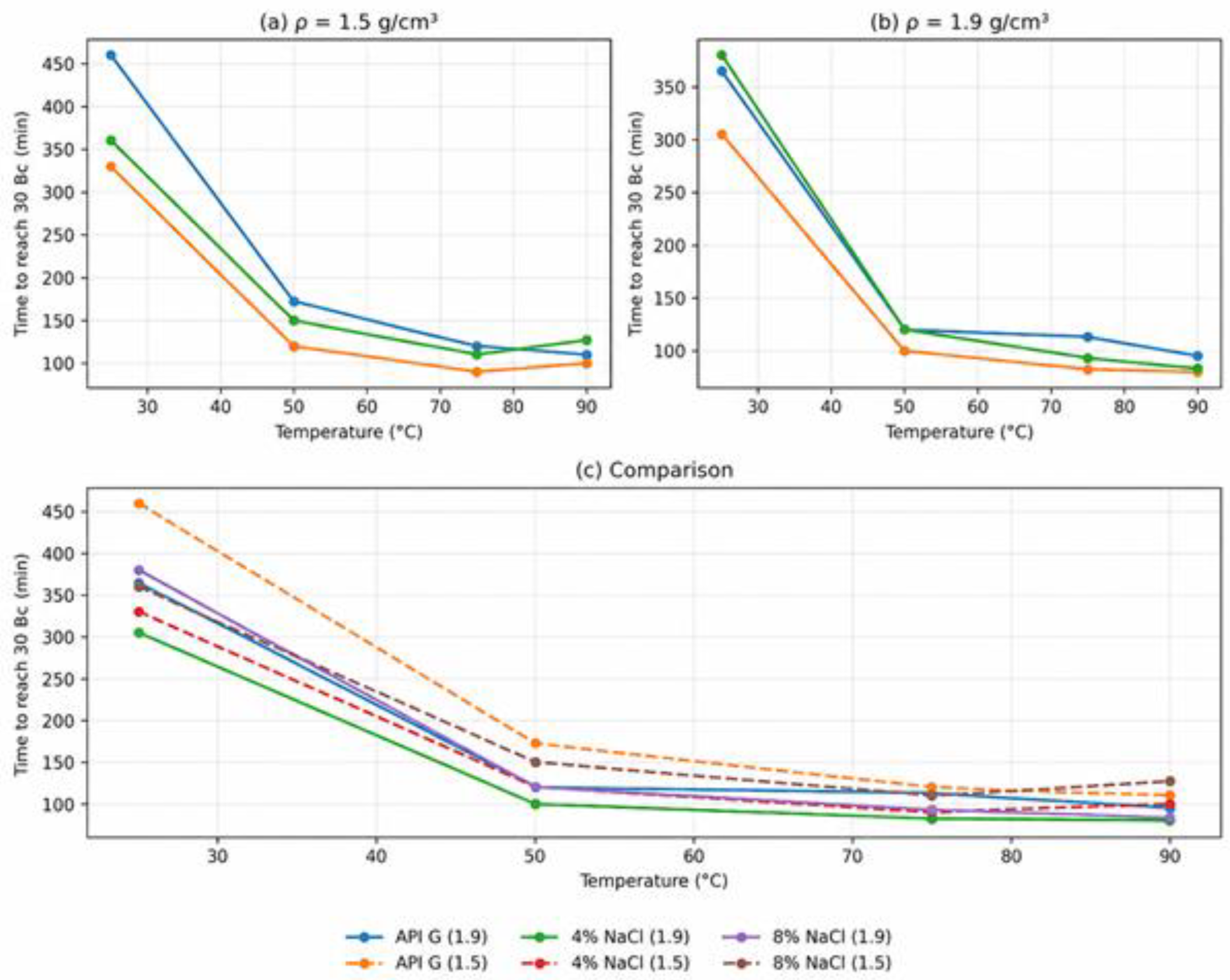
Comparison of the two slurry densities shows that the 1.5 g/cm3 slurries generally required more time to reach a consistency of 30 Bc than the 1.9 g/cm3 slurries, particularly at lower temperatures. This behavior can be attributed to the higher water-to-cement ratio of the lower-density slurry, which reduces the solids concentration and consequently delays consistency development.
From a practical perspective, the time required to reach 30 Bc provides a useful basis for comparing the relative rate of consistency development among the investigated formulations. However, because the measurements were performed under atmospheric pressure, the obtained values do not represent the actual pumping time window under downhole conditions. In practice, slurry pumpability is additionally influenced by pressure, the temperature profile, slurry placement time, wellbore geometry, and flow conditions.
Early compressive strength development is an important indicator of the readiness of a cement system for subsequent well operations. The required compressive strength depends on well design, the type of subsequent operation, and the engineering criteria adopted for a particular application. The UCA-estimated compressive strength after 12 and 24 h is presented in Figure 2.
For the 1.9 g/cm3 slurry, both NaCl-containing formulations developed higher compressive strength than the reference formulation at 25 °C. After 24 h, the increase was approximately 23% for the formulation containing 4 wt.% NaCl and approximately 32% for the formulation containing 8 wt.% NaCl. In contrast, at 75 °C, both NaCl-containing formulations exhibited lower compressive strength than the reference slurry. At 90 °C, the formulation containing 4 wt.% NaCl achieved a compressive strength approximately 0.9 MPa higher than that of the reference formulation after 24 h, whereas the formulation containing 8 wt.% NaCl was approximately 0.5 MPa lower.
A similar temperature-dependent response was observed for the 1.5 g/cm3 slurry. The formulation containing 4 wt.% NaCl exhibited higher or comparable compressive strength at temperatures between 25 and 75 °C, whereas at 90 °C its compressive strength was lower than that of the reference formulation. In contrast, the formulation containing 8 wt.% NaCl did not consistently produce the highest compressive strength, indicating that increasing the NaCl concentration did not provide a systematic improvement under all investigated temperature conditions.
The measured results demonstrate that the effect of NaCl on the UCA-estimated compressive strength depended on both temperature and slurry density. The observed trends may be attributed to the influence of NaCl on the ionic strength of the pore solution, the dissolution of clinker minerals, and the formation of hydration products [10,13,15]. However, without complementary calorimetric, phase, and microstructural analyses, it is not possible to determine whether the observed changes were primarily associated with differences in the hydration kinetics of the silicate phases, reactions involving the aluminate phases, or modifications to the microstructure of the hardened cement matrix.
In addition to the compressive strength values after 12 and 24 h, the times required to reach the UCA-estimated compressive strength thresholds of 0.5 and 3.5 MPa were also evaluated. The 0.5 MPa threshold was used as an indicator of the onset of measurable strength development, whereas the 3.5 MPa threshold served to compare the subsequent progression of strength development. These times should therefore be regarded as comparative indicators of early strength development rather than universal operational criteria for the continuation of well operations.
Figure 3.
Time required to reach UCA-estimated compressive-strength thresholds for API Class G cement systems containing different NaCl concentrations at a slurry density of 1.5 g/cm3: (a) 0.5 MPa and (b) 3.5 MPa. NR indicates that the selected threshold was not reached within the monitoring period.
Figure 3.
Time required to reach UCA-estimated compressive-strength thresholds for API Class G cement systems containing different NaCl concentrations at a slurry density of 1.5 g/cm3: (a) 0.5 MPa and (b) 3.5 MPa. NR indicates that the selected threshold was not reached within the monitoring period.
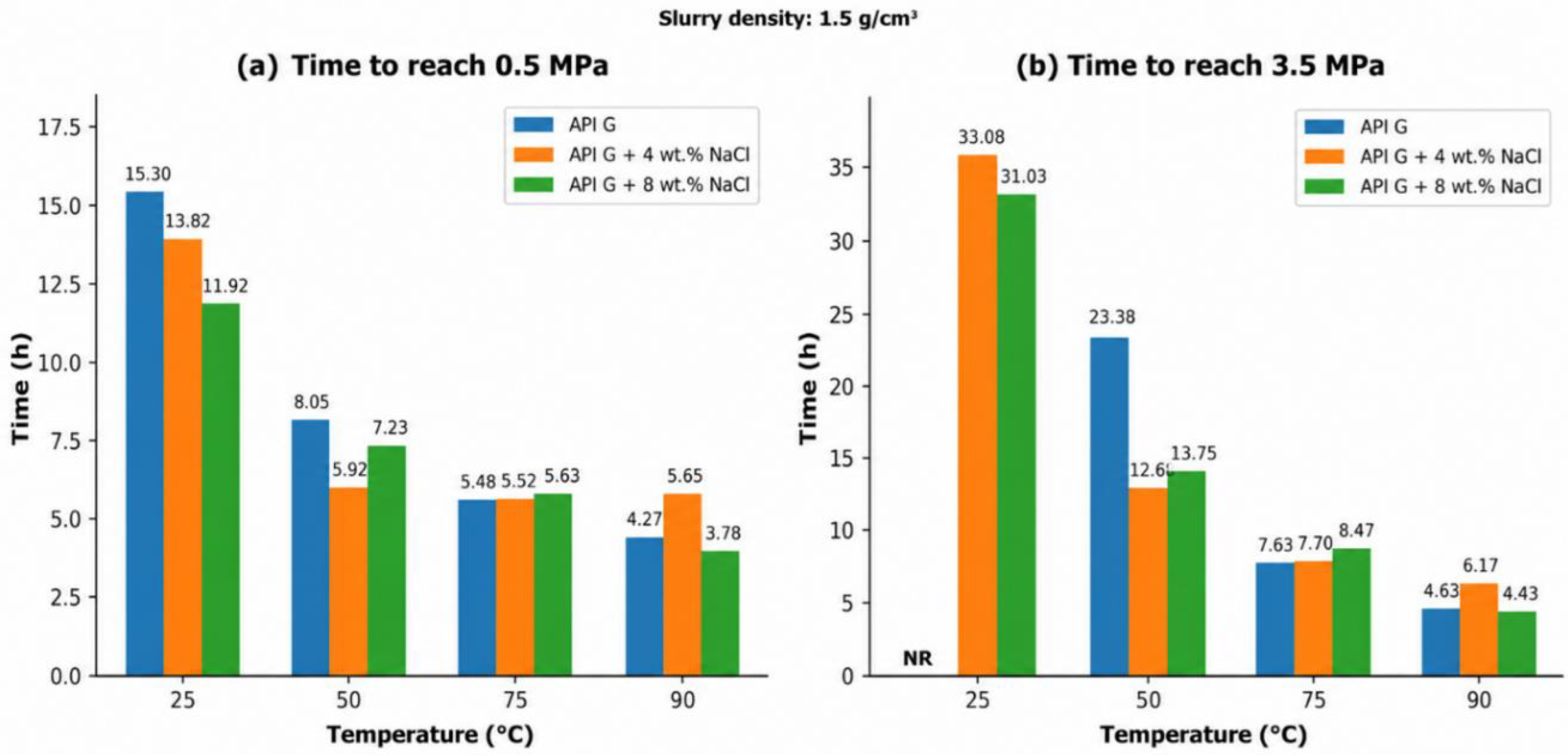
For the 1.5 g/cm3 slurry, increasing the temperature generally reduced the time required to reach both investigated strength thresholds. At 25 °C, the formulations containing 4 and 8 wt.% NaCl reached the 0.5 MPa threshold approximately 9.7% and 22.1% earlier than the reference formulation, respectively. The reference formulation did not reach the 3.5 MPa threshold within the monitoring period, whereas the formulations containing 4 and 8 wt.% NaCl reached this threshold after 33.08 and 31.03 h, respectively.
At 50 °C, both NaCl-containing formulations reached the investigated strength thresholds earlier than the reference formulation. The greatest acceleration was observed for the formulation containing 4 wt.% NaCl, which reached the 0.5 MPa threshold approximately 26.5% earlier and the 3.5 MPa threshold approximately 45.8% earlier than the reference formulation.
At 75 °C, differences among the formulations in the time required to reach the 0.5 MPa threshold were relatively small, whereas both NaCl-containing formulations reached the 3.5 MPa threshold slightly later than the reference formulation. At 90 °C, the response was reversed. The formulation containing 8 wt.% NaCl reached the 0.5 and 3.5 MPa thresholds approximately 11.3% and 4.3% earlier than the reference formulation, whereas the formulation containing 4 wt.% NaCl reached the same thresholds approximately 32.4% and 33.1% later, respectively.
The corresponding results for the 1.9 g/cm3 slurries are presented in Figure 4.
At 25 °C, the formulations containing 4 and 8 wt.% NaCl reached the 0.5 MPa threshold approximately 26.1% and 22.8% earlier than the reference formulation, respectively. The 3.5 MPa threshold was reached approximately 23.5% and 21.4% earlier, respectively.
At 50 °C, the opposite response was observed. The formulation containing 4 wt.% NaCl reached the 0.5 and 3.5 MPa thresholds approximately 27.6% and 16.9% later than the reference formulation, whereas the corresponding delays for the formulation containing 8 wt.% NaCl were approximately 44.8% and 30.1%, respectively. A similar trend was observed at 75 °C, where both NaCl-containing formulations reached the investigated strength thresholds later than the reference formulation.
At 90 °C, the formulation containing 8 wt.% NaCl reached the 0.5 MPa threshold approximately 11.6% earlier and the 3.5 MPa threshold approximately 4.1% earlier than the reference formulation. In contrast, the formulation containing 4 wt.% NaCl reached both thresholds approximately 13% later than the reference formulation.
Comparison of the two slurry densities showed that the 1.9 g/cm3 formulations generally reached the selected strength thresholds earlier than the 1.5 g/cm3 formulations. This behavior can be attributed to the lower water-to-cement ratio and higher solids content of the higher-density slurries.
A combined descriptive evaluation indicates that increasing the NaCl concentration from 4 to 8 wt.% did not result in a consistent improvement in rheological properties, the time required to reach 30 Bc, or early compressive strength development. Based on the overall descriptive assessment of the rheological parameters, the time required to reach 30 Bc, the time required to reach the selected UCA-estimated compressive strength thresholds, and the UCA-estimated compressive strength after 12 and 24 h, the formulation containing 4 wt.% NaCl exhibited the most balanced overall performance among the investigated salinity levels. This formulation generally reduced plastic viscosity (PV) and yield stress (YP) and shortened the time required to reach 30 Bc. However, it did not consistently produce either the earliest attainment of the selected strength thresholds or the highest compressive strength after 24 h under all investigated temperature conditions.
The combined results demonstrate that increasing the NaCl concentration did not produce proportional changes in all evaluated properties. This non-monotonic response may be interpreted in terms of the simultaneous influence of NaCl on the ionic strength of the pore solution, clinker mineral dissolution, hydration of the aluminate and silicate phases, and interparticle interactions [10,13,15]. Moderate NaCl concentrations may accelerate certain early hydration reactions and modify the rheological structure of the slurry, whereas higher salinity does not necessarily promote more favorable subsequent development of the cement matrix. Because calorimetric, phase, and microstructural analyses were not performed, these explanations should be regarded as mechanistic interpretations of the observed experimental trends rather than directly verified mechanisms.
From a practical perspective, the selection of NaCl concentration should not be based solely on the rate of consistency development or early strength gain but should consider rheological behavior, the available placement time, and the development of the required compressive strength. The formulation containing 4 wt.% NaCl may serve as a useful starting point for further laboratory optimization of cement slurry formulations intended for saline and salt-bearing formations; however, it should not be considered a directly applicable field formulation. Prior to field implementation, its performance should be verified under representative pressure and temperature conditions, together with evaluations of sedimentation stability, free-water separation, fluid loss, and compatibility with other additives. Furthermore, the results presented in this study are specific to the investigated API Class G High Sulfate Resistant (HSR) cement manufactured by Dyckerhoff and should not be directly extrapolated to cements with different chemical or mineralogical compositions.
The results should also be interpreted within the limitations of the experimental program. Independent replicate tests were not performed for individual combinations of NaCl concentration, slurry density, and temperature; consequently, experimental variability and the statistical significance of the observed differences could not be assessed. The proposed mechanisms were not directly verified through calorimetric, phase, or microstructural analyses. Additional limitations include consistency measurements performed under atmospheric pressure, indirect estimation of compressive strength by the UCA without calibration against destructive compressive strength testing, and the restriction of the analysis to the early stages of cement hydration.
Future research should include at least three independent replicates for each experimental condition, narrower NaCl concentration intervals, and a factorial experimental design to quantify the individual effects of the investigated variables and their interactions. The mechanisms underlying the observed trends should be further investigated using calorimetry, X-ray diffraction (XRD), and scanning electron microscopy coupled with energy-dispersive X-ray spectroscopy (SEM/EDS). In addition, the operational applicability of the investigated formulations should be evaluated using HPHT consistometry and slurry stability testing. Finally, long-term mechanical performance and the reliability of UCA-estimated compressive strength should be assessed through destructive compressive strength testing after 1, 7, 28, and 90 days.
4. Summary and Conclusions
The experimental trends obtained in this study demonstrate that the effect of NaCl on API Class G cement slurry formulations is not proportional to its concentration but depends on temperature, slurry density, and the property being evaluated. The addition of NaCl generally reduced plastic viscosity (PV) and yield stress (YP), whereas gel strength, consistency development, and early compressive strength development exhibited a stronger dependence on temperature and slurry density. Furthermore, earlier attainment of the 0.5 and 3.5 MPa strength thresholds was not necessarily accompanied by higher UCA-estimated compressive strength after 12 and 24 h.
The proposed hypothesis regarding the non-monotonic and condition-dependent influence of NaCl is supported by the observed experimental trends. Increasing the NaCl concentration from 4 to 8 wt.% did not result in consistent improvements in rheological properties, consistency development, or early mechanical performance. Considering both slurry densities and all investigated temperatures, the formulation containing 4 wt.% NaCl exhibited the most balanced overall performance based on the descriptive evaluation of the investigated properties. However, this concentration did not provide the best performance according to every individual criterion or under all experimental conditions and should therefore be regarded as a starting point for further formulation optimization rather than a formally established optimum or a directly applicable field formulation.
The principal scientific contribution of this study lies in the integrated experimental evaluation of the combined effects of NaCl concentration, slurry density, and temperature on rheological behavior, consistency development, and UCA-estimated early compressive strength within a single experimental program. The results demonstrate that the behavior of API Class G cement slurry formulations under saline conditions cannot be reliably assessed on the basis of a single property or NaCl concentration alone but requires the combined evaluation of multiple interrelated performance parameters.
The main limitation of this study is the absence of independent experimental replicates and statistical analysis, meaning that the proposed hypothesis should be considered descriptively supported rather than statistically validated. Additional limitations include consistency measurements performed under atmospheric pressure, indirect estimation of compressive strength using the UCA without calibration against destructive compressive strength testing, and the absence of long-term mechanical and microstructural characterization. Future research should address these limitations through statistical validation of the experimental trends, detailed microstructural characterization of the hardened cement, and testing under conditions that more closely simulate actual wellbore environments.
Abbreviations
The following abbreviations are used in this manuscript:
| API | American Petroleum Institute |
| WOC | Wait on Cement |
| PV | Plastic Viscosity |
| YP | Yield Point |
| UCA | Ultrasonic Cement Analyzer |
| NaCl | Sodium Chloride |
| SEM | Scanning Electron Microscopy |
| XRD | X-ray Diffraction |
| C–S–H | Calcium Silicate Hydrate |
| HPHT | High Pressure High Temperature |
| ASTM | American Society for Testing and Materials |
Author Contributions
Conceptualization, J.M. and M.C.; methodology, J.M. and Lj.T.; formal analysis, Lj.T. and A.M.; investigation, M.C., P.J. and D.B.; resources, J.M.; data curation, J.M. and A.M.; writing - original draft preparation, J.M., M.C. and D.B.; writing - review and editing, J.M., D.B. and M.C.; visualization, D.B. and A.M.; supervision, P.J. All authors have read and agreed to the published version of the manuscript.
Funding
The authors express their gratitude to the Ministry of Science, Technological Development and Innovation of the Republic of Serbia, for supporting scientific research, which is essential for the advancement of a knowledge-based society; Contract on realization and financing of the scientific research work of the Faculty of Mining and Geology in 2026 (451-03-34/2026-03/ 200126).
Institutional Review Board Statement
Not applicable.
Informed Consent Statement
Not applicable.
Data Availability Statement
The data presented in this study are available on request from the first author.
Acknowledgments
This research has been supported by the Ministry of Science, Technological Development and Innovation of the Republic of Serbia. The authors express special gratitude to the Cement Testing Laboratory of NIS-NAFTAGAS for providing access to the modern equipment and infrastructure required for the experimental part of this research. Special thanks are extended to the laboratory’s professional and technical staff for their dedication, expert suggestions, and support during sample preparation, measurement procedures, and data processing. Their knowledge, experience, and professional approach had a significant impact on the quality of the experimental work and contributed to the successful implementation of the research process.
Conflicts of Interest
The authors declare no conflict of interest. The funders had no role in the design of the study; in the collection, analyses, or interpretation of data; in the writing of the manuscript, or in the decision to publish the results.
Ethical approval
Permission to run the research was granted by the community authorities, the University of Belgrade - Faculty of Mining and Geology and University of Banja Luka - Faculty of Mining.
References
- B. Hunter et al., “Cementing casing strings across salt zones: An overview of global best practices,” SPE Prod. Oper., 2010. [CrossRef]
- A. da Silva et al., “Degradation of oil well cement with sodium chloride content exposed to supercritical carbon dioxide conditions: Temperature and pressure effects,” J. Pet. Sci. Eng., vol. 216, p. 111198, 2022. [CrossRef]
- A. Subaha et al., “The combined effect of temperature and salinity on the mechanical behaviour of well cement,” Engineer, vol. 50, no. 1, pp. 1–10, 2017. [CrossRef]
- Z. Szweda, “The influence of chloride ions content on the mechanical properties of concrete,” Struct. Environ., vol. 16, pp. 158–165, 2024. [CrossRef]
- C. Geng et al., “NaCl gradient controls Ca leaching of C–S–H in oil well cement at 260 °C: From strength enhancement to degradation,” Case Stud. Constr. Mater., vol. 24, p. e05339, 2025. [CrossRef]
- S. Gowthaman et al., “Effect of salinity on mechanical behaviour of well cement: Application to carbon capture and storage wells,” Engineer, vol. 49, no. 1, pp. 21–29, 2016. [CrossRef]
- G. D. S. Batista et al., “Hardened oil well cement paste modified with TiO2@SiO2 nanoparticles: Physical and chemical properties,” Constr. Build. Mater., vol. 361, p. 130282, 2023. [CrossRef]
- O. Mammadov et al., “A comprehensive review of cement degradation analysis under downhole conditions: CCS/CCUS/CO2-EOR applications,” ACS Omega, vol. 10, no. 27, pp. 28515–28533, 2025. [CrossRef]
- P. A. Blinov et al., “Analysis of modern additives for modifying structural and mechanical properties of cement sheath in oil and gas well cementing: A review,” Int. J. Eng., vol. 39, no. 4A, pp. 996–1008, 2026. [CrossRef]
- D. Teodoriu and M. Asamba, “Experimental study of salt content effect on Class G cement properties with application to well integrity,” J. Nat. Gas Sci. Eng., vol. 26, pp. 324–329, 2015. [CrossRef]
- D. K. Smith, Cementing. Richardson, TX: Society of Petroleum Engineers, 1976.
- T. Echt et al., “Salt cementing systems: Effect of specific ions on the performance of high-temperature cement fluid-loss polymers,” SPE-173764-MS, 2015. [CrossRef]
- R. F. Lago et al., “Evaluation of influence of salt in the cement hydration to oil wells,” Mater. Res., vol. 21, 2018. [CrossRef]
- H. Maroof et al., “Experimental investigations on dynamic gelation and thickening time of salt-containing well cement slurries,” Case Stud. Constr. Mater., vol. 24, p. e04711, 2025. [CrossRef]
- P. A. Blinov et al., “Evaluation of strength properties of cement containing NaCl in mixing water for cementing wells in halite strata,” Int. J. Eng., vol. 37, no. 10A, pp. 2109–2115, 2024. [CrossRef]
- L. D. Wakeley, “Distribution of chloride in a salt-saturated grout in contact with halite rock,” Cem. Concr. Res., vol. 16, no. 2, pp. 267–274, 1986. [CrossRef]
- J. Yun et al., “Rheological properties and early mechanical strength of oil-well cement modified by hybrid nano-silica and nano-hexagonal boron nitride,” Constr. Build. Mater., vol. 350, p. 129291, 2022. [CrossRef]
- A. B. Harooni et al., “A novel predictive model for the compressive strength development in Class G cement slurries at different temperatures, retarder, and salt concentrations,” Case Stud. Constr. Mater., vol. 24, p. e04360, 2025. [CrossRef]
- M. S. Lim et al., “Influence of salinity on the gelation and microstructure of cement–sodium silicate grout,” Tunn. Undergr. Space Technol., vol. 150, p. 107105, 2026. [CrossRef]
- W. Qi et al., “Effect of chlorine salt content on the microstructural development of C–S–H gels and Ca(OH)2 at different curing temperatures,” Materials, vol. 17, 2024. [CrossRef]
- W. Chen et al., “Effect of micro-magnesium oxide admixture on rheological and compressive strength properties of Class G well cement,” Front. Mater., vol. 9, p. 902076, 2022. [CrossRef]
- Y. El Bitouri, “The effect of temperature on the structural build-up of cement pastes,” CivilEng, vol. 4, pp. 1198–1213, 2023. [CrossRef]
- American Petroleum Institute, API Recommended Practice 10B-2: Recommended Practice for Testing Well Cements, 2nd ed. Washington, DC: American Petroleum Institute, 2013.
Figure 2.
UCA-estimated compressive strength after 12 and 24 h for API Class G cement systems containing different NaCl concentrations at slurry densities of 1.5 and 1.9 g/cm3.
Figure 2.
UCA-estimated compressive strength after 12 and 24 h for API Class G cement systems containing different NaCl concentrations at slurry densities of 1.5 and 1.9 g/cm3.
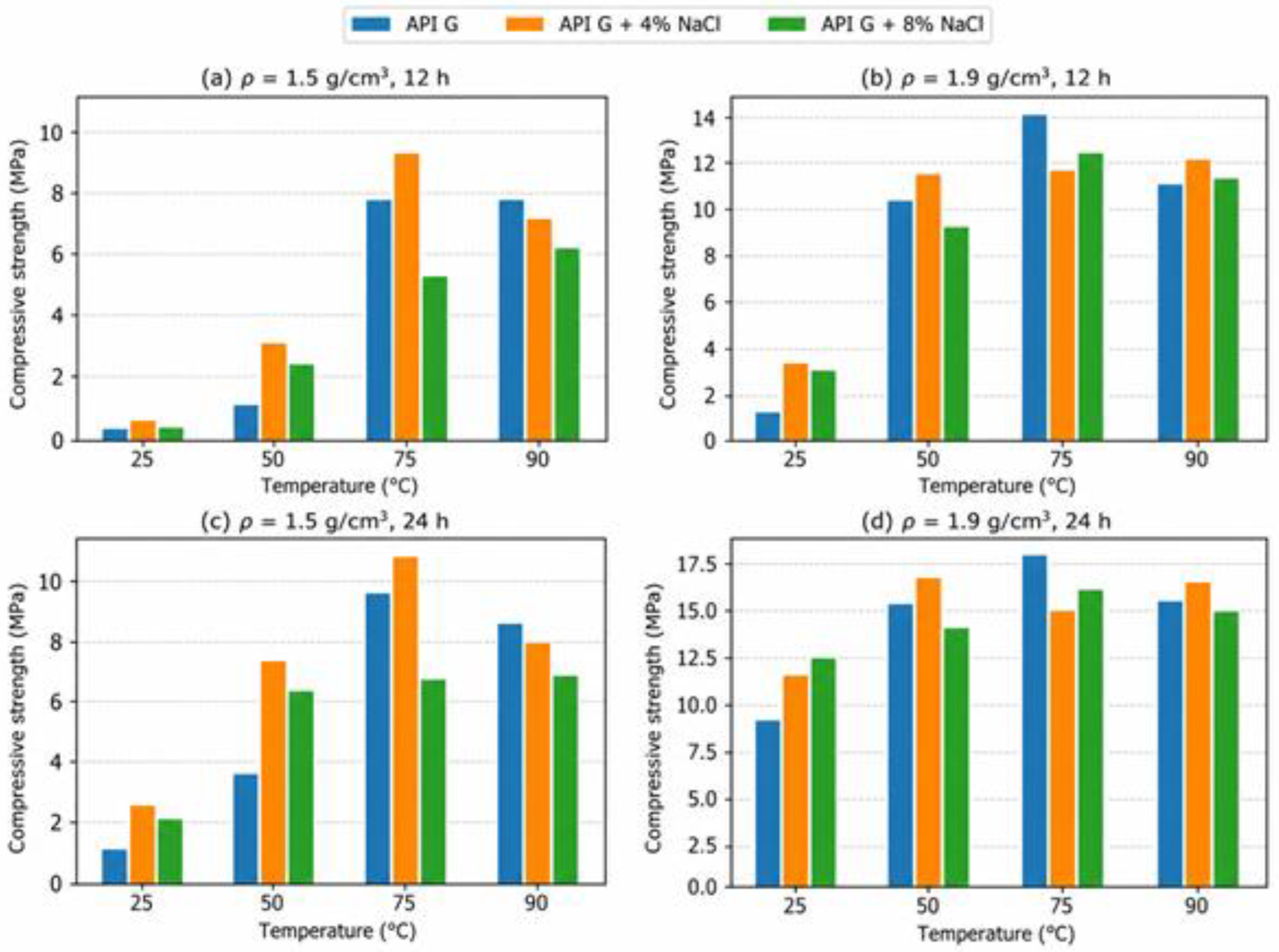
Figure 4.
Time required to reach the UCA-estimated compressive strength thresholds for API Class G cement slurry formulations containing 0, 4, and 8 wt.% NaCl at a slurry density of 1.9 g/cm3: (a) 0.5 MPa and (b) 3.5 MPa.
Figure 4.
Time required to reach the UCA-estimated compressive strength thresholds for API Class G cement slurry formulations containing 0, 4, and 8 wt.% NaCl at a slurry density of 1.9 g/cm3: (a) 0.5 MPa and (b) 3.5 MPa.
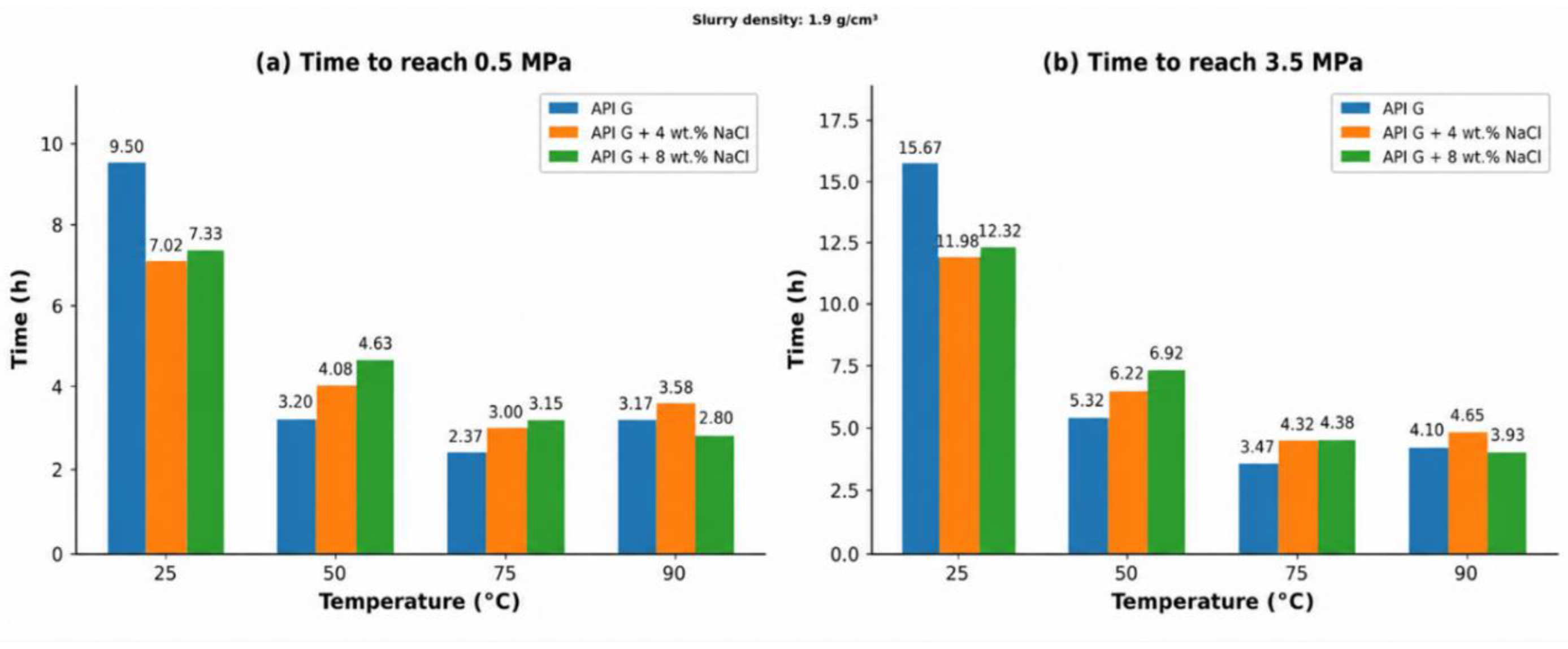
Table 1.
Selected characteristics of the high-sulfate-resistant (HSR) API Class G cement used.
| Data group | Parameter | Value |
|---|---|---|
| Chemical composition | MgO | 0,9 mas.% |
| Chemical composition | SO3 | 2,7 mas.% |
| Alkali content | Na2O ekvivalent | 0,63 mas.% |
| Estimated mineral composition | C3S | 51,0 mas.% |
| Estimated mineral composition | C3A | 2,5 mas.% |
| Composite parameter | C4AF + 2C3A | 22,3 mas.% |
Note: C3S and C3A represent the estimated clinker mineral phases, while C4AF + 2C3A represents a composite parameter reported in the quality certificate rather than the content of an individual mineral phase.
Table 2.
Composition of the tested cement slurries.
| System designation | Nominal density (g/cm3) | Cement (g) |
Water (g) |
w/c | NaCl (g) |
NaCl (wt.% BWOC) |
|---|---|---|---|---|---|---|
| G-1.5-0 | 1.5 | 1000 | 950 | 0.95 | 0 | 0 |
| G-1.5-4 | 1.5 | 1000 | 950 | 0.95 | 40 | 4 |
| G-1.5-8 | 1.5 | 1000 | 950 | 0.95 | 80 | 8 |
| G-1.9-0 | 1.9 | 1000 | 440 | 0.44 | 0 | 0 |
| G-1.9-4 | 1.9 | 1000 | 440 | 0.44 | 40 | 4 |
| G-1.9-8 | 1.9 | 1000 | 440 | 0.44 | 80 | 8 |
Note: The NaCl concentration is expressed as a percentage by weight of dry cement (BWOC). NaCl was completely dissolved in the mixing water before the cement was added.
Table 4.
Rheological parameters of API Class G cement slurries at different NaCl concentrations, slurry densities, and temperatures.
Table 4.
Rheological parameters of API Class G cement slurries at different NaCl concentrations, slurry densities, and temperatures.
| Density (g/cm3) |
Temperature (°C) |
NaCl (wt.%) |
PV (mPa·s) | YP (Pa) | Gel strength, 10 s/10 min (Pa) |
|---|---|---|---|---|---|
| 1.50 | 25 | 0 | 17.25 | 18.38 | 10.0/25.5 |
| 1.50 | 25 | 4 | 16.50 | 13.75 | 9.0/21.0 |
| 1.50 | 25 | 8 | 16.50 | 13.75 | 9.5/17.0 |
| 1.50 | 50 | 0 | 25.00 | 25.50 | 10.5/22.5 |
| 1.50 | 50 | 4 | 23.25 | 21.88 | 10.0/26.0 |
| 1.50 | 50 | 8 | 18.00 | 16.50 | 8.5/15.0 |
| 1.50 | 75 | 0 | 25.50 | 32.25 | 11.0/30.0 |
| 1.50 | 75 | 4 | 21.75 | 25.63 | 8.5/22.0 |
| 1.50 | 75 | 8 | 19.50 | 22.75 | 8.0/25.5 |
| 1.50 | 90 | 0 | 25.50 | 32.25 | 11.0/>300 |
| 1.50 | 90 | 4 | 24.00 | 28.00 | 6.5/33.5 |
| 1.50 | 90 | 8 | 21.00 | 19.00 | 9.5/54.5 |
| 1.90 | 25 | 0 | 45.75 | 15.13 | 7.0/22.0 |
| 1.90 | 25 | 4 | 39.75 | 15.63 | 10.5/14.5 |
| 1.90 | 25 | 8 | 42.00 | 21.50 | 8.5/15.0 |
| 1.90 | 50 | 0 | 53.25 | 47.38 | 11.0/13.5 |
| 1.90 | 50 | 4 | 42.75 | 31.13 | 8.5/9.0 |
| 1.90 | 50 | 8 | 49.50 | 28.75 | 10.0/15.0 |
| 1.90 | 75 | 0 | 69.75 | 56.13 | 8.0/21.0 |
| 1.90 | 75 | 4 | 42.00 | 30.50 | 9.0/>300 |
| 1.90 | 75 | 8 | 25.50 | 29.75 | 24.5/>300 |
| 1.90 | 90 | 0 | ND | ND | ND |
| 1.90 | 90 | 4 | ND | ND | ND |
| 1.90 | 90 | 8 | ND | ND | ND |
Note: PV - plastic viscosity; YP - yield point. The designation “>300 Pa” indicates that the gel strength exceeded the upper limit of reliable measurement under the applied test conditions. This designation does not represent an exact gel-strength value but only confirms that the actual value was greater than 300 Pa. ND – not determined. The rheological parameters of the 1.9 g/cm3 slurry systems at 90 °C could not be determined because the slurries began to develop consistency during temperature conditioning.
Disclaimer/Publisher’s Note: The statements, opinions and data contained in all publications are solely those of the individual author(s) and contributor(s) and not of MDPI and/or the editor(s). MDPI and/or the editor(s) disclaim responsibility for any injury to people or property resulting from any ideas, methods, instructions or products referred to in the content. |
© 2026 by the authors. Licensee MDPI, Basel, Switzerland. This article is an open access article distributed under the terms and conditions of the Creative Commons Attribution (CC BY) license (http://creativecommons.org/licenses/by/4.0/).
Copyright: This open access article is published under a Creative Commons CC BY 4.0 license, which permit the free download, distribution, and reuse, provided that the author and preprint are cited in any reuse.