

Submitted:
05 August 2026
Posted:
07 August 2026
You are already at the latest version
Abstract
Ultraviolet (UV) radiation was firstly selected to evaluate its assistant remediation effects on Cr-contaminated soil. Various remediation materials, including corn stover (CS), corn stover biochar (CSB), polypyrrole-modified corn stover (PPy-CS), and polypyrrole-modified corn stover biochar (PPy-CSB) were employed to evaluate their synergistic effects with UV radiation. Results showed UV radiation increased the toxicity characteristic leaching procedure (TCLP) Cr(Ⅵ) when no other remediation was added to the contaminated soil. However, when the remediation materials were added, with UV radiation, the contents of TCLP-Cr(Ⅵ) decreased while the contents of Cr(III) increased, and the removal rates of TCLP-Cr(Ⅵ) in contaminated soil treated by CSB, PPy-CSB, CS, and PPy-CS were 18.73%, 7.63%, 10.93%, and 8.17% higher than those of the non-irradiated groups, respectively. Notably, CS group demonstrated superior efficacy in Cr(Ⅵ) removal compared with CSB under UV irradiation. Meanwhile, characteristics analysis including Electron Paramagnetic Resonance (EPR), Fourier-transform infrared spectroscopy((FTIR) and X-ray photoelectron spectroscopy(XPS) assisted to find reaction mechanisms, which implied the UV irradiation could enhance the content of oxygen free radicals on the material surface, and effectively activate the reactions between Cr(Ⅵ) and remediation materials. This study verified UV irradiation could also be a promising assistant measure in the remediation of heavy metal contaminated soil.
Keywords:
ultraviolet radiation
; Cr(Ⅵ)
; soil remediation
; corn stover
; mechanism
1. Introduction
Chromium pollution was a globally recognized environmental concern. It was released into soil and natural water through wastes discharged from various sources, including electronics, electroplating, metallurgical, leather tanning, and pharmaceutical industries [1,2,3]. The discharged chromium was mainly divided into Cr(VI) and Cr(III). Notably, the toxicity of Cr(VI) is nearly 500 times higher than that of Cr(III) [4,5], at the same time, Cr(VI) has strong carcinogenic and mutagenic properties [6,7]. Because of the unstable valence state of chromium, remediation process often resulted in incomplete repair and undesirable morphological transformations, which increased the difficulty of the treatment. Meanwhile, most current research focused on the remediation of water-soluble hexavalent chromium, whereas the research on the remediation of hexavalent chromium in soil was lacking [8,9].
Biochar as a carbon-rich material produced from biomass, was considered an excellent remediation agent due to its large specific surface area, strong adsorption capacity, and stable structure, offering significant advantages over raw biomass [10,11]. To further enhance its performance, various modifications had been developed, including UV radiation modification, acid-base modification, supported metals and their oxides, and organic modification [12,13,14]. Among these, UV radiation modification stands out as a particularly competitive and clean approach. It could not only enhance the adsorption capacity of biochar for pollutants by increasing oxygen-containing functional groups such as -OH, -COO, -CO, and -COOH, but also avoid secondary pollution during the modification process [15,16,17]. For instance, Li et al. found that the coconut shell biochar irradiated with UV light at 365 nm for 16 h had the best adsorption effect on Cd(II) in soil [18]. Similarly, Wang et al. observed that the adsorption of Pb(II) and Cd(II) in solution by biochar after UV irradiation was 136.0% and 25.3% higher than that before UV irradiation [13]. Nevertheless, despite these promising results, the application of UV-modified biochar predominantly confined to wastewater treatment. Its potential for remediating the more complex and challenging case of Cr(VI) in soil was severely under explored.
Our previous research had demonstrated that polypyrrole modified corn stover (PPy-CS) and polypyrrole modified corn stover biochar (PPy-CSB) exhibited excellent remediation performance for Cr(VI) in soil [19]. Building upon this foundation as well as seeking to address the persistent challenge of Cr(VI) contamination, the new synergistic strategy of UV radiation was proposed. Its performance was examined and characteristics analysis such as scanning electron microscopy and energy dispersive X-ray photoelectron spectroscopy (XPS) analyses, Fourier-transform infrared spectroscopy (FTIR) and Electron Paramagnetic Resonance(EPR) were carried out. This study could enrich the application of UV radiation in the range of environmental pollution treatment.
2. Materials and Methods
2.1. Materials
Soil samples used in this study were collected from the top layer (0-20 cm) of the campus experimental field (113°48′E, 34°46′N) in Zhengzhou, Henan, China, and the soil type was meadow-cinnamon soil. Corn straw was sourced from Zhengzhou, Henan Province, China. The basic physical and chemical properties of the soil are shown in Table 1, where the indicators of organic matter, soil bulk density, and alkaline nitrogen were tested according to the methods in Soil testing standard (NY/T 1121-2006) issued by the Agricultural Industry Standards of the People’s Republic of China, and total chromium, total lead, and total copper were analyzed following Soil and sediment-Determination of copper, zinc, lead, nickel and chromium-Flame atomic absorption spectrophotometry (HJ 491-2019) issued by the National Environmental Protection Standards of the People’s Republic of China using atomic absorption spectrophotometer (TAS-990 SUP).
2.2. Methods
2.2.1. Preparation of Remediation Materials
The corn sover biochar was produced by heating dried corn stover sieved to 425 µm in a muffle furnace at a relatively low and environmentally friendly temperature of 350 ℃. Meanwhile, polypyrrole-modified corn stover biochar (PPy-CSB) was also used, and this material was prepared using corn stover biochar, pyrrole, hydrochloric acid solution, and ammonium persulfate, and had exhibited significantly better performance in the remediation of Cr(Ⅵ)-contaminated soil in our previous studies. In addition, corn sover biochar (CSB) was replaced with corn stover (CS), and polypyrrole-modified corn stover (PPy-CS) were prepared following the method used for PPy-CSB preparation.
2.2.2. Experiments
According to the Soil Environmental Quality-Risk Control Standard for Soil Contamination of Agricultural Land of China (GB 15618–2018), when the pH of farmland soil exceeded 7.5, the risk screening value for hexavalent chromium was set at 350 mg·kg-1, while the risk control value was set at 1300 mg·kg-1. In this study, an initial soil pollution concentration of 600 mg·kg-1 was selected. This concentration was above the screening value, belonging moderate to severe pollution scenarios, yet below the risk control value. Firstly, the soil samples were pretreated by adding the analytical-grade K2CrO4 reagent to achieve the calculated Cr(VI) concentration in the soil of 600 mg·kg-1. Then the contaminated soil was kept at room temperature for one week with humidity at 60%~70% of the field water holding capacity.
In the experiments, the above soil was firstly mixed with 5% CS, CSB, PPy-CS, and PPy-CSB, respectively. At the same time, no additions were added to the soil in the control group. After being stirred evenly, the mixtures were kept at 60~70% of the field water holding capacity, where the field water holding capacity of soil was determined via the cutting ring method specified in the Agricultural Trade Standard of China (NY/T 1121.22-2010). Then, the mixed soil samples were spread evenly to a thickness of approximately 2 mm and placed 30 cm directly below a UV lamp with a power of 30 W and a wavelength of 254 nm for irradiation for 0 min, 10 min, 20 min, 30 min, 60 min, and 120 min, respectively. The wavelength of 254nm was chosen referencing to the published research which believed it could effectively excite the electronic transition and promoting the reduction of Cr(VI) to Cr(III) [20]. Samples were taken at various time intervals, air-dried naturally and passed through a 2 mm sieve for testing. The experiments were divided into two groups of irradiation and non-irradiation. Each condition was conducted in triplicate, and average values were used for data analysis.
2.2.3. Characterization Methods
The samples collected for characterization were irradiated by a UV lamp for 2 h, and non-irradiated materials served as controls. The changes of free radicals in soil after ultraviolet radiation are detected by Electron Paramagnetic Resonance Spectroscopy (EPR) (Bruker EMXplus-6/1, Germany). The functional groups on the remediation materials were identified using Fourier-transform infrared spectroscopy (FTIR, Nicolet iS5, Thermo Fisher, Waltham, MA, USA). X-ray photoelectron spectroscopy (XPS, Thermo Fisher Scientific ESCALAB 250Xi, USA) was used to characterize the types and valence states of the elements in the soil.
2.2.4. Data Analysis
The content of Cr(VI) was determined by the method specified in the National Environmental Protection Standards of the People’s Republic of China (HJ 1082-2019) for soil and sediment determination of Cr(VI) using alkaline digestion and flame atomic absorption spectrometry. The toxicity characteristic leaching procedure (TCLP) method was adopted to test the availability of Cr(VI). This determination was performed using the standard method of the Environmental Protection Agency (EPA) in the USA (US Environmental, 1992), which was a widely used method for evaluating the ecological risk of heavy metals in soil and has the characteristics of simplicity and rapidity [21,22]. The specific detection steps were as follows. Firstly, the extractant suited for the target pH > 5 was chosen. It was made by dissolving glacial acetic acid in deionized water, and the pH was adjusted using HNO3 (1 mol·L-1) or NaOH (1 mol·L-1) to maintain the solution pH in the range of 2.88 ± 0.05. And the soil samples were mixed with the extractant solution in a ratio of 1:20, then the mixtures were shaken at 150 r·min-1 for 18 h at room temperature, after that they were centrifuged and filtered through a 0.45 μm filter membrane for detection.
The adsorption capacity of remediation materials was calculated by the following formula:
Where (mg·g-1) was the adsorption capacity at time t, C0 (mg·L-1) was the concentration of Cr(VI) in TCLP extractions before treatment, and Ct (mg·L-1) was the concentration of Cr(VI) in TCLP extractions at time t after treatment.
The Cr content in the soil was determined by flame atomic absorption spectrophotometry, and TCLP-Cr(VI) content was determined by diphenylcarbonyl dihydrazide spectrophotometer after the extraction using the TCLP method.
The stability efficiency of Cr(VI) was calculated using the following formula:
Where η is the stabilization efficiency (%), ω0 is the concentration of Cr(Ⅵ) in the TCLP extract before remediation (mg·kg-1), ωe is the concentration of Cr(Ⅵ) (mg·kg-1) in TCLP extract after remediation.
3. Results and Discussion
3.1. Effects of Ultraviolet Radiation on TCLP-Cr(Ⅵ) Under Different Remediation Materials in the Soil
Before used, properties of the simulated contaminated soil were tested and presented in Table 2. It could be observed that although the initial set concentration of Cr(Ⅵ) was 600 mg/kg, the actual Cr(Ⅵ) concentration tested in the soil was only around 582.36 mg·kg-1 immediately, and even after one week, the total Cr(Ⅵ) concentration was only around 512.73 mg·kg-1. The decreasing content of Cr(Ⅵ) maybe result from the reduction reactions by some reducing substances such as Fe2+, Mn2+, S2- in natural soil. At the same time, the average Cr(Ⅵ) content in TCLP extractions was also much lower, implying that part of Cr(Ⅵ) was fixed firmly in the natural soil. It also could be found that the soil pH value increased from 7.8 to 8.13 compared with the background soil, which was reasonable because K2CrO4 added in the soil was alkaline [21].
In the experiments, the above soil samples were mixed with different remediation materials such as CS, CSB, PPy-CS and PPy-CSB. The materials of PPy-CS and PPy-CSB were employed because they contained conjugated long chain structures, as well as advantageous properties such as ion exchange and redox properties, and their good performance had been demonstrated in the remediation of soil Cr(Ⅵ) in our former studies [19]. All the soil samples with remediation materials were divided into irradiation groups and non-irradiation groups. Firstly, Figure 1 showed TCLP-Cr(Ⅵ) changes with and without UV irradiation under no remediation materials in the soil samples. It could be seen the TCLP-Cr(Ⅵ) values increased by around 20-40 mg·kg-1 under UV irradiation compared to the non-irradiated control, indicating that UV irradiation improved the reactivity of Cr(Ⅵ) in the absence of any remediation materials in the soil.
The impact of various treatment environments on Cr (VI) in soil, both prior to and following UV irradiation, varies with reaction time, as illustrated in Figure 2. It is obvious that the adsorption capacity had higher values with UV irradiation than those without UV irradiation under all the remediation conditions. Moreover, it can be seen that the treatment effects under the remediation with CS were better than those under CSB, while the treatment effects were similar under both the PPy-CS and PPy-CSB. At the same time, the best effects occurred under both UV-PPy-CS and UV-PPy-CSB. All the adsorption capacities increased remarkably in the initial 30 min under all the remediation conditions, after that, the increasing trends of the values got gentle and gradually reached equilibrium around 120 min. Finally, the adsorption capacities got around 2.83, 3.36, 6.95, 7.48, 5.58, 6.19, 6.98 and 7.55 mg·g-1 under remediation conditions of CSB, UV-CSB, PPy-CSB, UV-PPy-CSB, CS, UV-CS, PPy-CS, and UV-PPy-CS, respectively. It is clear that the adsorption capacities with UV increased by 18.73%, 7.63%, 10.93%, and 8.17% under remediation conditions of CSB, PPy-CSB, CS, and PPy-CS, respectively, compared with those without UV. It can be concluded that the UV irradiation could activate the reactions between Cr(VI) and remediation agents in the soil, and the effects of UV on the Cr-contaminated soil were almost identical to the effects of PPy-CSB. The stable efficiency of Cr (VI) showed the most significant changes under CSB and UV-CSB remediation conditions, increasing by 22.15% and 21.22% at equilibrium compared to the initial UV irradiation. The stable efficiency of CS is higher than that of CSB, Meanwhile, the stable ability of both materials improves after UV irradiation.
3.2. XPS Analysis
XPS analysis was employed to assist in figuring out the reaction mechanisms in the remediation process. As shown in Figure 3, the survey spectra of contaminated soil before and after UV irradiation (without any remediation) revealed the presence of C, N, O, Ca, Si, Al, and Cr, while the total elements and peak positions showed no significant changes before and after UV irradiation. However, according to the peak-differentiation-imitating analysis of element Cr, it could be found in the electronic peaks of Cr(VI) and Cr(III) corresponding to 586.96 ev and 579.22 ev, the contents of Cr(VI) and Cr(III) before UV irradiation were 22.74% and 77.26%, respectively, while the values were 26.19% and 73.81% after UV irradiation. The increasing content of Cr(VI) and decreasing content of Cr(III) indicated that UV irradiation could promote some Cr(III) into Cr(VI) in the contaminated soil under the situation of no remediation. Concurrently, the analysis of element O revealed the C=O and C-OH groups increased from 16.76% and 43.35% to 22.1% and 50.89%, respectively, while the C-O group decreased from 34.89% to 27.01%. Other functional groups, including C-C/C=C, N-O-C, and C=O/C-O, showed only minor changes. It could be inferred that the oxidization reaction of Cr(III) to Cr(VI) maybe partly corresponding to the reduction reaction of C-O to C-OH group.
Concurrently, Figure 4 depicted the XPS of contaminated soil with and without UV irradiation under PPy-CSB remediation. It could be seen UV irradiation made the content of Cr(VI) decrease from 10.83% to 8.77% while Cr(III) increase from 89.17% to 91.23%. Particular attention should be paid to the content of C-OH group which had significant decrease from 71.96% to 26.65%, meanwhile C-O and C=O groups increased from 20.2% and 8.02% to 27.09% and 46.26%, respectively. It could be inferred that the reduction reaction of Cr(VI) to Cr(III) maybe corresponding to the oxidization reaction of C-OH to C-O and C=O groups.
The XPS analysis in Figure 5 reveals that the Cr and C contents were similar in contaminated soil treated with UV-PPy-CSB and UV-PPy-CS. In contrast, the O 1s spectra revealed distinct distributions of oxygen functional groups: the C-OH, C-O, and C=O groups were 26.65%, 27.09%, and 46.26%, respectively, under UV-PPy-CSB and 59.52%, 28.57%, and 11.91%, respectively, under UV-PPy-CS. The most pronounced differences occurred in the C-OH and C=O groups, indicating distinct oxygen reaction pathways for UV-PPy-CSB and UV-PPy-CS. The substantially lower C=O content in UV-PPy-CS may be attributed to the generation of free radicals under UV irradiation, which facilitates chain transfer and redox reactions with adjacent molecules [23].
3.3. Electron Paramagnetic Resonance Analysis
Analysis of ultraviolet-irradiated repaired soil using EPR technology. The EPR spectra of persistent free radicals(PFR) in CK (blank soil), CS, CSB, PPy-CS and PPy-CSB samples were shown in Figure 6(a). All remediation materials exhibited a typical signal of carbon-centered persistent free radicals at G ≈ 2.003 [24]. This signal was generated by the excitation of conjugated structures on the material surfaces under ultraviolet irradiation, and acted as the core electron supplier for the reduction of Cr(VI). The CK showed almost no obvious EPR signal, only baseline noise, indicating that the concentration of intrinsic free radicals in natural soil was extremely low and could be ignored. The CS presented a relatively low intensity of UV-induced persistent free radicals due to the lack of continuous conjugated photosensitive structures. The CSB possessed an conjugated carbon skeleton owing to the promoted aromatic ring condensation during high-temperature pyrolysis [25]. It showed a fast recombination rate of surface photogenerated electrons, leading to a free-radical signal only slightly higher than that of CS. After modification with PPy, the free-radical signals of both PPy-CS and PPy-CSB were greatly enhanced, while the signal intensities of these two modified materials showed no significant difference.
Figure 6. (b) and (c) showed the singlet oxygen radical spectra and superoxide radical spectra of the four repair processes. From the peak intensity of the EPR spectra, the signals of O2−· and 1O2 for both CS and CSB were weak, indicating a low efficiency of UV excitation. After PPy modification, the yields of O2−· and 1O2 for PPy-CS were increased by 3.2 times and 2.8 times, respectively, while those for PPy-CSB were increased by 2.1 times and 1.4 times, respectively. As a result, the total yield of reactive oxygen species (ROS) for PPy-CS and PPy-CSB was basically equivalent. Specifically, the biomass-based system was dominated by the electron transfer pathway for O2−· generation, and the biochar-based system was dominated by the energy transfer pathway for 1O2 generation. Although the two systems differed in radical generation pathways, the total amounts of electrons available for Cr(VI) reduction were ultimately similar.
3.4. FTIR Analysis
Figure 7 showed the FTIR spectra of CSB, PPy-CSB, CS, and PPy-CS before and after UV irradiation. The results indicated that UV-CSB exhibited more intense absorption peaks than CSB at 3447, 3386, and 3325 cm−1 (-OH stretching), 1700–1759 cm−1 (C=O stretching of carboxyl), and 1110 cm−1 (C-O vibration) [26]. The peak intensities of UV-PPy-CSB at 3400 cm-1 (-OH vibration), 1700~1760 cm-1 (C=O vibration), and 1110 cm-1 (C-O vibration) were stronger than those of PPy-CSB. In addition, the peak intensities of UV-CS at 3407 cm-1 (-OH vibration) and 1700~1759 cm-1 (C-O vibration) were higher than those of CS. The peak intensities of UV-PPy-CS at 3404 cm-1 (-OH vibration) and 1708 cm-1 (C-O vibration) were higher than those of PPy-CS. In summary, the peaks associated with -OH, C=O, and C-O groups on the surface of the adsorbent were more intense after UV irradiation than before. This indicated that UV irradiation enhanced the oxygen-containing functional groups to some extent, thereby promoting the reduction or adsorption of Cr(VI) in soil.
3.5. Reaction Mechanism Speculation
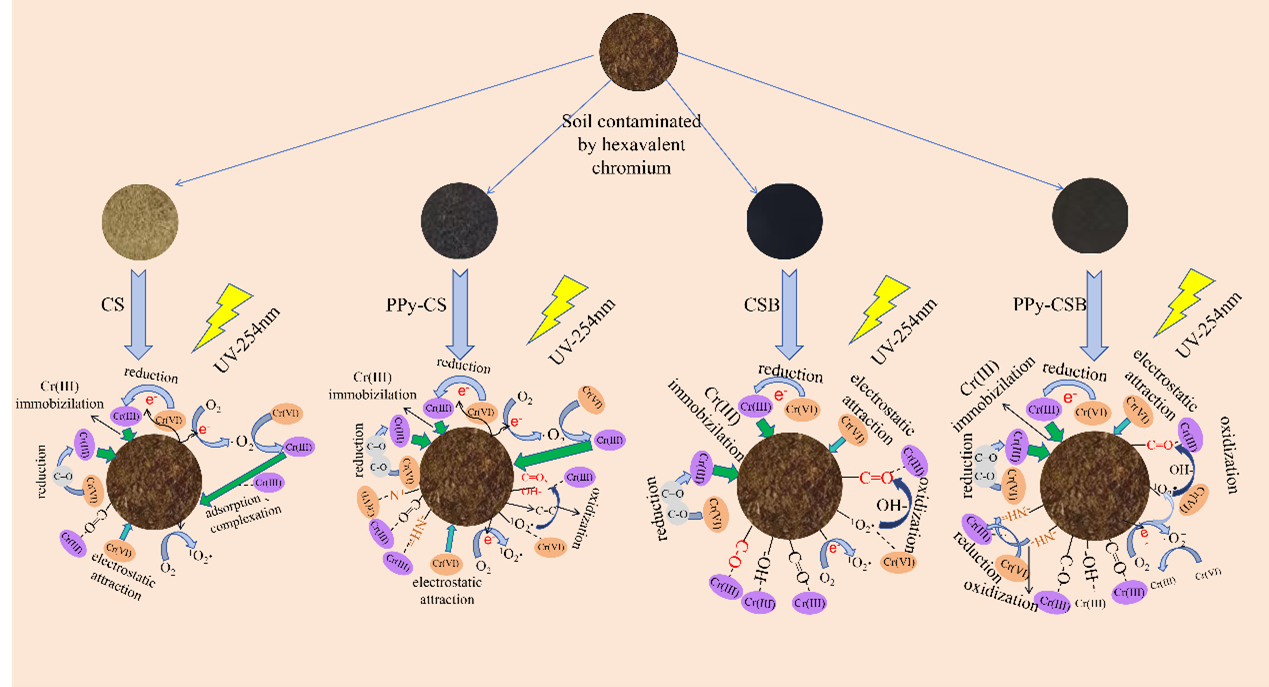
For biomass-based materials (CS/PPy-CS), the CS contained only a small number of isolated natural photosensitive groups (benzene rings and carbonyl groups), leading to a weak reduction capacity [27]. After modification with PPy, a stable conjugated long-chain structure was formed on the material surface, which could be efficiently excited to generate abundant carbon-centered free radicals under UV irradiation [28]. These radicals transferred electrons to dissolved oxygen in the soil through the electron transfer pathway, preferentially producing O2−·, accompanied by a small amount of 1O2. The strongly reductive O2−· could directly reduce Cr(VI) to low-toxic and stable Cr(III). In addition, 1O2 oxidized hydrophobic groups on the material surface to generate oxygen-containing functional groups such as hydroxyl and carboxyl groups, which further immobilized Cr(III) on the material surface via electrostatic adsorption and complexation. The possible reaction mechanism process of biomass-based materials was shown as follows.
For biochar-based materials (CSB/PPy-CSB), the CSB possessed a conjugated carbon skeleton and surface oxygen-containing functional groups formed during high-temperature pyrolysis [29]. After PPy modification, a π-π conjugation interaction was established between PPy and the biochar framework, which effectively suppressed the recombination of photogenerated electron-hole pairs and significantly boosted the generation and stabilization efficiency of free radicals [30]. The reaction was dominated by the energy transfer pathway: the UV-excited conjugated structure transferred energy to ground-state oxygen to generate a large amount of 1O2. The 1O2 oxidized surface C–OH groups to C=O groups and released electrons to reduce Cr(VI), accompanied by auxiliary reduction via O2−· produced through electron transfer. XPS results further verified that the relative content of C–OH in the system sharply dropped from 71.96% to 26.65%, while that of C=O rose to 46.26%. The generated Cr(III) was likewise stably immobilized by the oxygen-containing functional groups on the material surface. The possible reaction mechanism process of biochar-based materials was shown as follows.
In summary, biomass-based and biochar-based materials exhibited distinct remediation pathways for Cr(VI). The former was dominated by direct electron reduction mediated by O2−·, while the latter mainly relied on electron-releasing reduction via functional group oxidation induced by 1O2. Both pathways achieved the effective reduction and immobilization of Cr(VI).
3.6. Comparisons
Table 3 presented a summary of the treatment effects of different adsorbents on Cr(VI) under various conditions. The table showed that different light conditions greatly impacted the treatment effect of Cr(VI). For example, a higher power and shorter wavelength of the UV lamp generated more energy, which could improve the treatment effect of Cr(VI). However, excessive UV lamp power might raise the reaction temperature, potentially damaging the structure and functionality of remediation materials. This could lead to higher energy consumption and costs, resulting in the inefficient use of resources. Furthermore, by comparing with other literature, it was found that the majority of studies on enhancing the treatment efficacy of Cr(VI) by UV light had concentrated on Cr(VI) contamination in aqueous environments. In contrast, this study evaluated the effects of combining UV radiation with remediation materials on Cr(VI) contamination in soil and demonstrated that UV radiation effectively improved soil remediation results.
4. Conclusions
The research demonstrated that UV irradiation could effectively improve the remediation performance for the treatment of Cr(Ⅵ) contaminated soil. Under the remediation conditions of CSB, PPy-CSB, CS, and PPy-CS, the application of UV irradiation resulted in an increase of 18.73%, 7.63%, 10.93%, and 8.17% in the treatment effects of Cr(Ⅵ) in soil, respectively. EPR analysis indicated that the presence of both 1O2 and O2•- were detected in the material system following UV irradiation. Although the active oxygen pathways produced by biomass-based materials and biochar-based materials systems were different, the total amount was similar. XPS analysis revealed that without remediation agents, UV irradiation promoted the conversion of Cr(III) to Cr(VI) in soil. However, under PPy-CSB and PPy-CS remediation systems, UV irradiation could promote the conversion of Cr(VI) to Cr(III). Additionally, UV-PPy-CSB and UV-PPy-CS exhibited different oxygen reaction pathways due to variations in the distribution of carbon functional groups such as C-OH and C=O. The UV irradiation could activate the reactions between Cr(Ⅵ) and remediation agents in the soil, and its effects were almost identical to the effects of PPy-CSB. UV irradiation offered an efficient and cost-effective technological approach for the remediation of Cr(Ⅵ) contaminated soil.
Author Contributions
Yiping Guo: Conceptualization, Supervision, Writing—Review & Editing, Funding acquisition. Shihang Ni: Formal analysis, Investigation, Data curation, Writing—Original Draft. Qianqian Zhang: Data curation. Weigao Zhao: Review & Editing. Peng Liu: Review & Editing. Yunchao Dai: Review & Editing. Hui Wang: Review & Editing. All authors read and approved the final manuscript.
Funding
The authors thank for financial support from the grant Science & Technology Research and Development Plan Joint Fund in Henan Province (Grant No.222103810014), the Key R&D Special Project of Henan Province (No.241111320200), Talent introduction project of Henan Provincial Department of Science and Technology (No.HNGD2023021), and Excellent Research Funding Project for Overseas Chinese Students in 2023 sponsored by the Henan Provincial Department of Human Resources and Social Security.
Conflicts of Interest
The authors declare that they have no conflicts of interest.
References
- Ao, M.; Chen, X.T.; Deng, T.H.B.; Sun, S.S.; Tang, Y.T.; Morel, J.L.; Qiu, R.L.; Wang, S.Z. Chromium biogeochemical behaviour in soil-plant systems and remediation strategies: A critical review. J. Hazard. Mater. 2022a, 424, 127233. [Google Scholar] [CrossRef]
- Ao, M.; Sun, S.S.; Deng, T.H.B.; Zhang, F.; Liu, T.; Tang, Y.T.; Li, J.J.; Wang, S.Z.; Qiu, R.L. Natural source of Cr(VI) in soil: The anoxic oxidation of Cr(III) by Mn oxides. J. Hazard. Mater. 2022b, 433, 128805. [Google Scholar] [CrossRef] [PubMed]
- Xia, X.; Wu, S.J.; Zhou, Z.J.; Wang, G.J. Microbial Cd(II) and Cr(VI) resistance mechanisms and application in bioremediation. J. Hazard. Mater. 2021, 401, 123685. [Google Scholar] [CrossRef] [PubMed]
- Bolanos-Benitez, V.; Hullebusch, E.D.V.; Birck, J.-L.; Garnier, J.; Lens, P.N.L.; Tharaud, M.; Quantin, C.; Sivry, Y. Chromium mobility in ultramafic areas affected by mining activities in Barro Alto massif, Brazil: An isotopic study. J. Chem. Geol. 2021, 561, 120000. [Google Scholar] [CrossRef]
- Wang, Z.; Zhang, W.J.; Wang, H.H.; Wang, Z.W.; Chang, J. Oxidation of acetylsalicylic acid in water by UV/O3 process: Removal, byproduct analysis, and investigation of degradation mechanism and pathway. J. Environ. Chem. Eng. 2021, 9(5), 106259. [Google Scholar] [CrossRef]
- Zhang, T.; Tian, G.P.; Hu, X.R.; Xie, Y.L.; Zhang, L.M.; Bian, B. Intensity analysis of chromium cycling in south Jiangsu region of China. J. Chemosphere. 2021, 263, 128138. [Google Scholar] [CrossRef] [PubMed]
- Wang, Q.; Wen, J.; Hu, X.H.; Xing, L.; Yan, C.Y. Immobilization of Cr(VI) contaminated soil using green-tea impregnated attapulgite. J. Clean. Prod. 2021, 278, 123967. [Google Scholar] [CrossRef]
- Liang, J.L.; Huang, X.M.; Yan, J.W.; Li, Y.Y.; Zhao, Z.W.; Liu, Y.Y.; Ye, J.Y.; Wei, Y.M. A review of the formation of Cr(VI) via Cr(III) oxidation in soils and groundwater. J. Sci. Total Environ. 2021, 774, 145762. [Google Scholar] [CrossRef]
- Liu, J.W.; Sun, S.Y.; Zhang, H.X.; Kong, Q.; Li, Q.; Yao, X.D. Remediation materials for the immobilization of hexavalent chromium in contaminated soil: Preparation, applications, and mechanisms. J. Environ. Res. 2023, 237, 116918. [Google Scholar] [CrossRef] [PubMed]
- Xia, Y.; Liu, H.J.; Guo, Y.C.; Liu, Z.G.; Jiao, W.T. Immobilization of heavy metals in contaminated soils by modified hydrochar: Efficiency, risk assessment and potential mechanisms. J. Sci. Total Environ. Total Environ. 2019, 685, 1201–1208. [Google Scholar] [CrossRef] [PubMed]
- Dhaliwal, S.S.; Singh, J.; Taneja, P.K.; Mandal, A. Remediation techniques for removal of heavy metals from the soil contaminated through different sources: a review. J. Environ. Sci. Pollut. Res. 2020, 27(2), 1319–1333. [Google Scholar] [CrossRef] [PubMed]
- Sun, Y.; Yan, X.J.; Zhang, Y.; Du, W.; Lu, Jf. Feng, Main Modification Methods of Biochar and Its Application in Pollutant Removal. J. Contemp. Chem. Ind. 2019, 48(08), 1700–1703. [Google Scholar] [CrossRef]
- Wang, S.W.; Zheng, X.Y.; Xiao, D.; Zheng, L.L.; Yang, Y.; Ai, B.L.; Zhong, S.; Sheng, Z.W. Research progress of production, modification and application in environment remediation of biochar. J. Chem. Ind. Eng. Prog. 2020, 39(S2), 352–361. [Google Scholar] [CrossRef]
- Novais, S.V.; Zenero, M.D.O.; Barreto, M.S.C.; Montes, C.R.; Cerri, C.E.P. Phosphorus removal from eutrophic water using modified biochar. J. Sci. Total Environ. 2018, 633, 825–835. [Google Scholar] [CrossRef] [PubMed]
- Li, Q.; Ding, W.C.; Yong, Y.; Zeng, X.L.; Gao, Y.T. Effects of Ultraviolet Modification on Physicochemical Property and Adsorption Performance of Biochar. J. Nanosci. Nanotechnol. Lett. 2016, 8(11), 978–984. [Google Scholar] [CrossRef]
- Li, Q.; Gao, Y.T.; Jiang, W.; Yong, Y. Stabilization of Cd contaminated soil by ultraviolet irradiation modified biochar. J. Chin. J. Environ. Eng. 2017, 11(10), 5708–5714. [Google Scholar] [CrossRef]
- Li, N.; Rao, F.; He, L.L.; Yang; Bao, S.M.; Huang, C.J.; Bao, M.Z.; Chen, Y.H. Evaluation of biochar properties exposing to solar radiation: A promotion on surface activities. J. Chem. Eng. 2020, 384, 123353. [Google Scholar] [CrossRef]
- Li, B.; Yang, L.; Wang, C.Q.; Zhang, Q.P.; Liu, Q.C.; Li, Y.D.; Xiao, R. Adsorption of Cd(II) from aqueous solutions by rape straw biochar derived from different modification processes. J. Chemosphere. 2017, 175, 332–340. [Google Scholar] [CrossRef] [PubMed]
- Guo, Y.P.; Feng, W.J.; Zhang, Q.Q.; Shao, W.F.; Tao, X.K.; Zhao, W.G.; Kim, S.H.; Surendra, K.C.; Khanal, S.K. Efficient Remediation of Cr(VI) in Soil by Polypyrrole Modified Corn-Stover Biochar. J. Water Air Soil Pollut. 2025, 236(7), 403. [Google Scholar] [CrossRef]
- Yang, C.C.; Dao, K.C.; Lin, Y.S.; Cheng, T.Y.; Chen, K.F.; Tsai, Y.P. Impacts of Mixing Mode on Photocatalytic Reduction of Hexavalent Chromium over Titanium Dioxide Nanomaterial under Various Environmental Conditions. Water 2021, 13(16), 2291. [Google Scholar] [CrossRef]
- Li, Z.B.; Hu, J.W.; Zhou, C.; Lin, Y.M.; Li, L.Y.; Huang, X.F.; Jia, M. Using the Modified Tessier Method to Analyze Antimony Speciation in Suspended Solids in Mining Wastewater. J. Adv. Mat. Res. 2014, 955-959, 1423–1428. [Google Scholar] [CrossRef]
- Orecchio, S.; Polizzotto, G. Fractionation of mercury in sediments during draining of Augusta (Italy) coastal area by modified Tessier method. J. Microchem J. 2013, 110, 452–457. [Google Scholar] [CrossRef]
- Qin, L.Z.; Shin, D.H. Effects of UV light treatment on functional group and its adsorption capacity of biochar. Energies 2023, 16(14), 5508. [Google Scholar] [CrossRef]
- Zhang, Y.; Xu, M.; He, R.; Zhao, J.; Kang, W.; Lv, J. … of pyrolysis temperature on the activated permonosulfate degradation of antibiotics in nitrogen and sulfur-doping biochar: Key role of environmentally persistent free …. Chemosphere 2022. [Google Scholar] [CrossRef] [PubMed]
- Bi, D.; Yin, M.; Huang, F.; Zhang, J.; Yi, W. Evolution and prediction model of environmentally-persistent free radicals in biomass three-component pyrolytic carbon with pyrolysis temperature. Ind. Crops Prod. 2023, 206, 117643. [Google Scholar] [CrossRef]
- Wang, C.H.; Gu, L.F.; Liu, X.Y.; Zhang, X.Y.; Cao, L.Y.; Hu, X.X. Sorption behavior of Cr(VI) on pineapple-peel-derived biochar and the influence of coexisting pyrene. J. Int. Biodeterior. Biodegrad. 2016, 111, 78–84. [Google Scholar] [CrossRef]
- Xie, J.; Latif, J.; Yang, K.; Wang, Z.; Zhu, L.; Yang, H.; Qin, J.; Ni, Z.; Jia, H.; Xin, W.; Li, X. A state-of-art review on the redox activity of persistent free radicals in biochar. Water Res. 2024, 255, 121516. [Google Scholar] [CrossRef] [PubMed]
- Gao, Y.; Sun, Y.; Song, W.; Jia, Y.; Li, A.; Wang, S. Intrinsic properties of biochar for electron transfer. Chem. Eng. J. 2023, 475, 146356. [Google Scholar] [CrossRef]
- Xu, Z.; Xu, X.; Zhang, Y.; Yu, Y.; Cao, X. Pyrolysis-temperature depended electron donating and mediating mechanisms of biochar for Cr(VI) reduction. J. Hazard. Mater. 2020, 388, 121794. [Google Scholar] [CrossRef] [PubMed]
- He, X.; Zheng, N.; Hu, R.; Hu, Z.; Yu, J. C. Hydrothermal and Pyrolytic Conversion of Biomasses into Catalysts for Advanced Oxidation Treatments. Adv. Funct. Mater. 2020, 31(7). [Google Scholar] [CrossRef]
- Tang, Z.; Kong, Y.F.; Zhao, S.; Jia, H.Z.; Vione, D.; Kang, Y.M.; Gao, P. Enhancement of Cr(VI) decontamination by irradiated sludge biochar in neutral conditions: Evidence of a possible role of persistent free radicals. J. Sep. Purif. Technol. 2021, 277, 119414. [Google Scholar] [CrossRef]
- Peng, Z.Y.; Liu, X.M.; Chen, H.K.; Liu, Q.L.; Tang, J.C. Characterization of ultraviolet-modified biochar from different feedstocks for enhanced removal of hexavalent chromium from water. J. Water Sci. Technol. 2019, 79(9), 1705–1716. [Google Scholar] [CrossRef] [PubMed]
- Fatima, R.; Kim, J.O. Photocatalytic reduction of chromium by titanium metal organic frameworks in the presence of low-molecular-weight organic acids under UV and visible light. J. J. Environ. Chem. Eng. 2022, 10(6), 108796. [Google Scholar] [CrossRef]
- Ibrahim, I.; Kaltzoglou, A.; Athanasekou, C.; Katsaros, F.; Devlin, E.; Kontos, A.G.; Ioannidis, N.; Perraki, M.; Tsakiridis, P.; Sygellou, L.; Antoniadou, M.; Falaras, P. Magnetically separable TiO2/CoFe2O4/Ag nanocomposites for the photocatalytic reduction of hexavalent chromium pollutant under UV and artificial solar light. J. Chem. Eng. journal. 2020, 381, 122730. [Google Scholar] [CrossRef]
Figure 1.
TCLP-Cr (Ⅵ) changes with and without UV irradiation under no remediation materials.
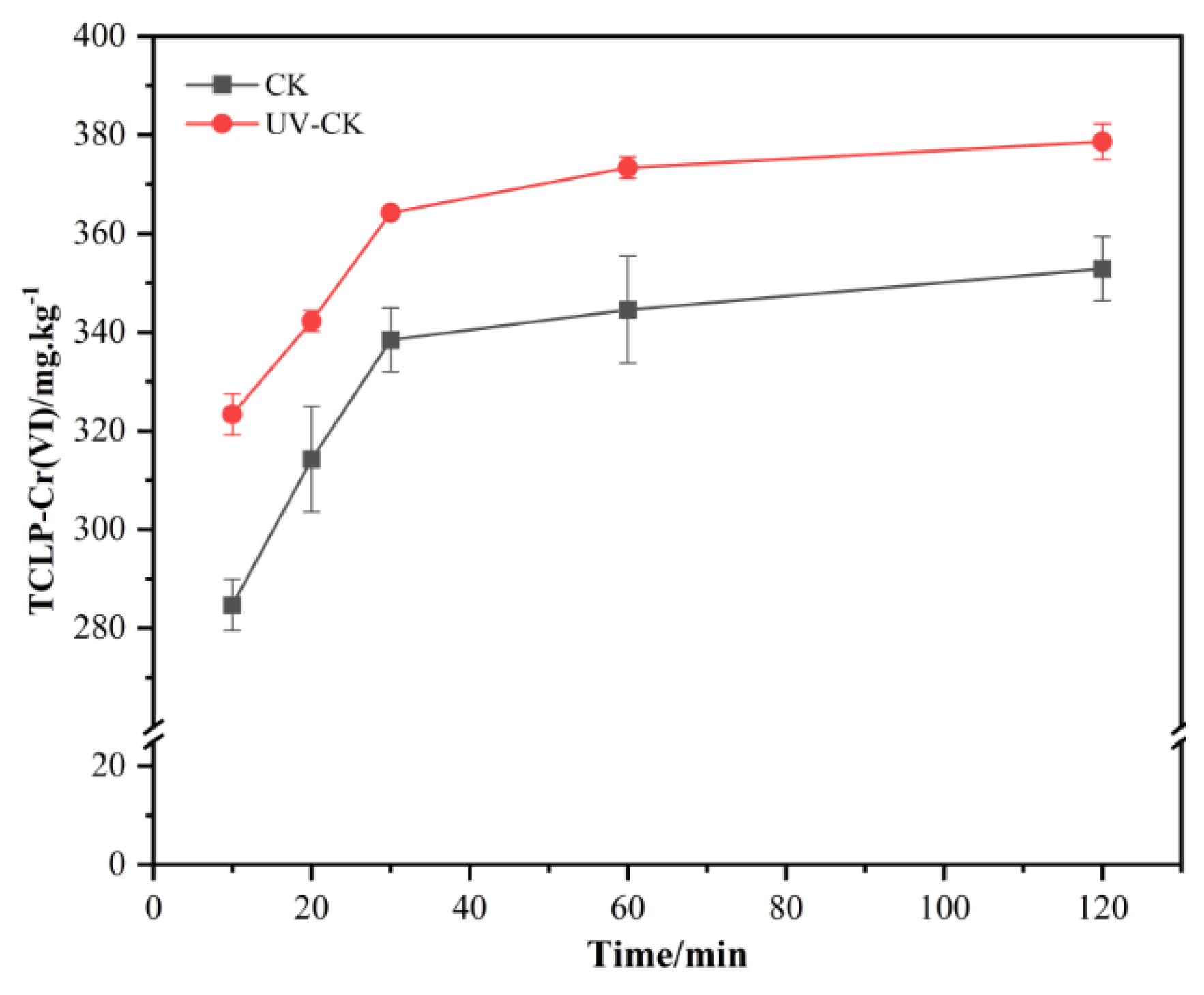
Figure 2.
Adsorption capacity of Cr(Ⅵ) in contaminated soil with and without UV irradiation under different remediation materials. (a) adsorption capacity, (b) stable efficiency.
Figure 2.
Adsorption capacity of Cr(Ⅵ) in contaminated soil with and without UV irradiation under different remediation materials. (a) adsorption capacity, (b) stable efficiency.
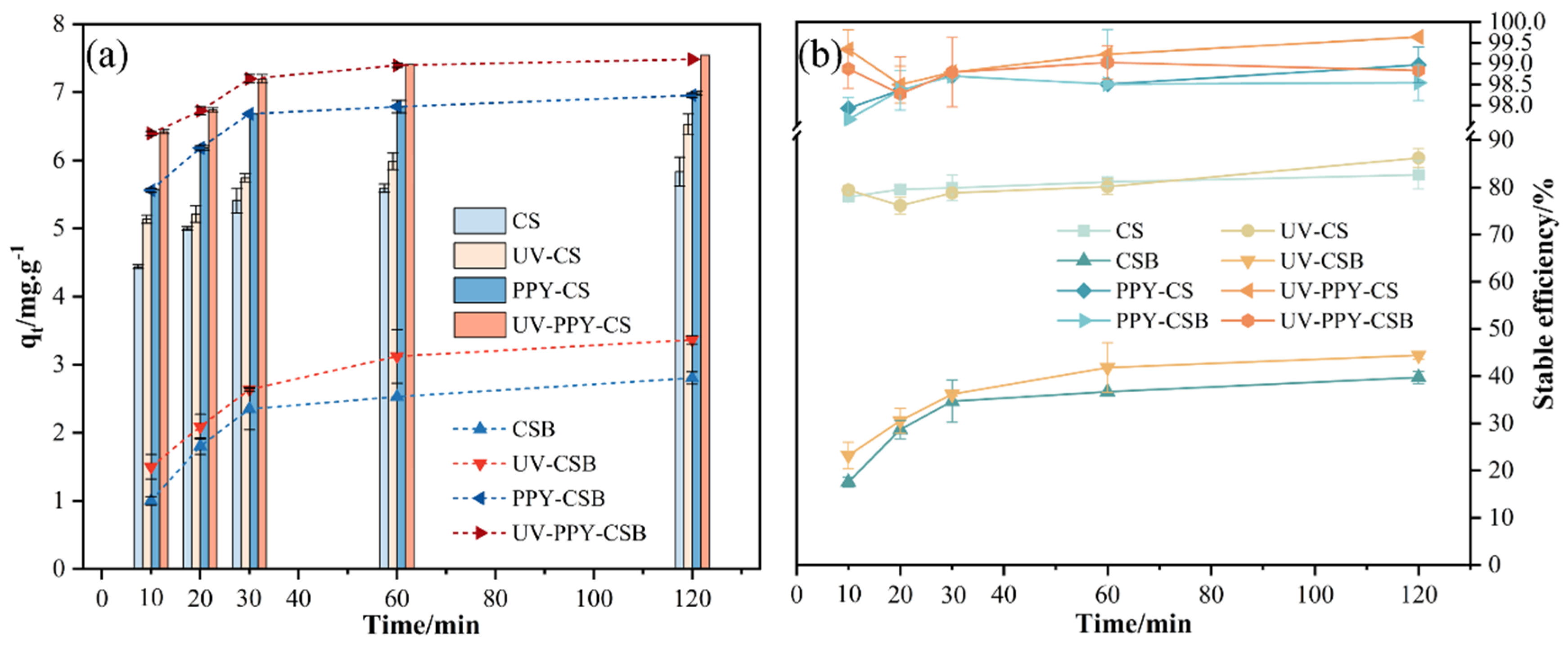
Figure 3.
XPS of contaminated soil before and after the UV under no remediation.
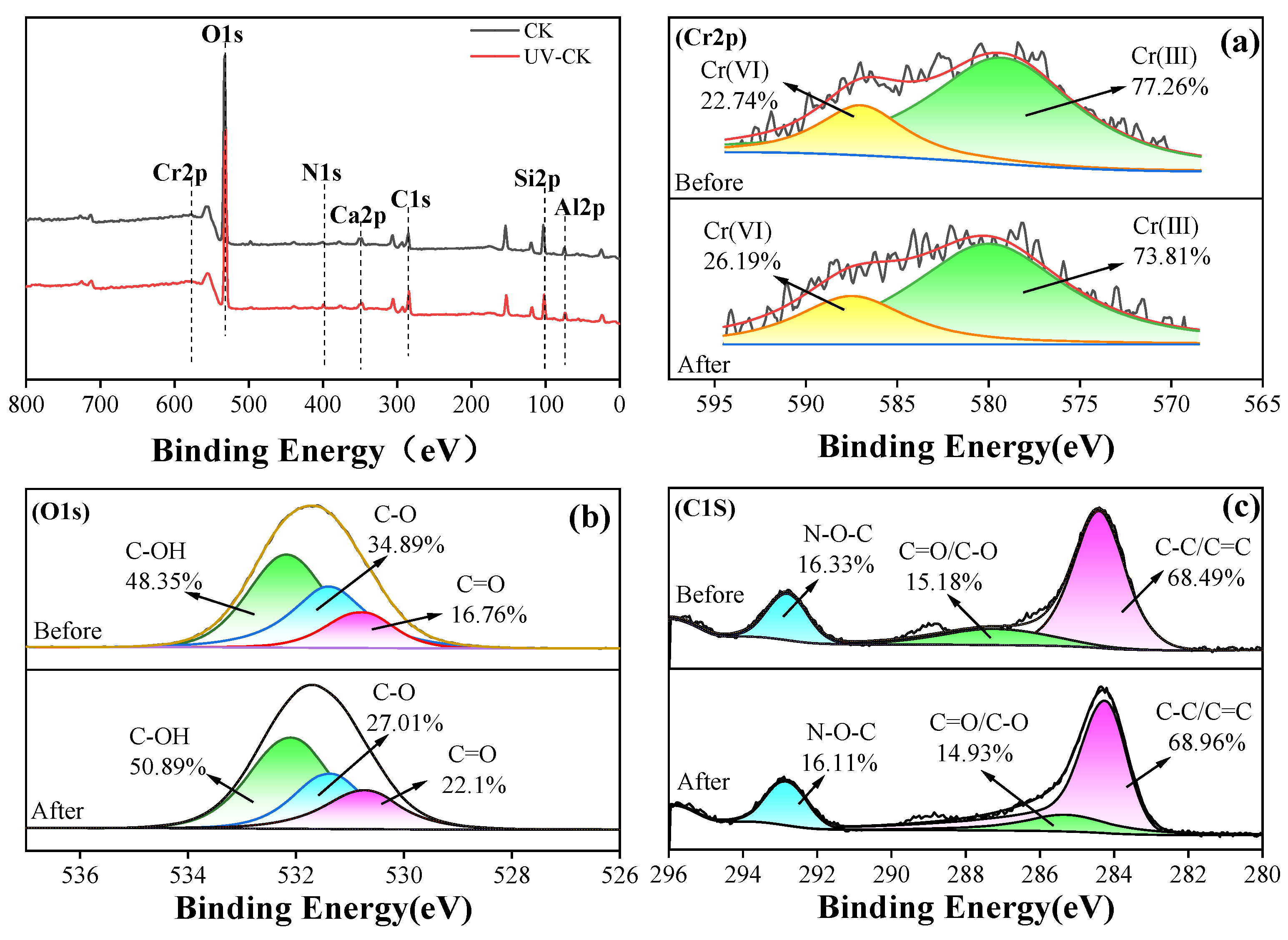
Figure 4.
XPS spectra of contaminated soil before and after UV irradiation under PPy-CSB remediation.
Figure 4.
XPS spectra of contaminated soil before and after UV irradiation under PPy-CSB remediation.
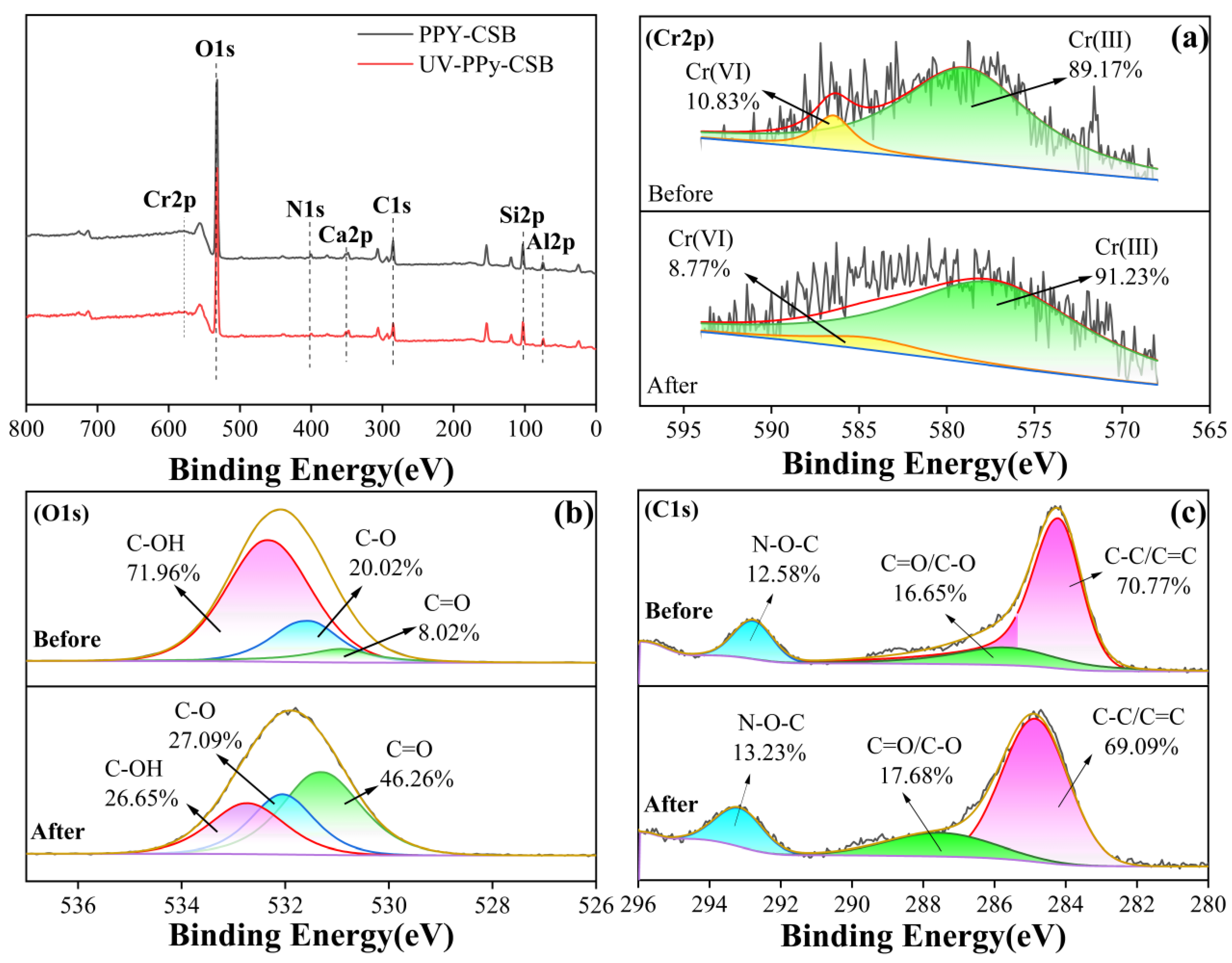
Figure 5.
XPS spectra of contaminated soil with UV irradiation under the PPy-CSB and PPy-CS.
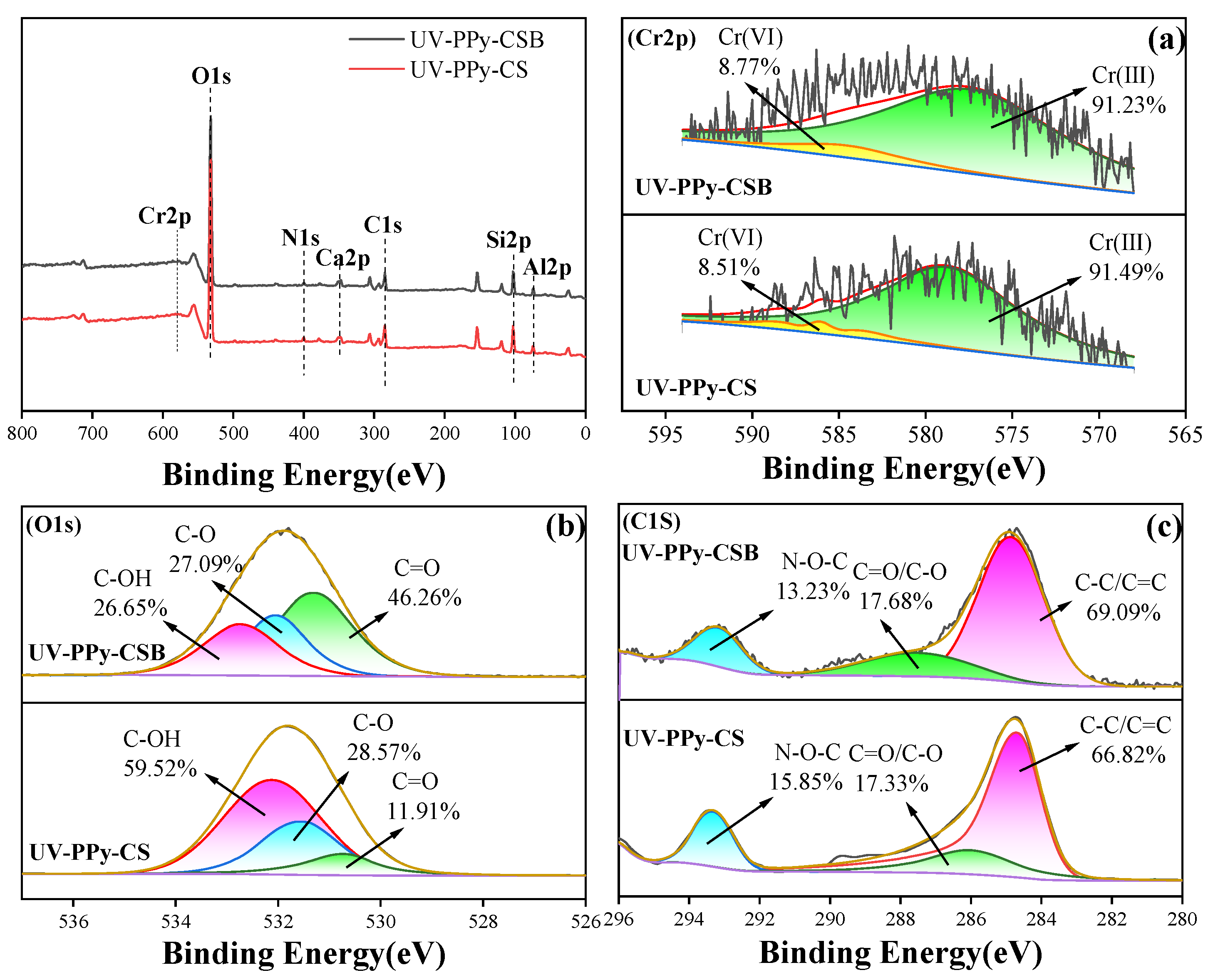
Figure 6.
EPR spectra of contaminated soil under repair material under UV irradiation. (a) Intrinsic persistent free radicals,(b) Singlet oxygen radicals, (c) Superoxide radicals.
Figure 6.
EPR spectra of contaminated soil under repair material under UV irradiation. (a) Intrinsic persistent free radicals,(b) Singlet oxygen radicals, (c) Superoxide radicals.
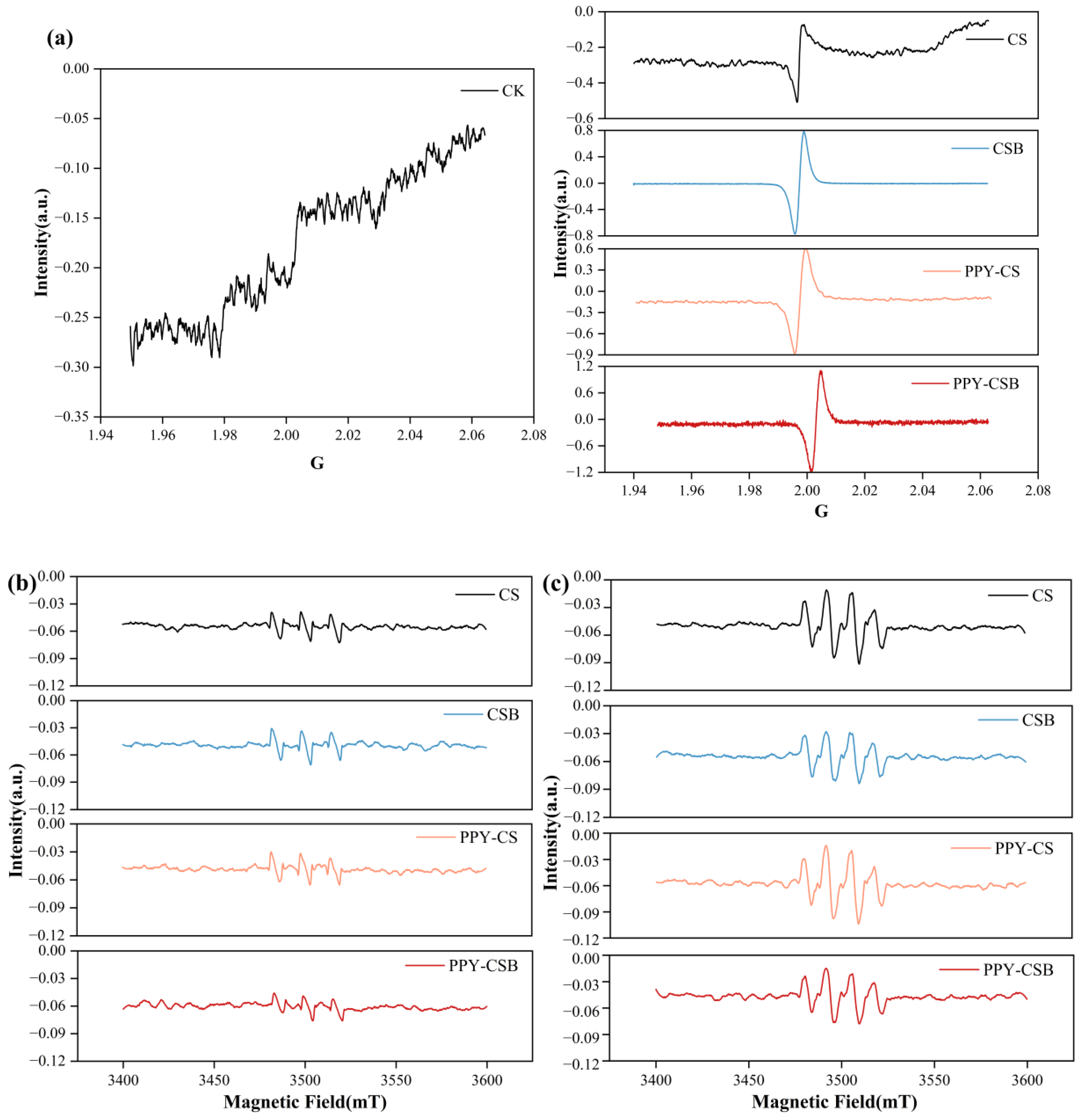
Figure 7.
Infrared spectra of adsorbed material before and after ultraviolet irradiation.
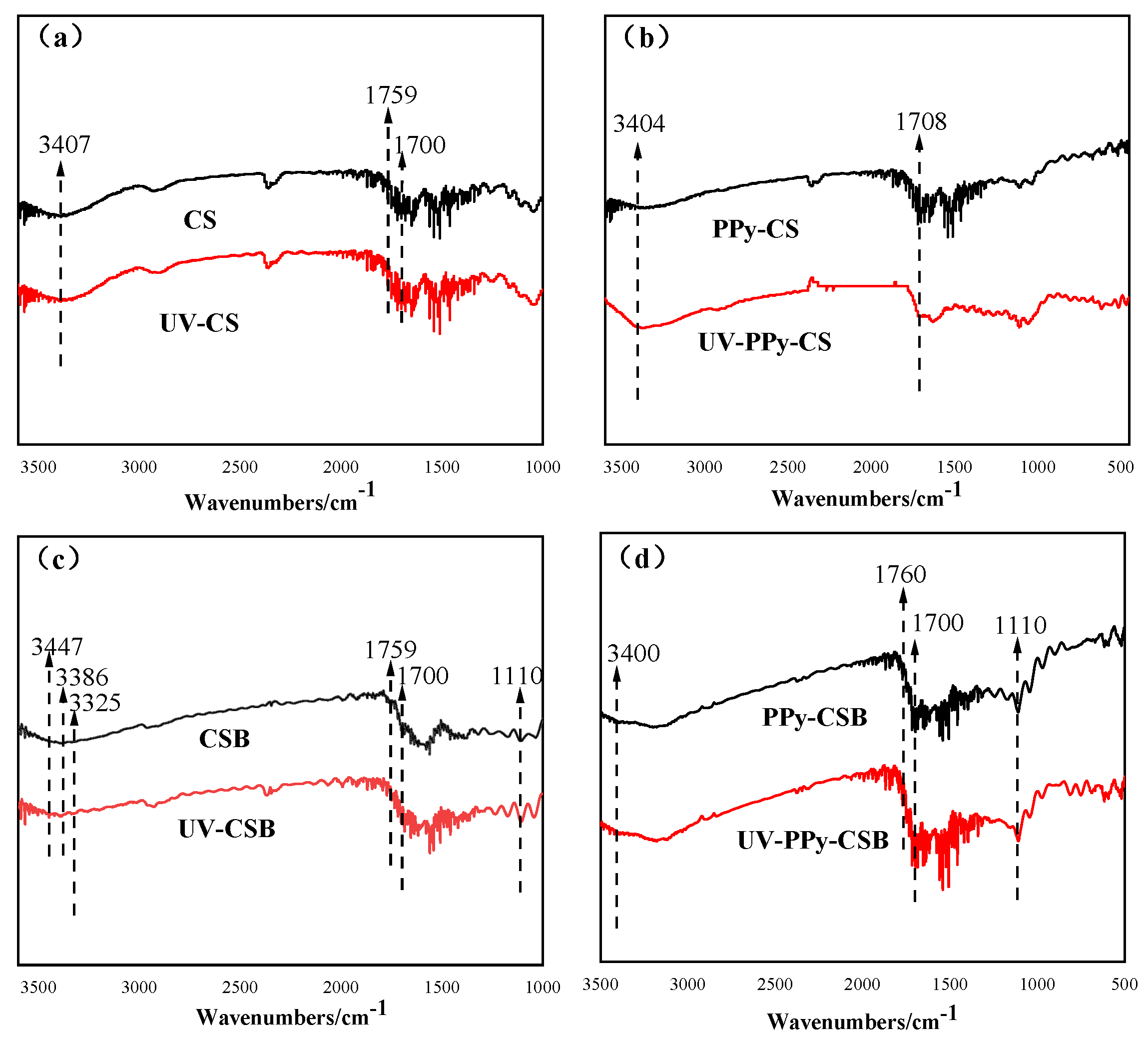

Table 1.
Basic properties of the background soil.
| Basic indicators | Content |
| pH | 7.8 ± 0.08 |
| Alkaline nitrogen(mg·kg-1) | 17.85 ± 0.71 |
| Organic matter(g·kg-1) | 10.23 ± 0.12 |
| Soil capacity(g·cm-3) | 1.3 ± 0.09 |
| Water content(%) | 2.13 ± 3.20 |
| Total Pb(mg·kg-1) | 3.87 ± 0.24 |
| Total Cu(mg·kg-1) | 8.67 ± 0.53 |
| Total Cr(mg·kg-1) | 34.11 ± 2.36 |
| Cr(Ⅵ(mg·kg-1) | - |
Table 2.
Basic properties of the simulated contaminated soil.
| Basic indicators | Cr(Ⅵ) concentrations |
| Testing total Cr(Ⅵ) concentrations (mg·kg-1) | 582.36 ± 4.12 |
| pH | 8.13 ± 0.04 |
| Alkaline nitrogen(mg·kg-1) | 17.56 ± 0.56 |
| TCLP-Cr(Ⅵ) (mg·kg-1) | 437.71 ± 2.26 |
| Total Cr(Ⅵ) concentrations (mg·kg-1) after one week | 512.73 ± 3.06 |
Table 3.
Comparison of the adsorption capacity of chromium by UV radiation.
| Adsorbents | Light conditions | Pollution Type | Qm (mg·g-1) |
Refer |
| Sludge biochar | Deuterium lamp with a power of 4W and a wavelength of 190-400nm, irradiation time of 6h, irradiation distance of 15cm. | Water pollution | 1.97 | [31] |
| Corn straw biochar(BC) | Use a 250W UV lamp with a wavelength of 365nm, an irradiation time of 24h and an irradiation distance of 40mm. | Water pollution | 20.04 | [32] |
| Titanium metal organic frameworks (MIL-125(Ti)+TA) |
Use a UV lamp with a power of 64W and a wavelength of 420nm, an irradiation time of 2h. | Water pollution | 9.94 | [33] |
| TiO2/CoFe2O4/Ag nanocomposites | Use of UV lamps with a power of 120W and a wavelength of 350-390nm. | Water pollution | 47.55 | [34] |
| PPy-CS | The use of power 30W, wavelength of 254nm ultraviolet lamp, irradiation time of 2h, irradiation distance of 30cm. | Soil pollution | 7.55 | This Work |
| PPy-CSB | The use of power 30W, wavelength of 254nm ultraviolet lamp, irradiation time of 2h, irradiation distance of 30cm. | Soil pollution | 7.48 | This Work |
Disclaimer/Publisher’s Note: The statements, opinions and data contained in all publications are solely those of the individual author(s) and contributor(s) and not of MDPI and/or the editor(s). MDPI and/or the editor(s) disclaim responsibility for any injury to people or property resulting from any ideas, methods, instructions or products referred to in the content. |
© 2026 by the authors. Licensee MDPI, Basel, Switzerland. This article is an open access article distributed under the terms and conditions of the Creative Commons Attribution (CC BY) license (http://creativecommons.org/licenses/by/4.0/).
Copyright: This open access article is published under a Creative Commons CC BY 4.0 license, which permit the free download, distribution, and reuse, provided that the author and preprint are cited in any reuse.