

Submitted:
06 August 2026
Posted:
07 August 2026
You are already at the latest version
Abstract
The decarbonization of transport and aviation sectors requires renewable fuels capable of reducing greenhouse gas emissions while maintaining compatibility with existing infrastructures. This review examines the technological evolution of renewable liquid fuels from biodiesel (FAME) to hydrotreated vegetable oil (HVO) and sustainable aviation fuels (SAF), highlighting biodiesel as the industrial and technological foundation upon which the most mature hydrocarbon fuel pathways have been developed. Biodiesel established the feedstock supply chains, processing technologies, quality standards, and regulatory frameworks that subsequently enabled the emergence of HVO and HEFA-SAF. HVO represents a major advancement over biodiesel by converting lipid-based feedstocks into fully deoxygenated paraffinic hydrocarbons through hydrotreatment, thereby overcoming limitations related to stability, fuel quality, and engine compatibility. Building upon similar feedstocks and upgrading principles, SAF extends this evolution toward aviation applications through pathways such as HEFA, Fischer–Tropsch (FT), Alcohol-to-Jet (ATJ), and Power-to-Liquid (PtL). The review integrates bibliometric analysis, fuel properties, combustion behavior, emission characteristics, production pathways, and techno-economic considerations. Results show that HVO research is largely focused on fuel upgrading and combustion optimization, whereas SAF research increasingly addresses system-level challenges, including feedstock availability, lifecycle emissions, renewable hydrogen production, and large-scale deployment. This transition reflects a broader shift from fuel-centered optimization to energy-system integration. Ultimately, the analysis suggests that SAF should be understood as the latest stage of a technological trajectory initiated by biodiesel, with future progress dependent on advances in renewable energy, hydrogen infrastructure, carbon management, and supportive policy frameworks.
Keywords:
combustion
; emissions
; life cycle assessment
; power-to-liquid
; net-zero aviation
; energy systems
1. Introduction
1.1. Motivation for Sustainable Aviation Fuels
The decarbonization of the transport sector represents one of the most pressing challenges in the global transition toward climate neutrality. While electrification has emerged as a viable pathway for road transport, sectors such as aviation remain particularly difficult to decarbonize due to strict energy density requirements, long operational lifetimes, and the lack of scalable alternative propulsion systems. Aviation alone accounts for approximately 2–3% of global CO₂ emissions, a share that is expected to increase as air traffic demand continues to grow worldwide. In this context, reducing emissions from aviation is essential to achieving international climate targets, including net-zero emissions by mid-century [1].
Among the available decarbonization strategies, sustainable aviation fuels (SAFs) have emerged as the most promising short- to medium-term solution. Unlike alternative propulsion technologies such as hydrogen or battery-electric systems (which require substantial redesign of aircraft and infrastructure) SAFs are liquid hydrocarbon fuels that can be used directly in existing engines as drop-in replacements or blends with conventional jet fuel. This compatibility allows SAFs to leverage the current aviation infrastructure, making them particularly attractive for rapid deployment. Life cycle assessments have shown that SAFs can reduce greenhouse gas emissions by 50–80% compared to fossil-based jet fuels, depending on the feedstock and production pathway. However, despite their potential, SAFs currently represent only a marginal fraction of total jet fuel consumption due to high production costs and limited supply [2].
Within the broader family of renewable drop-in fuels, hydrotreated vegetable oil (HVO) has played a pivotal role in demonstrating the feasibility of substituting fossil fuels with renewable alternatives. HVO is produced via the hydrodeoxygenation of lipid-based feedstocks, such as vegetable oils, waste fats, and greases, resulting in paraffinic hydrocarbons with properties similar to conventional fuels. As a first-generation renewable fuel, HVO has achieved significant commercial maturity, particularly in the road transport sector. Its relatively simple production route and compatibility with existing engines have made it a benchmark for renewable fuel deployment. Nonetheless, HVO is characterized by a predominantly paraffinic composition, lacking aromatic compounds that are essential for certain fuel performance and material compatibility requirements in aviation. This compositional limitation has restricted its direct application in aviation systems and highlights the need for more complex fuel formulations, such as those required for SAF.
The development of SAF extends beyond the scope of HVO, encompassing a diverse range of production pathways and feedstocks. Current ASTM-approved SAF technologies include hydroprocessed esters and fatty acids (HEFA), Fischer–Tropsch (FT) synthesis, and alcohol-to-jet (ATJ) conversion processes. Among these, HEFA is the most technologically mature route, benefiting from its similarity to HVO processing, while FT pathways offer greater flexibility in feedstock selection and lower life cycle emissions. In addition to bio-based SAF, synthetic pathways based on power-to-liquid (PtL) technologies have gained increasing attention. These processes utilize renewable electricity to produce hydrogen, which is subsequently combined with captured CO₂ to generate synthetic hydrocarbons. PtL fuels have the potential to achieve near-zero life cycle emissions, but their deployment is currently limited by high energy requirements and production costs [2].
1.2. From Biodiesel to Sustainable Aviation Fuels: A Technological Lineage
The development of renewable liquid fuels can be interpreted as a continuous technological lineage originating from biodiesel production and progressively evolving toward advanced hydrocarbon fuels. Rather than representing isolated or competing technologies, biodiesel (FAME), hydrotreated vegetable oil (HVO), and hydroprocessed esters and fatty acids sustainable aviation fuel (HEFA-SAF) can be viewed as successive stages in the maturation of lipid-based fuel systems.
The first stage was characterized by biodiesel production through transesterification of vegetable oils, animal fats, and waste lipids. Beyond providing one of the first commercially viable renewable fuels, this stage established feedstock supply chains, pretreatment technologies, quality standards, and industrial infrastructure [3]. The second stage emerged with HVO, which employed many of the same feedstocks but introduced catalytic hydrotreatment and deoxygenation processes to produce fully compatible paraffinic hydrocarbons with superior fuel properties. Subsequently, the third stage evolved toward HEFA-SAF, extending the same feedstock base and hydrotreatment principles to aviation applications through adapted refinery configurations and additional upgrading steps. Finally, emerging SAF pathways such as Fischer-Tropsch (FT), Alcohol-to-Jet (ATJ), and Power-to-Liquid (PtL) represent a fourth stage in which the sector progressively moves beyond its original biodiesel paradigm toward more diverse feedstocks and increasingly complex energy-system integration [4].
From this perspective, HVO should not be understood solely as an alternative to biodiesel, but rather as a technological upgrading of the biodiesel value chain, while HEFA-SAF represents its extension into the aviation sector. This evolutionary framework highlights the historical and technological importance of biodiesel as the foundation upon which the most mature renewable hydrocarbon fuel pathways have been developed.
1.3. Technical, Economic and System-Level Challenges
Despite the significant advances in fuel synthesis and processing, the transition from HVO to SAF represents more than a simple technological evolution. While HVO primarily addresses the optimization of combustion properties and emissions at the engine level, SAF introduces a broader set of challenges that span multiple scales, from molecular design to global energy systems. At the combustion level, both HVO and SAF have demonstrated the ability to reduce particulate matter and soot emissions relative to conventional fuels [5]. However, these benefits are often accompanied by shifts in particle size distributions, with an increased proportion of ultrafine particles that may have different environmental and health implications. Furthermore, variations in fuel composition, including the presence or absence of aromatics, influence ignition characteristics, spray behavior, and emissions profiles, pointing out the relevance of understanding the relationship between fuel properties and combustion performance.
At the production level, the limitations of feedstock availability play a critical role in determining the scalability of renewable fuels. HVO and HEFA-based SAF rely heavily on lipid-derived feedstocks, which are constrained by competition with food production, land use considerations, and limited global supply. Even under optimistic scenarios, biomass-based pathways are unlikely to fulfill long-term aviation fuel demand [6]. Studies have shown that while current bio-based technologies may meet short-term targets, biomass availability is expected to become a limiting factor beyond 2030, requiring the development of alternative pathways such as PtL. In contrast, synthetic SAF derived from CO₂ offers theoretically unlimited scalability but introduces new challenges related to energy demand, infrastructure requirements, and system integration [2].
Economic considerations further complicate the deployment of SAF. Current production costs for SAF remain significantly higher than those of conventional jet fuel, often ranging from two to five times higher depending on the pathway and feedstock. These cost disparities are driven by several factors, including feedstock prices, capital expenditure, and the high energy intensity of conversion processes. The reliance on renewable electricity in PtL pathways, in particular, shifts the bottleneck from feedstock availability to energy supply, making the large-scale deployment of SAF dependent on the expansion of renewable energy systems [1].
Apart from technical and economic aspects, the transition toward SAF also involves systemic challenges related to logistics, policy, and societal acceptance. The development of supply chains for feedstock collection, fuel production, and distribution introduces additional complexity, particularly in the context of global aviation operations. Policy mechanisms such as mandates, subsidies, and carbon pricing play a critical role in driving SAF adoption, while public perception and willingness to pay can influence market demand. These factors highlight that the viability of SAF cannot be assessed solely at the level of fuel properties or production technologies but must be considered within a broader socio-technical framework.
1.4. Scope and Aim of This Review
To contextualize the evolution of renewable fuels discussed in this review, Table 1 summarizes the key differences between biodiesel, HVO, and SAF in terms of composition, performance, and technological maturity.
The progression from biodiesel to HVO and SAF reflects both an improvement in fuel quality and an increase in system complexity. Biodiesel, as a first-generation biofuel, is characterized by its high oxygen content and limited compatibility with existing fuel systems, which restricts its application despite its relatively simple production. In contrast, HVO eliminates these limitations through hydrotreatment processes, producing paraffinic hydrocarbons with excellent drop-in compatibility and improved combustion performance, thus representing a mature and commercially established solution. However, while HVO significantly enhances fuel properties, it remains constrained by feedstock availability and is primarily limited to lipid-based resources.
SAF represents a further evolution, not only in terms of fuel performance but also in terms of technological diversity and systemic implications. Unlike HVO, SAF encompasses multiple production pathways, including HEFA, Fischer–Tropsch, alcohol-to-jet, and power-to-liquid technologies, each with distinct feedstocks and process requirements. This diversity enables higher emission reduction potential but also introduces challenges related to scalability, cost, and energy demand. The table clearly illustrates this transition from relatively simple, fuel-centered solutions to more complex, system-dependent approaches. In particular, the increasing technological maturity gap and the shift from moderate to very high emission reduction potential highlight the growing importance of integrating renewable energy, hydrogen production, and carbon management strategies. Thus, the evolution from biodiesel to HVO and SAF is not only a matter of improving fuel properties, but also a transition toward a broader, multi-dimensional framework where technological, economic, and environmental factors are tightly interconnected.
In this context, the present review aims to provide a comprehensive and integrated analysis of renewable drop-in fuels, bridging the gap between HVO and SAF. Unlike previous studies that focus on specific aspects such as combustion, fuel synthesis, or life cycle assessment, this work adopts a multiscale perspective that links fuel chemistry, atomization, combustion behavior, emissions, production pathways, economic factors, and system-level constraints. By examining the transition from HVO to SAF, this review identifies the key drivers and limitations of sustainable fuel deployment and highlights the shift from combustion-level optimization to system-level integration as the defining challenge for future aviation decarbonization (see Figure 1).
As observed, this figure presents a conceptual framework that captures the progressive evolution of renewable fuels from biodiesel-derived pathways to sustainable aviation fuels (SAF), highlighting both technological advancements and the increasing complexity of decarbonization strategies. At the initial stage, biodiesel, commonly represented by fatty acid methyl esters (FAME), is characterized by intrinsic physicochemical limitations associated with its oxygenated nature. These include poor oxidative stability, high viscosity, and unfavorable cold-flow properties, which restrict its direct use as a drop-in fuel. Consequently, biodiesel represents a baseline approach in renewable fuel development, where substitution is achieved at the cost of performance trade-offs.
The transition to hydrotreated vegetable oil (HVO) marks a significant step forward, as it involves the catalytic upgrading of lipid-based feedstocks through hydrotreatment processes such as hydrodeoxygenation, decarboxylation, and decarbonylation. These reactions remove oxygenated functionalities and yield paraffinic hydrocarbons with properties closely resembling those of conventional fuels. As a result, HVO achieves full compatibility with existing fuel infrastructures and engines, establishing it as a technologically mature and commercially viable drop-in solution. Importantly, this stage reflects a research focus centered on fuel-level optimization, where the primary objectives are to improve combustion characteristics, reduce emissions, and enhance fuel stability.
Beside HVO, the development of SAF introduces an additional layer of complexity driven by the stringent requirements of aviation fuels. Unlike HVO, SAF encompasses a broad portfolio of production pathways (including HEFA, Fischer–Tropsch, alcohol-to-jet, and emerging power-to-liquid technologies) each with distinct feedstocks, processing routes, and performance characteristics. This diversity reflects the need to balance fuel properties, sustainability criteria, and large-scale production constraints. In this context, SAF represents a transition from single-pathway optimization to a multi-pathway and multi-criteria problem, where issues such as lifecycle emissions, aromatic content, and fuel certification play a critical role.
The final stage depicted in the framework goes beyond fuel production toward a system-level perspective aligned with net-zero aviation targets. At this level, the deployment of SAF is no longer limited by fuel chemistry or combustion performance, but rather by broader constraints, including renewable energy availability, hydrogen production, carbon capture and utilization, infrastructure development, and policy support. This shift reflects a fundamental change in the nature of the challenge: from improving individual fuel properties to integrating complex energy systems capable of sustaining large-scale, low-carbon fuel production.
The multiscale framework presented in the figure underscores this evolution by linking fuel chemistry, combustion behavior, emissions formation, life-cycle assessment, production pathways, and energy systems integration. It illustrates that the pathway toward sustainable aviation is not linear but hierarchical, with each stage building upon the previous one while introducing new constraints and trade-offs. Ultimately, the figure highlights that achieving net-zero aviation requires not only advances in fuel technologies such as HVO and SAF, but also the coordinated development of interdisciplinary solutions that bridge engineering, energy, and policy domains.
Ultimately, this work argues that while HVO represents a successful proof of concept for renewable fuels, the widespread adoption of SAF requires a paradigm shift toward the integration of energy systems, carbon management technologies, and policy frameworks. The decarbonization of aviation is therefore not solely a matter of replacing fossil fuels with renewable alternatives but of reconfiguring the entire fuel production and energy landscape to enable sustainable, scalable, and economically viable solutions.
To provide a structured and coherent overview of the topics addressed in this review, Figure 2 presents a multiscale framework that defines the main steps covered throughout the manuscript. The figure organizes the analysis into a sequence of interconnected domains, starting from fuel chemistry and physicochemical properties, followed by spray formation, atomization, and combustion processes within the engine. These stages determine emissions formation and particle characteristics, which are further linked to environmental and health impacts.
Thus, the figure synthesizes the central thesis of this work by illustrating that renewable fuels must be understood as part of an interconnected system rather than as isolated products. The transition from biodiesel to HVO and SAF is not only a progression in fuel quality, but also a transformation in the scale and complexity of the associated challenges. By linking chemical processes, engine performance, emissions, environmental impacts, and energy infrastructure, the framework highlights the need for an integrated, multidisciplinary approach to achieve sustainable and scalable aviation fuels.
The objective of this review is to provide a comprehensive and multiscale analysis of renewable drop-in fuels, focusing on the transition from biodiesel-derived pathways to hydrotreated vegetable oil (HVO) and sustainable aviation fuels (SAF). Unlike conventional reviews that treat fuel properties, combustion, and production independently, this work adopts an integrated framework that links fuel chemistry, engine processes, emissions formation, and system-level implementation. As illustrated in Figure 5, the analysis follows a production-to-impact perspective, examining how upstream fuel synthesis and composition determine spray behavior, combustion characteristics, emissions, and particle properties within the engine, and how these effects propagate toward environmental and health impacts. In parallel, the review addresses the broader challenges associated with fuel production pathways, energy system integration, and industrial scalability, particularly in the context of SAF deployment. By bridging fundamental combustion science with sustainability and energy system considerations, this work aims to identify the key drivers, limitations, and trade-offs that govern the development of renewable fuels, ultimately providing a holistic framework for understanding their role in achieving low-carbon transport and net-zero aviation.
2. Bibliometric Analysis
The growing scientific interest in HVO and SAF is clearly reflected through bibliometric analysis. Thus, Figure 3 illustrates the temporal evolution of scientific publications related to hydrotreated vegetable oil (HVO) and sustainable aviation fuels (SAF), highlighting distinct growth patterns and research dynamics within each field.
From a macroscopic perspective, the bibliometric trends reveal a sequential evolution in renewable fuel research, beginning with biodiesel, followed by HVO, and more recently SAF. Although biodiesel is not included in the comparative figure, its scientific expansion preceded both technologies, establishing the feedstock, industrial, and regulatory foundations upon which subsequent hydrotreated fuel pathways were developed. In this sense, the growth of HVO and HEFA-SAF research can be interpreted as a continuation of the technological trajectory initiated by biodiesel.
HVO research exhibits an earlier development phase, with a noticeable increase starting around 2010. This growth reflects the scientific and industrial interest in upgrading lipid-based feedstocks into fully compatible drop-in fuels, largely motivated by the limitations associated with first-generation biodiesel. The HVO trajectory shows a progressive but relatively moderate increase, with fluctuations between 2015 and 2020, suggesting a phase of technological maturation and consolidation rather than rapid expansion.
In contrast, SAF research remained limited until approximately 2018–2019, after which a sharp exponential growth was observed. The number of SAF-related publications rises dramatically from fewer than 100 articles per year to nearly 900 by 2025, clearly surpassing HVO in terms of recent scientific output. This acceleration reflects the growing importance of aviation decarbonization and the increasing policy focus on sustainable aviation fuels.
A key insight from this comparison is the temporal transition between successive generations of renewable fuel research. Biodiesel pioneered the utilization of lipid feedstocks for energy applications; HVO subsequently emerged as a technological upgrade focused on producing high-quality hydrocarbon fuels; and SAF represents the latest stage, extending these concepts toward aviation applications and broader energy-system challenges. The figure therefore reflects not only changing research priorities but also the progressive evolution of a technological pathway that originated with biodiesel and has advanced through HVO toward increasingly sophisticated SAF solutions.
Interestingly, the multidisciplinary nature of research related to HVO and SAF is evident. Figure 3 shows the distribution of publications on HVO (a) and SAF (b) across scientific disciplines, and both graphs exhibit clear structural similarities. In both cases, the research landscape is dominated by core technical fields, particularly Energy, Engineering, Environmental Science, and Chemical Engineering. This pattern is consistent with the historical development of renewable liquid fuels, which began with biodiesel and subsequently evolved toward HVO and SAF. Throughout this evolution, advances have been primarily driven by challenges associated with feedstock processing, catalysis, fuel upgrading, and combustion performance. Additionally, contributions from Chemistry and Materials Science highlight the continuing importance of molecular-level understanding, reaction mechanisms, and catalyst development across all stages of this technological pathway.
However, important differences emerge that provide deeper insight into the evolution of these research areas. HVO research remains highly concentrated within traditional technical disciplines, with limited participation from non-engineering fields. This reflects its position as an intermediate stage in the renewable fuel transition, focused primarily on overcoming the limitations of biodiesel through hydroprocessing technologies and producing high-quality drop-in fuels. The relatively narrow disciplinary distribution suggests a technologically mature field centered on engineering optimization and industrial deployment.
In contrast, SAF research exhibits a broader and more heterogeneous disciplinary profile. While technical fields continue to dominate, a growing contribution from Social Sciences, Economics, Business, and Computer Science is observed. This diversification reflects the expanding scope of SAF research, which extends beyond fuel production to encompass policy development, techno-economic assessment, supply-chain optimization, lifecycle sustainability, and energy-system integration.
From a broader historical perspective, this comparison illustrates the progressive transformation of renewable fuel research. Biodiesel research was initially focused on fuel production and utilization of lipid feedstocks; HVO research subsequently concentrated on fuel upgrading and compatibility with existing infrastructures; and SAF research has evolved toward addressing system-wide challenges associated with large-scale decarbonization. Thus, the disciplinary evolution mirrors the technological evolution of the sector itself.
Figure 4.
Article distribution according to their subject area for (a) HVO and (b) SAF (search query: TITLE-ABS-KEY (“HVO” AND “SAF”) [7].
Figure 4.
Article distribution according to their subject area for (a) HVO and (b) SAF (search query: TITLE-ABS-KEY (“HVO” AND “SAF”) [7].
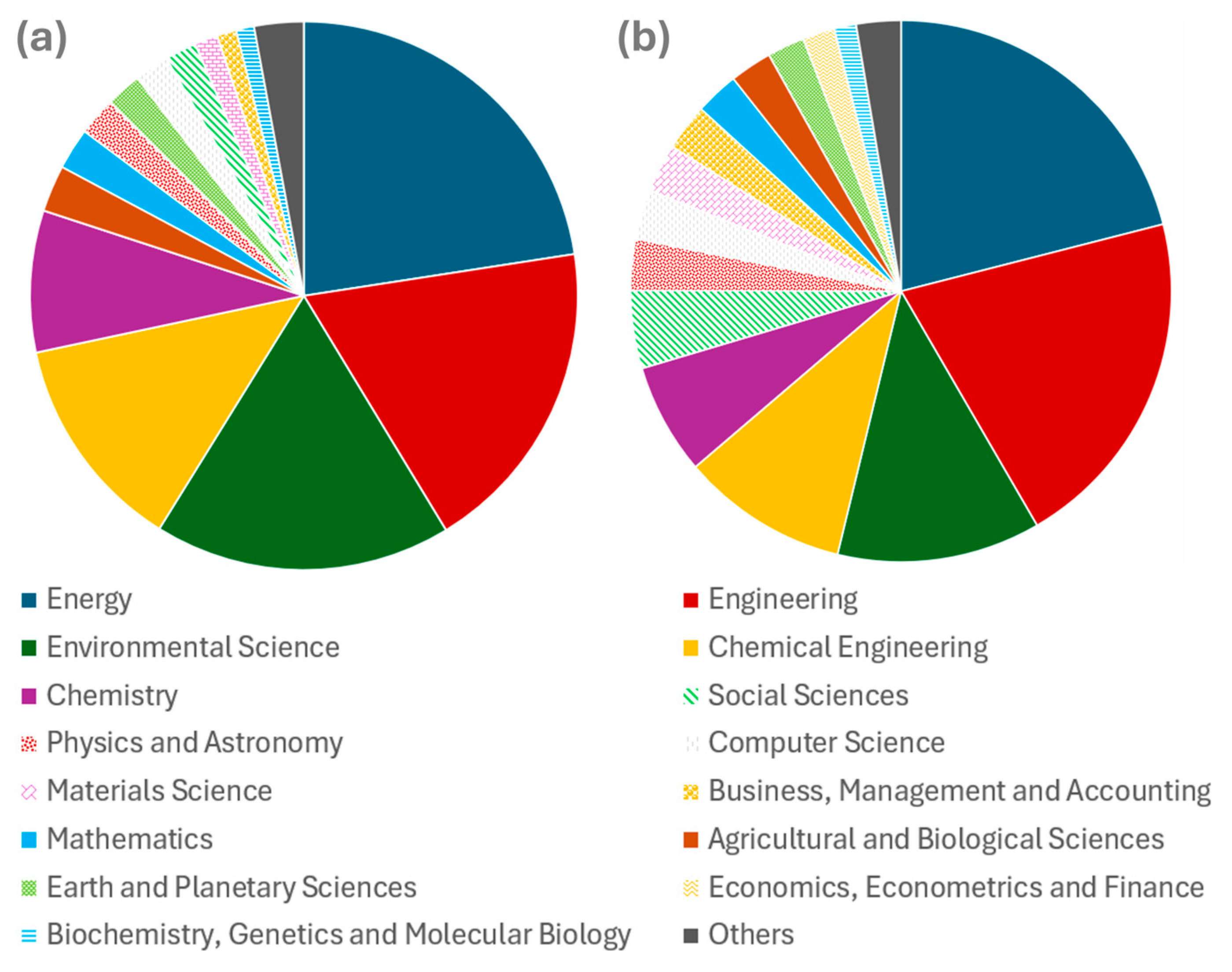
Consequently, Figure 3 reveals not only differences between HVO and SAF research but also the maturation of a scientific field that originated with biodiesel. The focus has progressively shifted from fuel-level optimization toward system-level sustainability challenges, positioning SAF as the current frontier of renewable fuel research while highlighting the foundational role that biodiesel played in enabling subsequent advances in HVO and aviation fuel technologies.
2.1. Methodological Approach
This study adopts a structured literature review informed by PRISMA principles to enhance transparency, consistency, and reproducibility while maintaining a qualitative and integrative perspective. This approach is particularly suitable for interdisciplinary fields such as renewable fuels research, where diverse methodologies (ranging from experimental combustion studies to techno-economic and system-level analyses) coexist.
A comprehensive literature search was conducted using major scientific databases, with primary emphasis on Scopus due to its broad coverage of peer-reviewed publications in energy, chemistry, and engineering. The search was carried out between February and June 2026 using combinations of relevant keywords, including “hydrotreated vegetable oil” (HVO), “sustainable aviation fuel” (SAF), “biofuels”, “combustion”, “emissions”, “life cycle assessment”, and “power-to-liquid”. The search focused on articles and review papers published in English between 2005 and 2025.
The selection process followed explicit inclusion and exclusion criteria. Studies were included if they addressed at least one of the following aspects: fuel properties and combustion behavior, emissions formation, production pathways, catalytic processes, life cycle assessment, techno-economic analysis, or system-level implications related to HVO or SAF. Articles purely focused on unrelated biofuels, lacking relevance to drop-in fuels, or not providing sufficient technical or scientific depth were excluded. Conference abstracts, editorials, and non-peer-reviewed documents were also omitted.
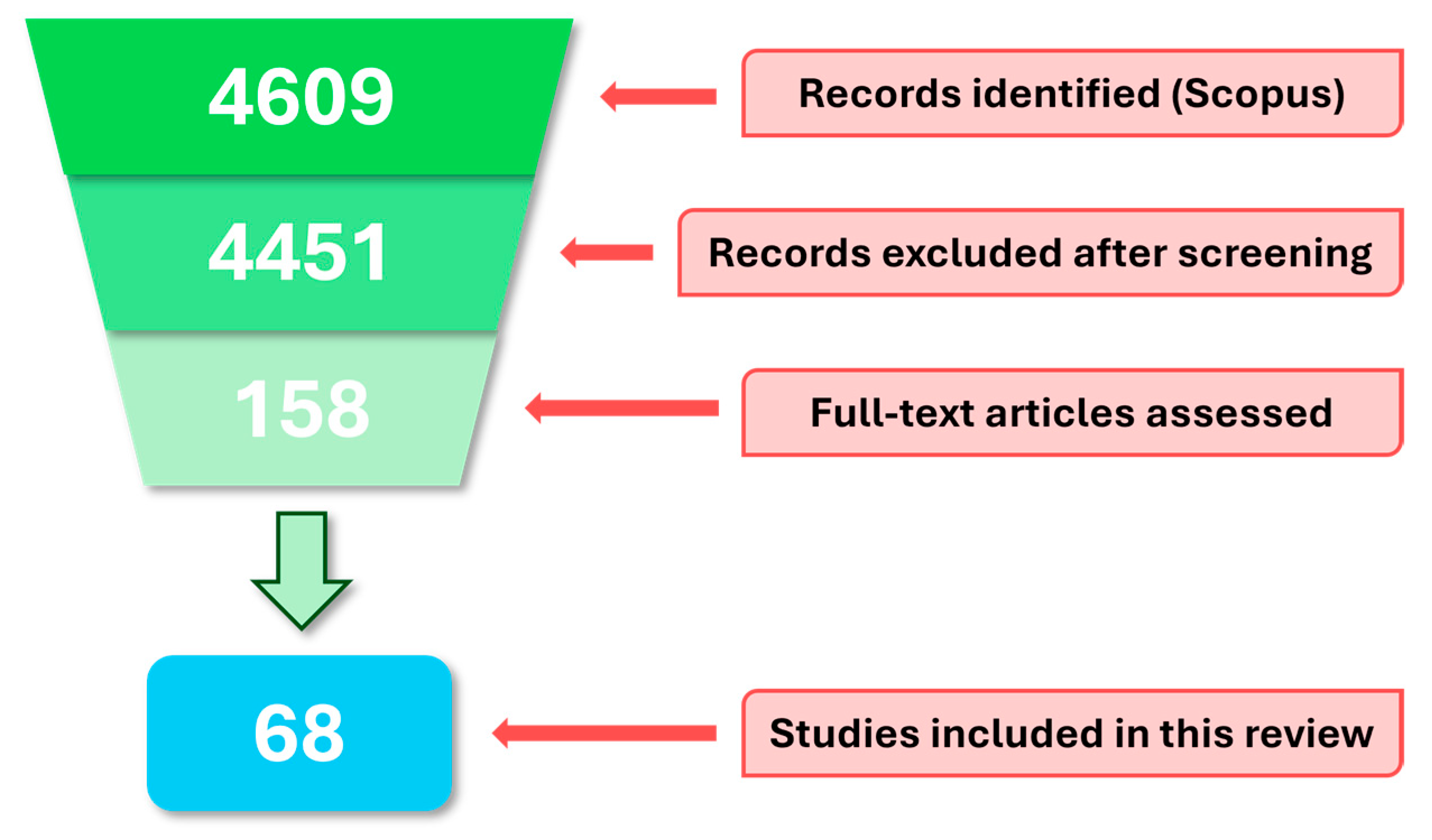
The initial search yielded a large pool of publications, which was progressively refined through title, abstract, and full-text screening. After removing duplicates and applying relevance criteria, a final dataset of more than 60 key peer-reviewed articles was selected for detailed analysis. Additional references of contextual relevance (e.g., policy frameworks, sustainability assessments, and emerging technologies) were included to support discussion and ensure coherence.
The overall selection process is summarized using a PRISMA-inspired flow diagram (see Figure 5). While this study does not aim to provide a fully systematic meta-analysis, the use of transparent and structured selection procedures ensures methodological rigor and traceability, supporting a comprehensive and multiscale synthesis of current knowledge on HVO and SAF.
Figure 5.
PRISMA-informed flow diagram illustrating the literature search and study selection process [7].
Figure 5.
PRISMA-informed flow diagram illustrating the literature search and study selection process [7].
3. Fuel Production and Conversion Pathways
3.1. From Biodiesel to Hydrotreated Fuels
The transition from conventional biodiesel to advanced hydrocarbon-based fuels represents a fundamental step in the evolution of renewable drop-in fuels for transport and aviation. Biodiesel, typically produced via transesterification of triglycerides into fatty acid methyl esters (FAME), constitutes the first generation of biofuels derived from lipid-based feedstocks such as vegetable oils, animal fats, and waste oils. Despite its relatively simple production process and renewable origin, biodiesel exhibits intrinsic physicochemical limitations associated with its oxygenated structure, including poor oxidative stability, high viscosity, and unfavorable cold-flow properties. These characteristics restrict its compatibility with existing engines and fuel infrastructures, particularly in applications requiring strict performance specifications such as aviation.
In response to these limitations, hydrotreatment processes have been developed as an effective upgrading strategy to convert biodiesel-derived feedstocks into fully compatible hydrocarbon fuels. This transition is based on the catalytic removal of oxygen through reactions such as hydrodeoxygenation (HDO), decarboxylation (DCX), and decarbonylation (DCN), which transform oxygenated esters and fatty acids into paraffinic hydrocarbons. These reactions typically occur under high hydrogen pressure and temperatures in the presence of sulfided metal catalysts, such as NiMo or CoMo supported on alumina, which promote hydrogenation and C–O bond cleavage. The hydrotreatment of triglycerides involves a complex network of hydrogenation, hydrodeoxygenation, decarboxylation, and decarbonylation reactions, whose relative contributions depend strongly on catalyst composition and operating conditions. Sulphided CoMo and NiMo catalysts remain widely used, although increasing attention is being directed toward non-sulphided catalysts and transition-metal phosphides because of their lower environmental impact and potential for improved selectivity [4].
The resulting hydrocarbon products, commonly referred to as hydrotreated vegetable oil (HVO), exhibit physicochemical properties that closely resemble those of conventional fossil fuels, including low oxygen content, high cetane number, and improved thermal and oxidative stability. Accordingly, HVO can be used as a fully compatible drop-in fuel without the blending limitations associated with biodiesel. This upgrading step not only improves fuel performance at the engine level but also significantly reduces issues related to storage, transport, and long-term degradation.
From a process perspective, the conversion of biodiesel-type feedstocks to HVO involves multiple reaction pathways whose relative contribution depends on operating conditions and catalyst formulations. Hydrodeoxygenation leads to the formation of straight-chain paraffins with carbon numbers similar to the original fatty acids, while decarboxylation and decarbonylation produce hydrocarbons with one carbon atom less, affecting carbon efficiency and hydrogen consumption. These competing pathways introduce important trade-offs between fuel yield, hydrogen demand, and process conditions, highlighting the need for optimized catalyst design and reactor configurations.
In general, the transformation from biodiesel to hydrotreated fuels represents a critical technological shift from oxygenated biofuels toward hydrocarbon-based fuels with improved compatibility and performance. However, while this approach successfully addresses many of the limitations of first-generation biofuels, it also introduces new challenges related to hydrogen consumption and feedstock availability. These aspects become increasingly relevant when extending this upgrading concept toward sustainable aviation fuels (SAF), where higher performance requirements and scalability constraints further amplify the complexity of fuel production systems.
3.2. HVO Production and Technological Maturity
Hydrotreated vegetable oil (HVO) represents one of the most technologically mature and commercially deployed pathways for producing renewable drop-in fuels. Building upon the hydrotreatment processes described in the previous section, HVO production involves the catalytic upgrading of lipid-based feedstocks (primarily vegetable oils, animal fats, and waste-derived lipids) into paraffinic hydrocarbons under elevated temperature and hydrogen pressure conditions. Industrial processes typically employ sulfided catalysts such as NiMo or CoMo supported on alumina, which promote hydrogenation, cracking, and deoxygenation reactions within trickle-bed reactors.
The resulting fuel is composed predominantly of straight-chain and iso-paraffins, with negligible oxygen and sulfur content. This composition confers several advantageous properties, including high cetane number, improved oxidative and thermal stability, and excellent combustion efficiency. In contrast to biodiesel (FAME), HVO exhibits full compatibility with existing fuel infrastructures and engines, enabling its use as a drop-in replacement without blending restrictions. These characteristics have facilitated its large-scale commercialization, particularly in the road transport sector, where HVO is already widely implemented.
Despite its technological maturity, HVO production is subject to several important limitations that constrain its long-term scalability. The most critical constraint lies in feedstock availability, as lipid-based resources are inherently limited and often compete with food production, land use, and other industrial applications. Even when considering waste oils and residues, the global supply remains insufficient to meet large-scale fuel demand, particularly in the context of aviation. As a result, HVO cannot be regarded as a standalone solution for deep decarbonization but rather as an intermediate step within a broader transition toward more scalable fuel systems.
In addition, hydrogen consumption represents a significant economic and environmental factor in HVO production. Hydrotreatment processes require substantial amounts of hydrogen to remove oxygen and saturate hydrocarbon chains, and the sustainability of HVO is therefore strongly dependent on the origin of this hydrogen. The use of fossil-derived hydrogen can offset a considerable portion of the emission reduction benefits, whereas the integration of renewable hydrogen can significantly improve lifecycle performance, albeit at higher costs.
From a process and product perspective, HVO also presents limitations related to its purely paraffinic composition. The absence of aromatic compounds, while beneficial for reducing particulate emissions, can impact certain fuel properties, such as seal swelling and density, which are particularly relevant in aviation applications. This compositional constraint highlights the need for further upgrading or blending when considering the transition toward sustainable aviation fuels (SAF).
Overall, HVO represents a key technological milestone in the evolution of renewable fuels, successfully addressing many of the performance limitations of first-generation biodiesel. Notwithstanding, its dependence on limited feedstocks, significant hydrogen demand, and compositional restrictions underscore the need for more diversified and scalable approaches. These challenges provide a direct motivation for the development of SAF pathways, which transcends lipid-based resources and introduce new levels of complexity in fuel production and system integration.
3.3. SAF Production Pathways
In contrast to HVO, which is based on a relatively well-defined and mature upgrading route, sustainable aviation fuels (SAFs) encompass a diverse portfolio of production pathways that reflect not only increasing technological complexity but also fundamental differences in feedstock origin and technological maturity. As illustrated in Figure 6, the main SAF routes (hydroprocessed esters and fatty acids (HEFA), Fischer–Tropsch (FT), alcohol-to-jet (ATJ), and power-to-liquid (PtL))can be systematically classified according to their associated raw materials and technology readiness levels (TRL).
This representation highlights a clear transition from lipid-based pathways, which exhibit high TRL and immediate deployment potential, toward more flexible and scalable routes based on biomass, waste, alcohol intermediates, and ultimately CO₂-derived feedstocks. While HEFA relies on well-established lipid resources and represents the most mature technology, FT and ATJ pathways introduce broader feedstock bases, including lignocellulosic biomass, waste streams, and alcohol platforms, and are therefore positioned at intermediate levels of technological development. Recent research on HEFA production from rapeseed oil demonstrated that advanced hydroisomerization catalysts can significantly improve the yield and low-temperature properties of aviation fuel fractions. Using a Pt/(SAPO-11 + Al2O3) catalyst, aviation-fuel yields of approximately 60% were obtained while meeting ASTM D7566 requirements for SAF applications [8].
In contrast, PtL systems, based on the conversion of captured CO₂ and renewable hydrogen, remain at low TRL but offer the highest long-term scalability potential due to their independence from biogenic feedstocks.
Figure 6 emphasizes that SAF technologies follow a dual gradient: a decrease in technological maturity is accompanied by an expansion of feedstock diversity and theoretical scalability. This reveals a fundamental trade-off between short-term industrial feasibility and long-term resource availability. As a result, SAF cannot be treated as a single technological solution, but rather as a continuum of pathways in which feedstock constraints, process maturity, and energy requirements must be jointly considered. This perspective justifies the need for a portfolio approach, where high-TRL technologies enable near-term deployment while lower-TRL routes are developed to ensure long-term sustainability and system scalability.
Although HEFA, FT, and ATJ currently represent the most mature SAF pathways, future large-scale deployment will require the utilization of lignocellulosic feedstocks and integrated bio- and chemo-catalytic conversion routes. These approaches offer opportunities to improve carbon utilization efficiency, diversify feedstock availability, and reduce dependence on lipid-based resources that may face long-term scalability constraints [9].
3.3.1. HEFA Pathway
Among these pathways, the HEFA route represents the most technologically mature and commercially dominant option. It can be considered a direct extension of HVO processing, applying similar hydrotreatment reactions to lipid-based feedstocks to produce jet-range hydrocarbons. Due to its high technology readiness level and compatibility with existing infrastructure, HEFA currently accounts for the majority of global SAF production. Nevertheless, it inherits the same fundamental limitation as HVO, namely the restricted availability of lipid-based feedstocks, which constrains its potential for large-scale deployment.
3.3.2. Fischer-Tropsch (FT)
In contrast, Fischer–Tropsch synthesis provides a more flexible approach by converting synthesis gas (CO and H₂), derived from biomass, municipal solid waste, or other carbonaceous sources, into liquid hydrocarbons. This pathway allows for a broader range of feedstocks and can achieve lower lifecycle emissions when integrated with renewable energy systems. Beside the production of synthetic paraffinic kerosenes, recent studies have demonstrated the feasibility of producing fully formulated synthetic jet fuels via Fischer–Tropsch refining. Such fuels contain the four major hydrocarbon classes required in conventional Jet A-1 fuels (n-alkanes, isoalkanes, cycloalkanes, and aromatics), allowing the formulation of fully synthetic aviation fuels without blending with petroleum-derived kerosene [10]. However, FT processes are characterized by higher capital costs, lower efficiencies in certain configurations, and increased process complexity due to multiple conversion and upgrading steps.
3.3.3. Alcohol-to-Jet (ATJ)
ATJ pathways expand the scope of SAF production by converting alcohol intermediates, such as ethanol or butanol, into aviation fuels through sequential dehydration, oligomerization, and hydrogenation reactions. This route enables the utilization of sugar- and lignocellulosic-based feedstocks, increasing resource flexibility. Nevertheless, ATJ processes currently face challenges related to conversion efficiency, intermediate processing requirements, and economic competitiveness.
3.3.4. Power-to-Liquid (PtL)
PtL technologies represent a fundamentally different approach, enabling the synthesis of aviation fuels from renewable electricity, hydrogen, and captured carbon dioxide. In this pathway, CO₂ is reduced and combined with green hydrogen to produce synthesis gas or intermediates that are further converted into liquid fuels. While PtL offers the potential for near-zero or even carbon-neutral fuels, it is currently the least mature pathway, with significant limitations related to high energy demand, hydrogen production costs, and infrastructure requirements. Importantly, PtL shifts the primary constraint from feedstock availability to renewable energy capacity, highlighting a paradigm shift in fuel production systems.
3.4. Emerging and Advanced Routes
In addition to the established SAF production pathways, a growing body of research is focused on advanced conversion routes designed to improve process efficiency, expand feedstock flexibility, and overcome the limitations of current technologies. These developments reflect a broader transition from conventional fuel upgrading toward process intensification and molecular-level fuel design, where the objective is not only to produce drop-in fuels but also to simultaneously optimize their environmental performance, fuel properties, and production efficiency.
One of the most promising research directions involves integrated or one-step conversion processes that combine multiple reaction stages, such as hydrodeoxygenation, isomerization, and hydrocracking, within a single reactor system. By reducing process complexity, these approaches have the potential to lower capital and operating costs while improving overall energy efficiency. Their development has been closely linked to advances in bifunctional catalysts that integrate metallic and acidic functionalities, enabling enhanced control over reaction pathways and selectivity toward aviation-range hydrocarbons. For example, Praikaew et al. demonstrated that an IrRe/SAPO-11 catalyst could simultaneously promote hydrodeoxygenation and hydroisomerization of triglycerides, achieving liquid fuel yields of approximately 74–78 wt% while increasing the formation of iso-alkanes and improving low-temperature fuel properties [11]. Apart from conventional PtL configurations based on Fischer–Tropsch or methanol-to-jet synthesis, novel one-step CO₂-to-SAF pathways are being developed to simplify process integration. Recent studies have demonstrated bifunctional catalyst systems capable of directly converting CO₂ and green hydrogen into aviation-fuel-range hydrocarbons, potentially reducing process complexity while improving carbon utilization efficiency [1].
Catalyst engineering has also evolved toward increasingly sophisticated hybrid materials that combine metals, zeolites, and carbon-based supports. Recent studies have highlighted the importance of catalyst-support interactions in tailoring SAF product distributions. Ferreira et al. demonstrated that bifunctional Co–Mo catalysts supported on CNT/H-ZSM-5 composites can simultaneously promote hydrodeoxygenation, cracking, and isomerization, producing significant fractions of C8–C16 hydrocarbons suitable for aviation applications. Increasing the CNT-to-zeolite ratio enhanced iso-alkane formation and improved selectivity toward SAF-range products [12]. Such systems offer improved control of molecular architecture and fuel composition, although challenges related to catalyst deactivation, coke formation, long-term stability, and industrial scalability remain unresolved.
Apart from catalyst development, another emerging area involves the intentional design of fuel molecules tailored specifically for aviation requirements. Novel synthetic routes based on Diels–Alder chemistry and related organic synthesis strategies have been proposed to produce high-density cycloalkanes and polycyclic hydrocarbons capable of replacing or complementing conventional aromatic components. These molecules are designed to maintain critical fuel properties such as density and energy content while reducing soot formation during combustion. Such approaches represent a significant conceptual shift from adapting alternative fuels to existing specifications toward designing fuels with predefined performance characteristics. Recent examples of molecular fuel design include the synthesis of bicyclic aviation-fuel blendstocks through catalyst-free Diels–Alder cycloaddition of cyclopentadiene with biomass-derived α-olefins. The resulting hydrogenated bicyclic hydrocarbons exhibited densities of 0.861–0.872 g mL⁻¹ and volumetric energy contents significantly higher than those of conventional HEFA fuels, making them attractive candidates for high-performance SAF formulations [13].
At the same time, hybrid production pathways combining biological and thermochemical processes are attracting increasing attention. Examples include fermentation routes coupled with catalytic upgrading as well as bio-electrochemical systems that integrate biomass conversion with renewable electricity inputs. Although most of these technologies remain at relatively low technology-readiness levels, they offer promising opportunities to improve carbon utilization, diversify feedstock options, and increase process efficiency.
Despite their considerable potential, most emerging SAF technologies remain constrained by challenges associated with technological maturity, scalability, process integration, and economic competitiveness. Many concepts are currently limited to laboratory or pilot-scale demonstrations, and their commercial deployment will require substantial advances in catalyst durability, reactor optimization, feedstock logistics, hydrogen integration, and system-level infrastructure. Furthermore, their viability remains strongly dependent on external factors such as electricity prices, hydrogen availability, carbon-management strategies, and supportive policy frameworks.
These advanced production routes demonstrate that the future evolution of SAF is progressively moving beyond conventional upgrading technologies toward highly integrated approaches that combine catalyst innovation, process intensification, and molecular fuel design. While these developments offer significant opportunities to enhance both sustainability and fuel performance, they also reveal that technological innovation alone will not be sufficient to ensure large-scale deployment.
Consequently, understanding how these emerging technologies can overcome the remaining barriers to commercialization requires a closer examination of the key technical, economic, and resource-related challenges that continue to constrain renewable fuel production.
3.5. Key Challenges in Fuel Production
Despite the significant progress achieved in the development of renewable fuels, the large-scale deployment of hydrotreated vegetable oil (HVO) and sustainable aviation fuels (SAF) remains subject to a series of critical challenges apart from technical feasibility. These constraints are not only related to conversion efficiency or fuel performance, but also to resource availability, energy demand, economic viability, and system integration. As such, fuel production must be understood as a multidimensional problem involving both process-level optimization and broader energy system considerations.
One of the most fundamental challenges lies in feedstock availability. Current technologies such as HVO and HEFA-SAF rely heavily on lipid-based feedstocks, including vegetable oils, animal fats, and waste-derived lipids. However, these resources are inherently limited and often compete with other sectors such as food production, chemicals, and materials. Even when considering advanced feedstocks such as lignocellulosic biomass or residues, the global potential remains constrained in relation to the scale of aviation fuel demand. This limitation implies that no single feedstock can sustain long-term fuel production, reinforcing the need for diversified pathways and feedstock flexibility.
Hydrogen demand constitutes another major constraint, particularly in hydrotreatment and power-to-liquid (PtL) pathways. The removal of oxygen from biomass-derived feedstocks requires substantial hydrogen input, while PtL processes depend entirely on green hydrogen as an energy carrier for CO₂ conversion. The sustainability of these routes is therefore highly sensitive to the source of hydrogen. In the absence of large-scale renewable hydrogen production, the environmental benefits of these fuels may be significantly reduced. Moreover, hydrogen production remains energy-intensive and costly, further limiting economic feasibility.
Closely linked to hydrogen demand is the broader issue of energy availability. Emerging SAF pathways increasingly rely on renewable electricity, particularly in electrolysis and synthetic fuel production. This introduces a critical bottleneck, as the deployment of SAF at scale would require a massive expansion of renewable energy capacity. In this context, the challenge shifts from chemical processing efficiency to energy system integration, where competition for low-carbon electricity between sectors may further constrain fuel production.
Economic factors also play a central role in limiting the adoption of renewable fuels. SAF production costs remain significantly higher than those of conventional fossil fuels, driven by feedstock prices, capital investment requirements, and process complexity. The lack of mature infrastructure, combined with uncertainties in policy support and carbon pricing mechanisms, further increases financial risk and slows industrial deployment. As a result, large-scale implementation currently depends heavily on subsidies, mandates, and regulatory incentives.
Finally, the environmental performance of renewable fuels is highly pathway-dependent and subject to important trade-offs. While significant reductions in greenhouse gas emissions can be achieved, indirect effects such as land use change, water consumption, and upstream energy inputs can influence sustainability. Furthermore, variability in fuel composition across different pathways introduces additional challenges in ensuring consistent performance and certification, particularly in aviation applications with strict safety and quality requirements.
These challenges highlight a critical conclusion: the production of renewable fuels cannot be treated as an isolated chemical or engineering problem, but must be addressed within the context of integrated energy systems. The transition from HVO to SAF reflects not only an increase in technological complexity, but also a shift toward systemic constraints that require coordinated solutions across multiple domains, including feedstock management, hydrogen production, renewable energy deployment, and policy development.
4. Fuel-Engine Interaction
The performance of renewable fuels in transport and aviation systems is ultimately determined by their interaction with the engine, where physicochemical properties govern spray dynamics, combustion behavior, and emissions formation. While production pathways define fuel composition, it is within the engine environment that these properties translate into operational performance and environmental impact. In this context, understanding the link between fuel chemistry and engine processes is essential to evaluate the real effectiveness of hydrotreated vegetable oil (HVO) and sustainable aviation fuels (SAF) as drop-in alternatives.
This section examines the multiscale processes involved in fuel–engine interaction, progressing from molecular composition and physical properties to spray formation, combustion dynamics, and emissions generation. This approach reflects the framework introduced in Figure 2, where small variations in fuel structure propagate through successive stages, ultimately determining engine efficiency and emission characteristics.
4.1. Fuel Chemistry and Physicochemical Properties
Fuel chemistry plays a fundamental role in determining engine performance, as the molecular structure of the fuel directly influences its physical properties and reactivity. The transition from biodiesel (FAME) to HVO and SAF illustrates a clear evolution in fuel composition, moving from oxygenated compounds to predominantly hydrocarbon-based fuels. Biodiesel consists mainly of fatty acid methyl esters containing oxygen functional groups, whereas HVO is composed of straight-chain paraffins produced through deoxygenation processes. In contrast, SAF exhibits a more complex composition that may include a mixture of n-paraffins, iso-paraffins, cycloparaffins, and, depending on the pathway, limited aromatic content.
These compositional differences translate into significant variations in key physicochemical properties such as density, viscosity, volatility, and cetane number. HVO, characterized by low density and low viscosity, generally promotes improved atomization and combustion efficiency compared to biodiesel. Additionally, its high cetane number leads to shorter ignition delay and more stable combustion. SAF properties, though, can vary depending on the production pathway. HEFA-derived fuels share many similarities with HVO, while fuels produced via Fischer–Tropsch or power-to-liquid routes may exhibit different density ranges and aromatic content, which can be critical for meeting aviation fuel specifications.
The influence of fuel composition goes beyond combustion chemistry and directly affects engine performance through variations in key physicochemical properties. Kroyan et al. identified density, viscosity, and lower heating value as the most influential fuel-property parameters governing jet-engine fuel consumption. Their model predicted fuel-consumption variations ranging from approximately −0.85% to +3.72% among ASTM-approved SAF pathways, demonstrating that relatively small property differences can translate into measurable changes in operational performance and fuel efficiency [14].
One important limitation associated with paraffinic fuels such as HVO and certain SAFs is the absence or reduction of aromatic compounds. While this contributes to lower soot formation, it can also affect material compatibility within fuel systems, particularly with respect to seal swelling and lubricity. For this reason, controlled blending or additional processing steps are often required to ensure compliance with aviation standards. At the same time, reduced aromatic content is directly linked to improved emission performance, highlighting a key trade-off between material compatibility and environmental benefits.
To better understand the differences in engine behavior discussed in this section, Table 2 summarizes the key physicochemical properties of biodiesel (FAME), HVO, and SAF. These properties play a fundamental role in governing spray characteristics, combustion dynamics, and emissions formation, establishing the link between fuel composition and engine performance.
This table provides a comparative overview of the main physicochemical properties of biodiesel (FAME), HVO, and SAF, highlighting how changes in fuel composition translate into differences in engine behavior. At the molecular level, the transition from oxygenated esters in biodiesel to paraffinic hydrocarbons in HVO and more complex mixtures in SAF results in significant variations in density, viscosity, volatility, and cetane number. These parameters directly influence fuel injection, atomization, and combustion processes.
One of the most relevant trends observed in the table is the reduction in viscosity and density when moving from biodiesel to HVO. This decrease promotes improved atomization, leading to smaller droplet sizes and more homogeneous air–fuel mixtures, which ultimately enhance combustion efficiency. In contrast, biodiesel’s higher viscosity and oxygenated structure can hinder spray breakup and evaporation, contributing to less efficient combustion under certain conditions. SAF fuels, depending on the pathway, exhibit intermediate or variable properties, reflecting their compositional diversity and the influence of different production routes.
The cetane number represents another critical parameter. HVO typically exhibits high cetane values, resulting in shorter ignition delays and more stable combustion. SAF fuels, particularly those derived from HEFA or Fischer–Tropsch processes, often share this characteristic, although variability in composition introduces a wider range of ignition behaviors. This variability highlights a key challenge in SAF deployment, as fuel properties must be carefully controlled to meet strict aviation specifications.
In addition, the presence or absence of aromatic compounds emerges as a crucial factor. While biodiesel and conventional fuels contain aromatic species to varying degrees, HVO is essentially paraffinic, lacking these components. SAF compositions are often engineered to include controlled aromatic fractions to ensure compatibility with existing fuel systems. This balance illustrates a trade-off between reducing soot formation and maintaining required fuel properties such as density and material compatibility.
In conclusion, the data presented reinforce the multiscale nature of fuel performance. Small differences in molecular structure and physicochemical properties propagate through spray formation, combustion behavior, and emissions, ultimately determining engine efficiency and environmental impact. These findings highlight that fuel design must consider not only production pathways but also downstream engine interactions, particularly in the context of heterogeneous SAF compositions.
In conclusion, fuel composition and physicochemical properties establish the initial conditions for all subsequent engine processes, including injection, atomization, combustion, and emissions formation. This emphasizes the importance of considering fuel design not only from a production perspective, but also in relation to its downstream behavior in real engine conditions.
4.2. Spray, Atomization and Evaporation
The injection and subsequent atomization of fuel represent critical stages in the fuel–engine interaction process, as they determine the initial distribution of the liquid fuel within the combustion chamber. These processes govern droplet formation, dispersion, and evaporation, ultimately influencing air–fuel mixing, ignition, and combustion efficiency. As such, the spray behavior of renewable fuels such as HVO and SAF plays a central role in defining engine performance and emission characteristics.
Spray formation begins with the injection of pressurized liquid fuel through the injector nozzle, where the liquid jet undergoes primary and secondary breakup into droplets. The characteristics of this process are strongly dependent on fuel physicochemical properties, particularly density, viscosity, and surface tension. Compared to biodiesel (FAME), HVO typically exhibits lower viscosity and density, which promotes improved atomization, resulting in finer droplets and increased spray dispersion. These effects contribute to enhanced mixing with air, facilitating more efficient combustion. In the case of SAF, spray behavior can vary depending on the production pathway, with HEFA-derived fuels showing similar characteristics to HVO, while Fischer–Tropsch and synthetic fuels may present differences in density and volatility that influence spray penetration and breakup dynamics.
Droplet size distribution is a key parameter in spray characterization, often described in terms of the Sauter mean diameter (SMD). A reduction in droplet size generally leads to improved evaporation rates and more homogeneous air–fuel mixtures. Experimental studies have consistently shown that paraffinic fuels, including HVO and certain SAFs, tend to produce smaller droplets compared to biodiesel, which can be attributed to their lower viscosity and absence of oxygenated functional groups. However, this improved atomization may also lead to increased spray penetration under certain conditions, particularly due to the lower density of these fuels, which alters momentum exchange with the surrounding air. Experimental and numerical studies have shown that HVO spray development is strongly affected by injection and ambient conditions. Using a CFD model validated against constant-volume vessel experiments, Zhang et al. reported that spray penetration increases with rail pressure and decreases with increasing ambient pressure, while higher ambient temperatures promote wider spray dispersion and enhanced atomization. The authors also highlighted that ambient pressure plays a dominant role in droplet breakup, whereas fuel temperature has a comparatively smaller influence during the injection period [15]. More recent optical investigations using diffuse back-illumination imaging confirmed that HVO exhibits shorter spray-tip penetration lengths, larger spray angles, larger spray volumes, and greater air-entrainment rates than conventional diesel under a wide range of injection pressures. These characteristics promote enhanced fuel–air mixing and lower local equivalence ratios, which may contribute to improved combustion efficiency and reduced soot formation. The authors also reported that HVO entrained larger quantities of ambient gas than diesel and maintained lower average equivalence ratios throughout spray development, further supporting the superior mixture-formation characteristics of paraffinic renewable fuels [16].
Following atomization, evaporation and mixing processes become dominant in determining mixture formation and subsequent combustion behavior. Fuel volatility and boiling characteristics govern the rate at which droplets vaporize and mix with air, directly influencing ignition and flame development. Recent droplet-scale experiments conducted under high-temperature and high-pressure conditions demonstrated that HVO surrogate fuels exhibit shorter droplet lifetimes and higher evaporation rates than diesel, primarily due to their lower density, lower surface tension, and narrower boiling range. These characteristics promote faster vaporization, more efficient fuel–air mixing, and potentially cleaner combustion. Similarly, HVO and SAF generally exhibit narrower boiling ranges and lower aromatic content than conventional fossil fuels, which further enhances evaporation behavior and mixture uniformity. Nevertheless, differences among SAF production pathways may lead to variations in volatility and evaporation rates, particularly under the low-temperature and high-pressure conditions frequently encountered in aviation applications [17]. A comprehensive experimental campaign performed by Millo et al. demonstrated that HVO and diesel exhibit broadly similar spray evolution at high injection pressures, whereas larger differences emerge at lower injection pressures, where HVO shows shorter penetration lengths, lower cone angles, and distinct hydraulic injection characteristics resulting from its lower density and viscosity [18].
The interplay between atomization and evaporation is particularly important in determining mixture homogeneity and local equivalence ratios within the combustion chamber. Improved atomization and faster evaporation generally lead to leaner and more uniform mixtures, which can reduce soot formation and improve combustion efficiency. Nevertheless, these conditions may also influence flame temperature and reaction kinetics, with potential implications for nitrogen oxide (NOx) formation. This highlights the existence of trade-offs between improved mixing and emission behavior, which must be carefully evaluated when introducing alternative fuels.
Overall, spray and evaporation processes constitute a fundamental link between fuel properties and combustion performance. The transition from biodiesel to HVO and SAF results in improved atomization and mixing characteristics, contributing to better combustion efficiency and reduced particulate emissions. However, variations in fuel properties across different SAF pathways introduce additional complexities that must be considered in engine design and optimization. Understanding these processes is therefore essential for assessing the real-world performance of renewable fuels and their impact on downstream emissions and environmental outcomes.
4.3. Combustion Process
Following injection, atomization, and evaporation, the combustion process represents the stage at which fuel properties are ultimately translated into energy release, engine performance, and emission formation. Combustion in internal combustion and aviation engines is governed by a complex interplay of chemical kinetics, turbulent mixing, and thermodynamic conditions, all of which are strongly influenced by fuel composition. As a result, the transition from biodiesel (FAME) to HVO and SAF leads to significant changes in ignition behavior, flame development, and heat release characteristics.
One of the most critical parameters in combustion is ignition delay, which defines the time elapsed between fuel injection and the onset of combustion. Fuels with higher cetane numbers typically exhibit shorter ignition delays, resulting in earlier combustion onset and more controlled heat release. HVO, characterized by its paraffinic composition and high cetane number, generally displays shorter ignition delays compared to biodiesel and even conventional fossil fuels. This behavior promotes more stable combustion and reduces the tendency for fuel accumulation prior to ignition. Thus, as observed in previous studies, fundamental combustion experiments conducted in a Euro 6 light-duty diesel engine showed that neat HVO consistently reduced ignition delay by approximately 1–3° CA depending on engine load, leading to earlier combustion phasing, lower combustion noise, and improved combustion stability [18]. Equally, experimental testing on a Euro 6 dual-loop EGR diesel engine showed that the higher cetane number of HVO advances the start of combustion, particularly at low-load conditions, resulting in shorter ignition delays and improved combustion stability compared with conventional diesel fuel [19]. Finally, experimental combustion analysis revealed that neat HVO reduced ignition delay by approximately 1 crank-angle degree compared with diesel fuel and produced lower heat-release rates during the premixed combustion stage, reflecting its superior ignition quality and higher cetane number [20].
In contrast, SAF exhibits a wider range of ignition characteristics depending on the production pathway. HEFA-derived fuels behave similarly to HVO, while fuels produced via Fischer–Tropsch or synthetic routes may show different ignition properties due to variations in molecular structure and composition.
The heat release profile during combustion is another key aspect influenced by fuel type. Paraffinic fuels such as HVO tend to produce a more uniform and controlled heat release, reducing the intensity of premixed combustion phases and improving efficiency. In contrast, biodiesel may exhibit more complex combustion behavior due to its oxygenated structure and higher viscosity, which can lead to less homogeneous mixtures. SAF combustion characteristics depend strongly on the balance between paraffinic, cycloparaffinic, and aromatic components, which influence evaporation rates, mixture formation, and flame propagation.
Fuel composition also affects flame structure and reaction kinetics. Straight-chain paraffins, dominant in HVO, promote faster chemical reactivity and cleaner combustion, while branched and cyclic hydrocarbons present in certain SAF blends can influence flame stability and combustion duration. The presence or absence of aromatic compounds plays a particularly important role: while their removal reduces soot formation, it can also modify flame temperature and combustion dynamics, creating trade-offs that must be carefully managed in aviation applications.
Another important consideration is the interaction between combustion and in-cylinder flow dynamics. Improved atomization and evaporation, as observed for HVO and certain SAFs, generally enhance air–fuel mixing, leading to more homogeneous combustion. This can reduce incomplete combustion products such as CO and hydrocarbons while improving thermal efficiency. Nevertheless, more uniform mixtures and higher local temperatures can also promote nitrogen oxide (NOx) formation, highlighting the existence of competing effects between different emission pathways.
Table 3 summarizes the main experimental studies investigating the combustion and emission performance of HVO and SAF in diesel and aviation applications. The selected studies cover a variety of systems, ranging from constant-volume vessels to diesel and aircraft engines, providing insights into spray behavior, combustion characteristics, pollutant formation, and particulate emissions.
Despite differences in engines or systems, operating conditions, and fuel formulations, a consistent trend emerges across literature. Hydrocarbon-based renewable fuels generally exhibit improved ignition characteristics, shorter ignition delays, and more stable combustion behavior compared to conventional fossil fuels and oxygenated biodiesel blends. These improvements are largely attributed to their high cetane number, paraffinic composition, and favorable atomization characteristics.
The table also highlights that combustion performance alone does not fully determine environmental outcomes. Several studies report that the benefits associated with improved combustion may vary depending on engine load, fuel injection strategy, exhaust gas recirculation (EGR) levels, and calibration settings. Recent work further demonstrated that the emissions benefits of HVO can be amplified through targeted engine recalibration. Using a light-duty compression-ignition engine, Dimitriadis et al. reported PM and HC reductions of up to 40%, while a moderate increase in EGR rates enabled additional NOx reductions of approximately 15% without a significant PM penalty [30].
This is particularly evident in the case of HVO, where emission trends can differ despite generally favorable combustion characteristics. Therefore, the relationship between fuel properties, combustion processes, and emissions should be understood as highly dependent on the interaction between fuel chemistry and engine operating conditions.
These studies support the transition from biodiesel toward hydrocarbon-based renewable fuels by demonstrating their ability to improve combustion efficiency while maintaining compatibility with existing engines. At the same time, they reveal the need for integrated assessments that consider not only combustion behavior but also downstream effects on pollutant formation and particulate emissions.
Thus, the combustion process represents the critical link between fuel design and environmental performance. The transition from biodiesel to HVO and SAF results in improved ignition behavior, more efficient combustion, and reduced soot formation, but also introduces new challenges related to emission trade-offs and variability in fuel composition. These findings emphasize that optimizing combustion alone is not sufficient, and must be considered alongside upstream production and downstream environmental impacts within a multiscale framework.
4.4. Emissions Formation
Emissions formation represents the direct outcome of combustion processes and constitutes a critical interface between engine performance and environmental impact. The nature and magnitude of emissions generated during combustion are strongly influenced by fuel composition, injection characteristics, and in-cylinder conditions. As a result, the transition from biodiesel (FAME) to HVO and SAF leads to significant changes in gaseous and particulate emission profiles, reflecting differences in chemical structure and combustion behavior. Recent investigations in heavy-fuel aircraft piston engines demonstrated that SAF-containing blends can substantially reduce gaseous pollutants. A 50% SAF–50% RP-3 blend reduced CO emissions by up to 63% and HC emissions by approximately 75% compared with biodiesel-rich blends, while also achieving improved fuel efficiency and lower CO₂ emissions [31].
To complement the combustion-oriented studies presented in Table 3, Table 4 summarizes the emission trends reported in the literature for HVO and SAF related to conventional fossil fuels. The compiled results provide an overview of the effects of renewable fuels on gaseous pollutants and particulate emissions under different operating conditions.
This table summarizes the emission reductions reported in the literature for HVO and SAF relative to conventional fossil fuels. A strong consensus can be observed for gaseous pollutants such as carbon monoxide (CO) and unburned hydrocarbons (HC), which are consistently reduced across most experimental studies. These reductions reflect the enhanced combustion quality associated with paraffinic fuels and confirm the beneficial role of high cetane numbers in promoting more complete oxidation processes. One of the earliest comprehensive evaluations of neat HVO in a heavy-duty common-rail diesel engine reported simultaneous reductions in NOx emissions (≈6%) and smoke emissions (≈35%) under standard engine calibration. Further optimization of injection timing enabled reductions of up to 16% in NOx and 37% in smoke while also improving fuel consumption, highlighting the potential of jointly optimizing fuel properties and engine settings [32]. The importance of calibration was further demonstrated by d’Ambrosio et al., who showed that the benefits of HVO can be enhanced through fuel-specific control strategies. Using a Euro 6 diesel engine, the authors reported soot reductions of up to 67%, HC reductions of up to 44%, and CO reductions of up to 36%, while dedicated dual-loop EGR calibration enabled additional reductions in NOx emissions without compromising efficiency [23].
In contrast, nitrogen oxide (NOx) emissions exhibit a less uniform response. While many studies report moderate reductions, others indicate slight increases depending on engine load, combustion temperature, injection timing, or EGR settings. This variability suggests that NOx formation remains governed by competing mechanisms and cannot be predicted solely from fuel composition.
Particulate emissions present an even more complex picture. Although most investigations demonstrate a reduction in particulate mass and soot formation, the magnitude of these benefits varies substantially among fuels and operating conditions. This variability demonstrates that conventional emission metrics alone may not provide a complete description of environmental performance. Consequently, the transition toward renewable fuels should be evaluated through a broader framework that incorporates both gaseous and particulate emissions, as well as their associated trade-offs.
To provide a comprehensive visualization of the emission behavior discussed in this section, Figure 7 presents a radar chart comparing the main pollutant trends associated with biodiesel (FAME) and hydrocarbon-based renewable fuels (HVO and SAF). This representation allows simultaneous assessment of gaseous emissions (CO, HC, NOx) and particulate characteristics (PM and PN), highlighting both improvements and emerging trade-offs in fuel performance.
The radar chart clearly illustrates the significant reduction in gaseous pollutants when transitioning from biodiesel to paraffinic fuels, particularly in terms of carbon monoxide (CO) and unburned hydrocarbons (HC). These reductions are primarily attributed to improved combustion efficiency, higher cetane number, and better atomization properties associated with HVO and SAF. As observed in the figure, both fuels exhibit consistently low values for CO and HC emissions, reflecting a more complete oxidation process within the combustion chamber.
Nitrogen oxide (NOx) emissions, however, display more nuanced behavior. As indicated in the radar chart, NOx values remain relatively similar between FAME and HVO/SAF, suggesting that improvements in combustion efficiency do not necessarily translate into reduced NOx formation. This can be explained by the competing effects of improved mixing and higher combustion temperatures, which may promote thermal NOx formation. Therefore, NOx remains a critical parameter that is not fully mitigated by the transition to alternative fuels.
The most pronounced differences emerge in the particulate domain. The figure clearly shows a strong reduction in particulate mass (PM) when switching to HVO and SAF, reflecting the absence or reduction of aromatic compounds and the cleaner combustion behavior of paraffinic fuels. This reduction represents one of the most important environmental advantages of these fuels, particularly in aviation applications where soot emissions are directly linked to climate-relevant processes such as contrail formation.
Meanwhile, this improvement is accompanied by a significant increase in particle number (PN), as revealed by the elevated PN values for HVO and SAF in the radar chart. This apparent contradiction highlights one of the central trade-offs discussed throughout this work: while particulate mass decreases, the formation of ultrafine particles increases. These particles, typically generated through nucleation processes, are not adequately captured by mass-based metrics and may have distinct atmospheric and health implications. This shift underscores the limitation of relying solely on PM mass as an indicator of environmental performance.
Although HVO and SAF are represented together in the figure due to their similar overall emission profiles, subtle differences can be identified from a mechanistic perspective. HVO emissions tend to be more consistent and predictable, reflecting its well-defined paraffinic composition derived from lipid-based feedstocks. In contrast, SAF emissions exhibit greater variability depending on the production pathway, feedstock, and fuel composition. For example, Fischer–Tropsch or power-to-liquid fuels may produce different particle number distributions or NOx responses compared to HEFA-derived fuels. Hence, SAF behavior should be understood as pathway-dependent rather than uniform.
Gaseous emissions, including carbon monoxide (CO), unburned hydrocarbons (HC), nitrogen oxides (NOx), and carbon dioxide (CO₂), are primarily determined by combustion efficiency and local air–fuel conditions. The improved atomization and higher cetane number of HVO generally promote more complete combustion, resulting in reduced CO and HC emissions compared to biodiesel and, in many cases, conventional fossil fuels. Similarly, SAF fuels (particularly paraffinic blends such as HEFA and FT-derived fuels) tend to exhibit lower CO and HC emissions due to their cleaner combustion and reduced aromatic content.
However, nitrogen oxide (NOx) formation presents a more complex behavior. NOx emissions are closely linked to combustion temperature and oxygen availability, and their response to alternative fuels is often inconsistent. While improved mixing and more homogeneous combustion can reduce local hotspots, the combination of higher flame temperatures and rapid combustion kinetics may, in some cases, increase NOx formation. Consequently, the use of HVO and SAF may result in either slight reductions or marginal increases in NOx emissions, depending on engine conditions and operating regimes, highlighting the presence of competing effects.
Particulate matter (PM) emissions represent one of the most significant advantages of hydrocarbon-based renewable fuels. The reduced aromatic content and cleaner combustion behavior of HVO and SAF lead to substantial decreases in soot formation compared to conventional fuels. Aromatic compounds are known precursors for soot formation, and their absence or reduction in paraffinic fuels directly contributes to lower particulate mass emissions. This effect is particularly relevant in aviation, where soot emissions are closely linked to contrail formation and climate forcing.
The reported environmental benefits of renewable fuels may also depend on the driving cycle employed. Serrano et al. observed that the transition from the NEDC to the WLTP protocol produced higher NOx emissions but had only a minor influence on the relative performance of HVO15 compared with conventional diesel, suggesting that fuel-related trends remain generally consistent across homologation procedures [29]. Recent results further suggest that HVO may provide greater flexibility for calibration optimization, as its lower sensitivity to rail pressure, injection timing, and EGR variations enables additional opportunities to improve the NOx–efficiency trade-off under both warmed-up and cold-start conditions [24].
Despite the reduction in total particulate mass, recent studies have shown that alternative fuels such as HVO and SAF can alter particle size distributions, often increasing the relative proportion of ultrafine particles. These particles, typically below 100 nm in diameter, are formed through nucleation processes and are not necessarily captured by conventional PM mass measurements. This shift toward smaller particle sizes has important implications, as ultrafine particles exhibit higher surface area-to-volume ratios and greater reactivity, which can enhance their potential for atmospheric transport and biological interaction.
The interplay between reduced soot mass and increased particle number represents a critical trade-off in emissions formation. While HVO and SAF contribute to cleaner combustion in terms of visible soot and particulate mass, the increased presence of ultrafine particles raises questions regarding their environmental and health impact. This highlights the limitation of relying solely on mass-based emission metrics and underscores the need to consider particle number and size distributions when evaluating fuel performance.
Emissions formation in renewable fuels reflects a complex balance between improved combustion efficiency and emerging trade-offs associated with particle characteristics and NOx formation. These findings reinforce the importance of a multiscale perspective, where changes at the molecular and combustion level propagate to influence atmospheric emissions and environmental impact. Hence, the evaluation of HVO and SAF must consider, apart from conventional emission indicators, other comprehensive metrics that capture the full spectrum of combustion-derived pollutants.
4.5. Particle Characteristics and Implications
Beyond the overall reduction of particulate matter (PM) mass, a comprehensive evaluation of fuel performance requires a detailed analysis of particle characteristics, including size distribution, number concentration, morphology, and chemical composition. These parameters are critical for understanding the behavior of combustion-derived particles in both atmospheric and biological contexts. In this sense, the transition from biodiesel (FAME) to HVO and SAF not only reduces total particulate emissions but also significantly alters the nature of the emitted particles, introducing new challenges and considerations.
Particle size distribution is one of the most relevant descriptors of combustion-generated aerosols. While conventional fossil fuels tend to produce a wide range of particle sizes dominated by soot agglomerates, paraffinic fuels such as HVO and SAF typically lead to a significant reduction in larger soot particles due to the lower aromatic content. However, this reduction in mass is often accompanied by an increase in the fraction of ultrafine particles, generally defined as particles with diameters below 100 nm. These particles are primarily formed through nucleation mechanisms rather than soot growth, and their formation is closely related to fuel volatility, combustion temperature, and chemical composition. While Table 4 summarizes emission trends, particulate emissions require a more detailed assessment because changes in particulate mass do not always correspond to changes in particle number or particle size. Therefore, Table 5 compiles the particle-related characteristics reported for HVO and SAF fuels, including trends in particulate mass (PM), particle number (PN), and particle size distribution (PSD), together with their associated environmental and health implications.
This table compiles the available evidence regarding the particle-related characteristics of HVO and SAF emissions. Unlike the gaseous pollutants summarized in Table 4, particulate emissions exhibit a considerably more complex behavior. While reductions in particulate mass are commonly reported, changes in particle number concentration and particle size distribution show less consistent trends across the literature.
Several studies indicate that the use of paraffinic fuels shifts emissions away from larger soot-dominated particles toward smaller ultrafine particle populations. In some cases, this transition is accompanied by an increase in particle number despite a reduction in total particulate mass. This behavior was also observed by Dobrzyńska et al., who reported that HVO-containing blends could reduce particulate mass while producing only marginal reductions, or even slight increases, in particle number emissions depending on fuel formulation and operating conditions, highlighting the complexity of particle formation mechanisms in renewable-fuel combustion [22]. Marine-engine experiments further confirmed that lower particulate mass emissions do not necessarily correspond to lower particle-number emissions. Ushakov and Lefebvre reported approximately 30% lower PM mass but nearly 30% higher particle concentrations for HVO relative to marine gas oil, mainly due to an increase in nanoparticles and a reduction in count median diameter [26]. On the other hand, recent studies report simultaneous reductions in both PM and PN, particularly for advanced SAF formulations and optimized operating conditions. These differences highlight the influence of fuel composition, engine technology, injection strategy, and combustion regime on particle formation mechanisms. Recent turbofan-engine experiments using 100% HEFA-SAF further confirmed the substantial particulate-matter mitigation potential of paraffinic aviation fuels. Compared with conventional aviation kerosene and diesel fuels, HEFA-SAF reduced nvPM number emissions by approximately 71–92% and nvPM mass emissions by 89–96%, while simultaneously producing smaller and narrower particle-size distributions [34]. These findings reinforce the role of HEFA-based SAFs as an effective pathway for reducing aviation particulate emissions, although the implications of smaller particle sizes for human exposure still require further investigation. Additionally, particulate characterization revealed that SAF-rich RP-3 blends produced significantly fewer particles and smaller geometric mean diameters than biodiesel-rich fuels. The lowest particle-number emissions were observed for a 50% SAF–50% RP-3 blend, which reduced total particle-number emissions by approximately 38% relative to the highest-emitting biodiesel-containing blend [30].
From an environmental and health perspective, the findings summarized in Table 5 are particularly relevant. Ultrafine particles possess higher mobility, longer atmospheric residence times, and enhanced deposition efficiency within the respiratory system. Consequently, reductions in particulate mass do not necessarily imply proportional reductions in exposure risk. The literature therefore supports the growing consensus that particle number concentration and particle size distribution should be evaluated alongside conventional PM metrics when assessing the sustainability of renewable fuels.
Collectively, the studies presented in this table reinforce one of the central conclusions of this review: improvements in emission performance should be interpreted not only as reductions in pollutant quantity but also as transformations in pollutant characteristics. To illustrate the shift in particle populations associated with different fuel types, Figure 8 presents a conceptual comparison of the particle size ranges commonly reported for fossil fuels, biodiesel (FAME), HVO, and SAF.
This figure highlights a progressive redistribution of emitted particles toward smaller size ranges as fuel composition evolves from fossil fuels and biodiesel to advanced hydrocarbon-based renewable fuels. Conventional fossil fuels are generally associated with the formation of larger soot-dominated particles, which contribute significantly to particulate mass emissions and atmospheric black carbon loading. Biodiesel exhibits an intermediate behavior, partially reducing soot formation due to its oxygenated nature, although a substantial fraction of particles remains within the accumulation-mode region.
A more pronounced shift can be observed for HVO, whose paraffinic composition and low aromatic content suppress soot precursors and promote the formation of smaller particles. As a result, the dominant particle population moves toward the ultrafine particle range. The relatively narrow interval represented for HVO reflects the homogeneous nature of the fuel and the consistency of its combustion behavior across different studies.
SAF follows the same tendency but displays a broader particle size range. This wider distribution reflects the diversity of SAF production pathways, including HEFA, Fischer–Tropsch, alcohol-to-jet, and power-to-liquid technologies, each leading to fuels with distinct molecular compositions and combustion characteristics. Consequently, SAF emissions are more strongly influenced by pathway-specific effects than those of HVO.
Importantly, the figure illustrates that the transition to HVO and SAF should not be interpreted solely as a reduction in particulate emissions. Rather, it involves a fundamental transformation in particle characteristics, with emissions shifting from larger soot particles toward ultrafine particle populations. This observation reinforces the need to complement conventional particulate mass measurements with particle number and size-distribution analyses when evaluating the environmental and health impacts of renewable fuels.
The shift toward ultrafine particle populations has important implications for atmospheric behavior. Due to their small size, ultrafine particles exhibit high mobility, longer residence times in the atmosphere, and enhanced potential for transport over long distances. Furthermore, their high surface area-to-volume ratio increases their capacity to adsorb hazardous compounds, including polycyclic aromatic hydrocarbons (PAHs) and other combustion by-products. This can amplify their reactivity and influence their role in atmospheric chemistry, including cloud condensation processes and secondary pollutant formation.
From a health perspective, ultrafine particles are of particular concern due to their ability to penetrate deep into the respiratory system and even enter the bloodstream. Unlike larger particles, which are typically filtered in the upper airways, nanoparticles can reach the alveolar region, where they may interact with cells and biological tissues. Their small size also enables translocation to other organs, potentially leading to systemic effects. Accordingly, although HVO and SAF reduce particulate mass emissions, the increased presence of ultrafine particles raises important questions regarding their net impact on human health.
Particle morphology, size, and chemical composition strongly influence the environmental and health impacts of combustion-generated aerosols. The reduced aromatic content of HVO and SAF generally leads to less graphitic particle structures and can modify oxidation reactivity and atmospheric aging behavior. However, significant variability among SAF production pathways may result in different particle characteristics depending on fuel composition and processing route, highlighting the need for pathway-specific assessments. Moreover, the relevance of particle properties is considerable, in addition to conventional emission metrics. Controlled human-exposure studies have shown that HVO exhaust particles can exhibit higher predicted respiratory deposition fractions than conventional diesel particles due to their smaller diameters, despite their lower particulate mass emissions. These findings emphasize the importance of evaluating particle size and number concentrations alongside PM mass when assessing the environmental and health implications of renewable fuels [33].
Summing up, the analysis of particle characteristics reveals a fundamental limitation of conventional emission metrics based solely on mass concentration. The transition from biodiesel to HVO and SAF demonstrates that improvements in particulate mass emissions do not necessarily translate into reduced environmental or health impacts. Instead, a more comprehensive approach is required, incorporating particle number concentration, size distribution, and chemical composition. This perspective reinforces the importance of integrating combustion science with environmental and health assessments, supporting the need for multiscale evaluation frameworks as proposed in this review.
5. Environmental and Health Impact
The evaluation of renewable fuels such as HVO and SAF cannot be limited to combustion performance or emission reductions alone, but must also consider their broader environmental and health implications. While significant improvements in fuel properties and emissions profiles have been demonstrated, the ultimate effectiveness of these fuels depends on their impact on air quality, climate change, and human health. In this context, the transition from biodiesel to HVO and SAF introduces both clear benefits and emerging challenges that require a comprehensive and multiscale assessment.
5.1. Atmospheric Emissions and Air Quality
From an environmental perspective, one of the main advantages of HVO and SAF is their ability to reduce regulated emissions compared to conventional fossil fuels. Lower emissions of particulate matter (PM), carbon monoxide (CO), and unburned hydrocarbons (HC) contribute directly to improved local air quality, particularly in urban or high-traffic environments such as airports. The reduced aromatic content of paraffinic fuels plays a significant role in decreasing soot formation, thereby lowering visible smoke and black carbon emissions, which are key contributors to both air pollution and climate forcing. Lifecycle greenhouse gas emissions reported for HVO vary considerably depending on feedstock origin, system boundaries, and methodological assumptions. This variability is largely driven by the feedstock employed, as purpose-grown crops such as palm and rapeseed generally exhibit higher lifecycle emissions than residual feedstocks such as tall oil, tallow, or waste-derived streams [35].
In aviation, reductions in soot emissions are particularly relevant due to their influence on contrail formation and radiative forcing. Lower soot particle concentrations can reduce the formation of persistent contrails, which have been identified as a major contributor to aviation-induced climate effects. Nonetheless, the overall climate impact of SAF is not limited to tailpipe emissions and depends strongly on lifecycle factors, including feedstock origin, energy inputs, and production pathways.
5.2. Particle Toxicity and Atmospheric Behavior
Beside emission quantities, the characteristics of emitted particles play a critical role in determining their environmental and health impacts. As discussed in the previous section, the use of HVO and SAF often shifts particle-size distributions toward smaller diameters, even when total particulate mass is reduced. Ultrafine particles exhibit higher mobility, longer atmospheric residence times, and greater surface reactivity than larger particles, influencing their transport and transformation in the environment.
In addition, ultrafine particles can act as carriers of combustion-derived toxic compounds, including trace organic species. Their high specific surface area enhances adsorption processes and participation in atmospheric chemical reactions, potentially contributing to the formation of secondary pollutants. They may also influence cloud-condensation processes and climate dynamics, although these effects remain associated with considerable uncertainty.
The significance of these particle-size effects directly affects human exposure. Controlled human-exposure studies have shown that HVO exhaust particles can exhibit respiratory deposition fractions approximately 40–50% higher than those estimated for conventional diesel aerosols due to their smaller particle diameters, despite their lower particulate-mass emissions. These findings emphasize that reductions in PM mass do not necessarily translate into proportional reductions in inhalation dose, highlighting the importance of considering particle size and number concentrations alongside traditional PM-based metrics when assessing the environmental and health performance of renewable fuels [33].
5.3. Human Health Implications
The impact of combustion-derived particles on human health is strongly dependent on particle size, composition, and concentration. While larger particles are generally filtered in the upper respiratory tract, ultrafine particles can penetrate deep into the lungs and reach the alveolar region. From there, they may enter the bloodstream and be transported to other organs, raising concerns about systemic health effects.
Although HVO and SAF reduce particulate mass emissions, the increased presence of ultrafine particles introduces a potential paradox in terms of health impact. These particles can interact more readily with biological tissues due to their high reactivity and small size. As a result, reductions in mass-based emissions may not directly correspond to reduced health risks, emphasizing the need for more comprehensive emission metrics that include particle number concentration and size distribution.
Furthermore, variations in particle composition across different SAF pathways may influence toxicity. Differences in organic content, volatility, and oxidation behavior can affect the biological activity of particles, although further research is needed to fully understand these mechanisms.
5.4. Climate and Lifecycle Considerations
In addition to local environmental and health effects, renewable fuels must be evaluated within the broader context of their lifecycle climate impact. Lifecycle assessment (LCA) studies have consistently shown that HVO and SAF can achieve substantial reductions in greenhouse-gas emissions compared with fossil fuels, particularly when produced from waste-derived feedstocks or renewable energy sources. For example, a recent primary-data-based assessment of two commercial Italian biorefineries reported carbon footprints ranging from 10.6–17.9 g CO₂eq MJ⁻¹ and 15.2–22.2 g CO₂eq MJ⁻¹ for HVO produced in Venice and Gela, respectively, corresponding to approximately 75% lower lifecycle emissions than conventional diesel [36]. Similarly, recent life-cycle assessments of lignin-derived SAF pathways reported greenhouse-gas emission reductions of 72–89% relative to fossil jet fuel, while catalytic hydrothermolysis (CH), one of the most recently approved ASTM SAF pathways, achieved reductions ranging from 48% to 82% depending on the feedstock employed. Waste-derived feedstocks such as corn oil, yellow grease, and brown grease generally exhibited the lowest carbon intensities, whereas oilseed-derived pathways were more sensitive to agricultural inputs and land-use effects [37]. These results further emphasize the importance of methodological assumptions when comparing sustainability metrics across different SAF routes [38]. Specifically, life-cycle assessments of waste-derived SAF pathways have reported exceptionally low carbon intensities when methane emissions from landfilling are avoided. Huq et al. estimated greenhouse-gas reductions of up to 165% relative to conventional jet fuel, indicating the potential for net-negative lifecycle emissions under specific waste-management scenarios [39].
Despite these promising reductions, lifecycle performance remains highly pathway-dependent and subject to considerable uncertainty. One of the most influential factors is indirect land-use change (ILUC), whose inclusion can substantially alter the carbon-intensity values reported for identical feedstocks and conversion pathways. Recent reviews have identified ILUC as one of the main sources of variability in comparative sustainability assessments, highlighting the need for careful interpretation of LCA results and transparent methodological reporting [40].
Beside ILUC, lifecycle emissions are strongly influenced by feedstock cultivation practices, upstream energy consumption, transportation requirements, supply-chain organization, and hydrogen production methods. In the case of power-to-liquid (PtL) fuels, climate performance is closely linked to the carbon intensity of the electricity used for hydrogen generation and CO₂ capture. Similarly, bio-based SAF pathways depend on sustainable feedstock sourcing, efficient logistics, and responsible land-management practices. These considerations demonstrate that the environmental benefits of renewable fuels cannot be evaluated solely on the basis of tailpipe or combustion emissions, but must instead account for the entire value chain [40].
Recent studies have also expanded the discussion beyond emission reduction toward carbon-removal strategies. Several assessments indicate that SAF pathways integrated with bioenergy carbon capture and storage (BECCS) may achieve net-negative lifecycle emissions. Ahlström et al. reported that four of seven evaluated SAF pathways remained climate-negative even after accounting for high-altitude effects, demonstrating that carbon-removal technologies could play an important role in offsetting residual aviation emissions that cannot be eliminated through fuel substitution alone [41].
Therefore, current evidence suggests that the sustainability of HVO and SAF is determined not only by the fuel itself, but by the broader system in which it is produced. Consequently, lifecycle performance should be assessed through an integrated environmental perspective that simultaneously considers feedstocks, energy sources, supply chains, land-use effects, carbon-management strategies, and end-use emissions.
5.5. Integrated Perspective on Environmental Impact
As observed in previous subsections, the environmental and health implications of HVO and SAF reflect the complexity of renewable fuel systems. While clear improvements are observed in terms of emission reductions and combustion cleanliness, new challenges emerge related to particle characteristics, toxicity, and lifecycle variability. These findings reinforce the need to go from single-parameter evaluation approaches to adopt integrated assessment frameworks that combine combustion analysis, environmental science, and health impact studies.
In this context, the transition toward SAF represents not only a technological shift but also a conceptual change in how fuel performance is evaluated. Rather than focusing solely on emission reductions at the tailpipe, it becomes essential to consider the full chain of effects, from production and combustion to atmospheric behavior and human exposure. This integrated perspective is critical for ensuring that renewable fuels contribute effectively to both environmental sustainability and public health objectives.
To summarize the environmental and health implications discussed throughout this section, Table 6 compares the main impacts associated with biodiesel (FAME), HVO, and SAF across air quality, particle characteristics, health concerns, and climate-related indicators.
This table highlights that the environmental advantages of renewable fuels go beyond conventional emission reductions. While both HVO and SAF significantly improve air quality indicators through lower particulate mass and gaseous emissions, important differences emerge when considering particle characteristics and lifecycle impacts. HVO generally provides a more predictable reduction in regulated pollutants, whereas SAF exhibits greater variability depending on the production pathway. From a climate perspective, SAF offers the highest decarbonization potential, particularly for PtL routes, although this benefit remains strongly dependent on renewable electricity availability and carbon sourcing. Nevertheless, one of the most important findings emerging from the analysis of combustion emissions is that environmental improvements cannot be assessed solely through conventional mass-based indicators. Although HVO and SAF consistently reduce particulate matter (PM) emissions compared to biodiesel and fossil fuels, the associated shift toward ultrafine particle (UFP) populations introduces an additional layer of complexity. As illustrated by the particle size distribution analysis, reductions in soot-dominated particles are frequently accompanied by an increase in smaller particles characterized by higher mobility, larger surface-area-to-volume ratios, and potentially different atmospheric and biological behaviors. Consequently, emission reductions should be interpreted not only as a decrease in pollutant quantity but also as a transformation in pollutant characteristics. This observation reinforces the need for integrated evaluation frameworks that combine particulate mass, particle number concentration, particle size distribution, toxicity, air-quality indicators, and lifecycle sustainability metrics to provide a more comprehensive assessment of the environmental and health implications of renewable fuels.
6. Energy System and Industrial Implementation
While previous sections have focused on fuel production and engine-level performance, the large-scale deployment of hydrotreated vegetable oil (HVO) and sustainable aviation fuels (SAF) ultimately depends on their integration within broader energy and industrial systems. At this level, the challenges associated with renewable encompass chemistry and combustion, feedstock availability, hydrogen production, infrastructure development, and economic feasibility. As a result, the transition toward SAF represents not only a technological evolution, but also a systemic transformation of energy supply chains.
The deployment of renewable aviation fuels requires the integration of multiple technological, energetic, economic, and regulatory components. Figure 9 illustrates the system-level interactions between renewable electricity, hydrogen production, carbon management, fuel synthesis, and aviation deployment through a PtL framework.
As illustrated in Figure 9, the SAF value chain relies on a series of interconnected resources and enabling conditions. The availability of sustainable feedstocks determines the potential carbon input to the system (Section 6.1), while renewable hydrogen produced through electrolysis represents a major energy requirement (Section 6.2). Carbon sourcing and capture technologies provide the carbon backbone of synthetic fuels (Section 6.3), whereas economic viability, infrastructure development, and policy support ultimately govern industrial deployment (Section 6.4, Section 6.5 and Section 6.6). The following sections analyze these factors individually before integrating them within a broader system-level perspective.
6.1. Feedstock Availability and Scalability
One of the most critical limitations in renewable fuel production is the availability of suitable feedstocks. As discussed in previous sections, HVO and HEFA-based SAF rely primarily on lipid-based resources such as vegetable oils, animal fats, and waste oils. Although these feedstocks currently support the most mature renewable-fuel pathways, their long-term scalability is constrained by limited availability and competing demands from the food, chemical, and energy sectors. Recent assessments indicate that the feedstock demand required to support projected HEFA expansion may exceed current domestic lipid utilization by several million tonnes per year, increasing dependence on imports, alternative feedstocks, and new oilseed-production systems [42]. At the same time, analyses of the ReFuelEU targets suggest that available bio-based feedstocks may be sufficient to meet short- and medium-term SAF demand, but long-term projections indicate a potential deficit in sustainable biomass availability by 2050. These findings reinforce concerns regarding feedstock scalability and underscore the need to complement biomass-based pathways with alternative routes such as power-to-liquid fuels [2].
To overcome these limitations, increasing attention has been directed toward lignocellulosic biomass, municipal solid waste, and other non-lipid resources. These feedstocks offer a larger resource base, but their effective utilization requires more complex collection, preprocessing, and conversion systems. In this context, lignin valorization is increasingly recognized as a key strategy for improving the economics of future biorefineries. The conversion of lignin-derived streams into jet-fuel-range hydrocarbons can enhance biomass utilization efficiency while reducing the minimum fuel selling price of lignocellulosic SAF pathways [9].
Beyond resource availability, the organization of the supply chain plays a major role in determining both economic and environmental performance. GIS-based optimization studies have shown that facility location, transportation infrastructure, and intermodal logistics significantly influence production costs and lifecycle emissions, highlighting the importance of integrating feedstock production with regional transportation networks [43]. Recent assessments of waste-to-SAF systems indicate that feedstock logistics can become as important as feedstock availability itself. For large-scale deployment, decentralized waste-to-oil conversion combined with centralized Fischer–Tropsch processing has been proposed as an effective strategy for reducing transportation requirements and improving supply-chain efficiency [44]. Moreover, recent optimization analyses indicate that feedstock selection often exerts a greater influence on production costs, lifecycle emissions, and supply reliability than geographical diversification strategies alone, emphasizing the need to balance economic performance with climate resilience in future SAF supply chains [45].
Considering the above, feedstock availability, supply-chain efficiency, and resource resilience constitute major challenges for large-scale SAF deployment, further reinforcing the importance of alternative pathways that reduce dependence on biomass resources and increase the role of low-carbon hydrogen and renewable electricity. Analyses based on municipal waste, agricultural residues, and forestry by-products further demonstrate that no single waste stream is likely to support large-scale SAF production on its own, reinforcing the need for diversified feedstock portfolios and integrated resource-management strategies [44].
6.2. Hydrogen Demand and Energy Requirements
Hydrogen plays a pivotal role in the production of HVO and SAF, particularly in hydrotreatment and power-to-liquid (PtL) pathways. The removal of oxygen from biomass-derived feedstocks through hydrodeoxygenation requires substantial hydrogen input, while PtL routes depend entirely on green hydrogen for the conversion of captured CO₂ into synthetic hydrocarbons. Consequently, hydrogen availability, production cost, and carbon intensity have emerged as critical factors affecting both the environmental and economic performance of renewable fuels. Hydrogen production has been identified as one of the major contributors to the carbon footprint of HVO, and replacing conventional fossil-derived hydrogen with low-carbon alternatives could reduce lifecycle emissions by up to 8.5 g CO₂eq MJ⁻¹, highlighting the importance of hydrogen decarbonization for future fuel systems [36]. In parallel, catalyst development increasingly focuses on maximizing deoxygenation efficiency while minimizing hydrogen consumption to improve process sustainability [4].
The production of green hydrogen via electrolysis is, though, highly energy-intensive and requires large quantities of renewable electricity. Thus, the viability of PtL pathways is closely linked to the broader energy system, making hydrogen not only a chemical reactant but also an energy carrier connecting fuel production with renewable-power deployment. Recent techno-economic analyses indicate that electricity consumption and electrolyzer costs remain the dominant economic drivers of PtL systems. In optimized Fischer–Tropsch and methanol-to-jet configurations, electrolysis accounts for approximately 68–69% of total process energy demand [46]. Similarly, reviews of CO₂-to-SAF pathways report energy efficiencies ranging from approximately 21% to 57%, while production costs remain substantially higher than those of conventional jet fuel despite projected technological improvements toward 2050 [47].
In conclusion, the future competitiveness and sustainability of HVO and SAF will depend largely on the availability of low-carbon hydrogen and affordable renewable electricity.
6.3. CO₂ Sourcing and Carbon Management
For synthetic SAF pathways, particularly those based on PtL, the sourcing of carbon dioxide is a critical factor. CO₂ can be obtained from industrial point sources or through direct air capture (DAC), with each option presenting different advantages and challenges. While industrial CO₂ streams are more concentrated and easier to capture, their long-term availability may decline as industries decarbonize. In contrast, DAC provides a more sustainable long-term solution, but is currently limited by high energy consumption and cost.
In addition to capture, carbon management strategies such as carbon capture and storage (CCS) or carbon capture and utilization (CCU) play an important role in determining the climate impact of SAF. Comparative analyses of BECCS and BECCU indicate that carbon storage generally provides greater climate benefits than carbon utilization for SAF applications, particularly when high-altitude climate effects are considered. These findings suggest that carbon sequestration may become an important complement to SAF deployment in achieving net-zero aviation targets [41].
The integration of these technologies can significantly enhance lifecycle performance, but also adds complexity to system design and implementation. Specifically, recent economic analyses conducted within the CORSIA framework suggest that airlines are unlikely to adopt SAF voluntarily while its cost remains substantially higher than that of carbon offsets. The results indicate that SAF deployment will depend heavily on economies of scale, targeted policy support, and mechanisms capable of improving its competitiveness relative to alternative compliance pathways [48].
6.4. Economic and Techno-Economic Constraints
Economic feasibility remains one of the main barriers to the widespread adoption of SAF. Production costs are currently substantially higher than those of conventional fossil jet fuels, driven by feedstock prices, hydrogen demand, capital investment requirements, and process complexity. Recent techno-economic assessments have shown that the key cost drivers vary among SAF pathways. Feedstock costs dominate the minimum jet-fuel selling price of HEFA fuels, whereas capital expenditures, operational expenditures, hydrogen demand, and by-product revenues exert stronger influences in ATJ, FT, and PtL pathways, highlighting the importance of methodological assumptions when comparing their economic performance [49].
Among currently available technologies, HEFA remains the most mature, commercially established, and cost-competitive SAF pathway, largely due to its technological maturity and lower production costs [50]. However, its long-term expansion is constrained by feedstock availability, limiting its scalability at the levels required for deep aviation decarbonization. In contrast, power-to-liquid pathways remain the most expensive option because of their dependence on large quantities of renewable electricity and green hydrogen, but they offer superior long-term scalability by reducing reliance on biomass resources [51]. Accordingly, while HEFA is expected to play a leading role in near-term SAF deployment, achieving large-scale and long-term aviation decarbonization will likely require the progressive expansion of more scalable pathways, particularly PtL technologies [50,51].
Economic barriers to SAF deployment also extend to the consumer level. Survey-based studies indicate that although air travellers generally recognize the environmental benefits of SAF, most are unwilling to pay substantially higher ticket prices to support its adoption. Public willingness to pay appears to depend strongly on social trust, perceived risks, and attitudes toward SAF-related technologies [52].
Techno-economic analyses further indicate that substantial cost reductions will require not only technological improvements and economies of scale, but also sustained investment, stable regulatory frameworks, and long-term policy support. Recent economic assessments conducted within the CORSIA framework suggest that SAF deployment will remain challenging while production costs significantly exceed those of alternative compliance options, emphasizing the need for policy mechanisms capable of improving competitiveness and stimulating market uptake [48].
Among the available pathways, power-to-liquid (PtL) fuels are often regarded as one of the most promising long-term options, but they are also among the most cost-intensive because of their dependence on renewable electricity and multi-step conversion processes. Even under optimistic future scenarios based on projected reductions in electrolyzer and direct air capture (DAC) costs, PtL fuel production costs remain approximately three times higher than those of contemporary fossil jet fuel, highlighting the magnitude of the economic challenge facing large-scale deployment [46]. Indeed, some studies suggest that decentralized PtL production may become a viable complement to large centralized SAF facilities. Although modular Fischer–Tropsch plants exhibit lower electrical efficiencies (approximately 35%) than large-scale installations, reduced indirect costs and simplified logistics may partially offset the loss of economies of scale, resulting in projected production costs of approximately €1.5–2.75 L−1 by 2050 [53].
Apart from production costs, SAF commercialization is also constrained by certification requirements and market-implementation challenges. Current fuel-approval procedures are often lengthy, costly, and fuel-intensive, creating additional barriers for emerging production pathways. To address this issue, Yang et al. proposed a Tier α prescreening methodology based on GC × GC analysis and property-prediction models capable of identifying potential operability concerns using only milliliter-scale fuel samples. Such approaches could significantly reduce the cost, fuel requirements, and development risks associated with the ASTM fuel-approval process, thereby accelerating the evaluation of new SAF candidates [54].
Apart from reducing testing requirements for fuel approval, large-scale SAF deployment also requires robust accounting and traceability mechanisms. Pechstein et al. proposed a “book-and-claim” framework for SAF accounting within the EU Emissions Trading Scheme (EU-ETS), enabling sustainability attributes to be traded independently from the physical fuel while avoiding the need for segregated fuel logistics. Such approaches could lower administrative burdens and facilitate wider SAF adoption without compromising certification integrity or fraud protection [55].
Finally, the effectiveness of SAF deployment strategies may vary across airline business models. Recent market analyses indicate that SAF mandates can influence competitive dynamics within the aviation sector because fuel costs represent different proportions of operating expenses for different carriers. In particular, fuel-efficient low-cost carriers may be less adversely affected by SAF blending requirements than full-service carriers, potentially influencing profitability, traffic distribution, and market structure during the SAF transition [56].
6.5. Supply Chain and Infrastructure
The implementation of SAF at scale also depends on the development of robust supply chains and infrastructure. This includes feedstock collection systems, fuel production plants, transportation networks, and distribution infrastructure compatible with existing aviation operations. The decentralized nature of biomass resources, combined with the centralized requirements of refining facilities, introduces logistical challenges that must be addressed through optimized system design.
In addition, the integration of new technologies such as hydrogen production and CO₂ capture requires the development of dedicated infrastructure, which may significantly increase capital requirements and project complexity. These factors highlight the need for coordinated planning across multiple sectors and stakeholders.
6.6. Policy, Regulation, and Market Drivers
Policy and regulatory frameworks play a crucial role in enabling the deployment of renewable fuels. Mechanisms such as blending mandates, carbon pricing, subsidies, and tax incentives are essential to bridge the cost gap between SAF and conventional fuels. In the aviation sector, initiatives such as CORSIA and regional policies in the European Union and other jurisdictions aim to promote the adoption of SAF through regulatory requirements and financial incentives [48].
Although fully formulated synthetic jet fuels can satisfy Jet A-1 property requirements, their deployment remains constrained by certification frameworks. De Klerk et al. highlighted that current ASTM approval pathways remain more restrictive than DEF STAN specifications because certification is linked not only to fuel properties but also to specific refining pathways [10].
Also, policy uncertainty and fragmented regulations can hinder investment and slow market development. A stable and long-term policy environment is therefore critical to support industrial scale-up and encourage innovation across the fuel value chain.
6.7. Integrated System Perspective
In addition to fuel performance and emissions, the large-scale deployment of HVO and SAF depends on a broader set of technological, economic, and regulatory factors. Table 7 summarizes the principal system-level studies identified in the literature, including assessments of feedstock availability, lifecycle performance, hydrogen demand, carbon management, supply-chain design, economic viability, policy frameworks, and long-term decarbonization pathways. Together, these studies provide a comprehensive perspective on the opportunities and challenges associated with scaling SAF production beyond laboratory and demonstration stages.
The evidence highlights that the large-scale deployment of renewable fuels requires a transition from isolated technological solutions to fully integrated energy systems. The interdependence among feedstock availability, hydrogen production, CO₂ sourcing, infrastructure development, economic competitiveness, and policy support underscores the complexity of implementing sustainable fuels at scale. This interconnected framework reinforces one of the central findings of this review: the limiting factors in renewable fuel deployment are no longer confined to fuel chemistry or engine performance, but are increasingly determined by resource availability, energy-system capacity, and the successful integration of multiple technological and socioeconomic components.
This table shows a system-level perspective on the challenges and opportunities associated with large-scale SAF deployment. In contrast to the combustion-oriented analyses presented in the previous sections, the studies summarized here emphasize that the future of sustainable aviation is increasingly constrained by factors beyond fuel chemistry and engine performance.
A recurring theme throughout the literature is the tension between technological maturity and long-term scalability. HEFA remains the most mature and commercially available pathway, making it the most likely contributor to near-term deployment. Nevertheless, its dependence on lipid-based feedstocks introduces important limitations regarding resource availability and long-term expansion. Conversely, pathways based on gasification, waste valorization, carbon capture, and power-to-liquid technologies offer greater scalability potential but remain associated with higher capital requirements, greater energy demand, and lower technology readiness levels.
The studies also highlight the growing importance of renewable electricity, hydrogen production, and carbon management as fundamental components of future SAF systems. In many cases, these factors exert a larger influence on environmental performance and economic viability than the fuel synthesis process itself. Furthermore, supply-chain design, infrastructure development, policy support, and social acceptance emerge as critical determinants of deployment success.
In addition to production and combustion considerations, fuel storage stability also represents an important operational challenge for renewable fuels. Long-term storage experiments showed that incorporating HVO into biodiesel–diesel blends improved fuel stability while maintaining acceptable viscosity, oxidation stability, acid number, and water-content values over six months of storage under both highland and coastal conditions [66]. Equally, long-term fuel storage and handling may also require further attention. Indeed, recent meta-analyses indicate that microbial contamination is a widespread issue in aviation-fuel systems and may remain relevant as SAF deployment increases, highlighting the need for monitoring and contamination-control strategies throughout the fuel supply chain [64].
Taken together, the evidence summarized in Table 7 supports a shift in perspective from fuel-centered optimization toward integrated energy-system analysis. The primary challenge is no longer identifying pathways capable of producing aviation fuel, but rather developing coordinated strategies that simultaneously address feedstock availability, renewable energy supply, certification requirements, economic competitiveness, infrastructure development, sustainability governance, and regulatory frameworks. Consequently, future progress will depend less on advances in fuel-production technologies alone and more on the successful integration of the entire value chain. This transition from technological feasibility to system-level coordination represents one of the defining challenges of achieving large-scale aviation decarbonization [67]. Recent analyses further suggest that SAF should not be viewed as a marginal decarbonization option. Instead, meaningful reductions in aviation emissions require high levels of SAF penetration combined with supportive deployment strategies and complementary technological measures [68].
7. Integrated Discussion: From HVO to SAF
The analysis presented throughout this review reveals that the development of renewable fuels for transport and aviation cannot be understood as a linear technological improvement, but rather as a transition across multiple levels of complexity. From biodiesel (FAME) to hydrotreated vegetable oil (HVO) and ultimately to sustainable aviation fuels (SAF), each stage introduces new challenges apart from fuel properties and combustion performance. This section integrates the findings discussed in previous sections, highlighting the key transitions, trade-offs, and limitations that define the current state of renewable fuel systems.
7.1. Evolution from Biodiesel to HVO and SAF
The transition from biodiesel to HVO represents a fundamental shift from oxygenated fuels with limited engine compatibility toward fully hydrocarbon-based drop-in fuels. This transition successfully addresses many of the operational limitations associated with first-generation biofuels, particularly in terms of stability, combustion efficiency, and emissions. However, the evolution from HVO to SAF introduces a new level of complexity, as aviation fuels require not only compatibility but also strict performance characteristics related to energy density, freezing point, and material interactions.
Unlike HVO, which can be treated as a relatively well-defined product, SAF represents a portfolio of pathways with varying compositions, feedstocks, and performance characteristics. This diversity reflects the absence of a single dominant solution and highlights the need for flexible and adaptive strategies for fuel production. As a result, the transition from HVO to SAF is not merely incremental but represents a qualitative change in how fuels are designed, produced, and evaluated.
To synthesize the transitions discussed across the different sections of this review, Table 8 provides a comparative overview of biodiesel, HVO, and SAF from a multiscale perspective, highlighting the evolution from fuel properties to system-level challenges.
Rather than focusing on a single aspect, this table captures the progression from fuel chemistry to system-level considerations, reinforcing the multiscale framework adopted in this review.
At the chemical level, the transition from oxygenated compounds in biodiesel to paraffinic hydrocarbons in HVO, and ultimately to tailored compositions in SAF, reflects a continuous improvement in fuel design and performance. This progression directly influences combustion behavior, where biodiesel exhibits limitations related to stability and compatibility, while HVO achieves optimized performance as a drop-in fuel. SAF introduces a new level of complexity, where fuel composition is no longer fixed but depends on the selected production pathway, leading to variability in combustion characteristics and emission profiles.
From a production perspective, the table highlights a clear shift from relatively simple processes, such as transesterification, toward increasingly complex and diversified pathways. HVO represents a mature and industrially established route based on hydrotreatment of lipid feedstocks, whereas SAF encompasses a broader portfolio of technologies with varying levels of technological readiness. This diversification reflects the need to expand the resource base beyond limited lipid-derived feedstocks, introducing biomass, waste, and CO₂-derived pathways as alternative carbon sources.
At the system level, the evolution becomes even more pronounced. While biodiesel production is associated with relatively low system complexity, HVO introduces moderate constraints related to feedstock and hydrogen availability. In contrast, SAF is inherently linked to high system complexity, requiring integration with renewable energy systems, hydrogen production, and carbon management infrastructures. This transition underscores a fundamental shift in the nature of the challenge, from fuel design and combustion optimization toward large-scale energy system integration.
Recent scenario-based analyses indicate that meaningful aviation decarbonization is unlikely to be achieved through SAF deployment alone. Studies assessing both the Chinese aviation sector and broader global decarbonization pathways have shown that neither SAF adoption nor aircraft-efficiency improvements are individually sufficient to meet mid-century climate targets. Instead, the greatest reductions in fuel consumption and CO₂ emissions are achieved when SAF deployment is combined with next-generation aircraft technologies and other complementary measures, highlighting the importance of integrated technological, operational, and energy-system strategies [69,70].
At the same time, these analyses underscore the risks associated with assuming unrestricted future SAF availability. Kito et al. demonstrated that, in the absence of sufficient SAF deployment, achieving aviation net-zero targets would require substantial reductions in flight activity, modal shifts toward rail transport, extended aircraft service lives, and significant changes in consumer behavior. Together, these findings reinforce the view that successful aviation decarbonization will depend not only on technological innovation, but also on ensuring that SAF deployment progresses at a scale and pace consistent with long-term climate objectives [62].
This way, the table clearly illustrates that the development of renewable fuels is not a linear improvement in performance, but a progression toward increasing complexity and interdependence. The comparison reveals that while HVO achieves a high degree of technological maturity and immediate applicability, SAF represents a broader and more flexible framework that is necessary for long-term decarbonization, albeit at the cost of higher complexity and uncertainty. This reinforces the central conclusion of this review: that achieving sustainable aviation will require integrated solutions that balance fuel performance, resource availability, and system-level constraints.
7.2. Multiscale Framework Interpretation
A central contribution of this work is the application of a multiscale framework linking fuel chemistry, engine processes, emissions formation, environmental impact, and system-level constraints. This approach demonstrates that changes introduced at the molecular level propagate through the entire chain of processes, affecting not only combustion performance but also environmental outcomes and system feasibility.
For example, the reduction of aromatic content in HVO and SAF improves combustion cleanliness and reduces soot formation, but simultaneously alters particle characteristics, leading to increased ultrafine particle fractions. Similarly, improvements in atomization and combustion efficiency influence emission profiles but may also impact NOx formation. These examples illustrate that fuel optimization at one level often introduces new challenges at another, reinforcing the need for integrated evaluation frameworks.
More importantly, the framework highlights that the ultimate constraints are no longer located within combustion processes, but at the system level. Feedstock availability, hydrogen production, and renewable energy capacity emerge as the dominant limiting factors, redefining the problem of fuel development as one of energy system integration rather than purely chemical innovation.
7.3. Key Trade-Offs and Limitations
The development of HVO and SAF is characterized by a series of trade-offs that must be carefully balanced to achieve optimal performance. At the combustion level, improved atomization and high cetane number enhance efficiency and reduce soot emissions, but may lead to increased NOx formation under certain conditions. At the emissions level, reductions in particulate mass are accompanied by shifts toward ultrafine particles, raising concerns about atmospheric behavior and health impacts.
At the production level, pathways that offer higher emission reductions often require more complex processes, higher energy input, and increased hydrogen consumption. For example, power-to-liquid fuels provide significant decarbonization potential but are constrained by the availability of renewable electricity. Similarly, bio-based pathways depend on limited feedstock resources, limiting scalability.
These trade-offs highlight a fundamental tension between performance, sustainability, and scalability. No single pathway simultaneously optimizes all three dimensions, indicating that the development of renewable fuels must be approached as a multi-objective problem. This reinforces the argument that a portfolio of technologies, rather than a single dominant solution, will be required to meet future energy demands.
7.4. Future Perspectives and Research Directions
Future developments in renewable fuels will depend on advances across several interconnected domains. From a technological perspective, the design of advanced catalysts and process intensification strategies will be essential to improve efficiency, reduce hydrogen consumption, and enhance selectivity toward jet-range hydrocarbons. In addition, the development of novel fuel molecules, tailored for specific performance requirements, represents a promising direction for optimizing combustion and emission characteristics.
At the system level, the expansion of renewable energy capacity and the development of hydrogen infrastructure will be critical for enabling large-scale SAF production, particularly for synthetic pathways such as power-to-liquid. Similarly, improvements in carbon capture technologies will play a key role in ensuring sustainable carbon sourcing. These developments must be supported by robust supply chains and coordinated infrastructure investment.
Equally important are policy and regulatory frameworks that provide long-term stability and incentives for investment. The implementation of carbon pricing mechanisms, blending mandates, and sustainability criteria will be essential to bridge the cost gap between renewable and fossil fuels. Furthermore, increased attention should be given to demand-side measures, including operational efficiency improvements and behavioral changes, as complements to fuel-based solutions.
7.5. Insights from the Integrated Perspective
The integrated analysis demonstrates that the transition from biodiesel to HVO and SAF reflects a broader paradigm shift in renewable fuel development. Early research efforts were primarily focused on improving fuel properties, combustion behavior, engine compatibility, and emission performance. While these objectives remain important, contemporary challenges are challenging. The large-scale deployment of renewable fuels is now constrained by system-level factors, including feedstock availability, renewable electricity generation, hydrogen supply, carbon management, infrastructure requirements, certification procedures, and economic competitiveness.
This evolution highlights a fundamental change in perspective: the principal challenge is no longer identifying technological pathways capable of producing renewable fuels, but rather developing integrated systems capable of sustaining their production at the scales required for meaningful decarbonization. In this context, the environmental and economic performance of HVO and SAF is strongly influenced by interactions between energy, agricultural, industrial, and transportation systems. As a result, future progress will depend not only on advances in catalytic processes, fuel upgrading technologies, and conversion efficiencies, but also on the successful integration of renewable electricity, low-carbon hydrogen, carbon-capture technologies, and resilient feedstock supply chains.
Recent perspectives on net-zero aviation further emphasize that SAF deployment must combine advances in feedstock management, carbon capture and storage, renewable hydrogen production, sustainable agricultural practices, and cleaner-burning fuel formulations. Consequently, achieving climate-neutral aviation will require coordinated progress across multiple sectors rather than relying on fuel substitution alone [70].
From this perspective, SAF should not be regarded simply as an alternative fuel, but as one component of a broader decarbonization strategy that connects energy production, resource management, industrial transformation, and climate policy. This perspective underscores the need for interdisciplinary approaches that combine chemistry, engineering, environmental science, economics, and policy analysis, moving beyond isolated technological solutions toward coordinated strategies for achieving net-zero transport and aviation.
Ultimately, the successful transition to sustainable aviation will depend not only on producing cleaner fuels, but on building integrated and resilient low-carbon energy systems capable of supporting their widespread adoption.
8. Conclusions and Prospects
The present review has demonstrated that the evolution of renewable liquid fuels for transport and aviation follows a clear pathway from biodiesel-derived systems to advanced hydrocarbon fuels such as HVO and SAF. Biodiesel (FAME) should be regarded not only as one of the earliest commercially successful renewable fuels, but also as the technological and industrial foundation upon which HVO and HEFA-SAF pathways were developed. Although FAME is limited by its oxygenated nature, poor oxidative stability, cold-flow issues, and partial incompatibility with existing infrastructures, its contribution is not limited to its role as a fuel. The biodiesel industry established feedstock supply chains, pretreatment technologies, quality standards, regulatory frameworks, and industrial expertise that later enabled hydrotreated renewable fuels.
From a historical perspective, the transition from FAME to HVO and HEFA-SAF represents a continuous technological trajectory rather than a sequence of disconnected fuel generations. Biodiesel provided the market, infrastructure, and operational experience necessary for hydroprocessing technologies. In this context, HVO should be viewed not as a competing alternative, but as a technological upgrading of the biodiesel value chain. Through catalytic hydrotreatment, HVO overcomes many of the limitations of FAME by producing paraffinic hydrocarbons with improved fuel properties, storage stability, and full drop-in compatibility. Consequently, HVO represents a mature intermediate stage between first-generation biofuels and advanced renewable hydrocarbons, although its long-term scalability remains constrained by the availability of sustainable lipid feedstocks.
Sustainable aviation fuels (SAF) represent a further stage in this evolution, combining improved fuel performance with greater technological diversity and systemic complexity. Notably, the most mature SAF pathway, HEFA-SAF, is directly based on the same feedstocks and hydrotreatment principles that supported biodiesel and HVO development. Thus, the current expansion of SAF can be interpreted as the latest stage of a technological evolution initiated by the biodiesel sector over three decades ago. Unlike HVO, SAF encompasses multiple pathways (including HEFA, Fischer–Tropsch, Alcohol-to-Jet, and Power-to-Liquid) with different feedstocks, efficiencies, infrastructure requirements, and environmental impacts. Their coexistence reflects both the potential of SAF and the absence of a single universally scalable solution.
At the combustion level, both HVO and SAF generally outperform conventional fossil fuels through lower particulate emissions and improved combustion characteristics. However, trade-offs remain, particularly regarding ultrafine particle formation and NOx emissions. While these fuels reduce soot mass emissions, they may also shift particle distributions toward the ultrafine range, with potential implications for air quality and human health. These findings highlight the limitations of traditional mass-based emission metrics and the need to include particle number concentrations and size distributions in future sustainability assessments.
A key finding of this review is the shift in research priorities from fuel-level optimization to system-level constraints. Earlier studies focused on improving fuel properties and combustion performance, whereas current SAF research increasingly addresses feedstock availability, lifecycle emissions, economic viability, and deployment challenges. Emerging pathways such as Power-to-Liquid further shift the bottleneck from fuel chemistry to renewable electricity and hydrogen availability. As a result, aviation decarbonization is no longer primarily limited by fuel production technologies, but by the ability of future energy systems to sustainably supply low-carbon energy at scale.
From a critical perspective, SAF is often presented as a standalone solution for aviation decarbonization, despite being deeply rooted in technological advances pioneered by the biodiesel sector. Although SAF will play a central role in future low-carbon aviation, major challenges remain, including high costs, infrastructure requirements, feedstock competition, and renewable energy constraints. Moreover, sustainability benefits are highly pathway-dependent and can be reduced by factors such as land-use change and electricity source mixes. As a consequence, SAF alone is unlikely to achieve net-zero targets without complementary measures such as operational efficiency improvements, air traffic optimization, and demand-management strategies.
Ultimately, the most enduring legacy of biodiesel may not be the fuel itself, but the technological ecosystem it created. Feedstock logistics, lipid-processing technologies, industrial expertise, certification frameworks, and policy instruments originally developed for biodiesel have enabled the emergence of HVO and HEFA-SAF and continue to support renewable hydrocarbon fuels. Therefore, biodiesel should be recognized not merely as a transitional biofuel, but as the cornerstone of the renewable hydrocarbon transition and the historical precursor of the most mature HVO and SAF pathways available today. Future progress will require integrating multiple fuel pathways with expanded renewable energy and hydrogen infrastructure, effective policy support, and interdisciplinary research efforts.
Author Contributions
Conceptualization, S.N-D.; methodology, S.N-D.; validation, S.N-D. and J.F.G.G.; formal analysis, S.N-D.; investigation, S.N-D.; resources, S.N-D. and J.F.G.G.; data curation, S.N-D.; writing—original draft preparation, S.N-D.; writing—review and editing, S.N-D. and J.F.G.G.; visualization, S.N-D. and J.F.G.G.; supervision, S.N-D. and J.F.G.G.; project administration, J.F.G.G.; funding acquisition, J.F.G.G. All authors have read and agreed to the published version of the manuscript.
Funding
This research was funded by the European Union, European Regional Development Fund and Regional Government of Extremadura (GR24127).
Data Availability Statement
The original contributions presented in this study are included in the article/supplementary material. Further inquiries can be directed to the corresponding authors.
Acknowledgments
The autors would like to thank the European Union, European Regional Development Fund and Regional Government of Extremadura (Este trabajo ha sido cofinanciado al 85% por la Unión Europea, Fondo Europeo de Desarrollo Regional, y la Junta de Extremadura. Autoridad de Gestión. Ministerio de Hacienda (GR24127)). During the preparation of this manuscript/study, the author used M365 Copilot, based on the GPT-5 Chat model from OpenAI, for the purposes of reviewing the writing of some parts of the final text. The author has reviewed and edited the output and takes full responsibility for the content of this publication. The author has read and agreed to the published version of the manuscript.
Conflicts of Interest
The authors declare no conflicts of interest.
Abbreviations
The following abbreviations are used in this manuscript:
| AFR | Air–Fuel Ratio |
| ASF distribution | Anderson–Schulz–Flory distribution |
| ATJ | Alcohol-to-Jet |
| BECCS | Bioenergy with Carbon Capture and Storage |
| CAPEX | Capital Expenditure |
| CCS | Carbon Capture and Storage |
| CCU | Carbon Capture and Utilization |
| CFD | Computational Fluid Dynamics |
| CHJ Fuel | Catalytic Hydrothermolysis Jet |
| CI | Compression Ignition |
| CII | Carbon Intensity Indicator |
| CMD | Count Median Diameter |
| CN | Cetane Number |
| CORSIA | Carbon Offsetting and Reduction Scheme for International Aviation |
| CVV | Constant Volume Vessel |
| DAC | Direct Air Capture |
| DCN | Decarbonylation |
| DCX | Decarboxylation |
| FAME | Fatty Acid Methyl Esters |
| FT | Fischer–Tropsch |
| FTK | Freight Ton Kilometers |
| FT-SPK | Fischer–Tropsch Synthetic Paraffinic Kerosene |
| GHG | Greenhouse Gas |
| GIS | Geographic Information System |
| GtJ | Gas-to-Jet |
| HC | Unburned Hydrocarbons |
| HDO | Hydrodeoxygenation |
| HEFA | Hydroprocessed Esters and Fatty Acids |
| HFS-SIP | Hydroprocessed Fermented Sugars to Synthetic Iso-Paraffins |
| HVO | Hydrotreated Vegetable Oil |
| Jet A-1 | Conventional Aviation Kerosene |
| LCA | Life Cycle Assessment |
| LHV | Lower Heating Value |
| ICAO | International Civil Aviation Organization |
| ILUC | Indirect Land Use Change |
| MILP | Mixed-Integer Linear Programming |
| MMD | Mass Median Diameter |
| NOx | Nitrogen Oxides |
| nvPM | Non-volatile Particulate Matter |
| OPEX | Operational Expenditure |
| OtJ | Oil-to-Jet |
| PAHs | Polycyclic Aromatic Hydrocarbons |
| PM | Particulate Matter |
| PN | Particle Number |
| PtL | Power-to-Liquid |
| PSD | Particle Size Distribution |
| ReFuelEU | EU Sustainable Aviation Fuel Initiative |
| RPK | Revenue Passenger Kilometers |
| RWGS | Reverse Water Gas Shift |
| SAF | Sustainable Aviation Fuel |
| SMD | Sauter Mean Diameter |
| SOx | Sulfur Oxides |
| SPK | Synthetic Paraffinic Kerosene |
| StJ | Sugar-to-Jet |
| TEA | Techno-Economic Analysis |
| THC | Total hydrocarbons |
| TRL | Technology Readiness Level |
| UFP | Ultrafine Particles |
References
- Lu, F.; Li, L.; Yu, Y.; Tian, G.; Xiong, H.; Miao, J.; Wei, F.; Zhang, C. Road to Carbon-Neutral Aviation: One-Step Conversion of CO2 to Sustainable Aviation Fuels. Ind. Eng. Chem. Res. 2025, 64, 3118–3135. [CrossRef]
- Shehab, M.; Moshammer, K.; Franke, M.; Zondervan, E. Analysis of the Potential of Meeting the EU’s Sustainable Aviation Fuel Targets in 2030 and 2050. Sustainability 2023, 15, 9266. [CrossRef]
- Biodiesel’s Evolution in a Changing Renewable Fuels Market. Biofuels International Magazine, 2025. Available online: https://biofuels-news.com/news/biodiesels-evolution-in-a-changing-renewable-fuels-market/ (accessed on 28 July 2026).
- Mussa, N.-S.; Toshtay, K.; Capron, M. Catalytic Applications in the Production of Hydrotreated Vegetable Oil (HVO) as a Renewable Fuel: A Review. Catalysts 2024, 14, 452. [CrossRef]
- Lapuerta, M.; Rodríguez-Fernández, J.; Oliva, F. Effect of fatty acid composition of biodiesel fuels on diesel emissions. Prog. Energy Combust. Sci. 2008, 34, 198–223. [CrossRef]
- Staples, M.D.; Malina, R.; Barrett, S.R.H. The Limits of Bioenergy for Mitigating Global Life-Cycle Greenhouse Gas Emissions from Fossil Fuels. Nat. Energy 2017, 2, 16202. [CrossRef]
- Scopus. Scopus Preview. Available online: https://www.scopus.com/pages/preview (accessed on 22 May 2026).
- Główka, M.; Wójcik, J.; Boberski, P.; Białecki, T.; Gawron, B.; Skolniak, M.; Suchocki, T. Sustainable Aviation Fuel—Comprehensive Study on Highly Selective Isomerization Route towards HEFA Based Bioadditives. Renew. Energy 2024, 220, 119696. [CrossRef]
- Zhang, J.; Webber, M.S.; Pu, Y.; Li, Z.; Meng, X.; Stone, M.L.; Wei, B.; Wang, X.; Yuan, S.; Klein, B.; et al. Sustainable Aviation Fuels from Biomass and Biowaste via Bio- and Chemo-Catalytic Conversion: Catalysis, Process Challenges, and Opportunities. Green Energy Environ. 2025, 10, 1210–1234. [CrossRef]
- de Klerk, A.; Chauhan, G.; Halmenschlager, C.; Link, F.; Montoya Sánchez, N.; Gartley, B.; El-Sayed, H.E.M.; Sehdev, R.; Lehoux, R. Sustainable Aviation Fuel: Pathways to Fully Formulated Synthetic Jet Fuel via Fischer–Tropsch Synthesis. Energy Sci. Eng. 2024, 12, 394–409. [CrossRef]
- Praikaew, W.; Chuseang, J.; Prameswari, J.; Ratchahat, S.; Chaiwat, W.; Koo-Amornpattana, W.; Assabumrungrat, S.; Lin, Y.-C.; Srifa, A. Direct Production of Sustainable Aviation Fuel by Deoxygenation and Isomerization of Triglycerides over Bifunctional IrReOx/SAPO-11 Catalyst. ChemPlusChem 2024, 89, e202400075. [CrossRef]
- Ferreira, K.K.; Magalhães, B.F.O.; Ribeiro, L.S.; Pereira, M.F.R. Co–Mo Catalysts Supported on CNT/H-ZSM-5 Composites for Selective Production of Sustainable Aviation Fuel-Range Alkanes. Energy Fuels 2025, 39, 14615–14626. [CrossRef]
- Woodroffe, J.-D.; Zhang, D.D.; Harvey, B.G. Diels–Alder Cycloaddition of Cyclopentadiene with α-Olefins for the Synthesis of High-Performance Sustainable Aviation Fuels. Energy Fuels 2024, 38, 18763–18768. [CrossRef]
- Kroyan, Y.; Wojcieszyk, M.; Kaario, O.; Larmi, M. Modeling the Impact of Sustainable Aviation Fuel Properties on End-Use Performance and Emissions in Aircraft Jet Engines. Energy 2022, 255, 124470. [CrossRef]
- Zhang, Z.; Lu, Y.; Roskilly, A.P.; Yu, X.; Wang, Y.; Smallbone, A. Investigation of the Macroscopic Characteristics of Hydrotreated Vegetable Oil (HVO) Spray Using CFD Method. Fuel 2019, 237, 28–39. [CrossRef]
- Zhai, C.; Li, K.; Dong, P.; Jin, Y.; Luo, H.; Zhou, B.; Liu, Y. Experimental Study on the Spray Characteristics of Diesel and Hydrotreated Vegetable Oil (HVO) Fuels under Different Injection Pressures. Processes 2024, 12, 1697. [CrossRef]
- Khuong, L.S.; Hashimoto, N.; Konno, Y.; Suganuma, Y.; Nomura, H.; Fujita, O. Droplet Evaporation Characteristics of Hydrotreated Vegetable Oil (HVO) under High Temperature and Pressure Conditions. Fuel 2024, 368, 131604. [CrossRef]
- Millo, F.; Piano, A.; De Falco, D.; et al. Combustion and emissions characteristics of hydrotreated vegetable oil in a Euro 6 light-duty diesel engine. Fuel 2025, 385, 134165.
- d’Ambrosio, S.; Mancarella, A.; Manelli, A. Utilization of Hydrotreated Vegetable Oil (HVO) in a Euro 6 Dual-Loop EGR Diesel Engine: Behavior as a Drop-In Fuel and Potentialities along Calibration Parameter Sweeps. Energies 2022, 15, 7202. [CrossRef]
- Shepel, K.; Lebedevas, S.; Dailydka, S.; et al. Experimental investigation of hydrotreated vegetable oil and animal-fat blends in a compression ignition engine. Energies 2022, 15, 7892.
- Zhang, Y.; Wang, J.; Li, X.; et al. Numerical and experimental investigation of HVO spray characteristics under diesel engine conditions. Fuel 2019, 252, 609–620.
- Dobrzyńska, E.; Szybist, J.; Kaźmierczak, A.; et al. Impact of hydrotreated vegetable oil blends and additives on exhaust emissions in passenger cars. Environmental Nanotechnology, Monitoring & Management 2020, 14, 100321.
- d'Ambrosio, S.; Ferrari, A.; Mittica, A.; et al. Assessment of HVO fuel in a Euro 6 diesel engine under standard and optimized calibration settings. J. Phys.: Conf. Ser. 2023, 2648, 012074.
- Mancarella, A.; Marello, O. Influence of hydrotreated vegetable oil on diesel engine cold-start behavior and emissions. Fuels 2023, 2, 232–249.
- Ushakov, S.; Lefebvre, A. Assessment of hydrotreated vegetable oil use in marine diesel engines. Fuel 2019, 245, 136–145.
- Shukla, P.C.; Belgiorno, G.; Di Blasio, G.; et al. Investigation of particle number emissions from hydrotreated vegetable oil fueled diesel engines. SAE Int. J. Fuels Lubr. 2018, 11, 463–475.
- Xu, H.; Wang, K.; Li, Z.; et al. Characterization of non-volatile particulate emissions from a turbofan engine fueled with HEFA-SAF. Sci. Total Environ. 2024, 918, 170642.
- Chen, Y.; Liu, Q.; Wang, X.; et al. Emission and particle characteristics of SAF blends in an aircraft piston engine. Energy 2025, 335, 137235.
- Dimitriadis, A.; Zvar Baškovič, U.; Vihar, R.; Seljak, T.; Dimaratos, A.; Bezergianni, S.; Samaras, Z.; Katrašnik, T. Emission Reduction in a Light-Duty Compression Ignition Engine Using Hydrotreated Vegetable Oils (HVO) through Recalibration of Exhaust Gas Recirculation Rate and Main Injection Timing. J. Energy Inst. 2026, 126, 102475. [CrossRef]
- Chen, L.; Zafar, A.; Zhong, S.; Pan, K.; Wang, M.; Fan, Y.; Zhang, Y.; Shi, W.; Xu, Z. Sustainable Aviation Fuel Blends in Aircraft Piston Engine: Comparative Analysis of 30% vs. 50% SAF on Combustion Performance and Emission Reduction. Energy 2025, 335, 137882. [CrossRef]
- Aatola, H.; Larmi, M.; Sarjovaara, T.; Mikkonen, S. Hydrotreated Vegetable Oil (HVO) as a Renewable Diesel Fuel: Trade-Off between NOx, Particulate Emission, and Fuel Consumption of a Heavy Duty Engine. SAE Int. J. Engines 2009, 1, 1251–1262. [CrossRef]
- Serrano, L.; Santana, B.; Pires, N.; Correia, C. Performance, Emissions, and Efficiency of Biodiesel versus Hydrotreated Vegetable Oils (HVO), Considering Different Driving Cycles Sensitivity Analysis (NEDC and WLTP). Fuels 2021, 2, 448–470. [CrossRef]
- Gren, L.; Torén, K.; Löndahl, J.; et al. Pulmonary deposition of particles emitted from hydrotreated vegetable oil combustion. Annals of Work Exposures and Health 2022, 66, 741–754.
- Xu, Z.; Wang, M.; Chang, L.; Pan, K.; Shen, X.; Zhong, S.; Xu, J.; Liu, L.; Li, G.; Chen, L. Assessing the Particulate Matter Emission Reduction Characteristics of Small Turbofan Engine Fueled with 100% HEFA Sustainable Aviation Fuel. Sci. Total Environ. 2024, 945, 174128. [CrossRef]
- Soam, S.; Hillman, K. Factors Influencing the Environmental Sustainability and Growth of Hydrotreated Vegetable Oil (HVO) in Sweden. Bioresour. Technol. Rep. 2019, 7, 100244. [CrossRef]
- Bonalumi, D.; Kolahchian Tabrizi, M.; Famiglietti, J.; Bua, L.; Gioco, G. The Carbon Footprint of Hydrotreated Vegetable Oil (HVO) Production and Consumption Based on Primary Data. J. Clean. Prod. 2026, 558, 148058. [CrossRef]
- Chen, P.H.; Lee, U.; Liu, X.; Cai, H.; Wang, M. Life-Cycle Analysis of Sustainable Aviation Fuel Production through Catalytic Hydrothermolysis. Biofuels Bioprod. Bioref. 2024, 18, 42–54. [CrossRef]
- Weyand, J.; Adelung, S.; Wallinder, J.; Sridharan, B.; Venderbosch, R.; Heeres, H.J.; Dietrich, R.-U. Sustainable Aviation Fuel from Kraft Lignin—Technical, Economic and Ecological Process Analysis. J. Clean. Prod. 2025, 500, 144559. [CrossRef]
- Huq, N.A.; Hafenstine, G.R.; Huo, X.; Nguyen, H.; Tifft, S.M.; Conklin, D.R.; Stück, D.; Stunkel, J.; Yang, Z.; Heyne, J.S.; et al. Toward Net-Zero Sustainable Aviation Fuel with Wet Waste-Derived Volatile Fatty Acids. Proc. Natl. Acad. Sci. USA 2021, 118, e2023008118. [CrossRef]
- Kurzawska-Pietrowicz, P. Life Cycle Emission of Selected Sustainable Aviation Fuels—A Review. Transp. Res. Procedia 2023, 75, 77–85. [CrossRef]
- Ahlström, J.; Jafri, Y.; Wetterlund, E.; Furusjö, E. Sustainable Aviation Fuels—Options for Negative Emissions and High Carbon Efficiency. Int. J. Greenh. Gas Control 2023, 125, 103886. [CrossRef]
- Brandt, K.; Martinez-Valencia, L.; Camenzind, D.; Martulli, A.; Malina, R.; Allroggen, F.; Wolcott, M. Pragmatic Assessment of Meeting the 2030 U.S. Sustainable Aviation Fuel Goal. Biomass Bioenergy 2026, 206, 108516. [CrossRef]
- Ullah, K.M.; Masum, F.H.; Field, J.L.; Dwivedi, P. Designing a GIS-Based Supply Chain for Producing Carinata-Based Sustainable Aviation Fuel in Georgia, USA. Biofuels Bioprod. Bioref. 2023, 17, 786–802. [CrossRef]
- Montoya Sánchez, N.; Link, F.; Chauhan, G.; Halmenschlager, C.; El-Sayed, H.E.M.; Sehdev, R.; Lehoux, R.; de Klerk, A. Conversion of Waste to Sustainable Aviation Fuel via Fischer–Tropsch Synthesis: Front-End Design Decisions. Energy Sci. Eng. 2022, 10, 1763–1789. [CrossRef]
- Akdemir, E.A.; Kern, J.; Smith, J.P.; Limb, B.J.; Quinn, J.C.; Field, J.L.; Pack, T. Multi-Objective Optimization of Sustainable Aviation Fuel Production Pathways in the U.S. Corn Belt. Biomass Bioenergy 2025, 193, 107590. [CrossRef]
- Eyberg, V.; Dieterich, V.; Bastek, S.; Dossow, M.; Spliethoff, H.; Fendt, S. Techno-Economic Assessment and Comparison of Fischer–Tropsch and Methanol-to-Jet Processes to Produce Sustainable Aviation Fuel via Power-to-Liquid. Energy Convers. Manag. 2024, 315, 118728. [CrossRef]
- Shapril, N.N.; Wahab, Y.A.; Suppiah, D.D.; Johan, M.R. Catalytic CO2 Hydrogenation to Sustainable Aviation Fuel: Mechanisms and Pathways to Net Zero. Sustain. Energy Fuels 2025, 9, 6631–6641. [CrossRef]
- Jiang, C.; Liu, Y. The Role of Sustainable Aviation Fuel in CORSIA: An Economic Analysis. Energy Econ. 2025, 143, 108238. [CrossRef]
- Farooq, Z.; Wetterlund, E.; Mesfun, S.; Furusjö, E. Uncovering the Economic Potential of Sustainable Aviation Fuel Production Pathways: A Meta-Analysis of Techno-Economic Studies. Energy Convers. Manag. 2025, 341, 120076. [CrossRef]
- Qasem, N.A.A.; Mourad, A.; Abderrahmane, A.; Said, Z.; Younis, O.; Guedri, K.; Kolsi, L. A Recent Review of Aviation Fuels and Sustainable Aviation Fuels. J. Therm. Anal. Calorim. 2024, 149, 4287–4312. [CrossRef]
- Braun, M.; Grimme, W.; Oesingmann, K. Pathway to Net Zero: Reviewing Sustainable Aviation Fuels, Environmental Impacts and Pricing. J. Air Transp. Manag. 2024, 117, 102580. [CrossRef]
- Xu, B.; Ahmad, S.; Charles, V.; Xuan, J. Sustainable Commercial Aviation: What Determines Air Travellers’ Willingness to Pay More for Sustainable Aviation Fuel? J. Clean. Prod. 2022, 374, 133990. [CrossRef]
- Meurer, A.; Jochem, P.; Kern, J. Decentralised Production of E-Fuels for Aviation: Implications and Trade-Offs of a Targeted Small-Scale Production of Sustainable Aviation Fuel Based on Fischer–Tropsch Synthesis. Sustain. Energy Fuels 2024, 8, 752–765. [CrossRef]
- Yang, Z.; Kosir, S.; Stachler, R.; Shafer, L.; Anderson, C.; Heyne, J.S. A GC × GC Tier α Combustor Operability Prescreening Method for Sustainable Aviation Fuel Candidates. Fuel 2021, 292, 120345. [CrossRef]
- Pechstein, J.; Bullerdiek, N.; Kaltschmitt, M. A “Book and Claim”-Approach to Account for Sustainable Aviation Fuels in the EU-ETS—Development of a Basic Concept. Energy Policy 2020, 136, 111014. [CrossRef]
- Chen, R.; Yang, H.; Wang, K.; Jiang, C. Impacts of a Sustainable Aviation Fuel Mandate on Airline Competition—Full-Service Carrier vs. Low-Cost Carrier. Transp. Res. Part B Methodol. 2024, 190, 103098. [CrossRef]
- Brandt, K.; Martinez-Valencia, L.; Camenzind, D.; Martulli, A.; Malina, R.; Allroggen, F.; Wolcott, M.P. Prospects for Meeting U.S. Sustainable Aviation Fuel Production Targets. Renew. Sustain. Energy Rev. 2026, 198, 115412.
- Kito, M.; Takayabu, H.; Nansai, K. Carbon-Neutral Pathways to 2050 for Japan’s Aviation Industry in the Absence of a Mass Supply of Sustainable Aviation Fuels. J. Ind. Ecol. 2023, 27, 1579–1592. [CrossRef]
- Bardon, P.; Massol, O.; Thomas, A. Greening Aviation with Sustainable Aviation Fuels: Insights from Decarbonization Scenarios. J. Environ. Manag. 2025, 374, 123943.
- Hirunsit, P.; Senocrate, A.; Gómez-Camacho, C.E.; Kiefer, F. From CO2 to Sustainable Aviation Fuel: Navigating the Technology Landscape. ACS Sustain. Chem. Eng. 2024, 12, 12143–12160.
- Lu, F.; Li, L.; Yu, Y.; Tian, G.; Xiong, H.; Miao, J.; Wei, F.; Zhang, C. Road to Carbon-Neutral Aviation: One-Step Conversion of CO2 to Sustainable Aviation Fuels. Ind. Eng. Chem. Res. 2025, 64, 3118–3135.
- Vardon, D.R.; Sherbacow, B.J.; Guan, K.; Heyne, J.S.; Abdullah, Z. Realizing “Net-Zero-Carbon” Sustainable Aviation Fuel. Joule 2022, 6, 16–21.
- Meurer, A.; Jochem, P.; Kern, J. Decentralised Production of E-Fuels for Aviation: Implications and Trade-Offs of a Targeted Small-Scale Production of Sustainable Aviation Fuel Based on Fischer–Tropsch Synthesis. Sustain. Energy Fuels 2024, 8, 752–765.
- Xu, F.; Wang, J.; Zhang, H.; et al. Public acceptance and willingness to pay for sustainable aviation fuels. J. Clean. Prod. 2022, 361, 132203.
- Beker, S.A.; Chaúque, B.J.M.; Marmitt, M.; Benitez, G.B.; Passman, F.J.; Bento, F.M. Global Status of Jet Fuel Biodeterioration Risk in the Era of Sustainable Aviation Fuels—A Systematic Literature Review and Meta-Analysis. Fuels 2026, 7, 8. [CrossRef]
- Fathurrahman, N.A.; Ginanjar, K.; Devitasari, R.D.; Maslahat, M.; Anggarani, R.; Aisyah, L.; Soemanto, A.; Solikhah, M.D.; Thahar, A.; Wibowo, E.; et al. Long-Term Storage Stability of Incorporated Hydrotreated Vegetable Oil (HVO) in Biodiesel–Diesel Blends at Highland and Coastal Areas. Fuel Commun. 2024, 18, 100107. [CrossRef]
- Ding, S.; Luo, X.; Gan, C.; Qiu, T.; Ma, Q.; Wang, X.; Zhao, S.; Bao, S.; Qu, G.; Shi, Y. Production and Certification Constraints to Sustainable Aviation Fuel Adoption: Analysis and Synergistic Solutions. Energy Strategy Rev. 2026, 63, 102010. [CrossRef]
- Bardon, P.; Massol, O.; Thomas, A. Greening Aviation with Sustainable Aviation Fuels: Insights from Decarbonization Scenarios. J. Environ. Manag. 2025, 374, 123943. [CrossRef]
- Yan, R.; Tang, B.-J.; Hu, Y.-J.; Ji, C.-J.; Lin, K.-B.; Shen, M. Sustainable Aviation Fuel and Next-Generation Aircraft: Low-Carbon Pathway for China’s Civil Aviation Industry. J. Environ. Manag. 2025, 391, 126493. [CrossRef]
- Abrantes, I.; Ferreira, A.F.; Silva, A.; Costa, M. Sustainable Aviation Fuels and Imminent Technologies—CO2 Emissions Evolution towards 2050. J. Clean. Prod. 2021, 313, 127937. [CrossRef]
Figure 1.
Conceptual framework illustrating the evolution from biodiesel-derived fuels to sustainable aviation fuels (SAF).
Figure 1.
Conceptual framework illustrating the evolution from biodiesel-derived fuels to sustainable aviation fuels (SAF).
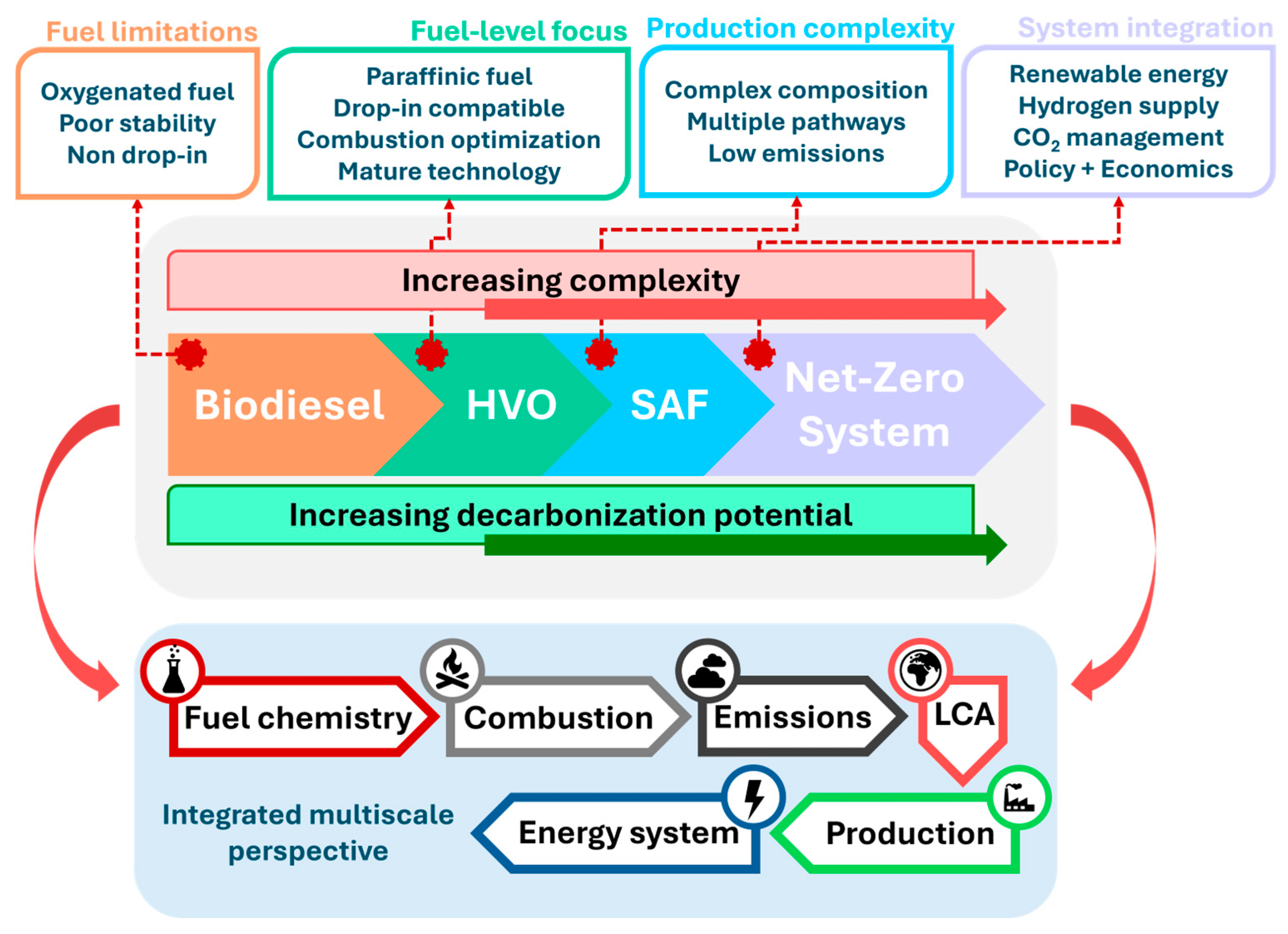
Figure 2.
Multiscale framework linking fuel properties, engine processes, emissions, and system-level implementation for renewable fuels.
Figure 2.
Multiscale framework linking fuel properties, engine processes, emissions, and system-level implementation for renewable fuels.
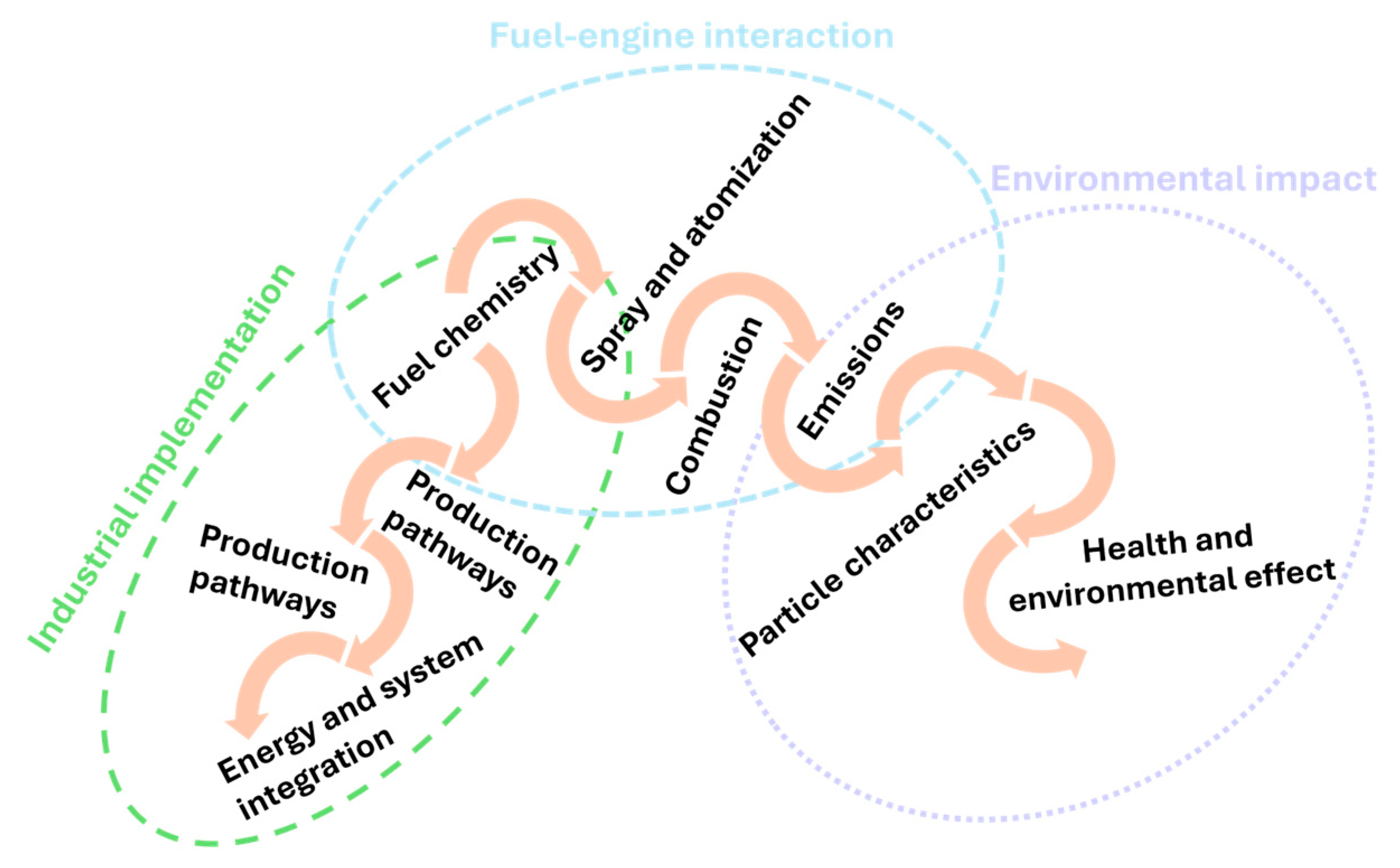
Figure 3.
Evolution of HVO and SAF publications, showing the transition from early HVO development to the recent exponential growth of SAF research driven by aviation decarbonization needs (search query: TITLE-ABS-KEY (“SAF” and “HVO”), Scopus database, from 2000 to 2025) [7].
Figure 3.
Evolution of HVO and SAF publications, showing the transition from early HVO development to the recent exponential growth of SAF research driven by aviation decarbonization needs (search query: TITLE-ABS-KEY (“SAF” and “HVO”), Scopus database, from 2000 to 2025) [7].
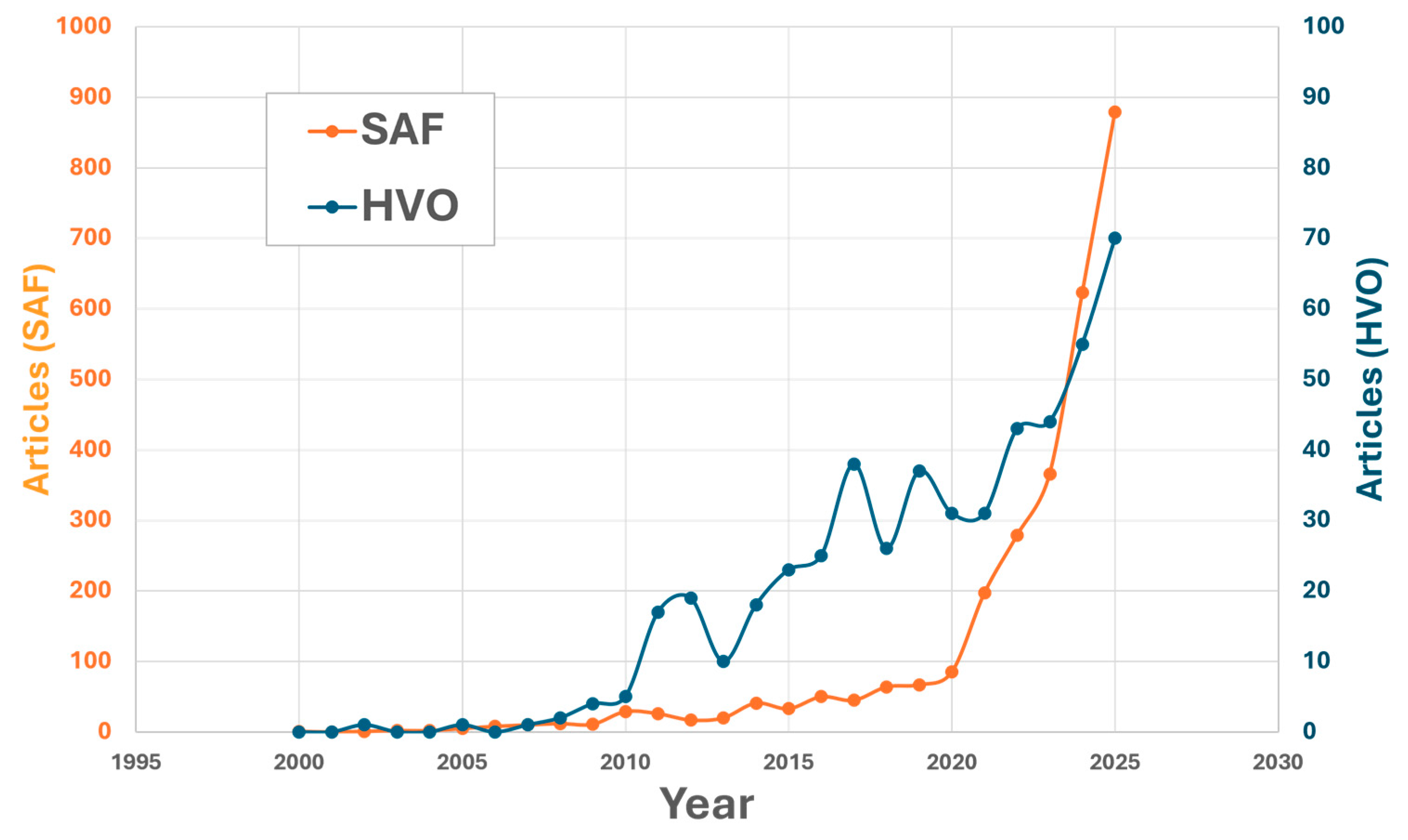
Figure 6.
Overview of the main sustainable aviation fuel (SAF) production pathways, including Hydroprocessed Esters and Fatty Acids (HEFA), Fischer–Tropsch (FT), alcohol-to-jet (ATJ), and power-to-liquid (PtL), classified according to their primary feedstocks and technology readiness levels (TRL).
Figure 6.
Overview of the main sustainable aviation fuel (SAF) production pathways, including Hydroprocessed Esters and Fatty Acids (HEFA), Fischer–Tropsch (FT), alcohol-to-jet (ATJ), and power-to-liquid (PtL), classified according to their primary feedstocks and technology readiness levels (TRL).
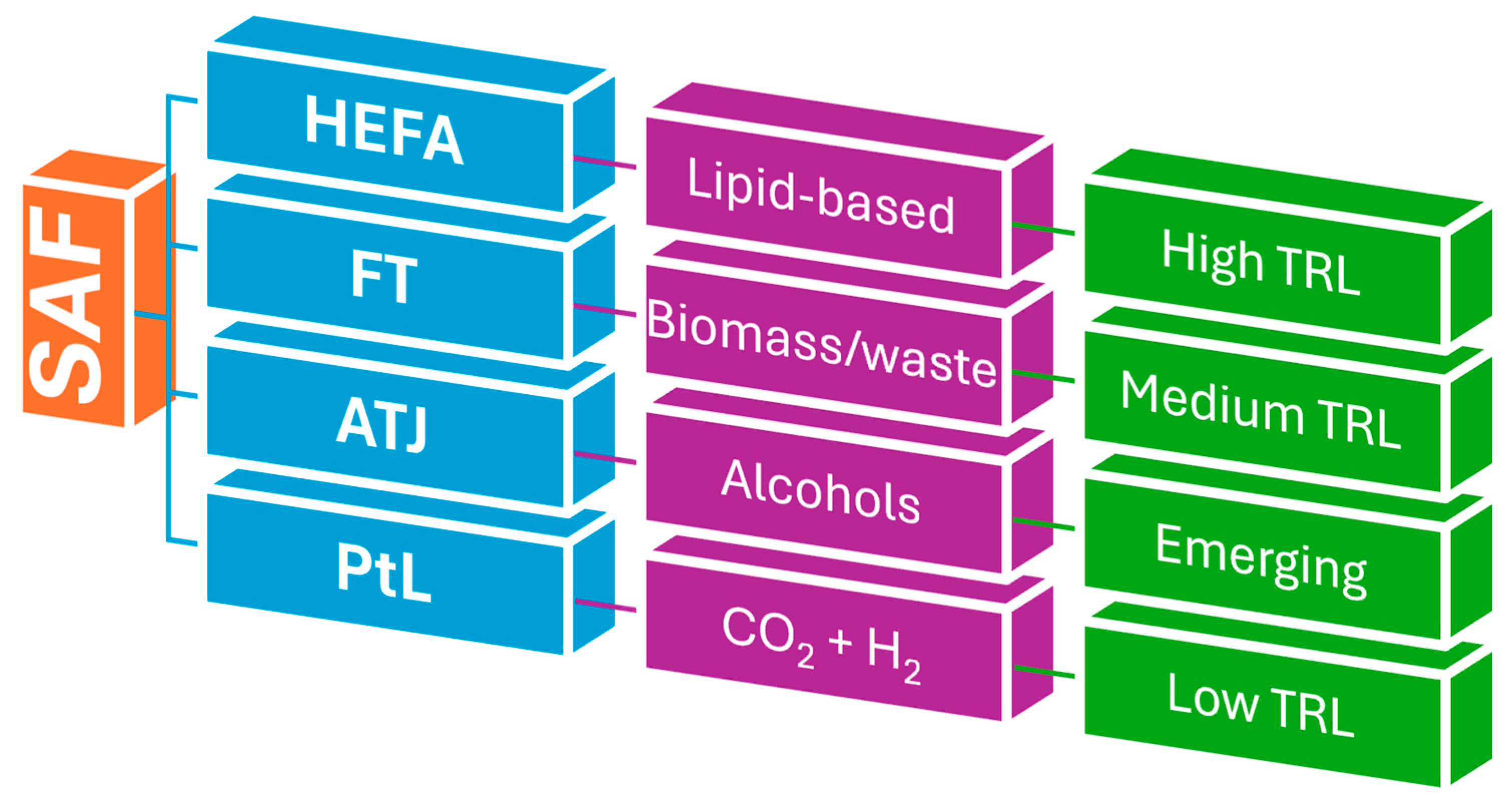
Figure 7.
Radar chart comparing emission trends of biodiesel (FAME) and hydrocarbon-based fuels (HVO/SAF) across key indicators (CO, hydrocarbons (HC), NOx, particulate mass (PM), and particle number (PN)).
Figure 7.
Radar chart comparing emission trends of biodiesel (FAME) and hydrocarbon-based fuels (HVO/SAF) across key indicators (CO, hydrocarbons (HC), NOx, particulate mass (PM), and particle number (PN)).
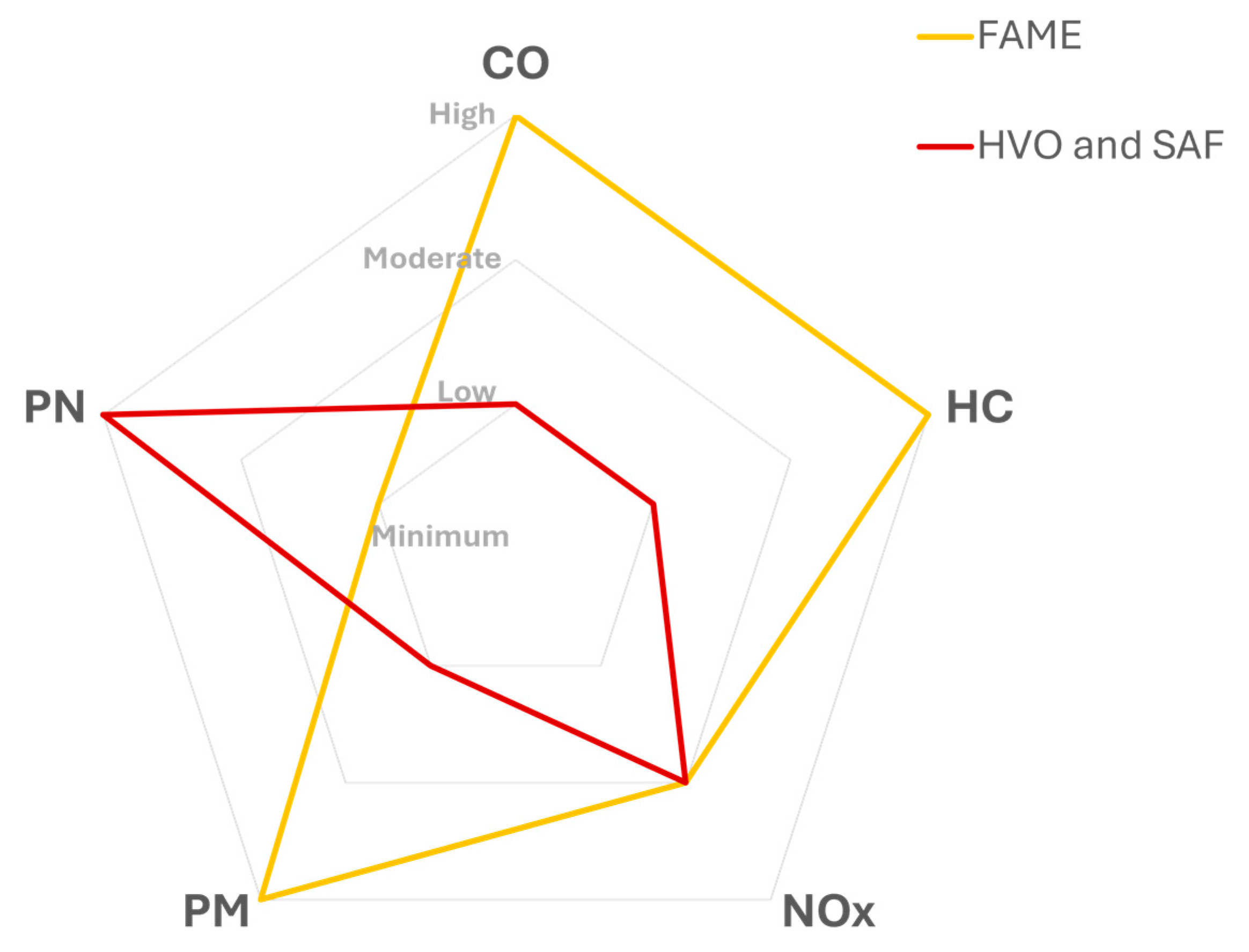
Figure 8.
Conceptual representation of the particle size ranges commonly associated with emissions from fossil fuels, biodiesel (FAME), HVO, and SAF.
Figure 8.
Conceptual representation of the particle size ranges commonly associated with emissions from fossil fuels, biodiesel (FAME), HVO, and SAF.
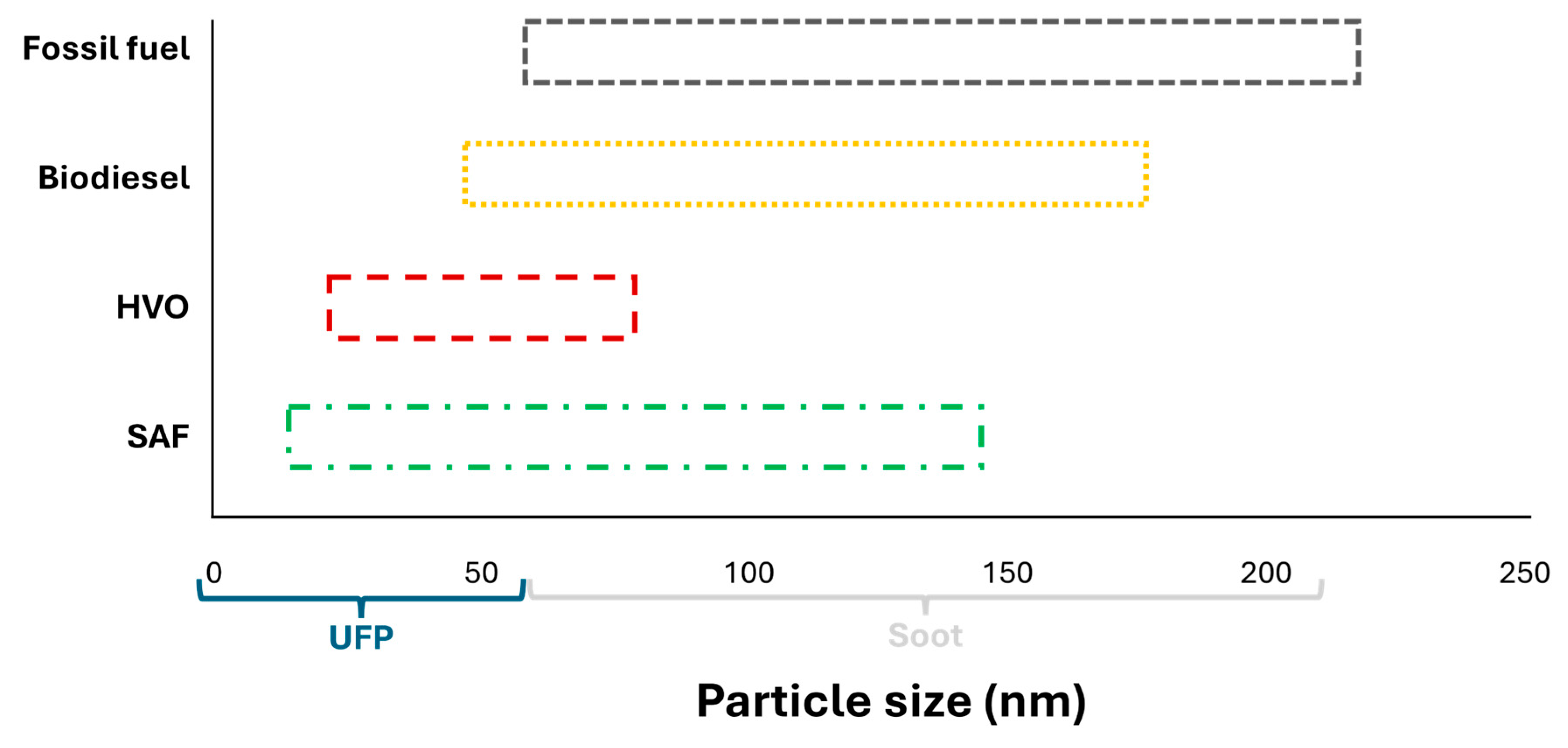
Figure 9.
System-level framework for sustainable aviation fuel (SAF) deployment through the power-to-liquid (PtL) pathway.
Figure 9.
System-level framework for sustainable aviation fuel (SAF) deployment through the power-to-liquid (PtL) pathway.
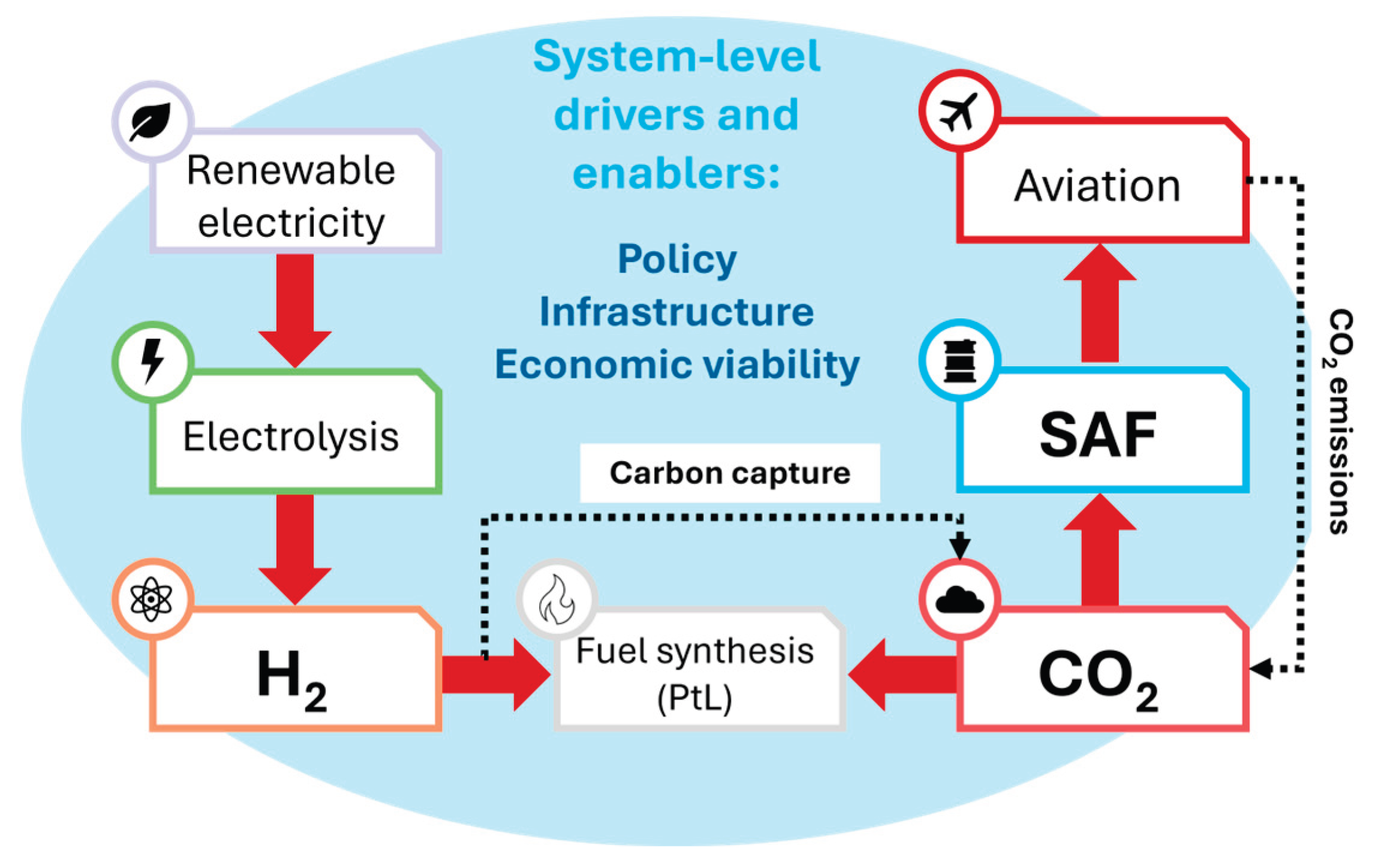

Table 1.
Comparison of biodiesel-derived fuels and sustainable aviation fuels.
| Parameter | Biodiesel (FAME) | HVO | SAF |
|---|---|---|---|
| Generation | First-generation biofuel | Advanced biofuel |
Advanced/synthetic fuels |
| Oxygen content | High | Negligible | Negligible (pathway-dependent) |
| Drop-in compatibility | No | Yes | Yes (blends or full) |
| Fuel composition | Oxygenated esters | Paraffinic hydrocarbons |
Complex (paraffinic + aromatics) |
| Main limitation | Stability and cold-flow issues | Feedstock availability |
Cost and scalability |
| Production pathways | Transesterification | Hydrotreatment (HDO) | HEFA, FT, ATJ, PtL |
| Technological maturity | High | High | Medium-low (depending on pathway) |
| Emission reduction | Moderate | High | Very high |
| System complexity | Low | Medium | High |
Table 2.
Comparison of key physicochemical properties of biodiesel (FAME), HVO, and SAF, including density, viscosity, cetane number, and aromatic content, highlighting their influence on spray behavior, combustion characteristics, and emissions formation.
Table 2.
Comparison of key physicochemical properties of biodiesel (FAME), HVO, and SAF, including density, viscosity, cetane number, and aromatic content, highlighting their influence on spray behavior, combustion characteristics, and emissions formation.
| Property | FAME | HVO | SAF |
|---|---|---|---|
| Density | High | Low | Variable |
| Visosity | High | Low | Medium |
| CN | Medium | High | Variable |
| Aromatics | Yes | No | Controlled |
Table 3.
Summary of combustion and emission studies investigating HVO and SAF fuels in diesel and aviation applications, including engine systems, combustion characteristics, emission behavior, and principal conclusions reported in the literature.
Table 3.
Summary of combustion and emission studies investigating HVO and SAF fuels in diesel and aviation applications, including engine systems, combustion characteristics, emission behavior, and principal conclusions reported in the literature.
| Fuel | Engine/system | Combustion findings | Emission findings | Conclusion | Ref. |
|---|---|---|---|---|---|
| HVO | CVV + CFD | Improved atomization and spray breakup | No direct emissions measured | Spray characteristics favor cleaner combustion | [21] |
| HVO | Euro 6 diesel engine | Shorter ignition delay and earlier combustion phasing | Lower CO, HC and NOx emissions; soot dependent on operating conditions | HVO as a viable drop-in fuel | [18] |
| HVO blends | Euro 3 passenger car |
Improved combustion quality due to higher cetane number | Reduced CO and HC emissions | Emission improvements without engine mofidication | [22] |
| HVO | Euro 6 diesel engine |
Shorter ignition delay, lower combustion noise and improved cold operation |
Large soot reduction; NOx load-dependent | Benefits amplified during low-temperature operation | [23] |
| HVO and fat blends | 1.9 L TDI engine |
HVO showed shortest ignition delay and smoothest combustion | Lowest HC, NOx and smoke emissions | Best performance among tested fuels | [20] |
| HVO | CI engine | Reduced calibration sensitivity and better cold-start combustion | Lower HC, CO and soot | Strong cold-operation performance | [24] |
| HVO | Marine diesel engine | Improved combustion quality due to paraffinic composition | Lower NOx, THC and PM mass | PM-PN trade-off observed | [25] |
| HVO | Heavy-duty diesel engine | Rail pressure strongly affects particle formation | Similar global PN and soot trends to diesel | Shift toward nucleation-mode particles | [26] |
| HEFA-SAF | Turbofan engine |
Improved mixing and volatility | Major reductions in nvPM mass and number | Strong particulate benefits | [27] |
| HEFA-SAF blends | Aircraft piston engine | Improved combustion stability and power output | Reduced HC, NOx, PM and PN | Higher SAF content improved overall performance | [28] |
| Neat HVO | Light-duty turbocharged CI engine | Higher cetane number advanced combustion and altered heat-release characteristics; EGR and MIT strongly affected combustion phasing | Reduced PM up to 40% and NOx up to 15% with optimized EGR | Engine recalibration can substantially improve the PM-NOx trade-off when using HVO | [29] |
| HVO | CVCC + DBI optical diagnosis | Shorter penetration, larger spray angle, larger spray volume, higher entrainment | Potential for lower soot formation through improved mixing | Fuel properties significantly influence atomization and mixture formation | [16] |
Table 4.
Reported emission trends for HVO and SAF fuels relative to conventional fossil fuels, including variations in carbon monoxide (CO), hydrocarbons (HC), nitrogen oxides (NOx), particulate matter (PM), soot, and particle number (PN) emissions under different operating conditions.
Table 4.
Reported emission trends for HVO and SAF fuels relative to conventional fossil fuels, including variations in carbon monoxide (CO), hydrocarbons (HC), nitrogen oxides (NOx), particulate matter (PM), soot, and particle number (PN) emissions under different operating conditions.
| Ref. | Fuel | CO | HC | NOx | PM/Soot | PN |
|---|---|---|---|---|---|---|
| [18] | HVO | ˗40% | ˗56% | ˗13% | Variable | N.R. |
| [22] | 30% HVO blend | ˗41% | ˗27% | Slight decrease | ˗2% | ˗2.5% |
| [23] | HVO | ˗15 to ˗36% | ˗25 to ˗44% | ˗15 to +10% | ˗15 to ˗67% | N.R. |
| [20] | HVO | Slight decrease | ˗45% | ˗18% | ˗18% (smoke) | N.R. |
| [24] | HVO | ˗60% | ˗67% | Similar | Soot decrease | N.R. |
| [25] | HVO | ˗20 to ˗30% | ˗50 to ˗55% | ˗10 to ˗15% | ˗30% | +30% |
| [27] | HEFA-SAF | N.R. | N.R. | N.R. | ˗89 to ˗96% nvPM | ˗71 to ˗92% |
| [28] | SAF-RP3 blends | Slight increase | ˗69 to ˗79% | ˗5 to ˗17% | ˗52 to ˗54% PM | ˗52 to ˗54% PN |
N.R. = Not reported.
Table 5.
Summary of particle-related emission characteristics reported for HVO and SAF fuels, including trends in particulate mass (PM), particle number (PN), particle size distribution (PSD), and the associated environmental and health implications.
Table 5.
Summary of particle-related emission characteristics reported for HVO and SAF fuels, including trends in particulate mass (PM), particle number (PN), particle size distribution (PSD), and the associated environmental and health implications.
| Fuel | PM trend | PN trend | Particle size (nm) | Main observation | Conclusion | Ref. |
|---|---|---|---|---|---|---|
| HVO | Similar | Similar or increase |
5-25 (nucleation) |
High pressure shifts particles toward ultrafine range | UFP increase possible | [26] |
| HVO | ˗30% | +30% | Smaller CMD1 | Lower PM but higher PN | PM alone is not enough | [25] |
| HVO | Lower PM | Similar deposited PN |
108 (MMD1) | Smaller particles deposit more efficiently in lungs | Health concern | [33] |
| HVO blends | Lower PM | Variable PN | N.R. | Blend-depended response | PM-PN trade-off | [22] |
| HVO | Variable soot response | N.R. | N.R. | Reduced HC does not guarantee lower PM | Complex particle behavior | [18] |
| HVO | ˗15 to ˗67% (soot) | N.R. | N.R. | Strong soot reduction | Cleaner exhaust | [23] |
| HVO blends | ˗18 to ˗59% (smoke) | N.R. | N.R. | Oxygenated fuels enhance soot oxidation | Reduced PM burden | [20] |
| HEFA-SAF | ˗89 to ˗96% (nvPM) | ˗71 to ˗92% | 7-20 | Fewer but very small particles | UFP monitoring required | [27] |
| SAF-RP3 | PM decrease | PN decrease | 20-30 | Reduced agglomeration and particle concentration | Better particulate profile | [28] |
| HEFA-SAF | ˗89-96% nvPM mass | ˗71-92% nvPM number | Smaller and narrower PSD | Substantial particulate-matter mitigation potential of paraffinic aviation fuels | HEFA-based SAFs effective for reducing particulate emissions | [34] |
1CMD and MMD describe the median particle diameter based on particle number and particle mass distributions, respectively.
Table 6.
Comparative environmental and health implications of biodiesel (FAME), HVO, and SAF.
| Aspect | Biodiesel | HVO | SAF |
|---|---|---|---|
| PM mass | Medium | Low | Low |
| Particle number | Medium | High | Variable |
| Air quality | Moderate | Improved | Improved |
| Contrail reduction | Low | Moderate | High |
| Lifecycle emissions | Moderate | High reduction | Very high reduction |
| Health uncertainty | Moderate | Moderate | High |
Table 7.
Overview of system-level considerations affecting large-scale SAF deployment, including techno-economic performance, policy frameworks, feedstock availability, carbon management strategies, supply-chain requirements, and long-term aviation decarbonization pathways.
Table 7.
Overview of system-level considerations affecting large-scale SAF deployment, including techno-economic performance, policy frameworks, feedstock availability, carbon management strategies, supply-chain requirements, and long-term aviation decarbonization pathways.
| Topic | Main finding | Key result | Ref. |
|---|---|---|---|
| ReFuelEU | EU can meet short-term SAF targets | 2050 deficit around 1.35 Mt SAF | [2] |
| U.S. deployment | HEFA dominates near-term production | 77-82% of 2030 SAF | [57] |
| Net-zero aviation | Demand reduction may be required | 18-27% flight suppression | [58] |
| Decarbonization scenarios | SAF alone may not be sufficient | Strong role for e-fuels | [59] |
| PtL economics | FT and MtJ show similar efficiencies | Carbon efficiency around 90% | [49] |
| CO2-to-SAF | Methanol route most promising | CO2 efficiency around 92% | [60] |
| Direct CO2-to-SAF | One-step route could reduce costs | Around 1692 $·t⁻¹ SAF | [61] |
| CCS vs CCU | CCS more effective than CCU | Net-negative pathways possible | [43] |
| Net-zero SAF | SAF can reduce soot and contrails | CII as low as 13.9 gCO2eq·MJ˗1 | [62] |
| Supply chains | GIS optimization lowers costs | Around 0.92 $·L⁻¹ SAF | [46] |
| CH-SAF LCA | Strong GHG reductions | 48-82 % reduction | [39] |
| Lignin-to-SAF | High carbon efficiency | 78% carbon efficiency | [40] |
| Decentralized PtL | Long-term competitiveness feasible | 2 €·L⁻¹ by 2050 | [63] |
| Social acceptance | SAF awareness remains limited | Low willingness to pay | [64] |
| Biodeterioration | Microbial risks remain relevant | Around 87% prevalence reported | [65] |
Table 8.
Comparative framework of biodiesel, HVO, and SAF across multiple scales.
| Level | Biodiesel | HVO | SAF |
|---|---|---|---|
| Chemistry | Oxygenated | Paraffinic | Tailored |
| Combustion | Limited | Optimized | Advanced |
| Production | Simple | Mature | Complex |
| Scalability | Limited | Limited | Potentially high |
| System complexity | Low | Medium | Very high |
| Main bottleneck | Fuel properties | Feedstock | Energy system |
Disclaimer/Publisher’s Note: The statements, opinions and data contained in all publications are solely those of the individual author(s) and contributor(s) and not of MDPI and/or the editor(s). MDPI and/or the editor(s) disclaim responsibility for any injury to people or property resulting from any ideas, methods, instructions or products referred to in the content. |
© 2026 by the authors. Licensee MDPI, Basel, Switzerland. This article is an open access article distributed under the terms and conditions of the Creative Commons Attribution (CC BY) license (http://creativecommons.org/licenses/by/4.0/).
Copyright: This open access article is published under a Creative Commons CC BY 4.0 license, which permit the free download, distribution, and reuse, provided that the author and preprint are cited in any reuse.