

Submitted:
06 August 2026
Posted:
07 August 2026
You are already at the latest version
Abstract
Orange peel is generated in large volumes and, when discarded, releases greenhouse gases and wastes a biomass with bioactive potential. This study evaluated the antioxidant and antimicrobial activity of essential oil extracted by steam distillation from the peel of Valencia orange (Citrus sinensis) and sour orange (Citrus aurantium). Antioxidant capacity was determined by ABTS and FRAP assays (2×2 factorial design, three replicates), and antimicrobial activity by disc diffusion against Escherichia coli, Shigella spp., Staphylococcus aureus, and Bacillus cereus (2×4 factorial design, two replicates); the susceptibility of the four bacteria to amoxicillin and ceftriaxone was evaluated as a comparative reference. Volumetric extraction yield was 1.25 mL/100 g for both varieties. Valencia orange oil showed significantly higher antioxidant capacity than sour orange oil in both assays (ABTS: 438.08 vs. 156.35 µmol TE/L; FRAP: 187.21 vs. 71.45 µmol TE/L; p < 0.001). In contrast, sour orange oil produced substantial inhibition halos against all four bacteria (16.0-29.5 mm), whereas Valencia orange oil produced no detectable inhibition (p < 0.001). Amoxicillin outperformed ceftriaxone against three of the four bacteria (halos up to 35 mm), with comparable effectiveness against Staphylococcus aureus. These results demonstrate marked functional differentiation between varieties and support the valorization of citrus peel into functional essential oils for the food, pharmaceutical, and cosmetic industries.
Keywords:
Citrus sinensis
; Citrus aurantium
; essential oil
; antioxidant activity
; antimicrobial activity
; agro-industrial waste valorization
Introduction
Citrus fruits are among the economically most important tree crops worldwide, and their cultivation continues to expand under increasingly demanding climatic and market conditions (Ertekin & Comart, 2024; Guzel & Akcaoz, 2026; Khan & Chunjie, 2026; Wei et al., 2026). Their processing into juice and fresh fruit generates a correspondingly large volume of peel, pulp, and seed residues, which are estimated to represent between 50% and 70% of total fruit mass and constitute one of the most abundant agro-industrial by-product streams worldwide (Cabot et al., 2022; Dubey et al., 2023). When this biomass is discarded rather than processed, its anaerobic decomposition releases methane and other greenhouse gases and wastes a matrix recognized as a source of biopolymers, packaging films, fermentable sugars, and bioactive compounds (Cabot et al., 2022; Dubey et al., 2023; Figueira et al., 2023; Stavrakakis et al., 2025).
Citrus sinensis (Valencia orange) is one of the most widely cultivated sweet orange varieties and plays a substantial economic role in producing regions, including the Andean valleys of Ecuador, while Citrus aurantium (sour or bitter orange) has a long history of use in traditional medicine and continues to attract pharmacological interest for the composition of its essential oil (Ashmawy et al., 2024). The peel of both varieties accumulates flavonoids, carotenoids, essential oils, and other phenolic compounds that vary in concentration and profile according to cultivar, maturity stage, and postharvest handling (Dongre et al., 2023; Lai et al., 2022; Qiu et al., 2023). In particular, hesperidin has been widely documented as a major bioactive flavanone of orange peel, with reported antioxidant, anti-inflammatory, and skin-protective properties that have driven interest in its recovery for nutraceutical and cosmetic applications (Paczkowska-Walendowska et al., 2023; Rodrigues & Pintado, 2024).
In parallel, the global rise of antimicrobial resistance has been recognized by the World Health Organization as one of the most pressing public health threats, with an updated list of priority bacterial pathogens highlighting multidrug-resistant Enterobacteriaceae and Staphylococcus aureus among the organisms of greatest concern for research and development (Jesudason, 2024; Ma et al., 2024; Meade et al., 2024). Comparative clinical evidence further indicates that the performance of beta-lactam antibiotics such as ceftriaxone and amoxicillin varies substantially depending on the target pathogen and the resistance mechanisms present in a given clinical or food-safety context (Guz et al., 2023), and interpretive frameworks based on minimum inhibitory concentration remain central to translating in vitro susceptibility into clinically or industrially meaningful categories (Dhandapani et al., 2023). This context has intensified interest in plant-derived essential oils as complementary or alternative antimicrobial agents, particularly for food-preservation applications where the substitution of synthetic additives is increasingly demanded by consumers and regulators.
Essential oils obtained from the leaves, flowers, and peel of Citrus aurantium have been characterized in several recent studies, which consistently report high proportions of monoterpenes such as limonene together with antioxidant and antimicrobial activity that depends strongly on the plant organ, the extraction method, and the analytical conditions used (Abud Espinoza et al., 2021; Ashmawy et al., 2024; Bozinou et al., 2023; El Kasimi et al., 2023; Mejri et al., 2022; Oulebsir et al., 2022). Comparable compositional and bioactivity work has been reported for Citrus sinensis peel oil, including antibacterial and antifungal effects, film-forming and packaging applications, and antioxidant protection in biological models (Bocker & Silva, 2024; de Aquino et al., 2023; Li et al., 2021; Sado et al., 2022; Zhang et al., 2022). In addition, a synergistic combination of Citrus aurantium essential oils has been shown to enhance antibacterial efficacy against Escherichia coli specifically for food-preservation purposes (Ellouze et al., 2024), while other recent reports have further characterized the composition, encapsulation, and processing of Citrus aurantium essential oil (Ashraf et al., 2024; Mejri et al., 2024; Mohagheghniapour et al., 2022; Sharifpour et al., 2025).
Among the terpenic constituents of citrus essential oils, limonene has received particular mechanistic attention. It has been shown to compromise the integrity of the bacterial cell membrane and cell wall, increase membrane permeability, and promote the leakage of intracellular components, with demonstrated activity against Staphylococcus aureus and Escherichia coli (Gupta et al., 2021b; Gupta et al., 2021a; Han et al., 2021). Complementary evidence indicates that essential oil vapors and isolated antimicrobial metabolites are similarly effective against Bacillus cereus, a spore-forming foodborne pathogen of particular concern in cereal- and rice-based foods (Liao et al., 2024; Woh & Ng, 2024; Yang et al., 2023), and that essential oils and their components can inactivate Shigella flexneri through membrane disruption and biofilm inhibition (Cai et al., 2023). The reliability of the disc diffusion method used to characterize these effects is, in turn, sensitive to technical parameters such as agar depth and inhibition-zone morphology, which have been the subject of recent methodological refinement (Olaru et al., 2024; Saar et al., 2025).
Despite this growing body of evidence on citrus essential oils individually, direct, parallel comparisons of the antioxidant and antimicrobial performance of Valencia orange and sour orange essential oils obtained under identical extraction and assay conditions remain scarce, and the extent to which the two varieties diverge in their functional profile has not been systematically characterized against a common panel of foodborne bacterial pathogens. The present study aimed to determine the antioxidant activity, via the ABTS and FRAP assays, and the antimicrobial activity, via the disc diffusion method against Escherichia coli, Shigella spp., Staphylococcus aureus, and Bacillus cereus, of the essential oil obtained by steam distillation from the peel of Citrus sinensis and Citrus aurantium, complemented by a characterization, via disc diffusion at increasing concentrations, of the susceptibility of the four bacteria to two reference antibiotics, amoxicillin and ceftriaxone, as a point of comparison with the activity of the essential oil.
Materials and Methods
Study Site and Plant Material
The trial was conducted in the research and outreach laboratories and the agro-industrial complex of the Universidad Estatal de Bolívar, located in Guaranda canton, Bolívar province, Ecuador (zone 17M, east 722773, north 9821524.1). Valencia orange (Citrus sinensis) and sour orange (Citrus aurantium) peel were obtained from fruit harvested in Caluma canton, Bolívar province, an area with approximately 2650 ha under citrus cultivation. Fruits were selected for uniform ripeness and absence of visible defects, washed under running water to remove surface residues, hand-peeled to recover the flavedo, and cut into small pieces immediately before extraction.
Essential Oil Extraction
The essential oil was obtained by steam distillation. For each extraction batch, 400 g of chopped peel was combined with 500 mL of distilled water containing 0.7% (3.5 g) sodium bicarbonate and left to macerate for 8-12 h at room temperature. The macerated material was ground and transferred to a distillation flask together with an additional 15% (60 mL) of distilled water, and heated to boiling without exceeding 100 °C. The condensate was collected in a separating funnel and left to stand for 24 h to allow separation of the aqueous (hydrolate) and oil phases by density difference. The essential oil layer was recovered, transferred to amber glass vials, and stored at 4-20 °C until analysis. The volumetric extraction yield (R, mL/100 g) was calculated using Equation 1,
where V1 is the volume of essential oil recovered (mL) and M2 is the initial mass of processed peel (g). Yield is expressed on a volume/mass basis because the recovered oil was quantified volumetrically.
R = (V1 / M2) × 100
Figure 1 illustrates the flow diagram of the extraction process and representative experimental stages, from raw-material selection to the determination of antioxidant activity.
Experimental Design
Antioxidant activity was evaluated under a completely randomized design with a 2 × 2 factorial arrangement, with variety (Valencia orange, sour orange) as factor A and determination method (FRAP, ABTS) as factor B, with three replicates per treatment combination (N = 12 independent determinations).
Antimicrobial activity was evaluated, in parallel, under a second completely randomized design with a 2 × 4 factorial arrangement, with variety as factor A and target microorganism (Escherichia coli, Shigella spp., Staphylococcus aureus, Bacillus cereus) as factor B, with two replicates per treatment combination (N = 16 independent determinations). Table 1 summarizes the structure of both designs.
Determination of Antioxidant Activity
For the ABTS assay (2,2'-azino-bis-(3-ethylbenzothiazoline)-6-sulfonic acid), the ABTS cationic radical was generated by mixing 5 mL of ABTS solution (7 mM) with 88 µL of potassium persulfate (140 mM) and allowing the mixture to react in the dark for 12 h; the resulting solution was diluted with acetic acid-sodium acetate buffer (pH 5) until reaching an absorbance of 0.7 at 734 nm. A 190 µL aliquot of this working solution was combined with 10 µL of essential oil, allowed to react for 5 min at room temperature, and read at 734 nm on a NanoDrop spectrophotometer (Thermo Scientific); a Trolox calibration curve (0-200 µmol/L) was used to express results as µmol Trolox equivalents (TE) per liter of sample.
For the FRAP assay, the working reagent was prepared by combining 2.5 mL of sodium acetate buffer, 2.5 mL of FeCl₃, and 2.5 mL of TPTZ solution, followed by incubation for 30 min at 37 °C protected from light. Reaction tubes containing 30 µL of distilled water, 30 µL of essential oil, and 900 µL of FRAP reagent (30 µL of ethanol replacing the sample in the blank) were incubated for 30 min at 37 °C, and absorbance was read at 593 nm; results were expressed as µmol TE per liter of sample using a Trolox calibration curve prepared in 96% ethanol.
Determination of Antimicrobial Activity
Strains of Escherichia coli, Staphylococcus aureus, Shigella spp., and Bacillus cereus, previously characterized and maintained in the microorganism bank of the general laboratory of the Faculty of Agricultural Sciences and the Research and Outreach laboratory of the Universidad Estatal de Bolívar, were reactivated on selective culture media: MacConkey agar for Escherichia coli, mannitol salt agar for Staphylococcus aureus, Salmonella-Shigella agar for Shigella spp., and Chromogenic Bacillus agar for Bacillus cereus. Culture media were prepared according to manufacturer specifications, autoclave-sterilized (121 °C, 15 min), poured into Petri dishes, and allowed to solidify before inoculation, following the microbiological culture-media preparation and quality-control guidelines of ISO 7218 (International Organization for Standardization, 2007); all strains were incubated at 37 °C for 24 h. Antimicrobial activity was determined by the disc diffusion method: 6 mm antibiogram discs were impregnated with pure essential oil (undiluted in solvent) at concentrations of 5, 10, and 15 µg per disc, including a blank disc without essential oil as a negative control for each bacterium, and placed on media inoculated with each bacterium at a McFarland turbidity standard of 0.5. Inhibition was quantified as the diameter of the clear zone around each disc after incubation, with larger diameters indicating greater antimicrobial effectiveness.
Susceptibility to Reference Antibiotics by Disc Diffusion
As a point of comparison with the antimicrobial activity of the essential oil, the susceptibility of the four bacteria to two reference antibiotics, ceftriaxone and amoxicillin, was additionally characterized using the disc diffusion method at three increasing concentrations (5, 10, and 15 µg), using Mueller-Hinton agar as the culture medium. Plates inoculated with each target bacterium were incubated for 48 h at 30 °C; discs impregnated with each antibiotic at the corresponding concentration were then applied to the agar surface, and the inhibition halo was measured after incubation as an indicator of comparative antimicrobial effectiveness.
Statistical Analysis
Data from each design were analyzed independently using two-way analysis of variance (ANOVA), with variety, the second factor (method or microorganism), and their interaction included as fixed effects. Normality of residuals was assessed with the Shapiro-Wilk test and homogeneity of variances with Levene's test. Effect sizes were quantified using η² (proportion of total variance explained by the effect) and ω² (an estimate of that same proportion corrected for the bias associated with small samples). Given the small number of replicates per treatment, each omnibus ANOVA result was corroborated using an exact or Monte Carlo permutation test (5000 relabelings), which does not depend on distributional assumptions. When the omnibus effect was significant, pairwise comparisons between treatment combinations were performed using Tukey's honestly significant difference (HSD) test. Analyses were performed in Python (SciPy and statsmodels); a nominal significance level of α = 0.05 was used throughout. Reference-antibiotic susceptibility determinations, with a single reading per bacterium-antibiotic-concentration combination, are reported descriptively.
Results
Essential Oil Yield
Steam distillation of 400 g of peel yielded 5 mL of essential oil for both Valencia orange and sour orange, corresponding to a volumetric extraction yield of 1.25 mL/100 g for each variety. Condensation during distillation began at approximately 23 °C for Valencia orange peel and 10 °C for sour orange peel, reaching a common upper range of 60-70 °C within a comparable condensation time of 65 min for both varieties, indicating greater initial volatility of the condensable fraction in sour orange peel despite the equivalent final yield.
Antioxidant Activity
Table 2 presents the descriptive statistics and two-way analysis of variance for antioxidant capacity, and Figure 2 illustrates the means obtained for each variety-method combination; Table 3 details the corresponding pairwise comparisons.
Valencia orange essential oil showed significantly higher antioxidant capacity than sour orange oil under both assays (variety effect: F(1,8) = 1955.42, p < 0.001, η² = 0.529, ω² = 0.528), and the ABTS assay produced systematically higher values than FRAP for both varieties (method effect: F(1,8) = 1395.31, p < 0.001, η² = 0.377, ω² = 0.377). The variety × method interaction was also significant (F(1,8) = 340.96, p < 0.001, η² = 0.092, ω² = 0.092): the magnitude of Valencia orange's advantage depended on the assay used, being greater with ABTS than with FRAP. An exact/Monte Carlo permutation test, independent of distributional assumptions, corroborated all three effects (permutation p < 0.001 for variety and method, p = 0.0006 for the interaction); model residuals met the assumptions of normality (Shapiro-Wilk W = 0.981, p = 0.987) and homogeneity of variance (Levene F = 1.151, p = 0.386).
Antimicrobial Activity
Table 4 presents the descriptive statistics and two-way analysis of variance for inhibition halo diameter, and Figure 3 illustrates the means obtained against each microorganism; Table 5 details the pairwise comparisons within the sour orange essential oil.
Sour orange essential oil produced measurable inhibition halos against all four bacteria evaluated, whereas Valencia orange essential oil produced no detectable inhibition against any of them (variety effect: F(1,8) = 11907.00, p < 0.001, η² = 0.885, ω² = 0.885). The microorganism effect and the variety × microorganism interaction were numerically identical (F(3,8) = 256.33, p < 0.001, η² = 0.057, ω² = 0.057 for each); this numerical identity is a direct mathematical consequence of the constant null response of Valencia orange to the four microorganisms, which collapses the microorganism main effect and the interaction term into the same source of variation. A permutation test corroborated all three effects (permutation p < 0.001 for the variety effect and the interaction, p = 0.0002 for the microorganism effect); this permutation-based evidence constitutes the reference result for this response variable, given that the constant null response of Valencia orange moves the residuals away from normality (Shapiro-Wilk W = 0.787, p = 0.0018) and numerically destabilizes Levene's test.
Within the sour orange essential oil, Staphylococcus aureus and Bacillus cereus were the most susceptible microorganisms, followed by Escherichia coli and, lastly, Shigella spp. (Table 4, Figure 3). Tukey's test confirmed that Staphylococcus aureus and Bacillus cereus did not differ from each other, but each differed significantly from Escherichia coli and Shigella spp., which in turn differed significantly from each other (Table 5).
Susceptibility to Reference Antibiotics by Disc Diffusion
Table 6 presents the inhibition halo diameter of the four bacteria against the two reference antibiotics at three increasing concentrations, with a single determination per bacterium × antibiotic × concentration combination, which supports a descriptive report for this variable.
Amoxicillin produced larger inhibition halos than ceftriaxone against Escherichia coli, Shigella spp., and Bacillus cereus at the 10 μg concentration, while both antibiotics performed comparably against Staphylococcus aureus (Table 6). The largest halos recorded were 35 mm, obtained with amoxicillin at 10 μg against Escherichia coli, Shigella spp., and Staphylococcus aureus; Bacillus cereus showed the comparatively lowest maximum response, reaching 30 mm with amoxicillin at 10 μg versus 25 mm with ceftriaxone at the same concentration.
Discussion
Extraction yield obtained through distillation-based methods is known to vary considerably depending on the extraction technique, distillation time, and pretreatment of the plant raw material, as illustrated by direct comparisons between steam and simultaneous distillation and supercritical CO2 extraction for other aromatic species (Munankarmi et al., 2025); the volumetric yield of 1.25 mL/100 g obtained here for Valencia orange and sour orange peel is consistent with this general process-dependent variability. The small difference observed in the initial condensation temperature between the two varieties, lower for sour orange than for Valencia, is consistent with the histochemical and compositional characterization of Citrus aurantium essential oil, in which the volatile terpenic fraction has been shown to change measurably according to plant organ and developmental stage (Mejri et al., 2022; Oulebsir et al., 2022).
The marked antioxidant advantage of Valencia orange essential oil over sour orange oil observed in the present study, evident in both the ABTS and FRAP assays (Table 2, Figure 2), agrees with previous comparative work on essential oils of Citrus sinensis, Citrus paradisi, and Citrus reticulata, which likewise reported differential antioxidant responses between species and assay methods for oils extracted under standardized conditions (Jiménez Jiménez et al., 2022). Comparable species-level differences in total phenolic content and antioxidant capacity have also been documented among peel extracts of Citrus sinensis, Citrus reticulata, and Citrus maxima (Alarcon Mite et al., 2022), and specifically for Citrus sinensis peel in a further comparative assessment of polyphenol content and antioxidant activity (Mora Loor et al., 2022). The consistently higher values obtained with the ABTS assay relative to FRAP for both varieties in the present study reproduce a more broadly documented pattern among antioxidant assay methodologies, since ABTS captures both hydrophilic and lipophilic antioxidants whereas FRAP is restricted to single-electron-transfer reducing capacity, a mechanistic distinction that is particularly relevant for lipophilic matrices such as essential oils. Navel orange peel has, in this regard, been shown to retain substantially different antioxidant capacities depending on the postharvest drying method, underscoring that pre-extraction handling of the raw material can modulate the antioxidant yield of the final product as much as the extraction method itself (Lai et al., 2022). The higher antioxidant response of Valencia orange observed here could be related to differences in the proportion of oxygenated monoterpenes and other minor volatile constituents between the two varieties, a mechanistic hypothesis that future studies could confirm through chromatographic characterization (e.g., GC-MS) of the essential oil. Hesperidin, a non-volatile orange peel flavanone widely documented as a major antioxidant constituent of Citrus sinensis peel and increasingly investigated for cosmetic and nutraceutical applications, accumulates preferentially in the solid peel matrix and does not necessarily transfer to the essential oil obtained by steam distillation (Paczkowska-Walendowska et al., 2023; Rodrigues & Pintado, 2024). A broader review of the botanical composition and pharmacology of Citrus sinensis further supports the association between sweet orange peel and a comparatively rich antioxidant flavonoid profile in the peel matrix as a whole (Dongre et al., 2023).
In marked contrast to its antioxidant performance, Valencia orange essential oil produced no detectable antimicrobial activity against any of the four bacteria evaluated, whereas sour orange essential oil inhibited all of them, with the largest halos observed against Staphylococcus aureus and Bacillus cereus (Table 4, Figure 3). This divergence is consistent with the broader chemical distinction reported between the two species: Citrus aurantium essential oil from the pericarp, leaves, and flowers has repeatedly shown marked antibacterial activity against bacterial and fungal microorganisms and human pathogens (Abud Espinoza et al., 2021; Bozinou et al., 2023), including demonstrated growth inhibition, biofilm suppression, and downregulation of virulence genes in Streptococcus mutans (Benzaid et al., 2021), and antiproliferative, antibacterial, antifungal, and antiviral activity of its leaf essential oil (Mejri et al., 2024), together with a demonstrated synergistic improvement in antibacterial efficacy against Escherichia coli when Citrus aurantium essential oils are combined specifically for food-preservation applications (Ellouze et al., 2024). Citrus sinensis peel oil has also shown, by comparison, antibacterial and antifungal activity in some assays (Anwar et al., 2023; Sado et al., 2022; Zhang et al., 2022), and films and coatings derived from Citrus sinensis that incorporate its peel essential oil have been proposed for food-contact applications (Bocker & Silva, 2024; Li et al., 2021), indicating that antimicrobial potency in citrus essential oils depends not only on species but also on cultivar, extraction conditions, and the specific bacterial strains evaluated (Ashraf et al., 2024; Dongre et al., 2023).
Mechanistically, limonene, one of the main monoterpenes in citrus peel oil, has been shown to compromise the integrity of the bacterial cell membrane and cell wall, increase membrane permeability, and cause the leakage of intracellular nucleic acids and proteins, with documented activity against Staphylococcus aureus and Escherichia coli (Gupta et al., 2021b; Gupta et al., 2021a; Han et al., 2021); formulation strategies that stabilize limonene as a nanoemulsion or incorporate it into limonene-rich citrus peel extracts have further shown that this antimicrobial activity can be maintained or enhanced in applied food-preservation settings (Liu et al., 2025; Qi et al., 2022). The greater susceptibility of Staphylococcus aureus and Bacillus cereus, both Gram-positive bacteria, relative to the Gram-negative Escherichia coli and Shigella spp. observed here is consistent with the absence, in the Gram-positive envelope, of the lipopolysaccharide-rich outer membrane characteristic of Gram-negative bacteria; this outer membrane acts as an additional permeability barrier against lipophilic compounds, so that the Gram-positive wall, although possessing a thicker peptidoglycan layer, is more accessible to terpene-rich lipophilic essential oils; this pattern has likewise been reported for the activity of essential oils and antimicrobial metabolites against Bacillus cereus in food matrices (Liao et al., 2024; Yang et al., 2023) and for essential-oil-mediated inhibition of Shigella flexneri through membrane disruption and biofilm suppression (Cai et al., 2023). Because Shigella spp. showed the smallest, though still significant, inhibition halo among the four bacteria in the present study, and Bacillus cereus remains a recognized cause of foodborne illness with documented antimicrobial resistance concerns (Woh & Ng, 2024), the antimicrobial profile of the sour orange essential oil described here is directly relevant to food-safety applications targeting both spoilage organisms and Gram-positive and Gram-negative pathogens.
Table 7 situates the yield and bioactivity determined here alongside those reported in three previous studies on essential oil from the peel, seed, or branch of Citrus sinensis or Citrus aurantium. Because each study used a different plant organ, extraction method, and reporting scale, the comparison is presented as qualitative context rather than a direct numerical equivalence.
The results of the reference-antibiotic susceptibility test, in which amoxicillin outperformed ceftriaxone against Escherichia coli, Shigella spp., and Bacillus cereus while both antibiotics performed similarly against Staphylococcus aureus, are broadly consistent with clinical evidence indicating that the comparative effectiveness of beta-lactam antibiotics such as ceftriaxone and amoxicillin (or its aminopenicillin relative, ampicillin) depends on the pathogen rather than uniformly favoring a single agent (Guz et al., 2023). Interpretive frameworks that assess susceptibility relative to a pathogen- and drug-specific minimum inhibitory concentration, rather than a single universal cutoff, represent the natural next step for translating these halo differences into clinically or industrially standardized susceptibility categories (Dhandapani et al., 2023). The comparatively lower maximum halo recorded for Bacillus cereus under both antibiotics reinforces the broader concern that this spore-forming organism may show reduced susceptibility to common antimicrobials in both food and clinical settings (Woh & Ng, 2024). These findings should be interpreted within the broader context of global antimicrobial resistance surveillance, in which the World Health Organization's most recent list of priority bacterial pathogens continues to flag multidrug-resistant Enterobacteriaceae and Staphylococcus aureus as high-priority organisms for research (Jesudason, 2024; Ma et al., 2024; Meade et al., 2024), reinforcing the practical relevance of characterizing natural antimicrobial alternatives such as the sour orange essential oil evaluated here. The reliability of the disc diffusion measurements underlying this comparison is, in turn, sensitive to standardized technical parameters, including agar depth and inhibition-zone morphology, both of which have been subject to recent scrutiny and methodological refinement (Olaru et al., 2024; Saar et al., 2025).
From an applied perspective, the marked functional divergence between the two varieties indicates that they are complementary, rather than interchangeable, raw materials for essential-oil valorization: Valencia orange peel is better suited to antioxidant-oriented applications, such as functional food ingredients, nutraceuticals, and cosmetic formulations built around hesperidin and related flavonoids (Paczkowska-Walendowska et al., 2023; Rodrigues & Pintado, 2024), whereas sour orange peel is better suited to antimicrobial-oriented applications, including natural food preservatives and antibacterial surface formulations such as hand-sanitizer gels (Coronado et al., 2025). Pharmacological interest in Citrus aurantium essential oil is, moreover, not restricted to its antimicrobial profile: independent clinical and preclinical work has reported acute anti-inflammatory activity for essential-oil combinations that include Citrus aurantium (Draoui et al., 2023) and a beneficial effect of Citrus aurantium var. amara essential oil on menopausal symptoms (Laili & Zuwariyah, 2023), which together broaden the range of applications that could accompany the antimicrobial use proposed here. Both applications converge on the broader goal of converting an abundant agro-industrial residue into higher-value products, in line with circular-bioeconomy approaches that have been proposed for citrus residue processing more generally, including its use in packaging films, pectin and hesperidin co-extraction, and microbial valorization pathways (Cabot et al., 2022; Figueira et al., 2023; Stavrakakis et al., 2025). Given that global citrus production continues to expand under increasingly variable climatic conditions in several major producing regions (Guzel & Akcaoz, 2026; Khan & Chunjie, 2026; Wei et al., 2026), the efficient recovery of functional essential oils from peel that would otherwise be discarded offers a concrete pathway to reduce the environmental and economic burden associated with citrus processing residues, while simultaneously generating natural antioxidant and antimicrobial ingredients for the food, pharmaceutical, and cosmetic industries.
Conclusions
Steam distillation of Valencia orange and sour orange peel yielded an equivalent volumetric yield of 1.25 mL/100 g of essential oil for both varieties, confirming that the two by-products are equally viable as raw materials for oil recovery despite their markedly different subsequent bioactivity. Valencia orange essential oil showed significantly higher antioxidant capacity than sour orange oil in both the ABTS and FRAP assays, whereas sour orange essential oil showed significant antimicrobial activity against Escherichia coli, Shigella spp., Staphylococcus aureus, and Bacillus cereus, activity that was completely absent in Valencia orange essential oil under the same disc diffusion conditions. This complementary, non-overlapping functional profile indicates that both varieties should be valorized for distinct applications: Valencia orange peel oil as a natural antioxidant ingredient for food, nutraceutical, and cosmetic formulations, and sour orange peel oil as a natural antimicrobial agent for food preservation and antibacterial formulations, with particularly strong activity against Staphylococcus aureus and Bacillus cereus. Characterization of bacterial susceptibility to reference antibiotics by disc diffusion further established that amoxicillin provides greater antimicrobial effectiveness than ceftriaxone against three of the four bacteria evaluated, with comparable performance for Staphylococcus aureus, information directly transferable to combined natural and synthetic antimicrobial strategies. Taken together, these findings support the industrial valorization of citrus peel, an abundant and currently underutilized agro-industrial residue, into essential oils with concrete and differentiated functional value for the food, pharmaceutical, and cosmetic sectors.
Ethical Considerations
This study did not involve human participants, live vertebrate animals, or field collection of protected species; the biological material evaluated consisted of reference bacterial strains handled under standard institutional microbiological biosafety procedures. Therefore, no additional ethical approval was required.
Data Availability
The datasets generated and analyzed during the present study are available from the corresponding author upon reasonable request.
Author Contributions
Conceptualization: Juan Gaibor-Chávez and Favian Bayas-Morejón; Methodology: Juan Gaibor-Chávez, Franz Verdezoto-Mendoza, and Angélica Tigre León; Formal analysis: Orlando Meneses-Quelal; Investigation: Franz Verdezoto-Mendoza, Angélica Tigre León, and Sthefany Gaibor-Cruz; Data curation: Orlando Meneses-Quelal and Sthefany Gaibor-Cruz; Writing – original draft: Juan Gaibor-Chávez; Writing – review and editing: Favian Bayas-Morejón and Orlando Meneses-Quelal; Supervision: Favian Bayas-Morejón; Project administration: Juan Gaibor-Chávez. All authors have read and agreed to the published version of the manuscript.
Funding
This research did not receive any specific external funding.
Conflict of Interest
The authors declare no conflicts of interest.
References
- Abud Espinoza, M.M.; Gutiérrez Narváez, E.A.; Guevara López, I.S.; Barillas, R. Acción bactericida del aceite esencial de semillas Citrus aurantium, C. sinensis, C. reticulata. Revista Científica Estelí 2021, 118–134. [Google Scholar] [CrossRef]
- Alarcon Mite, A.I.; Mora Loor, J.L.; Cabrera Casillas, D.O.; Garcia Larreta, F.S. Estudio Comparativo de la Composición Química, Fenoles Totales y Actividad Antioxidante de Citrus síntesis, Citrus reticulata y Citrus máxima. RECIAMUC 2022, 6(3), 535–545. [Google Scholar] [CrossRef]
- Anwar, T.; Qureshi, H.; Fatima, A.; Sattar, K.; Albasher, G.; Kamal, A.; Ayaz, A.; Zaman, W. Citrus sinensis Peel Oil Extraction and Evaluation as an Antibacterial and Antifungal Agent. Microorganisms 2023, 11(7), 1662. [Google Scholar] [CrossRef] [PubMed]
- Ashmawy, N.S.; Nilofar, N.; Zengin, G.; Eldahshan, O.A. Metabolic profiling and enzyme inhibitory activity of the essential oil of citrus aurantium fruit peel. BMC Complementary Medicine and Therapies 2024, 24(1), 262. [Google Scholar] [CrossRef] [PubMed]
- Ashraf, H.; Iahtisham-Ul-Haq; Butt, M.S.; Nayik, G.A.; Ramniwas, S.; Damto, T.; Ali Alharbi, S.; Ansari, M.J. Phytochemical and antioxidant profile of citrus peel extracts in relation to different extraction parameters. International Journal of Food Properties 2024, 27(1), 286–299. [Google Scholar] [CrossRef]
- Benzaid, C.; Belmadani, A.; Tichati, L.; Djeribi, R.; Rouabhia, M. Effect of Citrus aurantium L. Essential Oil on Streptococcus mutans Growth, Biofilm Formation and Virulent Genes Expression. Antibiotics 2021, 10(1), 54. [Google Scholar] [CrossRef] [PubMed]
- Bocker, R.; Silva, E.K. Sustainable pectin-based film for carrying phenolic compounds and essential oil from Citrus sinensis peel waste. Food Bioscience 2024, 61, 104526. [Google Scholar] [CrossRef]
- Bozinou, E.; Athanasiadis, V.; Chatzimitakos, T.; Ganos, C.; Gortzi, O.; Diamantopoulou, P.; Papanikolaou, S.; Chinou, I.; Lalas, S.I. Essential Oil of Greek Citrus sinensis cv New Hall - Citrus aurantium Pericarp: Effect upon Cellular Lipid Composition and Growth of Saccharomyces cerevisiae and Antimicrobial Activity against Bacteria, Fungi, and Human Pathogenic Microorganisms. Processes 2023, 11(2), 394. [Google Scholar] [CrossRef]
- Cabot, M.I.; Lado, J.; Clemente, G.; Sanjuán, N. Towards harmonised and regionalised life cycle assessment of fruits: A review on citrus fruit. Sustainable Production and Consumption 2022, 33, 567–585. [Google Scholar] [CrossRef]
- Cai, T.; Li, Z.; Guo, P.; Guo, J.; Wang, R.; Guo, D.; Yu, J.; Lü, X.; Xia, X.; Shi, C. Antimicrobial and Antibiofilm Efficacy and Mechanism of Oregano Essential Oil Against Shigella flexneri. Foodborne Pathogens and Disease 2023, 20(6), 209–221. [Google Scholar] [CrossRef] [PubMed]
- Coronado, M.A.; Ayala, J.R.; Jaramillo-Colorado, B.E.; Montes, D.G.; Beltrán-Partida, E.; Rojano, B.A.; Alzate-Arbeláez, A.F.; Vázquez, A.M. High-Limonene Orange Peel Essential Oil as a Natural Antibacterial Agent in Hand Sanitizer Gels. Cosmetics 2025, 12(6), 288. [Google Scholar] [CrossRef]
- de Aquino, L.V.C.; Santos, M.V.d.O.; de Oliveira, L.R.M.; Moura, Y.B.F.; do Nascimento, T.L.; Bertini, L.M.; Pereira, A.F. Antioxidant effects of Citrus sinensis peel essential oil in a bovine oocyte model. Livestock Science 2023, 276, 105324. [Google Scholar] [CrossRef]
- Dhandapani, S.; Priyadarshi, K.; Rajshekar, D.; Sivaradjy, M.; Madigubba, H.; Sastry, A.S. The role of cascade reporting integrated with breakpoint to minimum inhibitory concentration quotient (minimum inhibitory concentration therapeutic index) and minimum inhibitory concentration guiding table on clinical microbiology reporting of culture-proven bloodstream infections. Journal of Current Research in Scientific Medicine 2023. [Google Scholar] [CrossRef] [PubMed]
- Dongre, P.; Doifode, C.; Choudhary, S.; Sharma, N. Botanical description, chemical composition, traditional uses and pharmacology of Citrus sinensis: an updated review. Pharmacological Research - Modern Chinese Medicine 2023, 8, 100272. [Google Scholar] [CrossRef]
- Draoui, A.; Ouinten, M.; Gourine, N.; Yousfi, M. Acute anti-inflammatory activity of Artemisia campestris and Citrus aurantium: Effects of essential oil combinations. Biocatalysis and Agricultural Biotechnology 2023, 53, 102860. [Google Scholar] [CrossRef]
- Dubey, P.; Tripathi, G.; Mir, S.S.; Yousuf, O. Current scenario and global perspectives of citrus fruit waste as a valuable resource for the development of food packaging film. Trends in Food Science & Technology 2023, 141, 104190. [Google Scholar] [CrossRef]
- El Kasimi, R.; Douiri, F.; Haddi, K.; Boughdad, A. Bioactivity of Essential Oil from Citrus aurantium Peel against the Pulse Beetle Callosbruchus maculatus F. on Chickpea. Agriculture 2023, 13(2), 232. [Google Scholar] [CrossRef]
- Ellouze, I.; Ben Akacha, B.; Mekinić, I.G.; Ben Saad, R.; Kačániová, M.; Kluz, M.I.; Mnif, W.; Garzoli, S.; Ben Hsouna, A. Enhancing Antibacterial Efficacy: Synergistic Effects of Citrus aurantium Essential Oil Mixtures against Escherichia coli for Food Preservation. Foods 2024, 13(19), 3093. [Google Scholar] [CrossRef] [PubMed]
- Ertekin, C.; Comart, A. Energy Analysis of Citrus Production in Turkey and the World. Applied Fruit Science 2024, 66(2), 535–549. [Google Scholar] [CrossRef]
- Figueira, O.; Pereira, V.; Castilho, P.C. A Two-Step Approach to Orange Peel Waste Valorization: Consecutive Extraction of Pectin and Hesperidin. Foods 2023, 12(20), 3834. [Google Scholar] [CrossRef] [PubMed]
- Gupta, A.; Jeyakumar, E.; Lawrence, R. Journey of Limonene as an Antimicrobial Agent. Journal of Pure and Applied Microbiology 2021a, 15(3), 1094–1110. [Google Scholar] [CrossRef]
- Gupta, A.; Jeyakumar, E.; Lawrence, R. Strategic approach of multifaceted antibacterial mechanism of limonene traced in Escherichia coli. Scientific Reports 2021b, 11(1), 13816. [Google Scholar] [CrossRef] [PubMed]
- Guz, D.; Bracha, M.; Steinberg, Y.; Kozlovsky, D.; Gafter-Gvili, A.; Avni, T. Ceftriaxone versus ampicillin for the treatment of community-acquired pneumonia. A propensity matched cohort study. Clinical Microbiology and Infection 2023, 29(1), 70–76. [Google Scholar] [CrossRef] [PubMed]
- Guzel, A.; Akcaoz, H. Problems in Citrus Production Activities in Turkey: The Case of Antalya. Applied Fruit Science 2026, 68(1), 60. [Google Scholar] [CrossRef]
- Han, Y.; Chen, W.; Sun, Z. Antimicrobial activity and mechanism of limonene against Staphylococcus aureus. Journal of Food Safety 2021, 41(5), e12918. [Google Scholar] [CrossRef]
- International Organization for Standardization. Microbiology of food and animal feeding stuffs — General requirements and guidance for microbiological examinations. ISO 7218:2007; 2007.
- Jesudason, T. WHO publishes updated list of bacterial priority pathogens. The Lancet Microbe 2024, 5(9), 100940. [Google Scholar] [CrossRef] [PubMed]
- Jiménez Jiménez, W.J.; Zamora Guevara, J.A.; Campoverde Mori, J.R.; Mariscal Santi, W.E. Actividad antioxidante y antimicrobiana del aceite esencial de citrus sinenis, citrus paradisis y citrus reticulata. RECIAMUC 2022, 6(3), 399–407. [Google Scholar] [CrossRef]
- Khan, H.; Chunjie, Q. Predicting the Future of Citrus: Country-Level Forecasts for Production in Leading Producer Nations. Applied Fruit Science 2026, 68(2), 91. [Google Scholar] [CrossRef]
- Lai, C.; Liang, Y.; Zhang, L.; Huang, J.; Kaliaperumal, K.; Jiang, Y.; Zhang, J. Variations of Bioactive Phytochemicals and Antioxidant Capacity of Navel Orange Peel in Response to Different Drying Methods. Antioxidants 2022, 11(8), 1543. [Google Scholar] [CrossRef] [PubMed]
- Laili, U.; Zuwariyah, N. Effect of essential oil Citrus aurantium l var amara on menopause syndrome. Bali Medical Journal 2023, 12(2), 1872–1875. [Google Scholar] [CrossRef]
- Li, Y.; Tang, C.; He, Q. Effect of orange (Citrus sinensis L.) peel essential oil on characteristics of blend films based on chitosan and fish skin gelatin. Food Bioscience 2021, 41, 100927. [Google Scholar] [CrossRef]
- Liao, S.; Gong, G.; Fu, J.; Wang, J.; Qi, Q.; Hu, L.; Gao, C.; Wang, M.; Cui, H.; Liu, J.; Tian, L. Antimicrobial mechanism of morusin against Bacillus cereus and its potential as an antimicrobial agent. Food Bioscience 2024, 60, 104378. [Google Scholar] [CrossRef]
- Liu, C.; Xu, S.; Liu, X.; Wang, W.; Liao, W.; Yang, X.; He, Q. Preservation of Beef with Limonene-Rich Citrus Peel Extracts: Antioxidant, Antimicrobial and Textural Benefits. Foods 2025, 14(20), 3506. [Google Scholar] [CrossRef] [PubMed]
- Ma, Y.; Chen, P.; Mo, Y.; Xiao, Y. WHO revised bacterial priority pathogens list to encourage global actions to combat AMR. hLife 2024, 2(12), 607–610. [Google Scholar] [CrossRef]
- Meade, E.; Slattery, M.A.; Garvey, M. Antimicrobial Resistance Profile of Zoonotic Clinically Relevant WHO Priority Pathogens. Pathogens 2024, 13(11), 1006. [Google Scholar] [CrossRef] [PubMed]
- Mejri, H.; Khetatfa, T.; Aidi Wannes, W.; Smaoui, A.; Saidani Tounsi, M. Histochemistry, chemical composition and antioxidant activity of Citrus aurantium L. essential oil during leaf development. Journal of Essential Oil Research 2022, 34(4), 329–338. [Google Scholar] [CrossRef]
- Mejri, H.; Aidi Wannes, W.; Azeiz, S.; Hammami, M.; Hamdaoui, G.; Dussault, C.; Legault, J.; Saidani-Tounsi, M. Phytochemical analysis, antiproliferative, antibacterial, antifungal, and antiviral activities of bitter orange (Citrus aurantium) leaf essential oil. Plant Biosystems - An International Journal Dealing with all Aspects of Plant Biology 2024, 158(3), 408–418. [Google Scholar] [CrossRef]
- Mohagheghniapour, A.; Saharkhiz, M.J.; Movahhed Haghighi, T. A Compositional Perspective of Sour Orange (Citrus aurantium L.) Flowers Essential Oil under Different Storage Conditions. Food Science and Engineering 2022, 154–169. [Google Scholar] [CrossRef]
- Mora Loor, J.L.; Cabrera Casillas, D.O.; Alarcon Mite, A.I.; Garcia Larreta, F.S. Estudio comparativo de polifenoles o fenoles totales y actividad antioxidante de la cascara citrus sínensis. RECIAMUC 2022, 6(3), 459–469. [Google Scholar] [CrossRef]
- Munankarmi, N.N.; Shyaula, S.L.; Timilsina, P.M.; Chaudhary, S.; Gauchan, D.P. Optimization of supercritical CO2 green extraction of Zingiber officinale Roscoe essential oil and comparative GC-MS profiling and biological activities with steam and simultaneous distillation. Industrial Crops and Products 2025, 236, 122067. [Google Scholar] [CrossRef]
- Olaru, I.D.; Schoeler, S.; Schaumburg, F. The impact of agar depth on antimicrobial susceptibility testing by disc diffusion. Journal of Medical Microbiology 2024, 73(9). [Google Scholar] [CrossRef] [PubMed]
- Oulebsir, C.; Mefti-Korteby, H.; Djazouli, Z.; Zebib, B.; Merah, O. Essential Oil of Citrus aurantium L. Leaves: Composition, Antioxidant Activity, Elastase and Collagenase Inhibition. Agronomy 2022, 12(6), 1466. [Google Scholar] [CrossRef]
- Paczkowska-Walendowska, M.; Miklaszewski, A.; Cielecka-Piontek, J. Improving Solubility and Permeability of Hesperidin through Electrospun Orange-Peel-Extract-Loaded Nanofibers. International Journal of Molecular Sciences 2023, 24(9), 7963. [Google Scholar] [CrossRef] [PubMed]
- Qi, H.; Chen, S.; Zhang, J.; Liang, H. Robust stability and antimicrobial activity of d-limonene nanoemulsion by sodium caseinate and high pressure homogenization. Journal of Food Engineering 2022, 334, 111159. [Google Scholar] [CrossRef]
- Qiu, M.; Wei, W.; Zhang, J.; Wang, H.; Bai, Y.; Guo, D. A Scientometric Study to a Critical Review on Promising Anticancer and Neuroprotective Compounds: Citrus Flavonoids. Antioxidants 2023, 12(3), 669. [Google Scholar] [CrossRef] [PubMed]
- Rodrigues, C.V.; Pintado, M. Hesperidin from Orange Peel as a Promising Skincare Bioactive: An Overview. International Journal of Molecular Sciences 2024, 25(3), 1890. [Google Scholar] [CrossRef] [PubMed]
- Saar, M.; Wawrzyk, A.; Pastuszak-Lewandoska, D.; Bielec, F. Cefiderocol Antimicrobial Susceptibility Testing by Disk Diffusion: Influence of Agar Media and Inhibition Zone Morphology in K. pneumoniae Metallo-β-lactamase. Antibiotics 2025, 14(5), 527. [Google Scholar] [CrossRef] [PubMed]
- Sado, M.; Yusuf, Z.; Desta, M.; Idris, M. Physicochemical Properties, Antioxidant and Antimicrobial Activities of Sweet Orange (Citrus sinensis L. OSBECK) Fruit Peel and Pulp Oil Extracts. The Open Biotechnology Journal 2022, 16(1), e187407072206160. [Google Scholar] [CrossRef]
- Sharifpour, A.; Dakheli, M.J.; Rahimi, S.; Bassiri, A. Optimization of bitter orange (Citrus aurantium L.) essential oil microencapsulation through spout fluidized bed drying. Journal of Food Measurement and Characterization 2025, 19(1), 89–107. [Google Scholar] [CrossRef]
- Stavrakakis, I.; Melidis, P.; Kavroulakis, N.; Goliomytis, M.; Simitzis, P.; Ntougias, S. Bioeconomy-Based Approaches for the Microbial Valorization of Citrus Processing Waste. Microorganisms 2025, 13(8), 1891. [Google Scholar] [CrossRef] [PubMed]
- Wei, W.; ul Haq, S.; Iqbal, M.A. Sustaining Citrus Production Under Climate Stress: Estimating the Technical Efficiency of Citrus Farms in China. Applied Fruit Science 2026, 68(2), 126. [Google Scholar] [CrossRef]
- Woh, P.Y.; Ng, C. Bacillus cereus in rice: A review on food poisoning, antimicrobial resistance, and control measures. Tropical Biomedicine 2024, 41(3), 298–309. [Google Scholar] [CrossRef] [PubMed]
- Yang, H.; Yeom, W.; Oh, J.; Kim, H.; Beuchat, L.R.; Ryu, J. Antimicrobial effects of essential oil vapors on Bacillus cereus on nutrient agar and iceberg lettuce. Food Bioscience 2023, 53, 102580. [Google Scholar] [CrossRef]
- Zhang, W.; Liu, D.; Fu, X.; Xiong, C.; Nie, Q. Peel Essential Oil Composition and Antibacterial Activities of Citrus x sinensis L. Osbeck 'Tarocco' and Citrus reticulata Blanco. Horticulturae 2022, 8(9), 793. [Google Scholar] [CrossRef]
Figure 1.
Flow diagram of the extraction process and representative experimental stages. Note. (a) Flow diagram of the essential oil extraction process. (b) Valencia orange peel (left) and sour orange peel (right) after manual peeling. (c) Chopped and ground peel prior to maceration. (d) Selection and manual peeling of the fruits. (e) Separation of the essential oil and the aqueous phase (hydrolate) using a separating funnel. (f) Determination of antioxidant capacity by pipetting the sample. (g) Calibration-curve vials of the antioxidant assay at different concentrations.
Figure 1.
Flow diagram of the extraction process and representative experimental stages. Note. (a) Flow diagram of the essential oil extraction process. (b) Valencia orange peel (left) and sour orange peel (right) after manual peeling. (c) Chopped and ground peel prior to maceration. (d) Selection and manual peeling of the fruits. (e) Separation of the essential oil and the aqueous phase (hydrolate) using a separating funnel. (f) Determination of antioxidant capacity by pipetting the sample. (g) Calibration-curve vials of the antioxidant assay at different concentrations.
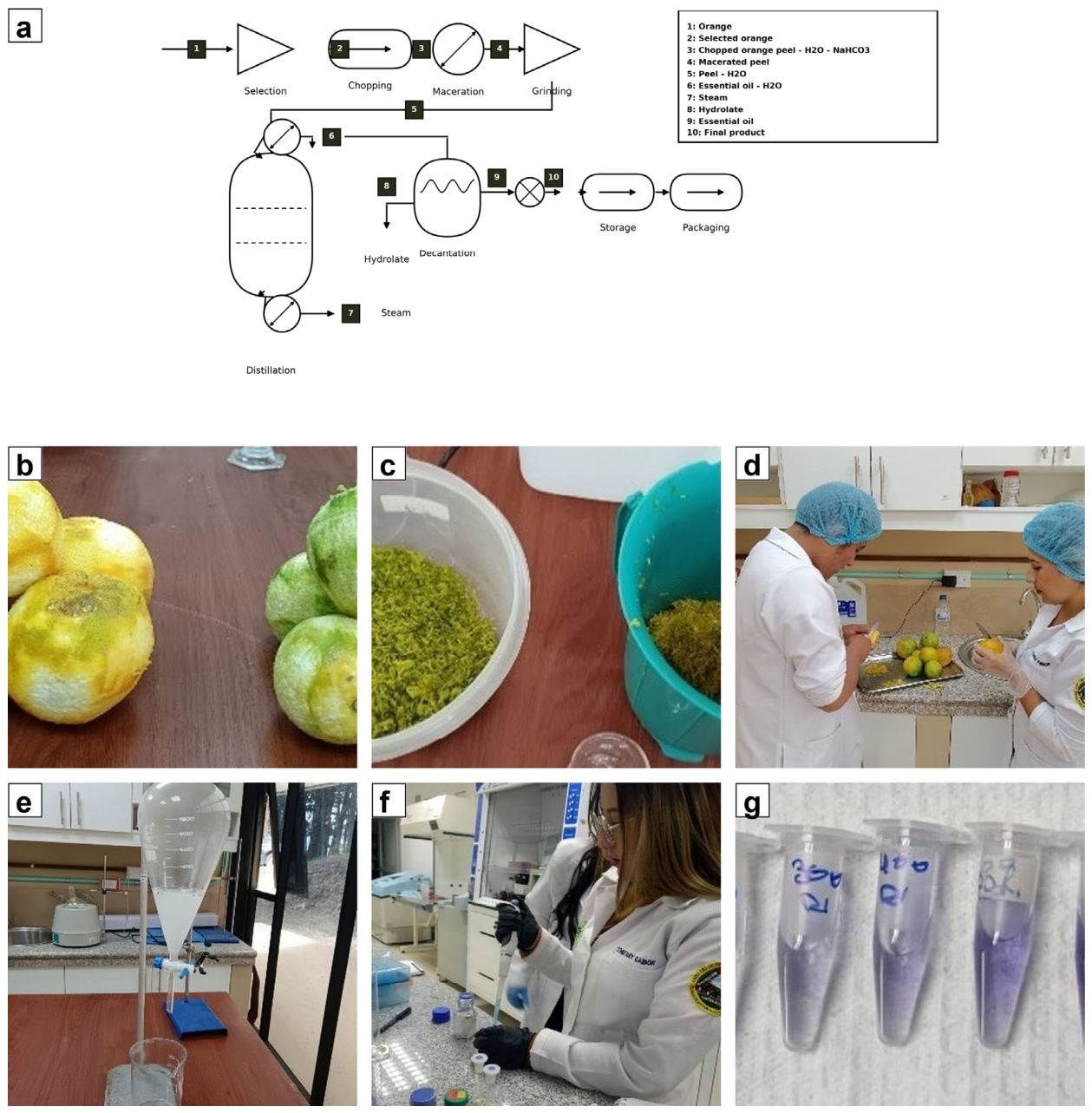
Figure 2.
Antioxidant capacity of Valencia orange and sour orange essential oil determined by the FRAP and ABTS assays. Note. Bars represent the mean ± standard error (n = 3 experimental determinations per treatment cell). Different letters above the bars indicate significant differences among the four variety × method combinations according to Tukey's test (α = 0.05). TE = Trolox equivalents.
Figure 2.
Antioxidant capacity of Valencia orange and sour orange essential oil determined by the FRAP and ABTS assays. Note. Bars represent the mean ± standard error (n = 3 experimental determinations per treatment cell). Different letters above the bars indicate significant differences among the four variety × method combinations according to Tukey's test (α = 0.05). TE = Trolox equivalents.
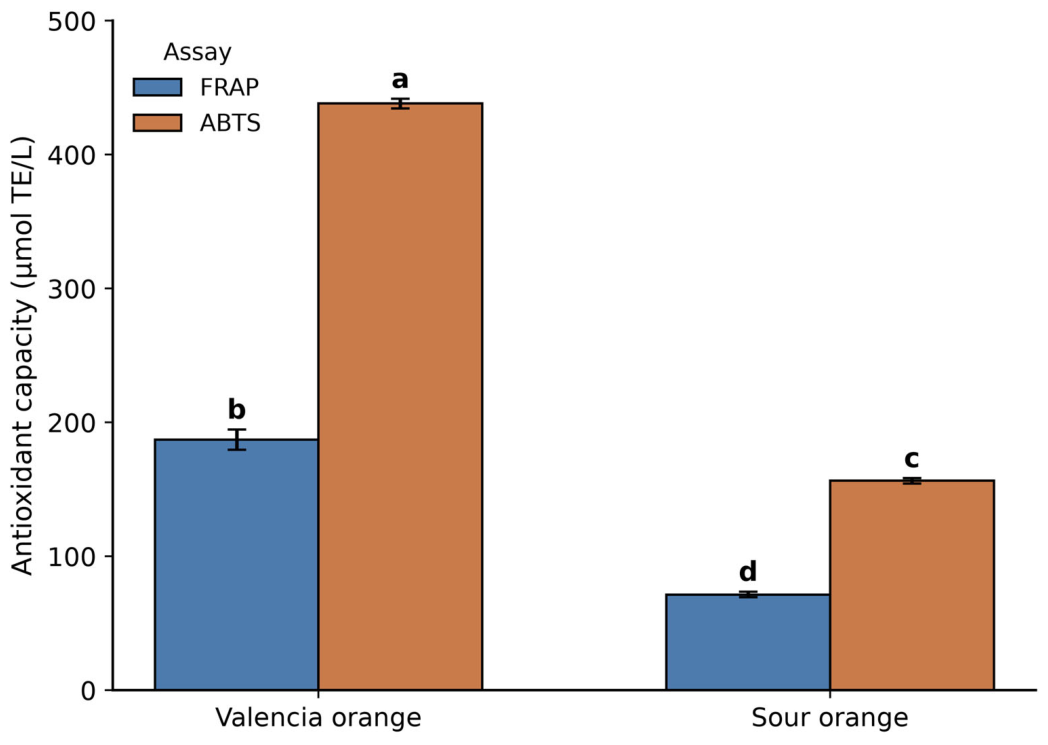
Figure 3.
Antimicrobial activity of Valencia orange and sour orange essential oil against four bacterial pathogens. Note. Bars represent the mean ± standard error (n = 2 experimental determinations per treatment cell) of the inhibition halo diameter obtained by the disc diffusion method. Valencia orange essential oil produced no detectable inhibition halo (0 mm) against any of the four microorganisms evaluated.
Figure 3.
Antimicrobial activity of Valencia orange and sour orange essential oil against four bacterial pathogens. Note. Bars represent the mean ± standard error (n = 2 experimental determinations per treatment cell) of the inhibition halo diameter obtained by the disc diffusion method. Valencia orange essential oil produced no detectable inhibition halo (0 mm) against any of the four microorganisms evaluated.
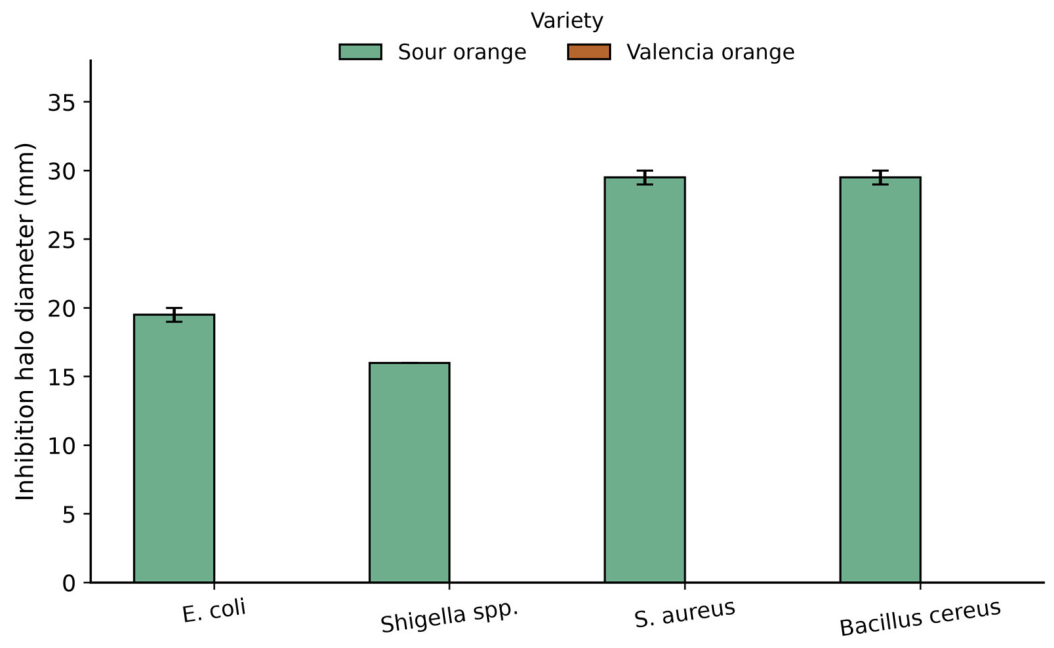

Table 1.
Structure of the two factorial designs used to evaluate antioxidant and antimicrobial activity.
Table 1.
Structure of the two factorial designs used to evaluate antioxidant and antimicrobial activity.
| Response variable | Factor A (variety) | Factor B | Levels of factor B | Replicates per treatment | N |
|---|---|---|---|---|---|
| Antioxidant capacity (µmol TE/L) | Valencia orange, sour orange | Determination method | FRAP, ABTS | 3 | 12 |
| Inhibition halo diameter (mm) | Valencia orange, sour orange | Target microorganism | Escherichia coli, Shigella spp., Staphylococcus aureus, Bacillus cereus | 2 | 16 |
Note. In both designs, the experimental unit was the independent analytical determination (not the individual fruit or the bacterial colony); the units of statistical analysis are, accordingly, N = 12 for antioxidant capacity and N = 16 for inhibition halo diameter. TE = Trolox equivalents.
Table 2.
Descriptive statistics and two-way analysis of variance for antioxidant capacity.
| Variety | Method | Mean ± SD (µmol TE/L) | 95% CI | Source | F | p | Permutation p | η² | ω² |
|---|---|---|---|---|---|---|---|---|---|
| Valencia orange | ABTS | 438.08 ± 6.50 | 421.93; 454.23 | Variety | 1955.42 | < 0.001* | < 0.001 | 0.529 | 0.528 |
| Valencia orange | FRAP | 187.21 ± 13.11 | 154.64; 219.78 | Method | 1395.31 | < 0.001* | < 0.001 | 0.377 | 0.377 |
| Sour orange | ABTS | 156.35 ± 3.75 | 147.03; 165.67 | Variety × Method | 340.96 | < 0.001* | 0.0006 | 0.092 | 0.092 |
| Sour orange | FRAP | 71.45 ± 3.78 | 62.06; 80.84 | – | – | – | – | – | – |
Note. TE = Trolox equivalents. Values in the first three columns are mean ± standard deviation (n = 3 per treatment cell); the 95% CI corresponds to the mean of each cell. The ANOVA source rows report the classic two-way analysis of variance (df = 1, 8 for all three effects) together with the p-value of an exact/Monte Carlo permutation test independent of distributional assumptions. η² = proportion of variance explained by the effect; ω² = that same proportion corrected for small-sample bias. *p < 0.05.
Table 3.
Pairwise comparisons using Tukey's test for antioxidant capacity.
| Comparison | Mean difference | 95% CI | Adjusted p | Significant? |
|---|---|---|---|---|
| Valencia ABTS vs. Valencia FRAP | −250.87 | −271.23; −230.52 | < 0.001 | Yes |
| Valencia ABTS vs. Sour ABTS | −281.73 | −302.09; −261.38 | < 0.001 | Yes |
| Valencia ABTS vs. Sour FRAP | −366.63 | −386.98; −346.27 | < 0.001 | Yes |
| Valencia FRAP vs. Sour ABTS | −30.86 | −51.21; −10.51 | 0.0055 | Yes |
| Valencia FRAP vs. Sour FRAP | −115.75 | −136.11; −95.40 | < 0.001 | Yes |
| Sour ABTS vs. Sour FRAP | −84.89 | −105.25; −64.54 | < 0.001 | Yes |
Note. Mean difference calculated as (second named group − first named group). A 95% confidence interval (CI) that does not include zero indicates a statistically significant difference.
Table 4.
Descriptive statistics and two-way analysis of variance for inhibition halo diameter.
| Variety | Microorg. | Mean ± SD (mm) | 95% CI | Source | F | df | p | Perm. p | η² | ω² |
|---|---|---|---|---|---|---|---|---|---|---|
| Sour orange | S. aureus | 29.5 ± 0.71 | 23.12; 35.88 | Variety | 11907.00 | 1, 8 | < 0.001* | < 0.001 | 0.885 | 0.885 |
| Sour orange | B. cereus | 29.5 ± 0.71 | 23.12; 35.88 | Microorg. | 256.33 | 3, 8 | < 0.001* | 0.0002 | 0.057 | 0.057 |
| Sour orange | E. coli | 19.5 ± 0.71 | 13.12; 25.88 | Variety × Microorg. | 256.33 | 3, 8 | < 0.001* | < 0.001 | 0.057 | 0.057 |
| Sour orange | Shigella spp. | 16.0 ± 0.00 | 16.00; 16.00 | – | – | – | – | – | – | – |
| Valencia orange | all 4 bacteria | 0.0 ± 0.00 | 0.00; 0.00 | – | – | – | – | – | – | – |
Note. Values in the first three columns are mean ± standard deviation (n = 2 per treatment cell); the 95% CI corresponds to the mean of each cell and is wide because it is based on only two determinations (df = 1). The microorganism effect and the variety × microorganism interaction are numerically identical because Valencia orange essential oil produced a constant null response (0 mm) against the four microorganisms. The permutation p column corresponds to an exact/Monte Carlo permutation test independent of distributional assumptions. η² = proportion of variance explained by the effect; ω² = that same proportion corrected for small-sample bias. *p < 0.05.
Table 5.
Pairwise comparisons using Tukey's test among microorganisms within sour orange essential oil.
Table 5.
Pairwise comparisons using Tukey's test among microorganisms within sour orange essential oil.
| Comparison | Mean difference (mm) | 95% CI | Adjusted p | Significant? |
|---|---|---|---|---|
| Bacillus cereus vs. E. coli | 10.0 | 8.29; 11.71 | < 0.001 | Yes |
| Bacillus cereus vs. S. aureus | 0.0 | −1.71; 1.71 | 1.000 | No |
| Bacillus cereus vs. Shigella spp. | 13.5 | 11.79; 15.21 | < 0.001 | Yes |
| E. coli vs. S. aureus | −10.0 | −11.71; −8.29 | < 0.001 | Yes |
| E. coli vs. Shigella spp. | 3.5 | 1.79; 5.21 | 0.0006 | Yes |
| S. aureus vs. Shigella spp. | 13.5 | 11.79; 15.21 | < 0.001 | Yes |
Note. Comparisons are restricted to sour orange essential oil because Valencia orange produced no detectable inhibition against any of the four microorganisms (all pairwise comparisons involving Valencia orange were significant when compared against any sour orange cell, and non-significant among themselves, and are omitted here for clarity; complete pairwise results for the 28 treatment-cell combinations are available from the corresponding authors upon reasonable request). Mean difference calculated as (second named group − first named group).
Table 6.
Inhibition halo diameter of the four bacteria against reference antibiotics at increasing concentrations.
Table 6.
Inhibition halo diameter of the four bacteria against reference antibiotics at increasing concentrations.
| Bacterium | Antibiotic | 5 µg (mm) | 10 µg (mm) | 15 µg (mm) |
|---|---|---|---|---|
| Bacillus cereus | Ceftriaxone | 20 | 25 | 20 |
| Bacillus cereus | Amoxicillin | 20 | 30 | 20 |
| Escherichia coli | Ceftriaxone | 20 | 30 | 25 |
| Escherichia coli | Amoxicillin | 25 | 35 | 30 |
| Shigella spp. | Ceftriaxone | 20 | 30 | 25 |
| Shigella spp. | Amoxicillin | 25 | 35 | 30 |
| Staphylococcus aureus | Ceftriaxone | 25 | 35 | 25 |
| Staphylococcus aureus | Amoxicillin | 25 | 35 | 30 |
Note. Values are the inhibition halo diameter (mm) recorded from a single disc diffusion determination per bacterium × antibiotic × concentration combination; results are presented descriptively.
Table 7.
Yield and bioactivity of Citrus sinensis and Citrus aurantium essential oil in the present study and in comparable previous studies.
Table 7.
Yield and bioactivity of Citrus sinensis and Citrus aurantium essential oil in the present study and in comparable previous studies.
| Study | Species and organ | Extraction method | Yield | Antioxidant assay (result) | Antimicrobial method (maximum result) |
|---|---|---|---|---|---|
| This study | C. sinensis, peel | Steam distillation | 1.25 mL/100 g | ABTS 438.08 µmol TE/L; FRAP 187.21 µmol TE/L | Disc diffusion: no detectable inhibition (0 mm) against the 4 bacteria |
| This study | C. aurantium, peel | Steam distillation | 1.25 mL/100 g | ABTS 156.35 µmol TE/L; FRAP 71.45 µmol TE/L | Disc diffusion: 29.5 mm against S. aureus and B. cereus (maximum) |
| Anwar et al. (2023) | C. sinensis, peel | Hydrodistillation (50-80 °C) | 2.4-3.6% (depending on temperature) | Not evaluated | Diffusion: 14.33 mm against E. coli; 11.33 mm against S. aureus |
| Abud Espinoza et al. (2021) | C. sinensis, seed | Solvent extraction (Soxhlet, 99% ethanol) | 17.53% | Not evaluated | Kirby-Bauer: 12 mm against E. coli; 14 mm against S. aureus (100% oil) |
| Abud Espinoza et al. (2021) | C. aurantium, seed | Solvent extraction (Soxhlet, 99% ethanol) | 20.80% | Not evaluated | Kirby-Bauer: 15 mm against E. coli; 16 mm against S. aureus (100% oil) |
| Ellouze et al. (2024) | C. aurantium, branch | Hydrodistillation (Clevenger) | 0.32% | Not evaluated | Disc diffusion: 25 mm against E. coli (50 mg/mL); MIC 1.89 mg/mL |
Note. TE = Trolox equivalents; MIC = minimum inhibitory concentration. The ABTS/FRAP assay quantifies a chemical mechanism distinct from antimicrobial activity and is expressed on its own scale (µmol TE/L), so these values only situate the relative magnitude of each variety within this study. Plant organ, extraction methods, and antimicrobial assay conditions differ among studies, so the antimicrobial results are presented as qualitative context rather than a direct numerical equivalence.
Disclaimer/Publisher’s Note: The statements, opinions and data contained in all publications are solely those of the individual author(s) and contributor(s) and not of MDPI and/or the editor(s). MDPI and/or the editor(s) disclaim responsibility for any injury to people or property resulting from any ideas, methods, instructions or products referred to in the content. |
© 2026 by the authors. Licensee MDPI, Basel, Switzerland. This article is an open access article distributed under the terms and conditions of the Creative Commons Attribution (CC BY) license (http://creativecommons.org/licenses/by/4.0/).
Copyright: This open access article is published under a Creative Commons CC BY 4.0 license, which permit the free download, distribution, and reuse, provided that the author and preprint are cited in any reuse.