
Submitted:
06 August 2026
Posted:
07 August 2026
You are already at the latest version
Abstract
This study examines how AI-generated product images and original photographs shape user engagement in C2C second-hand fashion e-commerce. While generative artificial intelligence increasingly enables sellers to improve the aesthetic quality of product presentation, little is known about how synthetic imagery affects actual platform behavior rather than stated consumer preferences. Drawing on signaling theory and the stimulus–organism–response model, the study reports a field experiment conducted on Vinted across two seasonal waves. The experimental design compared paired listings using original photographs and AI-generated product images, with engagement measured through views, likes, inquiries and transactions. The findings reveal a seasonal reversal: AI-generated images produced more favorable attention-related indicators in the autumn–winter wave, whereas original photographs performed more favorably in the spring–summer wave, especially for conversion-related indicators. The results suggest that the effectiveness of AI-generated imagery is conditional rather than universal and depends on the balance between aesthetic refinement, visual authenticity, perceived risk and product-verification needs. The study contributes to electronic commerce research by showing how AI-generated visual content operates as both an aesthetic and trust-related signal in C2C markets. It also provides implications for sellers and platform operators regarding transparent and responsible use of synthetic product imagery.
Keywords:
AI-generated product images
; visual authenticity
; visual trust
; C2C e-commerce
; Vinted
; second-hand fashion
; consumer engagement
; field experiment
; signaling theory
; S-O-R model
; platform governance
1. Introduction
Digital commerce increasingly relies on visual content as a primary interface between product, seller and consumer. In online environments, consumers often make judgments without direct access to the physical product, which makes product images central to attention, trust formation, perceived risk reduction and purchase decisions [1,2,15,16]. This role becomes particularly important in consumer-to-consumer (C2C) platforms, where the seller is usually a private individual and the buyer must evaluate not only the product but also the reliability of the seller and the credibility of the visual representation [19,24,25,26,27,28].
At the same time, generative artificial intelligence (AI) enables users to produce product visuals that are aesthetically refined, clean and visually consistent. Such tools may make second-hand items appear more attractive and professional, especially when private sellers lack photographic skills or suitable visual conditions. However, AI-generated product images also create a new ambiguity: they may improve visual appeal while weakening the evidential function of a product photograph if the image no longer documents the actual item being sold [22,23,33,34,35,45].
The problem is particularly salient on second-hand fashion platforms such as Vinted. Unlike conventional retailing, C2C resale transactions are characterized by information asymmetry, heterogeneity of product condition and limited institutional familiarity between buyer and seller [20,21,37,38,39,40]. In this context, product images do not merely display aesthetic qualities; they help buyers infer authenticity, product condition, seller credibility and transaction risk. For used garments, visual evidence of wear, fabric, fit and imperfections may be as important as general attractiveness.
Prior research on digital content marketing, online consumer engagement and visual information in e-commerce has emphasized the importance of content quality, trust, risk reduction and interaction with users [2,4,7,10,15,16,30]. More recent work has begun to address generative AI in marketing and visual communication [18,22,23,33,34,35,45]. However, empirical evidence on how AI-generated product images affect actual consumer behavior in C2C resale environments remains limited. Much existing research relies on surveys or experimental scenarios in which participants state their preferences. The present study addresses this gap by analyzing behavioral engagement in a natural platform setting.
This article investigates whether original product photographs or AI-generated product images generate stronger engagement among users of a C2C second-hand fashion platform. The study is based on a field experiment conducted on Vinted in two seasonal waves. Engagement was measured through behavioral indicators available on the platform: views, likes, inquiries and transactions. Rather than assuming a universal advantage of either original photographs or AI-generated images, the article examines whether their effects are contingent on the seasonal product context.
This study makes three contributions. First, it extends research on AI-generated visual content by examining actual behavioral engagement rather than declared preferences. Second, it contributes to research on visual authenticity and trust in second-hand digital commerce by showing that AI-generated images and original photographs may operate as different visual signals. Third, it identifies the seasonal contingency of visual effectiveness, suggesting that the impact of AI-generated product imagery depends on the interaction between aesthetic refinement, perceived authenticity, product-category context and the buyer’s need to verify the real condition of an item.
The article is structured as follows. Section 2 develops the theoretical background and research questions. Section 3 presents the field experiment, measures and analytical procedure. Section 4 reports the results. Section 5 discusses the seasonal reversal and interpretive model. Section 6 presents practical implications, limitations and future research, and Section 7 concludes the article.
2. Theoretical Background and Hypotheses
2.1. Visual Content, Authenticity and Engagement in Digital Commerce
Digital content marketing is commonly understood as the creation and distribution of relevant and valuable content that attracts, engages and retains audiences [1,2]. In digital commerce, visual content performs several functions simultaneously. It attracts attention, communicates product features, shapes affective responses and reduces uncertainty. Product images are therefore not merely decorative; they constitute informational and relational signals that influence how consumers evaluate an offer [15].
Consumer engagement in online environments can be understood as a multidimensional construct that includes cognitive, affective and behavioral responses to digital content [2,10,11]. In platform-based commerce, behavioral engagement can be observed through platform traces such as viewing an offer, saving it as a favorite, asking questions or completing a transaction. These traces differ in intensity. Views reflect initial exposure or attention, likes indicate preliminary interest, inquiries show active consideration, and transactions represent the final behavioral outcome. This layered structure is particularly useful for studying C2C platforms, where the buyer often progresses from low-effort interactions to more consequential actions.
Visual authenticity is especially relevant in second-hand commerce. Unlike new products offered by professional retailers, used fashion items differ in condition, wear, fit, texture and possible defects. An original photograph may therefore serve as evidence that the seller possesses the item and that the item exists in the condition described. Authenticity does not necessarily mean aesthetic perfection. In many C2C contexts, imperfections such as natural light, visible background or minor wrinkles may even strengthen the credibility of the image because they signal that the item was photographed in its actual context.
2.2. C2C Platforms, Vinted and the Second-Hand Fashion Context
C2C platforms differ from traditional e-commerce because they mediate transactions between individual users rather than between firms and consumers. This structure increases the importance of trust-building cues because buyers cannot rely on standardized product presentation, professional seller identity or institutional brand guarantees to the same degree as in business-to-consumer retailing [19,24,25,26,27,28,29]. In resale environments, the buyer must often make inferences from imperfect signals, including images, descriptions, price, response style and seller reputation.
Second-hand fashion intensifies this reliance on visual cues. Used garments cannot be evaluated solely through generic product descriptions because their value depends on condition, fabric, size, cut, wear, possible defects and the way the item appears in ordinary use. Therefore, images in second-hand fashion markets perform a dual function: they create attention and they serve as evidence. They may reduce information asymmetry by showing details that the buyer cannot inspect directly before purchase [21,30,37,38,39,40].
Vinted provides a particularly relevant empirical setting for this study because it combines C2C resale, fashion-oriented visual presentation and platform-based behavioral indicators. The platform context also reflects a broader shift toward digitally mediated second-hand consumption in Europe, where resale is increasingly normalized as a consumer practice rather than treated as a marginal alternative to buying new items [20]. For private sellers, the visual presentation of a listing becomes a low-cost marketing tool, while for buyers it becomes a key basis for judging whether the offer is credible and worth engaging with.
The specificity of Vinted also lies in the fact that product presentation is produced by ordinary users rather than professional retailers. This makes the platform particularly useful for studying the tension between authenticity and aesthetic refinement. A polished image may increase the perceived attractiveness of a listing, but a more ordinary original photograph may carry stronger evidential value because it documents the actual garment. This tension is central to understanding how AI-generated images may affect engagement in C2C second-hand commerce.
2.3. AI-Generated Product Images and Visual Trust
Generative AI tools can create product images that look professional, clean and visually coherent. In marketing, such images may enhance attractiveness, accelerate content production and reduce the cost of preparing visual materials [22,23,33,34,35,45]. For individual C2C sellers, AI tools may appear particularly useful because they can compensate for poor lighting, unattractive backgrounds or weak photographic skills. Nevertheless, AI-generated images may also create ambiguity. If the image is not a direct representation of the actual item, the buyer may question whether the product will look the same after purchase.
This study treats visual trust as a mechanism linking product imagery to user engagement. Visual trust refers to the extent to which the buyer perceives an image as credible, informative and sufficiently connected to the real product. In second-hand fashion, visual trust is not limited to aesthetic appeal. It also concerns whether the image helps verify the existence, condition, texture, fit and possible defects of the item. From this perspective, original photographs may act as trust-building signals because they document the actual garment, whereas AI-generated images may act as attractiveness-enhancing signals while potentially reducing evidential value [15,16,24,25,26,27,28,29,30].
In C2C second-hand commerce, product images do not merely present an item; they also reduce information asymmetry between private sellers and buyers. Original photographs may serve as credibility signals because they show the actual item, its condition and imperfections. AI-generated images, in contrast, may improve aesthetic appeal but weaken evidential value if consumers perceive them as detached from the real product. Therefore, visual trust becomes a key explanatory mechanism linking image type to engagement.
The distinction between aesthetic quality and evidential credibility is particularly important for AI-generated product images. A synthetic image can appear more professional than an ordinary photograph, but the very features that make it attractive—visual smoothness, idealized lighting, neutral background and apparent perfection—may also make it less useful for verifying a used item. This creates a possible trade-off between visual appeal and visual authenticity.
Consequently, the impact of AI-generated product images in C2C commerce should not be evaluated only in terms of whether they increase attention. A listing may attract views or likes because it is visually appealing, but higher-order engagement such as inquiries or transactions may depend more strongly on the buyer’s confidence that the displayed image corresponds to the real product. This logic justifies separating attention-related engagement from conversion-related engagement in the empirical analysis.
2.4. Signaling Theory and the S-O-R Model
Signaling theory explains how actors reduce information asymmetry by sending cues that allow receivers to infer hidden qualities [13,14]. In C2C e-commerce, the seller sends signals through images, descriptions, price and interaction style. The buyer interprets these signals to infer product condition, seller reliability and transaction risk. Original photographs can act as signals of authenticity and possession, while AI-generated images can act as signals of professionalism, clarity and effort. These signals may work in different directions depending on the product category and the buyer’s need for certainty.
The S-O-R model provides a complementary framework. In this model, the image type is the stimulus, the buyer’s internal evaluation of authenticity, attractiveness, trust and risk constitutes the organismic response, and observable engagement indicators represent the behavioral response [12]. Because the present field experiment measures behavior but not internal perceptions directly, the psychological mechanisms are interpreted indirectly. This limitation is important, but it also clarifies the contribution of the study: the research captures actual platform behavior in a natural setting rather than only self-reported evaluations.
2.5. Research Questions, Hypotheses and Exploratory Proposition
The study is guided by the following main research question: How does the type of product visualization affect user engagement in C2C second-hand fashion e-commerce?
Two research questions specify the main analytical distinction between attention-related and conversion-related engagement. RQ1: How do original photographs and AI-generated product images differ in their effects on attention-related engagement, measured through views and likes? RQ2: How do original photographs and AI-generated product images differ in their effects on conversion-related engagement, measured through inquiries and transactions?
Because the experiment was conducted in two seasonal waves, the study also includes an explicit exploratory contingency question. RQ3: How does seasonal product context shape the relationship between product visualization type and user engagement?
The hypotheses are directional and theory-driven, but they should not be read as universal claims about the superiority of one visualization type. They express the expectation that, in C2C second-hand commerce, original photographs may provide stronger evidential and trust-related signals because they show the actual item offered for sale.
H1.
In the overall comparison, offers using original product photographs are expected to generate higher attention-related engagement than offers using AI-generated product images, measured through views and likes.
H2.
In the overall comparison, offers using original product photographs are expected to generate higher conversion-related engagement than offers using AI-generated product images, measured through inquiries and transactions.
HG.
Overall, original product photographs are expected to generate higher user engagement than AI-generated product images in C2C second-hand fashion commerce.
In addition, the study is informed by the following exploratory proposition, which captures the possibility that image effectiveness is context-dependent rather than universal. P1. The effect of product visualization type on engagement in C2C second-hand fashion commerce is contingent on seasonal product context.
3. Materials and Methods
3.1. Research Design
The study used a field experiment conducted on Vinted. A field experiment was selected because it allows observation of user behavior in a natural platform environment. Unlike survey-based studies that capture stated preferences or purchase intentions, this field experiment captures actual behavioral traces generated by users interacting with real product listings. This increases ecological validity, although it also reduces control over platform algorithms and user-level characteristics. The value of the method therefore lies in observing natural platform behavior rather than asking participants to imagine or declare how they would respond to different forms of product visualization.
The experiment compared two types of product visualization: original photographs and AI-generated product images. Two seller accounts were used. Account A presented products with original photographs, whereas Account B presented the same products using AI-generated images. Each item was therefore represented in both conditions. This paired design made it possible to compare user engagement across the two visualization modes while keeping the underlying product constant as far as possible.
3.2. Setting, Products and Seasonal Waves
The experiment was conducted in two waves corresponding to different seasonal contexts. The autumn–winter wave included heavier and colder-season garments, while the spring–summer wave included lighter garments. Each wave consisted of 24 items presented on both accounts, resulting in 48 offers per wave and 96 offers in total. Products came from a private wardrobe and represented typical second-hand fashion items. Prices, descriptions and publication procedures were kept as similar as possible across accounts.
The use of two seasonal waves was important because fashion demand is strongly context-dependent. Buyers may evaluate winter garments differently from summer garments. For example, in heavier clothing, overall appearance and clarity of presentation may be more important, whereas in lighter garments, fit, transparency, fabric and real-life appearance may be more relevant. This makes season a potential moderator of the relationship between image type and engagement.
3.3. Variables and Measures
The independent variable was the type of product visualization: original photograph or AI-generated image. The dependent variables were four observable indicators of user engagement: number of views, number of likes, number of inquiries and number of transactions. These indicators represent increasing levels of behavioral engagement, from initial attention to final purchase action.

Table 1.
Behavioral engagement indicators used in the field experiment. Source: Authors’ elaboration.
Table 1.
Behavioral engagement indicators used in the field experiment. Source: Authors’ elaboration.
| Indicator | Marketing meaning | Engagement level |
|---|---|---|
| Views | Initial exposure and attention to the offer | Low |
| Likes | Preliminary interest and saving the offer for later consideration | Medium |
| Inquiries | Active purchase consideration and request for additional information | High |
| Transactions | Actual purchase decision and final platform outcome | Highest |
3.4. Control of Confounding Factors and Ethical Considerations
Several steps were taken to reduce confounding factors. The same items were presented in both conditions, descriptions were constructed in a similar manner, and pricing was kept comparable. Publication timing and platform activity were also managed to reduce differences between accounts. Nevertheless, full control is not possible in a natural platform environment. Algorithmic visibility, account credibility, item brand, size, category, product attractiveness, seasonality and user preferences could have influenced engagement independently of image type.
The field experiment did not collect personal data, demographic information or identifiable user information. The analysis was based on aggregate engagement indicators visible to the seller. At the same time, the study raises ethical and platform-governance questions, because users were not explicitly informed that some images were AI-generated. For this reason, the findings should be interpreted with caution, and future studies should consider survey-experimental or simulation-based designs in which participants are informed about the research procedure and can evaluate AI disclosure explicitly.
Table 2.
Field experiment and survey-based study: methodological comparison. Source: Authors’ elaboration.
Table 2.
Field experiment and survey-based study: methodological comparison. Source: Authors’ elaboration.
| Criterion | Field experiment on Vinted | Survey-based study |
|---|---|---|
| Type of data | Actual behavior | Declarations |
| Research environment | Natural selling platform | Artificially created situation |
| Measurement | Views, likes, inquiries, transactions | Opinions, intentions, evaluations |
| Main advantage | High ecological validity | Greater control over psychological variables |
| Main limitation | Lower control over algorithms and contextual factors | Risk of inconsistency between declarations and behavior |
For transparency and replicability, Table 3 provides a more detailed description of the dataset, matching logic, observation structure, account set-up and control decisions used in the field experiment. This information is important because reviewers may need to assess whether the observed differences could be attributed to visualization type rather than to price, description, publication timing, account history or paid promotion. The table therefore distinguishes between factors that were actively controlled and factors that could not be fully controlled in a natural platform environment.
3.5. Data Analysis
The analysis combined descriptive statistics, percentage differences and non-parametric tests. Because the sample was small and the data were paired by product, the Wilcoxon signed-rank test was used for views and likes. For conversion-related indicators, the analysis also considered absolute differences and the distribution of inquiries and transactions between accounts. The interpretation does not rely only on statistical significance. It also considers direction, magnitude, seasonal reversal and practical meaning of the observed differences. Values close to the conventional 0.05 threshold are described as tendencies rather than as evidence confirming hypotheses.
This analytical strategy is consistent with the exploratory nature of the field experiment. The aim is not to provide a universal causal estimate of the effect of AI-generated images, but to identify how different visual signals may operate in a realistic C2C platform context. The study therefore combines statistical caution with interpretive depth: statistically non-significant results are not overclaimed, while meaningful behavioral patterns are discussed as contextual evidence requiring further validation.
4. Results
4.1. Descriptive Results
Table 4 presents the aggregate outcomes for the autumn–winter wave. Account B, which used AI-generated product images, achieved higher values for all four engagement indicators. Views were 49.6% higher for Account B than for Account A. Likes were 77.8% higher. Inquiries and transactions were also more frequent for Account B, although the low number of conversion events requires cautious interpretation.
Table 5 presents the results for the spring–summer wave. In this wave, Account A, which used original photographs, obtained higher values for all indicators. Views were 64.0% higher for Account A than for Account B, and inquiries were substantially more frequent for Account A. This reversal suggests that the type of visualization did not operate independently of seasonal context.
Taken together, the descriptive results already suggest that the relationship between image type and engagement is not linear. AI-generated images were associated with more favorable engagement in the autumn–winter wave, while original photographs were associated with more favorable engagement in the spring–summer wave. This pattern makes the seasonal context analytically important rather than merely descriptive.
4.2. Hypothesis Testing and Effect Size
Table 6 summarizes the Wilcoxon test results for views and likes. The p-values for views in both waves were close to the conventional 0.05 threshold, but they did not reach statistical significance. Therefore, they should not be used as grounds for confirming the hypotheses. They do, however, suggest directional tendencies that deserve discussion, especially because the direction of the effect changed between seasons.
Table 7.
Percentage differences and approximate effect sizes. Source: Authors’ calculations.
| Indicator | Wave | Direction | Percentage difference | Effect size r | Interpretation |
|---|---|---|---|---|---|
| Views | Autumn–winter | B > A | B higher by 49.6% | 0.39 | Moderate effect, statistically non-significant |
| Views | Spring–summer | A > B | A higher by 64.0% | 0.38 | Moderate effect, statistically non-significant |
| Likes | Autumn–winter | B > A | B higher by 77.8% | 0.27 | Small-to-moderate effect, statistically non-significant |
| Likes | Spring–summer | A > B | A higher by 21.2% | 0.16 | Small effect, statistically non-significant |
The results for inquiries and transactions are shown in Table 8. The strongest conversion-related difference appeared in the spring–summer wave, where Account A generated 13 inquiries compared with 2 inquiries for Account B. This result supports a cautious interpretation that original photographs may become more important when users actively consider a purchase and need additional information about the real product. However, transaction numbers were low and should not be overinterpreted.
4.3. Summary of Hypotheses
The lack of full confirmation should not be treated as a weakness of the study. Rather, it indicates that the relationship between visualization type and user engagement is more complex than originally assumed. User reactions on C2C platforms do not depend only on whether an image is authentic or synthetic. They may also depend on product category, selling season, aesthetic quality, seller trust, price attractiveness and algorithmic visibility. The findings therefore suggest that AI-generated product imagery in e-commerce has a conditional rather than universal effect. In this sense, the seasonal reversal observed in the data directly addresses RQ3 and supports P1 as an exploratory pattern, while H1, H2 and HG should be interpreted with caution in the analyzed platform context.
Table 9.
Summary of hypotheses and exploratory proposition assessment. Source: Authors’ elaboration.
Table 9.
Summary of hypotheses and exploratory proposition assessment. Source: Authors’ elaboration.
| Hypothesis | Content | Decision |
|---|---|---|
| HG | Original photographs are expected to generate higher overall engagement than AI-generated images. | Not confirmed |
| H1 | Original photographs are expected to generate higher attention-related engagement measured through views and likes. | Not confirmed |
| H2 | Original photographs are expected to generate higher conversion-related engagement measured through inquiries and transactions. | Partially confirmed |
| P1 | The effect of product visualization type on engagement is contingent on seasonal product context. | Supported as an exploratory pattern |
5. Discussion
5.1. Seasonal Reversal as the Main Finding
The central finding is not a simple indication that one image type is more effective than the other, but the seasonal reversal of engagement patterns. In the autumn–winter wave, AI-generated images produced more favorable values across engagement indicators; in the spring–summer wave, original photographs produced more favorable values, especially for inquiries. This reversal suggests that AI-generated imagery does not work or fail universally. Rather, its effectiveness appears to depend on how aesthetic refinement and visual authenticity are evaluated in a given product context. For this reason, the seasonal pattern should be interpreted not as an unexpected inconsistency, but as the core exploratory contribution of the study and as empirical support for the contingency logic expressed in RQ3 and P1.
One possible explanation is that autumn–winter garments may benefit from visually polished presentation. Coats, sweaters and heavier clothing items are often evaluated through overall impression, color, volume and perceived quality. AI-generated images may have enhanced these qualities by creating cleaner, more professional-looking visuals. In such cases, aesthetic attractiveness may stimulate attention and interest even if the image is less authentic.
In contrast, spring–summer garments may require more precise assessment of fit, fabric, transparency, length and how the item appears on a body. In this context, original photographs may be more relevant because they provide evidence of the real product. Buyers may be less willing to rely on synthetic-looking images when the purchase decision depends on specific material or fit-related features. This may explain why original photographs generated more inquiries in the spring–summer wave.
The main theoretical implication is therefore a contingency logic: AI-generated imagery may be helpful when the buyer’s first task is to notice and aesthetically evaluate the offer, whereas original photographs may be more valuable when the buyer needs to verify the real condition of a used product. This interpretation is consistent with signaling theory because different image types send different signals: AI-generated images may signal visual professionalism, while original photographs may signal possession, authenticity and product verifiability.
5.2. Visual Authenticity Versus Aesthetic Refinement
The interpretation of the results requires distinguishing two overlapping dimensions of the experimental manipulation: the source of the image and the level of aesthetic refinement. The AI-generated images were not only synthetic; they were also more orderly, smoother and more visually professional than the original photographs. Consequently, the results cannot be interpreted as a pure effect of authenticity. They reflect the comparison between natural, seller-generated product representation and synthetic but aesthetically refined presentation.
This distinction is central to the contribution of the article. In C2C e-commerce, original photographs and AI-generated images may send different signals. Original photographs can signal possession, transparency and fidelity to the actual item. AI-generated images can signal effort, clarity and professionalization of presentation. The buyer may value either signal depending on the product and purchase situation. The same AI-generated image may attract attention at the browsing stage but become less useful when the buyer needs proof of condition or fit.
5.3. Interpretive Model
Based on the findings, the study proposes an interpretive model of how product visualization type may affect engagement on C2C platforms. The model is not a statistically verified mediation model; rather, it organizes the observed findings and indicates mechanisms that should be tested in future research. Product visualization type may influence both perceived visual authenticity and aesthetic attractiveness. These perceptions can shape engagement behaviors ranging from views and likes to inquiries and transactions. The strength and direction of these relationships may be moderated by selling season, product category, perceived purchase risk and the importance of fit assessment.
Figure 1.
Interpretive model of the relationship between product visualization type and user engagement in C2C e-commerce. Source: Authors’ conceptualization based on the field experiment.
Figure 1.
Interpretive model of the relationship between product visualization type and user engagement in C2C e-commerce. Source: Authors’ conceptualization based on the field experiment.
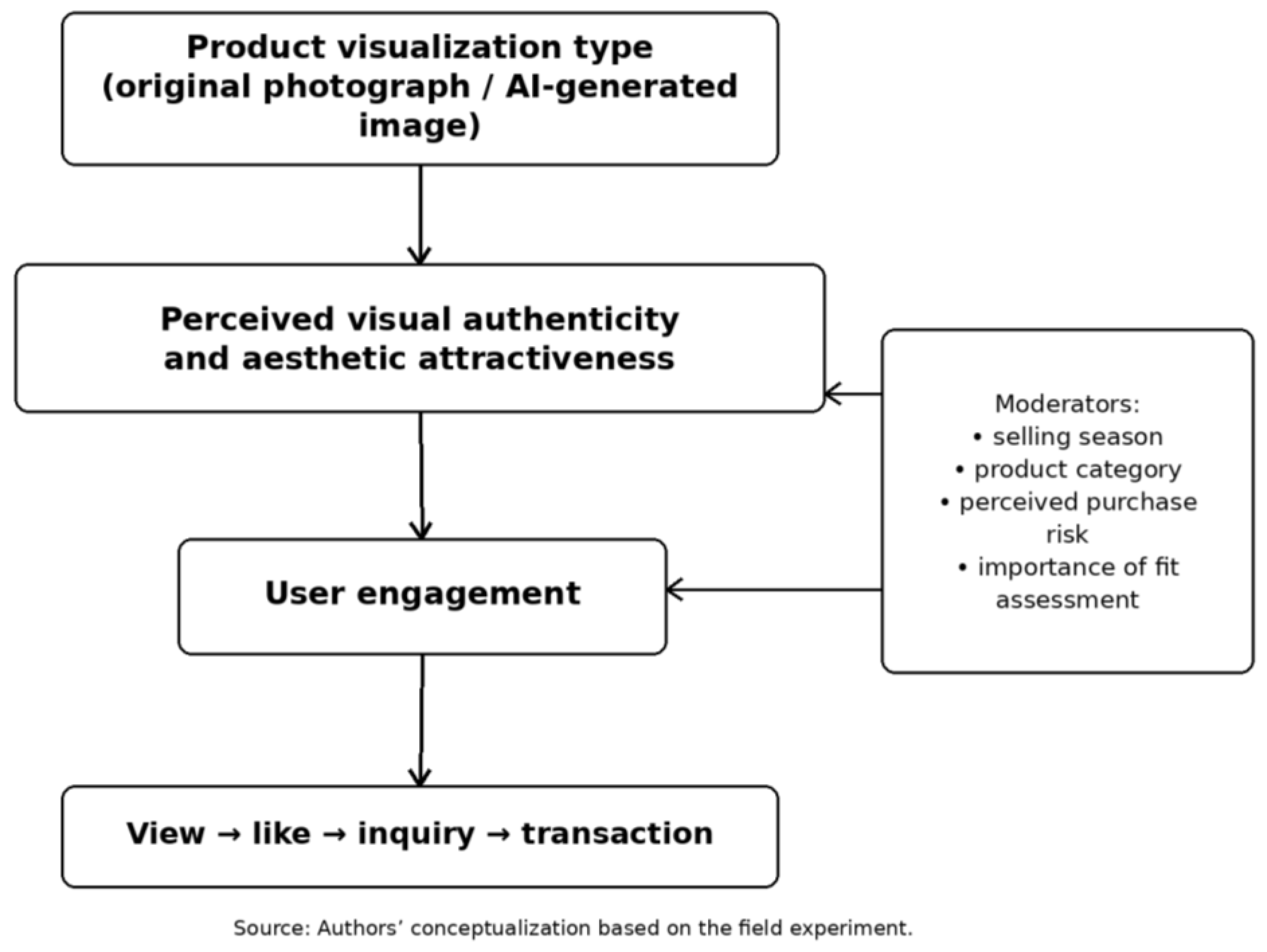
The model helps explain why the hypotheses were not fully confirmed. When aesthetic clarity is more important, AI-generated imagery may support attention-related engagement. When credibility and product verification are more important, original photographs may support stronger conversion-related engagement. This conditional explanation is more informative than a simple statement that one image type is generally better than the other.
5.4. Contributions to Theory and Practice
The theoretical contribution of the study is threefold. First, it extends electronic commerce research by showing that AI-generated product imagery should be analyzed not only as a tool for visual enhancement but also as a trust-related signal in C2C markets. Second, it advances research on visual authenticity by distinguishing aesthetic refinement from evidential credibility. Third, it contributes to consumer engagement research by showing that different behavioral indicators may respond differently to the same visual stimulus: views and likes capture attention-related engagement, whereas inquiries and transactions reflect more consequential forms of engagement.
The methodological contribution lies in the use of a field experiment on a real C2C platform. Unlike survey-based studies that capture stated preferences or purchase intentions, this field experiment captures actual behavioral traces generated by users interacting with real product listings. This increases ecological validity, although it also reduces control over platform algorithms and user-level characteristics. The contribution is therefore not a claim of universal causality, but an empirically grounded interpretation of how visual signals operate in a natural digital marketplace.
Table 10.
Main contributions of the study. Source: Authors’ elaboration.
| Area | Contribution |
|---|---|
| Theory | Combines visual authenticity, signaling theory, the S-O-R model and consumer engagement in the context of AI-generated product imagery. |
| Methodology | Uses a field experiment on a real C2C platform instead of relying only on stated preferences. |
| Empirics | Analyzes actual user behavior on Vinted: views, likes, inquiries and transactions. |
| Practice | Shows that the choice between original photographs and AI-generated images should depend on season, product category and communication goal. |
| Future research | Identifies the need to separate the effects of visual authenticity and aesthetic refinement. |
6. Practical Implications, Limitations and Future Research
6.1. Managerial and Platform Governance Implications
For sellers. The findings suggest that AI-generated product images should be used as a supportive tool rather than as a substitute for visual evidence of the actual product. Original photographs remain particularly important when the offer requires proof of condition, texture, defects, labels, fabric transparency, fit or authenticity. In practice, sellers may combine image types: original photographs can document the real item, while AI-supported editing may improve background clarity, lighting consistency or first impression, provided that it does not alter the perceived properties of the product.
For platforms. For platform operators, the findings raise questions about the governance of AI-generated product images. As generative tools become more accessible, C2C platforms may need clearer rules for synthetic or heavily edited visuals, including whether sellers should disclose AI-generated imagery, whether at least one photograph of the actual item should be required, and how users should be educated about ethical and transparent visual presentation. Platform operators should not treat AI-generated product imagery only as a matter of aesthetic enhancement, but also as a governance issue related to transparency, trust and consumer protection in C2C transactions.
These implications are particularly relevant for second-hand fashion platforms because transaction quality depends on the buyer’s ability to verify product condition before purchase. If AI-generated images improve attractiveness but reduce evidential value, platforms may face a trade-off between visual standardization and marketplace trust. Clearer governance rules may help prevent deception while still allowing sellers to benefit from AI-supported visual communication.
Table 11.
Practical recommendations for C2C sellers. Source: Authors’ elaboration.
| Selling situation | Recommended approach |
|---|---|
| The product requires proof of actual condition or defects | Use original photographs, including details and labels. |
| The product has specific texture, transparency or fit-related features | Show natural photographs on a body or hanger and include close-up details. |
| The ordinary photo is unclear or unattractive | Improve lighting, background and framing without altering the product appearance. |
| The offer aims to build trust in a private seller | Use original photographs as the main evidence of possession and condition. |
| The offer aims to attract initial attention | Use clear and aesthetically organized visuals. |
| AI is used in product presentation | Treat AI as a supportive visualization tool, not as a replacement for truthful representation. |
Table 12.
Platform governance implications for AI-generated product imagery in C2C commerce. Source: Authors’ elaboration.
Table 12.
Platform governance implications for AI-generated product imagery in C2C commerce. Source: Authors’ elaboration.
| Governance issue | Possible platform response | Rationale |
|---|---|---|
| AI-generated or heavily edited visuals | Introduce disclosure guidance or an AI-image label when synthetic visuals are used | Supports transparency and helps buyers interpret the evidential value of images. |
| Evidence of actual product condition | Require at least one original photograph of the real item in second-hand listings | Protects buyers by documenting condition, defects, fabric, labels and fit-related details. |
| Responsible seller behavior | Provide seller guidelines on acceptable AI-supported editing and visual enhancement | Allows aesthetic improvement without misrepresenting the product. |
| Consumer protection and trust | Educate users about the difference between illustrative AI visuals and photographs of the real product | Reduces information asymmetry and strengthens marketplace trust. |
| Algorithmic visibility and fairness | Monitor whether AI-enhanced images receive disproportionate visibility or engagement | Prevents visual standardization from privileging polished synthetic imagery over truthful evidence. |
6.2. Limitations
Several limitations must be acknowledged. First, the sample was limited to one platform and one set of second-hand fashion products. Second, the study measured behavioral outcomes but did not directly measure perceived authenticity, perceived attractiveness, visual trust or perceived risk. Third, the experiment could not fully control the platform algorithm, user characteristics, prior account reputation or the exact visibility of each listing. Fourth, the manipulation involved not only image source but also image style: AI-generated images were more visually polished and standardized than ordinary photographs. As a result, the findings should be interpreted as a comparison between authentic natural presentation and synthetic visually refined presentation, not as a pure test of authenticity alone.
The results therefore should not be generalized to all e-commerce platforms, all product categories or all forms of AI-generated imagery. They should be interpreted as evidence of tendencies observed in a specific C2C second-hand fashion context. This limitation does not invalidate the study; rather, it defines the scope of its contribution and points to the need for replication and extension.
6.3. Directions for Future Research
Future research should combine field experiments with survey-experimental designs. A follow-up study could expose participants to original photographs and AI-generated images while directly measuring perceived authenticity, aesthetic attractiveness, visual trust, perceived risk and purchase intention. This would allow researchers to test whether the mechanisms proposed in the interpretive model operate as mediators between image type and engagement.
Future studies should also examine other product categories and platform types. The role of AI-generated imagery may differ for electronics, cosmetics, handmade products, furniture, luxury goods, collectibles or new products sold by professional retailers. Categories that require close inspection of condition, authenticity, material or fit may be more sensitive to the evidential value of original photographs, whereas more standardized products may benefit more from AI-supported aesthetic enhancement.
Another promising direction concerns AI disclosure and platform governance. Future research could test whether labeling an image as AI-generated changes user trust and engagement. Disclosure may reduce perceived deception, but it may also reduce attractiveness or purchase intention if buyers interpret AI-generated images as less connected to the actual product [42,43,44,45]. Future studies could therefore compare disclosed and undisclosed AI-generated visuals, hybrid listings combining original photographs and AI-enhanced images, and platform rules requiring evidence of the real item.
Longitudinal and cross-country research would also be valuable. Second-hand fashion markets differ across countries in terms of platform maturity, sustainability motivations, price sensitivity and trust norms. Replicating the experiment across markets and seasons would help assess whether the seasonal reversal observed in this study reflects a broader pattern or a context-specific result.
7. Conclusions
This study examined how original photographs and AI-generated images affect user engagement in C2C second-hand fashion e-commerce. The findings do not support a universal advantage of either visualization type. Instead, they suggest that visual effectiveness is conditional. AI-generated images were associated with more favorable engagement in the autumn–winter wave, whereas original photographs were associated with more favorable engagement in the spring–summer wave, particularly for conversion-related indicators.
One possible interpretation of this seasonal reversal is that consumers may already be moving beyond the initial fascination with highly polished or artificially enhanced product imagery. The rapid normalization of retouched, AI-assisted and visually optimized images may reduce their novelty value and make users more sensitive to signals of naturalness and product verifiability. In this sense, the stronger performance of original photographs in the spring–summer wave may reflect not only a category-specific need to assess fit, fabric and condition, but also an emerging preference for more natural and evidential visual communication. This interpretation should be treated cautiously, as the study did not directly measure users’ awareness of AI-generated imagery or their attitudes toward visual enhancement. Nevertheless, it suggests an important direction for future e-commerce research: consumer responses to AI-generated product images may change quickly as users become more familiar with synthetic and improved visuals.
The article contributes to electronic commerce research by demonstrating that visual authenticity and aesthetic attractiveness should be treated as distinct but interacting mechanisms. In C2C resale environments, a product image is not only a marketing asset but also a signal of product reality and seller credibility. AI-generated images can support visual communication, but in the case of used products they should not fully replace original photographs that document the actual condition of the item. The main conclusion is therefore that the future use of AI imagery in C2C commerce should be guided by a balance between aesthetic enhancement, transparency and visual trust.
Author Contributions
Conceptualization, M.P., A.P. and G.R.; methodology, M.P., A.P. and G.R.; investigation, G.R.; formal analysis, M.P.; writing original draft preparation, M.P. A.P and G.R.; writing review and editing, M.P. and A.P.; supervision, M.P.; project administration, M.P. All authors have read and agreed to the published version of the manuscript. [To be verified and adjusted before submission according to the actual contribution of each author].
Funding
This research received no external funding.
Institutional Review Board Statement
Not applicable / to be completed according to institutional requirements. The study analyzed aggregate platform engagement indicators and did not collect identifiable user data. Because the study involved a field experiment on a live platform, the final statement should be verified with the authors’ institution before journal submission.
Informed Consent Statement
Informed consent was not applicable because no personal or identifiable user data were collected. The study analyzed aggregate engagement indicators. The ethical implications of AI-generated product images and disclosure are discussed in the manuscript.
Data Availability Statement
The data supporting the findings are available from the corresponding author upon reasonable request, subject to platform terms and anonymization requirements.
Use of Artificial Intelligence
During the preparation of this manuscript, the authors used ChatGPT (OpenAI) to support language editing, structural refinement and manuscript preparation. The authors reviewed and edited all AI-assisted output and take full responsibility for the content, accuracy and integrity of the manuscript.
Acknowledgments
The authors thank all persons who supported the preparation of the empirical material and manuscript development.
Conflicts of Interest
The authors declare no conflict of interest.
References
- Rowley, J. Understanding digital content marketing. Journal of Marketing Management 2008, 24, 517–540. [CrossRef]
- Hollebeek, L.D.; Macky, K. Digital Content Marketing’s Role in Fostering Consumer Engagement, Trust, and Value. Journal of Interactive Marketing 2019, 45, 27–41.
- Jacob, M.E.; Johnson, J. Conceptualising Digital Content Marketing for Greater Consumer Brand Engagement. Colombo Business Journal 2021, 12. [CrossRef]
- du Plessis, C. A Scoping Review of the Effect of Content Marketing on Online Consumer Behavior. SAGE Open 2022, 12.
- Kulikovskaja, V.; Hubert, M.; Grunert, K.G.; Zhao, H. Driving marketing outcomes through social media-based customer engagement. Journal of Retailing and Consumer Services 2023, 74, 103445. [CrossRef]
- Krowinska, A.; Dineva, D. The role and forms of social media branded content driving active customer engagement behaviours. Journal of Marketing Management 2025, 41, 1030–1060. [CrossRef]
- Meire, M.; Hewett, K.; Ballings, M.; Kumar, V.; Van den Poel, D. The Role of Marketer-Generated Content in Customer Engagement Marketing. Journal of Marketing 2019, 83, 1–22. [CrossRef]
- Bryła, P.; Chatterjee, S.; Ciabiada-Bryła, B. The Impact of Social Media Marketing on Consumer Engagement in Sustainable Consumption. International Journal of Environmental Research and Public Health 2022, 19, 16637. [CrossRef]
- Ebrahim, R.S. Studying the Drivers of Consumer Behavioural Engagement With Social Media Brand-Related Content. International Journal of Customer Relationship Marketing and Management 2022, 13. [CrossRef]
- Santini, F.O.; Ladeira, W.J.; Pinto, D.C.; Herter, M.M.; Sampaio, C.H.; Babin, B.J. Customer engagement in social media: a framework and meta-analysis. Journal of the Academy of Marketing Science 2020, 48, 1211–1232. [CrossRef]
- Trunfio, M.; Rossi, S. Conceptualising and measuring social media engagement: A systematic literature review. Italian Journal of Marketing 2021, 2021, 267–292. [CrossRef]
- Mehrabian, A.; Russell, J.A. An Approach to Environmental Psychology; MIT Press: Cambridge, MA, USA, 1974.
- Spence, M. Job Market Signaling. The Quarterly Journal of Economics 1973, 87, 355–374. [CrossRef]
- Erdem, T.; Swait, J. Brand equity as a signaling phenomenon. Journal of Consumer Psychology 1998, 7, 131–157. [CrossRef]
- Kim, J.; Lennon, S.J. The effects of visual and verbal information on attitudes and purchase intentions in Internet shopping. Psychology & Marketing 2008, 25, 146–178.
- Pavlou, P.A. Consumer acceptance of electronic commerce: Integrating trust and risk with the Technology Acceptance Model. International Journal of Electronic Commerce 2003, 7, 101–134. [CrossRef]
- Kaplan, A.; Haenlein, M. Siri, Siri, in my hand: On the interpretations, illustrations, and implications of artificial intelligence. Business Horizons 2019, 62, 15–25. [CrossRef]
- Dwivedi, Y.K.; et al. So what if ChatGPT wrote it? Multidisciplinary perspectives on opportunities, challenges and implications of generative conversational AI. International Journal of Information Management 2023, 71, 102642.
- Hajli, N. Social Commerce Constructs and Consumer’s Intention to Buy. International Journal of Information Management 2015, 35, 183–191. [CrossRef]
- Vinted Group. Second-hand is Replacing New in Wardrobes Across Europe, According to Vinted’s Latest Impact Report. Vinted Newsroom, 18 June 2024.
- Negash, Y.T.; Akhbar, T. Building consumer trust in secondhand fashion: A signaling theory perspective on how consumer orientation and environmental awareness shape engagement. Cleaner and Responsible Consumption 2024, 14, 100211. [CrossRef]
- Hartmann, J.; Exner, Y.; Domdey, S. The power of generative marketing: Can generative AI create superhuman visual marketing content? International Journal of Research in Marketing 2025, 42, 13–31. [CrossRef]
- Tian, Y.; Li, Y.; Chen, B.; Zhu, H.; Wang, S.; Kwong, S. AI-generated Image Quality Assessment in Visual Communication. Proceedings of the AAAI Conference on Artificial Intelligence 2025, 39, 7392–7400. [CrossRef]
- Ba, S.; Pavlou, P.A. Evidence of the effect of trust building technology in electronic markets: Price premiums and buyer behavior. MIS Quarterly 2002, 26, 243–268. [CrossRef]
- Gefen, D.; Karahanna, E.; Straub, D.W. Trust and TAM in online shopping: An integrated model. MIS Quarterly 2003, 27, 51–90. [CrossRef]
- McKnight, D.H.; Choudhury, V.; Kacmar, C. Developing and validating trust measures for e-commerce: An integrative typology. Information Systems Research 2002, 13, 334–359. [CrossRef]
- Wells, J.D.; Valacich, J.S.; Hess, T.J. What signal are you sending? How website quality influences perceptions of product quality and purchase intentions. MIS Quarterly 2011, 35, 373–396. [CrossRef]
- Kim, D.J.; Ferrin, D.L.; Rao, H.R. A trust-based consumer decision-making model in electronic commerce: The role of trust, perceived risk, and their antecedents. Decision Support Systems 2008, 44, 544–564. [CrossRef]
- Hong, I.B.; Cha, H.S. The mediating role of consumer trust in an online merchant in predicting purchase intention. International Journal of Information Management 2013, 33, 927–939. [CrossRef]
- Park, J.; Lennon, S.J.; Stoel, L. On-line product presentation: Effects on mood, perceived risk, and purchase intention. Psychology & Marketing 2005, 22, 695–719. [CrossRef]
- Oh, H.; Yoon, S.Y. Online apparel presentation: Exploring consumer response toward different types of product images. Journal of Global Fashion Marketing 2026, 17, 18–34.
- Puntoni, S.; Reczek, R.W.; Giesler, M.; Botti, S. Consumers and artificial intelligence: An experiential perspective. Journal of Marketing 2021, 85, 131–151. [CrossRef]
- Davenport, T.; Guha, A.; Grewal, D.; Bressgott, T. How artificial intelligence will change the future of marketing. Journal of the Academy of Marketing Science 2020, 48, 24–42. [CrossRef]
- Campbell, C.; Sands, S.; Ferraro, C.; Tsao, H.Y.; Mavrommatis, A. From data to action: How marketers can leverage AI. Business Horizons 2020, 63, 227–243. [CrossRef]
- Huang, M.H.; Rust, R.T. Artificial intelligence in service. Journal of Service Research 2018, 21, 155–172.
- Castelo, N.; Bos, M.W.; Lehmann, D.R. Task-dependent algorithm aversion. Journal of Marketing Research 2019, 56, 809–825. [CrossRef]
- Guiot, D.; Roux, D. A second-hand shoppers’ motivation scale: Antecedents, consequences, and implications for retailers. Journal of Retailing 2010, 86, 355–371. [CrossRef]
- Turunen, L.L.M.; Leipämaa-Leskinen, H. Pre-loved luxury: Identifying the meanings of second-hand luxury possessions. Journal of Product & Brand Management 2015, 24, 57–65. [CrossRef]
- Padmavathy, C.; Swapana, M.; Paul, J. Online second-hand shopping motivation: Conceptualization, scale development, and validation. Journal of Retailing and Consumer Services 2019, 51, 19–32. [CrossRef]
- Sihvonen, J.; Turunen, L.L.M. As good as new: Valuing fashion brands in the online second-hand markets. Journal of Product & Brand Management 2016, 25, 285–295. [CrossRef]
- Ertz, M.; Durif, F.; Arcand, M. Collaborative consumption: Conceptual snapshot at a buzzword. Journal of Entrepreneurship Education 2016, 19, 1–23.
- Luo, X.; Tong, S.; Fang, Z.; Qu, Z. Frontiers: Machines vs. humans: The impact of artificial intelligence chatbot disclosure on customer purchases. Marketing Science 2019, 38, 937–947. [CrossRef]
- Longoni, C.; Cian, L. Artificial intelligence in utilitarian versus hedonic contexts: The “word-of-machine” effect. Journal of Marketing 2022, 86, 91–108. [CrossRef]
- Luo, X.; Qin, M.S.; Fang, Z.; Qu, Z. Artificial intelligence coaches for sales agents: Caveats and solutions. Journal of Marketing 2021, 85, 14–32. [CrossRef]
- Peng, Q.; Lu, Y.; Peng, Y.; Qian, S.; Liu, X.; Shen, C. Crafting Synthetic Realities: Examining Visual Realism and Misinformation Potential of Photorealistic AI-Generated Images. arXiv 2024, arXiv:2409.17484.
Table 3.
Research procedure, matching logic and control decisions. Source: Authors’ elaboration.
| Element | Description | Publication-oriented methodological role |
|---|---|---|
| Platform | Vinted | Natural C2C e-commerce environment with real platform behavior. |
| Product category | Second-hand fashion | Context in which condition, fit, fabric, defects and visual evidence are important for purchase decisions. |
| Experimental conditions | Original photographs versus AI-generated product images | Comparison of authentic product evidence with synthetic, visually refined presentation. |
| Number of items | 48 distinct second-hand fashion items: 24 in the autumn-winter wave and 24 in the spring-summer wave | Defines the product-level base of the paired field experiment. |
| Number of listings | 96 listings in total, because each item was presented in both visual conditions | Allows paired comparison while keeping the underlying item constant as far as possible. |
| Waves | Two seasonal waves: autumn-winter and spring-summer | Enables exploration of seasonal product context as a contingency factor. |
| Engagement indicators | Views, likes, inquiries and transactions | Behavioral rather than declarative outcome measures. |
| Matching logic | The same items were presented in both visual conditions on two seller accounts | Reduces product-level variation between visual conditions. |
| Observation period | Two predefined seasonal observation windows corresponding to the autumn-winter and spring-summer waves | Captures engagement in natural selling periods while retaining the seasonal comparison central to the article. |
| Seller accounts | Two accounts were used to separate the visual conditions: Account A for original photographs and Account B for AI-generated images | Makes the manipulation visible at the account-condition level, while account effects remain a limitation. |
| Account history and reputation | Account history, reputation signals and user familiarity could not be fully equalized in the natural platform environment | Identifies a potential source of bias and strengthens transparency about field-experiment limitations. |
| Price control | Prices were kept comparable for paired listings of the same item | Reduces the possibility that engagement differences were driven primarily by price. |
| Description control | Product descriptions were kept similar across paired listings | Reduces variation in textual persuasion and information completeness. |
| Publication timing | Listings were published using comparable timing procedures within each wave | Limits, but does not eliminate, timing-related visibility effects. |
| Promotion policy | No paid promotion was used | Reduces platform-driven differences in paid visibility. |
| User-level data | No personal, demographic or identifiable user data were collected | Supports ethical caution while explaining why psychological mechanisms are inferred rather than directly measured. |
| Main methodological limitation | Platform algorithms, individual user preferences, account credibility, item brand, size and category could not be fully controlled | Clarifies that the study identifies tendencies in a real marketplace rather than universal causal effects. |
Table 4.
Engagement indicators in the autumn–winter wave. Source: Authors’ field experiment.
| Indicator | Account A: original photographs | Account B: AI-generated images | Average A | Average B |
|---|---|---|---|---|
| Views | 417 | 624 | 17.4 | 26.0 |
| Likes | 45 | 80 | 1.9 | 3.3 |
| Inquiries | 5 | 9 | — | — |
| Transactions | 1 | 5 | — | — |
Table 5.
Engagement indicators in the spring–summer wave. Source: Authors’ field experiment.
| Indicator | Account A: original photographs | Account B: AI-generated images | Average A | Average B |
|---|---|---|---|---|
| Views | 597 | 364 | 24.9 | 15.2 |
| Likes | 63 | 52 | 2.6 | 2.2 |
| Inquiries | 13 | 2 | — | — |
| Transactions | 5 | 1 | — | — |
Table 6.
Wilcoxon signed-rank test results for views and likes. Source: Authors’ calculations.
| Indicator | Wave | A / B | W | p | Result |
|---|---|---|---|---|---|
| Views | Autumn–winter | 417 / 624 | 76.0 | 0.059 | Not significant |
| Views | Spring–summer | 597 / 364 | 68.5 | 0.060 | Not significant |
| Likes | Autumn–winter | 45 / 80 | 62.5 | 0.189 | Not significant |
| Likes | Spring–summer | 63 / 52 | 52.5 | 0.420 | Not significant |
Table 8.
Conversion-related indicators. Source: Authors’ calculations.
| Indicator | Wave | A / B | p | Result |
|---|---|---|---|---|
| Inquiries | Autumn–winter | 5 / 9 | 0.424 | Not significant |
| Inquiries | Spring–summer | 13 / 2 | 0.007 | Significant |
| Transactions | Autumn–winter | 1 / 5 | 0.219 | Not significant |
| Transactions | Spring–summer | 5 / 1 | 0.219 | Not significant |
Disclaimer/Publisher’s Note: The statements, opinions and data contained in all publications are solely those of the individual author(s) and contributor(s) and not of MDPI and/or the editor(s). MDPI and/or the editor(s) disclaim responsibility for any injury to people or property resulting from any ideas, methods, instructions or products referred to in the content. |
© 2026 by the authors. Licensee MDPI, Basel, Switzerland. This article is an open access article distributed under the terms and conditions of the Creative Commons Attribution (CC BY) license (http://creativecommons.org/licenses/by/4.0/).
Copyright: This open access article is published under a Creative Commons CC BY 4.0 license, which permit the free download, distribution, and reuse, provided that the author and preprint are cited in any reuse.


