

Submitted:
05 August 2026
Posted:
07 August 2026
You are already at the latest version
Abstract
Drawing on environmental justice theory and the concept of social sustainability, this study examined perceived environmental injustice across its three core dimensions—distributive, procedural/participatory, and recognition—in relation to the planned radioactive waste storage facility at Trgovska Gora. The analysis included 385 valid surveys completed by residents of eight municipalities in Bosnia and Herzegovina. The composite scales demonstrated high reliability (Cronbach’s α = 0.875–0.894). All three dimensions were substantially above the neutral scale midpoint: distributive injustice, M = 4.304 (SD = 0.825); procedural/participatory justice and transboundary governance, M = 4.159 (SD = 0.758); and recognition injustice, M = 4.109 (SD = 0.920), with p < 0.001 and large effect sizes. The dimensions were strongly intercorrelated (r = 0.608–0.766; p < 0.001). Respondents’ level of information was positively correlated with all three dimensions, while Welch’s analyses revealed significant differences by municipality, financial situation, and age. HC3 robust regression models explained 21.0–30.6% of the variance. Municipality made a significant omnibus contribution in all three models, while personal awareness and the perceived level of community awareness remained significant predictors of selected outcomes. The findings indicate that residents primarily interpret the Trgovska Gora case as an unequal distribution of risks and benefits, associated with institutional exclusion and a failure to recognize the interests of affected communities. Due to the strong association between municipality and nationality, the observed group differences cannot be interpreted as isolated ethnic effects. From a social sustainability perspective, these findings demonstrate that the long-term legitimacy of transboundary radioactive waste governance depends not only on technical safety but also on the equitable distribution of environmental risks, meaningful public participation, and institutional recognition of affected communities. The study highlights environmental justice as a fundamental condition for socially sustainable and legitimate decision-making concerning high-risk infrastructure.
Keywords:
environmental justice
; social sustainability
; Trgovska Gora
; distributive justice
; procedural (participatory) justice
; transboundary conflict
; radioactive waste
1. Introduction
The Republic of Croatia’s intention to establish a long-term storage facility for low and intermediate-level radioactive waste at Trgovska Gora, in the immediate vicinity of the border with Bosnia and Herzegovina, has caused profound dissatisfaction and concern among residents of Bosnia and Herzegovina’s border municipalities. The planned facility, intended for the storage of waste from the Krško Nuclear Power Plant, would be located at the former Čerkezovac military barracks, only 900 meters from the municipality of Novi Grad in Bosnia and Herzegovina and from the Una River, which forms a natural boundary between Croatia and Bosnia and Herzegovina. Within the Una River basin on the territory of Bosnia and Herzegovina, there are 20 municipalities inhabited by approximately 360,000 residents belonging to different ethnic groups [1].
This decision has prompted numerous public reactions and citizen protests, while also raising complex questions that extend beyond the technical and environmental dimensions of the issue. In this case, local communities in Bosnia and Herzegovina perceive the Trgovska Gora project not only as a potential environmental disaster but also as a form of institutional injustice, a symbol of marginalization, and evidence of their exclusion from decision-making processes. For this reason, the present study draws on the theoretical framework of environmental justice. This approach enables the analysis not only of actual risks but also of perceived inequalities in the distribution of environmental benefits and burdens, institutional power, and opportunities for political participation.
Based on the environmental justice framework, this study analyses residents' perceptions through three key dimensions: distributive justice, procedural or participatory justice, and recognition justice. This approach makes it possible to examine not only the distribution of environmental risks and benefits but also how institutional processes and the symbolic recognition or misrecognition of social groups shape perceptions of injustice in the context of transboundary environmental conflicts.
Despite the considerable attention that the Trgovska Gora case has received in regional media and professional forums, research addressing the social perceptions of the population in Bosnia and Herzegovina, particularly from an environmental justice perspective, is almost non-existent. Existing studies have predominantly focused on technical and environmental aspects [2,3], legal and economic issues [4,5], and security-related dimensions [6], whereas the views of affected communities remain insufficiently investigated. This study seeks to address this research gap.
This research aims to examine how residents of eight border municipalities in Bosnia and Herzegovina perceive the planned radioactive waste storage project at Trgovska Gora, with particular emphasis on their perceptions of distributive, procedural, and recognition justice. Accordingly, the study addresses the following research questions:
- How do local communities perceive the distribution of environmental benefits and risks associated with the planned long-term radioactive waste storage facility at Trgovska Gora?
- To what extent do residents believe that they have the right to participate in decision-making, and do they perceive the decision-making process as fair and transparent?
- Do residents perceive specific ethnic and social groups as targets of institutional discrimination in the site-selection process—that is, do they believe that certain groups have been deliberately exposed to harmful effects?
The study seeks to contribute to a better understanding of how environmental injustice is formed and sustained in the context of transboundary relations, institutional asymmetries, and limited mechanisms for public participation. Although the empirical scope of the study is confined to the specific case of Trgovska Gora, its findings have broader theoretical and practical relevance for understanding the governance of high-risk environmental infrastructure projects across different geographical and political contexts.
1.1. Theoretical Framework of the Study: Environmental Justice in the Context of the Trgovska Gora Case
Over the past several decades, the concept of environmental justice has developed into one of the key theoretical and activist frameworks for analyzing the unequal distribution of environmental burdens and benefits, with particular emphasis on the position of marginalized social groups [7,8,9,10]. Contemporary interpretations of environmental justice extend beyond the narrow understanding that focused exclusively on pollution or environmental disasters and encompass a broader range of issues, including political processes, structural inequalities, access to information, and opportunities for institutional participation [11,12,13,14].
In the context of Trgovska Gora—the planned low- and intermediate-level radioactive waste disposal facility at the Čerkezovac site, in the immediate vicinity of the border with Bosnia and Herzegovina—this theoretical framework enables an analysis of the social, territorial, and political dimensions of perceived environmental injustice. Although radioactive waste disposal is frequently presented as a technical and safety-related issue, local communities perceive it through the lens of social and political injustice, making the environmental justice framework particularly relevant to understanding this case. Environmental justice theory comprises three key components: distributive justice, recognition justice, and procedural or participatory justice [7,15].
1.1.1. Distributive Justice
Distributive justice refers to the equitable distribution of environmental benefits and burdens, including risks to health, safety, and the environment. Research indicates that environmentally hazardous facilities, such as waste disposal sites and industrial plants, are disproportionately located in areas inhabited by socioeconomically and politically marginalized groups [16]. In the literature, this phenomenon is commonly examined through the siting of hazardous facilities, which reflects existing inequalities in political power and institutional protection [17,18,19].
In the case of Trgovska Gora, the perception among residents of the border municipalities of Bosnia and Herzegovina that they would bear potential environmental and health risks without receiving corresponding benefits or compensation may be interpreted as a form of distributive injustice. Particular emphasis is placed on the fact that the communities that consider themselves affected derive no direct benefits from radioactive waste management, which further intensifies the perception of unequal treatment.
1.1.2. Procedural or Participatory Justice
Procedural justice concerns the fairness of decision-making processes, including access to information, opportunities for participation, and the ability to exert meaningful influence over decision outcomes. This dimension requires transparent and inclusive processes in which affected communities are provided with genuine opportunities to express their views and influence decisions that concern them [20].
In the case of Trgovska Gora, it is frequently argued that local communities in Bosnia and Herzegovina have limited institutional mechanisms for direct participation in a decision-making process that formally takes place in another state. Although international legal frameworks for transboundary consultation exist, including conventions governing environmental impact assessment [21,22,23,24,25], their practical scope and influence may be limited. Such circumstances contribute to a sense of institutional powerlessness and deepen perceptions of injustice.
As Schlosberg [7] points out, exclusion from decision-making processes may have long-term consequences for institutional trust and the legitimacy of adopted decisions. Moreover, the fact that Bosnia and Herzegovina is not a member of the European Union may affect its negotiating position in such transboundary matters. This issue has increasingly been recognized in the literature as an important aspect of transboundary environmental justice [26].
1.1.3. Recognition Justice
Recognition justice refers to social and institutional relations in which the identities, values, and experiences of different social groups are adequately acknowledged and respected, without cultural devaluation, domination, or political marginalization [7]. This dimension emphasizes that injustice does not arise solely from the material distribution of resources but also from the misrecognition and exclusion of certain groups from social and political processes [27,28,29].
In the context of Trgovska Gora, recognition justice may be examined through residents’ perceptions that their interests, identities, and concerns have not been sufficiently acknowledged in the decision-making process. In a borderland and post-conflict context, such perceptions may be further intensified by a sense of geographical peripherality and political marginalization.
2. Methodology
2.1. Research Design
This study employed a quantitative, non-experimental, cross-sectional research design. Its primary objective was to examine how adult residents of border municipalities in Bosnia and Herzegovina perceived the distributive, procedural/participatory, and recognition-related dimensions of environmental injustice associated with the planned radioactive waste repository at Trgovska Gora.
Data were collected using a standardized survey questionnaire, which enabled the quantification of respondents’ attitudes and the examination of relationships among environmental justice dimensions, information-related variables, and sociodemographic and geographic characteristics. The research questions addressed the distribution of environmental risks and benefits, the fairness and transparency of the decision-making process, and the perceived institutional non-recognition and marginalization of affected communities. The study was designed as a case study of Trgovska Gora. Given its cross-sectional nature, all identified statistical relationships were interpreted as associations rather than evidence of causal effects.
2.2. Research Hypotheses
Three hypotheses were formulated based on the environmental justice framework. The first hypothesis concerned distributive injustice and proposed that local communities would perceive the distribution of environmental risks, burdens, and benefits associated with the planned radioactive waste repository at Trgovska Gora as unfair. More specifically, it was expected that respondents would consider communities in Bosnia and Herzegovina to bear a disproportionate share of the potential environmental and social consequences while receiving no corresponding benefits.
The second hypothesis concerned procedural and participatory injustice. It proposed that residents would perceive themselves as insufficiently included in the decision-making process and would consider the site-selection procedure to have been inadequately transparent, participatory, and responsive to the interests of affected cross-border communities.
The third hypothesis concerned recognition injustice. It proposed that residents would perceive institutional disregard for their interests, identities, experiences, and social status, as well as discriminatory or marginalizing elements in the process through which the repository location was selected. These hypotheses were operationalized through three composite dimensions: perceived distributive injustice, perceived recognition injustice, and perceived procedural/participatory injustice and transboundary governance.
2.3. Target Population and Sample
The target population consisted of adult residents of eight municipalities in Bosnia and Herzegovina included in the study: Bihać, Cazin, Bužim, Bosanska Krupa, Novi Grad, Kostajnica, Kozarska Dubica, and Prijedor. These municipalities were selected because their populations may be directly or indirectly affected by the environmental, health-related, social, economic, and political consequences associated with the planned repository at Trgovska Gora.
The original database contained 404 rows. Following data screening, 19 entirely blank records were removed. The final analytical sample therefore consisted of 385 valid questionnaires, each identified by a unique survey number ranging from 1 to 385. The number of valid responses varied slightly across individual variables because of sporadic missing values. The sample included 200 men, representing 52.2% of valid responses, and 183 women, representing 47.8%.
2.4. Sample
Data were collected in person between November 2025 and April 2026 through a structured questionnaire administered directly to respondents in the field. The target population consisted of adult residents of the eight municipalities in Bosnia and Herzegovina included in the study: Bihać, Cazin, Bužim, Bosanska Krupa, Novi Grad, Kostajnica, Kozarska Dubica, and Prijedor. After removing completely blank rows, the final analytical sample comprised 385 valid survey responses.
The final analytical sample comprised 385 valid survey records. Men accounted for 52.2% of valid responses and women for 47.8%. The largest age groups were 18–25 years (23.7%) and 36–45 years (22.7%). More than half of respondents were married (54.3%), 57.9% had completed secondary education, and 53.8% were employed. Participants resided in eight municipalities, with the largest shares from Prijedor (28.6%), Cazin (21.3%), and Bihać (17.9%). Residential stability was high, as 91.4% had lived in their municipality for more than 10 years. Bosniaks represented 50.7% and Serbs 45.2% of valid respondents (Table 1).
2.5. Research Instrument
Data were collected using a structured survey questionnaire consisting of two main sections. The first section included sociodemographic, socioeconomic, geographic, and information-related variables. The second section contained statements designed to measure different dimensions of perceived environmental injustice.
The sociodemographic and contextual variables included sex, age group, marital status, educational attainment, labor market status, municipality of residence, settlement type, length of residence in the municipality, perceived financial situation, nationality, personal information about the Trgovska Gora issue, and the perceived information level of people living in the wider local area.
Information was measured using two single-item ordinal indicators. Respondents assessed their own level of information about developments concerning Trgovska Gora and the general level of information among people living in that part of Bosnia and Herzegovina. Both variables were measured on a five-point scale ranging from 1, indicating “not at all informed,” to 5, indicating “extremely informed.”
Attitudes concerning environmental injustice were measured using a five-point Likert scale. A response of 1 indicated “strongly disagree,” 2 indicated “disagree,” 3 indicated “neither agree nor disagree,” 4 indicated “agree,” and 5 indicated “strongly agree.” Higher values therefore represented stronger perceptions of environmental injustice or greater support for statements concerning participation, institutional responsibility, and the recognition of affected communities. The instrument did not contain negatively worded items requiring reverse coding.
2.6. Operationalization of the Main Constructs
2.6.1. Perceived Distributive Injustice
Perceived distributive injustice was operationalized through four statements. These items measured the perceived unfairness of locating the repository near the border with Bosnia and Herzegovina, the belief that a location between Croatia and Slovenia would constitute a fairer alternative, the perception that the site was selected because Bosnia and Herzegovina had comparatively limited political power to oppose the decision, and the perceived asymmetric distribution of economic benefits and potential environmental consequences. A composite score was calculated as the arithmetic mean of the available item responses. At least three valid responses out of the four items were required for the composite score to be computed. Higher scores represented stronger perceptions that environmental risks, burdens, and benefits were distributed unfairly.
2.6.2. Perceived Recognition Injustice
Recognition injustice was measured using four statements addressing the perceived targeting of a minority or returnee area, ethno-territorial injustice, institutional neglect of residents in the affected area, and the perceived connection between the repository decision and the post-conflict legacy of the 1990s. The composite score was calculated as the arithmetic mean of the four items, provided that at least three valid responses were available. Higher scores indicated stronger perceptions of discrimination, marginalization, institutional neglect, and failure to recognize the interests and identities of local communities.
2.6.3. Procedural/Participatory Justice and Transboundary Governance
The third dimension comprised eight statements concerning the right of affected residents to participate in environmental decision-making, the formal participation rights of border communities in Bosnia and Herzegovina, the need to consider the views of residents living in another country, the transparency and inclusiveness of the site-selection process, the role of civic activism in increasing the visibility of the issue, the involvement of international organizations, perceived institutional asymmetry associated with Croatia’s membership in the European Union and NATO, and the resolution of the dispute through interstate dialogue under international oversight. The primary composite score was calculated as the arithmetic mean of the eight items, provided that respondents had supplied valid answers to at least six items. Higher scores reflected stronger support for participatory rights and stronger perceptions of procedural exclusion, institutional imbalance, and deficiencies in transboundary governance. Because this dimension covered a relatively broad conceptual domain, an additional sensitivity analysis separated it into two components. The first component, core procedural justice, included the right to participate, formal cross-border participation, consideration of the views of affected residents, and transparency of the decision-making process. The second component, governance and institutional response, included civic activism, the involvement of international organizations, institutional asymmetry, and interstate dialogue.
2.7. Data Preparation and Quality Control
Before conducting the main statistical analyses, the database was subjected to a systematic quality-control procedure. The screening process included verification of unique survey identification numbers, identification of entirely blank records, assessment of variable ranges, examination of missing values, detection of implausible or extreme values, verification of Likert-scale coding, and comparison of the variable names and contents with the original questionnaire.
Nineteen entirely blank records were removed from the analytical database. Missing values were not statistically imputed. Composite scores were calculated only when the predefined minimum number of valid item responses was available. Multivariable models were estimated using respondents with valid data for all variables included in the corresponding model.
Particular attention was paid to the item measuring perceived disrespect toward Bosnia and Herzegovina. Following correction of the original data-entry error, all responses to this item were within the theoretically valid range from 1 to 5.
2.8. Statistical Analysis
Statistical analyses were conducted using IBM SPSS Statistics. All tests were two-tailed, statistical significance was established at p < .05, and results were reported with 95% confidence intervals. Frequencies and valid percentages were used to describe categorical sample characteristics. Means and standard deviations were calculated for the individual Likert items, information indicators, and composite environmental justice scores. For each Likert statement, the combined percentage of respondents selecting “agree” or “strongly agree” was also reported. The internal consistency of the composite scales was assessed using Cronbach’s alpha, the mean inter-item correlation, and corrected item–total correlations. The obtained Cronbach’s alpha coefficients ranged from .875 to .894, indicating strong internal consistency across the primary environmental justice scales. Pearson correlation coefficients were used to examine associations among the composite dimensions of environmental injustice. Spearman’s rank-order correlations were used to analyze relationships between the two single-item ordinal information indicators and the composite environmental justice scores. The three directional hypotheses were tested using one-sample t tests in which each composite score was compared with the neutral midpoint of the five-point Likert scale, which was 3. Cohen’s d was calculated to quantify the magnitude of the difference between the observed score and the neutral reference value. Differences in the relative intensity of the three environmental justice dimensions were examined using repeated-measures analysis of variance. When the assumption of sphericity was not satisfied, the Greenhouse–Geisser correction was applied. Subsequent pairwise comparisons were conducted using paired-samples t tests with Holm-adjusted p values.
Differences between men and women were examined using Welch’s independent-samples t test. Differences across age groups, levels of education, financial-situation categories, municipalities, settlement types, and national groups were examined using Welch’s one-way analysis of variance. Welch procedures were selected because of unequal group sizes and because homogeneity of variances could not be assumed for all comparisons.
The Benjamini–Hochberg false-discovery-rate procedure was used to control the risk of Type I error across multiple omnibus tests. Multiple linear regression analyses were conducted to identify the independent statistical correlates of distributive injustice, recognition injustice, procedural/participatory injustice, and governance. The models included the two information indicators, sex, age, educational attainment, financial situation, settlement type, length of residence, and either geographic or nationality-related variables. Continuous predictors and outcome variables were standardized before model estimation. Because heteroskedasticity was detected in several models, HC3 heteroskedasticity-robust standard errors, confidence intervals, and significance tests were used.
Municipality of residence and nationality were not entered simultaneously into the same regression model because they were strongly associated. Their relationship was examined using Pearson’s chi-square test of independence. Because some expected cell frequencies were small, statistical significance was estimated using a Monte Carlo procedure. The strength of the association was assessed using Cramér’s V. Models including municipality and those including nationality were treated as alternative specifications. Municipality-based models were considered more appropriate for the primary geographic interpretation, while nationality-based findings were treated as sensitivity analyses and were not interpreted as isolated ethnic effects. The statistical procedures were selected to correspond directly with the three environmental justice constructs and the research hypotheses.
2.9. Ethical Considerations
Participation in the study was voluntary. Before completing the questionnaire, respondents were informed about the purpose of the research, the scientific use of the collected data, and the anonymous processing of their responses. The findings were analyzed and reported exclusively in aggregate form, without identifying individual participants.
3. Results
Respondents rated their own knowledge of developments surrounding Trgovska Gora more positively than the information level of the wider population. The mean self-rated information score was 3.36 (SD = 1.006), and 48.1% described themselves as quite or extremely informed. The perceived information level of people living in this part of Bosnia and Herzegovina was lower (M = 2.95, SD = 1.013), with 26.5% assessed as quite or extremely informed (Table 2).
3.1. Descriptive Profile of Environmental Justice
Perceptions of environmental injustice were consistently high. All distributive-injustice variables had mean scores above 4.20, with agreement ranging from 80.5% to 84.6%. Recognition-related injustice was also strongly endorsed, especially perceived institutional neglect (M = 4.28; 84.1% agreement), whereas the perceived connection with the conflicts of the 1990s was comparatively lower (M = 3.90; 65.7%). Within the procedural and governance variables, the strongest responses concerned the right of affected residents to decide on environmental matters (M = 4.42) and the formal participation rights of BiH border communities (M = 4.41) (Table 3).
3.2. Reliability and Correlations
The three environmental-justice dimensions showed strong internal consistency (α = 0.875–0.894) and were strongly and positively intercorrelated. The strongest association was between distributive injustice and procedural/participatory justice and governance (r = 0.766, p < 0.001), followed by distributive and recognition injustice (r = 0.685, p < 0.001). Recognition injustice was also positively related to procedural/participatory justice and governance (r = 0.608, p < 0.001). These findings indicate that perceptions of unequal burden distribution were closely connected to both institutional exclusion and recognition-related grievances (Table 4).
Higher self-reported information was associated with stronger distributive, recognition, and procedural/governance perceptions (ρ = 0.298–0.343, all p < 0.001). Perceived community information was also positively associated with all three dimensions, although the relationships were weaker (ρ = 0.181–0.303, all p < 0.001) (Table 5).
3.3. Direct Tests of the Environmental Justice Hypotheses
All three environmental-justice dimensions were significantly above the neutral midpoint, providing direct support for H1–H3. Distributive injustice showed the highest mean (M = 4.304, SD = 0.825), followed by procedural/participatory justice and governance (M = 4.159, SD = 0.758) and recognition injustice (M = 4.109, SD = 0.920). All effects were large (d = 1.21–1.58) (Table 6).
The relative strength of the three dimensions differed significantly, Greenhouse–Geisser-corrected F(1.77, 680.07) = 17.43, p < 0.001, partial η² = 0.043. Distributive injustice was significantly higher than both recognition injustice and procedural/governance perceptions, whereas recognition and procedural/governance scores did not differ significantly. A sensitivity split of the eight-item procedural/governance scale further showed that core participation and transparency principles were endorsed more strongly than governance and institutional-response statements.

Table 7.
Holm-adjusted within-respondent comparisons among environmental-justice dimensions (Table 7).
Table 7.
Holm-adjusted within-respondent comparisons among environmental-justice dimensions (Table 7).
| Comparison | Mean difference | t | Holm p | dz |
|---|---|---|---|---|
| Distributive injustice vs. Recognition injustice | 0.195 | 5.47 | <0.001 | 0.279 |
| Distributive injustice vs. Procedural/participatory justice and governance | 0.145 | 5.22 | <0.001 | 0.266 |
| Recognition injustice vs. Procedural/participatory justice and governance | -0.050 | -1.28 | 0.200 | -0.065 |
| Core procedural justice vs. Governance/institutional response | 0.385 | 13.03 | <0.001 | 0.664 |
Note: Positive differences indicate that the first-listed dimension had the higher mean. The last row is a prespecified sensitivity comparison within the procedural/governance block.
3.4. Geographic and Sociodemographic Differences
Welch’s omnibus tests indicated systematic geographic and socioeconomic heterogeneity. Municipality of residence, financial situation, and age were associated with all three dimensions after FDR adjustment. Nationality was also associated with all three outcomes, but these results cannot be interpreted as independent ethnic effects because nationality and municipality were strongly confounded. Education was related only to recognition injustice, while sex and settlement type were not associated with any environmental-justice dimension after multiplicity correction (Table 8).
Table 8.
FDR-significant Welch omnibus tests for environmental-justice dimensions.
| Factor | Outcome | Statistic | Raw p | FDR p | Effect size |
|---|---|---|---|---|---|
| Age group | Distributive injustice | F = 3.18 | 0.009 | 0.018 | 0.043 |
| Age group | Procedural/participatory justice and governance | F = 3.35 | 0.007 | 0.014 | 0.035 |
| Age group | Recognition injustice | F = 6.67 | <0.001 | <0.001 | 0.080 |
| Education | Recognition injustice | F = 4.31 | 0.022 | 0.036 | 0.023 |
| Financial situation | Distributive injustice | F = 18.47 | <0.001 | <0.001 | 0.107 |
| Financial situation | Procedural/participatory justice and governance | F = 26.31 | <0.001 | <0.001 | 0.108 |
| Financial situation | Recognition injustice | F = 5.23 | 0.006 | 0.014 | 0.044 |
| Municipality | Distributive injustice | F = 13.86 | <0.001 | <0.001 | 0.125 |
| Municipality | Procedural/participatory justice and governance | F = 19.20 | <0.001 | <0.001 | 0.206 |
| Municipality | Recognition injustice | F = 4.83 | <0.001 | <0.001 | 0.048 |
| Nationality | Distributive injustice | F = 21.14 | <0.001 | <0.001 | 0.094 |
| Nationality | Procedural/participatory justice and governance | F = 41.78 | <0.001 | <0.001 | 0.167 |
| Nationality | Recognition injustice | F = 4.68 | 0.015 | 0.026 | 0.023 |
Note: Welch tests were used because of unequal group sizes and variances. Effect size is eta squared for ANOVA. Nationality results are sensitivity estimates because municipality and nationality are not independent in this sample.
Table 9.
Environmental-justice composite scores by municipality of residence.
| Municipality | n | Distributive M (SD) | Recognition M (SD) | Procedural/governance M (SD) |
|---|---|---|---|---|
| Bihac | 69 | 4.01 (0.87) | 4.18 (1.01) | 3.80 (0.85) |
| Cazin | 82 | 4.05 (1.00) | 3.99 (1.13) | 3.85 (0.90) |
| Buzim | 24 | 4.14 (0.75) | 3.71 (0.94) | 4.04 (0.64) |
| Bosanska Krupa | 32 | 4.04 (1.07) | 3.80 (1.17) | 3.80 (0.90) |
| Novi Grad | 34 | 4.77 (0.30) | 4.45 (0.50) | 4.60 (0.35) |
| Kostajnica | 7 | 4.89 (0.20) | 4.71 (0.37) | 4.79 (0.24) |
| Kozarska Dubica | 27 | 4.63 (0.44) | 4.11 (0.64) | 4.63 (0.22) |
| Prijedor | 110 | 4.53 (0.61) | 4.19 (0.71) | 4.45 (0.43) |
Note: Municipality is a geographic proxy rather than a direct measure of distance. The Kostajnica estimate is based on only seven respondents and should be interpreted cautiously.
3.5. Adjusted Regression Models
HC3-robust multiple regression models were estimated to determine whether information and sociodemographic characteristics remained associated with environmental-justice perceptions after adjustment for municipality. The models explained 21.0%–30.6% of the outcome variance. Personal information remained independently associated with distributive injustice and procedural/governance perceptions; perceived community information remained associated with recognition injustice. Municipality retained a significant omnibus contribution in every model.
Table 10.
Summary of HC3-robust municipality-adjusted regression models.
| Outcome | N | R² | FDR-significant non-geographic predictors | Municipality omnibus |
|---|---|---|---|---|
| Distributive injustice | 380 | 0.283 | Personal information about Trgovska Gora: β = 0.188, 95% CI [0.070, 0.307], q = 0.016; Post-secondary/tertiary education (vs. secondary or lower): β = 0.279, 95% CI [0.067, 0.491], q = 0.045 | F = 13.86, q = <0.001 |
| Recognition injustice | 380 | 0.210 | Perceived community information: β = 0.175, 95% CI [0.057, 0.294], q = 0.021 | F = 4.83, q = <0.001 |
| Procedural/governance | 380 | 0.306 | Personal information about Trgovska Gora: β = 0.159, 95% CI [0.056, 0.262], q = 0.018; Age: β = 0.135, 95% CI [0.038, 0.232], q = 0.032 | F = 19.20, q = <0.001 |
Note: Continuous predictors and outcomes were standardized. Dummy-variable coefficients represent standard-deviation differences from the reference category. The complete coefficient set was retained in the statistical archive.
Municipality and nationality were strongly associated, χ²(14, N = 383) = 340.04, Monte Carlo p < 0.001, Cramér’s V = 0.666. Consequently, municipality and nationality were not entered in the same regression model, and apparent nationality differences should not be interpreted as isolated ethnic effects.
4. Discussion
4.1. Principal Findings
This study examined perceptions of environmental injustice associated with the planned radioactive waste storage facility at Trgovska Gora through three theoretically distinct but empirically interconnected dimensions: distributive injustice, procedural/participatory injustice and transboundary governance, and recognition injustice. The results provide consistent support for all three hypotheses. Each composite score was significantly above the neutral scale midpoint, with large effect sizes. Distributive injustice was the most strongly expressed dimension (M = 4.304, SD = 0.825), followed by procedural/participatory injustice and governance (M = 4.159, SD = 0.758) and recognition injustice (M = 4.109, SD = 0.920). The dimensions were also strongly intercorrelated (r = .608–.766), indicating that respondents did not experience the unequal distribution of burdens, exclusion from decision-making, and institutional non-recognition as separate problems. Rather, they interpreted the Trgovska Gora dispute as a multidimensional environmental justice conflict, in line with the integrative framework proposed by Schlosberg [7,15,28] and with quantitative evidence that the justice dimensions involved in nuclear waste siting cannot be treated as interchangeable or independent [30].
These results extend the earlier qualitative evidence from Novi Grad, where residents expressed strong opposition to the planned repository and connected the project with multiple threats to human security [6]. By examining 385 respondents from eight municipalities, the present study demonstrates that these concerns are not confined to a small group of activists or to a single municipality. They constitute a broader regional pattern structured by place, information, socioeconomic position, and perceived institutional asymmetry. This place-sensitive interpretation is also compatible with contemporary disaster-resilience research, which emphasizes that risk is differentiated across populations and territories rather than uniformly distributed [31,32].
4.2. Distributive Injustice and the Cross-Border Allocation of Risk
The particularly high distributive-injustice score provides strong support for H1. Respondents clearly perceived that communities in Bosnia and Herzegovina would bear potential environmental, health, economic, and territorial consequences without participating in the production of the radioactive waste or receiving corresponding benefits from its management. The high endorsement of unfair border siting, political-power asymmetry, and benefit–burden imbalance indicates that opposition cannot be reduced to a general fear of nuclear technology. It is anchored in a specific normative claim: communities located outside the state authorizing the project perceive that they are being assigned risks without equivalent benefits, representation, or control.
This finding is consistent with evidence from Japan showing that distance from residential areas and distributive fairness are central to public evaluations of radioactive-waste disposal sites [33]. It also corresponds with research from Taiwan, where nuclear-waste siting was found to reproduce wider territorial and minority disadvantages [34], and with broader analyses showing that nuclear hazards raise distributive, procedural, and intergenerational justice concerns of unusual duration [35]. Serbian research similarly demonstrates that nuclear-risk perceptions are shaped by the balance between feared radiation exposure and perceived social benefits [36]. In the Trgovska Gora case, the absence of direct benefits for the surveyed communities makes that balance particularly unfavorable.
The results also accord with recent evidence from the Duboko landfill in Serbia, where environmental-risk perceptions, institutional trust, and local resilience varied across municipalities and were closely connected with governance and communication [37]. Although radioactive waste and municipal waste involve different hazard profiles, both cases show that public responses to controversial facilities are shaped by the distribution of risks, the credibility of governing institutions, and the degree to which communities believe that their interests are protected. The international security context further reinforces the need to view radioactive-waste governance as part of a wider nuclear-policy system in which institutional arrangements, political inequality, and long-term responsibility are inseparable [38].
The prominence of distributive injustice differs from the Swiss vignette studies of Krütli, Stauffacher, Pedolin, Moser, and Scholz [39], in which procedural fairness was generally more influential than distributive arrangements. This divergence is theoretically informative rather than contradictory. In the Swiss studies, participants evaluated alternative procedures within a national institutional framework. In the Trgovska Gora case, the communities surveyed are located across an international border, derive no direct benefit from the facility, and possess no formal authority over the siting decision. Under these conditions, the unequal allocation of burdens becomes especially visible. The findings therefore support a cross-border affected-community model of distributive justice, in which the relevant comparison is not only between a national authority and a host municipality, but also between states and communities occupying unequal institutional positions.
4.3. Procedural Justice, Participation, and Transboundary Governance
The results strongly support H2. Respondents expressed substantial agreement that affected residents have the right to participate in environmental decision-making, that border municipalities in Bosnia and Herzegovina should possess formal participatory rights, and that Croatia should consider the views of people living near the proposed facility even when they reside in another state. The high score for perceived non-transparency and exclusion shows that procedural concerns were not merely abstract preferences. They reflected a perceived deficiency in the actual decision-making process.
This pattern is consistent with Bell’s [40] finding that procedural justice in nuclear-waste siting depends not only on formal opportunities for participation but also on the meaningful mobilization of local knowledge and sensitivity to spatial context. It also supports the conclusion of Krütli et al. [39] that process characteristics such as transparency, alternatives, and the involvement of affected people are central to perceived fairness. In Finnish nuclear communities, procedural and distributive justice were likewise related to trust and community acceptance, while longer experience with nuclear-waste management did not automatically increase acceptance [41].
The present findings add a specifically transboundary dimension to this literature. Conventional participation mechanisms are usually organized around the relationship between a national authority and communities situated within the same legal jurisdiction. At Trgovska Gora, some of the geographically closest communities are located outside the state conducting the process. Consequently, a procedure may meet domestic administrative requirements while remaining procedurally deficient from the perspective of cross-border environmental justice. Cotton’s [42] concept of scalar parity is useful here because it highlights the need to balance locally experienced consequences with regional and national decision-making authority. The Trgovska Gora case reveals a scalar mismatch: potential consequences are perceived at the border, river-basin, and regional levels, whereas formal authority remains primarily national.
The governance implications are consistent with disaster-management studies showing that weak institutional capacity, insufficient resources, and gaps between formal policy and local implementation frequently constrain community participation. Goyal [43] identifies legal and institutional governance as a foundation of community resilience, while Olawuni et al. [44] show that age, education, and length of residence can shape residents’ participation in risk management. Salam et al. [45] similarly demonstrate that formal local structures do not guarantee substantive participation when community voice and institutional capacity remain limited. Dukiya and Benjamine [46] emphasize the importance of partnerships across institutional levels, and Cvetković et al. [47] show that effective local risk governance requires sustained development of legal, financial, organizational, cooperative, and communication capacities.
The sensitivity analysis provides an additional contribution. Core procedural principles—participation rights, consideration of cross-border views, and transparency—were endorsed more strongly than statements concerning activism, international organizations, institutional power asymmetry, and interstate dialogue. This suggests stronger normative consensus about what a fair process should contain than empirical confidence in the actors expected to deliver it. The eight-item scale was reliable, but the findings support a conceptual distinction between core procedural justice and the broader governance response. Future research should confirm this structure using factor-analytic methods and test whether the two components have different predictors and consequences.
4.4. Recognition Injustice and Institutional Marginalization
H3 was also supported. Recognition injustice was significantly above the neutral midpoint. It showed a large effect size, indicating that respondents perceived insufficient acknowledgment of the interests, experiences, identities, and political standing of affected communities. The particularly high endorsement of institutional neglect suggests that recognition injustice was not merely symbolic. It concerned whether local communities were treated as legitimate stakeholders whose knowledge and concerns deserved institutional consideration.
The result is consistent with Huang et al. [34], who found that nuclear-waste policies may reproduce wider patterns of political, territorial, and ethnic disadvantage, and with Bell’s [40] argument that fair siting requires the incorporation of local knowledge rather than treating communities as passive recipients of expert decisions. Burger [48] similarly argues that environmental-risk communication must be based on reciprocal trust, respect, and recognition of community knowledge rather than one-directional transmission of technical information. Research on disability-inclusive disaster governance further shows that formal consultation can remain tokenistic when institutions fail to recognize the differentiated needs and lived experiences of affected groups [49]. These insights are directly relevant to border communities that perceive themselves as institutionally peripheral to a decision taken in another state.
The item-level results nevertheless qualify H3. Institutional neglect was more strongly endorsed than the claim that the repository decision was connected with the conflicts of the 1990s. Recognition injustice should therefore not be interpreted as a single, uniformly historical or ethnic narrative. The more defensible interpretation is that contemporary institutional exclusion, unequal state capacity, and insufficient acknowledgment of local interests provide the strongest shared basis for recognition grievances. This distinction is important in a post-conflict setting because it prevents the environmental dispute from being reduced to ethnic antagonism while still recognizing that history, identity, and territorial marginality can shape how current institutions are perceived.
4.5. Interdependence of Justice Dimensions and the Role of Information
The strong correlations among distributive, procedural, and recognition injustice reinforce the multidimensional conception of environmental justice. Respondents who perceived an unfair distribution of risks and benefits were also more likely to perceive institutional exclusion and failures of recognition. The strongest relationship was observed between distributive injustice and procedural/participatory justice and governance. This pattern is consistent with Schwarz’s [30] conclusion that justice dimensions in nuclear-waste siting are interrelated and cannot be substituted for one another. A process may be transparent yet distribute burdens unfairly; compensation may be offered while communities remain unrecognized; and formal consultation may occur without meaningful influence.
Both personal information and perceived community information were positively associated with all three justice dimensions. After adjustment, personal information remained associated with distributive and procedural/governance perceptions, while perceived community information remained associated with recognition injustice. Thus, information was not associated with reassurance or weaker concern. Better-informed respondents articulated justice grievances more strongly. This is compatible with Sjöberg’s [50] finding that stakeholder involvement in nuclear-waste controversies is associated with more pronounced attitudes rather than necessarily moderate positions.
The information findings also caution against an informational-deficit model in which public opposition is presumed to result primarily from inadequate technical knowledge. Research in Serbia shows that effective disaster-risk communication depends on credibility, institutional coordination, and adaptation to citizens’ needs, not simply on the volume of information transmitted [51]. Social media can widen access to risk information, but its effects depend on demographic characteristics, source credibility, and the quality of communication [52]. Renner and Mayr-Veselinovic [53] similarly emphasize that risk communication is central to obtaining and maintaining a social license for controversial resource projects. For Trgovska Gora, communication should therefore address siting criteria, decision rights, distribution of benefits and responsibilities, and the institutional use of community input, rather than limiting communication to technical safety messages.
4.6. Geographic and Sociodemographic Heterogeneity
Municipality of residence was significantly associated with all three environmental-justice dimensions and retained a significant omnibus contribution in every adjusted regression model. Geographic heterogeneity was strongest for procedural/participatory justice and governance, followed by distributive injustice, while the effect on recognition injustice was smaller. Novi Grad, Kostajnica, Kozarska Dubica, and Prijedor generally recorded higher scores than several municipalities in the western part of the sample. These results support a spatially sensitive interpretation of environmental justice but do not establish a simple distance-decay relationship, because municipality was used as a proxy rather than a direct measure of distance and the Kostajnica estimate was based on only seven respondents.
The municipal pattern is theoretically consistent with Bell’s [40] account of the spatial contingency of procedural justice and with Serbian evidence that resilience, institutional capacity, and perceived security vary substantially across territories. Cvetković et al. [32] identified pronounced regional disparities in structural community resilience, while Cvetković et al. [54] demonstrated that perceived community resilience also differs spatially and across social groups. Cvetković and Šišović [55] similarly found that demographic and socioeconomic characteristics shape social disaster resilience. Together, these studies support the interpretation that place is not merely a background variable; it structures institutional access, social resources, risk histories, and confidence in collective capacity.
Financial situation and age were associated with all three justice dimensions in the omnibus analyses, although several associations weakened after municipality and other covariates were controlled. This suggests that some socioeconomic differences are geographically embedded. Age remained independently associated with procedural/governance perceptions, while post-secondary education was associated with distributive injustice. These relationships may reflect accumulated institutional experience, differences in policy literacy, or variation in the ability to access and interpret complex information, but the mechanisms were not measured directly. More broadly, work on multidimensional security perceptions in Serbia confirms that institutional, socioeconomic, and demographic determinants can operate jointly rather than independently [56].
Sex and settlement type were not significantly associated with the justice dimensions after multiplicity correction. This absence of stable sex differences contrasts with Serbian flood research, where women and men differed in preparedness, risk understanding, and response behavior [57]. The difference between studies suggests that demographic effects are issue-specific. Trgovska Gora may be perceived as a shared territorial and institutional concern that cuts across gender and urban–rural divisions. Likewise, climate-related security research stresses that complex environmental threats often become collective infrastructure and governance challenges rather than narrowly individual concerns [58].
4.7. Municipality, Nationality, and the Interpretation of Group Differences
Nationality was associated with all three justice dimensions in unadjusted analyses, but municipality and nationality were strongly related, χ²(14, N = 383) = 340.04, p < .001, Cramér’s V = 0.666. Apparent nationality differences therefore cannot be interpreted as independent ethnic effects. In Bosnia and Herzegovina, residential geography, administrative organization, political representation, and ethnonational composition are deeply intertwined. The more defensible conclusion is that justice perceptions vary across municipalities with different geographic and institutional positions, whose demographic structures also differ.
This distinction is substantively important. Recognition justice does not imply that identity operates as an isolated individual attribute; it concerns how identity, territory, institutional standing, and political power interact. Treating the nationality coefficients as pure ethnic effects would risk reproducing the reductionism that the environmental justice framework is intended to overcome. Future studies should combine precise distance measures with municipality-level indicators of institutional capacity, economic dependence, political representation, environmental exposure, and trust. Multilevel modeling could then distinguish individual-level differences from contextual municipal and regional effects.
4.8. Theoretical and Practical Implications
The central theoretical contribution of this study is the demonstration that environmental injustice in a transboundary nuclear-waste dispute is experienced simultaneously as a problem of distribution, procedure, recognition, and scale. The dominance of distributive injustice shows that cross-border projects require transparent justification of why a location is selected and how risks and benefits are allocated across jurisdictions. The procedural findings show that consultation cannot be limited to communities formally situated within the state authorizing the project. Recognition findings demonstrate that potentially affected populations must be treated as legitimate knowledge holders and political stakeholders, not merely as audiences for technical risk communication.
These implications converge with research on participatory disaster governance. Local resilience is strengthened when institutions enable meaningful participation, partnership, and community ownership rather than symbolic consultation [43,44,46]. Grassroots structures are unlikely to be effective when local actors lack resources, authority, or influence over implementation [45]. Likewise, social acceptance of controversial projects depends on communication that is transparent, continuous, and responsive to community values [53].
In practical terms, a more credible governance process would require accessible disclosure of siting criteria, an independent cross-border expert review, permanent representation of potentially affected municipalities, transparent environmental and health monitoring, and clearly defined procedures through which public input can alter decisions. Interstate consultation should be supplemented by direct participation of local communities and civil-society organizations. Compensation or economic measures alone are unlikely to resolve the dispute because the findings show that distributive grievances are strongly connected with procedural exclusion and non-recognition. Strengthening local institutional capacity and cross-border coordination is therefore not an auxiliary activity but a central condition of legitimate risk governance [47].
4.9. Limitations and Directions for Future Research
Several limitations should be acknowledged. First, the cross-sectional design does not permit causal conclusions. Information may strengthen the articulation of injustice, but perceived injustice may also motivate information seeking. Second, the study measures perceived justice rather than objective radiological exposure, legal compliance, or technical safety. The findings should therefore be interpreted as evidence about social legitimacy and perceived institutional fairness, not as an engineering assessment of the facility.
Third, municipality was used as a geographic proxy and precise residential distance from the Čerkezovac site was unavailable. Future research should incorporate geocoded locations, road and river-network distances, watershed exposure, and objective risk scenarios. Fourth, group sizes were unequal, especially in Kostajnica and among Croat and other-nationality respondents, limiting the precision of some comparisons. Fifth, the procedural/governance scale combines core procedural principles with broader evaluations of activism and international institutional response. Its high reliability does not eliminate the need for confirmatory factor analysis, discriminant-validity testing, and measurement-invariance analysis across municipalities.
Finally, all attitudinal items were framed in the same substantive direction, which may have increased acquiescence or common-method covariance. Future instruments should employ balanced wording and include measures of institutional trust, perceived health and environmental risk, political efficacy, place attachment, social identity, perceived benefits, acceptance, and intended collective action. Longitudinal and mixed-method designs would be especially valuable for determining whether changing institutional practices, new technical information, or expanded participation alter environmental justice perceptions over time.
4.10. Assessment of the Hypotheses
H1 was fully supported. Respondents perceived a pronounced imbalance between the potential risks borne by communities in Bosnia and Herzegovina and the benefits associated with the project, and distributive injustice was the most strongly expressed dimension. H2 was also fully supported. Respondents strongly endorsed participatory rights and perceived substantial deficiencies in transparency and inclusion. However, they showed stronger consensus regarding core procedural principles than regarding the adequacy of broader institutional and governance responses. H3 was supported with an important qualification. Respondents perceived substantial institutional neglect and non-recognition, but they were less uniform in linking the repository decision directly to the conflicts of the 1990s. Recognition injustice therefore appears to be grounded primarily in contemporary institutional marginalization rather than in a universally shared historical attribution.
Taken together, the findings show that concern about Trgovska Gora should not be dismissed as a narrowly localized, technically uninformed, or purely ethnically structured reaction. It represents a coherent environmental justice claim organized around the unequal allocation of potential burdens, limited cross-border participation, and insufficient institutional recognition of affected communities.
5. Conclusion
This study provides empirical evidence that residents of eight border municipalities in Bosnia and Herzegovina perceive the planned radioactive waste storage facility at Trgovska Gora as a multidimensional environmental justice problem. The findings demonstrate that concerns surrounding the proposed facility extend beyond technical assessments of radiological or environmental safety and encompass the perceived fairness of burden distribution, the legitimacy of decision-making procedures, and the institutional recognition of affected communities. All three environmental justice dimensions were substantially above the neutral scale midpoint, with large effect sizes, thereby supporting the study’s three hypotheses.
Distributive injustice emerged as the most strongly expressed dimension. Respondents generally believed that communities in Bosnia and Herzegovina would bear potential environmental, health, social, and territorial consequences without participating in the production of the radioactive waste or receiving corresponding benefits. This pattern indicates that the Trgovska Gora dispute is interpreted primarily through an unequal cross-border distribution of risks and benefits. The finding also demonstrates that distributive justice in transboundary infrastructure disputes cannot be assessed solely within the territorial boundaries of the state authorizing the project. Communities located outside the formal jurisdiction of the decision may nevertheless perceive themselves as directly exposed to its consequences.
The findings also confirmed substantial procedural and participatory concerns. Respondents strongly supported the right of affected communities to participate in environmental decision-making and expressed high levels of concern regarding transparency, inclusion, and the consideration of cross-border perspectives. However, the distinction between core procedural principles and broader evaluations of institutional response suggests that residents were more consistent in defining what a fair process should entail than in assessing whether existing domestic and international mechanisms could deliver such fairness. This result underlines the need to move beyond formal consultation and establish participatory arrangements that provide affected communities with a meaningful opportunity to influence decisions.
Recognition injustice was likewise strongly expressed, particularly through perceptions of institutional neglect and insufficient acknowledgment of local interests and concerns. Nevertheless, the comparatively weaker association with the conflicts of the 1990s indicates that recognition grievances were not based exclusively on historical or ethnic interpretations. Instead, they appear to be rooted primarily in contemporary institutional relationships, unequal political influence, limited access to decision-making, and the perception that affected communities are not treated as legitimate stakeholders.
The strong correlations among distributive, procedural, and recognition injustice confirm that these dimensions operate as interconnected elements of a broader environmental justice experience. Respondents who perceived an unequal allocation of risks were also more likely to perceive institutional exclusion and non-recognition. The results therefore support a multidimensional approach in which no single justice dimension can adequately explain public responses to nuclear waste siting. Addressing only technical safety, financial compensation, or formal consultation would be insufficient if other dimensions of injustice remained unresolved.
Information was positively associated with all three environmental justice dimensions. More informed respondents did not exhibit lower levels of concern; instead, they expressed stronger perceptions of injustice. This finding suggests that public opposition should not be reduced to a lack of knowledge or an informational deficit. Technical communication alone is unlikely to resolve the dispute where the principal concerns relate to institutional power, procedural legitimacy, territorial asymmetry, and the distribution of burdens. Effective risk communication should therefore be transparent, reciprocal, and responsive to community knowledge and values.
Municipality of residence was consistently associated with environmental justice perceptions and remained significant in all adjusted models. This confirms the importance of spatial context, although municipality should be regarded as a geographic proxy rather than a precise measure of physical proximity. The strong relationship between municipality and nationality further indicates that observed nationality differences cannot be interpreted as isolated ethnic effects. The results are more appropriately understood as reflecting an interaction among geography, administrative structure, demographic composition, political representation, and perceived exposure.
The study contributes to environmental justice research by demonstrating how distributive, procedural, recognition, and scalar inequalities intersect in a cross-border nuclear waste dispute situated in a post-conflict region. It also expands the conventional host-community model by showing that communities located in another state may consider themselves affected stakeholders even when they possess no formal authority in the siting process. This cross-border affected-community perspective is particularly important for projects whose potential consequences extend through shared rivers, ecosystems, transport routes, and border regions.
From a policy perspective, the findings point to the need for a governance framework based on cross-border participation, transparent disclosure of site-selection criteria, independent scientific review, continuous environmental and health monitoring, and formal representation of potentially affected municipalities. Interstate consultation should be complemented by mechanisms that allow local communities, civil-society organizations, and independent experts to participate directly and meaningfully. Institutional legitimacy will depend not only on whether consultation takes place but also on whether community input can produce observable changes in the decision-making process.
The conclusions should nevertheless be interpreted in light of the cross-sectional design, the use of self-reported perceptions, unequal group sizes, and the absence of precise individual-level distance measures. The study does not evaluate the objective technical safety of the proposed facility and does not establish causal relationships among information, sociodemographic characteristics, and perceived injustice. Future research should incorporate geocoded proximity measures, longitudinal designs, institutional trust, risk perception, political efficacy, place attachment, and confirmatory analyses of the measurement structure.
Overall, the findings demonstrate that the Trgovska Gora controversy cannot be understood solely as a technical dispute over radioactive waste management. It is also a conflict over who bears environmental risks, who has the right to participate, whose concerns are recognized, and at what political and territorial scale justice should be assessed. A sustainable and legitimate resolution will therefore require not only technical assurances but also a demonstrably fair distribution of responsibilities, meaningful cross-border participation, and institutional recognition of all communities that may be affected.
Acknowledgments
The authors acknowledge the use of Grammarly Premium and ChatGPT 5.6 in the process of translating and improving the clarity and quality of the English language in this manuscript. The AI tools were used to assist in language enhancement but were not involved in the development of the scientific content. The authors take full responsibility for the originality, validity, and integrity of the manuscript.
Conflicts of Interest
The authors declare that they have no conflicts of interest.
Appendix A. Survey Questionnaire
Survey number: _______
SURVEY QUESTIONNAIRE
Dear Sir/Madam,
We invite you to participate in an anonymous public opinion survey concerning the initiative of the Republic of Croatia to build a long-term radioactive waste storage facility in the area of Trgovska Gora. The aim of the survey is to gather citizens' views on this issue, and all data collected will be used exclusively for scientific and research purposes.
Your opinion is extremely important to us, and we thank you for the time you have taken to participate in the survey. The time required to complete the survey is about 15 minutes.
PART I: SOCIO-DEMOGRAPHIC DATA
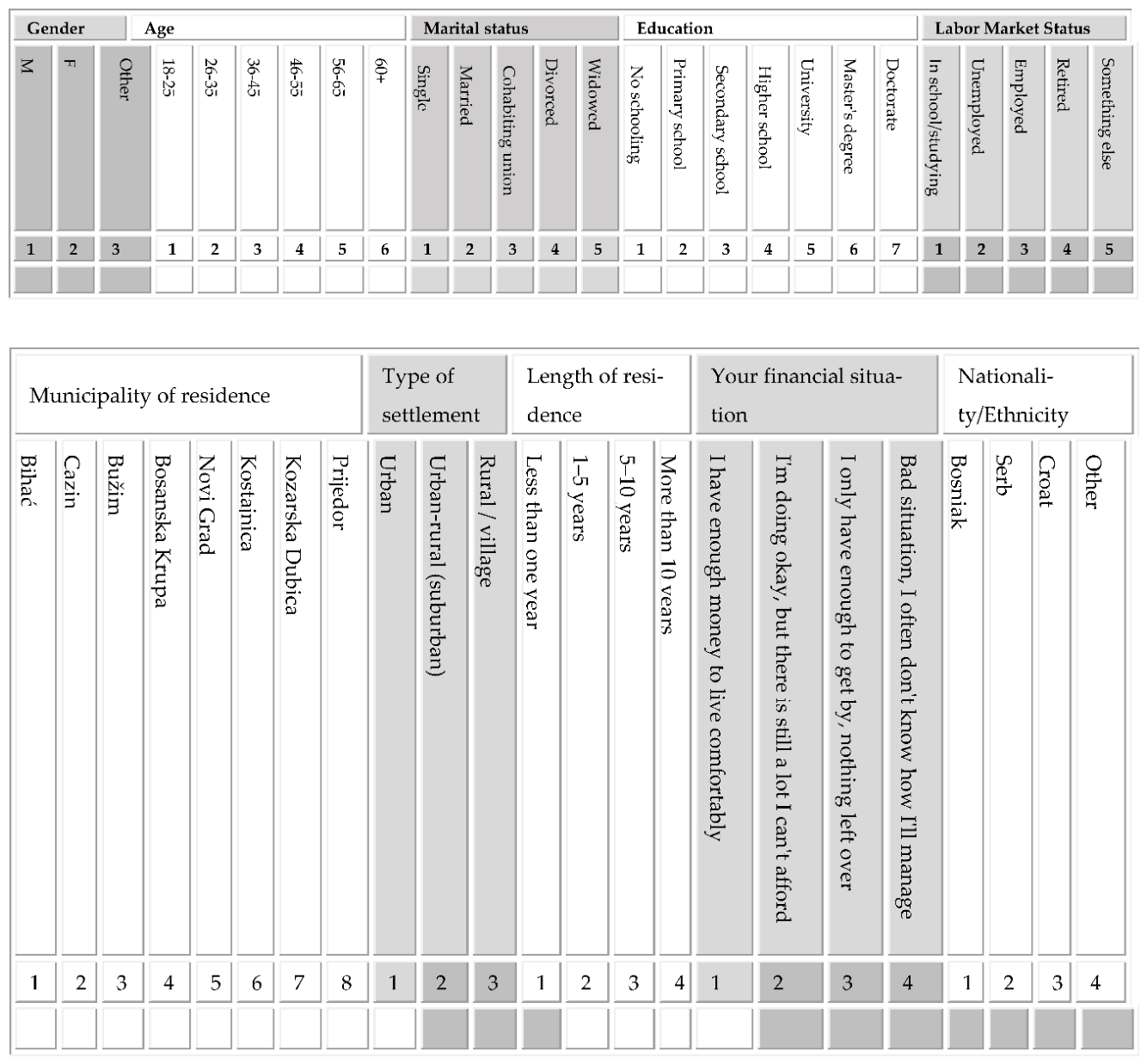
PART II: SELF-REPORTED AND COMMUNITY-LEVEL INFORMATION ABOUT THE TRGOVSKA GORA ISSUE.
| Not at all | Poorly | Somewhat | Fairly | Extremely | |
| I consider myself well informed about developments regarding the potential long-term storage of radioactive waste at Trgovska Gora | 1 | 2 | 3 | 4 | 5 |
| I consider that people living in this part of BiH are generally well informed about developments regarding the potential long-term storage of radioactive waste at Trgovska Gora. | 1 | 2 | 3 | 4 | 5 |
PART III: Perceived dimensions of environmental justice
| Distributive | Strongly disagree | Partially disagree | Neither agree nor disagree | Partially agree | Strongly agree |
| It is unfair that the long-term radioactive waste storage facility is planned to be built near the border of BiH, an area that has nothing to do with the Krško Nuclear Power Plant or that radioactive waste. | 1 | 2 | 3 | 4 | 5 |
| If it must be located on a border, it would be fairer for it to be between Croatia and Slovenia, since those two countries jointly manage the Krško Nuclear Power Plant. | 1 | 2 | 3 | 4 | 5 |
| I believe the location was chosen because it was assessed that BiH has less political power to oppose the selection of this location. | 1 | 2 | 3 | 4 | 5 |
| Croatia benefits economically from this project, while BiH bears the possible negative consequences without any benefit. | 1 | 2 | 3 | 4 | 5 |
| Recognition | Strongly disagree | Partially disagree | Neither agree nor disagree | Partially agree | Strongly agree |
| People in my community believe the location was chosen because it lies in an area with a minority/returnee population in Croatia (Serbs), which is perceived as a form of discrimination and marginalization. | 1 | 2 | 3 | 4 | 5 |
| The planned location is near the border with BiH, in an area where ethnic Croats are not the majority population, which some interpret as unjust and un-European. | 1 | 2 | 3 | 4 | 5 |
| The decision on the long-term storage facility is perceived as institutional neglect of the population living in this part of BiH and Croatia. | 1 | 2 | 3 | 4 | 5 |
| A The decision to build the long-term radioactive waste storage facility at Trgovska Gora is linked to the conflicts of the 1990s. | 1 | 2 | 3 | 4 | 5 |
| Procedural/Participatory | Strongly disagree | Partially disagree | Neither agree nor disagree | Partially agree | Strongly agree |
| The population in the Trgovska Gora area has the right to decide on issues concerning their living environment. | 1 | 2 | 3 | 4 | 5 |
| Residents of border municipalities/towns in BiH should have a formal right to participate in decision-making. | 1 | 2 | 3 | 4 | 5 |
| Croatia should take into account the views of people living near the planned long-term storage facility, even though they are citizens of another country. | 1 | 2 | 3 | 4 | 5 |
| The decision-making process regarding the location of the long-term storage facility is not transparent and excludes affected communities. | 1 | 2 | 3 | 4 | 5 |
| Civic activism in BiH has helped make the Trgovska Gora issue visible. | 1 | 2 | 3 | 4 | 5 |
| International organizations should be more involved in resolving this issue. | 1 | 2 | 3 | 4 | 5 |
| There is a perception that Croatia's membership in the EU and NATO makes an equal dialogue with BiH on the storage issue more difficult, since international institutions do not respond to calls for involvement. | 1 | 2 | 3 | 4 | 5 |
| The Trgovska Gora issue should be resolved through dialogue between the states, under the supervision of international institutions. | 1 | 2 | 3 | 4 | 5 |
Survey time: _______________ Location (e.g., square, marketplace, park): _______________
Thank you for taking the time to participate in this research.
References
- Agency for Statistics of Bosnia and Herzegovina. Census of population, households and dwellings in Bosnia and Herzegovina, 2013: Final results. Sarajevo, Bosnia and Herzegovina, 2016. Available online: https://www.popis.gov.ba/popis2013/doc/RezultatiPopisa_BS.pdf (accessed on 15 February 2026).
- Delić, E.; Dizdarević, E.; Softić, A.; Nukić, E. Comparative Analysis of Site Characterization for Storage and Deposition of Radioactive Waste at Trgovska Gora: What Went Wrong? In Proceedings of the 3rd International Scientific Meeting on Civil Engineering and Environmental Engineering (E-GTZ 2016), Tuzla, Bosnia and Herzegovina, 2–4 June 2016. [Google Scholar]
- Zgonjanin, J.; Pavlović, S. Trgovska Gora—History and status of site selection for radioactive waste storage. Svarog 2024, 28, 89–110. [Google Scholar] [CrossRef]
- Velić, L.; Velić, I. Odlaganje radioaktivnog otpada [Radioactive waste disposal]. Anal. Pravnog Fak. Univ. U Zenici 2021, 14, 13–34. [Google Scholar]
- Popović, V.; Jović, N. The case of disposal of nuclear waste in Trgovska Gora in the Republic of Croatia: Economic and legal consequences for Bosnia and Herzegovina. Acta Econ. 2022, 20, 195–207. [Google Scholar] [CrossRef]
- Lalić, V.; Ćeranić, P.; Baškalo, D. A radioactive waste repository in the border area between the Republic of Croatia and Bosnia and Herzegovina: Human security perspective. Secur. Dialogues 2023, 14, 115–133. [Google Scholar] [CrossRef]
- Schlosberg, D. Reconceiving environmental justice: Global movements and political theories. Environ. Politics 2004, 13, 517–540. [Google Scholar] [CrossRef]
- Mohai, P.; Pellow, D.; Roberts, J. T. Environmental justice. Annu. Rev. Environ. Resour. 2009, 34, 405–430. [Google Scholar] [CrossRef]
- Brulle, R. J.; Pellow, D. N. Environmental justice: Human health and environmental inequalities. Annu. Rev. Public Health 2006, 27, 103–124. [Google Scholar] [CrossRef] [PubMed]
- Agyeman, J.; Schlosberg, D.; Craven, L.; Matthews, C. Trends and directions in environmental justice: From inequity to everyday life, community, and just sustainabilities. Annu. Rev. Environ. Resour. 2016, 41, 321–340. [Google Scholar] [CrossRef]
- Malin, S. A.; Ryder, S. S. Developing deeply intersectional environmental justice scholarship. Environ. Sociol. 2018, 4, 1–7. [Google Scholar] [CrossRef]
- Gellers, J.; Jeffords, C. Toward environmental democracy? Procedural environmental rights and environmental justice. Glob. Environ. Politics 2018, 18, 99–121. [Google Scholar] [CrossRef]
- Menton, M.; Larrea, C.; Latorre, S.; Martinez-Alier, J.; Peck, M.; Temper, L.; Walter, M. Environmental justice and the SDGs: From synergies to gaps and contradictions. Sustain. Sci. 2020, 15(6), 1621–1636. [Google Scholar] [CrossRef]
- Pearse, R.; Schlosberg, D.; Rickards, L.; Della Bosca, H.; Moraes, O.; de Kleyn, L. Compounding barriers to environmental justice. Local Environ. 2025, 30, 1–16. [Google Scholar] [CrossRef]
- Schlosberg, D. Defining environmental justice: Theories, movements, and nature; Oxford University Press: Oxford, England, 2007. [Google Scholar]
- Mohai, P.; Saha, R. Which came first, people or pollution? A review of theory and evidence from longitudinal environmental justice studies. Environ. Res. Lett. 2015, 10, 125011. [Google Scholar] [CrossRef]
- Di Fonzo, D.; Fabri, A.; Pasetto, R. Distributive justice in environmental health hazards from industrial contamination: A systematic review of national and near-national assessments of social inequalities. Soc. Sci. Med. 2022, 297, 114834. [Google Scholar] [CrossRef] [PubMed]
- Odera, M.; Kelley, B.; Rivers, L.; Wilson, A.; Tran, J.; Patel, K.; Richmond-Bryant, J. A community-engaged oral history study as a tool for understanding environmental justice aspects of human exposures to hazardous waste thermal treatment emissions in Colfax, LA. Environ. Justice 2024, 17, 267–278. [Google Scholar] [CrossRef] [PubMed]
- Cannon, C. E. B. Critical environmental injustice: A case study approach to understanding disproportionate exposure to toxic emissions. Toxics 2024, 12, 295. [Google Scholar] [CrossRef] [PubMed]
- Schulz, A. J.; Rempel Fisher, G. M.; Nadeem, A.; Savoie, K.; Israel, B. A.; Landrum, T.; Sampson, N. Procedural justice in environmental decision making: An analysis of public participation language in state level cumulative impact legislation. Environ. Justice 2025, 18, 411–422. [Google Scholar] [CrossRef] [PubMed]
- Marsden, S. Enforcing non-discrimination in transboundary environmental impact assessment: Advantages for EU citizens from the transposition of the Espoo and Aarhus Conventions? J. Eur. Environ. Plan. Law. 2009, 6, 437–460. [Google Scholar] [CrossRef]
- Ebbesson, J. A modest contribution to environmental democracy and justice in transboundary contexts: The combined impact of the Espoo Convention and Aarhus Convention. Rev. Eur. Community Int. Environ. Law. 2011, 20, 248–257. [Google Scholar] [CrossRef]
- Papantoniou, A. Espoo Convention on transboundary environmental impact assessment and Kiev Protocol on strategic environmental assessment. In Multilateral Environmental Agreements (Elgar Encyclopedia of Environmental Law); Fitzmaurice, M., Tanzi, A., Papantoniou, A., Eds.; Edward Elgar Publishing: Cheltenham, UK, 2017; Volume 5, pp. 403–421. [Google Scholar] [CrossRef] [PubMed]
- Ryall, Á. Implementing the Aarhus Convention: Public participation, access to justice, and environmental governance. J. Environ. Law. 2019, 31, 149–172. [Google Scholar]
- Ryall, Á. The Aarhus Convention: Standards for access to justice in environmental matters. In Environmental rights: The development of standards; Turner, S. J., Shelton, D. L., Razzaque, J., McIntyre, O., May, J. R., Eds.; Cambridge University Press: Cambridge, England, 2019; pp. 116–146. [Google Scholar] [CrossRef]
- Temper, L.; del Bene, D.; Martinez-Alier, J. Mapping the frontiers and front lines of global environmental justice: The EJAtlas. J. Political Ecol. 2015, 22, 255–278. [Google Scholar] [CrossRef]
- Figueroa, R. M. Bivalent environmental justice and the culture of poverty. Rutgers J. Law. Urban Policy 2004, 1, 1–15. [Google Scholar]
- Schlosberg, D. Theorising environmental justice: The expanding sphere of a discourse. Environ. Politics 2013, 22, 37–55. [Google Scholar] [CrossRef]
- Bulkeley, H.; Carmin, J.; Castán Broto, V.; Edwards, G.; Fuller, S. Climate justice and global cities: Mapping the emerging discourses. Glob. Environ. Change 2013, 23, 914–925. [Google Scholar] [CrossRef]
- Schwarz, L. Is it all about a science-informed decision? A quantitative approach to three dimensions of justice and their relation in the nuclear waste repository siting process in Germany. Societies 2022, 12, 179. [Google Scholar] [CrossRef]
- Canete, R.; Biñas, R. Differential risk and the elements of resilience: A framework for advancing disaster risk reduction. Int. J. Disaster Risk Manag. 2025, 7, 209–238. [Google Scholar] [CrossRef]
- Cvetković, V. M.; Milenković, D.; Lukić, T. Measuring community disaster resilience in Serbia using an adapted BRIC framework grounded in DROP: Index construction and regional disparities. Geosciences 2026, 16, 135. [Google Scholar] [CrossRef]
- Takada, M.; Shirai, K.; Murakami, M.; Ohnuma, S.; Nakatani, J.; Yamada, K.; Yasutaka, T. Important factors for public acceptance of the final disposal of contaminated soil and wastes resulting from the Fukushima Daiichi nuclear power station accident. PLoS ONE 2022, 17, e0269702. [Google Scholar] [CrossRef] [PubMed]
- Huang, G. C. L.; Gray, T.; Bell, D. Environmental justice of nuclear waste policy in Taiwan: Taipower, government, and local community. Environ. Dev. Sustain. 2013, 15, 1555–1571. [Google Scholar] [CrossRef]
- Kyne, D.; Bolin, B. Emerging environmental justice issues in nuclear power and radioactive contamination. Int. J. Environ. Res. Public Health 2016, 13, 700. [Google Scholar] [CrossRef] [PubMed]
- Cvetković, V. M.; Öcal, A.; Lyamzina, Y.; Noji, E. K.; Nikolić, N.; Milošević, G. Nuclear power risk perception in Serbia: Fear of exposure to radiation vs. social benefits. Energies 2021, 14, 2464. [Google Scholar] [CrossRef]
- Nikolić, N.; Cvetković, V. M.; Renner, R.; Cvijović, N.; Gačić, J. Disaster risk perception and local resilience near the “Duboko” landfill: Challenges of governance, management, trust, and environmental communication in Serbia. Open Geosci. 2025, 17, 20250850. [Google Scholar] [CrossRef]
- Porel, T. A nuclear policy framework: Identifying challenges and ways to solutions. Int. J. Contemp. Secur. Stud. 2025, 1, 9–23. [Google Scholar] [CrossRef]
- Krütli, P.; Stauffacher, M.; Pedolin, D.; Moser, C.; Scholz, R. W. The process matters: Fairness in repository siting for nuclear waste. Soc. Justice Res. 2012, 25, 79–101. [Google Scholar] [CrossRef]
- Bell, M. Spatializing procedural justice: Fairness and local knowledge mobilisation in nuclear waste siting. Local Environ. 2021, 26, 165–180. [Google Scholar] [CrossRef]
- Vilhunen, T.; Kojo, M.; Litmanen, T.; Taebi, B. Perceptions of justice influencing community acceptance of spent nuclear fuel disposal: A case study in two Finnish nuclear communities. J. Risk Res. 2019, 25, 1023–1046. [Google Scholar] [CrossRef]
- Cotton, M. Environmental justice as scalar parity: Lessons from nuclear waste management. Soc. Justice Res. 2018, 31, 238–259. [Google Scholar] [CrossRef]
- Goyal, N. Disaster governance and community resilience: The law and the role of SDMAs. Int. J. Disaster Risk Manag. 2019, 1, 61–75. [Google Scholar] [CrossRef]
- Olawuni, P.; Olowoporoku, O.; Daramola, O. Determinants of residents’ participation in disaster risk management in Lagos Metropolis, Nigeria. Int. J. Disaster Risk Manag. 2021, 2, 1–18. [Google Scholar] [CrossRef]
- Salam, M. F.; Hemel, M. B. U.; Roni, A. H.; Pandith, J. C.; Ma-ee-sha, N. Grassroots disaster governance in Bangladesh: The roles of Union Parishads and disaster management committees. Int. J. Disaster Risk Manag. 2025, 7, 395–404. [Google Scholar] [CrossRef]
- Dukiya, J. J.; Benjamine, O. Building resilience through local and international partnerships: Nigeria experiences. Int. J. Disaster Risk Manag. 2021, 3, 11–24. [Google Scholar] [CrossRef]
- Cvetković, V. M.; Tanasić, J.; Ocal, A.; Kešetović, Ž.; Nikolić, N.; Dragašević, A. Capacity development of local self-governments for disaster risk management. Int. J. Environ. Res. Public Health 2021, 18, 10406. [Google Scholar] [CrossRef] [PubMed]
- Burger, J. Trust and consequences: Role of community science, perceptions, values, and environmental justice in risk communication. Risk Anal. 2022, 42, 2362–2375. [Google Scholar] [CrossRef] [PubMed]
- Bukula, J.; Mwageni, N. Beyond tokenism: Exploring the experiences and barriers of persons with disabilities in disability-inclusive disaster risk management in Mwanza City Council, Tanzania. Int. J. Disaster Risk Manag. 2025, 7, 51–64. [Google Scholar] [CrossRef]
- Sjöberg, L. Attitudes and risk perceptions of stakeholders in a nuclear waste siting issue. Risk Anal. 2003, 23, 739–749. [Google Scholar] [CrossRef] [PubMed]
- Cvetković, V. M.; Radovanović, M. P.; Milašinović, S. M. Disaster risk communication: Attitudes of Serbian citizens. Sociološki Pregl. 2021, 55, 1610–1647. [Google Scholar] [CrossRef]
- Cvetković, V. M.; Nikolić, A.; Ivanov, A. The role of social media in the process of informing the public about disaster risks. J. Lib. Int. Aff. 2023, 9, 104–119. [Google Scholar] [CrossRef]
- Renner, R.; Mayr-Veselinovic, C. Social license to operate: Where are you? The role of risk communication in raw material extraction. Int. J. Contemp. Secur. Stud. 2025, 1, 49–74. [Google Scholar] [CrossRef]
- Cvetković, V. M.; Milenković, D.; Bašić, J.; Lukić, T.; Renner, R. Predictive model of community disaster resilience across Serbia: A BRIC–DROP composite index and spatial patterns. Safety 2026, 12, 59. [Google Scholar] [CrossRef]
- Cvetković, V. M.; Šišović, V. Understanding the sustainable development of community (social) disaster resilience in Serbia: Demographic and socio-economic impacts. Sustainability 2024, 16, 2620. [Google Scholar] [CrossRef]
- Cvetković, V. M.; Lipovac, M.; Renner, R.; Stanarević, S.; Raonić, Z. A predictive framework for understanding multidimensional security perceptions among students in Serbia: The role of institutional, socio-economic, and demographic determinants of sustainability. Sustainability 2025, 17, 5030. [Google Scholar] [CrossRef]
- Cvetković, V. M.; Roder, G.; Öcal, A.; Tarolli, P.; Dragićević, S. The role of gender in preparedness and response behaviors towards flood risk in Serbia. Int. J. Environ. Res. Public Health 2018, 15, 2761. [Google Scholar] [CrossRef] [PubMed]
- Mančić, T. Climate change as a security challenge, risk and threat of the 21st century and its consequences on critical infrastructure. Int. J. Contemp. Secur. Stud. 2025, 1, 191–203. [Google Scholar] [CrossRef]
Table 1.
Sociodemographic characteristics of the study sample.
| Characteristic | Category | n | Valid % |
|---|---|---|---|
| Sex | Male | 200 | 52.2 |
| Female | 183 | 47.8 | |
| Age | 18–25 | 91 | 23.7 |
| 26–35 | 70 | 18.2 | |
| 36–45 | 87 | 22.7 | |
| 46–55 | 70 | 18.2 | |
| 56–65 | 34 | 8.9 | |
| 65+ | 32 | 8.3 | |
| Marital status | Single | 128 | 33.4 |
| Married | 208 | 54.3 | |
| Cohabiting | 6 | 1.6 | |
| Divorced | 32 | 8.4 | |
| Widowed | 9 | 2.3 | |
| Education | Primary school | 13 | 3.4 |
| Secondary school | 223 | 57.9 | |
| Higher school | 33 | 8.6 | |
| University degree | 106 | 27.5 | |
| Master’s degree | 6 | 1.6 | |
| Doctorate | 4 | 1.0 | |
| Labour market status | Student | 21 | 5.5 |
| Unemployed | 121 | 31.4 | |
| Employed | 207 | 53.8 | |
| Retired | 29 | 7.5 | |
| Other | 7 | 1.8 | |
| Municipality of residence | Bihać | 69 | 17.9 |
| Cazin | 82 | 21.3 | |
| Bužim | 24 | 6.2 | |
| Bosanska Krupa | 32 | 8.3 | |
| Novi Grad | 34 | 8.8 | |
| Kostajnica | 7 | 1.8 | |
| Kozarska Dubica | 27 | 7.0 | |
| Prijedor | 110 | 28.6 | |
| Settlement type | Urban | 183 | 47.8 |
| Urban–rural/suburban | 128 | 33.4 | |
| Rural | 72 | 18.8 | |
| Length of residence | Less than 1 year | 2 | 0.5 |
| 1–5 years | 6 | 1.6 | |
| 6–10 years | 25 | 6.5 | |
| More than 10 years | 351 | 91.4 | |
| Financial situation | Enough money to live comfortably | 103 | 26.8 |
| Doing well, but cannot afford many things | 199 | 51.7 | |
| Only enough for basic survival | 80 | 20.8 | |
| Very poor situation; often unsure how to get by | 3 | 0.8 | |
| Nationality | Bosniak | 194 | 50.7 |
| Serb | 173 | 45.2 | |
| Croat | 8 | 2.1 | |
| Other | 8 | 2.1 |
Note: Percentages are based on valid responses for each characteristic. The dataset includes 385 unique survey identifiers.
Table 2.
Self-reported and community-level information about the Trgovska Gora issue.
| Indicator | N | M | SD | Quite/Extremely informed (%) |
|---|---|---|---|---|
| Self-rated information about Trgovska Gora developments | 385 | 3.36 | 1.006 | 48.1 |
| Perceived information level of people in this part of BiH | 385 | 2.95 | 1.013 | 26.5 |
Note: M = mean; SD = standard deviation. The final column reports the combined valid percentage selecting “quite” or “extremely” informed.
Table 3.
Item-level descriptive statistics for perceived dimensions of environmental justice.
| Variable | Statement | N | M | SD | Agree/Strongly agree (%) |
|---|---|---|---|---|---|
| Perceived unfair border siting | Unfair to locate the radioactive waste storage near BiH, which is not connected to the Krško waste | 385 | 4.32 | 1.028 | 82.3 |
| Fairer Croatia-Slovenia border alternative | If located on a border, it would be fairer between Croatia and Slovenia | 385 | 4.39 | 0.880 | 84.6 |
| Perceived power-based site selection | The site was chosen because BiH has less political power to oppose it | 385 | 4.26 | 0.944 | 82.8 |
| Asymmetric distribution of benefits and risks | Croatia benefits economically while BiH bears possible negative consequences without benefits | 385 | 4.25 | 0.938 | 80.5 |
| Perceived targeting of a minority/returnee area | The location is perceived as targeting a minority/returnee Serb area in Croatia | 385 | 4.09 | 1.142 | 77.7 |
| Perceived ethno-territorial injustice | The border location is perceived as unjust because Croats are not the majority locally | 385 | 4.17 | 1.010 | 78.4 |
| Perceived institutional neglect | The decision is perceived as institutional neglect of residents in this part of BiH and Croatia | 385 | 4.28 | 0.948 | 84.1 |
| Perceived connection to the conflicts of the 1990s | The repository decision is linked to the conflicts of the 1990s | 385 | 3.90 | 1.200 | 65.7 |
| Right of affected residents to decide | Residents of the Trgovska Gora area have the right to decide on environmental matters affecting them | 385 | 4.42 | 0.907 | 82.1 |
| Formal participation rights of BiH border communities | Residents of BiH border municipalities should have a formal right to participate in decision-making | 385 | 4.41 | 0.850 | 83.9 |
| Consideration of cross-border residents' views | Croatia should consider the views of people living near the planned radioactive waste storage, even if they live in another state | 385 | 4.39 | 0.826 | 83.9 |
| Perceived non-transparency and exclusion | The site-selection process is not transparent and excludes affected communities | 383 | 4.18 | 0.915 | 80.2 |
| Civic activism and issue visibility | Civic activism in BiH helped make the Trgovska Gora issue visible. | 384 | 3.74 | 1.110 | 62.5 |
| Need for international-organization involvement | International organizations should be more involved in resolving the problem | 383 | 4.10 | 1.045 | 73.4 |
| Perceived EU/NATO power asymmetry | Croatia’s EU and NATO membership is perceived as hindering an equal dialogue with BiH | 384 | 3.77 | 1.256 | 63.0 |
| Interstate dialogue under international oversight | The issue should be resolved through interstate dialogue under international oversight | 384 | 4.25 | 1.040 | 79.7 |
Note: Agreement is the combined valid percentage selecting “agree” or “strongly agree.” M = mean; SD = standard deviation.
Table 4.
Descriptive statistics, reliability, and Pearson correlations among environmental-justice dimensions.
Table 4.
Descriptive statistics, reliability, and Pearson correlations among environmental-justice dimensions.
| No. | Variable | M | SD | α | 1 | 2 | 3 |
|---|---|---|---|---|---|---|---|
| 1 | Distributive injustice | 4.304 | 0.825 | 0.892 | — | ||
| 2 | Recognition injustice | 4.109 | 0.920 | 0.875 | 0.685*** | — | |
| 3 | Procedural/participatory justice and governance | 4.159 | 0.758 | 0.894 | 0.766*** | 0.608*** | — |
Note: N = 385. Values below the diagonal are Pearson correlation coefficients. * p < 0.05; ** p < 0.01; *** p < 0.001.
Table 5.
Spearman correlations between information indicators and environmental-justice dimensions.
| Environmental-justice dimension | Personal information ρ | p | Community information ρ | p |
|---|---|---|---|---|
| Distributive injustice | 0.302 | <0.001 | 0.208 | <0.001 |
| Recognition injustice | 0.343 | <0.001 | 0.303 | <0.001 |
| Procedural/participatory justice and governance | 0.298 | <0.001 | 0.181 | <0.001 |
Note: Spearman’s rho was used because the two information indicators were single ordinal items.
Table 6.
One-sample tests of the three environmental-justice hypotheses against the neutral midpoint.
Table 6.
One-sample tests of the three environmental-justice hypotheses against the neutral midpoint.
| Dimension | N | M (SD) | t (df) | p | Cohen’s d |
|---|---|---|---|---|---|
| Distributive injustice | 385 | 4.304 (0.825) | 31.01 (384) | <0.001 | 1.58 |
| Recognition injustice | 385 | 4.109 (0.920) | 23.64 (384) | <0.001 | 1.21 |
| Procedural/participatory justice and governance | 385 | 4.159 (0.758) | 30.01 (384) | <0.001 | 1.53 |
Note: The reference value was 3, representing the neutral response category. Positive values indicate stronger perceived injustice.
Disclaimer/Publisher’s Note: The statements, opinions and data contained in all publications are solely those of the individual author(s) and contributor(s) and not of MDPI and/or the editor(s). MDPI and/or the editor(s) disclaim responsibility for any injury to people or property resulting from any ideas, methods, instructions or products referred to in the content. |
© 2026 by the authors. Licensee MDPI, Basel, Switzerland. This article is an open access article distributed under the terms and conditions of the Creative Commons Attribution (CC BY) license (http://creativecommons.org/licenses/by/4.0/).
Copyright: This open access article is published under a Creative Commons CC BY 4.0 license, which permit the free download, distribution, and reuse, provided that the author and preprint are cited in any reuse.