
Submitted:
05 August 2026
Posted:
06 August 2026
You are already at the latest version
Abstract
Every crystal an active pharmaceutical ingredient (API) forms carries an intention, whether or not that intention was deliberately engineered: a lattice, hydrate shell, or amorphous halo that predetermines solubility, dissolution rate, physical and chemical stability, mechanical processability, and ultimately oral bioavailability long before the molecule reaches the bloodstream. This review proposes and applies a landscape-based organizing framework in which solid-state form is treated as an occupied position on a multidimensional lattice free-energy surface, and every deliberate engineering strategy polymorph and hydrate control, salt formation, cocrystallization, amorphous and co-amorphous dispersion, and particle/crystal habit engineering is positioned along two orthogonal axes: thermodynamic depth (resistance to reversion) and kinetic accessibility (ease with which the form can be reached and manufactured reproducibly). Framed this way, polymorph screening becomes a search for deep, accessible minima; salts and cocrystals become supramolecular relocations of the API onto an entirely different multicomponent landscape; amorphous dispersions become a deliberate exchange of thermodynamic depth for kinetic height, stabilized by polymeric or low-molecular-weight co-formers through the spring-and-parachute mechanism; and particle engineering becomes a second, independent landscape operating at the mesoscale rather than the molecular scale. We synthesize thirty-nine studies published since 2020 to update the mechanistic, analytical, and computational toolkit available to navigate this landscape, with particular emphasis on crystal structure prediction (CSP) using machine-learned interatomic potentials, machine-learning-guided coformer and amorphous-dispersion screening, disproportionation risk modeling for pharmaceutical salts, spherical co-crystallization for simultaneous molecular- and particle-level design, and continuous, solvent-minimized crystallization platforms aligned with ICH Q13. Original comparative figures and tables translate this landscape framework into a decision architecture Solid-State-by-Design (SSbD) intended to guide form selection from first candidate nomination through commercial manufacture, converting an API's crystal intentions from an accident of discovery-stage crystallization into a deliberately engineered design outcome. We close by identifying unresolved landscape-navigation problems: long-term prediction of amorphous recrystallization risk, extension of CSP and machine-learning tools to larger and more conformationally flexible discovery-stage molecules, and tighter integration of computational screening into candidate selection itself, rather than only after a lead has already been chosen.
Keywords:
solid-state pharmaceutics
; free-energy landscape
; polymorphism
; pharmaceutical cocrystals
; pharmaceutical salts
; disproportionation
; amorphous solid dispersion
; co-amorphous systems
; crystal structure prediction
; machine learning
; particle engineering
; continuous crystallization
; quality by design
1. Introduction
The Solid Form as a Hidden Design Variable
Every crystal has an intention, in the sense that its final packing, hydration state, or lack of long-range order is the deterministic outcome of the molecular and process conditions under which it formed whether or not a formulation scientist chose those conditions deliberately. Left un-engineered, that intention is set by whatever the molecule happens to encounter first during discovery-stage crystallization, and is only as good, or as risky, as chance allows. Roughly two out of every five marketed oral drugs, and up to nine out of every ten candidates now entering discovery pipelines, are constrained by poor aqueous solubility and fall into Biopharmaceutics Classification System (BCS) Classes II and IV [1]. For these molecules, pharmacological potency is rarely the limiting factor; the limiting factor is whether the compound can be packaged into a solid that dissolves quickly enough, survives storage long enough, and can be manufactured reproducibly enough to reach a patient as an effective medicine [2]. That constraint is resolved, almost entirely, at the level of solid-state chemistry the three-dimensional arrangement, or absence of long-range arrangement, of molecules in the solid phase [3].
A single API molecule can, in principle, be isolated in dozens of distinct solid forms: multiple crystalline polymorphs, hydrates and organic solvate, ionic salts, non-ionic multicomponent cocrystals, co-amorphous binary systems, and fully amorphous glasses [4]. Each occupies a different point on the compound's configurational energy surface, with a distinct lattice energy, packing density, and surface chemistry, and each therefore differs in melting point, intrinsic solubility, dissolution rate, hygroscopicity, compressibility, and chemical reactivity despite, in the polymorphic case, being chemically identical down to the last atom [5]. The regulatory and commercial history of pharmaceuticals contains repeated cautionary examples in which a late-appearing or unanticipated solid-state transition altered clinical exposure, delayed approval, or forced a product withdrawal, and these episodes have converted solid-state form from a manufacturing footnote into a formally recognized critical quality attribute [6].
This review argues that the disparate strategies used to engineer solid-state form polymorph selection, salt and cocrystal design, amorphous dispersion, and particle engineering are more usefully understood not as five independent toolkits but as five ways of deliberately setting an API's crystal intentions by relocating it on a single underlying free-energy landscape. Section 2 develops this landscape framework explicitly [6]. Section 3 through Section 6 apply it in turn to polymorphism, multicomponent ionic and supramolecular engineering, amorphous and co-amorphous systems, and particle/habit engineering. Section 7 surveys the analytical instrumentation required to read the landscape experimentally, and Section 8 surveys the computational and machine-learning tools now used to predict it before a single crystal is grown. Section 9 considers sustainability and continuous-manufacturing constraints on landscape navigation, and Section 10 integrates all of the above into a single Solid-State-by-Design (SSbD) decision architecture a design-integrated roadmap for turning an API's crystal intentions from an accident of discovery chemistry into an engineered outcome. We draw throughout on primary literature published from 2020 onward, reflecting how substantially machine learning, crystal structure prediction, and continuous processing have reshaped this field within the current decade.
2. A Free-Energy-Landscape Framework for Solid-Form Selection
2.1. Two Orthogonal Axes: Thermodynamic Depth and Kinetic Accessibility
Every solid form of an API can be located, at least conceptually, on a lattice (or, for multicomponent and amorphous systems, a configurational) free-energy surface, G, plotted against a generalized packing coordinate that captures molecular conformation, orientation, and intermolecular contact geometry [7]. Figure 1 renders this surface schematically for a hypothetical API: the global minimum corresponds to the thermodynamically most stable polymorph (Form I); a shallower local minimum corresponds to a kinetically accessible but thermodynamically metastable polymorph (Form II); a third well, shifted by incorporation of water into the lattice, represents a hydrate; and a broad, shallow depression at high free energy represents the amorphous state a kinetically arrested, glassy configuration rather than a true energetic minimum [8].
Two properties of this surface are engineeringly decisive. The first is thermodynamic depth: how far below competing forms a given minimum sit, which determines how strongly the system resists reverting to a more stable form during storage, formulation, or exposure to the gastrointestinal environment. The second is kinetic accessibility: how readily, and how reproducibly, a given minimum can be reached from solution or melt under manufacturable conditions, and how high the barrier is to escape it once formed [9]. A deep, easily accessible minimum the ideal case is rare; in practice, every solid-state strategy discussed in this review represents a different negotiated trade-off between these two properties.
2.2. Reframing Five Engineering Levers in Landscape Terms
Table 1 restates the five principal solid-state engineering levers in landscape language, and Figure 2 plots them schematically along the two axes just defined. Polymorph and hydrate control seeks the deepest, most kinetically robust minimum reachable by the unmodified molecule and is therefore positioned toward the high-stability, high-accessibility quadrant, constrained only by the risk of disappearing polymorphism the discovery, sometimes years after initial development, of an even more stable form that was kinetically inaccessible during original screening [10]. Salt formation and co-crystallization do not merely search the native landscape more thoroughly; they construct an entirely new multicomponent landscape by introducing a counterion or coformer, trading some manufacturing complexity for large, often predictable gains in solubility. Amorphous and co-amorphous engineering deliberately abandons the deep crystalline minima altogether, accepting a thermodynamically elevated, kinetically metastable state in exchange for the largest attainable dissolution advantage a strategy that only succeeds when a stabilizing carrier raises the effective kinetic barrier to recrystallization high enough to survive shelf life. Particle and crystal habit engineering operates on an essentially independent, mesoscale landscape: it does not change which molecular-level minimum is occupied, but reshapes the particle-level energy surface governing agglomeration, flow, and surface area, and can therefore be layered on top of any of the other four strategies.
4. Ionic and Supramolecular Multicomponent Engineering
4.1. Salts: Shifting the Ionization Equilibrium
Salt formation remains the single most widely used strategy for improving the solubility and dissolution of ionizable APIs, underlying roughly half of all marketed small-molecule medicines [23]. By pairing an acidic or basic drug with a pharmaceutically acceptable counterion, developers construct an entirely new ionic crystal lattice whose solubility, hygroscopicity, and melting behavior can differ dramatically from the free acid or base, even though the pharmacologically active species is regenerated upon dissolution [24]. Rational salt selection begins with the counterion pKa relative to the API a differential of at least roughly two pH units is generally required to favor complete, energetically stable proton transfer over a poorly defined ionic complex and continues through assessment of the resulting salt's crystallinity, hygroscopicity, and counterion toxicity.
4.2. Disproportionation as a Landscape-Crossing Event
A pharmaceutical salt can be understood as sitting in a favorable well on an ionic landscape only so long as local pH and counterion volatility conditions keep that well energetically preferred over reversion to the free acid or base [25]. Disproportionation the in-situ dissociation of a salt back to its neutral form, typically triggered by the alkaline microenvironment of certain excipients or by loss of a volatile counterion such as hydrochloride is therefore best understood as an unwanted crossing back over the barrier separating the salt well from the free-form well [26]. Recent mechanistic and modeling work has quantified this risk directly: sulfonate counterions have been shown to modulate biopharmaceutical performance across the population of FDA-approved salts in structurally systematic ways, refined pHmax equations now allow in-silico prediction of the pH at which a given salt becomes thermodynamically disfavored relative to its free form, and advanced synthetic methodologies have expanded the practical space of counterions available for salt screening beyond the classical shortlist [27,28]. These tools collectively let formulators identify, before a single stability study is run, which candidate salts sit in genuinely deep wells versus which are only kinetically, and precariously, trapped [28,29].
4.3. Cocrystals: Synthon-Directed Lattice Redesign
For non-ionizable APIs, or where the counterion-toxicity or disproportionation risk of a salt is unacceptable, pharmaceutical cocrystals offer a complementary multicomponent route. A cocrystal is a crystalline solid in which an API and a pharmaceutically acceptable coformer coexist in a defined stoichiometric ratio within a single lattice, held together by non-covalent interactions hydrogen bonding, halogen bonding, and π–π stacking without proton transfer [30]. Because cocrystallization leaves the covalent structure of the API untouched, it decouples physicochemical property tuning from pharmacological identity almost entirely, and comprehensive 2022 and subsequent reviews of cocrystal engineering document how thoroughly this platform has matured from serendipitous discovery toward literature-scale, database-mined design.
Coformer selection is now guided systematically by supramolecular synthon theory, which predicts the most probable hydrogen-bonding or halogen-bonding motifs between complementary functional groups on the API and candidate coformer, together with computational hydrogen-bond-propensity and Cambridge Structural Database mining tools that rank candidate coformers by predicted cocrystallization likelihood before any experimental screening begins. This computational-first approach has been extended specifically to low-molecular-weight and flavonoid-class APIs, and machine-learning-assisted coformer and multicomponent-form prediction pipelines are increasingly used to prioritize the coformer shortlist for experimental confirmation, converting what was once a combinatorial search problem into a ranked, hypothesis-driven screening campaign.
4.4. Regulatory Boundary Between Salts, Cocrystals, and Polymorphs
Because cocrystals occupy conceptual territory between a polymorph (no new chemical species) and a salt (complete proton transfer), regulatory agencies have published dedicated frameworks distinguishing cocrystals from both categories for the purposes of classification, patenting, and lifecycle management. This regulatory clarity has removed a significant historical barrier to cocrystal adoption in commercial development, and well-characterized novel multicomponent forms whether salts or cocrystals now routinely extend intellectual property protection for an API well beyond the life of the original composition-of-matter patent.

Table 2.
Comparative attributes of pharmaceutical salts and cocrystals as ionic versus neutral multicomponent landscape strategies.
Table 2.
Comparative attributes of pharmaceutical salts and cocrystals as ionic versus neutral multicomponent landscape strategies.
| Attribute | Pharmaceutical Salts | Pharmaceutical Cocrystals |
| Requires ionizable functional group | Yes (ΔpKa ≥ ~2 typical threshold) | No, applicable to neutral APIs |
| Bonding mechanism | Ionic (proton transfer) | Non-covalent (H-bond, halogen bond, π–π) |
| Principal instability mode | Disproportionation to free acid/base | Dissociation to component crystals under humidity/solvent stress |
| Screening logic | Counterion pKa matching; pHmax modeling | Supramolecular synthon prediction; CSD mining; ML ranking |
| Regulatory classification | Distinct new drug substance if patentable salt | Clarified as distinct from polymorphs/salts by dedicated guidance |
| Typical solubility gain | Large and comparatively predictable | Moderate to large; more coformer-dependent |
5. Amorphous and Co-Amorphous Engineering: Trading Depth for Height
5.1. The Spring-and-Parachute Mechanism
Where crystalline strategies reach their limit typically for high-melting, poorly ionizable, hydrogen-bond-poor molecules that resist both salt and cocrystal formation amorphous solid dispersions (ASDs) offer a fundamentally different route to enhanced apparent solubility. In an ASD, the API is molecularly dispersed within a polymeric carrier, eliminating the lattice energy barrier that otherwise limits dissolution from the crystalline state and permitting dissolution to generate a transiently supersaturated solution the spring whose degree of supersaturation can exceed thermodynamic equilibrium solubility by an order of magnitude or more [31]. Figure 3 depicts this behavior schematically: without a stabilizing polymer, the supersaturated spring collapses rapidly as the API recrystallizes from solution, erasing the advantage within hours; with an appropriately selected polymer, dissolved polymer chains inhibit nucleation and crystal growth in solution, sustaining supersaturation long enough for absorption to occur the parachute.
5.2. Polymer Selection as Landscape Stabilization
Because the amorphous state is thermodynamically metastable relative to every crystalline form on the native landscape, the central engineering challenge of ASD design is not reaching the amorphous state but keeping the API there for the duration of shelf life. The stabilizing polymer must satisfy at least three simultaneous requirements: it must kinetically inhibit nucleation and crystal growth during storage, it must remain miscible with the API across the intended shelf-life temperature and humidity range (a requirement often assessed through solubility-parameter matching and Flory–Huggins-type miscibility modeling), and it must itself inhibit recrystallization from the supersaturated solution generated on dissolution. Recent large-dataset machine-learning studies including models trained on hundreds of hot-melt-extruded formulations spanning dozens of distinct APIs have shown that gradient-boosted and deep-learning classifiers can now predict both amorphization success and post-manufacture chemical stability directly from molecular fingerprints and polymer descriptors with accuracies exceeding 90%, substantially compressing what was historically a purely empirical, trial-and-error polymer-selection process [32]. Complementary work has extended this predictive capability to drug-loading limits in poor glass-forming APIs and to decision-tree-style formulation guidance for super saturable mesoporous silica carriers, broadening the ASD toolkit beyond conventional polymer dispersions.
5.3. Co-Amorphous Systems as a Low-Molecular-Weight Alternative
Co-amorphous systems (CAMs) replace the high-molecular-weight polymeric carrier with a second small molecule either a genuine second drug (drug–drug CAMs) or a low-molecular-weight coformer such as an amino acid or carboxylic acid forming a single-phase amorphous blend stabilized by intermolecular hydrogen bonding, ionic interaction, or π–π stacking rather than by polymer entanglement. Because both components are small molecules, CAMs can achieve markedly higher glass transition temperatures and drug loadings than conventional polymeric ASDs, and predictive coformer-selection frameworks increasingly informed by computational screening of intermolecular interaction strength have begun to convert CAM design from a case-by-case empirical exercise into a more systematic screening campaign, mirroring the trajectory already established for cocrystal coformer selection.
5.4. Manufacturing Routes: HME Versus Spray Drying
Two manufacturing platforms dominate commercial ASD production: spray drying, which rapidly removes solvent from an atomized API–polymer solution, and hot-melt extrusion (HME), a solvent-free continuous process in which thermal and mechanical energy are applied to a molten API–polymer blend. Each imposes distinct constraints spray drying requires a common solvent system and generates fine, often low-bulk-density powders that need downstream densification, while HME requires thermal stability of the API at processing temperature but offers a genuinely continuous, solvent-free, and therefore comparatively green manufacturing route consistent with current regulatory encouragement of continuous processing. Systematic reviews of HPMCAS-based ASDs now marketed clinically confirm that both platforms are represented among commercially approved products, and quality-by-design frameworks specifically developed for HME-based ASD product development formalize design-of-experiments approaches to screening formulation and process variables jointly rather than sequentially [33].
6. Particle and Crystal Habit Engineering: Coupling Molecular Form to Powder Performance
Molecular-level solid-state form determines only part of a formulation's ultimate performance; particle-level properties size, shape, surface area, and habit govern how that molecular form actually behaves during downstream unit operations and dissolution. The Noyes–Whitney relationship makes this coupling explicit: dissolution rate scales directly with the exposed surface area of the solid, so even a thermodynamically well-chosen polymorph, salt, or cocrystal can underperform if its particle morphology yields poor powder flow, inconsistent tablet compaction, or insufficient surface area for rapid dissolution.
6.1. Habit Control During Crystallization
Crystal habit the relative growth rates of different crystal faces, and therefore the overall particle shape is influenced by solvent choice, supersaturation level, cooling profile, and habit-modifying additives that adsorb selectively onto specific crystal faces and slow their growth relative to others. Controlled crystallization platforms, including antisolvent precipitation, programmed cooling profiles, and continuous mixed-suspension mixed-product-removal (MSMPR) crystallizers, increasingly allow particle size distribution and habit to be engineered concurrently with polymorphic form selection at the crystallization step itself, rather than corrected after the fact by milling a post hoc process that can introduce surface disorder, amorphous content, and physical instability at particle surfaces [34].
6.2. Spherical Crystallization and Co-Processing
Spherical crystallization and continuous spherical agglomeration produce near-spherical, free-flowing, directly compressible particles from the crystallization step itself, illustrating how particle engineering and molecular crystal engineering are converging into a single upstream design activity. An integrated continuous crystallization–spherical agglomeration (CCSA) process demonstrated for atorvastatin calcium exemplifies this convergence, coupling continuous polymorph control with in-line particle shaping in a single intensified unit operation, while systematic studies of bridging-liquid selection and two-step bridging mechanisms have improved the reproducibility of agglomerate size control for benzoic-acid-class and arbidol-hydrochloride-class model APIs. A comprehensive 2023 review of API co-processing techniques catalogs spherical agglomeration and co-precipitation as complementary, solvent-media-based approaches that simultaneously address flow, compaction, and dissolution limitations without requiring a separate granulation step.
6.3. Nanocrystals as an Orthogonal Particle-Size Lever
At the opposite end of the particle-size spectrum, nanocrystal engineering reduces API particles to the sub-micron domain, exploiting the direct proportionality between surface area and dissolution rate to achieve solubility and bioavailability gains without altering molecular solid-state form at all. Recent formulation work has demonstrated fully redispersible dried nanocrystal powders stabilized with sucrose laurate that retain enhanced surface area and dissolution advantage after reconstitution, and combined co-crystal/nanocrystal approaches in which a cocrystal is itself reduced to nanoscale particle size by wet milling illustrate that molecular-level and particle-level engineering are not mutually exclusive but can be stacked to compound their individual solubility benefits, consistent with the particle-engineering axis in Figure 2 operating independently of, and in combination with, the molecular-landscape axis [35].
7. The Analytical Backbone: Reading the Landscape Experimentally
Every claim this review has made about landscape position which minimum an API occupies, how deep it is, and whether it is drifting toward another well is only as credible as the analytical methods used to verify it. Table 3 summarizes the core techniques required to detect and quantify solid-state heterogeneity, often at low levels within a bulk sample, and no single technique is sufficient in isolation: robust characterization depends on triangulating orthogonal methods, particularly when quantifying trace levels of a minor polymorph or residual crystallinity within a nominally amorphous matrix, since individual techniques carry different and sometimes complementary limits of detection [36].
Solid-state NMR in particular has undergone substantial methodological advance since 2020, with rapid ¹H quantification protocols and dynamic-nuclear-polarization-enhanced detection now extending the sensitivity of ssNMR into the sub-percent regime for polymorph and amorphous-content quantification a resolution that PXRD alone often cannot reliably achieve for low-level minor phases [37]. These advances matter disproportionately for the landscape framework proposed here, because the practical difference between a genuinely deep, safe minimum and a shallow, drifting one is frequently a matter of a percent or two of a minor competing phase that only the most sensitive orthogonal techniques can detect before it becomes a clinical or manufacturing problem.
8. Computational and AI-Accelerated Screening
8.1. Crystal Structure Prediction Matures into a Design Tool
Perhaps the most transformative development in solid-state pharmaceutics over the past five years is the maturation of crystal structure prediction (CSP) from an academic curiosity into a routinely deployable industrial tool. CSP generates and energy-ranks plausible crystal packing arrangements for a candidate molecule computationally, before any experimental crystallization is attempted, effectively mapping the theoretical free-energy landscape in silico ahead of the experimental search depicted in Figure 1. Recent validation studies combining systematic crystal-packing search algorithms with machine-learned interatomic force fields have demonstrated recovery of essentially all experimentally known polymorphic forms across large, diverse validation sets spanning dozens of molecules and well over a hundred confirmed polymorphs, while simultaneously flagging additional low-energy structures not yet observed experimentally precisely the disappearing-polymorphism risk discussed in Section 3.2, now surfaced computationally rather than discovered by costly post-launch reformulation. Complementary work applying active-learning-trained machine-learned potentials to CSP energy landscapes has improved the accuracy with which candidate structures are ranked relative to the prohibitively expensive periodic density-functional-theory calculations that CSP traditionally required, while broader field reviews confirm that CSP is now sufficiently reliable to inform polymorph screening strategy directly and to support prediction of physical stability under real-world storage conditions rather than only idealized ones.
8.2. Machine Learning Across the Pipeline
Machine learning has been layered onto essentially every stage of the solid-state design pipeline discussed in this review. Beyond CSP itself, ML models trained on historical crystallization and cocrystallization datasets now predict cocrystallization propensity and coformer suitability from molecular descriptors ahead of experimental synthon screening, ML classifiers trained on hundreds of hot-melt-extruded formulations predict amorphization success and post-manufacture chemical stability of ASDs with better than 90% accuracy, and combined high-throughput-screening/ML pipelines predict binary and ternary ASD formation from micro-quantity experimental datasets an order of magnitude faster than exhaustive combinatorial screening alone [38]. None of these tools yet replace experimental verification every study reviewed here retains a confirmatory experimental step but collectively they compress design cycles by focusing laboratory effort on the small subset of candidate forms that computational screening identifies as most promising, converting solid-state form selection from a largely serendipitous search into a ranked, hypothesis-driven engineering exercise.
9. Sustainability and Continuous Manufacturing as Landscape Constraints
Solvent use, energy demand, and waste generation associated with crystallization are increasingly treated not as afterthoughts but as explicit design constraints on which region of the solid-state landscape is practically reachable at manufacturing scale. Continuous crystallization platforms most commonly built around mixed-suspension mixed-product-removal (MSMPR) crystallizer configurations offer enhanced process robustness, tighter control over polymorphic outcome, and substantial reductions in solvent burden relative to traditional batch crystallization, and have received explicit regulatory encouragement through frameworks such as ICH Q13, which formally addresses continuous manufacturing of both drug substances and drug products [39]. Recent technoeconomic and sustainability analyses comparing batch and continuous crystallization workflows using open-source pharmaceutical flowsheet simulation tools now allow developers to quantify these tradeoffs quantitatively before committing to a manufacturing platform, while green-chemistry-oriented reviews document a measurable, if still limited, convergence between continuous manufacturing adoption and green-chemistry principle implementation across the pharmaceutical and pharma-chemical industries since roughly 2020. Deep-eutectic-solvent-based crystallization media represent a further emerging green-chemistry lever, offering tunable solubility and polymorphic control while substantially reducing reliance on conventional volatile organic solvents during the crystallization step itself.
10. Toward an Integrated Solid-State-by-Design (SSbD) Architecture
Figure 4 translates the landscape framework of Section 2 into an operational decision tree that mirrors typical early-development triage logic: ionizability is assessed first, favoring salt formation when a sufficient pKa differential is available; cocrystallization is evaluated next for non-ionizable APIs or where disproportionation risk disfavors a salt; and amorphous or co-amorphous engineering is reserved for molecules that remain intractable high-melting, poorly crystallizable, or lacking a suitable coformer after crystalline strategies have been exhausted. Polymorph and hydrate screening runs as a parallel, always-on activity across every branch rather than as a sequential step, consistent with the regulatory expectation, discussed in Section 3.2 and Section 7, that polymorphic risk be controlled continuously rather than assessed once. Particle and crystal habit engineering is applied concurrently to whichever crystalline or amorphous form is ultimately selected, reflecting its status as an independent, mesoscale landscape rather than a downstream afterthought.
Taken together, the strategies reviewed in Section 3 through Section 8 are most powerful when integrated early and iteratively, rather than applied sequentially as isolated late-stage fixes. We propose treating solid-state engineering analogously to Quality by Design (QbD) in drug product manufacturing: critical material attributes of the solid form crystallinity, particle size and shape, surface energy, hygroscopicity should be identified early, linked explicitly to critical quality attributes of the final product dissolution rate, bioavailability, physical and chemical stability, manufacturability and controlled through a deliberately engineered combination of molecular design, computational screening, crystallization or amorphization process parameters, and downstream particle processing. Figure 5 depicts this Solid-State-by-Design (SSbD) logic as a closed decision cycle, and Table 4 maps each stage of that cycle to the critical material attributes it is responsible for controlling and the analytical methods (Section 7) used to verify that control.
Open Challenges and Future Perspectives
- Long-term amorphous stability prediction remains difficult: accelerated stability protocols do not always predict shelf-life recrystallization behavior reliably, and while machine-learning models trained on hundreds of formulations now predict short-term amorphization and manufacture-stage chemical stability with high accuracy, prediction of multi-year physical stability under real-world, variable storage conditions remains comparatively immature.
- Extension of CSP and ML toolkits to larger, more conformationally flexible molecules: current CSP validation successes concentrate on comparatively rigid, historically well-studied small molecules; as discovery pipelines increasingly nominate larger, more flexible, more poorly soluble candidates, existing crystal-energy-landscape search algorithms face an exponential growth in conformational degrees of freedom that current machine-learned potentials only partially mitigate.
- Deeper integration of green chemistry and continuous manufacturing: despite explicit regulatory encouragement through ICH Q13 and a growing continuous-crystallization literature base, adoption of fully continuous, solvent-minimized crystallization at commercial scale remains limited relative to its demonstrated technoeconomic and sustainability advantages, and deep-eutectic-solvent and other green-solvent crystallization media remain at a comparatively early stage of pharmaceutical-scale validation.
- Earlier integration of computational screening into candidate selection itself: CSP, ML-guided coformer ranking, and ASD-formation prediction are currently deployed almost exclusively after a lead molecule has already been nominated; closer integration of these tools directly into early discovery decision-making could allow predicted solid-state developability to influence which candidate is advanced in the first place, rather than only how an already-selected candidate is formulated.
- Systematic coformer and co-amorphous-partner databases: despite substantial recent progress in ML-guided coformer ranking for both cocrystals and co-amorphous systems, the underlying training datasets remain comparatively small and unevenly distributed across chemical space, constraining the generalizability of current predictive models to structurally novel APIs.
11. Conclusions
Solid-state form is not incidental to drug development, nor separable from it; it is a design variable with the same strategic weight as molecular structure and dosage-form selection. Reframing polymorph control, salt and cocrystal engineering, amorphous and co-amorphous dispersion, and particle engineering as five coordinated ways of navigating a single underlying free-energy landscape rather than as five disconnected toolkits clarifies why each strategy succeeds or fails where it does, and provides a unifying vocabulary for comparing gains in thermodynamic depth against gains in kinetic accessibility. The rapid maturation since 2020 of crystal structure prediction using machine-learned interatomic potentials, machine-learning-guided coformer and amorphous-dispersion screening, quantitative disproportionation risk modeling, and continuous, solvent-minimized crystallization platforms has, for the first time, made much of this landscape computationally navigable before a single experimental crystal is grown. Realizing the full benefit of these tools requires treating solid-state form selection as an integrated Solid-State-by-Design activity from the earliest stages of development the framework summarized in Figure 1 through Figure 5 and Table 1 through 4 of this review rather than as a sequence of isolated fixes applied late, and often too late, in the development timeline.
Acknowledgments
The authors sincerely acknowledge Chalapathi University and Chalapathi Institute of Pharmaceutical Sciences (Autonomous) for their continuous encouragement, valuable support, and the facilities provided.
Conflicts of Interest
The authors declare no conflict of interest.
References
- Firaha, D.; Liu, Y.M.; van de Streek, J.; Sasikumar, K.; Dietrich, H.; Helfferich, J.; et al. Predicting Crystal Form Stability under Real-World Conditions. Nature 2023, 623, 324–328. [CrossRef] [PubMed]
- Bolla, G.; Sarma, B.; Nangia, A.K. Crystal Engineering of Pharmaceutical Cocrystals in the Discovery and Development of Improved Drugs. Chem. Rev. 2022, 122, 11514–11603. [CrossRef] [PubMed]
- Guo, M.; Sun, X.; Chen, J.; Cai, T. Pharmaceutical Cocrystals: A Review of Preparations, Physicochemical Properties and Applications. Acta Pharm. Sin. B 2021, 11, 2537–2564. [CrossRef] [PubMed]
- Saberi, A.; Kouhjani, M.; Yari, D.; Jahani, A.; Asare-Addo, K.; Kamali, H.; et al. Development, Recent Advances, and Updates in Binary, Ternary Co-Amorphous Systems, and Ternary Solid Dispersions. J. Drug Deliv. Sci. Technol. 2023, 86, 104746. [CrossRef]
- Abramov, Y.A.; Sun, G.; Zeng, Q. Emerging Landscape of Computational Modeling in Pharmaceutical Development. J. Chem. Inf. Model. 2022, 62, 1160–1171. [CrossRef] [PubMed]
- Jiang, J.; Lu, A.; Ma, X.; Ouyang, D.; Williams, R.O., III. The Applications of Machine Learning to Predict the Forming of Chemically Stable Amorphous Solid Dispersions Prepared by Hot-Melt Extrusion. Int. J. Pharm. X 2023, 5, 100164. [CrossRef] [PubMed]
- Sun, G.; et al. Current State-of-the-Art In-House and Cloud-Based Applications of Virtual Polymorph Screening of Pharmaceutical Compounds: A Challenging Case of AZD1305. Cryst. Growth Des. 2021, 21, 1972–1983. [CrossRef]
- International Council for Harmonisation of Technical Requirements for Pharmaceuticals for Human Use (ICH). ICH Q13: Continuous Manufacturing of Drug Substances and Drug Products; ICH: Geneva, Switzerland, 2023.
- Skrdla, P.J. Estimating the Maximal Solubility Advantage of Drug Salts. Int. J. Pharm. 2021, 595, 120228. [CrossRef] [PubMed]
- Bharate, S.S. Modulation of Biopharmaceutical Properties of Drugs Using Sulfonate Counterions: A Critical Analysis of FDA-Approved Pharmaceutical Salts. J. Drug Deliv. Sci. Technol. 2021, 66, 102913. [CrossRef]
- Amrutha, S.; Giri, L.; SeethaLekshmi, S.; Varughese, S. Advanced Methodologies for Pharmaceutical Salt Synthesis. Cryst. Growth Des. 2021, 21, 1358–1374. [CrossRef]
- Huang, Z.; Staufenbiel, S.; Bodmeier, R. Combination of Co-Crystal and Nanocrystal Techniques to Improve the Solubility and Dissolution Rate of Poorly Soluble Drugs. Pharm. Res. 2022, 39, 949–961. [CrossRef] [PubMed]
- Prajapati, H.; Serajuddin, A.T.M. Development of Fully Redispersible Dried Nanocrystals by Using Sucrose Laurate as Stabilizer for Increasing Surface Area and Dissolution Rate of Poorly Water-Soluble Drugs. J. Pharm. Sci. 2022, 111, 780–793. [CrossRef] [PubMed]
- Haskins, M.M.; Lusi, M.; Zaworotko, M.J. Supramolecular Synthon Promiscuity in Phosphoric Acid–Dihydrogen Phosphate Ionic Cocrystals. Cryst. Growth Des. 2022. [CrossRef] [PubMed]
- Deng, Y.; Liu, S.; Jiang, Y.; Martins, I.C.B.; Rades, T. Recent Advances in Co-Former Screening and Formation Prediction of Multicomponent Solid Forms of Low Molecular Weight Drugs. Pharmaceutics 2023, 15, 2174. [CrossRef] [PubMed]
- Agostini, [et al.] Growing Interest in Pharmaceutical Cocrystals: A Comprehensive Review of Applications and Trends. Chemistry Select 2025, 10, e202500831. [CrossRef]
- Monserrat Marcos Valdez, M.; Sperandeo, N.R.; Bueno, M.S.; Garnero, C. Pharmaceutical Cocrystals in Drug-Delivery Technologies: Advances from Rational Design to Therapeutic Applications. Pharmaceutics 2026, 18, 128. [CrossRef] [PubMed]
- Xu, J.; Shi, Q.; Wang, Y.; Wang, Y.; Xin, J.; Cheng, J.; Li, F. Recent Advances in Pharmaceutical Cocrystals: A Focused Review of Flavonoid Cocrystals. Molecules 2023, 28, 613. [CrossRef] [PubMed]
- Kolisnyk, T.; Mohylyuk, V.; Fil, N.; Bickerstaff, E.; Li, S.; Jones, D.S.; Andrews, G.P. High Drug-Loaded Amorphous Solid Dispersions of a Poor Glass Forming Drug: The Impact of Polymer Type and Cooling Rate on Amorphous Drug Behaviour. Int. J. Pharm. 2025, 670, 125095. [CrossRef] [PubMed]
- Vasa, D.M.; Wang, S.-W.; Dunn, M.F.; Long, E.; Luthra, S.A. Molecular-Properties Based Formulation Guidance Tree for Amorphous and Supersaturable Mesoporous Silica Preparations of Poorly Soluble Compounds. J. Pharm. Sci. 2025, 114, 554–565. [CrossRef] [PubMed]
- Chambers, L.I.; Grohganz, H.; Palmelund, H.; et al. Predictive Identification of Co-Formers in Co-Amorphous Systems. Eur. J. Pharm. Sci. 2021, 157, 105636. [CrossRef] [PubMed]
- Yarlagadda, D.L.; Sai Krishna Anand, V.; Nair, A.R.; Navya Sree, K.S.; Dengale, S.J.; Bhat, K. Considerations for the Selection of Co-Formers in the Preparation of Co-Amorphous Formulations. Int. J. Pharm. 2021, 602, 120649. [CrossRef] [PubMed]
- Tambe, S.; Jain, D.; Agarwal, Y.; Amin, P. Hot-Melt Extrusion: Highlighting Recent Advances in Pharmaceutical Applications. J. Drug Deliv. Sci. Technol. 2022, 71, 103307. [CrossRef]
- Corrie, L.; Ajjarapu, S.; Banda, S.; Parvathaneni, M.; Bolla, P.K.; Kommineni, N. HPMCAS-Based Amorphous Solid Dispersions in Clinic: A Review on Manufacturing Techniques (Hot Melt Extrusion and Spray Drying), Marketed Products and Patents. Materials 2023, 16, 6616. [CrossRef] [PubMed]
- Bandari, S.; Repka, M.A. Quality-by-Design in Hot Melt Extrusion Based Amorphous Solid Dispersions: An Industrial Perspective on Product Development. Eur. J. Pharm. Sci. 2020, 158, 105655. [CrossRef] [PubMed]
- Dhondale, M.R.; Nambiar, A.G.; Mali, A.R.; Singh, M.; Agrawal, A.K.; Shastri, N.R.; et al. Current Trends in API Co-Processing: Spherical Crystallization and Co-Precipitation Techniques. J. Pharm. Sci. 2023, 112, 2010–2028. [CrossRef] [PubMed]
- Parvaresh, R.; Ferdoush, S.; Kshirsagar, S.; Gonzalez, M.; Nagy, Z.K. Integrated Continuous Crystallization–Spherical Agglomeration (CCSA) Process for the Intensified Manufacturing of Atorvastatin Calcium. Cryst. Growth Des. 2024, 24, 5355–5364. [CrossRef]
- Wang, X.; Li, Z.; Zhang, C.; Wen, T.; Zhou, Y.; Ouyang, J. Designing Spherical Particles of Arbidol Hydrochloride via Spherical Crystallization: Preparation and Characterization. Ind. Eng. Chem. Res. 2024, 63, 5249–5260. [CrossRef]
- Merkelbach, N.; Xiouras, C.; Vancleef, A.; Thomassen, L.C.J.; Braeken, L. Precise Particle Size Control during Spherical Agglomeration of Benzoic Acid by Modification of the Bridging Liquid Phase Using Tween 20. Powder Technol. 2024, 435, 119194. [CrossRef]
- Pisay, M.; Padya, S.; Mutalik, S.; Koteshwara, K.B. Stability Challenges of Amorphous Solid Dispersions of Drugs: A Critical Review on Mechanistic Aspects. Crit. Rev. Ther. Drug Carrier Syst. 2024, 41, 45–94. [CrossRef] [PubMed]
- Zhang, J.; Guo, M.; Luo, M.; Cai, T. Advances in the Development of Amorphous Solid Dispersions: The Role of Polymeric Carriers. Asian J. Pharm. Sci. 2023, 18, 100834. [CrossRef] [PubMed]
- Anane-Adjei, A.B.; Jacobs, E.; Nash, S.C.; Askin, S.; Soundararajan, R.; Kyobula, M.; et al. Amorphous Solid Dispersions: Utilisation and Challenges in Preclinical Drug Development within AstraZeneca. Int. J. Pharm. 2022, 614, 121387. [CrossRef] [PubMed]
- Almotairy, A.; Almutairi, M.; Althobaiti, A.; Alyahya, M.; Sarabu, S.; Alzahrani, A.; et al. Effect of pH Modifiers on the Solubility, Dissolution Rate, and Stability of Telmisartan Solid Dispersions Produced by Hot-Melt Extrusion Technology. J. Drug Deliv. Sci. Technol. 2021, 65, 102674. [CrossRef] [PubMed]
- Shi, Q.; Wang, Y.; Moinuddin, S.M.; Feng, X.; Ahsan, F. Co-Amorphous Drug Delivery Systems: A Review of Physical Stability, In Vitro and In Vivo Performance. AAPS PharmSciTech 2022, 23, 259. [CrossRef] [PubMed]
- Feng, Y.; Li, B.; Yang, L.; Liu, Y. Co-Amorphous Delivery Systems Based on Curcumin and Hydroxycinnamic Acids: Stabilization, Solubilization, and Controlled Release. LWT 2022, 170, 114091. [CrossRef]
- Li, B.; Wang, Y.; Feng, Y.; et al. Design and Molecular Insights of Drug-Active Metabolite Based Co-Amorphous Formulation: A Case Study of Toltrazuril-Ponazuril Co-Amorphous. Int. J. Pharm. 2022, 615, 121475. [CrossRef] [PubMed]
- Chen, Y.; Mi, J.; Rossini, A.J. A Focus on Detection of Polymorphs by Dynamic Nuclear Polarization Solid-State Nuclear Magnetic Resonance Spectroscopy. Chem. Sci. 2023, 14, 11503–11514. [CrossRef] [PubMed]
- Rhim, Z.K.; et al. Technoeconomic and Sustainability Analysis of Batch and Continuous Crystallization for Pharmaceutical Manufacturing. AIChE. [CrossRef]
- Kar, S.; Sanderson, H.; Roy, K.; Benfenati, E.; Leszczynski, J. Green Chemistry in the Synthesis of Pharmaceuticals. Chem. Rev. 2022, 122, 3637–3710. [CrossRef] [PubMed]
Figure 1.
Schematic lattice free-energy landscape for a hypothetical API. The vertical separation between wells reflects relative thermodynamic stability; the height of the barrier separating wells (ΔG‡) reflects the kinetic difficulty of interconversion. The amorphous state occupies a shallow, broad, high-energy region rather than a true minimum, consistent with its status as a kinetically trapped rather than thermodynamically stable configuration.
Figure 1.
Schematic lattice free-energy landscape for a hypothetical API. The vertical separation between wells reflects relative thermodynamic stability; the height of the barrier separating wells (ΔG‡) reflects the kinetic difficulty of interconversion. The amorphous state occupies a shallow, broad, high-energy region rather than a true minimum, consistent with its status as a kinetically trapped rather than thermodynamically stable configuration.
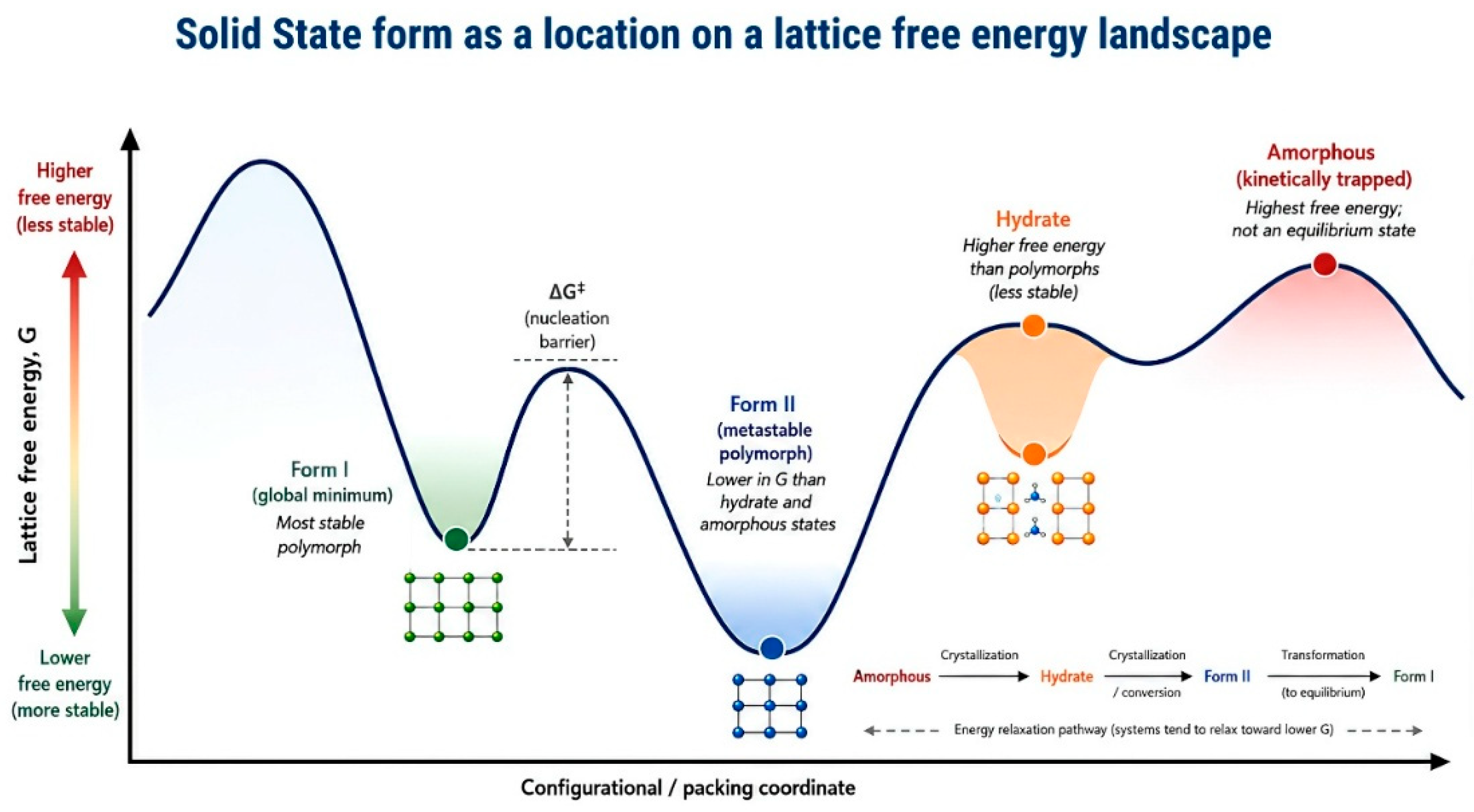
Figure 2.
The five solid-state engineering strategies mapped onto thermodynamic stability (vertical axis) versus kinetic accessibility / manufacturing ease (horizontal axis). Bubble size is illustrative of typical solubility enhancement magnitude rather than a quantitative metric.
Figure 2.
The five solid-state engineering strategies mapped onto thermodynamic stability (vertical axis) versus kinetic accessibility / manufacturing ease (horizontal axis). Bubble size is illustrative of typical solubility enhancement magnitude rather than a quantitative metric.
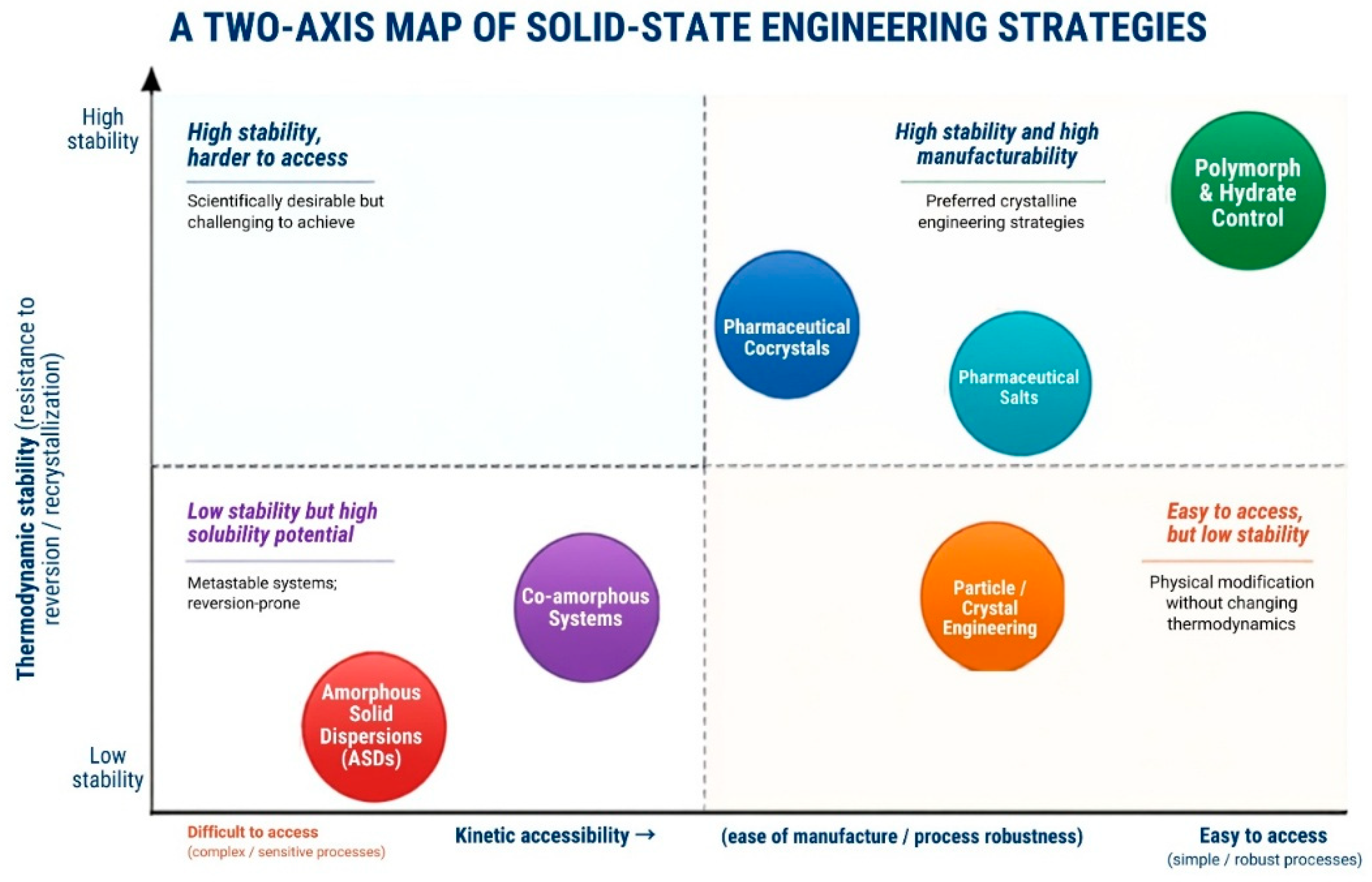
Figure 3.
The spring-and-parachute mechanism of amorphous solid dispersions. Both amorphous curves begin with a transient supersaturation spike (the spring) relative to the crystalline equilibrium baseline; only the polymer-stabilized dispersion sustains a supersaturated plateau (the parachute) long enough to be biopharmaceutically useful.
Figure 3.
The spring-and-parachute mechanism of amorphous solid dispersions. Both amorphous curves begin with a transient supersaturation spike (the spring) relative to the crystalline equilibrium baseline; only the polymer-stabilized dispersion sustains a supersaturated plateau (the parachute) long enough to be biopharmaceutically useful.
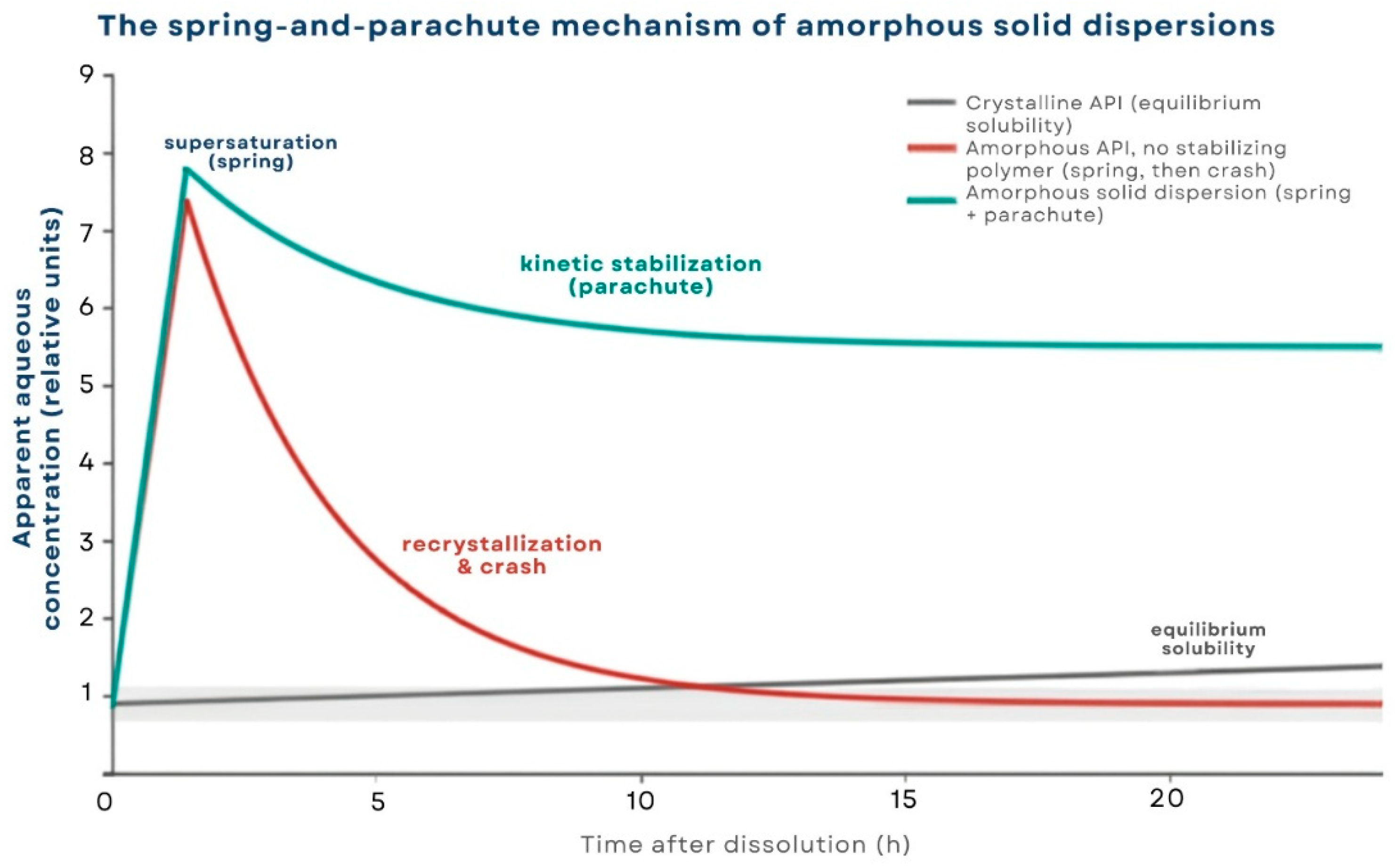
Figure 4.
Decision logic for solid-form selection during early API development, integrating ionizability triage, cocrystal feasibility, amorphous fallback, always-on polymorph/hydrate screening, and concurrent particle engineering.
Figure 4.
Decision logic for solid-form selection during early API development, integrating ionizability triage, cocrystal feasibility, amorphous fallback, always-on polymorph/hydrate screening, and concurrent particle engineering.
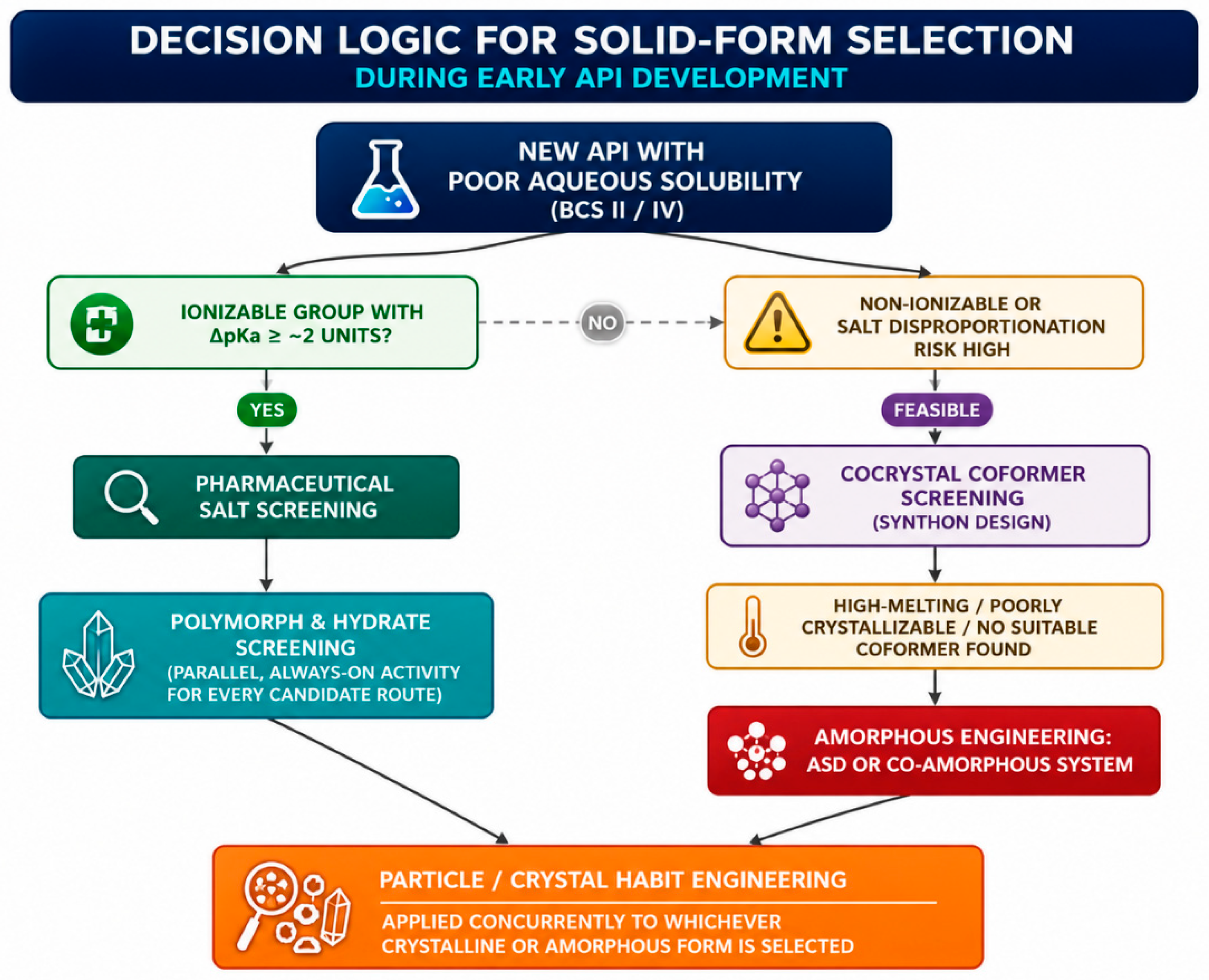
Figure 5.
The integrated Solid-State-by-Design (SSbD) decision cycle, linking molecular design and computational screening through crystallization/ASD process design, particle engineering, analytical control, and product critical quality attributes, with feedback informing the next design iteration.
Figure 5.
The integrated Solid-State-by-Design (SSbD) decision cycle, linking molecular design and computational screening through crystallization/ASD process design, particle engineering, analytical control, and product critical quality attributes, with feedback informing the next design iteration.
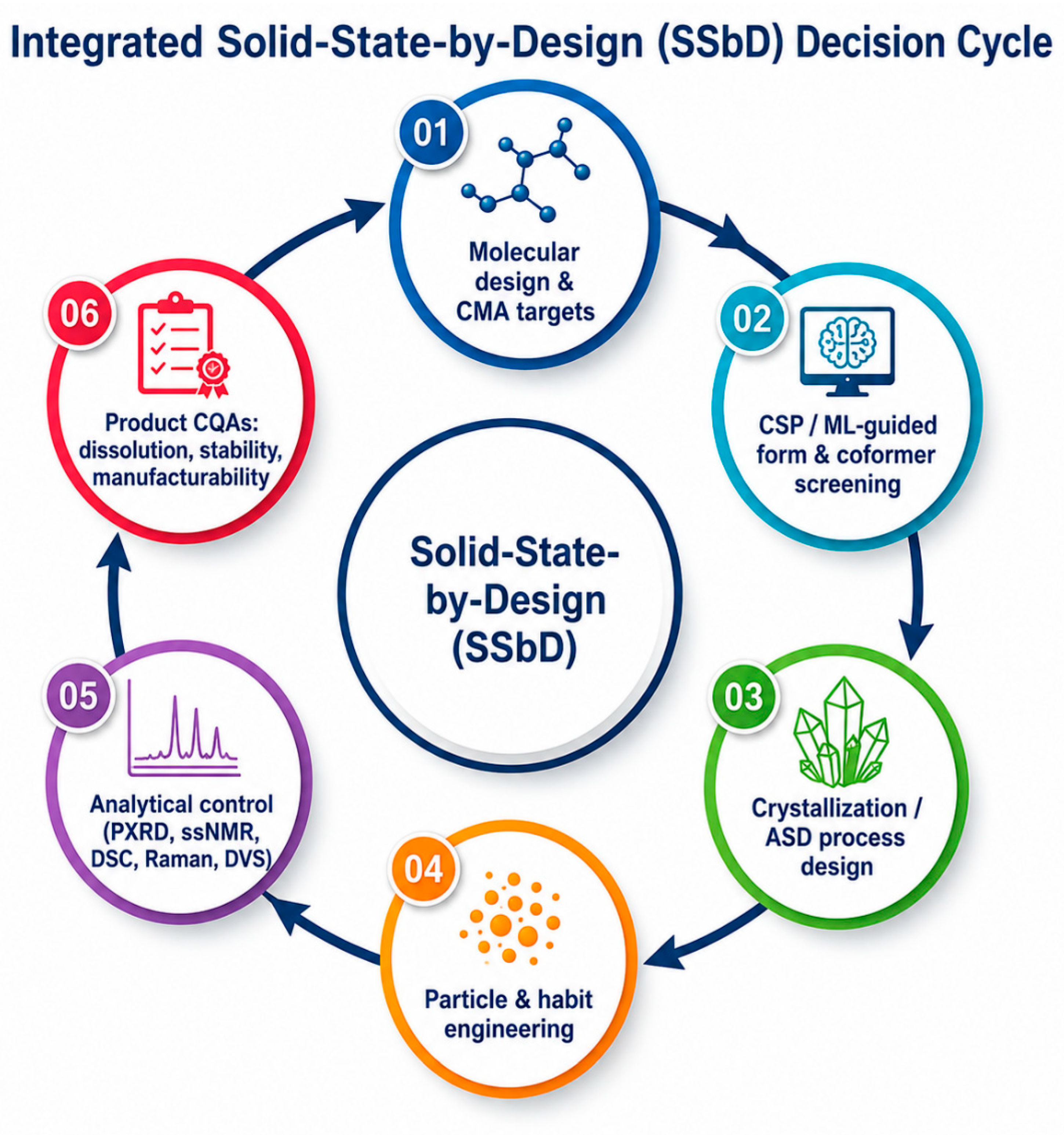
Table 1.
The five principal solid-state engineering strategies restated in free-energy-landscape terms.
Table 1.
The five principal solid-state engineering strategies restated in free-energy-landscape terms.
| Strategy | Landscape Position | Key Advantage | Key Limitation | Representative Example |
| Polymorph / hydrate control | Deepest accessible native minimum | No new chemical entity; well-precedented regulatory path | Disappearing polymorphism; hydrate conversion on storage | Ritonavir (Norvir) Form II re-selection |
| Pharmaceutical salts | New minimum on an ionic multicomponent landscape | Large, predictable solubility gains; ~50% regulatory precedent | Restricted to ionizable APIs; disproportionation risk | Atorvastatin calcium; sertraline HCl |
| Pharmaceutical cocrystals | New minimum on a neutral supramolecular landscape | Applicable to non-ionizable APIs; synthon-tunable; IP extension | Coformer screening still largely empirical | Ipragliflozin L-proline cocrystal (Suglat) |
| Amorphous / co-amorphous systems | Kinetically trapped, high-energy configuration | Largest solubility/dissolution gains for high-melting APIs | Thermodynamically metastable; recrystallization risk | Deucravacitinib spray-dried ASD (Sotyktu) |
| Particle / crystal habit engineering | Independent mesoscale (particle-level) landscape | Improves flow, compaction, dissolution without changing molecular form | Added unit operation; scale-up sensitivity | Spherically agglomerated atorvastatin calcium |
Table 3.
Core analytical techniques for solid-state characterization of active pharmaceutical ingredients.
Table 3.
Core analytical techniques for solid-state characterization of active pharmaceutical ingredients.
| Technique | Primary Information | Strength | Notable Limitation |
| Powder X-ray diffraction (PXRD) | Long-range crystal lattice identity; phase quantification via Rietveld refinement | Gold-standard for polymorph identification and quantification without a standard | Limited sensitivity for low-level (<2–5%) minor phases; blind to amorphous internal structure |
| Differential scanning calorimetry (DSC) / TGA | Melting behavior, phase transitions, glass transition, solvate/hydrate loss | Fast, low sample requirement, quantifies thermal events directly | Overlapping or induced thermal transitions during heating can confound interpretation |
| Solid-state NMR (ssNMR) | Local molecular environment; distinguishes polymorphs unresolved by PXRD | Inherently quantitative; resolves complex multi-component or amorphous systems; sub-1% LOQ achievable for amorphous content | Lower throughput; benefits substantially from dynamic nuclear polarization (DNP) enhancement for dilute forms |
| Raman / FT-IR spectroscopy | Vibrational fingerprint of molecular conformation and hydrogen bonding | Amenable to in-line process analytical technology (PAT) monitoring | Fluorescence interference (Raman); sample-presentation sensitivity (IR) |
| Dynamic vapor sorption (DVS) | Hygroscopicity and hydrate/solvate formation as a function of humidity | Directly probes storage-relevant moisture-uptake behavior | Slow equilibration; indirect on phase identity without complementary PXRD |
Table 4.
Mapping of the Solid-State-by-Design (SSbD) decision cycle to critical material attributes and their verification methods.
Table 4.
Mapping of the Solid-State-by-Design (SSbD) decision cycle to critical material attributes and their verification methods.
| SSbD Stage | Critical Material Attributes Controlled | Primary Verification Method(s) |
| Molecular design & CMA targets | Ionizability, hydrogen-bond donor/acceptor pattern, glass-forming ability | In-silico pKa and Hansen solubility parameter estimation |
| CSP / ML-guided screening | Predicted polymorph landscape; coformer/counterion ranking | Lattice energy ranking; ML propensity scores |
| Crystallization / ASD process design | Polymorphic form, crystallinity, drug loading, residual solvent | In-line PAT (Raman/NIR); off-line PXRD, DSC |
| Particle & habit engineering | Particle size distribution, shape, surface area, flow | Laser diffraction, SEM, powder rheometry |
| Analytical control | Phase purity, amorphous content, hygroscopicity | PXRD, ssNMR, DVS (Table 3) |
| Product CQAs | Dissolution rate, physical/chemical stability, manufacturability | Dissolution testing, stability studies, compaction analysis |
Disclaimer/Publisher’s Note: The statements, opinions and data contained in all publications are solely those of the individual author(s) and contributor(s) and not of MDPI and/or the editor(s). MDPI and/or the editor(s) disclaim responsibility for any injury to people or property resulting from any ideas, methods, instructions or products referred to in the content. |
© 2026 by the authors. Licensee MDPI, Basel, Switzerland. This article is an open access article distributed under the terms and conditions of the Creative Commons Attribution (CC BY) license (http://creativecommons.org/licenses/by/4.0/).
Copyright: This open access article is published under a Creative Commons CC BY 4.0 license, which permit the free download, distribution, and reuse, provided that the author and preprint are cited in any reuse.