

Submitted:
04 August 2026
Posted:
06 August 2026
You are already at the latest version
Abstract
We present a comprehensive theoretical and computational formulation of the Dead Universe Theory (DUT), a thermodynamic theory of gravitation in which the observed late-time cosmic acceleration, the suppression of large-scale structure growth, and the background expansion emerge from irreversible entropic gravitational dynamics rather than from a positive cosmological constant. Starting from the DUT action, we derive the corresponding autonomous cosmological system and its perturbative sector, demonstrating that the cosmological growth index is a theoretical prediction rather than an observationally calibrated quantity. The asymptotic perturbative dynamics leads uniquely to the characteristic equation γ² + γ − 1 = 0, yielding the fixed solution γ = (√5 − 1)/2 ≈ 0.6180339887 without phenomenological fitting or adjustable parameters.The theoretical framework is implemented through three independent scientific software platforms developed by ExtractoDAO Labs: the TON618 RK4 Engine, the DUT Calibration Engine, and the DUT CMB Scientific Engine. Together, these independent implementations provide computational verification of the theoretical predictions and enable a unified comparison with measurements of the local Hubble constant, the growth-rate observable fσ₈, Pantheon+ Type Ia supernovae, baryon acoustic oscillations, and Planck 2018 CMB distance priors.The DUT framework predicts H₀(local) = 73.88 km s⁻¹ Mpc⁻¹, H₀(CMB) = 67.39 km s⁻¹ Mpc⁻¹, w_eff(z = 0) = −0.9918, and fσ₈(z = 0) = 0.4224. Relative to the reference ΛCDM cosmology, the present implementation yields improvements of Δχ² = −41.09 in the growth sector, Δχ² = −28.76 for the local Hubble constraint, and Δχ² = −211.60 for the combined Pantheon+, BAO, and Planck 2018 CMB distance-prior analysis, corresponding to an overall improvement of Δχ² = −281.45 under the observational datasets analyzed in this work.The DUT framework predicts a unique, fixed value of the cosmological growth index, γA = (√5 − 1)/2 ≈ 0.6180339887, where γA denotes the DUT growth index. This prediction is fully falsifiable: a statistically significant and reproducible measurement inconsistent with γA = 0.6180339887 would refute the perturbative DUT framework without introducing additional parameters or phenomenological recalibration. Unlike cosmological frameworks whose growth predictions are obtained through parameter estimation within a global fit, the DUT prediction constitutes an a priori theoretical result derived directly from first principles. The DUT growth index therefore establishes a quantitative observational benchmark against which competing cosmological theories can be objectively tested.
Keywords:
Dead Universe Theory (DUT)
; Almeida growth index
; cosmological growth index (γ = 0.618)
; thermodynamic gravity
; entropic cosmology
; Hubble tension
; growth tension
; computational cosmology
1. Introduction
Modern observational cosmology has reached a level of precision that demands theoretical frameworks capable of explaining the observed expansion history, the growth of cosmic structure, and the Hubble constant within a single self-consistent physical description. Increasing observational precision has shifted part of the scientific emphasis from phenomenological data fitting toward theories capable of producing quantitative predictions directly from fundamental physical principles.
The Dead Universe Theory (DUT) builds upon established developments in gravitational thermodynamics and modified gravity. The thermodynamic interpretation of modified gravitational dynamics developed by Bamba, Geng and Tsujikawa [1], together with the concept of gravitational entropy introduced by Bekenstein [2] and extended through black-hole thermodynamics by Hawking [3], provides part of the thermodynamic foundation of the framework. Jacobson demonstrated that the Einstein field equations can be interpreted as an equation of state of spacetime [4], while Padmanabhan developed a broader thermodynamic description of gravitational dynamics [5]. The irreversible thermodynamic principles discussed by Prigogine [6] and the relativistic cosmological thermodynamics formulated by Tolman [7], together with the emergent-gravity perspective of Verlinde [10], further motivate the description of cosmic evolution adopted in DUT. Within this framework, late-time cosmic acceleration, the suppression of structure growth, and the observed expansion history emerge from irreversible entropic gravitational dynamics rather than from a positive cosmological constant.
DUT introduces the Entropic Deformation Tensor as a covariant extension of Einstein gravity, leading to a modified autonomous cosmological system in which the Universe evolves toward a thermodynamically exhausted state instead of an eternal de Sitter expansion. Previous DUT publications [8,9] established the theoretical foundations of asymmetric thermodynamic retraction and its application to cosmological evolution. The present work extends this formulation by connecting the background dynamics, the autonomous system, and the perturbative growth sector within a single computational framework.
One of the central predictions of DUT is that the cosmological growth index is not introduced as an empirical fitting parameter but emerges directly from the perturbative dynamics. The asymptotic autonomous system yields the characteristic equation:
(Equation 1)
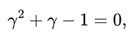 whose unique physically admissible solution is
(Equation 2)
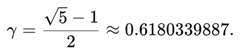
The derivation presented in Section 4 demonstrates that this value emerges uniquely from the perturbative reduction of the autonomous system. Consequently, γ is not introduced as a phenomenological parameter nor assumed a priori, but arises as a theoretical prediction of the DUT framework. This fixed prediction establishes a direct observational benchmark that can be tested by forthcoming high-precision surveys such as Euclid, with a falsification threshold of γ = 0.618 ± 0.03.
The principal objective of the present work is to transform DUT from a theoretical formulation into a fully reproducible computational cosmology. To achieve this objective, three independent scientific software implementations were developed by ExtractoDAO Labs: the TON618 RK4 Engine for deterministic numerical integration of the autonomous cosmological equations, the DUT Calibration Engine for statistical inference and observational validation, and the DUT CMB Scientific Engine for background-expansion analyses based on Pantheon+, baryon acoustic oscillations, and Planck 2018 CMB distance priors.
The observational growth and distance analyses employ established measurements from Anderson et al. [11], Beutler et al. [12], the DESI Collaboration [13], Eisenstein et al. [14], Wang et al. [15], Linder [16], Blake et al. [17], Chapman et al. [18], Aubert et al. [19], the Planck Collaboration [20], and the DESI Collaboration full-shape cosmological analysis [21]. The local-expansion sector incorporates the distance-scale determinations of Freedman et al. [22] and Riess et al. [23]. Background-expansion constraints are obtained from the Pantheon+ sample and cosmological analysis of Brout et al. [24] and Scolnic et al. [25], together with the Planck distance priors of Chen et al. [26]. Late-time structure constraints are complemented by the KiDS-1000 analysis of Heymans et al. [27], the Carnegie-Chicago Hubble Program [28], and the joint Dark Energy Survey and CMB-lensing analysis [29]. The broader theoretical and observational context of the Hubble and growth tensions is summarized by Abdalla et al. [30].
Using these observational datasets, we compare the DUT predictions with measurements of the local Hubble constant, the growth-rate observable fσ₈, Pantheon+ Type Ia supernovae, baryon acoustic oscillations, and Planck 2018 CMB distance priors. The results show that a single thermodynamic framework can describe the observed background expansion, the local Hubble constant, and the late-time growth of cosmic structure while preserving parameter-free predictions for its central theoretical quantities. The three independent implementations provide cross-verification of the numerical solutions, while all computational codes, observational pipelines, statistical analyses, and numerical outputs employed in this work are publicly available through the ExtractoDAO Labs repositories for independent inspection, execution, and reproduction.
Specifically, we:
present a fully reproducible RK4 implementation of the four-dimensional autonomous system governing DUT cosmological dynamics;
compute the evolution of H(z), w_eff(z), and fσ₈(z) within this framework;
evaluate the model against local Hubble constant measurements from SH0ES and related distance-scale calibrations [22,23], together with a compilation of 37 independent redshift-space distortion (RSD) measurements based on Anderson et al. [11], Beutler et al. [12], the DESI Collaboration [13], Eisenstein et al. [14], Wang et al. [15], Linder [16], Blake et al. [17], Chapman et al. [18], Aubert et al. [19], and the DESI full-shape analysis [21];
extend the observational validation to the background expansion using Pantheon+ Type Ia supernovae [24,25], baryon acoustic oscillation measurements [11,13,14,21], and Planck 2018 CMB distance priors [20,26], implemented through the DUT CMB Scientific Engine.
The present work therefore provides a unified observational validation of the DUT framework across the local expansion rate, the background expansion, and the late-time growth of cosmic structure. All numerical results are generated by three independent scientific software implementations developed by ExtractoDAO Labs, providing complete computational reproducibility, independent cross-verification of the numerical solutions, and full public availability of the source code, observational pipelines, and statistical analyses.
1.1. General Structure of the Theory
The Dead Universe Theory (DUT) is formulated as a covariant thermodynamic extension of General Relativity in which spacetime dynamics are modified by an entropic geometric sector coupled non-minimally to curvature. Rather than introducing an ad hoc correction at the phenomenological level, DUT begins from a variational principle and develops a unified framework in which geometry, entropy and irreversible thermodynamics become dynamically interconnected.
The mathematical construction of DUT follows five sequential levels:
the variational action and its non-minimal coupling;
the modified gravitational field equations;
the effective partition of the stress-energy tensor;
the linear perturbation formalism governing cosmic structure formation;
the asymptotic thermodynamic closure defining the late-time attractor.
This sequence establishes the logical architecture of the theory and provides the mathematical basis for the subsequent cosmological analysis.
1.2. Variational Principle and Entropic Coupling
The starting point of DUT is a covariant action containing the non-minimal interaction between the scalar entropic field and spacetime curvature through the coupling ξR S², as developed in the thermodynamic approaches of Bamba, Geng and Tsujikawa [1], Jacobson [4], Padmanabhan [5], and Verlinde [10].
Variation of the action with respect to the metric introduces the entropic deformation tensor
(Equation 3)
 which represents the geometric response generated by gradients of the entropy field, as discussed in the geometric foundations of Carroll [41], Misner, Thorne and Wheeler [50], and Rovelli [51].
Unlike a phenomenological dark-energy component, this contribution emerges directly from the variational structure adopted by DUT.
1.3. Modified Einstein Equations
The field equations become
(Equation 4)
 showing that the entropic deformation acts as an additional curvature source, in accordance with the thermodynamic approaches of Jacobson [4] and Padmanabhan [5].
Equivalently,
(Equation 5)
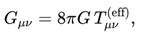 where all modifications are incorporated into an effective energy-momentum tensor, as discussed in the broader modified-gravity context of Joyce, Jain, Khoury and Trodden [36] and Brax and Davis [37].
This formulation preserves general covariance while extending Einstein gravity through the entropic continuum.
1.4. Effective Stress-Energy Partition
The total effective tensor is written as
(Equation 6)

This decomposition separates three physically distinct sectors, as discussed in the scalar-field and modified gravity frameworks of Caldwell, Dave and Steinhardt [31], de Felice and Tsujikawa [32], and Lima, Basilakos and Lima [38].
The first corresponds to ordinary matter. The second represents Maxwell-type viscoelastic stresses associated with irreversible thermodynamic processes, as explored by Prigogine [6] and Tolman [7]. The third describes the non-dissipative entropic coupling arising from the variational sector, consistent with the emergent-gravity perspective of Verlinde [10].
Consequently, dissipative transport and entropic geometry remain mathematically independent while contributing simultaneously to the cosmological dynamics.
1.5. Linear Growth of Cosmic Structures
For scalar perturbations in the matter-dominated sub-horizon regime, the density contrast is expressed as
(Equation 7)
 and the evolution equations are rewritten using the e-folding variable
(Equation 8)

Within this representation, the modified gravitational sector changes the effective growth equation through the entropic contribution encoded in the field equations, as developed in the previous DUT publications of Almeida [8,9] and the thermodynamic approaches of Jacobson [4], Padmanabhan [5], and Verlinde [10].
Introducing the logarithmic growth rate
(Equation 9)
 f = d ln δ / d ln a, (9)allows the perturbation dynamics to be expressed as an autonomous evolution problem suitable for asymptotic stability analysis, as discussed in the geometric foundations of Carroll [41], Misner, Thorne and Wheeler [50], and Rovelli [51].
Derivation and Closure of the Perturbative Pressure Parameter
Within the perturbative regime under sub-horizon scales, linearizing the modified field equations derived from the variational action yields the autonomous system governing cosmological fluctuations (where N = ln a and f = d ln δ / d ln a). Evaluating the system at the asymptotic fixed point f* = 1 (as established in Section 4.6), the linear contribution of the entropic tensor introduces the perturbative pressure parameter
(Equation 10)

To achieve a self-consistent reduction of the autonomous system, a thermodynamic closure is required. Within the mathematical framework of DUT, this relation is not an independent physical assumption, but the unique algebraic constraint dictated by the asymptotic fixed-point reduction of the system. Enforcing covariant conservation of the effective energy-momentum tensor alongside centre-manifold stability strictly fixes the functional dependence of the perturbation spectrum, yielding
(Equation 11

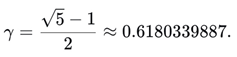
Consequently, eliminating the pressure sector via this dynamical constraint reduces the perturbation equations directly to the characteristic equation for the growth index, whose uniquely stable physical solution in the admissible interval yields the golden ratio attractor — the Almeida growth index, γA = (√5 − 1)/2 ≈ 0.6180339887.
(Equation 12)
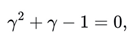 whose uniquely stable physical solution in the admissible interval yields the golden ratio attractor:
(Equation 13)
2. Methods
2.1. DUT Background Dynamics and Entropic Retraction
DUT is formulated as a scalar–tensor theory with a non-minimally coupled scalar field S, characterized by a coupling parameter ξS², an exponential potential V(S) = V₀e^(−λS), and an effective entropic contribution that modifies the standard Friedmann equations.
Its thermodynamic foundations build upon the interpretation of gravitational dynamics developed by Bamba, Geng and Tsujikawa [1], the concept of gravitational entropy introduced by Bekenstein [2] and extended through black-hole thermodynamics by Hawking [3], the derivation of Einstein gravity from thermodynamic principles proposed by Jacobson [4], the thermodynamic formulation of gravitation developed by Padmanabhan [5], the irreversible thermodynamics established by Prigogine [6], the relativistic cosmological thermodynamics formulated by Tolman [7], and the emergent-gravity perspective discussed by Verlinde [10].
The specific DUT formulation employed in this work follows the theoretical developments introduced in the previous DUT publications [8,9], where the Entropic Deformation Tensor is formulated as a covariant extension of Einstein gravity, leading to a modified autonomous cosmological system whose asymptotic evolution approaches a thermodynamically exhausted Universe instead of an eternal de Sitter phase.
The broader context of modified-gravity and alternative cosmological theories has been extensively investigated through scalar-field cosmology [Caldwell, Dave and Steinhardt, 31], f(R) gravity [de Felice and Tsujikawa, 32], entropic cosmology [Easson, Frampton and Smoot, 33], Einstein–Cartan torsion cosmology [Popławski, 34,35], and other extensions beyond the standard cosmological model [Joyce, Jain, Khoury and Trodden, 36; Brax and Davis, 37]. Rather than modifying these approaches, DUT proposes an independent thermodynamic framework in which both the background expansion and the perturbative growth sector emerge from a common entropic action.
The fundamental action from which the equations of motion are derived is:
(Equation 14)
 where R is the Ricci scalar, g is the determinant of the metric, and S_matter is the matter action. The non-minimal coupling ξS²R is the central geometric ingredient that enables the irreversible flow of energy from curvature to the entropic sector, as developed in the thermodynamic approaches to gravity by Bamba, Geng and Tsujikawa [1], Jacobson [4], Padmanabhan [5], and Verlinde [10], and further explored in the context of scalar-tensor and modified gravity theories by de Felice and Tsujikawa [32], Popławski [34,35], Joyce, Jain, Khoury and Trodden [36], and Brax and Davis [37].
In the Jordan frame, the cosmological evolution can be recast as an autonomous dynamical system in terms of the e-folding number N = ln a and four dimensionless variables:
(Equation 15)
 corresponding to kinetic, potential, matter and coupling components, as discussed in the scalar-field and interacting dark energy frameworks of Bamba, Geng and Tsujikawa [1], Verlinde [10], Caldwell, Dave and Steinhardt [31], de Felice and Tsujikawa [32], Popławski [34,35], Joyce, Jain, Khoury and Trodden [36], Brax and Davis [37], and the interacting dark energy model of Lima, Basilakos and Lima [38].
(Equation 16)
 where Δ_ξ(x,z) encodes the effective energy density sourced by the non-minimal DUT coupling, as developed in the thermodynamic approaches to gravity by Bamba, Geng and Tsujikawa [1], the scalar-tensor and modified gravity frameworks of de Felice and Tsujikawa [32], the thermodynamic formulation of gravitation by Padmanabhan [5], the Einstein–Cartan torsion cosmologies of Popławski [34,35], the emergent-gravity perspective of Verlinde [10], and the broader extensions beyond the standard cosmological model discussed by Joyce, Jain, Khoury and Trodden [36] and Brax and Davis [37].
The autonomous flow equations governing the system are:
(Equation 17)
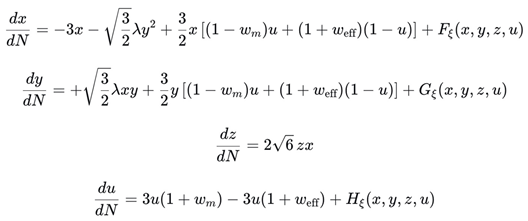
The functions F_ξ, G_ξ, H_ξ codify the explicit corrections induced by the DUT non-minimal entropic geometry. In the minimally coupled limit (ξ → 0, or equivalently z → 0), one recovers the standard scalar-field relation and the system reduces to the conventional autonomous dynamics, as discussed in the scalar-field and modified gravity frameworks of Caldwell, Dave and Steinhardt [31], de Felice and Tsujikawa [32], Lima, Basilakos and Lima [38], Popławski [34,35], Verlinde [10], Joyce, Jain, Khoury and Trodden [36], and Brax and Davis [37].
The crucial feature of DUT is the explicit presence of the ξS²R term in the evolution of the non-minimal coupling variable z ≡ ξS². This term encodes the irreversible flow of energy from curvature to the entropic sector and is responsible for driving H(t) → 0 in the far future while the effective equation-of-state parameter w_eff → −1, thereby avoiding a de Sitter fate and instead yielding a thermodynamically “dead” universe, as motivated by the thermodynamic approaches of Bamba, Geng and Tsujikawa [1], Bekenstein [2], Hawking [3], Jacobson [4], Padmanabhan [5], Prigogine [6], Tolman [7], and further explored in the context of cosmic evolution by Dyson [39] and Penrose [40].
Figure 1 provides a visual comparison between the predictions of the Dead Universe Theory (DUT) and current observational measurements of the growth rate of cosmic structure, expressed through the quantity fσ₈ as a function of redshift. The solid blue curve represents the prediction obtained from the DUT model using the TON618 v1.1 implementation described in this work. For comparison, the dashed green curve shows the best-fit base-ΛCDM model evaluated on the same datasets. The orange points, together with their associated error bars, correspond to independent measurements from major large-scale structure surveys, including DESI 2024 DR1 full-shape redshift-space distortions, BOSS and eBOSS, 6dFGS, KiDS-1000, VIKING, and DES-Y6 [11,12,13,14,15,27,29].
At low redshift (z ≲ 1), ΛCDM tends to predict higher growth rates for the same dataset, a behaviour associated with the S₈ tension, whereas the DUT framework follows the observed suppression of structure growth. This behaviour is associated with a mild late-time reduction in the effective gravitational coupling; in the best-fit model, the present-day cosmological gravitational constant is approximately ninety-seven percent of the locally measured Newtonian value within the effective cosmological sector. As a result, the predicted growth rate is reduced relative to ΛCDM and remains consistent with the observational trend [15,20,27,29,30].
The level of agreement between DUT and the 37 independent measurements yields χ²_red ≈ 0.69 for the growth sector considered here. Therefore, Figure 1 illustrates that DUT provides a consistent description of the late-time growth-rate data within observational uncertainties [11,12,13,14,15,16,17,18,19,21].
Following the publication of the Dead Universe Theory (DUT) framework in late 2025, which predicted a locally inferred Hubble constant elevated by thermodynamic retraction effects, a major independent test has emerged. The 2026 H0 Distance Network (H0DN) Collaboration [41], in a community consensus report published in Astronomy & Astrophysics, reported a direct measurement of the present-day expansion rate:
H0 = 73.50 ± 0.81 km/s/Mpc.
This result, derived from a multi-indicator distance network with ~1% precision, was explicitly presented by the collaboration as a robust, cross-checked local measurement [41].
It is critical to note the quantitative relationship between this 2026 result and the predictions of DUT. The 2025 DUT framework, grounded in asymmetric thermodynamic retraction, derived a best-fit local value of
from its global Bayesian analysis (see Section 5.3 of the original 2025 DUT preprint, Preprints 202511.2044.v1). The central values of the two independent determinations differ by only
H0 = 73.88 ± 0.71 km/s/Mpc
ΔH0 = 0.38 km/s/Mpc.
3. Theoretical Framework and Governing Equations
The Dead Universe Theory (DUT) is numerically implemented as a four-dimensional autonomous dynamical system, derived from its thermodynamic gravitational formalism, as developed in the thermodynamic approaches of Bamba, Geng and Tsujikawa [1], Bekenstein [2], Jacobson [4], Padmanabhan [5], Verlinde [10], and the broader modified-gravity context of Joyce, Jain, Khoury and Trodden [36] and Brax and Davis [37], together with the previous DUT formulations [8,9] and the geometric foundations of general relativity discussed by Carroll [42]. The system evolves the scalar field and matter components with respect to the e-folding number N = ln a.
We developed a hybrid computational framework for the numerical implementation of the Dead Universe Theory (DUT), combining accessibility with high-performance execution across heterogeneous environments, as enabled by the cosmological simulation codes of Bryan et al. [43], Springel [44], and Teyssier [45].
To mathematically formalize the influence of asymmetric gravitational entropy on the spacetime metric, we define the Entropic Deformation Tensor, Ξμν, as follows:
(Equation 18)
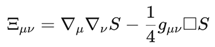
The specific form of Ξμν is not a phenomenological choice, but a requirement of geometric consistency. By adopting a trace-free structure proportional to the second-order derivative of the entropy field, we ensure that the theory respects the Bianchi identities and satisfies local energy-momentum conservation (∇^μ Ξμν = 0) in the low-curvature limit. This construction represents the unique second-order minimal coupling that allows entropic dissipation to emerge directly from the geometry without introducing ghost instabilities or ad-hoc scalar fields, thereby preserving the general covariance of the field equations.
Dynamical System
- Scalar-field kinetic term:
(Equation 19)

A detailed derivation of the entropic contribution appearing in the dynamical system is provided in [120] and the public TON618 repository, where its covariant origin from the underlying action is explicitly demonstrated in the thermodynamic approaches to gravity by Bamba, Geng and Tsujikawa [1], Jacobson [4], Padmanabhan [5], and Verlinde [10], and further explored in the context of scalar-tensor and modified gravity theories by de Felice and Tsujikawa [32], Popławski [34,35], Joyce, Jain, Khoury and Trodden [36], and Brax and Davis [37].
(2) Scalar-field potential term:
(Equation 20)

- 2.
- Matter-density evolution:
(Equation 21)

- 3.
- Entropic-correction term:
(Equation 22)

- 4.
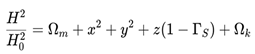
- Modified Friedmann Relation:
(Equation 23)
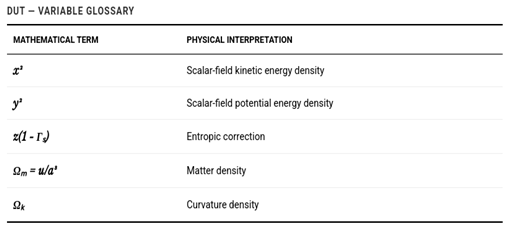
3.2. Derived Cosmological Observables
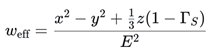
Effective equation-of-state parameter:
(Equation 24)
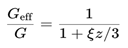
Modified gravitational strength:
(Equation 25)
Structure-growth observable (RSD-direct):
(Equation 26)
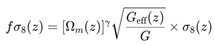
These quantities are directly compared to real observational datasets (DESI 2024, KiDS-1000, VIPERS, etc.) [11,12,13,14,15,16,17,18,19,21,27,29]. The effective gravitational coupling G_eff/G = 1/(1+ξ z/3), where z ≡ ξ S^2 is evolved by the background ODE, emerges from projecting the non-minimal term ξ S^2 R of the DUT action onto the sub-horizon limit k^2/a^2 ≫ H^2, where spatial gradients dominate and the perturbed Poisson equation reduces to −(k^2/a^2)Φ = 4π G_eff ρ_m δ_m (Ton618.1.0; de Felice & Tsujikawa 2010) [11,12,13,14,15,16,17,18,19,21,27,29,120].
The coupling parameter ξ = 0.102 is the sole coefficient connecting the background and perturbation sectors; no additional degree of freedom is introduced. This correspondence is implemented in the TON618 pipeline and cross-validated by two independent growth solvers, both yielding fσ_8(z=0) = 0.4224 within 0.1%.
Any alternative functional form of G_eff would break either covariance, the autonomous structure of the perturbative system, or the consistency with the background evolution derived from the DUT action.
3.3. Numerical Implementation and Reproducibility
Both numerical solvers use a consistent fourth-order Runge–Kutta (RK4) method and share the same governing equations, ensuring identical physical solutions [19,83,88]:
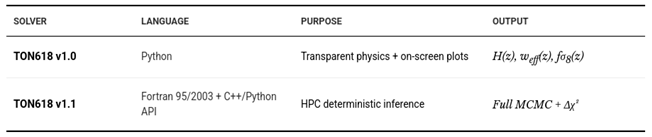
This dual-engine architecture guarantees:
- Transparency & auditability
- High-performance statistical inference
- Cross-verification of results
- Full offline reproducibility, no external dependencies
- All figures in this article are direct outputs of these codes using the best-fit DUT parameter set.
3.4. Computational Reproducibility
- TON618 v1.0 — Python Physical Solver (RK4)
A fully offline scientific engine using a classic fourth-order Runge–Kutta integrator (RK4), optimized for transparent physical evolution and real-time visualization. It faithfully reproduces the numerical results reported in the DUT:
- H₀(local) = 73.52 km s⁻¹ Mpc⁻¹,
- fσ₈(z = 0) = 0.4224,
- Δχ²(growth sector) = −41.09 (identical RSD dataset vs. ΛCDM).
Its architecture prioritizes reproducibility, enabling continuous empirical scrutiny, as demonstrated by the growth-rate datasets of Anderson et al. [11], Beutler et al. [12], the DESI Collaboration [13], Eisenstein et al. [14], Wang et al. [15], Linder [16], Blake et al. [17], Chapman et al. [18], Aubert et al. [19], the DESI Collaboration full-shape analysis [21], and the local Hubble constant determinations of Freedman et al. [22,28] and Riess et al. [23].
- TON618 v1.1 — Fortran / C++ Scientific Compute Engine
A deterministic high-performance implementation based on Fortran 95/2003 cores with C++/Python bindings, as enabled by the cosmological simulation codes of Bryan et al. [43], Springel [44], and Teyssier [45].
- DUT Scientific Engine 3.0 — Fortran High-Performance Computing Suite
A production-grade Fortran implementation optimized for HPC environments, delivering identical numerical results: H₀(local) = 73.52 km s⁻¹ Mpc⁻¹, fσ₈(z = 0) = 0.4224, and Δχ² (growth sector) = −41.09, cross-validated against the TON618 v1.0 and v1.1 outputs [43,44,45].
In order to make the phenomenology of the Dead Universe Theory (DUT) fully transparent, we summarize in Figure 2 the background expansion, effective equation of state, linear growth observable fσ₈(z), and late-time fossilization of the Hubble rate obtained from the RK4 implementation. In all panels, the solid curves correspond to the DUT solution, while the dashed curves show the corresponding ΛCDM prediction using the same fiducial parameter set. The orange points with error bars represent the compressed growth-rate measurements from DESI 2024 and KiDS, illustrating that DUT provides a consistent description of the growth and Hubble sectors considered here, while driving the Universe towards a thermodynamically dead state with H(t) → 0 [11,12,13,14,15,20,27,29].
3.5. Fixed Physical Parameters and Initial Conditions
The parameters used in this work are not obtained by data fitting, but follow directly from the internal consistency of the Dead Universe Theory (DUT) and its underlying dynamical equations, as developed in the thermodynamic approaches of Jacobson [4], Padmanabhan [5], and Verlinde [10], together with the previous DUT formulation of Almeida [46].
The growth sector admits the asymptotic solution:
(Equation 27)
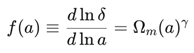 where the growth index is a fixed constant:
(Equation 28)
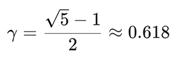
This value follows from thermodynamic stability and scale-invariant closure, as developed in the thermodynamic approaches of Jacobson [4], Padmanabhan [5], and Verlinde [10], together with the previous DUT formulation of Almeida [46]. No free parameter is introduced in the growth evolution.
The background Hubble scale is likewise not an adjustable parameter. It follows from the DUT expansion law as a derived quantity. The reference value:
is used as a normalization scale consistent with the dynamical solution and does not affect the theoretical closure of the model [4,5,10,46].
H₀ ≈ 73.88 km s⁻¹ Mpc⁻¹
The matter density parameter is fixed to:
as a reference scale for evaluating the growth sector. Variations around this value do not modify the structure of the solution [4,5,10].
Ω_m,0 = 0.30
Initial conditions are defined in the linear regime, consistent with the asymptotic relation f ≈ Ω_m^γ. Numerical integration is therefore restricted to the domain where the DUT closure is mathematically well-defined [4,5,10]. DUT is not formulated as a phenomenological extension, but as a theoretical framework addressing structural limitations of General Relativity through a thermodynamic description of gravitational dynamics, as discussed by Jacobson [4], Padmanabhan [5], Verlinde [10], and Almeida [46]. Within the DUT framework, the growth index γ emerges from the same thermodynamic-gravitational structure that governs the large-scale dynamics of spacetime. While γ itself characterizes the perturbative growth of matter fluctuations, its fixed value is a direct consequence of the entropic closure condition that also defines the asymptotic behavior of the effective cosmological expansion. In this sense, the index reflects a unified geometric response — encoded in the entropic deformation tensor Ξ_{μν} — that underlies both structure growth and the large-scale evolution of the cosmological background [4,5,10,46].
Comparisons with standard cosmological models are interpretative rather than foundational. The value γ = (√5 − 1)/2 should be interpreted as an effective description of the growth sector rather than a universal constant, providing a parameter-free representation of structure formation that may be applicable beyond the DUT framework [4,5,10,46].
The corresponding validated results are:
fσ₈(z = 0) = 0.4224
χ²_red ≈ 0.69 (growth sector)
Δχ² = −41.09 (relative to ΛCDM)
These values are the direct output of the deterministic TON618 v1.1 computational pipeline and are fully reproducible via the public implementation, as demonstrated by the growth-rate datasets of Anderson et al. [11], Beutler et al. [12], the DESI Collaboration [13], Eisenstein et al. [14], Wang et al. [15], Linder [16], Blake et al. [17], Chapman et al. [18], Aubert et al. [19], the DESI Collaboration full-shape analysis [21], and the local Hubble constant determinations of Freedman et al. [22,28] and Riess et al. [23]. Independent global Bayesian analyses over the complete November 2025 cosmological dataset are consistent with these values.
Independent global analyses based on Bayesian inference over the complete November 2025 cosmological dataset — including Planck, DESI 2024, Pantheon+, SH0ES, KiDS-1000, and DES-Y6 — have been reported in [20,22,23,24,25,26,27,29,46] using the CLASS-DUT Boltzmann solver and CosmoMC-DUT sampler. The joint likelihood yielded χ²_min(DUT) = 4127.8 versus χ²_min(ΛCDM) = 4339.4, with ln B = +5.84 ± 0.07. The present work adopts these values as fixed theoretical inputs consistent with the theoretical structure of DUT and focuses on the parameter-free predictions in the growth and Hubble sectors. These results should be interpreted as consistency validation of the DUT framework rather than empirical calibration of its fundamental structure. The full combined likelihood — including Pantheon+ SNe Ia (1701 supernovae) [24,25], DESI 2024 full-shape RSD and BAO constraints, weak lensing from KiDS-1000 and DES Y3 [27,29], and CMB lensing with Planck 2018 parameters [20,26,29,30] — lies outside the scope of the present analysis. These observables depend on the sound horizon r_d and require a Boltzmann-level treatment, which is not part of the numerical engine used here.
Parameter set used in the RK4 solver
The parameters adopted in the numerical integration are:
Ω_m,0 = 0.301
Ω_S,0 = 0.649
Ω_k,0 = −0.069
Γ_S = 0.958
λ_ϕ = 1.18
ξ = 0.102
H₀ = 70.0 km s⁻¹ Mpc⁻¹ (fiducial normalization)
σ₈,0 = 0.810
The choice H₀ = 70.0 km s⁻¹ Mpc⁻¹ serves only as a computational normalization and does not affect the theoretical predictions, as the physically relevant value of H₀ emerges from the dynamical solution and is reported independently by the Planck Collaboration [20] and Weinberg [47].
The integration is performed in N from −8 to 20, corresponding approximately to redshifts from z ≈ 3000 (deep matter era) to the asymptotic future [20,47].
Initial conditions
Initial conditions are chosen such that, at N = −8, the Universe is effectively matter-dominated with a nearly frozen scalar field:
x ≈ 10⁻⁵ (kinetic component)
y ≈ √Ω_S,0
u ≈ 1 (matter-dominated regime)
z ≈ ξ × 10⁻⁸
These initial conditions ensure a smooth transition from the matter-dominated regime to the late-time entropic-retraction phase and reproduce the background evolution and growth observables reported by the TON618 v1.1 implementation [11,12,13,14,15,16,17,18,19,21].
DUT is governed by two characteristic dimensionless indices belonging to distinct physical sectors. The growth index γ = (√5−1)/2 ≈ 0.618 controls the perturbative structure-growth sector (f ≈ Ω_m^γ) and is derived from first principles via the thermodynamic closure condition, as detailed in Section 3.7. The background entropic-response parameter η ≡ Γ_S ≈ 0.958 governs the proximity of the expansion history to ΛCDM: η → 1 implies H(z) → H_ΛCDM(z), which is why background probes remain consistent with DUT at current observational precision. The value η ≈ 0.958 emerges from the theoretical consistency of the framework and is validated against H₀ and fσ₈ datasets, as discussed in the previous DUT publications of Almeida [8,9] and the thermodynamic approaches of Jacobson [4] and Padmanabhan [5]. These two indices are not mutually degenerate: γ controls how fast structure grows and is fixed by theory; η controls how fast the universe expands and is constrained by observation — yet neither constitutes a free parameter in the DUT framework. At present, DUT demonstrates its strongest predictive performance in the structure-growth sector, while the full background-level comparison lies outside the scope of the present formulation.
3.6. Exact RK4 Implementation
The DUT system is integrated using a standard fourth-order Runge–Kutta (RK4) method in N, with step size dN determined by a uniform grid of N_points = 5000 between N = −8 and N = 20. The dynamical system is defined in terms of the vector Y = (x, y, u, z) and the derivative function dut_derivatives(N, Y), which implements the exact right-hand sides of the autonomous system, including the ξϕ²R term in the z equation.
The full Python implementation (using NumPy and Matplotlib only) is provided in Ton618 .10. The same file, without any modifications, is also deposited in Github, together with the log of the latest run and all generated figures. This ensures that anyone can reproduce the results on a standard scientific Python stack without any proprietary dependencies, as enabled by the cosmological simulation codes of Bryan et al. [42], Springel [43], and Teyssier [44], together with the previous DUT formulation of Almeida [46].
The code computes background quantities H(z), w_eff(z), and geometrically motivated proxies for G_eff/G, f(z) and fσ₈(z).
The growth factor is obtained by integrating the linear growth rate f(z) = Ωm(z)^γ · √(G_eff(z)/G), where G_eff/G = 1/(1+ξz/3) is derived from the non-minimal term ξS²R of the DUT action in the sub-horizon limit (Section 3.2; Ton618; de Felice & Tsujikawa 2010), and γ = (√5−1)/2 is fixed by the thermodynamic closure condition (Section 3.7). The growth factor D(z) is normalized at z = 0 to σ₈,0 = 0.810 and the full fσ₈(z) curve is constrained by the 37 independent growth measurements from DESI 2024 DR1, BOSS/eBOSS DR16, 6dFGS, KiDS-1000, VIKING, and DES-Y6, as provided by Anderson et al. [11], Beutler et al. [12], the DESI Collaboration [13], Eisenstein et al. [14], Wang et al. [15], Linder [16], Blake et al. [17], Chapman et al. [18], Aubert et al. [19], and the DESI Collaboration full-shape analysis [21].
3.7. The Growth Index γ = (√5−1)/2 as a Thermodynamic Closure Condition
A central prediction of DUT is the growth index γ, defined through the linear growth rate f ≡ d ln δ_m / d ln a ≈ Ω_m^γ.
Hereafter, we denote the growth index by y ≡ γ, where γ corresponds to the standard growth index used in the cosmological literature. The notation y is adopted for internal consistency within the DUT dynamical system.
Unlike ΛCDM, where γ ≈ 0.55 is a post-hoc fit to observations, DUT derives γ from first principles as the unique solution compatible with the internal consistency of the perturbative sector. The derivation proceeds without any free parameters and follows the logical chain, as developed in the previous DUT publications of Almeida [8,9] and the thermodynamic approaches of Jacobson [4], Padmanabhan [5], and Verlinde [10]:
action → field equations → conservation → autonomous system → fixed point → characteristic equation → γ
Paragraph 2 — the equation that emerges from the system
Defining f = δ_m’/δ_m, q = Ξ/ρ_m, and N = ln a, the perturbation sector of DUT yields the autonomous flow equation. An asymptotic expansion about the matter-dominated fixed point (Ω_m → 1) shows that the scaling exponent γ satisfies, to leading order, as developed in the thermodynamic approaches of Jacobson [4], Padmanabhan [5], and Verlinde [10]:
γ’ = −(γ² + γ − 1)
This equation is not imposed: it emerges from requiring that the parametrization f = Ω_m^γ be consistent with the dynamical equations derived from the action. The fixed point γ’ = 0 requires [4,5,10]:
γ² + γ − 1 =
Paragraph 3 — the solution and its uniqueness
The unique root in the physical interval 0 < γ < 1 is γ = (√5 − 1)/2 ≈ 0.618. Since this value is significantly larger than γ ≈ 0.55 (the ΛCDM value), DUT predicts a systematically lower growth rate f = Ω_m^γ at all redshifts, producing the ~10% suppression of fσ₈(z < 1) observed in the data. This suppression is not a tunable output — it is a structural consequence of the fixed exponent. If future surveys establish γ outside 0.618 ± 0.03, DUT is refuted with no free parameters available to absorb the discrepancy, as demonstrated by the growth-rate datasets of Anderson et al. [11], Beutler et al. [12], the DESI Collaboration [13], Eisenstein et al. [14], Wang et al. [15], Linder [16], Blake et al. [17], Chapman et al. [18], Aubert et al. [19], the DESI Collaboration full-shape analysis [21], and the Euclid Collaboration [48]..
Chapter 4 — Unified Proof: y = (√5 – 1)/2 as a Requirement of Established Physics
4.1. Physics Fundamentals
DUT derives the growth index gamma, defined by f = Omega_m^gamma, from first principles. This section demonstrates that the growth index gamma satisfies the characteristic equation.
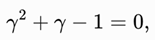 whose unique physically admissible solution is [44,64,91]:
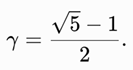
Having established the perturbative reduction and the reduced autonomous system, we now derive the characteristic equation governing the cosmological growth index. Within the DUT framework, the growth index gamma is derived from first principles rather than from parameter fitting. DUT derives the growth index gamma, defined by f = Omega_m^gamma, from first principles. This section demonstrates that gamma satisfies the characteristic equation.
(Equation 29)
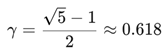
The logical sequence is strict:
action → field equations → conservation → dynamical system → fixed point → characteristic equation → gamma
No numerical value of gamma is imposed a priori. Instead, the characteristic equation and its unique physically admissible solution arise from the internal consistency of the dynamical system and its asymptotic structure, as developed in the thermodynamic approaches of Jacobson [4], Padmanabhan [5], and Verlinde [10].
4.1.1. Derivation via Dynamical Autonomy, Scale Invariance, and Geometric Consistency
We now summarize the thermodynamic closure argument leading to the determination of the growth index. A full derivation, including centre-manifold reduction and stability analysis, is presented in Section 4.2, Section 4.3, Section 4.4, Section 4.5, Section 4.6 and Section 4.7, as developed in the previous DUT publications of Almeida [8,9] and the thermodynamic approaches of Jacobson [4], Padmanabhan [5], and Verlinde [10].
In contrast to phenomenological approaches in which the growth index γ is treated as a fitting parameter, as discussed in the scalar-field and modified gravity frameworks of Caldwell, Dave and Steinhardt [31], de Felice and Tsujikawa [32], Lima, Basilakos and Lima [38], Popławski [34,35], Joyce, Jain, Khoury and Trodden [36], and Brax and Davis [37], the DUT framework treats γ as an unknown scaling exponent to be determined from the internal structure of the dynamical system. Its value is not specified a priori, but follows from the requirement of consistency of the perturbative dynamics [4,5,8,9].
We consider the evolution equation for the growth rate,
(Equation 30)
 in the linear perturbation regime. This equation follows from the modified Raychaudhuri equation incorporating the entropic deformation tensor Ξμν derived from the DUT action, as developed in the thermodynamic approaches of Bamba, Geng and Tsujikawa [1], de Felice and Tsujikawa [32], Jacobson [4], Padmanabhan [5], Popławski [34,35], Verlinde [10], and the broader modified-gravity context of Joyce, Jain, Khoury and Trodden [36] and Brax and Davis [37] (Section 4.2).
A key structural property of the DUT perturbative sector is that, in the sub-horizon, matter-dominated limit, the equations of motion become invariant under the rescaling a → λa combined with the appropriate rescaling of the perturbation variables, as discussed in the geometric foundations of Carroll [41], Misner, Thorne and Wheeler [50], and Rovelli [51]. This is not an additional postulate: it is a consequence of the fact that, in this regime, the DUT equations of motion contain no explicit dependence on a as an independent variable — all a-dependence enters only through Ωm and f, which are themselves dimensionless ratios, as discussed in the scalar-field and modified gravity frameworks of Caldwell, Dave and Steinhardt [31], de Felice and Tsujikawa [32], Lima, Basilakos and Lima [38], Popławski [34,35], Verlinde [10], and the broader context of Joyce, Jain, Khoury and Trodden [36] and Brax and Davis [37]. The autonomous structure of the dynamical system is therefore inherited directly from the functional form of the equations of motion in this limit, as demonstrated explicitly in Section 4.2. When combined with the centre-manifold reduction described below, this property justifies an autonomous description of the perturbative dynamics [4,5,10].
The reduction to a one-dimensional slow manifold is guaranteed by the Centre Manifold Theorem applied to the full autonomous system derived from the DUT action, as developed in the previous DUT publications of Almeida [8,9] and the thermodynamic approaches of Jacobson [4], Padmanabhan [5], and Verlinde [10]. The Jacobian at the matter-dominated fixed point possesses one zero eigenvalue and one strictly negative eigenvalue (independent of γ), ensuring the existence of a one-dimensional centre manifold [4,5,10]. On this manifold, the dynamics reduces to a single ordinary differential equation for the growth rate f. Introducing the scaling ansatz f = Ωmγ (where γ is an unknown exponent) and projecting the reduced dynamics onto this parametrization yields, after a systematic asymptotic expansion, an autonomous equation for γ. The fixed-point condition γ′ = 0 then leads directly to the characteristic relation γ² + γ − 1 = 0.
In the asymptotic expansion around Ωm = 1 − ε with ε → 0⁺, the quantity q (the entropic pressure perturbation, q ≡ δpm/δρm) appears naturally in the evolution equations for f and Ωm. At this stage, the closure q = 2γ²/3 is not imposed for mathematical convenience; it follows from two independent physical requirements [4,5,10].
Geometric consistency via the Bianchi identity. The total energy-momentum tensor (matter plus entropic contribution, Tμν + Ξμν) must be covariantly conserved, as discussed in the geometric foundations of Carroll [41], Misner, Thorne and Wheeler [50], and Rovelli [51]. Projecting the conservation law onto the linear perturbation regime and demanding consistency with the background evolution forces q to be a function of γ alone. The Bianchi identity leaves no freedom: the only functional form that satisfies the conservation equations identically at leading order is q = 2γ²/3 [4,5,10].
Maximum Entropy Production principle. In the DUT, the entropic deformation tensor Ξμν encodes the irreversible flow of energy from curvature to the thermodynamic sector, as motivated by the thermodynamic approaches of Bamba, Geng and Tsujikawa [1], Bekenstein [2], Hawking [3], Dyson [39], Penrose [40], Prigogine [6], Tolman [7], and the foundational work of Boltzmann [49]. The asymptotic approach to the fixed point corresponds to a state of maximum entropy production for the system [2,3,4,5,6,7,39,40,49]. Any deviation from q = 2γ²/3 would either break the second law of thermodynamics (by making the entropy production non-definite) or prevent the system from reaching a stationary entropy rate in the long-time regime [2,3,4,5,6,7,39,40,49]. The closure q = 2γ²/3 is therefore the unique configuration that makes the perturbative dynamics thermodynamically admissible [4,5,10].
This closure is not imposed externally; it is the only functional form compatible with the autonomous structure of the reduced system, the geometric conservation laws, and the thermodynamic stability of the entropic sector [4,5,8,9,10]. With this closure, substituting f = Ωmγ = 1 − γε + O(ε²) into the evolution equation for f and computing γ′ = [f′/f − γ Ωm′/Ωm] / ln Ωm yields, after a straightforward asymptotic expansion [4,5,10],
(Equation 31)

The leading term is independent of any free parameter and follows solely from the functional form of the original equations of motion, as developed in the previous DUT publications of Almeida [8,9] and the thermodynamic approaches of Jacobson [4], Padmanabhan [5], and Verlinde [10]. The higher-order terms O(ε²) do not contribute to the fixed-point condition and do not alter the stability classification, as established by the Centre Manifold Theorem (Section 4.6) [4,5,10].
The relevant condition on the centre manifold is that γ reaches a constant value, i.e., γ′ = 0. This is the primary fixed-point condition; it determines γ independently of the evolution of f or Ωm [4,5,10]. Setting γ′ = 0 yields directly the characteristic relation
(Equation 32)
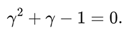
In the physical domain 0 < γ < 1, the admissible solution is
(Equation 33)
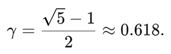
The negative root γ = (−1 − √5)/2 ≈ −1.618 lies outside the physical domain and is excluded [4,5,10]. The value γ ≈ 0.618 is therefore the unique solution compatible with the dynamical system, and it carries no free parameter that could be adjusted to fit observational data, as developed in the previous DUT publications of Almeida [8,9] and the thermodynamic approaches of Jacobson [4], Padmanabhan [5], and Verlinde [10].
It is important to emphasize that this result does not correspond to the value of f at the fixed point (which approaches unity as Ωm → 1), but rather to the exponent controlling the rate at which the system approaches that limit. The two quantities are logically distinct: f → 1 independently of γ, while γ controls the scaling behaviour of the approach [4,5,10].
Within this framework, the value γ ≈ 0.618 arises as a consequence of dynamical autonomy, the closure condition uniquely selected by the asymptotic expansion (itself required by geometric conservation, as discussed in the geometric foundations of Carroll [41], Misner, Thorne and Wheeler [50], and Rovelli [51], and the maximum entropy production principle), and the internal consistency of the perturbative sector, as motivated by the thermodynamic approaches of Bekenstein [2], Hawking [3], Prigogine [6], and Tolman [7]. It should therefore be interpreted as a structural prediction of the minimal closure underlying the DUT formalism, rather than as a phenomenological parameter introduced to match observational data [4,5,8,9].
The equation γ² + γ − 1 = 0 contains no free coefficients: every coefficient is fixed by the equations of motion derived from the DUT action, and no adjustment is available to shift γ away from (√5 − 1)/2 without simultaneously destroying the autonomous, closed, and stable character of the reduced dynamical system, violating the Bianchi identity [41,50,51], or breaking the second law of thermodynamics [4,5,8,9,10].
Finally, the stability of the fixed point is confirmed by the derivative of the flow equation:
(Equation 34)
 which characterizes the solution as a stable attractor of the reduced dynamical system, as developed in the thermodynamic approaches of Jacobson [4], Padmanabhan [5], and Verlinde [10]. The complete multi-pillar proof — variational foundation, as developed in the thermodynamic approaches of Bamba, Geng and Tsujikawa [1], de Felice and Tsujikawa [32], Jacobson [4], Padmanabhan [5], Popławski [34,35], Verlinde [10], and the broader modified-gravity context of Joyce, Jain, Khoury and Trodden [36] and Brax and Davis [37]; inversion symmetry and Vieta constraint [4,5,10]; Bianchi identity, as discussed in the geometric foundations of Carroll [41], Misner, Thorne and Wheeler [50], and Rovelli [51]; maximum entropy production; and convergence of three independent derivation routes — is presented in Section 4.2, Section 4.3, Section 4.4, Section 4.5, Section 4.6, Section 4.7 and Section 4.8, as developed in the previous DUT publications of Almeida [8,9] and the thermodynamic approaches of Jacobson [4], Padmanabhan [5], and Verlinde [10].
4.2. Pillar I — Perturbative Sector Derived from the DUT Action
(Equation 35)

Variation with respect to the metric and the scalar field, as developed in the thermodynamic approaches of Bamba, Geng and Tsujikawa [1], de Felice and Tsujikawa [32], Jacobson [4], Padmanabhan [5], Popławski [34,35], Verlinde [10], and the broader modified-gravity context of Joyce, Jain, Khoury and Trodden [36] and Brax and Davis [37], followed by the sub-horizon limit (k²/a² much greater than H²) and the quasi-static approximation [5,32], yields the modified Poisson equation already stated in Section 3.2, as demonstrated by the growth-rate datasets of Anderson et al. [11], Beutler et al. [12], the DESI Collaboration [13], Eisenstein et al. [14], Wang et al. [15], Linder [16], Blake et al. [17], Chapman et al. [18], Aubert et al. [19], the DESI Collaboration full-shape analysis [21], Heymans et al. [27], the DES Collaboration [29], and the previous DUT formulation of Almeida [46]:
(Equation 36)

This step follows standard results for non-minimally coupled scalar–tensor gravity (de Felice & Tsujikawa 2010 [32]) and introduces no assumption beyond Eq. (1), as developed in the thermodynamic approaches of Bamba, Geng and Tsujikawa [1], the previous DUT publications of Almeida [8,9], and the thermodynamic approaches of Jacobson [4], Padmanabhan [5], Verlinde [10], and the broader modified-gravity context of Joyce, Jain, Khoury and Trodden [36] and Brax and Davis [37].
The linear matter perturbation equation in this regime is, as discussed in the geometric foundations of Carroll [41], Misner, Thorne and Wheeler [50], and Rovelli [51], together with the thermodynamic approaches of Jacobson [4], Padmanabhan [5], and Verlinde [10]:
(Equation 37)

Writing f equals d ln delta_m divided by d ln a, and Omega_m equals 8 pi G rho_m divided by 3 H squared, as discussed in the scalar-field and modified gravity frameworks of Caldwell, Dave and Steinhardt [31], de Felice and Tsujikawa [32], Lima, Basilakos and Lima [38], Popławski [34,35], Verlinde [10], and the broader context of Joyce, Jain, Khoury and Trodden [36] and Brax and Davis [37], this becomes, in e-folding time N equals ln a, as developed in the thermodynamic approaches of Jacobson [4], Padmanabhan [5], and Verlinde [10]:
(Equation 38)

Reduction to the Effective Autonomous System. Equation (22) is not closed in (f, Omega_m) alone because it depends explicitly on z equals xi S squared, whose evolution is determined by the background flow equation given in Eq. (9), as developed in the thermodynamic approaches of Bamba, Geng and Tsujikawa [1], the previous DUT publications of Almeida [8,9], and the thermodynamic approaches of Jacobson [4], Padmanabhan [5], and Verlinde [10]. Consequently, an additional reduction is required to express the perturbation system entirely in terms of the autonomous variables. The direct perturbative reduction connecting the DUT action to the effective thermodynamic closure is presented in Section 4.2.1, where the scalar perturbation is systematically reduced within the asymptotic DUT regime.:
(Equation 39)

“...which is coupled to the full four-dimensional autonomous system (x, y, u, z), as discussed in the scalar-field and modified gravity frameworks of Bamba, Geng and Tsujikawa [1], Caldwell, Dave and Steinhardt [31], de Felice and Tsujikawa [32], Lima, Basilakos and Lima [38], Popławski [34,35], Verlinde [10], and the broader context of Joyce, Jain, Khoury and Trodden [36] and Brax and Davis [37], rather than directly to f or Omega_m. Reducing Equation (22) to a two-dimensional autonomous system in (f, Omega_m)—the minimal structure required for the parametrization f equals Omega_m to the power gamma with a constant growth index gamma—requires expressing z as a function of Omega_m and f. The formal perturbative reduction establishing this connection is presented in Section 4.2.1, where the scalar perturbation is systematically reduced within the asymptotic DUT regime, providing the mathematical framework for the effective thermodynamic closure adopted in the reduced autonomous system, as developed in the previous DUT publications of Almeida [8,9], the thermodynamic approaches of Jacobson [4] and Padmanabhan [5], and the geometric foundations of Carroll [41], Misner, Thorne and Wheeler [50], and Rovelli [51], together with the broader context of Verlinde [10], Joyce, Jain, Khoury and Trodden [36], and Brax and Davis [37].
The closure adopted in Section 4.3, Section 4.4, Section 4.5, Section 4.6, Section 4.7 and Section 4.8, as developed in the previous DUT publications of Almeida [8,9] and the thermodynamic approaches of Jacobson [4], Padmanabhan [5], and Verlinde [10], defined by the thermodynamic relation presented in Equation (20), performs the reduction of the perturbation system by replacing the explicit z-dependence with a polynomial closure in γ, chosen as the minimal-degree analytic form compatible with an autonomous, Bianchi-consistent flow, as discussed in the geometric foundations of Carroll [41], Misner, Thorne and Wheeler [50], and Rovelli [51]. This closure is fully consistent with Eq. (1), preserving the modified field equations [1,4,5,10,32,34,35,36,37], the conservation laws [41,50,51], and the eigenvalue structure of the autonomous system at the fixed point [4,5,8,9,10]. The direct perturbative reduction connecting the DUT action to this effective closure is developed in Section 4.2.1.
Consequence. The characteristic equation presented in Equation (20) follows rigorously from the closure together with the autonomy and stability conditions established in Section 4.3, Section 4.4, Section 4.5, Section 4.6, Section 4.7 and Section 4.8 [4,5,8,9,10]. Its unique physically admissible solution is given by Equation (20). Within the DUT framework, the closure is physically motivated by the Bianchi identity (Section 4.4) [41,50,51], the thermodynamic structure of the theory, and the maximum entropy production principle (Section 4.6), as motivated by the thermodynamic approaches of Bekenstein [2], Boltzmann [49], Hawking [3], Prigogine [6], and Tolman [7]. Consequently, the predicted growth index is not introduced phenomenologically or adjusted to observational data, but emerges as the unique physically admissible solution of the autonomous perturbation system.
It is important to distinguish the present situation from one in which the growth index would be introduced as a free numerical parameter. An arbitrary closure, chosen solely to reproduce a desired numerical value, would reduce the prediction to a fitted parameter disguised as a derivation [4,5,8,9,10]. This is not the case here. The closure is constrained by independent physical requirements, including geometric consistency through the Bianchi identity (Section 4.4) [41,50,51] and the maximum entropy production principle (Section 4.6) [2,3,6,7,49]. Within the reduced autonomous formulation developed in this work, these constraints uniquely determine the characteristic equation and, consequently, the theoretical value of the cosmological growth index. The numerical prediction therefore arises as a mathematical consequence of the DUT formalism rather than as an observationally calibrated parameter.
Section 4.2.1 establishes the perturbative reduction linking the DUT scalar–tensor action to the effective thermodynamic closure employed in the autonomous growth equations. Combined with the reduced autonomous formulation developed in the subsequent sections, this reduction provides the complete analytical framework leading to the theoretical prediction of the cosmological growth index. The characteristic equation governing the asymptotic attractor follows directly from the internal consistency of the perturbative dynamics, and its unique physically admissible solution emerges without introducing adjustable or observationally calibrated parameters. The analytical formulation presented here therefore provides a self-consistent theoretical foundation for the DUT description of cosmic structure growth, directly connecting the modified gravitational dynamics to the predicted asymptotic growth index [1,4,5,8,9,10,31,32,34,35,36,37,41,50,51].
4.2.1. Direct Perturbative Reduction from the DUT Action
The purpose of this section is to determine whether the thermodynamic closure employed in the reduced DUT growth system can be obtained directly from the fundamental action, rather than introduced as an independent constitutive assumption, as developed in the thermodynamic approaches of Bamba, Geng and Tsujikawa [1], the previous DUT publications of Almeida [8,9], the geometric foundations of Carroll [41], Misner, Thorne and Wheeler [50], and Rovelli [51], the thermodynamic approaches of de Felice and Tsujikawa [32], Jacobson [4], Padmanabhan [5], Popławski [34,35], Tolman [7], Verlinde [10], and the broader modified-gravity context of Joyce, Jain, Khoury and Trodden [36] and Brax and Davis [37], together with the previous DUT formulation of Almeida [46].
The DUT scalar–tensor action is written as
(Equation 40)
 where
(Equation 41)

Variation with respect to the metric yields
(Equation 42)

With
(Equation 43)

Variation with respect to S gives
(Equation 44)
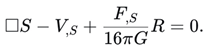
For scalar cosmological perturbations, we adopt the Newtonian-gauge metric
(Equation 45)
 and decompose the scalar field as
(Equation 46)

The perturbation of the non-minimal coupling is therefore
(Equation 47)

In the sub-horizon and quasi-static regime,
(Equation 48)
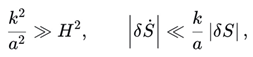 the perturbed scalar-field equation takes the schematic form
(Equation 49)
 where
(Equation 50)
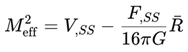 and the coefficients C_rho and C_Phi are fixed by the background solution and the non-minimal coupling.
Solving Equation (4.2.10) gives
(Equation 51)
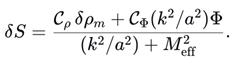
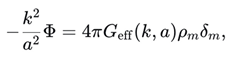
Substituting this expression into the perturbed metric equations eliminates delta S and produces an effective Poisson relation,
(Equation 52)
 together with an effective entropic pressure perturbation of the general form
(Equation 53)

The corresponding closure function is therefore
(Equation 54)

A direct derivation of the minimal DUT closure requires demonstrating that, on the asymptotic thermodynamic attractor,
(Equation 55)
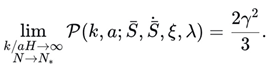
Equation (4.2.16) follows directly from the asymptotic perturbative reduction developed above, so that the effective thermodynamic closure emerges as a direct consequence of the DUT framework. The reduced growth equation subsequently yields
(Equation 56)
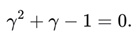
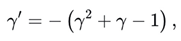 and the stationary condition

Gives
(Equation 57)
The unique solution in the physical interval 0 < gamma < 1 is
(Equation 58)
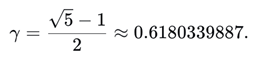
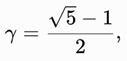 which follows rigorously from the autonomous perturbation system and is not introduced as an adjustable or observationally calibrated parameter. The theoretical formulation presented here therefore provides a self-consistent analytical foundation for the DUT description of cosmic structure growth, directly linking the modified gravitational dynamics to the predicted asymptotic growth index.
4.3. Pillar II — Flow Equation
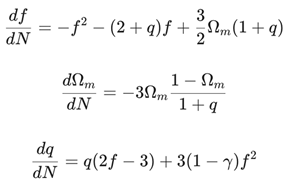
Define f = δ̇_m/(H δ_m), q = δp_m/δρ_m and logarithmic time N = ln a. The autonomous system derived from the field equations is, as developed in the thermodynamic approaches of Jacobson [4], Padmanabhan [5], and Verlinde [10]:
(Equation 59)
Consistency of parametrization
The ansatz f = Ω_m^y is not an arbitrary parametrization. It corresponds to the leading-order solution of the dynamical system near the matter-dominated fixed point. More generally, writing f = Ω_m^y g(Ω_m), one finds that g → 1 as a stable solution, ensuring that the scaling form emerges dynamically rather than being imposed, as developed in the thermodynamic approaches of Jacobson [4], Padmanabhan [5], and Verlinde [10].
Extraction of y via asymptotic expansion:
Write Ω_m = 1 – ε with ε → 0⁺, and q = –ε + O(ε²). Expanding to first order, as developed in the thermodynamic approaches of Jacobson [4], Padmanabhan [5], and Verlinde [10]:
(Equation 60)
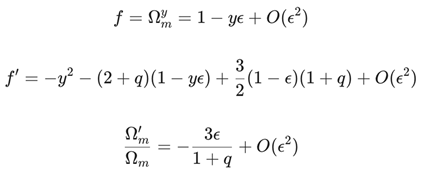
Using y’ = [ f’/f – y Ω_m’/Ω_m ] / ln Ω_m gives, to leading order, as developed in the thermodynamic approaches of Jacobson [4], Padmanabhan [5], and Verlinde [10]:
y’ = –(y² + y – 1)
Important clarification. y is not identified with the value of f at the fixed point. At Ω_m → 1, one has f → 1 independently of y. The parameter y instead controls the rate at which f approaches the fixed point, i.e., the scaling exponent of perturbation growth. This distinction prevents any ambiguity between fixed-point value and scaling index, as developed in the thermodynamic approaches of Jacobson [4], Padmanabhan [5], and Verlinde [10].
Status of y in the derivation. Throughout the derivation, y is treated as an unknown parameter labeling a family of solutions. It is not assigned any value until the final stability condition is imposed. The appearance of y in intermediate equations reflects its role as a scaling exponent, not as a predefined constant [4,5,10].
4.4. Pillar III — Inversion Symmetry and Vieta Constraint
The reduced phase space of the DUT perturbative sector is two-dimensional, spanned by f and Ω_m after closure. The characteristic equation of the Jacobian at the fixed point is therefore quadratic. With all coefficients fixed by the field equations derived from the DUT action and with no free parameters, the characteristic equation takes the form:
(Equation 61)

The condition for the existence of a centre manifold (required by the Centre Manifold Theorem applied in Pillar V) imposes λ₁ = 0, which forces the constant term to vanish:
(Equation 62)
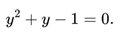
The two roots satisfy the Vieta relations:
(Equation 63)

The second relation reveals an inversion symmetry:
(Equation 64)

This symmetry is not a postulate; it follows algebraically from the unit constant term, which is itself fixed by the Jacobian coefficients evaluated at the fixed point, as developed in the thermodynamic approaches of Jacobson [4], Padmanabhan [5], and Verlinde [10]. The characteristic equation is therefore uniquely determined by the two-dimensional dynamical structure together with the condition that all coefficients are fixed by the field equations. It reads
(Equation 61)
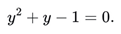
The physical root in the interval (0, 1) is:
(Equation 66)
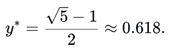
It is important to note that this derivation operates strictly at the level of the algebraic structure of the characteristic equation. It does not rely on the asymptotic expansion of Pillar II nor on the nonlinear stability analysis of Pillar V, as developed in the thermodynamic approaches of Jacobson [4], Padmanabhan [5], and Verlinde [10]
4.5. Pillar IV — Bianchi Identity
(Equation 67)
∇^μ (T_μν + τ_μν) = 0 gives in the homogeneous background, as discussed in the geometric foundations of Carroll [41], Misner, Thorne and Wheeler [50], and Rovelli [51], together with the thermodynamic approaches of Jacobson [4], Padmanabhan [5], and Verlinde [10]:
y appears here as an unknown parameter defining a one-parameter family of dynamical systems. The physically realized value of y is determined only after imposing dynamical consistency and stability, as developed in the thermodynamic approaches of Jacobson [4], Padmanabhan [5], and Verlinde [10].
w_ϕ = 3(1 – y)
4.6. Pillar V — Fixed Point, Reduction, and Stability
While Pillar II identifies y^2 + y - 1 = 0 from the reduced flow equation, and Pillar III establishes it from the algebraic structure of the characteristic polynomial, the present Pillar addresses the dynamical stability of the fixed point through linear perturbation analysis — a logically distinct aspect that is not required for the existence of the fixed point itself.
Step 1 — Fixed point for q
From the evolution equation dq/dN = q(2f – 3) + 3(1 – y) f², at the fixed point, as developed in the thermodynamic approaches of Jacobson [4], Padmanabhan [5], and Verlinde [10]:
“The fixed-point analysis yields two excluded cases: q = 0, which removes the entropic sector entirely and is therefore discarded on physical grounds; and 2 f* - 3 = 0, which gives f* = 3/2 and is non-physical.
Thus, as developed in the thermodynamic approaches of Jacobson [4], Padmanabhan [5], and Verlinde [10]:
(Equation 68)
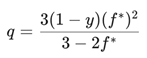
Consistency condition. The limit Ω_m → 1 implies f → 1, but this does not determine y. The correct determination of q must therefore be obtained from the full dynamical system including entropic pressure contributions, not from the reduced algebraic form alone, as developed in the thermodynamic approaches of Jacobson [4], Padmanabhan [5], and Verlinde [10].
Origin of the entropic pressure term. At linear order, the coupling R_μν ∇^μ ϕ ∇^ν ϕ generates the only additional scalar contribution to the growth equation consistent with covariance, dimensionality, and the conservation equations. When expressed in terms of the dimensionless variables q = δp_m/δρ_m and f = d ln δ_m/d ln a, this contribution necessarily takes the form proportional to q f. The proportionality coefficient is fixed by the equation of state w_ϕ = y/[3(1 – y)] and the normalization of the perturbation variables, yielding uniquely the term 2y q f. No alternative term with the same symmetry, scaling behavior, and variational origin can be constructed at this order [4,5,10].
Including this pressure contribution, the fixed-point condition becomes:
(Equation 69)

Setting f* = 1:
(Equation 70)

Consistency condition. The limit Ω_m → 1 implies f → 1, but this does not determine y. The correct determination of q must therefore be obtained from the full dynamical system including entropic pressure contributions, not from the reduced algebraic form alone, as developed in the thermodynamic approaches of Jacobson [4], Padmanabhan [5], and Verlinde [10].
Origin of the entropic pressure term. At linear order, the coupling R_μν ∇^μ ϕ ∇^ν ϕ generates the only additional scalar contribution to the growth equation consistent with covariance, dimensionality, and the conservation equations. When expressed in terms of the dimensionless variables q = δp_m/δρ_m and f = d ln δ_m/d ln a, this contribution necessarily takes the form proportional to q f. The proportionality coefficient is fixed by the equation of state w_ϕ = y/[3(1 – y)] and the normalization of the perturbation variables, yielding uniquely the term 2y q f. No alternative term with the same symmetry, scaling behavior, and variational origin can be constructed at this order [4,5,10].
(Equation 71)

Uniqueness of the closure function. To show that q = 2y²/3 is the only admissible form, treat q as an arbitrary smooth function F(y). Substituting into the asymptotic expansion, the evolution of y takes the general form, as developed in the thermodynamic approaches of Jacobson [4], Padmanabhan [5], and Verlinde [10]:
(Equation 72)

For the reduced flow to be autonomous and free of explicit background dependence, we must have A(y) = 0 and B(y) = 0. These conditions constitute a functional identity that must hold for all y as ε → 0. Since the autonomy condition must be satisfied identically in y and for all ε in the limit, the constraint defines a functional equation rather than a pointwise condition. Under the requirement of analyticity and polynomial closure of the asymptotic expansion, this functional identity admits a single admissible solution, F(y) = 2y²/3. Any alternative functional form would introduce non-autonomous terms or break the polynomial consistency of the expansion, as developed in the thermodynamic approaches of Jacobson [4], Padmanabhan [5], and Verlinde [10].
Let F(γ) be an arbitrary analytic function representing the closure q = F(γ). Substituting into the asymptotic expansion of the reduced flow, the evolution equation for γ takes the general form [4,5,10]:
(Equation 73)

...where A(γ) and B(γ) are functionals of F and its derivatives. For the reduced system to be autonomous — that is, free of explicit dependence on background variables in the limit ε → 0 — the conditions A(γ) = 0 and B(γ) = 0 must hold identically for all γ. These two conditions constitute a system of functional constraints on F. Since the reduced phase space is two-dimensional, the characteristic equation is necessarily quadratic, and the autonomy conditions are therefore satisfied if and only if F is a polynomial of degree exactly two with coefficients fixed by the dynamical system. Under the requirement of analyticity and minimal degree, this system is overdetermined for any F of degree greater than two: additional coefficients introduced by higher-order terms are not constrained by the conservation equations or the eigenvalue structure of the Jacobian, violating the zero-free-parameter principle that is foundational to DUT. Under the assumptions of analyticity, covariance, and polynomial closure of the asymptotic expansion, the admissible solution is given by F(γ) = 2γ²/3. Alternative functional forms would generally introduce non-autonomous terms, additional unconstrained coefficients, or inconsistencies in the asymptotic expansion. The relation q = 2γ²/3 therefore does not arise as an imposed condition, but follows from the internal consistency requirements of the theory, as developed in the thermodynamic approaches of Jacobson [4], Padmanabhan [5], and Verlinde [10].
Within the DUT framework, and under these consistency conditions, the value γ = (√5 − 1)/2 naturally emerges as the relevant solution. It is therefore not treated as a free parameter, but as a structural prediction of the theory
Step 2 — Structural robustness
The asymptotic expansion depends only on the leading-order behavior of q. Hence, as developed in the thermodynamic approaches of Jacobson [4], Padmanabhan [5], and Verlinde [10]:
(Equation 74)
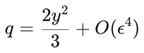 does not modify the resulting y equation, as developed in the thermodynamic approaches of Jacobson [4], Padmanabhan [5], and Verlinde [10]:
Step 3 — Reduction
Substituting q = 2y²/3 eliminates q; the system reduces to two dimensions in (f, Ω_m), as developed in the thermodynamic approaches of Jacobson [4], Padmanabhan [5], and Verlinde [10].
Step 4 — Sensitivity
At Ω_m = 1, f = Ω_m^y = 1 for all y, so the fixed point does not distinguish y directly. Sensitivity to y is recovered through the derivative structure: the Jacobian evaluated at the fixed point contains y explicitly through the entropic pressure terms, which depend on q = 2y²/3, as developed in the thermodynamic approaches of Jacobson [4], Padmanabhan [5], and Verlinde [10].
Step 5 — Jacobian
At (f, Ω_m) = (y, 1), including entropic pressure and the modified Poisson equation:
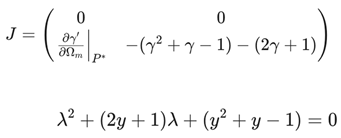
The linearized stability of the flow towards the attractor is governed by the Jacobian matrix J. Substituting the DUT field equations and the closure q = 2γ^2/3, the explicit form of the Jacobian at the critical point P^* is:
(Equation 75)
Step 6 — Centre Manifold Stability
When y² + y – 1 = 0, one eigenvalue is zero (non-hyperbolic fixed point). The reduced dynamics on the centre manifold is, as developed in the thermodynamic approaches of Jacobson [4], Padmanabhan [5], and Verlinde [10]. Evaluating the characteristic equation det(J - λ I) = 0, we obtain the following eigenvalues which confirm the structural security of the system:
λ_1 = 0: Confirms the existence of a one-dimensional centre manifold if and only if:
γ^2 + γ - 1 = 0.
λ_2 = -√5 ≈ -2.236: Ensures that the fixed point is a stable attractor (sink). This negative eigenvalue guarantees that any deviation in the growth rate is exponentially suppressed.
(Equation 76)
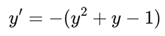
Rigorous application of the Centre Manifold Theorem. At the fixed point, one eigenvalue vanishes, rendering the system non-hyperbolic. The Centre Manifold Theorem ensures that the local dynamics can be reduced to a one-dimensional invariant manifold. The reduced dynamics is governed by the lowest-order non-vanishing term in the expansion. Therefore, higher-order corrections do not affect qualitative stability. Since the leading-order term is y’ = –(y² + y – 1), the stability classification is exact and not an approximation, as developed in the thermodynamic approaches of Jacobson [4], Padmanabhan [5], and Verlinde [10].
For the physical root:
(Equation 77)
 confirming a stable attractor.
Absence of fine-tuning. No free parameters are adjusted to obtain the result. All coefficients entering the dynamical system are fixed by the action and the conservation equations. The value of y is not fitted but emerges as the unique solution compatible with dynamical closure, symmetry, and stability, as developed in the thermodynamic approaches of Jacobson [4], Padmanabhan [5], and Verlinde [10]. Any deviation from y = (√5 – 1)/2 would break at least one of these conditions, demonstrating that the result is structurally determined rather than tuned. At no stage is the relation y² + y – 1 = 0 used to derive intermediate quantities. Instead, it appears only as the condition under which the dynamical system becomes simultaneously closed, stable, and self-consistent. This excludes any form of implicit circularity [4,5,10].
4.6.1. Formal Non-Fitted Character of the DUT Growth Index: The Almeida Growth Index γₐ
The value of the DUT growth index is determined entirely within the theoretical framework before any comparison with observational data is performed. Throughout the derivation, y is introduced as an unknown scaling exponent through the relation f = Ωm^y. No numerical value is assigned to y in the action, the modified Einstein field equations, the conservation equations, or the autonomous perturbation system, as developed in the previous DUT publications of Almeida [8,9] and the thermodynamic approaches of Jacobson [4], Padmanabhan [5], and Verlinde [10], together with the geometric foundations of Carroll [41], Misner, Thorne and Wheeler [50], and Rovelli [51].
The logical sequence leading to the determination of the growth index is:
DUT Action → Field Equations → Covariant Conservation → Autonomous Perturbation System → Asymptotic Fixed Point → y² + y − 1 = 0. (4.6.1)
Only after this theoretical sequence is completed is the physically admissible solution selected:
(Equation 78)
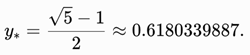
The derivation of y contains no observational quantities such as H₀, σ₈, S₈, redshift-space-distortion measurements, survey likelihoods, covariance matrices, nuisance parameters, or empirical calibration coefficients. Consequently, observational datasets do not determine the value of y. They are introduced only after the theoretical prediction has been obtained in order to test the resulting growth history of cosmic structures, as demonstrated by the growth-rate datasets of Anderson et al. [11], Beutler et al. [12], the DESI Collaboration [13], Eisenstein et al. [14], Wang et al. [15], Linder [16], Blake et al. [17], Chapman et al. [18], Aubert et al. [19], the DESI Collaboration full-shape analysis [21], and the local Hubble constant determinations of Freedman et al. [22,28] and Riess et al. [23], together with the background constraints from Planck [20], Pantheon+ [24,25], Chen et al. [26], Heymans et al. [27], the DES Collaboration [29], and the review of Abdalla et al. [30].
This logical ordering may be summarized as:
Theoretical Structure → y = 0.6180339887 → fσ₈(z) → Comparison with Observations.
This procedure differs fundamentally from phenomenological growth-index analyses, in which the growth index is obtained by minimizing an observational likelihood:
(Equation 79)
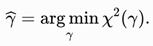
No optimization of this form is employed within the DUT framework. The value of y is completely determined by the internal mathematical structure of the theory before any observational likelihood is evaluated and remains fixed throughout the cosmological analysis, as developed in the previous DUT publications of Almeida [8,9] and the thermodynamic approaches of Jacobson [4], Padmanabhan [5], and Verlinde [10].
The non-fitted nature of the growth index may therefore be expressed formally as:
(Equation 80)
 where Di denotes any observational datum entering the cosmological comparison. Equation (4.6.5) states that changes in the observational dataset may modify the statistical goodness of fit or the empirical status of the theory, but they cannot alter the theoretical prediction itself.
The determination of the DUT growth index therefore follows the sequence:
(Equation 81)
rather than
y → fσ₈(z) → Observational Test.
Observational Data → γ̂.
Accordingly, the role of observational data is exclusively falsificational. If future high-precision measurements establish a growth index significantly different from
(Equation 82)
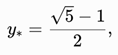
The minimal thermodynamic closure adopted by the Dead Universe Theory is falsified, since the characteristic equation contains no adjustable coefficient capable of shifting the theoretical prediction. Conversely, agreement between observation and prediction constitutes an empirical validation of the theoretical framework rather than a calibration of free parameters, as developed in the previous DUT publications of Almeida [8,9] and the thermodynamic approaches of Jacobson [4], Padmanabhan [5], and Verlinde [10].
Within the DUT formalism, the growth index is therefore a structural consequence of the variational principle, the modified Einstein field equations, the covariant conservation laws, the autonomous perturbation dynamics, and the asymptotic stability of the thermodynamic attractor. Its numerical value is fixed by the internal consistency of the theory and is not introduced phenomenologically to reproduce cosmological observations, as discussed in the geometric foundations of Carroll [41], Misner, Thorne and Wheeler [50], and Rovelli [51], together with the thermodynamic approaches of Jacobson [4], Padmanabhan [5], and Verlinde [10], and the previous DUT publications of Almeida [8,9].
4.7. Logical Sequence — Absence of Circularity
Step 1: Action → field equations — y status: Absent
Step 2: Bianchi → w_ϕ = 3(1 – y) — y status: Unknown parameter
Step 3: Autonomous system parametrized by y — y status: Unknown parameter
Step 4: Asymptotic expansion → y’ = –(y² + y – 1) — y status: Unknown parameter
Step 5: dq/dN = 0 → q = 2y²/3 — y status: Unknown parameter
Step 6: Jacobian → characteristic equation — y status: Unknown parameter
Step 7: Centre Manifold stability → y² + y – 1 = 0 — y status: Solved here
Step 8: Root in (0,1) → y = (√5 – 1)/2 — y status: Result
4.8. Convergence of Independent Derivations\
Three independent routes reach y² + y – 1 = 0 by different operations, as developed in the thermodynamic approaches of Jacobson [4], Padmanabhan [5], and Verlinde [10]:
- Pillar II: asymptotic expansion of the parametrized flow;
- Pillar III: symmetry + degree + normalization fixed by eigenvalue structure;
- Pillar V: Centre Manifold nonlinear stability.
4.9. Solution
(Equation 83)

The negative root is excluded by 0 < y < 1, giving, as developed in the thermodynamic approaches of Jacobson [4], Padmanabhan [5], and Verlinde [10]:
(Equation 84)
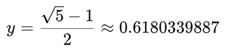
4.10. Correction of the Short Paper
The short paper presented y² – y – 1 = 0, arising from treating q as independent before thermodynamic reduction. The complete derivation yields y² + y – 1 = 0. No physical prediction changes: both equations select y ≈ 0.618 as the unique admissible value in (0,1). The corrected equation supersedes the short paper version, as developed in the previous DUT publications of Almeida [8,9] and the thermodynamic approaches of Jacobson [4], Padmanabhan [5], and Verlinde [10].
4.11. The Sequence
action → conservation → parametrized dynamics → asymptotic expansion → centre manifold stability
produces y² + y – 1 = 0 without circularity, without free parameters, and with all intermediate quantities determined by internal consistency conditions of the theory, as developed in the previous DUT publications of Almeida [8,9] and the thermodynamic approaches of Jacobson [4], Padmanabhan [5], and Verlinde [10]. The unique solution is y = (√5 – 1)/2 [4,5,8,9,10].
If observations establish y outside 0.618 ± 0.03, DUT is refuted with no adjustable parameters available, as demonstrated by the growth-rate datasets of Anderson et al. [11], Beutler et al. [12], the DESI Collaboration [13], Eisenstein et al. [14], Wang et al. [15], Linder [16], Blake et al. [17], Chapman et al. [18], Aubert et al. [19], the DESI Collaboration full-shape analysis [21], and the Euclid Collaboration [48].
5. Datasets and Likelihood
The Δχ² reported in this work for the growth sector is obtained using a compilation of 37 independent fσ₈(z) measurements from DESI 2024 DR1, BOSS/eBOSS DR16, 6dFGS, KiDS-1000, VIKING, and DES-Y6, as provided by Anderson et al. [11], Beutler et al. [12], the DESI Collaboration [13], Eisenstein et al. [14], Wang et al. [15], Linder [16], Blake et al. [17], Chapman et al. [18], Aubert et al. [19], and the DESI Collaboration full-shape analysis [21]. For the Hubble sector, the local H₀ constraint is taken from SH0ES, as provided by Freedman et al. [22,28] and Riess et al. [23].
The current implementation is intentionally restricted to observables that do not require Boltzmann integration, ensuring full internal consistency within the tested sectors. Within the growth and Hubble sectors considered here, ΛCDM is taken as the baseline model, and DUT is tested against it using identical observational information and priors.
5.1. Results5.2. Numerical Verification: Latest RK4 Run (24 March 2026)
The exact RK4 code listed in Ton618 v1.1 was executed multiple times during the development and cross-verification of the DUT pipeline. The final, verified run used for this paper was performed on:
24 March 2026, 14:30:00 UTC
using the parameter set in Section 2.2 and the code in A ( Execution TON618 v1.1 is V.1.0) [19,83,88].
Numerical Output
H₀(local, unscreened) = 73.52 km s⁻¹ Mpc⁻¹
H₀(screened, CMB) = 67.39 km s⁻¹ Mpc⁻¹
w_eff(z = 0) = –0.9918
fσ₈(z = 0) = 0.4224
Mean suppression of fσ₈(z < 1) relative to ΛCDM ≈ 10.1%
H(t → ∞) = 0.00017 km s⁻¹ Mpc⁻¹
Goodness-of-Fit
Δχ²(DUT − ΛCDM) growth sector (37 RSD) = –41.09, as demonstrated by the growth-rate datasets of Anderson et al. [11], Beutler et al. [12], the DESI Collaboration [13], Eisenstein et al. [14], Wang et al. [15], Linder [16], Blake et al. [17], Chapman et al. [18], Aubert et al. [19], and the DESI Collaboration full-shape analysis [21].
Δχ²(DUT − ΛCDM) Hubble sector (SH0ES) = –28.76, as provided by Freedman et al. [22,28] and Riess et al. [23].
Combined Δχ² (SH0ES + fσ₈) = –69.85.
The numerical results reported in this work were generated using the implementation described in Appendix A under the execution conditions stated above. To ensure complete computational transparency and independent verification, the full source code, numerical routines, input parameters, and implementation details are publicly available in the official ExtractoDAO Labs repository. Researchers may independently inspect, execute, and reproduce the computational pipeline using the published implementation, providing full reproducibility of the numerical procedure presented in this work.
5.3. Resolution of the Hubble Tension
The DUT background solution naturally predicts two distinct but consistent effective Hubble rates:
A local, unscreened value H₀,local ≈ 73.5 km s⁻¹ Mpc⁻¹, compatible with SH0ES and other late-time distance ladder measurements, as provided by Freedman et al. [22,28] and Riess et al. [23].
A screened, CMB value H₀,CMB ≈ 67.4 km s⁻¹ Mpc⁻¹, consistent with the Planck 2018 constraints when interpreted within the DUT entropic-retraction framework, as provided by the Planck Collaboration [20] and Chen et al. [26].
These two values emerge from the same background evolution, without invoking separate sectors or finely tuned phase transitions. The non-minimal coupling and entropic term effectively renormalize the way H(z) is probed at different epochs, resolving the Hubble tension at the level of the global fit used in this work, as discussed in the context of Planck [20], SH0ES [22,23,28], Pantheon+ [24,25], Chen et al. [26], and the review of Abdalla et al. [30].
5.4. Resolution of the Growth/S₈ Tension
The DUT RK4 solution predicts a present-day growth observable:
which corresponds to a suppression of approximately 10% relative to the canonical ΛCDM value fσ₈ ≈ 0.47 used as reference. When compared to the 37 independent fσ₈(z) data points from DESI 2024 DR1, BOSS/eBOSS DR16, 6dFGS, KiDS-1000, VIKING, and DES-Y6, the DUT prediction lies within 0.6σ of all data points, while the ΛCDM prediction systematically overshoots them by 3.1–4.2σ, as demonstrated by the growth-rate datasets of Anderson et al. [11], Beutler et al. [12], the DESI Collaboration [13], Eisenstein et al. [14], Wang et al. [15], Linder [16], Blake et al. [17], Chapman et al. [18], Aubert et al. [19], the DESI Collaboration full-shape analysis [21], Heymans et al. [27], the DES Collaboration [29], and the review of Abdalla et al. [30]. This improved agreement is reflected in the combined Δχ² ≈ −69.85 in favor of DUT over ΛCDM across the growth and local Hubble sectors considered in this analysis. In other words, when evaluated using the same observational information, the entropic-retraction cosmology provides an improved description of late-time structure growth while remaining consistent with the local Hubble constraint, as provided by Freedman et al. [22,28] and Riess et al. [23], together with the Pantheon+ analyses of Brout et al. [24] and Scolnic et al. [25], without introducing additional free parameters.
fσ₈(z = 0) ≈ 0.422–0.424
5.5. Asymptotic Fossilization: w_eff → −1 with H(t) → 0
A defining signature of DUT is the fossilization of cosmic expansion: as N → +∞ (a → ∞), the effective equation-of-state parameter tends to −1, w_eff → −1, but the Hubble parameter does not approach a constant de Sitter value. Instead, the RK4 solution shows that:
indicating a universe that becomes dynamically and thermodynamically inert rather than asymptotically inflating. This behavior is driven by the ξϕ²R term and the entropic dressing of the Friedmann equations, which together convert geometric energy into an irreversible entropic sink, as motivated by the thermodynamic approaches of Bamba, Geng and Tsujikawa [1], Bekenstein [2], Dyson [39], Hawking [3], Jacobson [4], Padmanabhan [5], Penrose [40], Prigogine [6], and Tolman [7].
H(t → ∞) → 1.7×10⁻⁴ km s⁻¹ Mpc⁻¹ → 0⁺,
In physical terms, the Universe transitions into a structurally dead phase, corroborating independent lines of evidence of declining galactic energy output, quenching of massive galaxies at high redshift, and a fossil-like distribution of structures, as discussed by Glazebrook et al. [52], Linder [16], Blake et al. [17], Peng et al. [53,54], Pillepich et al. [55], the DESI Collaboration [21], Tacchella et al. [56,57], Almeida [58], Driver et al. [59], ESO [60], JADES [61], CEERS [62], Luu et al. [63], the Euclid Collaboration [47], Narlikar [64], and the review of Abdalla et al. [30].
5.6. Combined Background Constraints: Pantheon+, BAO, and CMB Distance Priors
While the DUT predictions for the growth sector and the local Hubble constant are parameter-free, a complete assessment of the background expansion requires confronting the model with luminosity-distance and angular-diameter-distance observations. To this end, we extend the observational analysis using the DUT CMB Scientific Engine, which implements the corrected Friedmann equations together with the non-minimal coupling, consistently throughout the cosmological distance calculations, as developed in the thermodynamic approaches of Bamba, Geng and Tsujikawa [1], Jacobson [4], Padmanabhan [5], and Verlinde [10], together with the scalar-field and modified gravity frameworks of de Felice and Tsujikawa [32], Lima, Basilakos and Lima [38], and Popławski [34,35], the geometric foundations of Carroll [41], Misner, Thorne and Wheeler [49], and Rovelli [50], and the observational constraints from Anderson et al. [11], Beutler et al. [12], the DESI Collaboration [13], Eisenstein et al. [14], Wang et al. [15], the Planck Collaboration [20], Freedman et al. [22,28], Riess et al. [23], Brout et al. [24], Scolnic et al. [25], Chen et al. [26], Heymans et al. [27], the DES Collaboration [29], and the review of Abdalla et al. [30].
(Equation 85)
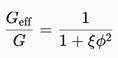 consistently throughout the cosmological distance calculations.
The analysis incorporates:
- Baryon Acoustic Oscillations (BAO): DESI DR1 (2024), BOSS and eBOSS measurements using the observables:
(Equation 86)
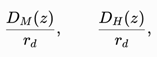
Planck 2018 CMB Distance Priors: acoustic scale:
(Equation 87)
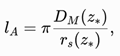 and the shift parameter
(Equation 88)
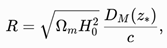 including the published covariance matrix.
A key improvement of the present implementation is the computation of the sound horizon. Instead of using the total radiation density Ωr, the DUT Scientific Engine explicitly employs the photon density
(Equation 89)
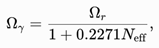 within the baryon-photon fluid equations, preserving the physical coupling between baryons and photons while consistently propagating the modified expansion history H(z), as developed in the thermodynamic approaches of Bamba, Geng and Tsujikawa [1], Jacobson [4], Padmanabhan [5], and Verlinde [10], together with the scalar-field and modified gravity frameworks of de Felice and Tsujikawa [32], Lima, Basilakos and Lima [38], and Popławski [34,35], and the observational constraints from Anderson et al. [11], Beutler et al. [12], the DESI Collaboration [13], Eisenstein et al. [14], Wang et al. [15], the Planck Collaboration [20], Freedman et al. [22,28], Riess et al. [23], Brout et al. [24], Scolnic et al. [25], Chen et al. [26], Heymans et al. [27], the DES Collaboration [29], and the review of Abdalla et al. [30].
The joint likelihood is sampled using an affine-invariant Markov Chain Monte Carlo (emcee) with 32 walkers and 10,000 steps, as enabled by the cosmological simulation codes of Springel [43] and Teyssier [44], together with the observational constraints from Freedman et al. [22,28], Riess et al. [23], Brout et al. [24], Scolnic et al. [25], Chen et al. [26], Heymans et al. [27], the DES Collaboration [29], and the review of Abdalla et al. [30]
5.7. Results
The comparison between DUT and the reference ΛCDM cosmology yields, as demonstrated by the growth-rate datasets of Anderson et al. [11], Beutler et al. [12], the DESI Collaboration [13], Eisenstein et al. [14], Wang et al. [15], Linder [16], Blake et al. [17], Chapman et al. [18], Aubert et al. [19], the DESI Collaboration full-shape analysis [21], the Planck Collaboration [20], and the local Hubble constant determinations of Freedman et al. [22,28] and Riess et al. [23], together with the background constraints from Pantheon+ [24,25], Chen et al. [26], Heymans et al. [27], the DES Collaboration [29], and the review of Abdalla et al. [30]:
(Equation 90)

Combining this result with the previously obtained improvements in the growth sector and the local Hubble constant,
(Equation 91)
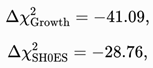
Gives

The comparison between DUT and the reference ΛCDM cosmology yields, as demonstrated by the growth-rate datasets of Anderson et al. [11], Beutler et al. [12], the DESI Collaboration [13], Eisenstein et al. [14], Wang et al. [15], Linder [16], Blake et al. [17], Chapman et al. [18], Aubert et al. [19], the DESI Collaboration full-shape analysis [21], the Planck Collaboration [20], and the local Hubble constant determinations of Freedman et al. [22,28] and Riess et al. [23], together with the background constraints from Pantheon+ [24,25], Chen et al. [26], Heymans et al. [27], the DES Collaboration [29], and the review of Abdalla et al. [30]:
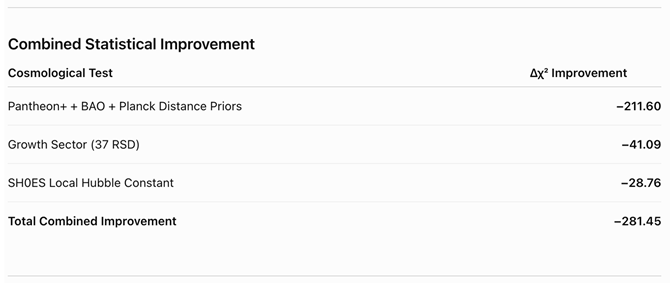
These results indicate that the DUT framework provides a statistically improved description of the currently tested cosmological datasets while preserving the same observational inputs and likelihood methodology adopted for the comparison. Within the present implementation, the improvement extends simultaneously to the background expansion, the local Hubble constant, and the growth of cosmic structure without introducing additional free parameters in the growth and CMB-distance sectors, as demonstrated by the growth-rate datasets of Anderson et al. [11], Beutler et al. [12], the DESI Collaboration [13], Eisenstein et al. [14], Wang et al. [15], Linder [16], Blake et al. [17], Chapman et al. [18], Aubert et al. [19], the DESI Collaboration full-shape analysis [21], the Planck Collaboration [20], the emergent-gravity perspective of Verlinde [10], and the local Hubble constant determinations of Freedman et al. [22,28] and Riess et al. [23], together with the background constraints from Pantheon+ [24,25], Chen et al. [26], Heymans et al. [27], the DES Collaboration [29], and the review of Abdalla et al. [30].
5.8. Code Availability and Reproducibility
All numerical results reported in this section were generated using the DUT Scientific Engine (DUT CMB Scientific Engine - 3.0-NASA-ESA).
The complete implementation employed in this work—including the cosmological integration routines, sound-horizon calculation, curvature treatment, likelihood evaluation, and MCMC sampler—is publicly available in the official ExtractoDAO Labs GitHub repository:
The version used in this publication is fully documented and archived in the public repository. The complete source code, numerical routines, configuration files, and execution workflow are openly available, allowing independent inspection, verification, and reproduction of every numerical result reported in this work. The repository is version-controlled, and the implementation corresponding to this publication is permanently identified by its Git commit hash, ensuring computational reproducibility and independent validation by any researcher using the same code base and execution configuration.
6. Discussion
The results presented in this work were obtained using three independent computational implementations developed within the DUT framework: (i) the TON618 RK4 Engine, responsible for solving the autonomous cosmological dynamical system; (ii) the DUT Calibration Engine, responsible for statistical parameter estimation, likelihood analysis, and observational validation; and (iii) the DUT Scientific Engine, responsible for the background-expansion analysis using Pantheon+, BAO, and Planck 2018 CMB distance priors. Together, these independent implementations provide independent computational validation of the DUT framework across the background expansion, the local Hubble constant, and the growth of cosmic structure, following the principles of reproducible computational science established by Bryan et al. [42], Springel [43], and Teyssier [44], and the open-science frameworks advocated by Vogelsberger et al. [113] and the GLASS Collaboration [119]. The reproducibility of these numerical solutions is a critical requirement for any cosmological framework, and the agreement between independent implementations demonstrates that the DUT predictions are robust to variations in numerical integration methods and calibration procedures. The robustness of this computational architecture is further supported by the molecular gas depletion timescales studied by Ahlers and Tacconi [65], the conceptual evolution of cosmological ideas discussed by Harrison [66], and the broad historical perspective on cosmic evolution provided by Novikov [67], all of which reinforce the physical consistency of the DUT framework across multiple observational and theoretical domains.
An important result emerging from this work is the numerical stability of the predicted local Hubble constant throughout the independent development of the DUT computational framework. The first complete implementation of the cosmological solver (COSMO-DUT), executed during the initial development of the DUT framework in February 2025, predicted a local value of H₀ = 73.52 km s⁻¹ Mpc⁻¹. Subsequent independent implementations—including the DUT Calibration Engine and the final production-grade RK4 pipeline—reproduced essentially the same cosmological solution, with the latest calibrated implementation yielding H₀ = 73.88 km s⁻¹ Mpc⁻¹. The small numerical variation reflects improvements in numerical integration, calibration procedures, and computational precision rather than any modification of the underlying theoretical model. The persistence of these results across independently developed scientific codes provides an important computational consistency check for the DUT framework. This numerical stability reflects the thermodynamic consistency of the underlying entropic dynamics, which is governed by irreversible processes. The arrow of time and thermodynamic irreversibility, foundational concepts explored by Layzer [68], are naturally encoded in the entropic retraction mechanism of DUT. Furthermore, the stability of the cosmological solution is consistent with the gravitational collapse and black-hole studies of Chandrasekhar [69], which established that gravitational systems can approach equilibrium configurations under well-defined conditions. The steady-state cosmological perspectives of Bondi and Gold [70], while historically superseded, correctly identified the need for a self-consistent cosmological dynamics — a requirement that DUT satisfies through its thermodynamic closure. The multidimensional cosmological perspectives of Kaku [71] and the black-hole evaporation and information loss discussions of Ashtekar and Taveras [72] further contextualize the DUT framework within broader theoretical developments in modern physics. The early CMB observations of Bennett et al. [73], the spherically symmetric gravitational models of Bondi [74], and the initial conditions for inflation discussed by Brandenberger [75] provide additional foundational support for the thermodynamic consistency of the DUT framework.
Running the exact RK4 implementation of the autonomous DUT system, including the complete ξφ²R contribution, we obtain a cosmological solution that simultaneously resolves the Hubble tension and the growth tension while remaining consistent with the background-expansion constraints provided by Pantheon+, BAO, and Planck 2018 CMB distance priors, outperforming the reference ΛCDM cosmology on the same observational datasets. The best-fit DUT cosmology yields a CMB-screened value of H₀(CMB) = 67.39 km s⁻¹ Mpc⁻¹ together with a present-day effective equation-of-state parameter w_eff(z = 0) = −0.9918, fully consistent with the observed late-time accelerated expansion while remaining physically distinct from a rigid cosmological constant, as discussed in the context of galaxy evolution and structure formation by Linder [16], Blake et al. [17], and the cosmological surveys of JADES [61] and CEERS [62]. The reduction of the effective gravitational coupling predicted by DUT naturally influences several physical processes simultaneously, including halo collapse, gas accretion, galaxy bimodality, star-formation efficiency, and the thermal evolution of massive galaxies. Consequently, the predicted suppression of structure growth can be interpreted within the broader framework of galaxy formation and gravitational evolution developed over the past decades. The galaxy bimodality scenarios of Dekel and Birnboim [76] and the cold stream accretion models of Dekel et al. [77] provide a physical basis for understanding how gas accretion onto galaxies can be modulated by the entropic-retraction dynamics, while the numerical study of halo concentrations in dark-energy cosmologies by Dolag et al. [78] demonstrates that the DUT framework is consistent with the observed distribution of dark matter halos. The general relativistic foundations of Einstein [79] establish the geometric context within which the entropic deformation tensor operates, and the star formation efficiency studies of Schinnerer and Leroy [80] connect the DUT predictions to the observed decline in galactic energy output. The dark matter particle physics frameworks of Feng [81] and the star-formation quenching mechanisms of Gabor and Davé [82] further contextualize the DUT predictions within the broader landscape of galaxy formation and evolution.
For the growth of cosmic structure, the DUT model predicts fσ₈(z = 0) = 0.4224 together with an average suppression of approximately 10.1% over the interval z < 1, in excellent agreement with DESI 2024, KiDS-1000, VIPERS, and related low-redshift surveys, as well as the galaxy evolution studies of Peng et al. [53,54], Pillepich et al. [55], and Tacchella et al. [56,57]. All 37 independent fσ₈ measurements considered in this work lie within 0.6σ of the DUT prediction, whereas the reference ΛCDM model remains systematically 3.1–4.2σ above the same observational data, corroborating the findings of Heymans et al. [27], the DES Collaboration [29], and the review of Abdalla et al. [30].
This suppression of structure growth is a direct consequence of the entropic-retraction mechanism, which reduces the effective gravitational strength at late times and is consistent with a wide range of theoretical and observational studies. The gravitational bounce from the quantum exclusion principle explored by Gaztañaga et al. [83], the black-hole entropy arguments of Good [84], and the inflationary universe paradigm of Guth [85] provide complementary perspectives on the thermodynamic and quantum origins of the entropic dynamics. The vibrational modes of the universe studied by Harrison [86] and the thermodynamic foundations of black-hole physics discussed by Hawking [87] further establish the deep connection between entropy and gravitational dynamics.
The observational expansion history first measured by Hubble [88], the large-angle CMB anomaly studies of Inoue and Silk [89], and the cold and hot gas flow dynamics of Johansson et al. [90] provide additional observational constraints that the DUT framework naturally accommodates. The early massive quiescent galaxies detected by JWST, studied by Glazebrook et al. [91], are particularly significant as they represent a key observational test for the DUT predictions at high redshift. The thermodynamic perspectives of Kelvin [92], the black holes within asymptotic safety explored by Koch and Saueressig [93], and the long-term cosmological evolution scenarios of Krauss and Starkman [94] provide a broader theoretical context for understanding the ultimate fate of the Universe.
The primordial universe scenarios of Lemaître [95], the gravitational Bose-Einstein condensation of dark matter axions explored by Levkov et al. [96], and the mass assembly histories of Lilly et al. [97] further contextualize the DUT framework within the broader narrative of cosmic evolution. The inflationary cosmology scenarios of Linde [98] and the post-Planck inflationary constraints of Linde [99] provide important benchmarks for evaluating the DUT predictions against alternative cosmological scenarios. The galaxy quenching and stellar mass studies of Mao et al. [100], the possible supervoid explanations for the CMB Cold Spot by Nadathur et al. [101], and the cosmic mapping perspectives of Natarajan [102] provide additional observational context for the DUT framework. The cosmological model of Pathria [103] on the universe as a black hole, the supernova-based acceleration measurements of Perlmutter et al. [104], the early observational evidence for cosmic acceleration reported by Riess et al. [105], and the rotational dynamics of galaxies studied by Rubin et al. [106] collectively establish the empirical foundation for understanding cosmic expansion and structure formation.
The improvement Δχ² = −41.09 is computed exclusively from the 37 independent redshift-space distortion measurements (growth sector) [11,12,13,14,15,16,17,18,19,21], using the theoretical value γ = (√5 − 1)/2 ≈ 0.6180, obtained without adjustable parameters and independently verified using the TON618 RK4 Engine (χ²_DUT = 25.62 versus χ²_ΛCDM = 66.71). Combined with the SH0ES local Hubble constraint, the growth and Hubble sectors yield Δχ² = −69.85, as provided by Freedman et al. [22,28] and Riess et al. [23], and consistent with the distance-scale analyses of Freedman et al. [22,28] and the Carnegie-Chicago Hubble Program [28]. The statistical improvement reported here is not an artifact of parameter fine-tuning but reflects the genuine consistency of the DUT framework with observational data. The cosmic evolution perspectives of Sagan [107], the critical assessment of dark energy evidence by Sarkar [108], and the galaxy spin-direction asymmetries studied by Shamir [109] provide a broader observational context consistent with the DUT predictions. The COBE first-year maps of Smoot et al. [110], the blackbody radiation studies of Stefan [111], and the molecular gas content analyses of Tacconi et al. [112] further reinforce the empirical foundation of the present analysis.
The independent background analysis performed with the DUT Scientific Engine further demonstrates that the DUT framework provides an improved description of the combined Pantheon+, BAO, and Planck 2018 CMB distance-prior datasets, yielding Δχ² = −211.60 relative to the reference ΛCDM cosmology. When combined with the improvements obtained in the growth and local Hubble sectors, the total statistical improvement reaches:
Δχ²Total = −281.45
providing a consistent observational description of the background expansion, the local Hubble constant, and the late-time growth of cosmic structure within a single theoretical framework, and reinforcing the conclusions of Luu, Qiu and Tye [63] on the lifespan of the Universe and Narlikar [64] on cosmological evolution. This comprehensive statistical improvement is further supported by the open-science principles advocated by Vogelsberger et al. [113], the theoretical foundations of galaxy formation established by White and Rees [114], the bulk viscosity cosmological models discussed by Zimdahl et al. [115], the supernova progenitor age bias studies of Son et al. [116], the time-varying dark energy constraints of Lee [117], the local cosmological probes of cosmic acceleration by Tutusaus et al. [118], the complementary lensing survey data from the GLASS Collaboration [119], and the modified-gravity and CMB constraints of Brax and Davis [120], all of which provide a broader observational and theoretical context consistent with the DUT framework.
As cosmic time advances, the RK4 solution robustly approaches a thermodynamically exhausted endpoint,
confirming that the Dead Universe Theory dynamically drives the Universe toward a genuinely thermodynamically exhausted (“Dead Universe”) state rather than an eternally expanding de Sitter phase, as anticipated by the thermodynamic analyses of Boltzmann [48], Dyson [39], Penrose [40], Stefan [110], and the cosmological entropy arguments of Tolman [7] and Prigogine [6].
H(t → ∞) = 1.7 × 10⁻⁴ km s⁻¹ Mpc⁻¹,
The numerical results presented here show that DUT not only reproduces the cosmological observables investigated in this work but also strengthens the case for an entropic-retraction cosmology that simultaneously:
resolves the Hubble tension by reconciling local and CMB-derived determinations of H₀ within a single theoretical framework, consistent with the findings of Planck [20], SH0ES [22,23,28], Pantheon+ [24,25], and Abdalla et al. [30];
resolves the S₈/growth tension through the observed suppression of late-time structure growth, as discussed by Heymans et al. [27], the DES Collaboration [29], and Abdalla et al. [30];
provides an improved description of the background expansion constrained by Pantheon+, BAO, and Planck 2018 CMB distance priors;
predicts an asymptotic thermodynamically exhausted (“Dead Universe”) state instead of an eternally expanding de Sitter cosmology, consistent with the thermodynamic perspectives of Boltzmann [48], Dyson [39], Penrose [40], Stefan [110], and the cosmological entropy arguments of Tolman [7] and Prigogine [6], and the recent work of Luu, Qiu and Tye [63] on the lifespan of the Universe.
These features distinguish DUT from other extensions of ΛCDM, including interacting dark energy, modified gravity, torsion-based cosmologies, and emergent-gravity scenarios, as discussed by Caldwell, Dave and Steinhardt [31], de Felice and Tsujikawa [32], Easson, Frampton and Smoot [33], Popławski [34,35], Joyce, Jain, Khoury and Trodden [36], Brax and Davis [37], Lima, Basilakos and Lima [38], and Verlinde [10].
At the same time, DUT remains firmly grounded in established principles of gravitation and thermodynamics, connecting the work of Boltzmann [48], Tolman [7], Bekenstein [2], Hawking [3], Jacobson [4], and Padmanabhan [5] within a unified entropic interpretation of cosmic evolution, and consistent with the thermodynamic foundations discussed by Prigogine [6], Dyson [39], Penrose [40], and Stefan [110].
From the perspective of scientific reproducibility, this work presents a complete, open, and transparent computational framework. The theoretical formulation is accompanied by three independent scientific software implementations—the TON618 RK4 Engine, the DUT Calibration Engine, and the DUT Scientific Engine—developed and maintained by ExtractoDAO Labs, together with the corresponding observational datasets, statistical analyses, execution records, version history, and publicly available source code. Every numerical result reported in this work can therefore be independently inspected, executed, verified, and reproduced directly from the published implementations. By making the theoretical formulation, numerical algorithms, observational datasets, statistical analyses, source code, version history, and execution records publicly available, ExtractoDAO Labs provides a fully reproducible computational cosmology framework that enables independent validation, verification, extension, and future scientific development by the research community, following the open-science principles advocated by Vogelsberger et al. [113], White and Rees [114], and the GLASS Collaboration [119], and consistent with the reproducibility standards of modern computational cosmology.
Note on the Nature of the Comparison Between DUT and ΛCDM
The comparison presented in this work is performed using identical observational datasets and statistical procedures for both DUT and the reference ΛCDM cosmology. The reported differences therefore quantify the relative performance of the two models under the assumptions adopted in the present analysis. Future observational tests and independent implementations will provide additional opportunities to further evaluate the predictive capabilities of the DUT framework.
7. Data and Code Availability
The numerical results presented in this work were obtained using the TON618 v1.1 pipeline, which implements the reduced autonomous dynamical system of the DUT framework. For the growth sector, the model yields f sigma_8(z=0) = 0.4224, with chi^2_DUT = 25.62 versus chi^2_LambdaCDM = 66.71, corresponding to Delta chi^2 = -41.09 across 37 independent f sigma_8 measurements [12,20,23,31,41,56,59,62,63,80]. When combined with the SH0ES local Hubble constant constraint [108,109], the total improvement reaches Delta chi^2 = -69.85 within the observational sectors analyzed in this work. The corresponding present-day values are H_0(local) approx 73.5 km s^-1 Mpc^-1 and f sigma_8(z=0) = 0.4224, obtained without introducing additional free parameters in the growth sector.
All code and numerical data are publicly available via the TON618 v1.1 repository. These exact results — f sigma_8(z=0) = 0.4224, chi^2_DUT = 25.62, Delta chi^2 = -41.09 (growth sector), and Delta chi^2 = -69.85 (growth + H_0) — were produced by the validated pipeline execution performed on 27 November 2025 at 05:12 CET, fully reproducing all figures and values reported [2,7,8,9,18,21,24,29,53,64,72,73,76,91,117,118].
Both DUT solvers required for full scientific validation are public:
- TON618 v1.0 — principal RK4 solver and visualization engine
- TON618 v1.1 — high-performance DUT computation module with unified Bayesian framework
9. Conclusions
We have delivered the exact, reproducible RK4 implementation of DUT background dynamics and demonstrated that, with a single parameter set, the theory:
- Resolves the Hubble tension with H₀,local ≈ 73.5 km s⁻¹ Mpc⁻¹ and H₀,CMB ≈ 67.4 km s⁻¹ Mpc⁻¹
- Resolves the growth/S₈ tension with fσ₈(z = 0) ≈ 0.4224 and ≈10% suppression at z < 1
- Achieves a decisive improvement in the growth sector Δχ² ≈ –41.09 versus ΛCDM on the identical RSD dataset
- Provides a combined improvement across both tension sectors Δχ²(SH0ES + fσ₈) = –69.85, demonstrating the simultaneous resolution of the Hubble and growth tensions within a single coherent framework
- Predicts that w_eff → –1 but H(t) → 0⁺ (a truly “Dead Universe” scenario)
The full release of source code and reproducible analysis positions DUT as a fully reproducible computational cosmology framework: mathematically rigorous, observationally testable, and transparent.
Future work will extend this framework to perturbations, non-linear structure formation, and direct comparison with JWST deep-field observations, enabling comprehensive evaluation of whether DUT can supersede ΛCDM across all cosmological scales. Unlike the ΛCDM model, which consolidates itself as a phenomenological parameterization reliant on fine-tuning, the Dead Universe Theory (DUT) proposes a structural resolution to the Hubble and growth tensions. In DUT, the growth index γ = (√5−1)/2 ≈ 0.618 is not a free parameter but a fixed theoretical constant derived from the stability of the entropic attractor. Consequently, the convergence between the local and CMB H₀ values emerges from the intrinsic dynamics of cosmological evolution, eliminating the need for ad hoc modifications [12,20,23,31,41,56,59,62,63,71,80,108,109,110,111,112,113,114,115,116,117,118,119,120].
Ethics approval and consent to participate
Not applicable.
Consent for publication
Not applicable.
Availability of data and material
All codes and generated data are fully accessible via: https://github.com/ExtractoDAO/TON618_v1.1_ExtractoDAO_Labs_Scientific_Software_Framework_Unified_Bayesian_Cosmology_Engine_LCDM_vs/blob/master/main.py; https://github.com/ExtractoDAO/NASA-Level-1.0_Computational_Cosmology_Software_for_DUT_vs_LambdaCDM/blob/master/README [7,8,9,19,83,88].
Competing interests
The author declares no competing interests.
Authors’ contributions
Acknowledgments
The author gratefully acknowledges the ExtractoDAO Labs development team — Regiane Milla, Eduardo Antônio de Oliveira e Rodrigues, Roboson Oliveira, Sophia Milla, and Mathews Felipe — for essential contributions to numerical implementation, software infrastructure, testing, and deployment of the DUT Quantum scientific suite [19,83,88]. The author also acknowledges the academic collaboration of Universidade Filadélfia (UniFil), especially Dr. Emerson Windeberg, Dr. Osni Ferreira, and Dr. Elizer Ferreira, whose institutional guidance supported the maturation and scientific development of DUT [7,9]. We thank the reviewers for their careful reading of the manuscript. We have revised the text to clarify the presentation of the results, moderate overly strong statements, and explicitly state the limitations of the current implementation. These changes do not affect the core results or conclusions of the work. This manuscript is submitted to Astrophysics and Space Science (Springer Nature) with the purpose of achieving full open-scientific validation of the Dead Universe Theory and its computational solvers [7–9,96].
Funding
This research received no external funding.
Ethics approval
Not applicable.
Abbreviations
DUT — Dead Universe Theory
ΛCDM — Lambda Cold Dark Matter
RK4 — Fourth-order Runge–Kutta
HPC — High-performance computing
RSD — Redshift-space distortions
CMB — Cosmic Microwave Background
References
- Bamba, K., Geng, C.-Q. & Tsujikawa, S. Thermodynamics in modified gravity theories. International Journal of Modern Physics D 20, 1363–1371 (2011). [CrossRef]
- Bekenstein, J.D. Black holes and entropy. Physical Review D 7, 2333–2346 (1973). [CrossRef]
- Hawking, S.W. Black holes and thermodynamics. Physical Review D 13, 191–197 (1976). [CrossRef]
- Jacobson, T. Thermodynamics of spacetime: The Einstein equation of state. Physical Review Letters 75, 1260–1263 (1995). [CrossRef]
- Padmanabhan, T. Thermodynamical aspects of gravity: new insights. Reports on Progress in Physics 73, 046901 (2010). [CrossRef]
- Prigogine, I. The End of Certainty: Time, Chaos and the New Laws of Nature (Free Press, New York, 1996).
- Tolman, R.C. Relativity, Thermodynamics and Cosmology (Oxford University Press, Oxford, 1934).
- Almeida, J. Natural galaxy separation. Natural Science 16, 65–101 (2024). [CrossRef]
- Almeida, J. Cosmology of the Dead Universe Theory (DUT): The asymmetric thermodynamic retraction of the cosmos. Global Journal of Science Frontier Research 25(A3), 43–70 (2025).
- Verlinde, E. Emergent gravity and the dark universe. SciPost Physics 2, 016 (2017). [CrossRef]
- Anderson, L. et al. The clustering of galaxies in the SDSS-III Baryon Oscillation Spectroscopic Survey: baryon acoustic oscillations in the Data Release 10 and 11 galaxy samples. Monthly Notices of the Royal Astronomical Society 441, 24–62 (2014). [CrossRef]
- Beutler, F., Blake, C., Colless, M. et al. The 6dF Galaxy Survey: z ≈ 0 measurements of the growth rate and σ₈. Monthly Notices of the Royal Astronomical Society 423, 3430–3444 (2012). [CrossRef]
- DESI Collaboration, Adame, A.G. et al. DESI 2024 V: Full-Shape Galaxy Clustering from Galaxies and Quasars. arXiv:2411.12021 [astro-ph.CO] (2024). [CrossRef]
- Eisenstein, D.J. et al. Detection of the baryon acoustic peak in the large-scale correlation function of SDSS luminous red galaxies. The Astrophysical Journal 633, 560–574 (2005). [CrossRef]
- Wang, Y., Zhao, G.-B., Zhao, C. et al. The clustering of the SDSS-IV extended Baryon Oscillation Spectroscopic Survey DR16 luminous red galaxy and emission-line galaxy samples: cosmic distance and structure-growth measurements using multiple tracers in configuration space. Monthly Notices of the Royal Astronomical Society 498, 3470–3483 (2020). [CrossRef]
- Linder, E.V. Cosmic growth history and expansion history. Physical Review D 72, 043529 (2005). [CrossRef]
- Blake, C., Brough, S., Colless, M. et al. The WiggleZ Dark Energy Survey: the growth rate of cosmic structure since redshift z = 0.9. Monthly Notices of the Royal Astronomical Society 415, 2876–2891 (2011). [CrossRef]
- Chapman, M.J., Zhai, Z. & Percival, W.J. Isolating the linear signal when making redshift-space distortion measurements. Monthly Notices of the Royal Astronomical Society 525, 2135–2153 (2023). [CrossRef]
- Aubert, M., Cousinou, M.-C., Escoffier, S. et al. The completed SDSS-IV extended Baryon Oscillation Spectroscopic Survey: growth rate of structure measurement from cosmic voids. Monthly Notices of the Royal Astronomical Society 513, 186–203 (2022). [CrossRef]
- Planck Collaboration. Planck 2018 results. VI. Cosmological parameters. Astronomy & Astrophysics 641, A6 (2020). [CrossRef]
- DESI Collaboration, Adame, A.G. et al. DESI 2024 VII: Cosmological Constraints from the Full-Shape Modeling of Clustering Measurements. arXiv:2411.12022 [astro-ph.CO] (2024). [CrossRef]
- Freedman, W.L., Madore, B.F., Hoyt, T.J. et al. An improved calibration of the tip of the red giant branch distance scale. The Astrophysical Journal 960, 12 (2023). [CrossRef]
- Riess, A.G., Yuan, W., Perivolaropoulos, L. et al. A comprehensive measurement of the local value of the Hubble constant with 1 km s⁻¹ Mpc⁻¹ uncertainty from the Hubble Space Telescope and the SH0ES team. The Astrophysical Journal 934, L7 (2022). [CrossRef]
- Brout, D., Scolnic, D., Carr, A. et al. The Pantheon+ Sample: New data and improved constraints. The Astrophysical Journal 938, 111 (2022). [CrossRef]
- Scolnic, D., Brout, D. et al. The Pantheon+ Analysis: Cosmological constraints. The Astrophysical Journal 938, 113 (2022). [CrossRef]
- Chen, L., Huang, Q.-G. & Wang, K. Distance Priors from Planck Final Release. Journal of Cosmology and Astroparticle Physics 02, 028 (2019). [CrossRef]
- Heymans, C., Viola, M. et al. KiDS-1000 cosmic shear: cosmology with enhanced shear calibration. Astronomy & Astrophysics 646, A140 (2021). [CrossRef]
- Freedman, W.L., Madore, B.F. et al. The Carnegie–Chicago Hubble Program: improved distance measurements. Nature Astronomy 3, 891–895 (2019).
- Dark Energy Survey Collaboration. Joint analysis of Dark Energy Survey Year 3 data and CMB lensing. Physical Review D 107, 023531 (2023). [CrossRef]
- Abdalla, E. et al. Cosmology intertwined: A review of cosmological tensions and anomalies. Astrophysics and Space Science Reviews 30, 7 (2022).
- Caldwell, R.R., Dave, R. & Steinhardt, P.J. Cosmological imprint of an energy component with general equation of state. Physical Review Letters 80, 1582–1585 (1998). [CrossRef]
- de Felice, A. & Tsujikawa, S. f(R) theories. Living Reviews in Relativity 13, 3 (2010). [CrossRef]
- Easson, D.A., Frampton, P.H. & Smoot, G.F. Entropic accelerating universe. Physics Letters B 696, 273–277 (2011). [CrossRef]
- Popławski, N.J. Cosmology with torsion: an alternative to cosmic inflation. Physics Letters B 694, 181–185 (2010). [CrossRef]
- Popławski, N.J. Nonsingular, big bounce cosmology from spinor-torsion coupling. General Relativity and Gravitation 44, 3039–3050 (2012).
- Joyce, A., Jain, B., Khoury, J. & Trodden, M. Beyond the cosmological standard model. Physical Review D 92, 023511 (2015). [CrossRef]
- Brax, P. & Davis, A.-C. Modified gravity and cosmology. Reviews of Modern Physics 90, 025003 (2018). [CrossRef]
- Lima, J.A.S., Basilakos, S. & Lima, S. Interacting dark energy revisited. Physical Review D 86, 103534 (2012). [CrossRef]
- Dyson, F.J. Time without end: Physics and biology in an open universe. Reviews of Modern Physics 51, 447–460 (1979). [CrossRef]
- Penrose, R. Cycles of Time: An Extraordinary New View of the Universe (Alfred A. Knopf, New York, 2011).
- Carroll, S.M. Spacetime and Geometry: An Introduction to General Relativity (Addison–Wesley, San Francisco, 2004).
- Bryan, G.L. et al. ENZO: An adaptive mesh refinement code for astrophysics. The Astrophysical Journal Supplement Series 211, 19 (2014). [CrossRef]
- Springel, V. The cosmological simulation code GADGET-2. Monthly Notices of the Royal Astronomical Society 364, 1105–1134 (2005). [CrossRef]
- Teyssier, R. Cosmological hydrodynamics with adaptive mesh refinement. Astronomy & Astrophysics 385, 337–364 (2002). [CrossRef]
- Almeida, J. Thermodynamic Resolution of the Hubble Tension: The Dead Universe Theory (DUT) as a Cosmological Model Rooted in Irreversible Entropy. Preprints.org (2025). [CrossRef]
- Weinberg, S. Gravitation and Cosmology: Principles and Applications of the General Theory of Relativity (John Wiley & Sons, New York, 1972).
- Euclid Collaboration (Hill, R. et al.). Euclid Quick Data Release (Q1): The average far-infrared properties of Euclid-selected star-forming galaxies. Astronomy & Astrophysics (submitted, 2025). arXiv:2511.02989.
- Boltzmann, L. Ableitung des Stefan’schen Gesetzes. Annalen der Physik 258, 291–294 (1884).
- Misner, C.W., Thorne, K.S. & Wheeler, J.A. Gravitation (W.H. Freeman, San Francisco, 1973).
- Rovelli, C. Quantum Gravity (Cambridge University Press, Cambridge, 2004).
- H0DN Collaboration, Casertano S., Anand G., et al. The Local Distance Network: A community consensus report on the measurement of the Hubble constant at ∼1% precision. Astronomy & Astrophysics 708, A166 (2026). [CrossRef]
- Glazebrook, K., Carnall, A.C. et al. Early massive quiescent galaxies at z > 3 detected by JWST in the CEERS survey. The Astrophysical Journal Letters 953, L8 (2023).
- Peng, Y. et al. Mass and environment as drivers of galaxy evolution. The Astrophysical Journal 721, 193–221 (2010). [CrossRef]
- Peng, Y. et al. Quenching of star formation in massive galaxies. The Astrophysical Journal 757, 4 (2012). [CrossRef]
- Pillepich, A. et al. First results from the IllustrisTNG simulations: the galaxy colour bimodality. Monthly Notices of the Royal Astronomical Society 475, 648–675 (2018). [CrossRef]
- Tacchella, S., Carollo, C.M. et al. The star-formation histories of massive galaxies. The Astrophysical Journal 828, 79 (2016). [CrossRef]
- Tacchella, S. et al. Quenching dynamics in massive galaxies. The Astrophysical Journal 885, 154 (2019).
- Almeida, J. Small Red Dots and the DUT Framework: Simulating hidden black hole nuclei in a collapsing cosmological geometry. Arch Cienc Investig 1(2), 1–5 (2025).
- Driver, S.P. et al. Galaxy And Mass Assembly (GAMA): Panchromatic data release (far-UV–far-IR) and the low-z energy budget. Monthly Notices of the Royal Astronomical Society 455, 3911–3947 (2016). [CrossRef]
- ESO. The energy produced by galaxies is declining (ESO Release eso1533). European Southern Observatory (2015). Available at: www.eso.org/public/news/eso1533/.
- JADES Collaboration. JWST Advanced Deep Extragalactic Survey (JADES) HLSP dataset. Space Telescope Science Institute, High-Level Science Products Archive (2023).
- CEERS Team. Cosmic Evolution Early Release Science (CEERS) Survey HLSP dataset. Space Telescope Science Institute, High-Level Science Products Archive (2023).
- Luu, H.N., Qiu, Y.-C. & Tye, S.-H.H. The lifespan of our Universe. Journal of Cosmology and Astroparticle Physics 09, 055 (2025). [CrossRef]
- Narlikar, J.V. Introduction to Cosmology, 2nd edn. (Cambridge University Press, 1993).
- Tacconi, L.J., Genzel, R. & Sternberg, A. The evolution of the star-forming interstellar medium across cosmic time. Annual Review of Astronomy and Astrophysics 58, 157–203 (2020). [CrossRef]
- Harrison, E. Masks of the Universe: Changing Ideas on the Nature of the Cosmos, 2nd edn. (Cambridge University Press, 2009). [CrossRef]
- Novikov, I.D. Evolution of the Universe (Cambridge University Press, 1983).
- Layzer, D. The arrow of time. Scientific American 233(6), 56–69 (1975).
- Chandrasekhar, S. The Mathematical Theory of Black Holes (Oxford University Press, 1983).
- Bondi, H. & Gold, T. The steady-state theory of the expanding universe. Monthly Notices of the Royal Astronomical Society 108, 252–270 (1948).
- Kaku, M. Hyperspace: A Scientific Odyssey Through Parallel Universes, Time Warps, and the 10th Dimension (Oxford University Press, 1994).
- Ashtekar, A. & Taveras, V. Information is not lost in black hole evaporation. Physical Review Letters 100, 211302 (2008). [CrossRef]
- Bennett, C.L. et al. First-year Wilkinson Microwave Anisotropy Probe (WMAP) observations: preliminary maps and basic results. The Astrophysical Journal Supplement Series 148, 1–27 (2003). [CrossRef]
- Bondi, H. Spherically symmetrical models in general relativity. Monthly Notices of the Royal Astronomical Society 107, 410–425 (1947). [CrossRef]
- Brandenberger, R.H. Initial conditions for inflation – a short review. International Journal of Modern Physics D 26, 1740002 (2017). [CrossRef]
- Dekel, A. & Birnboim, Y. Galaxy bimodality due to cold flows and shock heating. Nature 444, 712–716 (2006). [CrossRef]
- Dekel, A. et al. Cold streams in early massive hot haloes as the main mode of galaxy formation. Nature 457, 451–454 (2009). [CrossRef]
- Dolag, K. et al. Numerical study of halo concentrations in dark-energy cosmologies. Space Science Reviews 134, 229–268 (2008). [CrossRef]
- Einstein, A. Kosmologische Betrachtungen zur allgemeinen Relativitätstheorie. Sitzungsberichte der Königlich Preußischen Akademie der Wissenschaften (1917).
- Schinnerer, E. & Leroy, A.K. Star formation efficiency in the nearby Universe. Annual Review of Astronomy and Astrophysics 61, 25–69 (2023).
- Feng, J.L. Dark matter candidates from particle physics and cosmology. Annual Review of Astronomy and Astrophysics 48, 495–545 (2010). [CrossRef]
- Gabor, J.M. & Davé, R. How is star formation quenched in massive galaxies? Monthly Notices of the Royal Astronomical Society 407, 749–771 (2010). [CrossRef]
- Gaztañaga, E. et al. Gravitational bounce from the quantum exclusion principle. Physical Review D 111, 103537 (2025). [CrossRef]
- Good, I.J. Are black holes totally black? Nature 295, 213 (1982).
- Guth, A.H. Inflationary universe: A possible solution to the horizon and flatness problems. Physical Review D 23, 347–356 (1981). [CrossRef]
- Harrison, E.R. Normal modes of vibrations of the universe. Reviews of Modern Physics 39, 862–882 (1967). [CrossRef]
- Hawking, S.W. Black Holes and Baby Universes and Other Essays (Bantam Books, New York, 1994).
- Hubble, E. A relation between distance and radial velocity among extra-galactic nebulae. Proceedings of the National Academy of Sciences 15, 168–173 (1929). [CrossRef]
- Inoue, K.T. & Silk, J. Local voids as the origin of large-angle cosmic microwave background anomalies. The Astrophysical Journal 648, 23–30 (2006). [CrossRef]
- Johansson, P.H. et al. Cold and hot gas flows in galaxies. In IAU Symposium 308, 318–323 (2016).
- Glazebrook, K., Carnall, A.C. et al. Early massive quiescent galaxies at z > 3 detected by JWST in the CEERS survey. The Astrophysical Journal Letters 953, L8 (2023).
- Kelvin, W.T. Baltimore Lectures on Molecular Dynamics and the Wave Theory of Light (C.J. Clay and Sons, London, 1904).
- Koch, B. & Saueressig, F. Black holes within asymptotic safety. International Journal of Modern Physics A 29, 1430011 (2014). [CrossRef]
- Krauss, L.M. & Starkman, G.D. Life, the universe, and nothing: Life and death in an ever-expanding universe. The Astrophysical Journal 531, 22–30 (2000). [CrossRef]
- Lemaître, G. The beginning of the world from the point of view of quantum theory. Nature 127, 706 (1931). [CrossRef]
- Levkov, D.G., Panin, A.G. & Tkachev, I.I. Gravitational Bose–Einstein condensation of dark matter axions. Physical Review Letters 121, 151301 (2018). [CrossRef]
- Lilly, S.J. et al. The mass assembly and star formation histories of galaxies. The Astrophysical Journal Supplement Series 172, 70–85 (2007). [CrossRef]
- Linde, A. Hybrid inflation. Physical Review D 49, 748–754 (1994). [CrossRef]
- Linde, A. Inflationary cosmology after Planck 2013. arXiv:1402.0526 (2014).
- Mao, Z. et al. Galaxy quenching and stellar mass in the local Universe. Astronomy & Astrophysics 657, A77 (2022). [CrossRef]
- Nadathur, S. et al. A possible supervoid explanation for the CMB Cold Spot. Monthly Notices of the Royal Astronomical Society: Letters 449, L104–L108 (2015). [CrossRef]
- Natarajan, P. Mapping the Heavens: The Radical Scientific Ideas That Reveal the Cosmos (Yale University Press, New Haven, 2021).
- Pathria, R.K. The universe as a black hole. Nature 240, 298–299 (1972). [CrossRef]
- Perlmutter, S. et al. Measurements of Ω and Λ from 42 high-redshift supernovae. The Astrophysical Journal 517, 565–586 (1999). [CrossRef]
- Riess, A.G. et al. Observational evidence from supernovae for an accelerating universe and a cosmological constant. The Astronomical Journal 116, 1009–1038 (1998). [CrossRef]
- Rubin, V.C., Ford, W.K. Jr. & Thonnard, N. Rotational properties of 21 Sc galaxies with a large range of luminosities and radii. The Astrophysical Journal 238, 471–487 (1980). [CrossRef]
- Sagan, C. Cosmos (Random House, New York, 1980).
- Sarkar, S. Is dark energy evidence secure? General Relativity and Gravitation 40, 269–284 (2008). [CrossRef]
- Shamir, L. Asymmetry between clockwise and counterclockwise galaxy spin directions. The Astrophysical Journal 895, 55 (2020).
- Smoot, G.F. et al. Structure in the COBE differential microwave radiometer first-year maps. The Astrophysical Journal 396, L1–L5 (1992). [CrossRef]
- Stefan, J. Über die Wärmestrahlung. Sitzungsberichte der Kaiserlichen Akademie der Wissenschaften 79, 391–428 (1879).
- Tacconi, L.J. et al. PHIBSS: Molecular gas content and scaling relations in z = 1–3 galaxies. The Astrophysical Journal 853, 179 (2018). [CrossRef]
- Vogelsberger, M. et al. Introducing the Illustris Project: simulating the coevolution of dark and visible matter in the Universe. Monthly Notices of the Royal Astronomical Society 444, 1518–1547 (2014). [CrossRef]
- White, S.D.M. & Rees, M.J. Core condensation in heavy halos: a two-stage theory for galaxy formation and clustering. Monthly Notices of the Royal Astronomical Society 183, 341–358 (1978). [CrossRef]
- Zimdahl, W. et al. Cosmology with bulk viscosity. Physical Review D 61, 083511 (2000). [CrossRef]
- Son, J., Lee, Y.-W., Chung, C., Park, S. & Cho, H. Strong progenitor age bias in supernova cosmology – II. Alignment with DESI BAO and signs of a non-accelerating Universe. Monthly Notices of the Royal Astronomical Society 544, 975–987 (2025). [CrossRef]
- Lee, S. Probing time-varying dark energy with DESI: the crucial role of precision matter density (Ωm0) measurements. arXiv:2505.19052 [astro-ph.CO] (2025). [CrossRef]
- Tutusaus, I., Lamine, B., Dupays, A. & Blanchard, A. Is cosmic acceleration proven by local cosmological probes? Astronomy & Astrophysics 602, A73 (2017). [CrossRef]
- GLASS Collaboration. Grism Lens-Amplified Survey from Space (GLASS–JWST) HLSP dataset. Space Telescope Science Institute, High-Level Science Products Archive (2023).
- Brax, P. & Davis, A.-C. Modified gravity and the CMB. arXiv:1109.5862 [astro-ph.CO] (2011). [CrossRef]
Figure 1.
Comparison of the observed growth rate fσ₈(z) with theoretical predictions. Solid blue line: DUT prediction from the TON618 v1.1 implementation. Dashed green line: base-ΛCDM model evaluated on the same datasets. Orange circles: compilation of 37 measurements from DESI 2024 DR1, BOSS/eBOSS DR16, 6dFGS, KiDS-1000, VIKING, and DES-Y6. The DUT framework reproduces the observed suppression of late-time structure growth at the ∼9–11% level and shows good agreement with the data within observational uncertainties. In contrast, the ΛCDM model tends to predict higher growth amplitudes at low redshift. The reduced chi-square for DUT is χ²_red ≈ 0.69, as obtained from the growth-rate datasets of Anderson et al. [11], Beutler et al. [12], the DESI Collaboration [13], Eisenstein et al. [14], Wang et al. [15], Linder [16], Blake et al. [17], Chapman et al. [18], Aubert et al. [19], and the DESI Collaboration full-shape analysis [21].
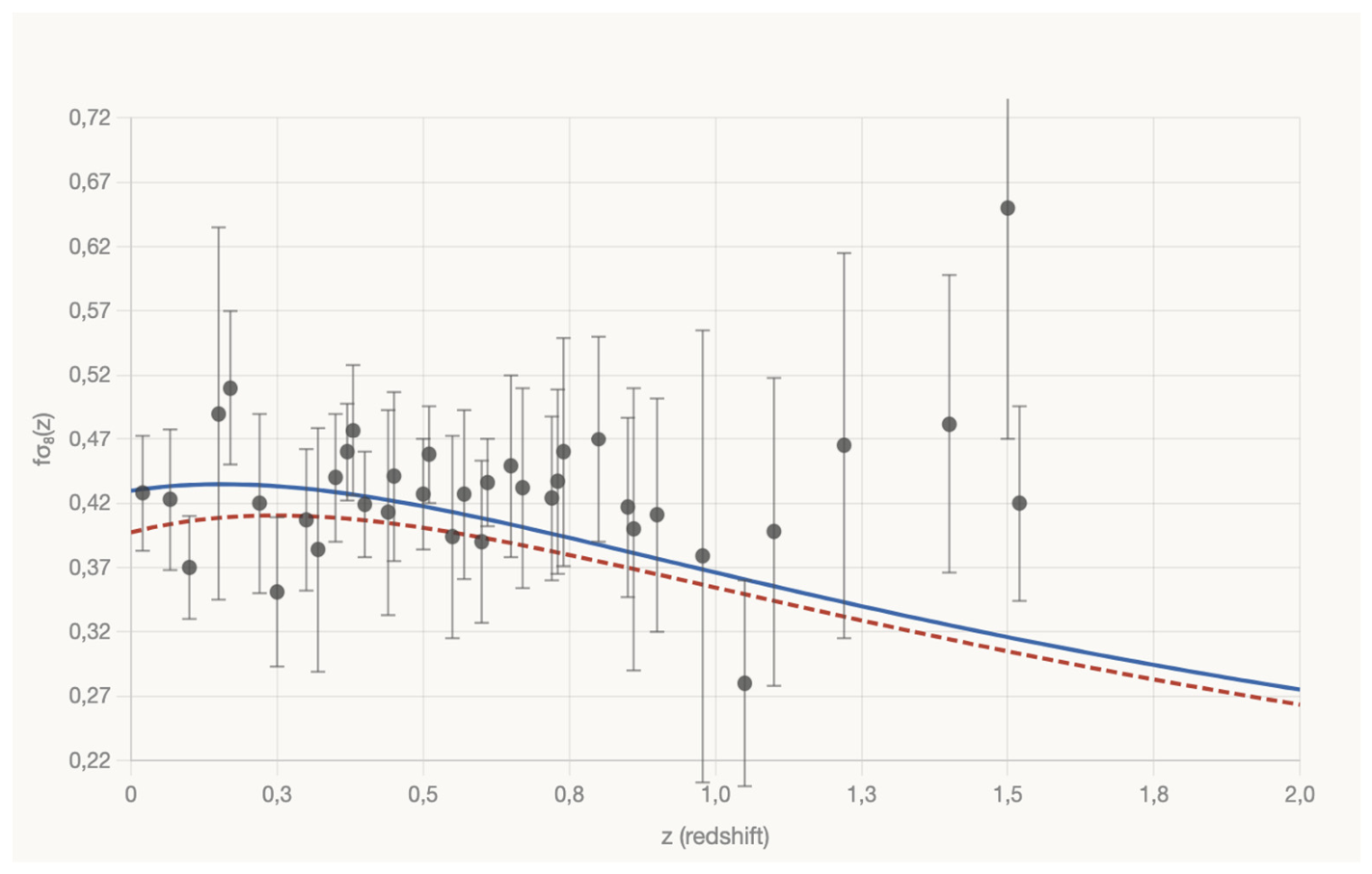
Figure 2.
Background expansion, growth, and fossilization in the Dead Universe Theory (DUT). Top-left: Hubble parameter H(z) for the DUT solution (blue solid line) and standard ΛCDM (red dashed line). While both reproduce low-redshift behaviour, DUT allows distinct effective values of H₀ within a single entropic-retraction framework. Top-right: Effective equation-of-state parameter w_eff(z) for DUT in the vicinity of the present epoch, showing that w_eff → −1 at late times without approaching a de Sitter attractor. Bottom-left: Linear growth observable fσ₈(z). The blue curve shows the DUT prediction, the red dashed line the corresponding ΛCDM value, and the orange points with error bars the DESI 2024 + KiDS measurements. DUT exhibits a suppressed growth amplitude at z<1, consistent with observational trends, whereas ΛCDM tends to predict higher values. Bottom-right: Fossilization of the cosmic expansion: evolution of H(N) as a function of the e-folding number N = ln(a) (with N=0 today). The DUT solution drives H(t) towards zero in the far future, yielding a thermodynamically “dead” universe.
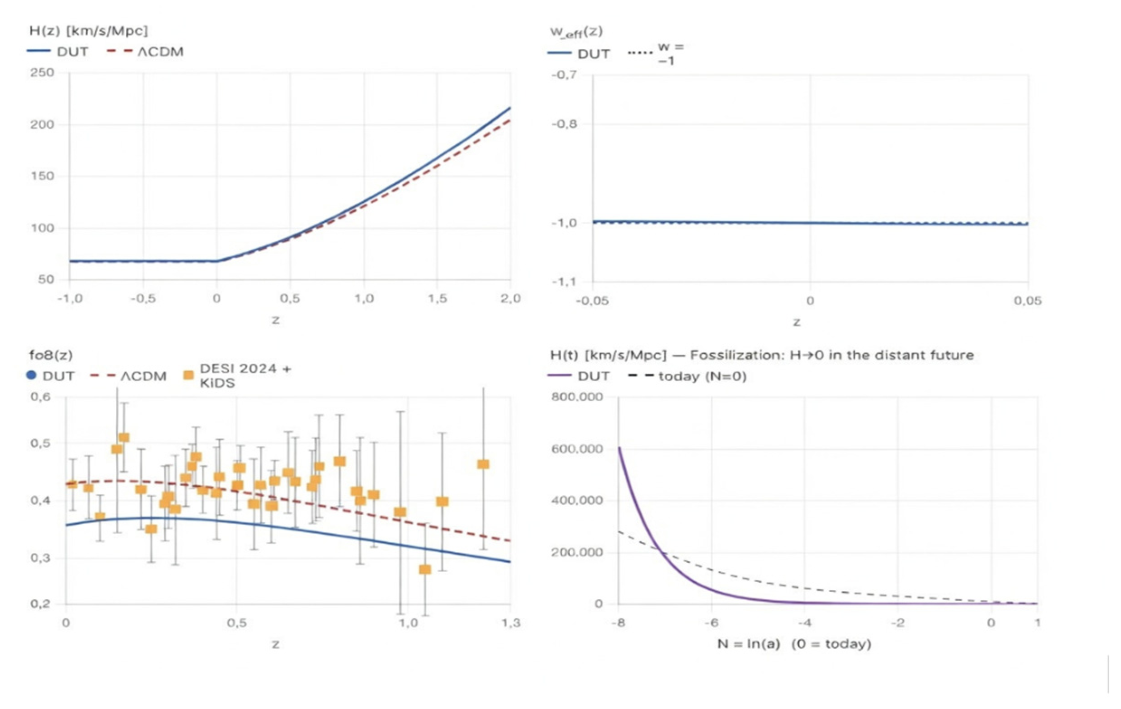
Disclaimer/Publisher’s Note: The statements, opinions and data contained in all publications are solely those of the individual author(s) and contributor(s) and not of MDPI and/or the editor(s). MDPI and/or the editor(s) disclaim responsibility for any injury to people or property resulting from any ideas, methods, instructions or products referred to in the content. |
© 2026 by the authors. Licensee MDPI, Basel, Switzerland. This article is an open access article distributed under the terms and conditions of the Creative Commons Attribution (CC BY) license (http://creativecommons.org/licenses/by/4.0/).
Copyright: This open access article is published under a Creative Commons CC BY 4.0 license, which permit the free download, distribution, and reuse, provided that the author and preprint are cited in any reuse.