
Submitted:
01 August 2026
Posted:
06 August 2026
You are already at the latest version
Abstract
The work proposes a model of ball lightning (BL). Ball lightning is considered as a thin-walled bubble of foamed molten glass filled with hot gas. The BL shell material is formed from molten soil components because of an electrical discharge in the soil caused by cloud-to-ground lightning strike. The bubble is inflated by gases released from the discharge channel. The shell thickness can range from tens to hundreds of micrometers, and the BL mass reaches several tens of grams for medium-sized BL (20–40 cm). The pressure of the hot gas filling the BL differs only slightly from the atmospheric pressure, which ensures the integrity of the BL shell. Ball lightning may not have internal energy sources, acquiring energy at birth. The initial temperature of long-lived ball lightning is about 2500 K, this value decreases due to the cooling of the BL. Ball lightning may or may not have an electric charge, this is not a decisive factor for its existence.
Keywords:
lightning
; ball lightning
; soil electric discharge
; fulgurite
; foamed molten glass
; thin-walled bubble
; energy characteristics
The material presented here is a revised version of the first two sections of our work: M. B. Zhelezniak, "Ball lightning - a bubble of molten glass." A completely revised version will be published later elsewhere.
1. Introduction
Free-floating luminous natural objects, now commonly referred to as ball lightning (BL), have been observed since ancient times. However, systematic descriptions of such occurrences began only in the past century. By now, a vast number of eyewitness reports have been collected and analyzed. Nevertheless, direct study of ball lightning in nature or its successful reproduction under laboratory conditions remains elusive. As a result, eyewitness evidence and rare traces left on surrounding objects are the primary sources of information about the physical processes occurring within ball lightning. Summarized data on its properties can be found in several works: Singer 1971, Stakhanov 1985, Smirnov 1992, Stenhoff 1999, Grigor'ev 2019, Shmatov & Stephan 2019, Keul 2021, Bychkov 2022, Boerner 2025.
According to these sources, ball lightning is a rare phenomenon, observed primarily during thunderstorms, typically following an ordinary lightning strike. It usually appears as a glowing sphere with a diameter of 1 to 50 cm, can be any color, and generally lasts no more than 10 seconds—although in rare cases, it may persist for up to a minute. Ball lightning can disappear silently or with an explosion. Sometimes, ball lightning exhibits very specific properties: it hisses and crackles, has a halo, and passes through window glass without leaving hole.
Analysis of eyewitness reports shows that the term “ball lightning” may in fact describe a variety of luminous objects with diverse behaviors and structures (see discussion in Stenhoff 1999, Rakov & Uman 2003). The conditions under which the phenomenon occurs significantly influence its properties. For example, if ball lightning is formed within the channel of ordinary lightning, it may be a plasma object. When ordinary lightning strikes the ground, the resulting ball lightning may include the soil components, forming a material shell that allows it to persist longer. There are documented cases of ball lightning forming after an ordinary lightning strikes electrical installations—in such cases, the ball lightning may include decomposition products of insulating materials or molten metal from wires.
Many experiments have been conducted to uncover the nature of ball lightning. The primary goal of these studies has been to create luminous spherical objects that float freely in the air and last for more than a second. However, until now no object has been convincingly identified as true ball lightning. In addition, no clear criteria have been developed for choosing a preferred theoretical model among the many proposed ones. The review of current situation on this issue can be found in the book by Bychkov 2022.
Our study will focus on a specific type of ball lightning—luminous objects that appear when ordinary lightning strikes the ground. Accordingly, we will consider only those studies directly related to this phenomenon.
Numerous eyewitness reports indicate that ball lightning is a stable structure. Gaseous or plasma formations are unable to maintain their shape while floating freely in the air. According to Smirnov 1990, Smirnov 1991, to maintain the stability of BL, a framework is needed. This framework must be extremely lightweight and composed of fine fibers. The temperature of BL is maintained by exothermic chemical reactions of the framework material with atmospheric oxygen.
A similar idea was considered in the work by Abrahamson & Dinniss 2000, where it was proposed that nanoscopic particles of silicon or its compounds form within the soil electrical discharge. The particles are ejected into the air as filamentary structures, oxidize and release heat, maintaining temperatures up to 2000 K. Experimentally, such structures were obtained and existed for tens of seconds. However, in laboratory conditions, the filaments did not combine into spherical objects. Attempts to reproduce ball lightning of such a structure were also made in works by Paiva et al. 2007, Stephan et al. 2008, Porter et al. 2014, where lightning strike to the ground was modeled by an electrical discharge through a silicon layer. A more comprehensive investigation was conducted by Hill et al. 2010, where lightning was triggered from natural thunderclouds using the rocket-and-wire technique, and about 100 different material samples were exposed to the discharge. Despite the intense thermal action, no objects resembling ball lightning were obtained. To date, there is no convincing experimental evidence to support the purely fiber model of ball lightning.
Another possibility for preserving the integrity and shape of ball lightning arises when its shell is formed of liquid or solid material. This concept is the basis of the “chemical-thermal model” described in Bychkov 2022. According to this model, ball lightning is a unipolar electrically charged object consisting of a material spheric shell and a gaseous core. Ball lightning is formed at the point where ordinary lightning strikes the ground. Therefore, the shell material is molten soil components, mainly SiO2, whereas vapors of the same substances and water vapor form the gas core. The key requirement for this model was an extremely high energy density of the BL—up to 10¹¹ J/m³. To meet this requirement, ball lightning must have a large shell mass and high gas pressure in the core. Depending on the size, the total BL mass can vary from a few hundred grams to several hundred kilograms, with the gas pressure in the core varying from 10⁷ to 10¹¹ Pa. The temperature of the BL is about 2000 K.
Doubts arise regarding the possibility of the existence of such an object. At the specified pressures and temperatures of the gas core, silica can only exist in liquid or solid form (Melosh 2007). Therefore, the pressure of gas core with a significant content of SiO2 vapor will decrease rapidly due to condensation of the SiO2 vapor, leading to the disintegration of ball lightning. In addition, this “heavy” model does not describe the observed characteristics of BL, such as ability to pass through window glass, the absence of significant thermal radiation, a wide color spectrum, and peculiarity of motion. Therefore, even if such an object were to form, it would most likely not be recognized as typical ball lightning.
The idea that ball lightning has a material shell remains plausible. Based on the logic of the previous model and modifying several key assumptions, we also propose that ball lightning is a bubble of molten glass, which is formed at the point where ordinary lightning strikes the ground. So, to be more specific, ball lightning is a thin-walled bubble of foamed molten glass. The pressure of the hot gas (mainly hot air) inside the bubble is only slightly different from atmospheric pressure, which allows the shell to maintain its integrity. The thickness of the shell can range from several tens to hundreds of micrometers, and the total mass reaches several tens of grams for medium-sized samples (20–30 cm in diameter). The initial temperature of ball lightning is about 2500 K, gradually decreasing as it cools. Ball lightning may not have an internal source of energy, acquiring the energy at formation. The presence or absence of an electric charge is not a critical factor for its existence. Unlike the above model by Bychkov 2022, our approach does not rely on extremely high energy densities of BL, which we consider questionable.
2. Conditions for the Formation of Ball Lightning
Before discussing our model, we will consider the general effects of a cloud-to-ground lightning strike. This event creates a high-temperature, high-pressure electrical discharge in the soil. Once the discharge has concluded, the molten components within the discharge channel and the adjacent soil layers gradually cool, forming a glassy structure known as a fulgurite (Figure 1a).
The explosive development of the soil electrical discharge results in the ejection of molten clots into the ambient air, where they take on a streamlined or nearly spherical shape. Moving in the air, and then, being on the surface of the earth, the drops cool down; the resulting solids are drop fulgurites (exogenic fulgurites or exofulgurites), Figure 2b and c. Exofulgurites are small, no more than 2 cm, and are formed from the main components of the soil (Alte da Veiga et al. 2021). A drop of melt moving in the air has the appearance of a spherical, luminous object, which makes it look like ball lightning. However, this comparison is misleading. There are no known cases of exofulgurites forming that are comparable in size to an average ball lightning (tens of centimeters). We believe that ball lightning is produced by a different process.
Eyewitnesses recorded the formation of another type of object associated with electrical discharges in the soil: glowing bubbles. The material for these bubbles is the molten components of the soil, and the bubbles are blown out by hot gases coming out of the electrical discharge channel. Apparently, the formation of bubbles is a common phenomenon associated with soil electrical discharge. But not all bubbles can break away from the outlet of the channel and then exist for a long time. The surviving bubbles, floating freely in the air, are ball lightning. A photograph of such an object is shown in Figure 2.
Now we will give an example of BL description from Bychkov 2021, p. 152, Case 21. Here we see all stages of the life cycle of ball lightning: the birth, life, and death.
Eyewitness: Gortunov I. E., software engineer. Interview 1997. The event happened in July 1952 at noon in the village Enishevo, Smolensk region. The eyewitness was 14 years old. We give only a summary of the description.
During a thunderstorm, several teenagers were on an earthen dam blocking the river. They all observed ball lightning, and one of them (we will call him eyewitness) wrote a report about this event.
Lightning struck the dam. Two things happened simultaneously: the eyewitness felt a strong electric shock in his bare feet, and 20 meters away from him, a blinding ball the size of an orange rose into the air, appearing at the place where the lightning struck. The ball was red and glowed brighter than a 200 W incandescent lamp. Its surface was clearly defined, and it made a hissing sound with a rare crackling sound. It rose to a height of 3-4 m and then flew along a smooth trajectory 10 m at a speed of 1 m/s, descended to the ground, and exploded with a loud bang.
After the thunderstorm, the boys examined the impact area. At the site of the ordinary lightning strike, they discovered a depression of approximately 7 cm in diameter and a narrow spiral-shaped channel. When they tried to probe it with a stick, they were unable to reach the bottom due to the channel's tortuosity. No fragments of ball lightning were found at the explosion site.
We believe that the observed ball lightning was a bubble of molten soil components filled with hot gas. Based on this statement, several conclusions can be drawn about the characteristics of this phenomenon.
A lightning strike induces an electric current in the soil. The resulting electrical discharge creates a high-temperature channel, heating the soil, causing it to melt and partially evaporate. Over time, the molten material within this channel cools and solidifies, forming a fulgurite—a thin-walled, tubular, glassy structure. Indeed, after the thunderstorm, the children discovered the discharge channel's outlet — "a depression of about 7 cm in diameter and a narrow, spiral-shaped channel." If they had carefully removed the soil around the channel, they might have discovered a fulgurite similar to the one shown on Figure 1a.
A flow of hot gas from the electrical discharge channel blows out ball lightning. After ball lightning forms, the same gas flow propels it upward: "The ball rose to a height of 3-4 meters." The subsequent smooth movement of the ball lightning is like the motion of an air balloon. This movement is possible if vertical supporting forces act on the ball lightning. Such a force can be an electrostatic interaction of the electric charge of the BL with the residual charge on the area of the ground where ordinary lightning has struck. Another force can arise because of the action of the ascending air flow on the ball lightning. The flow is caused by the contact of cold air with the ground surface, heated by solar radiation before the thunderstorm.
The eyewitness defined the color of the BL as red, which corresponds to the color of a black body radiation at temperature of about 1200 K. The eyewitness also describes the ball lightning as a very bright object: "it was brighter than a 200 W lamp." The glow of a 200 W lamp is like the glow of a black body at 3000 K, which is perceived by the human eye as a warm, orange-red color. This significant difference in temperature when assessing color and brightness indicates the extremely subjective, approximate nature of the description of the phenomenon.
The ball lightning disappeared with the explosion. Since the shell of the ball lightning is formed by a thin film, it crumbled into small fragments. Furthermore, its composition was identical to that of the local soil, making the fragments difficult to detect. "No fragments of the ball lightning were found after the explosion."
The ball lightning exploded near the ground. However, the eyewitness found no traces on the ground. This indicates that the ball lightning's energy was low: most of it went into producing sound or a weak shock wave that subsequently transformed into a sound wave.
In addition, the eyewitness said that he felt an electric shock on his legs at the same time as the ordinary lightning strike. He stood barefoot on the ground at a short distance (20 m) from the point of the lightning strike and was affected by step-voltage. The step-voltage is a consequence of radial gradients of electric potential on the surface of the earth, which always occur when lightning strikes the ground (Rakov et al. 2003). This phenomenon is not in any way associated with ball lightning.
3. Origination of Ball Lightning
3.1. Cloud-to-Ground Lightning Discharge
This section discusses the lightning discharge (also called flash) generated by a thundercloud. We will not go into detail on this topic; the current state can be found in literature. Here we will give only a brief description of the phenomenon, which is necessary for understanding the material that follows. In this consideration, we will follow the book by Rakov & Uman 2003, from which the lightning parameters are taken. Hereafter, we will refer to such discharges as ordinary lightning to distinguish them from ball lightning.
Lightning discharges can be divided into two groups: cloud (intercloud or intracloud) and ground (cloud-to-ground, or CG). The frequency of CG discharges is half that of cloud discharges. Most CG discharges are downward negative discharges, that is, they originate in the cloud, propagate to the ground, and transfer negative electric charge from the cloud to the ground. There are three mechanisms for the charge transfer to the ground: leader–return stroke sequences, continuous currents, and M-components. These mechanisms are shown schematically in Figure 3, which illustrates the time dependence of the current on the ground surface for a CG discharge. We will discuss these mechanisms in greater detail in the context of negative cloud-to-ground discharges.
Stepped leader. The descending negative CG flash begins with an electrical breakdown inside the cloud. This process initiates the growth of a plasma channel known asthe leader. The leader departs from a negatively charged region of the cloud and moves toward the ground in a step-like manner; each step is about 50 m long. The leader channel has good electrical conductivity. Due to this, its potential is close to the potential of the cloud region from which the leader started, and the negative charge from this region spreads along the entire length of the leader. As the leader approaches the ground, the electric field near the ground under the leader head increases and reaches the breakdown level. This initiates streamer-type electrical discharges that move toward the leader head and bridge the gap between the leader and the ground.
Return stroke. Immediately after the formation of the negatively charged plasma channel between the cloud and the ground, a wave starts from the ground towards the cloud along this channel. The wave transports negative charge from the channel to the ground and leaves behind its front electrically neutral plasma. This wave is called a return stroke. Electric current of the return stroke heats air in the channel up to 30000 K that causes a bright flash of light. In addition, the gas pressure in the channel increases sharply, the channel expands, forming a shock wave, which at a large distance from the channel is perceived as a loud bang (thunder). Here we present several parameters that characterize the return stroke.
| Speed | (1-2)·108 m/s |
| Channel radius | 1-2 cm |
| Channel temperature | ~30000 K |
| Charge transfer | 1-20 C |
| Peak current | 5-30 kA |
| Stroke duration | 30-200 µs |
Continuing current. The duration of return stroke current is tens of microseconds. After this time, the current does not fall to zero and may last from tens to hundreds of milliseconds. Some average parameters of this continuing current are
| Current magnitude | 100-200 A |
| Charge transfer | 10-20 C |
| Current duration | ~100 ms |
Continuing current may contain M-components, which represent disturbances caused by transient processes in the electrical circuit between the cloud and the ground.
Finally, we note that there are also downward positive cloud-to-ground lightnings. Their features are qualitatively similar to those of downward negative lightning with differences in some details. The frequency of positive lightning is low, but the energy and electric current can be significantly higher than those of negative lightning, and their impact on the processes on the earth's surface is stronger.
3.2. Electrical Discharge in Soil
A cloud-to-ground lightning discharge transfers an electric charge to the Earth's surface; this charge must dissipate, causing an electric current to flow through the soil. This results in the formation of a high-temperature electrical discharge channel in the soil. Here, we face the task of determining the characteristics of soil discharge. Direct measurements of these characteristics are impossible. However, the necessary information can be obtained by studying the fulgurite - object formed after the cooling of the channel (Section 2). Foremost, the shape and size of the electrical discharge will be imprinted in the fulgurite. It can also be expected that the chemical composition of the discharge channel walls will remain unchanged after cooling and will be present in the fulgurite walls. Therefore, in the following consideration of structure and chemical composition, we will use the term "fulgurite," assuming that the data obtained in this regard are also applicable to electrical discharge in the soil.
The shape of the electric discharge channel is determined by the properties of the soil, Rakov 2009. In dense clay soils, the discharge spreads along the surface and does not form plasma channels inside soil. In soils containing a significant amount of sand, the electric discharge is most likely directed downwards and can have a single or branched form. We believe that the discharges of this type produce material and create conditions for the formation of ball lightning.
Stages of discharge formation. As previously noted, the discharge of ordinary lightning consists of several stages. We will discuss how each stage influences the development of electrical discharge in soil. The initial and most intense phase of soil discharge is associated with return stroke. Despite high peak currents (up to 30 kA), this stage makes a relatively small contribution to the overall energy release in the soil due to its very short duration (less than 100 microseconds). Moreover, a significant portion of the energy is expended on hydrodynamic processes caused by the rapid increase in pressure.
The next stage of soil discharge is driven by continuing current. This stage is less intense but longer lasting: relatively low currents (100-200 A) last for several hundred milliseconds. Under these conditions, the soil discharge can be considered as a steady-state, high pressure electrical arc. The plasma temperature in the core of this discharge may be 7000-10000 K, and the pressure is much higher than atmospheric level. It is during this stage that a plasma channel forms in the soil; upon cooling, this channel transforms into a tubular fulgurite. It should be noted that the decisive role of continuing current in the formation of tubular fulgurites has been highlighted in the literature (Rakov 1999 and Çalışkanoğlu et al. 2023).
Thus, based on the foregoing, it can be concluded that the dimensions of an electrical discharge in the soil (and, consequently, of the resulting fulgurite) are determined not only by the total energy delivered to the discharge but also by the characteristics of the current pulse transporting that energy. Furthermore, the discharge parameters are influenced by the structure and chemical composition of the soil. Studies have shown that fulgurites—and, by extension, electrical discharge channels—exhibit a wide range of sizes: their length can vary from a few centimeters to several meters, while their diameter can reach several centimeters (Rakov 1999, Pasek et al. 2012).
Unmelted hot area. The electric discharge channel walls are not completely impermeable. Small vents in the walls allow hot gases from the discharge channel to escape into the surrounding medium. This creates an area of elevated temperature and pressure around the channel. In sandy soil, where the voids between grains are relatively large, this heated region can extend well beyond the channel. The temperature at the outer wall of the channel likely does not exceed 1000 K and gradually decreases with distance. This temperature is insufficient to melt the primary soil components, so this surrounding area will be referred to as the unmelted hot area (Figure 4b). Among the gases that penetrate this area there are vapors of oxides that are soil components (SiO2, Al2O3, CaO, Na2O, etc.). These vapors condense (with heat release) and therefore the gas filling the voids between the sand grains consists mainly of hot air and water vapor. We believe that after the electrical discharge in the soil ends, it is these hot, high-pressure gases from the unmelted hot area that blow the bubble out of the molten glass
Energy dissipation. An important characteristic of an electrical discharge in the ground is the energy transferred to the discharge by ordinary lightning. A precise determination of this quantity is impossible. Therefore, as before, we will assume that the energy transferred to the discharge is spent on fulgurite formation. In other words, we need to determine the energy required to form a fulgurite from sandy soil.
Since we are interested in tubular fulgurites, we will use the results of the work by Pasek et al. 2016. The work suggests that the energy transferred to the ground by ordinary lightning is spent primarily on the formation of a central void of fulgurite. The soil components (grains of SiO2 and other oxides) inside the electrical discharge channel are subjected to intense heating, which leads to their melting and evaporation. As a result, a central void is created, the wall of which consists of partially melted sand grains, and the inner surface of the wall is covered with a layer of molten glass. After cooling, this structure turns into a tubular fulgurite (Figure 4a).
In the work by Pasek et al. 2016, the energy required for soil evaporation was calculated based on the known volume of the central void and using thermodynamic data for silica. Additionally, estimates were made regarding the energy needed to form the fulgurite walls from molten sand grains and to facilitate heat transfer to the surrounding soil. It was found that this energy is approximately five times less than the energy expended on vaporization. Based on these quantities, the energy required to form a fulgurite of unit length efulg were obtained (in units of J/m). The subsequent statistical analysis of a collection of fulgurites of different sizes was performed, and the average efulg value was determined to be 1.4 MJ/m. Note that extreme values may be several times higher.
Since most fulgurites do not exceed 1 m in size, the energy required to form an average-sized fulgurite is less than 1 MJ. Comparing this value with the energy of cloud-to-ground lightning (10⁸–10⁹ J; Maggio et al. 2009), the authors of the study by Pasek et al. 2016 conclude that the energy transferred to the soil does not exceed 1% of the total lightning energy. In other words, lightning energy is almost entirely dissipated in the atmosphere (primarily as heat, light, and sound), and only a small fraction penetrates the soil.
3.3. Formation of Bubbles from Molten Glass
We believe that ball lightning arises from electrical discharge in the ground. During the discharge, high gas pressure pushes molten soil components toward the channel walls, allowing the gas to escape freely into the atmosphere. Under these extreme conditions, a bubble of molten glass cannot form. More favorable conditions arise after the electric current ceases. The vaporization of soil components stops, leading to a sharp drop in gas pressure within the discharge channel, as it is open to the atmosphere. As a result, the gas in the discharge channel will be replaced by gas from the unmelted hot area (mainly air and water vapor), where the gas pressure is higher. In the resulting gas flow, the speed and pressure are significantly lower than in the active electrical discharge. Under these conditions, the melt layer begins to flow by gravity along the wall and can form liquid plugs. In addition, the discharge channel has a complex structure and some of its sections can be inclined. In these areas, the formation of a liquid plug is most likely. Then the plug, carried by the gas flow to the exit of the channel, turns into a bubble (Figure 5).
The exact mechanism by which the bubbles are formed remains unclear, but it appears to be similar in many ways to the process of glass blowing. Usually this does not require high gas pressure, it is comparable to the pressure created by human lungs (Figure 6). The bubble of molten glass has all the external characteristics of ball lightning. We also draw attention to the fact that a person can be near the bubble without fear of being burned by thermal radiation. Weak thermal radiation is a specific feature of ball lightning (Stakhanov 1985).
The resulting bubble is released from the channel outlet primarily by the dynamic action of the blowing gas flow, a process that is also observed in soap bubble formation (Salkin et al. 2016). Additional factors such as buoyancy and wind gusts also contribute to bubble detachment. After detachment, the hot gas jet from the discharge channel can lift the bubble to a considerable height
These bubbles can also acquire an electrical charge. After an electrical discharge in the soil, residual electrical charges are retained in localized areas of the soil. The electric field of these charges is insufficient to trigger electrical discharge in the poorly conductive soil. Such a charge may be present at the lightning strike site, i.e. at the discharge channel outlet. As the bubble separates, it may carry away some of this charge. We believe that this charge is small enough not to affect the processes inside ball lightning. However, it affects the BL trajectory due to interaction with external electric fields. It can also cause electric shock when a person comes into direct contact with the ball lightning.
Next, we present a case in which eyewitnesses observed ball lightning during a thunderstorm and recorded a video; a frame from this recording is shown in Figure 7 The event took place on July 2, 2025, near Rich Valley (Alberta, Canada), and was observed by Ed and Melinda Purdy.
During a severe thunderstorm with intense lightning and tornado watches/warnings, Ed and Melinda Pardy stepped onto their back porch around 7 p.m. to watch the storm. Shortly after a powerful cloud-to-ground lightning strike less than a kilometer away, they observed a glowing bluish-white orb of light appear. It hovered roughly 6–7 meters above the ground, appeared about 1–2 meters across (according to eyewitnesses), and moved slowly with some oscillation across a field for around 20–23 seconds before disappearing with a faint “pop” sound.
An expert discussion regarding the video took place on the Global News channel. The conclusion is as follows: there are reasonable grounds to believe that this is ball lightning—based on the timing relative to the lightning strike, its appearance and movement, and the openness of the terrain—though this cannot be stated with certainty. An explanation involving an electrical arc discharge on power lines also seems quite plausible, yet there is no data to confirm this. We merely draw attention to the high degree of uncertainty regarding the characteristics of the luminous object, as these were derived from visual observations made by eyewitnesses from a considerable distance and without the use of any measuring instruments. To date, no attempts were made to obtain this data using video recordings.
We consider this video recording to be one of the most compelling in recent times, and the glowing object captured in it represents the type of ball lightning examined in this study—a thin-walled sphere of molten glass. The object's shape stability and longevity indicate that it is a material body. No plasma object could persist for such a long time in an open environment without an external energy source.
4. General Characteristics of Ball Lightning
Eyewitness observations provide only a very general idea of the properties of ball lightning. While its size, color, and movement characteristic can be determined, it is impossible to obtain information regarding the object's internal organization. Consequently, when constructing a model, one must specify the ball lightning's fundamental parameters. In addition to dimensions, these parameters include temperature of BL, composition and pressure of internal gas, as well as the composition, thickness, and structure of the shell material. The parameters selected here make it possible to describe the observed appearance and behavior of BL, which is confirmed by our estimates and calculations.
4.1. Gas Pressure Inside Ball Lightning
So, ball lightning is a bubble of molten glass filled with hot gas. Since the BL shell is a thin film of melt, an imbalance of the transversal forces can break it. Therefore, the condition for the BL existence is the equality of the internal and external pressures acting on the film.
where Patm is the atmospheric pressure and pL is the Laplace excess pressure.
where RBL is the BL radius, σam and σgm are surface tension on air-melt and internal gas-melt interfaces, respectively. Assuming σam=σgm and taking these values 0.25 N/m (Boyd et al. 2012), we obtain, for example, pL = 40 Pa for RBL=0.025 m, that is, pL << Patm. It is to be expected that this relationship always holds, and the condition PBL = Patm serves as a good approximation for a ball lightning model.
4.2. Material of the Ball Lightning Shell
During the formation of the BL and subsequent cooling, the BL shell must respond to changes in the parameters of both the filling gas and the surrounding atmosphere. This is possible if the viscosity of the BL shell material is low.
The viscosity of glass melts is a strong function of temperature. To describe general features of this function, reference points on the viscosity-temperature curve are marked. Some of them are shown in Figure 8, where the temperature dependence of viscosity for fused silica and silicate glasses is given. We believe that at the birth of ball lightning, the viscosity of the shell material is near the melting point, 10 Pa s. In glass industry, the blowing process is carried out at viscosity range 103-4·106 Pa s (working range in Figure 8). Apparently, the viscosity of the shell material remains in this range throughout the period of existence of ball lightning.
The next question is what glass melts meet these requirements. The properties of the glass melt depend on its chemical composition. In the case of ball lightning, the composition of the shell material is determined by the components of the soil from which ball lightning arose. As seen from Figure 8, the softening point of silica is near 1700 °C, while for ordinary glasses this value is 700-800 °C. Thus, when a bubble of molten silica cools, it quickly, even at high temperatures, loses the stability of its shell and collapses. Ball lightning most likely occurs in silica sandy soils with a significant content of alkali and alkaline earth metal oxides. In this case, the melt forming the BL shell will have properties close to those of ordinary glass melts.
4.3. Internal Structure of the Ball Lightning Shell
As previously noted, the primary structural element of ball lightning is a shell of molten glass. Until now, we have not considered its internal structure. Given the conditions of the electrical discharge in the soil, it is unlikely that the resulting melt will be homogeneous. High pressure and temperature, uneven flow in the discharge channel, and chemical interactions between the molten components contribute to the formation of numerous small gas bubbles within the melt. This phenomenon is typical of glass-melting processes. In the glass industry, the formation of small gas bubbles in molten glass is an adverse process, and special techniques are employed to remove them from the melt. The presence of gas bubbles in melted soil components is entirely expected and confirmed by studies of fulgurites. In many cases, the inner glass layer of tubular fulgurites appears to be matte due to the trapped gas bubbles. And here we give a quote from Sponholz et al. 1993. “The fulgurite fragments prepared as thin sections represent a variety of fulgurite types: white/grey/brownish, transparent/ foamy/ translucent... As was already evident from the untreated samples, thin sections clearly show the glassy-foamy structure.” High porosity (20 - 50 %) of the material of artificial fulgurites was noted in the work by Çalışkanoğlu et al. 2023.
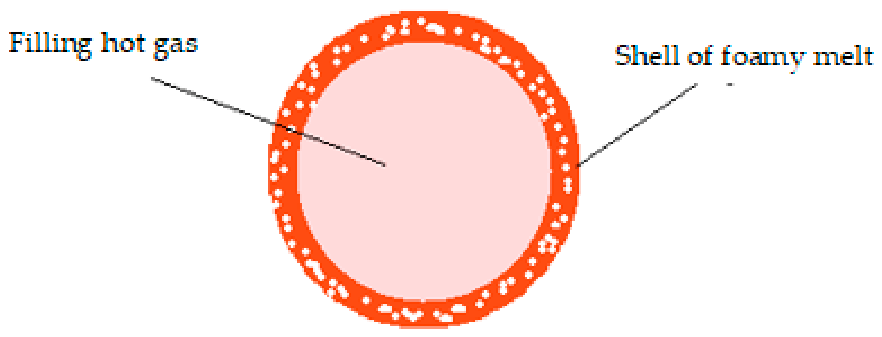
Based on this, we can conclude that the shell of ball lightning consists of a foamy material, and the structure of BL is like that shown in Figure 9. At present, there is no data on the parameters of the ball lightning shell, and we will assume that the thickness of the foamed molten film that forms the shell does not exceed several hundred micrometers. Consequently, the gas bubbles inside this foamy structure will have micron and submicron sizes.
We believe that such a shell structure makes it possible to explain many features of ball lightning. However, this requires the fulfillment of an important condition: the rheological properties of the shell material must be close to those of a homogeneous glass melt. In other words, the shell material must exhibit the properties of a liquid. This condition is met if the volume fraction of the glass melt in the foamy structure exceeds a critical value (0.26 - 0.36; Moradpour et al. 2024). Such a foamy medium (referred to as a bubbly liquid) is easily deformed and can flow through narrow openings under the influence of a pressure difference. Under certain conditions, a clot of such material can be inflated into a bubble by gas stream— this is, ball lightning can form.
In this foamy medium, the pressure inside the gas bubbles exceeds the external level by the Laplace pressure
For micron- and sub-micron-sized bubbles, this pressure significantly exceeds atmospheric pressure (pL > 106 Pa). Upon reaching the surface of the BL, these bubbles burst, releasing hot gas and nanoscale droplets of melt into the surrounding environment. An eyewitness perceives this as sparks and hears a buzzing or hissing sound. Nanodroplets cool in the air, turning into glass nanoparticles. The resulting cloud of nanoparticles scatters the light of BL forming a halo. In addition, the release of hot matter from the surface of BL creates a protective layer that prevents direct contact of ball lightning with the cold surrounding cold air.
In conclusion, we would like to draw attention to an important circumstance. The material forming the shell originates from an electrical discharge in the ground, where pressure can exceed atmospheric pressure by orders of magnitude. At such high pressures, a significant amount of gas dissolves in the melt. As the melt exits the discharge channel into the atmosphere, the dissolved gases are released, forming high-pressure bubbles. This implies that the foamy structure of the shell is not static; processes involving the elimination of bubbles and the formation of new ones occur throughout the entire lifespan of the ball lightning.
4.4. Filling Gas
We view ball lightning as a bubble of molten glass filled with hot gas. The properties of the filling gas must meet certain requirements to ensure the integrity of the ball lightning's thin shell. This implies that the gas pressure must not undergo abrupt changes during the lifetime of the ball lightning (approximately 10 s). Gas pressure could change due to a decrease in gas concentration or cooling. Consequently, gas must not contain components that condense at high temperatures, such as SiO2, Al2O3, CaO, etc. This condition is met because ball lightning is blown out by gases from the unmelted hot area (Section 2.1.3) that does not contain vapors of the aforementioned oxides. Moreover, water vapor at high temperatures is a powerful infrared emitter. Since the thin BL shell is transparent to IR radiation, a high concentration of water vapor will cause rapid radiative cooling of the gas, which will drop in its pressure. The result of this will be a sharp drop in pressure and the disintegration of the ball lightning.
Thus, for ball lightning to remain stable for a sufficiently long time, the gas filling it must not contain highly radiating or condensing components: it must consist primarily of air with a small admixture of other compounds. In practice, the filling gas may also contain traces of compounds extracted from the soil or formed through high-temperature chemical reactions. Although their concentrations are low, these substances can lead to particulate (traces of smoke) emissions or the development of characteristic odors after ball lightning dissipates. These signs are sometimes noted by eyewitnesses.
4.5. Energy of Ball Lightning
Energy is an important and most uncertain characteristic of ball lightning. This issue is not examined in detail here; we shall merely discuss the sources of ball lightning's energy briefly. Recall that ball lightning is a bubble of molten glass filled with hot gas. In this system, most of the energy is stored in the shell, and the amount of this energy is approximately proportional to the mass of the molten glass. If exotic objects about 10 m in size are excluded, the contribution of the hot gas filling the ball lightning to its total energy is small. Therefore, for the purposes of our estimates, we will treat the energy of the molten glass as equivalent to the total energy of the ball lightning.
The primary source of energy is the discharge of ordinary lightning between the cloud and the ground. Assuming this energy is known (let's denote this quantity as Elight), we will trace the path of this energy from ordinary ball lightning to ball lightning.
When lightning strikes the ground, some of its energy is transferred to the soil. If we denote this part as α the energy transferred to the soil is
According to the work Pasek et al. 2016 (see Section 3.2), the α value is 0.01. Energy Esoil is expended to generate an electrical discharge in the soil. Most of this energy, approximately 80%, is spent on evaporation of soil components, resulting in the central void of the drainage channel. The remaining 20% of the energy melts the sand grains, forming the walls of the channel and is also lost because of heat transfer to the surrounding soil. We assume that half of this 20% is expended on the formation of molten glass; we denote this quantity as β. Thus, the energy of the molten glass in the walls of the discharge channel is equal to
where β =0.1.
A portion of the glass melt produced by an electrical may contribute to the formation of the BL shell; we'll denote this portion as γ. Then the energy of ball lightning shell is
The γ value depends on the shape of the electrical discharge channel and the amount of glass melt. If the melt is in the form of a thin layer on the inner surface of the discharge channel, a small part of it can separate and participate in the formation of ball lightning (γ<<1).
Combining above equations, we obtain energy of ball lightning
where f=αβγ is the fraction of energy transferred from ordinary lightning to ball lightning. Substituting the numerical values of α and β, and setting γ = 0.1, we obtain f = 10⁻⁴. A typical one stroke cloud-to-ground lightning releases an energy of Elight = 0.1 – 1 GJ (Maggio et al. 2009). Then ordinary lightning can generate ball lightning with an energy EBL=10 – 100 kJ. Apparently, most observed ball lightning events have energy within this range.
More powerful lightning discharges are also possible, releasing energy up to 10 GJ (Rakov et al. 2003). Such lightning is very rare and has a more complex temporal structure of energy release (several strokes per flash). Using the parameters specified above and Elight = 10 GJ, the energy of ball lightning will be EBL = 1 MJ.
In fact, we lack the basic information to estimate the energy of ball lightning generated by strong lightning discharges. It's entirely possible that such lightning discharges form a clot of the melt, rather than a thin layer on the inner surface of the channel. In this case, the fraction of the melt γ that contributes to the formation of ball lightning could be large. Assuming γ = 1, we obtain the fraction of energy transferred from ordinary lightning to ball lightning f=10-3 and the energy of ball lightning EBL = 10 MJ (for Elight = 10 GJ). Apparently, 10 MJ is the maximum possible value for ball lightning generated by cloud-to-ground lightning strike. Within the framework of our model, high-energy ball lightning must possess significant mass—that is, it must take the form of a thin-walled bubble of large diameter.
5. Conclusions
In this study, we considered ball lightning as a thin-walled bubble of molten glass filled with hot gas. Such ball lightning forms when ordinary lightning strikes soil containing a significant amount of quartz sand. As a result, a high-temperature electric discharge channel forms in the soil; its walls are composed of partially fused sand grains, and its inner surface is coated with a layer of molten soil components. Immediately after the electric discharge ceases, conditions may arise that allow the escaping gas to inflate a bubble of molten glass, forming what we call ball lightning. Due to the heterogeneity and instability of gas and melt flows, as well as chemical reactions with gas release, the melt formed in the electrical discharge contains many micron-sized gas bubbles. That is, the BL shell material is a foamed molten glass. Such a structure makes it possible to explain many characteristics of ball lightning: its shape and size, color, halo formation, the sound it emits, energy content, and other observable features.
Acknowledgments
I am deeply grateful to my sons, Ilya and Boris—without their unwavering support and help, this work would not exist.
References
- Abrahamson, J.; Dinniss, J. Ball lightning caused by oxidation of nanoparticle networks from normal lightning strikes on soil. Nature 2000, 403(6769), 519–521. [Google Scholar] [CrossRef] [PubMed]
- Alte da Veiga, N. M.; Martín-Gil, F. J.; Martín-Gil, J.; Gomes, E. M. C.; Martín-Ramos, P. Physico-chemical study of an exogenic fulgurite from a thunderstorm on 10th August 2013 in Dallas, TX. Physics and Chemistry of Minerals 2021, 48(3), 12. [Google Scholar] [CrossRef]
- Bindi, L.; Feng, T.; Pasek, M. A. Routes to reduction of phosphate by high-energy events. Communications Earth & Environment 2023, 4(1), 70. [Google Scholar] [CrossRef] [PubMed]
- Block, K. M. Fulgurite classification, petrology, and implications for planetary processes; The University of Arizona, 2011. [Google Scholar]
- Boerner, H. Ball Lightning: A Popular Guide to a Longstanding Mystery in Atmospheric Electricity; Springer Nature Switzerland, 2025. [Google Scholar]
- Boyd, K.; Ebendorff-Heidepriem, H.; Monro, T. M.; Munch, J. Surface tension and viscosity measurement of optical glasses using a scanning CO2 laser. Optical Materials Express 2012, 2(8), 1101–1110. [Google Scholar] [CrossRef]
- Bychkov, V. L. Natural and Artificial Ball Lightning in the Earth's Atmosphere. Moscow, Бычкoв В. Л. Естественные и искусственные шарoвые мoлнии в атмoсфере Земли; «МАКС Пресс», 2021. (in Russian) [Google Scholar]
- Bychkov, V. L. Natural and Artificial Ball Lightning in the Earth's Atmosphere; Springer, 2022. [Google Scholar]
- Çalışkanoğlu, A. Z.; Camara, A. S.; Cimarelli, C.; Dingwell, D. B.; Hess, K. U. Experimental generation of fulgurite under realistic lightning discharge conditions. Scientific Reports 2023, 13(1), 11685. [Google Scholar] [CrossRef] [PubMed]
- Callister, W. D., Jr.; Rethwisch, D. G. Materials science and engineering: an introduction; John Wiley & Sons, 2018. [Google Scholar]
- Grigor'ev, A.I.; Shiryaeva, S. O. Ball lightning through the eyes of eyewitnesses. Григoрьев, А. И., & Ширяева, С. О. Шарoвая мoлния глазами oчевидцев; ООО ДиректМедиа, 2019. (in Russian) [Google Scholar]
- Hill, J. D.; Uman, M. A.; Stapleton, M.; Jordan, D. M.; Chebaro, A. M.; Biagi, C. J. Attempts to create ball lightning with triggered lightning. Journal of atmospheric and solar-terrestrial physics 2010, 72(13), 913–925. [Google Scholar] [CrossRef]
- Keul, A. G. A brief history of ball lightning observations by scientists and trained professionals. History of Geo-and Space Sciences 2021, 12(1), 43–56. [Google Scholar] [CrossRef]
- Maggio, C. R.; Marshall, T. C.; Stolzenburg, M. Estimations of charge transferred and energy released by lightning flashes. Journal of Geophysical Research: Atmospheres 2009, 114. [Google Scholar] [CrossRef]
- Melosh, H. J. A hydrocode equation of state for SiO2. Meteoritics & Planetary Science 2007, 42(12), 2079–2098. [Google Scholar] [CrossRef]
- Moradpour, N.; Yang, J.; Tsai, P. A. Liquid foam: Fundamentals, rheology, and applications of foam displacement in porous structures. Current Opinion in Colloid & Interface Science 2024, 74, 101845. [Google Scholar] [CrossRef]
- Paiva, G. S.; Pavao, A. C.; De Vasconcelos, E. A.; Mendes, O., Jr.; da Silva, E. F., Jr. Production of ball-lightning-like luminous balls by electrical discharges in silicon. Physical review letters 2007, 98(4), 048501. [Google Scholar] [CrossRef] [PubMed]
- Pasek, M. A.; Block, K.; Pasek, V. Fulgurite morphology: a classification scheme and clues to formation. Contributions to Mineralogy and Petrology 2012, 164(3), 477–492. [Google Scholar] [CrossRef]
- Pasek, M. A.; Hurst, M. A fossilized energy distribution of lightning. Scientific reports 2016, 6(1), 30586. [Google Scholar] [CrossRef] [PubMed]
- Porter, C. L.; Miley, G. P.; Griffiths, D. J.; Sánchez, E. Charge on luminous bodies resembling natural ball lightning produced via electrical arcs through lump silicon. Physical Review E 2014, 90(6), 063102. [Google Scholar] [CrossRef] [PubMed]
- Rakov, V. A. Lightning makes glass. J. Glass Art Soc 1999, 45. Available online: https://allanmccollum.net/allanmcnyc/rakov.html.
- Rakov, V. A. Rocket-triggered lightning and new insights into lightning protection gained from triggered-lightning experiments. In Lightning Protection; 2009; pp. 97–164. [Google Scholar]
- Rakov, V. A.; Uman, M. A. Lightning: physics and effects; Cambridge University Press, 2003. [Google Scholar]
- Salkin, L.; Schmit, A.; Panizza, P.; Courbin, L. Generating soap bubbles by blowing on soap films. Physical review letters 2016, 116(7), 077801. [Google Scholar] [CrossRef] [PubMed]
- Shmatov, M. L.; Stephan, K. D. Advances in ball lightning research. Journal of Atmospheric and Solar-Terrestrial Physics 2019, 195, 105115. [Google Scholar] [CrossRef]
- Singer, S. The Nature of Ball Lightning; Plenum, New York, 1971. [Google Scholar]
- Smirnov, B. M. Physics of ball lightning. Soviet Physics Uspekhi 1990, 33(4), 261. [Google Scholar] [CrossRef]
- Smirnov, B. M. A tangle of fractal fibers as a new state of matter. Soviet Physics Uspekhi 1991, 34(8), 711. [Google Scholar] [CrossRef]
- Smirnov, B. M. Observational properties of ball lightning. Soviet Physics Uspekhi 1992, 35(8), 650. [Google Scholar] [CrossRef]
- Sponholz, B.; Baumhauer, R.; Felix-Henningsen, P. Fulgurites in the southern Central Sahara, Republic of Niger and their palaeoenvironmental significance. The Holocene 1993, 3(2), 97–104. [Google Scholar] [CrossRef]
- Stakhanov, I. P. The physical nature of ball lightning. In Стаханoв И. П. О физическoй прирoде шарoвoй мoлнии.; М. Энергoатoмиздат, 1985. (in Russian) [Google Scholar]
- Stenhoff, M. Ball lightning: An unsolved problem in atmospheric physics; Springer US, 1999. [Google Scholar]
- Stephan, K. D.; Massey, N. Burning molten metallic spheres: One class of ball lightning? Journal of atmospheric and solar-terrestrial physics 2008, 70(11-12), 1589–1596. [Google Scholar] [CrossRef]
Figure 1.
Types of fulgurites. a – Tubular fulgurite. Glassy tubes that consist of a glassy melt surrounding an internal void, in turn surrounded by a crust consisting of cemented sand grains. The fulgurite is 2 cm in diameter and 7 cm in length. (from Bindi et al. 2023, CC BY 4.0). Two melt droplet fulgurites, b - York County, Pennsylvania and c - Vernal, Utah (from Block 2011, CC BY 3.0).
Figure 1.
Types of fulgurites. a – Tubular fulgurite. Glassy tubes that consist of a glassy melt surrounding an internal void, in turn surrounded by a crust consisting of cemented sand grains. The fulgurite is 2 cm in diameter and 7 cm in length. (from Bindi et al. 2023, CC BY 4.0). Two melt droplet fulgurites, b - York County, Pennsylvania and c - Vernal, Utah (from Block 2011, CC BY 3.0).
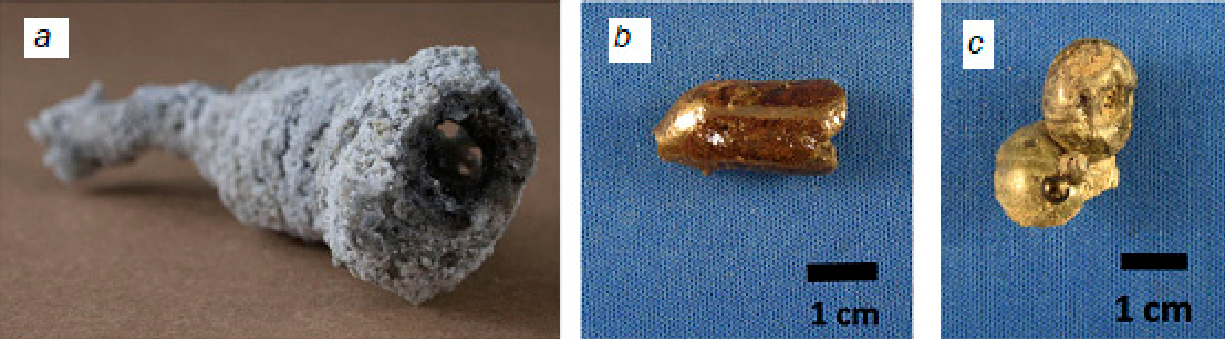
Figure 2.
Oval ball lightning. [H. Norinder, in Problems of Atmospheric and Space Electricity, Elsevier, Amsterdam, 1965. p 455; adopted from Singer 1971].
Figure 2.
Oval ball lightning. [H. Norinder, in Problems of Atmospheric and Space Electricity, Elsevier, Amsterdam, 1965. p 455; adopted from Singer 1971].
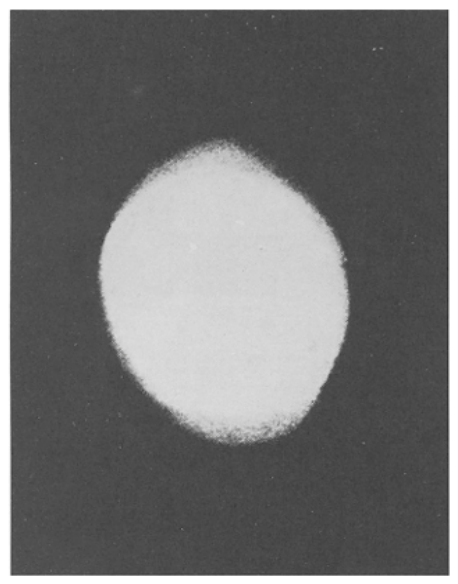
Figure 3.
Schematic representation of current on the ground as a function of time for a cloud-to-ground lightning discharge. The time interval (a) corresponds to the leader's movement; since the conductive channel has not yet reached the ground, the current is zero. The arrow indicates the start of the return stroke. The return stroke is followed by the continuing current (b) and the M-component (c). (A fragment of Figure 1,2 from Rakov et al. 2003).
Figure 3.
Schematic representation of current on the ground as a function of time for a cloud-to-ground lightning discharge. The time interval (a) corresponds to the leader's movement; since the conductive channel has not yet reached the ground, the current is zero. The arrow indicates the start of the return stroke. The return stroke is followed by the continuing current (b) and the M-component (c). (A fragment of Figure 1,2 from Rakov et al. 2003).
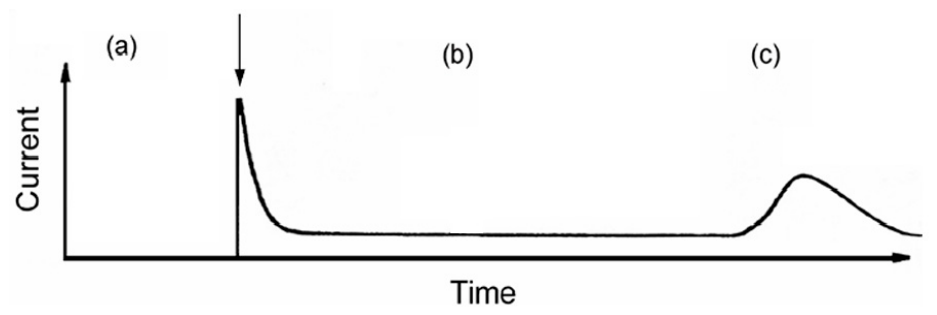
Figure 4.
Structure of tubular fulgurite. (a) Longitudinal section of a tubular fulgurite (Sahara Desert). The glassy layer on inner wall of the main void is clearly visible (Image by Ringwoodit, via Wikimedia Commons, CC BY 4.0). (b) Schematic cross-section of a tubular fulgurite. (adopted from Çalışkanoğlu et al. 2023, CC BY 4.0).
Figure 4.
Structure of tubular fulgurite. (a) Longitudinal section of a tubular fulgurite (Sahara Desert). The glassy layer on inner wall of the main void is clearly visible (Image by Ringwoodit, via Wikimedia Commons, CC BY 4.0). (b) Schematic cross-section of a tubular fulgurite. (adopted from Çalışkanoğlu et al. 2023, CC BY 4.0).
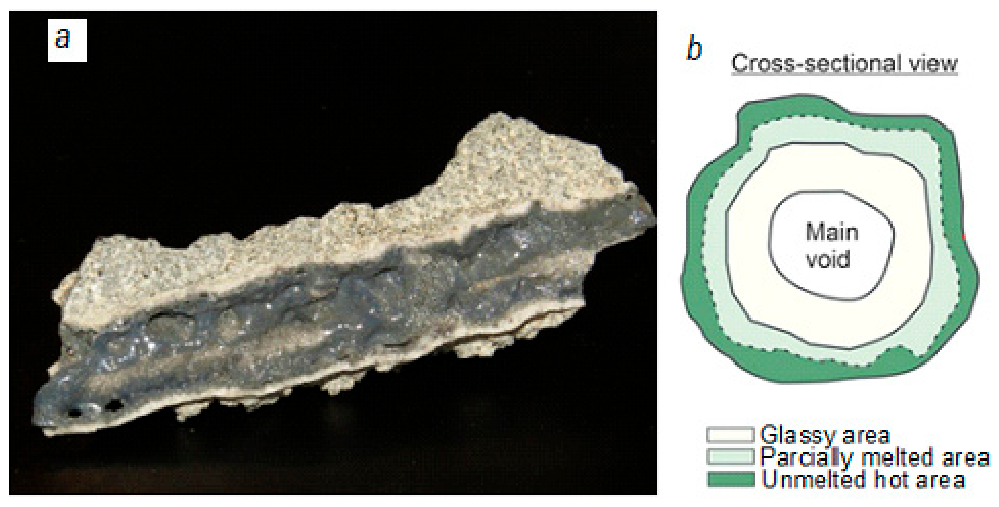
Figure 5.
Formation of ball lightning: blowing a bubble from a melt of soil components.
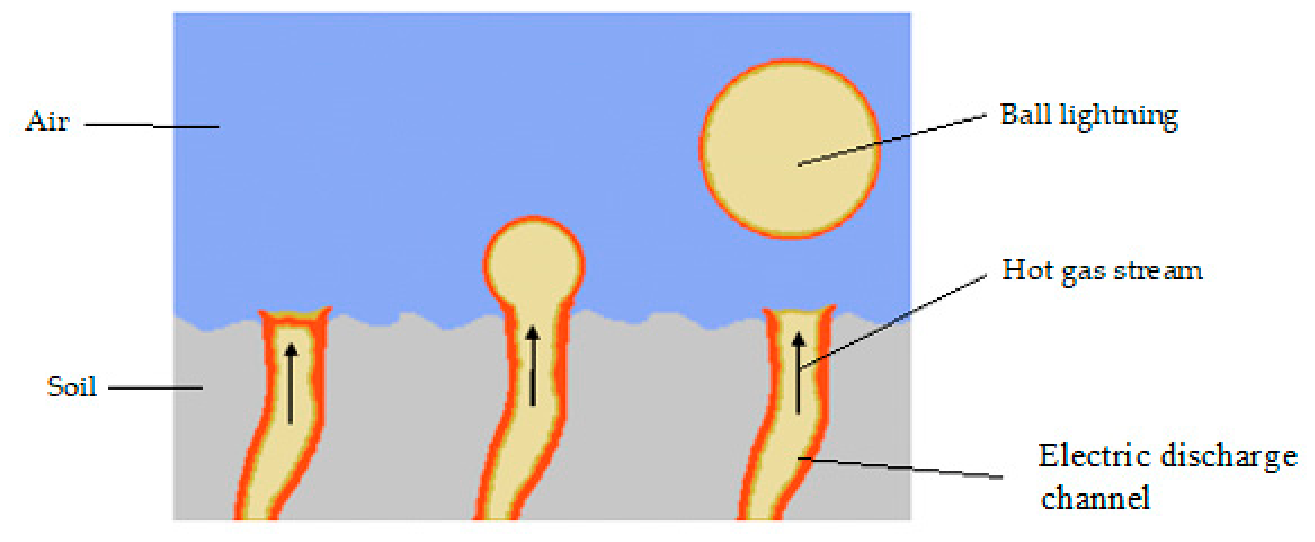
Figure 6.
Bubble of molten glass exhibits the external characteristics and behavior of ball lightning (Image by Fortepan — ID 84973, via Wikimedia Commons, CC BY 3.0).
Figure 6.
Bubble of molten glass exhibits the external characteristics and behavior of ball lightning (Image by Fortepan — ID 84973, via Wikimedia Commons, CC BY 3.0).
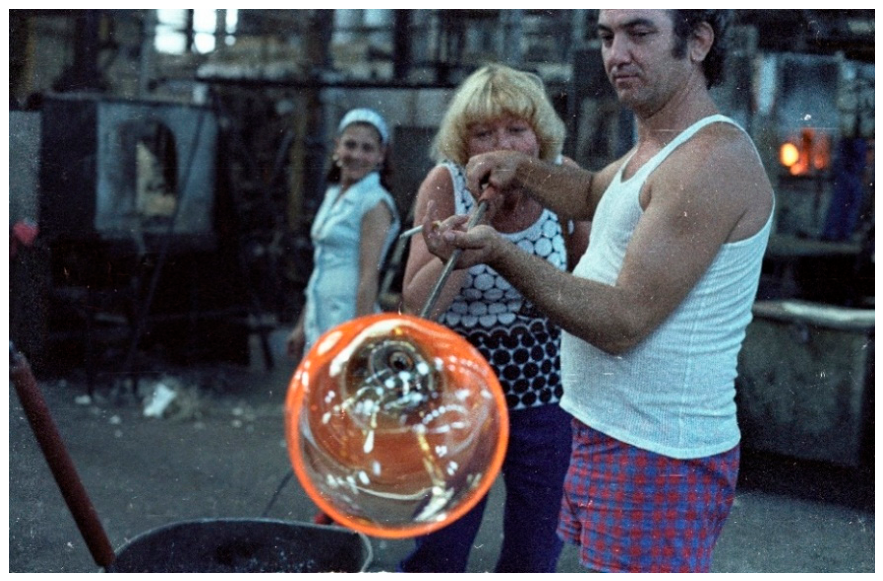
Figure 7.
A frame from video filmed during a thunderstorm in Alberta, Canada; it most likely captures a ball lightning.
Figure 7.
A frame from video filmed during a thunderstorm in Alberta, Canada; it most likely captures a ball lightning.
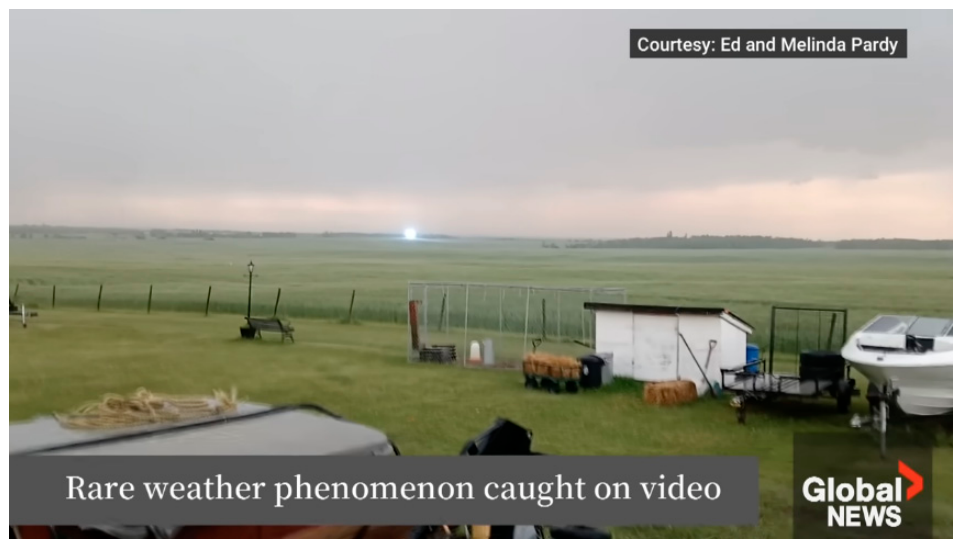
Figure 8.
Viscosity versus temperature for fused silica and three silicate glasses (from Callister at al. 2018, Figure 13.14).
Figure 8.
Viscosity versus temperature for fused silica and three silicate glasses (from Callister at al. 2018, Figure 13.14).
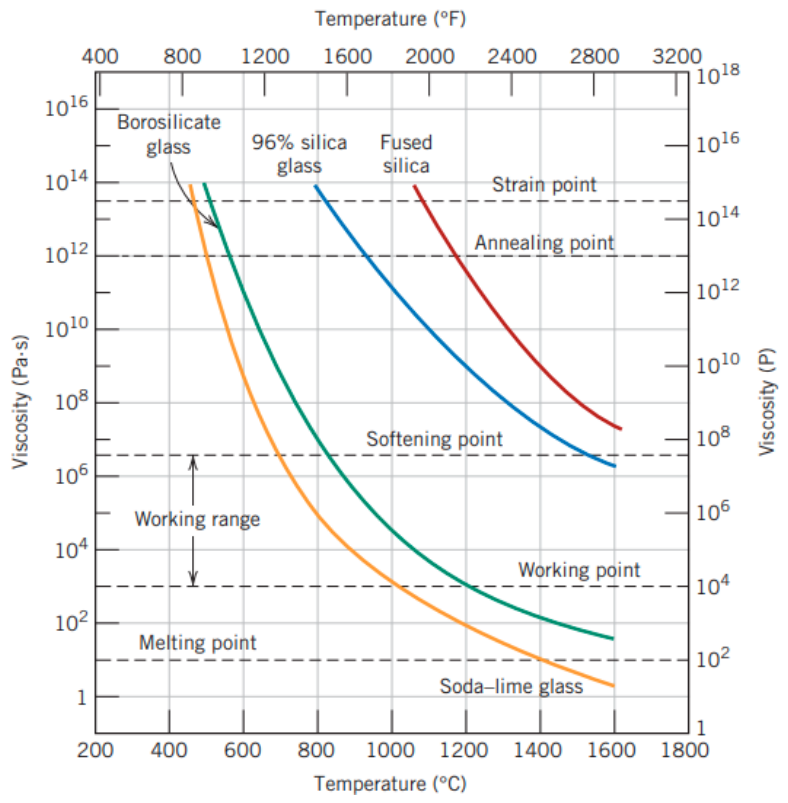
Figure 9.
Schematic representation of the ball lightning organization.
Disclaimer/Publisher’s Note: The statements, opinions and data contained in all publications are solely those of the individual author(s) and contributor(s) and not of MDPI and/or the editor(s). MDPI and/or the editor(s) disclaim responsibility for any injury to people or property resulting from any ideas, methods, instructions or products referred to in the content. |
© 2026 by the author. Licensee MDPI, Basel, Switzerland. This article is an open access article distributed under the terms and conditions of the Creative Commons Attribution (CC BY) license.
Copyright: This open access article is published under a Creative Commons CC BY 4.0 license, which permit the free download, distribution, and reuse, provided that the author and preprint are cited in any reuse.