

Submitted:
04 August 2026
Posted:
06 August 2026
You are already at the latest version
Abstract
Definitions of silence in pragmatics and semiotics face a dilemma. Criteria built on the speaker's choice or on the hearer's perception either exclude clear cases or admit everything that lacks linguistic material, down to the zero morpheme, which the field has kept out by stipulation and not by criterion. This paper proposes the discursive bay: a stretch of interaction in which no linguistic material is manifest and whose indexical load is carried by the marks that open and close it. The unit of analysis moves from the interval to the pair of marks that demarcate it, so that membership is decided by demarcation rather than by absence, and the zero morpheme falls outside without a special ruling. The criterion is not new. Poyatos stated it in 1984 for silence and stillness together and Saville-Troike stated it for verbal silence, and the field cited both without adopting either. Four published descriptions are re-read to show that the criterion reaches material collected under every one of the live definitions.
Keywords:
silence
; definition of silence
; discursive bay
; demarcation
; zero sign
; interaction
1. Introduction
The most recent argument that silence is a modality in its own right runs to twenty-five pages and does not define silence once, in its own terms or in anyone else’s. What it supplies instead is a typology of eight cases [1]. Section 2 gives the measurement; the point of raising it here is that it is not a complaint about one article. A field can work productively for a long time on an object it has never had to delimit, and this one has. Silence has been studied as a sign, as an inference, as a position in a sequence and as a cultural practice, and each part has accumulated results without needing agreement on what would count as a case.
What follows from having no common slot becomes visible when the two criteria the literature does use are set side by side. One locates the decision with the speaker, so that silence counts as a sign only when the speaker chose it [2] [p. 1914], a requirement that has not been relaxed since. The other locates it with the hearer, in what is registered as missing [3] [p. 92]. The two do not converge: a silence nobody chose can still be read, and a silence nobody registers can still be described. Nor does the generic fallback arbitrate between them. Defined as the absence of communicatively relevant linguistic material, silence takes in the zero morpheme, a form such as dog beside dogs, which carries meaning at a position where no material appears. That case is kept out, but by stipulation.
This paper proposes a third criterion and, with it, a different unit. A discursive bay is a stretch of interaction in which no linguistic material is manifest and whose indexical load is carried by the marks that open and close it. What is analysed is the pair of marks, and the silence is what they delimit. The term names a topology, and two shores with a gap between them is how that topology reads under a cut taken at the level where linguistic material manifests. Since demarcation is a property of the material and not a state of a participant, the dilemma above does not have to be adjudicated. It dissolves.
Section 2 sets out the partition of the field and shows that a demarcative criterion was formulated twice and taken up neither time. Section 3 gives the definition, the filter it yields and the lineage it recovers. Section 4 re-reads four published descriptions under it, one of them from a signed language, a case that a classic of the field sanctions in a footnote [4] [p. 85, n. 2]. Section 5 makes the claim concrete with two illustrations, and Section 6 states what the proposal leaves alone.
2. The Dispersal
Silence is not a neglected object. It has been studied as a sign, as an inference, as a position in a sequence and as a cultural practice, and the literature is by now large enough that any review of it has to choose. What the field lacks is a common slot: a criterion of membership that its different parts would recognise as deciding, for a given stretch of interaction, whether there is a silence there at all. This section sets out the partition. Three lines are alive and determine silence by what is missing from it. A fourth determined it by the properties of the material around it, and was read without being adopted.
The first line reads silence as a sign with a null signifier. Its sharpest formulation is Kurzon’s: for silence to mean in the linguistic sense the speaker must have an intention, so that a zero signifier “has an utterable signified, a meaning that may be expressed in words” [5] [p. 8], quoted in Adler and Kohn [1] [p. 948]. The formula fixes the model most of the field has worked with since: a slot from which something is missing, and a value that can be recovered and written into it. Ephratt carries the line into Peircean territory, subsuming the zero sign under diagrammatic hypoiconicity, where silence draws its interpretation from its location within a paradigm [6] [p. 252]; the relation that does the work there is internal and paradigmatic, not lateral. The most recent statement of the line, and the one that argues for silence as a modality in its own right rather than a complement to sound, is Adler and Kohn [1]. It is also the most instructive for present purposes. Across twenty-five pages the article states no definitional criterion for its object, its own or anyone else’s; the working notion is assembled by review from Kurzon, Ephratt, Saville-Troike and Jaworski (p. 948), and what the article does supply is a typology of eight cases of silence (p. 953) whose principle of partition mixes graphic support, channel, function and effect and is nowhere declared. A field can have a typology and still lack a definition, and that is the situation this paper starts from.
The second line places the decision with the speaker and processes the result by inference. Ephratt’s eloquent silence is an active means chosen by the speaker, and the zero sign counts as a sign “only when it is an outcome of choice” [2] [p. 1914]. The requirement does not relax across a decade: the null signifier is joined to a non-null signified chosen in the speaker’s own turn [7] [p. 2300], verbal silence is the speaker’s choice when it is his turn to speak [8] [p. 67], and choice is still doing the excluding in 2018 [6] [p. 241]. Jaworski’s move is the complement rather than the rival: the interpretive processes that apply to someone speaking apply equally to someone remaining meaningfully silent [3] [p. 3], which puts the weight on what a hearer makes of the gap. The inferential machinery, Gricean or relevance-theoretic, then operates on the same object, a departure from what was expected. Determination is once more by absence, now measured against an expectation rather than against a paradigm.
The third line is sequential. Under the turn-taking system a silence is classified by where it falls, between turns, inside a turn, or after a point of possible completion, and it is attributable to a participant by the same rules that allocate turns [9,10] makes the attribution explicit, so that what a silence conveys depends on which participant the sequence had made responsible for the slot it occupies. The form of the determination is again negative: what is at stake is the second part that the sequence projected and did not receive. This is technically the most precise of the three lines, and, as the citation record below shows, the one that travels least.
Both determinations travel well outside the field. Relevance-theoretic work takes silence as an ostensive stimulus, so that the additional processing effort it costs has to be repaid by additional effects [11] [p. 438], which measures the silence against what an addressee was entitled to expect. The sequential partition, for its part, was taken over intact by Hispanic pragmatics, whose three names, pausa, intervalo and lapso, render the three positions of Sacks, Schegloff and Jefferson: within a turn, between turns, and between sequences [12] [p. 89]. The vocabularies differ. What decides membership does not, and it is still an expectation or a slot that the sequence had allocated.
A fourth line determined silence by the properties of the material around it, and it is not part of the exchange. Poyatos treated silence and stillness as the two basic non-activities of interaction and defined them by what they bound, limiting the communicative segments whose beginning, duration and end they mark and linking those segments to one another [13] [p. 1221]. On the following page the demarcation stops being an aid to interpretation and becomes a criterion of membership: a silence not limited at both ends by interrelated behaviours, and not related to them either, ceases to be a pause at all and passes into a different class (p. 1222). The condition is conjunctive, and Poyatos should not be credited with the stronger version on which losing a single mark would suffice. Saville-Troike stated the same relation for verbal silence, treating it as “bounded by stretches of verbal material which provide boundary marking for its identification” [14] [p. 4].
Neither statement was taken up as a criterion, and the record of how that happened is unusually explicit. In 2008 Ephratt raised the relation between Poyatos’s definition of silence and her own, and set it aside in a footnote as lying beyond the limits of that paper [2] [p. 1911, n. 5]. Three years later she cited him twenty-one times and transcribed the delimiting function of his silent alternants, which is the only occurrence of that vocabulary in the article, and left it standing as description rather than promoting it to a criterion [7] [p. 2292]. The demarcative criterion was not overlooked. It was read, deferred, and not resumed.
Two things follow. The first is that the three live lines share a form of determination and differ only in what the missing item is measured against: a paradigm, an expectation, or a projected next turn. None of them lets the properties of the surrounding material decide membership, and the body of work that did is not in the conversation. The second is that the traffic between the lines is asymmetric rather than absent. The semiotic and the pragmatic-inferential lines cite each other, and Adler and Kohn run them together in a single paragraph that chains Kurzon, Jaworski, Ephratt and Saville-Troike (2023, p. 948). The sequential line stays outside that exchange: Sacks, Schegloff, Jefferson and Levinson appear nowhere in the twenty-five pages of the most recent statement of the semiotic line. The demarcative line, for its part, is cited without being adopted, which is a third pattern again. What the field lacks is therefore neither attention to silence nor traffic between its parts. It is a criterion of membership that any of the parts would recognise as deciding. Section 3 proposes one, and recovers the precedent that this record shows was there to be had.
The lexicon shows the same gap. Verschueren’s survey of the English and Dutch verbs of being silent sorts them into three classes, the absence of speech, the absence of speech about a topic, and the cessation of speech [15] [pp. 75–76], each keyed to the speaker’s own production. The context those words carry is preceding discourse, and the lack of any term for silence before speech is called “the most striking gap in the lexical frame” (p. 117). No item names a stretch decided by both its edges, and why it stops there is left open here.
3. The Discursive Bay
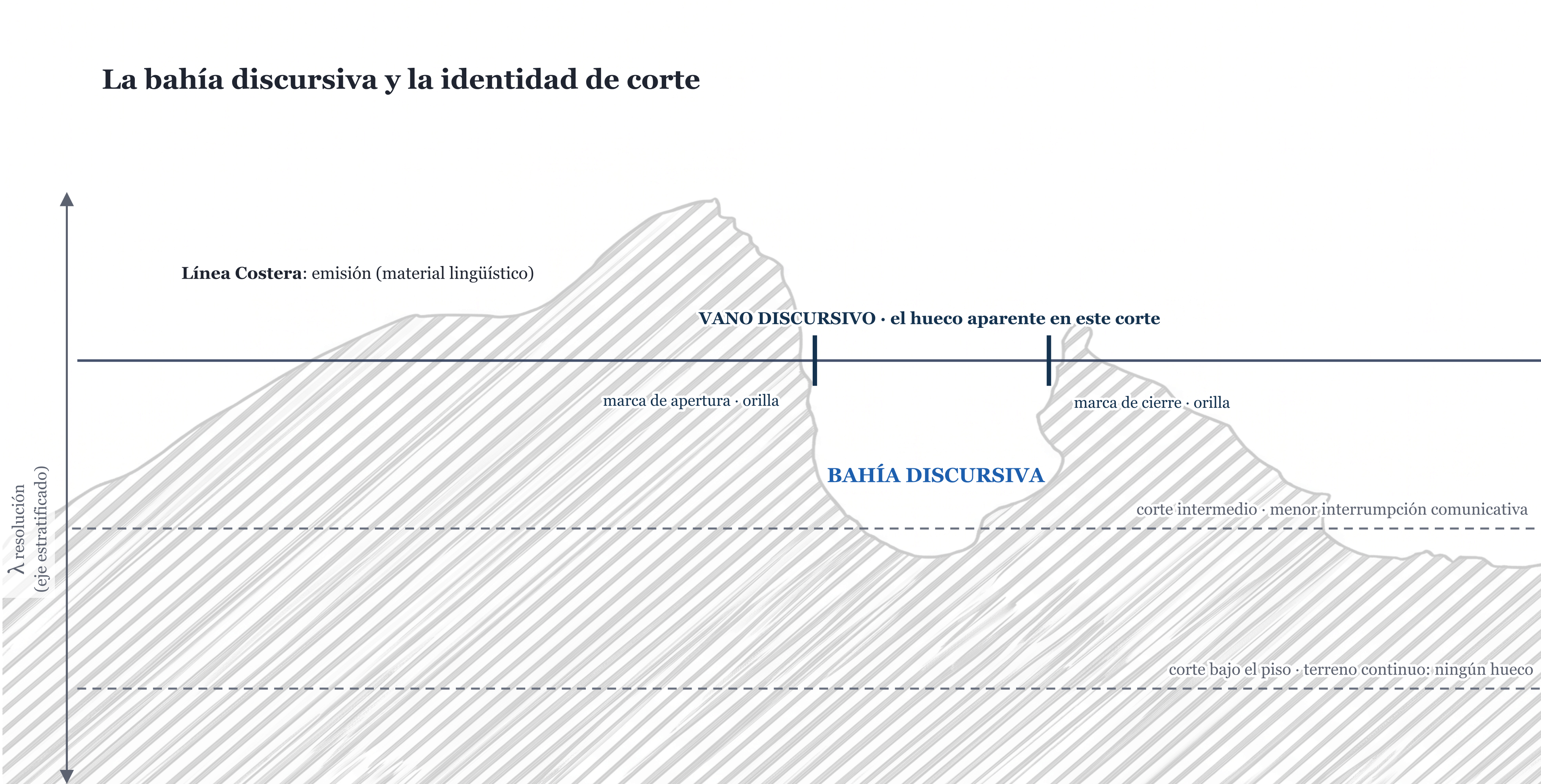
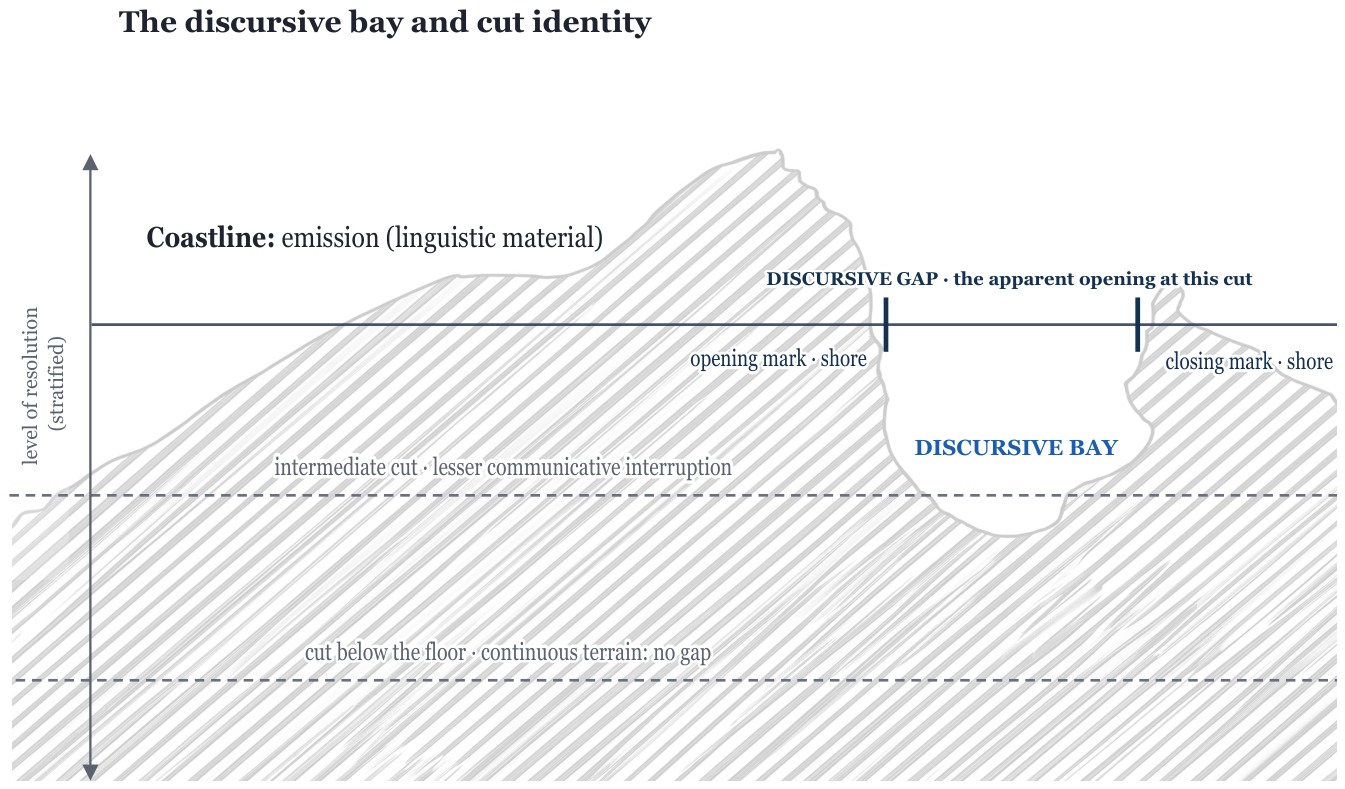
A discursive bay is a stretch of interaction in which no linguistic material is manifest and whose indexical load is carried by the marks that open and close it. The definition puts the unit of analysis in an unfamiliar place. It is not the interval, which is where every account surveyed in Section 2 looks for its object, but the pair of marks that demarcate the interval. What is analysed is a configuration of surrounding material, and the silence is what that configuration delimits. The term names a topology, and the object appears as two shores with a gap between them only under a cut taken at the level where linguistic material manifests. Under cuts taken elsewhere it presents itself otherwise, which Figure 1 sets out.
The name is worth a paragraph, because English has a technical term for this and it has not been used for silence. In its architectural sense a bay is “a main division of a structure”, and that sense reaches English from Anglo-French baee, an opening, from a verb meaning to be wide open or to gape [16], while the coastal sense arrives by a separate route; the two converged in one word. What the architectural term measures is not the void but the supports and the span they leave: a bay is specified by what stands on either side of it, not by its emptiness. That the second sense converged on the same word is the reason to prefer it. A bay is at once an opening demarcated by what flanks it and a body of water that has not been severed from the sea, which is exactly the pair of properties the object requires.
Two conditions decide whether a stretch is a discursive bay, and both are conditions on the material rather than on minds. The first is that the space be set up: something in the stream opens it and something closes it, and both marks are publicly available. The second is that it be available to be noticed, which is a property of a demarcated stretch and not a report of anyone’s attention. Call the pair the framing filter. Its interest is comparative, because the two criteria the literature has settled on locate the decision elsewhere. One places it with the speaker: silence counts as a zero sign, for Ephratt, “only when it is an outcome of choice”1 [2] [p. 1914], a requirement she holds unrelaxed a decade later [6] [p. 241]. The other places it with the hearer, in what is registered as missing [3] [p. 92]. Both are states of a participant. Demarcation is not: two analysts working from the same recording can disagree about intention and still agree about where the marks fall.
The test case is the one the generic definition cannot survive, the zero morpheme. A form such as dog beside dogs carries meaning at a position where no material appears, so any definition built on the absence of linguistic material admits it, and the field has kept it out by stipulation rather than by criterion. The framing filter excludes it without stipulation: nothing opens it and nothing closes it, so there are no marks to carry an indexical load, and there is nothing in the stream available to be noticed. The dilemma of Section 1 therefore does not have to be adjudicated. It dissolves, because the two rival criteria were competing to draw a line that a third property draws on its own.
None of this is as new as it may look, and the precedent is precise. Poyatos [13] treated silence and stillness as the two basic non-activities of interaction, symmetrical across the vocal-auditory and the kinesic-visual channels, and defined them by what they bound: they limit the communicative segments whose beginning, duration and end they mark, linking those segments to one another (p. 1221). The decisive move comes on the following page, where demarcation stops being a context for interpretation and becomes a criterion of membership. A silence or a static position not limited at both ends by interrelated behaviours, and not related to them either, “is not a pause” (p. 1222): it changes class. The condition is conjunctive, and the point deserves care, because Poyatos excludes the case in which delimitation and relation fail together, so the stronger reading, on which losing a single mark would suffice, is not in his text and should not be attributed to him. He also broke the model the rest of the field inherited. Where silence functions as a sign in its own right, its message is “not given by the lack of expected signs, but by the silence itself” (p. 1224). A third mode, in which silence prolongs and amplifies the sign preceding it (pp. 1224–1225), points past what is developed here.
What the present proposal adds to that precedent is a filter, a second lineage, and an account of why the criterion did not travel, which Section 2 has already given. The second lineage is Goffman [19] [pp. 251–254], whose typographic analogy supplies opening and closing brackets and a slot beside the left bracket where the operator sits, and which has never been applied to silence. On the side of the surrounding material the ancestor is Goodwin’s contextual configuration [20], and it is worth noting that this ancestor is already in the room: the recent semiotics of silence draws on it [1] without drawing the consequence for the definition of its own object.
One neighbour is close enough to require a distinction in the body rather than in a note. Davidson’s monitor space [21] [pp. 119–124] differs on four counts: it is designed to forestall silence rather than to hold it; it need not be silent at all; it projects a second pair-part rather than an inference; and its unit is the series of successive versions, not the pair of marks. A second neighbour is terminological. The obvious English name for the object would be the parenthesis, and that name is taken twice over. In conversation analysis, Mazeland’s parenthetical sequences describe a speaker halting a unit before completing it, inserting a comment, and returning to the halted unit [22]. In Spanish grammar, the same term names a discursive fragment set apart from its context by delimiting signs [23] [p. 141]. Both uses share the wrapper that the bay requires: a pair of marks that open and close a stretch. What they do not share is the interior, because a parenthesis is full.
Figure 1 shows why the object looks different at different levels of description, and the level at which the cut is taken is not only the analyst’s choice. Participants run an interaction at a band of their own, set by how involved they are, what they are attending to and how much they already share, and that band decides how much can go unproduced without loss. Between intimates a long stretch of unproduced material is not an interruption at all; between strangers the same stretch is a gap that calls for repair. The criterion has not quietly reverted to perception: perception decides whether a participant registers the silence, the cut decides at what resolution it is described, and demarcation remains a public property of the material at every cut.
4. Exemplary Re-Readings
A criterion earns its place by what it makes visible in material collected for other purposes. This section re-reads four published descriptions under the definition of Section 3. None was written with the present proposal in view, none requires new data, and none requires re-transcription. The test each has to pass is narrow: the original must already identify a stretch of silence by the material that flanks it, and must stop short of treating that identification as what decides the case. Where the pattern holds, the demarcative account is being read off the description rather than imposed on it. The four are drawn from a signed language, from literary narrative, from the founding formulation of the zero sign, and from conversation analysis.
The most direct evidence comes first, and from the least likely place. In a chapter on im/politeness in signed languages, Boyes Braem and Tissi [24] annotate an aside in Swiss German Sign Language in which a signer turns away from one addressee to deal with another. Their Table 2 (p. 38) shows the episode opening with a bracketed “(hands down)” and closing with the same notation; across the whole of it the non-dominant hand holds a WAIT sign directed at the first signer, while gaze and head switch to the second addressee and then return. The configuration is the one Section 3 describes. Two publicly available marks of identical form open and close a stretch in which no linguistic material is produced for the first addressee, and the indexical load, that the turn is being kept and its holder will be returned to, is carried by those marks together with what is held across them.
What makes the case worth its space is that the description is complete and the theorising absent. The authors annotate the configuration and put it to work as evidence for a claim about politeness; the bounding notation is a transcription decision, not a finding. Nor could the finding have been stated in the vocabulary available to them, because the chapter never names silence: silence, silent, quiet, hush, shush and mute return zero occurrences across its thirty-eight pages. The most direct published description of a discursive bay comes from a study that had no term for the object it was describing.
One distinction is owed, since the marks here are hands coming to rest. Rest positions have been described as a device that bounds episodes of body movement [25], and manual holds as resources for the management of conversation [26]. Both accounts concern the way the body organises the stream, and neither treats a pair of such positions as opening and closing a stretch whose interpretation is the analytic object. The present reading adds that step; the observation that the hands go down is already in the source.
The second case comes from the semiotic line’s own corpus, and it is the limiting one. In an argument about iconicity, Ephratt [6] [p. 253] takes up the fifth day of Ishiguro’s The Remains of the Day, which the narrative does not recount: the chapter headed Day four ends on one page and Day six opens on the next. Nothing within the stretch marks it, for the sufficient reason that there is nothing within it, and a reader who has not been counting still finds the silence, because the numbering of the two flanking marks does the counting. Any account that looks for the object in the interval has nothing here to look at. Ephratt’s own reading is paradigmatic: a blank in Iser’s sense, and an omission from a list, so that what signifies is the entry that fails to appear, measured against the series. The demarcative reading locates the object in the stretch between the two headings and fixes its content by what flanks it. The two can be told apart, which is what makes the case useful. Remove the series and the paradigmatic reading has nothing left to measure against; the two headings still delimit a stretch.
The third case is a sentence rather than a passage, and it is the cheapest evidence that the criterion was available from the start. Kurzon sets out the sequence of ordinary conversation as “speech silence speech” [5] [p. 10]. The silence is specified there by what stands on either side of it, in a formula that would serve as a definition and is offered as a description. What follows is a gloss of turn-taking alternation; the intention criterion enters only two pages later (p. 12), and the formula does not return. What the book builds, and what the later work on the zero signifier took from it, rests on the second move. Section 2 traced this shape in Ephratt’s deferral of Poyatos; here it appears a decade earlier and inside the founding text of the line, with an author setting aside a formulation of his own. The formula was there to be picked up, and was not.
The sequential line supplies the fourth. Section 3 has already distinguished the monitor space from a discursive bay and that distinction stands; the interest here is the transcript. In Davidson’s analysis of subsequent versions the space an inviter leaves for a response is treated as an object with a name and a place in the layout, its lines labelled first version, monitor space, subsequent version, response [21] [pp. 119–124]. The space opens at a point of possible completion and closes with the version hooked on after it, and its going unfilled is what produces the effect, since an inviter who hears nothing there may take the absence as “possibly rejection-implicative” (p. 120). Two marks, a stretch between them, and a consequence carried by the pair. The analysis then follows what the speaker does next, so the space is a unit in the transcription and a stage in the argument. The convention had committed to something the argument did not take up.
The four descriptions were produced under four rubrics: politeness in a signed language, iconicity in narrative, the zero signifier, and the sequential organisation of invitations. None was written to make the point made here, and none had to be amended to serve it. The four have no theory in common. They have a constraint in common: an analyst who has to say which silence is under discussion must name what flanks it, because there is nothing else there to name. The demarcative criterion asks that the constraint be promoted from a convenience of description to a condition of membership. None of this shows the criterion to be correct. It shows that it is available in material the field already holds, which is the weaker claim, and the one Section 6 takes up.
5. The Gap and the Terrain
A linguist trained on the verbal channel sees silence as a gap in a chain of material. The definition of Section 3 says something different: what looks like a gap at one level of description is a bay at another, and the two levels are related by the cut the analyst takes. Figure 1 already showed this in its caption. This section makes the claim concrete.
The first illustration is developmental. When an infant of about three months watches a ball roll behind a screen, the infant does not look to the other side of the screen to wait for the ball to emerge; at that age the ball has, for the infant, ceased to exist. A few months later the same infant tracks the ball through the occlusion and expects it on the other side [27]. What changed is not the ball or the screen. What changed is the infant’s capacity to maintain an object across a stretch in which it is not manifest. The analogy is direct. An analyst who defines silence as the absence of linguistic material is tracking one channel at a resolution at which the material disappears behind the screen. The bay does not claim that the material is still there. It claims that the terrain is still there, and that the terrain is what carries the indexical load across the stretch.
The second illustration is musical. A rest in a score is not the absence of music. It is a notated duration, flanked by notes, whose length and position are as much a part of the composition as the sounds that surround it. No one describes a rest as a gap in the music, because the score makes visible that the rest is bounded and that its bounding is compositional. The bay asks the same of silence in interaction: not that it be treated as sound, but that its bounding be treated as part of the description.
Neither illustration is needed to make the point, because the point has already been made inside the field, though not in the terms used here. Watzlawick, Beavin and Jackson stated the axiom: one cannot not communicate [28]. As long as two participants are co-present, something is being sustained. Goodwin’s contextual configuration assembles diverse semiotic fields, of which the verbal is one and none of which ceases when another does [20]. Kendon treats speech as emerging from a continuous stream of visible bodily action [29]. Mondada has shown that fully silent stretches of interaction are organised by visible action into sequences as orderly as any spoken exchange [30]. Poyatos defined silence and stillness as the two basic non-activities of interaction, each identified by what it is not and each bounded by what it interrupts [13]. In every case the terrain was continuous. What the present proposal adds is the filter that makes the terrain visible as an analytic object: two marks, a stretch between them, and a criterion of membership that does not require settling what anyone intended or perceived. The formal framework within which levels of description and the cuts between them are defined is presented in Escobar L.-Dellamary [31]; the present paper isolates one object from that framework and argues for it on its own terms.
6. Implications and Limits
If demarcation decides membership, the field acquires the common slot it has been working without, and the slot is formal rather than substantial. Nothing has to be settled about intention, about attention, or about what a given silence means before it can be said that there is one there. The bodies of work surveyed in Section 2 are then describing the same kind of object under different questions, and their results become comparable in a way they cannot be while each carries its own entry condition. The zero morpheme falls outside without a special ruling, and the ruling that had been keeping it out can be retired.
The criterion also does not presuppose a channel. A mark that opens a stretch may be a word, a fall in intonation, the end of a gesture, or hands coming to rest, and nothing in the definition prefers one of these to another. This is not a promissory note. The most recent statement of the semiotic line argues for non-acoustic silence on a corpus of comics [1], and the case re-read in Section 4 comes from a signed language, while sign language and deaf do not occur anywhere in that statement. The visual-gestural modality has been left aside by an argument that had use for it, and a demarcative criterion reaches it without any extension. Work on how gesture and sign pattern meaning above the lexical level [32] and on how indexical reference operates in Mexican Sign Language [33] suggests that the criterion has room to run in that modality.
Three things are deliberately set aside. The proposal decides membership but does not develop the account of determination that its own terms imply: two bays whose marks have the same form can deliver quite different inferences, and what fixes the difference is the ecology of the terrain that carries them, which Section 5 has pointed to but not spelled out. Nothing is claimed about reported speech, or about what happens when a silence is quoted. And the argument rests on published descriptions throughout, with no field data of its own.
References
- Adler, S.; Kohn, A. Silence: A modality of its own. Soc. Semiot. 2023, 33, 946–970. [Google Scholar] [CrossRef]
- Ephratt, M. The functions of silence. J. Pragmat. 2008, 40, 1909–1938. [Google Scholar] [CrossRef]
- Jaworski, A. The Power of Silence: Social and Pragmatic Perspectives; Sage: Newbury Park, CA, 1993. [Google Scholar] [CrossRef]
- Bilmes, J. Constituting silence: Life in the world of total meaning. Semiotica 1994, 98, 73–87. [Google Scholar] [CrossRef]
- Kurzon, D. Discourse of Silence; Number 49 in Pragmatics & Beyond New Series; John Benjamins: Amsterdam, 1998. [Google Scholar] [CrossRef]
- Ephratt, M. Iconic silence: A semiotic paradox or a semiotic paragon? Semiotica 2018, 2018, 239–259. [Google Scholar] [CrossRef]
- Ephratt, M. Linguistic, paralinguistic and extralinguistic speech and silence. J. Pragmat. 2011, 43, 2286–2307. [Google Scholar] [CrossRef]
- Ephratt, M. “We try harder”: Silence and Grice’s cooperative principle, maxims and implicatures. Lang. Commun. 2012, 32, 62–79. [Google Scholar] [CrossRef]
- Sacks, H.; Schegloff, E.A.; Jefferson, G. A simplest systematics for the organization of turn-taking for conversation. Language 1974, 50, 696–735. [Google Scholar] [CrossRef] [PubMed]
- Levinson, S.C. Pragmatics; Cambridge University Press: Cambridge, 1983. [Google Scholar] [CrossRef]
- Sasamoto, R. Silence in ostensive communication. In Observing Linguistic Phenomena; Yoshimura, A., Suga, A., Yamamoto, N., Eds.; Eihosha, 2012; pp. 437–449. [Google Scholar]
- Méndez Guerrero, B. Principios estructuradores del silencio en la conversación española. Estud. Interlingüísticos 2014, 2, 87–105. [Google Scholar]
- Poyatos, F. Silence and stillness as sign processes. In Semiotics Unfolding: Proceedings of the Second Congress of the International Association for Semiotic Studies, Vienna, July 1979; Borbé, T., Ed.; Mouton: Berlin, 1984; pp. 1219–1227. [Google Scholar] [CrossRef]
- Saville-Troike, M. The place of silence in an integrated theory of communication. In Perspectives on Silence; Tannen, D., Saville-Troike, M., Eds.; Ablex: Norwood, NJ, 1985; pp. 3–18. [Google Scholar]
- Verschueren, J. What People Say They Do With Words: Prolegomena to an Empirical-Conceptual Approach to Linguistic Action; Vol. XIV, Advances in Discourse Processes; Ablex: Norwood, NJ, 1985. [Google Scholar]
- Merriam-Webster. Bay. Merriam-Webster.com Dict. Retrieved. 2026. [Google Scholar] [CrossRef]
- Haugh, M. Intention in pragmatics. Intercult. Pragmat. 2008, 5, 99–110. [Google Scholar] [CrossRef]
- Duranti, A. The Anthropology of Intentions: Language in a World of Others; Cambridge University Press: Cambridge, 2015. [Google Scholar] [CrossRef]
- Goffman, E. Frame Analysis: An Essay on the Organization of Experience; Harper and Row: New York, 1974. [Google Scholar]
- Goodwin, C. Action and embodiment within situated human interaction. J. Pragmat. 2000, 32, 1489–1522. [Google Scholar] [CrossRef]
- Davidson, J. Subsequent versions of invitations, offers, requests and proposals dealing with potential or actual rejection. In Structures of Social Action: Studies in Conversation Analysis; Atkinson, J.M., Heritage, J., Eds.; Cambridge University Press, 1984; pp. 102–128. [Google Scholar]
- Mazeland, H. Parenthetical sequences. J. Pragmat. 2007, 39, 1816–1869. [Google Scholar] [CrossRef]
- Müller, G.E. Parentéticas: elaboración construccional y cuestiones limítrofes. Cuad. De La ALFAL 2023, 15, 140–158. [Google Scholar] [CrossRef]
- Boyes Braem, P.; Tissi, K. In your face: Im/politeness in signed languages, with examples from Swiss German Sign Language (DSGS). In Multimodal Im/politeness: Signed, Spoken, Written; Jucker, A.H., Hübscher, I., Brown, L., Eds.; John Benjamins: Amsterdam, 2023; pp. 27–64. [Google Scholar] [CrossRef]
- Sacks, H.; Schegloff, E.A. Home position. Gesture 2002, 2, 133–146. [Google Scholar] [CrossRef]
- Lepeut, A. When hands stop moving, interaction keeps going: A study of manual holds in the management of conversation in French-speaking and signing Belgium. Lang. Contrast 2022, 22, 290–321. [Google Scholar] [CrossRef]
- Baillargeon, R. Object permanence in 3½- and 4½-month-old infants. Dev. Psychol. 1987, 23, 655–664. [Google Scholar] [CrossRef]
- Watzlawick, P.; Beavin, J.H.; Jackson, D.D. Pragmatics of Human Communication: A Study of Interactional Patterns, Pathologies, and Paradoxes; Norton: New York, 1967. [Google Scholar]
- Kendon, A. Gesture: Visible Action as Utterance; Cambridge University Press: Cambridge, 2004. [Google Scholar] [CrossRef]
- Mondada, L. Transcribing silent actions: A multimodal approach of sequence organization. Soc. Interact. Video-Based Stud. Hum. Soc. 2019, 2. [Google Scholar] [CrossRef]
- Escobar L.-Dellamary, L. The Trace & Trajectory Framework: A Programmatic Introduction. SSRN 2026. [Google Scholar] [CrossRef]
- Escobar L.-Dellamary, L. Gestures and Signs Are Phrases Not Words: A High Definition Account. Preprints.org 2025. [Google Scholar] [CrossRef]
- Escobar L.-Dellamary, L. La fluidez de la referencia intersubjetiva: el señalamiento (IX) en la Lengua de Señas Mexicana (LSM). Verbum Et. Ling. Didáctica Leng. Y Cult. 2026, 1–29. [Google Scholar] [CrossRef]
| 1 | That choice should be constitutive of signification is itself debated. Work on deliberateness in linguistic action [17,18] suggests that the speaker’s control over meaning is rarely as categorical as the requirement assumes; the demarcative criterion sidesteps the difficulty, since demarcation is a property of the material and not a report of anyone’s decision. |
Figure 1.
The discursive bay and cut identity. The coastline is the emission: the manifest activity of contrast, sound against silence, movement against rest, by which a channel is patterned into linguistic material. The terrain beneath is the space of possible emissions that the interaction has set up. Cut at the level where linguistic material manifests (solid line), the bay presents two shores, an opening mark, a closing mark and a gap between them. At an intermediate cut (upper dashed line), the interruption narrows: less of what the interaction sustains has been lost. Cut below the floor (lower dashed line), the interruption disappears: the terrain was never severed.
Figure 1.
The discursive bay and cut identity. The coastline is the emission: the manifest activity of contrast, sound against silence, movement against rest, by which a channel is patterned into linguistic material. The terrain beneath is the space of possible emissions that the interaction has set up. Cut at the level where linguistic material manifests (solid line), the bay presents two shores, an opening mark, a closing mark and a gap between them. At an intermediate cut (upper dashed line), the interruption narrows: less of what the interaction sustains has been lost. Cut below the floor (lower dashed line), the interruption disappears: the terrain was never severed.
Disclaimer/Publisher’s Note: The statements, opinions and data contained in all publications are solely those of the individual author(s) and contributor(s) and not of MDPI and/or the editor(s). MDPI and/or the editor(s) disclaim responsibility for any injury to people or property resulting from any ideas, methods, instructions or products referred to in the content. |
© 2026 by the author. Licensee MDPI, Basel, Switzerland. This article is an open access article distributed under the terms and conditions of the Creative Commons Attribution (CC BY) license.
Copyright: This open access article is published under a Creative Commons CC BY 4.0 license, which permit the free download, distribution, and reuse, provided that the author and preprint are cited in any reuse.