

Submitted:
05 August 2026
Posted:
05 August 2026
You are already at the latest version
Abstract
A general model of superconductivity mechanism based on the separation of overlapping subbands near the Fermi level in highly degenerate materials is presented. Despite some unconventional properties, high-temperature superconductors exhibit fundamental behaviors common to low-temperature superconductors. In accordance with Fermi-Dirac statistics, the Landau-Ginzburg second-order phase transition and thermodynamic relations for superconductors, the fundamental characteristics, such as the Gibbs free energy, the total system energy, the electron density of states, the energy gap, and the entropy dependences on temperature are presented. It is shown that a main error in the BCS model is the concept that any free electron passing through the lattice polarizes the lattice ions along its path, because almost all metal atoms are neutral. Below the energy gap, there are no separate electrons; free randomly moving electrons are only above the energy gap. The proposed model is applicable to both low- and high-temperature superconductors. It is shown that the main thermodynamic equations describe both the normal and superconducting phases: the free energy, the total electron energy, the energy gap, and the entropy of a highly degenerate electron gas.
Keywords:
BCS model
; effective density of randomly moving electrons
; electronic defects
; second-order phase transition
; two-subband separation
; free energy
; total energy
; energy gap temperature dependence
1. Introduction
Superconductivity, one of the most wonderful phenomena of nature, was discovered by H.K. Onnes [1] just 3 years after he had first liquefied helium. He observed that the electrical resistance of mercury disappeared completely at a critical temperature of 4.2 K. The critical temperature TC (at which the material's resistance becomes zero) in pure metals achieves 9.2 K (niobium), whereas in intermetallic compounds and alloys it can exceed 20 K.
The more significant effect than zero resistance is the Meissner effect observed by W. Meissner and R. Ochsenfeld [2], who in 1933 demonstrated that a superconductor exhibits perfect diamagnetism, meaning that magnetic flux is completely excluded from the superconductor. They found that not only a magnetic field is excluded from entering a superconductor, as might appear to be explained by perfect conductivity, but also that a field in an originally normal sample is expelled as it is cooled through TC.
In 1935, F. London and H. London [3] proposed a phenomenological theory of the electromagnetic properties of superconductors in which the diamagnetic aspects were assumed basic. Their theory was based on the two-fluid model, in which the total electron density is the sum of the superconducting and normal electron densities.
In 1950, V.L. Ginsburg and L.D. Landau, building on second-order phase-transition theory and incorporating a quantum description, developed a phenomenological theory of superconductors [4]. The last theory also explained the limitation of F. and H. London theory. But neither the theory of F. and H. London nor the Ginsburg-Landau theories answered the question: what are those superconducting electrons?
Only in 1957 was a microscopic quantum theory of superconductivity, known as the BCS theory, formulated by J. Bardeen, L.N. Cooper, and J.R. Schrieffer [5]. The BCS theory is based on electron-phonon interactions and describes how moving an electron polarizes the ionic lattice, which can then indirectly interact with another electron that experiences the induced polarization. The basic idea that even a weak attraction can bind pairs of electrons into a bound state was presented by L.N. Cooper [6]. He showed that the Fermi electron sea is unstable against the formation of at least one bound pair, regardless of how weak the interaction is, so long as it is attractive. Soon after, the microscopic derivation of the Ginzburg-Landau equations and their relation to the BCS theory were given by L.P. Gor′kov [7]. The approximation used in the BCS theory cannot predict the thermodynamic potential [8], which is essential for calculating other thermodynamic properties, such as entropy or specific heat.
In 1962 B.D. Josephson [9], based on the BCS theory, showed that two weakly coupled superconductors (a tunnel junction) exhibit a coherent microwave current when a dc bias voltage is applied across the junction.
According to the BCS theory, no rigorous upper limit for the superconducting transition temperature has been established; most researchers believe that such a limit lies between 30 K and 40 K. Most aspects of the BCS pairing theory have been tested. But in 1986, a new class of superconducting material was discovered by J.G. Bednorz and K.A. Müller [10], and transition temperatures up to 164 K have been obtained [11,12]. The unconventional properties of high-temperature superconductors led to the suggestion that phonons could not be responsible for the attractive force binding the Cooper pairs, though the existence of quasiparticle pairs with charge q = 2e0 (e0 is the electron charge) and the temperature dependence of the energy gap reflect a BCS-like character.
According to J.E. Hirsh [13,14,15], a fundamental asymmetry exists between electrons and holes in solids. Electrons at the Fermi surface give rise to high conductivity and normal metallic behavior; holes at the Fermi surface yield poor conductivity and give rise to superconductivity. He proposes a dynamical explanation of the Meissner effect in superconductors and predicts the existence of a spin Meissner effect that a macroscopic spin current flows within a London penetration depth λL of the surface of superconductors in the absence of applied external fields, The two members of a Cooper pair circulate in orbits of radius 2λL in opposite directions, and the spin current in a Cooper pair has orbital angular momentum ℏ.
Thus, at present, no consensus exists among researchers on a microscopic theory of both high- and low-temperature superconductivity. There, critical attention will be paid to the BCS theory propositions and conclusions. To explain the high-temperature superconducting mechanism, one must understand the low-temperature superconducting mechanism, especially that of simple metals, because many characteristics of simple metals are well defined. On the other hand, we have no evidence that the superconducting mechanism in high-temperature superconductors differs significantly.
A general model of the superconductivity mechanism, based on the separation of overlapping subbands near the Fermi level in highly degenerate materials, is presented. The superconducting mechanism is analyzed using a second-order phase transition, accounting for the properties of free randomly moving (RM) charge carriers. The relationships among the superconducting transition critical temperature, the energy gap, and the electron condensation energy for two electrons at zero temperature are derived, which are applicable to both low- and high-temperature superconductors. By solving this problem, the free energy minimum is obtained at any temperature below the superconducting phase-transition temperature, allowing us to determine the energy gap and other characteristic temperature dependences.
2. Results and Discussions
2.1. Some Notes on the Conclusions of the BCS Model
There, we present critical notes on the concept and conclusions of the BCS model. We will see which arguments have been proposed based on this model, and whether they really exist. The BCS theory of superconductivity [5] proposed that the interaction between electrons resulting from the virtual exchange of phonons is attractive. A schematic picture of phonon-mediated electron interaction is usually described in the following way. Any electron e moving through the lattice polarizes the lattice ions (Figure 1) along its path, and the polarization remains during the time it takes for the pulse of phonons making up the ion displacements to disperse. It is assumed that the time for dispersion is sufficiently long to allow another electron to experience the local polarization caused by the first electron. Its total energy is thereby reduced, so the process may be considered as an effective attraction between two electrons. The attraction is explained in terms of the transition between two degenerate electrons that differ only in that a pair of states , changes to . It is obvious that for this to happen, the states must initially be occupied, and the states empty, i. e., the electron with the wave vector polarizes the lattice ion, creating a phonon with the wave vector (Figure 1b), another electron with a wave vector absorbs this phonon; it results in creating two electrons with wave vectors and (Cooper pair). The attraction is greater for electrons with opposite spins and equal and opposite wave vectors.
According to the BCS model, in the normal phase at absolute zero temperature, the states below the Fermi level are filled by electrons, and states above it are empty (Figure 2a). When material is in the superconducting phase at zero temperature, there is an energy gap 2, which is centered about the Fermi level, and there are no permissible energy states in the energy gap. The interactions between Cooper pairs must produce the new superconducting ground state. What energy is of that ground state relative to the Fermi level energy? Till now, there is no clear answer. In order to describe the Josephson effect or explain the pair excitation (or breaking), one assumes that the ground state coincides with the Fermi level energy, but in accordance with the BCS theory, there are no permissible energy states. If we suppose that the ground state of pairs is below the energy gap 2Δ, we obtain that the Cooper pair breaking energy must be 4Δ, which is inconsistent with the experimental result 2Δ.
It was noted by BCS [5] that the energy gap 2Δ in the energy spectrum is due to the fermion-like relation and that the creation of fermion pairs does not mean that these pairs are bosons. Therefore, the mechanisms of superconductivity and superfluidity are different. On the basis of the minimization of the total electron free energy, the BCS authors presented such a relation for the energy gap at temperature K:
where is the density of Bloch states of one spin per unit energy at the Fermi level energy, is the electron-phonon interaction energy, is the maximum of phonon energy (here is the Debye frequency, and is the Debye temperature). In the weak coupling limit [ and Δ<<], they presented such a superconducting transition temperature:
From Eqs. (1) and (2) follow that energy gap at and superconducting transition temperature are related by such an equation:
So, the BCS model seems to give an idea of how the superconducting transition temperature can be increased by increasing (or ), or . Let us see how this model agrees with experiments on superconducting metals. It can be noted that there are still no direct methods to independently determine the electron-phonon interaction energy . It can be noted that Eqs. (1) and (2), respectively, do not describe the energy gap , and the superconducting transition temperature for real superconductors, but their ratio gives Eq. (3), because the used nondeterminable multipliers simplify.
In Figure 3a, the relationship between the superconducting transition temperature and the Debye temperature is presented for elemental metal superconductors. As seen from this figure, there is no direct relationship evident from Eq. (2). Moreover, there is an opposite tendency. The considerable inadequacy between Eq. (2) and the experimental results of TC and TD is observed for the metal alloys. In Figure 3b, the dependences of the superconducting transition temperature TC, the Debye temperature TD, and the electronic heat capacity coefficient γ of the Nb1-xMox alloy composition are presented in [17]. In this case, as Mo content increases, the Debye temperature TD increases almost linearly, while the superconducting transition temperature decreases rapidly (Figure 3b). There is some correlation between superconducting transition temperature and electronic heat capacity.
Thus, experimental data demonstrate that relations of the superconducting transition temperature TC [Eq. (2)] and energy gap [Eq. (1)] are not fulfilled. Equation (2) is also used for the explanation of the isotope effect, i.e., according to the BCS theory, the superconducting transition temperature and isotope mass M must satisfy such a dependence:
where α=1/2. The predicted isotope effect index α for various elemental metal superconductors is presented in Table 1. For superconductors such as Zn, Sn, Hg, and Pb, the index α is very close to the predicted value 0.5, but for other superconductors, such as Ru and Zr, no isotope effect is observed; the predicted isotopic effect in the form of Eq. (4) is rarely observed.
Another essential question within the BCS framework is: which electrons can form Cooper pairs? According to the Pauli principle, only electrons very close to the Fermi level energy may participate in kinetic processes. According to the Debye model, phonon energies are limited to energies ≤ћ. The BCS theory implies that states can be used for creation pairs. There, the precondition was made that this energy range ћ is very narrow, and the electron density of states . In order to compare the magnitudes of energies, the energy gap 3.50k, the Debye energy ћ, and the effective width of the probability density function in energy for free randomly moving electrons are presented in Figure 4a near the superconducting transition temperature TC=90 K. The quantity ћ is many times larger than , and the used energy range ћ for the estimation of TC and is ungrounded.
In Figure 4b, the relative values of the energy gap as a function of relative temperature for some metals in the superconducting phase are close to the predictions of the BCS model. The first experimental indication of a gap in the excitation spectrum was obtained from measurements of the Thomson effect [18]. Further evidence for an energy gap in the superconductor electron density of states was obtained from a variety of experiments: thermal conductivity [19], electronic specific heat [20], infrared transmission [21], and tunneling [22,23].
In publications [25,26], flux quantization with a flux quantum of ħ/2e was observed. The same experimental data were obtained for low-temperature (LTSC) and high-temperature (HTSC) superconductors (Figure 5a). Electrons can be condensed below the energy gap or can be excited over the energy gap only two-by-two (by pairs).
The importance of the electron subbands configuration and the Fermi surface to the superconducting transition was widely discussed. The appearance of a sharp quasiparticle peak in photoemission below TC is a common characteristic of superconductors (Figure 5b). The redistribution of electron density to such peaks near the Fermi level forms an energy gap, resulting in material superconducting properties [27]. During the phase transition at the critical temperature TC, the energy gap 2Δ forms because the free energy of the new electron distribution system is lower. The overlap of valence subbands, their separation, and the electron band structure near the Fermi level are important for the formation of the superconducting phase [28,29].
In the BCS theory, the energy gap 2Δ in the spectrum arises from the electron-phonon interaction, in which Cooper pairs form a new superconducting ground state. If one describes the Josephson effect or explains the pair excitation (or breaking) energy, one assumes that the ground state coincides with the Fermi level [31], but in accordance with the BCS theory, there are no permissible states. If one supposes that the ground state of pairs is below the energy gap 2Δ, then the Cooper-pair-breaking energy must be 4Δ, which is inconsistent with experiment. The pair-breaking energy equals 2Δ.
One important question for understanding the superconducting mechanism is the free-energy difference between the normal and superconducting phases of the material. If we take (in accordance with the BCS theory) that in the energy gap there are no energy levels, then at absolute zero temperature, the free energy of the material in the superconducting phase is smaller than in the normal phase. The thermodynamic energy decrease at absolute zero temperature can be described as:
If we take into account the distribution of the electron density peak below the energy gap (Figure 2b), the energy difference would be that described by Eq. (5), but the experimental data show that this difference at T=0 is only:
So far, no one has offered an explanation for this energy difference. Additionally, to date, no superconductor has been found to have a spherical Fermi surface in the normal state, though many use the spherical Fermi surface to explain superconducting properties.
The most unacceptable result of the BCS model is the concept that electron interactions arise from the virtual exchange of phonons, which is attractive (see Figure 1). A schematic view of the superconductor in the normal state is shown in Figure 6.
The free randomly moving electron density neff is about two to three orders smaller than the total valence electron density, and they cause the conductivity of superconductors in the normal state. The other part of the valence electrons (n-neff) cannot change their energy because all neighboring energy levels are occupied [31,32]. Due to the Pauli exclusion principle, these electrons have a constant energy and, according to quantum mechanics, can only move in a central field around the native ions.
Figure 6.
The schematic distribution of the impurity (dark point), the electronic defect (yellow point), and the free electron (red point) in a two-dimensional area of the superconductor in the normal state for ~1000 atoms.
Figure 6.
The schematic distribution of the impurity (dark point), the electronic defect (yellow point), and the free electron (red point) in a two-dimensional area of the superconductor in the normal state for ~1000 atoms.
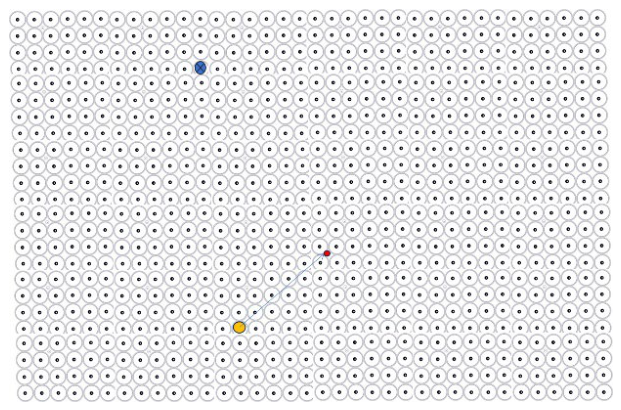
Thus, in metals, there is no Fermi electron sea. It is essential to emphasize that free RM electrons pass through the neutral atom lattice and do not interact with these atoms or their valence electrons (n-neff), since the latter cannot change their energy. So, any free RM electron moving through the material cannot polarize the neutral atoms, and the predicted BCS model of Cooper pair creation is unacceptable. Free RM electrons move through metals; they are scattered only by electronic defects and do not interact with neutral atom valence electrons, whose energy is below a few kT of the Fermi level energy. [31,32]. The mean free electron path in the normal state is the average of the distances between electronic defects.
2.2. Modeling of the Basic Thermodynamical-Statistical Characteristics of Superconductors
The importance of the electronic subband configuration for the superconducting transition has been widely discussed in [33,34]. During the superconducting phase transition at the critical temperature TC, the overlapping subbands separate, and an energy gap 2Δ forms because the free energy is lower. Considering that the superconducting phase transition is second order and that, in the superconducting phase, there is an energy gap, a general mechanism for superconductivity based on the separation of overlapping electronic subbands near the Fermi level in highly degenerate materials is proposed by [35,36,37]. The energy gap is the main characteristic of the superconductivity mechanism, that give rise to the others. There, we investigate the simplest superconductor model with two overlapping parabolic subbands near the Fermi level (Figure 7a) at T > TC, and in Figure 7b at T < TC.
For the calculations, we assumed that all relevant relations among thermodynamic functions hold in both the normal and superconducting states, and that electrons are described by the Fermi distribution function f(E). Additionally, we required that the total density of electrons and electron states in the conduction band is constant. The main thermodynamic equation that describes normal and superconducting phases presents the relationship between the free energy F, total electron system energy U, and entropy S:
Where
Many of our calculations for a superconductor in the normal state with two overlapping subbands show that for a different distribution of the density of states for a highly degenerate electronic gas with different subbands, the total electron system energy and free energy can be described in a similar way as for a spherical Fermi surface (Figure 8a):
where at T=0 K . The obtained results explain why, for most metals and other highly degenerate materials, the electron heat capacity is linearly dependent on temperature, even though their Fermi surfaces are not spherical. Moreover, the parameter γ for electron heat capacity is estimated as . The dependence of the free energy in superconducting and normal phases on temperature is shown in Figure 8b.
The Ginzburg-Landau theory [4,37,38], in general, is phenomenological and is based on Landau's earlier phenomenological theory of second-order phase transitions
Our investigations show that across various subband overlaps (Figure 7a), the entropy of electrons near the Fermi energy in the normal phase equals the electronic heat capacity. So, Eq. (11) can be described as:
The free energy change during the superconducting transition at T=0 K can be estimated as:
where is the thermodynamic critical magnetic flux density at T≈0 K obtained from the calometric measurements, and is the magnetic permeability of vacuum. At T=TC, Eq. (13) can be rewritten as:
When the temperature changes from T=TC, the free energy in the superconducting phase changes from to +(1/4)g( at T = 0 K, i. e.:
Then from Eqs. (15) and (16), we can write:
From this relation, we obtain that:
So, the energy gap 2 at T=0 K is equal to:
The average value of the randomly moving electron condensation energy due to the superconducting phase transition at T=0 K can be estimated as
From Eqs. (14) and (20), we obtain:
and the condensation energy for two electrons is:
The dependence of critical transition temperature TC on electron condensation energy A1 for different superconductors is shown in Figure 9a: dots are experimental results found from well-known measurement results of TC, , BC(0). It is observed that the relation between the superconducting condensation energy estimated for one electron and the transition temperature for low- and high-temperature superconductors is almost the same.
It is shown that the calculated energy gap at zero temperature is close to the experimental data and is valid for both low- and high-temperature superconductors. The relation between the energy gap and the electron condensation energy 2A1 for two free RM electrons at T = 0 K is shown in Figure 9b. It is interesting to note that for low- and high-temperature superconductors, such a relation is fulfilled:
Great attention is given to clarifying the image of the carrier pair with charge 2e. According to the BCS theory, based on Cooper electron pair formation, superconductivity is caused by a condensate of these pairs, and the elementary charge of that pair is 2e. The elementary charge of the pair 2e demonstrates the quantization of magnetic flux and the Josephson effect. The free energy of two electrons in the same energy level below the energy gap, when the free energy level range is narrower than kT, is smaller than the free energy of two electrons in different energy levels. Therefore, after the formation of the energy gap, electrons occupy the free energy levels below the energy gap two-by-two according to the Pauli exclusion principle: each energy level accommodates two electrons with opposite spins and opposite wave vectors. It explains why electrons condense or emit in pairs. Below the energy gap, there are no separate electrons. Free randomly moving electrons are only over the energy gap.
There is also an inconsistency between the energy decrease estimated by Eq. (4) (from Figure 2) and the experimental value Eq. (6), which is twice smaller. It can be explained in the following way: though the free energy of electrons due to electron condensation decreases, while due to increasing of the density states below the energy gap, the energy of particular electrons below the energy gap increases, i.e., the increase in the electron density states below the energy gap is going from the upper and the bottom sides. If one estimates the Cooper pair condensation (Figure 2), their free energy must decrease by 4Δ. Due to the increase in the lower electron condensate energy resulting from the increase in electron density states, the free energy increases by only 2Δ. It answers why electron excitations across the energy gap are produced by two electrons rather than by a single electron. It provides a vision of electron pairs. As shown in Figure 8, there is no fundamental energy level for Cooper pairs; the electron energy levels are distributed in some energy interval.
It is shown that the critical energy gap at zero temperature predetermines the superconducting transition temperature. The condensation and excitation energies of the electrons go two-by-two, which seems like a Cooper pair. Free electrons over the energy gap are scattered only by electronic defects, which emit or absorb phonons.
2.3. The Energy Gap Dependence on Temperature
Now we determine the temperature dependence of the energy gap. As a first approximation, we can describe the free electron for systems with a highly degenerate electron gas in the superconducting second-order phase transition in the following way:
where the member in square brackets represents the free energy dependence on energy gap due to electron condensation. According to the second-order phase transition at temperature T=TC, the total electron system energy , the free energy , and the entropy . The general parameter α for T<TC should have the dimension of the electron density of states . In principle, according to Landau second-order phase transition theory, the parameter β must be positive and constant at all temperatures, whereas the parameter α must change from negative above TC to positive below TC, thereby ensuring that the free energy minimum lies below TC. As seen from Eq. (24), the parameter α has the dimension of the electron density of states, and having in mind that all characteristics of a superconductor at any gap depend on free electron density nS(T), instead of the Landau expression for , we took
where is free randomly moving electron density over the energy gap:
The parameter α at 0<T<TC depends on the ratio of the free randomly moving electron density above the energy gap. So, the properties of the superconductor are defined by the electron density above the energy gap, which, of course, does not mean the density of superconducting electrons. In our proposed model, the supercurrent is carried by electrons condensed below the energy gap. The maximum value of the critical supercurrent and other characteristics of the superconductor are defined by the randomly moving charge carrier density at the onset of the superconducting phase transition.
The total energy and entropy of the electron system in the superconducting phase can be obtained by the well-known equations (8) and (9), with the new distribution of electron density on energy . The parameters of the density of states distribution are calculated under the strict requirement that at any temperature, the total number of electrons and the total number of electronic states must be constant. The redistribution of the density of states at any temperature is carried out in accordance with the conditions mentioned above, i.e., also with the redistribution of the electron condensate in the opposite direction. All relations of the thermodynamical functions correspond to the second-order phase transition theory requirements. For temperatures T≈0 K, the electron system entropy =0, and free energy in the superconducting phase can be expressed as
The stable state of the electron system corresponds to the minimum of the free energy. From the derivative = 0, we obtain:
where at T≈0 K is the energy gap for the minimum of the free energy , and α= and β=. Then
So, the free energy minimum at T≈0 K is below the value UN(0) = FN(0) = 0 by the quantity . The relation (25) ensures that Eq. (24) reflects well the superconductor characteristics not only near the transition temperature TC, but in the entire temperature range 0<T<TC, too.
We investigate the simplest superconductor model, in which the conduction band has two parabolic subbands that overlap near the Fermi level in the normal state (Figure 7a). For the calculation, we used average parameters close to those of YBCO-group superconductors. Keeping in mind the Eqs. (8) and (9), we tried to find conditions for the minimum free energy, and define the energy gap at any temperature T<TC. The calculation of the electron system free energy and the distribution of the electron density of states for the modeled superconductor in the superconducting phase was performed using the thermodynamical-statistical relation system [Eqs. (7 – 9, 24], including the changes →, and→, [Eq. (27)].
Thus, the free energy for systems with a highly degenerate electron gas in the superconducting phase can be described by a relation Eq. (24) that satisfies the requirements of the second-order phase transition, and where the order parameter is the energy gap Δ [35,36]. By solving this problem, the minimum of the free energy on the energy gap Δ in the superconducting phase is found at any temperature T<TC. Figure 10 shows the free energy as a function of the energy gap width at nine temperatures. It is obvious that at each temperature, the free energy has a minimum. Moreover, the distribution of electron density of states is obtained. The electron density of states distributions at two temperatures are shown in Figure 11.
From these calculations, the energy gap dependence on temperature was obtained, as shown in Figure 12a. The dependences of the electron system total energy US, and free energy FS on temperature for the proposed superconductivity model are shown in Figure 12b. It is seen that there are no changes in superconductivity parameters US and FS at temperatures T<0.3TC, because, at such low temperatures, the probability for two electrons to jump over the energy gap 2Δ is very small. The obtained calculation data are in good agreement with experimental results.
Now it is possible to determine other thermodynamic and statistical characteristics of superconductors. The entropy of the electron system in the superconducting state SS was calculated using Eq. (9) and is shown in Figure 13a. The electronic heat capacity CeS in the superconducting phase was determined as:
The obtained temperature dependence of the electronic heat capacity in the superconducting CeS and normal CeN phases is shown in Figure 13b.
Figure 13.
The electron system entropy in the normal SN and superconducting SS phases, b) the electronic heat capacity in the normal CeN and superconducting CeS phases dependences on temperature. Dots are experimental data for Al in the superconducting phase [16], and solid lines are the calculation results.
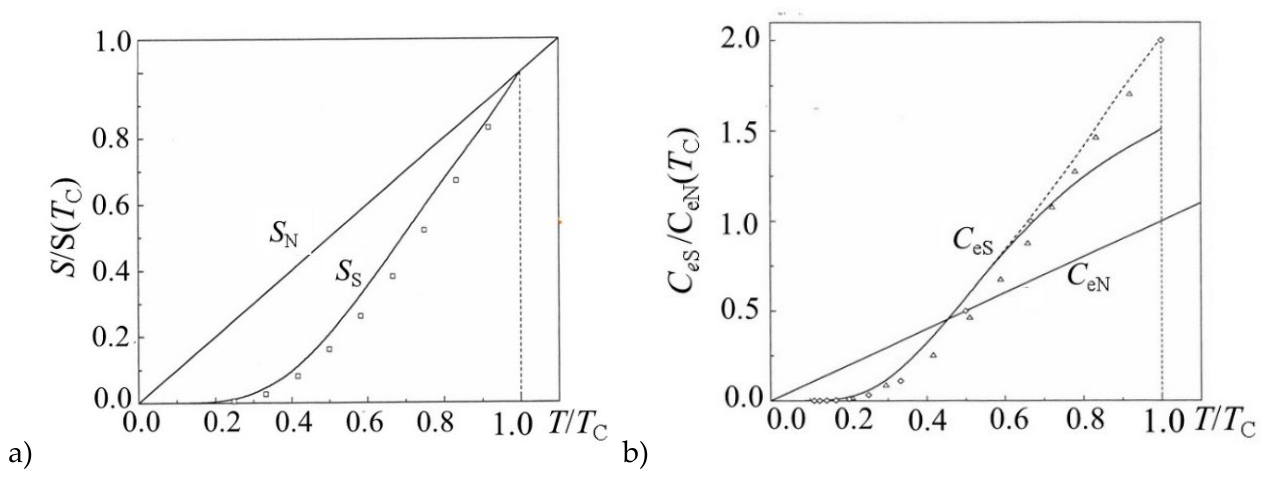
Despite the simplicity of the proposed overlapping two parabolic subband model, the calculated basic superconductor characteristics are in good agreement with experimental data. Also, there are no restrictions on applying this model to low- and high-temperature superconductors.
The presented model, with two overlapping parabolic density-of-states subbands near the Fermi level, allows us to find the temperature dependence of the basic superconducting characteristics, such as the free energy, the energy gap, the total electron system energy, the electron density of states, the electronic heat capacity, and the electron system entropy. The calculated dependences of relative superconductor characteristics on temperature are in good agreement with known experimental results.
The distribution of electrons by energy in superconductors is described by Fermi-Dirac statistics and does not imply the creation of Cooper pairs or bosons. According to the proposed superconducting model, the superconducting phase can only exist in highly degenerate materials with overlapping electronic subbands near the Fermi level in the normal state.
3. Conclusion
It is shown that the BCS relationships for both the superconducting transition temperature [Eq. (1)] and the energy gap [Eq. (2)] are not satisfied, but their ratio agrees with experiment because the corresponding multipliers simplify. BCS proposed that the electron energy range kTD near the Fermi level is very narrow, but in fact, this range many times exceeds the width of the probability density function in energy for free moving electrons. The most unacceptable result is the BCS model concept that the free electron passing through the lattice polarizes the lattice ions along its path. Considering the superconducting transition temperatures of metals, the density of free electrons is about three orders smaller than the total valence electron density, so many atoms of metal are neutral, and any free electron passing through neutral atoms cannot polarize the neutral atom lattice, and the predicted BCS model of Cooper pair creation is unacceptable. The free electrons in the normal phase are scattered by electronic defects, and their mean free path is about the average distance between electronic defects.
A general mechanism of superconductivity, based on the separation of two overlapping electronic subbands near the Fermi level in highly degenerate materials, is presented. The main thermodynamic equation that describes the normal and superconducting phases relates the free energy, total electron energy, and entropy of a highly degenerate electron gas during the second-order superconducting transition. By solving this problem, the minimum of the free energy on the energy gap in the superconducting phase is found at any temperature T<TC. The calculated dependences of the energy gap, free energy, total system energy, and entropy on temperature are close to the experimental results for both low- and high-temperature superconductors. It is shown that after the formation of the energy gap, electrons occupy the free energy levels below the gap two by two with opposite spins and opposite wave vectors, providing a picture of electron pairs.
Author Contributions
V.P. is the author of the theoretical concept and derivations, and M.K. performed calculations and visualization of data. The manuscript is written through contributions of both authors. Both authors have approved the final version of the manuscript.
Funding
This research received no external funding.
Data Availability Statement
Data are provided in the figures of the article.
Conflicts of Interest
The authors declare no conflict of interest.
References
- Onnes, H.K. Commun. Phys. Lab. Univ. Leiden. 1911, 120b, 122b, 124c.
- Meissner, W.; Ochsenfeld, R. Constraining forces causing Meissner effect. Naturwissenschaften 1933, 21, 787–789. [Google Scholar]
- London, F.; London, H. The electromagnetic equation of the supraconductor. Proc. Roy. Soc. A 1935, 149, 71–88. [Google Scholar] [CrossRef]
- Ginsburg, V.L.; Landau, L.D. On the theory of superconductivity. J. Exp. Theor. Phys. (Russ.) 1950, 20(12), 1064–1082. [Google Scholar]
- Bardeen, J.; Cooper, L.N.; Schriefer, J.R. Theory of superconductivity. Phys. Rev. B 1957, 108(5), 4260–4263. [Google Scholar] [CrossRef]
- Cooper, L.N. Bound electron pairs in a degenerate Fermi gas. Phys. Rev. 1956, 104(4), 1189–1190. [Google Scholar] [CrossRef]
- Gor′kov, L.P. Microscopic derivation Ginzburg-Landau equations of superconducting theory. J. Eksp. Theor. Phys. (Russ.) 1959, 36(6), 1918–1923. [Google Scholar]
- Chávez, I.; Salas, P.; Solís, M.A.; de Llano, M. A boson-fermion theory that goes beyond the BCS approximations for superconductors. Phys. A 2022, 607, 128167. [Google Scholar] [CrossRef]
- Josephson, B.D. Possible new effects in superconductive tunneling. Phys. Lett. 1962, 1, 251–262. [Google Scholar] [CrossRef]
- Bednorz, J.G.; Müller, K.A. Possible high TC superconductivity in the Ba-La-Cu-O system. Z. Phys. B 1986, 64, 189–193. [Google Scholar] [CrossRef]
- Wu, M.K.; Ashburn, J.R.; Torg, C.J.; Horn, P.H.; Meng, R.L.; Gao, L.; Huang, Z.J.; Wang, Y.Q.; Chu, C.W. Superconductivity at 93 K in a new mixed-phase Y-Ba-Cu-O compound system at ambient pressure. Phys. Rev. Lett. 1987, 58(9), 908–910. [Google Scholar] [CrossRef] [PubMed]
- Gao, L.; Xue, Y.Y.; Chen, F.; Xiong, Q.; Meng, R.L.; Ramirez, D.; Chu, C.W.; Eggert, J.H.; Mao, H.K. Superconductivity up to 164 K in HgBa2Cam-1CumO2m+2+δ (m=1, 2, 3) under quasihydrostatic pressures. Phys. Rev. B 1994, 50(6), 4260–4263. [Google Scholar]
- Hirsh, J.E. Hole conductors and superconductors. Mat. Res. Soc. Symp. Proc. 1989, 156. [Google Scholar]
- Hirsch, J.E. Spin Meissner effect in superconductors and the origin of the Meissner effect. EPL J. 2008, 81, 67003. [Google Scholar] [CrossRef]
- Hirsch, J.E. The London moment: what a rotating superconductor reveals about superconductivity. Phys. Scr. 2014, 89, 015806. [Google Scholar]
- Cohen, M.L. Superconductivity in Low-Carrier-Density Systems: Degenerate Semiconductors; Marcel Dekker, Inc.: New York, NY, USA, 1969. [Google Scholar]
- Daunt, J.G.; Medelsson, K. An experiment on the mechanism of superconductivity. Proc. Roy. Soc. A 1946, 185, 225–239. [Google Scholar] [CrossRef]
- Goodman, B.B. The thermal conductivity of superconducting tin below 1 K. Proc. Phys. Soc. A 1953, 66, 217–227. [Google Scholar] [CrossRef]
- Corak, W.S.; Goodman, B.B.; Satterthaite, C.B.; Wexler, A. Exponential temperature dependence of the electronic specific heat of superconducting vanadium. Phys. Rev. 1954, 96, 1442–1444. [Google Scholar] [CrossRef]
- Tinkham, M. Energy gap interpretation of experiments on infrared transmission through superconducting films. Phys. Rev. 1945, 104, 845–846. [Google Scholar]
- Takada, J.; Terashima, T.; Bando, Y.; Mazaki, H.; Iijima, K.; Yamamoto, K.; Hirata, K. Quasiparticle density of states in the perpendicular direction to the Cu-O planes in YBa2Cu3O7-x single-crystal thin films. Phys. Rev. B 1989, 4478–4481. [Google Scholar] [CrossRef] [PubMed]
- Giaever, I. Energy in superconductors measured by electron tunneling. Phys. Rev. Lett. 1960, 5, 147–148. [Google Scholar] [CrossRef]
- Kittel, C. Introduction to Solid State Physics; John Wiley and Sons, Inc.: New York, NY, USA, 1976. [Google Scholar]
- Keene, M.N.; Jackson, Y.J.; Gough, C.E. Demonstration of the phase coherence of the superconducting wavefunctions between conventional and high-TC superconductors. Nature 1989, 340, 210–211. [Google Scholar] [CrossRef]
- Deaver, B.S., Jr.; Fairbank, W.M. Experimental evidence for quantized flux in superconducting cylinders. Phys. Rev. Lett. 1961, 7(2), 43–46. [Google Scholar] [CrossRef]
- Doll, R.; Nabauer, M. Experimental proof of magnetic flux quantization in a superconducting ring. Phys. Rev. Lett. 1961, 7(2), 51–52. [Google Scholar] [CrossRef]
- Tsuei, C.C.; Chi, C.C.; Newns, D.M.; Pattnaik, P.C.; Däumling, M. Thermodynamic evidence for a density-of-state peak near the Fermi level in YBa2Cu3O7-y. Phys. Rev. Lett. 1992, 69(14), 2134–2137. [Google Scholar] [CrossRef] [PubMed]
- Fugimori, A. Nature of the electronic states near the Fermi level in high-TC superconductors: high-energy spectroscopic evidence. In Proc. Strong Correlation and Superconductivity.; Springer-Verlag: Berlin, Heidelberg, Germany, 1989. [Google Scholar]
- Goodenough, J.B. Chemical and structural relationships in high-TC material. Supercond. Sci. Technol. 1990, 3(1), 26–37. [Google Scholar]
- Olson, C.G.; Liu, R.; Lynch, D.W.; Arko, A.J.; List, R.S.; Veal, B.W.; Chang, Y.C.; Jiang, P.Z.; Poukilar, A.P. Superconducting gap in Bi-Sr-Ca-Cu-O by high-resolution angle-resolved photoelectron spectroscopy. Science 1989, 245, 731–733. [Google Scholar] [CrossRef] [PubMed]
- Palenskis, V.; Jonkus, V. Study of the randomly moving electron transport peculiarities in metals. Metals 2023, 13, 1551. [Google Scholar] [CrossRef]
- Palenskis, V.; Žitkevičius, E. Summary of new insight into electron transport in metals. Crystals 2021, 11, 622. [Google Scholar] [CrossRef]
- Korovina, J.I.; Leoniuk, L.I.; Pediash, M.V.; Petrov, D.K.; Ponomariov, J.G.; Rachimov, Ch.T.; Setupati, K.; Sugakova, M.V.; Tennakun, A.B. Determination of the energy gap of Bi2-xPbxSr2CaCu2O8 using the tunneling spectroscopy. Supercond. Phys. Chem. Technol. 1991, 4(11), 2133–2143. [Google Scholar]
- Kitazawa, A. Electronic structures of oxide superconductors – development of concepts. In Earlier and Recent Aspects of Superconductivity; Bednorz, J.G., Müller, K.A., Eds.; Springer-Verlag: Berlin, Heidelberg, Germany, 1990. [Google Scholar]
- Palenskis, V.; Maknys, K. Modeling of superconductor characteristics. Lith. J. Phys. 1996, 36(4), 365–368. [Google Scholar]
- Palenskis, V.; Maknys, K. Minimization of the Gibbs free energy and redistribution of electron density of states in superconductors. Lith. J. Phys. 1997, 37(6), 484–488. [Google Scholar]
- Palenskis, V.; Maknys, K. Modeling of the basic superconducting thermodynamical-statistical characteristics. J. Low. Temp. Phys. 1999, 127(3/4), 271–275. [Google Scholar] [CrossRef]
- Tinkham, M. Introduction to Superconductivity; McGraw-Hill, Inc.: New York, NY, USA, 1996. [Google Scholar]
- Waldram, J. R. Superconductivity of Metals and Cuprates. Ch. 14. Normal-State Transport Properties in the Cuprates; The Institute of Physics: London, 1996. [Google Scholar]
Figure 1.
Schematic views of a latter ion polarization by moving electron (a), and a phonon-mediated electron interaction (b).
Figure 1.
Schematic views of a latter ion polarization by moving electron (a), and a phonon-mediated electron interaction (b).
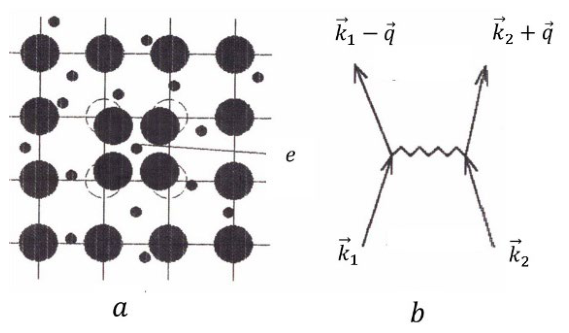
Figure 2.
The schematic distribution of the density of the electronic states near the energy gap at T≈0 according to the BCS model: a) in the normal phase; b) in the superconducting phase.
Figure 2.
The schematic distribution of the density of the electronic states near the energy gap at T≈0 according to the BCS model: a) in the normal phase; b) in the superconducting phase.
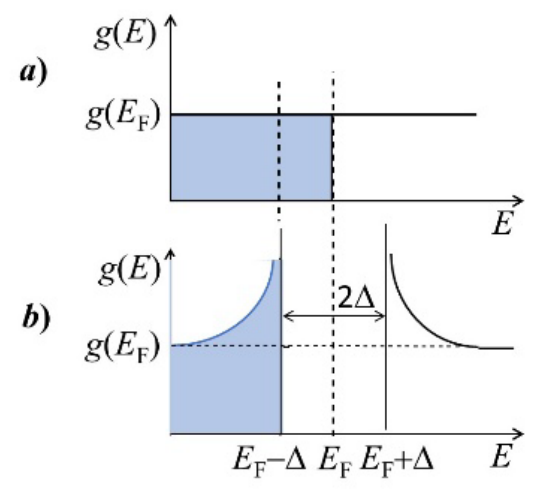
Figure 3.
a) The relationship between the superconducting transition temperature TC and the Debye temperature TD, for elemental metal superconductors; b) the dependences of the TC, TD, and γ on the composition x of the alloy Nb1- xMox (from table 7 [16]).
Figure 3.
a) The relationship between the superconducting transition temperature TC and the Debye temperature TD, for elemental metal superconductors; b) the dependences of the TC, TD, and γ on the composition x of the alloy Nb1- xMox (from table 7 [16]).
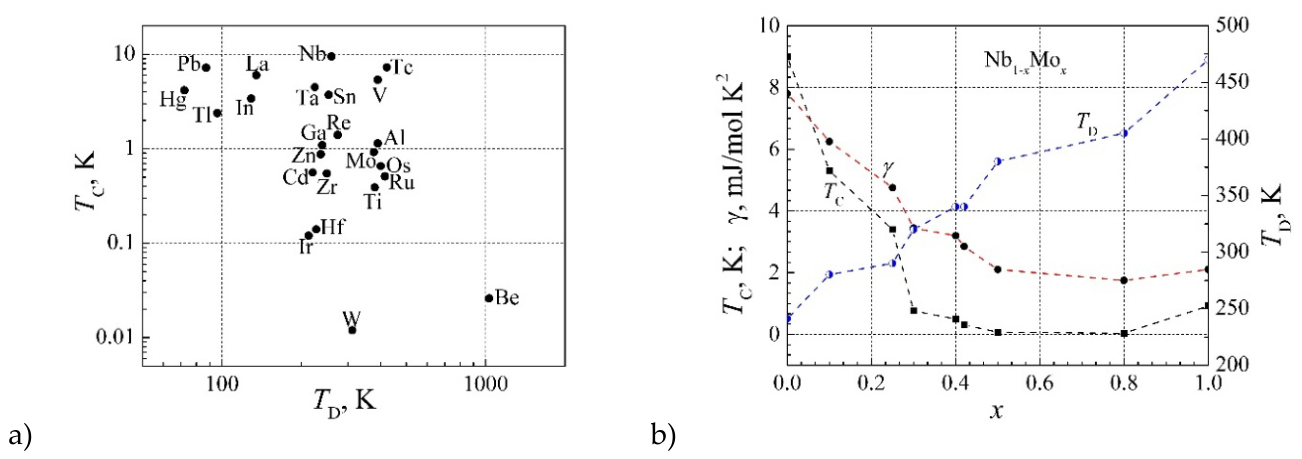
Figure 4.
a) The comparison of the energy gap 2Δ, kTD=ћωD, the distribution of the free randomly moving electrons neff(TC) (shaded area), and the Fermi function f(E); b) relative values of the energy gap dependence on the relative temperature in the superconducting phase (according to [16]). The dots are the experimental data for Sn, Ta, and Nb; the solid curve is the BCS prediction.
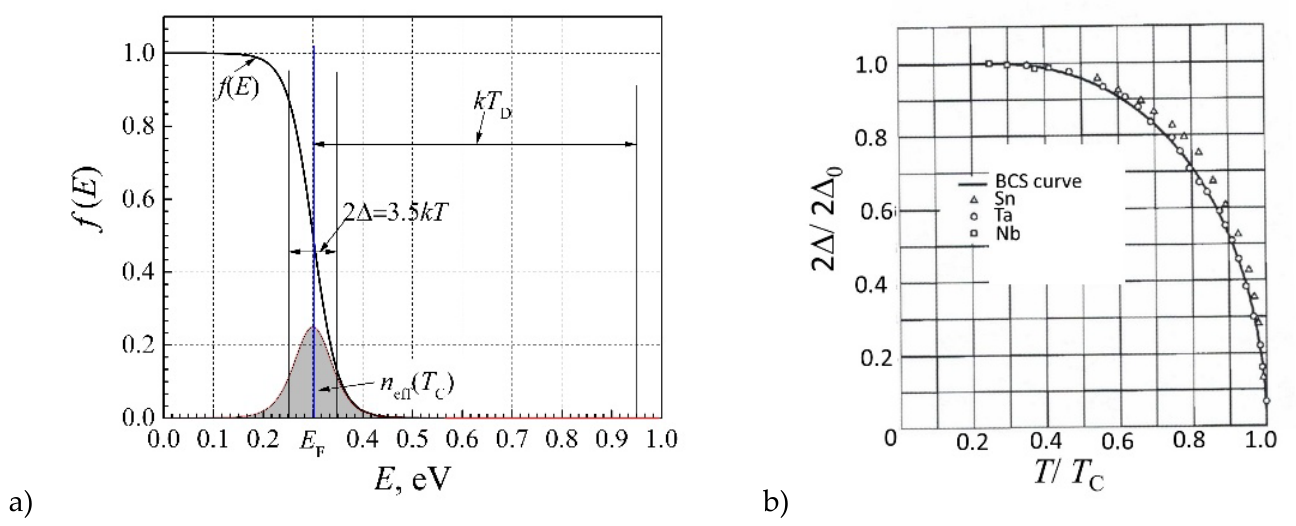
Figure 5.
a) The flux quantization in a structure YBCO/Nb ring [24]; b) illustration of the appearance of the quasiparticle peak in Bi2Sr2CaCu2O8 below TC obtained using high-energy and angular-resolution spectra at temperatures 90 K (1) and 20 K (2) [30].
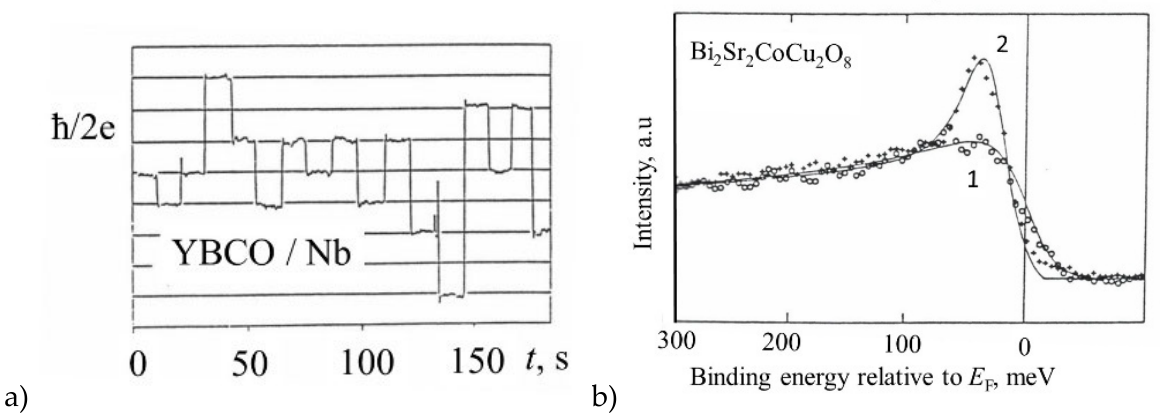
Figure 7.
a) Schematic distribution of two overlapping parabolic energy subbands for the proposed superconducting transition model, a) at T > TC; b) at T < TC. Here, nS(T) is the free RM electron density in the superconducting phase.
Figure 7.
a) Schematic distribution of two overlapping parabolic energy subbands for the proposed superconducting transition model, a) at T > TC; b) at T < TC. Here, nS(T) is the free RM electron density in the superconducting phase.
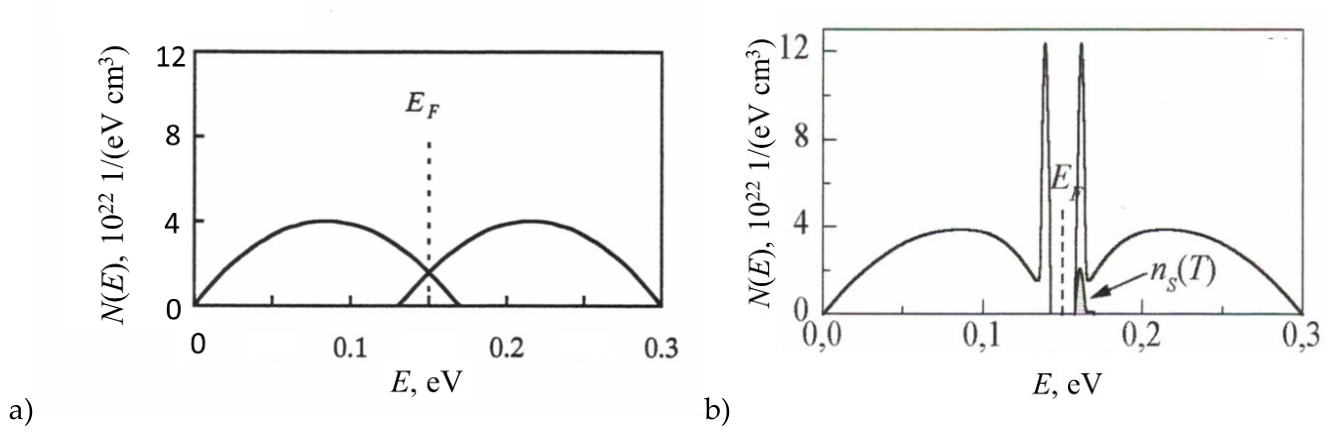
Figure 8.
a) The total electron system energy U and free energy F dependences on temperature in the normal phase of a superconductor; b) dependence of the free energy in superconducting and normal phases on temperature.
Figure 8.
a) The total electron system energy U and free energy F dependences on temperature in the normal phase of a superconductor; b) dependence of the free energy in superconducting and normal phases on temperature.
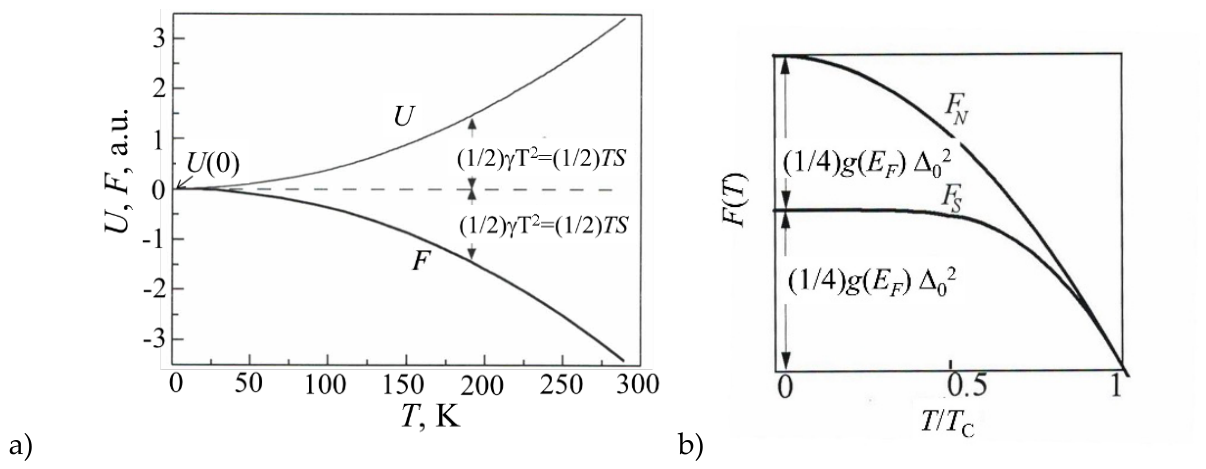
Figure 9.
a) The relation between TC and the electron condensation energy A1 for one free RM electron at T = 0 K. The red dashed curve is described by Eq. (21); b) The relation between the energy gap and the electron condensation energy 2A1 for two free RM electrons at T = 0 K. The red dashed curve is described by Eq. (22); here, KBiO (BaxK1-xBiO3), LSCO (La1.8Sr0.2Cu4O4), YBCO (YBa2Cu3O7), BSCCO (Bi2Sr2Ca2Cu3O10), TBBCCO (Tl2Ba2Ca2Cu3O10) [39].
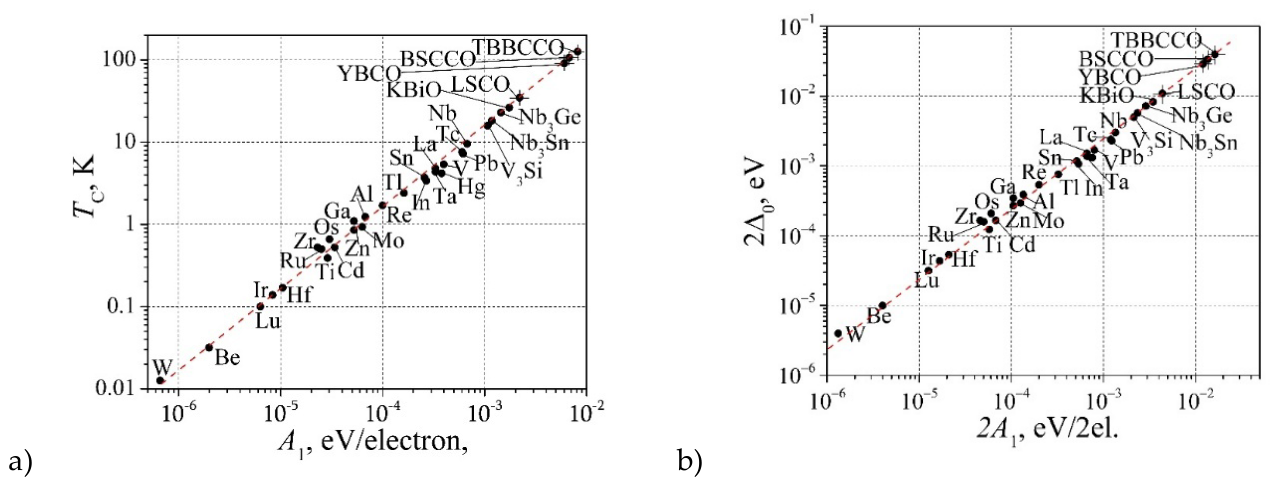
Figure 10.
The free energy dependence on the energy gap width at different relative temperatures T/TC: B) 0.1; C) 0.2; D) 0.3; E) 0.4; F) 0.5; G) 0.6; H) 0.7; I) 0.8; J) 0.9.
Figure 10.
The free energy dependence on the energy gap width at different relative temperatures T/TC: B) 0.1; C) 0.2; D) 0.3; E) 0.4; F) 0.5; G) 0.6; H) 0.7; I) 0.8; J) 0.9.
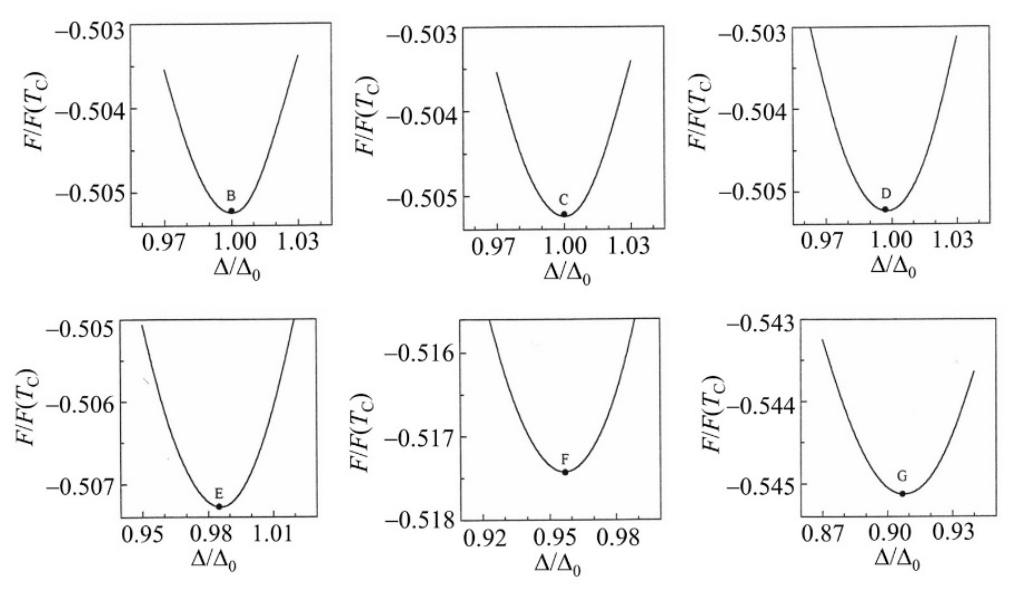
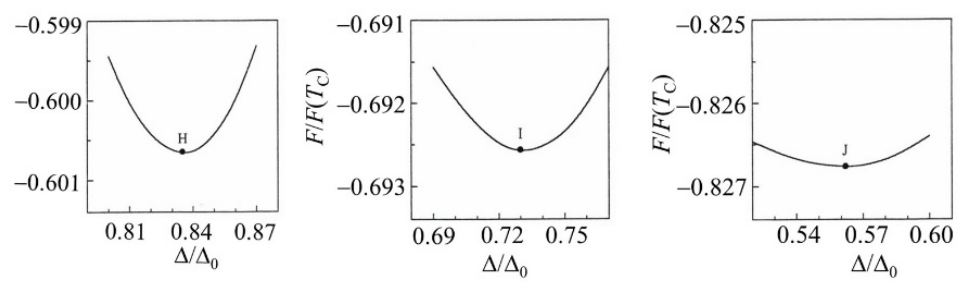
Figure 11.
The distribution of the electron density of states for the proposed superconductivity model in the superconductivity phase at two relative temperatures T/TC: a) 0.7; b) 0.9.
Figure 11.
The distribution of the electron density of states for the proposed superconductivity model in the superconductivity phase at two relative temperatures T/TC: a) 0.7; b) 0.9.
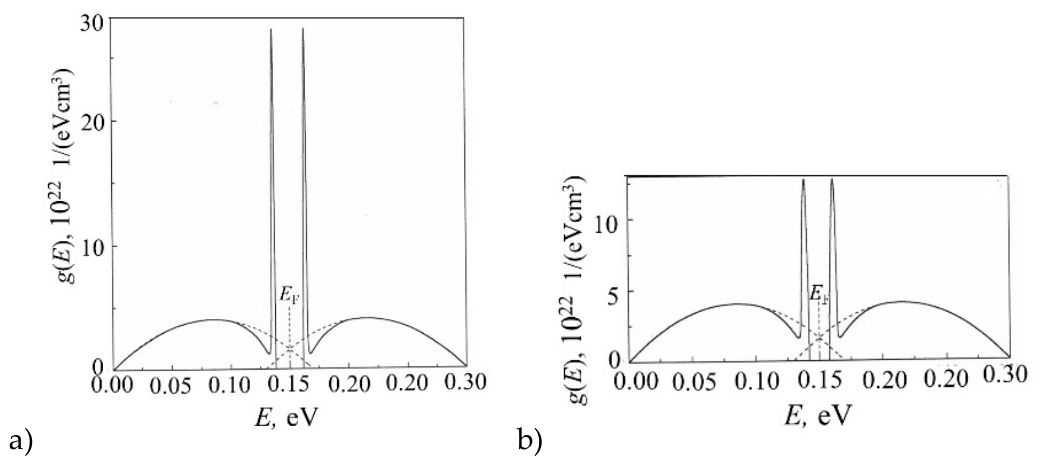
Figure 12.
a) The energy gap dependence on temperature: black dots B, C, D, E, F, G, H, I, J represent the minimum values in Figure 10; Δ and ◊ dots are the experimental data of Sn and Ta, respectively [16]; dots □ are data of Bi1.9Pb0.1Sr2CaCu2O8 [33]; b) the electron system entropy dependence on temperature in the normal SN and superconducting SS phases. Dots □ are experimental data for aluminum in the superconducting state [16].
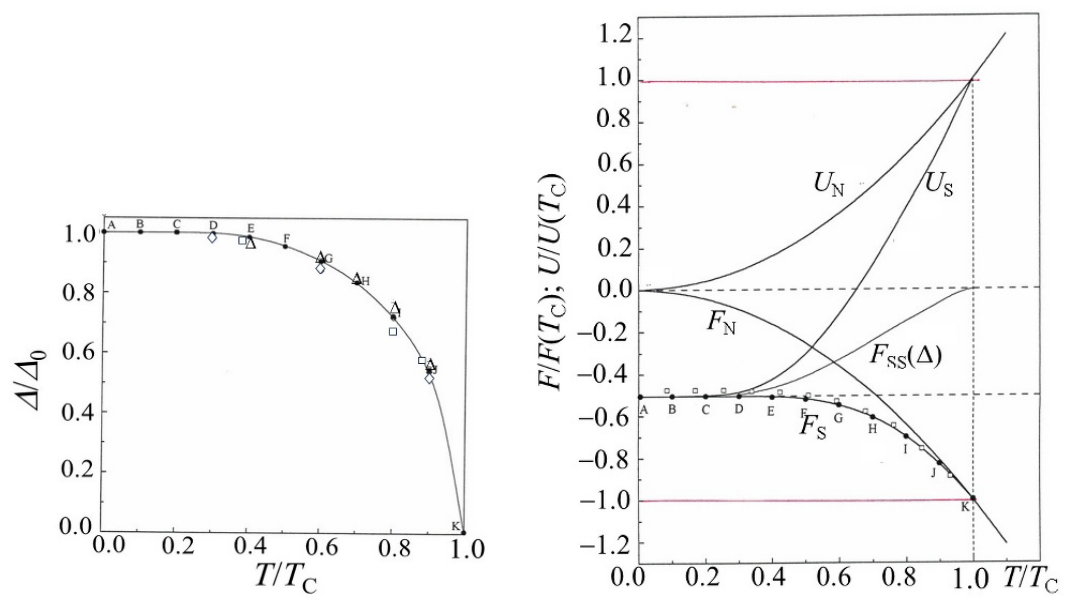

Table 1.
The exponent index α for various elemental metal superconductors (according to [16]).
Table 1.
The exponent index α for various elemental metal superconductors (according to [16]).
| Superconductor | α | Superconductor | α |
| Zn | 0.45±0.05 | Ru | 0.00±0.05 |
| Sn | 0.47±0.02 | Os | 0.15±0.05 |
| Hg | 0.50±0.03 | Zr | 0.00±0.05 |
| Pb | 0.49±0.02 | Cd | 0.32±0.07 |
| Mo | 0.33 |
Disclaimer/Publisher’s Note: The statements, opinions and data contained in all publications are solely those of the individual author(s) and contributor(s) and not of MDPI and/or the editor(s). MDPI and/or the editor(s) disclaim responsibility for any injury to people or property resulting from any ideas, methods, instructions or products referred to in the content. |
© 2026 by the authors. Licensee MDPI, Basel, Switzerland. This article is an open access article distributed under the terms and conditions of the Creative Commons Attribution (CC BY) license (http://creativecommons.org/licenses/by/4.0/).
Copyright: This open access article is published under a Creative Commons CC BY 4.0 license, which permit the free download, distribution, and reuse, provided that the author and preprint are cited in any reuse.