
Submitted:
04 August 2026
Posted:
05 August 2026
You are already at the latest version
Abstract
Electrical machines, including motors, generators, and transformers, are fundamental components of modern industrial systems, power networks, transportation infrastructure, and renewable energy installations. Their reliable operation is essential for maintaining system efficiency, operational safety, and economic performance. However, these machines are continuously exposed to electrical, mechanical, thermal, and environmental stresses that can lead to performance degradation and unexpected failures. Conventional condition monitoring and maintenance approaches, such as vibration analysis, Motor Current Signature Analysis (MCSA), infrared thermography, acoustic emission monitoring, partial discharge testing, and Dissolved Gas Analysis (DGA), have been widely used for machine health assessment. Despite their effectiveness, these methods often require expert interpretation, extensive manual analysis, and periodic inspections, limiting their ability to detect incipient faults and support predictive maintenance. Recent advances in sensing technologies, the Industrial Internet of Things (IIoT), edge computing, and cloud analytics have enabled the collection of large volumes of operational data, creating new opportunities for Artificial Intelligence (AI)-based health management systems. This review presents a comprehensive overview of AI applications in electrical machine health monitoring, fault diagnosis, and predictive maintenance. The paper discusses electrical machine classifications, common fault mechanisms, condition monitoring data sources, maintenance strategies, and the limitations of conventional diagnostic approaches. Furthermore, the review examines machine learning (ML), deep learning (DL), hybrid AI approaches, and Explainable Artificial Intelligence (XAI) techniques for motors, generators, and transformers. Finally, key challenges related to data quality, model interpretability, computational complexity, cybersecurity, and standardization are discussed, together with future research directions involving Digital Twins, multimodal data fusion, federated learning, and edge intelligence.
Keywords:
artificial intelligence
; electrical machines
; fault diagnosis
; health monitoring
; predictive maintenance
; machine learning
; deep learning
1. Introduction
Electric motors, generators, transformers and other electrical machines are the backbone of modern industrial systems, electrical power networks, transportation infrastructure, manufacturing plants and renewable energy installations [1,2]. These machines are involved in energy conversion, transmission and utilization processes that underpin economic development and technological progress around the world. Hence, the continuous and reliable operation of electrical machines is of great importance for maintaining productivity, system stability and operational efficiency [3,4,5]. However, electrical machines are usually subjected to severe working conditions such as thermal stress, electrical overloads, mechanical vibrations, insulation deterioration, environmental contamination, and ageing effects that can cause performance degradation and unforeseen failures. Electrical machines are widely used in industry, and failures can cause considerable economical losses, unplanned downtime, lower energy efficiency, increased maintenance costs and safety risk [6]. Common motor faults are bearing faults, stator winding faults, rotor bar faults, shaft misalignment, eccentricity and insulation degradation. Transformers may also have winding deformation, partial discharge, insulation ageing, core faults, overheating and oil contamination. The early detection and accurate diagnosis of these faults are essential to avoid catastrophic failures and prolong the life of the equipment [7,8]. Traditionally, condition assessment of electrical machines has been carried out based on preventive and corrective maintenance strategies, aided by techniques such as vibration analysis, motor current signature analysis, thermal imaging, acoustic emission monitoring and dissolved gas analysis as shown in Figure 1 [9,10]. These techniques have been proved to be useful, but they usually need expert interpretation, detailed manual analysis and periodic inspections, which restrict their efficiency to detect incipient faults and to predict future machine health conditions. With the increasing complexity and interconnection of industrial systems, the demand for intelligent maintenance with real-time monitoring, automatic diagnostics and predictive decision-making is increasing [11].
The recent breakthroughs in the field of AI have revolutionised electrical machine health management. AI enables the extraction of meaningful information from large amounts of operational data, and accurate detection, classification, prediction and maintenance planning for faults [12,13]. ML and DL algorithms have shown impressive capabilities in recognising complex fault patterns from electrical, mechanical, thermal and acoustic signals. ANNs, support vector machines (SVMs), random forests (RFs), convolutional neural networks (CNNs), recurrent neural networks (RNNs), and long short-term memory (LSTM) networks have been successfully used to monitor the machine health and predict failures before they occur. [14,15] The exponential growth of Internet of Things (IoT), cloud computing, edge computing and Industry 4.0 technologies has further accelerated the adoption of AI-driven condition monitoring systems. Smart sensors are increasingly being integrated into modern electrical machines, which can collect operational data continuously, allowing for real-time analytics and predictive maintenance [16]. Recent state-of-the-art AI paradigms, such as XAI, Graph Neural Networks (GNNs), Federated Learning (FL), Reinforcement Learning (RL), and Digital Twins, have demonstrated promising outcomes in improving diagnostic accuracy, model transparency, scalability, and autonomous maintenance capabilities [17,18]. Much progress has been made in this area, but many challenges remain. These include limited availability of high-quality fault datasets, data imbalance issues, model interpretability issues, cybersecurity risks, computational complexity and issues related to real world deployment. Additionally, the increasing heterogeneity of AI techniques and electrical machine applications has created a need for a comprehensive review that summarises the current developments, identifies research deficiencies, and highlights future opportunities [19,20].
This paper presents a comprehensive review of AI applications in electrical machine health monitoring, fault diagnosis, and predictive maintenance. The review focuses on motors, generators, and transformers, examining their common fault mechanisms, condition monitoring data sources, and maintenance strategies. Conventional diagnostic techniques, including vibration analysis, Motor Current Signature Analysis (MCSA), infrared thermography, acoustic emission monitoring, partial discharge testing, and Dissolved Gas Analysis (DGA), are reviewed together with their limitations in modern industrial environments. Furthermore, the paper provides a detailed analysis of AI methodologies applied to electrical machine health management, including machine learning, deep learning, reinforcement learning, hybrid AI approaches, and XAI. The applications of these techniques in fault detection, anomaly identification, Remaining Useful Life (RUL) estimation, maintenance optimization, and intelligent asset management are comprehensively discussed. The review also examines the integration of AI with enabling technologies such as the Industrial Internet of Things (IIoT), edge computing, cloud analytics, and Digital Twins. In addition, the key challenges associated with data quality, model generalization, interpretability, computational complexity, cybersecurity, and standardization are identified, and future research directions are highlighted. The remainder of this paper is organized as follows. Section 2 presents an overview of electrical machines, common fault mechanisms, condition monitoring data sources, and maintenance strategies. Section 3 reviews AI techniques for electrical machine health management, including machine learning, deep learning and hybrid AI approaches. Section 4 discusses the applications of AI in motors, generators, and transformers, with emphasis on fault diagnosis, prognostics, and predictive maintenance. Section 5 outlines the major challenges and future research directions. Finally, Section 6 concludes the paper and summarizes the key findings.
2. Overview of Electrical Machines and Common Fault Mechanisms
Electrical machines are fundamental components of modern power systems and industrial processes, serving as the primary devices for electrical energy conversion, transmission, and utilization [21,22]. These machines are extensively deployed in manufacturing industries, transportation systems, renewable energy installations, power generation facilities, and smart grid infrastructures. The growing dependence on electrical machines for critical operations has increased the need for reliable, efficient, and uninterrupted performance [23]. Consequently, maintaining the health and operational integrity of these machines has become a major focus for both researchers and industry practitioners. Understanding the structure, operating principles, and common failure mechanisms of electrical machines is essential for developing effective monitoring, diagnostic, and predictive maintenance strategies.
2.1. Classification of Electrical Machines
Electrical machines can generally be classified into motors, generators, and transformers based on their functional roles within electrical systems. These machines form the foundation of modern industrial processes, power generation facilities, transportation systems, renewable energy installations, and smart grid infrastructures [24,25]. Their ability to efficiently convert, transfer, and regulate energy has made them indispensable components of contemporary electrical engineering applications. As industries continue to adopt automation, digitalization, and intelligent control technologies, the operational reliability and performance of electrical machines have become increasingly important. Consequently, significant research efforts have focused on developing advanced monitoring and maintenance strategies capable of improving machine availability and reducing unexpected failures [26]. Table 1 presents a comparison of the major categories of electrical machines based on their energy conversion principles, input-output relationships, primary functions, and representative examples. Electric motors are the most widely deployed category of electrical machines and are responsible for converting electrical energy into mechanical energy [27,28]. They are extensively used in industrial drives, manufacturing equipment, electric vehicles, robotics, pumps, compressors, fans, conveyor systems, and household appliances. It is estimated that electric motors account for a substantial portion of global electricity consumption, highlighting their economic and operational significance. Among the various motor technologies available, induction motors remain the most utilized due to their rugged construction, low maintenance requirements, reliability, and cost-effectiveness [29]. However, advancements in power electronics and control systems have accelerated the adoption of synchronous motors, permanent magnet synchronous motors (PMSMs), brushless direct-current (BLDC) motors, and switched reluctance motors (SRMs) in applications requiring high efficiency, superior dynamic performance, and precise speed control. The increasing deployment of these advanced motor technologies has also created new challenges associated with condition monitoring, fault diagnosis, and predictive maintenance [30].
Generators perform the reverse energy conversion process by transforming mechanical energy into electrical energy. These machines are critical components in conventional thermal power plants, hydroelectric stations, nuclear facilities, wind farms, and distributed generation systems [31]. Synchronous generators are predominantly used in large-scale power generation because of their ability to maintain voltage regulation and contribute to power system stability. In contrast, induction generators and permanent magnet generators are increasingly employed in renewable energy applications, particularly in wind energy conversion systems. The growing integration of renewable energy resources into modern power grids has significantly increased the operational demands placed on generator systems. Consequently, ensuring generator reliability has become a major priority for utility companies and power system operators. Continuous monitoring of generator health is essential to prevent unexpected failures that may compromise power quality, system stability, and energy security [32,33]. Transformers represent another critical class of electrical machines and play a vital role in the transmission and distribution of electrical energy. Unlike motors and generators, transformers do not involve electromechanical energy conversion but instead transfer electrical energy between circuits through electromagnetic induction. Their primary function is to step voltage levels up or down to facilitate efficient power transmission and safe electricity distribution [34]. Transformers can be categorized into power transformers, distribution transformers, instrument transformers, autotransformers, dry-type transformers, and emerging smart transformers. These assets are among the most expensive and strategically important components within electrical power networks [35]. Transformer failures can result in widespread service interruptions, costly repairs, and substantial economic losses. As a result, transformer condition monitoring has become a major area of research, particularly with the emergence of intelligent diagnostic techniques based on Artificial Intelligence, the Internet of Things (IoT), and Digital Twin technologies [36,37].
As illustrated in Figure 2, the digital transformation of electrical machines involves systematic workflow that begins with data acquisition from motors, generators, and transformers through various sensing technologies. The collected data are transmitted through communication networks and processed using cloud or edge computing platforms, where AI algorithms perform condition monitoring, fault diagnosis, prognostics, and maintenance decision support [38,39]. This framework enables the transition from conventional maintenance approaches toward intelligent, data-driven health management systems capable of improving reliability, reducing downtime, and optimizing maintenance activities. The increasing availability of high-resolution monitoring data has created significant opportunities for the application of Artificial Intelligence techniques in electrical machine health management [40,41,42]. ML and DL algorithms can automatically identify complex fault patterns, detect anomalies, classify fault conditions, and predict equipment degradation with high accuracy. Furthermore, AI-driven analytics can support maintenance decision-making by estimating the Remaining Useful Life (RUL) of critical machine components, thereby reducing unplanned downtime and maintenance costs [43].
2.2. Common Fault Mechanisms in Electrical Machines
Electrical machines operate under a variety of electrical, mechanical, thermal, and environmental stresses throughout their service life. These stresses can gradually degrade machine components and eventually lead to failures if appropriate monitoring and maintenance measures are not implemented. Faults generally develop progressively, beginning with minor abnormalities that may initially have little impact on machine performance [44,45]. However, if left undetected, these abnormalities can evolve into severe failures that compromise machine reliability, efficiency, and safety. Mechanical faults represent one of the most common causes of machine failure, particularly in rotating electrical machines. Components such as bearings, shafts, couplings, and rotor assemblies are continuously subjected to dynamic mechanical forces during operation [46]. Over time, these forces can lead to wear, fatigue, misalignment, imbalance, and structural deterioration. Bearing faults are especially prevalent and are often associated with inadequate lubrication, contamination, excessive loading, and material fatigue [47]. Since bearings support rotational motion and directly influence machine stability, their degradation frequently results in increased vibration levels, excessive noise, and reduced operational efficiency. Electrical faults primarily originate from insulation deterioration, excessive current stresses, manufacturing defects, and adverse operating conditions. Stator winding faults, inter-turn short circuits, broken rotor bars, open-circuit conductors, and partial discharge phenomena are among the most frequently encountered electrical failures [48,49]. These faults can produce abnormal current distributions, excessive heat generation, electromagnetic imbalances, and increased power losses. In many cases, electrical faults remain undetected during their early stages because their signatures are subtle and difficult to distinguish from normal operating variations. Consequently, advanced monitoring techniques are often required to identify these faults before they cause severe damage. Thermal stress also plays a significant role in electrical machine degradation [50]. Excessive temperatures accelerate insulation aging, reduce material strength, and increase the likelihood of electrical breakdown. Thermal faults may arise from overloading, inadequate cooling, blocked ventilation pathways, or elevated ambient temperatures. Prolonged exposure to excessive heat can significantly shorten machine lifespan and contribute to catastrophic failures [51,52]. For transformers, thermal deterioration is particularly critical because it directly affects insulation integrity and transformer oil quality.
Transformer faults exhibit unique characteristics compared to those of rotating machines. Common transformer failures include winding deformation, insulation aging, core faults, overheating, partial discharge activity, and oil contamination. These faults can compromise transformer efficiency, reliability, and operational safety [53,54]. Dissolved gases generated within transformer oil often provide valuable information regarding fault development and severity. As a result, dissolved gas analysis has become one of the most widely adopted diagnostic techniques for transformer condition assessment. In addition to the direct causes of machine failures, operating conditions play a crucial role in accelerating fault development [55]. Electrical machines operating under variable loading conditions, frequent start-stop cycles, harsh environmental conditions, and fluctuating power quality are generally more susceptible to degradation than machines operating under stable conditions. Voltage unbalance, harmonic distortion, transient overvoltage, and frequent thermal cycling can introduce additional stresses that accelerate insulation deterioration and mechanical wear [56,57]. Consequently, modern electrical machines require continuous monitoring to assess their operating conditions and detect abnormal behavior before serious faults occur. Another important aspect of electrical machine degradation is the interaction between different fault mechanisms. In many practical situations, faults do not occur independently but instead influence one another [58]. For example, excessive mechanical vibration caused by rotor imbalance or bearing defects can accelerate insulation degradation in stator windings. Similarly, electrical faults such as short circuits can generate excessive heat, leading to thermal degradation of insulation materials and mechanical deformation of machine components. In transformers, partial discharge activity can progressively weaken insulation systems, eventually resulting in thermal faults and catastrophic breakdown [60,61]. The interdependence of these fault mechanisms makes fault diagnosis a complex task and highlights the need for intelligent diagnostic systems capable of identifying multiple fault conditions simultaneously [62].
The severity of machine faults can vary considerably depending on their location, duration, and progression rate. Incipient faults are characterized by subtle changes in machine behaviors and often remain undetectable using conventional monitoring techniques [63]. As the fault progresses, measurable deviations become increasingly evident in vibration signals, current waveforms, temperature profiles, acoustic emissions, and other operational parameters. Advanced signal processing and Artificial Intelligence techniques have demonstrated significant potential in detecting these early-stage fault signatures, enabling maintenance actions to be implemented before severe degradation occurs [65]. Furthermore, the economic consequences of electrical machine failures have motivated industries to adopt more proactive maintenance strategies. Unexpected failures can lead to costly production interruptions, equipment replacement expenses, safety incidents, and reduced operational efficiency [66,67]. In critical sectors such as manufacturing, transportation, power generation, and renewable energy systems, even a brief period of downtime can result in substantial financial losses. Therefore, fault prevention and early diagnosis have become strategic priorities for asset management and reliability engineering programs. With the rapid advancement of sensing technologies and digital monitoring platforms, vast amounts of operational data can now be collected from electrical machines in real time [68]. This data provides valuable information regarding machine health conditions and fault progression patterns. However, the complexity and volume of these datasets often exceed the capabilities of traditional diagnostic methods [69]. As a result, Artificial Intelligence-based techniques, including machine learning and deep learning algorithms, have emerged as powerful tools for extracting meaningful insights from monitoring data and improving fault detection accuracy. These developments have accelerated the transition from traditional maintenance practices toward intelligent condition-based and predictive maintenance frameworks [70,71]. The progressive nature of fault development highlights the importance of continuous monitoring and early diagnosis. Modern condition monitoring systems seek to identify subtle fault signatures before significant performance degradation occurs. This capability is particularly important in critical industrial applications where unexpected equipment failure can result in costly downtime, safety hazards, and substantial economic losses [72]. Consequently, the integration of advanced monitoring technologies and Artificial Intelligence techniques has emerged as a promising approach for enhancing the reliability, availability, and lifespan of electrical machines.
2.3. Common Fault Mechanisms in Electrical Machines
Electrical machines are continuously exposed to electrical, mechanical, thermal, and environmental stresses throughout their operational lifetime. These stresses gradually degrade machine components and may eventually result in performance deterioration or catastrophic failure if appropriate maintenance strategies are not implemented [73,74]. Faults in electrical machines typically develop progressively, beginning with minor abnormalities that may initially have negligible effects on machine performance. However, as these abnormalities evolve, they can significantly compromise machine reliability, efficiency, availability, and operational safety [75]. Mechanical faults represent one of the leading causes of failures in rotating electrical machines. Components such as bearings, shafts, couplings, and rotor assemblies are subjected to continuous dynamic loading, vibration, and mechanical stresses during operation. Over time, these conditions may lead to wear, fatigue, misalignment, imbalance, looseness, and structural degradation. Bearing defects are particularly prevalent and are commonly associated with inadequate lubrication, contamination, excessive loading, and material fatigue [76,77]. Since bearings play a crucial role in supporting rotational motion and maintaining machine stability, their degradation often results in increased vibration levels, abnormal acoustic emissions, excessive noise, and reduced operational efficiency. Electrical faults primarily arise from insulation deterioration, manufacturing defects, excessive current stresses, and adverse operating conditions. Common electrical faults include stator winding failures, short inter-turn circuits, broken rotor bars, open-circuit conductors, insulation breakdown, and partial discharge activity [78]. These faults can produce abnormal current distributions, electromagnetic imbalances, excessive heat generation, and increased power losses. In many cases, electrical faults remain difficult to detect during their early stages because their signatures are subtle and often masked by normal operating variations [79,80]. Consequently, advanced condition monitoring techniques are required to identify these abnormalities before severe damage occurs. Thermal stress also contributes significantly to electrical machine degradation. Excessive temperatures accelerate insulation aging, reduce material strength, and increase the likelihood of electrical breakdown. Thermal faults may result from overloading, inadequate cooling, blocked ventilation pathways, poor heat dissipation, or elevated ambient temperatures [81]. Prolonged exposure to excessive heat can significantly reduce machine lifespan and increase maintenance requirements. In transformers, thermal degradation is particularly critical because it directly affects insulation integrity and transformer oil quality.
Transformer faults exhibit unique characteristics compared with those observed in rotating machines. Common transformer failures include winding deformation, insulation aging, core faults, overheating, partial discharge activity, and oil contamination. These faults can compromise transformer efficiency, reliability, and operational safety, potentially leading to costly service interruptions and equipment replacement. Dissolved gases generated within transformer oil often provide valuable information regarding fault initiation and severity [82,83]. Consequently, dissolved gas analysis has become one of the most widely adopted techniques for transformer condition assessment. Environmental factors further accelerate machine degradation and can significantly influence fault development. Harsh operating environments characterized by high humidity, dust accumulation, corrosive substances, moisture ingress, and extreme temperatures may adversely affect machine components and insulation systems [84]. Additionally, electrical machines operating under variable loading conditions, frequent start-stop cycles, voltage unbalance, harmonic distortion, and transient overvoltage are more susceptible to accelerated aging and premature failure. Fault mechanisms in electrical machines are often interdependent rather than isolated [85]. For example, mechanical defects such as rotor imbalance and bearing failures can increase vibration levels, which may accelerate insulation degradation and initiate electrical faults. Similarly, electrical faults frequently generate excessive heat that contributes to thermal degradation and mechanical deformation. In transformers, partial discharge activity can progressively weaken insulation systems, ultimately resulting in thermal faults and catastrophic failure [86]. This complex interaction among fault mechanisms increases the difficulty of fault diagnosis and underscores the need for intelligent monitoring systems capable of identifying multiple fault conditions simultaneously.
As illustrated in Figure 3, common fault mechanisms in electrical machines can be categorized into mechanical, electrical, thermal, transformer-specific, and environmental faults. The figure also presents the typical workflow of modern condition monitoring systems, which integrates data acquisition, communication networks, data storage, data analytics, diagnosis, and maintenance decision-making [87]. This integrated framework enables the continuous assessment of machine health conditions and supports the early detection of incipient faults. The progressive nature of fault development highlights the importance of continuous monitoring and early diagnosis. Modern condition monitoring systems seek to identify subtle fault signatures before significant performance degradation occurs. This capability is particularly important in critical industrial sectors where unexpected equipment failures can result in substantial economic losses, safety hazards, and reduced operational efficiency [88,89]. The rapid advancement of sensing technologies, Industrial Internet of Things (IIoT) platforms, cloud computing, and Artificial Intelligence has facilitated the transition from traditional preventive maintenance strategies toward intelligent condition-based and predictive maintenance frameworks. By leveraging machine learning and deep learning algorithms, these systems can extract meaningful insights from large volumes of operational data, thereby improving fault detection accuracy, optimizing maintenance schedules, and enhancing the reliability and lifespan of electrical machines.
As summarized in Table 2, the major fault mechanisms affecting electrical machines can be categorized into mechanical, electrical, thermal, transformer-specific, and environmental faults. Each fault category is associated with distinct causes, fault signatures, and operational consequences [90]. Mechanical faults are primarily characterized by abnormal vibration and acoustic emissions, whereas electrical faults are often identified through current harmonics, insulation degradation, and partial discharge activity. Thermal faults are typically associated with excessive temperatures and accelerated insulation aging, while transformer faults frequently involve winding deformation, oil contamination, and insulation deterioration. Environmental factors such as moisture, dust accumulation, and corrosion further contribute to machine degradation and can significantly reduce operational reliability.
2.4. Condition Monitoring Data Sources and Fault Indicators
The effectiveness of electrical machine health management depends largely on the availability and quality of condition monitoring data. As fault mechanisms evolve, they generate measurable changes in electrical, mechanical, thermal, acoustic, and chemical parameters that can be used to assess machine health. The acquisition and analysis of these fault indicators form the foundation of modern diagnostic and predictive maintenance systems [97]. Condition monitoring involves the continuous or periodic measurement of machine operating parameters to detect abnormalities, assess equipment condition, and predict future failures. Unlike traditional time-based maintenance approaches, condition monitoring enables maintenance decisions to be based on the actual health status of equipment. This strategy improves maintenance efficiency, reduces unplanned downtime, and extends equipment service life [98,99]. Electrical signals are among the most widely used data sources for machine condition assessment because they can be acquired non-invasively and often contain valuable information regarding internal machine conditions. Parameters such as stator current, voltage, power factor, harmonic content, and electromagnetic flux are commonly monitored to identify stator winding faults, broken rotor bars, insulation degradation, and phase imbalances. Motor Current Signature Analysis (MCSA) has emerged as a popular technique due to its ability to detect various motor faults without requiring direct access to internal components [100].
Mechanical signals provide another important source of diagnostic information, particularly for rotating machines. Vibration measurements, shaft displacement, rotational speed, and torque fluctuations are extensively used to detect bearing defects, rotor imbalance, shaft misalignment, looseness, and eccentricity. Among these parameters, vibration signals are considered highly sensitive to mechanical degradation and are therefore widely employed in industrial condition monitoring systems [101]. Thermal monitoring techniques provide valuable insights into machine operating conditions and insulation health. Temperature measurements obtained from windings, bearings, cooling systems, and transformer oil can reveal overheating conditions and abnormal thermal behavior. Infrared thermography has gained significant attention because it enables non-contact temperature measurements and facilitates the identification of hot spots and thermal anomalies [102]. Acoustic signals and acoustic emission measurements are increasingly being utilized for fault diagnosis applications. Mechanical defects such as bearing wear, friction, and partial discharge activity often generate distinctive acoustic signatures that can be analyzed to identify incipient faults. Acoustic monitoring offers the advantage of non-invasive data acquisition and can complement vibration and electrical measurements.
Transformer condition monitoring relies heavily on chemical indicators obtained from insulating oil. Dissolved Gas Analysis (DGA) is one of the most widely adopted techniques for assessing transformer health. The presence and concentration of gases such as hydrogen, methane, ethylene, acetylene, and carbon monoxide provide valuable information regarding fault types and severity [103]. Additional indicators, including oil moisture content, dielectric strength, and furan concentration, are commonly used to evaluate insulation aging and transformer degradation. Recent advances in sensing technologies and Industrial Internet of Things (IIoT) platforms have enabled the deployment of smart sensors capable of continuously collecting high-resolution operational data. These sensors generate large volumes of heterogeneous data that can be transmitted through communication networks and processed using cloud or edge computing platforms. Consequently, modern electrical machines have evolved into intelligent assets capable of supporting real-time monitoring and predictive maintenance. As illustrated in Figure 4, multiple sensing modalities can be integrated to provide a comprehensive assessment of machine health conditions [104,105]. The figure presents the major condition monitoring data sources, including electrical, mechanical, thermal, acoustic, chemical, and environmental measurements, together with their corresponding fault indicators and diagnostic pathways. The fusion of these heterogeneous data sources improves fault detection accuracy and enhances the performance of Artificial Intelligence-based diagnostic systems.
A summary of the major condition monitoring data sources, associated fault indicators, and typical faults detected is presented in Table 3. The table highlights the relationship between specific sensing modalities and the corresponding fault categories, providing a useful reference for selecting appropriate monitoring techniques for different machine types and operating conditions [106,107]. Since different fault mechanisms exhibit distinct signatures across multiple sensing domains, the integration of electrical, mechanical, thermal, acoustic, chemical, and environmental data can significantly improve diagnostic accuracy and reliability. Consequently, multimodal condition monitoring has emerged as an effective approach for capturing the complex interactions among fault mechanisms and enhancing overall machine health assessment. The rapid advancement of sensing technologies, Industrial Internet of Things (IIoT) platforms, wireless communication networks, and cloud computing infrastructures has enabled the continuous acquisition of high-resolution operational data from electrical machines. Modern monitoring systems can generate large volumes of heterogeneous data characterized by high dimensionality, varying sampling rates, and diverse data formats [108]. While these data provide valuable insights into machine health conditions, their complexity often exceeds the capabilities of conventional analytical techniques. The increasing availability of multimodal monitoring data has accelerated the adoption of machine learning and deep learning techniques for automated fault diagnosis and prognostics. These data-driven approaches can extract hidden patterns from large datasets, enabling more accurate fault classification, anomaly detection, degradation modelling, Remaining Useful Life (RUL) estimation, and maintenance decision-making [109,110]. Furthermore, Artificial Intelligence algorithms can continuously learn from historical and real-time data, allowing diagnostic models to adapt to changing operating conditions and evolving fault characteristics. Recent developments in edge computing and cloud-based analytics have further enhanced the practical implementation of intelligent monitoring systems by enabling real-time data processing, remote diagnostics, and scalable predictive maintenance solutions. The integration of AI with Digital Twins, XAI, and Federated Learning is expected to further improve model transparency, data privacy, and decision-making capabilities in future electrical machine health management systems [111].
2.5. Maintenance Strategies for Electrical Machines
The reliable operation of electrical machines is essential for ensuring the continuity, efficiency, and safety of industrial processes and power systems. Effective maintenance strategies play a critical role in minimizing equipment failures, reducing operational costs, and extending asset lifespan [118,119]. Traditionally, maintenance practices for electrical machines have evolved from simple reactive approaches toward intelligent, data-driven frameworks that leverage advances in sensing technologies, communication systems, and AI. This evolution has been driven by increasing demands for higher equipment availability, improved energy efficiency, and enhanced operational reliability. Corrective maintenance, commonly referred to as reactive maintenance or run-to-failure maintenance, is the most basic maintenance strategy and involves repairing or replacing components only after a fault has occurred. This approach requires minimal planning and low initial investment; however, it often results in unplanned downtime, increased repair costs, production losses, and safety risks. In critical applications, unexpected failures can disrupt entire production processes and significantly affect system performance. Consequently, corrective maintenance is generally suitable only for non-critical assets whose failure has limited operational consequences [120]. Preventive maintenance was introduced to address the limitations of reactive maintenance by scheduling maintenance activities at predetermined intervals based on operating hours, calendar time, or manufacturer recommendations [121]. Typical preventive maintenance tasks include routine inspections, lubrication, cleaning, calibration, component replacement, and performance testing. Although preventive maintenance reduces the likelihood of unexpected failures and improves equipment reliability, it often results in unnecessary maintenance interventions because machine degradation rates vary depending on operating conditions, environmental factors, and loading profiles. This approach may therefore increase maintenance costs and lead to premature replacement of components that still have useful service life [122].
Condition-based maintenance (CBM) represents a more advanced maintenance strategy in which maintenance decisions are based on the actual health condition of equipment. CBM relies on continuous or periodic monitoring of machine parameters such as vibration, current, voltage, temperature, acoustic emissions, and oil quality. Maintenance activities are initiated only when fault indicators or abnormal operating conditions are detected. By utilizing real-time condition information, CBM reduces unnecessary maintenance actions, improves equipment availability, and optimizes maintenance resources. The effectiveness of CBM depends largely on the accuracy of monitoring systems and the ability to interpret collected data [123,124]. Predictive maintenance (PdM) extends the capabilities of condition-based maintenance by incorporating prognostic techniques and advanced analytics to estimate future machine conditions and predict failures before they occur. Predictive maintenance combines historical and real-time operational data to estimate the Remaining Useful Life (RUL) of critical components and optimize maintenance scheduling. This approach minimizes unplanned downtime, reduces maintenance costs, and enhances asset utilization. The widespread deployment of Industrial Internet of Things (IIoT) devices, cloud computing platforms, and high-performance data analytics has significantly accelerated the adoption of predictive maintenance in modern industrial environments. More recently, prescriptive maintenance has emerged as the next stage in maintenance evolution [125]. Unlike predictive maintenance, which focuses on forecasting future failures, prescriptive maintenance recommends specific maintenance actions based on predictive insights, operational constraints, and optimization objectives. By integrating AI algorithms, Digital Twins, and decision-support systems, prescriptive maintenance enables autonomous maintenance planning and resource allocation. This approach supports maintenance managers in identifying the most cost-effective interventions while minimizing disruptions to operations. As illustrated in Figure 5, maintenance strategies have evolved from reactive approaches toward intelligent predictive and prescriptive frameworks characterized by increasing levels of data utilization, automation, and decision-making capabilities. This evolution reflects the growing importance of digital transformation in industrial asset management [126]. Compared with traditional maintenance methods, AI-driven predictive maintenance offers significant advantages, including reduced downtime, lower maintenance costs, improved operational efficiency, enhanced safety, and extended equipment lifespan.
The implementation of advanced maintenance strategies relies heavily on data acquisition, communication infrastructures, and analytical capabilities. Modern electrical machines are increasingly equipped with smart sensors capable of continuously collecting operational data related to electrical, mechanical, thermal, and environmental conditions. These data streams are transmitted through IIoT networks and processed using cloud or edge computing platforms, enabling real-time diagnostics and prognostics [127]. The availability of large-scale operational datasets has created new opportunities for the application of machine learning and deep learning algorithms in maintenance optimization. Artificial Intelligence has become a key enabler of next-generation maintenance systems by facilitating automated fault detection, anomaly identification, degradation modelling, and maintenance scheduling [128]. Machine learning algorithms can identify hidden relationships among machine parameters, while deep learning models can extract complex features from high-dimensional datasets without extensive manual intervention. Furthermore, emerging technologies such as XAI, Federated Learning, Edge AI, and Digital Twins are expanding the capabilities of predictive maintenance systems by improving model transparency, scalability, and real-time decision-making. Table 5 summarizes the major maintenance strategies employed in electrical machine health management, highlighting their characteristics, advantages, limitations, and typical applications. The transition from corrective and preventive maintenance toward condition-based, predictive, and prescriptive maintenance reflects the growing need for intelligent, reliable, and cost-effective asset management solutions capable of supporting Industry 4.0 and Industry 5.0 initiatives [129].
The implementation of advanced maintenance strategies relies heavily on data acquisition, communication infrastructures, and analytical capabilities. Modern electrical machines are increasingly equipped with smart sensors capable of continuously collecting operational data related to electrical, mechanical, thermal, and environmental conditions. These data streams are transmitted through IIoT networks and processed using cloud or edge computing platforms, enabling real-time diagnostics and prognostics [130]. The availability of large-scale operational datasets has created new opportunities for the application of machine learning and deep learning algorithms in maintenance optimization. Artificial Intelligence has become a key enabler of next-generation maintenance systems by facilitating automated fault detection, anomaly identification, degradation modelling, and maintenance scheduling. Machine learning algorithms can identify hidden relationships among machine parameters, while deep learning models can extract complex features from high-dimensional datasets without extensive manual intervention. Furthermore, emerging technologies such as Explainable XAI, Federated Learning, Edge AI, and Digital Twins are expanding the capabilities of predictive maintenance systems by improving model transparency, scalability, and real-time decision-making [134,135]. Table 4 summarizes the major maintenance strategies employed in electrical machine health management, highlighting their characteristics, advantages, limitations, and typical applications. The transition from corrective and preventive maintenance toward condition-based, predictive, and prescriptive maintenance reflects the growing need for intelligent, reliable, and cost-effective asset management solutions capable of supporting Industry 4.0 and Industry 5.0 initiatives.
3. Artificial Intelligence Techniques for Electrical Machine Health Management
The rapid digitalization of industrial systems, coupled with advances in sensing technologies, Industrial Internet of Things (IIoT) platforms, cloud computing, and edge intelligence, has accelerated the adoption of AI techniques for electrical machine health management [136]. Traditional condition monitoring approaches often rely on predefined fault thresholds, manual interpretation of diagnostic data, and domain expertise, which can limit their effectiveness in complex and dynamic operating environments. In contrast, AI-based methods can automatically learn patterns from large volumes of operational data, enabling more accurate fault detection, diagnosis, prognostics, and maintenance decision-making. Artificial Intelligence encompasses a broad range of computational techniques designed to emulate human intelligence and support automated decision-making. In the context of electrical machine health management, AI algorithms can process heterogeneous data acquired from multiple sensing modalities, including vibration signals, stator current measurements, thermal images, acoustic emissions, partial discharge signals, and dissolved gas analysis results [137,138]. By extracting meaningful features and identifying hidden relationships within these datasets, AI techniques can provide valuable insights into machine operating conditions and degradation mechanisms. AI-driven health management systems generally follow a structured workflow consisting of data acquisition, signal preprocessing, feature extraction, feature selection, model development, fault classification, prognostics, and maintenance decision support. The application of AI techniques in electrical machine monitoring offers several advantages over conventional diagnostic methods [140].
Furthermore, AI algorithms can continuously adapt to changing operating conditions and learn from new data, making them particularly suitable for modern industrial environments characterized by dynamic operational requirements. Artificial Intelligence methods used in electrical machine health management can generally be categorized into machine learning, deep learning, reinforcement learning, hybrid intelligence, and emerging explainable and trustworthy AI techniques [141,142]. Machine learning approaches utilize handcrafted features derived from sensor signals to classify machine conditions and predict future failures. Deep learning techniques automatically extract hierarchical features from raw data, eliminating the need for extensive manual feature engineering. Reinforcement learning methods focus on optimizing maintenance policies and operational decisions through interactions with the environment. Hybrid intelligence frameworks combine multiple AI algorithms with signal processing techniques, optimization methods, or Digital Twin models to improve overall system performance [143]. Recent advancements in XAI, Edge AI, Federated Learning, and Digital Twins have further expanded the capabilities of intelligent maintenance systems. These technologies address critical challenges related to model transparency, data privacy, computational efficiency, and real-time implementation. Consequently, AI-based health management has become a key enabler of Industry 4.0 and Industry 5.0 initiatives, supporting the development of autonomous, resilient, and sustainable industrial systems.
3.1. Machine Learning Techniques
ML has emerged as one of the most widely adopted Artificial Intelligence approaches for electrical machine health monitoring, fault diagnosis, and predictive maintenance [144]. Unlike conventional rule-based diagnostic systems, machine learning algorithms can automatically learn complex relationships and hidden patterns from historical and real-time operational data, enabling more accurate and efficient decision-making. The ability of ML techniques to process large volumes of heterogeneous data has significantly improved the detection of incipient faults, fault classification accuracy, and prognostic capabilities in modern electrical machines. Machine learning techniques typically rely on a structured workflow consisting of data acquisition, signal preprocessing, feature extraction, feature selection, model training, validation, and performance evaluation [145]. Sensor data acquired from electrical machines, including vibration signals, stator current measurements, temperature profiles, acoustic emissions, partial discharge signals, and dissolved gas analysis results, are first preprocessed to remove noise and normalize data distributions. Relevant features are subsequently extracted using statistical, time-domain, frequency-domain, time-frequency, or wavelet-based methods before being provided as inputs to machine learning models [146,147]. Machine learning algorithms employed in electrical machine health management can generally be categorized into supervised, unsupervised, semi-supervised, and reinforcement learning approaches. Supervised learning algorithms utilize labelled datasets to establish relationships between input features and predefined output classes. These methods are widely used for fault classification, condition assessment, and Remaining Useful Life (RUL) prediction [148]. Common supervised learning algorithms include Support Vector Machines (SVMs), Artificial Neural Networks (ANNs), Decision Trees (DTs), Random Forests (RFs), k-Nearest Neighbors (k-NN), Naïve Bayes (NB), and Extreme Gradient Boosting (XGBoost).
Support Vector Machines have been extensively applied to electrical machine fault diagnosis due to their strong generalization capabilities and effectiveness when dealing with high-dimensional datasets. SVMs construct optimal decision boundaries that maximize class separation, making them particularly suitable for applications involving limited training data [149,150]. Numerous studies have demonstrated the successful application of SVMs for detecting bearing defects, stator winding faults, rotor bar failures, and transformer insulation degradation. Artificial Neural Networks represent another widely used class of machine learning algorithms. ANNs can model complex nonlinear relationships between machine operating parameters and fault conditions. Traditional feedforward neural networks, multilayer perceptions, radial basis function networks, and adaptive neuro-fuzzy inference systems have been successfully employed for fault classification and condition monitoring of motors, generators, and transformers. However, conventional neural networks often require extensive feature engineering and may experience performance degradation when handling large-scale datasets [151]. Decision Trees and ensemble learning methods such as Random Forests and Gradient Boosting algorithms have gained considerable attention because of their robustness, interpretability, and ability to handle nonlinear relationships. Random Forest algorithms combine multiple decision trees to improve classification accuracy and reduce overfitting, while boosting methods such as XGBoost iteratively optimize model performance by minimizing prediction errors. These techniques have demonstrated excellent performance in fault detection and prognostics applications involving complex industrial datasets [152]. The k-Nearest Neighbor algorithm remains a popular choice for electrical machine fault classification because of its simplicity and ease of implementation. The algorithm classifies unknown samples based on the similarity between neighboring data points within the feature space. Although k-NN can achieve high classification accuracy for small datasets, its computational complexity increases significantly with dataset size, limiting its applicability in real-time industrial environments.
Unsupervised learning techniques are increasingly employed in scenarios where labelled fault data are unavailable or difficult to obtain. Clustering algorithms such as k-means, hierarchical clustering, and Gaussian Mixture Models can identify hidden structures and operating patterns within machine data, enabling anomaly detection and condition assessment without requiring predefined fault labels [153,154]. Dimensionality reduction techniques, including Principal Component Analysis (PCA) and t-distributed Stochastic Neighbor Embedding (t-SNE), are also widely used to visualize high-dimensional datasets and extract meaningful features. Semi-supervised learning approaches combine labelled and unlabeled data to improve model performance when obtaining labelled fault samples is expensive or impractical. These methods have become increasingly relevant for industrial applications because fault events occur relatively infrequently, resulting in highly imbalanced datasets. Semi-supervised techniques enable diagnostic models to leverage large amounts of unlabeled operational data while minimizing the need for extensive manual annotation [155]. Despite their considerable advantages, machine learning techniques face several challenges in practical implementations. Their performance strongly depends on data quality, feature engineering, and the availability of representative training datasets. Furthermore, many machine learning models exhibit limited generalization capabilities when operating conditions change significantly. Data imbalance, noise, missing values, and domain adaptation issues can also adversely affect model accuracy and reliability. Nevertheless, machine learning techniques continue to play a pivotal role in electrical machine health management due to their ability to automate diagnostic processes and support predictive maintenance strategies [156,157]. Recent research efforts have focused on developing hybrid machine learning frameworks that combine advanced signal processing methods, optimization algorithms, and domain knowledge to enhance diagnostic performance. Figure 6 illustrates the general workflow of machine learning-based fault diagnosis for electrical machines, while Table 5 summarizes the major machine learning algorithms and their applications in health monitoring, fault diagnosis, and predictive maintenance [158].

Table 5.
Common machine learning algorithms used for electrical machine health monitoring and fault diagnosis.
Table 5.
Common machine learning algorithms used for electrical machine health monitoring and fault diagnosis.
| Algorithm | Application | Strength |
| Support Vector Machine (SVM) |
Fault classification and diagnosis | High accuracy with small datasets |
| Artificial Neural Network (ANN) |
Condition monitoring and RUL prediction | Captures nonlinear relationships |
| Decision Tree (DT) | Fault identification | Easy to interpret and implement |
| Random Forest (RF) | Fault diagnosis and anomaly detection |
Robust and accurate |
| k-Nearest Neighbour (kNN) |
Bearing and rotor fault classification |
Simple and effective |
| Naïve Bayes (NB) | Transformer fault diagnosis | Fast and computationally efficient |
| Extreme Gradient Boosting (XGBoost) | Predictive maintenance and fault classification | High predictive performance |
3.2. Deep Learning Techniques
DL has emerged as a transformative branch of Artificial Intelligence for electrical machine health monitoring, fault diagnosis, and predictive maintenance. Unlike conventional machine learning algorithms that rely heavily on handcrafted features and expert knowledge, deep learning models can automatically learn hierarchical feature representations directly from raw sensor data [159]. This capability significantly reduces the need for manual feature engineering and enables the extraction of complex nonlinear patterns associated with machine degradation and fault progression. The increasing deployment of smart sensors, Industrial Internet of Things (IIoT) devices, and cloud-based monitoring systems has resulted in the generation of large volumes of high-dimensional data from electrical machines [160]. These data include vibration signals, stator current measurements, thermal images, acoustic emissions, partial discharge signals, and dissolved gas analysis results. Deep learning techniques are particularly well suited to processing such heterogeneous datasets due to their ability to learn intricate relationships from multimodal data sources. Deep learning-based diagnostic frameworks generally follow a structured workflow consisting of data acquisition, preprocessing, model training, feature learning, fault classification, and prognostic analysis. Raw sensor data are first collected and pre-processed through normalization, denoising, segmentation, and data augmentation techniques [161]. The processed data are subsequently provided as inputs to deep neural networks, which automatically extract representative features and identify fault patterns. The learned features are then utilized for fault detection, anomaly identification, Remaining Useful Life (RUL) estimation, and maintenance decision support. Convolutional Neural Networks (CNNs) are among the most widely adopted deep learning architectures for electrical machine fault diagnosis. CNNs employ convolutional layers to automatically extract local features from one-dimensional signals, two-dimensional images, or time-frequency representations such as spectrograms and scalograms. These networks have demonstrated excellent performance in bearing fault detection, rotor fault diagnosis, stator winding fault classification, and transformer condition assessment. Their ability to capture spatial patterns and hierarchical features makes them particularly effective for vibration analysis and thermal image processing [162].
Recurrent Neural Networks (RNNs), including Long Short-Term Memory (LSTM) and Gated Recurrent Unit (GRU) networks, are specifically designed to process sequential and time-series data. These architectures can model temporal dependencies and capture long-term relationships within sensor signals, making them suitable for machine degradation modelling, anomaly detection, and Remaining Useful Life prediction. LSTM and GRU models have been successfully applied to vibration signals, current signatures, and transformer monitoring data for prognostic applications [163]. Autoencoders (AEs) and Variational Autoencoders (VAEs) are unsupervised deep learning models that learn compact latent representations of input data. These models are widely used for feature extraction, dimensionality reduction, anomaly detection, and fault identification, particularly in scenarios where labelled fault data are scarce. By reconstructing input signals and identifying deviations from normal operating conditions, autoencoders enable early detection of incipient faults [164,165]. Deep Belief Networks (DBNs) and Restricted Boltzmann Machines (RBMs) were among the earliest deep learning architectures employed for electrical machine diagnostics. Although their popularity has declined with the emergence of CNNs and transformer-based models, they continue to be utilized for feature learning and fault classification in certain applications. More recently, attention mechanisms and Transformer networks have attracted significant research interest due to their ability to capture long-range dependencies and process sequential data efficiently. Transformer architecture has demonstrated promising results in fault diagnosis and prognostics by leveraging self-attention mechanisms to identify critical features within complex datasets. Their parallel processing capabilities offer advantages over conventional recurrent networks in terms of computational efficiency and scalability [166]. Hybrid deep learning models that combine multiple architectures have also been proposed to improve diagnostic performance. Examples include CNN-LSTM, CNN-GRU, attention-based CNNs, and autoencoder-CNN frameworks. These hybrid approaches exploit the complementary strengths of different architectures by integrating spatial feature extraction with temporal sequence modelling. Consequently, they often achieve superior fault classification accuracy and prognostic performance compared with standalone models.
Despite their advantages, deep learning techniques face several challenges in practical applications. Their performance depends heavily on the availability of large, high-quality datasets and substantial computational resources. Data imbalance, limited fault samples, noisy measurements, and changing operating conditions can adversely affect model generalization capabilities. Furthermore, deep learning models are often criticized for their limited interpretability, which can reduce user trust and hinder industrial adoption. Recent advances in XAI, transfer learning, federated learning, and edge computing have been introduced to address these limitations. Explainable AI techniques improve model transparency by identifying influential features and explaining model predictions [167,168]. Transfer learning reduces the need for large, labelled datasets by leveraging knowledge from related domains, while federated learning enables collaborative model training without sharing sensitive data. Edge computing facilitates real-time implementation of deep learning models by processing data closer to the source. Figure 7 illustrates the general workflow of deep learning-based health monitoring, fault diagnosis, and predictive maintenance for electrical machines [169]. Unlike conventional machine learning approaches that rely heavily on handcrafted feature extraction and domain expertise, deep learning frameworks enable end-to-end learning by automatically extracting representative features directly from raw sensor data. The workflow begins with the acquisition of operational data from multiple sensing modalities, including vibration signals, stator current measurements, temperature profiles, acoustic emissions, partial discharge signals, and dissolved gas analysis results. These heterogeneous data sources provide complementary information regarding machine operating conditions and fault progression. The collected data are subsequently subjected to preprocessing procedures, including noise filtering, normalization, segmentation, resampling, and data augmentation. These operations improve data quality, reduce the effects of measurement noise, and enhance model robustness under varying operating conditions.
Following preprocessing, the data are transformed into suitable input representations for deep learning models. Depending on the application, raw one-dimensional time-series signals, two-dimensional time-frequency representations such as spectrograms and scalograms, thermal images, or multimodal datasets can be utilized [170]. The choice of input representation significantly influences diagnostic performance and computational complexity. The processed data are then provided as inputs to deep learning architectures such as Convolutional Neural Networks (CNNs), Recurrent Neural Networks (RNNs), Long Short-Term Memory (LSTM) networks, Gated Recurrent Units (GRUs), Autoencoders, and Transformer models. These architectures automatically learn hierarchical feature representations that capture complex spatial, temporal, and nonlinear relationships associated with machine degradation and fault evolution. Model training and evaluation constitute the next stage of the workflow [171,172]. The available datasets are typically divided into training, validation, and testing subsets to ensure robust model development and prevent overfitting. Performance metrics such as accuracy, precision, recall, F1-score, receiver operating characteristic (ROC) curves, and confusion matrices are commonly employed to assess model effectiveness. The final stage involves the deployment of trained models for fault diagnosis and prognostic applications. Deep learning models can perform fault classification, anomaly detection, fault severity assessment, and Remaining Useful Life (RUL) estimation. These capabilities support intelligent maintenance decision-making by enabling early fault detection, optimizing maintenance schedules, reducing unplanned downtime, and extending equipment lifespan [173].
Table 6 summarizes the major deep learning architectures used for electrical machine health monitoring, fault diagnosis, and predictive maintenance. The selection of an appropriate model depends on the characteristics of the data input, computational requirements, and specific diagnostic objectives [174]. Convolutional Neural Networks (CNNs) are widely employed for processing vibration signals, thermal images, and time-frequency representations because of their ability to automatically extract spatial features. Recurrent Neural Networks (RNNs), including Long Short-Term Memory (LSTM) and Gated Recurrent Unit (GRU) models, are effective for analysing sequential data and capturing temporal dependencies, making them suitable for fault prediction and Remaining Useful Life (RUL) estimation. Autoencoders (AEs) and Variational Autoencoders (VAEs) are commonly used for anomaly detection and feature extraction, particularly when labelled fault data are limited. Transformer architecture has recently gained attention due to their ability to model long-range dependencies and process multimodal datasets efficiently [15,176]. Hybrid models, such as CNN-LSTM and CNN-GRU, combine spatial and temporal feature learning to improve diagnostic performance. Although deep learning models have demonstrated superior accuracy compared with conventional approaches, their effectiveness depends on the availability of large, high-quality datasets and adequate computational resources. Challenges related to data imbalance, model interpretability, and changing operating conditions remain important research areas. Consequently, emerging technologies such as transfer learning, XAI, federated learning, and edge computing are increasingly being integrated to improve model transparency, scalability, and real-time deployment [177].
3.3. Hybrid Artificial Intelligence Approaches
Hybrid AI approaches combine multiple computational techniques to overcome the limitations of individual algorithms and improve the accuracy, robustness, and reliability of electrical machine health management systems. By integrating machine learning, deep learning, optimization algorithms, signal processing methods, and expert knowledge, hybrid frameworks can effectively address the complex and nonlinear characteristics associated with electrical machine fault diagnosis and predictive maintenance [178]. Traditional machine learning algorithms often require extensive feature engineering and may struggle to capture complex temporal and spatial relationships within monitoring data. Similarly, deep learning models typically require large datasets and significant computational resources. Hybrid AI approaches seek to leverage the complementary strengths of different techniques while mitigating their individual limitations. In electrical machine applications, hybrid frameworks commonly integrate advanced signal processing methods with AI algorithms [179]. Signal processing techniques such as Fast Fourier Transform (FFT), Wavelet Transform (WT), Empirical Mode Decomposition (EMD), Variational Mode Decomposition (VMD), and Hilbert–Huang Transform (HHT) are frequently employed to extract informative features from vibration signals, stator currents, thermal images, and acoustic emissions. These features are subsequently used as inputs for machine learning and deep learning models to improve fault classification accuracy.
Optimization algorithms are also widely combined with AI models to enhance parameter tuning and model performance. Metaheuristic optimization techniques such as Genetic Algorithms (GA), Particle Swarm Optimization (PSO), Ant Colony Optimization (ACO), Grey Wolf Optimizer (GWO), and Whale Optimization Algorithm (WOA) have been successfully applied to optimize hyperparameters, feature selection processes, and neural network architectures. These optimization methods improve convergence speed, reduce computational complexity, and enhance diagnostic accuracy. Hybrid deep learning architectures have attracted considerable attention in recent years [180,181]. Models such as CNN-LSTM, CNN-GRU, Autoencoder-CNN, and attention-based networks integrate multiple deep learning components to simultaneously capture spatial and temporal information from heterogeneous datasets. For example, CNN layers can automatically extract discriminative features from time-frequency representations, while LSTM or GRU layers model temporal dependencies associated with machine degradation and fault progression. Ensemble learning approaches constitute another important category of hybrid AI methods. These approaches combine predictions from multiple classifiers to improve generalization capabilities and reduce prediction uncertainty. Techniques such as bagging, boosting, stacking, and voting ensembles have demonstrated superior performance compared with standalone models in fault diagnosis and prognostic applications.
The integration of physics-based models with data-driven techniques has further expanded the capabilities of hybrid AI systems. Digital Twin frameworks, for example, combine real-time operational data with virtual representations of physical machines to support condition monitoring, fault prediction, and maintenance optimization. By incorporating domain knowledge and physical constraints, hybrid Digital Twin models can improve interpretability and enhance model reliability. Despite their advantages, hybrid AI approaches introduce additional complexity related to model design, parameter tuning, and computational requirements [182]. The integration of multiple algorithms may increase training time and require extensive domain expertise for effective implementation. Furthermore, challenges associated with data quality, interoperability, and real-time deployment remain important considerations for industrial applications. Figure 12 illustrates the general architecture of hybrid AI-based health management systems for electrical machines. The framework integrates multiple sensing modalities, including vibration, current, temperature, acoustic emission, and partial discharge data, to provide a comprehensive representation of machine health conditions. Following data acquisition, preprocessing and feature extraction techniques such as FFT, Wavelet Transform, EMD, and statistical analysis are employed to generate informative features. These features are subsequently processed using a combination of machine learning, deep learning, and optimization algorithms to improve diagnostic accuracy and prognostic performance. The hybrid AI layer combines data fusion, model fusion, and domain knowledge to enhance fault detection, reduce uncertainty, and improve decision-making capabilities [183,184]. Adaptive learning mechanisms continuously update models using new operational data, enabling the framework to respond to changing operating conditions and evolving fault patterns. The final stage supports fault diagnosis, anomaly detection, fault severity assessment, and Remaining Useful Life (RUL) estimation, thereby facilitating predictive maintenance planning and maintenance optimization.
Figure 8.
General architecture of hybrid AI-based health management systems for electrical machines.
Figure 8.
General architecture of hybrid AI-based health management systems for electrical machines.
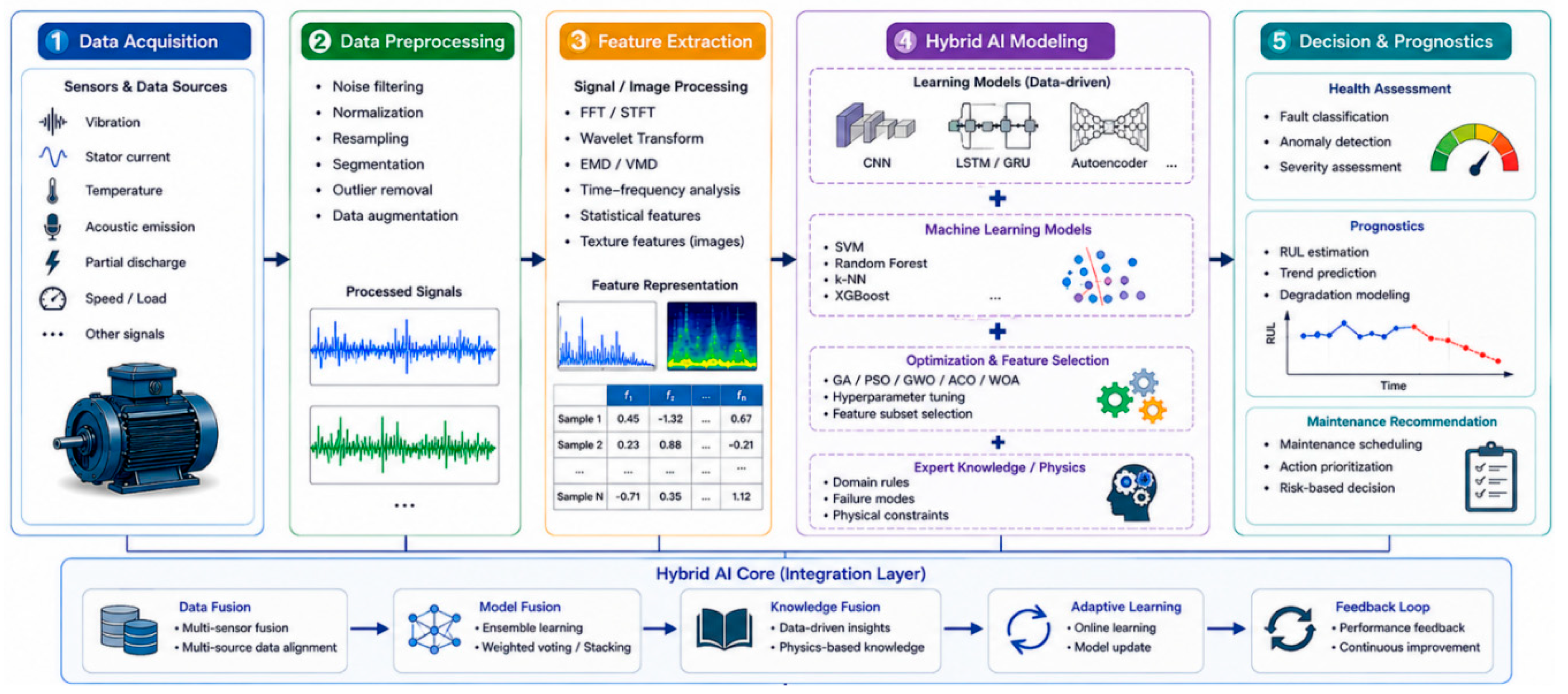
Table 7 summarizes the major hybrid AI approaches used in electrical machine health monitoring, fault diagnosis, and predictive maintenance. These approaches combine multiple techniques, including signal processing, machine learning, deep learning, optimization algorithms, and physics-based models, to improve diagnostic accuracy and prognostic performance. Signal processing methods such as FFT, WT, EMD, and VMD are frequently integrated with AI models to enhance feature extraction. Optimization algorithms, including GA and PSO, are employed for feature selection and hyperparameter tuning. Hybrid deep learning architectures, such as CNN-LSTM and CNN-GRU, combine spatial and temporal feature learning for improved fault diagnosis and Remaining Useful Life (RUL) prediction. Ensemble learning and Digital Twin-based frameworks further enhance model robustness, interpretability, and decision-making capabilities.
4. Applications for Artificial Intelligence in Electrical Machine Health Management
AI has emerged as a transformative technology for electrical machine health monitoring, fault diagnosis, prognostics, and predictive maintenance. The integration of machine learning, deep learning, reinforcement learning, and hybrid AI approaches has enabled the development of intelligent systems capable of processing large volumes of heterogeneous sensor data and providing accurate, real-time insights into machine health conditions [195]. The application of AI in electrical machine health management varies according to machine type, operating environment, sensing modalities, and maintenance objectives. Electric motors, generators, and transformers exhibit distinct fault mechanisms and operational characteristics, requiring tailored monitoring and diagnostic strategies. Nevertheless, the primary objective remains consistent across all applications: to improve equipment reliability, reduce unplanned downtime, optimize maintenance activities, and extend asset lifespan [196]. Electric motors are among the most widely studied electrical machines due to their extensive use in industrial automation, manufacturing, transportation systems, robotics, and electric vehicles. AI techniques have been successfully applied to detect and classify faults such as bearing defects, broken rotor bars, stator winding faults, shaft misalignment, eccentricity, and insulation degradation [197]. Data acquired from vibration sensors, stator current measurements, thermal imaging systems, and acoustic emission sensors are commonly analyzed using Support Vector Machines (SVMs), Random Forests (RFs), Convolutional Neural Networks (CNNs), and Long Short-Term Memory (LSTM) networks. These techniques enable early fault detection and support predictive maintenance strategies that minimize operational disruptions and maintenance costs.
Generators are critical assets in conventional and renewable energy systems, making their reliable operation essential for maintaining power system stability and energy security. AI-based monitoring systems analyze vibration signals, partial discharge measurements, current signatures, thermal profiles, and operational parameters to identify incipient faults and estimate equipment degradation [198,199]. Hybrid AI frameworks integrating signal processing techniques with deep learning models have demonstrated superior performance in detecting complex fault patterns in synchronous generators, induction generators, and permanent magnet generators. AI applications in generators include anomaly detection, fault classification, maintenance scheduling, and Remaining Useful Life (RUL) estimation. Transformers represent some of the most valuable and strategically important assets within electrical power systems. Their failures can result in significant economic losses and widespread service interruptions [200]. Consequently, transformer condition monitoring has become a major application area for AI-driven diagnostics. Machine learning and deep learning algorithms are widely employed to analyze Dissolved Gas Analysis (DGA) data, thermal measurements, partial discharge signals, oil quality indicators, and load profiles. Artificial Neural Networks (ANNs), SVMs, Extreme Gradient Boosting (XGBoost), and hybrid AI models have demonstrated strong capabilities in transformer fault classification, insulation health assessment, and maintenance planning. Beyond fault diagnosis, AI techniques have enabled significant advances in prognostics and predictive maintenance. Remaining Useful Life estimation has emerged as a key application area in which AI models analyze historical and real-time monitoring data to predict future degradation trends and estimate the time remaining before component failure [201]. Deep learning architectures such as LSTM networks, Gated Recurrent Units (GRUs), Transformers, and hybrid CNN-LSTM models have demonstrated strong capabilities in modelling degradation processes and forecasting machine health conditions. Accurate RUL estimation enables maintenance activities to be scheduled proactively, thereby reducing unplanned downtime, minimizing maintenance costs, and extending equipment lifespan.
The effectiveness of AI applications depends strongly on the availability and quality of monitoring data. Multimodal sensing approaches that integrate vibration, current, voltage, temperature, acoustic emission, partial discharge, and oil analysis data have demonstrated superior diagnostic performance compared with single-sensor systems [202]. Data fusion techniques enable AI models to capture the complex interactions among different fault mechanisms, thereby improving fault detection accuracy and reducing false alarm rates. Recent advances in the Industrial Internet of Things (IIoT) have further accelerated the deployment of AI-enabled monitoring systems. Smart sensors, wireless communication networks, edge devices, and cloud computing platforms facilitate the continuous acquisition and processing of operational data from geographically distributed assets. These technologies support remote monitoring, real-time diagnostics, and centralized maintenance management, enabling organizations to transition from conventional maintenance strategies toward intelligent, data-driven asset management frameworks [203]. The selection of appropriate AI techniques depends on several factors, including machine type, fault characteristics, data availability, computational resources, and interpretability requirements. Machine learning algorithms are particularly suitable for applications involving structured datasets and limited computational resources, whereas deep learning models offer superior performance when large volumes of high-dimensional data are available. Reinforcement learning techniques are increasingly being explored for maintenance optimization and decision-making tasks, while hybrid AI approaches integrate the strengths of multiple algorithms to improve overall system performance.
The integration of AI with Digital Twins, edge computing, and cloud analytics has further expanded the capabilities of intelligent asset management systems. Digital Twins provide virtual representations of physical machines that continuously synchronize with real-time operational data, enabling condition monitoring, predictive analysis, maintenance optimization, and what-if scenario evaluation [204,205]. These technologies are expected to play a key role in the development of autonomous maintenance systems aligned with Industry 4.0 and Industry 5.0 initiatives. Despite significant progress, practical implementation challenges remain. Variations in operating conditions, data imbalance, limited fault samples, sensor failures, and changing environmental conditions can negatively affect model performance and generalization capabilities. Furthermore, industrial deployment requires AI models that are not only accurate but also computationally efficient, interpretable, secure, and capable of operating in real time [206]. Future AI applications are expected to focus on autonomous health management systems that integrate XAI, Digital Twins, federated learning, edge computing, and advanced communication technologies. These developments will enable more transparent decision-making, privacy-preserving data sharing, low-latency analytics, and adaptive maintenance strategies capable of continuously learning from operational data. Table 8 summarizes the major AI applications across different electrical machine categories, while Table 9 compares the suitability of various AI techniques for specific maintenance objectives.
5. Challenges and Future Research Directions
Despite the significant progress achieved in applying AI to electrical machine health monitoring, fault diagnosis, and predictive maintenance, several technical and practical challenges continue to limit large-scale industrial adoption. Addressing these challenges is essential for developing reliable, scalable, and trustworthy AI-enabled health management systems capable of operating effectively in real-world industrial environments. One of the most significant challenges relates to data availability and quality [210]. The performance of AI models depends heavily on the availability of large, diverse, and high-quality datasets. However, obtaining representative fault data from electrical machines remains difficult because failures occur infrequently, and collecting labelled fault data is often expensive, time-consuming, and disruptive to industrial operations. Furthermore, monitoring datasets frequently contain noise, missing values, class imbalance, inconsistent sampling rates, and variations in operating conditions. Many existing studies rely on laboratory-generated datasets acquired under controlled conditions that do not accurately represent the complexity of practical industrial environments. Consequently, AI models trained using these datasets may exhibit limited generalization capabilities when deployed in real applications. Another important challenge concerns model robustness and adaptability [211]. Electrical machines operate under dynamic and non-stationary conditions characterized by varying loads, environmental influences, machine configurations, and degradation patterns. AI models that demonstrate high accuracy under specific operating conditions may experience significant performance degradation when exposed to unseen scenarios. The presence of multiple simultaneous faults, evolving fault signatures, and uncertain operating environments further complicates the diagnostic process. Therefore, future AI systems must be capable of continuously adapting to changing operating conditions through techniques such as domain adaptation, online learning, continual learning, and self-supervised learning.
Although deep learning models have demonstrated remarkable performance in fault diagnosis and prognostics, their black-box nature often limits industrial acceptance. Maintenance engineers require transparent and interpretable systems that provide clear explanations for diagnostic decisions and maintenance recommendations. XAI techniques, including SHAP, LIME, attention mechanisms, and saliency maps, have emerged as promising solutions for improving model transparency [212]. However, achieving an appropriate balance between predictive accuracy and interpretability remains an open research challenge. In addition to interpretability, trustworthy AI systems must ensure reliability, fairness, accountability, privacy, and safety. Computational complexity represents another significant obstacle to industrial implementation. Advanced deep learning and hybrid AI frameworks often require substantial computational resources, large memory capacities, and extended training times. These requirements can limit their deployment in real-time applications and resource-constrained edge devices. Consequently, there is a growing need for lightweight AI models, efficient model compression techniques, knowledge distillation approaches, and hardware acceleration technologies capable of supporting low-latency decision-making [213]. The increasing integration of Industrial Internet of Things (IIoT) platforms, cloud computing, and wireless communication networks has introduced additional concerns related to data privacy and cybersecurity. Unauthorized access to monitoring data or AI models may compromise system reliability and expose sensitive operational information. Furthermore, adversarial attacks targeting AI algorithms can manipulate diagnostic outcomes and undermine maintenance decision-making processes. Future research should therefore focus on privacy-preserving machine learning, federated learning, blockchain technologies, and secure communication protocols to ensure the safe deployment of AI-enabled maintenance systems [214].
The absence of standardized datasets, benchmarking procedures, interoperability frameworks, and validation protocols also remains a major barrier to industrial adoption. Existing studies often utilize different datasets, evaluation metrics, and experimental configurations, making direct comparisons between AI models difficult. Establishing common benchmarking procedures and standardized testing environments is essential for objectively evaluating algorithm performance and accelerating technology transfer from research laboratories to industrial applications [215,216]. The integration of AI with emerging technologies such as Digital Twins, edge computing, cloud analytics, advanced sensing technologies, and next-generation communication networks presents significant opportunities for future development. Digital Twins can provide virtual representations of physical assets for real-time monitoring, predictive analysis, and maintenance optimization, while edge computing enables low-latency analytics to be closer to the data source. The convergence of these technologies is expected to facilitate the development of autonomous and adaptive maintenance systems capable of continuous learning and real-time decision-making. Human expertise will continue to play a critical role in future maintenance systems despite increasing levels of automation. Human-in-the-loop frameworks that combine AI capabilities with expert knowledge can improve model reliability, increase user trust, and enhance decision-making processes. Rather than replacing maintenance personnel, AI technologies should augment human expertise and support more informed and efficient maintenance decisions [217]. Sustainability considerations are also becoming increasingly important in electrical machine health management. AI-enabled maintenance strategies can contribute to sustainable industrial development by reducing energy consumption, minimizing equipment failures, extending asset lifespan, and decreasing material waste. However, the training and deployment of large-scale AI models can require substantial computational resources and energy consumption. Consequently, future research should focus on developing energy-efficient algorithms, green computing techniques, and sustainable AI frameworks.
Overall, the future of electrical machine health management lies in the development of intelligent, explainable, autonomous, and sustainable maintenance systems capable of continuously learning from operational data and adapting to dynamic environments. Advances in Explainable AI, federated learning, Digital Twins, multimodal data fusion, self-supervised learning, and edge intelligence are expected to significantly enhance diagnostic accuracy, model robustness, and maintenance decision-making. Ultimately, the convergence of AI with emerging digital technologies will enable the realization of self-healing and self-optimizing industrial systems that support Industry 4.0 and Industry 5.0 initiatives while enhancing reliability, safety, and sustainability. Table 10 summarizes the key challenges and future research directions associated with the application of AI in electrical machine health management. Major challenges include limited availability of high-quality fault datasets, poor model generalization under varying operating conditions, limited interpretability of deep learning models, high computational requirements, cybersecurity concerns, and the lack of standardized datasets and evaluation frameworks [218,219]. Emerging technologies such as XAI, federated learning, Digital Twins, edge computing, multimodal data fusion, and Industrial Internet of Things (IIoT) platforms offer promising solutions to address these limitations. Future research should focus on developing robust, interpretable, secure, and computationally efficient AI models capable of real-time deployment in industrial environments.
6. Conclusions
Electrical machines, including motors, generators, and transformers, are fundamental components of modern industrial systems, power networks, transportation infrastructure, and renewable energy installations. Ensuring their reliable and efficient operation is essential for maintaining productivity, system stability, and operational safety. However, these machines are continuously exposed to electrical, mechanical, thermal, and environmental stresses that can lead to performance degradation and unexpected failures. This review has presented a comprehensive overview of AI applications in electrical machine health monitoring, fault diagnosis, and predictive maintenance. The study first discussed the classification of electrical machines, common fault mechanisms, condition monitoring data sources, and maintenance strategies. Conventional diagnostic approaches and their limitations were subsequently examined, highlighting the growing need for intelligent, data-driven maintenance frameworks. The review explored various AI techniques employed in electrical machine health management, including machine learning, deep learning, reinforcement learning, hybrid AI approaches, and XAI. Machine learning algorithms such as Support Vector Machines, Random Forests, and Artificial Neural Networks have demonstrated strong capabilities in fault classification and condition assessment. Deep learning architectures, including Convolutional Neural Networks, Long Short-Term Memory networks, Transformers, and hybrid models, have further enhanced diagnostic accuracy by enabling automatic feature extraction and end-to-end learning. Reinforcement learning and hybrid AI frameworks have shown significant potential for maintenance optimization and Remaining Useful Life estimation.
The application of AI across motors, generators, and transformers has demonstrated substantial improvements in fault detection accuracy, prognostic performance, maintenance scheduling, and asset reliability. The integration of AI with Industrial Internet of Things (IIoT) platforms, Digital Twins, edge computing, and cloud analytics is transforming conventional maintenance practices into intelligent, predictive, and autonomous health management systems. Despite these advances, several challenges remain, including limited availability of high-quality datasets, model generalization issues, interpretability concerns, computational complexity, cybersecurity risks, and the lack of standardized benchmarking frameworks. Addressing these challenges will require interdisciplinary collaboration among researchers, equipment manufacturers, utilities, and industry stakeholders. Future research should focus on developing robust, interpretable, secure, and computationally efficient AI models capable of operating under dynamic industrial conditions. Emerging technologies such as federated learning, multimodal data fusion, self-supervised learning, Digital Twins, and Explainable AI are expected to play a critical role in advancing next-generation electrical machine health management systems. Overall, the convergence of AI with advanced sensing technologies and digital infrastructures presents significant opportunities for enhancing the reliability, efficiency, and sustainability of electrical machines. As these technologies continue to evolve, AI-driven health management systems are expected to become key enablers of Industry 4.0 and Industry 5.0, supporting the development of intelligent, resilient, and autonomous industrial ecosystems.
Funding
This research received no external funding.
Data Availability Statement
Data are available upon request.
Conflicts of Interest
The author declares no conflicts of interest.
Acknowledgments
The author, M.N., would like to acknowledge the institutional support provided by the Department of Electrical Engineering at the Durban University of Technology. During the preparation of this manuscript, the author used ChatGPT (GPT-5.5) and QuillBot for the purposes of improving the clarity of the English writing. The author has reviewed and edited the output and takes full responsibility for the content of this publication.
Abbreviations
The following abbreviations are used in this manuscript:
| Abbreviation | Definition |
| ACO | Ant Colony Optimization |
| AE | Autoencoder |
| AI | Artificial Intelligence |
| ANN | Artificial Neural Network |
| BLDC | Brushless Direct-Current |
| CBM | Condition-Based Maintenance |
| CNN | Convolutional Neural Network |
| DBN | Deep Belief Network |
| DGA | Dissolved Gas Analysis |
| DL | Deep Learning |
| DNN | Deep Neural Network |
| DQN | Deep Q-Network |
| DRL | Deep Reinforcement Learning |
| DT | Decision Tree |
| EMD | Empirical Mode Decomposition |
| FFT | Fast Fourier Transform |
| GA | Genetic Algorithm |
| GMM | Gaussian Mixture Model |
| GRU | Gated Recurrent Unit |
| GWO | Grey Wolf Optimizer |
| HHT | Hilbert–Huang Transform |
| IIoT | Industrial Internet of Things |
| IoT | Internet of Things |
| k-NN | k-Nearest Neighbour |
| LIME | Local Interpretable Model-Agnostic Explanations |
| LSTM | Long Short-Term Memory |
| MCSA | Motor Current Signature Analysis |
| ML | Machine Learning |
| NB | Naïve Bayes |
| PCA | Principal Component Analysis |
| PdM | Predictive Maintenance |
| PMSM | Permanent Magnet Synchronous Motor |
| PSO | Particle Swarm Optimization |
| RF | Random Forest |
| RL | Reinforcement Learning |
| RNN | Recurrent Neural Network |
| ROC | Receiver Operating Characteristic |
| RUL | Remaining Useful Life |
| SARSA | State–Action–Reward–State–Action |
| SHAP | Shapley Additive Explanations |
| SSL | Semi-Supervised Learning |
| SRM | Switched Reluctance Motor |
| STFT | Short-Time Fourier Transform |
| SVM | Support Vector Machine |
| VAE | Variational Autoencoder |
| VMD | Variational Mode Decomposition |
| WOA | Whale Optimization Algorithm |
| WT | Wavelet Transform |
| XAI | Explainable Artificial Intelligence |
| XGBoost | Extreme Gradient Boosting |
References
- Akbar, S.; Vaimann, T.; Asad, B.; Kallaste, A.; Sardar, M. U.; Kudelina, K. State-of-the-art techniques for fault diagnosis in electrical machines: Advancements and future directions. Energies 2023, vol. 16(no. 18), 6345. [Google Scholar]
- Abid, S. M. A.; Khan, M. T.; Iqbal, J. A review on fault detection and diagnosis techniques: Basics and beyond. Artif. Intell. Rev. 2021, vol. 54, 3639–3664. [Google Scholar]
- Bazan, G. H.; Goedtel, A.; Duque-Perez, O.; Morinigo-Sotelo, D. Multi-fault diagnosis in three-phase induction motors using data optimization and machine learning techniques. Electronics 2021, vol. 10(no. 12), 1462. [Google Scholar]
- Gawde, S.; Patil, S.; Kumar, S.; Kamat, P.; Kotecha, K.; Abraham, A. Multi-fault diagnosis of industrial rotating machines using data-driven approach: A review of two decades of research. Eng. Appl. Artif. Intell. 2023, vol. 123, 106139. [Google Scholar] [CrossRef]
- Tama, B. A.; Vania, M.; Lee, S.; Lim, S. Recent advances in the application of deep learning for fault diagnosis of rotating machinery using vibration signals. Artif. Intell. Rev. 2023, vol. 56, 4667–4709. [Google Scholar]
- Drakaki, M.; Karnavas, Y. L.; Tziafettas, I. A.; Linardos, V.; Tzionas, P. Machine learning and deep learning based methods toward Industry 4.0 predictive maintenance in induction motors: State of the art survey. J. Ind. Eng. Manag. 2022, vol. 15(no. 1), 31–57. [Google Scholar] [CrossRef]
- Khanam, R.; Hussain, M.; Hill, R.; Allen, P. A comprehensive review of convolutional neural networks for defect detection in industrial applications. IEEE Access 2024, vol. 12, 94250–94295. [Google Scholar] [CrossRef]
- Chen, G.; Yuan, J.; Zhang, Y.; Zhu, H.; Huang, R.; Wang, F.; Li, W. Enhancing reliability through interpretability: A comprehensive survey of interpretable intelligent fault diagnosis in rotating machinery. IEEE Access 2024, vol. 12, 103348–103379. [Google Scholar] [CrossRef]
- Toma, R. N.; Prosvirin, A. E.; Kim, J.-M. Bearing fault diagnosis of induction motors using a genetic algorithm and machine learning classifiers. Sensors 2020, vol. 20(no. 7), 1884. [Google Scholar]
- Feng, J.; Bao, S.; Xu, X.; Zhang, Z.; Hou, P.; Steyskal, F.; Dustdar, S. Rotating machinery fault diagnosis based on feature extraction via an unsupervised graph neural network. Appl. Intell. 2023, vol. 53, 21211–21226. [Google Scholar] [CrossRef]
- Barrera-Llanga, K.; Burriel-Valencia, J.; Sapena-Bañó, Á.; Martínez-Román, J. A comparative analysis of deep learning convolutional neural network architectures for fault diagnosis of broken rotor bars in induction motors. Sensors 2023, vol. 23(no. 18), 8196. [Google Scholar]
- Chen, Z.; Liang, K.; Peng, T.; Wang, Y. Multi-condition PMSM fault diagnosis based on convolutional neural network phase tracker. Symmetry 2022, vol. 14(no. 2), 295. [Google Scholar]
- Peng, B.; Xia, H.; Lv, X.; Annor-Nyarko, M.; Zhu, S.; Liu, Y.; Zhang, J. An intelligent fault diagnosis method for rotating machinery based on data fusion and deep residual neural network. Appl. Intell. 2022, vol. 52, 3051–3065. [Google Scholar]
- Guo, S.; Yang, T.; Hua, H.; Cao, J. Coupling fault diagnosis of wind turbine gearbox based on multitask parallel convolutional neural networks with overall information. Renew. Energy 2021, vol. 178, 639–650. [Google Scholar] [CrossRef]
- Fu, G.; Wei, Q.; Yang, Y. Bearing fault diagnosis with parallel CNN and LSTM. Math. Biosci. Eng. 2024, vol. 21(no. 2), 2385–2406. [Google Scholar] [CrossRef] [PubMed]
- Xu, L.; Teoh, S. S.; Ibrahim, H. A deep learning approach for electric motor fault diagnosis based on modified InceptionV3. Sci. Rep. 2024, vol. 14, 12344. [Google Scholar]
- Chen, Q.; Zhang, F.; Wang, Y.; Yu, Q.; Lang, G.; Zeng, L. Bearing fault diagnosis based on efficient cross space multiscale CNN transformer parallelism. Sci. Rep. vol. 15, 12344, 2025.
- Sabir, R.; Rosato, D.; Hartmann, S.; Guehmann, C. LSTM based bearing fault diagnosis of electrical machines using motor current signal. Proc. IEEE ICMLA, Boca Raton, FL, USA, 2019; pp. 613–618. [Google Scholar]
- Tavares, T. M.; Santos, L. D.; Quiles, M. G.; Giesbrecht, M. A hybrid CNN-LSTM based network for rolling bearing fault detection. Proc. IECON, Chicago, IL, USA, 2024; pp. 1–6. [Google Scholar]
- Huang, T.; Zhang, Q.; Tang, X.; Zhao, S.; Lu, X. A novel fault diagnosis method based on CNN and LSTM and its application in fault diagnosis for complex systems. Artif. Intell. Rev. 2022, vol. 55, 1289–1315. [Google Scholar]
- Li, Y.; Jiang, W.; Zhang, G.; Shu, L. Wind turbine fault diagnosis based on transfer learning and convolutional autoencoder with small-scale data. Renew. Energy 2021, vol. 171, 103–115. [Google Scholar] [CrossRef]
- Brito, L. C.; Susto, G. A.; Brito, J. N.; Duarte, M. A. V. Fault diagnosis using eXplainable AI: A transfer learning-based approach for rotating machinery exploiting augmented synthetic data. Expert Syst. With Appl. 2023, vol. 232, 120860. [Google Scholar] [CrossRef]
- Zhong, Z.; Xie, H.; Wang, Z.; Zhang, Z. Domain adversarial transfer learning bearing fault diagnosis model incorporating structural adjustment modules. Sensors vol. 25(no. 6), 1851, 2025.
- Zhou, K.; Yang, C.; Liu, J.; Xu, Q. Deep graph feature learning-based diagnosis approach for rotating machinery using multi-sensor data. J. Intell. Manuf. 2023, vol. 34, 1965–1974. [Google Scholar]
- Wang, J.; Ma, J.; Meng, D.; Zhao, X.; Zhang, K. Fault diagnosis of PMSMs based on image features of multi-sensor fusion. Sensors 2023, vol. 23(no. 21), 8592. [Google Scholar]
- Attallah; Ibrahim, R. A.; Zakzouk, N. E. Fault diagnosis for induction generator-based wind turbine using ensemble deep learning techniques. Energy Rep. 2022, vol. 8, 12787–12798. [Google Scholar] [CrossRef]
- Mohamed, M. A.; Hassan, M. A. M.; Albalawi, F.; Ghoneim, S. S. M.; Ali, Z. M.; Dardeer, M. Diagnostic modelling for induction motor faults via ANFIS algorithm and DWT-based feature extraction. Appl. Sci. 2021, vol. 11(no. 19), 9115. [Google Scholar]
- Ding, J.; Huang, L.; Xiao, D.; Li, X. GMPSO-VMD algorithm and its application to rolling bearing fault feature extraction. Sensors 2020, vol. 20(no. 7), 1946. [Google Scholar]
- Lee, C.-Y.; Maceren, E. D. C. Induction motor bearing fault classification using deep neural network with particle swarm optimization-extreme gradient boosting. IET Electr. Power Appl. 2024, vol. 18(no. 4), 297–311. [Google Scholar] [CrossRef]
- Djaballah, S.; Saidi, L.; Meftah, K.; Hechifa, A.; Bajaj, M.; Zaitsev, I. A hybrid LSTM random forest model with grey wolf optimization for enhanced detection of multiple bearing faults. Sci. Rep. 2024, vol. 14, 23997. [Google Scholar]
- Kim, M.-C.; Lee, J.-H.; Wang, D.-H.; Lee, I.-S. Induction motor fault diagnosis using support vector machine, neural networks, and boosting methods. Sensors 2023, vol. 23(no. 5), 2585. [Google Scholar]
- Tang, Z.; Shi, X.; Zou, H.; Zhu, Y.; Yang, Y.; Zhang, Y.; He, J. Fault diagnosis of wind turbine generators based on stacking integration algorithm and adaptive threshold. Sensors 2023, vol. 23(no. 14), 6198. [Google Scholar]
- Inyang, U. I.; Petrunin, I.; Jennions, I. Diagnosis of multiple faults in rotating machinery using ensemble learning. Sensors 2023, vol. 23(no. 3), 1005. [Google Scholar]
- Ali, U.; Ramzan, U.; Ali, W.; Al-Jaafari, K. A. An improved fault diagnosis strategy for induction motors using weighted probability ensemble deep learning. IEEE Access 2025, vol. 13, 106958–106973. [Google Scholar] [CrossRef]
- Chen, M.; Wang, H.; Zhang, F. Self-supervised learning for machinery fault diagnosis under strong background noise and limited epochs. Meas. Sci. Technol. 2025, vol. 36(no. 2), 026135. [Google Scholar] [CrossRef]
- Hu, J.; Xiao, H.; Ye, Z.; Luo, N.; Zhou, M. Research and prospects of digital twin-based fault diagnosis of electric machines. Sensors vol. 25(no. 9), 2625, 2025.
- Yang, R.; Zhong, M. Machine Learning-Based Fault Diagnosis for Industrial Engineering Systems, 1st ed.; CRC Press: Boca Raton, FL, USA, 2022. [Google Scholar]
- Wilhelm, Y.; Reimann, P.; Gauchel, W.; Mitschang, B. Overview on hybrid approaches to fault detection and diagnosis: Combining data-driven, physics-based and knowledge-based models. Procedia CIRP 2021, vol. 99, 278–283. [Google Scholar] [CrossRef]
- Barai, V.; Ramteke, S. M.; Dhanalkotwar, V.; Nagmote, Y.; Shende, S.; Deshmukh, D. Bearing fault diagnosis using signal processing and machine learning techniques: A review. IOP Conf. Ser. Mater. Sci. Eng. 2022, vol. 1259, 012034. [Google Scholar] [CrossRef]
- Gao, Z.; Wang, H.; Wu, Q.; Li, Y.; Diao, L. Demagnetization characteristics diagnosis of permanent magnet synchronous motors. Proc. EITRT, Singapore, 2023; pp. 331–338. [Google Scholar]
- Shi, C.; Peng, L.; Zhang, Z.; Shi, T. Analytical modeling and analysis of permanent-magnet motor with demagnetization fault. Sensors 2022, vol. 22(no. 23), 9440. [Google Scholar]
- AlShorman; Alkahatni, F.; Masadeh, M.; Irfan, M.; Glowacz, A.; Althobiani, F.; Kozik, J.; Glowacz, W. Sounds and acoustic emission-based early fault diagnosis of induction motor: A review study. Adv. Mech. Eng. 2021, vol. 13(no. 2). [Google Scholar]
- Shi, X.; Zhang, Z.; Xia, Z.; Li, B.; Gu, G.; Shi, T. Application of Teager–Kaiser energy operator in the early fault diagnosis of rolling bearings. Sensors 2022, vol. 22(no. 17), 6673. [Google Scholar]
- Jaros, R.; Byrtus, R.; Dohnal, J.; Danys, L.; Baros, J.; Koziorek, J.; Zmij, P.; Martinek, R. Advanced signal processing methods for condition monitoring. Arch. Comput. Methods Eng. 2023, vol. 30, 1553–1577. [Google Scholar]
- Badihi, H.; Zhang, Y.; Jiang, B.; Pillay, P.; Rakheja, S. A comprehensive review on signal-based and model-based condition monitoring of wind turbines: Fault diagnosis and lifetime prognosis. Proc. IEEE 2022, vol. 110(no. 6), 754–806. [Google Scholar] [CrossRef]
- Rehman, U.; Jiao, W.; Sun, J.; Sohaib, M.; Jiang, Y.; Shahzadi, M.; Khan, M. I. Efficient fault detection of rotor minor inter-turn short circuit in induction machines using wavelet transform and empirical mode decomposition. Sensors 2023, vol. 23(no. 16), 7109. [Google Scholar]
- Aguayo-Tapia, S.; Ávalos-Almazán, G.; Rangel-Magdaleno, J.; Paternina, M. R. A. Broken rotor bar detection in induction motors using digital Taylor-Fourier transform. Proc. IEEE ROPEC, Ixtapa, Mexico, 2022; pp. 1–6. [Google Scholar]
- Ramu, S. K.; Irudayaraj, G. C. R.; Devarajan, G.; Indragandhi, V.; Subramaniyaswamy, V.; Alaric, J. Sam. Diagnosis of broken bars in V/F control induction motor drive using wavelets and EEV estimation for electric vehicle applications. Int. Trans. Electr. Energy Syst. 2022, vol. 2022, 9474640. [Google Scholar]
- Zhao, Y.; Wang, X.; Han, S.; Lin, J.; Han, Q. Fault diagnosis for abnormal wear of rolling element bearing fusing oil debris monitoring. Sensors 2023, vol. 23(no. 7), 3402. [Google Scholar]
- Tang, Z.; Wang, M.; Ouyang, T.; Che, F. A wind turbine bearing fault diagnosis method based on fused depth features in time–frequency domain. Energy Rep. 2022, vol. 8, 12727–12739. [Google Scholar] [CrossRef]
- Yaqub, R.; Ali, H.; Wahab, M. H. B. A. Electrical motor fault detection system using AI’s random forest classifier technique. Proc. IEEE IC_ASET, Hammamet, Tunisia, 2023; pp. 1–5. [Google Scholar]
- Zhang, B.; Mao, Y.; Chen, X.; Chai, Y.; Yang, Z. Self-supervised learning advance fault diagnosis of rotating machinery. In Neural Computing for Advanced Applications; Guangzhou, China, 2021; pp. 319–332. [Google Scholar]
- Liu, R.; Zhang, L. A review of failure modes, condition monitoring and fault diagnosis methods for large-scale wind turbine bearings. Measurement 2020, vol. 149, 107002. [Google Scholar] [CrossRef]
- Gaerke, T. R.; Hernandez, D. C. Root cause analysis of motor stator failures. Proc. IEEE PPIC, Charlotte, NC, USA, 2013; pp. 11–16. [Google Scholar]
- Trnka, P.; Trnkova, M. Asset management of large electric machines through monitoring of electric insulation. Acta Polytech. Hung. 2022, vol. 19(no. 8), 85–102. [Google Scholar] [CrossRef]
- Leffler, J.; Trnka, P. Failures of electrical machines—Review. Proc. IYCE, Eger, Hungary, 2022; pp. 1–4. [Google Scholar]
- Gracheva, E. I.; Petrova, R. M.; Sinyukova, T.; Valtchev, S.; Miceli, R.; Caruso, M. Reliability and overload capacity of power transformers. Proc. ICCEP, Terrasini, Italy, 2023; pp. 684–689. [Google Scholar]
- Yasid, N.; Alawady, A.; Yousof, M.; Talib, M.; Kamarudin, M. The effect of short circuit fault in three-phase core-typed transformer. Int. J. Power Electron. Drive Syst. 2020, vol. 11(no. 1), 409–416. [Google Scholar] [CrossRef]
- M. H. A. Soliman, Industrial Power Transformers: Selection, Installation, Advanced Maintenance and Reliability; Mohammed Hamed Ahmed Soliman: Cairo, Egypt, 2024.
- Babak, V.; Babak, S.; Zaporozhets, A. “Tasks and main methods of statistical diagnostics of electric power equipment,” in Statistical Diagnostics of Electric Power Equipment; Springer: Berlin, Germany, 2024; pp. 1–50. [Google Scholar]
- Bagri; Tahiry, K.; Hraiba, A.; Touil, A.; Mousrij, A. Vibration signal analysis for intelligent rotating machinery diagnosis and prognosis: A comprehensive systematic literature review. Vibration 2024, vol. 7(no. 4), 1013–1062. [Google Scholar] [CrossRef]
- Wang, Z.; Xuan, J.; Shi, T. Domain reinforcement feature adaptation methodology with correlation alignment for compound fault diagnosis of rolling bearing. Expert Syst. With Appl. 2025, vol. 262, 125594. [Google Scholar] [CrossRef]
- Wang, Z.; Xuan, J.; Shi, T. An autonomous recognition framework based on reinforced adversarial open set algorithm for compound fault of mechanical equipment. Mech. Syst. Signal Process. 2024, vol. 219, 111596. [Google Scholar] [CrossRef]
- Wang, Z.; Xuan, J.; Shi, T.; Li, Y. F. Multi-label domain adversarial reinforcement learning for unsupervised compound fault recognition. Reliab. Eng. Syst. Saf. 2025, vol. 254, 110638. [Google Scholar] [CrossRef]
- Mazibuko, N.; Akindeji, K.; Moloi, K. Performance comparison of machine learning based fault detection scheme for a compensated transmission line. Proc. IEEE PES/IAS PowerAfrica, Johannesburg, South Africa, 2024; pp. 1–5. [Google Scholar]
- Chen, X.; Wang, M.; Zhang, H. Machine learning-based fault prediction and diagnosis of brushless motors. Eng. Adv. 2024, vol. 4, 130–142. [Google Scholar] [CrossRef]
- Arabaci, H.; Mohamed, M. A. A knowledge-based diagnosis algorithm for broken rotor bar fault classification using FFT, principal component analysis and support vector machines. Int. J. Intell. Eng. Inform. 2020, vol. 8(no. 1), 19–37. [Google Scholar] [CrossRef]
- Al-Haddad, L. A.; Jaber, A. A.; Hamzah, M. N.; Fayad, M. A. Vibration-current data fusion and gradient boosting classifier for enhanced stator fault diagnosis in three-phase permanent magnet synchronous motors. Electr. Eng. 2024, vol. 106, 3253–3268. [Google Scholar]
- Wei, L.; Rong, X.; Wang, H.; Yu, S.; Zhang, Y. Method for identifying stator and rotor faults of induction motors based on machine vision. Math. Probl. Eng. 2021, vol. 2021, 6658648. [Google Scholar]
- Giacotto, A. C. P.; Mesquita; Marques, H. C.; Martinetti, A. Holistic and scalable smart optimization framework for prescriptive maintenance. Proc. ICAS, Florence, Italy, 2024. [Google Scholar]
- Dweiri, F. A.; Aydin, R.; Alnaqbi, A.; Almazrouei, S. M. A review on the advancements and challenges of artificial intelligence based models for predictive maintenance of water injection pumps in the oil and gas industry. SN Appl. Sci. 2023, vol. 5, 391. [Google Scholar]
- Yu, Q.; Zhao, N.; Li, M.; Li, Z.; Wang, H.; Zhang, W.; Sui, K.; Pei, D. A survey on intelligent management of alerts and incidents in IT services. J. Netw. Comput. Appl. 2024, vol. 224, 103842. [Google Scholar] [CrossRef]
- Taye, M. Understanding of machine learning with deep learning: Architectures, workflow, applications and future directions. Computers 2023, vol. 12(no. 5), 91. [Google Scholar]
- Li, Z.; Liu, F.; Yang, W.; Peng, S.; Zhou, J. A survey of convolutional neural networks: Analysis, applications, and prospects. IEEE Trans. Neural Netw. Learn. Syst. 2021, vol. 33(no. 12), 6999–7019. [Google Scholar]
- Zhang, W.; Zhang, T.; Cui, G.; Pan, Y. Intelligent machine fault diagnosis using convolutional neural networks and transfer learning. IEEE Access 2022, vol. 10, 50959–50973. [Google Scholar] [CrossRef]
- Khan; Sohail, A.; Zahoora, U.; Qureshi, A. S. A survey of the recent architectures of deep convolutional neural networks. Artif. Intell. Rev. 2020, vol. 53, 5455–5516. [Google Scholar] [CrossRef]
- Patil, D.; Rane, N.; Desai, P.; Rane, J. “Machine learning and deep learning: Methods, techniques, applications, challenges, and future research opportunities,” in Trustworthy Artificial Intelligence in Industry and Society; Deep Science Publishing: New York, NY, USA, 2024; pp. 28–81. [Google Scholar]
- Tirthyani, D.; Kumar, S.; Vats, S. “Clustering and unsupervised learning,” in Recent Trends and Future Direction for Data Analytics; IGI Global: Hershey, PA, USA, 2024; pp. 119–139. [Google Scholar]
- Lu, J.; Ma, G.; Zhang, G. Fuzzy machine learning: A comprehensive framework and systematic review. IEEE Trans. Fuzzy Syst. 2024, vol. 32(no. 7), 3861–3878. [Google Scholar] [CrossRef]
- Boulesnane. “Evolutionary dynamic optimization and machine learning,” in Advanced Machine Learning with Evolutionary and Metaheuristic Techniques; Springer: Berlin, Germany, 2024; pp. 67–85. [Google Scholar]
- Kiasari, R.; Ghaffari, M.; Aly, H. H. A comprehensive review of the current status of smart grid technologies for renewable energies integration and future trends: The role of machine learning and energy storage systems. Energies 2024, vol. 17(no. 16), 4128. [Google Scholar]
- Fida, K.; Abbasi, U.; Adnan, M.; Iqbal, S.; Mohamed, S. E. G. A comprehensive survey on load forecasting hybrid models: Navigating the futuristic demand response patterns through experts and intelligent systems. Results Eng. 2024, vol. 23, 102773. [Google Scholar] [CrossRef]
- Regulwar, G. B.; Mahalle, A.; Pawar, R.; Shamkuwar, S. K.; Kakde, P. R.; Tiwari, S. “Big data collection, filtering, and extraction of features,” in Big Data Analytics Techniques for Market Intelligence; IGI Global: Hershey, PA, USA, 2024; pp. 136–158. [Google Scholar]
- Watson, S. J.; Xiang, B. J.; Yang, W.; Tavner, P. J.; Crabtree, C. J. Condition monitoring of the power output of wind turbine generators using wavelets. IEEE Trans. Energy Convers. 2010, vol. 25(no. 3), 715–721. [Google Scholar] [CrossRef]
- Chen, J.; Pan, J.; Li, Z.; Zi, Y.; Chen, X. Generator bearing fault diagnosis for wind turbine via empirical wavelet transform using measured vibration signals. Renew. Energy 2016, vol. 89, 80–92. [Google Scholar] [CrossRef]
- Talhaoui, H.; Menacer, A.; Kessal, A.; Tarek, A. Experimental diagnosis of broken rotor bars fault in induction machine based on Hilbert and discrete wavelet transforms. Int. J. Adv. Manuf. Technol. 2018, vol. 95, 1399–1408. [Google Scholar]
- Pan, S.; Han, T.; Tan, A. C. C.; Lin, T. R. Fault diagnosis system of induction motors based on multiscale entropy and support vector machine with mutual information algorithm. Shock Vib. 2016, vol. 2016, 5836717. [Google Scholar]
- Huo, Z.; Zhang, Y.; Shu, L.; Gallimore, M. A new bearing fault diagnosis method based on fine-to-coarse multiscale permutation entropy, Laplacian score and SVM. IEEE Access 2019, vol. 7, 17050–17066. [Google Scholar] [CrossRef]
- Saad, N.; Irfan, M.; Ibrahim, R. Condition Monitoring and Faults Diagnosis of Induction Motors: Electrical Signature Analysis; CRC Press: Boca Raton, FL, USA, 2018. [Google Scholar]
- Thomson, W. T.; Culbert, I. Current Signature Analysis for Condition Monitoring of Cage Induction Motors: Industrial Application and Case Histories; Wiley: Hoboken, NJ, USA, 2017. [Google Scholar]
- Merizalde, Y.; Hernández-Callejo, L.; Duque-Perez, O. State of the art and trends in the monitoring, detection and diagnosis of failures in electric induction motors. Energies 2017, vol. 10(no. 7), 1056. [Google Scholar]
- Miljković, D. Brief review of motor current signature analysis. HDKBR Info-CrSNDT J. 2015, vol. 15(no. 1), 15–26. [Google Scholar]
- Syahputra, R.; Purwanto, H.; Wiyagi, R. O.; Mustar, M. Y.; Soesanti, I. Analysis of induction motor performance using motor current signature analysis technique. J. Electr. Technol. UMY 2021, vol. 5(no. 1), 7–16. [Google Scholar]
- Fofana; Hadjadj, Y. Electrical-based diagnostic techniques for assessing insulation condition in aged transformers. Energies 2016, vol. 9(no. 9), 679. [Google Scholar]
- Metwally. Failures, monitoring and new trends of power transformers. IEEE Potentials 2011, vol. 30(no. 3), 36–43. [Google Scholar] [CrossRef]
- Saha, T. K.; Purkait, P. Transformer Ageing: Monitoring and Estimation Techniques; Wiley: Hoboken, NJ, USA, 2017. [Google Scholar]
- Haddad, G.; Sandborn, P. A.; Pecht, M. G. An options approach for decision support of systems with prognostic capabilities. IEEE Trans. Reliab. 2012, vol. 61(no. 4), 872–883. [Google Scholar] [CrossRef]
- Peng, Y.; Dong, M.; Zuo, M. J. Current status of machine prognostics in condition-based maintenance: A review. Int. J. Adv. Manuf. Technol. 2010, vol. 50, 297–313. [Google Scholar] [CrossRef]
- Arunraj, N.; Maiti, J. Risk-based maintenance policy selection using AHP and goal programming. Saf. Sci. 2010, vol. 48(no. 2), 238–247. [Google Scholar] [CrossRef]
- Thomson, W. T.; Fenger, M. Current signature analysis to detect induction motor faults. IEEE Ind. Appl. Mag. 2001, vol. 7(no. 4), 26–34. [Google Scholar] [CrossRef]
- Schoen, R. R.; Habetler, T. G.; Kamran, F.; Bartfield, R. Motor bearing damage detection using stator current monitoring. IEEE Trans. Ind. Appl. 1995, vol. 31(no. 6), 1274–1279. [Google Scholar] [CrossRef]
- Tallam, R. M.; Lee, S. B.; Stone, G. C.; Kliman, G. B.; Yoo, J.; Habetler, T. G.; Harley, R. G. A survey of methods for detection of stator-related faults in induction machines. IEEE Trans. Ind. Appl. 2007, vol. 43(no. 4), 920–933. [Google Scholar] [CrossRef]
- Andrew, M. Fault diagnosis: Models, artificial intelligence, applications. Kybernetes 2005, vol. 34(no. 5), 742–743. [Google Scholar] [CrossRef]
- Collacott, R. Mechanical Fault Diagnosis and Condition Monitoring; Springer: Berlin, Germany, 2012. [Google Scholar]
- Scheffer, C.; Girdhar, P. Practical Machinery Vibration Analysis and Predictive Maintenance; Elsevier: Amsterdam, Netherlands, 2004. [Google Scholar]
- Miljković, D. Review of machine condition monitoring based on vibration data. Proc. MIPRO, Opatija, Croatia, 2008; pp. 70–75. [Google Scholar]
- Lin, Y.; Tu, L.; Liu, H.; et al. Fault analysis of wind turbines in China. Renew. Sustain. Energy Rev. 2016, vol. 55, 482–490. [Google Scholar] [CrossRef]
- Lenin, N. C.; Padmanaban, S.; Bhaskar, M. S.; et al. Ceiling fan drives—past, present and future. IEEE Access 2021, vol. 9, 44888–44904. [Google Scholar] [CrossRef]
- Peng, X.; Liu, Z.; Jiang, D. A review of multiphase energy conversion in wind power generation. Renew. Sustain. Energy Rev. 2021, vol. 147, 111172. [Google Scholar] [CrossRef]
- Scalcon, F. P.; Fang, G.; Volpato Filho, C. J.; et al. A review on switched reluctance generators in wind power applications: Fundamentals, control and future trends. IEEE Access, 2022. [Google Scholar]
- Irgat, E.; Çinar, E.; Ünsal, A.; et al. An IoT-based monitoring system for induction motor faults utilizing deep learning models. J. Vib. Eng. Technol. 2022, 1–11. [Google Scholar] [CrossRef]
- Wang, C. S.; Kao, I. H.; Perng, J. W. Fault diagnosis and fault frequency determination of permanent magnet synchronous motor based on deep learning. Sensors 2021, vol. 21(no. 11), 3608. [Google Scholar]
- You, Y. Multi-objective optimal design of permanent magnet synchronous motor for electric vehicle based on deep learning. Appl. Sci. 2020, vol. 10(no. 2), 482. [Google Scholar]
- Zhao, X.; Wang, S.; Niu, S.; et al. A novel high-order-harmonic winding design method for vernier reluctance machine with DC coils across two stator teeth. IEEE Trans. Ind. Electron. 2021, vol. 69(no. 8), 7696–7707. [Google Scholar]
- Niu, S.; Sheng, T.; Zhao, X.; et al. Operation principle and torque component quantification of short-pitched flux-bidirectional-modulation machine. IEEE Access 2019, vol. 7, 136676–136685. [Google Scholar] [CrossRef]
- Huang; Fu, W.; Niu, S.; et al. Comparative analysis of different permanent magnet arrangements in a novel flux modulated electric machine. IEEE Access 2021, vol. 9, 14437–14445. [Google Scholar] [CrossRef]
- Wang, Q.; Zhao, X.; Niu, S. Flux-modulated permanent magnet machines: Challenges and opportunities. World Electr. Veh. J. 2021, vol. 12(no. 1), 13. [Google Scholar]
- Niu, S.; Wang, S.; Zhao, X. Overview of stator slot-opening permanent magnet machines. IEEE Trans. Transp. Electrif. 2022, vol. 9(no. 1), 782–804. [Google Scholar] [CrossRef]
- AlShorman; Irfan, M.; Saad, N.; et al. A review of artificial intelligence methods for condition monitoring and fault diagnosis of rolling element bearings for induction motor. Shock Vib. 2020, vol. 2020, 1–20. [Google Scholar] [CrossRef]
- Wang, X.; Wang, Y.; Wu, T. The review of electromagnetic field modeling methods for permanent-magnet linear motors. Energies 2022, vol. 15(no. 10), 3595. [Google Scholar] [CrossRef]
- Omar, M.; Sayed, E.; Abdalmagid, M.; et al. Review of machine learning applications to the modeling and design optimization of switched reluctance motors. IEEE Access 2022, vol. 10, 130444–130468. [Google Scholar] [CrossRef]
- Zhao; Liu, X.; Wang, S.; et al. Review of design and control optimization of axial flux PMSM in renewable-energy applications. Chin. J. Mech. Eng. 2023, vol. 36(no. 1), 45. [Google Scholar] [CrossRef]
- Li, Y.; Lei, G.; Bramerdorfer, G.; et al. Machine learning for design optimization of electromagnetic devices: Recent developments and future directions. Appl. Sci. 2021, vol. 11(no. 4), 1627. [Google Scholar] [CrossRef]
- Shao, A. E. H.; Karci; Tavernini, D.; et al. Design approaches and control strategies for energy-efficient electric machines for electric vehicles—A review. IEEE Access 2020, vol. 8, 116900–116913. [Google Scholar] [CrossRef]
- De Klerk, L.; Saha, A. K. A comprehensive review of advanced traction motor control techniques suitable for electric vehicle applications. IEEE Access 2021, vol. 9, 125080–125108. [Google Scholar] [CrossRef]
- Gangsar, P.; Tiwari, R. Signal based condition monitoring techniques for fault detection and diagnosis of induction motors: A state-of-the-art review. Mech. Syst. Signal Process. 2020, vol. 144, 106908. [Google Scholar] [CrossRef]
- Zhang, H. S. H.; Chung; Lo, W. L.; Hui, S. Y.; Wu, A. K. M. Implementation of a decoupled optimization technique for design of switching regulators using genetic algorithms. IEEE Trans. Power Electron. 2001, vol. 16(no. 6), 752–763. [Google Scholar] [CrossRef]
- Wang, D.; Tan, D.; Liu, L. Particle swarm optimization algorithm: An overview. Soft Comput. 2018, vol. 22, 387–408. [Google Scholar] [CrossRef]
- Li, X.; Ding, Q.; Sun, J.-Q. Remaining useful life estimation in prognostics using deep convolution neural networks. Reliab. Eng. Syst. Saf. 2018, vol. 172, 1–11. [Google Scholar] [CrossRef]
- Xue, H.; Zhou, J.; Chen, Z.; et al. Real-time diagnosis of an in-wheel motor of an electric vehicle based on dynamic Bayesian networks. IEEE Access 2019, vol. 7, 114685–114699. [Google Scholar] [CrossRef]
- Huang, H.-Z.; Wang, H.-K.; Li, Y.-F.; Zhang, L.; Liu, Z. Support vector machine based estimation of remaining useful life: Current research status and future trends. J. Mech. Sci. Technol. 2015, vol. 29(no. 1), 151–163. [Google Scholar] [CrossRef]
- Khan; Ghorbanian, V.; Lowther, D. Deep learning for magnetic field estimation. IEEE Trans. Magn. 2019, vol. 55(no. 6), 1–4. [Google Scholar] [CrossRef]
- Shi, H.; Guo, L.; Tan, S.; Bai, X. Rolling bearing initial fault detection using long short-term memory recurrent network. IEEE Access 2019, vol. 7, 171559–171569. [Google Scholar] [CrossRef]
- Zhou, Q.; Shen, H.; Zhao, J.; et al. Degradation state recognition of rolling bearing based on K-means and CNN algorithm. Shock Vib. 2019, vol. 2019. [Google Scholar]
- Wang, T. Z.; Xu, H.; Han, J. G.; Elbouchikhi, E.; Benbouzid, M. E. H. Cascaded H-bridge multilevel inverter system fault diagnosis using a PCA and multiclass relevance vector machine approach. IEEE Trans. Power Electron. 2015, vol. 30(no. 12), 7006–7018. [Google Scholar] [CrossRef]
- Dong; He, M.; Zhao, Y.; et al. Machine learning fault detection algorithm based on resampling. Proc. Chinese Automation Congress, 2019; pp. 3158–3163. [Google Scholar]
- Zhang, X.; Li, C.; Xue, M.; et al. Application of deep learning in motor vibration and noise suppression based on negative magnetostrictive effect. J. Electr. Eng. Technol. 2023, vol. 18(no. 3), 1931–1944. [Google Scholar] [CrossRef]
- Traue; Book, G.; Kirchgässner, W.; et al. Toward a reinforcement learning environment toolbox for intelligent electric motor control. IEEE Trans. Neural Netw. Learn. Syst. 2020, vol. 33(no. 3), 919–928. [Google Scholar] [CrossRef] [PubMed]
- Mahmoudi; Kahourzade, S.; Abd Rahim, N.; Hew, W. P. Design, analysis, and prototyping of an axial-flux permanent magnet motor based on genetic algorithm and finite-element analysis. IEEE Trans. Magn. 2012, vol. 49(no. 4), 1479–1492. [Google Scholar] [CrossRef]
- Lee, J.-H.; Kim, J.-W.; Song, J.-Y.; Kim, Y.-J.; Jung, S.-Y. A novel memetic algorithm using modified particle swarm optimization and mesh adaptive direct search for PMSM design. IEEE Trans. Magn. 2015, vol. 52(no. 3), 1–4. [Google Scholar] [CrossRef]
- Hong, G.; Wei, T.; Ding, X. Multi-objective optimal design of permanent magnet synchronous motor for high efficiency and high dynamic performance. IEEE Access 2018, vol. 6, 23568–23581. [Google Scholar] [CrossRef]
- Khan; Mohammadi, M. H.; Ghorbanian, V.; et al. Efficiency map prediction of motor drives using deep learning. IEEE Trans. Magn. 2020, vol. 56(no. 3), 1–4. [Google Scholar] [CrossRef]
- Barmada, S.; Fontana, N.; Sani, L.; et al. Deep learning and reduced models for fast optimization in electromagnetics. IEEE Trans. Magn. 2020, vol. 56(no. 3), 1–4. [Google Scholar] [CrossRef]
- Asanuma; Doi, S.; Igarashi, H. Transfer learning through deep learning: Application to topology optimization of electric motor. IEEE Trans. Magn. 2020, vol. 56(no. 3), 1–4. [Google Scholar] [CrossRef]
- Parekh, V.; Flore, D.; Schöps, S. Deep learning-based prediction of key performance indicators for electrical machines. IEEE Access 2021, vol. 9, 21786–21797. [Google Scholar] [CrossRef]
- Park, S. H.; Chin, J. W.; Cha, K. S.; et al. Deep transfer learning-based sizing method of permanent magnet synchronous motors considering axial leakage flux. IEEE Trans. Magn. 2022, vol. 58(no. 9), 1–5. [Google Scholar] [CrossRef]
- Khan, C. Midha; Lowther, D. Reinforcement learning for topology optimization of a synchronous reluctance motor. IEEE Trans. Magn. 2022, vol. 58(no. 9), 1–4. [Google Scholar] [CrossRef]
- Wu, H.; Niu, S.; Zhang, Y.; et al. Physics-informed generative adversarial network-based modeling and simulation of linear electric machines. Appl. Sci. 2022, vol. 12(no. 20), 10426. [Google Scholar] [CrossRef]
- Almatheel, Y. A.; Abdelrahman, A. Speed control of DC motor using fuzzy logic controller. Proc. ICCCCEE 2017, 1–8. [Google Scholar] [CrossRef]
- Tseng, L.; Wang, S. Y.; Chien, S. C.; et al. Development of a self-tuning TSK-fuzzy speed control strategy for switched reluctance motor. IEEE Trans. Power Electron. 2011, vol. 27(no. 4), 2141–2152. [Google Scholar] [CrossRef]
- Singh, K.; Chhabra, A.; Chhillar, A.; et al. Fuzzy logic based controllers for speed control of BLDC motor. Int. J. Res. Appl. Sci. Eng. Technol. 2017, vol. 5(no. 6), 985–1001. [Google Scholar]
- Jayetileke, H. R.; De Mel, W. R.; Ratnayake, H. U. W. Modelling and simulation analysis of the genetic-fuzzy controller for speed regulation of a sensored BLDC motor using MATLAB/Simulink. Proc. IEEE ICIIS, 2017; pp. 1–6. [Google Scholar]
- Bača, J.; Kouřil, D.; Palacký, P.; Strossa, J. Induction motor drive with field-oriented control and speed estimation using feedforward neural network. Proc. Electric Power Engineering Conf., 2020. [Google Scholar]
- Hasan, M. Artificial neural network based speed estimator for sensorless FOC of three phase IM. Proc. ICECTE 2019. [Google Scholar] [CrossRef]
- Pham Van, T.; Vo Tien, D.; Leonowicz, Z.; Jasinski, M.; Sikorski, T.; Chakrabarti, P. Online rotor and stator resistance estimation based on artificial neural network applied in sensorless induction motor drive. Energies 2020, vol. 13, 4946. [Google Scholar] [CrossRef]
- Karimi, J.; Sadighi, A.; Yazdi, M. R. H. Non-intrusive induction motor parameter estimation using MRAS algorithm and neural network rotor flux observer. Proc. ICRoM 2022, 267–272. [Google Scholar] [CrossRef]
- Li, Z.; Yang, K.; Zhang, Y.; et al. Improved active disturbance rejection control of permanent-magnet synchronous motor based on BP neural network. Proc. ICEMS 2020, 2137–2141. [Google Scholar]
- Jie, H.; Zheng, G.; Zou, J.; et al. Speed regulation based on adaptive control and RBFNN for PMSM considering parametric uncertainty and load fluctuation. IEEE Access 2020, vol. 8, 190147–190159. [Google Scholar] [CrossRef]
- Chi, X.; Quan, S.; Chen, J.; et al. Proton exchange membrane fuel cell-powered bidirectional DC motor control based on adaptive sliding-mode technique with neural network estimation. Int. J. Hydrogen Energy 2020, vol. 45(no. 39), 20282–20292. [Google Scholar] [CrossRef]
- Ahmed, H. M.; Jlassi, I.; Cardoso, A. J. M.; et al. Model-free predictive current control of synchronous reluctance motors based on a recurrent neural network. IEEE Trans. Ind. Electron. 2021, vol. 69(no. 11), 10984–10992. [Google Scholar] [CrossRef]
- Song, Z.; Yang, J.; Mei, X.; et al. Deep reinforcement learning for permanent magnet synchronous motor speed control systems. Neural Comput. Appl. 2021, vol. 33, 5409–5418. [Google Scholar] [CrossRef]
- Pajchrowski, T.; Siwek, P.; Wójcik, A. Adaptive controller design for electric drive with variable parameters by reinforcement learning method. Bull. Pol. Acad. Sci. Tech. Sci. 2020, vol. 68(no. 5), 1019–1030. [Google Scholar] [CrossRef]
- Poudel; Watson, T.; Li, W. Learning to control DC motor for micromobility in real time with reinforcement learning. Proc. IEEE ITSC, 2022; pp. 1248–1254. [Google Scholar]
- Malla; Panigrahi, I. Review of condition monitoring of rolling element bearing using vibration analysis and other techniques. J. Vib. Eng. Technol. 2019, vol. 7, 407–414. [Google Scholar] [CrossRef]
- Staton; Boglietti, A.; Cavagnino, A. Solving the more difficult aspects of electric motor thermal analysis in small and medium size industrial induction motors. IEEE Trans. Energy Convers. 2005, vol. 20(no. 3), 620–628. [Google Scholar] [CrossRef]
- Kirchgässner, W.; Wallscheid, O.; Böcker, J. Estimating electric motor temperatures with deep residual machine learning. IEEE Trans. Power Electron. 2020, vol. 36(no. 7), 7480–7488. [Google Scholar] [CrossRef]
- Huang, K.; et al. Flux linkage tracking based permanent magnet temperature hybrid modeling and estimation for PMSMs with data-driven based core loss compensation. IEEE Transactions on Power Electronics, 2023. [Google Scholar]
- Salah; Bacha, K.; Chaari, A. An improved spectral analysis of the stray flux component for the detection of air-gap irregularities in squirrel cage motors. ISA Trans. 2014, vol. 53(no. 3), 816–826. [Google Scholar] [CrossRef] [PubMed]
- Sikder; Bhakta, K.; Al Nahid, A.; et al. Fault diagnosis of motor bearing using ensemble learning algorithm with FFT-based preprocessing. Proc. ICREST 2019, 564–569. [Google Scholar]
- Ciabattoni, L.; Cimini, G.; Ferracuti, F.; et al. A novel LDA-based approach for motor bearing fault detection. Proc. IEEE INDIN, 2015; pp. 771–776. [Google Scholar]
- Zanardelli, W. G.; Strangas, E. G.; Khalil, H. K.; et al. Wavelet-based methods for the prognosis of mechanical and electrical failures in electric motors. Mech. Syst. Signal Process. 2005, vol. 19(no. 2), 411–426. [Google Scholar] [CrossRef]
- Zuhaib, M.; Shaikh, F. A.; Tanweer, W.; et al. Faults feature extraction using discrete wavelet transform and artificial neural network for induction motor availability monitoring—Internet of Things enabled environment. Energies 2022, vol. 15(no. 21), 7888. [Google Scholar] [CrossRef]
- Konar; Chattopadhyay, P. Multi-class fault diagnosis of induction motor using Hilbert and wavelet transform. Appl. Soft Comput. 2015, vol. 30, 341–352. [Google Scholar] [CrossRef]
- Ribeiro Junior, F.; dos Santos Areias, I. A.; Campos, M. M.; et al. Fault detection and diagnosis in electric motors using convolution neural network and short-time Fourier transform. J. Vib. Eng. Technol. 2022, vol. 10(no. 7), 2531–2542. [Google Scholar] [CrossRef]
- Yang, B. S.; Han, T.; Yin, Z. J. Fault diagnosis system of induction motors using feature extraction, feature selection and classification algorithm. JSME Int. J. Ser. C 2006, vol. 49(no. 3), 734–741. [Google Scholar] [CrossRef]
- Gangsar; Tiwari, R. Diagnostics of mechanical and electrical faults in induction motors using wavelet-based features of vibration and current through support vector machine algorithms for various operating conditions. J. Braz. Soc. Mech. Sci. Eng. 2019, vol. 41, 1–25. [Google Scholar] [CrossRef]
- Murphey, Y. L.; Masrur, M. A.; Chen, Z. H.; et al. Model-based fault diagnosis in electric drives using machine learning. IEEE/ASME Trans. Mechatron. 2006, vol. 11(no. 3), 290–303. [Google Scholar] [CrossRef]
- Lin, L. Application of machine learning to a medium Gaussian support vector machine in the diagnosis of motor bearing faults. Electronics 2021, vol. 10(no. 18), 2266. [Google Scholar]
- Konar; Chattopadhyay, P. Bearing fault detection of induction motor using wavelet and support vector machines. Appl. Soft Comput. 2011, vol. 11(no. 6), 4203–4211. [Google Scholar] [CrossRef]
- Hwang, D. H.; Youn, Y. W.; Sun, J. H.; et al. Support vector machine based bearing fault diagnosis for induction motors using vibration signals. J. Electr. Eng. Technol. 2015, vol. 10(no. 4), 1558–1565. [Google Scholar] [CrossRef]
- Fernández-Francos, D.; Martínez-Rego, D.; Fontenla-Romero, O.; et al. Automatic bearing fault diagnosis based on one-class ν-SVM. Comput. Ind. Eng. 2013, vol. 64(no. 1), 357–365. [Google Scholar] [CrossRef]
- Senanayaka, J. S. L.; Kandukuri, S. T.; Van Khang, H.; et al. Early detection and classification of bearing faults using support vector machine algorithm. Proc. IEEE WEMDCD, 2017; pp. 250–255. [Google Scholar]
- Roy, S.; Dey, S.; Chatterjee, S. Autocorrelation aided random forest classifier-based bearing fault detection framework. IEEE Sens. J. 2020, vol. 20(no. 18), 10792–10800. [Google Scholar] [CrossRef]
- Ozcan, H.; Devecioglu, O. C.; Ince, T.; et al. Enhanced bearing fault detection using multichannel, multilevel 1D CNN classifier. Electr. Eng. 2022, vol. 104(no. 2), 435–447. [Google Scholar] [CrossRef]
- Eren, L.; Ince, T.; Kiranyaz, S. A generic intelligent bearing fault diagnosis system using compact adaptive 1D CNN classifier. J. Signal Process. Syst. 2019, vol. 91, 179–189. [Google Scholar] [CrossRef]
- Zou; Hou, B.; Lei, J.; et al. Bearing fault diagnosis method based on EEMD and LSTM. Int. J. Comput. Commun. Control 2020, vol. 15(no. 1). [Google Scholar]
- Principi; Rossetti, D.; Squartini, S.; et al. Unsupervised electric motor fault detection by using deep autoencoders. IEEE/CAA J. Autom. Sin. 2019, vol. 6(no. 2), 441–451. [Google Scholar] [CrossRef]
- Pham, M. T.; Kim, J. M.; Kim, C. H. Rolling bearing fault diagnosis based on improved GAN and 2-D representation of acoustic emission signals. IEEE Access 2022, vol. 10, 78056–78069. [Google Scholar] [CrossRef]
- Guo; Li, Y.; Liu, Y.; et al. Data augmentation for intelligent mechanical fault diagnosis based on local shared multiple-generator GAN. IEEE Sens. J. 2022, vol. 22(no. 10), 9598–9609. [Google Scholar] [CrossRef]
- Hao; Zhao, Y.; Chen, Y.; et al. Incremental single-class fault detection and diagnosis method for rolling bearings based on OS-ELM. Electronics 2023, vol. 12(no. 19), 4099. [Google Scholar]
- Coşkun; Kumralbaş, Z.; Çavuş, H.; et al. A syntactic pattern recognition based approach to online anomaly detection and identification on electric motors. Proc. DAGM German Conference on Pattern Recognition, 2022; pp. 116–132. [Google Scholar]
- Liu, F.; Liu, B.; Zhang, J.; et al. Fault mode detection of a hybrid electric vehicle by using support vector machine. Energy Rep. 2023, vol. 9, 137–148. [Google Scholar] [CrossRef]
- Gongora, W. S.; Goedtel, A.; da Silva, S. A. O.; et al. Neural approach to fault detection in three-phase induction motors. IEEE Lat. Am. Trans. 2016, vol. 14(no. 3), 1279–1288. [Google Scholar] [CrossRef]
- Quiroz, C.; Mariun, N.; Mehrjou, M. R.; et al. Fault detection of broken rotor bar in LS-PMSM using random forests. Measurement 2018, vol. 116, 273–280. [Google Scholar] [CrossRef]
- Peng, X.; Wei, L.; Gao, W. Application of CNN-based machine learning in the study of motor fault diagnosis. Comput. Intell. Neurosci. 2022, vol. 2022. [Google Scholar] [CrossRef] [PubMed]
- Kim; Jung, J. H.; Ko, J. U.; et al. Direct connection-based convolutional neural network for fault diagnosis of rotor systems. IEEE Access 2020, vol. 8, 172043–172056. [Google Scholar] [CrossRef]
- Hsueh, Y. M.; Ittangihal, V. R.; Wu, W. B.; et al. Fault diagnosis system for induction motors by CNN using empirical wavelet transform. Symmetry 2019, vol. 11(no. 10), 1212. [Google Scholar] [CrossRef]
- Skowron; Orlowska-Kowalska, T.; Wolkiewicz, M.; et al. Convolutional neural network-based stator current data-driven incipient stator fault diagnosis of inverter-fed induction motor. Energies 2020, vol. 13(no. 6), 1475. [Google Scholar] [CrossRef]
- Li, Y.-J.; Zhou, Z.-L.; Li, M.-H.; et al. Fault diagnosis of interturn short circuit of permanent magnet synchronous motor based on deep learning. Electr. Mach. Control 2020, vol. 24(no. 9). [Google Scholar]
- Xiao, D.; Huang, Y.; Zhao, L.; et al. Domain adaptive motor fault diagnosis using deep transfer learning. IEEE Access 2019, vol. 7, 80937–80949. [Google Scholar] [CrossRef]
- Bensaoucha; Brik, Y.; Moreau, S.; et al. Induction machine stator short-circuit fault detection using support vector machine. COMPEL 2021, vol. 40(no. 3), 373–389. [Google Scholar] [CrossRef]
- Dos Santos, F. J. T. E.; Ferreira; Pires, J. M.; et al. Stator winding short-circuit fault diagnosis in induction motors using random forest. Proc. IEEE IEMDC, 2017; pp. 1–8. [Google Scholar]
- Tian, R.; Chen, F.; Dong, S. Compound fault diagnosis of stator interturn short circuit and air gap eccentricity based on random forest and XGBoost. Math. Probl. Eng. 2021, vol. 2021, 1–10. [Google Scholar] [CrossRef]
- Husari, F.; Seshadrinath, J. Early stator fault detection and condition identification in induction motor using novel deep network. IEEE Trans. Artif. Intell. 2021, vol. 3(no. 5), 809–818. [Google Scholar] [CrossRef]
- Hussain; Soother, D. K.; Kalwar, I. H.; et al. Stator winding fault detection and classification in three-phase induction motor. Intell. Autom. Soft Comput. 2021, vol. 29(no. 3), 869–883. [Google Scholar] [CrossRef]
- Feng, L.; Luo, H.; Xu, S.; et al. Inverter fault diagnosis for a three-phase permanent-magnet synchronous motor drive system based on SDAE-GAN-LSTM. Electronics 2023, vol. 12(no. 19), 4172. [Google Scholar]
- Zhang, D.; Ning, Z. Q.; Yang, B.; et al. Fault diagnosis of permanent magnet motor based on DCGAN-RCCNN. Energy Rep. 2022, vol. 8, 616–626. [Google Scholar] [CrossRef]
- Huangfu; Zhou, Y.; Zhang, J.; et al. Research on inter-turn short circuit fault diagnosis of electromechanical actuator based on transfer learning and VGG16. Electronics 2022, vol. 11(no. 8), 1232. [Google Scholar]
- Reyes-Malanche; Villalobos-Pina, F. J.; Ramírez-Velasco, E.; et al. Short-circuit fault diagnosis on induction motors through electric current phasor analysis and fuzzy logic. Energies 2023, vol. 16(no. 1), 516. [Google Scholar] [CrossRef]
- Ahouee, R. A.; Mola, M. Inter-turn fault detection in PM synchronous motor by neuro-fuzzy technique. Int. J. Syst. Assur. Eng. Manag. 2020, vol. 11(no. 5), 923–934. [Google Scholar] [CrossRef]
- Tian, Z. An artificial neural network method for remaining useful life prediction of equipment subject to condition monitoring. J. Intell. Manuf. 2012, vol. 23(no. 2), 227–237. [Google Scholar] [CrossRef]
- Satishkumar, R.; Sugumaran, V. Estimation of remaining useful life of bearings based on support vector regression. Indian J. Sci. Technol. 2016, vol. 9(no. 10), 1–7. [Google Scholar] [CrossRef]
- Li, X.; Elasha, F.; Shanbr, S.; Mba, D. Remaining useful life prediction of rolling element bearings using supervised machine learning. Energies 2019, vol. 12(no. 14), 2705. [Google Scholar] [CrossRef]
- Elsrogy, W. M.; Fkirin, M. A.; Hassan, M. A. M. Speed control of DC motor using PID controller based on artificial intelligence techniques. Proc. CoDIT 2013, 196–201. [Google Scholar] [CrossRef]
- Sasaki, H.; Igarashi, H. Topology optimization of IPM motor with aid of deep learning. Int. J. Appl. Electromagn. Mech. 2019, vol. 59(no. 1), 87–96. [Google Scholar] [CrossRef]
- Cunningham; Cord, M.; Delany, S. J. “Supervised learning,” in Machine Learning Techniques for Multimedia; Springer: Berlin, Germany, 2008; pp. 21–49. [Google Scholar]
- Zhao; Bose, B. K. Neural-network-based waveform processing and delayless filtering in power electronics and AC drives. IEEE Trans. Ind. Electron. 2004, vol. 51(no. 5), 981–991. [Google Scholar] [CrossRef]
- Ge, Z.; Yang, C.; Song, Z. Improved kernel PCA-based monitoring approach for nonlinear processes. Chem. Eng. Sci. 2009, vol. 64(no. 9), 2245–2255. [Google Scholar] [CrossRef]
- Kaelbling, P.; Littman, M. L.; Moore, A. W. Reinforcement learning: A survey. J. Artif. Intell. Res. 1996, vol. 4, 237–285. [Google Scholar] [CrossRef]
Figure 1.
Conventional condition monitoring and diagnostic techniques used for electrical machine fault detection and maintenance assessment.
Figure 1.
Conventional condition monitoring and diagnostic techniques used for electrical machine fault detection and maintenance assessment.
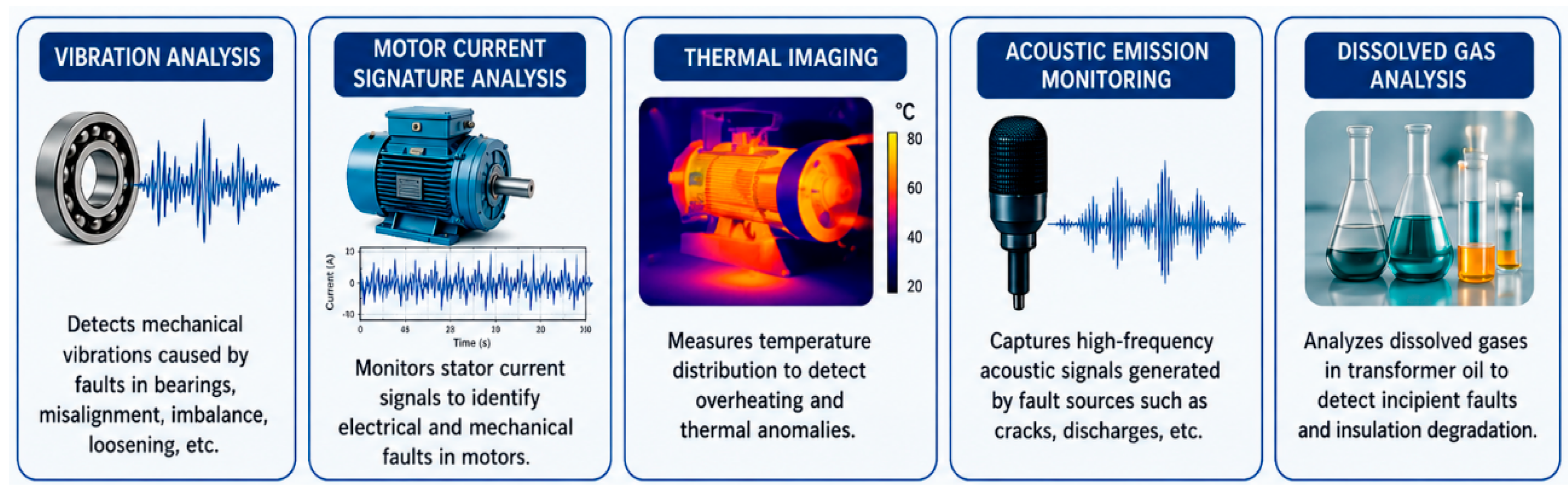
Figure 2.
AI-driven framework for intelligent monitoring and predictive maintenance of electrical machines.
Figure 2.
AI-driven framework for intelligent monitoring and predictive maintenance of electrical machines.
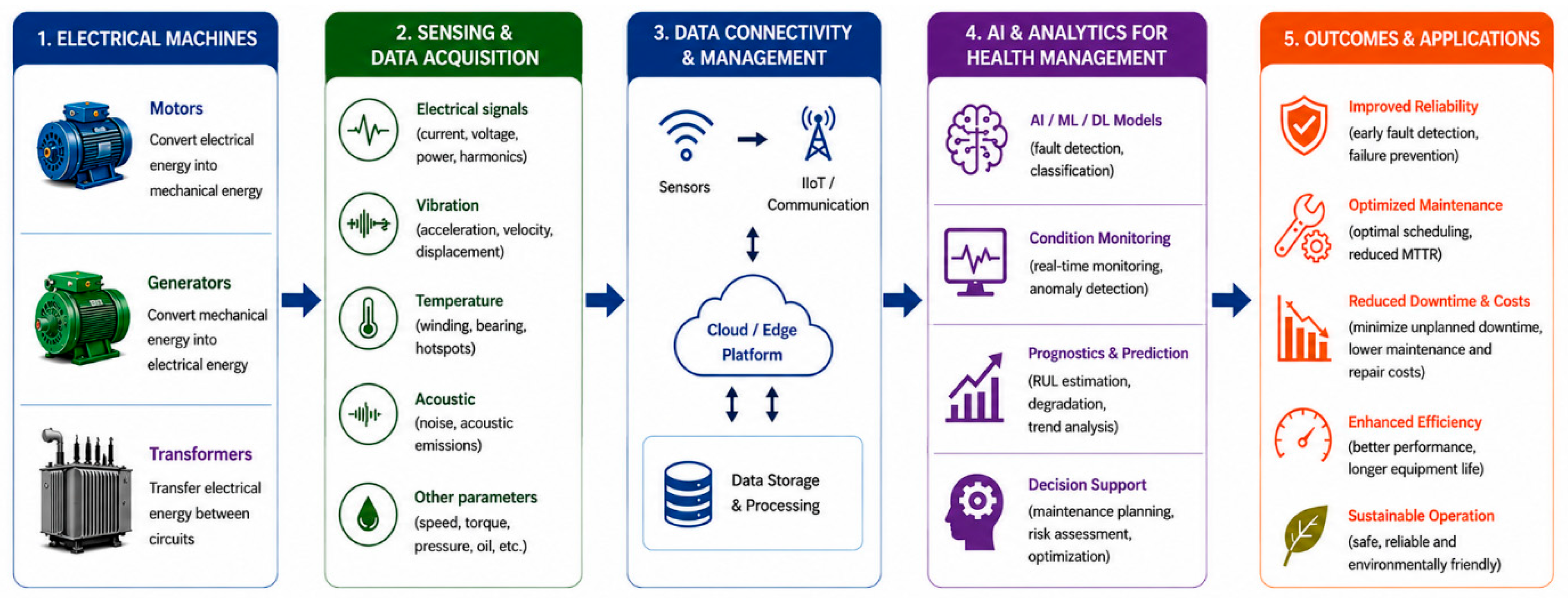
Figure 3.
Overview of common fault mechanisms and the AI-enabled condition monitoring workflow for electrical machines.
Figure 3.
Overview of common fault mechanisms and the AI-enabled condition monitoring workflow for electrical machines.
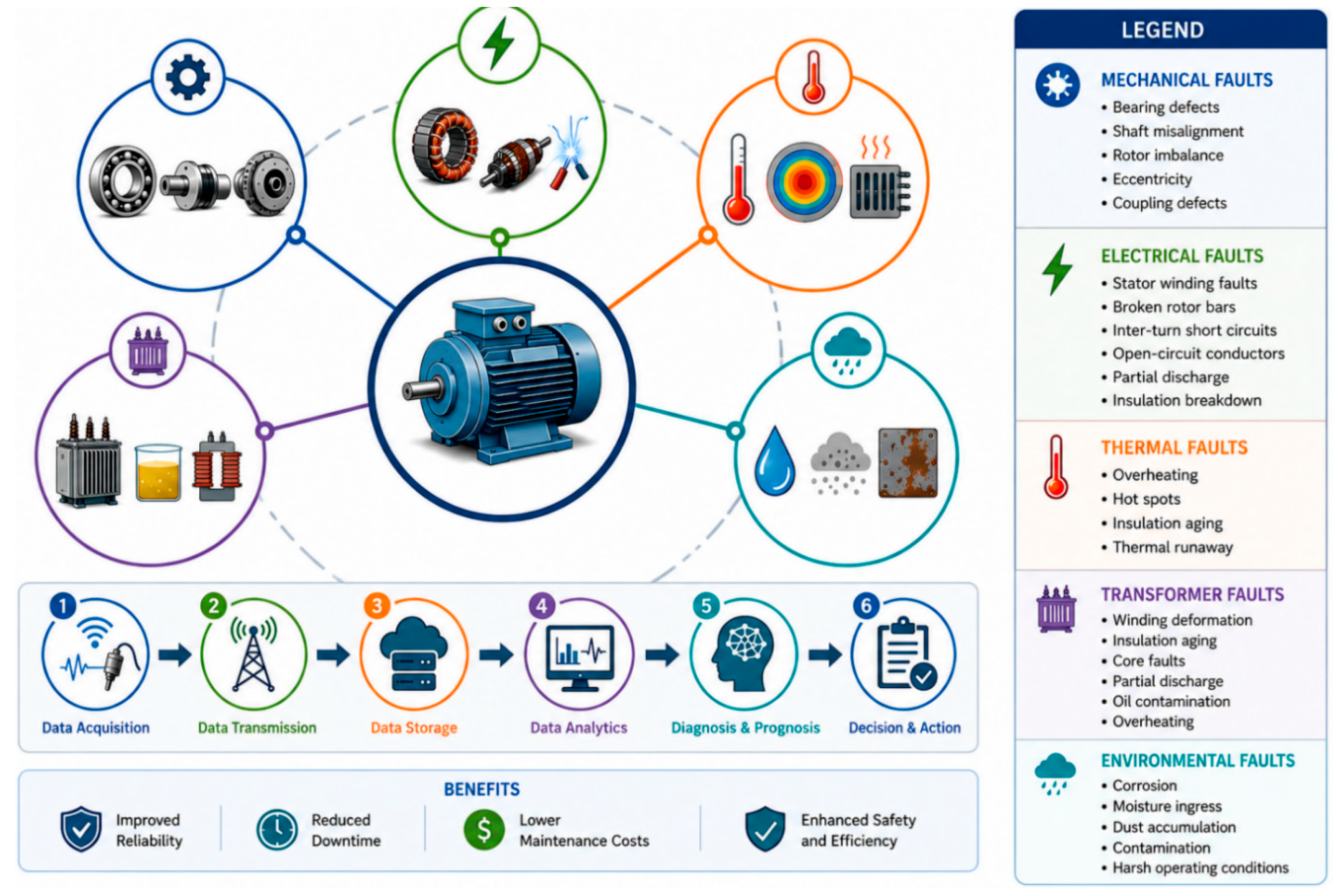
Figure 4.
Major condition monitoring data sources and fault indicators for electrical machines.
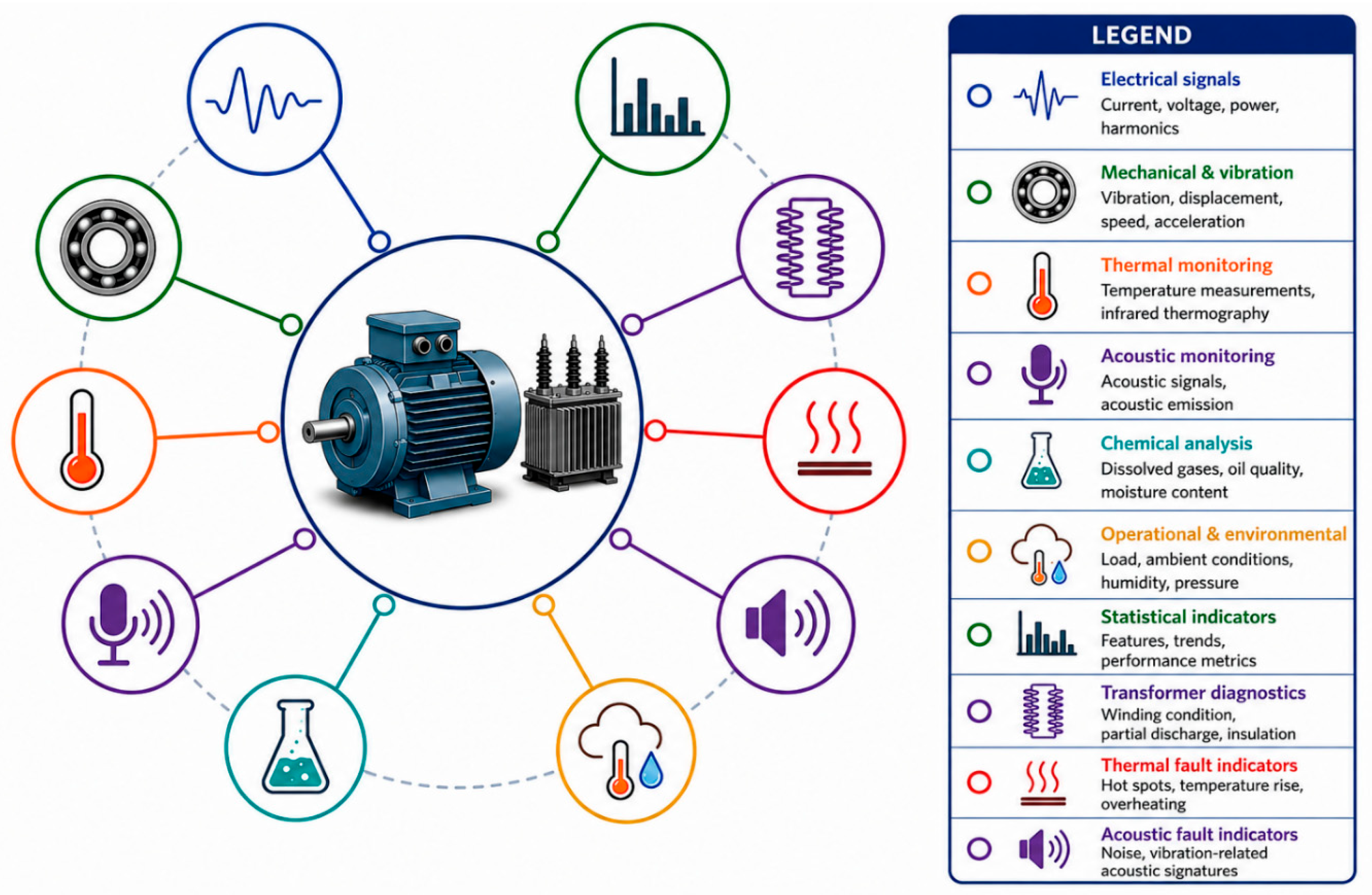
Figure 5.
Evolution of maintenance strategies for electrical machines from corrective maintenance to AI-driven predictive and prescriptive maintenance.
Figure 5.
Evolution of maintenance strategies for electrical machines from corrective maintenance to AI-driven predictive and prescriptive maintenance.
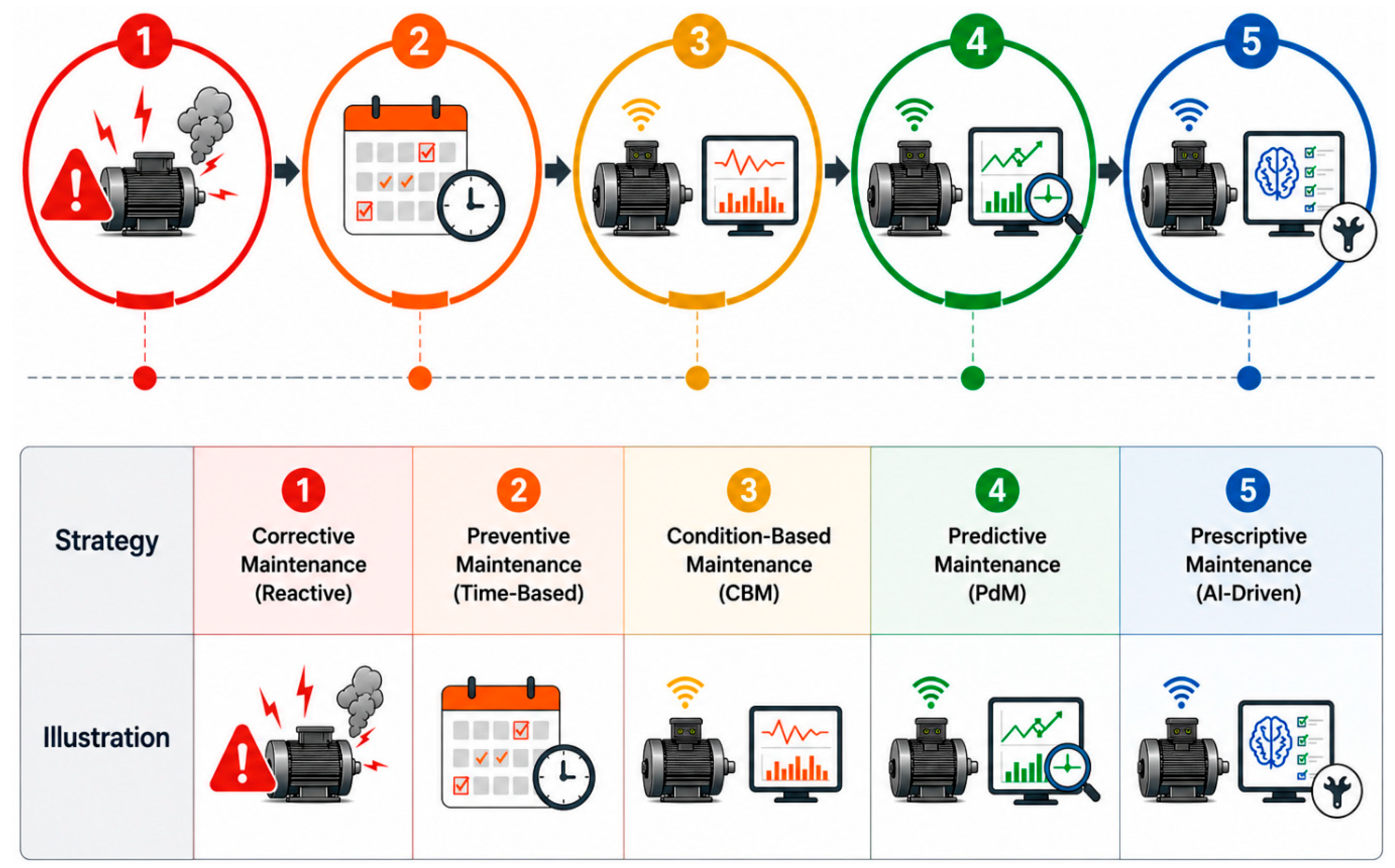
Figure 6.
General workflow of machine learning-based fault diagnosis and predictive maintenance for electrical machines.
Figure 6.
General workflow of machine learning-based fault diagnosis and predictive maintenance for electrical machines.
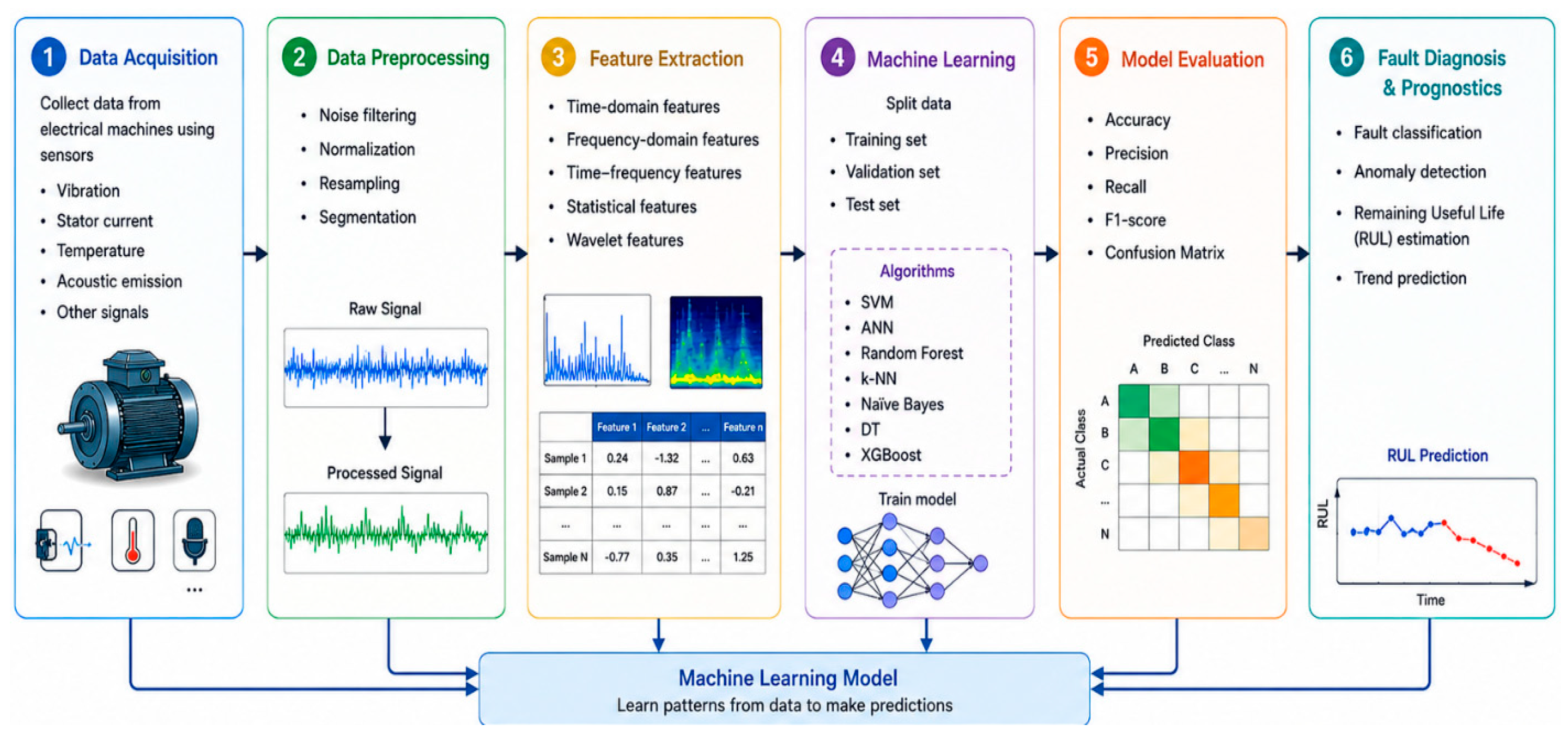
Figure 7.
General workflow of deep learning-based health monitoring, fault diagnosis, and predictive maintenance for electrical machines.
Figure 7.
General workflow of deep learning-based health monitoring, fault diagnosis, and predictive maintenance for electrical machines.
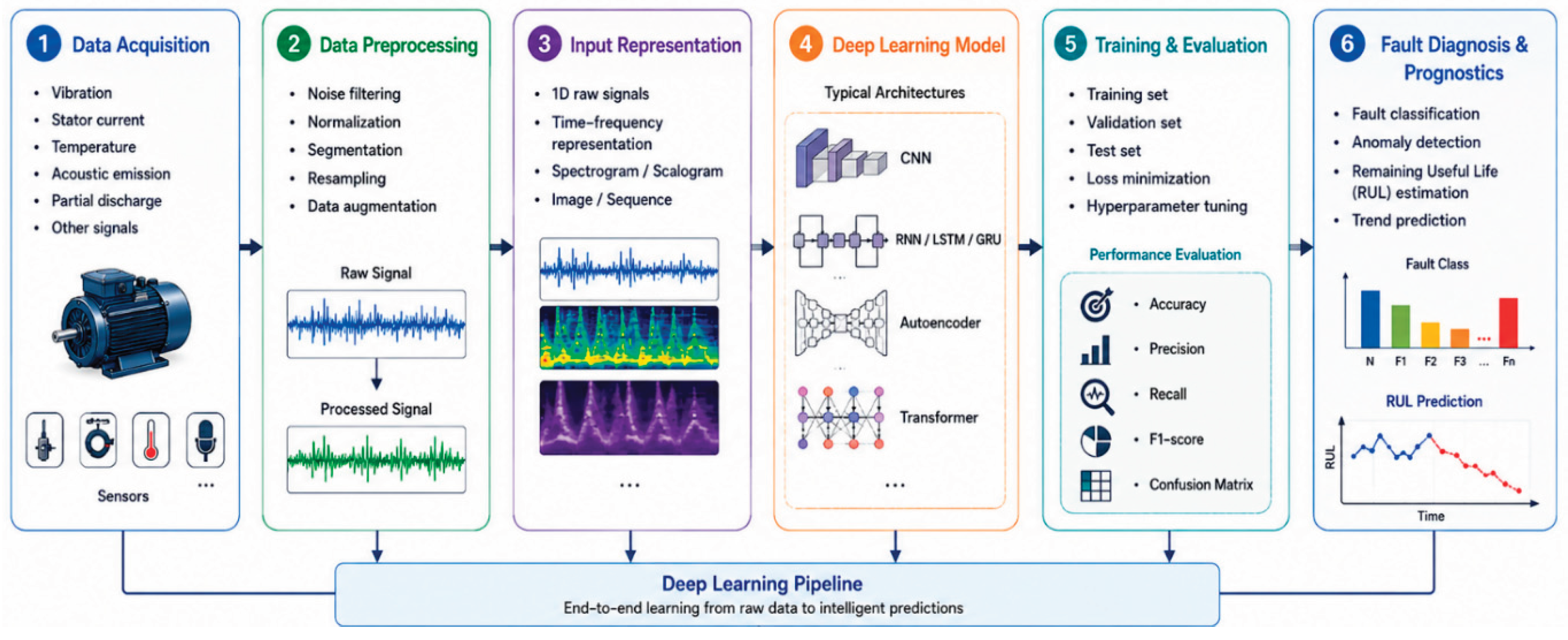
Table 1.
Comparison of motors, generators, and transformers based on energy conversion principles.
| Machine Type | Input Energy | Output Energy | Main Purpose | Examples |
| Motor | Electrical Energy | Mechanical Energy | Drive mechanical loads | Induction Motor, PMSM, BLDC Motor, DC Motor |
| Generator | Mechanical Energy | Electrical Energy | Produce electrical power | Synchronous Generator, Induction Generator, Permanent Magnet Generator |
| Transformer | Electrical Energy | Electrical Energy (Different Voltage Level) | Voltage transformation and power transfer | Power Transformer, Distribution Transformer, Instrument Transformer |
Table 2.
Summary of common fault mechanisms in electrical machines and their associated indicators.
| Fault Category | Typical Faults | Key Indicators | Impact | Reference |
| Mechanical | Bearing defects, misalignment, rotor imbalance | Vibration, acoustic emissions, noise | Reduced efficiency and mechanical failure | [91] |
| Electrical | Winding faults, broken rotor bars, insulation breakdown, partial discharge | Current harmonics, voltage imbalance, temperature rise | Power losses and overheating | [92] |
| Thermal | Overheating, hot spots, insulation aging | Temperature profiles, thermal imaging | Accelerated aging and reduced lifespan | [93,94] |
| Transformer | Winding deformation, oil contamination, core faults | Dissolved gas analysis, oil quality, temperature | Reduced reliability and service interruption | [95] |
| Environmental | Corrosion, moisture ingress, dust contamination | Insulation degradation, leakage currents | Premature component degradation | [96] |
Table 3.
Summary of condition monitoring data sources, fault indicators, and typical faults in electrical machines.
Table 3.
Summary of condition monitoring data sources, fault indicators, and typical faults in electrical machines.
| Data Source | Measured Parameters |
Key Fault Indicators |
Typical Faults Detected |
Monitoring Technique |
Reference |
| Electrical | Current, voltage, power, harmonics, flux | Current imbalance, harmonic distortion, sideband frequencies | Stator winding faults, broken rotor bars, insulation degradation, phase imbalance | Motor Current Signature Analysis (MCSA), power quality analysis | [112] |
| Mechanical | Vibration, displacement, speed, torque | Vibration amplitude, characteristic frequencies, kurtosis | Bearing defects, misalignment, rotor imbalance, eccentricity | Vibration analysis, FFT, envelope analysis | [113] |
| Thermal | Temperature, infrared images | Temperature rise, hot spots, thermal gradients | Overheating, poor cooling, insulation aging | Temperature sensing, infrared thermography | [114] |
| Acoustic | Acoustic signals, acoustic emissions | Peak amplitude, high-frequency components, acoustic energy | Bearing wear, lubrication issues, partial discharge | Acoustic emission monitoring, spectrogram analysis | [115] |
| Chemical | Dissolved gases, oil quality, moisture content | Gas concentration ratios, moisture levels, oil degradation | Internal arcing, thermal faults, insulation degradation | Dissolved Gas Analysis (DGA), oil analysis | [116] |
| Operational and Environmental | Load, ambient temperature, humidity, operating profile | Load variation, overload events, environmental stresses | Overloading, frequent start-stop cycles, environmental degradation | SCADA systems, IoT sensors, environmental monitoring | [117] |
Table 4.
Comparison of maintenance strategies for electrical machines, including corrective, preventive, condition-based, predictive, and prescriptive maintenance approaches.
Table 4.
Comparison of maintenance strategies for electrical machines, including corrective, preventive, condition-based, predictive, and prescriptive maintenance approaches.
| Strategy | Approach | Data Requirement |
Decision Basis | Key Objective | Limitations |
| Corrective Maintenance (Reactive) | Maintenance is performed after failure occurs | None or minimal | Failure occurrence | Restore operation after failure |
Unplanned downtime; high repair cost; safety risks |
| Preventive Maintenance (Time-Based) | Maintenance is scheduled at fixed intervals | Historical maintenance records | Time or usage intervals | Preventing unexpected failures |
Over-maintenance; unnecessary component replacement |
| Condition-Based Maintenance (CBM) | Maintenance is triggered by machine condition | Real-time or periodic sensor data | Actual equipment health | Detect degradation early | Requires monitoring infrastructure and expert interpretation |
| Predictive Maintenance (PdM) | Maintenance is based on prognostic models | Historical and real-time operational data | Predicted future condition | Predict failures and estimate Remaining Useful Life (RUL) | Requires large datasets and advanced analytics |
| Prescriptive Maintenance (AI-Driven) | Maintenance actions are automatically recommended |
Real-time, historical, and contextual data | Optimized AI-based decisions | Recommend optimal maintenance actions | High implementation complexity; cybersecurity and data privacy concerns |
Table 6.
Summary of deep learning architectures and their applications in electrical machine health management.
Table 6.
Summary of deep learning architectures and their applications in electrical machine health management.
| Deep Learning Model | Input Data | Typical Applications | Key Advantage |
| Convolutional Neural Network (CNN) | Vibration signals, thermal images, spectrograms, current signals | Bearing fault diagnosis, stator winding fault detection, transformer condition assessment | Automatic feature extraction from spatial and time-frequency data |
| Recurrent Neural Network (RNN) |
Sequential sensor data and time-series signals | Machine degradation modelling and fault prediction | Captures temporal dependencies |
| Long Short-Term Memory (LSTM) | Vibration, current, temperature, and historical operational data | Remaining Useful Life (RUL) prediction and predictive maintenance | Learns long-term temporal relationships |
| Gated Recurrent Unit (GRU) | Time-series sensor data | Fault diagnosis and prognostics | Lower computational complexity than LSTM |
| Autoencoder (AE) | Unlabelled sensor data | Anomaly detection and feature extraction | Learns compact data representations without labels |
| Variational Autoencoder (VAE) | Multimodal sensor data | Fault detection and data generation | Handles uncertainty and complex data distributions |
| Deep Belief Network (DBN) | Vibration and current signals | Fault classification and condition monitoring | Effective hierarchical feature learning |
| Transformer | Long sequential data and multimodal datasets | Fault diagnosis, prognostics, and RUL estimation | Captures long-range dependencies using attention mechanisms |
| Hybrid Models (CNN-LSTM, CNN-GRU) | Time-frequency representations and sequential data | Fault diagnosis and predictive maintenance | Combines spatial and temporal features learning |
Table 7.
Summary of hybrid AI approaches and their applications in electrical machine health management.
Table 7.
Summary of hybrid AI approaches and their applications in electrical machine health management.
| Hybrid AI Approach |
Components | Typical Applications | Key Advantage | Reference |
| FFT + SVM | Fast Fourier Transform + Support Vector Machine | Bearing fault diagnosis, rotor fault detection | Improved frequency-domain feature extraction | [185] |
| WT + ANN | Wavelet Transform + Artificial Neural Network | Stator winding fault diagnosis, transformer monitoring | Effective analysis of non-stationary signals | [186] |
| EMD + RF | Empirical Mode Decomposition + Random Forest | Vibration-based fault classification | Enhanced feature quality and robustness | [187] |
| VMD + XGBoost | Variational Mode Decomposition + Extreme Gradient Boosting | Predictive maintenance and anomaly detection | Improved classification accuracy | [188] |
| GA + ANN | Genetic Algorithm + Artificial Neural Network | Feature selection and model optimization | Reduced computational complexity | [189] |
| PSO + SVM | Particle Swarm Optimization + Support Vector Machine | Fault diagnosis and condition monitoring | Optimized hyperparameter tuning | [190] |
| CNN + LSTM | Convolutional Neural Network + Long Short-Term Memory | Fault diagnosis and Remaining Useful Life (RUL) prediction | Combined spatial and temporal feature learning | [191] |
| CNN + GRU | Convolutional Neural Network + Gated Recurrent Unit | Time-series fault classification | Lower computational complexity than CNN-LSTM | [192] |
| Ensemble Learning | Multiple classifiers (bagging, boosting, stacking) | Fault classification and prognostics | Improved robustness and generalization | [193] |
| Digital Twin + AI | Physics-based model + Machine Learning/Deep Learning | Predictive maintenance and maintenance optimization | Enhanced interpretability and real-time decision-making | [194] |
Table 8.
Comparison of AI applications across different electrical machine types.
| Machine Type | Common Faults |
Monitoring Data |
AI Techniques |
Primary Objective |
Reference |
| Electric Motors |
Bearing faults, broken rotor bars, stator winding faults, eccentricity | Vibration, current, temperature, acoustic signals | SVM, RF, CNN, LSTM | Fault diagnosis and predictive maintenance | [207] |
| Generators | Rotor faults, stator faults, bearing defects, partial discharge | Vibration, current, temperature, partial discharge data | CNN, LSTM, Hybrid AI | Fault detection and degradation assessment | [208] |
| Transformers | Insulation aging, winding deformation, oil contamination, core faults | DGA, thermal data, oil quality, partial discharge | ANN, SVM, XGBoost, CNN | Fault classification and asset management | [209] |
Table 9.
Comparison of AI techniques for electrical machine health management objectives.
| AI Technique | Fault Diagnosis |
Anomaly Detection |
RUL Estimation |
Predictive Maintenance |
Digital Twin Integration |
| Machine Learning | High | Medium | Medium | High | Medium |
| Deep Learning | Very High | High | Very High | Very High | High |
| Reinforcement Learning | Low | Medium | High | Very High | High |
| Hybrid AI | Very High | Very High | Very High | Very High | Very High |
| Explainable AI (XAI) |
Medium | Medium | Medium | High | High |
Table 10.
Key challenges and future research directions for AI-based electrical machine health management.
Table 10.
Key challenges and future research directions for AI-based electrical machine health management.
| Challenge Area | Key Issues | Future Research Directions |
| Data Availability and Quality | Limited labelled fault data, class imbalance, noisy and missing data | Open-access datasets, data augmentation, synthetic data generation, transfer learning |
| Model Generalization |
Performance degradation under varying operating conditions | Domain adaptation, continual learning, self-supervised learning |
| Interpretability and Trustworthiness | Black-box models, limited transparency, lack of user trust | Explainable AI (XAI), human-in-the-loop frameworks, trustworthy AI |
| Computational Complexity | High computational and memory requirements | Model compression, lightweight networks, edge AI, hardware acceleration |
| Data Privacy and Cybersecurity | Data leakage, adversarial attacks, insecure communications | Federated learning, blockchain, privacy-preserving AI, secure protocols |
| Standardization and Benchmarking | Lack of common datasets, metrics, and validation procedures | Standardized datasets, interoperability frameworks, benchmarking protocols |
| Integration with Emerging Technologies | Challenges in integrating AI with IIoT, Digital Twins, and cloud platforms | Unified architecture for Digital Twins, edge computing, and 5G/6G networks |
| Human–AI Collaboration | Limited user acceptance and dependence on expert knowledge | Human-in-the-loop systems, explainable decision support tools |
| Sustainability and Energy Efficiency | High energy consumption of large AI models | Green AI, energy-efficient algorithms, sustainable computing frameworks |
Disclaimer/Publisher’s Note: The statements, opinions and data contained in all publications are solely those of the individual author(s) and contributor(s) and not of MDPI and/or the editor(s). MDPI and/or the editor(s) disclaim responsibility for any injury to people or property resulting from any ideas, methods, instructions or products referred to in the content. |
© 2026 by the authors. Licensee MDPI, Basel, Switzerland. This article is an open access article distributed under the terms and conditions of the Creative Commons Attribution (CC BY) license (http://creativecommons.org/licenses/by/4.0/).
Copyright: This open access article is published under a Creative Commons CC BY 4.0 license, which permit the free download, distribution, and reuse, provided that the author and preprint are cited in any reuse.


