
Submitted:
04 August 2026
Posted:
05 August 2026
You are already at the latest version
Abstract
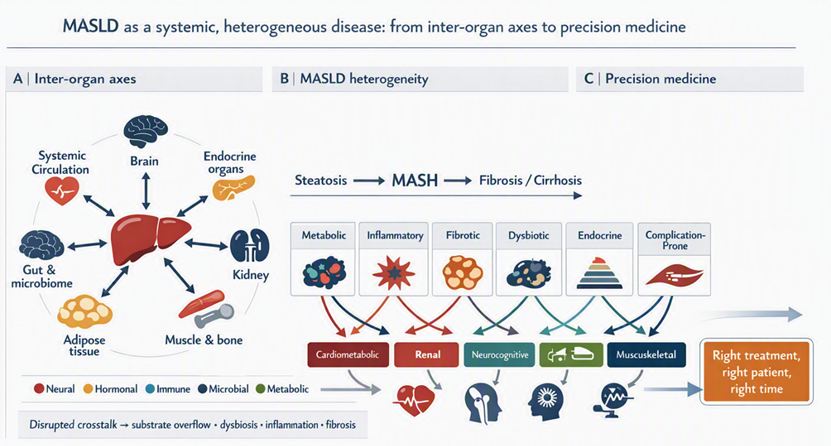
Metabolic dysfunction-associated steatotic liver disease (MASLD) is a systemic disorder shaped by inter-organ crosstalk: dynamic, bidirectional communication through which the liver and endocrine organs, gut, adipose tissue, brain, kidney, skeletal muscle, and bone exchange signals to coordinate metabolism, immunity, and tissue homeostasis. Across these axes, neural circuits, hormones, cytokines, adipokines, hepatokines, myokines, osteokines, bile acids, microbial metabolites, lipids, extracellular vesicles, and microRNAs integrate nutrient handling, insulin action, immunity, mitochondrial function, and tissue remodeling. Perturbation of these networks converts physiological homeostasis into self-reinforcing loops of substrate overflow, endocrine dysregulation, dysbiosis, inflammation, and fibrogenesis, while hepatic dysfunction propagates renal, neurocognitive, cardiometabolic, and musculoskeletal complications. This framework helps explain why individuals with comparable steatosis show divergent trajectories of metabolic dysfunction-associated steatohepatitis (MASH), fibrosis, extrahepatic disease, and treatment response. It also highlights tractable points of intervention, including restoration of adipose buffering, modulation of gut microbial and bile-acid signaling, correction of endocrine drivers, preservation of muscle and bone, and integrated cardio–kidney–liver risk reduction across different disease stages and clinical phenotypes. We argue that precision hepatology should move beyond isolated assessment of liver fat and fibrosis towards multidimensional phenotyping of dominant crosstalk mechanisms. Longitudinal multi-omic studies and trials incorporating outcomes across organs are now required to distinguish causal signals from disease correlates, define clinically actionable endotypes, and test whether targeting one node can restore durable metabolic and functional resilience throughout the interconnected MASLD network, while improving patient-centered outcomes across the disease course.
Keywords:
gut microbiome
; insulin resistance
; bile acids and salts
; extracellular vesicles
; intercellular signaling peptides and proteins
; MASLD
Copyright: This open access article is published under a Creative Commons CC BY 4.0 license, which permit the free download, distribution, and reuse, provided that the author and preprint are cited in any reuse.


