

Submitted:
04 August 2026
Posted:
05 August 2026
You are already at the latest version
Abstract
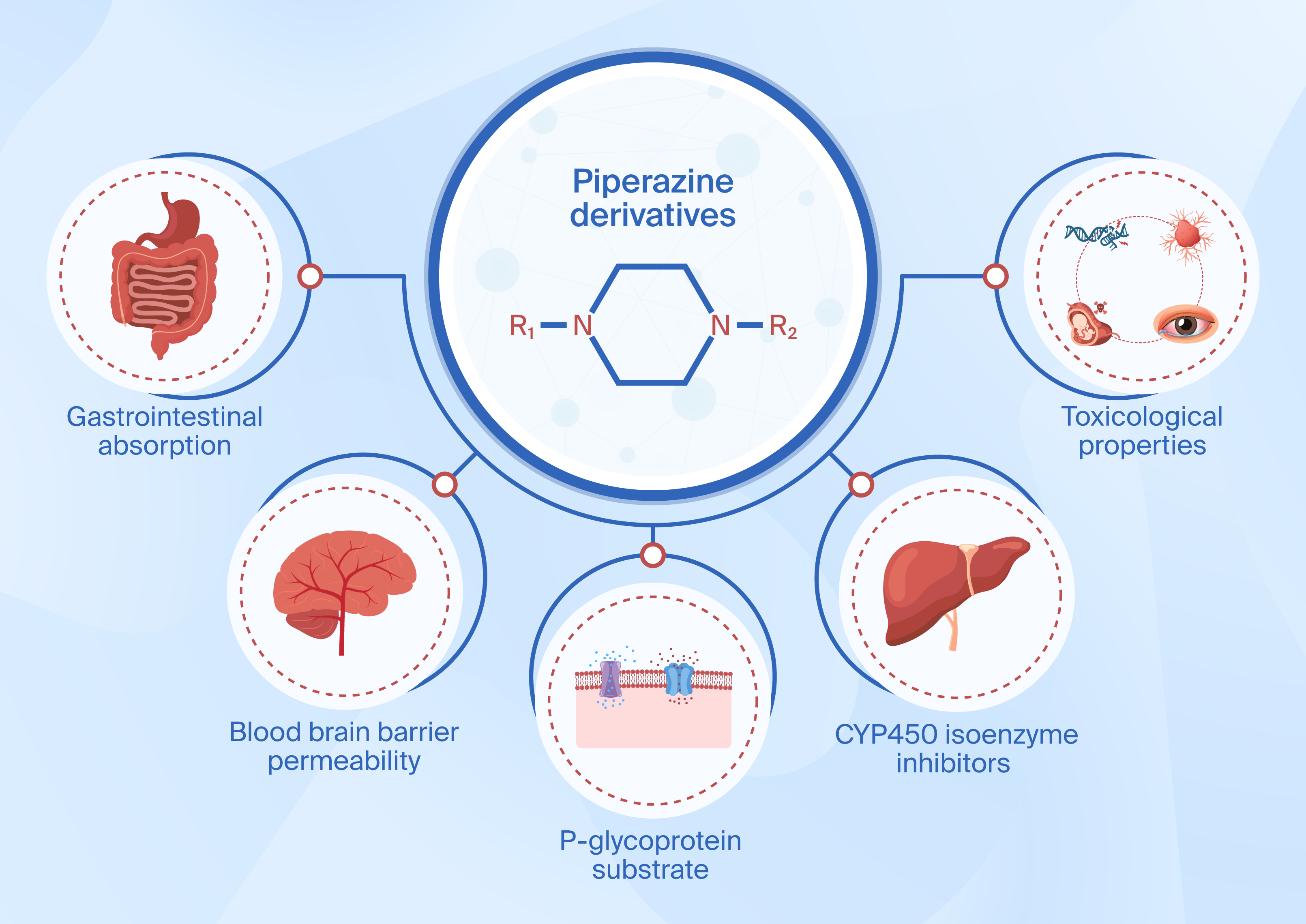
Background/Objectives: Piperazine constitutes a versatile heterocyclic core commonly used in drug development because of its ability to engage with different biological targets. The current research focuses on the computation-based drug-likeness analysis, gastrointestinal absorption prediction, and toxicity estimation of derivatives (1–27) of piperazine, where four compounds (1–4) belong to the list of commercially available drugs. Methods: Parameters related to drug-likeness, solubility and bioavailability were calculated by using the SwissADME and ADMETlab 3.0 web tools as well as MoloVol software (v1.2.0) and MarvinSketch software (v4.1.13). Aftewards, GI absorption, blood-brain barrier permeability, P-glycoprotein recognition and CYP450 inhibition were modeled. The toxicological characteristics were assessed by DataWarrior software (v06.05.04), which classified compounds as mutagenic, carcinogenic, reproductive, and irritant. Results: According to the BOILED‑Egg approach, compounds 2, 4–6, 10–21, 23–25, and 27 were estimated to exhibit good blood–brain barrier permeation. Majority of compounds (1–4, 7–9, 14, 16, 17, and 19–25) were recognized as P-glycoprotein substrates. The metabolic profile suggested inhibition of different CYP450 enzymes: 1A2, 2C19, 2C9, 2D6, and 3A4. None of the compounds (1–27) were indicated to pose mutagenic hazard. Compounds 5 and 13 were predicted to be carcinogenic. Compounds 6, 12, and 14 were anticipated to exhibit reproductive toxicity. Compounds 11–15 were expected to act as irritants. Conclusions: Computational data generate several hypotheses requiring further experimental validation of studied compounds as promising antiparasitic drugs (7, 8, 10), an antimicrobial drug (11), a neuroactive drug (16), anti-inflammatory drugs (18, 20–24), antitubercular drugs (25, 26), and an antitumor drug (27).
Keywords:
piperazine derivatives
; in silico estimation
; bioavailability
; ADMET
; toxicological properties
; potentially new drugs
1. Introduction
Piperazines represent a popular heterocyclic core in modern medicinal chemistry owing to their unique combination of properties that promote the development of new medicines. Chemically, piperazine is a six-membered ring with two opposite nitrogen atoms that allow for high conformational flexibility of the compound and ability to interact with different biological targets [1,2]. As a result, the molecule demonstrates high compatibility with the enzyme active site and receptor binding sites, thus promoting ligand-target interactions within their target binding sites [3,4].
Chemically, piperazine demonstrates adjustable basicity and participates in various weak non-covalent interactions such as hydrogen bonds, cation-π interaction and electrostatics that increase the possible uses of the molecule [3,4]. In this way, it is widely used in the preparation of antiparasitic, antimicrobial, neuroactive, anti-inflammatory, antitubercular, and anticancer agents due to the presence of its core, which can be easily modified with different substituents. Moreover, the core offers opportunities to improve pharmacokinetic properties.
Within the framework of this research, the primary objective is the assessment of the drug-likeness and physicochemical properties of piperazine derivatives [5] as markers of oral bioavailability. The secondary objective is to estimate their pharmacokinetics and toxicity profiles in silico. This study is designed as a physicochemical and ADMET-based screening approach to prioritize compounds for subsequent experimental investigation. However, ADMET-based screening excludes the prediction of excretion.
2. Material and Methods
2.1. Lipinski’s Rule
Lipinski’s Rule of Five predicts poor absorption and permeability in compounds with more than five hydrogen bond donors, more than ten hydrogen bond acceptors, a molecular weight greater than 500 Da, and a calculated log P value exceeding 5. Molecules that violate two or more of these criteria generally exhibit poor bioavailability. Lipinski’s rule applies to drugs that cross the cell membrane via passive diffusion, whereas drugs that rely on active transport are exempt from this rule [6]. The decimal logarithm of the octanol–water partition coefficient (log P) is used as a measure of molecular hydrophobicity. Drug absorption, bioavailability, receptor–ligand hydrophobic interactions, metabolism, and toxicity depend on hydrophobicity [6].
In the present study, lipophilicity was assessed using the Consensus logP value provided by the SwissADME web tool. Consensus logP is calculated as the arithmetic mean of five different predictive methods (iLOGP, XLOGP3, WLOGP, MLOGP, and SILICOS-IT). This approach is considered more robust than reliance on a single method and was therefore selected as the primary lipophilicity descriptor for evaluating Lipinski’s rule and related drug-likeness parameters [7].
2.2. Topological Polar Surface Area (TPSA)
The polar surface area of a molecule (PSA) represents the surface occupied by polar atoms, most commonly nitrogen, oxygen, and the attached hydrogen atoms. It is a parameter that influences drug transport across membranes and correlates with good intestinal absorption and penetration through the blood–brain barrier (BBB). For rapid and simple calculation, the topological polar surface area (TPSA) is used. The procedure is based on the summation of tabulated surface values assigned to polar fragments of the molecule (atoms and their surrounding environment) [8].
2.3. Number of Rotatable Bonds (Nrotb)
The number of rotatable bonds, together with the polar surface area (TPSA) and the total number of hydrogen bonds (sum of hydrogen bond acceptors and donors), are molecular parameters that serve as important indicators of good oral bioavailability, independent of molecular volume. However, the number of rotatable bonds and hydrogen bonds increases with the enlargement of molecular volume, which can be considered a valid parameter for the assessment of oral bioavailability. A rotatable bond is defined as a single bond not bound to a ring and attached to a non-terminal heavy atom (not hydrogen-bonded) [9].
2.4. Calculation of Drug-Likeness Parameters
For 27 selected piperazine derivatives, the calculation of drug-likeness parameters was performed, which may indicate their oral bioavailability. The SwissADME web tool [10,11] was used to calculate the following drug-likeness parameters: Consensus LOGP, topological polar surface area (TPSA), number of heavy atoms (Natoms), molecular weight (MW), number of hydrogen bond acceptors (nON), number of hydrogen bond donors (nOHNH), number of Lipinski’s rule violations (Nviolations), number of rotatable bonds (Nrotb), aqueous solubility parameters log S (ESOL) and log S (Ali) as well as Abbott bioavailability score. In addition to this, MoloVol software version 1.2.0 was utilized to calculate the molecular volume (Volume) [12].
2.5. Estimation of Absorption, Distribution, and Metabolic Properties
To account for the ionization state of the basic piperazine derivatives at physiological pH, logD7.4 values were calculated using ADMETlab 3.0 web tool [13], and both ionized and unionized 2D PSA values were determined using MarvinSketch software (v4.1.13) [14].
Absorption, distribution, and metabolic properties of compounds 1–27 were estimated using the SwissADME web tool [10,11]. Gastrointestinal (GIT) absorption and blood–brain barrier (BBB) permeability were assessed using the BOILED-Egg model [15]. Predictions of P-glycoprotein substrate status and inhibition of major CYP450 isoforms (1A2, 2C19, 2C9, 2D6, and 3A4) were also obtained using the SwissADME web tool [10,11].
2.6. Assessment of Toxicological Properties
The assessment of toxicological properties for compounds 1–27 was performed using DataWarrior software( v.06.05.04) [16]. The classification was carried out into four main toxicity categories: mutagenicity, carcinogenicity, irritant effects, and reproductive toxicity.
The risk assessment of toxicity is based on the identification of structural fragments within the molecule that indicate a potential risk of toxic effects. The list of fragments for each toxicity category was obtained from the RTECS database of compounds known to be active in a specific toxicity class (e.g., carcinogenicity). For prediction purposes, both a set of toxic compounds (RTECS database) and a set of non-toxic compounds (marketed drugs) were used [17].
3. Results
By applying the SwissADME web tool and MoloVol software (v1.2.0), Table 1 was generated, presenting the calculated drug-likeness, solubility, and bioavailability parameters for compounds 1–27. None of compounds 1-27 exhibited more than one violation of Lipinski’s rule based on the SwissADME web tool.
If Lipinski’s rule is strictly applied, compounds 9, 22, and 26 exhibit a single violation, which is considered acceptable and corresponds to GI absorption prediction obtained using the SwissADME web tool (Table 3). However, compounds 17 and 19 display two violations according to Lipinski’s rule: their molecular weight (MW) exceeds 500 Da, and the Consensus logP is greater than 5. In contrast, the SwissADME web tool indicates only one violation, which does not align with the MW and Consensus logP data presented in Table 1.
According to the log S (ESOL) and log S (Ali) values presented in Table 1, the majority of compounds (compounds 1-16, 18, 20-25 and 27) were estimated to be moderately soluble, very soluble, or soluble. Nonetheless, compounds 17, 19 and 26 were considered as poorly soluble [10].
The Abbott score values are 0.55 for all investigated compounds [18] which may indicate acceptable rat oral bioavailability for the majority of compounds.
Table 2 displays the calculated values of Consensus logP, logD7.4, ionized 2D PSA at pH 7.4, unionized 2D PSA, and TPSA for compounds 1–27, obtained using the SwissADME and ADMETlab 3.0 web tools, together with MarvinSketch software (v4.1.13). It is important to emphasize that, owing to the availability of MarvinSketch software (v4.1.13), unionized and ionized 2D PSA values were calculated. No difference between TPSA and unionized 2D PSA values was noticed for all compounds except for compounds 1 and 26. Moreover, only minor differences between TPSA and unionized 2D PSA values were observed for compounds 1 and 26.
In addition to this, the majority of the compounds (sixteen compounds) do not exhibit any difference between the ionized 2D PSA and the unionized 2D PSA values, whereas a small difference between the ionized 2D PSA and the unionized 2D PSA values is present for eleven compounds (1–4, 9, 11, 19–22, and 27).
According to SwissADME web tool, all compounds except compound 9 possessed TPSA values below 140 Å2, which is consistent with good GI absorption. Based on the BOILED-Egg model implemented in SwissADME, compounds 2, 4–6, 10–21, 23–25, and 27 were expected to exhibit good blood–brain barrier permeability, whereas compounds 1, 3, 7–9, 22, and 26 were suggested to have poor BBB permeability.
In order to account for the ionization state of the basic piperazine derivatives at physiological pH, logD7.4 and ionized 2D PSA values at pH 7.4 were calculated (Table 2). These descriptors provide a more physiologically relevant representation compared with the unionized values.
Regarding P-glycoprotein recognition, most of the investigated compounds were indicated to be P-glycoprotein substrates, including compounds 1–4, 7–9, 14, 16, 17, and 19–25, whereas compounds 5, 6, 10–13, 15, 18, 26, and 27 are not anticipated to act as P-glycoprotein substrates. Table 3 provides a summary of the predicted absorption and distribution properties of compounds 1–27.
With respect to the predicted metabolic properties of the investigated compounds, nine compounds are potential inhibitors of the CYP450 1A2 isoenzyme. In addition, sixteen compounds are expected to inhibit CYP450 2C19, while eleven may inhibit CYP450 2C9. The majority of the compounds (eighteen compounds) are identified as prospective inhibitors of CYP450 2D6. Furthermore, twelve compounds are suggested to display inhibitory activity against CYP450 3A4. Details of the predicted metabolic properties of the investigated compounds 1–27 are displayed in Table 4.
The risk for mutagenicity is not estimated for any of the investigated compounds (1–27). Carcinogenicity is not indicated for twenty-five compounds, apart from compounds 5 and 13, which are projected to exhibit high levels of carcinogenic risk. Compound 6 is anticipated to have a low-level risk of reproductive toxicity, while compounds 12 and 14 are suggested to have high levels of reproductive toxicity. However, most of the investigated compounds (twenty-four compounds) are not expected to pose a risk for reproductive toxicity. Compound 11 is predicted to have a low-level risk of irritant effect, while compounds 12–15 are suggested to have a high risk of irritant effect. On the other hand, most of the investigated compounds (twenty-two compounds) are not anticipated to have an irritant effect. Table 5 presents the predicted toxicological properties of the investigated compounds 1–27.
4. Discussion
The investigated compounds 1–4 are commercially available drugs: ciprofloxacin (compound 1), cetirizine (compound 2), imatinib (compound 3), and aripiprazole (compound 4). Ciprofloxacin is a fluoroquinolone antibiotic, cetirizine is an antihistamine, imatinib is an anticancer agent, and aripiprazole is an antipsychotic [5]. Figure 1 displays chemical structures of the commercially available drugs (1-4).
To validate the predictive performance of the computational tools used in this study, before extending interpretations to the newly synthesized compounds (5–27), we benchmarked SwissADME predictions for the four marketed reference drugs (compounds 1–4) against published experimental and clinical ADMET data (Table 6). Overall, the models demontrated reasonable concordance with literature values for most parameters, including GI absorption and P-glycoprotein substrate status.
The benchmarking exercise revealed some limitations of the predictive model as well. First, the discrepancies were observed in the predictions for cetirizine (compound 2). The SwissADME system successfully identified cetirizine as a substrate of P-glycoprotein but suggested good BBB permeability for this compound. However, many studies have demonstrated the low brain penetration of cetirizine. Gupta et al. (2006) reported unbound brain-to-plasma partition coefficients (Kp,uu) of 0.14–0.17 in guinea pigs through microdialysis, which indicates efflux from the BBB [28]. Furthermore, Polli et al. (2003) observed that the brain penetration of cetirizine in P-glycoprotein deficient mice was 2.3-fold to 8.7-fold higher than in wild-type mice [29]; Chen et al. (2003) confirmed the P-glycoprotein substrate role of cetirizine both in vivo and in vitro [34]. This example illustrates the limitation of the BOILED-Egg classifier, as the classifier cannot take into consideration the combined effect of active efflux and the zwitterionic nature of the molecule at physiological pH.
However, the estimations for imatinib (compound 3) and aripiprazole (compound 4) showed much better correlation with literature data. The predictions for imatinib correspond to the poor penetration of this compound in the brain, since large central nervous system (CNS) levels were noted only under the circumstances when BBB was disrupted [30]. Aripiprazole was expected to cross BBB, consistent with its antipsychotic activity; however, its brain penetration is known to depend on P-glycoprotein [31].
Taking into consideration the benchmarking results, even though the computational methods used in this study indicated useful information about the compounds, they have certain limitations and cannot be regarded as definitive. Therefore, the predictions for compounds 5-27 should be taken as hypotheses for further experimental validation. Compounds 5–27 are newly synthesized organic compounds. Based on the conducted investigations and literature data, compounds 5–10 exhibit antiparasitic activity, compounds 11–14 display antimicrobial activity, compounds 15–17 act as neuroactive agents, compounds 18–24 show anti-inflammatory activity, compounds 25 and 26 are antitubercular agents, while compound 27 exhibits antitumor activity [5]. Figure 2 shows chemical structures of compounds 5-10 synthesized as antiparasitic agents. Figure 3 exhibits chemical structures of compounds 11-14 synthesized as antimicrobial agents as well as compounds 15-17 as neuroactive agents. Figure 4 displays chemical structures of compounds 18-24 synthesized as anti-inflammatory agents. Figure 5 illustrates chemical structures of compounds 25 and 26 synthesized as antitubercular agents and also compound 27 as antitumor agent.
The majority of compounds complied with Lipinski’s rule, but compounds 9, 22, and 26 exhibited one violation of Lipinski’s rule (Table 1). In contrast, compounds 17 and 19 showed two violations of Lipinski’s rule, which do not correspond to the predictions generated by the SwissADME web tool (Table 3). Therefore, compounds 17 and 19 may be hypothesized to possess less favorable estimated absorption and permeability profiles.
Table 1 presents the log S (ESOL) and log S (Ali) values, and most compounds were projected to be moderately soluble, very soluble, or soluble. Nevertheless, compounds 17, 19 and 26 were expected to be poorly soluble [10]. This limitation may be overcome by optimizing the formulation of pharmaceutical dosage forms containing compound 17, 19 or 26.
All investigated compounds showed Abbott score values of 0.55 [18], indicating that their rat oral bioavailability may anticipated to be acceptable for the majority of compounds.
Predicted absorption and distribution properties indicate that all compounds except compound 9 were indicated to have good gastrointestinal absorption. Based on the BOILED-Egg model, compounds 2, 4–6, 10–21, 23–25, and 27 were estimated to have good blood–brain barrier (BBB) permeability. The majority of compounds were also suggested to be P-glycoprotein substrates (compounds 1-4, 7-9, 14, 16, 17 and 19-25).
Compounds with a TPSA value below 140 Å2 are generally expected to exhibit good intestinal absorption, whereas those with TPSA values under 60 Å2 are anticipated to penetrate the blood–brain barrier [8,15]. When the parameters in Table 1 are examined in detail, it is observed that the investigated compounds (except compound 9) possess TPSA values below 140 Å2, which is indicative of good intestinal absorption. Additionally, compounds 2, 4–6, 11–13, 16–18, 23–25, and 27 exhibit TPSA values below 60 Å2, a threshold that may suggest enhanced penetration across the blood–brain barrier.
If the number of rotatable bonds does not exceed 10 (Nrotb ≤ 10) and the molecular volume remains below 500 Å3 (Volume ≤ 500 Å3), compounds are expected to exhibit good oral bioavailability [10]. No more than 10 rotatable bonds are observed for the evaluated compounds (with the exception of compound 22), which is a sign of good oral bioavailability. All compounds have molecular volume lower than 500 Å3, thus ensuring the advantage of oral bioavailability.
The P-glycoprotein (P-gp) is an active efflux transporter that requires ATP for its activity and extrudes substrate from the cells, thus decreasing their oral availability and preventing entry into the brain. This feature is quite important for drug bioavailability and distribution [6]. Most of the tested compounds are expected to be substrates for P-gp, including compounds 1-4, 7-9, 14, 16, 17, and 19-25.
SwissADME predicts the probability of small molecule inhibition of cytochrome P450 (CYP450) isoenzymes that play a role of key enzymes of drug metabolism. This is a common way of the occurrence of pharmacokinetic drug-drug interactions [11]. As for anticipated metabolic properties, nine compounds are likely to inhibit CYP450 1A2 isoenzyme, sixteen are potential CYP450 2C19 inhibitors as well as eleven may inhibit CYP450 2C9. Eighteen compounds are likely to be CYP450 2D6 inhibitors, and twelve are considered as CYP3A4 inhibitors.
The toxicological properties of compounds 1-27 were assessed using DataWarrior software (v.06.05.04). The analysis considered four main types of toxicity and their associated risk levels: mutagenicity, carcinogenicity, reproductive toxicity, and irritancy [16,17]. No mutagenic risk was expected for compounds 1-27. Carcinogenic risk was projected to be absent in most cases, although compounds 5 and 13 were indicated to have high risk. A low risk of reproductive toxicity was predicted for compound 6, and a high risk was suggested for compounds 12 and 14. On the other hand, the remaining twenty-four compounds were not anticipated to pose reproductive toxicity. Regarding irritant effect, compound 11 was considered to have a low risk, and compounds 12-15 were estimated to have high risk, whereas twenty-two compounds were anticipated to be non-irritant.
4.1. Limitations
SwissADME's estimations of gastrointestinal absorption and brain penetration are made according to the BOILED-Egg model, which is a simple model based on a two-descriptor classification approach with lipophilicity (WLOGP) and topological polar surface area (TPSA) as descriptors. Although the approach allows fast and intuitive visualizations, it is not able to describe the full complexity of biological membranes (e.g., active transport, metabolism, ionization under physiological conditions). Likewise, CYP450 inhibition is modeled using a support vector machine (SVM) classifier, yielding probability values rather than binary yes/no outputs. Toxicity alerts in DataWarrior are based on toxic substructures in the RTECS database; these are expert systems known to produce false positive and false negative answers. Therefore, no toxicity alerts mean the absence of structural features but not their absence itself.
Another aspect is related to the applicability domain of the models used for projections. It is known that most quantitative structure–activity relationships (QSAR) models used in SwissADME are developed predominantly with drug-like molecules with molecular weights below 500–600 Da. Compounds 17, 19, 22, and 26 have molecular weights ranging approximately from 499 to 536 Da and therefore belong to the area at the border of the drug-like chemical space, and predictions for these molecules may be considered less confident. Moreover, compounds with TPSA values below 60 Å2 are expected to exhibit good blood-brain barrier permeability, but compounds 15, 19-21 and 24 have TPSA values ranging approximately from 59-63 Å2, and their assessments may be considered less reliable.
5. Conclusions
This in silico study was carried out to determine the drug-likeness, absorption and distribution properties, metabolic liabilities, and toxicological alerts of 27 piperazine analogues. Most of the compounds followed Lipinski’s rule and exhibited good absorption properties. According to the BOILED-Egg theory, the majority of compounds were predicted to cross the blood-brain barrier. In addition, most of the compounds exhibit potential P-glycoprotein substrate properties and also inhibit specific CYP450 isoforms. Toxicological screening indicated no mutagenic alerts, although specific concerns regarding carcinogenicity, reproductive toxicity, and irritant effects were identified for a limited number of compounds.
Because this study relies entirely on computational predictions, the findings should be regarded as prioritization hypotheses rather than confirmed ADMET properties, with the exception of excretion. The recommended next steps therefore constitute a required experimental validation pathway. Priority should first be given to the experimental assessment of the reference compounds (1–4) to further evaluate model performance, followed by selected compounds that exhibited favorable overall properties (e.g., 7, 8, 10, 11, 16, 18, 20–27) and those carrying toxicity alerts (5, 6, 11–15). Suggested experimental studies include aqueous solubility and permeability assays (PAMPA or Caco-2), P-glycoprotein efflux assays, CYP inhibition IC50 determinations, and basic genotoxicity testing (Ames and in vitro micronucleus assays).
Author Contributions
Conceptualization, methodology, investigation, formal analysis, writing-original draft preparation, and writing-review and editing were carried out by the sole author.
Funding
This research was funded by the Ministry of Science, Technological Development and Innovation of the Republic of Serbia, grant number 451-03-34/2026-03/200113.
Institutional Review Board Statement
Not applicable.
Data Availability Statement
The original contributions presented in this study are included in the article/supplementary material. Further inquiries can be directed to the corresponding author.
Acknowledgments
I would like to thank MDPI Author Services for providing the graphical abstract creation service.
Conflicts of Interest
The author declares no conflict of interest. The funders had no role in the design of the study; in the collection, analyses, or interpretation of data; in the writing of the manuscript; or in the decision to publish the results.
Abbreviations
The following abbreviations are used in this manuscript:
| GI | Gastrointestinal |
| ADMET | Absorption, Distribution, Metabolism, Excretion, and Toxicity |
| GIT | Gastrointestinal tract |
| P-gp | P-glycoprotein |
| CYP450 | Cytochrome P450 enzyme |
| Da | Daltons |
| P | Partition coefficient between n-octanol and water |
| log P | The decimal logarithm of the octanol–water partition coefficient |
| ATP | Adenosine triphosphate |
| Consensus logP | Arithmetic mean of five predicted logP values (iLOGP, XLOGP3, WLOGP, MLOGP, and SILICOS-IT) |
| PSA | Polar surface area |
| TPSA | Topological polar surface area |
| Natoms | Number of heavy atoms |
| MW | Molecular weight |
| nON | Number of hydrogen bond acceptors |
| nOHNH | Number of hydrogen bond donors |
| Nviolations | Number of Lipinski’s rule violations |
| Nrotb | Number of rotatable bonds |
| Volume | Molecular volume |
| BBB | Blood–brain barrier |
| RTECS | Registry of toxic effects of chemical substances |
| CML | Chronic myeloid leukemia |
| F | Absolute oral bioavailability |
| CSF | Cerebrospinal fluid |
| Kp,uu | Unbound brain-to-plasma partition coefficient |
| KO | Knockout |
| A | Apical |
| B | Basolateral |
| MDR1 | Multidrug resistance 1 |
| MDR1-MDCK | Madin-Darby canine kidney cells transfected with human MDR1 gene |
| BCRP | Breast cancer resistance protein |
| SVM | Support vector machine |
| QSAR | Quantitative structure–activity relationships |
References
- Brito, A.F.; Moreira, L.K.S.; Menegatti, R.; Costa, E.A. Piperazine derivatives with central pharmacological activity used as therapeutic tools. Fundam. Clin. Pharmacol. 2019, 33, 13–24. [Google Scholar] [CrossRef]
- Leśniewska, A.; Przybylski, P. Seven-membered N-heterocycles as approved drugs and promising leads in medicinal chemistry as well as the metal-free domino access to their scaffolds. Eur. J. Med. Chem. 2024, 275, 116556. [Google Scholar] [CrossRef]
- Shaquiquzzaman, M.; Verma, G.; Marella, A.; Akhter, M.; Akhtar, W.; Khan, M.F.; Tasneem, S.; Alam, M.M. Piperazine scaffold: a remarkable tool in generation of diverse pharmacological agents. Eur. J. Med. Chem. 2015, 102, 487–529. [Google Scholar] [CrossRef] [PubMed]
- Girase, P.S.; Dhawan, S.; Kumar, V.; Shinde, S.R.; Palkar, M.B.; Karpoormath, R. An appraisal of anti-mycobacterial activity with structure-activity relationship of piperazine and its analogues: a review. Eur. J. Med. Chem. 2021, 210, 112967. [Google Scholar] [CrossRef] [PubMed]
- Ten, A.; Koizhaiganova, R.; Bissenbay, D.; Tursynova, B.; Zhaxibayeva, Z.; Yu, V. Piperazine derivatives: a privileged scaffold in modern synthesis and medicinal chemistry. ChemistryOpen 2026, 15, e202500366. [Google Scholar] [CrossRef] [PubMed]
- Lipinski, C.A.; Lombardo, F.; Dominy, B.W.; Feeney, P.J. Experimental and computational approaches to estimate solubility and permeability in drug discovery and development settings. Adv. Drug Deliv. Rev. 2001, 46, 3–26. [Google Scholar] [CrossRef] [PubMed]
- Daina, A.; Michielin, O.; Zoete, V. iLOGP: a simple, robust, and efficient description of n-octanol/water partition coefficient for drug design using the GB/SA approach. J. Chem. Inf. Model. 2014, 54, 3284–3301. [Google Scholar] [CrossRef] [PubMed]
- Ertl, P.; Rohde, B.; Selzer, P. Fast calculation of molecular polar surface area as a sum of fragment-based contributions and its application to the prediction of drug transport properties. J. Med. Chem. 2000, 43, 3714–3717. [Google Scholar] [CrossRef] [PubMed]
- Veber, D.F.; Johnson, S.R.; Cheng, H.Y.; Smith, B.R.; Ward, K.W.; Kopple, K.D. Molecular properties that influence the oral bioavailability of drug candidates. J. Med. Chem. 2002, 45, 2615–2623. [Google Scholar] [CrossRef] [PubMed]
- Daina, A.; Michielin, O.; Zoete, V. SwissADME: a free web tool to evaluate pharmacokinetics, drug-likeness and medicinal chemistry friendliness of small molecules. Sci. Rep. 2017, 7, 42717. [Google Scholar] [CrossRef] [PubMed]
- SwissADME web tool. Available online: https://swissadme.ch/ (accessed on 28th June 2026).
- MoloVol software version 1.2.0. Available online: https://molovol.com/download.html (accessed on 28th June 2026).
- ADMETlab 3.0 web tool. Available online: https://admetlab3.scbdd.com/server/evaluation (accessed on 28th June 2026).
- MarvinSketch software version 4.1.13. New software version available online. Available online: https://www.certara.com/marvin/ (accessed on 28th June 2026).
- Daina, A.; Zoete, V. A. BOILED-Egg to predict gastrointestinal absorption and brain penetration of small molecules. ChemMedChem 2016, 11, 1117–1121. [Google Scholar] [CrossRef] [PubMed]
- Datawarrior software v.06.05.04. Available online: https://www.openmolecules.org/datawarrior/download.html (accessed on 28th June 2026).
- Registry of Toxic Effects of Chemical Substances (RTECS). Available online: https://www.cdc.gov/niosh/docs/97-119/default.html (accessed on 28th June 2026).
- Martin, Y. C. A bioavailability score. J. Med. Chem. 2005, 48, 3164–3170. [Google Scholar] [CrossRef] [PubMed]
- Ali, N.M.; El-Lateef, H.M.A.; Althagafi, S.H.; Al-Ghamdi, S.N.; Alageel, A.A.; Alsenani, N.I.; Alhadhrami, N.A.; Mousally, S.M.; Amer, A.A.; Al-Otaibi, K.M.; Alzahrani, Z.I.; Abdelhamid, A.A.; Elhenawy, A.A. Design, microwave-assisted synthesis, and biological evaluation of novel 1,3-thiazolidin-4-one hybrids: Insights from DFT, molecular docking, and ADMET profiling. Chem. Biodivers. 2026, 23, e71379. [Google Scholar] [CrossRef] [PubMed]
- Pagliara, A.; Testa, B.; Carrupt, P.-A.; Jolliet, P.; Morin, C.; Morin, D.; Urien, S.; Tillement, J.-P.; Rihoux, J.-P. Molecular properties and pharmacokinetic behavior of cetirizine, a zwitterionic H1-receptor antagonist. J. Med. Chem. 1998, 41, 853–863. [Google Scholar] [CrossRef] [PubMed]
- Sanches, V.H.d.S.; Lobato, C.C.; Silva, L.B.; Santos, I.V.F.d.; Barros, E.d.S.; Maciel, A.d.A.; Ferreira, E.F.B.; Costa, K.S.d.; Espejo-Román, J.M.; Rosa, J.M.C.; Kimani, N.M.; Santos, C.B.R. Rational approach to new chemical entities with antiproliferative activity on Ab1 tyrosine kinase encoded by the BCR-ABL gene: An hierarchical biochemoinformatics analysis. Pharmaceuticals 2024, 17, 1491. [Google Scholar] [CrossRef] [PubMed]
- Fatoki, T.H.; Ibraheem, O.; Awofisayo, O.A.; Oyedele, A.S.; Akinlolu, O.S. In silico investigation of first-pass effect on selected small molecule excipients and structural dynamics of P-glycoprotein. Bioinform. Biol. Insights 2020, 14, 1177932220943183. [Google Scholar] [CrossRef] [PubMed]
- Junkert, A.M.; Lazo, R.E.L.; Deffert, F.; Carneiro, J.; Borba, H.H.L.; Campos, M.L.D.; Pontarolo, R. Pharmacokinetics of oral ciprofloxacin in adult patients: a scoping review. Br. J. Clin. Pharmacol. 2024, 90, 528–547. [Google Scholar] [CrossRef] [PubMed]
- Chen, C. Physicochemical, pharmacological and pharmacokinetic properties of the zwitterionic antihistamines cetirizine and levocetirizine. Curr. Med. Chem. 2008, 15, 2173–2191. [Google Scholar] [CrossRef] [PubMed]
- Arora, R.; Sharma, M.; Monif, T.; Iyer, S. A multi-centric bioequivalence trial in Ph+ chronic myeloid leukemia patients to assess bioequivalence and safety evaluation of generic imatinib mesylate 400 mg tablets. Cancer Res. Treat. 2016, 48, 1120–1129. [Google Scholar] [CrossRef] [PubMed]
- Wang, X.; Raoufinia, A.; Bihorel, S.; Passarell, J.; Mallikaarjun, S.; Phillips, L. Population pharmacokinetic modeling and exposure-response analysis for aripiprazole once monthly in subjects with schizophrenia. Clin. Pharmacol. Drug Dev. 2022, 11, 150–164. [Google Scholar] [CrossRef] [PubMed]
- Naora, K.; Katagiri, Y.; Ichikawa, N.; Hayashibara, M.; Iwamoto, K. Enhanced entry of ciprofloxacin into the rat central nervous system induced by fenbufen. J. Pharmacol. Exp. Ther. 1991, 258, 1033–1037. Available online: https://pubmed.ncbi.nlm.nih.gov/1890610/. [CrossRef]
- Gupta, A.; Chatelain, P.; Massingham, R.; Jonsson, E.N.; Hammarlund-Udenaes, M. Brain distribution of cetirizine enantiomers: comparison of three different tissue-to-plasma partition coefficients: Kp, Kp,u and Kp,uu. Drug Metab. Dispos. 2006, 34, 318–323. [Google Scholar] [CrossRef] [PubMed]
- Polli, J.W.; Baughman, T.M.; Humphreys, J.E.; Jordan, K.H.; Mote, A.L.; Salisbury, J.A.; Tippin, T.K.; Serabjit-Singh, C.J. P-glycoprotein influences the brain concentrations of cetirizine (Zyrtec), a second-generation non-sedating antihistamine. J. Pharm. Sci. 2003, 92, 2082–2089. [Google Scholar] [CrossRef] [PubMed]
- Holdhoff, M.; Supko, J.G.; Gallia, G.L.; Hann, C.L.; Bonekamp, D.; Ye, X.; Cao, B.; Olivi, A.; Grossman, S.A. Intratumoral concentrations of imatinib after oral administration in patients with glioblastoma multiforme. J. Neurooncol. 2010, 97, 241–245. [Google Scholar] [CrossRef] [PubMed]
- Wang, J.S.; Zhu, H.J.; Donovan, J.L.; Yuan, H.J.; Markowitz, J.S.; Geesey, M.E.; DeVane, C.L. Aripiprazole brain concentration is altered in P-glycoprotein deficient mice. Schizophr. Res. 2009, 110, 90–94. [Google Scholar] [CrossRef] [PubMed]
- Park, M.S.; Okochi, H.; Benet, L.Z. Is ciprofloxacin a substrate of P-glycoprotein? Arch. Drug Inf. 2011, 4, 1–9. [Google Scholar] [CrossRef] [PubMed]
- Oostendorp, R.L.; Buckle, T.; Beijnen, J.H.; Tellingen, O.v.; Schellens, J.H.M. The effect of P-gp (Mdr1a/1b), BCRP (Bcrp1) and P-gp/BCRP inhibitors on the in vivo absorption, distribution, metabolism and excretion of imatinib. Invest. New Drugs 2009, 27, 31–40. [Google Scholar] [CrossRef] [PubMed]
- Chen, C.; Hanson, E.; Watson, J.W.; Lee, J.S. P-glycoprotein limits the brain penetration of nonsedating but not sedating H1-antagonists. Drug Metab. Dispos. 2003, 31, 312–318. [Google Scholar] [CrossRef] [PubMed]
Figure 1.
Chemical structures of the commercially available drugs ciprofloxacin (1), cetirizine (2), imatinib (3) and aripiprazole (4).
Figure 1.
Chemical structures of the commercially available drugs ciprofloxacin (1), cetirizine (2), imatinib (3) and aripiprazole (4).
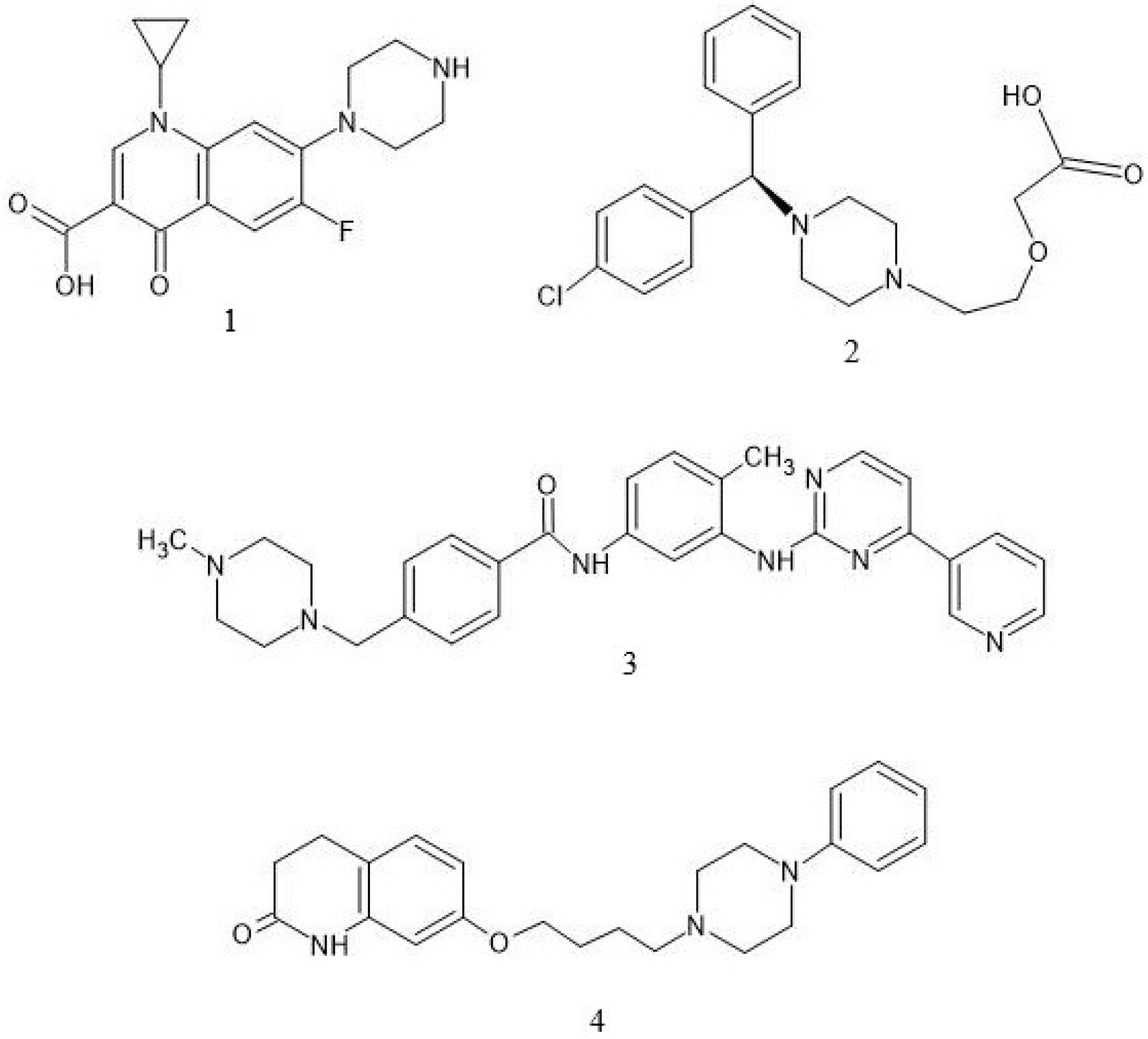
Figure 2.
Chemical structures of compounds 5-10 synthesized as antiparasitic agents.
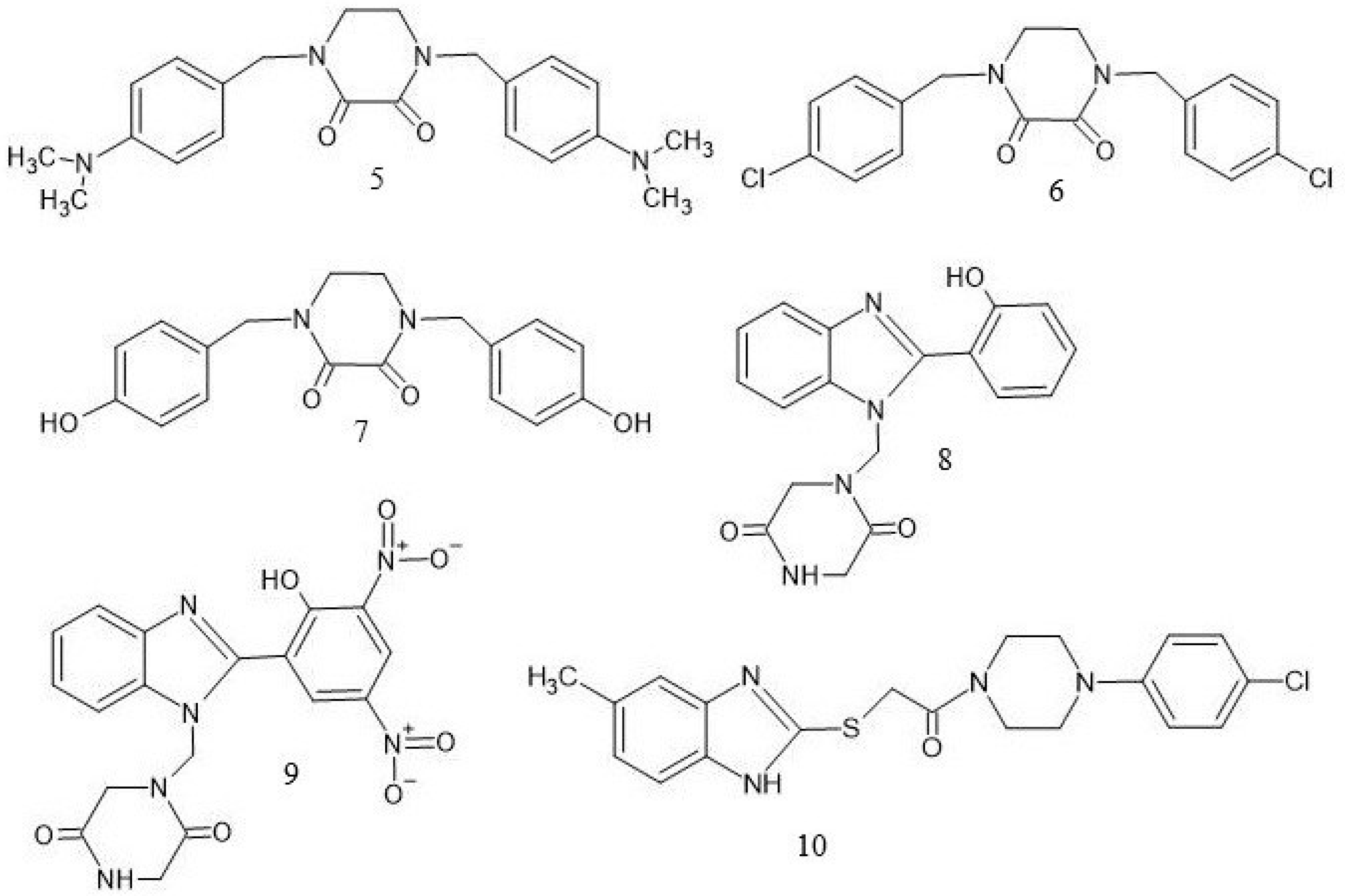
Figure 3.
Chemical structures of compounds 11-14 synthesized as antimicrobial agents as well as compounds 15-17 as neuroactive agents.
Figure 3.
Chemical structures of compounds 11-14 synthesized as antimicrobial agents as well as compounds 15-17 as neuroactive agents.
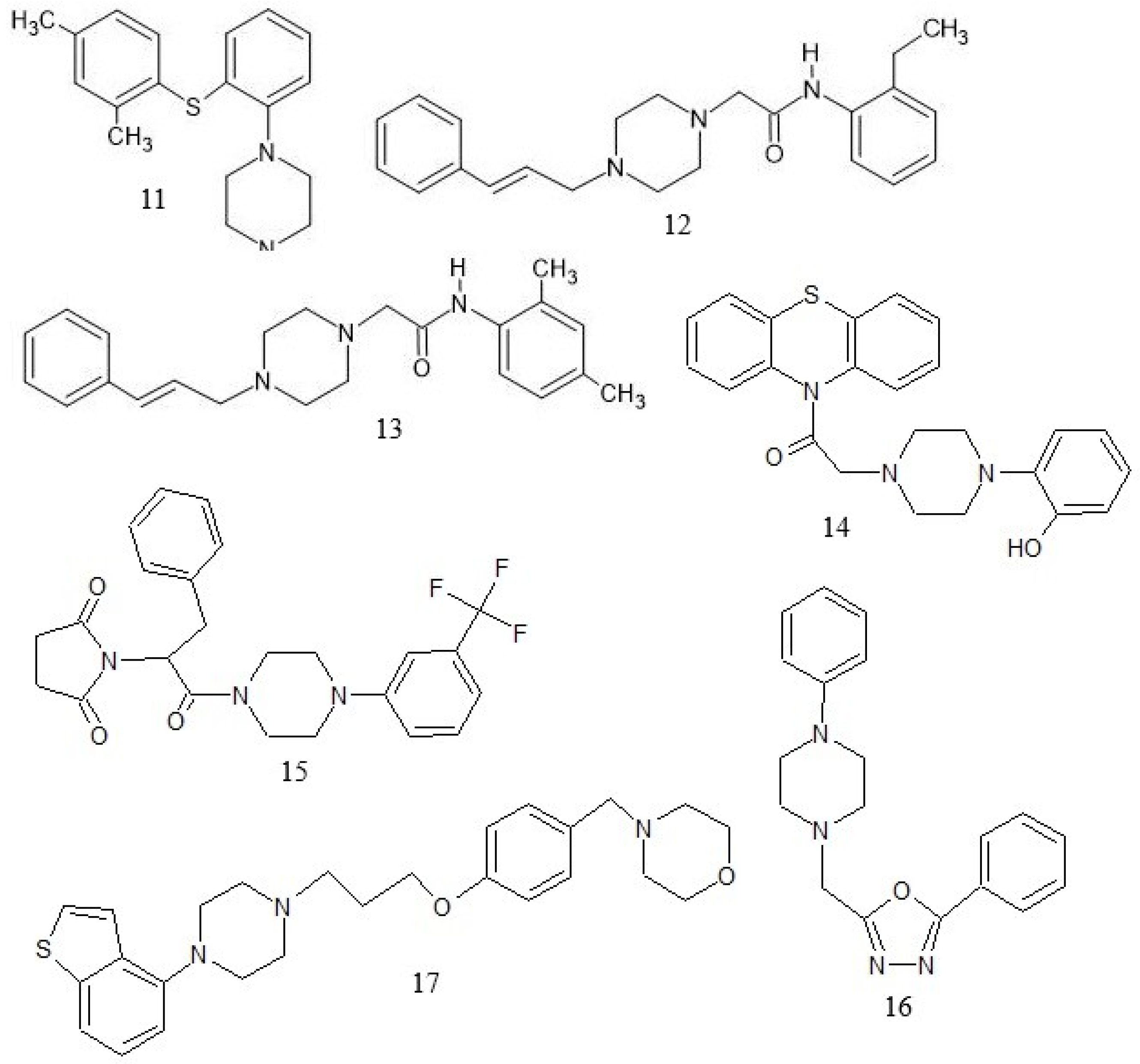
Figure 4.
Chemical structures of compounds 18-24 synthesized as anti-inflammatory agents.
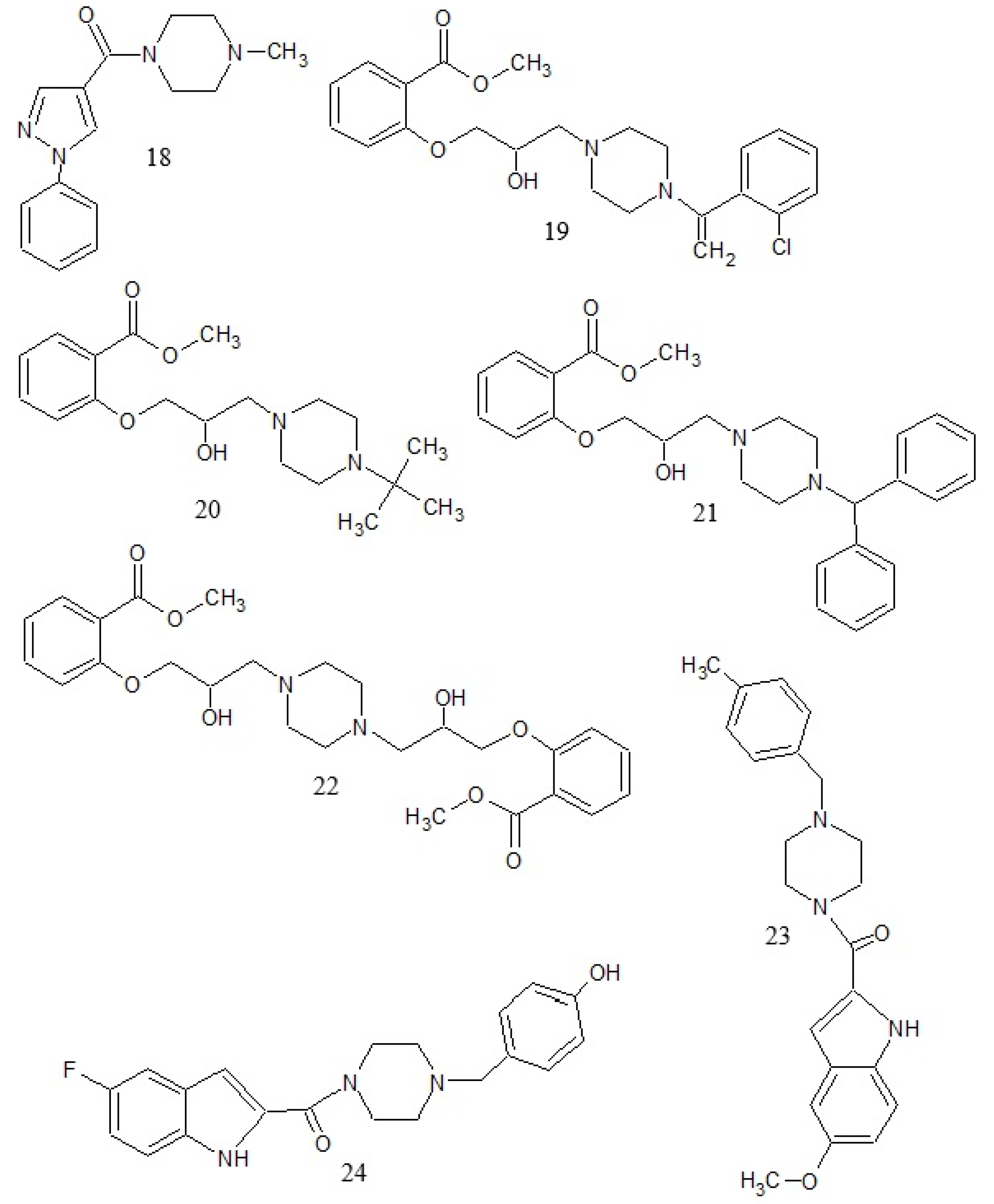
Figure 5.
Chemical structures of compounds 25 and 26 synthesized as antitubercular agents and also compound 27 as antitumor agent.
Figure 5.
Chemical structures of compounds 25 and 26 synthesized as antitubercular agents and also compound 27 as antitumor agent.
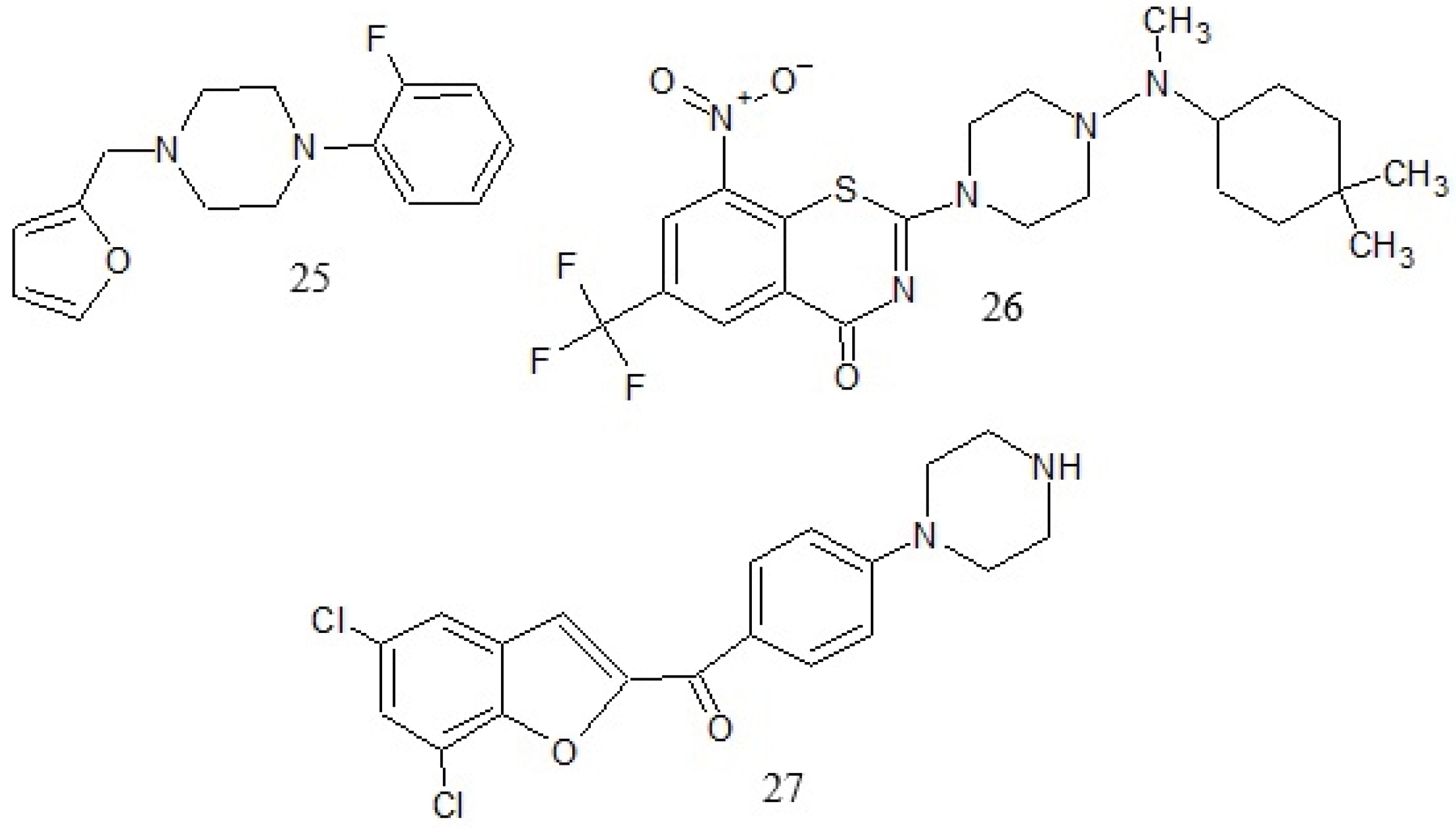

Table 1.
Calculated values of drug-likeness, solubility and bioavailability parameters for compounds 1–27 using the SwissADME web tool, and MoloVol software (v1.2.0).
Table 1.
Calculated values of drug-likeness, solubility and bioavailability parameters for compounds 1–27 using the SwissADME web tool, and MoloVol software (v1.2.0).
| No. | Consensus LOGP1 |
TPSA2 (Å2) |
Natoms3 |
MW4 (g/mol) |
nON5 | nOHNH6 | Nviolations7 | Nrotb8 |
Volume9 (Å3) |
log S 10 (ESOL) | log S 11(Ali) | Abbott score 12 |
| 1 | 1.10 | 74.57 | 24 | 331.34 | 5 | 2 | 0 | 3 | 309.25 | -1.32 | 0 | 0.55 |
| 2 | 2.59 | 53.01 | 27 | 388.89 | 5 | 1 | 0 | 8 | 338.45 | -3.12 | -2.43 | 0.55 |
| 3 | 3.38 | 86.28 | 37 | 493.60 | 6 | 2 | 0 | 8 | 456.27 | -5.07 | -5.02 | 0.55 |
| 4 | 3.12 | 44.81 | 28 | 379.50 | 3 | 1 | 0 | 7 | 379.10 | -4.18 | -4.00 | 0.55 |
| 5 | 2.11 | 47.10 | 28 | 380.48 | 2 | 0 | 0 | 6 | 385.41 | -3.77 | -3.26 | 0.55 |
| 6 | 3.17 | 40.62 | 24 | 363.24 | 2 | 0 | 0 | 4 | 323.98 | -4.48 | -4.17 | 0.55 |
| 7 | 1.31 | 81.08 | 24 | 326.35 | 4 | 2 | 0 | 4 | 307.54 | -3.02 | -2.99 | 0.55 |
| 8 | 1.22 | 87.46 | 25 | 336.34 | 4 | 2 | 0 | 3 | 311.09 | -3.07 | -2.86 | 0.55 |
| 9 | -0.04 | 179.10 | 31 | 426.34 | 8 | 2 | 1 | 5 | 361.46 | -3.54 | -5.00 | 0.55 |
| 10 | 3.58 | 77.53 | 15 | 400.92 | 2 | 1 | 0 | 5 | 382.66 | -5.20 | -5.79 | 0.55 |
| 11 | 3.74 | 40.57 | 21 | 298.45 | 1 | 1 | 0 | 3 | 314.64 | -4.55 | -4.75 | 0.55 |
| 12 | 3.31 | 35.58 | 27 | 363.50 | 3 | 1 | 0 | 8 | 371.50 | -4.36 | -4.36 | 0.55 |
| 13 | 3.44 | 35.58 | 27 | 363.50 | 3 | 1 | 0 | 7 | 371.98 | -4.38 | -4.28 | 0.55 |
| 14 | 3.50 | 72.32 | 30 | 417.52 | 3 | 1 | 0 | 4 | 392.13 | -5.31 | -5.52 | 0.55 |
| 15 | 3.16 | 60.93 | 33 | 459.46 | 6 | 0 | 0 | 7 | 406.98 | -4.47 | -4.09 | 0.55 |
| 16 | 2.64 | 45.40 | 24 | 320.39 | 4 | 0 | 0 | 4 | 297.32 | -3.90 | -3.49 | 0.55 |
| 17 | 5.80 | 56.42 | 38 | 535.78 | 4 | 0 | 1 | 8 | 352.98 | -7.72 | -8.63 | 0.55 |
| 18 | 1.35 | 41.37 | 11 | 270.33 | 3 | 0 | 0 | 3 | 274.04 | -2.46 | -1.62 | 0.55 |
| 19 | 5.09 | 62.24 | 36 | 515.08 | 5 | 1 | 1 | 9 | 396.66 | -7.22 | -8.33 | 0.55 |
| 20 | 1.96 | 62.24 | 25 | 350.45 | 6 | 1 | 0 | 8 | 333.20 | -2.90 | -2.89 | 0.55 |
| 21 | 3.54 | 62.24 | 34 | 460.56 | 6 | 1 | 0 | 10 | 443.69 | -5.05 | -5.19 | 0.55 |
| 22 | 1.93 | 118.00 | 36 | 502.56 | 10 | 2 | 1 | 14 | 405.62 | -3.46 | -3.98 | 0.55 |
| 23 | 3.17 | 48.57 | 27 | 363.45 | 3 | 1 | 0 | 5 | 368.98 | -4.37 | -4.18 | 0.55 |
| 24 | 2.73 | 59.57 | 26 | 353.39 | 4 | 2 | 0 | 4 | 335.34 | -4.01 | -3.80 | 0.55 |
| 25 | 2.51 | 19.62 | 19 | 260.31 | 3 | 0 | 0 | 3 | 251.85 | -3.29 | -2.61 | 0.55 |
| 26 | 4.15 | 113.74 | 34 | 499.55 | 9 | 0 | 1 | 5 | 423.90 | -5.99 | -7.16 | 0.55 |
| 27 | 3.78 | 45.48 | 25 | 375.25 | 3 | 1 | 0 | 3 | 345.36 | -5.39 | -5.40 | 0.55 |
1 calculated Consensus logPo/w values. 2 topological polar surface area. 3 number of heavy atoms. 4 molecular weight. 5 number of hydrogen bond acceptors (O and N atoms). 6 number of hydrogen bond donors (OH i NH groups). 7 number of Lipinski’s rule violations. 8 number of rotatable bonds. 9 molecular volume. 10,11 aqueous solubility parameters. 12 Abbott bioavailability score.
Table 2.
Calculated values of Consensus logP, logD7.4, ionized 2D PSA at pH 7.4, unionized 2D PSA, and TPSA for compounds 1–27, obtained using the SwissADME and ADMETlab 3.0 web tools, as well as MarvinSketch software (v4.1.13).
Table 2.
Calculated values of Consensus logP, logD7.4, ionized 2D PSA at pH 7.4, unionized 2D PSA, and TPSA for compounds 1–27, obtained using the SwissADME and ADMETlab 3.0 web tools, as well as MarvinSketch software (v4.1.13).
| No. | Consensus LOGP 1 | logD7.4 2 | Ionized 2D PSA 3 | Unionized 2D PSA 4 |
TPSA 5 (Å2) |
| 1 | 1.10 | 1.135 | 80.29 | 72.88 | 74.57 |
| 2 | 2.59 | 2.363 | 57.04 | 53.01 | 53.01 |
| 3 | 3.38 | 2.822 | 87.48 | 86.28 | 86.28 |
| 4 | 3.12 | 2.693 | 46.01 | 44.81 | 44.81 |
| 5 | 2.11 | 2.478 | 47.10 | 47.10 | 47.10 |
| 6 | 3.17 | 3.449 | 40.62 | 40.62 | 40.62 |
| 7 | 1.31 | 1.157 | 81.08 | 81.08 | 81.08 |
| 8 | 1.22 | 1.225 | 87.46 | 87.46 | 87.46 |
| 9 | -0.04 | 1.326 | 181.93 | 179.10 | 179.10 |
| 10 | 3.58 | 3.677 | 77.53 | 77.53 | 77.53 |
| 11 | 3.74 | 3.561 | 45.15 | 40.57 | 40.57 |
| 12 | 3.31 | 3.121 | 35.58 | 35.58 | 35.58 |
| 13 | 3.44 | 3.008 | 35.58 | 35.58 | 35.58 |
| 14 | 3.50 | 3.558 | 72.32 | 72.32 | 72.32 |
| 15 | 3.16 | 3.209 | 60.93 | 60.93 | 60.93 |
| 16 | 2.64 | 2.965 | 45.40 | 45.40 | 45.40 |
| 17 | 5.80 | 4.028 | 56.42 | 56.42 | 56.42 |
| 18 | 1.35 | 1.368 | 41.37 | 41.37 | 41.37 |
| 19 | 5.09 | 3.078 | 63.44 | 62.24 | 62.24 |
| 20 | 1.96 | 2.134 | 63.44 | 62.24 | 62.24 |
| 21 | 3.54 | 3.566 | 63.44 | 62.24 | 62.24 |
| 22 | 1.93 | 2.185 | 119.20 | 118.00 | 118.00 |
| 23 | 3.17 | 3.309 | 48.57 | 48.57 | 48.57 |
| 24 | 2.73 | 2.963 | 59.57 | 59.57 | 59.57 |
| 25 | 2.51 | 2.692 | 19.62 | 19.62 | 19.62 |
| 26 | 4.15 | 3.671 | 110.27 | 110.27 | 113.74 |
| 27 | 3.78 | 3.519 | 50.06 | 45.48 | 45.48 |
1 Consensus logPo/w values obtained using the SwissADME web tool. 2 logD7.4 values at pH 7.4 obtained using ADMETlab 3.0 web tool. 3 2D PSA values for the dominant ionized microspecies at pH 7.4 obtained using MarvinSketch software (v4.1.13). 4 2D PSA values for the unionized compound obtained using MarvinSketch software (v4.1.13). 5 TPSA values obtained using the SwissADME web tool.
Table 3.
Predicted absorption and distribution properties of the investigated compounds 1–27 using the SwissADME web tool.
Table 3.
Predicted absorption and distribution properties of the investigated compounds 1–27 using the SwissADME web tool.
| Absorption properties | The investigated compounds |
| Good GIT 1 absorption | 1-8, 10-27 |
| Poor GIT absorption | 9 |
| Good blood-brain permeability | 2, 4-6, 10-21, 23-25, 27 |
| Poor blood-brain permeability | 1, 3, 7-9, 22, 26 |
| Substrate for P-gp 2 | 1-4, 7-9, 14, 16, 17, 19-25 |
| Not a substrate for P-gp | 5, 6, 10-13, 15, 18, 26, 27 |
1 gastrointestinal tract. 2 P-glycoprotein.
Table 4.
Predicted metabolic properties of the investigated compounds 1-27 obtained using the SwissADME web tool.
Table 4.
Predicted metabolic properties of the investigated compounds 1-27 obtained using the SwissADME web tool.
| Metabolic properties | The investigated compounds |
| CYP450 1A2 inhibitor | 6, 8, 10, 11, 16, 23-25, 27 |
| CYP450 2C19 inhibitor | 3-6, 9-16, 23, 25-27 |
| CYP450 2C9 inhibitor | 3, 6, 9, 10, 14-16, 21, 23, 26, 27 |
| CYP450 2D6 inhibitor | 2-6, 10-16, 20, 21, 23-25, 27 |
| CYP450 3A4 inhibitor | 3-6, 10, 11, 14-16, 21, 23, 27 |
Table 5.
Predicted toxicological properties of the investigated compounds 1-27 using DataWarrior software (v.06.05.04).
Table 5.
Predicted toxicological properties of the investigated compounds 1-27 using DataWarrior software (v.06.05.04).
| Toxicological properties | Results |
| Mutagenicity | Not detected |
| Carcinogenicity | 5 (high level), 13 (high level) |
| Reproductive toxicity | 6 (low level), 12, 14 (high level) |
| Irritant effect | 11 (low level), 12-15 (high level) |
Table 6.
Benchmarking of SwissADME predictions against literature-reported experimental and clinical data for the four reference drugs (compounds 1–4).
Table 6.
Benchmarking of SwissADME predictions against literature-reported experimental and clinical data for the four reference drugs (compounds 1–4).
| Parameter | Ciprofloxacin (1) Predicted | Ciprofloxacin (1) Literature Value | Cetirizine (2) Predicted | Cetirizine (2) Literature Value | Imatinib (3) Predicted | Imatinib (3) Literature Value | Aripiprazole (4) Predicted | Aripiprazole (4) Literature Value |
| Consensus logP | 1.10 | 1.69 [19] | 2.59 | 1.5 [20] | 3.38 | 3.38 [21] | 3.12 | 4.25 [22] |
| GI Absorption | Good | Good oral absorption; healthy adults: F ≈ 70% [23] |
Good | Good oral absorption; healthy adults: (> 70%) [24] |
Good | Excellent oral absorption; Adult patients with CML: (≈ 98%) [25] |
Good | Good oral absorption; Adult patients with schizophrenia [26] |
| BBB Permeability | Poor | Moderate penetration into brain/CSF [27] | Good |
Poor Kp,uu = 0.14–0.17 [28] Brain exposure 2.3–8.7-fold higher in P-gp KO mice [29] |
Poor | Poor across intact BBB; median tumor-to-plasma ratio = 0.71 in contrast-enhancing regions [30] | Good | Good CNS penetration; brain levels 3.0–4.6-fold higher in P-gp KO mice [31] |
| P-gp Substrate | Yes | Yes [32] | Yes | Yes (efflux ratio B→A/A→B = 5.47 in MDR1-MDCK cells) [29] | Yes | Yes (BCRP/P-gp inhibitors) [33] | Yes | Yes [31] |
Note:In SwissADME, gastrointestinal (GI) absorption is classified as ‘Good’ or ‘Poor’ according to the BOILED-Egg model. Blood–brain barrier (BBB) permeability is classified as ‘Good’ (predicted good permeability) or ‘Poor’ (predicted poor permeability). P-glycoprotein (P-gp) substrate status is classified as ‘Yes’ (predicted substrate) or ‘No’ (predicted non-substrate). These are categorical predictions generated by the underlying models and should be interpreted as prioritization hypotheses rather than definitive experimental outcomes.
Disclaimer/Publisher’s Note: The statements, opinions and data contained in all publications are solely those of the individual author(s) and contributor(s) and not of MDPI and/or the editor(s). MDPI and/or the editor(s) disclaim responsibility for any injury to people or property resulting from any ideas, methods, instructions or products referred to in the content. |
© 2026 by the authors. Licensee MDPI, Basel, Switzerland. This article is an open access article distributed under the terms and conditions of the Creative Commons Attribution (CC BY) license (http://creativecommons.org/licenses/by/4.0/).
Copyright: This open access article is published under a Creative Commons CC BY 4.0 license, which permit the free download, distribution, and reuse, provided that the author and preprint are cited in any reuse.