

Submitted:
03 August 2026
Posted:
05 August 2026
You are already at the latest version
Abstract
Background: Mesenchymal stromal cell (MSC)-derived extracellular vesicles (EVs) are under investigation as cell-free therapeutic platforms for neurodegeneration and age-related disease, and their biological effects depend partly on cargo composition. Existing MSC-EV cargo studies rarely integrate disease-gene evidence, aging databases, publication-level support and translational annotation. Methods: Using public data only, we assembled documented human MSC-EV cargo from ExoCarta and Vesiclepedia, deduplicated to independent source publications, and retained proteins with support from at least two publications. Each protein was integrated across independent-publication support, neurodegeneration disease-gene evidence (Open Targets), aging/senescence membership (CellAge, GenAge) and protein-interaction centrality (STRING) into a four-component Cargo Prioritization Score (CPS), after a component-correlation analysis. Robustness was assessed by weighting, component and source-study analyses; enrichment used the MSC-EV cargo universe as background; and top candidates received a separate Computational Liability Annotation (LOEUF, oncology association, expression breadth) with structured directionality curation. Results: The reproducible universe comprised 815 proteins derived from 9 source publications; disease-breadth was removed for redundancy with the neurodegeneration score (Spearman ρ=0.93). The ranking was robust to weighting (equal-weight ρ≈0.99) and to removal of any single component (ρ=0.83–0.94), but the eligible universe and several disease-anchored candidates depended strongly on individual source publications: excluding one publication reduced the universe from 815 to 228 proteins. 43 proteins carried joint neurodegeneration and aging evidence, including VCP, PARK7, SQSTM1, SOD1 and APOE, whereas the highest ranks partly reflected abundant, broadly expressed or highly connected proteins (GAPDH, ACTB, ALDOA, EGFR). Conclusions: The framework integrates evidence to prioritize MSC-EV cargo and separately annotates translational directionality and liability. A high CPS does not establish beneficial delivery, and the annotation is not a safety assessment; the output is a translationally annotated, hypothesis-generating candidate set for product-specific experimental validation.
Keywords:
mesenchymal stromal cells
; extracellular vesicles
; small EVs
; neurodegeneration
; aging
; senescence
; cargo prioritization
; translational liability
; directionality
; reproducible bioinformatics
1. Introduction
MSC-derived EVs are being investigated as cell-free therapeutic agents, and their biological activity is thought to depend partly on the proteins, lipids and nucleic acids they carry [1,2,3]. Small EVs are membrane-bound vesicles that package a selected molecular repertoire [4,5]; their biological effects are jointly shaped by the delivered cargo, by surface molecules that direct targeting and uptake, and by the biophysical properties of the vesicle itself, so product- and cargo-specific understanding is central yet remains incomplete and heterogeneous across MSC sources and isolation methods [6].
Aging and neurodegeneration are examined jointly for biological reasons. Aging is the principal risk factor for Alzheimer's disease, Parkinson's disease and amyotrophic lateral sclerosis, and loss of proteostasis, oxidative stress, mitochondrial dysfunction, inflammation and cellular senescence are shared hallmarks connecting them [7,8]. Proteostasis decline in particular underlies the protein-aggregation pathology common to these diseases [9,10], and curated senescence and longevity gene sets make aging biology computable [11,12].
Prior MSC-EV proteomic studies largely describe cargo and enriched pathways; few integrate disease-gene evidence, aging databases, publication-level support, directionality and translational caution. The most integrative mapped a UC-MSC EV proteome to an Alzheimer's model but did not incorporate aging or disease-gene databases or a liability assessment [13], and concern over tumour-supportive MSC-EV cargo has been noted without a corresponding computational triage [14].
Disease association alone is insufficient to nominate therapeutic cargo: a gene linked to a disease may be protective or harmful, and its direction can be isoform- or mutation-specific, so candidate relevance must be distinguished from the direction of a beneficial delivery. We therefore separate evidence prioritization from translational filtering.
Here we assemble publication-supported human MSC-EV cargo, integrate it with neurodegeneration and aging evidence into a transparent, robustness-tested prioritization score, and annotate top candidates for directionality and computational liability, using public data only and framing the output as experimentally testable hypotheses rather than efficacy or safety claims [15].
2. Materials and Methods
The workflow is summarised in Figure 1. All source databases were queried on 31 July 2026, and the following releases were used. ExoCarta: downloadable flat-file release (286 curated studies; 41,755 protein entries; most recent catalogued study 2015), corresponding to Version 5. Vesiclepedia: downloadable flat-file release (1,254 curated studies; 342,535 protein entries; most recent catalogued study 2018), corresponding to Version 4.1 as described in the 2019 database report. Open Targets Platform: data release 26.06, queried through the GraphQL API (version 26.6.3). CellAge: Build 3 (released 23 April 2023; 950 senescence-associated genes). GenAge: Human Genes Build 21 (released 28 August 2023; 307 genes). STRING: version 12.0, restricted to Homo sapiens (NCBI taxon 9606) with a combined score threshold of 700. gnomAD: version 4.1.0 gene-constraint data on GRCh38, retrieved through the gnomAD browser GraphQL API. Human Protein Atlas: version 25.1 (released 25 May 2026; Ensembl 109), using the RNA tissue distribution annotation. Gene symbols were resolved to Ensembl identifiers using MyGene.info (API version 3). Note that the ExoCarta and Vesiclepedia downloadable flat files lag their respective web front-ends; the analysis therefore reflects the cargo evidence available in those distributed releases rather than the full current web content (Section 4.7).
2.1. Scope and Extracellular-Vesicle Terminology
The primary analysis concerns pan-MSC EV cargo assembled from public repositories; it is not UC-MSC-specific and does not represent any particular clinical-grade EV product. Following MISEV2023 [15], repository-derived vesicles are referred to as extracellular vesicles or small EVs, because their endosomal biogenesis is not established; “exosome” is used only for the general therapeutic concept and for cited studies that used the term. Repository detection indicates prior report of a protein in an MSC EV preparation and does not establish cargo loading, luminal localisation, delivery, potency or activity.
2.2. MSC-EV Cargo Universe and Independent-Publication Support
Human MSC-EV cargo was extracted from ExoCarta [16] and Vesiclepedia [17] by selecting experiments annotated as mesenchymal stem/stromal cell (pooling adipose, bone-marrow, placental, synovial, endometrial and umbilical-cord sources). To avoid pseudo-replication, support was defined as the number of distinct source publications (PubMed identifiers), deduplicated across both repositories; records without a PubMed identifier were excluded. Proteins with ≥2 independent-publication support formed the reproducible universe. This measures independent literature support, not independent biological replication. A umbilical-cord (UC-MSC) subset was annotated separately as a descriptor only, because it derives from a single publication.
2.3. Disease-Gene and Aging Evidence
Neurodegeneration evidence for each protein was the maximum Open Targets [18] overall association across Alzheimer's disease (MONDO_0004975), Parkinson's disease (MONDO_0005180) and amyotrophic lateral sclerosis (MONDO_0004976). Aging membership was defined by CellAge [11] or GenAge [12] membership. Anchoring cargo to curated disease and aging modules follows the network-medicine principle [19].
2.4. Cargo Prioritization Score and Robustness
Components were min–max scaled to the unit interval 0–1 (continuous: publication support, PPI degree) or set as binary 0/1 indicators (aging membership); the neurodegeneration score was already on 0–1. A component-correlation analysis (Spearman) identified redundancy between the neurodegeneration score and a candidate disease-breadth term, which was removed. The four retained components were combined with weights proportionally renormalised from the original scheme: CPS = 0.333·publication-support + 0.278·neurodegeneration + 0.222·aging + 0.167·PPI-hub. Weights were fixed a priori because no outcome labels exist for training. The CPS is an evidence-integration score for prioritizing candidates for experimental evaluation, not a therapeutic-efficacy score.
Robustness was assessed on three distinct axes. (i) Weighting: an equal-weight comparison and a systematic weight perturbation in which each of the four component weights was independently scaled by 0.5, 0.75, 1.0, 1.25 or 1.5 and then renormalised to sum to one (a full 5^4 = 625-scheme grid), each compared with the reference ranking by Spearman correlation and by Top-10/Top-20 membership retention. (ii) Component selection: leave-one-component-out and single-component rankings. (iii) Source study: leave-one-publication-out, leave-one-repository-out, dominant-study and UC-MSC-source exclusion. For the source-study analysis, each reduced publication set was processed through the full pipeline: ≥2-publication eligibility was re-determined within the reduced set (so the eligible universe was recomputed, not merely subsetted), the continuous components were re-scaled by min–max within the reduced universe, the CPS was recomputed, the Spearman correlation was calculated over only the proteins shared between the full and reduced rankings, and Top-10/Top-20 retention was defined as the proportion of the full-analysis Top-10/Top-20 proteins that remained within the reduced-analysis Top-10/Top-20. Analyses used Python 3.11.15 (pandas 2.3.3, numpy 2.4.6, scipy 1.17.1, networkx 3.6.1, requests 2.34.2, matplotlib 3.11.0) and R 4.5.3 (clusterProfiler 4.18.4, ReactomePA 1.54.0, org.Hs.eg.db 3.22.0, reactome.db 1.95.0) with a fixed random seed.
2.5. Functional Enrichment
Enrichment of the top-100 prioritized proteins used clusterProfiler [20] and ReactomePA [21] with the reproducible MSC-EV universe as the primary background (Benjamini–Hochberg adjustment; adjusted P<0.05); a genome-wide background was retained only as a secondary comparison. Gene symbols were mapped to Entrez identifiers via org.Hs.eg.db before enrichment. This mapping is not lossless: 99 of the 100 foreground proteins and 743 of the 815 background proteins mapped to an Entrez identifier (about 9% of the background unmapped), the unmapped minority comprising deprecated, aliased or non-coding symbols; within each pathway resource the usable foreground and background were then further restricted to genes carrying annotations in that resource (Gene Ontology biological process, 99 foreground and 735 background; Reactome, 96 and 641), which is why the reported gene ratios and background ratios differ between databases (Table 6). These counts are specific to the annotation builds used here (org.Hs.eg.db 3.22.0, reactome.db 1.95.0, clusterProfiler 4.18.4) and will shift with other builds. PPI used STRING [22] at combined score ≥700 with igraph/NetworkX [23,24].
2.6. Computational Liability Annotation and Directionality Curation
Top candidates were annotated—not scored—on separate dimensions: loss-of-function constraint (gnomAD LOEUF [25]; lower values indicate greater intolerance to predicted loss-of-function variation, i.e. a LoF-constrained gene, which does not by itself measure toxicity from protein supplementation; the descriptive constraint bands used for presentation, such as LOEUF<0.35 labelled 'constrained', are author-defined intervals for readability and are not validated clinical risk categories), oncology association (maximum Open Targets oncology-area association, reported as directionally unresolved because it may reflect oncogene, tumour-suppressor, biomarker or drug-target biology), and tissue-expression breadth (Human Protein Atlas [26], contextual information rather than a toxicity metric). No composite safety score was computed. Directionality categories (potentially protective; context-dependent; isoform-/mutation-dependent; proliferative-signalling concern; housekeeping/abundance-biased; directionally unresolved) were assigned by structured literature-based curation against predefined criteria (human genetic evidence, gain- and loss-of-function evidence, overexpression/supplementation evidence, isoform- and mutation-specific effects, established proliferative-signalling or housekeeping roles); each classification, its rationale, key references and a proposed validation assay are provided in Supplementary Table S1.
3. Results
3.1. Construction of the Publication-Supported MSC-EV Cargo Universe
Repository extraction yielded 16,213 MSC-EV protein records (5,127 unique proteins); 1,877 records without a PubMed identifier were excluded from publication-support analysis. The retained, PubMed-linked records mapped to 9 distinct source publications. Assigning each protein its distinct-publication count partitioned the 5,127 unique proteins exactly into three mutually exclusive groups: 3,897 proteins with 1-publication support, 815 proteins with ≥2-publication support, and 415 proteins that were detected only in records lacking a PubMed identifier and therefore carried no published support (3,897 + 815 + 415 = 5,127). These 415 publication-unsupported proteins were excluded, leaving the 815-protein ≥2-publication set as the reproducible universe (further stratified as ≥3 publications for 148 proteins and ≥4 for 17; Table 1). Canonical EV markers (CD9, CD63, CD81) were present, an internal MISEV-consistent check [15]. Of the reproducible universe, 729 proteins (89%) were also present in the single-publication UC-MSC subset, and 111 were annotated aging genes.
3.2. Contribution of Source Publications and Repository Overlap
The cargo universe was unevenly distributed across the 9 publications: two studies dominated, contributing 2,772 and 1,831 proteins (PMIDs 19389847 and 29148239), while the remaining publications contributed far fewer (Table 2). ExoCarta genes were almost entirely a subset of Vesiclepedia (921/938 shared), so the analysis is effectively Vesiclepedia-driven. This concentration motivates the source-study sensitivity analysis (Section 3.5).
3.3. Component Distributions and Correlations
Among five candidate components, the neurodegeneration score and a disease-breadth term were strongly correlated (Spearman ρ=0.93; Supplementary Figure S1), confirming redundancy, and disease-breadth was removed. All other pairwise correlations were ≤0.46 (publication support–PPI degree 0.46, consistent with study intensity and abundance affecting both). The four-component score was used thereafter.
3.4. Cargo Prioritization and Weight/Component Robustness
The four-component CPS ranked the 815 reproducible proteins (Figure 2, Table 3). Ranking was robust to weighting: equal weights reproduced it (ρ≈0.99), and the full 625-scheme weight perturbation (each weight scaled 0.5–1.5× and renormalised) preserved the ordering with a median Spearman ρ of 0.994 (minimum 0.968); Top-20 membership was largely retained (median 0.90), although specific Top-10 membership could shift under extreme reweighting (median retention 0.80, minimum 0.40), indicating that the exact head of the list is more weight-sensitive than the overall ordering (Supplementary Table S2). Leave-one-component-out gave ρ=0.83–0.94 (Table 4), and no single component reproduced the CPS (maximum ρ≈0.62), indicating the integration drives the ordering. Robustness to weighting does not, however, validate the biological choice of components: the layers are partly non-independent (e.g. Open Targets contributes to more than one), publication support and network degree partly reflect research intensity and abundance, and binary aging membership simplifies heterogeneous evidence.
3.5. Source-Study Sensitivity
Because the universe derives from 9 publications with two dominant studies, we tested dependence on individual sources (Table 5). Among proteins that remained eligible, rankings were stable (Spearman ρ=0.92–0.97 for leave-one-publication-out; 0.998 for Vesiclepedia-only). However, the eligible universe itself was strongly source-dependent: excluding a single publication reduced it from 815 to as few as 228 proteins, and an ExoCarta-only analysis yielded no reproducible proteins. Notably, excluding the UC-MSC source publication (PMID 29148239) removed most disease-anchored candidates (VCP, PARK7, SQSTM1, APOE) from the reproducible universe, with only SOD1 retained. The prioritized candidates therefore depend materially on a small number of source publications, which we treat as a principal limitation; source-study robustness is weaker than weight or component robustness.
3.6. Dual-Indication and Disease-Anchored Candidates
43 proteins carried both neurodegeneration evidence and aging-gene membership (Figure 3). Among these, proteins with strong disease anchoring included VCP (ALS/frontotemporal dementia; proteostasis) [9], APOE (Alzheimer's risk) [27], PARK7/DJ-1 (Parkinson's; redox) [28], SQSTM1/p62 (selective autophagy) [29] and SOD1 [30]. These are the candidates carried forward to translational filtering (Section 3.9).
3.7. Abundance, Publication and Network-Hub Bias
Several of the highest ranks were occupied by abundant, broadly expressed or highly connected proteins—GAPDH, ACTB, ALDOA, HSP90AA1 and EGFR. Their high rank may predominantly reflect abundance, broad expression, publication frequency or network centrality rather than disease-specific directionality; they are therefore deprioritized in the translational-filtering step (Section 3.9) rather than treated as immediate candidates. This behaviour is expected given that repository detection and STRING degree both increase with study intensity and protein abundance.
3.8. Functional Enrichment Relative to the MSC-EV Background
Against the reproducible MSC-EV universe (the biologically appropriate background), the top-100 prioritized proteins were overrepresented for cellular stress responses, regulation of intracellular signal transduction, heat-stress/proteostasis pathways and cell-population proliferation (Table 6). These themes are overrepresented among highly prioritized proteins relative to other MSC-EV cargo but do not establish directionality or functional benefit; the presence of growth-factor-receptor and proliferation terms is itself a reason for translational caution rather than evidence of product-level tumour risk. A genome-wide background produced more generic terms and is reported only for comparison.

Table 6.
Representative enrichment against the MSC-EV cargo universe (top terms; Benjamini–Hochberg adjusted P).
Table 6.
Representative enrichment against the MSC-EV cargo universe (top terms; Benjamini–Hochberg adjusted P).
| Source | Term | Gene ratio | Bg ratio | adj. P | Count |
|---|---|---|---|---|---|
| GO BP | regulation of intracellular signal transduction | 48/99 | 140/735 | 5.27e-10 | 48 |
| GO BP | cellular response to stress | 41/99 | 113/735 | 4.4e-09 | 41 |
| GO BP | regulation of response to stimulus | 61/99 | 238/735 | 4.99e-08 | 61 |
| GO BP | cell population proliferation | 41/99 | 124/735 | 6.45e-08 | 41 |
| GO BP | regulation of cell communication | 57/99 | 219/735 | 8.36e-08 | 57 |
| Reactome | Cytokine Signaling in Immune system | 30/96 | 89/641 | 0.000467 | 30 |
| Reactome | Cellular response to heat stress | 10/96 | 15/641 | 0.00119 | 10 |
| Reactome | Diseases of signal transduction by growth factor receptors and second messengers | 23/96 | 64/641 | 0.00119 | 23 |
| Reactome | Gene expression (Transcription) | 25/96 | 74/641 | 0.0012 | 25 |
3.9. Computational Liability Annotation and Directionality
Top candidates were annotated on three separate dimensions and a directionality category (Figure 4, Table 7; full curation in Supplementary Table S1). The descriptive constraint band LOEUF<0.35 (an author-defined presentation interval, not a validated risk category) flags LoF-constrained genes (VCP, CTNNB1, ACTB) that are intolerant of predicted loss-of-function variation; EGFR is a canonical proliferative-signalling receptor [31] and CTNNB1 a Wnt-pathway effector [32], both proliferative-signalling concerns; the chaperones HSP90AA1/AB1 [33], CALR [34] and HSPA5/BiP [35] are oncology-relevant and context-dependent; PARK7 is potentially protective in selected contexts; wild-type SOD1 performs a normal superoxide-dismutase antioxidant function [36], whereas misfolded/mutant SOD1 is toxic [30]; APOE effects are isoform-dependent and gene-level evidence cannot distinguish APOE2/3/4 [27]; and abundant housekeeping proteins (GAPDH, ACTB, ALDOA) are deprioritized as likely abundance-biased. Oncology association is reported as directionally unresolved.
3.10. Translationally Prioritized Candidate Groups
Combining the CPS with translational filtering yields interpretable groups rather than a single ordering: (i) disease-anchored candidates for directional testing (e.g. PARK7, SOD1, potentially protective in defined contexts); (ii) directionally unresolved disease-anchored proteins requiring gain-/loss-of-function resolution before any delivery inference (e.g. VCP, APOE, SQSTM1); (iii) proliferative-signalling concerns (EGFR, CTNNB1); (iv) context-dependent oncology-relevant chaperones (HSP90AA1/AB1, CALR, HSPA5); and (v) abundance-biased proteins deprioritized in this framework (GAPDH, ACTB, ALDOA). Translational filtering supplements, and does not retroactively invalidate, the CPS; the groups define which experiments each candidate requires.
4. Discussion
4.1. Principal Findings
This framework assembles publication-supported MSC-EV cargo and integrates it with neurodegeneration and aging evidence, separating an evidence-integration ranking from a translational-filtering step. Publication-level deduplication reduced an apparently large cargo set to 815 proteins from 9 source publications, and source-study analysis showed that the eligible universe and several disease-anchored candidates depend on individual publications. A high CPS therefore indicates convergent evidence for experimental attention, not that a protein should be enriched in a therapeutic EV.
4.2. Biological Interpretation
The disease-anchored candidates converge on proteostasis, oxidative-stress handling and autophagy—processes shared by aging and neurodegeneration [7,9,29]—consistent with the enrichment against the MSC-EV background. This coherence is a face-validity signal for the prioritization but is not evidence of therapeutic effect, and the concurrent enrichment of proliferative and growth-factor-signalling themes underlines the need for translational caution.
4.3. Directionality and Candidate-Specific Caveats
Disease association does not indicate the direction of a beneficial intervention. APOE is isoform- and context-dependent and gene-level evidence cannot resolve APOE2/3/4 [27]; VCP disease alleles are mutation- and mechanism-specific, so exogenous VCP delivery is directionally unresolved [9]; SOD1 wild-type antioxidant activity must be distinguished from misfolded/mutant toxicity [30]; PARK7 is potentially protective only in defined contexts [28]; SQSTM1 depends on autophagic flux, with both excess and deficiency pathological [29]; EGFR and CTNNB1 are proliferative-signalling proteins [32]; the HSP90 family and other chaperones are context-dependent and oncology-relevant; and abundant housekeeping proteins are deprioritized because their rank likely reflects abundance rather than directionality.
4.4. Methodological Contribution
Relative to prior MSC-EV proteomics, including the closest Alzheimer's-focused study [13], the contribution is methodological: publication-level cargo definition, integration of EV-cargo, disease-gene and aging evidence, explicit assessment of component and source-study dependence, MSC-EV-background enrichment, and a separate liability annotation with structured directionality curation. Single-source prioritization (network- or genetics-only) does not reproduce the ranking [19]. We position this as an extension of prior work.
4.5. Translational Relevance
The framework is intended to prioritize experiments, not to specify cargo for enrichment. Because repository cargo is not product-specific, any candidate must first be confirmed in the intended clinical-grade EV, and its directionality established, before therapeutic inference. Progress in EV manufacturing and cargo engineering makes such product-specific work feasible [37,38], and early clinical experience with MSC-EV products provides context [39,40].
4.6. Validation Roadmap
A defensible sequence is: (1) product-specific cargo confirmation in MISEV2023-compliant EVs (targeted proteomics, immunoblotting, batch reproducibility); (2) cargo localisation (luminal versus surface; protease-protection with detergent controls); (3) uptake and target engagement; (4) functional directionality by gain- and loss-of-function (neuronal survival, oxidative stress, proteostasis, autophagy, mitochondrial function, senescence markers); (5) disease-specific models (Alzheimer's, Parkinson's, ALS, senescence); and (6) translational-risk assessment (biodistribution, proliferative-signalling assays, repeated-dose evaluation and tumorigenicity where scientifically justified). Database prioritization is only the first stage.
4.7. Limitations
The principal limitation is the small number of source publications (9), with two dominant studies; the reproducible universe and several disease-anchored candidates are source-dependent (Section 3.5). Further limitations include repository incompleteness and publication and abundance bias, compounded by the currency of the distributed ExoCarta and Vesiclepedia flat files, whose most recent catalogued studies date from 2015 and 2018 respectively, so MSC-EV proteomes published since then are not represented; heterogeneous MSC sources, EV isolation and characterisation [6]; the absence of product-specific proteomics; binary aging annotations; partial dependence among the evidence layers, so convergent annotation is not independent biological validation; gene-level rather than protein-state or isoform-level annotation; inability to infer cargo localisation, delivery direction or dose; the limitations of LOEUF (LoF intolerance, not supplementation toxicity), of oncology association (directionally unresolved) and of expression breadth (limited discrimination when most candidates are broadly expressed); LOEUF unavailable for some genes; and the absence of experimental validation or causal inference.
4.8. Conclusions of the Analysis
The framework should be used to triage cargo and design experiments, not to assert therapeutic value. It generates a translationally annotated, hypothesis-generating candidate set whose members require product-specific confirmation and directional validation.
5. Conclusions
Integrating publication-supported MSC-EV cargo with neurodegeneration and aging evidence, and separating evidence prioritization from translational filtering, yields a transparent, robustness-tested, translationally annotated candidate set for experimental validation. A high prioritization score does not establish beneficial delivery, the liability annotation is not a safety assessment, and the reproducible cargo depends on a small number of source publications; the output is a starting point for product-specific experimental work rather than evidence of efficacy or safety.
Supplementary Materials
The following supporting information can be downloaded at the website of this paper posted on Preprints.org. Figure S1: Spearman rank-correlation matrix of the five candidate CPS components (PNG, PDF and SVG). Table S1: candidate annotation — Cargo Prioritization Score and its components, raw LOEUF and constraint band, oncology association, expression breadth, directionality category, biological rationale, major uncertainty, isoform/mutation dependence, key references and a proposed validation assay for each top candidate. Table S2: full weight-perturbation grid (625 weighting schemes; Spearman correlation with the reference ranking and Top-10/Top-20 retention for each scheme). All supplementary tables are supplied as sheets of a single workbook, Supplementary_Materials.xlsx.
Author Contributions
Conceptualization, E.H.-L.C. and C.-C.C.; methodology, E.H.-L.C. and H.-T.E.S.; software, H.-T.E.S., B.-X.B.Z. and C.-H.L.; validation, B.-X.B.Z., C.-H.L. and T.-H.C.; formal analysis, E.H.-L.C., B.-X.B.Z. and C.-H.L.; investigation, T.-H.C. and H.-T.E.S.; resources, C.-C.C.; data curation, H.-T.E.S. and B.-X.B.Z.; writing—original draft preparation, E.H.-L.C.; writing—review and editing, C.-C.C., T.-H.C. and E.H.-L.C.; visualization, E.H.-L.C., B.-X.B.Z., C.-H.L. and M.-K.H.; supervision, C.-C.C.; project administration, C.-C.C.. All authors have read and agreed to the published version of the manuscript.
Funding
This research received no external funding.
Institutional Review Board Statement
Not applicable; this study reanalysed publicly available, de-identified data.
Informed Consent Statement
Not applicable.
Data Availability Statement
All primary data are public: ExoCarta Version 5, Vesiclepedia Version 4.1, Open Targets Platform release 26.06 (GraphQL API 26.6.3), CellAge Build 3, GenAge Human Genes Build 21, STRING version 12.0, gnomAD version 4.1.0 (GRCh38 constraint) and the Human Protein Atlas version 25.1. Derived tables are provided as Supplementary Materials.
Acknowledgments
Not applicable.
Conflicts of Interest
Hsieh-Tsung Ethan Shen and Bo-Xiang Benjamin Zhang are affiliated with Ji Yan Biomedical (JY BioMed). The remaining authors declare no conflicts of interest. This manuscript is an independent narrative review of published literature and does not report, endorse or promote any proprietary product; inclusion of named programmes and clinical trials is descriptive and does not constitute endorsement.
Abbreviations
The following abbreviations are used in this manuscript:
| ALS | amyotrophic lateral sclerosis |
| API | application programming interface |
| BP | biological process (Gene Ontology domain) |
| CPS | Cargo Prioritization Score |
| EV | extracellular vesicle |
| GO | Gene Ontology |
| GRCh38 | Genome Reference Consortium Human Build 38 |
| LoF | loss of function |
| LOEUF | loss-of-function observed/expected upper bound fraction |
| MISEV2023 | Minimal Information for Studies of Extracellular Vesicles 2023 |
| MONDO | Mondo Disease Ontology |
| MSC | mesenchymal stromal cell |
| PMID | PubMed identifier |
| PPI | protein–protein interaction |
| STRING | Search Tool for the Retrieval of Interacting Genes/Proteins |
| UC-MSC | umbilical-cord mesenchymal stromal cell |
References
- Tan, F.; Li, X.; Wang, Z.; Li, J.; Shahzad, K.; Zheng, J. Clinical applications of stem cell-derived exosomes. Signal Transduct. Target. Ther. 2024, 9(1), 17. [Google Scholar] [CrossRef]
- Cheng, Y.; Cao, X.; Qin, L. Mesenchymal Stem Cell-Derived Extracellular Vesicles: A Novel Cell-Free Therapy for Sepsis. Front. Immunol. 2020, 11, 647. [Google Scholar] [CrossRef] [PubMed]
- Ha, D. H.; Kim, H. K.; Lee, J.; Kwon, H. H.; Park, G. H.; Yang, S. H.; Jung, J. Y.; Choi, H.; Lee, J. H.; Sung, S.; Yi, Y. W.; Cho, B. S. Mesenchymal Stem/Stromal Cell-Derived Exosomes for Immunomodulatory Therapeutics and Skin Regeneration. Cells 2020, 9(5), 1157. [Google Scholar] [CrossRef] [PubMed]
- Xie, S.; Zhang, Q.; Jiang, L. Current Knowledge on Exosome Biogenesis, Cargo-Sorting Mechanism and Therapeutic Implications. Membranes 2022, 12(5), 498. [Google Scholar] [CrossRef] [PubMed]
- Krylova, S. V.; Feng, D. The Machinery of Exosomes: Biogenesis, Release, and Uptake. Int. J. Mol. Sci. 2023, 24(2), 1337. [Google Scholar] [CrossRef] [PubMed]
- Williams, T.; Salmanian, G.; Burns, M.; Maldonado, V.; Smith, E.; Porter, R. M.; Song, Y. H.; Samsonraj, R. M. Versatility of mesenchymal stem cell-derived extracellular vesicles in tissue repair and regenerative applications. Biochimie 2023, 207, 33–48. [Google Scholar] [CrossRef] [PubMed]
- López-Otín, C.; Blasco, M. A.; Partridge, L.; Serrano, M.; Kroemer, G. Hallmarks of aging: An expanding universe. Cell 2023, 186(2), 243–278. [Google Scholar] [CrossRef] [PubMed]
- Baechle, J. J.; Chen, N.; Makhijani, P.; Winer, S.; Furman, D.; Winer, D. A. Chronic inflammation and the hallmarks of aging. Mol. Metab. 2023, 74, 101755. [Google Scholar] [CrossRef] [PubMed]
- Franz, A.; Ackermann, L.; Hoppe, T. Create and preserve: proteostasis in development and aging is governed by Cdc48/p97/VCP. Biochim. Et. Biophys. Acta 2014, 1843(1), 205–215. [Google Scholar] [CrossRef] [PubMed]
- Balchin, D.; Hayer-Hartl, M.; Hartl, F. U. In vivo aspects of protein folding and quality control. In Science; New York, N.Y., 2016; Volume 353, 6294, p. aac4354. [Google Scholar] [CrossRef] [PubMed]
- Avelar, R. A.; Ortega, J. G.; Tacutu, R.; Tyler, E. J.; Bennett, D.; Binetti, P.; Budovsky, A.; Chatsirisupachai, K.; Johnson, E.; Murray, A.; Shields, S.; Tejada-Martinez, D.; Thornton, D.; Fraifeld, V. E.; Bishop, C. L.; de Magalhães, J. P. A multidimensional systems biology analysis of cellular senescence in aging and disease. Genome Biol. 2020, 21(1), 91. [Google Scholar] [CrossRef] [PubMed]
- de Magalhães, J. P.; Toussaint, O. GenAge: a genomic and proteomic network map of human ageing. FEBS Lett. 2004, 571(1-3), 243–247. [Google Scholar] [CrossRef] [PubMed]
- Li, S.; Zhang, J.; Liu, X.; Wang, N.; Sun, L.; Liu, J.; Liu, X.; Masoudi, A.; Wang, H.; Li, C.; Guo, C.; Liu, X. Proteomic characterization of hUC-MSC extracellular vesicles and evaluation of its therapeutic potential to treat Alzheimer's disease. Sci. Rep. 2024, 14(1), 5959. [Google Scholar] [CrossRef] [PubMed]
- Tan, T. T.; Lai, R. C.; Padmanabhan, J.; Sim, W. K.; Choo, A. B. H.; Lim, S. K. Assessment of Tumorigenic Potential in Mesenchymal-Stem/Stromal-Cell-Derived Small Extracellular Vesicles (MSC-sEV). Pharmaceuticals 2021, 14(4), 345. [Google Scholar] [CrossRef] [PubMed]
- Welsh, J. A.; Goberdhan, D. C. I.; O'Driscoll, L.; Buzas, E. I.; Blenkiron, C.; Bussolati, B.; Cai, H.; Di Vizio, D.; Driedonks, T. A. P.; Erdbrügger, U.; Falcon-Perez, J. M.; Fu, Q. L.; Hill, A. F.; Lenassi, M.; Lim, S. K.; Mahoney, M. G.; Mohanty, S.; Möller, A.; Nieuwland, R.; Ochiya, T.; …; Witwer, K. W. Minimal information for studies of extracellular vesicles (MISEV2023): From basic to advanced approaches. J. Extracell. Vesicles 2024, 13(2), e12404. [Google Scholar] [CrossRef] [PubMed]
- Keerthikumar, S.; Chisanga, D.; Ariyaratne, D.; Al Saffar, H.; Anand, S.; Zhao, K.; Samuel, M.; Pathan, M.; Jois, M.; Chilamkurti, N.; Gangoda, L.; Mathivanan, S. ExoCarta: A Web-Based Compendium of Exosomal Cargo. J. Mol. Biol. 2016, 428(4), 688–692. [Google Scholar] [CrossRef] [PubMed]
- Pathan, M.; Fonseka, P.; Chitti, S. V.; Kang, T.; Sanwlani, R.; Van Deun, J.; Hendrix, A.; Mathivanan, S. Vesiclepedia 2019: a compendium of RNA, proteins, lipids and metabolites in extracellular vesicles. Nucleic Acids Res. 2019, 47(D1), D516–D519. [Google Scholar] [CrossRef] [PubMed]
- Ochoa, D.; Hercules, A.; Carmona, M.; Suveges, D.; Baker, J.; Malangone, C.; Lopez, I.; Miranda, A.; Cruz-Castillo, C.; Fumis, L.; Bernal-Llinares, M.; Tsukanov, K.; Cornu, H.; Tsirigos, K.; Razuvayevskaya, O.; Buniello, A.; Schwartzentruber, J.; Karim, M.; Ariano, B.; Martinez Osorio, R. E.; …; McDonagh, E. M. The next-generation Open Targets Platform: reimagined, redesigned, rebuilt. Nucleic Acids Res. 2023, 51(D1), D1353–D1359. [Google Scholar] [CrossRef] [PubMed]
- Gan, X.; Shu, Z.; Wang, X.; Yan, D.; Li, J.; Ofaim, S.; Albert, R.; Li, X.; Liu, B.; Zhou, X.; Barabási, A. L. Network medicine framework reveals generic herb-symptom effectiveness of traditional Chinese medicine. Sci. Adv. 2023, 9(43), eadh0215. [Google Scholar] [CrossRef] [PubMed]
- Yu, G.; Wang, L. G.; Han, Y.; He, Q. Y. clusterProfiler: an R package for comparing biological themes among gene clusters. Omics A J. Integr. Biol. 2012, 16(5), 284–287. [Google Scholar] [CrossRef] [PubMed]
- Yu, G.; He, Q. Y. ReactomePA: an R/Bioconductor package for reactome pathway analysis and visualization. Mol. Biosyst. 2016, 12(2), 477–479. [Google Scholar] [CrossRef] [PubMed]
- Szklarczyk, D.; Kirsch, R.; Koutrouli, M.; Nastou, K.; Mehryary, F.; Hachilif, R.; Gable, A. L.; Fang, T.; Doncheva, N. T.; Pyysalo, S.; Bork, P.; Jensen, L. J.; von Mering, C. The STRING database in 2023: protein-protein association networks and functional enrichment analyses for any sequenced genome of interest. Nucleic Acids Res. 2023, 51(D1), D638–D646. [Google Scholar] [CrossRef] [PubMed]
- Csárdi, G.; Nepusz, T. The igraph software package for complex network research. 2006. Available online: https://api.semanticscholar.org/CorpusID:16923281.
- Hagberg, A.A.; Schult, D.A.; Swart, P.J.; Hagberg, J. Exploring Network Structure, Dynamics, and Function using NetworkX. In Proceedings of the Python in Science Conference, 2008; Available online: https://api.semanticscholar.org/CorpusID:16050699.
- Karczewski, K. J.; Francioli, L. C.; Tiao, G.; Cummings, B. B.; Alföldi, J.; Wang, Q.; Collins, R. L.; Laricchia, K. M.; Ganna, A.; Birnbaum, D. P.; Gauthier, L. D.; Brand, H.; Solomonson, M.; Watts, N. A.; Rhodes, D.; Singer-Berk, M.; England, E. M.; Seaby, E. G.; Kosmicki, J. A.; Walters, R. K.; …; MacArthur, D. G. The mutational constraint spectrum quantified from variation in 141,456 humans. Nature 2020, 581(7809), 434–443. [Google Scholar] [CrossRef] [PubMed]
- Uhlén, M.; Fagerberg, L.; Hallström, B. M.; Lindskog, C.; Oksvold, P.; Mardinoglu, A.; Sivertsson, Å.; Kampf, C.; Sjöstedt, E.; Asplund, A.; Olsson, I.; Edlund, K.; Lundberg, E.; Navani, S.; Szigyarto, C. A.; Odeberg, J.; Djureinovic, D.; Takanen, J. O.; Hober, S.; Alm, T.; …; Pontén, F. Proteomics. Tissue-based map of the human proteome. Science 2015, 347(6220), 1260419. [Google Scholar] [CrossRef] [PubMed]
- Windham, I. A.; Cohen, S. The cell biology of APOE in the brain. Trends Cell Biol. 2024, 34(4), 338–348. [Google Scholar] [CrossRef] [PubMed]
- Skou, L. D.; Johansen, S. K.; Okarmus, J.; Meyer, M. Pathogenesis of DJ-1/PARK7-Mediated Parkinson's Disease. Cells 2024, 13(4), 296. [Google Scholar] [CrossRef] [PubMed]
- Kumar, A. V.; Mills, J.; Lapierre, L. R. Selective Autophagy Receptor p62/SQSTM1, a Pivotal Player in Stress and Aging. Front. Cell Dev. Biol. 2022, 10, 793328. [Google Scholar] [CrossRef] [PubMed]
- Silverman, J. M.; Fernando, S. M.; Grad, L. I.; Hill, A. F.; Turner, B. J.; Yerbury, J. J.; Cashman, N. R. Disease Mechanisms in ALS: Misfolded SOD1 Transferred Through Exosome-Dependent and Exosome-Independent Pathways. Cell. Mol. Neurobiol. 2016, 36(3), 377–381. [Google Scholar] [CrossRef] [PubMed]
- Sabbah, D. A.; Hajjo, R.; Sweidan, K. Review on Epidermal Growth Factor Receptor (EGFR) Structure, Signaling Pathways, Interactions, and Recent Updates of EGFR Inhibitors. Curr. Top. Med. Chem. 2020, 20(10), 815–834. [Google Scholar] [CrossRef] [PubMed]
- Liu, J.; Xiao, Q.; Xiao, J.; Niu, C.; Li, Y.; Zhang, X.; Zhou, Z.; Shu, G.; Yin, G. Wnt/β-catenin signalling: function, biological mechanisms, and therapeutic opportunities. Signal Transduct. Target. Ther. 2022, 7(1), 3. [Google Scholar] [CrossRef] [PubMed]
- Li, Z. N.; Luo, Y. HSP90 inhibitors and cancer: Prospects for use in targeted therapies (Review). Oncol. Rep. 2023, 49(1), 6. [Google Scholar] [CrossRef] [PubMed]
- Fucikova, J.; Spisek, R.; Kroemer, G.; Galluzzi, L. Calreticulin and cancer. Cell Res. 2021, 31(1), 5–16. [Google Scholar] [CrossRef] [PubMed]
- Wang, J.; Lee, J.; Liem, D.; Ping, P. HSPA5 Gene encoding Hsp70 chaperone BiP in the endoplasmic reticulum. Gene 2017, 618, 14–23. [Google Scholar] [CrossRef] [PubMed]
- Eleutherio, E. C. A.; Silva Magalhães, R. S.; de Araújo Brasil, A.; Monteiro Neto, J. R.; de Holanda Paranhos, L. SOD1, more than just an antioxidant. Arch. Biochem. Biophys. 2021, 697, 108701. [Google Scholar] [CrossRef] [PubMed]
- Staubach, S.; Bauer, F. N.; Tertel, T.; Börger, V.; Stambouli, O.; Salzig, D.; Giebel, B. Scaled preparation of extracellular vesicles from conditioned media. Adv. Drug Deliv. Rev. 2021, 177, 113940. [Google Scholar] [CrossRef] [PubMed]
- Kimiz-Gebologlu, I.; Oncel, S. S. Exosomes: Large-scale production, isolation, drug loading efficiency, and biodistribution and uptake. J. Control. Release Off. J. Control. Release Soc. 2022, 347, 533–543. [Google Scholar] [CrossRef] [PubMed]
- Shimizu, Y.; Inoue, Y.; Matsuura, N.; Ishii, T.; Sowa, Y.; Sunami, H.; Ntege, E. H. Mesenchymal stromal cell-derived extracellular vesicles in regenerative medicine: Standardisation, bioengineering and clinical translation. Regen. Ther. 2025, 31, 101058. [Google Scholar] [CrossRef] [PubMed]
- Akhlaghpasand, M.; Tavanaei, R.; Hosseinpoor, M.; Yazdani, K. O.; Soleimani, A.; Zoshk, M. Y.; Soleimani, M.; Chamanara, M.; Ghorbani, M.; Deylami, M.; Zali, A.; Heidari, R.; Oraee-Yazdani, S. Safety and potential effects of intrathecal injection of allogeneic human umbilical cord mesenchymal stem cell-derived exosomes in complete subacute spinal cord injury: a first-in-human, single-arm, open-label, phase I clinical trial. Stem Cell Res. Ther. 2024, 15(1), 264. [Google Scholar] [CrossRef] [PubMed]
Figure 1.
Analytical workflow. Documented human MSC-EV cargo is assembled from ExoCarta and Vesiclepedia, deduplicated to distinct source publications, and filtered to proteins with ≥2 independent-publication support. Each protein is integrated across publication support, neurodegeneration disease-gene evidence (Open Targets), aging/senescence membership (CellAge, GenAge) and STRING interaction centrality into a four-component Cargo Prioritization Score, followed by weighting, component and source-study robustness analyses; functional enrichment against the MSC-EV cargo universe; and a separate Computational Liability Annotation with structured directionality curation feeding a translational-filtering step. No in-house wet-lab data are used.
Figure 1.
Analytical workflow. Documented human MSC-EV cargo is assembled from ExoCarta and Vesiclepedia, deduplicated to distinct source publications, and filtered to proteins with ≥2 independent-publication support. Each protein is integrated across publication support, neurodegeneration disease-gene evidence (Open Targets), aging/senescence membership (CellAge, GenAge) and STRING interaction centrality into a four-component Cargo Prioritization Score, followed by weighting, component and source-study robustness analyses; functional enrichment against the MSC-EV cargo universe; and a separate Computational Liability Annotation with structured directionality curation feeding a translational-filtering step. No in-house wet-lab data are used.
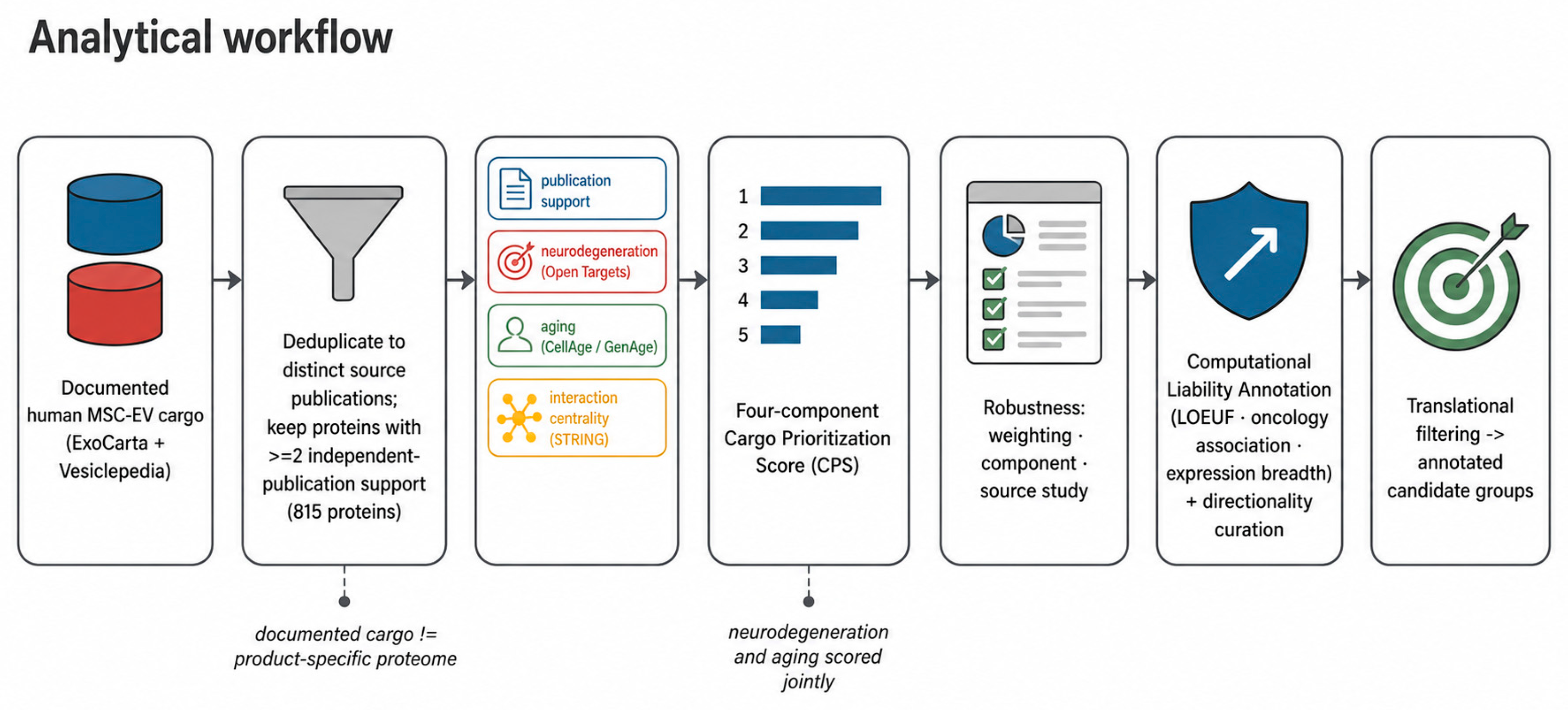
Figure 2.
Four-component CPS for the top 20 MSC-EV cargo proteins. Bar segments show weighted component contributions (publication support 0.333, neurodegeneration 0.278, aging 0.222, PPI hub 0.167). Proteins ordered by CPS.
Figure 2.
Four-component CPS for the top 20 MSC-EV cargo proteins. Bar segments show weighted component contributions (publication support 0.333, neurodegeneration 0.278, aging 0.222, PPI hub 0.167). Proteins ordered by CPS.
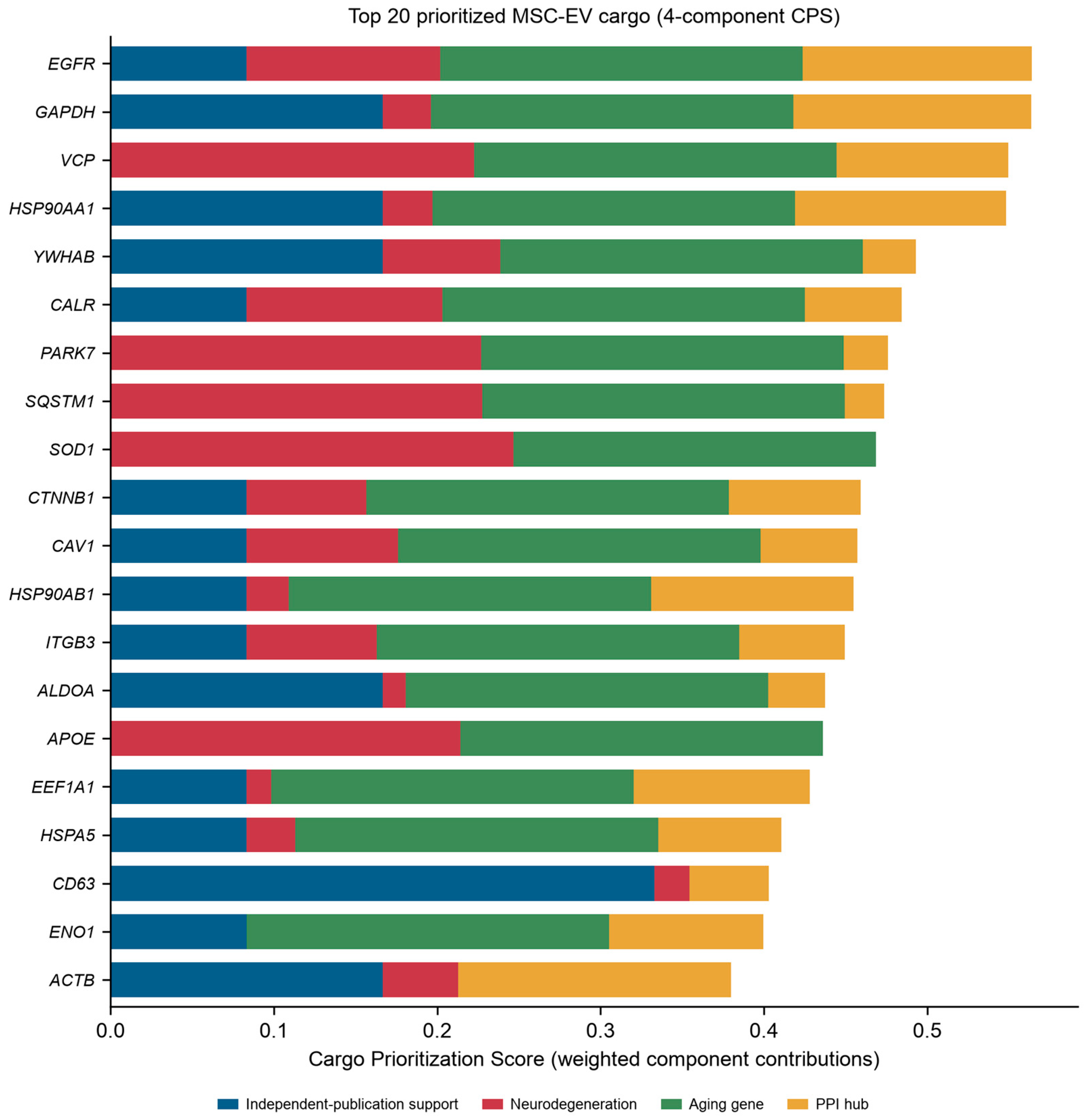
Figure 3.
Dual-indication map of MSC-EV cargo. x-axis, neurodegeneration disease-gene evidence (maximum Open Targets association); y-axis, independent-publication support (distinct PubMed IDs, jittered). Green, aging genes (CellAge/GenAge); grey, non-aging; red rings, highlighted disease-anchored dual candidates (the 14 highest-CPS proteins with neurodegeneration score >0.4 and aging-gene membership).
Figure 3.
Dual-indication map of MSC-EV cargo. x-axis, neurodegeneration disease-gene evidence (maximum Open Targets association); y-axis, independent-publication support (distinct PubMed IDs, jittered). Green, aging genes (CellAge/GenAge); grey, non-aging; red rings, highlighted disease-anchored dual candidates (the 14 highest-CPS proteins with neurodegeneration score >0.4 and aging-gene membership).
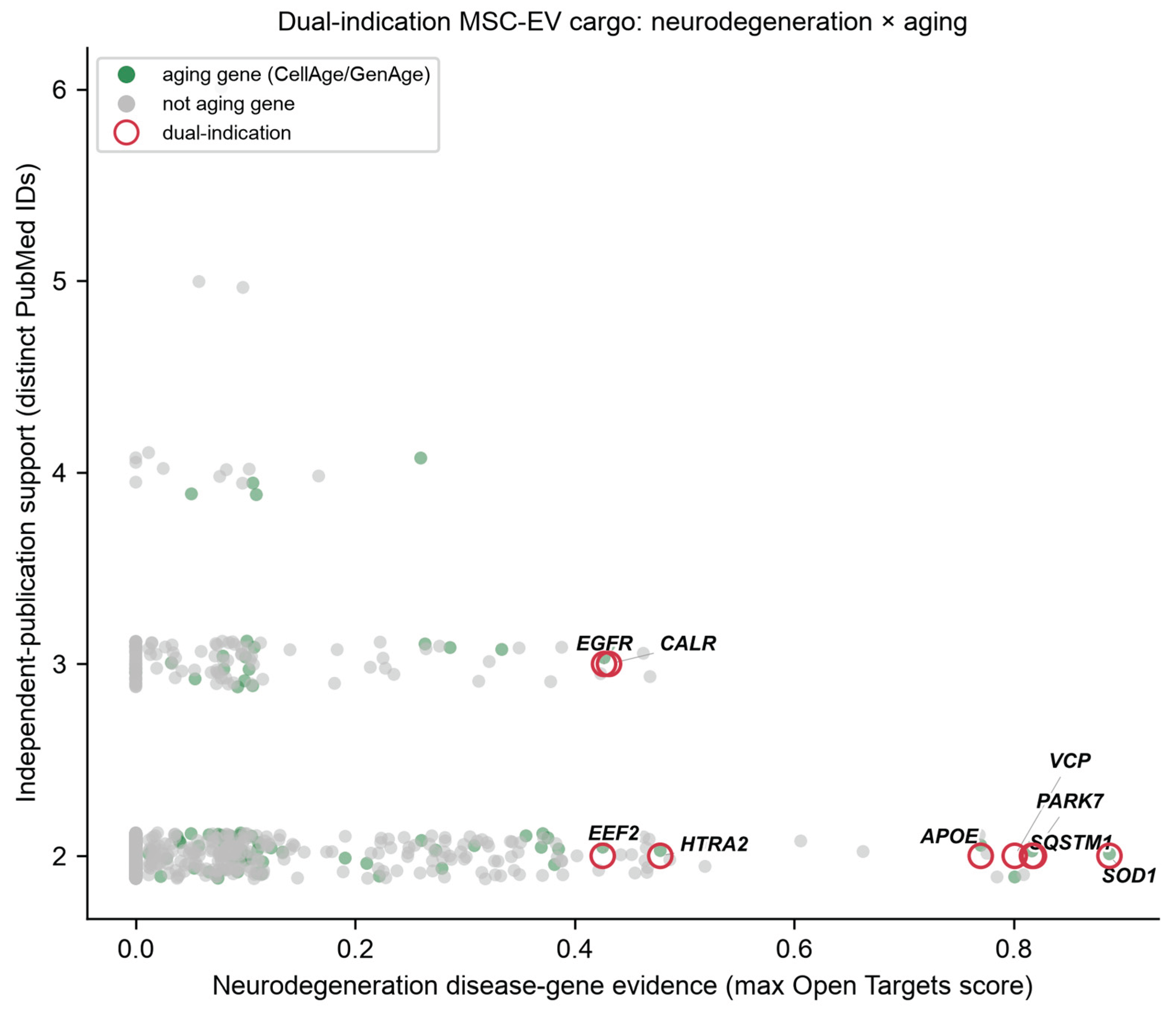
Figure 4.
Computational Liability Annotation, shown as three separate dimensions for the top candidates: LoF constraint (displayed as 1 − min(LOEUF, 1), i.e. LOEUF is first clipped to a maximum of 1 and then subtracted from 1, so the shaded value lies in 0–1 and darker = more constrained; the raw, unclipped LOEUF is given in Table 7), oncology association (directionally unresolved) and expression breadth (Human Protein Atlas category, 0–1). This is a heuristic annotation, not a validated safety score; the constraint bands are author-defined descriptive intervals; NA = not available.
Figure 4.
Computational Liability Annotation, shown as three separate dimensions for the top candidates: LoF constraint (displayed as 1 − min(LOEUF, 1), i.e. LOEUF is first clipped to a maximum of 1 and then subtracted from 1, so the shaded value lies in 0–1 and darker = more constrained; the raw, unclipped LOEUF is given in Table 7), oncology association (directionally unresolved) and expression breadth (Human Protein Atlas category, 0–1). This is a heuristic annotation, not a validated safety score; the constraint bands are author-defined descriptive intervals; NA = not available.
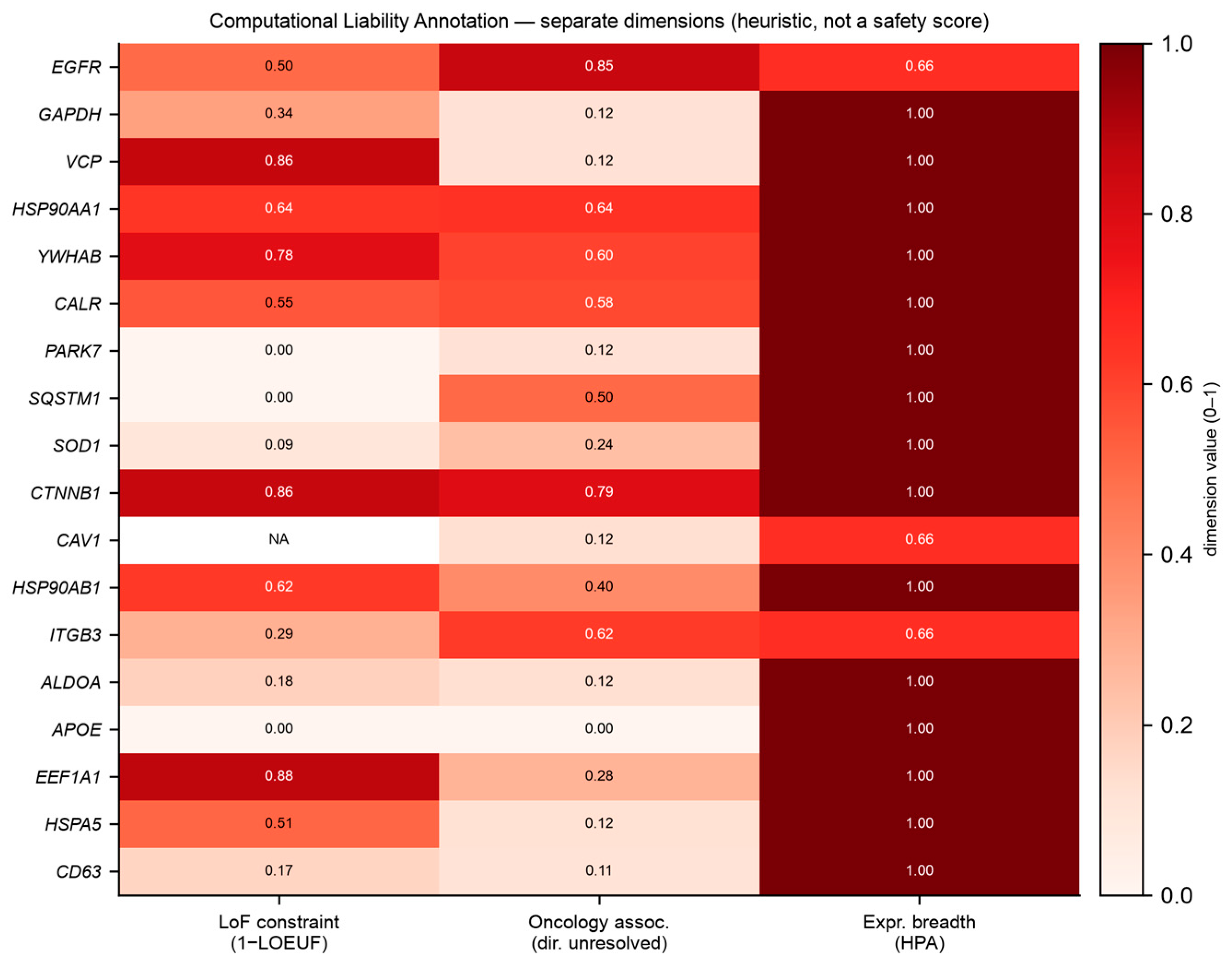
Table 1.
Construction and filtering of the MSC-EV cargo universe. The unique proteins partition exactly into 1-publication (3,897), ≥2-publication (815) and PubMed-less-only (415) groups.
Table 1.
Construction and filtering of the MSC-EV cargo universe. The unique proteins partition exactly into 1-publication (3,897), ≥2-publication (815) and PubMed-less-only (415) groups.
| Metric | Value |
|---|---|
| Raw MSC-EV protein records | 16,213 |
| Unique proteins (any support) | 5,127 |
| Records without PubMed ID (excluded) | 1,877 |
| Distinct source publications | 9 |
| Proteins with 1-publication support | 3,897 |
| Proteins with ≥2-publication support (reproducible universe) | 815 |
| Proteins with ≥3-publication support | 148 |
| Proteins supported only by PubMed-less records (excluded) | 415 |
| ExoCarta genes/Vesiclepedia genes/overlap | 938/5110/921 |
| Reproducible proteins also in UC-MSC subset | 729 (89%) |
Table 2.
Contribution of all 9 source publications to the cargo universe, ordered by proteins contributed. Two studies (PMIDs 19389847 and 29148239) dominate; the remaining seven contribute few proteins each.
Table 2.
Contribution of all 9 source publications to the cargo universe, ordered by proteins contributed. Two studies (PMIDs 19389847 and 29148239) dominate; the remaining seven contribute few proteins each.
| Source publication (PMID) | Proteins contributed | Proteins unique to this publication | Repository |
|---|---|---|---|
| 19389847 | 2772 | 2380 | Vesiclepedia |
| 29148239 | 1831 | 1102 | Vesiclepedia |
| 22148876 | 696 | 198 | Vesiclepedia |
| 23861904 | 373 | 213 | Vesiclepedia |
| 25669974 | 7 | 0 | ExoCarta |
| 20668554 | 6 | 3 | Vesiclepedia |
| 23454749 | 6 | 1 | Vesiclepedia |
| 28042326 | 4 | 0 | Vesiclepedia |
| 28170197 | 1 | 0 | Vesiclepedia |
Table 3.
Top 15 CPS-ranked MSC-EV cargo proteins. CPS is shown to three significant figures; closely spaced values (e.g. EGFR and GAPDH) differ only at higher precision. Pub. support, distinct source publications; Neuro score, maximum Open Targets association; PPI degree, STRING degree at combined score ≥700.
Table 3.
Top 15 CPS-ranked MSC-EV cargo proteins. CPS is shown to three significant figures; closely spaced values (e.g. EGFR and GAPDH) differ only at higher precision. Pub. support, distinct source publications; Neuro score, maximum Open Targets association; PPI degree, STRING degree at combined score ≥700.
| Rank | Gene | CPS | Pub. support | Neuro score | CellAge | GenAge | PPI degree | In UC-MSC subset |
|---|---|---|---|---|---|---|---|---|
| 1 | EGFR | 0.564 | 3 | 0.427 | 1 | 1 | 52 | 1 |
| 2 | GAPDH | 0.564 | 4 | 0.107 | 1 | 0 | 54 | 1 |
| 3 | VCP | 0.55 | 2 | 0.801 | 0 | 1 | 39 | 1 |
| 4 | HSP90AA1 | 0.548 | 4 | 0.11 | 1 | 1 | 48 | 1 |
| 5 | YWHAB | 0.493 | 4 | 0.26 | 1 | 0 | 12 | 1 |
| 6 | CALR | 0.484 | 3 | 0.431 | 1 | 0 | 22 | 1 |
| 7 | PARK7 | 0.476 | 2 | 0.817 | 1 | 0 | 10 | 1 |
| 8 | SQSTM1 | 0.474 | 2 | 0.818 | 0 | 1 | 9 | 1 |
| 9 | SOD1 | 0.469 | 2 | 0.887 | 1 | 1 | 0 | 0 |
| 10 | CTNNB1 | 0.459 | 3 | 0.264 | 1 | 1 | 30 | 1 |
| 11 | CAV1 | 0.457 | 3 | 0.333 | 1 | 0 | 22 | 1 |
| 12 | HSP90AB1 | 0.455 | 3 | 0.0928 | 1 | 0 | 46 | 1 |
| 13 | ITGB3 | 0.45 | 3 | 0.286 | 1 | 0 | 24 | 1 |
| 14 | ALDOA | 0.438 | 4 | 0.0507 | 1 | 0 | 13 | 1 |
| 15 | APOE | 0.436 | 2 | 0.77 | 0 | 1 | 0 | 1 |
Table 4.
Component robustness: leave-one-component-out rank correlation with the full CPS.
| Component removed | Spearman ρ vs full | Top-20 retained |
|---|---|---|
| S_pubsupport | 0.935 | 14 |
| S_neuro | 0.825 | 16 |
| S_aging | 0.87 | 12 |
| S_hub | 0.926 | 16 |
Table 5.
Source-study sensitivity of the MSC-EV cargo universe and CPS ranking.
| Scenario | Universe (proteins) | Spearman ρ (shared genes) | Top-10 retained | Top-20 retained |
|---|---|---|---|---|
| Full analysis (all 9 publications) | 815 | 1 | 10 | 20 |
| Leave-out PMID 19389847 (2772 proteins) | 520 | 0.93 | 8 | 17 |
| Leave-out PMID 29148239 (1831 proteins) | 228 | 0.931 | 7 | 16 |
| Leave-out PMID 22148876 (696 proteins) | 458 | 0.92 | 6 | 16 |
| Leave-out PMID 23861904 (373 proteins) | 724 | 0.974 | 7 | 16 |
| Dominant-study excluded (PMID 19389847) | 520 | 0.93 | 8 | 17 |
| UC-MSC source excluded (PMID 29148239) | 228 | 0.931 | 7 | 16 |
| Vesiclepedia-only | 813 | 0.998 | 7 | 20 |
| ExoCarta-only | 0 | NA | NA | NA |
Table 7.
Liability dimensions and directionality for the top 15 candidates. LOEUF is raw (lower = more LoF-constrained); oncology association is directionally unresolved; NA = not available.
Table 7.
Liability dimensions and directionality for the top 15 candidates. LOEUF is raw (lower = more LoF-constrained); oncology association is directionally unresolved; NA = not available.
| Gene | CPS | LOEUF (raw) | LoF-constraint | Oncol. assoc. | Expr. breadth | Directionality |
|---|---|---|---|---|---|---|
| EGFR | 0.564 | 0.505 | moderate (0.35-0.6) | 0.853 | Detected in many | proliferative-signalling concern |
| GAPDH | 0.564 | 0.662 | low/none | 0.116 | Detected in all | deprioritized in present framework — directionality unresolved; rank may reflect abundance/network bias |
| VCP | 0.55 | 0.138 | high (LOEUF<0.35) | 0.116 | Detected in all | directionally unresolved |
| HSP90AA1 | 0.548 | 0.364 | moderate (0.35-0.6) | 0.643 | Detected in all | context-dependent/oncology-relevant |
| YWHAB | 0.493 | 0.221 | high (LOEUF<0.35) | 0.598 | Detected in all | context-dependent |
| CALR | 0.484 | 0.452 | moderate (0.35-0.6) | 0.584 | Detected in all | context-dependent/oncology-relevant |
| PARK7 | 0.476 | 1.07 | low/none | 0.115 | Detected in all | potentially protective |
| SQSTM1 | 0.474 | 1.05 | low/none | 0.502 | Detected in all | context-dependent |
| SOD1 | 0.469 | 0.908 | low/none | 0.239 | Detected in all | wild-type protective/mutant toxic |
| CTNNB1 | 0.459 | 0.144 | high (LOEUF<0.35) | 0.787 | Detected in all | proliferative-signalling concern |
| CAV1 | 0.457 | NA | unavailable | 0.125 | Detected in many | context-dependent |
| HSP90AB1 | 0.455 | 0.376 | moderate (0.35-0.6) | 0.402 | Detected in all | context-dependent/oncology-relevant |
| ITGB3 | 0.45 | 0.711 | low/none | 0.619 | Detected in many | context-dependent |
| ALDOA | 0.438 | 0.822 | low/none | 0.125 | Detected in all | deprioritized in present framework — directionality unresolved; rank may reflect abundance/network bias |
| APOE | 0.436 | 1.29 | low/none | 0 | Detected in all | context/isoform-dependent |
Disclaimer/Publisher’s Note: The statements, opinions and data contained in all publications are solely those of the individual author(s) and contributor(s) and not of MDPI and/or the editor(s). MDPI and/or the editor(s) disclaim responsibility for any injury to people or property resulting from any ideas, methods, instructions or products referred to in the content. |
© 2026 by the authors. Licensee MDPI, Basel, Switzerland. This article is an open access article distributed under the terms and conditions of the Creative Commons Attribution (CC BY) license (http://creativecommons.org/licenses/by/4.0/).
Copyright: This open access article is published under a Creative Commons CC BY 4.0 license, which permit the free download, distribution, and reuse, provided that the author and preprint are cited in any reuse.