

Submitted:
04 August 2026
Posted:
04 August 2026
You are already at the latest version
Abstract
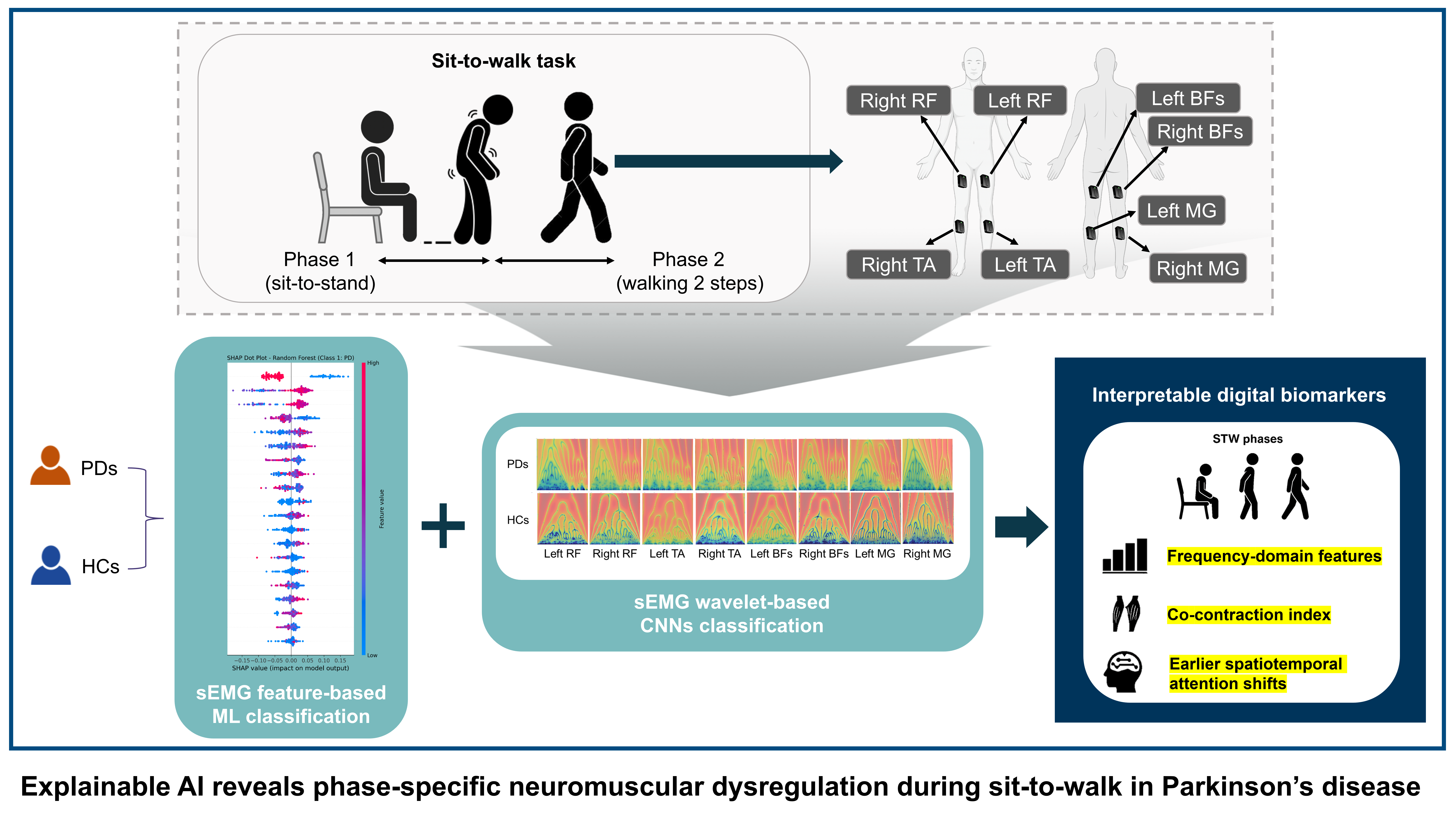
Neuromuscular dysfunction during the sit-to-walk (STW) task in Parkinson’s disease (PD) remains poorly understood. We aimed to analyze surface electromyography (sEMG) signals across STW phases using explainable machine learning (ML) and deep learning approaches in PD. Individuals with PD (n = 102) and healthy controls (n = 50) performed a standardized STW task while sEMG signals were recorded bilaterally from eight lower-limb muscles. These signals were preprocessed and segmented into three phases in the STW task. Feature-based ML models were compared with convolutional neural networks (CNN) trained on wavelet-transformed sEMG spectrograms. Explainable artificial intelligence methods identified physiologically interpretable neuromuscular patterns. STW phase 1 was the most sensitive interval for detecting PD-related neuromuscular abnormalities. Feature-based models achieved high classification performance, identifying frequency-domain features and rectus femoris–biceps femoris short head co-contraction indices as key discriminants. CNN-based analyses revealed earlier and temporally concentrated activation patterns in individuals with PD, particularly in proximal muscles critical for momentum generation and postural stabilization. Our findings revealed impaired predictive neuromuscular control and maladaptive proximal muscle coordination during STW phase 1 as core features of PD. This approach provides a physiologically grounded foundation for developing interpretable digital neuromuscular biomarkers and timing-focused rehabilitation strategies in PD.
Keywords:
Parkinson's disease
; surface electromyography
; sit-to-walk
; machine learning
; convolutional neural networks
; explainable artificial intelligence
Copyright: This open access article is published under a Creative Commons CC BY 4.0 license, which permit the free download, distribution, and reuse, provided that the author and preprint are cited in any reuse.


