

Submitted:
04 August 2026
Posted:
04 August 2026
You are already at the latest version
Abstract
Physics describes evolution, causal structure, and measurement outcomes, but lacks an accepted physical account of why one outcome-conditioned quantum situation is actual as the present. This article develops a conditional account within the reconstruction program, which places a premetric selection layer prior to spacetime dynamics. The Indefinite Reconstruction Stability Principle requires identities and readable relations to survive admissible continuation and to ignore unobservable distinctions. A present is proposed to be the outcome-conditioned quantum read-out of an IRSP-stable, history-bearing reconstruction boundary. Because the underlying relational record need not factorize, its read-out is generally entangled rather than a classical instantaneous configuration. Admissible successors are represented by a quantum instrument; present actualization postulates that one stable record sector becomes definite with its conditional probability, without an external observer. An explicit event-identity bridge identifies operationally equivalent realizations of the same descended event, and observable descent then makes its weight independent of reconstruction representative and unread embedding context. Given positivity, normalization, exclusive additivity, and a Hilbert-space read-out, Gleason representation fixes the Born form. Linear history composition implies no genuine third-order successor interference. Proper inheritance of the complete ancestry class supplies a conditional acyclic reconstruction order, stable small-step channels recover standard effective dynamics, and spacelike confluence replaces a preferred global simultaneity surface. The result is a conditional quantum architecture of present actuality and becoming, with explicit premises and failure conditions but no fitted collapse rate.
Keywords:
quantum foundations
; present
; temporal actuality
; reconstruction
; IRSP
; entanglement
; quantum measurement
; Born rule
; quantum instruments
; higher-order interference
; emergence of time
1. Introduction
Modern physics is exceptionally successful at describing how physical states are related. A Hamiltonian or unitary operator relates states at different parameter values; quantum field theory predicts scattering amplitudes and correlations; general relativity supplies causal structure and dynamical geometry; and statistical mechanics explains why macroscopic processes exhibit robust temporal asymmetries. Yet these theories do not by themselves settle a deceptively simple question: what makes one complete physical situation actual as the present?
This question is not answered by writing a time coordinate t. A coordinate labels represented events but does not distinguish an actual record from an unactualized possibility. Nor is the present simply a surface of simultaneous events. Relativity makes simultaneity frame dependent and supplies no preferred global “now” [1,2,3,4,5]. Entropy is equally important but addresses another problem: it characterizes thermodynamic asymmetry once an ordered family of states and a coarse graining have already been supplied [6,7,8,9,13]. A theory of evolution, geometry, or entropy is therefore not yet a theory of present actuality.
Quantum mechanics makes the gap sharper. A quantum state may encode several possible records with definite amplitudes, while an experiment produces one observed record. Decoherence explains why interference between suitable record sectors becomes strongly suppressed and why preferred effective observables emerge [19,20]. It does not, by itself, turn an improper mixture into one uniquely actual outcome. Collapse theories add an objective stochastic law [21,22]; Everettian theories retain all branches and interpret actuality relationally [23,24]; consistent-histories approaches assign probabilities to decoherent history families [25,26]; and relational approaches treat physical states as relative to interactions or systems [27]. These approaches illuminate different aspects of the measurement problem, but no consensus identifies the physical present with a precise quantum object and simultaneously explains its relation to temporal order.
This article explores a reconstruction-based answer. The reconstruction program proposes that spacetime, fields, particle identities, symmetry data, and their observable states are read-outs of a more primitive relational selection layer. “Primitive” here does not mean earlier in a hidden cosmic time. It means logically prior to the availability of metric duration, causal cones, field amplitudes, and ordinary dynamical evolution. At that level, one may still ask whether relations compose and close, whether two descriptions differ only by unread bookkeeping, and whether an identity remains the same under every admissible continuation.
The basic existence criterion is the Indefinite Reconstruction Stability Principle (IRSP). In plain language:
A physical identity is admissible only if every allowed continuation of its reconstruction continues to identify it as the same physical identity, and every readable relation remains independent of choices that no observation can detect.
If a proposed object exists only because reconstruction was stopped at one convenient stage, the next admissible continuation can erase or change it. If two physically indistinguishable descriptions assign it different behavior or different probabilities, there is no well-defined physical fact about what it does. Within the framework, such a proposal has not defined an unstable object; it has failed to define an observable object at all.
The new thesis is that present actuality is a quantum read-out:
The physical present is the outcome-conditioned quantum read-out of a history-bearing, IRSP-stable reconstruction boundary.
The reconstruction boundary includes the invariant consequences of its ancestry, its current relational anchoring, and every correlation relevant to admissible continuation. Its read-out includes the causal platform, the observable algebra, the quantum state, and the stable records that define the current physical situation. The state is generally entangled because the global reconstruction record need not decompose into independently completed subsystem records.
This formulation differs from the classical expression “the present is one full configuration.” A full reconstruction boundary is not read out as a list of simultaneously possessed classical properties. It is read out as a quantum state on an observable algebra. When stable record sectors form, the read-out has the mathematical structure of a quantum instrument: several successor records are admissible, each has a probability, and one outcome-conditioned state is actualized as the next present. The observer is part of that state. No external consciousness or cosmic measurement apparatus is required.
Figure 1 summarizes the proposed explanatory order.
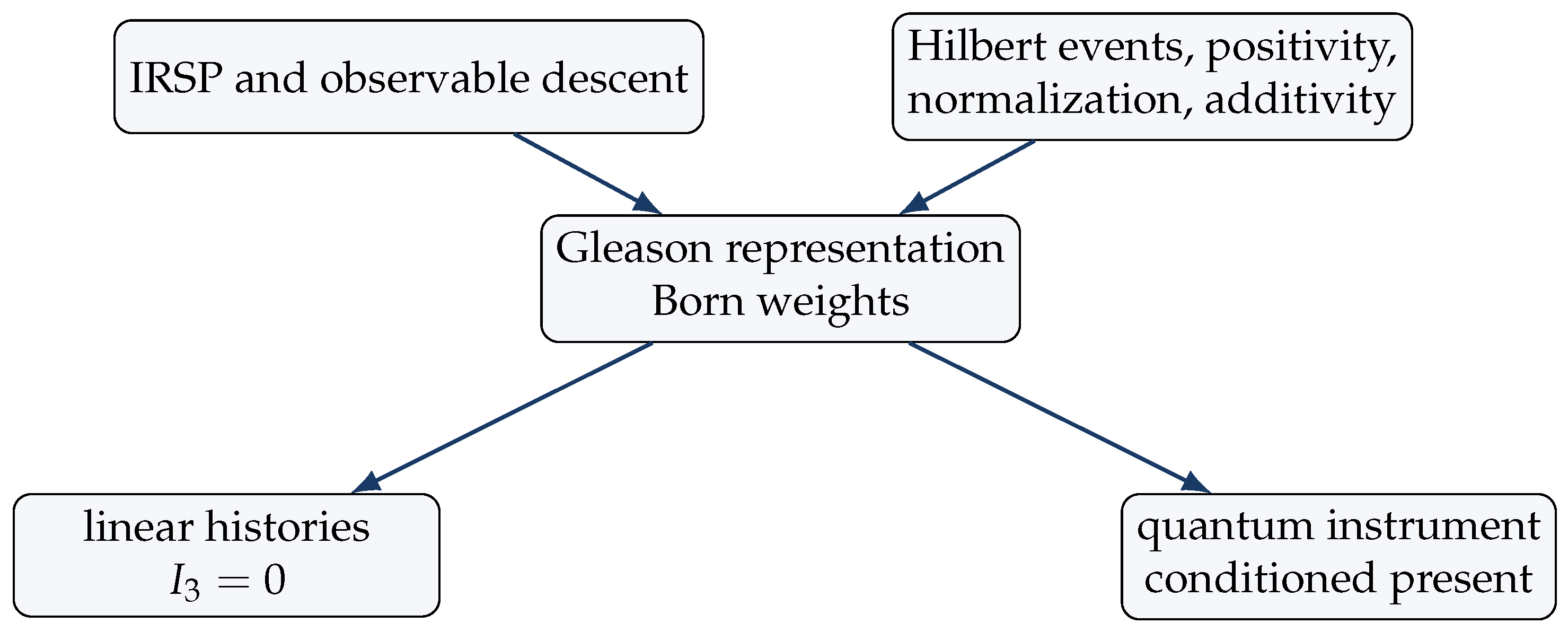
The paper has four main conditional results. First, an event-identity bridge establishes when distinct implementations represent the same descended successor event; observable descent then requires its probability to be independent of reconstruction representative and unread embedding context. With the standard positivity, normalization, and exclusive-additivity assumptions on a Hilbert-space event lattice, Gleason’s theorem gives a unique density-operator representation. The Born form is therefore conditionally represented by combining declared quantum-probability assumptions with IRSP-motivated probability descent; it is not derived from IRSP alone.
Second, the resulting quadratic quantum measure has no genuine third-order interference. For three mutually exclusive successor histories, the Sorkin third-order combination vanishes. This exact and experimentally accessible null condition is shared with ordinary linear quantum theory. A nonzero result surviving controls for nonlinear evolution, multiparticle effects, detector response, and unintended paths would falsify the declared bridge architecture, although a null result would not uniquely confirm reconstruction.
Third, inherited record inclusion provides an acyclicity argument. The full reconstruction state contains an ancestry ledger even when its reduced quantum state recurs. Nontrivial actualization properly extends that ledger, supplying a monotone depth and excluding strict cycles of full actuality. Quantum recurrence and reversible effective dynamics remain possible at the reduced-state level.
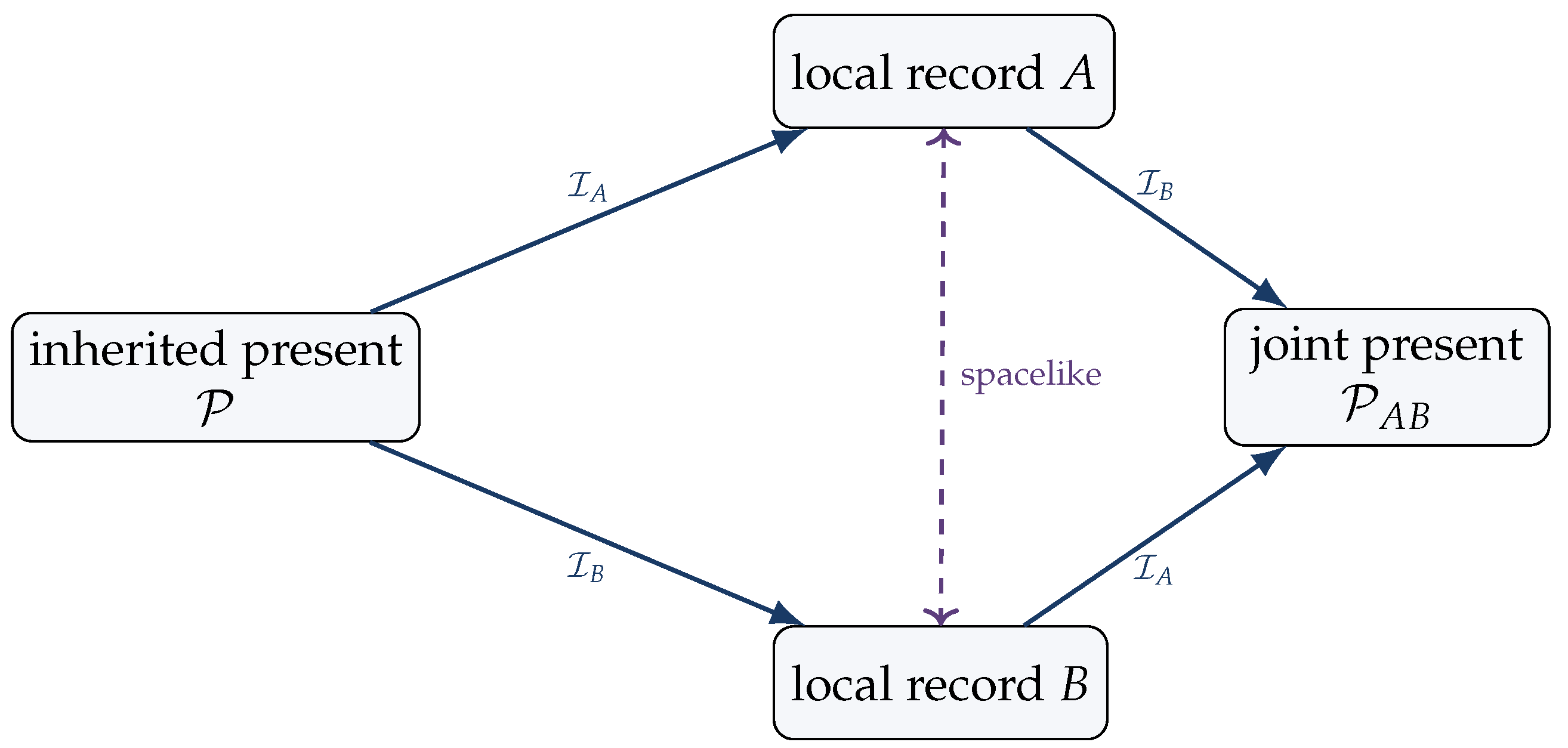
Fourth, no global instantaneous collapse is introduced. The physical present is represented by a causally admissible reconstruction front, not by a preferred spacelike foliation. Spacelike-separated local read-outs must be confluent: changing their unread ordering cannot change the joint physical state. This implements the same representative-independence logic in the relativistic setting.
Claim boundary. The article presents a conditional architecture, not a completed microscopic collapse model. It derives neither a collapse rate nor a new energy-injection scale. Single-outcome actualization is an ontological principle; the probability theorem uses an event-identity bridge, Hilbert-space event assumptions, and established Gleason representation; the entanglement claim uses an explicit composition correspondence; acyclicity uses proper history inheritance; and the relativistic conclusion uses causal confluence. These premises are stated explicitly. The proposed contribution is to compose them into a reconstruction account of the quantum present and to expose direct failure conditions.
The article is organized as follows. Section 2 introduces reconstruction, IRSP, completion, observable quotient, saturation, the neutral parent, the relational atlas, and the read-out platform, and summarizes quantitative evidence from earlier applications. Section 3 separates temporal order, metric time, present actuality, measurement, and related interpretations. Section 4 defines a history-bearing quantum present. Section 5 formulates reconstruction nonfactorizability and its entangled read-out. Section 6 introduces probabilistic successor instruments. Section 7 proves the conditional Born representation and the vanishing of genuine third-order successor interference. Section 8 derives acyclicity from inherited record depth, Section 9 recovers effective quantum dynamics, and Section 10 formulates relativistic confluence. Section 11 and Section 12 give operational tests, related-work comparisons, and limitations.
2. Reconstruction Framework and Prior Evidence
2.1. Premetric does not Mean a Hidden Earlier Spacetime
The term premetric is easily misunderstood. It does not denote a smaller spacetime located behind ordinary spacetime, nor a material ether in which reconstruction occurs. It denotes a level of description at which length, duration, light cones, energy density, and field amplitude have not yet become physical observables. Consequently, a conventional microscopic Lagrangian is not available at this level: a Lagrangian already presupposes fields, locality, a measure of integration, and a causal or temporal structure on which variation is defined.
The starting point is not literal nothingness. At minimum, the framework requires possible distinctions, relational composition, admissible continuation, and equivalence under unread relabeling. These are logical and mathematical resources rather than physical objects. The neutral parent, relational atlas, symmetry groups, metric platform, quantum states, and dynamical laws are not placed inside this starting layer. They are names for invariant completed structures selected from it.
Physical intuition. Imagine a map before distances and coordinates have been assigned. Only adjacency, incidence, continuation, and consistency are available. Reconstruction does not place objects on a ready-made map. It selects a relational structure whose read-out simultaneously supplies the map, its metric, and the objects localized relative to it.
2.2. Completion, Observable Quotient, and Saturation
Let denote a class of candidate relational presentations and let
denote completion under the declared compatibility and closure rules. A completion is not necessarily unique at the presentation level. Let
mean that no admissible read-out distinguishes the completed presentations x and y. The physical reconstruction class is then an element of the observable quotient
Definition 1
(Observable descent). A map F defined on completed presentations descends to the observable quotient if
Equivalently, there exists a map on such that
where is the quotient map.
Descent is the mathematical form of the statement that invisible bookkeeping cannot change physics. A probability law that assigns different weights to two representatives of the same physical event does not define a probability on observable events.
Principle 2
(Indefinite Reconstruction Stability Principle). A completed identity or readable relation is physically admissible only if it remains well defined under every admissible finite continuation and if every associated observable law descends through the observable quotient.
“Indefinite” means that physical existence cannot depend on a decree to stop reconstructing at a convenient stage. It does not mean that an ordinary particle must survive forever in metric time. A muon can decay while its identity and decay law remain perfectly well defined. IRSP concerns invariance under reconstruction and representative choice, not immortality under subsequent effective evolution.
IRSP is not a minimum-resolution rule. Once unread duplication has been removed, saturation retains all inequivalent admissible completed channels. Deleting an inconvenient branch merely to preserve a desired answer would violate indefinite stability.
2.3. Neutral Parent and Relational Atlas
Earlier applications introduced the neutral parent as the common organizing origin of particle read-outs [44,45,46]. The refined interpretation used here is that is not a primitive particle contained in the premetric layer. It is the universal completed identity class selected before particle-specific charge, mass, gauge representation, and localization become readable. “Neutral” means prior to those oppositions, not an additional electrically neutral particle.
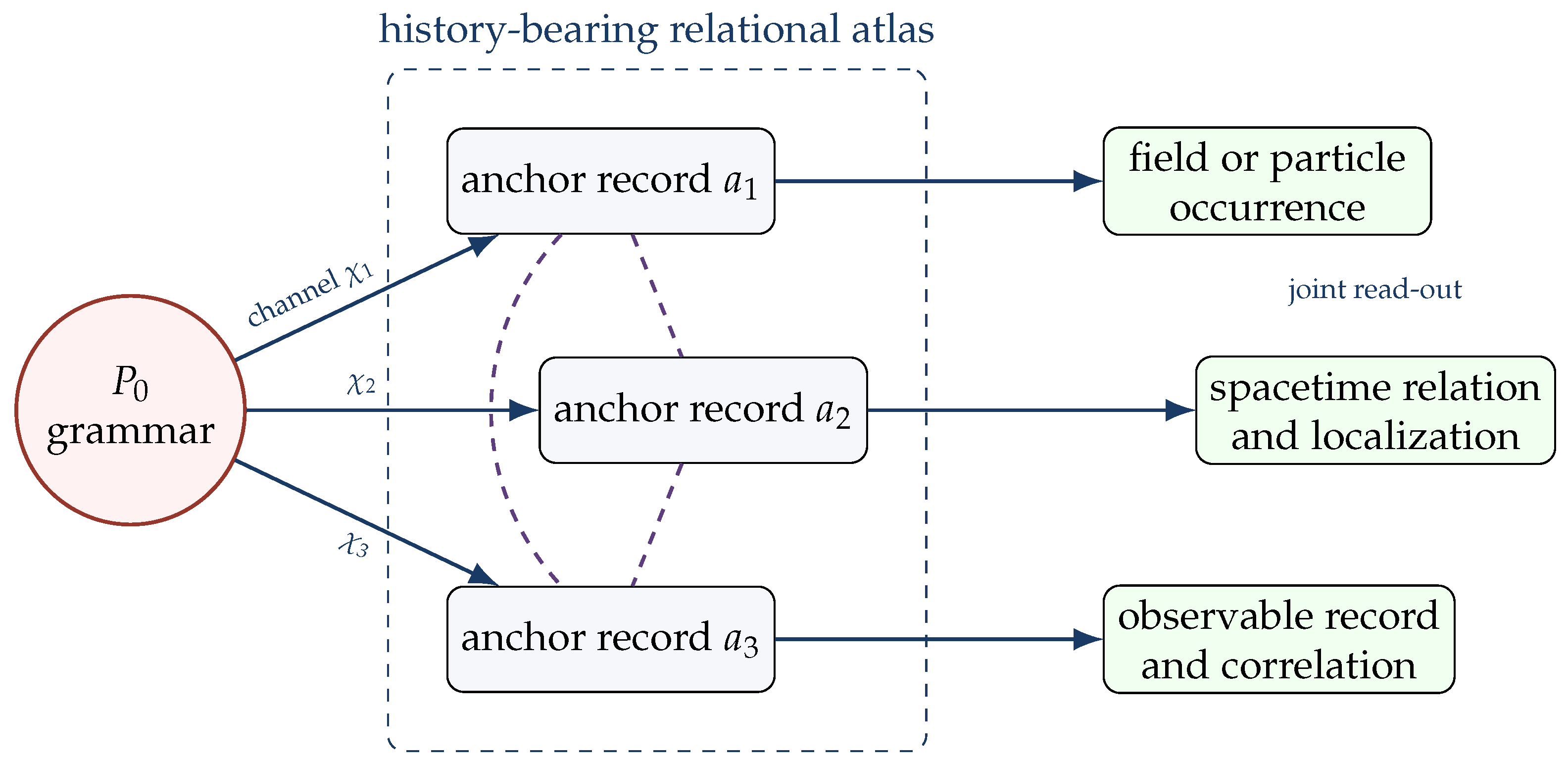
The neutral parent plays the role of a single generative grammar. A particular observed particle occurrence additionally requires a read-out channel, a relational anchor, and a current state record:
Multiple identical particles therefore need not be primitive copies of the archetype. They are different occupation or anchoring records using the same selected identity grammar. This is compatible in spirit with the field-theoretic fact that identical particles are excitations of a common field rather than classically labelled miniature objects.
The global history-bearing structure will be called the relational atlas. Again, the atlas is not a sheet stored in a premetric container. It is the equivalence class of ancestry, incidence, channel, and anchoring relations that survive completion and quotient. Its external relations read out as causal and metric support; its channel records read out as fields and particles; and its ancestry relations read out as memories and physical records.
Figure 2.
One generative grammar and one history-bearing atlas. The neutral parent is a selected universal identity class, not one hidden particle per observed object. Distinct channel and anchor records use that grammar. Their joint read-out supplies fields, particle occurrences, spacetime localization, and observable records. The “map” and its contents therefore emerge together.
Figure 2.
One generative grammar and one history-bearing atlas. The neutral parent is a selected universal identity class, not one hidden particle per observed object. Distinct channel and anchor records use that grammar. Their joint read-out supplies fields, particle occurrences, spacetime localization, and observable records. The “map” and its contents therefore emerge together.
2.4. Read-Out Platform and Observer-Conditioned Records
A constitutive read-out realizes a stable reconstruction class as an effective platform
The label allows the possibility that the premetric reconstruction core supports more than one observer-compatible read-out architecture. This does not mean that observers choose their laws. An observer is itself a stable record-making subsystem internal to one platform. The present paper studies the read-out class that supports a Lorentzian causal arena, quantum observables, and the particle records familiar to us.
At the effective level, conventional spacetime is the causal-metric sector of . It is not a primitive empty container. A chain of relational anchors
is read out as a worldline or field-support history in spacetime. The anchors are not premetric coordinates; their joint realization defines both the effective locations and the geometry in which those locations are compared.
2.5. Prior Quantitative Evidence
The present proposal is conceptually new, and its quantum bridges must be judged on their own premises. It is nevertheless relevant that the same reconstruction architecture has already produced previously reported quantitative targets in independent particle sectors. The codimension-two selection was developed topologically in Ref. [44]. The neutral-parent particle application then predicted the neutron–proton magnetic-moment ratio [45], and the charged-lepton application predicted three pole-mass ratios [46]. A companion holonomy-capacity analysis gives the low-energy inverse fine-structure constant [47]. The reported values are collected in Table 1.
These agreements do not prove IRSP, the neutral-parent bridge, or the present theory. They are included for a narrower reason: they show that reconstruction has been used to generate sharp cross-sector targets rather than only retrospective qualitative narratives. No numerical value in Table 1 is an input to any theorem below.
3. The Physical Problem: Order, Time, Actuality, and Measurement
3.1. Four Notions that Must be Separated
Four notions are often compressed into the single word “time”:
- 1.
- Reconstruction order: a partial before–after or dependency relation among completed boundaries.
- 2.
- Metric time: the duration and causal comparison supplied by a read-out platform and its clocks.
- 3.
- Present actuality: the status of the currently outcome-conditioned reconstruction boundary.
- 4.
- Quantum measurement: the production of a stable readable record from several admissible quantum alternatives.
They are related but not identical. A partial order can exist without a metric. A time coordinate can parametrize a represented solution without declaring one state actual. A quantum state can evolve unitarily while containing several mutually exclusive potential records. A measurement record can be local without defining a universal simultaneity surface.
The proposed hierarchy is
This is explanatory order. The first arrow is not an event occurring at an earlier value of the last line’s time coordinate.
3.2. Why The Present Is Not Entropy
Entropy requires a state space, a measure or counting rule, and a coarse graining. A statement such as
already assumes that the two states can be ordered and compared. Entropy can explain why typical macroscopic records point consistently in one temporal direction, but it does not by itself define the order or identify the actual present [10,11,12,13].
The history-bearing reconstruction state and thermodynamic entropy can also move differently. A local subsystem may be cooled, reset, or purified while the full reconstruction ancestry still extends. Record depth is not a measure of disorder.
3.3. Why The Present Is Not A Global Simultaneity Surface
In Minkowski spacetime, different inertial observers assign different simultaneity surfaces to the same events. In curved spacetime, a global foliation may not be unique or physically distinguished. The present theory therefore does not identify actuality with
for one preferred time function t.
Instead, a reconstruction boundary is a causally admissible front: a maximal set of mutually unordered record updates together with their inherited past. Different effective foliations can represent the same underlying partial order. If two spacelike-separated updates are physically independent, exchanging their representation order must leave the joint read-out unchanged. Section 10 makes this confluence condition precise.
3.4. Why The Present Is A Quantum Problem
The old classical phrase “one complete configuration is actual” is insufficient. A quantum present cannot be a simultaneous assignment of sharp values to all observables; contextuality and noncommutativity prohibit that picture [28]. The complete physical situation must instead be specified by an observable algebra, a quantum state on that algebra, and an actual record subalgebra whose values have become stably readable.
The whole state may remain highly entangled. Actualization does not mean that every degree of freedom becomes a classical eigenstate. It means that one successor record sector is selected and conditioned, while unresolved quantum relations—including entanglement within that sector—remain quantum.
3.5. Relation To Existing Interpretations
The reconstruction account shares elements with several established approaches without being identical to any one of them.
- With Copenhagen and operational quantum mechanics, it uses quantum instruments and outcome conditioning, but the apparatus and observer are internal read-outs rather than primitive classical objects.
- With objective-collapse approaches, it treats one record sector as actual, but it does not yet add a modified stochastic Schrödinger equation or fitted collapse rate.
- With Everettian theory, it takes the universal entangled state and relative records seriously, but saturation of admissible alternatives is distinguished from the actuality of one outcome-conditioned present.
- With consistent histories, it treats complete histories and a quadratic quantum measure as fundamental to probability, but it adds IRSP-stable completion and present actualization.
- With relational quantum mechanics, it rejects an external view from nowhere, but it anchors observer-relative records in one history-bearing reconstruction class.
- With decoherence and quantum Darwinism, it uses stable, redundantly readable records to identify admissible effective sectors, while maintaining that decoherence alone does not select which record is actual.
The framework is therefore best described as reconstructional quantum actualism: only the current outcome-conditioned boundary is actual as present; its inherited past remains encoded in present records; admissible successors carry quantum weights but are not yet actual; and ordinary unitary or open-system dynamics remains the effective law between and across stable read-out events.
4. The History-Bearing Quantum Present
4.1. A Reconstruction Boundary Is More Than An Instantaneous State
Let label a completed reconstruction boundary and let
denote its observable equivalence class. The symbol is meant to emphasize ancestry: a boundary contains not only relations readable “now”, but also invariant records of the admissible completions through which the boundary was reached. It is therefore closer to a self-consistent history boundary than to one frame of a film.
The word boundary should not be read metrically. Before read-out there is no earlier region on one side and later region on the other. It means the complete set of currently available relational constraints on further continuation. After read-out, part of this structure can be represented as a causal front with an inherited past.
Physical intuition. A conventional instantaneous state resembles a photograph. A history-bearing boundary resembles a photograph containing intact memory devices, fossils, detector tracks, and all physical correlations needed to establish how the photographed situation can consistently continue. The records are present structures, not pieces of a vanished past stored somewhere outside the current universe.
4.2. Observable Algebra, State, and Record Algebra
We use the algebraic language because it does not require a preferred tensor factorization or basis. Let be a unital -algebra of observables available at the read-out of . A quantum state is a positive normalized linear functional
In a finite-dimensional Hilbert-space representation this has the familiar form
Not every observable is a presently readable fact. Let denote a commutative effective record algebra: its coarse-grained projectors or effects correspond to mutually distinguishable records that are stable under the admissible continuations relevant to the observer. Decoherence, amplification, and redundant environmental encoding are physical mechanisms by which such an algebra can become robust [19,20]. IRSP adds a selection demand: the record designation must descend through the observable quotient and must not depend on an unread reconstruction convention.
Definition 3
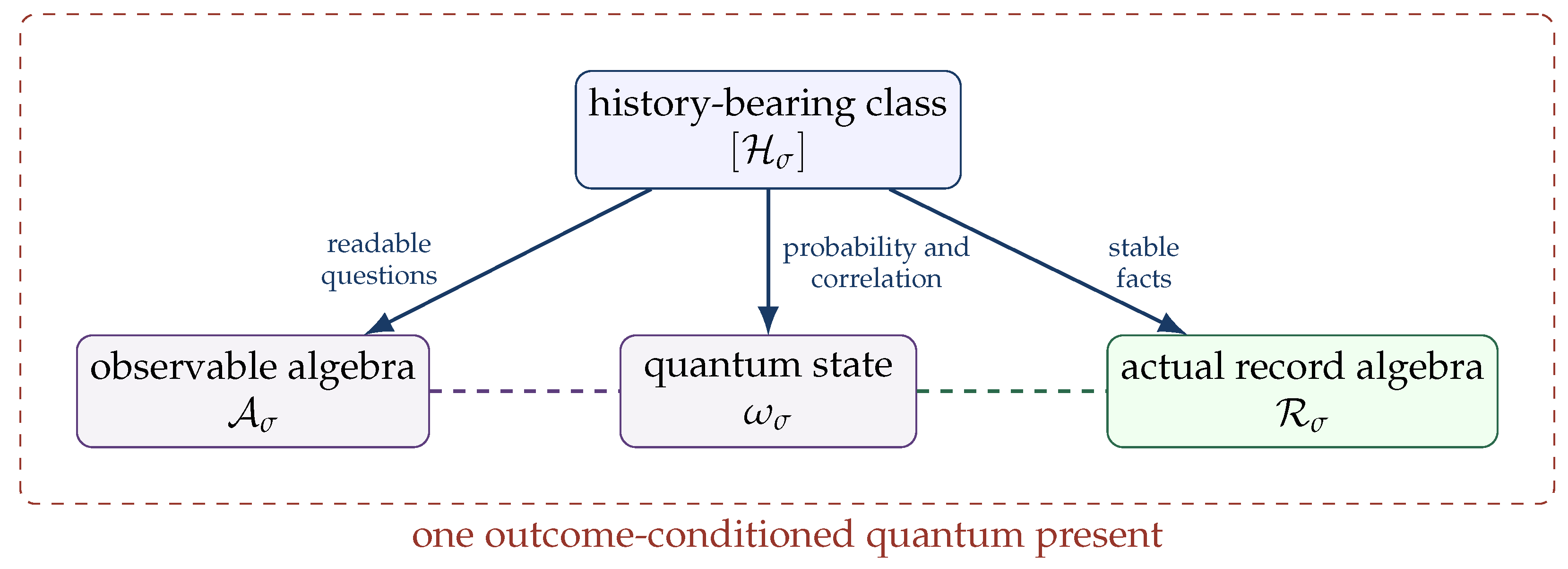
(Quantum present). A quantum present at reconstruction boundary σ is the quadruple
where the reconstruction class carries inherited history, is the effective observable algebra, is its quantum state, and is the algebra of records actual and readable at that boundary.
The definition separates three questions that are often conflated. The state determines quantum probabilities and correlations. The record algebra determines which alternatives are physically distinguishable as outcomes. The reconstruction class determines why those algebraic data belong to the same present and how their inherited records constrain further completion.
Figure 3.
The present is not one classical assignment of values. It is the joint read-out of a history-bearing reconstruction class as an observable algebra, a quantum state, and a stable record algebra. The state may remain entangled and mixed after a particular record sector has become actual.
Figure 3.
The present is not one classical assignment of values. It is the joint read-out of a history-bearing reconstruction class as an observable algebra, a quantum state, and a stable record algebra. The state may remain entangled and mixed after a particular record sector has become actual.
4.3. The Present Is Not “The Eigenstate of the Universe”
It is tempting to say that the next moment is one eigenstate of the universe. That phrase is too restrictive. An eigenstate is defined only after an observable has been specified; macroscopic outcomes are normally degenerate and coarse grained; and an outcome-conditioned state may remain mixed and entangled. The precise statement is instead:
A successor present is one stable record sector selected by a specified quantum instrument, together with the normalized quantum state conditioned on that record.
Projective eigenstate collapse is a special idealization of this more general construction.
Proposition 4
(Representative independence of a present). Suppose the read-out maps
descend through . If , then no experiment in the read-out platform can distinguish the presents constructed from and .
Proof.
Descent means that equivalent completed representatives induce isomorphic observable and record algebras and the same state on corresponding observables. Hence every observable expectation, record probability, and admissible continuation probability agrees. A distinction not preserved by these data is outside the observable quotient. □
This modest proposition carries much of the conceptual load. It prevents a hidden choice of reconstruction labels from deciding which quantum event is actual or with what probability.
5. Entanglement as the Read-Out of Reconstruction Nonfactorizability
5.1. Subsystems are Effective Factorizations
Suppose a read-out admits two operationally distinguishable subsystems, represented in finite dimension by
In the algebraic setting it is enough to have commuting subalgebras . A product state satisfies
A separable state is a convex mixture of product states. A state not admitting such a decomposition is entangled.
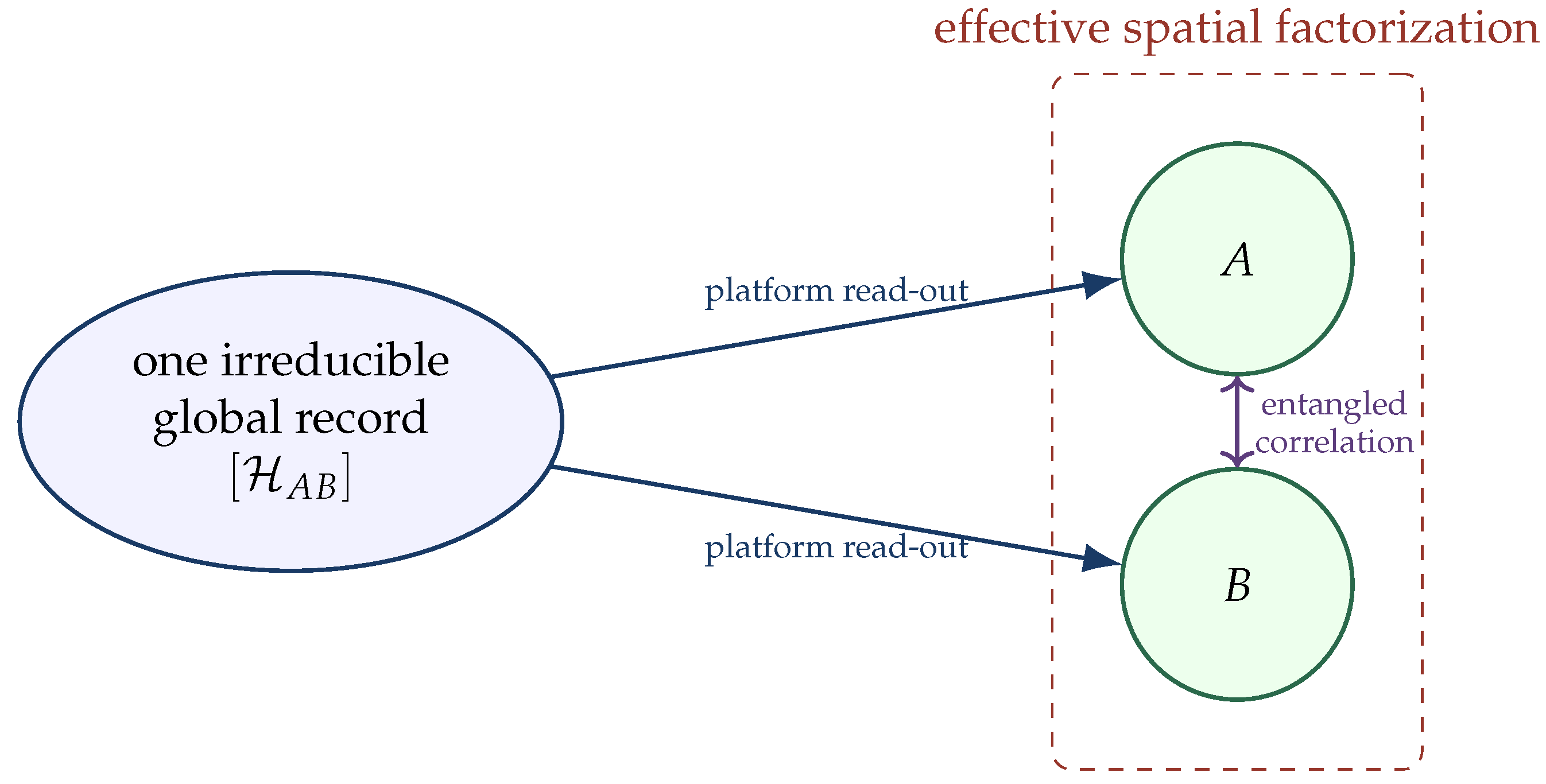
The reconstruction layer does not begin with labelled parts A and B. Those parts emerge when the read-out platform supports approximately independent local operations and records. Consequently, factorization at the read-out cannot simply be assumed to mirror a primitive factorization below it.
Bridge Hypothesis 5 (Composition bridge)For a chosen read-out factorization:
- 1.
- independently completable reconstruction classes read out as product states;
- 2.
- classically distinguishable alternatives among such completions read out as separable mixtures; and
- 3.
- a completed global class that admits neither decomposition reads out as a nonseparable state on the effective subsystem algebra.
Proposition 6
(Conditional composition correspondence). Under Bridge Hypothesis 5, if cannot be represented as a product completion or as a classical mixture of product completions relative to the read-out, then its quantum state is entangled across .
Proof.
If were separable, it would have a representation
By the converse direction declared in the composition bridge, this would be the read-out of a classical mixture of product completions, contrary to the hypothesis. □
Claim boundary. The proposition is an interpretive correspondence conditional on the composition bridge, not an independent derivation of entanglement. IRSP alone does not derive Hilbert-space tensor products or the full convex structure of quantum states. Its substantive content is the proposed physical meaning of entanglement: the effective signature of a global reconstruction record that cannot be resolved into independently completed parts. Deriving the bridge itself from completion theory remains open.
Figure 4.
Entanglement in the reconstruction picture. A global completed record need not factorize even when its read-out admits spatially separated subsystems A and B. The shared premetric ancestry is not a signal sent between the subsystems; it is what the post-read-out entangled state records.
Figure 4.
Entanglement in the reconstruction picture. A global completed record need not factorize even when its read-out admits spatially separated subsystems A and B. The shared premetric ancestry is not a signal sent between the subsystems; it is what the post-read-out entangled state records.
5.2. Correlation Without Superluminal Influence
This picture gives an intuition for quantum nonlocality without supplying a local hidden-variable model. Bell’s theorem excludes any theory that reproduces quantum correlations through local pre-existing values satisfying its factorization assumptions [29]. The reconstruction class is instead a single nonfactorizable object; it does not assign an independent local instruction set to each wing. Once the Lorentzian platform is read out, local operations still obey its causal restrictions, and the reduced state on one wing is unchanged by an unannounced choice of trace-preserving operation on the other. Global correlation therefore need not be interpreted as a controllable signal crossing an already existing distance.
6. Probabilistic Successor Actualization
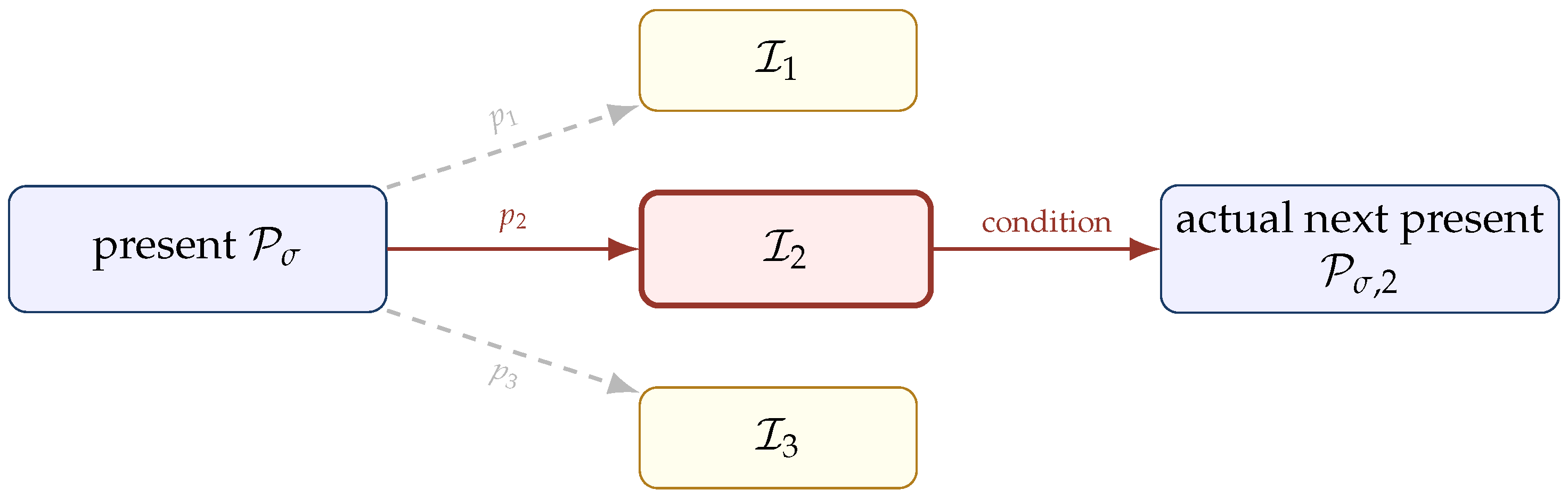
6.1. Admissible Successors Form A Quantum Instrument
Let be the state of the current present and let be a quantum instrument associated with an admissible record-making continuation. Each is completely positive and trace nonincreasing, while
is trace preserving [16,17,18]. The probability and conditioned successor state are
The unconditioned state
describes the ensemble obtained when the outcome record is ignored. It must not be confused with the one outcome-conditioned present actually recorded in an individual run.
Principle 7
(Present actualization). When an admissible continuation produces mutually exclusive IRSP-stable record sectors, exactly one sector α is actualized as the next present with probability , and the next quantum state is conditioned according to Equation ().
The principle does not say that the whole universe becomes classical. It says that a stable record is definite. Quantum coherence may remain within the selected sector and among degrees of freedom not resolved by the record algebra. The assertion that exactly one sector becomes actual is an ontological postulate of the present architecture, not a dynamical consequence of the instrument formalism or of IRSP alone. A microscopic theory must still explain when stable-sector actualization occurs and implement it covariantly.
6.2. Two Many-To-One Operations That Must Be Distinguished
The observable quotient and outcome conditioning are both many-to-one, but they solve different problems:
The quotient identifies presentations that never represented different physical possibilities. Actualization selects one outcome among genuinely different readable successor sectors. Confusing the two would either turn mere relabeling into stochastic physics or erase the distinction between observable outcomes.
6.3. No External Observer and No Continuous Projection
An instrument need not be applied by a consciousness. It is an effective description of an interaction that creates a stable, internally readable record. Detectors, memories, biological observers, and environmental copies are parts of the same reconstructed present.
Nor does the theory posit projective collapse at every arbitrarily small parameter step. Such a prescription would generically invite quantum-Zeno behavior and, in many collapse models, energy-balance difficulties. Between stable record actualizations, the effective state may evolve unitarily or by a continuous completely positive channel. Actualization is attached to IRSP-stable record formation, not to an externally imposed infinitely rapid sequence of observations.
Figure 5.
Successor actualization. The instrument specifies mutually exclusive stable record sectors and their probabilities. One sector is conditioned as the next present; the other sectors remain counterfactual possibilities for that occurrence. This diagram is explanatory, not a branching process in a pre-existing external time.
Figure 5.
Successor actualization. The instrument specifies mutually exclusive stable record sectors and their probabilities. One sector is conditioned as the next present; the other sectors remain counterfactual possibilities for that occurrence. This diagram is explanatory, not a branching process in a pre-existing external time.
6.4. Where The Preferred Record Basis Comes From
The well-known preferred-basis problem is not solved merely by writing an instrument. In the present framework the admissible record algebra is constrained jointly by three requirements:
- 1.
- environmental stability: interference between candidate records is suppressed on the relevant observational scale;
- 2.
- redundant readability: the record can be copied or independently accessed by internal observers; and
- 3.
- reconstruction descent: the record and its probabilities are unchanged by unread representative choices and remain identifiable under admissible continuation.
Decoherence supplies powerful dynamics for the first two requirements. IRSP supplies the third. A complete microscopic theory would still have to derive the record algebra and actualization rate for a concrete system. The present article does not claim that final step.
7. IRSP, Born Valuation, and Third-Order Interference
7.1. From Observable Descent To Noncontextual Event Weights
Let an event be represented by a projector P on a Hilbert space . The same physical event may occur in different complete measurement contexts, for example in two orthogonal resolutions of the identity that both contain P. It may also be obtained from different representatives of one reconstruction class. Different laboratory contexts are not automatically equivalent: they can change the apparatus, disturbance, boundary conditions, or physical event. The following bridge states the operational equivalence required before observable descent can be applied.
Bridge Hypothesis 8 (Descended event identity)If two implementations realize the same projector P, with the same preparation and record effect, and all remaining differences are operationally unread and belong to one observable reconstruction class, then they represent the same descended successor event. Contexts that change any readable part of the event are not identified by this bridge.
Lemma 9
(IRSP probability descent). If successor-event probability is an observable law satisfying Principle 2 and the implementations satisfy Bridge Hypothesis 8, then the probability assigned to an event depends only on the descended event P, not on its completed reconstruction representative or on which unread mutually exclusive alternatives accompany it in a measurement context.
Proof.
Bridge Hypothesis 8 establishes that the two implementations are presentations of the same descended event and differ only by -unread data. If their probabilities differed, the probability map would fail Definition 1. Such a map would not be a law on observable events and is inadmissible by IRSP. □
The lemma supplies a conditional physical route to noncontextuality of the probability valuation across operationally equivalent realizations. It does not assert that physically different measurement contexts have equal probabilities, nor that all observable values are noncontextual; the Kochen–Specker theorem forbids such an assignment in dimension at least three [28]. Only the weight of the same event is required to be independent of unread embedding context.
7.2. Conditional Born Representation
Assumption 10
(Quantum event valuation). For a Hilbert-space read-out with , successor-event weights obey:
- 1.
- positivity, ;
- 2.
- normalization, ; and
- 3.
-
exclusive additivity,for every finite or countable orthogonal family for which the sum is defined.
Theorem 11
(IRSP-conditioned Born representation). Under Lemma 9 and Assumption 10, there exists a unique density operator ρ such that
for every projector P on .
Proof.
Lemma 9 makes w a single noncontextual measure on the projector lattice. Positivity, normalization, and orthogonal additivity are the remaining hypotheses of Gleason’s theorem. The representation (6) and uniqueness of therefore follow [30]. Generalized-measurement extensions can include the two-dimensional case by taking positive-operator-valued events as primitive [31]. □
Physical intuition. IRSP does not determine the Born rule from the word “stability” alone. Its role is precise: after the event-identity bridge has established operational equivalence, IRSP forbids the event probability from changing when only unread bookkeeping or embedding context is changed. Once Hilbert-space events, positivity, normalization, and exclusive additivity are supplied, an established representation theorem fixes the density-operator Born form.
Textbook quantum mechanics normally takes the Born rule as a postulate. Theorem 11 instead gives a conditional reconstructional representation: IRSP motivates representative independence, while the Hilbert-event and additive-probability assumptions complete the hypotheses of Gleason’s theorem. This is an explanatory result, not a derivation of probability, Hilbert-space quantum mechanics, or exclusive additivity from IRSP alone.
7.3. Histories and the Absence of Genuine Third-Order Interference
Let denote mutually exclusive fine-grained successor-history classes, and let be their class operators. For disjoint alternatives, linear quantum composition gives
Define the quantum measure
The third-order Sorkin combination is
12
(No genuine third-order successor interference). If successor alternatives compose linearly as in Equation (7) and probabilities have the quadratic form (8), then
for every triple of mutually exclusive successor histories.
Proof.
Expanding each term in Equation (9), every diagonal term and every pairwise cross term appears with total coefficient zero. A quadratic functional contains no irreducible cubic cross term. The full cancellation is displayed in Appendix A. □
Remark 13.
Equation (10) is already a consequence of ordinary linear quantum mechanics with the Born rule; it is not separately postulated in standard quantum theory. The reconstruction claim is that the event-identity bridge and IRSP together motivate the representative-independent valuation to which the declared quantum-probability assumptions apply. A confirmed nonzerogenuine would therefore falsify the resulting bridge architecture as well as standard grade-two quantum measure theory [32].
Claim boundary. Raw three-path expressions need not vanish if “opening a path” changes the Hamiltonian or boundary conditions, if looped trajectories are omitted, if sources or detectors are nonlinear, or if multiparticle events contaminate the sample. The theorem concerns one fixed operational event algebra with properly calibrated mutually exclusive history classes. Section 11 turns this distinction into an experimental protocol.
8. Inherited Records and Acyclic Reconstruction
8.1. The Full Present has an Ancestry Ledger
The density operator of a small subsystem can return arbitrarily close to an earlier value. A spin can be rotated back to its initial state; a finite closed system can exhibit recurrences; and a memory register can be erased. These facts prohibit identifying temporal order with a scalar function of a reduced quantum state.
The full reconstruction boundary contains more. Let be the invariant ancestry ledger of : the partially ordered set of stable event records, including the relations required to establish which records constrain which later completions. Two ledgers related only by an unread relabeling represent the same element of the observable quotient.
Definition 14
(Record extension). A nontrivial actualization
is a proper record extension if there is an order-preserving embedding
whose image is a proper subledger and whose new element or relation records the actualization outcome.
This definition does not require every microscopic detail to be recoverable from a macroscopic observer’s memory. It requires the complete reconstruction class to inherit the physical consequences of its ancestry. An erased laboratory bit still leaves correlations in the environment and constraints on which global completions are admissible.
Assumption 15
(History inheritance). Every nontrivial stable-record actualization is a proper record extension in the sense of Definition 14; trivial representational updates remain within the same observable class.
Proper extension concerns the invariant ancestry of the complete reconstruction class. It does not require accessible memory, stored macroscopic information, or thermodynamic entropy to increase monotonically: records may be erased or become unread at the effective level while their relational ancestry remains part of the completed class. Accordingly, the following result is conditional on the no-deletion property asserted by Assumption 15.
8.2. Acyclicity Theorem
For a finite ledger, let be the maximum length of a chain. For a locally finite infinite ledger, the argument can be applied to every finite causal interval, or K can be replaced by inclusion order itself.
16
(Conditional acyclicity of full actuality). Under Assumption 15, no finite sequence of nontrivial actualizations can return to the same full quantum present:
If each extension adds a record above a maximal inherited chain, then
at every nontrivial step.
Proof.
Proper record extension gives
up to observable isomorphism. A strict finite inclusion chain cannot close onto its first member. Under the stated rank condition, the integer K strictly increases and supplies an explicit contradiction to recurrence of the full present. □
Corollary 17
(Reduced-state recurrence is compatible with becoming). Theorem 16 does not forbid for a subsystem S, or even the recurrence of a large effective state after coarse graining. It forbids only the recurrence of the complete outcome-conditioned reconstruction class and its ancestry ledger.
Physical intuition. The hands of a clock can return to twelve, and a quantum bit can return to its initial ray. The universe has not thereby returned to the same present, because the route, the records of the route, and the correlations created by it belong to the current boundary. The theory places becoming in this inherited relational order, not in the nonrecurrence of every reduced state.
8.3. Past, Present, and Future
The three temporal notions can now be stated without assuming a background flow:
- the past is the invariant ancestry encoded by the current ledger, not an independently existing region that must remain ontically present;
- the present is the current outcome-conditioned boundary ; and
- the future is the weighted set of admissible successor completions, not a collection of already actual records.
This is a growing-record ontology, but the growth variable is reconstruction order. Metric time appears only when a suitable family of physical clocks is read out.
9. Effective Quantum Dynamics and Emergent Time
9.1. From Reconstruction Steps to a Continuous Parameter
Let n label successive stable boundaries in reconstruction order. The label is discrete bookkeeping, not yet physical time. Suppose a read-out regime supplies approximately uniform clock records of duration and an unconditioned channel
Assume the family is differentiable at the identity:
uniformly on the relevant state domain. Setting gives the continuum limit
Proposition 18
Proof.
Equation (11) is the forward-Euler consistency condition for the generator . Stability plus consistency gives convergence of the product
on compact intervals as . This is the standard semigroup continuum limit. □
For a closed reversible read-out, complete positivity and reversibility lead to unitary conjugation and
For a norm-continuous Markovian open-system semigroup, the Gorini–Kossakowski–Sudarshan–Lindblad theorem gives
9.2. Conditioned Histories and Unconditioned Dynamics
The master equation governs an ensemble or a state for which particular outcome records are not conditioned. An individual present history follows a stochastic sequence
with probabilities given by Equation (4). Averaging over records recovers the channel
Thus stochastic actuality and deterministic effective state evolution are not rival descriptions; they answer conditioned and unconditioned questions.
9.3. Division Of Labor
Reconstruction does not replace the Schrödinger equation, quantum field theory, the Standard Model, or general relativity. It addresses why a stable state space, probability law, causal platform, and outcome record are available for those theories to use. Once the platform and its calibration are read out, conventional dynamics performs the evolution calculation.
Physical intuition. Reconstruction selects the stage, the admissible actors, the record book, and the rules by which one scene counts as a possible continuation. Effective physics calculates how amplitudes and fields evolve on that stage. The parameter t is supplied by stable clock correlations within the stage; it is not the parameter of a hidden premetric movie.
10. Relativistic Compatibility without a Global Now
10.1. Local Fronts and Spacelike Confluence
Let A and B be spacelike-separated record-forming regions in the read-out platform. Suppose and denote the associated local unconditioned operations, or particular compatible outcome maps when their records are jointly specified. A coordinate foliation may represent A first or B first, even though no invariant causal order exists between them. To avoid conflating the reconstruction quotient with a map on density operators, let denote the induced identification of quantum outputs that arise from observably equivalent completed reconstruction presentations.
Principle 19
(Spacelike confluence). If two local read-outs are spacelike separated and jointly admissible, their unread representation order cannot affect the descended joint present:
Proposition 20
(IRSP requires spacelike confluence). If exchanging the order of two spacelike-separated read-outs is an unread change of reconstruction representative, then any IRSP-admissible successor law satisfies Equation (15).
Proof.
The two ordered presentations represent the same causal partial order and differ only by a foliation convention. Observable descent therefore maps them to the same joint state. If the outputs differed observably, the successor law would depend on an unread representative and violate IRSP. □
For unconditioned local maps, confluence is the effective order-independence required by microcausal dynamics. For outcome maps, Equation (15) applies only when the same compatible pair of records is jointly specified and the conditioning convention is held fixed; it does not identify differently conditioned ensembles.
Figure 6.
Relativistic confluence. Two foliations may order spacelike record updates A and B differently, but both paths through the diagram must descend to the same joint present. Actuality is therefore attached to a causal reconstruction front, not to one preferred global simultaneity surface.
Figure 6.
Relativistic confluence. Two foliations may order spacelike record updates A and B differently, but both paths through the diagram must descend to the same joint present. Actuality is therefore attached to a causal reconstruction front, not to one preferred global simultaneity surface.
10.2. No-Signalling and Local State Updates
For a bipartite state , any trace-preserving operation local to B satisfies
so its unannounced application cannot change local statistics at A. Conditioned states can change when a particular outcome at B is specified, but using that change requires the corresponding classical record. The framework therefore adopts the ordinary operational no-signalling structure of relativistic quantum theory.
In continuum field theory the same idea is naturally expressed by Tomonaga–Schwinger evolution between spacelike hypersurfaces or by local algebras in algebraic quantum field theory [39,40,41]. The surfaces are alternative representations of causal advancement; no one surface is the metaphysically privileged present.
Claim boundary. Confluence is a necessary relativistic consistency condition, not a complete construction of relativistic collapse. A full model must specify local instruments for quantum fields, prove their covariance and microcausality, and control ultraviolet and gravitational effects. The present theory supplies the criterion such a model must satisfy.
11. Consistency Tests and Failure Conditions
11.1. Primary Consistency Test: Genuine Third-Order Successor Interference
The cleanest exact null condition inherited by the reconstruction architecture is Equation (10). Triple-slit experiments have already placed strong bounds on Born-rule violations [33,34,35]. For the present theory, a conceptually closer implementation would use three coherently controlled successor-history channels—for example time bins, paths, or qutrit transitions—that recombine into the same final record event.
For every subset , one measures the probability of that fixed final event under a calibrated implementation of the corresponding history class. The test statistic is
The architecture requires after all known context changes are included in the operational model. This is shared with ordinary linear quantum theory: a null result is compatible with reconstruction but does not uniquely support it, whereas a controlled nonzero result would invalidate the declared quadratic/linear bridge.
A credible experiment must demonstrate:
- 1.
- identical source preparation and final record effect for all settings;
- 2.
- a full scattering or channel model for boundary changes introduced by enabling and disabling histories;
- 3.
- control of multiparticle contamination, detector nonlinearities, drift, and dark counts;
- 4.
- inclusion of looped or nonclassical paths where relevant; and
- 5.
- a preregistered uncertainty budget and null analysis.
Nonlinear dynamics can mimic higher-order interference even when the Born rule is retained, so such effects must be bounded independently [36].
11.2. Secondary Consistency Test: Spacelike Order Confluence
A second null test implements two record-forming quantum operations at spacelike separation and reconstructs the joint process matrix in frames that reverse their coordinate ordering. After transforming detector settings and conditioning conventions consistently, the joint descended map must be order independent as in Equation (15). An observable foliation-order dependence that could not be attributed to ordinary communication, synchronization, or model error would falsify relativistic IRSP descent.
This prediction agrees with relativistic quantum theory; agreement would not uniquely confirm reconstruction. Its value is diagnostic: the theory states in advance which possible observations it cannot accommodate.
11.3. What Would Refute The Proposed Architecture?
The theory presently predicts no collapse rate, spontaneous heating, mass threshold, or mesoscopic visibility curve. Claiming one without deriving the required normalization would add a fitted phenomenological model rather than test the reconstruction framework. If a future completion derives such a scale, matter-wave interferometry, optomechanics, and macroscopic superposition experiments would become additional tests.

Table 2.
Principal failure conditions. Each condition targets a declared bridge or principle rather than a fitted parameter.
Table 2.
Principal failure conditions. Each condition targets a declared bridge or principle rather than a fitted parameter.
| Observation | Failed claim | Required interpretation |
|---|---|---|
| Context-dependent weight for the same descended event | IRSP probability descent | All physical changes of preparation and measurement must first be excluded. |
| Genuine | Quadratic Born valuation or linear history composition | Nonlinear evolution, multiparticle events, detector response, and boundary changes must be controlled. |
| Observable order dependence of spacelike read-outs | Spacelike confluence | Ordinary signalling and inconsistent conditioning must be excluded. |
| Stable record sectors that cannot be represented by any descended record algebra | Quantum-present and record bridge | The failure must concern physical records, not merely a different convenient basis. |
12. Discussion
12.1. What Is Derived, What Is Imported, and What Is Proposed
The argument is easiest to assess when its logical layers are kept separate.
This ledger prevents two opposite mistakes. One would dismiss the framework because it is not a conventional microscopic Lagrangian. At the premetric level no such Lagrangian is available, because fields, locality, measure, and time are read-out structures. The other would claim that IRSP alone proves all of quantum theory. It does not. Hilbert-space events, linear composition, and the reconstruction-to-quantum correspondence are substantive bridges whose deeper derivation remains part of the research program.
Table 3.
Status ledger for the construction.
| Layer | Content | Status |
|---|---|---|
| Reconstruction core | completion, observable quotient, IRSP, saturation, inherited ancestry | proposed selection framework; quotient and descent are standard mathematics |
| Quantum read-out | -observable algebra, state, record algebra, subsystem factorization | established quantum formalism plus explicit read-out and composition bridges |
| Actualization | one stable instrument outcome is the next present | ontological principle; no rate or microscopic trigger is yet derived |
| Probability | event-identity bridge, representative/context descent, positivity, normalization, orthogonal additivity | operational equivalence plus IRSP motivates descent; other hypotheses are declared quantum-probability assumptions |
| Born form | theorem by Gleason representation under the preceding hypotheses | |
| Third-order interference | exact algebraic consequence of linear amplitudes and a quadratic measure | |
| Temporal order | proper inheritance of the complete ancestry ledger | no-deletion bridge; conditional acyclicity is then a theorem |
| Effective dynamics | von Neumann or GKSL evolution | standard stable continuum/semigroup limit under declared regularity assumptions |
| Relativity | confluence of spacelike local read-outs | IRSP descent consequence if foliation order is an unread representative choice |
12.2. Novelty and Significance
No single mathematical ingredient used here is new. Quantum instruments, Gleason representation, decoherence, quantum measure theory, completely positive semigroups, and local relativistic algebras are established structures. The proposed advance is their organization around a new physical object: the history-bearing reconstruction boundary whose outcome-conditioned quantum read-out is the present.
That organization gives a unified answer to several questions usually treated separately:
- 1.
- why the complete present is a quantum state rather than a classical snapshot;
- 2.
- why entanglement can be understood as irreducible global record structure rather than influence travelling between already separate objects;
- 3.
- how operationally equivalent event weights can be made representative independent without imposing equality on physically different contexts;
- 4.
- how single-outcome actuality can be formulated as an observer-independent physical principle using stable record sectors;
- 5.
- why effective dynamical time can coexist with a more primitive acyclic order; and
- 6.
- why relativity requires local confluence rather than a universal instantaneous collapse surface.
The paper therefore aims to fill a genuine conceptual gap rather than modify successful laboratory quantum dynamics. Standard quantum theory says how to compute the possible outcomes and their probabilities. The reconstruction account asks what kind of invariant structure makes an outcome a present fact and makes further outcome probabilities well defined.
12.3. Platform-Relative Access and Invariant Agreement
The present analysis is conditional on the empirically observed platform supporting Hilbert-space quantum observables, stable memories, and a Lorentzian causal sector. It does not require a claim about realized alternative worlds or alternative physical laws. “Observer-conditioned” means only that a physical observer has access through the record algebra of the platform that sustains that observer; it does not mean that an observer chooses or creates the laws.
Within our platform, observer dependence does not mean arbitrary personal reality. Different observers’ records must embed consistently into one completed reconstruction class. When they later compare records, confluence and observable descent require agreement on their shared invariant content.
12.4. Limitations and Open Problems
The following problems remain open.
- 1.
- Hilbert-space emergence. The paper assumes a quantum read-out bridge; it does not derive complex Hilbert space, the tensor product, or complete positivity from completion theory alone.
- 2.
- Record algebra. Decoherence and redundancy help identify stable observables, but a universal reconstruction criterion selecting the exact record algebra remains to be proved.
- 3.
- Actualization law. Present actualization specifies what becomes definite but supplies no new rate, localization profile, or field-theoretic stochastic equation.
- 4.
- History inheritance. The ancestry ledger is defined structurally. Concrete relativistic quantum field models must exhibit it without violating locality or allowing physically meaningless infinite record proliferation.
- 5.
- Gravity. A generally covariant coupling between actualization, record structure, and dynamical geometry has not been constructed.
- 6.
- Unique empirical discrimination. The exact tests emphasized here are consistency and null tests shared with standard quantum theory. A future completion should derive a quantitative deviation or a new domain of applicability if reconstruction is to be distinguished empirically rather than only explanatorily.
These limitations are substantial, but they are also useful: they turn the theory of the present into a sequence of concrete mathematical and experimental questions rather than a purely verbal interpretation.
13. Conclusions
Physics has highly successful theories of dynamical evolution, causal geometry, thermodynamic asymmetry, and quantum probability, but no generally accepted theory of why one outcome-conditioned quantum situation is actual as the present. This paper has formulated a conditional reconstructional answer.
The starting layer is premetric: it contains no hidden clock, spacetime, particle inventory, symmetry group, or Lagrangian. Completion, observable quotient, saturation, and IRSP select invariant relational structures capable of indefinite continuation. Their history-bearing global class reads out as an effective platform containing an observable algebra, a quantum state, and a stable record algebra. The physical present is the resulting outcome-conditioned quantum boundary. Because the global record need not factorize into independently completed parts, the read-out can be intrinsically entangled.
Admissible successor records are represented by a quantum instrument. One stable sector is postulated to actualize with its conditioned state; no external observer is required, and unresolved correlations remain quantum. After operational event identity has been established, IRSP requires the probability of that descended event to be independent of unread representative and embedding-context choices. With positivity, normalization, exclusive additivity, and a Hilbert-space event structure, Gleason representation fixes the Born form. Linear alternative composition then yields the exact null condition of no genuine third-order successor interference, shared with ordinary quantum theory.
Under the declared proper-inheritance assumption, the complete ancestry class supplies an acyclic reconstruction order even when accessible records are erased or reduced quantum states recur. Stable small-step channels yield von Neumann or open-system master equations when clock records support a continuum limit. Relativistic compatibility is expressed through confluence of spacelike read-outs: alternative foliation orders must descend to the same joint present. Conventional spacetime time is therefore the calibrated dynamical parameter internal to the read-out platform, while becoming is the proper extension of the history-bearing boundary.
The strongest justified conclusion is neither that the measurement problem is fully solved nor that standard quantum mechanics must be replaced. It is that present actuality can be made into a precise quantum-reconstruction problem with explicit premises, conditional theorems, and direct failure conditions. The next decisive tasks are to derive the quantum and record bridges from common completion theory, construct a covariant microscopic actualization model without fitted parameters, and subject the successor interference and spacelike-confluence conditions to increasingly precise tests.
Funding
This research received no external funding.
Data Availability Statement
No new empirical data were created or analyzed in this study. All mathematical constructions and test criteria are contained in the article.
Conflicts of Interest
The author declares no conflict of interest.
Appendix A. Explicit Cancellation of Third-Order Interference
Write
For disjoint , linearity gives
Substitution into Equation (9) cancels each diagonal term: for example, has coefficients . Each pairwise interference term cancels between the three-history expression and its corresponding two-history expression. Since , , and no term remains. Hence .
The cancellation does not require decoherence between . Pairwise interference may be nonzero; only an irreducible third-order contribution is absent.
Appendix B. Compact Glossary and Logical Dependencies
| Term | Meaning in this article |
| Term | Meaning in this article |
| Premetric | Logically prior to metric distance, duration, causal cones, fields, and Lagrangian dynamics; not earlier in a hidden time. |
| Completion | Closure of a relational presentation under the declared admissibility and compatibility rules. |
| Observable quotient | Identification of completed presentations that no admissible read-out can distinguish. |
| IRSP | Existence condition requiring identity and readable law to survive every admissible continuation and to descend through the observable quotient. |
| Saturation | Retention of all inequivalent admissible completed channels after unread duplication is removed. |
| Neutral parent | One selected universal identity grammar prior to particle-specific charge, mass, representation, and localization; not a hidden particle. |
| Relational atlas | History-bearing invariant class of ancestry, channel, incidence, and anchor relations whose joint read-out supplies effective objects and localization. |
| Read-out platform | Effective causal, geometric, quantum, and record arena in which ordinary dynamics is defined. |
| Quantum present | History-bearing reconstruction class together with its observable algebra, quantum state, and actual stable record algebra. |
| Actualization | Selection and conditioning of one mutually exclusive stable record sector of a quantum instrument. |
| Reconstruction order | Partial order supplied by proper ancestry-ledger extension; it is not a premetric clock parameter. |
| Confluence | Equality of the descended joint result when spacelike local updates are represented in either coordinate order. |
Figure A1 summarizes the logical dependence of the principal results.
Figure A1.
Logical dependence of the central probability results. IRSP supplies representative and context descent; standard quantum-event assumptions complete the hypotheses of Gleason representation. The Born form then supports instrument probabilities, and with linear history composition it implies .
Figure A1.
Logical dependence of the central probability results. IRSP supplies representative and context descent; standard quantum-event assumptions complete the hypotheses of Gleason representation. The Born form then supports instrument probabilities, and with linear history composition it implies .
Appendix C. Abbreviations
The following abbreviations are used in this manuscript:
| IRSP | Indefinite Reconstruction Stability Principle |
| POVM | Positive-operator-valued measure |
| GKSL | Gorini–Kossakowski–Sudarshan–Lindblad |
| QFT | Quantum field theory |
References
- Einstein, A. Zur Elektrodynamik bewegter Körper. Ann. Phys. 1905, 322, 891–921. [Google Scholar]
- Minkowski, H. Raum und Zeit. Phys. Z. 1909, 10, 104–111. [Google Scholar]
- Stein, H. On Einstein–Minkowski space-time. J. Philos. 1968, 65, 5–23. [Google Scholar] [CrossRef]
- Savitt, S.F. There’s no time like the present (in Minkowski spacetime). Philos. Sci. 2000, 67, S563–S574. [Google Scholar] [CrossRef]
- Callender, C. What Makes Time Special? Oxford University Press: Oxford, UK, 2017. [Google Scholar]
- Boltzmann, L. Vorlesungen über Gastheorie; Barth: Leipzig, Germany, 1896. [Google Scholar]
- Gibbs, J.W. Elementary Principles in Statistical Mechanics; Yale University Press: New Haven, CT, USA, 1902. [Google Scholar]
- Lebowitz, J.L. Boltzmann’s entropy and time’s arrow. Phys. Today 1993, 46, 32–38. [Google Scholar]
- Zeh, H.D. The Physical Basis of the Direction of Time, 5th ed.; Springer: Berlin, Germany, 2007. [Google Scholar]
- Price, H. Time’s Arrow and Archimedes’ Point; Oxford University Press: Oxford, UK, 1996. [Google Scholar]
- Albert, D.Z. Time and Chance; Harvard University Press: Cambridge, MA, USA, 2000. [Google Scholar]
- Carroll, S. From Eternity to Here; Dutton: New York, NY, USA, 2010. [Google Scholar]
- Li, B. On the structural distinction between entropy and time in dynamical theories. Philosophies 2026, 11, 87. [Google Scholar] [CrossRef]
- von Neumann, J. Mathematische Grundlagen der Quantenmechanik; Springer: Berlin, Germany, 1932. [Google Scholar]
- Lüders, G. Über die Zustandsänderung durch den Messprozess. Ann. Phys. 1951, 443, 322–328. [Google Scholar]
- Davies, E.B.; Lewis, J.T. An operational approach to quantum probability. Commun. Math. Phys. 1970, 17, 239–260. [Google Scholar]
- Kraus, K. States, Effects, and Operations; Springer: Berlin, Germany, 1983. [Google Scholar]
- Nielsen, M.A.; Chuang, I.L. Quantum Computation and Quantum Information, 10th anniversary ed.; Cambridge University Press: Cambridge, UK, 2010. [Google Scholar]
- Zurek, W.H. Decoherence, einselection, and the quantum origins of the classical. Rev. Mod. Phys. 2003, 75, 715–775. [Google Scholar] [CrossRef]
- Schlosshauer, M. Decoherence and the Quantum-to-Classical Transition; Springer: Berlin, Germany, 2007. [Google Scholar]
- Ghirardi, G.C.; Rimini, A.; Weber, T. Unified dynamics for microscopic and macroscopic systems. Phys. Rev. D. 1986, 34, 470–491. [Google Scholar] [CrossRef] [PubMed]
- Bassi, A.; Lochan, K.; Satin, S.; Singh, T.P.; Ulbricht, H. Models of wave-function collapse, underlying theories, and experimental tests. Rev. Mod. Phys. 2013, 85, 471–527. [Google Scholar] [CrossRef]
- Everett, H., III. “Relative state” formulation of quantum mechanics. Rev. Mod. Phys. 1957, 29, 454–462. [Google Scholar] [CrossRef]
- Wallace, D. The Emergent Multiverse; Oxford University Press: Oxford, UK, 2012. [Google Scholar]
- Griffiths, R.B. Consistent histories and the interpretation of quantum mechanics. J. Stat. Phys. 1984, 36, 219–272. [Google Scholar] [CrossRef]
- Gell-Mann, M.; Hartle, J.B. Classical equations for quantum systems. Phys. Rev. D. 1993, 47, 3345–3382. [Google Scholar] [CrossRef] [PubMed]
- Rovelli, C. Relational quantum mechanics. Int. J. Theor. Phys. 1996, 35, 1637–1678. [Google Scholar] [CrossRef]
- Kochen, S.; Specker, E.P. The problem of hidden variables in quantum mechanics. J. Math. Mech. 1967, 17, 59–87. [Google Scholar] [CrossRef]
- Bell, J.S. On the Einstein Podolsky Rosen paradox. Phys. Phys. Fiz. 1964, 1, 195–200. [Google Scholar] [CrossRef]
- Gleason, A.M. Measures on the closed subspaces of a Hilbert space. J. Math. Mech. 1957, 6, 885–893. [Google Scholar] [CrossRef]
- Busch, P. Quantum states and generalized observables: A simple proof of Gleason’s theorem. Phys. Rev. Lett. 2003, 91, 120403. [Google Scholar] [CrossRef] [PubMed]
- Sorkin, R.D. Quantum mechanics as quantum measure theory. Mod. Phys. Lett. A 1994, 9, 3119–3127. [Google Scholar] [CrossRef]
- Sinha, U.; Couteau, C.; Jennewein, T.; Laflamme, R.; Weihs, G. Ruling out multi-order interference in quantum mechanics. Science 2010, 329, 418–421. [Google Scholar] [CrossRef] [PubMed]
- Jin, F.; et al. Probing the limits of Born’s rule in quantum mechanics with a triple-path interferometer. Phys. Rev. A 2017, 95, 012107. [Google Scholar]
- Pleinert, M.-O.; von Zanthier, J.; Lutz, E. Many-particle interference to test Born’s rule. Phys. Rev. Res. 2020, 2, 012051. [Google Scholar] [CrossRef]
- Namdar, P.; Kunjwal, R.; Sinha, U. Higher-order interference in the presence of nonlinear evolution. Phys. Rev. A 2023, 107, 032211. [Google Scholar]
- Gorini, V.; Kossakowski, A.; Sudarshan, E.C.G. Completely positive dynamical semigroups of N-level systems. J. Math. Phys. 1976, 17, 821–825. [Google Scholar] [CrossRef]
- Lindblad, G. On the generators of quantum dynamical semigroups. Commun. Math. Phys. 1976, 48, 119–130. [Google Scholar] [CrossRef]
- Tomonaga, S. On a relativistically invariant formulation of the quantum theory of wave fields. Prog. Theor. Phys. 1946, 1, 27–42. [Google Scholar] [CrossRef]
- Schwinger, J. Quantum electrodynamics. I. A covariant formulation. Phys. Rev. 1948, 74, 1439–1461. [Google Scholar] [CrossRef]
- Haag, R. Local Quantum Physics, 2nd ed.; Springer: Berlin, Germany, 1996. [Google Scholar]
- Li, B. Geometric origin of quantum waves from finite action. Quantum Rep. 2025, 7, 61. [Google Scholar] [CrossRef]
- Li, B. Emergent gravity from a non-metric substrate with gauge-theoretic structure. Rep. Adv. Phys. Sci. 2025, 9, 2550004. [Google Scholar] [CrossRef]
- Li, B. Topological classification of admissible reconstruction operations. Int. J. Topol. 2026, 3, 8. [Google Scholar] [CrossRef]
- Li, B. Particle structure from codimension-two carrier closure. Symmetry 2026, 18, 1154. [Google Scholar] [CrossRef]
- Li, B. A structural origin of the charged-lepton hierarchy. Symmetry 2026, 18, 1232. [Google Scholar] [CrossRef]
- Li, B. A Structural Prediction of the Fine-Structure Constant from the Invariant Capacity of Neutral Codimension-Two Holonomy Defects. Preprints 2026, 2026071775. [Google Scholar] [CrossRef]
Figure 1.
Map of the construction. The arrows give explanatory and reconstruction order, not motion in a pre-existing background time. Premetric possibilities are filtered into a history-bearing stable boundary. Its quantum read-out is generally entangled. Admissible successor sectors carry Born weights, and one outcome-conditioned sector supplies the next present and its inherited records.
Figure 1.
Map of the construction. The arrows give explanatory and reconstruction order, not motion in a pre-existing background time. Premetric possibilities are filtered into a history-bearing stable boundary. Its quantum read-out is generally entangled. Admissible successor sectors carry Born weights, and one outcome-conditioned sector supplies the next present and its inherited records.
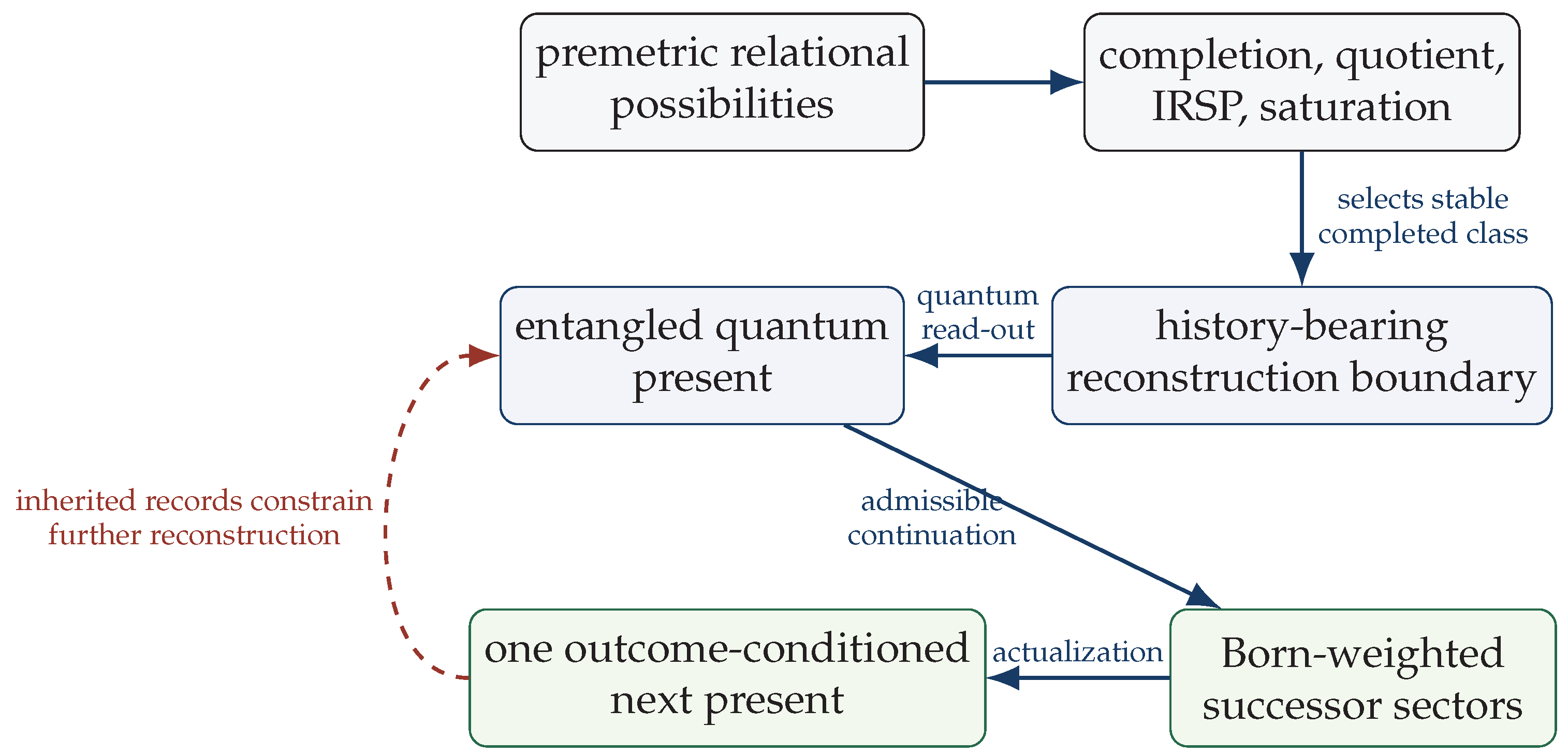
Table 1.
Previously reported no-fit reconstruction targets. Reference values and deviations are those quoted in the cited studies.
Table 1.
Previously reported no-fit reconstruction targets. Reference values and deviations are those quoted in the cited studies.
| Observable | Structural prediction | Reference value | Reported deviation |
|---|---|---|---|
| ; | |||
Disclaimer/Publisher’s Note: The statements, opinions and data contained in all publications are solely those of the individual author(s) and contributor(s) and not of MDPI and/or the editor(s). MDPI and/or the editor(s) disclaim responsibility for any injury to people or property resulting from any ideas, methods, instructions or products referred to in the content. |
© 2026 by the authors. Licensee MDPI, Basel, Switzerland. This article is an open access article distributed under the terms and conditions of the Creative Commons Attribution (CC BY) license (http://creativecommons.org/licenses/by/4.0/).
Copyright: This open access article is published under a Creative Commons CC BY 4.0 license, which permit the free download, distribution, and reuse, provided that the author and preprint are cited in any reuse.


