

Submitted:
01 August 2026
Posted:
04 August 2026
You are already at the latest version
Abstract
Introduction Trauma remains a leading cause of morbidity and mortality in the United States and places a substantial economic burden on the healthcare system. Although simulation-based training has been associated with improved trauma team performance and patient outcomes, whether emergency medicine simulation fellowship programs are associated with differences in trauma mortality remains unknown. This study examined whether counties with emergency medicine simulation fellowship programs differ in trauma mortality rates compared with counties without such programs. Methods County-level trauma mortality data (2021–2023) were obtained from the CDC WONDER Multiple Cause of Death database. The database was queried by county, year, and external cause of death. Trauma-related deaths were identified using ICD-10 external cause-of-death codes corresponding to blunt and penetrating injuries, excluding suicide. Counties with emergency medicine simulation fellowship programs were identified through publicly-available fellowship directories and classified according to the presence or absence of a simulation fellowship program. Trauma mortality rates were calculated by dividing the total number of trauma-related deaths by the cumulative county population for counties with and without simulation fellowship programs. The two mortality rates were compared using the rate ratio, 95% confidence interval, and P value calculated with the MedCalc online statistical calculator. Results Trauma mortality was 8.0 per 100,000 population in counties with emergency medicine simulation fellowship programs compared with 3.3 per 100,000 population in counties without fellowship programs (rate ratio, 2.45; P<0.0001). Conclusion Contrary to our hypothesis, counties with emergency medicine simulation fellowship programs demonstrated higher trauma mortality rates. Because these programs are predominantly located in urban counties, these findings may reflect greater injury severity and higher emergency department volume rather than effects of the fellowship programs themselves. These factors should be considered when interpreting the association between emergency medicine simulation fellowship programs and trauma-related mortality.
Keywords:
emergency medicine
; simulation fellowship
; simulation-based training
; trauma mortality
; medical education
Introduction
Trauma remains one of the leading causes of morbidity and mortality globally accounting for nearly 9% of all deaths in the world. In the United States, traumas are the primary cause of death in individuals aged up to 50 and remain the number one contributor of years of life lost. In 2016, trauma was responsible for 29.2 million visits to emergency departments and 39.5 million visits to physician offices across the United States.[1] The rate of trauma mortalities has increased in the United States for over 25 years and continues to rise, marking traumas as an ongoing public health issue with immense burdens and strains on our healthcare systems. Estimates include a cost of $670 billion annually, encompassing medical expenditures and loss of productivity. However, trauma networks and research continue to be underfunded, comprising only 2.9% of the National Institutes of Health’s extramural budget in 2016. Despite the present barriers, trauma systems are designed to deliver the best possible care, covering everything from prevention initiatives and coordinated trauma center networks to organized research efforts. [2]
In emergency departments (EDs), technical and non-technical errors are consistently identified as root causes of delays and poor patient outcomes. Delivering high-quality, safe care requires a range of skills - including knowledge, procedural skills, communication, teamwork/coordination, leadership, decision-making, coordination, and collaboration. These demands highlight the need for more-realistic training scenarios than those traditionally used in medical education.[3]
Simulation-based training (SBT) has emerged as a means to accomplish these and address latent safety threats. Within the last several decades, technology, including virtual reality, mannequins, software, and sophisticated use of standardized participants, evolved rapidly. Each of these modalities have been used to create scenarios to bridge theory and practice in trauma care without risks to patients during training. SBT significantly improves technical skills such as those found in the Advanced Trauma Life Support (ATLS) protocol, including airway and circulation management. SBT also improves non-technical skills related to communication, leadership, and teamwork. A recent study showed a 42% reduction in risk-adjusted pediatric trauma mortality at institutions with high simulation volume. [4]
Over 90% of EM residency programs in the United States have implemented simulation in their curriculums. Additionally, there are currently over 50 established emergency medicine (EM) simulation fellowships. Skill development amongst Sim Fellows varies depending on the exposure to educational opportunities and requirements of the programs. [5] Over 1-2 years of training, Fellows master curriculum design, high-fidelity mannequin operation, in-situ simulation, debriefing, and research methods. Oftentimes, many Fellows become directors at various simulation centers across the country, often remaining in the same locale post-training. [5] Institutions with fellowships conduct frequent, high-fidelity simulation training, which has been linked to lower mortality in American College of Surgeons Trauma Quality Improvement Program analyses. However, regions with limited simulation infrastructure may see fewer benefits typically associated with higher training volume. [4]
Although numerous studies demonstrate improved trauma team performance following simulation interventions, few have examined whether improved trauma patient outcomes are observed in areas with simulation fellowship programs. This ecological study attempts to examine whether the presence of EM simulation fellowships is associated with decreased trauma mortality. We hypothesize areas with such fellowships will have a significantly-lower trauma mortality rate compared to those without. One assumption underlying this project is that physicians stay in the local geographic area where they train, so they apply in their post-graduate academic or non-academic roles what they learned during their residency- or fellowship-based trauma simulation trainings. Studies have found this largely to be true. Nationally, across all medical specialties, about 57% of physicians who completed residency from 2013–2022 practice in the same state as their residency training (per AAMC Report on Residents data); [6] 62% of family medicine residency graduates, [6] and approximately 40% of EM graduates, [7,8] stay to practice in the location they trained.
Methods
Publicly-available data was obtained from Centers for Disease Control and Prevention (CDC) WONDER Multiple Cause of Death. The database was queried and filtered by county, year, and “external cause of death,” between the years 2021-2023 to capture the most-recent years, as there have been several new simulation fellowship programs started in the last few years. We filtered cause of death to capture only those from blunt or penetrating traumas by any cause other than suicide. Deaths were identified using ICD-10 external cause-of-death codes corresponding to these traumatic injuries.
Counties containing Simulation Based Training (SBT) fellowships were identified via publicly-available fellowship directories and institutional websites. Counties were classified as either possessing no simulation fellowship program or having one or more simulation fellowship. Each county’s trauma mortality data was characterized according to whether that county had no simulation fellowship or had one or more simulation fellowship.
To calculate the overall trauma mortality rate, the sum of the total number of trauma-related deaths meeting the inclusion criteria (unintentional and homicide deaths) within each county over the three-year period was divided by the sum of the total population of each county over the same three-year period. The total mortality rates were aggregated for the counties containing fellowship programs and for the counties that did not contain fellowship programs.
Study data were collected and managed using REDCap electronic data capture tools hosted at Northwell Health. [9,10] REDCap (Research Electronic Data Capture) is a secure, web-based software platform designed to support data capture for research studies, providing 1) an intuitive interface for validated data capture; 2) audit trails for tracking data manipulation and export procedures; 3) automated export procedures for seamless data downloads to common statistical packages; and 4) procedures for data integration and interoperability with external sources.
A statistical analysis of the comparison of the two total mortality ratio values obtained for (each group) the counties with SBTs and the counties without SBTs was conducted using MedCalc online statistical calculator (MedCalc Software Ltd., Ostend, Belgium). Statistical significance was set a priori as p <0.05.
This project was reviewed and deemed not to meet the definition of research by the Northwell Health Institutional Review Board’s (IRB’s) Human Research Protection Program (HSRD24-0133), indicating formal IRB approval was not required. All observations were collected in compliance with institutional guidelines for patient privacy and data security.
Results
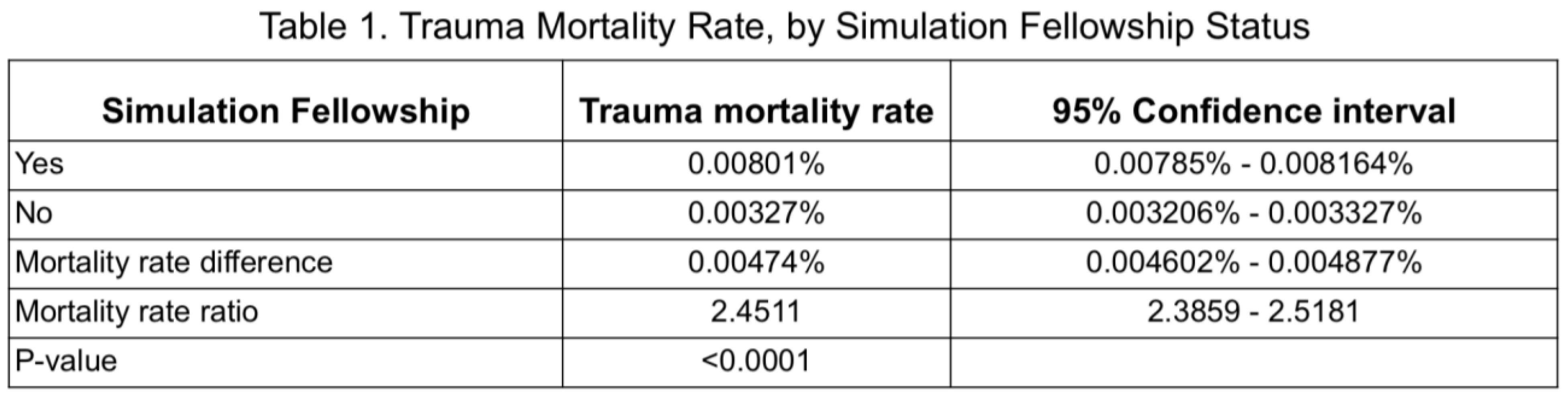
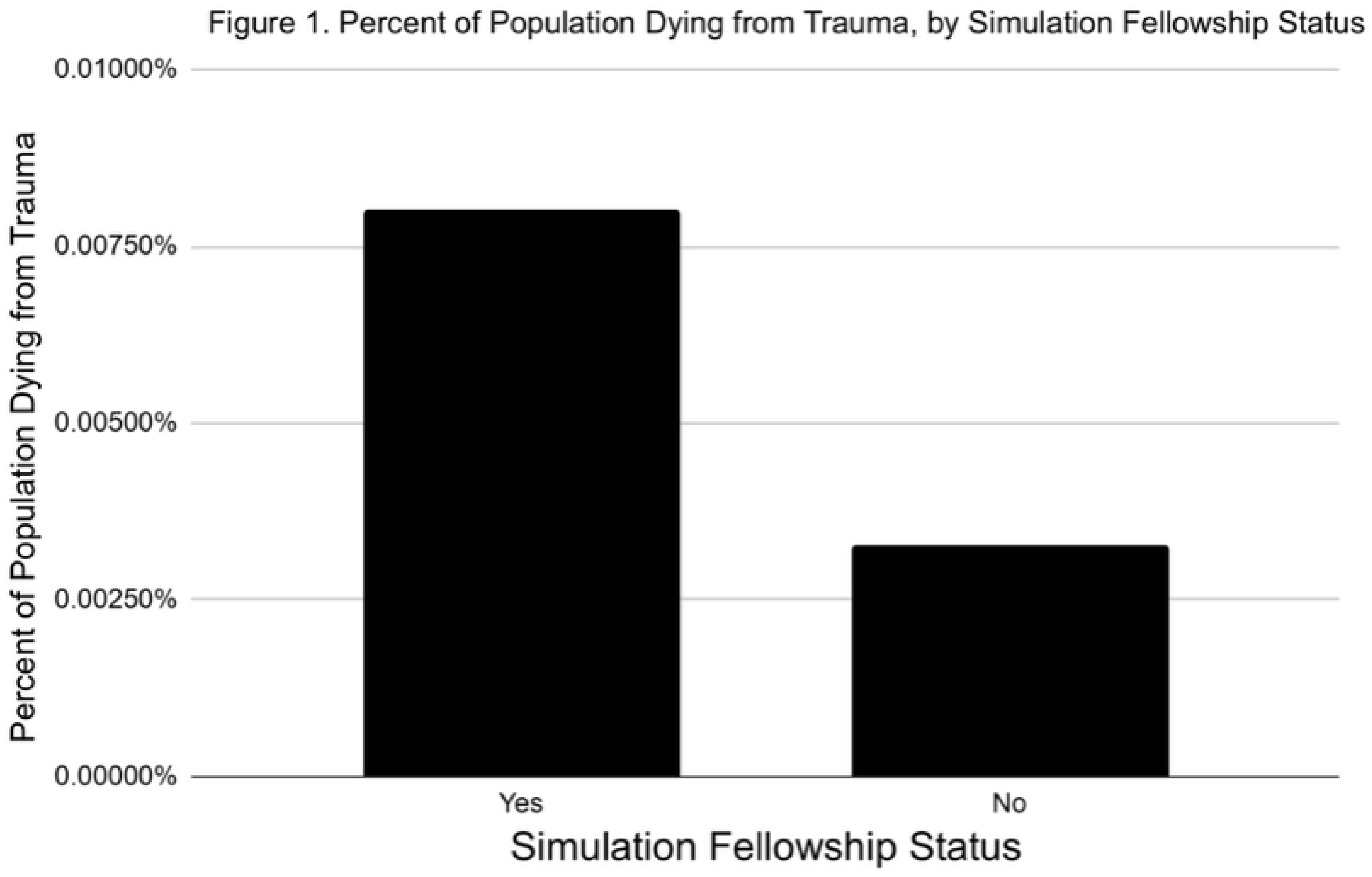
Contrary to our hypothesis, locations with a simulation fellowship had trauma mortality rates more than twice that of those without a simulation fellowship (8.0 vs. 3.3 per 100,000, p <0.0001). In areas with a fellowship, 0.00801% of the population died from trauma vs. 0.00327% in areas without a fellowship. (Table 1, Figure 1)
Discussion
This study found that counties with emergency medicine simulation fellowships had a significantly-higher trauma mortality rate than those without such fellowships, which contradicts our hypothesis. A likely explanation includes the fact that all of these fellowships are located in counties that are mostly urban. While the percent of trauma from motor vehicle collisions was 31% in both urban and rural populations, a greater percent of urban trauma was from penetrating causes (eg, gunshots, stabbings) as well as struck pedestrians. [11] The severity of the injuries plays a major role in the patient outcomes, as more-severe cases may result in complications that are not in the control of ED staff even if they have been trained with simulation fellowships. Urban EDs tend to have a higher volume of patients than rural EDs. Recent research studies have identified predictable patterns in ED overcrowding of urban hospitals, which unequally affect patient populations. [12] Higher ED caseloads could result in delayed response times and divided attention per patient, negatively impacting quality of patient care. It is also possible that urban ERs are understaffed during overcrowding. These uncontrolled variables in urban populations hinder the accurate assessment of the impact of these emergency medicine simulation fellowships on mortality.
Limitations
The study was based on public data from the CDC WONDER database, which did not specify whether the patients treated for trauma within the counties included were treated by physicians and ED staff who participated in trauma-related SBT prior to treating them. This study also assumes that doctors who participate in a SBT program stay within the same county, but this is only true for 40% of graduates. [9] Hence, there is a greater chance that trauma patients were treated by physicians who did not participate in a SBT based in their respective counties, if at all. In addition, SBT curricula vary by county; [13] even if a physician had participated in trauma-related SBT in one county, the topics covered in SBT in that county might not be applicable to causes of trauma mortality in a county in which they later practice. This emphasizes the importance of participation in county-specific SBT programs.
The database provides the mortality rate of trauma patients in each county, but it does not provide sufficient information to determine case fatality, which is the percentage of patients who had died from the specific trauma for which they were triaged. This poses a limitation to the study, as case fatality is a better marker of the effectiveness of SBT programs on trauma outcomes. It is possible that patients may have comorbidities, unrelated to the trauma incident, affecting patient outcomes by skewing mortality rates. Additionally, all data collected pertaining to this study was only in the timeframe between the years 2021-2023 and it was also filtered to exclude suicide.
References
- FastStats - Accidents or Unintentional Injuries. Available online: https://www.cdc.gov/nchs/fastats/accidental-injury.htm (accessed on 3/25/26).
- Choi, J.; Carlos, G.; Nassar, A.K.; Knowlton, L.M.; Spain, D.A. The impact of trauma systems on patient outcomes. Curr. Probl. Surg. 2021, 58, 100849. [Google Scholar] [CrossRef] [PubMed] [PubMed Central]
- Zhang, C. A Literature Study of Medical Simulations for Non-Technical Skills Training in Emergency Medicine: Twenty Years of Progress, an Integrated Research Framework, and Future Research Avenues. Int. J. Environ. Res. Public Health 2023, 20, 4487. [Google Scholar] [CrossRef] [PubMed] [PubMed Central]
- Jensen, A.R.; McLaughlin, C.; Subacius, H.; McAuliff, K.; Nathens, A.B.; Wong, C.; Meeker, D.; Burd, R.S.; Ford, H.R.; Upperman, J.S. Simulation-based training is associated with lower risk-adjusted mortality in ACS pediatric TQIP centers. J. Trauma Acute Care Surg. 2019, 87, 841–848. [Google Scholar] [CrossRef] [PubMed]
- Emergency Medicine Residents’ Association. Simulation fellowship, 3rd ed.; [EMRA Fellowship Guide]; 2023; Available online: https://archive.emra.org/books/fellowship-guide-book/23-simulation.
- American Board of Family Medicine. Where Residents Train Is Where They Stay — And That Has Consequences for Primary Care Access. Available online: https://www.theabfm.org/insight/where-residents-train-is-where-they-stay-and-that-has-consequences-for-primary-care-access/ (accessed on 7/3/26).
- Steele, M.T.; Schwab, R.A.; McNamara, R.M.; Watson, W.A. Emergency medicine resident choice of practice location. Ann. Emerg. Med. 1998, 31, 351–357. [Google Scholar] [CrossRef] [PubMed]
- Steele, M.T.; Watson, W.A.; Ma, O.J. Percentage of emergency medicine residency graduates who got their first choice of jobs did not change between 1995 and 1997. Am. J. Emerg. Med. 2000, 18, 152–155. [Google Scholar] [CrossRef] [PubMed]
- Harris, P.A.; Taylor, R.; Thielke, R.; Payne, J.; Gonzalez, N.; Conde, J.G. Research electronic data capture (REDCap) – A metadata-driven methodology and workflow process for providing translational research informatics support. J. Biomed. Inform. 2009, 42, 377–381. [Google Scholar] [CrossRef] [PubMed]
- Harris, P.A.; Taylor, R.; Minor, B.L.; Elliott, V.; Fernandez, M.; O’Neal, L.; McLeod, L.; Delacqua, G.; Delacqua, F.; Kirby, J.; Duda, S.N. REDCap Consortium. The REDCap consortium: Building an international community of software partners. J. Biomed. Inform. 2019. [Google Scholar] [CrossRef] [PubMed]
- Lipsky, A.M.; Karsteadt, L.L.; Gausche-Hill, M.; Hartmans, S.; Bongard, F.S.; Cryer, H.G.; Ekhardt, P.B.; Loffredo, A.J.; Farmer, P.D.; Whitney, S.C.; Lewis, R.J. A comparison of rural versus urban trauma care. J. Emerg. Trauma Shock. 2014, 7, 41–46. [Google Scholar] [CrossRef] [PubMed] [PubMed Central]
- Alvee, Md Saifullah and Rahman, Mizanur and Chowdhury, Tahmidur Rahman, Data Analytics for Reducing Emergency Room Overcrowding in Urban US Hospitals (July 31, 2025). Available online: https://ssrn.com/abstract=5374975. [CrossRef]
- Wehbi, N.K.; Wani, R.; Yang, Y.; et al. A needs assessment for simulation-based training of emergency medical providers in Nebraska, USA. Adv. Simul. 2018, 3, 22. [Google Scholar] [CrossRef] [PubMed]
Disclaimer/Publisher’s Note: The statements, opinions and data contained in all publications are solely those of the individual author(s) and contributor(s) and not of MDPI and/or the editor(s). MDPI and/or the editor(s) disclaim responsibility for any injury to people or property resulting from any ideas, methods, instructions or products referred to in the content. |
© 2026 by the authors. Licensee MDPI, Basel, Switzerland. This article is an open access article distributed under the terms and conditions of the Creative Commons Attribution (CC BY) license (http://creativecommons.org/licenses/by/4.0/).
Copyright: This open access article is published under a Creative Commons CC BY 4.0 license, which permit the free download, distribution, and reuse, provided that the author and preprint are cited in any reuse.


