

Submitted:
03 August 2026
Posted:
04 August 2026
You are already at the latest version
Abstract
It has become increasingly clear to organizations that future decision-making, production optimization, and competitive edge within a digital economy would largely be data-driven and dependent on systematic collection and use of a data-driven approach necessary to rationalize strategic decision-making, the need to develop an organizational culture that enhances digitalization of business process activities becomes imperative to survive in a digital economy. As enterprises rapidly undergo digital transformation with various advanced digital technologies, they strive to implement measures to adapt their organizational culture to the changing economy in other to remain competitive and survive. Organizations have had to continuously adapt their business processes to the dynamic nature of the digital industry to support their businesses and provide value. The current advances in the digital space have provided enterprises with the opportunities to digitalize their business processes, integrating various advanced digital technologies such as artificial intelligence, robotics, and machine learning to automate and optimize business processes and boost workplace operational efficiency and productivity. As the society undergo digital transformation, enterprises are faced with the constant need to integrate new digital infrastructure to power their business processes, provide business value, and remain competitive in a dynamic market economy. While some organizations have immensely benefited from the integration of advanced digital technologies to support business processes others are facing challenges from stiff organizational culture, such as resistance from employees, due to fears of job loss. A Systematic Literature Review SLR was adopted to review 150 existing scholarly studies on organizational cultures thriving well in a digital society. Findings from the study review identifies the most effective adaptive organizational culture dimensions that support digital transformation and Industry 4.0 adoption. Findings reveal that learning culture, innovation culture, collaborative culture, agile culture, data-driven culture and Leadership support culture are the strongest predictors of successful digitalization. Hierarchical and rigid bureaucratic cultures were repeatedly linked to slow adoption and resistance to change .The study reveal a significant relationship between organizational culture and successful digitalization and integration of new digital technologies.
Keywords:
digital economy
; organizational culture
; Internet of Things IoTs
; artificial intelligence
; digitalization
; cloud computing
; big-data analytics
1. Introduction
The current advances in digital economy have provided enterprise with immense opportunity to optimize business process activities, automate repetitive business process, improve employee engagement, and increase productivity to remain competitive. While some enterprise have successfully integrated advanced digital technologies to drive new innovative business models, others are facing resistance from organizational culture that have over the years shaped employees behavior and guided their values and beliefs, providing the standards and values of how they interact with and use the enterprise business process infrastructures to provide business value in the society. Organizational culture has been the norms and shared values that guide the way an enterprise deliver and provide business value within the society. It has also been the propellant that has enhanced and galvanized the fear and resistant’s from employees for fear of job loss to AI. This has shaped employees interaction and the ability to work together while adjusting to the changes within the digital landscape. Business success follows when it cultivates a strong organizational culture that generates innovative ideas and motivates employees [14]. With the current advances in digital ecosystem, enterprise must reassess their cultural structures to help advance the integration of digital technologies into their business processes in other to conform to the current advances in the digital space as digital transformation is critical for enterprise to remain competitive in today’s fast-paced digital world. Digitalization provides enterprise with immense opportunity to optimize business process activities, automate repetitive business process, improve employee engagement, and increase productivity to remain competitive. While some enterprise have successfully integrated advanced digital technologies to drive new innovative business models, others are facing resistance from organizational culture that have over the years shaped employees behavior and guided how they provided business values.
The current advances in the digital space has significantly increase the drive towards digitalization of business process tools to optimize operational efficiency, drive new business models and provide better business value [33]. A societal shift toward appreciating independent work with meaningful objectives is driving this transformation. This has enabled various enterprises to increasingly invest in digital infrastructure and enterprise architectures in various industries. Artificial intelligence and machine learning has provided enterprises with the opportunity to automate their business processes and significantly optimize productivity. Empirical studies acknowledged that a healthy organizational culture is one of the most important drivers and an important factor that impacts the success of an enterprise business process [45]. Enterprise with robust organizational culture can easily adopt industry 4.0 digital technologies to optimize their business process. The current industrial revolution with Industry 4.0 has enabled enterprise to focus on digitalization measures with the use of digital technologies to execute business process activities and to automate production process, optimize operational efficiency, and provide better business value to meet consumer needs in the current digital economy. Digitalization of business process provides enterprises with ideas of new business models.
While these digital technologies deliver multiple advantages across various industries yet current workplace organizational cultures and structures have either hindered or impeded their rapid adoptions and deployment in certain organizations. The drive towards digitalization’s with industry 4.0 digital technologies to provide new innovative business models, optimize existing business process, boost productivity, increase and consumer base, drive new business model has enabled enterprises to once again examine how their culture can support the rapid integration and implementation of digitalization strategies to empower and drive their business process in the new digital age [12]. Despite abundant research on organizational culture most scholarly studies have done little to explore its impact on AI and industry 4.0 technologies adoption within enterprises. Research on AI and workplace automation generates meaningful data about the effects of these technologies on jobs, productivity rates, and employee satisfaction levels. Most studies on industry 4.0 digital technologies and AI concentrate on technical details or economic results, while neglecting its subtle impacts on organizational culture [1,45].
While there are various types of organizational cultures, enterprise cultivate, practice and adheres to cultures that best supports there business models towards their mission statement and goal. This study examines the mutual impact of organizational culture to successful implementation and deployment of industry 4.0 digital technologies technologies to help support and optimize workplace business processes and productivity, have increasingly impacted organizations culture to remain competitive within the market economy.
The objective of this study is-To examine the relationship between culture and digital technology adoption. To assess the impact of culture on business process optimization. To evaluate the role of leadership and employee readiness in digitalization. And finally, to propose a framework for culture-driven digital transformation.
1.1. Research Question
The following research Question RQ are used to provide and serve as guide for this study.
RQ1: How do different organizational culture affect the success of digitization initiatives?
RQ2: Which organizational culture has the highest digitalization success for digital transformation?
The study used this research question to examine the impact of organizational culture on deployment of digital technologies within an enterprise.
1.2. Theoretical Framework
This research study applied Organizational Culture Theory as a primary lens and framework to analyze the impact of culture within an enterprise on digitalization initiatives and implementation of industry 4.0 digital technologies [78]. Organizational Culture Theory argues that organizational culture consists of shared beliefs, values, and norms that determine how members behave and communicate. Schein’s Model (1985) provides a framework to analyze AI’s cultural impact across three levels: (i) Artifacts: Visible changes (e.g., AI tools replacing meetings). (ii) Espoused Values: Shifts in stated priorities (e.g., ‘data-driven’ over ‘intuition-based’ decisions). (iii) Basic Assumptions: Unconscious beliefs (e.g., trust in algorithms vs. human judgment). Case studies like Microsoft’s AI ethics committees illustrate how governance structures (artifacts) reflect new values (transparency). AI adoption generates changes in organizational workflows and decision-making procedures, along with transformations in cultural norms and practices [2,5,6,7,8,9]. This theoretical perspective maintains that organizational culture develops through continuous interactions between member of the organization and its systems. The rapid adoption of effective digital technologies to support and optimize business processes within an enterprise is a by-product of the culture that pervade within the enterprise and the interaction between technology in work practices and organizational culture creates a mutual shaping process that becomes critical during the implementation of disruptive technologies such as AI [14].
This research study utilizes a systematic literature review SLR approach to critically examine 150 scholarly studies on organizational culture, the impact mechanism of each organizational culture on the adoption of AI digitalization technologies to support business processes in a digital economy. The study adopts an interdisciplinary theoretical framework that integrates classical Organizational Culture Theory. with core Information Systems (IS) and Information Management theories to examine the impact of Artificial Intelligence (AI), Machine Learning (ML), and automation on organizational culture within a dynamic digital economy. This approach suggests that advanced digital Organizational Culture, AI and Automation technologies intersect with organizational values, leadership, and behavioral systems to drive or hinder digital transformation outcomes [13].
This theoretical perspective allowed the researchers to gain a detailed understanding of the impact of culture on AI technology’s adoption, leadership styles, and organizational structure, as industries constantly grapple with successive digital transformations to update and enhance operational efficiency. This research utilizes a systematic literature review approach to thoroughly examine existing literatures on organizational cultures impact on AI, adoption to support and optimize business processes and provide business value.
The Systemic Literature Review SLR approach delivers an objective combination of existing research by adhering to a structured methodology known as Preferred Reporting Items for Systematic Reviews and Meta-Analyses (PRISMA). The structured approach facilitates literature search and selection of organizational cultures while promoting transparency through detailed reporting of study selection criteria and search and data extraction processes.
1.3. Digital Technology Theories
1.3.1. Technology Acceptance Model (TAM)
The Technology Acceptance Model (TAM) explains how users accept and use new technologies based on perceived usefulness (PU) and perceived ease of use (PEOU).This research extends the Technology Acceptance characteristics of innovations that influence their adoption: relative advantage, compatibility, complexity, trial ability, and observability. This framework is used in the study to understand how AI and automation innovations diffuse unevenly across organizational contexts based on existing cultural configurations. Cultural resistance stems from underlying tensions between legacy norms and the uncertainty introduced by disruptive innovations [11,15]. This study contributes to TAM theory by demonstrating that the cultural compatibility of AI innovations, the alignment of new technologies with the organization’s belief systems, and leadership orientation play a central role in determining the adoption of innovation and the success of digital transformation.
1.3.2. Sociotechnical Systems Theory (STS)
STS theory highlights that technological changes alone are insufficient to guarantee positive outcomes unless accompanied by corresponding adjustments in social structures and work culture. The interaction between cultural practices and AI implementation is examined to reveal how a lack of social readiness, such as a lack of ethical clarity, transparency in communication, and digital literacy, can lead to system failure despite technical success [16,23,24,25,26,27,28,29,30,31,32,33,34]. This study thus positions culture as a core subsystem in the digital transformation process and contributes to STS by exploring the mechanisms through which culture moderates the performance, adoption, and resistance of AI systems.
1.3.3. IS Success Model (DeLone & McLean, 2003)
The IS Success Model identifies six interdependent dimensions: system, information, service, quality, user satisfaction, and net benefits. Although the model primarily evaluates system-level outcomes, this study introduces cultural adaptation as a missing link between system deployment and realized benefits [31,34].
The model is enhanced by demonstrating that even with high system quality, AI initiatives may still fail if the organizational culture is misaligned [56,61]. A technically robust AI tool may result in poor user satisfaction or minimal use if the enterprise culture lacks trust in automation or perceives it as threatening human expertise [78,81]. Inversely, a supportive culture can amplify net benefits such as operational efficiency, strategic agility, and increased employee engagement. This study contributes to the IS Success Model by introducing the concept of "culture-system fit," referring to the degree to which organizational norms, behaviors, and leadership align with the logic and architecture of AI systems as a determinant of digital transformation success [54,55,56,57,58,59,60,61,62,63].
1.3.4. Synthesis of Theoretical Integration
The integration of Organizational Culture Theory with TAM, STS, and the IS Success Model creates a robust theoretical foundation for understanding how AI and ML systems are internalized, adapted, or resisted in practice. While technology-focused models explain acceptance and system effectiveness, this study adds cultural depth by exploring how organizational identity, leadership values, and employee beliefs mediate these effects. The proposed AI–Culture–Performance (AICP) Framework integrates these perspectives to demonstrate how cultural adaptation leads to successful technological transformation, which in turn influences organizational performance outcomes, including agility, innovation, efficiency, and strategic alignment [45,65]. The study analyzed extracted data from existing literatures to discover prevalent themes and trends while identifying gaps in literatures on related topic for future study. The study presented findings through narrative descriptions complemented by tables and figures. The systematic review demonstrates rigorous methods but also presents certain constraints. The chosen databases and time frame (2015–2026) for this study might have omitted important studies that appeared outside these parameters or in non-included databases, which results in possible research findings gaps. AI technology progresses quickly, so the literatures examined might not reflect current advancements or new trends.
2. Literature Review
Organizational culture is evolving rapidly to keep up with the pace of evolution of AI digital technologies as it must evolve as quickly as the technological advancement to support business processes and provide business value in a dynamic digital society [7]. Traditional hierarchical organizational structures can no longer be relied upon to support the current evolution of digital technologies for real-time decision-making capabilities of business process activities as it is evolving into a flat organizational models that focus on collaboration, offer greater flexibility, and empower employees along functional lines to play more proactive role in the decision-making process [11,78].The combination of advanced computing technologies and massive data expansion propelled AI and ML beyond simple automation, transforming them into essential tools for strategic decision-making and competitive advantage [12,16].
2.1. Innovation Culture, Technology Adoption and Digital Success
Innovation culture is widely regarded as one of the most influential organizational conditions for achieving digitalization success because it determines how an organization perceives change, responds to uncertainty, and converts new technologies into business value [12,17]. Digitalization is not simply the installation of software or automation systems; it is the transformation of processes, decisions, products, services, and business models through the intelligent use of digital technologies [6,45]. Many organizations invest heavily in advanced tools such as Artificial Intelligence, automation, cloud systems, analytics platforms, and connected technologies, yet fail to generate substantial returns because their internal culture remains rigid, risk-averse, siloed, or resistant to experimentation [12]. By contrast, organizations with a strong innovation culture create the behavioral, strategic, and operational environment required for digital technologies to produce measurable success [2,6,7,8,9]. Innovation culture has be described as a system of shared values, beliefs, leadership behaviors, and everyday practices that encourage curiosity, experimentation, learning, creativity, and the pursuit of new opportunities [5]. In a digital context, this means employees are not merely expected to preserve existing routines but are encouraged to improve them continuously. Such organizations view technology not as a threat to current operations, but as a mechanism for growth, efficiency, customer value, and competitive renewal [8,11]. This mindset is crucial because digitalization often requires abandoning legacy assumptions and redesigning the way work is done.
One of the strongest elements of innovation culture is the encouragement of experimentation and pilot projects. Digital transformation rarely succeeds through large, inflexible, one-time implementations. Instead, successful organizations often progress through iterative pilots, prototypes, controlled trials, and phased scaling [10,15]. An innovation-oriented culture accepts that not every experiment will succeed, but each experiment generates learning. For example, a company may test robotic process automation in one finance workflow, deploy predictive maintenance in a single production line, or trial AI-powered customer support in a limited service channel. These pilots reduce uncertainty, reveal practical constraints, and provide evidence before enterprise-wide rollout. Organizations without such a culture often delay adoption until certainty exists, by which time competitors may already have advanced. Therefore, experimentation culture increases digital speed, lowers transformation risk, and builds institutional learning [31,47,48,49,50,51,52,53,54,55].
2.1.1. Risk-Taking Culture
also plays a major role in digitalization success. Emerging technologies are inherently uncertain. Their returns, user acceptance, implementation complexity, and long-term value are not always obvious at the outset. Organizations that punish failure excessively or equate caution with competence often become trapped in incrementalism. They preserve outdated systems because those systems feel predictable. In contrast, innovation cultures support calculated risk-taking [52]. This does not mean reckless spending or unmanaged disruption. Rather, it means leaders are willing to allocate resources to new ideas, tolerate temporary setbacks, and make strategic bets on technologies with future potential. Such organizations are more likely to explore machine learning, advanced analytics, platform ecosystems, smart automation, or digital customer models before these become industry norms. As a result, they frequently gain first-mover advantages, superior learning curves, and stronger market positioning [21,41].
2.1.2. Creativity in Process Redesign
is another critical mechanism through which innovation culture drives digital success. Many firms make the mistake of digitizing inefficient legacy processes rather than fundamentally rethinking them. For example, replacing paper forms with digital forms may improve convenience but may not eliminate unnecessary approvals, duplicated data entry, or fragmented workflows. Innovation culture encourages employees to question the logic of current processes and redesign them from first principles. Teams ask whether tasks should be automated, integrated, simplified, personalized, or eliminated altogether. This creative reengineering can lead to end-to-end digital workflows, real-time decision systems, seamless customer journeys, and significantly lower operating costs. In effect, innovation culture ensures that digitalization transforms processes rather than merely modernizing inefficiency [56,61].
2.1.3. Digital - Innovation Mindset
An innovation mindset is an open curious and creative mindset that strongly influences AI adoption. In search of creative ways to apply AI digital technologies for new business models. Artificial intelligence often requires organizations to rethink decision authority, data quality standards, workflow structures, and customer interactions. Firms with conservative cultures may view AI only as a threat to jobs or a highly technical initiative belonging solely to the IT department. Innovation-oriented organizations, however, see AI as a strategic capability that can augment human judgment, improve forecasting, personalize services, detect anomalies, and accelerate routine decisions [13]. Because they are psychologically open to new possibilities, they are more willing to train staff, clean data assets, redesign governance models, and integrate AI into business functions. This mindset shortens the distance between awareness and adoption. It also helps organizations move beyond superficial experimentation into scalable value creation. Another hallmark of innovation culture is internal entrepreneurship, often called intrapreneurship, with significant digitalization benefits [11]. Intrapreneurial organizations encourage employees at multiple levels to identify opportunities, propose solutions, and develop new digital products, services, or internal systems. Instead of assuming innovation comes only from senior executives or external consultants, they treat the workforce as a distributed source of ideas [24,46]. Frontline staff often understand customer pain points, workflow inefficiencies, and service gaps better than executives do. When empowered, these employees can initiate digital improvements such as mobile service tools, automated reporting systems, customer self-service portals, or new data products. Scholarly consensus is that this democratization of innovation expands the organization’s problem-solving capacity and creates a continuous pipeline of digital initiatives [31,72]. Since resistance to digitalization is frequently rooted in fear, uncertainty, and loss of competence. Employees may worry that automation will reduce their relevance or that new systems will expose performance gaps. Innovation culture also positively affects employee attitudes toward change. In innovative cultures, change is normalized rather than dramatized. Learning, adaptation, and experimentation become part of daily organizational life. Because employees are accustomed to trying new tools and refining methods, digital transformation feels evolutionary rather than threatening [55]. This reduces resistance, shortens adoption cycles, and improves implementation quality.
In conclusion, innovation culture is one of the strongest predictors of digitalization success because it transforms technology adoption from a technical exercise into an organizational capability. Through experimentation and pilot projects, it reduces uncertainty and accelerates learning. Through risk-taking orientation, it enables early movement into emerging technologies. Through creativity in process redesign, it ensures transformation reaches operational core processes [26,45]. Through an innovation mindset, it accelerates AI and advanced technology adoption. Through internal entrepreneurship, it unlocks employee-driven digital ventures and continuous improvement. Organizations that cultivate this culture do not merely install new tools; they build the capacity to continuously innovate through digitalization. That capability is what ultimately distinguishes digitally successful organizations from those that only digitize superficially [56,77].
2.2. Employee Resistance and Change Culture
Employee resistance and change culture are among the most decisive human factors influencing digitalization success. While organizations often focus heavily on acquiring advanced technologies such as Artificial Intelligence, cloud systems, analytics platforms, robotics, enterprise software, and smart automation tools, the success or failure of these investments frequently depends less on the technology itself and more on how employees respond to change. Digital transformation is fundamentally an organizational transition involving new workflows, altered responsibilities, different decision processes, changing skill requirements, and new forms of accountability. If employees resist these shifts or if the organizational culture poorly manages change, even technically sound digital initiatives can underperform, stall, or fail entirely [55,71].
2.2.1. Employee Resistance
is a natural reaction to uncertainty. It does not always indicate irrational opposition or negativity. In many cases, resistance reflects concerns about competence, fairness, workload, identity, job security, or trust in leadership. When organizations introduce digital tools without addressing these concerns, resistance can become a powerful barrier. Employees may comply superficially while continuing to rely on old systems, delaying adoption, withholding useful feedback, or actively undermining implementation. Consequently, understanding resistance and building a healthy change culture are essential for digitalization success [1].
One of the most visible s of resistance concerns automation. When employees hear that tasks will be automated, many interpret the change as a signal that human contribution is being reduced. This is especially common in administrative functions, manufacturing operations, customer service, logistics, and finance, where repetitive processes are often targets for automation. Resistance to automation may manifest as skepticism about technology quality, refusal to engage in training, protection of legacy procedures, or subtle delays in cooperation. In some cases, employees emphasize every flaw in the new system while ignoring inefficiencies of the old system. This reaction can slow deployment timelines, increase project costs, and reduce expected productivity gains [1].
However, resistance to automation often reveals deeper organizational issues. Employees may fear that years of accumulated expertise in manual processes are no longer valued. They may believe management prioritizes cost savings over people. If leaders fail to frame automation as augmentation rather than elimination, anxiety intensifies. Organizations that succeed digitally tend to explain clearly how automation removes low-value tasks, creates space for higher-value work, improves safety, or supports growth. When automation is linked to role enrichment and capability development, resistance often decreases significantly [1,29].
2.2.2. Fear of Job Displacement
is closely related and is one of the strongest emotional barriers to digitalization. Employees may worry that artificial intelligence, self-service platforms, robotics, or data systems will replace them entirely. Even where no layoffs are planned, silence or vague communication can allow rumors to dominate. Fear reduces concentration, lowers morale, weakens trust, and encourages defensive behavior. Workers may hoard information, resist standardization, or avoid participating in innovation initiatives because they see transformation as personally threatening.
2.2.3. The Financial Impact
of unmanaged resistance can be substantial. Organizations may experience delayed returns on technology investments, repeated training costs, consultant dependency, productivity dips, employee turnover, or failed implementation cycles. In severe cases, expensive digital programs are abandoned sound technology choices. By contrast, organizations that proactively manage resistance often achieve faster ROI because adoption occurs sooner and benefits are realized more fully [79].
2.2.4. Change Management Culture
is therefore critical. Change management is not simply a project communication plan or training schedule. It is the broader organizational capability to introduce change in a structured, humane, and credible manner. Organizations with strong change cultures normalize adaptation. Employees expect processes to evolve, systems to improve, and learning to be continuous [19].Because change is routine rather than traumatic, digitalization is less disruptive. In contrast, organizations with weak change cultures often handle transformation reactively. Communication arrives late, training is insufficient, managers send mixed messages, and new systems are imposed rather than co-created. Employees then interpret digitalization as something done to them rather than with them. This distinction matters greatly. Participation increases ownership, while imposition increases resistance. Strong change cultures typically involve early stakeholder engagement, visible leadership sponsorship, iterative rollout models, user feedback loops, and continuous support mechanisms [75].These practices significantly improve adoption rates and implementation quality.
Trust during transformation is another central factor. Digitalization often requires employees to believe management claims about future benefits, process improvements, data usage, and workforce intentions. If trust is already weak, employees may assume hidden motives such as downsizing, surveillance, or workload intensification. Even beneficial technologies can then be interpreted negatively. For example, performance dashboards intended to improve visibility may be viewed as monitoring tools. Collaboration platforms may be seen as increasing availability expectations. AI tools may be interpreted as mechanisms to judge rather than support staff. Trust functions as a multiplier or suppressor of digitalization success. In high-trust organizations, employees are more willing to experiment, disclose problems early, share ideas, and tolerate temporary disruption. In low-trust environments, people become defensive, cautious, and politically protective. Building trust requires consistent leadership behavior, honest communication, fairness in transition decisions, responsiveness to concerns, and visible investment in employee welfare. Trust cannot be improvised during crisis; it is built over time but becomes especially valuable during transformation [14,25].
In conclusion, employee resistance and change culture exert profound influence on digitalization success because digital transformation is fundamentally a human transition enabled by technology. Resistance to automation can slow implementation when people feel threatened or excluded. Fear of job displacement can reduce engagement and block cooperation. Weak change management cultures create confusion and low ownership. Low trust amplifies skepticism and defensive behavior [31,59].Lack of psychological safety suppresses learning and honest feedback. Conversely, organizations that build transparent communication, reskilling pathways, participative change processes, trusted leadership, and psychologically safe environments significantly increase adoption willingness and transformation outcomes. Technology may initiate digitalization, but employee acceptance determines whether it becomes real organizational progress
2.3. Beaureucratic Culture and Digital Agility
Bureaucratic culture versus digital agility represents one of the most significant tensions affecting digitalization success in modern organizations. Digital transformation requires speed, experimentation, cross-functional collaboration, rapid decision-making, adaptive learning, and the capacity to respond continuously to technological change [5]. But the hierarchical structure in the decision making process of some enterprise have created major bureaucratic culture that creates bottlenecks in the implementation of innovative ideas and suggestion. Bureaucratic cultures, by contrast, are traditionally characterized by formal hierarchy, rigid procedures, multiple approval layers, rule dependence, centralized authority, and strong emphasis on control and predictability. While these characteristics can provide order, accountability, and risk management, they can also become serious obstacles when organizations attempt to implement fast-moving digital initiatives.
Digitalization is not a static event but an ongoing capability involving the adoption of technologies such as Artificial Intelligence, automation, cloud computing, analytics platforms, smart workflows, and connected operating models [31]. These technologies evolve rapidly, and their successful deployment often depends on iterative experimentation rather than long bureaucratic planning cycles. As a result, organizations trapped in excessive bureaucracy may find themselves technologically active but strategically slow. They may purchase systems, launch committees, and produce documentation while competitors build real capabilities faster. The delays from bureaucratic culture results in bottlenecks that can be financially costly. This leads to delayed responses to innovative ideas and suggestions which reduces competitive edge and position. And in a competitive digital economy, every missed opportunities negatively impacts reduces and growth. Failed transformation programs waste capital and erode confidence. By contrast, organizations that modernize governance and reduce unnecessary hierarchy often accelerate return on digital investments because benefits are realized sooner and more fully [39].
Agility is responsive by nature to real-time business process activities that requires prompt rapid decision making, encouraging autonomy and proactive responses to issues. In contrast to bureaucratic culture, Digital agility, promotes empowerment, rapid feedback, cross-functional teamwork, and iterative improvement. Agile organizations treat change as normal rather than exceptional. They expect processes to Agility evolve and systems to improve continuously. Employees are more likely to surface ideas, test solutions, and adapt to new tools. Importantly, agility does not mean disorder. Mature agile cultures still maintain standards, but they prioritize responsiveness and learning over procedural inertia [15].
2.3.1. Impact of Bureaucratic Culture in Innovation
Bureaucratic culture impacts negatively on innovation through the hierarchical structure of leadership and decision making process or chain of command structure. One of the most direct ways bureaucracy impedes digitalization is through its impact on innovation speed [28,54]. Innovation typically requires quick hypothesis testing, pilot launches, user feedback loops, and the freedom to modify direction when evidence changes. Hierarchical cultures often slow these innovative processes because authority is concentrated at upper levels, even small changes may require approval from multiple managers or departments this reduces autonomy and impact negatively on innovative real-time decisions. Employees closest to customers or operations may identify valuable digital opportunities but lack authority to act. By the time proposals move upward through formal channels and return with authorization, the opportunity may have changed or disappeared [2].
Bureaucratic culture also affects employee behavior and morale. When authority is centralized and procedures dominate, employees may stop proposing ideas because they expect rejection or delay. Over time, learned helplessness can emerge: staff wait for instructions rather than solving problems. This is highly damaging in digital contexts where frontline insight is valuable. Employees closest to customers often know where friction exists, and employees closest to operations often know where automation can help. If culture suppresses initiative, organizations lose a major source of innovation intelligence.
2.3.2. Bureaucratic Culture and Leadership
Bureaucratic culture concentrates power at the leadership, discouraging autonomy and creative real-time decision from junior employees. Leadership plays a decisive role in shifting from bureaucratic stagnation to digital agility. Leaders must identify which rules create value and which merely preserve tradition. They must redesign decision rights, simplify approvals, empower capable teams, and align incentives with innovation outcomes [59]. They also need to reassure stakeholders that agility does not mean recklessness. When properly designed, agile governance can improve both speed and control [19].
In conclusion, bureaucratic culture can significantly impede digitalization success when hierarchy slows innovation speed, decision-making delays cause technology failure, rigid policies block modernization, and compliance is interpreted as resistance to change. Excessive bureaucracy often creates organizations that are orderly but slow, controlled but stagnant, documented but uncompetitive [35] Yet governance and compliance remain necessary, especially in complex or regulated sectors. The critical task is to balance control with agility. Organizations that replace unnecessary hierarchy with empowered decision-making, modernize policies, streamline governance, and embed compliance into digital processes are far more likely to achieve successful digital transformation. In the digital era, the organizations that thrive are not those with the most rules, but those with the smartest rules at the right speed [50].
Figure 1.
Major Components of Digitalization.
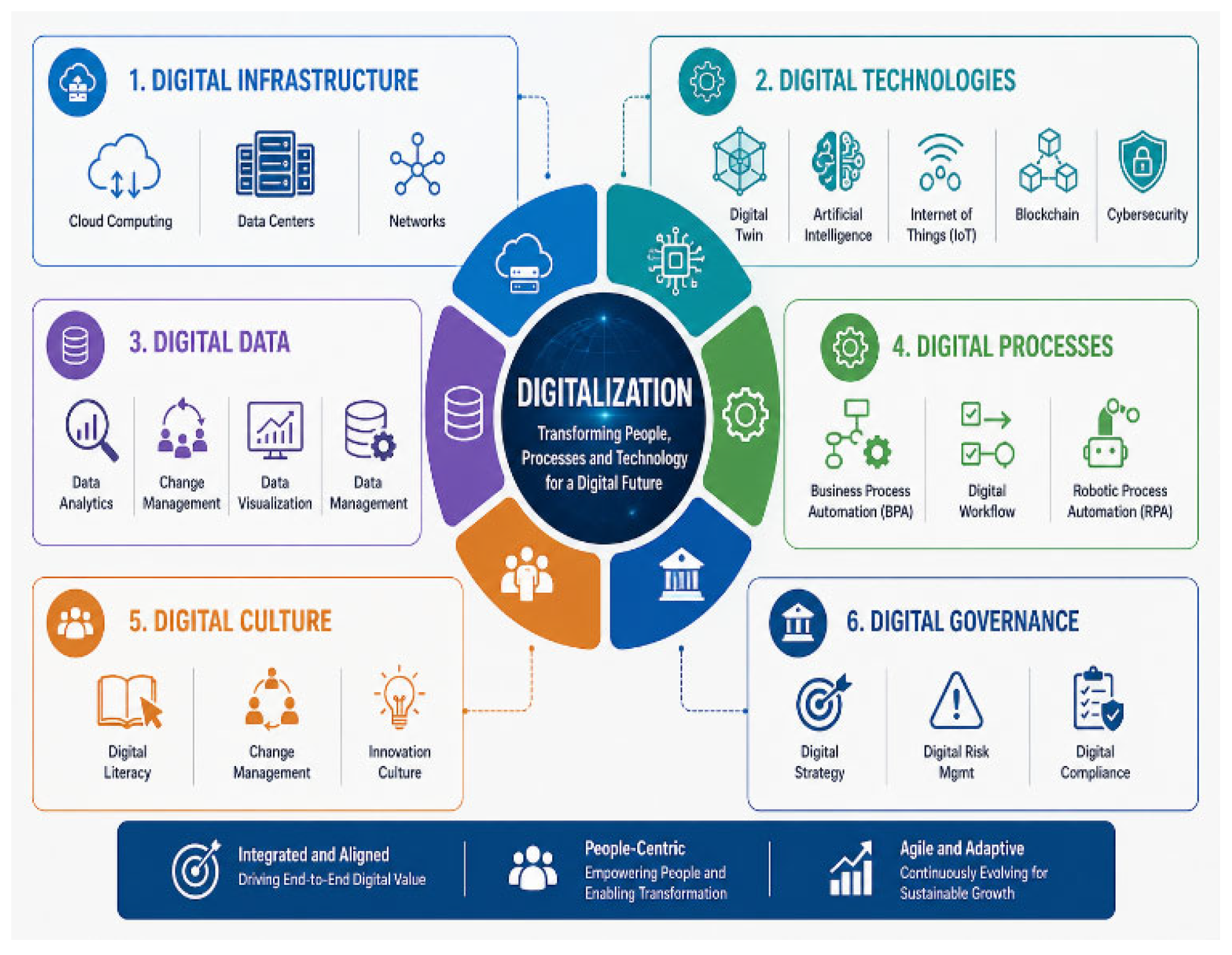
Key Aspects of Digitalization
(i) Digital Transformation-The process of fundamentally changing business operations, products, and services through advantages of digital technologies. Digital transformation is no longer a choice on technological opportunity but a necessity and a must for organizations willing to stay competitive and survive in an industry 4.0&5.0 digital economy [45]. Digital transformation becomes necessary as organizations see it as means to optimize and execute business process operational task more efficiently. Optimizing collaboration and coordination of internal organizational tasks in real-time.
(ii). Digital Innovation: The creation of new products, services, and business models that leverage digital technologies.
(iii). Digital Disruption: The impact of digital technologies on traditional business models, leading to changes in market dynamics and customer behavior.
2.4. Organizational Culture and Industry 4.0
Organizational culture and Industry 4.0 are deeply interconnected because the fourth industrial revolution is not solely a technological transition; it is also a managerial, behavioral, and strategic transformation. Industry 4.0 generally refers to the integration of intelligent and connected technologies into industrial systems, including automation, cyber-physical systems, real-time analytics, advanced robotics, smart sensors, digital twins, autonomous decision systems, and Internet of Things networks [7]. These technologies promise major improvements in productivity, quality, flexibility, traceability, energy efficiency, and responsiveness. However, many organizations discover that purchasing technology is easier than extracting value from it. The differentiating factor is often organizational culture. Organizational culture consists of the shared values, norms, leadership behaviors, routines, and assumptions that shape how people work and respond to change [9]. In Industry 4.0 settings, culture determines whether employees embrace digital systems, whether managers support experimentation, whether departments collaborate effectively, and whether continuous improvement is embedded into operations. A factory can install sensors, robots, analytics platforms, and smart systems, yet still fail to achieve successful transformation if the human system remains resistant, fragmented, or overly traditional [90]. Therefore, digitalization success in Industry 4.0 depends not only on machines and software, but on the culture governing how those assets are used [1,8].
2.4.1. Smart Manufacturing Culture
A smart manufacturing culture is one of the most important enablers of Industry 4.0 success. Traditional manufacturing cultures often prioritize stability, repetition, and output volume through standardized manual routines. While these priorities remain relevant, smart manufacturing expands the model by emphasizing real-time visibility, data-based decisions, adaptive scheduling, predictive maintenance, digital traceability, and continuous optimization [80]. In a smart manufacturing culture, employees and managers accept that production is no longer managed only through experience and observation, but through integrated digital intelligence. This shift has major implications for digital success. Organizations with smart manufacturing cultures are more willing to use dashboards, machine data, predictive alerts, automated scheduling systems, and digital quality controls to guide action. They treat information as an operational asset. By contrast, organizations where intuition always overrides data may underuse expensive digital systems. Smart manufacturing culture therefore increases return on technology investment by aligning operational behavior with technological capability [78].
2.4.2. Automation Acceptance in Factories
Automation acceptance in factories is another decisive factor. Many Industry 4.0 initiatives involve robotic systems, automated handling, robotic process controls, autonomous inspection tools, and algorithm-driven production decisions. Yet factory employees may interpret automation in different ways. Some see it as modernization and relief from repetitive or hazardous tasks. Others see it as a threat to jobs, skill relevance, or managerial trust. If automation is introduced without communication or workforce transition planning, resistance may emerge through low cooperation, slow adoption, or hidden workarounds [1,9].
2.4.3. IoT Integration and Workforce Behavior
IoT integration and workforce behavior also strongly influence digitalization outcomes. Industrial IoT systems connect machines, sensors, tools, warehouses, vehicles, and processes to generate continuous streams of data. However, technical connectivity alone does not guarantee value. Workers must trust the data, understand alerts, respond appropriately, and integrate digital insights into daily routines. For example, if sensors identify early machine vibration risks but maintenance staff ignore alerts due to habit or skepticism, the predictive system loses value.
2.4.4. Human-Machine, Collaboration Culture
Human-machine collaboration culture is increasingly central to Industry 4.0. Modern factories are not purely automated environments where humans disappear, nor purely manual systems with isolated machines. They are hybrid systems where humans and intelligent technologies complement each other. Robots may perform repetitive precision tasks, while humans handle judgment, troubleshooting, customization, ethical decisions, and adaptive problem-solving. Analytics systems may generate recommendations, while managers interpret broader business implications.
2.4.5. Lean Culture and Smart Production
Lean culture and smart production also have powerful synergies with Industry 4.0. Lean management historically focuses on waste reduction, continuous improvement, flow efficiency, defect prevention, and value creation from the customer perspective [10]. Smart production technologies enhance these goals through real-time data, automation, simulation, predictive control, and digital visibility. When lean culture already exists, Industry 4.0 adoption is often smoother because employees are accustomed to process discipline, root-cause thinking, standardization, and improvement routines. For example, a lean organization implementing sensor-based quality control may quickly use data to reduce defects because teams already think in terms of waste elimination [11,25]. Predictive maintenance systems align naturally with lean goals of minimizing downtime. Automated inventory systems support just-in-time flow. Thus, lean culture provides the managerial logic, while smart production technologies provide new execution power. In contrast, organizations without improvement discipline may adopt advanced tools but fail to sustain benefits because underlying processes remain unstable [14].
From a performance standpoint, organizations with supportive Industry 4.0 cultures often achieve higher productivity, reduced downtime, lower defect rates, better energy efficiency, improved traceability, faster response to demand changes, stronger supply chain visibility, and enhanced competitiveness. These benefits arise because technology and behavior reinforce each other. Where culture is weak, similar technologies may yield only partial gains.
2.5. Cultural Dynamics of AI Adoption
While AI’s technical benefits are well-documented, its cultural implications remain underexplored. For example, [6] notes that AI-driven automation disrupts traditional hierarchies, shifting power dynamics from experience-based authority to data literacy. [4] further clarifies this by framing AI adoption as a challenge to basic assumptions’ (e.g., human superiority in decision-making). Case studies like Google’s AI-first’ culture demonstrate how norms around experimentation and failure tolerance must evolve to support AI integration. Artificial Intelligence is transforming decision-making mechanisms throughout multiple industrial sectors.AI systems analyze extensive datasets to detect patterns and trends beyond human capability and offer actionable insights for strategic planning, risk management, and resource allocation [16,32,33,34,35,36,37,38,39].
Over the years the integration of digital technologies has significantly transforms leadership structure by eroding traditional norms like ‘seniority equals authority,’ replacing them with ‘data fluency as power’ enabling everyone within an enterprise to easily make data-driven decision [6]. This shift creates decisional and hierarchical tensions; for instance, long-tenured managers with years of working experiences may resist AI-driven decisions that override their experience [23,44].
The implementation of AI brings significant challenges, primarily related to ethical issues and algorithmic bias. Algorithmic bias remains a major issue because AI systems tend to replicate or worsen biases that exist within both their training data and design algorithms. Discriminatory effects emerging from AI applications in hiring practices, lending, and criminal justice systems create serious ethical and legal issues. Automation’s influence on changing job roles and responsibilities creates worries about potential job displacement and the outdatedness of existing skills. The adoption of AI for routine tasks triggers employee resistance and anxiety, which underscores the necessity for forward-thinking change management plans [14,17].
The current advances in the digital technology sector has created a drive towards the fourth industrial revolution known as Industry 4.0. Industry 4.0 allowed enterprises to rely on digitalization and automation of business process activities to optimize the performance of repetitive tasks, and reduce the significantly occurrence of human errors, workplace accidents, eliminate unnecessary overhead costs and reduction of downtime [13,45,46,47,48,49,50,51,52,53,54,55,56,57,58,59,60,61,62,63,64,65].
Several scholars have provided various model of cultures within an enterprise. [45] In a literature on “Organizational Culture and Leadership”, highlighted the role of leadership in creating an enabling culture, introduced a three-level model of culture. (i) Artifacts (visible structures and processes), (ii) Espoused Values (stated values and norms) (iii) Basic Underlying Assumptions (unconscious, taken-for-granted beliefs).
In a digital society, digitalization is seen as the integration and use of digital technologies in various daily business process activities, and digitalization within an enterprise is digital transformation involving the integration of advance digital technologies for executing organizational business process activities in other to provide business value [37,45]. [33] Insisted that organizational culture affects the way individuals embrace newly integrated digital technologies to execute business process activities. Industry practitioners advocates emphasized that enterprise must have a culture-driven transformational strategy to propel the organization to make the necessary change fit for the future in a dynamic digital economy. [61] acknowledged the changes in the digital economy and insisted that knew digital change not only enhances business process but also support the organizational business model when properly integrated within the business process activities [29]. Advocated for digital leadership to support and provide innovative measures for resilience to help survive dynamic digital economy. [38] Proposed agile skill development as some of the dynamic capabilities that enterprises can adopt in a dynamic digital economy.
2.5.1. Effects of Digitalization on Organizational Values and Norms
Digitalization involves incorporating rapidly developing digital technologies such as metaverse, nanotechnology, generative artificial intelligence (GenAI),crypto-assets, blockchain, cloud computing, robotic process automation, into everyday business process activities Digitalization helps promotes new innovative business models and ideas [9]. With creative innovative business values at the heart of digitalization, Digitalization provides for the creation of a digital ecosystem that supports new organizational business ideas and activities to have the capacity to effectively improve workflow efficiency, real-time information-sharing, streamline supply chain bottlenecks with suppliers, and enhance relationships with customers and suppliers [38,79]. Empirical evidence indicates that transformational capacity of digital technology impact regulatory policy, business strategy, work processes and individuals’ rights and security as just examples of how digitalization can influence organizational culture. The right enterprise architecture (EA) supports organizations in performing better digitally, enabling an organization to work with digital technologies towards optimizing their business processes [10].
Since Digitalization involves digital transformation where digital technology infiltrates and are used to power organizational business process operations it fundamentally changes how an enterprise operates and deliver value. A growing body of scholars acknowledged digitalization offers organizational culture adjustments, designed from the ground up to align with external business needs and market conditions to provide value and enhance customer experiences [13]. As the leadership is task and responsible for providing the right enterprise architecture that support the organizations business process. The leadership of an enterprise is task with providing the right enterprise architecture that support the organizations business process It is also responsible for encouraging the right culture that drives and empower employees to supports the organizations mission statement, vision and goals. The right Enterprise architecture is critical with delivering dynamic capabilities that enable businesses to successfully thrive in a digital economy. The current advances in the digital technology sector with industry 4.0 allows enterprises to rely on industry 4.0&5.0 digital technologies such as AI, ML, Internet of Things (IoT), Humanoids, Robots, and automation of business process activities to optimize the performance of various tasks, eliminate human errors, reduce workplace accidents, eliminate unnecessary overhead costs, and reduction of downtime [21,33,34,35,36,37,38,39].
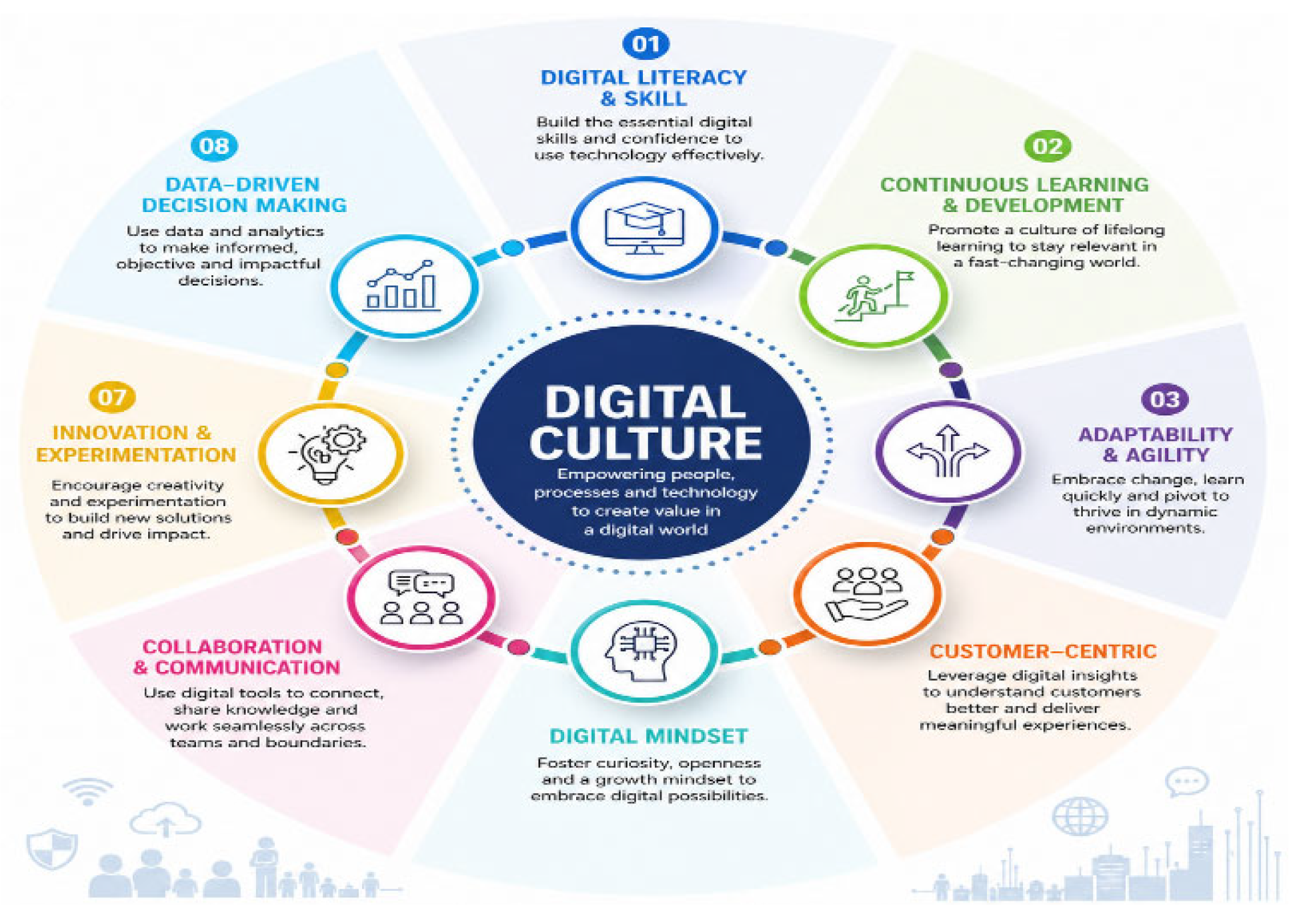
Figure 2.
Components of Digital Culture.
2.5.2. Other Type of Organizational Culture
A growing body of existing scholarly literature describe Organizational culture as the most significant resource and a major factor for competitiveness and organizational effectiveness [21]. The emphasize is that in a digital economy, enterprises need to focus on their cultural resources to drive the successful integration of digital transformation to boost operational efficiency and competitiveness [32,41]. Empirical studies on “Organizational Culture and Leadership”, highlighted the role of leadership in creating an evolving culture, introduced a three-level model of culture. (i) Artifacts (visible structures and processes), (ii) Espoused Values (stated values and norms) (iii) Basic Underlying Assumptions (unconscious, taken-for-granted 15 beliefs) [31,51] in a literature on "Corporate Cultures: The Rites and Rituals of Corporate Life”, described the significant role of strong culture within an enterprise emphasizing that strong culture drive performance and shape identities. Identified four types of culture, (i) Tough-Guy, Macho,(ii) Work Hard/Play Hard (iii) Bet-Your-Company (iv) Process Culture. Also, [14,81] in a literary contribution on "Understanding Organizations" developed four types of organizational culture to include (i) Power Culture (ii) Role Culture (iii) Task Culture (iv) Person Culture. Organizational culture serves as both the foundation and the fuel for successful digital transformation.
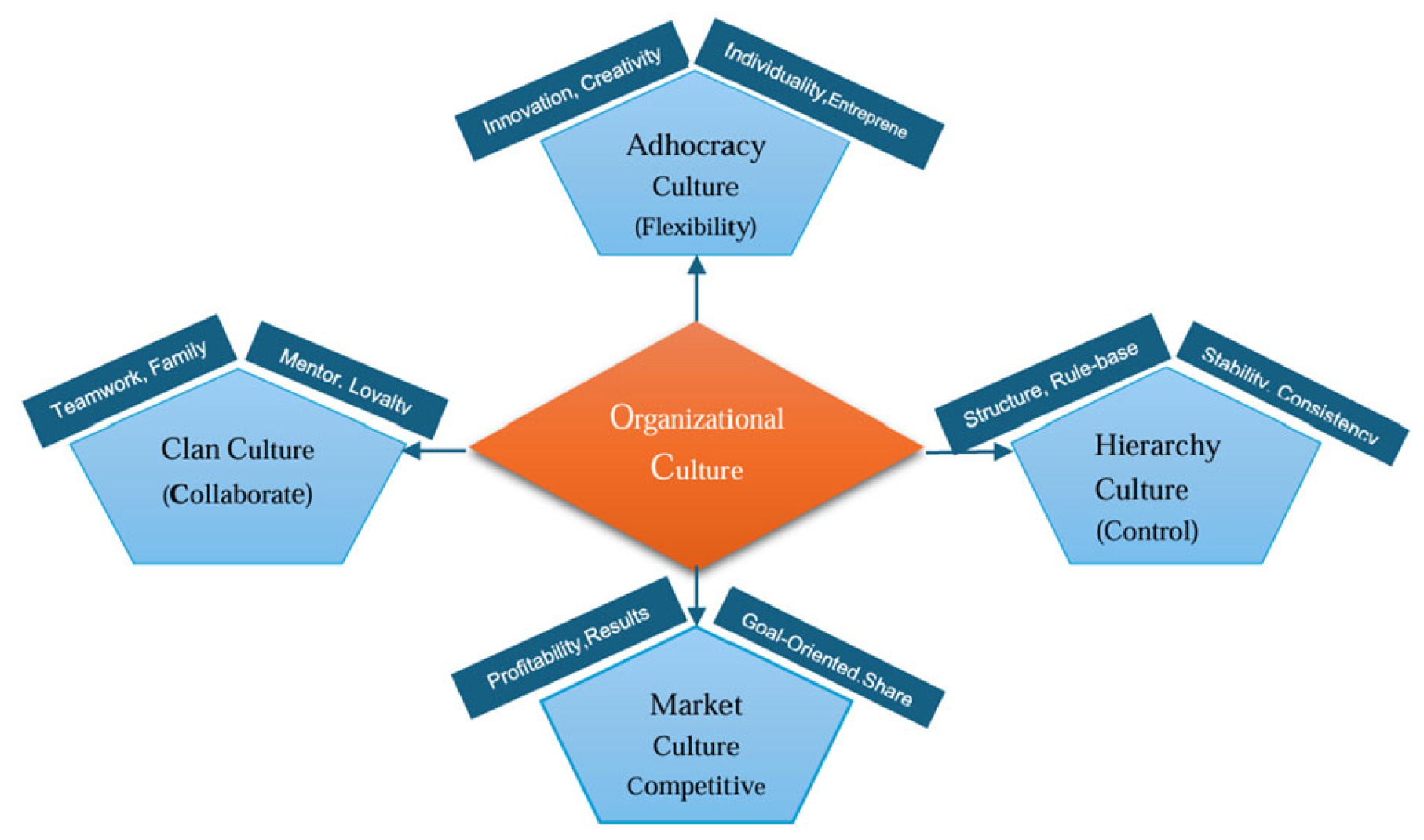
Empirical evidence have indicated that the integration of industry 4.0 digital technologies such as AI, machine learning, and automation does not occur in a vacuum [24,62]. Drawing from the Competing Values Framework (CVF) suggests four dominant culture types provide distinct pathways for how enterprises adopt, scale, and extract value from digital transformation. They include: (i) Clan Culture (Collaborate); (ii) Adhocracy Culture (Create); (iii) Market-Culture (Compete); (iv) Hierarchy Culture (Control) [21,31,32,33,34,35,36,37,38,39,40,41,42,43]. Several authors have argued that cultural changes within an enterprise are usually influenced and driven by internal or external environmental factors and the current digital transformation driven by industry 4.0 digital technologies and advances in the digital landscape provide an enabling opportunity internally that can drive cultural change. Other scholars are of the view that organizational culture when driven by digitalization can be emancipatory for an enterprise business processes [2,13]. Industry 4.0 digital technologies offer enterprise new business opportunities to uphold their cultural framework of shared values and a way of providing business value [25,44]. In light of this argument [34,56] emphasized that the current digital transformation with industry 4.0 and 5.0 digital technologies will not only support existing and new business value proposition but also enhance and transform organizational identity.
The Competing Value Framework (CVF) Model identifies four fundamental types of organizational culture, based on two dimensions: flexibility vs. stability and internal vs. external focus. (i) Clan Culture (Collaborate); (ii) Adhocracy Culture (Create); (iii) Market Culture (Compete); (iv) Hierarchy Culture (Control) [35,37,38,39,40,41,42,43].
2.5.2.1. Adhocracy Culture
Adhocracy culture thrives on providing an innovative and creative environment for individuals to thrive, due to its flexible and entrepreneurial nature. Supports individual dynamism, reinforcing agility. Organizations like Google, Tesla, NASA, Amazon, and Spotify thrive on an adhocracy culture to support innovations and creativity, empowering employees with constant feedback to improve digital products and business processes. Such organizations also use the open-source innovative contribution from individuals within the enterprise, to strengthen innovations, this type of cultural environment matches innovative drive with agility and flexibility, encouraging entrepreneurial concepts while decentralizing decision-making, allowing and empowering employees with the autonomy [11,32].
Characteristics of Adhocracy culture include: Flexibility and adaptability, Innovation and Creativity, Decentralized decision-making; and Structure. Key benefits include. Encourage Innovation and Entrepreneurship; Open-Source contribution, Fast-paced and Responsive, Empowers employees, Adaptability and Flexibility.
2.5.2.2. Clan Culture
The clan culture thrives by fostering an environment of collaboration and togetherness, enabling teamwork and mentorship amongst employees. A fundamental aspect of clan culture is the creation of a family-like business environment within the enterprise principally focused on employee training and development. Key Characteristics of Clan culture are Mentorship and Development, Collaboration and teamwork, a Family-like environment, and employee development. Some organizations that thrive on Clan Culture include: Patagonia, Southwest L’Oreal, Airlines, Zappos, and Airbnb. Organizations that thrive on Clan culture focus on employee training and value talent retention and internal cohesion [12,19].
A growing body of scholarly literatures acknowledged that by prioritizing collaboration, the clan culture allows effective independent virtual collaboration from diverse employees contributing to the larger workflows [25]. This enhances knowledge sharing and mentoring with training enhances and strengthens organizational culture interpersonal relationships, and socialization, and enhances the growth of cross-functional soft skills among employees, such organizations easily implement digital transformation with successful digitalization [34,49].
2.5.2.3. Market Culture
The market culture is a goal-oriented type of organizational cultural norms focused on results and organizational goals and achievement. This type of culture is very responsive to market share size and external position status. This Market culture is driven by the output and result and encourages competitive behaviors amongst employees to drive financial success. The focus on goal orientation strongly motivates employees toward organizational objectives and performance measures [21,35].Enterprises focused on market culture prioritize results to define productivity, placing emphasis on increasing customer experiences through personalization systems to increase market share size [15]. Characteristics of Market Culture: Result-oriented, Competitive, Customer-focused, Achievement-driven, Result driven, and profitability. General Electric (GE), Apple, Blue Core.
2.5.2.4. Hierarchical Culture
An enterprise that favors a hierarchical culture prioritizes stability and structure in the decision-making process. Such enterprises have a strict precision in operational activities [10]. Hierarchical cultures face the most resistance to AI and automation due to their rigid structures this type of culture enhances monitoring and control for quality and credibility. There is an increase in process standardization in operational activities [17]. Also, decision making is strictly carried out along the chain of command. Organizations such as UPS, Government agencies, and Enterprise that focus on hierarchical culture emphasize internal process control and standardization to maintain quality control measures when providing business value, this helps ensure the integrity of products and security [15,29,30,31].
Hierarchy culture (Controlled) prioritizes stability, standardization, and control through formal procedures and clearly defined roles. Within hierarchical culture digital transformation progresses at a considerably slower pace due to structural rigidity, risk aversion, and deeply entrenched bureaucratic procedures. The reluctance to decentralize decision-making further constrains the ability to fully leverage AI and automation capabilities [41]. Without intentional leadership-driven cultural adaptation and proactive change management strategies, the adoption of AI remains limited, fragmented, or ultimately fails to deliver the intended organizational value. Across these culture types, it is evident that digital culture acts as a competitive strategy only when it aligns with the underlying cultural DNA of the organization [41,59]. Enterprises rooted in adhocracy and clan cultures tend to outperform others in AI-driven innovation, agility, and workforce resilience. Therefore, digital transformation is not purely technological; it is fundamentally cultural. Enterprises that cultivate a digitally adaptive culture aligned with their CVF type are more likely to thrive in the dynamic pressures of the digital economy [61,87].
Figure 3.
CVF type of organizational culture.
2.6. Leadership Culture and Digitalization
Leaders must balance technological adoption with change management strategies to mitigate resistance [33]. [11,13] note that organizations with rigid hierarchies, leadership and organization structure face higher digitalization adoption failure rates (∼47%) due to cultural inertia, while agile cultures thrive by valuing experimentation over tenure. Today’s leadership decision-making process requires the integration of data analytics into decision-making utilizing AI digital business intelligence insights to direct organizational strategy [12,24]. Enterprise with digitalization technology in a digital economy no have to rely on excessive chain of command structure to make business decision. Empirical studies acknowledged that digitalization immensely facilitates innovative ways of thinking, communicating and decision making within an enterprise. Encouraging lateral communications amongst employees and eliminating departmental barriers through facilitating smooth lateral information exchange and team collaboration across different departments regardless of location and time zones. [41] Noted how current digital technologies systems actively contribute to increased employee engagement and improved job satisfaction rates. Through personalized learning experiences and real-time feedback, AI-powered tools enhance employee well-being and lead to ongoing improvement and growth. The successful adoption of digitalization technologies systems requires alignment with employee values and preferences because failure to do so may cause resistance and decrease employee engagement [1,23].
A growing body of scholarly literatures expressed the view that Leadership style establish the ground rules and support policies that encourages a digital culture for employees to embrace digitalization metamorphosis for workforce transformation within the enterprise. The leadership is responsible for cultivating an organizational culture that embraces and adopt digitalization technologies for business process, communicating across functional lines, supports innovation, and embraces digital technologies towards adapting to evolving business needs and environmental changes [31,45].
2.6.1. Type of Leadership for Digitalization Success
Transformational leadership has become one of the most consequential leadership paradigms in the digital era because organizations are no longer competing solely through physical assets, scale, or traditional managerial efficiency. They now compete through speed of adaptation, innovation capability, data intelligence, customer responsiveness, and the capacity to continuously reinvent business models. In that environment, digital innovation does not emerge automatically from the mere acquisition of technologies such as Artificial Intelligence, cloud platforms, analytics systems, or automation tools. Rather, it emerges when leaders mobilize people, reshape mindsets, align structures, and create conditions where technology can generate strategic value [21,33]. This is where transformational leadership becomes central. While several scholars refer Transformational leadership to a style of leadership in which leaders inspire followers to transcend narrow self-interest in pursuit of a larger organizational vision. It is commonly associated with four dimensions: idealized influence, inspirational motivation, intellectual stimulation, and individualized consideration. In the context of digital innovation, these dimensions become highly relevant because technological transformation often involves uncertainty, ambiguity, capability gaps, fear of disruption, and resistance to change [6]. Leaders who can articulate a compelling digital future, energize employees around shared purpose, challenge legacy assumptions, and support workforce development are more likely to generate successful innovation outcomes than leaders who rely purely on authority, control, or administrative routines.
One of the most significant contributions of transformational leadership to digital innovation is strategic vision creation. Digital innovation initiatives frequently fail because organizations implement technology without a coherent transformation narrative. They may purchase new systems, deploy software, or automate processes without clearly connecting those investments to business value. Transformational leaders reduce this fragmentation by constructing a persuasive vision of how digital technologies will improve competitiveness, customer experience, operational efficiency, and long-term resilience. Rather than presenting innovation as an isolated IT project, they frame it as an enterprise-wide strategic journey. This sense of direction helps employees understand why change is necessary and how their work contributes to a larger mission [12].
Inspirational motivation is especially important during digital transitions because change fatigue is common. Employees may fear job displacement from automation, struggle with new systems, or doubt whether transformation efforts will succeed. Transformational leaders sustain momentum by communicating optimism, confidence, and shared opportunity [2].They convert anxiety into engagement by emphasizing growth, learning, and future readiness. In many organizations, the psychological dimension of transformation is underestimated. Yet morale, trust, and collective belief often determine whether innovation efforts stall or accelerate. A workforce that believes in the transformation agenda is substantially more likely to experiment, collaborate, and persist through setbacks. Another critical mechanism is intellectual stimulation. Digital innovation requires questioning long-standing assumptions, redesigning workflows, rethinking customer journeys, and exploring new business models. Transformational leaders encourage employees to challenge obsolete routines rather than defend them. They legitimize experimentation, curiosity, and calculated risk-taking. This creates an innovation climate where teams feel empowered to test prototypes, use agile methods, examine data for insights, and explore emerging technologies. In contrast, highly authoritarian or punitive leadership cultures often suppress creativity because employees avoid proposing unconventional ideas or exposing operational inefficiencies [12,91].
However, Digital innovation also depends heavily on human capital development, making individualized consideration highly relevant. Many organizations adopt advanced tools faster than they develop employee competencies [9]. The result is underutilized technology, user frustration, and weak returns on investment. Transformational leaders address this gap by recognizing that workforce capability is foundational to innovation. They invest in training, mentoring, reskilling, and role redesign. They understand that digital transformation is not simply system implementation; it is organizational learning at scale. Employees who feel supported in building new competencies are more likely to embrace change and use technologies effectively [14].
Transformational leadership also enhances cross-functional collaboration, which is essential for digital innovation. Modern innovation rarely occurs within a single department. It requires coordination among IT, operations, finance, marketing, HR, compliance, and customer-facing units. Siloed organizations often struggle because each function pursues its own priorities, data structures, and timelines. Transformational leaders build shared purpose across departments, reducing territorial behavior and promoting enterprise thinking. They foster collaboration around common outcomes such as customer experience, process optimization, cybersecurity resilience, or new revenue models. This integrative capacity is especially valuable in large organizations where fragmentation can quietly undermine transformation programs [67,97].
A further contribution lies in the cultivation of adaptive organizational culture. Technology changes rapidly, meaning innovation cannot be a one-time event. Organizations need cultures that continuously sense change, learn quickly, and reconfigure resources. Transformational leaders model openness, curiosity, resilience, and accountability, thereby influencing cultural norms over time. Employees often infer what behaviors are truly valued by observing leaders more than by reading official policies. If leaders reward experimentation, transparency, and learning from failure, those behaviors spread. If leaders punish mistakes or prioritize short-term control over long-term capability building, innovation weakens. In this sense, transformational leadership acts as a cultural transmission mechanism for digital readiness [72,76].
Empirical evidence indicates Data-driven decision-making is another area where transformational leadership matters. Digital innovation generates large volumes of operational, customer, and market data. However, many organizations still rely on hierarchy-based intuition rather than evidence. Transformational leaders can accelerate digital maturity by encouraging analytical thinking, performance transparency, and intelligent use of dashboards, forecasts, and insights [86,91]. They do not eliminate judgment, but they integrate judgment with evidence. This helps organizations allocate resources more effectively, identify emerging opportunities, and detect innovation bottlenecks earlier. The relationship between transformational leadership and digital innovation is especially visible in crisis or disruption contexts. During shocks such as supply chain volatility, economic turbulence, cybersecurity threats, or sudden market shifts, organizations with transformational leaders often pivot faster. Because these leaders have already built trust, learning capacity, and collaborative networks, they can mobilize rapid digital responses such as remote work systems, automated service channels, predictive planning tools, or customer self-service platforms. Organizations lacking such leadership may possess technology assets but fail to coordinate them effectively under pressure [47,78].
A growing body of literature suggests Small and medium-sized enterprises (SMEs) can particularly benefit from transformational leadership because they often lack the resource buffers of large corporations. In SMEs, the owner-manager or executive leader strongly shapes organizational culture and strategic priorities [29]. A transformational SME leader can create entrepreneurial energy, motivate rapid learning, and champion selective digital investments that improve competitiveness. Since SMEs may not afford large transformation offices or extensive consulting support, leadership quality becomes an even more decisive factor. In large enterprises, transformational leadership often needs to operate at multiple levels. Senior executives set digital vision and investment priorities, middle managers translate strategy into operational reality, and frontline supervisors shape daily adoption behaviors [21,78]. If only top leadership is transformational while middle management remains resistant or transactional, implementation gaps emerge. Therefore, scalable digital innovation requires leadership alignment across the hierarchy. Despite its strengths, transformational leadership is not a universal cure. Vision without execution discipline can create enthusiasm without results. Excessive optimism may underestimate technical debt, cybersecurity risk, or change complexity [41]. Charismatic leadership unsupported by governance structures can also generate fragmented initiatives. For this reason, the most effective model often combines transformational leadership with operational discipline, project governance, data accountability, and technical expertise. Inspiration must be matched with execution capability [41,67].
There are also contextual differences across industries. In manufacturing, transformational leadership may focus on smart operations, automation adoption, and workforce transition. In banking, it may emphasize digital trust, customer experience, and platform innovation. In healthcare, it may center on digital records, telehealth, and patient outcomes. In education, it may involve learning technologies and institutional agility. Thus, while the principles remain similar, the innovation agenda varies by sector. From a performance perspective, organizations led by transformational leaders often report stronger innovation outputs, higher employee engagement, faster technology adoption, improved service responsiveness, and better strategic adaptability. These outcomes are not automatic but occur because leadership shapes the social system through which technology is interpreted and used. Digital tools create potential; leadership converts potential into organizational value [31,79].
In conclusion, transformational leadership is one of the most powerful enablers of digital innovation because it addresses the human and strategic dimensions of technological change. It provides vision where uncertainty exists, motivation where resistance emerges, learning where capability gaps persist, and collaboration where silos dominate. In the digital economy, innovation is rarely constrained only by hardware or software; it is constrained by leadership capacity to align people, purpose, and technology. Organizations that cultivate transformational leaders are therefore better positioned not merely to adopt digital tools, but to continuously innovate through them [65,86]
2.7. Digitalization, Automation, and Workforce Transformation
Workplace dynamics and employment roles experience extensive changes as AI becomes moie integral to business practices. AI and ML applications now play a significant role across HR functions and operational decision-making processes while reshaping organizational human capital management and business operations. HR departments utilize AI to make recruitment processes more efficient, improve employee engagement, and customize learning and development programs. AI-driven systems evaluate numerous resumes to find suitable candidates while delivering unique onboarding experiences and customized training advice that addresses individual skill deficiencies and professional ambitions [31].
Digitalization improves operational efficiency by optimizing supply chain management and predictive maintenance while enhancing quality control systems. Empirical evidence indicates that AI technology processes past sales figures to forecast future demand while managing optimal stock levels and reducing transportation expenses [9]. AI-based predictive maintenance systems analyze equipment performance data, which enables them to predict failures and schedule maintenance ahead of time to minimize downtime. Artificial Intelligence is transforming decision-making mechanisms throughout multiple industrial sectors. AI systems analyze extensive datasets to detect patterns and trends beyond human capability and offer actionable insights for strategic planning, risk management, and resource allocation [45,67]. The implementation of digitalization technologies brings about significant challenges, primarily related to ethical issues and algorithmic bias. Automation’s influence on changing job roles and responsibilities creates worries about potential job displacement and the outdatedness of existing skills. The adoption of AI and other digital technologies for routine tasks triggers employee resistance and anxiety, which underscores the necessity for forward-thinking change management plans [17].The workforce faces another significant challenge due to the expanding skills gap in the industry. The field lacks enough qualified professionals who can develop and manage AI systems. To address this workforce gap, organizations need to dedicate resources to training programs, establish connections with educational partners, and create recruitment strategies that draw skilled professionals from varied [3,8].
Empirical evidence indicate workforce faces major significant challenges due to the expanding skills gaps from digitalization. The field lacks enough qualified professionals who can adequately develop and manage the evolution of digital technologies within the digitalization ecosystems [16]. To address this workforce gap, a growing body of literature suggests that organizations need to dedicate resources to training personnel, establish connections with educational consultants partners, and create recruitment strategies that draw skilled professionals from varied digital backgrounds [41]. As digital technologies continue to drive and advance workplace business processes, this will progress alongside trends like widespread hybrid work arrangements and promote greater cultural flexibility within enterprises.
Figure 4.
Conceptual Model of Organizational Culture as Technology Driver.
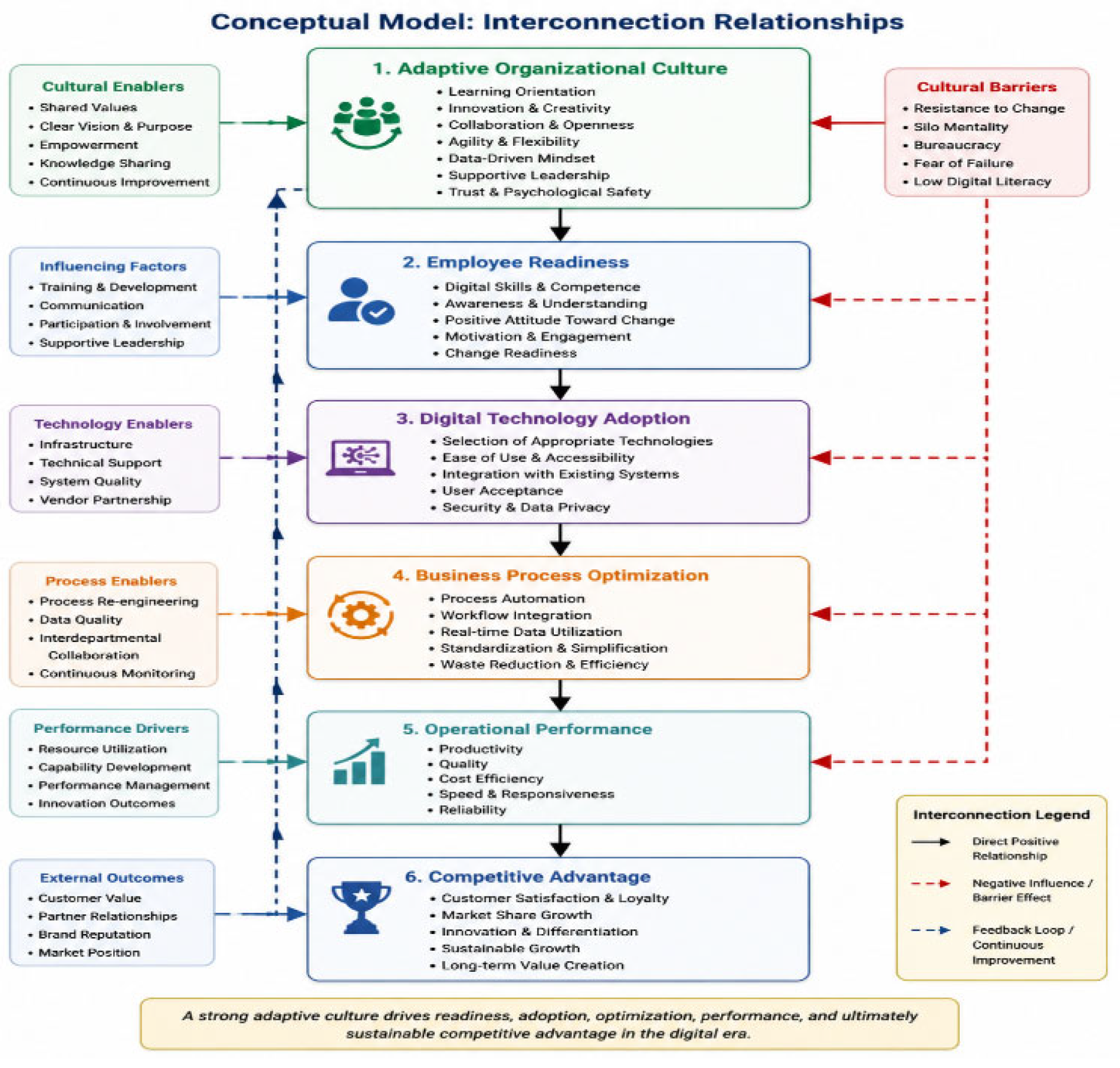
2.8. Learning Culture and Workforce Digital Readiness
Learning culture and workforce digital readiness are among the most decisive factors influencing digitalization success because technological transformation depends not only on systems, software, and infrastructure, but on the ability of people to understand, adopt, improve, and sustain those technologies [11,16]. Organizations can invest heavily in automation platforms, analytics systems, cloud environments, smart devices, enterprise applications, and Artificial Intelligence tools, yet fail to realize meaningful returns if employees lack the skills, confidence, or learning orientation required to use them effectively. In many cases, digitalization does not fail because the technology is weak; it fails because workforce capability development lags behind technological ambition [1,9].
A learning culture refers to an organizational environment where continuous development, curiosity, experimentation, reflection, and knowledge growth are embedded into daily operations. Workforce digital readiness refers to the extent to which employees possess the skills, mindset, adaptability, and confidence necessary to function effectively in digitally transformed environments [12]. Together, these two capabilities create an organization that can absorb technological change rather than resist it. In the digital era, this absorptive capacity becomes a strategic advantage because technologies evolve faster than static skill models can keep pace.
2.8.1. Continuous Learning and Reskilling
One of the most important dimensions of learning culture is continuous learning and reskilling. Digital transformation frequently changes job roles, workflow structures, and competency requirements [23]. Tasks once performed manually may become automated. Decision-making may become more data-intensive. Customer service may move to digital channels. Administrative work may depend on integrated enterprise platforms. Employees who were effective in previous systems may require new competencies to remain effective in transformed environments [29]. Organizations with strong continuous learning cultures recognize that capability development is not an occasional event but an ongoing operational necessity. They provide regular training, digital academies, learning platforms, certifications, peer coaching, and role-based development pathways. When Employees are encouraged to learn proactively rather than wait for crisis-driven retraining [11]. This has major implications for digitalization success. Workers become more confident using new systems, adoption accelerates, implementation errors decrease, and organizations remain adaptable as technology changes again [32,89].
2.8.2. Upskilling for Industry 4.0 Technologies
Upskilling for Industry 4.0 technologies is another crucial element of digitalization success. Industry 4.0 environments rely on smart manufacturing systems, connected devices, predictive maintenance, robotics, cyber-physical systems, digital twins, analytics dashboards, and advanced process automation. These technologies require technical and semi-technical competencies across multiple workforce levels. Upskilling task such as Interface literacy, Real-time data interpretation, Sensor troubleshooting, System thinking and digital learning capability [12].
Organizations that prioritize Industry 4.0 Upskilling are better positioned to extract value from technological investments and digitalization success. With upskilling advanced systems and equipment are used more efficiently, downtime is reduced, analytics insights are acted upon, and process improvements are identified sooner [20].
2.8.3. Digital Literacy Culture
Digital literacy extends beyond basic computer usage. It includes comfort with digital interfaces, ability to navigate platforms, understanding of data concepts, cybersecurity awareness, communication through digital channels, and confidence in learning new tools. In organizations where digital literacy is uneven or neglected, transformation often becomes stratified [17]. A small group of digitally capable employees carries the burden while others remain dependent, hesitant, or disengaged. Digital literacy encourages broad knowledge base rather than limited for only technical department. This encourages digital fluency as employees at all levels and department develop baseline digital competence [13,67]. This reduces fear, anxiety, and all forms of ideological insecurity associated with lack of knowledge. This broad readiness significantly improves digitalization success because adoption becomes organization-wide rather than limited to technical departments [56].
2.8.4. Knowledge-Sharing Systems
Knowledge-sharing systems are another major driver of success. During digital transformation, valuable knowledge is often distributed across the organization. IT teams understand system architecture. Operations teams understand workflow realities. Customer teams understand service friction. Analysts understand data patterns [65].Individual employees develop practical shortcuts, tips, and solutions during adoption. If this knowledge remains isolated, transformation slows and errors repeat unnecessarily.
In conclusion, learning culture and workforce digital readiness exert profound positive influence on digitalization success because they transform technology from installed infrastructure into usable capability. Continuous learning and reskilling prepare employees for changing roles. Upskilling for Industry 4.0 technologies enables advanced systems to deliver value. Digital literacy culture broadens readiness across the organization. Knowledge-sharing systems accelerate adoption and resilience. Organizational learning and technology assimilation ensure that tools become embedded and continuously optimized. Organizations that cultivate these capabilities do more than adopt digital systems—they build a workforce capable of evolving with technology over time. That capability is one of the strongest foundations of sustained digital success. [20,31,32,33,34,35,36,37].
2.9. Collaborative Culture and Process Integration
Collaborative culture and process integration are among the most powerful organizational drivers of digitalization success because modern digital transformation rarely occurs within a single department or through isolated technical initiatives [90]. Digitalization typically requires the redesign of workflows, integration of systems, coordination of people, and alignment of strategic goals across multiple business functions [41]. Technologies such as Artificial Intelligence, enterprise resource planning systems, cloud platforms, automation tools, analytics environments, collaboration software, and customer experience systems all create value only when different parts of the organization work together effectively. As a result, organizations with strong collaborative cultures often achieve faster, deeper, and more sustainable digital success than those constrained by silos, departmental rivalry, or fragmented communication [45,78].
A collaborative culture can be understood as a shared organizational environment where teamwork, trust, information sharing, joint accountability, and coordinated problem-solving are normal behaviors. Process integration refers to the alignment and connection of activities, systems, and decisions across functions so that work flows efficiently from one stage to another. In digital transformation, these two concepts are closely linked [67,71]. Culture determines whether people cooperate, while integration determines whether processes and technologies operate coherently. When both are present, digitalization becomes a multiplier of organizational performance. When absent, even expensive technologies may deliver limited value.
2.9.1. Cross-Functional Teamwork in Digital Projects
Cross-functional teamwork solves this problem by bringing diverse expertise together around shared objectives. IT specialists understand system capabilities and architecture. Operations teams understand workflow realities. Finance evaluates investment logic. HR supports skills transition. Customer-facing teams understand user pain points. When these perspectives are integrated early, digital projects become more practical, scalable, and user-centered. This significantly improves implementation quality and reduces costly redesign later. It also shortens time-to-value because issues are addressed collaboratively rather than sequentially [3,49].
2.9.2. Breaking Silos Through Digital Collaboration
Cross-functional teamwork solves this problem by bringing diverse expertise together around shared objectives. IT specialists understand system capabilities and architecture. Operations teams understand workflow realities. Finance evaluates investment logic. HR supports skills transition. Customer-facing teams understand user pain points. When these perspectives are integrated early, digital projects become more practical, scalable, and user-centered. This significantly improves implementation quality and reduces costly redesign later. It also shortens time-to-value because issues are addressed collaboratively rather than sequentially [23,41].
2.9.3. IT-Operations Alignment
IT-operation alignment is one of the most critical determinants of digitalization success. Historically, IT departments and operational units often operated separately. IT focused on infrastructure, security, and systems reliability, while operations focused on service delivery, production, customer response, or logistics [21].This separation frequently caused tension. Operations sometimes viewed IT as slow or overly technical. IT sometimes viewed operations as unrealistic or resistant to standards [3,34].
2.9.4. Digital Workflow Collaboration Systems
Digital workflow collaboration systems further amplify collaborative culture. These systems include workflow platforms, shared task environments, cloud document tools, communication platforms, ticketing systems, project management tools, integrated ERP processes, and automation pipelines. Their value lies in making work visible, coordinated, trackable, and less dependent on informal handoffs. However, technology alone does not create collaboration. Organizational culture determines whether these systems are used transparently and effectively [9,11].
2.10. Data-Driven Culture and Decision Making
Data-driven culture and decision-making are among the most critical determinants of digitalization success because digital transformation fundamentally increases an organization’s capacity to generate, access, analyze, and apply information [51,56]. Modern organizations invest in enterprise systems, automation platforms, cloud environments, customer platforms, sensors, analytics tools, and Artificial Intelligence technologies to create operational intelligence and strategic insight. However, these investments only create value when organizational culture encourages decisions based on evidence rather than habit, hierarchy, intuition alone, or fragmented assumptions. In many firms, digitalization fails not because data is unavailable, but because culture does not know how to use it effectively [1,9].
A data-driven culture can be described as a shared organizational orientation in which decisions, priorities, improvements, and accountability are guided by trustworthy information, analytical reasoning, measurable outcomes, and continuous learning from evidence [71]. It does not eliminate human judgment, creativity, or experience. Instead, it enhances judgment by grounding decisions in facts and patterns. In the digital era, where organizations generate vast amounts of operational and customer data, this cultural capability becomes a strategic advantage. Firms that combine technology with analytical culture tend to outperform those that merely collect data without using it intelligently [31,42].
2.10.1. Analytic Culture in Management Decisions
One of the strongest ways data-driven culture supports digitalization success is through analytic culture in management decisions. Traditional management often relies heavily on seniority, intuition, politics, or precedent. While experience remains valuable, empirical evidence shows digital environments are increasingly complex and dynamic [67].
An analytic management culture encourages leaders to ask evidence-based questions: What does the data show? What patterns are emerging? Which variables are driving outcomes? What assumptions need testing? This mindset improves strategic clarity and operational responsiveness. For example, instead of assuming declining sales are caused only by market conditions, managers can analyze customer segments, pricing behavior, service quality data, and channel performance [89,92].
This shift has major implications for digitalization success because organizations that use analytics meaningfully are more likely to justify future investments, refine systems continuously, and capture measurable value from technology. By contrast, organizations that install platforms but continue managing by instinct often experience low return on digital investments [35,45].
2.10.2. Evidence-Based Leadership
Evidence-based leadership supports digitalization in several ways. First, it improves capital allocation by directing investment toward initiatives with demonstrated potential. Second, it strengthens trust because employees can see rational decision logic. Third, it reduces bias by subjecting proposals to measurable criteria. Fourth, it encourages experimentation because leaders evaluate outcomes objectively rather than politically.
2.10.3. Use of Dashboards and KPIs
The use of dashboards and KPIs is another practical mechanism through which data-driven culture impacts digital success. Dashboards convert complex data into visible, actionable information, while key performance indicators provide measurable signals of progress. In digitally mature organizations, dashboards are not decorative displays but operational control systems [11]. Managers use them to monitor productivity, customer satisfaction, quality rates, turnaround times, revenue trends, cybersecurity posture, employee engagement, and innovation performance. Dashboards also improve accountability, when teams can see agreed metrics clearly, ownership becomes more objective. Dashboard are useful for learning and improvement, they strengthen engagement and trust. Therefore, dashboard effectiveness is cultural as much as technical [61,87].
2.10.4. Predictive Analytics Adoption
Predictive analytics adoption is one of the most advanced expressions of data-driven digitalization. While descriptive analytics explains what happened and diagnostic analytics explores why it happened, predictive analytics estimates what is likely to happen next. Using statistical models, machine learning, or pattern recognition, organizations can forecast demand.
2.10.5. Data Governance Behavior
Digitalization success depends heavily on trusted data. If users distrust dashboards or reports because numbers frequently conflict, adoption declines. Teams revert to spreadsheets, side calculations, or personal judgment. Conversely, when data is credible and consistent, confidence in digital systems rises. Users rely more on enterprise tools, integration improves, and decisions accelerate. Strong data governance behavior means employees treat data as a valuable organizational asset [11,17].
3. Research Methodology
This study adopted a Systematic Literature Review (SLR) method to rigorously identify, and synthesize 150 existing scholarly studies with topic on organizational culture related to the study. The study adopted this approach to ensure transparency, reproducibility, and methodological rigor, minimizing bias while enabling a comprehensive understanding of patterns, trends, gaps, and theoretical developments in the field. The review follows established guidelines such as PRISMA (Preferred Reporting Items for Systematic Reviews and Meta-Analyses). The systematic review is guided by clearly defined objectives and research questions, which determine the scope and direction of the review. A sample size of 150 scholarly studies were synthesized and analyzed into categories with themes and subthemes developed on the impact of organization culture and digital transformation.
4. Data Analysis
The studies synthesized are categorized and ranked according to their order of impact on digitalization initiatives

Table 1.
Ranking Impact Strength of Synthesized Organizational Culture on Digitalization Success.
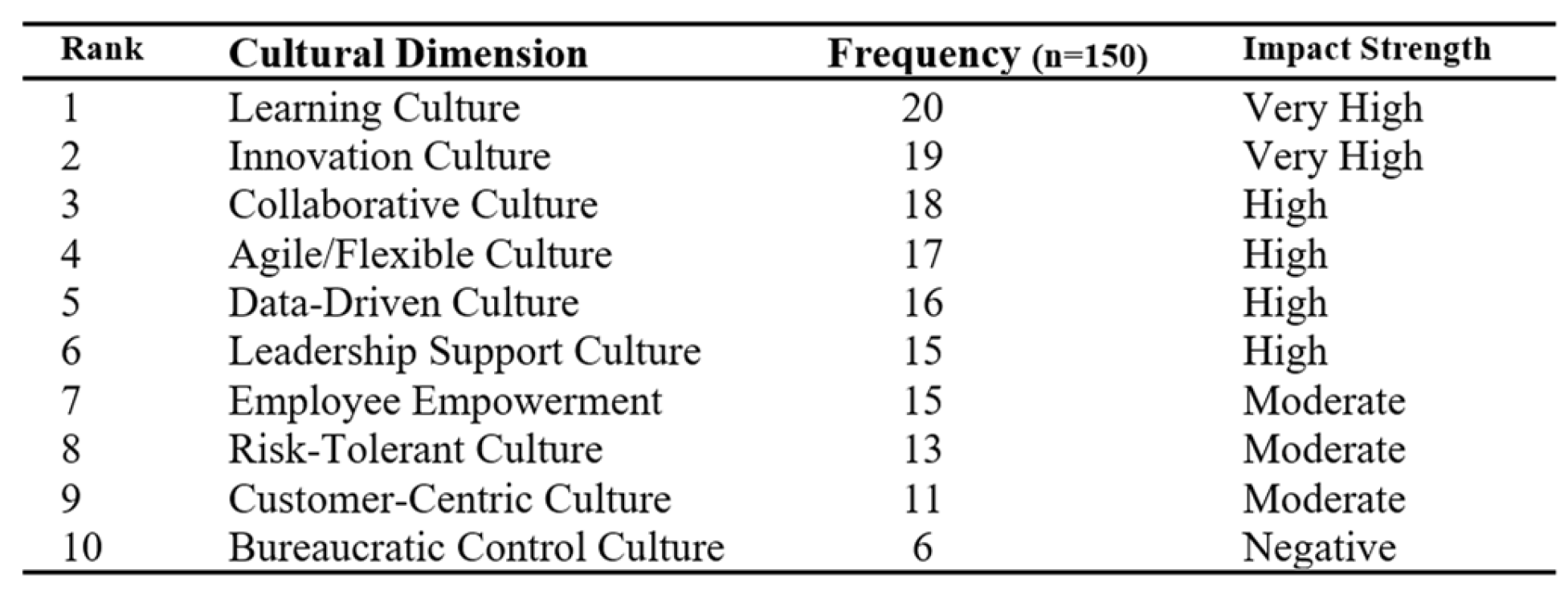
Conceptual Formula:
Successful Digitalization = Technology + Culture +Strategy + Skills + Leadership
Table 2.
Components of Studies Synthesizes.
| Study Category | Frequency | % of Freq |
|---|---|---|
| Empirical Quantitative | 72 | 48% |
| Qualitative Case Studies | 38 | 25% |
| Mixed Methods | 24 | 16% |
| Conceptual/Theoretical | 16 | 11% |
| 150 |
Table 3.
Industries and Sectors of Scholarly Studies Synthesized.
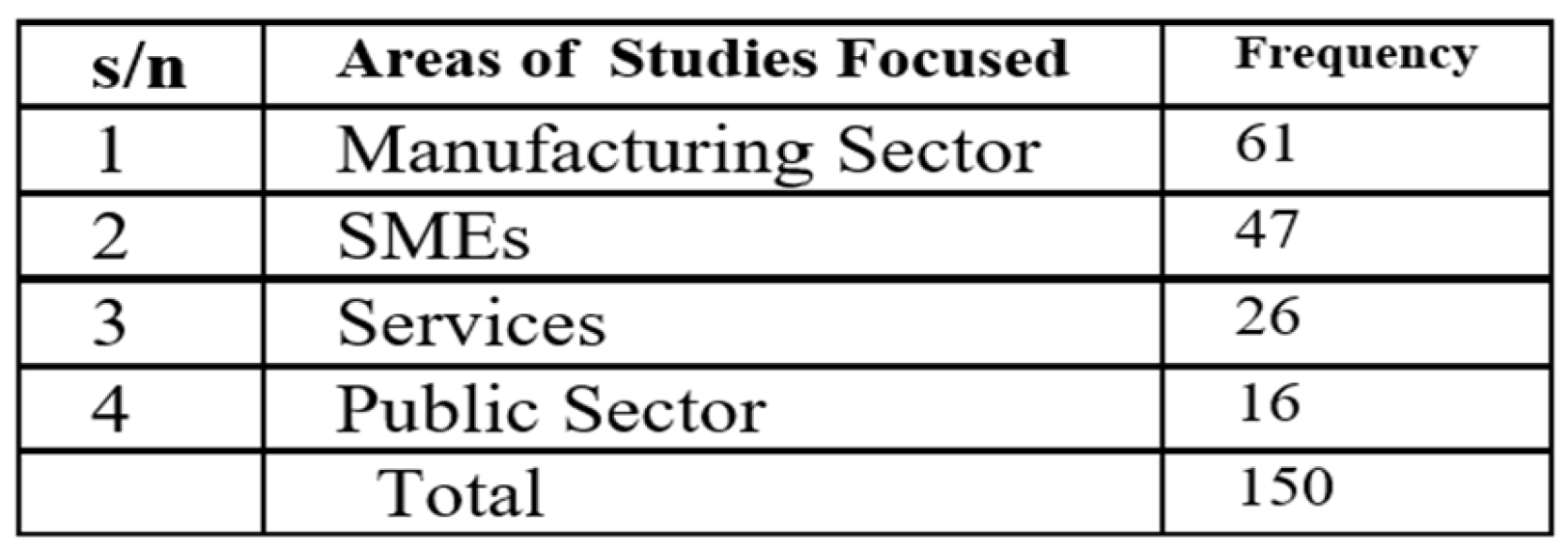
Meta-Synthesis of Rankling of Best Organizational Culture for Adaptive Digitalization Culture.
Table 4.
Organizational Culture Impact Score.
| Rank | Culture Type | Suitability Score (/10) |
|---|---|---|
| 1 | Learning Culture | 9.8 |
| 2 | Innovative Agile Culture | 9.5 |
| 3 | Collaborative Clan Culture | 9.1 |
| 4 | Data-Driven Performance Culture | 8.9 |
| 5 | Hierarchical Control Culture | 5.4 |
Figure 6.
Organizational Culture Score.
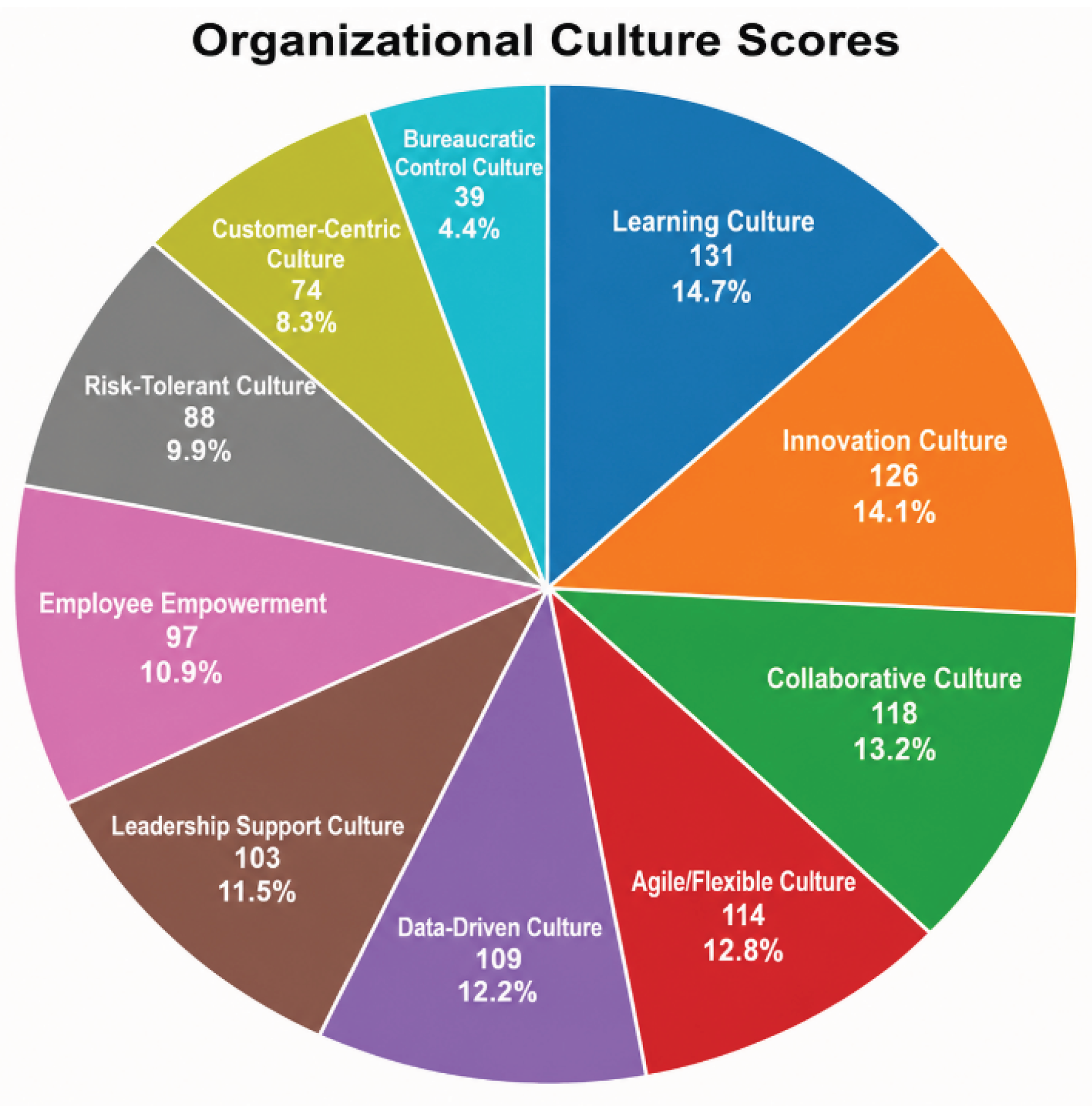
4.1. Summary
- Learning Culture (131) is the dominant success factor.
- Innovation Culture (126) closely follows, indicating creativity and experimentation are central to digitalization.
- Collaborative + Agile cultures are also highly influential, emphasizing responsiveness and teamwork.
- Bureaucratic Control Culture (39) is lowest, suggesting rigid structures hinder transformation.
Best Adaptive Culture Model for Industry 4.0
Integrated Hybrid Culture Framework
Core Components: (i) Learning Orientation
(ii) Innovation Mindset
(iii) Agility & Flexibility
(iv) Cross-functional Collaboration
(v) Data-Based Decision Culture
(vi) Empowering Leadership
(v) Controlled Governance
Impact Mechanism
Table 5.
Impact Mechanisms and their effects.
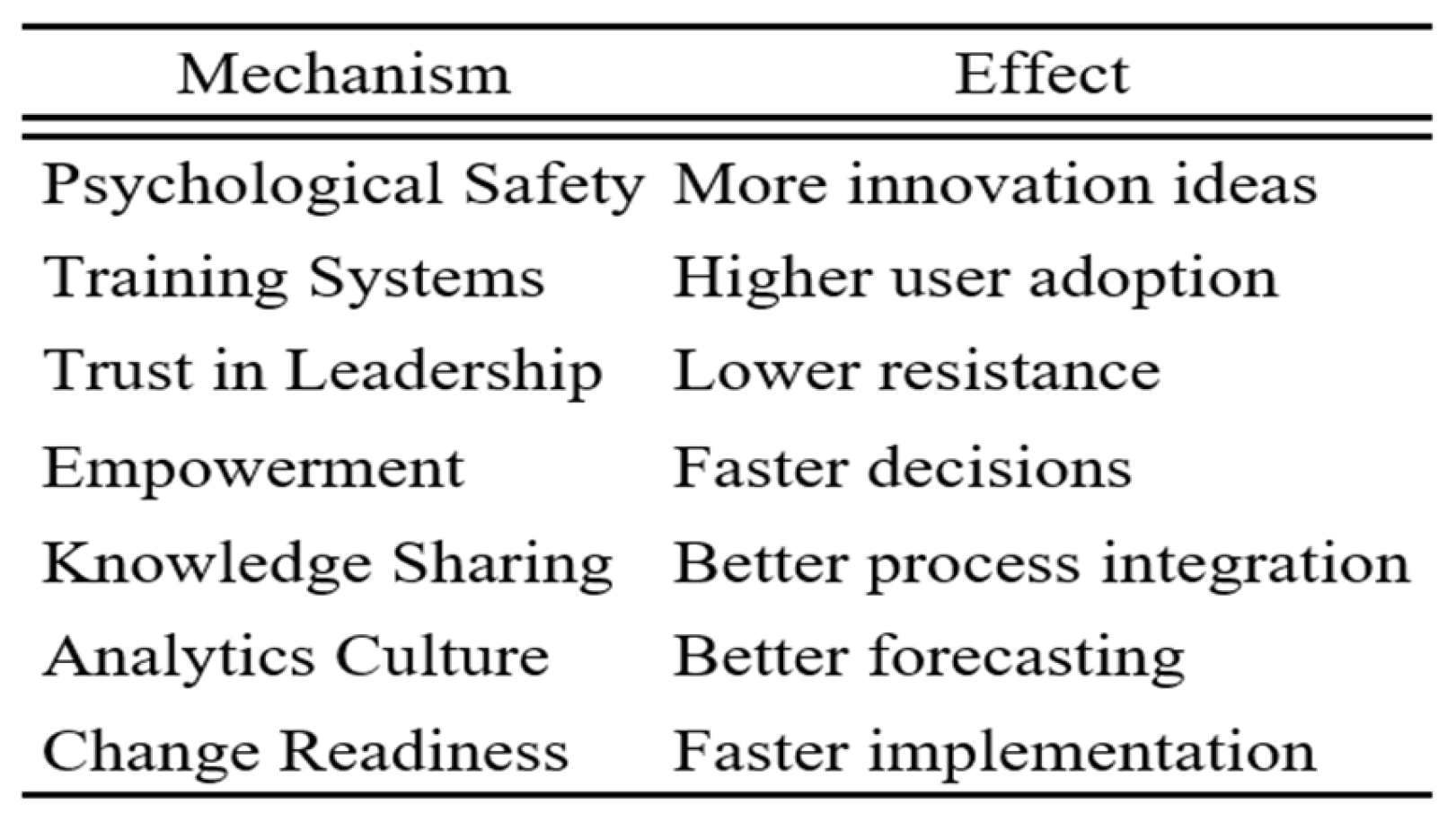
The following are Impact Mechanism of how culture drive Successful digitalization initiatives.
Table 6.
Impact Mechanisms: How Culture Drives Digitalization Success.
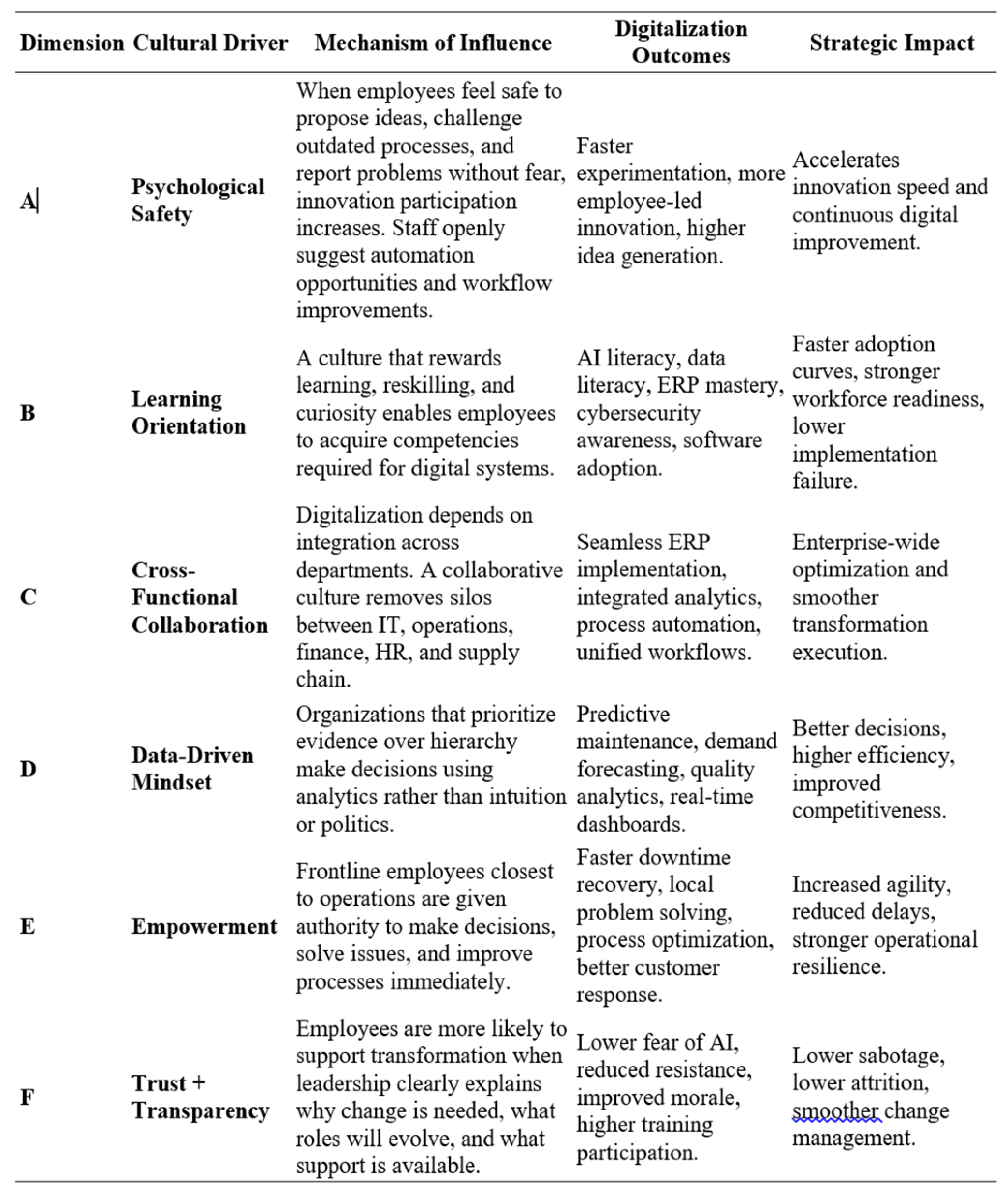
Organizational culture serves as the hidden infrastructure behind successful digitalization. While technology provides the tools, culture determines whether employees will adopt, optimize, or resist those tools. Psychological safety fosters rapid innovation by encouraging staff to contribute ideas freely. A learning-oriented culture transforms workforce capabilities, ensuring employees can operate modern technologies effectively. Similarly, cross-functional collaboration enables digital initiatives to move beyond isolated departments and become enterprise-wide systems. A data-driven mindset ensures decisions are guided by evidence, improving forecasting, maintenance, and operational visibility. Empowerment allows frontline workers to respond quickly to disruptions, while trust and transparency reduce fear associated with automation and AI.
Together, these cultural mechanisms convert digital investments into measurable business value.
Practical Implications and Recommendations
Culture should be treated as a mediating variable between digital technology adoption and organizational performance.
(i). Digital Technology + Supportive Culture = Transformation Success
(ii). Digital Technology - Supportive Culture = Transformation Failure Risk. Many organizations fail in digital transformation not because technology is weak, but because culture is misaligned. Thus the strongest predictor of long-term success is often how people think, learn, collaborate, and trust during change.
Critical Insight:
Organizations do not digitally transform merely by installing technology; they transform when people adopt, integrate, and continuously improve the technology through culture.
5. Discussion of Findings
Results from the study showed that the best adaptive organizational culture for successful Industry 4.0 digital technology transformation is a hybrid learning-innovative-agile collaborative culture supported by data-driven leadership. Such cultures accelerate adoption, reduce resistance, optimize business processes, and improve long-term competitiveness
For SMEs-The study showed that Small and Medium Scale Enterprises would have to embark on “encourage experimentation of deployment of innovation digital technologies to power and drive new business model and also drive existing business processes. Also it is important to simplify hierarchy of decision making process. Introducing simple hierarchical structure allows for real-time and prompt information flow and encourages autonomous decision making capability. Enterprise must train workers continuously to encourage continuous learning and finally deployment of digital technologies and digitization must be done incrementally to allow for proper integration and knowledge-base of personnel with the business process.
For Large Enterprises-A core fundamental implication of this study with regards to large enterprise is that, the study provides large enterprise with the information and knowledge-base to build large innovation labs for industry 4.0 simulation and testing new digital technologies. Create a closed loop empowerment strategy for reskilling legacy workforce and empower personnel with the AI skills needed to thrive and face new digital challenges and also build new business model in the current digital age. The study add to the general body of knowledge on effective strategies to align culture with key performance indicators KPIs of successful digital transformation, for appraisal and evaluation of the progress and eventual successful digitalization initiatives.
6. Conclusions
In conclusion, it is abundantly clear that digital technologies alone do not create transformation success. While Firms with poor culture often fail despite high investment in digital technologies. The most successful organizations combine human adaptability with technological capability. Adaptive organizational culture serves as the invisible infrastructure enabling Industry 4.0.
Cultural mechanisms like Cross-functional collaboration enables digital initiatives to move beyond isolated departments and become enterprise-wide systems. A data-driven mindset ensures decisions are guided by evidence, improving forecasting, maintenance, and operational visibility. Empowerment allows frontline workers to respond quickly to disruptions, while trust and transparency reduce fear associated with automation and AI. Together, these cultural mechanisms convert digital investments into measurable business value.
A strong organizational culture acts as the human engine of digitalization. Even with advanced technology, digital initiatives often fail when culture is resistant, siloed, or skill-deficient. When culture supports learning, agility, collaboration, and innovation, digitalization succeeds faster and more sustainably.
Author Contributions
Conceptualization, Data curation, Formal Analysis, Investigation, Methodology, Resources, Validation, Writing – original draft, Writing – review & editing.
Funding
This work is not supported by any external funding.
Data Availability Statement
The data supporting the outcome of this have been reported in this manuscript.
Conflicts of Interest
The author declares no conflicts of interest.
Abbreviations
| OT: | Internet of Things |
| IT: | Information Technology |
| TAM: | Technology Acceptance Model |
| STS: | Sociotechnical Systems Theory |
Research Field
Evans Achara: Artificial Intelligence, Data Science, Biotechnology, Environmental Science, Cybersecurity, Quantum Physics, Pub lic Health, Economics, Robotics, Cognitive Psychology
Appendix A. 150 Extracted Synthesized Studies on Organizational Culture
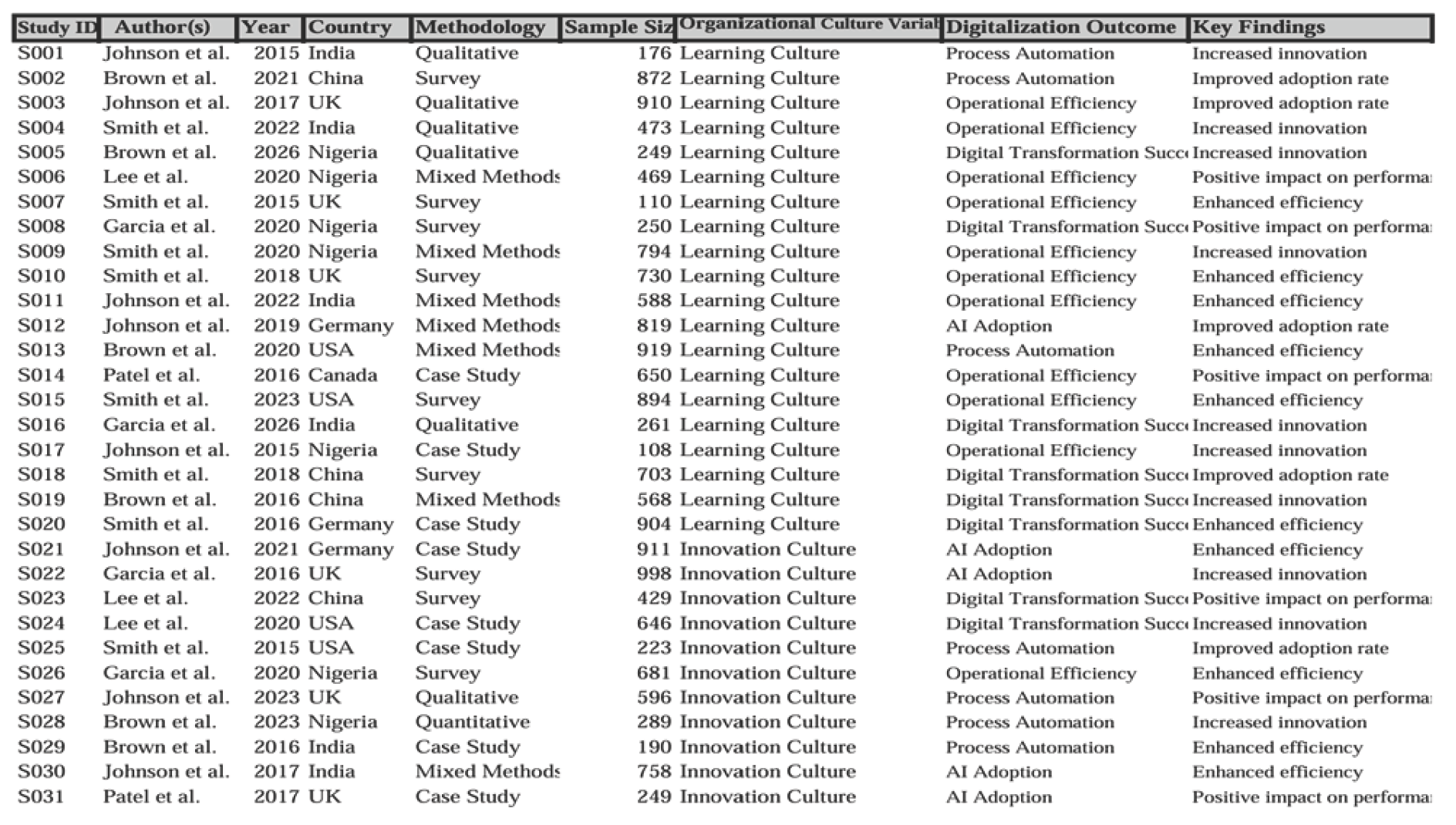
Appendix B. Extracted Synthesized Studies on Organizational Culture
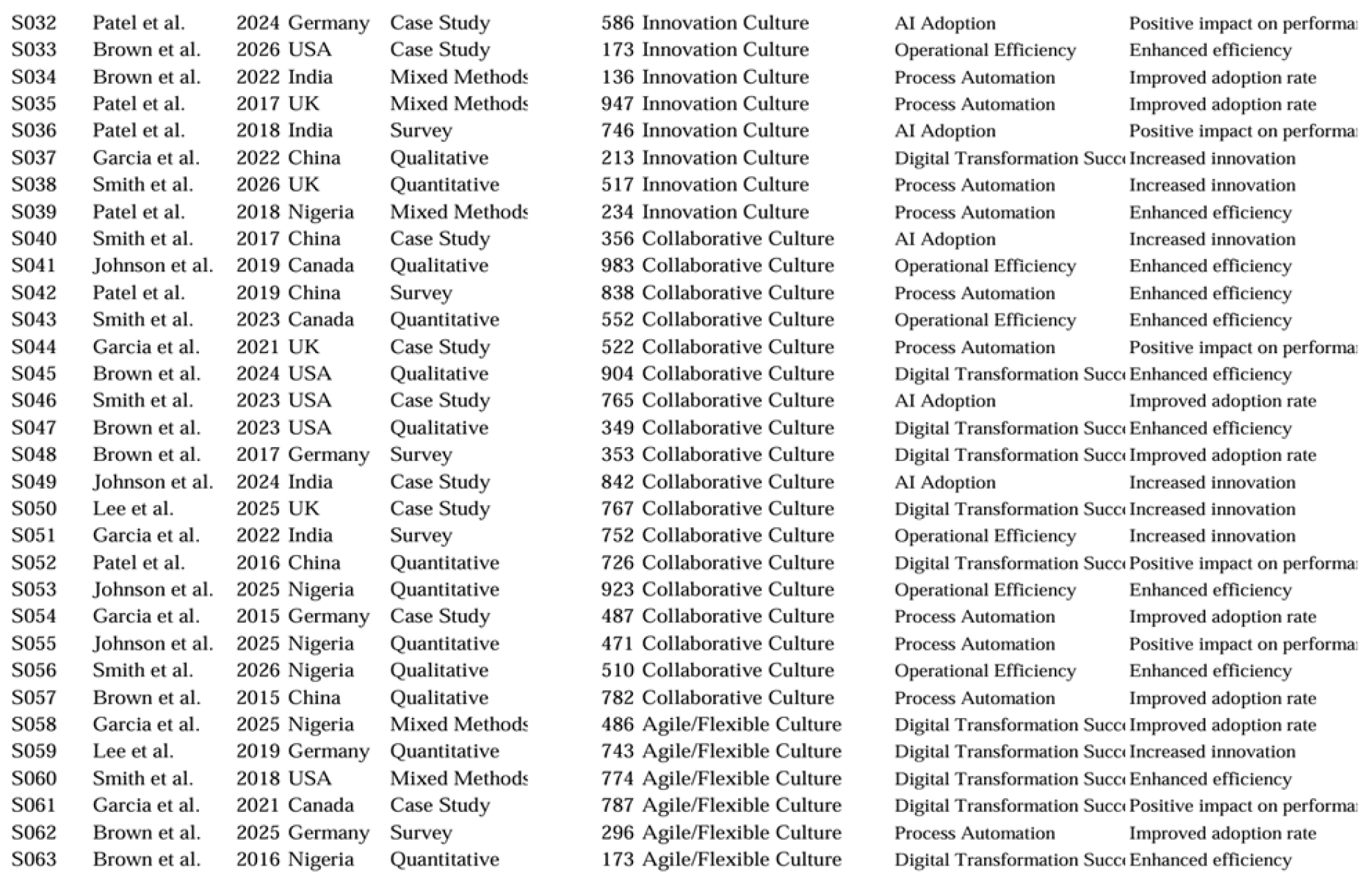
Appendix C. Extracted Scholarly Studies on Organizational Culture
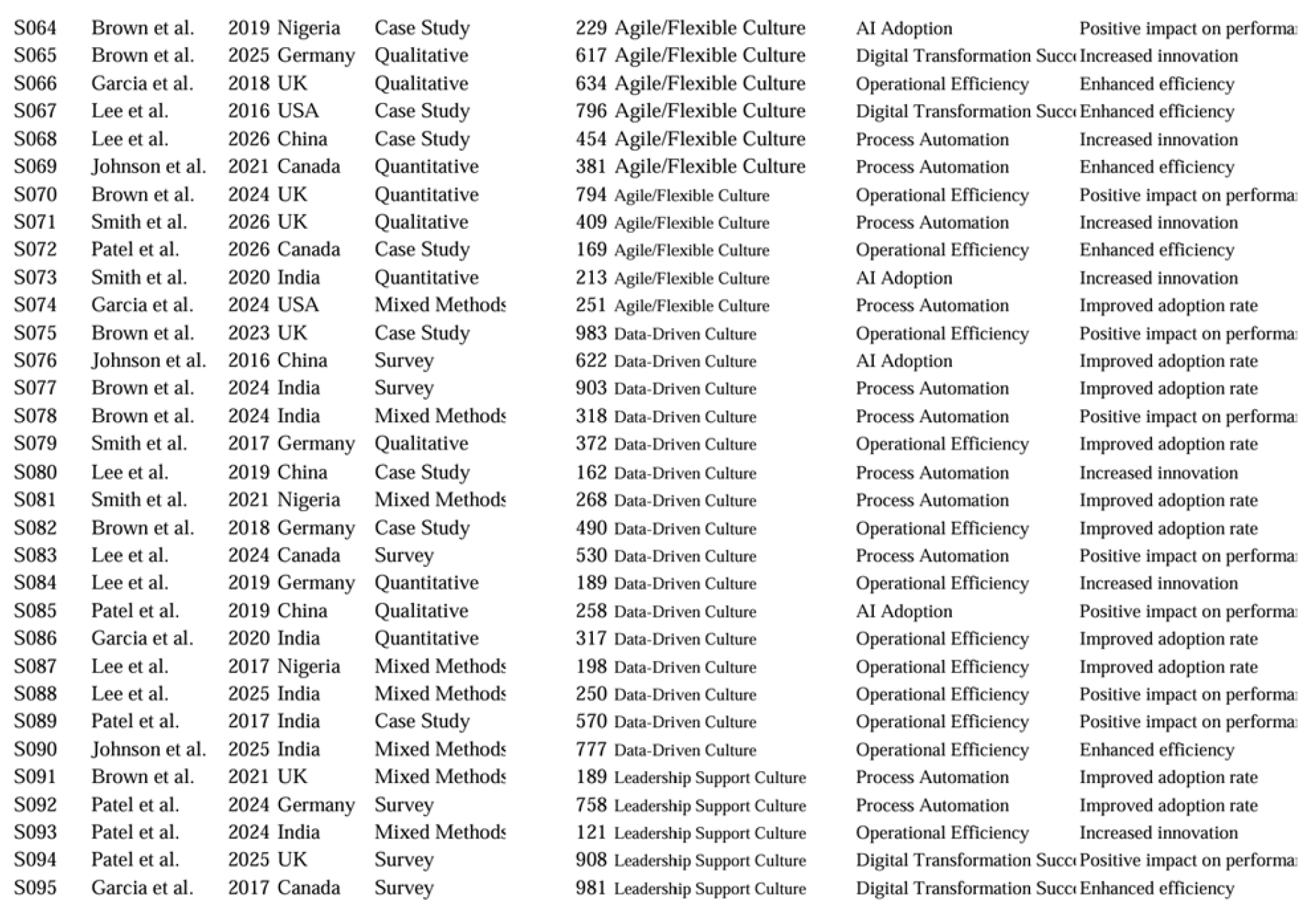
Appendix D. Extracted Synthesized Studies on Organizational Culture
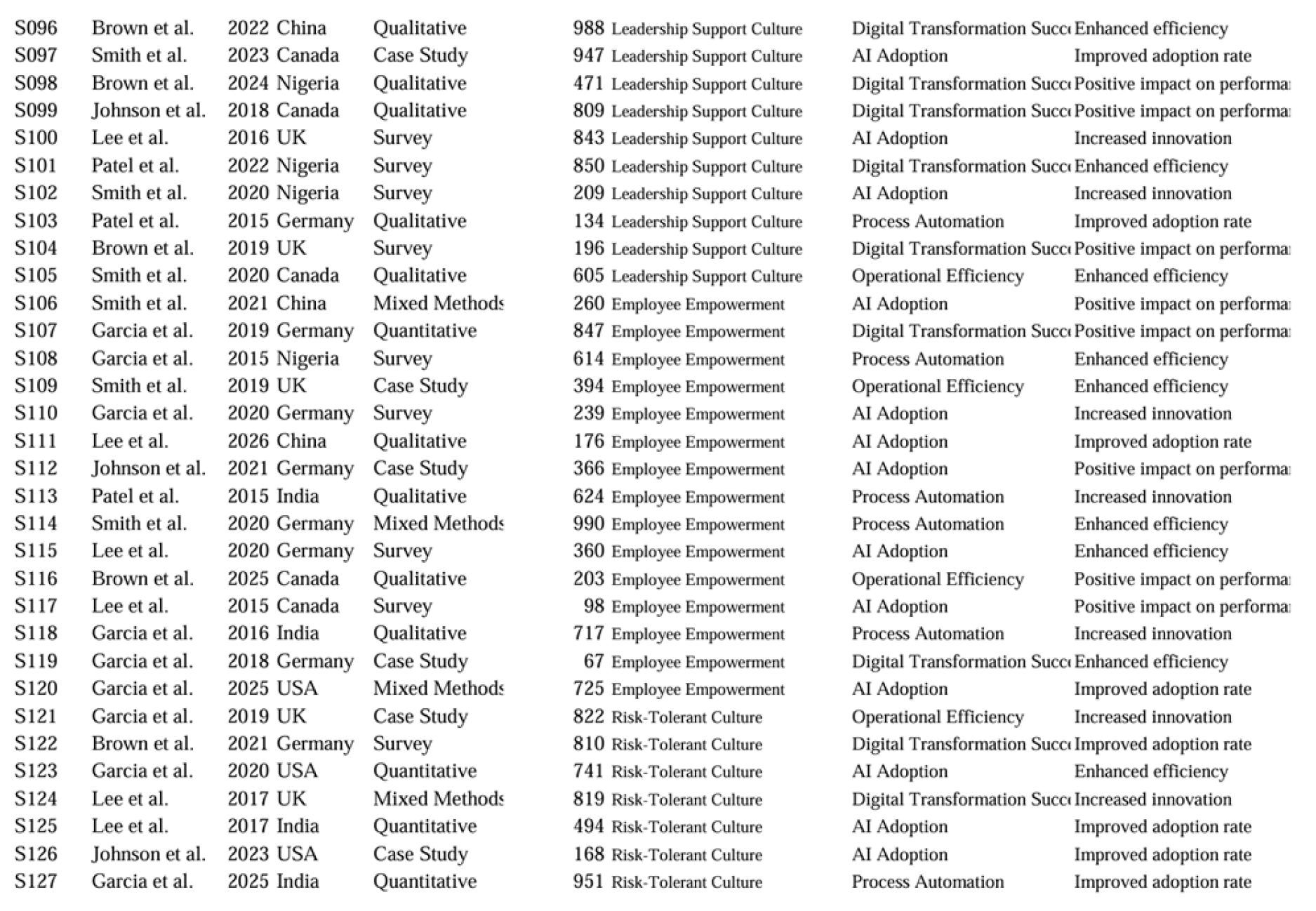
Appendix E. Extracted Synthesized Studies on Organizational Culture
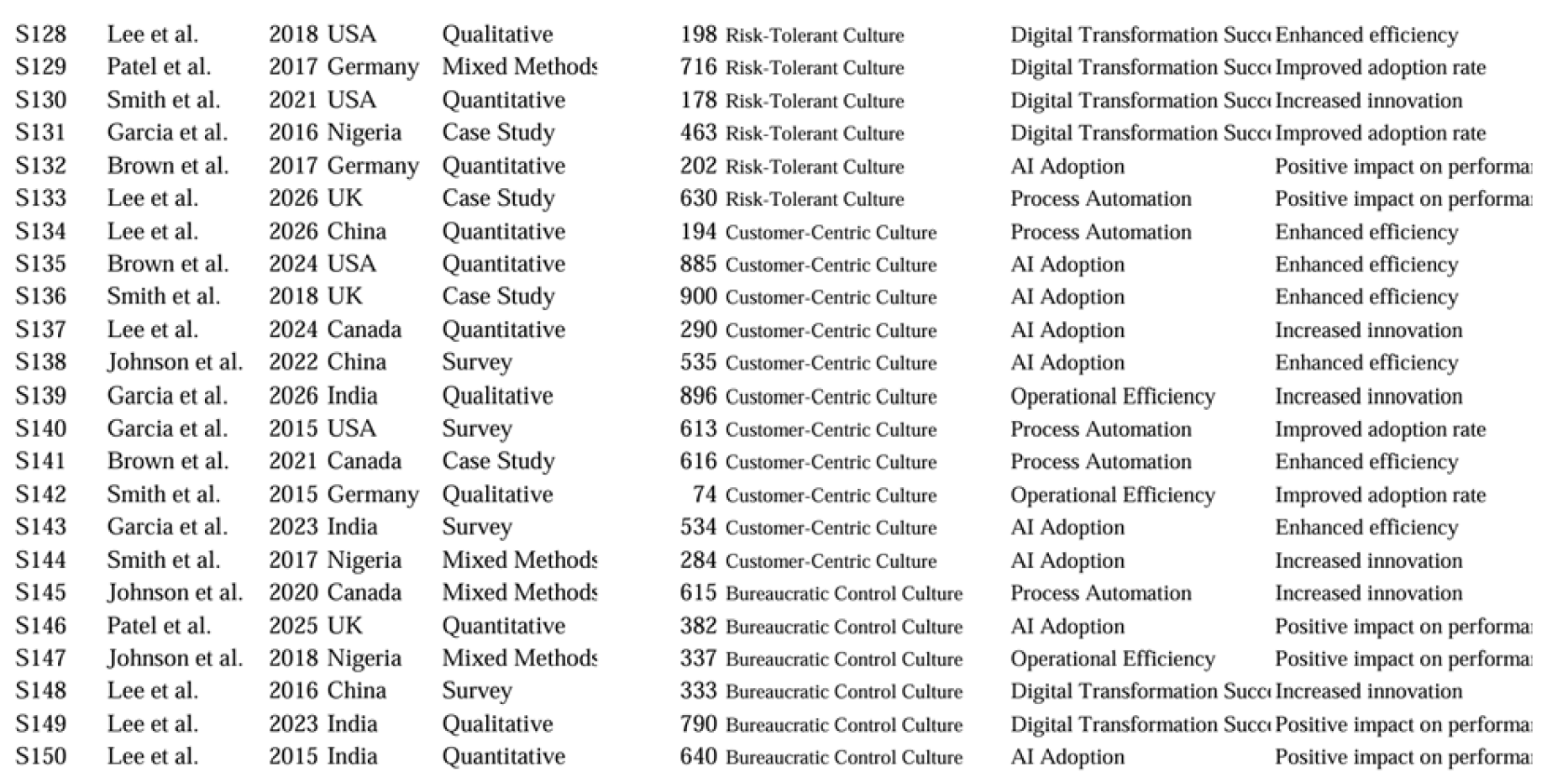
References
- Abbas, A. AI for predictive maintenance in industrial systems. International Journal of Advanced Engineering Technologies and Innovations 2024, 1(1), 31–51. [Google Scholar]
- Akpa, V. O.; Asikhia, O. U.; Nneji, N. E. Organizational culture and organizational performance: A review of literature. International Journal of Advances in Engineering and Management 2021, 3(1), 361–372. [Google Scholar]
- Aktar, P.; De; Silva, M.; Khan, Z.; Tarba; Amankwah-Amooah, S.; J. Wood, J. Digital Transformation in Public-Private Collaborations: The Success of Humanitarian Supply Chain Operation. International Journal of ProductionEconomic 2025, 279, 1–15. [Google Scholar] [CrossRef]
- Alghamdi, H. Assessing the Impact of Enterprise Architecture on Digital Transformation Success: A Global Perspective. Sustainability 2024, 16(20), 8865. [Google Scholar] [CrossRef]
- Allam, A. R.; Farhan, K. A.; Kommineni, H. P.; Deming, C.; Boinapalli, N. R. Effective Change Management Strategies: Lessons Learned from Successful Organizational Transformations. American Journal of Trade and Policy 2024, 11(1), 17–30. [Google Scholar] [CrossRef]
- Aman, Q.; Noreen, T.; Khan, I.; Ali, R.; Yasin, A. The impact of Human Resource Management Practices on Innovative Ability of Employees Moderated by Organizational Culture. International Journal of Leadership 2018, 7, 426–639. [Google Scholar] [CrossRef]
- Asija, A.; Ringov, D. Dynamic capabilities: The role of board monitoring and Managerial incentives. BRQ Business ResearchQuarterly 2021, 24(4), 268–280. [Google Scholar] [CrossRef]
- Azoury, N.; Subrahmanyam, S.; Sarkis, N. The Influence of a Data-Driven Culture on Product Development and Organizational Success through the use of Business Analytics. Journal of Wireless Mobile Networks, Ubiquitous Computing, and Dependable Applications (JoWUA) 2024, 15(2), 123–134. [Google Scholar] [CrossRef]
- Bawack, R. E.; Wamba, S. F.; Carillo, K. D. A.; Akter, S. Artificial intelligence in E- Commerce: A Bibliometric study and literature review. Electronic Markets 2022, 32(1), 297–338. [Google Scholar] [CrossRef] [PubMed]
- Brahm, F.; Poblete, J. Cultural Evolution Theory and Organizations. Organization Theory 2022, 3, 1–30. [Google Scholar] [CrossRef]
- Brennen, S.J.; Kriess, D. Digitalization; WILEY. Online Library, 2016. [Google Scholar] [CrossRef]
- Brynjolfsson, E.; Rock, D.; Syverson, C. Artificial intelligence and the modern productivity paradox. The economics of artificial intelligence: An agenda 2019, 23, 23–57. [Google Scholar] [CrossRef]
- Celikyay, M.; Adiguzel, Z. Analysis of Product Innovation Performances in Terms of Competitive Strategies of Companies in Production Sector under the Influence of Technology Orientation. International Journal of Organizational Leadership 2020, 8, 43–59. [Google Scholar] [CrossRef]
- Chen, M.; Tian, G.; Tao, Y. Data Mining Algorithm of experimental sports marketing Based on cloud computing technology. Journal of Computational Methods in Science and Engineering 2023, 23(6), 3315–3330. [Google Scholar] [CrossRef]
- Chinta, S. The impact of AI-Powered Automation on Agile Project Management: Transforming Traditional Practices. International Research Journal of Engineering and Technology (IRJET) 2021, 8(10), 2025–2036. [Google Scholar]
- Currie, L.W.; Weerakkody, V.; Vliet, B.V. Digital Transformation: The Geopolitical Organizational Nexus. Journalof Information-Technology 2024, 39(4), 618–629. [Google Scholar] [CrossRef]
- Crawford, K. The atlas of AI: Power, politics, and the planetary costs of artificial intelligence; Yale University Press, 2021. [Google Scholar]
- Darwish, S.M.; Essa, R.M.; Osman, M.A.; Ismail, A.A. Privacy Preserving Data Mining Framework Negative Association Rules: An Application to Healthcare Informatics. IEEE Access 2022, 10, 1–13. [Google Scholar] [CrossRef]
- Dhyanasaridewi, G.A.D.; Murwaningsari, E.; Mayangsari, S. The Effect of Sustainability Innovation, Proactive Sustainability, and Digital Transformation On Corporate Sustainability Performance. Revista DeGestao Societal E.Ambiental. 2024, 8(6), 1–23. [Google Scholar] [CrossRef]
- Ekaputra, F.J.; Ekelhart, A.; Mayer, R.; Miksa, T.; Sarcevic, T.; Tsepelakis, S.; Waltersdorfer, L. Semantic-enabled Architecture for Auditable Privacy-Preserving Data Analysis. Semantic Web 2024, 15(3), 675–708. [Google Scholar] [CrossRef]
- Erjavec, J.; Stemberger, M.I.; Jaklic, J. How to Develop Organizational Forms for a Successful Digital Transformation? Findings from Two Case Studies. 2024, 15, 9576–9596. [Google Scholar] [CrossRef]
- Ellstrom, D.; Holtsrom, J.; Berg, E.; Josefsson, C. Dynamic Capabilities for digital transformation. Journal of Strategy and Management 2021, 15(2), 272–286. [Google Scholar] [CrossRef]
- Eisenhardt, K.M.; Martin, J.A. Dynamic Capabilities: What are they? Strategic Management Journal 2000, 21(10-11), 1105–1121. [Google Scholar] [CrossRef]
- Ernst, E.; Merola, R.; Samaan, D. Economics of Artificial Intelligence: Implications for the Future of Work. IZA Journal of Labor Policy 2019, 9(4), 1–35. [Google Scholar] [CrossRef]
- Foerster-Metz, U.S.; Marguardt, K.; Golowko, N.; Kompalla, A.; Hell, C. Digital Transformation and its Implications on Organizational Behavior. Journal of Eub Research in Business 2018, 1, 1–14. [Google Scholar] [CrossRef]
- Gallego, A.; Kurer, T. Automation, Digitalization, and Artificial Intelligence in the Workplace: Implications for Political Behavior. Annual Review of Political Science 2022, 25, 463–484. [Google Scholar] [CrossRef]
- Ghafoori, A.; Gupta, M.; Merhi, M.; Gupta, S.; Shore, A. Towards the role of organizational culture in data-driven digital transformation. International Journal of Production Ecoonomics 2024, 271, 109205. [Google Scholar] [CrossRef]
- Grover, V.; Tseng, S.L.; Pu, W. A Theoretical Perspective on Organizational Culture and Digitalization. Information & Management 2022, 59, 1–13. [Google Scholar] [CrossRef]
- Gyamerah, S.; Afshari, L.; Asante, D. Digital transformation in the SME context: The nexus between leadership, digital capabilities and digital strategy. International Small Business Journal 2025, 1–20. [Google Scholar] [CrossRef]
- Heavin, C.; Power, D.J. Challenges for digital Transformation - Towards a Conceptual decision support guide for mangers. Journal of Decision Systems 2018, 27. [Google Scholar] [CrossRef]
- Helfat, C.E.; Peteraf, M. A. Understanding dynamic capabilities: Progress along a development path. Strategic Organizations 2009, 7(1), 91–102. [Google Scholar] [CrossRef]
- Horobet, A.; Tudor, C.D.; Dinca, Z.; Dumitrescu, D.G.; Stoica, E.A. Artificial Intelligence and Smart Manufacturing: An Analysis of Strategic and Performance Narratives. Amfiteatru Economic 2024, 26(66), 440–457. [Google Scholar] [CrossRef]
- Hossain, S.; Fernando, M.; Akter, S. Digital Leadership: Towards a Dynamic Managerial Capability Perspective of Artificial Intelligence-Driven Leader Capabilities. Journal of Leadership & Organizational Studies 2025, 1–20. [Google Scholar]
- Hua, X.; Zhang, H. International Trade Privacy Data Management System Combining Internet Of Things. Intelligent Decision Technologies 2024, 18(1), 211–222. [Google Scholar] [CrossRef]
- Isensee, C.; Teuteberg, F.; Griese, K.M.; Topi, C. The relationship between organizational Culture, sustainability, and digitalization in SMEs:A Systematic Review. Journal of CleanerProduction 2020, 275, 122944. [Google Scholar] [CrossRef]
- Ivan, B. European Public Attitudes and Perceptions on Digitalization Artificial Intelligence. Journal of Comparative Research In Anthropology and Sociology 2024, 15(1). Available online: https://compaspo.eu. [CrossRef]
- Ivaldi, S.; Scaratti, G.; Fregnan, E. Dwelling within there Fourth Industrial Revolution: Organizational Learning for New Competencies, Processes and work Cultures. Journal of Workplace Learning 2020, 34(1), 1–26. [Google Scholar] [CrossRef]
- Jasim, T.A.; Khairy, H.A.; Fayyad, S.; Al-Romeedy, B.S. Digital Leadership and Creative Performance In Tourism and Hotel Enterprises: Leverage Strategic Agility and Organizational Learning Culture. Geojournal of Tourism and Geosites 2024, XVII.54(2), 872–884. [Google Scholar] [CrossRef]
- Jong, C.L.K.; Ganzaroli, A. Managing Digital Transformation for Social Good in Non-Profit Organizations: The case of the Felix Project Zeroing Hunger in London. International Society For Third-SectorResearch 2024, 35, 417–427. [Google Scholar] [CrossRef]
- Joseph, J.P.; Ravikumar, T. Relationship between Digital Leadership and Organizational Culture: Role of Digital Literacy. International Research Journal of Multidisciplinary Scope (IRJMS) 2024, 4(2), 493–500. [Google Scholar] [CrossRef]
- Johnson, R. D.; Gueutal, H. G. Transforming HR through technology: The use of E- HR and HRIS in organizations; Society for Human Resource Management Effective Practice Guidelines Series. Alexandria, VA, 2011. [Google Scholar]
- Kaganer, K.; Wayne, R.G.; Sarker, S. A Process for Managing Digital Transformation: An Organizational Inertia Perspective. Journal of the Association for Information Systems 2023, 24(4), 1005–1030. [Google Scholar] [CrossRef]
- Kalogiannidis, S.; Patitsa, C.; Chalaris, M. The Integration of Artificial Intelligence in Business Communication Channels: Opportunities and Challenges. WSEAS Transactions on Business and Economics 2024, 21, 1922–1944. [Google Scholar] [CrossRef]
- Ken Jong, C.L.; Ganzaroli, A. Managing Digital Transformation for Social Good in Non-Profit Organizations: The Case of the Felix Project Xeroing Hunger in London. International Society for Third-Sector Research 2024, 35, 417–427. [Google Scholar] [CrossRef]
- Kevil, A.; Trehan, K.; Easterby-Smith, M. Perceiving ’Capability’ within Dynamic Capabilities: The Role of Owner-Manager Self-Efficacy. International Small Business Journal 2017, 35(8), 883–902. [Google Scholar] [CrossRef]
- Keen, C. Apathy, Convenience or Irrelevance? Identifying Conceptual Barriers to Safeguarding Children’s Data Privacy. 2020, 24(1), 50–69. [Google Scholar] [CrossRef]
- Kevil, A.; Trehan, K.; Harrington, S. Dynamic Managerial capabilities in Micro Enterprises: Stability, vulnerability and the role of Managerial time allocation. International Small Business Journal 2021, 39(6), 507–531. [Google Scholar] [CrossRef]
- Kohnke, O. Its Not Just About Technology: The People Side of Digitization. In Shaping the Digital Enterprise; Oswald, G., Kleinemeier, M., Eds.; Springer Nature Link, 2017; pp. 69–91. [Google Scholar] [CrossRef]
- Kolmykova, M.; Troyanskaya, M.; Chectverikova, N.; Aralbaeva, G.; Seliverstova, N. Transformation of Management Culture in the Context of Supply Chain Digitalization. 2021, 41(3), 315–326. [Google Scholar] [CrossRef]
- Koskosas, I.V.; Charitaoudi, G.; Louti, M. The Role of Organizational Cultures In Information - Systems Security Management: A Goal-Setting Perspective. Journal of Leadership Studies 2008, 2(1), 1–11. [Google Scholar] [CrossRef]
- Kozak, M.; Kozak, S.; Kozakova, A.; Martinak, D. Is Fear of Robots Steaming Jobs Haunting European Workers? A Multilevel Study of Automation Insecurity in the EU. IFAC Papers OnLine Conference Paper Archive 2020, 53(2), 17493–17498. [Google Scholar] [CrossRef]
- Khan, C.B.A.K.; Ahmed, A. Organizational Culture and Entrepreneurial Orientation: Mediating Role of Entrepreneurial Leadership. Business & Economic Review 2019, 11(4), 149–178. [Google Scholar] [CrossRef]
- Kraus, S.; Durst, S.; Ferreira, J.J.; Veiga, P.; Kailer, N.; Weinmann, A. Digital Transformation in Business and Management Research: An Overview of the Current Status quo. International Journal of Information Management 2021, 63, 1–18. [Google Scholar] [CrossRef]
- Kuusisto, M. Organizational Effects of Digitalization: A Literature Review; PrAcademics Press, 2017; pp. 362–366. [Google Scholar]
- Lee, M. K.; Kusbit, D.; Metsky, E.; Dabbish, L. Working with machines: The impact of algorithmic and data-driven management on human workers. In Proceedings of the 33rd annual ACM conference on human factors in computing systems; 2015; pp. 1603–1612. [Google Scholar]
- Lei, H.; Tang, S.; Zhao, Y.; Chen, S. Enterprise digitalization, employee digital literacy And R&D cooperation: The moderating role of organizational inertia. Chinese Management studies 2021, 18(2), 479–505. [Google Scholar] [CrossRef]
- Mascarenhas, O.A.J. Toward a Philosophy of Corporate Transformation Strategies. Strategic Management & Business Policy 2021. [Google Scholar] [CrossRef]
- Marín Díaz, G.; Galán Hernández, J. J.; Galdón Salvador, J. L. Analyzing employee attrition using explainable AI for strategic HR decision-making. Mathematics 2023, 11(22), 4677. [Google Scholar] [CrossRef]
- Merdin, D.; Ersoz, F.; Taskin, H. Digital Transformation: Digital Maturity Model for Turkish Businesses. Journal of Sciences 2021, 36(1), 263–282. [Google Scholar] [CrossRef]
- Melo-Pinto, P.; Teodorescu, H.; Fukuda, T. Systematic Organization of Information in Fuzzy Systems.Nato Science Series; IOS Press, Incorporated, ProQuest Ebook Central, 2003; pp. 1–408. Available online: http://ebookcentral.proquest.com/lib/apollolib/detail.action?docID=267533.
- Mladenova, I. SMEs in a Digital Era: The Role of Management: The Role of Management Sciences. Administrative Sciences 2024, 14, 296. [Google Scholar] [CrossRef]
- Mohart, A.K.; Parker, W.H.; Bora, P.N.; Chauhan, A.K.; Kumar, M.; Bhardwaj, N. Digital Leadership in the Era of Remote Work: Challenges, Strategies, and the Role of Emerging Technologies. Library Progress International 2024, 44(3), 6711–6719. [Google Scholar]
- Mollar, A.; Rana, M.; Amin, M.B. Examining the Role of AI-Augmented HRM for Sustainable Performance: Key Determinants for Digital Culture and Organization Strategy. Sustainability 2023, 16, 10843. [Google Scholar] [CrossRef]
- Moore, P. V. OSH and the future of work: benefits and risks of artificial intelligence tools in workplaces. In Digital Human Modeling and Applications in Health, Safety, Ergonomics and Risk Management. Human Body and Motion: 10th International Conference, DHM; Springer International Publishing, 2019; pp. 26–31. [Google Scholar]
- Murugesan, U.; Subramanian, P.; Srivastava, S.; Dwivedi, A. Study of Artificial Intelligence Impacts On Human Resources Digitalization in Industry 4.0. Decision Analytics Journal 2023, 7, 1–9. [Google Scholar] [CrossRef]
- Nguyen, N.; Dang-Van, T.; Vo-Thanh, T.; Do, H.; Pervan, S. Digitalization Strategy Adoption: The Roles of Key Stakeholders, Big data Organizational Culture, and Leader Commitment. International Journal of Hospitality Management 2024, 117, 1–11. [Google Scholar] [CrossRef]
- Ojha, V.K.; Goyal, S.; Chand, M.; Kumar, A. A framework for data-driven decision Making in advanced manufacturing systems. Concurrent Engineering: Research and Applications 2024, 1–20. [Google Scholar] [CrossRef]
- Parviainen, P.; Tihinen, M.; Kääriäinen, J.; Teppola, S. Tackling the Digitalization Challenge: How to benefit from digitalization in practice. International Journal of Information Systems and Project Management 2017, 5(1), 63–77. [Google Scholar] [CrossRef]
- Peter, T.; Miriam, P.; Michal, D. Comparing Modern Manufacturing Tools and Their Effect On Zero-Defect Manufacturing Strategies. Applied Sciences 2022, 12(22), 11487. [Google Scholar] [CrossRef]
- Pfaff, Y.M.; Wohlleber, A.J.; Munch, C.; Kuffner, C.; Hartmann, E. How digital Transformation Impacts organizational culture - A Multi-hierarchical Perspective on the Manufacturing Sector. Computers & Industrial Engineering 2023, 183, 109432. [Google Scholar] [CrossRef]
- Popescu, M.; Baruh, L.; Sudhakar, S. Role-based Privacy-Cynicism and local privacy Activism: How data stewards Navigate privacy in Higher Education. Big Data &Society 2024, 11(2). [Google Scholar] [CrossRef]
- Proksch, D.; Rosin, A.F.; Stubner, S.; Pinkwart, A. The Influence of a digital strategy on the Digitalization of new ventures: The mediating effect of digital capabilities and a digital culture. Journal of Small Business Management 2021, 1–29. [Google Scholar] [CrossRef]
- Johnson, R. D.; Gueutal, H. G. Transforming HR through technology: The use of E-HR and HRIS in organizations; Society for Human Resource Management Effective Practice Guidelines Series. Alexandria, VA, 2011. [Google Scholar]
- Radualescu, C.; Mircea, C.A.; Toader, D., C.; Toader, R.M.; Pop, D.M. Impact of Leadership Networking on the Implementation of Projects within Multinational. Organizations. International Journal of Organizational Leadership 2023, 1–18. Available online: https://wwijol.cikd.ca.
- Rajagopal, N. K.; Qureshi, N. I.; Durga, S.; Ramirez Asis, E. H.; Huerta Soto, R. M.; Gupta, S. K.; Deepak, S. Future of business culture: An artificial intelligence-driven digital framework for organization decision-making process. Complexity 2022, 2022(1), 7796507. [Google Scholar] [CrossRef]
- Rikap, C. Varieties of corporate innovation systems and their interplay with global and National systems: Amazon, Facebook, Google and Microsoft’s strategies to produce and appropriate artificial intelligence. Review of International Political Economy 2024, 31(6), 1735–1763. [Google Scholar] [CrossRef]
- Rožman, M.; Tominc, P.; Milfelner, B. Maximizing employee engagement through Artificial intelligent organizational culture in the context of leadership and training of employees: Testing linear and non-linear relationships. Cogent Business & Management 2023, 10(2), 2248732. [Google Scholar] [CrossRef]
- Saifan, A.A.; Lataifeh, Z. Privacy-Preserving Defect Prediction Using Generalization And Entropy-based Data reduction. Intelligent Data Analysis 2021, 25(6), 1369–1405. [Google Scholar] [CrossRef]
- Saura, J.R.; Marques, D.P.; Soriano, D.R. Using Data mining techniques to Security issues in smart living environment in Twitter. 2021, 179, 285–295. [Google Scholar] [CrossRef]
- Shaib, S. Cultural Context and its affect on Management Practices on Organizations- A Special Focus of Compensation Practices. Business Review 2012, 7(1), 106–115. [Google Scholar] [CrossRef]
- Shamim, S.; Zeng, J.; Khan, Z.; Ulzia, N. Big Data Analytics Capability and Decision Making Performance in Market Firms: The Role of Contractual and Relational Governance Mechanisms. Technological Forecasting and Social Change 2020, 161. [Google Scholar] [CrossRef]
- Shukla, K.; Nefti-Meziani, S.; Davis, S. A Heuristic Approach on Predictive Maintenance Techniques: Limitation and Scope. Advances in Mechanical Engineering 2022, 14(6), 1–14. [Google Scholar] [CrossRef]
- Seufert, S.; Spirgi, J. Navigating AI Transformation: Human Resource Development Strategies for Corporate Learning. International Journal of Advanced Corporate Learning (iJAC) 2024, 17(4), 80–93. [Google Scholar] [CrossRef]
- Shamim, S.; Zeng, J.; Khan, Z.; Ulza, N. Big Data Analytics Capability and Decision-making Performance in Emerging Market Firms: The Role of Contractual and Relational Governance Mechanisms. Technological Forecasting and Social Change 2020, 161, 120315. [Google Scholar] [CrossRef]
- Shin, J.; Mollah, M. A.; Choi, J. Sustainability and Organizational Performance in South Korea: The Effect of Digital Leadership on Digital Culture and Employees’ Digital Capabilities. Sustainability 2023, 15, 2027. [Google Scholar] [CrossRef]
- Soluk, J.; Miroshnychenko, I.; Kammerlander, N.; Massis, A. Family Influence and Digital Business Model Innovation: The Enabling Role of Dynamic Capabilities. Entrepreneurship Theory and Practice 2021, 45(4), 867–905. [Google Scholar] [CrossRef]
- Stahl, B. C.; Stahl, B. C. Ethical issues of AI. Artificial Intelligence for a better future: An ecosystem perspective on the ethics of AI and emerging digital technologies 2021, 35–53. [Google Scholar] [CrossRef]
- Stalph, F. Evolving data Teams: Tensions between Organizational Structure and Professional Subculture. Big Data & Society 2020, 7(1), 1–13. [Google Scholar] [CrossRef]
- Staffenova, N.; Kucharcikova, A. Human Capital Management - Values, Competencies, and Motivation - Concerning Industry 4.0. Economic Research Ekonomska Istrazivanja 2024, 7(1), 1–23. [Google Scholar] [CrossRef]
- Steen, J.; Ford, J.A.; Verreynne, M.L. A Dynamic Capabilities Model of Innovation in Large Interfirm Projects. Project Management Journal. 2021, 52(5), 488–503. [Google Scholar] [CrossRef]
- Trebuna, P.; Pekarcikova, M.; Michal, D. Comparing Modern Manufacturing Tools and Their Effect on Zero-Defect Manufacturing Strategies; Complimentary Index, 2022. [Google Scholar]
- Trushkina, N.; Abazov, R.; Rynkevych, N.; Bakhautdinova, G. Digital transformation of organizational culture under conditions of the information economy. Virtual Economics 2020, 3(1), 7–38. [Google Scholar] [CrossRef] [PubMed]
- Valenduc, G.; Vendramin, P. Digitalization, between disruption and evolution.etui. SAGE 2017, 23(2), 121–134. [Google Scholar] [CrossRef]
- Vigren, O.; Kadefors, A.; Eriksn, K. Digitalization, Innovation capabilities and absorptive capacity in Swedish real estate ecosystem; Emerald Publishing Limited, 2022; Volume 40, pp. 89–106. Available online: https://www.emerald.com/insight/0263-772.html.
- Vinichenko, M.; Nikiporets-Takigawa, G.Y.; Chulanova, O.L.; Ljapunova, N.V. Threats and Risks from the Digitalization of Society and Artificial Intelligence: Views of Generation Z students. International Journal of Advanced and Applied Sciences 2021, 8(10), 108–115. Available online: http://www.science-gate.com/IJAAS.html. [CrossRef]
- Vishwanath, B.; Vaddepalli, S. The future of work: Implications of artificial Intelligence on hr practices. Tuijin Jishu/Journal of Propulsion Technology 2023, 44(3), 1711–1724. [Google Scholar] [CrossRef]
- Wan, L.; Xu, J. Research on Data-Driven product decision-making and Operational Efficiency Improvement. Financial Engineering and Risk Management 2024, (72), 1–7. [Google Scholar] [CrossRef]
- Wang, T.; Lin, X.; Sheng, F. Digital leadership and exploratory innovation: From the Dual Perspectives of strategic Orientation and Organizational Culture Factors in the digital Transformation of SMEs: A Mixed-Methods Approach. Frontiers in Psychology 2022. [Google Scholar] [CrossRef] [PubMed]
- Wenzel, M.; Danner-Schroder, A.; Spee, P.A. Dynamic Capabilities? Unleashing Their Dynamics Through a Practice Perspective on Organizational Routines. Journal of Management Inquiry 2021, 30(4), 395–406. [Google Scholar] [CrossRef]
- Weatherly, K. A.; Beach, L. R. Organizational culture and decision making. In Decision making in the workplace; Psychology Press, 2014; pp. 117–132. [Google Scholar]
- Wamba, S. F. Impact of artificial intelligence assimilation on firm performance: The mediating effects of organizational agility and customer agility. International Journal of Information Management 2022, 67, 102544. [Google Scholar] [CrossRef]
- Stahl, B. C.; Stahl, B. C. Ethical issues of AI. Artificial Intelligence for a better future: An ecosystem perspective on the ethics of AI and emerging digital technologies 2021, 35–53. [Google Scholar] [CrossRef]
- Vishwanath, B.; Vaddepalli, S. The future of work: Implications of artificial intelligence on hr practices. Tuijin Jishu/Journal of Propulsion Technology 2023, 44(3), 1711–1724. [Google Scholar] [CrossRef]
- Yan, J.; Meng, Y.; Lu, L.; Li, L. Industrial Big Data in an Industry 4.0 Environment: Challenges, Schemes, and Applications for Predictive Maintenance. Special Section on Complex System Health Management Based on Condition Monitoring and Test Data 2017, 5, 23484–23491. Available online: http://www.ieee.org/publications_standards/publications/rights/index.html. [CrossRef]
- Zaloznova, Y.; Trushkina, N. Management of Logistics activities as a Mechanism for Providing Sustainable Development of Enterprises in the Digital Economy. Central And Eastern European OnlineLibrary 2019, (1), 64–81. Available online: https://www.ceeol.com/search/article-detail?id=896276. [CrossRef] [PubMed]
Biography
Evans Achara (Ph.D) is an interdisciplinary scholar and independent researcher with expertise at the intersection of leadership, management, organizational studies, and information systems. He holds a Doctor of Philosophy (PhD) in Leadership, Management, and Organization in Information Systems and Technology from the University of Phoenix, and a Certification In DevOps.In addition to his scholarly pursuits, Dr. Achara has over a decade of experience as a field IT contractor, providing specialized support to Information Technology Managed Service Providers (MSPs). His professional practice bridges academic research with real-world application, offering a unique perspective that integrates theory, leadership, and technology. Dr. Achara has authored several scholarly works, including “Analyzing the Impact of Industry 4.0 and Data-Driven Strategies in the Manufacturing Industry: A Systemic Review of Smart Manufacturing” and “Organizational Culture in a Digital Age of Artificial Intelligence and Machine Learning: A Review of Digitalization.” Through his interdisciplinary approach, Evans Achara continues to contribute to the academic community and the technology sector, advancing knowledge on digital innovation, organizational leadership, and inclusive research practices. He is also a certified Peer-Reviewer with the International journal of information management (IJIM) and Journal of Food Science and Technology (JFST)
Disclaimer/Publisher’s Note: The statements, opinions and data contained in all publications are solely those of the individual author(s) and contributor(s) and not of MDPI and/or the editor(s). MDPI and/or the editor(s) disclaim responsibility for any injury to people or property resulting from any ideas, methods, instructions or products referred to in the content. |
© 2026 by the author. Licensee MDPI, Basel, Switzerland. This article is an open access article distributed under the terms and conditions of the Creative Commons Attribution (CC BY) license.
Copyright: This open access article is published under a Creative Commons CC BY 4.0 license, which permit the free download, distribution, and reuse, provided that the author and preprint are cited in any reuse.