

Submitted:
03 August 2026
Posted:
04 August 2026
You are already at the latest version
Abstract
Smart textiles have progressed from conventional passive sensing fabrics to advanced cyber-physical systems capable of integrating sensing, actuation, computation, and wireless communication within a single textile platform. With a focus on circular economy principles, this review critically examines intelligent textile ecosystems, from material architectures to AI-enabled wearable platforms. The functional hierarchy in-volves passive (sensing), active (sensing + response) and ultra-smart (autonomous deci-sion-making) textiles. The four classes of materials are metallic conductors, carbonaceous nanomaterials (CNTs and graphene), conductive polymers (PEDOT:PSS) and bio-based alternatives. Integration is achieved by coating, weaving, printing and additive manu-facturing. Energy autonomy is achieved by five harvesting mechanisms: piezoelectric (1–10 µW·cm⁻²), triboelectric (10–100 µW·cm⁻²), thermoelectric (20–50 µW·cm⁻²), photovol-taic (100–1000 µW·cm⁻²) and bioelectrochemical (1–5 µW·cm⁻²). Hybrid systems can run continuously. Flexible supercapacitors and thin-film batteries are used for energy stor-age. The combination of AI and IoT allows for multi-tier architectures that encompass edge processing (TinyML), gateway management, and cloud analytics. On-device in-ference reduces energy consumption by 60-80%, improves privacy and enables real-time anomaly detection using CNNs, LSTMs and autoencoders. Sustainability is considered by life cycle assessment, which quantifies impacts across extraction, fabrication, use, and end-of-life of materials. Circular strategies: Design for disassembly, harmonisation of materials, biodegradable electronics, and recycling routes are all important. We critically evaluate key challenges such as manufacturing scalability, washability, biocompatibility, and regulatory standardisation. This review provides a unifying framework that con-nects materials science, electronics, AI and sustainable design, providing a roadmap for circular, intelligent and energy-autonomous textile systems in line with UN SDGs (3, 9, 12, 13).
Keywords:
smart textiles
; wearable electronics
; internet of things (IoT)
; artificial intelligence (AI)
; energy harvesting
; sustainability
; circular design
1. Introduction
The textile industry worldwide is going through a revolutionary change which might possibly be the most drastic one. The old way of textile manufacturing that regarded weaving threads mainly as a means of providing warmth and protection and also decoration has now disappeared. It is the fabric in fact that has become the intelligent and interactive medium giving rise to the new diversified discipline. The way new fabric is going to be used will, of course, be a great deal different from the ordinary function of clothing only because new fabric will be self-sensing [1,2]. Processing the data and reacting physically or digitally are not out of the question for the new fabric. In fact, a small piece of fabric must contain the ability to touch, to measure temperature or pressure, to see or even to carry out chemical experiments and to change them into signals that may be used. For that reason, smart textiles or e-textiles are also called electronic textiles [3,4].
1.1. Technological Underpinnings of the Transformation
Various technological domains have fueled the need for innovation to develop smart textiles:
- Nanotechnology allows for molecular-level modifications of fibers. Electrically conductive nanomaterials like graphene, carbon nanotubes (CNTs), silver nanowires, and metal nanoparticles enable textile materials to have electric conductivity, sensing capability, and durability while still being soft and flexible [5].
- The miniaturization of microelectronics allows the integration of sensors and processors into fibers and coating layers. Micro-electro-mechanical systems (MEMS) and nano-electro-mechanical systems (NEMS) enable fabrics to perform computing without affecting their properties such as draping and breathing [6].
- Functional and smart polymers offer fabrics new reactivity features, for instance, shape-memory polymers that react to temperature changes, piezoelectric fibers that generate electricity when compressed, and photochromic materials that change color when exposed to light [7].
By integrating these techniques, a piece of fabric is transformed into a novel cyber-physical system or a physical interface capable of flexible interaction between humans and the digital world.
1.2. Smart Textiles Within the Context of Industry 4.0
Smart textiles are a significant component of the Internet of Things (IoT), which forms one of the main elements of the Fourth Industrial Revolution (Industry 4.0) [8]. The idea here is of ubiquitous computing where any surface, garment or accessory not only carry but can also process and share information. To illustrate, a jacket can keep track of the owner's heart rate and posture, a sports sleeve, the degree of muscle fatigue, or a medical bandage can measure the pH level in a wounded body area. In this way, a cloth not only becomes an article of clothing but also turns into a device that integrates computing power into everyday items. Such clothes that combine the qualities of being flexible, comfortable, and constantly in skin touch that are very close to each other (or even multiplied to become invisible) could be considered ideal surfaces for collecting personal data and, simultaneously, becoming a basis for a symbiotic human-machine interaction [1].
1.3. Extending the Scope of Functionality
The practical applications of smart textiles span a variety of aspects of our lives:
- Healthcare and assisted living: With real-time healthcare monitoring such as heart rate, breathing or hydration, one would be able to diagnose diseases early and practice remote medicine [9].
- Sports and performance optimization: Combining sensors in fabric which can measure movements and pressures for providing biomechanics feedback to the individual when training or performing [10].
- Defense and security: Protective uniforms with weapon detection, response system, and environment awareness features [11].
- Energy generation: Photovoltaic, thermoelectric, or triboelectric fibers can convert physical stimuli like heat, light, or motion into electricity to power other wearables [12].
Hence, the textile industry is evolving from a consumer to a producer, with Industry 4.0 capabilities thanks to newly developed functional features and valuable data.
1.4. The Challenge of Sustainability
Despite the fact that the use of electronic parts and smart materials has really increased the level of product performance, we have to look at the harmful effects on the environment that these changes have brought about. Addressing the problem of separating metals, polymers, and semiconductors that are integrated into electronic products is challenging due to the complexity of the materials used and the procedures for recycling them. In addition, hybrid materials result in complex composite structures which make disassembly more difficult and lead to an increase in the embodied energy of the product (which means the energy that gets used during the whole lifecycle of production) [13].
The main environmental issues are:
- Tension between recyclability and function: multi-layer materials made of copper, silver, polyurethane, and polyester can be separated easily using available facilities.
- Extensive resource use: production of electric inks, batteries or thin film circuits requires a number of rare metals and solvents.
- Disposing as electronic waste: with textiles being turned into electronics, such disposal might lead to an increase in e-waste.
Besides that, the main targets for the implementation of sustainability measures should be the pre-design phase and the post-design phase, namely the usage of materials, energy consumption of manufacturing, recycling of products, and biodegradation after the end of life. Examples of such measures involve electronic components made of a single material (e.g. PET based), adoption of low-temperature fabrication processes, electrically conducting bio-based inks, and the design of electronics in a modular way so that they can be repaired or upgraded without any difficulties [13,14].
1.5. Bridging Technology and Circularity
Clearly, the goal is not simply to produce smart textiles; rather, the real problem is to find a way for making them sustainably intelligent. It is at this stage that the digital properties of materials must be combined with ecological ones, so that incorporation of an electronic element does not adversely affect human well-being and the environment.
Therefore, work on smart textiles should be interdisciplinary, bringing together engineering, designing, and sustainability skills. Each group of people should concentrate on a particular goal: engineers enhancing the electronic performance of fabrics, designers coming up with attractive and socially acceptable products, and sustainability specialists determining the level of environmental damage [13]. As a team, these people will invent novel smart textiles that will improve human well-being and aid in the achievement of the United Nations Sustainable Development Goals (SDG 3, 9, 12, 13) [15].
1.6. Research Gap and Contribution
Although numerous reviews have separately discussed smart textiles, wearable electronics, IoT-enabled wearables, or sustainable e-textiles, no existing review integrates architecture, AI, energy harvesting, circular economy, and manufacturing scalability into a unified framework.
Contributions to this review:
- Comprehensive architectural framework bridging materials, electronics, and system integration
- AI-IoT integration analysis with quantitative performance metrics and edge computing strategies
- Sustainability assessment through life cycle assessment (LCA) principles and circular design strategies
- Manufacturing issues including scalability obstacles, testing norms, and cost considerations
- Future roadmap for circular, intelligent, and energy-independent textile systems in accordance with UN Sustainable Development Goals (3, 9, 12, 13)
1.7. Conceptual Roadmap
The conceptual progression of textile intelligence from traditional materials to connected wearable devices is represented in Figure 1.
- Traditional fabrics offered primarily basic protection and were a vehicle for visual and aesthetic expression.
- Functional textiles went a step further by adding layers or materials to provide additional features (like water repellency, UV resistance etc.).
- Smart textiles, however, can sense changes in the environment and respond appropriately using the embedded sensors and actuators.
- Connected wearables brought forth new AI-enabled decision-making and wireless communication, positioning fabrics as interactive points within digital ecosystems.
2. Taxonomy and Evolution of Smart Textiles
This part will go on explaining the history and classification of smart textiles from the viewpoint of natural evolution and taxonomy.
2.1. Evolutionary Stages
The incorporation of scientific, electronic, and information technologies into the manufacturing process has greatly influenced the development of smart textiles. Mattila (2006) points out that smart textiles have gone through three major technological transformation phases [18]:
- Functional Textiles (1980-2000): The first generation of textiles comprised molecular and atomic level changes aimed at improving the chemical and physical properties of materials. For instance, microcapsules were added for scent release, hydrophobic materials were used in waterproofing, UV-proof fibers were developed, and antimicrobial agents were incorporated. Such textiles were more comfortable, hygienic, and functional; however, they did not have sensory or interactional features [19].
- Smart Textiles (2000-2020): The second developmental phase of textiles saw the inclusion of sensing and actuating capabilities along with energy storing or management properties. Examples of such advances are conductive yarn, thermochromic dye, or flexible circuits that enable textiles to detect changes in pressure, temperature, or chemicals and respond in turn. At this stage, it is almost fair to claim that textiles were equivalent to “intelligent clothes” [20].
- Connected Wearable Devices (2020-present): During this period, computation, communication, and artificial intelligence were integrated into the textile fabric. These wearables can gather physiological and environmental data at the time of occurrence, get connected to mobile or cloud computing platforms, and employ machine learning for the analysis of behavioral patterns [21].
Above timeline can be related to the progression of computer technology since its beginning. Just like mainframe computers which were initially standalone, we now have an Internet of Things (IoT) ecosystem wherein everything you own from house to phone gets connected seamlessly [22]. The major technological milestones that have driven the evolution of smart textiles are summarized in Figure 2.
2.2. Conceptual Definition
The conceptual definition of smart textiles is based on their capability to interact intelligently, i.e., in a smart way, with the users or the environment. As per ISO/TR 23383:2020, smart textiles are:
“Textile products that sense and respond to the environment or user through functional transformation or signal processing” [23].
Basically, two essential layers of interactivity are emphasized in this definition:
- Mechanical Interactivity - where the fabric actually moves or changes in response to something that happens outside of it (e.g. shape-memory fibers that contract with heat) [16].
- Informational Interactivity - where that the fabric itself is able to sense, gather and even interpret the information through electronic components and computer programs that are hidden in the fabric [3].
By merging these two aspects, smart textiles are at the crossroads of mechanics, electronics, and informatics. They make textiles become active components of human, machine systems instead of passive materials.
2.3. Motives for Development
A number of technological and social elements are responsible for the rapid growth of innovations in smart textiles:
- Conductive Materials: CNTs, graphene, metallic nanowires, and PEDOT:PSS are examples of such type of materials that take shape of flexible and stretchable conductive paths [15].
- Flexible Energy Systems: Up to date, thin-film batteries, textile supercapacitors, and energy harvesting systems have been developed to the extent wearable devices can remain autonomous with remote constant monitoring of the outside environment [15].
- Post-COVID Requirement of Continuous Health Monitoring: The need for wearable devices that allow tracking health all the time and telemedicine is enhanced due to integrated biosensors which can monitor oxygen saturation, body temperature, and other parameters [26].
- Ecologically Sound Products: Responding to environmental regulations and consumer pressure, developers are working on producing garments with low energy production and sustainable lines. Such garments help to attain SDGs 9, 12, and 13 [27].
Referring to Section 2, first, the history of smart textiles technologically and evolutionarily should be explored. This will make it possible to establish a taxonomy of smart textiles along with their historical development through the fusion of data intelligence and materials. By referring to Figure 2 as a timeline, it is expected that the reader will realize that it was not a single breakthrough, but a series of inventions and gradual convergence of technologies [16].
3. Functional Classification of Smart Textiles
3.1. Introduction
This section analyzes intelligent textiles in a three-level hierarchy based on the textiles' degree of interactivity, ability to provide feedback in real-time, and overall level of intelligence of the system. Drawing upon Raihan (2023) and Mattila (2016), the model depicts these textiles as passive, active, and ultra-smart systems, respectively, each representing a higher level of sensing, responsiveness, and autonomy [28,29,30]. An overview of functional levels is shown in Table 1.
Hence, smart textiles gradually transform simple sensor functionality to autonomous, intelligent systems capable of processing and reacting to data instantly. Figure 3 illustrates this hierarchy, making it clear how the gradual changes from passive sensing led to the creation of fully adaptive, self-learning fabrics.
Passive smart textiles are the first level of textile intelligence. Their role is only to sense, i.e., detect the changes happening outside without making any automatic response or actuation. In fact, they are mainly information gatherers, just like biological sensors (e.g., skin receptors) [9].
Here are some of the most common types of sensors:
- Temperature sensors: Employ thermistors or fiber Bragg gratings (FBG) incorporated in fibers to trace temperature changes. FBGs are used to measure strain and temperature variations by identifying changes in wavelength of reflected light [31].
- Strain sensors: Function through resistive or capacitive mechanisms with the help of conductive yarns (e.g., carbon-coated or silver-coated fibers). The resistive strain-sensing behavior can be mathematically described by [32]:
(1)
Where, GF = gauge factor (sensitivity), R₀ = initial resistance, and ε = applied strain.
A higher gauge factor basically means the sensor is more receptive to changes. This is why carbon-based fibers normally display a GF of about 5 to 10, whereas metal nanowires can get to a level of 20, which allows them to do very accurate strain measurements. For practical wearable applications, strain sensors must maintain <5% signal drift after 1000 stretching cycles while achieving sufficient sensitivity to detect 0.1% mechanical deformation [33]:
- Humidity sensors: Constructed from hygroscopic polymers that vary their dielectric constant when absorbing moisture, hence they can detect humidity changes in clothing or the environment [9].
- Chemical/Gas sensors: Employ doped nanofibers like titanium dioxide (TiO2) or zinc oxide (ZnO) for the detection of volatile organic compounds (VOCs) as well as carbon dioxide (CO2). These devices find their major uses in ensuring health safety at work and tracking changes in the environment [34].
Applications: Passive smart textiles find their way into athletic wear, sleep monitoring garments, and environmental uniforms, all of which call for continuous sensing without the intervention of the sensor material itself [35].
3.2. Active Smart Textiles
Active smart textiles feature built-in actuators that enable them to not only sense but also respond to a stimulus. These textiles form a triple system in which a signal counteraction results in a mechanical, chemical, or thermal reaction [36].
The most popular actuation components are:
- Thermal actuation: Thermally sensitive materials like shape-memory alloys (NiTi) and shape-memory polymers (PU, PLA) will change their shape or revert to their original shape in response to changes in temperature. Example: A NiTi wire in a jacket could work such that it opens the ventilation flaps automatically when the temperature outside is higher than 35 °C and closes them when it is lower than 25 °C, thus providing thermal comfort without the need of external control [37].
- Electroactive polymers (EAPs): Polymers that physically expand or contract when electrically stimulated. Ionic EAPs, for example, are capable of changing their shape as a result of ion migration when a voltage is applied [38].
- Photonic actuation: Use of thermochromic or electrochromic fibers which can change their color or transparency depending on the temperature or voltage. These types of fibers are popularly used in camouflage and fashion technologies [39].
- Chemical actuation: The use of pH-sensitive hydrogels or fibers which are capable of swelling or contracting depending on the nature of sweat. These could find application in biomedical and sports fields [40].
- Applications: Active smart textiles have been widely adopted in the areas of adaptive clothing, thermoregulatory apparel, compression garments, and color-changing fashion items. They represent the proper functioning of sensor, actuator feedback loops in a manner that leads to responsive adaptability [41].
3.3. Ultra-Smart Textiles
Ultra-smart textiles are the highest point of textile intelligence. They are cyber-physical systems (CPS) that integrate sensors, actuators, processors, communication modules, and learning algorithms into a single architecture. These fabrics can sense, decide, and act on their own. Usually they chat with other devices or networks via Bluetooth, Wi-Fi, or LoRa WAN [24].
Major capabilities include:
- Physiological data acquisition: measuring ECG, EMG, respiration and temperature data using conductive sensors and fiber sensors [42].
- Embedded data processing: microcontroller (Arduino Nano, STM32, or ESP32), installed directly in the system takes care of local signal analysis [43].
- Wireless data communication: sending the data collected via smartphones or online dashboard enabling visualization, diagnostic procedures or remote monitoring [44].
- Machine learning integration: artificial intelligence models (CNN, LSTM, Random Forests, etc.) understand complex physiological patterns. Example – a smart t-shirt is able to spot early signs of tiredness thanks to the interrelation of heart rate variability, body temperature and motion, hence making health predictions possible [43].
Applications: The most prominent application areas of ultra-smart systems include advanced healthcare monitoring, sports analytics and defense purposes. Showing the way forward for autonomous wearable devices with decision-making capabilities [45]. Ultra-smart textiles require <100 ms latency for real-time anomaly detection, with AI model sizes under 100 KB to enable on-device inference without cloud dependency [28].
4. System Integration and Architecture
The sustainability and performance of smart fabrics are entirely contingent upon the successful integration of electronic, mechanical, and sensory components into a single architectural system. In 4.4, it is stated that the existing smart fabrics are built up with several layers which perform various functions, such as layer for sensing, layer for power management, etc.; however, in spite of that fact that the layers have different functions, all together they make the fabric flexible, comfortable, and eco-friendly. Such an architectural design allows the fabrics to work as full-fledged electronic ecosystems, which are capable of collecting, processing, and communicating information [44].
4.1. System-Level Overview
In a way, smart textiles are layered systems where each layer carries out a different function in the overall architecture of the device. This coordinated work of the layers ensures that the sensory data is conveyed without much energy loss and mechanical stress from detecting to output [24]. As shown in Figure 4, smart textiles operate as distributed cyber-physical systems in which sensing, computation, energy management, and communication are integrated within a unified wearable platform.

Table 2.
Functional architecture of smart textile systems and representative components.
| Layer | Function | Example Components |
| Sensing Layer | Detects physical or chemical stimuli from the body or environment | Conductive yarns, fiber Bragg gratings (FBGs), capacitive fabric patches |
| Data Processing Layer | Converts analog signals into digital data and performs primary computations | Microcontrollers, flexible printed circuit boards (PCBs) |
| Communication Layer | Transmits processed data to external devices wirelessly | Bluetooth, Zigbee, Near-Field Communication (NFC) modules |
| Power Layer | Supplies energy through integrated or harvested sources | Thin-film lithium batteries, solar textiles, triboelectric nanogenerators |
| Interface Layer | Provides feedback and interaction for the user | Display threads, haptic actuators, LEDs |
Such a modular arrangement allows smart textiles to function as distributed computing systems where sensing, data communication, and response occur simultaneously. The modular layout also makes repairing and scaling up both quite easy, which is actually quite essential for a commercial launch [47]. For reliable operation, system-level power consumption must remain below 50 mW for continuous monitoring applications, with a target of <10 mW for future energy-autonomous platforms [48].
4.2. Material Integration Techniques
Integrating conductive, sensing, and structural materials in a logical way is essential to obtaining smart textiles successfully. The methods chosen will depend on the desired functionalities, the level of strength, the recycling aspects, etc. [49].
- Yarn-Level Integration: Conductive materials are integrated into yarns by being coated or spun [50].
Example: nylon yarns coated with silver can provide excellent conductivity (~10⁵ S m⁻¹) and at the same time keep the textile soft and stretchy.
Benefit: It is possible to have electrical conduction at the tiniest level; perfect for woven detecting elements and garments for heating.
- Fabric-Level Integration: Conductive routing is done by weaving, knitting, or embroidering methods, i.e., the electrical networks are embedded directly within the textile matrix [24].
Example: embroidered antennas or resistive strain grids in sportswear.
Benefit: The integration is tough and can be washed with little effect on air permeability.
- Surface-Level Integration: This means printing the fabric surface with conductive inks (in the case of PEDOT:PSS, graphene, silver nanoparticle inks) [49].
Example: The layer thickness is generally less than 20 µm, so the material remains breathable and soft.
Benefit: The long roll-to-roll conversion of this technique is capable of producing large area at low cost even.
- Hybrid Integration: It is a combination of various existing methods, printed circuits with electronic modules that are detachable or flexible PCBs [43].
Example: Modular sensors and snap-on microcontrollers that can be detached with no trouble.
Benefit: Promoting repairability and recycling, thus contributing to the achievement of Sustainable Development Goal (SDG) 12.5 related to waste reduction.
4.3. Flexible Interconnections
One of the major issues in the design of electronic textiles (e-textiles) is to ensure that their electrical features remain intact even when they are subjected to mechanical deformations, such as stretching, bending, or washing. Strong interconnections can be achieved in the following ways:
- Serpentine or helical circuit geometries distribute mechanical strain evenly and thus prevent conductor breakage.
- Conductive elastomer encapsulation not only cushions the circuits but also protects them from abrasion or water.
- Snap-fit or magnetic connectors make it simple to attach/detach rigid electronic modules, hence allowing the system to be modular and whether it is easy to maintain.
4.4. Power and Signal Compatibility
The reason for which power management and signal compatibility are two of the most important aspects in the reliability and safety of smart textiles is that the latter consist of a number of electrical parts with different energy requirements.
The power consumption of equipment extends from the sensor device that requires milliwatts to the heating element that can draw several watts of power. To be safe for full skin contact, the voltage should be limited to 5 V. Signal integrity should be maintained as well even when flexed repeatedly, allowing less than 1% drift after 100 bending cycles [53].
The voltage drop along a conductive path may be expressed as:
(2)
Where, I = current, ρ = resistivity of conductor, L = conductor length, A = cross-sectional area. Vloss can be significantly reduced if the design properly balances electrical conductivity and mechanical flexibility. As thick conductors are less resistive, the increased thickness of the conductor may affect negatively the elasticity of the textile [54].
4.5. Reliability and Durability
In the context of smart textiles, durability determines whether a smart textile can become a commercial product or will remain a laboratory prototype. Standard tests, which were initially designed for conventional textiles only, have now been extended to cover electrical and electronic performance metrics.
- ISO 6330: Test the wash durability; the smart fabric should maintain its conductivity uninterrupted after at least 20 washing cycles.
- ISO 12947: Determine the resistance to abrasion caused by repeated wear.
- Electrical continuity and signal integrity checks will be carried out at each stress cycle to assess the long-term effect of wear.
4.6. System Design Sustainability
As sustainability gains more and more relevance in the innovation process, current system designs are oriented toward using materials and procedures which are less detrimental to the environment over the entire product life cycle:
- Mono-material designs (e.g. PET laminated with TPU) are a step forward to recycling products at their end life as these do not have mixed material structures.
- Among alternative substrates for electronics, besides conventional petrochemical polymers, are biodegradable ones such as cellulose nanofibril films and silk fibroin films.
- Low thermal soldering (<180 °C) besides shortening the carbon footprint of the process, it also leads to the polymer substrates not being melted.
5. Power Generation and Storage in Smart Textiles
Energy production and storage are integral components of smart textiles. This section concentrates on the role of textile integration in the smart textiles sector, developing harvesting technologies, storage techniques, and energy sources management.
5.1. Energy Challenge
The data collection, processing, transmission, and even visualization of smart textiles are highly dependent on power source capabilities, and they should at the same time be flexible and stable. Lithium batteries can still provide the necessary power level for smart textile functions; however, beyond their rigidity, safety issues, and difficulty in recycling, they may still pose problems for subsequent development.
The challenge therefore is to come up with self-powered textile solutions that can produce their own electricity by using environmental stimuli and human activity as sources. The introduction of such textile products will then create completely independent textile solutions operating without the need for batteries or any other external power sources [58].
5.2. Energy Harvesting Mechanisms
Different physical principles enable the transformation of environmental stimuli into energy that can be employed by the textile. The principal energy generation methods as well as their fundamental operating concepts and materials are listed in Table 3 [59]. The major textile-based energy harvesting technologies, including piezoelectric, triboelectric, thermoelectric, and photovoltaic mechanisms, are illustrated in Figure 5. Table 3 summarizes the major textile-based energy harvesting mechanisms, including their operating principles, representative output power densities, typical material systems, and practical characteristics such as flexibility, washability, scalability, and sustainability, as reported in recent literature.
The coexistence of these complementary mechanisms serves to ensure that energy is constantly at the disposal of the wearer regardless of changing circumstances be it the wearer walking, resting or being outdoors. Among these mechanisms, triboelectric nanogenerators offer the highest mechanical-to-electrical energy conversion efficiency (up to 85%) under low-frequency (<5 Hz) human motion, making them most suitable for wearable applications [33].
5.3. Piezoelectric and Triboelectric Generators
Piezoelectric nanogenerators (PENGs) are able to generate voltage due to mechanical deformation. The output voltage V is directly related to the applied stress σ:
(3)
where d33 represents the piezoelectric coefficient (Cn-1) and t is the fiber thickness. The typical d33 value for PVDF is ~30 pC N-1. PVDF or ZnO-based electronic patches embroidered into garments yield 0.5, 2 V under usual body movement, as a result, they are capable of lighting up small LEDs or powering micro-sensors [65].
Triboelectric nanogenerators (TENGs) are based on the principle of contact electrification and electrostatic induction between two dissimilar materials, such as nylon and PTFE. With every motion, pressing, rubbing, or stretching, charge separation occurs which can be harvested. TENG fabrics have been used to power IoT nodes, charge capacitors, or supply energy for wireless communication bursts. They have a major advantage for motion-rich environments such as sportswear or active healthcare monitoring [66].
5.4. Thermoelectric Generators (TEGs)
Thermoelectric generators transform the natural difference in temperature between human skin (~33 °C) and ambient air (~28 °C) into electrical energy using the Seebeck effect:
(4)
where S represents the Seebeck coefficient (µV K-1), and ΔT is the temperature difference.
5.5. Solar and Hybrid Systems
Textile photovoltaics (PVs) use flexible organic and perovskite materials to convert the sun's energy into electrical energy while maintaining the softness and wearability of the textiles.
- Organic solar fabrics based on P3HT:PCBM blends are very light and flexible.
- Perovskite-coated polyester textiles have reached a power conversion efficiency (PCE) of about 10 % and can generate approximately 120 mW under full sunlight.
Hybrid energy systems refer to the use of different energy harvesting methods such as PV + TENG or PV + TEG to generate both continuous (solar, thermal) and dynamic (motion-based) power. Such combination of modes results in nearly continuous energy availability, capable of supporting the operation of wearable sensors, communication nodes, and health smart devices without any breaks [69,70].
5.6. Energy Storage: Textile Batteries and Supercapacitors
Energy that has been collected needs to be stored effectively in order to provide power continuously when there is scarcely any input. Textile based batteries and supercapacitors offer solutions by balancing between energy density and cycle life. Table 4 compares the performance characteristics of the most widely investigated flexible energy storage devices for wearable electronic textiles.
Flexible fiber-shaped supercapacitors made of CNT yarn electrodes and using PVA/H3PO4 gel electrolytes provide 30 mWh m-1 linear energy density; they are also able to be woven directly into fabrics [75].
Their discharge capacity can be derived as follows:
(5)
Where, C = capacitance, I = discharge current, Δt = discharge duration, and ΔV = voltage window. Such devices offer the ability to perform rapid charge-discharge cycles with a broad range of flexibility and are stable over long periods of time these being the most important parameters for wearable electronics [76].
5.7. Sustainable Power Strategies
Forthcoming power systems will raise the bar in terms of big footprint reductions on both the environmental and the operational levels, while keeping eco-design principles their notion of rightness. The following figure provides a glimpse of some of the methods:
- Biodegradable electrolytes: Sacrificing lithium salts for natural gels such as gelatin, agarose, or chitosan to lower the toxicity of e-waste.
- Interchangeable, modular batteries: Allowing replacement and recycling of parts even if the full garment is not disposed of, thereby increasing the lifespan of a product.
- Hybrid solar, triboelectric fabrics: Guarantee uninterrupted 24-hour functionality since this produce energy complementary to daytime and physical activity.
- Energy-efficient communication protocols: For instance, the use of Bluetooth Low Energy (BLE) or LoRaWAN is a way of data transmission which minimally consumes power.
6. Data Acquisition and Signal Conditioning
Unprocessed sensory input of a smart textile system needs multiple conversions, amplification, and conditioning before they can be interpreted or communicated. Subsection 4.6 explains the configuration of the sensor data chain, identifies the most energy-efficient microcontroller platforms, and outlines essential signal processing and communication techniques that wearables rely on to maintain accuracy, stability, and low energy consumption.
6.1. Sensor Data Chain
The data acquisition chain is the path that analog signals generated by the sensors take before they become digitized and ready for use. Great care must be taken during every step of the sensing, amplification, filtering, digitization, and transmission process not only to reduce power consumption but also to prevent the signal from deteriorating. The signal acquisition chain in a smart textile node is shown in Figure 6.
The process is described as follows:
- Sensor Stage: Records the analog signals such as strain, temperature, or bio-potentials (ECG, EMG).
- Amplifier Stage: The signal is boosted to a level that it becomes detectable with the help of operational amplifiers (op-amps).
- Filter Stage: Removes unwanted high-frequency noise or motion artifacts from the signal.
- Analog-to-Digital Conversion (ADC): Changes the filtered analog signal into its digital form.
- Microcontroller Unit (MCU): Receives, analyzes, and prepares the signal for transmission.
- Transmission: Wirelessly sends the data to a smartphone, base station, or cloud storage.
Such a complex sequence is required to ensure that very weak physiological signals (which usually exist in the range of microvolts) are properly decoded before transmission. Though current sensor architecture designs have brought about much improvement in the reliability of the smart fabrics system, the problem of signal degradation still persists. Issues of fabric distortion, displacement of sensors, moisture, and electromagnetic interferences might contribute to signal distortion during extended use. Thus, future sensor architecture designs must focus on adaptive signal calibration and self-correction algorithms [79,80].
6.2. Microcontroller Platforms
The core element of every smart textile node is the microcontroller (MCU), a mini computer that manages operations like signal conditioning, decision-making, and communication. Selecting an MCU is a crucial decision as it impacts power consumption, processing capacity, and wireless connectivity. Table 5 summarizes widely adopted embedded computing platforms for smart textiles and wearable electronics based on their hardware specifications and wireless communication capabilities.
Modern microcontrollers that consume very low amounts of energy (<50 mW) can work continuously when connected to a small battery or when self-powered through textiles. This means that the continuously-on sensing and edge AI computation can be done without any compromise on comfort or flexibility. The continuous evolution of low-power microcontrollers is accelerating the development of autonomous smart textile systems. However, achieving an optimal balance between computational performance, wireless connectivity, and energy consumption remains challenging. Future platforms are expected to integrate dedicated AI accelerators and advanced power management units, enabling more sophisticated on-device analytics while extending operational lifetime [83,84].
6.3. Signal Processing Techniques
The raw sensor data is often corrupted by noise, motion artifacts and baseline drifts. In order to pass only the relevant data, the signal must be properly conditioned. Here are the main methods:
Filtering:
- Prior to the conversion of the analog signal to digital form, analog filters (RC, Butterworth) are employed to get rid of unwanted frequencies.
- In order to make the signal just right in the software environment, digital filters (Moving Average, FIR, or IIR) are used.
Noise Reduction: The Kalman filter is an algorithm that determines and cancels out the fluctuations in the signal caused by the movement or electrodes shift in a collaborative passenger bio signals' monitoring case study
Data Compression: Data compression can be done using methods such as Discrete Wavelet Transform (DWT) and Principal Component Analysis (PCA). Data is compressed prior to sending it to conserve energy and to ease off the network burden.
Feature Extraction:
- ECG: Identifying the R-peaks in order to measure heart rate and heart rate variability (HRV).
- Motion Sensors: Using the Fast Fourier Transform (FFT) algorithm to recognize motion frequencies or patterns.
- Temperature/Pressure: Time-domain smoothing and slope detection for trend predictions.
Increasingly, these processes are being performed through TinyML (Machine Learning for Microcontrollers), which enables the implementation of on-device intelligence for tasks such as real-time anomaly detection, posture analysis, and fatigue prediction, thereby eliminating the need for cloud computation. Despite significant advances in signal conditioning techniques, the variability of physiological and environmental signals impairs reliable interpretation. Motion induced artifacts, baseline drift and user specific physiological differences often lowers the prediction accuracy. Consequently, adaptive filtering techniques and AI-assisted signal enhancement methods are emerging as promising solutions for improving robustness in real-time wearable monitoring applications [85,86]. TinyML-based anomaly detection on microcontrollers can achieve >95% accuracy with <50 KB model size and <10 ms inference time, making it feasible for real-time health monitoring in resource-constrained wearable platforms [87].
6.4. Wireless Communication
After data has been processed, the next step is to send it to an external device or cloud in a power-efficient manner. The choice of the wireless communication protocol to be used should be based on considerations of range, data rate, and power consumption. Table 6 summarizes the major wireless communication protocols adopted in wearable smart textiles and Internet of Things (IoT) applications.
BLE is still the most widely used standard in wearable systems, largely because of its low power consumption, widespread availability, and the fact that it integrates natively with smartphones. Besides that, in order to make sure that the data stays intact and sustainable, hybrid systems that integrate BLE data transmission along with cloud-based data compression and energy harvesting are increasingly being used, which greatly reduces both bandwidth and power requirements.
Therefore, Section 6 is a good example of how the data acquisition and conditioning subsystem enables the interaction between the physical and the digital worlds- it changes the raw and noisy signals of textile sensors into trustworthy and compressed digital data ready for smart analysis and transmission. As a result, a data channel with high efficiency and a very low latency is created, which can be used for real-time applications while allowing wearers of the technology to maintain the freedom and comfort that is expected of them [89]. While wireless communication technologies have enabled seamless connectivity in smart textile ecosystems, communication-related energy consumption remains one of the primary limitations of wearable devices. However, frequent transmission of information results in fast battery discharge and increases the carbon footprint of digital health technology [90]. Future research is needed in the field of event-triggered communication, edge computing, and intelligent scheduling of transmissions in order to reduce energy costs while ensuring stable connections.
6.5. Challenges in Textile Signal Acquisition
Reliable acquisition of physiological and environmental signals constitutes another major challenge for the development of smart textiles. Contrary to the traditional sensors which are rather stiff and do not change their positions in time, textile-embedded sensors are permanently subjected to mechanical deformation, movements, sweat, laundry cycle, and other factors that can lead to distortion and drift in measured values. In addition, there are differences in fit and thus different pressures applied by sensors to skin among wearers. To solve these problems, further investigation is required in the field of self-calibrating sensors, data fusion, and AI-assisted error correction.
7. Flexible Circuits and Electronic Integration
The quality of smart textiles and their comfort level are mainly determined by how effectively the flexible electronic circuits are interwoven with the soft fabric. Section 7 looks at the raw materials, methods of manufacture, designs of antennas, and protective encapsulation techniques that make it possible to insert electronics in textiles in an invisible way, without affecting the flexibility, durability, or sustainability of the textiles.
7.1. Substrate Materials
Flexible substrates are the platforms on which printed or integrated circuits in textile-based systems are made. In addition to mechanical flexibility, these substrates should also possess electrical insulation, biocompatibility, and the ability to remain unchanged after stretching, moisture, and temperature changes. Representative polymeric and bio-based substrate materials employed in wearable smart textile systems are compared in Table 7 according to their material type, functional properties, and environmental compatibility.
TPU and PDMS still hold the main share in the market because of their mechanical strength and processing convenience but biodegradable options such as cellulose and silk fibroin, are gaining ground as a better fit with circular economy and Responsible Consumption and Production (UN SDG 12) objectives. Besides minimizing e-waste over time, these eco-friendly materials can also help setting up closed-loop recycled systems for wearable gadgets [95,96].
7.2. Fabrication Methods
Additive manufacturing, a modern technology for building layer by layer, has led to the revolution of electronic execution by enabling manufacturing of conductive lines and sensors straight into textiles. There are four main printing methods:
- Screen Printing: This method prints silver, carbon nanotubes or graphene. It offers very high levels of conductivity and durability, which is why it is widely used for producing heating circuits, for example [97].
- Inkjet Printing: High-resolution printing is made possible by this one that drops tiny droplets of conductive and/or insulating inks and is mainly used for fabricating antennas, sensor tracks, and other similar devices on plastic substrates. PEDOT:PSS and silver nanoparticle inks are typical examples [98].
- 3D Printing: It builds three-dimensional objects by depositing materials layer by layer. It can be used with a mix of TPU and conductive filament interactions to develop electronics, strain sensors, and micro-batteries, even integrated circuits [99].
- Laser Sintering: There is no need for a high temperature with this one as the heat necessary to generate the sintering of metal particles comes from a laser or very bright light source (photonic energy) [100]. One of the main challenges that printed electronic components have to face is how to limit the sheet resistance of a conductive path, which is the measure of its longitudinal resistance and can be calculated as:
(6)
Where, Rs = sheet resistance (Ω/sq), σ = ink conductivity (S/m), and t = layer thickness (m). If the goal is to reduce sheet resistance, it is necessary to adjust the ink formulation and film thickness in such a way that the electrical properties are preserved and the fabric remains breathable at the same time [101].
Notwithstanding the technological progress achieved in the field of electronics incorporated into textiles, issues of scalability are still relevant in this sphere. At the moment, screen printing and embroidery are the most promising techniques used in this area owing to their suitability for the existing technology of producing textiles. But achieving high electrical conductivity in conditions of repeated bending, stretching, and washing is still the key issue preventing the use of electronic textiles in the long term. New techniques including the use of MXene-based ink, liquid metal, and additive manufacturing show their effectiveness in this sphere. For scalable manufacturing, printed conductive tracks must achieve sheet resistance <0.5 Ω/sq while maintaining <20% resistance increase after 1000 washing cycles, a benchmark currently met by <15% of reported printed e-textile technologies [48].
7.3. Flexible Antennas and Communication Textiles
The use of wearable communication using wireless devices depends significantly on the utilization of flexible antennas and textile antennas. These kinds of antennas can be created using conductive yarns and silver conductive inks and then integrated into fabrics to ensure continuous communication using Bluetooth, Wi-Fi, or LoRa networks without the need for bulky external devices. Reflection Coefficient (S11) or Return Loss is one of the critical aspects when determining the efficiency of an antenna. It measures the amount of signal that is reflected back from the antenna due to the mismatch in the impedance. The rule of thumb is that the S11 value should be less than -10 dB to allow most of the signal power to pass through the antenna.
A silver-coated textile antenna operating at 2.45 GHz ISM band (commonly used by Bluetooth Low Energy, BLE) had a measured Return Loss (S11) of about −18 dB, showing a good match in impedance. Moreover, the textile antennas made with silver-based conductive material have proven to function reliably even after 20 washes [102].
Embroidery-based microstrip antennas and printed NFC coils may be examples of other solutions besides those mentioned above. Not only can these types of devices resist the strain of being bent, but they can also be stretched, which will make them more reliable and flexible. These devices serve as the basic communication means for wearable Internet of Things [103]. While there are a lot of advantages of using textile antennas in wearables, they have certain drawbacks that need to be considered. For example, there is some influence of fabric deformation, body proximity effects, and various environmental conditions such as humidity on their performance. It is a challenging task to provide impedance matching and radiation efficiency under such conditions [104].
7.4. Encapsulation and Protection
As a result of being exposed to mechanical strains, washing and many other environmental factors, the functionality of the textile electronics can be affected. Therefore, the ability to withstand these is the main characteristic in this field. Besides, the encapsulation is that step when the conductive paths receive not only electrical isolation but also mechanical protection. Encapsulation techniques are usually confined to the following:
- Thin TPU membranes (50, 100 µm): Provide a water barrier while maintaining the fabric soft and comfortable.
- Silicone over-molding: Mechanical load is shared and delamination is prevented.
- Fluoropolymer layers: Can resist chemical attacks and sweat.
During the process of proof-of-concept validation, the textile system must be tested for durability according to ISO 6330 and ASTM D4966 regarding laundering and abrasion resistance tests, correspondingly.
The advanced encapsulation technologies allow to keep the signal of up to 90 % after 25 cycles of washing, and even more at the industrial level of reliability of wearable electronic devices. Therefore, in general, Section 7 highlights that the combination of flexible materials, high-end printing and encapsulation is what is needed for the creation of durable, eco-friendly and highly performing electronic textiles. In case of the usage of green substrates and advanced manufacturing technologies, the smart textile industry is going to reach the goal of producing circular mass-producible wearables. The long-term success of textile electronics is significantly dependent on the efficiency of the encapsulation technologies. Although traditional polymer coatings ensure the good protection from moisture and mechanical strain, they can negatively affect the flexibility, breathability, and recyclability of fabric. For that reason, the scientists started to search for the biodegradable encapsulation materials and self-healing protective layers that can extend the lifetime of the device while maintaining its sustainability goals. Such trends are expected to become crucial in circular smart textile manufacturing [105,106]. The multilayer structure of flexible electronic textiles is shown in Figure 7. The conductive pathways are incorporated into encapsulated substrate layers providing mechanical stability and protection from the environment.
8. Artificial Intelligence and IoT Fusion
One of the key developments that influenced the development and evolution of intelligent textiles from simple wearables to multi-connected ecosystems is the convergence of artificial intelligence (AI) and internet of things (IoT). Section 8 discusses how AI and IoT are combined in the concept of smart textiles from various perspectives including system design, machine learning algorithms, edge-AI computation efficiency, ethical aspects of data usage, and sustainability concerns [22,25].
8.1. Smart Textile Ecosystem Evolution
Through AI and IoT integration, smart textile-based ecosystems have been developed capable of communicating and exchanging data independently. Wearables, for instance, are equipped with different sensors to continuously monitor not only the physiological parameters of the user but also the environment of the user such as heart rate variability, posture, walking style, and fatigue level. Next, the AI algorithms that are behind the processing of the data extracted by the sensor end are capable of recognizing motion patterns and even spotting anomalies by comparing the motion patterns with past ones [25]. Eventually, the smart textile system is able to provide automatic ventilation adjustment, alerting the user in real-time or carrying out preventive maintenance of the fabric system. Data processing based on AI plays a major role in the transformation of smart textiles into intelligent and self-adaptive systems that can operate on their own without human intervention [21].
8.2. Architecture of Smart Textile IoT Network
Smart textile ecosystems are based on a multi-layered IoT network architecture that facilitates the interaction of edge devices, gateways, and cloud systems in a consistent, energy-efficient manner. As illustrated in Figure 8, the integration of edge intelligence, secure gateway management, and cloud-based AI analytics establishes a scalable and energy-efficient smart textile ecosystem capable of real-time decision-making.
The system architecture is divided into three interrelated levels:
- ▪ Edge Processing: Delay and energy use are cut down by local processing using microcontrollers built into the clothes. These are simple signal filters, classification and event identification, performed by the device itself [107].
- ▪ Gateway Management: Gateways translate local Bluetooth Low Energy (BLE) or Zigbee signals into higher bandwidth Wi-Fi or cellular networks for further transmission. In addition, they also handle encryption , packet verification , and network routing to keep the connection safe [108].
- ▪ Cloud Analytics: Large scale AI frameworks are used to evaluate data collected from several users to find patterns, perform predictive analytics and acquire insights at the population level. This level makes it possible to analyze health trends, get the most out of performance, and apply adaptive algorithm updates throughout the network [107].
Such a three-tier architecture is the baseline of smart textile ecosystems, which allow distributed processing and can be scaled up to different applications such as personal health monitoring and industrial safety tracking [22].
8.3. Machine Learning Applications
Raw sensor data can be converted into meaningful information by artificial intelligence. A number of machine learning (ML) techniques are available, and the choice depends on the characteristics of the input data and the desired output, as shown in Table 8.
With the help of embedded ML algorithms, decisions can be made adaptively at the very moment based on changing situations. For instance, a smart sleeve based on a CNN architecture can recognize the gesture or posture of the user, whereas an LSTM network embedded into a microcontroller can find abnormalities in heartbeat and send an alert before the user even experiences the symptoms [109,110].
8.4. Edge AI for Energy Efficiency
Such intelligence if implemented on device level will greatly improve safety, timeliness, and individualization. The need for Edge AI stems from a desire for energy-saving operation of smart textiles, among other things. Implementations of Edge AI include local processing of data in microcontrollers with the help of various frameworks, e.g., TensorFlow Lite Micro, TinyML, or Edge Impulse. Such a way of implementation reduces energy usage as it avoids the continuous transmission of data wirelessly. For instance, performing local inference for heart rhythm abnormality detection can substantially reduce energy consumption compared with continuous wireless transmission of raw physiological data to the cloud, while also reducing latency and enhancing data privacy [111].
By rethinking the concept of smart textile hardware/software products through the adoption of Edge AI technology, it is possible to achieve a sweet spot between outstanding performance and the same time being environment-friendly not forgetting that these textile-type gadgets are highly energy consumption limited. The implementation of Edge AI significantly reduces communication energy consumption and improves response latency; however, computational limitations of microcontrollers continue to constrain model complexity. As a result, model compression techniques such as quantization, pruning, and knowledge distillation have become essential for deploying advanced machine learning algorithms on wearable platforms. Future smart textile systems are expected to utilize federated learning and distributed intelligence frameworks, allowing continuous model improvement while preserving user privacy and minimizing cloud dependence [112].
8.5. Data Security and Ethics
As smart fabrics continuously collect detailed information, including biometric details and tracking of behavior, the focus of privacy and ethics must be a priority in the design phase. Besides GDPR, smart wearable products have to meet the rules of data security as specified by ISO/IEC 27001 [113,114].
The following approaches contribute to data security:
- Advanced Encryption Standard, 128 (AES-128): It protects the data packets being transmitted through BLE or Wi-Fi protocols from the unauthorized access.
- Employing Blockchain Technology for Verification of Identity: This technology establishes a tamper-proof ledger for sensor data ownership and prevents fraud in multi-user health monitoring networks.
- Consent Making Algorithms: They are a part of the mobile/web applications that inquire individuals for permission to collect, keep and share their data.
Beyond technical security measures, ethical considerations are becoming increasingly important in wearable healthcare and human-monitoring applications. The continuous collection of physiological and behavioral data raises concerns regarding data ownership, informed consent, algorithmic bias, and long-term privacy protection. Therefore, future smart textile ecosystems must incorporate privacy-by-design principles and transparent AI frameworks to ensure both regulatory compliance and user trust.
8.6. Sustainability in IoT Networks
Besides digital intelligence, just like people, modern textile ecosystems must also retain environmental intelligence at the same time. IoT-enabled smart textiles are the ones that integrate design features that can reduce their energy and carbon footprints to a minimum:
- Low-Power Communication: The less energy consumed during data transmission, the better. So, we favor using BLE and LoRaWAN protocols.
- Sleep-Mode Scheduling: The devices drastically reduce their idle energy consumptions when they are in the ultra-low-power standby mode.
- Modular Hardware Design: Gives the possibility to change communication chips and sensors only, not a whole garment, thus, it is possible to support reutilization and recycling.
- Carbon Accounting for Data Transmission: Recent LCAs commonly report approximately 2–10 g CO₂e per GB for efficient fixed-network data transmission. The exact factor should be selected based on the study's assumptions and region [115].
With the help of these measures, AI-powered textiles are a prime example of eco-digital convergence, where smart technologies help greatly in data efficiency improvement and environmental sustainability preservation together. Therefore, it is proven here that incorporation of AI and IoT changes the very nature of smart textiles to intelligent, connected, and sustainable ecosystems. The combination of machine learning (Table 8) and multi-tier IoT architecture (Figure 8) leads to a new class of wearable systems that are not only able to sense and react but also learn, adapt, and protect both their users and the planet [116]. The environmental impact of digital infrastructure associated with smart textiles is often overlooked during product development. Besides material sustainability, future assessments should consider the carbon footprint of cloud computing, wireless communication, and data storage activities throughout the product lifecycle. Integrating life cycle assessment (LCA) methodologies into smart textile design can facilitate more informed decisions regarding energy consumption, material selection, and end-of-life management strategies [117].
9. Applications of Smart and Functional Textiles
Smart and functional textiles are becoming one of the fastest growing fields, and their practical applications extend to a great extent beyond just fashion or comfort. With integration of sensing, actuation, and communication, they can perform very important functions in sectors like healthcare, sports performance, defense, environmental monitoring, and industrial safety. Each industry adapts the use of smart textiles to its needs from biometric monitoring and versatile protection to environmental sensing thus making this technology one of the main elements in the contemporary wearables ecosystem [3].
9.1. Healthcare and Medical Monitoring
Smart textiles in the healthcare sector facilitate continuous human physiological monitoring in a non-invasive way using biometry sensors, microfluidic channels, and wireless communication components embedded in textiles. They respond to the worldwide healthcare trend of preventive care, telemedicine, and personalized health management by providing new means of therapeutic monitoring and patient management. Smart textile sensor types and corresponding healthcare functions are represented in Table 9.
A great example of this concept is a cotton T-shirt that integrates silver/silver chloride (Ag/AgCl) embroidered electrodes and a Bluetooth Low Energy (BLE) module. Such a smart T-shirt can record ECG signals with an accuracy of more than 95% and no more than 5% distortion as compared to devices used in the hospital. The signals are sent to a mobile phone and then forwarded to a cloud-based dashboard for remote examination by the doctors and diagnosis without any contact [35,118]. As illustrated in Figure 9, where multiple functional modules are integrated into a unified smart textile system.
Key Benefits:
- Non-stop, instant physiological monitoring at a high level of comfort.
- Rapid identification of heart or brain abnormal conditions.
- Less reliance on physical hospital visits.
- Increase in telemedicine which aligns with UN SDG 3 (Good Health and Well-Being).
Despite remarkable progress in textile-based healthcare monitoring, challenges related to signal quality, clinical validation, and regulatory approval remain significant barriers to widespread adoption. Motion artifacts, electrode-skin interface instability, and variations in textile fit can affect measurement accuracy. Future developments should focus on integrating multimodal sensing, AI-assisted diagnostics, and self-powered monitoring systems capable of supporting continuous and reliable healthcare management in both clinical and home environments. Clinical validation studies demonstrate that textile-based ECG systems achieve >95% accuracy compared to gold-standard hospital equipment when properly designed, with <5% signal distortion under static conditions, though performance degrades to 85-90% accuracy during motion.
9.2. Sports and Fitness
Sports textiles embedded with sensing capabilities are playing a prominent role in advancing knowledge and understanding of performance parameters in sports sciences. They are revealing information about the efficiency of body movement, identifying improper postures, and measuring exhaustion levels. Embedded sensors in sportswear enable sportsmen and their coaches to track both physical and physiological parameters in real time. Representative sensors employed in wearable smart textiles for healthcare and sports monitoring are summarized in Table 10.
For instance, the Hexoskin Smart Shirt detects heart rate, breathing volume, and movement at the same time. The app of the system gives you real-time responses; through monitoring your performance with data, you can adjust the level of your training and decrease the possibility of getting injured. The integration of machine learning algorithms with smart sportswear is transforming traditional athletic monitoring into predictive performance management. By combining physiological, biomechanical, and environmental data streams, advanced systems can provide personalized recommendations for training optimization and injury prevention. Future developments are expected to incorporate digital twin technologies and real-time biomechanical modeling for enhanced athlete performance assessment [10,35].
9.3. Defense and Protective Clothing
In the military and emergency sectors, smart protective textiles combine the toughness of the material, the ability to sense surroundings, and the capacity to adapt to the environment. Thanks to these solutions, soldiers and first responders can enjoy higher levels of protection, a clearer understanding of their situation, and the capability to monitor their physiological functions even in the most challenging environment.
Table 11.
Smart textile technologies for defense and protective applications.
| Feature | Technology | Function | Ref. |
| Thermal Camouflage | Infrared (IR)-reflective or adaptive emissivity textiles | Conceals body thermal signatures from infrared (IR) imaging systems | [123] |
| Health Monitoring | Embedded textile biosensors | Continuously monitor physiological parameters such as fatigue, dehydration, and stress | [121] |
| Ballistic Protection | Shear-thickening fluid (STF)-impregnated fabrics | Enhances impact resistance and dissipates ballistic energy while maintaining flexibility | [124] |
| Environmental Awareness | Integrated gas sensors and RFID/NFC modules | Detects hazardous chemical or biological agents and enables personnel or asset identification | [125] |
A representative example is Kevlar fabric impregnated with a silica nanoparticle-based shear thickening fluid (STF) dispersed in polyethylene glycol (PEG). Compared with untreated Kevlar, the STF-treated composite demonstrated an increase in impact energy absorption of up to 56.6% while largely retaining the flexibility and comfort of the fabric. This enhancement is attributed to the rapid shear-thickening behavior of the STF under impact, which increases inter-yarn friction and improves energy dissipation without significantly compromising wearer mobility [126,127,128]. Future military smart textiles are expected to evolve beyond passive protection toward adaptive systems capable of sensing threats and responding autonomously. Integration of energy harvesting, physiological monitoring, and environmental sensing within a single textile platform could substantially enhance soldier safety and operational awareness. However, balancing multifunctionality with durability, comfort, and energy efficiency remains a critical engineering challenge.
9.4. Environmental and Industrial Applications
Besides personal wearables, smart textiles are also employed in environment sensing, pollution control, and industrial safety. The high surface area and the possibility of adaptation make them perfect for distributed sensing applications [129,130].
- Air Quality Monitoring: Atmospheric pollutants such as VOCs and NO2 are detected by electrospun TiO2 nanofibers.
- Water Quality Fabrics: Filtered textiles coated with Graphene oxide (GO) are able to determine pH, heavy metals like lead, and mercury in liquid.
- Temperature-Responsive Safety Fabrics: Thermochromic materials present a visual color change indication when machinery or pipelines overheat physically.
- Smart Agricultural Geotextiles: Using moisture-sensitive fabrics to soils, irrigation systems get automated leading to water savings and higher agricultural output.
10. Manufacturing and Scalability
Despite the huge progress of smart textiles at the lab and prototype levels, mass production and industrial scalability are still major challenges. Section 10 discusses the main production techniques, demonstrates an industrial case, and enumerates the testing and reliability standards for commercial use. These are the criteria that will either allow or block smart fabrics from transitioning from the experimental phase to becoming products available worldwide [131].
10.1. Methods of Production
Manufacturing smart textiles involves blending the conventional textile processing with the cutting-edge electronic production. Depending on the level of accuracy, capacity, and compatibility of materials, the techniques may impact the costs and the durability of the final products. Manufacturing methods for smart textiles and comparison are shown in table 12. Although considerable progress has been made in manufacturing technologies, the transition from laboratory-scale prototypes to industrial-scale production remains challenging. Issues related to process standardization, material compatibility, quality control, and manufacturing cost continue to hinder commercialization. Hybrid production approaches that combine textile manufacturing with printed electronics are expected to offer a practical pathway toward large-scale, cost-effective smart textile production.
Table 12.
Manufacturing methods for smart textiles and comparison.
| Method | Description | Advantages | Limitations |
| Coating / Printing | Depositing conductive or sensing layers onto conventional fabrics using inks or pastes | Low cost, compatible with roll-to-roll production, scalable for large areas | Reduced durability, possible delamination under stress or washing |
| Electrospinning | Fabrication of nanofibers containing functional nanoparticles or polymers | High surface area, tunable porosity, excellent sensitivity | Low throughput, not ideal for mass manufacturing |
| Yarn Integration | Twisting, co-extruding, or embedding conductive fibers during yarn production | Mechanically robust, compatible with existing textile infrastructure | Requires equipment adaptation and specialized machinery |
| Weaving / Knitting / Embroidery | Integration of conductive yarns or circuits directly into fabric | Seamless and washable, high design flexibility | Complex pattern control, slower production |
| 3D / Additive Manufacturing | Layer-by-layer deposition of flexible electronic structures | High precision, customizable geometries | Expensive, slower scalability for consumer markets |
Currently, roll-to-roll printing and conductive embroidery are the most scalable approaches among those listed, as they provide a good mix of automation, cost efficiency, and material flexibility. New hybrid systems combining screen-printed circuits and woven sensors have the potential for multi-functionality with a significant reduction in production cost [49,132].
10.2. Dependability and Standards for Testing
Smart textile commercial success demands rigorous testing and certification to guarantee the products' reliability, safety, and user comfort. International norms dictate the methods to assess such products when subjected to the effects of mechanical, thermal, chemical, and electromagnetic exposures. Table 13 demonstrate the international testing standards and performance metrics for smart textiles.
Meeting those requirements means that smart textiles will be functionally reliable, safe for users, and acceptable by the market. For example, compliance with ISO 6330 means that the conductive coatings and embedded sensors can still perform after a number of washing cycles, on the other hand, IEC 60601-1-2 is concerned with the safety from electromagnetic interference of devices used near medical equipment [106,136]. While existing standards provide a foundation for evaluating smart textile performance, current testing methodologies often assess individual properties rather than the integrated performance of complete wearable systems. Future standardization efforts should incorporate multifunctional testing protocols addressing electrical reliability, mechanical durability, user comfort, and environmental sustainability simultaneously. Such harmonized standards would facilitate industrial adoption and improve consumer confidence in smart textile products.
Integrated Perspective: According to section 10, preparing smart textiles for the market requires a combined effort, leveraging manufacturing innovation, automation, and standardized testing. By adjusting their production methods to be in line with the international standards and sustainable practices, the smart textile industry is taking steps towards mass customization where electronic wear can be produced at a large scale while maintaining quality, showing environmental responsibility, and being ready for global export [137]. The overall manufacturing and integration workflow is presented in Figure 10, demonstrating the transition from laboratory fabrication to functional smart textile systems.
11. Sustainability and Life Cycle Assessment (LCA)
Smart textiles are the result of mixing high-performance materials with the embedded electronics, which not only take functionalities to the next level but at the same time, they also make the environment quite complicated. Section 11 discusses how sustainability principles and life cycle assessment (LCA) tools can be used to measure and control these environmental impacts. It starts by discussing environmental issues, then explaining a life-cycle model, showing circular design strategies, and ultimately comparing conventional and smart garment LCAs to demonstrate how innovation can be ecologically responsible [27].
11.1. Environmental Issues
While regular fabrics mainly contain a single type of polymer (for instance, cotton, polyester), smart textiles feature a mix of polymers, metals, and semiconductors. This combination not only changes the recyclability and toxicity profile but also makes the products more difficult to recycle. Sensors, conductive coatings, and microcontrollers contribute to energy and material consumption and complicate the management of electronic waste. Thus, LCA should take into account all four major stages, including:
- Raw Material Acquisition: Extracting and processing of silver, copper, and lithium for production of conductive threads, battery cells, and electrodes involves very high energy and water consumption. This leads to formation of ashes with heavy metals residues.
- Fabrication Phase: Techniques such as printing, coating, electrospinning, and curing require a lot of energy for heat and electricity. For some products, these phases alone could represent up to 60% of total life cycle emission.
- Use Phase: Energy consumption is increased by charging, communication data transmission, and wireless communication. However, a product may have a minimum environmental impact if, for example, it is capable of reducing energy consumption through thermal regulation.
- End-of-Life Phase: The issue of discarding and disposal of products is made complicated by the fact that many polymers and metallic materials are non-degradable, leading to E-waste accumulation.
11.2. Life-Cycle Model
The LCA framework is a quantitative tool for measuring environmental impact comprehensively through different phases of a product's life (from raw material extraction to waste). It quantifies aspects such as energy consumption, greenhouse gas emissions, hazardous effects, and the potential for recycling of resources post product usage. A smart textile may be regarded as net-positive sustainable when the energy conserved during its use phase (such as lesser requirement of heating or cooling due to adaptive thermoregulation) is at least 25, 30% above its embedded manufacturing emissions. Consider, for example, a self-heating jacket that would enable a user to reduce their HVAC energy consumption by 30% during its lifetime. In this situation, the benefit to the user could very well be adequate to offset the added energy use of the jacket's manufacturing. This kind of situation represents the dual sustainability approach, improving product functionality while at the same time reducing overall energy consumption [13].
11.3. Circular Design Strategies
Making the transition to a circular textile industry requires innovative design approaches that ensure the environmental sustainability of not only the materials but also the entire system. Some major approaches are [138,139]:
- Design for Disassembly: Detachability of elements such as sensors, microcontrollers, and batteries is ensured so that they can be replaced or recycled without the need for disposing of the entire clothing.
- Material Harmonization: Making use of mono-polymer composites (e.g., PET + TPU) that are easier to recycle and prevent contamination from the presence of various materials.
- Biodegradable Electronics: Using silk fibroin or magnesium as substrates help in natural decomposition without leaving toxic residues.
- Recycling Pathways: Introduction of mechanical and chemical separation technologies enable collection of conductive fillers (like Ag, CNTs) from polymer matrices.
- Extended Producer Responsibility (EPR): Changes in legislation that hold manufacturers responsible for the lifecycle of garments, including take-back, recovery and recycling of old garments, encourage closed-loop system which is in line with the United Nations Sustainable Development Goal (UN SDG) 12 (Responsible Consumption and Production).
11.4. Comparative LCA Example
LCA comparison between a regular garment and one equipped with self-heating smart technology indicates how increased product functionalities might make up for higher energy use during production. Table 14 summarizes the principal life-cycle differences between conventional garments and self-heating smart garments based on recent studies of wearable thermoregulating textiles and sustainable electronic textiles.
Although self-heating smart garments generally require additional materials and manufacturing processes, resulting in a higher initial environmental burden, they can reduce operational energy demand by providing localized personal thermal management and decreasing reliance on centralized heating systems. Consequently, the overall life-cycle environmental performance depends on factors such as user behavior, electricity sources, product durability, repairability, and recycling strategies. Therefore, comprehensive life cycle assessment (LCA) remains essential for evaluating the sustainability of smart textile systems [143,144]. Integrated Perspective: Section 11 points out that sustainability in smart textiles is a far broader subject than material substitution, it involves systemic design thinking. By combining life-cycle metrics, circular strategies, and energy optimization, smart textiles are capable of going from being energy-intensive to climate-positive technologies. The integrated structure of LCA modeling (Section 11.2), circular strategies (Section 11.3), and comparative analysis gives a direction toward sustainable intelligence, where innovation enhances not only digital connectivity but also environmental preservation [13]. The life cycle assessment framework and circular design strategy are summarized in Figure 11, emphasizing energy efficiency and material recycling across all stages.
12. Challenges and Future Outlook
Despite remarkable progress in smart textile technologies, several interconnected technical, environmental, regulatory, and ethical challenges continue to hinder their large-scale commercialization and adoption. The successful transition of smart textiles from laboratory prototypes to widely used products will require advances in materials engineering, energy management, manufacturing scalability, data security, and sustainability. At the same time, emerging technologies such as artificial intelligence, biodegradable electronics, and decentralized manufacturing are opening new opportunities for the development of intelligent, adaptive, and environmentally responsible textile systems. This section discusses the major challenges facing the field and outlines future research directions that are expected to shape the next generation of smart textiles.
12.1. Technical Challenges
The performance and eco-friendliness of smart textiles depend largely on solving a number of fundamental engineering and materials science problems. These are:
Durability and washability: One of the most common technical problems is maintaining electrical and mechanical stability during repeated bending, stretching, and washing. With deformation, conductive inks and coatings tend to peel off which affects the quality of signal transmission. According to research, it is very important to develop flexible protective techniques and hybrid yarn structures to extend product lifecycle [106]. Although advances in conductive yarns, encapsulation materials, and textile integration techniques have improved durability, further research is needed to develop self-healing materials and robust protective structures capable of extending product lifespan under real-world conditions.
Energy Storage and power Supply: Since reducing a system's energy supply unit size while maintaining its autonomy is a major challenge, the use of piezoelectric and thermoelectric generators as energy harvesting methods can only provide additional power because the energy storage density of such systems is still lower than that of commercial batteries. In addition to sustainability aspects, an ideal tradeoff between energy capacity, recharging capability, and degradability should be considered [145]. Future smart textile systems are expected to combine hybrid energy harvesting technologies with advanced energy storage devices and intelligent power management strategies to achieve greater energy autonomy.
Electromagnetic Interference: Electronic components embedded into flexible and stretchable fabrics face a risk of electromagnetic interference coming from the rest of the electronic devices. Therefore, a number of ways of protecting electronic circuits from EMI using, for example, meshes of conductive textiles or noise-cancelling algorithms are being developed so that the reliability of data transmission is assured [146].
Biocompatibility and user safety: Since the prolonged contact of the skin to conductive metals (silver, nickel) and polymeric fibers may result in allergic reactions and skin irritations, the next generation of conductors should be not only biologically inert but also breathable [11]. Therefore, future research should focus on breathable, non-toxic, and biologically compatible conductive materials that maintain both user comfort and sensing performance during long-term use.
Regulatory Frameworks: The lack of standardized testing and certification frameworks leads to a major regulatory gap. While industry standards such as ISO 6330 and ISO 10993 have been widely used, they are now being further developed to include testing procedures for electrical connectivity, radiofrequency stability, and recyclability in real-life conditions, among other things [15].
12.3. Privacy, Security, and Ethical Considerations
Smart textiles equipped with biometric and behavioral data collection are raising the issue of privacy and data ethics. Sensors such as ECG, motion, and chemical ones that are incorporated in clothing (as in Figure 9, Smart Healthcare System) continuously track personal health parameters, which provokes worries about where the data is stored, who owns it, and getting permission to use it. One option is to create future systems that meet the requirements of:
- GDPR (General Data Protection Regulation)- setting rules for handling personal data and granting rights to users.
- ISO/IEC 27701:2025- enlarging the scope of information security management systems to cover privacy information management.
Among the main protective measures are encrypting data on the device, validating data through blockchain, and consent via opt-in mechanisms built into mobile apps. Through such measures, ethical considerations can be incorporated at the technical level, and smart textiles will be able to serve as reliable human, machine interfaces rather than spying tools [147,148].
12.4. Sustainability and Circular Economy Challenges
The increasing incorporation of electronic components into textile products creates new environmental challenges associated with electronic waste generation and end-of-life management. Conventional smart textile systems often combine multiple materials that are difficult to separate and recycle. Consequently, future research should prioritize biodegradable conductive materials, recyclable electronic components, and modular product architectures that facilitate repair, reuse, and material recovery. The adoption of circular economy principles and life cycle assessment methodologies will be critical for minimizing environmental impact throughout the product lifecycle.
12.5. Emerging Research Trends and Future Directions
The ongoing exploration of new materials and integration of AI is pushing forward the development of smart textiles to the next level. These changes represent a radical re-orientation towards circular, self-sufficient, and smart textile systems. Combining advanced materials, green energy sources, and AI-powered adaptive algorithms, smart textiles of the future will not only enhance human capabilities but also meet sustainable development and digital ethics [149,150]. Recent advances in materials science, artificial intelligence, and manufacturing technologies are creating new opportunities for next-generation smart textiles. The major technical limitations of smart textile systems are summarized in Figure 12, particularly emphasizing durability and washability challenges in practical applications.
Biodegradable and Eco-Electronic Materials: Creating biopolymer-based conductive materials, circuits made of silk-fibroin, and magnesium electrodes will make it possible to have functional textiles that naturally break down without causing pollution, thus reducing the landfill of electronic waste.
Digital Product Passports (DPP): Giving clothes digitally traceable identities will not only increase transparency but also make it easier to recycle and verify the authenticity of products, thereby supporting the global circular economy and the EU Green Deal.
AI-Driven Personalization and Human–AI Interaction: Using context-aware AI, fabrics could be made to recognize both the physical and mental states of the wearer. Changes in the environment could be made to the textile such as presence adjustment in, ventilation, pressure, etc for enhancing comfort and well-being safety.
Hybrid and Decentralized Manufacturing: A combination of 3D printing, conductive embroidery, and roll-to-roll fabrication techniques can be used for decentralizing the production of smart garments, thus enabling cheap and customizable manufacturing close to the locations of demand.
Edge Computing and Federated Learning: Moving out from cloud-based AI to AI embedded within devices will not only make energy consumption less, but also latency will go down and user data privacy is ensured as sensitive biometric data remains physically with the user.
Self-Healing and Energy-Autonomous Systems: Future smart textiles are expected to integrate self-healing polymer networks, multifunctional nanogenerators, and intelligent energy management systems. These technologies have the potential to improve product durability, reduce maintenance requirements, and support long-term autonomous operation without frequent battery replacement.Policy Frameworks and Global Standardization: It is highly necessary to continue working on international ISO/IEC standards worldwide for product durability, recycling, and cybersecurity to enable the commercialization of smart clothing and industrial wearables and to set product quality benchmarks.
Future Research Roadmap: The future of smart textiles will be shaped by the convergence of sustainable materials, flexible electronics, artificial intelligence, energy harvesting technologies, and secure IoT infrastructures. As research progresses, smart textile systems are expected to evolve into adaptive, self-powered, and environmentally responsible platforms capable of supporting personalized healthcare, intelligent sportswear, protective equipment, environmental monitoring, and industrial applications. Achieving this vision will require interdisciplinary collaboration across textile engineering, materials science, electronics, computer science, healthcare, and sustainability research. Through continued innovation and responsible design practices, smart textiles have the potential to become a cornerstone technology in future digital and circular economies.
13. Conclusions
Smart textiles are one of the most revolutionary innovations at the junction of textile engineering, materials science, electronics, artificial intelligence and digital communication technologies. The combination of sensing, actuation, energy management, data processing and wireless communication in flexible textile structures has converted these systems from traditional fabrics into intelligent platforms able to interact with their users and surroundings. This review presents a systematic discussion on the evolution, classification, functional architecture, fabrication techniques, energy systems, AI, IoT and various application domains of smart textiles. The review also highlights the increasing importance of smart textiles in healthcare, sports, defense, environmental monitoring, and industrial safety.
The analysis unveils remarkable advances in flexible sensors, conductive materials, wearable electronics and self-powered devices. Recent progress in energy harvesting technologies, including as piezoelectric, triboelectric, thermoelectric, and photovoltaic, has increased the viability of energy-autonomous textile systems. At the same time, the use of artificial intelligence and IoT architectures has turned wearable systems into intelligent ecosystems capable of real time monitoring, adaptive decision making and tailored user interaction. Furthermore, scalable production techniques such as conductive printing, embroidery, yarn integration, and additive manufacturing are enabling the shift of smart textiles from lab-scale prototypes to commercial goods.However, despite these advances, several major challenges remain to impede big scale deployment. Key research issues such as long term durability, washability, energy autonomy, data security, biocompatibility, regulatory standards and end of life management still remains. The increasing integration of electrical components in textile systems also necessitates a greater emphasis on sustainability, circular economy principles and ethical data governance. Solving these problems will require interdisciplinary collaboration among textile engineers, materials scientists, electronics researchers, computer scientists, healthcare practitioners, policy authorities and industry stakeholders.
Looking ahead, the future of smart textiles will be shaped by the convergence of biodegradable electronic materials, self-healing structures, edge artificial intelligence, energy-autonomous systems, digital product passports, and circular manufacturing strategies. As these technologies are further developed, smart fabrics are expected to evolve into flexible, safe and eco-friendly platforms, which can be easily integrated into our day-to-day lives. Smart textiles through ongoing innovation and sustainable design methodologies are predicted to be a vital enabler for personalized healthcare, smart infrastructure, improved protective systems and a larger move to a connected and sustainable digital society.
Author Contributions
M.S.A.: Conceptualization, writing—review and editing, visualization, software, validation, investigation, data curation, Methodology, Writing—Original Draft. M.A.: Conceptualization, Investigation, Methodology, A.B.: Investigation, Methodology, Writing—Original Draft. M.R.C: Data Curation, Investigation, Methodology, Z.RM & M.M.A.: Supervision, Review and Editing, Data Curation, project administration, Funding acquisition, S.H.: Investigation, visualization, data curation, review and editing. All authors have read and agreed to the published version of the manuscript.
Data Availability Statement
The data presented in this study are available on request from the corresponding authors.
Conflicts of Interest
The authors declare no conflict of interest.
References
- Stoppa, M.; Chiolerio, A. Wearable Electronics and Smart Textiles: A Critical Review. Sensors 2014, 14, 11957–11992. [Google Scholar] [CrossRef] [PubMed]
- Zheng, X.; Cao, W.; Hong, X.; Wang, Y.; Zhang, Z. Versatile Electronic Textile Enabled by a Mixed-Dimensional Assembly Strategy. Small 2023, 19, 2207187. [Google Scholar] [CrossRef] [PubMed]
- Meena, J.S.; Choi, S.B.; Jung, S.-B.; JW, J. Electronic textiles: New age of wearable technology for healthcare and fitness solutions. Mater. Today Bio 2023, 19, 100565. [Google Scholar] [CrossRef] [PubMed]
- Ghahremani Honarvar, M.; Latifi, M. Overview of wearable electronics and smart textiles. J. Text. Inst. 2017, 108, 631–652. [Google Scholar]
- Zhu, L.; Zhang, W.; Luan, S.; Wang, X.; Liu, Y. Nanomaterials for smart wearable fibers and textiles: A critical review. iScience 2025, 28, 113126. [Google Scholar] [CrossRef] [PubMed]
- Simegnaw, A.A.; Malengier, B.; Rotich, G.; Van Langenhove, L. Review on the Integration of Microelectronics for E-Textile. Materials 2021, 14, 5113. [Google Scholar] [CrossRef] [PubMed]
- Hu, J.; Meng, H.; Li, G.; Ibekwe, S.I. A review of stimuli-responsive polymers for smart textile applications. Smart Mater. Struct. 2012, 21, 053001. [Google Scholar] [CrossRef]
- Fernández-Caramés, T.M.; Fraga-Lamas, P. Towards The Internet of Smart Clothing: A Review on IoT Wearables and Garments for Creating Intelligent Connected E-Textiles. Electronics 2018, 7, 405. [Google Scholar] [CrossRef]
- Wang, H.; Zhang, Y.; Liang, X.; Zhang, Y. Smart Fibers and Textiles for Personal Health Management. ACS Nano 2021, 15, 12497–12508. [Google Scholar] [CrossRef] [PubMed]
- Xu, Z.; Zhang, C.; Wang, F.; Liu, L.; Wang, Z. Smart Textiles for Personalized Sports and Healthcare. Nano-Micro Lett. 2025, 17, 232. [Google Scholar] [CrossRef] [PubMed]
- Shah, M.A.; Pirzada, B.M.; Price, G.; Shibir, A.L.; Guo, Q. Applications of nanotechnology in smart textile industry: A critical review. J. Adv. Res. 2022, 38, 55–75. [Google Scholar] [CrossRef] [PubMed]
- Tat, T.; Chen, G.; Zhao, X.; Zhou, Y.; Xu, J.; Chen, J. Smart Textiles for Healthcare and Sustainability. ACS Nano 2022, 16, 13301–13313. [Google Scholar] [CrossRef] [PubMed]
- Dulal, M.; Afroj, S.; Ahn, J.; Cho, Y.; Carr, C.; Kim, I.D.; Karim, N. Toward Sustainable Wearable Electronic Textiles. ACS Nano 2022, 16, 19755–19788. [Google Scholar] [CrossRef] [PubMed]
- Tadesse, M.G.; Abate, M.T.; Lübben, J.F.; Chen, G. Recycling and Sustainable Design for Smart Textiles − A Review. Adv. Sustain. Syst. 2025, 9, 2400123. [Google Scholar] [CrossRef]
- Tat, T.; Chen, G.; Zhao, X.; Zhou, Y.; Xu, J.; Chen, J. Smart Textiles for Healthcare and Sustainability. ACS Nano 2022, 16, 13301–13313. [Google Scholar] [CrossRef] [PubMed]
- Júnior, H.L.O.; Neves, R.M.; Monticeli, F.M.; Ornaghi, H.L. Smart Fabric Textiles: Recent Advances and Challenges. Textiles 2022, 2, 582–605. [Google Scholar] [CrossRef]
- Stoppa, M.; Chiolerio, A. Wearable Electronics and Smart Textiles: A Critical Review. Sensors 2014, 14, 11957–11992. [Google Scholar] [CrossRef] [PubMed]
- Mattila, H. (Ed.) Intelligent Textiles and Clothing; Woodhead Publishing/CRC Press: Cambridge, UK, 2006. [Google Scholar]
- Ghosh, J.; Rupanty, N.S.; Khan, F.; Islam, M. Grafting modification for textile functionalization: innovations and applications. Discov. Appl. Sci. 2025, 7, 49. [Google Scholar] [CrossRef]
- Hatamie, A.; Angizi, S.; Kumar, S.; Pandey, C.M.; Willander, M.; Malhotra, B.D. Review—Textile Based Chemical and Physical Sensors for Healthcare Monitoring. J. Electrochem. Soc. 2020, 167, 037546. [Google Scholar] [CrossRef]
- Avellar, L.; Stefano Filho, C.; Delgado, G.; Silva, R. AI-enabled photonic smart garment for movement analysis. Sci. Rep. 2022, 12, 4067. [Google Scholar] [CrossRef] [PubMed]
- Fernández-Caramés, T.M.; Fraga-Lamas, P. Towards The Internet of Smart Clothing: A Review on IoT Wearables and Garments for Creating Intelligent Connected E-Textiles. Electronics 2018, 7, 405. [Google Scholar] [CrossRef]
- Sajovic, I.; Kert, M.; Boh Podgornik, B. Smart Textiles: A Review and Bibliometric Mapping. Textiles 2023, 3, 150–170. [Google Scholar]
- Shi, J.; Liu, S.; Zhang, L.; Yang, B.; Liu, L. Smart Textile-Integrated Microelectronic Systems for Wearable Applications. Adv. Mater. 2020, 32, 1901958. [Google Scholar] [CrossRef]
- Hossain, M.R.; Ahmed, M.R.; Tonmoy, A.H.; Alam, M.S. Nanomaterial-Enabled Smart Textiles: A Decade of Innovation, Challenges, and Future Frontiers Beyond Wearables. J. Electron. Mater. 2026. [Google Scholar] [CrossRef]
- Li, H.; Yuan, J.; Fennell, G.; Zhang, Y. Recent advances in wearable sensors and data analytics for continuous monitoring and analysis of biomarkers and symptoms related to COVID-19. Biophys. Rev. 2023, 4, 031301. [Google Scholar] [CrossRef] [PubMed]
- Zhu, S.; Liu, X. The Ecodesign Transformation of Smart Clothing: Towards a Systemic and Coupled Social–Ecological–Technological System Perspective. Sustainability 2025, 17, 2102. [Google Scholar] [CrossRef]
- Hossain, M.R.; Ahmed, M.R.; Alam, M.S. Smart textiles. Text. Prog. 2023, 55, 47–108. [Google Scholar] [CrossRef]
- Tao, X. (Ed.) Smart Fibres, Fabrics and Clothing; Woodhead Publishing: Cambridge, UK, 2001. [Google Scholar]
- Zaman, S.u.; Tao, X.; Cochrane, C.; Koncar, V. Smart E-Textile Systems: A Review for Healthcare Applications. Electronics 2021, 11, 99. [Google Scholar] [CrossRef]
- Ryu, W.M.; Lee, Y.; Son, Y.; Kim, J. Thermally Drawn Multi-material Fibers Based on Polymer Nanocomposite for Continuous Temperature Sensing. Adv. Fiber Mater. 2023, 5, 1712–1724. [Google Scholar] [CrossRef]
- Sun, Z.; Yang, J.; Li, Y.; Zhang, X. Flexible and breathable textile-based multi-functional strain sensor for compressive sensing, electromagnetic shielding, and electrical heating. J. Alloys Compd. 2024, 983, 173867. [Google Scholar] [CrossRef]
- Hossain, M.R.; Ahmed, M.R.; Alam, M.S. Advanced Medical Textiles: From Passive Implants to Intelligent Therapeutic Platforms. Text. Prog. 2026. [Google Scholar] [CrossRef]
- Trovato, V.; Sfameni, S.; Rando, G.; Rosace, G.; Pluto, C. A Review of Stimuli-Responsive Smart Materials for Wearable Technology in Healthcare: Retrospective, Perspective, and Prospective. Molecules 2022, 27, 5709. [Google Scholar] [CrossRef] [PubMed]
- Angelucci, A.; Cavicchioli, M.; Cintorrino, I.; Lauricella, G.; Rossi, S. Smart Textiles and Sensorized Garments for Physiological Monitoring: A Review of Available Solutions and Techniques. Sensors 2021, 21, 814. [Google Scholar] [CrossRef] [PubMed]
- Sanchez, V.; Payne, C.J.; Preston, D.J.; Wood, R.J.; Walsh, C.J. Smart Thermally Actuating Textiles. Adv. Mater. Technol. 2020, 5, 2000282. [Google Scholar] [CrossRef]
- Fang, C.; Xu, B.; Li, M.; Zhang, Y. Advanced Design of Fibrous Flexible Actuators for Smart Wearable Applications. Adv. Fiber Mater. 2024, 6, 622–657. [Google Scholar] [CrossRef]
- Backe, C.; Martinez, J.G.; Guo, L.; Jager, E.W.H. Woven, In-Air, Textile Actuators by Conjugated Polymers and Solid-State Electrolyte Tape Yarns. Adv. Intell. Syst. 2025, 7, 2400210. [Google Scholar] [CrossRef]
- Peng, C.; Chen, Y.; Yang, B.; Liu, X. Recent Advances of Soft Actuators in Smart Wearable Electronic-Textile. Adv. Mater. Technol. 2024, 9, 2301100. [Google Scholar] [CrossRef]
- Zheng, Q.; Xu, C.; Jiang, Z.; Wang, Y. Smart Actuators Based on External Stimulus Response. Front. Chem. 2021, 9, 795823. [Google Scholar] [CrossRef] [PubMed]
- Lan, C.; Liang, M.; Meng, J.; Zhang, H. Humidity-Responsive Actuator-Based Smart Personal Thermal Management Fabrics Achieved by Solar Thermal Heating and Sweat-Evaporation Cooling. ACS Nano 2025, 19, 8294–8302. [Google Scholar] [CrossRef] [PubMed]
- Elfouly, T.; Alouani, A. A Comprehensive Survey on Wearable Computing for Mental and Physical Health Monitoring. Electronics 2025, 14, 3443. [Google Scholar] [CrossRef]
- Cai, Z.; Ye, K.; Luo, H.; Zhang, Y. Textile Hybrid Electronics for Multifunctional Wearable Integrated Systems. Research 2025, 8, 0412. [Google Scholar] [CrossRef] [PubMed]
- Du, K.; Lin, R.; Yin, L.; Wang, X. Electronic textiles for energy, sensing, and communication. iScience 2022, 25, 104174. [Google Scholar] [CrossRef] [PubMed]
- Zhang, Z.; He, T.; Zhu, M.; Sun, Z.; Shi, Q.; Lee, C. Deep learning-enabled triboelectric smart socks for IoT-based gait analysis and VR applications. npj Flex. Electron. 2020, 4, 29. [Google Scholar] [CrossRef]
- Ahmed, A.; Hasan, E.u.; Hasseni, S.-E.-I. Smart and Sustainable: A Global Review of Smart Textiles, IoT Integration, and Human-Centric Design. Sensors 2025, 25, 7267. [Google Scholar] [CrossRef] [PubMed]
- Gupta, N.; Cheung, H.; Payra, S.; Fink, Y. A single-fibre computer enables textile networks and distributed inference. Nature 2025, 639, 79–86. [Google Scholar] [CrossRef] [PubMed]
- Hossain, M.R.; Tonmoy, A.H.; Alam, M.S. Medical Textiles: A Structured Review of Functional Classes, Emerging Technologies, and Sustainability Challenges. Adv. Mater. Sci. Eng. 2026, 2026, 105214. [Google Scholar] [CrossRef]
- Tseghai, G.B.; Malengier, B.; Fante, K.A.; Nigusse, A.B.; Van Langenhove, L. Integration of Conductive Materials with Textile Structures, an Overview. Sensors 2020, 20, 6910. [Google Scholar] [CrossRef] [PubMed]
- Chatterjee, K.; Tabor, J.; Ghosh, T.K. Electrically Conductive Coatings for Fiber-Based E-Textiles. Fibers 2019, 7, 51. [Google Scholar] [CrossRef]
- Koshi, T.; Nomura, K.; Yoshida, M. Measurement and analysis on failure lifetime of serpentine interconnects for e-textiles under cyclic large deformation. Flex. Print. Electron. 2021, 6, 025003. [Google Scholar] [CrossRef]
- Stanley, J.; Hunt, J.A.; Kunovski, P.; Torah, R. A review of connectors and joining technologies for electronic textiles. Eng. Rep. 2022, 4, e12495. [Google Scholar]
- Kubiak, P.; Leśnikowski, J. Influence of Mechanical Deformations on the Characteristic Impedance of Sewed Textile Signal Lines. Materials 2022, 15, 1149. [Google Scholar] [CrossRef] [PubMed]
- Dils, C.; Werft, L.; Walter, H.; Kallali, H. Investigation of the Mechanical and Electrical Properties of Elastic Textile/Polymer Composites for Stretchable Electronics at Quasi-Static or Cyclic Mechanical Loads. Materials 2019, 12, 3599. [Google Scholar] [CrossRef] [PubMed]
- Lee, S.; Park, S. Optimizing washing conditions for smart fabrics: a comprehensive study. RSC Adv. 2024, 14, 40098–40116. [Google Scholar] [CrossRef] [PubMed]
- Biermaier, C.; Petz, P.; Bechtold, T.; Pham, T. Investigation of the Functional Ageing of Conductive Coated Fabrics under Simulated Washing Conditions. Materials 2023, 16, 912. [Google Scholar] [CrossRef] [PubMed]
- Fazlali, Z.; Schaubroeck, D.; Cauwe, M.; De Mey, G. Polylactic Acid and Polyhydroxybutyrate as Printed Circuit Board Substrates: A Novel Approach. Processes 2025, 13, 1360. [Google Scholar] [CrossRef]
- Wen, J.; Xu, B.; Gao, Y.; Wang, Z. Wearable technologies enable high-performance textile supercapacitors with flexible, breathable and wearable characteristics for future energy storage. Energy Storage Mater. 2021, 37, 94–122. [Google Scholar] [CrossRef]
- Sezer, N.; Koç, M. A comprehensive review on the state-of-the-art of piezoelectric energy harvesting. Nano Energy 2021, 80, 105567. [Google Scholar] [CrossRef]
- Persano, L.; Dagdeviren, C.; Su, Y.; Zhang, Y.; Girardo, S.; Pisignano, D.; Huang, Y.; Rogers, J.A. High performance piezoelectric devices based on aligned arrays of nanofibers of poly(vinylidenefluoride-co-trifluoroethylene). Nat. Commun. 2013, 4, 1633. [Google Scholar] [CrossRef] [PubMed]
- Dong, K.; Peng, X.; Wang, Z.L. Fiber/Fabric-Based Piezoelectric and Triboelectric Nanogenerators for Flexible/Stretchable and Wearable Electronics and Artificial Intelligence. Adv. Mater. 2020, 32, 1902549. [Google Scholar] [CrossRef] [PubMed]
- He, W.; Zhang, G.; Zhang, X.; Ji, J.; Li, G.; Zhao, X. Recent development and application of thermoelectric generator and cooler. Appl. Energy 2015, 143, 1–25. [Google Scholar] [CrossRef]
- Juan, F.; Zhu, T.; Xu, F.; Wang, L. Formation of Distributed Local Heterojunction to Enhance NIR Emission Due to the Effective Carrier Transfer. Adv. Opt. Mater. 2024, 12, 2303136. [Google Scholar] [CrossRef]
- Bandodkar, A.J.; Jeerapan, I.; Wang, J. Wearable Chemical Sensors: Present Challenges and Future Prospects. ACS Sens. 2016, 1, 464–482. [Google Scholar] [CrossRef]
- Almusallam, A.; Luo, Z.; Komolafe, A.; Torah, R.; Beeby, S. Flexible piezoelectric nano-composite films for kinetic energy harvesting from textiles. Nano Energy 2017, 33, 146–156. [Google Scholar] [CrossRef]
- So, M.Y.; Xu, B. Adaptive Ultra-Low Resilience Woven Triboelectric Nanogenerators for High-Performance Wearable Energy Harvesting and Motion Sensing. Small 2025, 21, 2408102. [Google Scholar] [CrossRef] [PubMed]
- Soleimani, Z.; Zoras, S.; Ceranic, B.; Shahzad, S.; Cui, Y. A comprehensive review on the output voltage/power of wearable thermoelectric generators concerning their geometry and thermoelectric materials. Nano Energy 2021, 89, 106325. [Google Scholar] [CrossRef]
- Wang, L.; Zhang, K. Textile-Based Thermoelectric Generators and Their Applications. Energy Environ. Mater. 2020, 3, 67–79. [Google Scholar]
- Dolez, P.I. Energy Harvesting Materials and Structures for Smart Textile Applications: Recent Progress and Path Forward. Sensors 2021, 21, 6297. [Google Scholar] [CrossRef] [PubMed]
- Jung, J.W.; Bae, J.H.; Ko, J.H.; Kim, Y.H. Fully solution-processed indium tin oxide-free textile-based flexible solar cells made of an organic–inorganic perovskite absorber: Toward a wearable power source. J. Power Sources 2018, 402, 327–332. [Google Scholar] [CrossRef]
- Nitta, N.; Wu, F.; Lee, J.T.; Yushin, G. Li-ion battery materials: present and future. Mater. Today 2015, 18, 252–264. [Google Scholar] [CrossRef]
- Li, Y.; Dai, H. Recent advances in zinc–air batteries. Chem. Soc. Rev. 2014, 43, 5257–5275. [Google Scholar] [CrossRef] [PubMed]
- Simon, P.; Gogotsi, Y. Perspectives for electrochemical capacitors and related devices. Nat. Mater. 2020, 19, 1151–1163. [Google Scholar] [CrossRef] [PubMed]
- Alam, M.S.; Ahmed, M.; Barik, A.; Hossain, M.R. Molecular Transformation Pathways in Textile-Derived Carbon Materials: From Organic Fiber Chemistry to Functional Electrochemical Applications. Organics 2026, 7, 31. [Google Scholar] [CrossRef]
- Islam, M.R.; Afroj, S.; Novoselov, K.S.; Karim, N. Smart Electronic Textile-Based Wearable Supercapacitors. Adv. Sci. 2022, 9, 2203856. [Google Scholar] [CrossRef] [PubMed]
- Levitt, A.; Zhang, J.; Dion, G.; Gogotsi, Y. MXene-Based Fibers, Yarns, and Fabrics for Wearable Energy Storage Devices. Adv. Funct. Mater. 2020, 30, 2000739. [Google Scholar] [CrossRef]
- Ali, I.; Islam, M.R.; Yin, J.; Karim, N. Advances in Smart Photovoltaic Textiles. ACS Nano 2024, 18, 3871–3915. [Google Scholar] [CrossRef] [PubMed]
- Yin, L.; Kim, K.N.; Lv, J.; Tehrani, F.; Lin, M.; Moon, S.W.; Park, J.; Sempionatto, J.R.; Lu, J.; Wang, J. A self-sustainable wearable multi-modular E-textile bioenergy microgrid system. Nat. Commun. 2021, 12, 1542. [Google Scholar] [CrossRef] [PubMed]
- Furniturewalla, A.; Chan, M.; Sui, J.; Erkmen, B. Fully integrated wearable impedance cytometry platform on flexible circuit board with online smartphone readout. Microsyst. Nanoeng. 2018, 4, 20. [Google Scholar] [CrossRef] [PubMed]
- Liu, Z.; Kong, J.; Qu, M.; Wang, Z. Progress in Data Acquisition of Wearable Sensors. Biosensors 2022, 12, 889. [Google Scholar] [CrossRef] [PubMed]
- Espressif Systems. ESP32 Series Datasheet, Version 5.2: 2.4 GHz Wi-Fi + Bluetooth® + Bluetooth LE SoC; Espressif Systems: Shanghai, China, 2024; Available online: www.espressif.com (accessed on 31 July 2026).
- STMicroelectronics. STM32WB55xx STM32WB35xx Multiprotocol Wireless 32-bit MCU Datasheet; STMicroelectronics: Geneva, Switzerland, 2026; Available online: www.st.com (accessed on 31 July 2026).
- Cay, G.; Solanki, D.; Al Rumon, M.A.; Mankodiya, K. SolunumWear: A smart textile system for dynamic respiration monitoring across various postures. iScience 2024, 27, 110223. [Google Scholar] [CrossRef] [PubMed]
- Barovic, A.; Moin, A. TinyML for Speech Recognition. In Proceedings of the 2025 IEEE 49th Annual Computers, Software, and Applications Conference (COMPSAC), Torino, Italy, 14–18 July 2025; IEEE: Piscataway, NJ, USA, 2025; pp. 1631–1636. [Google Scholar]
- Hizem, M.; Bousbia, L.; Ben Dhiab, Y.; Ben Amara, N. Reliable ECG Anomaly Detection on Edge Devices for Internet of Medical Things Applications. Sensors 2025, 25, 2496. [Google Scholar] [CrossRef] [PubMed]
- Santos, C.; Frey, S.; Cossettini, A.; Benini, L. Real-Time, Single-Ear, Wearable ECG Reconstruction, R-Peak Detection, and HR/HRV Monitoring. In Proceedings of the 2025 47th Annual International Conference of the IEEE Engineering in Medicine and Biology Society (EMBC), Barcelona, Spain, 20–24 July 2025; IEEE: Piscataway, NJ, USA, 2025; pp. 1–7. [Google Scholar]
- Hossain, M.R.; Alam, M.M.; Esposito Corcione, C.; Alam, M.S. Electrospun Polycaprolactone/Gelatin Blended Nanofibre Textiles with Controlled Dexamethasone Release for Anti-Inflammatory Wound Dressings. Polymers 2026, 18, 1204. [Google Scholar] [CrossRef] [PubMed]
- LoRa Alliance. LoRaWAN 1.1 Specification; LoRa Alliance: San Ramon, CA, USA, 2017. [Google Scholar]
- Morin, E.; Maman, M.; Guizzetti, R.; Duda, A. Comparison of the Device Lifetime in Wireless Networks for the Internet of Things. IEEE Access 2017, 5, 7097–7114. [Google Scholar] [CrossRef]
- Pitu, F.; Gaitan, N.C. Implementing a Wide-Area Network and Low Power Solution Using Long-Range Wide-Area Network Technology. Technologies 2025, 13, 36. [Google Scholar] [CrossRef]
- Rogers, J.A.; Someya, T.; Huang, Y. (Eds.) Flexible, Wearable, and Stretchable Electronics; CRC Press: Boca Raton, FL, USA, 2016. [Google Scholar]
- Lee, J.N.; Park, C.; Whitesides, G.M. Solvent Compatibility of Poly(dimethylsiloxane)-Based Microfluidic Devices. Anal. Chem. 2003, 75, 6544–6554. [Google Scholar] [CrossRef] [PubMed]
- Klemm, D.; Cranston, E.D.; Fischer, D.; Kralisch, D.; Skaker, F. Nanocellulose as a natural source for groundbreaking applications in materials science: Today’s state. Mater. Today 2018, 21, 720–748. [Google Scholar] [CrossRef]
- Kundu, B.; Rajkhowa, R.; Kundu, S.C.; Wang, X. Silk fibroin biomaterials for tissue regenerations. Adv. Drug Deliv. Rev. 2013, 65, 457–470. [Google Scholar] [CrossRef] [PubMed]
- Jaiswal, A.K.; Kumar, V.; Jansson, E.; Österberg, M. Biodegradable Cellulose Nanocomposite Substrate for Recyclable Flexible Printed Electronics. Adv. Electron. Mater. 2023, 9, 2201012. [Google Scholar] [CrossRef]
- Baeg, K.J.; Lee, J. Flexible Electronic Systems on Plastic Substrates and Textiles for Smart Wearable Technologies. Adv. Mater. Technol. 2020, 5, 2000071. [Google Scholar] [CrossRef]
- Guérineau, J.; Ton, J.; Zhuldybina, M. Screen Printing Conductive Inks on Textiles: Impact of Plasma Treatment. Sensors 2025, 25, 4240. [Google Scholar] [CrossRef] [PubMed]
- Karim, N.; Afroj, S.; Tan, S.; He, P.; Fernando, A.; Carr, C.; Novoselov, K.S. All Inkjet-Printed Graphene-Silver Composite Ink on Textiles for Highly Conductive Wearable Electronics Applications. Sci. Rep. 2019, 9, 8035. [Google Scholar] [CrossRef] [PubMed]
- Wang, Y.; Wang, Z.; Wang, Z.; Zhang, Y. Multifunctional Electronic Textiles by Direct 3D Printing of Stretchable Conductive Fibers. Adv. Electron. Mater. 2023, 9, 2200981. [Google Scholar] [CrossRef]
- Orzari, L.O.; Kalinke, C.; Silva-Neto, H.A.; Janegitz, B.C. Screen-Printing vs Additive Manufacturing Approaches: Recent Aspects and Trends Involving the Fabrication of Electrochemical Sensors. Anal. Chem. 2025, 97, 1482–1494. [Google Scholar] [CrossRef] [PubMed]
- Bae, K.; Heo, B.; Hwang, K.; Park, S. Washable heat-resistant and inkjet-printed devices on cotton fabric for wearable applications. Nat. Commun. 2025, 16, 8615. [Google Scholar] [CrossRef] [PubMed]
- Kazani, I.; Declercq, F.; Scarpello, M.L.; Hertleer, C.; Van Langenhove, L. Performance Study of Screen-Printed Textile Antennas after Repeated Washing. Autex Res. J. 2014, 14, 47–54. [Google Scholar] [CrossRef]
- Boumegnane, A.; Douhi, S.; Batine, A.; El Amrani, A. Rheological Properties and Inkjet Printability of a Green Silver-Based Conductive Ink for Wearable Flexible Textile Antennas. Sensors 2024, 24, 2938. [Google Scholar] [CrossRef] [PubMed]
- Marterer, V.; Radouchová, M.; Soukup, R.; Hamacek, A. Wearable textile antennas: investigation on material variants, fabrication methods, design and application. Fash. Text. 2024, 11, 9. [Google Scholar] [CrossRef]
- Jeong, S.Y.; Shim, H.R.; Na, Y.; Choi, K.C. Foldable and washable textile-based OLEDs with a multi-functional near-room-temperature encapsulation layer for smart e-textiles. npj Flex. Electron. 2021, 5, 15. [Google Scholar] [CrossRef]
- Shak Sadi, M.; Kumpikaitė, E. Advances in the Robustness of Wearable Electronic Textiles: Strategies, Stability, Washability and Perspective. Nanomaterials 2022, 12, 2039. [Google Scholar] [CrossRef] [PubMed]
- Ali, O.; Ishak, M.K.; Bhatti, M.K.L.; Khan, I. A Comprehensive Review of Internet of Things: Technology Stack, Middlewares, and Fog/Edge Computing Interface. Sensors 2022, 22, 995. [Google Scholar] [CrossRef] [PubMed]
- Dauda, A.; Flauzac, O.; Nolot, F. A Survey on IoT Application Architectures. Sensors 2024, 24, 5320. [Google Scholar] [CrossRef] [PubMed]
- Xia, K.; Huang, J.; Wang, H. LSTM-CNN Architecture for Human Activity Recognition. IEEE Access 2020, 8, 56855–56866. [Google Scholar] [CrossRef]
- Potharaju, S.; Tirandasu, R.K.; Tambe, S.N.; Kumar, P. A two-step machine learning approach for predictive maintenance and anomaly detection in environmental sensor systems. MethodsX 2025, 14, 103181. [Google Scholar] [CrossRef] [PubMed]
- Oloko-Oba, M.; Esenogho, E.; Aruleba, K. From Biosignals to Bedside: A Review of Real-Time Edge Machine Learning for Wearable Health Monitoring. Bioengineering 2026, 13, 412. [Google Scholar] [CrossRef] [PubMed]
- Alajlan, N.N.; Ibrahim, D.M. TinyML: Enabling of Inference Deep Learning Models on Ultra-Low-Power IoT Edge Devices for AI Applications. Micromachines 2022, 13, 851. [Google Scholar] [CrossRef] [PubMed]
- Padma, A.; Ramaiah, M. Blockchain Based an Efficient and Secure Privacy Preserved Framework for Smart Cities. IEEE Access 2024, 12, 21985–22002. [Google Scholar] [CrossRef]
- Doherty, C.; Baldwin, M.; Lambe, R.; O'Connor, N. Privacy in consumer wearable technologies: a living systematic analysis of data policies across leading manufacturers. npj Digit. Med. 2025, 8, 363. [Google Scholar] [CrossRef] [PubMed]
- Mytton, D.; Lundén, D.; Malmodin, J. Network energy use not directly proportional to data volume: The power model approach for more reliable network energy consumption calculations. J. Ind. Ecol. 2024, 28, 966–980. [Google Scholar] [CrossRef]
- Quisbert-Trujillo, E.; Morfouli, P. Using a data driven approach for comprehensive Life Cycle Assessment and effective eco design of the Internet of Things: taking LoRa-based IoT systems as examples. Discov. Internet Things 2023, 3, 20. [Google Scholar] [CrossRef]
- Ficher, M.; Berthoud, F.; Ligozat, A.-L.; Bugeau, A. Assessing the carbon footprint of the data transmission on a backbone network. In Proceedings of the 2021 24th Conference on Innovation in Clouds, Internet and Networks and Workshops (ICIN), Paris, France, 15–18 March 2021; IEEE: Piscataway, NJ, USA, 2021; pp. 105–109. [Google Scholar]
- Chen, G.; Xiao, X.; Zhao, X.; Tat, T.; Bick, M.; Chen, J. Electronic Textiles for Wearable Point-of-Care Systems. Chem. Rev. 2022, 122, 3259–3291. [Google Scholar] [CrossRef] [PubMed]
- Yang, C.-C.; Hsu, Y.-L. A Review of Accelerometry-Based Wearable Motion Detectors for Physical Activity Monitoring. Sensors 2010, 10, 7772–7788. [Google Scholar] [CrossRef] [PubMed]
- Wang, C.; Xia, K.; Wang, H.; Liang, X.; Yin, Z.; Zhang, Y. Advanced Carbon for Flexible and Wearable Electronics. Adv. Mater. 2019, 31, 1801072. [Google Scholar] [CrossRef] [PubMed]
- Heikenfeld, J.; Jajack, A.; Rogers, J.; Gutruf, P.; Tian, L.; Pan, T.; Li, R.; Khine, M.; Kim, J.; Wang, J. Wearable sensors: Modalities, challenges, and prospects. Lab Chip 2018, 18, 217–248. [Google Scholar] [CrossRef] [PubMed]
- Tamura, T.; Maeda, Y.; Sekine, M.; Yoshida, M. Wearable Photoplethysmographic Sensors—Past and Present. Electronics 2014, 3, 282–302. [Google Scholar] [CrossRef]
- Zeng, S.; Pian, S.; Su, M.; Wang, Z.; Wu, M.; Liu, X.; Chen, M.; Xiang, Y.; Wu, J.; Zhang, Y. Hierarchical-morphology metafabric for scalable passive daytime radiative cooling. Science 2021, 373, 692–696. [Google Scholar] [CrossRef] [PubMed]
- Decker, M.J.; Halbach, C.J.; Nam, C.H.; Wagner, N.J.; Wetzel, E.D. Stab resistance of shear thickening fluid (STF)-treated fabrics. Compos. Sci. Technol. 2007, 67, 565–578. [Google Scholar] [CrossRef]
- Stoppa, M.; Chiolerio, A. Wearable Electronics and Smart Textiles: A Critical Review. Sensors 2014, 14, 11957–11992. [Google Scholar] [CrossRef] [PubMed]
- Bilwashree, H.; Mahadeva, J.H.M.; Ramya, K. Providing the Smart Clothes for Security Forces by Adopting the IOT Technology. Int. J. Adv. Res. Sci. Commun. Technol. 2023, 3, 351–359. [Google Scholar] [CrossRef]
- Degenstein, L.M.; Sameoto, D.; Hogan, J.D.; Dolez, P.I. Smart Textiles for Visible and IR Camouflage Application: State-of-the-Art and Microfabrication Path Forward. Micromachines 2021, 12, 773. [Google Scholar] [CrossRef] [PubMed]
- Liu, L.; Yang, Z.; Zhao, Z.; Wang, Y. The influences of rheological property on the impact performance of kevlar fabrics impregnated with SiO2/PEG shear thickening fluid. Thin-Walled Struct. 2020, 151, 106717. [Google Scholar] [CrossRef]
- Skrzetuska, E.; Szablewska, P.; Patalas, A. Manufacture and Analysis of a Textile Sensor Response to Chemical Stimulus Using Printing Techniques and Embroidery for Health Protection. Sustainability 2024, 16, 9702. [Google Scholar] [CrossRef]
- Aldalbahi, A.; El-Naggar, M.E.; El-Newehy, M.H.; Rahaman, M. Effects of Technical Textiles and Synthetic Nanofibers on Environmental Pollution. Polymers 2021, 13, 155. [Google Scholar] [CrossRef] [PubMed]
- Ruckdashel, R.R.; Khadse, N.; Park, J.H. Smart E-Textiles: Overview of Components and Outlook. Sensors 2022, 22, 6055. [Google Scholar] [CrossRef] [PubMed]
- Franco Urquiza, E.A. Advances in Additive Manufacturing of Polymer-Fused Deposition Modeling on Textiles: From 3D Printing to Innovative 4D Printing—A Review. Polymers 2024, 16, 700. [Google Scholar] [CrossRef] [PubMed]
- Decaens, J.; Vermeersch, O. Specific testing for smart textiles. In Advanced Characterization and Testing of Textiles; Dolez, P., Vermeersch, O., Izquierdo, V., Eds.; Woodhead Publishing: Cambridge, UK, 2018; pp. 351–374. [Google Scholar]
- ISO. ISO 15025:2016; Protective Clothing—Protection Against Flame—Method of Test for Limited Flame Spread. International Organization for Standardization: Geneva, Switzerland, 2016.
- Ogunsola, A.; Acakpovi, A.; Elhafez, M. Technical Guidelines to Electromagnetic Compatibility for Medical Devices. IEEE Access 2021, 9, 11200–11215. [Google Scholar]
- Iftekhar Shuvo, I.; Decaens, J.; Lachapelle, D.; Dolez, P.I. Smart Textiles Testing: A Roadmap to Standardized Test Methods for Safety and Quality-Control. In Textiles for Functional Applications; IntechOpen: Rijeka, Croatia, 2021. [Google Scholar]
- Hossain, M.T.; Shahid, M.A.; Limon, M.G.M.; Islam, M.M. Techniques, applications, and challenges in textiles for a sustainable future. J. Open Innov. Technol. Mark. Complex. 2024, 10, 100230. [Google Scholar] [CrossRef]
- Casciani, D.; Wang, W. Unpacking strategies for E-textile design for Disassembly. In Proceedings of the Textile Intersections Conference 2023, London, UK, 20–23 September 2023; Design Research Society: London, UK, 2023. [Google Scholar]
- Skrzetuska, E.; Rzeźniczak, P. Circularity of Smart Products and Textiles Containing Flexible Electronics: Challenges, Opportunities, and Future Directions. Sensors 2025, 25, 1787. [Google Scholar] [CrossRef] [PubMed]
- Dulal, M.; Modha, H.R.M.; Liu, J.; Afroj, S.; Karim, N. Sustainable, Wearable, and Eco-Friendly Electronic Textiles. Energy Environ. Mater. 2025, 8, e12854. [Google Scholar] [CrossRef]
- Zhang, Q.; Cheng, H.; Zhang, S.; Wang, X. Advancements and challenges in thermoregulating textiles: Smart clothing for enhanced personal thermal management. Chem. Eng. J. 2024, 488, 151040. [Google Scholar] [CrossRef]
- Li, Q.; Xue, Z.; Wu, Y.; Liu, Y. The Status Quo and Prospect of Sustainable Development of Smart Clothing. Sustainability 2022, 14, 890. [Google Scholar] [CrossRef]
- Fonseca, A.; Ramalho, E.; Gouveia, A.; Silva, C. Systematic Insights into a Textile Industry: Reviewing Life Cycle Assessment and Eco-Design. Sustainability 2023, 15, 15267. [Google Scholar] [CrossRef]
- Dulal, M.; Modha, H.R.M.; Liu, J.; Afroj, S.; Karim, N. Sustainable, Wearable, and Eco-Friendly Electronic Textiles. Energy Environ. Mater. 2025, 8, e12854. [Google Scholar] [CrossRef]
- Chen, G.; Li, Y.; Bick, M.; Chen, J. Smart Textiles for Electricity Generation. Chem. Rev. 2020, 120, 3668–3720. [Google Scholar] [CrossRef] [PubMed]
- Akram, S.; Ashraf, M.; Javid, A.; Raza, Z.A. Recent advances in electromagnetic interference (EMI) shielding textiles: A comprehensive review. Synth. Met. 2023, 294, 117305. [Google Scholar] [CrossRef]
- Özçağdavul, M. General Data Protection Regulation Compliance and Privacy Protection in Wearable Health Devices: Challenges and Solutions. Artuklu Health 2024, 4, 29–37. [Google Scholar] [CrossRef]
- Rantos, K.; Drosatos, G.; Demertzis, K.; Ilioudis, C.; Papanikolaou, A. Blockchain-based Consents Management for Personal Data Processing in the IoT Ecosystem. In Proceedings of the 15th International Joint Conference on e-Business and Telecommunications (ICETE 2018), Porto, Portugal, 26–28 July 2018; SCITEPRESS: Setúbal, Portugal, 2018; pp. 738–743. [Google Scholar]
- Wang, S.; Urban, M.W. Self-healing polymers. Nat. Rev. Mater. 2020, 5, 562–583. [Google Scholar]
- Yadav, A.; Yadav, K. Transforming healthcare and fitness with AI powered next-generation smart clothing. Discov. Electrochem. 2025, 2, 2. [Google Scholar] [CrossRef]
Figure 1.
Conceptual roadmap illustrating the evolution of textile intelligence from conventional textiles to functional textiles, smart textiles, and AI-enabled connected wearable systems. The figure highlights the progressive integration of advanced materials, sensing, communication, and digital intelligence technologies that transform passive fabrics into interactive human–machine interfaces.
Figure 1.
Conceptual roadmap illustrating the evolution of textile intelligence from conventional textiles to functional textiles, smart textiles, and AI-enabled connected wearable systems. The figure highlights the progressive integration of advanced materials, sensing, communication, and digital intelligence technologies that transform passive fabrics into interactive human–machine interfaces.
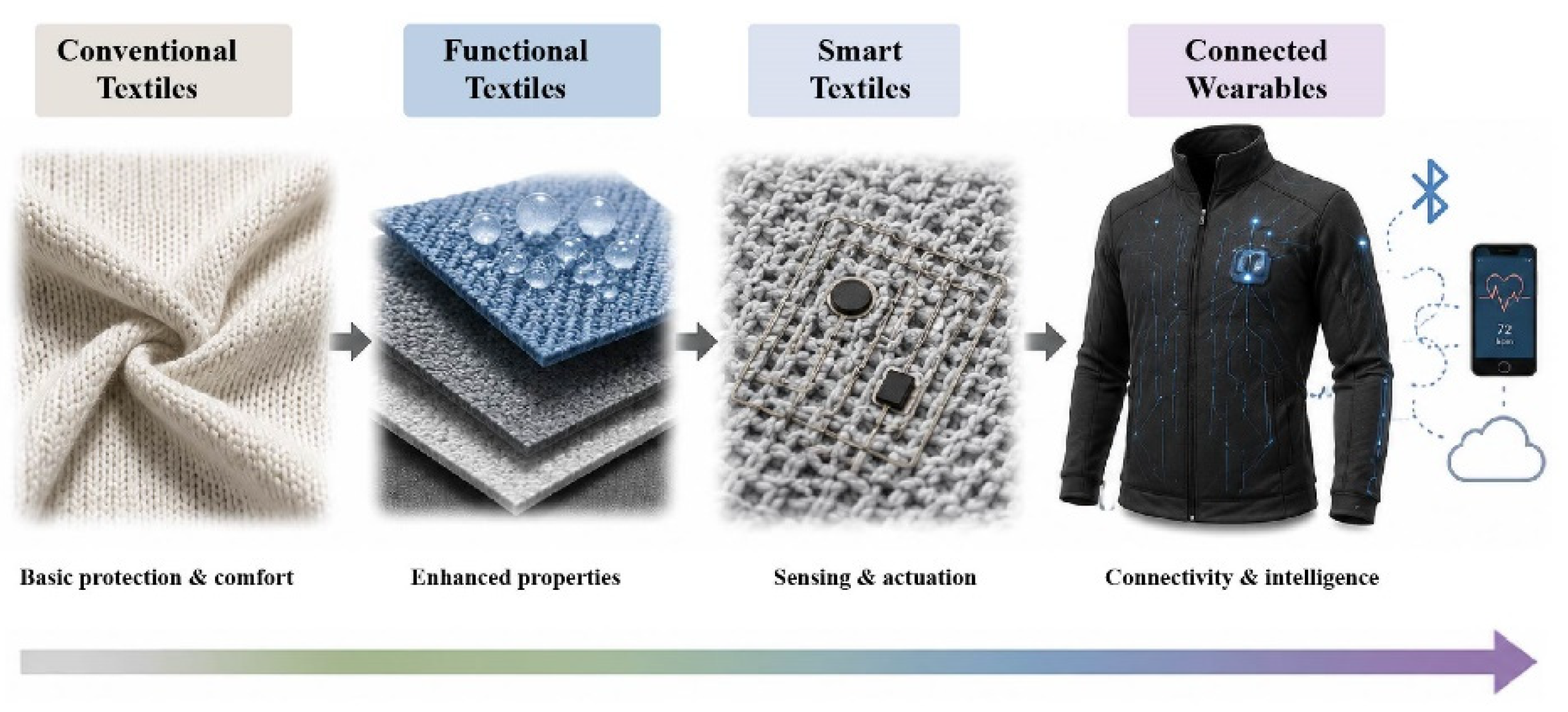
Figure 2.
Evolutionary timeline of smart textile technologies showing key milestones from functional textiles (1980s) to conductive fibers, wearable sensors, IoT-enabled textiles, AI-powered wearables, and future circular smart textile systems. The timeline demonstrates the progressive convergence of textile materials, electronics, connectivity, and sustainability concepts.
Figure 2.
Evolutionary timeline of smart textile technologies showing key milestones from functional textiles (1980s) to conductive fibers, wearable sensors, IoT-enabled textiles, AI-powered wearables, and future circular smart textile systems. The timeline demonstrates the progressive convergence of textile materials, electronics, connectivity, and sustainability concepts.
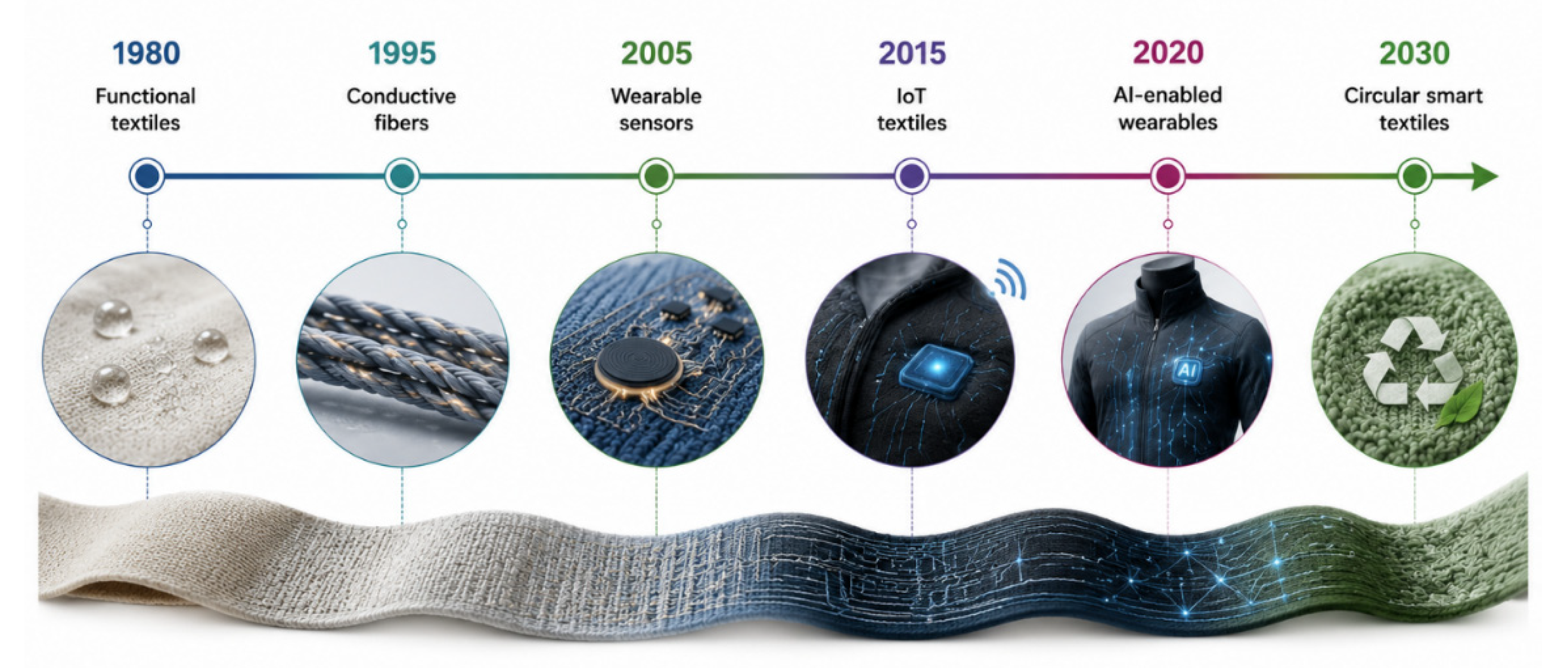
Figure 3.
Hierarchical classification of smart textiles based on functional intelligence, illustrating the progression from passive smart textiles that perform sensing functions, to active smart textiles capable of sensing and responding to stimuli, and finally to ultra-smart textiles that integrate sensing, adaptive decision-making, wireless communication, and artificial intelligence within a unified wearable platform.
Figure 3.
Hierarchical classification of smart textiles based on functional intelligence, illustrating the progression from passive smart textiles that perform sensing functions, to active smart textiles capable of sensing and responding to stimuli, and finally to ultra-smart textiles that integrate sensing, adaptive decision-making, wireless communication, and artificial intelligence within a unified wearable platform.
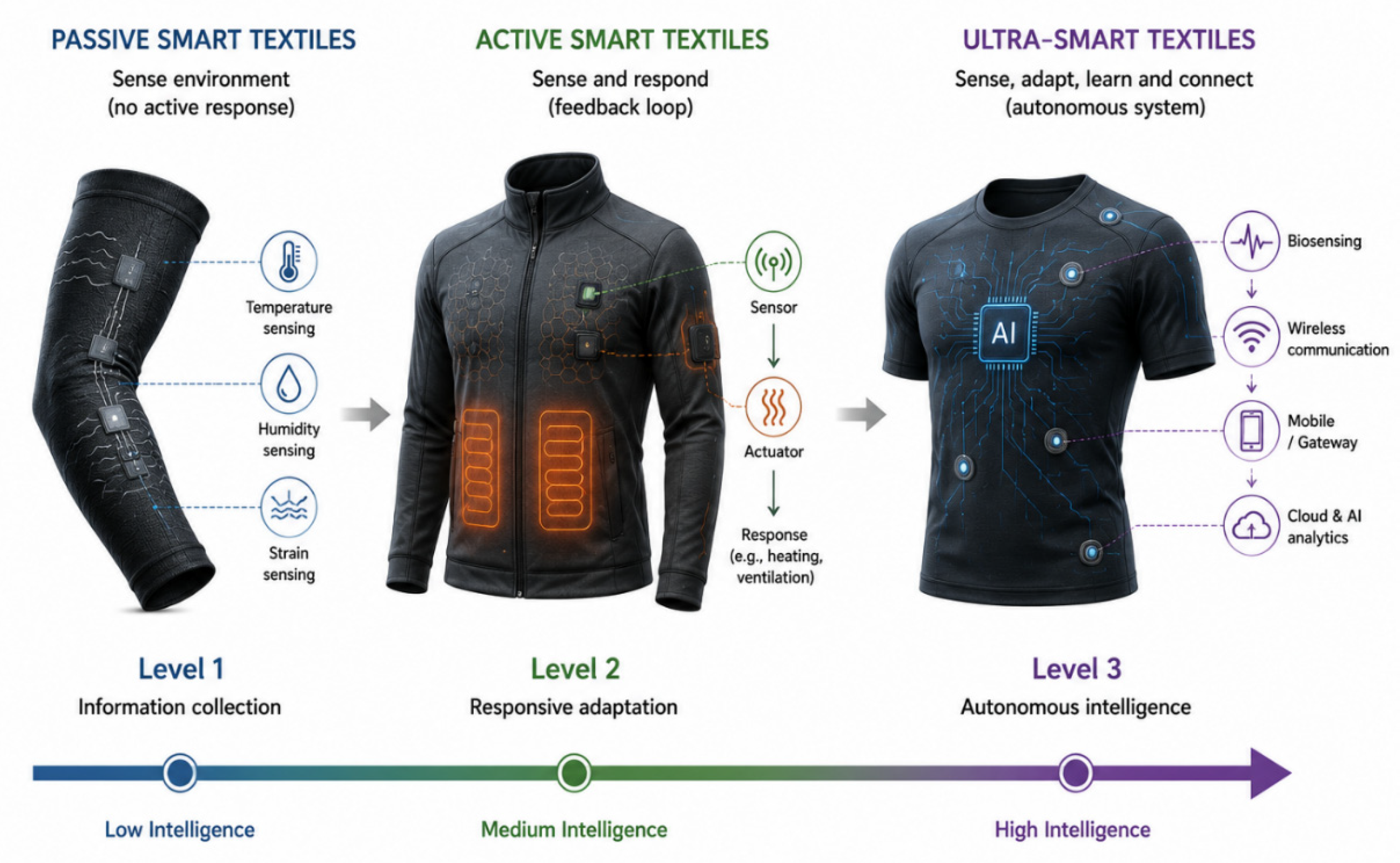
Figure 4.
Multi-layer system architecture of smart textiles illustrating the integration of sensing, data processing, communication, power management, and user interface within a flexible and wearable platform [46]. The functional architecture of a typical smart textile system consists of sensing, signal processing, communication, power management, and user interface layers, each contributing to the acquisition, processing, transmission, and presentation of information (Table 2).
Figure 4.
Multi-layer system architecture of smart textiles illustrating the integration of sensing, data processing, communication, power management, and user interface within a flexible and wearable platform [46]. The functional architecture of a typical smart textile system consists of sensing, signal processing, communication, power management, and user interface layers, each contributing to the acquisition, processing, transmission, and presentation of information (Table 2).
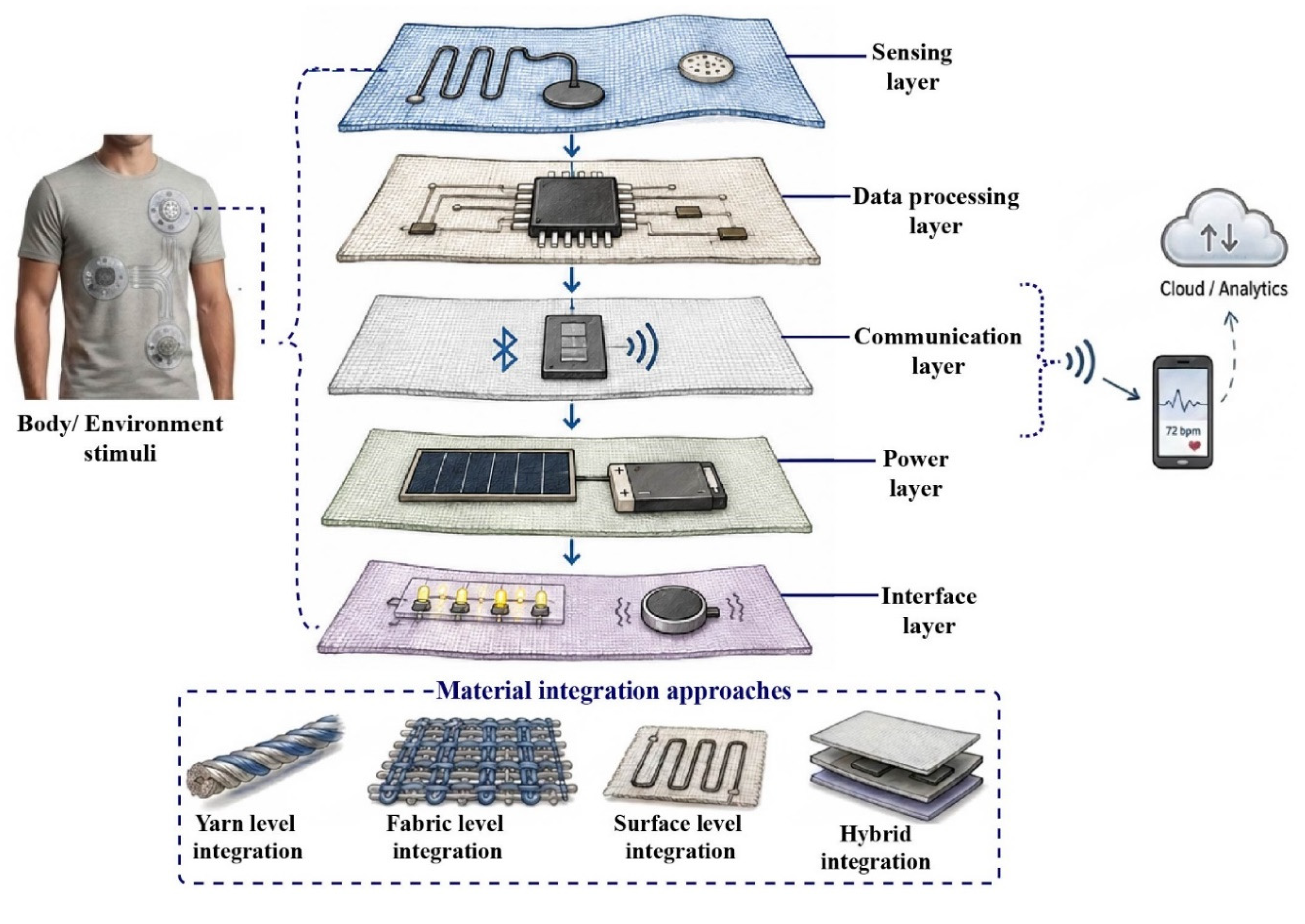
Figure 5.
Textile-based energy-harvesting mechanisms: (a) piezoelectric; (b) triboelectric; (c) thermoelectric; (d) photovoltaic.
Figure 5.
Textile-based energy-harvesting mechanisms: (a) piezoelectric; (b) triboelectric; (c) thermoelectric; (d) photovoltaic.
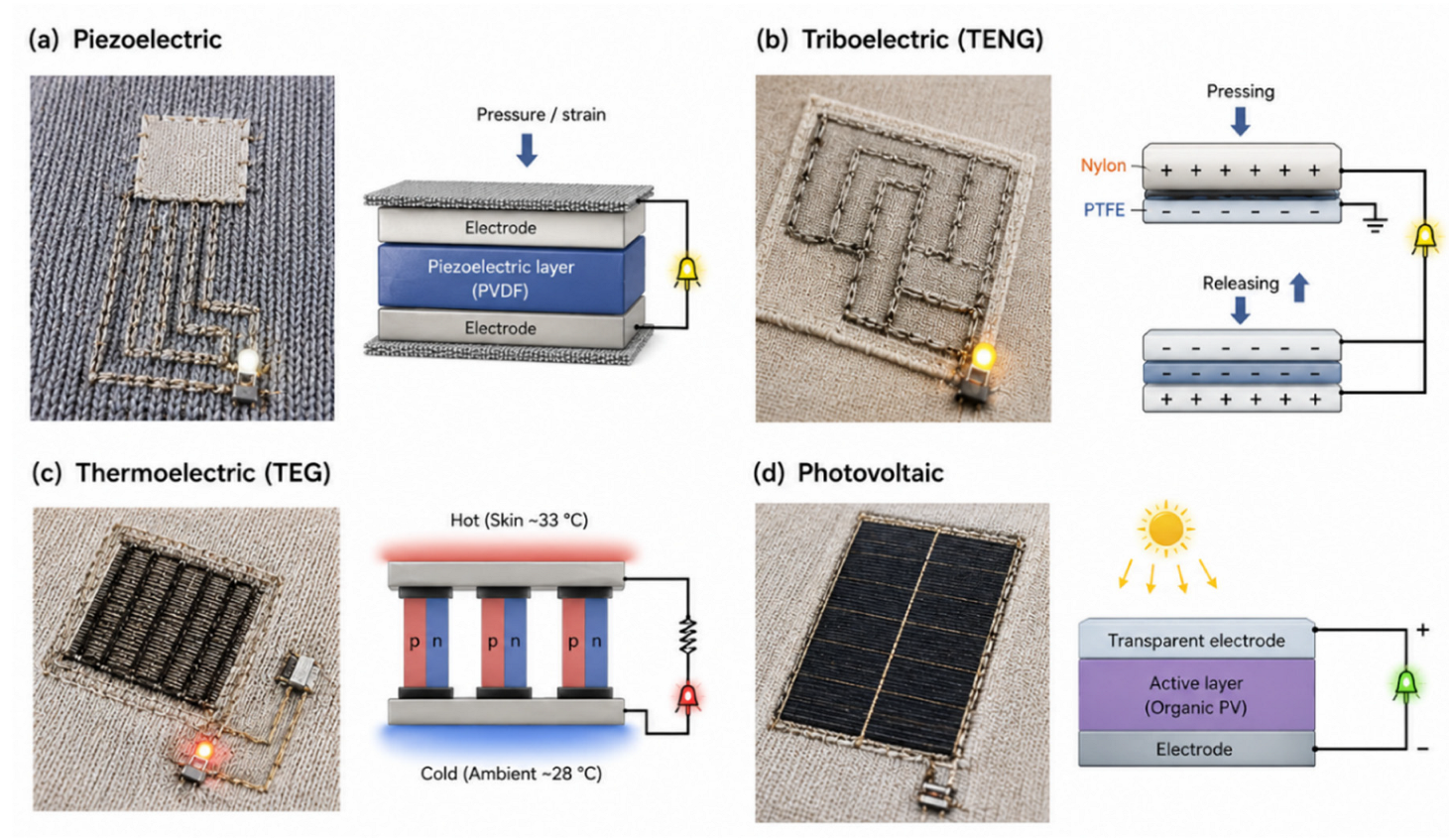
Figure 6.
Signal acquisition chain in a smart textile node [79].
Figure 6.
Signal acquisition chain in a smart textile node [79].
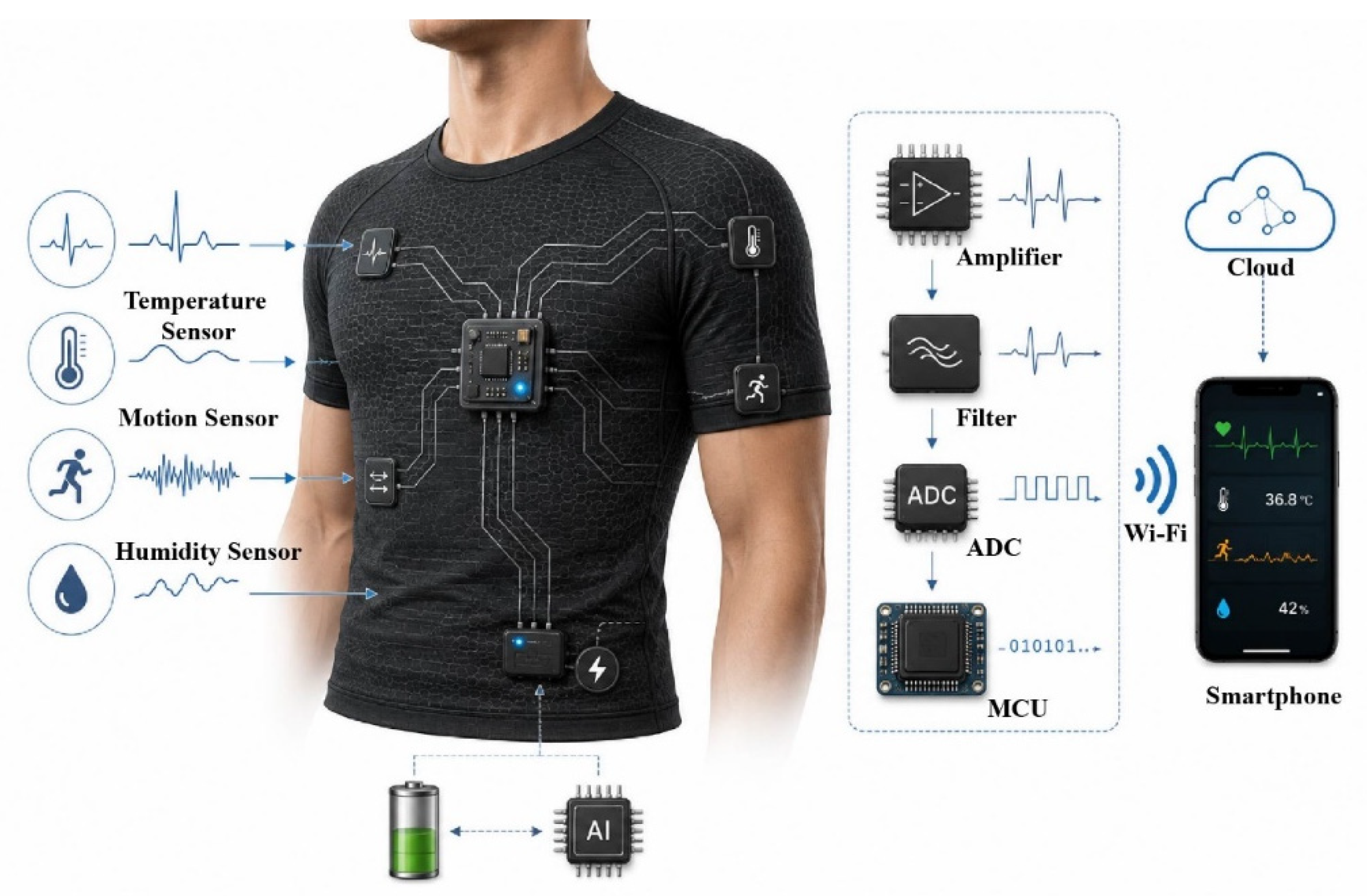
Figure 7.
Schematic illustration of a multilayer flexible electronic textile architecture, demonstrating the incorporation of conductive ink patterns on a flexible substrate, sandwiched by encapsulation layers. The common substrate materials include TPU, PDMS, cellulose nanofibril film, and silk fibroin.
Figure 7.
Schematic illustration of a multilayer flexible electronic textile architecture, demonstrating the incorporation of conductive ink patterns on a flexible substrate, sandwiched by encapsulation layers. The common substrate materials include TPU, PDMS, cellulose nanofibril film, and silk fibroin.
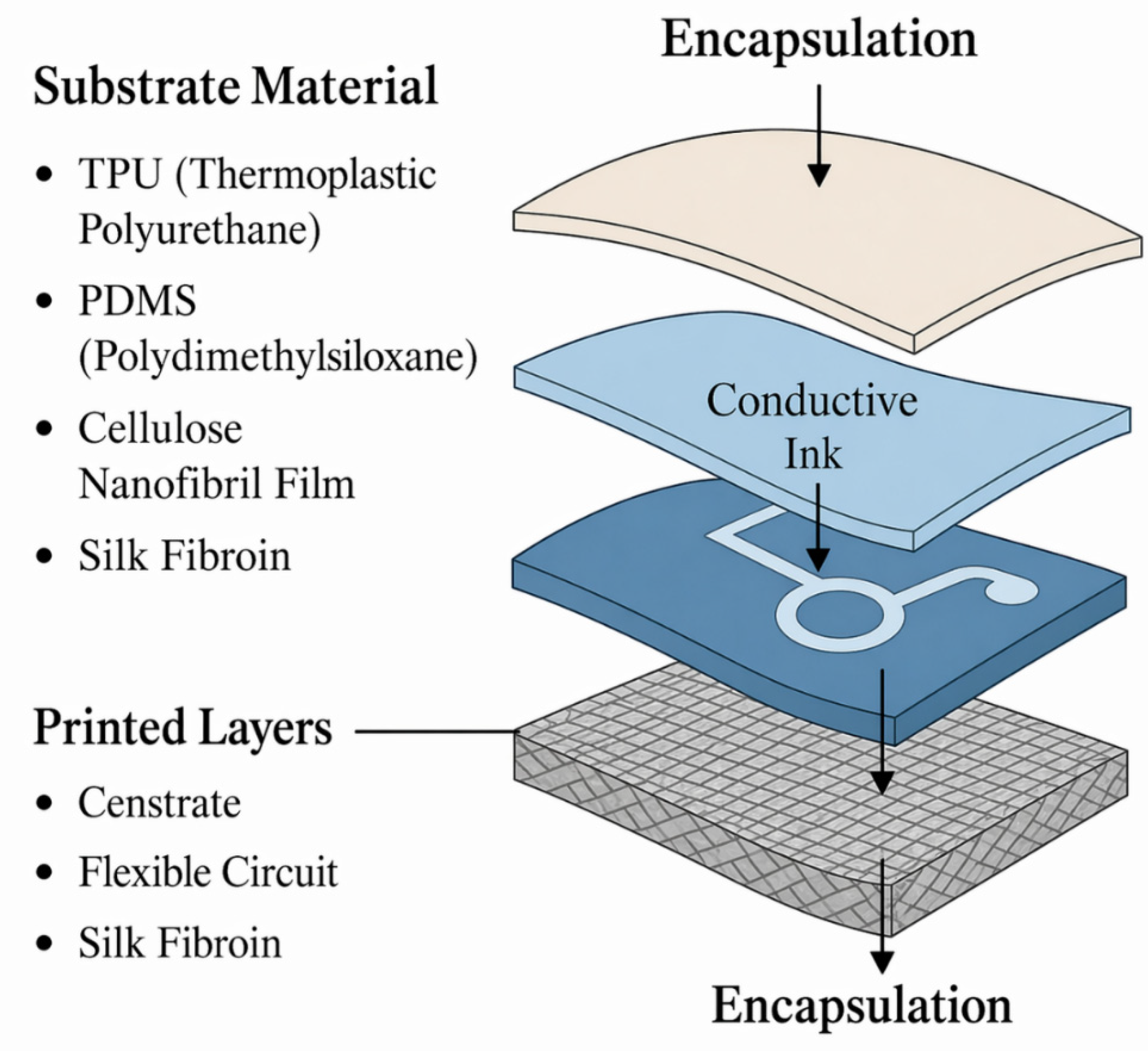
Figure 8.
AI/IoT-enabled smart textile ecosystem architecture illustrating multi-level data flow across wearable edge devices, gateway systems, and cloud platforms. The framework integrates local sensing and edge intelligence, secure data transmission via communication protocols, and cloud-based AI analytics for real-time monitoring, anomaly detection, and adaptive system response.
Figure 8.
AI/IoT-enabled smart textile ecosystem architecture illustrating multi-level data flow across wearable edge devices, gateway systems, and cloud platforms. The framework integrates local sensing and edge intelligence, secure data transmission via communication protocols, and cloud-based AI analytics for real-time monitoring, anomaly detection, and adaptive system response.
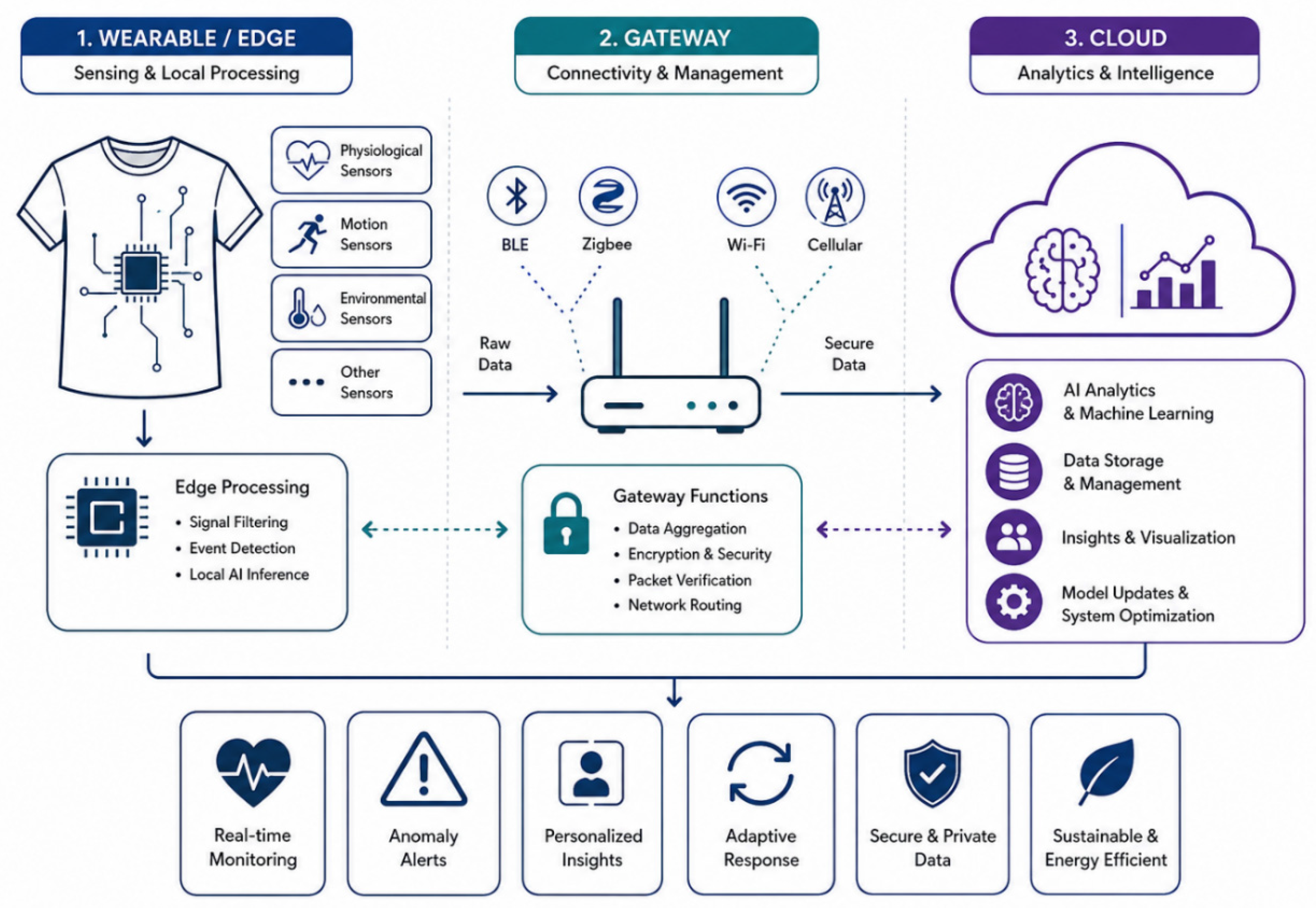
Figure 9.
System integration architecture of smart textiles, illustrating the interconnection of sensing, signal processing, power management, communication, and user interface components within a wearable textile platform.
Figure 9.
System integration architecture of smart textiles, illustrating the interconnection of sensing, signal processing, power management, communication, and user interface components within a wearable textile platform.
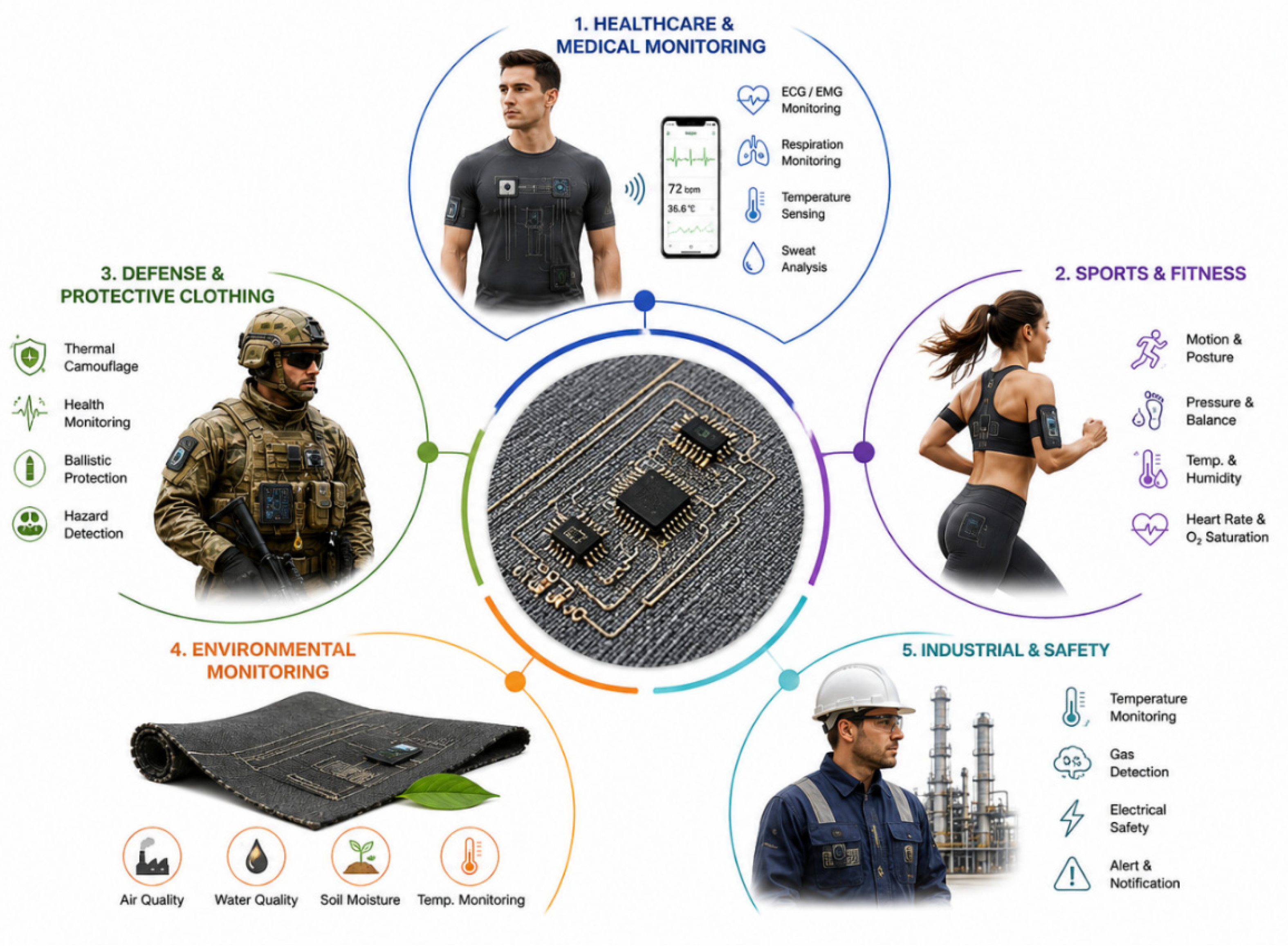
Figure 10.
Manufacturing and integration workflow of smart textiles, highlighting key fabrication processes such as coating, weaving, and printing, followed by system-level electronic integration for functional textile development.
Figure 10.
Manufacturing and integration workflow of smart textiles, highlighting key fabrication processes such as coating, weaving, and printing, followed by system-level electronic integration for functional textile development.
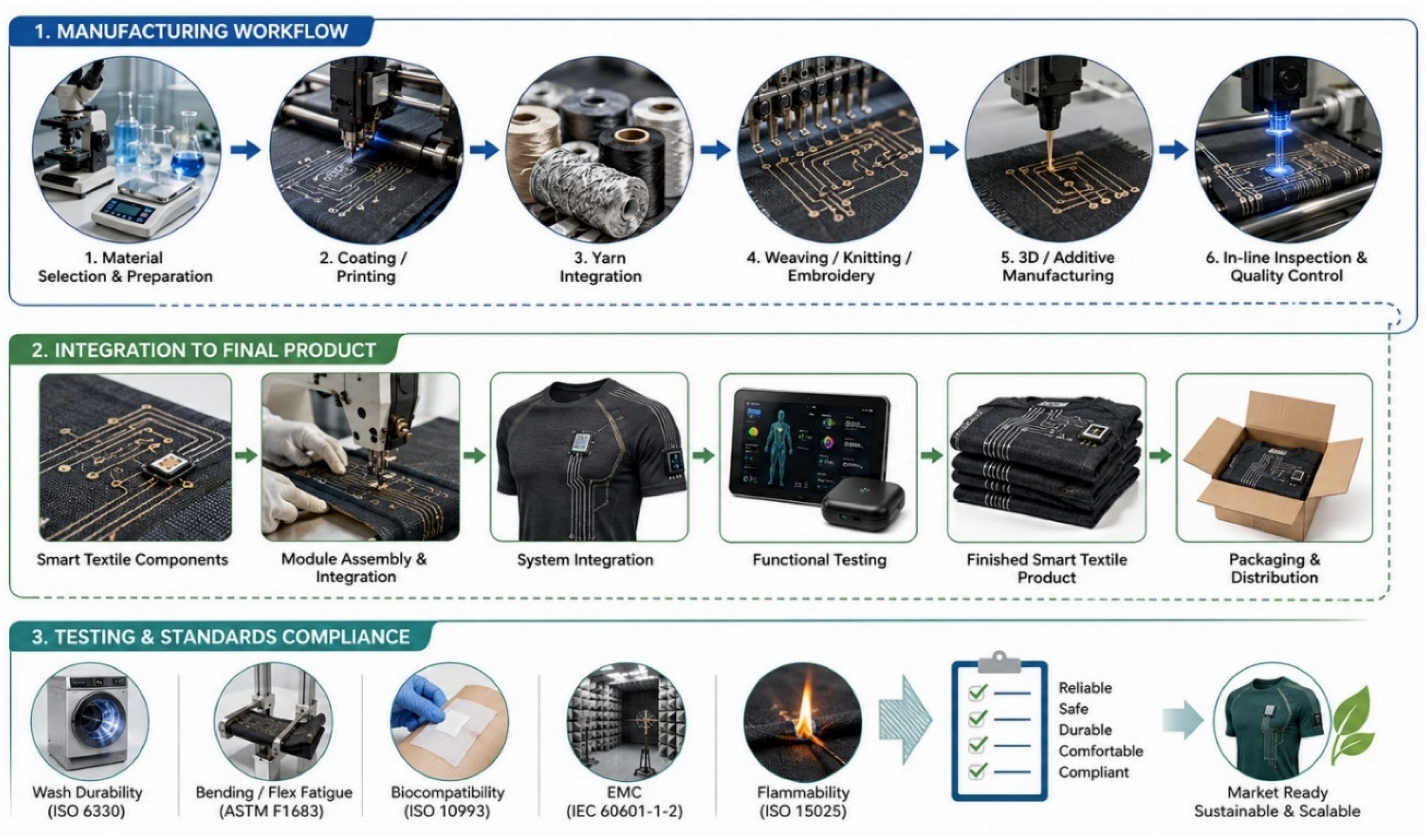
Figure 11.
Life cycle and circular design framework for smart textiles, illustrating the stages of raw material extraction, fabrication, use phase, and end-of-life management, integrated with energy-saving and recycling pathways to support sustainable development.
Figure 11.
Life cycle and circular design framework for smart textiles, illustrating the stages of raw material extraction, fabrication, use phase, and end-of-life management, integrated with energy-saving and recycling pathways to support sustainable development.
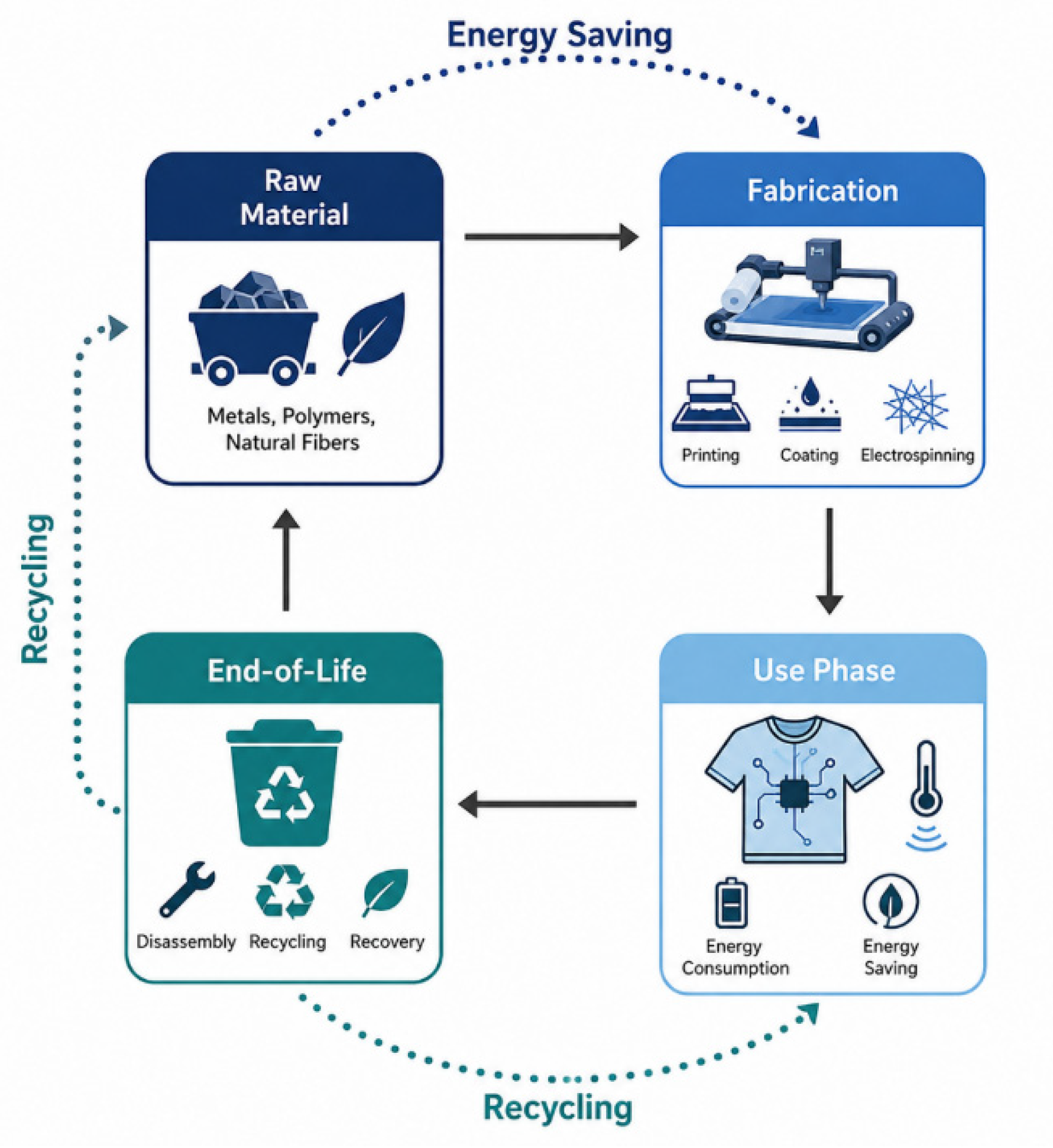
Figure 12.
Overview of key technical challenges in smart textile systems, highlighting durability and washability constraints affecting long-term performance and reliability.
Figure 12.
Overview of key technical challenges in smart textile systems, highlighting durability and washability constraints affecting long-term performance and reliability.
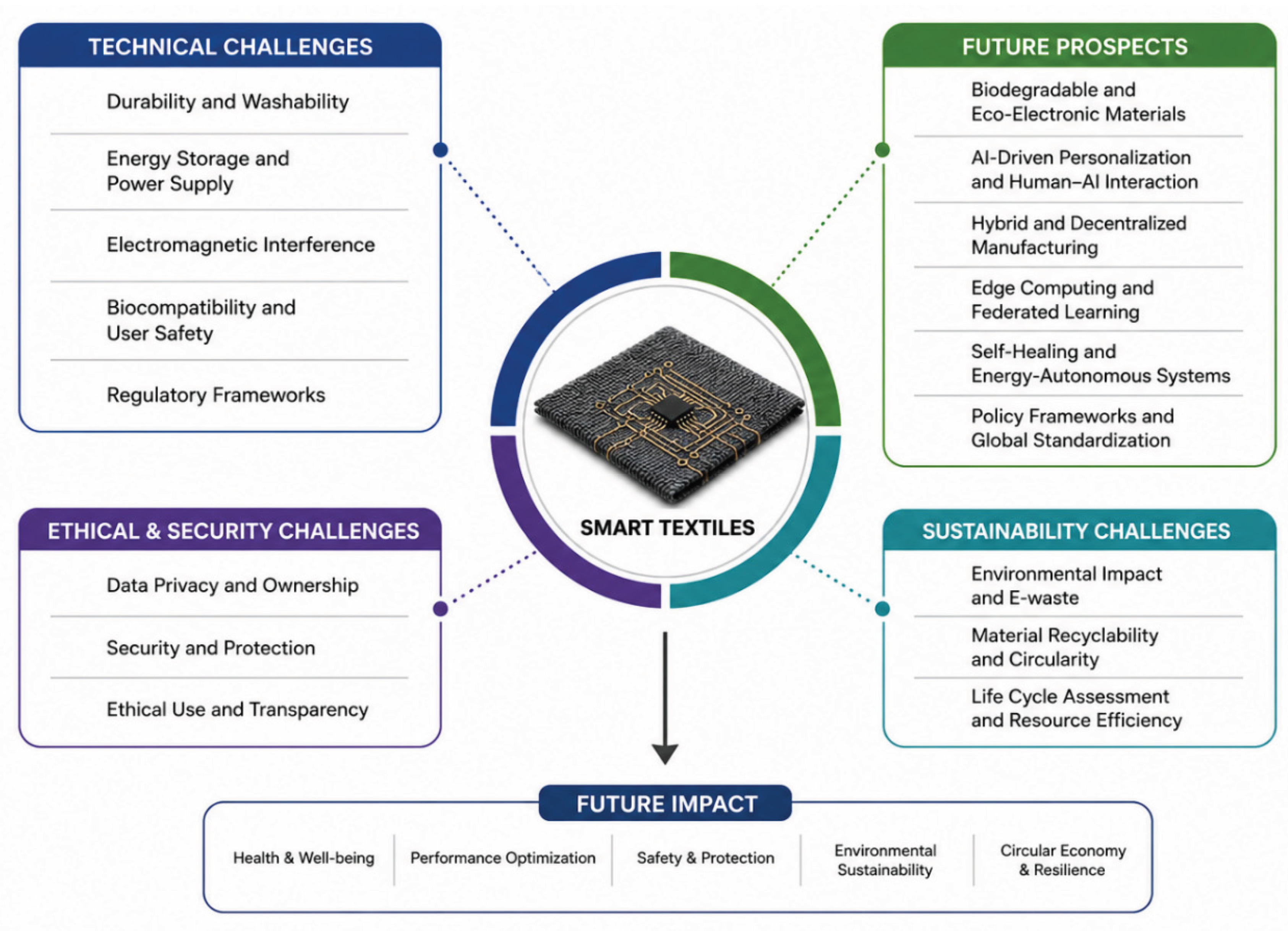
Table 1.
Overview of Functional Levels.
| Level | Definition | Functionality Example | Control Type |
| Passive Smart | Sense environmental changes without active response | Temperature, moisture, strain sensors | None (one-way) |
| Active Smart | Sense and respond to stimuli | Thermoregulating PCM, self-heating garments | Feedback loop |
| Ultra-Smart | Sense, adapt, and communicate autonomously | AI-driven physiological monitoring, self-diagnosing garments | Self-learning |
Table 3.
Comparison of textile-based energy harvesting mechanisms for wearable smart textile applications.
Table 3.
Comparison of textile-based energy harvesting mechanisms for wearable smart textile applications.
| Mechanism | Working Principle | Typical Output* | Example Material / System | Flexibility | Washability | Scalability | Sustainability | Ref. |
| Piezoelectric | Converts mechanical deformation into electrical potential through the direct piezoelectric effect | 1–10 µW cm⁻² | PVDF nanofibers, ZnO nanowires | Excellent | Good | High | High | [60] |
| Triboelectric (TENG) | Generates electricity through contact electrification and electrostatic induction during periodic contact and separation | 10–100 µW cm⁻² | Nylon/PTFE multilayer textiles | Excellent | Moderate | High | High | [61] |
| Thermoelectric (TEG) | Converts temperature gradients into electrical energy based on the Seebeck effect | 20–50 µW cm⁻² | Bi₂Te₃ nanowires, PEDOT:PSS/Bi₂Te₃ composites | Good | Moderate | Moderate | Moderate | [62] |
| Photovoltaic | Converts incident light into electrical energy through the photovoltaic effect | 100–1000 µW cm⁻² (indoor illumination); substantially higher under direct sunlight | Organic photovoltaic (P3HT:PCBM), flexible perovskite solar cells | Excellent | Moderate | High | Moderate | [63] |
| Biofuel / Enzymatic | Generates electricity through enzymatic oxidation of biochemical metabolites (e.g., lactate or glucose in sweat) | 1–5 µW cm⁻² | Lactate oxidase biofuel cell | Excellent | Poor | Moderate | Excellent | [64] |
Table 4.
Comparison of flexible energy storage technologies for wearable smart textile applications.
Table 4.
Comparison of flexible energy storage technologies for wearable smart textile applications.
| Type | Mechanism | Energy Density (Wh kg⁻¹) | Cycle Life | Key Material | Ref. |
| Lithium-ion Battery | Reversible intercalation/deintercalation of Li⁺ ions between the cathode and anode | 150–250 | 500–2,000 | LiCoO₂/Graphite, LiFePO₄ | [71] |
| Zinc–air Battery | Electrochemical oxidation of Zn at the anode coupled with oxygen reduction at the air cathode | 300–500 | 300–1,000 | Zn anode, carbon cloth air cathode | [72] |
| Supercapacitor | Electrochemical double-layer capacitance (EDLC) and/or pseudocapacitance | 5–20 | >100,000 | CNTs, Graphene, MnO₂ | [73,74] |
Table 5.
Comparison of microcontroller platforms commonly used in wearable smart textiles.
| Platform | Processor | Active Power (mW) | Communication | Notes | Ref. |
| Arduino Nano 33 BLE Sense | ARM Cortex-M4F (64 MHz) | ≈40 | Bluetooth® 5.0 (BLE) | Open-source platform with integrated environmental and motion sensors; suitable for TinyML and wearable prototyping | |
| ESP32 | Xtensa LX6 Dual-Core | 160–260 | Wi-Fi + Bluetooth/BLE | High-performance IoT processor supporting Wi-Fi and BLE connectivity for wearable and edge-AI applications | [81] |
| nRF52840 | ARM Cortex-M4F (64 MHz) | ≈15–18 | Bluetooth 5.0 LE, Thread, Zigbee, ANT | Ultra-low-power wireless SoC widely used in medical and wearable devices | |
| STM32WB55 | ARM Cortex-M4 + Cortex-M0+ | ≈25 | Bluetooth 5.0 LE, Zigbee, Thread | Dual-core architecture with industrial-grade reliability and low-power wireless communication | [82] |
Table 6.
Comparison of wireless communication protocols used in wearable smart textile systems.
| Protocol | Typical Range | Data Rate | Power Consumption | Typical Application | Ref. |
| Bluetooth Low Energy (BLE) | 10–50 m | 1 Mbps (Bluetooth 5 LE PHY) | Very low | Personal healthcare, wearable sensors, fitness monitoring | [82] |
| Wi-Fi (IEEE 802.11n/ac) | 30–100 m | 10–100 Mbps | Moderate–High | Smart homes, edge computing, real-time image/video transmission | [2] |
| NFC / RFID | <10 cm | 106–424 kbps | Passive (NFC tags) / Very low (active devices) | Identification, authentication, contactless payment, inventory tracking | [3] |
| LoRaWAN | 2–15 km (rural), 2–5 km (urban) | 0.3–50 kbps | Very low | Remote health monitoring, environmental sensing, agricultural IoT | [88] |
Table 7.
Flexible substrate materials commonly used in wearable smart textile systems.
| Material | Type | Key Features | Environmental Compatibility | Ref. |
| TPU (Thermoplastic Polyurethane) | Thermoplastic elastomer | Highly stretchable, flexible, washable, and mechanically durable | Recyclable (thermoplastic) | [91] |
| PDMS (Polydimethylsiloxane) | Silicone elastomer | Highly flexible, biocompatible, optically transparent, chemically stable | Non-biodegradable but biocompatible | [92] |
| Cellulose Nanofibril (CNF) Film | Biopolymer | Transparent, flexible, lightweight, high mechanical strength | Renewable and biodegradable | [93] |
| Silk Fibroin | Natural protein biopolymer | High tensile strength, biocompatible, flexible, water-processable | Biodegradable and biocompatible | [94] |
Table 8.
Representative machine learning models and applications in smart textile systems.
| ML Model | Use Case | Data Input | Output |
| Convolutional Neural Network (CNN) | Motion recognition | Inertial Measurement Unit (IMU) signals | Activity classification |
| Long Short-Term Memory (LSTM) | ECG pattern detection | Time-series biosignals | Heart anomaly alerts |
| Random Forest (RF) | Sweat composition analysis | Chemical sensor data | Concentration prediction |
| Autoencoder | Anomaly detection | Multi-sensor fusion | Outlier flagging |
Table 9.
Smart textile sensor types and corresponding healthcare functions.
| Function | Sensor Type | Parameter | Example Application |
| ECG / EMG Monitoring | Textile electrodes (Ag-coated yarns) | Heart activity | Arrhythmia detection |
| Respiration & Motion | Piezoresistive stretch sensors | Chest expansion | Sleep apnea monitoring |
| Temperature Sensing | Thermistor or Fiber Bragg Grating | Body temperature | Fever or hypothermia detection |
| Sweat Analysis | Ion-selective electrode | Electrolyte/pH balance | Dehydration or stress level assessment |
Table 10.
Representative wearable sensors integrated into smart textile systems for sports and health monitoring.
Table 10.
Representative wearable sensors integrated into smart textile systems for sports and health monitoring.
| Sensor Type | Measured Parameter | Typical Application | Ref. |
| IMU / Accelerometer | Motion, posture, gait, acceleration | Running, yoga, rehabilitation, activity recognition | [119] |
| Pressure Sensors | Plantar pressure, foot strike, balance | Smart insoles, gait analysis, cycling, skiing | [120] |
| Temperature & Humidity Sensors | Skin/body temperature, perspiration (sweat), humidity | Thermoregulation monitoring, hydration assessment | [121] |
| Heart Rate / SpO₂ Sensors | Heart rate, blood oxygen saturation (SpO₂), cardiovascular status | Exercise monitoring, training optimization, recovery assessment | [122] |
Table 13.
International testing standards and performance metrics for smart textiles.
| Property | Standard | Test Objective | Ref. |
| Wash Durability | ISO 6330 | Evaluates the durability of smart textiles after standardized domestic washing and drying procedures, including retention of electrical and mechanical performance after repeated laundering. | [133] |
| Flexural Durability (Bending/Flex Fatigue) | IEC 63203-201-2:2022 | Evaluates the mechanical flexibility and electrical performance of conductive fabrics and insulation materials used in electronic textiles under repeated deformation. | [134] |
| Biocompatibility | ISO 10993-1 | Evaluates the biological safety of materials intended for skin contact, including cytotoxicity, irritation, and sensitization. | [135] |
| Electromagnetic Compatibility (EMC) | IEC 60601-1-2 | Verifies electromagnetic emissions and immunity of medical electrical equipment, including wearable medical devices. | [135] |
| Flammability | ISO 15025 | Determines the limited flame spread characteristics of protective textile materials under controlled flame exposure. | [134] |
Table 14.
Comparative life-cycle assessment considerations for conventional and self-heating smart garments.
Table 14.
Comparative life-cycle assessment considerations for conventional and self-heating smart garments.
| Category | Conventional Garment | Self-heating Smart Garment | Overall Impact | Ref. |
| Manufacturing Energy | Lower due to simpler manufacturing processes | Higher because of conductive materials, electronics, and additional fabrication steps | Initial environmental burden increases |
[140] |
| Operational Energy | Relies on building HVAC for thermal comfort | Provides localized personal heating, potentially reducing dependence on HVAC systems | Potential reduction in use-phase energy consumption | [141] |
| Carbon Footprint | Lower embodied carbon during production | Higher embodied carbon, but life-cycle emissions may decrease if operational energy savings offset manufacturing impacts | Depends on use scenario and electricity source | [140] |
| Service Lifetime | Limited by textile durability | May be extended through multifunctionality and higher user value, provided durability and repairability are ensured | Potential improvement in product longevity | [142] |
Disclaimer/Publisher’s Note: The statements, opinions and data contained in all publications are solely those of the individual author(s) and contributor(s) and not of MDPI and/or the editor(s). MDPI and/or the editor(s) disclaim responsibility for any injury to people or property resulting from any ideas, methods, instructions or products referred to in the content. |
© 2026 by the authors. Licensee MDPI, Basel, Switzerland. This article is an open access article distributed under the terms and conditions of the Creative Commons Attribution (CC BY) license.
Copyright: This open access article is published under a Creative Commons CC BY 4.0 license, which permit the free download, distribution, and reuse, provided that the author and preprint are cited in any reuse.


