
Submitted:
03 August 2026
Posted:
04 August 2026
You are already at the latest version
Abstract
The black-hole information paradox presupposes a causal boundary that permanently prevents information carried by infalling matter from returning to the exterior. We examine an alternative based on the squared factor \(f(r)=\left(1-GM/(c^2r)\right)^2\), which appears in extremal Reissner–Nordström geometry and in the minimal Haug–Spavieri metric, together with an equal-factor geometry for which radial null characteristics satisfy |dr/dt|=c wherever the metric is nondegenerate. For the associated escape-velocity expression, the value reaches but does not exceed \(c\). Following a nested-sphere construction, an interior mass profile \(M(r)=c^2r/G\) gives \(v_{\rm esc}=c\) at every interior radius. This profile is interpreted as a saturation condition rather than an independent demonstration of outward causal escape. Haug's Planck-quantization program gives \(GM/c^2=N\ell_P\) and \(r_s=2N\ell_P\) for \(M=Nm_P\). We extend this idea by treating invariant areal radius as a discrete observable and replacing continuum evolution near the nominal horizon with unitary transitions between neighboring radial states. The classical zero of f(r) then need not correspond to a physical state that permanently divides the Hilbert space. Outgoing massless excitations may pass from interior to exterior states without occupying the degenerate continuum radius, while a minimum radius removes \(r=0\) from the physical state space. Infalling matter is consequently proposed to be transformed into highly scrambled, information-bearing radiation rather than permanently lost. The framework permits a nonzero intrinsic luminosity in addition to conventional disk and jet emission and suggests observational tests involving delayed radiation, photon-ring structure, polarization correlations, and late-time emission. A complete resolution of the information paradox requires a quantitative transition law, backreaction, entropy evolution, and radiation spectrum, which remain to be developed.
Keywords:
black-hole information paradox
; Planck length
; quantized horizon
; Haug–Spavieri metric
; extremal Reissner–Nordström geometry
; Hawking radiation
; unitarity
; intrinsic black-hole luminosity
; accretion disks
1. Introduction
Bekenstein associated black-hole entropy with horizon area [1], and Hawking showed that black holes radiate thermally [2]. Hawking then argued that complete evaporation appears to map a pure state into a mixed state [3]. Preskill emphasized the depth of the resulting conflict between semiclassical gravity and unitary quantum mechanics [4], while Page demonstrated that unitary evaporation requires the radiation entropy to rise and later fall [5]. Complementarity [6], holography [7], microscopic string-theory entropy counting [8], and AdS/CFT [9] all support information preservation. Hayden and Preskill further showed that an old black hole can act as a rapid information mirror under unitary assumptions [10]. The firewall argument then showed that unitarity, semiclassical locality, and a smooth horizon cannot all be maintained in their simplest forms [11]. Reviews by Harlow and Polchinski summarize the resulting tension between causal geometry and quantum information [12,13].
Quantum extremal surfaces, replica wormholes, and entanglement islands now reproduce Page curves in controlled semiclassical models [14,15,16]. These calculations are major advances, but the interpretation of the interior and the mechanism by which information appears in realistic asymptotically flat radiation remain debated [17,18]. Alternative approaches include remnants [19], fuzzballs and the small-corrections theorem [20,21], nonlocal information transfer [22], state-dependent interior reconstruction [23], apparent rather than permanent event horizons [24], and quantum hair [25].
This paper develops another possibility: the exact continuum horizon may cease to be a physical causal boundary when invariant radius is Planck quantized. Haug proposed Planck-scale reformulations of Newtonian and relativistic gravity in which
for [26,27]. This is directly relevant to the minimal Haug–Spavieri and extremal Reissner–Nordström metrics, whose degenerate radius is . Physical areal positions are taken to form a discrete spectrum, and quantum evolution remains connected across the nominal horizon. This provides the proposed causal mechanism: Planck-scale radial discreteness, together with a suitable unitary transition law, may prevent the formation of a permanently information-trapping surface.
2. Squared-Factor Metrics and the Escape Question
Define . The static, spherically symmetric Einstein–Maxwell solution was obtained in the early work of Reissner and Nordström [28,29]; a closely related independent derivation was later given by Jeffery [30]. The Reissner–Nordström line element is
where
The horizon radii and global structure of charged black holes are treated in standard analyses of exact black-hole solutions [31,32,33,34,35]. In the extremal limit,
The minimal Haug–Spavieri metric was derived by Haug and Spavieri from a stress–energy tensor intended to include both electric-field energy and gravitational field energy, and independently through a mass–energy argument [36]. For a neutral source its metric factor is
The second-order term is therefore interpreted as a gravitational mass-field contribution rather than necessarily as an electromagnetic charge term. Haug and Spavieri further show that the more general mass–charge solution can be written in the Weyl class of static axisymmetric Einstein solutions [37,38]. In the neutral limit, their horizon is , equal to the degenerate horizon of extremal Reissner–Nordström geometry.
An associated escape-velocity expression is
It reaches c at rather than becoming greater than c there. This is qualitatively different from a naive extrapolation of . Nevertheless, escape velocity alone does not establish causal escape, because a classical event horizon is defined globally. Extremal Reissner–Nordström spacetime retains horizon structure despite the nonnegative squared factor, and its degenerate horizon has distinctive near-horizon geometry and stability properties [39,40]. The proposal therefore depends on discreteness as well as Equation (6).
2.1. When the Interior Escape Velocity Is Saturated at c
The distinction between a fixed total mass and the mass enclosed by an interior sphere is essential. Following the procedure used by Haug and Spavieri in their cosmological application of the metric [41], let the black-hole horizon be
and consider a concentric interior sphere of radius
containing mass . Applying Equation (6) locally to that enclosed mass gives
If the interior mass profile saturates the condition
then substitution into Equation (9) yields
for every admissible interior radius. Equivalently, writing and solving the fixed-mass expression for r gives a real radius only for ; the saturated case gives . Thus an interior assembled from nested saturated spheres obeying Equation (10) has escape velocity equal to, but never greater than, c at every radius.
This conclusion must be stated with care. Equation (11) is not obtained for a single fixed mass inserted at every ; doing that makes Equation (6) decrease again below the horizon and eventually cease to be real. The result throughout the interior follows only when the enclosed mass scales linearly with areal radius. Moreover, because Equation (10) is obtained by imposing the saturated condition , it is best interpreted as a consistency condition or proposed interior mass profile, not as an independent proof that the geometry dynamically produces that profile.
For the present information-recovery proposal, the importance of Equation (11) is therefore limited but useful. It removes the Newtonian-style objection that an interior escape speed must become superluminal, and it is compatible with a nonsingular, distributed interior rather than compulsory collapse into a point. It does not by itself demonstrate outward causal propagation across a global event horizon. That stronger claim still requires the null-characteristic analysis and, in this paper, the additional Planck-discrete transition law developed below.
A related equal-factor geometry is
For radial null motion at each nondegenerate radius,
The continuum metric degenerates at , but the discrete theory contains no requirement that a photon occupy that exact continuum point. Admissible states on both sides possess outward null characteristics, and the quantum transition law directly joins them.
3. Planck-Quantized Radius and Unitary Information Recovery
Using , , and yields Equation (1). Thus the horizon of the minimal Haug–Spavieri or extremal Reissner–Nordström geometry is already
This establishes a published precedent for a Planck-quantized gravitational radius and provides the natural basis for a discrete radial state space in which the horizon is traversable by massless excitations.
Let physical areal positions be represented by cell centers
so that lies at a cell boundary. An equivalent theory might use and assign a finite transition law to the coincident horizon state. The essential condition is not the labeling convention but the absence of a permanently disconnected interior sector.
Let denote a radial state with all additional degrees of freedom collected in . Evolution over a fundamental step is
Outward crossing occurs if the neighboring-state matrix element satisfies
A state need not occupy every real value between adjacent eigenvalues. The continuum zero of can then be an interpolation feature rather than a physical state that divides the Hilbert space.
The same spectrum excludes . A minimum radius must be supplemented by a core dynamics, which may be represented schematically as
Matter may be compressed, heated, fragmented, pair-produced, annihilated, and converted into photons or other massless excitations. Information need not be visible in an approximately thermal one-particle spectrum; it may be encoded in correlations among frequencies, times, polarizations, angular modes, particle species, and higher-order entanglement observables.
If realized by a complete unitary dynamics, Equations (17) and (18) would eliminate any permanently inaccessible subsystem. Radiation entropy rises during scrambling and falls as delayed information-bearing radiation escapes, giving the physical content of Page behavior. Charged and extremal black holes have distinctive formation and entropy properties [42,43], but the central result remains: Planck-discrete geometry removes exact causal disconnection at the kinematic level and replaces information loss with delayed information release.
Haug has also argued that his Planck reformulation should not be understood merely as canonical quantization of an otherwise unchanged gravitational field. He suggests that conventional quantum mechanics, especially its treatment of matter wavelength and gravitational mass, may require deeper revision [44]. The present approach is compatible with that direction: geometric discreteness is posited first, and the required quantum transition theory is then constrained by the geometry.
3.1. Extremal Entropy, Reversible Throughput, and the Carnot-Engine Analogy
The entropy of an exactly extremal black hole is not settled universally. Hawking, Horowitz, and Ross argued from the Euclidean geometry and action that an exactly extremal Reissner–Nordström black hole has zero entropy despite its nonzero horizon area [45]. Edery and Constantineau reached a complementary conclusion: because the maximally extended extremal spacetime is time-independent throughout and represents a single classical gravitational microstate, they assign it zero gravitational entropy [43]. Other approaches, including microscopic state counting for important extremal systems, retain a nonzero area entropy. The zero-entropy assignment is therefore used here only as conceptual motivation and not as an established universal property of all extremal black holes.
Zero entropy is not identical to a cancellation between inward- and outward-directed entropy. Entropy is a state quantity, whereas entropy transport is described by fluxes. A schematic balance law for the interior is
where represents irreversible entropy production in a coarse-grained description. In an ideal stationary and reversible limit,
Equation (20) describes zero net accumulation of interior entropy; it does not imply that the inward and outward fluxes vanish individually. In the present hypothesis, matter and its encoded information may enter, undergo unitary scrambling, and reappear in correlations carried by outward radiation.
Haug has proposed a related thermodynamic interpretation in which an extremal Reissner–Nordström-like Hubble sphere is modeled as an ideal Carnot engine operating at the cosmic microwave background temperature [46]. For a reversible Carnot cycle the working system returns to its initial thermodynamic state and has
although nonzero entropy is transferred between the reservoirs. This provides an analogy for stationary throughput: inward energy and entropy associated with captured matter can be balanced by outward energy, entropy, and information-bearing radiation without permanent accumulation in an inaccessible interior sector. Haug’s construction is a working-paper proposal and does not by itself derive the entropy current, heat reservoirs, or transition dynamics of the black-hole model developed here.
The possible support is consequently limited but relevant. The zero-entropy arguments of Hawking–Horowitz–Ross and Edery–Constantineau are compatible with the absence of an independently evolving, permanently hidden interior entropy sector, while the Carnot-engine analogy illustrates how zero net entropy change can coexist with nonzero inward and outward transport. A quantitative claim requires an explicit density matrix or entropy current showing that total unitary evolution preserves fine-grained entropy while transferring recoverable information from infalling matter to outgoing radiation.
4. Relation to Other Proposed Resolutions of the Information Paradox
The present proposal belongs broadly to the family of approaches in which the classical horizon or interior description is modified so that information is never permanently isolated. Its distinctive ingredient is a Planck-discrete areal-radius spectrum together with finite unitary transitions between neighboring radial states across the nominal horizon. This supplies a direct kinematic picture of information transfer, but at the present stage the transition operator is postulated rather than derived from a covariant microscopic theory.
Quantum extremal surfaces, replica wormholes, and entanglement islands reproduce Page-curve behavior in controlled semiclassical models [14,15,16]. Their principal strength is a quantitative generalized-entropy calculation. The present model instead attempts to specify a physical propagation mechanism: the exact continuum horizon is not an admissible state, and outward transitions connect interior and exterior radial states. Its current limitation relative to island calculations is the absence of a derived Page curve, density-matrix evolution, and backreaction law.
Fuzzball models replace the conventional horizon and interior by horizon-scale quantum microstates and thereby allow information to be radiated from an ordinary quantum system [20,21]. The present proposal is similar in denying that a smooth classical horizon permanently hides information, but it is less microscopically developed. It does not yet provide explicit microstates or entropy counting comparable to those available for special string-theory systems. Its advantage is a comparatively simple geometric hypothesis that may be applied without assuming a particular string compactification.
Black-hole complementarity, holography, and state-dependent reconstruction preserve information by encoding interior data in exterior or boundary degrees of freedom [6,7,9,23]. The discrete-radius proposal instead seeks a single connected physical evolution and does not rely on observer-dependent copies of the same information. It must nevertheless demonstrate that ordinary local quantum field theory and approximate Lorentz invariance are recovered far from the Planck region.
The firewall argument shows that unitarity, semiclassical locality, and a smooth horizon cannot all remain simultaneously unchanged in their simplest forms [11]. The present construction gives up the exact continuum horizon while attempting to avoid a high-energy firewall. Whether this succeeds depends on the spectrum and strength of the cross-horizon transition amplitudes. A complete theory must show that an infalling observer does not encounter uncontrolled Planckian excitations at a macroscopic horizon.
Remnant scenarios preserve information in a stable or extremely long-lived compact object [19]. The present model differs by allowing the information to return gradually in outgoing radiation rather than remain stored indefinitely. However, unless a finite release-time distribution is derived, a strongly delayed version of the model could be phenomenologically difficult to distinguish from a long-lived remnant.
Nonlocal information-transfer proposals modify effective dynamics so that information can pass from the black-hole interior to exterior modes without violent horizon-scale effects [22]. The present hypothesis has a similar purpose but locates the transfer in neighboring Planck-radius states. Its central mathematical task is therefore to replace the schematic condition
with an explicit evolution law. A minimal discrete model could take the form
with a finite coupling across the nominal horizon. Such a model would need to demonstrate norm conservation, outward probability current, energy conservation, backreaction of emission on N, a finite transmission coefficient, and radiation-entropy evolution consistent with a Page curve.
The comparison therefore identifies both the potential contribution and the present limitation of the approach. It offers a transparent causal mechanism and potentially distinctive astrophysical signatures, but it is presently less mathematically complete than islands, fuzzballs, and established holographic constructions. The appropriate claim is that Planck-discrete radial connectivity provides a distinct and testable route toward information recovery, not that it has already superseded other proposed resolutions.
5. Intrinsic Luminosity, Cosmic Recycling, and Accretion-Model Degeneracy
A precise observational distinction is necessary. Not every astrophysical black hole is electromagnetically bright. Binary black holes detected through gravitational waves can have no identified electromagnetic counterpart, and quiescent or isolated candidates may be found through dynamics or microlensing rather than through their own luminosity. Nevertheless, essentially every black-hole system selected and studied directly through electromagnetic radiation is observed as a luminous environment: stellar-mass candidates appear as X-ray binaries, supermassive candidates at active galactic centers appear through radio, infrared, optical, ultraviolet, or X-ray emission, and quasars are among the most luminous persistent objects in the universe. Horizon-scale images of M87* and Sgr A* likewise show bright ring-like emission surrounding a central brightness depression [47,48]. Figure 1 illustrates representative electromagnetically bright black-hole environments that motivate the distinction between luminosity produced in the surrounding accretion flow and any possible delayed emission from the compact object itself.1
The standard interpretation has a long and successful history. Accretion onto a compact relativistic object can convert gravitational binding energy into radiation [50,51]. Thin-disk theory and its relativistic extensions provide quantitative spectra and efficiencies [52,53], while modern general-relativistic magnetohydrodynamic calculations reproduce many properties of accretion flows, magnetic fields, and jets [54]. In this framework, the observed photons are produced before matter crosses the horizon, and the horizon itself has no outward emissivity.
The present theory provides the broader physical interpretation. External accretion radiation is real and can be dominant, but it is not the only source of light. Matter that crosses the nominal horizon is not permanently removed from causal contact if neighboring Planck-radius states remain connected. As the infalling matter approaches the minimum-radius region, its organized massive degrees of freedom may be destroyed by extreme compression and interaction and converted into photons and other relativistic quanta through the unitary map in Equation (18). Those quanta can propagate outward through the same discrete radial state network. A fraction of the light attributed observationally to the accretion environment is therefore naturally interpreted as reprocessed radiation that has entered, traversed, and escaped from the compact object.
In this picture, black holes are not terminal sinks but cosmic recirculation engines. Matter and free energy captured from stars, gas, dust, and radiation are compressed into a highly scrambled state near the minimum radius and later returned to the universe predominantly as redshifted radiation. The phrase “crunched into photons” should not be understood as the literal destruction of quantum information, nor as a claim that photons are the only possible final particles. Rather, it denotes a unitary conversion of infalling massive matter into outward-propagating relativistic degrees of freedom. The original information is retained in their correlations. On cosmological timescales, black holes would then participate in a cycle
This interpretation is closely aligned with the proposal that black holes are intrinsically bright rather than perfectly absorbing objects [49].
The narrower criticism of standard modeling is therefore not that accretion disks do not exist. It is that calculations normally impose a perfectly absorbing inner boundary. Matter passing through that boundary is removed from the observable domain because a classical event horizon is assumed. Such models show that external plasma can produce the observed radiation, but they do not independently prove that the compact object has exactly zero intrinsic emissivity or that no previously absorbed energy can later re-emerge.
A more general luminosity decomposition is
The delayed core contribution may be parameterized by
where is the ultimately returned fraction and K includes redshift, trapping, scattering, and delay. A black hole can therefore be intrinsically “bright” in the strict sense of nonzero outward emissivity while appearing faint in a particular band or epoch. The model predicts that the observable central engine is a superposition of prompt disk emission and delayed recycled emission, rather than a luminous disk surrounding an absolutely black sink.
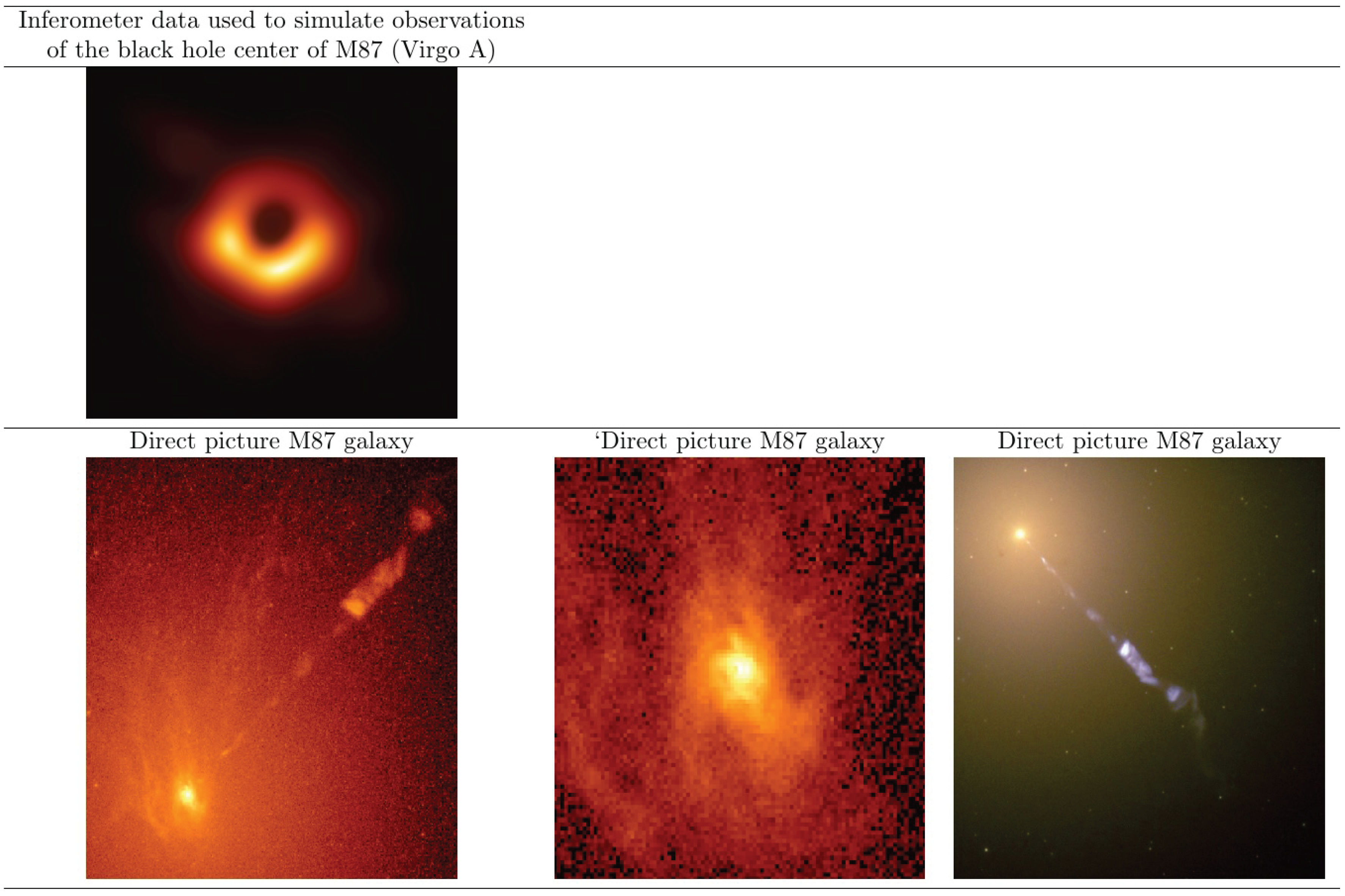
The dark central depression in a horizon-scale image is not a resolved photograph of a material surface. It depends on lensing, photon capture, optical depth, plasma geometry, and emitter distribution. Surface-emission constraints on Sgr A* are important [55], but applying them to a highly delayed, nonthermal quantum transition region requires its actual response function rather than a steady blackbody assumption. The defensible claim is therefore not that accretion disks are fictitious, but that is a model-dependent restriction. A nonzero could carry correlations with matter accreted much earlier. Figure 2 compares horizon-scale and wider-field views of M87 and emphasizes that these observations probe different wavelengths, angular scales, and emitting regions; they therefore do not by themselves determine whether the central object has exactly zero intrinsic emissivity.
6. Consistency Requirements, Predictions, and Conclusions
The invariant geometric quantity in the proposed discrete description is the areal radius defined by , or equivalently a quantized area as in other approaches to quantum geometry [56]. A minimum radial state removes from the physical spectrum, while finite transition amplitudes replace continuum evolution at radii where the classical metric becomes degenerate. Backreaction must ultimately evolve the mass, horizon index, and transition matrix together.
The escape-velocity analysis supplies a limited but useful consistency result. For a fixed mass, the squared-factor expression reaches at and does not require a superluminal escape velocity. If the enclosed mass instead obeys
then each nested interior sphere satisfies
Because this mass profile follows from imposing the saturated escape condition, the result should not be interpreted as an independent derivation of the interior dynamics. It shows that the proposed distributed interior is compatible with an escape velocity equal to, rather than greater than, c.
The causal claim rests on additional structure. In the equal-factor geometry, radial null curves satisfy at every nondegenerate radius. The continuum metric nevertheless degenerates at , so this relation alone does not establish global escape. The proposed Planck-discrete theory removes the requirement that a propagating state occupy the exact degenerate radius and connects neighboring interior and exterior states through a nonzero transition amplitude. Information recovery therefore depends on the existence and unitarity of this transition law, not on the escape-velocity expression alone.
The framework gives several observational targets. Intrinsic emission should depend on earlier accretion through the response kernel in Equation (26). Accretion flares may be followed by weak, highly redshifted components delayed beyond ordinary reverberation times. Core emission may also modify higher-order photon rings, polarization correlations, spectral tails, and the luminosity remaining after the visible accretion flow fades. Near-horizon structure could produce gravitational-wave echoes, although present claims remain disputed [57,58]. These effects must be calculated quantitatively before they can distinguish the proposed intrinsic emission from conventional disk and jet radiation.
The minimal Haug–Spavieri and extremal Reissner–Nordström metrics share the factor
and Haug’s Planck representation gives their characteristic radius as . Combining a discrete invariant radius, finite neighboring-state transitions across the nominal horizon, and unitary minimum-radius dynamics provides a possible mechanism by which no permanently inaccessible interior subsystem forms. Infalling matter may then be converted into highly scrambled outgoing radiation whose correlations retain the original quantum information. The extremal zero-entropy arguments and the reversible Carnot-throughput analogy are consistent with this interpretation, but they do not replace an explicit entropy-current or density-matrix calculation.
The present model should therefore be understood as a proposed route to resolving the information paradox rather than a completed solution. Its central claim will require an explicit covariant transition dynamics, a derivation of the relevant stress–energy tensors, backreaction, energy conservation, entropy evolution, radiation spectra, and release times. Developing these elements would allow the proposal to be compared quantitatively with semiclassical island calculations, conventional accretion models, horizon-scale observations, and gravitational-wave data.
Author Contributions
Conceptualization, methodology, investigation, writing—original draft preparation, and writing—review and editing: Espen Gaarder Haug. The author has read and agreed to the published version of the manuscript.
Funding
This research received no external funding.
Institutional Review Board Statement
Not applicable.
Informed Consent Statement
Not applicable.
Data Availability Statement
No new data were created or analyzed in this study. Data sharing is not applicable to this article.
Acknowledgments
The author acknowledges the use of publicly available scientific literature and astronomical image archives discussed and cited in the manuscript.
Conflicts of Interest
The author declares no conflicts of interest.
| 1 | Both figure montages are reproduced from the author’s earlier paper Black Holes Are Bright [49]. The source paper attributes the underlying publicly available astronomical images to the ESA/NASA Hubble image archive; for the horizon-scale M87* panel, it credits the Event Horizon Telescope Collaboration/ESO. |
References
- Bekenstein, J. D. Black holes and entropy. Phys. Rev. D. 1973, 7, 2333–2346. [Google Scholar] [CrossRef]
- Hawking, S. W. Particle creation by black holes. Commun. Math. Phys. 1975, 43, 199–220. [Google Scholar] [CrossRef]
- Hawking, S. W. Breakdown of predictability in gravitational collapse. Phys. Rev. D. 1976, 14, 2460–2473. [Google Scholar] [CrossRef]
- Preskill, J. Do black holes destroy information? In International Symposium on Black Holes, Membranes, Wormholes and Superstrings; arXiv:hep-th/9209058; World Scientific, 1993; pp. 22–39. [Google Scholar]
- Page, D. N. Information in black hole radiation. Phys. Rev. Lett. 1993, 71, 3743–3746. [Google Scholar] [CrossRef] [PubMed]
- Susskind, L.; Thorlacius, L.; Uglum, J. The stretched horizon and black hole complementarity. Phys. Rev. D. 1993, 48, 3743–3761. [Google Scholar] [CrossRef] [PubMed]
- ’t Hooft, G. “Dimensional reduction in quantum gravity,” in Salamfestschrift; World Scientific, 1993; pp. 284–296. [Google Scholar]
- Strominger, A.; Vafa, C. Microscopic origin of the Bekenstein–Hawking entropy. Phys. Lett. B 1996, 379, 99–104. [Google Scholar] [CrossRef]
- Maldacena, J. M. The large-N limit of superconformal field theories and supergravity. Adv. Theor. Math. Phys. 1998, 2, 231–252. [Google Scholar] [CrossRef]
- Hayden, P.; Preskill, J. Black holes as mirrors: Quantum information in random subsystems. JHEP 2007, 09, 120. [Google Scholar] [CrossRef]
- Almheiri, A.; Marolf, D.; Polchinski, J.; Sully, J. Black holes: Complementarity or firewalls? JHEP 2013, 02, 062. [Google Scholar] [CrossRef]
- Harlow, D. Jerusalem lectures on black holes and quantum information. Rev. Mod. Phys. 2016, 88, 015002. [Google Scholar] [CrossRef]
- Polchinski, J. The black hole information problem. In New Frontiers in Fields and Strings; World Scientific, 2017; pp. 353–397. [Google Scholar] [CrossRef]
- Penington, G. Entanglement wedge reconstruction and the information paradox. JHEP 2020, 09, 002. [Google Scholar] [CrossRef]
- Almheiri, A.; Engelhardt, N.; Marolf, D.; Maxfield, H. The entropy of bulk quantum fields and the entanglement wedge of an evaporating black hole. JHEP 2019, 12, 063. [Google Scholar] [CrossRef]
- Almheiri, A.; Hartman, T.; Maldacena, J.; Shaghoulian, E.; Tajdini, A. The entropy of Hawking radiation. Rev. Mod. Phys. 2021, 93, 035002. [Google Scholar] [CrossRef]
- Raju, S. Lessons from the information paradox. Phys. Rep. 2022, 943, 1–80. [Google Scholar] [CrossRef]
- Mahajan, R. Recent progress on the black hole information paradox. Resonance 2021, 26, 33–48. [Google Scholar] [CrossRef]
- Giddings, S. B. The black hole information paradox. In in Particles, Strings and Cosmology; World Scientific, 1996; pp. 415–428. [Google Scholar]
- Mathur, S. D. The fuzzball proposal for black holes: An elementary review. Fortschr. Phys. 2005, 53, 793–827. [Google Scholar] [CrossRef]
- Mathur, S. D. The information paradox: A pedagogical introduction. Class. Quantum Grav. 2009, 26, 224001. [Google Scholar] [CrossRef]
- Giddings, S. B. Black holes, quantum information, and unitary evolution. Phys. Rev. D. 2012, 85, 124063. [Google Scholar] [CrossRef]
- Papadodimas, K.; Raju, S. An infalling observer in AdS/CFT. JHEP 2013, 10, 212. [Google Scholar] [CrossRef]
- Hawking, S. W. Information preservation and weather forecasting for black holes. arXiv 2014, arXiv:1401.5761. [Google Scholar]
- Calmet, X.; Hsu, S. D. H. Quantum hair and black hole information. Phys. Lett. B 2022, 827, 136995. [Google Scholar] [CrossRef]
- Haug, E. G. Planck quantization of Newton and Einstein gravitation. Int. J. Astron. Astrophys. 2016, 6, 206–217. [Google Scholar] [CrossRef]
- Haug, E. G. Planck quantised general relativity theory written on different forms. J. Appl. Math. Phys. 2024, 12, 2281–2301. [Google Scholar] [CrossRef]
- Reissner, H. Über die Eigengravitation des elektrischen Feldes nach der Einsteinschen Theorie. Ann. Phys. 1916, 355, 106–120. [Google Scholar] [CrossRef]
- Nordström, G. On the energy of the gravitational field in Einstein’s theory. Proc. K. Ned. Akad. Wet. 1918, 20, 1238–1245. [Google Scholar]
- Jeffery, G. B. The field of an electron on Einstein’s theory of gravitation. Proc. R. Soc. Lond. A 1921, 99, 123–134. [Google Scholar] [CrossRef]
- Carter, B. Global structure of the Kerr family of gravitational fields. Phys. Rev. 1968, 174, 1559–1571. [Google Scholar] [CrossRef]
- S. Chandrasekhar, The Mathematical Theory of Black Holes; Oxford University Press: Oxford, 1983.
- R. M. Wald, General Relativity; University of Chicago Press: Chicago, 1984.
- Hobson, M. P.; Efstathiou, G. P.; Lasenby, A. N. General Relativity: An Introduction for Physicists; Cambridge University Press: Cambridge, 2006. [Google Scholar] [CrossRef]
- Bambi, C. Introduction to General Relativity: A Course for Undergraduate Students of Physics; Springer: Singapore, 2018. [Google Scholar] [CrossRef]
- Haug, E. G.; Spavieri, G. Mass-charge metric in curved spacetime. Int. J. Theor. Phys. 2023, 62, 248. [Google Scholar] [CrossRef]
- H. Weyl, Zur Gravitationstheorie. Ann. Phys. 1917, 359, 117–145. [CrossRef]
- Stephani, H.; Kramer, D.; MacCallum, M.; Hoenselaers, C.; Herlt, E. Exact Solutions of Einstein’s Field Equations, 2nd ed.; Cambridge University Press: Cambridge, 2003. [Google Scholar] [CrossRef]
- Bardeen, J. M.; Horowitz, G. T. The extreme Kerr throat geometry: A vacuum analog of AdS2×S2. Phys. Rev. D. 1999, 60, 104030. [Google Scholar] [CrossRef]
- Aretakis, S. Stability and instability of extreme Reissner–Nordström black hole spacetimes for linear scalar perturbations I. Commun. Math. Phys. 2011, 307, 17–63. [Google Scholar] [CrossRef]
- Haug, E. G.; Spavieri, G. New exact solution to Einstein’s field equation gives a new cosmological model. preprint ResearchGate publication 375601328. 2023, viXra, 2312.0052. [Google Scholar] [CrossRef]
- Sorkin, E.; Piran, T. Formation and evaporation of charged black holes. Phys. Rev. D. 2001, 63, 124024. [Google Scholar] [CrossRef]
- Edery, A.; Constantineau, B. Extremal black holes, gravitational entropy and nonstationary metric fields. Class. Quantum Grav. 2011, 28, 045003. [Google Scholar] [CrossRef]
- Haug, E. G. Different mass definitions and their pluses and minuses related to gravity. Foundations 2023, 3, 199–219. [Google Scholar] [CrossRef]
- Hawking, S. W.; Horowitz, G. T.; Ross, S. F. Entropy, area, and black hole pairs. Phys. Rev. D. 1995, 51, 4302–4314. [Google Scholar] [CrossRef] [PubMed]
- Haug, E. G. The Hubble sphere as an extremal Reissner–Nordström black hole Carnot engine operating at the CMB temperature of Tcmb=TmaxTmin≈2.725K. Cambridge Open Engage, Physics and Astronomy working paper, version 1 posted 6 March 2025. 6 March. [CrossRef]
- Event Horizon Telescope Collaboration, First M87 Event Horizon Telescope results. I. Astrophys. J. Lett. 2019, 875, L1. [CrossRef]
- Event Horizon Telescope Collaboration, First Sagittarius A* Event Horizon Telescope results. I. Astrophys. J. Lett. 2022, 930, L12. [CrossRef]
- Haug, E. G. “Black holes are bright,” HAL open-science preprint, hal-03922209 (2023).
- Salpeter, E. E. Accretion of interstellar matter by massive objects. Astrophys. J. 1964, 140, 796–800. [Google Scholar] [CrossRef] [PubMed]
- Lynden-Bell, D. Galactic nuclei as collapsed old quasars. Nature 1969, 223, 690–694. [Google Scholar] [CrossRef]
- Shakura, N. I.; Sunyaev, R. A. Black holes in binary systems: Observational appearance. Astron. Astrophys. 1973, 24, 337–355. [Google Scholar]
- Novikov, I. D.; Thorne, K. S. Astrophysics of black holes. In Black Holes; DeWitt, C., DeWitt, B. S., Eds.; Gordon and Breach: New York, 1973; pp. 343–450. [Google Scholar]
- Narayan, R.; Sadowski, A.; Penna, R. F.; Kulkarni, A. K. GRMHD simulations of magnetized advection-dominated accretion. Mon. Not. R. Astron. Soc. 2012, 426, 3241–3259. [Google Scholar] [CrossRef]
- Broderick, A. E.; Narayan, R. On the nature of the compact dark mass at the Galactic center. Astrophys. J. Lett. 2006, 638, L21–L24. [Google Scholar] [CrossRef]
- Rovelli, C.; Smolin, L. Discreteness of area and volume in quantum gravity. Nucl. Phys. B 1995, 442, 593–622. [Google Scholar] [CrossRef]
- Cardoso, V.; Franzin, E.; Pani, P. Is the gravitational-wave ringdown a probe of the event horizon? Phys. Rev. Lett. 2016, 116, 171101. [Google Scholar] [CrossRef] [PubMed]
- Abedi, J.; Dykaar, H.; Afshordi, N. Echoes from the abyss. Phys. Rev. D. 2017, 96, 082004. [Google Scholar] [CrossRef]
Figure 1.
Examples of electromagnetically observed galactic nuclei and quasars assembled from publicly available ESA/NASA Hubble image-archive material. Standard theory attributes this luminosity primarily to accretion flows and jets; the present model allows an additional delayed component from the compact object.
Figure 1.
Examples of electromagnetically observed galactic nuclei and quasars assembled from publicly available ESA/NASA Hubble image-archive material. Standard theory attributes this luminosity primarily to accretion flows and jets; the present model allows an additional delayed component from the compact object.
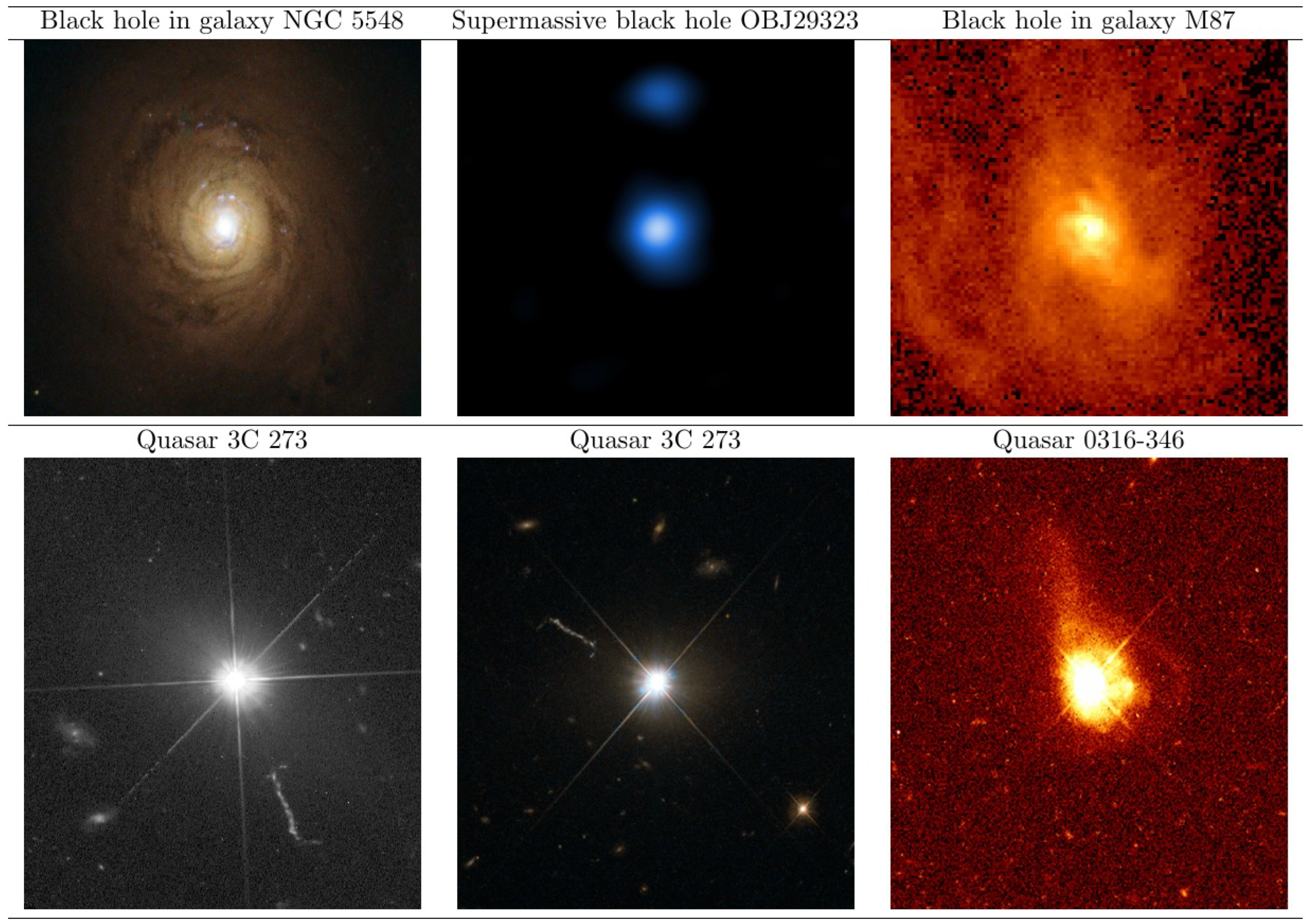
Figure 2.
Horizon-scale and wider-field views of M87 assembled from publicly available astronomical image archives, including ESA/NASA Hubble material and the EHT/ESO M87* reconstruction. The panels probe different wavelengths, angular resolutions, and physical scales.
Figure 2.
Horizon-scale and wider-field views of M87 assembled from publicly available astronomical image archives, including ESA/NASA Hubble material and the EHT/ESO M87* reconstruction. The panels probe different wavelengths, angular resolutions, and physical scales.
Disclaimer/Publisher’s Note: The statements, opinions and data contained in all publications are solely those of the individual author(s) and contributor(s) and not of MDPI and/or the editor(s). MDPI and/or the editor(s) disclaim responsibility for any injury to people or property resulting from any ideas, methods, instructions or products referred to in the content. |
© 2026 by the authors. Licensee MDPI, Basel, Switzerland. This article is an open access article distributed under the terms and conditions of the Creative Commons Attribution (CC BY) license (http://creativecommons.org/licenses/by/4.0/).
Copyright: This open access article is published under a Creative Commons CC BY 4.0 license, which permit the free download, distribution, and reuse, provided that the author and preprint are cited in any reuse.


