

Submitted:
01 August 2026
Posted:
04 August 2026
You are already at the latest version
Abstract
This paper presents a critical analysis of the current system of scholarly communication, which has undergone a profound transformation under the influence of excessive commercialization within the neoliberal "publish or perish" paradigm. The study demonstrates that the Open Access movement, in its current form, has been co-opted by major commercial publishers through mechanisms such as Article Processing Charges (APCs) and "Transformative Agreements," which fail to solve the problem of creating a fair and accessible environment for the dissemination of knowledge. The work substantiates the thesis that the prestige of academic journals has ceased to be a reliable indicator of scientific quality, and that the traditional peer-review system is in a state of crisis, driven by the exponential growth of publications and a catastrophic shortage of qualified reviewers. The author analyzes potential solutions to this impasse, including a transition to platform-based publication and review models, as well as the advancement of Diamond Open Access. Particular attention is paid to the deconstruction of the English language monopoly in science: it is shown that the development of artificial intelligence (AI) technologies is neutralizing language barriers, making high-quality knowledge globally accessible regardless of the original language. The paper proposes a reform model for scholarly communication that combines elements of centralized access—based on adapting the Soviet VINITI experience to the digital environment—with decentralized Diamond Open Access platforms. Possible reactions of commercial publishers to such radical measures are discussed. In conclusion, a program for transforming the system of scholarly communication is formulated. This includes the reform of research assessment principles (shifting from quantitative metrics toward qualitative peer review), the assurance of technological sovereignty in metadata processing and bibliometrics, and the conceptual integration of Open Access to current publications, scientific heritage, and educational resources into a single framework under public control.
Keywords:
scholarly communication
; Open Access
; reviewing-publication system
; publishing-reviewing system
; Open Access platforms
; Transformative Agreements
; Diamond Open Access
; Open Peer review
Introduction
This study presents a critical analysis of the current scholarly communication system, which has become increasingly defined by excessive commercialization. While the Open Access movement was initially envisioned as a mechanism to democratize and ensure equity within the system, its trajectory has unfortunately deviated from these goals. Riding the wave of this movement, commercial publishers have introduced exorbitantly priced Article Processing Charges (APCs) for Gold Open Access journals and costly Open Access options for hybrid titles; more recently, they have further capitalized on so-called “Transformative Agreements.” These developments have not only created significant tensions within the academic communities of developed nations but have also exacerbated the divide between the Global North and South regarding the ability to disseminate new knowledge.
Simultaneously, institutional research assessment policies, often driven by a neoliberal agenda and predicated on quantitative citation metrics, remain a subject of intense criticism. This framework has fostered a “publish or perish” culture and incentivized the pursuit of high university rankings over the intrinsic value of research. Despite this widespread critique, governments in many advanced economies—where equitable systems of scientific communication originated—have yet to successfully transition back to a model centered on academic organizations and scientific societies.
This paper is structured into 19 sections, outlined as follows:
1. Criticism of the Open Access movement within the neoliberal agenda;
2. The Open Access crisis and proposals for radical reform;
3. Deconstructing the myth of quality in traditional peer-reviewed journals;
4. Modeling the interaction between high-quality science and pseudo-science;
5. Predatory journals and the Open Access landscape;
6. Shifting the focus: From journal prestige to the impact of the individual article;
7. Linguistic hegemony: English-language monopoly versus multilingualism in Open Access;
8. A critique of the traditional review-publication system;
9. Journal consortia: Improving the traditional system;
10. Transitioning to an Open Access platform-based publication-review model;
11. Open Peer Review: potentials and challenges;
12. The crisis of Transformative Agreements;
13. Projected global expenditures on a complete transition to Open Access;
14. Alternative approaches to Transformative Agreements;
15. The Soviet experience of a centralized subscription model;
16. Adapting VINITI’s Soviet experience of a centralized subscription model for the digital environment;
17. The transition toward Diamond Open Access;
18. Designing a scholarly communication system based on Diamond Open Access;
19. Anticipating the response of commercial publishers.
Note on scope: It should be noted that the primary work on this extensive manuscript was conducted throughout 2024 and 2025; consequently, literature published in 2026 is not systematically included in the reference list. The field of scholarly communication is currently evolving at a rapid pace. A preliminary search on Google Scholar indicates that approximately 1,300 new publications featuring the term “Open Access” in their titles have appeared in the first half of 2026 alone. Given this rapid growth, we can expect the emergence of further innovative solutions and transformative models in scholarly communication in the very near future, which will undoubtedly complement the analysis presented in this paper.
1. Criticism of the Open Access Movement Within the Neoliberal Agenda
It is well known that the system of scholarly communication is deeply unfair, even predatory, to the scientific community and to all taxpayers.
It is nonsense for big business to manage the dissemination of knowledge and the assessment of its quality when it should be the responsibility of the scientific community, as it was before the privatisation of journals by commercial publishers and the takeover of the US Institute for Scientific Information by Thomson in 1992.
A comprehensive review of the critique of global Open Access was recently published in S. Pinfield’s book (2024), which identifies F. Piron (2018), M. Knöchelmann (2021) and P. Sengupta (2021) as the most prominent critics of open access from the perspective of the hegemony of the Global North over the Global South, noting that many of the key elements of this criticism were already outlined in 2007 by J. Haider (2007). According to S. Pinfield (2024), she argued that the BOAI failed to take into account power asymmetries, which limited the positive impact of Open Access.
After analysing a large volume of literary sources and Open Access declarations, J. Haider (2007) came to the following conclusion, formulated in the abstract to her article:
“Open access is presented as an issue of moral concern beyond the narrow scope of scholarly communication. Claims are made based on hegemonic discourses that are positioned as a priori and universal. The construction of open access as an issue of unquestionable moral necessity also impedes the problematisation of its own heritage.”
S. Pinfield (2024) analysed a much larger volume of sources criticising Open Access and showed that this criticism takes three interrelated forms:
“Critique 1: OA is observed to impose inappropriate and unsustainable business and publishing models on researchers from low-resource regions and their institutions, with the system dominated by large corporations based in Western Europe and North America.
Critique 2: OA is also portrayed as perpetuating or exacerbating inequities inherent in the scholarly communication system, research evaluation system, and the academy in general, limiting the participation of people in LMICs.
Critique 3: OA is seen by some critics as a way of dominating LMICs with alien and oppressive forms of knowledge associated with the Global North, devaluing indigenous knowledge forms, and creating epistemic injustice.”
Ultimately, S. Pinfield (2024) argues for epistemic openness, which is ignored in positivist epistemology, to counter hermeneutical epistemic injustice with the aim of creating an environment in which contributions from diverse epistemic systems are welcomed.
From theoretical and philosophical criticism of Open Access, we will move on to examining the negative impact of neoliberal forces on the formal system of scientific communication and the scientific system as a whole in the context of digitalisation and Open Access.
First, it should be noted that the privatisation of scientific journals began sometime in the 1970s, without any resistance from scientific societies and academic organisations. During those years, commercial publishers, taking advantage of the inelasticity of demand for scientific journals and the lack of competition between journals and publishers, began to actively buy up scientific journals and raise the prices of journal subscriptions, which has become particularly pronounced in the digital age.
According to V. Larivière, S. Haustein and P. Mongeon (2015), in 1973, 20% of scientific publications were published by commercial publishers, and in 2013, this figure had risen to 53%, while the share of publications by scientific societies had declined.
At the beginning of the digital era (late 1990s – early 2000s), digital platforms appeared (ScienceDirect from Elsevier, SpringerLink, Wiley Online Library, etc.), which strengthened the monopolisation of the scientific periodicals market. Commercial publishers began selling access not to individual journals, but to entire packages (Big Deal), which made academic organisations hostage to subscriptions. The first such agreements were concluded by Elsevier in the late 1990s through the ScienceDirect platform, launched in 1997.
It should be noted that the concept of Big Deal was first publicly discussed by K. Frazier (2001), who argued that, although the Big Deal might be attractive to individual university libraries, it would be collectively harmful to the academic community (Bergstrom et al., 2014).
In the late 1990s, the concept of hybrid journals was invented (Walker, 1998) and developed by D. Prosser (2003). Since 2004, this concept has been adopted by large commercial publishers with the aim of generating large profits.
In 2004, Springer’s Open Access Choice option cost USD 3,000 per article, while a similar option from Wiley cost USD 2,500 (Boyes, Kingsley, 2016). Subsequently, hybrid journals, along with Big Deal, have become the dominant form of commercial publishers’ adaptation to openness requirements, especially under pressure from Open Access initiatives (Björk, 2017 a).
Critics of the hybrid Open Access model point to double dipping, where publishers receive payment from authors for Open Access to their articles and from academic libraries for subscriptions, without reducing the subscription price, as well as low pricing transparency (Open Access fees in hybrid journals are often higher than APCs in gold Open Access journals) and the irregularity of Open Access (only a few Open Access articles may be published in hybrid journals, which reduces the overall accessibility of scientific information) (Boyes, Kingsley, 2016).
Subsequently, under pressure from Plan S, Transformative Agreements were introduced, which did not improve the situation in the Open Access movement. Overall, this movement arose as a reaction by the scientific community to the constant increase in the cost of journal subscriptions, but in the context of an oligopoly of commercial publishers, it was practically impossible to achieve the goals set by Open Access initiatives.
The reasons for the constant price increases by commercial publishers are well known and are as follows: closed Big Deal packages without transparent pricing; commercial publishers monetise the journal brand by linking it to the impact factor; commercial publishers index prices annually by 5-8% regardless of inflation; in conditions of inelastic demand and lack of competition, non-commercial publishers are being absorbed and commercial publishers are merging, which has led to an oligopoly in the scientific periodicals market and even greater price dictation.
With regard to competition in the scientific journal market, B.C. Björk (2017 a) asks why Open Access to research results, which are predominantly funded by the state, has not yet become a generally accepted business model. Analysing the current situation using Porter’s five forces model, he writes:
“The analysis demonstrates a lack of competitive pressure in this industry, leading to so high profit levels of the leading publishers that they have not yet felt a strong need to change the way they operate. OA funded by article publishing charges (APCs) might nevertheless start rapidly becoming more common.”
The neo-liberal agenda and “publish or perish” ideology lead to the five flawed practices and processes: citation cartels, inflated research fronts, outflow of academic papers from countries, privatisation of research results or knowledge feudalism, black market of academic papers, which ultimately lead to instability of global and national scientific systems (Moskovkin, Serkina, 2016). Obviously, these flawed practices and processes are most pronounced in Open Access environment.
Thus, it is clear that under the conditions of the dominance of neoliberal doctrine in science, the sustainable development of the scientific system is impossible (Moskovkin, Serkina, 2016), and the transition to Plan S does not solve the problem, as it does not exclude big business from the processes of knowledge dissemination and its evaluation. As Á. Tenorio-Fornés et al. (2021) “Open Access publications are still mostly served from infrastructure controlled by a few industry players (Elsevier, Springer, Clarivate)”, and R. Poynder (2019, p. 60) regarding Plan S wrote:
“One irony here is that the very publishers that open access advocates have for so long vilified will be embedded in the new regime, and in such a way that they will be able to continue charging a level of fees for their services that librarians have long maintained are unsustainable.”
Although commercial publishers do not publish their revenue data, there are indirect estimates for them. For example, W. Crawford (2021) showed from DOAJ data that there were 12,041 continuing Gold Open Access journals (i.e., journals continuing from 2019) with 971,549 articles published in 2020. Examining sample APC price lists for these journals, he showed that the total APC revenue for commercial publishers in 2020 was $1,223,126,750, or $1,259 per article. The highest revenues came from 478,523 articles with APCs of $1,400 or more.
L. Zhang et al. (2022) counted WoS articles from InCites published by twelve major commercial publishers in 2020. They obtained 552,182 Gold Open Access articles and 156,986 Hybrid Open Access articles. An analysis of the sample journals’ price lists for APC and Open Access options estimated revenues from Gold Open Access journals at $1.186 billion and revenues from Hybrid journals at $540 million, giving a total of $1.726 billion. Having seen the rapidly increasing volumes of articles in gold OA journals during 2021, authors find it reasonable to assume that the global expenses on APC will exceed 2 billion USD in 2022, which, for comparison, is three times the budget of UNESCO (unesco.org/en/budget-strategy).
L.-A. Butler et al. (2023) estimated the total amount of article processing charges (APCs) paid to publish open access (OA) in journals controlled by the five large commercial publishers (Elsevier, Sage, Springer Nature, Taylor & Francis, and Wiley) between 2015 and 2018. Using publication data from WoS, OA status from Unpaywall, and annual APC prices from open data sets and historical fees retrieved via the Internet Archive Wayback Machine, they estimate that globally authors paid $1.06 billion in publication fees to these publishers from 2015–2018.
S. Haustein et al. (2024) used an open dataset of annual APC list prices from Elsevier, Frontiers, MDPI, PLOS, Springer Nature, and Wiley in combination with the number of open access articles from these publishers indexed by OpenAlex to estimate that, globally, a total of $8.394 billion ($8.968 billion in 2023 US dollars) were spent on APCs between 2019 and 2023. After adjusting for inflation, they also show that annual spending nearly triples from $910.3 million in 2019 to $2.538 billion in 2023, and that gold fees exceed hybrid fees by about three times (the abstract incorrectly states that hybrids exceed gold).
It should be noted that the annual budget of the European Research Council is 2.9 billion USD (European Research Council, 2021).
It is safe to say that the Open Access movement makes it much easier for the global institutions and transnational corporations to monitor, analyse and control knowledge, and allows them to quickly identify and exploit promising sprouts of scientific knowledge for commercial purposes. Paradoxically, the Open Access movement emerged as an opposition to the neoliberal ambitions of commercial publishers, but it has fallen under the control of the neoliberal forces and has become a tool for generating even greater profits. We call this phenomenon the “paradox of open access” (Moskovkin, 2011). We read roughly the same thing from R. Poynder (2019, p.73), who, referring to one of the authors (link not working now), writes:
“As the author of this paper puts it, we are told that “scientific literature and data ought to be given out for free, while knowledge produced under patents, or subject to commercial exploitation, is exempt from the requirements of open science. The fruits of scientific research are thus provided for free to businesses, which can then draw from it to develop commercial products that will be brought to the market in a re-enclosed form.”
There is a view that the Open Access movement excludes researchers from underdeveloped countries from the process of international scholarly communication because their academic organisations are unable to pay for expensive APCs in Gold Open Access journals and Open Access options in Hybrid journals. For example, K. Siler et al. (2018) write about this, suggesting that researchers from developing countries are excluded from this process because they are unable to pay the APC required to publish in leading journals.
This has already been written about in a more rigorous way by J. Beall (2013):
“To boost the open-access movement, its leaders sacrifice the academic futures of young scholars and those from developing countries, pressuring them to publish in lower-quality open-access journals”.
Ultimately, as L. Zhang et al. (2022):
“Research publishing will be closed to those who cannot make an institution or project money payment”.
In addition to the dominance of commercial publishers of scientific journals in an open access environment, the latter has led to the creation of many predatory journals, as J. Beall (2013) wrote more than a decade ago:
“open-access movement has fostered the creation of numerous predatory publishers and standalone journals”.
As a counter to the neoliberal doctrine in the context of copyright protection of the scientific community, the “Mexican Declaration in Support of the Latin American Non-Profit Open Access Ecosystem” will be signed in Mexico on 15 December 2017. This document proposes to make the region’s scientific production publicly available under a Creative Commons BY-NC-SA licence (Declaración De México, 2017).
The developing countries of Latin America, Spain and Portugal, signatories to the Declaración De México, see the use of Open Access licences as a North-South issue, not least because they fear that it will allow large traditional publishers based in the North to capture and monetise research published in the global South. For this reason, the signatories of this declaration recommended that authors and publishers in the region abandon the CC BY licence in favour of the CC BY-NC-SA licence, which prohibits third parties from using a work for commercial purposes without permission and requires them to license any derivative works using the CC BY-NC-SA licence (Poynder, 2019).
The mechanism of this monetisation R. Poynder (2019, p. 69) describes as follows:
“Thus in an OA world in which CC BY was the norm the northern-based publishing oligopoly (who already have huge databases of research in which the own exclusive rights) would be able trawl the web (and other publishers’ sites) for CC BY-licensed content, combine it with their exclusive content, wrap additional services around the combination and then sell that aggregated package back to the research community in the form of new value-added services.”
Another economic mechanism for the transition of scientific knowledge into commercial circulation can be described as follows.
The Open Access movement is activating the free flow of scientific knowledge. At the same time, leading intellectual (brain) centres identify breakthrough scientific knowledge that promises high dividends in the future. Leading transnational corporations then encapsulate this knowledge, taking it out of the open circulation of scientific knowledge through patenting and licensing. They also bring this commercialised knowledge into open circulation under TRIPS, which strengthens the position of knowledge feudalism (Moskovkin, 2010).
To conclude this section, we will again quote R. Poynder (2019. p.72):
“The key point: the open access, open science and other open movements have given too little thought to the fact that they have perforce to operate in a neoliberal world, a world in which commercial enclosure is a natural instinct and invariable endpoint, regardless of whatever high-sounding claims researchers might make about laying the foundation “for uniting humanity in a common intellectual conversation and quest for knowledge”.
In the next section we will show what the crisis in the Open Access movement has led to.
2. The Open Access Crisis and Proposals for Radical Reform
In contrast to the existing flawed system of scholarly communication, which imposes ultra-expensive subscriptions to scholarly journals on academic libraries, and expensive APCs for Open Access journals on authors and their sponsors, expensive Open Access options for hybrid journals, and the sale of copies of individual articles, the pirate resource Sci-Hub has emerged.
The scientific community, starting with the creation of ArXiv.org in 1991, is still on the arduous journey to full open access, but in 2012 it was achieved overnight by one person - Alexandra Elbakyan.
It is symbolic that in this year scientific community has started to react to and protest against the exploitative behaviour of the major for-profit publishers. As V. Larivière, S. Haustein and Ph. Mongeon (2015):
“In 2012, the “Cost of Knowledge” (http://thecostofknowledge.com/) campaign started by Cambridge mathematician and Fields Medalist Timothy Gowers asked researchers to protest against Elsevier’s business model through a boycott against its journals by ceasing to submit to, edit and referee them. Started by a blogpost, the boycott was later termed the beginning of an “Academic Spring””.
Prior to the launch of Sci-Hub, not only researchers but also libraries protested against the activities of commercial publishers. In this regard, T.C. Bergstrom et al. (2014) wrote:
“Commercial publishers have not been able to induce most research libraries to sign big deal contracts, and the number that do so has fallen between 2006 and 2012. … A majority of research libraries have not made full-package big deals with the major publishers, despite the efficiencies that result from full access.”
In Nature magazine news, the event was headlined “Elsevier boycott gathers pace” (Whitfield, 2012). In this report, the author described the views of rebellious scientists who were thinking about how to get rid of the dictates of commercial publishers.
A detailed literature search using Google Scholar and Semantic Scholar for the term Sci-Hub identified six clusters of publications, the largest of which were clusters of publications on the legitimacy, ethics, accessibility, and countermeasures of Sci-Hub (Gao et al., 2024).
Academic libraries have recognised that legal access to subscription resources is difficult and requires many more steps than Sci-Hub, as Sci-Hub is widely used by researchers around the world (Faust, 2016; Heathers, 2016; Oakely, 2016; Plutchak, 2019; Pastor-Ramon, et al., 2023; Gao et al., 2024).
As an example, one argument in favour of using Sci-Hub is described by J.S. Faust (2016):
“Sci-Hub’s appeal does not rest on speed alone but rather its reliability... In contrast, when Sci-Hub finds an article, you’re always 1 click away from the pdf file”.
J. Heathers (2016) notes 4 steps to access an article through Sci-Hub and 10 steps to such access through Institutional Access, and M. Oakley (2016) compares a paper search in the Georgetown University Library and Sci-Hub:
“Article in journal to which we subscribe:–GU Library: 6 clicks, 24 seconds–Sci -Hub: 2 clicks, 5 seconds.”
T.S. Plutchak (2019) writes that legal arguments are not enough and regardless of whether one views the use of Sci-Hub as a noble act of civil disobedience and a strike against an unfair system of access to scientific knowledge, people will continue to use Sci-Hub as long as it is so useful and easier than anything legal that librarians and publishers have come up with.
E. Pastor-Ramon et al. (2023), based on a survey of Spanish-speaking researchers in the natural and social sciences about their use of library resources and Sci-Hub, showed that researchers know that they are using pirated access even when they have access to a virtual library, but they do not mind because they believe that efficiency is more important than copyright issues, ignoring the stages of access through the library, and in some cases the library does not have remote access.
Z. Gao et al. (2024) proposed soft measures that commercial publishers and libraries could use to combat Sci-Hub. As an example, the first measure was described as follows:
“Publishers are organizing a survey of Sci-Hub users to determine at what cost of electronic copies of articles they are willing to stop using Sci-Hub. The estimated number of such users and the income for publishers when selling these copies at the price obtained as a result of the survey are estimated. At the same time, publishers are calculating the losses they will sustain from refusing to sell electronic copies of articles at the previously established price of 30–40 dollars per article. The ratio of income to losses will indicate the profitability of this measure for publishers…. In addition to being cheap, the payment system should be convenient. People don’t want to spend 10 minutes registering their account on the publisher’s website, indicating their real full name and postal address with a zip code (which is checked for correctness), then confirming registration by email, then entering their card number, receiving an SMS with confirmation, and so on. Therefore, even after a serious price reduction, traffic to Sci-Hub may not decrease. So, this measure will be viable if only the loading time of the article on the publisher’s site is no longer than its loading time on the Sci-Hub site.”
Despite intense persecution of Sci-Hub by commercial publishers hiding behind flawed copyright laws (Story, 2003, 2012), the project is still helping scientists around the world to access copyrighted articles, and there is no technical means to stop it. This was discussed by Peter Suber in an interview with J. Bohannon (2016):
“I don’t endorse illegal tactics,” says Peter Suber, director of the Office for Scholarly Communications at Harvard University and one of the leading experts on open-access publishing. However, “a lawsuit isn’t going to stop it, nor is there any obvious technical means. Everyone should be thinking about the fact that this is here to stay.”
The same was later argued by R. Poynder (2019, p.49):
“The larger issue is that legislation like the EU Copyright Directive seems unlikely to solve the problem with Sci-Hub since the service operates out of Kazakhstan. For this reason, legal attempts to close the service have to date failed.”
It should be noted that almost from the beginning Sci-Hub has been operating not in Kazakhstan but in Russia.
This communist project of Alexandra Elbakyan, as she positions it, has found support around the world, including in Western liberal academia (Schiermeier, 2015; Bohannon, 2016). It is in line with the first Mertonian norms: Communism: the common ownership of scientific discoveries, according to which scientists give up intellectual property in exchange for recognition and esteem (Merton,1942).
A. Elbakyan (2024) is currently trying to legalise her project and remove it from Black Open Access status.
Z. Gao et al. (2024) ask the question. When will Sci-Hub cease to exist? To this question, on which there is already a consensus, they give the following answer:
“We should note that under the pressure of the legal and pirate Open Access movements, commercial publishers are forced to transform their activities and move to the Open Access model. When this happens, then the Sci-Hub pirate project will die out by itself, as Alexandra Elbakyan always said in her interviews. A similar thought was expressed by Björk (2017 b) speaking about 100% Gold Open Access. This is precisely what Plan S that was launched in September 2018 aims to develop as the goals and principles of the Berlin Declaration on Open Access to Knowledge in the Sciences and Humanities (2013).”
A radical system for scientific communication between researchers and students, developed as part of the Sci-Hub project, was recently created by A. Elbakyan and launched in 2025. This project под названием Sci-Net (2025) is a social network for requesting and uploading scientific papers. As of May 2025, it is invite-only, with invite codes being given out randomly in the sidebar of the Sci-Hub pages for scientific papers. Users can request and receive papers using SCIHUB cryptocurrency tokens. Sci-Net uses decentralized tokens to reward uploaders and implements a number of algorithms to remove watermarks from uploaded PDF files. Articles are requested by DOI, and Sci-Net ensures complete anonymity for uploaders. Uploaded articles are available as open access via Sci-Hub.
The second radical solution called the Radical Open Access Collective (2025) arose in 2015, three years after the launch of Sci-Hub. If Sci-Hub and Sci-Net are focused on communication between researchers, then the Radical Open Access Collective (ROAC) is based exclusively on cooperative interactions between non-profit organizations, of which there are currently more than 70. But all these three projects have in common that they are not based on business models and competition, but on scientific communication based on mutual assistance and cooperation.
The creation of ROAC was an answer to the question. How to wrest Open Access from corporate control? ROAC offers a radical alternative to the hegemonic and conservative versions of open access currently promoted by commercially oriented publishers, sponsors, and politicians. On the ROAC website, you can read that this community, based on mutual support and focused exclusively on the humanities and social sciences, consists of publishers, theorists, scientists, librarians, technology specialists, activists and other specialists from different fields and with different experiences who share common values and interests. And further, at the end of the philosophical section of the site, we read:
“Given these shared values, a collective of likeminded presses and projects will benefit members by offering an alternative to open access as currently promoted, particularly in its often narrow focus on the need for sustainable business models. By sharing resources, advice and (where possible) time, member organisations can rely on a shared body of collaborative knowledge gifted to the community.”
In C. Schimmel (2023) emphasises the importance of sociospatial strategies for non-profit publishing initiatives, which are supported and implemented by ROAC, in order to create a knowledge commons around open and equitable infrastructures.
3. Deconstructing the Myth of Quality in Traditional Peer-Reviewed Journals
The dominance of the commercial approach in the processes of scientific communication is largely based on the blind faith of the scientific community itself in the prestige of commercial scientific journals and their impact factors. This is facilitated by institutional systems for evaluating the results of scientific research, the “Publish or Perish” ideology, and publication monetary incentives based on quantitative citation indicators and impact factors that are easily manipulated and directly fraudulent.
As S. Macdonald (2022):
“The problem is magnified by the academic publishing industry and by academic institutions, pleased to pretend that peer review is safeguarding scholarship.”
Indeed, there is a strong perception that the best peer-reviewed research is published in high-impact journals, but this perception is contradicted by many studies that show that these journals can publish many flawed and fraudulent articles.
For example, one such study shows that monetary reward systems in China have resulted in 30 per cent of researchers fabricating raw data and falsifying the results of their research, which are then published in WoS journals (Qiu, 2010). Examples of such monetary reward systems in Chinese medical universities are given by J. Shao and H. Shen (2011).
Apparently, monetary reward systems in this country are directly related to the Academic Ranking of World Universities (ARWU), which was launched in 2003.
On the extent of fabrication of raw data and falsification of research results, Chinese researchers X. Liu and X. Chen (2018) wrote the following:
“Compared with publicized cases of falsified or fabricated data by authors from other countries of the world, the number of Chinese academics exposed for research misconduct has increased dramatically in recent years. Chinese authors do not have to generate fake data or fake peer reviews for themselves because paper mills in China will do the work for them for a price.”
And on the controversy over fraud in science writing, these authors have written:
“The recent mass retractions of articles by Chinese authors, however, do not belong to the debatable category because most of the articles were submitted by third party paper mills with fake reviews and some were written entirely by paper mills.”
Randy Schekman, an American biologist who won the 2013 Nobel Prize in Physiology or Medicine, has announced that his laboratory will no longer submit scientific papers to the leading journals - Nature, Cell and Science. He believes that such journals distort the scientific process and represent a “tyranny” that should be broken by boycotting them (Sample, 2013). He also said that “pressure to publish in “luxury” journals encouraged researchers to cut corners and pursue trendy fields of science instead of doing more important work”.
The publication games and fraud with citation and impact factors are most evident in medicine. Therefore, S. Macdonald (2022) wrote:
“Many authors in medicine have made no meaningful contribution to the article that bears their names, and those who have contributed most are often not named as authors. Author slots are openly bought and sold.”
And he backs all this up with references to about one and a half hundred academic publications and, as we know, such fake articles are very often commissioned by pharmaceutical and biomedical companies to promote their flawed drugs and treatments.
Studies also show that artificial intelligence (AI) can generate fraudulent articles for publication in prestigious scientific journals (Májovský et al., 2023; Dadkhah et al., 2023); it is so disruptive to the system of scholarly communication that many journals ask authors to specify in their requirements how they will use this tool in their articles (Daykan, O’Reilly, 2023). However, AI with its machine learning can successfully identify fake publications, including those published in WoS journals (Dadkhah et al., 2023). In addition, Chinese researchers J. Wu et al. (2024) proposes an interpretable machine learning model for early warning of predatory Open Access journals, which identifies predatory journals through the ensemble of multiple machine learning algorithms.
Let’s ask ourselves how references are formed in journal articles. Authors primarily cite articles in prestigious journals and well-known authors. If an article quickly gains citations, this creates a demonstration effect, causing the article to gain even more citations. This corresponds to the Matthew Effect, whereby higher-quality articles by lesser-known authors published in less prestigious journals will always receive an order of magnitude fewer citations than articles by well-known authors published in prestigious journals. This practice severely distorts the scientific landscape.
4. Modeling the Interaction Between High-Quality Science and Pseudo-Science
Several models of interaction between high-quality science and pseudo-science can be constructed as follows:
1. A Static Mathematical Model: The “Laffer Curve” of Science
The interaction between the Publish or Perish mandate and various incentive mechanisms can be conceptualized as a “carrot and stick” policy, where the former represents the stick and the latter the carrot. In this context, the Publish or Perish mandate refers to the stringent requirement to produce publications indexed in Scopus and Web of Science.
At low levels of pressure and moderate increases in incentive mechanisms, the quality of research tends to improve. However, under conditions of excessive incentives combined with rigid mandates, researchers are increasingly tempted to exploit the system through data fabrication and result falsification—as observed in the case of certain studies originating from China. Consequently, the share of high-quality science diminishes, which is mathematically equivalent to an increase in the share of pseudo-science (assuming the sum of the shares of high-quality science and pseudo-science equals unity).
This relationship demonstrates that the function of the share of high-quality science relative to a quantitative variable representing incentive intensity follows a path similar to the Laffer curve, featuring a single local maximum. Thus, we can posit the existence of a “Laffer curve in science.”
2. A Dynamic Mathematical Model: Lotka-Volterra Population Dynamics Equations
A more rigorous approach to this curve, viewed through the lens of dynamics, can be achieved by utilizing the Lotka-Volterra population dynamics equations under conditions of competitive interaction between two variables: one representing the measure of high-quality science and the other representing pseudo-science.
Depending on the model parameters, four possible scenarios for the behavior of this dynamic system emerge: a scenario of total degeneration (with two zero equilibrium points); two scenarios where one variable suppresses the other, leading to solutions with a single local maximum (the “Laffer-type” behavior); and the most probable scenario observed in practice—the mutual coexistence of high-quality science and pseudo-science.
Concluding Remarks: The Impact of Open Access
The current transformation toward Open Access (OA) has profoundly altered these dynamics. The Gold OA model, where publication fees (APCs) create a financial incentive for publishers to prioritize volume over quality, lowers the barrier to entry for pseudo-science. In this environment, the “food supply” for pseudo-science—namely, the ease of digital visibility—expands rapidly.
Without an accompanying “Open Infrastructure for Validation,” the OA movement inadvertently accelerates the movement toward the downward slope of the Laffer curve, making low-quality content more visible and citable than ever before. We argue that the survival of high-quality science requires a fundamental decommodification of the publication process. A shift from evaluating the prestige of the venue to evaluating the integrity of the content (as demonstrated by the efforts of GOAMUR) is essential to shifting the competitive balance in favor of high-quality research.
5. Predatory Journals and the Open Access Landscape
The problem of predatory journals, which have become identified in the environment of prestigious Scopus & WoS journals, have emerged due to the Open Access paradigm, where Article Processing Charges (APCs) are integral to the scientific publishing business model (Beall, 2013; Aleksić et al., 2015).
A comprehensive analysis of publications in predatory journals was carried out by V. Macháček and M. Srholec (2022). They identified a total of 324 journals appearing in both the Beall and Scopus lists, with 164,000 articles published between 2015 and 2017. The distribution of articles published in the suspected predatory journals across 172 countries in four research areas (health sciences, life sciences, physical sciences, and social sciences) was analysed. The top five countries were Kazakhstan (17.63% of articles), Indonesia (16.73%), Iraq (12.94%), Albania (12.08%) and Malaysia (11.60%).
It is clear that the counting of articles was carried out by corresponding authors, and regarding the absolute numbers of articles in suspected predatory journals the authors write the following:
“The main case in point is China, which does not stand out in relative terms, with 3.66% of suspected predatory journal articles in the total national article count, but around 44,000 articles published in suspected predatory journals had at least one coauthor from China; this is by far the largest number worldwide. This means that nearly every fourth suspected predatory journal article has a Chinese coauthor. Next are India and the United States, with almost every sixth and ninth suspected predatory journal article coauthored by a researcher from that country, respectively.”
The magnitude of this phenomenon led to the fact that in 2018, a blacklist of predatory journals was prepared to help Chinese authors and sponsors avoid low quality journals (Cyranoski, 2018), and in 2020, the Center of Scientometrics (CoS) in China established a list of “problematic” journals, called the Chinese Early Warning Journal List (EWJL), the only national watchlist in China, to support Chinese academics and the Ministry of Science and Technology of China (Teixeira da Silva et al., 2024).
Analysing the results of the calculations made by V. Macháček and M. Srholec (2022), it should be understood that not every article published in a predatory journal is of poor quality. Thus, when publishing articles in such journals, universities often enter into agreements with intermediaries, who in turn have agreements with the journals. At the same time, universities from developing countries that have joined the publication race are often not concerned with the prestige and quality of journals, as their main priority is to meet the requirements of their countries’ ministries of education to publish as many articles as possible in journals included in the Scopus & WoS databases.
When concluding agreements with journals, intermediaries focus on low-impact factor and relatively inexpensive journals from the above-mentioned databases, which are at risk and are therefore often excluded from these databases. Until journals are excluded from these databases, universities do not assume that these journals were predatory when concluding contracts with intermediaries. The same can be said for intermediaries in many cases.
The quality of articles published by predatory journals depends entirely on their expertise in universities, as intermediaries and editors of such journals do not review articles. Therefore, universities that have established a system for reviewing articles before submitting them to intermediaries can expect satisfactory quality from articles published by predatory journals.
However, intermediaries and predatory journals often collude, creating journal citation cartels, sometimes involving universities that delegate their professors to the editorial boards of these journals.
I have outlined all of the above based on my experience of how the scientific communications system functions in conditions of open access in post-Soviet countries, where, as in China, paper mills actively produce poor quality or completely fraudulent articles and dissertations.
6. Shifting the Focus: From Journal Prestige to the Impact of the Individual Article
Let us ask ourselves why scientists, or rather their employers, pay large sums of money for the publication of articles. D. Nettle (2023) provided a good answer to this question:
“Academics, when they submit a paper for publication, are not just looking for a company that will make a nice PDF and put it online on a reliable server. They could do that themselves. They are paying for someone to credential it: give it a status of being epistemically reliable, important, and generally worth reading. The irony of academic publishing is that the actual credentialling labour – the careful reading by an editor, the independent peer reviewing, the accumulated culture of good practice in the field – is not provided or even paid for by the profitable publishing corporation. It is done by other academics who do it without payment, or more precisely using the time already paid for by their university and government employers. The fruit of this labour is then privatised and sold by the publishing corporations we have become entangled with.”
The ability to put articles in Open Access will gradually level the value of prestigious journals, because a quality article can be published anywhere and will always stand out against a background of rubbish articles.
We don’t flick through the journal filings to find articles; they are searched by keyword, for example in Google Scholar, not by journal title. And with such a search, you can see relevant and high quality articles regardless of where they were published (Moskovkin, 2015). We find confirmation of this in the article by A. Barnett (2024), who states that “celebrating the “what” rather than the “where” is a great idea”.
Similar thoughts are expressed by L.P. Balogh (2022), who writes:
“Today, not only complete journals and magazines, but also individual articles can be purchased online, detaching their assumed value from a journal”,
and also notes that the journal impact factor cannot be an indicator of the quality of an individual article, but is an indicator of the quality of the journal itself.
The same was stated ten years ago in the San Francisco Declaration on Research Assessment (DORA, 2012). It is important to note that this principle is included in Plan S.
All this is in line with the ideas of J. D. Bernal (1939), who proposed to abandon journals and focus on individual articles.
With the development of artificial intelligence, the role of journal impact factors will diminish, and alternative indicators such as article-level metrics might thus become more prominent (Schniedermann et al., 2024).
Ultimately, the transition toward article-level evaluation marks a move away from ‘proxy-based’ quality assessments—where prestige is inferred from the venue—toward ‘content-based’ assessments. As the scientific community increasingly leverages open platforms and AI-assisted discovery, the infrastructure for credentialing must also evolve. Rather than relying on the legacy reputation of a journal, future verification mechanisms should be embedded directly into the article’s lifecycle through open peer review and continuous post-publication assessment. By decoupling scientific merit from journal branding, we do not merely lower costs; we restore the integrity of the scholarly record by making it transparent, verifiable, and inherently focused on the research itself.
7. Linguistic Hegemony: English-Language Monopoly Versus Multilingualism in Open Access
At the beginning of the twentieth century, English, French and German occupied a central and fairly balanced position in the sciences, although they differed by discipline. For example, medicine, biology and chemistry were dominated by German-language publications, law and political science were the domain of French, and English dominated political economy and geology (Ammon, 1998; Hamel, 2007).
Many experts have identified the rise of the United States as the dominant economic, political and military power since the late 19th century as the single most important factor explaining the hegemony of English (Hamel, 2007).
The growing dominance of English in the 20th century has reinforced the tendency for the English language to have a growing monopoly in science. In the global scientific environment, there is a perception that there is nothing that is not published in English. This can be seen in the title of the article by M.S. Di Bitetti and J.A. Ferreras (2017) – “Publish (in English) or perish:...”; at the same time, these authors point out that English-language publications are more visible and more cited, which is of course fair in the context of monolingualism.
However, this behaviour of many scholars leads them to deny important results published in other languages, thus reinventing the wheel (Hamel, 2007).
As we know, commercial publishers have used the Open Access movement to generate additional profits - unjustified APCs and Open Access option costs, as well as the sale of individual electronic copies of articles. They have also turned the desire of non-English-speaking scientists to publish in English into additional revenue. Thus, in 2018, publishers Elsevier, Taylor & Francis and Wiley offered manuscript translations from Spanish to English (10,000 characters, 12 days) for US$1.1-1.4 thousand, and similar translations from Chinese to English for US$1.6-1.8 thousand (Bowker, Ciro, 2019).
It is important to note that CNKI manages the Journal Translation Project, which previously planned to translate 400 Chinese journals with 20,000 articles into English by 2020 (Poynder, 2019).
However, in our opinion, with the Open Access movement, the development of machine translation by AI, and the UNESCO and European policies of cultural and linguistic diversity, the policy of monolingualism in science will fade.
A striking example of this is the information given by R. Poynder (2019, p. 74):
“In April, UNESCO announced the launch of the Global Alliance of Open Access Scholarly Communication Platforms (GLOALL). This brings together a group of scholarly platforms based primarily in the Global South – with the aim of facilitating the “democratisation of knowledge generated in ALL places, subjects and languages.” Amongst other things, GLOALL members want to see the development of multilingual scholarly communication standards, products and services.”
J. E. Frantsvåg et al. (2023) note that multinational services are now centred on the major world languages. For example, SCielo is a platform for Portuguese and Spanish language journals in Latin American countries; Érudit and Open Edition are platforms for Francophone journals; Open Journal System (OJS) is the main journal platform in the Nordic countries. Regarding the latter platform, J.E. Frantsvåg says that it is well suited to a multilingual environment because it is built to be translated into different languages:
“In such an environment serving a number of journals, with user interfaces in a number of languages is quite feasible - but only if you have volumes. You would still need support staff being able to support in those languages, but not more than if you do it nationally. And much support can be done across languages, as the UI translates much”.
J. Yoon (2024) discusses the development of multilingual scholarly information systems as a means of promoting healthy global scholarly communication.
L. Goretti et al. (2024) consider the impact of generative AI on scholarly journals, discussing the policies of major publishers and exploring the potential for increasing the productivity of AI tools for research and editorial work. This work proposes a number of interventions to overcome language barriers in academic publications, including a review of the balance of power between publishers and editorial boards.
A review of the work of H. Arenas-Castro et al. (2024) led to the following conclusions on the issue of overcoming language barriers:
“We urge academic publishers and journals to revise their policies to identify any linguistic discrimination, educate themselves on scientific evidence related to language barriers and the experience of their readers and potential authors, and commit resources to implementing linguistically inclusive policies.”
Today, when machine translation by AI has reached great sophistication, it is no longer a problem to translate articles from any language into another language for reading, or to translate manuscripts by non-English-speaking authors into English for submission to journals. For evidence, see R. Sun (2024), who focuses on the implied themes in the Iraq travelogue by the contemporary Chinese writer Qiuyu Yu, and examines how the two models handle these implied themes when translating the text into English. He shows that ChatGPT performs better in inferring the implied subjects accurately, reflecting ChatGPT’s superior contextual understanding. Finally, the author concludes:
“The comparison of the source text and target texts also shows that ChatGPT’s translation is more succinct, nuanced, and easier to read. DeepL’s translation, by comparison, prioritizes reducing potential misunderstanding. This research tentatively concludes that, though not specialized for translation, ChatGPT translates with higher accuracy and demonstrates more sophisticated intelligence compared to DeepL when translating literary texts.”
So, if AI can cope perfectly with translating a fictional text from Chinese into English, there is no need to talk about translating rigorous scientific texts into English.
However, when preparing a manuscript for a journal, the machine translation should be carefully proofread by the author, or by an English-speaking specialist if the author has a poor command of English and a poor grasp of English terminology.
We believe that Google Scholar, publishers and Open Access platforms should enable their sites to translate the full text of articles presented in HTML format into the native language of the user. At present, automatic machine translation into native languages is only available for mobile phones. We will provide information on the possibility of such translation on Open Access platforms in the section dedicated to them.
The Helsinki Initiative on Multilingualism in Scholarly Communication (2019), which has been translated into 45 languages, plays a major role in promoting multilingualism in science. Let us list some of its points:
“Make sure equal access to researched knowledge is provided in a variety of languages;Make sure national journals and book publishers are safeguarded in their transition to open access;Make sure that in the process of expert-based evaluation, high quality research is valued regardless of the publishing language or publication channel;Make sure that when metrics-based systems are utilized, journal and book publications in all languages are adequately taken into account”.
The breakdown of signatories to this initiative, which we have compiled by country as at 18 March 2025 for organisations and individuals (Table 1 and Table 2), is shown below.
Table 1 shows that 210 organisations from 50 countries have signed the initiative. Of these countries, Finland and Spain are the leaders by a large margin.
Table 2 shows that 869 individuals from 67 countries have signed the initiative. Of these countries, Finland, Spain and France are the leaders.
The data presented in Table 1 and Table 2 reveal a geographically diverse but uneven commitment to the Helsinki Initiative. While the participation of 210 organizations and 869 individuals across more than 60 countries signals a growing global awareness of the dangers posed by linguistic hegemony, the concentration of signatories in specific European nations—most notably Finland, Spain, and France—suggests that the movement is currently driven by regions with strong national traditions of linguistic and cultural preservation.
Several key observations emerge from this analysis:
- The Gap Between Consensus and Implementation: Although the Helsinki Initiative provides a clear ethical framework for multilingualism, the quantitative distribution of signatories indicates that the transition from policy to practice remains inconsistent. The challenge lies in translating this broad support into concrete, publisher-neutral infrastructure that mandates linguistic inclusivity.
- The Role of Institutional Leadership: The leadership of countries like Finland highlights that national policy and institutional support are critical catalysts for change. Without systematic backing from research councils and academic leadership in other regions, the trend toward monolingualism will continue to be reinforced by commercial incentives.
- A Call for Global Re-alignment: The relatively low participation from some major scientific powers—despite their significant output—underscores that the current scholarly communication landscape is still heavily influenced by the “English-first” commercial model.
In conclusion, the Helsinki Initiative acts as an essential moral compass. However, to effectively counter linguistic discrimination, the scientific community must move beyond formal endorsements. It requires the integration of multilingual support directly into the core infrastructure of the new scholarly communication ecosystem, leveraging the potential of AI-driven translation tools to ensure that the language of publication no longer dictates the perceived value of the research itself.
8. A Critique of the Traditional Review-Publication System
The quality of articles in Scopus & WoS journals is largely based on the work of volunteer reviewers, whose comments often help to improve the quality of articles. On the other hand, anonymous reviewing is not conducive to writing high quality reviews.
However, there are also frequent situations where the editors, instead of sending the manuscripts to these reviewers, simply reject the articles as inappropriate. This can only be explained by the fact that editorial offices are overwhelmed with manuscripts and there is a catastrophic shortage of reviewers. Indeed, as M.L. Segheir (2024):
“The exponential increase in the number of submissions, further accelerated by generative AI, and the decline in the availability of experts are burdening the peer review process. This has led to high unethical desk rejection rates, a growing appeal for the publication of unreviewed preprints, and a worrying proliferation of predatory journals.”
K. Shashok (2017) reasonably argues that the scientific community is overwhelmed by journals that do not contribute valuable knowledge, which puts a strain on the community’s capacity for quality peer review and wastes resources.
If we look at the data on the number of Scopus journals on the Scimago platform, we see that in 1999 there were 17,140 such journals, and in 2023-29,165, i.e., 1.7 times more. At the same time, journals are now publishing significantly more articles than at the end of the 1990s. On the same platform, you can see and compare the number of cited documents for different countries. If we take the current leaders, China and the USA, we can see that in 2023 China and the USA had 1,018,423 and 609,674 publications respectively, whereas in 1996 these countries had 30,776 and 352,894 publications respectively, i.e., there has been an increase in publications in these countries, 33.1 times in China and 1.7 times in the USA.
India, which was ranked 13th in 1996, was among the top three countries in terms of publication activity in 2023. It follows that the developing countries, represented by China and India, are the main contributors to the exponential growth in publications described by M.L. Segheir (2024). If desired, this can be rigorously demonstrated using data from the platform in question.
Returning to the issue of peer review, we note that large commercial publishers use their Article (Manuscript) Transfer Services to transfer what they consider to be non-core manuscripts to other journals. However, there are also cases where publishers’ consulting editors formally offer a choice of three journals, presumably using their journal finder.
The initial consideration of a manuscript in the editorial office and its further review and decision by the editors takes a very long time. Authors often wait more than a year for their articles to be published.
Authors are also not satisfied with the need to prepare manuscripts according to the requirements of a particular journal, knowing that the article is very likely to be rejected (in high-impact journals the acceptance rate of manuscripts for publication is very low), and when sending the manuscript to another journal it will be necessary to comply with the new requirements.
The question arises. Is it difficult for journal editors to ask authors to bring the manuscripts of their articles into line with their requirements, after having reviewed them in the process of finalising the manuscript? This is obvious.
In order to attract additional reviewers, who are in dire short supply, commercial publishers, who make large profits, could offer their reviewers fees for their work. But they don’t.
To improve the functioning of the traditional review-publication system, we can propose the idea of creating journal consortia.
9. Journal Consortia: Optimizing Peer Review Through Collaborative Manuscript Routing
An essential component of scholarly communication, as discussed previously, is the peer review process. The challenges facing this system are succinctly captured by M.L. Seghier (2024):
“The exponential increase in the number of submissions, further accelerated by generative AI, and the decline in the availability of experts are burdening the peer review process. This has led to high unethical desk rejection rates, a growing appeal for the publication of unreviewed preprints, and a worrying proliferation of predatory journals. The idea of monetarily compensating scientific peer reviewers has been around for many years; maybe, it is time to take it seriously as one way to save the peer review process.”
In our view, the structural inefficiencies of the traditional “review-then-publish” model can be addressed through the establishment of specialized journal consortia. The operational mechanism for such consortia would be as follows:
When an author submits an article to a journal within the consortium, the editor evaluates its scope and quality. Should the article be deemed unsuitable—for example, due to a mismatch with the journal’s specific focus—it is automatically transitioned to a centralized digital platform shared by all member journals. On this platform, the titles and abstracts of these articles become visible to the collective editorial boards of the consortium.
Editors from other member journals, or authorized reviewers within the consortium network, can then request the full text for review. The first editor or reviewer to claim the manuscript initiates the formal review process, and the article is subsequently removed from the “open” pool on the platform. If an article fails to attract interest within a predefined period, it is returned to the author with a clear report, providing the author with valuable feedback rather than a standard desk rejection.
This model offers several critical advantages:
- Reduced Administrative Waste: It eliminates the “re-submission loop,” where authors spend months moving a manuscript between journals, repeatedly facing the same administrative overhead.
- Optimal Expert Matching: By pooling the expertise of multiple editorial boards, the probability of finding a qualified reviewer for a specialized topic increases significantly.
- Enhanced Transparency: Open peer review processes can be integrated directly onto the platform, providing public documentation of the review quality.
- Collective Sustainability: The infrastructure and technical support for this platform can be funded through shared contributions from the consortium members, distributing the financial burden and reducing reliance on exploitative commercial models.
By fostering a collaborative environment, journal consortia transform the review process from a series of isolated, competitive silos into a fluid, collective effort. While this approach significantly improves the efficiency of the traditional review-publication model, it remains a transitional solution. As we have already argued, the limitations of the traditional review-publication system are increasingly apparent to the academic community. This growing dissatisfaction has necessitated the development of an alternative, rapid-publication paradigm: the publication-review system, which is currently being implemented through Open Access platforms in line with the recommendations of Plan S.
10. Transitioning to an Open Access Platform-Based Publication-Review Model
The crisis in the traditional review-publication system led to the formation of the publication-review system.
One of the first publication - reviewing systems, even before the launch of Plan S, was an initiative called “liquid publications” (Baez et al., 2010; Simon et al., 2010). It presented a “Liquid journals conceptual model”, the development of which was supported by the EU ICT project Liquid Publication under FET-Open grant number 213360. Unfortunately, this model was not further developed.
Within the framework of this alternative system, we can consider the Open Access platforms envisaged for the creation of Plan S. Wellcome Open Research and Gates Open Research platforms are well known, where peer review takes place after the publication of articles. Once an article has received the required number of positive reviews, it is indexed. The final articles are published under different versions and have their own doi. APCs are paid by the foundations that set up these platforms, and for authors of research supported by these foundations, APC = 0.
A similar platform, Open Research Europe, has been set up to host articles supported by European Commission programmes and funds. It implements the open peer review process.
The methodology and technology of these platforms belong to the developers of the F1000 Research platform, launched in 2016. As this platform is not supported by any foundation, once an article that has received two positive reviews is submitted to the indexing system, it is paid for by the authors or their sponsors. The maximum APC is $1,599.
The publication - reviewing system under consideration was developed in the new initiative MetaROR (MetaResearch Open Review) (Kaltenbrunner et al., 2023). In November 2024, it launched a platform that operates according to a “publish-review-curate model”. In MetaROR’s publish-review-curate model, researchers will first publish their work on a preprint server such as MetaArXiv, SocArXiv or OSF Preprints and then submit it to MetaROR. MetaROR editors organise the Open Peer review process and write their reports based on the reviews. Research reviewed and curated by MetaROR can still be published in traditional journals. To streamline this process, MetaROR aims to develop partnerships with journals in the broad field of STS and adjacent areas of meta-research.
Springer offers to host manuscripts uploaded to its platform, as well as articles rejected by its journals, on the Research Square preprint server, which it acquired in 2022, and to provide a DOI and further review. Research Square is a multidisciplinary preprint and author services platform and currently hosts around 348.6 thousand preprints.
It is free to post articles on this platform, but the very large flow of manuscripts (more than 100 per day) is not, in our view, matched by a sufficient number of reviewers, and therefore manuscripts on this platform can wait a long time for review. In our experience, humanitarian manuscripts are rejected by the editors of this platform.
Another free preprint server for authors is Preprints.org, hosted by MDPI in Basel, Switzerland. It is also linked to CrossRef and currently contains around 87,000 preprints. Unlike Research Square, it is linked to Web of Science and hosts preprints in all fields of knowledge.
Currently, a decentralised publication and peer review system is being developed based on modern distributed technologies such as blockchain and IPFS, based on an Open Access and Open Review model (Tenorio-Fornés, Á. et al., 2021). The authors of this model have presented Decentralised Science (DecSci), an interoperable platform based on decentralised technologies that aims to provide an alternative publication model to increase the transparency and accountability of the peer review and publication processes.
In addition to the 10 Open Access platforms mentioned above, there are Science Open, ArXiv, PsyArXiv, BioRxiv, ChemRxiv, medRxiv, TechRxiv, MediArXiv, EarthArXiv, Jxiv, AfricArXiv, ESS Open Archive, SciELO Preprints, APSA Preprints, Zenodo, Figshare, PeerJ Preprints, SSRN, HAL, eLife, Review Commons, Peer Community in. Thus, we have identified a total of 32 Open Access platforms. Most of these platforms are American, but there are European, African, Japanese and Brazilian platforms.
Table 3 summarises the information we collected from the mobile websites of these platforms on the availability of the option to translate preprints into the native language of the person making the request.
Table 3 shows that the mobile phone sites of all 32 Open Access platforms provide translation of metadata into the user’s native language, and nine of these platforms additionally provide translation of full texts. On the other 23 platforms, the full texts are presented as downloadable files, so translation is not possible.
Note that SocArXiv and PsyArXiv are part of the OSF Preprints. It follows that the managers of the remaining 21 platforms should be asked to provide html files of full text articles.
It should be noted that a number of major platforms, such as Figshare and Zenodo, publish not only preprints but also datasets, software, theses, online resources, presentations, posters and previously published books, book chapters, reports, journal articles and conference proceedings, i.e., in this case they act as Open Access repositories.
It is important to note that one of the first attempts to create preprint servers serving all Soviet scientists was realized by VINITI (All-Union Institute for Scientific and Technical Information, Moscow) in 1961 in the form system of deposited scientific works (Hammarfelt, Dahlin, 2024).
The idea of such servers goes back to J. D. Bernal (1939), who proposed to abandon journals as the basic unit of scholarly communication and to focus on individual articles. In this context, B. Hammarfelt and J. Dahlin (2024) wrote:
“The idea of a fast-publishing system which did not rely on journals was not new, but the Soviet system of deposited scientific works was one of the first attempts at implementing such plans on a grander scale.”
The issue of interaction between Open Access platform managers (preprint servers) and commercial journal publishers was first explored recently by N. Chtena et al. (2025). The results of their study indicate a lack of consensus on such interactions, as well as divergent views on how and by whom the functions of certification and curation should best be performed. Concerns about reliability and long-term financial sustainability are increasingly encouraging independent and community-driven preprint servers to work more closely with commercial publisher journals, undermining their original role as champions against the dominance of commercial journal publishers (Chtena et al., 2025).
The large number of non-commercial Open Access platforms we have identified (Table 3) indicates the great popularity of preprints among authors who do not wish to pay the $2000-3000 per article to commercial journal publishers in the Open Access environment. The fear expressed by some experts that the absence of peer review opens a direct path to junk publications (Chtena et al., 2025) is, in our view, unjustified, as preprints are not taken into account in the processes of incentives and career development of researchers.
At the same time, their quality can be improved by organising Open Peer review on Open Access platforms, which, as we have seen, has already begun to be implemented on some platforms. As a first approximation, for a comparative analysis of the quality of journals and preprints, it is desirable to organise quantitative studies comparing citations of comparable samples of journals and preprints.
Recently, preprint review was organized on the Sciety platform (https://sciety.org/). Sciety was created by eLife to help scientists and researchers focus their attention on preprints that have been peer reviewed by groups that they trust.
It should be noted that predatory and fake journals and their publishers aggressively impose their services for authors of preprints, having a shortage of manuscripts. This, in our opinion, is due to the fact that most experienced researchers before spending their own or sponsor’s money to pay for APC carefully study whether a journal is included in the Scopus & WoS databases. Therefore, inexperienced and novice researchers should be warned about this danger.
The predatory and fake journals and their publishers discussed here could be described as “preprint hunters”’.
Unfortunately, prestigious journals run by commercial publishers do not use this practice to seek out high-quality manuscripts; rather, as we demonstrated earlier in the section “Deconstructing the myth of quality in traditional peer-reviewed journals”, they, like predatory journals, publish many fake articles. The editorial teams of Diamond Open Access journals could adopt this practice of sourcing high-quality manuscripts from preprint servers.
A researcher who is not under pressure from the “publish or perish” culture and who is preparing a manuscript for preprint servers is less likely to falsify data or engage in manipulation. The preprint model, which is free from the pressure of “publish or perish”, encourages more honest scientific conduct.
11. Open Peer Review: Potentials and Challenges
In the spirit of the Open Access movement, there has been a gradual shift towards Open Peer review, which, as we have seen, is being implemented on Open Access platforms.
According to a literature review on this process published by E. Ford (2013), one of the first papers proposing and discussing this process was an article by M. McGiffert (1988) in which he surveyed 100 referees for “The William & Mary Quarterly” and “revealed that while some referees would be willing to disclose their identities, the majority wished the process to remain blind”. Unfortunately, this article is not available in Open Access.
It is important to recognise the need to attribute authorship of a review. This can help to encourage reviewers to take on more responsibility for their writing and motivates them to produce a review of the highest calibre, as their reputation is on the line. Many authors have written about this in general, noting that revealing the identity of reviewers will make them accountable for the quality, content, and professionalism of their reviews to journal editors and the scientific community (Mulligan, 2008; Cope & Kalantzis, 2009; Fitzpatrick, 2010; Ford, 2013).
Similar considerations are made by R. A. C. Velasquez (2016). He writes that “there is also the possibility that the reviewer performs a poor review process, since anonymity will protect his/her identity from any criticism or sanction”, and also notes that publishing reviews together with the accepted manuscripts “makes the peer-review process exceptionally transparent, as it allows a simultaneous evaluation of the work of the reviewers”. In our opinion, a high-quality open review with doi has the potential to become an independent work that may be cited by other authors, similar to book reviews. Open reviews can be stored in a special repository. Authors of open reviews should have promotion bonuses and discounts when publishing articles in Gold Open Access journals.
The most comprehensive review of the peer review problem was done by M.L. Segheir (2024), who, based on a synthesis of the literature, identified 14 measures with the potential to improve the peer review process. That said, the author believes that paying professional reviewers could be implemented in conjunction with any of these measures.
We present these measures in Table 4, with the addition of two measures in which we previously suggested the creation of journal consortia and their digital platforms to accelerate (optimise) the manuscript transfer and review processes, and the inclusion of editorial board members in the review process. The latter measure will be described below.
In the conditions of a catastrophic lack of reviewers, as M.L. Seghier (2024) writes, it is reasonable, in our opinion, to involve in the reviewing the members of the editorial boards of journals who are not very busy with any work in these journals. The lists of editorial boards are made up of leading scientists in the profile of the journals, just to give them importance.
Let’s take a typical quarterly journal that publishes an average of 15 articles per issue and 60 articles per year. Let us assume a manuscript acceptance rate of 20%, i.e., every fifth manuscript is accepted for publication. This means that the journal receives 300 manuscripts per year.
The editor-in-chief of the journal can ask each member of the editorial board to review 6 articles per year, i.e., one article every two months. This is not a heavy workload for a scientist on the editorial board. Then, to review all 300 manuscripts, the editorial board would have to include 300/6 = 50 editorial board members, and there is no need for unmotivated external reviewers.
If a quarterly journal publishes an average of 20 articles per issue, then about 70 editorial board members are needed, which is quite a lot. A much smaller number of editorial board members can review 50% of the manuscripts (200 manuscripts), and the remaining 200 manuscripts can be sent to external reviewers for review.
However, the shift toward Open Peer Review (OPR) is not without its challenges. These can be categorized into four primary areas:
- Ethical Conduct and AI Transparency: With the increasing integration of Large Language Models (LLMs) in academic writing, there is a critical need for transparency regarding the role of artificial intelligence in the review process. We propose that any open review generated or assisted by AI tools must explicitly disclose the extent of such involvement. This ensures accountability and maintains the integrity of the critical assessment, preventing the dilution of expert human judgment.
- Psychosocial Barriers and Peer Dynamics: Despite the potential benefits of accountability, revealing the identity of reviewers may exacerbate existing power dynamics. Junior researchers may feel hesitant to provide rigorous, critical feedback to established senior scholars, fearing potential repercussions for their careers, grant opportunities, or future collaborative prospects.
- The Risk of Reviewer Retaliation: Transparency, while promoting high-quality input, may inadvertently expose reviewers to personal animosity or retaliatory actions from authors who receive unfavorable reviews. Developing robust mechanisms for mediation and protecting the rights of reviewers—perhaps through independent ombudsman offices within Diamond Open Access infrastructures—will be essential to sustaining a healthy ecosystem.
- Workload and Fatigue: As previously noted, the global shortage of reviewers is acute. Without proper institutional recognition, making reviews public does not solve the underlying problem of workload. There is a danger that if open reviews become ‘performative’ or overly elaborate to boost the reviewer’s public profile, the time required to complete them will increase, further straining the already overburdened academic community.
Addressing these challenges requires a shift in how institutions incentivize review work: moving from viewing peer review as an ‘invisible’ voluntary service to treating it as a recognized, professional, and measurable academic output.
As part of the transition to Plan S, in addition to the previously discussed Open Access platforms operating under the alternative publication - review system, Transformative Agreements for the traditional review - publication system were proposed, but five years after the launch of these agreements there was a crisis.
12. The Crisis of Transformative Agreements
A very important event occurred at the end of 2024, when three UK universities decided not to continue with their Elsevier Read-and-Publish Deals (Barr, 2025). Financial difficulties in the country and non-transparent pricing by publishers were the reasons.
P. Barr (2025) notes that the major academic publishers are revenue driven and are used to a certain level of this in the UK market. Moreover, their strategies, like those of any business, are based on revenue growth, which is achieved by increasing the number of articles published. And further, the author writes that “If multiple libraries are unable, or unwilling, to sign up to a deal then either the remaining subscribers will have to pay more to maintain the revenue, or the publisher will have to accept they will make less”.
He rightly believes that a fair deal between commercial publishers and academic libraries lies in the realm of true price transparency.
P. Barr (2025) concludes his article with this prediction:
“The December 2025 watershed sees the end of the majority of the UK’s largest TAs, the economics and dynamics for the next generation of deals has changed. It remains to be seen whether the major academic publishers can respond as the partners they claim to be, or whether we need to look to a new approach entirely”.
B. Mittermaier (2025), on the basis of a detailed quantitative study of Transformative Agreements, was even more blunt in the title of his article: “Transformationsverträge sind eine Sackgasse”, calling them a dead end. In the English-language abstract of his article he writes:
“The flipping rates of two major publishers (Springer Nature and Wiley) and the results of the cOAlition S ‘Transformative Journals’ programme are examined using various approaches, with the result that the transformation of the majority of journals to open access via transformative agreements would take many decades”.
A more accurate estimate of the timing of this transformation, given in the article, is that it will take about 150 years.
R. Steinberg (2025) uses a case study of publisher Wiley, a business model canvas, and a decision matrix to explore and analyse the business model of large publishers driving Transformative Agreements (TA). As a result, he came to the following conclusion:
“TA provide many benefits and interests that don’t align with libraries and are counter to them. This direction leads to a future that is technically OA but lacks any of the values originally associated with the movement. It homogenizes published research by excluding many researchers from access to publishing and enriches the corporations OA emerged to combat.”
Earlier close thoughts were also expressed by R. Poynder (2019, p. 73):
“Northern-style open access looks set to operate much in the way international capitalism does – in so far as it will homogenise the research and scholarly communication processes, and in a way that pushes those in the Global South further into the periphery.”
And he further writes (Poynder, 2019, p.76):
“For its part, OA is also an increasingly coerced process. Individual researchers are now coerced by their institutions, research institutions are coerced by governments and funders, and cOAlition S wants to coerce other countries to adopt a system that will benefit the Global North to the disadvantage of the Global South.”
It should be noted that, according to P. Barr (2025), all of the ‘Big 5’ Transformative Agreements (Elsevier, Wiley, Springer Nature, Taylor and Francis, Sage) expire in December 2025, which will be a turning point and will stimulate discussions to find new solutions to improve the system of scholarly communication.
However, it is necessary to check whether all of the ‘Big 5’ Transformative Agreements really expire at the end of 2025. To do this, we turned to the ESAC database and constructed Table 5, which shows the agreements that expire in 2026–2028. We added the major publisher Emerald to these five major publishers.
Six major commercial publishers have concluded such agreements with approximately forty library consortia from 24 countries. In total, it is planned to publish 124,768 articles annually under these agreements after 2025. The largest agreements with commercial publishers were signed by library consortia in Germany, the Netherlands, Italy, France, and Canada.

Table 6.
List of countries where library consortia have stopped renewing Transformative Agreements with major commercial publishers for 2026 or earlier (21 April 2025).
Table 6.
List of countries where library consortia have stopped renewing Transformative Agreements with major commercial publishers for 2026 or earlier (21 April 2025).
| Country | Publisher |
| Australia | Elsevier, Sage, Springer Nature, Taylor & Francis, Wiley |
| Austria | Emerald, Sage |
| Canada | Springer Nature, Wiley |
| Czechia | Emerald, Springer Nature, Taylor & Francis |
| Denmark | Wiley |
| Finland | Elsevier, Emerald, Wiley |
| France | Wiley |
| Germany | Emerald, Sage |
| Greece | Springer Nature, Wiley |
| Hong Kong | Taylor & Francis, Wiley |
| Hungary | Emerald, Elsevier, Sage, Springer Nature, Taylor & Francis, Wiley |
| India | Springer Nature |
| Ireland | Taylor & Francis |
| Israel | Taylor & Francis |
| Italy | Emerald, Springer Nature |
It should be noted that at the time of our data collection, the ESAC database contained a total of 1,300 Transformative Agreements signed by commercial and non-commercial publishers with library consortia from 46 countries, among which there were very few developing countries, confirming the established opinion that these countries are excluded from the Open Access publishing process after the transition to full open access.
Thus, we see that the coverage of Transformative Agreements is not large and they allow the publication of no more than 130,000 articles per year, which is a negligible share compared to the global flow of scientific publications.
Let us now look at the costs that the governments of the world’s leading countries will incur after the expiry of the Transformative Agreements and the transition to full open access, as envisaged in Plan S.
13. Projected Global Expenditures on a Complete Transition to Open Access
We utilized data on citable documents for 2024 from the Scimago Journal & Country Rank (SJR) platform for the world’s top eleven countries. To this set, we added four countries from Table 5 that produced more than 4,000 articles, as well as three countries for which data on journal subscription and Open Access publishing costs were available. Based on two realistic APC values of $2,000 and $3,000, we calculated the total cost of Open Access publishing for eighteen countries (Table 7).
We will attempt to understand whether a complete transition to Open Access is possible for the countries under consideration without significant financial challenges. Due to the complexity of obtaining current data on Open Access publishing and journal subscription costs—largely owing to the confidentiality of the latter—we turn to scattered retrospective data.
The issue of a comprehensive open access transformation carried out without financial stress was raised by R. Schimmer, K. K. Geschuhn, and A. Vogler (2015). Using 2013 data for Germany, the United Kingdom, and France, they demonstrated that for these countries, there were no difficulties in preparing for an Open Access transformation. Their conclusions were based on the fact that current expenditures on journal subscriptions exceeded the projected costs of Open Access publishing. For Germany, this excess was 250/140 = 1.8 times; for the United Kingdom, it was 260/144 = 1.8 and 218/144 = 1.5; and for France, it was 120/92 = 1.3.
In this calculation, expenditures in the numerator and denominator are expressed in millions of euros. For Germany, we utilized an estimated cost for journal subscriptions of 250 million euros, as the aforementioned article noted that these costs significantly exceed 200 million euros. For the United Kingdom, two cost scenarios were considered.
Based on these data, we recalculated the expenditure levels for 2024, assuming an annual growth rate of 5% in subscription costs. From the Scimago Journal & Country Rank (SJR) platform, we extracted data on “citable documents” for 2013 and 2024. Using these figures, we calculated the total costs for journal subscriptions for those years, as well as calculated, based on these figures, the total costs for journal subscriptions for these years at APC values of EUR 2,000 and EUR 3,000 for the three countries under consideration. The data on “citable documents” and OA publishing costs for 2024 were already presented in Table 7. Consequently, we constructed Table 8.
Comparing the actual total costs for 2013 with the estimated OA publishing costs, assuming a transition to full Open Access, we observe that for the first two countries, the latter are lower than the former at an APC of EUR 2,000. Conversely, at an APC of EUR 3,000, the estimated OA publishing costs exceed the actual total costs by an average of 70–120 million euros for all three countries.
Projections for 2024 demonstrate the cost-effectiveness of a transition to full Open Access for all three countries, as the OA publishing costs are lower than the total costs at both APC levels (EUR 2,000 and EUR 3,000).
Regarding the global annual expenditure on journal subscriptions, which commercial publishers receive as revenue, R. Schimmer, K.K. Geschuhn and A. Vogler (2015) write:
“As we know from various market reports by key analysts such as Simba and PNB Paribas, annual sales of academic journals throughout the world currently generate commercial revenues of approximately EUR 7.6 billion.”
They correlate these costs with 2 million articles, which corresponds to EUR 3,800 per article in the event of a full transition to Open Access. On the other hand, by assuming an average APC of EUR 2,000, R. Schimmer (2017) arrives at a figure of EUR 4.0 billion, which he compares to the EUR 7.6 billion spent on journal subscriptions. However, he does not account for Gold Open Access articles already funded by states, as we did previously for the three countries in Table 8. Accounting for these would argue even more strongly in favor of a full transition to Open Access.
We also identified similar data for Finland, Austria, and New Zealand. L. Lahti (2016), citing data from the Ministry of Education and Culture of Finland and its Open Science and Research Initiative, reports that publishing all articles as Open Access would have cost 17 million EUR, whereas the subscription fees in 2014 totaled 22 million EUR. Based on this, he concludes that a transition to the Open Access model might be a viable strategy. Furthermore, citing other sources, he notes that in approximately the same year, journal subscription expenditures in Austria and New Zealand were 70 million EUR and 31 million EUR, respectively.
We will now construct Table 9 for these three countries, following the methodology used for Table 8.
Comparing the actual total costs for 2024 with the estimated OA publishing costs, assuming a transition to full Open Access, we observe that for Finland, a full transition is cost-effective at an APC of EUR 2,000 but not at an APC of EUR 3,000. In contrast, for Austria and New Zealand, a full transition to Open Access is cost-effective at both APC levels, as the estimated OA publishing costs remain lower than the actual total costs.
We also have data regarding the “One Nation, One Subscription’” program, which came into effect in India on January 1, 2025. Under this program, India will pay a total of approximately $715 million over three years to 30 global publishers, including major entities such as Elsevier, Springer Nature, and Wiley (Chandrashekhar, 2024). As noted by the author, this average annual expenditure exceeds the amount previously paid by government-funded institutions for separate subscriptions—estimated at approximately $200 million in 2018. While this program is expected to cover a portion of the OA publishing costs, but as shown in Table 7, a full transition to Open Access would require significantly higher expenditures for India.
A. McGregor (2024) reports that a new study by The Australia Institute reveals that last year, Australian universities and research institutions spent over $322 million on journal subscriptions and a total of $1 billion on academic publishers. Referring to Table 7, it is evident that a transition to full Open Access would be cost-effective for Australia.
Thus, we have demonstrated that the current landscape is characterized by a crisis of Transformative Agreements and abandonment (Barr, 2025; Mittermaier, 2025; Steinberg, 2025). The contribution of these agreements to the total volume of Open Access publications remains marginal, and for many countries, a full transition to such access models is not financially viable.
A. McGregor (2024) reports that a new study by The Australia Institute reveals that last year, Australian universities and research institutions spent over $322 million on journal subscriptions and a total of $1 billion on academic publishers. Referring to Table 7, it is evident that a transition to full Open Access would be cost-effective for Australia.
Thus, we have demonstrated that a crisis of Transformative Agreements is currently underway, characterized further by a growing trend of abandonment (Barr, 2025; Mittermaier, 2025; Steinberg, 2025). The contribution of these agreements to the total volume of Open Access publications remains marginal, and for many countries, a full transition to such access models is not financially viable.
What might this mean for the future?
It suggests that a process of fragmentation of the global scholarly communication system has been set in motion.
Countries that publish very many scientific articles are interested in Green Open Access based on the traditional subscription model, as R. Poynder (2019) writes in relation to the US and China.
The European Union is planning to move to Gold Open Access through transformative agreements.
The countries of the Global South are interested in Diamond Open Access due to the lack of resources to support the previous two models. In this regard, it is very important that the top Chinese research journals, such as those supported by the flagship Chinese STM (science, technology and medicine) journals programme, are adopting a development strategy via Diamond Open Access to boost their citations (Yang, 2021).
We believe that China’s partners, as well as all the countries of the global South, will be watching China closely in its choice of model for scholarly communication, given that it is a world leader in terms of publication activity.
It should be assumed that the most optimal option is a combination of all three models. The only question is what proportion of publications will be distributed in this combined model.
The crisis of Transformative Agreements described above raises the question of finding alternative approaches (Barr, 2025) that are being proposed or already implemented on the basis of Diamond Open Access. We will consider them in the next section.
14. Alternative Approaches to Transformative Agreements
Such approaches should be seen in a broader context, as alternative approaches to the established system of formal scientific communication, which as K. Shashok (2017) has outlived its purpose and that responsibility for publishing should be returned to researchers and their institutions.
One such approach was realised back in January 2018 based on the five Fair Open Access principles (https://www.mathoa.org/about/fair-open-access/) that formed the basis of the Free Journal Network (FJN) (https://freejournals.org/).
The main purpose of FJN is to promote scholarly journals run according to the Fair Open Access model (roughly, journals that are controlled by the scholarly community, and have no financial barriers to readers and authors). This network currently includes 37 mathematics journals, 26 journals in Natural Sciences, Medicine and Engineering, 15 journals in Social Sciences and 14 journals in Humanities and Law.
Another alternative approach called Open Journals Collective (OJC) was launched on 31 March 2025 based on Diamond Open Access principles. OJC is an equitable, sustainable, community-led alternative to the big deals offered by corporate academic publishers. This growing coalition of academics, librarians, and university-based publishers plans to launch a collection of hundreds of Diamond Open Access journals in the arts, humanities, and social sciences in January 2026 (Edwards, 2025).
Note also the Subscribe to Open (S2O) model, which is an emerging open access model that moves away from article-level charges, instead leveraging existing subscription revenues and infrastructure to achieve seamless and sustainable open access (Bosshart, Cookson, Hess, 2022).
The S2O model provides an immediate and practical route to opening up a vast amount of research findings that would otherwise remain closed (Crow, Gallagher, Naim, 2020).
Discussing the prospects for the development of this model S. Bosshart, R. Cookson and P. Hess (2022) wrote:
“As with any emerging model, the success of S2O will depend on the engagement of various stakeholders in the publishing environment; the S2O Community of Practice is beginning to address this by bringing together publishers, librarians, funders, sales agents and service providers. Through collaborative discussions and outreach, the group seeks to establish shared principles to shape the future of the S2O model and ultimately ensure its long-term sustainability.”
Although this is a subscription model, but it does not charge readers and authors and therefore can be considered under Diamond Open Access.
On fairer open access models, as recommended by BOAI, C. Bakker, A. Langham-Putrow and A. Riegelman (2024) wrote:
“TAs can be criticized for maintaining and even entrenching current power dynamics. Alternative strategies, such as SciELO and Redalyc, rely on shared infrastructure rather than agreements with commercial publishers. The low number of agreements from non-European countries in the ESAC Registry, and subsequently in our analysis, may be due to the successes of these models. … Alternative models to achieve open access, such as shared infrastructure, may ultimately prove to be a more sustainable, equitable approach to scholarly publishing.”
In this regard, it is important to note that, unlike in Western countries, the Open Access movement in Latin America has been largely structured around state-supported platforms such as Redalyc or Scielo, rather than commercial publishers. On this subject, A. Becerril-García and E. Aguado-López (2019) wrote:
“Latin America, for example, has created and maintains a noncommercial structure where publishing belongs to the academy and not to large publishers, where the Open Journal Systems software has been key in the birth of the electronic journal, where the need for visibility, interoperability and presence on the web was the breeding ground for the emergence of platforms such as Latindex, Redalyc and Scielo. The Latin American region, as a result, owns an ecosystem characterized by the fact that “publishing” is conceived as acts of “making public”, of “sharing”, rather than the activity of a profit-driven publishing industry.”
Moreover, as R. Poynder (2019, p.74) noted, unlike the research community in the Global North, the developing world has not transferred most of its journal publications to commercial publishers, and there remains a strong tradition of universities and scientific societies managing their own journals.
It is symbolic that after the launch of Plan S, in November 2018 the Latin American OA portal Redalyc (in partnership with UNESCO and CLACSO) launched AmeliCA with the aim of promoting a model that would better meet the needs of the Global South, including journals managed by scientists, universities and scientific societies that are published on a non-commercial basis.
While Plan S aims simply to regulate commercial agreements, AmeliCA focuses on “building an infrastructure from and for the academy.” (Poynder, 2019, p.74).
At a session organised by UNESCO on 8 April 2019 at the WSIS Forum 2019 in Geneva, coordinators of six platforms – AmeliCA, AJOL, Érudit, J-STAGE, OpenEdition, and SciELO Network – agreed to join forces to democratise scientific knowledge following a multicultural, multi-thematic and multilingual approach. The Global Alliance of Open Access Scholarly Communication Platforms (GLOALL) was launched with a recognition of the principle that scientific and scholarly knowledge is a global public good essential for the achievement of the UN Sustainable Development Goals (GLOALL launched, 2019).
Z. Taşkın et al. (2025) write about the importance of the above-mentioned Latin American initiatives in the development of the Open Access movement. Based on a comprehensive analysis of all WoS-indexed journals (N=21,886) and focusing on the type of publishers and languages, they concluded:
“South/Latin America stands out with fantastic open-access rates across all types and languages, possibly reflecting the positive impact of initiatives like SciELO and AmeliCA. Noteworthy is the unavailability of content published by professional publishers from North America and Europe. Despite being the starting point for many open-access movements, the content produced by these countries remains inaccessible.”
The representatives of African Open Science Platform, AmeLICA, cOAlition S, OA2020, and SciELO – five of the major worldwide Open Access initiatives – met on 1 May 2019 during the annual meeting of the Global Research Council in São Paulo, Brazil. They are united in their common mission of making knowledge available and accessible wherever it can have the greatest impact and help solve humanity’s challenges regardless of where it was produced. The combined effect of the five initiatives has generated a new momentum in the push towards universal, full, and immediate Open Access (São Paulo Statement on Open Access, 2019).
It is important to note that this statement was signed jointly for the first time by leaders of both Global South and Global North initiatives. However, the success of all the above initiatives remains unclear, and R. Poynder (2019, p. 74) wrote the following about AmeLICA and the concerns of the Latin American scientific community regarding the current situation with Open Access:
“The current trajectory of Northern-style open access will further marginalise the Global South – increasingly turning what was historically an essentially self-managed system into an all-encompassing neoliberal marketplace. Rather than delivering on the BOAI promise of removing epistemic injustice, Plan S will simply migrate this injustice to the OA environment.”
As an alternative to Plan S, in the context of journal subscriptions, we can mention the American CloudSource project (SirsiDynix, 2023), which will be described in the section “Subscription model. Adaptation of VINITI’s post-Soviet experience into the Internet environment”.
Plan S, which aims to encourage open access publishing, sought to provide publishers with incentives to accelerate the transition to openness and price transparency, but as we have shown earlier, this has not led to a significant increase in open access articles, and only a few publishers have fully implemented such a transition. It is therefore not surprising that the EU and the academic community are now considering non-commercial alternatives led by scientists. On this subject, J. Rooryck, M. Bargheer and P. Mounier (2023) wrote:
“To facilitate the move to diamond open access in the European Research Area, Horizon Europe has funded two projects: Diamas and Craft-OA. These will develop technical services and a federated infrastructure for institutional publishers and service providers to share resources such as software, know-how and training with the community. They also aim to lay the foundations for a network of distributed capacity centres for diamond publishing. These would assist journal editors and institutional publishers in working towards shared quality standards and best practices, and integrate journal outputs into the European Open Science Cloud.”
It is essential that all the alternative approaches considered are integrated and supported by governments and international non-governmental organisations.
Below we describe our vision for a non-commercial system of scholarly communication based on the separation of government funding for commercial journal subscriptions and open access publishing.
15. The Soviet Experience of a Centralised Subscription Model
This was the case in the USSR for forty years, when VINITI (All-Union Institute for Scientific and Technical Information, Moscow) purchased the entire global flow of journal articles. Imagine that all the scattered flow of scientific information generated in different parts of the world was collected in one place - VINITI - where it was analysed, classified and distributed to all academic institutions through their libraries.
Indeed, in 1965, during the visit of the Soviet delegation to ISI, Nikolai Arutyunov, chief of the Administration of Scientific and Technical Information and Dissemination at the USSR State Committee on Science and Technology (GKNT), told a newspaper journalist “that the VINITI covered some 2.5 million articles published in 18,000 journals in “virtually the entire field of science” annually” (Aronova, 2021).
All these articles were refereed by a huge staff of leading scientists in their fields (VINITI referents and freelance VINITI referents from a huge number of academic organisations), and their author’s high-quality abstracts were published in VINITI’s Referativny Zhurnal (“The Abstract Journal”) from 1952.
Freelance referents received a small remuneration for their work, which went into their savings books. But that wasn’t the main motivation. The prestige of freelance referent work was due to the fact that referents were the first to receive the results of the latest scientific research from around the world, which they used in conducting their own scientific research.
This differed from American practice, where abstracts were prepared by librarians, and later abstracts written by the authors themselves were used.
About 200 thematic issues of the Abstract Journal, published once or twice a month, have been consolidated into 24 volumes in the fields of natural sciences, exact sciences, technical sciences and economics (industrial economics, management organisation). Separate and special issues were also published. The Abstract Journal contained information on documents from more than 100 countries in 60 languages.
In addition to the Abstract Journal, VINITI published 1-2 times a week “Express Information” (2-5 extended abstracts), “Review Information” (4-12 issues a year), “Results of Science and Technology” (once a year on different scientific directions), bibliographic index “Deposited scientific articles” (once a month), two monthly scientific and technical collections under the title “Scientific and Technical Information” (two series), quarterly journal “International Forum on Information and Documentation”.
The huge number of people employed by VINITI and the scientific documents processed by them can be illustrated by C. M. Schneider (1994), who quotes the following data from M. Semeria (1987, p. 145):
“In the late 1980s, this organization employed over 26,000 people, including 2,300 senior science writers and 2,000 translators. Its handling capacity was impressive; over 1.2 million articles and 38,000 scientific journals were fed into the reference system each year”.
From this we can estimate the total number of freelance referents, which was around 20,000.
The necessary abstract journals were supplied by subscription to all academic libraries, and scientists ordered photocopies of full-text journal articles through these libraries to the VINITI “Production and Publishing Combine” (Lyubertsy, Moscow Region). All costs for the production of abstracts and the delivery of journal articles to scientists through their academic organisations were borne by the state, and therefore access to high quality and high capacity abstracts and full-text journal articles was absolutely free for researchers.
Thus, for forty years (1952-1991), the USSR had fair Open Access to scientific knowledge. In time, VINITI’s experience inspired his friend Eugene Garfield to create the US Institute for Scientific Information. It is also known that the Americans compared the creation of VINITI to an event such as the launch of the first artificial Sputnik into space in 1957.
In this regard, we note that, as E. Aronova (2021) wrote with reference to Garfield’s unpublished draft on ISI history:
“in January of 1958, just months after the news of Sputnik, Garfield had changed the name of his consulting company in information management from DocuMation, Inc., a shorthand for DOCUmentation AutoMATION, to the Institute of Scientific Information (ISI), as a nod to its Soviet namesake”.
This brief historical excursion into the activities of VINITI is based on our ten years’ experience as a freelance referent at this institute (1980-1991), supported by references to the above sources.
The VINITI experience can be adapted to the online environment by a Library consortium or a single National Academic Library purchasing the entire world journals stream and distributing it to the rest of the academic libraries.
16. Adapting Soviet Experience of a Centralised Subscription Model for the Digital Environment
Subscriptions to the entire world stream of journal articles can be organised within the framework of interlibrary loan for research articles and journals. In this case, a nucleus of large libraries (Library consortium) in a country or association of countries provides a non-overlapping subscription to the entire global flow of journal articles, and provides low cost (or even free) access to selected journal collections for all other academic libraries, as well as similar access to selected articles for researchers. A possible option is to have the entire global flow of journal articles in one National Academic Library. Academic libraries then order the journals they need and researchers order selected articles.
However, this will lead to significant friction with commercial publishers, who will quickly realise they are losing revenue and may introduce countermeasures, as will be discussed later.
Such a centralised subscription model should not be publicised or implemented as a “Big Deal”, as was recently done in India as part of the “One Nation. One Subscription” initiative (Chandrashekhar, 2024), as commercial publishers always come out on top in such deals.
In our view, the preparatory work for launching such a model should consist of the following. To begin with, it is necessary to bring together on a centralised digital platform as many retrospective journal subscriptions as possible, which were previously purchased by the consortium’s libraries from commercial publishers as part of bundle subscriptions. Missing journal articles can be gathered from various resources, such as Google Scholar, Semantic Scholar, Open Alex, as well as from pirate websites. It should be noted, however, that this work has already been carried out by Sci-Hub; the following can be read on its website (Sci-Hub, 18 April 2025):
“Sci-Hub collected a database of 88,343,822 research documents, freely available for download. Around 80% of the collection are research articles published in journals, 6% are papers from conference proceedings, 5% are book chapters, the rest are other types of documents. 77% of the documents available through Sci-Hub were published between 1980 and 2020, and 36% between 2010 and 2020. The coverage is > 95% for all major scientific publishers. The total size of Sci-Hub database is about 100 TB. Most research articles in database - around 25 million - come from medical and health journals. They are followed by chemistry, biology, humanities and social sciences, and other fields. Note that numbers are rough and I was only able to assign field of science only for 70% of articles in Sci-Hub database. Some papers were assigned to more than one category.”
This is the largest database of scientific publications in the world, collected in one place. Since 2015 the full Sci-Hub database is available on torrents for download.
Discussing the issue of China’s creation of a legal Sci-Hub, R. Poynder (2019, p. 79) wrote:
“Like legacy publishers, China could also harvest the growing amount of CC BY licenced scholarly content becoming available on the Web, both content published in international journals in the North, plus any CC BY licensed content published in national journals in the South. To this it could also add preprints and green OA articles. Again, this might seem more attractive given that Plan S insists that all papers placed in repositories (green OA) must be immediately available and with a CC BY licence attached.”
In this way, China can build up a large portfolio of English-language journals, whilst acquiring the copyright to them under a CC BY licence.
Once all back issues of the journals have been collected, current issues should be purchased directly from the publishers, even though they tend to try to push bundle subscriptions that include back issues onto libraries.
It is advisable to allocate the consortium’s libraries to different publishers so that they can negotiate and conclude agreements independently.
Another preparatory task should involve investigating the demand for journal subscriptions. To this end, it is necessary to compile a representative sample of academic libraries and conduct a survey of readers to gauge their interest in particular journals. At present, in our view, such surveys are carried out merely as a formality, with heads of research departments at academic institutions ordering unnecessary journal subscriptions if the cost is not borne by their own budgets.
On the other hand, there have been some studies on this issue. From a theoretical perspective, when addressing the issue of demand for journal subscriptions, it is worth testing the Pareto hypothesis, which states that only 20 per cent of all journal subscriptions are in demand. On this subject, J.A. Stemper and J.M. Jaguszewski (2004) wrote:
“Although the 80/20 rule is expanded to 80/30 or almost 80/40 in an electronic environment, a very large number of titles are receiving little use. Therefore, librarians should consider moving away from package deals and focus on title-by-title selection (when vendors provide the option). Where they do not offer this option, librarians should exert their considerable market pressure and demand it.”
J. Schmitt (2014) of Clarkson University also writes about the Pareto principle in his post with the striking title “Academic journals: The most profitable obsolete technology in history”, citing the arguments of Vincent Lariviere, a professor at the Université de Montréal:
“For Elsevier it is very hard to purchase specific journals--either you buy everything or you buy nothing,” says Vincent Lariviere, a professor at Université de Montréal. Lariviere finds that his university uses 20 percent of the journals they subscribe to and 80 percent are never downloaded. “The pricing scheme is such that if you subscribe to only 20 percent of the journals individually, it will cost you more money than taking everything. So people are stuck.”
F. Shu et al. (2018) analysed subscription and citation data from 34 universities in North America. They found that, following the introduction of the ‘Big Deal’ model, the proportion of cited journals out of the total number of journals subscribed to fell by 61% between 2000 and 2011. This suggests that many journals in such packages remain unused.
A. Fernández-Ramos et al. (2019) studied the evolution of the use of electronic scientific journals in the 2007-2018 period by the academic communities of the public universities of Castilla and Leon, members the Bucle consortium. They analysed the download figures for articles distributed by four providers: Emerald, ScienceDirect, SpringerLink and Wiley. The authors reached the following conclusions:
1. The universities analyzed use a limited number of titles of the subscribed big deals.
2. A small number of journals account for most of the downloads.
3. It is necessary to question the sustainability of the big deal model.
M. Rodriguez (2021) showed that:
“In 2020–2021, the University of Connecticut (UConn) Library ceased more than 90% of its print journal subscriptions for the general collections. This decision was the outcome of a data-based review and cost-benefit analysis. Staff considered factors such as online availability, number of WorldCat holdings, scan-on-demand and interlibrary lending and borrowing activity, and hidden costs of storage and staff time for processing. Recorded usage proved all but nonexistent, with an annual average use of one per title.”
In this regard, it is important to outline the considerations of B. Frohmann (2004, p.4), who wrote that if it is true that the official scientific literature is hardly used in research and that most published articles are never read or, at the very least, never cited, then facilitating and expanding access to this literature within and for the scientific community cannot be the main objective of Open Access.
In SirsiDynix (December 5, 2023) было обнаружено, что:
“When Mississippi State University Libraries analyzed their collections, they found that more than 60 percent of the content in the proprietary databases they subscribed to consisted of open access articles, says Cathy Austin, interim director of resource management. “It’s not necessary to be paying for content that’s freely available,” she notes. “That was definitely eye-opening””.
This revolutionary approach—moving away from subscriptions and towards the collection of Open Access content—was implemented in late 2021 as part of the CloudSource project, which currently brings together 370 institutions representing more than 500 American libraries. The CloudSource platform brings together over 60 million open-access research articles and open educational resources from hundreds of thousands of journals, e-books and e-textbooks, consolidating them into a single, comprehensive index that makes it easier for users to search for and access the full text of open-access content.
The way this platform works is described by SirsiDynix (5 December 2023) as follows:
“When a user searches for a particular source, the platform looks to see if there’s an open access version or if the library already offers this source through an existing database subscription. If not, libraries can pay to offer on-demand access to the source for their patrons. … By using CloudSource to make millions of open access materials easily discoverable and supplementing these materials with on-off purchases of individual journal articles as needed, libraries can save money by eliminating the use of high-cost subscription databases.”
17. The Transition Toward Diamond Open Access
The most comprehensive overview of Diamond Open Access can be found on Wikipedia, which includes a large number of links and a bibliography; it should be borne in mind that Platinum Open Access is equivalent to Diamond Open Access.
From it we learn that Prof. Tom Wilson introduced the expression “Platinum Open Access” in 2007 following an heated debate with Stevan Harnad and other open access activists on the American Scientist Open Access Forum mailing list.
At the same time, the term “Diamond Open Access” was coined later in 2012 by Marie Farge, a French mathematician and physicist and open access activist, which was involved in the Cost of Knowledge campaign led by Timothy Gowers against the excessive cost of scientific publishing.
However, this extensive Wikipedia article does not address the issue of commercial publishers’ journals transitioning to Diamond Open Access status.
Let us imagine such a situation: if governments reorient their support for academic libraries (journal subscriptions, Transformative Agreements), Gold Open Access journals (APC funding) and Hybrid journals (funding of Open Access options) to support Diamond Open Access journals, then the editors of scientific journals, together with their editorial boards, will begin to actively move away from commercial publishers towards academic organisations and scientific societies, and acquire the status of Diamond Open Access journals.
As we know, this situation existed before the privatisation of scholarly journals by commercial publishers. This was well described by J. E. Frantsvåg et al. (2023):
“Diamond OA is what most closely resembles how scholarly institutions took care of dissemination of their scholarly output in the days before we let prot-seeking ventures take control over scholarly content.”
However, even without any government support for Diamond Open Access, the trend of journals moving away from commercial publishers has been evident over the last few decades.
Mass resignations of editors of scholarly journals have been recorded in the Open Access Directory since 1989. For example, in 2023 the editors of eight journals on subjects ranging from mathematics to biogeography simultaneously resigned due to disputes with publishers. The Directory includes journal declarations of independence, which describe the resignation of editors from a journal in order to start a comparable journal with a friendlier publisher or less restrictive access policies. Two types of information are collected to describe the list of editor resignations from journals (Open Access Directory, 2025):
“First, an editor or group of editors resigns from a journal in order to protest its high subscription price or audience-limiting access rules. This is usually accompanied by a public statement explaining “the causes which impel them to the separation” (to quote Thomas Jefferson). Second, some of the resigning editors create a new free or affordable alternative journal to compete with the first and to embody their vision of wide access.”
Since 2015, the Retraction Watch Mass Resignations List (15 April 2025) has also been maintained, describing instances where editors have left commercial publishers to start a new journal with a ‘diamond’ open access model that does not charge for reading or publishing papers. As of April 2025, there are 43 journals on this list.
The process of transitioning scholarly journals from commercial publishers to Diamond Open Access status can also be seen in the Open Library of Humanities (15 March 2025), which publishes 33 Diamond Open Access journals.
The idea of a shift from commercial journal publishers to Diamond Open Access journals is supported by B. Mittermaier (2025), who argues that Diamond Open Access journals should not be so much an alternative to Transformative Agreements as (more fundamentally) an alternative to journals published by commercial publishers. In addition to the Action Plan for Diamond Open Access, he cites many other initiatives that support Diamond Open Access.
Among these, we note in particular the “Memorandum on the Open Access Transformation at the Helmholtz Association” (The Joint Open Access..., 2025). Paragraph 9 of this memorandum reads:
“The Helmholtz Centers should reduce their dependence on major publishers and promote a sustainable open access publishing landscape by supporting not-for-profit publishing opportunities, establishing scholar-led publishing infrastructures, and using existing offerings.”
Currently, the Diamond Open Access movement is gaining momentum, as evidenced by the launch of the March 2022 Action Plan for Diamond Open Access, which has been translated into 15 languages and which we estimate has been signed by 168 organisations from 44 countries and 167 individuals from 38 countries as of 14 October 2024 (Table 10 and Table 11).
As can be seen from these tables, the greatest support for Diamond Open Access comes from organisations and researchers in France, Germany and the USA.
In Table 12 we show the country distribution of organisations that have signed up to various Open Access initiatives, including the Action Plan for Diamond Open Access. We have limited the number of organisations to a total of ten signatures across the five initiatives. These cumulative signatures characterise the Open Access potential of countries to support Open Access initiatives.
From a statistical point of view, the Budapest Open Access Initiative signatures for Turkey and India are considered statistical outliers, as their organisations have too many signatures for this initiative compared to the low number of signatures for other initiatives. In terms of Open Access support, Germany, USA, Spain and Italy have the highest Open Access potential.
Although the Diamond Open Access movement is gaining momentum from the 29,000 OA diamond journals worldwide only 11,504 of these are registered in DOAJ as of February 2021, which leaves a large part of the landscape almost unknown and uncharted for key target groups (Becerril et al., 2021). This study identified the following challenges to the functioning of Diamond Open Access journals due to lack of resources and competences: Crossref membership fees are too high for many journals, difficulties in creating structured content in XML and HTML, difficulties in accessing anti-plagiarism software, huge shortage of peer-reviewers, lack of policies on content preservation and self-archiving, monitoring and reporting are domains in which journal capacity is low, only 49% of the journals embed machine-readable licenses in their metadata.
If the process of transitioning journals from commercial publishers to Diamond Open Access status is massive, these journals could be hosted on different specialised online platforms. On these platforms it will be possible to organise Open Peer review with a small payment for reviewers, as was organised for VINITI referents. It is also possible to create one centralised infrastructure for Diamond Open Access journals in the form of a large multi-journal platform, the advantages of which are described by Frantsvåg et al. (2023):
“Diamond OA is in many ways small-scale, for an economist this means expensive. Supporting centralised infrastructures is a way of keeping costs down, and of increasing the level of competence available for the journals, resulting in journals that better conforms to the technical criteria they should meet”.
Here the economic efficiency of centralised and collective infrastructure is related to the well-known economies of scale effect.
Similar ideas are expressed by A. Becerril et al. (2021), they write:
“Our vision is to create a diverse, thriving, innovative and more interconnected and collaborative OA diamond journal ecosystem that supports bibliodiversity and serves many languages, cultures and domains in the future: The OA Commons. The OA Commons will be a new more integrated international OA publishing system and ecosystem that serves the research community”.
It is well known that Diamond Open Access implies, in addition to Diamond Open Access journals, the existence of the Open Access platforms (preprint servers) described above. It is important to note that the existence of such journals and platforms was supported by Plan S.
Let us now describe how it will be possible in the future to build a system of scholarly communication based on Diamond Open Access to replace the existing one.
18. Designing a Scholarly Communication System Based on Diamond Open Access
The main elements of the system under consideration are Diamond Open Access journals and non-commercial Open Access platforms. In this system of scholarly communication, we will also consider Fair Open Access journals, which in their essence are very close to Diamond Open Access journals.
Overlay journals can serve as the simplest prototype of such a system. As it is known, an overlay journal or overlay ejournal is a type of open access journal or electronic journals that does not produce its own content, but selects from texts that are already freely available online. We will be interested in such journals that select texts from preprint servers. This idea was first proposed by P. Ginsparg (1996) and realised by him on the basis of Physical Review and ArXiv.
In discussing the future preservation of documents through automated conversion to newer and more general electronic formats, P. Ginsparg (1996) suggests that this should always be possible in times of transition, provided there is a recognised need to prevent our living research archives from becoming data graveyards. The solution, he suggests, is as follows:
“One possibility is that some consortium of professional societies and institutional libraries will ultimately acquire the technical competence to provide umbrella sponsorship of the global raw research archive. Those societies that are as well non-profit publishers may continue to organize high-quality peer-reviewed overlays (though perhaps no longer as a means of generating income to subsidize other non-publishing ventures), and certain commercial publishers accustomed to large pre-tax profit margins on their academic publishing activities will probably have to learn to compete in more realistic marketplaces”.
This idea is also interesting from the point of view of synthesising Read & Publish as an alternative to Transformative Agreements.
Therefore, in addition to Diamond (Fair) Open Access journals & platforms, we will introduce overlay journals in our scholarly communication system based on Diamond Open Access. In addition, this system will require a pool of reviewers to provide Open Access peer review for submissions of preprints to Diamond (Fair) Open Access journals and overlay journals, as well as for reviewing manuscripts submitted directly to Diamond (Fair) Open Access journals.
Interaction with reviewers may take place via the Open Access Review platform. We do not consider existing commercial peer review services, such as Publons, which are associated with publishers of commercial journals.
In addition, it is necessary for the functioning of the system under consideration to provide the possibility of automated translation of documents based on AI. The latter is due to the fact that preprints may be in different languages and their translation is required when submitting them to English-language journals.
On the other hand, there is a need to translate previously published priority results into English in order to post them on preprint servers or overlay journals. This translation process can be organised for a small fee on a special server, or it is easier to offer to do the translation for the authors using AI, e.g., Chat GPT or DeepL.
As most preprint servers do not allow the publication of previously published papers in another language, since the term “preprint” refers to a version of a scholarly paper that has not been formally peer-reviewed and published in a peer-reviewed journal, it makes sense to create a special server for the publication of translated papers.
In this regard, we note that translations of previously published articles and other scholarly results can be published on Zenodo under the “Other” category.
In addition, an Open Access Repository for Rare Editions can be created to preserve old printed heritage that is in the public domain. In this repository, researchers can deposit old and rare works that they come across in the course of their research.
In the Diamond Open Access-based scholarly communication system under consideration, journals and platforms can form specialised consortia with centralised infrastructure to reduce their costs.
In general, the system of scholarly communication under consideration works as follows. Authors submit manuscripts to Diamond (Fair) Open Access journals, preprints to Open Access platforms, translations of previously published publications to the Open Access Platform for Translated Publications and rare editions that they study to the Open Access Repository for Rare Editions.
All journals and Open Access platforms interact with peer reviewers through the Open Access Review platform, but at the same time we believe that editors of Diamond (Fair) Open Access journals should actively seek quality preprints on Open Access platforms for further review, as should editors of overlay journals.
The considered process of interactions between the Diamond (Fair) Open Access actors is shown in the diagram (Figure 1).
Alongside DOAJ, FOAJ and OJ, the scheme under consideration could include journals operating under the Subscribe to Open (S2O) model, as well as academic blogs. In the latter case, the comments by A. Schniedermann et al. (2024) are of particular interest; they wrote:
“AI-assisted research will affect the role of publishing venues on a systemic level. In our envisioned world, AI could extend a publication system that already changes towards smaller and more diverse outputs and micro-publication.”
This framework should also take into account the need for infrastructure for the long-term preservation of journals and preprints, which can only be provided by large institutional bodies or the state.
This problem was first raised, and in very stark terms, by M. Laakso, L. Matthias and J. Najko (2021). They found 174 OA journals that, through lack of comprehensive and open archives, vanished from the web between 2000 and 2019, spanning all major research disciplines and geographic regions of the world; they also stated that:
“Our results raise vital concern for the integrity of the scholarly record and highlight the urgency to take collaborative action to ensure continued access and prevent the loss of more scholarly knowledge. We encourage those interested in the phenomenon of vanished journals to use the public dataset for their own research.”
It should also be noted that the results from a survey presented in the OA Diamond Journals Study (2021, p. 96) indicate that 57% of the journals “state that, to the best of their knowledge, they have no preservation policy in place”.
According to the Wikipedia article “Diamond Open Access”:
“Efforts are underway to solve this issue, such as Project JASPER, an ongoing project of the Directory of Open Access Journals, CLOCKSS, the Internet Archive, the KEEPERS Registry, and PKP-PN, as well as the automated preservation of published articles in LOCKSS when Open Journal Systems (OJS) is used “.
In addition to addressing the challenge of preserving journals and preprints within the proposed system, it is essential to transform research assessment procedures at the individual, departmental, and institutional levels in accordance with the DORA principles. Under such a framework, preprints may be assigned a lower weight compared to peer-reviewed journal articles. To enhance the quality of these preprints, editorial boards of Open Access platforms should implement plagiarism screening, for instance, through services like CrossCheck.
It is worth noting that, as previously mentioned, the Sciety platform already provides a mechanism for evaluating the quality of preprints and can be integrated into the Diamond Open Access infrastructure (Figure 1).
Academic institutions should abolish publication incentive policies that reward authors based on the impact factor or quartile of the journals in which their articles are published, and redirect the liberated funds toward supporting scientific research.
It should be noted that the synthesis of Diamond Open Access and artificial intelligence may ultimately disrupt the current system of scholarly communication, as recently discussed by A. Schniedermann et al. (2024):
“The shift from journals to platforms and AI interfaces would fundamentally undermine journals’ role as the locus of peer review and as such the guarantors of publication quality. Their perceived stance as proxies for research quality would diminish, and reputational markers such as journal impact factors and journal rankings would also lose meaning.”
19. Anticipating the Response of Commercial Publishers
So the proposed scholarly communication system will put strong pressure on commercial publishers from two sides - from academic libraries in relation to journal subscriptions and from Diamond Open Access publishing.
How will commercial publishers respond to the developments described above? Assuming that the proposed system of scholarly communication is implemented within the EU, commercial publishers will seek to compensate for the loss of their profits at the expense of the scholarly systems of other regions of the world, which will cause great concern there, and they may follow the EU’s example.
In this situation, commercial publishers could make significant concessions to prevent the collapse of their business by allowing an independent audit of their operations to establish transparent pricing. If the price proves to be acceptable for the public support of the countries’ scientific systems, a compromise will be reached.
On this subject, and in relation to the Transformative Agreements crisis, P. Barr (2025) wrote:
“In the spirit of not wasting a crisis, this represents an opportunity to reset the power imbalance between libraries (and their institutions), and publishers. The coming year will tell us a lot more about how far all this can be taken, but this is not just an issue for libraries. Institutions and policy makers must decide what sort of academic publishing they wish to support. Publishers must decide whether they can become affordable again.”
In this regard, we believe that institutions and policy makers should support Diamond Open Access.
Below, we will examine the question of how commercial publishers might react to the reallocation of government spending on journal subscriptions to support Diamond Open Access.
If we hypothetically imagine a situation in which states refuse to fund subscriptions to scientific journals published by commercial publishers and redirect these funds to support Diamond Open Access, the response of commercial publishers will be a complex, multi-stage defensive and adaptive maneuver.
1. Strategic Adaptation: Pivot to Infrastructure and Data
- Intensification of Gold/Hybrid OA: Publishers will accelerate the transition to APC-based models to secure immediate revenue.
- Platformization (The “Lock-in” Effect): If subscription revenue declines, publishers will shift the financial burden to institutional subscriptions for analytical and evaluative platforms (e.g., Scopus, SciVal, Web of Science). They will frame these tools as “essential infrastructure for research management,” effectively maintaining their revenue streams while branding them as “value-added services” rather than access fees.
2. Control over Metadata and Bibliometric Infrastructure (NEW)
- Monopolization of “Data Insights”: Recognizing that content accessibility may shift toward Diamond OA, publishers will double down on controlling the context of science. By owning the metadata, citation links, and persistent identifiers (like DOIs and RORs), they remain the gatekeepers of scientific visibility. They will increasingly bundle these metadata services with mandatory analytical suites (like SciVal or Dimensions), ensuring that even if the reading is free, the evaluation remains a paid, proprietary monopoly.
3. Political and Narrative Lobbying
- Regulatory Capture: Publishers will lobby governments, arguing that Diamond OA models lack the professional infrastructure for rigorous peer review, data preservation, and ethical compliance.
- “Prestige Defensive” Campaigns: Leveraging the “brand capital” of Nature, Cell, and The Lancet, they will propagate the narrative that Diamond OA is a “second-tier” or “amateur” publishing environment, targeting the prestige-sensitive academic culture.
4. Financial and Legal Aggression
- Aggressive Pricing: Significant hikes in APCs for Hybrid/Gold journals to compensate for lost subscription volume.
- Legal Warfare: Increased use of copyright and database rights to challenge the legitimacy of independent repositories and automated harvesting tools, framing them as “piracy” or “data theft.”
5. Co-optation and Innovation
- Strategic Acquisitions: Large publishers will likely acquire successful Diamond OA platforms early in their development to absorb them into their corporate ecosystem, effectively “neutralizing” them by integrating them into proprietary workflows.
6. Resistance and stagnation
Likely reaction: moderately high in the short term
- Preservation of old models in developing countries and among conservative scientific circles: Some universities, especially in countries with low digital literacy or those dependent on traditional indices (Web of Science, Scopus), may be reluctant to abandon familiar journals.
- Support for “prestigious brands”: Names such as Nature, Cell, and Lancet will remain symbols of quality, and competition with them in the Diamond OA field may be limited.
Conclusion: A Systemic Power Struggle This transformation is not merely a financial shift; it is a fundamental reconfiguration of academic power. The transition to Diamond OA will only succeed if governments realize that decommodification requires more than just redirecting money—it requires the creation of sovereign, interoperable, and transparent scientific infrastructure that replaces the proprietary tools currently controlled by commercial giants.
Conclusion
The aforementioned analysis allows us to formulate a set of measures to transform the system of formal scholarly communication. We propose moving from a profit-driven model to a system focused on the integrity and sovereignty of knowledge.
- Centralized Access: Establishing consortia of academic libraries to acquire access rights to data arrays, effectively transforming them into a global public good. The historical experience of VINITI demonstrates the efficacy of centralized models in resource-constrained environments.
- Transition to Diamond Open Access: Developing an ecosystem where journals and preprints hold equal authority. This requires non-commercial platforms for Open Access review, automated translation of priority research from national languages into English, and repositories for the preservation of rare scientific heritage.
- Reform of Research Assessment: Shifting away from quantitative metrics (h-index, Impact Factor) for hiring and promotion in favor of qualitative peer review (aligned with DORA principles). This will dismantle the economic foundation of the “publish or perish” culture.
- Comprehensive Infrastructure: Expanding initiatives beyond mere publishing to include open-source software, shared research infrastructure, and open verification tools.
- Data Sovereignty: Recognizing that commercial publishers will attempt to pivot their monopoly from content to metadata and bibliometric infrastructure. The scientific community must develop independent, sovereign tools for research evaluation to ensure that even if reading becomes free, the contextualization and assessment of science remain under public control.
- Conceptual Integration: The three distinct missions — Open Access to current publications, Open Access to scientific heritage, and Open Educational Resources — must be unified into a single framework. Developing a conceptual synthesis for this unified movement remains a priority for future scholarly discourse.
References
- Action Plan for Diamond Open Access. 2022. Available online: https://scienceeurope.org/our-resources/action-plan-for-diamond-open-access/.
- Aleksić, J., Alexa, A., Attwood, T. K., Hong, N. C., Dahlö, M., Davey, R. P., Dinkel, H., Förstner, K. U., Grigorov, I., Hériché, J., Lahti, L., MacLean, D., Markie, M., Molloy, J., Schneider, M. V., Scott, C., Smith-Unna, R., & Vieira, B. M. (2015). An Open Science Peer Review Oath. F1000research, 3, 271. [CrossRef]
- Ammon, U. (1998). Ist Deutsch noch internationale Wissenschaftssprache?: Englisch auch für die Lehre an den deutschsprachigen Hochschulen, Berlin, New York: De Gruyter. [CrossRef]
- Arenas-Castro, H., Berdejo-Espinola, V., Chowdhury, S., Rodríguez-Contreras, A., James, A. R., Raja, N. B., ... & Amano, T. (2024). Academic publishing requires linguistically inclusive policies. Proceedings of the Royal Society B, 291(2018), 20232840. [CrossRef]
- Aronova, E. (2021). Scientometrics with and without Computers: The Cold War Transnational Journeys of the Science Citation Index. In: Solovey, M., Dayé, C. (eds) Cold War Social Science. Palgrave Macmillan, Cham. [CrossRef]
- Baez, M., Casati, F., Birukou, A., & Marchese, M. (2010). Liquid Journals: Knowledge Dissemination in the Web Era. Technical Report No. DISI-10-028. Available online: http://eprints.biblio.unitn.it/1814/.
- Bakker, C., Langham-Putrow, A., & Riegelman, A. (2024). The Impact of Transformative Agreements on Publication Patterns: An Analysis Based on Agreements from the ESAC Registry. International Journal of Librarianship, 8(4), 67–96. [CrossRef]
- Balogh, L.P. (2022). Pseudo-science, False, and Fake science. Why is this appening, and what can you doi? Precision Nanomedicine, 5(1), 870 – 878. [CrossRef]
- Barnett, A. (2024). Why I’ve removed journal titles from the papers on my CV. Nature. 2024 Aug 9. [CrossRef]
- Barr, P. (2025). Why are universities ending their Elsevier open access agreements? LSE Impact Blog, February 3, 2025. Available online: https://blogs.lse.ac.uk/impactofsocialsciences/2025/02/03/why-are-universities-ending-the-elsevier-open-access-agreements/.
- Beall, J. (2013). The open-access movement is not really about open access. Triple C: Communication, Capitalism & Critique. Open Access Journal for a Global Sustainable Information Society, 11(2), 589-597. [CrossRef]
- Bernal, J. D. (1939). The Social Function of Science. London: George Routledge & Sons Ltd. Available online: https://ia601501.us.archive.org/30/items/in.ernet.dli.2015.188098/2015.188098.The-Social-Function-Of-Science.pdf.
- Becerril-García, A., & Aguado-López, E. (2019). The End of a Centralized Open Access Project and the Beginning of a Community-Based Sustainable Infrastructure for Latin America: Redalyc.org after Fifteen Years In: Connecting the Knowledge Commons — From Projects to Sustainable Infrastructure: The 22nd International Conference on Electronic Publishing – Revised Selected Papers. Marseille: OpenEdition Press, pp.41-55. Available online: https://books.openedition.org/oep/9003.
- Becerril, A., Bosman, J., Bjørnshauge, L., Frantsvåg, J. E., Kramer, B., Langlais, P.-C., Mounier, P., Proudman, V., Redhead, C., & Torny, D. (2021). OA Diamond Journals Study. Part 2: Recommendations. Zenodo. [CrossRef]
- Bergstrom, T.C., Courant, P.N., McAfee, P. R., & Williams, M.A. (2014). Evaluating Big Deal Journal Bundles, Proceedings of the National Academy of Sciences, 111 (26), 9425 – 9430. [CrossRef]
- Björk, B.-C. (2017). Scholarly journal publishing in transition - from restricted to open access. Electron Markets, 27, 101–109. [CrossRef]
- Bohannon, J. (2016). Who’s downloading pirated papers? Everyone. Science News, 29 April 2016. Vol. 352. Issue 6285. P. 508 -512. [CrossRef]
- Bosshart, S., Cookson, R., & Hess, P. (2022). Open access through Subscribe to Open: a society publisher’s implementation. Insights, 35. [CrossRef]
- Bowker, L., & Ciro, J.B. (2019). “Scholarly Communication”, Machine Translation and Global Research: Towards Improved Machine Translation Literacy in the Scholarly Community, Emerald Publishing Limited, Leeds, pp. 7-36. [CrossRef]
- Boyes, Ph., & Kingsley, D. (24 October 2016). Hybrid open access – an analysis. Unlocking Research. Open Research at Cambridge. Available online: https://unlockingresearch-blog.lib.cam.ac.uk/?p=969.
- Butler, L.-A., Matthias, L., Simard, M.-A., Mongeon, P., & Haustein, S. (2023). The oligopoly’s shift to open access: How the big five academic publishers profit from article processing charges. Quantitative Science Studies, 4 (4), 778–799. [CrossRef]
- Chandrashekhar, V. (2 Dec 2024). India takes out giant nationwide subscription to 13,000 journals. Science. [CrossRef]
- Chtena, N., Alperin, J.P., Pinfield, S., Fleerackers, A., & Pasquett, I.V. (2025), “Preprint servers and journals: rivals or allies?” Journal of Documentation, Vol. ahead-of-print No. ahead-of-print. [CrossRef]
- Cope, W. W., & Kalantzis, M. (2009). Signs of epistemic disruption: Transformations in the knowledge system of the academic journal. First Monday, 14(4). [CrossRef]
- Crawford, W. (2021). Gold Open Access 2015–2020. Articles in Journals (GOA6). Cites & Insights Books. Livermore, California. Available online: https://waltcrawford.name/goa6.pdf.
- Crow, R., Gallagher, R., & Naim, K. (2020). Subscribe to Open: A practical approach for converting subscription journals to open access. Learned Publishing, 33(2). [CrossRef]
- Cyranoski, D. (2018). China awaits controversial blacklist of ‘poor quality’journals. Nature, 562(7728), 471-472. Available online: https://bilimakademisi.org/wp-content/uploads/2020/02/china-awaits-controversial-blacklist-of-poor-quality-journals.pdf.
- Dadkhah, M., Oermann, M., Hegedüs, M., Raman, R. & Dávid, L. (2023). Detection of fake papers in the era of artificial intelligence. Diagnosis, 10(4), 390-397. [CrossRef]
- Daykan, Y., & O’Reilly, B.A. (2023). The impact of artificial intelligence on academic life. Int Urogynecol J, 34, 1661. [CrossRef]
- Declaración De México. 15 December 2017. Available online: https://redalyc.org/redalyc/documentos/Declaracion-Mexico.pdf.
- Di Bitetti, M. S., & Ferreras, J. A. (2017). Publish (in English) or perish: the effect on citation rate of using languages other than English in scientific publications. Ambio, 46, 121-127. [CrossRef]
- DORA. 2012. Available online: https://sfdora.org/.
- Edwards, C. (2025). Academic libraries cannot afford to carry on with transformative agreements. LSE Impact blog. Available online: https://blogs.lse.ac.uk/impactofsocialsciences/2025/03/31/academic-libraries-cannot-afford-to-carry-on-with-transformative-agreements/.
- Elbakyan, A. (2024). From Black Open Access to Open Access of Color: Accepting the Diversity of Approaches towards Free Science. Peprints. [CrossRef]
- European Research Council (2021). Facts and figures. Available online: https://erc.europa.eu/about-erc/facts-and-figures.
- Faust, J. S. (2016). Sci-Hub. A solution to the problem of paywalls, or merely a diagnosis of a broken system? Annals of Emergency Medicine, 68(1), A15–A17. [CrossRef]
- Fernández-Ramos, A., Rodríguez-Bravo, B. Alvite-Díez, M.-L., Santos-De-Paz, L., Morán-Suárez, M.-A., Gallego-Lorenzo, J., & Olea, I. (2019). Evolution of the big deals use in the public universities of the Castile and Leon region, Spain. El profesional de la información, 28(6), e280519. [CrossRef]
- Fitzpatrick, K. (2010). Peer-to-peer Review and the Future of Scholarly Authority. Social Epistemology, 24(3), 161–179. [CrossRef]
- Ford, E. (2013). Defining and characterizing open peer review: A review of the literature. Journal of Scholarly Publishing, 44 (4), 311-326. [CrossRef]
- Frantsvåg, J. E., Pölönen, J., Pylvänäinen, E., & Linna, A. K. (2023, February). Diamond future of open access. Publication Forum. Available online: https://munin.uit.no/bitstream/handle/10037/28989/article.pdf?sequence=2.
- Frazier, K. (2001). The librarian’s dilemma: Contemplating the costs of the “big deal. D-Lib Magazine, 7(1). Available online: https://www.dlib.org/dlib/march01/frazier/03frazier.html.
- Frohmann, B. (2004). Deflating Information: From Science Studies to Documentation. University of Toronto Press. [CrossRef]
- Gao, Z., Moskovkin, V.M., Gakhova, N.N., & Boichuk, I.V. (2024). Comparative analysis of downloads of articles by Chinese and Russian researchers using Sci-Hub. Educ Inf Technol., 29, 17327-17362. [CrossRef]
- Ginsparg, P. (1996). Winners and losers in the global research village. Invited contribution for conference held at UNESCO HQ, Paris, 19-23 Feb 1996, during session Scientists’s View of Electronic Publishing and Issues Raised, Wed 21 Feb 1996. Available online: https://www.cs.cornell.edu/~ginsparg/physics/blurb/pg96unesco.html.
- GLOALL launched. 2019. Available online: https://www.uksg.org/newsletter/gloall-launched/.
- Goretti, L., Küsters, A., Morgana, S., & Sharma, A. (2024). Challenges and Opportunities of Using Generative AI for Research: Opening the Discussion. The International Spectator, 1–16. [CrossRef]
- Haider, J. (2007). Of the rich and the poor and other curious minds: on open access and development. Aslib Proceedings, 59(4/5), 449-461. [CrossRef]
- Hamel, R. E. (2007). The dominance of English in the international scientific periodical literature and the future of language use in science. AILA Review, 20(1), 53-71. [CrossRef]
- Hammarfelt, B., & Dahlin, J. (2024). Abstracting It All: The Soviet Institute of Scientific Information (VINITI) and the Promise of Centralisation, 1952–1977. Minerva. [CrossRef]
- Haustein, S., Schares,E., Alperin, J.P., Hare, M., Butter, L.-A., & Schönfelder, N. (2024). Estimating global article processing charges paid to six publishers for open access between 2019 and 2023. arXiv:2407.16551 (Submitted on 23 Jul 2024). [CrossRef]
- Heathers J. (May 2, 2016). Why Sci-Hub Will Win. Medium. Available online: https://jamesheathers.medium.com/why-sci-hub-will-win-595b53aae9fa.
- Helsinki Initiative on Multilingualism in Scholarly Communication (2019). Helsinki: Federation of Finnish Learned Societies, Committee for Public Information, Finnish Association for Scholarly Publishing, Universities Norway & European Network for Research Evaluation in the Social Sciences and the Humanities. [CrossRef]
- Kaltenbrunner, W., Waltman, L., Barnett, A., Byrne, J., Chin, J.M. Holcombe, A., Pinfield, S., Vazire, S., & Wilsdon, J. (2023). MetaROR – a new form of scholarly publishing and peer review for STS. EASST Review, 42(1). Available online: https://easst.net/easst-review/easst-review-volume-421-july-2023/metaror-a-new-form-of-scholarly-publishing-and-peer-review-for-sts/.
- Knöchelmann, M. (2021). The democratisation myth: Open access and the solidification of epistemic injustices. Science & Technology Studies, 34(2), Article 2. [CrossRef]
- Larivière, V., Haustein, S., & Mongeon, Ph. (2015). The Oligopoly of Academic Publishers in the Digital Era. PLoS ONE 10 (6), e0127502. [CrossRef]
- Laakso, M, Matthias, L. & Najko, J. (2021). Open is not forever: A study of vanished open access journals. Journal of the Association for Information Science and Technology, 72 (9): 1099–1112. [CrossRef]
- Lahti, L. (June 10, 2016). Scientific journal subscription cost in Finland 2010-2015. rOpenGov. Available online: https://ropengov.org/2016/06/scientific-journal-subscription-costs-in-finland-2010-2015/?utm.
- Liu, X., & Chen, X. (2018). Journal retractions: Some unique features of research misconduct in China. Journal of Scholarly Publishing, 49(3), 305-319. [CrossRef]
- Macdonald, S. (2022). The gaming of citation and authorship in academic journals: a warning from medicine. Social Science Information, 61(4), 457-480. [CrossRef]
- Macháček,V., & Srholec, M. (2022). Predatory publishing in Scopus: Evidence on cross-country differences. Quantitative Science Studies, 3 (3), 859–887. [CrossRef]
- Májovský, M., Černý, M., Kasal, M., Komarc, M., & Netuka, D. (2023). Artificial Inteligence Can Generate Fraudulent but Authentic-Looking Scientific Medical Articles: Pandora’s Box Has Been Opened. J Med Internet Res, 25:e46924. [CrossRef]
- McGiffert, M. (1988). Is Justice Blind? An Inquiry into Peer Review. Scholarly Publishing, 20 (I), 43-48.
- McGregor, A. (April 7, 2024). Australian universities spend hundreds of millions on journal subscriptions. Honi Soit. Available online: https://honisoit.com/2024/04/australian-universities-spend-hundreds-of-millions-on-journal-subscriptions/?
- Merton, R.K. (1942). A Note on Science and Democracy. Journal of Legal and Political Sociology, 1, 115–126. Available online: https://ru.scribd.com/doc/270306844/A-Note-on-Science-and-Democracy-by-Robert-K-Merton?utm_medium=cpc&utm_source=google_search&utm_campaign=Scribd_Google_DSA_NB_RoW_UGC&utm_adgroup=Documents&utm_term=&utm_matchtype=&utm_device=c&utm_network=g&gad_source=1&gclid=CjwKCAjw0YGyBhByEiwAQmBEWpdkW27h27hzpkq-H-siAxsNEjYgPiHiIH1LAMwUIkCh1zSbAguTSRoCdnwQAvD_BwE.
- Mittermaier, B. (2025). Transformationsverträge sind eine Sackgasse: In Erinnerung an Irene Barbers (1966–2025). O-Bib. Das Offene Bibliotheksjournal Herausgeber VDB, 12(1), 1-22. [CrossRef]
- Moskovkin, V.M. (2010). Open access to scientific knowledge. Who receives dividends? Scientific and Technical Information Processing, 37(3), 172-177. [CrossRef]
- Moskovkin, V. M. (2011). Open access to scientific knowledge and feudalism knowledge: Is there a connection? Webology, 8(1), Article 83. Available online: http://www.webology.org/2011/v8n1/a83.html.
- Moskovkin, V. (2015). Disastrous race. What is hidden behind the slogan “Publish or Perish”? Poisk (Moscow), 15. [in Russian]. Available online: https://poisknews.ru/magazine/14172/.
- Moskovkin, V. M., & Serkina, O.V. (2016). Is sustainable development of scientific systems possible in the neo-liberal agenda? Ethics Sci Environ Polit., 16, 1-9. Available online: https://www.int-res.com/articles/esep2016/16/e016p001.pdf.
- Mulligan, A. (2008). Quality, Certification and Peer Review. Information Services & Use, 28 (3-4), 197-214. Available online: https://content.iospress.com/articles/information-services-and-use/isu582.
- Nettle, D. (14 June, 2023). The political economy of scientific publishing, and the promise of diamond open access. Available online: https://www.danielnettle.eu/2023/06/14/the-political-economy-of-scientific-publishing-and-the-promise-of-diamond-open-access/.
- Qiu, J. (2010). Publish or perish in China. Nature, 463, 142 – 143. [CrossRef]
- Oakley, M. (2016). Online piracy: Why Sci-Hub is disrupting scholarly publishing. Georgetown University Library. Available online: https://www.library.georgetown.edu/sites/default/files/sci-hub-intro.pdf.
- Open Access Directory (2025). Journal declarations of independence. Available online: https://oad.simmons.edu/oadwiki/Journal_declarations_of_independence.
- Open Library of Humanities. 15 March 2025. Available online: https://www.openlibhums.org/.
- Pastor-Ramon, E., Aguirre, O., García-Puente, M., María Morán, J., & Herrera-Peco, I. (2023). Sci-Hub use among Spanish researchers: Enemy or a learning opportunity for libraries? Journal of Information Science. [CrossRef]
- Pinfield, S. (2024). Achieving global open access: The need for scientific, epistemic and participatory openness (p. 134). London and New York: Taylor & Francis. Available online: https://library.oapen.org/handle/20.500.12657/91151.
- Piron, F. (2018). Postcolonial open access. In U. Herb & J. Schopfel (Eds.), Open divide: Critical studies in open access. Litwin Books. Available online: http://hdl.handle.net/20.500.11794/16178.
- Plutchak, T.S. (2019). Epistemology: three ways of talking about Sci-Hub. Against the Grain. Manuscript 8389, 60–62. Available online: https://docs.lib.purdue.edu/cgi/viewcontent.cgi?article=8389&context=atg.
- Poynder, R. (2019). Open access: Could defeat be snatched from the jaws of victory? Libraries at University of Nebraska – Lincoln. 18th November 2019. Available online: https://digitalcommons.unl.edu/cgi/viewcontent.cgi?article=1132&context=scholcom.
- Prosser, D. (2003). From here to there: a proposed mechanism for transforming journals from closed to open access. Learned Publishing, 16 (3), 163–166. [CrossRef]
- Radical Open Access Collective. 2025. Available online: https://radicaloa.postdigitalcultures.org/.
- Rodriguez, M. (2021). Rethinking Print Journal Subscriptions at a Large Research University. Serials Review, 47(2), 62–67. [CrossRef]
- Rooryck, J., Bargheer, M., & Mounier, P. (22 Jun 2023). Diamond is for everyone. Research Professional News. Available online: https://www.researchprofessionalnews.com/rr-news-europe-views-of-europe-2023-6-diamond-is-for-everyone/.
- Sample, I. (2013). Nobel winner declares boycott of top science journals. The Guardian, Monday 9 December 2013. Available online: https://www.theguardian.com/science/2013/dec/09/nobel-winner-boycott-science-journals.
- São Paulo Statement on Open Access. 2019. Available online: https://www.coalition-s.org/sao-paulo-statement-on-open-access/.
- Schiermeier, Q. (2015). Pirate research-paper sites play hide-and-seek with publishers. Nature. [CrossRef]
- Schimmel, C. (2023). Exploring Networks of Scholar-Led Publishing Initiatives with a Social Network Analysis of the Radical Open Access Collective. Journal of Scholarly Publishing, 54(1), 121-151. [CrossRef]
- Schimmer, R. (2017). The transformation of scientific journal publishing: Open access after the Berlin 12 Conference. Information Services and Use, 37(1), 7-11. [CrossRef]
- Schimmer, R., Geschuhn, K.K., & Vogler, A. (28 April 2015). Disrupting the subscription journals’ business model for the necessary large-scale transformation to open access. A Max Planck Digital Library Open Access Policy White Paper. Available online: https://oa2020.org/wp-content/uploads/pdfs/MPDL_OA-Transition_White_Paper.pdf.
- Schmitt, J. (2014). Academic journals: The most profitable obsolete technology in history. The Huffington Post Blog. 23 December 2014. Available online: https://www.huffpost.com/entry/academic-journals-the-mos_b_6368204.
- Schneider, C. M. (1994). Research and Development Management: From the Soviet Union to Russia. Heidelberg: Physica-Verlag. Available online: https://pure.iiasa.ac.at/id/eprint/3993/.
- Schniedermann, A., Heßelmann, F., Stephen, D., Leckert, M., & Ottaviani, M. (12 Dezember 2024). Will ChatGPT Get Tenure [Blogbeitrag]. Abgerufen von. Available online: https://www.leidenmadtrics.nl/articles/will-chatgpt-get-tenure.
- Sci-Hub. 18 April 2025. Available online: https://sci-hub.se/database.
- Segheir, M.L. (2024). Paying reviewers and regulating the number of papers may help fix the peer-review process. F1000Research [version 3; peer review: 4 approved, 1 approved with reservations]. [CrossRef]
- Semeria, M. (1987). Information Channels for Science and Technology. In: Sinclair, C. (eds) The Status of Soviet Civil Science. Springer, Dordrecht. [CrossRef]
- Sengupta, P. (2021). Open access publication: Academic colonialism or knowledge philanthropy? Geoforum, 118(1), 203–206. [CrossRef]
- Shao, J., & Shen, H. (2011). The outflow of academic papers from China: why is it happening and can it be stemmed? Learned Publishing, 24 (2), 95 – 97. [CrossRef]
- Shashok, K. (10 Jan 2017). Can scientists and their institutions become their own open access publishers? arXiv:1701.02461. [CrossRef]
- Shu, F., Mongeon, P., Haustein, S., Siler, K., Alperin, J. P., & Larivière, V. (2018). Is It Such a Big Deal? On the Cost of Journal Use in the Digital Era. College & Research Libraries, 79(1), 6–31. Available online: https://crl.acrl.org/index.php/crl/article/view/16829/18997.
- Siler, K., Haustein, S., Smith, E., Larivière, V., & Alperin, J. (2018). Authorial and institutional stratification in open access publishing: The case of global health research. PeerJ, 6, Article e4269. [CrossRef]
- Simon, J., Birukou, A., Casati, F., Casati, R., & Marchese, M. (2010). Liquid Publications Green Paper. December. [CrossRef]
- SirsiDynix (December 5, 2023). Three Things Every Librarian Should Know About Open Access Content. Library Journal. Available online: https://www.libraryjournal.com/story/research/three-things-every-librarian-should-know-about-open-access-content-lj231205.
- Steinberg, R. (2025). The business of transformative agreements. The Journal of Academic Librarianship, 51(2), 103020. [CrossRef]
- Stemper, J. A., & Jaguszewski, J. M. (2004). Usage Statistics for Electronic Journals: An Analysis of Local and Vendor Counts. Collection Management, 28(4), 3–22. [CrossRef]
- Story, A. (2003). Burn Berne: Why the Leading International Copyright Convention Must be Repealed. Houston Law Review, 40 (3): 763-803. Available online: https://houstonlawreview.org/article/4815-burn-berne-why-the-leading-international-copyright-convention-must-be-repealed.
- Story, A. (2012). Inside Views: «Balanced» Copyright: Not A Magic Solving World. Intellectual Property Watch, 27.02.2012. Available online: https://www.ip-watch.org/2012/02/27/%E2%80%98balanced%E2%80%99-copyright-not-a-magic-solving-word/.
- Sun, R. (2024). Evaluating the Translation Accuracy of ChatGPT and DeepL Through the Lens of Implied Subjects. AWEJ for Translation & Literary Studies, 8 (4). Available online: https://ssrn.com/abstract=5029393.
- Taşkın, Z., Pölönen, J., Kulczycki, E., & Laakso, M. (2025). Mapping the publisher types and collaborations behind Web of Science indexed journals. Quantitative Science Studies. [CrossRef]
- Tenorio-Fornés, Á., Tirador, E.P., Sánchez-Ruiz, A.A., & Hassan, S. (2021). Decentralizing science: Towards an interoperable open peer review ecosystem using blockchain. Information Processing & Management, 58(6), 102724. [CrossRef]
- Teixeira da Silva, J. A., Nazarovets, S., Daly, T., & Kendall, G. (2024). The Chinese Early Warning Journal List: Strengths, weaknesses and solutions in the light of China’s global scientific rise. The Journal of Academic Librarianship, 50 (4), 102898. [CrossRef]
- The OA Diamond Journals Study. 2021. [CrossRef]
- The Joint Open Access Transformation Task Group of the Working Groups “Open Science” and “Library and Information Management” and the Helmholtz Open Science Office (Ed.) (2025): Memorandum on the Open Access Transformation at the Helmholtz Association - Position Paper of the Working Groups “Open Science” and “Library and Information Management”, Potsdam: Helmholtz Open Science Office, 10 p. [CrossRef]
- The Retraction Watch Mass Resignations List. 15 April 2025. Available online: https://retractionwatch.com/the-retraction-watch-mass-resignations-list/.
- Velasquez, R. A. C. (2016). Is it time for open peer-review? Journal of Oral Research, 5(7), 258–259. [CrossRef]
- Whitfield, J. (2012). Elsevier boycott gathers pace. Nature. [CrossRef]
- Walker, T. (1998). Free Internet Access to Traditional Journals. American Scientist, 86 (5), 463. Available online: https://ui.adsabs.harvard.edu/abs/1998AmSci..86..463W/abstract.
- Wu, J., Liu, T., Mu, K., & Zhou, L. (2024). Identification and causal analysis of predatory open access journals based on interpretable machine learning. Scientometrics, 129, 2131–2158. [CrossRef]
- Yang, W. (2021) Open and inclusive science: A Chinese perspective. Cultures of Science, 4(4), 185-198. [CrossRef]
- Yoon, J. (2024). Global Scholarly Communication and the Internationalization of Scholarly Journals. Journal of the Korean Society for Information Management, 41(3), 359–380. [CrossRef]
- Zhang, L., Wei, Y., Huang, Y., & Sivertsen, G. (2022). Should open access lead to closed research? The trends towards paying to perform research. Scientometrics, 127, 7653–7679. [CrossRef]
Figure 1.
Diamond (Fair) Open Access publishing scheme. Designation: DOAJ – Diamond Open Access journals; FOAJ – Fair Open Access journals; OJ – Overlay journals; OAP - Open Access platforms; OAP for TP - Open Access Platform for Translated Publications; OAR for RE - Open Access Repository for Rare Editions; OARP - Open Access Review platform.
Figure 1.
Diamond (Fair) Open Access publishing scheme. Designation: DOAJ – Diamond Open Access journals; FOAJ – Fair Open Access journals; OJ – Overlay journals; OAP - Open Access platforms; OAP for TP - Open Access Platform for Translated Publications; OAR for RE - Open Access Repository for Rare Editions; OARP - Open Access Review platform.
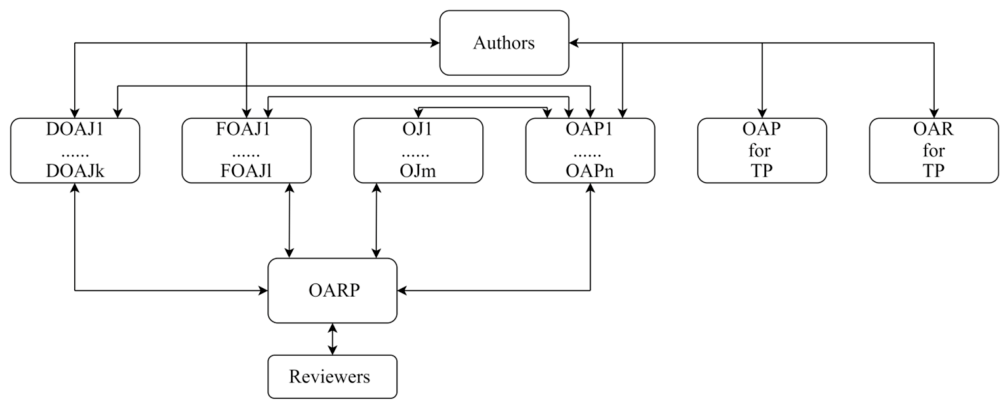
Table 1.
Distribution of organisations that have signed the Helsinki Initiative on Multilingualism in Scholarly Communication by country.
Table 1.
Distribution of organisations that have signed the Helsinki Initiative on Multilingualism in Scholarly Communication by country.
| Country | Number of organisations | Country | Number of organisations |
| Finland | 31 | Georgia | 2 |
| Spain | 23 | Indonesia | 2 |
| Argentina | 14 | Iran | 2 |
| Croatia | 13 | New Zeland | 2 |
| International | 11 | Norway | 2 |
| Venezuela | 10 | Peru | 2 |
| Mexico | 9 | Portugal | 2 |
| Colombia | 7 | Algeria | 1 |
| Brasil | 5 | Argentina | 1 |
| Canada | 5 | Armenia | 1 |
| India | 5 | Australia | 1 |
| USA | 5 | Austria | 1 |
| Ecaudor | 4 | Benin | 1 |
| Netherlands | 4 | China | 1 |
| Chile | 3 | Cyprus | 1 |
| Germany | 3 | Dominican Rep. | 1 |
| Greece | 3 | Hong Kong | 1 |
| Italy | 3 | Hungary | 1 |
| Latvia | 3 | Ireland | 1 |
| Moldova | 3 | Israel | 1 |
| UK | 3 | Macedonia | 1 |
| Ukraine | 3 | Nigeria | 1 |
| Belgium | 2 | Poland | 1 |
| Costa Rica | 2 | Romania | 1 |
| Cuba | 2 | Senegal | 1 |
| France | 2 | Total | 210 |
Table 2.
Distribution of individuals who signed the Helsinki Initiative on Multilingualism in Scholarly Communication by country.
Table 2.
Distribution of individuals who signed the Helsinki Initiative on Multilingualism in Scholarly Communication by country.
| Country | Number of organisations | Country | Number of organisations |
| Finland | 204 | Australia | 3 |
| Spain | 88 | Greece | 3 |
| France | 69 | Puerto-Rico | 3 |
| Brasil | 43 | Russia | 3 |
| Croatia | 42 | Venezuela | 3 |
| Argentina | 32 | Japan | 3 |
| Poland | 26 | China | 2 |
| Germany | 22 | Hungary | 2 |
| Portugal | 22 | Serbia | 2 |
| USA | 22 | South Korea | 2 |
| Mexico | 21 | UAE | 2 |
| Canada | 20 | Uruguay | 1 |
| Norway | 20 | Andorra | 1 |
| Italy | 18 | Belarus | 1 |
| UK | 17 | Bulgaria | 1 |
| Austria | 16 | Burundi | 1 |
| Belgium | 12 | Chechia | 1 |
| Switzerland | 11 | Costa Rica | 1 |
| Denmark | 11 | Dominican Rep. | 1 |
| Ireland | 10 | French Polynesia | 1 |
| Turkey | 10 | Georgia | 1 |
| Colombia | 9 | Honduras | 1 |
| Ukraine | 9 | Iceland | 1 |
| Chile | 8 | Iran | 1 |
| Latvia | 8 | Jordan | 1 |
| Moldova | 8 | Mauritius | 1 |
| Sweden | 8 | Montenegro | 1 |
| Estonia | 6 | Panama | 1 |
| Indonesia | 5 | Peru | 1 |
| Internationals | 5 | Qatar | 1 |
| Netherlands | 5 | Romania | 1 |
| Algeria | 4 | Taiwan | 1 |
| Cuba | 4 | Uzbekistan | 1 |
| India | 4 | Total | 869 |
Table 3.
Ability to translate metadata and full text of preprints into native language.
|
Open Access platform |
Metadata | Full text |
| Research Square | Yes | No |
| Preprints.org | Yes | No |
| F1000 Research | Yes | Yes |
| Meta ROR | Yes | Yes |
| Wellcome Open Research | Yes | Yes |
| Gates Open Research | Yes | Yes |
| Open Research Europe | Yes | Yes |
| Science Open | Yes | Yes |
| PeerJ Preprints | Yes | No |
| SSRN | Yes | No |
| HAL | Yes | No |
| ArXiv | Yes | Yes |
| MetaArXiv Preprints | Yes | No |
| OSF Preprints | Yes | No |
| SocArXiv | Yes | No |
| PsyArXiv | Yes | No |
| bioRxiv | Yes | Yes |
| ChemRxiv | Yes | No |
| medRxiv | Yes | Yes |
| TechRxiv | Yes | No |
| MediArXiv | Yes | No |
| EarthArXiv | Yes | No |
| Jxiv | Yes | No |
| AfricArXiv | Yes | No |
| ESS Open Archive | Yes | No |
| SciELO Preprints | Yes | No |
| APSA Preprints | Yes | No |
| Zenodo | Yes | No |
| Figshare | Yes | No |
| eLife | Yes | No |
| Review Commons | Yes | No |
| Peer Community in | Yes | No |
Table 4.
A list of suggested solutions and innovations in previous studies to improve the peer review process.
Table 4.
A list of suggested solutions and innovations in previous studies to improve the peer review process.
| 1 | Implement peer review as an open, continuous, interactive forum involving all stakeholders. |
| 2 | Put in place a hybrid two-tier system where only impactful research is sent for peer review. |
| 3 | Offer a non-selective review model to speed up the peer review process. |
| 4 | Link peer review involvement to the researcher’s academic benefits. |
| 5 | Adopt a portable peer review across journals and publishers. |
| 6 | Create communities of researchers reviewing preprints. |
| 7 | Merge journals into mega-journals with large editorial boards. |
| 8 | Build an online reviewer registry accessible by all journals. |
| 9 | Augment the review process with technology. |
| 10 | You review as much as you publish. |
| 11 | Offer incentives and rewards to reviewers. |
| 12 | Link peer review involvement to the researcher’s academic benefits. |
| 13 | Abandon the prepublication peer review model and adopt the post-publication peer-review (PPPR) model. |
| 14 | Abandon the peer review process altogether. |
| 15 | Establishment of journal consortia and their digital platforms to accelerate manuscript transfer and peer review processes. |
| 16 | Involvement of journal editorial board members in the review process. |
Table 5.
Distribution of Transformative Agreements with major commercial publishers graduating in 2026 - 2028, by country (21 April 2025).
Table 5.
Distribution of Transformative Agreements with major commercial publishers graduating in 2026 - 2028, by country (21 April 2025).
| Country | Publishers | Consortium | Number of Articles |
| Austria | Elsevier, Springer Nature, Taylor & Francis, Wiley | KEMOE | 4,783 |
| Canada | Elsevier, Sage | CRKN | 11,000 |
| Colombia | Elsevier, Springer Nature, Taylor & Francis, Wiley, Sage | Consorcio Colombia, Pontifica Universidad Javeriana | 2,430 |
| Czech Republic | Wiley | CzechELib | 650 |
| Denmark | Elsevier, Springer Nature, Taylor & Francis, Sage | RDL | 4,490 |
| Finland | Elsevier, Springer Nature, Taylor & Francis, Sage | FinELib | 1,140 |
| France | Elsevier | Couperin | 11,000 |
| Germany | Elsevier, Springer Nature, Taylor & Francis, Wiley | Projekt DEAL, GLC/TIB/MDPL, ZBW LICE | 37,800 |
| Hong Kong | Springer Nature | JULAC | 760 |
| India | Wiley | DEA | 380 |
| Ireland | Springer Nature, Taylor & Francis, Wiley, Sage | IReL | 1,897 |
| Israel | Elsevier, Springer Nature, Wiley | MALMAD | 3,400 |
| Italy | Elsevier, Wiley | CRUI-CARE | 12,000 |
| Netherlands | Elsevier, Springer Nature, Sage, Taylor & Francis, Wiley, Emerald | UKB/NWO/KNAW/VH/SURF | 13,629 |
| Norway | Sage, Springer Nature, Taylor & Francis | Sikt (previously Unit) | 2,550 |
| Slovakia | Elsevier, Springer Nature | SKeLib (CVTI SR) | 393 |
| Slovenia | Elsevier, Wiley | SC CTK | 570 |
| South Africa | Taylor & Francis | SANLiC | 1,808 |
| South Korea | Elsevier, Springer Nature | NRC S&T, SNU | 1,445 |
| Spain | Taylor & Francis | CSIC SNRC | 70 |
| Sweden | Elsevier, Springer Nature | Bibsam Consortium | 7,314 |
| Switzerland | Elsevier, Taylor & Francis | CSAL | 4,200 |
| Turkey | Springer Nature | EKUAL/TUBITAK | 2,750 |
| USA | Elsevier, Sage, Springer Nature, Taylor & Francis, Wiley | Lirasis, VA, NERL, CARLI, ISU | 2,509 |
Notes: CRKN - Canadian Research Knowledge Network; RDL – Royal Danish Library; GLC/TIB/MDPL - German library consortium, jointly administered by TIB and MPDL; ZBW LICE - ZBW Leibniz Information Centre for Economics; DEA - Department of Atomic Energy; SC CTK - Slovenian Consortium CTK; NRC S&T - National Research Council of Science & Technology; SNU - Seoul National University;CSIC SNRC - CSIC Spanish National Research Council; CSAL - Consortium of Swiss Academic Libraries; VA - Vanderbilt University; NERL – North East Research Libraries; CARLI - Consortium of Academic and Research Libraries in Illinois; ISU - Iowa State University.
Table 7.
Projected expenditure by the world’s leading countries on Open Access publishing in the event of a complete transition to Open Access.
Table 7.
Projected expenditure by the world’s leading countries on Open Access publishing in the event of a complete transition to Open Access.
| Country | Citable Documents | Cost for Publications, Thousand $ (APC = $2,000) | Cost for Publications, Thousand $ (APC = $3,000) |
| China | 1,190,419 | 2,380,838 | 3,571,257 |
| USA | 636,319 | 1,272,638 | 1,908,957 |
| India | 302,793 | 605,586 | 908,379 |
| UK | 211,490 | 422,980 | 634,470 |
| Germany | 185,893 | 371,786 | 557,679 |
| Italy | 144,985 | 289,970 | 434,955 |
| Japan | 129,428 | 258,856 | 388,284 |
| Canada | 117,420 | 234,840 | 352,260 |
| Spain | 115,233 | 230,466 | 345,699 |
| France | 112,837 | 225,674 | 338,511 |
| Australia | 109,796 | 219,592 | 329,388 |
| Netherlands | 67,526 | 135,052 | 202,578 |
| Switzerland | 52,818 | 105,636 | 158,454 |
| Sweden | 47,222 | 94,444 | 141,666 |
| Denmark | 32,906 | 65,812 | 98,718 |
| Austria | 30,882 | 61,764 | 92,646 |
| Finland | 24,537 | 49,074 | 73,611 |
| New Zealand | 16,443 | 32,886 | 49,329 |
Table 8.
Actual (2013) and projected (2024) expenditures on journal subscriptions and OA publishing for Germany, the UK, and France, compared with total costs in the event of a complete transition to Open Access.
Table 8.
Actual (2013) and projected (2024) expenditures on journal subscriptions and OA publishing for Germany, the UK, and France, compared with total costs in the event of a complete transition to Open Access.
| Costs | Germany | UK | France |
| Subscription cost (2013) | 250 | 260 | 120 |
| OA Publishing cost (2013) | 140 | 144 | 92 |
| Total cost (2013) | 390 | 404 | 212 |
| Citable docs (2013) | 153,984 | 160,092 | 109,934 |
| OA Publishing cost (2013) (APC = EUR 2,000) | 308 | 320 | 220 |
| OA Publishing cost (2013) (APC = EUR 3,000) | 462 | 480 | 330 |
| Subscription cost (2024) | 428 | 445 | 205 |
| OA Publishing cost (2024) | 238 | 247 | 158 |
| Total cost (2024) | 666 | 692 | 363 |
| Citable docs (2024) | 185,893 | 211,490 | 112,837 |
| OA Publishing cost (2024) (APC = EUR 2,000) | 372 | 423 | 226 |
| OA Publishing cost (2024) (APC = EUR 3,000) | 558 | 635 | 339 |
Table 9.
Actual (2014) and projected (2024) expenditures on journal subscriptions and OA publishing for Finland, Austria, and New Zealand, compared with total costs in the event of a full transition to Open Access.
Table 9.
Actual (2014) and projected (2024) expenditures on journal subscriptions and OA publishing for Finland, Austria, and New Zealand, compared with total costs in the event of a full transition to Open Access.
| Costs | Finland | Austria | New Zealand |
| Subscription cost (2014) | 22 | 70 | 31 |
| OA Publishing cost (2014) | 17 | 54 | 24 |
| Total cost (2014) | 39 | 124 | 55 |
| Citable docs (2014) | 18,231 | 21,984 | 13,202 |
| OA Publishing cost (2014) (APC = EUR 2,000) | 37 | 44 | 26 |
| OA Publishing cost (2014) (APC = EUR 3,000) | 55 | 66 | 40 |
| Subscription cost (2024) | 36 | 114 | 51 |
| OA Publishing cost (2024) | 28 | 88 | 39 |
| Total cost (2024) | 64 | 202 | 90 |
| Citable docs (2024) | 24,537 | 30,882 | 16,433 |
| OA Publishing cost (2024) (APC = EUR 2,000) | 49.1 | 61.8 | 32.9 |
| OA Publishing cost (2024) (APC = EUR 3,000) | 73.6 | 92.7 | 49.3 |
Table 10.
Distribution of organisations that have signed the Action Plan for Diamond Open Access by country.
Table 10.
Distribution of organisations that have signed the Action Plan for Diamond Open Access by country.
| Country | Number of organisations | Country | Number of organisations |
| France | 21 | Mexico | 2 |
| Germany | 14 | Nigeria | 2 |
| USA | 13 | Serbia | 2 |
| The Netherlands | 11 | Sweden | 2 |
| Switzerland | 11 | Turkey | 2 |
| UK | 9 | North Macedonia | 2 |
| Belgium | 8 | Armenia | 1 |
| Spain | 5 | Australia | 1 |
| Croatia | 5 | Australia/Sweden | 1 |
| Europe | 5 | Australia/New Zealand | 1 |
| International | 5 | Brasil | 1 |
| Canada | 4 | Egypt | 1 |
| Norway | 4 | Greece | 1 |
| Portugal | 4 | Luxembourg | 1 |
| Italy | 3 | India | 1 |
| Bulgaria | 3 | Malawi | 1 |
| Ireland | 3 | Algeria | 1 |
| Slovenia | 3 | Peru | 1 |
| Indonesia | 3 | Poland | 1 |
| Argentina | 2 | Rep. of Korea | 1 |
| Austria | 2 | Romania | 1 |
| Colombia | 2 | Total | 168 |
| Finland | 2 |
Table 11.
Distribution of individuals who signed the Action Plan for Diamond Open Access by country.
Table 11.
Distribution of individuals who signed the Action Plan for Diamond Open Access by country.
| Country | Number of individuals | Country | Number of individuals |
| Spain | 16 | India | 2 |
| France | 15 | Indonesia | 2 |
| Germany | 13 | Italy | 2 |
| USA | 11 | Czech Rep. | 2 |
| Portugal | 10 | Poland | 2 |
| UK | 9 | The Netherlands | 2 |
| Croatia | 8 | Algeria | 1 |
| Ireland | 8 | Argentina | 1 |
| Rep. of Korea | 7 | Chile | 1 |
| Canada | 6 | Colombia | 1 |
| Switzerland | 6 | Cyptus | 1 |
| Austria | 5 | Europe | 1 |
| Belgium | 5 | Ethiopia | 1 |
| Norway | 5 | Lebanon | 1 |
| Brasil | 4 | Nigeria | 1 |
| Mexico | 4 | Slovenia | 1 |
| Turkey | 4 | Sweden | 1 |
| Denmark | 3 | Uzbekistan | 1 |
| Serbia | 3 | Vietnam | 1 |
| Total | 167 |
Table 12.
Distribution by country of the organisations that have signed up to the various Open Access initiatives as at 15 October 2024.
Table 12.
Distribution by country of the organisations that have signed up to the various Open Access initiatives as at 15 October 2024.
| Country | APDOA | BOAI | OA2020 | Bar. Decl. | Berl. Decl. | Total |
| 1.Turkey | 2 | 281 | 1 | 1 | 1 | 286 |
| 2. Germany | 14 | 43 | 28 | 10 | 164 | 259 |
| 3. USA | 13 | 143 | 17 | 2 | 43 | 218 |
| 4. India | 1 | 175 | 1 | 0 | 4 | 181 |
| 5. Spain | 5 | 43 | 5 | 16 | 69 | 138 |
| 6. Italy | 3 | 26 | 3 | 5 | 83 | 120 |
| 7. France | 21 | 23 | 0 | 13 | 23 | 80 |
| 8. Indonesia | 3 | 75 | 0 | 0 | 2 | 80 |
| 9. Ukraine | 0 | 67 | 2 | 2 | 6 | 77 |
| 10.Russia | 0 | 68 | 2 | 0 | 2 | 72 |
| 11.Peru | 1 | 21 | 0 | 0 | 46 | 68 |
| 12.UK | 9 | 50 | 2 | 2 | 2 | 65 |
| 13.The Netherlands | 11 | 9 | 6 | 9 | 22 | 57 |
| 14.Switzerland | 11 | 7 | 3 | 0 | 32 | 53 |
| 15.Colombia | 2 | 35 | 0 | 2 | 6 | 45 |
| 16.Belgium | 8 | 14 | 0 | 0 | 20 | 42 |
| 17.Mexico | 2 | 32 | 0 | 1 | 6 | 41 |
| 18.Austria | 2 | 4 | 2 | 1 | 30 | 39 |
| 19.China | 0 | 14 | 19 | 0 | 3 | 35 |
| 20.South Africa | 0 | 5 | 0 | 6 | 23 | 34 |
| 21.Argentina | 2 | 26 | 0 | 1 | 1 | 30 |
| 22.Japan | 0 | 23 | 0 | 1 | 0 | 24 |
| 23.Portugal | 4 | 7 | 1 | 4 | 8 | 24 |
| 24.Canada | 4 | 3 | 2 | 0 | 14 | 23 |
| 25.Nigeria | 2 | 14 | 4 | 0 | 2 | 22 |
| 26.Sweden | 2 | 4 | 5 | 1 | 10 | 22 |
| 27.Brasil | 1 | 15 | 2 | 2 | 1 | 21 |
| 28.Norway | 4 | 0 | 9 | 0 | 7 | 20 |
| 29.North Macedonia | 2 | 15 | 0 | 1 | 1 | 19 |
| 30.International | 5 | 0 | 1 | 7 | 5 | 18 |
| 31.Iran | 0 | 17 | 0 | 0 | 0 | 17 |
| 32.Poland | 1 | 10 | 1 | 0 | 4 | 16 |
| 33.Venezuela | 0 | 15 | 0 | 0 | 1 | 16 |
| 34.Czechia | 0 | 2 | 0 | 1 | 13 | 15 |
| 35.Greece | 1 | 4 | 2 | 1 | 6 | 14 |
| 36.Bulgaria | 3 | 7 | 1 | 0 | 2 | 13 |
| 37.Romania | 1 | 11 | 0 | 0 | 1 | 13 |
| 38.Ecuador | 0 | 13 | 0 | 0 | 0 | 13 |
| 39.Armenia | 1 | 7 | 0 | 0 | 4 | 12 |
| 40.Croatia | 5 | 5 | 0 | 0 | 1 | 11 |
| 41.Europe | 5 | 0 | 2 | 0 | 4 | 11 |
| 42.Serbia | 2 | 2 | 0 | 0 | 7 | 11 |
| 43.Hungary | 0 | 7 | 1 | 0 | 4 | 11 |
| 44.Kenya | 0 | 0 | 4 | 0 | 7 | 11 |
| 45.Denmark | 0 | 0 | 2 | 1 | 7 | 10 |
| 46.Algeria | 1 | 9 | 0 | 0 | 0 | 10 |
| 47.Australia | 1 | 8 | 1 | 0 | 0 | 10 |
Notes: APDOA – Action Plan for Diamond Open Access (March 2, 2022), BOAI – Budapest Open Access Initiative (February 14, 2002), OA2020 - Open Access 2020 Initiative (December 8-9,2015), Bar. Decl. – Barcelona Declaration on Open Research Information (April 16, 2024), Berl. Decl. - Berlin Declaration on Open Access to Knowledge in the Sciences and Humanities (October 22, 2003).
Disclaimer/Publisher’s Note: The statements, opinions and data contained in all publications are solely those of the individual author(s) and contributor(s) and not of MDPI and/or the editor(s). MDPI and/or the editor(s) disclaim responsibility for any injury to people or property resulting from any ideas, methods, instructions or products referred to in the content. |
© 2026 by the authors. Licensee MDPI, Basel, Switzerland. This article is an open access article distributed under the terms and conditions of the Creative Commons Attribution (CC BY) license (http://creativecommons.org/licenses/by/4.0/).
Copyright: This open access article is published under a Creative Commons CC BY 4.0 license, which permit the free download, distribution, and reuse, provided that the author and preprint are cited in any reuse.