

Submitted:
31 July 2026
Posted:
04 August 2026
You are already at the latest version
Abstract
Background/Objectives: Although the exact etiology of Inflammatory Bowel Diseases (IBD) is not yet fully understood, recent evidence suggests that both genetic and dietary factors are involved in their pathogenesis. The aim of the present exploratory study was to investigate how first-degree relatives (FDRs) of individuals with IBD perceive genetic risk and the role of diet in IBD prevention. Methods: A mixed methods approach was followed. A total of 103 unaffected FDRs of individuals living with IBD in Greece participated in an online questionnaire examining demographic characteristics, disease-related knowledge, risk perception, and beliefs about the role of diet in IBD onset and prevention. Through 16 semi-structured interviews, the beliefs of unaffected FDRs, their dietary practices and the factors affecting those practices for IBD prevention were investigated using Framework analysis guided by the Health Belief Model. Results: Quantitative findings showed that perceived importance of diet was the strongest predictor of dietary change, while genetic beliefs were associated with reduced preventive behaviors despite professional consultation. Qualitative findings provided a deeper understanding of participants’ beliefs, highlighting that diet was mainly viewed as relevant to IBD management rather than prevention. Fear of disease onset and healthcare professional guidance were perceived as key facilitators of dietary changes. Conclusions: Our findings highlight the need for individualized dietary counselling and improved risk communication, to enhance implementation of preventive dietary practices and bridge the gap between knowledge and behavior in IBD prevention.
Keywords:
Crohn’s disease
; ulcerative colitis
; inflammatory bowel disease
; mixed method
; diet
; genetic risk
; preventive behavior
; health belief model
1. Introduction
Inflammatory Bowel Disease (IBD) is a general term that encompasses a group of chronic diseases characterized by relapsing and remitting inflammation of the intestine. The two main IBD types are Crohn’s Disease (CD) and Ulcerative Colitis (UC) [1]. IBD is estimated to affect more than three million people in the United States and approximately 2.5 to 3 million in Europe [2]. To date, there is no definitive treatment for IBD, and available therapeutic approaches focus on achieving remission and preventing relapse [3]. IBD patients are often required to manage serious physical symptoms (e.g., pain, discomfort, and surgical interventions), psychological burdens (e.g., depression and anxiety) [4], and social challenges (e.g., professional problems and social isolation) [5]. IBD, thus, can significantly affect both the physical and mental health of patients, as well as their overall quality of life [6].
Although the exact etiology of IBD is still not completely known, recent studies have indicated that both genetic susceptibility and diet are involved in IBD pathogenesis [7,8,9,10].
In particular, population studies have provided compelling evidence that genetic factors play a vital role in the pathogenesis of IBD. Both UC and CD often occur in more than one member of the same family, with family studies showing that a child has a 26-fold increased risk of developing CD when a sibling has already been diagnosed with the disease; in the case of UC the corresponding increase in risk is nine-fold [11]. On a similar note, the risk of developing IBD is eight to ten times higher among first-degree relatives (FDRs) of individuals with UC or CD, implying a strong genetic predisposition to IBD. Off note, twin studies have also provided evidence of genetic predisposition for IBD, with stronger evidence for CD compared to UC [12]. A recent genetic association study collected data from more than 75,000 adolescent and adult IBD patients and controls and conducted various genome-wide analyses [13]. The study identified 163 genetic regions associated with IBD susceptibility, and approximately 300 potential candidate genes. Of these 163 loci, 110 were associated with increased risk for both subtypes of IBD, while 30 were specific for CD and 23 were exclusive to UC [13]. Likewise, a multinational study involving over 20,000 individuals of European and non-European descent, identified 38 new genetic loci associated with IBD, highlighting shared genetic risk across different populations and increasing the total number of known risk loci for IBD to 200 [14,15].
Past research has explored the role of specific dietary components on IBD development and identified several dietary practices related to a decreased IBD risk [7,8]. For instance, increased intake of the omega-6 arachidonic acid has been associated with an elevated risk of developing UC [16]. Conversely, an increased intake of omega-3 fatty acids, such as docosahexaenoic acid (DHA), and a high ratio of omega-3 to omega-6 fatty acids, may lower the UC and CD risk [17]. Plant fibers may reduce the risk of IBD onset, with fiber from fruits and whole-grain breads protecting against CD and fiber from whole grains reducing UC risk [18]. Increased vitamin D intake may reduce the risk of UC whereas high zinc intake is associated with a lower likelihood of CD. In contrast, intake of iron, folate, vitamin B12, Vitamins A, C, and E and polyphenols have not been associated with IBD risk [19].
In addition to studying individual dietary components, there is growing research on overall dietary patterns and their potential impact on the risk of an IBD diagnosis. Dietary patterns characterized by high consumption of fruits, whole grains, nuts and seeds, alongside a limited intake of red and processed meats and foods high in sugars, have been linked to lower risk of developing IBD. On the contrary, high consumption of ultra-processed foods has been associated with a greater likelihood of developing CD [7].
Although the role of dietary factors and genetic predisposition in the pathogenesis of IBD has been extensively investigated, the interplay between these two determinants remains poorly understood. Increasing evidence supports that gene-environment interactions, diet-induced changes in the gut microbiota, and epigenetic modifications collectively influence immune dysfunction and intestinal inflammation [20]. However, the mechanistic pathways through which dietary exposures interact with the host genetic background to lead to disease development have not yet been elucidated.
Furthermore, existing research has focused predominantly on biomedical, molecular, and epidemiological factors, with comparatively limited attention to the experiences of individuals at elevated genetic risk of developing IBD. In particular, the beliefs, perceptions, and attitudes of unaffected FDRs of individuals living with IBD towards the role of diet in IBD onset, alongside their current dietary practices, remain underexplored [21]. Examining these perspectives would enhance our understanding of how families understand and respond to perceived IBD risk, thereby informing the development of preventive interventions tailored to the needs of this high-risk population [22].
Using mixed methods approaches to center the perspectives of unaffected FDRs of individuals living with IBD may provide a more holistic understanding of the cognitive and behavioral dimensions of dietary prevention. This approach can clarify whether dietary modifications are being adopted by unaffected FDRs and identify preventive dietary practices that may not be supported by current evidence. Such insights could help shape future family-centered dietary guidance and prevention strategies.
Hence, by following a mixed methods approach, the aim of the present research study is to examine dietary beliefs and practices among unaffected FDRs of people with IBD, including parents, siblings, and offspring. In particular, the current mixed methods study examines how unaffected FDRs perceive their hereditary IBD risk and the role of diet in IBD prevention. It also examines whether and how they may also adopt dietary changes within the context of preventive IBD strategies.
2. Materials and Methods
2.1. Study Design
A mixed methods design was employed, and the qualitative and quantitative studies were concurrently conducted, between October 2025 and March 2026.
An online questionnaire survey was administered to 103 unaffected FDRs of individuals living with IBD in Greece. The online survey aimed at investigating knowledge, perceptions and attitudes regarding the role of diet in the occurrence and prevention of IBD in unaffected FDRs of individuals living with IBD. At the same time, the perception of familial predisposition was examined, as well as possible dietary practices or changes adopted to reduce the relative risk.
The qualitative study included semi-structured interviews with unaffected FDRs of individuals living with IBD. The interviews explored in-depth the perceptions, experiences, and dietary practices of the participants.
No formal integration between the qualitative and quantitative components (e.g., triangulation or use of an integration matrix) was performed at the analysis level but findings are triangulated at an interpretation level, meaning that herein they are discussed together.
2.2. Inclusion/Exclusion Criteria
In both studies, eligibility criteria included adult age (18 or above years old), ability to communicate in the Greek language and residency in Greece. Additionally, participants were required to self-report no personal diagnosis of IBD and to be an FDR of an individual living with IBD (i.e., parent, sibling, or offspring). No further inclusion criteria were applied.
2.3. Procedure & Ethical Approval
The current study obtained ethical approval from the Ethics Committee of the University of Thessaly (approval no: 57/1.10.2025) and was completed in accordance with the code of conduct, legal regulations, and ethical guidelines defined by the University Ethics Committee. No adverse events were observed during or after the completion of both studies, meaning that both studies were completed as expected.
Participants were invited to take part in the online survey through social media platforms and organizations that provide support to people with IBD. Before giving their consent, participants were fully informed about the study’s objectives and procedures. The online questionnaire included closed-ended questions regarding demographic characteristics, as well as knowledge, perceptions and attitudes regarding the role of diet in the occurrence and prevention of IBD. It is worth noting that data collection was conducted anonymously, without recording any information that could reveal the participants’ identities, ensuring that responses could not be linked to specific individuals.
For the qualitative study, interviewees were invited to take part in two different ways. Initially, as in the quantitative phase, interested individuals were informed about both studies through social media platforms and IBD patient support organizations, and could contact the research team directly. In addition, participants who expressed interest in receiving more information about the interview study while completing the online questionnaire were given the opportunity to provide their contact information. The research team then contacted them, providing detailed information about the subject and scope of the qualitative study.
Next, for both recruitment methods, the study information sheet, which outlined the purpose of the research, the potential risks and benefits for participants, voluntary participation, and confidentiality issues, was emailed to those who expressed interest in participating in the interviews.
For the qualitative study, individual interviews were scheduled and conducted on dates that were convenient for both the participants and the researcher(s). Before the process began, participants were asked to sign the consent form electronically. All interviews were conducted online. On the day of the interview, researchers DS and GC provided a detailed explanation of the study’s purpose and gave participants ample time to ask any questions. Each interview lasted approximately one hour. Participants had the option to withdraw at any time, either to ask questions or to leave early in case of psychological distress. However, it is worth noting that all interviews were completed as scheduled.
All data and information generated by the two studies were stored electronically and handled with the greatest confidentiality. Specifically, in the context of the quantitative study, no personal data, such as names, were collected, with the sole exception of the email addresses of those who wished to participate in the qualitative phase as well. Participants’ data were stored on computers at the Laboratory of Nutrition and Clinical Dietetics, after first being coded with numerical identifiers to ensure their confidentiality. The interview recordings were securely stored on an encrypted drive, accessible exclusively to the researchers of the studies. Prior to analysis, the interviews were transcribed verbatim, the data were then anonymized and imported into N-VIVO for further processing.
2.4. Materials
An online questionnaire (see Supplementary Materials, Questionnaire S1) was developed by the research team for the purpose of the present study, and its content was informed by previously published literature on IBD regarding disease-related knowledge, risk perception, and beliefs about the role of diet in disease onset and prevention [23,24]. The questionnaire consisted mainly of closed-ended questions. The initial draft was assessed for content validity by research team members with expertise in the fields of nutrition and public health, while the clarity and readability of the questions were checked to ensure their suitability for use in the target population.
The questionnaire collected information on the demographic characteristics of the participants, including gender, age, education level, employment status, marital status and place of residence. In addition, the presence of IBD in the family environment of the participants was investigated. At the same time, participants’ perceptions regarding the likelihood of IBD occurrence in FDRs (including parents, siblings, and children) were assessed. Participants’ attitudes towards this statement were recorded using a five-point Likert scale (1 = “Strongly disagree” to 5 = “Strongly agree”). In addition, it was investigated whether participants had discussed with a healthcare professional the likelihood of IBD occurrence or the role of diet in its occurrence and/or prevention. In case of a positive response, participants were asked to identify the specialty of the healthcare professional. Finally, the questionnaire included questions about the perceived role of diet in IBD prevention and about potential dietary changes undertaken to reduce IBD risk in unaffected family members.
With regards to the qualitative study, a semi-structured topic guide entailing ten open questions was used for all interviews (Table 1). Questions explored the perceptions, beliefs and behavioral intentions of FDRs of individuals with IBD regarding perceived susceptibility, perceived severity of the disease, perceived benefits of nutrition and perceived barriers of dietary changes, cues to action, self-efficacy and dietary changes that were finally made, within the context of a cognitive-behavioral model, the Health Belief Model (HBM). Probing and follow-up questions were used where appropriate to encourage deeper reflection and to clarify emerging topics. A consent form was also administered to the participants prior to the start of the interviews.
2.5. Analyses
2.5.1. Statistical Analysis
Quantitative data on demographic characteristics, participants’ relationship with IBD, professional consultations and perceptions of FDRs were presented as absolute (n) and relative (%) frequencies. To investigate the factors associated with dietary changes, a multivariable logistic regression analysis was performed. The model included demographic variables (e.g., age, gender, education, employment status) and perceptions regarding the disease (e.g., belief in genetic risk, professional consultation) as predictors. Odds Ratios (OR) with their corresponding 95% Confidence Intervals (CI) were calculated to estimate the strength of the associations. Statistical significance was set at p < 0.05. All statistical analyses were conducted using Jamovi (Version 2.6.44).
2.5.2. Framework Analysis
A deductive analysis method was used in this study to identify, analyze and interpret the meanings from the interviews. In this approach, the analysis starts from the theory which acts as a guide for the identification of the initial codes [25]. The present study was based on the theoretical framework of HBM, which was developed in the 1950s. This model is widely used in health behavior research and allows the understanding of the processes that support both the adoption and maintenance of health behaviors but also offers a theoretical basis for the development of health interventions.
HBM predicts the likelihood that an individual will engage in behaviors that aim to prevent, detect, or control health problems. For this purpose, specific concepts are used, such as perceived vulnerability, perceived severity, perceived benefits and barriers, cues to action, and more recently the addition of self-efficacy [26]. Since specific categories had been predefined based on the model, the data were analyzed in the following way. First, the specific thematic units were identified and the basic elements of HBM were recorded and served as initial codes. The data were then analyzed to identify and classify the corresponding meanings, and the predefined thematic categories were used as a basis for the meanings that emerged from the data (deductive analysis). The third and final step included the agreement between the researchers on both issues that concern the research questions, the codes and the basic thematic areas [27] as well as the saturation of the data, which demonstrates that no new information or themes emerge.
3. Results
3.1. Quantitative Results
The demographic characteristics of the 103 unaffected study participants are presented in Table 2. The median age of the sample was 43.0 years (Q1, Q3: 34.0, 51.5). Most were females (61.2%), resided in urban areas (85.4%) and were educated to at least Bachelor level (72.7%). Regarding marital and employment status, the majority of the respondents were married (62.1%) and in full-time employment (61.2%). FDRs’ IBD diagnoses included CD (63.1%) and UC (36.9%). Participants’ relationships with the individual with IBD included being a parent (53.3%), sibling (13.3%), or offspring (33.4%).
Less than half of the participants (42.8%) agreed or strongly agreed that FDRs of IBD patients face a higher risk of developing the disease compared to the general population (Table 3). A similar proportion (39.8%) remained neutral whereas 17.4% disagreed.
According to Table 4, 58.3% discussed the possibility of disease onset among FDRs with a healthcare professional, while the vast majority (93.2%) had discussed the pre-ventive role of diet in lowering IBD risk. Despite these discussions, less than half of the participants (43.7%) believed that diet plays a crucial role in the onset or prevention of IBD in FDRs. Likewise, only 28.2% reported having implemented dietary changes within their family to reduce IBD risk.
The different specialties of healthcare professionals providing advice on the role of diet in IBD prevention are shown in Table 5. As participants were able to select more than one specialty (multiple response question), the total number of reported consultations exceeds the sample size. Gastroenterologists were selected by the vast majority (89.6%) as the primary source of dietary advice, followed by dietitians-nutritionists (47.9%). Other professionals involved in patient consultation included pathologists (22.9%), psychologists (16.7%), and general practitioners (15.6%). A smaller proportion (14.6%) reported seeking advice from other specialties, such as nursing staff or pediatricians.
A multivariable logistic regression analysis was performed to assess factors pre-dicting dietary changes among participants (N=103 with n=29 events) (see Table 6). While the model demonstrated a satisfactory fit (Nagelkerke R2 = 0.358), the overall model test was not statistically significant (χ2 = 29.5, df = 22, p = 0.131). The most significant predictor of dietary changes was the perceived importance of diet (OR = 5.088, p = 0.005), indicating that individuals who perceived diet as important were more than five times more likely to report dietary changes compared to those who did not. Conversely, a strong belief in genetic risk significantly reduced the likelihood of dietary modifications (OR = 0.045, p = 0.046), suggesting that these individuals perceived IBD risk as primarily hereditary. Other factors, including gender, age, education level and employment status, did not show statistically significant associations with dietary changes (p > 0.05), indicating that they were not key behavioral drivers in this model. Likewise, consulting a healthcare professional about genetic risk or dietary role alongside the type of healthcare professional consulted, did not show statistically significant associations with dietary changes.
3.2. Qualitative Results
As Table 7 illustrates, 16 unaffected FDRs of individuals living with IBD participated in the study. The associated IBD diagnoses of the FDR were evenly distributed between CD (n=8) and UC (n=8). Regarding disease status, most of the participants reported that their affected relative diagnosis was made 1–6 years ago.
Most interviewees were women (n=9) and lived in urban areas (n=14). All participants completed at least junior high school or high school education level, and most were employed full-time. The median age of the interviewees was 37 years. Of the participants, six were parents of children with IBD, five were siblings of individuals with IBD, and five were offspring of individuals with IBD.

Table 7.
Demographic characteristics unaffected FDRs of individuals with IBD, who participated in individual interviews (N=16).
Table 7.
Demographic characteristics unaffected FDRs of individuals with IBD, who participated in individual interviews (N=16).
| Variable | n (%)1 |
|---|---|
| FDR’s IBD diagnosis | |
| Crohn’s Disease | 8 (50%) |
| Ulcerative Colitis | 8 (50%) |
| Diagnosis | |
| 14 years ago or more | 5 (31%) |
| 7-13 years ago | 3 (19%) |
| 1-6 years ago | 8 (50%) |
| Gender | |
| Male | 7 (44%) |
| Female | 9 (56%) |
| Place of residence | |
| Urban area | 14 (88%) |
| Rural area | 2 (12%) |
| Educational level | |
| Master’s Degree/ Doctorate (PhD) | 6 (38%) |
| Bachelor’s Degree | 6 (38%) |
| Secondary Education | 4 (24%) |
| Employment status | |
| Full-time employment | 13 (81%) |
| Retired/ Unemployed | 1 (6%) |
| Students | 2 (13%) |
| Relationship to IBD individual | |
| Parent | 6 (37.5%) |
| Sibling | 5 (31.25%) |
| Offspring | 5 (31.25%) |
| Personal IBD diagnosis | |
| Yes | 0 (0%) |
| No | 16 (100%) |
| Age (years), Median (Q1, Q3)1 | 37.00 (28.75, 47.00) |
1 n = number; % = percentage; Q1 = first quartile (25th percentile); Q3 = third quartile (75th percentile).
Sub-analyses by the aforementioned demographic characteristics are presented, where relevant, within each theme.
At a high level, two overarching themes emerged from the analysis. The first theme, namely “dietary practices for IBD prevention”, highlighted substantial variability in whether and how participants adapted their diets following an IBD diagnosis within the family, ranging from no changes to more structured modifications. The second theme, “factors influencing dietary practices”, reflected key constructs of the HBM, showing that perceptions of susceptibility, severity, benefits, barriers, and cues to action collectively shaped participants’ decisions regarding dietary change (Figure 1). Both themes are presented in detail below.
3.2.1. Theme 1- Dietary Practices for IBD Prevention
Dietary practices for IBD prevention showed heterogeneity among all interviewees. Most interviewees reported that they had not changed anything in their diet after the diagnosis of their relative.
“We did not make any major changes to our diet after the diagnosis.” (PART7, Male, 50 years old)
Among those reporting dietary changes, some mentioned partial dietary modifications, such as a decrease in the consumption of fried foods, junk foods, sugar, and salt consumption to prevent the disease. Others described increased consumption of fruits, vegetables, and fatty fish, reduced consumption of red meat, and elevated use of olive oil.
“We’ve been avoiding fried foods for a very long time, anyway. We got an air fryer right after the diagnosis. We eat very often, like I said four times a week, vegetables, beans, peas and a spinach-rice dish.” (PART2, Female, 35 years old)
Only a few participants mentioned systematic dietary changes after the IBD diagnosis of their FDR, treating diet as an active tool for IBD prevention. In most of these families dietary modifications were implemented collectively, affecting the entire family environment.
“We are more careful now, especially regarding food and food combinations—not only for my brother, but for all of us in general. If something seems to bother us, we pay more attention to it. Overall, our eating habits and lifestyle have changed somewhat, and we have definitely become more mindful about our diet.” (PART9, Female, 24 years old)
3.2.2. Theme 2-Factors Affecting Dietary Practices as Reflected in the HBM
According to HBM, the adoption of preventive behaviors and dietary changes is influenced by the interaction of perceived vulnerability, perceived severity, perceived benefits and barriers, cues to action, and self-efficacy. The analysis of the present data revealed that participants acknowledge the existence of genetic vulnerability in IBD onset. Regarding perceived severity, participants who focused on physical symptoms of IBD had a sense of reduced perceived severity, while those who focused on psychosocial symptoms of IBD showed a stronger perception of severity. Most participants said that diet mainly affects the progression and flare ups of IBD rather than its onset. Perceived barriers were either practical, such as cost and time for food preparation, or psychological, such as habits. Cues to action were both internal and external, including reliable guidance from healthcare professionals and the fear of a new IBD diagnosis. These factors are described in more detail below.
3.2.2.1. Perceived Susceptibility to IBD Onset
Perceived susceptibility to the occurrence of IBD emerged as a multidimensional concept, which was expressed with different intensity and emotional load among the participants. About half recognized the possibility of the disease occurring in family members with IBD history, which indicates an increased level of risk awareness.
“…because this seems to be related to a genetic predisposition, I already consider it a possibility and would not be entirely surprised if it were confirmed.” (PART1, Male, 37 years old)
Heredity was systematically reported as the most important vulnerability factor for most interviewees. Genetic predisposition was described either as a “latent” condition that can be “activated” under specific conditions or, in some cases, as an almost inevitable development. For some participants, the coexistence of other autoimmune diseases in the family history such as Hashimoto disease and autoimmune rheumatic diseases, further strengthened the perception of risk, as IBD was associated with a broader autoimmune susceptibility.
“I have Hashimoto’s, I have a thyroid condition…Among my relatives, my brother has vitiligo. That is, as the doctors explained to me as well, they’re like “cousins” that run around within the family.” (PART12, Female, 41 years old)
Most interviewees stated that anxiety and psychological stress could increase IBD susceptibility. These participants often attributed a triggering role to prolonged emo-tional distress; IBD diagnosis was perceived as a consequence of severe psychosomatic stress rather than a random occurrence.
“I believe that the primary factor that influences is stress…I think that stress triggers many different health-related issues.” (PART4, Female, 28 years old)
3.2.2.2. Perceived Severity of an IBD Diagnosis
Many interviewees perceived the disease as relatively manageable, largely due to confidence in current treatments and the belief that early diagnosis and appropriate management could reduce disease burden. As one relative explained:
“It doesn’t worry me much because I understand that, unless something very severe develops, it may remain mild. And even if it becomes more serious, I will know ways to manage it, so I feel at ease about it.” (PART3, Female, 29 years old)
Among FDRs without IBD who were parents, the possibility of the disease affecting their children perceived as particularly concerning, placing greater emphasis on its psychosocial impact. Their concerns focused on emotional distress, quality of life, and the broader effects on family functioning, particularly when children were involved. This heightened emotional frame is reflected in statements such as:
“I don’t want my children to go through anything that affects their daily lives or their psychological well-being, like IBD did to my brother. I know it’s not a fatal disease and that there are stages where you can manage it, but I still wouldn’t want them to have it…” (PART12, Female, 41 years old).
3.2.2.3. Perceived Benefits of a Healthy Diet to IBD Prevention
Most participants expressed uncertainty about the beneficial role of diet in IBD prevention implying that diet cannot cause the disease. Nevertheless, most suggested that diet plays a crucial role in shaping severity, intensity, and progression of symptoms once IBD appears.
“I can’t say I’m convinced that diet causes the disease, but I do believe it strongly influences how it presents—particularly in terms of severity” (PART5, Male, 47 years old).
At the same time, participants emphasized that diet alone is not sufficient for prevention, highlighting its synergistic interaction with other factors, most notably stress. Several described IBD as the result of a broader lifestyle context, where multiple influences act together.
“I think it’s a combination of factors—it’s not just about diet. You might be eating well, but if you’re also stressed, smoking, or have other habits… everything works together. You need to look at the bigger picture” (PART2, Female, 35 years old).
In fact, adverse psychological factors were perceived as having a more crucial role in IBD onset than diet, as reflected in the words of one interviewee:
“I’m not sure, but I feel that the onset is influenced more by stress and psychological factors than by diet.” (PART1, Male, 37 years old).
3.2.2.4. Perceived Barriers to Adopting a Healthy Diet as Prevention to IBD
According to the interviewees, perceived barriers against healthier dietary changes were practical, psychological, and social. Limited time, work and family obligations, and the convenience of quick meals were frequently reported as practical barriers to changing diet to prevent the disease.
“ Unfortunately, due to the demands of everyday life—balancing office work, professional responsibilities, and childcare—we often resort to ordering takeout meals because of time constraints.” (PART2, Male, 40 years old)
At a psychological level, as most participants explained, the consumption of un-healthy food was associated with emotional reward and stress relief, posing significant challenges to behavior change.
“Psychology may also play a role, as many people—myself included in the past—tend to view junk food as a form of reward or entertainment. It is often perceived as more enjoyable, while at the same time being less healthy, so this factor may contribute as well. “ (PART1, Male, 37 years old)
At a social level, lack of clear dietary information and guidance from healthcare professionals increased confusion among interviewees and discouraged the adoption of healthier dietary choices.
“It stems from a lack of information, as people are often unaware of what drives the eating habits that they should adopt.” (PART15, Female, 52 years old)
3.2.2.5. Cues to Action Promoting Dietary Changes
Cues to action are triggers—both internal and external—that motivate individuals to adopt or maintain health-related dietary behaviors. In this study, participants described a range of such cues that could motivate them to make dietary changes to prevent IBD.
In particular, internal cues included personal experiences that heightened awareness or concern about health. These encompassed the fear prompted by a potential new IBD diagnosis or the appearance of physical symptoms in the unaffected family members. As a participant mentioned:
“It could certainly be the fear of developing such a disease (that could motivate me to implement dietary changes)…” (PART6, Male, 31 years old)
On the other hand, external cues involved influences from the social and healthcare environment. According to almost all interviewees, reliable guidance from healthcare professionals, regular monitoring by a dietitian-nutritionist, family support, would reinforce participants’ commitment to behavior change and maintenance of healthier dietary habits.
“The guidance of a gastroenterologist, pathologist, dietitian, or another appropriate healthcare professional is of great importance, depending on the individual’s needs.” (PART17, Male, 26 years old)
4. Discussion
To our knowledge, this is the first mixed methods study conducted in Greece investigating the perceptions of unaffected FDRs of individuals living with IBD about the role of diet in the prevention of IBD in unaffected family members. Taken together, the qualitative and quantitative data reveal a complex interplay between the perceived disease severity and vulnerability and dietary perceptions and modifications within the study population.
Quantitative findings showed that fewer than half of the participants recognized the increased IBD risk among FDRs, with many remaining uncertain. This aligns with previous research indicating that although familial predisposition is well established in IBD, health literacy may influence the interpretation of genetic susceptibility information [28]. In contrast, qualitative data indicated greater awareness of genetic susceptibility, often framing IBD as an almost “inevitable” but manageable health condition. This discrepancy may reflect the explanatory depth of the qualitative methods and participation bias, since individuals who participate in interviews are often more interested or informed about the topic. As such, this may have contributed to the higher expressed awareness of genetic susceptibility observed in the qualitative findings.
Interviewees emphasized that genetic risk does not act alone, identifying stress as a significant triggering factor of IBD. This perception among FDRs is consistent with previous studies showing that individuals with IBD similarly identify stress as a key contributor to disease onset and exacerbation [4,29]. Such perceptions are supported by evidence highlighting the substantial psychological burden of IBD, with anxiety, depression, and impaired quality of life frequently reported among patients and often persisting despite clinical remission [29,30,31,32].
Notably, perceptions of severity, among many FDRs, did not solely focus on physical symptoms; several participants highlighted the psychological impact of the disease. While these perspectives reflect the experiences and concerns of relatives at risk rather than individuals living with IBD themselves, they do align with the priorities reported by patients with IBD, for whom disease burden during remission extends beyond symptom control to include psychological well-being and quality of life [33,34]. This overlap implies that FDRs may have a broader understanding of IBD severity, similar to that described by IBD patients [33,34].
Quantitative analyses revealed skepticism about diet in prevention; more than half of the participants did not believe that diet plays a role in IBD onset and prevention. However, “belief in the role of diet” was the strongest positive predictor of dietary changes. Past literature also suggests that individuals’ dietary beliefs significantly influence their behavior, as many modify their diet based on their personal perceptions of the role of diet in IBD [35]. Further to this quantitative finding, qualitative results illustrated how such beliefs may be shaped, influenced and sometimes constrained. Many interviewees perceived diet as more beneficial regarding IBD management rather than its onset. This perception seemed to weaken motivation from preventive dietary changes, especially when compared to the relatively strong recognition of genetic susceptibility. Contrary to the perceptions of our study population, emerging evidence recognizes diet as a modifiable risk factor in IBD prevention [8,36,37,38,39]; specific dietary patterns such as Mediterranean-like, high fiber and low ultra-processed lower the risk of IBD onset [7]. In addition, current clinical guidelines from the European Society for Clinical Nutrition and Metabolism and the European Crohn’s and Colitis Organisation consensus stress diet as a potential modifiable factor in IBD prevention. As these guidelines suggest, a dietary pattern rich in fruits, vegetables, fibers, and omega-3 fatty acids, and low in omega-6 fatty acids and ultra-processed foods, may be associated with a reduced risk of developing IBD, while promoting overall healthy eating patterns as part of primary prevention [7,40]. The low perceived benefit of diet in IBD prevention as captured in the present interviews in combination with emerging evidence suggesting a potential role of dietary patterns in IBD onset highlights the need for improved awareness, targeted counselling and preventive interventions in at-risk populations.
A striking finding across both study components was the gap between participants’ awareness about diet and the actual adoption of preventive dietary behaviors. Interviews revealed multiple barriers to dietary change, including practical constraints such as time and cost, psychological factors such as emotional attachment to unhealthy foods, and social barriers such as unclear or inconsistent dietary guidance. Our findings are in line with behavioral studies which show that when many barriers are identified, the likelihood of behavior change and, in particular, the adoption of preventive health behaviors may be reduced [41]. This finding might be further explained in the light of genetic susceptibility. As behavioral science studies show, genetic attributions may attenuate engagement in preventive health behaviors. This points toward a genetic essentialist bias, where individuals perceive their health as predetermined [42].
Both internal and external cues were identified by our qualitative findings, as key determinants of adopting and maintaining healthier dietary practices to prevent IBD onset. Healthcare professionals were identified in the qualitative findings as an important external cue to action, with participants emphasizing that guidance from trusted experts could motivate and support dietary behavior change. This is substantiated by the quantitative results, where gastroenterologists (89.6%) were reported as the primary source of advice, followed by dietitians-nutritionists (47.9%), highlighting the central role of medical professionals in shaping FDRs’ understanding of IBD and the role of diet. This finding is consistent with past research highlighting the central role of healthcare professionals in improving IBD outcomes through effective communication and provision of evidence-based support. Use of patient decision aids and reliable dietary guidance may, thus, help reduce uncertainty, counter misinformation, and support informed decision-making among individuals living with or being at risk of IBD [43,44,45].
Finally, our qualitative results offer valuable context for interpreting the lack of significant associations between sociodemographic factors and dietary changes in our quantitative model. Rather than age, gender, or education, behavior appears to be more strongly shaped by cognitive and emotional constructs. This finding underscores the importance of moving toward a more cognitive and emotional based informed approach, integrating clear risk information and psychological support.
The present study presents several strengths alongside limitations. The mixed method design is a significant advantage, as it combines quantitative and qualitative approaches, preserving the strengths of each method, while limiting the respective limitations. This approach allows for a more comprehensive understanding of the phenomenon under study, which would not be possible with the implementation of an exclusively quantitative or qualitative method [46,47]. In the qualitative study, strengths include the satisfactory number of participants and the use of semi-structured interviews, offering flexibility and the possibility of listening to the FDRs’ voices. Quantitative study successfully quantifies the gap between clinical consultation and actual behavioral implementation, providing a clear target for healthcare interventions. Furthermore, by using multivariable logistic regression, the study moves beyond simple correlations to identify “belief in the role of diet” as a primary driver of behavioral change.
However, the study also has some limitations, including the use of convenience sampling and online recruitment. These may introduce selection bias, potentially leading to an overrepresentation of participants from urban areas and of those who were more engaged with digital platforms.
For the quantitative study, while online data collection allowed for geographical expansion, the sample size is relatively small, especially when using multivariable logistic regression. In combination with the absence of a priori sample size calculation, the statistical power and the stability of the estimated associations may have been affected. Furthermore, due to the cross-sectional nature of the study, it is not possible to establish causality regarding the factors preventing dietary changes.
Regarding qualitative study one limitation concerns the inherent susceptibility of qualitative methods to interpretive bias. To address this issue, two researchers (DS, GC) independently coded the data and discussed differences until consensus was reached, ensuring the reliability of the present analysis. An additional limitation relates to the self-efficacy dimension of HBM. Although self-efficacy is a key factor in adopting and maintaining dietary changes, participants in our study did not provide sufficient data to adequately assess this dimension. As a result, the analysis could not provide conclusions about self-efficacy and its possible influence on dietary practices. Future studies could further investigate this dimension of HBM. Also, the experiences of FDRs’ living in small or remote areas have not been adequately recorded, limiting the applicability of the results to all of Greece.
Supplementary Materials
The following supporting information can be downloaded at the website of this paper posted on Preprints.org. Questionnaire S1: Online questionnaire - “Dietary Beliefs, Genetic Risk Perceptions, and Preventive Dietary Practices among Unaffected First-Degree Relatives of Individuals with Inflammatory Bowel Disease: A Mixed Methods Study in Greece”.
Author Contributions
“V.S., D.E.S. and O.A. conceptualized and designed the current study, G.C., and D.E.S. performed interviews, D.E.S., E.Z., G.C., M.M., M.M., I.D. and A.V. performed transcriptions and thematic analysis, A.T., D.E.S. and V.S. performed statistical analysis, V.S., D.E.S, E.Z., A.T., A.S. M.M., G.C., A.V., M.M., I.D., A.K., K.A. and O.A. prepared the original draft and had responsibility for the final content. All authors have read and agreed to the published version of the manuscript.”.
Funding
This research received no external funding.
Institutional Review Board Statement
This study was conducted in accordance with the principles of the Declaration of Helsinki. Ethical approval was obtained from the Ethics Committee of the Department of Nutrition & Dietetics, University of Thessaly and was conducted in line with the code of conduct, legal regulations, and ethical guidelines defined by the University Ethics Committee (approval no: 57/1.10.2025).
Informed Consent Statement
Informed consent was obtained from all subjects involved in the study.
Data Availability Statement
The datasets used and/or analyzed during the current study are available from the corresponding author on reasonable request. The following email address will be requested: oandroutsos@uth.gr.
Acknowledgments
The authors would like to thank Anna Maria Pentzeretzi and Maria Delliou for their valuable assistance and support during the preparation of this manuscript.
Conflicts of Interest
The authors declare no conflicts of interest.
Abbreviations
The following abbreviations are used in this manuscript:
| CD | Crohn’s Disease |
| CI | Confidence Intervals |
| FDRs | First-Degree Relatives |
| HBM | Health Belief Model |
| IBD | Inflammatory Bowel Disease |
| OR | Odds Ratios |
| UC | Ulcerative Colitis |
References
- Tomasello, G.; Abruzzo, A.; Sinagra, E.; Damiani, P.; Damiani, F.; Traina, G.; Campanella, C.; Rappa, F.; Marino Gammazza, A.; Noto, M.; et al. Nutrition in IBD patient’s. What are the prospects? Progress in Nutrition 2015, 17, 79-86.
- Dubinsky, M.C.; Dotan, I.; Rubin, D.T.; Bernauer, M.; Patel, D.; Cheung, R.; Modesto, I.; Latymer, M.; Keefer, L. Burden of comorbid anxiety and depression in patients with inflammatory bowel disease: a systematic literature review. Expert Review of Gastroenterology & Hepatology 2021, 15, 985-997. [CrossRef]
- Moayyedi, P.; Ullman, T.; Sandborn, W.; Kane, S.; Hanauer, S.; Dubinsky, M.; Bernstein, C.; Achkar, J.-P.; Abreu, M.; Talley, N. An Evidence-Based Systematic Review on Medical Therapies for Inflammatory Bowel Disease. American Journal of Gastroenterology 2011, 106, S2-S25. [CrossRef]
- Strongylou, D.E.; Svolos, V.; Vlachou, A.; Zoupa, E.; Vakouftsi, V.-R.; Ntanou, A.; Argyriou, K.; Kapsoritakis, A.; Bonoti, F.; Androutsos, O. Understanding the Tripartite Relationship Between Dietary Practices, Psychological Well-Being, and Disease Experience in Greek Patients with IBD: A Mixed-Methods Exploration. Nutrients 2026, 18, 1439.
- Marin-Fernandez, B.; Marti-Garcia, C.; Schmidt-Riovalle, J.; Montoya-Juarez, R.; Garcia-Caro, M.P.; Hueso-Montoro, C.; Lopez-Cortes, R. Factors Influencing the Life Experiences of Individuals With Inflammatory Bowel Disease. Gastroenterology Nursing 2018, 41, 120-130. [CrossRef]
- Abdulla, M.; Hallak, Y.; Sawaf, B.; Abbarh, S.; Abdalkarim, M.; Battikh, E.; Naga, Y.; Rakab, A. Impact of inflammatory bowel disease on quality of life and fatigue: a systematic review and meta-analysis. Inflammatory Bowel Diseases 2025, 31, S66-S66. [CrossRef]
- Svolos, V.; Gordon, H.; Lomer, M.C.E.; Aloi, M.; Bancil, A.; Day, A.S.; Day, A.S.; Fitzpatrick, J.A.; Gerasimidis, K.; Gkikas, K.; et al. European Crohn’s and Colitis Organisation consensus on dietary management of inflammatory bowel disease. Journal of Crohn’s and Colitis 2025, 19. [CrossRef]
- Halmos, E.P.; Godny, L.; Vanderstappen, J.; Sarbagili-Shabat, C.; Svolos, V. Role of diet in prevention versus treatment of Crohn’s disease and ulcerative colitis. Frontline Gastroenterology 2024, 15, 247-257. [CrossRef]
- Gkikas, K.; Svolos, V.; Hansen, R.; Russell, R.K.; Gerasimidis, K. Take-Home Messages from 20 Years of Progress in Dietary Therapy of Inflammatory Bowel Disease. Annals of Nutrition and Metabolism 2023, 79, 476-484. [CrossRef]
- Gerasimidis, K.; Godny, L.; Sigall-Boneh, R.; Svolos, V.; Wall, C.; Halmos, E. Current recommendations on the role of diet in the aetiology and management of IBD. Frontline Gastroenterology 2022, 13, 160-167. [CrossRef]
- Group, C.i.I.S.; Neopics; Uhlig, H.H.; Schwerd, T.; Koletzko, S.; Shah, N.; Kammermeier, J.; Elkadri, A.; Ouahed, J.; Wilson, D.C.; et al. The Diagnostic Approach to Monogenic Very Early Onset Inflammatory Bowel Disease. Gastroenterology 2014, 147, 990-1007.e1003. [CrossRef]
- Cho, J.H.; Brant, S.R. Recent insights into the genetics of inflammatory bowel disease. Gastroenterology 2011, 140, 1704-1712. [CrossRef]
- Loddo, I.; Romano, C. Inflammatory Bowel Disease: Genetics, Epigenetics, and Pathogenesis. Frontiers in Immunology 2015, Volume 6 - 2015. [CrossRef]
- Liu, J.Z.; van Sommeren, S.; Huang, H.; Ng, S.C.; Alberts, R.; Takahashi, A.; Ripke, S.; Lee, J.C.; Jostins, L.; Shah, T.; et al. Association analyses identify 38 susceptibility loci for inflammatory bowel disease and highlight shared genetic risk across populations. Nature Genetics 2015, 47, 979-986. [CrossRef]
- McGovern, D.P.; Kugathasan, S.; Cho, J.H. Genetics of Inflammatory Bowel Diseases. Gastroenterology 2015, 149, 1163-1176.e1162. [CrossRef]
- Investigators, T.I.i.E.S. Linoleic acid, a dietary n-6 polyunsaturated fatty acid, and the aetiology of ulcerative colitis: a nested case–control study within a European prospective cohort study. Gut 2009, 58, 1606-1611. [CrossRef]
- Barbalho, S.M.; Goulart Rde, A.; Quesada, K.; Bechara, M.D.; de Carvalho Ade, C. Inflammatory bowel disease: can omega-3 fatty acids really help? Ann Gastroenterol 2016, 29, 37-43.
- Hart, A.; Khaw, K.-T.; Welch, A.; Shrestha, S.; Luben, R.; John, S. Dietary n-3 polyunsaturated fatty acids and the aetiology of ulcerative colitis: a UK prospective cohort study. European Journal of Gastroenterology & Hepatology 2010, 22, 602-606. [CrossRef]
- Ananthakrishnan, A.N.; Khalili, H.; Konijeti, G.G.; Higuchi, L.M.; de Silva, P.; Korzenik, J.R.; Fuchs, C.S.; Willett, W.C.; Richter, J.M.; Chan, A.T. A Prospective Study of Long-term Intake of Dietary Fiber and Risk of Crohn’s Disease and Ulcerative Colitis. Gastroenterology 2013, 145, 970-977. [CrossRef]
- Sugihara, K.; Kamada, N. Diet–Microbiota Interactions in Inflammatory Bowel Disease. Nutrients 2021, 13, 1533.
- Moller, F.T.; Andersen, V.; Wohlfahrt, J.; Jess, T. Familial risk of inflammatory bowel disease: a population-based cohort study 1977-2011. Am J Gastroenterol 2015, 110, 564-571. [CrossRef]
- Santos, M.P.C.; Gomes, C.; Torres, J. Familial and ethnic risk in inflammatory bowel disease. Ann Gastroenterol 2018, 31, 14-23. [CrossRef]
- Zallot, C.; Quilliot, D.; Chevaux, J.-B.; Peyrin-Biroulet, C.; Guéant-Rodriguez, R.M.; Freling, E.; Collet-Fenetrier, B.; Williet, N.; Ziegler, O.; Bigard, M.-A.; et al. Dietary Beliefs and Behavior Among Inflammatory Bowel Disease Patients. Inflammatory Bowel Diseases 2013, 19, 66-72. [CrossRef]
- de Vries, Jeanne H.M.; Dijkhuizen, M.; Tap, P.; Witteman, Ben J.M. Patient’s Dietary Beliefs and Behaviours in Inflammatory Bowel Disease. Digestive Diseases 2018, 37, 131-139. [CrossRef]
- Hsieh, H.F.; Shannon, S.E. Three approaches to qualitative content analysis. Qual Health Res 2005, 15, 1277-1288. [CrossRef]
- Janz, N.K.; Becker, M.H. The Health Belief Model: a decade later. Health Educ Q 1984, 11, 1-47. [CrossRef]
- Bingham, A.J. & Witkowsky, P. Deductive and inductive approaches to qualitative data analysis; Analyzing and interpreting qualitative data: After the interview 2021, 1, 133-146.
- Hooker, G.W.; Peay, H.; Erby, L.; Bayless, T.; Biesecker, B.B.; Roter, D.L. Genetic literacy and patient perceptions of IBD testing utility and disease control: a randomized vignette study of genetic testing. Inflamm Bowel Dis 2014, 20, 901-908. [CrossRef]
- Wintjens, D.S.J.; de Jong, M.J.; van der Meulen-de Jong, A.E.; Romberg-Camps, M.J.; Becx, M.C.; Maljaars, J.P.; van Bodegraven, A.A.; Mahmmod, N.; Markus, T.; Haans, J.; et al. Novel Perceived Stress and Life Events Precede Flares of Inflammatory Bowel Disease: A Prospective 12-Month Follow-Up Study. Journal of Crohn’s and Colitis 2019, 13, 410-416. [CrossRef]
- Knowles, S.R.; Graff, L.A.; Wilding, H.; Hewitt, C.; Keefer, L.; Mikocka-Walus, A. Quality of Life in Inflammatory Bowel Disease: A Systematic Review and Meta-analyses-Part I. Inflamm Bowel Dis 2018, 24, 742-751. [CrossRef]
- Riggott, C.; Ford, A.C.; Gracie, D.J. Review article: The role of the gut–brain axis in inflammatory bowel disease and its therapeutic implications. Alimentary Pharmacology & Therapeutics 2024, 60, 1200-1214. [CrossRef]
- Chen, Y.; Chen, X.; Lin, S.; Huang, S.; Li, L.; Hong, M.; Li, J.; Ma, L.; Ma, J. Effects of psychological stress on inflammatory bowel disease via affecting the microbiota-gut-brain axis. Chin Med J (Engl) 2025, 138, 664-677. [CrossRef]
- Viazis, N.; Mantzaris, G.; Karmiris, K.; Polymeros, D.; Kouklakis, G.; Maris, T.; Karagiannis, J.; Karamanolis, D.G. Inflammatory bowel disease: Greek patients’ perspective on quality of life, information on the disease, work productivity and family support. Ann Gastroenterol 2013, 26, 52-58.
- Popov, J.; Farbod, Y.; Chauhan, U.; Kalantar, M.; Hill, L.; Armstrong, D.; Halder, S.; Marshall, J.K.; Moayyedi, P.; Kaasalainen, S. Patients’ Experiences and Challenges in Living with Inflammatory Bowel Disease: A Qualitative Approach. Clin Exp Gastroenterol 2021, 14, 123-131. [CrossRef]
- Guida, L.; Di Giorgio, F.M.; Busacca, A.; Carrozza, L.; Ciminnisi, S.; Almasio, P.L.; Di Marco, V.; Cappello, M. Perception of the Role of Food and Dietary Modifications in Patients with Inflammatory Bowel Disease: Impact on Lifestyle. Nutrients 2021, 13, 759.
- El-Serag, H.; Abraham, B.; Hou, J. Dietary Intake and Risk of Developing Inflammatory Bowel Disease: A Systematic Review of the Literature. American Journal of Gastroenterology 2011, 106, 563-573. [CrossRef]
- Tayyem, R.F.; Qalqili, T.R.; Ajeen, R.; Rayyan, Y.M. Dietary Patterns and the Risk of Inflammatory Bowel Disease: Findings from a Case-Control Study. Nutrients 2021, 13, 1889.
- Meyer, A.; Agrawal, M.; Savin-Shalom, E.; Wong, E.C.L.; Levinson, C.; Gold, S.; Narula, N.; Colombel, J.-F.; Carbonnel, F. Impact of diet on inflammatory bowel disease risk: systematic review, meta-analyses and implications for prevention. eClinicalMedicine 2025, 86. [CrossRef]
- Khalili, H.; Håkansson, N.; Chan, S.S.; Chen, Y.; Lochhead, P.; Ludvigsson, J.F.; Chan, A.T.; Hart, A.R.; Olén, O.; Wolk, A. Adherence to a Mediterranean diet is associated with a lower risk of later-onset Crohn’s disease: results from two large prospective cohort studies. Gut 2020, 69, 1637-1644. [CrossRef]
- Bischoff, S.C.; Bager, P.; Escher, J.; Forbes, A.; Hébuterne, X.; Hvas, C.L.; Joly, F.; Klek, S.; Krznaric, Z.; Ockenga, J.; et al. ESPEN guideline on Clinical Nutrition in inflammatory bowel disease. Clinical Nutrition 2023, 42, 352-379. [CrossRef]
- Champion, V.L; Skinner, C.S. The health belief model. In Health Behavior and Health Education: Theory, Research, and Practice, 4th ed.; Glanz, K.; Rimer, B.K.; Viswanath, K, Eds.; Jossey-Bass/Wiley: San Francisko, CA, USA, 2008; 45-65.
- Dar-Nimrod, I.; Heine, S.J. Genetic essentialism: on the deceptive determinism of DNA. Psychol Bull 2011, 137, 800-818. [CrossRef]
- Schoefs, E.; Vermeire, S.; Ferrante, M.; Sabino, J.; Lambrechts, T.; Avedano, L.; Haaf, I.; De Rocchis, M.S.; Broggi, A.; Sajak-Szczerba, M.; et al. What are the Unmet Needs and Most Relevant Treatment Outcomes According to Patients with Inflammatory Bowel Disease? A Qualitative Patient Preference Study. Journal of Crohn’s and Colitis 2023, 17, 379-388. [CrossRef]
- Day, A.S.; Vanderstappen, J.; Sandall, A.; Svolos, V.; Shabat, C.S. From Kitchen to Inflammatory Bowel Disease (IBD) Clinic: Transforming the Role of Dietitians in IBD Care. A Narrative Review by Dietitians With Expertise in IBD. JCC Plus 2026, 1, e70007. [CrossRef]
- Gkikas, K.; Wan, M.; Svolos, V.; Nichols, B.; Hansen, R.; Russell, R.K.; Gerasimidis, K. YouTube as a Source of Information for Food, Diet-Related Items, and Advisory Comments for the Management of Inflammatory Bowel Disease. Inflamm Bowel Dis 2024, 30, 347-356. [CrossRef]
- Creswell, J.W.; Plano Clark, V.L. Designing and Conducting Mixed Methods Research, 2nd ed.; SAGE: Los Angeles, CA, USA, 2011.
- Morse, J.M.; Niehaus, L. Mixed Method Design: Principles and Procedures; Left Coast Press: Walnut Creek, CA, USA, 2009.
Figure 1.
Studied HΒΜ constructs influencing dietary practices among families with an IBD diagnosis.
Figure 1.
Studied HΒΜ constructs influencing dietary practices among families with an IBD diagnosis.
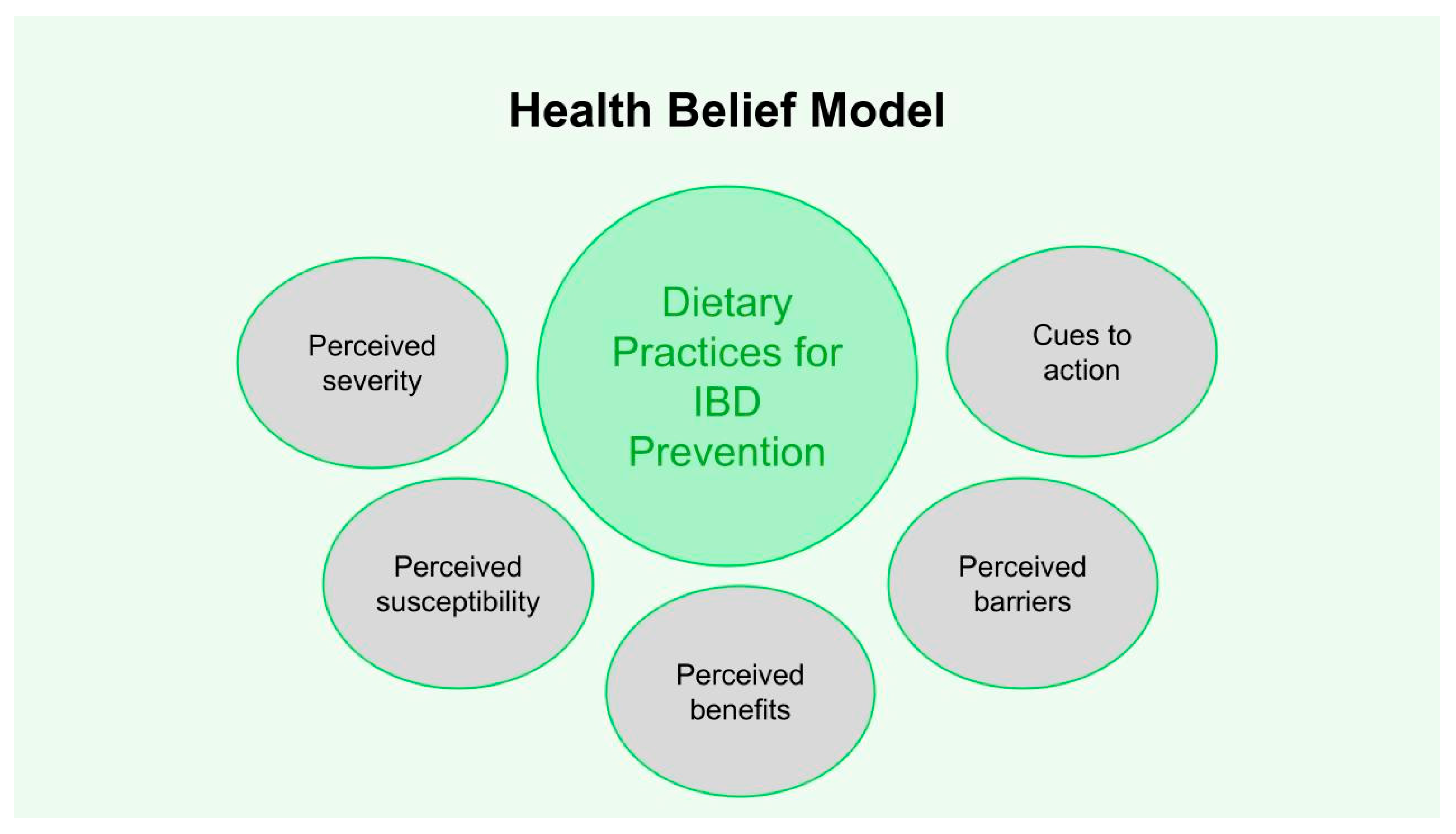
Table 1.
Topic guide for semi-structured interviews with FDRs of individuals with IBD.
| Question 1. What is it like living with a first-degree relative who has an IBD diagnosis? |
| Question 2. What are your thoughts about the possibility of first-degree relatives of affected individuals (e.g., children, parents, siblings) developing this disease? (susceptibility) |
| Question 3. What factors/habits do you believe may influence the severity of the disease at the time of diagnosis? (severity) |
| Question 4. How important do you think the role of diet is in the possible development of the disease in yourself? (benefits, susceptibility) Do you believe that diet can reduce the risk? (benefits) |
| Question 5. How have you changed—or what changes have you made, if any - to your diet since learning about your relative’s diagnosis? (target behavior) How easy was it for you to make such changes? (self-efficacy) |
| Question 6. What do you think motivates people like yourself - that is, relatives of individuals with chronic diseases—to change their dietary practices/habits? (cues to action) |
| Question 7. What do you think are the main difficulties in adopting a healthy diet (e.g., knowledge, financial cost, habits, underestimating the disease)? (barriers) |
| Question 8. What do you think would encourage you to adopt (more) healthy eating habits (e.g., healthcare professionals, the internet)? (cues to action) |
| Question 9. What advice would you give to another relative of a patient regarding their diet (e.g., changes in portion sizes/types of foods, cooking methods, improving food “quality” such as choosing organic/seasonal products, etc.)? (target behavior) What would be the benefits of these changes? |
| Question 10. Would you like to add anything that has not already been discussed? Do you have any questions for me? |
Table 2.
Demographic characteristics of participants (N=103).
| Variable | n (%)1 |
|---|---|
| Gender | |
| Male | 38 (36.9%) |
| Female | 63 (61.2%) |
| Prefer not to say | 2 (1.9%) |
| Educational level | |
| Primary education | 3 (2.9%) |
| Lower Secondary Education (Gymnasium) | 3 (2.9%) |
| Upper Secondary Education (Lyceum) | 19 (18.4%) |
| Bachelor’s Degree | 50 (48.5%) |
| Master’s Degree/ Doctorate (PhD) | 28 (27.2%) |
| Marital status | |
| Single | 33 (32.0%) |
| Married | 64 (62.1%) |
| Divorced | 5 (4.9%) |
| Widowed | 1 (1.0%) |
| Employment status | |
| Full-time employment | 63 (61.2%) |
| Part-time employment | 5 (4.9%) |
| Self-employed | 3 (2.9%) |
| Unemployed | 15 (14.6%) |
| Retired | 13 (12.6%) |
| Students | 4 (3.9%) |
| Place of residence | |
| Urban area | 88 (85.4%) |
| Semi-urban area | 5 (4.9%) |
| Rural area | 10 (9.7%) |
| Personal IBD diagnosis | |
| Yes | 0 (0%) |
| No | 103 (100%) |
| FDR’s IBD diagnosis | |
| Crohn’s Disease | 65 (63.1%) |
| Ulcerative Colitis | 38 (36.9%) |
| Relationship to IBD individual | |
| Parent | 55 (53.3%) |
| Sibling | 14 (13.3%) |
| Offspring | 34 (33.4%) |
| Age (years), Median (Q1, Q3)1 | 43.0 (34.0, 51.5) |
1 n = number; % = percentage; Q1 = first quartile (25th percentile); Q3 = third quartile (75th percentile).
Table 3.
Participants’ perceptions regarding the genetic risk of IBD (N=103).
| Statement, n (%) | Strongly disagree | Disagree | Neutral | Agree | Strongly agree |
|---|---|---|---|---|---|
| First-degree relatives of patients are at a higher risk of developing the disease compared to the general population | 9 (8.7%) | 9 (8.7%) | 41 (39.8%) | 32 (31.1%) | 12 (11.7%) |
Table 4.
Participants’ perceptions, consultations and dietary practices regarding IBD (N=103).
| Survey Question | Response, n (%) | |
|---|---|---|
| Yes | No | |
| 1. Beliefs about diet | ||
| “Do you believe that diet and nutrition play a role in the onset or prevention of the disease in first-degree relatives?” | 45 (43.7%) | 58 (56.3%) |
| 2. Consultations with professionals | ||
| “Have you ever discussed the possibility of disease onset in first-degree relatives with a healthcare professional?” | 60 (58.3%) |
43 (41.7%) |
| “Have you ever discussed the role of diet in disease prevention with a healthcare professional?” | 96 (93.2%) | 7 (6.8%) |
| 3. Practical implementation (Actions) | ||
| “Have you implemented dietary changes in the family to reduce disease risk?” | 29 (28.2%) | 74 (71.8%) |
Table 5.
Healthcare professionals’ specialties providing IBD advice (N=96).
| Healthcare Specialty | n (%) |
|---|---|
| Gastroenterologist | 86 (89.6%) |
| Dietitian-nutritionist | 46 (47.9%) |
| Pathologist | 22 (22.9%) |
| Psychologist | 16 (16.7%) |
| General Practitioner | 15 (15.6%) |
| Other | 14 (14.6%) |
Table 6.
Multivariable logistic regression of factors associated with dietary changes (N=103).
| Predictor | OR | 95%CI | p-value |
|---|---|---|---|
| Gender | |||
| (Female vs. Male) | 1.030 | [0.317, 3.353] | 0.961 |
| Age (Years) | 0.980 | [0.916, 1.050] | 0.577 |
| Educational level | |||
| (Up to Secondary vs. Higher education) | 1.427 | [0.318, 6.406] | 0.642 |
| Employment status (Ref:unemployed) | |||
| Employed | 0.409 | [0.082, 2.051] | 0.278 |
| Retired | 0.227 | [0.021, 2.497] | 0.225 |
| Students | 1.264 | [0.015, 103.583] | 0.917 |
| Beliefs in genetic risk (Ref: Strongly disagree) | |||
| Disagree | 0.198 | [0.013, 3.106] | 0.249 |
| Neutral | 0.669 | [0.102, 4.373] | 0.675 |
| Agree | 0.807 | [0.116, 5.640] | 0.829 |
| Strongly agree | 0.045 | [0.002, 0.946] | 0.046* |
| Consulted healthcare professional on genetic risk | |||
| (Yes vs. No) |
2.358 | [0.733, 7.591] |
0.150 |
| Belief in diet role | |||
| (Yes vs. No) |
5.088 | [1.631, 15.875] | 0.005* |
| Consulted healthcare professionals on dietary role | |||
| (Yes vs. No) |
0.309 | [0.000, Inf] |
1.000 |
| Healthcare specialty | |||
| (Gastroenterologist vs. Dietitian-nutritionist) | 1.313 | [0.402, 4.296] | 0.652 |
Abbreviations: OR, odds ratio; CI, confidence interval. Model statistics: N = 103; events = 29; Nagelkerke R2 = 0.358; overall model test χ2 (22) = 29.5, p = 0.131. * p < 0.05.
Disclaimer/Publisher’s Note: The statements, opinions and data contained in all publications are solely those of the individual author(s) and contributor(s) and not of MDPI and/or the editor(s). MDPI and/or the editor(s) disclaim responsibility for any injury to people or property resulting from any ideas, methods, instructions or products referred to in the content. |
© 2026 by the authors. Licensee MDPI, Basel, Switzerland. This article is an open access article distributed under the terms and conditions of the Creative Commons Attribution (CC BY) license (http://creativecommons.org/licenses/by/4.0/).
Copyright: This open access article is published under a Creative Commons CC BY 4.0 license, which permit the free download, distribution, and reuse, provided that the author and preprint are cited in any reuse.


