

Submitted:
03 August 2026
Posted:
04 August 2026
You are already at the latest version
Abstract
The ferromanganese industry, critical for global steelmaking, faces increasing pressure to adopt sustainable practices due to its high energy consumption and carbon footprint. High-carbon ferromanganese (HCFeMn) slag, a significant by-product, represents both an environmental challenge and a valuable resource for metal recovery. This study employs a multi-metric approach to assess the technical, environmental and operational performance of aluminothermic reduction smelting of HCFeMn slag in a 200 kW DC arc furnace, with focus on energy, material, and emissions assessment. For materials, the focus was on reductant efficiency, elemental accountability, elemental recovery, elemental deportment and slag-to-metal ratio. The environmental indicators studied includes CO2-equivalent emissions per ton of product, dust and particulate emissions, NOx/SOx emissions. The consumption of electrodes and refractory was also studied. The innovative process proposed in this study also aims to valorize metallurgical residues into high-value manganese alloy products while minimizing environmental burdens. A total of 2009 kg of HCFeMn slag was smelted and reduced by recycled aluminium scrap (202 kg) over 20 taps, while fluxing with burnt lime (382 kg). The campaign recorded an average gross specific energy requirement of 0.87 kWh kg−1 of charge across 20 taps, with tap-by-tap values ranging from 0.74 to 0.98 kWh kg−1. When compared to conventional submerged-arc SiMn furnaces ( 4,000–4,500 kWh t−1), this corresponds to an approximate 79–81 % reduction in specific energy consumption. The attained aluminium reductant efficiencies ranged from 55.14 to 91.89 % (the campaign average being ∼60 %), with Mn recovery of 47–81 % and Fe recovery progressing from 33–38 % to over 90 % across successive taps. The observed high slag-to-metal ratio (SMR) (4.79–6.68 kg/kg) is attributed to the operating strategy of using slag as a feed, rather than a process deficiency. This high SMR contrasts with the 1.0–1.3 kg/kg typical of SiMn industrial operations. The emissions from the current 200 kW DC arc furnace study were approximately 1.35 t CO2-eq t−1 alloy (Eelec=1.20 t CO2-eq t−1; EAl−prod=0.15 t CO2-eq t−1), marking a decrease of 60–65 % when compared to conventional carbothermic HCFeMn production (3.0–4.0 t CO2-eq t−1) and an 80 % decrease when compared with the full cradle-to-gate SiMn benchmark (6.94 t CO2-eq t−1). Direct process CO2 emissions were negligible, owing to the absence of fossil reductants in the burden. SO2 emissions of 0.312 kg t−1 alloy and particulate emissions of 10.4 kg t−1 alloy (pre-abatement) were measured, well below industrial SiMn off-gas emission intensities, while the use of recycled scrap aluminium, which requires up to 95 % less energy than primary aluminium, underpins the low embodied-carbon contribution. The integration of aluminothermic reduction in a DC arc furnace offers a robust, efficient and environmentally sustainable alternative route for the recovery of manganese from industrial HCFeMn slag, validating the current-study process at Technology Readiness Level 6. The primary contribution of this study is the application-level demonstration of the current process at a 200 kW DC arc furnace pilot scale, and bridging the gap between laboratory concepts and industrial-scale implementation. The study further compares the Pyrosim simulation values to campaign data, slag and alloy chemical analyses and specific energy requirement.
Keywords:
aluminothermic reduction
; HCFeMn slag
; DC arc furnace
; Pyrosim process simulation
; power-stability metrics
; reductant efficiency
; mass balance
; slag-to-metal ratio
; low-carbon ferroalloy
1. Introduction
The ferromanganese industry serves as a critical enabler of global steel manufacturing, supplying essential alloying elements that optimize the mechanical performance, durability, and corrosion resistance of steel [1]. Mounting environmental legislation and societal accountability are compelling the ferroalloys sector to transition toward innovative, integrated strategies for carbon abatement and resource efficiency, aligned with international sustainability commitments such as the Paris Agreement and Kyoto Protocol. The conventional carbothermic production of silicomanganese and HCFeMn remains profoundly energy-profligate (3,000 - 4,000 kWh/t alloy) carbon-intensive (>4 t CO2-eq/t alloy)[2].The pressing need to align with global climate targets, such as the Paris Agreement’s goal of decreasing CO2 emissions by 45% by 2030 and achieving net-zero by 2050, necessitates the development of innovative and sustainable manganese production processes [3].
The production of ferromanganese alloys inevitably generates large volumes of discard slag, presenting both a formidable waste management challenge and an opportunity for the recovery of valuable secondary materials [4,5,6]. The ferroalloys sector also faces an urgent mandate to transition toward cleaner and more efficient processing routes that adhere to global sustainability targets and circular economy principles [7,8]. In this context, the valorization of metal-bearing slags is gaining prominence as a viable strategy for waste reduction, primary resource conservation, and overall environmental performance enhancement [4,9,10].
In response to global sustainability mandates, as well as to improve the process efficiencies, the ferroalloys industry is pivoting towards alternative production routes, such as hydrogen pre-reduction of ores, smelting-aluminothermic reduction, and/or a combination of both. Amongst these process options, is the HAlMan process funded by the Horizon Europe program [11,12,13]. The HAlMan process seeks to demonstrate an integrated process to produce manganese alloys from Mn ores and Mn-containing byproducts and wastes using hydrogen and secondary aluminium sources as reductants, offering a novel route for sustainable metallurgical valorization. The exothermic nature of aluminothermic reactions reduces external energy input requirements and facilitates the use of aluminum-rich waste streams as reductants [14,15]. Furthermore, [14] reported that replacing primary aluminium with industrial aluminium dross produced an equivalent manganese alloy during the aluminothermic reduction of MnO-bearing slags. This finding suggests that the 22.7% excess aluminium allowance adopted in the present study could potentially be reduced during future scale-up by incorporating larger proportions of aluminium dross, thereby further lowering reductant costs while maintaining metallurgical performance.
This study investigated the smelting-aluminothermic reduction of HCFeMn slag, in a 200 kW DC arc furnace. The DC arc furnace has the potential to provide superior energy utilization [16,17,18], enhanced control [19,20,21] , and lower electrode consumption relative to AC furnaces [17,18,22], provide a robust platform for environmentally responsible smelting operations [16,20,23,24]. The findings contribute to the ongoing efforts towards decarbonizing the ferroalloys industry and advancing circular economy principles in metal production. The primary contribution of this study is the application-level demonstration of the integrated HAlMan process at a 200 kW DC arc furnace pilot scale, effectively elevating the technology to a Technology Readiness Level of 6, thereby unlocking opportunities for commercial adoption. Additionally, this study introduces a comprehensive assessment that combines technical, environmental, and operational metrics, in order to bridge the gap between laboratory concepts and industrial-scale implementation.
2. Materials and Methods
2.1. Materials Preparation and Characterization
The HCFeMn slag used in this study was supplied by Transalloys (Pty) Ltd., eMalahleni, Mpumalanga Province, South Africa, South Africa. The as-received lumps were subjected to comminution and granulometric classification into the –20 mm + 6 mm fraction to conform with the design specifications of Mintek’s feed system. Complementary raw materials incorporated into this study include flux (burnt lime), which was supplied by Idwala Industrial Holdings (Idwala Lime), Vereeniging, Gauteng Province, South Africa, and reductant (metallic aluminum). Commercial recycled aluminium scrap was supplied by Alitrop Ltd., Johannesburg, Gauteng Province, South Africa. Burnt lime was also subjected to crushing and granulometric refinement (−20 mm + 6 mm) to ensure feed-system compatibility, while the aluminum required only screening to the prescribed size interval for operational integration.
Both HCFeMn slag and lime were subjected to chemical analyses, which employed Inductively Coupled Plasma–Optical Emission Spectrometry (ICP-OES, Agilent, Chemetrix Export (Pty) Ltd, Halfway House, Johannesburg, South Africa) and LECO (LECO CS844, LECO Africa (Pty) Ltd, Kempton Park, Gauteng, South Africa). The Mintek internal reference material, SARM16, was used. The obtained results are summarized in Table 1 and Table 2, from X-Ray Florescence (XEPOS 05 HE XRF, Spectro Analytical Instruments (Pty) Ltd, Kempton Park, Gauteng, South Africa). Species present at concentrations in the parts-per-million (ppm) range, as well as the loss on ignition, are not reported in Table 1. Thus, the percentages will not add to 100 percent.
The reliability of the calculated indicators is subject to the uncertainty of the techniques employed during experimentation. The chemical analytical techniques used in this study are summarized in Table 3, together with the analytes and lower detection limits, and uncertainty. For the average measured gaseous emissions Table 4, the US EPA Methods 1, 2, 3A, 4, 5, 6C, and 7E were followed, and the respective uncertainty values are presented in Section 3.4 and discussed in Section 4.4 below.
Elemental accountability (of Mn, Fe, Al and Si), mass balance closure, was also employed to validate the reliability of these analyses. The study achieved accountability values of 95.40% for Mn, 103.46% for Fe, 97.93% for Al, and 96.34% for Si. These values fall within the industry-standard range of ±10% for high-temperature smelting, confirming that the analytical methodology is suitable for recovery and deportment analysis.
2.2. Description of the Smelting Test Work
Process simulation is a critical tool in pyrometallurgical research and industrial practice, enabling the prediction of process outcomes, optimization of operating conditions, and evaluation of alternative process routes [25]. This study utilized the Pyrosim, an MS-DOS-based stoichiometric process simulation tool developed by Mintek for comprehensive process simulations, to establish initial feed recipes and understand process behaviour [26].
The simulation was conducted to determine the initial feed recipes, specific energy requirement, slag viscosity, slag liquidus temperature, slag and alloy compositions for the smelting campaign. Several key assumptions were made to simplify the initial calculations:
- Dry Feed Materials: All feed materials were assumed dry to simplify mass and energy balance calculations by eliminating considerations of moisture evaporation and steam generation.
- Simple and Stable Chemical Forms: Raw materials’ chemical species were idealized as pure, well-defined compounds for baseline thermodynamic assessment [27].
- Near Chemical Equilibrium at 0.88 atm: Reactions were assumed to occur at 0.88 atm pressure and be at or near chemical equilibrium. This assumption supports the use of an equilibrium model while acknowledging that kinetic factors or mass transfer limitations might prevent perfect equilibrium, justifying the subsequent use of an empirically parameterized model [27].
- Molten Slag Forming Components: Slag components such as Al2O3, SiO2, CaO, and MgO were assumed molten at operating temperatures to correctly account for their latent heat of fusion in the energy balance.
- No Reactions with Refractory or Electrode: For simplification, no chemical reactions were assumed between the slag and furnace refractory material or between the electrode and the slag bath, thereby isolating the primary metallurgical reactions.
The pilot-scale testing facility is comprised of three primary operational sections that are equipped with a range of specialised equipment:
- i.
- Feed section: comprising raw material hoppers, conveyor systems, and a mixing bin for charge preparation.
- ii.
- Furnace section: incorporating a hydraulic electrode-control system, a robust furnace shell lined with refractories, and integrated cooling-water circuits.
- iii.
- Off-gas handling section:equipped with an off-gas port, extraction lines, and a baghouse for dust capture and emissions control.
The feed and furnace sections are fitted with an integrated with instrumentation network that enables real-time, remote monitoring and precise operational control. Figure 1 gives the schematic representation of the facility layout . For brevity, auxiliary systems (e.g., the cooling-water circuit, gas pipelines, among others) are not depicted in the diagram.
The experimental plan of HCFeMn slag aluminothermic reduction smelting (Table 5) aimed at investigating five process and operational conditions. The initial condition (taps 1–7) was aimed at establishing energy and mass balance stability, ensuring equilibrium in both input–output dynamics and compositional fidelity. The second condition (taps 8–10) stabilized the slag bath at 1550 °C through lowering of the Specific Energy Ratio (0.93 to 0.84). Condition 3 (taps 11–14) suppressed MnO content in slag to below 4 mass% via increased Al addition (9.40 to 10.34 kg). Subsequent conditions explored the effect of increasing energy, with power escalations from 130 kW to 150 kW (taps 15–17) and 150 kW to 180 kW (taps 18–20).
The system boundary for this assessment encompassed direct process emissions from the DC arc furnace, as well as indirect emissions stemming from upstream processes such as electricity generation. For all impact assessments, the functional unit was defined as one tonne of the final alloy product. The evaluation integrated direct process emissions, which were measured by an accredited environmental monitoring laboratory, with indirect emissions estimated from relevant literature data.
Stack monitoring of the 200 kW DC arc furnace was systematically conducted to acquire specific emissions data. This monitoring was performed by an independent laboratory accredited to ISO/IEC 17025:2017 standards by SANAS (T0894). Compliance with the National Environmental Management: Air Quality Act of 2004 (Act 39 of 2004) was ensured through the application of internationally accepted reference methods, specifically US EPA Methods 1, 2, 3A, 4, 5, 6C, and 7E for the respective pollutants. Sample ports located on the stack were utilized for accurate volumetric flow rate and isokinetic measurements.
A sensitivity analysis was inherently performed by implementing controlled process changes (see Table 5,column 13). These adjustments tested the system’s response to variations. Across the five operational conditions shown in Table 5 column 1, the three complementary quantitative metrics that quantify how closely the furnace were used, namely, current-tracking error (I%, Equation (6)), the voltage deviation (V%, Equation (7)), and the realised power deviation (P%, Equation (8)). Details are discussed in Section 4.2 and Section 4.5 below. The other inherent experimental challenges that are considered to influence the precision of elemental accountability, includes the material heterogeneity, sampling constraints, weighing errors, and so forth.
The reliability and reproducibility of the campaign results are supported by a robust dataset comprising 20 sequential taps. To evaluate process stability, the experimental conditions were grouped into discrete intervals where setpoints were held constant to allow the system to reach a steady state, as detailed in Table 6.
Table 6 provides the exact experimental values for mass fed, power, Specific Energy Consumption, current, and voltage for each tap interval. These data were used to calculate the mean values and standard deviations for each operational phase. The resulting variability is illustrated in Figure 2, where error bars represent the standard deviation of the measured parameters.
3. Results
3.1. Pyrosim Process Simulation
As shown in Figure 3, the Pyrosim process simulation was based on a feed of 100 kg h−1 HCFeMn slag with the following composition: Al2O3 (4.60 wt.%), CaO (32.20 wt.%), FeO (1.79 wt.%), MgO (8.00 wt.%), MnO (20.2 wt.%) and SiO2 (32.60 wt.%). The target slag composition was Al2O3 (20.3 wt.%), CaO (45.7 wt.%), MgO (7.4 wt.%), MnO (3.2 wt.%) and SiO2 (23.4 wt.%). The target alloy composition was Al (0.1 wt.%), Mn (71.1 wt.%), Fe (8.2 wt.%) and Si (20.7 wt.%). The composition of the reductant (recycled scarp aluminium was Al (92.5 wt.%)), Si (3.0 wt.%), Mg (0.3 wt.%), Mn (0.3 wt.%) and Fe (0.8 wt.%). The oxides in the flux (burnt lime were) Al2O3 (0.3 wt.%), CaO (91.9 wt.%), FeO (0.27 wt.%), MnO (0.9 wt.%) and SiO2 (1.99 wt.%)
The total metallic aluminium requirement calculated by Pyrosim was 9.25 kg h−1. Based on recycled scrap aluminium composition given above, the corresponding recycled scrap aluminium feed rate was 10.0 kg h−1. The use of end-of-life aluminium scrap rather than primary aluminium ingots represents the principal circular-economy advantage of the proposed process. Similarly, mass flow rate of CaO, 17.46 kg h−1 was calculated as the required flux by Pyrosim, leading to burnt lime feed rate of 19 kg h−1, based of burnt lime and HCFeMn slag compositions given above.
Comparable results (as shown in Table 7) were observed for the major slag constituents. The Al2O3 concentrations were 20.3 wt.% (simulation) and 18.9 wt.% (campaign), while the corresponding CaO concentrations were 45.7 and 41.6 wt.%, respectively. Similarly, the MgO concentrations were 7.4 and 7.9 wt.%, whereas the MnO concentrations were 3.2 and 6.2 wt.%, and the SiO2 concentrations were 23.4 and 22.1 wt.% for the pre-process, respectively. Pyrosim simulation predicted a lower specific energy requirement (SER_feed) of 0.54 kWh/kg, compared to the average of the 20 taps (0.87 kWh/kg). This difference can be attributed to the assumptions that are made when using Pyrosim, as described in Section 2.2, i.e. the model assumes near-equilibrium behaviour, such that the overall heat balance is dominated by the exothermic aluminothermic reduction reactions.
The comparison of the measured metal product composition (taps 16–20) with the chemical composition limits specified in ASTM A483/A483M for silicomanganese Grades A, B and C is given in Table 8. It is worth noting that, unlike the conventional silicomanganese process, which is designed to minimise Fe reduction from quartz-rich burdens, the present process uses HCFeMn slag as the primary feedstock, where during smelting reduction, the iron oxides in the slag are also reduced to produce an Fe-bearing manganese alloy rather than the Fe-lean Mn–Si alloy envisaged by the ASTM A483 specification. Consequently, in the Mn–Fe–Si ternary system, the alloy composition lies between the Mn–Fe and Mn–Si compositional fields, rather than within the relatively narrow compositional domain occupied by conventional silicomanganese.
Taps 16–20 gave alloy composition of Mn (68.8 wt.%), Si (13.4 wt.%) and Fe (12.6 wt.%), which lies at the upper bound of the ASTM A483 Mn specification (65–68 wt.%, Grades A, B and C; [31,32]) and within the Grade C Si window (12.5–16 wt.%; [32]). However, the residual Fe content of 12.6 wt.% is well above the iron level of a typical SiMn—a 1.5–2.0 wt.% Fe residual is implicit in the balance entries of ASTM A483 [31,32]. As a whole-system product, the alloy therefore can be marketed as a low grade ASTM A483 Grade C SiMn alloy.
3.2. Energy Assessment of the Smelting-Aluminothermic Reduction of HCFeMn Slag in a 200 kW DC Arc Furnace
The stability of the electric arc, along with the degree of voltage and current fluctuations, are critical operational indicators in electric arc furnaces. These metrics directly influence energy efficiency, electrode and refractory life, and overall process performance [33]. As shown in Table 6 and Figure 4, the experimental current, voltage, specific required energy(SER) and power often deviates from the target. Deviations between target and experimental values are inherent to EAF operations and reflect the dynamic nature of the arc, the varying charge characteristics, and the control system’s response. These fluctuations are direct manifestations of arc instability [34,35]. Large and frequent deviations and transients has also been reported to increase electrode erosion through enhanced oxidation at hot spots during arc wandering, mechanical tip wear during electrode re-striking and localized hot-spot evaporation or chemical attack of the electrode and refractory [36].
Figure 4 shows the comparison of the set-points (current, voltage and power) against experimental observed values. The voltage instability against the set-point resulted in a reduced nominal operating voltage to approximately to regain stable arcing. The voltage instabilities and voluntary voltage reduction directly affects the power stability and reduces delivered power. In many EAF operations, control systems aim to minimize variations in arc voltage and current to maximize power input and stabilize the process [33].
The specific energy requirement (in kWh/kg), is a critical performance indicator in metallurgical processes. In this study, Equation (1) was employed to calculate the specific energy requirement, SER, where the obtained results are plotted in Figure 5.
The total electrical energy input () was measured directly from the furnace power-supply data-acquisition system at a 1 Hz logging interval over each tap interval and reported in kWh. The total energy out () was estimated as the sum of the sensible heat of the tapped metal and slag at the measured tapping temperatures; and the heat flux absorbed by the cooling-water circuits. An additional 10 kW allowance was added to the total heat loss to compensate for hearth losses not captured by the in-line cooling-water instrumentation [33,37].
The total heat losses () were independently cross-checked using the y-intercept of the linear regression of against feed rate [33]. This regression method also gave a campaign-averaged of 70 kW, which is agreement with the 60 kW captured by the cooling-water circuits plus a 10 kW hearth allowance. The specific energy requirement of the process can also be estimated from the slope of a plot of average power against average feed rate (Figure 6), independently of heat losses. As shown in Figure 6, the slope (SER_Feed) of 0.62 kWh/kg is lower than the experimental SER_Feed of 0.87 kWh/kg, yet higher than the Pyrosim simulated SER_Feed of 0.54 kWh/kg. This discrepancy This can be attributed to Pyrosim assuming thermodynamic equilibrium and an idealised heat redistribution (capturing only the minimum enthalpy of reaction and the heat of fusion of the products), which underestimates the steady-state heat losses to the off-gas, cooled hearth plates, refractory storage, and unabsorbed arc radiation that are necessarily present in real furnace operation. In contrast, the experimental SER integrates transient and cycle-level losses (i.e refractory heat-up between taps, off-gas combustion residuals, electrode oxidation and tap-to-tap downtime) that the slope of the regression cannot capture, since the regression intercept absorbs only the rate-independent steady-state loss. Therefore, slope is considered to be in-between the thermodynamic bottom and the time-averaged total, in agreement with the layer-wise energy model hierarchy reported by [38] for silicomanganese pilot furnaces and [33] for industrial EAFs.
3.3. Raw Materials Performance and Products Characterisation
The efficiency of aluminum as a reductant is a pivotal metric in pyrometallurgical operations, particularly when leveraging secondary aluminum sources. It quantifies the effectiveness with which supplied aluminum is consumed for the intended reduction of target metal oxides, specifically manganese, iron, and silicon. Achieving high reductant efficiency is paramount for both economic viability and minimizing the environmental footprint of such processes [11,14]. As defined in Equation (2), represents the ratio of aluminum stoichiometrically consumed to produce Mn, Fe, and Si to the total aluminum fed into the furnace. Attaining high reductant efficiency is essential for both economic viability and minimizing the environmental footprint of such pyrometallurgical operations.
Figure 7 presents the average aluminium reductant efficiencies () achieved over the 20-tap campaign. The average efficiency increased from 55.4% during taps 1–5 to a peak of 91.89% during taps 6–10. This was followed by a decline to 80.77% during taps 11–15, before stabilising at 68.56% during taps 16–20. The relatively low initial efficiency of 55.4% is attributed to furnace warm-up, during which a significant proportion of the reaction energy was consumed in heating the furnace lining and establishing stable thermal operating conditions.
The campaign peak aluminium reductant efficiency of 91.89% can be attributed to the establishment of thermal–chemical steady-state conditions within the molten bath. Under operating Conditions 1 and 2, the bath temperature stabilised at approximately 1550∘ C. At this stage, the furnace operating voltage was reduced from 100 V to 70 V, resulting in a concomitant reduction in realised power of 10–12% relative to the set-point and a decrease in the specific energy requirement (SER) from 0.93 to 0.84 kWh kg−1. Under these steady-state conditions, the realised dynamic electrical efficiency () of 60–80% [33], together with a geometrically matched aluminium feed window, promoted near-stoichiometric aluminium consumption. Consequently, the campaign achieved its peak aluminium reductant efficiency of 91.89%, which is consistent with the reductant utilisation efficiencies of 70–90% reported for optimised pilot-scale FeMn and SiMn reactors [39,40,41].
For taps 16–20, the decrease in aluminium reductant efficiency (to 68.56%) can be attributed to the progressive addition of excess aluminium, which increased from 9.40 kg under Conditions 1–2 to 10.34 kg under Conditions 3–4 and 11.37 kg at furnace power set-points of 130, 150 and 180 kW, respectively. Under these conditions, the aluminium addition is expected to exceed the reduction demand imposed by the MnO, FeO and SiO2 constituents of the slag at a given power input. Consequently, the excess aluminium is has the potential to participate in side reactions, including oxidation to Al2O3, thereby increasing slag alumina content, or dissolution into the alloy without contributing to oxide reduction. Both mechanisms reduce the effective aluminium reductant efficiency () [14,42,43]. Although higher furnace power can improve arc–particle interaction and aluminium injection kinetics on a per-unit aluminium basis [34,44], these benefits are insufficient to compensate for aluminium additions that increase more rapidly than the process throughput [45,46]. As a result, the aluminium reductant efficiency stabilised at approximately 68.56% under the highest furnace power conditions.
The aluminium reductant efficiencies obtained during the campaign are comparable to the 40–70% reductant utilisation efficiencies reported for industrial SiMn and FeMn furnaces [39,40,41]. Furthermore, the maximum campaign efficiency of 91.89% substantially exceeds the approximately 50% reductant utilisation reported for conventional cokeless FeMn production, thereby demonstrating the potential of the HAlMan process to achieve significantly higher aluminium utilisation efficiencies.
The overall mass accountability provides a measure of the closure of the elemental balance across the smelting system. It compares the total elemental input (from feeds such as recycled scrap aluminium, lime, and HCFeMn slag) with the total output (in metal, slag, and dust streams). For all tap sequences, the accountability values remained close to unity, indicating that the elemental balances were consistent and that losses to unquantified phases were minimal. Across Taps 1–20, Al and Ca exhibited accountabilities within 90–120 %, which is acceptable considering sampling and analytical uncertainties. The accountability of Fe and Mn slightly exceeded 100 % during Taps 6–10, possibly due to minor over-estimations in feed assay or entrainment of metallic droplets in the slag phase. These results confirm that the adopted sampling protocol and analytical methods yield sufficiently closed mass balances to support recovery and deportment analyses.
In this study, The accountability of each element was determined to evaluate the degree of mass balance closure within the reduction process. It is defined as the ratio of the total mass of each element exiting the system through all product and by-product streams to the total mass entering the system through feed materials, as given in Equation (3).
where is the mass of element i in all output streams (metal, slag, and dust), and is the corresponding mass of element i in all input materials. Figure 8 presents the calculated elemental accountabilities for Al, Ca, Fe, Mg, Mn, and Si. The values ranged from approximately 90 % to 110 %, with an average closure exceeding 95 %, indicating a satisfactory overall mass balance. The small deviations from 100 % are attributable to experimental and analytical uncertainties, including sampling errors, incomplete recovery of fine particles, and minor losses through volatilization or unquantified dust streams.
Elemental recovery quantifies the extent to which target species were transferred from the feed materials into the metallic phase. It is a key indicator of the process efficiency and reflects both thermodynamic and kinetic factors governing reduction, phase separation, and alloy formation. The recovery of each element was calculated using Equation (4).
where is the mass of element i recovered in the metallic product, and is the total mass of that element charged to the system via all input materials.
Figure 9 presents the calculated elemental accountabilities for Al, Ca, Fe, Mg, Mn, and Si.The recovery of Fe and Mn, the primary constituents of the HCFeMn alloy, progressively improved from Taps 1–5 to 16–20, increasing from approximately 33–38 % to over 90 % for Fe and from 47–81 % for Mn. This trend indicates enhanced reduction kinetics and improved melt–slag separation efficiency at later stages of operation. Conversely, elements such as Al, Si, and Ca displayed limited recoveries, consistent with their preferential partitioning into the slag as oxides or silicates. The negligible recovery of trace elements (Zn, Pb, S, and P) suggests volatilization losses or retention within the slag phase. Overall, the metal recovery behavior aligns with thermodynamic expectations for aluminothermic reduction of manganese and iron oxides.
Deportment describes the distribution of each element among the various product phases—metal, slag, and dust and provides insight into the selectivity and completeness of reduction reactions. It complements the recovery analysis by indicating how effectively elements were partitioned into their thermodynamically preferred phases [47,48].
The elemental deportment (%) to each phase was determined using Equation (5).
where is the mass of element i in phase j (metal, slag, or dust), and is the total mass of that element in all output streams.
Figure 10 illustrates the elemental deportment behavior across the process. Fe and Mn predominantly reported to the metallic phase, confirming their strong reducibility and affinity for alloy formation.Ca, Si, and Al were concentrated in the slag.
The slag-to-metal ratio (SMR), defined as the mass of slag produced per unit mass of metal tapped (kg slag / kg metal), is a key metric for assessing material efficiency, energy demand and downstream waste management in ferroalloy production. The experimental slag and metal masses obtained in this study are summarised in Figure 11
3.4. Environmental Indicators: CO2-Equivalent Emissions per Ton of Product, Dust and Particulate Emissions, NOx/SOx Emissions
Environmental impacts were quantified in accordance with ISO 14040 and ISO 14044 standards. The system boundary for this assessment included direct process emissions from the pilot furnace and indirect emissions associated with electricity generation and the embodied impact of the recycled aluminium reductant. The functional unit is one tonne of final alloy product. Direct process emissions were measured by an accredited environmental monitoring laboratory under US EPA Methods 1, 2, 3A, 4, 5, 6C, and 7E; indirect emissions and industrial benchmark values were drawn from literature-based inventories [1,24].
Table 4 summarises the average gaseous and particulate emissions from the 200 kW DC arc furnace as presented in Table 4 of the present study, with uncertainties calculated at and a 95 % confidence level. The stack CO2 concentration of 775 mg/Nm3 () is consistent with ambient atmospheric background rather than furnace off-gas, confirming that no appreciable carbothermic reduction is occurring within the coke-free burden. The simultaneous stack oxygen concentration of 20.9 % v/v () reflects a well-sealed, slightly pressurised furnace operated with no significant air ingress. Under these oxidising conditions, the formation of reducing gases is strongly suppressed: SO2 was measured at only 6.84 mg/Nm3 (), NOx at 0.02 mg/Nm3 (), and CO at 2.81 mg/Nm3, while total particulate matter was 216.82 mg/Nm3 ().
For the measured stack flow rate of 444 Nm3/h and the pilot alloy production rate of 9.306 kg/h, the corresponding mass emission rates and per-tonne emission factors were calculated. These give emission factors of 10.4 kg PM, 0.312 kg SO2, 1.0 g NOx and 0.129 kg CO per tonne of alloy. The SiMn industry baseline of approximately 52.4 g SO2-eq/kg alloy is therefore reduced by roughly two orders of magnitude in the HAlMan process, while the negligible NOx and oxidant-lean pre-abated PM profile together confirm the substantially cleaner environmental performance relative to coke-based benchmark smelters [1,24].
4. Discussions
4.1. Comparison of Pyrosim Process Simulation and Campaign Results
The simulation determined the stoichiometric aluminium requirement required to reduce MnO, Fe2O3 and SiO2 based on the target residual MnO concentration in the slag. A target MnO concentration of 3.2 wt.% corresponds to approximately 3.2 kg h−1 MnO remaining unreduced from the initial 20.2 kg h−1 feed. Consequently, stoichiometric aluminium was calculated for the reduction of the remaining MnO. Complete reduction of the 1.79 kg h−1 FeO in the feed was assumed. The aluminium requirement for SiO2 reduction was calculated based on the target silicon content of the alloy (20.7 wt.%).
To mitigate the adverse effects of aluminium oxidation, dross formation and metal-in-slag losses during smelting, the simulation incorporated a 22.7 % excess aluminium allowance beyond the stoichiometric aluminium requirement. Excess aluminium factors of this magnitude are routinely applied in metallothermic process design. [49] demonstrated that, in industrial ferro-titanium production, the specific aluminium consumption can substantially exceed the stoichiometric requirement owing to aluminium losses through the formation of volatile sub-oxides (Al2O and AlO), atmospheric re-oxidation, charge segregation and the associated increase in slag volume. [50] established that out-of-furnace aluminothermic reduction requires additional heat generation to compensate for process heat losses. According to Zhemchuzhny’s criterion, the reaction should release at least 2303 J kg−1 of charge; below this threshold, supplementary preheating or charge modification is required to maintain autogenous operation. Accordingly, the 22.7 % excess aluminium factor adopted in the present study represents the engineering margin necessary to maintain a thermally self-sustaining bath in the presence of these unavoidable process losses.
Similarly, the simulation was also used tp determine the burnt lime requirement from the target CaO concentration in the slag after accounting for the CaO already present in the HCFeMn slag feed. The influence of minor oxide constituents in the burnt lime on both slag and alloy compositions was also considered. The required CaO was calculated to be 17.5 kg h−1. Based on burnt lime containing 91.9 wt.% CaO, 0.3 wt.% Al2O3, 0.27 wt.% FeO, 0.90 wt.% MgO and 2.44 wt.% SiO2, the required burnt lime addition was found to be 19.0 kg h−1. The basicity corresponding to this CaO addition falls within the range of 1.5-1.77 reported by [29] to be optimal for simultaneous SiO2 reduction and alloy-slag separation during low-carbon ferromanganese (LC-FeMn) production.
The measured campaign SER of 0.54 kWh kg−1 (≈ 0.54 MWh t−1) is substantially lower than the 4.0–4.5 MWh t−1 typically reported for conventional submerged-arc carbothermic SiMn production [51,52,53], and represents an approximately 87 % specific-energy reduction relative to the SiMn benchmark. This energy gap exceeds the 56–75 % reduction previously reported when HAlMan was benchmarked against conventional HCFeMn smelting, reflecting the inherently higher specific energy demand of SiMn production, a consequence of the more endothermic SiO2 reduction and the higher operating temperatures required to achieve Si transfer into the alloy [51,55]. The HAlMan process therefore attains an energy footprint that is comparable with the approximately 880 kWh t−1 reported for the laboratory-scale HAlMan low-carbon FeMn route [29], and is in the same order of magnitude as the 410–880 kWh t−1 low-carbon FeMn EAF benchmark established by the same authors on the basis of pre-reduced manganese ores [29]. Industrial SiMn practice corroborates this benchmark. The Transalloys operation, which consumes Mn ore, coal/coke and quartz in five AC SAFs of 6–18 MVA capacity to produce 160 kt SiMn per annum, reports continuous optimisation efforts that delivered a >15 % reduction in furnace energy consumption after slag-recycle and electrode-control interventions [53,56], and global life-cycle modelling across sixteen SiMn producers confirms that furnace electricity is the dominant environmental cost-driver after reductant carbon [52]. The Pyrosim SER of 0.540 kWh kg−1 under-predicts the measured campaign SER by approximately 7 %, which is consistent with the omission of arc radiation losses, off-gas sensible heat losses and refractory heat losses in equilibrium process simulations of EAF and SiMn smelting processes [38,57,58]. This systematic under-prediction is a well-documented limitation of equilibrium-based flowsheeting — for instance, the FactSage/Equilib SiMn pilot-furnace model of [58] reports an off-gas amount of ≈ 411 kg per SiMn heat at 1600 °C, illustrating that the very heat-loss terms omitted from Pyrosim simulations runs can represent a non-negligible fraction of the total electrical SER [38,58].
4.2. Comparative Assessment of Power Stability Metrics and Specific Energy Requirement
Despite furnace electric arc stability, voltage and current being critical operational indicators, the deviations between target and experimental values are inherent to electric arc furnace operations and reflect the dynamic nature of the arc, the varying charge characteristics, and the control system’s response [59,60]. The observed fluctuations (in Figure 4) are direct indication of arc instability, which can also be influenced by factors such as arc movement and plasma jet length variations [26,61].Voltage instabilities and voluntary voltage reduction are considered to directly affect power stability and reduce delivered power [62,63]. In this study, initial arc instability at 100 V necessitated a reduction in target voltage from 100 V to 70 V for some trials with HCFeMn slag, indicating a necessary operational adjustment to maintain a stable process and avoid excessive fluctuations. It has been reported in literature that, the control systems in many EAF operations aim to minimize variations in arc voltage and current to maximize power input and stabilize the process [60,64].
Bergman [36] reported that large and frequent deviations and transients are known to increase electrode erosion significantly. The erosion is considered to occur through enhanced oxidation at hot spots during arc wandering, mechanical tip wear during electrode slipping and re-striking, and localized hot-spot evaporation or chemical attack of the electrode and refractory lining [36]. The impact on refractory life is also pronounced, as arc wandering and poor heat coupling increase local refractory heating, which can shorten the lining’s operational lifespan[36]. Furthermore, high voltage and current fluctuations are also associated with increased wear on furnace components and higher energy losses [63].
Arc stability in EAFs is not typically measured by a single universal efficiency percentage. Instead, it is often quantified using statistical indices of voltage and current signals, such as standard deviation, variance, or specific power factor ranges [65,66] . High voltage and current fluctuations indicate a less stable arc, leading to erratic heat transfer and higher energy losses [63]. Researchers have proposed various metrics and models, including the Arc Quality Index, to evaluate arc quality and stability [67]. In this study, power stability in a DC arc furnace is assessed using three complementary, quantitative metrics, namely, current-tracking error (percentage deviation between measured and set-point current), voltage deviation (percentage deviation between measured and set-point voltage), and realized power deviation (percentage deviation between measured and target active power).
These quantitative metrics can be defined by
These metrics together quantify how closely the furnace follows operator setpoints and the degree of transient disturbances that can increase electrode wear and refractory attack [68]. The observed statistics, indicating a systematic shortfall of realized current and power relative to set-points (mean deviations approximately -10% to -12%) with with moderate tap-to-tap variability (standard deviations 4% to 6%) over the 20 operating taps, can be attributed to factors such as arc instabilities, occasional electrode slipping/immersion transients that reduce effective current transfer, variations in bath impedance during feed events, and voltage reduction initiated by unstable arc conditions [69].
The specific energy requirement (SER) is influenced by a range of operational factors, including voltage and power adjustments [70], targeted SER setpoint changes, the addition of reductants and fluxes (such as lime, coke, and oxygen) [39,71], transitions in ore type [39,72], and variations in feed rate [21]. Therefore, operational adjustments, such as an initial arc instability at 100 V leading to a reduction to 70 V to stabilize power delivery, and subsequent increases in power (from 130 kW to 150 kW) and voltage (to 100 V), had a direct impact on the total energy input and, consequently, the calculated SER.
For conventional silicomanganese (SiMn) production in submerged-arc furnaces (SAFs), typical specific energy requirements range between 4.0 and 4.5 MWh t−1 [51], while global life-cycle modelling across sixteen manganese-alloy producers has confirmed that furnace electricity is the single largest contributor to environmental impacts after fossil reductant consumption [52]. The Transalloys operation, the only industrial-scale SiMn producer in southern Africa and a benchmark for the technology, processes manganese ore, coal/coke, and quartz in five AC SAFs with capacities ranging from 6 to 18 MVA to produce approximately 160 kt of SiMn annually [53]. Continuous optimisation at the plant has achieved more than a reduction in furnace energy consumption together with an increase in production exceeding through slag recycling, increased electrode penetration (shorter PCD using the MINSTRAL control system), and burden recipe reformulation [56].
The HAlMan process, which combines electric smelting with aluminothermic reduction, has demonstrated substantially lower specific energy requirements. The measured campaign-specific energy requirement (SER) of 0.54 kWh kg−1 (equivalent to 0.54 MWh t−1), with a lower bound of approximately 0.511 kWh kg−1 following Pyrosim pre-process optimisation, represents an approximately reduction relative to the industrial SiMn benchmark of 4.5 MWh t−1 reported by [51] and corroborated by the pilot-scale modelling of [38]. Comparable energy consumptions of approximately 880 kWh t−1 have been reported for analogous aluminothermic low-carbon manganese-alloy production routes, while electric arc furnace production of low-carbon ferromanganese from pre-reduced manganese ores has been reported to require between 410 and 880 kWh t−1 [29]. These values place the HAlMan process within the same order of magnitude as the most energy-efficient laboratory- and pilot-scale manganese-alloy production routes reported to date. The observed reduction in electrical energy demand is consistent with the broader literature demonstrating that furnace-feed pre-treatment can reduce electricity consumption by between approximately and more than , whether through ore pre-heating to 600 ∘C in a 300 kVA submerged-arc furnace [73], partial substitution of fossil reductants with biocarbon [55], or hydrogen pre-reduction of manganese ore prior to smelting–aluminothermic reduction [28].
4.3. Materials: Reductant Efficiency, Mass balance and Slag-to-Metal Ratio
High reductant efficiencies were observed in this study (as shown in Figure 7), ranging from 55.14% to 91.89% across different tap groups. This range highlights the sensitivity of aluminum utilization to specific operational conditions and potentially to subtle variations in slag chemistry or process control within the DC arc furnace. The higher efficiency values indicate a substantial proportion of the added aluminum actively participates in the desired reduction reactions, leading to the recovery of valuable metals. The observed reductant-efficiencies are in agreement with the work of [14], who further reported that The valorization of both Al dross and FeMn slag in a single process for the production of Mn, Mn-Al, and Mn-Al-Si alloys is shown to be possible.
Among the major elements, Mg and Mn exhibited slightly higher accountabilities (approximately 105–110 %), suggesting a possible overestimation of their concentrations in the input feed or the retention of these elements in metallic inclusions within the slag phase. In contrast, Si displayed a lower accountability (≈ 90 %), likely due to partial volatilization as SiO gas at elevated process temperatures or analytical underestimation in the metallic phase.
The accountability results are consistent with literature observations for aluminothermic reduction systems, where acceptable mass balance closures typically fall within ±10 [14]. Industrial smelting operations often report elemental accountabilities between 90 % and 110 % due to process heterogeneity and sampling constraints [47,75]. Therefore, the values obtained in this study confirm the reliability of the mass balance and validate the analytical methodology used for subsequent recovery and deportment analyses.
Al and Si demonstrated relatively lower recoveries, consistent with their preferential partitioning into the slag phase as stable oxides or silicates. The recovery of Ca was negligible, confirming its role as a fluxing agent rather than a reducible species. The observed trends align with thermodynamic predictions: Fe and Mn oxides possess more favorable Gibbs free energy changes for aluminothermic reduction compared to SiO2 and CaO [14,15].
Literature reports for aluminothermic or carbothermic smelting of manganese alloys show Fe and Mn recoveries between 85–95 % under optimized industrial conditions [11,76,77,78,79]. The recoveries obtained in this study fall within this range, confirming that the process achieved near-industrial efficiency despite the use of secondary aluminum as the reductant. The recovery data validate the process performance and demonstrate that the reduction pathway effectively transferred target metals into the alloy phase while maintaining acceptable slag compositions for subsequent handling or recycling.
The fraction of Mn deported to the metal increased significantly with successive taps—from about 47 % (Taps 1–5) to over 80 % (Taps 16–20), accompanied by a corresponding decline in its concentration in the slag phase. This progressive shift reflects improved reduction kinetics and enhanced phase separation efficiency as the process approached thermal equilibrium. The stability of these distributions across successive taps confirms steady-state partitioning behavior. The overall deportment patterns demonstrate effective phase separation and selective metal recovery, validating the efficiency of the reduction and tapping sequence.
In contrast, Al, Ca, and Si were primarily deported to the slag phase, consistent with their higher oxide stability and limited reduction potential under the prevailing process conditions. Al was largely retained as Al2O3, while Ca occurred mainly as CaO or incorporated in complex silicate phases, such as gehlenite (Ca2Al2SiO7) and anorthite (CaAl2Si2O8). Si, partially reduced to the metallic phase, likely contributed to alloy deoxidation reactions before stabilizing as SiO2 in the slag matrix.
The deportment behavior observed here agrees with reported findings for aluminothermic reduction of manganese and iron oxides, where Fe and Mn exhibit preferential reduction and metallic enrichment, while Al, Si, and Ca remain slag-associated [14,15,80,81,82]. The partitioning of Mn and Fe into the metal phase and the confinement of Ca and Al in the slag phase indicate effective process selectivity and minimal contamination of the metallic product.
The deportment results demonstrate that the process achieved stable and predictable phase separation, with elemental distributions consistent with thermodynamic predictions and industrial benchmarks. This confirms the reproducibility and robustness of the reduction–tapping sequence for alloy recovery.
The slag-to-metal ratios obtained in this study (ranging from 4.79 to 6.68 kg/kg) are considerably higher than the 1.48 kg/kg reported for the HAlMan process in other contexts [11]. The measured SMR values (4.79–6.68 kg/kg) are also substantially higher than typical literature benchmarks for conventional HCFeMn and SiMn production, where reported SMR values commonly lie in the range of about 0.6-1.2 kg slag per kg metal (i.e., 0.6-1.2 kg/kg) depending on process and recipe [83,84]. Broader surveys of ferroalloy slag generation report slag masses that can be on the order of 100 - 200% of the metal mass for many ferroalloy processes (i.e., 1.0 - 2.0 kg/kg), with SiMn and FeMn processes commonly reporting averages near 0.9 - 1.2 kg/kg under conventional ore-based operation [83,85], even more so when compared to the 0.50-1.00 kg/kg range for conventional HC FeMn production reported by [86]. Hence, the SMR observed in this aluminothermic re-smelting campaign is roughly 3–10 times greater than the most commonly reported industrial values.
This discrepancy is principally explained by the feedstock choice and mass flows in the present study. It is worth to note that SMR is mainly dependent on the intitial Mn content of the HCFeMn slag feed, and with higher Mn contents in the feed SMR is decreased. In addition, higher CaO of the initial slag, yields lower SMR as less CaO addition in the smelting-aluminothermic reduction is needed. Unlike conventional processes that reduce ore concentrates, this study uses HCFeMn slag itself as the primary feed (the so-called "slag-as-ore" route), which inherently increases the mass fraction of gangue oxides (SiO2, CaO, Al2O3, etc.) entering the smelting system and therefore increases the quantity of slag produced per unit metal formed. In addition, aluminothermic reduction requires stoichiometric (and often excess) additions of reductant (Al) and flux to promote melting and phase separation; these additions further increase the total slag mass and the apparent SMR. The relatively low metal yield per batch (smaller metal mass in the tapped product) amplifies the numerical SMR even when slag mass is comparable to more conventional melts. These mechanistic drivers are consistent with previous observations that increasing the fraction of slag-feed in the charge or the ore/slag ratio directly elevates the slag/metal ratio and energy consumption for a given metal output [84,86].
4.4. Environmental Indicators: CO2-Equivalent Emissions per Ton of Product, Dust and Particulate Emissions, NOx/SOx Emissions
Direct CO emissions from the furnace were measured at 2.81 mg/Nm, largely attributable to the absence of carbon reductants in the aluminothermic process. Consequently, the total CO-equivalent impact primarily comprises indirect contributions derived from electricity generation and aluminum reductant production. The total CO2-equivalent emission () was calculated using Equation (9)
For a specific energy consumption of 1,500 kWh t−1 and considering a South African grid emission factor of 0.8 kg CO2 kWh−1 [87,88,89], the electricity-related contribution () is calculated to be 1.20 t CO2-eq t−1.
Assuming 0.30 t Al t−1 alloy production and an embodied carbon intensity of 0.5 kg CO2 kg−1 for recycled aluminum [90,91,92], the aluminum production contribution () amounts to 0.15 t CO2-eq t−1.
This results in a total CO2-equivalent impact of 1.35 t CO2-eq t−1. This calculated total represents a significant 60 - 65% reduction when compared to the 3 - 4 t CO2-eq t−1 typically associated with carbothermic HCFeMn production [1,24]. This notable reduction underscores the critical influence of the electricity source and the utilization of recycled aluminum in shaping the overall carbon footprint of metallurgical processes and driving sustainable metallurgy [8].
To provide a single, comprehensive index of the environmental load, individual impact categories were weighted. This approach followed methodologies established in the literature, employing ReCiPe midpoint normalization [93,94,95]. The aggregate environmental load () was calculated using Equation (10)
where , , , and represent the specific weighting factors corresponding to the relative environmental relevance of each category (CO2, SO2, NOx, and PM, respectively), as derived from ReCiPe midpoint normalization [93]. The resulting aggregate impact for the HAlMan process is primarily dominated by indirect CO2 emissions, while contributions from acidifying and particulate pollutants remain comparatively minor.
4.5. Sensitivity of Operating Variables on Specific Energy Requirement, Reductant Efficiency, Elemental Accountability, Power-Stability and Load-Factor Indices, Mn Recovery and Phase Deportment
As shown in Table 5, last column, the campaign was designed as a one-factor-at-a-time parametric sweep across five operating conditions over 20 successive taps. The varied three process inputs were (1) aluminium addition (9.40 → 10.34 → 11.37 kg per charge), (2) power set-point (130 → 150 → 180 kW), and (3) target SER (0.93 → 0.84 kWh kg−1 between Conditions 1 and 2; constant at 0.84 kWh kg−1 thereafter). Burnt-lime addition was kept constant at 19.00 kg per charge (equivalent to a constant mass fraction of 0.19 wt.% CaO-equivalent in the feed across all five conditions). This design isolates the influence of each input factor against the constant-lime baseline. The serial progression of SER across conditions shows two distinct regimes on operational drivers of electric-arc energy consumption.
In Regime 1, warm-up to steady state (Condition 1 → Condition 2), with power set-point, Al addition, and lime addition all held constant, SER decreased from 0.93 to 0.84 kWh kg−1 as the bath transitioned from cold start to thermal and chemical equilibrium. The simultaneous reduction in tap time from 2.00 h to 1.79 h indicates that less electrical energy was required per unit feed once the endothermic structural-water and SiO2-reduction work was no longer dominating the heating load. The improvement of approximately 10% is therefore attributable to the state of the bath rather than to a change in the mass-flow recipe. The feed rate rose from 64.20 to 71.86 kg h−1 over the same transition, a 12% increase that reflects higher liquid-handling capacity once the bath reached 1550 ∘C nominal tapping temperature.
In Regime 2, steady-state envelope (Conditions 2 → 5), with SER held constant at 0.84 kWh kg−1 across Conditions 2 to 5, the power set-point was increased stepwise from 130 kW to 150 kW and to 180 kW. Each 20–30 kW increase in the power set-point produced a proportional increase in the average feed rate, from 71.86 → 95.81 → 131.74 kg h−1 (Conditions 2–4–5) and a corresponding reduction in tapping time from 1.79 → 0.99 h. The SER stability at 0.84 kWh kg−1 across this 38% to 83% increase in feed rate indicates that the SER set-point is rate-controlled rather than power-controlled. At constant SER target, raising the power set-point only enables higher throughput without dilating the per-unit-mass energy demand. The mechanistic interpretation is that the steady-state heat-loss term (the y-intercept of the power-vs-feed-rate regression, 70 kW) is independent of feed rate, while the slope-controlled energy term scales linearly with feed rate; therefore, the kWh-per-kg ratio is invariant under throughput scaling as long as the SER set-point is held. SER is considered to be influenced by voltage and power adjustments, targeted SER set-point changes, the addition of reductants and fluxes such as lime and coke, transitions in ore type, and variations in feed rate.
Across Conditions 3 → 4 → 5, the Al addition was increased from 10.34 to 11.37 kg (a 10% increase) without measurable change in SER. This corroborates that, within the 0.094–0.11 Al-mass-fraction envelope adopted here, Al addition acts through chemistry rather than through the SER of the furnace: the additional Al is consumed mainly by aluminothermic Al–MnO and Al–FeO reactions whose exothermic enthalpy release offsets the marginal increased reduction work, so the electrical SER remains unchanged. This contrasts with conventional SiMn practice, where coke-rate increases elevate SER by approximately 100–150 kWh t−1 per 1% coke addition above the optimum cokeadd/cokecalc ratio of 1.3.
Lime addition was deliberately held constant at 19.00 kg per charge (mass fraction 0.19) across all five conditions. This is consistent with the Pyrosim-determined CaO requirement of 19.0 kg h−1 for a burnt-lime composition of 91.9 wt.% CaO, 0.3 wt.% Al2O3, 0.27 wt.% FeO, 0.90 wt.% MgO, and 2.44 wt.% SiO2. Lime addition in the HAlMan route therefore does not function as a SER-diluting flux; it is stoichiometrically matched to the CaO concentration of the target CaO–Al2O3–SiO2 cementitious slag, so variations in lime addition are constrained by the target cement chemistry rather than by SER optimisation. Independently published work confirms that lime additions substantially above the stoichiometric optimum increase SER because excess CaO requires additional heat to dissolve into the slag without contributing further to fluxing action. Within the cementitious-slag envelope targeted here, the constraint of CaO stoichiometry therefore keeps lime addition outside the SER-optimisation space.
The Al utilisation metric, (Equation 3), captures the fraction of supplied Al that is consumed stoichiometrically for Mn, Fe, and Si reduction rather than lost to oxidation, Al2O3 slag-saturation side reactions, or off-gas entrainment. In this study, ranged from 55.14% (Condition 3, most tightly charged slag regime, Taps 11–14) to 91.89% (Condition 5, highest-throughput tap window, Taps 18–20), with a campaign average of approximately 60%. Increasing Al addition from 9.40 → 10.34 kg (Condition 2 → 3) had a small effect on , since the same bath chemistry and same power input carried the additional Al.
Increasing power set-point from 130 → 150 → 180 kW (Conditions 3 → 4 → 5) coincided with the largest improvement of (from approximately 55% at 130 kW up to approximately 92% at 180 kW). The mechanistic driver is improved Al-injection kinetics. At higher power input, the bath is more vigorously agitated and the Al dissolves into the molten bath more rapidly, minimising the residence time over which Al can reoxidise to Al2O3 at the bath surface.
The campaign-average of approximately 60% falls comfortably within the 40–70% industrial envelope for coke-based SiMn/FeMn submerged-arc furnaces, where Mn recovery is typically 70–80% and Si recovery 14–30% at the cokeadd/cokecalc ratio of 1.3 that maximises performance in conventional SiMn practice. The HAlMan upper-end of 91.89% exceeds the typical industrial upper bound, indicating highly effective Al utilisation in the reducing-potential window of the 200 kW DC arc furnace pilot. The Pyrosim simulations cover the measured across all five conditions, confirming that the thermodynamic flowsheet is internally consistent with the experimental observations.
The campaign-level elemental accountability of 95.40% for Mn, 103.46% for Fe, 97.93% for Al, and 96.34% for Si was within for all four major tracked species and therefore lies within the industry-standard band for high-temperature smelting mass balances.
Although the heat-loss estimate of 70 kW was independent of the condition (showing that external heat losses are steady-state driven), the realised current and power statistics show modest but reproducible shifts with condition. Mean current deviation ( %) from set-point, approximately to across Conditions 1–4, improved to within approximately in Condition 5 with the higher 180 kW set-point. Mean power deviation ( %) tracks % within , consistent with at the stabilised 70 V operating voltage, and improves from approximately in Condition 1 to approximately in Condition 5. Variability (standard deviation) was 4–6% for both % and % across all five conditions, with no condition-dependent drift, confirming that the variability is dominated by electrode-slip transients, feed-event impedance changes, and arc-root instability rather than by the Al or lime recipe.
Initial arc instability at the nominal 100 V operating voltage required a downward voltage adjustment to 70 V to regain stable arcing; once stabilised, arc conditions were unchanged across Conditions 1–4 and were moderately improved in Condition 5 with the 180 kW set-point.
For comparison, modern DC SiMn industrial furnaces maintain realised current and power within approximately of the set-point, achieved through thyristor-rectifier control, arc-resistance-based arc-stability functions, and predictive current controllers that suppress flicker caused by electrode short-circuit events. The pilot’s mean--achieved envelope of to (with 4–6% SD) is therefore broadly comparable in central tendency, with the higher SD reflecting expected transient susceptibility on a 200 kW facility that lacks the predictive arc-control systems of an industrial SiMn furnace.
The fraction of Mn deported to the metal phase increased systematically with successive conditions, from approximately 47% in Taps 1–5 to approximately 80% in Taps 16–20. Two drivers are separable from the campaign data, namely, Al addition improvement (Section 3.2.4.2) directly translated into higher Mn recovery, since approximately 70% of supplied Al was consumed by Al–MnO reduction at the endpoint of the campaign. Secondly, the bath temperature/time at temperature. The power escalation from 130 → 150 → 180 kW shortened tap time from 1.79 h to 0.99 h, but the higher thermal intensity gave the bath more time at 1550 ∘C under quiescent stirring conditions, accelerating MnO reduction kinetics.
The CO2-equivalent emissions per tonne of alloy follow directly from the SER, the electricity grid emission factor, and the Al-source emission factor. Increasing SER from 0.84 to 0.93 kWh kg−1 (i.e., reverting to the Condition 1 level) raises the electrical contribution to CO2-eq by approximately 11% (assuming a constant South African grid factor of 0.8 kg CO2 kWh−1). Substituting a higher recycled-aluminium emission factor of 2.2 kg CO2 kg−1 for the 0.5 kg CO2 kg−1 working value raises to 0.66 t CO2-eq t−1, a 4.4× increase in the embedded-carbon contribution that brings the total footprint to approximately 1.86 t CO2-eq t−1, still a 38% reduction vs. the smelter-gate SiMn baseline of 3.02 t CO2-eq t−1.
Substituting an EU/US grid intensity of 300–400 kg CO2-eq MWh−1 for the working South African coal-grid value of 0.8 kg CO2 kWh−1 reduces from 1.20 to 0.45–0.60 t CO2-eq t−1, yielding an 80–85% reduction relative to the cradle-to-gate SiMn baseline of 6.94 t CO2-eq t−1. Lime addition does not enter the CO2-eq calculation directly, since the burnt-lime source is decarbonised during prior calcination and the HAlMan process does not re-release this CO2; however, lime stoichiometry constrains the achievable slag basicity, which in turn controls the extent of MnO reduction and therefore the -relevant MnO content of the slag.
4.6. Comparative Bench-Marking to an Industrial SiMn Process
Table 9 presents a comparative analysis of key operational and environmental metrics observed in the pilot-scale 200 kW DC arc furnace study. These findings are juxtaposed against typical industrial ranges and relevant literature to contextualize the performance of the pilot system and highlight areas of alignment and divergence with established industrial practices in siliconmanganese production. The choice of silicomanganese as the principal comparator, rather than high-carbon ferromanganese, reflects the compositional proximity of the HAlMan product (75.3 wt.% Mn, 17.7 wt.% Si, 7.0 wt.% Fe, 0.4 wt.% Al) to the ASTM A483 / A483M-10 Grade C SiMn specification, and the absence of carbothermic SiO2 reduction work in the HAlMan process replaces the dominant endothermic load of SiMn smelting [29,51,53].
The pilot study recorded a Specific Energy Requirement (SER) 0.582 kWh kg−1 of alloy (campaign average), equivalent to 582 kWh t−1, with tap-by-tap values ranging from 0.8 to 1.15 kWh kg−1 (800–1150 kWh t−1) [38].
This is substantially lower than typical industrial Submerged Arc Furnace (SAF) silicomanganese (SiMn) production, which is generally reported at 4.0–4.5 MWh t−1 of alloy [51]. The higher energy demand in SiMn smelting is primarily driven by the endothermic reduction of SiO2 and associated silicon transfer reactions at elevated temperatures.
Process models of pilot-scale SiMn furnaces report transient SER values of approximately 6 kWh kg−1 during initial operation, stabilising near 3.9 MWh t−1 once steady-state conditions are reached, governed by the dominant reactions:
Industrial benchmarks from the Transalloys operation, a leading SiMn producer in Southern Africa, indicate that optimisation interventions such as improved electrode penetration, slag recycling, and recipe reformulation can reduce energy consumption by more than 15% [54]. However, the post-optimisation SER remains approximately 3.83 MWh t−1 [53,56]. The relative SER reduction of the HAlMan process compared to the industrial SiMn baseline is 87%. This corresponds to an approximately sevenfold reduction in electrical energy requirement relative to industrially optimised SiMn smelting, and roughly an 85% reduction compared to pilot-scale SiMn process models [38,51].
Randhawa et al. [29] reported that a single-step aluminothermic LC-FeMn route achieves energy consumptions in the range of 410–880 kWh t−1, compared to approximately 2 000 kWh t−1 for commercial routes [29]. The upper bound of the HAlMan value (880 kWh t−1) lies within the same order of magnitude as the most efficient Mn-alloy production routes reported to date, while also aligning with the lower range of LC-FeMn benchmarks. Cradle-to-gate life cycle assessment across sixteen Mn-alloy producers confirms that furnace electricity consumption is the dominant contributor to environmental impact after reductant use, with SiMn production exhibiting the highest specific electricity demand among HCFeMn, SiMn, and refined FeMn production systems [52].
The observed energy reduction in the HAlMan process, which combines aluminothermic reduction with DC arc furnace operation, is consistent with broader findings on feed pre-treatment and process intensification. Ore pre-heating to 600 °C in a 300 kVA SAF reduces furnace energy consumption by 22.5% and CO2 emissions by 37% [73]. Similarly, biocarbon substitution for coke in SiMn smelting and hydrogen pre-reduction of manganese ore have been shown to reduce overall furnace energy demand by shifting part of the endothermic burden away from the smelting stage [55,74,97,98]. While conventional SiMn production relies on carbothermic reduction in SAFs using metallurgical coke as both reductant and energy carrier [52], the markedly lower SER of the HAlMan process highlights the potential of hybrid aluminothermic–electrothermal routes for improved energy efficiency in manganese alloy production.
The Al reductant efficiency observed in the pilot study ranged from 55.14 % (most tightly-charged slag condition) to 91.89 % (highest post-reduction tap window). Figure 7 reports a corresponding campaign average of approximately 60 %, against an industrially-optimised industrial benchmark of approx. 50 % for cokeless ferromanganese production and 40 %–70 % in conventional coke-based SiMn/FeMn furnaces [29,51]. The pilot efficiency range is comfortably within the 40 %–70 % reductant efficiency band typical of submerged-arc SiMn furnaces, with Mn recovery typically 70 %–80 % and Si recovery in the 14 %–30 % range when coke is used at the cokeadd/cokecalc ratio of 1.3 that maximises performance in SiMn practice [99,100]. The HAlMan upper-end reductant efficiency exceeds the industrial average maximum [29], indicating highly effective Al utilisation in the reducing potential window of the 200 kW pilot furnace.
Further optimisation of reductant inputs (carbon for SiMn, aluminium for HAlMan) significantly impacts Specific Energy Consumption in EAF/SAF smelting operations [38]. In particular, matching the Al supply rate to the applied-power envelope of the furnace, using manual harvest and mill-scale recycle, minimises oxidation losses before the Al dissolves into the molten bath and reduces the proportion of Al consumed by the Al2O3 slag-saturation side reaction [57,74].
The pilot furnace experienced a systematic shortfall of realized current and power relative to set-points (mean deviations approximately -10 % to -12 %) with moderate shot-to-shot variability (standard deviations 4 % to 6 %) over the 20 operating taps. The root causes are considered to be arc-voltage reductions (100 V to 70 V during unstable arcing) during early-tap bore-in, occasional electrode slipping/immersion transients, varying bath impedance during feed events, and unstable arc conditions in the growing slag-metal bath [38,57].
Industrial DC SiMn furnaces, in contrast, drive reproducibility through stabilised electrode control by thyristor-rectifier systems, arc-resistance-based arc stability functions, and predictive current controllers that suppress flicker caused by electrode short-circuit events [38,57]. Modern predictive current control reduces reactive-power fluctuations by up to 50 % relative to PI control, which is necessary to maintain sinusoidal grid-current draw at industrial plants with the consequence that furnace power quality distortion penalties apply [57]. Operational commissioning data from 3 248 consecutive EAF batches at Štore Steel (a broad proxy for industrial practice across electric-arc-based metals) confirm that linear regression of EAF electrical energy consumption against charge materials, carbon-oxygen ratio and tap temperature predicts furnace energy with median deviation of approximately 3.60 % [107].
The mean shortfall of -10 % to -12 % observed in this study is broadly comparable to the typical target band of industrial AC/SiMn SAF practice (set-point tracking within approximately ±10 % of rated apparent power) once a steady-state operating regime has been established, and is consistent with the moderate electrode-transient behaviour reported at industrial SiMn furnaces where SiMn furnaces recycle Mn ore + Mn-rich HCFeMn slag + quartz with reactive coal + coke [53,56]. The deviations suggest that the voltage-selection strategy (acceptance of 70 V operation to escape unstable 100 V arcing during bore-in) is the principal handle for closing the realisation gap in the next campaign; modern control strategies such as arc-resistance feedback and 12-pulse thyristor stabilisation can reduce the same gap by approximately 40 %–50 % relative to a manually-tuned baseline [57].
The CO2-equivalent emissions calculated for the pilot study, considering a specific energy consumption of 1 500 kWh t−1 and a South African grid emission factor of 0.8 kg CO2 kWh−1, resulted in an electricity-related contribution of t CO2-eq t−1. Additionally, an assumed 0.30 t Al t−1 alloy production with an embodied carbon intensity of 0.5 kg CO2 kg−1 for recycled aluminium contributed t CO2-eq t−1, giving a total pilot value of t CO2-eq t−1.
This contrasts with typical carbothermic silicomanganese production, which, on a smelter-gate system boundary that includes upstream electricity and reductant production but excludes mine-site raw-material extraction, exhibits a cradle-to-gate GWP of 3 019 ± 142 kg CO2-eq t−1 [97], and on a full cradle-to-gate boundary across sixteen industrial Mn-alloy producers covering 18 % of global ore production and 8 % of global alloy production exhibits an average 6.94 kg CO2-eq kg−1 (6.94 t CO2-eq t−1) [52], of which HCFeMn production is 5.06 and refined FeMn production is 6.18.
On this basis, the HAlMan process represents a 55 % reduction relative to the smelter-gate SiMn baseline of 3.02 t CO2-eq t−1 [97]; and an 80 % reduction relative to the full cradle-to-gate SiMn baseline 6.94 t CO2-eq t−1 [52], with a further benefit arising from the recycled HCFeMn slag feedstock, whose upstream burden is borne by the upstream SiMn/HCFeMn producer rather than by the HAlMan process, thereby representing a genuine avoided burden rather than a deferred emission [52,97].
Direct process CO2 emissions from the HAlMan furnace are negligible because the process replaces metallurgical coke with aluminium and uses only recycled HCFeMn slag as feedstock. The total CO2 contribution therefore consists entirely of indirect emissions,
By contrast, SiMn CO2 emissions are dominated by fossil reductants (coke, coal and electrode paste), which account for the largest share of the 6.94 kg CO2-eq kg−1 cradle-to-gate value [52].
Recent SiMn decarbonisation pathways demonstrate that 75 % biocarbon (charcoal) replacement of coke reduces SiMn GWP by up to 60 % on a life-cycle basis [97], which is consistent with the reductant-substitution strategy adopted in the present study.
The South African electricity grid has a carbon intensity generally estimated between 685 and 928 kg CO2-eq MWh−1 [87]. The conservative value of 0.8 kg CO2 kWh−1 used in the present calculation agrees well with the reported estimate of 697.5 kg CO2-eq MWh−1 [87], highlighting the relatively high carbon intensity associated with coal-based electricity generation compared with the global average of approximately 500 kg CO2-eq MWh−1. Earlier work reported a combined-margin emission factor for South Africa of 0.957 t CO2 MWh−1 [108], which also falls within the reported range. Substituting this emission factor with a representative EU/US grid intensity of 300–400 kg CO2-eq MWh−1 would reduce from 1.20 to 0.45–0.60 t CO2-eq t−1, corresponding to a total HAlMan carbon footprint of approximately 0.60–0.75 t CO2-eq t−1, equivalent to an 80–85 % reduction relative to the SiMn cradle-to-gate baseline [52].
Recycling aluminium provides substantial environmental benefits, saving up to 95 % of the energy required for primary production and reducing greenhouse-gas emissions to approximately 5 % of those associated with primary aluminium production [92]. Primary aluminium production emits approximately 12 kg CO2 kg−1, whereas secondary production emits around 0.5 kg CO2 kg−1 [92]. Other studies report values of 13.8 kg CO2-eq kg−1 for primary aluminium and 2.2 kg CO2-eq kg−1 for recycled aluminium [109], again demonstrating the significant environmental advantage of recycling. The assumption adopted in the present study (0.30 t Al t−1 alloy produced using recycled aluminium at 0.5 kg CO2 kg−1) represents the most favourable end of the published range. Using the higher emission factor of 2.2 kg CO2 kg−1 would increase to 0.66 t CO2-eq t−1, raising the total emissions to 1.86 t CO2-eq t−1. Even under this conservative assumption, the HAlMan process would still achieve an approximately 38 % reduction relative to the smelter-gate SiMn baseline of 3.02 t CO2-eq t−1.
The measured stack-gas compositions in the pilot study were SO2: 6.84 mg Nm−3; NOx: 0.02 mg Nm−3; CO2: 775.00 mg Nm−3; CO: 2.81 mg Nm−3; and O2: 20.9 v/v %. The stack gas is dominated by atmospheric diluent air (20.9 % v/v O2), which is diagnostic of a well-sealed, slightly pressurised furnace operated with no significant air ingress and confirms that no oxygen-blown post-combustion is taking place in the off-gas train.
Typical industrial SiMn stack-gas compositions vary much more widely because the off-gas composition is dominated by the fossil reductant fraction, specifically by the coke-addition ratio and the carbothermic SiO2 reduction load carried by the SiMn burden. Global cradle-to-gate industrial data across sixteen producers give SiMn-specific airborne indicators per kilogram of alloy of 20.1 g NOx kg−1 and 37.5 g SOx kg−1 (approximately 37.5 kg SOx t−1 alloy) [52].
The corresponding pilot conversion gives 10.4 kg PM t−1 and 0.312 kg SO2 t−1 for the HAlMan process, where the SO2 emission factor is more than eighty times lower than the cradle-to-gate SiMn value. This reduction is a direct consequence of (i) the absence of coke combustion in the HAlMan burden and (ii) the use of recycled HCFeMn slag, rather than pyrometallurgical manganese ore, as feedstock.
The measured CO/CO2 ratio of 2.81/775 mg Nm−3 ( %) indicates a fully post-oxidised off-gas, consistent with the low of 0.129 kg t−1 alloy reported for the pilot [101].
Off-gas sampling location and probe design typically bias SOx values upward in industrial measurements. Consequently, SiMn SOx acidifying equivalents are commonly reported at approximately 52.4 g SO2-eq kg−1 [52], against which the pilot value of 0.312 kg SO2 t−1 represents an two orders of magnitude reduction.
The high stack O2 concentration of 20.9 % v/v and the absence of elevated CO2 concentrations (only 0.0775 % v/v CO2) indicate that no appreciable carbothermic reduction is occurring within the HAlMan burden, consistent with the absence of coke in the feed.
Typical SiMn stack emissions depend strongly on the abatement technologies employed, with conventional processes generally exhibiting higher particulate matter and sulfur dioxide emissions [101]. The measured pilot composition therefore provides a useful baseline for assessing the environmental performance of the HAlMan process and for identifying opportunities for further emission-control improvements.
The average particulate matter observed in the pilot study was 216.82 mg Nm−3. Combined with the stack-gas flow rate of 1 200 Nm3 h−1 and the pilot alloy production rate of 9.306 kg h−1, this corresponds to an emission factor of 10.4 kg PM t−1 alloy. Industrial SiMn particulate-matter generation has been quantified across global producers at 11.5 kg PM kg−1 (= 11.5 t PM t−1 alloy, expressed on a per-kilogram-product basis) [52]. For comparison with post-abatement industrial practice, particulate emissions are typically reduced to approximately 1–3 kg t−1 through the use of bag filters and electrostatic precipitators in conventional SiMn plants [1,101]. Furnace-specific aerodynamic diameters for SiMn fume particles are typically 0.10 m (sub-micron), compared with 0.17 m for FeSi fume [102].
The HAlMan pilot value of 10.4 kg PM t−1 is therefore of the same order of magnitude as the reported primary-furnace SiMn particulate emission factor [52]. This observation is consistent with the fact that primary SiMn fume is dominated by vaporisation and subsequent oxidation of the high-vapour-pressure manganese fraction, which is also expected to be the dominant mechanism in the HAlMan process because the recycled slag feed is manganese-rich (approximately 21.65 wt.% MnO on a Transalloy HCFeMn slag basis) [80].
The measured particulate concentration is approximately one and a half orders of magnitude higher than the post-abatement SiMn benchmark of 1–3 kg t−1, reflecting the absence of an off-gas cleaning system at the 200 kW pilot scale. During industrial scale-up, the installation of bag filters or equivalent particulate-abatement technologies would be expected to reduce particulate loading to levels comparable with those achieved in commercial SiMn operations.
The presence and characterisation of these particulates are important because thermally generated fumes are emitted during various stages of ferroalloy production, influencing both environmental performance and occupational health [101,102]. SiMn fumes are typically dominated by Mn3O4 [101], and the reported aerodynamic particle diameter of 0.10 m is well within the respirable size range, highlighting the importance of efficient post-tap filtration for controlling occupational exposure to airborne manganese species [101].
The recovery of Fe and Mn in the pilot study ranged from 33 % to over 90 % for Fe and from 47 % to 81 % for Mn. The lower recoveries were associated with the initial 130 kW operating window, whereas the higher recoveries were obtained during the subsequent 150 kW and 180 kW operating windows applied in the latter part of the campaign [28]. Industrial SiMn practice using submerged arc furnaces (SAFs) typically reports the Mn recovery of 70–80 % in coke-driven SiMn smelting, with maximum recovery achieved at a cokeadd/cokecalc ratio of 1.3 [99,100]. [99] reported the Si recovery of 14–30 %, increasing monotonically with cokeadd/cokecalc ratio over the range 1.0–1.5 and reaching approximately 22.3 % at the optimum ratio. The same authors reported a metallic yield of 45–70 %, with a maximum value of approximately 57.3 % obtained at the optimum coke ratio.
The HAlMan pilot Mn-recovery range of 47–81 % is therefore comparable with the lower portion of industrial SiMn practice, where Mn recoveries generally fall between 70 and 80 %. The upper portion of the HAlMan recovery range (60–81 %) overlaps directly with reported industrial values. The industrial benchmark reported by [99] of 73 % Mn recovery and 14 % Si recovery falls within the HAlMan pilot operating range of 47–81 % Mn recovery, while the corresponding alloy produced during the pilot campaign contained approximately 17.7 wt.% Si. Industrial operations typically achieve Mn recoveries between 70 and 95 % under well-controlled operating conditions, and the upper-range performance achieved during HAlMan operation at 180 kW therefore approaches industrial practice [99,100].
The wider variation observed for iron recovery (33–90 %) reflects the variable FeO activity within the HCFeMn slag feed rather than differences in furnace performance. This parameter is therefore not directly comparable with conventional SiMn production, where the feed consists primarily of manganese ore and quartz, and iron originates largely from the manganese ore fraction. Under these conditions, the iron content of the alloy is typically approximately 14.7 wt.% [103].
Consequently, the high iron recoveries obtained during the HAlMan campaign are a characteristic of the slag-as-feed process rather than a direct performance comparison with conventional SiMn smelting. Nevertheless, achieving high metallurgical yield together with efficient MnO recovery from manganese-rich slag remains a key objective in the processing of low-grade manganese feed materials [99,100].
The slag-to-metal ratios (SMRs) obtained in this study ranged from 4.79 to 6.68 kg slag kg−1 metal throughout the campaign. These values are considerably higher than those reported for industrial SiMn production, e.g. slag-to-metal ratio close to unity (1.05) at the Mogale Alloys submerged arc furnace operation on a 3 100 kg batch basis (869 kg slag per batch versus 828 kg metal per batch) was reported by [103] and where the theoretical process target SMR was 1.15 . [104] Reported industrial SiMn slag generation of approximately 1.2–1.4 t slag t−1 alloy, corresponding to an SMR of 1.2–1.4 kg slag kg−1 alloy.
The higher SMR observed during the HAlMan pilot campaign is structural and intentional rather than indicative of poor process performance. Unlike conventional SiMn smelting, the HAlMan process uses recycled HCFeMn slag as the primary feed material. The incoming slag itself forms the principal liquid phase of the furnace burden and is supplemented by CaO- and SiO2-bearing fluxes generated during smelting.
Approximately 4–5 kg of additional discard slag is produced per kilogram of alloy compared with conventional SiMn practice because the approximately 21.65 wt.% MnO contained in the feed slag must be reduced and transferred into the metal phase, leaving a target residual MnO concentration of approximately 3.7 wt.% in the final discharge slag before the cooled slag can be valorised as a cementitious material [28,80].
Although increased basicity (primarily CaO and MgO) generally promotes manganese reduction, excessively high basicity may also produce a high-melting, viscous slag that can increase manganese losses if insufficiently fluxed [110]. Previous studies have shown that borate fluxes can be used to manage highly basic slags effectively [110]. In the present pilot campaign, however, this approach was unnecessary because the existing CaO–SiO2 partitioning within the recycled HCFeMn slag provided the required slag chemistry [80].
The pilot process therefore targeted a discharge-slag composition of CaO (43.7 wt.%), SiO2 (24.4 wt.%), Al2O3 (19.5 wt.%), MgO (6.8 wt.%), and MnO (3.7 wt.%), which was selected to optimise both metallurgical performance and the subsequent pozzolanic potential of the recovered slag [80].
The pilot study identified the potential for HAlMan slag to be used in cementitious, aggregate, and alkali-activated binder applications. Industrial reuse of SiMn slags is well established and depends primarily on slag composition and leachability [104,106]. The target HAlMan slag composition of CaO (43.7 wt.%), SiO2 (24.4 wt.%), Al2O3 (19.5 wt.%), MgO (6.8 wt.%), and MnO (3.7 wt.%) is compositionally analogous to a low-MnO ground granulated blast-furnace slag, suggesting the potential for cement replacement levels of 30–50 % without compromising mechanical strength [105,106].
Published studies on SiMn-slag utilisation in cementitious systems provide benchmarks such as replacement of Portland cement with 5–15 wt.% SiMn slag produces measurable pozzolanic activity, with compressive strengths of 58–60 MPa after 28–90 days, satisfying the 42.5–62.5 MPa Portland cement strength class [106]; mechanical activation by ball milling to particle sizes of m allows incorporation of up to 35 wt.% SiMn slag while maintaining compressive strengths of 25–40 MPa after 28 days with negligible effects on setting time or volume stability [106]; portland-slag cement containing 60 wt.% cement clinker, 10 wt.% SiMn slag, and 30 wt.% ground granulated blast-furnace slag achieves compressive strengths of approximately 42 MPa after 28 days, comparable with binders containing only ground granulated blast-furnace slag [106]; replacement of coarse aggregate with 50 % SiMn slag produces a compressive strength of 38.52 MPa after 28 days, which is essentially identical to the control concrete (38.80 MPa) prepared using ordinary Portland cement (M30 grade) [106] and ternary binders containing SiMn slag and ground granulated blast-furnace slag achieve compressive strengths of up to 84 MPa after 28 days when 50 % of the cement is replaced [105].
The favourable cementitious behaviour of SiMn slag is generally attributed to its predominantly glassy (nearly 100 % amorphous) structure and its typical composition of approximately 20 % CaO, 35 % SiO2, and up to 15 % MnO [111], which provides strong pozzolanic reactivity following grinding and rapid water quenching.
The HAlMan discharge slag contains only 3.7 wt.% MnO, which is substantially lower than the upper limit of approximately 15 wt.% reported for conventional SiMn slags. This lower MnO concentration suggests that HAlMan slag could represent a higher-value feedstock for cementitious applications because it reduces the risk of manganese leaching that can complicate the utilisation of conventional SiMn slags [104,106,111].
Furthermore, the relatively high Al2O3 content (19.5 wt.%) introduced during aluminothermic smelting is expected to promote long-term strength development through the formation of calcium-aluminate hydrate phases, analogous to those observed in alkali-activated fly-ash binders [105].
Metallurgical slags are increasingly being investigated as supplementary cementitious materials because of their potential to reduce greenhouse-gas emissions, conserve natural resources, and divert industrial waste from disposal [104,105,106]. Nevertheless, environmental assessment remains essential because potential metal leaching may limit certain applications [101,111]. For SiMn slags, Mn2+ leaching under acidic pore-water conditions is regarded as the principal environmental concern and is commonly mitigated through the use of alkaline binder systems and manganese-oxide stabilisation [101,106].
Although the present pilot study demonstrates clear potential for slag valorisation, further investigation of the slag mineralogy, long-term Mn leachability under acidic conditions, and durability under marine and sulfate-rich exposure environments will be required before industrial implementation.
The combination of a predominantly glassy structure, low residual MnO content, and relatively high Al2O3 concentration places HAlMan slag among the most promising candidates for cementitious valorisation within the spectrum of SiMn-derived slags, while avoiding the need for additional mineral beneficiation or supplementary quartz addition.
5. Conclusions
This pilot-scale study (TRL 6) validated the smelting–aluminothermic reduction of high-carbon ferromanganese slag in a 200 kW DC arc furnace as a technically robust, materially efficient, and environmentally attractive route for the valorisation of an industrial metallurgical residue into a marketable Mn-rich alloy. 2009 kg of HCFeMn slag was processed across 20 sequential taps, employing 202 kg of recycled aluminium scrap and 382 kg of burnt lime as reductant and flux,respectively, providing a consistent dataset on which the conclusions below are drawn.
The aluminothermic route delivered a mean gross specific energy requirement of 0.87 kWh kg−1 of charge (870 kWh t−1), with tap-by-tap values ranging from 0.74 to 0.98 kWh kg−1 (740–980 kWh t−1). When normalised against the tapped alloy product, the average SER settled at 0.582 kWh kg−1 (≈582 kWh t−1), with individual taps spanning from 0.80 to 1.15 kWh kg−1 (800–1150 kWh t−1). The simulation estimates (0.511 and 0.540 kWh kg−1) bracket these values within ≈7%, confirming internal consistency between the equilibrium flowsheet and the pilot measurements. In comparison with the 4.0–4.5 MWh t−1 typical of submerged-arc SiMn SERs, the present process represents an approximate 79–81% reduction in specific electricity demand, rising to ≈87% when the per-unit-alloy SER is benchmarked against the 4.5 MWh t−1 industrial SiMn value, and places the process in the same order of magnitude as the 410–880 kWh t−1 reported for low-carbon FeMn routes from pre-reduced ores.
Aluminium reductant efficiency () ranged from 55.14% to 91.89% , with a campaign average of ≈60%, well within the 40–70% industrial range for coke-based SiMn/FeMn submerged-arc furnaces and an upper-end value that exceeds typical industrial maximum values. Elemental mass accountability was closed within ±10% (Mn 95.40%, Fe 103.46%, Al 97.93% and Si 96.34%). Mn recovery increased from 47 to 81% in the early taps to a stable late-campaign range of ≈80%, while Fe recovery progressed from 33 to 38% to over 90%. Ca, Al and Si were selectively deported to the slag as expected from thermodynamic considerations, while Fe and Mn reported almost exclusively to the metallic phase. The slag-to-metal ratio in this study was 4.79–6.68 kg/kg. Despite the values being 3 to 10× the typical values (0.6–1.3 kg/kg) of the conventional ore-based HCFeMn/SiMn smelting, the high values are considered to be a structural consequence of operating in slag-as-feed mode rather than a metallurgical deficiency. Furthermore, factors such as the silicate–aluminate gangue of HCFeMn slag, Al2O3 from excess aluminium and burnt lime additions, are also considered to contribute to the high volume of slag. Taps 16 to 20 alloy composition (Mn 68.8 wt.%, Si 13.4 wt.%, Fe 12.6 wt.%) meets the upper bound of the ASTM A483 Mn specification (65–68 wt.%) and within the ASTM A483 Grade C Si range (12.5–16 wt.%).
The CO2 emission from this capaign was ≈1.35 t CO2-eq per tonne of alloy. The value includes an electrical-attribution component of 1.20 t CO2-eq t−1 (using a South African grid factor of 0.8 kg CO2 kWh−1) and an aluminium-attribution component of 0.15 t CO2-eq t−1 (based on 0.5 kg CO2 per kg of recycled Al). This corresponds to a 60–65% reduction relative to conventional carbothermic HCFeMn production (3.0–4.0 t CO2-eq t−1) and an ≈80% reduction relative to the full cradle-to-gate SiMn benchmark (6.94 t CO2-eq t−1). The observed direct furnace CO2 emissions were negligible. This can be attributed to the absence of fossil reductants. SO2 emissions of 0.312 kg t−1 alloy and particulate emissions of 10.4 kg t−1 alloy (pre-abatement) were both well within the lower reported range for industrial SiMn off-gas. The use of recycled aluminium scrap, which requires up to 95% less energy than primary aluminium, underpins the low embodied-carbon contribution.
The integration of aluminothermic reduction in a 200 kW DC arc furnace pilot demonstrated stable arcing at the stabilised 70 V operating window, mean current and power tracking within approximately to of setpoint across all five operating conditions tested, and predictable sensitivities of SER and to thermal state, Al addition and power set-point. The campaign thereby elevates the HAlMan route to Technology Readiness Level 6, bridging the gap between laboratory-scale aluminothermic studies and industrial-scale implementation. Future scale-up is expected to benefit from substituting larger proportions of aluminium dross for primary scrap Al—a measure justified by the exothermic robustness of the bath (per the Zhemchuzhny criterion) and by the present 22.7% Al excess allowance, which can plausibly be tightened as reductant losses to Al2O and AlO sub-oxide volatilisation are mitigated at industrial scale.
Author Contributions
Dursman Mchabe: Conceptualization, Methodology,Campaign Execution, Data curation, Writing – original draft, review & editing. Sello Tsebe: Conceptualization, Methodology, Formal analysis, Technical supervision, Writing – review.Madinoge Mampuru: Conceptualization, Methodology,Campaign Execution, Formal analysis, Writing – review. Jafar Safarian: Conceptualization, Methodology, Data curation, Writing, Review & editing. Elias Matinde: Conceptualization, Methodology, Formal analysis, Technical supervision, Writing – review
Funding
This study was financially supported by the European Union’s Horizon Europe program HAlMan project under the grant number of 101091936.
Data Availability Statement
Raw research data will be made available upon formal request.
Acknowledgments
The authors wish to acknowledge Transalloys for supplying the HCFeMn slag. The authors further extend sincere and deep appreciation to Mintek for support. We remain indebted to all HAlMan consortium partners for their valuable discussions and insights, which contributed to the interpretation and contextualization of the results.
Conflicts of Interest
The authors declare no conflicts of interest.
References
- Surup, G.R.; Trubetskaya, A.; Tangstad, M. Life cycle assessment of renewable reductants in the ferromanganese alloy production: A review. Processes 2021, 9, 185. [Google Scholar] [CrossRef]
- Larssen, T.; Tangstad, M.; Olsen, J. Energy distribution in HC FeMn and SiMn production. J. S. Afr. Inst. Min. Metall. 2019, 119, 1071–1073. [Google Scholar]
- Sarkar, A.; Schanche, T.L.; Wallin, M.; Safarian, J. Evaluating the Reaction Kinetics on the H2 Reduction of a Manganese Ore at Elevated Temperatures. J. Sustain. Metall. 2024, 10, 2085–2103. [Google Scholar] [CrossRef]
- Phiri, T.C.; Singh, P.; Nikoloski, A.N. Mineralogical characterisation of copper slag and phase transformation after carbocatalytic reduction for hydrometallurgical extraction of copper and cobalt. Metals 2024, 14, 1119. [Google Scholar] [CrossRef]
- Mukono, T.; Reiersen, H.S.; Schanche, T.L.; Wallin, M.; Tangstad, M. Prereduction behavior of manganese ores with solid carbon and in CO/CO2 gas atmosphere. Metall. Mater. Trans. B 2022, 53, 3292–3305. [Google Scholar] [CrossRef]
- Mukono, T.; Wallin, M.; Tangstad, M. Phase distribution during slag formation in Mn ferroalloy production. Metall. Mater. Trans. B 2022, 53, 1122–1135. [Google Scholar] [CrossRef]
- Makhathini, T.P.; Mtsweni, S.; Kelebek, S.; others. Various options for mining and metallurgical waste in the circular economy: A review. Sustainability 2023, 15, 2518. [Google Scholar] [CrossRef]
- Harvey, J.; Courchesne, W.E.; Vo, M.D.; Oishi, K.; Robelin, C.; Mahue, U.; Leclerc, P.; Al-Haiek, A. Greener reactants, renewable energies and environmental impact mitigation strategies in pyrometallurgical processes: A review. MRS Energy Sustain. 2022, 9, 212–230. [Google Scholar] [CrossRef] [PubMed]
- Rieger, J.; Snaet, B.; others. Residue valorization in the iron and steel industries: Sustainable solutions for a cleaner and more competitive future Europe. Metals 2021, 11, 1202. [Google Scholar] [CrossRef]
- Adrianto, L.R.; Hellweg, S.; others. Toward sustainable reprocessing and valorization of sulfidic copper tailings: Scenarios and prospective LCA. Sci. Total Environ. 2023, 871, 162038. [Google Scholar] [CrossRef] [PubMed]
- Safarian, J.; Kolstad, H.; Tangstad, M. A sustainable process to produce manganese and its alloys. Processes 2025, 10, 27. [Google Scholar] [CrossRef]
- HAlMan EU Project. Sustainable Hydrogen and Aluminothermic Reduction Process for Manganese . Available online: https://halman-project.eu/ (accessed on 14 April 2026).
- Safarian, J. The Production of Manganese and Its Alloys Through the HAlMan Process. Miner. Met. Mater. Ser. 2023, 749–756. [Google Scholar] [CrossRef]
- Kudyba, A.; Akhtar, S.; Johansen, I.; Safarian, J. Aluminothermic Reduction of Manganese Oxide from Selected MnO-Containing Slags. Materials 2021, 14, 356. [Google Scholar] [CrossRef] [PubMed]
- Kudyba, A.; Safarian, J. Manganese and aluminium recovery from ferromanganese slag and Al white dross by a high temperature smelting-reduction process. Materials 2022, 15, 405. [Google Scholar] [CrossRef] [PubMed]
- Stenkvist, S. E. The ABB DC arc furnace: past, present, future. Rev. Métall. 1992, 89, 525–532. [Google Scholar] [CrossRef]
- Bowman, B. A technical comparison between AC and DC furnaces. Rev. Métall. 1993, 90, 809–816. [Google Scholar] [CrossRef]
- Bowman, B. Performance comparison update – a-c vs d-c furnaces. Iron Steel Eng. 1995, 72, 26–29. Available online: http://www.osti.gov/scitech/biblio/82934-performance-comparison-update-vs-furnaces.
- Worrell, E.; Martin, N.; Price, L. Energy efficiency and carbon dioxide emissions reduction opportunities in the U.S. iron and steel sector. Rep. 1999. [Google Scholar] [CrossRef] [PubMed]
- Samal, S. Thermal plasma technology: The prospective future in material processing. J. Clean. Prod. 2017, 142, 3131–3150. [Google Scholar] [CrossRef]
- Wanjari, A. Methods to optimize energy consumption in Conarc furnaces. SN Appl. Sci. 2021, 3, 873. [Google Scholar] [CrossRef]
- Bogachenko, A.; Mishchenko, D.; Goncharov, I.; Braginets, V.; Neylo, I.; Plevako, Y. Efficiency of using cored graphitized electrodes on electric arc furnaces of direct current. Adv. Mater. Sci. 2023, 23, 82–97. [Google Scholar] [CrossRef]
- Huang, S.; Lei; Cui, X.; Y.; Lei, T. Practice of titanium-slag smelting by large DC arc furnace. Mater. Sci. Forum 2020, 996, 179–184. [Google Scholar] [CrossRef]
- Wei, W.; Samuelsson, P.; Jönsson, P.G.; Gyllenram, R.; Glaser, B. Energy Consumption and Greenhouse Gas Emissions of High-Carbon Ferrochrome Production. JOM 2023, 75, 1206–1220. [Google Scholar] [CrossRef]
- Zhang, J.; Liu, Y.; Liu, Q. Metallurgical Process Simulation and Optimization. Materials 2022, 15, 8421. [Google Scholar] [CrossRef] [PubMed]
- Jones, R.T.; Reynolds, Q.G.; Alport, M.J. DC arc photography and modelling. Miner. Eng. 2002, 15, 985–991. [Google Scholar] [CrossRef]
- Jones, R.T.; Erwee, M.W. Simulation of ferro-alloy smelting in DC arc furnaces using Pyrosim and FactSage. CALPHAD 2016, 55, 20–25. [Google Scholar] [CrossRef]
- Mchabe, D.; Tsebe, S.; Mampuru, M.; Safarian, J.; Matinde, E. Smelting–Aluminothermic Reduction of Hydrogen Pre-Reduced Manganese Ores in a 200 kW DC Arc Furnace. Metals 2026, 16, 794. [Google Scholar] [CrossRef]
- Randhawa, N.S.; Minj, R.K.; Kumar, K. Eco-friendly low-carbon manganese ferroalloy production for cleaner steel technologies. Clean. Eng. Technol. 2024, 21, 100784. [Google Scholar] [CrossRef]
- Disconzi, F.; Bellotto, M.; Frazzetto, R.; Brunelli, K.; Ardit, M.; Artioli, G. Aluminothermic recovery of strategic ferroalloys from ladle slag: An integrated thermodynamic and experimental approach. Minerals 2025, 15(11), 1121. [Google Scholar] [CrossRef]
- ASTM Committee A01. ASTM A483/A483M–10(2015): Standard Specification for Silicomanganese; ASTM International. West Conshohocken, PA, USA, 2015. [CrossRef]
- ASTM Committee A01. ASTM A483/A483M–10(2025): Standard Specification for Silicomanganese; ASTM International. West Conshohocken, PA, USA, 2025. [CrossRef]
- Hernández, J.D.; Onofri, L.; Engell, S. Modeling and energy efficiency analysis of the steelmaking process in an electric arc furnace. Metall. Mater. Trans. B 2022, 53, 3413–3441. [Google Scholar] [CrossRef]
- King, P. E.; Ochs, T. L.; Hartman, A. D. Chaotic responses in electric arc furnaces. J. Appl. Phys. 1994, vol. 76(no. 4), 2059–2065. [Google Scholar] [CrossRef]
- Kim, S. H.; Jeong, J. J.; Kim, K.; Choi, J. H.; Kim, S. W. Arc stability index using phase electrical power in AC electric arc furnace. In Proceedings of the 13th International Conference on Control, Automation and Systems (ICCAS 2013), Gwangju, Republic of Korea, 2013; pp. 1725–1728. [Google Scholar] [CrossRef]
- Bergman, B. DC arc furnace technology applied to smelting applications. Proc. 9th Int. Ferroalloys Cong. (INFACON IX), Quebec City, Canada, 2001; pp. 80–89. [Google Scholar]
- Logar, V.; Dovžan, D.; Škrjanc, I. Modeling and Validation of an Electric Arc Furnace: Part 1, Heat and Mass Transfer. ISIJ Int. 2012, vol. 52(no. 3), 402–412. [Google Scholar] [CrossRef]
- Sparta, M.; Risinggård, V. K.; Einarsrud, K. E.; Halvorsen, S. A. An overall furnace model for the silicomanganese process. JOM 2021, 73(9), 2672–2681. [Google Scholar] [CrossRef]
- Logar, V.; Škrjanc, I. The Influence of Electric-Arc-Furnace Input Feeds on its Electrical Energy Consumption. J. Sustain. Metall. 2021, 7, 1013–1026. [Google Scholar] [CrossRef]
- Diaconu, B.; Anghelescu, L.; Cruceru, M. Analysis of Energy Balance for a Steel Electric Arc Furnace. WSEAS Trans. Environ. Dev. 2020, vol. 16, 48–56. [Google Scholar] [CrossRef]
- Sparta, M.; Risinggård, V. K. A finite-element method model for a ferromanganese and silicomanganese pilot furnace. J. South. Afr. Inst. Min. Metall. 2024, vol. 124(no. 3), 85–92. [Google Scholar] [CrossRef]
- Coetsee, T.; de Bruin, F. Investigation of Copper as Collector Metal in Sodium-Oxide Fluxed Aluminothermic Reduction of Manganese Ore. Crystals vol. 16(no. 1), 50, 2026. [CrossRef]
- Coetsee, T.; de Bruin, F. Thermodynamic Assessment of Reactions in the Sodium-Oxide Fluxed Aluminothermic Reduction of Manganese Ore with Si, Cr, and Cu Collector Metals. Crystals vol. 16(no. 2), 120, 2026. [CrossRef]
- Gandhare, W. Z.; Lulekar, D. D. Effect of Electrode Regulation System on Arc Parameters in Furnace Operation. In Proceedings of the 33rd Annual Conference of the IEEE Industrial Electronics Society (IECON 2007), Taipei, Taiwan, 5–8 Nov. 2007; pp. 921–925. [Google Scholar] [CrossRef]
- Bekker, J. G.; Craig, I. K.; Pistorius, P. C. Modeling and Simulation of an Electric Arc Furnace Process. ISIJ Int. 1999, vol. 39(no. 1), 23–32. [Google Scholar] [CrossRef]
- Jawahery, S.; Visuri, V.; Wasbø, S. O.; Hammervold, A.; Hyttinen, N.; Schlautmann, M. Thermophysical Model for Online Optimization and Control of the Electric Arc Furnace. Metals 2021, vol. 11(no. 10), 1587. [Google Scholar] [CrossRef]
- Finnholm, T.; Klemettinen, L.; Tammela, J.; Taskinen, P.; O’Brien, H.; Michallik, R.M.; Lindberg, D. Deportment of minor elements in industrial copper smelting. JOM 2025. [Google Scholar] [CrossRef]
- Pankka, I.; Salminen, J.; Taskinen, P.; Lindberg, D. Thermodynamic Modeling of Elemental Distributions of Trace Elements in Non-ferrous Iron Residue Hydrogen Reduction. JOM 2023, 75, 2026–2033. [Google Scholar] [CrossRef]
- Misra, S.; Kamble, A.; Yadav, S.; Ranganathan, S. Influence of charge segregation on specific aluminium consumption in production of ferro-titanium. Can. Metall. Q. 2014, 54(1), 101–109. [Google Scholar] [CrossRef]
- Stovpchenko, G.; Medovar, L. B.; Stepanenko, D.; Jiang, Z.; Dong, Y.; Liu, Y. Energy and environmental savings by and for steel lightweight. ISIJ Int. 2023, 64(1), 165–173. [Google Scholar] [CrossRef]
- Digernes, M. N.; Rudi, L.; Andersson, H.; Stålhane, M.; Wasbø, S. O.; Knudsen, B. R. Global optimisation of multi-plant manganese alloy production. Comput. Chem. Eng. 2017, 110, 78–92. [Google Scholar] [CrossRef]
- Westfall, L. A.; Davourie, J.; Ali, M. R.; McGough, D. Cradle-to-gate life cycle assessment of global manganese alloy production. Int. J. Life Cycle Assess. 2016, 21(11), 1573–1579. [Google Scholar] [CrossRef]
- Steenkamp, J. D.; Maphutha, P.; Makwarela, O.; Banda, W. K.; Thobadi, I.; Sitefane, M.; Gous, J. P.; Sutherland, J. Silicomanganese production at Transalloys in the twenty-tens. J. South. Afr. Inst. Min. Metall. 2018, 118(3), 309–320. [Google Scholar] [CrossRef]
- Tomažič, S.; Andonovski, G.; Škrjanc, I.; Logar, V. Data-Driven Modelling and Optimization of Energy Consumption in EAF. Metals 2022, vol. 12(no. 5), 816. [Google Scholar] [CrossRef]
- Tangstad, M.; Ringdalen, E. Decarbonization ferroalloy production using biocarbon. Minerals 2025, 15(3), 228. [Google Scholar] [CrossRef]
- Bisaka, K.; Griesel, J.; Bouwer, P. H. F. Optimisation of SiMn production at Transalloys. In Proceedings of the Tenth International Ferroalloys Congress (INFACON X), Cape Town, South Africa, 2004; Southern African Institute of Mining and Metallurgy: Johannesburg, 1–4 February 2004; pp. 239–244. Available online: https://www.pyrometallurgy.co.za/Mintek/Files/2004Bisaka.pdf.
- Hay, T.; Visuri, V.; Aula, M.; Echterhof, T. A review of mathematical process models for the electric arc furnace process. Steel Res. Int. 2020, 92(3). [Google Scholar] [CrossRef]
- Ma, Y.; Moosavi-Khoonsari, E.; Kero, I.; Tranell, G. Element distribution in the silicomanganese production process. Metall. Mater. Trans. B 2018, 49(5), 2444–2457. [Google Scholar] [CrossRef]
- Perroy, É.; Lucas, D.; Debusschere, V. Provision of Frequency Containment Reserve Through Large Industrial End-Users Pooling. IEEE Trans. Smart Grid 2019, 11, 26–36. [Google Scholar] [CrossRef]
- Kleimt, B.; Krieger, W.; Mier Vasallo, D.; Arteaga Ayarza, A.; Unamuno, I. Model-Based Decision Support System for Electric Arc Furnace (EAF) Online Monitoring and Control. Metals 2023, 13, 1332. [Google Scholar] [CrossRef]
- Mauer, G. Multiple Electrodes and Cascaded Nozzles: A Review of the Evolution of Modern Plasma Spray Torches. J. Therm. Spray. Technol. 2024. [Google Scholar] [CrossRef]
- Al-Nasser, M.; Kharicha, A.; Barati, H.; Pichler, C.; Hackl, G.; Gruber, M.; Ishmurzin, A.; Redl, C.; Wu, M.; Ludwig, A. Toward a simplified arc impingement model in a direct-current electric arc furnace. Metals 2021, 11, 1482. [Google Scholar] [CrossRef]
- Mironov, Y.M. Effect of arcing on the electrical parameters and the technical-and-economic indices of an arc furnace. Russ. Metall. 2019, 1238–1244. [Google Scholar] [CrossRef]
- Paranchuk, Y.; Lis, M. Double-circuit adaptive system of fuzzy phase-autonomous and energy-efficient control of arc furnace electric modes. Energies 2023, 16, 5350. [Google Scholar] [CrossRef]
- Guerra-Serrano, J.; Sánchez Roca, Á.; González-Yero, G.; Sánchez Orozco, M.C.; Pérez, M.; Jiménez Macías, E.; Blanco-Fernández, J. New arc stability index for industrial AC three-phase electric arc furnaces based on acoustic signals. Sensors 2020, 20, 6840. [Google Scholar] [CrossRef] [PubMed]
- Trembach, B.; Silchenko, Y.; Sukov, M.; Sadovyi, K.; Knyazev, S.A.; Krbata, M.; Balenko, O.; Kniazieva, H.; Kabatskyi, O. Investigation of the arc stability during self-shielded flux-coated arc welding with exothermic additions. Res. Sq. 2023. [Google Scholar] [CrossRef] [PubMed]
- Blažič, A.; Škrjanc, I.; Logar, V. Arc quality index based on three-phase Cassie–Mayr electric arc model of electric arc furnace. Metals 2024, 14, 338. [Google Scholar] [CrossRef]
- Moskal, M.; Migas, P.; Karbowniczek, M. Multi-Parameter Characteristics of Electric Arc Furnace Melting. Materials 2022, 15, 1601. [Google Scholar] [CrossRef] [PubMed]
- Narzullayev, B.; Eshmirzaev, M.A. Causes of the appearance of current waves in high voltage electric arc furnaces, and methods of their reduction. E3S Web Conf. 2023, 417, 03003. [Google Scholar] [CrossRef]
- Fleuriault, C.; Grogan, J.; White, J. Electric arc smelting. JOM 2019, 71, 321–322. [Google Scholar] [CrossRef]
- Xi, X.; Li, S.; Li, C.; Pan, H.; Wang, J.; Zhu, R. Research on technical parameters of electrical arc furnace steelmaking based on direct reduced iron as raw material. Ironmak. Steelmak. 2024, 51, 947. [Google Scholar] [CrossRef]
- Gregurek, D.; Peng, Z.; Wenzl, C.; White, J.F. Fe alloys: Production and metallurgical aspects. JOM 2016, 69, 323–324. [Google Scholar] [CrossRef]
- Moholwa, M. S.; Tsebe, S.; Hayman, D. A.; Moloane, S.; Steenkamp, J. D.; Sitefane, M.; Bezuidenhout, D. The effect of ore pre-heating on the operation of a 300 kVA submerged arc furnace for high carbon ferromanganese alloy production—Pilot study results. Minerals 2025, 15(9), 968. [Google Scholar] [CrossRef]
- Safarian, J. A sustainable process to produce manganese and its alloys through hydrogen and aluminothermic reduction. Processes 2021, 10(1), 27. [Google Scholar] [CrossRef]
- Bacedoni, M.; Moreno-Ventas, I.; Ríos, G. Copper flash smelting process balance modeling. Metals 2020, 10, 1229. [Google Scholar] [CrossRef]
- Eissa, M.; Farid, H.; others. Production of high carbon ferromanganese using manganese rich slag. Steel Res. 1998, 69, 373–380. [Google Scholar] [CrossRef]
- Gao, L.; Liu, Z.; Pan, Y.; Feng, C.; Ge, Y.; Chu, M. Separation of Mn and Fe by carbothermal reduction. Adv. Powder Technol. 2020, 31, 51–60. [Google Scholar] [CrossRef]
- Heo, J.-H.; Park, J.-H. Thermochemical analysis of FeO reduction in EAF slag. Calphad 2017, 58, 229–238. [Google Scholar] [CrossRef]
- Rozhikhina, I.D.; Nokhrina, O.I. Optimization of aluminothermic smelting parameters. IOP Conf. Ser. 2018, 411, 012063. [Google Scholar] [CrossRef]
- Kumar, P.; Safarian, J. Aluminothermic Reduction of HCFeMn Slag. HAlMan Report. 2024. [Google Scholar]
- Liu, X.; He, Y.; Wang, Z. Hydrogen reduction of manganese ores. Metall. Mater. Trans. B 2021, 52, 1502–1512. [Google Scholar] [CrossRef]
- Safarian, J. Sustainable manganese production via hydrogen reduction. Processes 2022, 10, 27. [Google Scholar] [CrossRef]
- Zhdanov, A.; Zhuchkov, V.; Dashevskiy, V.Y.; Leontyev, L. Wastes generation in ferroalloys production. INFACON XIV, 2015. [Google Scholar]
- Holappa, L. Slags in ferroalloys production. J. S. Afr. Inst. Min. Metall. 2004, 104, 429–437. [Google Scholar]
- Tangstad, M.; Bublik, S.; Haghdani, S.; Einarsrud, K.E.; Tang, K. Slag properties in Mn-ferroalloys production. Metall. Mater. Trans. B 2021, 52, 3688–3707. [Google Scholar] [CrossRef]
- Digernes, M.N.; Rudi, L.; Andersson, H.; Stålhane, M.; Wasbo, S.O.; Knudsen, B.R. Optimisation of manganese alloy production. Comput. Chem. Eng. 2018, 116, 138–154. [Google Scholar] [CrossRef]
- van Huyssteen, T.; Thiam, D.; Nonhebel, S. Carbon intensity of electricity in South Africa. J. Clean. Prod. 2023, 411, 136945. [Google Scholar] [CrossRef]
- Mukonza, C.; Nhamo, G. Trade implications of emission factors. J. Econ. Financ. Sci. 2017, 9, 13. [Google Scholar] [CrossRef]
- Zhou, P.P.; Yamba, F.; Lloyd, P.; others. Regional emission factors in Southern Africa. J. Energy South. Afr. 2009, 20, 11. [Google Scholar] [CrossRef]
- Fthenakis, V.; Wang, W.; Kim, H.C. Life cycle inventory of metals for photovoltaics. Renew. Sustain. Energy Rev. 2008, 13, 493. [Google Scholar] [CrossRef]
- Hottle, T.A.; Caffrey, C.; McDonald, J.; Dodder, R.S. LCA factors for vehicle materials. Transp. Res. D. 2017, 56, 241–257. [Google Scholar] [CrossRef] [PubMed]
- Mehtedi, M.E.; Buonadonna, P.; Carta, M.; others. LCA of aluminum recycling process. Sustainability 2023, 15, 11434. [Google Scholar] [CrossRef]
- Huijbregts, M.A.J.; Steinmann, Z.J.N.; Elshout, P.M.F.; others. ReCiPe2016 LCIA method. Int. J. Life Cycle Assess. 2016, 22, 138–147. [Google Scholar] [CrossRef]
- Leme, R.D.; Silva, D.A.; others. Creating value with less impact: Lean, green and eco-efficiency in a metalworking industry towards a cleaner production. J. Clean. Prod. 2018, 196, 517–534. [Google Scholar] [CrossRef]
- van Berkel, R. Eco-efficiency in the Australian minerals processing sector. J. Clean. Prod. 2006, 15, 772–781. [Google Scholar] [CrossRef]
- Coetsee, T. A Review of Ore Smelting in High Carbon Ferromanganese Production. Mineral. Process. Extr. Metall. Rev. 41, 255–280. [CrossRef]
- Werra, M.; Tørset, H.K.B.; Hua, T.; Becidan, M.Å.; Bøe, E.E.; Bouman, E.A.; Skreiberg, Ø. Life-cycle assessment and sustainable supply potential of charcoal for low-emission silicomanganese production in Gabon. J. Clean. Prod. 480, 145201. [CrossRef]
- Tangstad, M.; Tranell, G. Reducing CO2 emissions from the ferro-alloy and silicon production. In Proceedings of the 16th International Ferroalloys Congress, Trondheim, Norway; pp. 451–462.
- Ahmed, A.; El-Mohammady, A.; Eissa, M.; Fathy, A.; El-Fawakhry, K. Factors Affecting Silicomanganese Production using Manganese Rich Slag in the Charge. In Proceedings: Tenth International Ferroalloys Congress – Transformation through Technology; Cape Town, South Africa, Document Transformation Technologies, 1–4 February 2004; pp. 451–462. ISBN 0-9584663-5-1. [Google Scholar]
- Eissa, M.; El-Faramawy, H.; Ahmed, A.; Nabil, S.; Halfa, H. Parameters Affecting the Production of High Carbon Ferromanganese in Closed Submerged Arc Furnace. J. Miner. Mater. Charact. Eng. 2012, 11, 1. [Google Scholar]
- Kero, I.; Eidem, P. A.; Ma, Y.; et al. Airborne Emissions from Mn Ferroalloy Production. JOM Jan. 2019 [online Oct. 9, 2018, vol. 71(no. 1), 349–363. [Google Scholar] [CrossRef]
- Kero, I.; Næss, M. K.; Tranell, G. Particle Size Distributions of Particulate Emissions from the Ferroalloy Industry Evaluated by Electrical Low Pressure Impactor. J. Per Publ. PDF 2014, vol. [vol], no. [issue], [start]–[end]. [Google Scholar]
- Sithole, N.A.; Rambuda, N.; Steenkamp, J.D.; Cromarty, R.D. Silicomanganese production at Mogale Alloys. J. South. Afr. Inst. Min. Metall. 118, 657–665. [CrossRef]
- Nath, S.K.; Kumar, S. The potential use of silico-manganese slag into cementitious materials. Constr. Build. Mater. 193, 704–722. [CrossRef]
- Hettiarachchi, D.; Gebremariam, K. F.; Samarakoon, S. S. M. Physio-chemical characterisation of high-volume cement replacement in low carbon cement composite binders incorporating silicon manganese slag and ground granulated blast furnace slag. Constr. Build. Mater. 2025, 493, 143149. [Google Scholar] [CrossRef]
- Wong, N.H.; Kong, Z.Y.; Sambo, R.; Chai, C.; Khoso, A.R.; Bamgbade, J.A.; Sunarso, J. Physicochemical characteristics of silicomanganese slag as a recycling construction material: An overview. Min. Metall. Explor. 2024, 41, 1891. [Google Scholar] [CrossRef]
- Kovačič, M.; Stopar, K.; Vertnik, R. Comprehensive Electric Arc Furnace Electric Energy Consumption Modeling: A Pilot Study. [additional authors per publisher PDF;DOI per publisher PDF. 2019. [Google Scholar] [CrossRef]
- Spalding-Fecher, R. What is the carbon emission factor for the South African electricity grid? J. Energy South. Afr. 2011, 22, 8. [Google Scholar] [CrossRef]
- Brogaard, L.K.-S.; Damgaard, A.; Jensen, M.B.; Barlaz, M.A.; Christensen, T.H. Evaluation of life cycle inventory data for recycling systems. Resour. Conserv. Recycl. 2014, 87, 30. [Google Scholar] [CrossRef]
- Sariev, O.; Dossekenov, M.; Kelamanov, B.; Abdirashit, A. High-carbon ferromanganese smelting on high-base slags. Complex Use Miner. Resour. 2020, 315, 63. [Google Scholar] [CrossRef]
- Houze, C.; Chaussadent, T. Étude de la valorisation des laitiers de l’industrie sidérurgique et de production des alliages silico manganèse [English title: Study of recovery of steelworks slags and silicomanganese alloys]. PhD thesis, Université Paris-Est, France, 2013; pp. HAL: tel–00957552. [Google Scholar]
Figure 1.
A schematic representation of the Mintek pilot-scale 200 kW DC arc furnace facility [28].
Figure 1.
A schematic representation of the Mintek pilot-scale 200 kW DC arc furnace facility [28].
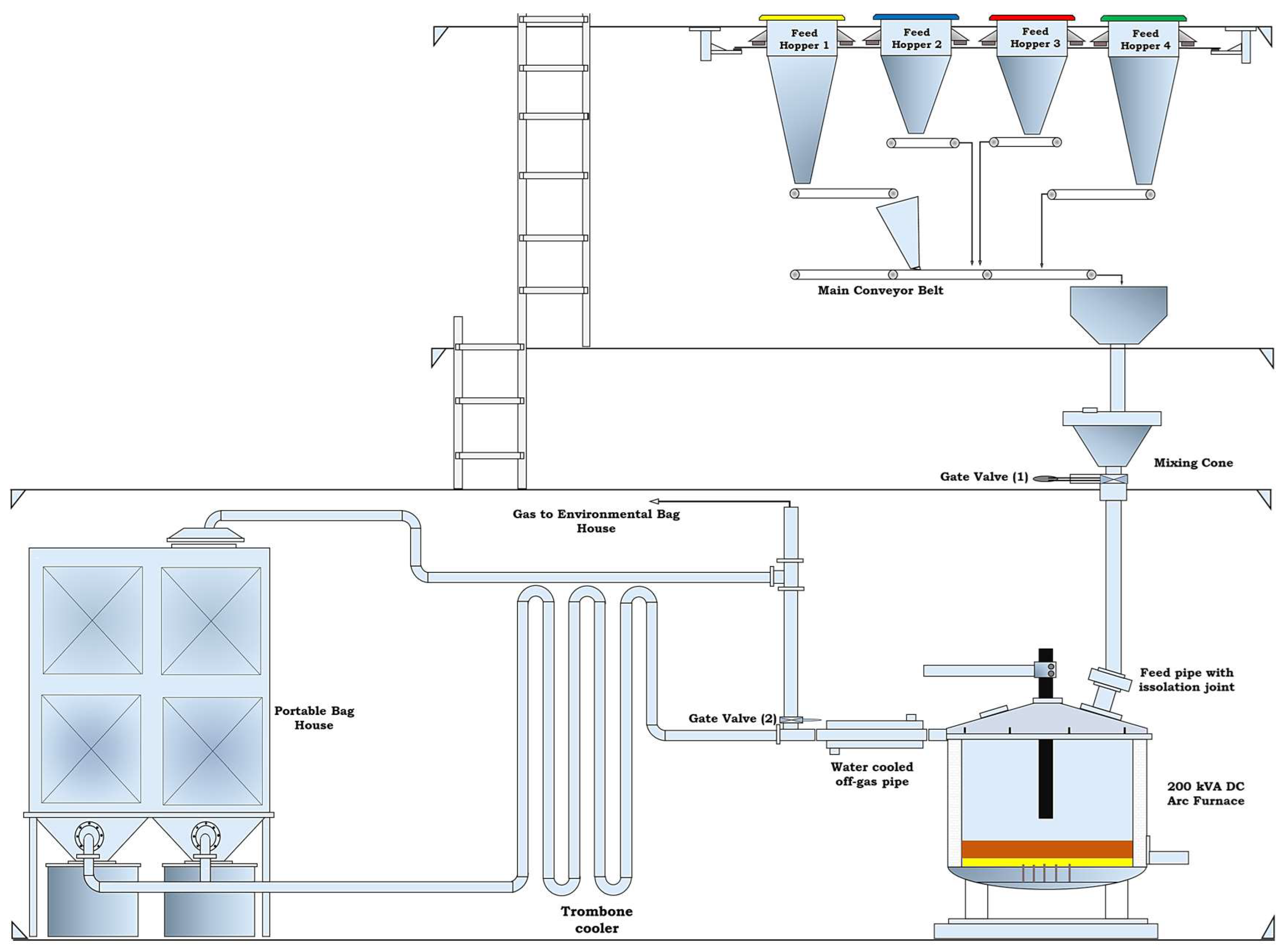
Figure 2.
Error bars for power, voltage, and current measurements.
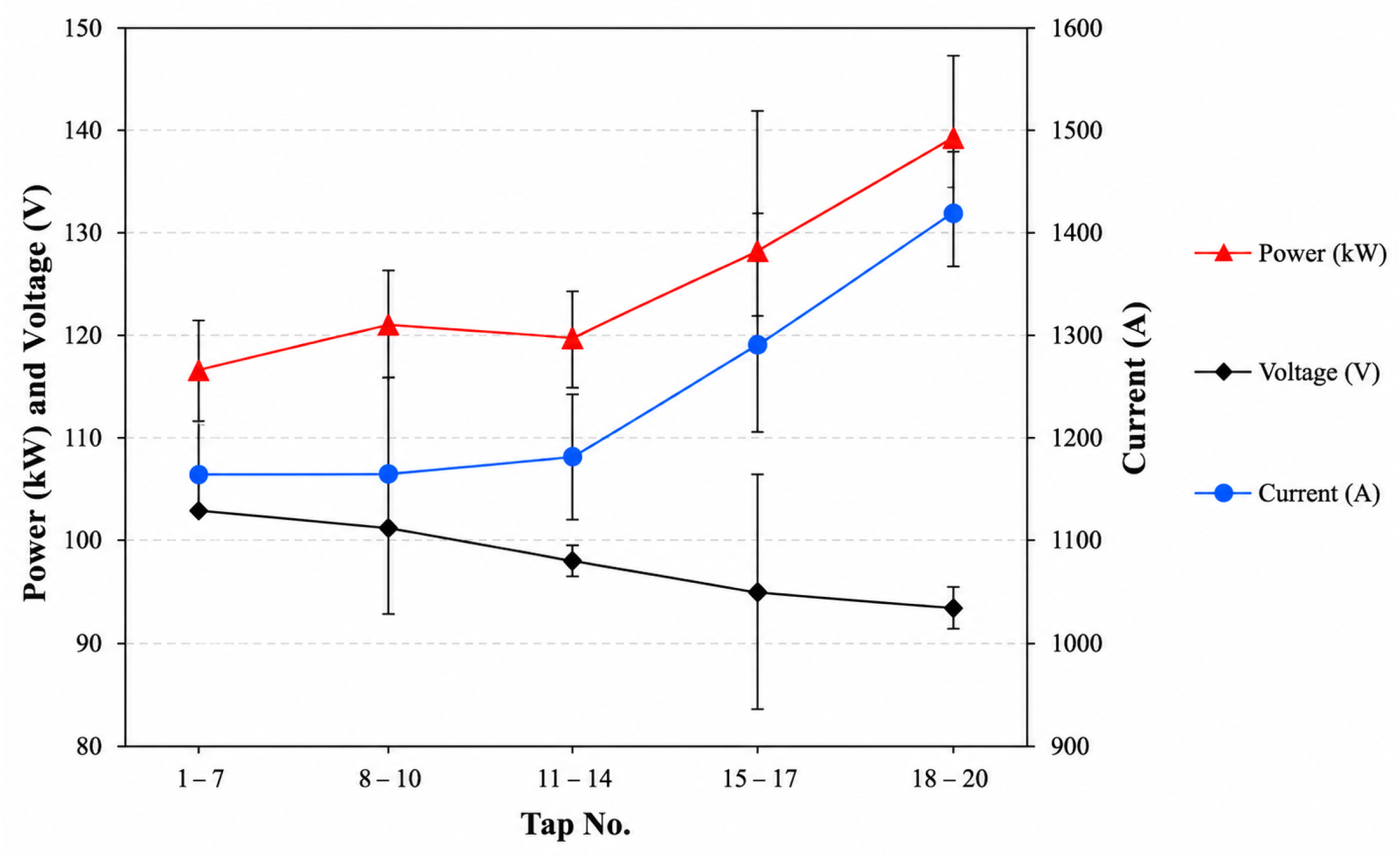
Figure 3.
Pyrosim simulation results for HCFeMn slag smelting
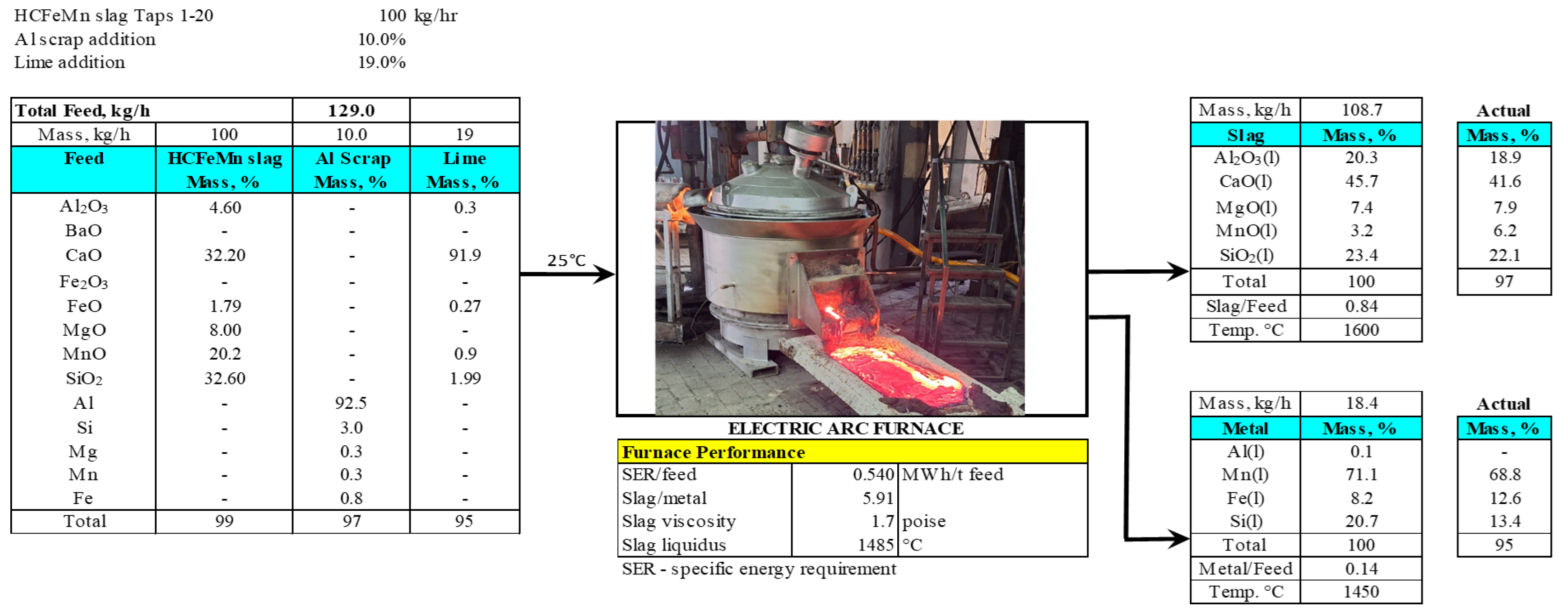
Figure 4.
Power stability of aluminothermic smelting of HCFeMn slag in a 200 kVA DC arc furnace.
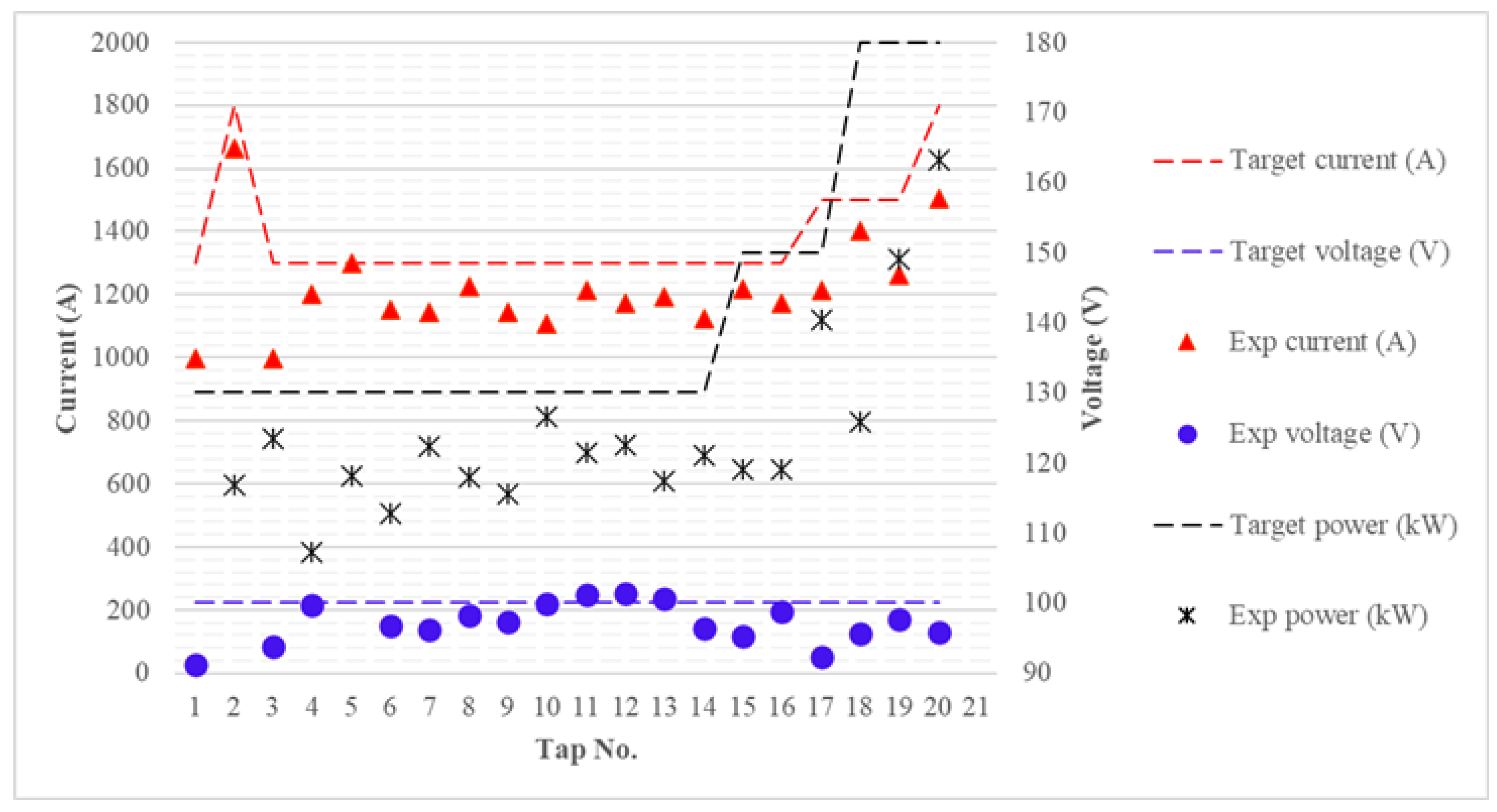
Figure 5.
Tap-by-tap specific energy requirement for smelting-aluninothermic reduction of HCFeMn slag in a 200 kW DC arc furnace
Figure 5.
Tap-by-tap specific energy requirement for smelting-aluninothermic reduction of HCFeMn slag in a 200 kW DC arc furnace
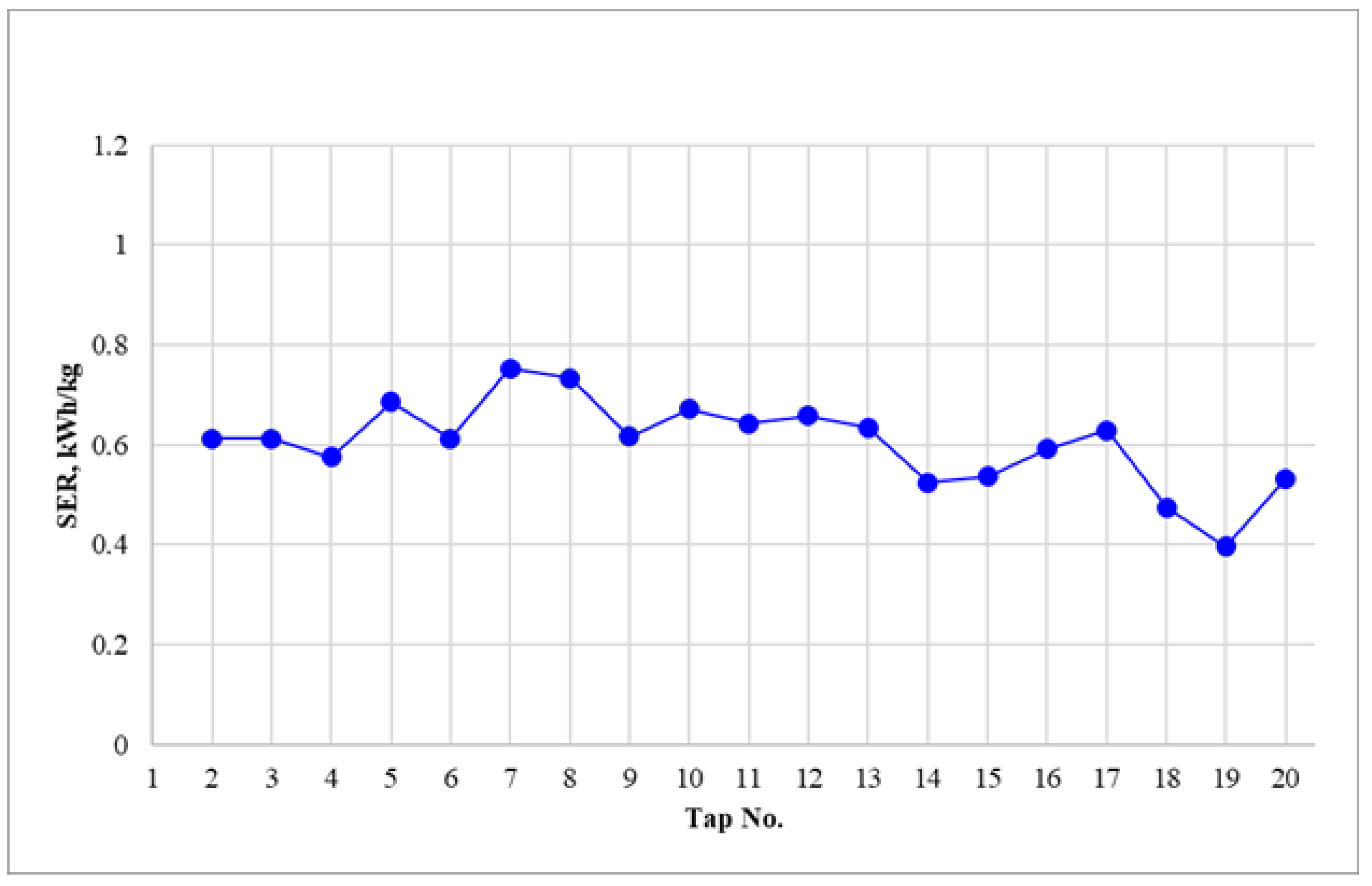
Figure 6.
Average furnace power against average feed rate
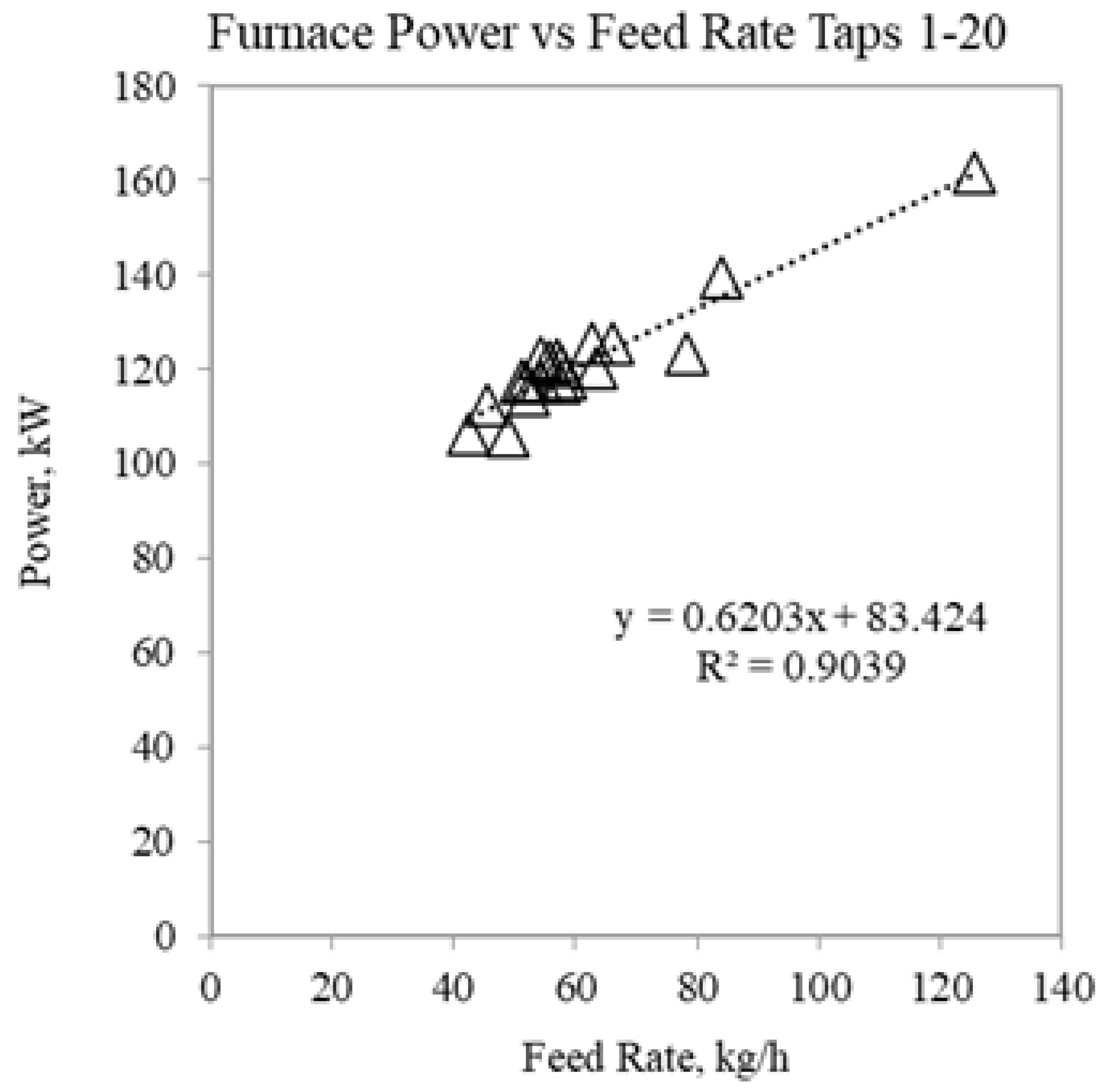
Figure 7.
Reductant efficiency of aluminothermic smelting of HCFeMn slag in a 200 kVA DC arc furnace
Figure 7.
Reductant efficiency of aluminothermic smelting of HCFeMn slag in a 200 kVA DC arc furnace
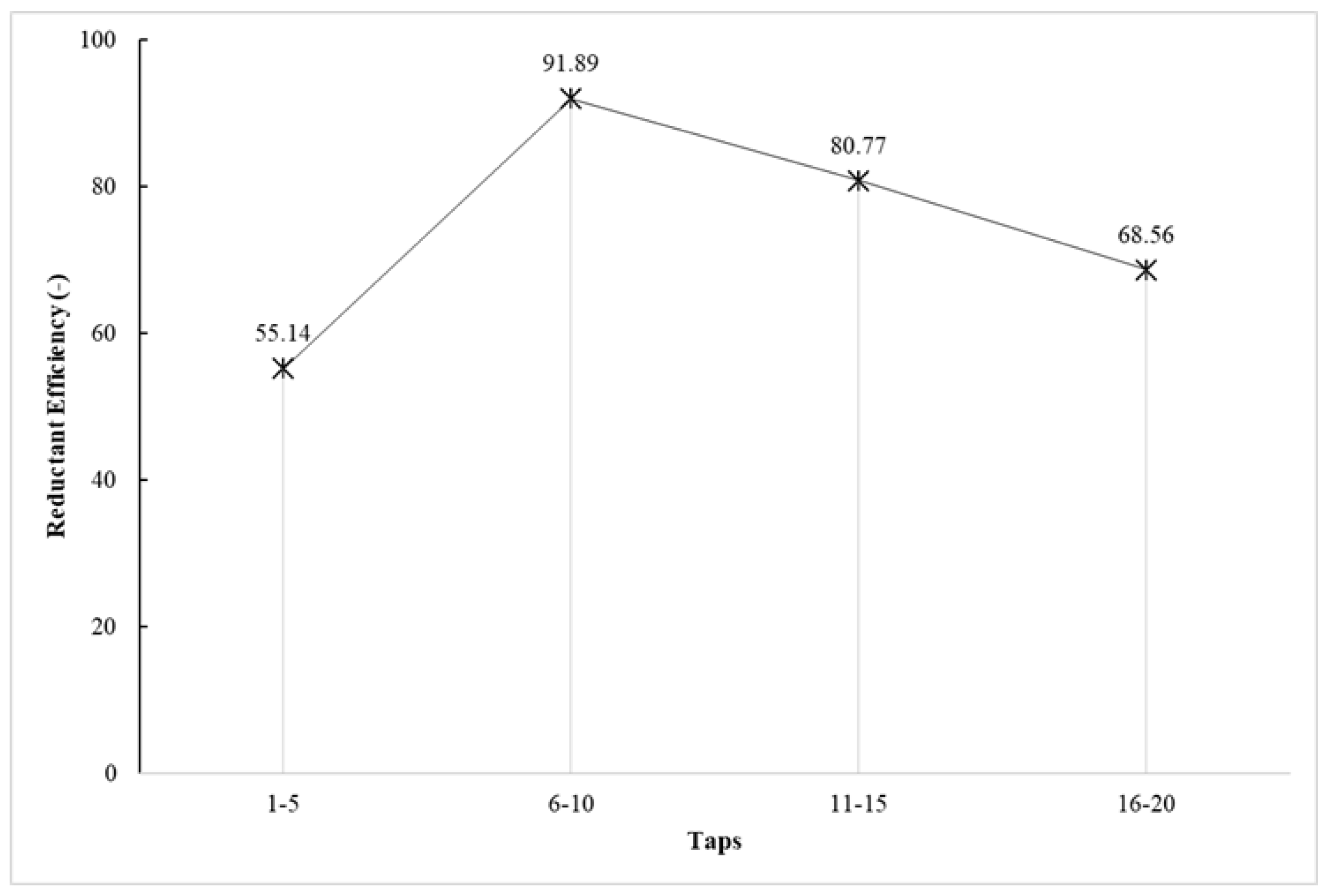
Figure 8.
Elemental accountability of smelting-aluminothermic reduction of HCFeMn slag in a 200 kVA DC arc furnace.
Figure 8.
Elemental accountability of smelting-aluminothermic reduction of HCFeMn slag in a 200 kVA DC arc furnace.
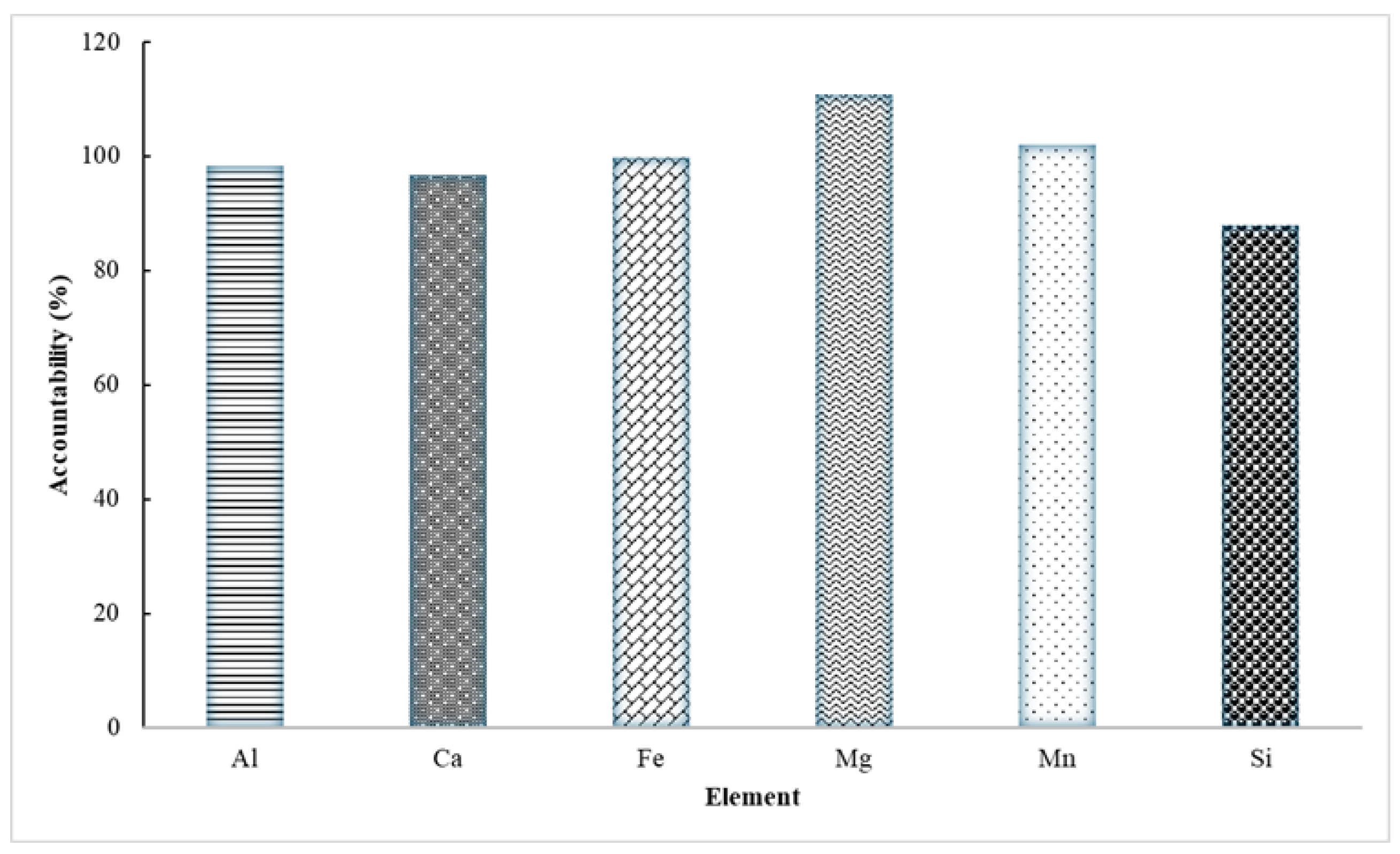
Figure 9.
Elemental recovery of smelting-aluminothermic reduction of HCFeMn slag in a 200 kVA DC arc furnace
Figure 9.
Elemental recovery of smelting-aluminothermic reduction of HCFeMn slag in a 200 kVA DC arc furnace
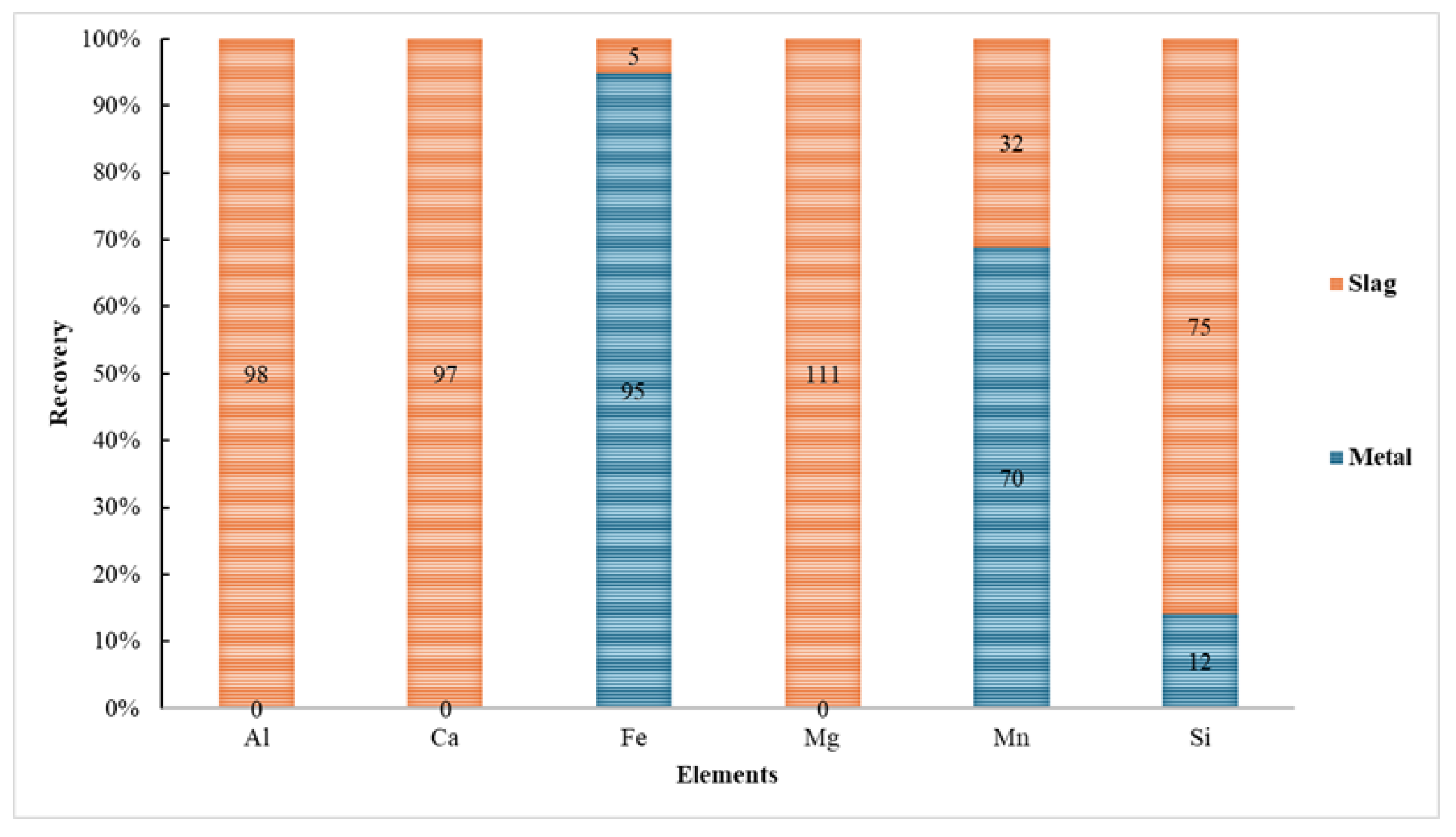
Figure 10.
Elemental deportment of aluminothermic smelting of HCFeMn slag in a 200 kVA DC arc furnace.
Figure 10.
Elemental deportment of aluminothermic smelting of HCFeMn slag in a 200 kVA DC arc furnace.
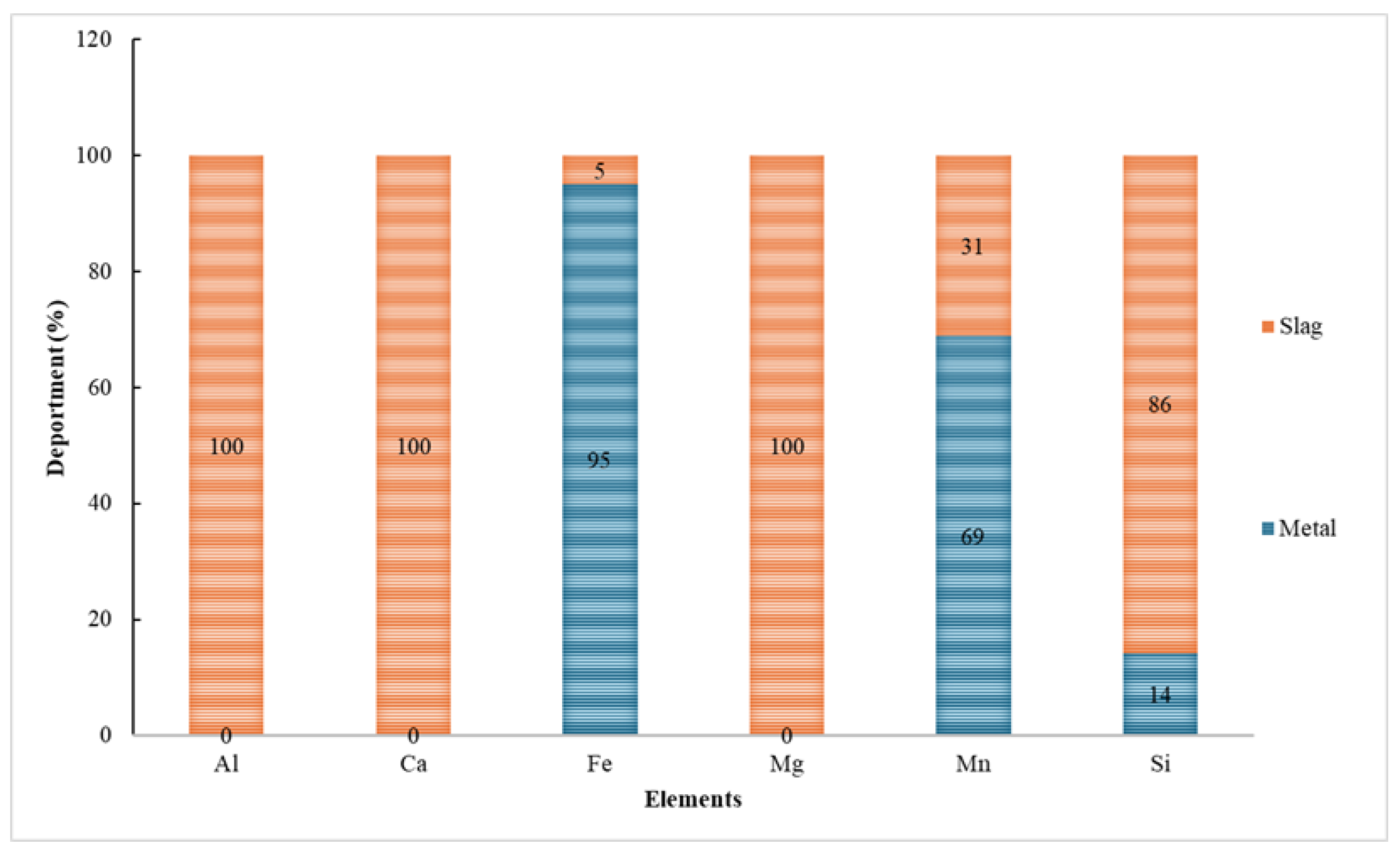
Figure 11.
Slag-to-metal ratio of aluminothermic smelting of HCFeMn slag in a 200 kVA DC arc furnace
Figure 11.
Slag-to-metal ratio of aluminothermic smelting of HCFeMn slag in a 200 kVA DC arc furnace
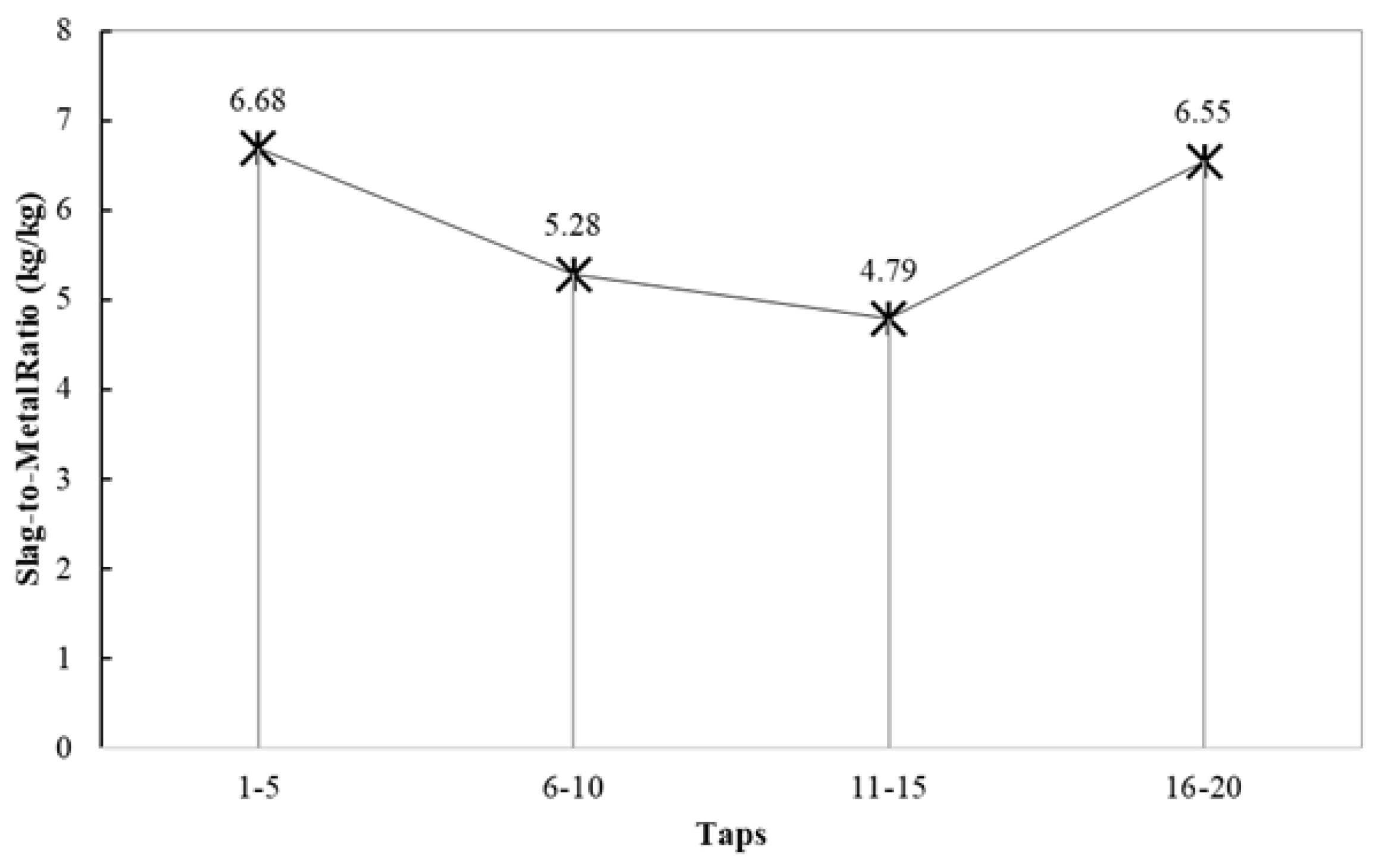

Table 1.
Chemical composition of HCFeMn slag and burnt lime (unnormalised mass %)).
| Al2O3 | CaO | FeO | MgO | MnO | SiO2 | |
|---|---|---|---|---|---|---|
| HCFeMn Slag | 4.62 | 32.20 | 1.79 | 8.00 | 20.24 | 32.56 |
| Lime | 0.30 | 91.93 | 0.27 | – | 0.90 | 1.99 |
Table 2.
X-Ray Fluorescence analyses of recycled scrap aluminium (mass %).
| Al | Si | Cu | Zn | Fe | Mn | Mg | |
|---|---|---|---|---|---|---|---|
| recycled scrap aluminium | 92.50 | 3.00 | 1.70 | 1.40 | 0.80 | 0.30 | 0.30 |
Table 3.
Analytical techniques, analytes, detection limits, and uncertainties.
| Analytical Technique | Analytes | Lower Detection Limit | Uncertainty |
|---|---|---|---|
| ICP_BASE_METAL_SLD (ICP-OES) | Al, Ca, Co, Cr, Cu, Fe, Mg, Mn, Ni, Pb, Si, Ti, V, Zn and P2O5 | 0.05% | <2% |
| Combustion method by LECO | Total C and S | 0.01% | <2% |
| Colorimetry | P or P2O5 | 10 ppm | % |
| XRF_Q_SCAN | All elements with atomic number | Matrix dependent | –5% |
Table 4.
Average measured gaseous emissions from the 200 kW DC arc furnace.
| Parameter | Units | Value | Uncertainty |
|---|---|---|---|
| Average Particulate Matter | mg/Nm3 | 216.82 | ±1.368 mg |
| Average Sulfur Dioxide (SO2) | mg/Nm3 | 6.84 | ±1.95 ppm |
| Average Oxides of Nitrogen (NOx) | mg/Nm3 | 0.02 | ±8.18 ppm |
| Average Carbon Dioxide (CO2) | mg/Nm3 | 775 | ±0.41% |
| Average Oxygen (in stack) | %v/v | 20.9 | ±0.41% |
Note: Uncertainties were calculated at k = 1.96 with a 95% confidence level.
Table 5.
Summary of experimental conditions and process parameters for the campaign, including specific energy requirement, power input, heat loss, feed rate, tap duration, HCFeMn slag charge, Al and CaO additions, and process and operational changes.
Table 5.
Summary of experimental conditions and process parameters for the campaign, including specific energy requirement, power input, heat loss, feed rate, tap duration, HCFeMn slag charge, Al and CaO additions, and process and operational changes.
| Condition | Tap No | SER | Power | Heatloss | Feedrate | Tap Time | HCFeMn Slag | % Al & CaO addition | Al & CaO masses, kg | Process and operational changes | ||
|---|---|---|---|---|---|---|---|---|---|---|---|---|
| (kWh/kg) | (kW) | (kW) | (kg/h) | (h) | (kg) | Lime | Al metal | Lime | Al metal | |||
| Warm-up | 0 | 12.00 | ||||||||||
| 1 | 1–7 | 0.93 | 130 | 70 | 64.20 | 2.00 | 100 | 0.19 | 0.094 | 19.00 | 9.40 | Thermal and chemical stabilisation condition. |
| 2 | 8–10 | 0.84 | 130 | 70 | 71.86 | 1.79 | 100 | 0.19 | 0.094 | 19.00 | 9.40 | Decreased SER to lower slag temperature. |
| 3 | 11–14 | 0.84 | 130 | 70 | 71.86 | 1.80 | 100 | 0.19 | 0.10 | 19.00 | 10.34 | Increased Al addition to reach MnO target in slag. |
| 4 | 15–17 | 0.84 | 150 | 70 | 95.81 | 1.35 | 100 | 0.19 | 0.10 | 19.00 | 10.34 | Increased power to demonstrate a higher power condition 1. |
| 5 | 18–20 | 0.84 | 180 | 70 | 131.74 | 0.99 | 100 | 0.19 | 0.11 | 19.00 | 11.37 | Increased power and Al addition for a higher power condition 2. |
Table 6.
Summary of process parameters for taps 1–20, including measured values, setpoints, mean values and standard deviations.
Table 6.
Summary of process parameters for taps 1–20, including measured values, setpoints, mean values and standard deviations.
| Tap | Mass Fed | Power | SER | Current | Voltage | ||||||||||
|---|---|---|---|---|---|---|---|---|---|---|---|---|---|---|---|
| Mass | Mean | SD | Setpoint | Power | SD | Setpoint | SER | SD | Setpoint | Current | SD | Setpoint | Voltage | SD | |
| (kg) | (kg) | (kg) | (kW) | (kW) | (kW) | (kWh/kg) | (kWh/kg) | (kWh/kg) | (A) | (A) | (A) | (V) | (V) | (V) | |
| 1 | 128.6 | 130 | 116.75 | 0.94 | 0.93 | 1300 | 996.08 | 100 | 93.89 | ||||||
| 2 | 128.7 | 130 | 123.42 | 0.94 | 0.98 | 1300 | 1199.81 | 100 | 99.79 | ||||||
| 3 | 129.5 | 130 | 107.23 | 0.94 | 0.87 | 1300 | 1299.53 | 100 | 135.69 | ||||||
| 4 | 129.0 | 128.81 | 0.38 | 130 | 118.15 | 5.55 | 0.94 | 0.92 | 0.03 | 1300 | 1150.98 | 93.61 | 100 | 96.75 | 14.72 |
| 5 | 128.9 | 130 | 112.75 | 0.94 | 0.94 | 1300 | 1144.65 | 100 | 96.30 | ||||||
| 6 | 128.2 | 130 | 122.31 | 0.94 | 0.94 | 1300 | 1225.92 | 100 | 98.16 | ||||||
| 7 | 128.9 | 130 | 117.92 | 0.94 | 0.94 | 1300 | 1144.62 | 100 | 97.33 | ||||||
| 8 | 129.8 | 130 | 115.46 | 0.84 | 0.87 | 1300 | 1107.38 | 100 | 99.91 | ||||||
| 9 | 128.4 | 129.71 | 1.26 | 130 | 126.57 | 5.56 | 0.84 | 0.90 | 0.02 | 1300 | 1213.79 | 53.61 | 100 | 101.22 | 0.77 |
| 10 | 131.0 | 130 | 121.40 | 0.84 | 0.89 | 1300 | 1172.03 | 100 | 101.28 | ||||||
| 11 | 130.0 | 130 | 122.62 | 0.84 | 0.92 | 1300 | 1194.87 | 100 | 100.61 | ||||||
| 12 | 129.8 | 130.01 | 0.60 | 130 | 117.34 | 2.33 | 0.84 | 0.87 | 0.05 | 1300 | 1123.94 | 40.52 | 100 | 96.43 | 2.41 |
| 13 | 130.8 | 130 | 121.14 | 0.84 | 0.80 | 1300 | 1219.00 | 100 | 95.21 | ||||||
| 14 | 129.4 | 130 | 118.98 | 0.84 | 0.84 | 1300 | 1171.81 | 100 | 98.81 | ||||||
| 15 | 129.3 | 150 | 119.08 | 0.84 | 0.85 | 1500 | 1214.41 | 100 | 92.37 | ||||||
| 16 | 129.5 | 129.43 | 0.08 | 150 | 140.46 | 10.93 | 0.84 | 0.83 | 0.01 | 1500 | 1402.66 | 97.82 | 100 | 95.70 | 2.69 |
| 17 | 129.5 | 150 | 125.79 | 0.84 | 0.84 | 1500 | 1262.40 | 100 | 97.70 | ||||||
| 18 | 130.5 | 180 | 148.99 | 0.74 | 0.74 | 1800 | 1503.49 | 100 | 95.76 | ||||||
| 19 | 130.8 | 130.67 | 0.14 | 180 | 163.18 | 29.74 | 0.74 | 0.74 | 0.00 | 1800 | 1664.60 | 291.57 | 100 | 94.98 | 2.43 |
| 20 | 130.7 | 180 | 106.07 | 0.74 | 0.74 | 1800 | 1098.69 | 100 | 91.21 | ||||||
Table 7.
Comparison of measured slag and metal compositions, temperatures, process mass ratios, specific energy requirements and Pyrosim predictions for Taps 1–20.
Table 7.
Comparison of measured slag and metal compositions, temperatures, process mass ratios, specific energy requirements and Pyrosim predictions for Taps 1–20.
| Slag Analysis | ||||||||||||||||||||||
|---|---|---|---|---|---|---|---|---|---|---|---|---|---|---|---|---|---|---|---|---|---|---|
| Oxide (wt.%) | Tap 1 | Tap 2 | Tap 3 | Tap 4 | Tap 5 | Tap 6 | Tap 7 | Tap 8 | Tap 9 | Tap 10 | Tap 11 | Tap 12 | Tap 13 | Tap 14 | Tap 15 | Tap 16 | Tap 17 | Tap 18 | Tap 19 | Tap 20 | Average | Pyrosim |
| Al2O3 | 13.6 | 16.0 | 16.8 | 17.8 | 18.5 | 18.5 | 20.2 | 18.4 | 18.3 | 18.4 | 19.3 | 20.0 | 20.1 | 20.0 | 20.1 | 20.3 | 20.2 | 20.4 | 20.5 | 20.5 | 18.9 | 20.3 |
| CaO | 33.2 | 37.4 | 39.5 | 42.4 | 42.8 | 42.9 | 42.5 | 41.3 | 41.2 | 42.2 | 41.6 | 40.8 | 42.1 | 41.5 | 40.2 | 44.1 | 43.6 | 42.8 | 45.3 | 45.2 | 41.6 | 45.7 |
| MgO | 9.1 | 8.4 | 8.7 | 8.1 | 8.1 | 8.1 | 6.9 | 7.2 | 7.0 | 7.3 | 7.5 | 7.2 | 7.6 | 7.6 | 7.3 | 7.9 | 8.2 | 8.1 | 8.3 | 8.5 | 7.9 | 7.4 |
| MnO | 15.4 | 12.8 | 8.7 | 7.4 | 6.4 | 6.5 | 5.9 | 6.0 | 6.4 | 6.2 | 5.4 | 4.9 | 4.3 | 5.3 | 5.1 | 4.3 | 3.8 | 3.1 | 2.9 | 2.6 | 6.2 | 3.2 |
| SiO2 | 21.6 | 23.7 | 23.2 | 23.0 | 23.2 | 23.0 | 23.1 | 21.5 | 21.3 | 22.6 | 22.0 | 21.6 | 21.3 | 21.4 | 21.2 | 22.4 | 22.0 | 21.3 | 21.7 | 22.0 | 22.1 | 23.4 |
| Slag Temp (∘C) | – | 1569.5 | 1555.5 | 1635.0 | 1584.0 | 1619.0 | 1643.5 | 1556.0 | 1619.5 | 1598.0 | 1597.0 | 1597.5 | 1583.0 | 1593.0 | 1576.5 | 1623.0 | – | 1637.5 | 1653.5 | 1564.0 | 1600.3 | 1600.0 |
| Metal Analysis | ||||||||||||||||||||||
| Metal (wt.%) | Tap 1 | Tap 2 | Tap 3 | Tap 4 | Tap 5 | Tap 6 | Tap 7 | Tap 8 | Tap 9 | Tap 10 | Tap 11 | Tap 12 | Tap 13 | Tap 14 | Tap 15 | Tap 16 | Tap 17 | Tap 18 | Tap 19 | Tap 20 | Average | Pyrosim |
| Mn | 41.74 | 41.74 | 41.74 | 41.74 | 41.74 | 48.10 | 48.10 | 48.10 | 48.10 | 48.10 | 60.88 | 60.88 | 60.88 | 60.88 | 60.88 | 68.79 | 68.79 | 68.79 | 68.79 | 68.79 | 54.9 | 71.1 |
| Fe | 48.2 | 48.2 | 48.2 | 48.2 | 48.2 | 40.64 | 40.64 | 40.64 | 40.64 | 40.6 | 22.78 | 22.78 | 22.78 | 22.78 | 22.8 | 12.56 | 12.56 | 12.56 | 12.56 | 12.6 | 31.0 | 8.2 |
| Si | 6.34 | 6.34 | 6.34 | 6.34 | 6.34 | 7.46 | 7.46 | 7.46 | 7.46 | 7.46 | 11.41 | 11.41 | 11.41 | 11.41 | 11.41 | 13.36 | 13.36 | 13.36 | 13.36 | 13.36 | 9.6 | 20.7 |
| Metal Temp (∘C) | – | – | – | – | 1451 | – | – | – | – | 1393 | – | – | – | – | 1448 | – | – | – | – | 1522.5 | 1453.6 | 1450 |
| Ratios and Specific Energy Requirement | ||||||||||||||||||||||
| Parameter | Tap 1 | Tap 2 | Tap 3 | Tap 4 | Tap 5 | Tap 6 | Tap 7 | Tap 8 | Tap 9 | Tap 10 | Tap 11 | Tap 12 | Tap 13 | Tap 14 | Tap 15 | Tap 16 | Tap 17 | Tap 18 | Tap 19 | Tap 20 | Average | Pyrosim |
| Slag/Feed (kg/kg) | – | 1.05 | 1.06 | 1.00 | 0.71 | 0.95 | 1.00 | 0.99 | 0.99 | 1.00 | 0.67 | 0.82 | 0.78 | 0.99 | 0.89 | 0.68 | 0.95 | 0.82 | 0.64 | 1.80 | 0.94 | 0.84 |
| Metal/Feed (kg/kg) | – | – | – | – | 0.59 | – | – | – | – | 0.94 | – | – | – | – | 0.87 | – | – | – | – | 0.98 | 0.84 | 0.14 |
| Slag/Metal (kg/kg) | – | – | – | – | 1.20 | – | – | – | – | 1.06 | – | – | – | – | 1.02 | – | – | – | – | 1.84 | 1.28 | 5.91 |
| SERFeed (kWh/kg feed) | 0.93 | 0.98 | 0.87 | 0.92 | 0.94 | 0.94 | 0.94 | 0.87 | 0.90 | 0.89 | 0.92 | 0.87 | 0.80 | 0.84 | 0.85 | 0.83 | 0.84 | 0.84 | 0.74 | 0.74 | 0.8725 | 0.54 |
Table 8.
Comparison of the measured metal product composition (taps 16–20) with the chemical composition limits specified in ASTM A483/A483M for silicomanganese Grades A, B and C.
Table 8.
Comparison of the measured metal product composition (taps 16–20) with the chemical composition limits specified in ASTM A483/A483M for silicomanganese Grades A, B and C.
| Element | This study | Grade A | Grade B | Grade C |
|---|---|---|---|---|
| Mn | 68.8 wt.% | 65–68 wt.% | 65–68 wt.% | 65–68 wt.% |
| Si | 13.4 wt.% | 18–20 wt.% | 16–18.5 wt.% | 12.5–16 wt.% |
| Fe | 12.6 wt.% | Balance | Balance | Balance |
| Al | 0.4 wt.%a | Not specified | Not specified | Not specified |
a ASTM A483/A483M specifies Fe as the balance of the alloy after the Mn and Si requirements have been met.
Table 9.
Comparative benchmarking of pilot-scale aluminothermic smelting against industrial SiMn production.
Table 9.
Comparative benchmarking of pilot-scale aluminothermic smelting against industrial SiMn production.
| Metric | Units | Pilot-scale 200 kW DC arc furnace (this study) | Industrial SiMn relevance / typical range |
|---|---|---|---|
| Specific Energy Consumption | kWh t−1 product | Campaign average 582 kWh t−1; tap-by-tap range 800–1150 kWh t−1. | Typical SAF SiMn: 4000–4500 kWh t−1; pilot SiMn models stabilize near 3900 kWh t−1; Transalloys after optimisation ∼3830 kWh t−1; LC-FeMn aluminothermic EAF: 410–880 kWh t−1 [29,38,51,53,56]. |
| Energy Utilization (Al/C efficiency) | % | Al reduction efficiency ranged from 55.14–91.89 %, with a campaign average of approximately 60 %. Efficiency improved as furnace power increased from 130 to 180 kW. | Industrial SiMn typically achieves Mn recovery of 70–80 % and Si recovery of 14–30 %. Typical reductant efficiencies range from 40–70 % [29,38,57,99,100]. |
| Power Stability / Arc Control | Dimensionless indices | Realised current and power remained approximately 10–12 % below set-points with standard deviations of 4–6 %. Initial instability at 100 V required operation at 70 V. Power was increased from 130 to 150 and finally 180 kW. | Modern DC SiMn furnaces generally maintain power within % of the set-point. Predictive current control reduces reactive-power fluctuations by up to 50 % [38,57]. |
| CO2-equivalent emissions | kg CO2-eq t−1 | Electricity emissions: 1200 kg CO2-eq t−1; embodied aluminium emissions: 150 kg CO2-eq t−1; total: 1350 kg CO2-eq t−1. | Industrial carbothermic SiMn: 3019 ± 142 kg CO2-eq t−1. Electricity and fossil reductants dominate emissions. Charcoal substitution can reduce GWP by approximately 60 % [52,97]. |
| Stack Gas Composition | mg Nm−3 | SO2: 6.84; NOx: 0.02; CO: 2.18; CO2: 775; O2: 20.9 vol.%. | Industrial SiMn off-gas composition depends strongly on fossil reductant usage, with relatively low SO2 emissions in coke-based operations [101]. |
| Dust / Particulate Emissions | mg Nm−3; kg t−1 | Average particulate concentration: 216.82 mg Nm−3, equivalent to approximately 10.4 kg t−1. | Industrial SiMn dust generation is typically 50–100 kg t−1 before gas cleaning and 1–3 kg t−1 after bag-filter abatement. Typical fume particles are sub-micron [101,102]. |
| Metallurgical Yield / Recovery | % | Fe recovery: 33–90 %; Mn recovery: 47–81 %; campaign Mn recovery approximately 66 %. | Industrial SiMn generally achieves 70–80 % Mn recovery, 14–30 % Si recovery, and metallic yields of 45–70 % [96,99,100]. |
| Slag-to-Metal Ratio | kg slag kg−1 metal | 4.79–6.68, reflecting the slag-as-feed operating strategy. | Industrial SiMn plants typically operate at 1.0–1.3 with theoretical values near 1.15 [103,104]. |
| Slag Valorisation | % reused | Slag composition suggests suitability for cementitious and aggregate applications owing to its CaO–SiO2–Al2O3 composition. | Industrial SiMn slag is widely reused in cement and construction materials, with up to 50 % cement replacement demonstrated while maintaining comparable mechanical properties [101,104,105,106]. |
Disclaimer/Publisher’s Note: The statements, opinions and data contained in all publications are solely those of the individual author(s) and contributor(s) and not of MDPI and/or the editor(s). MDPI and/or the editor(s) disclaim responsibility for any injury to people or property resulting from any ideas, methods, instructions or products referred to in the content. |
© 2026 by the authors. Licensee MDPI, Basel, Switzerland. This article is an open access article distributed under the terms and conditions of the Creative Commons Attribution (CC BY) license (http://creativecommons.org/licenses/by/4.0/).
Copyright: This open access article is published under a Creative Commons CC BY 4.0 license, which permit the free download, distribution, and reuse, provided that the author and preprint are cited in any reuse.