
Submitted:
02 August 2026
Posted:
03 August 2026
You are already at the latest version
Abstract
The rapid advancement of digital technologies presents transformative opportunities for 9
promoting sustainable industrial development. This study investigates how data analyt- 10
ics, artificial intelligence (AI), and digital tools can inform innovative policy frameworks 11
within the construction industry. This study adopts a qualitative, multi-source synthesis 12
design that combines a structured literature review, structured policy analysis, and the- 13
matic synthesis of secondary sources. The research examines how data-driven decision- 14
making can enhance sustainability performance, improve occupational safety, and opti- 15
mize resource utilization. The findings contribute to the evolving discourse on sustainable 16
industrialization by illustrating how digital transformation acts as both a catalyst and an 17
enabler of policy innovation. Ultimately, the study proposes strategic pathways for inte- 18
grating data-centric technologies into industrial policy formulation to advance green 19
growth and circular economy objectives within the construction sector.
Keywords:
artificial intelligence
; construction industry
; digital transformation
; policy innovation
; sustainable construction
1. Introduction
Over the past decade, the construction sector has experienced rapid digitalisation through the diffusion of Building Information Modelling (BIM), digital twins, sensor-based monitoring, and artificial intelligence (AI)–driven analytics, often framed under the umbrella of Construction 4.0 [1]. These technologies enable more granular carbon accounting, safety monitoring and lifecycle optimisation in buildings and infrastructure, with significant implications for sustainable industrial development [2]. These pressures have positioned the construction sector at the centre of international sustainability agendas, including the Sustainable Development Goals and global cli-mate agreements, where it is increasingly viewed as a critical leverage point for achieving low carbon and resource efficient development pathways [3]. Evidence from industry surveys indicates that while awareness of sustainability objectives has increased, practical uptake of whole life carbon assessment, environmental, social and governance (ESG) integration, and circular economy practices remains limited and inconsistent [4]. Governance focused research further suggests that many construction policies continue to rely on prescriptive regulatory instruments that struggle to accommodate the complexity, uncertainty, and data intensity of contemporary construction systems [5].
As a result, there is growing recognition that traditional rule-based approaches are insufficient for achieving long term sustainability objectives in construction industries, particularly in rapidly changing economic and technological environments [6]. Digital transformation has emerged as a potential response to these limitations by enabling data driven decision making, continuous monitoring, and adaptive governance across the construction lifecycle [7]. Technologies such as artificial intelligence (AI), Building Information Modelling (BIM), digital twins, and sensor-based systems allow construction stakeholders to capture, analyse, and act on environmental, social, and economic performance data in real time [8]. These capabilities create new opportunities for policymakers to move beyond static compliance models toward evidence based and performance-oriented construction policies that reward measurable sustainability outcomes [9].
In the context of circular economy transitions, digital tools such as material passports and AI enabled digital twins to have been shown to support waste minimisation, reuse strategies, and lifecycle optimisation in construction systems [10]. However, existing research has largely concentrated on firm level or project level applications of digital technologies, with comparatively limited attention given to their im-plications for construction policy design and public governance [11]. This gap is particularly pronounced in emerging and transitioning economies, where institutional capacity constraints, fragmented governance structures, and uneven access to digital infrastructure complicate the adoption and scaling of data driven approaches [12]. Addressing this disconnect between technological potential and policy practice is therefore essential for advancing sustainable industrialisation within the construction sector. Against this backdrop, this study examines how data driven industrial innovation can inform sustainable construction policies through a policy-oriented synthesis of recent literature [13].
The paper contributes by explicitly linking digital transformation technologies such as AI, BIM, digital twins, and data analytics to policy innovation and sustainability outcomes in construction industries. In doing so, it advances current debates by highlighting strategic pathways through which data centric approaches can support adaptive regulation, improved environmental performance, enhanced occupational health and safety, and progress toward circular economy objectives across diverse regulatory contexts.
Taken together, these strands of literature reveal three interrelated gaps. First, re-search on Construction 4.0 has paid insufficient attention to the design of data-enabled public governance frameworks, concentrating largely on firm- or project-level applications of digital tools. Second, existing studies of carbon tracking and ESG integration rarely address how digital evidence is incorporated into binding regulatory instruments, standardised reporting infrastructures, and performance-based policy regimes. Third, there is a lack of integrative, policy-oriented syntheses that connect data-driven industrial innovation with concrete pathways for sustainable construction policy, particularly in emerging and transitioning economies. This paper addresses these gaps by providing a structured, policy-focused synthesis of recent evidence on data-driven sustainable construction governance and by articulating specific policy design implications. “Evidence from industry surveys indicates that while awareness of sustainability objectives has increased, practical uptake of whole-life carbon assessment, environ-mental, social and governance (ESG) integration, and circular economy practices re-mains limited and inconsistent.”
Despite growing interest in Construction 4.0, existing scholarship and policy practice remain fragmented in how they employ data-centric technologies to guide sustainable construction at the level of public governance and industrial policy. Accordingly, this study aims to investigate how data-driven industrial innovation can inform the design and implementation of sustainable construction policies across environmental, occupational health and safety, and circular economy domains. To achieve this aim, the paper pursues three specific objectives: (i) to synthesise recent evidence on the use of AI, BIM, digital twins, and related Industry 4.0 tools in sustain-ability-oriented construction governance; (ii) to identify critical gaps and limitations in current policy frameworks for carbon tracking, ESG integration, and circular construction; and (iii) to propose strategic, data enabled policy pathways for advancing sustainable industrial development in the construction sector.
Guided by these objectives, the paper addresses the following research questions:
RQ1: In what ways are data-driven technologies currently being leveraged in public governance and policy frameworks for sustainable construction, particularly in relation to carbon tracking, ESG integration, and circular economy objectives?
RQ2: What key gaps and deficiencies can be identified in existing research and policy practice on data-enabled construction governance in the context of Construction 4.0?
RQ3: How can data-driven industrial innovation be translated into actionable policy strategies that strengthen sustainable construction performance and industrial development? In this paper, data driven sustainable construction policy refers to policy and regulatory frameworks that systematically embed digital measurement, data governance and analytics into the design, implementation and evaluation of instruments aimed at improving environmental performance, occupational health and safety, and circular economy practices in the construction sector [14,25,31].
In contrast to predominantly technical Construction 4.0 reviews that focus on digital tools and productivity, this paper’s distinctive contribution lies in articulating concrete data governance and regulatory design implications for sustainable construction policy, based on a purposive, policy-oriented synthesis of academic and policy sources. Rather than focusing on firm-level technology adoption, this paper examines how such digital infrastructures interact with public governance and industrial policy design in sustainable construction.
2. Literature Review
2.1. Sustainable Construction and Industrial Development
Sustainable construction is commonly defined as the integration of environmental protection, social equity, and economic viability throughout the entire lifecycle of built assets, including planning, design, construction, operation, and end-of-life phases [14]. Unlike earlier interpretations that focused narrowly on energy-efficient buildings or green materials, contemporary scholarship emphasises that sustainable construction is a systemic concept encompassing governance arrangements, institutional coordination, regulatory frameworks, and stakeholder participation that collectively shape construction practices and outcomes [15]. This broader framing recognises that sustainability challenges in construction are not solely technological, but are deeply embedded in organisational structures, policy regimes, and market incentives [16]. Within the context of industrial development, sustainable construction is increasingly positioned as a strategic mechanism for decoupling economic growth from environmental degradation [17]. Construction activities are closely linked to industrial value chains, infrastructure investment, and urban productivity, meaning that sustainability transitions in this sector have far-reaching implications for national development trajectories [18].
Traditional construction models have historically prioritised short-term cost efficiency, speed of delivery, and capital expenditure minimisation, often at the expense of long-term environmental and social performance [19]. This approach has contributed to high lifecycle emissions, excessive material waste, occupational safety risks, and persistent social externalities such as unequal access to infrastructure and services [20]. A growing body of literature on Construction 4.0 examines how digitalisation reshapes construction processes, yet most contributions emphasise technical capabilities or firm-level productivity rather than public governance and regulatory design. Studies on Construction 4.0 governance tend to provide broad overviews of policy drivers or institutional complexity but rarely unpack how AI, BIM, digital twins, and IoT data are concretely embedded in regulatory instruments, compliance regimes, or performance-based standards. Representative reviews identify issues such as fragmented responsibilities, lack of digital skills in public agencies, and weak coordination between industrial and environmental policy, but they stop short of systematically analysing data governance mechanisms, AI-ready regulatory infrastructures, or the design of ESG-oriented monitoring systems. These limits are understanding of how Construction 4.0 can be operationalised as a coherent policy framework rather than a collection of isolated technological pilots.
In contrast, sustainable construction promotes long-term value creation by emphasising resource efficiency, resilience to environmental and economic shocks, and inclusive development that considers the needs of diverse user groups and communities [21]. Achieving this transition requires innovation not only in construction materials and production technologies, but also in policy design and governance structures that influence decision-making across the construction value chain [22]. Scholars argue that without supportive regulatory frameworks, coordinated institutions, and performance-based incentives, technological advances alone are insufficient to drive meaningful sustainability [23]. Consequently, sustainable construction is increasingly understood as an outcome of aligned industrial policy, governance capacity, and innovation systems, rather than isolated project-level interventions [24]. Traditional construction models have historically prioritized short-term cost efficiency at the expense of long-term environmental and social performance
In this paper, data-driven industrial innovation in construction refers specifically to the use of digital technologies and data infrastructures (e.g., AI, BIM, digital twins, IoT, data platforms) to generate, integrate and use performance data in ways that reshape regulatory instruments, incentives and governance processes, rather than only improving project-level efficiency.
2.2. Data-Driven Industrial Innovation
Governance-focused studies on Construction 4.0 and digitalisation provide valuable overviews of institutional complexity, regulatory drivers and public-sector innovation, yet they typically treat digital technologies as part of broader modernisation agendas rather than examining in detail how AI, BIM, digital twins and IoT are embedded in specific policy instruments, data-governance arrangements or performance-based regulatory regimes. Existing reviews therefore seldom distinguish between project-level digitalisation and the design of AI- and data-enabled construction policies, leaving the mechanisms of policy integration under-specified. This study addresses that gap by focusing explicitly on how data-driven technologies are mobilised at policy and governance level for sustainable construction.
Data-driven industrial innovation refers to the systematic use of digital data, advanced analytics, and intelligent systems to enhance industrial performance, productivity, and decision-making [25]. In the construction sector, this paradigm is closely associated with the adoption of Industry 4.0 technologies such as Building Information Modelling (BIM), artificial intelligence (AI), Internet of Things (IoT) sensors, big data analytics, and digital twin platforms [26]. These technologies enable the generation, integration, and analysis of large volumes of data across the entire construction lifecycle, creating new possibilities for optimisation, prediction, and control [27]. A defining feature of data-driven innovation in construction is the establishment of continuous data flows that link design, construction, operation, maintenance, and end-of-life stages [28]. BIM and digital twin systems, for example, provide dynamic digital representations of physical assets that can be updated in real time using sensor data and AI-based analytics [29]. This integration allows stakeholders to assess environmental performance, energy use, material efficiency, and safety conditions on an ongoing basis rather than relying on static, ex-post evaluations [30]. From a policy and governance perspective, data-driven industrial innovation enables a shift away from static compliance-based regulation toward adaptive and performance-based governance frameworks [31].
Real-time data improves transparency by making construction performance more visible to regulators, clients, and the public, while also enhancing accountability through measurable and verifiable indicators [32]. Moreover, data-rich environments support policy learning by allowing governments to evaluate the effectiveness of interventions, adjust regulatory instruments, and scale successful practices more efficiently [33]. However, the governance benefits of data-driven innovation are contingent on institutional capacity, data interoperability, and equitable access to digital infrastructure. Research indicates that without clear standards, data governance frameworks, and skilled personnel, digital systems risk reinforcing fragmentation rather than enabling coordination [34]. Consequently, data-driven industrial innovation should be understood not merely as a technological shift, but as a socio-technical transformation that requires alignment between technology adoption, policy design, and institutional development to support sustainable construction outcomes [35].
Data-driven sustainable construction policy is defined here as policy and regulatory frameworks that systematically embed digital measurement, data governance and analytics into the design, implementation and evaluation of instruments aimed at improving environmental performance, OHS outcomes and circular-economy practices in the construction sector. Building on this literature, we define data-driven sustainable construction policy as policy and regulatory frameworks that systematically embed digital measurement, data governance and analytics into instruments targeting environmental performance, OHS outcomes and circular-economy practices in construction [25,31,35]. This definition provides the conceptual anchor for the subsequent analysis.
2.3. Theoretical and Analytical Framework
The analysis is guided by a governance-oriented conceptualisation of digital transformation that views data-driven innovation as a socio-technical process linking technologies, institutions and policy instruments. Specifically, the study draws on perspectives from performance-based regulation, data governance, and sustainable industrial policy to structure its inquiry. Performance-based regulation emphasises measurable outcomes (such as whole-life carbon, OHS indicators and waste recovery rates) rather than detailed design prescriptions, and thus provides a lens for examining how digital measurement infrastructures can support more adaptive and outcome-oriented construction policies. Data-governance concepts, including interoperability, standards and responsibilities for data sharing, inform the analysis of how project-level information can be aggregated into sector-wide monitoring and learning systems. Finally, sustainable industrial policy frameworks highlight the need to align digital innovation with green growth, circular-economy objectives and inclusive development, foregrounding questions of capacity, distributional effects and governance arrangements. Taken together, this theoretical framing positions the conceptual framework in Figure 1 as a representation of how digital measurement infrastructures, AI-enabled risk management and circular-economy data tools interact with governance capacities and policy instruments to shape sustainability outcomes in construction.
Overall, the reviewed literature suggests that sustainable construction, data-driven industrial innovation and Construction 4.0 governance have developed largely in parallel, with limited integration across these strands. Sustainability and industrial-policy studies emphasise governance capacity and performance-based regulation, whereas technical and Construction 4.0 research foregrounds digital tools and data infrastructures but often brackets questions of policy design and institutional context. By bringing these strands together, the present study develops a conceptual synthesis that links digital measurement infrastructures and AI-enabled risk management to sustainable construction policy pathways
3. Methodology
The definition of data-driven sustainable construction policy functions as a central analytical construct in the study, guiding the selection of literature and policy documents and structuring the coding framework used to identify themes related to digital measurement infrastructures, data governance and performance-based regulation [31,35,41].
3.1. Overall Design
The study adopts a structural qualitative synthesis design in which a governance-oriented conceptual framework (Figure 1) guides the structured literature review, structured policy analysis, and thematic synthesis of secondary sources. The approach is appropriate for integrating diverse technological, governance, and policy perspectives on data-driven sustainable construction without collecting new primary data. The three components are closely linked: the literature review identifies the state of knowledge on Construction 4.0, carbon tracking, ESG integration, and sustainable construction governance; the policy analysis examines how these themes appear in actual policy instruments; and the thematic synthesis integrates insights across both bodies of material to generate policy-relevant analytical themes.
Policy analysis was used to examine how digital technologies are framed within regulatory instruments, industrial strategies, and governance frameworks, while academic literature provided empirical and theoretical grounding for understanding implementation dynamics and sustainability outcomes [39]. This combination enables a comprehensive assessment of both normative policy intentions and observed practice, which is especially relevant in construction research where governance and implementation gaps are well documented [40].
A structured review of academic literature published between 2015 and 2025 was conducted to capture recent developments in artificial intelligence, data analytics, Industry 4.0 technologies, and sustainability-oriented construction governance [41]. This timeframe reflects the period during which digitalisation accelerated significantly in the construction sector and aligns with the emergence of sustainability frameworks linking industrial development, digital innovation, and climate policy [42]. Peer-reviewed journal articles were prioritised to ensure academic rigor, while institutional publications were included selectively to contextualise policy trends and industry practice. The analysis employed a thematic synthesis approach to identify recurring patterns and analytical themes across the reviewed sources [43].
The database searches initially yielded 236 records after removal of duplicates. Titles and abstracts were screened against the inclusion and exclusion criteria, resulting in 94 articles selected for full-text review. Of these, 52 peer-reviewed articles met all criteria and were included in the final synthesis. In addition, 18 policy and strategy documents and 12 professional or industry reports were purposively sampled to capture current policy practice and sectoral guidance.
Thematic synthesis is well suited for qualitative evidence integration, allowing concepts to emerge inductively from the literature while retaining sensitivity to contextual and disciplinary differences [44]. Through iterative coding and comparison, key themes were developed linking data-driven innovation, sustainability performance (environmental, social, and economic dimensions), and policy effectiveness in construction systems. To enhance analytic transparency and reliability, themes were cross-checked across multiple source types, including systematic reviews and governance-focused studies. This triangulation strengthens the validity of the synthesis by reducing dependence on single perspectives and by confirming that identified patterns are robust across empirical, conceptual, and policy-oriented literature [45]. Although the study does not generate new empirical data, its methodological contribution lies in the coherent integration of digital innovation scholarship with construction policy and sustainability research, providing a structured foundation for the subsequent analysis and discussion. To ensure transparency and replicability of the qualitative analysis process, Table 1 summarises the coding structure applied across the three stages of thematic analysis.
3.2. Structured Literature Review
The structured literature review focused on peer-reviewed publications between 2015 and 2025, reflecting the period in which digitalisation and data-driven approaches accelerated in the construction sector. The search was conducted in [Scopus, Web of Science, and ScienceDirect] using combinations of keywords such as “Construction 4.0”, “data-driven construction”, “artificial intelligence”, “building information modelling”, “digital twin”, “carbon tracking”, “ESG integration”, “sustainable construction policy”, and “governance”. Boolean operators and truncations (e.g., “construction* AND (data-driven OR digital) AND (policy OR governance)”) were applied to refine the results.
The initial search results were screened in three stages. First, duplicates were removed. Second, titles and abstracts were screened against inclusion criteria: (i) focus on the construction or built environment sector; (ii) explicit attention to digital technologies, data analytics, or Industry 4.0/Construction 4.0; and (iii) relevance to sustainability, governance, or policy. Exclusion criteria included publications not in English, purely technical papers without any governance or policy implications, and non-scholarly content (e.g., magazine articles). Third, full-text screening was undertaken to confirm conceptual and empirical relevance. Grey literature (e.g., reports from international organisations and professional bodies) was included selectively where it provided up-to-date insights into policy practice, particularly for carbon tracking and ESG integration, but was clearly distinguished from peer-reviewed sources.
All academic sources were cross-checked for bibliographic accuracy using Scopus, Web of Science, CrossRef and publisher databases. Where complete metadata or source verification could not be established, the references were excluded or replaced with traceable scholarly sources.
3.3. Policy Analysis
Grey literature sources were included selectively only where they originated from recognised institutions and were directly relevant to policy implementation, governance frameworks, or sector guidance. In parallel, a structured policy analysis was undertaken to examine how digital and data-driven approaches are framed within sustainable construction and industrial development policies. Policy documents were purposively sampled from [South Africa, selected EU member states, and international organisations such as the EU and OECD] to capture a range of regulatory contexts. The sample included national construction or infrastructure strategies, climate and green industrial policies, building regulations, and guidance on digitalisation or Construction 4.0 that contained explicit references to data, digital technologies, or performance-based regulation. Each policy document was analysed using a common analytical framework that captured: (i) policy objectives related to sustainable construction and industrial development; (ii) references to digital technologies (e.g., AI, BIM, digital twins, IoT) and data infrastructures; (iii) the types of policy tools employed (regulation, incentives, information and capacity-building instruments, procurement requirements); (iv) provisions for carbon tracking, ESG reporting, and circular economy practices; and (v) implementation and monitoring arrangements, including any performance indicators or data governance requirements. This framework enabled systematic comparison of how different jurisdictions conceptualise and operationalise data-driven sustainable construction.
For clarity, the screening process from the 236 initial records to the final 52 included articles is summarized in a PRISMA-style flow description as follows: identification of records through database searches (n = 236 after duplicates removed); title and abstract screening based on predefined inclusion and exclusion criteria; full-text eligibility assessment of 94 articles; and final inclusion of 52 peer-reviewed articles that met all relevance and quality thresholds.
The review selection process followed PRISMA 2020 reporting principles. Figure 2 presents the identification, screening, eligibility and inclusion stages used to derive the final evidence base.

Table 2.
Overview of sampled policy and strategy documents on data-driven sustainable construction.
| ID | Country/Organisation | Year | Document type | Brief focus |
| P1 | South Africa | 2017 | National construction strategy | National construction and infrastructure strategy with references to digitalisation and BIM. |
| P2 | South Africa | 2020 | Green industrial policy | Green industrial policy including construction-sector decarbonisation and data reporting. |
| P3 | South Africa | 2018 | Building regulations/guidelines | Building regulations with energy and carbon performance requirements and digital compliance. |
| P4 | EU (European Union) | 2020 | EU-level digitalisation strategy | EU digitalisation/Construction 4.0 strategy with BIM and data-sharing provisions. |
| P5 | EU (European Union) | 2019 | Green deal / climate strategy | EU climate/green deal framework with implications for construction and carbon tracking. |
| P6 | EU Member State A | 2016 | National BIM mandate | National BIM mandate for public projects with data and interoperability requirements. |
| P7 | EU Member State A | 2021 | Energy performance regulation | Building energy performance regulation using digital performance data. |
| P8 | EU Member State B | 2018 | Circular economy strategy | Circular economy strategy including construction waste and materials passports. |
| P9 | EU Member State B | 2022 | Construction sector roadmap | Construction roadmap linking digital tools to sustainability targets. |
| P10 | OECD | 2019 | OECD digital government report | OECD guidance on data-driven public governance with construction-sector examples. |
| P11 | International org. 1 | 2018 | Infrastructure policy guidance | Infrastructure policy guidance emphasising digital tools and sustainability reporting. |
| P12 | International org. 1 | 2020 | OHS/safety guidelines | Occupational health and safety guidelines with digital monitoring recommendations. |
| P13 | International org. 2 | 2019 | ESG reporting framework | ESG reporting framework for infrastructure and construction assets. |
| P14 | International org. 2 | 2023 | Sustainable buildings roadmap | Roadmap for sustainable buildings with data and metrics requirements. |
| P15 | Country C | 2016 | Smart city / digital strategy | National smart city strategy including construction data platforms and digital twins. |
| P16 | Country C | 2022 | Green building regulation | Green building regulation referencing digital performance assessment tools. |
| P17 | Country D | 2019 | Industrial digitalisation plan | Industrial digitalisation plan with construction-specific digital governance measures. |
| P18 | Country D | 2022 | Climate/industrial policy | Climate-industrial policy integrating data-driven carbon tracking in construction. |
3.4. Qualitative Data Analysis and Coding Process
The analytical process followed a structured qualitative synthesis approach to ensure transparency, replicability, and theoretical alignment with the research questions and conceptual framework.
1. Development of Sensitising Concepts (Deductive Phase)
The conceptual framework was first operationalised by translating its core constructs into sensitising concepts to guide the analysis. These included:
• Digital measurement infrastructures
• Artificial intelligence (AI)-enabled risk management
• Circular economy data systems
• Performance-based regulation
• Data governance mechanisms
• Governance capacity and institutional readiness
These sensitising concepts informed, but did not restrict, the subsequent open coding process.
2. Open Coding (Inductive Phase)
A line-by-line open coding approach was applied to all included academic literature, policy documents, and industry reports. This process aimed to identify recurring meanings and patterns without imposing pre-defined categories.
Examples of initial codes included:
“real-time carbon tracking”
“ESG reporting pipelines”
“AI-based safety monitoring”
“Performance-based building regulations”
“Data interoperability constraints”
“Public sector digital skills gaps”
This stage ensured that coding remained grounded in the empirical evidence.
3. Axial Coding (Category Development)
In the axial coding phase, related codes were grouped into higher-order categories that reflected relationships between technological systems, governance mechanisms, and sustainability outcomes.
The following categories were developed:
• Digital measurement infrastructures for carbon and ESG reporting
• AI-enabled occupational health, safety, and risk governance
• Circular economy data ecosystems and resource efficiency systems
• Data interoperability and governance frameworks
• Institutional capacity, skills development, and inclusion challenges
4. Selective Coding (Theme Integration)
In the selective coding stage, the axial categories were integrated into overarching analytical themes that directly address the research questions (RQ1–RQ3) and align with the conceptual framework.
The final themes were:
• Digital measurement infrastructures and performance-based regulation
• AI-enabled occupational health, safety, and ESG governance systems
• Data-driven circular economy and resource efficiency policies
• Governance capacity, interoperability, and institutional inclusion
Each theme was included only were supported by convergent evidence from multiple source types, including peer-reviewed studies, policy documents, and industry reports.
5. Integration and Validation
The final themes were systematically mapped back to:
• The research questions (RQ1–RQ3)
• The conceptual framework (Figure 1)
• The underlying coded dataset
To ensure methodological rigor:
• Coding was conducted iteratively
• Categories were refined as new evidence emerged
• Consistency was checked across multiple data sources
• Analytical decisions were documented throughout the process
6. Software Support
The coding process was supported using qualitative analysis tools (e.g., NVivo/Atlas.ti/Excel), which facilitated systematic organisation, retrieval, and refinement of codes and categories.
3.5. Trustworthiness and Limitations
To enhance the trustworthiness of the thematic synthesis, several strategies were employed. First, codes and emerging themes were iteratively reviewed and discussed among the author team to check for conceptual coherence and to reduce individual bias. Where there were disagreements about code allocation or theme boundaries, these were resolved through discussion until consensus was reached. Second, themes were cross checked across different types of sources (empirical studies, systematic reviews, policy documents, and professional guidance) to ensure that they were supported by multiple lines of evidence rather than single studies. This form of triangulation helped to confirm the robustness and relevance of the final themes. Formals inter coder reliability statistics were not calculated, which is a limitation of the study, but the collaborative coding process and triangulation across source types provide reasonable assurance of analytical rigour. The policy sample is also illustrative rather than exhaustive, focusing on policies that explicitly engage with digitalisation and sustainability; this constrains the generalisability of some findings, but is appropriate for the study’s aim of developing policy-oriented insights into data driven sustainable construction.
To maintain a clear line of sight between the research questions and the analysis, RQ1 is primarily addressed through the empirical themes presented in Section 4.1, Section 4.2 and Section 4.3, RQ2 through the critical gaps and governance challenges discussed in Section 4.3 and Section 4.4, and RQ3 through the policy pathways and recommendations outlined in Section 5. The synthesis aims for conceptual saturation around key governance mechanisms rather than exhaustive coverage of all digital tools or all jurisdictions and should therefore be interpreted as analytically focused rather than fully comprehensive in scope.
To maintain a clear line of sight between the research questions and the analysis, RQ1 is primarily addressed through the empirical themes presented in Section 4.1, Section 4.2 and Section 4.3, RQ2 through the critical gaps and governance challenges discussed in Section 4.3 and Section 4.4, and RQ3 through the policy pathways and recommendations outlined in Section 5.
4. Results
This theme emerged from 27 peer-reviewed articles and 10 policy documents in which digital measurement infrastructures (BIM-based carbon models, real-time energy dashboards, ESG data platforms) were explicitly linked to performance-based regulatory instruments such as outcome-oriented building codes and green procurement criteria. The category ‘AI-enabled OHS and ESG pipelines’ was derived from studies and policies that described end-to-end data flows from sensor-based risk detection through analytics to reporting and enforcement mechanisms, thereby answering RQ1 on how data-driven technologies are embedded in governance frameworks. The thematic synthesis yielded four overarching themes: (i) digital measurement infrastructures for environmental performance; (ii) AI-enabled OHS and ESG risk management; (iii) data-supported circular construction; and (iv) governance capacity and inclusion. The following subsections present each theme in turn, indicating how it emerges from recurring codes in the reviewed academic literature and policy documents and outlining its implications for sustainable construction policy.
4.1. Data-Driven Innovation and Environmental Sustainability
The conceptual framework in Figure 1 synthesises the themes identified in Section 4.1, Section 4.2, Section 4.3 and Section 4.4 by mapping how digital measurement infrastructures, AI enabled OHS and ESG analytics, and circular economy data tools feed into performance based regulatory mechanisms, which are in turn conditioned by governance capacity and institutional alignment.
Across the reviewed peer reviewed studies and policy documents, BIM, IoT, AI and digital twins are consistently associated with improved visibility of energy, emissions and material flows across project lifecycles, providing the technical capability for performance based environmental monitoring [46]. At the same time, industry and policy scans show that adoption has stalled in key areas such as carbon tracking and ESG integration, and that weak data governance and skills gaps prevent these project level data streams from being scaled into regulatory systems [47]. Synthesizing these sources, the analysis indicates that digital tools currently function primarily as project level measurement instruments rather than as integral components of performance based environmental regulation [48].
Finding 1: Digital technologies already provide a measurement backbone for sustainable construction, but weak integration into formal regulatory and data governance frameworks constrains their environmental policy impact [49,50]. The figure below shows the conceptual framework for digital-enabled environmental governance across the construction lifecycle
This theme emerged from codes such as “carbon tracking”, “whole-life emissions”, “ESG reporting”, and “performance-based regulation”, which recurred across multiple empirical studies and policy documents dealing with digital environmental governance. Although digital tools can already generate detailed carbon and resource data, most policies do not mandate their use or specify how such data should be integrated into monitoring systems, so the potential measurement capacity is not translated into regulatory leverage.
While professional and industry guidance strongly promotes whole life carbon assessment and ESG aligned information flows, most statutory policies still emphasise high level sustainability goals rather than detailed requirements for digital evidence pipelines, creating a gap between expert recommendations and regulatory practice.
Source: [51]
The higher-order themes generated through the thematic synthesis (Section 4) were subsequently integrated into a conceptual framework (Figure 1) that explicates the hypothesized relationships between digital technologies, data governance, policy instruments and sustainability outcomes in construction.
4.2. Occupational Health and Safety (OHS) Enhancement
The reviewed OHS studies and professional guidance show that AI-enabled computer vision, wearables and analytics are being deployed to support real-time hazard detection, early risk signaling and proactive safety interventions on construction sites, with documented improvements in incident prediction and control [52]. Executive practice guides catalogue concrete use cases from image analytics and 360° site capture to proximity warning systems and autonomous equipment that demonstrate measurable gains when safety-relevant data are analysed continuously [53]. At the same time, professional communities and emerging regulatory debates stress that such tools must operate under clear transparency, privacy and human-in-the-loop requirements to avoid creating new risks and to maintain trust [54]. Synthesising these strands, the analysis suggests that AI is best understood as an augmenting safety infrastructure that can strengthen predictive prevention, rather than as a substitute for professional judgement and regulatory oversight [55].
Finding 2: AI-enabled safety analytics can shift OHS practice from reactive compliance to predictive prevention, but their effectiveness and legitimacy depend on explicit governance frameworks for ethical, human-centred deployment [56].
This theme emerged from codes relating to “AI-enabled hazard detection”, “wearables and telemetry”, “predictive safety analytics”, and “human-in-the-loop governance” that appeared repeatedly in the OHS literature and professional guidance. Yet, even as safety analytics become more sophisticated, very few policies clarify how algorithmic decisions should be audited or contested, creating a tension between increased automation and unresolved questions of accountability.
Academic studies focus on the technical accuracy and predictive power of AI-enabled safety systems, whereas policy and professional documents focus more on responsibility, liability and ethical oversight, revealing different priorities between research and practice communities. At the same time, a growing body of critical commentary highlights concerns about worker privacy, continuous surveillance, and the potential for algorithmic bias in safety-related decision-making. There is a risk that AI-enabled monitoring technologies, if poorly governed, may shift responsibility onto workers, normalise intrusive tracking, or reproduce existing inequalities in how risk is managed across different groups. These debates underline the need for labour-rights safeguards, participatory implementation and clear avenues for contesting automated or semi-automated safety decisions.
4.3. Resource Efficiency and Circular Economy Objectives
Across the mapped literature and policy pilots, digitalisation is shown to underpin practical circularity by enabling material passports, traceability and predictive analytics to guide reuse, remanufacturing and low-waste design across the asset lifecycle [57]. Systematic mappings how AI, blockchain, IoT and BIM converge to forecast construction-and-demolition waste, automate waste classification and secure transparent, recoverable supply chains, while European policy experiments explore AI-driven orchestration of material flows [58]. However, these pilots also reveal gaps in standards, mandates and market rules, with industry case commentary indicating that, without regulatory codification of data formats and responsibilities, circular practices remain fragmented and difficult to scale [59]. Taken together, these observations indicate that digital tools can make circular construction technically and organisationally feasible, but only when embedded in interoperable information infrastructures and supportive market-shaping policies [60].
Finding 3: Digital technologies can make circular construction scalable by converting fragmented material information into actionable decision support, yet absent standards and mandates, their impact remains confined to isolated pilots and niche markets [60].
This theme emerged from codes including “material passports”, “C&D waste forecasting”, “digital traceability”, and “circular procurement requirements”, which were identified across systematic mappings, case studies, and circular-economy policy pilots.
Although pilots demonstrate that digital material passports can support high-value reuse, in most jurisdictions’ demolition practices and procurement rules still incentivize linear, low-value disposal routes, which undermines the circular potential of these tools
European policy pilots tend to foreground interoperable data spaces and digital material passports, while evidence from emerging economies highlights more basic challenges such as incomplete waste data and limited digital infrastructure, underscoring divergent starting points for circular construction.
4.4. Governance and Institutional Constraints
A cross-cutting pattern in the reviewed literature and sector scans is that the promises of Construction 4.0 are highly contingent on public governance conditions, including policy alignment, infrastructure investment, skills development, digital inclusion, cross-sector partnerships and robust data-governance arrangements [61]. Recent reviews highlight persistent barriers such as cost pressures, capability gaps and weak long-term planning, whereas enabling factors include incentives, executive commitment, workforce training and cloud/BIM ecosystems [62]. Sector evidence further shows that digital adoption has plateaued for many firms especially with respect to carbon tracking and ESG integration so that innovations remain siloed at project level and have not aggregated into policy-visible, system-wide sustainability evidence [63]. Synthesising these strands, the analysis underscores that digital transformation alone is insufficient; without deliberate, inclusive governance strategies, Construction 4.0 risks reinforcing existing inequalities and fragmentation rather than delivering broad-based sustainability gains [64].
Finding 4: The system-wide sustainability impact of Construction 4.0 is fundamentally limited by governance capacity and institutional design; policies that do not address skills, infrastructure and coordination are unlikely to translate digital pilots into sector-level change [64].
This theme emerged from codes such as “governance capacity”, “skills and training”, “data standards”, “institutional fragmentation”, and “digital inclusion”, which were observed consistently across reviews of Construction 4.0, national policy documents, and sectoral scans. Although governments increasingly frame digitalisation as a route to more efficient regulation, the evidence suggests that without parallel investment in skills and coordination, new technologies can actually add complexity for under-capacitated regulators and SMEs.
Across jurisdictions, strategic visions for Construction 4.0 are often ambitious, yet implementation evidence repeatedly points to fragmented responsibilities and under-resourced public agencies, revealing a persistent implementation gap. Across the reviewed studies and policies, a recurring gap is the absence of explicit requirements to integrate BIM-based carbon and ESG data into binding regulatory instruments, resulting in fragmented and voluntary data practices rather than coherent performance-based regimes.
Table 3.
Structured Gap Analysis of Existing Construction Policies.
| Policy Domain | Current Condition | Gap Identified | Policy Need |
| Carbon Tracking | Voluntary reporting | No mandatory real-time metrics | Digital carbon disclosure |
| ESG | Fragmented metrics | Non-standard data | Harmonised ESG standards |
| OHS | Reactive compliance | Limited predictive analytics | AI-assisted prevention |
| Circular Economy | Pilot projects only | Weak traceability | Material passports |
| Governance | Siloed agencies | Low coordination | Integrated governance platforms |
5. Discussions
5.1. Explicit Synthesis of Findings by Research Question
5.1.1. Response to RQ1
RQ1: How are data-driven technologies being used in sustainable construction governance?
Answer:
The synthesis shows four dominant applications:
BIM-enabled carbon measurement
AI-based OHS monitoring
Digital twins for lifecycle compliance
Material passports for circular economy governance
These tools currently function more strongly at project level than policy-system level.
5.1.2. Response to RQ2
RQ2: What gaps exist?
Answer:
Five major gaps were identified:
• Weak regulatory integration
• Lack of interoperability standards
• SME exclusion risk
• Limited public-sector digital capacity
• Absence of AI governance rules
5.1.3. Response to RQ3
RQ3: What pathways can strengthen policy?
Answer:
Four pathways emerged:
Performance-based digital regulation
Mandatory interoperable data standards
AI-ready ESG/OHS reporting systems
Skills + inclusion support programs
Building on the evidence of fragmented data-governance arrangements in Section 4.1 and Section 4.3, we propose that construction-related regulations and public procurement frameworks incorporate explicit requirements for interoperable data formats (e.g., open BIM standards), machine-readable reporting of carbon and ESG indicators, and formalised data-sharing agreements between project actors and regulators.
5.2. Shift from Prescriptive to Performance Based, Data Enabled Regulation
Regulatory frameworks for sustainable construction should progressively shift from prescriptive, rule based requirements toward performance based, data enabled regulation that evaluates outcomes rather than compliance alone [65]. Performance metrics such as whole life carbon emissions, energy intensity, waste recovery rates, and leading occupational health and safety (OHS) indicators are increasingly recognised as more effective measures of sustainability performance than static design standards [66].
To operationalise such metrics, regulators should require digital evidence pipelines including BIM integrated lifecycle assessment (LCA) models, sensor generated operational data, and auditable digital records capable of verifying performance across the construction lifecycle [67]. For instance, several policies reference BIM and digital twins as tools for whole-life carbon assessment yet fail to specify how such data should feed into performance-based regulatory indicators or compliance monitoring. This approach aligns regulatory incentives with sustainability outcomes while leveraging artificial intelligence and data analytics to support monitoring, benchmarking, and policy evaluation. Importantly, performance based regulation avoids the rigidity of one size fits all prescriptions, allowing flexibility in how outcomes are achieved while maintaining accountability through measurable indicators [68] .Evidence from South African infrastructure and construction studies further suggests that outcome oriented regulation can improve policy coherence and implementation where institutional capacity and governance fragmentation have historically constrained sustainability delivery [69]. This section outlines four key policy implications derived from the preceding thematic analysis.
Table 4.
Themes from the synthesis and corresponding policy implications.
| Theme (Section 4) | Brief description | Main policy implications (Section 5) |
| Theme 1: Digital measurement infrastructures for environmental performance | Digital tools (BIM, IoT, AI, digital twins) provide end-to-end visibility of energy use, emissions and material flows but are weakly embedded in formal regulatory monitoring. | 5.1 Shift from prescriptive to performance-based, data-enabled regulation that requires digital evidence pipelines (e.g., whole-life carbon, energy and waste indicators). |
| Theme 2: AI-enabled OHS and ESG risk management | AI, computer vision, wearables and analytics enable predictive safety and ESG monitoring but raise governance issues around transparency, privacy and human oversight. | 5.3 Incentivise AI-ready, privacy-preserving OHS and ESG data pipelines with clear ethical and human-in-the-loop requirements. |
| Theme 3: Data-supported circular construction | Material passports, traceability systems and predictive analytics support reuse, remanufacturing and low-waste design, yet remain fragmented without common standards and mandates. | 5.2 Establish interoperable data standards and digital product/material passports to make circular practices scalable and enforceable. |
| Theme 4: Governance capacity and inclusion | Realising Construction 4.0 benefits depends on governance capacity, skills, infrastructure and digital inclusion; otherwise, digitalisation reinforces existing inequalities. | 5.4 Build institutional capacity and close the digital divide through training, shared platforms and targeted support for SMEs and under-resourced authorities. |
5.3. Establish Interoperability, Open Standards, and Digital Passports
A second policy priority is the establishment of interoperable data standards across design, construction, operation, and end-of-life phases [70]. Interoperability enables project-level data to be aggregated into sector-wide dashboards, regulatory reporting systems, and material marketplaces, which are essential for advancing circular economy objectives in construction [72]. Without shared data schemas, open standards, and clear disclosure obligations, sustainability information remains fragmented, limiting its usefulness for policy oversight and strategic planning [72].
Digital product and material passports have emerged as a practical policy instrument for supporting reuse, remanufacturing, and lifecycle optimisation by ensuring traceable and standardised information on material composition, performance, and recovery potential [73]. Policy mandates that support the adoption of such passports can bridge the gap between circular economy ambition and implementation by embedding data requirements into routine construction practice [74]. In the absence of these mandates, ESG reporting and circular economy assurance tend to stall at the interface between individual projects and broader policy systems, undermining scalability and market confidence [75]
5.4. Incentivise AI Ready OHS and ESG Data Pipelines
Public clients and regulators have a critical role to play in accelerating the adoption of AI ready, privacy preserving data pipelines for occupational health and safety and ESG performance [76]. Research shows that AI enabled safety analytics are most effective when supported by consistent, high-quality datasets generated through site telemetry, digital inspections, and real time monitoring systems [77].
Accordingly, policy instruments such as permitting requirements, public procurement criteria, and compliance reporting frameworks should encourage or require the generation of standardised OHS and ESG data suitable for AI based analysis [78]. At the same time, professional bodies emphasise that ethical deployment is essential, with human in the loop oversight, transparency, and data privacy safeguards forming non-negotiable conditions for AI use in construction safety management [79]. Linking incentives such as preferential procurement scoring, reduced insurance premiums, or accelerated approvals to proactive, predictive safety management can accelerate diffusion while preserving worker rights and public trust [80]. Such measures reposition AI as a governance support tool rather than a substitute for professional judgement [81].
5.5. Build Institutional Capacity and Close the Digital Divide
Finally, the effectiveness of data driven construction policy is contingent on institutional capacity at national, regional, and local levels. Digital regulation cannot succeed if ministries, municipalities, and small and medium sized enterprises (SMEs) lack the skills, infrastructure, or resources required for implementation [82]. Consequently, regulatory reform should be accompanied by targeted skills development programmes, shared digital platforms, and technical assistance, particularly for public authorities and smaller contractors that are most vulnerable to exclusion [83].
Empirical evidence indicates that uneven digital uptake is most pronounced outside major urban centres and among firms with limited access to capital and specialist expertise [84]. Targeted support mechanisms such as subsidised training, interoperable public data environments, and collaborative innovation hubs are therefore essential to prevent digital construction policies from entrenching existing inequalities [85]. By embedding capacity building within policy design, governments can ensure that data driven innovation contributes to inclusive and sustainable industrial development rather than reinforcing structural divides [86].
6. Conclusions
Theoretically, this study advances debates on Construction 4.0 and sustainable construction governance by developing a data-centric conception of sustainable construction policy that treats digital measurement infrastructures, AI-enabled risk management and circular-economy data tools as core policy instruments rather than purely technical add-ons. It brings together largely separate literatures on digitalisation, performance-based regulation, and sustainable industrial policy into a coherent analytical lens for examining how data flows shape environmental, OHS and circular-economy outcomes in construction systems. The conceptual framework proposed in the paper specifies the hypothesised relationships between technologies, da-ta-governance arrangements, institutional capacities and sustainability performance, thereby offering a testable structure that future empirical studies can refine and operationalise in different regulatory contexts. In doing so, the study contributes to theory by clarifying the mechanisms through which data-driven industrial innovation can be translated into adaptive, outcome-oriented construction policies.
7. Limitations and Future Research
This study has several limitations that should be acknowledged. First, it relies primarily on secondary academic literature and policy documents, which limits the ability to establish direct causal relationships between data driven regulation and observed sustainability outcomes. While the synthesis captures dominant trends, theoretical frameworks, and governance patterns, it may underrepresent ongoing or experimental initiatives that have not yet been formally documented.
Future research should therefore incorporate comparative case studies and quasi experimental policy evaluations to quantify the effects of data enabled regulation on emissions reduction, occupational health and safety performance, and circular economy outcomes across different regulatory settings. Longitudinal research designs would also be valuable for assessing whether early gains from digital policy interventions are sustained over time and at scale. From a methodological perspective, further work is needed to develop standardised metrics for evaluating AI enhanced safety performance, interoperability benchmarks for digital material passports, and practical indicators for data governance and policy effectiveness.
In addition, future studies should place greater emphasis on equity focused analysis to assess whether data driven construction policies risk reinforcing digital divides or excluding smaller firms, peripheral regions, or informal actors within the construction sector. Finally, there is considerable scope for further investigation into the governance of generative artificial intelligence in construction. Future research should explore how regulatory systems can balance innovation benefits with requirements for explainability, data protection, accountability, and human oversight, particularly where automated or semi-automated decision making is introduced into safety critical or regulatory contexts. Addressing these questions will be essential to ensuring that the next phase of digital transformation in construction supports not only efficiency and innovation, but also trust, fairness, and long-term sustainability. Since each theme had to be supported by multiple, independently sourced documents and to align with the predefined conceptual constructs, idiosyncratic or weakly supported patterns were excluded from the final structure. This structural filtering improves the robustness and theoretical clarity of the findings, even though the study remains limited by its reliance on secondary material and a purposive policy sample.
Author Contributions
Conceptualization, T.L.N., and S.C.; methodology, T.L.N., and S.C.; formal analysis, T.L.N and S.C.; investigation, T.L.N., and S.C.; resources, T.L.N and S.C.; data curation, T.L.N and S.C.; writing original draft preparation, T.L.N.; writing review and editing, T.L.N., and S.C.; visualization, T.L.N.; supervision, T.L.N.; project administration, T.L.N. All authors have read and agreed to the published version of the manuscript.
Funding
This research received no external funding.
Institutional Review Board Statement
Not applicable.
Informed Consent Statement
Not applicable.
Data Availability Statement
Data sharing is not applicable to this article as no new data were created or analysed in this study.
Conflicts of Interest
The author declares no conflicts of interest.
Acknowledgments
The author would like to acknowledge the use of artificial intelligence tools for language editing and structural refinement during the preparation of this manuscript. The author has reviewed and edited the content and takes full responsibility for the final version of the manuscript.
Abbreviations
The following abbreviations are used in this manuscript:
AI – Artificial Intelligence
BIM – Building Information Modeling
C&D – Construction and Demolition
ESG – Environmental, Social and Governance
GHG – Greenhouse Gas
IoT – Internet of Things
OHS – Occupational Health and Safety
SMEs – Small Medium Sized Enterprises
Appendix A. Workplace Injury Prevention Analytics Scale (WIPAS) Items
Respondents rated each statement on a 5-point Likert scale (1 = strongly disagree; 5 = strongly agree).
1. Health and safety-related data are collected frequently in my organisation (e.g. daily, weekly, monthly).
2. My organisation analyses various data types (e.g. incident reports, employee feedback, environmental data, wearable technology data) for safety purposes.
3. My organisation regularly evaluates the outcomes of data analytics efforts to reduce workplace injuries.
4. My organisation utilises practical data analytics tools for safety analysis (e.g. predictive analytics software and real-time monitoring systems).
5. My organisation employs real-time data analytics to monitor workplace conditions and detect hazards immediately
6. Data analytics is integrated into my organisation’s health and safety protocols and practices.
7. My organisation’s management actively supports the implementation of data analytics in health and safety initiatives.
8. Predictive analytics is used to forecast hazards and risks in my firm
9. Employees in my organisation are trained in data analytics techniques relevant to health and safety management.
References
- Pickering, G.J.; et al. Exploration of youth knowledge and perceptions of individual-level climate mitigation action. Environ. Res. Lett. 2020, 15, 104080. [Google Scholar] [CrossRef]
- AlSanad, S. Advancing urban infrastructure through innovative asset management. In Revolutionizing Urban Development and Governance with Emerging Technologies; IGI Global Scientific Publishing: Hershey, PA, USA, 2025; Volume 2, pp. 1–42. [Google Scholar]
- 3. Fei; W.; et al. The critical role of the construction industry in achieving the sustainable development goals (SDGs): Delivering projects for the common good. Sustainability 2021, 13, 9112. [Google Scholar] [CrossRef]
- Happaerts, S.; Bruyninckx, H. Sustainable development: The institutionalization of a contested policy concept. In Advances in International Environmental Politics; Springer: Cham, Switzerland, 2014; pp. 300–327. [Google Scholar]
- Oti-Sarpong, K.; et al. Transforming the construction sector: An institutional complexity perspective. Constr. Innov. 2022, 22, 361–387. [Google Scholar]
- Harris, F.; et al. Modern Construction Management; John Wiley & Sons: Hoboken, NJ, USA, 2020. [Google Scholar]
- Asro, A.; et al. Executive decision support system implementation strategies based on big data analytics to improve operational efficiency and corporate governance in global digital enterprises. Integr. Syst. Manag. Technol. 2026, 1, 41–49. [Google Scholar]
- Ngcobo, N.; et al. Maintenance Engineering for Buildings: Digital Solutions and Sustainable Practices; Elsevier: Amsterdam, The Netherlands, 2024. [Google Scholar]
- Meacham, B.J. Sustainability and resiliency objectives in performance building regulations. In Building Governance and Climate Change; Routledge: London, UK, 2019; pp. 8–23. [Google Scholar]
- 10. de Gier, A.J. From policy to practice: Regulating for sustainability in construction. In Building a Circular Future: Insights from Interdisciplinary Research; Realdania: Copenhagen, Denmark, 2024; pp. 71–72.
- van der Heijden, J. Public governance in the context of Construction 4.0: A systematic and comprehensive literature review. Smart Sustain. Built Environ. 2024, 13, 737–756. [Google Scholar] [CrossRef]
- Sani, A.I.; et al. Cybersecurity challenges in 6G-enabled smart cities: Toward secure and resilient network infrastructures. J. Comput. Commun. 2025, 13, 28–55. [Google Scholar] [CrossRef]
- Elkliny, A.; et al. big data-driven implementation in international construction supply chain management: Framework development, future directions, and barriers. Buildings 2025, 15, 2167. [Google Scholar] [CrossRef]
- Karunasena, G.; Rathnayake, R.M.N.U.; Senarathne, D. Integrating sustainability concepts and value planning for sustainable construction. Built Environ. Proj. Asset Manag. 2016, 6, 125–138. [Google Scholar] [CrossRef]
- McAllister, M.L. Local Governance in Transition: Toward Sustainable Canadian Communities; UBC Press: Vancouver, BC, Canada, 2024. [Google Scholar]
- Martek, I.; Hosseini, M.R.; Shrestha, A.; Edwards, D.J.; Durdyev, S. Barriers inhibiting the transition to sustainability within the Australian construction industry: An investigation of technical and social interactions. J. Clean. Prod. 2019, 211, 281–292. [Google Scholar] [CrossRef]
- Kerschner, C.; O’Neill, D.W. Economic growth and sustainability. In Sustainability; Routledge: London, UK, 2015; pp. 243–276. [Google Scholar]
- Mahmood, S.; et al. Sustainable infrastructure, energy projects, and economic growth: Mediating role of sustainable supply chain management. Ann. Oper. Res. 2025, 355, 1099–1130. [Google Scholar]
- de Carvalho Matos, B. Modern Construction. In Contrib. Econ.; 2025. [Google Scholar]
- Chancel, L. Unsustainable Inequalities: Social Justice and the Environment; Harvard University Press: Cambridge, MA, USA, 2020. [Google Scholar]
- Pass, S.; Liu-Smith, Y.L.; Ridgway, M.; Kougiannou, N. Sustaining workplace success through employee engagement. NBS Explor. 2024, 1, 6–8. [Google Scholar]
- Eissa, R.; El-Adaway, I.H. Managing and accelerating the circular economy transitions within the construction value chain using network governance and game theory systems perspectives. J. Manag. Eng. 2026, 42, 04025051. [Google Scholar] [CrossRef]
- Musonda, I.; Onososen, A.; Moyo, T. Digital Transitioning in the Built Environment of Developing Countries; Taylor & Francis: London, UK, 2025. [Google Scholar]
- Shan, M.; Hwang, B.-G.; Zhu, L. A global review of sustainable construction project financing: Policies, practices, and research efforts. Sustainability 2017, 9, 2347. [Google Scholar] [CrossRef]
- Puneetha, B.H.; Prashanth, B.S.; Kumar, M.V.M. Enhancing Industry 5.0 with process mining: Driving human-centric innovation and operational excellence. Ind. 5.0 A New Revolut. Through Hum.-Centric Solut. 2025, Vol. 17, 177. [Google Scholar] [CrossRef]
- Rane, N. Integrating building information modelling (BIM) and artificial intelligence (AI) for smart construction schedule, cost, quality, and safety management: Challenges and opportunities. SSRN 2023. [Google Scholar] [CrossRef]
- Zhou, B. Machine learning methods for product quality monitoring in electric resistance welding. 2021. [Google Scholar] [CrossRef]
- Deutsch, R. Data-Driven Design and Construction: 25 Strategies for Capturing, Analyzing and Applying Building Data; John Wiley & Sons: Hoboken, NJ, USA, 2015. [Google Scholar]
- Rasheed, A.; San, O.; Kvamsdal, T. Digital twin: Values, challenges and enablers from a modeling perspective. IEEE Access 2020, 8, 21980–22012. [Google Scholar] [CrossRef]
- Lützkendorf, T. Assessing the environmental performance of buildings: Trends, lessons and tensions. Build. Res. Inf. 2018, 46, 594–614. [Google Scholar]
- Jacob, D.E.; Jacob, I.D. Toward a harmonized future: Regional innovation systems, global standards, and the path to sustainable development. Stand.-Relat. Reg. Innov. Int. Coop. 2025, 1, 14–33. [Google Scholar] [CrossRef]
- Ajibade, O.A. Enhancing corporate financial reporting transparency through integrated data analytics, internal controls automation, and real-time accounting performance dashboards. Int. J. Comput. Appl. Technol. Res. 2025, 14, 148–166. [Google Scholar]
- Akingbemisilu, T.H. A critical evaluation of government role in spatial data infrastructures for healthcare decision-making. J. Public Policy 2024, 8, 14–23. [Google Scholar] [CrossRef]
- Bucher, D. Decentralized Data Technologies: Potentials and Impact for the Built Environment. Doctoral Dissertation, ETH Zurich, Zurich, Switzerland, 2025. [Google Scholar]
- Iveroth, E.; Pandis-Iveroth, S.; Mulder, K. Strategies for sustainable transition: The urban area of Hammarby Sjöstad as an experiment in technology-driven change. IEEE Trans. Eng. Manag. 2025, 73, 110–122. [Google Scholar]
- Othman, S.; Steen, M.; Fleet, J. A sequential explanatory mixed methods study design: An example of how to integrate data in a midwifery research project. J. Nurs. Educ. Pract. 2020, 11, 75–89. [Google Scholar] [CrossRef]
- Okoro, C.S. Sustainable facilities management in the built environment: A mixed-method review. Sustainability 2023, 15, 3174. [Google Scholar] [CrossRef]
- Ebekozien, A.; Aigbavboa, C.O.; Thwala, W.D. A Practical Research Process for Developing a Sustainable Built Environment in Emerging Economies; Taylor & Francis: London, UK, 2025; p. 38. [Google Scholar]
- Strueber, R.; Boojihawon, D.K.; Bryson, J.R. Identifying corporate innovative sustainability strategies in consultancy reports: A systematic (grey) literature review. Bus. Strategy Environ. 2025. [Google Scholar] [CrossRef]
- Maund, K.; Gajendran, T.; Brewer, G. Key issues for implementation of environmental planning policy: Construction management practice. Sustainability 2018, 10, 2156. [Google Scholar] [CrossRef]
- Akhavan, M.; et al. Impact of Industry 5.0 on the construction industry (Construction 5.0): Systematic literature review and bibliometric analysis. Buildings 2025, 15, 1491. [Google Scholar] [CrossRef]
- Péter, V. Digitalization in the Construction Industry: The Pledge of Survival. 2022. [Google Scholar] [PubMed]
- Cruzes, D.S.; Dybå, T.; Runeson, P.; Höst, M. Case studies synthesis: A thematic, cross-case, and narrative synthesis worked example. Empir. Softw. Eng. 2015, 20, 1634–1665. [Google Scholar] [CrossRef]
- Fendt, J. Embracing emergence in qualitative meta-analysis: A guide to higher-order synthesis. Methodol. Innov. 2025, 18, 143–167. [Google Scholar] [CrossRef]
- Essouid, W.; Salem, H.; Trébucq, S.; Loubet, P.; Sonnemann, G. Improving Scope 3 procurement emissions accounting: Key challenges and a strategic approach using MICMAC and the sustainability balanced scorecard; Corp. Soc. Responsib. Environ. Manag., 2026; p. 45. [Google Scholar]
- Agostinelli, S. Optimization and management of microgrids in the built environment based on intelligent digital twins. 2024. [Google Scholar] [PubMed]
- Jaking, F. Leveraging ESG Investing with Digital Transformation to Enhance the Carbon Intensity Indicator. Thesis, University of Gothenburg, Gothenburg, Sweden, 2025. [Google Scholar]
- Khan, M.N.I. A systematic review of legal technology adoption in contract management, data governance, and compliance monitoring. Am. J. Interdiscip. Stud. 2022, 3, 1–30. [Google Scholar] [CrossRef]
- Rana, T.; Rahman, M.J.; Öhman, P. Management control, performance measurement, and climate risk management perspectives for carbon accounting. In Carbon Accounting for Sustainability and Environmental Management; Routledge: London, UK, 2025; pp. 328–355. [Google Scholar]
- Buzuleeva, S. Enhancing the cold supply chain for pharmaceuticals: The role of IoT-based temperature monitoring. 2025. [Google Scholar]
- Mahwish, R.; Shad, M.K.; Lai, F.W.; Hamad, S. Digitalization in circular economy: A pathway to sustainable corporate value creation: A conceptual framework. In Proceedings of the International Conference on Environmental, Social, and Governance (ICESG 2024), 2025; Atlantis Press; pp. 303–329. [Google Scholar]
- Manjunatha, J.G. Handbook of Carbon Sensors. 2025, 52. [Google Scholar]
- Heracleous, C.; Kolios, P. D4.1B—Overview of currently used and possible technical solutions for data analysis and data sharing, including common practices: Assessment and recommendations for future use. COLLARIS Project Deliverable, 2024; 53. [Google Scholar]
- Dasgupta, S.; Zhu, X.; Irfan, M.S.; Rahman, M.; Gong, J.; Jones, S. AI machine vision for safety and mobility: An autonomous vehicle perspective. In Handbook on Artificial Intelligence and Transport; 2023; pp. 380–409. [Google Scholar]
- Shneiderman, B. Bridging the gap between ethics and practice: Guidelines for reliable, safe, and trustworthy human-centered AI systems. ACM Trans. Interact. Intell. Syst. 2020, 10, 1–31. [Google Scholar]
- Gao, D.K. Regulating Artificial Intelligence in the US: A Historical-Innovation-Inspired Framework. Doctoral Dissertation, Mississippi State University, Starkville, MS, USA, 2025. [Google Scholar]
- Trubina, N.; et al. Digital technologies and material passports for circularity in buildings: An in-depth analysis of current practices and emerging trends. In Coordinating Engineering for Sustainability and Resilience; Springer Nature Switzerland: Cham, Switzerland, 2024; pp. 690–699. [Google Scholar]
- Alimi, K.; et al. Exploring artificial intelligence applications in construction and demolition waste management: A review of existing literature. J. Sci. Transp. Technol. 2025, 104–136. [Google Scholar] [CrossRef]
- Sajawal Akhtar, M.; Gómez, F.R.; Pandit, A.; Mahmood, H.; Khan, M.A.; Liu, J. Toward standards-compliant dynamic life cycle assessment: Harnessing digital innovations for climate and regulatory alignment. ACS Sustain. Chem. Eng. 2026, 14, 5295–5314. [Google Scholar] [CrossRef]
- Jensen, H.H. Data-driven circularity—The brain of a circular economy. In Circular Economy Opportunities and Pathways for Manufacturers: Manufacturing Renewed; Springer Nature Switzerland: Cham, Switzerland, 2025; pp. 389–412. [Google Scholar]
- Jensen, H.H. Data-driven circularity—The brain of a circular economy. In Circular Economy Opportunities and Pathways for Manufacturers: Manufacturing Renewed; Springer Nature Switzerland: Cham, Switzerland, 2025; pp. 389–412. [Google Scholar]
- Jahangir, M.F.; Schultz, C.P.L.; Kamari, A. A review of drivers and barriers of digital twin adoption in building project development processes. J. Inf. Technol. Constr. 2024, 29. [Google Scholar] [CrossRef]
- Jaking, F. Leveraging ESG investing with digital transformation to enhance the carbon intensity indicator. Thesis, University of Gothenburg, Gothenburg, Sweden, 2025. [Google Scholar]
- Stötzel, C. The Digital Ecosystem of Kenya: Transforming Governance for a Sustainable Digital Development; Springer Nature: Cham, Switzerland, 2024. [Google Scholar]
- May, P.J. Performance-based regulation and regulatory regimes: The saga of leaky buildings. Law. Policy 2003, 25, 381–401. [Google Scholar] [CrossRef]
- Taddese, G.; Durieux, S.; Duc, E. Sustainability performance indicators for additive manufacturing: A literature review based on product life cycle studies. Int. J. Adv. Manuf. Technol. 2020, 107, 3109–3134. [Google Scholar] [CrossRef]
- Spudys, P.; Jurelionis, A.; Fokaides, P. Digitizing buildings sustainability assessment: Integrating energy audits, operational energy assessments, and life cycle assessments for enhanced building assessment. Energy 2025, 316, 134429. [Google Scholar] [CrossRef]
- Brand, N. Digital Transformation with a Purpose: A Method for Aligning Digital Transformations with Stakeholder Values. 2025. [Google Scholar] [PubMed]
- Awuzie, B.; Monyane, T.G. Conceptualizing sustainability governance implementation for infrastructure delivery systems in developing countries: Success factors. Sustainability 2020, 12, 961. [Google Scholar] [CrossRef]
- Doe, R.; et al. Interoperability in AECO and the oil & gas sectors: Object-based standards and systems. J. Inf. Technol. Constr. 2022, 27. [Google Scholar] [CrossRef]
- Martucci, C. Qualitative evaluation of Power BI and its application in an aerospace industry cluster. Doctoral Dissertation, Politecnico di Torino, Turin, Italy, 2024. [Google Scholar]
- 72. Royo; Yetano, S.; A. Measuring and assessing the openness of sustainability information in the public sector: A conceptual model. In Research Handbook on Open Government; Edward Elgar Publishing: Cheltenham, UK, 2025; pp. 157–173. [Google Scholar]
- Koppelaar, R.H.E.M.; et al. A digital product passport for critical raw materials reuse and recycling. Sustainability 2023, 15, 1405. [Google Scholar] [CrossRef]
- Hassanzadeh Zargar, B. Circular economy in construction: A systematic review of EU policies and practices. 2025. [Google Scholar] [CrossRef]
- Agyemang, A.O.; Osei, A.; Kongkuah, M. Exploring the ESG–circular economy nexus in emerging markets: A systems perspective on governance, innovation, and sustainable business models. In Bus. Strategy Environ.; 2025. [Google Scholar]
- Pesqueira, A.; Fitzgerald, J.; Kurman, P.A.; Jaimes, S.D.G.; Curado, J.; Gianico, S. Balancing ethical, data privacy, and security dimensions in blockchain-based healthcare governance: Aligning with ESG principles. In Navigating Privacy, Innovation, and Patient Empowerment Through Ethical Healthcare Technology; 2025. [Google Scholar]
- Lichtenheim, G. Transforming E-governance with cloud-based AI: A systems methodology for implementation. Doctoral Dissertation, Stevens Institute of Technology, Hoboken, NJ, USA, 2024. [Google Scholar]
- Tohti, R. Sustainability as criteria for logistics services procurement decisions: Perspective of purchasing organizations and logistics service providers. 2024, 78. [Google Scholar]
- Gangavarapu, R. Mastering AI governance: A guide to building trustworthy and transparent AI systems; Springer Nature: Cham, Switzerland, 2025. [Google Scholar]
- Leppänen, R.-E. Enhancing supplier risk management in hospital procurement: A case study of Finnish public procurement law compliance. 2024. [Google Scholar] [PubMed]
- Kuziemski, M.; Misuraca, G. AI governance in the public sector: Three tales from the frontiers of automated decision-making in democratic settings. Telecommun. Policy 2020, 44, 101976. [Google Scholar] [CrossRef] [PubMed]
- Noble, G.W. Collective Action in East Asia: How Ruling Parties Shape Industrial Policy; Cornell University Press: Ithaca, NY, USA, 1998. [Google Scholar]
- Deganis, I.; Tagashira, M.; Yang, W. Digitally enabled new forms of work and policy implications for labour regulation frameworks and social protection systems. 2021, 83. [Google Scholar]
- Yao, L.; Huang, J.; Rui, H. Can smart cities drive manufacturing innovation? Evidence from Chinese listed corporations. 2022. [Google Scholar] [PubMed]
- Chen, Y.; Chen, L.; Blasch, E. Digital twins in future smart cities: From mirroring to immersion. 2025. [Google Scholar] [CrossRef]
- Jha, A.; Singh, S.R. Bridging the divide: Capacity building for AI adoption in developing countries. In AI Strategies for Social Entrepreneurship and Sustainable Economic Development; IGI Global: Hershey, PA, USA, 2025; pp. 133–150. [Google Scholar]
Figure 1.
PRISMA 2020 Flow Diagram for Literature Selection.
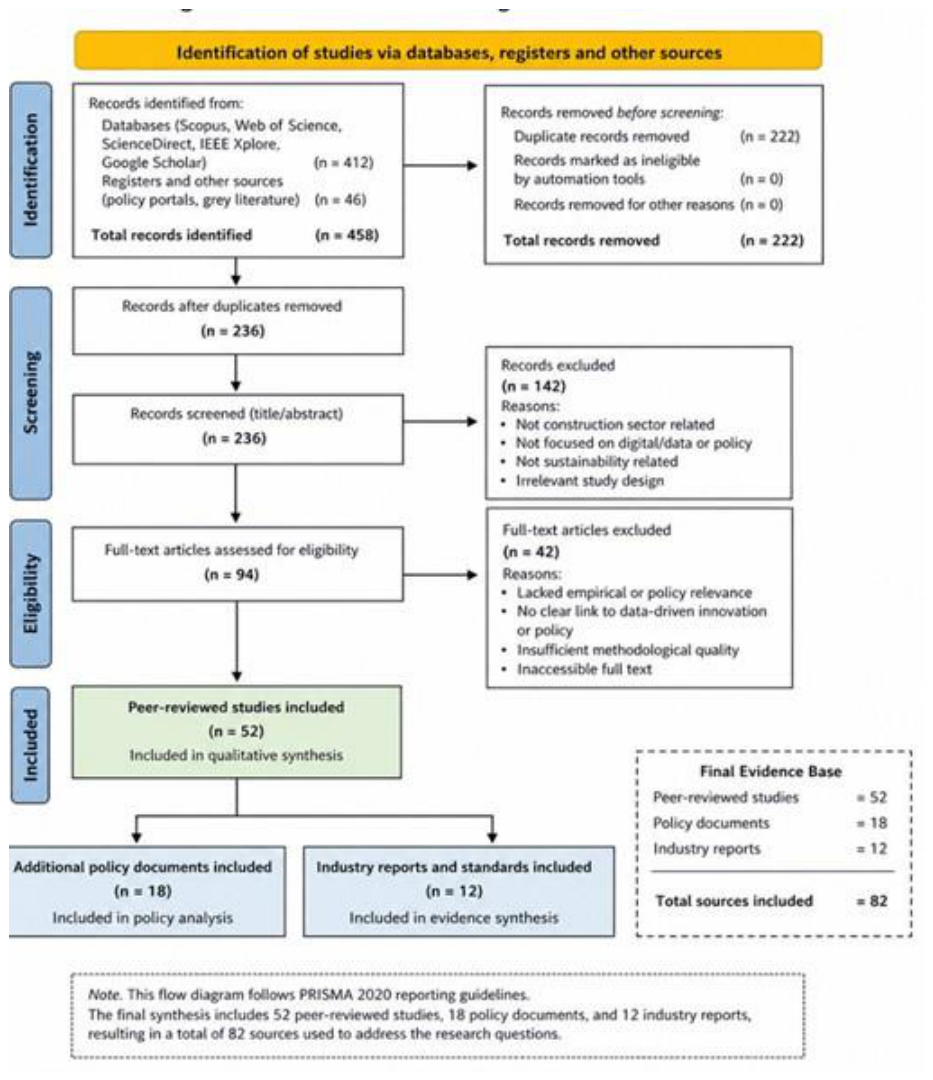
Figure 1.
Conceptual framework for digital-enabled environmental governance across the construction lifecycle.
Figure 1.
Conceptual framework for digital-enabled environmental governance across the construction lifecycle.
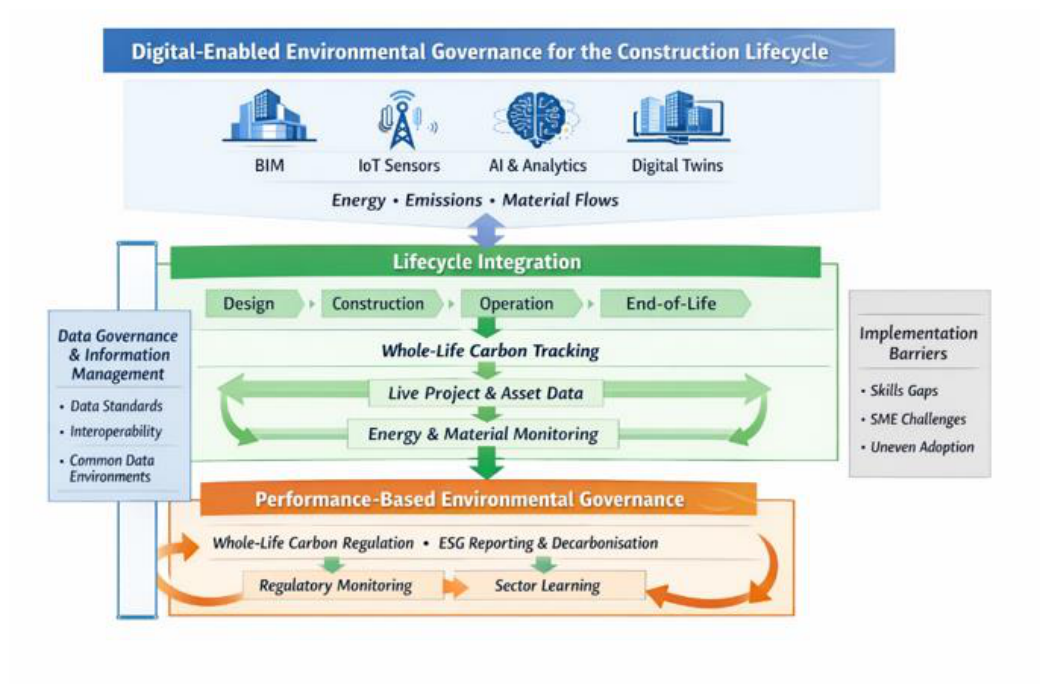
Table 1.
Coding Framework and Thematic Structure.
| Stage | Output | Example |
| Open Coding | Raw descriptive codes | “AI safety monitoring”, “carbon reporting gap” |
| Axial Coding | Grouped categories | Digital technologies, policy gaps |
| Thematic Coding | Final analytical themes | Governance gaps, circular economy enablement |
Disclaimer/Publisher’s Note: The statements, opinions and data contained in all publications are solely those of the individual author(s) and contributor(s) and not of MDPI and/or the editor(s). MDPI and/or the editor(s) disclaim responsibility for any injury to people or property resulting from any ideas, methods, instructions or products referred to in the content. |
© 2026 by the authors. Licensee MDPI, Basel, Switzerland. This article is an open access article distributed under the terms and conditions of the Creative Commons Attribution (CC BY) license.
Copyright: This open access article is published under a Creative Commons CC BY 4.0 license, which permit the free download, distribution, and reuse, provided that the author and preprint are cited in any reuse.