

Submitted:
02 August 2026
Posted:
03 August 2026
You are already at the latest version
Abstract
Background: Cyber intimate partner violence (C-IPV) refers to abusive and controlling behaviors enacted through digital technologies toward a current or former intimate partner. Previous research suggests that pathological narcissism may be associated with the perpetration of C-IPV. Methods: This study examined the psychometric prop-erties of the Brief Pathological Narcissism Inventory (B-PNI), estimated the prevalence of C-IPV perpetration, and explored its association with pathological narcissism among emerging adults. The sample comprised 371 Portuguese participants aged 18–25 years (M = 21.52, SD = 1.97), of whom 78.7% were female. Results: Confirmatory factor analysis supported the proposed two-factor structure of the B-PNI (CFI = .982, TLI = .965, RMSEA = .076). The instrument demonstrated satisfactory reliability and construct validity. Overall, 58.7% of participants reported perpetrating at least one act of C-IPV. Prevalence rates were 36.9% for online control, 37.2% for online jealousy, and 18.9% for online intrusive behaviors. Positive and significant associations were found between C-IPV perpetration and both vulnerable and grandiose narcissistic dimen-sions. Conclusions: The findings support the adequacy of the B-PNI for use among Portuguese emerging adults and highlight pathological narcissism as a relevant per-sonality-related factor associated with cyber intimate partner violence perpetration, reinforcing the importance of personality-focused prevention and intervention strategies.
Keywords:
cyber intimate partner violence
; pathological narcissism
; vulnerable narcissism
; grandiose narcissism
; perpetration
; emerging adults
1. The Cyber Intimate Partner Violence in Emerging Adulthood
Information and Communication Technologies (ICTs) play a central role in the establishment and maintenance of intimate relationships, particularly among young people and emerging adults, by enabling constant interaction through social networking sites, messaging applications, video calls, and other digital platforms (Burke et al., 2011). Research has shown that almost all young adults use ICTs to communicate with intimate partners, with text messaging being one of the most frequently used forms of communication (Caridade et al., 2020).
Despite the benefits associated with digital communication, increasing evidence suggests that these technologies may also facilitate abusive interpersonal dynamics, including cyber intimate partner violence (C-IPV) (Caridade et al., 2020). The literature has used different terms to describe this phenomenon, including Cyber Dating Abuse, Digital Dating Abuse, and Cyber Intimate Partner Violence (Borrajo et al., 2015; Caridade et al., 2019; Reed et al., 2016). In the present study, the term Cyber Intimate Partner Violence (C-IPV) is adopted to refer to abusive and controlling behaviors perpetrated through digital technologies toward a current or former intimate partner.
C-IPV encompasses multiple forms of abuse, including threats, humiliation, harassment, monitoring, invasion of privacy, and coercive control enacted through digital means (Borrajo et al., 2015; Gámez-Guadix et al., 2018; Villora et al., 2019). Research has generally identified two main dimensions of C-IPV: direct aggression (e.g., insults, threats, public humiliation) and controlling behaviors (e.g., monitoring online activity, excessive messaging, checking social media interactions) (Borrajo et al., 2015; Caridade & Braga, 2019). Controlling forms of C-IPV appear particularly prevalent among young people, partly because they are often normalized as expressions of care, jealousy, or relational involvement (Caridade et al., 2020).
C-IPV has been increasingly recognized as a relevant public health concern due to its high prevalence and negative psychological and relational consequences (Melander & Marganski, 2020). Digital environments may facilitate abusive behaviors because they allow constant access to intimate partners, reduce temporal and physical barriers, increase opportunities for surveillance and control, and may reduce perpetrators’ inhibition by limiting direct exposure to victims’ emotional reactions (Bhogal & Wallace, 2022; Peterson & Densley, 2017). Furthermore, online abuse frequently co-occurs with offline intimate partner violence, suggesting continuity between online and offline relational dynamics (Caridade et al, 2020; Cava et al., 2020).
Research has documented considerable variability in prevalence rates of C-IPV perpetration, partly due to methodological differences and inconsistent terminology across studies (Caridade et al., 2019). Nevertheless, studies consistently indicate substantial rates of perpetration among adolescents and emerging adults. In Portugal, prevalence studies have found that a significant proportion of young adults report engaging in at least one act of C-IPV, particularly controlling behaviors (Caridade & Braga, 2019; Caridade et al., 2020; Monteiro et al., 2023).
The perpetration of C-IPV has been associated with several psychosocial and relational risk factors, including jealousy, emotional dysregulation, insecure attachment, sexist beliefs, and maladaptive personality traits (Peskin et al., 2017). Among these factors, pathological narcissism has increasingly emerged as a potentially relevant correlate of digitally mediated intimate aggression.
The General Aggression Model (GAM; Anderson & Bushman, 2001) provides a useful framework for understanding aggressive behaviors, including C-IPV. According to the GAM, aggressive behavior results from the interaction between situational and personal factors that influence individuals’ cognitive, emotional, and physiological states, ultimately shaping behavioral responses.
Within this framework, personality traits are considered important personal inputs that may predispose individuals to aggression, particularly in situations involving perceived rejection, humiliation, or threats to self-esteem (Anderson & Bushman, 2001). Previous literature has shown that maladaptive personality traits characterized by emotional instability, lack of empathy, or unstable self-esteem are associated with aggressive and abusive behaviors in intimate relationships (Bui & Pasalich, 2021; Warburton & Anderson, 2018).
Pathological narcissism may therefore function as a relevant personal risk factor for C-IPV perpetration, particularly because individuals with narcissistic traits may react aggressively when experiencing threats to their self-image, interpersonal rejection, or relational insecurity.
1.1. Pathological Narcissism and C-IPV
Narcissism is a multidimensional construct that ranges from normative personality characteristics to more maladaptive and pathological manifestations. While normative narcissism may contribute to adaptive self-esteem regulation, pathological narcissism involves maladaptive self-regulatory processes, emotional vulnerability, and interpersonal dysfunction (Pincus et al., 2009).
Contemporary conceptualizations of pathological narcissism generally distinguish between two major dimensions: grandiose narcissism and vulnerable narcissism (Pincus & Lukowitsky, 2010). Grandiose narcissism is characterized by dominance, entitlement, exhibitionism, interpersonal exploitation, and an excessive need for admiration. In contrast, vulnerable narcissism is associated with insecurity, hypersensitivity to criticism, emotional instability, shame, and fear of rejection (Miller et al., 2011).
Digital environments may be particularly relevant for individuals with narcissistic traits because online interactions allow greater control over self-presentation, social validation, and interpersonal monitoring (Buffardi & Campbell, 2008). Moreover, characteristics commonly associated with pathological narcissism, such as jealousy, sensitivity to rejection, and interpersonal control, may contribute to abusive digital behaviors within intimate relationships.
Several studies (e.g., Branson & March, 2021; Lambe et al., 2018; March et al., 2021; Zerach, 2016) have documented associations between pathological narcissism and C-IPV perpetration. Evidence suggests that vulnerable narcissism may be particularly associated with C-IPV due to heightened fears of abandonment and rejection, which may lead individuals to engage in controlling and monitoring behaviors toward intimate partners (Branson & March, 2021; March et al., 2021). However, findings remain inconsistent, with some studies identifying associations with grandiose narcissism, while others failed to find significant relationships between narcissistic traits and C-IPV perpetration (Bhogal & Wallace, 2022; Pabian et al., 2015).
Despite growing international interest in this topic, research examining the relationship between pathological narcissism and C-IPV in Portuguese populations remains limited. Furthermore, no Portuguese study has validated the Brief Pathological Narcissism Inventory (B-PNI) within the context of C-IPV research.
1.2. Assessment of Pathological Narcissism
Several instruments assessing narcissistic traits have been validated for the Portuguese population, including the Narcissistic Personality Inventory (NPI-13) and the Hypersensitive Narcissism Scale (HSNS) (Pechorro et al., 2016, 2018, 2019; Pereira & Paixão, 2019). However, these measures primarily focus on either grandiose or hypersensitive narcissism separately.
The Brief Pathological Narcissism Inventory (B-PNI; Schoenleber et al., 2015) offers a broader assessment of pathological narcissism by simultaneously evaluating grandiose and vulnerable narcissistic dimensions. The B-PNI is a reduced version of the Pathological Narcissism Inventory (PNI; Pincus et al., 2009) and has demonstrated adequate psychometric properties across different cultural contexts (Diguer et al., 2020; Fossati et al., 2018; Malaeb et al., 2023).
Given the relevance of pathological narcissism for understanding aggressive interpersonal behaviors, the validation of the B-PNI for the Portuguese population may contribute to advancing research on personality risk factors associated with C-IPV perpetration.
1.3. Present Study
Previous literature has documented associations between pathological narcissism and cyber intimate partner violence perpetration, particularly regarding vulnerable narcissistic traits. However, findings remain inconsistent, and research within Portuguese populations is still scarce. Therefore, the present study aimed to: (1) translate and validate the Brief Pathological Narcissism Inventory (B-PNI) for the Portuguese population by examining its psychometric properties; (2) analyze the prevalence of C-IPV perpetration and controlling behaviors among emerging adults; and (3) examine the association between C-IPV perpetration and pathological narcissism, including both grandiose and vulnerable narcissistic dimensions.
2. Materials and Methods
2.1. Participants
The initial sample for this study consisted of 671 participants, of whom 300 were excluded after analysis of the inclusion criteria. Specifically, these participants were older than the defined age range (18 to 25 years) and reported never having been in a romantic relationship.
The final sample consisted of a total of 371 young Portuguese (292 females and 79 males), aged between 18 and 25 years (M = 21.52, SD = 1.973). 94.1% of the participants had Portuguese nationality, 47.2% had completed secondary school, 44.2% had a university degree, while the remaining participants had different levels of education. Regarding romantic relationships, 67.7% of the participants were in a romantic relationship at the time of completing the questionnaire, while 32.3% were not in a romantic relationship at the time of completing the questionnaire, but reported having had romantic relationships in the past. The mean duration of the relationship was 27.44 months, with a standard deviation of 24.627. The majority of the sample (45.6%) reported being in a relationship for more than 3 years, 30.5% reported being in a relationship for less than 1 year and 24% reported being in a relationship between 1 and 3 years.
2.2. Instruments
The socio-demographic questionnaire included open-ended questions about age and occupation, and closed-ended questions about gender, sexual orientation, nationality, educational attainment, marital status, occupational situation, socioeconomic level, and whether they had ever been in a romantic relationship.
The Cyber Dating Questionnaire - Q_A (Sánchez et al., 2015), validated for the Portuguese population by Caridade et al. (in press). The Cyberdating Q_A is designed to assess adolescents’ use of digital technologies within intimate relationships and to capture different forms of CDA. It consists of six subscales assessing different positive and negative dimensions of adolescent online dating relationships. In this study only the three negative subscales specifically assessing different forms of online aggression were used. The instrument comprised 13 items rated on a five-point Likert scale ranging from 0 (never) to 4 (always): 1. Online Jealousy, assessed through four items (e.g., “I feel jealous when my partner posts provocative photos on their social media profile”); 2. Online Intrusiveness, measured through four items (e.g., “When we argue and my partner does not reply to me, I leave them many private messages”); and 3. Online Control, assessed through five items (e.g., “I have added my partner’s friends to monitor them”). In the original validation study, all dimensions demonstrated good internal consistency, with Cronbach’s alpha coefficients ranging from .79 to .85 (Sánchez-Jiménez et al., 2015). In this study, the Q_A had a Cronbach’s alpha ranging from α= .46 to α= .76, indicating satisfactory internal consistency.
The Brief Symptom Inventory (BSI) was validated by Canavarro (1999) for the Portuguese population. It assesses psychopathological symptoms and consists of 53 items on a four-point Likert scale: 0. "Never"; 1. "A few times"; 2. "Sometimes"; 3. "Often"; and 4. "Very often". These items can be divided into nine symptom dimensions, such as somatization, obsessions and compulsions, interpersonal sensitivity, depression, anxiety, hostility, phobic anxiety, paranoid ideation, and psychoticism. In the present study, only 19 questions were presented on the Somatization, Depression, and Anxiety dimensions, which have a Cronbach’s alpha of α= .80, α= .73, and α= .77, respectively, so this instrument has adequate internal consistency (Canavarro, 1999). In this study, the BSI had Cronbach’s alphas of α= .91, α= .92, and α= .89 for the somatization, depression, and anxiety dimensions, respectively.
The 10-item Personality Inventory - TIPI-P, validated for the Portuguese population (Nunes et al., 2018), consists of 9 questions on a seven-point Likert scale: 1. "Strongly disagree", 2. "Moderately disagree", 3. "Somewhat disagree", 4. "Neither agree nor disagree", 5. "Somewhat agree", 6. "Moderately agree", and 7. "Strongly agree". The items are grouped into five factors (each factor consists of two items): Openness to new experiences, Friendliness, Conscientiousness, Emotional stability, and Extroversion (Nunes et al., 2018). The Portuguese validation of the instrument has a Cronbach’s alpha ranging from α= .39 to α= .72, that is, it has a satisfactory internal consistency. In the present study, this questionnaire obtained a Cronbach’s alpha of α= .53, which means that it has a favorable internal consistency.
The Brief-Pathological Narcissism Inventory - B-PNI (Schoenleber et al., 2015) is a self-report instrument that assesses traits of pathological narcissism through 28 questions with a five-point Likert scale ranging from 0-"Not at all like me" to 5-"Very much like me." This instrument has two factors: the grandiose narcissism factor (explorativeness, self-sacrifice for self-improvement, and grandiose fantasy), which contains twelve items, and the vulnerable factor (contingent self-esteem, hiding the self, devaluation, right to anger), which contains sixteen items (Schoenleber et al., 2015). The original version of this instrument has a Cronbach’s alpha ranging from α= .83 to α= .86 for the grandiose narcissism factor and α= .93 for the vulnerable narcissism factor, meaning that both factors have adequate internal consistency (Schoenleber et al., 2015). In order to validate this instrument, it was first translated and back-translated, both by a bilingual person, to ensure the structure of the assumption.
2.3. Procedures
The study was approved by the Ethics Committee for Research in Social and Human Sciences of the University of Minho (CEICSH), Portugal (protocol code CEICSH 142/2022; approval date: 13 July 2022). After obtaining ethical approval and authorization from the authors of the instruments, the survey was administered online through Google Forms and disseminated via social media and email. Participants were informed about the study objectives, inclusion criteria, confidentiality, and voluntary nature of participation before providing informed consent. Completion of the survey required approximately 20 minutes. At the end of the questionnaire, participants were provided with information about psychological support helplines (e.g., SOS Voz Amiga, Conversa Amiga, and Telefone da Amizade).
2.4. Data Analysis
Data analysis was conducted using Microsoft Excel and IBM SPSS version 27 for Windows. Initially, descriptive analyses were performed, and kurtosis and skewness values were calculated to assess data normality. Since the assumptions required for parametric tests were not met, non-parametric tests were used instead.
Construct validity was examined through Confirmatory Factor Analysis (CFA), using IBM SPSS AMOS version 27 for Windows, as well as analyses of convergent and discriminant validity (Objective 1). Model fit was evaluated using multiple fit indices, including the chi-square to degrees of freedom ratio (χ²/df), the Comparative Fit Index (CFI), the Tucker–Lewis Index (TLI), and the Root Mean Square Error of Approximation (RMSEA). Following conventional recommendations, values of χ²/df below 5, CFI and TLI values close to or above .90, and RMSEA values below .08–.10 were considered indicative of acceptable model fit (Marôco, 2014). Internal consistency was examined using Cronbach’s alpha coefficients.
Analyses of the prevalence of perpetration of at least one act of C-IPV and of the typology of control were also carried out (Objective 2).
Point-Biserial correlation tests were used to verify the existence of correlations between the perpetration of C-IPV and the presence of narcissistic traits overall, as well as with the two types of narcissism (Objective 3). According to Marôco (2014), the correlation is considered weak if the obtained value is between .25 and .50; moderate if the value is between .50 and .75; and strong if the obtained value is greater than .75.
3. Results
3.1. Preliminary Analyses
Prior to the main analyses, the data were screened for missing values, outliers, and distributional assumptions. No substantial missing data were identified, and the variables showed acceptable distributions for the statistical procedures conducted.
Descriptive statistics and correlations among the main study variables are presented in Table 1. Because some variables did not fully satisfy normality assumptions, Spearman’s rank-order correlations were computed.
For the confirmatory factor analysis (CFA), multivariate normality was assessed and considered adequate (Kurtosis multivariate = 4.38 < 10; Kline, 2005), supporting the use of maximum likelihood estimation.
3.2. CFA of Brief-Pathological Narcissism Inventory
A confirmatory factor analysis (CFA) was conducted to examine the factorial structure of the Brief Pathological Narcissism Inventory (B-PNI). Preliminary analyses indicated adequate multivariate normality (Kurtosis multivariate = 4.38 < 10; Kline, 2005), supporting the use of maximum likelihood estimation.
The proposed two-factor model demonstrated an acceptable fit to the data. Although the chi-square test was statistically significant, χ²(11) = 34.72, p < .001, additional fit indices supported model adequacy: Comparative Fit Index (CFI) = .982, Tucker-Lewis Index (TLI) = .965, and Root Mean Square Error of Approximation (RMSEA) = .076. These values are consistent with recommended cutoff criteria for acceptable to good model fit (Schreiber et al., 2006).
Based on modification indices and theoretical interpretability, a small number of covariances between conceptually related error terms were specified to improve model specification (Marôco, 2014). Figure 1 presents the final CFA model.
The correlation between the two latent factors was high and positive (r = .86), indicating substantial shared variance between grandiose and vulnerable narcissism dimensions. Standardized factor loadings were generally adequate and above .50, with the exception of the Exploitativeness (EXP) facet, which presented a slightly lower loading (.49).
3.3. Reliability
Internal consistency analyses were conducted using Cronbach’s alpha coefficients. The grandiose narcissism factor demonstrated acceptable internal consistency (α = .72), whereas the vulnerable narcissism factor showed good internal consistency (α = .87).
Regarding the grandiose narcissism facets, Cronbach’s alpha coefficients ranged from .74 to .87, specifically: Exploitativeness (EXP), α = .74; Self-Sacrificing Self-Enhancement (SSE), α = .78; and Grandiose Fantasy (GF), α = .87.
For the vulnerable narcissism facets, alpha coefficients ranged from .77 to .84: Devaluation (DEV), α = .77; Contingent Self-Esteem (CSE), α = .84; Hiding the Self (HS), α = .81; and Entitlement Rage (ER), α = .79.
Overall, the B-PNI demonstrated satisfactory internal consistency across both global dimensions and their respective facets.
3.4. Construct Validity
Evidence of construct validity was examined through correlations with the TIPI-P dimensions (see Table 2). Statistically significant, although small, positive correlations were found between grandiose narcissism and all TIPI-P dimensions: Extraversion (rs = .136, p < .01), Openness to Experience (rs = .141, p < .01), Agreeableness (rs = .212, p < .01), Conscientiousness (rs = .170, p < .01), and Emotional Stability (rs = .149, p < .01). Vulnerable narcissism showed a significant positive association only with Agreeableness (rs = .166, p < .01).
Additional evidence of convergent validity was obtained through the examination of Average Variance Extracted (AVE) and Composite Reliability (CR) indices for the two higher-order dimensions included in the CFA model. AVE values were satisfactory for vulnerable narcissism (.64) and reached the recommended threshold for grandiose narcissism (.50) (Netemeyer et al., 2003). Composite Reliability values were satisfactory for both vulnerable narcissism (.88) and grandiose narcissism (.82), exceeding the recommended cutoff value of .70 (Netemeyer et al., 2003).
Associations between the B-PNI dimensions and psychological symptomatology were also examined using the Brief Symptom Inventory (BSI; see Table 4). Vulnerable narcissism was positively associated with Somatization (rs = .346, p < .01), Depression (rs = .499, p < .01), and Anxiety (rs = .460, p < .01). Similarly, grandiose narcissism showed positive associations with Somatization (rs = .228, p < .01), Depression (rs = .270, p < .01), and Anxiety (rs = .256, p < .01).
Finally, the correlation between the two latent dimensions obtained in the CFA model was high (r = .86), indicating substantial shared variance between grandiose and vulnerable narcissism. Nevertheless, the theoretical distinction between both constructs and the overall model fit supported the retention of the proposed two-factor structure.

Table 2.
Spearman Correlations Between the B-PNI Dimensions and TIPI-P Factors.
| E | O | A | C | ES | |
|---|---|---|---|---|---|
| BPNI Vulnerable | .098 | −.037 | .166** | .087 | .059 |
| BPNI Grandiose | .136** | .141** | .212** | .170** | .149** |
Note. BPNI = Brief Pathological Narcissism Inventory; TIPI-P = Ten-Item Personality Inventory – Portuguese Version; E = Extraversion; O = Openness to Experience; A = Agreeableness; C = Conscientiousness; ES = Emotional Stability. p < .01.
Table 3.
Spearman Correlations Between the B-PNI Dimensions and BSI Symptoms.
| Somatization | Depression | Anxiety | |
|---|---|---|---|
| BPNI Vulnerable | .346** | .499** | .460** |
| BPNI Grandiose | .228** | .270** | .256** |
Note. BPNI = Brief Pathological Narcissism Inventory; BSI = Brief Symptom Inventory. p < .01.
3.5. Prevalence of C-IPV Perpetration
Regarding prevalence rates, 58.7% of participants reported having perpetrated at least one act of cyber intimate partner violence. Concerning the negative dimensions of the Cyberdating Q_A, 36.9% reported online control behaviors, 37.2% online jealousy behaviors, and 18.9% online intrusive behaviors.
Table 4.
Prevalence of C-IPV Perpetration and Negative Cyberdating Q_A Dimensions.
| Variable | n | % |
|---|---|---|
| C-IPV perpetration | 363 | 58.7 |
| Online control | 228 | 36.9 |
| Online jealousy | 230 | 37.2 |
| Online intrusive behaviors | 117 | 18.9 |
Note. Prevalence rates correspond to participants reporting at least one abusive behavior within each dimension.
3.6. Association Between C-IPV Perpetration and Personality Traits
Point-biserial correlation analyses revealed positive and statistically significant associations between C-IPV perpetration and pathological narcissism overall (rpb = .192, p < .01), vulnerable narcissism (rpb = .136, p < .01), and grandiose narcissism (rpb = .234, p < .01). Although these associations were weak in magnitude, the findings suggest that higher levels of pathological narcissism, particularly grandiose narcissism, are associated with greater involvement in cyber intimate partner violence perpetration.
4. Discussion
The present study aimed to examine the psychometric properties of the Brief Pathological Narcissism Inventory (B-PNI; Schoenleber et al., 2015) in a Portuguese sample of emerging adults, estimate the prevalence of cyber intimate partner violence (C-IPV) perpetration, and analyze the association between C-IPV perpetration and pathological narcissism.
The CFA supported the proposed two-factor structure of the B-PNI, comprising grandiose and vulnerable narcissism. This structure is consistent with the original validation study conducted by Schoenleber et al. (2015) and with the Arabic validation by Malaeb et al. (2023). The fit indices obtained in the present study indicated an acceptable to good model fit, with CFI and TLI values above recommended thresholds and an RMSEA value within the acceptable range (Schreiber et al., 2006). Although the correlation between the two latent dimensions was high, similar findings have been reported in previous studies using the B-PNI (Malaeb et al., 2023; Schoenleber et al., 2015), reflecting the substantial conceptual overlap between grandiose and vulnerable narcissism within broader models of pathological narcissism (Pincus & Lukowitsky, 2010).
The B-PNI also demonstrated satisfactory reliability. Internal consistency values were acceptable to good for both higher-order dimensions and all facets (DeVellis, 2017), supporting the use of the instrument for assessing pathological narcissism among Portuguese emerging adults. Moreover, the AVE and CR indices further supported the adequacy of the two-factor structure, although the grandiose narcissism dimension reached only the minimum recommended AVE threshold (Netemeyer et al., 2003).
Evidence of construct validity was examined through associations with personality dimensions and psychological symptomatology. Grandiose narcissism showed weak but significant positive associations with all TIPI-P dimensions, whereas vulnerable narcissism was significantly associated only with agreeableness. Similar findings were reported by Zajenkowski and Szymaniak (2021), who observed broader associations between grandiose narcissism and Big Five personality traits, while vulnerable narcissism showed a more restricted pattern of associations. The weak magnitude of the correlations found in the present study should, however, be interpreted cautiously, particularly considering the reduced number of items included in the TIPI-P (Nunes et al., 2018).
Both narcissism dimensions were also positively associated with somatization, depression, and anxiety symptoms. These findings are consistent with previous literature showing associations between pathological narcissism and psychological distress (Brailovskaia et al., 2020, 2021; Kealy et al., 2018). More specifically, vulnerable narcissism has been associated with anxiety and depressive symptomatology (Brailovskaia et al., 2020), whereas both vulnerable and grandiose narcissism appear to intensify the association between loneliness and depressive symptoms (Brailovskaia et al., 2021). Similarly, Kealy et al. (2018) demonstrated that pathological narcissism may contribute indirectly to somatic distress.
Regarding C-IPV perpetration, the present study identified considerable prevalence rates, with 58.7% of participants reporting at least one act of C-IPV perpetration. Concerning the negative dimensions of the Cyberdating Q_A, prevalence rates were 36.9% for online control, 37.2% for online jealousy, and 18.9% for online intrusive behaviors. These findings are generally consistent with previous Portuguese studies reporting substantial rates of cyber intimate partner violence among young people and emerging adults (Caridade & Braga, 2019; Caridade et al., 2020; Monteiro et al., 2023), as well as with international literature highlighting the high prevalence of digitally mediated abusive behaviors in intimate relationships (Borrajo et al., 2015; Brown & Hegarty, 2018; Caridade et al., 2019).
The relatively higher prevalence of online control and jealousy behaviors compared to online intrusive behaviors may reflect the normalization and social acceptability of monitoring and controlling practices within digitally mediated intimate relationships (Caridade et al., 2020). Indeed, behaviors such as checking a partner’s online activity, monitoring social interactions, or expressing jealousy through digital technologies are often perceived by young people as normative expressions of relational involvement rather than as abusive behaviors. These findings further reinforce the importance of distinguishing between different dimensions of C-IPV when examining prevalence patterns and associated risk factors.
C-IPV perpetration was positively associated with pathological narcissism overall, supporting previous studies suggesting that narcissistic traits may contribute to aggressive and controlling behaviors in intimate relationships (Lambe et al., 2018; Pineda et al., 2021). Nevertheless, the magnitude of these associations was weak, indicating that narcissistic traits should not be interpreted as isolated explanatory factors of C-IPV perpetration. This finding is consistent with the General Aggression Model (Anderson & Bushman, 2001), which emphasizes that aggressive behavior emerges from the interaction between multiple personal and situational factors.
The results further demonstrated significant associations between C-IPV perpetration and both vulnerable and grandiose narcissism. Contrary to expectations based on previous studies suggesting a stronger role for vulnerable narcissism (Branson & March, 2021; March et al., 2021), grandiose narcissism presented the strongest association with C-IPV perpetration in the present study. This finding suggests that characteristics associated with grandiose narcissism, such as entitlement, dominance, interpersonal exploitation, and the need for admiration (Miller et al., 2011), may play a relevant role in digitally mediated abusive behaviors.
At the same time, the significant association between vulnerable narcissism and C-IPV perpetration reinforces the role of insecurity, rejection sensitivity, and emotional vulnerability in the perpetration of abusive digital behaviors. Indeed, individuals with vulnerable narcissistic traits may engage in controlling and monitoring behaviors as maladaptive strategies to manage fears of abandonment and rejection (Branson & March, 2021; March et al., 2021).
The literature on narcissism and C-IPV remains inconsistent. Whereas some studies found associations only with vulnerable narcissism (Branson & March, 2021; March et al., 2021), others identified relationships with grandiose narcissism or with both dimensions (Takezawa et al., 2022; Zerach, 2016). These inconsistencies may reflect methodological differences across studies, including variations in sample composition, gender distribution, sexual orientation, and the specific dimensions of C-IPV assessed.
Several limitations should be acknowledged. First, the sample was predominantly female, limiting the analysis of gender differences. Second, the cross-sectional design prevents causal interpretations. Third, the use of self-report measures may have increased susceptibility to social desirability and response biases. Additionally, the TIPI-P is a brief personality measure, which may have limited the strength and interpretability of construct validity evidence.
Future studies should replicate these findings in larger and more balanced samples, examine measurement invariance across gender and other relevant groups, and further explore the differential associations between narcissistic dimensions and specific forms of C-IPV, particularly controlling and direct aggression behaviors. Longitudinal studies would also be valuable to clarify the directionality of associations between pathological narcissism and C-IPV perpetration. Finally, future research should consider additional risk factors, such as jealousy, attachment insecurity, prior victimization, and offline intimate partner violence.
5. Conclusions
This study contributes to the literature on pathological narcissism and cyber intimate partner violence by providing evidence for the adequacy of the B-PNI in a Portuguese sample of emerging adults. The findings supported the two-factor structure of the instrument and demonstrated satisfactory reliability and construct validity.
The study also identified high prevalence rates of C-IPV perpetration and controlling behaviors, reinforcing concerns regarding the normalization of digitally mediated abusive behaviors among emerging adults. Furthermore, the positive associations between C-IPV perpetration and both vulnerable and grandiose narcissism suggest that personality-related factors may play a relevant role in understanding risk processes involved in cyber intimate abuse.
Overall, the findings suggest that the B-PNI may represent a useful instrument for research on pathological narcissism in Portuguese-speaking contexts and may contribute to a more nuanced understanding of personality-related factors associated with cyber intimate partner violence.
Author Contributions
Conceptualization, S.C. and M.R.; methodology, S.C. and M.R.; validation, S.C. and M.R.; formal analysis, S.C. and M.R.; investigation, M.R.; data curation, M.R.; writing—original draft preparation, M.R. and S.C.; writing—review and editing, S.C. and M.R.; visualization, M.R.; supervision, S.C.; project administration, S.C. All authors have read and agreed to the published version of the manuscript.
Funding
This study was conducted at the Psychology Research Centre (CIPsi; PSI/01662), School of Psychology, University of Minho, and was supported by the Portuguese Foundation for Science and Technology (FCT; UID/01662/2025) through the Portuguese State Budget. The Centre is registered under the DOI: https://doi.org/10.54499/UID/01662/2025.
Institutional Review Board Statement
The study was conducted in accordance with the Declaration of Helsinki and approved by the Ethics Committee for Research in Social and Human Sciences of the University of Minho (CEICSH), Portugal (protocol code CEICSH 142/2022; date of approval: [13 July of 2022]). Informed consent was obtained from all participants prior to their participation in the study.
Informed Consent Statement
Informed consent was obtained from all subjects involved in the study.
Data Availability Statement
The data presented in this study are not publicly available due to ethical and privacy restrictions related to the sensitive nature of the data and the protection of participants’ confidentiality. Anonymized data may be made available by the corresponding author upon reasonable request and subject to approval by the relevant ethics committee and institutional regulations.
Conflicts of Interest
The authors declare no conflicts of interest. The funders had no role in the design of the study; in the collection, analyses, or interpretation of data; in the writing of the manuscript; or in the decision to publish the results.
References
- (Anderson & Bushman, 2002) )Anderson, C. A., & Bushman, B. J. (2002). Human aggression. Annual Review of Psychology, 53(1), 27–51. [CrossRef]
- (Bhogal & Wallace, 2022) Bhogal, M. S., & Wallace, D. (2022). Cost-inflicting mate retention tactics predict the perpetration of cyber dating abuse. Evolutionary Psychological Science, 8, 1–9. [CrossRef]
- (Borrajo et al., 2015) Borrajo, E., Gámez-Guadix, M., Pereda, N., & Calvete, E. (2015). The development and validation of the Cyber Dating Abuse Questionnaire among young couples. Computers in Human Behavior, 48, 358–365. [CrossRef]
- (Buffardi & Campbell, 2008) Buffardi, L. E., & Campbell, W. K. (2008). Narcissism and social networking web sites. Personality and Social Psychology Bulletin, 34(10), 1303–1314. [CrossRef]
- (Burke et al., 2011) Burke, S. C., Wallen, M., Vail-Smith, K., & Knox, D. (2011). Using technology to control intimate partners: An exploratory study of college undergraduates. Computers in Human Behavior, 27(3), 1162–1167. [CrossRef]
- (Brown & Hegarty, 2018) Brown, C., & Hegarty, K. (2018). Digital dating abuse measures: A critical review. Aggression and Violent Behavior, 40, 44–59. [CrossRef]
- (Bui & Pasalich, 2021) Bui, N. H., & Pasalich, D. S. (2021). Insecure attachment, maladaptive personality traits, and the perpetration of in-person and cyber psychological abuse. Journal of Interpersonal Violence, 36(5–6), 2117–2139. [CrossRef]
- (Branson & March, 2018) Branson, M., & March, E. (2021). Dangerous dating in the digital age: Jealousy, hostility, narcissism, and psychopathy as predictors of cyber dating abuse. Computers in Human Behavior, 119, 106711. [CrossRef]
- (Caridade et al., 2020) Caridade, S., Pedrosa e Sousa, H. F., & Dinis, M. A. P. (2020). Cyber and offline dating abuse in a Portuguese sample: Prevalence and context of abuse. Behavioral Sciences, 10(10), Article 152. [CrossRef]
- (Cava et al., 2020) Cava, M. J., Martínez-Ferrer, B., Buelga, S., & Carrascosa, L. (2020). Sexist attitudes, romantic myths, and offline dating violence as predictors of cyber dating violence perpetration in adolescents. Computers in Human Behavior, 111, Article 106449. [CrossRef]
- (Deans & Bhogal, 2019) Deans, H., & Bhogal, M. S. (2019). Perpetrating cyber dating abuse: A brief report on the role of aggression, romantic jealousy and gender. Current Psychology, 38(5), 1077–1082. [CrossRef]
- (DeVellis, 2017) DeVellis, R. F. (2017). Scale development: Theory and applications (4th ed.). Sage.
- (Diguer et al., 2020) Diguer, L., Turmel, V., Brin, J., Lapointe, T., Chrétien, S., Marcoux, L.-A., Mathieu, V., & da Silva Luis, R. (2020). Traduction et validation en français du Pathological Narcissism Inventory [Translation and validation in French of the Pathological Narcissism Inventory]. Canadian Journal of Behavioural Science, 52(2), 89–101.
- (Fossati et al., 2018) Fossati, A., Somma, A., Borroni, S., & Miller, J. D. (2018). Assessing dimensions of pathological narcissism: Psychometric properties of the short form of the Five-Factor Narcissism Inventory in a sample of Italian university students. Journal of Personality Assessment, 100(3), 250–258. [CrossRef]
- (Gámez-Guadix et al., 2018) Gámez-Guadix, M., Borrajo, E., & Calvete, E. (2018). Partner abuse, control and violence through internet and smartphones: Characteristics, evaluation and prevention. Papeles del Psicólogo, 39(3), 218–227. [CrossRef]
- (Jones & Paulhus, 2010) Jones, D. N., & Paulhus, D. L. (2010). Different provocations trigger aggression in narcissists and psychopaths. Social Psychological and Personality Science, 1(1), 12–18. [CrossRef]
- (Kealy et al., 2018) Kealy, D., Rice, S. M., Ogrodniczuk, J. S., & Cox, D. W. (2018). Investigating the link between pathological narcissism and somatization. Journal of Nervous and Mental Disease, 206(12), 964–967. [CrossRef]
- (Kline, 2005) Kline, R. B. (2005). Principles and practice of structural equation modeling (2nd ed.). Guilford Press.
- (Lambe et al., 2018) Lambe, S., Hamilton-Giachritsis, C., Garner, E., & Walker, J. (2018). The role of narcissism in aggression and violence: A systematic review. Trauma, Violence, & Abuse, 19(2), 209–230. [CrossRef]
- (Malaeb et al., 2023) Malaeb, D., Asan, A. E., Fekih-Romdhane, F., Azzi, V., El Dine, A. S., Hallit, S., & Pincus, A. L. (2023). Validation of the Pathological Narcissistic Inventory (PNI) and its brief form (B-PNI) in the Arabic language. BMC Psychiatry, 23(1), Article 166. [CrossRef]
- (March et al., 2021) March, E., Grieve, R., Clancy, E., Klettke, B., van Dijk, R., & Hernandez Bark, A. S. (2021). The role of individual differences in cyber dating abuse perpetration. Cyberpsychology, Behavior, and Social Networking, 24(7), 457–463. [CrossRef]
- (Marôco, 2014) Marôco, J. (2014). Análise de equações estruturais: Fundamentos teóricos, software e aplicações. ReportNumber.
- (Melander & Marganski, 2020) Melander, L. A., & Marganski, A. J. (2020). Cyber and in-person intimate partner violence victimization: Examining maladaptive psychosocial and behavioral correlates. Cyberpsychology, 14(1), Article 1. [CrossRef]
- (Miller et al., 2011) Miller, J. D., Hoffman, B. J., Gaughan, E. T., Gentile, B., Maples, J., & Campbell, W. K. (2011). Grandiose and vulnerable narcissism: A nomological network analysis. Journal of Personality, 79(5), 1013–1042. [CrossRef]
- (Monteiro et al., 2023) Monteiro, A. P., Guedes, S., & Correia, E. (2023). Cyber dating abuse in higher education students: Self-esteem, sex, age and recreational time online. Social Sciences, 12(3), Article 139. [CrossRef]
- (Netemeyer et al., 2003) Netemeyer, R. G., Bearden, W. O., & Sharma, S. (2003). Scaling procedures: Issues and applications. Sage.
- (Nunes et al., 2018) Nunes, A., Limpo, T., Lima, C. F., & Castro, S. L. (2018). Short scales for the assessment of personality traits: Development and validation of the Portuguese Ten-Item Personality Inventory (TIPI). Frontiers in Psychology, 9, Article 461. [CrossRef]
- (Pabian et al., 2015) Pabian, S., de Backer, C. J. S., & Vandebosch, H. (2015). Dark Triad personality traits and adolescent cyber-aggression. Personality and Individual Differences, 75, 41–46. [CrossRef]
- (Pechorro et al., 2016) Pechorro, P., Gentile, B., Ray, J. V., Nunes, C., & Gonçalves, R. A. (2016). Adaptation of the Narcissistic Personality Inventory among a Portuguese sample of incarcerated juvenile offenders. Psychology, Crime & Law, 22(5), 495–511. [CrossRef]
- (Pechorro et al., 2018) Pechorro, P., Marôco, J., Ray, J. V., Gonçalves, R. A., & Nunes, C. (2018). A brief measure of narcissism among female juvenile delinquents and community youths: The Narcissistic Personality Inventory-13. International Journal of Offender Therapy and Comparative Criminology, 62(8), 2292–2311. [CrossRef]
- (Pechorro et al., 2019) Pechorro, P., Nunes, C., Gonçalves, R. A., Simões, M., & Oliveira, J. (2019). Estudo de validação do Inventário de Personalidade Narcísica-13 numa amostra escolar de jovens portugueses. Revista Iberoamericana de Diagnóstico y Evaluación Psicológica, 50(4). [CrossRef]
- (Pereira & Paixão, 2019) Pereira, C., & Paixão, R. (2019). Factor structure of the Portuguese version of the Hypersensitive Narcissism Scale. Revista Iberoamericana de Diagnóstico y Evaluación Psicológica, 53(4), 19–31. [CrossRef]
- (Peskin et al., 2017) Peskin, M. F., Markham, C. M., Shegog, R., Temple, J. R., Baumler, E. R., Addy, R. C., Hernandez, B., Cuccaro, P., Gabay, E. K., Thiel, M., & Emery, S. T. (2017). Prevalence and correlates of the perpetration of cyber dating abuse among early adolescents. Journal of Youth and Adolescence, 46(2), 358–375. [CrossRef]
- (Peterson & Densley, 2017) Peterson, J., & Densley, J. (2017). Cyber violence: What do we know and where do we go from here? Aggression and Violent Behavior, 34, 193–200. [CrossRef]
- (Pincus et al., 2009) Pincus, A. L., Ansell, E. B., Pimentel, C. A., Cain, N. M., Wright, A. G. C., & Levy, K. N. (2009). Initial construction and validation of the Pathological Narcissism Inventory. Psychological Assessment, 21(3), 365–379. [CrossRef]
- (Pincus & Lukowitsky, 2010) Pincus, A. L., & Lukowitsky, M. R. (2010). Pathological narcissism and narcissistic personality disorder. Annual Review of Clinical Psychology, 6, 421–446. [CrossRef]
- (Pineda et al., 2021) Pineda, D., Galán, M., Martínez-Martínez, A., Campagne, D. M., & Piqueras, J. A. (2021). Same personality, new ways to abuse: How Dark Tetrad personalities are connected with cyber intimate partner violence. Journal of Interpersonal Violence. [CrossRef]
- (Reed et al., 2016) Reed, L. A., Tolman, R. M., & Ward, L. M. (2016). Snooping and sexting: Digital media as a context for dating aggression and abuse among college students. Violence Against Women, 22(13), 1556–1576. [CrossRef]
- (Sánchez et al., 2015) Sánchez, V., Muñoz-Fernández, N., & Ortega-Ruiz, R. (2015). "Cyberdating Q-A": An instrument to assess the quality of adolescent dating relationships in social networks. Computers in Human Behavior, 48, 78–86. [CrossRef]
- (Schoenleber et al., 2015) Schoenleber, M., Roche, M. J., Wetzel, E., Pincus, A. L., & Roberts, B. W. (2015). Development of a brief version of the Pathological Narcissism Inventory. Psychological Assessment, 27(4), 1520–1526. [CrossRef]
- (Schreiber et al., 2006) Schreiber, J. B., Stage, F. K., King, J., Nora, A., & Barlow, E. A. (2006). Reporting structural equation modeling and confirmatory factor analysis results: A review. Journal of Educational Research, 99(6), 323–338. [CrossRef]
- (Takezawa et al., 2022) Takezawa, M., Matsui, M., & Kawasaki, N. (2022). Narcissism and intimate partner violence using information and communication technology in Japan. Journal of Family Violence. [CrossRef]
- (Villora et al., 2019) Villora, B., Yubero, S., & Navarro, R. (2019). Cyber dating abuse and masculine gender norms in a sample of male adults. Future Internet, 11(4), Article 84. [CrossRef]
- (Warburton & Anderson, 2018). Warburton, W. A., & Anderson, C. A. (2018). Aggression. In V. Zeigler-Hill & T. K. Shackelford (Eds.), The SAGE Handbook of Personality and Individual Differences: Applications of Personality and Individual Differences (pp. 183–211). Sage. [CrossRef]
- (Zajenkowski & Szymaniak, 2021) Zajenkowski, M., & Szymaniak, K. (2021). Narcissism between facets and domains: The relationships between two types of narcissism and aspects of the Big Five. Current Psychology, 40(5), 2112–2121. [CrossRef]
- (Zerach, 2016) Zerach, G. (2016). Pathological narcissism, cyberbullying victimization and offending among homosexual and heterosexual participants in online dating websites. Computers in Human Behavior, 57, 292–299. [CrossRef]
- (Zweig et al., 2013) Zweig, J. M., Dank, M., Yahner, J., & Lachman, P. (2013). The rate of cyber dating abuse among teens and how it relates to other forms of teen dating violence. Journal of Youth and Adolescence, 42(7), 1063–1077. [CrossRef]
Figure 1.
Confirmatory factor analysis of the Brief Pathological Narcissism Inventory (B-PNI), showing the standardized factor loadings and correlation between grandiose and vulnerable narcissism dimensions. Note. Standardized estimates are presented. EXP = Exploitativeness; SSE = Self-Sacrificing Self-Enhancement; GF = Grandiose Fantasy; DEV = Devaluation; CSE = Contingent Self-Esteem; HS = Hiding the Self; ER = Entitlement Rage. Covariances between error terms were added based on modification indices and theoretical interpretability.
Figure 1.
Confirmatory factor analysis of the Brief Pathological Narcissism Inventory (B-PNI), showing the standardized factor loadings and correlation between grandiose and vulnerable narcissism dimensions. Note. Standardized estimates are presented. EXP = Exploitativeness; SSE = Self-Sacrificing Self-Enhancement; GF = Grandiose Fantasy; DEV = Devaluation; CSE = Contingent Self-Esteem; HS = Hiding the Self; ER = Entitlement Rage. Covariances between error terms were added based on modification indices and theoretical interpretability.
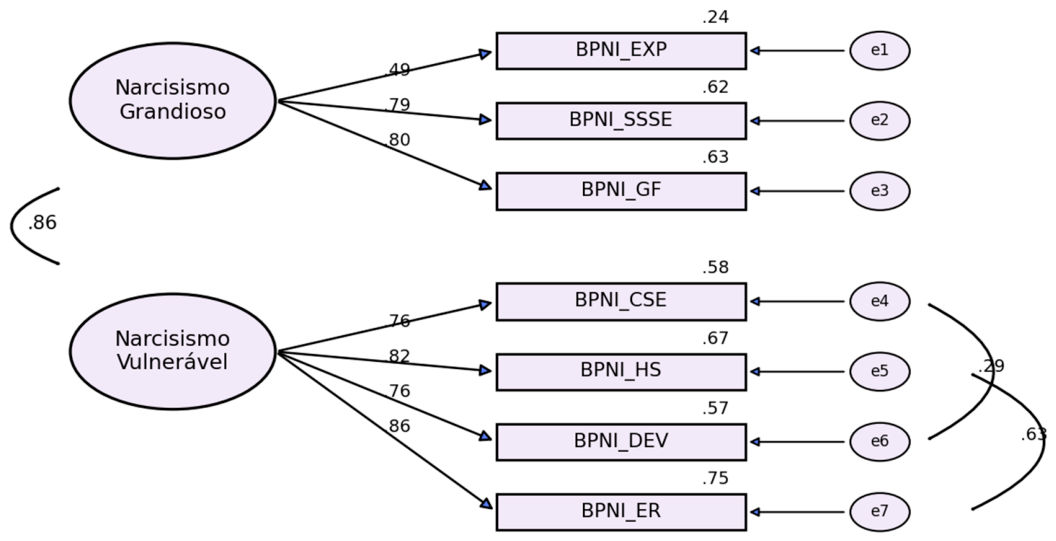
Table 1.
Descriptive Statistics and Spearman Correlations Among Study Variables.
| Variable | M | SD | 1 | 2 | 3 | 4 | 5 | 6 | 7 |
|---|---|---|---|---|---|---|---|---|---|
| 1. BPNI Vulnerable | 27.33 | 17.97 | — | ||||||
| 2. BPNI Grandiose | 28.61 | 13.00 | .70** | — | |||||
| 3. C-IPV Total | 0.98 | 0.15 | .14** | .19** | — | ||||
| 4. C-IPV Control | 0.61 | 0.49 | .28** | .31** | .19** | — | |||
| 5. Somatization | 5.88 | 6.53 | .35** | .23** | .11* | .16** | — | ||
| 6. Depression | 7.89 | 6.66 | .50** | .27** | ... | ... | ... | — | |
| 7. Anxiety | 7.42 | 6.23 | .46** | .26** | ... | ... | ... | ... | — |
Note. BPNI = Brief Pathological Narcissism Inventory; C-IPV = Cyber Intimate Partner Violence. p < .05. p < .01.
Disclaimer/Publisher’s Note: The statements, opinions and data contained in all publications are solely those of the individual author(s) and contributor(s) and not of MDPI and/or the editor(s). MDPI and/or the editor(s) disclaim responsibility for any injury to people or property resulting from any ideas, methods, instructions or products referred to in the content. |
© 2026 by the authors. Licensee MDPI, Basel, Switzerland. This article is an open access article distributed under the terms and conditions of the Creative Commons Attribution (CC BY) license (http://creativecommons.org/licenses/by/4.0/).
Copyright: This open access article is published under a Creative Commons CC BY 4.0 license, which permit the free download, distribution, and reuse, provided that the author and preprint are cited in any reuse.