

Submitted:
01 August 2026
Posted:
03 August 2026
You are already at the latest version
Abstract
Previous research has demonstrated that self-talk can enhance athletic performance and that longer quiet-eye duration is positively associated with successful performance. However, the effects of strategic self-talk on quiet-eye duration and free-throw performance have not been fully examined. This study investigated the effects of strategic self-talk on quiet-eye duration, gaze location, and free-throw performance in novice female basketball players. Forty participants were randomly assigned to a strategic self-talk group or a practice-only control group; data from 35 participants (18 in the self-talk group and 17 in the control group) were included in the final analyses. Both groups completed identical pre-tests and post-tests consisting of three blocks of 30 free throws. Between tests, they completed a three-week supervised practice program comprising two sessions per week and three blocks of 10 attempts per session. The strategic self-talk group used assigned and individualized self-talk cues, whereas the control group completed the same practice without self-talk instructions. Free-throw performance was evaluated using the six-point Hardy and Parfitt scoring system, and gaze behavior was recorded using eye-tracking technology. Compared with the control group, the strategic self-talk group showed greater improvements in free-throw performance and quiet-eye duration, a higher percentage of fixations directed toward the basket, and a lower percentage directed toward irrelevant locations (all p < .05). These findings suggest that strategic self-talk may enhance performance by promoting longer quiet-eye durations and more task-relevant gaze behavior.
Keywords:
strategic self-talk
; quiet eye
; free throw
; novice basketball players
; basketball performance
Introduction
Self-talk in sport is commonly classified as either automatic self-talk (Zourbanos et al., 2009), subsequently termed organic self-talk (Latinjak et al., 2019), or strategic self-talk (Latinjak et al., 2019). Research on organic self-talk examines the content of athletes’ spontaneous self-statements and thoughts, whereas research on strategic self-talk focuses on the deliberate use of specific cue words before or during task execution to facilitate performance. Self-talk also serves two principal functions: instructional and motivational. Instructional self-talk directs attention toward the technical, tactical, or sensorimotor components of a skill and may therefore enhance learning and performance. Motivational self-talk is intended to increase effort and confidence and to promote adaptive emotional states (Bellomo et al., 2020; Theodorakis et al., 2000). The effectiveness of self-talk may depend on the nature of the task, as proposed by the matching hypothesis (Theodorakis et al., 2000). Instructional self-talk may be particularly useful for complex or precision-based tasks, whereas motivational self-talk may be more effective for relatively simple tasks. Nevertheless, the effectiveness of specific cues may vary according to task characteristics, which may explain the mixed evidence regarding the matching hypothesis (Hatzigeorgiadis et al., 2007). Internal distractions, such as intrusive thoughts, and external distractions, such as sudden noise, may also moderate the effects of self-talk (Galanis et al., 2018). Athletes attend to relevant environmental cues, process the available information, select an appropriate response, execute the movement, and use feedback to guide subsequent actions. Accordingly, the visual system plays a central role in sport-related decision-making and motor performance, and the quiet eye is regarded as an important attentional-cognitive component of skilled performance (Vickers, 2009).
The quiet eye may therefore represent a potential attentional mechanism through which self-talk influences performance. The quiet eye is defined as the onset, offset, and duration of the final fixation or tracking gaze directed toward a task-relevant location before and during movement execution (Vickers, 1996). Earlier onset and longer quiet-eye durations have been associated with higher levels of expertise and better performance across several sports (Williams et al., 2002; Wilson et al., 2009). During sport performance, athletes must identify and maintain attention on the most informative visual cues. Fixation on irrelevant locations may lead to misinterpretation of information, while environmental distraction can shorten the quiet-eye period and disrupt information processing. The quiet eye is therefore considered an indicator of optimal attentional control during accurate skill execution (Vickers, 2009). From ecological and dynamical-systems perspectives, visual information acquired during movement is essential for online movement control. In contrast, representational accounts propose that visual input is integrated with stored representations to produce motor responses (Vickers, 2009). Quiet-eye duration may involve both pre-programmed and online control processes, although online visual regulation appears particularly important during execution. Longer quiet-eye periods during movement preparation (Mann et al., 2011; Vickers, 1996, 2007) and execution (Vine et al., 2013, 2017) may support more effective movement parameterization (Klostermann et al., 2014). Explicit verbal cues may help athletes maintain attention on the target for longer periods, thereby extending quiet-eye duration and improving movement efficiency (Sarig, 2017). Examining quiet eye as a potential mechanism of self-talk may therefore clarify how self-talk affects performance. The beneficial effects of quiet eye may be related to three interrelated attentional networks: orienting, executive control, and alerting (Posner & Raichle, 1994). The orienting network allocates attention to relevant cues, the executive network evaluates those cues in relation to the performance goal, and the alerting network maintains attentional readiness. Quiet-eye behavior may reflect the coordinated operation of these networks by sustaining attention on task-relevant information. Consequently, quiet eye has been used as an objective indicator of visual attention (Moore et al., 2012).
Research examining self-talk and quiet eye has generally reported beneficial effects, although some findings remain inconsistent (Asadi et al., 2022; Cumming et al., 2006). Nevertheless, the potential role of quiet eye as an attentional mechanism associated with self-talk remains insufficiently understood. This issue is particularly relevant in basketball, where successful free throws require precise attentional and motor control. Strategic self-talk may help players focus on task-relevant cues, prolong quiet-eye duration, and improve performance (Sarig, 2017; Horn & Marchetto, 2021). Previous studies have examined the effects of self-talk on quiet eye in golf and darts (Sarig, 2017), but evidence in team-sport contexts remains limited. Accordingly, the present study examined the effects of strategic self-talk on quiet-eye duration and free-throw performance in novice basketball players. It was hypothesized that, compared with the control group, the self-talk group would show greater improvements in (a) free-throw performance and (b) quiet-eye duration, and (c) a greater proportion of fixations directed toward task-relevant locations and fewer fixations toward irrelevant locations.
Methods
Participants
This study used a randomized pre-test-post-test control-group design. Participants were female undergraduate students from the Faculty of Sport Sciences and Health at the University of Tehran who volunteered to take part. Participants were classified as novice basketball players because they had at least six months of basketball experience, had completed the university-level Basketball I course but not Basketball II, and had no federated or formal competitive basketball experience. An a priori power analysis conducted using G*Power 3.1.9.4 indicated that at least 34 participants were required to detect a medium group × time interaction in a 2 × 2 mixed-design ANOVA (f = .25, α = .05, power = .80). To allow for attrition, 40 participants were recruited and randomly allocated in a 1:1 ratio to the strategic self-talk and control groups (n = 20 per group) using a draw-based randomization procedure. Five participants did not attend the post-test and were lost to follow-up; therefore, 35 participants were included in the final analysis (self-talk group, n = 18; control group, n = 17). Inclusion criteria were female sex, undergraduate enrollment in the Faculty of Sport Sciences and Health, at least six months of basketball experience, completion of Basketball I but not Basketball II, normal or corrected-to-normal vision, and the ability to perform the free throw with the dominant hand. Exclusion criteria were voluntary withdrawal, absence from testing or intervention sessions, injury during the study, or unusable eye-tracking data caused by calibration or recording problems. Demographic and baseline data were collected before the intervention.
Measures
Snellen Chart
Visual acuity was assessed using a standard Snellen chart containing 11 rows of progressively smaller letters. Participants were required to demonstrate normal or corrected-to-normal visual acuity to be eligible for the study.
Edinburgh Handedness Inventory
Hand dominance was assessed using the Edinburgh Handedness Inventory. Participants indicated which hand they preferred for a range of everyday activities, and the resulting scores were used to classify them as right-handed, left-handed, or ambidextrous. The assessment also collected relevant demographic information.
Eye-Tracking System
The Pupil Labs eye-tracking system (Germany) included two eye cameras recording at 200 Hz and an adjustable external scene camera capable of recording at 30, 60, or 120 Hz. Pupil Capture was used for calibration and recording, and Pupil Player was used for data processing and export. Fixation and quiet-eye durations were calculated using the 200-Hz eye-camera timestamps, whereas the external camera was used to identify and synchronize task events.
Basketball Task
A regulation size 6 basketball was used. The ball had a circumference of 74–76 cm, weighed 570–620 g, and was inflated to 59–66 kPa. For each free throw, participants stood behind the free-throw line and attempted the shot using their dominant hand without dribbling. Each attempt had to be completed within 5 s. Free-throw accuracy was evaluated using the six-category Hardy and Parfitt scoring system, as described by Lam et al. (2009): 5 points for a clean shot that passed through the basket without touching the rim; 4 points for a successful shot that touched the rim; 3 points for a successful shot that touched the backboard; 2 points for an unsuccessful shot that touched the rim; 1 point for an unsuccessful shot that touched the backboard; and 0 points for a complete miss. Participants wore the eye-tracking glasses during the free-throw task. Simultaneously, an external digital camera positioned in the sagittal plane recorded each participant’s shooting movement for identifying movement onset and synchronizing the eye-tracking and movement recordings. At the beginning of each trial, a researcher produced a visible flash signal, and participants initiated the movement after detecting the signal. The flash was captured by both the eye-tracker scene camera and the external sagittal-plane camera. The two recordings were imported into Kinovea and temporally synchronized using the first frame in which the flash appeared as the common reference point. Movement onset was identified from the sagittal-plane recording as the first frame showing initiation of the shooting movement. The frame immediately preceding movement onset was then matched to the corresponding eye-tracking recording. Finally, the synchronized eye-tracking data were examined in Pupil Player to identify the onset and offset of the final fixation and to calculate quiet-eye duration from the 200-Hz eye-tracker timestamps.
Procedure
Ethical approval was obtained from the University of Tehran (IR.UT.SPORT.REC.1402.005), and all participants provided written informed consent. Group allocation was performed as described above. Both groups completed 10 warm-up shots followed by a pre-test consisting of three sets of 30 free throws (90 attempts in total) while wearing calibrated eye-tracking glasses. The strategic self-talk intervention lasted three weeks and comprised six supervised training sessions conducted twice weekly. In each session, participants completed three blocks of 10 free throws, resulting in 30 attempts per session and 180 practice attempts across the intervention. Before training, participants in the self-talk group received a brief explanation of how and when to use self-talk cues. During the first week, they practiced instructional cues related to task-relevant technical aspects of the free throw, including “elbow,” “target,” and “knees.” During the second week, they practiced motivational cues designed to support confidence and persistence, such as “I can.” During the third week, participants developed and used individualized cue words that they considered most helpful for their own pre-shot routine. Participants were instructed to say the cue aloud immediately before each attempt. The control group followed the same three-week schedule and completed the same number of free throws but received no self-talk training, instructions, or cue words. All sessions were conducted in the afternoon under comparable environmental conditions and under researcher supervision; attendance and completion of the prescribed attempts were recorded. After the intervention, both groups completed a post-test identical to the pre-test in the same gym and under comparable conditions. The participant flow through enrollment, random allocation, follow-up, and final analysis is shown in Figure 1.
Gaze Coding and Quiet-Eye Analysis
Quiet-eye duration was calculated using frame-by-frame coding of the synchronized eye-tracking and movement recordings. Quiet eye was defined as the final fixation occurring before the critical movement event, identified as the initiation of the upward elbow movement during the free throw. Only fixations lasting at least 100 ms were included. The frame immediately preceding the critical event was identified in the sagittal-plane recording and temporally matched with the corresponding frame in the 60-frames/s scene recording. The scene video was used to locate the movement event, whereas fixation onset, offset, and duration were determined from the 200-Hz eye-camera data exported from Pupil Player. Fixation locations were classified into three predefined areas of interest: the basket, the backboard, and irrelevant locations. Mean quiet-eye duration and the percentage of fixations directed toward each location were calculated for each participant at each testing phase. All gaze data were coded by a trained assessor who was blinded to group allocation and testing phase.
Statistical Analysis
Descriptive statistics are reported as means and standard deviations. The Shapiro-Wilk test was used to assess normality, and Levene’s test was used to examine homogeneity of variance between groups. For each dependent variable, a 2 × 2 mixed-design analysis of variance (ANOVA) was conducted with group (strategic self-talk, control) as the between-subjects factor and time (pre-test, post-test) as the within-subjects factor. When significant main effects or interactions were observed, Bonferroni-adjusted pairwise comparisons were performed. Effect sizes were reported as partial eta squared (partial η²), and statistical significance was set at p < .05. Analyses were conducted using IBM SPSS Statistics version 27.
Results
Participant characteristics, including age, height, body mass, and body mass index (BMI), are presented by group in Table 1.
Independent-samples t tests indicated no significant between-group differences in age, height, body mass, or BMI at baseline (all p > .05), suggesting that the groups were comparable on these characteristics. Descriptive statistics for the study outcomes at pre-test and post-test are presented in Table 2.
The Shapiro-Wilk tests indicated that free-throw performance was normally distributed in both groups at pre-test and post-test (all p > .05). Levene’s tests were nonsignificant at pre-test, F(1, 33) = 1.93, p = .174, and post-test, F(1, 33) = 2.22, p = .146. The mixed-design ANOVA revealed significant effects of time, F(1, 33) = 982.70, p < .001, partial η² = .968, and group, F(1, 33) = 6.24, p = .018, partial η² = .159, as well as a significant group × time interaction, F(1, 33) = 181.83, p < .001, partial η² = .846. Bonferroni-adjusted comparisons showed no between-group difference at pre-test, mean difference (MD) = 0.01, standard error (SE) = 0.08, p = .895, 95% CI [−0.16, 0.18], whereas the self-talk group scored significantly higher at post-test, MD = 0.43, SE = 0.10, p < .001, 95% CI [0.24, 0.63]. Both groups improved from pre-test to post-test, with a larger change in the self-talk group.

Table 3.
Mixed-design ANOVA results for basketball free-throw performance.
| Source | Sum of squares | Df | Mean square | F | p value | Partial η² |
|---|---|---|---|---|---|---|
| Time | 4.23 | 1 | 4.23 | 982.70 | < .001* | .97 |
| Time × Group | 0.78 | 1 | .78 | 181.83 | < .001* | .85 |
| Error | 0.14 | 33 | 0.0043 | - | - | - |
| Group | 0.87 | 1 | .87 | 6.24 | .018 * | .16 |
| Error | 4.58 | 33 | 0.1388 | - | - | - |
*Statistically significant at p < .05.
Bonferroni-adjusted within-group comparisons were conducted to examine changes in free-throw performance from pre-test to post-test (Table 4).
Free-throw performance improved significantly from pre-test to post-test in both groups (p < .05), with a larger improvement in the self-talk group (Figure 2).
Quiet-eye duration was normally distributed in both groups at both testing phases (all p > .05). Levene’s tests were nonsignificant at pre-test, F(1, 33) = 0.05, p = .818, and post-test, F(1, 33) = 0.06, p = .816. The mixed-design ANOVA showed a significant effect of time, F(1, 33) = 43.54, p < .001, partial η² = .569, and a significant group × time interaction, F(1, 33) = 27.87, p < .001, partial η² = .458; the group main effect was not significant, F(1, 33) = 1.56, p = .221, partial η² = .045. Bonferroni-adjusted comparisons showed no between-group difference at pre-test, MD = −2.78 ms, SE = 51.31, p = .957, 95% CI [−107.17, 101.62], but the self-talk group had a significantly longer quiet-eye duration at post-test, MD = 131.63 ms, SE = 54.96, p = .022, 95% CI [19.81, 243.45]. Quiet-eye duration increased significantly in the self-talk group, MD = 151.19 ms, SE = 17.74, p < .001, 95% CI [115.10, 187.29], whereas the control-group change was not significant, MD = 16.79 ms, SE = 18.26, p = .364, 95% CI [−20.35, 53.94].
Table 5.
Mixed-design ANOVA results for quiet-eye duration.
| Source | Sum of squares | df | Mean square | F | p value | Partial η² |
|---|---|---|---|---|---|---|
| Time | 123356.64 | 1 | 123356.64 | 43.539 | < .001* | 0.57 |
| Time × Group | 78967.68 | 1 | 78967.68 | 27.872 | < .001* | 0.46 |
| Error | 93496.67 | 33 | 2833.23 | - | - | - |
| Group | 72576.11 | 1 | 72576.11 | 1.558 | .22 | 0.05 |
| Error | 1537676.93 | 33 | 46596.26 | - | - | - |
*Statistically significant at p < .05.
Bonferroni-adjusted comparisons are presented in Table 6. Quiet-eye duration increased significantly from pre-test to post-test in the self-talk group (p < .05), whereas the change in the control group was not significant (p = .36). The between-group patterns are shown in Figure 3.
Fixation Location Percentages
Separate 2 × 2 mixed-design ANOVAs were conducted for the percentages of fixations directed toward the basket, backboard, and irrelevant locations. Significant group × time interactions were found for basket fixations, F(1, 33) = 71.75, p < .001, partial η² = .685; backboard fixations, F(1, 33) = 6.99, p = .012, partial η² = .175; and irrelevant fixations, F(1, 33) = 54.23, p < .001, partial η² = .622. There were no significant between-group differences at pre-test for any fixation location (all p ≥ .797). At post-test, the self-talk group showed a higher percentage of fixations directed toward the basket than the control group, MD = 16.35%, SE = 3.53, p < .001, 95% CI [9.17, 23.54], and a lower percentage directed toward irrelevant locations, MD = −9.77%, SE = 2.64, p = .001, 95% CI [−15.15, −4.39]. The post-test between-group difference for backboard fixations was not significant.
Discussion
This study examined the effects of strategic self-talk on quiet-eye duration and free-throw performance in novice basketball players. The findings showed that strategic self-talk improved free-throw performance, prolonged quiet-eye duration, and increased the proportion of gaze directed toward the basket during free-throw attempts. These results support the proposition that quiet eye may represent a potential attentional mechanism through which self-talk facilitates motor performance. By directing attention toward task-relevant cues, strategic self-talk may extend the final fixation period and allow more effective movement preparation and execution (Sarig, 2017). Self-talk may enhance performance by helping performers maintain attention on relevant environmental information. Within the sport-related decision-making framework, pre-movement quiet-eye fixation may support information processing and movement planning, online gaze behavior may contribute to movement regulation, and post-movement visual information may provide feedback for subsequent performance. Strategic self-talk may therefore influence attentional-cognitive processes in which quiet eye plays a central role (Vickers, 2009). The present findings are consistent with previous evidence that self-talk can protect performance from the disruptive effects of external distraction and improve attentional control (Galanis et al., 2018). Rizal et al. (2021) similarly reported that self-talk training improved shooting accuracy, potentially by strengthening self-control over movement, breathing, and emotional responses. Together, these findings suggest that strategic self-talk may facilitate performance by stabilizing attention and regulating task execution. The present findings also agree with those of Tzormpatzakis et al. (2022), who reported improvements in shooting stability and performance following a strategic self-talk intervention. Galanis et al. (2022) found that strategic self-talk improved basketball free-throw performance under physically demanding conditions, supporting its role as a self-regulatory strategy during challenging tasks. Boroujeni and Shahbazi (2011) likewise observed that instructional self-talk improved passing accuracy, whereas motivational self-talk was more beneficial for speed-based skills. In contrast, Cumming et al. (2006) found no performance benefit of motivational self-talk in dart throwing, suggesting that the effectiveness of self-talk may depend on the task, cue content, and intervention context. The increase in quiet-eye duration observed in the self-talk group is consistent with previous studies in golf and darts, in which self-talk training prolonged quiet-eye duration and improved performance (Sarig, 2017). Ayaz Kanat and Şimşek (2021) also reported longer quiet-eye durations in skilled basketball players than in novices. In addition, attentional-focus instructions have been shown to improve throwing accuracy and quiet-eye behavior in children (Asadi et al., 2021). Chia et al. (2017) similarly found longer quiet-eye durations among more skilled performers across task conditions. However, other findings have not consistently linked better performance to longer quiet-eye duration (Asadi et al., 2021), indicating that the relationship may vary according to task demands and participant characteristics.
Strategic self-talk may facilitate performance through several complementary mechanisms. Instructional cues may direct attention toward task-relevant movement components, while motivational cues may enhance self-efficacy, confidence, effort regulation, and emotional control. These functions are consistent with self-regulation theory and with evidence that self-talk supports attentional focus and automatic skill execution (Hatzigeorgiadis et al., 2011). By prolonging quiet-eye duration, self-talk may provide additional time for movement planning and parameterization, thereby improving performance (Mann et al., 2011).
Several limitations should be considered. Participants performed free throws under relatively controlled conditions and were not exposed to substantial physiological or psychological stress. Future studies should incorporate conditions such as prior running or competitive pressure to better approximate game situations. The restriction of the sample to novice basketball players also limits the generalizability of the findings. Future research should examine other forms of self-talk, include physiological or neurocognitive outcomes, and assess adherence to self-talk cues. From an applied perspective, coaches may consider integrating brief, structured self-talk practice into training programs to support attentional focus and free-throw performance.
Conclusions
A three-week strategic self-talk intervention combining instructional, motivational, and individualized cues was associated with greater improvements in free-throw performance, quiet-eye duration, and task-relevant gaze behavior than practice alone in novice female basketball players. These findings support strategic self-talk as a practical attentional and self-regulatory approach, although the controlled setting and restricted sample indicate that the results should be generalized cautiously.
Ethical Considerations
The study was approved by the Research Ethics Committee of the University of Tehran (IR.UT.SPORT.REC.1402.005). It was conducted in accordance with established ethical principles. Participation was voluntary, written informed consent was obtained from all participants, and confidentiality and privacy were maintained throughout the research process.
Declaration of Generative AI and AI-Assisted Technologies:
During the preparation of this manuscript, the authors used ChatGPT (OpenAI) for English-language editing, formatting, and checking the consistency of in-text citations and the reference list. The authors subsequently reviewed and revised the manuscript and take full responsibility for its content.
Acknowledgments
The authors thank all participants and individuals who contributed to the completion of this study.
Author Contributions
Z.J.: Conceptualization, investigation, data curation, and writing—original draft. S.T.B.: Conceptualization, methodology, supervision, and writing—review and editing. M.T: writing—review and editing. N.C.: Methodology, validation, and writing—review and editing. All authors read and approved the final manuscript.
Funding
The authors received no financial support for the research, authorship, or publication of this article.
Conflicts of Interest
The authors declare no conflicts of interest.
References
- Asadi, A., Aiken, C. A., Heidari, S., & Kochackpour, F. (2021). The effect of attentional instructions during modeling on gaze behavior and throwing accuracy in 7 to 10 year-old children. Human Movement Science, 78, 102825. [CrossRef]
- Asadi, A., Aiken, C. A., Heidari, S., Goudini, R., & Saeedpour-Parizi, M. R. (2022). The effects of attentional focus on visuomotor control during observational learning in children with autism spectrum disorder. Research in Autism Spectrum Disorders, 98, 102041. [CrossRef]
- Ayaz Kanat, E., & Şimşek, D. (2021). The “Quiet Eye” and motor performance in basketball free throw shooting. Physical Education of Students, 25(2), 103–109. [CrossRef]
- Bellomo, E., Cooke, A., Gallicchio, G., Ring, C., & Hardy, J. (2020). Mind and body: Psychophysiological profiles of instructional and motivational self-talk. Psychophysiology, 57(9), e13586. [CrossRef]
- Boroujeni, S. T., & Shahbazi, M. (2011). The effect of instructional and motivational self-talk on performance of basketball’s motor skill. Procedia - Social and Behavioral Sciences, 15, 3113–3117. [CrossRef]
- Chia, S. J., Chow, J. Y., Kawabata, M., Dicks, M., & Lee, M. (2017). An exploratory analysis of variations in quiet eye duration within and between levels of expertise. International Journal of Sport and Exercise Psychology, 15(3), 221–235. [CrossRef]
- Cumming, J., Nordin, S. M., Horton, R., & Reynolds, S. (2006). Examining the direction of imagery and self-talk on dart-throwing performance and self-efficacy. The Sport Psychologist, 20(3), 257–274. [CrossRef]
- Galanis, E., Hatzigeorgiadis, A., Charachousi, F., Latinjak, A. T., Comoutos, N., & Theodorakis, Y. (2022). Strategic self-talk assists basketball free-throw performance under conditions of physical exertion. Frontiers in Sports and Active Living, 4. [CrossRef]
- Galanis, E., Hatzigeorgiadis, A., Comoutos, N., Charachousi, F., & Sanchez, X. (2018). From the lab to the field: Effects of self-talk on task performance under distracting conditions. The Sport Psychologist, 32(1), 26–32. [CrossRef]
- Hatzigeorgiadis, A., Zourbanos, N., & Theodorakis, Y. (2007). The moderating effects of self-talk content on self-talk functions. Journal of Applied Sport Psychology, 19(2), 240–251. [CrossRef]
- Hatzigeorgiadis, A., Zourbanos, N., Galanis, E., & Theodorakis, Y. (2011). Self-talk and sports performance: A meta-analysis. Perspectives on Psychological Science, 6(4), 348–356. [CrossRef]
- Horn, R. R., & Marchetto, J. D. (2021). Approximate Target Pre-Cueing Reduces Programming Quiet Eye and Movement Preparation Time: Evidence for Parameter Pre-Programming? Research Quarterly for Exercise and Sport, 92(4), 787–795. [CrossRef]
- Klostermann, A., Kredel, R., & Hossner, E.-J. (2014). On the interaction of attentional focus and gaze: The quiet eye inhibits focus-related performance decrements. Journal of Sport and Exercise Psychology, 36(4), 392–400. [CrossRef]
- Lam, W. K., Maxwell, J. P., & Masters, R. S. W. (2009). Analogy versus explicit learning of a modified basketball shooting task: Performance and kinematic outcomes. Journal of Sports Sciences, 27(2), 179–191. [CrossRef]
- Latinjak, A. T., Hardy, J., Comoutos, N., & Hatzigeorgiadis, A. (2019). Nothing unfortunate about disagreements in sport self-talk research: Reply to Van Raalte, Vincent, Dickens, and Brewer (2019). Sport, Exercise, and Performance Psychology, 8(4), 379–386. [CrossRef]
- Mann, D. T. Y., Coombes, S. A., Mousseau, M. B., & Janelle, C. M. (2011). Quiet eye and the Bereitschaftspotential: Visuomotor mechanisms of expert motor performance. Cognitive Processing, 12(3), 223–234. [CrossRef]
- Moore, L. J., Vine, S. J., Wilson, M. R., & Freeman, P. (2012). The effect of challenge and threat states on performance: An examination of potential mechanisms. Psychophysiology, 49(10), 1417–1425. [CrossRef]
- Posner, M. I., & Raichle, M. E. (1994). Images of mind. Scientific American Library.
- Rizal, R. M., Asmawi, M., & Lubis, J. (2021). Effect of self-talk on petanque shooting accuracy. International Journal of Human Movement and Sports Sciences, 9(4), 807–813. [CrossRef]
- Sarig, Y. (2017). The effects of instructional self-talk on quiet eye duration and golf putting performance [Master’s thesis, University of Jyväskylä]. JYX Digital Repository. http://urn.fi/URN:NBN:fi:jyu-201706012626.
- Theodorakis, Y., Weinberg, R., Natsis, P., Douma, I., & Kazakas, P. (2000). The effects of motivational versus instructional self-talk on improving motor performance. The Sport Psychologist, 14(3), 253–271. [CrossRef]
- Tzormpatzakis, E., Galanis, E., Chaldeaki, A., & Hatzigeorgiadis, A. (2022). Application of strategic self-talk: An experimental study on the effects on shooting stability and performance. International Journal of Kinesiology and Sports Science, 10(1), 52–56. [CrossRef]
- Vickers, J. N. (1996). Control of visual attention during the basketball free throw. The American Journal of Sports Medicine, 24(6 Suppl.), S93–S97. [CrossRef]
- Vickers, J. N. (2007). Perception, cognition, and decision training: The quiet eye in action. Human Kinetics.
- Vickers, J. N. (2009). Advances in coupling perception and action: The quiet eye as a bidirectional link between gaze, attention, and action. Progress in Brain Research, 174, 279–288. [CrossRef]
- Vine, S. J., Lee, D. H., Walters-Symons, R., & Wilson, M. R. (2017). An occlusion paradigm to assess the importance of the timing of the quiet eye fixation. European Journal of Sport Science, 17(1), 85–92. [CrossRef]
- Vine, S. J., Lee, D., Moore, L. J., & Wilson, M. R. (2013). Quiet eye and choking: Online control breaks down at the point of performance failure. Medicine and Science in Sports and Exercise, 45(10), 1988–1994. [CrossRef]
- Williams, A. M., Singer, R. N., & Frehlich, S. G. (2002). Quiet eye duration, expertise, and task complexity in near and far aiming tasks. Journal of Motor Behavior, 34(2), 197–207. [CrossRef]
- Wilson, M. R., Vine, S. J., & Wood, G. (2009). The influence of anxiety on visual attentional control in basketball free throw shooting. Journal of Sport and Exercise Psychology, 31(2), 152–168. [CrossRef]
- Zourbanos, N., Hatzigeorgiadis, A., Chroni, S., Theodorakis, Y., & Papaioannou, A. (2009). Automatic self-talk questionnaire for sports (ASTQS): Development and preliminary validation of a measure identifying the structure of athletes’ self-talk. The Sport Psychologist, 23(2), 233–251. [CrossRef]
Figure 1.
CONSORT-style flow diagram of participant enrollment, random allocation, intervention, follow-up, and final analysis.
Figure 1.
CONSORT-style flow diagram of participant enrollment, random allocation, intervention, follow-up, and final analysis.
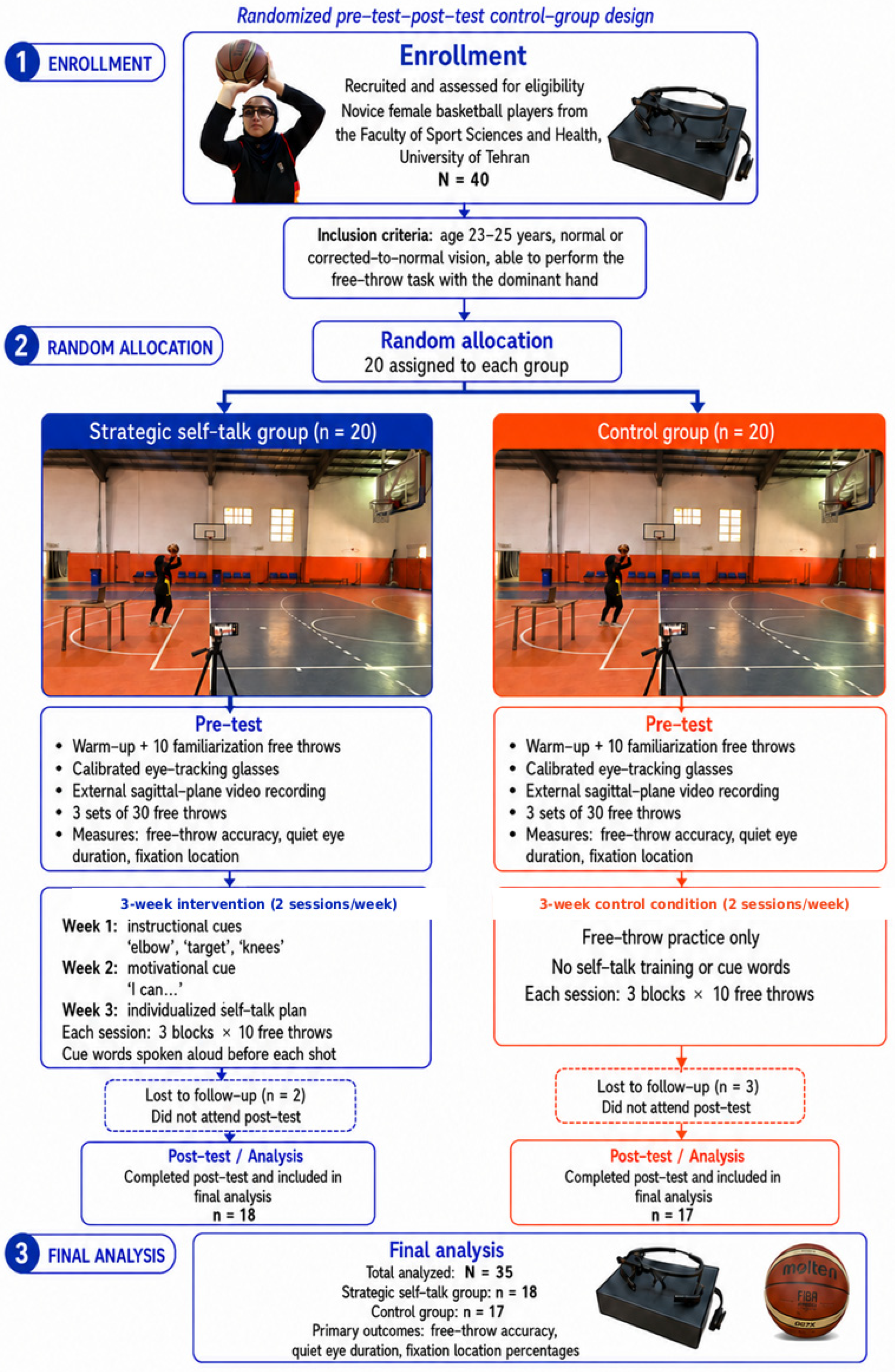
Figure 2.
Basketball free-throw performance in the self-talk and control groups at pre-test and post-test.
Figure 2.
Basketball free-throw performance in the self-talk and control groups at pre-test and post-test.
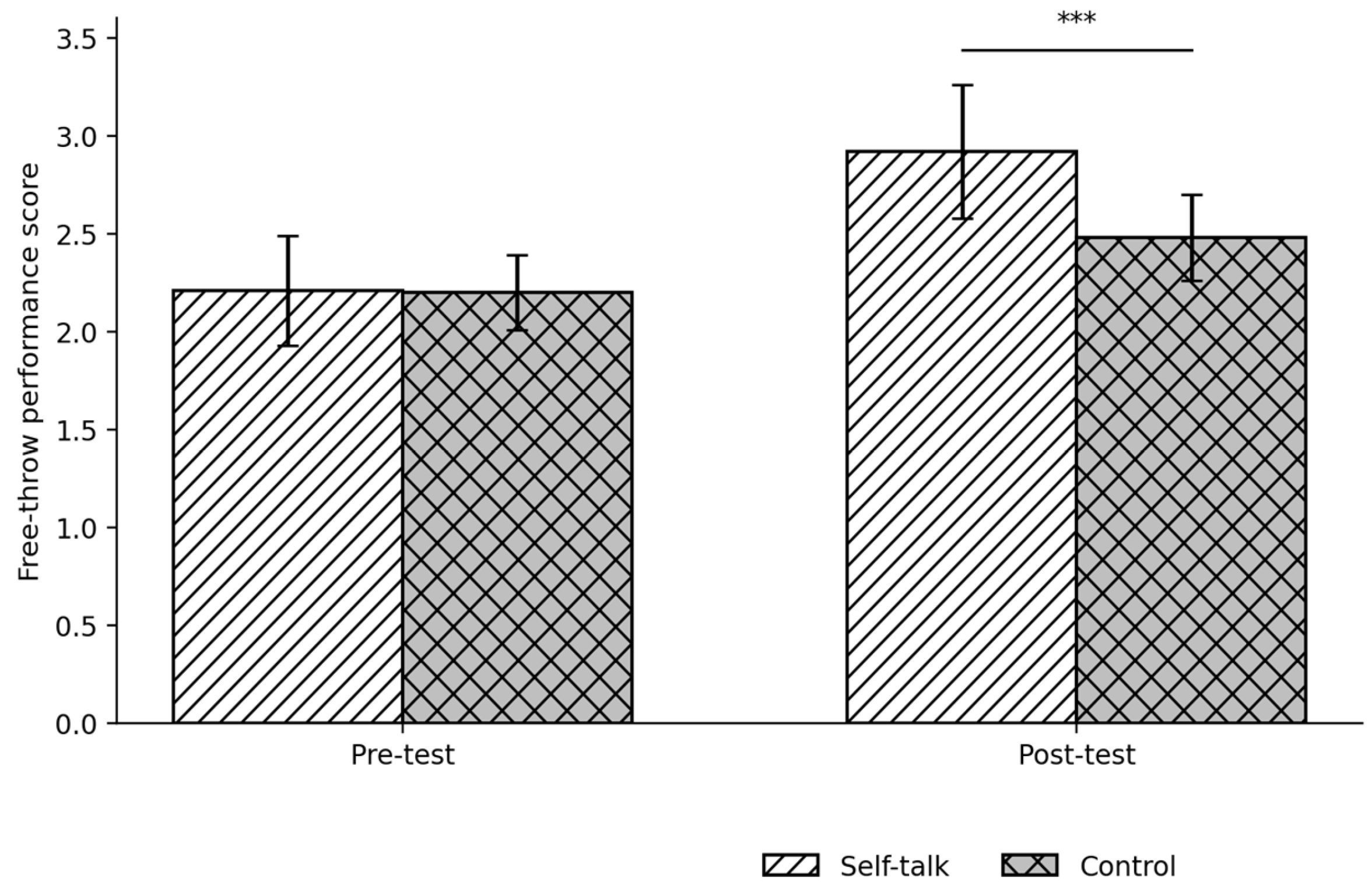
Figure 3.
Quiet-eye duration in the self-talk and control groups at pre-test and post-test.
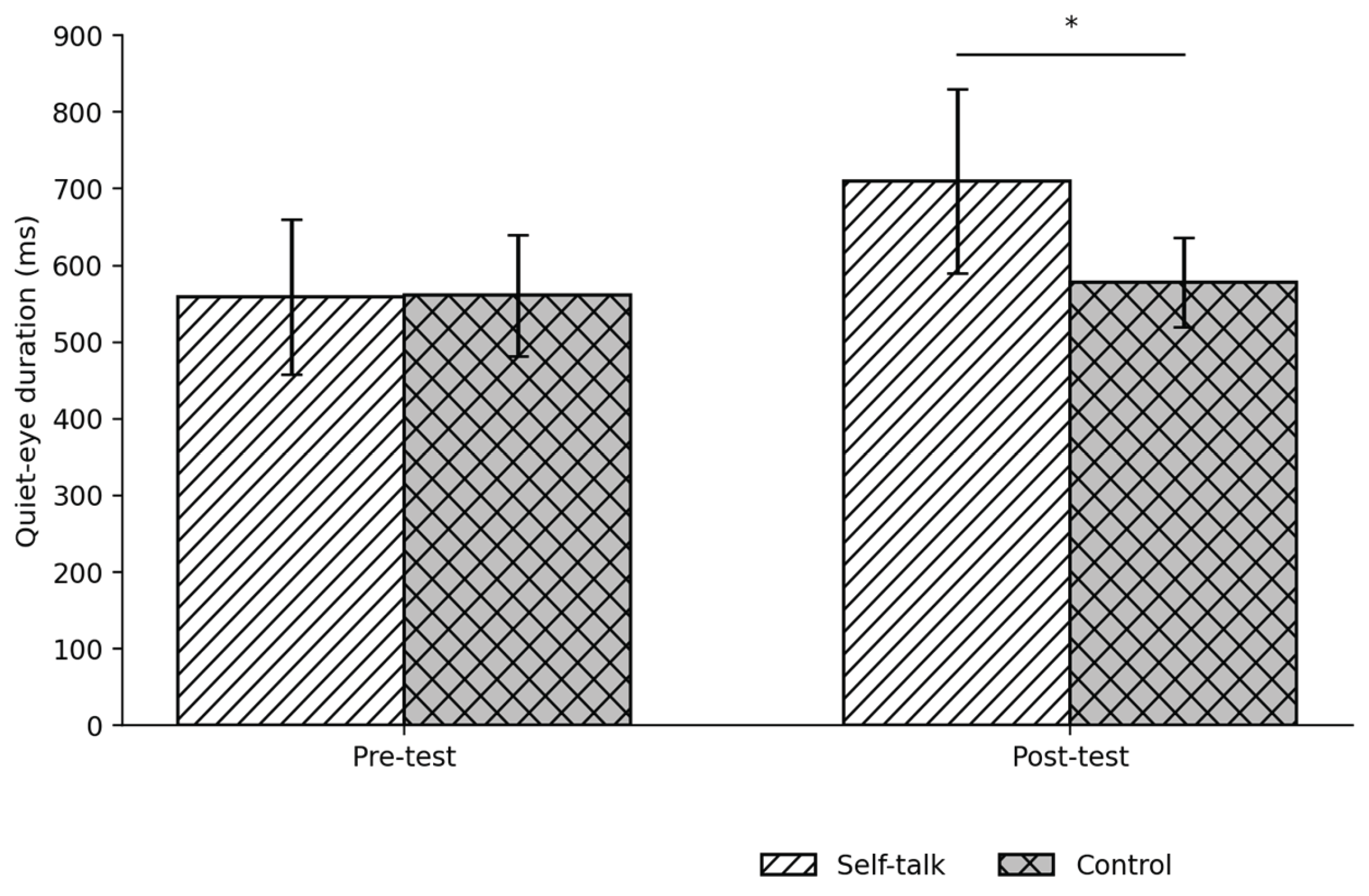
Table 1.
Participant characteristics by group (mean ± SD).
| Variable | Self-Talk, M ± SD | Control, M ± SD | p |
|---|---|---|---|
| Age (years) | 23.20 ± 0.40 | 23.47 ±2.52 | .57 |
| Height (cm) | 165.00 ± 4.35 | 164.23 ± 4.73 | .62 |
| Body mass (kg) | 58.83 ± 5.56 | 57.47 ± 5.53 | .47 |
| Body mass index (BMI) | 21.61 ± 1.83 | 21.32 ± 2.04 | .66 |
Table 2.
Descriptive statistics for free-throw performance, quiet-eye duration, and gaze location by group and time.
Table 2.
Descriptive statistics for free-throw performance, quiet-eye duration, and gaze location by group and time.
| Group | Outcome | Location | Pretest, M ± SD | Posttest, M ± SD |
|---|---|---|---|---|
| Strategic Self-Talk | Free-throw accuracy | 2.21 ± 0.28 | 2.91 ± 0.34 | |
| Quiet eye duration (milliseconds) | 559.00 ± 154.07 | 710.20 ± 164.50 | ||
| Visual search location (%) | Basket | 41.66 ± 9.91 | 58.70 ± 12.10 | |
| Backboard | 34.44 ± 9.70 | 28.51 ± 10.17 | ||
| Irrelevant | 23.88 ± 8.42 | 12.77 ± 7.16 | ||
| Control | Free-throw accuracy | 2.20 ± 0.18 | 2.48 ± 0.22 | |
| Quiet eye duration (milliseconds) | 561.78 ± 149.17 | 578.57 ± 160.37 | ||
| Visual search location (%) | Basket | 41.37 ± 8.33 | 42.35 ± 8.31 | |
| Backboard | 35.29 ± 9.65 | 35.09 ± 12.47 | ||
| Irrelevant | 23.33 ± 6.34 | 22.54 ± 8.45 |
Table 4.
Bonferroni-adjusted within-group comparisons for basketball free-throw performance.
| Variables | Groups | Mean difference | p value |
|---|---|---|---|
| Free-throw performance | Self-Talk | −0.70 | < .001* |
| Control | −0.28 | < .001* |
Note. Mean differences were calculated as pretest minus posttest; negative values indicate improvement.
Table 6.
Bonferroni-adjusted within-group comparisons for quiet-eye duration.
| Variables | Groups | Mean difference | p value |
|---|---|---|---|
| Quiet-eye duration (ms) | Self-Talk | −151.19 | < .001 |
| Control | −16.79 | .36 |
Note. Mean differences were calculated as pretest minus posttest; negative values indicate an increase in quiet-eye duration.
Disclaimer/Publisher’s Note: The statements, opinions and data contained in all publications are solely those of the individual author(s) and contributor(s) and not of MDPI and/or the editor(s). MDPI and/or the editor(s) disclaim responsibility for any injury to people or property resulting from any ideas, methods, instructions or products referred to in the content. |
© 2026 by the authors. Licensee MDPI, Basel, Switzerland. This article is an open access article distributed under the terms and conditions of the Creative Commons Attribution (CC BY) license (http://creativecommons.org/licenses/by/4.0/).
Copyright: This open access article is published under a Creative Commons CC BY 4.0 license, which permit the free download, distribution, and reuse, provided that the author and preprint are cited in any reuse.