
Submitted:
30 July 2026
Posted:
03 August 2026
You are already at the latest version
Abstract
Background: Hysterectomy is a prevalent gynecological procedure and ensuring appropriate use of minimally invasive approaches is essential to enhance the value and quality of care. The aim of this study was to evaluate, for the first time in a Romanian real-world cohort, the factors influencing the final choice of surgical route for hysterectomy and the subsequent impact on postoperative hospitalization. Methods: This is a retrospective analytical observational study conducted over a 4 year period (2021- 2025). The database comprised 961 cases of hysterectomy performed for benign gynecological conditions using laparoscopic (LH), abdominal (AH) and vaginal (VH) approaches in two tertiary centers. Results: The previously developed decision algorithm was implemented in a selected subgroup of approximately 332 (34,54%) patients, while the remaining 629 (65,45%) hysterectomies were performed according to surgeon preference or institutional resource availability. The mean duration of hospitalization of the entire lot was 6.88 days (SD= 2.70). In laparoscopic surgery, deviation was not associated with prolonged hospitalization, with results indicating a null effect, OR 1.08 (95% CI 0.72–1.62). In contrast, in the abdominal cohort, deviation was strongly associated with prolonged LOS, with OR 2.76 (95% CI 1.75–4.40). Conclusions: Patient-related factors shape the theoretical suitability of a surgical approach, but operator and institution-related factors determine whether that option is realistically available. Strengthening training in minimally invasive surgery across all clinics could reduce selection bias.
Keywords:
hysterectomy
; surgical approach
; postoperative recovery
; Romania
; minimally invasive surgery
1. Introduction
Hysterectomy is a prevalent gynecological procedure and ensuring appropriate use of minimally invasive approaches is essential to enhance the value and quality of care. For benign indications, vaginal and laparoscopic approaches are generally associated with reduced morbidity compared with open abdominal hysterectomy. Although laparoscopic procedures may have a longer operative time, this approach is generally associated with faster recovery, reflected in reduced analgesic requirements and a shorter average hospital stay. Moreover, studies show that even in obese patients, laparoscopy may shorten operative time compared with the open approach [1,2].
Current recommendations favor minimally invasive approaches, prioritizing vaginal hysterectomy when feasible and considering laparoscopy as an appropriate alternative when the vaginal route is not suitable. Nevertheless, abdominal hysterectomy continues to play an important role in patients for whom minimally invasive techniques are contraindicated or cannot be performed safely [3,4].
In a previous study published in 2026, we proposed and evaluated a decision-making algorithm for selecting the surgical route of hysterectomy, without demonstrating a reduction in the overall rates of abdominal hysterectomy following the implementation of the treatment algorithm. The selection of surgical approach was itself influenced by non-patient-related factors [5].
Although international guidelines suggest criteria for selecting the optimal route of total hysterectomy [3,6], real-world practice often departs from these recommendations. Over the past decade, no study has systematically examined the determinants of this divergence or its implications for postoperative outcomes. Existing literature primarily documents variability in practice. To our knowledge, this is the first Romanian study to investigate why recommended hysterectomy algorithms diverge from real-world surgical practice, by examining the factors that ultimately shape the choice of surgical route for total hysterectomy.
Currently, the literature has increasingly shifted toward implementation science, real-world evidence, barriers to adopting minimally invasive techniques, and institutional variability in surgical practice. The rates of hysterectomy vary significantly between centers, as highlighted in a 10 years study from Germany [7] and the surgeon expertise is the major determinant of the surgical approach, not the clinical criteria, as suggested Whiteside et al., in 2024 [8].
Another recent study including more than 150 gynecologists, all ISGE members, evaluated guideline awareness and implementation, assessing surgeons’ preferences and perceived barriers to minimally invasive hysterectomy. Although it is primarily an opinion-based survey, it concludes that limited training during residency and insufficient surgical experience are the most frequently reported barriers in current practice [9].
In a recent systematic analysis published in the Romanian journal Chirurgia, we underscored that the absence of a clear consensus on standardized selection criteria for hysterectomy in benign pathology generates substantial variability in real-world practice, with decisions that do not always reflect the specific characteristics of each case. In the absence of universally accepted criteria, surgeons rely on their own experience and on the resources available, which leads to marked differences between institutions. Additionally, the lack of minimally invasive resources limits the application of the guidelines [10].
Clinical decision algorithms may reduce unwarranted variation in the selection of the surgical route for total hysterectomy. However, the implementation of such algorithms may itself be selective and influenced by factors unrelated to the patient’s clinical characteristics. This study evaluated the gap between algorithm-guided and routine surgical practice in a cohort of consecutive hysterectomies. As shown in recent analyses, the choice of surgical approach is shaped by both the patient’s clinical profile and the surgical team’s experience and individual [11]. Thus, the theoretically most appropriate route for a given patient may not always be the route ultimately performed in routine clinical practice. Accurate case documentation is fundamental to maintaining quality standards and ensuring equity in gynecological care [12].
The aim of this study was to evaluate, for the first time in a Romanian real-world cohort, the factors influencing the final choice of surgical route for hysterectomy and the subsequent impact on postoperative hospitalization.
2. Materials and Methods
2.1. Ethical Consideration
The analysis of the data in this study was conducted in accordance with the Declaration of Helsinki and approved by the Ethics Committee of “St John” Clinical Emergency Hospital, Bucharest (protocol code R612/ January 23, 2026) and Ethics Committee of “Dr. Ion Cantacuzino” Clinical Hospital, Bucharest (protocol code 13562/June 30, 2025).
2.2. Study Design
This is a retrospective analytical observational study carried out over a 4-year period (November 2021 -June 2025) and comprises cases from two university centers: the Surgery Department of “St John” Clinical Emergency Hospital and the Gynecology Department of “Dr. Ion Cantacuzino” Clinical Hospital. Including cases from distinct specialties strengthens the study by providing an interdisciplinary perspective and enhancing the external relevance of the findings.
2.3. Data Sources and Participants
The database comprised 961 cases of hysterectomy performed for benign gynecological conditions using laparoscopic (LH), vaginal (VH), and abdominal (AH) approaches in two tertiary centers. Written informed consent was obtained from all patients at the outset.
Of the total cases, 332 procedures followed the algorithm’s recommended route, whereas the remaining 629 hysterectomies were performed according to surgeon preference or institutional resource availability, introducing a potential selection bias. Overall, the cohort included 450 laparoscopic hysterectomies, 416 open surgeries, and 95 vaginal hysterectomies (Table 1). Concomitant adnexectomy, whether unilateral or bilateral, was not included in the analysis; only the surgical approach was evaluated.
2.4. Working Protocol
The study uses existing data, without intervention on patient management. All data were anonymized prior to analysis. Cases were identified through institutional surgical databases, and data extraction was carried out by two independent reviewers to ensure accuracy. Discrepancies were resolved through consensus. All hysterectomy procedures for benign indications recorded in the institutional database over the 4-year interval were included, with no exclusion criteria applied.
The database captured whether the evidence-based hysterectomy route-selection algorithm published in 2026 (10.3390/life16050749) was applied during surgical planning and documented the specific reasons for non-application. Patients were classified according to whether the previously developed hysterectomy route selection algorithm was implemented in the clinical decision-making process. Data extraction included demographic characteristics, clinical variables, surgical approach, operator-related factors (surgeon preference, laparoscopic expertise), and institutional constraints (availability of equipment).
2.5. Study Objectives
The primary objective was to characterize the non-clinical factors associated with deviation from the recommended decision algorithm and to quantify the proportion of cases in which the algorithm was not followed.
The secondary objective was to assess the impact of deviation from the algorithm on postoperative recovery, by comparing mean length of stay across adherence groups.
2.6. Statistical Analyses
Data processing and initial organization were carried out using Microsoft Excel and statistical analyses were performed using IBM SPSS version 23.0. Categorical variables were analyzed using the χ² (chi-squared) test. Continuous variables were reported as mean ± standard deviation or median and interquartile range, depending on distribution. Statistical significance was defined as p < 0.05 for all tests. No missing data were present in the dataset.
3. Results
Among 961 consecutive hysterectomies, the previously developed decision algorithm was implemented in a selected subgroup of approximately 332 (34,54%) patients, while the remaining 629 (65,45%) hysterectomies were performed according to surgeon preference or institutional resource availability. Overall, the cohort included 450 (46,82%) laparoscopic hysterectomies, 416 (43,28%) open surgeries, and 95 (9,8%) vaginal hysterectomies (Table 1).
3.1. Non-Clinical Determinants of Algorithm Deviation
The selective implementation of the algorithm created a clinically relevant difference between the population in which the algorithm was evaluated and the broader population undergoing hysterectomy in routine practice. Deviation from algorithm-guided decision-making seemed to arise from determinants unrelated to patient characteristics, including surgeon-related factors and the availability of institutional resources. This implementation gap may have contributed to the observed variation in the distribution of abdominal, laparoscopic, and vaginal hysterectomy.
Given the deviations from the proposed algorithm observed exclusively in the laparoscopic and abdominal approaches, the analysis was restricted to these two subgroups. Among the 416 abdominal hysterectomies, only 102 cases (24.51%) followed the algorithm, while the remaining 75.49% were performed according to surgeon-related factors or institutional constraints. To ensure a balanced comparison between the two cohorts, an equivalent dataset was constructed for the laparoscopic approach: out of 450 laparoscopic hysterectomies, 135 procedures (30%) adhered to the algorithm. The remaining cases have not completed the steps proposed by the algorithm.
Analyzing the open-surgery subgroup based on the observations recorded in the initial database, we found that nearly two-thirds of the non-adherent cases deviated from the proposed algorithm due to surgeon-related factors, whereas 38.85% were attributable to institutional constraints and 1.27% to other unspecified causes. The distribution of non-clinical factors contributing to deviation from the recommended decision pathway is presented in Table 2. The initial database also included subjective notes documenting the reasons reported at the time of surgical planning. Among surgeon-related factors, in 120 cases (63.82%) the decision to perform open surgery was driven by the unavailability of a minimally invasive surgical team, while in 68 cases (36.17%) the deviation was explained by surgeon preference or limited experience in minimally invasive techniques. Regarding institutional factors, 65.57% of cases were associated with an overloaded operating schedule or emergencies that altered case sequencing, whereas 34.43% were linked to equipment unavailability or technical malfunction.
It should be highlighted that the deviation from the algorithm reflects the intrinsic challenges of standardizing a surgical approach. Surgeon-related expertise, patient-specific factors, and institutional constraints inevitably shape intraoperative decision-making. As a result, the observed variability cannot be attributed solely to ”selection bias”; rather, it reflects structural limitations inherent to applying a rigid decision pathway in real-world surgical practice. We reiterate the necessity of implementing structured training programs in minimally invasive surgery in all centers.
3.2. Impact on Postoperative Recovery
The second objective aimed to evaluate the impact of deviation from the algorithm on postoperative recovery by analyzing the mean length of hospital stay (LOS). Among patients who underwent the surgical approach recommended by the decision algorithm, the analysis of LOS (N = 332) revealed a remarkably uniform central tendency across the three techniques, with the median consistently at 6 days. The arithmetic means were likewise very similar: 6.55 days for the abdominal approach (SD = 1.85), 6.44 days for the laparoscopic approach (SD = 2.72), and 6.36 days for the vaginal approach (SD = 1.95), suggesting that the type of intervention did not substantially influence hospitalization duration. The 95% confidence intervals showed considerable overlap across groups, indicating no meaningful differences between the means. Table 3 presents the descriptive analysis of LOS according to surgical approach: abdominal, laparoscopic, and vaginal.
The mean duration of hospitalization of the entire lot was 6.88 days (SD= 2.70). The association between the surgical approach (laparoscopic vs. abdominal) and prolonged LOS was analyzed using univariate logistic regression. The results are presented as Odds Ratios (OR) with 95% confidence intervals. No additional variables were included in the model, given the comparative design and the objective of evaluating the direct effect of the surgical approach on the outcome. Considering the overall median LOS of 6 days, we analyzed the proportion of cases requiring more than 6 days of hospitalization in both the LH and AH groups. These data are presented in table 4.
In the laparoscopic subgroup, among the 315 cases that did not follow the decision algorithm, 179 cases (56.82%) had a hospital stay longer than 6 days, while among algorithm-adherent cases, approximately half exceeded this threshold (54.81%). Statistical analysis showed that, in the laparoscopic group, deviation from the algorithm was not associated with prolonged hospitalization. The odds of extended LOS were similar between deviated and non-deviated cases (OR 1.08, 95% CI 0.72–1.62, p = 0.78).
In the subgroup of hysterectomies performed through an open approach, a hospital stay longer than 6 days was observed in nearly two-thirds of the 314 cases that did not follow the algorithm (64.96%), compared with only 41 cases (40.19%) among the 102 algorithm-adherent cases. In the abdominal cohort, deviation from the algorithm was significantly associated with prolonged hospitalization. Deviated cases had higher odds of extended LOS compared with non-deviated cases (OR 2.76, 95% CI 1.75–4.40, p < 0.0001). In conclusion, abdominal hysterectomy cases that deviated from the algorithm had nearly twice the odds of prolonged LOS compared with adherent cases.The confidence interval does not cross 1, indicating a robust effect, and the association is strongly statistically significant (p < 0.0001).

Table 4.
Odds ratios (OR) and 95% confidence intervals (CI) for each surgical subgroup. “Error Left” and “Error Right” represent the lower and upper standard errors associated with each estimate.
Table 4.
Odds ratios (OR) and 95% confidence intervals (CI) for each surgical subgroup. “Error Left” and “Error Right” represent the lower and upper standard errors associated with each estimate.
| Subgroup | OR | 95% CI Low | 95% CI High | Error Left | Error Right |
|---|---|---|---|---|---|
| LH | 1,08 | 0,72 | 1,63 | 0,36 | 0,54 |
| AH | 2,76 | 1,75 | 4,40 | 1,01 | 1,64 |
The impact of algorithm deviation on postoperative recovery differed substantially between surgical approaches (Figure 1). In laparoscopic surgery, deviation was not associated with prolonged hospitalization, with results indicating a null effect, OR 1.08 (95% CI 0.72–1.62). This pattern suggests that, in a minimally invasive context, decision variability does not translate into measurable clinical consequences, likely due to accelerated recovery associated with the technique. In contrast, in the abdominal cohort, deviation was strongly associated with prolonged LOS, with OR 2.76 (95% CI 1.75–4.40). These findings suggest that, in open surgery, case heterogeneity increases patient susceptibility to decisions that diverge from the recommended pathway, thereby raising the risk of delayed recovery. Overall, the results support the utility of the selection algorithm and underscore the relevance of decision stratification, particularly for abdominal case.
We found that divergence from the recommended route occurred in nearly two-thirds of cases, predominantly driven by limited surgeon expertise and institutional resource constraints, with significant consequences for postoperative recovery. This bias limits both the generalizability of the algorithms and the comparability of postoperative outcomes between groups. The selective implementation of a hysterectomy route-selection algorithm, together with structured training in minimally invasive surgery, represents an important strategy for minimizing potential selection bias.
4. Discussion
The literature can be broadly classified into four categories: work documenting variation in practice across regions, hospitals, or surgeons; analyses proposing or evaluating decision algorithms; investigations of perceived barriers such as limited training or insufficient familiarity with minimally invasive techniques; and research demonstrating the influence of surgeon preference on decision-making.
Published evidence indicates that open surgical approaches for hysterectomy remain overutilized even in cases where minimally invasive techniques could be appropriately employed. Limiting unnecessary open hysterectomies yields clear benefits, including faster recovery, lower rates of complications, and reduced healthcare costs [13,14,15,16]. Although decision algorithms have been proposed for selecting the approach method in hysterectomy, their application in clinical practice is often limited by external factors such as the availability of technological resources, the surgeon's level of experience, or the institution's preferences. This large, dual-center Romanian cohort shows that algorithm-recommended hysterectomy routes diverge from actual surgical practice in nearly two-thirds of cases. These findings gap a substantial disconnect between guideline-based recommendations and real-world practice, underscoring the influence of structural determinants that extend beyond patient-level clinical criteria.
One way of reducing variability in care is by adopting clinical pathways. Kovacs reported in 2002 that implementing guidelines for selecting the route of hysterectomy substantially shifted the distribution of surgical approaches, increasing the proportion of vaginal procedures and reducing the abdominal to vaginal ratio. Their conclusion was that such guidelines can effectively reduce inconsistencies in clinical practice [17].
A 2017 study of 6,569 benign hysterectomies evaluated the impact of implementing a standardized pathway and found reductions in adverse outcomes and complications. However, it did not assess case-level discordance between the recommended and actual surgical route, nor the reasons for which the algorithm was not applied [18].
Although the standardization of decision-making is often proposed as a means to improve consistency in clinical practice, the specific factors influencing route selection remain insufficiently clarified. A 2019 study analyzing 230,876 hysterectomies examined temporal and regional variation in the use of abdominal, vaginal, and laparoscopic approaches. Its findings underscore that variability in surgical route selection is a significant, system-level phenomenon rather than an issue confined to a single institution [19]. These observations are further supported by a recent 2024 study from the Netherlands, which identified substantial regional differences in both hysterectomy rates and the choice of surgical approach. The authors highlighted variation in practice patterns and the adoption of minimally invasive techniques, reinforcing the notion that a patient’s likelihood of receiving a particular surgical route may differ depending on the location and context of care [20].
Early studies suggested that physician preference may influence the selection of the surgical route beyond differences in patient characteristics. In 1995, a retrospective analysis of 502 patients treated by 16 gynecologists examined whether route selection was driven primarily by patient factors or by surgeon preference. The authors identified cases of abdominal hysterectomy without a clear clinical indication and concluded that practice variability could not be explained solely by patient characteristics. These findings indicate that the surgeon’s practice style and personal preferences may play a meaningful role in determining the type of hysterectomy performed [21]. Similarly, a 1996 population-based administrative study examining variation in hysterectomy practice used a statistical model incorporating patient, physician, and hospital factors to assess the contribution of non-clinical determinants. Physician-related factors added explanatory power even after adjusting for patient and hospital characteristics, indicating that non-clinical influences meaningfully contribute to practice variation [22]. In a previous study, we explicitly discussed practitioner variability and the fact that approach selection is influenced by technology and context; however, the objective was to develop the algorithm rather than systematically measure the divergence between recommended approaches and actual practice. The data analysis identified determinants of surgical approach selection, and tried to validate the proposed decision algorithm in a real-world, heterogeneous population [5]. A 2017 study examined the implementation of a pathway aimed at reducing abdominal hysterectomies and explored both surgeon-related and system-related factors [22]. Conversely, a practice survey assessed the approaches surgeons use, their preferences, and the factors they consider, yet did not provide an applied algorithm or a measurement of deviation from it [9].
A comprehensive study from Germany, published in 2020, demonstrated that the selection of surgical approaches for hysterectomy has changed significantly over the past decade, influenced not only by patient characteristics but also by contextual factors and institutional changes. The authors emphasize that in practice, approach selection is a complex process depending on infrastructure, team expertise, and local trends, resulting in substantial variations across centers [7].
In 2020, Schmitt et al. developed an algorithm incorporating key clinical factors—prior laparotomy, uterine size, and feasibility of vaginal access—to predict the optimal hysterectomy route. They compared the algorithm-recommended approach with the actual surgical route, classifying cases as compliant or deviated. The authors suggested that nationwide prospective use of this tool could reduce healthcare costs. In their cohort of 365 patients undergoing benign hysterectomy, 12.6% of procedures deviated toward a more invasive route than recommended [24].
Many studies identified insufficient residency training and limited surgical experience as the predominant barriers to performing minimally invasive hysterectomy, strongly supporting the concept of operator-related constraints in real-world decision-making [25,26]. Similarly, Janda et al. (2018), in a survey of 258 specialists, demonstrated that the lack of structured training opportunities and insufficient laparoscopic skill acquisition continued to represent the main impediments to expanding the use of laparoscopic hysterectomy [27]. Together, these findings highlight a persistent gap between evidence-based recommendations and actual surgical practice, driven largely by variability in surgeon expertise and training exposure.
Whiteside et al. further support this perspective through their analysis of determinants influencing the choice of surgical route in ambulatory benign hysterectomy. The authors identified surgeon expertise and access to appropriate technology as major determinants of approach selection—factors that, in some instances, outweighed the clinical indication itself [8]. These observations align closely with our findings, in which limited competence in laparoscopic or vaginal techniques and the unavailability of necessary equipment represented the principal reasons for deviation from the algorithm-recommended route. Surgeon experience in laparoscopic hysterectomy is pivotal for minimizing complications, making rigorous and structured training indispensable to ensure competent and safe performance, as all laparoscopic procedures require achieving an optimal learning curve [28,29].
Another study highlights inadequate training as a major barrier to the adoption of minimally invasive techniques. Laparoscopic hysterectomy is technically more demanding than other benign gynecologic procedures, which explains why not all gynecologists perform it routinely. Consequently, developing competence in minimally invasive surgery should become a priority within advanced surgical training modules. Nonetheless, limited access to this technique is not determined solely by surgeon skill, as broader structural factors also influence the feasibility of offering laparoscopic hysterectomy [30,31]. The substantial overlap between laparoscopic and abdominal approaches across many clinical profiles underscores the influence of local surgical capacity and operator expertise on final route selection [5].
A 2024 study emphasized that increasing the use of minimally invasive procedures depends both on developing appropriate clinical pathways and ensuring adequate surgical training. The authors also referenced the UK’s GIRFT (”Get It Right First Time”) program, which advocates that each patient should receive surgery from the right surgeon, in the right place, and at the right time. Importantly, these pathways are not intended to restrict clinical autonomy but rather to reduce variations in access to care and improve patient outcomes [32,33]. Tailored surgical management is essential, reflecting the core principle of personalized medicine [34].
Frequently reported barriers to minimally invasive hysterectomy include: insufficient residency training, technical complexity, limited operative experience, longer operative times, and caseload constraints, underscoring that the surgical route chosen is shaped as much by institutional and surgical context as by patient-specific clinical factors [35]. Variability in hysterectomy approach is well documented in the international literature and represents a major obstacle to standardizing surgical practice. Overall, the literature indicates that although route-selection algorithms are theoretically useful, their generalizability is limited when implemented in clinical environments with heterogeneous resources [5,35,36]. This observation is directly relevant to our results, in which approximately two-thirds of cases deviated from the algorithm due to limitations in operator competence.
Real-world biases in surgical practice are not isolated operator-level deviations but structural patterns shaped by resource limitations, variability in surgeon competence, and institutional preferences. Within this broader context, our study provides a pragmatic contribution by illustrating, through data from two Romanian hospitals, the practical limitations that hinder the effective implementation of such decision-making algorithms in routine clinical care. Surgical route selection is a multilevel decision occurring at the intersection of patient characteristics, provider capabilities, and institutional resources, that is why algorithm diverge from clinical practice. Importantly, such discordance should not be construed as inappropriate care. Clinical conditions may evolve, additional intraoperative findings may emerge, and both patient and clinician preferences may legitimately modify the initial plan. Ultimately, the surgeon's judgment transforms guidelines into individualized patient care.
This study is limited by its single-country, two-center design, the retrospective nature of data collection, and the potential misclassification inherent in auditing resources and surgical expertise.
5. Conclusions
Patient-related factors shape the theoretical suitability of a surgical approach, but operator and institution-related factors determine whether that option is realistically available. This first Romanian evaluation demonstrates that hysterectomy algorithms diverge from clinical practice due to system-level constraints, emphasizing the need for targeted implementation strategies to enhance value of care. Efforts to improve adherence should prioritize focused training in minimally invasive techniques, investment in equipment, and institutional policies that support guideline-concordant care.
Author Contributions
Conceptualization, Nicoleta Alina Mareș, Alexandru Iordache and Niculae Iordache; Data curation, Nicoleta Alina Mareș and Alexandru Iordache; Formal analysis, Nicoleta Alina Mareș and Alexandru Iordache; Investigation, Nicoleta Alina Mareș and Alexandru Iordache; Methodology, Nicoleta Alina Mareș, Alexandru Iordache, Niculae Iordache and Andrei Stoica; Project administration, Nicoleta Alina Mareș, Alexandru Iordache, Niculae Iordache, Andrei Stoica, Iulia Bistriceanu, Iuliana Ceausu and Cristian Poalelungi; Resources, Nicoleta Alina Mareș and Alexandru Iordache; Software, Nicoleta Alina Mareș and Alexandru Iordache; Supervision, Niculae Iordache and Cristian Poalelungi; Validation, Niculae Iordache, Andrei Stoica, Iulia Bistriceanu, Iuliana Ceausu and Cristian Poalelungi; Visualization, Nicoleta Alina Mareș, Alexandru Iordache, Niculae Iordache, Andrei Stoica, Iulia Bistriceanu, Iuliana Ceausu and Cristian Poalelungi; Writing – original draft, Nicoleta Alina Mareș and Alexandru Iordache; Writing – review & editing, Niculae Iordache and Andrei Stoica. All authors have read and agreed to the published version of the manuscript.
Funding
funding for this research. Publication of this paper was supported by the University of Medicine and Pharmacy Carol Davila, through the institutional program Publish not Perish.
Institutional Review Board Statement
The study was conducted in accordance with the Declaration of Helsinki and approved by the Ethics Committee of “Dr. Ion Cantacuzino” Hospital (protocol code 13562/ June 30, 2025) and the Ethics Committee of “St. John” Clinical Emergency Hospital (protocol code R612/ January 23, 2026).
Informed Consent Statement
Informed consent was obtained from all subjects involved in the study.
Data Availability Statement
The original contributions presented in the study are included in the article, further inquiries can be directed to the corresponding author.
Acknowledgments
The authors have reviewed and edited the output and take full responsibility for the content of this publication. The authors received no external
Conflicts of Interest
The authors declare no conflicts of interest.
Abbreviations
The following abbreviations are used in this manuscript:
| ACOG | American College of Obstetricians and Gynecologists |
| LH | Laparoscopic Hysterectomy |
| AH | Abdominal Hysterectomy |
| VH | Vaginal Hysterectomy |
| LOS | Length of Hospital Stay |
References
- Schmitt, J.J.; Carranza Leon, D.A.; Occhino, J.A.; Weaver, A.L.; Dowdy, S.C.; Bakkum-Gamez, J.N.; Pasupathy, K.S.; Gebhart, J.B. Determining Optimal Route of Hysterectomy for Benign Indications: Clinical Decision Tree Algorithm. Obstet. Gynecol. 2017, 129, 130–138. [Google Scholar] [CrossRef] [PubMed]
- Timisescu, L.; Turcu, F.; Munteanu, R.; Gidea, C.; Drăghici, L.; Ginghină, O.; Iordache, N. Treatment of bilateral inguinal hernia—Minimally invasive versus open surgery procedure. Chirurgia 2013, 108, 56–61. [Google Scholar] [PubMed]
- American College of Obstetricians and Gynecologists. Guidelines for Women’s Health Care: A Resource Manual, 4th ed.; American College of Obstetricians and Gynecologists: Washington, DC, USA, 2014. [Google Scholar]
- Chrysostomou, A.; Djokovic, D.; Edridge, W.; van Herendael, B.J. Evidence-based guidelines for vaginal hysterectomy of the International Society for Gynecologic Endoscopy (ISGE). Eur. J. Obstet. Gynecol. Reprod. Biol. 2018, 231, 262–267. [Google Scholar] [CrossRef] [PubMed]
- Mareș, N.A.; Iordache, A.; Iordache, N.; Stănculea, F.C.; Vilallonga, R.; Ceaușu, I.; Poalelungi, C.V. Minimally Invasive Versus Open Total Hysterectomy: From Practice Variability to a Decision Algorithm. Life 2026, 16, 749. [Google Scholar] [CrossRef] [PubMed]
- Committee Opinion No 701: ACOG. Choosing the Route of Hysterectomy for Benign Disease. Obs. Gynecol. 2017, 129, e155–e159. [CrossRef] [PubMed]
- Ebner, F.; de Gregorio, N.; Lato, C.; Ohly, V.; Janni, W.; Spohrs, J.; Jerg-Bretzke, L.; Walter, S. Choosing a Surgical Access Point for Hysterectomy: A Paradigm Shift Over a 10-Year Span. Front. Med. 2020, 7, 569895. [Google Scholar] [CrossRef] [PubMed]
- Whiteside, J.; Tumin, D.; Hildebrand, J. Determinants of Surgical Approach for Benign Outpatient Hysterectomy. J. Minim. Invasive Gynecol. 2023, 31, 123–130.e2. [Google Scholar] [PubMed]
- Djokovic, D.; Noé, G.; van Herendael, B. J.; Chrysostomou, A. The routes of hysterectomy: A survey of current practices amongst members of the International Society for Gynaecologic Endoscopy (ISGE). Eur. J. Obstet. Gynecol. Reprod. Biol. 2023, 291, 99–105. [Google Scholar] [CrossRef] [PubMed]
- Mareş, N. A.; Iordache, A.; Iordache, N. Strategic Challenges of Hysterectomy in Benign Gynecological Pathology - Perspectives from a Systematic Review. Chirurgia 2026, 121(2), 188–199. [Google Scholar] [CrossRef] [PubMed]
- Ungureanu, C.O.; Ginghina, O.; Stanculea, F.; Vacaroiu, I.; Ene, C.; Iosifescu, R.; Georgescu, D.E.; Cristian, D.A.; Grigorean, V.T.; Iordache, N. Surgical Approach to Bilateral Inguinal Hernia. A Case-Control Study. Chirurgia 2023, 118, 642–653. [Google Scholar] [CrossRef] [PubMed]
- Brăila, A.D.; Tudor, V.; Poalelungi, C.V.; Damian, C.M.; Bogdan-Andreescu, C.F.; Burcea, A.; Bănăteanu, A.M.; Cadar, E.; Albu, C.C. Clinical and Histopathological Correlates of Endometrial Proliferative Lesions in Perimenopausal Women: A Retrospective Study with Internal Validation of a Risk Model. Clin. Pract. 2025, 15, 177. [Google Scholar] [CrossRef] [PubMed]
- Sanei-Moghaddam, A.; Ma, T.; Goughnour, S. L.; Edwards, R. P.; Lounder, P. J.; Ismail, N.; Comerci, J. T.; Mansuria, S. M.; Linkov, F. Changes in Hysterectomy Trends After the Implementation of a Clinical Pathway. Obstet. Gynecol. 2016, 127(1), 139–147. [Google Scholar] [CrossRef] [PubMed]
- Gandaglia, G.; Ghani, K. R.; Sood, A.; Meyers, J. R.; Sammon, J. D.; Schmid, M.; Varda, B.; Briganti, A.; Montorsi, F.; Sun, M.; Menon, M.; Kibel, A. S.; Trinh, Q. D. Effect of minimally invasive surgery on the risk for surgical site infections: results from the National Surgical Quality Improvement Program (NSQIP) Database. JAMA Surg. 2014, 149(10), 1039–1044. [Google Scholar] [CrossRef] [PubMed]
- AAGL Advancing Minimally Invasive Gynecology Worldwide. AAGL position statement: route of hysterectomy to treat benign uterine disease. J. Minim. Invasive Gynecol. 2011, 18(1), 1–3. [CrossRef] [PubMed]
- ACOG Committee Opinion No. 444: choosing the route of hysterectomy for benign disease. Obstet. Gynecol. 2009, 114(5), 1156–1158. [CrossRef] [PubMed]
- Kovac, S. R.; Barhan, S.; Lister, M.; Tucker, L.; Bishop, M.; Das, A. Guidelines for the selection of the route of hysterectomy: application in a resident clinic population. Am. J. Obstet. Gynecol. 2002, 187(6), 1521–1527. [Google Scholar] [CrossRef] [PubMed]
- Linkov, F.; Sanei-Moghaddam, A.; Edwards, R. P.; Lounder, P. J.; Ismail, N.; Goughnour, S. L.; Kang, C.; Mansuria, S. M.; Comerci, J. T. Implementation of Hysterectomy Pathway: Impact on Complications. Women's health issues: official publication of the Jacobs Institute of Women's Health 2017, 27(4), 493–498. [Google Scholar] [CrossRef] [PubMed]
- Madhvani, K.; Curnow, T.; Carpenter, T. Route of hysterectomy: a retrospective, cohort study in English NHS Hospitals from 2011 to 2017. BJOG An. Int. J. Obstet. Gynaecol. 2019, 126(6), 795–802. [Google Scholar]
- Vink, M. D. H.; Portrait, F. R. M.; Hehenkamp, W. J. K.; van Wezep, T.; Koolman, X.; Bongers, M. Y.; van der Hijden, E. J. E. Regional practice variation in hysterectomy and the implementation of less invasive surgical procedures: A register-based study in the Netherlands. Acta Obstet. Et. Gynecol. Scand. 2024, 103(7), 1292–1301. [Google Scholar] [CrossRef] [PubMed]
- Dorsey, J. H.; Steinberg, E. P.; Holtz, P. M. Clinical indications for hysterectomy route: patient characteristics or physician preference? Am. J. Obstet. Gynecol. 1995, 173(5), 1452–1460. [Google Scholar] [CrossRef] [PubMed]
- Geller, S. E.; Burns, L. R.; Brailer, D. J. The impact of nonclinical factors on practice variations: the case of hysterectomies. Health Serv. Res. 1996, 30(6), 729–750. [Google Scholar] [PubMed]
- Sanei-Moghaddam, A.; Goughnour, S.; Edwards, R.; Comerci, J.; Kelley, J.; Donnellan, N.; Linkov, F.; Mansuria, S. Hysterectomy Pathway as the Global Engine of Practice Change: Implications for Value in Care. Cent. Asian J. Glob. Health 2017, 6(1), 299. [Google Scholar] [CrossRef] [PubMed]
- Schmitt, J. J.; Baker, M. V.; Occhino, J. A.; McGree, M. E.; Weaver, A. L.; Bakkum-Gamez, J. N.; Dowdy, S. C.; Pasupathy, K. S.; Gebhart, J. B. Prospective Implementation and Evaluation of a Decision-Tree Algorithm for Route of Hysterectomy. Obstet. Gynecol. 2020, 135(4), 761–769. [Google Scholar] [CrossRef] [PubMed]
- Chen, I.; Mallick, R.; Allaire, C.; Bajzak, K. I.; Belland, L. M.; Bougie, O.; Cassell, K. A.; Choudhry, A. J.; Cundiff, G. W.; Kroft, J.; Leyland, N. A.; Maheux-Lacroix, S.; Rajakumar, C.; Randle, E.; Robertson, D.; Thiel, J. A.; Tulandi, T.; Yong, P. J.; Laberge, P. Y. & Canadian Women's Investigators for Surgical Excellence in Research (CanWISER) Collaboration. Technicity in Canada: A Nationwide Whole-Population Analysis of Temporal Trends and Variation in Minimally Invasive Hysterectomies. J. Minim. Invasive Gynecol. 2021, 28(5), 1041–1050. [Google Scholar] [PubMed]
- Gray, K. E.; Ma, E. W.; Callegari, L. S.; Magnusson, S. L.; Tartaglione, E. V.; Christy, A. Y.; Katon, J. G. Understanding Variation in Availability and Provision of Minimally Invasive Hysterectomy: A Qualitative Study of Department of Veterans Affairs Gynecologists. Women's health issues: official publication of the Jacobs Institute of Women's Health 2020, 30(3), 200–206. [Google Scholar] [CrossRef] [PubMed]
- Janda, M.; Armfield, N. R.; Kerr, G.; Kurz, S.; Jackson, G.; Currie, J.; Page, K.; Weaver, E.; Yazdani, A.; Obermair, A. Surgical approach to hysterectomy and barriers to using minimally invasive methods. Aust. N. Z. J. Obstet. Gynaecol. 2018, 58(6), 690–695. [Google Scholar] [CrossRef] [PubMed]
- Vilallonga, R.; Stoica, R.A.; Cotirlet, A.; Armengol, M.; Iordache, N. Single incision laparoscopic surgery (SILS) cholecystectomy. A novel technique. Chirurgia 2010, 105, 239–241. [Google Scholar] [PubMed]
- Zhu, X.; Xi, H.; Li, Z.; Wang, X. Trends in surgical approaches and adnexal surgeries during hysterectomies for benign diseases between 2015-2021. Front. Surg. 2023, 10, 1068776. [Google Scholar] [CrossRef] [PubMed]
- Leung, M.; Murji, A.; Allaire, C.; et al. Factors influencing the difficulty of laparoscopic myomectomy: the development of a surgical rating tool. Eur. J. Obstet. Gynecol. Reprod. Biol. 2018, 231, 230–4. [Google Scholar] [CrossRef] [PubMed]
- Cooper, N. A. M.; Daniels, N. F.; Magama, Z.; Aref-Adib, M.; Odejinmi, F. Opportunities for change and levelling up: a trust wide retrospective analysis of 8 years of laparoscopic and abdominal myomectomy. Facts Views Vis. ObGyn 2024, 16(2), 195–201. [Google Scholar] [CrossRef] [PubMed]
- Amoah, A.; Quinn, S. D. Uterine-preserving treatments or hysterectomy reintervention after myomectomy or uterine artery embolisation: A retrospective cohort study of long-term outcomes. BJOG An. Int. J. Obstet. Gynaecol. 2023, 130(7), 823–831. [Google Scholar] [CrossRef] [PubMed]
- Einarsson, J. I.; Matteson, K. A.; Schulkin, J.; Chavan, N. R.; Sangi-Haghpeykar, H. Minimally invasive hysterectomies-a survey on attitudes and barriers among practicing gynecologists. J. Minim. Invasive Gynecol. 2010, 17(2), 167–175. [Google Scholar] [CrossRef] [PubMed]
- Hudita, A.; Ioana-Lavric, V.; Zamfir, A.; Buburuzan, L.; Ginghina, O.; Negrei, C.; Burcea Dragomiroiu, G.T.A.; Costache, M.; Ardeleanu, C.; Radu, E.; Popa, D.E.; Barca, M.; Iordache, N.; Ceausu, I.; Galateanu, B. Optimization of a flow cytometry method for the approach of liquid biopsy as a therapy modulation tool in patients with colorectal cancer. Farmacia 2018, 66(5), 853–860. [Google Scholar] [CrossRef]
- Schutzendubel, M.; Boosz, A.; Baev, E.; Haberle, L.; Muller, A. Learning laparoscopic hysterectomy: Analysis of different surgeons’individual learning curves. Arch. Gynecol. Obstet. 2023, 307, 1065–1072. [Google Scholar] [CrossRef] [PubMed]
- Blosser, E. G.; Morris, G. B., 4th; Gala, R. B. Retrospective Analysis of Route Selection for Hysterectomy for Benign Indications at Ochsner Baptist Hospital. Ochsner journal. 2020, 20(4), 368–372. [Google Scholar] [CrossRef] [PubMed]
Figure 1.
Forest plot showing the association between surgical approach and prolonged hospital stay. Odds ratios (ORs) and 95% confidence intervals are presented for laparoscopic hysterectomy (LH) and abdominal hysterectomy (AH). The vertical line at OR = 1 represents the null effect.
Figure 1.
Forest plot showing the association between surgical approach and prolonged hospital stay. Odds ratios (ORs) and 95% confidence intervals are presented for laparoscopic hysterectomy (LH) and abdominal hysterectomy (AH). The vertical line at OR = 1 represents the null effect.
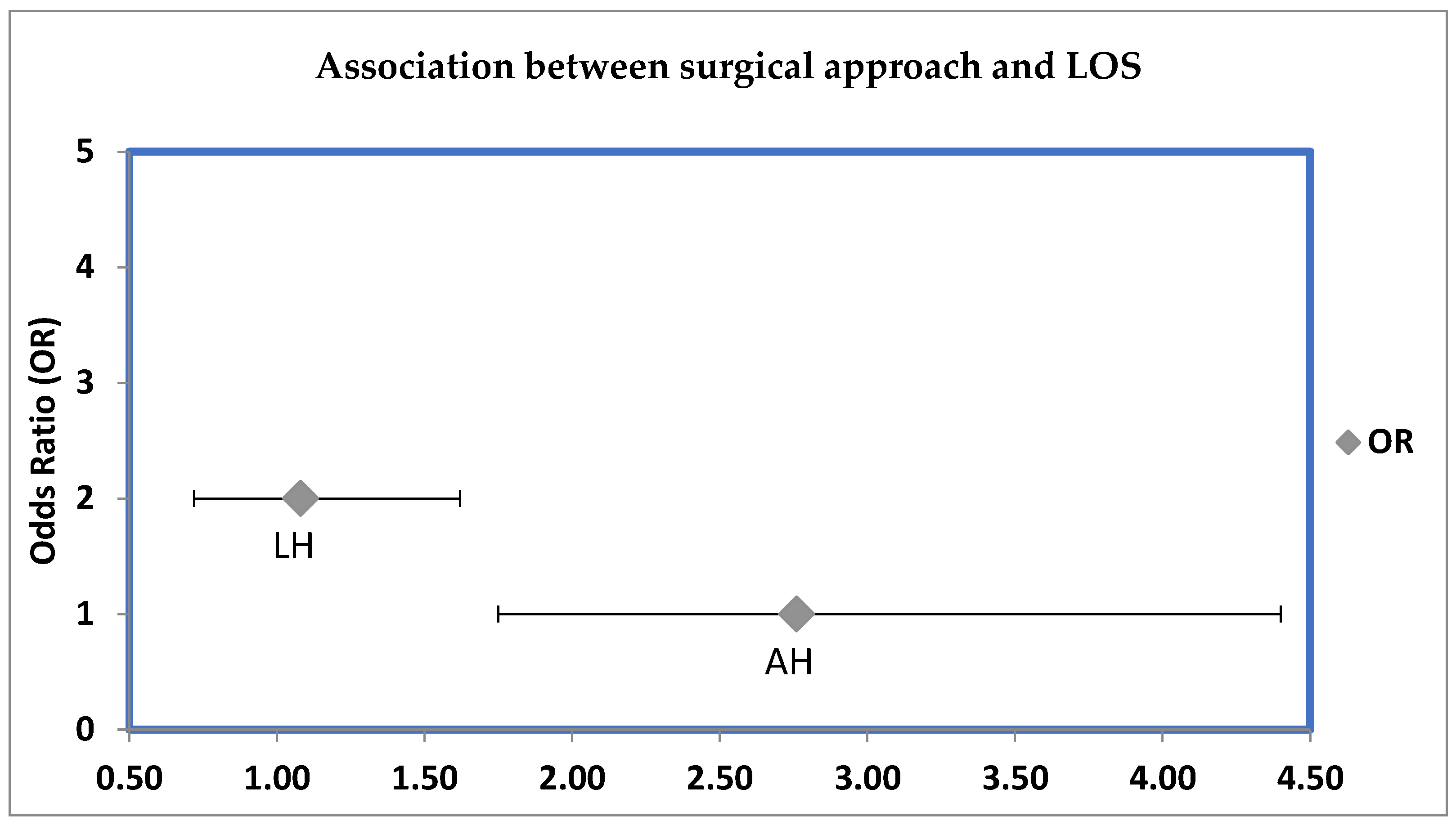
Table 1.
Distribution of Surgical Approaches.
| Surgical approach | n | % |
|---|---|---|
| Abdominal (AH) | 416 | 43,28 |
| Laparoscopic (LH) | 450 | 46,82 |
| Vaginal (VH) | 95 | 9,8 |
| Total | 961 | 100% |
Table 2.
Distribution of non-clinical determinants of algorithm deviation in AH subgroup.
| Non clinical factors | n | % |
|---|---|---|
| Surgeon | 188 | 59,87 |
| Resources | 122 | 38,85 |
| Others | 4 | 1,27 |
| Total | 314 | 100% |
Table 3.
Descriptive analysis of the average length of hospital stay, depending on the type of surgical approach.
Table 3.
Descriptive analysis of the average length of hospital stay, depending on the type of surgical approach.
| LOS | ||||
|---|---|---|---|---|
| Surgical Approach | AH | LH | VH | Total (LOS) |
| Valid | 102 | 135 | 95 | 332 |
| Missing values | 0 | 0 | 0 | 0 |
| Median | 6 | 6 | 6 | 6 |
| Mean | 6,56 | 6,45 | 6,37 | 6,46 |
| Upper limit of the 95% CI for the mean | 6,92 | 6,91 | 6,77 | 6,70 |
| Lowerlimit of the 95% CI for the mean | 6,19 | 5,98 | 5,97 | 6,21 |
| Standard deviation (SD) | 1,86 | 2,72 | 1,96 | 2,27 |
| Upper limit of the 95% CI for the standard deviation | 2,16 | 3,09 | 2,28 | 2,45 |
| Lowerlimit of the 95% CI for the standard deviation | 1,63 | 2,43 | 1,71 | 2,11 |
Disclaimer/Publisher’s Note: The statements, opinions and data contained in all publications are solely those of the individual author(s) and contributor(s) and not of MDPI and/or the editor(s). MDPI and/or the editor(s) disclaim responsibility for any injury to people or property resulting from any ideas, methods, instructions or products referred to in the content. |
© 2026 by the authors. Licensee MDPI, Basel, Switzerland. This article is an open access article distributed under the terms and conditions of the Creative Commons Attribution (CC BY) license (http://creativecommons.org/licenses/by/4.0/).
Copyright: This open access article is published under a Creative Commons CC BY 4.0 license, which permit the free download, distribution, and reuse, provided that the author and preprint are cited in any reuse.


